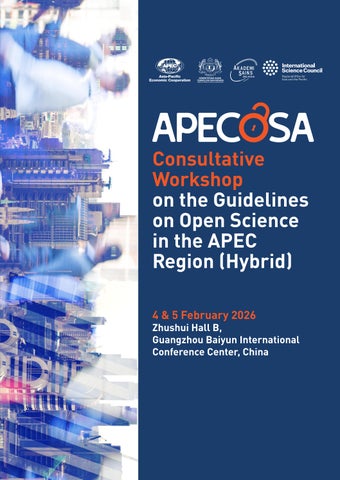
APECOSA Consultative Workshop on the Guidelines on Open Science in the APEC Region (Hybrid)

Page 1


Consultative Workshop on the Guidelines on Open Science in the APEC Region (Hybrid)

4 & 5 February 2026

Zhushui Hall B, Guangzhou Baiyun International Conference Center, China
The APEC Open Science Alliance (APECOSA) is a regional initiative dedicated to transforming the scientific landscape of the APEC region to address complex regional challenges through inclusive and sustainable development. By enabling the preservation, accessibility, and reusability of data, the alliance seeks to remove traditional barriers to the free flow of knowledge. Central to its mission is the promotion of responsible research conduct, which emphasises transparency and the strategic reduction of research duplication to ensure resources are utilised effectively across the region.

The momentum for this movement began in 2017 with the endorsement of the Policy Statement on Science, Technology and Innovation Communication at the APEC PPSTI-10 in Viet Nam. This landmark statement recognised that Open Science and Open Access are critical for maximising returns on both public and private investments. It further highlighted how openness reinforces international cooperation and facilitates rapid scientific inquiry that proved indispensable during the COVID-19 pandemic, ultimately fostering research in emerging fields that offer significant regional and global benefits.

Building upon this policy foundation, Malaysia introduced the formal concept of APECOSA in 2023 through the Academy of Sciences Malaysia (ASM) and the Ministry of Science, Technology and Innovation (MOSTI). Presented during the 23rd Policy Partnership on Science, Technology and Innovation (PPSTI-23), the initiative received strong collective support from member economies. This led to a series of foundational activities in 2024, including two workshops designed to assess the current Open Science landscape. These efforts culminated in the “Landscape Study Report on Policy Recommendations for The Implementation of APECOSA”, which was formally presented at APEC PPSTI SOM 1 in February 2025.

The alliance is now entering its next strategic phase: the production of the “Guidelines on Open Science in the APEC Region”. Although many member economies have already implemented their respective national policies, these new guidelines serve to consolidate diverse local approaches into a unified regional reference. This concerted effort ensures that APECOSA moves forward in a coherent and systematic manner, providing a shared framework that strengthens the scientific ecosystem for all APEC members.

Day 1 (4 February 2026)

Time Session (Details)

09:00 09:40

Opening remarks by

10:00 11:30 11:45 13:15

14:30 16:00

• Dr Hwanil Park , Chair of the APEC Policy Partnership on Science, Technology and Innovation (APEC-PPSTI)

• Madam Hazami Habib, CEO of the Academy of Sciences Malaysia (ASM)

• Ms Ronit Prawer, Director of International Science Council-Regional Focal Point for Asia and the Pacific (ISC RFP-AP)

Presentation on APECOSA Virtual Workshop

Short recap on APECOSA and the findings of the APECOSA Virtual Workshop by Professor ChM Dr Noorsaadah Abd Rahman FASc , APECOSA Project Overseer & Secretary-General of ASM

Key Lessons from Open Science Global Initiatives

Experts share on the existing global initiatives such as ISC CODATA, UNESCO Recommendations on Open Science & The Declaration on Research Assessment (DORA), and how these initiatives can complement and contribute to the guidelines of open science in the APEC region.

Moderator:

Madam Hazami Habib, CEO of ASM

Panelists:

• Professor Virginia Barbour, Co-chair of DORA, Australia

• Dr Eunjung Shin , Senior Research Fellow, Science and Technology Policy Institute (STEPI), Republic of Korea

• Professor Wibool Piyawattanametha , Lead Principal Investigator, Open Science Policy for Thailand Science and Research Innovation (TSRI)

Presentation of the APECOSA Virtual Workshop Survey Results

The survey results of the strategic pillars framing the guidelines on Open Science in the APEC region are presented to the participants.

Validation of Strategic Pillars of the Guidelines on Open Science in the APEC Region I

Strategic Pillar 1: Policy and Governance

Led by Professor Virginia Barbour, Co-chair of DORA, Australia

Lunch

Validation of Strategic Pillars of the Guidelines on Open Science in the APEC Region II

Strategic Pillar 2 & 3: Capacity Building, Funding & Incentives

Led by Professor Wibool Piyawattanametha , Lead Principal Investigator, Open Science Policy for Thailand Science and Research Innovation (TSRI)

Validation of Strategic Pillars of the Guidelines on Open Science in the APEC Region III

Strategic Pillar 4 & 5: Ethics, Security and Infrastructure & Data Management

Led by Dr Eunjung Shin , Senior Research Fellow, Science and Technology Policy Institute (STEPI), Republic of Korea

18:00

Wrap-up of Day 1

Day 2 (5 February 2026)

Time Session (Details)

09:00

09:15

11:00

11:15

Recap of Day 1

Zero Draft Guidelines on Open Science in the APEC region I

Based on the consolidated input from the writing template, participants are tasked with writing 2-3 paragraphs of guideline content, including 3-5 actionable recommendations for each strategic pillar.

Coffee Break

Zero Draft of the Guidelines on Open Science in the APEC region II

Based on the consolidated input from the writing template, participants are tasked with writing 2-3 paragraphs of guideline content, including 3-5 actionable recommendations for each strategic pillar.

12:00

Closing & Next Milestones

Outline agreed next steps in alignment to project workplan, including but not limited to:

• Agreed timeline for the final endorsement of PPSTI for Guidelines on Open Science in the APEC Region

• Further consultation with PPSTI, researchers, government ministries

• Volunteer for Guidelines Drafting Committee

Chair, APEC Policy

Partnership on Science, Technology and Innovation (APEC-PPSTI)

Dr Hwanil Park is a senior research fellow in the Directorate for Global Strategy at the Science and Technology Policy Institute (STEPI), Korea, since 2016. He mainly focuses on the science, technology and innovation (STI) policy for climate change and its risk mitigation.

As the Chief Director of the Division of Global Innovation Strategy from 2021 to 2024 at STEPI, he had overseen various scopes of projects focusing on the STI policy for the global challenges with perspectives of national, regional, and global levels. In particular, he had led a national project to establish a science diplomacy strategy for the Korean government in 2019. He is currently participating in APEC PPSTI and G20 RIWG as a Korean delegate, and conducting a field research project with UNOSSC to explore sustainable STI policies and technologies for the water, energy, and food NEXUS in the Mekong region as a primary researcher.

Dr Park was formerly the Vice-Chair of APEC PPSTI 2021 before becoming Chair in 2026. He is also engaged as an expert in a range of government organisations, including the Presidential Commission on Carbon Neutrality and Green Growth, the Ministry of Science and ICT, Korea Meteorological Administration, and the National Research Foundation of Korea.

Prior to joining STEPI, Dr Park served as a Specialist at the Bureau of Supporting Green Growth at the Office for Government Policy Coordination, RoK (2016). He also worked as Director of the Policy Research Division at the Green Technology Centre (2014-2015) and as a Research Fellow at the Samsung Economic Research Institute (2009-2014).

His main research interests are 1) dynamics of markets, the environment and economy, 2) STI for sustainable development and climate change, and 3) international cooperation of science and technology.

He received PhD and an MA in Agricultural and Applied Economics from the University of Wisconsin-Madison, USA, in 2009. He earned his BA in Agronomy at Korea University in 1998.

and Innovation (APEC–PPSTI),

CEO, Academy of Sciences Malaysia (ASM)

Madam Hazami Habib currently serves as the CEO of ASM and the Vice-Chair of APEC-PPSTI, specialising in STEM talent development, policies, strategic science communication, foresight, science diplomacy, and governance. She has contributed to key initiatives such as the APEC-PPSTI Meetings, National Science Challenge, and the Next-Generation Talent Towards a Knowledge-Based, Values-Driven Development Study.

She played a major role in formulating national policies and roadmaps, including the National Policy on STI (NPSTI) 2021–2030, the 10-10 MySTIE Framework, the National Planetary Health Action Plan (NPHAP), the National Education Reform Framework, Water Sector Transformation 2040 (WST2040), and the Research, Development, Innovation, Commercialisation, Economy (RDICE) Roadmap.

As CEO, she oversees ASM’s flagship studies such as the Foresight Study on Malaysia 2050 and Science Outlook. She also serves on the Board of Trustees of Yayasan Pintar Negara (YPN). Internationally, she has represented Malaysia at the China-ASEAN Technology Transfer and STI Cooperation Forum (China), ASEAN Talent Mobility Workshop (Thailand), and the UN World Summit on Information Society (WSIS) (Switzerland).

Director, International Science Council-Regional Focal Point for Asia and the Pacific (ISC RFP-AP)

Ronit Prawer is the Head of International Affairs at the Australian Academy of Science and serves the International Science Council as Director of the Regional Focal Point for Asia and the Pacific.

Starting her career as a geneticist, Ronit is a distinguished science diplomat and strategic leader whose work advances the integration of scientific evidence into global policy and cooperation. Her leadership builds on extensive global experience in managing science partnerships across governments, non-government organisations, industry, and academia. Prior to this appointment, she was Director of Science and Innovation at the British Consulate in Boston, where she led strategic management of the US–UK bilateral science relationship.

A Fellow of the Centre for Science and Policy at the University of Cambridge, Ronit has been at the helm of initiatives that support transdisciplinary engagement and collaboration, including contributions to the successful launch of the Pacific Academy of Sciences and the development of the Asia Science Mission Program for sustainability. In 2022, she was selected as a senior executive fellow at Harvard University’s Kennedy School of Government.

Ronit’s work is defined by her commitment to fostering collaboration across disciplines, borders, and communities to ensure science contributes to sustainable solutions for society’s most pressing challenges.

Professor ChM Dr Noorsaadah Abd Rahman FASc

Project Overseer, APECOSA

Secretary-General, Academy of Sciences Malaysia (ASM)

Professor ChM Dr Noorsaadah Abd Rahman FASc received her PhD from Cambridge University in 1990 and joined Universiti Malaya (UM) as a lecturer in the Department of Chemistry. She was appointed the deputy director for UM’s Institute of Research Management and Monitoring (IPPP) in 2006 and subsequently the director in 2009. In 2015, she ascended to the distinguished role of Deputy Vice-Chancellor (Research & Innovation) of UM, a position she held with unwavering dedication until her well-deserved retirement in 2021. Her remarkable journey was adorned with accolades, as she was honoured as a Fellow of ASM and bestowed with the prestigious Top Research Scientists Malaysia (TRSM) award in 2014. 2018 marked another pinnacle in her illustrious career as she was elevated to the esteemed position of Fellow (ChM) of the Institut Kimia Malaysia. She, then, was elected as a Fellow of the World Academy of Sciences in 2024.

Professor Noorsaadah is currently the Secretary-General of ASM. She chairs the Malaysia Open Science Alliance (MOSA) under the auspices of the academy, which oversees the implementation of the Malaysia Open Science Platform. At the regional level, she is overseeing the APEC Open Science Alliance (APECOSA) initiative. Professor Noorsaadah strongly supports advancing science education and is very much involved in promoting science education in Malaysia through various programmes such as the National Science Challenge and the International Chemistry Olympiad.

Professor Virginia Barbour

Co-chair of the Declaration on Research Assessment (DORA), Australia

Professor Virginia Barbour is the Editor-in-Chief of the Medical Journal of Australia and an Adjunct Professor in the Faculty of Health at Queensland University of Technology. She trained in both clinical and academic haematology in the UK and has since built a distinguished career spanning research, publishing, and research policy.

In 2004, she was one of the founding editors of PLOS Medicine. She previously served as Director of Open Access Australasia, where she played a key role in promoting open access initiatives.

Professor Virginia is currently Co-Chair of the Declaration on Research Assessment (DORA) and was previously Chair of the Committee on Publication Ethics (COPE). She is also a member of the NHMRC and MRFF Public Health and Health Systems Committee and previously served on the NHMRC Research Quality Steering Committee.

Dr Eunjung Shin

Senior Research Fellow, Directorate for System Innovation, Science and Technology Policy Institute (STEPI), Republic of Korea

Dr Eunjung Shin is a Senior Research Fellow of the Science and Technology Policy Institute (STEPI). She joined STEPI after her graduation from the University of Illinois in Chicago in 2013. Since then, she has led multiple policy research on research data and infrastructure, open science, and bio-research materials. Her research interests are in the intersection between public policy and research inputs in a digital era.

She served as a member of the UNESCO Open Science Advisory Committee (2020-2021) as well as the OECD Advisory Group on Enhanced Access to Research Data (2019-2020), and Vicechair of the Science, Engineering, Technology and Innovation Policy Asia and the Pacific Network (STEPAN) affiliated with UNESCO Jakarta Office (2021-2025). She currently participates in UNESCO working groups on open science and a couple of other international working groups on research software.

Dr Wibool

Piyawattanametha

Lead Principal Investigator, Open Science Policy for Thailand Science and Research Innovation (TSRI)

Dr Wibool Piyawattanametha is a Professor of Biomedical Engineering, Director of the Advanced Imaging Research Center at King Mongkut’s Institute of Technology Ladkrabang, Thailand, and an Adjunct Professor at Michigan State University, USA. He received his PhD in Electrical Engineering from UCLA in 2004 and previously served as a senior scientist at Stanford University’s Bio-X Program.

Dr Piyawattanametha’s research focuses on AI, MEMS, photonics, and biomedical imaging for early cancer detection. He is a Fellow of the International Science Council (ISC) and the Society of Photo-Optical Instrumentation Engineers (SPIE), and serves as Senior Editor of IEEE Photonics Technology Letters.

He was awarded the Fraunhofer-Bessel Research Award granted by the Alexander von Humboldt Foundation and was recognised among the Top 40 Young Scientists under 40 by the World Economic Forum for his leadership at the intersection of science, innovation, and global policy. He is also a cofounding member and former executive member of the Global Young Academy.

Dr Piyawattanametha is the founder of DeepPap, Inc. and DeepMam, Inc., These two startups develop AI-driven diagnostic platforms for ultra-fast whole-slide imaging and the early detection of cervical and breast cancers. His multidisciplinary work bridges advanced imaging, artificial intelligence, and open science to advance equitable and sustainable health innovation globally.

About the Academy of Sciences Malaysia

The Academy of Sciences Malaysia (ASM) is a statutory body under the purview of the Ministry of Science, Technology and Innovation (MOSTI). As a Thought Leader and Changemaker, ASM provides strategic advice to the Government through its expert network on matters related to science, technology, innovation, and the economy (STIE). ASM also serves as a platform for knowledge exchange among academia, policymakers, civil society, and industry.

ASM currently comprises more than 1,000 experts, including Fellows, Top Research Scientists Malaysia (TRSM), the Young Scientists Network (YSN-ASM), Associates, and Mahathir Science Award Laureates. These experts span eight disciplines: Engineering Sciences; Medical and Health Sciences; Biological, Agricultural, and Environmental Sciences; Information Technology and Computer Sciences; Chemical Sciences; Mathematics, Physics and Earth Sciences; Science & Technology Development and Industry; and Social Sciences and Humanities.

Our core activities include providing independent, evidence-based input to the Government, conducting foresight and strategic studies, and driving key science-based programmes at national, regional, and global levels. Our ethos is “Think Science, Celebrate Technology, Inspire Innovation”.

For more information, visit www.akademisains.gov.my

About Seeds of Science, Asia

The APECOSA Workshop on Guidelines of Open Science in the APEC region is supported by the Seeds of Science, Asia (SoSA) grant funding programme, run by the International Science Council’s Regional Focal Point for Asia and the Pacific (ISC-RFP) and the International Network for Governmental Science Advice in Asia (INGSA-Asia). The program is an opportunity for scientists, researchers, academics and practitioners in Asia to share their knowledge and insights on science advice with members of the scientific community and policymakers in their respective countries. Equally, it is an opportunity for policymakers, civil servants, and government officials to explore how science advice can best support their work, and to provide relevant advice to scientists about the complexities of policymaking, and how science can be efficiently integrated therein.

Acknowledgement

The APECOSA Workshop on Guidelines of Open Science in the APEC region is being supported by the ISC-RFP, which is funded by the Australian Department of Industry, Science and Resources and led by the Australian Academy of Science. The five-year programme (2023-2028) is working to ensure that regional needs and priorities are adequately represented in ISC’s global agenda on issues of major importance to both science and society. This workshop is being supported by the International Network for Governmental Science Advice-Asia (INGSA-Asia), which is funded by the Quebec government and the Fonds de Recherche du Québec.

Turn static files into dynamic content formats.

Create a flipbook
Issuu converts static files into: digital portfolios, online yearbooks, online catalogs, digital photo albums and more. Sign up and create your flipbook.