

MANILA — The Philippines is excluded from the list of 75 countries whose nationals are affected by the United States’ temporary suspension of visa processing, according to Philippine Ambassador to the U.S. Jose Manuel “Babe” Romualdez.
“No, not included,” he told the Inquirer in a text message on Thursday when he was asked about the matter.
The State Department, led by Secretary Marco Rubio, earlier said it had instructed consular officers to halt immigrant visa applications from the countries affected in accordance with a broader order issued in November that tightened rules around potential immigrants who might become “public charges” in the U.S.
The suspension will not apply to applicants seeking non-immigrant, or temporary tourist or business visas.
“The Trump administration is bringing an end to the abuse of America’s immigration system by those who would extract wealth from the American people,” the department previously said in a statement.
PAGE 3

by AJPress
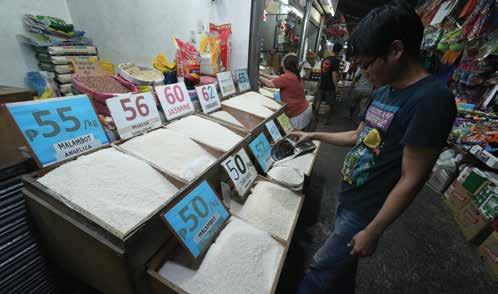
The court found probable cause in kidnapping with homicide complaints. Atong Ang, through counsel, denied involvement in the disappearance of dozens of sabungeros and said his defense will challenge the arrest warrants, as authorities announced a P10 million reward for information leading to his arrest.
by AJPress
Enrique Razon Jr. filed two cyberlibel complaints against Cavite Rep. Kiko Barzaga over posts alleging bribery in Congress, seeking P110 million in damages.
by AJPress
to bribery and corruption in the
House of Representatives.
The complaints were filed on January 14, 2026, before the Makati City Prosecutor’s Office, according to statements from Razon’s legal counsel cited by multiple national news organizations.
Posts cited in the complaint
Dollar strength, not domestic shock, drives the decline
Analysts attributed the peso’s weakness
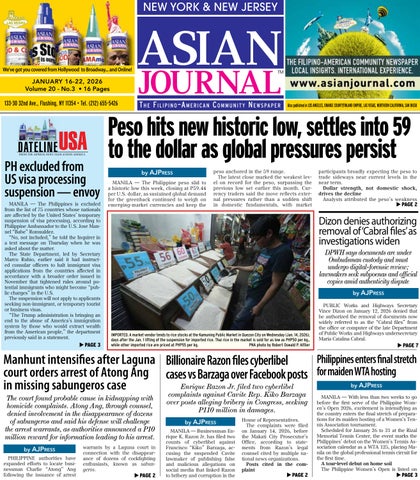
peso anchored in the 59 range. The latest close marked the weakest level on record for the peso, surpassing the previous low set earlier this month. Currency traders said the move reflects external pressures rather than a sudden shift in domestic fundamentals, with market participants broadly expecting the peso to trade sideways near current levels in the near term.
Dizon denies authorizing removal of ‘Cabral files’ as investigations widen
DPWH says documents are under Ombudsman custody and must undergo digital-forensic review; lawmakers seek subpoenas and official copies amid authenticity dispute
by AJPress
PUBLIC Works and Highways Secretary Vince Dizon on January 12, 2026 denied that he authorized the removal of documents now widely referred to as the “Cabral files” from the office or computer of the late Department of Public Works and Highways undersecretary Maria Catalina Cabral.
u PAGE 7
by AJPress
MANILA — With less than two weeks to go before the first serve of the Philippine Women’s Open 2026, excitement is intensifying as the country enters the final stretch of preparations for its maiden hosting of a Women’s Tennis Association tournament.
Scheduled for January 26 to 31 at the Rizal Memorial Tennis Center, the event marks the Philippines’ debut on the Women’s Tennis Association calendar as a WTA 125, placing Manila on the global professional tennis circuit for the first time.
A tour-level debut on home soil
The Philippine Women’s Open is listed on u PAGE 3
PAGE 1
primarily to the strength of the U.S. dollar, which has remained firm as investors reassess the timing and scale of potential interest rate cuts by the Federal Reserve.
When U.S. interest rates stay elevated, dollar-denominated assets become more attractive to global investors. That dynamic draws capital toward the United States and away from emerging markets, placing downward pressure on currencies such as the peso. Similar trends have been observed across Asia in recent weeks.
Energy imports add pressure at the margin Rising energy prices have compounded currency pressures. The Philippines is a net importer of oil, and higher crude prices increase demand for dollars to pay for fuel imports, adding incremental strain to the exchange rate.
Central bank signals continuity, not defense
The Bangko Sentral ng Pilipinas has reiterated that it does not target a specific exchange rate level. Instead, the central bank’s policy is to intervene only to smooth excessive vola-
tility and prevent disorderly market conditions.
BSP officials have said the peso’s recent movements are largely driven by global factors and that there is no intention to defend any particular level, even if the currency weakens further. Market participants noted that this stance preserves foreign exchange reserves and aligns with long-standing policy.
Markets expect consolidation rather than a free fall
Despite the record low, economists and bank strategists do not expect a sharp or sustained slide in the near term. Several forecasts point to the peso remaining broadly range bound around the 59-to-the-dollar level, assuming no major external shock and a gradual easing of global monetary conditions later in the year.
HSBC Private Bank has said the peso is expected to remain largely range bound, with projections placing it close to current levels toward the end of 2026. Analysts cautioned that short-term volatility is likely as markets respond to U.S. inflation data, shifts in risk sentiment, and policy
signals from major central banks.
Everyday impact unfolds gradually
For consumers, a weaker peso can translate into higher prices for imported goods, particularly fuel and products tied to global commodity markets. These effects typically filter through over time rather than appearing immediately.
For households receiving remittances from overseas, peso weakness means each dollar converts into more pesos, offering some relief, although that benefit can be offset if domestic prices rise.
A currency shaped by global forces
For policymakers, the challenge remains balancing currency flexibility with price stability. As long as inflation remains manageable and markets stay orderly, officials have signaled that exchange rate movements alone will not drive policy shifts.
The peso’s historic low underscores the Philippines’ exposure to a dollar-driven global financial system, where international forces often outweigh local developments in determining currency direction. n
The cyberlibel complaints stem from January 9 Facebook posts attributed to Barzaga. In those posts, Barzaga alleged that members of the National Unity Party received bribes from Razon during gatherings at Solaire ahead of the 2025 elections, purportedly in exchange for supporting House Speaker Martin Romualdez.
Another post cited in the complaint described Razon as the “mastermind behind the corruption in Congress” and included the hashtag #IkulongSiRazon. Razon maintains that these statements are entirely false and defamatory.
Razon denies allegations
Through counsel, Razon denied having bribed any lawmaker or political party, saying the posts went beyond protected political speech and constituted malicious imputations that damaged his reputation. The complaint argues that the allegations were presented as statements of fact despite lacking proof, and that they were disseminated to a wide audience through social media.
Damages sought
Razon is seeking P100 million in moral damages and P10 million in exemplary damages, citing reputational harm, emotional distress, and the broader impact of the allegations on his personal and business standing.
The Regional Trial Court Branch 26 in Santa Cruz, Laguna issued the warrants on January 13, 2026, ordering Ang’s arrest in cases alleging kidnapping with homicide and kidnapping and serious illegal detention. The offenses cited in the warrants are classified as non-bailable under Philippine law. The issuance of the warrants reflects the court’s finding that probable cause exists to hold the accused for trial.
associated with Ang have been revoked or placed under review, and that registered weapons are subject to surrender in accordance with standard procedures when a suspect faces serious criminal charges and remains at large.
Officials said the measures are precautionary and are intended to mitigate security risks while the arrest warrants are outstanding.
Several accused under custody; coordination across agencies
cockfighting matches. A whistleblower and co-accused has claimed the victims were killed and disposed of, including allegations that bodies were dumped in Taal Lake. Authorities have confirmed that search operations in the area resulted in the recovery of human remains.
Barzaga’s response
Barzaga, who is serving a 60-day suspension from the House of Representatives that took effect on December 1, 2025, has said he is prepared to face the complaints. In media interviews, he said he intends to present evidence supporting his claims in the appropriate forum.
Party reaction
The National Unity Party, through its chair, former House Speaker Ronaldo “Ronnie” Puno, has said the party is also considering legal action, arguing that Barzaga’s statements unfairly maligned its members by accusing them of accepting bribes.
Legal framework
Cyberlibel is prosecuted under the Cybercrime Prevention Act of 2012 (Republic Act No. 10175), which treats libel committed through computer systems as a criminal offense. The Supreme Court has upheld the constitutionality of the law’s cyberlibel provision, while emphasizing that courts must balance reputational rights with freedom of expression.
The cases now move to preliminary investigation, where prosecutors will determine whether sufficient grounds exist to file charges in court. At this stage, the filings reflect competing claims, and no findings on the merits have been made. n
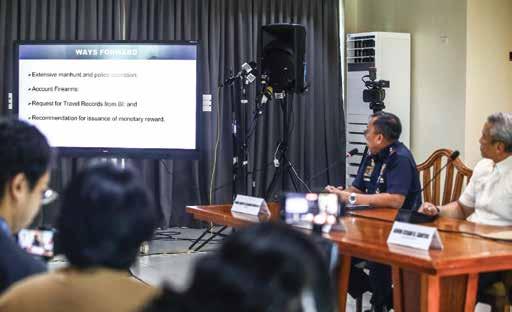
Police step up operations; reward announced
The Philippine National Police said it has begun implementing the court orders and coordinating across units to locate Ang, who remains at large.
Interior and law enforcement officials announced that a P10 million reward is being offered for information that would directly lead to Ang’s arrest. In public briefings, officials have described Ang as the top priority of the ongoing manhunt, underscoring the seriousness of the charges filed before the court.
Authorities said tips will be assessed through established law enforcement channels and emphasized that the reward will apply only to information that results in a lawful arrest.
Firearms permits reviewed amid manhunt Police officials also confirmed that firearms licenses
Police said several individuals named in the same warrants are already under restrictive custody, including police personnel who were directed to surrender to the Criminal Investigation and Detection Group for processing.
Authorities said coordination is ongoing among law enforcement, justice, and immigration agencies as part of routine procedures following the issuance of arrest warrants in serious criminal cases.
Origins of the case
The court action follows a Department of Justice resolution issued in December 2025, which found prima facie evidence to indict Ang and other respondents in connection with the disappearance of at least 34 sabungeros reported missing between 2021 and 2022.
Prosecutors allege the victims were abducted following disputes linked to
These claims remain allegations and have not yet been ruled on by the courts. Defense disputes warrants, cites due process Ang, through legal counsel, has denied involvement in the disappearances. His defense has questioned the validity of the arrest warrants, raising concerns over procedure and due process, and said it will pursue legal remedies to challenge the court’s findings.
Case advances to enforcement stage
With arrest warrants now issued, the case has entered the enforcement phase of judicial proceedings. Prosecutors are expected to move toward arraignment and pretrial hearings once all accused are brought before the court.
For families of the missing sabungeros, the expanded manhunt and reward offer mark a significant development in a case that has remained unresolved for years. For the justice system, it represents the point at which competing claims will be examined through formal trial proceedings. n
PAGE 1
The countries affected by the suspension announced on Wednesday are: Afghanistan, Albania, Algeria, Antigua and Barbuda, Armenia, Azerbaijan, Bahamas, Bangladesh, Barbados, Belarus, Belize, Bhutan, Bosnia, Brazil, Burma, Cambodia, Cameroon, Cape Verde, Co-
lombia, Congo, Cuba, Dominica, Egypt, Eritrea, Ethiopia, Fiji, Gambia, Georgia, Ghana, Grenada, Guatemala, Guinea, Haiti, Iran, Iraq, Ivory Coast, Jamaica, Jordan, Kazakhstan, Kosovo, Kuwait, Kyrgyzstan, Laos, Lebanon, Liberia, Libya, Macedonia, Moldova, Mongolia, Montenegro, Morocco, Nepal, Nicaragua, Nigeria,
Pakistan, Republic of the Congo, Russia, Rwanda, Saint Kitts and Nevis, Saint Lucia, Saint Vincent and the Grenadines, Senegal, Sierra Leone, Somalia, South Sudan, Sudan, Syria, Tanzania, Thailand, Togo, Tunisia, Uganda, Uruguay, Uzbekistan and Yemen.
(With a report from Associated Press/ Inquirer.net)
PAGE 1
the WTA calendar as a hardcourt tournament with a $115,000 prize pool, featuring a 32-player singles draw and 16-team doubles field. As a WTA 125 event, it offers ranking points and competitive opportunities for players moving between the ITF and main WTA Tour levels, while giving local fans rare, closeup access to international women’s tennis.
For Philippine sports officials, the listing itself represents a milestone years in the making. Securing a WTA-sanctioned event requires compliance with strict standards covering courts, player services, officiating, medical support, broadcast readiness, and operations.
Rizal Memorial upgrade under pressure
At the center of the preparations is the historic Rizal Memorial Tennis Center, part of the Rizal Memorial Sports Complex. The venue has undergone accelerated upgrades to meet WTA specifications, including court resurfacing, improved lighting, player facilities, and tournament operations areas.
The Philippine Sports Commission (PSC), working with the Philippine Tennis Association (PHILTA), has overseen the refurbishment as part of a broader push to modernize legacy sports infrastructure. Officials have described the work as both event-driven and future-oriented, positioning the venue for continued international and regional use beyond the tournament.
Test events and local competitions have already been staged on the refurbished courts, allowing organizers to simulate match conditions, officiating flow, and crowd management ahead of the WTA arrival.
Ticketing and access Organizers have emphasized accessibility in pricing for the inaugural staging. Tickets for qualifying matches are set at entry-level prices, while main-draw sessions

and championship rounds are priced below typical international tour standards.
The approach, officials say, is deliberate: to prioritize audience-building, introduce more Filipinos to live professional tennis, and ensure a strong atmosphere for the tournament’s first edition. Junior players and grassroots programs are also expected to be integrated into the event through ball-kid participation and on-site engagement activities.
Local players in focus
Beyond the international field, attention is centered on Filipino participation. Wildcard entries have been earmarked for local players, giving homegrown talents the chance to compete against WTA-ranked opponents on Philippine soil.
For PHILTA, this exposure is a central objective. Competing in a tour-level event at home reduces the financial and logistical barriers that often limit international experience for developing players, while offering ranking opportunities that would otherwise require overseas travel.
Managing expectations
While the WTA listing lends global credibility, organizers have also cautioned that final player fields can shift late due to scheduling conflicts, injuries, or results in preced-
Bronx Locations: Sharon Houses: 820 Jackson Avenue
Leggett Avenue: 972-976 Leggett Avenue
Woodycrest: 949-951-953 Anderson Avenue
60-68 East 162nd Street 951 Woodycrest Avenue
Brooklyn Locations: Winthrop Gardens 182 East 93rd Street 185 East 92nd Street
The Clarkson Apartment 280 East 91st Street
ing tournaments, particularly with the Philippine Women’s Open positioned near the Australian Open window.
Even so, officials stress that the success of the inaugural edition will be measured not only by names on the draw sheet, but by execution: court quality, scheduling discipline, player services, and the overall spectator experience.
Beyond a single event
Sports authorities have framed the Philippine Women’s Open as a starting point rather than a one-off spectacle. The hosting is being positioned as part of a longer-term strategy that links international event hosting, sports tourism, and athlete development.
If successfully delivered, the tournament could strengthen the case for future WTA returns and open the door to additional international competitions across other sports, reinforcing Manila’s credentials as a capable host city.
For now, the focus is firmly on the countdown. As finishing work continues at Rizal Memorial and operational teams shift into tournament mode, the Philippines is preparing to welcome the WTA — and to test whether its long-awaited return to the international tennis stage can translate into a sustainable presence. n
TO APPLY- Starting January 20, 2026:
1. Request by mail and specify Bronx or Brooklyn locaton: send self-addressed stamped envelope to Bronx Brooklyn Preservation PO Box 169 Bronx, New York 10451
2. Request an application to print by Email: applyBBP@twinpinesmgmt.com
Please specify Bronx or Brooklyn location when requesting an application.
3. Pick-up in person from BBP Offices located at:
820 Jackson Avenue Bronx, NY 10456; every Tuesday and Thursday 1:00 pm – 3:00 pm. 182 East 93rd Street, Brooklyn, New York 11212; every Wednesday and Friday 10:00 am – 2:00 pm
COMPLETED APPLICATIONS MUST BE SENT BY REGULAR MAIL TO P.O. BOX 169 Bronx, New York 10451
NO HAND DELIVERY OR EXPRESS/OVERNIGHT MAIL OR EMAILED APPLICATIONS WILL BE ACCEPTED. ONLY ONE APPLICATION PER ENVELOPE/PER HOUSEHOLD.
Bronx Brooklyn Preservation does not discriminate on the basis of race, creed, Religion, sex, national origin, age, familial status, or disability.
Governor Kathy Hochul • Mayor Zohran Mamdani

by AJPress
WASHINGTON — The federal government on January 7, 2026, released updated national nutrition advice, signaling a renewed emphasis on whole foods and a sharper warning against ultra-processed diets.
The U.S. Department of Agriculture and the Department of Health and Human Services jointly issued the 2025–2030 Dietary Guidelines for Americans, the latest edition of science-based recommendations that guide federal nutrition programs and public health messaging nationwide.
Updated every five years, the guidelines shape meals served in schools, childcare centers, senior nutrition programs, and military and veterans’ facilities. They are also widely used by healthcare providers and policymakers as a benchmark for dietary counseling and nutrition education.
Federal officials described the update as a response to persistent diet-related health challenges in the United States, where chronic conditions linked to poor nutrition continue to drive the bulk of healthcare spending and affect workforce readiness.
Whole foods at the center of the plate
The new guidelines place clear emphasis on whole, minimally processed foods, encouraging Americans to prioritize vegetables, fruits, legumes, nuts, seeds, whole grains, healthy fats, and a variety of protein sources from both plant and animal origins.
The guidance highlights the importance of including protein at every meal and incorporating healthy fats from foods such as seafood, eggs, nuts, seeds, olives, and avocados. Fruits and vegetables are encouraged throughout the day, with an emphasis on whole forms rather than heavily processed versions.
Rather than focusing narrowly on calories or individual nutrients, the updated guidelines stress overall dietary patterns— how foods are eaten together over time — as a more meaningful measure of diet quality.
Stronger limits on ultra-processed foods
A central feature of the 2025–2030 guidelines is a

firmer stance on ultra-processed foods. Federal nutrition messaging advises Americans to limit highly processed packaged, prepared, and ready-to-eat products, particularly those high in added sugars and refined carbohydrates.
The guidance also recommends reducing consumption of sugar-sweetened beverages and choosing water or unsweetened drinks as default options. Alcohol intake is advised to be limited as part of an overall healthy lifestyle.
Federal health agencies cite research linking frequent consumption of ultra-processed foods to higher risks of obesity, type 2 diabetes, cardiovascular disease, and other chronic conditions.
Why federal guidance evolved
Officials point to a growing body of nutrition research showing that diets dominated by ultra-processed foods are associated with poorer long-term health outcomes, while eating patterns centered on minimally processed foods are linked to improved metabolic and cardiovascular health.
The agencies also note broader national implications, including the impact of diet-related conditions on healthcare costs and military readiness.
Moving beyond earlier nutrition models
The updated guidelines continue a gradual shift away from earlier federal nutrition tools, including the Food Guide Pyramid introduced in the 1990s, which
As the Philippines boosts agriculture spending, farm clustering offers overseas landowners a structured way to make farmland productive without giving up ownership.
by AJPress
emphasized food group proportions but did not clearly distinguish between refined and whole foods.
Later models, such as MyPlate, sought to simplify nutrition advice at the meal level. The 2025–2030 guidelines build on those efforts by placing greater emphasis on food quality, degree of processing, and sustainability of eating habits over time.
Designed for diverse households
Federal officials emphasized that the guidelines are intended to be flexible and culturally adaptable, allowing individuals and families to apply the recommendations within their own cuisines, traditions, and household budgets.
The guidance includes considerations for different life stages, including infants and toddlers, children and adolescents, pregnant and lactating women, older adults, individuals with chronic disease, and those following vegetarian or vegan diets.
Impact over the next five years
The 2025–2030 Dietary Guidelines will guide updates to federally funded nutrition programs and influence nutrition education and public health campaigns nationwide over the next five years.
As nutrition science continues to evolve, the revised guidance reflects a broader consensus emerging across public health research: diets built around whole, minimally processed foods remain central to improving long-term health. n
MANILA — For many Filipinos living overseas, owning farmland in the Philippines is a continuing responsibility shaped by distance. Titles are maintained, real property taxes are paid, and a relative or caretaker is often asked to watch over the land. What proves difficult from abroad is not ownership, but management: coordinating labor, inputs, equipment, and buyers across time zones and without daily oversight.
As the Philippine government increases public spending on agriculture, officials are emphasizing a policy framework intended to address one of the sector’s most persistent constraints: fragmented, smallscale production. Central to this effort is farm clustering and consolidation, an approach designed to help farms operate at scale without requiring landowners to sell or surrender their property.
For 2026, the national budget provides a P297.10 billion allocation for the agriculture sector covering the Department of Agriculture and the Department of Agrarian Reform, according to DA budget summaries. Of this amount, P185.77 billion is earmarked for the DA itself, based on bicameral conference committee figures. Officials have repeatedly stressed that the effectiveness of this spending depends not only on subsidies, but on how farms are organized.
Distance complicates what small-scale farming requires
The challenges facing overseas landowners mirror those of the broader sector. Government data cited in DA program guidelines show that average farm size in the Philippines has steadily declined from about three hectares in the 1980sto 0.9 hectare by 2012. Smaller plots are harder to mechanize, more expensive to serve with extension services, and less attractive to

institutional buyers.
For owners abroad, these constraints are amplified by distance. Managing planting schedules, hiring labor, negotiating with traders, and monitoring harvests remotely can be impractical. In some cases, informal caretaker arrangements make record-keeping and long-term planning difficult.
The result is land that may be cultivated intermittently, produce only at subsistence levels, or remain idle.
How clustering reorganizes farming without changing ownership
Farm clustering and consolidation aim to address these structural issues by organizing farmers and landholders into coordinated groups, often through cooperatives or associations, while preserving individual land ownership. Under this approach, farms within a defined area or value chain align production plans, pool access to machinery and post-harvest facilities, and market their output collectively.
The DA implements this policy through the Farm and Fisheries Clustering and Consolidation Program (F2C2). Program guidelines describe clustering as a way to achieve economies of scale, improve access to markets and financing, strengthen bargaining power, and raise productivity
across agriculture and fisheries. Cluster Development Plans, prepared with DA regional field offices and local governments, define what crops are grown, how production is scheduled, and where products are sold.
For overseas landowners, participation typically means contributing land to a cluster’s production plan while operations are handled locally. Ownership remains unchanged. Returns are usually structured through lease arrangements or agreed profit-sharing, depending on the cooperative or cluster’s model.
Turning dispersed plots into coordinated supply chains
Once land is part of a recognized cluster, it becomes eligible for support that individual farms often cannot access on their own. This may include shared machinery, drying or cold-storage facilities, training programs, financing linkages, and connections to institutional buyers such as processors or exporters.
Clustering does not eliminate agricultural risk. Weather, prices, and input costs continue to shape outcomes. What clustering changes is the operating environment: farms engage markets as organized suppliers rather than isolated sellers.


THE Philippine peso’s fall to its weakest level in history is not a technical footnote in global finance. It is a judgment on long-standing economic fragilities and a burden carried not only by those at home, but by millions of Filipinos working overseas who quietly sustain the country through their labor and remittances.
For years, peso weakness has been softened in public discourse with a convenient refrain: overseas Filipinos benefit because every dollar sent home converts to more pesos. This framing is misleading. A weak peso does not create value. It shifts pain. What remittances gain on paper, inflation steadily takes away at the market, the pharmacy, and the fuel pump.
For a news organization serving Filipinos abroad, this distinction matters. Remittances are not surplus income. They are lifelines. This is not simply global bad luck
BORN shortly after the end of the World War II, my generation has long considered itself fortunate not to have known, let alone fought in, a world war. But no one can be sure anymore how long this fragile peace can endure. My sense is that the major powers are again sleepwalking toward war in a vain and thoughtless attempt to manage a world
Global conditions matter. High interest rates in the United States have strengthened the dollar and pressured currencies worldwide. Yet not all currencies have reached historic lows. The peso’s underperformance reflects vulnerabilities economists have flagged for years.
Analysts from institutions such as the International Monetary Fund and the World Bank consistently point to the Philippines’ structural gaps: a persistent current account deficit, heavy reliance on imported food and fuel, weak agricultural productivity, and an economy driven
that has long slipped out of anyone’s control.
That world has grown immensely complex. It is differentiated into functional spheres—economy, politics, science, law, technology, and media—each driven by its own logic and resistant to central coordination. What is economically rational is often ecologically destructive; what is efficient (like artificial intelligence) may corrode what makes us human. Economic growth has

proceeded alongside widening inequality; material abundance has multiplied without a corresponding rise in human well-being.
The postwar order that modernization was expected to deliver was imagined as a coherent package: market economies, democratic politics, universal education, the rule of law, a free press, civilian control of the military, and independent science. Together, these were

more by consumption than by exports and industrial capacity.
Remittances and the BPO sector have func-
In a Jan. 4, 2026 Substack essay that has been circulating quietly but intensely among defense analysts and policymakers here in Washington, geopolitical writer Shanaka Anslem Perera distilled what many in this town sensed almost immediately after the early hours of Jan. 3.
In his analysis titled “The Delta Doctrine: How 150
tioned as shock absorbers, but they have also masked unresolved weaknesses. Instead of
Minutes Over Caracas Redrew the Map of Global Power,” Perera wrote: “The capture of Nicolás Maduro represents far more than the removal of a narco-dictator. It represents the crystallization of a new doctrine of American power that the world has not seen since the height of the Cold War.”
That observation explains why the reverberations from Caracas were felt almost instantly far beyond Latin America. In the days that
followed, conversations in Washington shifted noticeably, from think tanks along Massachusetts Avenue to discreet briefings inside allied embassies. The question was no longer what happened – but what it meant. For years after the chaotic withdrawal from Afghanistan, a lingering doubt shadowed American foreign policy. Does the United States still possess not only overwhelming capability, but the
Client agrees and covenants to
AJPI and its officers against any and all loss, liability, damage, expenses, cost, charges, claims, actions, causes of action, recoveries, judgments, penalties, including outside attorneys’ fees (individually and collectively “Claims”) which AJPI may suffer by reason of
by
EmmanuEl Tupas Philstar.com
MANILA — After rejecting an earlier offer of P1 billion each to make him and his brother go easy on a congressman and a contractor being linked to flood control anomalies, Interior Secretary Jonvic Remulla said he and Ombudsman Jesus Crispin Remulla were offered P2 billion each, which he said they rejected.
“A contractor and a congressman-contractor want us to help them in their case – removed from the list, or allowed to post bail,” Remulla said.
He declined to name the two, but he said one is connected with a group from Luzon and the other is from the Visayas and Mindanao.
The Department of the Interior and Local Government chief said the lawmaker and the contractor want help in arranging a favorable decision on their cases.
He said an emissary of the congressman from Luzon, who is also a contractor, communicated the offer through a
friend about two weeks ago.
The second person, a contractor from the Visayas, made the same offer about three to four days ago, Remulla said.
“They think we hold the key to their being cleared. But it’s their lawyers actually who hold the key to their defense before the courts,” Remulla said in Filipino at a news briefing.
Remulla said he rejected the offer outright, while his brother felt insulted when informed of the bribe offer.
Upon learning of the latest bribe offer, Remulla said his ombudsman-brother blurted out: “Is that how low they think of us?”
Asked why he and his brother did not file cases for the bribe attempt, Remulla explained the alleged principals would likely just deny the bribe attempt and call it hearsay, as only their intermediaries took part in it. He said he does not know personally the lawmakers involved.
But Remulla said he opted to make the bribe offer public to send a signal to people
involved in corruption that he and the ombudsman would never accept money in exchange for favors.
“Don’t even try, because it won’t work,” he said.
Meanwhile, an official of the Catholic Bishops’ Conference of the Philippines said several politicians have expressed interest in officially meeting with new CBCP president Lipa, Batangas Archbishop Gilbert Garcera.
Fr. Jerome Secillano, CBCP-Public Affairs Committee executive secretary, said he does not know what the politicians would like to discuss with Garcera. Secillano said the new CBCP president has not finalized a meeting yet with any of the politicians.
“There are requests for him to meet with some politicians but he wasn’t able to do it just yet,” said Secillano.
He said that it was possible that the politicians were only reaching out to Garcera “for building network,” and might just want to ask the prelate’s
8
Dizon issued the denial after Leandro Leviste, a member of the House of Representatives, publicly claimed that the retrieval or possession of the documents had been carried out with the knowledge or approval of the department’s leadership.
“The removal of files that you saw, those that former staff of Undersecretary Cabral allegedly took out, and the retrieval of files from a computer did not have my authorization. I will say that again and again,” Dizon said.
Cabral, a former DPWH undersecretary, died in late 2025, according to government and media reports. Following her death, documents attributed to her office surfaced publicly and were cited by Leviste in connection with alleged irregularities involving flood-control and infrastructure projects.
Dizon said he has not authenticated any of the documents circulating in public, stressing that the department has not verified their origin, completeness, or integrity.
The documents and Cabral’s computer are now under the custody of the Office of the Ombudsman, after the DPWH turned over records in compli-
ance with a subpoena duces tecum issued in late December 2025. Officials have said the Ombudsman is preparing a digital-forensic examination to determine the authenticity and integrity of original files. The Ombudsman has also stated that Leviste did not submit a complete set of the socalled Cabral files despite requests, a characterization that Leviste has disputed in separate statements. Authorities have emphasized that copies held outside official custody are vulnerable to alteration and cannot substitute for authenticated records obtained through formal investigative processes.
In early January, Cabral’s legal counsel said several boxes of documents that Cabral had previously identified were unaccounted for, raising additional questions about the completeness of records tied to the department’s budget preparation and project listings.
Lawmakers have since moved to secure official copies through institutional channels. The House Infrastructure Committee said it would request documents directly from the DPWH, arguing that records formally turned over to investigators should also
by AJPress
MANILA — The return to the Philippines of former Department of Public Works and Highways secretary Manuel Bonoan has been delayed after medical complications related to his wife’s recent procedure, according to the Department of Justice.
Justice Secretary Fredderick Vida said in a press briefing on Thursday, January 15, that Bonoan’s lawyer sent him an email shortly before Christmas explaining that Bonoan
could not return to the country as earlier indicated because of issues arising from an operation undergone by his wife.
Vida said the explanation was formally conveyed through counsel and involved a private medical matter. He did not provide details about the procedure or the nature of the complications, and he did not specify a revised timetable for Bonoan’s return.
Bonoan, who previously headed the Department of Public Works and Highways, had earlier informed authorities through legal represen-
tatives that he would return to the Philippines, prompting expectations within government that his arrival was forthcoming.
Vida said the Department of Justice has taken note of the explanation provided and is awaiting further communication from Bonoan or his legal team. He added that no additional action has been announced in connection with the delayed return.
Officials said the DOJ would issue updates should new information be formally relayed. n
building competitiveness, the country has learned to manage volatility by exporting its people.
The Bangko Sentral ng Pilipinas is correct to say the exchange rate is market-determined and that reserves remain adequate. But markets price confidence. When depreciation becomes historic, it reflects skepticism about longterm economic fundamentals.
be accessible to Congress through proper procedures.
In the Senate, the Blue Ribbon Committee has indicated it will pursue subpoenas as hearings resume later in January.
Dizon said he supports transparency but maintained that any disclosure must follow legal process, particularly because the records are now evidence in an ongoing investigation. He also designated DPWH Undersecretary Ricardo Bernabe III as the department’s official point person for legal questions related to the controversy.
By repeatedly stating that there was no authorization for the removal of files, Dizon sought to distinguish the department’s official actions from the manner in which the documents were obtained, while underscoring the importance of preserving the chain of custody of government records.
Authorities have not authenticated the publicly circulating “Cabral files.” Government officials and lawmakers have cautioned that the documents should not be treated as official or conclusive pending the outcome of the Ombudsman’s forensic review and related legislative inquiries. n
The daily cost of peso weakness
Currency depreciation is often discussed in percentages. Filipinos experience it in prices.
A weaker peso raises fuel costs, which ripple through transportation, electricity, and food distribution. Imported staples, medicines, school supplies, and construction materials become more expensive. Wages follow, but always too late and never far enough.
This burden is not evenly shared. Inflation driven by currency weakness is regressive by nature. Low- and middle-income families spend a larger share of their income on essentials. For them, peso depreciation is not a temporary inconvenience. It is cumulative loss.
Exporters and BPO firms may see short-term gains when dollar earnings convert into pesos. Economists caution that these benefits fade when inflation erodes purchasing power and labor costs rise in response.
Why overseas Filipinos pay twice
For overseas Filipinos, including permanent residents, dual citizens, and families long settled abroad, this is not an abstract policy debate.
Every peso lost to depreciation means more money sent home, greater sacrifice overseas, and fewer realistic paths to return.
The first payment is immediate and financial. As prices rise in the Philippines, families do not absorb the shock alone. They turn outward. Tuition increases, hospital bills, utility costs, and daily necessities are covered by remittances. Overseas Filipinos send more simply to preserve the same standard of living back home.
The second payment is longer term and personal. To send more, overseas Filipinos delay home purchases, postpone retirement, work longer hours, or abandon plans to return permanently. For many, the longer peso weakness persists, the more returning home becomes financially impractical rather than aspirational.
This is not a normal remittance cycle. Peso depreciation turns remittances from voluntary support into a compensatory mechanism. Instead of supplementing income, they replace what the economy fails to provide: stable prices, adequate wages, and affordable essentials.
The unspoken reliance
This is the moral hazard embedded in the Philippine economic model. Remittances are celebrated as stability while quietly treated as a fallback for policy failure. When growth falters, the expectation is unspoken but clear: overseas Filipinos will compensate.
This reliance delays reform. It softens pressure to confront trade-offs between consumption and investment, imports and domestic production, short-term comfort and longterm resilience. Inflation is
absorbed by families, not institutions. Stability is funded externally, not earned internally. Overseas Filipinos provide foreign currency that supports the balance of payments and domestic consumption, yet they have little influence over fiscal priorities, agricultural reform, or industrial strategy. They absorb risk without representation.
What history is warning us about
A flexible exchange rate can serve as a shock absorber. But when depreciation becomes chronic, it signals that the underlying economy is not adjusting; it is compensating for unresolved structural weaknesses.
Economists have long warned that growth built on consumption, imports, and remittances is inherently fragile. Without export diversification, food security, and productivity gains, currency weakness stops being a temporary adjustment and becomes a structural condition.
No economy can outsource resilience indefinitely.
A demand, not a plea
This moment calls for reform, not reassurance. Reducing dependence on food imports. Investing seriously in agriculture and manufacturing. Building high-value exports. Aligning fiscal ambition with execution capacity. Treating remittances as a bridge, not a permanent foundation.
For overseas Filipinos, the peso’s historic fall is not merely an economic milestone. It is a test of whether the Philippines will continue to lean on its people overseas, or finally build an economy strong enough that it no longer has to. (AJPress)
support for their programs.
He said Garcera would not be alone when he meets with the politicians.
“As I was told, he’ll do it with utmost prudence – consult bishops and other stakeholders before doing so, and bring with him some individuals as observers during the meeting,” Secillano added.
Garcera became CBCP president on Dec. 1, taking over from Kalookan’s Pablo Virgilio Cardinal David, who completed two consecutive terms, between 2021 and 2025. –Evelyn Macairan (With reports from Evelyn Macairan)
PAGE 4 PAGE 7
Trade liberalization raises the cost of remaining fragmented
political will to act decisively?
Perera framed that question bluntly, writing that the operation represented “the final answer to the question that has haunted international relations since the disastrous withdrawals from Kabul: does America still have the will to act?”
In Perera’s analysis, and in the assessment of many officials I have spoken with, the response was unmistakable. “The answer arrived on rotors in the darkness above Caracas.”
What followed was not merely a successful raid, but a carefully calibrated strategic message. Perera argues that its consequences extend far beyond Venezuela itself.
“The implications cascade across every domain of international relations,” he writes, “from the credibility of Russian arms exports to the viability of Chinese Belt and Road investments… to the calculus of every dictator who believed great-power patronage could shield them from American justice.”
That sentence encapsulates why the episode has become a reference point in Washington almost overnight. Credibility, once lost, is difficult to restore. But when reasserted, behavior changes quickly among allies and adversaries alike.
Perera also anticipates the debates that will inevitably follow. “The chattering classes will debate the legality for years. The historians will argue about proportionality for decades,” he notes. “But the dictators of the world understood the message instantly.”
Whether one agrees with the operation or not, that assessment rings true. Deterrence is not built on speeches alone. It rests on the belief that lines, once crossed, carry consequences.
From a Philippine perspective, that moment deserves careful attention. As a treaty ally of the United States situated in a contested Indo-Pacific, the Philippines depends heavily on credibili-
ty and clarity in alliance commitments. For smaller and middle powers, deterrence is not an abstract concept debated in seminar rooms. It is the invisible scaffolding that supports sovereignty, maritime rights and regional stability.
The renewed emphasis on American resolve has direct implications for the West Philippine Sea, freedom of navigation and the confidence of partners who rely on a rules-based order. It reinforces the logic behind recent defense cooperation agreements, joint exercises and capacity-building efforts that Manila has pursued steadily across administrations.
One aspect of Perera’s analysis that particularly resonates in Washington is the emphasis on preparation over improvisation. The operation was not a spur-ofthe-moment decision, but the culmination of months of pressure, intelligence work, cyber operations and electronic warfare. The lightning strike was simply the final act of a campaign already shaped in quieter and less visible arenas.
That distinction matters. Modern power is no longer defined solely by firepower but by coordination, patience and clarity of purpose – qualities that allies watch closely and adversaries study carefully.
Critics will argue, and with reason, that such actions risk escalation or weaken international norms. Those concerns merit serious discussion. But so, too, does the cost of inaction. A world in which authoritarian leaders believe they are untouchable is not a safer world. History has shown repeatedly that ambiguity, when misread as weakness, invites miscalculation.
Perera ends his essay with a line that has already become a refrain in policy circles: “The United States is back. And it is not asking for permission.”
Whether that sentiment is welcomed or viewed cau-
tiously, it undeniably signals a shift. Allies will recalibrate. Adversaries will reassess. Middle powers, especially in the Indo-Pacific, will watch closely and adjust their strategies accordingly.
Let me share an anecdote that happened a few evenings after the operation, at a small off-the-record gathering not far from Dupont Circle. A senior intelligence officer, now retired and certainly no hawk, summed it up quietly over coffee. “It’s not about Venezuela,” he said. “It’s about whether deterrence still exists.”
That, in essence, is the point.
Jan. 3, 2026 will not be remembered merely as the night a dictator fell. It will be remembered as a moment when the global conversation about power, credibility and resolve decisively changed. History will judge the long-term consequences. But the message, as Perera rightly observed, has already been received.
For the Philippines, the lesson is not to seek confrontation, but to invest consistently in capability, partnerships and national confidence. Deterrence works best when it is quiet, credible and collective. Washington’s renewed emphasis on resolve underscores why modernization, interoperability and diplomacy must move together.
In an era of sharpening competition, small states cannot afford illusions. They must read signals clearly, strengthen alliances prudently and ensure that peace is preserved – not by wishful thinking, but by preparedness grounded in shared interests and mutual respect.
These are lessons Washington insiders quietly acknowledge while the rest of the world watches closely today. (Philstar.com)
* * *
The opinions, beliefs and viewpoints expressed by the author do not necessarily reflect the opinions, beliefs and viewpoints of the Asian Journal, its management, editorial board and staff.
* * *
Email: babeseyeview@gmail.com
The push to organize farms gained urgency after the Philippines ratified the Regional Comprehensive Economic Partnership on Feb. 21, 2023. Participation in a large regional free-trade bloc exposes domestic producers to competition from countries where cooperative farming and consolidated supply chains are already standard.
Agriculture groups argued during the ratification debate that without economies of scale, Filipino producers would struggle to compete. Clustering and consolidation emerged as a practical response – offering scale with-
out dismantling smallholder or family ownership, including land held by Filipinos abroad.
How landowners abroad can enter government-backed clusters
Overseas owners generally engage through a Special Power of Attorney (SPA) authorizing a trusted local representative. The usual starting point is the Municipal or City Agriculture Office where the land is located, which can confirm whether an F2C2 cluster already exists nearby or coordinate with the DA Regional Field Office on enrollment and planning.
For national-level inquiries and verification, the Department of Agriculture – Office of the Secretary can be reached at osec.of-
ficial@da.gov.ph, through trunklines +63 (2) 8928-8741 to 64, or hotline 1381.
From inheritance to operating asset
For decades, farmland owned by Filipinos overseas has often been treated primarily as inheritance. Farm clustering reframes it as working land capable of generating income, supporting rural employment, and integrating into modern supply chains even while owners remain abroad.
As agriculture funding expands, officials say the question for overseas landowners is no longer whether they can personally farm. It is whether their land remains fragmented or becomes part of a system designed to make scale work. n
PAGE 6
meant to produce prosperity and stability. What was less appreciated was that modernity also entailed the uneven and autonomous development of these domains, with no central authority capable of harmonizing their effects. Globalization proved to be anything but seamless. It produced a few winners and many losers, both within countries and across them.
Countries that sought to maximize their gains from these transformations soon encountered the limits of control under heightened complexity. Gradually, they learned to adjust to a polycentric world society that no single nation, however powerful, could plausibly manage. The institutions once expected to provide global governance, the United Nations and its Security Council, have proved largely incapable of producing decisions binding on the world as a whole.
Emerging from the World War II as the only major power unscathed by war, the United States long assumed it could direct global developments across virtually all domains of human activity. This confidence was reinforced after the Soviet Union collapsed in 1991. For roughly two decades thereafter, American preeminence appeared unassailable. Since then, however, that dominance has been in steady, if uneven, decline. By contrast, China’s rise— as an economic powerhouse,
a hub of scientific and technological development, and a formidable military actor— has been swift and unprecedented. Benefiting more than any other country from its U.S.-sponsored entry into the global economy, China moved from cheap labor manufacturing to technological leadership, offering developing countries access to capital, infrastructure, and advanced education.
This is the world in which the U.S. is now attempting to reassert its hegemony. The perception of China as a formidable rival did not begin with U.S. President Donald Trump. What distinguishes the present moment is that these efforts are no longer couched in terms of shared values or a common global future. They have become instead self-referential, transactional, and openly coercive.
The clearest articulation of this posture appears in the U.S.’ most recent National Security Strategy, released in November 2025. There, the Western Hemisphere—from Greenland to Argentina—is defined as an immediate security perimeter, with access to American capital, technology, markets, and security guarantees treated not as public goods but as leverage to enforce alignment.
Recent events in Venezuela starkly reveal the limits of this approach. Early this month, the U.S. launched a large-scale military operation there, capturing Presi-
dent Nicolás Maduro, who was then taken to the U.S. to face criminal charges. The intervention—the most direct American military action in Latin America in decades—has drawn sharp international criticism and raised serious legal questions. Even as U.S. officials have spoken of overseeing aspects of Venezuela’s political and economic future, governance on the ground remains contested. This episode underscores the difficulty of imposing control even over a single country.
All this is undertaken in the name of making America great again. Few countries are presently in a position to openly challenge such unilateral assertiveness. Yet the deeper problem lies elsewhere. This effort rests on a basic misreading of the world as it has become. It assumes that a complex and highly differentiated world can be steered as if it were hierarchically ordered and politically pliable. That assumption is the real hubris of our time. Attempts to impose coherence on a world that resists it may yield illusory gains. But, more likely, they will deepen existing conflicts and hasten the very instability they seek to manage. (Inquirer.net) * * *
The opinions, beliefs and viewpoints expressed by the author do not necessarily reflect the opinions, beliefs and viewpoints of the Asian Journal, its management, editorial board and staff. * * * public.lives@gmail.com
by Dexter Cabalza, luisa Cabato Inquirer.net
MANILA — From saying in 2024 that impeaching Vice President Sara Duterte would be a “waste of time” and he wasn’t supporting it, President Ferdinand Marcos Jr. appears to have had a change of heart and is now open to letting the process play out.
Following news that a fresh impeachment complaint will be filed in the House of Representatives against Duterte, Palace press officer Claire Castro on Monday said the President’s view was that the move against the vice president should be treated similarly to how the government investigates the flood control mess.
“The president only said that the impeachment complaint against Vice President Sara would be treated the same way as discussions and investigations into the anomalous flood control projects,” she told reporters in a briefing.
“It means that whoever should be held accountable should be made accountable. That’s the President’s order. There should be no exceptions,” she said.
Asked what made the president change his stance, Castro said, “It may be that the extent of the issue at that time was not yet fully seen or understood.”
‘Not important’
In late November 2024, following the breakup of Duterte’s political alliance with
the administration, Marcos told reporters that he opposed the plan of some members of the lower house to impeach Duterte, saying the highly polarizing political process would not benefit the Filipino people.
“This is not important. This does not make any difference to even one single Filipino life. So, why waste time on this? None of this will help improve a single Filipino life,” he said.
Several House lawmakers, particularly members of the Makabayan bloc, are set to refile and endorse the impeachment complaint to the House justice committee next month as the one-year ban on Duterte’s impeachment lapses on Feb. 6.
But this time, Malacañang said that if lawmakers have the evidence against Duterte, they should proceed with the filing, and “the president will not interfere with their mandate.”
Castro said Marcos would allow the impeachment process to take its course, “and whatever outcome emerges in accordance with the law and proper procedure will be supported by the president.”
She also expressed hope that the legislators hearing the new impeachment complaint “will think about the interest of the people, not the interests of the individuals they idolize.”
Complaint vs Marcos?
The president himself may be facing im-
by elizabeth Marcelo Philstar.com
MANILA — A group of doctors, lawyers and members of Philippine Health Insurance Corp. have filed a criminal and administrative complaint before the Office of the Ombudsman against Executive Secretary Ralph Recto and former PhilHealth president and chief executive officer Emmanuel Ledesma Jr. in connection with the transfer of P60 billion in excess fund of the health insurer to the national treasury.
In their 33-page complaint affidavit filed yesterday, the complainants – composed mostly of doctors based in Iloilo – urged the ombudsman to investigate Recto and Ledesma for possible criminal offenses of plunder, technical malversation and graft as well as for the administrative offense of grave misconduct.
The complainants said Recto and Ledesma must be held criminally and administratively liable for their blatant violation of existing laws explicitly prohibiting the return of PhilHealth’s Reserve Funds to the general fund of the government.
Reacting to the filing of the complaint, Recto insisted the government has adhered to the Supreme Court’s decision on the PhilHealth funds.
“The issue has already been addressed by the Supreme Court, and the government has fully complied with its ruling. Consistent with this, funding for PhilHealth has since been restored and even augmented in order to better serve our countrymen,” Recto said in a statement.
“Let me also reiterate my innocence, as opined by Supreme Court justices, that no criminal liability may attach to me, as former secretary of finance, for acting in good faith and in accor-
dance with a direct mandate from Congress in ordering the remittance of PhilHealth’s unused funds,” he added.
Recto vowed to continue to uphold the rule of law, respect due process and work to uplift the lives of Filipinos.
“We remain confident that the facts and the law are clear, and that the appropriate institutions will evaluate any allegations fairly and objectively,” he said.
“I will not get distracted by political noise. The work of improving government performance and services is my priority,” he maintained.
‘In good faith’
At a briefing, Recto maintained that he issued DOF Circular No. 003-2024 “in good faith” and thus, the SC – while declaring the circular as void and unconstitutional – did not find any criminal liability on his part.
“The issue has already been addressed by the Supreme Court, and the government has fully complied with its ruling. Consistent with this, funding for PhilHealth has since been restored and even augmented in order to better serve our countrymen,” Recto said.
The complainants, however, cited the recent ruling of the Supreme Court declaring the P60 billion transfer of PhilHealth’s excess funds to the national treasury as unconstitutional and ordered its return to PhilHealth through the 2026 General Appropriations Act (GAA).
The complainants also cited Section 11 of Republic Act 11223 or the Universal Health Care Act (UHCA) which requires PhilHealth to maintain reserve funds up to a ceiling equivalent to two years of projected program expenses.

PAGE 9
peachment raps, after Senior House Deputy Minority Leader Rep. Edgar Erice said on Sunday that some lawmakers were planning to file a complaint against Marcos for “betrayal of public trust,” among others.
Specifically, these lawmakers want to impeach Marcos for allegedly being complicit in the budget insertions made by Cabinet members and congressional allies and for enacting corruption-riddled budget laws from 2023 to 2025.
He also revealed that some “pro-vice president” groups had called to ask him if he could endorse an impeachment complaint against the president.
To this, Castro said Marcos is ready for any such complaint that may be thrown at him, and that he believes members of Congress still trust him.
“The president is prepared for any situation because he respects the Constitution and respects due process,” said Castro.
“But if we are talking about a breach of pub-
lic trust, which has been mentioned in relation to the alleged signing of the GAA (General Appropriations Act) — first of all, the president did not steal any money. Second, he is the one ordering investigations into anomalous flood control projects that may have been a source of corruption.
And third, he does not have any ‘Mary Grace Piattos,’” she added, referring to one of the names uncovered in House hearings as allegedly fictitious beneficiaries of the confidential funds released to the Office of the Vice President.
“At present, the president remains confident that lawmakers also continue to trust him, because the president is not committing any wrongdoing. In fact, he was the one who protected the 2025 budget in particular,” Castro said.
Archived complaint
In December 2024, four impeachment complaints were filed against the vice president.
The fourth complaint led to Duterte’s impeachment in the House — the first
time the second-highest official of the Philippines was formally charged with a serious breach of the Constitution.
Crossing party lines, 215 House members voted to approve the articles of impeachment.
Duterte was accused of culpable violation of the Constitution, bribery, graft and corruption, betrayal of public trust, and other high crimes, including her alleged misuse of up to P612.5 million in confidential funds assigned to her office and the Department of Education, which she headed in a concurrent position, from 2022 to 2023.
The approved articles of impeachment were then transmitted to the Senate for the conduct of the trial. But senators led by then Senate President Francis Escudero sat on the impeachment articles.
In August 2025, the Senate voted 19–4, with one abstention, to archive the impeachment articles following the Supreme Court’s ruling that declared the complaint unconstitutional.
PAGE 9
The same provision of UHCA also states that any excess from the reserve fund ceiling shall not be returned to the national treasury but must instead be used by PhilHealth to increase program benefits for members or decrease the amount of members’ contributions.
“Indeed, the respondents are being charged with Plunder committed through Section 1 (d) (1 & 6) of RA 7080 (Anti-Plunder Law) because of a persistent pattern of transferring (excess) reserve funds from government-owned and controlled corporations (GOCCs) such as PhilHealth when ghost and substandard projects are prevalent funded through unprogrammed appropriation,” the complaint read.
“The amount involved is far more than the threshold amount of PhP50 Million as provided under the Anti-Plunder Act,” it added.
Ledesma, meanwhile, must be held liable for his acquiescence to the DOF Circular despite knowing that it is against the provision of the UHCA and the PhilHealth Act, the complainants pointed out.
“Without doubt, when Respondents Recto and Ledesma Jr. caused the transfer of P60 billion from PhilHealth excess reserve funds to the National Treasury to fund unappropriated programs, they committed deliberate transgression of the law, specifically RA 7875 as amended, and RA 11223,” the complainants said.
“Indeed, the facts of the surrounding case shows a clear intent to violate the law and constitute flagrant disregard of an established rule,” they added.
Ombudsman Jesus Crispin
Remulla said his office would thoroughly evaluate the complaint.
“If we find it to be properly done and the legal basis to be solid, then we will proceed [with the investigation],”
Remulla said.
New MAIFIP rules
The Department of Health (DOH), in a post on social media, said it is set to come up with new guidelines for its Medical Assistance for Indigent and Financially Incapacitated Persons (MAIFIP) program.
The move is in response to President Marcos’ directive to
Health Secretary Ted Herbosa to ensure that medical financial aid for Filipinos is easily accessible and without intervention from politicians.
But a group of private hospitals said it will continue to accept guarantee letters issued by politicians to patients while awaiting an official order from the DOH to disregard the practice.
The Private Hospitals Association of the Philippines Inc. (PHAPI) said though there are already congressmen who stopped issuing guarantee letters, several of their hospitals continue to honor them when presented by patients.
“So far, the Department of Health has no advice yet regarding the MAIFIP so most hospitals continue accepting it (GLs). It is better than doing promissory notes,” PHAPI president Dr. Jose Rene de Grano said in an interview.
Sen. Risa Hontiveros, for her part, urged the DOH to ensure that its plan to draft a new administrative order on medical assistance would strike out the requirement for guarantee letters. (With reports of Alexis Romero, Rhodina Villanueva, Marc Jayson Cayabyab)

by AJPress
WHEN The Pitt claimed the Golden Globe for Best Television Series – Drama, the award affirmed what critics had consistently observed: a medical drama anchored in craft and credibility. The series is propelled by procedure, pace, and institutional pressure rather than theatrics, resisting the excess that has long defined the genre.
That same evening, Noah Wyle received Best Actor in a Television Series – Drama for his portrayal of Dr. Michael “Robby” Robinavitch, an emergency physician navigating clinical crises alongside systemic strain. For Wyle, whose earlier tenure on ER earned multiple nominations but no Globe, the win marked a notable career milestone.
For the series, it reinforced authority.
Awards, however, explain only part of the show’s impact.
A hospital that sounds like the country it serves
From its opening episodes, The Pitt establishes the emergency room as a multilingual workplace. Characters move fluidly between English and other languages in the course of routine work, without emphasis or explanation. Among them are Filipino healthcare workers who speak Tagalog to one another during shifts, subtitled plainly and treated as ordinary professional exchange.
The choice aligns with the series’ realism-first approach and reflects the linguistic texture of many U.S. hospitals, particularly in urban centers where multilingual staff are commonplace rather than exceptional.
Filipino presence, integrated rather than showcased
The series features Isa Briones as Dr. Trinity Santos, a
Filipina physician whose identity is explicit but never deployed as a narrative device. She works alongside Filipina nurses portrayed by Amielynn Abellera and Kristin Villanueva. Their interactions, including brief exchanges in Tagalog, unfold naturally amid the demands of emergency care.
For decades, American medical dramas relied on hospitals for realism while presenting improbably homogeneous staffs. The Pitt corrects that imbalance quietly, without calling attention to the correction.
Representation treated as workplace fact
What distinguishes The Pitt is restraint.
Filipino characters are not introduced through explanatory arcs or cultural lessons.
One nurse is portrayed as Muslim, reflecting a dimension of Filipino life rarely depicted on U.S. television. The series does not pause to contextualize these details. It assumes the audience can observe and understand.
In published interviews, Briones has said she advocated for her character’s Filipino identity, including her surname, as a matter of accuracy rather than symbolism. Filipino healthcare workers, she has noted, are not peripheral figures in American hospitals. They are at its core.
Why this realism resonates now
Medical dramas have long framed hospitals as microcosms of society. Too often, those microcosms were narrowly rendered, even in cities where diversity is structural rather than incidental.
The Pitt widens the frame without announcing the shift. Its emergency room feels lived-in, not curated. Languages overlap. Cultural shorthand circulates. The realism extends beyond medical

procedure to the social reality of the workplace itself.
For viewers from families with deep ties to healthcare, the recognition lands quietly but precisely. This is not aspirational representation. It is acknowledgment of labor long visible in real life and largely absent on screen.
Beyond trophies
The Golden Globe wins position The Pitt prominently in a crowded television landscape, with a second season set to follow. Awards, however, are a transient measure.
By allowing Filipino characters to exist as professionals rather than symbols, and by letting Tagalog be heard without explanation or apology, The Pitt narrows the gap between television and reality. It does so without speeches, without lessons, and without claiming credit.
In contemporary television, that restraint is not incidental. It is the achievement.


IN 2024, Americans lost nearly $13 billion to fraud, according to reports to the FTC. Imposter scams are constantly the top reported fraud, and complex schemes involving government and business imposters are increasingly draining people’s hard-earned savings. Join experts from the FTC, SEC, and SSA for a discussion about the most common government imposter scams and learn about free resources to help you avoid these scams. To join the webinar at 2pm ET/11am CT/9am PT:
URL: https://ftc.zoomgov. com/j/1608587778?pwd=Rzh HKlbmzNeohHQOuS8Uk3x78 mHnJR.1
Meeting ID: 160 858 7778
Passcode: 737804
By phone: (for higher
quality, dial a number based on your current location): 646 828 7666 US (New York); 646 964 1167 US (US Spanish Line); 669 216 1590 US (San Jose); 833 568 8864 US Tollfree
FTC Privacy Policy
Under the Freedom of Information Act (“FOIA”) or other laws, we may be required to disclose to outside organizations the information you provide when you preregister for events that require registration. The Commission will consider all timely and responsive public comments, whether filed in paper or electronic form, and as a matter of discretion, we make every effort to remove home contact information for individuals from the public comments before posting them on the
FTC website. The FTC Act and other laws we administer permit the collection of your pre-registration contact information and the comments you file to consider and use in this proceeding as appropriate. For additional information, including routine uses permitted by the Privacy Act, see the Commission’s Privacy Act system for public records and comprehensive privacy policy. This event will be open to the public and may be photographed, videotaped, webcast, or otherwise recorded. By participating in this event, you are agreeing that your image — and anything you say or submit — may be posted indefinitely at ftc.gov or on one of the Commission’s publicly available social media sites.
by Carl lorEnz CErvanTEs Inquirer.net
I LOVE Filipino spaghetti. It has a strange, sweet sauce made from banana ketchup and whatever meat was left over—hotdogs, maybe canned corned beef. Filipino spaghetti is present in every handaan, for whatever occasion. You can tell that it is such a staple Filipino food with the fact that international fast food chains in the Philippines have to offer spaghetti on their menus. In fact, go anywhere else around the world, and you will see how the same restaurants will have at least one dish that is popular locally. For us, apparently, it is Filipino spaghetti.
It is a misconception that the spaghetti we enjoy is a corruption of the original Italian. Our spaghetti is a Filipinized version of the American-style spaghetti, which they got from the Italians who immigrated there. In fact, the Italians may have gotten the idea for noodles from the ancient Chinese! So, aside from the Filipino spaghetti we so enjoy, we also have all types of pancit—also from the Chinese.
Pancit is so popular that each town will have their own spin on it, depending on whatever they have for sahog. Coastal towns will likely have seafood in their pancit, whereas other places may have pork or chicken. There is also pancit that you put in soup, such as mami. But, actually, the word “pancit” does not mean noodles; Gloria Chan-Yap points out that it comes from the Hokkien for “something that is easy to cook.”
Most, if not all, of what we currently enjoy and celebrate as traditional Filipino dishes are stuff we have developed across time, as a form of adaptation (like sisig, which originated from discarded pig heads near military bases) or as a way of assimilating foreign practices (like adobo, which is actually a Latin American way of preparing meat; the soy sauce was a Chinese addition). So what makes it “Filipino”? Actually, it is the fact that we adapt it to our particular tastes, and that we enjoy it together.
The culinary arts have so much influence on our language and customs. This has been explored by food writers such as Doreen Fernandez. When we are deeply immersed in something, such as in a hobby or activity, we say we are “babad”—that is, marinated. We used to say
During one of her life’s hardest trials, the Black Nazarene answered her prayers for music and life
by allan poliCarpio Inquirer.net
ANGELINE Quinto’s earliest memory of the Black Nazarene was joining the Traslación and walking barefoot with neighbors in Sampaloc toward Quiapo Church. She was only around seven or eight back then and far too young to understand the ritual. All she knew—and needed—was that her late adoptive mother, whom she lovingly called Mama Bob, was with her, together with her childhood friends. “I just went with them,” she says.

that being on the telephone a lot, or watching too much television, was “telebabad.” When we feel that a sports game, pageant, or raffle was manipulated in any way, we say that there was some “luto” involved—literally, that it was cooked by someone. If we feel like someone is not yet ready to be given some responsibility, we say that they are still raw, “hilaw.” What I am doing in this essay, by taking apart and investigating different aspects of our culture, is like carefully slicing meat or peeling off skin—that is, “paghimay.”
The stomach is valued in our folklore because we believe that it is where the soul resides. When someone gets bruised or wounded, we say, “Huwag ka mag-alala. Malayo sa bituka!” When we meet someone, and we want to get to know them, we invite them to eat with us: “Tara, kain tayo!” Baylan across the country offer food and wine to spirits whenever they need to talk to them, either to ask for blessings or cures. It is almost like a lunch meeting!
We know that a person is sick or feeling down when they do not have a healthy appetite. We notice this in children, friends, and even our pets. We say, “Wala yata siyang gana,” and we might start to worry. According to psychologist Violeta Bautista, gana is an important aspect of our holistic well-being, or “ginhawa.” When we cannot take something anymore, we say that we cannot stomach it: “Hindi ko na masikmura!”
So, let us be mindful of what we put into our bodies—this is true for nourishing food, but it is also true about the kind or hurtful words people might say about us as well as the stress we willingly accept at work. Remember: Good food is food that is shared, and there should always be an extra seat on the table for our kapwa
But as she grew older, Quinto began to understand the ritual’s significance and the devotion it required. And so even after Mama Bob grew frail and could no longer join the procession, Quinto continued her panata to honor the tradition passed to her.
After attending mass at Quiapo Church, the singer would usually join the crowd near Quinta Market in the early hours of Jan. 9. She would hang out with her friends, eating street food while waiting for the Black Nazarene’s carriage to complete its journey back to the church. Hearing the devotees chant “Viva Señor!” and wave their white towels never fails to give her goosebumps.
First brush with mortality
In her early years of devotion, Quinto—who at one point had to give up singing due to school and personal challenges—always prayed for a steady job, even if it had nothing to do with singing. Before long, her prayers to the Black Nazarene were answered. After years of trying her luck in singing contests, she finally earned a breakthrough—one that would unwittingly grant her mother a second lease on life.
Quinto’s first real brush with mortality came in November 2010, when her adoptive mother, Mama Bob, nearly lost her life to heart disease. After her mother flatlined and was admitted to the intensive care unit, doctors said she needed a pacemaker. Desperate, Quinto was forced to mortgage their Sampaloc home to pay for the procedure.
Back then, Quinto was competing in the singing tilt “Star Power.” But despite her strong showing, she still considered withdrawing— shuttling between ABS-CBN for her performances and the

Philippine Heart Center to care for her mother proved to be too exhausting. “I felt so alone,” she recalls.
With no one else to lean on, she held fast to her faith in the Black Nazarene, praying not just for her mother’s recovery but for a way to provide for her family. It didn’t have to be her dream job; she just needed to earn enough to make ends meet.
A miracle
Two months later—in what she believes was a miracle— Quinto won “Star Power,” allowing her to cover the medical expenses and eventually reclaim their house. Since then, Quinto has built a successful singing career. Her Mama Bob, meanwhile, enjoyed 10 more years of comfort before she passed away in 2020.
“I was given the opportunity to do what I love in different places while helping my family,” Quinto says.
It was that great blessing that compelled the singer to finally scale the Black Nazarene’s carriage to fortify her expression of gratitude. “I used to be scared, but I realized it was my only way to thank Him for all the blessings He willingly gave me,” she says.
And with the help of trusted fellow devotees from a Makati-based group, she has performed the act of faith—the sampa, as it’s called—several times, pausing only during the pandemic years due to restrictions. “It feels heartening once you
come down and see people clapping, because you have made it safely,” she says, adding that joining the celebration is also a way to reconnect with her old friends and feel grounded in a place where one’s status in life doesn’t matter.
A full-circle moment
Today, Quinto stays true to her panata. If she can’t join the procession, she makes it a point to at least attend mass. Every so often, she gets invited to perform at gatherings at Quirino Grandstand, where she’s often asked to sing “May Bukas Pa,” which is, coincidentally, one of the contest pieces she sang on “Star Power.”
It’s a full-circle moment of sorts: Before her breakthrough, she stayed among the crowd; now she takes the stage to perform for her fellow devotees.
Quinto no longer asks for favors, but instead gives thanks for the comfortable life, enduring career, and loving family she once only prayed for. Last year, she brought her three-year-old son Sylvio to Quiapo for the first time. At home, they keep a small figure of the Black Nazarene, which is why her son already recognizes Him.
Surely, her Mama Bob would have been happy to see the devotion she instilled in Quinto being passed on to her son. “Whatever I have now is because of Him. My heart is just filled with gratitude,” she says.
Through food tourism, Isi Laureano helps preserve Malabon’s heirloom dishes so they do not disappear
by rEggiE aspiras Inquirer.net
BEHIND every enduring food tradition is someone who refuses to let it fade—someone who cooks, remembers, and passes things on. They are the quiet keepers of culture. Isi Laureano is one of them.
A Malabon-born chef and cultural advocate, Laureano’s work is rooted in home kitchens, palengkes, and everyday food makers. Through food tourism, she helps preserve Malabon’s heirloom dishes so they do not disappear.
When I ask her about Malabon, she pauses, sighs, and says softly: “Ang aking Malabon.” Then, she begins to tell her story. I listen in awe.
A simple way of life 1983. Laureano was born and raised on Trias Street, Hulong Duhat, Malabon— surrounded by generations of women who cooked, not as a profession, but as a way of life. Food was always freshly made, never stored— the palengke was part of daily living. There were no malls or fast food, only family-run stalls, bakeries, and neighbors who fed one another.
Her grandparents, Lolo Virgilio “Pido” Laureano and Lola Concordia, owned sari-sari stores at the Hulong Duhat market, where they sold bread and sweets, household goods, nuts, and freshly cooked fish and shrimp crackers.
Food was labor, memory, and survival. Everything was made from scratch. They lived simply. Ingredients were bought daily, and they bought only what was needed.
As a coastal city, Malabon’s table revolved around seafood—tinapa, tuyo, daing, rellenong isda, halabos na mga lamang-dagat, sugpo sinigang, torta, adobo, and sarciado. Coconut milk was rare; fish soups were everyday fare. One dish her lola served often was tapang kabayo—and it was only later that she realized it was horse meat.
Structured around food and community
Laureano’s days were structured around food. Breakfast was at 5 a.m., cooked by Nanay Cordia before her parents left for
work, and she headed to St. Theresa’s College. Lunch was always home-cooked. Dinner was prepared by Tatay Pido.
But merienda was sacred: Valencia (triangle-shaped turon with pinipig and langka filling) from Aling Tessie on Flores Street, pancit of every kind, and the champorado made by Nanay Lola Cordia—still unmatched, where no other version ever came close.
Neighbors were an extension of the family kitchen. Mother Helen and Ate Virgie’s carinderia fed them for years. Aling Mely’s still does. Their food mirrors what her grandparents cooked, which is why it still feels like home, even now that her elders are gone.
Weekends were feasts. Her Lola’s barbecue, pork chops, talaba, prawns, crabs, inihaw na bangus stuffed with tomatoes and onions, paired with sago’t gulaman or fresh melon juice. Sundays meant Malabon lechon—not as a luxury, but as practical restday food, short-ordered at the palengke and sold out before lunch.
“This was my food education,” Laureano says. “My gauge of taste.”
More than just Pancit Malabon
Malabon was then known for floods, but people adapted. It was also famous for Pancit Malabon, Rufina patis, and sapin-sapin. Food was everywhere.
Betsy’s Cakeshop, founded by her grandaunt Mama Bella Serna and later run by her aunt, Tita Betsy, was their second home—where birthdays and milestones were celebrated. Mama Bella invented the soft broas


with buttercream, something you had to go to Malabon to taste. There were no deliveries, no cameras. Everything Laureano carries now is memory.
On her mother’s side, her uncle Tito Bong Guillen of Dampalit remains the best cook she knows. His mechado is now a recipe they sell. Lugaw was breakfast in Malabon long before trends. Her maternal grandparents were seafood dealers, which meant the best fish and shellfish always reached their table.
This is why Malabon food is distinct. It offers not just Pancit Malabon and sapin-sapin but everyday cuisine shaped by water, markets, preservation, and community. Tortang alimasag, rellenong bangus, mechado, tapang kabayo, kikiam, tinapa, bagoong, sukang Paombong, sawsawan culture, and endless kakanin… all these have become what Malabon is known for.
Food tourism, the Malabon way
Food has always been Laureano’s language. In

2015, she opened her home through Traveling Spoon— not as a restaurant, but as a living Malabon kitchen. She later created a Malabon Food Tour rooted in memory.
When the local government unit tour program did not resume after the pandemic, she started her own in 2022 with her aunt, Tita Betsy, using e-tricycles to visit churches, ancestral streets, markets, and the food makers of her childhood. What began as a school fundraiser grew through trust and community support and is now also available on Traveling Spoon.
The tour remains simple. Guests start early, move by e-trike, and are reminded: huwag kayong mag-almusal The goal is not spectacle, but understanding—to eat, remember, and support.
The Malabon Food Tour today
Built entirely on childhood memory and community trust, the tour traces the places and food makers that shaped Laureano’s Malabon. Stops include San Bartolome Church; Concepcion Market for okoy, tinapa, rellenong bangus, and tapang kabayo; the pianono bakery; a kikiam stall near Rufina Patis; Belen’s Kitchenette for Pancit Malabon; Aling Mely’s Carinderia; Aling Tessie’s Valencia alongside Judy Ann’s crispy pata, Dolor’s sapin-sapin, and Hazel’s puto pao; Arny and Dading’s pichi-pichi; and Betsy’s Cakeshop for Pancit Malabon, soft broas, and pastries.
Laureano considers herself a quiet ambassador of Filipino cuisine. Through Eat Matters and Traveling Spoon, she honors everyday cooks and preserves food heritage before it disappears.
Malabon shaped her. This tour is her way of giving back.
Listening to Laureano made my mouth water. Her stories brought me to a time back then—of happier, simpler days. And on a deeper level, she made me understand that some people do not just remember food—they carry it, so others may taste where they come from… and understand why it matters.
Book Malabon tours through @eatmattersph @ travelingspoons.
by KaThlEEn a. llEmiT Philstar.com
ANOTHER power couple is at the center of rumors at the start of the year, with Dennis Trillo immediately defending his wife, actress Jennylyn Mercado, against allegations involving his family.
Showbiz entertainment host Ogie Diaz, in his January 9 vlog, read a message from a source who claimed that Jennylyn is not on “good terms” with Dennis’s parents and sisters.
The source, who requested anonymity, said that Jennylyn has neither greeted nor seen her in-laws for years. Ogie also cited rumors alleging that Jennylyn has prevented Dennis from seeing his family. However, the source stressed that Dennis remains a good son, continuing to provide for his elderly parents, who still live in their house in Taytay.
Ogie’s source alleged that when the actor’s father was hospitalized last year, Dennis only sent a video message to him. The actor also reportedly set a lunch date with his parents but asked his sisters not to attend because Jennylyn allegedly did not want to see them.
The source said it wanted to hear Jennylyn’s side of the story.
Dennis has seemingly caught wind of the rumors involving his family and his wife. The actor defended Jennylyn in a Facebook post on Sunday, January 11, stressing that she
is one of the good people in his life and that it is his privilege to have been chosen by her as his life partner. He also appealed for his elderly parents to be spared, noting that unlike him, they are not public personalities.
“Sa mga hindi po nakakakilala sa aking asawa, isa siya sa pinakamabuting tao sa buhay ko. Isang pribilehiyo na ako ang pinili niyang makasama habang buhay,” Dennis wrote. He continued, “Ang mga magulang ko naman ay may edad na po. Hindi din sila showbiz at tahimik lang sila na namumuhay... ‘wag naman sana sila bigyan ng isyu."
Dennis highlighted his love for his wife, sisters, and parents, explaining that they have not been able to bond due to their busy schedules. He also urged rumormongers to focus on being good people in the new year and to pay attention to more pressing issues facing the country. He ended by saying that life is short, advising people to choose happiness and kindness.
“Mahal na mahal ko po silang lahat at maayos ang samahan namin kahit ‘di man kami madalas nagkakasama dahil sadyang busy ang aming mga schedules. 2026 na po, mag-focus na lang tayo sa pagiging mabuting tao. Madaming problema ang ating bansa na mas kailangan nating pagtuunan ng pansin. Maiksi lang ang buhay, piliin natin maging masaya at mabuti araw-araw,” Dennis said.

PhiliP S. Chua, MD, FaCS, FPCS
NEW studies revealed the potential health benefits of coffee, more specifically, on its positive effects on lowering the risk for chronic disease and on longevity. One study “suggests that consuming 3 to 4 cups of coffee daily could increase lifespan and may add 5 extra years of life.”
`An independent review also shows that “3 to 5 cups of coffee a day could decrease mortality and lower the risk of some diseases,” and a third piece of research further suggests the health benefits of drinking coffee, especially in women as they get older.
Coffee is among the world’s most consumed beverages: more than 2 billion cups of coffee are consumed daily worldwide. About 75 percent of American adults drink coffee each day, with an average of 3 cups per day. About 80 percent of Filipinos, children included, drink coffee daily, averaging 2.5 cups a day.
Fruit skin
Most people peel the skin of edible fruits like apples, kiwi, pears, plums, peaches, mangoes (a bit chewy), etc., not realizing the skin of these fruits is loaded with added fiber, vitamins A, K, and C, and antioxidants, which are all beneficial to our microbiome. After washing these fruits well, eating them, with their skin, is healthy.
GLP-1 and sex drive
The very popular new wonder class drug, GLP-1 receptor agonists, “appear to have bidirectional effects on sexual desire and function that involve both central reward pathways and peripheral hormonal or vascular mechanisms,” studies show.
Taking GLP-1 can change dopamine and norepinephrine signaling, which are crucial neurotransmitters for sexual desire and arousal.
The study reveals that “in some patients, this modulation may enhance* reward processing related to erotic stimuli, potentially increasing libido and sexual satisfaction—especially in men with obesity or type 2 diabetes.”
The 2025 meta-analysis in men with overweight or obesity found that GLP-1 RAs increased total testos-
terone, luteinizing hormone, and follicle-stimulating hormone, and improved erectile function versus other antidiabetic…Conversely, there are case reports—particularly in postmenopausal women—of *suppressed* sexual response characterized by anorgasmia no orgasm)… Individual responses vary widely—some patients report increased libido and confidence correlating with weight loss and improved self-image, while others experience reduced desire or orgasmic difficulty.”
A hearty microbiome is vital to maintaining good health, a principle expressed in the “Yin and Yang” in Traditional Chinese Medicine, the balance in our state of mind and gut health (balance of good and bad bacteria). The state of our microbiome dictates our general health and the state of our immune system. Studies in 2023 have shown that fermented foods, like sauerkraut, kimchi, yogurt, kefir, pickles, kombucha, sourdough bread, and cheese, contain probiotic prebiotics, which feed the good bacteria in our gut, which is beneficial to our gut microbiome and strengthens our immune defenses. Ultra-processed foods and deli meat products are unhealthy for our microbiome and general health, increasing the risk for metabolic illnesses, Alzheimer's, and even cancer.
A new study evaluated a compound called theobromine, which is predominantly in chocolate, and found that “participants with the highest blood levels of this compound had signs that their biological age was advancing more slowly.” Theobromine is also in cocoa, and to a lesser extent, coffee. It is similar to caffeine but have greatly reduced stimulant effect, and those with the highest level of theobromine had “epigenetic markers associated with slower biological aging.” This study was posted in the scientific journal Aging, which needs confirmation in more detail in larger, independent worldwide studies.
In the meantime, let’s enjoy the taste of Godiva, Teuscher, Ghirardelli, Lindt, Voges Haut Chocolat, and La Maison du Chocolat, or any of your preferred brands, especially the dark variety.
Carb and depression
Multiple studies discovered that “the degree of carbohydrate restriction correlates with the magnitude of improvement in depressive symptoms, with the most pronounced effects seen in very-low-carbohydrate (ketogenic) diets. This diet is not for everyone. The keto diet has many side effects. It is healthier to reduce carbohydrates (sweets, including soft drinks), eating cardsize lean meats (2-3 times a week), and more plant-based protein daily. The Mediterranean Diet, minus items with gluten and lectins in it, is a healthy diet daily.
New pill for fats
An experimental drug, enlicitide, has been found to lower low-density lipoprotein (LDL, bad) cholesterol by up to 60 percent. This is an impressive clinical finding, which would be most useful for people resistant to statins and lifestyle changes in lowering their LDL. This initial finding was published in JAMA on November 9, 2025, a welcome news for millions struggling with high bad cholesterol.
Fibromyalgia
The once mysterious muscular pains all over the body, mostly misdiagnosed in the past as psychosomatic, frustrating people suffering “true pains,” is now a recognized entity. It is called Fibromyalgia (muscle pains). An off-label treatment using naltrexone, a medication originally formulated to treat substance abuse disorders, has been found to relieve the chronic pain, fatigue, and brain fog associated with the debilitating fibromyalgia that afflicts millions of Americans and Filipinos. It is effective in over 70 percent of these patients, and less than 10 percent need to stop due to the side effects. A Godsend for these suffering people around the world.
The opinions, beliefs and viewpoints expressed by the author do not necessarily reflect the opinions, beliefs and viewpoints of the Asian Journal, its management, editorial board and staff.
The main objective of this column is to educate and inspire people live a healthier lifestyle to prevent illnesses and disabilities and achieve a happier and more productive life. Any diagnosis, recommendation or treatment in our article are general medical information and not intended to be applicable or appropriate for any-
by JEssiCa ann EvangElisTa Inquirer.net
LIZA Soberano is feeling “vindicated” after netizens apologized to her for previously canceling her over her past comments on the Philippine love-team system.
Soberano took to X (formerly Twitter) on Thursday, Jan. 15, to express how confused she was by the messages of apology she had been receiving online.
A netizen then explained that people have been apologizing to her for the bashing she faced over her past remarks about love teams, only for people to later realize “she was right.”
“Well, thank you, I guess, hehe,” Soberano responded. “I never really got to expound on why I personally think it’s ‘dangerous’ to be in a love team, so it makes sense people get offended. They didn’t fully understand where I was coming from.”
The issue stemmed from controversial talks about one of the popular love teams today, Bianca de Vera and Will Ashley, who are onscreen partners but are rumored to be dating other people.
Soberano previously sparked debate in 2023 after speaking about her experiences in the local entertainment industry, including her views on the country’s longstanding loveteam culture.
At the time, she reasoned that being paired exclusively with one on-screen partner can limit creative growth and place pressure on actors to maintain a public romantic image.

“In the Philippines, the only way to become a big star really, if you’re not a singer, if you’re an actor, is to be in a love team,” she said at the time.
“In love teams, you’re expected to be with just that one person throughout your career and in your personal life. People don’t want to see you aside from any other male actor or any other male in general,” the actress added.
Soberano was in a previous long-term onscreen partnership with Enrique Gil, who also became her boyfriend in real life. The actress confirmed their separation last year.
Soberano is now pursuing a career abroad. She previously made her Hollywood debut in the film “Lisa Frankenstein.” She is set to appear next in the upcoming animated film “Forgotten Island.”
by KrisTofEr purnEll Philstar.com
ACTRESS Karla Estrada recalled advising her son Daniel Padilla on how to handle his publicized breakup with fellow actor Kathryn Bernardo. Kathryn announced her split with Daniel at the end of November 2023, closing the chapter on the popular KathNiel tandem after over a decade.
During a guest appearance on Melai Cantiveros-Francisco's digital talk show "Kuan On One," the former "Magandang Buhay" co-hosts discussed how Daniel and Kathryn smoothly handled the split.
Karla credited it to the former couple's maturity, humility, and acceptance. She revealed that she was the first person informed by Daniel that he and Kathryn were calling it quits.
"'Sige, anak,' I said, 'Nangyayari talaga 'to... lalabas tayo with all humility, acceptance

and, of course, kailangan natin ng silence,'" Karla said in a mix of Filipino and English.
She pointed out that the news would be treated as a "circus" by the public where everyone would be talking and speculating about it.
Karla reminded Daniel that at the end of the day it was his and Kathryn's decision to end their 11-year relationship.
"If I got involved, it would make me look bad. I'd look like a nosy mother," Karla added in Waray, which was praised by Melai.
"Hindi tayo puwedeng sumakay. Tayong pamilya, hindi tayo magsa-salita. Wala tayong sasabihin," Karla said in Waray, adding they would respect Kathryn and her family's decision.
(People, Events,Places)

AS the new year begins, I asked nine respondents from different walks of life to share their personal hopes, expectations, and anticipations for 2026. Their reflections span governance, journalism, culture, technology, family, and personal growth—offering a cross-section of aspirations that mirror both private and public concerns.
Elvie Borje-Lim, a retired DTI–CITEM manager, devoted 43 years to government service after graduating as a journalism major from the University of the Philippines Diliman in 1974. She retired in 2017 at age 65 and is now a full-time homemaker and the wife of Pastor Jimmy Lim.
“A complete stop to political feuds, especially impeachment moves, so government leaders—elected and appointed—can focus on good governance marked by excellence for the betterment of Filipino lives; and that amassing wealth through corruption becomes a lifestyle to abhor, because living within one’s means is a source of joy in itself.”
Luz Tupas Suplico-Jeong, former division manager of CITEM and full professor at De La Salle University, expressed both personal and national hopes.
“I hope that 2026 will usher in a new year of good health and prosperity for all of us. Personally, I look forward to more opportunities for growth, networking, and achieving personal and career goals. I also hope for more honest and transparent governance in the Philippines.”
Chino Hansel Philyang, a multi-awarded journalist and editor-in-chief of spluk.ph, underscored journalism’s public responsibility.
“In 2026, I look forward to journalism that moves beyond surface narratives and meaningfully interrogates the realities shaping Asian communities. I hope to see sustained coverage on education reform, migration and policy impacts, emerging Asian-led enterprises, cultural preservation, and ethical leadership. At its best, news
should not only inform but also challenge, contextualize, and strengthen the public conscience.”
Jeremaiah Opiniano, full professor and chair of the Department of Journalism at the University of Santo Tomas, pointed to accountability in public service.
“That there will be more clarity on the people, including elected officials—not just district engineers and other civil servants—who will be indicted in connection with the flood control scandal.”
Cecile Guidote-Alvarez, former executive director of the National Commission for Culture and the Arts, highlighted culture’s role in global cooperation.
“The Philippines will host the UNESCO International Theatre Institute’s Global Dance Day celebration in the last weekend of April 2026, which also falls within Earth Day Month. This will provide a global cultural panorama aligned with the Sustainable Development Goals, with a specialized ASEAN regional perspective promoting peace, health care, climate justice, and poverty reduction through partnerships.
“The result will be fully documented and presented as a technically resilient manifestation at the ASEAN Pavilion, as the Philippines hosts the ASEAN chairmanship in 2026. Through UNESCO patronage, countries are encouraged to provide cultural inputs—from ancestral roots to contemporary expressions—popularizing climate science and collective action, while embedding values of compassion, truth, and freedom to help stop violence against humanity and Mother Earth.
“This will serve as a virtual SDGs cultural Olympics online during the UN Climate Change Conference (COP31) to be held in Antalya, Türkiye, on November 9–10, 2026.
“We look forward to mobilizing a creative rainbow army of artists, communicators, teachers, scientists, sports heroes, and peace advocates to protect people and the planet, and to promote peace and prosperity through collaboration. Partnership is key to ensuring a safe, clean, healthy, peaceful, and sustainable future for the children of the world.”
Sofi Fermazi, singer and actress, shared a personal vision grounded in creative fulfillment.

“Everything I’ve been dreaming about may just come true, and that alone fuels my purpose. I’m looking forward to releasing music, enjoying the work I love, and being with the people who have supported me throughout my journey. I believe this will be an eventful year, and I can’t wait for what’s ahead.”
Eduardo Burgos Jr., former Malaya columnist and former information attaché at the Philippine Embassy in Canberra, Australia, emphasized technology and diaspora engagement.
“Having navigated diplomacy, journalism, and migrant affairs, I see 2026 as a pivotal year of technological empowerment for the Global Filipino. With the Philippines assuming the ASEAN chairship, there is a timely opportunity to lead the region in meaningful digital transformation.
“Through Gap Drone, I am optimistic about how unmanned aerial technology can modernize Philippine agriculture and strengthen disaster resilience. The year 2026 need not merely represent recovery—it can mark the Philippines’ coming of age as a confident, tech-driven leader in the Asia-Pacific, placing its people at home and abroad at the center of progress.”
Lauren Orlina, an Ameri-


can journalist based in New Zealand, voiced a hope shared by many.
“I really hope that our world will be in a better place in 2026, with less divisiveness in politics, especially in the United States.”
Emily Samson, entrepreneur and member of VIP, Solid Gold, and Kool Katz Dancers, focused on family and balance.
“I am looking forward to a healthy, peaceful, and stable 2026, especially for my children and my family. My priority is to spend more quality time with them, support my children’s education, and ensure that our family continues to grow with love, unity, and security—while pursuing personal growth and meaningful work. I also look forward to new opportunities and projects that bring purpose and progress.”
* * *
The opinions, beliefs and viewpoints expressed by the author do not necessarily reflect the opinions, beliefs and viewpoints of Asian Journal, its management, editorial board and staff.
* * * rogeliocmedina@yahoo.com





14
one. This column is not a substitute for your physician, who knows your condition well and who is your best ally when it comes to your health.
* * *
Philip S. Chua, MD, FACS, FPCS, a Cardiac Surgeon Emeritus based in Northwest Indiana and Las Vegas, Nevada, is an international medical lecturer/author, Health Advocate, medical missionary, newspaper columnist, and Chairman of the Filipino United Network-USA, a 501(c)3 humanitarian foundation in the United States. He is a decorated recipient
include
President
Muhammad Ali,
HW
Letterman, distinguished educators, scientists, etc. (Wikipedia). Websites: FUN8888.com, Today.SPSAtoday. com, and philipSchua.com. On Amazon.com, search for “Where is My America?” Email: scalpelpen@ gmail.com.