Better Business Winter 2025

Page 1


BUILT TO DELIVER MEET THE SUPPLIERS THAT MAKE EVENTS HAPPEN BROADENING HORIZONS WHAT IT TAKES TO EXPAND YOUR BUSINESS

KEEP YOUR TALENT STRATEGIES TO FOR RETAINING EMPLOYEES WITH DISABILITIES

2.70

Learn to use Artificial Intelligence in your business and everyday life with AI micro-qualifications — short, targeted, subsidised courses delivering the skills you need.

BOOST SKILLS, BOOST BUSINESS skillstoadvance.ie

WELCOME WINTER 2025/26

Editor: Denise Maguire

Creative Director: Jane Matthews

Designer: Alan McArthur

Production Executive: Claire Kiernan

Managing Director: Gerry Tynan

Chairman: Diarmaid Lennon

Email: info@ashville.com or write to: Better Business, Ashville Media, Unit 55, Park West Road, Park West Industrial Estate, Dublin 12, D12 X9F9. Tel: (01) 432 2200

All rights reserved. Every care has been taken to ensure that the information contained in this magazine is accurate. The publishers cannot, however, accept responsibility for errors or omissions. Reproduction by any means in whole or in part without the permission of the publisher is prohibited. © Ashville Media Group 2025. All discounts, promotions and competitions contained in this magazine are run independently of Better Business. The promoter/advertiser is responsible for honouring the prize. ISSN 2009-9118 SFA is a trading name of Ibec.

Now that we have closed the book on an active 2025, the SFA continues its busy streak into 2026. e SFA began the year by launching its new three-year strategy for Ireland’s small business leaders. e strategy was launched by Minister for Enterprise, Tourism & Employment, Peter Burke, TD at the Hodson Bay Hotel in Athlone at the annual masterclass weekend for the nalists of the SFA National Small Business Awards. In this issue, I have given an interview about the strategy’s signi cance for small business owners.

In this winter issue, readers will see images from the many events that the SFA hosted and participated in in the latter part of 2025, including its agship social event, the Annual Lunch, which took place at the Mansion House in Dublin in November. e event gathered over 400 business leaders where I conducted a reside chat with legendary broadcaster Ryan Tubridy. During the in-depth conversation, Mr Tubridy shared the highs and lows of his professional career. In December, former Irish rugby international Bernard Jackman was the special guest speaker at the SFA’s annual Christmas reception.

roughout the event, titled ‘From the Pitch to the Bottom Line: Lessons in Peak Performance’, Mr Jackman shared insights on leadership and building high-performance teams with SFA Director David Broderick in front of nalists for the SFA National Small Business Awards 2026. is issue of Better Business is packed with news from Ireland’s most innovative small businesses, along with some useful advice on how to manage the various challenges that the sector is facing. e entrepreneurs section focuses on exporters while the travel pages are focused on one of Ireland’s largest trading partners, China. e sector spotlight pages are dedicated to event management companies, while the health section explores the issue of social media addiction.

Better Business is the magazine of the small business community. We welcome your feedback, suggestions and ideas to info@sfa.ie or the SFA LinkedIn page.

Association

On the cover: Eoin Christian, Chief Executive O cer, GRID Finance

Big News for Small Business News, views and profiles from SFA members and small businesses in Ireland 14

Sector Spotlight

We take a look at the critical role suppliers play behind the scenes of large-scale events

Events

Claire Hayes on the importance of embracing the Employers Toolkit for LGBTQ+ Inclusion

Cover Story

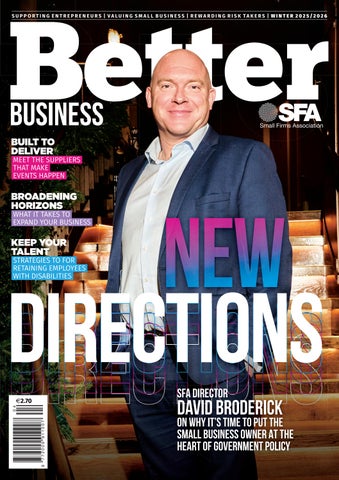
SFA Director David Broderick on putting the small business owner at the heart of Government policy

Health

Rabia Mirza offers practical solutions for modern organisations around social media use

Policy

SFA underlines the importance of strengthening the resilience of Ireland’s small firms

Arts and Culture

We chat to one urban explorer that’s sparking conversations around dereliction

Travel

SFA Awards 2026

The SFA National Small Business Awards 2026 finalists have been announced

30

Entrepreneurs

Four businesses chat about the opportunities and challenges around exporting

Mohamed S Camara outlines key strategies for retaining employees with disabilities 12

55 And Another Thing…

Small businesses must embrace digital adoption, writes John O’Shanahan

The Chinese market offers Irish firms opportunities across a raft of industries 44 HR

FROM TOP LEFT: Fiona Cronin at Croke Park Stadium on why collaboration is at the heart of a successful event, page 18 // It’s time to put the small business owner at the heart of Government policy says SFA Director David Broderick, page 26 // Lorraine Eagleton is building on Avem’s solid growth trajectory through exporting, page 31 // Jamie Robinson is sparking conversations about Ireland’s growing stock of derelict buildings, page 48

BIG NEWS FOR SMALL BUSINESS

OVVO CONNECTORS MAKES ITS MARK IN SHANGHAI

Following a string of major international showcases in Europe, OVVO continued its global momentum at the 30th Furniture China Expo 2025, held at the Shanghai New International Expo Centre (SNIEC). As one of the industry’s most influential trade events in Asia, the Shanghai fair provided an important platform for OVVO to connect with manufacturers, distributors and design-led brands from across the region. Positioned as part of the international innovation zone, OVVO’s booth attracted widespread attention from attendees drawn to the speed, simplicity and precision of the patented toolfree, glue-free and screw-free connection system. Live product demos and in-booth installations illustrated how OVVO helps manufacturers save time, reduce errors and streamline assembly, whether for flat-pack, commercial joinery or modular build-outs. One of the highlights from Shanghai was OVVO’s continued partnership with Sourcebynet, a global design and sourcing solutions provider. The collaboration aims to bring OVVO’s connector technology into a broader range of retailers and consumer furniture projects across Europe, AsiaPacific and beyond. The event also enabled conversations in lead generation and regional network growth. With a growing global footprint and a strong showing across trade events in Cologne, Guangzhou and now Shanghai, OVVO continues to position itself not just as a connector supplier, but as a strategic partner for manufacturers seeking smarter, faster ways to build.

www.ovvotech.com

New face at Moeboe Group

Moeboe Group, under the leadership of owner and CEO Eamon Bowe, has appointed Deirdre Devitt as Business Development Manager for Ireland and the UK. In this role, Deirdre will support organisations in designing and scaling outsourced teams and functions delivered through Moeboe’s established Pakistan operations, with Irish-led account management and clear operational governance. Her focus will be on supporting SMEs and growth-stage businesses to seek reliable, cost-efficient offshore capability across business support, technology and operational functions, without compromising on quality or control. The appointment aligns with Moeboe Group’s next phase of international growth. The company has confirmed the launch of its Australian operations in January 2026, extending its outsourcing model into the Asia-Pacific region in response to increasing client demand.

www.moeboe.com

New AI tool helps small businesses win more public contracts

Small businesses spend countless hours preparing tender proposals – often with little feedback on why they succeed or fall short. A new Irish innovation is changing that. BidReview.ai, founded by Irish entrepreneur and tendering expert Tony Corrigan, has launched the BidReview Scorecard, an AI-powered tool that reviews draft proposals from a buyer’s perspective and predicts their likely evaluation score before submission. Drawing on data from over 500 recent proposals, the system’s predictions are accurate to within 3% of actual evaluation results, giving smaller firms unprecedented insight into how buyers assess their work. The resulting Scorecard provides clear, actionable recommendations to strengthen bids – helping companies improve quality, clarity and compliance before hitting “submit.” Corrigan, who has spent over two decades supporting Irish SMEs in public procurement, says the goal is to level the playing field. “We built BidReview so every small business can compete on equal terms – with feedback that’s fast, affordable and genuinely useful.”

Small Firms Association members can avail of enhanced free access to the app. Interested companies can register for access at bidreview.ai/sfaenquiry

APPOINTMENT

NOW’S THE TIME TO GET AHEAD WITH GDPR

At re:GDPR, Eileen Ireland CDPO makes GDPR simple. Her down to earth and approachable attitude helps to ‘Take the fear out of GDPR’.

“Our aim is to give you peace of mind by ensuring you meet your legal obligations while educating you on how to maintain a GDPR Program within your business. Staff training is an essential part of your GDPR obligation. Staff must be trained in what their own responsibilities are as well as knowing how to recognise and respond to a Data Subject Access Request or even a Data Breach.”

The re:GDPR Training Calendar for 2026 is now open, with signature courses available to book now:

GDPR Fundamentals

• Fully tailored to your business or sector

• Available in person or online

• Includes a CPD Certificate of Attendance and 3 CPD points

AI Training

• A 1-hour session available as a bolt-on to pre-booked training or as a standalone course

DSAR Training

• Focused sessions dedicated to managing Data Subject Access Requests effectively

Data Breach Training

• Practical guidance on identifying, reporting and responding to data breaches

If your business would benefit from ongoing GDPR guidance and support, talk to re:GDPR about its retainer services. This is the simplest way to keep your business compliant, confident and ahead of the curve all year round.

https://regdpr.com/onlinetraining-cpd-accredited/

INNOVATION

Ireland’s first minimally invasive device innovation centre set to open

Eyedea Medtech Education, founded by internationally recognised surgical device designer Damian Carr, is developing Ireland’s first advanced education and prototyping centre dedicated to minimally invasive medical devices. The facility –housed inside a restored 100-year-old pub in the mountains near Westport, Co Mayo – will provide hands-on training in the design and manufacture of the tools used for stent placement, heart-valve replacement, neurosurgical procedures and early-stage cancer therapies. Set to officially open in July 2026, the centre will welcome engineers, innovators and medtech professionals from around the world. One of the former bar spaces has already been fully converted into a functioning prototyping lab, enabling visitors to design and build devices and test them on surgical models in a single session. Alongside international training, Eyedea is planting the seeds of Ireland’s future in life sciences by collaborating with schools and universities, inspiring the next generation of Irish medtech talent. The project underscores a wider mission – to establish Ireland as a global leader in minimally invasive technology while creating skilled, meaningful employment in the West of Ireland.

www.eyedea.ie

TOP POSTS

@MichealMartinTD

Microsoft came to Ireland in 1985 when there was 17% unemployment. That’s why this government focuses on enterprise and economy a lot. I’ve never forgotten those days

MACLACHLAN IP –A NEW NAME FOR A LEGACY OF PROTECTION

As of 1 October 2025, MacLachlan & Donaldson is now known as MacLachlan IP. With a long and proud history of protecting the Intellectual Property of Irish businesses in Ireland and abroad, MacLachlan & Donaldson has been guiding clients through the process of obtaining IP protection for nearly 60 years. This includes registering as trademarks, obtaining patents for new innovations or inventions and registering designs to protect the appearance of a product. In 2002, the company formed a strategic alliance with Ansons, a Belfastbased firm of Intellectual Property attorneys, enabling both firms to offer IP services throughout the island of Ireland, the UK and the EU. At that time, it was beneficial for the two offices to maintain their separate trading identities. However world events, such as Brexit and Covid, have worked to mould the two offices into a single team operating in two locations, with the two offices now adopting the name MacLachlan IP. Carla MacLachlan, Managing Director, said: “Our clients remain at the heart of everything we do and it’s on this strong foundation that we look forward to building the future – together – under our new name, MacLachlan IP.”

For more information contact Cherrie Stewart, stewartc@ansons.co.uk, + 353 (0) 1 676 3465

@rtenews

A new report from a Government advisory group has found that artificial intelligence (AI) jobs have doubled in Ireland since 2023

@GerardBrady100 €10 billion in Corporate Tax receipts in November alone! And revenue at the 15% rate still to come in 2026. Stein’s law still applies, however: “If something cannot go on forever,it will stop.”

TARGET INTEGRATION EXPANDS INTO UK

Target Integration has announced three major milestones that define 2025 as a stand-out year for the company – expansion into the UK market and the achievement of Gold Partner status with both Odoo and HubSpot. The UK expansion strengthens Target Integration’s on the ground presence, allowing the company to better support growing demand from organisations seeking scalable Enterprise Resource Planning (ERP) and Customer Relationship Manager (CRM) solutions. This move enhances delivery capacity, deepens client relationships and reinforces Target Integration’s long-term commitment to the UK market. Alongside this growth, the company has been awarded Gold Partner status by Odoo and HubSpot, recognising the company’s technical expertise, delivery quality and consistent success across complex implementations. Achieving Gold status with two leading platforms in the same year positions Target Integration among a select group of top-tier systems integration partners. “These achievements reflect a year of focused execution and strategic growth,” the company said. “Expanding in the UK while earning Gold Partner recognition from both Odoo and HubSpot is a strong endorsement of our team, our approach and the results we deliver for clients.” With increased UK capacity and elite partner status, Target Integration enters the next phase of growth well positioned to support ambitious organisations across 2025 and beyond.

www.targetintegration.com

“While Ireland’s economy is booming, the small business owner is tired, restless and exhausted. Despite a thriving marketplace, small business owners are struggling to cope with an avalanche of regulations in the past decade.”

SFA Chairperson Geraldine Magnier’s keynote address at the annual SME Assembly in Copenhagan

“Every industry needs it, every company uses it and every nation needs to build it.”

Jensen Huang, President and CEO of Nvidia Corporation, discussing AI in an interview with Time Magazine

“This is a time when government, business and the private sector need to value not only what it means to be a leader, but what it means to be a citizen.”

Secretary Hillary Rodham Clinton, receiving the Peter Sutherland Award for Leadership at the annual Business & Finance Awards in Dublin

LGBTQ+ TOOLKIT FOR BUSINESSES

CLAIRE HAYES AT THE OPEN DOORS INITIATIVE ON WHY THE EMPLOYERS TOOLKIT FOR LGBTQ+ INCLUSION IS AN ESSENTIAL RESOURCE FOR EMPLOYERS ON THEIR INCLUSION JOURNEY

SMEs are at the heart of Ireland’s economy, shaping workplace culture and driving the future of inclusion. Yet many smaller organisations do not have the time or resources to develop evidence-based resources to support them in embedding inclusion that not only supports their employees, but strengthens their business. With talent attraction, retention, innovation and customer trust all increasingly linked to strong inclusion practices, the business case for taking action has never been clearer. The Employers Toolkit for LGBTQ+ Inclusion by the Open Doors Initiative (ODI) directly responds to the need for practical guidance. The toolkit was launched on 22nd October at ESB headquarters by Minister Jerry Buttimer and was funded by ESB’s Energy for Generations Fund. Authored by Dr Vanessa Lacey, Director of Gendercare, the new toolkit is an evidence-based guide for employers seeking to create inclusive, respectful and equitable workplaces for LGBTQ+ employees and jobseekers. It provides SMEs

DESIGNED WITH THE REALITIES OF BUSINESSES IN MIND, THE TOOLKIT ADDRESSES AREAS THAT OFTEN PRESENT THE GREATEST CHALLENGES:

Integrating inclusive language into policies and communications

Recognising and reducing microaggressions

Responding effectively to homophobia and transphobia

Strengthening allyship supported by visible leadership

with practical, actionable guidance they can implement immediately to build more inclusive, productive and competitive workplaces.

This toolkit builds on ODI’s large resource hub of evidence based toolkits and guides, in particular the Inclusive Recruitment of Trans and Non-Binary Candidates. This toolkit offers a comprehensive roadmap for organisations seeking to turn inclusion intentions into tangible outcomes.

Its recommendations are grounded in lived experience and shaped by insights from LGBTQ+ professionals, HR leaders and inclusion experts, ensuring they are both achievable and impactful.

At the launch, Minister Jerry Buttimer emphasised the toolkit as a timely and essential resource for employers beginning or advancing their inclusion journey. ESB’s Director of HR, Sinéad Kilkelly, highlighted the organisation’s commitment to building equitable workplaces and the importance of supporting SMEs in this space. Dr Lacey presented key findings from her research, followed by a panel discussion featuring representatives from ESB and Accenture, moderated by ODI’s Head of Programmes, Talita Holzer.

For SMEs striving to compete for talent, strengthen workplace culture and demonstrate authentic leadership on inclusion, this toolkit offers more than guidance, it provides a practical mechanism to deliver real business benefits. As we know from the work we do at ODI, inclusion becomes meaningful only when embedded in everyday practice. This resource equips employers with the tools to make that a reality and to position their organisations for long-term success.

Giving small business a voice

SFA Director David Broderick and SFA Chair Geraldine Magnier represented small businesses on the European stage

At the annual EU SME Assembly in Copenhagen, held in November 2025, Geraldine Magnier had the honour of giving the keynote address. In her speech, she called for a partnership between the EU and SMEs to implement simplification measures for SMEs, improve regulations and protect the single market. The SME Assembly is the EU’s annual conference for small and medium-sized enterprises that occurs as part of the European SME Week. It is a significant event where business leaders, policymakers and experts meet to discuss challenges, opportunities, policy and share best practices for SMEs.

“INCLUSION BECOMES MEANINGFUL ONLY WHEN EMBEDDED IN EVERYDAY PRACTICE.”

Christmas Evening

At SFA’s Christmas Evening, SFA Director David Broderick sat down with Bernard Jackman for a chat about leadership and performance

In December, the SFA had the pleasure of hosting close to 100 business leaders at our SFA Christmas Evening: “From the Pitch to the Bottom Line: Lessons in Peak Performance with Bernard Jackman”. Bernard shared his wisdom and insights from the world of sports when it comes to leadership. From stories of bricklayers to Pat Lambe’s 3 H’s for Connacht Rugby, there were important business nuggets throughout the fireside chat with SFA Director, David Broderick.

Annual Lunch

Broadcaster Ryan Tubridy chatted with SFA Director David Broderick at the SFA’s flagship event

In November, the SFA hosted its flagship social event, the Annual Lunch, in the Round Room at the Mansion House. At the event, David Broderick had a fireside chat with legendary broadcaster Ryan Tubridy, where he shared the highs and lows of his professional career along with a few interesting stories about the people he has interviewed.

FINALISTS ANNOUNCED

THE SFA NATIONAL SMALL BUSINESS AWARDS 2026 FINALISTS HAVE BEEN ANNOUNCED

The finalists in the SFA National Small Business Awards 2026 were officially announced by Sue O’Neill, Chair of the SFA Awards Judging Panel. The aim of the awards is to celebrate the achievements of small business in Ireland and to recognise the vital contribution of the small business sector to Irish industry.

“The strong engagement with this year’s awards programme shows the continued resilience and determination of Ireland’s small businesses, who consistently strive for recognition of their hard work,” said Sue O’Neill.

“Alongside our nine award categories, we are also highlighting five exceptional Emerging New Businesses – each established within the last two years – and it’s clear that entrepreneurship continues to flourish across the country.”

“The Small Firms Association remains dedicated to celebrating the accomplishments of small business owners. With 273,000 small firms employing nearly half of Ireland’s private-sector workforce, these awards shine a light on excellence, innovation and success across all sectors and regions,” she added.

Speaking at the launch of the awards, An Taoiseach, Micheál Martin said: “Through the SFA National Small Business Awards, we honour their achievements and inspire the next generation of entrepreneurs. With current uncertainty in the global economic environment, it is vital that our small businesses are strong, adaptable and ready to meet any challenge. The Government will continue to work with them to grow our economy and ensure Ireland remains an attractive place to do business.”

53 COMPANIES HAVE BEEN SELECTED FROM 16 DIFFERENT COUNTIES, ACROSS 10 CATEGORIES:

MANUFACTURING

(UP TO 50 EMPLOYEES)

Sponsored by PTSB

• Applied Concepts - Offaly

• Garnacha - Dublin

• Helio Gas Detection - Cork

• Hygeia - Galway

• K Factory Print & Embroidery - Dublin

• Lawrence Engineering - Sligo

FOOD & DRINK

(UP TO 50 EMPLOYEES)

Sponsored by Bord Bia

• Builíin Blasta - Galway

• Burren Smokehouse - Clare

• Carlingford Oyster Company - Louth

• Dromod Boxty - Limerick

HYDE Irish Whiskey - Cork

• Pizza da Piero - Dublin

SERVICES (UP TO 50 EMPLOYEES)

Sponsored by Sage

• 3Q Recruitment - Dublin

Aureol Global Connections - Dublin

• Company Bureau - Dublin

• Future Direct Professional Services - Dublin

• KDA Doyle Kelly Accountants - Wexford

• Laochra Academy - Cavan

OUTSTANDING SMALL BUSINESS

(UP TO FIVE EMPLOYEES)

Sponsored by Elavon

• Donna Reilly People & Wellness - Dublin

• Louise Corrigan Law - Kildare

• Pawpear - Waterford

• Pure Water Window Cleaning - Wexford

• Sligo Surf Experience - Sligo

The Nude Wine Company - Kildare

INNOVATION

(UP TO 50 EMPLOYEES)

Sponsored by

National Standards Authority of Ireland (NSAI)

• An Even Better Place to Work - Mayo

JPK Fencing - Galway

• Profitsflow - Wexford

• Recaptureone - Kildare

• The Career Coach - Dublin

• The Skibbereen Food Company - Cork

FAMILY BUSINESS (UP TO 50 EMPLOYEES)

Sponsored by Interpath Boxty House - Dublin

• Dromod Boxty - Limerick

• Howth Cliff Cruises - Dublin Kilkenny Architectural Salvage & AntiquesKilkenny

• N.A.A. - Dublin

• Rainey & Co. - Dublin

EXPORTER OF THE YEAR (UP TO 50 EMPLOYEES)

Sponsored by Enterprise Ireland

• Adams & Butler - Dublin Aterim - Dublin

• Avem Market Solutions - Galway

• Green Streets Environmental Resources - Dublin

• Helio Gas Detection - Cork

• Lawrence Engineering - Sligo

SUSTAINABILITY (UP TO 50 EMPLOYEES)

Sponsored by Strategic Banking Corporation of Ireland (SBCI)

• Burren Smokehouse - Clare

• Dingle Sea Salt - Kerry

• Hemp Heros - Wicklow

• Hygeia - Galway

Rock Farm Eco Tourism - Meath

• Tom Crean Brewery Kenmare - Kerry

WORKPLACE WELLBEING (UP TO 50 EMPLOYEES)

Sponsored by DeCare 3Q Recruitment - Dublin

• Donna Reilly People & Wellness - Dublin

• Engage People - Dublin

• MW Health and Safety - Cork

• PHE Engineering & Architecture - Galway

• Simpson Jones - Wicklow

EMERGING NEW BUSINESS

(UP TO 50 EMPLOYEES, UNDER 2 YEARS IN BUSINESS)

Sponsored by Microfinance Ireland

• Biovit Technologies - Dublin

• Career Navigator - Dublin

• ealu - Wicklow

Four Acre Foods - Meath

• Irish Camper Goods - Galway

The Awards prize package for ALL finalists includes participation in a strategic management masterclass weekend during January as well as the SFA Business Connect event at Killashee Hotel next February 5th. All benefit from broad-ranging national and local media coverage valued at €50,000. Finalists also receive three complimentary tickets to the Gala Prize Winning Ceremony to take place in the RDS on March 5th 2026 when category prize winners and the overall winner will be announced. The Category winners will be presented with a trophy and free membership of the Small Firms Association for one year.

WISE GUYS

SIX INDUSTRY EXPERTS SHARE ONE PERSONAL NUGGET OF ADVICE FOR ASPIRING ENTREPRENEURS.

1

Cybersecurity can seem like a minefield right now, so it’s wise to build a trusted relationship with an organisation that understands your business. With the right support, you can navigate cybersecurity challenges. A great partner not only cares about your business but provides concrete support, uncovers risks, strengthens your team and helps you to be prepared for any incident that arises.

2

Developing knowledge within a specific sector is one of your most powerful assets. Don’t be afraid to be ambitious and focus on planning your next steps. An Post recently became one of the first postal service operators globally to achieve a 50% reduction in carbon emissions.

Determination enabled us to reach that target early and we’re already looking at our next milestone, Net Zero by 2030, if not sooner.

3

Owen Power CEO, Greenvolt Next Ireland & UK

Establishing a sustainable business requires high standards and commitment – that means turning up every day even when you feel your goal is out of reach. If you believe in what you’re doing, you’ll get there. Efficiency is key to running a business with sustainability at its core. From not being wasteful with the resources you purchase to turning off the lights when you leave the room, it should be prioritised across every aspect.

Change is inevitable. You either resist it – we know who those people are – or you go with it.

Our new ‘Pinergy Energy Sustainability Research Study’ shows Irish businesses view sustainability as strategic imperatives driven by the bottom line. Many businesses are missing out on opportunities to accelerate their transition to a more sustainable and costefficient future. Our research shows that businesses need clear energy monitoring solutions and guidance on navigating investment and establishing internal accountability – that’s what we do.

4 5 6

The value of strong professional relationships can’t be underestimated. Investing time and trust in building meaningful connections isn’t just beneficial from a business perspective – it genuinely boosts long-term happiness and fulfilment in your role. As our world becomes increasingly digital, it’s more important than ever to prioritise authentic, faceto-face engagement. These real connections often open the door to new business opportunities, mentorship and collaboration.

2025 marked the biggest structural shift in Irish pensions in decades as Auto-Enrolment (AE) entered its rollout phase for the 1st of January 2026. There has been confusion among both employers and employees, but AE is a good step forward to improve retirement outcomes. This year, the key is understanding whether to become enrolled in My Future Fund or contribute to a private pension. Speak to your financial consultant to make sure you’re on the right track.

Built to Deliver

JENNIFER MCSHANE SPEAKS TO THREE INDUSTRY LEADERS ABOUT THE REALITIES OF DELIVERING LARGE-SCALE EVENTS, EVOLVING CLIENT EXPECTATIONS AND THE CRITICAL ROLE SUPPLIERS PLAY BEHIND THE SCENES

“We craft an environment that reflects the brand’s identity and objectives”

AVCOM has been part of Paul Murphy’s life for as long as he can remember. Founded by his father, Tony Murphy, the family business is now celebrating 45 years in operation, with Paul at the helm since 2008. “Being a family business, AVCOM has always been a major part of my life, from cleaning the office and equipment as a teenager, to now leading the company and celebrating our 45th year in operation,” he says. “It’s been an honour to build on the vision, entrepreneurship and success of my father Tony Murphy.”

Today, Murphy is owner and Managing Director of AVCOM, which he describes as “the premium event production agency.” The design-led production company combines the latest innovative technology, delivered by what Murphy calls “our highly trained and skilled specialists, the AVCOM Ninjas.”

While clients increasingly recognise the value of professional production, Murphy feels the supplier role is still not always fully understood. “Sometimes they can underestimate the strategic and creative role we play in transforming an event from a concept into an experience,” he says.

For AVCOM, that strategic role begins long before an event goes live – particularly when it comes to sustainability. “Every AVCOM production begins with a sustainable mindset,” Murphy explains. From reusable scenic elements to energy-efficient lighting and LED walls, sustainability is considered from the outset, shaping creative and technical decisions rather than being treated as an add-on. “Inside our warehouse, props are made from recycled goods, printed materials are biodegradable and technical equipment is maintained for long-term performance. Sustainability for us isn’t an add-on. It’s built into how we think, produce and deliver.”

That design-led approach extends to how technology is used. “It’s not just about having gear; it’s about knowing how to use technology creatively to elevate the event,” Murphy says. Storytelling and brand are just as important. “We don’t just set up equipment; we craft an environment that reflects the brand’s identity and objectives.” Ultimately, it comes back to audience response. “We design experiences that make people feel something, which drives engagement and retention.” Looking back over the past five years, Murphy points to significant shifts across the Irish events landscape. “The corporate event industry has experienced a dramatic transformation fuelled by technology and evolving expectations,” he says.

Paul Murphy, Owner and Managing Director, AVCOM
“WE DESIGN EXPERIENCES THAT MAKE PEOPLE FEEL SOMETHING, WHICH DRIVES ENGAGEMENT AND RETENTION.”

The pandemic was a major turning point. “In 2020, event planners pivoted to virtual formats due to Covid. Since then, hybrid events have become dominant – the vast majority of attendees now prefer a mix of in-person and virtual experiences.” For suppliers, he says, that shift has brought added layers of technical complexity and responsibility. Looking ahead, Murphy expects hybrid delivery, sustainability, immersive environments, techenabled engagement and wellness-focused design to continue shaping the sector. For AVCOM, the focus remains on delivering experiences that balance creativity and technology, while staying true to its family-business foundations.

“Great events don’t happen in isolation”

As Meetings & Events Department Manager at Croke Park Stadium, Fiona Cronin leads a multidisciplinary team responsible for delivering events at one of Ireland’s most iconic and recognisable venues. Her role spans sales, planning and operations, guiding clients from early enquiry through to on-the-day delivery and postevent follow-up.

For Cronin, the success of an event is rooted in work most people never see. That includes everything from risk assessments and AV integration to contingency planning, supplier coordination and staffing.

“Clients usually see only the polished running order, the smooth transitions and the seamless guest experience,” she says, “but what they don’t see are the hundreds of small decisions and problem-solving

“PARTNERING WITH EXPERIENCED SUPPLIERS SAVES TIME, RESOURCES AND BUDGET WHILE DELIVERING MEASURABLE ENVIRONMENTAL IMPACT. THESE PRACTICAL STEPS MAKE EVENTS MORE SUSTAINABLE, WHILE STILL BEING CREATIVE, ENGAGING AND MEMORABLE.”

moments that make it possible.” She explains her team operates much like a backstage production crew, anticipating challenges, adapting quickly and working behind the scenes to keep events on track. “It’s this invisible yet critical work that turns ideas into memorable, flawlessly executed experiences.”

For Cronin, collaboration is truly at the heart of everything – successful events are what the team makes of them. “Great events don’t happen in isolation,” she says. Early involvement, clear briefs, shared goals and open communication are essential, as is mutual respect for each partner’s expertise. “When suppliers feel valued, informed and empowered, collaboration stops being a task and becomes a true competitive advantage.”

Delegate visitor expectations are shifting too –they want huge variety in their experiences. “They increasingly want interactive elements, personalised

experiences and digital content they can access both before and after the physical event,” she says. At the same time, clients are having to at least try to balance cost with impact, sustainability and measurable outcomes, placing additional pressure on venues to deliver more with less.

“Gone are the days of simply booking a room and catering,” Cronin says. “Clients now demand end-toend partnership.” This includes expertise in digital and hybrid delivery, responsiveness to sustainability requirements and creative approaches to drive engagement.

At Croke Park, sustainability has also become a growing priority in the delivery of their events. Cronin points to practical shifts such as digital-first planning, reduced printed materials and changing catering choices as those they tackled first. “One of the biggest shifts we’re seeing is the move toward digital-first planning,” she says, with apps, QR codes and digital agendas helping to reduce print. Catering choices also play a role, with reusable serviceware and locally sourced, low-carbon menus gaining traction.

Transport is also not forgotten, with public transport, cycling, carpooling and electric vehicle infrastructure all playing a role in reducing emissions and making our world a little bit greener. “Partnering with experienced suppliers saves time, resources and budget while delivering measurable environmental impact. These practical steps make events more sustainable, while still being creative, engaging and memorable.”

Fiona Cronin, Meetings & Events Department Manager, Croke Park Stadium
“It’s ultimately show business, so the show must go on”

As Managing Director of Vinehall Displays, Gerard McElhinney’s role spans strategy, client relationships and operational oversight, with a strong emphasis on delivery in a fast-moving and demanding sector. Much of his time is spent working closely with the team to ensure projects land as planned, often under significant pressure.

“It’s about balancing innovation with reliability, because our reputation is built on value and trust,” he says. “At the end of the day, my job is to make sure clients feel confident that we’ll deliver, no matter the pressure.”

The operating environment for event suppliers has changed noticeably in recent years and, like many in the sector, Vinehall Displays feels it in almost every aspect of its work. “There’s definitely more pressure on margins,” McElhinney notes. “Costs have risen across the board – materials, labour, logistics – yet expectations for polished, high-impact events haven’t eased.”

That pressure demands constant problem-solving, usually against immovable deadlines. “When it all comes together seamlessly, it looks effortless, but that’s the result of years of experience and a team that knows how to deliver under pressure. It’s not just building stands or stages or installing window graphics or printed backdrops; it’s managing timelines, budgets, venues and technical details under serious pressure.” But as McElhinney puts it, “at the end of the day, it’s ultimately show business, so the show must go on.”

Ireland’s position as an island adds another layer of complexity, particularly around logistics. At the same time, business tourism remains vital. “As an island nation, we face unique logistical challenges,” he explains, adding that “business tourism is a huge driver for our sector, bringing international visitors and opportunities that benefit communities nationwide.”

Vinehall Displays’ family-run structure plays an important role. Agility and trust are key, with long-standing client relationships built over decades. “We’re not just agile and hands-on; we’re dedicated to building lasting relationships grounded in trust,” he says. “Many of our clients have partnered with us for over 35 years, relying on us to go the extra mile and deliver results time and time again.”

Clear communication underpins every event the company delivers – and it keeps clients happy too.

“By blending creativity with efficiency, we make sure our clients never have to compromise, no matter the pressure or scale of the event.”

Sustainability is now embedded across Vinehall Displays’ operations. “Clients now expect genuine evidence of sustainability, not just promises,” McElhinney continues. “We’ve earned a Gold medal from EcoVadis for the past three years and achieved ISO 14001 certification for two years.”

These credentials, he says, give clients confidence that standards are being met. “This commitment to sustainability begins on day one, resulting in better planning and stronger outcomes for our clients.”

Collaboration between suppliers remains constant and will always be key. For McElhinney, it comes down to openness, trust and transparency. “When everyone shares timelines and communicates openly, things run smoothly.”

Early involvement, he believes, leads to better outcomes. “If suppliers collaborate from the start, solutions are smarter and more cost-effective.”

Gerard McElhinney, Managing Director, Vinehall Displays

SETTING THE STANDARD IN

InIN A ROOM FILLED WITH ANTICIPATION, OVER 600 INDUSTRY LEADERS AND ENTHUSIASTS GATHERED TO CELEBRATE THE 22ND IRISH DIGITAL MEDIA AWARDS

October 2025, the Dublin Royal Convention Centre came alive as it hosted the much-anticipated Digital Media Awards. With an audience of over 600 attendees, the night was lled with excitement as everyone eagerly awaited the announcement of the evening’s most prestigious honour – the Best Agency Award. e excitement reached its peak when Havas Media Ireland was crowned the overall winner. However, Havas Media was far from the only company to leave the night with a sense of triumph.

also recognised for its “From Click to Kitchen – A Digital Evolution in Cra , Culture and Conversion” campaign, a collaboration with Cash & Carry Kitchens, which claimed the Best in Retail and Consumer Goods award. Havas Media also triumphed in the Best Newcomer category with the debut of its new agency under the Havas brand, “Havas Play: CultureLed, Results-Driven: e Havas Play Way.”

e Digital Media Awards were made possible thanks to the generous support of the event’s o cial sponsors – Ebow Digital, Elevate Media, Kantar Media, Olytico, e Business Post and Select Hotels & Experiences.

Not only did Havas Media take home the Best Agency Award but it was

Other standout wins included a Zenith & Core campaign executed for the Dalata Hotel Group for the Best Use of SEO, along with LADBible Ireland for Best Brand. Wolfgang Digital’s campaign for Horseware Ireland won in the Best Integrated Campaign category and Irish Life scooped Gold in the “Best Conversion Strategy”.

e event also celebrated the incredible talents of emerging professionals and students who are shaping the future of the digital media sector. Eight students from Technological University of Shannon: Midlands were nominated for Best Student,

with Lisa Castro bringing home Gold. Jessica Oliviera from the Institute of Art, Design and Technology (IADT) took home Silver, while Lucy Sheehy from Munster Technological University proudly claimed Bronze. ese young talents are clearly poised to become the next generation of digital media leaders.

Kerry Lyons, Executive Creative Director at Ebow Digital, said: “Being able to take a moment on nights like these to celebrate the thousands of hours of work, the collective talent honed over decades and the courage to go that extra creative mile, clients and agency alike, make it all so worth it.”

Re ecting on the evening’s success, Trish Murphy, Sponsorship Director of the Digital Media Awards, extended her heartfelt thanks to the event’s sponsors. “Without their unwavering support and commitment to the sector, this awards ceremony would not be possible,” she said. “We are deeply grateful for their continued support of the Awards, which have become synonymous with excellence in the digital world!” e event couldn’t happen without the panel of expert judges drawn from all areas of the digital media sector. anks to their expertise and consideration, a new standard for digital excellence has been established at the 2025 Irish Digital Media Awards.

Havas Media Ireland, DMA 2025 Best Agency Award Gold Winner
An Post, DMA 2025 Best Website Gold Winner
Anton Savage, DMA 2026 Host
LADbible Ireland, DMA 2025 Best Brand Gold Winner

2025 WINNERS

Best Use of Digital OOH

Gold WInner:

Talon Outdoor

- How Heineken Turned DOOH into a Performance Channel

JUDGES

Caoimhe Nugent

Senior New Business Strategist UKI at Google

Ciara Lawler

Business Director at dentsu

Colin Baker

CEO, Back from the Future IT & Tech Presenter, Ireland AM

Darina Sexton

Dusty Rhodes

Best Student

Gold WInner:

Technological University of the Shannon: Midlands - Lisa Castro

Best Specialist Agency

Head of Communications at Microsoft Ireland Subsidiary

Founder & CEO of DustPod

Edel Walsh

Head of Digital Marketing at EY Ireland

Emmet Ryan

Business and Technology Reporter

Fergal O’Connor

Founder & CEO of Buymedia

Gareth Dunlop

Speaker, Writer and Consultant on Experience Design, Strategy, Innovation and Leadership

Gavin McKenna

Head of Marketing, Digital and Communications at Visit Belfast

Grace Crowley

Head of Marketing & Communications

Greg Canty

Managing Partner of Fuzion Communications

Ian Campbell

Digital Board Director at Zenith, part of Core

John Carty

John Coleman

Best Website Gold WInner:

An Post - One Brand. One Platform. Infinite Possibilities – AnPost.com

Best Use of Display Sponsored by Business Post

Gold WInner:

WPP Media - Jeep Avenger: Driving Freedom and Sales Through a Hyper-Localised Display Campaign

Best Brand

Gold WInner:

LADbible Ireland

- The Best Mate of the Internet

Best Creative

Lecturer and Researcher at Atlantic Technological University (ATU) Galway

Head of SEO at iProspect

Karen Conway

Digital Marketing Consultant

Keith McLoughlin

Director at Connexus Recruit

Mark O’Brien

Director of Product (Content, Date & AI) at Shutterstock

Niall Kitson

Editor of Techcentral.ie and Co-Host of Tech Radio

Paula Cerruti

Director at Reputation Inc

Rachel Ray

Gold WInner:

Irish Times Group - SKYTurning Sofas into Strongholds: Bringing Sky’s Stay-In Strategy to Life

Best Conversion Strategy

Gold WInner:

Irish Life - If You Build It, They Will Come: How a New Calculator-First Strategy Resulted in a 461% Increase in Sales Opportunities

Best Use of Data and Insights

Gold WInner:

Mediahuis IrelandRECLICK & INMARKET | A First-Party Data Retargeting Revolution

Best Newcomer

Gold WInner:

Havas Play - Culture-Led, Results-Driven: The Havas Play Way

Best Sales Team

Gold WInner:

Bauer Media Outdoor

- Bauer Media Outdoor Ireland

Best App

Gold WInner: Dublin AirportThe New Dublin Airport App - Travel Smarter

Best Use of Social Sponsored by Olytico

Gold WInner:

Gold WInner:

GlowMetrics - GlowMetrics: Digital Analytics & Data-Driven Marketing Specialists

Best Tech & Innovation Sponsored by Ebow

Gold WInner:

Zenith, part of Core & audioXi, part of Media Central - McDonald’sInnovation McDelivered – Did Someone Order 245,700 Ads?

Best Search Campaign

Gold WInner:

Core Optimisation Limited - Ella & JoSkin Deep Search

Best Use of Content/Native Gold WInner: SPAR and EUROSPAR - Breast Before Dates

Best Collaboration (Owner/Brand/Agency) Sponsored by Kantar Media

Gold WInner:

Ebow Digital - Virtual Record Treasury of Ireland: Knowledge Graph Innovation

Best Brand Strategy

Gold WInner: Idea - Dublin Port - The Hardworking Heart of Dublin

Best Use of SEO

Gold WInner:

Zenith & Core - Dalata Hotel Group - From 52 to 2 Domains: An SEO Masterclass in Strategic Migration

Best Use of Digital Audio Sponsored by Elevate Media

Gold WInner:

Mediahuis Ireland - Indo Sport with Joe Molloy

Best in Government & Not for Profit

Gold WInner:

Ebow Digital - Virtual Record Treasury of Ireland: Knowledge Graph Innovation

Best Use of AI

Gold WInner:

Chadwicks - Building a Community – Earning the Space to Drive Commercial Actions

Best in Retail and Consumer Goods

Gold WInner:

Havas Media Ireland

- Cash & Carry Kitchens

- From Click to Kitchen

– A Digital Evolution in Craft, Culture and Conversion

Best Integrated Campaign

Gold WInner:

Group Strategy Director at dentsu

Tara Moran

Head of Sales at Virgin Media Television

Viv Maher

Founder & Connector at ThinkDifferently

Bord Gáis Energy - Intelligent Content & Search: Scaling Performance with AI Precision

Best Use of Video

Gold WInner:

LADbible Group - Heineken IrelandLADbible Ireland x Orchard Thieves: The Guerilla Gameshow That Made Ireland Obey Their Instincts

Best Small Agency (<15)

Gold WInner: Vroom Digital - Driven by Story. Defined by Impact

Wolfgang Digital - Wolfgang Digital & Horseware Ireland: From Dark Horse to Prized Pony

Best Agency

Gold WInner: Havas Media

WinningCRM with

CRM SOFTWARE CAN HELP SMALL BUSINESSES WIN MORE CUSTOMERS BUT WITH UP TO 60% OF CRM PROJECTS FAILING, JUST BUYING THE SOFTWARE WON'T DO.
MICHAEL FITZGERALD REVEALS HOW BUSINESSES CAN GET THE MOST OUT OF THEIR CRM INVESTMENT

DON’T JUST STORE CONTACTS, WORK THEM

A CRM is not a glorified phonebook where you simply store names and details. It should function more like a machine (a conveyor belt of sorts) that keeps sales opportunities moving forward. So, instead of hoarding contacts, give them a clear next step and a date for when it should happen. Then, prioritise based on who needs your attention first.

DELIVER ON YOUR PROMISES – ALWAYS

If you want to build trust and strengthen your relationships with customers, there’s one promise you always need to make: that you’ll follow up. This need not be a formal promise; even a simple “I will get back to you” counts. In fact, it’s usually not a promise made to the customer at all. Most times, it’s a commitment you make to yourself to always keep conversations going and prevent contacts from going cold. This is where your CRM comes in. Use it to record every follow-up activity you intend to carry out, get reminders when they’re due and set new ones after completing the old.

CUT DOWN ON ADMIN WORK

Small businesses spend around 15-20 hours each week on repetitive work. This takes time away from what actually drives sales, which is speaking with customers and building relationships with them. That’s why your CRM should be used to automate as much of that dull work as possible. Let the system handle data entry, emailing, report generation, reminders, lead assignment and other routine tasks. With this, you’ll have more time and more energy to focus on the people who keep your business going. In 2026, more and more small businesses will turn to CRM software to organise their operations and win more customers. There’s no reason why you can’t do the same. The only caveat is that you need to start well and that means choosing the right software.

GETTING TO GRIPS WITH

MARY WHITE ON WHY IRISH SMES NEED IP AND HOW THEY CAN AVAIL OF EU GRANTS IN 2026

It is easy to think of the tangible assets in a business as ‘property’ because we can literally see, touch and value them every day. We recognise their importance. We maintain them, we lock them up at night and put on an alarm; we take out an insurance policy to cover unexpected damage. But in every Irish SME there are also invisible, intangible assets quietly powering the business. Yours could be a unique service offering or innovative product you offer; a special design feature, your skills and know-how, your artwork, original content, brand reputation and much more. These assets are the foundation of your reputation and competitive advantage. Yet, they’re often left undocumented, undervalued and unprotected – which means that the value you created becomes an easy target for copycats and lookalikes.

SMEs may also face the reverse risk of unknowingly infringing someone else’s rights. Both scenarios can cause stress, disrupt operations and trading relationships, affect export plans or trigger unexpected legal or rebranding costs.

Mary White, Director, Trade Marks, Murgitroyd & Company Limited

Develop a pragmatic, affordable IP strategy

A robust intellectual property (IP) strategy doesn’t need to be complicated. It simply requires a structured look at what your new and unique offerings are. One revealing question is, what gives your business its distinctive identity? Or, what aspects would make you most angry or upset if somebody cloned your business?

Once you’ve identified your intangible assets, the next step is considering its value so you can decide what to protect formally, what to keep confidential and what you’re happy to share freely with the world. Even identifying and prioritising these assets can be transformative, helping your leadership team quantify, evaluate and leverage your strategic business drivers.

Where you identify worthy intangible assets, protect them. Your budget for securing and enforcing IP rights should be proportionate to their value. Different assets can be protected using different IP rights – which may overlap.

If innovation is your competitive advantage, protecting your IP can make that advantage last longer

In Ireland, copyright arises naturally every time you create new artwork or creative content, without having to formally register it. Trademarks can be registered to protect your brand (name, logo or other symbols). Design rights protect the aesthetic aspects of packaging or products and patents can protect technical inventions. There are even trade secret protections for confidential know-how. Some of these rights are free. There are also some excellent financial supports available too – including the ‘IP Start’ Grants (from your LEO, Udaras na Gaeltachta or Enterprise Ireland) and the SME Fund (from the EU Intellectual Property Office).

Trademark and design registrations are relatively low-cost and straightforward to secure and they immediately strengthen your position with customers, distributors and potential investors. Patents require more investment, but for the right technology they can open the door to licensing revenue, joint ventures or increased valuation.

Owning IP rights is akin to holding the deeds of your home, monitoring your market is like installing an intruder alarm and enforcement could be compared to having security staff remove trespassers. All three aspects are necessary to fully protect a high-value business.

IP doesn’t police itself and infringement is more common than people realise, so monitoring your market and watching out for infringements is important. In today’s globalised economy and digital age, copying can happen quickly and at scale, in any part of the world. Ownership of registered IP enables a quicker and more decisive action plan for enforcement and enhances the chances of a successful outcome, with lower legal costs. Speed is important when detecting and tackling infringements – before damage is done to your business, or your reputation is diluted or the copycat begins to acquire conflicting rights.

Finally, while IP protection is critical for risk management, it’s also an important long-term investment. EU research consistently shows that SMEs with registered IP rights perform better; they attract more investment, grow faster, export more and achieve higher overall valuations. For founders planning to scale, diversify or eventually exit, IP can be a springboard to grow, a shield against competitor attack, a cornerstone of corporate worth and the backbone for strong negotiations.

How much does it cost? Are there supports available?

SME owners can take comfort that they may be able to avail of copyright, unregistered design rights and trade secret protections already. Some IP rights do have to be registered, but the costs are often less than people imagine – and when you’re creating a strategy and budget for IP, bear in mind that costs should be proportionate and in line with your business’ commercial needs. Enterprise Ireland and the Local Enterprise Office network run an IP Start grant and the EUIPO will launch the SME Fund in early February 2026. This can reimburse small and medium businesses up to 90% of an IP Scan (audit services with a professional to support them, up to a total cost of €1,500) and up to 75% of official trademark and design costs (in 2026 this was capped at a maximum refund of €700).

In summary, most SME firms already possess more IP than they realise. The key is to recognise it, protect it and turn it into a strategic asset that supports long-term success. With new EU SME Funds becoming available in February 2026, there’s never been a better time to bring your IP strategy in line with your commercial ambitions. Until March 2026, all members of the SFA can avail of a free IP Audit. Contact us to arrange yours today.

SFA DIRECTOR DAVID BRODERICK ON WHY IT’S TIME TO PUT THE SMALL BUSINESS OWNER AT THE HEART OF GOVERNMENT POLICY

David Broderick, Director, SFA
“WE’RE OPTIMISTIC IN THAT WE HAVE THE RIGHT PEOPLE AND THE RIGHT COMMUNITY. SMALL FIRMS ARE ALL ABOUT HELPING EACH OTHER AND THAT’S SOMETHING THAT STANDS TO US.”

Directions New Here at Better Business,

we often say that small firms are the backbone of the Irish economy. It’s undoubtedly true but when we break it down, what do we really mean? “We’re talking about the small business owners who are brave enough to take risks and who are working extra hours to deal with additional registry burdens. If you take auto-enrolment for example, many of the emails we receive aren’t being sent during business hours. We get them at 8pm on a Saturday night or 7am on a Sunday morning when the owner is doing all the other tasks that are involved in running a small business. That’s where the focus needs to shift,” says Small Firms Association Director, David Broderick. That shift in focus is the driving force behind the SFA’s new strategy for 20262029, entitled “Small Business Owners. Driving Ireland Forward.” Designed in consultation with SFA members, the 3-year strategy sets out the Association’s programme to manage and navigate the challenges facing Ireland’s small business community. It puts the small business owner front and centre – something that’s been missing in the past few years, says David. “I think one of the big things we’ve learned since our last strategy is that we’re forgetting about the small business owner. That was glaringly obvious in Budget 2025. We needed some type of support that would have an immediate effect, but there was nothing.”

The VAT reduction for the hospitality sector was welcome, but only supports 25% of small businesses. “What about the other 75%? That’s where a PRSI rebate would have a positive effect.” This year, the SFA is lobbying for a PRSI rebate which would,

Strategic Pillars 2026-2028

A Snapshot

GROWTH & COMPETITIVENESS

The SFA will advocate for measures that directly improve the competitiveness of small firms, continue to work with Government to improve the procurement process and engage with cost-of-doing-business advisory forum to ultimately reduce costs for small businesses.

ACCESS TO FINANCE

The SFA will engage with pillar banks, alternative lenders and Government to call for policies to simplify lending criteria, improve credit availability to small businesses and explore the establishment of a semi-state bank dedicated to servicing small businesses.

SKILLS & TALENT

The SFA will work to expand Skillnet and MentorsWork programmes that are led by the ever-changing industry needs and advocate for flexible upskilling pathways that recognise prior learning and real-world experience.

DIGITAL & PRODUCTIVITY

SFA will provide guidance and tools for small business leaders to improve digital literacy, AI readiness, cybersecurity awareness and risk mitigation knowledge among members and advocate for the State to establish a centre of excellence for small business owners to enable digital transactions and upgrades.

REPRESENTATION & POLICY INFLUENCE

The strategy commits to evidence-based advocacy, annual third-party research series, grounded in CSO and OECD data, with regular sentiment analysis and constructive partnership with Government. Through its office in Bussels, the SFA will become more visible and influential on the EU’s Simplification agenda.

COMMUNICATION & COMMUNITY

SFA will invest in its communications strategy to strengthen engagement with members, media and policymakers, both nationally and regionally, and expand its digital channels, deepening regional networks and creating forums where business owners can connect, learn and influence.

Go to www.sfa.ie for full details on the new strategy

it says, make a real difference to small business owners. It’s something that could be implemented quickly and would immediately ease the burden on small firms. “With our new strategy, the aim is to put the small business owner back in decisionmakers’ thoughts. When policies are on the table, we want Government to consider their impact on small business owners. That’s really the essence of it.”

The strategy sets out six key pillars that focus on various action points – Growth & Competitiveness, Access to Finance, Skills & Talent, Digital & Productivity, Representation & Policy Influence and Communication & Community. These pillars have been developed to equip business owners and entrepreneurs with the practical supports they need to grow. “This shift in strategy is needed. Research shows that productivity is down by 1%. When you consider that we’ve got this era-defining tool called AI at our disposal and productivity is still down – it doesn’t add up.” Small business owners might be using AI, but not to its full capability. The reason, says David, is time constraints. “They simply don’t have the time to step back and figure out what tools are best for their business. Ironically, these are tools that could potentially save them time, allowing them to focus on growth and diversification.”

“Resilience” is a word often used to describe small businesses. “It’s an accurate description but at some point, everyone has a breaking point. We can’t continue the way we’ve been going. That’s why the new strategy is focused on increased supports – that’s what’s missing.” Some small firms are faring better than others, says David. “Start-ups are perhaps more flexible when it comes to adapting business models and that could be down to Covid and having to change up their offering. I think the firms struggling the most are what we refer to as stay-ups – the businesses with between 10-20 people that really need additional supports. The regulatory burden on firms of this size is significant.” Spending valuable time on onerous admin prevents small firms from focusing on growing the business. “It’s an area that’s been put on pause for too long. The steps they need to take to improve their productivity, to focus on sourcing the right finance at their particular stage of growth – all that has taken a back seat. It’s not good for the business or for our thriving indigenous community and it’s certainly not good for Ireland Inc.” Is that message getting across to key decision-makers? “I don’t think it is. That’s why we’ve developed our new strategy. By taking a different approach, we’re helping to ensure our message is heard.”

The SFA’s existing suite of supports goes some way towards helping small firms negotiate the difficult business environment. Since 2020, MentorsWork has worked with over 4,000 small businesses across

KEY STATS:

€102BN

GROSS VALUE ADDED OF ALL SMALL BUSINESSES (2024)

€20BN

TOTAL VALUE OF ALL EXPORTS BY SMALL BUSINESSES (2023)

€9BN

TOTAL VALUE OF | EU EXPORTS BY SMALL BUSINESSES (2023)

859,256 NUMBER OF PEOPLE IN DIRECT EMPLOYMENT (FT/PT) IN THE SMALL BUSINESSES (2022)

43% PEOPLE EMPLOYED IN THE PRIVATE SECTOR WORK IN A SMALL BUSINESS (2022)

98.6% OF ALL ENTERPRISES IN THE IRISH ECONOMY ARE SMALL BUSINESSES (2023)

1,095,473 NUMBER OF PEOPLE IN INDIRECT EMPLOYMENT (FT/PT) IN SMALL BUSINESSES (2022)

‘RESILIENCE’ IS A WORD OFTEN USED TO DESCRIBE SMALL BUSINESSES. “IT’S AN ACCURATE DESCRIPTION BUT AT SOME POINT, EVERYONE HAS A BREAKING POINT. WE CAN’T CONTINUE THE WAY WE’VE BEEN GOING. THAT’S WHY THE NEW STRATEGY IS FOCUSED ON INCREASED SUPPORTS – THAT’S WHAT’S MISSING.”

David Broderick, Director, SFA

the country in areas like finance, sustainability, digitisation, HR management and sales. Providing practical solutions that small business owners can implement quickly and easily, the fully-funded programme is regularly over-subscribed. “It gives them an opportunity to step away from the business for a couple of hours and speak with a mentor. A lot of the time, small business owners just need someone to talk to, someone that will listen. Business leadership can be such a lonely place – MentorsWork allows you to talk to someone who’s walked in your shoes before.”

In Budget 2025 Skillnet Ireland, the national workforce development agency, received €54.2 million to deliver skills supports to businesses throughout Ireland. This was, says David, disappointing. “Particularly when the Government

is sitting on a National Training Fund that’s paid for by employers but which they can’t access. It’s not acceptable and the feeling amongst members is that if you’re not going to fully utilise it, you should give it back.” The SFA also lobbied for the SME incentivisation scheme but to date, no meaningful action has been taken to implement it. “That would consist of a voucher to cover the cost of sending an employee on a scheme. It would remove the cost burden of having a staff member absent from the factory floor or out of the office for the day. We’re extremely disappointed that we’ve seen no movement on it.”

Small firms aren’t just the backbone of the Irish economy. They’re also defined by innovation. “It’s the other side of the coin. Every so often I have to check myself – I’m so concerned about the small business owners that are struggling that it’s sometimes easy to forget about the firms that are showing so much creativity. We recently announced our 50 finalists for the 2026 SFA National Small Business Awards. When we got back to the firms that didn’t make it through, they were obviously disappointed but so many of them said the process gave them time to reflect on how far they’ve come. I love to hear that because for the most part, small business owners never take the time to pat themselves on the back.”

The SFA’s new strategy will be launched by Minister for Enterprise, Tourism and Employment, Peter Burke, in January. Covering three-years, it’s shorter than previous strategies. “It’s very focused. We’ve honed in on the policies and supports that we want to see implemented by 2029, such as the PRSI rebate and new initiatives around access to finance.” David and the team at the SFA are optimistic, but under no allusion as to what can and can’t be achieved in a short timeframe. “We’re optimistic in that we have the right people and the right community. Small firms are all about helping each other and that’s something that stands to us. We have good access to decision-makers within Government so we’re well placed to meet our goals. But we want to see action – we can’t wait any longer. It’s time the small business owner was listened to.”

Horizons Broadening

FOUR BUSINESSES CHAT ABOUT WHAT IT TAKES TO EXPAND BEYOND THEIR HOME MARKET

LORRAINE EAGLETON

Avem Market Solutions, exporting makes up 90% of the business. Although it comes with its own unique set of geopolitical challenges, it’s been a vital element of the business since it was set up in 2018. Avem, a business development and strategic market access company, was established by

“ECONOMIC CHALLENGES AROUND SUPPLY CHAIN AND TARIFFS IMPACT OUR CLIENTS AND INDEED US AT TIMES, BUT MEDICAL DEVICES IS A STRONG, RESILIENT SECTOR.”

Lorraine Eagleton. Based in Galway, the business focuses solely on the B2B medical device sector. “We help B2B medical device companies who specialise in minimally invasive and surgical device design & manufacturing to accelerate their sales and get closer to their EU customers, without the need for manufacturing facilities in the EU,” says Lorraine. Ultimately, Avem becomes their business development, technical sales, customer service and strategic account management team in the EU – all rolled into one.

From the off, Lorraine identified a demand for contracted technical sales and business development services for US firms wanting to access the EU. Next, she had to differentiate her offering. “We provide a service that differs from what you’d expect from contracted sales and business development. Almost immediately, I began exporting to two US firms in 2018. Then in 2020, I began to scale the offering.” Challenges around exporting exist from a currency fluctuation perspective, but they’re manageable. “Economic challenges around supply chain and tariffs impact our clients and indeed us at times, but medical devices is a strong, resilient sector. What I’ve witnessed over the past 30 years is that when challenges become complex, there are more companies that need our help. Resourcing that demand in a timely manner is the challenging piece for us. It’s not a case of finding the work, it’s about being able to meet demand.”

In 2026 and beyond, the aim is to build on Avem’s already solid growth trajectory. “We’re working towards our 2030 strategy, which is about adding more clients, increasing our team and expanding our services. We’ll also be rolling out our marketing plan to support the promotion of our additional services including commercial operations and market access services, which complement our contract technical sales. We’re taking a targeted approach to the markets we’re interested in – this includes digital marketing, AI optimisation and tradeshows.” Avem will be exhibiting at three tradeshows this year in Ireland and Düsseldorf. “We’re also attending two tradeshows in the USA. It’s important to maintain a presence and build on what we’ve accomplished so far.”

GUILLAUME RIGGI

In 2023,

Aterim opened its new HQ in Dublin. The company, which provides umbrella services and Employer of Record solutions for both employees and contractors, exports the majority of its services from Ireland. “Our main focus is assisting both Irish and international companies in exporting their own services by employing staff for them in their target markets. We look after their employment, payroll, expatriation, immigration and other HR requirements,” says Aterim founder, Guillaume Riggi. To date, the business has hosted more than 150 staff across 31 countries for short and long term assignments.

Founded in 2019 by Guillaume and Alan Gazielly, their aim was to create a safe and secure space for temporary workers, experts and contractors by providing them with comprehensive management during their worldwide deployments. For businesses, the company provides flexible, tailored solutions to recruit and host their employees and contractors with local to expat contracts. For the employee, Aterim offers an umbrella solution that simplifies administrative and legal processes. “The priority is to provide a secured space for professionals and give them comprehensive support during their assignments.”

Exporting accounts for 98% of Aterim’s turnover. “Our main export market is Europe, followed by

Oceania, Africa and Asia. Business was excellent in 2025; turnover was up 15% and we began exporting to seven new countries including Ethiopia, Senegal, Saudi Arabia, Uzbekistan, the Philippines, Cambodia and Denmark. We have several contracts planned for this year and we’re also looking to expand into Italy and Austria, so we expect a strong 2026. We’re proud – since the company was set up in 2019, it has grown year-on-year.”

The biggest challenge is ensuring the business stays fully compliant in every export country in order to limit exposure for customers, while continuing to offer them flexible and tailored solutions, says Guillaume. “Sourcing local partners for compliance can also sometimes be challenging, but we have established solid relationships with local partners in countries across the world. We have also built an excellent reputation over the years and I think that really helps.”

In 2026, the aim is to further grow the market in France and increase activities in other regions. “We have a large customer base in France so it makes sense to increase our market share there. At the end of 2025, we partnered with the France Ireland Chamber of Commerce to help French companies settle in Ireland. So far, we’ve helped two French companies gain a foothold here and that’s also something we’re keen to build on in 2026.”

Lawrence Engineering started out in 1984 as a small toolmaking workshop beside the family home.

Today, it’s an internationally recognised precision engineering and contract manufacturing company, with a strong focus on exporting. The business has two sides – tooling and contract manufacturing.

“When the company began, it was focused on tooling for a wide range of industries. Over time, the focus moved to medical devices and really began to grow. That side of the business is at full capacity but with contract manufacturing, there’s huge scope to grow and scale,” said Managing Director James Lawrence. In 2021, James identified a demand for high-quality medical components. “That’s when we added the contract manufacturing side to the business. It’s given us the resources to take products from concept design right through to manufacturing and assembly. What we’ve been seeing, particularly in the last year or two, is companies coming to us for tooling but then realising we also offer contract manufacturing. That’s what differentiates us – our ability to provide a full service offering.”

About six years ago, Lawrence Engineering began exporting its services. It started small, from referrals and word of mouth. “Some of our customers might have sites in international markets like the US or India. That grew and last year, exports reached €600,000.” Key markets include Costa Rica and the US. “There’s been huge growth in medical device manufacturing in Costa Rica, primarily due to the amount of medical device manufacturers and pharmaceutical companies that have set up there in the last three to four years. The expertise around tool-making doesn’t really exist over there to support those companies, so we’re well placed to take advantage of that gap.”

Not having an established name in export countries can be a challenge. “Getting our name out there is sometimes difficult. We send a lot of samples out to potential customers and we’ll bring them to tradeshows. It’s only when people actually pick up these core pins that we manufacture that they realise

“WHAT WE’VE BEEN SEEING, PARTICULARLY IN THE LAST YEAR OR TWO, IS COMPANIES COMING TO US FOR TOOLING BUT THEN REALISING WE ALSO OFFER CONTRACT MANUFACTURING.”

our offering is unique and actually, what they’ve been searching for.”

The company’s very specialised expertise can’t be found in the US. “We develop micro extruded parts for a leading manufacturer in the US and they have told us that type of work isn’t available over there. We know that a lot of the work we do is quite unique, but when you hear it directly from a customer in the US and that it’s not just down to price, it’s gratifying. We’re on the right track.”

JAMES LAWRENCE

PAT MURPHY

Based in Little Island, Co Cork,

CEMS Environmental & Process Controls provides industrial emission monitoring and control systems to help customers meet and exceed their legislative obligations. Clients span various sectors including pharmaceutical and biopharmaceutical, manufacturing, brewing, energy, municipal services, waste and wastewater management, agriculture and refrigeration. Alongside its emissions and process controls services, the company’s growth is anchored by its flagship innovation – Helio Gas Detection. Designed and manufactured in-house in Little Island, Co. Cork, these precision-engineered products have evolved from a niche local solution to a trusted global brand. About seven years ago, the business began exporting its gas detection products to the UK, South Africa, the US and EU. “Our first major international opportunity came when a large cosmetics manufacturer discovered us online. Since then, our

systems have been installed in a range of facilities including manufacturing plants in Brazil, industrial diamond production sites in South Africa, Wembley Stadium and the Francis Crick Institute in London,” says Sales Director Pat Murphy.

After developing a solid Irish customer base, the natural next step was to explore new markets abroad.To broaden its international presence, the company began exhibiting at trade fairs in the UK which helped build relationships with partners who now support the business with installations and after-sales service. “To achieve sustainable growth, we needed to reach larger industrial sectors abroad where demand is higher. Exporting allows us to cut down on our reliance on any single economy and create a more resilient revenue stream.” Exporting brings with it its own challenges, especially for a small Irish company producing life-safety equipment. “Customers in international markets have to be fully confident in the reliability of our products before they’ll consider adopting them, so we place a strong emphasis on demonstrating proven performance through compliance with global safety regulations and by securing independent third party certifications to recognised international standards.”

Investment in R&D keeps the business a step ahead of its competitors, says Pat. “We’re constantly investing in new technology and R&D and although other companies also do that, I think we go the extra mile. We’re quick to launch products to ensure our customers can avail of them as quickly as possible.”

Next up is further expansion in the US and Canada. “We’ve partnered with a company in New York and they’re looking at selling our equipment across North America. That’s an exciting opportunity for us and one we’ve been working towards for a long time. This year is about expanding sales internationally and identifying resellers that share our values and ethos.”

“TO BE SUSTAINABLE, WE NEEDED TO REACH LARGER INDUSTRIAL SECTORS ABROAD WHERE DEMAND IS HIGHER. EXPORTING ALLOWS US TO CUT DOWN ON OUR RELIANCE ON ANY SINGLE ECONOMY AND CREATE A MORE RESILIENT REVENUE STREAM.”

The Social Media DilemmA

RABIA MIRZA OFFERS PRACTICAL SOLUTIONS FOR MODERN ORGANISATIONS AROUND SOCIAL MEDIA USE

Social media is now an established feature of professional life. While it can enhance connectivity, brand advocacy and knowledge sharing, unmanaged use in the workplace presents clear risks to productivity, engagement and workplace relationships. As organisations focus on performance and culture, leaders must understand the challenges social media creates and respond with practical, proportionate solutions aligned to business objectives. This article outlines two key workplace challenges linked to social media use and three evidence-based responses that HR and business leaders can apply with confidence.

 PROBLEM 1: DISTRACTION AND REDUCED PRODUCTIVITY

One of the most common concerns associated with social media in the workplace is its impact on attention and output. Research indicates that frequent social media use during working hours can significantly reduce task completion, with some studies suggesting that 60% to 80% of time spent on social platforms is linked to diminished productivity. The concept of “cyber-loafing”, defined as using digital tools for non-work purposes during working time, continues to present a legitimate challenge for employers, particularly in hybrid and remote environments where oversight is less visible.

 SOLUTION: STRUCTURED USAGE POLICIES AND DIGITAL WELLBEING PROGRAMMES

Organisations must set clear, proportional policies that distinguish between permissible professional use and personal activity that undermines work objectives. These policies should be co-created with employee input, anchored in trust and paired with digital wellbeing programmes that support focus and minimise context switching. Training in time-management techniques and digital boundaries can help employees self-regulate their engagement with social media during core working hours.

 PROBLEM 2: EMOTIONAL CONTAGION AND WORKPLACE RELATIONSHIPS

Social media content is not neutral. Posts ranging from colleagues’ personal milestones to polarised social or political commentary can quickly influence employee mood, motivation and interpersonal behaviour. Research from Rutgers University found that exposure to emotionally charged or contentious content during the working day was associated with increased anxiety, disengagement and reduced collaboration. This highlights how off-job social media experiences can spill into the workplace, affecting psychological safety, team dynamics and overall cohesion.

 SOLUTION: PROMOTING DIGITAL AWARENESS AND RESPONSIBLE ENGAGEMENT

Employers should invest in digital awareness, emotional intelligence and respectful communication training to help employees recognise how online content influences behaviour. Facilitated conversations around digital etiquette and shared norms can reinforce expectations while supporting a respectful workplace culture. Leaders play a critical role by modelling mindful digital engagement and reinforcing constructive online behaviours.

Social media in the workplace requires thoughtful leadership and clear, evidence-based HR practices. By addressing distraction, emotional impact and policy ambiguity with structured solutions, organisations can reduce risk while harnessing social media’s potential to support connection, learning and professional identity.

Rabia Mirza, founder of Leadership & HR Solutions, helps scaling organisations improve modern workplace culture, reduce employee turnover and retain their top employees.

www.leadershipandhr.com

HONOURING INNOVATION IN INVESTMENT

IN MAY 2025, LEADERS FROM ACROSS THE FINANCE INDUSTRY GATHERED AT THE IRISH INVESTOR AWARDS, IN ASSOCIATION WITH FORVIS MAZARS, TO HONOUR AND CELEBRATE OUTSTANDING ACHIEVEMENTS IN PRIVATE EQUITY AND VENTURE CAPITAL INVESTMENT

Applications for the 2026 Irish Investor Awards are open until the 12th February 2026.

The gala event will take place on the 15th May 2026 in the Mansion House.

To enter, go to www.irishinvestorawards.ie

The event was hosted by Irish broadcaster Anton Savage, with keynote speeches delivered by Minister for Public Expenditure, National Development Plan Delivery and Reform Jack Chambers and Tom O’Brien, Managing Partner at Forvis

Mazars. Both speakers praised the quality of this year’s finalists and highlighted the growing significance of the Irish Investor Awards as a landmark event in the investment calendar.

The event was supported by sponsors including Duport Capital, Development Capital, The Business Post, Byrne Wallace Shields, Whelehans Wines and headline sponsor and hosts Forvis Mazars.

Winners and finalists were selected by a panel of 22 judges, comprising some of the most respected and recognisable figures in the financial sector. Peter Davy from Bank of Ireland, who took home the Debt Funding Deal of the Year > €10m award, said:

“Delighted to accept this award on behalf of my great team and of course funding a great business in Mail Metrics with a great partner in MLL.”

Andre Bourg, from Development

Capital, who took home the Deal of the Year (€2.5m- €10m) award, said they had “the honour of attending the Irish Investor Awards at the Mansion House. Like last year, it was a wonderful evening dedicated to celebrating the achievements of Ireland’s venture capital and private equity community.”

“We extend our sincerest gratitude to the esteemed panel of judges for their dedication and expertise in evaluating this year’s submissions,” said Jill Thornton, Event Coordinator of the Irish Investor Awards. “Their rigorous assessment process has ensured that only the most deserving winners have been selected, reflecting the highest standards of achievement and innovation in private equity and venture capital investment.”

Denis O’Brien, founder of Communicorp, Esat Telecom and Digicel, was awarded the Lifetime Achievement Award in recognition of his contributions to the telecommunications industry and his broader impact on global business.

“Forvis Mazars is honoured to celebrate individuals and firms who are shaping the future of investment in Ireland,” said John Bowe, Corporate Finance Partner at Forvis Mazars. “We’re particularly proud to

recognise Denis O’Brien’s enduring legacy through the Lifetime Achievement Award.

“Ireland’s private equity and venture capital community continues to demonstrate resilience, ambition and a strong commitment to partnership. Investors are not only providing capital but working closely with management teams to strengthen governance, open new markets, drive digital transformation and support sustainable growth.

“The Irish Investor Awards were established to showcase that contribution and to celebrate the people shaping the next chapter of Irish enterprise. At Forvis Mazars, we remain committed to supporting a sector that plays such an important role in developing and growing businesses that deliver long-term value.”

As the event concluded, the Irish Investor Awards in just its second year has already cemented its reputation as a landmark event within Ireland’s financial calendar. With record participation and an ever-expanding pool of high-quality submissions the awards continue to provide a distinguished platform for showcasing the individuals and firms driving innovation, growth and excellence across the investment community.

IRISH INVESTOR AWARDS WINNERS

Corporate Finance Advisory Firm of the Year Sponsored by DunPort Capital Clearwater

Corporate Law Firm of the Year

McCann FitzGerald LLP

Deal of the Year (€2.5m-€10m)

Development Capital investment in Zartis

Deal of the Year (Sub €2.5m)

SME Equity Limited investment in Customs Window Technologies

Deal of the Year > €10m

Kennet Partners investment in Screendragon

Debt Funding Deal of the Year

< €10m

Beach Point Capital funding of Cool Planet

Debt Funding Deal of the Year > €10m

Bank of Ireland Corporate Banking funding of Mail Metrics strategic acquisition of Adare SEC

Due Diligence Team of the Year

Sponsored by Business Post

Azets Ireland

Environmental, Social, and Governance Deal of the Year

Sponsored by Development Capital Goodbody Capital Partners investment in Viotas

International PE Investment in Irish Company Deal of the Year

EQT Private Equity

– Investment in AMCS, advised by The Maples Group

Portfolio Deal of the Year

MML exit of Kyte Powertech

Rising Star Under 30

Mark Farrelly, HBAN

Irish Private Equity House of the Year

Sponsored by Byrne Wallace Shields

MML Growth Capital Partners

Ireland

Irish VC House of the Year

Act Venture Capital

Lifetime Achievement

Sponsored by Forvis Mazars

Denis O’Brien

Down to a

fineart

e Whitethorn Gallery came about as much by accident as design. Award winning artist, Anne Merrins, with no head for business but a vision and a knack for curating, decided to manifest a dream. With her family at least partially raised, she took the plunge in what she mistakenly thought was the end of the recession in 2009. It turned out that the recession continued on for quite some time, so the Whitethorn was not much more than a glori ed hobby for the rst seven years of its existence. But it was a labour of love.

Subsequently, through a combination of luck, skill, and bravery it has emerged as one of the foremost galleries in the country, showcasing works by some of the nest contemporary artists that Ireland has to o er, together with a number of renowned European and international artists.

e Gallery is situated on the sunny side of Main Street in the Village of Clifden, Connemara.

A great cosmopolitan little town and holiday destination for a many Irish and international visitors every year. Spread over ve rooms, providing ample space for the casual browser as well as those with an eye to buy, e Whitethorn Gallery is one of the many reasons that Clifden has become such a desirable destination for visitors from all over the Globe.

BACKGROUND

Whisked away to Montreal, Canada by her father at the age of 14 because Ireland could not o er him the opportunities he needed in 1975, Anne spent 15 years studying there, earning a degree in Psychology from McGill University and planning her return to Ireland.

While there, she developed her interest in painting and participated in several exhibitions, most notably a three-man exhibition with Cecil Maguire and Markey Robinson hosted by the

ANNE MERRINS AT THE WHITETHORN GALLERY CHATS ABOUT HOW THE GALLERY HAS BECOME ONE OF THE COUNTRY’S MOST VITAL ART SPACES AND WHY IT’S THE ARTISTS THAT HAVE MADE IT INTO THE SUCCESS IT IS TODAY

THE ARTISTS

A gallery is only as good as the artists it represents and a curator is only as good as the bank of talent they have to work with. “We have been so fortunate with the artists that have gravitated to our doors in our 16 years in business. One doesn’t have to look beyond the borders of our little country to find an endless supply of inspired painters and sculptors.

Notwithstanding, the odd foray outside the 32 counties has increased our numbers with a few extraordinary, handpicked European and international artists.”

The Whitethorn almost started out its life as a Co-op, but for various reasons that idea was quickly shelved. “However we like to think that we carry that ethos with us. Of the artists that we represent, some have come to us over the years, others we have pursued, occasionally persistently if we felt that the fit was particularly good. All of this has culminated in a stable of artists that we are very proud to represent and in most, if not all cases, to call friends.”

That’s why The Whitethorn has gone from moderate beginnings to a mainstream gallery with national and international recognition. “It’s all down to our wonderful artists. Too many to highlight or thank individually, but know that you are the heart and soul of the Whitethorn and that you have our heartfelt gratitude for staying the pace and making us a gallery to be reckoned with.”

In 2026 and beyond, a new purpose-built Whitethorn Gallery spanning three floors and boasting two terraced outdoor sculpture gardens will be built, just across the road from the original premises on Main Street in Clifden.

Early Morning On The Beach by Brenda Malley

Irish community. “ at was probably the de ning moment for me – I knew I wanted to return home and immerse myself in the Irish art world,” said Anne. “I returned to Ireland in 1990, bought my rst home in the West of Ireland and proceeded to paint.

I participated in various exhibitions and was invited to submit to the Royal Hibernian Academy’s annual banquet exhibition by the lovely Tom Nisbett at the RHA. In 1992, I won an award for Water colour of Outstanding Merit in the RHA Annual Exhibition.”

Anne then met her husband and had two children. She all but hung up her paint brushes for a decade.

“ e desire to pursue the arts never le me and in 2009, e Whitethorn Gallery opened its doors for the rst time. Running a gallery, particularly in the throes of a recession was not as it turned out, for the faint hearted. ey say it takes three to ve years for a business to prove its viability – in our case it was more like seven.” Manning it herself with the occasional help of some local artists, Anne just about broke even for the rst few years.

“We came through the recession and with the help of the Dublin Art Fair held in the RDS every November and the wonderful destination town that is Clifden, the gallery went from strength to strength, attracting established and extremely talented artists and a bank of ever-expanding clients.”

Unexpectedly, Covid was bene cial for the visual arts because everyone was stuck at home. “ ey had nothing else to spend their money on other than renovation and improving their surroundings. e Whitethorn really took o and website improvements meant many more online sales.”

Today, Anne’s sister-in-law Susan along with her sons Joshua and James got involved and the current Whitethorn team was born.

Anne Merrins
Arrival. And Hamish Mackie Humpback Mother And Calf Breachiing by Fran Halpin
Connemara Bogland by Kenneth Webb

EMPOWERING IRISH BUSINESSES

AI MICRO-QUALIFICATIONS FROM SKILLS TO ADVANCE ARE HELPING EMPLOYERS AND EMPLOYEES TO EMBRACING AI

The rapid advancement of artificial intelligence (AI) is transforming industries across Ireland and beyond. Recognising the growing need for accessible, relevant training, Skills to Advance has launched new AI micro-qualifications. These short, targeted courses offer citizens, employees and the wider business community a unique opportunity to upskill and learn about essential topics such as machine learning basics, ethical AI, data analysis and practical use cases relevant to Irish businesses.

WHAT ARE AI MICRO-QUALIFICATIONS?

Further Education and Training (FET) micro-qualifications are bitesized, accredited courses that offer targeted training in emerging skill areas. Micro-qualifications are highly subsidised, flexibly delivered and short in duration –typically amounting to 50 hours of tutor time and self-directed learning combined.

All Skills to Advance courses, including micro-qualifications, are delivered locally by the network of 16 Education and Training Boards (ETBs) nationwide. Programmes are scheduled around the operating needs of businesses and can be delivered in person, online or in blended learning formats. Tutor support and online digital resources are also provided to enhance the learning experience. The new AI micro-qualifications are accredited at Levels 4 to 6 on the National Framework of Qualifications.

COURSES INCLUDE:

Introduction to Artificial Intelligence (Level 4)

This programme is designed to equip participants with foundational knowledge, skills and competencies in the rapidly evolving area of AI. Participants will gain an understanding of AI concepts, practical applications and ethical considerations, and have opportunities to enhance their problem-solving abilities.

Enhancing Productivity with AI (Level 5)

This programme will demystify Generative AI (GenAI) and empower employees to confidently begin integrating tools and technologies into their professional environments. The programme seeks to bridge the gap between the theoretical knowledge of AI and its practical application, enabling participants to critically consider how to harness the potential of GenAI.

AI Strategic Planning and Legal Review (Level 6)

Coming early 2026, this programme contains two micro-qualifications –AI Legal and Ethical Considerations and Strategic Planning for AI. These micro-qualifications can be completed individually or combined and are designed to equip employees with the knowledge, skills and practical tools required to support the responsible and strategic adoption of AI and GenAI in workplace and organisational contexts.

Learn how to harness the potential of emerging technologies safely and effectively today. Contact your local ETB about the AI micro-qualifications on offer in your area, or find out more at www.skillstoadvance.ie

OPEN

FOR BUSINESS

IBEC HAS LAUNCHED ITS ‘OPEN FOR BUSINESS’ CAMPAIGN

Recently, Ibec launched a campaign designed to support businesses with practical tools and resources to rebalance the public discourse, provide thought leadership and facilitate the development of common positions around our values, social cohesion and economic stability. The campaign was launched at Ibec head office which featured a brief overview of Edelman’s 2025 Trust Barometer which measures public trust in various institutions, including businesses, Government, media and NGOs. The results of the Trust Barometer provide insights into societal issues like economic uncertainty, the tangible impact of misinformation and public sentiment towards different sectors. The ultimate purpose of the campaign is to ensure that Ireland remains open for business, open for talent and open for the future.

Speaking at the launch, Ibec CEO, Danny McCoy, said: “Ireland's success as a dynamic, open and inclusive society is the foundation of our economic prosperity. It is our competitive advantage in attracting global talent, driving innovation, and securing investment. However, this progress is now facing new challenges. A rise in anti-immigration, anti-LGBT+, anti-establishment sentiment, fuelled by the spread of misinformation, is contributing to growing hostility and division within Irish society. These narratives risk undermining the inclusive values that have helped Ireland thrive.”

“IRELAND'S SUCCESS AS A DYNAMIC, OPEN AND INCLUSIVE SOCIETY IS THE FOUNDATION OF OUR ECONOMIC PROSPERITY”
Danny McCoy, CEO, Ibec

SFA’S POSITION ON IRELAND’S EU PRESIDENCY

SFA UNDERLINES THE IMPORTANCE OF STRENGTHENING THE RESILIENCE OF IRELAND’S SMALL FIRMS

In December, the SFA submitted its policy priorities to a Government consultation for Ireland’s EU Presidency which will commence in the latter half of 2026. The SFA stated that strengthening small business resilience against external shocks – whether supply chain disruptions, energy crises or geopolitical tensions – must be done through EU-wide risk management tools. SFA also called for better cross-border market integration, supports for small businesses in adopting advanced digital tools and expansion of EU-backed microfinance and guarantee schemes tailored to small businesses.

A VICTORY FOR THE BUSINESS COMMUNITY IN EUROPE!

In December, the European Parliament voted to reduce the scope of the Corporate Sustainability Reporting Directive (CSRD) and the related Corporate Sustainability Due Diligence Directive (CSDDD). Reporting obligations for CSRD will only apply to companies or organisations with revenue of more than €450 million and more than 1,000 employees. The CSDDD is an EU law requiring large companies to identify, prevent and mitigate adverse human rights and environmental impacts across their global value chains and to report on these efforts.

IRISH ECONOMY SUSTAINS MOMENTUM DESPITE TURBULENT YEAR

Ibec recently published its latest Economic Outlook, which forecasts domestic demand growth of 2.8% in 2026, following a 3.4% growth rate in 2025. The Outlook notes that the Irish economy continues to show sustained momentum through the end of 2025, driven by positive momentum in the global economy, and that 78% of Irish exports to the US have, so far, remained exempt from tariffs. Meanwhile, GDP grew from 2.6% in 2024 to 11.6% in 2025, largely due to the front-loading of pharmaceutical goods in the early part of the year to avoid potential US tariffs.

Commenting on the outlook, Gerard Brady, Chief Economist and Head of National Policy, said: "We are now seeing that technology – especially AI and geopolitics – are driving economics in a material way, which leads to greater uncertainty and makes business planning more difficult. Since President Trump’s April tariff announcement, most of 2025 has been defined by a volatile trading environment. Despite this, over the last number of months we have seen renewed momentum in investment decisions, particularly with a US-EU trade deal in place. While elements like Section 232 remain to be fully resolved, especially for Ireland, the economy, while likely to slow next year, remains extremely resilient.”

Keeping

CHALLENGES AND BARRIERS IN RETAINING EMPLOYEES WITH DISABILITIES

Some firms encounter several unique challenges when it comes to employing and retaining individuals with disabilities. Understanding these barriers is essential in order to design systematic interventions that address them effectively. A few obstacles identified for this article include the following:

1. Lack of Awareness, Confidence and Familiarity with Disability Issues

Many employers have a limited understanding of disability and reasonable accommodations. Misconceptions about job capability and a lack of training can lead to doubt and hesitation. A lack of confidence in providing simple, low-cost accommodations reinforces stigma and slows the adoption of inclusive practices.

2. Concerns Over Accommodation Costs

MOHAMED S CAMARA OUTLINES KEY STRATEGIES FOR RETAINING EMPLOYEES WITH DISABILITIES

Employee retention is a key part of running a stable small organisation, where limited resources make every staff member’s contribution important. Keeping skilled employees protects organisational knowledge, cuts recruitment and training costs, and supports steady growth.

Retention is even more challenging for employees with disabilities. National employment rates remain low, but well-designed programmes and clear policies can improve both hiring and long-term retention. Examples include the Oireachtas Work Learning (OWL) Programme and the Willing Able Mentoring (WAM) Programme, which support entry into the workforce for people with disabilities.

Employees with disabilities bring unique perspectives, resilience, and problem-solving skills that strengthen teams and boost performance. As disability rights advocate Robert M. Hensel once said, “Know me for my abilities, not my disability.”

This article examines the challenges faced by small firms in retaining employees with disabilities, practical retention strategies, and utilising government funds to tailor programmes to enhance inclusion and sustained employment.

Let's start with challenges and barriers.

A major barrier to hiring and keeping employees with disabilities is the belief that accommodations are expensive. Most adjustments have little or no cost and offer strong returns, but some firms still worry about the financial impact. This leads to hesitation in making modifications or putting support systems in place.

3. Fear of Legal Liability

Small firms are particularly cautious of potential legal repercussions related to accommodating employees with disabilities. The fear of lawsuits or legal noncompliance with legislation such as the Disability Act and the Equal Status Act may deter employers from pursuing aggressive hiring and retention strategies for disabled workers. Such concerns prompt many firms to tread carefully, sometimes to the detriment of employment practices for people with disabilities.

4. Rising Business Costs

The Small Firms Association (SFA) survey in June 2025 shows the broader cost pressures facing small businesses:

A third of small businesses reported increased costs in the past 12 months, with an average rise of 11.7%

31% reported higher labour-related costs

54% cannot trade for six months without additional funding, up from 35% last year

Borrowing has fallen sharply, with 81% saying they have not borrowed in the past two years.

In a high-cost environment, investing in staff support or accommodations may seem unrealistic. But avoiding action risks higher turnover costs, which can far exceed the price of retention measures.

PRACTICAL RETENTION STRATEGIES FOR SMALL FIRMS

To overcome the challenges outlined above, small firms must adopt a series of practical retention strategies that not only address the barriers but also promote an inclusive work environment. The following are strategies that can help a small firm integrate good practices:

1. Enhanced Training for Supervisors and Managers

Training is one of the most effective ways to challenge misconceptions and build an inclusive workplace. In Ireland, the Work and Access Scheme from the Department of Social Protection covers disability training costs, which lowers the financial pressure on employers. These sessions help managers communicate clearly, engage respectfully, and recognise biases that affect hiring, progression, and daily interactions.

Training should include:

Legal duties under disability law

Practical ways to support employees

Case studies showing successful inclusion and retention

Investing in training strengthens managerial skills and builds a leadership approach that supports disabled employees and improves overall practice.

2. Developing Written Guidelines and Policies

Another effective strategy involves creating and disseminating clear written guidelines for handling disability issues and reasonable accommodation requests. Key elements that should feature in these guidelines include:

Step-by-step procedures for requesting and implementing reasonable accommodations

Detailed descriptions of available support measures

Communication protocols for addressing concerns in a timely manner

Having documented policies can also reduce legal risks by ensuring that processes are transparent and uniformly applied.

3. Utilising External Resources and Partnerships

External resources can significantly supplement internal efforts. Small firms often benefit from partnerships with organisations that specialise in disability employment, such as information services like Employers for Change or advocacy groups with expert knowledge in disability employment.

Such partnerships may offer:

Regular training workshops and seminars

Access to up-to-date best practices and success stories

Specialised expertise that is otherwise unavailable within the firm

These collaborations help small firms overcome internal limitations and broaden their capacity to manage disability issues effectively.

REFERENCES

Gov.ie: National Enterprise Hub

Survey: SFA Survey 2025

For consultation regarding government support, reasonable accommodation or disability policies and training, contact info@employersforchange.ie or follow on LinkedIn: https:// www.linkedin.com/company/ employers-for-change

Find more information and resources from the website: www.employersforchange.ie

DR DAVID CASEY ON THE WELLNESS TRENDS THAT SMALL BUSINESSES SHOULD KNOW ABOUT IN THE COMING YEAR

WELLNESSIN

As we move into early 2026, workplace wellbeing continues to evolve at pace. For small sized businesses, supporting employee health is no longer just about doing the right thing – it’s directly linked to quality of life, productivity, retention, reputation and long-term business success.

One of the biggest ongoing shi ts is how and where people work. Hybrid working is now firmly part of everyday working life. A 2025 survey by Ibec found that 68% of employees highlighted hybrid or flexible work as essential to their wellbeing. With more people physically present in workplaces on certain days or working from home, ergonomics is firmly back in focus. Poor posture, unsuitable desks, bad chairs and incorrect screen height continue to drive many of the aches and pains seen across teams. These issues may seem minor, but they directly a ect optical health, comfort, concentration, absenteeism and performance. Simple supports such as workstation assessments, posture education and regular movement breaks remain highly e ective.

Communicable diseases are also still a reality of working life in 2026. Covid has not disappeared and continues to sit alongside colds, flu and new variants. In shared spaces, illness can still spread quickly. Many employers now accept that sickness will come in waves. Good ventilation, hygiene, cleaning routines, flexible sick leave and a strong “stay home if unwell” culture are now core pillars of workplace wellbeing.

At the same time, non-communicable diseases remain the leading causes of death in Ireland and worldwide. Cardiovascular disease, cancer, diabetes and respiratory illness continue to place huge pressure on individuals, families and healthcare systems. These conditions are closely linked to lifestyle factors such as physical inactivity, nutrition, smoking, alcohol use, stress and sleep. Workplaces play a powerful role in prevention through movement initiatives, stress supports, healthy food environments, screening and early intervention.

Mental health remains one of the most important wellbeing priorities for 2026. A 2025 study by Hays Ireland

showed that while almost all employers and employees agree that wellbeing is important to organisational success (95% of employers and 96% of employees), only 48% of employees feel their organisation’s current wellbeing approach e ectively supports them. Moreover, 22% of surveyed professionals said they had taken time o work in the last 12 months due to stress or stress-related illness. The same study found that 49% of professionals have previously le t a job because of insu cient wellbeing support and another 31% have considered leaving for that reason.

Another key trend is the move towards more personalised and preventative care. Rather than o ering one-size-fitsall wellbeing programmes, businesses are increasingly tailoring supports to the individual. This is particularly visible

“FOR SMALL BUSINESSES IN 2026, THE MESSAGE IS CLEAR – WORKPLACE WELLBEING IS NOW A CORE BUSINESS STRATEGY. THOSE THAT INVEST IN FLEXIBLE WORKING, PREVENTION, SOCIAL AND MENTAL HEALTH, PERSONALISED CARE AND HEALTHY WORKPLACE DESIGN WILL BE BEST PLACED TO SUPPORT THEIR PEOPLE AND STRENGTHEN THEIR BUSINESS FOR THE YEAR AHEAD.”

in areas such as oral and vision health, where regular check-ups, early detection and personalised care plans can help prevent long-term issues. Good dental and optical health are closely linked to overall wellbeing, influencing confidence, comfort, long-term health risk and work performance. Finally, technology and AI continue to shape the wellbeing landscape. AI and data tools are now being used to analyse wellbeing data, flag burnout risk and personalise support. While this brings exciting potential, it also requires strong ethical standards around privacy, trust and data use.

For small businesses in 2026, the message is clear – workplace wellbeing is now a core business strategy. Those that invest in flexible working, prevention, social and mental health, personalised care and healthy workplace design will be best placed to support their people and strengthen their business for the year ahead.

Dr David Casey is DeCare’s Head of Health Promotion and a Doctorate Candidate of Trinity College Dublin. Find out more about our dental, vision and wellness programs at decare.ie

Dr David Casey, Wellness Health Promotion Manager, Decare

Sight Plain Exploring What’s Hidden In

AS IRELAND STRUGGLES WITH A GROWING STOCK OF DERELICT BUILDINGS, ONE URBAN EXPLORER IS REFRAMING THE DECAY – CAPTURING STORIES AND SPARKING CONVERSATIONS IN THE PROCESS. BETTER BUSINESS CAUGHT UP WITH JAMIE ROBINSON TO FIND OUT MORE

Today, around 20,000 buildings across Ireland sit empty and in decay, according to GeoDirectory.

While these derelictions are an eyesore, one man sees them as a creative playground. At 26, Belfastborn urban explorer Jamie Robinson has made a full-time job out of venturing into places most people don’t know exist: derelict hospitals, empty hotels, abandoned mansions and closed-down prisons. His behind-the-scenes videos have earned him a massive following on social media, including 381,000 on TikTok, 294,000 on Facebook and a fast-growing YouTube audience.

Yet, urban exploration wasn’t always on the cards for Robinson. What started as a lockdown distraction during the pandemic quickly became something more purposeful. “We were just bored through Covid and didn’t really have much to do,” he explains. “One night, we decided to go to an abandoned hospital near where we lived. A lot of people had said it was very scary at night. So we went, sort of got hooked and then started looking for more places.”

Robinson’s videos of his explorations came about six months later as his curiosity dragged him deeper into a world he hadn’t even known existed. “It’s probably the adrenaline that got me hooked,” he says. “That feeling of never really being sure what’s going to be around every corner.” Today, Robinson explores full-time, travelling across Ireland and Europe to discover sites most people will never see, telling stories that are frozen in time.

RAW FOOTAGE

Robinson admits to having never been a history buff at school. “Even when I started, I actually wasn’t really into history. It’s only as I’ve explored more places that I’ve become interested in understanding how a place has gotten to the state that it’s in or what it was before.”

In his videos, Robinson blends raw mobile footage with historical breadcrumbs, guiding viewers through a forgotten world with his whispering narration. The team itself is fluid, too. “I just drag everyone I know in,” he says. ”It changes. I’ve a friend in England, so there are times it would be the two of us if we’re in Europe and then if we’re doing something in Ireland or Northern Ireland, it’d be one of my friends from here.” Robinson’s process for finding locations is a mix of detective work and good fortune. He spends hours on Google looking for potential sites at home and abroad. With a growing online community of people interested in abandoned places, he gets tons of recommendations and there are some lucky discoveries that happen on the road, too.

Jamie Robinson
“NOW LOTS ARE SAYING, ‘I LOVE WHAT YOU DO’… BUT BACK AT THE START, THEY WERE SAYING I WAS WEIRD.”

Once Robinson arrives at a site, a couple of factors determine whether he enters. “If there’s a way to get in without causing any damage or breaking anything, then we’ll go in that way,” he says. “If there’s not, we’ll just hold our hands up and leave it. Usually in the UK and up North, it’s a civil matter, so there’s not really any issues. If the police come, they’ll just ask us to leave and that’s the end of it.”

Still, there have been run-ins with the law. He recalls an incident while exploring an abandoned hotel in Bettystown: “The guards came and they arrested us. So we were in a cell for maybe six hours and had to pay €300 for bail. But when it came to court, the case was dismissed. The judge basically just smirked it off and dropped it.”

MEMORABLE DISCOVERIES

Robinson has explored hundreds of locations since starting out, so choosing the most memorable ones takes some reflection. Some European discoveries stand out. Like the time they were looking around an abandoned transplant hospital in Spain, they found a kidney and bladder. Another find in Belgium involved a mansion owned by a former Turkish mafia drug lord who was sent to jail for murder. In Sicily, things got even more unconventional when they kayaked to and onboarded a boat that was lying idle in the sea for a decade.

Closer to home, there was the Guinness mansion – a place thousands of people unknowingly pass when driving through Dublin’s Chapelizod. Inside that house with the big wooden staircase, Robinson says, the contrast was startling. “On the right-hand side, it’s all run down… But then, as soon as you go across the tunnel, it’s a completely different world.”

Robinson tackled a much more sensitive topic when he explored the Castlepollard Mother and Baby Home in Co. Westmeath, which operated between 1935 and 1971. “We’re starting to highlight the dark history of the mother and baby homes, which the younger generation, like my age and younger, don’t know a lot about because it’s being brushed under the carpet.”

Robinson found himself at the centre of a story when he uncovered thousands of patient records at the former St. Loman’s psychiatric hospital in Mullingar. It raised serious questions about data protection at the HSE. “There were hundreds of thousands of patient X-rays, their personal information, their documents,” says Robinson. “The discovery went viral. Within a couple of hours, it was blowing up, and all the news outlets were contacting us. Then the hospital came at us hard. Obviously, they were embarrassed that we exposed it all.”

Creating content around urban exploring isn’t your typical day job or even hobby, so early reactions from people who knew Robinson weren’t the most flattering. “A lot of them branded us weird,” he says. But that changed once his following grew. “Now lots are saying, ‘I love what you do’… but back at the start, they were saying I was weird.”

In general, the public has been supportive and Robinson receives many messages crediting him for spotlighting important issues, like dereliction and unused housing stock, at a time when the country is battling a housing crisis. “It’s the hotels, which are crazier,” he says. “Properties once used for Ukrainian refugees or asylum seekers often end up entirely abandoned afterwards. You see all the beds made and how these hotels are completely forgotten about.”

MONETISING CONTENT

Any content creator will tell you that making a living out of what they do is not easy. Robinson has monetised his content through Facebook and TikTok where he gets paid for ads that run on his videos. While it won’t pay for one of the abandoned mansions he explores, it’s enough to get by. For now, his ambitions are clear: grow his YouTube audience, build more credibility and increase ad revenue. “At the minute, we’re establishing ourselves as proper YouTubers,” he says. “The next goal is to get maybe 100,000 followers on the platform.”

At the time of speaking, Robinson had taken a keen interest in exploring more abandoned mansions and old European houses and had a dedicated trip to France lined up. As for bucketlist locations, Fukushima in Japan, where a major nuclear accident happened in 2011, is the place he’d most like to explore. “It’s in much better condition than Chernobyl, if that makes sense,” he says. “All the casinos still have their machines and money in them. The hospitals have just been evacuated and everything has been left as it was. So that’s up there for me.”

In terms of his work, Robinson isn’t ruling out incorporating interviews into his content or focusing on longer-form documentaries in the near future, but is honest about where he is in that journey. “Our confidence just isn’t there yet,” he admits. “We have experimented with more documentary-style storytelling but we’re trying to get better first.”

In terms of influences, Robinson draws little inspiration from other creators, choosing to just do it his way. “I tell everyone I don’t even watch anyone else explore,” he says. The upshot is Robinson doesn’t end up copying others’ work, consciously or subconsciously. And that, ultimately, is what his followers respond to: the unfiltered and authentic vantage point of someone who goes where almost no-one else does – then shows us what has been left behind.

HERE TO HELP

FOR

BUSINESSES STRUGGLING TO SECURE BANK CREDIT, CREDIT REVIEW IS HERE TO HELP

Financial planning is crucial for businesses, especially when seeking credit from lenders. As you finalise your trading plans for 2026, a clearly outlined cashflow forecast shows you have an understanding of your turnover and costs. It also helps to identify potential cashflow shortfalls and allows you to take preventive action before these become an issue. Lenders are more likely to support businesses that can show they’ve considered and addressed these risks. When applying for credit, you need to be clear on the amount you need – the days of testing what banks are willing to lend are now behind us. A cashflow forecast helps you determine the amount of credit you require, ensuring you don’t over or under-borrow, which can affect your business. Most importantly, lenders

want to know how you’ll repay the credit. A cashflow helps map out the repayment plan, demonstrating you have the means to repay.

WHAT IF I AM HAVING DIFFICULTY SECURING CREDIT FROM MY BANK?

Credit Review is here to help. We provide an independent appeal service for businesses who have had credit facilities refused, reduced, restructured/refinanced or withdrawn by AIB, BOI and PTSB for facilities up to €3 million. We also operate a helpline – sometimes credit issues can be resolved without a formal appeal; something that is appreciated by both banks and borrowers!

Our appeals process is flexible and responsive. Our credit experts will

Credit where it’s due.

Having difficulty getting a new business loan or restructuring your existing debt with your bank?

Established by the Minister for Finance, Credit Review is here to help.

Talk to the credit experts today on 0818 211 789 or visit creditreview.ie

“CREDIT REVIEW IS HERE TO HELP. WE PROVIDE AN INDEPENDENT APPEAL SERVICE FOR BUSINESSES.”

engage directly with you and provide comprehensive insights into the credit application/decline process.

For more information on our independent appeals process and information services, visit creditreview.ie to request a call back or call the helpline directly on 0818 211789

TECHNOLOGY

Ireland is a major exporter of integrated circuits and electrical machinery and plays a key role in China’s high-tech supply chain. In 2024, research from UN Comtrade shows that Ireland exported US$4.9 billion in electrical machinery and equipment to China. Irish firms involved in AI-driven software solutions, semiconductor design and cybersecurity services are also well-placed to benefit from China’s push for technological selfsufficiency and digital transformation.

The Sleeping Giant

DAUNTED BY THE PROSPECT OF DOING BUSINESS IN CHINA? DON’T BE – THE WORLD’S SECOND LARGEST ECONOMY OFFERS IRISH FIRMS OPPORTUNITIES ACROSS A RAFT OF INDUSTRIES

About

1,864 giant panda live in the wild in central China

With2ND

largest economy by nominal GDP in the world

a population of around 1.41 billion and a GDP projected to reach $20.2 trillion in 2026, China could offer Irish firms new routes for expansion and growth. China is one of Ireland’s largest trade partners; data from the CSO shows bilateral trade in goods exceeded €21 billion in 2024, up 8.1% from 2023. Total goods exports from Ireland reached €9.5 billion in value in 2024, up 6.1% year-on-year. There are hopes that those figures will be boosted by Taoiseach Micheál Martin’s trip to China at the start of 2026, a visit intended to shore up ties between the EU and China before Dublin assumes the rotating presidency of the bloc in July. Irish firms in areas like technology and electronics and pharmaceuticals are well placed to do business in China, along with industries including food, financial services and fintech.

Key sectors include services, manufacturing and agriculture

PHARMACEUTICALS

In 2024, Ireland exported US$2.3 billion in pharmaceutical products to China. According to UN Comtrade data, about half of those exports consisted of blood products in 2023, while 45.5% consisted of medicaments for therapeutic and prophylactic uses. As China continues to upgrade its healthcare system and respond to the needs of an aging population, Irish pharmaceutical firms specialising in biotechnology, medical devices and healthcare innovations could take advantage of this growing market.

AGRICULTURAL AND FOOD EXPORTS

Ireland’s reputation for high-quality food products serves us well in China. Although not as large a market, there’s a growing demand for Irish dairy, meat and cereal-based products in Asia, stemming from an increasing consumer demand for premium food. Irish businesses specialising in organic foods and infant nutrition – growing sectors in China – are well placed to establish a strong foothold in the market.

Beijing Central Business District
Taoiseach Micheál Martin with Chinese president Xi Jinping in Beijing Li Xiang/Xinhua

TOP TIPS

CULTURE

Doing business in China means getting acquainted with the term ‘guanxi’. Directly translated, it means “relationships” or “connections” but it has a deeper meaning in China, reflecting a deeply rooted system of trust. Handshakes are common in China business etiquette. A good handshake is firm but not overly strong, accompanied by a smile and eye contact. The exchange of business cards is also common and are presented with both hands. Gift-giving is also common; the choice of gift must consider hierarchy and relationship.

DOUBLE TAXATION

AVOIDANCE TREATY

Signed into law in 2001, The Double Taxation Avoidance Agreement (DTA) between China and Ireland prevents businesses and individuals from being taxed twice on the same income in both jurisdictions. This works to reduce financial barriers and creates a more favourable investment climate. It includes provisions on tax residency, dividend withholding taxes and capital gains taxation and so benefits multinational companies operating between the two regions.

Bring enough business cards and present them with both hands

Show respect for hierarchy at meetings and dinners

Accept invitations to meals and social events

Don’t criticise or confront publicly

Have patience –negotiations take time

FINANCIAL SERVICES AND FINTECH

Digital payments, financial analytics and blockchain technology hold strong export growth for Irish firms in China. There is also growing demand for cross-border financial services, especially in wealth management and insurance, offering even more opportunities for Irish financial institutions..

World’s largest exporter and second-largest importer

SUPPORTS

Established in 2000, the Ireland China Business Association (ICBA) helps businesses explore opportunities in China and identify keys areas of potential cooperation between Irish and Chinese companies in the emerging Chinese market. One of its key aims is to support member businesses, particularly in the SME sector, who want to learn how to succeed in the Chinese market https://irelandchina.org/

Irish businesses can also access supports from the Ireland China Science and Technology Association, set up in 2017 to promote collaboration between Ireland, EU and China, most notably in technology, trade, culture and education https://icsata.org/

Table Tennis is China’s national sport

AND ANOTHER THING…

SMALL BUSINESSES MUST EMBRACE DIGITAL ADOPTION AND AVAIL OF GOVERNMENT SUPPORTS TO HELP LEVEL THE PLAYING FIELD, WRITES JOHN O’SHANAHAN

Through LeanBPI’s own research on digital readiness in Irish micro and small enterprises, several clear enablers emerged

A progressive business owner who believes improvement is possible

Access to industry consultants who can translate needs into solutions

Training programmes that build confidence and capability

The research also identified real and understandable inhibitors

Lack of knowledge or confidence around technology options

Perceived or real implementation costs

Fear of failure

Inalmost 40 years of working across industry and over a decade working directly with small businesses, I have witnessed rst-hand how work itself has evolved. And yet, despite this transformation, far too many small businesses are failing to keep pace. While some are innovating and embracing emerging technologies, others still operate using systems that were designed decades ago. In today’s fast-moving environment, the gap between innovation and stagnation is becoming increasingly risky.

e fact of the matter is we are living through one of the most signi cant shi s in business operations in decades. Tools that were once only available to large companies such as arti cial intelligence and integrated digital systems are now accessible and a ordable for even the smallest organisations. Without question, the businesses that move early are the ones gaining a real competitive advantage: greater visibility, reduced costs, faster response times and improved customer experience. ey scale without adding headcount, make better decisions and adapt more quickly.

While technology unlocks potential, what sets these early adopters apart is not the tools that they use, but the mindset they cultivate. ey are curious, open to learning and willing to experiment. ey view technology as an enabler rather than a threat.

ese barriers are real, but they are not insurmountable. Businesses do not have to face them alone. In fact, Ireland has some of the strongest supports in Europe for small business digital adoption, yet many owners remain unaware of them. e Local Enterprise O ce "Digital for Business" programme and the Grow Digital Grant o er funded consultancy and nancial support for companies with under 50 employees. Additional support is available through the European Digital Innovation Hubs (EDIH) network, MentorsWork, Skillnet and micro-credential programmes. Enterprise Ireland also provides a wide range of initiatives for digital adoption among its client companies.

ese supports exist to reduce risk, remove cost barriers and ensure small businesses are not le behind. For many owners, the hardest part is knowing where to begin. Progress, however, starts with one small, meaningful change. Start by choosing a single process that causes the most headaches – such as stock control, scheduling or invoicing – and focus on improving it.

Build momentum. Celebrate progress. Digital transformation is not a single event; it is a journey of continuous improvement.

Ireland’s small business sector is the backbone of our economy. To remain competitive, resilient and future-ready, we must ensure digital capability is accessible to all – not just the early adopters. With the right mindset and the right support, small businesses can embrace change and shape their own future.

Suppo r t loc a l to l i ft us a l l

All Ri s e All Ri s e

Ch am p i o n G r ee n . i e

Turn static files into dynamic content formats.

Create a flipbook
Issuu converts static files into: digital portfolios, online yearbooks, online catalogs, digital photo albums and more. Sign up and create your flipbook.