BEYOND LAYERS BEYOND LAYERS
EDITORIAL
Carta de los colaboradores
En esta edición, exploramos dos proyectos japoneses de alto impacto: el Japan Pavilion y el Athletes’ Village Plaza, diseñados por Nikken Sekkei para la Expo Osaka 2025. Ambos destacan por su enfoque en la sostenibilidad, la prefabricación y la resistencia sísmica, y muestran cómo la madera puede ser un material estructural de primer nivel
Nuestro objetivo con esta revista es analizar cómo funciona cada estructura, por qué cada elemento es necesario y cómo se construyó, integrando tanto la visión arquitectónica como la ingeniería detrás de cada proyecto La revista está pensada para estudiantes, arquitectos y entusiastas que buscan comprender el vínculo entre diseño y estructura en proyectos contemporáneos.
Collaborators letter
In this volume, we explore two high-impact Japanese projects: the Japan Pavilion and the Athletes’ Village Plaza, designed by Nikken Sekkei for Expo Osaka 2025 Both stand out for their focus on sustainability, prefabrication, and seismic resistance, and demonstrate how wood can be a top-tier structural material
Our goal with this magazine is to analyze how each structure functions, why each element is necessary, and how it was built, integrating both the architectural vision and the engineering behind each project The magazine is intended for students, architects, and enthusiasts seeking to understand the link between design and structure in contemporary projects.


BEYOND LAYERS
Colaboradores
Collaborators
Video Descriptivo Español English Descriptive Video
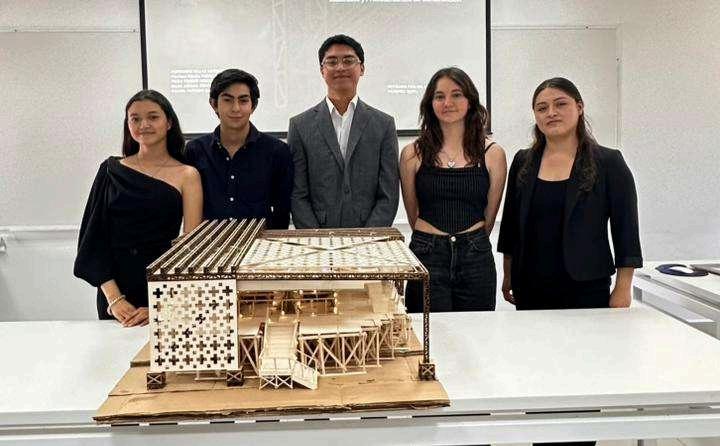
Foto de colaboradores/ Photo of contributors Tomada por/ Taken by Dra / Phd Elizabeth Vazquéz Quit
¿Quién es Nikken Sekkei?
3.1 Concepto arquitectónico
3.2 preliminares
3.3 Cimentación
3.4 Estructuras
3.5 Acabados
01 Editorial 02 03 04 Japan pavillion - Osaka 2025 Athletes’ Village Plaza
4.1 Contexto
4.2 Preliminares
4.3 Cimentación
4.4 Estructuras
4.5 Acabados 05 Pabellón Meridiano

WHO IS NIKKEN SEKKEI?
NIKKEN SEKKEI? ¿QUIÉN ES
Nikken Sekkei es una firma japonesa de servicios profesionales dedicada al diseño arquitectónico, la supervisión y el diseño urbanos, así como a la investigación, planificación y consultoría en estos campos. Bajo su lema “más que creativos”, trabajan de forma integrada con arquitectos, diseñadores, ingenieros, planificadores y consultores para ofrecer soluciones creativas pero también técnicas y factibles
La empresa fue fundada en 1900 y tiene su sede en Tokio. Hoy es una de las firmas de arquitectura y diseño más grandes del mundo, con miles de empleados y más de 25 000 proyectos en más de 50 países, incluyendo edificios altos, equipamientos culturales, complejos urbanos y espacios públicos
Nikken Sekkei is a Japanese professional design firm specializing in architectural design, urban design and supervision, as well as research, planning and consulting Guided by its motto “ more than creative”, the firm uses an integrated, multidisciplinary approach, bringing together architects, engineers, planners and consultants to deliver both imaginative and practical solutions for cities and buildings
Founded in 1900 and headquartered in Tokyo, Nikken Sekkei has grown into one of the world’s largest architectural practices, with several thousand staff members and over 25,000 projects completed in more than 50 countries, ranging from skyscrapers and cultural facilities to large-scale urban developments

PABELLÓN DE JAPÓN
CONCEPTO ARQUITECTÓNICO
ARCHITECTURAL CONCEPT
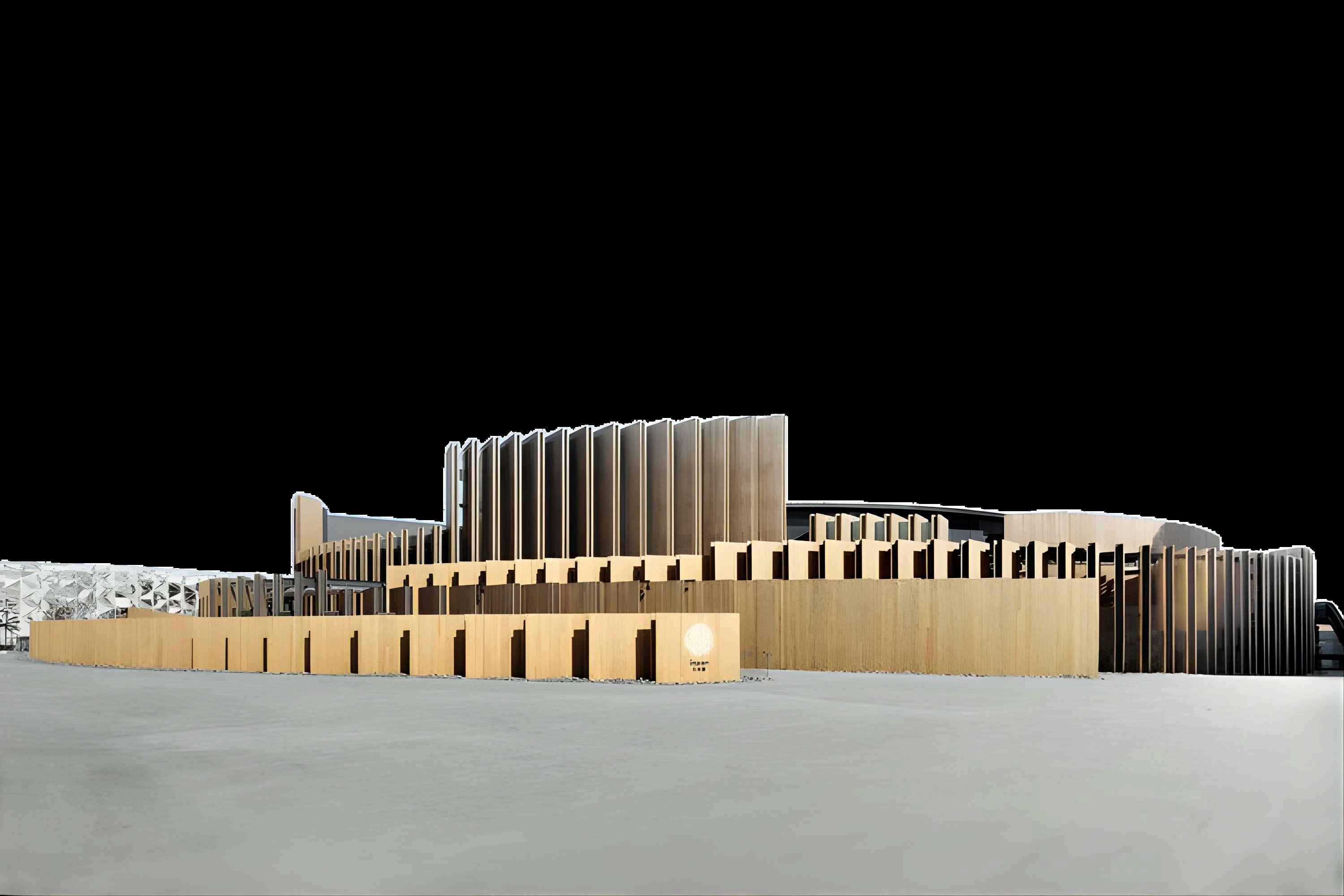
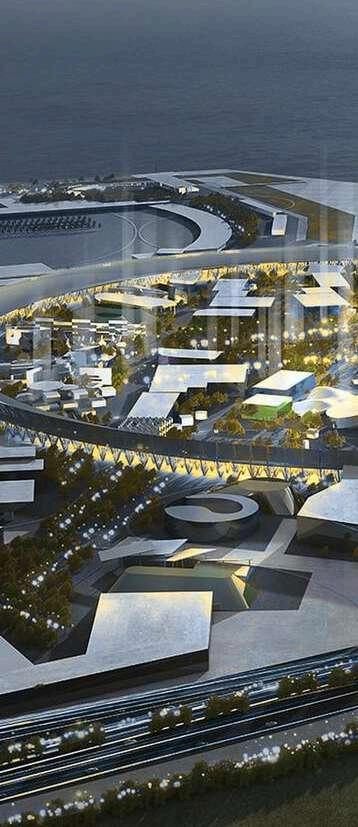
El Japan Pavilion se basa en la idea de la “circulación de la vida” y el tema “Between Lives” La arquitectura se resuelve como un anillo de madera CLT en formación concéntrica, donde las piezas se repiten y se desfasan para crear un recorrido continuo sin inicio ni final Este gesto circular representa los ciclos de transformación de personas, naturaleza y sociedad, y al mismo tiempo genera espacios “entre” interior y exterior, sombra y luz, edificio y exposición La posibilidad de desmontar y reutilizar la madera refuerza el concepto de ciclo y regeneración en lugar de un pabellón temporal que desaparece.
The Japan Pavilion is conceived around the theme “Between Lives” and the “cycle of life” Architecturally, it takes the form of a concentric circular ring of staggered CLT timber panels, creating a continuous promenade with no clear beginning or end This circular motion symbolizes ongoing cycles of transformation in nature, society and individuals, while the gaps between the panels produce in-between spaces that blur inside and outside, structure and exhibition The fact that the timber elements can be disassembled and reused turns the pavilion into a prototype of regenerative, circular architecture rather than a one-time temporary structure
PABELLÓN DE JAPONEXPO OSAKA 2025.
JAPAN PAVILION
OSAKA EXPO 2025
ARQUITECTO: Nikken Sekkei + Oki Sato (Nendo)
INGENIERÍA ESTRUCTURAL: Equipo de Ingenieria Nikken Sekkei
CONSTRUCTORA: Asociación de Contratistas Expo 2025 Osaka
UBICACIÓN: Isla Yumeshima, Osaka, Japón
DISEÑADO EN :2021–2023
CONSTRUIDO EN: 2023–2025
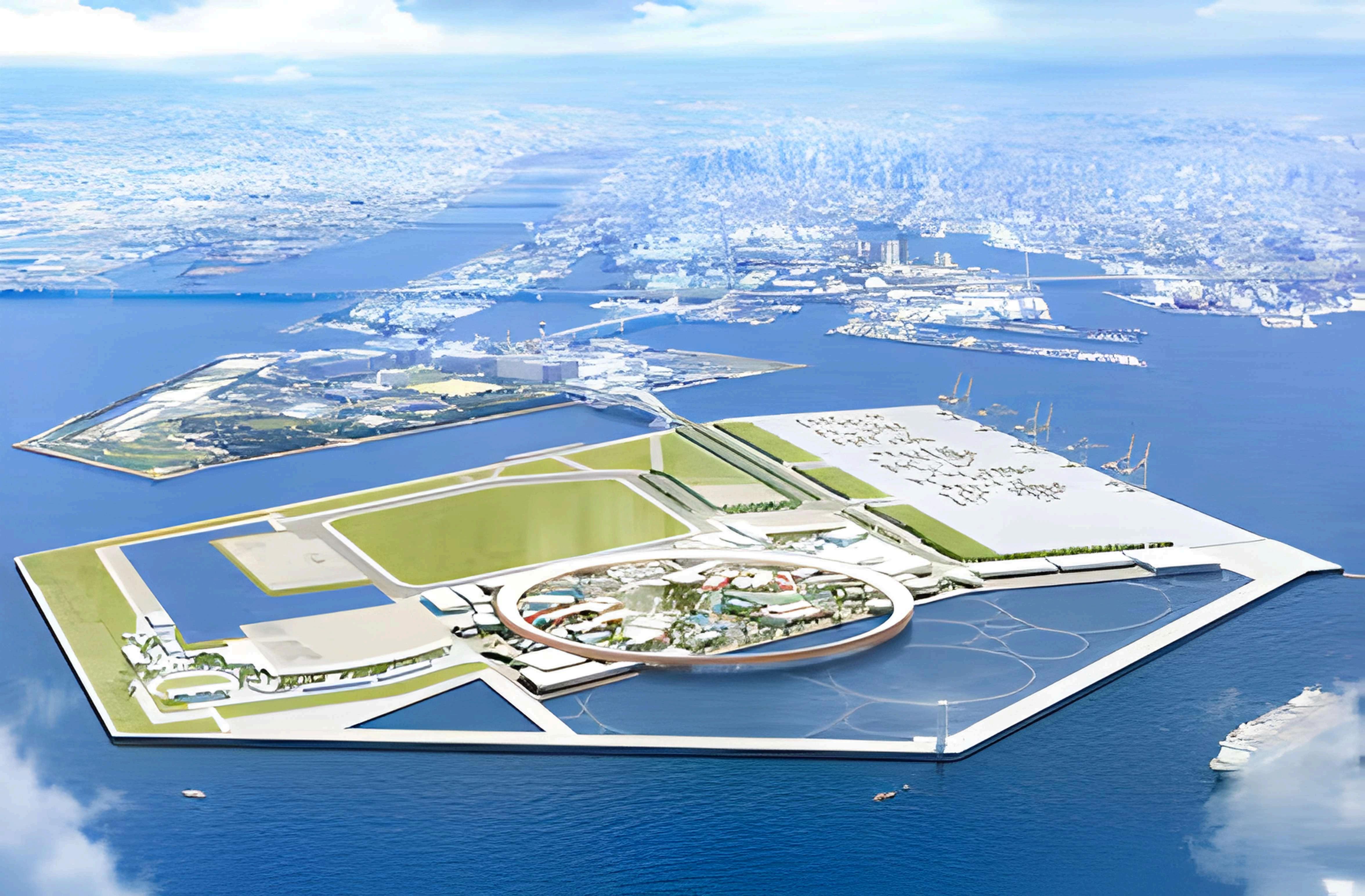
ALTURA: 12–15 m (estructura principal, aproximado)
SUPERFICIE CONSTRUIDA:≈ 5,000 m²
CONCEPTO : “Ciclo de vida”
MATERIAL PRINCIPAL: Madera laminada cruzada (CLT)
SISTEMA ESTRUCTURAL: Paneles CLT en bandas concéntricas unidos con conectores metálicos ocultos
ARCHITECT: Nikken Sekkei + Oki Sato (Nendo)
STRUCTURAL ENGINEERING: Nikken
Sekkei Engineering Team
CONSTRUCTION COMPANY: Expo 2025
Osaka Association Contractors
LOCATION: Yumeshima Island, Osaka, Japan
DESIGNED IN: 2021–2023
BUILT IN: 2023–2025
HEIGHT: 12–15 m (main structure, approx )
BUILT-UP AREA: ≈ 5,000 m²
CONCEPT: “Cycle of Life”
MAIN MATERIAL: Cross-Laminated Timber (CLT)
STRUCTURAL SYSTEM: CLT panels arranged in concentric bands with hidden steel connectors
PRELIMINARES
PRELIMINARIES
Antes de que el Japan Pavilion se construya, el proyecto empieza en Yumeshima, isla artificial en la bahía de Osaka preparada para la Expo 2025 El gobierno y el comité organizador generan una gran plataforma urbanizada con vialidades e infraestructura, definen el master plan y asignan a Japón un lote con reglas claras de uso, seguridad y desmontaje
Como pabellón autoconstruido, el equipo de Nikken Sekkei primero gestiona permisos y coordinación con la Expo, instala casetas, bodegas, cercado, sanitarios y servicios provisionales de luz y agua Después replantea en sitio el anillo circular: ejes, radios, accesos y conexiones peatonales Este trazado y nivelación define la posición de la cimentación y de la futura estructura de acero y paneles de madera CLT, convirtiendo a los preliminares en la base logística y geométrica de todo el pabellón
Before the Japan Pavilion is built, the project starts on Yumeshima, an artificial island in Osaka Bay prepared to host Expo 2025 The local government and Expo committee create a large urbanised platform with roads and infrastructure, define the overall master plan, and assign Japan a serviced plot with strict rules for use safety and dismantling
As a self-built pavilion, the Nikken Sekkei team first focuses on permits and coordination with the Expo, then sets up temporary facilities: site offices, storage, fencing, toilets and provisional power and water After that, they set out the circular ring on site axes, radii, entrances and pedestrian links This setting-out and leveling fixes the position of the foundations and the future steel structure with CLT timber panels, making the preliminaries the logistical and geometric base of the entire pavilion
Isla artificia Yumesh ma/Yumeshima artificia
CIMENTACIÓN
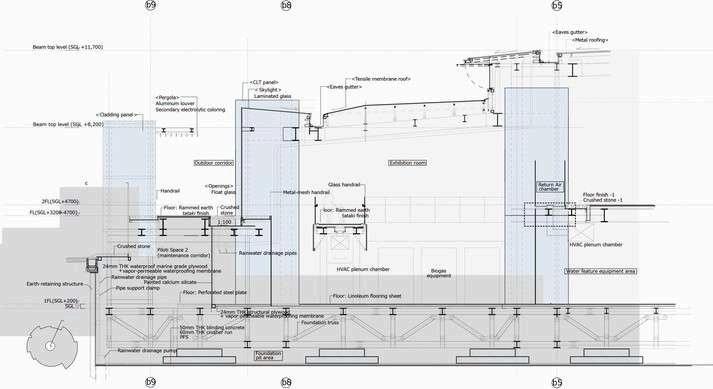
La cimentación del Japan Pavilion está pensada como una gran plataforma técnica más que como una simple base En el corte se ve cómo una serie de zapatas aisladas de concreto recibe una cercha metálica continua que funciona como viga de fundación: amarra las columnas, reparte las cargas del anillo estructural y eleva el edificio respecto al terreno de relleno de Yumeshima
Sobre esta cercha se forma un entrepiso técnico donde se alojan ductos, drenajes, cámaras de aire y el plenum de instalaciones Así, la cimentación no solo garantiza estabilidad frente a posibles asentamientos, sino que organiza el paso de agua, aire y energía bajo el pabellón
De esta manera, la base estructural y el “suelo” que pisan los visitantes forman una sola pieza, discreta a la vista pero fundamental para que el anillo de madera y acero pueda funcionar

The foundation of the Japan Pavilion is conceived as a technical platform rather than a simple base In the section drawing we can see how a series of reinforced concrete footings support a continuous steel truss that works as a foundation beam: it ties the columns together, distributes the loads of the circular structure and lifts the building above the reclaimed ground of Yumeshima On top of this truss, a service floor is created to accommodate ducts, drainage pipes, air chambers and the installations plenum In this way, the foundation not only provides stability against possible settlements, but also organises the flow of water, air and energy beneath the pavilion The structural base and the floor used by visitors become one integrated system almost invisible, but essential for the timber-and-steel ring to perform properly
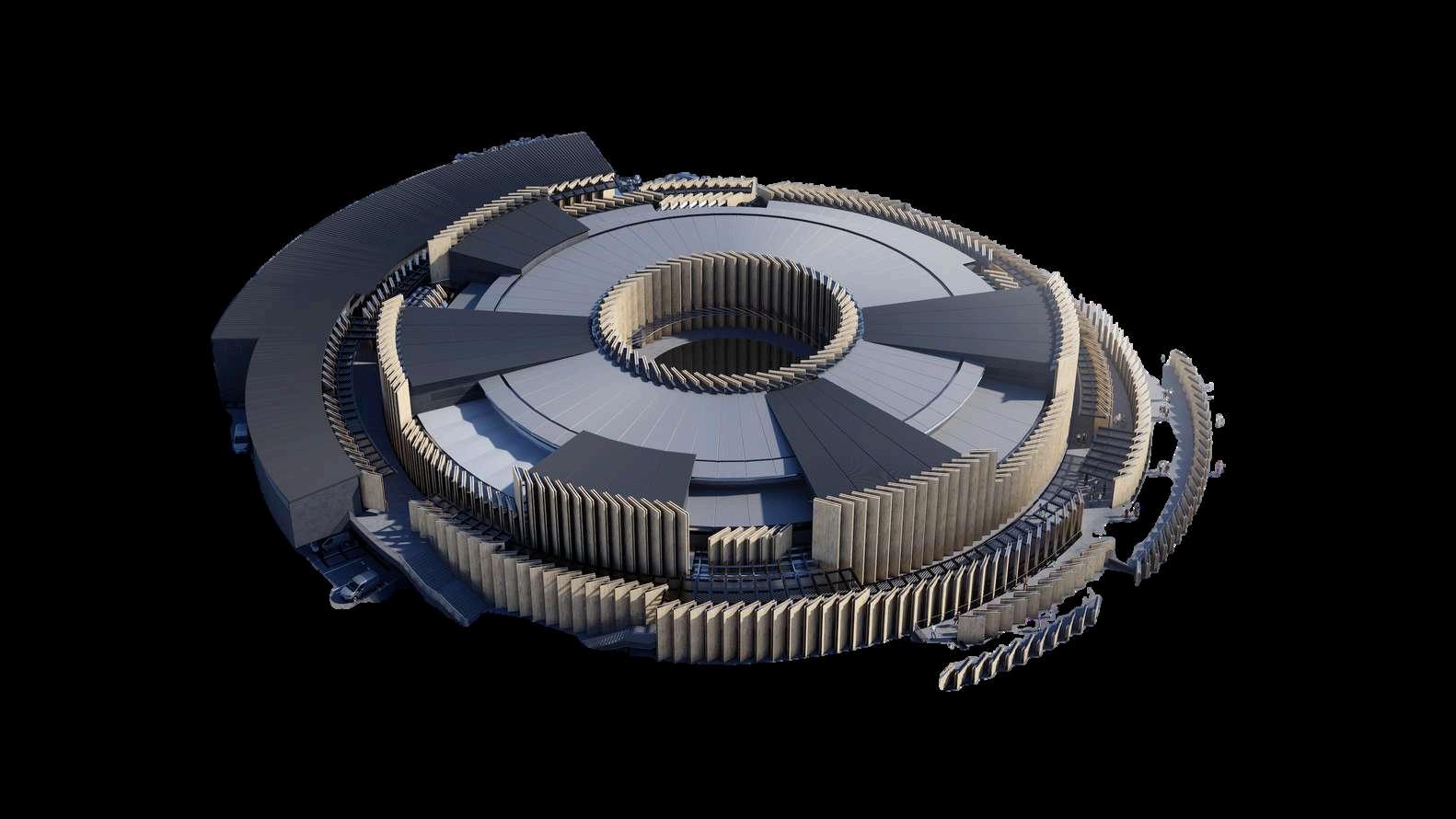
Pavellón Osaka Japon 2025 vista aerea / Pavel on

ESTRUCTURA STRUCTURE
El sistema estructural del Japan Pavilion destaca por su uso de madera laminada CLT combinada con un armazón de acero dispuesto en forma radial La subestructura metálica circular distribuye las cargas del anillo principal y permite un montaje rápido sin recurrir a cimentaciones profundas La forma circular del pabellón responde a criterios estructurales y simbólicos: el anillo perimetral estabiliza el conjunto y los paneles de CLT instalados verticalmente actúan como muros resistentes a sismo, aportando rigidez torsional al edificio Gracias a esta geometría, la cubierta de madera funciona como un volumen continuo que abraza el recorrido interior
Cada panel de CLT fue prefabricado con precisión y montado mediante uniones secas desmontables, lo que permite retirar, reutilizar o reciclar los elementos estructurales tras la Expo 2025 El uso de madera reduce la huella ambiental del proyecto y refuerza su narrativa basada en el ciclo de vida
El resultado es un pabellón que combina ligereza, estabilidad y eficiencia constructiva, logrando una estructura contemporánea profundamente vinculada a la tradición arquitectónica japonesa
The structural system of the Japan Pavilion features a combination of CLT timber panels and a radial steel framework
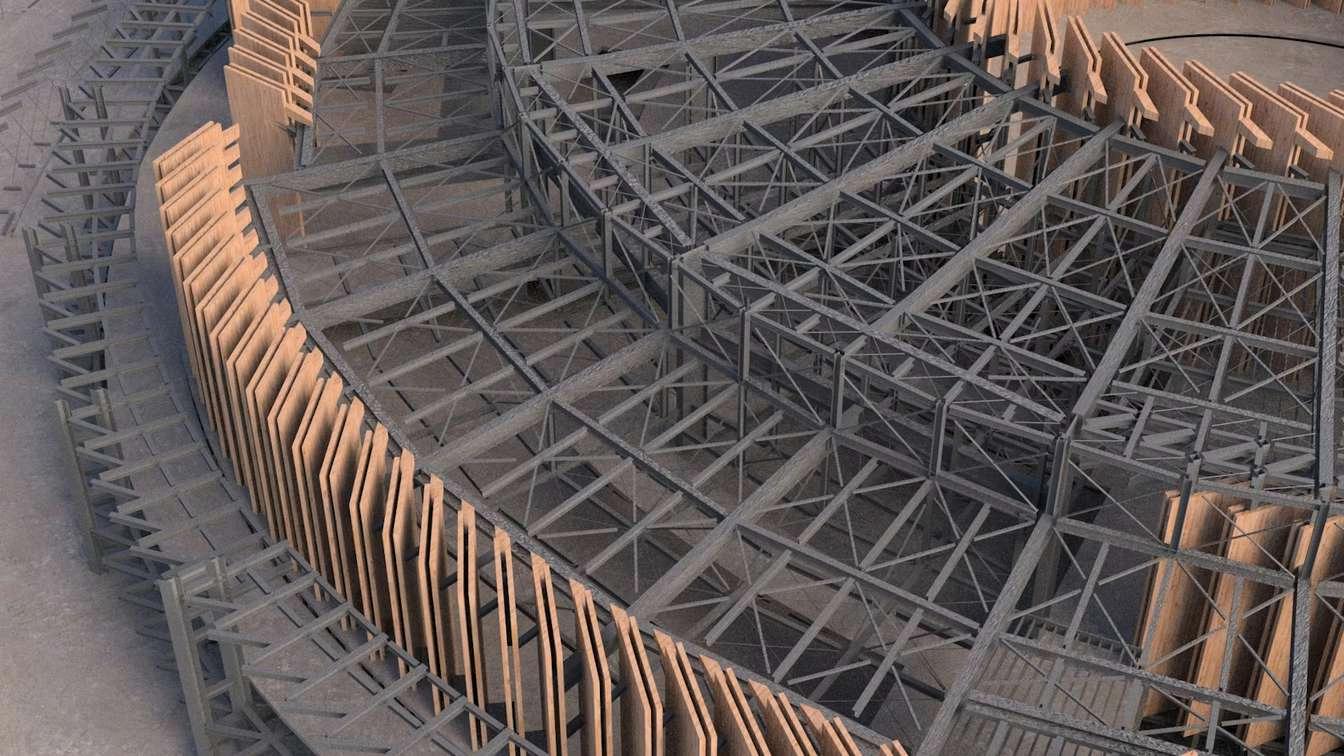
The circular steel substructure distributes loads from the main ring and enables rapid assembly without the need for deep foundations
The pavilion’s circular form responds to both structural and symbolic requirements: the outer ring provides stability, while vertically installed CLT panels act as seismic-resistant walls, adding torsional stiffness to the building
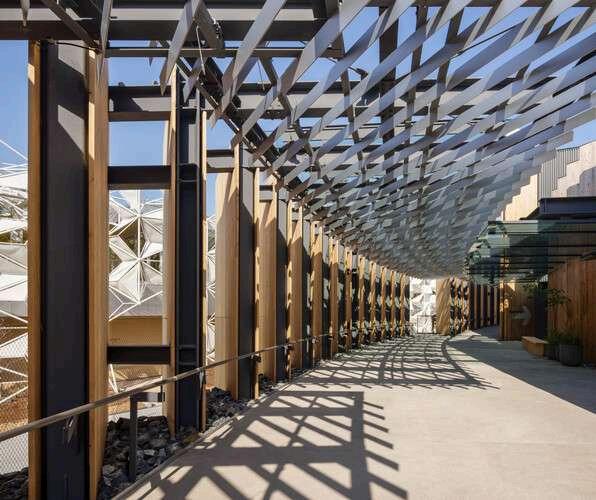
This geometry allows the timber roof to behave as a continuous volume that encloses the interior walkway
Each CLT panel was prefabricated with precision and connected using dry-joint systems that allow the structure to be disassembled,
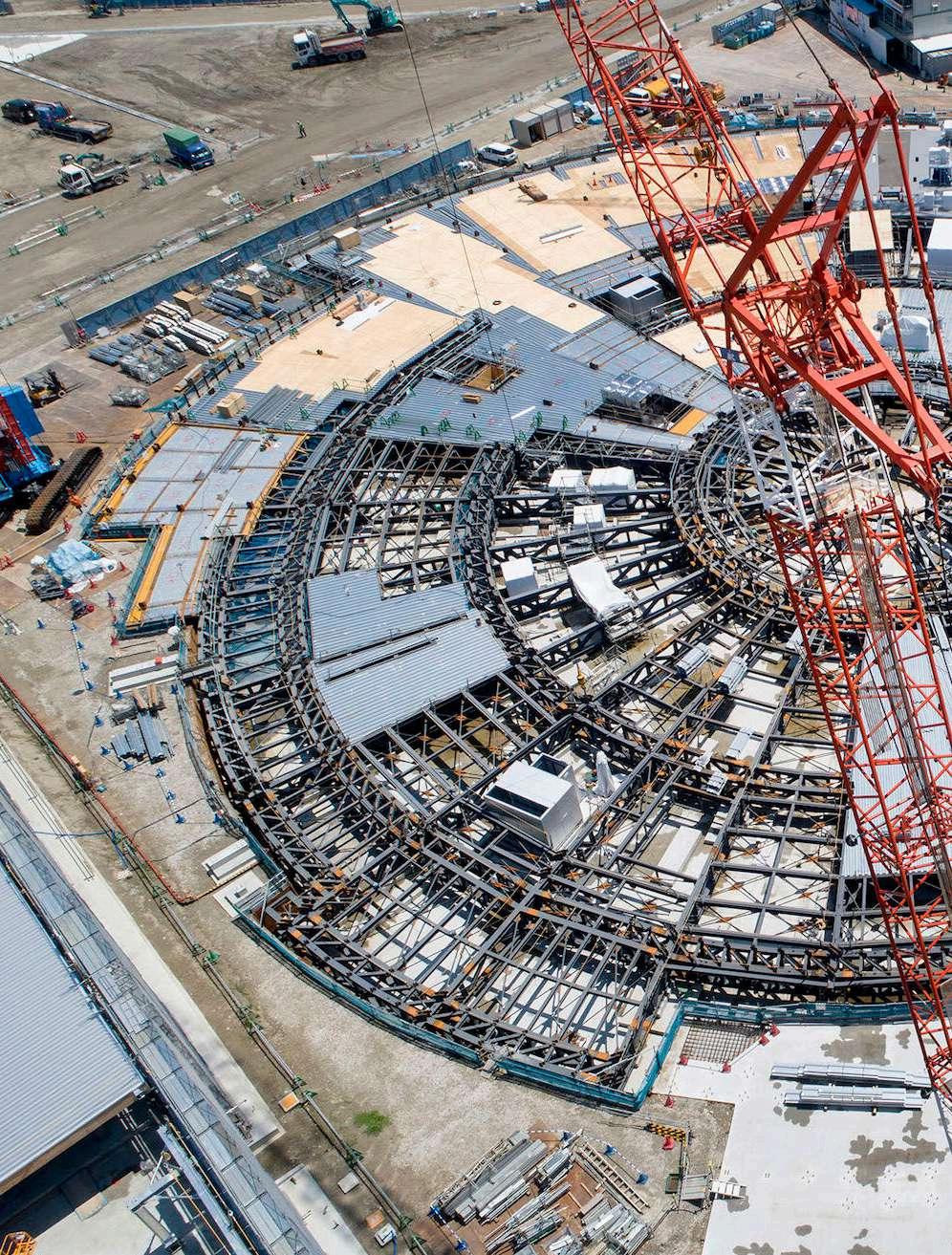
reused or recycled after Expo 2025 The use of timber reduces the project’s environmental footprint and reinforces its lifecycle narrative
The result is a pavilion that blends lightness, stability, and construction efficiency, creating a contemporary structure deeply rooted in Japanese architectural tradition
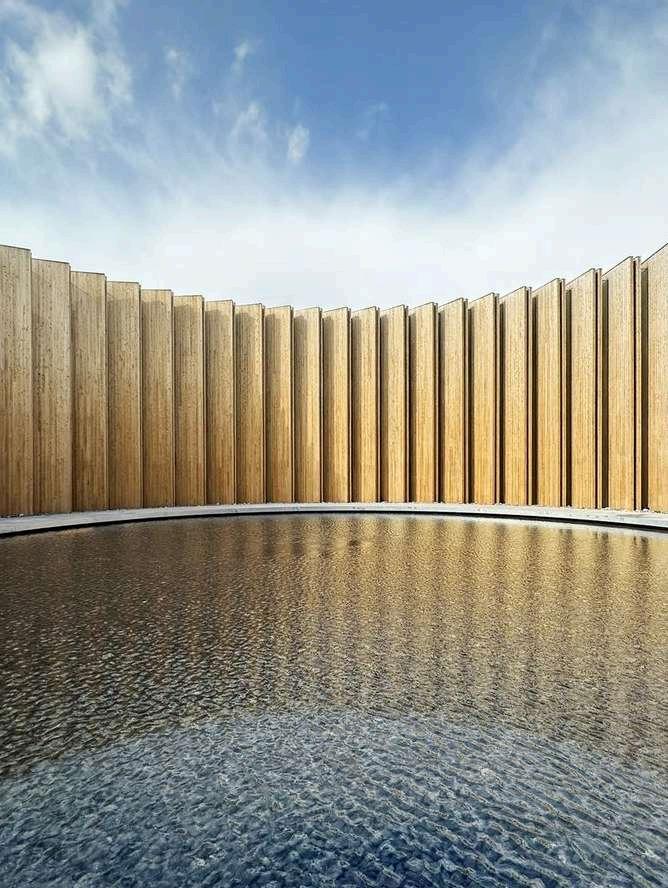
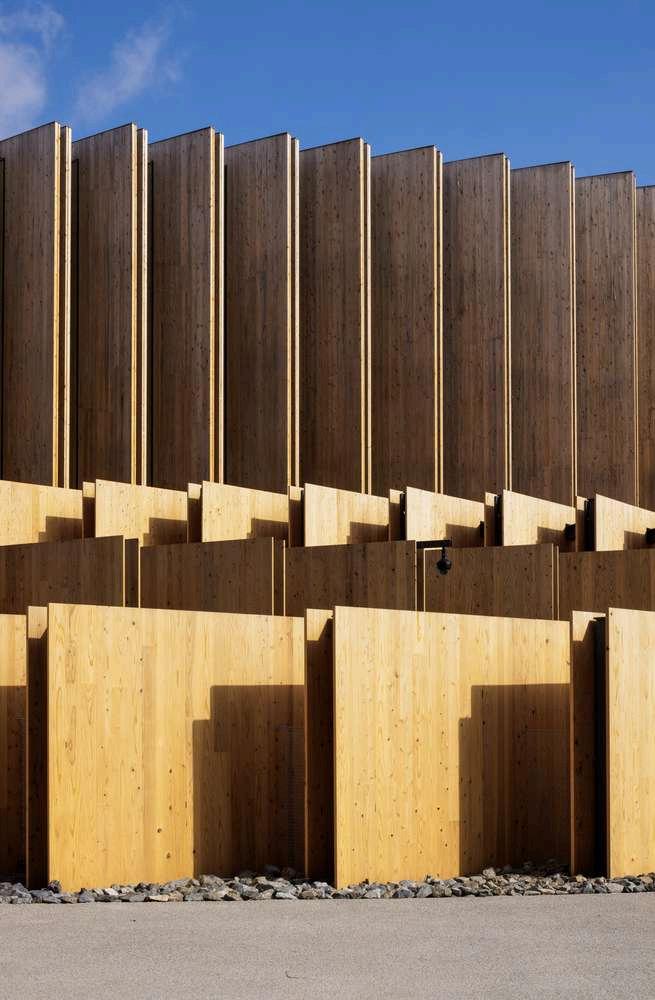
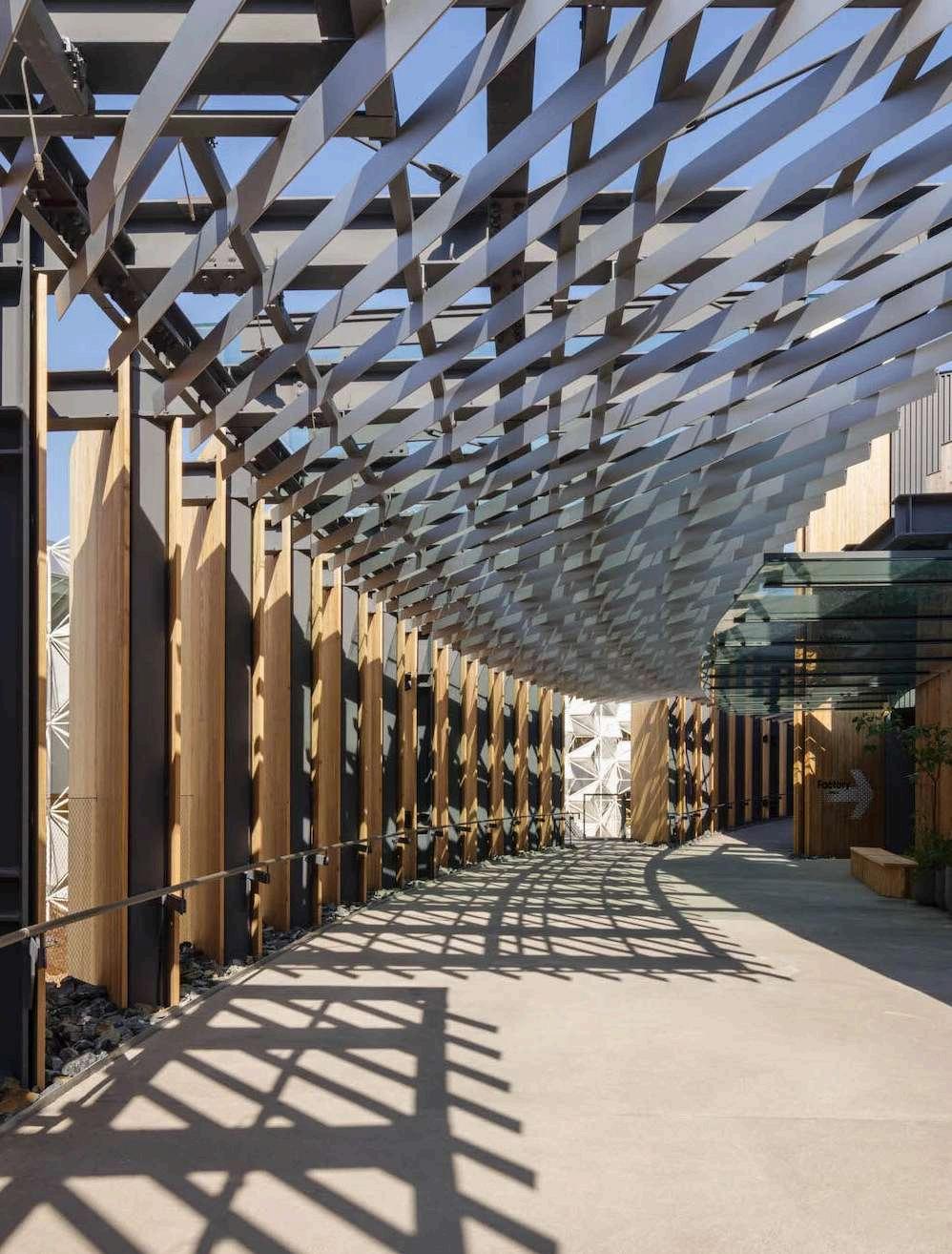
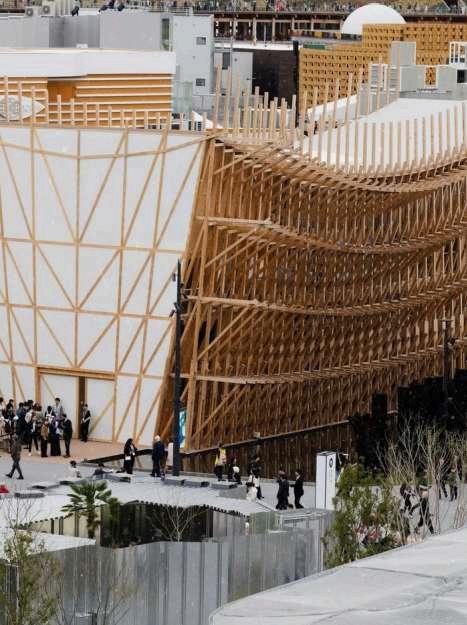
La envolvente del Japan Pavilion está dominada por los paneles de madera CLT de cedro japonés, que funcionan al mismo tiempo como estructura y como acabado visible Al exterior se leen como una serie de láminas altas y moduladas que forman un filtro continuo: protegen del sol, generan sombras profundas y dan al pabellón una imagen cálida y homogénea, muy distinta a la de un pabellón metálico convencional Al interior, estos mismos planos de madera se combinan con cielos
ACABADOS FINISHES
The envelope of the Japan Pavilion is dominated by CLT panels made of Japanese cedar, which act both as structure and as visible finish On the exterior, they read as a series of tall, modulated slats that form a continuous filter: they provide solar protection, create deep shadows and give the pavilion a warm, uniform appearance, very different from that of a conventional metallic pavilion Inside, these same wooden planes are combined with technical exposed-steel ceilings, continuous concrete or resin floors and glass exhibition elements
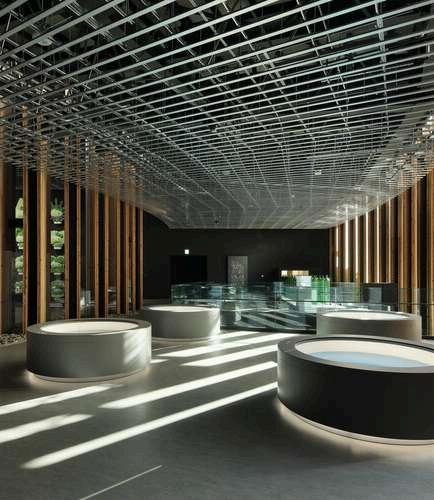
The contrast between the natural texture of the cedar, the dark roof structure and the focused lighting creates an almost scenographic atmosphere, where visitors move between shadows, reflections on the water and flashes of light passing through the gaps in the façade Far from being just a final layer, the finishes reinforce the concept of the life cycle and the idea of a space in constant transformation
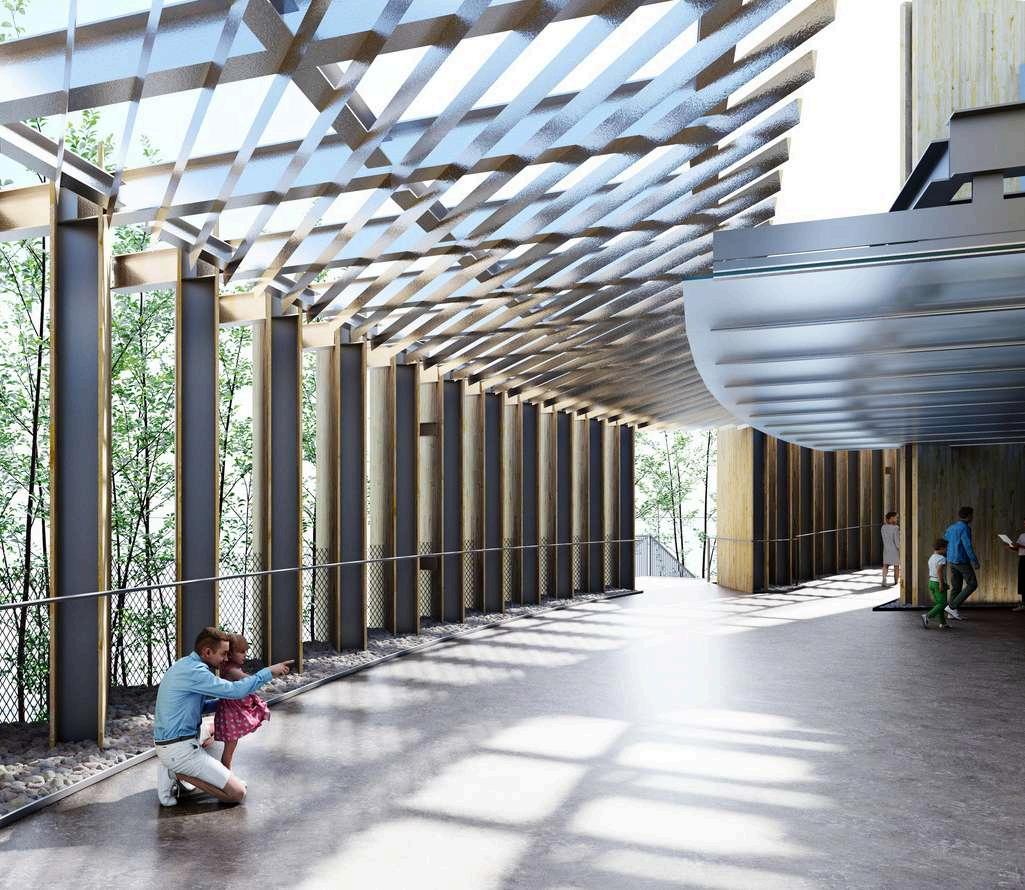
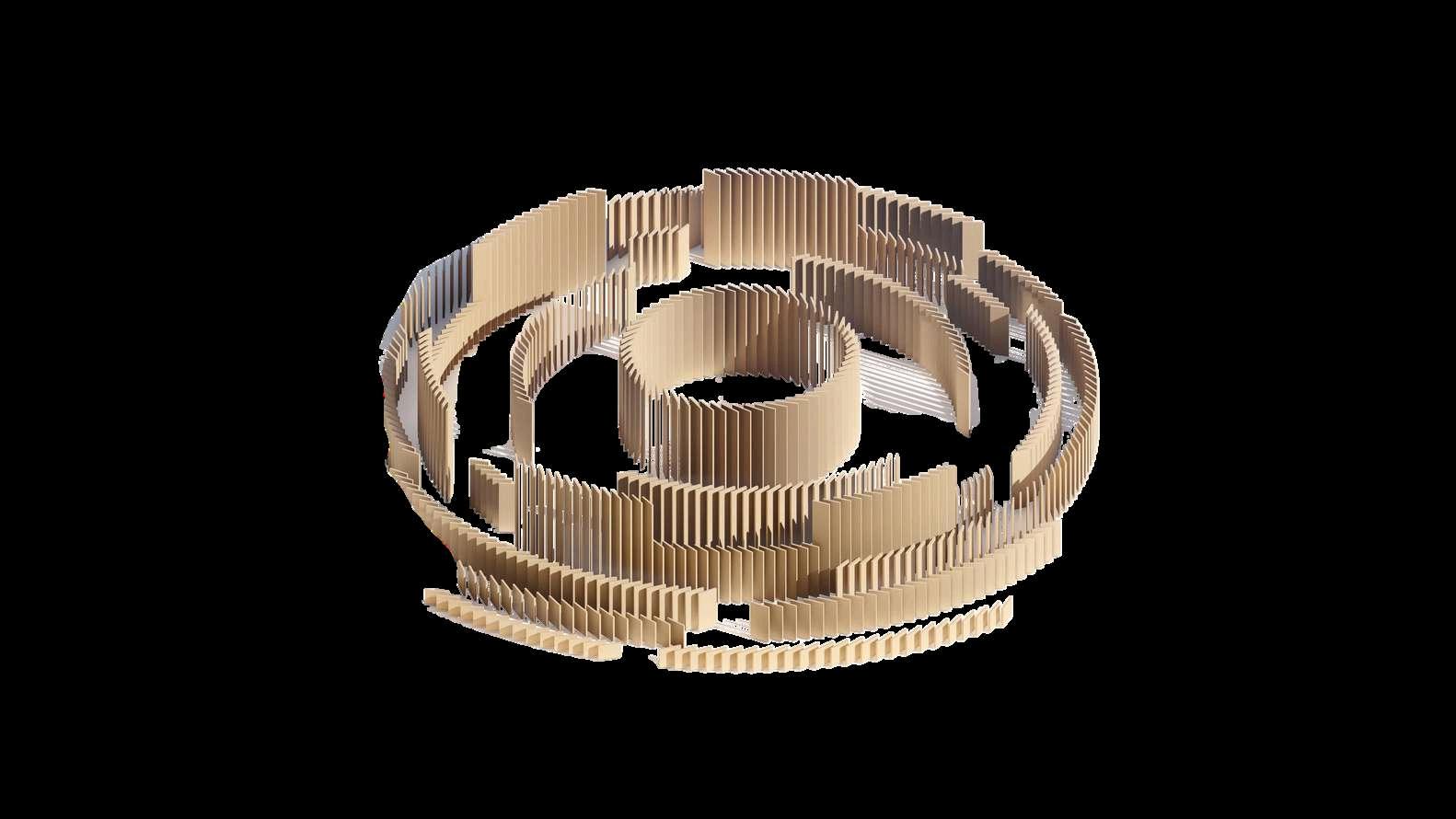
Figura 1
ESCANEAPARACONOCERMÁS SCAN TO LEARN MORE

Plaza de la Villa de los Atletas
CONTEXTO
CONTEXT
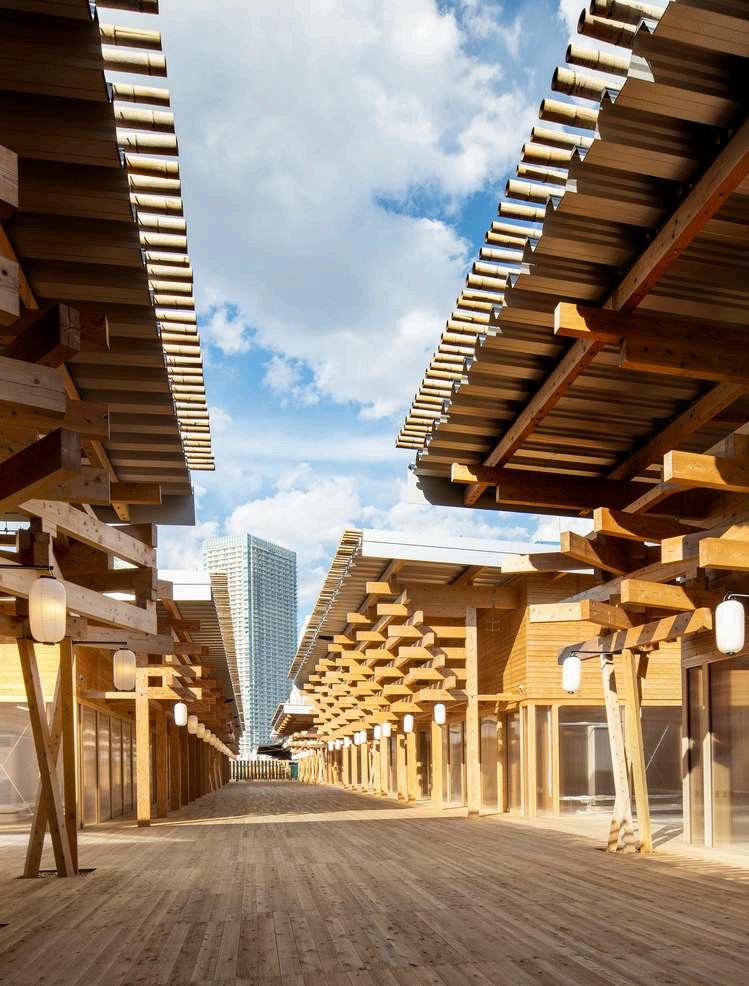
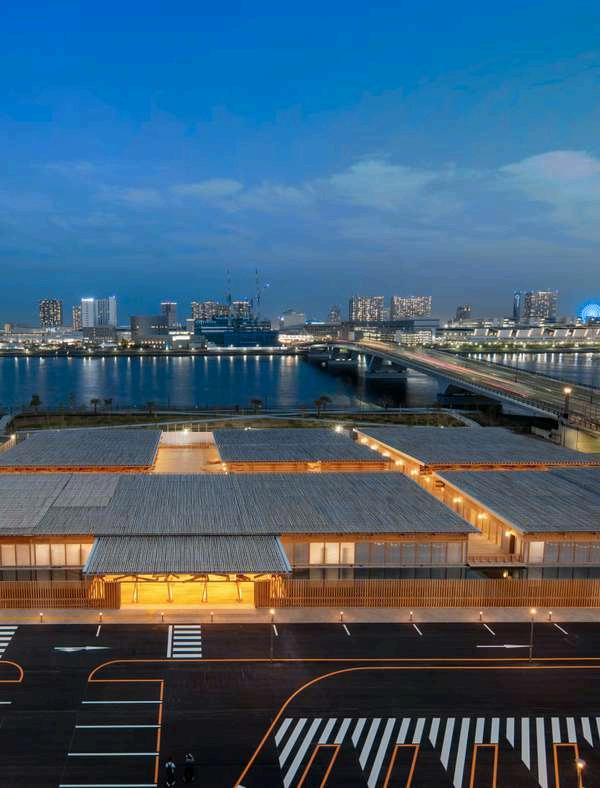
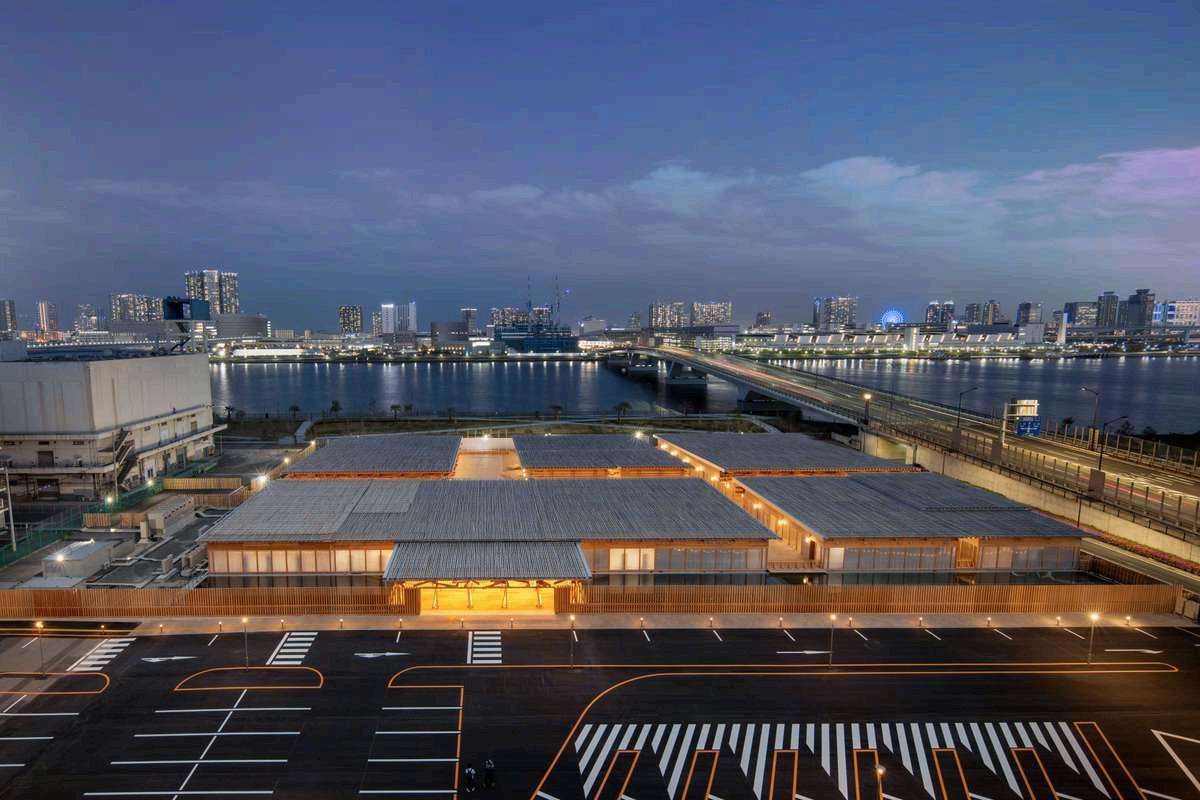
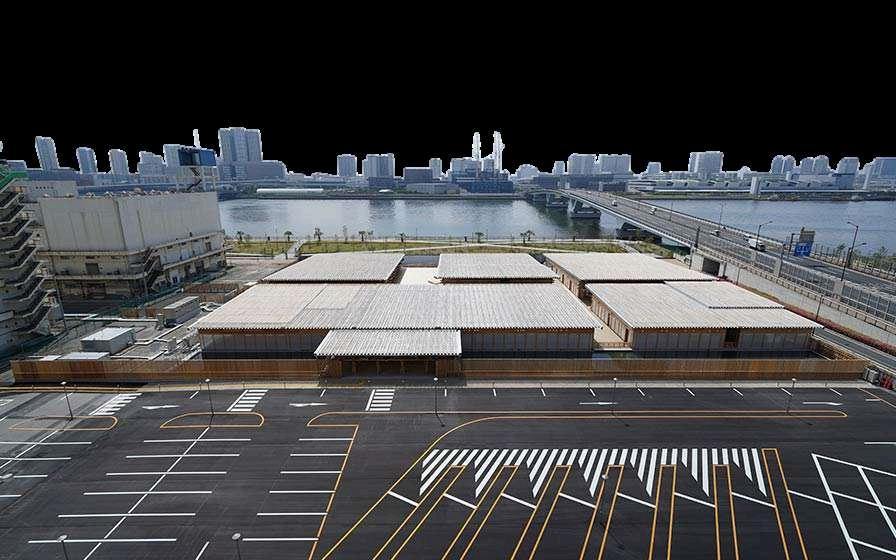
El Athletes’ Village Plaza es una instalación temporal construida en la Villa Olímpica de Tokio 2020, en Harumi, Tokio Diseñada por Nikken Sekkei, funcionó como un espacio ceremonial y de servicios donde podían encontrarse atletas, medios, personal de los Juegos y visitantes: tiendas, cafetería, áreas de descanso y atención médica, todo en un solo conjunto de edificios de baja altura
El proyecto se concibió como un gesto de “ apoyo nacional en madera”: alrededor de 40,000 piezas de madera fueron prestadas por 63 municipios de Japón, utilizadas para levantar la plaza y, una vez terminados los Juegos, desmontadas y regresadas a cada localidad para reutilizarse en mobiliario y equipamiento público. Así, la plaza se vuelve un ejemplo de arquitectura efímera y circular, donde el material tiene una segunda vida más allá del evento
Athletes’ Village Plaza is a temporary facility built inside the Tokyo 2020 Olympic and Paralympic Village in Harumi, Tokyo Designed by Nikken Sekkei, it served as a low-rise ceremonial and service area where athletes, media, VIPs, and guests could meet, shop, relax, and access support services in a single complex
The project was based on the idea of “National Timber Support”: about 40,000 timber members were borrowed from 63 municipalities across Japan, assembled to form the plaza, and after the Games dismantled and returned to each municipality to be reused as benches and public facilities The plaza thus becomes a clear example of temporary, circular timber architecture, where materials are designed to have a new life after the event
Plazadela Villadelos Atletas
Athletes’ Village Plaza
Nombre: Athletes’ Village Plaza
Ubicación: Harumi, Chuoku, Tokio, Japón
Uso principal: Plaza de servicios y ceremonias para la Villa Olímpica (tiendas, cafetería, áreas de encuentro)
Cliente: Tokyo Organizing Committee for the Olympic and Paralympic Games
Arquitectos: Nikken Sekkei Ltd
Área de sitio: aprox 14,500 m²
Superficie construida: aprox 5,300 m²
Altura: aprox 6 95 m, 1 nivel
Estructura principal: madera (piezas de distintas especies provenientes de municipios japoneses)
Año de conclusión: 2020
Name: Athletes’ Village Plaza
Location: Harumi, Chuo-ku, Tokyo, Japan
Main use: Service and ceremonial plaza for the Olympic Village (shops, cafés, meeting areas)
Client: Tokyo Organizing Committee for the Olympic and Paralympic Games
Architects: Nikken Sekkei Ltd
Site area: approx 14,500 m²
Total floor area: approx 5,300 m² Height: approx 6 95 m, 1 storey
Main structure: timber (members of different species provided by Japanese municipalities)
Completion year: 2020
PRELIMINARES
PRELIMINARIES
Los preliminares del Athletes’ Village Plaza se centraron en diseñar un edificio temporal, prefabricado y desmontable para los Juegos de Tokio 2020 Se analizaron el flujo de atletas y prensa, las condiciones climáticas del distrito costero de Harumi como la humedad, los vientos de bahía y las cargas sísmicas y la mejor orientación del volumen. También se definió desde el inicio el uso de madera proveniente de más de 60 municipios, seleccionada y clasificada según estándares JAS para garantizar calidad, resistencia y rápida instalación en obra
The preliminary phase of the Athletes’ Village Plaza focused on creating a temporary, prefabricated and fully demountable facility for the Tokyo 2020 Games Early studies analyzed athlete and media circulation, the climatic conditions of the coastal Harumi district such as humidity, bay winds and seismic loads and the ideal orientation of the building The use of timber sourced from over 60 municipalities was also established early on, with each piece inspected under JAS standards to ensure quality, strength and fast on-site assembly
CIMENTACIÓN
FOUNDATION
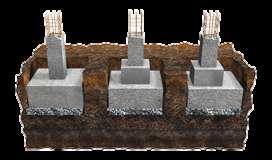
La cimentación del Athletes’ Village Plaza se resolvió con un sistema superficial ligero, adecuado para un edificio temporal y de baja altura Debido a que la estructura debía desmontarse tras los Juegos, se evitaron elementos profundos como pilotes o losas masivas En su lugar, se utilizaron zapatas y bases modulares que permiten soportar las cargas de los marcos de madera y los elementos diagonales, manteniendo la estabilidad en el suelo costero de Harumi
El peso reducido del edificio compuesto en su mayoría por madera facilitó una cimentación mínima, diseñada para resistir humedad, vientos de bahía y vibraciones sísmicas
Este enfoque permitió una instalación rápida, precisa y compatible con el concepto principal del proyecto: un pabellón desmontable, reutilizable y de bajo impacto ambiental
The foundation of the Athletes’ Village Plaza uses a light, shallow system suitable for a temporary, low-rise building Since the structure was designed to be dismantled after the Olympic Games, deep elements such as piles or massive slabs were avoided Instead, shallow pads and modular footings were installed to support the timber frames and diagonal columns, ensuring stability over the coastal soils of Harumi
The building’s low weight mostly timber made it possible to minimize the foundation while still resisting humidity, bay winds and seismic activity This approach enabled fast and precise installation, aligning with the project’s core concept of a demountable, reusable and low-impact pavilion
ESTRUCTURA
STRUCTURE
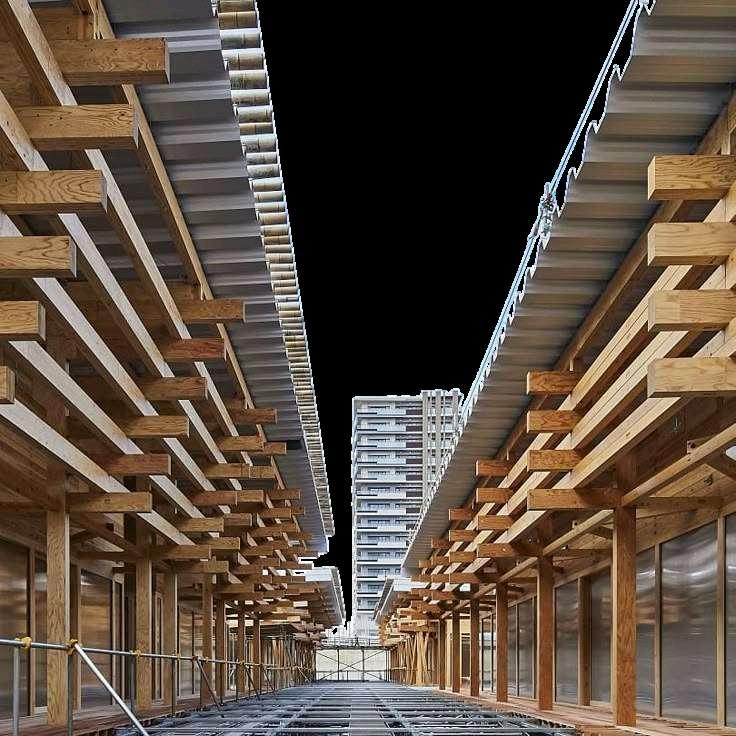
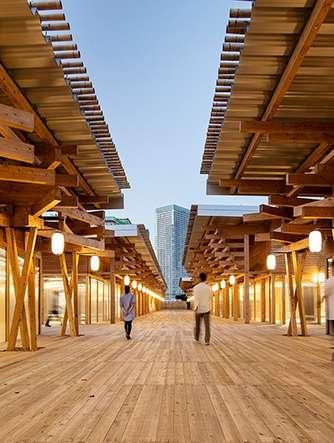
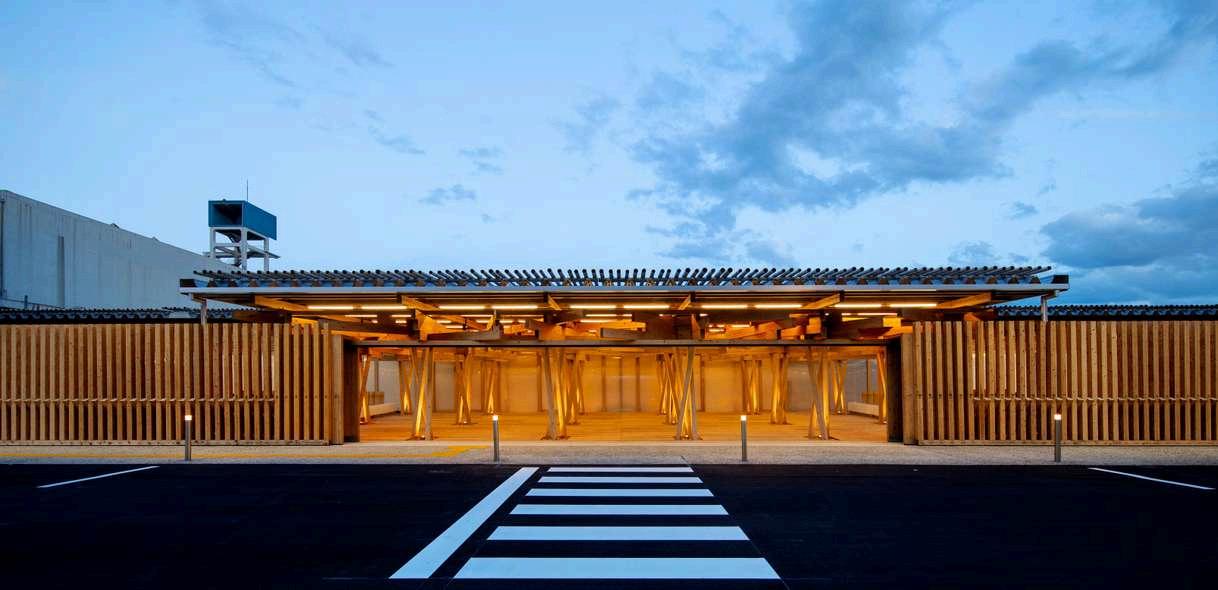
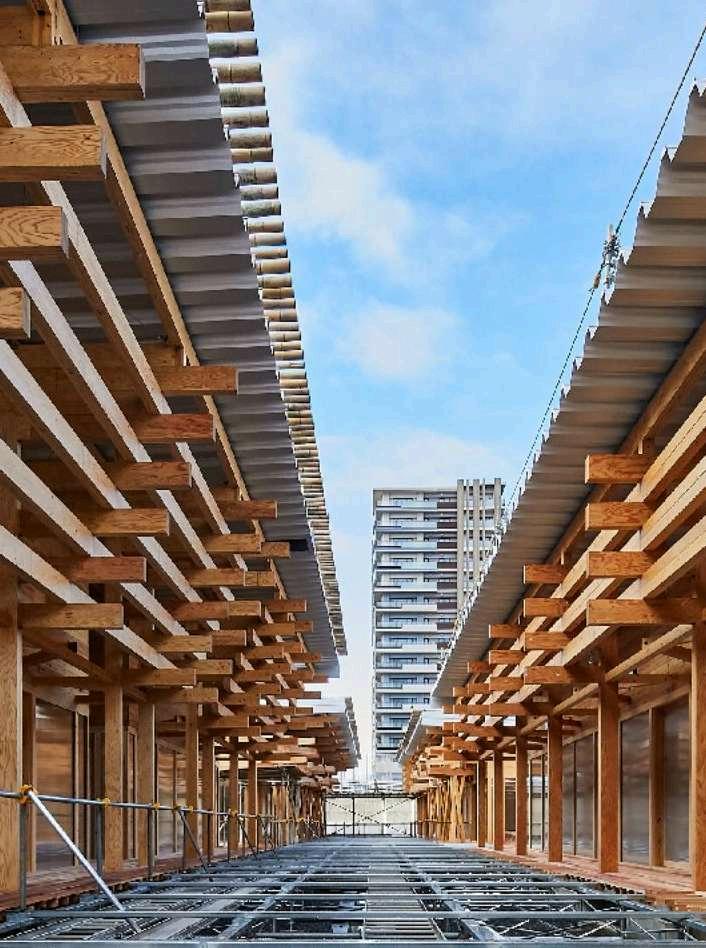
El sistema estructural del Athletes’ Village Plaza está compuesto casi en su totalidad por madera, ensamblada mediante uniones visibles que evocan las técnicas tradicionales japonesas La estructura se organiza con marcos repetitivos y elementos diagonales que permiten crear grandes luces sin recurrir a acero pesado ni concreto masivo Las piezas son modulares, estandarizadas y diseñadas para ser desmontadas tras los Juegos, permitiendo que la madera regrese a su región de origen para ser reutilizada
El diseño busca una arquitectura cálida y ligera, donde los techos amplios y la retícula estructural de madera generan un ritmo espacial continuo, reforzando el concepto de comunidad temporal y sostenible La precisión de los ensamblajes garantiza estabilidad sísmica y rapidez constructiva, a la vez que celebra la artesanía japonesa en su expresión más contemporánea
The structural system of the Athletes’ Village Plaza is composed almost entirely of timber, assembled through visible joinery inspired by traditional Japanese carpentry The building features repetitive frames and diagonal bracing that allow large spans without the need for heavy steel or massive concrete All components are standardized and designed for disassembly after the Games, ensuring that the timber can be returned to its region of origin for reuse
The architectural expression emphasizes warmth and lightness, with broad roof planes and a rhythmic timber grid that reinforces the idea of a temporary, sustainable community The precision of the joinery ensures seismic stability, rapid construction, and a contemporary reinterpretation of Japanese craftsmanship
ENVOLVENTE Y ACABADOS
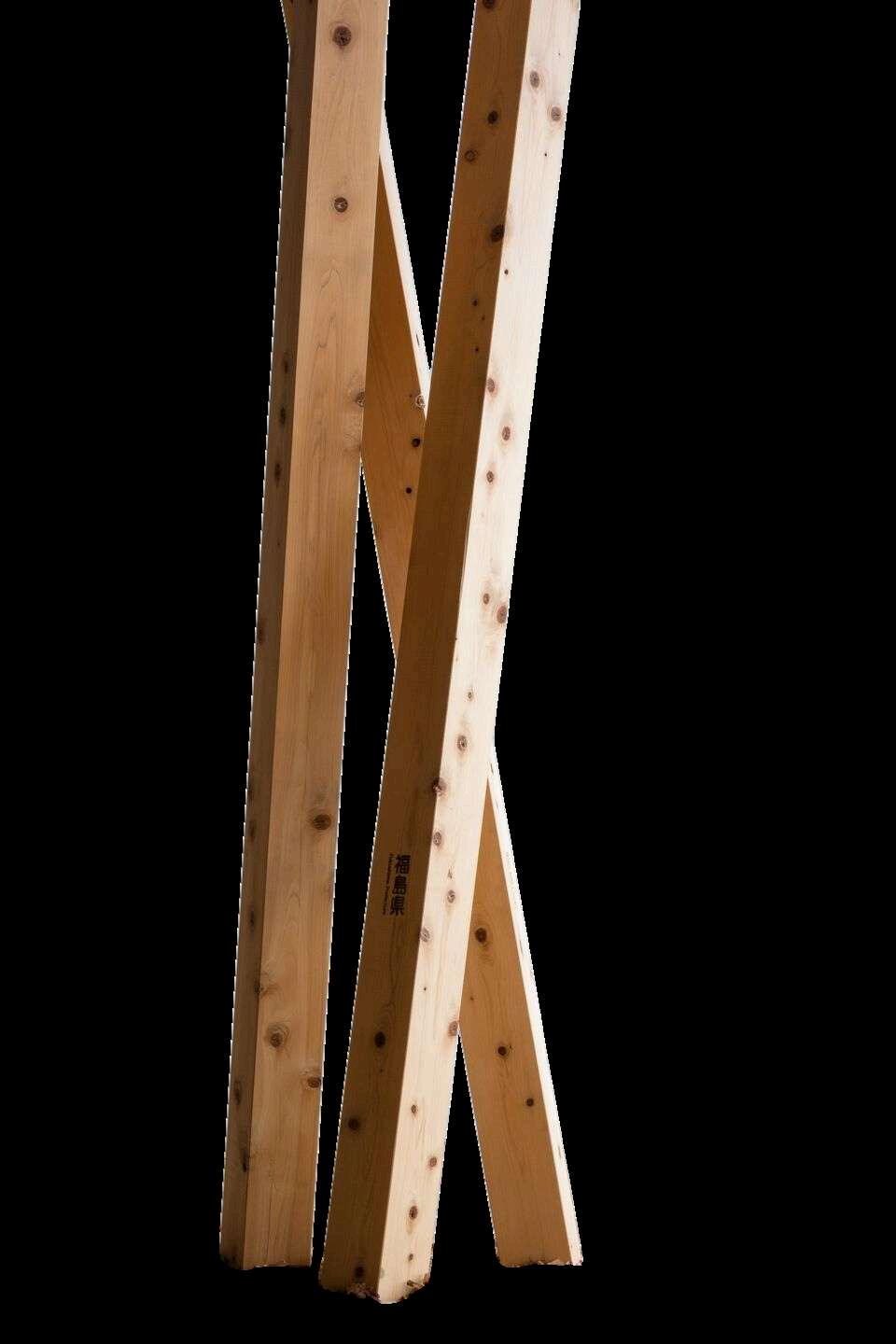
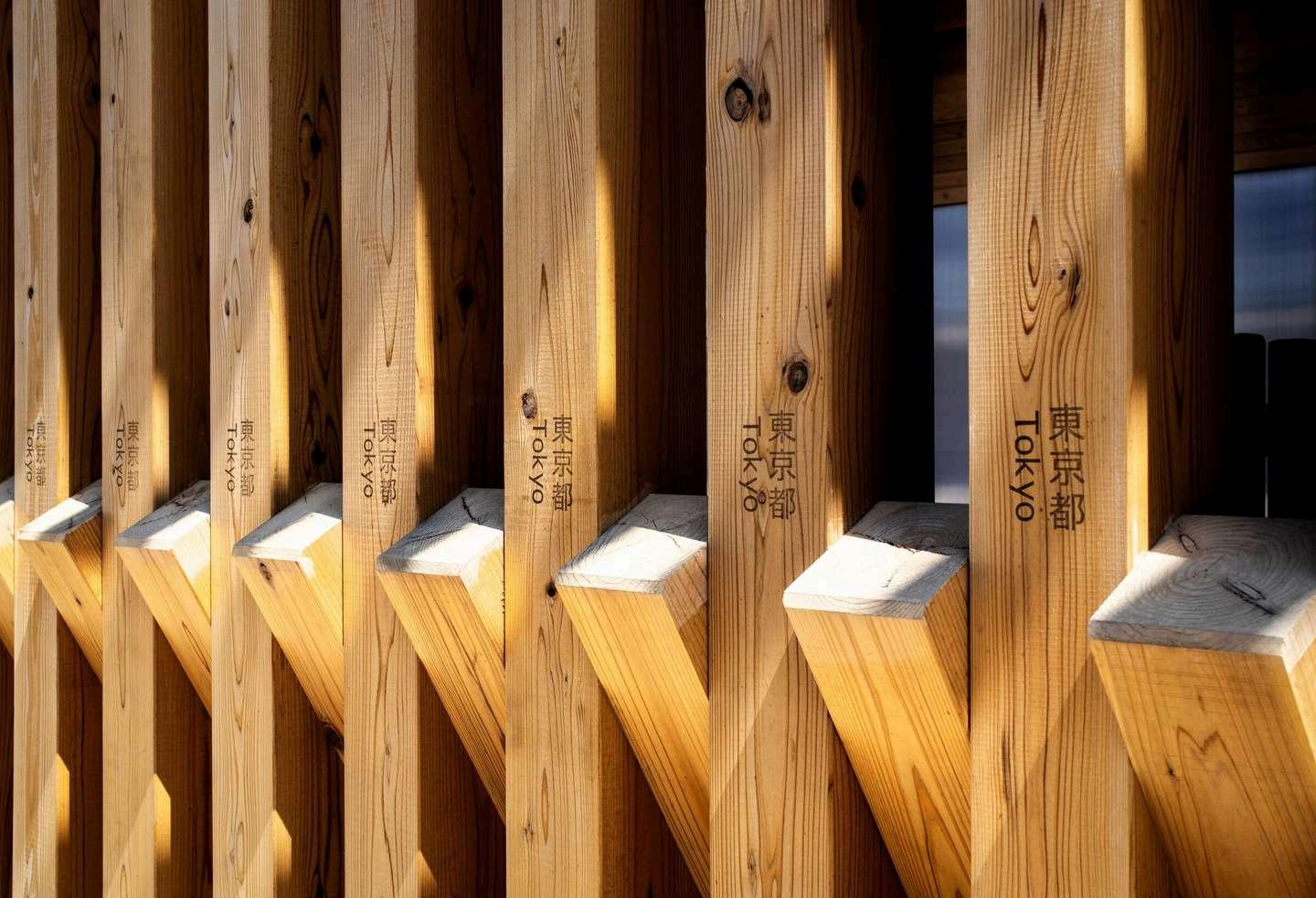
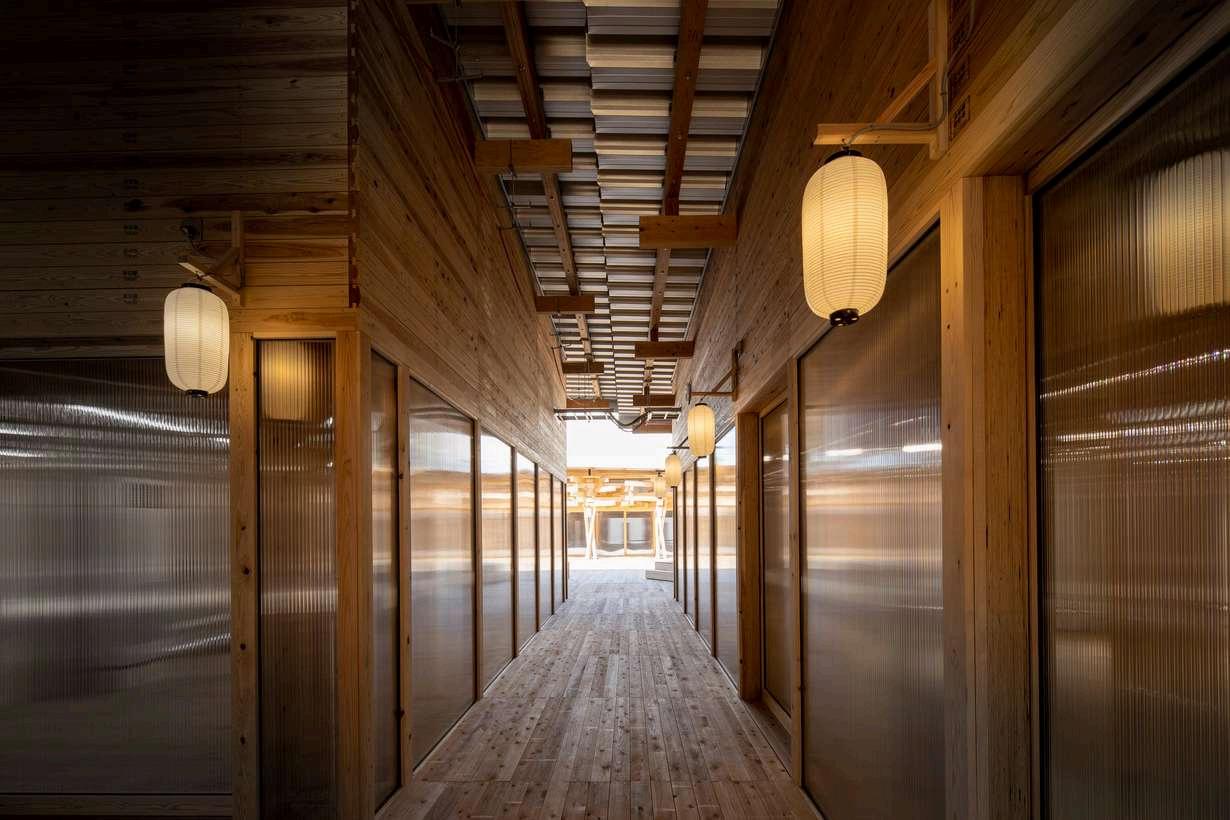
En la Athletes’ Village Plaza la envolvente es casi por completo de madera aparente, y eso la convierte en la verdadera protagonista del proyecto. Los pabellones se cierran con una serie de bastidores y listones que forman fachadas ligeras, ventiladas y moduladas; hacia el exterior funcionan como filtro solar y como barandal continuo alrededor del conjunto Un detalle importante es que muchas piezas llevan grabado el nombre del municipio que donó la madera Esto convierte a cada elemento en algo más que un componente constructivo: es una pieza identificable que, una vez desmontada la plaza, regresará a su lugar de origen para reutilizarse en mobiliario y equipamiento público Los acabados, por lo tanto, hablan directamente del concepto de la obra: una arquitectura templada, cálida y temporal, pensada para celebrar los Juegos, pero también para tener una segunda vida después del evento
In Athletes’ Village Plaza, the envelope is almost entirely exposed timber, making it the main character of the project The pavilions are wrapped with frames and slats that create light, ventilated and highly regular façades; on the outside they work as a solar screen and as a continuous railing around the complex
Many of the members carry the name of the municipality that supplied the timber
ENVELOPE AND FINISHES
This turns each piece into more than just a construction element: once the plaza is dismantled, it returns to its place of origin to be reused as public furniture or facilities
The finishes therefore express the core idea of the project: a warm, temporary wooden architecture designed to host the Games but already prepared for a second life afterwards


PABELLÓN MERIDIANO
MERIDIAN PAVILION
CONCEPTO Y OBJETIVO
CONCEPT AND OBJECTIVE
El concepto del pabellón parte del mecanismo del reloj: un sistema circular que organiza el tiempo mediante el movimiento constante de sus manecillas alrededor de un centro fijo. De la misma forma, el pabellón organiza el recorrido expositivo como un flujo continuo, sin principio ni fin, donde las “manecillas” se transforman en el tránsito de los visitantes Arquitectura e ingeniería funcionan como engranes complementarios: la arquitectura define el espacio y la atmósfera, mientras que la ingeniería calibra la estructura para que todo el sistema funcione como un mecanismo preciso
Desarrollar el diseño de un pabellón temporal en los alrededores de la UDLAP, utilizando como referencia conceptual el mecanismo del reloj El proyecto busca explorar el comportamiento y la aplicación de materiales efímeros, así como las estrategias
para estructurarlos y convertirlos en una propuesta arquitectónica que, aunque breve en duración, sea precisa, significativa y resultado de la colaboración entre arquitectura e ingeniería civil
The pavilion’s concept is based on the mechanism of a clock: a circular system that organises time through the constant movement of its hands around a fixed centre Likewise, the pavilion organises the exhibition path as a continuous flow with no beginning or end, where the “hands” become the movement of visitors Architecture and civil engineering act as complementary gears: architecture defines space and atmosphere, while engineering calibrates the structure so that the whole system works as a precise mechanism
To develop the design of a temporary pavilion in the surroundings of UDLAP, using the clock mechanism as the main conceptual reference The project aims to explore the behaviour and application of ephemeral materials, as well as strategies to structure them and transform them into an architectural proposal that, although short-lived, is precise, meaningful and based on close collaboration between architecture and civil engineering

CONCEPTO
Así como un reloj necesita de manecillas, minutero y engranajes para marcar el tiempo con precisión, nuestro pabellón depende de la colaboración entre arquitectura e ingeniería civil La arquitectura define el recorrido y la atmósfera; la ingeniería lo sostiene y sincroniza Inspirados en esta relación, diseñamos un espacio fluido y continuo, donde técnica y emoción se alinean como un mecanismo bien calibrado
El proyecto original tiene una forma poco convencional, pues intenta ser circular, además tiene un desnivel central con la idea de que se logrará ver la estructura, originalmente no tenia un propósito como tal, pero tomamos ese espacio y lo aprovechamos, convirtiéndolo en un espacio de descanso
Just as a clock needs hands, minutes, and gears to accurately mark time, our pavilion depends on the collaboration between architecture and civil engineering Architecture defines the path and the atmosphere; engineering supports and synchronizes it Inspired by this relationship, we designed a fluid and continuous space, where technique and emotion align like a finely calibrated mechanism
The original project has an unconventional shape, attempting to be circular, and features a central slope intended to reveal the structure This slope didn't originally have a specific purpose, but we repurposed it, transforming it into a rest area
UBICACIÓN Y TERRENO
PABELLÓN MERIDIANO
AND SITE
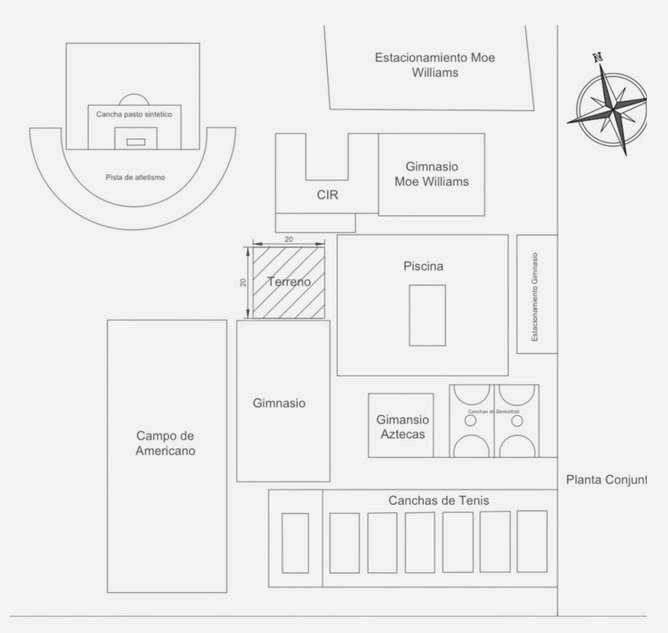
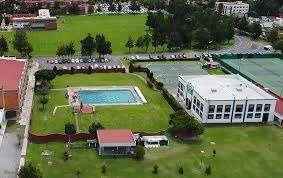
El Pabellón Meridiano se ubica en los alrededores del campus de la UDLAP, en San Andrés Cholula, Puebla El proyecto se plantea sobre un área abierta de 20 × 20 m, pensada como espacio de ensayo para estructuras temporales, pero al mismo tiempo vinculada visualmente con los edificios y andadores existentes del campus
Desde este punto se tiene una buena relación con los flujos peatonales principales y con las vistas hacia el interior de la universidad LOCATION
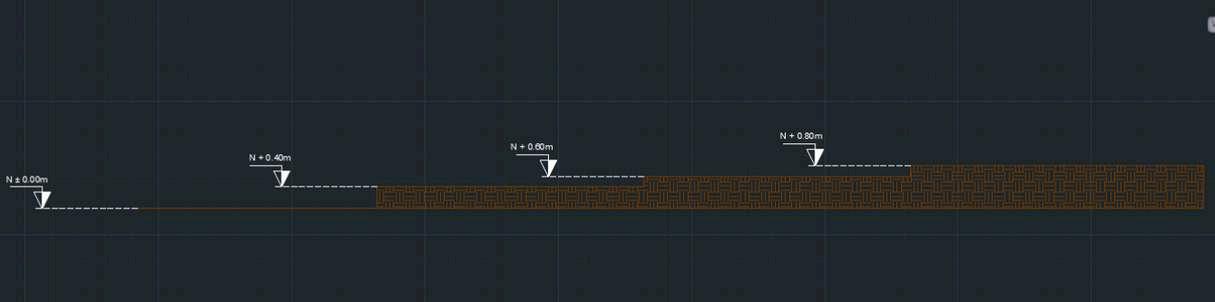
El terreno presenta un desnivel aproximado de 0 80 m entre sus puntos más alto y más bajo Lejos de corregirlo por completo, el proyecto aprovecha esta condición: la retícula estructural se adapta a la topografía y el pabellón se “ apoya ” escalonadamente, generando plataformas a diferentes alturas. Esto permite que el visitante perciba el cambio de nivel a través de rampas, escaleras y vistas cruzadas al vacío central, haciendo evidente que el pabellón
no se posa en un plano abstracto, sino que dialoga directamente con el terreno real de la UDLAP
The Meridiano Pavilion is located on the outskirts of the UDLAP campus in San Andrés Cholula, Puebla The project is set on a 20 × 20 m open area, conceived as a testing ground for temporary structures but still visually connected to the existing campus buildings and walkways From this point there is a good relationship with the main pedestrian flows and with views towards the interior of the university The site has an approximate level difference of 0 80 m between its highest and lowest points Instead of completely flattening it, the project takes advantage of this condition: the structural grid adapts to the topography and the pavilion is supported in steps, creating platforms at different heights This allows visitors to perceive the change in level through ramps, stairs and views towards the central void, making it clear that the pavilion does not sit on an abstract plane but directly responds to the real ground of the UDLAP campus
Arquitectos:
Mariana Méndez Padilla
Frida Torres Rosas
Dana Abigail Gómez
Morales
Rafael Papaqui Cano
Ingeniero civil:
Fernando Villar Sánchez
Año: 2025.
Ciudad y país: San Andrés Cholula, Puebla, México
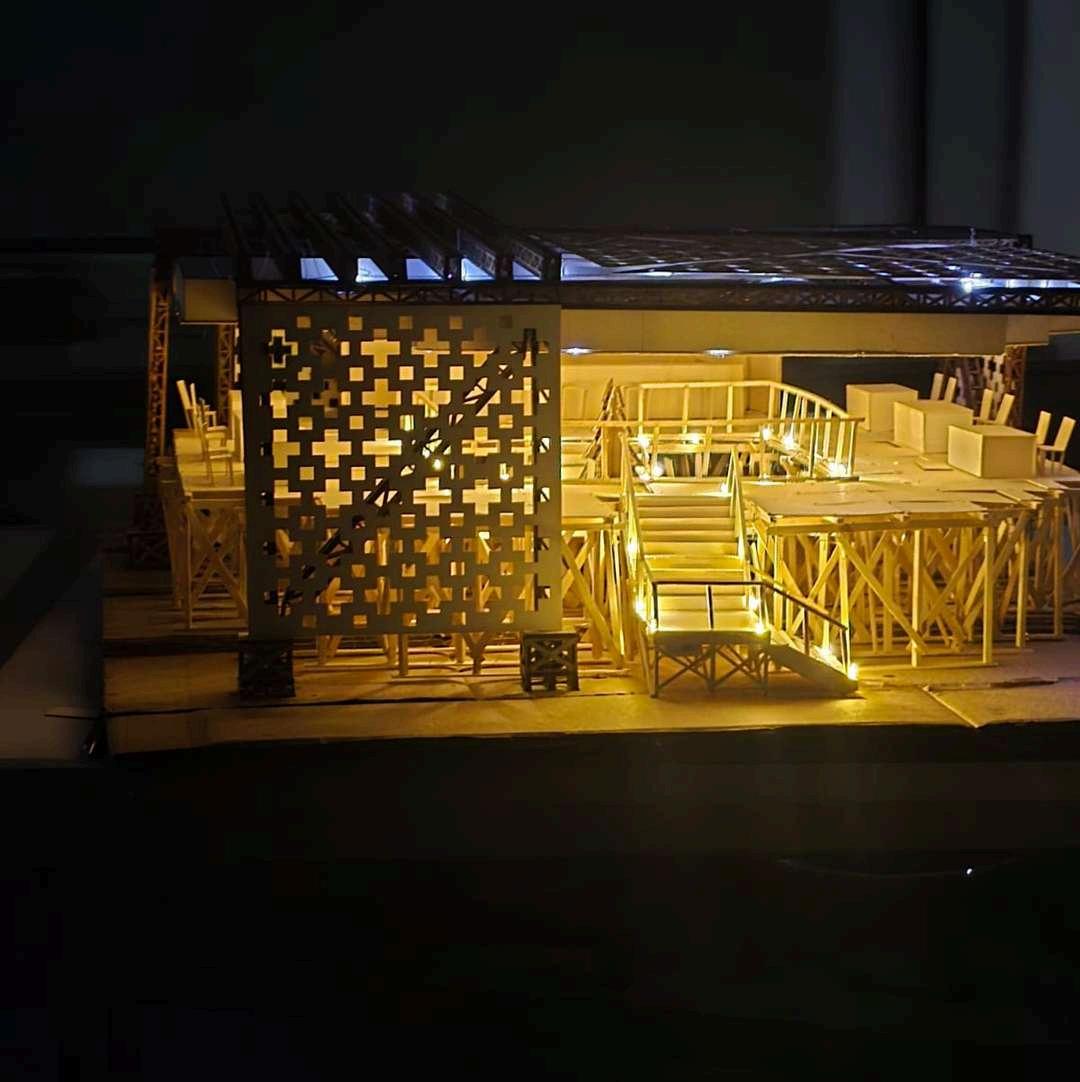
Materiales (maqueta): Cartón corrugado, madera balsa, papel batería, MDF, espagueti pintado, focos e hilo/cable eléctrico
Revisado por: Dra Elizabeth Vázquez Quitl
Architects:
Mariana Méndez Padilla
Frida Torres Rosas
Dana Abigail Gómez Morales
Rafael Papaqui Cano
Civil Engineer: Fernando Villar Sánchez
Year: 2025
City and Country: San Andrés Cholula, Puebla, Mexico
Materials (model): Corrugated cardboard, balsa wood, battery paper, MDF, painted spaghetti, bulbs and electrical wire
Reviewed by: Dr Elizabeth Vázquez
El Pabellón Meridiano es el resultado de un proceso en dos tiempos: primero, un equipo que definió la lógica estructural de la cimbra; después, nuestro equipo, que convirtió esa base en un pabellón habitable con cubierta, instalaciones y atmósfera propia.
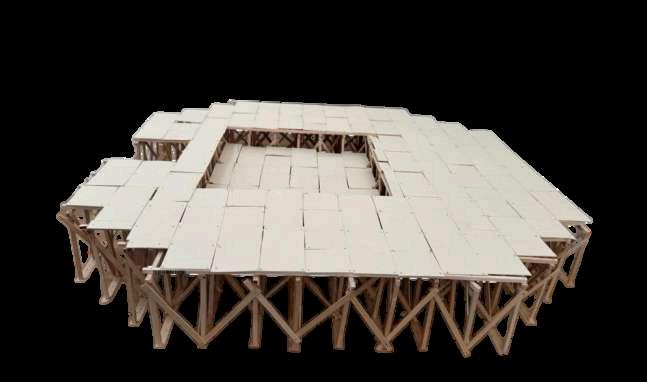
Primero se modela el terreno simulado con cartón corrugado, donde se marca el desnivel y la retícula de 20 × 20 m que ordena todo el proyecto Sobre esa base se trazan los ejes principales y las zonas donde se apoyará la estructura tipo cimbra
PROCESO CONSTRUCTIVO
BUILDING PROCESS
The Meridiano Pavilion is the result of a two-stage process: first, a team that defined the structural logic of the formwork; then our team, which turned that base into a habitable pavilion with its own roof, installations and atmosphere
First, the site is modeled with corrugated cardboard, where the slope and the 20 × 20 m grid that organizes the whole project are marked On this base, the main axes and the areas where the formwork-type structure will be supported are drawn
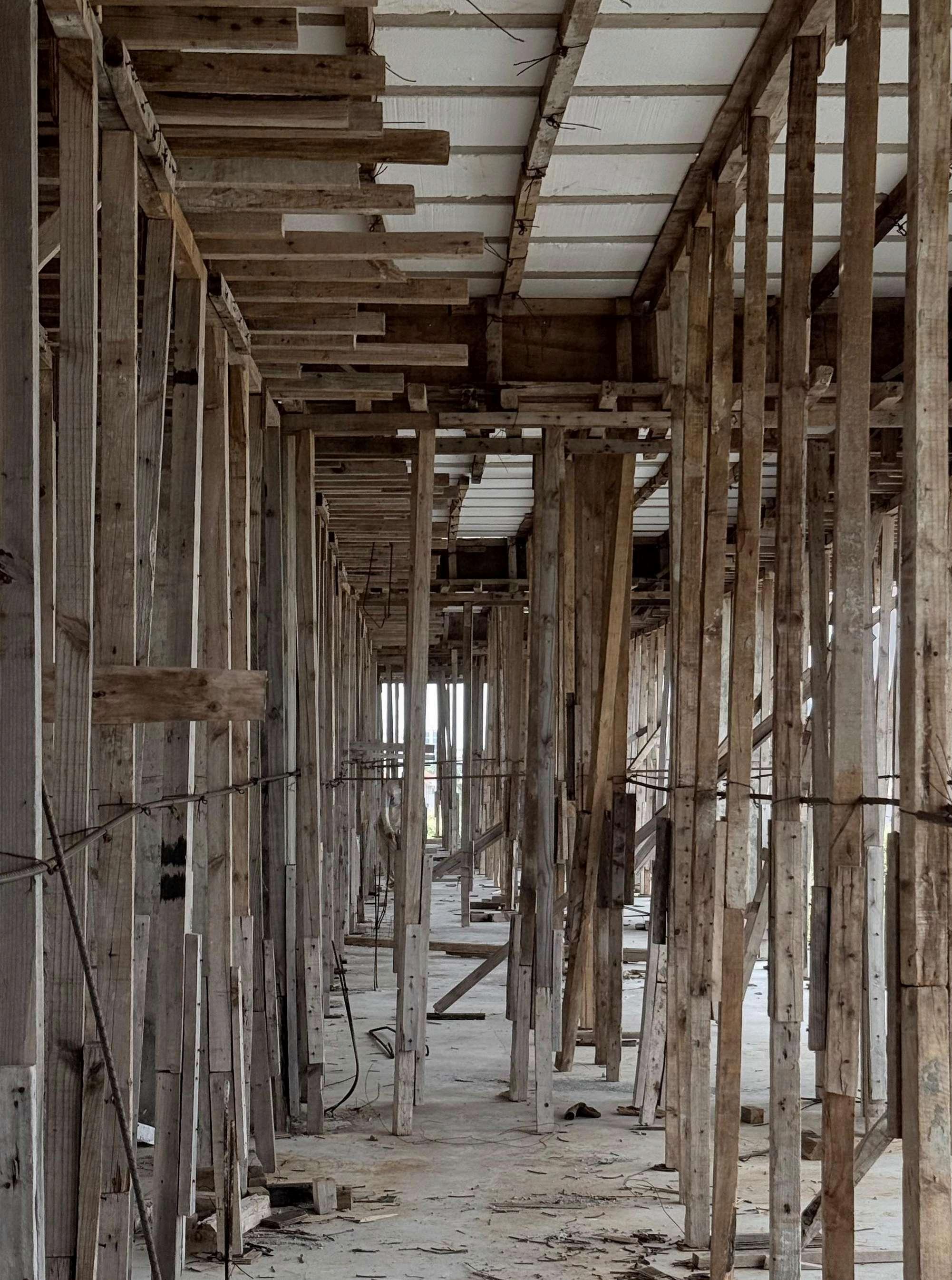
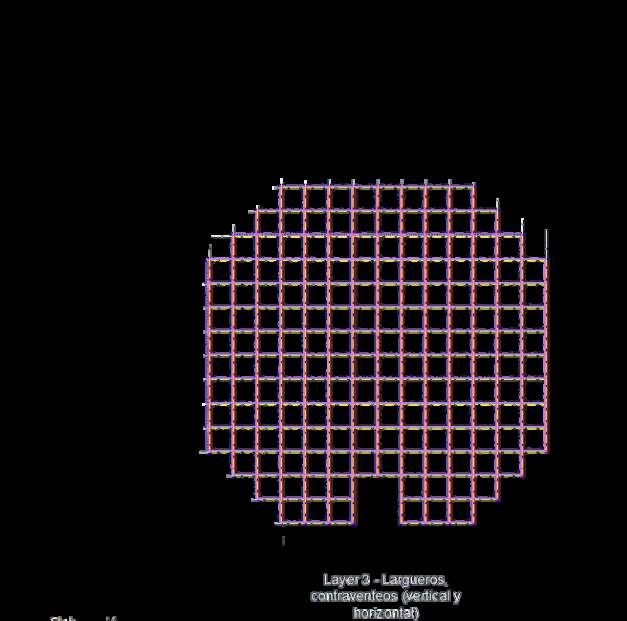
A continuación se coloca la estructura base Los elementos verticales (puntales) se representan como elementos verticales simulados por madera balsa, distribuidos según la retícula Sobre ellos se apoyan las madrinas, largueros y contraventeos, también en balsa, formando los marcos y triángulos que dan estabilidad al sistema Esta etapa corresponde a la cimbra diseñada donde se define el “esqueleto” estructural del pabellón
Next, the base structure is placed
The vertical elements (props) are represented as vertical elements simulated with balsa wood, distributed according to the grid On top of them rest the madrinas, ledgers and bracing members, also in balsa, forming the frames and triangles that give stability to the system This stage corresponds to the designed formwork, where the structural “skeleton” of the pavilion is defined
PROCESO CONSTRUCTIVO
BUILDING PROCESS
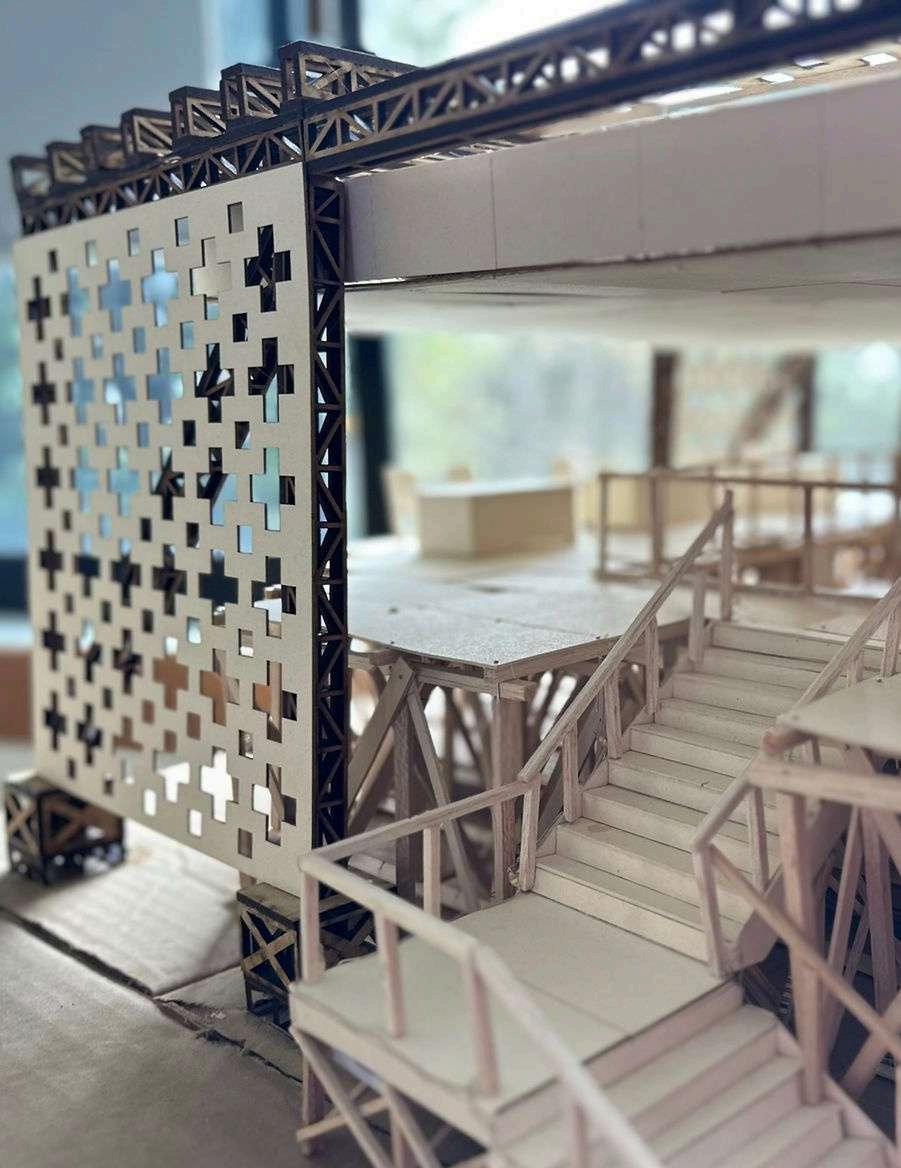
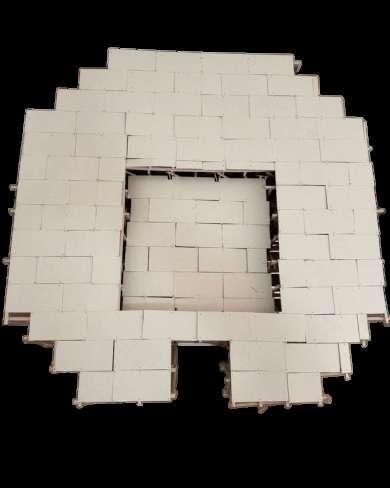
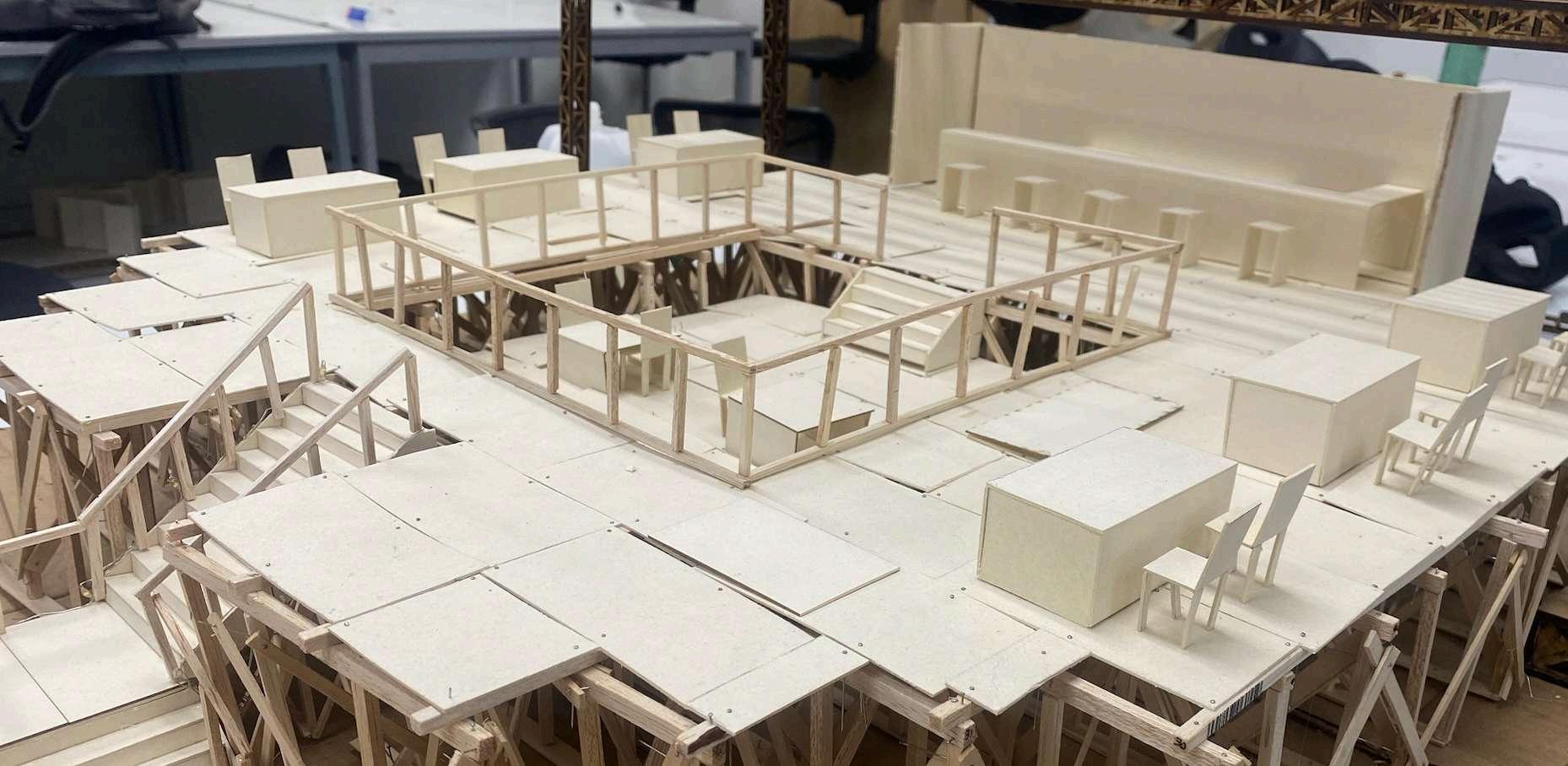
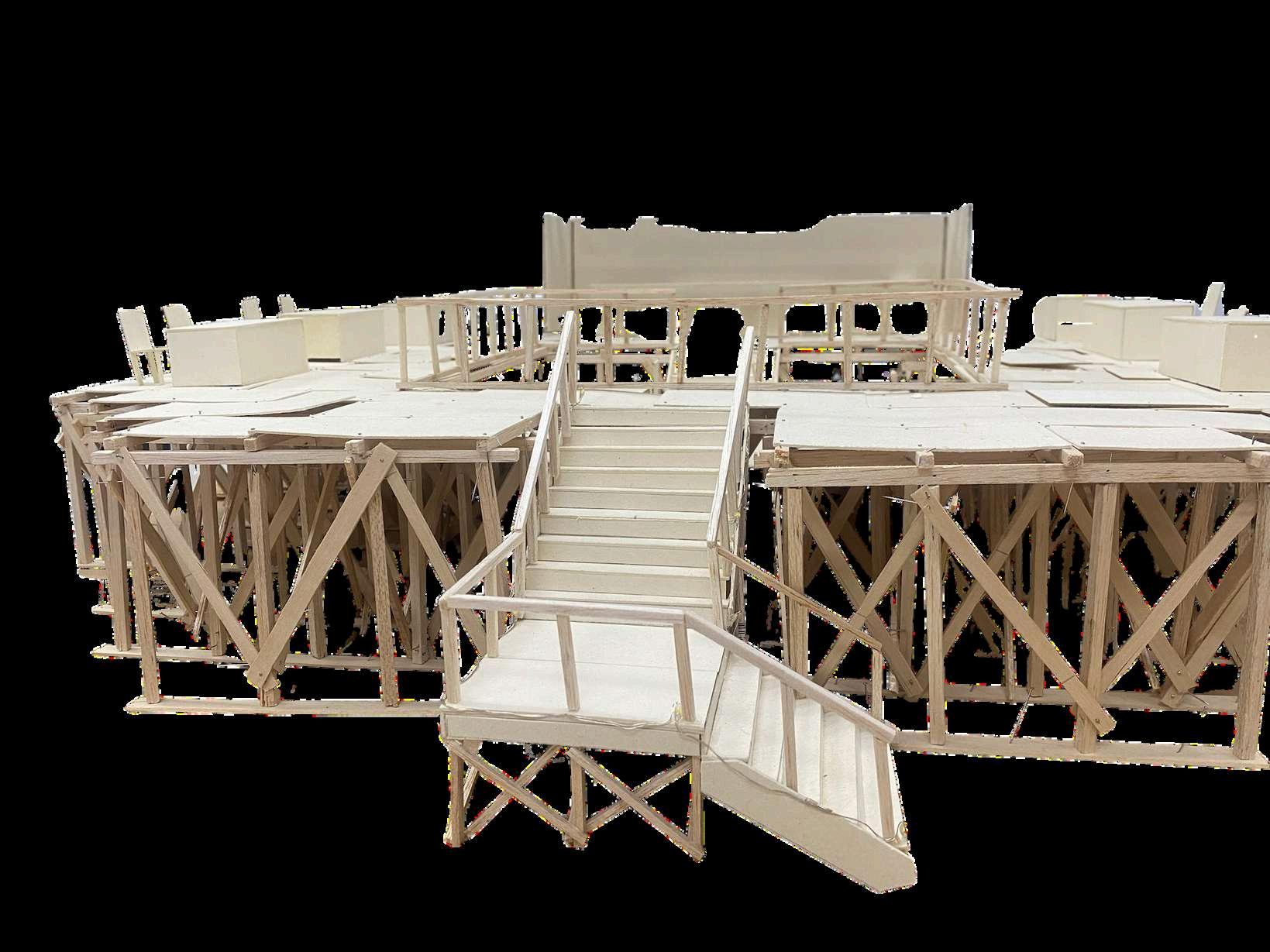
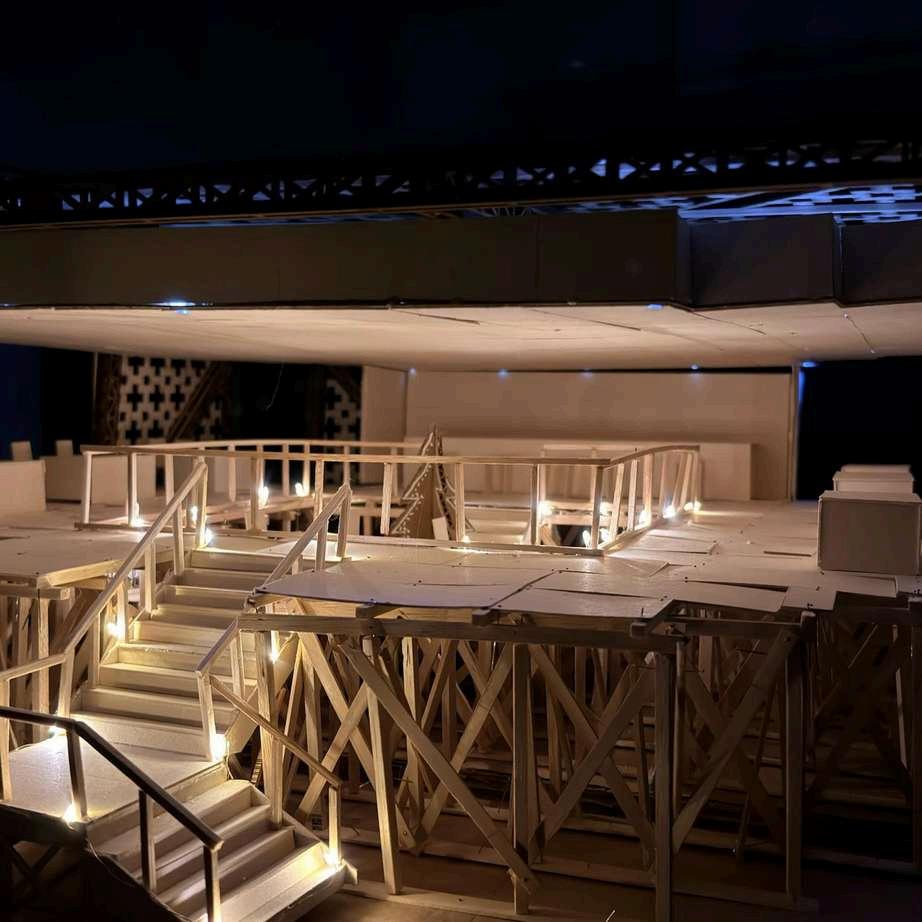
Una vez resuelta la cimbra, se construye la parte habitable Las plataformas de piso se representan con triplay simulado con papel batería, apoyado sobre la subestructura de madera balsa Con el mismo criterio se modelan las escaleras (huellas en papel batería, zancas en balsa) y los barandales que protegen el vacío central y las circulaciones Aquí el siste deja de ser solo soporte tempo y se convierte en un recorr claro para el usuario
Después se desarrolla cubierta Sobre los mar existentes se colocan los polin y armaduras, igualmente madera balsa, que definen forma general del techo So estas armaduras se añade u celosía construida con ti delgadas de balsa o papel bate recortado, que permite sugeri paso de la luz y las somb sobre el interior del pabellón
Finalmente se incorpora la capa técnica y atmosférica El plafón se representa con piezas de papel batería, generando un plano continuo bajo la cubierta donde se integran las instalaciones La instalación eléctrica e hidráulica se sugiere con spaguetti pintado, que marca los recorridos de tubería y cableado en la maqueta La
Once the formwork is resolved, the habitable part is built The floor platforms are represented with plywood simulated by battery paper, supported on the balsa-wood substructure Using the same criteria, the stairs are modeled (treads in battery paper, stringers in balsa) as well as the railings that protect the central void and the circulation paths At this point the system stops being only temporary support and becomes a clear route for the user Then the roof is developed On the existing frames, purlins and trusses, also in balsa wood, are placed to
On these trusses, a
is assembled made with thin strips of balsa or cut battery paper, which suggests the way light and shadows pass over the interior of the pavilion
Finally the technical and atmospheric layer is incorporated
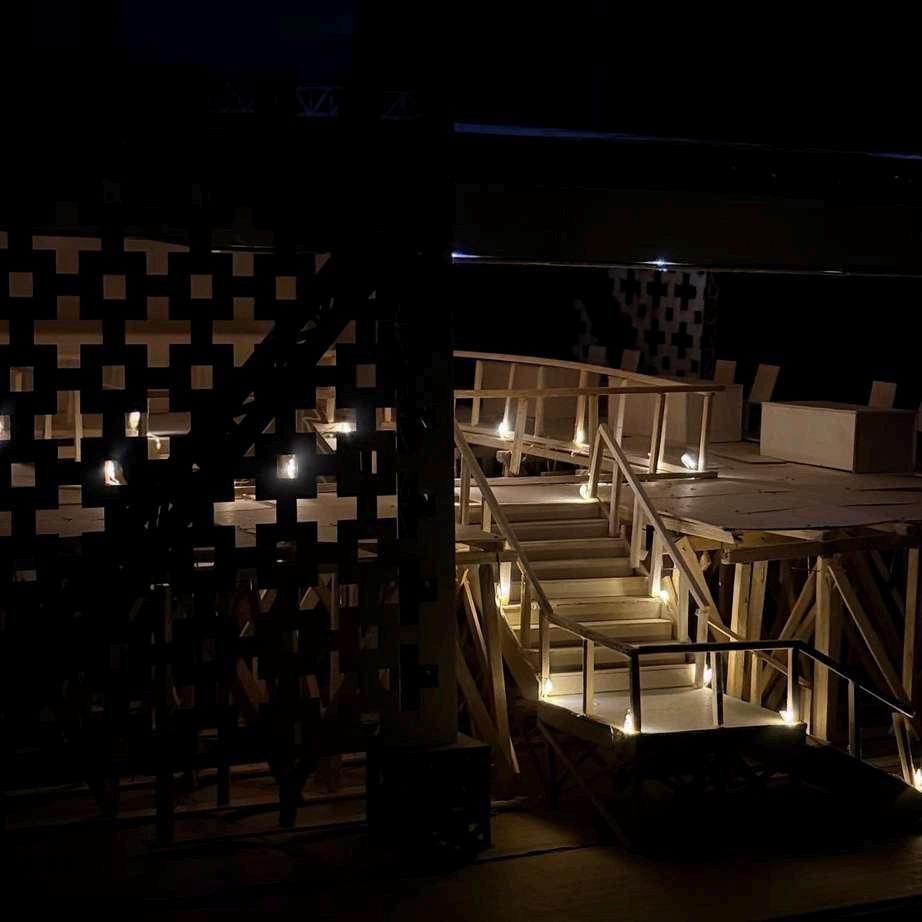
The ceiling is represented with pieces of battery paper, creating a continuous plane under the roof where the installations are integrated The electrical and hydraulic installation is suggested with painted spaghetti, marking the routes of pipes and wiring in the model The lighting is resolved with small bulbs placed at key points along the route and around the central void, showing how the pavilion would be perceived in real conditions
Fotograf a de proceso de construcc ón de pabellón Tomada por Fernando vi lar
Fotografia
roof lattice
PROCESO CONSTRUCTIVO
BUILDING PROCESS
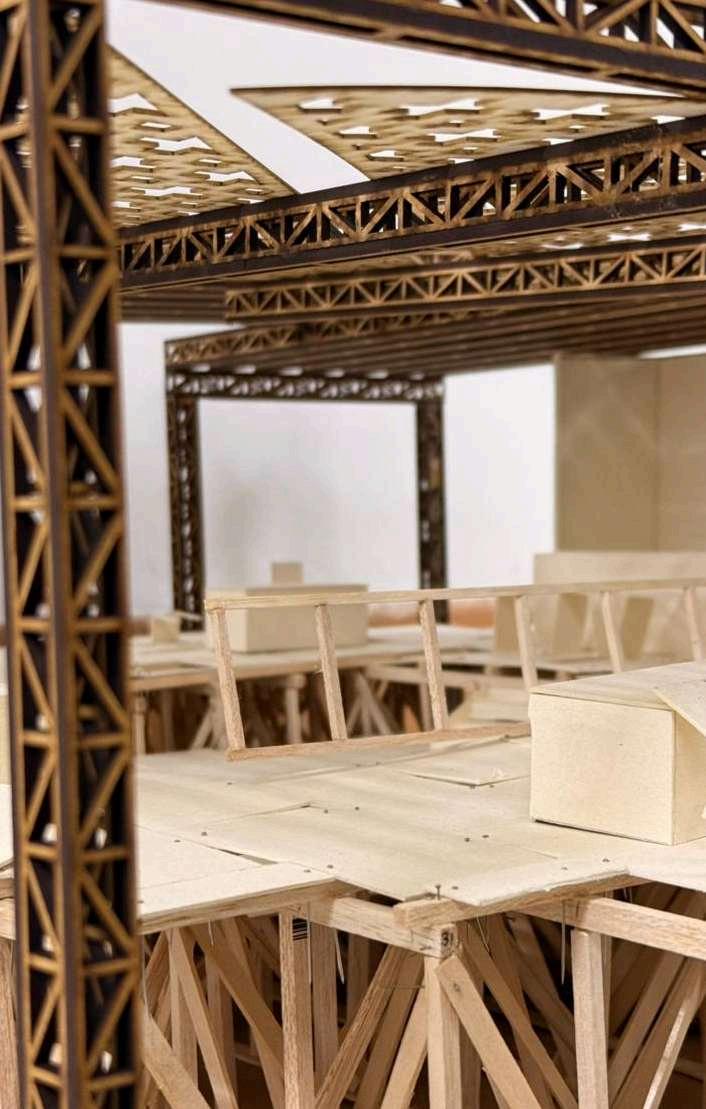
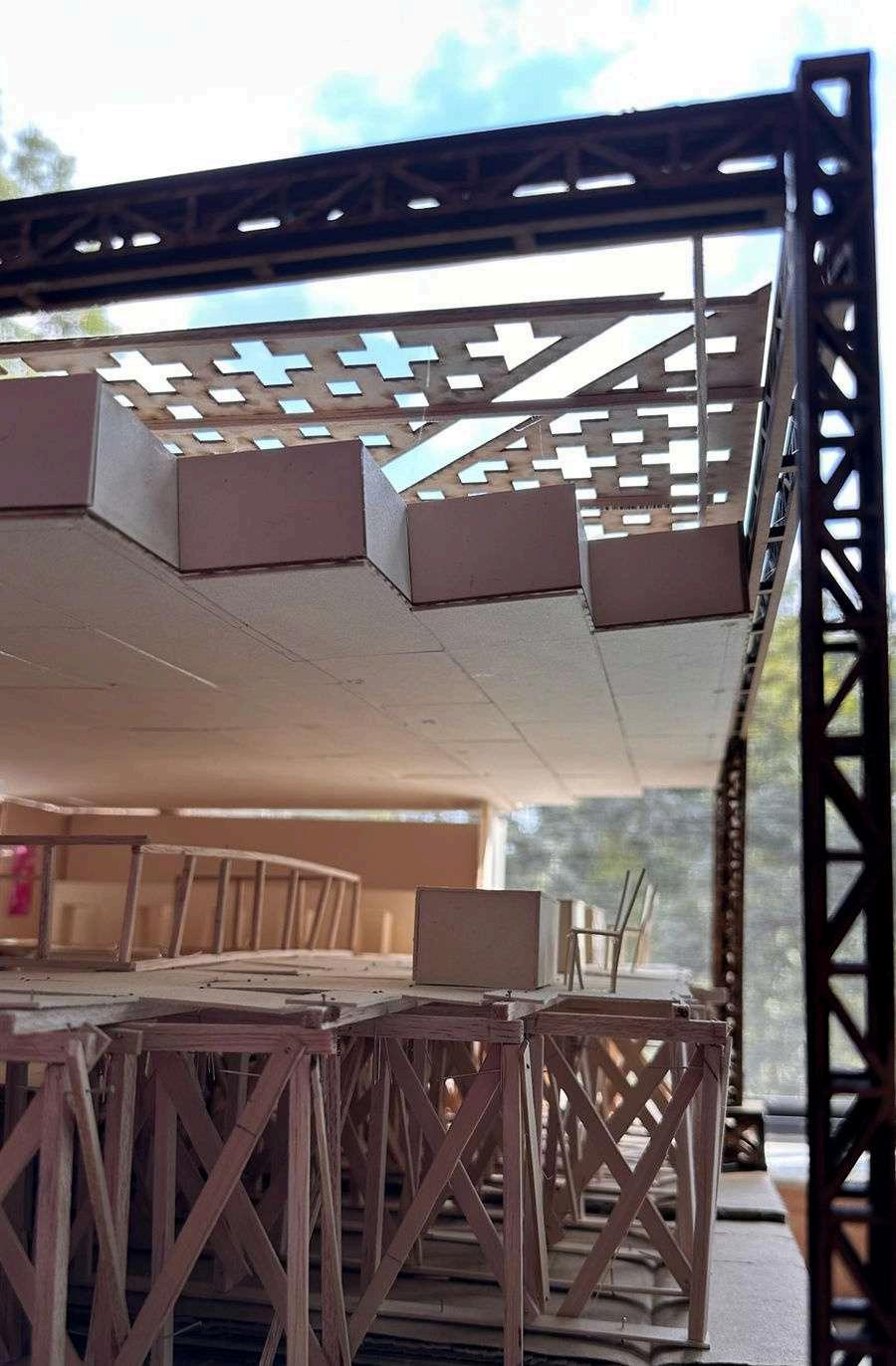
Una vez terminada la etapa inicial de la planta arquitectónica y ciombra, continuamos con la etapa de la cubierta La cubierta está principalmente conformada por armaduras con un diseño tipo warren hechas en el modelo escala con MDF de 3 mm.
Uno de los principales problemas que tuvimos fue el pandeo de la cubierta debido a los grandes claros del proyecto, problema que resolvimos incluyendo cimentación. Estas zapatas fueron enterradas en el cartón base que simula el terreno Estas ayudan a dar soporte a las armaduras y evitar movimientos bruscos en la estructura de esta
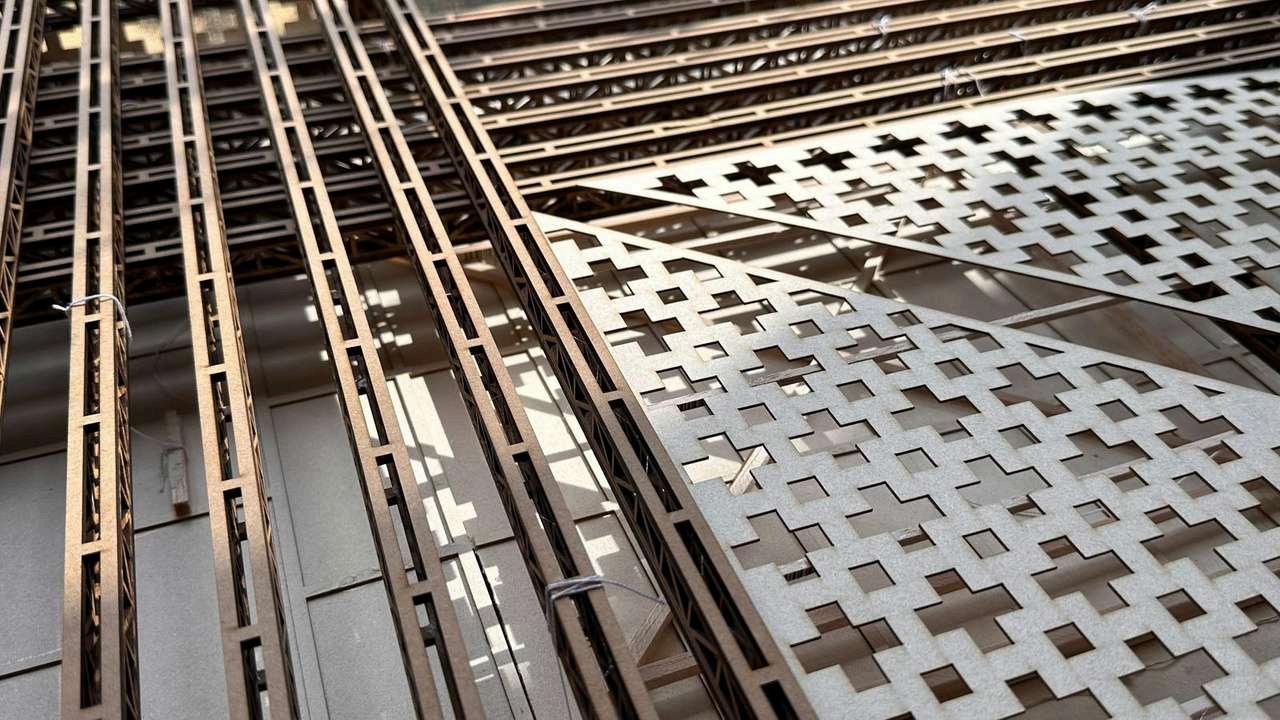
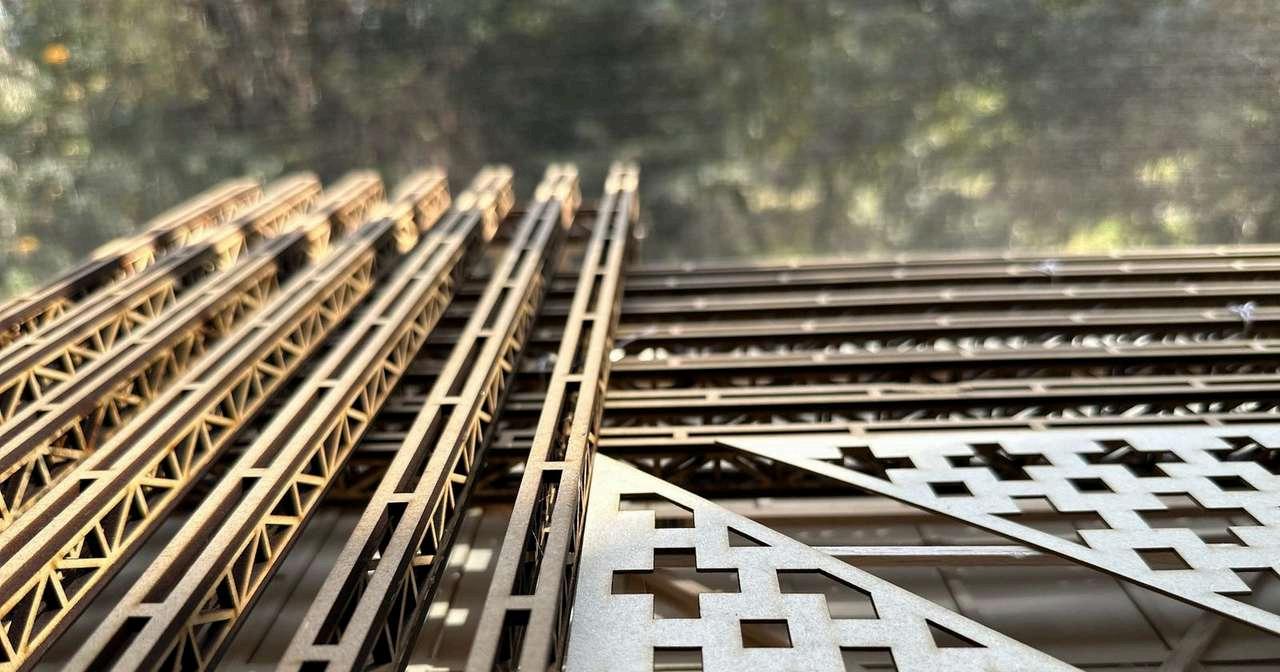
Once the initial stage of the architectural plan and formwork was completed, we continued with the roof stage The roof is primarily composed of Warren trusses, modeled on a scale using 3mm MDF
One of the main problems we encountered was roof buckling due to the large spans of the project, a problem we solved by including footings as a foundation
These footings were embedded in the cardboard base that simulates the ground They help support the trusses and prevent sudden movements in the structure
Fotagrafía de la cubierta Tomada por Dra Elizabeth Vázquez
Fotagraf a a detalle de vigas en cubierta / Detailed photograph of roof beams Tomada por Dra E izabeth Vázquez / Taken by PhD Elizabeth Vázquez
Fotagrafía a deta le de v gas en cub erta / Deta led photograph of roof beams Tomada por Dra Elizabeth Vázquez / Taken by PhD Elizabeth Vázquez
PROCE BUILDING PROCESS
Como elemento arquitectónico
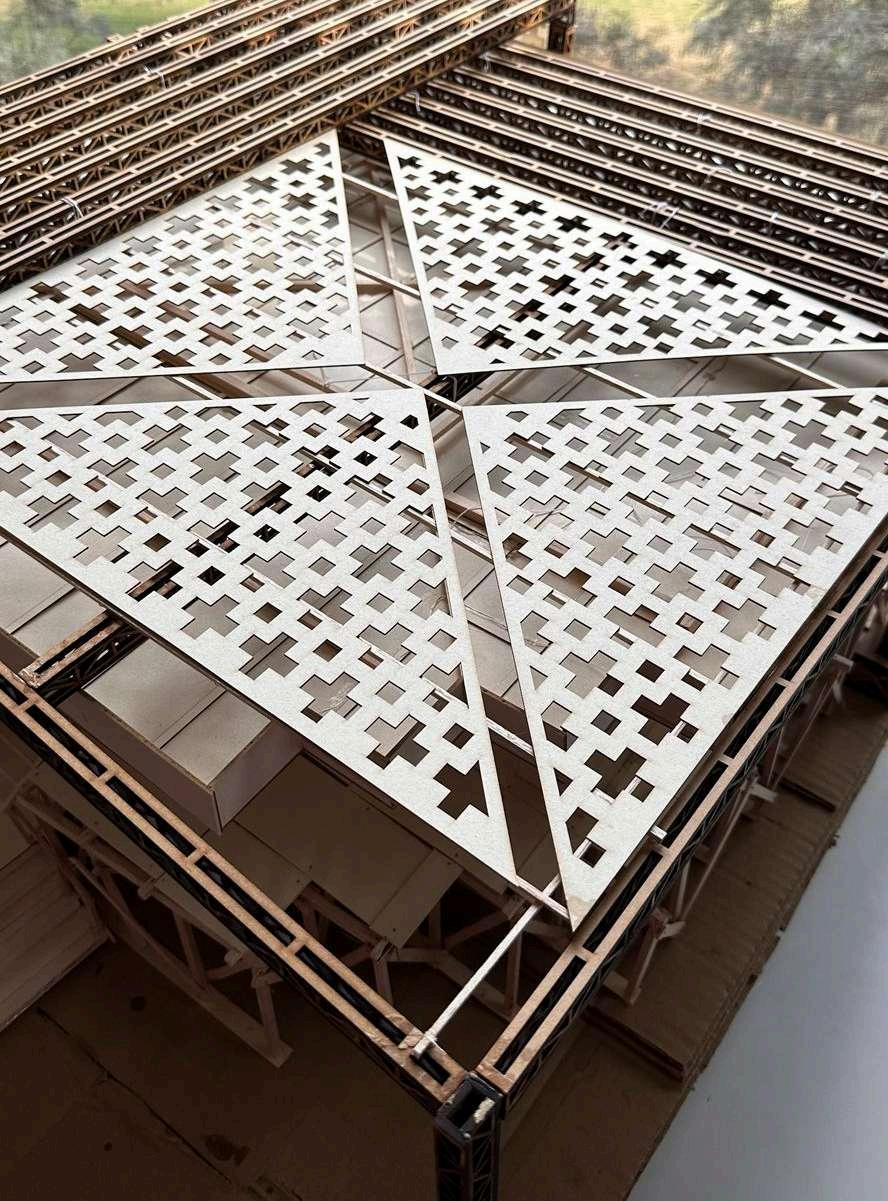
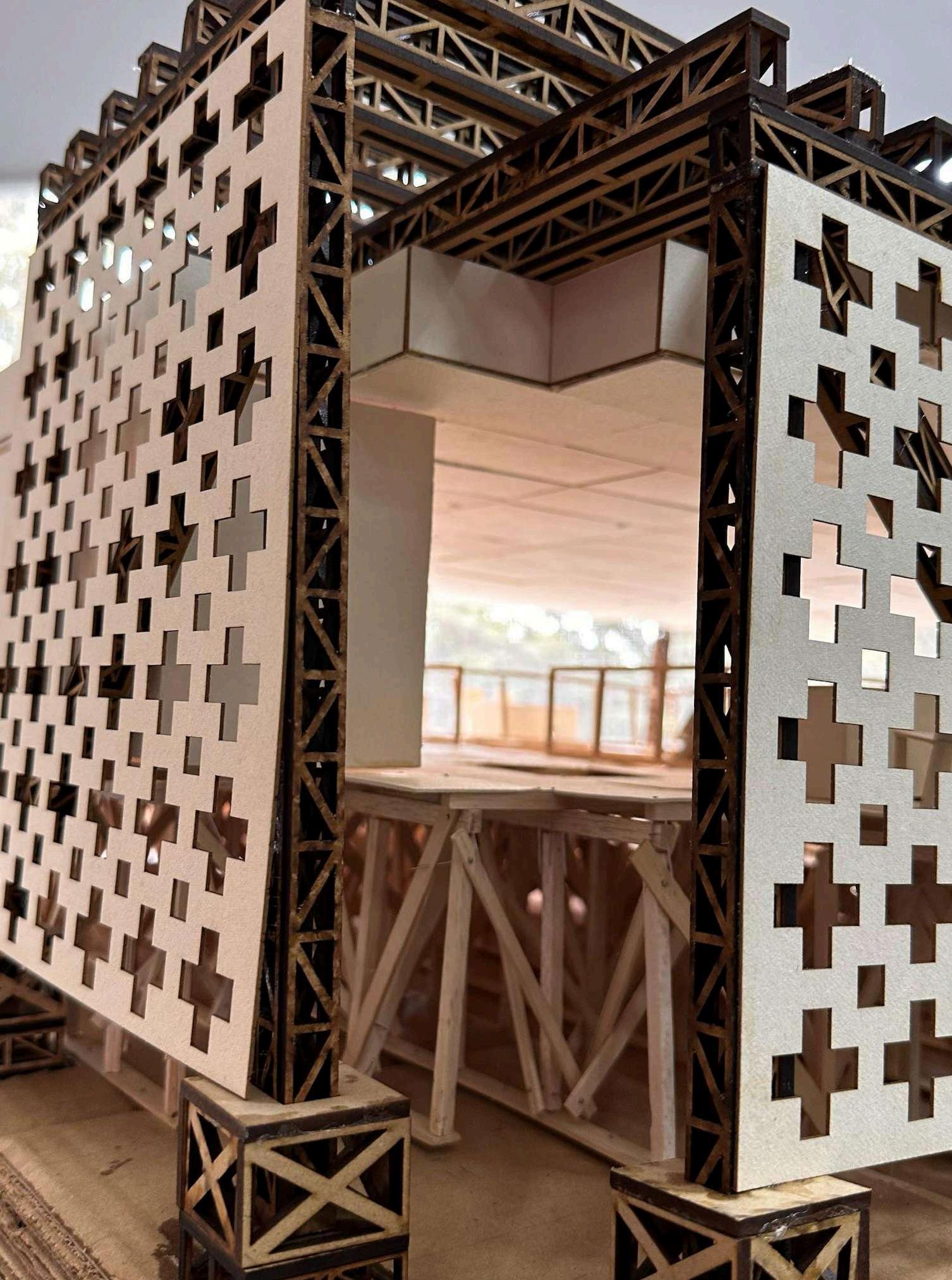
utilizamos un diseño de celosía para esconder la ingeniería detrás de la estabilidad de la cubierta La celocia nos funcionó como un elemento arquitectónico para dar carácter al proyecto al hacer un juego de formas y sombras
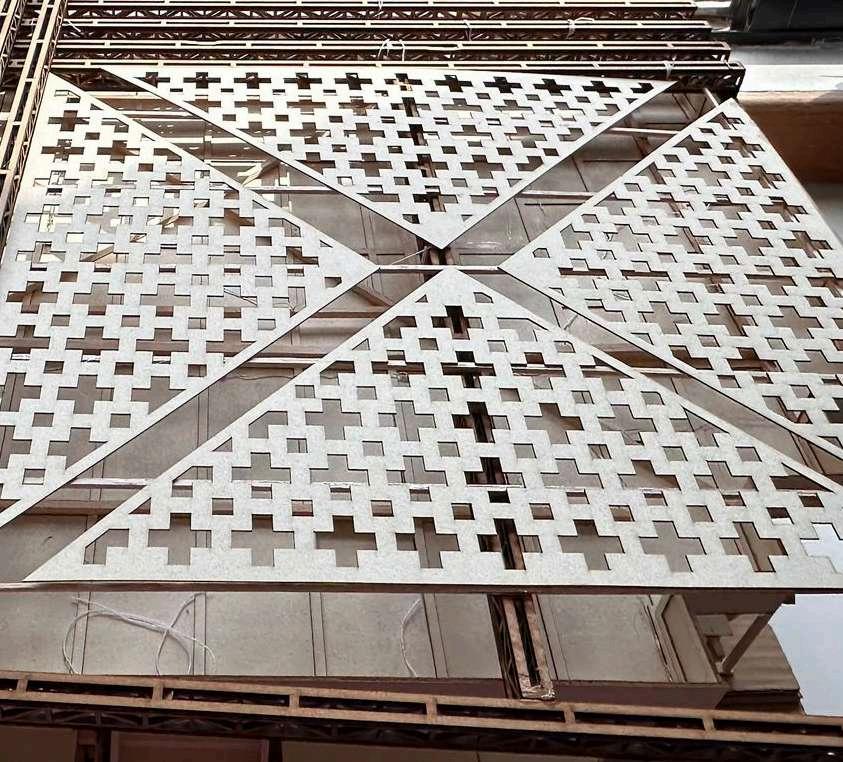
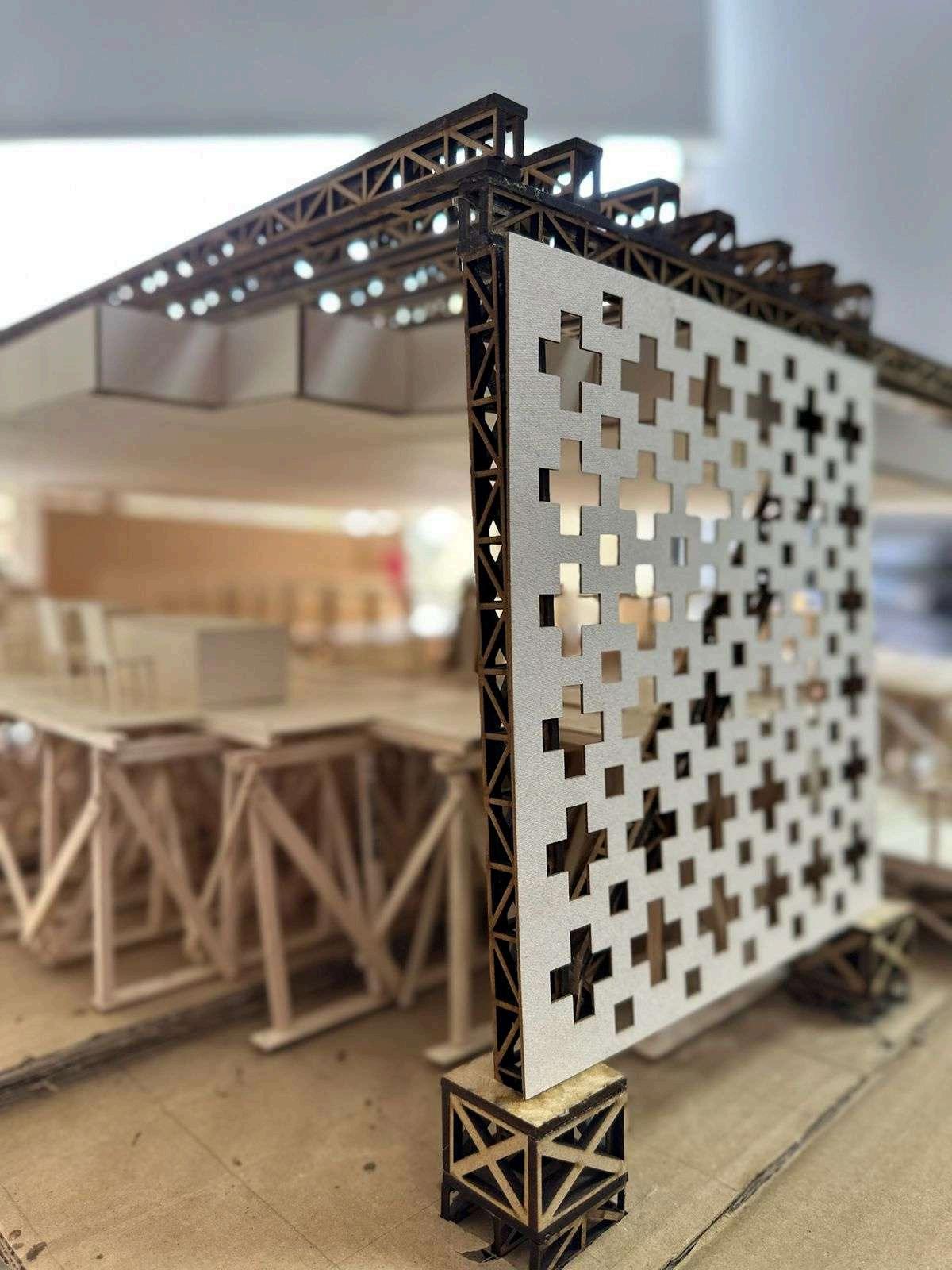
lattice design to conceal the engineering behind the roofs stability
The lattice functioned as an architectural element, giving character to the project by creating a play of shapes and shadows
r e
latticework at the top of our pavilion was laser-cut from balsa wood and supported by a structure of balsa wood beams
The remaining latticework was used to create the facade of one of the truss structures, covering its bracing and providing a clear view for the user
Fotagraf a a detalle de celos a en muros / Detai ed photograph of atticework on walls
Tomada por Dra E izabeth Vázquez / Taken by PhD Elizabeth Vázquez
Fotagraf
Vázquez / Taken by PhD Elizabeth Vázquez
PROCESO CONSTRUCTIVO
BUILDING PROCESS
En la fotografía se observa la escalera elaborada con materiales de batería y madera balsa, se utilizaron para dar estabilidad y fuerza a la estructura para sostenerla Debajo de esta se encuentran los puntales y contraventeos necesarios para una escalera segura y funcional
Otro de los elementos esenciales en el Pabellón Meridiano es el plafón, el cual fue realizado a partir de papel batería en el modelo El plafón como elemento ayuda a colocar las instalaciones de luminaria de una manera mas limpia,
Las vigas de MDF son quienes sufren todo el esfuerzo de carga de la cubierta, El plafón esta sujeto con hilo, el cual representa espárragos de aluminio, a las vigas, de esta manera haciendo que el plafón sea estable
The photograph shows the staircase made with battery paper and balsa wood, which were used to provide stability and strength to the structure Beneath it are the struts and bracing necessary for a safe and functional staircase
Another essential element in the Meridian Pavilion is the ceiling, which was made from battery paper in the model The ceiling helps to install the lighting fixtures more neatly
The MDF beams bear the entire load of the roof The ceiling is attached to the beams with thread, which represents aluminum studs, thus ensuring the ceiling's stability
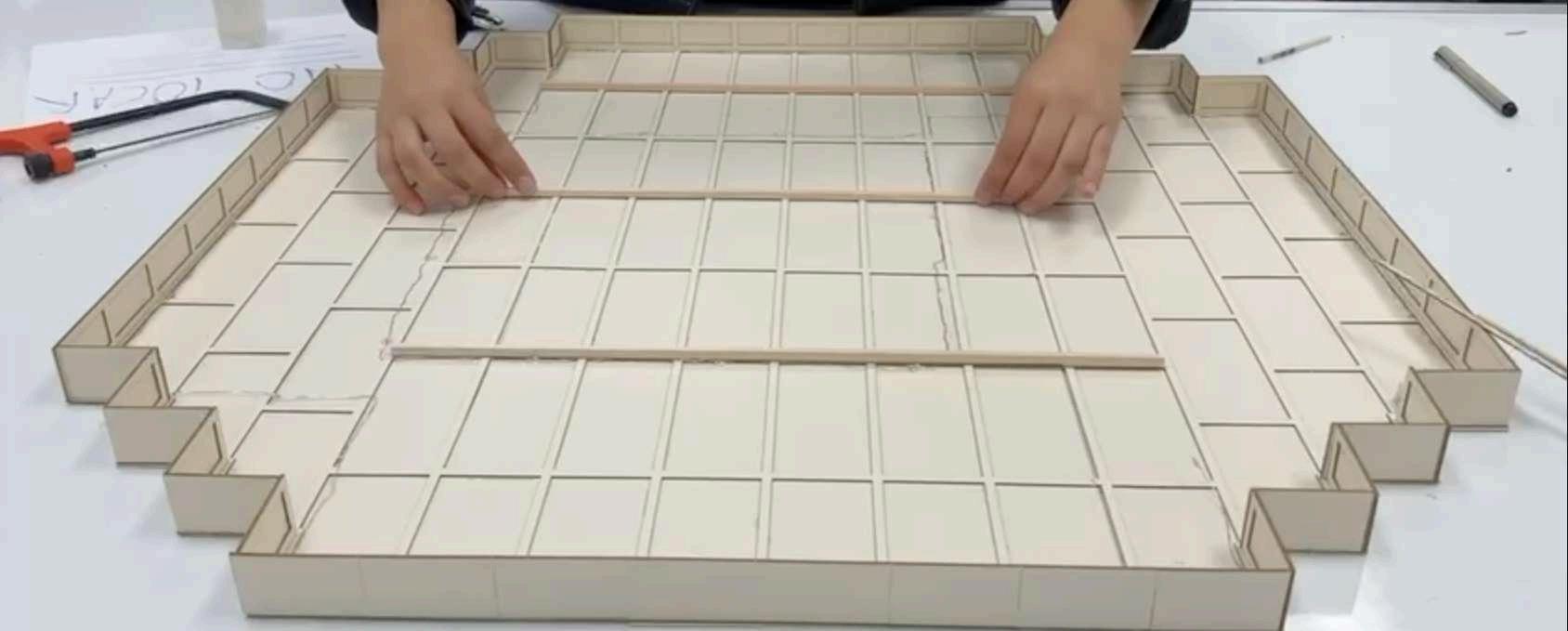
Fotagrafía inter or de plafón / Interior photograph of ceil ng Tomada por Dra Elizabeth Vázquez / Taken by PhD Elizabeth Vázquez
Fotagraf a del proceso de contrucc ón de p afón tomada por ntegrantes del equipo 3 / Photograph of the cei ing construct on process taken by members of team 3
RESULTADOS
RESULTS
El Pabellón Meridiano muestra cómo la coordinación entre arquitectura e ingeniería puede conducir a una solución clara y ordenada A partir de la cimbra diseñada por el primer equipo, se ajustaron niveles, recorridos, uniones y refuerzos para que la propuesta arquitectónica respetara siempre la lógica estructural: cada escalera, vacío, barandal y cubierta se apoya en un sistema de puntales, madrinas, largueros y contraventeos que trabaja de forma coherente.
El proceso completo desde el trazo del terreno y la cimbra, hasta la incorporación de la cubierta, las celosías y las instalaciones simuladas con focos y espagueti pintado permitió verificar la secuencia constructiva y detectar mejoras en tiempo real El resultado final es un pabellón temporal que hace visible el “cómo se construye”: una pieza en la que las decisiones espaciales y las decisiones técnicas se cierran en un mismo lenguaje
The Meridiano Pavilion shows how architecture and engineering can be coordinated to reach a clear and organized solution Starting from the formwork designed by the first team, levels, paths, joints and reinforcements were adjusted so that the architectural proposal always respected the structural logic: every stair, void, railing and roof is supported by a system of props, primary beams, ledgers and bracing members that work consistently together
The complete process from marking the site and building the formwork, to adding the roof, lattices and installations simulated with bulbs and painted spaghetti made it possible to verify the construction sequence and detect improvements in real time The final result is a temporary pavilion that makes the “how it is built” visible: a piece where spatial decisions and technical decisions come together in a single language
Fotografía
Fotografía
Nikken Sekkei Ltd (s f ) Athletes’ Village Plaza: A Festive Space
Created with Timber from Across the Nation [Proyecto]. Recuperado de:
https://www nikken jp/en/projects/mixed use/athletes village plaza html? subCat=Mixed%20Use
Tomoyose, G. (2021, 1 de diciembre).
Así es la isla artificial con autos voladores, robots y redes 6G que prepara Japón para 2025. La Nación. Recuperado de:
https://www lanacion com ar/tecnologia/ futurista-asi-es-yumeshima-la-islaartificial-con-autos-voladores-robots-yredes-6g-que-prepara-nid01122021/
NIKKEN SEKKEI LTD. (s. f.).
Athletes’ Village Plaza: A Festive Space Created with Timber from Across the Nation. Archinect. Recuperado de : https://archinect com/nikkensekkei/proj ect/athletes-village-plaza-a-festivespace-created-with-timber-from-acrossthe-nation
Invest Osaka (s f ) Yumeshima Recuperado de : https://www investosaka jp/eng/business /yumeshima html
Fakharany, N (2024, 25 de septiembre). Japan Pavilion at Expo 2025 Osaka, Designed by Nikken Sekkei, Showcases the Cycles of Life. ArchDaily. Recuperado de: https://www archdaily com/1021597/japa n-pavilion-at-expo-2025-osakadesigned-by-nikken-sekkei-showcasesthe-cycles-of-life
Nikken Sekkei Ltd (s f ) OsakaKansai Expo 2025 Japan Pavilion [Proyecto]. Archello. Recuperado de: https://archello com/pt/project/osakakansai-expo-2025-japan-pavilion
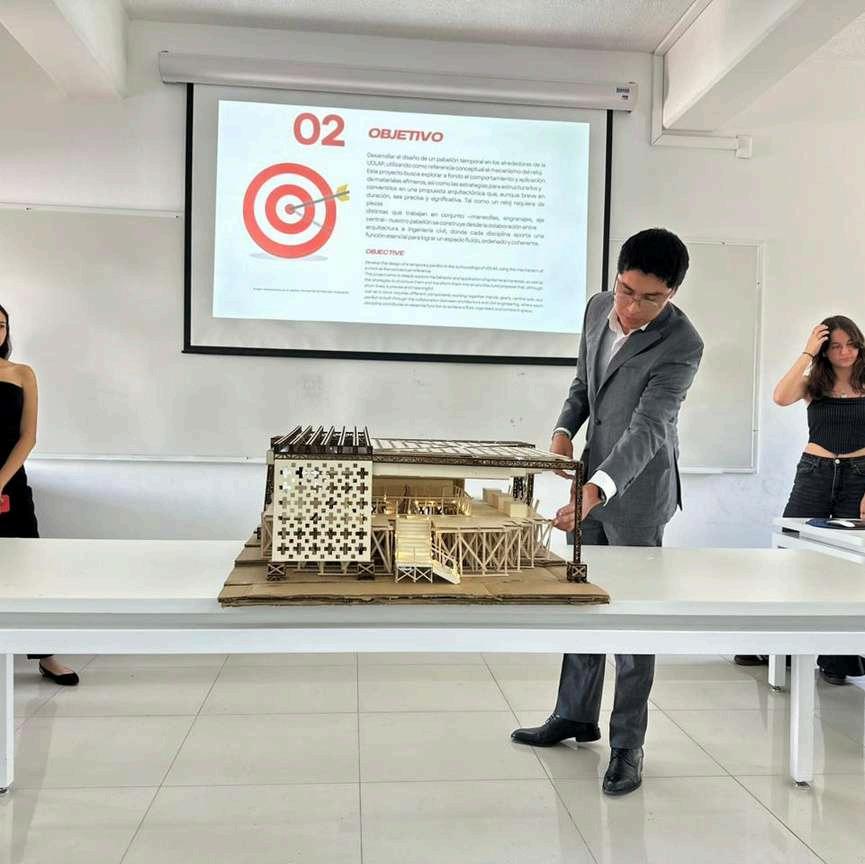
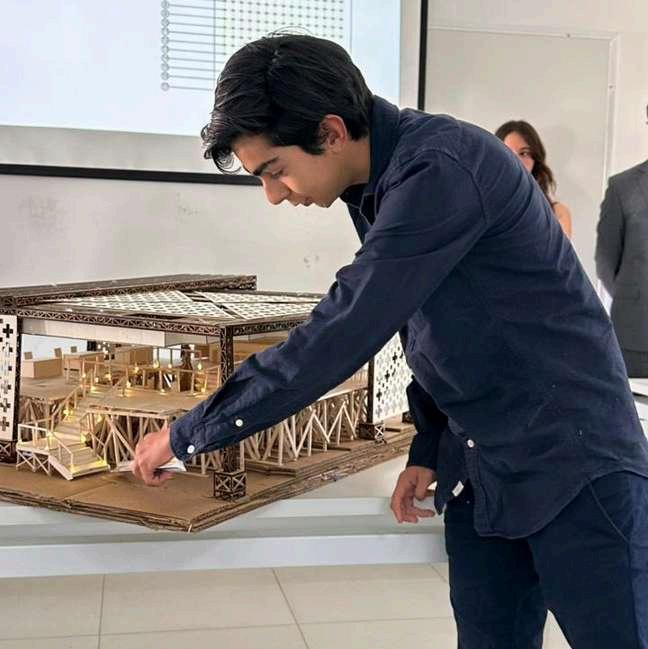
Fotagrafía exposición del pabe lón/ Exh bition photograph of the pav lion Tomada por Dra Elizabeth Vázquez / Taken by PhD El zabeth Vázquez
Fotagrafía expos c ón del pabellón/ Exhib tion photograph of the pavil on Tomada por Dra
Vázquez / Taken by
izabeth Vázquez
Revisado por:
Reviwed by
DRA PhD ELIZABETH VÁZQUEZ QUITL
Video Descriptivo Español English Descriptive Video