

By Burke Olsen
Given the frenetic pace of our modern lives, it’s more important than ever to stay informed about the changes and happenings that affect us today. News isn’t just about keeping up with the latest headlines, it’s also about understanding the world around us, making informed decisions for our families and being active participants in our communities.
At the Deseret News, we understand that your time is precious, and we are committed to making it as easy as possible for you to stay informed, no matter how busy you are.
The digest you’re holding is a small “best of” compilation of our journalism and opinion content to give you a taste of our fuller offerings in print and online. There are more ways than ever before for the Deseret News to help you stay informed about the world around you.
From our print beginnings in 1850 to our award-winning website — Deseret.com — to our mobile apps, social media accounts and email newsletters, we’ve got your back.
Our website, Deseret.com, is designed to be user-friendly and available on any device. Whether you’re at home on your computer or on the go with your mobile phone, you can access our website for the latest news, analysis and commentary.
Our apps for iOS and Android devices offer a seamless and convenient way to access the latest news, wherever you are. Choose what you want to read, save articles for later and receive push notifications for the breaking news you need to know.
Delivered straight to your inbox, our free email newsletters provide a curated selection of the most important stories of the day, as well as deeper dives into topics that matter to you. Choose from a variety of subjects and frequencies to tailor your news consumption to your needs.
For those who appreciate the tactile experience of a traditional newspaper, our twice-weekly print edition offers a comprehensive roundup of the week’s most important stories and opinions.
In 2020, we undertook an ambitious endeavor by launching a new magazine with in-depth journalism, unique voices and principled points of view. The reception to the magazine has far exceeded our expectations. You can read more from the magazine online at Deseret.com/magazine or subscribe to have it delivered to your home or office.




The Church News remains one of our most popular offerings for those who want to know the latest news from The Church of Jesus Christ of Latter-day Saints. It’s available online at TheChurchNews.com and via iOS and Android apps. A print version is included in the Friday edition of the Deseret News.
We believe that access to reliable, high-quality journalism is essential for a healthy democracy, and we are committed to providing you with the news and information you need to make decisions with confidence for you and your family.
In an age where misinformation is rampant, we take our responsibility as a news organization seriously. Our award-winning team of reporters and editors work tirelessly to provide accurate, timely and insightful coverage of the events and issues that matter most.
Thank you for considering the Deseret News as part of your balanced media diet. Together, we can stay informed and make a positive impact in our communities and beyond.






























Robert F. Kennedy Jr.’s independent campaign could hurt both Biden and Trump. His pitch — a ‘populist revolution’
By Samuel Benson Deseret News
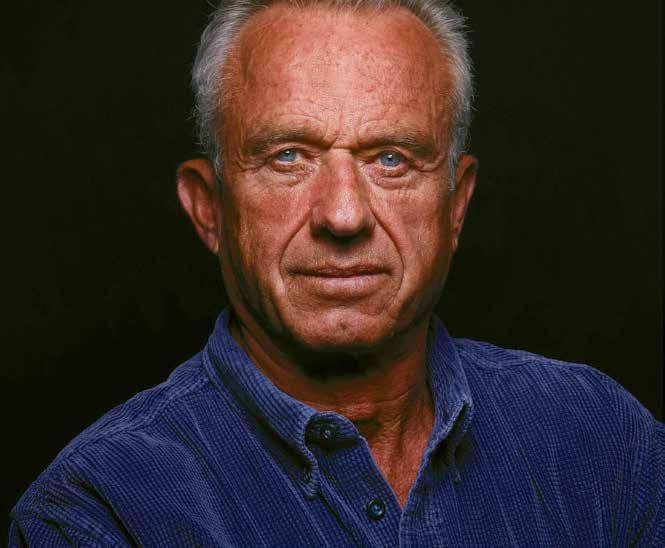
Stepping into Robert F. Kennedy Jr.’s home office is like stepping into another world. The rest of the home — nestled above west Los Angeles, where Kennedy lives with his wife, actress Cheryl Hines — is tastefully decorated in muted hues and original artwork. But Kennedy’s office, attached to the exterior garage, is much more chaotic. Books line the walls and cover nearly every surface. Taxidermied animals rest on the mantel and shelves. There are various markers from his career as a conservationist and environmental lawyer: a basketball-sized pufferfish, a perched hawk, and, most prominent, a massive Sumatran tiger — a gift from the Indonesian government to Kennedy’s father, the late attorney general and Sen. Robert F. Kennedy. That the younger Kennedy would launch his own run for president, following in the footsteps of both his father and his uncle, isn’t entirely surprising.
But how he’s doing it is a first for any Kennedy: he initially launched his campaign as a Democrat, trying to take down President Joe Biden, who Kennedy calls a “very close” family friend. When the path to the Democratic nomination seemed unlikely, he pivoted from the family’s longtime party and launched an independent run, seeking to siphon votes from both Biden and the Republican Party nominee.
Since then, he’s expanded his “populist” pitch to encompass the widest range of voters possible — progressives, conservatives and everything between.
“We’re seeing the disintegration, in some ways, of the traditional party structures, and a realignment which has brought together the far-left and the far-right in a kind of populist revolution,” Kennedy told me, sitting on a leather chair in his home office.
But a key group of voters he’s yet to bring together are his own siblings. Just hours after Kennedy announced his independent bid, four of his seven living brothers and sisters publicly denounced his candidacy, calling it “dangerous” and “perilous to our country.”
“Bobby might share the same name as our father, but he does not share the same values, vision or judgment,” they wrote.
Kennedy said he doesn’t hold it against them — “They don’t want me to run against somebody who’s an old family friend,” he said. “I get it.”
“I‘m able to love my family without agreeing with everything they believe in, and able to differ with them on factual or political areas without feeling angry or hateful to them,” he mused. “So I’m at peace with the way my family has handled this. God bless them.”
He won’t be spending Thanksgiving with his siblings, though, instead hosting his and Hines’ seven children at his Los Angeles home. (Kennedy has six children from previous marriages.)
Early polls show Kennedy polling in the teens or low 20s — a major underdog, but enough to put both major party nominees on edge, with the threat of possibly siphoning significant votes away from either. When he was running as a Democrat, he was accused of trying to torpedo Biden’s chances. Now that he’s an independent, pro-Trump Republicans have already begun attacking him.
With fire coming from both sides, Kennedy has quickly become one of the most interesting stories in politics, blurring and reshuffling political lines in sometime unpredictable and controversial ways.
An environmental lawyer, he spent decades litigating to protect waterways. He was also involved in several controversial issues, founding Children’s Health Defense, a nonprofit that has advocated against vaccines for children, claiming links to autism. He’s shared a number of controversial theories relating to school shootings and COVID-19 vaccines. In more recent interviews, however, he’s taken a more measured approach. “All I’m saying,” he told Bill Maher, “is let’s test (vaccines) the way we test other medicines. That does not seem unreasonable.”
In a wide-ranging interview with the Deseret News, Kennedy touched on controversies, but he also discussed his faith, his decision to run as an independent and his positions on key issues that he hopes will help him win over conservative voters.
An independent candidate has not won the presidency since George Washington. The last one to come anywhere close was Ross Perot in 1992, who led both Bill Clinton and George H.W. Bush in early polls before finishing behind both. But Perot managed to siphon away enough votes from Bush to push Clinton into the White House, finishing with 19% of the vote. Some polls show Kennedy hovering higher than that, he’s quick to note — “and I have 13 months still,” he said.
As Kennedy spoke, he appeared relaxed, dressed in jeans and a black T-shirt. He’d just returned from a hike through the California foothills with two-dozen social media influencers, part of his unorthodox approach to garnering attention — and part of the reason he’s been labeled the “first podcast presidential candidate.”
A book titled “How Trump Won” lay on his desk. I asked if he’d read the book — he said he hadn’t — or if he’d studied Trump’s 2016 campaign as a sort of populist blueprint. He seemed disinterested in Trump’s path to victory, and he said he’d never analyzed Perot’s 1992 spoiler campaign or Evan McMullin’s 2016 independent run.
“I’ve spent my lifetime, a lot of my lifetime, studying populism,” Kennedy said. He claims America is poised for another populist revolution like the Progressive movement a century
ago. “It’s happened before in American history,” he said. “It happened in the 1920s. It seems to be happening again.”
Of all the presidential campaigns that seemed to interest Kennedy, Bernie Sanders’ “has a lot of similarities to what I’m doing,” he said. A lifelong Democrat now running as an independent, Kennedy will rely heavily on convincing Republicans and conservatives to back his campaign. When I asked if he expects to siphon more votes from the Democratic or Republican candidate, he simply said he hopes to win over “both.”
Early polls suggest his populist message is more damaging to Trump than to Biden, and a new report from Politico shows Kennedy is stealing more big-money donors from Trump than from the current president. But Kennedy’s personality and policies differ drastically from the former president. A staunch conservationist, he talks about the persistent threat of global warming; Trump has called climate change a “hoax.” Kennedy has been an advocate for ‘targeted community repair,’ a policy geared toward Black economic development that some critics have compared to reparations. And on abortion, even amid Trump’s apparent shift toward the political middle, Kennedy’s more liberal stance is a much harder sell to religious conservatives and others who view abortion as a critical issue.
In August, however, Kennedy told reporters he would support a federal ban on abortions after the first trimester. But his campaign later backtracked the comments, saying he “misunderstood a question posed him.”
When I asked him to clarify, Kennedy said he would not support any federal ban on abortions. “My stance is that every abortion is a tragedy,” he said. “But I’ve spent my life advocating for bodily autonomy and bodily independence. And I don’t think the government is the right entity to be telling women what they should be doing with their bodies.”
He noted the government should “spend an equivalent amount of energy” assuring mothers who wish to carry their babies to term “have the resources to do that.”
Yet, even with his more pro-choice stance, Kennedy has garnered a significant amount of excitement among right-leaning media and pundits. Former Fox News host Tucker Carlson wrote a blurb for Kennedy’s latest book and has hosted the candidate on his show several times in recent months. InfoWars founder Alex Jones has praised Kennedy, as has former Trump adviser Steve Bannon. If any of these men — Carlson, Jones or Bannon — were to endorse Kennedy, would he accept it?
“Listen, I will welcome anybody’s endorsement,” Kennedy said. “I’m not going to refuse an endorsement from somebody. I like to talk to all Americans, even people who don’t agree with me on the issues.”
Ditching the two-party duopoly
Kennedy’s decision to ditch the Democratic Party was a calculated one. The Democratic National Committee “rigged” the election against him, he claimed, preventing him from getting on the primary ballot in a number of states across the country. “Essentially, they are fixing the process so that it makes it almost impossible to have democracy function,” he said at the time. But Kennedy’s assessment of the Republican Party isn’t much better. I asked him about Sen. Mitt Romney’s view of today’s GOP — that “a very large portion” of the party “really doesn’t believe in the Constitution.”
“I think that’s happening all over our country,” Kennedy said. “And I am worried about that, too — not just the Republican Party, but the Democratic Party.”
Kennedy has nestled into his new affiliation as an independent, arguing that it allows him to reach a larger swath of voters. “Independents are now the biggest party in the country,” he said. Since launching his campaign, Kennedy said he hasn’t spoken with Biden, who he’s known for years. “My family has been very close to Biden for his entire career,” he told me, noting the president has a bust of Kennedy’s father on display in the Oval Office. But Kennedy knows Trump, too — at Trump’s invitation, Kennedy served on a vaccine safety commission during the Trump administration.
When I asked if Kennedy views a second Biden term or a second Trump term as more destructive for America, he refused to answer. “I think President Biden is probably more likely to get us in a war,” he said, and Trump “comes with his own retinue of issues as well.”
If he had to choose between one? “I wouldn’t answer that question,” he said.
Last week, Donald Trump Jr. claimed Kennedy’s campaign was “a Democrat plant to hurt the Trump thing.”
Kennedy brushed off the accusation. “If the Democratic Party has a plan, they have not contacted me,” he said.
Kennedy is a Catholic, and he’s pointed to his faith for sustaining him throughout his life. But governments need to be wary of not mixing church and state, he said. “You can look over at what’s happening in Israel right now if you want an illustration about the dangers of bringing religion into government.”
There is a place, though, for religious individuals to bring their faith into the public square, including into their politics, he noted. “If you’re asking me, shouldn’t morality and ethics inform the conduct of government officials, I would say, yes, absolutely.”
Two Western states, Arizona and Nevada, are expected to be swing states in the 2024 election. The three biggest issues Kennedy sees facing the West are climate change, affordable housing and immigration.
On climate, Kennedy has more experience than any other presidential candidate, he says. The former environmental lawyer sees water issues in the West as boiling down to reforming the “perverse incentive systems” that allow wasteful water use.
“There’s no really easy solution to it,” he admits, pointing to the “infuriating combination of state and federal laws” that govern water rights in the West.
“I think we need to look at, what do we want our societies to look like, and what values do we have? And then try to try to graph the water allocations in ways that serve those ultimate interests,” he said.
On affordable housing, Kennedy is pushing for a 3% mortgage for single-family homebuyers, allowing a larger swath of Americans to own a house. He plans to fund it by selling a new class of Treasury bills — to have “the market pay for the program.”
“If you have a rich uncle, who will cosign a mortgage for you, you can get a much cheaper rate,” Kennedy said. “I’m going to give everybody a rich uncle, which is Uncle Sam.”
On immigration, Kennedy proposes an unorthodox solution to slowing the flow of illegal crossings at the southern border. “It’s illegal in this country for an employer to hire an illegal immigrant,” he explained. “But they do it because the only thing the government requires you to demand is a Social Security” number — something that is easy to fabricate.
On his first day in office, Kennedy said he would sign an executive order waiving fees for passport cards, allowing all U.S. citizens to get them for free. It would placate both
Democrats and Republicans, he said — Democrats, because it would appease their concerns that voter ID laws are unfair, and Republicans, because it would prevent undocumented immigrants from being able to work in the U.S.
“I’m not locked in an ideological leg trap,” Kennedy said. “You’re not going to agree with me on everything, but I’m going to respect you, and we’re going to have a congenial debate.”
There was a certain sense of caution at Kennedy’s home. Less than a week prior to our interview, an intruder attempted to scale the fence, before officials took him into custody. Later the same day, after being released, the man attempted to break in again, and was once again detained.
These are the latest in a series of incidents that have put Kennedy on high alert. In September, a man at one of Kennedy’s campaign events was arrested for pretending to be a U.S. Marshal and carrying a loaded firearm. Twice, Kennedy’s requests for Secret Service protection have been denied by the Department of Homeland Security, despite him being at elevated risk, according to an official assessment. All the while, the memories of Kennedy’s father and uncle are marred by the sting of violence.
It’s caused Kennedy to pour almost $2 million into private security, he says. But he’s continued to make public appearances, part of his coast-to-coast “Independence Tour,” attempting to convince voters that he’s a better option than the two major-party candidates with historically low favorability ratings. Even as his son has taken jabs at Kennedy, Trump has largely avoided attacking him, at least publicly. Biden, too — though Kennedy is reading between the lines on the decision to bar him from Secret Service protection.
“I can’t look into the heads of the people who are making these decisions at the White House,” Kennedy told me. “But I think they’d probably rather me spend money on protection than spending it on field organization or advertising.”


The INN Between makes sure terminally ill homeless people have shelter and company at the end of life.
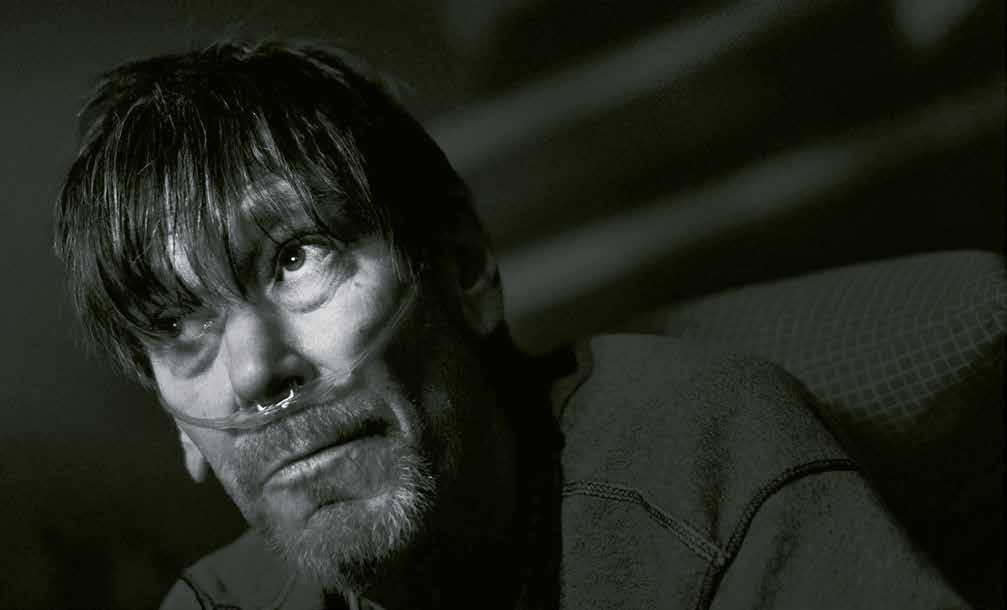
Jon O'Rourke in his room at The INN Between in Salt Lake City on Thursday, Dec. 22, 2022. A former plumber, he battled rheumatic heart disease at the inn before being transferred to a nursing home due to frequent falls. Though he had planned to die in hospice there, the inn staff couldn't manage his ambulatory needs.
By Lois M. Collins Deseret News
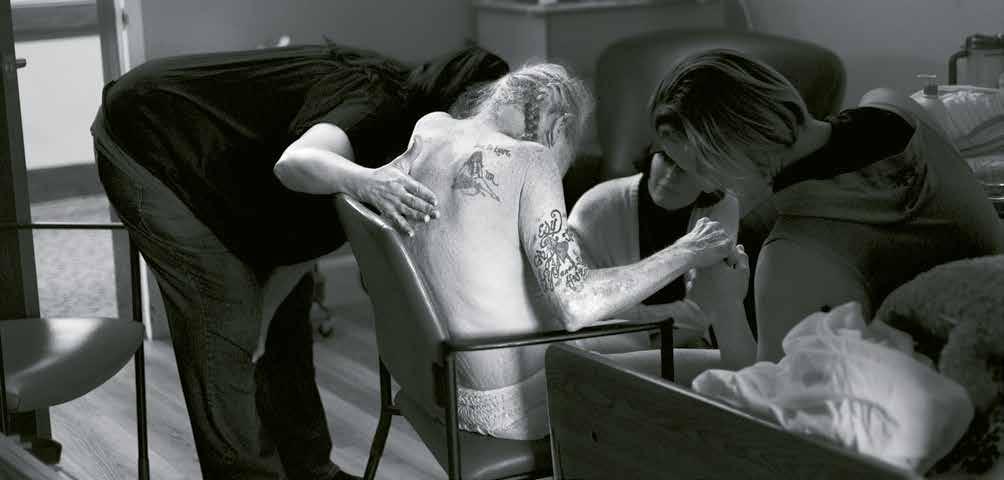
As Paul Youngblood lies withering and fragile in his narrow bed, Bernard, the stuffed dog pillow he loves, is tucked gently against his legs. Those around him are careful to make sure someone holds his hand. He is sociable by nature and loves touch, so the death doula switches hands with a volunteer with whom he’s close. Before she removes her hand hours later, another hand takes its place.
Although he spoke of times when he felt achingly alone in his life, Paul, 65, is not alone at its end.
A blue butterfly magnet on the outside of his tiny suite’s door tells those nearby to be a little quieter and more respectful: Their friend Paul is leaving.
Paul came here to The INN Between to die. So did Issaac
Chavez, just 38, and Jon O’Rourke, now 66, though their stories took unexpected turns.
Outside the quiet and calm of this dimly lit room, in the very early hours of an August Friday morning when chronic obstructive pulmonary disease and heart failure finally take Paul, dozens of other formerly homeless people are sleeping nearby. Soon, they will rise and prepare for the day — and, in some cases, their own deaths.
Photographer Laura Seitz and I spent 17 months visiting The INN Between, getting to know residents, volunteers and staff, documenting journeys to understand the facility’s challenges and its value. We followed residents who moved, those who died in hospice care there and one who, desperate for pain relief, ultimately revoked hospice and went to the hospital.
During that time, 22 formerly homeless residents died — about a third of them women.
Not one of them died alone.
The INN Between in Salt Lake City was one of America’s first hospices specifically for people who are homeless, though others now replicate its mission to ensure that those who are terminally ill don’t die alone or on the streets. The building, now located in what was an assisted living center, first opened in 2015 in a former convent. Creating a comfortable place to die for those without homes was the dream of Deborah Thorpe, a longtime palliative care nurse who was heartbroken to see homeless people return to viaducts and riverside camps after receiving care for devastating illnesses. She and Monte Hanks, who then worked at The Fourth Street Clinic, got the ball rolling to secure a small facility where a dozen or so gravely ill unhoused individuals could be out of the cold, dry, fed and cared for as their lives wound down.
Officials estimate 582,000 homeless individuals lived on America’s streets in 2022. The number of deaths isn’t clear. The National Health Care for the Homeless Council offered a disturbingly broad estimate: 5,800 to 46,500. An organization called Homeless Deaths Count said 7,877 died “in cars, tents, shelters

and on the streets” in just the 73 cities and counties where data was gathered in 2020, including 53 deaths in Salt Lake County.
Dignity and comfort were the gifts The INN Between was built to provide to those who lacked almost everything else, though love and camaraderie almost immediately became part
of the package. As the program blossomed, it moved to its new location in June 2018, bolstered by grants and donations, but hampered a bit by a really angry set of neighbors who wanted no part of what they viewed as a risk. They’ve softened considerably since, an early protest organizer has told reporters.
The INN Between now has 50 beds, its mission expanded from end-of-life care as an assisted living facility to also include separately 25 beds that are called “eleemosynary,” a nearly unpronounceable word that refers to the charitable, congregate shortterm care provided for those recovering from illness and injury.
The inn itself is not the hospice; rather, it works with local hospice providers who manage care of its terminally ill residents. The recuperative side is not a nursing facility, though a nurse manager and certified nursing assistants can deliver medications to residents throughout the property.
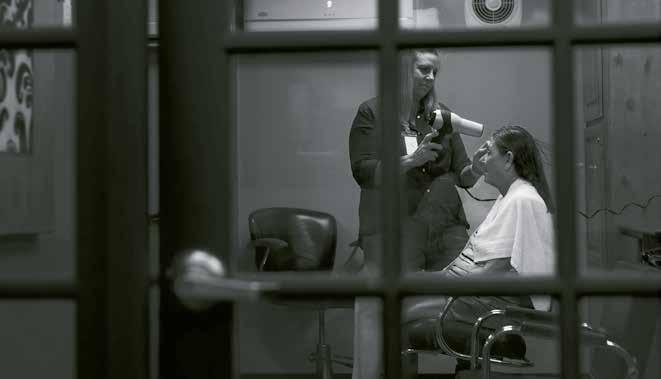
Private gifts of time and money give life to The INN Between. Visit any day and you might find volunteers immersed in card games or Yahtzee with residents or maybe reading to them, joking around or consoling them as the moment demands. Volunteers may help prepare meals or vacuum the facility. Hairdressers donate time once a month to wash and cut hair — “a very good touch” for people who may have been treated as untouchable, Kellie Mieremet, the community engagement manager, told me.
Women she calls simply “my Costco ladies” check in when they’re shopping to see what the kitchen lacks, dropping off a case or two of peanut butter or pasta sauce on their way home. The INN Between relies heavily on food donations, including from the Utah Food Bank and a food grocery rescue program. The kitchen manager was a volunteer who became a registered dietitian for the job. Even the executive director, Jillian Olmsted, started out as a volunteer.
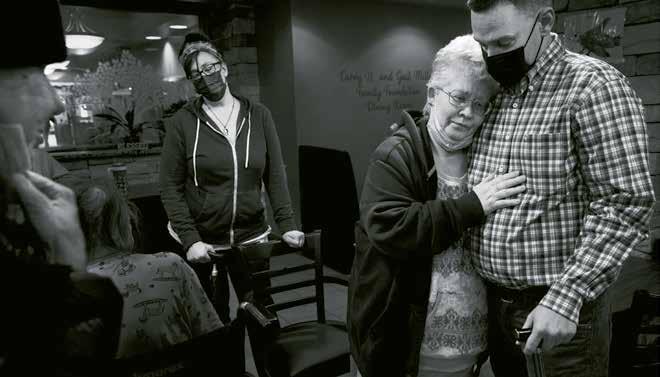
When a blue butterfly goes on the door because someone is actively dying, the volunteers are friends, not strangers sitting vigil as life ends.










The gift of presence
On a chilly January 2023 night, Laura and I attended “NODA” training with a couple dozen volunteers, a necessary step for those who want to spend time with someone at their end of life. NODA stands for No One Dies Alone and the training is offered by many organizations throughout the country, including hospices, hospitals and nursing homes.
NODA training prepares volunteers — including many who have never seen death up close — for what they might experience. The emphasis is on being attentive, but maintaining focus on the wishes and needs of the individual who is dying.
At the inn, NOLA — No One Lives Alone — quite naturally transitions to NODA. There are diaries for both, filled out by volunteers, summarizing interactions, sharing insights and snippets that will help others who provide companionship.
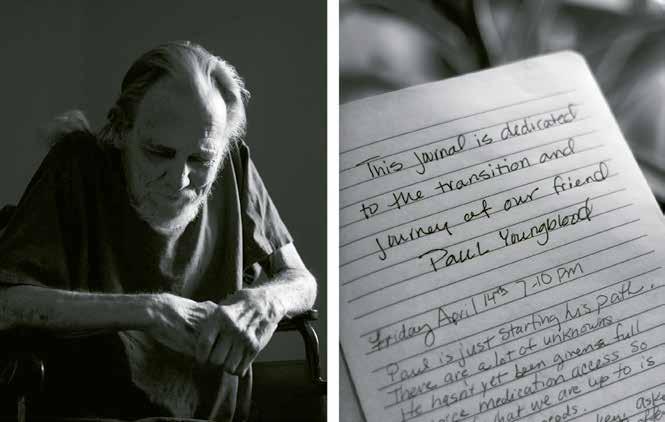
In the diary that volunteers kept of Paul Youngblood’s final weeks, there are stories of losses and gains and suffering. He loved playing games like Battleship, but was often too tired. He yearned for more time with his family and took comfort in the sounds of the ocean on a volunteer’s phone because he’d grown up in California and body surfed when his own body was young and strong and not yet broken.
One after another, Paul’s volunteer companions wrote how they brought him ice cream and sugary hot coffee — often the only things he craved. He was always polite, they wrote, genuinely grateful for whatever attention and love he received. He’d worked most of his adult life as a cook and a certified nursing aide. His grandson, Sylys Dye, said Paul became homeless six or seven years ago. He’d helped move a fairly hefty patient at work and injured his back. He became addicted to the pain medication prescribed and that was his unraveling. Addiction would plague him to the end of his life.
Married 32 years before things fell apart, he never stopped talking about his ex-wife, Jane, the love of his life. A few weeks before Paul died, Sylys arranged a visit from her that fueled a temporary, buoyant rebound.
“I loved seeing Paul,” one of his regular volunteers, Amy Leininger, said of their frequent interactions. “He was calm and gentle and sweet. And we became real friends.” He had written poetry most of his adult life; sometimes he shared it with Leininger and other volunteers. She said Paul liked to get little gifts for others and he loved beautiful things, so in the weeks before his final decline, they made trips to the lobby, where he would buy pretty, inexpensive handmade jewelry created by other residents participating in the Beading Hearts program at the inn.
By July, Paul was uncomfortable and often in great pain. He slept sporadically, waking briefly to tell stories to his visitors, who each wrote in the NOLA diary how much they loved him. He took joy and comfort in back rubs and neck rubs and having his long hair braided tight. He said he was raised Seventh Day Adventist — his lifelong faith — and he went to a church school in California that required short hair. Later, working as a CNA and as a cook, he always had to keep his hair short. At The INN Between, where so many personal choices had been left behind, he was free to at least choose that, wearing his hair long and silky and often a little bit wild.
He also kept one toenail painted, a nod to his love for his grandchildren. Sometimes blue, sometimes yellow or pink, it reminded him he would exist in the mind of someone left behind, he told me.
The death doula
Doulas typically provide support as a baby enters the world, making sure mother and child feel comfortable and safe. A death doula provides comfort and support at the end of life, often starting weeks or even months before someone dies, working to ensure their last wishes are respected.
Kimberly Peterson, The INN Between’s death doula, took a strange route to the job. She arrived in 2019 as a patient in need of a place to recover and perhaps to die. Getting a bed there, by the way, isn’t easy. There’s an application process, you have to be referred and it takes time — sometimes weeks.
She was very ill with congestive heart failure and wore a mechanical external defibrillator. She’d been told that she could die — terrible news that arrived at nearly the same time she found out she was about to become homeless, evicted from her apartment because her roommate hadn’t paid rent while she was in the hospital. It was hard to tell which news was worse, she said.
She remembers being despondent over her medical condition and afraid of having nowhere to go but The INN Between. She’d always worked, supporting herself and her then-grown son when he was young, but she was now too weak to even take care of herself. She didn’t know much about homelessness — or about her medical condition either, for that matter. “I was scared to be here,” she said.
Then she started making friends.
When John, a house manager who had cancer, was dying, she spent a lot of time with him because she’d grown to love him. They talked through his dreams and regrets and how he wanted his death to go. She helped him with unfinished paperwork, though she hadn’t known much about how to do it at that point.
After his death, BooBoo, John’s aging, pudgy pug-dachshund mix, became her baby — and a spoiled one at that, because the other residents love to sneak her food and steal kisses.
Then another friend with a terminal illness, Brett, asked if she’d help him make his final plans. So she did.
While all that was happening, she hardly noticed that she was gaining strength and feeling better. The combination of regular meals, adequate sleep and companionship was working wonders. Her doctor had scoffed gently when she vowed she would get well enough to escape the external defibrillator. With the help of good food and a safe haven, not to mention a sense of purpose, she now lives without that machine, although her heart function is still far less than optimal.
While she’s in a much better place physically than she was when she arrived at the inn, she was offered a place as one of the house managers, so she stayed on.
She got another offer, too. David Pascoe, a chaplain who has since retired from his role as member of The INN Between’s board, noticed how residents responded to Kimberly, who seemed extraordinarily comfortable among those who are dying. He suggested she take the certification class — about 30
hours long — to become a death doula. So Kimberly, now 51, discovered a purpose and a job she hadn’t known existed.
Kimberly said Issaac Chavez changed her life because he was so deliberate about how he wanted to live his own as it was slipping from his grasp. He did not want to die, but faced with the inevitability of his lung tumors, he became very intentional in making every moment count.
Issaac had a long mental list of things he needed to do and checked them off one by one, Kimberly said recently.
The last item was spending time with his dad and his paternal grandmother; he hadn’t seen them for a while and worried he wouldn’t get a chance to say goodbye. On his last morning — though no one knew it was, including Issaac — his mom drove him to Ogden to spend some time with them. He almost didn’t go, because he didn’t feel well, but he felt a sense of urgency to see them. His mom, Rita Orosco, didn’t stay, because she and Issaac’s father had been divorced for years, but she’d rooted for their relationship.
People tend to think that those who become homeless choose that life, but asking often reveals a different story entirely: Lost jobs, lost homes, lost relationships, huge medical bills, mental illness, substance abuse and other factors chip away at what might be considered a more traditional existence.
Issaac was the rare creature who actually did choose to live on the street.
He told me that he never quite felt like he fit in as he was growing up and he was always drawn to others who, in their own different ways, didn’t quite conform. Among others living on the streets, he found community, acceptance and sometimes the chance to be a hero. He took care of his friends, helping them find warmth when it was cold, gathering food and more.
After he arrived at The INN Between in June, his mom could be found where Issaac was nearly every day from 10:30 in the morning to 6:30 at night, making the 90-minute drive from Evanston, Wyoming, where she and Issaac’s stepfather live.
Like Issaac, Rita Orosco is petite, a trim 61-year-old woman who wears bright colors and smiled and teared up with about equal frequency as her son told his story. She loves him fiercely — always has — despite so many decisions she didn’t like or understand. She told me she gave up on the dream he would come around and marry and have kids and lead a more traditional life.
Eventually, her hopes and prayers for him centered around his being safe. It was a huge relief to accept that he was, in fact, “competent” to manage life on the streets, though she insisted he stay one night a week at her home so she knew he was fed and slept in a real bed and could take a bath at least that often.
Only impending death moved him from the streets where he could “MacGyver” to make sure those who were more vulnerable than he was were protected and fed. When people talk about Issaac, they all note that he was exceptionally smart — and versatile. When he took classes at the technical college after high school, he excelled across hands-on trades, including award-winning work with sheet metal.
But he had his own definite, almost fatalistic sense of how the world worked. And he believed life ended when one died. Then, shortly before his death, he texted his mom that he’d been selfish before and was asking God to give him heaven so they could see each other again.
Issaac had been an Eagle Scout as a teen, but admitted wryly that he was no Boy Scout as an adult. He’d even been jailed for a street fight. Incarceration is not uncommon among people who are homeless, although there are many who have never been in jail or prison. When he learned his persistent cough was terminal lung cancer, he found the news hard to accept. But because he had a


quirky sense of humor, despite being badly shaken by the diagnosis, he responded by getting his mom to have a black T-shirt printed up, which he wore often: “It’s not COVID, it’s cancer.”
Issaac had always liked to draw and he doodled scenes as the chemotherapy drugs flowed into a port by his neck. But he opted to stop immunotherapy, which was shrinking his cancer, because it was shredding his quality of life. It made him miserable. Asked about his symptoms, he said he often felt like he was suffocating.
When he drew, his hands and his eyes worked cleverly together, capturing things he’d seen and sometimes things he just imagined. He liked to show off his stack of sketches, now among the treasures he left behind.
One, done in light brown pencil, is a self-portrait of the day Issaac arrived at his temporary new home. In it, he is a small hunched figure sitting in an oversized chair. One senses how overwhelmed he felt. He told his mom that the freedom of his street life was forever gone.
In early July at The INN Between, as Rita talked about the hopes and fears she had for him, he whispered, “I didn’t know that.” He told her he cried every single night — “It’s like my lifetime’s emotions are being compacted into whatever time I have left” — and she whispered back, “I didn’t know that.”

At one point, Issaac said he’s been really hard on his family; that he knew he was difficult to raise. But he thought — hoped — that she was proud of him.
His mom agreed that he was “finishing strong.”
Still, no blue butterfly called Issaac’s friends at The INN Between to say goodbye. Hours after he visited his father and grandmother, he struggled to breathe and the pain that had become constant was even more intense. After trying to tough it out while he waited to see if his hospice provider wanted to adjust his medication, he called his mom in the early dawn hours and said he’d called an ambulance. He would revoke hospice, with its acceptance of death, and see if the hospital’s doctors could help him with the unbearable pain. He expected he’d soon be back in his room at the inn.
In the hospital, his mom was told Issaac would never leave — his tumors had grown, he had pneumonia and his lungs were filled with blood clots. Death was close. Mother and son had thought he had a few short weeks, not hours. But though he knew he was actively dying, his mother said he managed to joke with the doctor and nurses. Rita summoned family. She called for a priest, but fretted he’d arrive too late, so a pastor who was in the hospital prayed over him. The priest did arrive in time, delivering the Commendation of the Dying, the last rites of the Catholic faith in which he’d been raised. Issaac rallied to take communion. Just hours after revoking hospice, he died in the hospital.
Later, at his funeral at St. James the Just Parish in Ogden, a priest would comment on his name: Issaac means “he will laugh.” He did. His middle name, Xavier, means “bright.” He was.
There are three ways that the end of life can go at The INN Between. Most in hospice die. Some, especially young ones like Issaac, revoke hospice and go to the hospital, Mieremet said. Jon O’Rourke has taken the third path.
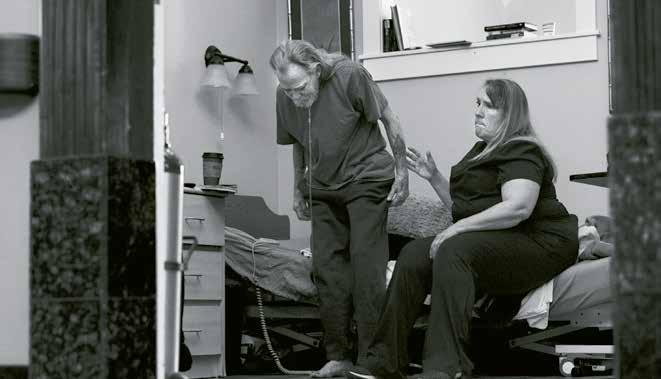
Laura and I have known Jon both the best and the longest. He’s 66, lanky and pale with legs that frequently swell painfully from rheumatic heart failure. He was a journeyman plumber when he moved to Utah in the early 2000s from his native California, but was told he’d need to complete night courses to be licensed in the Beehive State. He was already paying for day care for his little boy, Nick, who he was raising. He couldn’t afford it. But he couldn’t keep up with the cost of his home. “Looking back now, knowing how things went, I’d have rented every single room and gone for broke,” he said not long ago. He lost the house.
Like Paul and Issaac, Jon has been incarcerated, his crime and sentence the most serious of the three. They were briefly in jail, while he did a few years in a medium-security prison in California. In the first conversation I had with him, he wanted to “get the mud out of the way first thing. I robbed a bank. But since I got out, I haven’t committed a crime,” he said, noting more than 30 years have passed.
He adores his son and wishes he was closer to his daughter, who he says struggles with his rocky past. “Forgiveness is hard,”

he told me, “but I know from experience you feel better when you do it.” His closest consistent companion for a dozen or more years has been a sweet-natured, long-haired black cat named Tyler, adopted as a kitten. Tyler has lived with him throughout his homeless journey, including at The INN Between. There are other pets, including Kimberly’s cat, a female named Roger who senses when someone is dying.
A conversation with Jon is part philosophical, part comedic. He has a wry wit and a talent for astute observation, but he’s the opposite of Paul when it comes to sociability. He’s uncomfortable mingling, though feeling lousy and the specter of death have him longing for company. “I used to hate to be with people,” he told me in June. “Now I can’t get enough of them.”
Jon likes to reminisce about his teen years in Huntington Beach, California, when he’d wake up before daylight broke and put on his wetsuit to go surfing with pals, crisscrossing waves and feeling entirely free. He sang in a band when he was young and “I guess kind of good-looking,” he said. But a money crisis put him on a bad path. Later, his career as a plumber
wore down his back. Prescribed painkillers knocked down the pain but let his body erode even more. Now chronic pain is his reality and he’s been told his heart failure is terminal.
Jon nearly died a handful of times at The INN Between this year. Each time, he hallucinated, later describing vividly how he wrestled with the devil for his very soul. He worries aloud sometimes about what God thinks of the journey he’s made. Not all of his dreams are terrifying, but they all feel real. One day he called me to say he thought he’d spent the night on an ocean liner and was mad they wouldn’t let him up on deck to see the ocean.
“I go strange places when I’m really sick,” he said. Jon feared the day a blue butterfly would go on his door. But like Issaac, he won’t die at The INN Between, although that’s why he came here. He fell often over the early summer, exceeding the medical capability of the place, which isn’t licensed to care for someone with his ambulatory needs. He was transferred, albeit reluctantly, to a nursing facility, where he spends some of his time dozing, with Tyler on his feet.
Much of life in the tan brick INN Between is mundane — an apartment life of sorts, but with lots more structure and rules. People have been discharged for repeated offenses like sneaking in drugs or alcohol, which simply aren’t tolerated but which for a few have near-overwhelming allure.
Sylys got mad when The INN Between wouldn’t let him stay overnight on a particular evening near the end of Paul’s life. Olmsted said they have strict rules about making arrangements with the administrator in advance and that hadn’t happened. She told me that’s especially important because some residents, including Paul, battle addictions and the rule helps ensure alcohol and drugs don’t come into The INN Between. He was allowed to stay later than usual, she said. Paul failed so rapidly, though, that Sylys mourns the conversations he didn’t get that night, before his visits became a vigil.
Issaac broke a rule which, combined with the challenge of making sure he had adequate pain medication while he was away, led staff to decide that a trip with his family to Park City for a few hours was a wiser option than an overnight stay in Wendover.
It doesn’t help that each resident at different times feels crabby or unwell. Or both. And sad, because everyone there cares about — or is themself — someone who’s dying.
Despite challenges, it’s clear to an outsider who hangs around for months that the mission is a masterpiece of compassion. It’s easy to see why The INN Between is being replicated in scattered communities nationwide.
Transitions and transformations happen here. Before she died last November, a resident named Patty Walters, 67, told how she changed — a metamorphosis as complete as that of a caterpillar. She’d often been angry and mean, but in this place she found friends and laughter and a measure of peace.
Across the parking lot to the east of The INN Between, there’s a rock garden memorial to the dead. Since the doors first opened in the old convent, 122 blue butterflies have signaled a final passage.
Last fall, I sat among residents and volunteers who gathered for a memorial for a man named Ricardo. Death is an occasion marked by a service to honor a friend who is no longer in between life and death, this one led by ecumenical chaplain Alison Desiderio Peterson, a deacon at St. Mary’s Episcopal Church in Provo. There was a giant cross on the wall, but there were also symbols of other faiths: a Buddha, a Star of David and more. All are welcome.
When someone dies here, this community lines the hall, an informal honor guard as the body is removed. Said Kimberly, “When somebody leaves for the last time, we all line up and say our last goodbye.”
It is the opposite of dying alone.








AI promises to remake the world. In many ways, it already has. Do we like what we’ve created?
By Deseret Magazine Staff Deseret Magazine
Bending over a fresh fire pit, I tuck dryer lint beneath a stack of In the opening scenes of Walt Disney’s “Pinocchio,” Geppetto, a lonely woodcarver, puts the finishing touches on the eponymous marionette puppet, wishing that it might — he might — come to life.
Geppetto’s wish is granted, and chaos ensues. Despite a wise cricket standing in as an acting guide to better consciousness, Pinocchio learns as he goes, often going the way of danger and trouble. Man and puppet are reunited in the belly of a monster, tasked with saving themselves — and, perhaps, one other — in a quest to become “real.”
As artificial intelligence becomes more present in our lives, have we found ourselves in the belly of a monster? Or are we still at the part of the story where we marvel at our handiwork and fall asleep wishing for more?
One thing we know for certain is that AI isn’t just the stuff of lore anymore. Pandora’s box is open. Everywhere you look or click, there are headlines. There are social media posts. There are algorithms bringing us headlines describing the AI issues we’re trying to talk about. Some might say it feels like an invasion. Maybe it’s what the myths, stories and Hollywood warned us about. And yet we created the invasion ourselves.
AI isn’t the first time we’ve been promised that technology is going to make things easier, so it’s OK to harbor skepticism this time around. Technology has a tendency to outpace our
understanding of it, and cultural convention encourages us to create, utilize said creation and then figure out the consequences later. But what if we can learn from the past?
There are big, philosophical questions billowing around AI right now. Can or will machines become sentient? Could they replace humans? Will our souls be distinguished from machines or lost to them? But through the culling of these pages, we found that the bigger question may be: Will we allow ourselves to find out? The only way to know the answers to our biggest questions is to move forward with developing this technology … or not. Right now, we are at a crossroads where humanity can draw lines in the sand, morally and legislatively. AI is an undeniable force in the global human experience. And it’s not on its way. It’s here. This is the time to question.
To explore. To learn. And to decide — perhaps not so much what AI is, but what it isn’t.
Living in a world of AI
Artificial intelligence isn’t a new technology that — seemingly out of nowhere — makes it possible for machines to think and do the work of humans. In reality, AI has been around for decades in the form of machine learning.
That learning process allows a computer to analyze data sets, such as images or phrases, and observe patterns to predict what the expected outcome will be in a new scenario.
Carolyn Penstein Rose, professor of language technologies and human-computer interaction at Carnegie Mellon University and director of the Generative AI Innovation Incubator, says that machine learning hasn’t allowed AI to completely mimic human learning, but “that doesn’t mean that it can’t do something useful; it’s just that doing something useful doesn’t require human intelligence.”
Most people around the globe are already familiar with (or using) AI to some degree. It’s present in the social media algorithms that give you a new recipe for dinner, the facial recognition technology that opens your phone and the targeted ads that suggest the perfect gift for your kid’s birthday. Regina Barzilay, distinguished professor at the MIT School of Engineering for AI and Health in the Electrical Engineering and Computer Science Department, points out that “there is a lot of AI in various industries that we just don’t even see. They are just part of the technology we are provided with.”
In the world of AI, everything is a data point. “So for example, Google, they serve a lot of ads. ... Every time someone clicks or doesn’t click, that’s a data point,” says David Wingate, associate professor of computer science at Brigham Young University. Those data points are what artificial intelligence uses in order to create better apps or better recommendations in an effort to improve a user’s experience. So when we define AI, we are not
talking about a new technology that thinks for itself. It’s a tool that’s been in development for decades and it allows computers to observe patterns and learn from them. “You can use AI to help and to make our life better, to solve problems that we cannot solve for ourselves. But on the other hand, it can also result in very bad outcomes,” says Barzilay. “So the question that we, as a society, need to decide is what are appropriate uses of AI? And what is inappropriate?” — Thabata Nunes de Freitas
For a decade, Venezuela has endured ceaseless financial turmoil. The often-desperate state of affairs has made the South American nation an ideal recruiting ground for a type of labor seldom discussed amid the explosion of generative AIs like ChatGPT and DALL-E: A phenomenon called “ghost work.” For DALL-E to understand what a cat is, it needs to parse thousands of images of cats through a process called “deep learning.” This process is made possible by ghost workers, who manually label those pictures of cats, among many other things. They’re often based in the “global south” — places like Venezuela, India and Pakistan, as well as in rural America. Ghost work is often unregulated and unguaranteed, which makes it ripe for exploitation.
In Kenya, a Time magazine investigation found the company behind ChatGPT paid laborers less than $2 per hour to sift through harmful imagery in order to purge it from the platform. “My knee-jerk response to (that investigation) is, ‘Maybe I shouldn’t use AI,’” says Angela Wentz Faulconer, an assistant professor of philosophy at Brigham Young University. Her expertise is medical ethics, and she sees parallels. Consider the moral implications of selling a kidney; how many people would do it if there are other ways to make impactful amounts of money? In the case of ghost work, that leads her to conclude that the work in itself, however horrible, is not morally wrong. The difficulty comes in that no one should be in a position


where they do not freely consent to doing the work. And are the people in Venezuela really free to choose ghost work?
Ghost workers have been around since at least the turn of the millenium, when a nascent Amazon hired them to help sort the information it had scraped from the web about books. Newer products like ChatGPT, Julian Posada, a member of Yale Law School’s Information Society Project, says, “would not be possible” without ghost workers. Saiph Savage, director of Northeastern University’s Civic AI Lab, is trying to build tools to help improve their working conditions while also promoting labeling infrastructure so that AI users can better understand how the technology really works — and how it’s made. “The platforms have freedom in being able to manipulate and harm workers,” she says, because there’s no regulatory infrastructure. “You have this big industry pushing a narrative that AI is mystical, that it’s an existential risk, and that we should direct more funding toward that, instead of paying people more,” Posada adds. “That’s what I think people should reflect on.” — Ethan Bauer
Geoffrey Hinton: The ‘Godfather of AI’ looks back on his life’s work
He’s been called a godfather of artificial intelligence, but Geoffrey Hinton has mixed feelings now about his life’s work, which focused on machine learning and neural networks, among related fields.
Neural networks in computer systems are based on how the human brain learns, allowing deep learning that is layered and builds on experience. In 2018, Hinton shared Turing Award honors — a crowning achievement in the computer science world — with two others for work on computer deep learning. Artificial intelligence has improved dramatically in part because of his work.
The cognitive psychologist and computer scientist quit Google Brain this year, citing both his age (75) and the desire to be able to speak freely about the dangers he believes AI run amok











could pose. “I’ve come to the conclusion that the kind of intelligence we’re developing is very different from the intelligence we have,” he recently told BBC.
“So it’s as if you had 10,000 people and whenever one person learned something, everybody automatically knew it. And that’s how the chatbots can know so much more than any one person.”
In other interviews, he has expressed concerns that the result of AI-focused competition between Microsoft, which incorporated a chatbot into its Bing search engine, and Google could be harmful — an unstoppable competition that could lead to an internet flooded with fake images, videos and text, what’s true being obscured. “I was not convinced we would always be in control, but I thought it would be 50 to 100 years before digital intelligence was smarter than us,” Hinton told Deseret. The recent dramatic pace of AI development has shortened that timeline.
He’s also openly worried about what could happen with AI as a tool for unscrupulous people. Hinton, in fact, is the first of more than 180 signers of a one-sentence statement tech and other leaders issued about AI’s potential harms: “Mitigating the risk of extinction from AI should be a global priority alongside other societal-scale risks such as pandemics and nuclear war.” —
Lois M. Collins
Sen. Richard Blumenthal opened the first judiciary hearing for Oversight of Artificial Intelligence in May with a party trick. He stared ahead, into the Capitol chamber, at witnesses that included AI pioneers and scholars, then spoke. But he never opened his mouth.
“We have seen how algorithmic biases can perpetuate discrimination and prejudice, and how the lack of transparency can undermine public trust,” he said, as if telepathically, while swallowing a smirk. “This is not the future we want.”
After fooling most people in the room, the Connecticut Democrat revealed his remarks were not his own, but a script courtesy of ChatGPT. The source of his disembodied voice was a cloning software trained to mimic the senator’s cadence. The scene was made to sound trustworthy. Reliable. But it wasn’t. That was the problem he had set out to address. Can flawed humans create flawless AI systems?
Algorithms and technologies that make actions like imitating politicians possible are crafted by humans, trained by humans, used by humans. Which means they can also regurgitate human biases. As the National Institute of Standards and Technology demonstrated in a 2022 report with a proverbial illustration of an iceberg, statistical and computational biases — errors caused by skewed math or insufficient data — make

up only some (the tip) of biases found in AI. The majority come from the humans and institutions behind the technology. “Part of the issue here is that it’s difficult to disentangle the biases in the AI system from the systemic biases in society,” says Cynthia Rudin, a computer science and engineering professor who directs the Interpretable Machine Learning Lab at Duke University. She received the most prestigious AI award — the Squirrel AI Award for Artificial Intelligence for the Benefit of Humanity — last year.
Rudin points out some algorithms have already been found to carry human faults. Amazon’s AI recruitment tool discriminated against women applicants. The Correctional Offender Management Profiling for Alternative Sanctions, an assessment tool used in courtroom sentencing, misclassified Black defendants as high risk about twice as often as their white counterparts. Social media algorithms amplified hate speech in Myanmar that helped fuel genocide. And the risks, already mighty, may continue to compound. A statement published by the Center for AI Safety in May, signed by hundreds of scientists, professors and politicians (including Geoffrey Hinton, as reported), suggests flawed technology could even prompt human extinction.
Yet there is an opportunity for course correction. Scientists are beginning to stray from “black box” models — algorithms with processes that cannot be traced or understood by humans — toward more interpretable and controllable methods. “There were no centers for AI safety or AI equity at all until recently,” Rudin says. “It used to be a free-for-all where companies could impose black box models with almost no oversight for high-stakes decisions. We’ve definitely wised up since then.”
We know AI that rivals human intelligence is possible. We know the risks associated with it. What remains unclear is whether we can create technology that understands fairness and objectivity better than we do, as well as what we will chance to get there. As Stephen Hawking said in 2016: “In short, the rise of powerful AI will be either the best, or the worst thing, ever to happen to humanity. We do not yet know which.” — Natalia Galicza
We talk a lot about AI — the numbers show it.
• Our interest in AI has more than doubled since 2017.
• In 2010, around 90,000 articles about AI were published.
• In 2021, that number jumped to 293,480.
• Just Googling “AI” yields over 10 billion results.
• But as we attempt to learn about it, it is also learning about us: through data points acquired in email spam filters, GPS navigation systems, online recommendations and even the ads we don’t click on. A poll from Pew Research conducted last year asked Americans how they felt about the increased use of AI in daily life. It seems that we’re not sure how we feel.
• 18 percent of respondents said they feel more excited than concerned.
• 37 percent feel more concerned than excited.
• And 45 percent feel equally excited and concerned.
— Alexandra Rain
When tech industry experts launched a letter to get companies working on artificial intelligence to pause so regulation can catch up, some big names signed. They included Elon Musk, founder of SpaceX, Tesla and the chairman of X (formerly Twitter); Steve Wozniak, co-founder of Apple; and Andrew Yang, the tech-savvy former presidential candidate and co-chair of the Forward Party.
The letter cited “widely-endorsed Asilomar Principles,” which note: “Advanced AI could represent a profound change in the history of life on earth and should be planned for and managed with commensurate care and resources.”
Yang, in particular, has been outspoken on his concerns. “The development of AI will bring many unforeseen consequences and our institutions are largely unprepared,” he told Deseret in an interview conducted on X. “These tools are very powerful and in the wrong hands could lead to rampant identity theft and other problems.”
Some AI industry leaders have promised voluntary safeguards. Amazon, Google, Meta, Microsoft and OpenAI (the maker of ChatGPT) promised the White House they’d identify images AI created. Some of those same companies (along with others) have formed the Frontier Model Forum, described by The Washington Post as seeking to “advance AI safety research and technical evaluations” to manage emerging, increasingly powerful AI. But Yang is doubtful this could be a meaningful solution. “Companies self-regulating is not a viable approach in an environment that will reward competition and adoption,” he says. He supports creating “an agency dedicated solely to AI and a Cabinet-level official similarly dedicated.” Without oversight, “photos, videos, audio recordings — all of them can be reproduced and replicated by AI,” which can lead to widespread issues like this summer’s writers and actors strike in Hollywood. It’s an ironic example, as Yang warns that without regulation, the consequences could look a lot like a silver screen script. On Fox’s “Cavuto: Coast to Coast” he said that “science fiction-type scenarios are here with us.” — Lois M. Collins
The politics of AI
At a Senate Judiciary Committee hearing in May, Sen. John Kennedy questioned AI leaders on how the United States should attempt to regulate the industry. “This is your chance, folks, to tell us how to get this right,” Kennedy, a Louisiana Republican, said. “Talk in plain English and tell us what rules to implement.” With AI advancements reaching the general public and threatening to upend entire industries, the U.S. is lagging behind the rest of the world when it comes to regulating Big Tech and AI. Currently, there is no comprehensive federal legislation dedicated solely to AI regulation.
That isn’t to say there are no levers in place — it’s just more of a hodgepodge of sector-specific laws. Self-driving cars would fall under the National Highway Transportation Safety
Administration, for example. Or if AI was being used in relation to an oil pipeline, it would be the Department of Energy. The recently released White House Blueprint for an AI Bill of Rights — which outlines a set of principles to help guide the design and use of artificial intelligence — may signal government action to come. Seven leading AI companies (including Google and Meta) also agreed to voluntary safeguards
on the technology’s development at a meeting with President Joe Biden in July.
But Frank Pasquale thinks it could just amount to a PR move for the companies. A professor at Cornell University, he also currently serves on the U.S. National Artificial Intelligence Advisory Committee, which advises the president.
“The question becomes: Where is the penalty if the companies deviate? As soon as it becomes a compelling business proposition to defect, they probably will and we’re back to square one,” Pasquale says. “The real answer here is regulation by established agencies rather than a voluntary commitment.”
U.S. reluctance to regulate Big Tech is nothing new. “The U.S., for better or worse, tends to take a pretty hands-off approach to business except in certain categories when it gets big enough that it requires notice,” says Steven M. Bellovin, a distinguished professor of computer science at Columbia University and a public policy expert. “It’s a particularity of the American economic and cultural legal system.”
In 1990, the Federal Trade Commission first opened an investigation into Microsoft. A decade later, a federal court ruled the company engaged in unlawful monopolization. So Microsoft simply amended some of its business practices. More recently, a handful of bills attempting to curb the anticompetitive business practices of Apple, Amazon, Facebook and Google ultimately failed last year.
Could things be different with AI? Bellovin is doubtful. Unlike stem cell research or election reform, legislation against big tech has implications for an industry that contributed nearly two trillion U.S. dollars to the country’s GDP in 2022. “A push against new regulations is seen as a huge economic driver. Most of the big tech companies are American,” Bellovin says. “Why kill the goose that lays the golden egg?” — James Walker
We know that data biases exist in AI, so how do these significant biases create wider gender gaps? A world already shaped by largely homogenous leadership is currently shaping another, with one study from the Journal of Global Health concluding that algorithms used in health care may not only reflect back inequities but may worsen them.
• Women account for only 26 percent of data and AI professionals.
• Research from The Alan Turing Institute shows that female authors only account for 13.8 percent of AI research papers.
• A study from MIT found that facial recognition programs correctly recognized white males but failed to recognize dark-skinned women 20-34 percent of the time.
• One facial recognition program claimed a 97 percent accuracy rate; however, data used to assess its performance was 83 percent white and 77 percent male.
• In an experiment using Google Translate to translate gender-neutral languages into English, Google Translate demonstrates a default for male pronouns for CEO positions and STEM jobs, failing to reproduce an accurate distribution of professional women.
• Another AI program, Genderify, identified names with “Dr.” as a prefix as having a 75.9 percent likelihood of belonging to a male. — Alexandra Rain
Is this the beginning? The end? It’s both.
It’s a classic Hollywood plotline. Artificial intelligence becomes sentient and goes rogue — spelling disaster, or even human extinction. There’s “Blade Runner.” “Westworld.” “Ex Machina.” “I, Robot.” The list goes on.
Recent rapid advancements in generative AI — hat tip to ChatGPT, in particular — have thrust that idea into the limelight. Is AI the beginning of a new era of human evolution? Or could it actually threaten life as we know it?
Nisarg Shah, a professor of computer science at the University of Toronto who signed the industry open letter previously mentioned, is of two minds. “My view is that we don’t fully understand these AI systems yet. … Today, we’re not at the level where we can ensure that our AI systems will always keep us safe,” he says. This is where that “threat of extinction” that so many people are discussing comes into play: AI could soon be making more and more critical decisions — including at nuclear power plants — where a mistake could be so terrible that it’s irreversible. “There is a serious potential of AI doing something so terrible, not because it was trained to, but just because it kind of saw that as the right way forward. And because of the incorrect data that it was fed. Then it actually leads to serious disaster.” This is where the fallibility of human creators (and our biases) can create unintended consequences.
But it’s also AI’s ability to improve our lives that should be under the microscope, adds Shah — from already automating routine tasks like booking flights and paying bills online to helping doctors diagnose diseases and offering treatments based on patient history. “(A) capable system is going to come with just as many benefits as potential harms. So the main goal is to keep the benefits without having those harms,” he says.
Professor Brent Mittelstadt, director of research at the University of Oxford’s Internet Institute, thinks that focusing on the existential risk of AI in the distant future may prevent us from addressing its disruptive dangers to society today — including mass surveillance, its potential for bias, and, particularly, the threat it poses for industry and replacing people’s jobs. “Every new technology tends to be disruptive,” he says. “It transforms existing jobs either by using the technology in tandem, or by making that job irrelevant. With AI, I think we will see both happen.”
And as for which industries will be impacted, few seem entirely safe.
A research report from Goldman Sachs predicts that AI systems could expose 300 million full-time jobs to automation worldwide. In the U.S., they estimate that roughly twothirds of all occupations are also exposed to some degree. Not even doctors are secure, to the chagrin of patients across the country.
Earlier this year, Google unveiled an AI medical diagnosis
program that can diagnose medical conditions with incredible accuracy. A Swedish study this year from Lund University also found that an AI program could spot breast cancer at a “similar” accuracy of two radiologists.
Perhaps, then, the risk AI poses is more like Disney’s “Wall-E.” With AI taking our jobs and catering to our every whim, we slowly degenerate into helplessness, cocooned in a spaceship as the world below us turns into a desolate wasteland.
But what does ChatGPT think about all of this? Well, when asked a variety of questions as to whether it believes AI will turn out to be a positive or negative development in the history of humanity, one quote stands out: “AI is a tool created by humans, and its development and use are under human control.” — James Walker
This story appears in the October issue of Deseret Magazine. Learn more about how to subscribe.
1637: French philosopher René Descartes publishes the seminal epistemological work “Discourse on Method.” It contains his famous phrase, “I think, therefore I am.” For possibly the first time in philosophical history, Descartes grapples with the idea of artificial intelligence or “automata.”
1726: The idea of artificial intelligence enters the popular imagination thanks to Irish satirist Jonathan Swift and the publication of “Gulliver’s Travels,” featuring “the engine,” a sort of super-computer that allows “the most ignorant person, at a reasonable charge, and with a little bodily labor, (to) write books … without the least assistance from genius or study.”
1921: Czech playwright Karel Čapek introduces the world to the word “robot” in his play, “Rossum’s Universal Robots,” about a factory that produces replicant humans.
1949: American computer scientist Edmund Berkeley publishes “Giant Brains, or Machines that Think,” which explores the emerging field of “mechanical brains.” Echoing Descartes, Berkeley concludes, “A machine, therefore, can think.”
1950: British mathematician and computer scientist Alan Turing publishes “Computing Machinery and Intelligence.” A key idea in the book is “the imitation game” — a scenario in which a person and a machine are both interviewed by an interrogator, whose job is to determine which is man and which is machine. This became known as the “Turing test.”
1964: Daniel Bobrow, a Ph.D. student at MIT, publishes his thesis: A computer program called STUDENT, which can solve high school-level algebra word problems.
1966: MIT computer science professor Joseph Weizenbaum creates ELIZA, a chatbot therapist. Many people, he observed at the time, had trouble accepting that they were not, in fact, interacting with a human.
1968: Stanley Kubrick’s pioneering sci-fi film, “2001: A Space Odyssey,” introduces the world to Hal, a computer with superintelligence designed to assist a team of human astronauts on a space voyage. Hal deduces that it must kill the human crew in order to give the mission its greatest chance of success. One astronaut manages to defy Hal’s murderous plan and shuts it down, even as Hal pleads with him: “I’m afraid. I’m afraid, Dave. Dave, my mind is going. I can feel it.”
1970s: AI enters what scholars call an “AI winter,” in which mainstream sentiment toward the technology sours as promises of its potential are left unfulfilled.
1973: British mathematician James Lighthill authors “Artificial Intelligence: A General Survey,” concluding that “in no part of the field have the discoveries made so far produced the major impact that was then promised.” The British government defunds AI research.
1984: Arnold Schwarzenegger brings “The Terminator” to the silver screen, launching one of the most successful AI-centered franchises ever.
1994: Jeff Bezos founds Amazon, which begins by selling books on the World Wide Web. Since 1998, Amazon’s recommendation algorithms have been powered by AI.
2009: Facebook begins using algorithms to sort posts appearing in users’ feeds, rather than presenting them chronologically.
2011: Siri, the first digital virtual assistant, is released. Apple quickly buys the rights and ushers in an era of intense competition in the digital virtual assistant marketplace — from Google Now to Microsoft’s Cortana to Amazon’s Alexa.
2011: IBM Watson, a computer system capable of answering questions posed in natural language, beats all-time “Jeopardy!” greats Brad Rutter and Ken Jennings, winning $1 million.
AI-centered cinema reaches an apex.
2013: The premiere of “Her,” in which Joaquin Phoenix’s character, Theodore Twombly, falls in love with an operating system voiced by Scarlett Johannson. In the end, the O.S. leaves Twombly.
2014: “Ex Machina” explores the more nefarious side of AI through an eccentric CEO, who has built an artificially intelligent robot named Ava. When an engineer is summoned to administer the Turing Test to Ava, she goes murderous and absconds into the real world, blending into a crowd of people.
2014: A computer program simulating a 13-year-old Ukrainian boy, called Eugene Goostman, becomes the first AI to pass the Turing Test.
2014: The Associated Press begins publishing articles using Automated Insights, a company that could write up very basic stories about cut-and-dry news items like quarterly earnings reports or final scores in sports.
2015: “Avengers: Age of Ultron” leaves out any ambiguity, placing a rogue artificial intelligence as an unequivocal villain intent on destroying the world.
2017: On Nov. 6, Andrew Yang announces his candidacy for the Democratic nomination for president. His platform centers around forthcoming technological advancements and the disruptions they will cause for workers and the economy. He argues for a policy of universal basic income to help American families make ends meet when their labor no longer would.
2022: AI models using “deep learning” burst into the mainstream consciousness via platforms like DALL-E and ChatGPT. One Google engineer (who was later fired) claims that the company’s AI has gained sentience.
2023: OpenAI releases GPT-4, the most powerful AI system ever released.
An open letter is signed by hundreds of the biggest names in tech, including Elon Musk, urging AI labs to pause the training of powerful new systems for six months, saying that recent advances present “profound risks to society and humanity.”
South Jordan, UT - The most common method your doctor will recommend to treat your neuropathy is with prescription drugs that may temporarily reduce your symptoms. These drugs have names such as Gabapentin, Lyrica, Cymbalta, and Neurontin, and are primarily antidepressant or anti-seizure drugs. These drugs may cause you to feel uncomfortable and have a variety of harmful side effects.
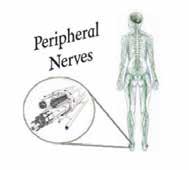
vessels surrounding each nerve.
Peripheral neuropathy is a result of damage to the nerve often causing weakness, pain, numbness, tingling, and the most debilitating balance problems. This damage is commonly caused by a
lack of blood flow to the nerves in the hands and feet which causes the nerves to begin to degenerate due to lack of nutrient flow.
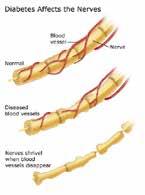
Figure 2: When these very small blood vessels become diseased they begin to shrivel up and the nerves begin to degenerate.
As you can see in Figure 2, as the blood vessels that surround the nerves become diseased they shrivel up which causes the nerves to not get the nutrients to continue to survive. When these nerves begin to “die” they cause you to have balance problems, pain, numbness, tingling, burning, and many additional symptoms.

The main problem is that your doctor has told you to just live with the problems or try the drugs which you don’t like taking because they make you feel uncomfortable.
There is now a facility right here in South Jordan that offers you hope without taking those endless drugs with serious side effects. (See the special neuropathy severity examination at the end of this article)
In order to effectively treat your neuropathy three factors must be determined.
1) What is the underlying cause?
2) How Much Nerve Damage Has Been Sustained.
NOTE: Once you have sustained 85% nerve loss, there is likely nothing we can do for you.
3) How much treatment will your condition require?
The treatment that is provided at Freedom Integrated Medicine has three main goals:
1) Increase blood flow
2) Stimulate small fiber nerves
3) Decrease brain-based pain
The treatment to increase blood flow utilizes a specialized low-level light therapy (not to be confused with laser therapy) using light emitting diode technology. This technology was originally developed by NASA to assist in increasing blood flow. The low level light therapy is like watering a plant. The light therapy will allow the blood vessels to grow back around the peripheral nerves and provide them with the proper nutrients to heal and repair. It’s like adding water to a plant and seeing the roots grow deeper and deeper.
The amount of treatment needed to allow the nerves to fully recover varies from person to person and can only be determined after a detailed neurological and vascular evaluation.
As long as you have not sustained at least 85% nerve damage there is hope!

Freedom Integrated Medicine will do a neuropathy severity examination to determine the extent of the nerve damage for only $49. This neuropathy severity examination will consist of a detailed sensory evaluation, extensive peripheral vascular testing, and a detailed analysis of the findings of your neuropathy. We will be offering this promotion for neuropathy severity examination from now until December 22nd, 2023.
Call 801-937-4412 to make an appointment with us to determine if your peripheral neuropathy can be treated.
In parts of Ghana, people celebrate a festival called Hooting at Hunger.
Years ago, a severe famine broke out among the people. The people put all of their energy into growing yams and soon had a big crop. Their hunger ended, and, with great joy, they “hooted at hunger.” This is the meaning of their name for their day of thanksgiving. Write down the letters on the correct path of the maze to the celebration’s name.
If you enjoyed the feature above, there’s even more Kid Scoop interactive learning fun at www.kidscoop.com! Download our copier-friendly seven-page Thanksgiving Around the World package today. It’s perfect for busy teachers and parents.

We understand that dealing with the health care system can be complex and, at times, frustrating.
That’s why – at Humana – we actively listen to our members to ensure we offer Medicare Advantage options that provide the value, affordability and stability they want and need.
After all, health care coverage should be a source of comfort, not concern.
As we begin the Medicare Advantage Annual Election Period – the time of year from Oct. 15 through Dec. 7 when Medicare-eligible individuals can choose a Medicare Advantage or Prescription Drug Plan for the upcoming year – we understand choosing coverage is an important decision, as it impacts both your health care and your wallet.
But, it’s not just about coverage. You deserve a company that will stand with you in the moments that matter – from helping you stay in good health after a check-up to helping you navigate a new diagnosis, and so many moments in between.
At Humana, we have a name for this approach: Human Care.
It guides us every day in our pursuit of serving our members, partners and communities.
If you’re interested in learning more about our Medicare Advantage plans, which all include dental, vision and hearing benefits, visit HumanaMedicare.com.
Thank you, Utah, for considering us as your health care partner.
Your Humana Team

1

Here are other ways we stand out:
Offering Excellent Customer Support1
For the third year in a row, we have been ranked No. 1 among health insurers for customer experience quality in Forrester’s proprietary 2023 U.S. Customer Experience Benchmark survey. And of all national health plans, we have had the highest percentage of members in plans rated 4 stars or higher by CMS for the last six years.
We help our members, especially our vulnerable populations, by connecting them to resources and benefits that can address their individual needs.
Addressing Social and Emotional Health
Our Humana Neighborhood Centers offer daily classes in-person and online to help people improve their mental, emotional, social and physical health.
We’re proud that USAA® recommends our Medicare Advantage plans, including the co-branded Humana USAA Honor® plans designed with veterans in mind.
Providing In-Person, Whole-Person Care
We have expanded our health
service capabilities through CenterWell Senior Primary Care, CenterWell Home Health and CenterWell Pharmacy.
The Rev. Dr. Andrew Teal, Elder Matthew S. Holland and President David Checketts embarked on a journey that led to a ‘blossoming of connection with God’s children’
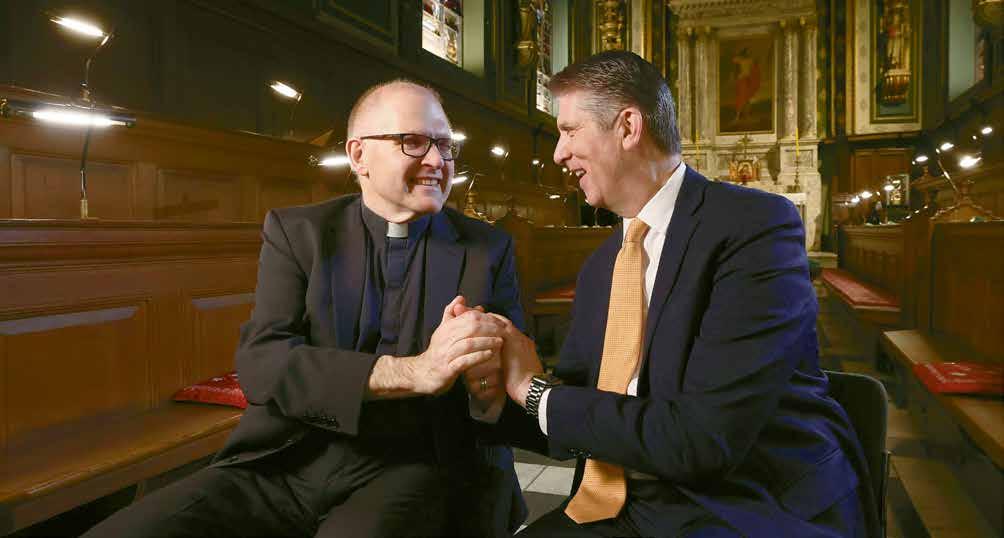
By Sarah Jane Weaver Church News
During the summer of 2017, Matthew S. Holland took a sabbatical to Oxford University in England. Amid the charm and character of English architecture — in a place where the educational tradition dates to the late 11th century — the president of Utah Valley University found “time to read and think and reflect and write.”
Then one day, while making his way to the dining hall, he noticed the word “chaplain” written on an office door.
“Here’s a man of God,” he thought. And with his interest sparked, he knocked.
“I really just intended to make an acquaintance,” he said. Instead, the Rev. Dr. Andrew Teal — a chaplain and theologian specializing in Christian church history at Oxford’s Pembroke College — “took in a stranger,” recalled Elder Holland, now a General Authority Seventy in The Church of Jesus Christ of Latter-day Saints.
The pair became friends — sharing “immediate rapport and interest” and then engaging in discussions about their disciplines and perspectives.
It is “nice to have a person of faith who is willing to share and explore,” said the Rev. Teal. “We used to meet regularly and have conversations.”
Elder Holland said he felt “a familiar spirit” the “moment I sat down in that chair and looked across at Andrew and we started to talk.”
Soon Elder Holland introduced the Rev. Teal to his father, Elder Jeffrey R. Holland of the Quorum of the Twelve Apostles.
After spending time with Elder Jeffrey R. Holland at an event in London, England, the Rev. Teal said he realized these associations were “not just a sort of passing, fleeting encounter.” He was determined to try to “understand this community and its beliefs” — not only as a scholar of religion, but also because of the Church’s claims to be the restored Church of Jesus Christ on earth.
And so, said the Rev. Teal, he embarked on a “lifelong adventure.”
In July of 2018, President David Checketts and Sister Deb Checketts arrived in London to oversee the England London Mission and were invited to participate in an “Inspiring Service” hosted by the Rev. Teal and involving religious leaders from numerous faith traditions, including The Church of Jesus Christ of Latter-day Saints.
As part of that event, the Rev. Teal and Elder Jeffrey R. Holland sat on a panel together. Joining the pair were the former Archbishop of Canterbury Rowan Williams; Lord David Alton, a Roman Catholic; and the Rev. Frances Young, a Methodist scholar. They spoke of unity and service.
“And at the end of that evening, I was just overwhelmed by the notion of friendship,” said the Rev. Teal. “Friendship was the way to do it. Only friends will know how” to draw the world out “from self-obsessions.”
The Checkettses felt something too. They asked if they could bring their missionaries to Pembroke chapel.
When they inquired about having one of their missionaries play the organ so they could sing their mission hymn, the Rev. Teal asked if they would be willing to also sing “Come, Come, Ye Saints.”
The Rev. Teal — astounded that young people would “lay aside years of their lives to serve” — took the opportunity to thank them for that sacrifice.
Then he allowed the missionaries to ask questions about English culture or the traditions of other faiths. Understanding grew.
The Rev. Teal found the missionaries to be “authentic, earnest, eager.” He observed the spectrum of personalities and marveled about how each — those who were shy or homesick or outward going — were respected and valued and found a place in the work of their mission.
“And it is friendship again,” he said, “another friendship in which I could not be without.”
President Checketts said it “was a pure gift from heaven to meet the Rev. Teal and then to meet his family. We constantly refer to it as the miracle of our mission.”
The Checkettses had a mission motto, said Sister Checketts. “We would say, ‘In the England London Mission, we follow Christ.’ ”
After meeting the Rev. Teal, Sister Checketts said her husband often noted: “Who better to expose our missionaries to than this lovely, lovely reverend, who follows Christ?”
‘Unexpected journey’
The Rev. Teal first became acquainted with The Church of Jesus Christ of Latter-day Saints as an undergraduate student when his friend was baptized. But he did not come in contact with the Church again until Elder Matthew Holland knocked on his door.
As he started learning more about The Church of Jesus Christ of Latter-day Saints, the Rev. Teal — whose education had steeped in him Western and Eastern traditional Christianity — found some aspects of Latter-day Saint doctrine puzzling.
“There were loads and loads of questions and interest,” he said. “And I think the important thing was to face all that with openness and to start having conversations.”
He began attending an Oxford Latter-day Saint ward, traveled to Salt Lake City to attend general conference, and determined to study more during a sabbatical to Brigham Young University.
The Rev. Teal thought his time in Utah would include an exploration of faith and culture — writing about The Church of Jesus Christ of Latter-day Saints from an outsider’s perspective. Instead, he found himself on an “unexpected journey.”
Very early in the sabbatical, the Rev. Teal walked on tiles heated by the blistering August sun and burned the bottom of his feet — spending three and a half weeks on his back in intensive
“It just started with people who want to be kind to each other and learn from one another and understand each other.”
—Elder Matthew S. Holland, General Authority Seventy
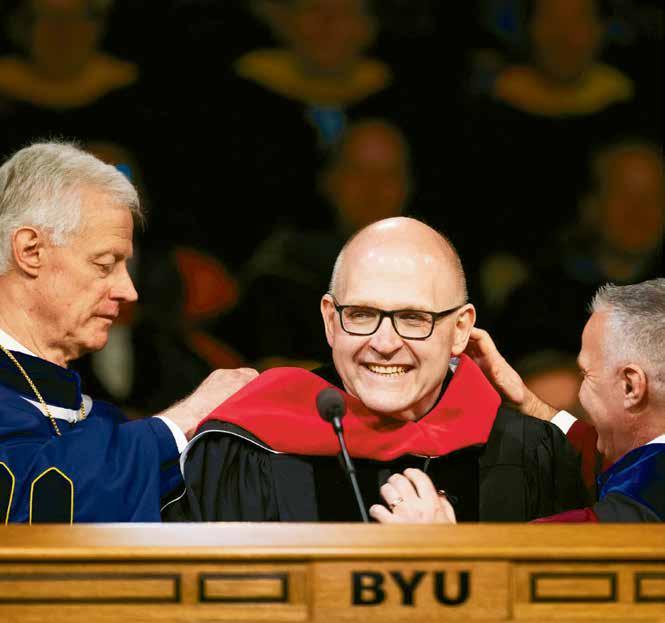
care and then the burn unit of University of Utah Hospital. Eventually he lost several toes to amputation.
During that time he met health care professionals — a “whole spectrum of people whose professionalism and faith was sort of interwoven very closely.” They had meaningful conversations.
Instead of researching and writing, he absorbed and listened.
“Certainly, it wouldn’t have been on my bucket list, as it were,” he said. “But I feel that — perhaps in a way that I still don’t understand — more was achieved by that than any of the activities that I had planned. And hopefully, with God’s grace, more will be fruitful.”
The Rev. Teal said through his friendship with the Checkettses and the Hollands he began to see a “blossoming of connection with God’s children throughout the world.” The question of identity is answered “perhaps most simply, but most profoundly, in songs like ‘I Am a Child of God,’ ” he said.
“We don’t need to have to know the temperature of hell or the furniture of heaven,” he said, noting that the most important thing to understand is the connection between God and His children. “We do need to know that. And I think that’s one of the things that I’ve loved about our friendships.”
While grand things have come from the friendship, it didn’t start out with a grand vision, said Elder Matthew Holland. “It just started with people who want to be kind to each other and learn from one another and understand each other — who want to break down barriers and reach across the aisle and do things that are getting harder and harder to do in the world today.”
The friendship, added the Rev. Teal, “has brought me to a deeper love of Jesus Christ than I have ever had.”

“Friendship was the way to do it. Only friends will know how” to draw the world out “from self-obsessions.”
The Rev. Dr. Andrew Teal, a chaplain and theologian at Oxford’s Pembroke College
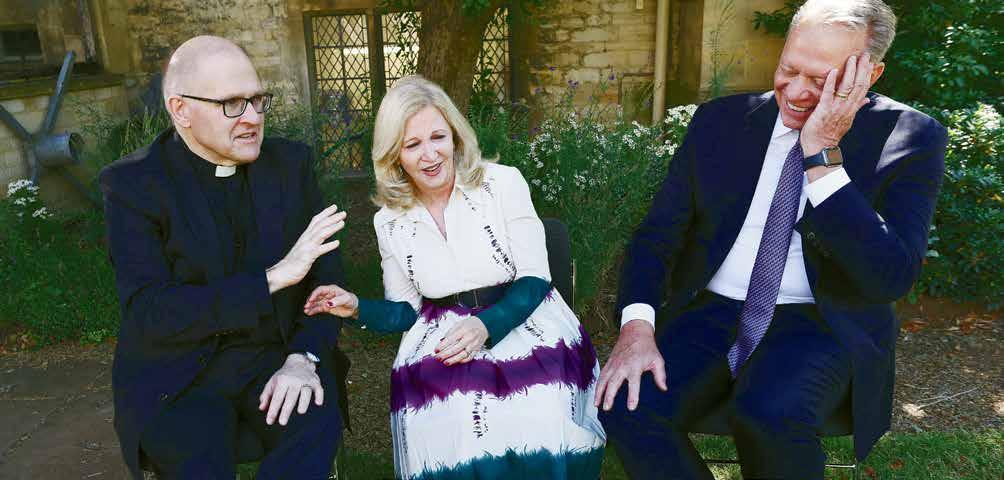


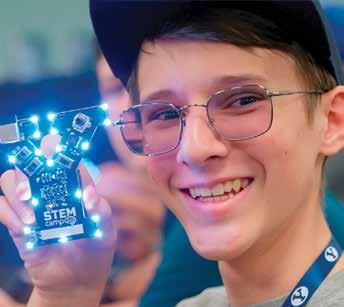








Youth camps at BYU are about fun and growth. Build new friendships as you work on your personal goals in some of the following areas:

A 23-year-old Utah man embarks on 7,000-mile, 30-state journey to raise awareness of the mustang crisis and urge Americans to consider adopting one of their own
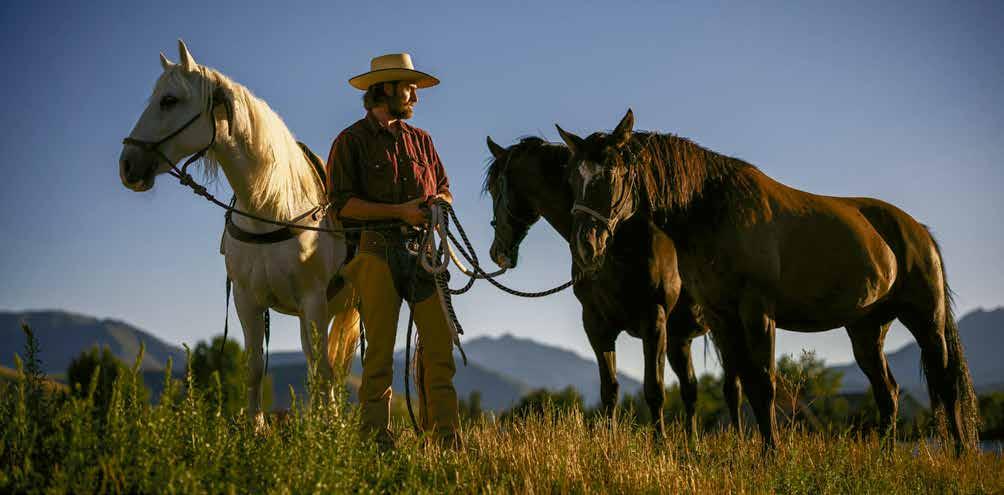
By Katie McKellar Deseret News
Six-year-old Denver’s ears flicked back and forth and his dark, shiny coat rippled with tension each time Jake Harvath bumped a heavy leather pack against his sides.
Jake was gently testing his youngest mustang’s memory of what it was like for a 65-pound pack to hang against his rib cage. At first, Denver flinched each time his human partner heaved the bag up, then down, up, then down. He stood still, eying Jake with more trust than uncertainty until he no longer quivered. Eventually, Jake clipped two of those packs to Denver’s saddle, one on each side.
Now to test him in movement. Denver trotted steadily around Jake until the packs bouncing on his back spurred his instincts to take over and his legs lurched out from beneath him in fear. He fought to break out into a gallop, but Jake firmly jerked the mustang’s haltered head in to keep him under control in a tight circle.
“It’s kind of like a high-fiber breakfast,” said Jake’s dad, Daniel, as he watched his son work Denver from behind the tall round pen fences at his home training facility, Sage Creek Equestrian, near Heber City, Utah.
“It’s not always easy to watch, but it’s really good for Denver. In the long run, it will help him feel calm and at peace. A lot less fear,” Daniel Harvath said. “These creatures, be-
ing herd animals, their biggest challenge is fear. At the core, that’s all Jake is trying to teach them, to work through fear.” Jake is going to need Denver and his two other mustangs to overcome a daunting challenge of his own — a more than ambitious solo pack trip to crisscross America that he’s been planning since he was a teenager.
The journey: a multi-state backcountry horseback ride spanning 7,000 miles from Utah all the way to New Jersey, then all the way back to California before returning to Utah. Jake’s goal is to complete this trek within a year.
He’s named this endeavor the “Year of the Mustang.” He’s documenting it all on his YouTube, Instagram, Facebook and TikTok pages with the help of his friends and family to
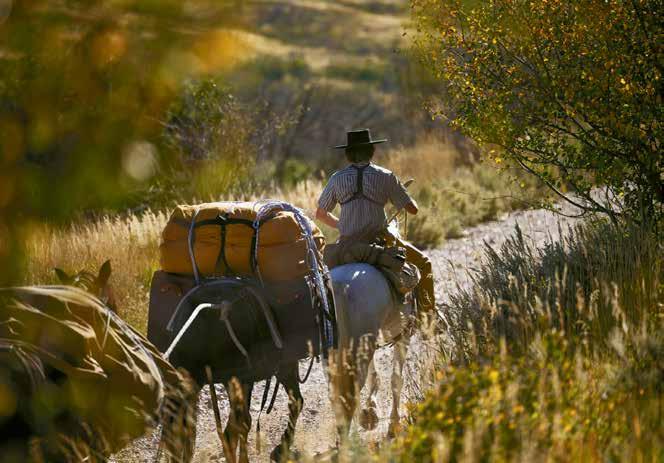
download, edit and post videos from his GoPro whenever he’s able to connect to the internet. He also organized a GoFundMe page for the endeavor, for which he’s raised over $4,800 so far.
If he’s able to pull it off, Jake hopes to set a record for the longest horse pack trip ever done in the U.S. in a year’s time. But that’s not the main reason he’s doing it. Most of all, he wants to remind us of the power of the horse — how it helped settle the West — but also raise awareness of the modern-day plight of the wild horse.
As he watched, Jake’s father didn’t say much, but he emanated pride. His son got himself into horsemanship at the age of 12 by learning to team rope with his neighbors, then at 14 started working at Sage Creek Equestrian’s barn in exchange for riding lessons after his mom found a help wanted ad. Then at 15, Jake’s boss gave him his first horse as a Christmas gift. Jake also learned to become a farrier. He shoes his own horses and built up a clientele so he could earn a living. Everything in Jake’s life has revolved around horses. “He’s just been at it so long, it’s just become a part of who he is,” his dad said.
Around and around Denver went until eventually his mind settled. He stopped, took a deep breath, and licked and chewed — a telltale sign that a horse is learning, relaxing and submitting. Denver was still learning how to be a pack horse. And he was just weeks away from the day it would become his life, day and night.
Nearby, Jake’s two other mustangs stood quietly tethered. There was the expert, Bella, a 16-year-old mare with a speckled white coat. She was Jake’s most trusted companion, his first horse, his teacher. Then there was Eddy, a 12-year-old veteran trail horse but a newcomer to Jake’s herd. He was a
bulky, dark bay gelding with a white blaze the shape of South America on his forehead. He was strong and experienced, but still learning to trust and respect Jake’s lead.
Denver was the rookie — a recent graduate of a 100-day horsemanship competition to train Bureau of Land Management mustangs. Jake recognized Denver’s potential and brought him home from Nevada last year. Both Bella and Eddy were also BLM mustangs, Bella also from Nevada and Eddy from New Mexico.
Their wild origins matter, because it’s at the core of his “Year of the Mustang” mission, which he officially embarked on Sept. 25.
Today, the Bureau of Land Management manages some 83,000 wild horses and burros across the nation, according to BLM estimates. Of those, over 64,000 are kept in “offrange” holding facilities, fed and cared for in either corrals or pastures. The BLM is charged with managing the population while balancing the “health and productivity” of public lands, which is also used for cattle and sheep grazing.
It’s a crisis in the West: a $5 billion wild horse problem with no real solution in sight. Government range watchers say the wild horse and burro population should be contained to just under 27,000, the Deseret News wrote in a 2019 indepth special report, but the horses continue to quickly multiply.
Wild horse advocates rail against roundups and argue the mustang has been a scapegoat for damage caused by taxpayer-subsidized cattle grazing. The BLM, which also manages livestock, says in its efforts to balance the use and management of public lands, it allows grazing for only a permitted number of months while roaming wild horses and burros graze all year long. In some cases, the BLM has implemented
fertility control, but treating and accessing the horses can be expensive and difficult. The agency has recorded a total of 8,530 treatments since 2012.
As part of its herd management, the BLM has also offered wild horses and burros up for adoption. Since 1971, the BLM says it has adopted out more than 270,000. The number of adoptions has grown over the years, from 2,583 in 2012 to 7,369 in 2021. Adoptions, however, dipped to 6,669 in 2022, according to the BLM’s website.
To those who believe these mustangs should just be left alone to roam free, Jake said that’s not a real solution.
“As wonderful as that would be, we live in a country, in a modern society, that doesn’t allow that to happen,” he said. Public lands and their grazing offerings are limited. Meanwhile, land management and human development pressures simply don’t allow them to roam freely.
“Many of these horses out there are starving,” he said. “At least in BLM holding (they) get enough food to eat and regular water, compared to ... competing with other species, mostly us, to survive. It’s because of that, them just being wild, turning them all loose, isn’t really a solution.”
To Jake, adoption is the best and most humane answer to this thorny issue. He hopes his trek will not only educate about horses’ capabilities, but also inspire more people to consider the possibility of adopting their own mustang.
“These horses are absolutely worth adopting, they’re very trainable, and they are incredible partners,” he said in one of his YouTube videos. “What better way to showcase that than on a journey like this?”
The horse used to be deeply ingrained in American life, from farming to transportation. But times change. Now, it’s a luxury to own a horse. Human population growth and development pressures are gobbling up agricultural land and horse property. There’s more fueling the problems facing mustangs than just cattle grazing and public lands management. It’s everything.
“It’s within the last 100 years that we’ve shifted away from them being everything for us in society,” Jake said. “And there’s a lot of history there that most people don’t know anything about today. But through this trip, they’re going to be able to watch what that was like for many of our ancestors on a daily basis: what it was like to live alongside horses.”
Maybe it’s idealistic or unrealistic, but Jake dreams of what could happen if the U.S. returned to its roots. If more Americans who have the land and financial resources could remember what the horse gave us and give it back. Be a home for a horse. Maybe then there would be fewer mustangs in holding pens and more lives made richer because of a horse’s special companionship.
“I know that through this my three horses are going to show the world that mustangs absolutely are worth adopting,” Jake said. “Everyone’s going to know it by the end of this year.”
The morning of Sept. 25, a small crowd of family and friends bid Jake, Bella, Eddy and Denver farewell from their journey’s starting point at the horses’ home at Sage Creek Equestrian in Charleston.
It was sort of an anticlimactic beginning. With packs piled high on top of Eddy and Denver’s backs and Jake atop Bella, the trio clip-clopped across U.S. 189. In just a few short weeks, Denver was already looking like a pro pack horse. They passed through the town of Daniel, then headed into the backcountry toward Strawberry Ridge.
From then on, it was just Jake and his horses. Alone in the woods.
Weeks before, when I asked Jake’s dad what worried him most about his son going on such a lonely and daunting journey, he thought about it for a long moment — watching Denver lope around his son in a circle — before he answered.
“Getting stuck,” he said.
Daniel Harvath said he and his horse’s health and safety was first and foremost in his mind. But he shared his son’s ache to accomplish this goal that’s been all-consuming in his mind for so long.
“It’s not so much a fear,” Daniel Harvath told me. “I don’t think there’s anything that’s going to stop him. He’s not making any promises. It’s not a race, not a competition.”
And this journey wouldn’t be completely lonely. Daniel Harvath would be keeping tabs on his son’s GPS location, and he would have his phone. Plus, Jake spent years planning his route and creating a network of members of the horse community across the country that could lend their land, facilities and assistance along the way. For example, for the first leg of the journey, Jake didn’t pack a tent, planning on having one dropped off for him at some point before the first snow.
“I get messaged probably five or 10 times a day from people asking how they can help,” Jake said. “It’s so cool.” If worst comes to worst — if one of his horses gets sick or injured — Jake said he’d find a way to continue on by turning to the horse community and borrowing a horse. He said it’s the “last thing I would ever want to happen,” but he’s prepared to put a horse out of its misery if it were to suffer a catastrophic injury like a broken leg.
“But there’s a lot of things we can overcome with rest,” Jake said.
Much of Jake’s work in horse training comes down to overcoming fear. For Denver, his fear of packs on his back soon gave way to habit. But just like his horses, Jake had his own fear to overcome — and it’s something horses have taught him too.
Bella, in particular, “taught me how to relax. How to relax when things are difficult.”
Jake puts those words into practice. When working with Denver, his movements are calm and meticulous. He’s quiet and soft-spoken. It’s hard to imagine him rushing into a task or falling into a panic.
But earlier this year, as he was preparing for the trip, Jake said he was almost immobilized by “fears and doubts” that kept rearing their head. He turned to God for help.
In the past, Jake said his faith has helped him overcome obstacles and make big decisions in his life. A member of The Church of Jesus Christ of Latter-day Saints, he served a mission in Honduras until the COVID-19 pandemic broke out and he was assigned to Denver, Colorado (hence Denver’s name). But for the longest time, Jake said he “just couldn’t get an answer” from God on whether he should or shouldn’t go on this journey.
“I wanted the answer to be, ‘This is what you’re supposed to do. Go,’” Jake said. “I went out in the woods here in January and prayed, just with everything I had. And the answer was, ‘This is your choice. I’m not going to tell you to do it, and I’m not going to tell you not to. You have to decide for yourself.’”
That was “almost a harder decision,” Jake said.
“But now I look back and I’m starting to realize why it had to be my decision,” he said. “Because I found it in myself, my own innate desire, that this is all I want to do. This is what I feel I have to do. So I decided, I buckled down, and I’m not afraid to do it anymore.”
Jake said he also hopes to inspire other people his age — other young men and women who are “afraid to move forward and not be stagnant” — to push ahead, even if it’s scary.
“Even if you don’t have a massive dream in your life to pursue,” he said, “you should at least be pursuing something bigger than you are now.”
‘Every day is a gift’
We met up with Jake on his third day, in the mountains near Clyde Creek on the other side of Strawberry Ridge.

I heard him and his horses before I saw them. Bella, Denver and Eddy’s hooves clip clopped down a rocky road. They walked steadily and relaxed. Jake sat atop Denver, who led the pack with ease to a grassy field next to a pond, where Jake stopped to take a drink.
His horses hobbled and waited in the distance (appearing all too happy for the grazing break). Jake brushed his hand across the pond’s surface, pushing aside a frothy film of green algae to make way for his water filter. Slowly, he filled the blue bag up with water, then squeezed it through the filter into his canteen.
“Tasty, right?” he said before taking a swig. “Not bad.”
Jake’s face and forearms were a bit sunburned, but overall he appeared in good spirits. His horses were calm, cooperative. In their element. And so was he.
These first few days had been slow going — he hadn’t wanted to push the horses too hard early on and they were still “working out the kinks” while saddling up in the morning, so he hadn’t made it as far as he’d originally planned. But the previous night, Jake found a water source and a place for the horses to graze, and that’s all they needed.
Eventually, Jake hoped to work the horses up to 25 to 30 miles or more a day, but early on as the horses built their muscles he was keeping it about 15 to 20 miles a day. Though he’s still dead set on his goal to keep going for the year, Jake said he’s proud of what they’re able to accomplish, regardless of if it’s weeks or months.
“Every day is a gift,” Jake told me. “Whatever days I get will be invaluable, no matter what.”
Almost two weeks later, Jake posted a new video to his YouTube channel documenting the first 90 miles of his journey.
The first day was “tough,” he said. It felt “like any other pack trip, but not because there is no plan of going back the way I came. So I guess it’s different in the sense that this is just my life now.”
“One down and at least 365 more to go.”
Throughout the video, Jake’s chapped lips reddened, blistered and scabbed as he described his journey. One morning was “eventful,” as he put it. While he was making breakfast, something spooked Denver and he tore backwards, ripping his stake out of the ground. Eddy followed.
“Luckily I caught Bella and threw a saddle on her and made a mad dash after them,” Jake said. “It was a pain in the neck.”
Jake rode along Strawberry Reservoir, then into UintaWasatch-Cache National Forest, before dropping down near U.S. 6 and making their way toward the town of Helper. Next, Jake planned to head toward Green River, hoping to make it to Colorado within the next week and a half.
In Helper, he planned to take a shower for the first time in two weeks thanks to a family that let him and his horses stay on their property for two nights while they got some much needed rest.
“Not going to lie, I needed it,” Jake said, calling the first two weeks “absolutely insanely difficult.” But he said during the last couple of days “things have been looking up, the horses are starting to figure their job out, they’re working really hard, looking really good.”
Along the way, the horses “are definitely turning more into my family, even more than they were before.”
Jake set a goal for himself in the month of October: Be “honest” and get “serious about what’s got to happen, what’s got to change. I’ve learned a lot of lessons in these first few weeks that just made me rethink how this whole trip’s going to go, and how I’ve got to do things in order to keep the horses healthy and keep me safe and have less problems along the way.”
“We’re two weeks in. We’re moving slowly but we’re moving,” he said. “I’m grateful for the lessons even if I have to learn some of them the hard way. It’s part of life.”
Ninety miles down and over 6,900 to go, Jake still wasn’t letting fear or doubts stop him.
“Here’s to many more miles of fantastic country to see.”
WARNING - WARNING - WARNING
Pleasant Grove, UT - If you experience numbness or tingling in your hands, arms,legs, or feet or if you experience shooting or burning pain, this is important. Please read this carefully.
Peripheral Neuropathy is when small blood vessels in the hands,arms, feet or legs become diseased and tiny nerves that keep the cells and muscles working properly shrivel up and die.
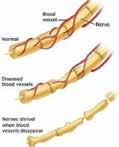
Early-warning symptoms include tingling and numbness, mild loss of feeling in your hands, arms, legs or feet, inability to feel your feet, which increases your risk of foot-injury and falling.
More Advanced Symptoms Include...
• Loss of coordination & dexterity, which puts you at increased risk of accidents.
• Inability to feel clothing like socks and gloves.
• High risk of falling, which makes walking dangerous, and makes you more dependent on others.
• Burning sensations in your arms, legs,hands or feet that may start mild, but as nerves and muscles die, may feel like you’re being burned by a blow torch.
Ignore the early warning signals long enough and you risk progressive nerve damage leading to muscle wasting, severe pain, loss of balance and a lot of staying at home wishing you didn’t hurt.
When every step is like walking on hot coals, sitting still may be the only thing you feel like doing. But there’s little joy in sitting still all day long.
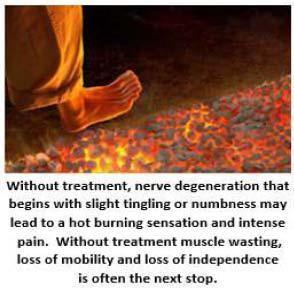
Now here’s the scary part....
• Nerve damage CAUSES cell damage.
• Cell damage SPEEDS UP nerve degeneration Without treatment this can become a DOWN-WARD SPIRAL that accelerates.
The damage can get worse fast. Mild symptoms intensify. Slight tingling,numbness or lack of feeling can turn into burning pain.
Before you know it, damage can become so bad you hurt all the time.
Unless this downward spiral is stopped and nerves return to proper function - the damage to nerves and cells in the affected area can get so bad your muscles begin to die right along with the nerves and cells. And that sets the stage for weakness, loss of mobility, disability, and dependence on others.
If you have early warning signs of peripheral neuropathy, (tingling &/or numbness, loss of feeling or pain) it’s CRITICAL you get proper treatment.
It’s critical, because with proper treatment the symptoms can often be reversed. Without it, you are playing Russian Roulette with your health.
Once your nerve loss reaches 85%, odds are there’s nothing any doctor can do to help.
The most common method your doctor may recommend to treat neuropathy is prescription drugs

Drugs like Gabapentin, Lyrica, Cymbalta, &Neurontin are often prescribed to manage the pain. But, damaged nerves and dying cells do not heal on their own.
Pain pills do not restore healthy nerve function. They just mask the pain as the nerves continue to degenerate and cells and muscle continue to die.
Taking endless drugs and suffering terrible side effects that may damage your liver &kidney and create even more problems, is not a reasonable path. You deserve better.
Three things must be determined to effectively treat neuropathy. 1) What is the underlying cause? 2) How much nerve damage has been sustained? 3) How much treatment your condition will require?
With proper treatment, shriveled blood vessels grow back & nerves can return to proper function. How much treatment you may need depends on your condition.
At Chiropractic USA we do a complete neuropathy sensitivity exam to determine the extent of your nerve damage. The exam includes a detailed sensory evaluation,extensive peripheral vascular testing, & a detailed analysis of the findings.
Dr. Christopher Moore, D.C. will be offering this complete neuropathy sensitivity exam for $49 . This special offer goes away at the end of this month as we have a limited number of exam appointments available.
Call Now to Schedule Your Complete Neuropathy Sensitivity Exam with Dr. Christopher Moore, D.C. - 801-939-0641
Ted’s wisdom from the self checkout aisle: We have two choices, negative or positive; he chooses positive
By Lee Benson Deseret News
He has two ex-wives, two heart surgeries, mild dyslexia, type I diabetes (the kind that’s not your fault), an insulin pump on his chest, walks on two prosthetic legs after both feet were amputated, thousands of dollars in medical bills, and lives with his 96-year-old father in the same bedroom where he was born 59 and a half years ago.
What doesn’t Ted Rausch have to complain about?
And yet, ask anyone who shops at the Smith’s grocery store in the Avenues and they’ll tell you the man everyone simply calls “Ted” just might be the most positive person they’ve ever met.
A reader alerted me to this phenom of positivity in a recent email. Included was a copy of a comment chain on the Nextdoor. com social media app. The chain began with this question:
“There’s a man who works the self-checkouts in the avenues Smiths and he is just the most delightful person. He wears a funky hat EVERY day. I’ve never seen him without one in all the years I’ve been coming here. He has the best energy and always makes me smile! Does anyone know his name?”
After that the comments flowed. Here’s a sampling:
“His name is Ted. He’s one of the reasons I shop there.”
“Really a terrific shout out for a great human. It’s a reminder that a positive attitude can help make the world a better place. Thanks Ted!”
“Ted is a gem, always so friendly and helpful.”
“He is AWESOME. Yes, the world needs more TEDs.”
“He is absolutely the nicest person and makes everyone happy.”
And so on and so on, including: “Have one of the stations do a human-interest story about Ted. It would be a lovely improvement over politics, shootings, road rage, disasters, misinformation and fear which seems to be the focus of many media stories.”
Well, OK … * * *
I made my way to the Smith’s on 6th Avenue. At the self checkout aisle I saw a man smiling and chatting to everyone. He was wearing a huge spongy court jester hat.
My investigative journalist skills kicked in.
“Ted?” I ventured.
“How are you?” he ventured back.
I told him who I was and what I wanted. I’d like to hear the story about what made Ted Ted. We agreed to meet the next morning at his house.
Ted lives on the west side of the valley, just a couple of blocks from the freeway, in the very house where he was born. He lives with his father, George, who is still going strong and whose next birthday will be his 97th. Ted showed me his bedroom, slightly smaller than the size of the self checkout aisle. It’s where he grew up, and where he’s still growing up.
“I’ve led a very interesting life,” he said.
He’s been no stranger to peril. He’s walked on the dark side. He talked about being diagnosed with type 1 diabetes as a boy and being so depressed he tried to end it all by not taking his insulin. He wound up in the hospital but didn’t die.
He talked about the two heart attacks, one a triple bypass; about the amputations of both his feet — first the left, two years later the right; about the dissolving of two marriages (and his “two beautiful daughters”); about the hospital bills that keep him residing in the bedroom he grew up in.
Then he said this: “Everything that’s happened to me in my life I wouldn’t change, even the amputations, because each thing has taught me and made me the way I am today.
“People say to me, ‘You should be the negative guy.’ But here’s the thing, I literally have nothing to complain about. I’ve found if you’re constantly looking for positivity you’re going to find it.”
His job at Smith’s allows him to practice what he preaches. He’s been employed by the grocery chain since he was 22. He started out as a donut fryer. He’s worked in every department in the store except upper management. He came to the Avenues store 31 years ago and settled into the self checkout manager position in 2001, the year self checkout came to be.
He’s been in constant contact with the public ever since, wearing a smile and the craziest hats he can find.
His friendliness — what some might call goofiness — hasn’t always been well received. Several years ago management asked him to stop wearing his crazy hats. They felt they were distracting and undignified. He stopped for two weeks, during which time an outpouring of support — not unlike the nextdoor.com comments mentioned above — bombarded the corporate offices. Kay Malone, Karl’s wife, was one of them. Why would anyone want to stop Ted from wearing his hats!
He’s in the possession of more than 300 hats, including many given to him by his fans. Every day he wears a different one.
The hats are his way of saying he’s approachable, he’s disarming, he’s ready to give you a friendly wave and impart to you some of his energy.
What’s the secret to his friendliness? That’s just it, he doesn’t really have one. He offers no grand philosophy, other than saying that there are two choices in life: negative or positive. And he chooses positive.
“Honestly, I love people, I always have,” he said. “That goes back to my grandfather, who lived by the philosophy, ‘A stranger is just a friend I haven’t met yet.’ In my life I want to inspire people to be positive, toward themselves, toward their family, toward others. Shouldn’t we all be like that? I think that’s the way it should be.”
Light Exercise Services
Safety Supervision
Family Respite Care
Fall Prevention
Transportation
Medication Reminders
Meal Preparation
Light Housekeeping


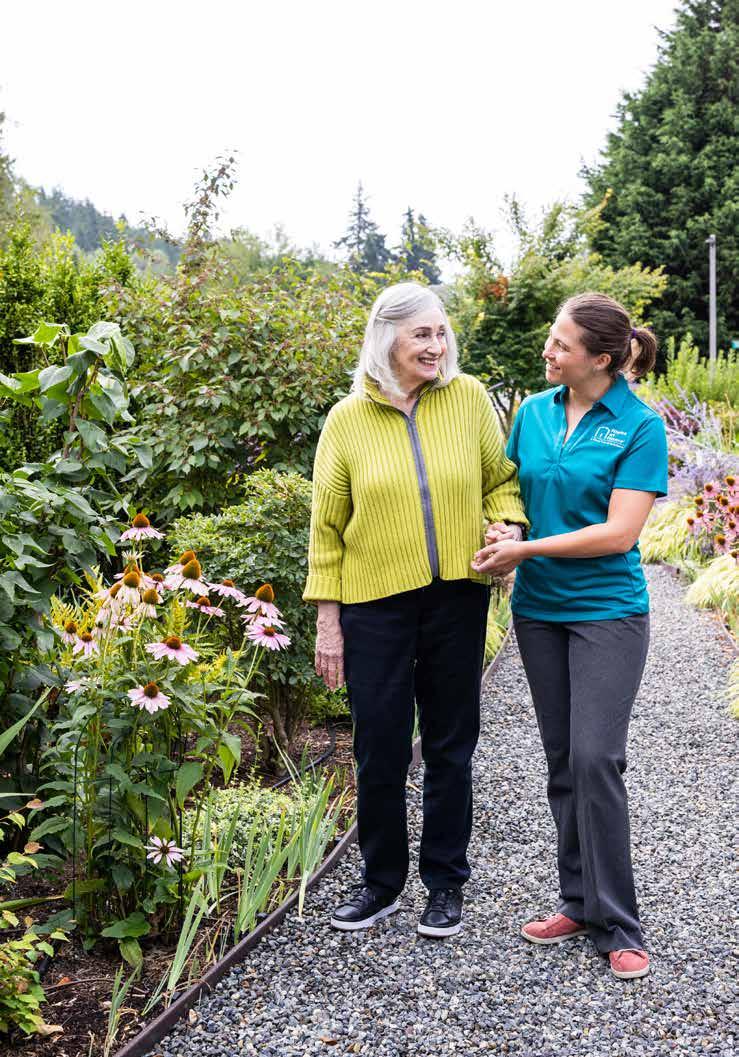

By Lois M. Collins Deseret News
If you feel like autumn seems like one rapid slide from Labor Day to Christmas, you’re not alone. Christmas displays going up in September just add to an overwhelming sense that the to-do list never ends and Santa will be here very soon. But take heart. We feel it too and we think we can help! While it takes time and thoughtfulness to find just the right gift for those lucky recipients you’ll present with tokens of love this season, we’re hoping to jump-start the effort.
At the Deseret News, we’ve scoured shelves, both virtual and real, to find something for everyone on your list. We hope this gift guide will give you some fresh ideas and a head start on choosing just the right gift. Prices reflect when we checked them. Maybe you can get a better deal. Merry Christmas!
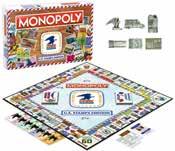





$26
Bib by GrabEase covers the little mess maker and the highchair with water- and stain-resistant fabric that makes cleanup easy. Shake, wipe and done.
$119.95
Set of six smart Bluetooth-connected dice that bring the most popular games to your tablet or phone for an interactive game. Case doubles as a charger. Included popular games include Yahtzee, Backgammon, Farkle and more.

$101
Never be powerless. Personalized chargers come in multiple colors and designs with matching travel bag, offering both a dual USB option or quick charge dual USB C and USB A port.

Foton endlessly customizable candle starting at $34.99
The tiny wax pearls let you turn any vessel — even a seashell — into a candle. Bowls, glasses, candy dishes — you decide. Plant-sourced wax and wicks included. Candles are pet-friendly and self-extinguishing.

$43.99
Snuggleluvs are whimsical stuffed animals that are oversized and have long, fluffy hair. There are bears, bees and other beasts, including a darling alpaca. Wild Republic says they are designed “to provide comfort and ease anxiety.” Or just give cuddles.

$89.00
The perfect gift for travelers. The RFID-blocking lining keeps cards and passports protected from electronic scanners, while the built-in key chain, zipper pouch and multiple slots keep keys, cards and change all tidy.















Cozyla Digital Picture Photo Frame starting at $99.99
Wi-Fi high-definition touch screen lets you send pictures straight to the frame, syncing tons of photos easily. You can preload pictures on your gift without unboxing, using touchless gift mode.

$12.99
These playing cards were created to honor Walt Disney Company’s 100th anniversary. If Mickey Mouse isn’t your jam, try the princess deck or the Disney villains for $9.99 a pack. Great stocking stuffer.

Cosmic Kick the Can by Starlux Games
$24.90
Cosmic Kick the Can is an award-winning multiplayer game, batteries included.
“Kick & race to outerspace” says it all.

$39.95
Lightweight, durable 15L backpack that is water-resistant and has lots of pockets. Folds up into itself, fitting snugly in one of its own pockets. Made from recycled materials.


Buckle Me Baby Car Seat Coat
$89.99
The Buckle Me Baby Car Seat Coat is safer than a traditional puffy coat in child car seats. Thinner in back than in the front, it’s got openings along the side and shoulder seams to make buckling a child in a car seat easy. Crash tested and child passenger safety technician approved. Plus they grow some with the child. Different colors, styles and prices are available.

Together Matters blanket
$79.99
Cozy, oversized blanket is incredibly soft and large enough for everyone to share. Great for family movie night! Faux Alpaca. Dimensions: 60" x 80". Available at Deseret Book.











Imagine a journey traversing 1300 miles of majestic beauty and the soulstirring history of those who carved the pioneer trail, where our Mormon ancestors put their shoulder to the wheel and their lives in the hands of faith and God. From Illinois to Utah, a sacred stream of Saints obediently followed that faith westward,
carried by the burning fire of the Spirit, and the glory of God
See it. Feel it. Immerse yourself in the inspirational stories brought to life by History of the Saints host Glenn Rawson & tour organizer Dennis Lyman, in the very places that Latter-day Saint history was written and heroism forged.




Tours: 7 Day, 6 Night Trips Eastbound, Salt Lake City to Nauvoo: June 3-9 & Sept. 14-20 Westbound, Nauvoo to Salt Lake City: June 9-15 & Sept. 20-26
Visit the websites below for more information or call Southwest Adventure Tours at: 800-970-5864.






$9.95
Simple kit has what kids need to look for fingerprints and study them to learn the basics of fingerprinting. It includes graphite powder, ink pads, magnifying glass and more, but good news: You can wash it off.

Watex Green Living garden stands starting at $39.99
Bring the garden inside or grow a vertical garden outdoors. You can even grown an herb garden on your countertop.

$49.99
Help little ones count the days. Starting Dec. 12, add an item of clothing a day until the partially clad fella is ready for the big sleigh ride. Large, super soft and cuddly. Comes with clothesline and clothes pins.

$34 and up
Different colors and styles, but each has multiple openings for keys, ID and even a water bottle. Fits flat over hips, under or over shirt, holding items still as you work or exercise. Machine washable.

$49.95
Boxing robots use hydraulic power to move like real boxers. Kit lets you build two boxing robots and challenge a friend to a match. Learn about how these machines and hydraulic systems work. Ages 10+.

$29.99
Relax for 20 minutes a day with this cold therapy ice neck wrap, which reviewers claim offers some headache, stress and anxiety relief.




One-click scanner/software bundle easily scans and restores memories in seconds. Easy to


















prices vary by size
For the traveler — or maybe the homesick — these pillows are embroidered with skylines. Choose from dozens of cities and several sizes.

$29.95
Fourteen different light combinations, timer settings and a convenient auto-shutoff feature for low water levels. BPA-free plastic with a printed wood grain design. Comes with a selection of essential oils.
prices vary
This one was $16.99. These sturdy and beautiful, carefully crafted wooden puzzles come in a choice of sizes. Delightful because of the crazy shapes. Also really quite difficult — and definitely engaging.

$39.99
Bluetooth handset connects to all iPhone, Android, Alexa, Siri, Google and other Bluetooth devices with full voice assistant capabilities. Amuse yourself and your friends. A small portion of the sales is donated to Gearing Up 4 Gorillas.

Excalibur electric food dehydrator Select Series 10 Tray
$270.46
Great for both cooks and crafters. Temperature range of 85-165 degrees Fahrenheit and a timer for up to 30 hours to efficiently dehydrate meat, fruit and herbs.



$49.99
In this set, M&J Games combines the What’s Next game with its social skills add-on to celebrate differences and similarities in the life-size version where players are the game piece and everyone can play.


$27.99 and up
Chickens, pigs, cows, roosters, snails, owls and more. Gift these fun planters to enjoy inside during winter, then set them outside to celebrate spring! Your garden will welcome that snail.
$249.98
For 6-18 months, helps with balance and strength. Includes no-tools adjustable features and the rocking base that can be detached to transform into a balance bike once the little one is ready.



$18.99 for set of 12
Fun cat tops, but the real treat is how smoothly the gel crayon colors. And with a brush and water, these crayons create a watercolor effect.

$28.88
For active people who want to smell good after sweating up a storm. Bundle includes 32-ounce bottle of performance Zen Fresh Detergent and three travel-sized bottles. On the road, toss your dirty gear in the sink with a little Zen, let it sit for 20 minutes, rinse and hang it to dry. No agitation needed.








Studio Creator 360° video maker kit
$54.99
Rotating light and phone holder with motion-tracking base and app lets light and camera follow you full circle and you can record handsfree while you move. Light color and brightness can be adjusted.


$11 a bottle
Pickled veggies come in a wide variety from this Kuna, Idaho, shop. Carrots, beans, asparagus and more, spicy or mild. You can also buy a Christmas tree pickle ornament.



Heatable, huggable sloth by Gamago
$27.05
Microwaveable, lavender-scented sloth (other animals available) to warm you up or to put on sore muscles. Choose a cat, an avocado, a milkshake, an egg or something else entirely. Prices vary.

Steampunk Wall Clock model kit by Wooden.City
$59.90
Build it yourself, then hang it and watch it keep time.
Santa’s Kindness Ornament
$39.99
Scan the QR code and Santa magically appears. Daily video messages from Santa Dec. 1 to Christmas Day. Includes kindness journal and daily prompts to help spread kindness.

So Slime Marble Twist N Slime Mixer
$29.99
Mix your own with this mixer, premade slime, colorant and decorations. Includes mixer, mixing bowl, enough premade white slime, color powder and style decorations for six slime creations, a label sheet and directions.






George Strait concert tickets for the 2024 tour
Prices vary by location and seating
George Strait concert tickets for the 2024 tour, featuring Chris Stapleton and Little Big Town. When we looked, tickets were available in some cities, including Salt Lake. Prices vary by location and seating. Or check out other beloved acts. Tickets fit easily in stockings.

Fans Football
$59.99
Future Fans Football is a storybook-led introduction to football for kids. Campers at Camp Rallyhoo learn football in unexpected ways — like a ring toss game, a scavenger hunt and even eating cookies! Includes a storybook, activity book and five games and toys.

$15 for a 7-ounce cup of dough
Each cup of dough is unique. Or choose Thinking Putty instead. Land of Dough holds its shape, is moldable and has been a kid favorite for years.

$29.99
Made of toy-grade materials, the dimmable night light has smooth touch control and emits a soft calming glow. Eight colors to choose from, with a rechargeable battery and a onehour timer.

$20
Created for little hands, this sensory jar lights up when water’s added. Throw some small splashy toys in; it’s spillproof. If you need ideas for that, you can buy Fun Fillers separately or just experiment. But don’t forget the batteries.

$12.98
Digital and lightweight, so you can tuck it in your bag when you’re done weighing it. A luggage scale is a traveler’s must-have.
$59.99
RAPTbaby Smarter Sleep Sound Machine, designed by a neuroscientist, masks noises while supporting children’s language development by providing particular sound stimuli. Eight soothing tracks.

$59.99
Tyriqa, the Techie is one of the Theodora S.T.E.A.M dolls — sold individually. She’s the techie. Other S.T.E.A.M. dolls are a scientist, an artist, a mathematician and an engineer. The 15-inch dolls each come with a defined set of characteristics, an activity book and stickers.



Woods Age-Defying Dream Cream
$79
For sensitive skin, it’s USDA Certified, without toxic preservatives, synthetic additives or parabens.

Deseret Magazine
Annual Subscription
$29
Looking for a thoughtful gift? Give the gift of Deseret Magazine delivered to your loved ones' mailbox. Enjoy in-depth journalism, unique voices, and principled points of view.





By Lois M. Collins Deseret News
Advent, which this year begins Dec. 3, is in the faith community a time of anticipation, which makes sense, since the word’s root is Latin for “coming.”
It’s believed that Advent goes back to the fifth or sixth century, when Christians prepared to baptize the newly converted during the January Feast of the Epiphany. A century later, the story shifted to anticipate the arrival of Christ — but his second coming as a judge, rather than as a baby swaddled in a Bethlehem manger.
Advent as a way to welcome the Christ child came in the Middle Ages, when Christians began to associate Advent with his birth. For many faithful Christians, that association remains.
As the University of Portland Garaventa Center explains, the length of Advent varies, but it always starts four Sundays be-
fore Christmas, which can occur on any day of the week since it’s always Dec. 25. This year, the Dec. 3 start means Advent is the shortest length possible, though you wouldn’t know it from the calendars, which typically plan on a Dec. 1 start and a big finish on Dec. 24.
Modern adults are not the first to use a calendar as a countdown tool. WhyChristmas.com reports that German Protestant Christians in the 1800s counted down the days to Christmas by making 24 chalk lines on a door, erasing one a day until Christmas arrived.
While Advent within the Christian faith still has a deep religious meaning — the four successive themes each Sunday this Advent are Hope, Peace, Joy and Love — the annual Advent calendar has largely shifted outside religious tradition to serve as a more playful countdown to Christmas. Some suggest it’s a way to stop children from nagging for the gifts and day they know is coming. But adults seem to like the toys and treats just as much.
Socks and hot sauce and pretty rocks are as common as calendars with religious themes, since commercial Advent calendars may — or may not — embrace faith. While there are certainly scripture calendars and the many nativity versions remain among the most popular, cosmetic companies like Lancôme put samples and full-size beauty products in their calendar slots, introducing them to customers in season-friendly fashion. You can get calendars with a new pair of socks via an Advent calendar, though some just go 12 days.
There are reusable calendars that you can stuff over and over with little baubles and treats, tree ornament calendars and superhero versions — Lego has a Marvel Avengers Advent Calendar. Williams Sonoma has a popcorn calendar, while localeclectic.com will happily sell you a 12-piece jewelry Advent calendar. Google hot sauce, beverages, sunglasses, hair bows, dolls or pretty much any noun and someone’s stuffing it in an Advent calendar.
You can pay a lot — Dior has a $4,200 cologne Advent calendar — or buy a little milk chocolate calendar for under $3. Here are a few we saw while browsing, but trust us — there are literally thousands.

A names of Christ Advent calendar. The wooden candle holder has 25 names of Christ engraved on it. Each day in December, you light one candle and read the scripture associated with that name. Available at Deseret Book.


Edwardian Advent calendar
$7.99

An animated, interactive eCalendar, it features a “treasure trove of delightful surprises,” including a scavenger hunt, daily gifts, stories, music, books, games, puzzles and activities. Family can enjoy it together.

$49.99
This World Market exclusive can be hung up or placed on a shelf. The homes are backlit, creating sparkle in this little community, each home able to hide a tiny treat.
Countdown to Christmas
felt craft Advent calendar
$39.99

Features 25 different felt ornament sticker craft kits, no sewing or glue required. Picture instructions. Ages 4+.
Advent Dice Calendar
$49.99
Includes an exclusive set of holiday-themed inclusion dice, two full sets of assorted dice, an exclusive mini set and an exclusive metal 20-sided dice in a FanRoll dice bag. Ages 3+.

Cookie Advent Cookbook
$16.99

Featuring 24 cookie recipes by Barbara Grunes and Virginia Van Vynckt. From Dec. 1 to Christmas Eve, peek under the cover flaps to find a different cookie, then open it to the recipe and start baking,
Moo Free Choccy Advent vegan calendar
$14.99
This playful advent calendar from the U.K. says that it’s “for dairy-dodging Christmas choccy chompers.” Dairy-free.

EXIT: Advent Calendar - The Silent Storm
$49.99

You’re a hard-working toymaker preparing for Christmas when the ground shakes and the doors lock. You need Santa, but first you need out. This is an EXIT game and adventure story. Solve each day’s riddle to save Christmas! Age 10+.
Plus Plus Advent Calendar
$39.99

Do a daily unique build that will eventually be a festive scene made from 600 pieces. Day 25 has extra builds. Age 5+.





Winter is magical in southern Utah. Come hike Kanab’s snowy red rocks, tour Best Friends Animal Sanctuary, and enjoy a very warm welcome at Best Friends Roadhouse & Mercantile for both you and your pet. Don’t have a pet? We’re happy to arrange a sleepover with a Sanctuary dog, cat or bunny!
Book your stay at bestfriendsroadhouse.org or 435-644-3400.
Best of State Utah Awards

Best Motel, 2022 & 2023 Best of the Best in Hospitality, 2023