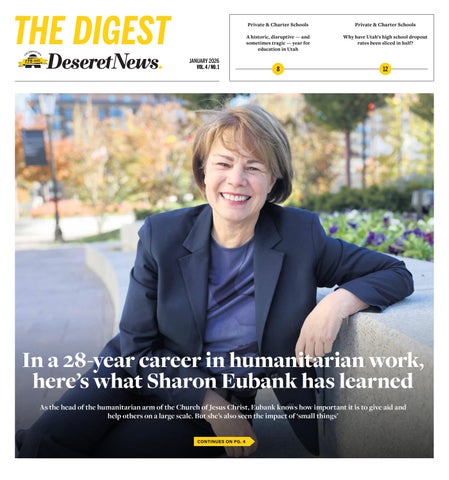
As the head of the humanitarian arm of the Church of Jesus Christ, Eubank knows how important it is to give aid and help others on a large scale. But she’s also seen the impact of ‘small things’
By Doug Wilks Executive Editor
By Burke Olsen Publisher
We are pleased to introduce you to The Digest, a sampling of some of the best stories written every day by the dedicated journalists at the Deseret News, Deseret Magazine and Church News. Ouyor hope is that you will make us your trusted news source each day at a time when there is confusion and contention in the nation.
The Deseret News brand stands for unimpeachable journalism centered on the issues most core to the human heart. While the Deseret News since its beginning in 1850 has evolved to meet the demands of its audience — reimagining print offerings, launching an acclaimed magazine and increasing the visibility and reach of its award-winning website — the publication remains committed to certain timeless ideals.
We stand for truth and light. We stand for faith and family. We stand for liberty and responsibility. We provide news and perspective, exploring society’s thorniest problems in search of solutions that will improve your life. That’s our commitment to our readers.
We invite you to discover what we can offer you:
Award-winning website
Our website, Deseret.com, is designed to be user-friendly and available on any device. Whether you’re at home on your computer
INTRODUCING 'THE DIGEST'
or on the go with your mobile phone, you can access our website for the latest news, analysis and commentary.
Mobile apps
Our apps for iOS and Android devices offer a seamless and convenient way to access the latest news, wherever you are. Choose what you want to read, save articles for later and receive push notifications for the breaking news you need to know.
Newsletters
Delivered straight to your inbox, our free email newsletters provide a curated selection of the most important stories of the day, as well as deeper dives into topics that matter to you. Choose from a variety of subjects and frequencies to tailor your news consumption to your needs.
Weekly print newspaper
For those who appreciate the tactile experience of a traditional newspaper, our twice-weekly print edition offers a comprehensive roundup of the week’s most important stories and opinions, including the most comprehensive high school, college and professional sports offerings in the state.
Deseret Magazine
In 2020, we undertook an ambitious endeavor by launching a new magazine with in-depth journalism, unique voices and principled points of view. The reception to the magazine has far exceeded our expectations. You can read more from the magazine online at Deseret.com/magazine or subscribe to have it delivered to your home or office.
Church News
The Church News remains one of our most popular offerings for those who want to know the latest news from The Church of Jesus Christ of Latter-day Saints. It’s available online at TheChurchNews.com and via iOS and Android apps. A print version is included in the Friday edition of the Deseret News.
In a 28-year career in humanitarian work, here’s what Sharon Eubank has learned — and wants to share
As the head of the humanitarian arm of the Church of Jesus Christ, Eubank knows how important it is to give aid and help others on a large scale. But she’s also seen the impact of ‘small things’
By Valerie Jones Deseret News
Kristin Murphy, Deseret News
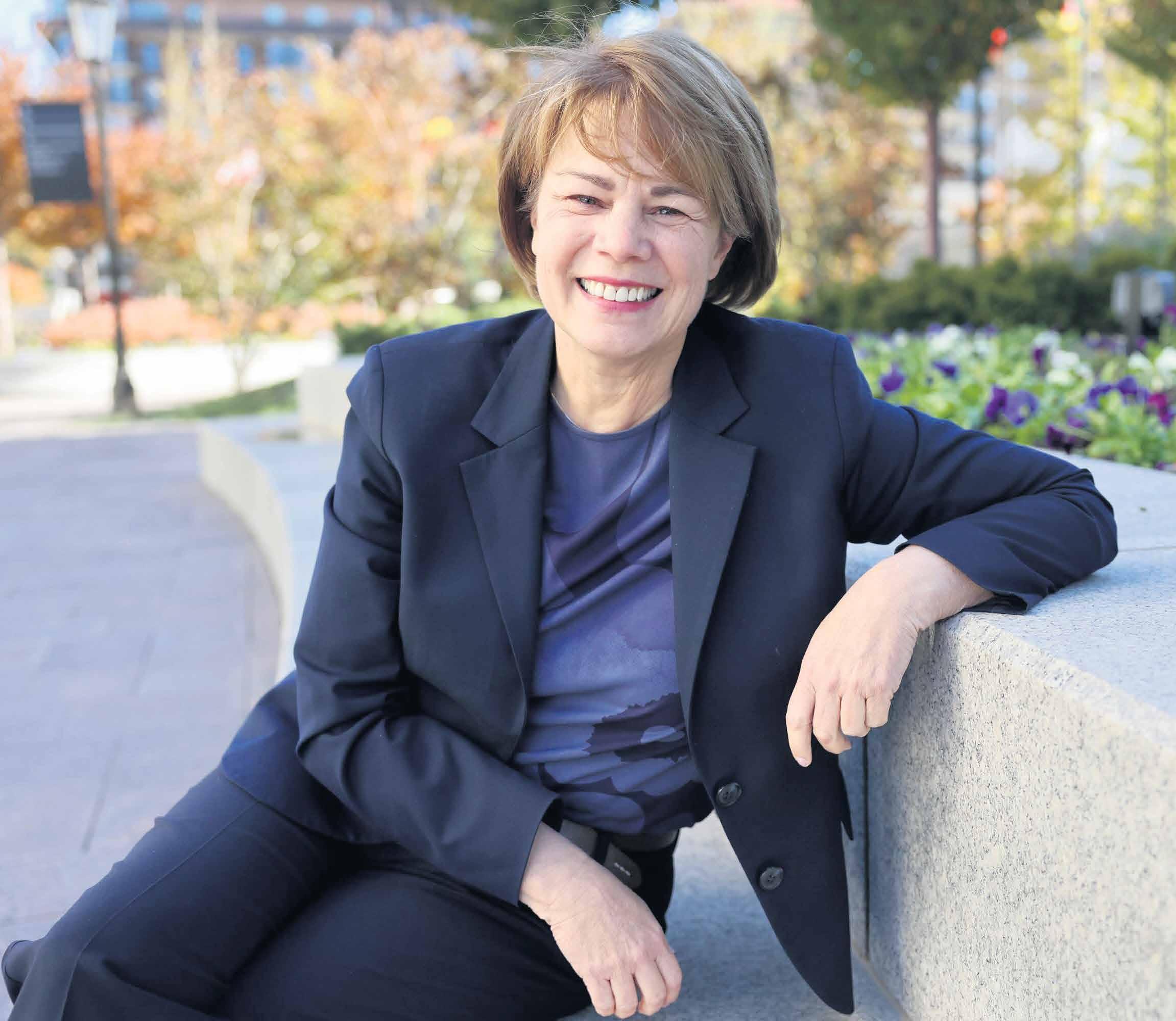
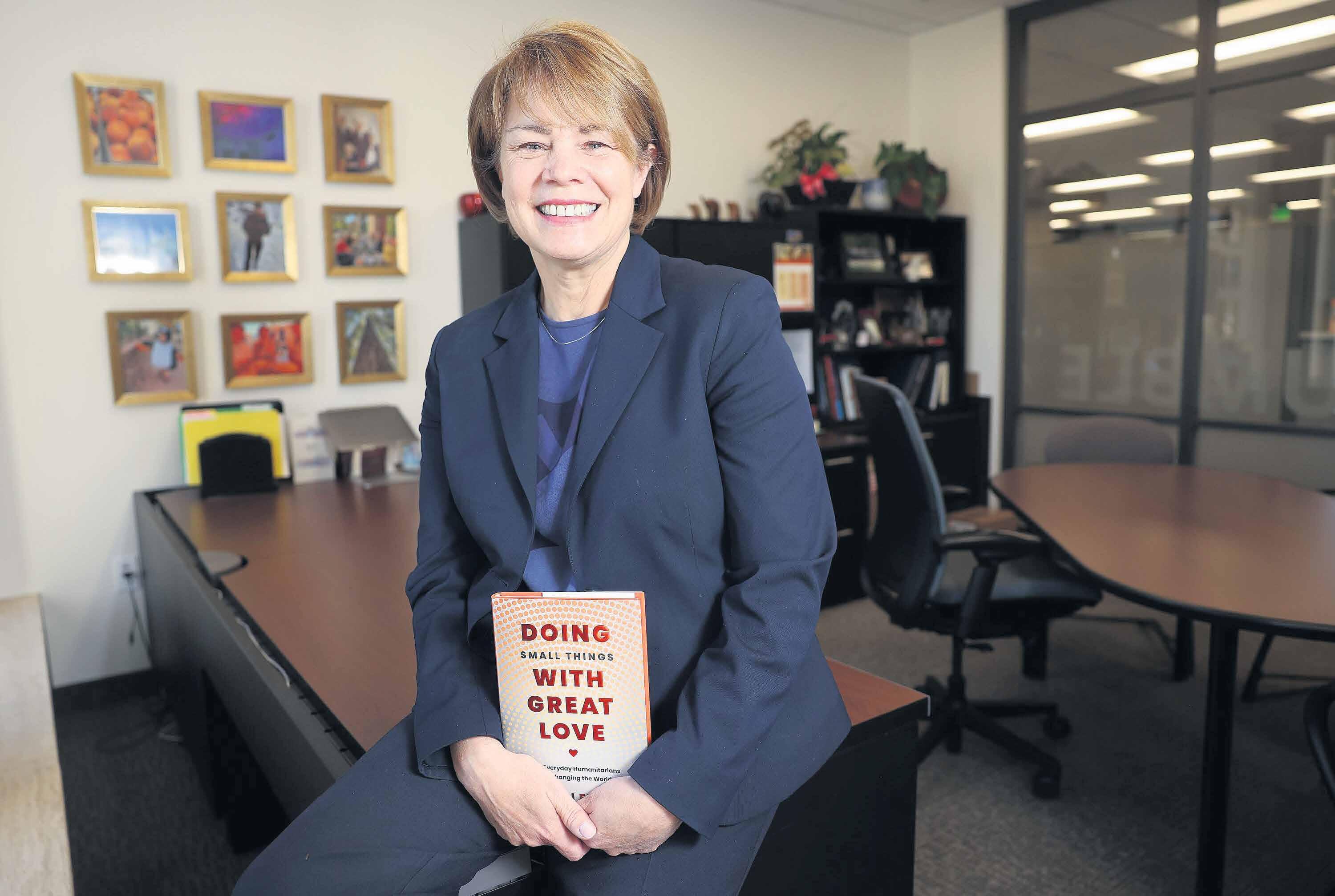
Sharon Eubank, director of Humanitarian Services for The Church of Jesus Christ of Latter-day Saints and former first counselor in the general presidency of the Relief Society, poses for a portrait in her office in Salt Lake City on Wednesday, Oct. 29, 2025. Eubank has a new book called “ Doing Small Things with Great Love: How Everyday Humanitarians Are Changing the World.”
Years before she embarked on her decadeslong humanitarian career, Sharon Eubank watched her mother knitting pairs of slippers to send to war-torn Sarajevo and asked herself a question that she now says she’s “embarrassed” by: “Is that the best we can do?”
At the time, Bosnia was engulfed in conflict that led to genocide and nearly 2 million people being displaced — a crisis on a massive scale. And Eubank wasn’t sure how, in her words, “homemade slippers from a woman in Utah” were going to help.
Five years later, however, Eubank read an account in The New York Times of a woman living in Sarajevo in a bombed-out, freezing cold building, who was overjoyed to receive a gift — a new pair of socks.
“I felt like I had been living as an animal,” Eubank recalled the woman saying in the article. “And putting my filthy, frozen feet into these socks somehow made me feel like I was human again, that somebody had acknowledged, you’re a human being that needs help.”
Looking back at her mother’s knitted slippers now, Eubank has had a change of perspective. In her opinion, asking whether a gesture of help is “big enough” is the wrong way of looking at things.
“I recognized it isn’t whether socks or slippers are big enough — it’s that it was the right thing, the thing that she needed at the right time, delivered in the right way,” Eubank told the Deseret News.
That idea is what has driven Eubank’s mentality throughout her 28-year career in humanitarian work — and it’s also what has led her to write a new book, “Doing Small Things with Great Love: How Everyday Humanitarians Are Changing the World,” which was published in September by Shadow Mountain Publishing.
As the head of the humanitarian arm of The Church of Jesus Christ of Latter-day Saints, Eubank knows how important it is to give aid and help others on a large scale. But she’s also seen the impact of “small things” — like a pair of new socks for a woman in Sarajevo — and the difference it can make in the lives of both those who give and those who receive.
Creating a practical guide for humanitarian work
Eubank didn’t set out to write a book. But after nearly three decades of experience in humanitarian work, people had questions for her about what they could do to help others — and she had some answers.
“Over the 28 years that I had been doing this work, I had, number one, met a lot of people who are terrific, who taught me by experience,” Eubank said. “And then I also made a lot of mistakes over that time, and I was hoping that people wouldn’t have to make the same mistakes that I had made.”
With that in mind, she wanted to write a practical guide — based on principles as well as personal experiences — that would-be humanitarians could use as a starting point. She noted that many books on the topic of humanitarian or volunteer work tend to be “academic or high-minded,” but she wanted to create something different.
Kristin Murphy, Deseret News
Sharon Eubank, director of Humanitarian Services for The Church of Jesus Christ of Latter-day Saints and former first counselor in the general presidency of the Relief Society, holds her new book outside of the Church Office Building in Salt Lake City on Wednesday, Oct. 29, 2025.
“I think for most people who are just living their regular lives, and they have a little bit of time or a little bit of money, they need to know, ‘Tell me what to do with my hands,’” she said. “And so that was the bent that I took on the book.”
Eubank drew the title of the book from a quote commonly attributed to Mother Teresa:
“Not all of us can do great things. But we can do small things with great love.” Throughout the book, she highlights 12 principles that she believes should guide humanitarian work — ranging from “You are most powerful where you live” to “Protect dignity, protect choice” to “It’s meant to be fun.”
Eubank has plenty of her own practical experience to back up her advice. She’s been the director of Humanitarian Services for the Church of Jesus Christ since 2011, and also spent several years as first counselor in the church’s Relief Society general presidency. In those capacities, she’s traveled the world and led a number of global programs, including the church’s wheelchair initiative, and, more recently, oversees JustServe and the Perpetual Education Fund.
Her career didn’t begin in humanitarian work, though. Eubank, who grew up in Bountiful, Utah, as the oldest of seven siblings (her father, Mark Eubank, was a longtime meteorologist for KSL), studied English and history at BYU. After
tragedy — not in her work, but in her personal life.
Eubank is close to the family of Ava Ahlander, a 23-year-old woman who was killed last month in an accident at the Redwest Music Festival in Salt Lake City.
“I watched her siblings, I watched her parents and her extended family deal with such a shock and such grief,” Eubank said. “And I saw the kind things that people did for them that made a difference.”
As people reached out to the family to share memories and photographs, and to bring food to the family during such a difficult time, Eubank said she was able to observe the difference that those small acts made for that family.
It was also a reminder to her to have empathy for others — because you never know what the people around you may be going through.
“Any given time, as you walk down the street, there are people who, at that moment, are going through something like that,” she said. “You don’t see it outside, but internally, their whole world has just exploded. ... It sounds like a cliche, but give each other the grace to say, ‘I don’t understand everything that’s going on in your world.’”
Another reminder came during the recent government shutdown, which lasted a record-long 43 days and — before it ended on Nov. 12 — led to millions of Americans going without paychecks and aid from programs like SNAP. Though the shutdown was a large-scale problem that ultimately had to be resolved by Congress, there were still ways for individuals to step up and help.
graduating, her experience ranged from teaching English in Japan to working as a legislative aide for two U.S. senators to owning her own small business.
But Eubank believes that this breadth of experience has helped her.
“In some ways, you think, ‘Oh, I didn’t prepare,’” Eubank said of her career background. “But in a lot of other ways, the variety, the background that I gained from things that I did before I began working in humanitarian services have been a real help for me.”
And although her past roles seemed “unrelated” to each other, Eubank notes in her book that at each step of her career, she found herself drawn to similar questions.
“Can I as an individual make a real difference, or is it up to governments, organizations and foundations to do the real work?”
“Do small acts of compassion and connection have power to change situations for the better?”
“How can I help?”
Individuals can make a difference — even amid tragedy
Through the years, Eubank has seen over and over again how individuals and “small acts” can make a big difference. And she saw it happen up close earlier this year, in the aftermath of a
“All of us, you know, just regular citizens, we may not have a huge effect on Washington right now,” Eubank said. “But we can certainly do what we need to do in the month of November and December to take care of everybody in our neighborhoods. And I hope that we’ll reach out. ... Let’s try to help each other not suffer.”
Red velvet cake and ‘the real spirit of Christmas’
For Eubank, the act of giving or helping others doesn’t just benefit the person who receives that help — it benefits the giver as well. Because of this, she says that the idea of “giving” ought to be seen as a “reciprocal relationship.”
It can be easy to fall into the trap of thinking, “I have been fortunate, so I will help people who are less fortunate,” Eubank said. “But I think when we categorize people in that hierarchical kind of way, I think it discounts the richness that every person is born in.”
“It’s maybe comfortable to think that ‘I am educated, I am rich, I am helpful, and I will help you,’ but the disparity between our relationships sort of gets in the way of us really having a reciprocal relationship. And I’m always looking for ways to break those barriers down.”
One way of doing that is to recognize that every person has “riches” or “poverties,” Eubank says — and that there’s something that we can all gain from each other.
Eubank learned this lesson years ago from a woman who was frequently panhandling in the street outside of her office building in Salt Lake City.
At first, “she scared me to death,” Eubank said, so whenever she needed to leave the building, she would try to leave through different doors in an attempt to avoid her. So she was surprised when she left her office one day with one of her colleagues, who greeted the panhandling woman by name and said, “Marilyn, it’s so nice to see you.”
Eubank realized that her colleague, Elizabeth, had met Marilyn in the same way that she had, by encountering her in the street. But instead, Elizabeth had developed a “real relationship” with Marilyn, Eubank said. They had talked to each other about their families, and Elizabeth had even brought her husband and children to meet Marilyn at Christmastime.
During that Christmas meeting, it turned out that Marilyn had a gift for Elizabeth’s family — a piece of red velvet cake that she had saved in a Styrofoam container for them.
Learning all of this made Eubank realize that Marilyn “had riches that I didn’t know anything about,” she said.
“(Marilyn) wanted to be a giver. She wanted to give a Christmas present — and how respectful it is to accept her piece of red velvet cake and to thank her for it, and to be touched by that, the real spirit of Christmas.”
Finding common ground in volunteering and the golden rule
Apart from the benefits to individuals, Eubank believes that it affects society as a whole when people volunteer their time to help others. She sees volunteerism as a “civilizing, unifying principle in our community.”
“We might vote differently, we might worship differently,” but volunteering for a common cause can help people find something neutral to agree on. And that can help create new relationships — as well as strengthen existing ones.
Eubank said that she takes longtime Utah advocate Pamela Atkinson as her example when it comes to engaging with people with whom she disagrees.
“She always says, ‘I can disagree with you 75% of the time, but I still like you,’” Eubank said. “You know, ‘We’re still friends.’ And she doesn’t put the friendship on the line, and we don’t have to agree on everything to still keep our relationships.
“But that only works ... if you have a strong enough relationship with each other outside of politics, or the faith, or whatever that thing is. And so for me, volunteerism is the mechanism that allows (us) to do something in the society together.”
In her book, Eubank discusses the principle of the golden rule — a fundamental Christian belief taught in the Bible. But as she researched for her book, Eubank said that she realized that the principle was far from exclusive to Christianity.
“It exists in every faith, culture that I could come across,” she said. “It exists separate from history, from tribal affiliations, from politics, from faith.”
Eubank includes a lengthy list of quotes in the book, each of them from different cultures and faiths — from Buddhism to Islam to the Yoruba people of West Africa — that all share the same basic idea of the golden rule. As for Eubank, she describes the principle this way: “Do unto others what you would want them to do to you, and don’t do unto other people what you don’t want done unto you.”
To Eubank, that principle is another way of finding common ground with others who may be different from you. And while the golden rule exists in such a wide variety of cultures, for her, it is grounded in her own faith — in believing that “we’re all children of God ... we are all part
of a human family with divine origins and divine purpose.”
The other side of that coin, she believes, is that each person in the world possesses “fundamental human rights.”
“You have these human rights by virtue of being human,” Eubank said. “They may be protected, they may be unprotected, but they still accrue to you as human beings, and the best governments, the best forces in our society, will protect those rights for every human being.”
Remembering that all people have human rights influences every aspect of her life and work, she said. “That motivates me as a human being, as a person, as a humanitarian, as a family member. I want my rights to be respected, and I want to ensure that other people have their rights.”
Although it’s the responsibility of governments and nations to protect human rights, Eubank believes individuals need to remember that they have influence, too. She said it’s important to consider, “‘What is my moral responsibility as an individual to stand up for people whose rights are being disrespected?’ Because it’s much more powerful when somebody from a group that isn’t being affected stands up for the rights of people who are being affected.”
As an example, she pointed to the experiences of early members of The Church of Jesus Christ of Latter-day Saints, who experienced prejudice and persecution in the years after the church was founded.
“We had non-Latter-day Saints stand up for our rights when we were being persecuted,” Eubank said, “and that’s still meaningful to us 200 years later.”
Finding where to get started
When Eubank was around 8 or 9 years old, her parents sat her down with her siblings to tell them that they had bought a piece of land and they were going to build a house on it. But they didn’t have the money yet to build the house, her parents said, and they needed the help of Eubank and her siblings to save money. They said the children could help in small ways, like turning out the lights to save on electricity costs.
Because her parents had asked for her help, Eubank said she felt “very accountable” and did her best to help out — she turned out the lights
in the house whenever she could, even if people were still sitting in the room.
“I probably contributed 6 cents to my parents’ house, the savings of the electricity,” Eubank said. “But I felt like it was my individual responsibility.”
She likened this feeling to a quote by former President Jimmy Carter, who said that “the common good is our common interest and our individual responsibility.”
The more that each individual person contributes and takes accountability for helping their state, their community, their school or their neighborhood thrive, “even if we’re just giving our 6 cents, the more we can achieve what this country was built on,” she said. “It was based on principles of democracy, where everybody contributes to the common good.”
Still, even for those who want to contribute, it can sometimes be difficult to know where to begin. That’s why, in Eubank’s book, she included a list of 50 “prompts to get started” — some of them as simple as “introduce yourself to a neighbor you don’t know.”
But Eubank had a particular invitation for Deseret News readers — one that she said she intended to try herself with members of her own family.
“Sit down with someone who’s under 20 years old and ask them to give you a playlist of their top five songs,” she said. Then, ask them a couple of questions: “Tell me why you like those songs. What is it about this music that engages with you?”
The idea behind the exercise, according to Eubank, is to “engage with a young person in a way that doesn’t make them feel uncomfortable” and to see what you can learn “about them and their view of the world and their dreams and their hopes and what they’d like to do, and maybe there’s something (you) could do together.”
It’s a small action to start with — but, as Eubank notes in the title of her book, it’s not the size of the action that matters.
“It isn’t that we focus on, ‘Am I doing a big thing or a small thing?’” Eubank said. “That doesn’t matter as much as the way that we’re doing it. We’re doing it with empathy, with respect, with dignity — in Mother Teresa’s words, great love. That is the thing we should focus on the very most.”
Kristin Murphy, Deseret News
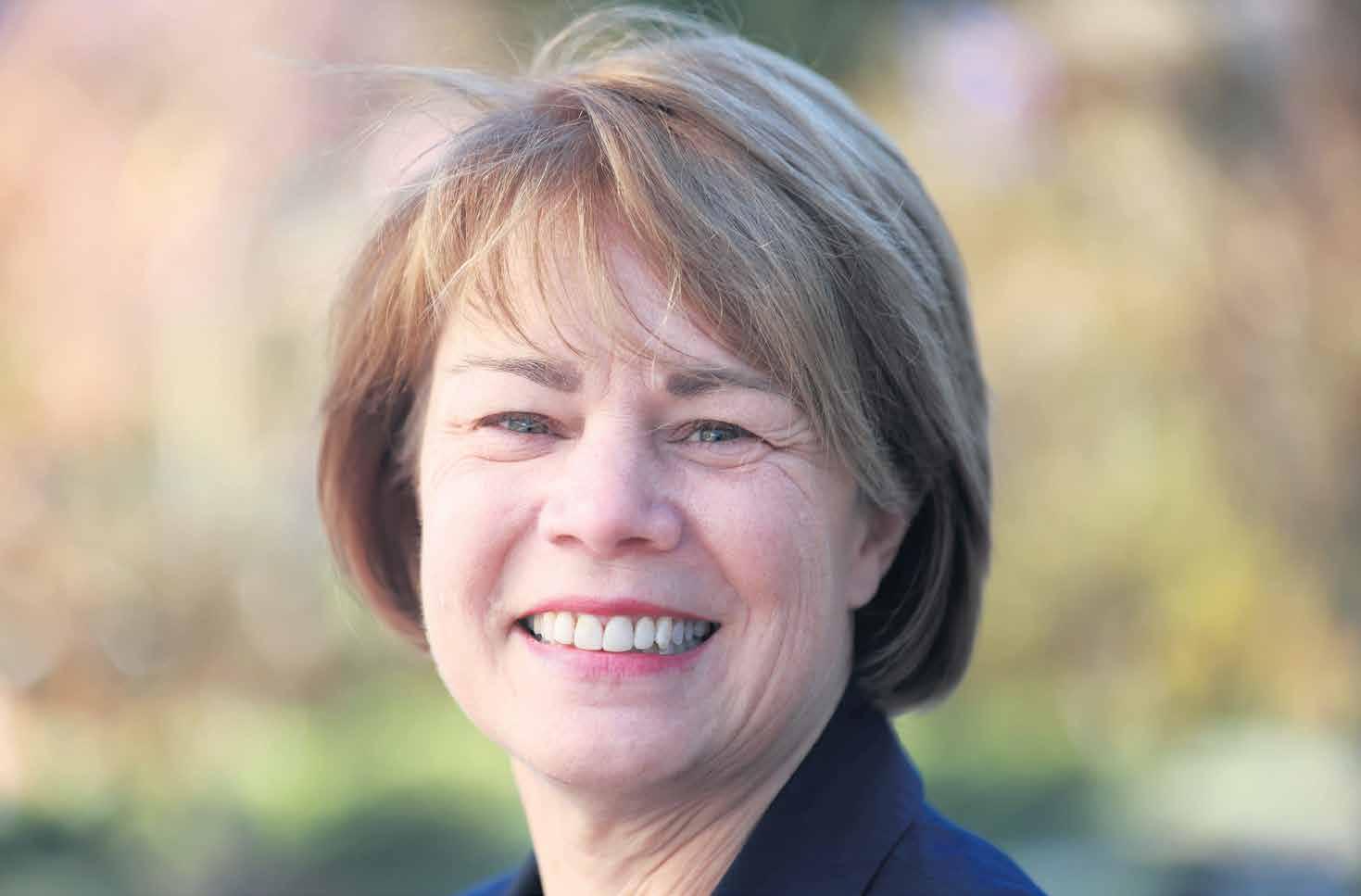
Sharon Eubank, director of Humanitarian Services for The Church of Jesus Christ of Latter-day Saints and former first counselor in the general presidency of the Relief Society, poses for a portrait outside of the Church Office Building in Salt Lake City on Wednesday, Oct. 29, 2025.
THE DESERET DIGEST 2026
Private & Charter Schools Section
Helping parents who are currently finding alternative schooling options for their children.
2025: A historic, disruptive — and sometimes tragic — year for education in Utah
UVU and the Charlie Kirk slaying, college budget reappropriations, and
By Jason Swensen Deseret News
Education in Utah in 2025 proved a consistent headline grabber — with high-interest stories ranging from higher education budget reallocations, Education Department disruptions, the sound of cellphone silence in K-12 classrooms, and the shocking news of the murder of Charlie Kirk on an Orem campus.
Here’s a look back at how Utah schools were impacted by a defining year in education— and what changes may await Utah education in 2026.
Launching Utah HB265: Higher education’s massive reinvestment plan
In an effort to better meet the needs of Utah college students and local industry, the Utah Legislature passed House Bill 265 — the socalled Higher Education Strategic Reinvestment plan requiring the state’s eight public colleges and universities to reallocate millions of budget dollars to programs determined to be of highest value.
Proponents of HB265 argued the reallocations were essential to serve Utah students and the local economy while also responding to higher education costs and high-demand industries in today’s high-tech world.
Opponents, meanwhile, countered that the bill jeopardized the humanities while weakening the reputations of Utah’s public colleges and universities.
This year’s reallocation efforts at each institution prompted the creation of hundreds of new employee positions on Utah campuses. But hundreds were also eliminated.
Meanwhile, academic programs and course offerings are being dramatically altered across Utah’s higher education institutions, with aggressive reinvestment happening in health care, STEM and artificial intelligence.
A Forbes magazine story suggested Utah’s HB265 could become a model for other state legislatures seeking ways to reshape academic programs.
“Universities might not like it because major restructuring always carries both expected and unanticipated costs, and it will force difficult choices by campus leaders,” the Forbes article noted.
“Still, the bill represents a relatively calibrated
classroom cellphone bans seized headlines in 2025
attempt to influence academic priorities that may find support across the political spectrum.”
Claiming a bachelor’s degree — in 3 years
Beyond budget reallocations, HB265 also limits bachelor’s degrees at Utah’s public degree-granting institutions to no more than 120 credit hours — with allowances if programs require additional credit hours if they require accreditation or licensing.
This year, Utah became the first public higher education system in the country to offer threeyear bachelor’s degrees to help students complete degrees faster and save tuition money.
The Utah Board of Higher Education approved accelerated degree programs at Weber State University and Utah Valley University.
Charlie Kirk murder: Tragedy and panic at Utah Valley University
A Utah school became the unwanted focus of global attention in the moments, days and months following the Sept. 10 murder of conservative activist Charlie Kirk.
Kirk was shot during an outdoor gathering at Utah Valley University, prompting scores of students to scatter in fear.
Tyler Robinson, 22, of Washington, Washington County, is accused of shooting and
killing Kirk. Robinson is charged with aggravated murder and, if convicted, could face the death penalty.
Following the Kirk assassination, the Utah Board of Higher Education set plans in motion to establish a task force on campus safety. The new task force will evaluate campus safety at the state’s 16 public higher education institutions — which includes eight degree-granting schools and eight technical colleges. It will then make recommendations to the UBHE for system-wide policies and practices.
Isaac Hale, Deseret News
Amanda Kerr, a junior at Utah Valley University studying nursing, takes a moment at a memorial outside the Brandon D. Fugal Gateway Building on the campus of UVU in Orem on Wednesday, Sept. 17, 2025, as students return to campus following the shooting death of Charlie Kirk at UVU a week prior.
K-12
schools: Silencing cellphones
Utah lawmakers in 2025 also passed a law, Senate Bill 178, prohibiting cellphone use during class time at the state’s public schools.
The new directive allows individual schools or districts to opt for a different policy — but there have been no reports of any exercising that option.
“Things are going great,” SB178’s sponsor, Sen. Lincoln Fillmore, R-South Jordan, told the Deseret News shortly after the 2025-2026 school
year began.
“It’s been socially and academically beneficial — and I’ve heard that from teachers, as well as students. … Teachers like having the support of a law to back them when they know that cellphones are a distraction.”
Look for the Legislature in 2026 to perhaps expand the school cellphone prohibition beyond simply class time.
Several lawmakers have echoed Utah Gov.
Trump administration disrupts Education Department
President Donald Trump has long expressed disdain for the Department of Education, calling it “a big con job” and seeking its closure.
Meanwhile, Cox and some members of Utah’s congressional delegation have also voiced support for abolishing the DOE, arguing education is best managed across the board at the state level.
But others worry students from vulnerable communities and schools could be harmed by the DOE’s seemingly eventual demise.
Under the direction of Education Secretary Linda McMahon, the department also laid off a sizable percentage of its staff in 2025.
And last month, the DOE announced the formation of a half-dozen interagency agreements — shifting several of the department’s critical functions across four other federal agencies: the Departments of Labor, Interior, Health and Human Services, and State.
The new agreements are expected to move billions of dollars in grant programs to sister agencies and, according to the DOE, “break up the federal education bureaucracy, ensure efficient delivery of funded programs … and move closer to fulfilling (Trump’s) promise to return education to the states.”
Perhaps most notable are administrative modifications of several key K-12 education programs, including Title I money for K-12 schools in low-income communities, from the DOE to the Department of Labor.
Utah’s new K-12 education chief
Spencer Cox’s call for a so-called “bell-to-bell” cellphone ban in Utah public grade schools.
“Every piece of evidence shows that we must pass a full-day ban or risk damaging our kids more,” wrote Cox in a social media post in August.
For hire: Utah college presidents
There were several presidential job movements at Utah’s higher education institutions in 2025.
In February, Utah State University President Elizabeth Cantwell resigned after being selected as president of Washington State University. A survey presented to the legislative auditor general in August revealed several risks at the school regarding past oversight and spending practices at the President’s Office.
Brad Mortensen was appointed USU’s 18th president in October.
Mortensen had served as president of Weber State for several years. A search is now underway for Mortensen’s successor at WSU.
Utah Tech University also welcomed a new president in 2025 — Shane Smeed.
Headquartered in St. George, UT has experienced historic growth in recent years. During the 2000s, the school originally known as the St. George Stake Academy went from being Dixie State College to Dixie State University and now, since 2022, Utah Tech University.
And in September, veteran Westminster University President Beth Dobkin announced her upcoming retirement. The private university plans to have Dobkin’s replacement hired by next spring.
Last June, the Utah State Board of Education appointed Molly Hart as the state school superintendent of public instruction.
A veteran educator and former board member, Hart assumed her new position even as changes in Utah classrooms are happening in rapid, real time.
While optimistic about the emerging opportunities for Utah’s schoolkids, Hart is also tasked with helping to remedy challenges such as classroom misbehavior, chronic absenteeism and determining how to meet the diverse needs of the state’s K-12 student body.
Reading proficiencies dip in Utah — and beyond
In 2026, Hart and her associates will also be focusing increased attention on boosting reading proficiencies across the state.
The most recent “Nation’s Report Card” reveals Beehive State students performed “significantly higher” in math than the national public average for both fourth and eighth grades in 2024. And Utah’s fourth and eighth graders also outperformed their national counterparts, on average, in reading.
But the average reading score for eighth grade students in Utah was lower than their average in 2022.
When the 2024 results revealed declining reading scores for eighth graders earlier this year, the Utah State Board of Education signaled their commitment to identifying the causes of declining reading scores — while implementing “targeted efforts” and proven strategies.
Rio Giancarlo, Deseret News
Students walk through the University of Utah campus in Salt Lake City on Friday, Sept. 26, 2025.
Kristin Murphy, Deseret News
An eighth grader uses their cellphone after school at Evergreen Junior High School in Millcreek on Wednesday, Jan. 10, 2024.
A parent co-op learning community where teachers and parents collaborate to educate and empower life-long learners.
The Open Classroom, situated in the Salt Lake City School District, is a distinctive educational environment that offers a unique approach to learning for students from pre-kindergarten through 8th grade. Established in 1977 as an optional program, it transitioned into a district-supported charter school in 2006. This free public school is characterized by a blend of traditional and innovative educational practices. Key features of the Open Classroom include:
• Teacher-led, parent-supported, and child-centered approach, ensuring a dynamic and collaborative learning environment.
• Emphasis on the whole child, where social, emotional, creative, cognitive, and physical aspects are nurtured alongside meeting state academic standards.
• Small-group collaborative learning that is tailored to the interests of the students, allowing for a more personalized and engaging education experience.
• Active parent participation in classrooms, which has shown to enhance students’ appreciation for education and strengthen family relationships.
The Open Classroom is more than just a school; it’s a cooper-
• Multi-age classrooms, enabling students to learn from and teach each other, deepening their understanding of various subjects.
ative and intentional community, united not by location or demographics, but by a shared philosophy and commitment to the holistic development of children. This community aspect is a cornerstone of the school’s philosophy, with over four decades of experience highlighting the positive impact of parental involvement on children’s love for learning and their educational outcomes. For those interested in learning more about this unique educational approach and the community it fosters, additional information is available at OCSLC.org. The Open Classroom stands as a testament to the power of collaborative, inclusive, and child- centric education in shaping the minds and lives of young learners.
Why have Utah’s high school dropout rates been sliced in half?
By Jason Swensen Deseret News
School board report: Graduation rates are up in student groups ‘that have historically faced barriers’
Almost 90% of Utahns are leaving high school with a diploma in hand.
And on the flip side, the state’s dropout rate has been sliced in half in recent years, from 16.2% to 8.5%, according to a report released by the Utah State Board of Education.
The report revealed that Utah’s overall fouryear cohort graduation rate has risen to 89.9% for the 2025 cohort — up from 88.8% for the 2024 cohort.
Statistically, a one-percentage point increase might not seem significant — but that point
represents hundreds of Utah youth now better equipped with job skills, increased earning potential and a path to higher education.
Such long-term trends, according to USBE, reflect the collective efforts of schools, educators, families and communities all partnering to help students stay on track and earn a high school diploma.
“Utah’s students, families, and educators continue to demonstrate what is possible when high expectations are paired with strong support,” said State Superintendent of Public Instruction Molly
Hart in a USBE release.
“We are especially encouraged to see meaningful gains for student groups that have historically faced barriers to graduation, alongside continued reductions in dropout rates statewide.”
The reported graduation rates for the 2025 cohort includes all students who started ninth grade in the 2021-22 school year, students with severe cognitive disabilities who have had their cohort reassigned to 2025, and students who transferred into the Utah public education system after ninth grade.
The “graduate” category includes students who have earned a basic high school diploma, an “Alternate Diploma” for students with a significant cognitive disability, or an adult education high school diploma by Sept. 30 following the end of their cohort school year.”
The “dropout” category includes students who have not completed graduation requirements after withdrawing from school or being expelled.
Jason Olson, Deseret News
Payson High School's class of 2004 line up for commencement ceremonies at the Marriott Center in Provo on Tuesday, May 25, 2004.
Saint Olaf Catholic School –Proudly Serving Grades PreK through Eighth Grade
Pre-Kindergarten 3 Opening Fall 2026 in Bountiful, Utah!
Saint Olaf Catholic School has proudly served families in Davis County for 65 years. Since 1960, Saint Olaf has educated generations of students, nurturing children into well-rounded learners and critical thinkers.
Small class sizes allow teachers to provide individualized attention, enrichment, and support. English Language Arts instruction across all grade levels emphasizes problem solving, creativity, and collaboration. Students engage with a wide variety of texts to strengthen comprehension and interpretation and learn to communicate ideas clearly by support claims with evidence while thoughtfully evaluating the reliability of sources.
STEM (science, technology, engineering, and math education) is woven into daily learning in all grades. Through hands-on experiences, students build intuition and creativity while approaching challenges with confidence. Brainstorming, testing ideas, and analyzing results foster critical thinking and problem-solving.
The school’s Technology Lab provide Middle School students with engaging, hands-on experiences in coding, robotics, and electronics. Older students explore programming basics and troubleshooting while also learning responsible digital habits, including online safety, information evaluation, and healthy technology use.
Our Christ-centered faith guides us every day. Students participate in religious education daily, attend weekly church services, and support the wider community with service projects and fundraisers. Saint Olaf students also enjoy enriching physical education, music, and art classes.. After-school opportunities include sports, choir, private string lessons, Student Council, and yearbook. Extended Day Care is available onsite for enrolled students.
We invite you to attend the Saint Olaf Catholic School Open House on Sunday, January 25, 2026, from 12:30–2:00 p.m. Saint Olaf is a qualifying provider for Utah Fits All Scholarships, offering eligible students up to $8,000 in tuition assistance. For more information, call 801-295-5341 or visit stolafs.org.
Graduation: Breaking down the rates by Utah’s communities
White students in Utah had the highest high school completion rate in 2025, with 92.1% meeting graduation requirements.
Meanwhile, Black students in Utah achieved the largest bump in high school graduation rates, going from 80.6% in 2024 to 83.9% in 2025.
Pacific Islander and American Indian students also recorded graduation rate improvements. Pacific Islander rates increased from 81.9% to 85%, while American Indian graduation rates rose from 77.5% to 80.1%.
American Indian and Black students had the largest dropout percentage decline in 2025.
Hispanic/Latino students — the school system’s largest minority group — also notched a slight graduation uptick in 2025, increasing from 81.8% to 83.2%.
And Utah high school students classified as “English learners” have improved their graduation rate by more than 12% since 2017, hitting almost 80% for the 2025 cohort.
For the first time, USBE is reporting graduation and dropout rates for Utah students in foster care, students experiencing homelessness and military-connected students.
Ninety-seven percent of military-connected students in Utah are graduating from high school.
Graduation rates are less encouraging among foster care and homeless youth: 62.8% and 72.8%, respectively.
Confronting Utah’s growing reading crisis
While encouraged by rising high school graduation rates, Utah educators also face well-documented challenges.
According to the most recent Nation’s Report Card, Utah students are generally outperforming their peers across the country. But reading scores among the state’s eighth graders continue to decline.
According to data released by the National Assessment of Education Progress earlier this year, Beehive State students performed “significantly higher” in math than the national public average for both fourth and eighth graders in 2024.
Utah’s fourth and eighth graders also outperformed their national counterparts, on average, in reading.
But while the average reading score of eighth grade students in Utah was higher than the average reading score for students in the nation, eighth graders in Utah are reading at lower levels than in earlier years.
In a recent Deseret News opinion column, Utah education advocate Christine Ivory noted that less than half of Utah’s third grade students (48%) are reading grade level.
“This quiet reading crisis in our state and across the nation will eventually explode into unskilled workers faced with limited possibilities. National data shows that only 31% of students are reading at or above grade level,” wrote Ivory.
A public policy focusing on improving reading rates for third graders is essential to Utah’s
strength and position, she added. “The complexities involved in creating a sound, rigorous education system for our state will depend on a united effort to find solutions.”
Meanwhile, a legislative audit released late last year revealed a “statewide gap between the performance of students who are in a group that traditionally struggles with academic proficiency, and those who aren’t.”
The audit classified “underperforming student groups” as those who have a higher than typical chance of performing below proficiency “and who are economically disadvantaged, learning English, or racial or ethnic minorities.”
Such “underperforming student groups” frequently need the most growth and support, the report added.
USBE has signaled commitment to identifying the causes of declining reading scores — while implementing “targeted efforts” and proven strategies.
“Our focus is on ensuring measurable improvements in reading outcomes by working with schools to equip educators and students with tools and targeted training,” said Darin Nielsen, deputy superintendent of student learning, in a state board report released earlier this year.
“We are committed to implementing evidence-based programs that address reading challenges early, providing intensive support where it’s needed most, and tracking progress to make sure every student has the opportunity to improve and succeed.”
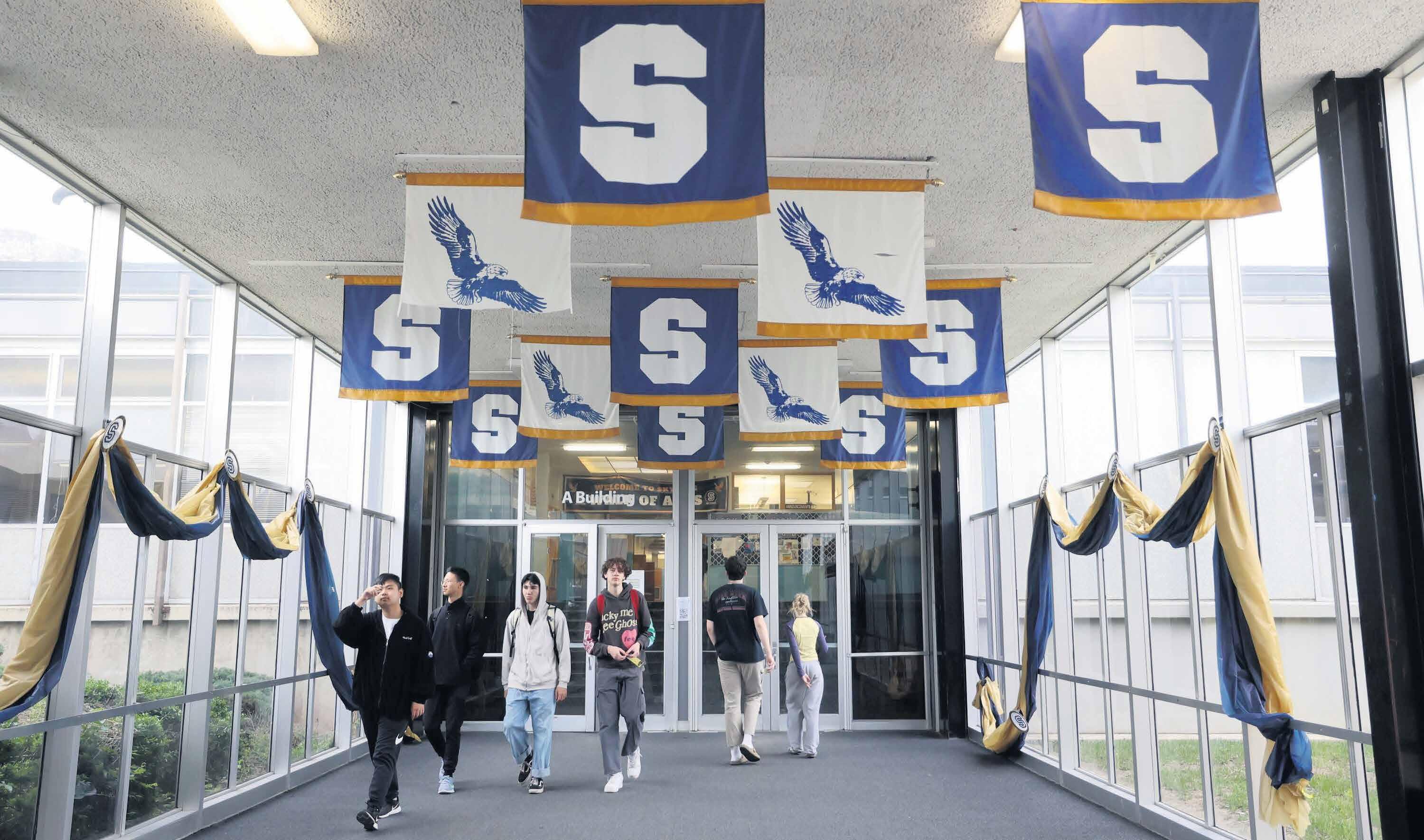
Kristin Murphy, Deseret News Students walk through Skyline High School in Millcreek on Wednesday, May 22, 2024.
Where Curiosity Leads and Children Are Known
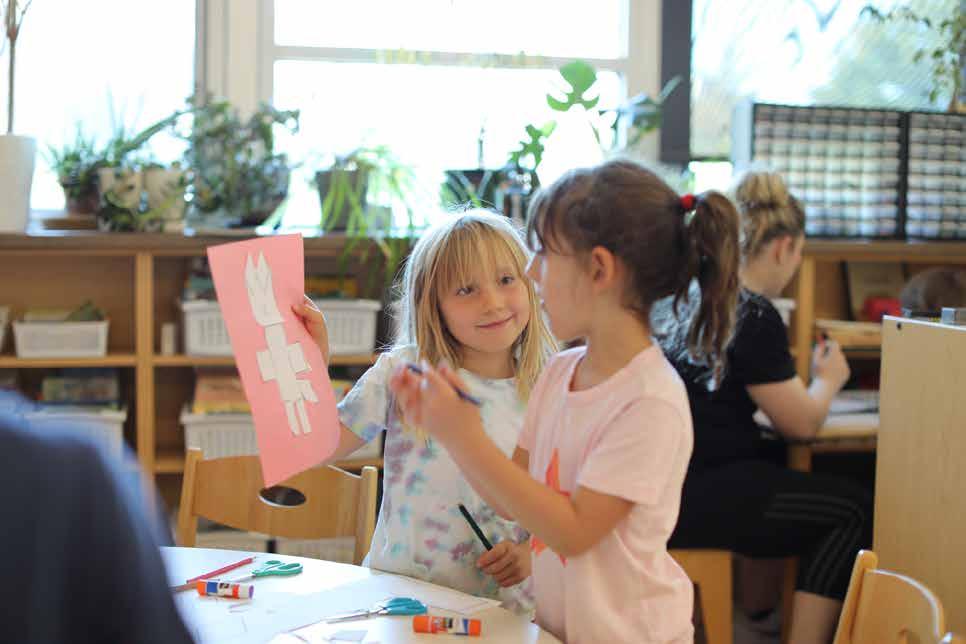
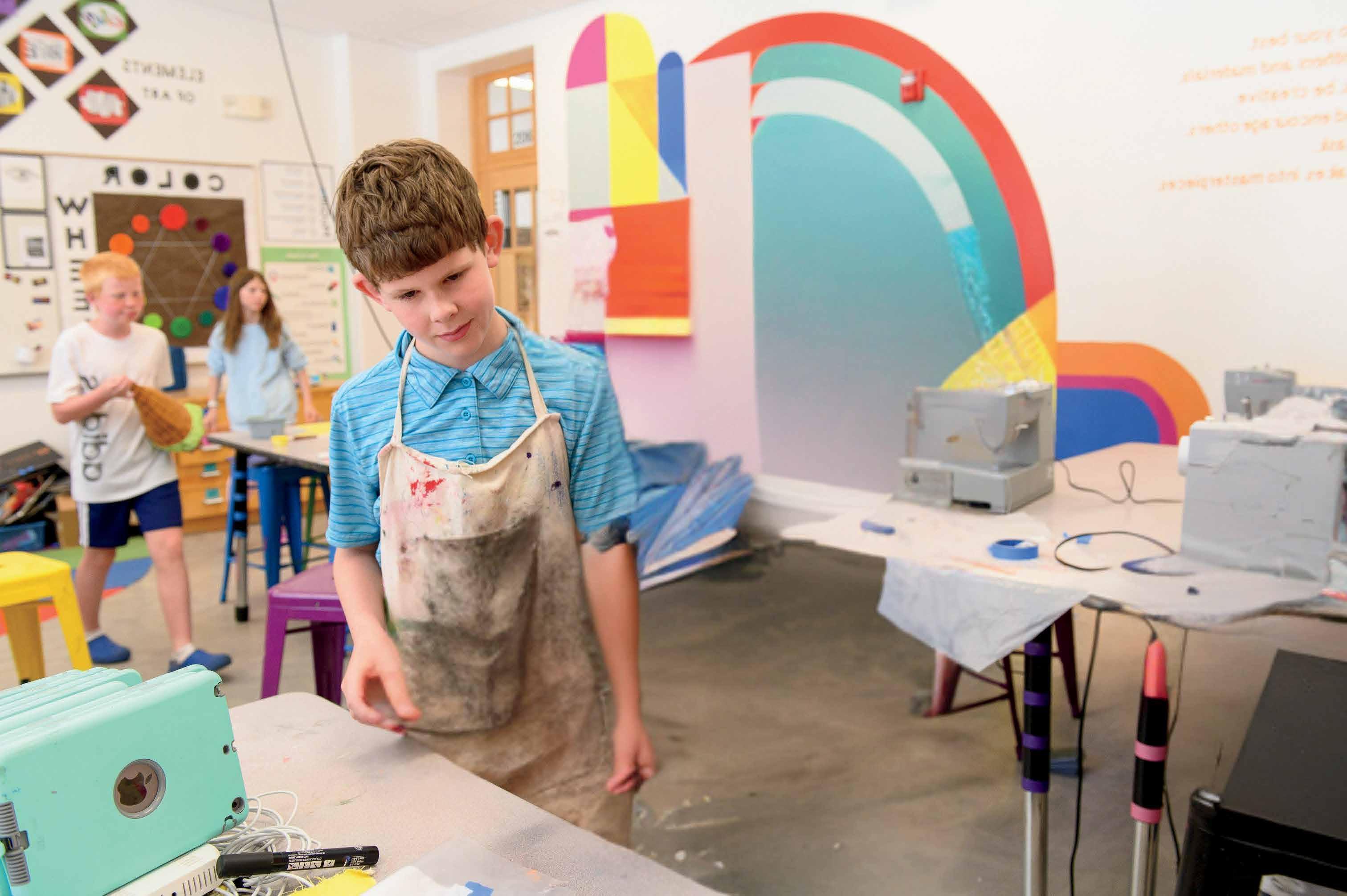
At Elizabeth Academy, education is not about rushing children through milestones it’s about honoring how they learn best Rooted in the Montessori philosophy, Elizabeth Academy offers a thoughtfully prepared environment where children are empowered to explore, ask questions, and grow with confidence
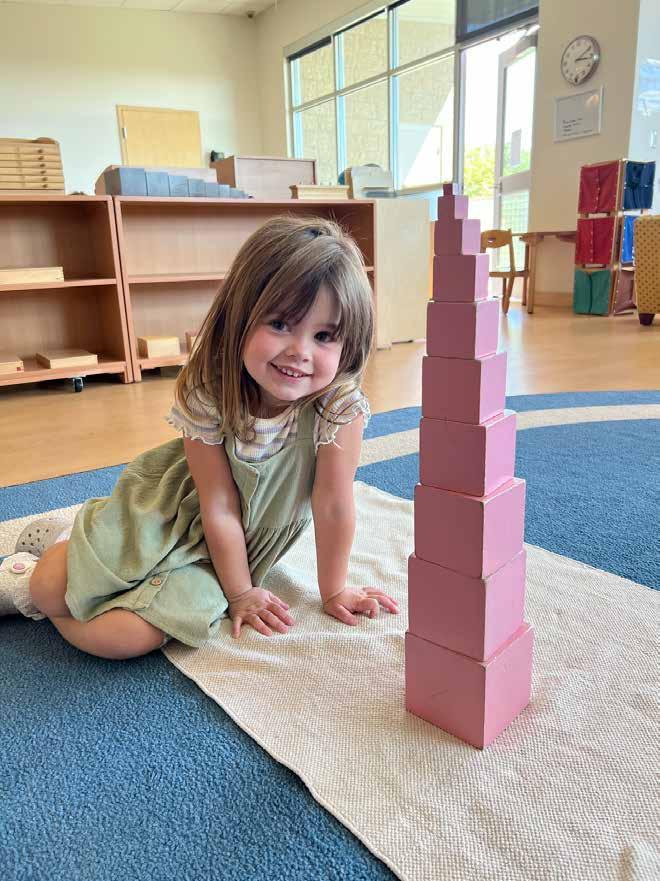
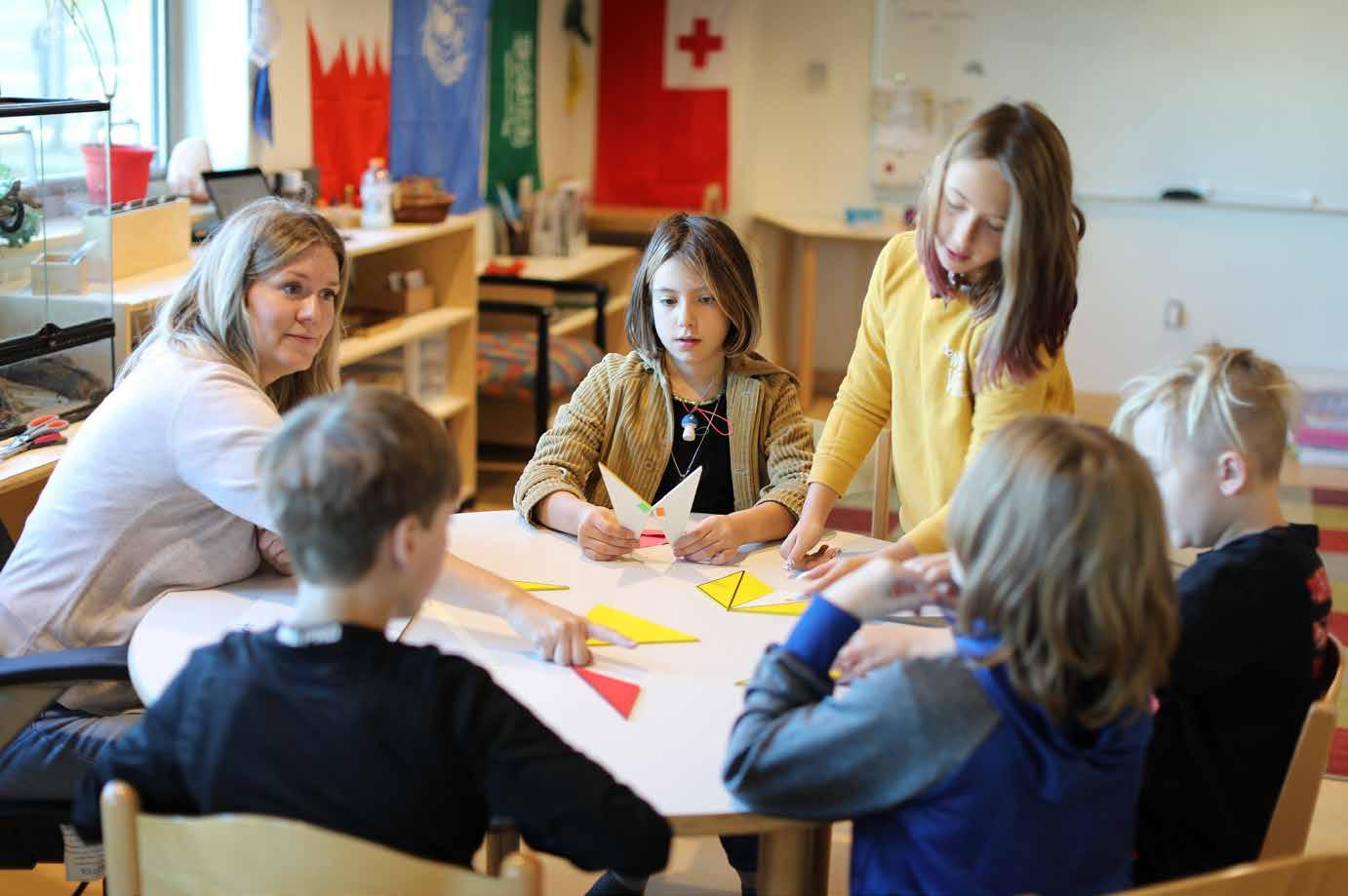
From the moment students enter the classroom, learning feels purposeful and calm. Multi-age classrooms foster leadership, collaboration, and empathy, allowing younger students to learn by observation while older students deepen mastery through mentorship Carefully designed Montessori materials invite hands-on discovery turning abstract concepts into tangible understanding and nurturing a genuine love of learning
Families choose Elizabeth Academy because it feels different The campus is warm and welcoming. The classrooms are intentional and inspiring And the culture is one of respect for children, educators, and the learning process itself
At Elizabeth Academy, education is joyful, personal, and enduring It’s a place where children develop confidence in who they are, curiosity about the world, and a strong foundation for who they will become
Elizabeth Academy
Cultivating capable, compassionate, and curious learners one child at a time