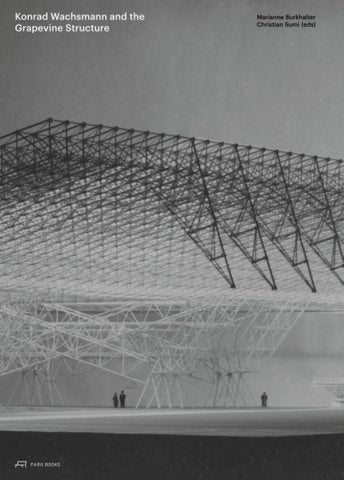
Konrad Wachsmann and the Grapvine Structure_BLAD

Page 1


Editorial note

In his book The Turning PointofBuilding,Konrad Wachsmannspeaksofa “dynamic structure,”whileinalatermanuscript foraplanned exhibitionthe name“Vine Grape structure” appears. In the Konrad Wachsmann ArchiveatAkademie der Künste in Berlin, theprojectisfiled under “Study of aDynamic Structure ‘Grapevine’.”Today, two commonly used terms –“Structural Grapevine”and “Grapevine Structure”–havebeen established.

Forewordbythe Editors

Christian Sumi

Knotsand Joints1941–1951

Packaged House,General Panel System

Three-dimensional Joint

Mobilar Structure

USAF,USAir ForceHangar

Mock-ups, Akademie der Künste,Berlin, Konrad-Wachsmann-Archiv

Photos Heinz Unger, Zürich

Marianne Burkhalter,Christian Sumi

Grapevine Structure1953

AndreasBurkhalter

The ArchitectureofThinking

Hannes Mayer, Fabio Gramazio,Matthias Kohler

LOM: Location Orientation Manipulator 1969

MarkoPogacnik

Salzburg1956–1960.Konrad Wachsmann and the Teamwork ConceptinSalzburg.

AConversation with FriedrichKurrent and Hermann Czech

The chronology demonstratesthe development of the hook connection, comprising twocross pieces(red), apin (blue) and screws or wedges (yellow).Inadvance of the chronology is an earlier project by Walter Gropius and afirst scheme by Wachsmann from 1939.

Growing House1932, Walter Gropius: (Förster und KraftPrinzip)

The three champfered interior componentsofthe wall areheldin place with the U-shaped fasteners(red). Threesingle compression connections (yellow) result.

1. Frenchscheme 1939:

Thewall elementsarriveonsitewithpre-mounted fasteners. The joint consistsofthree Connectors (Wachsmann): TwoY-shaped cross pieces(red) interlock in the center and arefixed in place by aspine (blue). The final locking element (yellow) pulls the two wedge-shaped elementsatthe wall’s edgestogether with radial forceand stabilizes the joint.

2. Reworkingof the Frenchscheme1941:

Instead of screwing the cross piecestogether on the diagonal the connection is made with ascrew and counter-screw perpendicular to the panel (yellow),preventing the connecting element from tearing itself out. The locking element (yellow),can be releasedwith ascrewing action, allowing forthe “internal pressure” to be regulated.

3. Packaged HouseSystem variation 1942:

1 The chronology wascontributed by Daniel Gut. His work, with a comprehensive explanation, was writtenunder the supervision of Bruno Krucker as an elective project forProf. Arthur Rüegg at the ETHZ upon my encouragement, and was published in abridged form in: Konstruktive Konzepte der Moderne,Lehrstuhl Prof.Arthur Rüegg Zurich 2001,p.138 ff. Steeve Sabatto providesa thorough chronology in: Architecture industrialisée op.cit. p. 170ff

Thewalls’ claddingare slightly shiftedagainst each other and organized by anodal jointinarotational orientation (see Wachsmann’scube).Because of this configuration, all wall connections areidentical. The Yshapeand spineconnectors arereplaced by 3 “flat”elements: two“crosspieces” (red), fixed with and pushed through and intersected by the “mainstay piece”(blue). The screwsare replaced by wedges (yellow).The final wedge is driven on site,tangential to the joint. In the end, acover strip is used to cover the apertureused forassembly.Bynow,four wall elementscan also convergeinasingle joint.

4. TDU-1variation:

Similar to variation 3but with less expensivehardware:instead of castelements, the system usesdie cut and breakedsheet metal.

5. Patent variation 1945:

The “mainstay piece”has beensubdivided into two diagonal hooks(blue)and the shape of the “crosspieces” is modified into “loops”(red). The joint is constrained and locked into place by the dead weight of the last vertical wall element to be lifted into place.

6. TurningPoint variation:

Same as variation 5, except that instead of atapered horizontal element, the element is bent.

Growing House 1932, Walter Gropius

1French scheme 1939

2Reworkingofthe Frenchscheme 1941

3Packaged House System variation 1942

4TDU-1variation

5Patent variation 1945

6TurningPoint variation

Chain, wood,colored and painted, ca. 27 cm
Clasp with one tube laterally placed, metal, colored and painted, ca. 35,5 cm
Node,metal, wood, ca. 35 cm, possibly developed by FritzHaller
Erne Holzbau: Construction of the Grapevine

Turn static files into dynamic content formats.
Create a flipbook
Issuu converts static files into: digital portfolios, online yearbooks, online catalogs, digital photo albums and more. Sign up and create your flipbook.