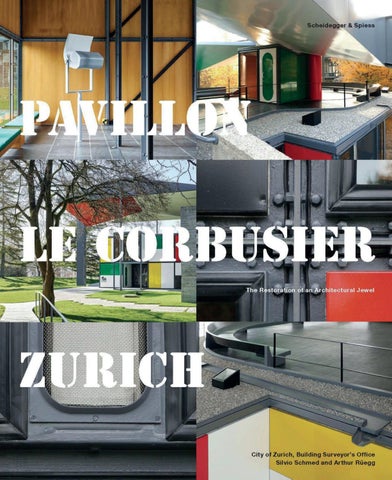
PAVILLON LE CORBUSIER ZURICH
Cityof Zurich,BuildingSurveyor’s Office Silvio Schmed andArthurRüegg
Restoration of an Architectural Jewel
Editors City of Zurich,Building Surveyor’s Office, Silvio Schmed andArthurRüegg
Book concept Silvio Schmed andArthurRüegg,Zurich
Copy editing Monique Zumbrunn,Zurich
Proofreading Louise Stein,Edinburgh
Book design Robert& Durrer,Zurich
Retouching Peter Habe,Zurich
Lithography Widmer &Fluri GmbH,Zurich
Printingand binding DZADruckerei zu Altenburg GmbH,Thuringia
Fonts: Neue Helvetica,Stencil
Paper: LuxoArt Samt matte coated 150g/m2
©Texts:bythe authors
©WorksofLeCorbusier: Fondation Le CorbusierParis /2019, ProLitteris, Zurich
Photos GeorgAerni:©Georg Aerni,Zurich
PhotosRené Burri:Museum für Gestaltung Zurich, Graphics Collection/ ©René Burri /MagnumPhotos
PhotosJürg Gasser: ©gta Archive ETHZurich, Donation Jürg Gasser
Photo BärbelHögner: ©BärbelHögner,Berlin
Photos Silvio Schmed andArthurRüegg: ©Silvio Schmedand Arthur Rüegg, Zurich
©2019 Verlag Scheidegger& Spiess AG, Zurich
ISBN 978-3-85881-852-2
Verlag Scheidegger&Spiess AG
Niederdorfstrasse 54
8001 Zurich
Switzerland www.scheidegger-spiess.ch
Scheidegger and Spiessisbeing supportedbythe Federal Office of Culture with ageneralsubsidy for the years2016–2020.
Allrightsreserved; no part of thispublication may be reproduced, storedin aretrievalsystem, or transmittedinany form or byany means,electronic, mechanical, photocopying,recording,orotherwise, without theprior written consent of thepublisher
Picturecredits
Georg Aerni, Zurich:pp. 8/9, 15, 29, 33, 38/39, 40/41, 42/43, 47, 50 below,51, 60/61,62right, 64, 67, 68, 70, 76 above, 77, 79, 80, 81, 82/83, 88
Archive Fondation Le Corbusier,Paris:pp. 20 below, 27 center,30left Bauen+Wohnen, September 1966, p. 347:p.30right
Betty Fleck, Museum für Gestaltung Zurich /ZHdK:pp. 72/73, 74/75
gta Archive, ETH Zurich, Donation Jürg Gasser:pp. 12,13, 17–19, 21, back endpapers
gta Archive, ETH Zurich, estate of BernhardHoesli:front endpapers, pp. 22 center and below,25, 26 below
gta Archive, ETH Zurich, estate of Heinz Ronner:pp. 23, 24 above, 25, 27 below
Bärbel Högner,Berlin:p.45
KEYSTONE/PHOTOPRESS-ARCHIVE: p. 11
Stills from thedocumentary Centre Le Corbusier.The Last Building of Le Corbusier (1965 –1967) by Fredi M. Murer and Jürg Gasser:pp. 20 above, 22 above, 24 below, 26 above, 27 above Museum für Gestaltung Zurich, GraphicsCollection:p.6
Walter andRenate Rohrer,Winterthur:p.78
Silvio Schmed and Arthur Rüegg, Zurich:pp. 14, 34–37, 44, 46, 48, 49, 50 above, 52–59, 62 left, 63, 65, 66, 69, 71, 76 below,84–87
If,despite best efforts, we have not been able to identify the holders of copyright and printing rights for all the illustrations, copyright holders not mentioned in the credits areasked to substantiate their claims, and recompense will be made according to standardpractice.
7Foreword
WiebkeRöslerHäfliger
10 HeidiWeber’s Exhibition “House”
Arthur Rüegg andSilvioSchmed
16 TheRealizationofaManifesto
Arthur Rüegg andSilvioSchmed
28 Le Corbusier’s Last Work
Roger Strub
32 Restoration,Reconstruction, Retrofitting
Arthur Rüegg andSilvioSchmed
84 Project Organization Restoration 2016–2019
85 Sponsors
86 Project Organization1960–1967 Chronology
87 Captionsfor thefull-pageillustrations
Notes

HeidiWeber welcomingLeCorbusieratZurichAirport, November24, 1960
PhotoRenéBurri
WiththePavillonLeCorbusier,theCityofZurichhasatrulyuniqueobjectinitsportfolio.Thisarchitecturalicon, completedin1967, is situated closetothe lakeshoreinaspaciouspark. That Le Corbusierwas able to realizethis exemplarydemonstrationofhis architectural ideasinsuch aprime locationisthanks solely to the efforts of arisk-taking young galleristand interior architect,who provedexceptionally adeptattranslating hervisions into reality. HeidiWeber initiated the master’sonlybuildinginGermanspeaking Switzerlandwith unflaggingdedication, financeditherself,and togetherwith the architects AlainTavèsandRobertRebutatosawitthroughtocompletiontwoyearsafterLeCorbusier’sdeath.The CityofZurich hadpreviously grantedher afifty-yearlease on the plot betweenthe neo-Gothic VillaEgli andHermann Haller’s studio,which is built entirely of wood.Whenthatlease expired in 2014,title to the pavilion fell to theCity, whichdecidedtorun it as aLeCorbusiermuseumthatwould draw visitorsfrom farand wide to Zurich.
TheBuilding Surveyor’s Office of theCityofZurich (AHB)was thereupon entrustedwith thefullscale restorationofthe structure. Thefactthatweweredealing with aprotected historicalmonument, which at thetime wasindesperate need of work to make it fit forpurpose as astate-of-the-art exhibition space, madethisasomewhat daunting brief. TheAHB wastherefore fortunate in being able to enlist as architects Silvio Schmed andArthurRüegg,two internationallyrespected,Zurich-based Le Corbusier connoisseurs.Their feasibility study,which wasoverseenby a comité scientifique,identified the pavilion’s shell, infrastructure,furnishings,and compatibility with theprevailing standardsasthe mostchallengingaspectsoftheproject.Althoughthestructurebuiltentirelyofsteelandglasshadbeen well-maintained, there could be no doubting the urgentneedfor action. Between autumn of 2017 and springof2019, therefore, the twoarchitects togetherwiththe canton’s ownculturalheritageteamand numerousotherspecialists appliedtheir considerableexpertiseand eyefor detail to the restorationof thisjewel.Itwasataskthatmorethanoncecalledforrecoursetounconventionalsolutions,suchasthe use of aneedle gun to remove the coatsofpaint covering the intricatesteel frame.
ThePavillonLeCorbusier hasbeenopentothe public againsince May2019. TheCityhas entrustedits operation to the Museumfür Gestaltung Zurich,which hasundertaken to stagea newsummer exhibition there everyyear. Nowabeautifully preservedhistoricmonument,the pavilion evincesthe samefreshness,elegance,and colorasithad at itsopening. That it scarcelylooksany different than it didin1967may seem paradoxical; yetitalsoshows howprofessionally, andwithwhatassiduous attentiontodetail, the taskathandwas solved—not leastinthe reconstruction of themissing itemsof furnitureand lightfixtures.The project wasconcludedwithout anyfaults, moreover,which is certainly notamatterofcourse;and that in addition to thequality specifications both the budget andschedule were also met is extremelygratifying.Theexcellent outcomespeaksfor itself andatthe sametime atteststothe smooth andsuccessfulcollaborationofall our internal andexternalexperts. It is their work,therefore,thatthis publicationdocuments and honors.Onbehalfof the City of Zurich,Iwould like to extend my sincerest thanks to allthoseinvolved fortheir hard work on this project
InApril2019,theEuropeanCouncildeclaredanetworkofsomethirtyworksbyLeCorbusier,among them the PavillonLeCorbusier in Zurich,toformone of itsofficial “Culture Routes,” thus supplying but onereason more to visit this intricateand colorful tour de force of Le Corbusier’slateperiodinZurich
Wiebke Rösler Häfliger,Director,BuildingSurveyor’sOffice of the CityofZurich


HeidiWeber’s Exhibition “House”
ArthurRüegg andSilvioSchmed
Le Corbusier’s Zurich pavilion is ademonstration of architecturalprinciplesand alaboratoryfor the synthesisofthe arts.
“Synthesis” here meansthe combination of autonomous butmutuallyenhancing formsofartistic expression.Suchaninteraction of architecture, furniture, painting, tapestry, sculpture,and the graphic arts,LeCorbusier argued,ismoreeffectively demonstrated by the “modest andnomadicsettingofa dwelling” thanbythe “arbitrarinesscommonly found in rooms designed forexhibition purposes.”1 He suppliedthe frameworkwithwhich to prove this in theformofan“artist house”assembled outofprefabricatedsteel andglass elements,whoseproportionswerederived from the Modulor.Its dual functionof privatehomeand exhibition spacewas of centralimportance to the client rightfromthe start.The interiordesigner HeidiWeber,owner of the GalerieMezzanin,had been Le Corbusier’s exclusiveart dealer since1958, andhad been instrumental in reissuing thefouriconic tubular-steelchairsof1928/29.As earlyas1959, shehad dreamedofpresenting allthe creations of the greatartist-architect “in ahouse that he himself designed.”2
Weberatfirsttookadvantage of the very different spacestoexhibit the worksofLeCorbusier himself,turning the spotlightonthe history of the pavilion,a series of oilpaintings, andfinallyhis buildings forIndia’s newprovincialcapital of Chandigarh.But in 1969,fearing that the premises mightdegenerate intoa kind of “LeCorbusier Mausoleum,”3 shehad the “CentreLeCorbusier”hostanenvironmental forumwith thedeclaredaim of contributingtothe “criticalengagementwiththe problemsoftoday’s housing andliving conditions”4 in away that the master himselfwould have approved of.Inthe years 1968 to 1977,Weberand hercurator,the photographerJürgGasser, launched an ambitiousprogram of sociallycritical showsflankedbytalks givenbyspeakersofrenown. In September 1968,for example, the pavilion wasthe scene of adiscussionmarathon, whichhas gone down in theannals as the “6-DayLong ZürcherManifest.”After Gasser’sdepartureinlate1977, the Gottlieb Duttweiler Institutewith itsCorbusier CommunityWorkshop (CoCo) movedinonatwo-yearlease,which wasnot,however, renewed.The pavilion thereafter remained closed,asithad been from 1973 to 1976,5 andnot until1984 diditonceagain offernew insights into theworkofthe homo universalis Le Corbusier.
Weberhad always reservedthe rough-plastered basement of thepavilionfor Le Corbusier’s own worksofart—evenduring CoCo’s interregnum.While shepresented his drawings andgouachesunder glass in box-like oakframes,Gasser worked on developing modularsupport systems forthe twoupper storiesbased on thesteel-frame modules. Overthe years, many of the oakplywood façade panels were doubledupwithchipboard panels paintedinvariouscolorsuntilcertain partsofthe building—the two-storystudio, forexample—had been completelyremodeled.
Afterthe “Heidi WeberHausvon Le Corbusier”passedtothe City of Zurich in 2014,Cultural Affairs staged four summerexhibitions there, notwithstanding theverydifficult climaticconditions that by then were prevailing in the basement.Since the conclusion of the restorationwork, the pavilion hasbeen runasa publicmuseum by the Museum fürGestaltungZurich.There aregood groundstohopethatitwill become alivingcultural center in whichthe youngergeneration canre-evaluatethe synthesisofarchitecture, art, andlifechampionedbyLeCorbusier.


West façade
Northfaçade Ground
East façade
Rooftop
Southfaçade


Therestoration work calledfor threesetsofscaffolding:one outside thebuildingtosupportthe temporaryroof, oneonthe façade,which waserectedonthe projecting basementstory, andfinallya specialhousingenclosingthe canopies, which servedasa vacuum chamberfor the decontaminationwork. Only afterthishousing had been dismantledcould the renovationofthe roof skin commence.
Sandblasting wasusedtoremove the PCB-contaminatedpaint coating the topofthe canopies. Inside thevacuumchamber the workershad to wear specialsuitswith their ownoxygen supply


Partly hidden by the old coatsofpaint:patchesofrustonthe connector plates.
Thedismantledrailing on the rooftopterrace
Thesheet metal base wascut open,the railingdismantled, the stumps sealed with bitumen andliquid plastic to preventfurther corrosion,and therailingthenreinstalled. Only then were the openingsrewelded to sealthem.