Colonial Views of India

Page 1


Copyright © Ashmolean Museum, University of Oxford, 2026

Mallica Kumbera Landrus, Marwa Ahmed, Geoffrey Batchen, Radhica Ganapathy, Julia A.B. Hegewald, Dane Kennedy, Aparna Kumar, Nyanika Mathur, Tim Pearse, Chaitanya Sambrani and Giles Tillotson have asserted their moral rights to be identified as the authors of this work.

British Library Cataloguing in Publications Data

A catalogue record for this book is available from the British Library.

ISBN: 978-1-910807-XX-X

All rights reserved. No part of this publication may be transmitted in any form or by any means, electronic or mechanical, including photocopy, recording or any storage and retrieval system, without the prior permission in writing of the publisher.

Designed by Stephen Hebron

Printed and bound by XXXX

Frontispiece: Jain temple and pool, possibly at Mount Abu (detail), 1858–65, photograph, 11.5 × 18.6 cm

For further details of Ashmolean titles please visit: www.ashmolean.org/shop

Foreword 7

Xa Sturgis

Foreword 9

Richard Ovenden

Acknowledgements 10

Colonial Views of India 13

Mallica Kumbera Landrus

Political Agency 37

Geoffrey Batchen

Picturesque Views and Architectural Documentation 47

Julia A. B. Hegewald

Alwar and Jodhpur 65

Giles Tillotson

Mount Abu and Shimla 85

Dane Kennedy

Performing Community/Performing Empire 105

Radhica Ganapathy

Portraying People 113

Marwa Ahmed

Captive Cats 131

Nayanika Mathur

Cracking India: Fragile Archaeological Photographs 141

Aparna Kumar

Construction of Tradition 149

Chaitanya Sambrani

Observation of a Photographer’s Process 157

Tim Pearse

Notes 168

Bibliography 173

Contributors 176

Opposite: Detail from fig. 13

Below:

1. Temple and pool, possibly at Mount Abu, 1858–65

COLONIAL VIEWS OF INDIA

The essays in this volume discuss images and themes during the second half of the nineteenth century in India associated with the photographer, Colonel Eugene Clutterbuck Impey (1830–1904). As such, this volume introduces the early period of photography in India. Arranged as commentaries and discussions, the essays invite readers to engage with images and their contexts in an interrogative manner. The volume and the accompanying exhibition assess and present previously unseen photographs. They welcome readers to a more informative reconsideration of images that are much more than curious observations, as they also appear to be in the service of Britain’s imperial mission in India (fig. 1).

In format, this volume attends to the various ways in which photographs may be seen as constituting a visual, social, and epistemological technology which is essential to understanding colonial India. The essays highlight important themes and issues that are key to understanding this period in India’s history. They provide the reader with productive and useful resources

In rethinking the history of colonial photography, it is important for viewers to consider their interaction with these views of India. While we can appreciate the artistic value of these photographs, we must also recognize the heavy burden of their historical context. The Impey collection reflects a deep interest in photography, favouring beautiful and sweeping views that include people, helping to illustrate the relationship between photography and areas such as art, archaeology, anthropology, history, and performance (fig. 24). The essays accompanying this collection delve into the various meanings behind what we consider to be ‘accurate’ photographs depicting ‘reality’.

24. Lake scene with crouching figure, 1858–65 (right half of stereoscopic image)

Opposite:

Detail from fig. 73

Overleaf:

Detail from fig. 29

Opposite:

Detail from fig. 128

Indian, eyes. And, indeed, a number of officers contributed pictures to official publications or issued albums of albumen prints of Indian scenes when they returned to London. Impey did the same in 1865. When considered in that public context, we can see that Impey’s images served as a visual record of exotic places (many of them already familiar to a British audience in the form of written reports in the press during the Uprising) but, more importantly, as a confirmation of the continued stability of the Empire itself. They provided their viewers with information and entertainment, but also with reassurance.

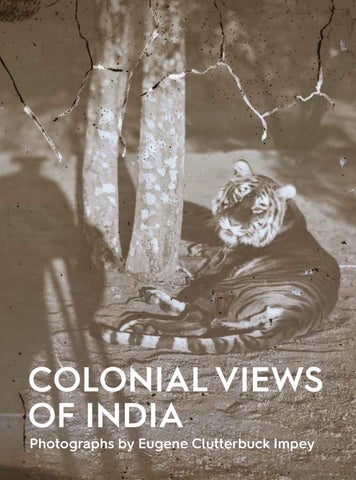
A stereoscopic image by Impey consolidates many of these themes (fig. 128; detail opposite). The negative comprises a doubled picture of a tiger, its glass surface marred by fissures in the photograph’s emulsion (and with its upper-right corner now broken). But the image also accidentally includes Impey’s own distorted shadow, merged with that of his camera, tripod and dark cloth, cast forward across the composition by the ignition of a small pile of magnesium powder located behind the photographer. Photography and its subject overlap one another, having been compressed into the same picture plane. That subject is, at one level, just this supine tiger, looking lazily back over its shoulder at the photographer (and at us). When seen in stereo, the space the tiger occupies unexpectedly extends into the background, diminishing the sense of danger we might otherwise feel in its presence. But the very fact that Impey has been able to set up his camera, wet his glass plate with his light-sensitive solution, pour out some magnesium powder and light it to make the exposure, suggests that this tiger, a living symbol of India, is not an imminent threat. Indeed, closer inspection reveals that it is tethered in place by a chain. Vanquished by its handlers and now by the camera, it is no more than a vestige of its formerly wild self. Reduced to a stereoscopic apparition, the tiger has become an allegorical fantasy of the India that Britain wants to believe it now has firmly under its control. In other words, this photograph, like all of Impey’s work, is a powerful form of political activity earnestly pretending to be something else.

72. Temple in valley at Bhangarh, Alwar territory, 1858–65

95. Indian agents of the Rajasthan princely states seated and standing around Impey, 1858–73

The paradox at the heart of hill-stations such as Mount Abu and Shimla is that although they acquired reputations as places set apart from the challenges that India posed for the British, these highland resorts were in fact integral to the workings of the Raj. Their roles as centres of recuperation, recreation, romance, domesticity, education, and more made them crucial to the reproduction of the ruling race. They also became sites of governance. While Impey’s photographs of Shimla give little hint of its significance as a centre of political power, several of his Mount Abu photographs document his personal contribution to the imperial project. One of them shows Impey seated at a document-strewn desk, pen in hand, his eyes focused on the Indian peasant – no shoes, no shirt – who stands before him, his hands placed in a pleading position (fig. 119; detail opposite). On either side of Impey are eight well-dressed Indians, who are presumably taking part in the proceedings as translators, scribes, and other agents of the court. What we have here is a quotidian example of how the British dispensed justice at the local level in India. The other revealing photograph is the one that shows Impey surrounded by sixteen resplendently garbed Indian men, most likely the vakils (agents) of Rajasthan’s princely states (fig. 95). They were obliged to reside in Mount Abu so that Impey, as their political agent, could consult with them as a group rather than travel across Rajasthan to individual states. Here in microcosm was the hierarchical yet collaborative relationship that the British established with the Indian princes, which proved so crucial to the persistence of the Raj. Both photographs provide us with a glimpse of the political undercurrents of empire that the British so eagerly sought to escape in their sojourns to the hill-stations.

Opposite:

Detail from fig. 119

105. British couples and dog, taking tea, 1858–65

In another ‘studio’-style photograph, we are presented with a small child seated in a baby carriage and dressed in light clothing against a dark backdrop (fig. 106). The girl’s pose, coupled with the lighting, and the contrast between light and dark, appears to signify a purity and innocence. A minor grimace and a very slight blurring to the image suggest a youthful impatience in sitting for the exposure. Her carriage, which acts as a prop, seems symbolic of class as well as signifying Victorian British parenting.

In addition to the portraits from court, we also encounter photographs of various Indian occupation types. These include, for example, images of cultivators posed outside with their tools (fig. 107), a bhisti (water carrier) with bull (fig. 108), and artisans using a bow-drill (fig. 109). A portrait of a darzi (tailor) sewing (fig. 110), seated cross-legged on a raised platform covered

106. British child in baby carriage, on striped durree, 1858–65

Opposite: Detail from fig. 127

CAPTIVE CATS

Nayanika Mathur

There are two images of big cats in the Impey collection. Intriguingly, they are both captive and are both speaking, in distinct ways, to the contemporary juncture of the sixth mass extinction. The other non-human animals in the collection are notable for the labour they are all performing for the colonial state. For most, the labour is evident; for example, the elephants and camels with the ornate seats that carry humans around. The less ornamentalised cattle without the relatively comfortable seating are obviously beasts of burden. But even those that seem to be more domesticated are working for the Crown. The dogs in the photographs – whether they be seated begging on a chair or more sedately on the ground while the humans drink tea – are performing an important labour of providing familiarity and the home and family that the British so desperately sought out in the colonies (figs 122–128).75 The big cats, by contrast, were symbols of the wildness (jungleepan) of India, and a beastly nature that had to be controlled.

The entry of the British on the Indian sub-continent was, as animal histories have shown us, to have a considerable impact on the lives of the big cats through two means: the system of rewarding bounties for the killing of animals newly classified as ‘vermin’ or ‘pests’ or ‘dangerous’, and through the development of the hunt or the shikar into a ‘sport’ as well as a state ritual. For the first time in the recorded wildlife history of India, a centralized administrative state machinery was set up by the British that was to wage a ‘veritable war against errant species’.76 The tiger was one of the first of such errant animals that was sought to be exterminated beginning in Bengal where, in the 1870s, a bounty was declared for anyone who killed a tiger. A particular imagination77 of the tiger as a ‘dangerous beast’, a ‘cunning, silent, savage enemy’ that committed ‘fearful ravages’ against people78 seemed to be operating in the minds of the new rulers who considered it their duty to oversee its elimination. ‘The tiger was the prime example of a lawless beast, whose conquest was held to be among the greatest blessings conferred by Pax Brittanica’.79 The bounty system proved to be extremely popular with over 20,000 ‘dangerous beasts’ being killed for bounties in British India by the middle of the 1870s, very soon after its commencement. The cheetah was classified as ‘vermin’ and killed in vast numbers while the lion, tiger, and leopard were to constitute prestigious sporting trophies. So, for instance, in the Madras Presidency, the district collectors paid Rs 25 for the death of every cheetah. The princely states, too, were pulled into this

128. Seated tiger with tripod shadow, 1858–65

Contributors

Marwa Ahmed is Research Assistant for the Indian collection at the Ashmolean Museum, University of Oxford.

Geoffrey Batchen holds the Professorship of the History of Art at the University of Oxford. His work as a teacher, writer, and curator focuses on the history of photography. Professor Batchen is a Fellow of Trinity College.

Radhica Ganapathy is Associate Professor of Theatre History and Criticism at West Virginia University. Her research engages in critical representations of race, class, gender, sexuality, and religion in theatre and performance.

Julia A. B. Hegewald is Professor of Oriental Art History at the University of Bonn. Her research focuses on artistic and architectural expressions of different forms of dependency in Asian (particularly South Asian) art and architecture.

Aparna Kumar is Lecturer in Art and Visual Cultures of the Global South at University College London. Her research focuses on modern and contemporary South Asian art, twentieth-century partition history, museum studies, and postcolonial theory.

Mallica Kumbera Landrus is Keeper of Eastern Art, and Senior Curator of Indian, Himalayan and Southeast Asian art at the Ashmolean, and a Fellow of St Cross College. Professor Kumbera Landrus’ research interests focus on the intersection of art, architecture, socioeconomics, religion, and politics.

Dane Kennedy is Professor Emeritus at the George Washington University. His research and teaching interests have included British imperial, modern British, and world history, with a special focus on Asia and Africa. Professor Kennedy was also Director of the National History Center (USA).

Nayanika Mathur is Professor of Anthropology and South Asian Studies at the University of Oxford. Her research interests include the anthropology of politics, development, environment, law, and human-animal studies. She is a Fellow of St Antony’s College.

Tim Pearse is an award-winning photographer and founder of Negative Thinking in Bristol, UK. Maintaining an active studio practice, he specialises in the wet collodion process.

Chaitanya Sambrani is Associate Professor at the Australian National University. As an art historian and curator, he works on modern and contemporary art in Asia, especially in relation to tradition, marginality, and politics.

Giles Tillotson was previously Reader in History of Art at SOAS, University of London, and is currently Senior Vice President at the Delhi Art Gallery. His research and curatorial work focus on Indian history and architecture.

Turn static files into dynamic content formats.
Create a flipbook
Issuu converts static files into: digital portfolios, online yearbooks, online catalogs, digital photo albums and more. Sign up and create your flipbook.