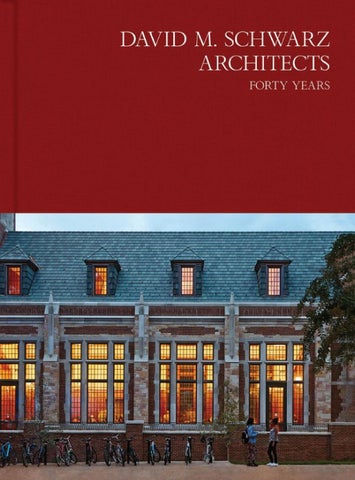
David M Schwarz Architects

Page 1


When the Texas Rangers Baseball Club sent a Request for Proposals (RFP) to twenty-two architectural firms from across the country, everyone realized it was a thinly veiled invitation to participate in a design competition. The ball club sent the RFP to the major sports architects, large well-respected design firms, some local favorites and a handful of dark-horse candidates. After the fact, David M. Schwarz Architects learned that the Rangers’ president, Ambassador Thomas Schieffer, considered them somewhere between a local favorite and a dark horse. The firm came to his attention when his son spent weeks in the Schwarz-designed Cook Children’s Medical Center (see page 198).

Having played in an inadequate converted minorleague stadium for nearly two decades, the Rangers were quite clear on their vision for a new ballpark. How to give that vision form was the challenge. After reading the RFP, which articulated that vision well, Mr. Schwarz declared, “I know how to win this.” One had to simply appeal to Texans’ strong sense of pride and their never-ending desire for profit. Additionally, it was clear that Ambassador Schieffer, the author of the RFP, was both a student of the game’s history and a fan of its nostalgia and memories. The firm geared its response to play off those sentiments.

To address the issue of Texan pride, the firm carefully studied the history of the Texas Rangers, both the twentyyear history of the ball team and the more than 150 years of the law enforcement agency. They also utilized their vast knowledge of Texas’s architectural history. The RFP stressed that the team was the Texas Rangers, not the

THE BALLPARK IN ARLINGTON

Arlington, Texas, 1991

Client: The Texas Rangers Baseball Club

Arlington Rangers or the Dallas–Fort Worth Rangers. The Schwarz team’s concept designs included nods to the Texas Capitol and governor’s mansion in Austin, buildings at Rice University in Houston, and the Tarrant County Courthouse in Fort Worth. Baseball is a sport steeped in its own history. The competition entry also included tributes to landmark ballparks of yesteryear, which the architect went on to refine in the final design. For example, Home Run Porch was an homage to the old Tiger Stadium in Detroit. David M. Schwarz Architects presented on the final day of four, and while it took weeks for the Rangers to publicly announce it, they prevailed. Long after the fact, one member of the selection committee revealed that the committee let out a collective sigh of relief when Mr. Schwarz unveiled the concept elevation replete with Texas granite, longhorns, and lone stars.

To address the profit-making needs of the club, the firm produced both short- and long-term master plans of the entire 270 acres under the Rangers’ control, showing how, over time, the club could maximize the value of the land. Additionally, the firm learned from a rival team president everything about the five major revenue streams in baseball. Their competition entry included elements designed to maximize those income streams: ticket sales, outdoor advertising, broadcast rights, concessions, and parking. They continued to develop all of these as their design efforts progressed. For instance, they employed tree-lined paths to provide shade and break up seas of parking; they carefully integrated advertising locations so that ownership would not allow advertisers to place ads wherever they wanted; and they designed specific

AMERICAN AIRLINES CENTER

Dallas, Texas, 2001

Client: Hillwood Development

As with The Ballpark in Arlin gton (see page 18), David M. Schwarz Architects won the commission for the American Airlines Center via a design competition, in this case a limited invitation to five prominent national firms. As the Schwarz team utilizes a highly client-interactive and iterative design process, design competitions usually place them at a distinct disadvantage. To overcome the disadvantage, they convinced the rather large and diverse client group to engage each firm in an interim design review prior to the due date for entries. This gave them an opportunity to present architecture as process, service, and more than just delivery of a product.

For the finals, the team presented numerous studies and options for all aspects of the building and grounds, including the master plan, iconic roof forms, concourse and seating-bowl arrangements, and exterior architectural styles. Because Ross Perot, Jr., majority owner of the Dallas Mavericks, owned 75 acres of developable land around the arena site—the Victory Park district that Dallas Stars principal owner, Thomas Hicks, would later buy into—the master plan was an unspoken criterion for landing the job. The Schwarz team noted that the civil engineers, retained before the competition, had designed a ten-lane arterial roadway to the east of the site, which would have effectively cut off the arena and Victory Park from the surrounding community. Instead, the architects suggested splitting the roadway into a more pedestrianfriendly pair of one-way streets, one on each side of the arena. That, along with their many façade options (to appeal to the client groups’ wide-ranging tastes) and some

pioneering interior circulation and bowl design concepts, proved victorious.

These innovative concepts were the most notable feature as the arena design advanced. Up until that date, most arenas had seating bowls surrounded by hippodrome-shaped, racetrack concourses with restrooms and concessions spread evenly around the perimeter. One only knew where one was by looking at the seatingsection numbers on signage. Attendees had no inherent sense of where they were. Additionally, each seating level had its own concourse, often with no connections to the others. The firm was eager to break this mold. They did so by designing four grand lobbies—one at each end, and one on each side of the seating bowl. In these multistory lobbies, upper-level concourses became balconies overlooking the levels below. On their edges, these lobbies housed concessions and escalators. Large, semicircular windows provided views from each lobby at every level to different parts of the city, so that patrons would always know on what side of the arena they were. At the end of each lobby, the architects placed a circular turning point, which reoriented visitors by 45 degrees into smaller corner lobbies that provided access to restrooms and elevators. At each level, these turning spaces have circular floor openings, providing another opportunity to link the various levels. In each corner, the architects connected the suite levels and club-level concourse via modern glass and stainless-steel open stairways. Beyond the organizational and wayfinding benefits for the patron, this innovative approach had one substantial unique advantage: the teams were able to sell naming rights and sponsorship packages,

DAVID M. SCHWARZ ARCHITECTS: FORTY YEARS

1133 CONNECTICUT AVENUE NW

Washington, D.C., 1989

David M. Schwarz Architects’ involvement with 1133 Connecticut Avenue in Washington, D.C. had a very unusual beginning. Mr. Schwarz was visiting the offices of The Lenkin Company—the client for two of the firm’s prior designs—to discuss a different potential project, when another architect’s model for the commercial building at 1133 Connecticut Avenue arrived. Mr. Lenkin asked Mr. Schwarz what he thought of it. He said that his mother, like most mothers, had taught him that if he didn’t have something nice to say, not to say anything at all. Mr. Lenkin then asked if the Schwarz firm could do better, evoking the reply, “After saying that, we better be able to do better.” The exchange continued with, “Okay, you have two weeks.” As the current design was nearing completion of contract documents, construction was about to start, and the city had already issued a building permit, the ground rules were set such that they could not change the concrete-framed structure, save for an allowance to shift exterior columns no more than a short distance.

Returning in two weeks with a rough study model, elevations, and a rendering, the firm received Mr. Lenkin’s agreement that their assertion was correct and, in fact, they could do better. Their new design was based on the Louis Sullivan analogy that a building, like a column, must have a base, shaft, and capital. In this case, the base is the first three stories, clad in Indiana limestone with stylized classical detailing. This reads as a ground floor with mezzanine (actually, the second floor) and an attic story (actually, the third floor). The limestone base sits on a Canadian green granite plinth and has a limestone balustrade on top. The shaft consists of seven additional

floors of offices, and the capital is the final two floors of offices, with similar detailing to the base, rendered in architectural precast concrete to match the limestone below. The architects were not satisfied merely with this vertical separation; they wanted differentiation along the shaft’s perimeter as well. Their design utilizes tower-like elements separating three areas of glass curtainwall. The architects curved the middle section of curtainwall at the corner to pay homage to the landmark Mayflower Hotel across DeSales Street. They further divided these towers into outer beige brick bays and inner precast window frames and spandrel panels. Although one normally considers curtainwall a modern material, the architects wanted a transitional read to relate to the more classically inspired masonry and precast. They settled on a syncopated rhythm of major and minor mullions in both the horizontal and vertical directions. The green, minor members are standard aluminum pieces, and the major members are break-formed sheet copper, the appearance of which changes over time as a patina slowly develops. Lastly, between the towers, the firm added limestone “temple” elements, which rise into the curtainwall at the fourth and fifth floors.

The firm worked with the original architect to rapidly incorporate the changes into the contract documents. During this time, the client kept increasing the Schwarz team’s design scope. First came the main lobby and ground-floor elevator lobby, then the elevator cabs, and finally the standard upper-floor lobbies and restrooms. Each new assignment came with its own set of constraints and restrictions. Of very real interest was the economic

Client: The Lenkin Company

WEST VILLAGE

Dallas, Texas, 2001

Client: Oak Creek Partners, Inc.

Facing a hostile takeover in the mid-1980s, Southland Corporation, the parent company of 7-Eleven convenience stores, completed an ill-fated management buyout. The debt-laden company was severely weakened by the 1987 stock-market crash, and ultimately had to sell its land holdings near North Dallas, on which they had planned Cityplace, a massive 60-acre, mixed-use development. Only one high-rise office building was completed on the east side of the North Central Expressway at the time of the sale. Oak Creek Partners, Ltd. acquired the balance of the land. One of Oak Creek’s partners had previously worked with David M. Schwarz Architects, so the newly formed Cityplace Company hired the firm to reimagine Southland’s plans for the land west of the expressway. The master plan, which centered around Cityplace Blvd as the main spine, terminated on a site controlled by Henry Miller III. By 1998, a partnership of Henry Miller III (owner of the famed Highland Park Shopping Center in Dallas) and Blake Pogue’s Phoenix Property Company formed to develop this 7.6-acre site on the west edge of Cityplace, with the desire to transform the vacant ground into a vibrant, mixed-use neighborhood. They retained the Schwarz firm—this time to design more than 220 apartments above 150,000 square feet of retail space, in the area they dubbed West Village.

First the firm looked at a number of different block and street configurations before settling on the five-block arrangement of the project as built. The pragmatics of screening a large, nearly-800-car garage within the residential component necessitated one larger block, and locating it in the center made it equally accessible to the four perimeter blocks. Budget dictated a fair amount of

EIFS (a synthetic stucco) as the exterior finish. Rather than mix it with brick or place EIFS-clad stories above a brick base—pretending that nobody ever looks up— they designed quality brick buildings and made the EIFS façades look like traditional stucco buildings. There were no suburban-looking hybrids. The brick elevations front onto the more prominent, retail-oriented McKinney Avenue and take on a loft-like, converted-commercial appearance. Architects used EIFS on the two interior streets and along the back street, Cole Avenue, which has a predominantly residential character, and where the prevailing material was already stucco.

Economics required that the Landmark movie theaters utilize tilt-wall, concrete construction. The team placed the actual cinemas on the second floor, which freed up the street level for additional retail shops. The architects applied periodic, projecting buildouts along the façade, interspersed with waterjet-cut custom tile inset in vertical recesses, providing articulation and ornamentation on what would have otherwise been a large expanse of blank façade, out of context with the balance of the village.

West Village is also a transit-oriented development. When the Schwarz team started their master planning efforts, the City of Dallas had located three mass transit termini (bus, trolley, and light rail) about 800 feet apart along the North Central Expressway. The architects convinced the City to reconsider its plans and move them all within closer proximity to each other on the same east–west street in the center of Cityplace. This street leads to West Village, thus creating a pedestrian path through the project to the residential neighborhood to the west. The downtown trolley now loops West Village and there are two adjacent light-rail stations.

VANDERBILT UNIVERSITY RESIDENTIAL COLLEGES

Nashville, Tennessee, Ongoing Client: Vanderbilt University

David M. Schwarz Architects first started working with Vanderbilt University in 2003, when then board chairperson, Martha Ingram—also chair of the Nashville Symphony Orchestra’s board, for whom the firm was designing a new concert hall (see page 270)—approached them about master planning the conversion of Vanderbilt’s Peabody College into a new freshman campus. At the same time, Ms. Ingram and then chancellor, Nicholas Zeppos, wanted to provide the rest of the student body with a similar integrated learning and living environment. They decided to install a residential college system, and the firm developed a master plan for renovating and building new buildings on the main campus to house 4,800 students in residential colleges. Mr. Zeppos saw residential colleges as the means to create “citizen-scholars.” In 2013, after learning it would cost over $25 million to renovate the 1960s-era, high-rise Carmichael dormitories, which were highly undesirable, Mr. Zeppos decided to move forward with the residential college master plan. When he asked Ms. Ingram, who by then had stepped down as chairperson, to spearhead the effort for the remainder of the colleges, she agreed with the strong suggestion that the Schwarz team be hired as design architects. Subsequently, they hired the firm for master planning and building design of what became the four West End residential colleges.

E. Bronson Ingram College (EBI) was the first of the firm’s four buildings and the site was chosen because it didn’t require demolishing the high-rise dorms. Design and construction phasing were like a giant shell game, needing to make sure the university always had sufficient

beds. As with the firm’s work in New Haven (see page 210) and Spartanburg (see page 222), they chose a collegiate Gothic vocabulary, based on its centuries of association with quality education. The clients and design team visited the residential colleges at Yale, Harvard, and Princeton to confirm this choice. Consistent with the clients’ preference, the firm’s Vanderbilt designs are a more straightforward interpretation of collegiate Gothic than their more stylized work at Yale and USC Upstate. All the colleges feature both public and more private, student-only courtyards and connecting paths.

EBI is designed to relate to two of Vanderbilt’s most historic buildings, Kirkland Hall, a Victorian Gothic building and Alumni Hall, a classic collegiate Gothic building. At the same time, the university’s desire to maintain one of Vanderbilt’s historic gingko trees required the building to be set back at a place where a natural transition in the architectural style could occur. The east side of the building, facing the main formal entrance of the campus, is composed of dark red molded bricks with red, Indian sandstone details and double-hung windows, based on the context of Kirkland Hall; the west side of the building, facing Alumni Lawn where graduation is held, is designed to complement Alumni Hall with a mix of variegated brick, Indiana limestone, Tennessee Crab Orchard sandstone, and steel casement windows. Features include dormers, chimneys (hiding mechanical, electrical and plumbing equipment), corbelled brickwork, metal gates, arched windows, towers, bays, oriels, arcades, and vaulted entries.

Published in Australia in 2024 by

The Images Publishing Group Pty Ltd

ABN 89 059 734 431

Offices

Melbourne Waterman Business Centre

Suite 64, Level 2 UL40

1341 Dandenong Road

Chadstone, Victoria 3148 Australia

Tel: +61 3 9561 5544

books@imagespublishing.com www.imagespublishing.com

New York

6 West 18th Street 4B

New York, NY 10011

United States

Tel: +1 212 645 1111

Shanghai

6F, Building C, 838 Guangji Road

Hongkou District, Shanghai 200434

China

Tel: +86 021 31260822

Copyright © David M. Schwarz Architects 2024. All images are by Hedrich Blessing / Hall + Merrick unless noted otherwise (see Project Credits, pages 345–347).

The Images Publishing Group Reference Number: 1607

All rights reserved. Apart from any fair dealing for the purposes of private study, research, criticism or review as permitted under the Copyright Act, no part of this publication may be reproduced, stored in a retrieval system or transmitted in any form by any means, electronic, mechanical, photocopying, recording or otherwise, without the written permission of the publisher.

Title: David M. Schwarz Architects: Forty Years // Text by Craig P. Williams

ISBN: 9781864709148

This title was commissioned in IMAGES’ Melbourne office and produced as follows: Editorial Georgia (Gina) Tsarouhas, Art direction/production Nicole Boehringer Thanks to Helen Koehne (proofing)

Printed by Graphius nv, Belgium, on 150gsm GardaMatt Ultra art paper

IMAGES has included on its website a page for special notices in relation to this and its other publications. Please visit www.imagespublishing.com

Every effort has been made to trace the original source of copyright material contained in this book. The publishers would be pleased to hear from copyright holders to rectify any errors or omissions. The information and illustrations in this publication have been prepared and supplied by David M. Schwarz Architects and the participants. While all reasonable efforts have been made to ensure accuracy, the publishers do not, under any circumstances, accept responsibility for errors, omissions and representations express or implied.

Turn static files into dynamic content formats.
Create a flipbook
Issuu converts static files into: digital portfolios, online yearbooks, online catalogs, digital photo albums and more. Sign up and create your flipbook.