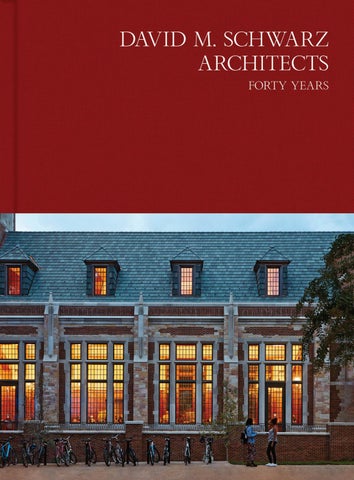
David M. Schwarz Architects

Page 1


opposite: Center field office building clockwise from top left: View down first-base line; Steel frame detail; Seating detail
left: Dr Pepper Youth Ballpark following: Aerial view

ESPN’S WIDE WORLD OF SPORTS COMPLEX

Lake Buena Vista, Florida, 1994 Client: Disney Development Company

David M. Schwarz Architects first met executives of the Walt Disney Company and Disney Development Company when their loyal clients in Fort Worth, Texas, the Bass Family, were major shareholders in Disney. Eventually, Disney hired the firm to design the Disney Vacation Club Clubhouse—a sales facility for Disney’s timeshare offerings, the Disney Vacation Club. After schematic design, that project came to an abrupt halt when Disney cancelled the project for non-architectural reasons. However, the Schwarz team left a positive impression with Disney. When Disney embarked on the Disney Sports Complex—now known as ESPN’s Wide World of Sports Complex—they returned to these architects for advice. Disney had already decided that their in-house design shop, the Imagineers, would be the design architects, and after a collegial discussion, Mr. Schwarz suggested they hire a sports architect as Architect of Record. Fast forward about another year, when three members of the architects’ leadership were in Florida on other business, and the Disney Development Company invited them to Orlando. Disney had decided to replace the Imagineers. By the end of their meeting, Disney asked the architects to join an already in-progress project team meeting in a construction trailer a mile away.

ESPN’s Wide World of Sports was planned as a collection of facilities to accommodate a wide range of amateur sports including tennis, baseball, softball, soccer, track and field events, cycling, gymnastics, and basketball, all situated in a park-like setting. To begin, the firm worked with the landscape architects to revise the master plan by incorporating a Main Street, an organizational

concept common to most of Disney’s parks. At the same time, Disney had been considering building a new theme park—a “fifth gate” for which this complex was thought to be the south anchor—and the Main Street could serve as the connector. The two featured structures are the ballpark and the fieldhouse. In addition to amateur games, the ballpark—designed to minor-league Triple-A standards—has been the spring training home for some Major League Baseball teams. The fieldhouse, depending upon its configuration, has up to eight basketball courts with minimal seating or a single center court with seating for 5,000 spectators. It was also used for the National Basketball Association’s 2020 “Season in a Bubble.” In addition to the two main structures, the firm designed several park structures throughout the landscape, including a tennis pavilion, other viewing facilities, and restrooms.

The Disney project team started with a predetermined aesthetic in mind for these buildings: red brick, like Fenway Park in Boston. In fact, they wrote that requirement into the Schwarz team’s contract. So the architects completed schematic designs for red-brick buildings. During the presentation of those concepts to higher Disney executives, one asked Mr. Schwarz what he thought of the design. After a nod from Disney’s team leader, Mr. Schwarz noted that Disney was expert at getting audiences to willingly suspend disbelief; however, even Disney was unlikely to get people to suspend disbelief to the point that they felt they were in New England in the middle of August in Orlando. When asked what the design direction should be, the architects suggested “Florida Picturesque,” which they had used for the earlier, unexecuted Disney Vacation

AMERICAN AIRLINES CENTER

Dallas, Texas, 2001

Client: Hillwood Development

As with The Ballpark in Arlin gton (see page 18), David M. Schwarz Architects won the commission for the American Airlines Center via a design competition, in this case a limited invitation to five prominent national firms. As the Schwarz team utilizes a highly client-interactive and iterative design process, design competitions usually place them at a distinct disadvantage. To overcome the disadvantage, they convinced the rather large and diverse client group to engage each firm in an interim design review prior to the due date for entries. This gave them an opportunity to present architecture as process, service, and more than just delivery of a product.

For the finals, the team presented numerous studies and options for all aspects of the building and grounds, including the master plan, iconic roof forms, concourse and seating-bowl arrangements, and exterior architectural styles. Because Ross Perot, Jr., majority owner of the Dallas Mavericks, owned 75 acres of developable land around the arena site—the Victory Park district that Dallas Stars principal owner, Thomas Hicks, would later buy into—the master plan was an unspoken criterion for landing the job. The Schwarz team noted that the civil engineers, retained before the competition, had designed a ten-lane arterial roadway to the east of the site, which would have effectively cut off the arena and Victory Park from the surrounding community. Instead, the architects suggested splitting the roadway into a more pedestrianfriendly pair of one-way streets, one on each side of the arena. That, along with their many façade options (to appeal to the client groups’ wide-ranging tastes) and some

pioneering interior circulation and bowl design concepts, proved victorious.

These innovative concepts were the most notable feature as the arena design advanced. Up until that date, most arenas had seating bowls surrounded by hippodrome-shaped, racetrack concourses with restrooms and concessions spread evenly around the perimeter. One only knew where one was by looking at the seatingsection numbers on signage. Attendees had no inherent sense of where they were. Additionally, each seating level had its own concourse, often with no connections to the others. The firm was eager to break this mold. They did so by designing four grand lobbies—one at each end, and one on each side of the seating bowl. In these multistory lobbies, upper-level concourses became balconies overlooking the levels below. On their edges, these lobbies housed concessions and escalators. Large, semicircular windows provided views from each lobby at every level to different parts of the city, so that patrons would always know on what side of the arena they were. At the end of each lobby, the architects placed a circular turning point, which reoriented visitors by 45 degrees into smaller corner lobbies that provided access to restrooms and elevators. At each level, these turning spaces have circular floor openings, providing another opportunity to link the various levels. In each corner, the architects connected the suite levels and club-level concourse via modern glass and stainless-steel open stairways. Beyond the organizational and wayfinding benefits for the patron, this innovative approach had one substantial unique advantage: the teams were able to sell naming rights and sponsorship packages,

non-game days to function as a park for the surrounding neighborhood. Likewise, some concession stands can operate on non-game days, so that neighborhood residents can have a grab-and-go lunch in the park.

DAVID M. SCHWARZ
page 38: View of home plate building from balcony suite above (top): View of center field; (bottom): Main entrance
clockwise from top left: Course as an urban park; On-grade concourse seen from balcony; Home plate building

For three weeks every late January and early February, the annual Fort Worth Stock Show and Rodeo (FWSSR) contributes significantly to the city’s economy and cultural life. Economically, the event brings in thousands of ranchers, cowboys, cowgirls, spectators, and visitors to the livestock exhibits and the three daily rodeos. Culturally, Fort Worth prides itself as being the head of the historic Chisolm Trail, and thus “Where the West Begins.”

The FWSSR is the United States’ longest continually running livestock show and rodeo, having started in 1896. Since 1936, the Will Rogers Memorial Center has hosted the FWSSR within its 120-acre complex. The rodeo is performed in the center’s coliseum. The coliseum, along with a matching auditorium, flank the Will Rogers Memorial’s towering southwestern art deco spire, designed by noted architect Wyatt C. Hedrick. Although the event continued annually, by the turn of the twenty-first century the much-loved coliseum had become significantly out dated for both rodeo operations and patron amenity and comfort. Additionally, the coliseum could not be touched without bringing it up to current codes, which would have cost nearly as much as a new arena. Moreover, there was no ability for Fort Worth to bring in traveling shows and host other events, unless a bigger, more modern, and commodious arena was built. By the early 2000s, a public-private partnership between Event Facilities Fort Worth (EFFW) and the City of Fort Worth retained David M. Schwarz Architects to plan and design a state-of-the-art replacement. The project team selected a new site within the Will Rogers complex and

DICKIES ARENA

design work began. However, the Great Recession of 2007–2009 brought planning to a halt after completion of the design development phase. The slow recovery meant the leaders would have to wait several years before they could mount a successful public-bond referendum to fund the city’s part of the financial contribution. Finally, the referendum passed with 79 percent acceptance in November 2014, and design activities recommenced. Nevertheless, before construction of the arena could begin, a new 2,200-car garage—also designed by the firm—was required to replace surface parking, as many events would continue at the Will Rogers complex during construction. The city also used this period to complete roadway, parking-lot, and landscape improvements needed to support the new arena.

The nearly 750,000-square-foot Dickies Arena sits atop a 4-acre, landscaped plaza with commanding views of the Will Rogers campus and downtown Fort Worth. While it is a multipurpose facility—home to Texas Christian University (TCU) basketball, concerts, boxing, National Collegiate Athletic Association tournaments, hockey, family shows, and other events—the architects specifically designed unique features to support the rodeo. Below the plaza, a 156,000-square-foot livestock support building is at the arena’s event level. This support level is fully conditioned and can be used as convention space for trade shows and similar events, thus making the arena capable of being used for an even larger range of events. The roof monitor for this level’s equine warm-up ring becomes a pavilion in the plaza, providing natural light and spectator views to the ring below. Pipe and drape or

Fort Worth, Texas, 2019
Client: Event Facilities Fort Worth
DAVID M. SCHWARZ
page 116: The Trust, Cassidy, and the Sanguinet buildings opposite: Sundance West apartments this page, top left: Cinema’s marquee; top right and right: Interior details; bottom left : Entrance detail at Sundance West
DAVID M. SCHWARZ
top: The Trust Building bottom: The Cassidy Building opposite: Lobby of the Trust Building

Published in Australia in 2024 by

The Images Publishing Group Pty Ltd

ABN 89 059 734 431

Offices

Melbourne Waterman Business Centre

Suite 64, Level 2 UL40

1341 Dandenong Road

Chadstone, Victoria 3148 Australia

Tel: +61 3 9561 5544

books@imagespublishing.com www.imagespublishing.com

New York

6 West 18th Street 4B

New York, NY 10011

United States

Tel: +1 212 645 1111

Shanghai

6F, Building C, 838 Guangji Road

Hongkou District, Shanghai 200434

China

Tel: +86 021 31260822

Copyright © David M. Schwarz Architects 2024. All images are by Hedrich Blessing / Hall + Merrick unless noted otherwise (see Project Credits, pages 345–347).

The Images Publishing Group Reference Number: 1607

All rights reserved. Apart from any fair dealing for the purposes of private study, research, criticism or review as permitted under the Copyright Act, no part of this publication may be reproduced, stored in a retrieval system or transmitted in any form by any means, electronic, mechanical, photocopying, recording or otherwise, without the written permission of the publisher.

Title: David M. Schwarz Architects: Forty Years // Text by Craig P. Williams

ISBN: 9781864709148

This title was commissioned in IMAGES’ Melbourne office and produced as follows: Editorial Georgia (Gina) Tsarouhas, Art direction/production Nicole Boehringer Thanks to Helen Koehne (proofing)

Printed by Graphius nv, Belgium, on 150gsm GardaMatt Ultra art paper

IMAGES has included on its website a page for special notices in relation to this and its other publications. Please visit www.imagespublishing.com

Every effort has been made to trace the original source of copyright material contained in this book. The publishers would be pleased to hear from copyright holders to rectify any errors or omissions. The information and illustrations in this publication have been prepared and supplied by David M. Schwarz Architects and the participants. While all reasonable efforts have been made to ensure accuracy, the publishers do not, under any circumstances, accept responsibility for errors, omissions and representations express or implied.

Turn static files into dynamic content formats.
Create a flipbook
Issuu converts static files into: digital portfolios, online yearbooks, online catalogs, digital photo albums and more. Sign up and create your flipbook.