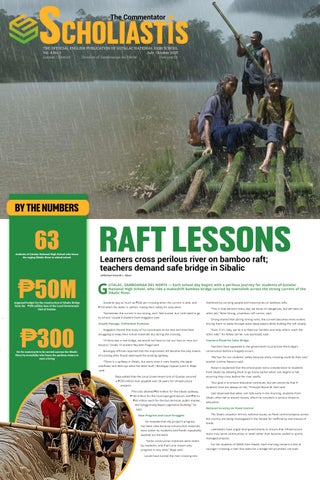
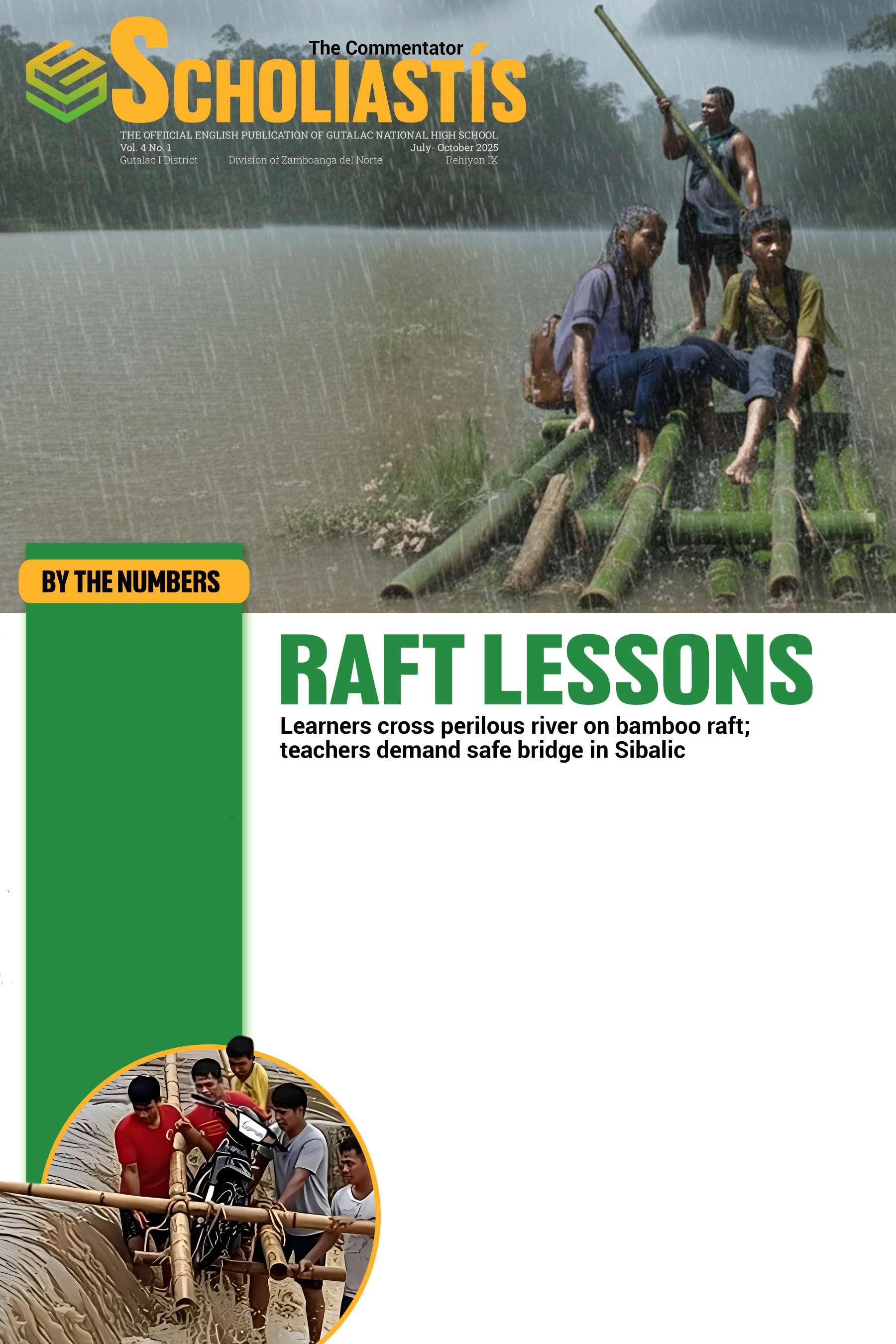
GUTALAC, ZAMBOANGA DEL NORTE — Each school day begins with a perilous journey for students of Gutalac National High School, who ride a makeshift bamboo bridge carried by townsfolk across the strong current of the Sibalic River.
Students pay as much as ₱ 300 per crossing when the current is wild, and ₱ 150 when the water is calmer, risking their safety for education.
“Sometimes the current is too strong, and I feel scared, but I still need to go to school,” Grade 9 student Clark Anggalon said.
Unsafe Passage, Unfinished Promises
Anggalon shared that many of his classmates arrive late and drenched, struggling to keep their school materials dry during the crossing.
“If there was a real bridge, we would not have to risk our lives or miss our lessons,” Grade 10 student Rey John Piagal said.
Barangay officials reported that the improvised raft became the only means of crossing after floods destroyed the existing spillway.
“There is a spillway in Sibalic, but every time it rains heavily, the water overflows and destroys what has been built,” Barangay Captain Junie K. Biaje said.
Biaje added that the Local Government Unit of Gutalac secured a ₱ 250-million loan payable over 20 years for infrastructure projects.
“The LGU allotted ₱ 50 million for the Sibalic spillway, ₱ 100 million for the municipal gymnasium, and ₱ 30 to ₱ 35 million each for the bus terminal, public market, and Sangguniang Bayan Legislative Building,” he said.
Slow Progress and Local Struggles
He revealed that the project’s progress has been slow because construction materials were stolen by residents and floods repeatedly washed out the work.
“Some construction materials were stolen by residents, and that’s one reason why progress is very slow,” Biaje said.
Locals have turned the river crossing into
livelihood by carrying people and motorcycles on bamboo rafts.
“This is how we earn every day; we know it’s dangerous, but we have no other job,” Rene Orong, a bamboo raft carrier, said.
Orong shared that during strong rains, the current becomes more violent, forcing them to wade through waist-deep waters while holding the raft steady.
“Even if it’s risky, we do it to feed our families and help others reach the other side,” his fellow carrier, Leo Gumotad, said.
Teachers Plead for Safer Bridge
Teachers have appealed to the government to prioritize the bridge’s construction before a tragedy occurs.
“We fear for our students’ safety because every crossing could be their last,” teacher Lutchie Navarro said.
Navarro explained that the school gives extra consideration to students from Sibalic by allowing them to go home earlier when rain begins to fall, ensuring they cross before the river swells.
“Our goal is to ensure education continues, but we cannot do that if students’ lives are always at risk,” Principal Rezve M. Sael said.
Sael observed that when rain falls early in the morning, students from Sibalic often fail to attend classes, which he considers a serious threat to education.
National Scrutiny on Flood Control
The Sibalic situation mirrors national issues, as flood control projects across the country are being investigated in the Senate for inefficiency and misuse of funds.
Lawmakers have urged local governments to ensure that infrastructure loans truly serve communities in need rather than become stalled or poorly managed projects.
For the students of GNHS from Sibalic, each morning remains a test of courage—crossing a river that waits for a bridge still promised, not built.
of Gutalac National High School who brace the raging Sibalic River to attend school
carried aacross the Sibalic River by townfolks who brace the perilous waters to earn a living
Jeffmhare Kieanth L. Mazo
Gutalac public market renovation brings hope to vendors, students alike
12 GNHS students reveal abuse; Police urge victims to speak up amid 19 recorded child rape cases
“We had readers regress instead of improve,” Palicte noted. “The gap widened when reading was no longer guided daily.”
Catch-Up Fridays: A Nationwide Push By 2023, DepEd introduced Catch-Up Fridays, a weekly initiative where students devoted one day to reading and literacy enhancement.
The goal was to recover lost learning caused by pandemic disruptions.
At GNHS, teachers welcomed the concept but struggled with its execution.
“We only have limited reading materials,” Dela Peña explained. “Some students don’t bring books at all. Without enough resources, we end up reading the same passages over and over.”
While the program instilled a reading habit, teachers said it fell short of addressing comprehension issues.
Non-readers and those with learning difficulties remained the most affected.
The ARAL Program and Recovery Efforts In 2024, DepEd rolled out the Academic Recovery and Accessible Learning (ARAL) program, a nationwide catch-up initiative designed to help students regain foundational skills in reading, math, and science.
According to DepEd, ARAL focuses on targeted interventions, prioritizing Grades 1 to 3 learners who struggle with literacy and numeracy.
The program integrates remedial reading sessions and peer tutoring.
“We saw small progress among our learners,” said Mr. Alvin Lomugdang, school reading focal person. “But sustainability remains the problem. Without continuous monitoring, we might lose momentum again.”
A Cycle of Reform, A Crisis Unresolved
Education experts point out that DepEd’s reading programs often follow a pattern.
Each new reform is introduced with urgency but rarely sustained long enough to create lasting change.
Data from Phil-IRI reports show that the number of independent readers has remained stagnant in many divisions.
Teachers argue that systemic issues—large class sizes, lack of reading corners, and insufficient teacher training—continue to hinder progress.
Palicte reflected, “It’s not that our students don’t want to read. It’s that they’re caught in a system that keeps starting over.”
A Fight Far from Over For teachers in Gutalac, every reading reform feels like rebuilding a fragile tower—one block at a time. Programs change names, materials are reprinted, but the struggle remains the same.
The goal is to make students truly understand what they read.
“The
Ivy Jane Salarda
Miryle B. Adaro Mary
Omaguing
Jeffmhare Kieanth
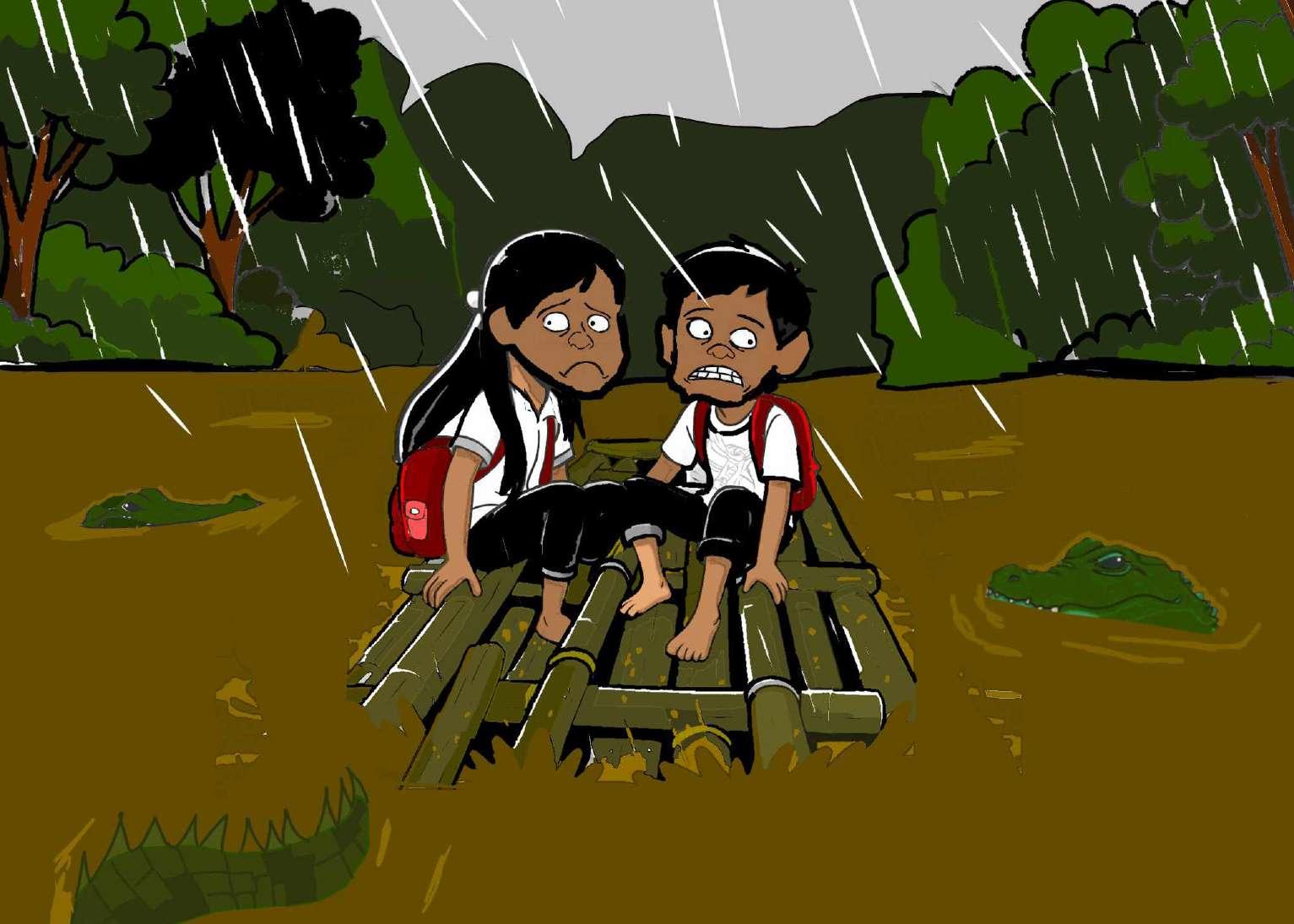
THE BRIDGE THAT NEVER WAS
a spillway that would connect children to classrooms, but what stands today is neither bridge nor progress—only bamboo lashed together by desperation. How many more mornings must end in fear before the bridge becomes more than a campaign word?
The tragedy here is not the flood—it is the bureaucracy drowning the people. Funds have been allocated, plans have been drafted, and still, the river reigns. Officials cite theft, bad weather, and bad luck. But bad governance, it seems, is the only constant that never gets washed away. When millions of pesos flow into a project and none of it reaches the people, the real disaster is not natural—it is man-made.
Even more insulting is how easily our institutions tolerate the delay. At the national level, for instance, the Commission on Audit (COA) came under scrutiny after a flood control
Lizette H. Baidiango
The Naked truth
project was reported 89% complete only 15 days after work commenced, and another 46% complete in just 2 days—clear “red flags” of fraud that were allegedly overlooked.
Moreover, since 2022 the Department of Public Works and Highways (DPWH) has not been coordinating with the agency mandated to draft a comprehensive river-basin master plan, meaning many flood-control works proceed without proper feasibility studies.
And while flood-prone provinces continue to suffer, senators lament that the vast floodcontrol budget has been “chopped up” among districts rather than used in integrated flagship investments.
Some will say progress takes time. But tell that to the students who paddle across death daily just to learn. Tell that to the parents who pay ₱300 for a trip that should have been free because a bridge that could save their children was never finished. Progress delayed is
progress denied. And in Gutalac, denial is killing opportunity one current at a time. What is needed now is not another feasibility study, nor another glossy rendering of a bridge that may never rise. What Gutalac— and communities across the country—need is transparency: open records of where the ₱250 million loan went, community oversight of every project peso, and accountability that bites—not just barks. Until those measures are in place, every promise of development remains just another plank in the raft of deceit.
If the government cannot protect the very students who embody the nation’s future, then what good is governance at all? Infrastructure without integrity is a monument to failure.
In the end, the people of Sibalic do not ask for luxury, only safety. But when even safety becomes a privilege, the bridge they wait for is no longer just concrete—it is justice itself.
RAccording to a 2024 Inquirer report, seven in ten Filipino teachers experience moderate to severe stress, while students cite “constant fatigue” as their most common academic struggle. The Alliance of Concerned Teachers (ACT) has repeatedly called for longer wellness periods, citing rising absenteeism and plummeting motivation. But every time teachers ask for rest, bureaucracy responds with another training, another form, another reason to stay tired. We call it “commitment to quality education,” but it’s really commitment to collapse. “Dungka,”
Ammibriel I. Villagracia
Cracks in the system
Pause and effect
est has finally entered the classroom. After months of marathon teaching, make-up
and
gymnastics, the Department of Education (DepEd) has declared a wellness break on October 27–30—a
pause in the academic treadmill. Even the In-Service Training (INSET) for teachers has been rescheduled so educators, for once, can breathe without guilt. The announcement was greeted less like a memo and more like
will spend the “break” checking papers; students will call it a “mental health break” while mentally breaking over deadlines. Administrators will post reminders about “wellness”—right before emailing the next set of requirements. It’s the Filipino version of rest:
Truth on trial
Joecyvelle L. Guilingan
Cyra Myrtel V. Maglangit
EDITORIAL
Ammibriel I. Villagracia
Ma. Niña Angela B. Amping
Mark Angelo Abilay
Jewel Calago
Pitogo Power Play
Baynosa smashes 5.28 meters, keeps Gutalac on top in girls’ shot put
We couldn’t tell where the ball would land—his jump was too high, and his foot’s twist was unpredictable
We
-Dagaylon
Pitogo
Mark Angelo Abilay
Jewel Calago
-Baynosa
Mark Angelo Abilay
BREAKING THE TIME BARRIER
“It
to quit. But I realized, the race isn’t over yet.”
According to sports coordinator Jess D. Antigo, Inso made history as the first female athlete from Gutalac to win double gold in the regional meet since the school’s founding in 1981.
BSince then, no Gutalacnon athlete has returned to the national stage.
In 2024, Naseha Inso brought home two gold medals from the Zamboanga Peninsula Regional Athletic Association (ZPRAA) Meet but failed to qualify for the Palaro after falling short of the required time.
“I won two gold medals, but it felt like fake gold because I still didn’t make it to the Palaro,” said Inso, who admitted that the lack of continuous training affected her performance.
According to sports coordinator Jess D. Antigo, many student-athletes have the potential to reach the national level but lack a strong support system to develop their skills.
Paperwork Heavier Than Medals
“There are athletes who can’t compete just because of missing documents or low grades,” Antigo said.
He added that every year, several students are disqualified simply because they cannot complete the required papers before the regional meet.
“Sometimes the papers weigh more than the medals,” he remarked, glancing at a list of disqualified athletes.
Coaches Still Learning the Game
Antigo revealed that many teachers are assigned as coaches for sports they are not familiar with due to the lack of trained trainers.
“Many of our coaches learn the game while already teaching it,” he said.
Because of this, the school relies on old playbooks and online videos as alternative training materials.
Lack of Facilities and Practice Time
In the school’s single covered court, athletes from volleyball, basketball, badminton, and even the dance troupe train at the same time.
“When it rains, practice stops; when the sun is up, it’s unbearably hot,” said Antigo.
Maria Liza Ramos from the volleyball team shared that not all teachers allow them to be excused from class for practice sessions.
Collaboration and Reform
Some alumni have long expressed willingness to help but said there was no clear coordination between them and the administration.
“I’m ready to help, but no one reached out,” said Angus, the only Gutalacnon to compete in the Palarong Pambansa.
Antigo said one of his goals is to revive the school’s sports network in partnership with alumni and the local government.
He also plans to launch a school-based sports clinic to identify promising athletes at an early age.
Despite the limitations, Antigo and the young athletes of Gutalac remain hopeful that their time will come—when the long drought of defeat will finally give way to the harvest of victory.
This year, Inso is training under a tighter regimen designed to improve speed and endurance. Every afternoon, she can be seen circling the old oval in Gutalac—her shadow stretching behind her like a silent witness to unfinished business.
“Every step feels like a continuation of last year’s race,” she said. “But this time, I’m running wiser, stronger, and hungrier.”
If she breaks through the qualifying time, Inso will become the second athlete in Gutalac’s 44-year history to reach the Palarong
“She has the potential not only to qualify for the Palaro but to rewrite Gutalac’s athletic story,” Antigo said, his tone mixing hope and pride.
Pambansa—following Jomar P. Angus, who won a bronze medal in the 3000-meter steeplechase in 2011.
“What Jomar did back then reminds me that it’s possible,” Inso said. “He ran for Gutalac’s pride. Now it’s my turn.”
Carrying the school’s banner once more, Inso will represent Gutalac National High School in the Cluster Meet in Kalawit, Zamboanga del Norte on November 6, the first step in her pursuit of a long-awaited national return.
No longer running just for medals, Inso runs for meaning—for a small town’s dream of proving that from the quiet hills of Gutalac, champions can still rise.