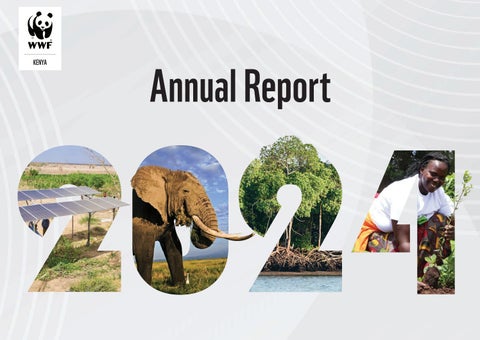
Annual Report 2024

Page 1


Testimonials

There is dignity and prosperity in the work we do now. No more running battles with the police over illegal brew. With the support of WWF-Kenya, we earned our first one million shillings through the sale of indigenous seedlings. This backing from a reputable organization opened our eyes to new possibilities It has unlocked doors for us, including our latest sale of 1.2 million shillings.

I am proud that we are bold enough and ready to formally make financial disclosures on what we are doing on our journey in embracing sustainable finance practices. We have an opportunity to unveil the ‘Banks Climate-Related Financial Disclosures Reporting Template’ developed by the KBA’s Sustainable Finance Initiative (SFI) and is based on the Task Force on Climate-Related Financial Disclosures (TCFD) framework. We wish to appreciate WWF-Kenya for their funding support

Kenya Bankers Association CEO, Dr. Habil Olaka

Elizabeth Kigen - Chair, Tumaini Self Help Group, Kaptagat Forest

Elephants are majestic and immense, yet incredibly fragile creatures. Without our diligent care for them and their precious habitat, they risk vanishing from our land forever. This would be a devastating loss for us, as the economy of Oloitoktok depends greatly on tourism, the natural environment, and our culture. Let the teamwork of elephants inspire us to come together, to stand united in protecting our wildlife. In doing so, we not only safeguard our natural heritage but also ensure our prosperity,

What motivates us is that mangroves provide us with job opportunities, especially for us women, through nurseries which are a source of income. Additionally, we understand the importance of mangroves in ensuring we have clean air and in reducing diseases.

Ronda Senkeiyo -Resident Loitoktok, Kajiado County
Mariam Ali from KiongweCFA member, Mkunumbi CFA.

MESSAGE FROM OUR CHAIRMAN

It is a privilege to share WWF-Kenya’s 2024 Annual Report—a moment to reflect on the challenges we face, the progress we’ve made, and the partnerships that continue to shape our journey.

Over the past year WWF-Kenya has operated at the intersection of two realities. On the one hand, Kenya faces mounting pressure on land, freshwater resources and habitats for wildlife from the ever-expanding infrastructure, growing population, changing land use and worsening climate change impact.

On the other, we are witnessing many opportunities: stronger political will, more inclusive conservation models, stronger desire for transformative alliances, and a rising generation of youth and communities who are demanding and driving change.

As a Board, we have remained focused on ensuring that WWF-Kenya’s strategy, governance, and investments are aligned with this evolving landscape. We have supported the finalisation of the revised Integrated Strategic Plan (2020–2030), approved in June 2024, which sharpens our focus on measurable impact, landscape-level visioning, and adaptive management. We have also overseen key steps to strengthen financial resilience, compliance, and enterprise development, ensuring that conservation is not only sustainable, but also economically empowering.

WWF-Kenya’s work is rooted in collaboration. Whether it is restoring forests, protecting endangered species, or supporting nature-based enterprises, our impact is made possible by the dedication of our staff, the courage of local communities, the technical support of partners, and the trust of donors.

As stewards of this mission, the Board remains committed to enabling bold, inclusive, and transparent conservation action. We recognise that the scale of the challenge requires humility, innovation, and a shared resolve.

On behalf of the Board, thank you to everyone who contributed to the achievements of the year. The work continues, and so does our commitment to a future where nature and people thrive together.

MESSAGE FROM OUR CEO

This report covers the period July 2023 – June 2024

As I reflect on the past year, I am reminded of the quiet but powerful momentum that continues to build across our landscapes, communities, and partnerships. This report captures not just statistics, but stories of recovery, resilience, and the growing belief that conservation in Kenya is both possible and essential.

While our work is implemented across four priority landscapes and through a national programme addressing cross-cutting themes, it is guided by six strategic goals that shape our vision and actions. These are: Thriving Wildlife, Functioning Habitats, People Benefiting, Footprint Greened, Improved Governance, and Organizational Excellence. Together, they reflect our commitment to achieving a healthy natural environment that supports people and sustainable development in Kenya.

Under Thriving Wildlife, we’ve seen encouraging signs of stability and growth. The black rhino population rose to 1,004, with poaching rates held at 0.4%—below the national threshold. In Loita, elephant numbers increased significantly, and the Tsavo lion census confirmed population stability. Marine conservation efforts also showed progress, with turtle by-catch dropping from 231 to 159. These gains are the result of years of collaboration between rangers, communities, and partners—working to secure safe spaces for both people and wildlife.

In Functioning Habitats, our restoration efforts are beginning to bear fruit. Over 14,500 hectares were restored this year, bringing our cumulative total to 176,780 hectares. Forests and drylands are recovering and river health in catchments like Mara and Naivasha remained stable, and the spawning potential ratio for parrot fish reached 24%, indicating sustainable fishing practices. These ecological indicators reflect a deeper truth, that when habitats are healthy, communities thrive.

People Benefiting is at the heart of our work. In FY24, over 38,000 people directly benefited from our conservation initiatives, including emergency support to flood-affected families in Lamu County. Cumulative beneficiaries now stand at over 141,000 since 2020. Income generated by supported communities reached KES 48.4 million this year, pushing the total to KES 440.32 million. We also supported the creation of 1,499 jobs, ranging from nature-based enterprises to rangers and nature-positive agriculture. These are not just numbers, they

represent livelihoods, dignity, and hope.

Through Footprint Greened, we have continued to promote nature-positive investments and sustainable infrastructure. From bankable solutions in agriculture to green entrepreneurship, our focus has been on practical innovations that improve lives while protecting ecosystems. We have also worked with financial institutions to integrate climate risk into their operations, laying the groundwork for a more resilient economy and a more sustainable future.

In Improved Governance, we have supported policy frameworks and communityled governance structures that embed sustainability into local decision-making. Our engagement with County Governments and the National Government is helping shape the future of Kenya’s landscapes in ways that are inclusive, accountable, and adaptive. These efforts are ensuring that conservation is not just a project, but a shared responsibility.

Finally, Organizational Excellence has remained a priority. We have strengthened our internal systems, improved financial performance, and deepened our engagement with supporters. We have laid the foundation for the next phase of our Integrated Strategic Plan, ensuring that WWF-Kenya remains agile, transparent, and ready to meet the challenges ahead.

Taken together, these achievements show that conservation in Kenya is not just about protecting wildlife, it is about securing the future of people, ecosystems, and economies. It is about working together, staying grounded, and being bold in the face of uncertainty.

To our staff, partners, government colleagues, communities, and supporters—thank you. Your commitment makes this work possible.

As we look ahead, our task is to build on this momentum, scale what works, and remain focused on the vision of a Kenya where nature and people thrive together.

Mohamed Awer

We’re here to discuss a crucial topic that connects us all: the future of business, society, and nature. This is an issue many of you are deeply involved in. We are living through what’s often called the triple planetary challenge: climate change, biodiversity loss, and pollution. These challenges are made more urgent by our rapidly growing global population.

Today, the group prioritizes two key areas. The first one is green financing, where to date, 15% of our loan book is dedicated to green projects, and our goal is to grow this to 25% in the next couple of years.

The private sector holds incredible power when it comes to conservation. You have the ability to influence not only your clients and guests, but also your own employees. That is the power of the people in this room. Conservation isn’t just a simple box to check off; it’s a process that you should integrate into your company’s daily operations. It’s a living part of your business, which is what we’ve strived to do at Sankara.

We can’t do business on a dead planet. International companies already recognize this fundamental link. As a key finding from the World Economic Forum’s 2020 New Nature Economy Report states: There is no future for business as usual.

About 10 years ago, we, the community in Siana...set aside some 10,000 acres of land... and we did approach quite a number of organizations, but we were not successful... But when we met with WWF, they took a bet on us... And thanks to the partnership with WWF also, we now have, we are now over 2,000 landowners in Siana... we have a guaranteed lease payment of some money... we have a bursary programme that is benefiting over 500 kids every year...

Technology has rapidly changed conservation, but a major challenge remains: the tools are not yet accessible or affordable. For us to make real progress, we must address these barriers. For example, much of this technology requires smartphones, but the communities who need it most often can’t afford them. This is a problem we must solve, especially with the continued development of AI.

ABOUT US

We are the World Wide Fund for Nature- Kenya (WWFKenya), a locally registered non-governmental conservation organization and an affiliate of WWF International. Our strength lies in our collaboration with the government, civil society, private sector organizations, and local communities. Together, we strive to create a healthy natural environment supporting the Kenyan people and sustainable development.

OUR VISION

A healthy natural environment supporting people and sustainable development in Kenya

WE ARE ON A MISSION

To stop degradation of our planet’s natural environment, and build a future in which humans live in harmony with nature

OUR LANDSCAPES

Kenya Rift Lakes Landscape - KRL

Kenya Rift Lakes Landscape (KRL) covers three sub-landscapes, namely;

(i) Naivasha-Western Aberdares

(ii) Eastern Mau-Nakuru

(iii) Baringo-Bogoria-Elgeyo Marakwet. This region is dominated by two key water towers (Mau and Aberdares) and five lakes (Naivasha, Elementaita, Nakuru, Bogoria and Baringo), and significant areas of irrigated land for food and flowers: for the nation and export.

South of Kenya North of Tanzania Landscape - SOKNOT

The Southern Kenya Landscape (SKL) l is part of the transboundary landscape that covers the Southern Kenya and Northern Tanzania (commonly known as Unganisha-SOKNOT). The Southern Kenya landscape is divided into three sub-landscapes:

i) Amboseli-Chyulu

ii) Greater Mara -Loita

iii) Tsavo.

This landscape is rich in biodiversity and home to over 60% of Kenya’s wildlife. It is also home to over two million people, benefiting from the usually vibrant tourism sector, livestock rearing and agriculture.

Northern Kenya Landscape - NKP

Northern Kenya Landscape (NKL) is a new conservation frontier for WWF-Kenya. The expansive landscape, which presents an unparalleled opportunity for biodiversity conservation, is highly vulnerable to extreme effects of climate change. The landscape has untapped potential for WWF-Kenya with unique habitats, endemic and endangered species and critical wildlife corridors. Given the vasteness of the landscape, we will identify and implement scalable solutions in key areas. This ensures our efforts have a ripple effect, positively impacting a wider portion of NKL over time.

Coastal Kenya Landscape - CKL

Coastal Kenya Landscape (CKL) encompasses land and seascape, managed under two sub-landscapes: i) Kwale-Kilifi ii) Lamu-Ijara.

Kenya’s coastal region is endowed with a variety of habitats and ecosystems that carry valuable natural resources, with rich biological diversity. Rich in species of conservation value to WWF- Kenya and the country, the landscape’s major habitats include, rain forest (Shimba Hills Ecosystem), dryland forest, woodlands, scrublands, freshwater ecosystems (rivers, lakes and wetlands), Rangelands and farmlands. The Seascape is home to marine turtles, one of WWF’s priority species, it encompasses vital habitats such as mangrove forests, estuaries, seagrass, coral reefs, beaches and open waters.

INDIAN OCEAN
L. VICTORIA
United Republic of Tanzania

OUR GOALS

FROM RANGELANDS TO WETLANDS

Thriving Wildlife

Increased to 1,004 in FY24 compared to 966 in FY23

Zero

retaliatory killing of lions recorded in FY24 thanks to implementation of the safe system approach as way of curbing human wildlife conflict

Tsavo census estimates of 424 lions demonstrating stability in lion population in Tsavo.

SAFE System Strategy: all 3 sub-landscapes in the Southern Kenya adopted the SAFE System strategy for safe People, wildlife, assets and habitats.

Elephants: Loita Elephant census in in Loita recorded at 659, an increase from 432 recorded in 2018.

Turtle By-catch recorded at 159 in FY24, down from 231 in FY23

Black Rhino:

Water for all: people, livestock and wildlife, as solar power springs 40-year-old borehole to life

The Ilmarba solar-powered borehole, originally drilled by the Government of Kenya with donor support in the 1980s and initially running on diesel fuel, has been renovated and solarised under our WWF-Kenya Southern Kenya Landscape Initiative. Thanks to financial support from the Michael Otto Foundation for Sustainability and the German Federal Ministry for Economic Cooperation and Development.

Situated near Amboseli National Park, this borehole is a lifeline for people, their livestock, and wildlife. A camera trap installed near one of the dedicated troughs for wildlife revealed the diverse array of wildlife that rely on the borehole for water, among them zebras, elephants, waterbucks and hyenas.

Before solar

Annual cost: 7,592,400 KES

Diesel use:

35 litres/day × 186 KES/litre = 2,376,150 KES/year

Generator dependency

Borehole serving: 1,000+ people

1,366 cattle

2,852 goats & sheep

Wildlife (elephants, lions, giraffes, zebras)

Impact

After solar

Annual savings: 3,796,200 KES

Maintenance costs cut in half

More affordable water access

Increased resilience & community growth

Solar energy = reduced costs + stronger community + sustainable future.

Miriam Naloomala, a resident of Ilmarba, carries water fetched from the community’s solar-powered borehole, a lifeline that has transformed her life and ensured sustainable water access for the entire village.
©Faith Tanui/WWF-Kenya Camera trap photos

Working with rangers to end illegal wildlife trade

“When it comes to preventing illegal wildlife trade, women are at the forefront in my community. We lead patrols, secure crime scenes and educate our people about the value of wildlife and the importance of protecting animals from poachers. We also collaborate closely with the Kenya Wildlife Service (KWS), thanks to the training provided by WWF.”

Purity Lakara, female ranger based at Olenarika Conservancy, Olgulului Group Ranch

“Using the camera traps, we are able to monitor wildlife distribution and address issues related to illegal wildlife trade. This technology helps us to protect endangered wildlife species and also to maintain the balance of wildlife in our ecosystem.”

Functioning Habitats

14,585.7 hectares of landscapes and habitats restored bringing the cumulative area under restoration to 176,780 hectares. Key forests under restoration are Kaptagat, Oloitoktok, Chepalungu, and Shimba Hills.

Normalized difference vegetation index (NDVI): Based on GIS data, NDVI within targeted terrestrial forests in WWF Kenya priority landscapes improved to 0.726 in 2024 up from 0.381 index in 2023.

River Health Index (RHI): The scorecard of the average RHI in WWF-Kenya targeted rivers maintained at the moderate score of 2 in FY24. The RHI scorecard for Mara, Njoro and Naivasha rivers was moderate (a score of 2). The average overall score for all the categories

(biota, water quality and community perception) for the Mara River Basin was at 2.19 in FY24, compared to 1.8 score in FY22. These scores indicate a moderate health status of the said catchments.

Stable e-flows recorded for targeted rivers in the Kenya Rift Lakes landscape: 2 rivers, Malewa and Gilgil recored improved environmental flows (e-flows). Rivers Malewa and Gilgil recorded enhanced compliance to water abstraction regulations as set by the Water Resources Authority (WRA), which in turn helped reduce illegal and over abstraction hence Environmental flows or base flows maintained. The discharge levels as at June 2024, for rivers Gilgil, Turasha and Malewa were 0.608M3/sec, 3.28M3/sec and 0.927M3/ sec, respectively. In addition, the Mara and Naivasha rivers (reported in FY23) all have their e-flows maintained at 1M3/ sec. These scores demonstrate

Restoration: A summary of achievements

Restoration work

• FY24 Restoration Achieved: 14,585.7 Ha

• FY24 Target: 20,000 Ha

• % Achieved: 72.9%

• Cumulative Total Restored: 176,780 Ha

Vegetation Health (NDVI)

NDVI Scores (Normalized Difference Vegetation Index):

Conclusion: Significant recovery in vegetation after drought

Spawning Potential Ratio (SPR) – Parrot Fish

• FY24 SPR: 24%

• Sustainability Threshold: 20%

• Interpretation:

• Fish stock is healthy and sustainable

• 24% of mature females remain in the population for reproduction

River Health Index (RHI)

• Average RHI Score FY24: 2.0 (Moderate)

• Rivers Scored: Mara, Njoro, Naivasha

• Mara Basin Detailed Score (FY24): 2.19

o Improved from FY22: 1.8

Environmental Flows (E-Flows)

• Rivers Secured for E-Flows in FY24: 2

o Malewa and Gilgil

• Improved Compliance: Yes (per Water Resources Authority guidelines)

• Discharge Levels (June 2024):

o Gilgil: 0.608 m³/sec

o Turasha: 3.28 m³/sec

o Malewa: 0.927 m³/sec

• Maintained E-Flows (FY23):

o Mara & Naivasha: 1 m³/sec

Conclusion: These scores indicate a moderate health status of the said catchments.

Aberdare Forest: over 500 hectares restored

The once heavily degraded Aberdare Forest is now bouncing back: greener, richer, and more resilient. Thanks to the five-year Forest Landscape Restoration (FLR) initiative that has combined environmental restoration with the improvement of livelihoods for forest-adjacent community members. Between 2020 and 2025, over 547 hectares of the forest have been restored, while many farmers living nearby are harvesting the rewards of sustainable farming, particularly through the cultivation of red tamarillos, commonly known as tree tomatoes.

Led by WWF-Kenya and funded by the German Federal Ministry for Economic Cooperation and Development (BMZ) through its BENGO – Climate Funding Facility, the FLR project has turned forest restoration into an engine for both ecological and economic revival. Working with 447 tamarillo farmers and local institutions, the project also complements Kenya’s national ambition to restore 5.1 million hectares of land under the AFR100 initiative by 2030.

Logoman Forest: 206.5 hectares under restoration

The 1.3 million tree seedlings model nursery in Loitokitok Forest Station. This modern innovative facility has a bi-annual production of 650,000 seedlings and is one of the largest in the country. Featuring a solar-powered borehole to ensure year-round seedling production, WWF-Kenya and the Kenya Forest Service installed this facility at a cost of 16 million shillings thanks to funding from the International Climate Initiative through the German Federal Ministry for the Environment, Nature Conservation, Nuclear Safety, and Consumer Protection.

Loitokitok Forest: Modern model tree nursery established

Working with members of the Logoman Community Forest Association (CFA), we planted 223, 534 indigenous tree species, putting 206.5 hectares under restoration.

Members of Logoman Community Forest Association in the Mau ecosystem pose for a group photo with Kenya Forest Service and WWF-Kenya officials in Nakuru County after the launch of Participatory Forest Management Plans on Tuesday, 19 September 2023. Through our technical and financial support, Logoman CFA developed and launched a Participatory Forest Management Plan that effectively brought 9,523 hectares under sustainable forest management.

People Benefiting

14,536 people directly benefiting from WWF and partners conservation initiatives, including

2,250 benefiting from emergency response. Cumulative people benefiting stands at 115,455

KES 400.78M: Financial income generated by WWF-Kenya direct beneficiaries up from KES 391.88M reported in FY23.

KES. 465,916,839.79 - Grants disbursed to support conservation initiatives in FY 24

KES. 655,759,174.48 amount of money paid directly to communities and businesses that delivered goods and services to enhance conservation impact delivery for the benefit of people and nature.

38,398 the number of people who directly benefited from WWF-Kenya and partners’ initiatives

1,499 jobs created in FY 24 across the WWFKenya landscapes and sectors: nature based enterprises and bankable solutions in the agriculture sector. Compares to 1,344 jobs created in FY23.

Promoting climate smart agricultural practices

Samson Kimeli is one of many residents of Kaptagat, Elgeyo-Marakwet County, who have benefited from WWF-Kenya’s conservation efforts aimed at improving livelihoods through agroforestry. In July 2023, under the Kaptagat Integrated Conservation Programme, 10,000 avocado seedlings were distributed to local farmers. This initiative contributed to the restoration of approximately 505 hectares of the degraded landscape with indigenous trees and fruit crops, promoting environmental health while also improving household incomes.

Samson’s journey with avocado farming began earlier, during the 5th Edition of the Kaptagat Conservation Drive in 2021, when he received his first batch of seedlings as part of a distribution of 3,000 avocado trees. Today, he is part of a growing community of farmers whose lives are being transformed through nature-based solutions.

WWF-Kenya is a key partner in the Kaptagat Integrated Conservation Programme, working alongside local stakeholders to promote sustainable land use, restore degraded landscapes, and support community resilience.

Under the Tree No More: Ilmao Women’s transformation from Harsh, Under-Tree Beadwork to

Meet the Ilmao Women Group, In the heart of Imbirikani Group Ranch in Southern Kenya, a community conservancy supported by WWF-Kenya. Their story of transformation starts from a dream to create nature-based enterprises that would allow them to reap the benefits of eco-tourism on their ancestral land, known for its rich Maasai culture and wildlife.

Tourists were drawn to the vibrant Maasai beaded ornaments and accessories, sparking a business opportunity for the women. Armed with unmatched beadwork skills and the little capital they had, they seized the chance. However, there was a challenge - shelter. With no proper workspace, they were left to create their intricate beadwork under a tree, vulnerable to harsh weather conditions, without a safe place to store their valuable creations or display.

Financial support of WWF-Kenya through funding from the German Federal Ministry for Economic Cooperation and Development (BMZ) came at the right time, enabling the construction of a modern facility for the Ilmao Women Group. Today, the women work in a dignified space, their craft flourishing and their beads safely stored. The new facility has not only boosted their productivity but also their pride and sense of empowerment.

a

Modern Facility Imbirikani

3 Enterprises/ investments established as a result of WWF-Kenya and partners support

3 Nature Based Enterprises were established during the year. These include Black Soldier Fly enterprises in Tsavo, and Affordable Student Green Housing enterprise in Mara sub-landscapes.

2 County Spatial Plans (Narok and Bomet) supported by WWF-Kenya are informing County management decisions, contributing towards improved land use planning for better management of natural resources.

WWF-Kenya’s and partners’ support, the Central Bank of Kenya (CBK) issued guidance on climate related risk management. As such, 46 Kenyan banks have adopted the climate-related disclosure reporting template, thus

enhancing adoption of green/blue financing systems that integrate environment and social governance considerations by financial, lending institutions and investors.

500 households in Kilifi County adopted energy efficient technologies (improved cooking stoves).

50 farmers in Samburu County, are implementing climate smart agriculture for improved climate adaptation.

TWO Boreholes were solarized in Isiolo County and Shurr Conservancy enabling climate adaptation for at least 5,000 people

Driving Sustainable Impact

In collaboration with partners, WWF-Kenya made transformative contributions to environmental conservation, climate resilience, and sustainable development across Kenya. Here are the highlights: Nature-based enterprises flourish

Supported the establishment of three nature-based enterprises, including a black soldier fly business for Mgeno Conservancy in Tsavo and affordable student green housing enterprise in Mara.

Greening the financial sector in Kenya

With WWF-Kenya’s support, the Central Bank of Kenya issued guidance on climate-related risk management. As such, 46 Kenyan banks adopted climate disclosure templates, accelerating green and blue financing and Environmental, Social, and Governance integration.

Empowering communities with clean energy

In Kilifi County, 500 households adopted energy-efficient cooking stoves, reducing deforestation and indoor pollution.

Solar-powered water access

In Isiolo and Marsabit counties, two boreholes were solarized, providing clean water to over 5,000 people in Shurr Conservancy.

Advocacy: lobbying for sustainable infrastructure development

WWF-Kenya joined a coalition of conservation organizations, government agencies, and civil society actors that called on the National Government to consider an alternative road for a section of the over 500-kilometer Mau Mau Road designed to traverse through Aberdare National Park, a critical ecological zone. The group comprised Conservation Alliance of Kenya, African Wildlife Foundation, Green Belt Movement, East Africa Wildlife Society, Rhino Ark and the National Environment Civil Society of Kenya.

Using evidence-based advocacy, supported by scientific evidence and spatial analysis, the coalition lobbied for the 32-km Kariamu-Ndunyu Njeru road that offers a shorter route compared to the proposed 49km Ihithe-Ndunyu Njeru road, which cut right in the middle of the Aberdare ecosystem. The group demonstrated that the proposed construction of the 32km stretch of road threatens the ecological integrity of the Aberdare National Park and forest reserve, a critical water catchment area and biodiversity hotspot.

Through coordinated efforts to raise public awareness and promote sustainable alternatives, the Environment and Land Court in Nyeri issued and repeatedly extended conservatory orders halting the construction of the road, pending further review and site assessments.

“At what cost to the environment will this road be done? Is it sustainable? The Aberdare is a critical water catchment. This means that the destruction of this ecosystem will affect all of us, because what happens in the Aberdare does not stay in the Aberdare, making the preservation of this critical ecosystem, my business, your business, and our business.”

Christine Mwangi, Regional Coordinator, Africa Sustainable Investment & Infrastructure Programme, WWF-Kenya

Improved Governance

47 policies, legislations, standards and Plans, at national, county and community levels influenced by WWF-Kenya. 9 out of the 4 documents progressed to implementation status

They include;

• National mangrove ecosystem management plan;

• Recovery and action plan for black rhino in Kenya (2022-2026);

• Central Bank of Kenya guidelines on climaterelated risk disclosures and management;

• Taita Taveta animal feeding strategy;

• Mgeno conservancy policy manuals;

• Wushumbu conservancy policy manuals;

• Nyandarua county forest land restoration strategy;

• Regional minimum terms and conditions for fisheries; and

• Green economy strategy and implementation plan, 2016

During the financial year 2024, WWF-Kenya actively engaged in and influenced a total of 47 policies, legislations, standards, and plans across national, county, and community levels. These efforts were aimed at strengthening environmental governance and ensuring that conservation priorities were integrated into key decision-making processes.

Out of the 47 documents influenced, 9 progressed to implementation status. These documents reflect WWF-Kenya’s strategic input and alignment with partner recommendations, marking a significant milestone in translating policy influence into tangible action.

Policies Under Implementation

• National Mangrove Ecosystem Management Plan

• Recovery and Action Plan for Black Rhino in Kenya (2022–2026)

• Central Bank of Kenya Guidelines on Climate-Related Risk Disclosures and Management

• The Sable Antelope Recovery and Action Plan 2024-2033

• Taita Taveta Animal Feeding Strategy

• Mgeno Conservancy Policy Manuals

• Wushumbu Conservancy Policy Manuals

• Nyandarua County Forest Land Restoration Strategy

• Regional Minimum Terms and Conditions for Fisheries

• Green Economy Strategy and Implementation Plan (2016)

Journey of Water: Kenyans unite to save River Kibos

“If we are not careful as a country, Kenya could become a land of dry rivers,” said Enock Kiminta, – Chief Executive Officer (CEO) of the Kenya National Water Resources Users Association, the umbrella organization of water resources users associations.

Kiminta was speaking at the stakeholders’ conference held in June in Kisumu City on the third and final day of the Journey of Water campaign for River Kibos.

At the conference, the three counties in western Kenya that share River Kibos pledged to restore the water source and its tributaries following the Journey of Water campaign. This was the third edition of the campaign spearheaded by WWF-Kenya, the first having been for River Malewa in 2022 and the second for River Ewaso Nyiro in 2023.

The three-day national campaign raised awareness on water security and brought together over 1,800 participants, including government authorities, nonstate actors, civil societies and local residents from across the three counties. There was a marked increase in the number of young people who participated in the walk, among them university students who are members of environmental clubs.

Following the issues exposed during the walk along River Kibos, Nandi, Vihiga and Kisumu Counties agreed to an 11-point joint communique, outlining the joint efforts they would undertake to restore water catchments in the Lake Victoria Basin Area.

Winding over 60 km through the three counties, River Kibos is a crucial transboundary water resource in the region,providing 65% of the water supply to about half-a-million Kisumu City residents but to communities in the upper catchment who use it both for domestic and irrigation purposes. However, River Kibos faces numerous threats. Upstream catchment encroachment due to human activities is diminishing water quality and quantity. Unsustainable sand harvesting is destabilizing the riverbanks and altering the natural flow. In the middle catchment areas, the degradation of riparian zones is harming the ecosystem, while the lower zones of the river are suffering from increasing pollution levels, further impacting water quality.

Judy Oluoch – Kisumu County Committee Executive Member for Water, Environment, Natural Resources and Climate Change, read out the commitments at the stakeholders’ conference.

“We commit to establish a joint water resource facility geared towards pooling resources from respective counties and development partners…..and in collaboration with other stakeholders support the establishment of the Basin Water Resource Committees in the Lake region,” read Judy.

During the Journey of Water campaign, participants walked 23 km along the River Kibos and its tributary, River Nyangori, through River Nyamasaria to the mouth in Dunga Beach.

Julius Korir – Principal Secretary (PS), State Department for Water, flagged off the campaign at Kobujoi, Nandi County, the river’s waterhead.

Mr. Korir said “the Ministry [of Water, Irrigation and Sanitation] is engaging with stakeholders on the modalities of establishing Basin Water Resources Committees. The Intergovernmental Water Sector Coordination Framework was signed and will soon be operational. The framework is critical for water conservation because it represents all stakeholders, from the National and County Governments to the communities living within the basins and other key stakeholders.”

Along the course of the river, the caravan noted the widespread establishment of on-farm woodlots, which have increased the tree cover of the area while also diversifying the livelihoods of the local communities.

However, there was also widespread sand harvesting in the middle catchment, riparian encroachment, including the planting of eucalyptus trees along the riparian. Most of the sand harvesting is undertaken by youth who relied on it for their daily bread.

Engaging with the youth, the local Water Resources Authority, pledged to follow up with the community to ensure their participation in the development of their sub-catchment plan.

The development of the sub-catchment plan will give youth opportunities to participate in the identification of alternative livelihoods and sustainable practices that will ensure they derive benefits from their natural resources while also conserving water sources.

In their joint communique, the three countries also promised to: “Prioritize sensitization, empowerment, and engagement of the local communities in the sub-catchments to adopt sustainable practices, including sustainable land use, agroforestry, and the planting of indigenous and appropriate tree species.”

“Water connects us more than anything else. It is, therefore, our joy to be here together. Our biggest responsibility is not only promoting the conservation of water source areas but also fostering our unity and togetherness,” said Mohamed Awer – CEO, WWF-Kenya.

The Journey of Water campaign is funded through the Catchment to Tap project which is supported by the Embassy of the Kingdom of the Netherlands in Kenya and other partners.

Organizational Excellence

Kshs 2,950,862,304

Funding secured for conservation impact for the benefit of people nature and the economy.

72,724 new supporters joined the movement bringing the total to 281,264 across all levels of WWF Kenya supporters. This translates to 108% achievement of the FY24 target of 260,198.

Integrated Strategic Plan 2020-2030 review completed

Landscape Visioning: Landscapes vision documents, aligned to the revised ISP Optimization of the Enterprise resource planning (ERP) System for enhanced efficiency

WWF-Kenya made notable progress in strengthening its operational efficiency and institutional performance during the financial year 2024. The following highlights reflect key achievements under the organizational excellence goal:

Funding Status

WWF-Kenya secured a total of Kshs 2,950,862,304 in funding against a target of Kshs 3,001,624,135, achieving a performance rate of 98.3%. This includes Kshs 3.47 million raised through individual giving, demonstrating growing public support and diversified funding sources.

Funds Utilization

By the end of June 2024, the organization had utilised 76% of its available funds, slightly below the annual target of 85%. However, this marks an improvement from the previous year’s utilisation rate of 73%, indicating better financial execution and resource deployment across landscapes and units.

FY24 Work Plan Execution

Implementation of the approved FY24 work plan showed strong performance across all operational areas. Overall, 76.6% of planned activities were executed, with 57.8% fully completed and an additional 18.8% reaching over 50% completion. This reflects consistent progress in delivering on strategic commitments.

Audit, Risk and Compliance

WWF-Kenya successfully implemented 98% of prior year audit recommendations. Of these, 42% were fully addressed while 56% remain in progress. Only 2% were not implemented, primarily due to dependencies on ongoing processes such as SAP optimisation, policy revisions, and vendor payments. This demonstrates a robust approach to risk management and internal controls.

Supporter Base Growth

The organization welcomed 72,724 new supporters in FY24, bringing the cumulative total to 281,264. This represents 108% achievement of the annual target of 260,198, underscoring the effectiveness of outreach and engagement strategies.

Integrated Strategic Plan (ISP)

The review of WWF-Kenya’s Integrated Strategic Plan (2020–2030) was successfully concluded, with Board approval secured on 27th June 2024. Socialization sessions were conducted across all landscapes and units to ensure staff alignment. Additionally, the Monitoring, Evaluation, and Learning (MEL) Plan, aligned to the revised ISP, was finalized to support performance tracking and adaptive management.

Otin Agnes Nangira Odhiambo
Awer

TOTAL INCOME:

Our FY24 restricted income spending increased by 20% compared to FY23 due to increased funding

EXPENDITURE:

The proportion of administrative expenditures to that of program expenses reduced to 6% from 7% in previous year.

A healthy natural environment supporting people and sustainable development in

Kenya

Turn static files into dynamic content formats.
Create a flipbook
Issuu converts static files into: digital portfolios, online yearbooks, online catalogs, digital photo albums and more. Sign up and create your flipbook.