From Risk to Resilience
Helping People and Firms
Adapt in South Asia
Megan Lang, Jonah Rexer, Siddharth Sharma, and Margaret Triyana, Editors
Poor people are poor because markets fail them and governments fail them. Governments intervene to correct market failures, such as externalities or public goods, but these, in turn, create government failures, such as unaccountable service providers or elite capture of public resources. The challenge of poverty reduction is to design actions that correct government failures without recreating the market failures the policies were meant to address, and vice-versa.
These principles underpin this remarkable and refreshing book on climate adaptation in South Asia, the most vulnerable region on the planet. The book starts by asking how the private sector— households and firms—is adapting to higher temperatures and more frequent extreme-weather events. The authors’ motivation, namely that all South Asian governments lack fiscal space and, therefore, the private sector should undertake adaptation, is not necessary. Even if these governments had fiscal surpluses, the private sector should lead because there is no obvious market failure in adaptation. When a firm installs a ceiling fan or a household reinforces its walls, the firm or household benefits. As the report shows, firms and households are undertaking such adaptation measures. But these people may not have access to the most up-to-date information about rising heat or storm frequency. This information is a public good and so there is a case for the government to provide it at this stage. However, once this information becomes mainstreamed, there is no need for the government to be involved, just as financial investors get their information from non-government sources. Information is not the only constraint to better adaptation by the private sector.
The report documents how firms lack access to credit in order to purchase expensive technologies for adaptation. Although most surveyed firms—around the world—claim they lack credit, the solution of subsidizing credit should be treated with care. Usually, the lack of credit stems from a distortion in the banking sector, and unless that is addressed, a subsidy could even make matters worse. The report likewise points out that distortions in other markets, such as labor and land, impede firms’ adaptation. Again, the solution should be to reform these markets, not take them as given and subsidize adaptation. The latter is politically tempting, but it risks locking the country in a policy that is hard to reverse—the 50-year-old policy of free power to farmers in south India is a case in point. Incidentally, the detrimental effect of this free-power policy on groundwater supply, exacerbating the effects of climate change on agriculture, is another case of government failure undermining climate adaptation.
After examining the potential for the private sector, with better information and fewer regulatory constraints, to undertake adaptation, the report concludes that public investment in core public goods such as roads, bridges, and health systems, as well as in social protection, will be necessary. But these are sectors in which South Asian countries have historically underperformed. Maintenance of roads, which is the key to resilience, is chronically under-funded; doctors and nurses in primary health centers in India are absent 40 percent of the time; Sri Lanka’s flagship social protection program, Samurdhi, only reaches 40 percent of the poor (and is subject to political capture). The complementary public investments should build on these lessons, promote greater accountability, and minimize government failures in fulfilling the legitimate role of government.
By providing an analytically rigorous, evidence-based, and comprehensive treatment of climate adaptation in South Asia, this book is a model for how to use economics to help poor people. It will definitely feature in my syllabus, as well as in many others.
Shanta Devarajan
Professor of the Practice of International Development, Edmund A. Walsh School of Foreign Service, Georgetown University
This is a timely report for at least two reasons. First, recent disaster events and longer-run environmental changes across South Asia, ranging from massive floods in Pakistan and heat waves across India to an increase in water and soil salinity in the coastal areas of Bangladesh, West Bengal, and Orissa, imply that the climate crisis is already affecting millions of lives. It has become urgent to give private and public sector decision-makers in the region some ideas for policy tools to deal with these crises. Second, because households and firms have already started experiencing these changes, social scientists can finally observe how people mitigate and adapt to these shocks. This implies that the new insights that are now emerging from research studies based on actual empirical observations of people’s reactions to shocks are more robust and dependable than past studies that relied on counterfactual modeling of future climate scenarios. Social science research is on a much more solid footing when we analyze observations of actual changes rather than make predictions of future changes. It is important for the World Bank to use its considerable convening power and analytical capabilities to summarize and highlight these new insights for decision-makers in the region.
Ahmed Mushfiq Mobarak
Jerome Kasoff ’54 Professor of Management and Economics, Yale University
This book, along with any associated content or subsequent updates, can be accessed at https://hdl.handle.net/10986/43230
Scan to see all the titles in this series. Data associated with this book have been deposited in the World Bank Open Data Repository (https://data.worldbank.org/).
Megan Lang, Jonah Rexer, Siddharth Sharma, and Margaret Triyana, Editors
© 2025 International Bank for Reconstruction and Development / The World Bank 1818 H Street NW, Washington, DC 20433
Telephone: 202-473-1000; Internet: www.worldbank.org
Some rights reserved
1 2 3 4 28 27 26 25
This work is a product of the staff of The World Bank with external contributions. The findings, interpretations, and conclusions expressed in this work do not necessarily reflect the views of The World Bank, its Board of Executive Directors, or the governments they represent.
The World Bank does not guarantee the accuracy, completeness, or currency of the data included in this work and does not assume responsibility for any errors, omissions, or discrepancies in the information, or liability with respect to the use of or failure to use the information, methods, processes, or conclusions set forth. The boundaries, colors, denominations, links/footnotes, and other information shown in this work do not imply any judgment on the part of The World Bank concerning the legal status of any territory or the endorsement or acceptance of such boundaries. The citation of works authored by others does not mean The World Bank endorses the views expressed by those authors or the content of their works.
Nothing herein shall constitute or be construed or considered to be a limitation upon or waiver of the privileges and immunities of The World Bank, all of which are specifically reserved.
Rights and Permissions

This work is available under the Creative Commons Attribution 3.0 IGO license (CC BY 3.0 IGO) http://creativecommons.org /licenses/by/3.0/igo. Under the Creative Commons Attribution license, you are free to copy, distribute, transmit, and adapt this work, including for commercial purposes, under the following conditions:
Attribution —Please cite the work as follows: Lang, Megan, Jonah Rexer, Siddharth Sharma, and Margaret Triyana, eds. 2025. From Risk to Resilience: Helping People and Firms Adapt in South Asia. South Asia Development Matters. Washington, DC: World Bank. doi:10.1596/978-1-4648-2152-3. License: Creative Commons Attribution CC BY 3.0 IGO
Translations —If you create a translation of this work, please add the following disclaimer along with the attribution: This translation was not created by The World Bank and should not be considered an official World Bank translation. The World Bank shall not be liable for any content or error in this translation.
Adaptations —If you create an adaptation of this work, please add the following disclaimer along with the attribution: This is an adaptation of an original work by The World Bank. Views and opinions expressed in the adaptation are the sole responsibility of the author or authors of the adaptation and are not endorsed by The World Bank.
Third-party content —The World Bank does not necessarily own each component of the content contained within the work. The World Bank therefore does not warrant that the use of any third-party-owned individual component or part contained in the work will not infringe on the rights of those third parties. The risk of claims resulting from such infringement rests solely with you. If you wish to re-use a component of the work, it is your responsibility to determine whether permission is needed for that re-use and to obtain permission from the copyright owner. Examples of components can include, but are not limited to, tables, figures, or images.
All queries on rights and licenses should be addressed to World Bank Publications, The World Bank, 1818 H Street NW, Washington, DC 20433, USA; e-mail: pubrights@worldbank.org.
ISBN (paper): 978-1-4648-2152-3
ISBN (electronic): 978-1-4648-2260-5
DOI: 10.1596/978-1-4648-2152-3
Cover design: David Spours (Cucumber Design).
The cutoff data for the data used in the report was April 10, 2025.
Library of Congress Control Number: 2025928191.
This regional flagship series serves as a vehicle for in-depth synthesis of economic and policy analysis on key development topics for South Asia. It aims to promote dialogue and debate with all of the World Bank’s partners—from policymakers to civil society organizations, academic institutions, development practitioners, and the media—and to contribute toward building consensus among all those who care about stimulating development and eradicating poverty in South Asia.
2025
From Risk to Resilience: Helping People and Firms Adapt in South Asia (2025), Megan Lang, Jonah Rexer, Siddharth Sharma, and Margaret Triyana (eds.)
2023
Striving for Clean Air: Air Pollution and Public Health in South Asia (2023), World Bank
2021
Hidden Debt: Solutions to Avert the Next Financial Crisis in South Asia (2021), Martin Melecky
2018
South Asia’s Hotspots: Impacts of Temperature and Precipitation Changes on Living Standards (2018), Muthukumara Mani, Sushenjit Bandyopadhyay, Shun Chonabayashi, Anil Markandya, and Thomas Mosier
2016
Leveraging Urbanization in South Asia: Managing Spatial Transformation for Prosperity and Livability (2016), Peter Ellis and Mark Roberts
South Asia’s Turn: Policies to Boost Competitiveness and Create the Next Export Powerhouse (2016), Gladys Lopez-Acevedo, Denis Medvedev, and Vincent Palmade
2015
Addressing Inequality in South Asia (2015), Pradeep K. Mitra, Martin Rama, John Lincoln Newman, Tara Béteille, and Yue Li
2012
More and Better Jobs in South Asia (2012), Reema Nayar, Pablo Gottret, Pradeep Mitra, Gordon Betcherman, Yue Man Lee, Indhira Santos, Mahesh Dahal, and Maheshwor Shrestha
All books in the South Asia Development Matters series are available for free at https://hdl.handle.net/10986/2149
Weifeng Larry Liu, Warwick McKibbin, Franziska Ohnsorge, and Siddharth
Ademola Braimoh, Harideep Singh, and Ashesh Prasann
Ashley Charlotte Pople, Dhriti Pathak, Hagen Kruse, and Thomas Michael Kerr
Zhang, Capucine Riom, and Asmita Tiwari
5.7
5.8
6.6
S.1
2B.3
2B.4
3B.1
3B.7
3B.8
3C.5
4C.1
B5.1.1
5B.2
5B.3
5B.4
5B.6
This volume, a product of the World Bank’s Office of the Chief Economist for South Asia, represents the collective effort of far more individuals than the names that appear on its cover. First and foremost, we extend our deep gratitude to Martin Raiser, Vice President for South Asia at the World Bank, who has supported and championed this project from inception and whose vision has been central to shaping this book.
We are immensely grateful to all our contributors, without whom this volume would not exist. The six chapters were prepared by Megan Lang, Weifeng Larry Liu, Warwick McKibbin, Franziska Ohnsorge, Jonah Rexer, Siddharth Sharma, and Margaret Triyana. Seema Jayachandran co-authored box 5.1. The authors of the deep dives were Ademola Braimoh, Ashesh Prasann, and Harideep Singh (deep dive 1); Thomas Michael Kerr, Hagen Kruse, Dhriti Pathak, and Ashley Charlotte Pople (deep dive 2); Sarah Coll-Black and Javier Sanchez-Reaza (deep dive 3); and Capucine Riom, Asmita Tiwari, and Yan Zhang (deep dive 4). We are grateful for their substantial expertise and for their patience and insightful responses to our frequent queries. By commenting on each other’s work, the authors and contributors have collectively improved the quality of this volume.
In addition to the core authors, many colleagues contributed inputs to the deep dives: Maha Ahmed, Md Mansur Ahmed, Amadou Ba, Olivier Durand, Andrew Goodland, Chris Jackson, Sabina Karki, John Keyser, Manivannan Pathy, Alreena Renita Pinto, Tomás Rosada, Sheu Salau, Joachim Vandercasteelen, and Shijie Yang (deep dive 1); Randa El-Rashidi, Tehreem Fatima, Catherine Fitzgibbon, and Martha Hobson (deep dive 3); and Chandan Deuskar, Ross Eisenberg, Tjark Gall, Natsuko Kikutake, Jolanta Kryspin-Watson, Jun Rentschler, Bachir Sabo, Zoe Trohanis, and Ayush Yadav (deep dive 4).
This book has benefited from the expert advice of many people, including peer reviewers, participants in the authors’ workshop, and attendees at numerous seminars and conferences. We especially thank Stephane Hallegatte and Richard Damania, and their respective teams, for helpful comments during the seminars.
Teevrat Garg and Anant Sudharshan served as external academic reviewers to the chapters. Patrick Behrer, Miki Khanh Doan, Jia Li, Viviana Perego, Sumati Rajput, and Mark Roberts served as peer reviewers. Charles Collyns, Graham Heche, Graeme Littler, Jim Rowe, and Chris Towe provided technical and editorial suggestions. Francesca de Nicola, Ebad Ebadi, Jia Li, Claudia Ruiz Ortega, and Marc Schiffbauer served as discussants at the authors’ workshop. Additional inputs and advice were received from Gayatri Acharya, Ana Goicoechea, Mehul Jain, Abhas Jha, Abedalrazq Khalil, and Cem Mete.
A special thanks is owed to Achyuta Adhvaryu, Teevrat Garg, and the 21st Century India Center at the University of California, San Diego, with whom we organized the joint 2024 World Bank–UC San Diego Workshop on Climate Adaptation in South Asia and who have served as fantastic intellectual partners from the beginning of this endeavor. Through many conversations, they have sharpened our thinking on climate adaptation, helped refine the firm surveys behind this report, and pushed our inquiries into new directions.
Issac Yurui Hu, Isabella Masetto, and Xinyi Wang provided excellent research assistance. Additional research assistance was provided by Kaihao Cai, Ahnaf Rafid Bin Habib, Andy Weicheng Jiang, Mehria Saadat Khan, MD Shah Naoaj, Muhammad Ahmed Nazif, Laura Heras Recuero, Saloni Taneja, Astha Vohra, and Nolan Ander Young Zabala.
The South Asia Climate Adaptation (SACA) Household Survey was conducted in collaboration with Mehul Jain, Ashley Charlotte Pople, Satya Priya, and Deepak Singh (Bihar, India) and Bramka Arga Jafino, Swarna Kazi, and Tom Schwantje (Bangladesh). The SACA Firm Survey was conducted in collaboration with Ana Goicoechea and Hosna Ferdous Sumi (Bangladesh); Mehul Jain, Nicholas Jones, and Deepak Singh (India); and Guillermo Carlos Arenas, Tobias Akhtar Haque, and Rafay Khan (Pakistan). The surveys would not have been possible without these close partnerships.
We are grateful for financial support for the book and the SACA survey from the World Bank’s Resilient Asia Program, funded by the UK government’s Foreign Commonwealth Development Office (FCDO). This funding is delivered through Climate Action for a Resilient Asia (CARA), the United Kingdom’s flagship regional program to build climate resilience in South Asia, Southeast Asia, and the Pacific islands. The SACA Household Survey in Bangladesh received financial support from the Global Facility for Disaster Reduction and Recovery’s (GFDRR) Japan–World Bank Program for Mainstreaming Disaster Risk Management in Developing Countries, which is financed by the Government of Japan and receives technical support from the GFDRR’s Tokyo Disaster Risk Management Hub. The SACA Firm Survey in Pakistan received financial support from the FCDO through the Pakistan@100 Partnership Trust Fund.
The dedication and professionalism of the production team converted the manuscript into a finished book. Rana Al-Gazzaz contributed to the report’s production and dissemination. Quinn David Spours designed the graphics and layout, and Sutton Austin was responsible for the layout and typesetting of the Advance Edition. Kathie Porta Baker, Talia Greenberg, Graeme Littler, Peter Milne, and Erin Rice edited the report. Elena Karaban and Mehreen Arshad Sheikh coordinated dissemination with support and advice from Shilpa Banerji, Diana Ya-Wai Chung, and Sudip Mozumder. Ahmad Khalid Afridi provided administrative support.
We thank Hans Timmer, former Chief Economist for South Asia at the World Bank, who sparked this book’s initial ideas and guided us in the early stages of the project.
Finally, we are deeply indebted to Franziska Ohnsorge, Chief Economist for South Asia at the World Bank, whose unwavering support and insightful guidance have been instrumental in driving our climate adaptation research program, which has culminated in this volume.
People in South Asia are familiar with the intense heat and sudden downpours of monsoon season. The monsoon rains bring life to the crops and relief from the summer heat. But monsoons can also be powerful and destructive, especially as weather patterns in the region become increasingly unpredictable and extreme. Last year’s monsoon caused severe flooding in Bangladesh, India, Nepal, and Pakistan. This year’s monsoon is expected to arrive early and again bring above-normal rainfalls.
South Asia is one of the most climate-vulnerable regions in the world, with its high population density, already high temperatures, and exposed geography. Since 2010, natural disasters have affected an average of about 67 million people each year. The situation is worsening: By 2030, nearly 90 percent of the region’s population will be at risk of extreme heat, and nearly 25 percent will be at risk of severe flooding.
The most dramatic weather shocks can destroy assets and livelihoods. Displaced households face lost incomes, and firms must address lost revenues and supply chain disruptions. Weather shocks can be damaging even when they are not dramatic; high temperatures can reduce worker productivity and crop growth.
South Asia’s households and firms are not helpless in the face of these shocks. Indeed, to the extent they can, they adapt. Households dig drainage ditches or plant trees to protect and shade their homes. They move to areas that are less vulnerable to weather shocks. Similarly, firms adjust and shift production locations or diversify suppliers to reduce their risks. Many firms invest in fans and air conditioning in response to higher temperatures.
But the autonomous actions of households and firms are often not enough. To date, most households and firms in South Asia take only basic adaptation measures that leave them vulnerable to climate shocks. More advanced adaptations, such as planting climate-resilient crop varieties and subscribing to index-based weather insurance products, are uncommon, especially among poor households.
The reasons households and firms do not adapt effectively are the same as the ones that limit their livelihoods. They lack access to credit, affordable technology, and information and are trapped in high-risk locations by a lack of jobs elsewhere. They lack weather-resilient roads needed to access markets and inputs, even during weather shocks. They lack the piped water that can be safe to drink, even during floods.
What can governments in South Asia with limited fiscal resources do to boost the resilience of their economies and societies? This report offers some solutions, focused on ensuring that markets work better, thereby helping poor households and small firms adapt more effectively. Information is often helpful on its own, such as providing early warnings about impending storms, droughts, or floods. Governments can also help by removing obstacles to autonomous adaptation, such as increasing access to credit or removing labor and land market distortions that lock people and firms in vulnerable places. Targeted public investments in physical and social infrastructure—such as access roads, drainage systems, and primary health facilities—and adaptative social protection systems can complement market-based measures to protect those who are most vulnerable.
The people of South Asia have always found ways to adapt and thrive in difficult circumstances. As worsening weather shocks pose a serious challenge, simple yet effective adaptation strategies can help bolster the ingenuity and resilience of the people in the region to overcome such challenges.
Martin Raiser Vice President, South Asia Region
South Asia is the most climate-vulnerable region among emerging market and developing economies (EMDEs). With governments having limited room to act because of fiscal constraints, the burden of climate adaptation will fall primarily on households and firms. Awareness of climate risks is high; more than 75 percent of households and firms expect a weather shock in the next 10 years. Climate adaptation is widespread, with 63 percent of firms and 80 percent of households having taken action. However, most rely on basic, low-cost solutions rather than leveraging advanced technologies and public infrastructure. Market imperfections and income constraints limit access to information, finance, and technologies needed for more effective adaptation. If these obstacles were removed, private sector adaptation could offset about one-third of the potential damage from rising global temperatures to South Asian economies. The policy priority for governments is, therefore, to facilitate private sector adaptation through a comprehensive policy package. The package includes climate-specific measures such as improving weather information access, promoting resilient technologies and weather insurance, and investing in protective infrastructure in a targeted manner. Equally important are broader developmental initiatives with resilience co-benefits: in other words, policies that generate double dividends. These include strengthening core public goods like transportation, water systems, and health care; addressing barriers to accessing markets, inputs, and finance without causing unintended responses that increase vulnerabilities; and supporting vulnerable groups through shock-responsive social protection.
Chapter 2. Under the Weather: Household Climate Risk. South Asia is expected to face more frequent and more severe weather shocks over the coming decade. By 2030, 1.8 billion people (89 percent of the region’s population) are projected to be exposed to extreme heat, while 462 million people (22 percent) are projected to be exposed to severe flooding. Poor and agricultural households in the region are more exposed to, and affected by, weather shocks. Weather shocks cause damage to human capital and assets, as well as income losses. However, when households receive early warnings, nearly 90 percent take preemptive action to reduce damages. Households’ access to early warning systems is uneven: In vulnerable coastal and riverine areas,
most households have access to early warnings for cyclones, but fewer than half of them have access to early warnings for floods and other shocks. These findings call for better early warning systems, targeted programs to assist vulnerable households during shocks in a timely fashion, and policies to help households adapt to the growing risk of extreme weather shocks.
Chapter 3. Prepared for the Worst: Building Household Resilience. Rising exposure to climate risk in South Asia has increased pressure on households to adapt, but current adaptation strategies among rural households are inadequate for the scale of the problem. Although 80 percent of surveyed households in South Asia have adapted to climate change in some way, 80 percent of these adapting households rely on accessible, low-technology methods, with limited use of more advanced tools such as weather insurance or climate-resilient agricultural inputs. Limited access to credit, land, and information all constrain household adaptation. Extreme weather events lead to short-lived adaptations whose longer-term effectiveness may be limited, and underestimation of future climate risk leads to inadequate investment in adaptation. Protective public infrastructure tends to substitute for private adaptation. This removes some of the burden on households, but it carries a risk of investing in places rather than people, generating lock-in, and forestalling necessary reallocations. Policies to alleviate financial and land market failures and information constraints can help households adapt in place, and faster job creation in non-agricultural sectors and urban areas would help them move to more productive sectors and locations.
Chapter 4. Shutters Down: Firm Climate Risk. Increasingly frequent and severe weather shocks reduce revenues; damage physical assets; and require costly shifts in products, markets, and labor practices for South Asian firms. Firm managers in the region expect that increasingly frequent and severe weather shocks will cause damages in 2025–29 that are three times as great as those experienced from 2019 to 2024. More experienced and more highly skilled managers tend to have expectations about future weather shocks that are more aligned with consensus forecasts. They also expect lower damages, possibly because better managers tend to be better able to adapt to extreme weather.
Chapter 5. Back to Business: Building Firm Resilience. South Asian firms are acting to mitigate the impact of weather-related shocks on their business, with 63 percent of them having undertaken at least one such action in the past five years. But these firms have largely relied on low-cost upgrades to buildings and equipment for adapting to the growing risk of weather shocks rather than major upgrades to capital, technologies, or business practices. Firms that have experienced, or expect, more weather shocks have been more likely to undertake adaptations, while firms with less-advanced management practices and firms facing greater financial and regulatory obstacles have adapted less. These results suggest that there is scope for policies to encourage adaptation by improving access to information about adaptation options, by helping firms to strengthen managerial capabilities, and by easing regulatory burdens and expanding access to finance.
Chapter 6. Returns to Resilience: Aggregate Impacts of Adaptation. Because of South Asia’s already-high average temperature and reliance on rain-fed agriculture, rising global temperatures could lead to aggregate output and per capita income losses by 2050 that are larger than those in
the average EMDE. Higher temperatures would cause significant damage in the most vulnerable sectors, such as agriculture, but more limited damage in the most resilient sectors, such as services. About one-third of the total climate damage could be reduced if the private sector could flexibly shift resources across activities and locations in response to these climate-induced changes in relative prices and incomes. Even South Asia’s fiscally constrained governments have scope to facilitate these shifts, including by expanding access to finance, improving transport and digital connectivity, and providing well-targeted and flexible social benefit systems.
South Asia’s high vulnerability to rising global temperatures and increasingly common weather shocks, combined with constrained fiscal positions limiting public adaptation measures, means the burden of adaptation will fall disproportionately on firms and households—particularly poor households, which are more vulnerable to weather shocks. A comprehensive and systematic review of research identifies a variety of adaptation strategies used by households, firms, and farmers. These strategies have reduced the damage from weather shocks by 46 percent, on average, in the examples covered by the literature. Adaptations that involve new resilient technologies or public support—typically in the form of core public goods such as roads and health systems that help access jobs and protect human capital—tend to be the most effective in reducing the damage from weather shocks. Compared with households and farmers, firms have access to more effective adaptation strategies, typically technology-related. The analysis suggests that policy should be guided by three principles: (1) implementing a comprehensive package of policies, (2) prioritizing policies that generate “double dividends,” and (3) designing policies that target broader developmental goals in a manner that does not set back adaptation-related goals.
Deep Dive 1. Climate Adaptation and Agriculture in South Asia. South Asian agriculture faces significant challenges from rising global temperatures, compounded by the sector’s existing constraints, including the predominance of smallholder farming and low productivity. Rising temperatures, water scarcity, irregular rainfall patterns, and more frequent extreme weather events such as droughts and floods threaten to reduce South Asia’s agricultural output by 7.5 percent by 2050, considerably more than in other EMDE regions. The key strategies needed to build agricultural resilience are the promotion of climate-smart farming practices, expansion of weather insurance markets, redirection of inefficient input subsidies, modernization of irrigation infrastructure, and leveraging of digital technologies to deliver weather information and advisory services to farmers.
Deep Dive 2. Bridging the Adaptation Financing Gap in South Asia. Dedicated adaptation finance meets only a fraction of South Asia’s needs for climate adaptation. This gap stems from limited fiscal space for public funding and financial market imperfections that limit private financing. To help finance public goods for adaptation, governments can mobilize resources by eliminating distortions like fossil fuel subsidies, scaling up innovative instruments like blended finance, and strengthening institutional capacity to access concessional sources of climate finance. Credit and insurance market failures that limit access to adaptation financing can be overcome through standardized metrics to improve lending decisions, the strategic use of public finance for de-risking private credit, emergency credit guarantee schemes, and expanded markets for weather index insurance.
Deep Dive 3. Adaptive Social Protection in South Asia. Social protection systems can help strengthen resilience, before a shock strikes, by reducing poverty and, once a shock strikes, by supporting those who are the most vulnerable. These programs can also help build resilience to climate change by encouraging adaptation, asset accumulation, and income diversification. However, although South Asia’s social protection systems have good coverage at 77 percent of the population, they are underfunded, with expenditures at only 4 percent of gross domestic product, less than half the EMDE average. These programs are also generally not well-targeted and not rapidly scalable, which could be addressed with investments in information systems and program design. Case studies from Bangladesh, India, and Pakistan show that well-targeted social assistance programs, combined with up-to-date information, can be rapidly scaled up to respond to shocks and provide support for poor and vulnerable individuals.
Deep Dive 4. Urban Policy for Climate Adaptation in South Asia. Just like South Asia’s rural population, its urban population is also highly exposed to extreme weather shocks, and this exposure is projected to grow. By 2030, 322 million (24 percent of the urban population) are projected to be exposed to flooding, while 1.2 billion (92 percent) are projected to be exposed to extreme heat. Large and growing concentrations of vulnerable population groups in cities add to the region’s challenge of building urban resilience to extreme weather. South Asian cities can build climate resilience by better integrating climate risk data into urban planning and regulation, further investing in early warning systems and resilient infrastructure, supporting targeted interventions for vulnerable populations, and strengthening the technical capacity of city governments to implement resilience-related programs.
acronyms definitions
AC air conditioner
ADB Asian Development Bank
AE advanced economy
AfDB African Development Bank
ATAI Agricultural Technology Adoption Initiative
AIIB Asian Infrastructure Investment Bank
ASPIRE Atlas of Social Protection Indicators of Resilience and Equity
BAMIS Bangladesh Agro-Meteorological Information System
BDM Becker-DeGroot-Marschak
BISP Benazir Income Support Programme
BKBDP World Bank Bihar Kosi Basin Development Project
CAT catastrophe
CBI Climate Bonds Initiative
CCDR Country Climate and Development Report
CEB Council of Europe Development Bank
CEGA Center for Effective Global Action
CIAT International Center for Tropical Agriculture
CLP Chars Livelihood Program
COVID-19 coronavirus (SARS-CoV2)
CPI Climate Policy Initiative
CRAFT Climate Resilience and Adaptation Finance and Technology Transfer Facility
CREWS Climate Risk and Early Warning Systems
CSA climate-smart agriculture
DBT direct benefit transfer
DDO deferred drawdown option
acronyms definitions
DFI development finance institution
DFO Dartmouth Flood Observatory
EAP East Asia and Pacific
EBRD European Bank for Reconstruction and Development
ECA Europe and Central Asia
EIB European Investment Bank
EMDE emerging market and developing economy
ER enhancing resilience
EWS early warning system
FAO Food and Agriculture Organization
FDI foreign direct investment
FFS farmer field school
GARI Global Adaptation & Resilience Investment Group
GCA Global Center on Adaptation
GCF Green Climate Fund
GDP gross domestic product
GFD Global Flood Database
GFDRR World Bank Global Facility for Disaster Reduction and Recovery
GHG greenhouse gas
GSDMA Gujarat State Disaster Management Authority
HH household
HSC Higher Secondary Certificate
IAAS Integrated Agrometeorological Advisory Service
ID identification document
IDB Inter-American Development Bank
IFPRI International Food Policy Research Institute
ILO International Labour Organization
IMF International Monetary Fund
IPCC Intergovernmental Panel on Climate Change
IsDB Islamic Development Bank
J-PAL Abdul Latif Jameel Poverty Action Lab
KAIP Kenya Agriculture Insurance Program
KLIP Kenya Livestock Insurance Program
KPI key performance indicator
LAC Latin America and the Caribbean
LDC least developed country
LVC land value capture
acronyms definitions
MARD Viet Nam Ministry of Agriculture and Rural Development
MDB Multilateral Development Bank
MGNREGS Mahatma Gandhi National Rural Employment Guarantee Scheme
MNA Middle East and North Africa
MNAIS Modified National Agricultural Insurance Scheme
NAP National Adaptation Plan
NBS nature-based solution
NDB New Development Bank
NDCs Nationally Determined Contribution
ND-GAIN University of Notre Dame’s Global Adaptation Initiative
NGO non-governmental organization
NSER National Socio-Economic Registry
OECD Organisation for Economic Co-operation and Development
OLS ordinary least squares (regression)
PIPIP Punjab Irrigated-agriculture Productivity Improvement Project
PKR Pakistani Rupee
PMFBY Pradhan Mantri Fasal Bima Yojana
PMT proxy means test
PPPs public-private partnerships
R&D research and development
RCP representative concentration pathway
RHS Right-Hand Side
RWI Relative Wealth Index
SACA South Asia Climate Adaptation
SAR South Asia Region
SARCE Office of the Chief Economist for the South Asia Region (World Bank)
SCERs Sri Lankan Certified Carbon Reductions
SD standard deviation
SHRUG Socioeconomic High-resolution Rural-Urban Geographic Platform for India
SIDS Small Island Developing States
SLCCS Sri Lanka Carbon Crediting Scheme
SLCF Sri Lanka Climate Fund
SME small and medium-sized enterprise
SMS short message service
SSA Sub-Saharan Africa
SSP Shared Socioeconomic Pathways
UNDP United Nations Development Programme
acronyms definitions
UNDRR United Nations Office for Disaster Risk Reduction
UNEP United Nations Environment Programme
UNESCAP United Nations Economic and Social Commission for Asia and the Pacific
UNFCCC United Nations Framework Convention on Climate Change
WASH water, sanitation, and hygiene
WDI World Development Indicators
WMO World Meteorological Organization
WRD-GOB Water Resources Department-Government of Bihar
All dollar amounts are US dollars unless otherwise indicated.
Part 1 comprises six chapters and a spotlight that examine the impact of climate shocks and growing exposure to extreme weather on households and firms in South Asia, how households and firms in the region adapt to these growing risks, and how governments can support climate adaptation in South Asia. It presents new empirical insights on households’ and firms’ beliefs about climate risk and their adaptation strategies, as well as aggregate impacts of adaptation.
Siddharth Sharma
South Asia is the most climate-vulnerable region among emerging market and developing economies (EMDE’s). With governments having limited room to act because of fiscal constraints, the burden of climate adaptation will fall primarily on households and firms. Awareness of climate risks is high; more than 75 percent of households and firms expect a weather shock in the next 10 years. Climate adaptation is widespread, with 63 percent of firms and 80 percent of households having taken action. However, most rely on basic, low-cost solutions rather than leveraging advanced technologies and public infrastructure. Market imperfections and income constraints limit access to information, finance, and technologies needed for more effective adaptation. If these obstacles were removed, private sector adaptation could offset about one-third of the potential damage from rising global temperatures to South Asian economies. The policy priority for governments is therefore to facilitate private sector adaptation through a comprehensive policy package. The package includes climate-specific measures such as improving weather information access, promoting resilient technologies and weather insurance, and investing in protective infrastructure in a targeted manner. Equally important are broader developmental initiatives with resilience co-benefits: in other words, policies that generate double dividends. These include strengthening core public goods like transportation, water systems, and healthcare; addressing barriers to accessing markets, inputs, and finance without causing unintended responses that increase vulnerabilities; and supporting vulnerable groups through shock-responsive social protection.
Growing exposure to heat in South Asia. Exposure to extreme heat, already high in much of South Asia, is predicted to grow as the global mean temperature rises (Watts et al. 2017). Maximum daily temperatures in South Asia during 2017–21 averaged 30°C, about 6° above the average for other EMDE regions (refer to figure 1.1a). Temperature projections indicate that by 2030, approximately 89 percent (1.8 billion) of South Asia’s population will face extreme heat risk (refer to figure 1.1b). In 2021, an average of six hours a day were too hot to safely work outside in four South Asian countries (Bangladesh, India, Pakistan, Sri Lanka); this is expected to increase to seven or eight hours a day by 2050 (refer to figure 1.1c).
Rise in natural disasters. On average, about 67 million people per year have been affected by natural disasters in South Asia since 2010, more than in any other region in the world (refer to figure 1.1d). Flooding is a particularly common weather-related hazard in the region, with 40 percent of land area having been flooded during 2000–18, a share above the EMDE average (refer to figure 1.1e). Extreme rainfall and flooding are expected to become more frequent and intense with rising global temperatures, with 22 percent (462 million) of the population projected to face floods exceeding 15 centimeters in depth by 2030 (refer to figure 1.1b). In sum, given its combination of exposed geography and dense population concentrations, South Asia’s vulnerability to rising global temperatures and associated developments exceeds that of all other EMDE regions, as is shown by the University of Notre Dame’s (2024) Global Adaptation Initiative (ND-GAIN) vulnerability index (refer to figure 1.1f).
South Asia is particularly vulnerable to rising global temperatures. It is the EMDE region with the largest number of people affected by natural disasters and one of the highest incidences of floods and extreme temperatures. The region’s exposure to heat and floods is rising.
c. Number of hours when it is too hot to work outside
d. Number of people affected by natural disasters, 2015–24 average
average
Share of population (RHS) Number of people (LHS)
f. Vulnerability to climate risk, 2017–21 average
Sources: Fathom; Flood Observatory; International Disaster Database ( https://www.emdat.be/ ); Romanello et al. 2023; Notre Dame Global Adaptation Initiative (https://gain.nd.edu/our-work/country-index/ ); Schiavina, Melchiorri, and Pesaresi 2023; Observed Climate Data Climatic Research Unit gridded Time Series 4.07 0.5-degree (University of East Anglia); World Bank. Note: Panel a: Average maximum daily temperature in SAR countries, 2017–21. “Other EMDEs” are EMDEs excluding SAR countries. Panel b: Population exposed to flooding (>15 cm water depth in one-in-100-year floods) and heat (two-day heatwaves >30°C) in 2020, with projections for 2030 and 2050 under moderate emissions scenario (SSP2-4.5). Panel c: Average daily hours per person with at least moderate heat stress risk faced during light outdoor activity, based on Sports Medicine Australia’s 2021 Extreme Heat Policy criteria. This includes 2050 projections for 2°C warming scenarios. Panel d: Population affected by natural disasters, total number (bars) and share (diamonds), averaged over 2015–24. Sample includes 144 EMDEs (22 in EAP, 20 in ECA, 31 in LAC, 18 in MNA, 8 in SAR, and 45 in SSA). Panel e: The proportion of total land mass flooded in South Asia compared with the rest of EMDEs excluding SAR countries. Panel f: Regional aggregates computed using 2015 gross domestic product as weights. Values shown are an average over 2017–21. Sample includes 148 EMDEs (22 in EAP, 22 in ECA, 31 in LAC, 18 in MNA, 8 in SAR, and 47 in SSA). AFG = Afghanistan; BGD = Bangladesh; BTN = Bhutan; EAP = East Asia and Pacific; ECA = Europe and Central Asia; EMDEs = emerging market and developing economies; IND = India; LAC = Latin America and the Caribbean; LHS = left-hand side; LKA = Sri Lanka; MDV = Maldives; MNA = Middle East and North Africa; NPL = Nepal; PAK = Pakistan; RHS = right-hand side; SAR = South Asia; SSA = Sub-Saharan Africa; SSP2-4.5 = Shared Socioeconomic Pathway 2, with a radiative forcing level of 4.5 W m-2 by 2100.
Impacts of rising global temperatures. The rise in the global mean temperature is projected to reduce agricultural yields, industrial output, labor supply, productivity, and human capital.1 The agricultural sector, in which almost half of South Asia’s working-age population works, is expected to experience the most acute impacts. For example, by 2050, almost half of the Indo-Gangetic Plain—South Asia’s primary food-producing region—may become unsuitable for wheat cultivation because of warming (Ortiz et al. 2008). Rising temperatures and heat stress are projected to reduce staple crop yields—including wheat, rice, and maize—by 5–25 percent in the coming decades (IFPRI 2022). Nonfarm enterprises are not immune, either. For example, in South Asia, on average, each cyclone reduces the value of firm-level physical assets by 2.2 percent, and every degree Celsius of warming reduces the annual output of manufacturing factories by 2 percent (Pelli et al. 2023; Somanathan et al. 2021).
Adaptation for development. Continued growth and poverty reduction progress will depend on South Asia’s ability to adapt to the growing risk of extreme weather. Evidence is growing that households, farmers, and firms worldwide are adapting to rising temperatures and the accompanying increase in extreme weather conditions. These adaptations include protective investments in buildings, shifts to less vulnerable economic activities, and the adoption of more resilient technologies, and they have had some success in reducing the adverse impacts of rising global temperatures and associated developments (Ohnsorge and Raiser 2024; Rexer and Sharma 2024).
Fiscal constraints on adaptation options in South Asia. Recognizing the threats from rising global temperatures, governments in the region are preparing national adaptation plans and have embarked on large-scale programs to build resilient infrastructure and disaster preparedness systems (World Bank 2022a, 2022b, 2022c). However, their ability to invest in climate adaptation is severely constrained by a lack of fiscal space. On average, South Asia’s government debt (relative to gross domestic product [GDP]) and its government interest spending (relative to revenues) are the highest among EMDE regions (refer to figures 1.2a and 1.2b). The heavy lifting needed to build climate resilience in South Asia may need to be done by firms and individuals, facilitated by complementary public investments and policy reforms.
Questions addressed in this report. In the face of these policy challenges, this report addresses the following questions:
• How do rising global temperatures and growing exposure to extreme weather affect people and firms?
• How are people and firms in South Asia adapting to rising global temperatures?
• How can governments support climate adaptation in South Asia?
This report contributes to the understanding of adaptation to rising global temperatures in South Asia through systematic literature reviews, analysis of new household and firm surveys, geospatial data analysis, original macroeconomic modeling, and policy case studies. Although recent literature
Fiscal pressures, including high debt, severely constrain governments’ ability to support climate adaptation.
a. Government debt b. Government interest spending
Sources: World Economic Outlook database, IMF (https://www.imf.org/en/Publications/SPROLLs/world-economic-outlook -databases#sort=%40imfdate%20descending); World Bank.
Note: Unweighted averages. Panel b: Interest spending is defined as the difference between primary and overall net lending or borrowing. EAP = East Asia and Pacific (21 economies); ECA = Europe and Central Asia (22 economies); GDP = gross domestic product; LAC = Latin America and the Caribbean (32 economies); MNA = Middle East and North Africa (18 economies); SAR = South Asia (7 economies); SSA = Sub-Saharan Africa (46 economies).
and policy reports have examined climate resilience and adaptation globally, this report is the first to comprehensively examine adaptation in South Asia by analyzing both the adaptation behavior of households and firms and the evidence on adaptation and its effects at the macro level.2 Among the report’s contributions are the following.
First, the report presents comprehensive findings on exposure to extreme weather in South Asia from new quantitative analysis and by updating existing reviews (Hallegatte, Bangalore, et al. 2016; Hallegatte, Vogt-Schilb, et al. 2016; Triyana et al. 2024). The World Bank’s new South Asia Climate Adaptation (SACA) surveys allow a comprehensive assessment of vulnerability to multiple weather hazards among households and firms. Using recent global wealth estimates on a 2.4-kilometer grid, the report also provides a detailed geographical analysis of the incidence of exposure to both heat and floods. Past household and firm studies have largely examined specific shocks in isolation and in specific contexts (Goicoechea and Lang 2023; Triyana et al. 2024).
Second, this report comprehensively examines households’ and firms’ beliefs about future extreme weather events and their impacts, and it shows that these beliefs are central to adaptation by households and firms (Carleton et al. 2024). Here, these beliefs are assessed using direct measures rather than inferring beliefs indirectly, as done in most prior research (see, for example, Balboni, Boehm, and Waseem 2024; Burlig et al. 2024; Ding and Deng 2024; Kala 2017; Kelly, Kolstad, and Mitchell 2005; Lemoine and Kapnick 2024; Lin, Schmid, and Weisbach 2019; Pankratz, Bauer, and Derwall 2023; Pankratz and Schiller 2024; Rosenzweig and Udry 2014; Shrader 2021; Taraz 2017).
Third, the report presents the first comprehensive analysis of adaptation methods and prevalence in South Asia using the SACA surveys Defining climate adaptation as household or firm actions that attempt to reduce the economic losses from weather shocks, the surveys provide uniquely granular and comparable data on adaptation strategies in three South Asian countries. This goes beyond existing research, which has typically been context specific or focused on a limited set of adaptations (see, for example, Aragon, Oteiza, and Rud 2021; Branco and Féres 2021; Chaijaroen 2019; Taraz 2017).
Fourth, this report comprehensively examines factors influencing adaptation, including market conditions, institutions, beliefs, information, managerial skills, and behavioral biases. Prior research has been constrained by much more limited information on households’ and firms’ adaptation responses and their determinants and their expectations about weather and climate than the SACA surveys provide (Rexer and Sharma 2024).
Fifth, this report explores the aggregate effects of climate adaptation in a global dynamic general equilibrium model, advancing beyond a small, growing literature that is generally not global and does not account for sectoral linkages and dynamic effects (Wei and Aaheim 2023; World Bank 2022c). It distinguishes between autonomous and directed adaptation. The former is the spontaneous market-based response of individuals and firms to the impacts of rising temperatures, whereas the latter consists of investments explicitly aimed at offsetting the expected impact of rising temperatures.
Sixth, this report identifies the main policy options for facilitating climate adaptation in South Asia, drawing on lessons from empirical research and case studies of policy initiatives in South Asia and other EMDE regions.
The report uses a combination of econometric analysis of microdata, macroeconomic modeling, and systematic literature reviews to examine climate adaptation in South Asia.
Econometric analysis of novel microdata. The report’s core analysis of the impacts of weather shocks and adaptation to them among households and firms is based on descriptive statistics and regressions using new microdata. The main data sets are as follows:
• The SACA household surveys, which provide comprehensive data on climate impacts and adaptation patterns across 9,451 households in the Kosi River region in India’s Bihar state and coastal Bangladesh in 2024, capturing experiences with weather shocks, expectations and perceived risks of future weather shocks, adaptation behaviors, and socioeconomic characteristics. Although covering multiple climate hazards, the surveys focus particularly on flooding-related adaptations because of the high vulnerability of the surveyed areas to floods.
• The SACA firm survey, which collected data from a broadly representative sample of about 3,019 manufacturing and services firms across Bangladesh, Pakistan, and three industrialized Indian states (Gujarat, Maharashtra, and Tamil Nadu) in 2024, capturing information on past and expected exposure to weather shocks, associated damages, and adaptation measures.
• Geospatial data from multiple sources, which are used to analyze extreme weather exposure and incidence throughout South Asia. The temperature data combine historical daily maximum temperatures (Copernicus Climate Change Service 2019) with projections from the Climate Impact Lab (O’Neill et al. 2016), and the flood exposure data come from the Global Flood Database (https://global-flood-database.cloudtostreet.ai/), using satellite imagery and machine learning at 250 meters resolution (Tellman et al. 2021). The new Relative Wealth Index provides detailed spatial information on relative wealth in 2011–19 (Chi et al. 2022).
Macroeconomic modeling of adaptation impacts. The report uses a variant of the dynamic general equilibrium G-Cubed model with detailed economic disaggregation for Asian countries, including South Asia, to analyze climate adaptation impacts (Liu and McKibbin 2022; McKibbin and Wilcoxen 2013). The model is used to examine two adaptation strategies: adaptation by households and firms in response to market signals—often termed autonomous adaptation—and government investment in agricultural resilience.
Systematic literature review. Microdata analysis of exposure to, and impacts of, weather shocks is complemented by a systematic review and meta-analysis of more than 70 empirical economic studies of the exposure to, and impact on, poor households of weather shocks. The spotlight on the effectiveness of adaptations by households, farmers, and nonagricultural firms is based on a metaanalysis of more than 80 empirical studies of climate adaptation.
Several new findings emerge from this report.
First, as in other EMDE regions, poor and agricultural households in South Asia are disproportionately exposed and vulnerable to weather shocks. Region-wide, places with lower wealth are significantly more exposed to heat. In the riverine and coastal SACA household survey regions, agricultural households experience 5 percent more shocks and a 10 percentage point greater likelihood of flood damage than others. In these locations, 40 percent of households experience shocks at an annual frequency, with negative impacts on human capital, income, and assets.
Second, South Asian firms face significant and growing challenges from extreme weather. Threequarters of firms have experienced at least one weather shock in the past five years, with average damages from all shocks totaling 17 percent of revenues annually. More than three-quarters of firms expect their exposure and damage to rise.
Third, people and firms are already adapting to rising global temperatures. Nearly 80 percent of households and 63 percent of firms have adapted in some form in the past five years. However, households tend to rely on basic adaptations, such as reinforcing housing structures to protect against cyclones. Firms have also typically relied on low-cost investments in cooling and building upgrades.
Fourth, the types of adaptations that are most effective in reducing damages from weather shocks are still uncommon in South Asia. A meta-analysis shows that adaptations can offset nearly half of
damages from weather shocks on average, although with sizable variation across methods and contexts. The most effective adaptations involve new technology or the use of core public goods, such as roads and local clinics, to protect livelihoods and health. Such adaptations are uncommon in South Asia, in part because they are not widely available. For example, apart from minor upgrades, fewer than 5 percent of firms have adopted energy-efficient technology.
Fifth, household and firm beliefs about exposure to weather shocks are a key driver of adaptation. For example, firms that expect a weather shock in the next five years have a 30 percent higher level of adaptation than those not expecting a shock. Beliefs vary widely and often deviate from expert predictions, suggesting that providing people with more accurate, science-based climate information could improve adaptation.
Sixth, adaptation by people and firms faces obstacles arising from credit and other market imperfections. For example, greater access to credit from formal institutions is associated with more household and firm adaptation. Among rural households, adaptation is constrained by land market frictions. Among firms, adaptation is constrained by a prevalence of weak management practices and behavioral biases in decision-making, which stem partly from weak human capital but also from legal and regulatory constraints.
Seventh, in aggregate, a continuation of recent trends in global temperatures could reduce South Asia’s output by nearly 7 percent below baseline by 2050, a loss more than 50 percent larger than in other EMDEs on average. Market-driven autonomous adaptation could offset approximately one-third of climate damage in South Asia, an impact larger than the EMDE average, provided that enabling policies are enacted to facilitate such actions. Directed public investment, such as that in more resilient agricultural crops and practices, could offset a significant portion of the remaining damages.
Eighth, given fiscal constraints, a policy priority for governments should be to facilitate private sector adaptation with both climate-specific measures and broader developmental measures with resilience cobenefits. Priorities for resilience-specific public investments include improving weather information access, promoting resilient technologies and weather insurance, and investing in protective infrastructure in a targeted manner, with rigorous cost-benefit analyses that consider undesirable lock-in effects that delay transitions out of vulnerable locations or jobs. Priorities for broader developmental measures with resilience cobenefits include strengthening core public goods, like transportation, water systems, and health care; addressing barriers to accessing markets, inputs, and finance; and supporting vulnerable groups through shock-responsive social protection.
Part I uses novel microdata and systematic literature reviews to analyze how people and firms in South Asia are being affected by rising global temperatures and adapting to them. Chapter 2 examines household climate impacts. Chapter 3 studies household climate adaptation. Chapter 4 examines firm climate impacts. Chapter 5 studies firm adaptation. Chapter 6 presents the results of a macroeconomic analysis of the aggregate impacts of climate adaptation in South Asia.
The spotlight examines the effectiveness of adaptation methods. Part II draws on sector expertise, reviews of the literature, and case studies to present options for building resilience in four domains: social protection, adaptation financing, agriculture, and urban development.
Vulnerability to rising global temperatures and associated developments in South Asia is uneven, with exposure and impacts positively correlated with poverty. Poor households not only experience more shocks but also suffer more severe and persistent impacts on income, human capital, and assets. Dependence on agricultural activity also increases exposure and vulnerability. In vulnerable coastal and riverine locations, 98 percent of households have faced at least one weather shock in the past five years, with 40 percent having experienced a shock in each of those years. Firms in the nonfarm sector also report widespread and growing exposure to weather shocks, with 80 percent of firms having experienced a shock in the past five years, resulting in substantial financial costs.
Poverty and exposure to extreme weather. A systematic review of past research shows that globally, poor households have generally been found to have suffered more exposure to extreme weather than affluent households, with statistically significant higher exposure among poor households in 68 percent of studies, potentially because of limited residential mobility (refer to figure 1.3a; Cattaneo and Peri 2016). This report finds, through its analysis of regionwide geospatial data, that this unevenness also applies in South Asia. Thus, during 2014–18, locations with a lower Relative Wealth Index were significantly more exposed to higher temperatures, particularly in urban areas. Furthermore, projected warming trends are steeper in poorer rural locations, suggesting that inequality of exposure is likely to worsen more in rural areas. During 2000–18, poorer households were also more exposed to floods in urban areas, where locations with repeated flood exposure had lower wealth on average (refer to figure 1.3b).
The SACA household surveys zoom in on rural parts of South Asia that are poorer than average and face a higher-than-average flood risk because of their coastal and riverine locations. They suggest that people residing in such poor, vulnerable locations experience frequent and multiple types of extreme weather shocks (refer to figure 1.3c).
Poverty and the impacts of extreme weather. A meta-analysis of 61 studies shows that, globally, extreme weather has also tended to have a disproportionately large impact on poor households, with 80 percent of studies finding that income effects have been worse among poorer households (refer to figure 1.3a). These disproportionate effects can be long-lasting, with three-fourths of the estimates finding that poor households still experienced impacts more than one year after a shock.
Agricultural dependence and vulnerability to shocks. Among surveyed households in coastal Bangladesh and riverine Bihar, the most important predictor of exposure was found to be a dependence on agriculture, with agricultural households being exposed to 5 percent more climate shocks than nonagricultural households in the past five years (refer to figure 1.3d). Households that depend on agriculture are not just more exposed to weather shocks, but also experience greater damage from them (refer to figure 1.3e).
Multiple channels of household impact. In line with the literature, the surveys suggest that weather shocks damage household human capital, income, and assets. Among the surveyed households that experienced a weather shock in the past five years,
• 45 percent reported illness due to the shock, and 50 percent reported damage to water, sanitation, and hygiene infrastructure;
• 40 percent reported a decline in earnings and damage to crops;
• 35 percent reported damage to local infrastructure and roads; and
• 30 percent also experienced damage to their homes, their main private asset (refer to figure 1.3f).
Although not captured in the survey, another channel of impact on human capital is that on children’s test scores and educational outcomes—effects that persist into adulthood.
Poor and agricultural households are disproportionately exposed to and affected by weather shocks, with adverse impacts on
and
a. Share of studies that report the poor to be disproportionately vulnerable to weather shocks: Exposure, income loss, and human capital loss
b. Relative wealth and exposure to temperature extremes and floods in urban and rural areas
(continued)
FIGURE 1.3 Poverty, Agricultural Dependence, and Vulnerability (Continued)
c. Hazard exposure in the past five years
e. Agricultural dependence and disproportionate impact of weather shocks
d. Agricultural dependence and disproportionate exposure to weather shocks
f. Channels of impact
Sources: ERA5-Land; Flood Observatory; Li 2019; RWI; South Asia Climate Adaptation Survey; World Bank.
Note: SSP2-4.5, with a radiative forcing level of 4.5 watts per square meter by 2100. Estimates based on ordinary least squares regressions. Orange whiskers show 95 percent confidence intervals. Panel a: The bar for exposure shows the share of studies (n = 33) that document greater exposure of poor households to shocks. The other bars show the share of studies ( n = 61) documenting that poor households have larger income and human capital losses. Panel b: Blue bars = estimated relationship between RWI and an increase in the average daily maximum temperature from 30°C to 32°C; urban estimates are for 2014–17 temperatures and rural estimates are for 2050 SSP2-4.5 temperature projections. Red bars = relationship between RWI and flooding during 2000–18. Estimates are provided in annex table 2A.2. Panel c: Percentage of households experiencing at least one shock (left), annual shock occurrence averaged across shock types (middle), and average exposure to multiple weatherrelated shocks (right). All figures represent unweighted averages. Panel d: Estimated relationship of household shock exposure to agricultural dependence (annex table A2.2.2). Panel e: Estimated relationship of the probability of negative shock impacts to agricultural dependence (annex table A2.2.3). Panel f: Share of households reporting being affected by each channel due to shocks, averaging across all shocks. RWI = Relative Wealth Index; SSP2-4.5 = Shared Socioeconomic Pathway 2; WASH = water, sanitation, and hygiene.
Widespread and rising exposure and impacts. The SACA firm survey covers a broadly representative cross-section of manufacturing and services firms in Bangladesh, three states of India (Gujarat, Maharashtra, and Tamil Nadu), and Pakistan. The survey results indicate that South Asia’s nonfarm sectors have increasingly been exposed to extreme weather. Three-quarters of the firms in the survey have been exposed to at least one weather shock in the past five years, and an even larger share expect to be affected by such a shock in the next five years (refer to figure 1.4a). The three most common shocks have been excessive rainfall with waterlogging, extreme heat, and floods. Average annual damage to firms from all shocks has been a sizable 17 percent of annual revenues. Firms expect such damages to rise substantially in the next five years, partly because of greater exposure and partly because each shock is expected to be more damaging, on average (refer to figure 1.4b).
Multiple channels of impact. The literature suggests that extreme weather affects firms in several ways. For example, it can disrupt access to markets or lead to local income losses and therefore depress sales. It can lead to higher rates of absenteeism, adjustments in working hours, and damage to capital and inventory. In line with the literature, declining sales; costs of adjusting labor, products, or marketing practices; and damaged capital and inventory were found to have contributed significantly to the total damage from shocks among SACA survey firms (refer to figure 1.4c).
Firm characteristics associated with larger impact. Among the firms surveyed in Bangladesh, India, and Pakistan, location is the most important predictor of firms’ vulnerability to weather shocks. Adjusting for location, firms with better management practices and more skilled workers lose less revenue each year to weather-related damages than other firms (refer to figure 1.4d). This suggests that firms with better managerial and worker skills may be better placed to undertake adaptations to partially offset the effects of weather shocks.
Firms report high and rising exposure to weather shocks, with expectations of growing adverse effects on revenue, labor productivity, and capital.
a. Weather shocks: Exposure and damages
Costs associated with a single incident of each weather shock
c. Average damages across all weather shocks, by types of damages
d. Firm characteristics and expected damages
Correlation with expected damages
Percent of revenues
workers Management practices index
Regulatory burden Domestic inputs
Sources: South Asia Climate Adaptation Survey; World Bank.
Note: Estimates based on firm-level survey data. Weights are used to make data representative of firms in the survey districts. Rain refers to excessive rainfall, and heat refers to a period of abnormally high heat lasting at least two days. Panel a: Blue bars = share of firms that were affected by a weather shock in the past five years (2019–24) or expect to be affected by one in the next five years (2025–29). Red bars = average annual total costs associated with all shocks experienced in the past five years (2019–24) or expected in the next five years (2025–29) as a percentage of a firm’s annual revenues. Sample includes all firms, including those that did not experience a shock or did not expect to experience a shock. Panel b: Blue bars = the average per-shock cost associated with each type of shock experienced over the past five years (2019–24) as a percentage of a firm’s annual revenues. Red bars = the average per-shock costs associated with each type of expected shock event over the next five years (2025–29). Panel c: Means of the percent of annual revenue going to revenue loss, product adjustment costs, labor adjustment costs, and capital costs resulting from all types of weather shocks, 2019–24, among firms that experienced at least one weather shock during that time period. Panel d: Bars represent coefficients from ordinary least squares regressions of total expected damages in the next five years (2025–29) from all weather shocks on indicators for which shocks a firm expects to be exposed to and firm characteristics. Skilled workers are the percentage of the firm’s employees that have completed secondary school. The management practices index is an index of good management practices. Regulatory burden is an index of the burden a firm faces from labor, trade, and licensing regulations. Domestic inputs are the percentage of inputs that a firm sources from domestic markets. Orange whiskers show 95 percent confidence intervals. Coefficients for all continuous variables show the association between a 1-standard-deviation change in the variable and the error rate. Estimates are in annex table 4B.3. RHS = right-hand side.
South Asian households and firms are adapting to rising global temperatures and extreme weather, but primarily through basic, low-cost measures. Households typically rely on measures such as small-scale rainwater harvesting and housing reinforcement, and technology-based solutions remain rare. Firms predominantly implement low-cost building and cooling equipment upgrades. A meta-analysis conducted for this report finds that adaptation efforts by households and firms globally reduce about half of weather-related damage on average and that, leaving costs aside, the most effective adaptations involve new technologies and the use of public goods, such as roads and health facilities, to access more resilient jobs and protect human capital. Such adaptations are uncommon in the region.
Anticipatory and reactive adaptation. There is growing global evidence that people and firms in EMDEs are undertaking measures to mitigate the losses from rising global temperatures. This adaptive behavior is often forward-looking, with people and firms choosing their best options to mitigate expected damages from extreme weather, based on their beliefs about the future climate (Bilal and Rossi-Hansberg 2023; Carleton et al. 2024; Hsiang 2016; Lemoine 2018). Examples of such anticipatory adaptations (also referred to as ex ante or directed adaptations) include firms diversifying suppliers to minimize future supply chain disruption from floods and farmers choosing when to plant seeds based on six-month forecasts of the onset of monsoon rains (Balboni, Boehm, and Waseem 2024; Burlig et al. 2024; Castro-Vincenzi et al. 2024). People and firms also respond to current or recent weather conditions, undertaking what is termed reactive (or autonomous) adaptation. For example, farmers facing dry years shift from high- to low-water-intensity crops (Taraz 2017).
New evidence on adaptation methods in South Asia. Although many specific instances of adaptation by households and firms have been examined in past studies, the literature has lacked comparisons across different adaptation strategies and systematic analysis of comprehensive evidence on adaptation strategies and their prevalence, especially in EMDEs. The data from the novel SACA surveys help fill this gap.
Prevalence of basic adaptations. The household-level SACA surveys suggest that although most households in especially vulnerable areas have taken action to build resilience to weather shocks, they have predominantly relied on basic, accessible measures. Thus, in the past five years, 77 percent of surveyed households have adapted in some form to the risks of weather shocks in general, the two most common adaptations being rainwater harvesting to cope with drought and housing reinforcement to cope with storms. Because these are flood-prone areas, an equally large share of households has also undertaken some form of flood-specific adaptation, usually through simple protective techniques like raising houses and planting trees to prevent erosion (refer to figure 1.5a).
Limited use of technology and market-based adjustment. The use of more sophisticated, technologically innovative adaptations, like climate-resilient crop varieties, has been rare among surveyed households, irrigation being a notable exception. Past research has shown that when land or labor markets have been sufficiently flexible, households have adapted by reallocating their labor or land use to less vulnerable activities; examples are moving labor to off-farm activities in response to long-run groundwater depletion and migration after a major flood (Blakeslee, Fishman, and Srinivasan 2020; Giannelli and Canessa 2022). However, there is limited evidence in the literature of such adaptations in South Asia, and the SACA surveys suggest that they are less common than more basic protective measures. The surveys do show, however, that exposure to heat has raised the share of households engaged in off-farm wage employment by 2.2 percentage points from a baseline of 36 percent while raising the migration rate from 10 to 20 percent (refer to figure 1.5b).
Low adoption of insurance. Index-based weather insurance—in which policyholders are paid when an extreme weather event causes a weather index to cross some threshold—has shown promise in encouraging agricultural investments by reducing risk, but its uptake remains low in EMDEs (Boucher et al. 2024; Hill et al. 2019; Karlan et al. 2014). Only 1.1 percent of surveyed households have used a weather insurance product as a climate adaptation (refer to chapter 3).
Widespread adaptation through low-cost capital upgrades. The firm survey reveals that many South Asian firms are acting to adapt to the growing risk of extreme weather, with 63 percent having taken some measure for weather-related reasons in the past five years (refer to figure 1.5c). The adaptations typically involve upgrades to buildings and machinery, most commonly installation of fans, followed by air conditioners, building upgrades, and energy-efficient appliances. Many of the reported adaptations are low in cost (relative to the scale of the firm): if adaptation measures costing less than 1 percent of revenue annually are excluded, the share of firms that have adapted is just 31 percent. On average, among firms with at least one type of adaptation implemented in the past five years, the total adaptation spending per year has been a moderate 3 percent of revenue (refer to figure 1.5d).
A large share of households and firms are adapting to the growing risk of extreme weather, but mainly through basic, lowcost approaches. Adaptations undertaken by firms and those involving technology adoption or basic public goods are most effective at offsetting shock damages.
a. Households: Adaptation in general and for flooding
b. Households: Impact of exposure to climate shocks on off-farm employment and migration
FIGURE 1.5 Household and Firm Adaptation and Its Effectiveness (Continued)
c. Firms that have undertaken adaptations d. Average expenditure on adaptation among adapters
2024
e. Mean adaptation ratio among households,
f. Mean adaptation ratio, by adaptation mechanism
Sources: Investment and Capital Stock data set, International Monetary Fund; Rexer and Sharma 2024; South Asia Climate Adaptation Survey; World Bank.
Note: Panel a: Share of households that adopted at least one adaptation measure, along with the two most common adaptation choices, in response to either any type of climate shock or specifically to flooding. Categories are not mutually exclusive. Panel b: Share of households engaging in off-farm employment and migrating based on their exposure to heat within the past five years. Off-farm employment rate is defined as the share of households with at least one household member working in nonfarm wage employment in the week preceding the survey. Migration rate is defined as the share of households with at least one long-term migrant in the 12 months preceding the survey. Panel c: Share of firms that implemented adaptations. Minor adaptations are defined as those whose annual expenditure over the past five years was less than 1 percent of the firm’s annual revenue in 2024, and nonminor adaptations involve expenditures of at least 1 percent. The full list of adaptations is shown in annex table 5A.1. Panels e and f: Bars represent mean adaptation ratios disaggregated by agent type (panel e) and adaptation mechanism type (panel f). The total sample consists of 118 estimates from 52 papers included in the meta-analysis of adaptation in Rexer and Sharma 2024. Adaptation ratios measure the share of climate damage that is offset by climate adaptation. Technical details are explained in Rexer and Sharma 2024. Orange whiskers show 95% confidence intervals. ACs = air conditioners; EE = energy efficient.
Limited use of resource reallocation and contingency planning. Firms can adapt to shocks by reallocating resources to less vulnerable uses, such as by sourcing inputs from less flood-prone locations and shifting vulnerable workers to less-exposed tasks (Adhvaryu, Kala, and Nyshadham 2022; Balboni, Boehm, and Waseem 2024; Castro-Vincenzi et al. 2024). However, such reallocations remain uncommon among South Asian firms. Fewer than 15 percent of surveyed firms report making changes to markets, workforce, products, or suppliers because of concerns about extreme weather. Contingency planning for extreme weather events, too, is infrequent, considering exposure rates. For example, nearly 40 percent of firms expect to be affected by heat waves in the next five years but only 22 percent have made heat contingency plans (refer to figure 1.5c; chapter 4).
Is adaptation by households and firms effective? The meta-analysis of past empirical studies that estimate the effectiveness of adaptation across a wide range of adaptation choices, weather shocks, and economic outcomes suggests that, on average, adaptation is partially effective, offsetting 46 percent of the damage from the shocks (refer to spotlight). Firms’ adaptation strategies have been more effective than those of farmers and households (refer to figure 1.5e). This suggests that firms in the nonfarm sector have access to more effective adaptation opportunities.
Most effective types of adaptations. The meta-analysis finds that adaptations that use public goods such as roads, health care, and water supply systems have some of the highest levels of effectiveness; that is, they offset relatively large shares of the damage from shocks (refer to figure 1.5f). Notably, the public goods studied in the meta-analysis tend to be general-purpose, not climate-specific, investments, so they not only serve their primary use but also improve resilience to climate change—for instance, by providing access to jobs, product markets, and essential services at times of stress. For example, in India, access to railroads has reduced the likelihood of famine in times of drought, and access to local clinics has reduced the impact of heat on infant mortality (Banerjee and Maharaj 2020; Burgess and Donaldson 2010). Private technological innovations— ranging from climate control systems to improved agricultural practices—have provided the second-most-effective adaptation approach. The studies included in the meta-analysis generally do not measure the cost of adaptation, and, hence, it is not possible for the meta-analysis to compare the cost-effectiveness and affordability of adaptation methods.
The fact that South Asia’s private sector has been adapting to climate change largely in basic and low-cost ways suggests that there may be obstacles to more effective adaptations, such as limited access to core public goods, lack of information, and financial constraints. The next section identifies possible barriers.
Adaptation efforts are greater among households and firms that expect more weather shocks for the future, have already experienced weather shocks, face fewer hurdles in credit and land markets, and have fewer capacity constraints. Compared with consensus expert projections of future weather
shocks, households tend to be overoptimistic and firms mildly pessimistic. Capacity constraints, such as limited education, weak management practices, and behavioral biases, particularly impede more advanced adaptation strategies such as technology-based solutions and insurance.
Experience of shocks and adaptation. Experiencing a weather shock tends to encourage adaptation: among surveyed households, those that have experienced a weather shock in the past five years have, on average, implemented a significantly larger number of general climate adaptations—that is, they have a significantly higher general adaptation index—than others (refer to figure 1.6a; chapter 5). This relationship holds for different types of shocks. Thus, surveyed households that have experienced more floods have implemented a significantly larger number of flood-specific adaptations (refer to figure 1.6b).
Expectations of shocks and household adaptation. Beliefs are central to ex ante adaptation because they determine the perceived benefits from undertaking adaptive investments in advance of shocks (Carleton et al. 2024). The survey results indicate that among households, expectations about future weather shocks are more important drivers of adaptation than experience of past shocks. For example, a 1-meter increase in the expected depth of the next one-in-10-year flood is associated with a 19 percent increase in flood-specific adaptation (refer to figure 1.6b). The adaptation index is three times as sensitive to expected future flood depth as it is to the depth of the worst flood experienced recently.
(continued)
c. Firms: Increase in adaptation index with expected shocks
Correlation with adaptation index
d. Firms’ predicted adaptation index: Uncertainty versus certainty about expected climate damage
index
Sources: South Asia Climate Adaptation Survey; World Bank.
Note: Orange whiskers show 95% confidence intervals estimated with robust standard errors. Panel a: Bars show coefficients from household-level OLS regressions of the general adaptation index on climate shock exposure indicators, controlling for economic covariates and district fixed effects (annex table 3B.6). Seasons refers to changing seasonal patterns; rainfall refers to spells of excessive rainfall. Adaptation index is the number of general climate adaptations adopted by the household. Panel b: Bars show the impact of a 1-meter increase in the depth of either the most recently experienced flood or the expectation for the next one-in-10-year flood on the adaptation index, controlling for economic covariates, flood exposure variables, and village fixed effects (annex table 3B.1). Sample is all households for which relevant variables are nonmissing. Panel c: The chart depicts coefficients on expected shock dummies from firm-level OLS regressions of the adaptation index on shock dummies, firm size controls, and district and sector fixed effects (annex table 5B.1). The adaptation index is the number of adaptations implemented by the firm in the past five years (mean value = 1.8). Panel d: The chart depicts the predicted adaptation index for firms that expect damage from climate shocks and are certain or somewhat certain about it, compared with those not certain about it, using the firm-level OLS regression coefficient on an interaction of expected damage with a certainty dummy (annex table 5B.1, column 4). OLS = ordinary least squares.
Expectations of shocks and firm adaptation. As with households, there is a significant positive correlation between expectations of weather shocks and adaptation among firms in South Asia. For example, given experience with past weather shocks, the value of the adaptation index is 30 percent higher for firms that expect to be affected by a weather shock in the next five years than for firms not expecting a shock (refer to figure 1.6c). Moreover, greater certainty about how much damage could be inflicted by anticipated weather shocks is associated with a higher adaptation intensity (refer to figure 1.6d).
Belief formation. Research has shown that beliefs about future climate deviate from forecasts, are highly variable, and do not always change consistently in response to new information (Patel 2023; Zappalà 2023, 2024). This inconsistency affects how people and firms adapt. For example, farmers who underestimate soil salinity also underinvest in salinity-tolerant rice in coastal Bangladesh (Patel 2023), and households that misestimate their flood risk because of insurance classification errors engage in less flood adaptation in the United States (Mulder 2024). The survey findings echo prior research findings on the variability and inconsistency of climate beliefs.
Beliefs among households. Among households in the flood-prone survey areas, the median expectation of the depth of the next major flood is 26 percent less than localized expert model projections, with a large variance in the distribution of expectations (refer to chapter 3). This overoptimism is mainly driven by households that have limited experience of flooding; households that have experienced flooding every year over the past five years have median expectations identical to model projections (refer to figure 1.7a). This suggests that households, not surprisingly, learn from experience of weather shocks. Households may also have a recency bias in beliefs: the more recent their flood experience, the more pessimistic is their belief about future floods (refer to figure 1.7b).
Household and firm beliefs about future weather shocks vary substantially, with households tending to be overoptimistic and firms mildly pessimistic compared with consensus projections. Households learn from their weather shock experience, but more so if the shock was recent (that is, with recency bias).
a. Households: Belief
b. Households: Beliefs and flood experience
c. Firm characteristics and deviation of beliefs from forecasts
d. Firms: Belief deviations from forecasts of the number of days above 35°C
Number of rms
Weighted mean [9.50]
(continued)
Sources: Fathom; Gergel et al. 2024; South Asia Climate Adaptation Survey; World Bank.
Note: Orange whiskers show 95% confidence intervals. Panels a and b: Household belief deviation from expert forecast is measured as the difference between reported expected depth and Fathom V2 (version 2) projected depth of the next onein-10-year flood, in centimeters. Fathom V2 depth is calculated as the maximum fluvial flood depth within 1 kilometer of the household Global Positioning System coordinates. Flooding severity beliefs are measured as the reported expected depth of the next one-in-10-year flood. Sample includes all households reporting flooding beliefs for which Fathom V2 flood risk predictions are nonmissing. Linear fit is estimated on the underlying data. In panel b, timing of most recent flood is self-reported and includes both flooding and cyclone events, and the coefficients are estimated conditional on village fixed effects and relative to nonexposed households (refer to annex table 3B.4). Panel c: Blue bars represent coefficients from OLS regressions of the absolute value of the difference between manager predictions of the number of days that temperatures will be above 35°C in the next five years and expert forecasts on firm characteristics. The sample includes only firms whose managers underestimate exposure by more than 20 days per year. Finance index is an index capturing the firm’s access to finance. Domestic inputs are the percentage of inputs that the firm sources domestically. Manager experience is the number of years of experience the manager has in the sector of the firm. Bachelor’s and above indicates whether a firm manager has at least an undergraduate degree. Skilled workers are the percentage of the firm’s employees who have completed secondary school (refer to annex table 4B.2). Coefficients for all continuous variables show the association between a 1 standard deviation change in the variable and the error rate. Panel d: Bars show the weighted distribution of differences between expectations of firm managers and expert forecasts about the average number of days that will exceed 35°C in the next five years using the SSP2-4.5 scenario. Negative (respectively, positive) numbers indicate that the manager is underestimating (respectively, overestimating) exposure to extreme heat. OLS = ordinary least squares; SSP = Shared Socioeconomic Pathway; SSP2-4.5 and SSP5-8.5 = moderate- and highemissions climate scenario, respectively, used by the Intergovernmental Panel on Climate Change to model future climate change impacts.
Beliefs among firms. Just like households, firm managers vary significantly in their beliefs about future weather shocks. But unlike households, their beliefs tend toward mild pessimism when compared with consensus projections, with the average manager overestimating the expected number of days above 35°C by 16 percent compared with the localized prediction of the consensus model (refer to figure 1.6d). The gap between beliefs and expert forecasts is significantly smaller among firm managers who have better education and experience (refer to figure 1.7d).
Household adaptation: Access to finance. Access to finance is critical for adaptation investments with high upfront costs. For example, it facilitated irrigation investment in the United States during the 1950s’ droughts and has helped provide emergency funding during shocks in EMDEs (Demont 2022; Macours, Premand, and Vakis 2022; Rajan and Ramcharan 2023). SACA survey data support these findings, with households ranking access to finance as the top obstacle to adaptation (refer to chapter 3). Households with access to credit from banks and other formal financial institutions have significantly higher adaptation levels than those restricted to informal sources of credit (refer to figure 1.8a).
Household adaptation: Land market imperfections. Land market imperfections—associated with a proliferation of small farm plots, lack of land ownership among farmers, tenure insecurity, and tenant farming—have long hindered development in South Asia and appear to influence adaptation (Besley and Burgess 2000). Among agricultural households, those owning
land are significantly more likely to adapt through technology adoption, one of the most effective adaptation methods. They are less likely to adapt through labor adjustment (such as an increase in local off-farm work), one of the least effective methods (refer to figure 1.8b). This could be because climate-resilient seeds, irrigation, and other technology-based rural adaptations involve land use and are risky without tenure security (Asfaw and Maggio 2018; Emerick et al. 2016).
Household adaptation: Availability of information. Surveyed households rank lack of information as the second most important obstacle to adaptation, echoing prior research showing that information constraints hold back agricultural technology adoption in lower- and middleincome countries (refer to chapter 3). More educated households are more likely to adapt through technology adoption and less likely to do so through migration and other labor adjustment (refer to figure 1.8b). This could be because more educated households have better access to information on resilient technologies.
Household adaptation: Lock-in effects of public investments. A study of a flood embankment in Northern India’s Kosi River Basin, conducted as part of this report, suggests that resilient public infrastructure enables people to redirect resources from private protective measures toward more productive investments but can also generate unintended lock-in effects (refer to chapter 3). Households protected by the embankment reduced their spending on private protective structures while shifting adaptive investments toward more effective approaches, such as adopting new technologies. However, the embankment also led to reduced off-farm employment and migration, suggesting that it may have encouraged households to lock into exposed places and sectors.
Access to formal finance is positively correlated with adaptation among households and firms. Among households, land ownership and education correlate with more effective adaptation types. Firms with more sophisticated management practices adapt more.
a. Households: Adaptation and access to finance
b. Households: Land ownership, education, and types of adaptation
c. Firm: Increase in adaptation index with management and external constraints
d. Change in adaptation spending with climate damage: Financially unconstrained versus all firms
Adaptation expenditure
rms Financially unconstrained rms
Sources: South Asia Climate Adaptation Survey; World Bank.
Note: Orange whiskers show 95% confidence intervals. Panel a: Bars represent coefficients from a household-level OLS regression of a flood adaptation index on household characteristics (refer to annex table 3B.1; details in annex 3B). The flood adaptation index is the number of flooding-specific adaptations adopted. Formal credit indicates household borrowing from formal sources (commercial banks, credit unions, and microfinance institutions). Informal credit covers all other borrowing sources. Panel b: Bars represent coefficients from household-level OLS regressions of indicator variables for adoption of each general adaptation subcategory on household characteristics (refer to annex table 3B.6). Technology adoption and labor market adaptation are binary indicator variables for adoption. Education levels are measured for the primary survey respondent and grouped into four categories: no education, up to primary, up to secondary, and tertiary, with no education serving as the omitted group. Panel c: Bars depict coefficients from firm-level OLS regressions of the adaptation index on a management practices index and a digital technology index (refer to annex table 5B.3) and on district average values of a labor regulation index and an access to finance index, with additional firm-level controls (refer to annex table 5B.4). The adaptation index is the number of adaptations adopted. The management practices index is an index of good management practices. The digital technology index is an index of digital technology use in general business functions. The access to finance index is an index of access to formal sector finance. The labor regulation index is an index of firm perceptions of labor regulations as an obstacle to business. Panel d: Bars depict coefficients on expected damage from climate shocks (as a percentage of revenue) from firm-level OLS regressions with adaptation expenditures as the outcome, comparing estimates from the full sample with those from the sample restricted to firms with the finance index above the 75th percentile (refer to annex table 5B.5). OLS = ordinary least squares.
Firm adaptation: Access to finance. As with households, better access to finance is associated with more adaptation among South Asian firms (refer to figure 1.8c). Credit constraints could be limiting the scale of adaptation relative to the expected damage from weather shocks: firms that expect more damage from weather shocks spend more on adaptation, but especially when they have better-than-average access to credit (refer to figure 1.8d). This accords with other evidence that lack of access to credit impedes investment by EMDE firms (Banerjee, Duflo, and Hornbeck 2014; De Mel, McKenzie, and Woodruff 2008).
Firm adaptation: Regulatory obstacles. Past research has shown how inflexible labor laws prevent EMDE firms from adjusting labor inputs in response to weather shocks (Adhvaryu, Chari, and Sharma 2013). In line with this evidence, the survey suggests that regulatory obstacles also impede adaptation efforts in South Asia: a higher district-average labor regulation index—which captures how strongly firms perceive labor regulations to be an obstacle to their business—is associated with
a significantly lower adaptation index (refer to figure 1.8c). Also, interviews conducted before the survey indicated that firms had faced regulatory constraints in seeking to adjust work shifts during heat waves.
Firm adaptation: Management skills. The survey also suggests that better-managed firms have a greater capacity to adapt. Better managerial practices and the use of digital technology in operations are associated with significantly higher values of the adaptation index, in line with the broader literature on firm performance (refer to figure 1.8c). This accords with prior evidence that good managers may be better at mitigating the impacts of air pollution on firm performance (Adhvaryu, Kala, and Nyshadham 2022).
Firm adaptation: Behavioral biases. There has been little research on the influence of behavioral biases on adaptation decisions among firm managers in EMDEs. It has been hypothesized that managers may underinvest in insurance because they are loss averse (Kremer, Villamor, and Aguinis 2019). The intuition behind this can be illustrated by considering a heat insurance contract that charges an annual premium and offers a payout in “hot years”—that is, years in which the total number of hot days exceeds a predefined threshold. Theory predicts that compared with managers whose behavior is driven by a standard type of risk aversion, loss-averse managers would have an aversion to losing the insurance premium with certainty in normal years in which no insurance payouts are triggered and would therefore have a lower willingness to pay for heat insurance. New research undertaken for this report by Jayachandran, Lang, and Sharma (2025) in Bangladesh suggests that managers’ preference among heat-related insurance contracts aligns with this prediction about loss aversion. Managers were given a choice between two types of heat insurance contracts. The first contract was of a standard type, offering a payout only in hot years. The second contract involved a lower payout in hot years while giving a small premium rebate in normal years. The expected payout on the second contract was lower than that on the first one, and yet, consistent with loss aversion, a large share of managers chose the former contract, especially in smaller, less sophisticated firms (refer to chapter 5).
A rise of 2°C in global mean temperature by 2050 could inflict about 50 percent greater output losses in South Asia by 2050 than in other EMDEs. Market-driven autonomous adaptation by households and firms could mitigate roughly one-third of this damage—provided they can flexibly respond by adjusting their activities or locations.
Economy-wide modeling of adaptation. The effects of climate change adaptation on GDP in South Asia are estimated using a dynamic general equilibrium model of the world economy, which builds on the G-Cubed model (Liu and McKibbin 2022; McKibbin and Wilcoxen 2013) (refer to chapter 6). The baseline scenario is a counterfactual one in which global temperatures remain unchanged at their 1985 levels. This is compared with a scenario in which global average temperatures rise by about 2 degrees Celsius between 1985 and 2050, broadly in line with the projections in the SSP5-8.5 scenario (IPCC 2022). The model predicts that rising global temperatures will lead to lower total factor productivity because of land loss from rising sea levels, lower labor productivity because of heat and diseases, and lower agricultural yields.
Autonomous versus directed adaptation. The model allows both autonomous and directed adaptation. An example of autonomous, market-driven adaptation would be workers moving out of sectors where wages are falling because of a drop in productivity resulting from rising temperatures. Directed, or ex ante, adaptation refers to adaptation investments aimed at reducing expected damage from future climate change (Carleton et al. 2024).
Aggregate climate damage. In aggregate, the model predicts that rising global temperatures could lower South Asia’s output and per capita income by 7 percent relative to the baseline by 2050—even without taking into account floods, storms, and other natural disasters that can be expected to accompany the rise in temperatures (refer to figure 1.9a). The predicted reduction in GDP is larger in South Asia than in the average EMDE because average daily temperatures in South Asia are initially relatively high and because South Asia’s economies are unusually reliant on agriculture.
In South Asia, climate damage is expected to be larger than in the average EMDE. Adaptation measures taken in response to shocks (that is, autonomous adaptation) are projected to offset about one-third of this climate damage, considerably more than in the average EMDE. The adoption of more climate-resilient agricultural practices—an example of directed adaptation—could offset some of the remaining output damages.
a. Output losses due to climate damage
b. Share of climate damage offset by autonomous adaptation, 2050 Without adaptation With autonomous adaptation
of climate damage
Sources: International Monetary Fund, Investment and Capital Stock database; World Bank.
Note: Numbers are GDP-weighted averages (at 2010–19 average prices and market exchange rates). Panel a: Climate damage without adaptation is defined as output loss due to direct and indirect (through sectoral interlinkages) climate damage, without general equilibrium effects in response to relative prices and incomes. Panel b: Share of climate damage—taking into account direct and indirect (through sectoral interlinkages) climate damage—that remains after subtracting output losses due to climate damage and general-equilibrium autonomous adaptation. EMDEs = emerging market and developing economies; GDP = gross domestic product; SAR = South Asia.
Autonomous adaptation. Autonomous adaptation could reduce the output loss from the rise in temperatures in South Asia in 2050 by about one-third (refer to figure 1.9b). This is more than twice as much as in the average EMDE. This is because South Asia’s relatively high initial temperatures and large agricultural sectors result in greater climate-related damage, creating stronger pressure for autonomous adaptation. However, the extent of this adaptation will depend on how flexibly households and firms can shift across activities and locations.
Directed adaptation. Deliberate investments in climate-resilient infrastructure, production facilities, and agriculture could also reduce the damage from rising temperatures. Specifically, the model examines investment in agricultural R&D of climate-resilient crops and practices that could generate sizable gains in agricultural yields in the context of climate change (IFPRI 2022). For example, even if only 10 percent of farmers adopted more climate-resilient crops, technologies, and practices by 2050, the resulting productivity gains could offset just over one-tenth of the output losses remaining after autonomous adaptation (refer to chapter 6).
This study’s empirical findings suggest that households and firms will protect themselves against weather shocks, provided they are well informed about forecasts, climate risks, and adaptation options; have access to necessary resources; and face no regulatory or other obstacles to adaptation. The policy priority for governments is therefore to facilitate private sector adaptation through a comprehensive package that includes both climate-specific measures and broader development initiatives with resilience cobenefits.
Key climate-specific measures include improved access to early warning systems and high-quality weather forecasts to encourage preemptive action, promotion of resilient technologies and weather insurance, and targeted investment in resilient infrastructure. This infrastructure investment should emphasize strengthening critical networks like drainage systems that have multiple benefits, enhanced maintenance of existing systems, and rigorous cost-benefit analyses of protective measures like embankments that consider potential undesirable lock-in effects.
Impact of early warning systems. A recent randomized study in India (Jagnani and Pande 2024) shows that access to early warnings of flooding substantially increased adaptation. In line with this
research, preventive actions taken by surveyed households after early warnings are associated with significantly less flood damage (refer to figure 1.10a).
Early warning systems in South Asia. Early warning systems are not widespread in South Asia, although their accessibility is improving. In the highly vulnerable survey locations in coastal Bangladesh and riverine Bihar, early warnings of cyclones are widely disseminated, but few households have access to early warnings of floods or droughts (refer to figure 1.10b). Countries in the region have recently invested in improving their early warning systems (Swarna 2020). For example, Nepal established an early warning system for floods, and Bangladesh has invested in a cyclone early warning system (refer to deep dive 4). Besides investing in early warning systems, preparing plans for acting on early warnings can accelerate responses and reduce damage (Casanueva et al. 2019). Ahmedabad, India, was one of the first cities in the region to develop a Heat Action Plan, and more cities could follow its example (Hess et al. 2018; Knowlton et al. 2014).
Among households, receiving an early warning is associated with reduced damages from weather shocks. Apart from cyclones, access to early warning systems remains limited.
a. Determinants of damages by access to early warning systems
Access to early warning
Sources: Flood early warning survey; South Asia Climate Adaptation Survey; World Bank.
Note: Panel a: Household-level OLS regression coefficients showing the relationship between damages and receiving early warning. Coefficients standardized by the standard deviation of the covariate. Household characteristics include agricultural household, land ownership, asset count, and education of the head of the household. Shock characteristics include timing of the shock, self-reported flood depth, and its quadratic term. Village fixed effects are included, with robust standard errors. Orange whiskers indicate 95 percent confidence intervals (refer to annex table 2B.4, panel b). Panel b: Share of households exposed to extreme weather shocks in the past five years that reported receiving early warnings. OLS = ordinary least squares.
Impact of weather forecasts. Weather forecasts and longer-term climate assessments can help households and firms identify appropriate options for ex ante adaptation. In a randomized trial, Burlig et al. (2024) provide six-month monsoon forecasts to farmers in India, allowing them to better tailor planting times and agricultural input choices to the expected weather. There is other evidence that, when given more accurate information about weather and climate prospects, households tend to update their expectations, reduce their biases, and make more efficient adaptation choices (Mulder 2024; Patel 2023). Although similar evidence is lacking for firms, the results of experiments in which firms have been provided with information about expected developments in macroeconomic fundamentals like inflation suggest that they could also respond to information about weather and climate (Coibion, Gorodnichenko, and Kumar 2018; Coibion, Gorodnichenko, and Ropele 2018; Hunziker et al. 2022).
Infrastructure for weather forecasting in South Asia. Sparse weather station networks and poor data quality hinder weather forecasting in much of South Asia. The forecasting infrastructure has been improving but with varying coverage and quality across countries. In general, there is significant scope to increase the density of stations, their total coverage, and the quality of forecasting (refer to deep dive 1).
Resilient Infrastructure
Prioritizing critical resilient infrastructure. Infrastructure that is not climate resilient will depreciate faster and may fail in extreme weather, amplifying damage. To maximize infrastructure resilience under their budget constraints, governments can prioritize critical, vulnerable networks that could trigger cascading failures if disrupted (such as the supply of water, electricity, and transportation) and improved drainage systems that provide benefits regardless of how global temperatures evolve (Hallegatte, Rentschler, and Rozenberg 2019). The importance of drainage systems is illustrated by the fact that mortality during urban flooding in South Asian cities is highest when drainage capacity is overwhelmed (Bearpark, Patankar, and Rode 2024).
Better maintenance and reduced wastage in infrastructure use. Well-maintained assets are often more resilient than new construction (Hallegatte, Rentschler, and Rozenberg 2019). The importance of maintenance is illustrated by the significant water losses, attributable to poor maintenance, that drain from the 50 percent of South Asian agricultural land that is equipped with irrigation (refer to figure 1.11f). Starting in 2012, Punjab, Pakistan, constructed improved water channels, high-efficiency irrigation systems, and water harvesting ponds, with 40:60 cost-sharing between farmers and government. The project helped reduce water losses and enhance dry-period resilience (refer to deep dive 1).
Selectivity in protective infrastructure. Publicly provided protective infrastructure shifts adaptation burdens from households to government entities and may enable complementary private adaptations. For example, evidence presented in this report suggests that in one case, embankments enabled households to redirect investments toward advanced adaptation strategies involving technological innovation. However, limited public funds require careful consideration of opportunity costs. Investments in protective infrastructure may not be optimal if they merely
substitute for equally cost-effective private adaptation. They may also generate undesirable lock-in effects, delaying necessary structural adjustments, like relocation, which in the long run might better reduce or prevent climate-related productivity losses (Colmer 2021; Hsiao 2025). Potential projects therefore need to be evaluated with rigorous cost-benefit analysis.
South Asia’s business regulatory framework and access to finance are below the EMDE average. Rudimentary management practices prevail among firms. The region’s social protection systems have relatively high coverage, but their total funding and benefit adequacy levels are also below the EMDE average. A relatively large share of the region’s farmland is equipped for irrigation.
Sources: Demirgüç-Kunt et al. 2022; FAOSTAT; ILO 2019; Leon Solano et al. 2024; South Asia Climate Adaptation Survey; Atlas of Social Protection Indicators of Resilience and Equity, World Bank (https://www.worldbank.org/en/data/datatopics/aspire); B-READY, World Bank, 2024; World Development Indicators, World Bank (https://databank.worldbank.org/source/world -development-indicators); World Bank Enterprise Surveys; World Bank.
Note: GDP-weighted regional averages. Panel a: Bars show B-READY 2024 regulatory framework pillar for Bangladesh, Nepal, and Pakistan (SAR) and 39 other EMDEs. Panel b: Bars show share of firms using noncomputerized methods for production planning and supply chain management, maintaining no production targets and KPI, using paper-based recordkeeping and not keeping records. Panel c: Borrowed indicator is for borrowing from a formal financial institution, and ease is the ability to access emergency funds within 30 days. Other EMDEs = 98 countries. SAR excludes Afghanistan and the Maldives because of data nonavailability. Panel d: The first two bars are based on firm-level data from surveys conducted in 67 EMDEs between 2019 and 2024. The third shows an average as a percentage of GDP for 2019–23 using country-level data for 125 EMDEs. Panel e: Bars show 2023 public social protection expenditure as percentage of GDP (red) and benefit adequacy (blue). Diamonds indicate population coverage. Adequacy measures are transfers received by participants as share of total expenditure. Population-based weights for coverage and adequacy and GDP-based weights for expenditure. Panel f: SAR countries include Afghanistan, Bangladesh, Bhutan, India, Nepal, Pakistan, and Sri Lanka. Data for the Maldives are unavailable. Other EMDEs include 142 economies and AEs include 32 economies. AEs = advanced economies; B-READY = World Bank Business Ready; EMDEs = emerging market and developing economies; KPI = key performance indicator; RHS = right-hand side; SAR = South Asia.
R&D on resilient technologies and practices. As suggested by this report’s estimate of the aggregate impacts on GDP and output per head of public investment in adaptation, public investment in R&D on climate-resilient technologies can yield large benefits while addressing a well-known market failure. Even modest investment in agricultural R&D could uncover new technologies, crops, and practices that generate sizable gains in agricultural yields in the context of global warming (IFPRI 2022). Given the estimated productivity benefits from air conditioning, support for R&D on cost-effective cooling technologies appropriate for South Asian contexts could also generate high returns (Somanathan et al. 2021).
Development of nature-based solutions. Green spaces and wetlands can build resilience in a costeffective manner. For example, the benefit-to-cost ratio of mangrove protection exceeds five to one
(Global Commission on Adaptation 2019). Nature-based approaches can also reduce cooling costs (refer to deep dive 4). Innovative modeling tools that combine advanced computing techniques with satellite and survey data can help evaluate nature-based interventions for strengthening resilience (for example, World Bank 2015).
Broader developmental initiatives are equally important for building resilience. First, investment in foundational public goods, such as education and infrastructure, can help households and firms shift to more climate-resilient activities or locations. This will also require a focus on boosting nonagricultural firms, output, and jobs.
Second, removing obstacles to adaptation is crucial: eliminating agricultural subsidies that perpetuate vulnerable crops and practices, expanding access to finance so households and firms can invest in effective adaptation technologies and insure against extreme weather, and streamlining regulations and urban planning to help firms respond to shocks and grow.
Third, carefully targeted and adaptive social benefit systems can prevent lasting damage from extreme weather shocks and help vulnerable households build buffers needed for preemptive action.
Job creation and firm growth. Nonfarm job creation and output growth are essential for South Asia’s climate adaptation, as underscored by evidence that weather shocks have lower impacts in countries with higher per capita output (Li et al. 2024). They require a conducive business environment for nonagricultural firms and urban planning to help mitigate firms’ exposure to extreme weather risks.
Business environment. The flexibility and clarity of business regulations affect firms’ ability to adapt to climate change by reorganizing work schedules, supply chains, and marketing strategies. They also affect firms’ ability to grow and create jobs. Key regulatory areas are labor laws that can limit workforce flexibility, industrial land regulations that may constrain relocation options, and contract enforcement institutions that may limit supply chain adjustments (Adhvaryu, Chari, and Sharma 2013; Banerjee and Duflo 2000; Macchiavello 2022; McMillan and Woodruff 1999). Although some South Asian countries’ regulations have recently been simplified, they are still less business-friendly than EMDE averages (refer to figure 1.11a). Regulatory reviews in consultation with relevant stakeholders could help identify reforms that would provide firms with more flexibility without jeopardizing the legitimate purposes of regulations.
Climate-informed urban regulation. In urban areas, land-use planning regulations can help guide private adaptation. Incorporating weather-resilience requirements into building codes, land-use planning, and infrastructure standards can help avoid expensive future retrofitting (Hallegatte, Rentschler, and Rozenberg 2019). Options include zoning that restricts development in high-risk areas, regulations limiting impermeable surfaces to reduce flooding, and overlay zones imposing more stringent requirements in vulnerable areas (refer to deep dive 4).
Market frictions in technological innovation. Informational and managerial constraints tend to delay technology adoption in farms and nonagricultural firms (Emerick and Dar 2021; Verhoogen 2023). The management practices of most South Asian firms are rudimentary; for example, most firms still use manual methods for production planning (refer to figure 1.11b). Better access to better information and training could help improve business practices (Bloom et al. 2019; Bloom and Van Reenen 2010).
Diffusion of new technologies in agriculture. Agricultural extension agents and social networks can encourage the adoption of new technologies in farms (BenYishay and Mobarak 2019; Conley and Udry 2010). This suggests that they could be used to help the diffusion of climate-resilient technologies. For example, a program in Viet Nam invested in R&D on salt-, flood-, and droughttolerant rice varieties; climate-smart cultivation practices; and extension services improved rice yields and promoted sustainable farming practices (refer to deep dive 1).
Business advice to improve practices. Business advice and management training programs have been shown to be effective in improving business practices, with lasting performance benefits (Bloom et al. 2013, 2020; Bruhn, Karlan, and Schoar 2018). For example, a randomized evaluation of group-based consulting for Colombian auto parts firms found that the program had significantly improved managerial practices and productivity at low costs compared with one-onone training (Iacovone, Maloney, and McKenzie 2022). Similar approaches could be adapted for managing weather-related risks.
Behavioral interventions that target biases. As suggested by the analysis in this report, climate beliefs and adaptation behaviors are prone to behavioral biases. Small steps that target these biases and decision support tools could facilitate private adaptation among households. Although evidence on behavioral interventions in the climate adaptation domain remains limited, similar approaches have been effective in areas like energy conservation (Gillingham, Keyes, and Palmer 2018).
Private sector financing gaps. South Asian countries lag behind other EMDEs in indicators of financial access for both households and firms (refer to figures 1.11c and 1.11d). Evidence on policies to improve access to finance for private sector climate adaptation is lacking, but broad evidence on the benefits of adequate access to finance in other contexts suggests that policies to improve the availability of financing for the private sector in South Asia could facilitate adaptation (refer to deep dive 2).
Broadening access to finance. South Asian countries can broaden access to finance by strengthening legal and institutional frameworks to promote financial inclusion. For example, stronger legal frameworks for contract enforcement, property rights, and collateral systems would enable financial institutions to provide services to previously excluded populations while managing risks effectively. Supporting innovation and competition in the provision of financial services would also help expand access to finance. For example, policies could encourage the entry of new firms and business models that can serve previously excluded populations, such as microfinance and digital financial services. Developing regulations that balance financial inclusion goals with
financial stability and consumer protection is also important. For example, countries could consider tiered regulatory frameworks where lighter requirements apply to lower-risk, small-value accounts and services while appropriate oversight is maintained (World Bank 2014).
Upgrading financial infrastructure for improved lending to firms. South Asian countries could also consider reforms to financial infrastructure and lending practices that have improved firms’ access to general finance globally. For example, innovations such as the use of movable asset registries for collateral, alternative financing contracts such as hire-purchase agreements, and psychometrics-based lending have improved credit supply to small firms in some EMDEs (Bari et al. 2024; Bryan, Karlan, and Osman 2024; Love, Martinez Pería, and Singh 2016). They could be applied to adaptation financing but would require upgraded financial infrastructure, such as asset registries (World Bank 2022d).
Improving information for adaptation financing. In addition to these measures to expand access to finance, policy makers in the region could consider developing country-specific, standardized metrics of weather-related risks and their corresponding adaptation investments. This would help address information gaps specific to adaptation financing.
Direct government support. Both government-backed credit guarantees and direct subsidies can be useful in some circumstances, but with limits. Credit guarantees impose smaller fiscal burdens than direct lending but have more limited impact on investment and may have a negative effect on loan recovery (Corredera-Catalán, di Pietro, and Trujillo-Ponce 2021; de Blasio et al. 2018; D’Ignazio and Menon 2020; Zecchini and Ventura 2009). Direct subsidies can stimulate innovation but risk inefficiencies and political influence (Cheng et al. 2019; Howell 2017). Either approach should be carefully piloted and evaluated before any full-scale implementation in South Asia.
Insurance against extreme weather. Weather index insurance can offer cost-effective protection against extreme weather by providing payouts based on observable weather indices. In agriculture, it can protect from yield losses and increased costs during shocks, reduce distress livestock sales, and encourage investment (refer to deep dive 2). However, its uptake remains consistently low because of high premiums, low trust, and basis risk (the potential mismatch between the weather index used to determine payouts and the actual risk) (Giné, Townsend, and Vickery 2008). Subsidies are often required—at least initially—to stimulate demand (J-PAL, CEGA, and ATAI 2016). India’s Modified National Agricultural Insurance Scheme, currently covering 39 percent of the country’s gross cropped area, is a promising large-scale subsidized index insurance program (refer to deep dive 1). Index insurance is also being explored in nonagricultural contexts, such as a pilot scheme against heat for self-employed female workers in Gujarat, India (Dickie, Jessop, and Patel 2023).
Social protection for resilience. Social protection systems help build climate resilience by addressing poverty, providing shock-responsive cash transfers, and promoting sustainable livelihoods through labor market programs (refer to deep dive 3). Timely and well-targeted assistance matters. For example, emergency credit facilities after disasters help small firms recover better, guaranteed credit in flood-prone areas improves adaptation investments and recovery, and anticipatory cash transfers help mitigate the impact of shocks (De Mel, McKenzie, and Woodruff 2012; Lane 2024; Pople et al. 2022; Tanner et al. 2019).
Strengthening South Asia’s social protection systems for better resilience. The region’s total social protection expenditure and benefit adequacy are below EMDE averages, and public sector pensions and subsidies are a relatively large share of total social protection expenditures, compromising their poverty reduction potential (refer to figure 1.11e). Countries in the region also generally lack the information systems and comprehensive registries that could underpin shockresponsive social protection programs (Johnson and Walker 2022; Leon Solano et al. 2024). An exception is Pakistan’s Benazir Income Support Programme, an emergency cash program that supported 12 million vulnerable families during the COVID-19 pandemic through a comprehensive social registry, digital identification verification, and automated eligibility determination (Leon Solano et al. 2024). Stronger funding and information systems that improve targeting and speed up scalability would help make South Asia’s social protection systems more effective in supporting resilience.
South Asia faces high and growing risks from rising global temperatures, with vulnerabilities distributed unequally across populations and sectors. Poor and agricultural households bear the heaviest burden of exposure and damage, experiencing more frequent and intense weather shocks, with fewer resources to cope. Although households and firms across the region are adapting, most efforts remain basic and fall short of addressing the growing challenges. The most effective adaptation strategies—those utilizing new technologies and critical public goods—remain uncommon, constrained by market imperfections, information gaps, regulatory obstacles, and capacity limitations. Because fiscal constraints limit the resources available for direct government intervention, the policy priority is to ensure that public funding is directed toward areas with high resilience returns, including in ways that improve the private sector’s own ability to effectively adapt to rising global temperatures.
This report has used novel data and modeling to help understand some of these issues in the context of South Asia, but more research is needed to identify which policies and programs most effectively facilitate private adaptation. Some of the largest gaps are in effective delivery of information, adaptation financing, and cost-benefit estimates of different adaptation strategies. Also, existing research has focused on households and farms, leaving firm adaptation understudied. Information delivery. This report highlights wide variation in climate risk perceptions, pointing to a critical gap: how to deliver information that corrects misperceptions and supports better adaptation decisions. More evidence-based estimates of climate impacts would also help people and firms make better-informed adaptation choices. For instance, Adhvaryu, Kala, and Nyshadham (2022) estimate how manufacturing labor productivity responds to temperature at different levels, information that could help managers accurately assess potential gains from cooling technologies. Research is needed on effective mechanisms to communicate such specific, quantified climate risks and adaptation benefits for better decision-making.
Financial innovations. Another significant gap relates to a critical market imperfection: the question of which financial innovations would best overcome credit constraints for adaptation investments. New financial products to reduce the risks involved in private adaptation investment,
such as credit guarantee programs and blended finance approaches that combine public and private capital, are being explored across South Asia. More evidence on the impacts of these innovations would be valuable. Understanding how financial infrastructure and regulations can be updated to support innovative adaptation financing while maintaining safeguards would also be helpful.
Costing adaptation strategies. In contrast to the growing evidence on the returns to household- and firm-level adaptation methods, there is limited evidence on the costs of private adaptations, hindering evidence-based cost-benefit analysis of adaptation strategies (Rexer and Sharma 2024). Although data on the unit price of specific adaptation investments, such as installation of air conditioners, are readily available, empirical research would help estimate the total units of investment required for effective adaptation. Empirical research would also help estimate the costs of adaptations that lack clear market prices, such as changes in business practices or labor market decisions.
Firm adaptation. For firms specifically, several research priorities emerge: how weather risk factors into location decisions; the effectiveness of common but understudied adaptations like building upgrades and protective capital investments and whether these complement or substitute for public investments; which management capacity interventions and business training programs best enable climate adaptation; and how regulatory frameworks can be structured to facilitate resource reallocation while meeting other regulatory objectives. Further research in these areas would contribute to more effective policy design for climate resilience in South Asia.
Notes
1. See, for example, Auffhammer (2018); Bilal and Kanzig (2024); Carleton and Hsiang (2016); Dell, Jones, and Olken (2014); and Fernando, Liu, and McKibbin (2021) for estimates of aggregate impacts of rising global temperatures. Annex table 6A.1 documents the literature on the impacts of rising global temperatures.
2. Recent literature reviews of adaptation include Carleton et al. (2024); Goicoechea and Lang (2023); Kala, Balboni, and Bhogale (2023); and Rexer and Sharma (2024). Recent global policy reports on adaptation include Hallegatte, Rentschler, and Rozenberg (2019) and Li et al. (2024).
Adhvaryu, A., A. V. Chari, and S. Sharma. 2013. “Firing Costs and Flexibility: Evidence from Firms’ Employment Responses to Shocks in India.” Review of Economics and Statistics 95 (3): 725–40.
Adhvaryu, A., N. Kala, and A. Nyshadham. 2020. “The Light and the Heat: Productivity Co-Benefits of EnergySaving Technology.” Review of Economics and Statistics 102 (4): 779–92.
Adhvaryu, A., N. Kala, and A. Nyshadham. 2022. “Management and Shocks to Worker Productivity.” Journal of Political Economy 130 (1): 1–47.
Aragon, F. M., F. Oteiza, and J. P. Rud. 2021. “Climate Change and Agriculture: Subsistence Farmers’ Response to Extreme Heat.” American Economic Journal: Economic Policy 13 (1): 1–35.
Asfaw, S., and G. Maggio. 2018. “Gender, Weather Shocks and Welfare: Evidence from Malawi.” Journal of Development Studies 54 (2): 271–91.
Auffhammer, M. 2018. “Quantifying Economic Damages from Climate Change.” Journal of Economic Perspectives 32 (4): 33–52.
Balboni, C., J. Boehm, and M. Waseem. 2024. “Firm Adaptation in Production Networks: Evidence from Extreme Weather Events in Pakistan.” Working Paper, London School of Economics, London, UK.
Bandiera, O., and I. Rasul. 2006. “Social Networks and Technology Adoption in Northern Mozambique.” Economic Journal 116 (514): 869–902.
Banerjee, A., E. Duflo, and R. Hornbeck. 2014. “Bundling Health Insurance and Microfinance in India: There Cannot Be Adverse Selection If There Is No Demand.” American Economic Review 104 (5): 291–7.
Banerjee, A. V., and E. Duflo. 2000. “Reputation Effects and the Limits of Contracting: A Study of the Indian Software Industry.” Quarterly Journal of Economics 115 (3): 989–1017.
Banerjee, R., and R. Maharaj. 2020. “Heat, Infant Mortality, and Adaptation: Evidence from India.” Journal of Development Economics 143: 102378.
Bari, F., K. Malik, M. Meki, and S. Quinn. 2024. “Asset-Based Microfinance for Microenterprises: Evidence from Pakistan.” American Economic Review 114 (2): 534–74.
Bearpark, T., A. Patankar, and A. Rode. 2024. “Rainfall and Death in a Developing Megacity.” Working Paper, University of Chicago, Chicago, IL.
BenYishay, A., and A. M. Mobarak. 2019. “Social Learning and Incentives for Experimentation and Communication.” Review of Economic Studies 86 (3): 976–1009.
Besley, T., and R. Burgess. 2000. “Land Reform, Poverty Reduction, and Growth: Evidence from India.” Quarterly Journal of Economics 115 (2): 389–430.
Bilal, A., and E. Rossi-Hansberg. 2023. “Anticipating Climate Change across the United States.” Working Paper 31323, National Bureau of Economic Research, Cambridge, MA.
Blakeslee, D., R. Fishman, and V. Srinivasan. 2020. “Way Down in the Hole: Adaptation to Long-Term Water Loss in Rural India.” American Economic Review 110 (1): 200–24.
Bloom, N., E. Brynjolfsson, L. Foster, R. Jarmin, M. Patnaik, I. Saporta-Eksten, and J. Van Reenen. 2019. “What Drives Differences in Management Practices?” American Economic Review 109 (5): 1648–83.
Bloom, N., B. Eifert, A. Mahajan, D. McKenzie, and J. Roberts. 2013. “Does Management Matter? Evidence from India.” Quarterly Journal of Economics 128 (1): 1–51.
Bloom, N., A. Mahajan, D. McKenzie, and J. Roberts. 2020. “Do Management Interventions Last? Evidence from India.” American Economic Journal: Applied Economics 12 (2): 198–219.
Bloom, N., and J. Van Reenen. 2010. “Why Do Management Practices Differ across Firms and Countries?” Journal of Economic Perspectives 24 (1): 203–24.
Boucher, S. R., M. R. Carter, J. E. Flatnes, T. J. Lybbert, J. G. Malacarne, P. P. Marenya, and L. A. Paul. 2024. “Bundling Genetic and Financial Technologies for More Resilient and Productive Small-Scale Farmers in Africa.” Economic Journal 134 (662): 2321–50.
Branco, D., and J. Féres. 2021. “Weather Shocks and Labor Allocation: Evidence from Rural Brazil.” American Journal of Agricultural Economics 103 (4): 1359–77.
Bruhn, M., D. Karlan, and A. Schoar. 2018. “The Impact of Consulting Services on Small and Medium Enterprises: Evidence from a Randomized Trial in Mexico.” Journal of Political Economy 126 (2): 635–87.
Bryan, G., D. Karlan, and A. Osman. 2024. “Big Loans to Small Businesses: Predicting Winners and Losers in an Entrepreneurial Lending Experiment.” American Economic Review 114 (9): 2825–60.
Burgess, R., and D. Donaldson. 2010. “Can Openness Mitigate the Effects of Weather Shocks? Evidence from India’s Famine Era.” American Economic Review 100 (2): 449–53.
Burlig, F., A. Jina, E. Kelley, G. Lane, and H. Sahai. 2024. “Long-Range Forecasts as Climate Adaptation: Experimental Evidence from Developing-Country Agriculture.” Working Paper 32173, National Bureau of Economic Research, Cambridge, MA.
Carleton, T., E. Duflo, B. K. Jack, and G. Zappalà. 2024. “Adaptation to Climate Change.” Working Paper 33264, National Bureau of Economic Research, Cambridge, MA.
Carleton, T. A., and S. M. Hsiang. 2016. “Social and Economic Impacts of Climate.” Science 353 (6304): aad9837. Carranza, E., and D. McKenzie. 2024. “Job Training and Job Search Assistance Policies in Developing Countries.” Journal of Economic Perspectives 38 (1): 221–44.
Casanueva, A., A. Burgstall, S. Kotlarski, A. Messeri, M. Morabito, A. D. Flouris, L. Nybo, C. Spirig, and C. Schwierz. 2019. “Overview of Existing Heat-Health Warning Systems in Europe.” International Journal of Environmental Research and Public Health 16 (15): 2657.
Castro-Vincenzi, J., G. Khanna, N. Morales, and N. Pandalai-Nayar. 2024. “Weathering the Storm: Supply Chains and Climate Risk.” Working Paper 32218, National Bureau of Economic Research, Cambridge, MA.
Cattaneo, C., and G. Peri. 2016. “The Migration Response to Increasing Temperatures.” Journal of Development Economics 122: 127–46.
Chaijaroen, P. 2019. “Long-Lasting Income Shocks and Adaptations: Evidence from Coral Bleaching in Indonesia.” Journal of Development Economics 136: 119–36.
Chen, X., and L. Yang. 2019. “Temperature and Industrial Output: Firm-Level Evidence from China.” Journal of Environmental Economics and Management 95: 257–74.
Cheng, H., H. Fan, T. Hoshi, and D. Hu. 2019. “Do Innovation Subsidies Make Chinese Firms More Innovative? Evidence from the China Employer Employee Survey.” Working Paper 25432, National Bureau of Economic Research, Cambridge, MA.
Chi, G., H. Fang, S. Chatterjee, and J. E. Blumenstock. 2022. “Microestimates of Wealth for All Low- and MiddleIncome Countries.” Proceedings of the National Academy of Sciences 119 (3): e2113658119.
Coibion, O., Y. Gorodnichenko, and S. Kumar. 2018. “How Do Firms Form Their Expectations? New Survey Evidence.” American Economic Review 108 (9): 2671–713.
Coibion, O., Y. Gorodnichenko, and T. Ropele. 2018. “Inflation Expectations and Firm Decisions: New Causal Evidence.” Working Paper 25412, National Bureau of Economic Research, Cambridge, MA.
Colmer, J. 2021. “Temperature, Labor Reallocation, and Industrial Production: Evidence from India.” American Economic Journal: Applied Economics 13 (4): 101–24.
Conley, T. G., and C. R. Udry. 2010. “Learning about a New Technology: Pineapple in Ghana.” American Economic Review 100 (1): 35–69.
Copernicus Climate Change Service. 2019. “ERA5-Land Hourly Data from 1950 to Present.” London: Copernicus Climate Change Service Climate Data Store.
Corredera-Catalán, F., F. di Pietro, and A. Trujillo-Ponce. 2021. “Post-COVID-19 SME Financing Constraints and the Credit Guarantee Scheme Solution in Spain.” Journal of Banking Regulation 22 (3): 250–60.
Currie, J., and T. Vogl. 2013. “Early-Life Health and Adult Circumstance in Developing Countries.” Annual Review of Economics 5: 1–36.
de Blasio, G., S. De Mitri, A. D’Ignazio, P. Finaldi Russo, and L. Stoppani. 2018. “Public Guarantees to SME Borrowing. A RDD Evaluation.” Journal of Banking and Finance 96: 73–86.
Delforge, D., V. Wathelet, R. Below, C. L. Sofia, M. Tonnelier, J. A. F. Van Loenhout, and N. Speybroeck. 2025. “EM-DAT: The Emergency Events Database.” International Journal of Disaster Risk Reduction 124: 105509.
Dell, M., B. F. Jones, and B. A. Olken. 2014. “What Do We Learn from the Weather? The New Climate-Economy Literature.” Journal of Economic Literature 52 (3): 740–98.
De Mel, S., D. McKenzie, and C. Woodruff. 2008. “Returns to Capital in Microenterprises: Evidence from a Field Experiment.” Quarterly Journal of Economics 123 (4): 1329–72.
De Mel, S., D. McKenzie, and C. Woodruff. 2012. “Enterprise Recovery Following Natural Disasters.” Economic Journal 122 (559): 64–91.
Demirgüç-Kunt, A., L. Klapper, D. Singer, and S. Ansar. 2022. The Global Findex Database 2021: Financial Inclusion, Digital Payments, and Resilience in the Age of Covid19. Washington, DC: World Bank.
Demont, T. 2022. “Coping with Shocks: How Self-Help Groups Impact Food Security and Seasonal Migration.” World Development 155: 105892.
Dickie, G., S. Jessop, and S. Patel. 2023. “Insight: Heat Insurance Offers Climate Change Lifeline to Poor Workers.” Reuters, May 22, 2023. https://www.reuters.com/sustainability/heat-insurance-offers-climate-change -lifeline-poor-workers-2023-05-19/.
D’Ignazio, A., and C. Menon. 2020. “Causal Effect of Credit Guarantees for Small- and Medium-Sized Enterprises: Evidence from Italy.” Scandinavian Journal of Economics 122 (1): 191–218. Ding, Y., and P. Deng. 2024. “Learning from Natural Disasters: Evidence from Enterprise Property Insurance Take-Up in China.” Journal of Risk and Uncertainty 68 (3): 299–334.
Emerick, K., and M. H. Dar. 2021. “Farmer Field Days and Demonstrator Selection for Increasing Technology Adoption.” Review of Economics and Statistics 103 (4): 680–93.
Emerick, K., A. De Janvry, E. Sadoulet, and M. H. Dar. 2016. “Technological Innovations, Downside Risk, and the Modernization of Agriculture.” American Economic Review 106 (6): 1537–61.
Fankhauser, S. 2017. “Adaptation to Climate Change.” Annual Review of Resource Economics 9 (1): 209–30.
Fernando, R., W. Liu, and W. J. McKibbin. 2021. “Global Economic Impacts of Climate Shocks, Climate Policy and Changes in Climate Risk Assessment.” CAMA Working Paper 37/2021, Social Science Research Network, Rochester, NY.
Fishman, R., M. Jain, and A. Kishore. 2015. “When Water Runs Out: Scarcity, Adaptation and Migration in Gujarat.” Working Paper, International Growth Centre, London.
Garg, T., M. Jagnani, and V. Taraz. 2017. “Human Capital Costs of Climate Change: Evidence from Test Scores in India.” Unpublished manuscript, posted March 28, 2017; last revised April 21, 2020. https://papers.ssrn.com/sol3 /papers.cfm?abstract_id=2941049
Gergel, D. R., S. B. Malevich, K. E. McCusker, E. Tenezakis, M. T. Delgado, M. A. Fish, and R. E. Kopp. 2024. “Global Downscaled Projections for Climate Impacts Research (GDPCIR): Preserving Quantile Trends for Modeling Future Climate Impacts.” Geoscientific Model Development 17 (1): 191–227.
Giannelli, G. C., and E. Canessa. 2022. “After the Flood: Migration and Remittances as Coping Strategies of Rural Bangladeshi Households.” Economic Development and Cultural Change 70 (3): 1159–95.
Gillingham, K., A. Keyes, and K. Palmer. 2018. “Advances in Evaluating Energy Efficiency Policies and Programs.” Annual Review of Resource Economics 10 (1): 511–32.
Giné, X., R. Townsend, and J. Vickery. 2008. “Patterns of Rainfall Insurance Participation in Rural India.” World Bank Economic Review 22 (3): 539–66.
Global Commission on Adaptation. 2019. Adapt Now: A Global Call for Leadership on Climate Resilience. Washington, DC: World Resources Institute.
Goicoechea, A., and M. Lang. 2023. “Literature Review: Firms and Climate Change in Low and Middle-Income Countries.” Policy Research Working Paper 10644, World Bank, Washington, DC.
Guiteras, R. 2009. “The Impact of Climate Change on Indian Agriculture.” Working Paper, University of Maryland, College Park, MD.
Hagerty, N., and A. Zucker. 2024. “Price Incentives for Conservation.” Working Paper IND-22167, International Growth Centre, London.
Hallegatte, S., M. Bangalore, L. Bonzanigo, M. Fay, T. Kane, U. Narloch, J. Rozenberg, D. Treguer, and A. VogtSchilb. 2016. Shock Waves: Managing the Impacts of Climate Change on Poverty. Washington, DC: World Bank.
Hallegatte, S., J. Rentschler, and J. Rozenberg. 2019. Lifelines: The Resilient Infrastructure Opportunity. Washington, DC: World Bank.
Hallegatte, S., A. Vogt-Schilb, M. Bangalore, and J. Rozenberg. 2016. Unbreakable: Building the Resilience of the Poor in the Face of Natural Disasters. Washington, DC: World Bank.
Harris, I., T. J. Osborn, P. Jones, and D. Lister. 2020. “Version 4 of the CRU TS Monthly High-Resolution Gridded Multivariate Climate Dataset.” Scientific Data 7 (1): 109.
Hess, J. J., S. Lm, K. Knowlton, S. Saha, P. Dutta, P. Ganguly, A. Tiwari, et al. 2018. “Building Resilience to Climate Change: Pilot Evaluation of the Impact of India’s First Heat Action Plan on All-Cause Mortality.” Journal of Environmental and Public Health 2018: 1–8.
Hill, R. V., N. Kumar, N. Magnan, S. Makhija, F. De Nicola, D. J. Spielman, and P. S. Ward. 2019. “Ex Ante and Ex Post Effects of Hybrid Index Insurance in Bangladesh.” Journal of Development Economics 136: 1–17.
Howell, S. T. 2017. “Financing Innovation: Evidence from R and D Grants.” American Economic Review 107 (4): 1136–64.
Hsiang, S. 2016. “Climate Econometrics.” Annual Review of Resource Economics 8 (1): 43–75.
Hsiao, A. 2025. “Sea Level Rise and Urban Adaptation in Jakarta.” Working Paper, Stanford University, Stanford, CA. Hunziker, H., C. Raggi, R. Rosenblatt-Wisch, and A. Zanetti. 2022. “The Impact of Guidance, Short-Term Dynamics and Individual Characteristics on Firms’ Long-Term Inflation Expectations.” Journal of Macroeconomics 71: 103380.
Huppertz, M. 2025. “Sacking the Sales Staff: Weather Shocks to Labor Productivity, Complementary Input Adjustments, and Their Climate Policy Implications.” Working Paper, University of Michigan, Ann Arbor, MI. Iacovone, L., W. Maloney, and D. McKenzie. 2022. “Improving Management with Individual and Group-Based Consulting: Results from a Randomized Experiment in Colombia.” Review of Economic Studies 89 (1): 346–71. IFPRI (International Food Policy Research Institute). 2022. IMPACT Projections of Aggregate Food Production with and without Climate Change: Extended Country-Level Results for 2022 GFPR Table 1A. Washington, DC: IFPRI.
ILO (International Labour Organization). 2019. Working on a Warmer Planet: The Impact of Heat Stress on Labour Productivity and Decent Work. Geneva: ILO.
IMF (International Monetary Fund). 2023. World Economic Outlook: Navigating Global Divergences. Washington, DC: IMF.
IPCC (Intergovernmental Panel on Climate Change). 2022. “The IPCC Sixth Assessment Report WGIII Climate Assessment of Mitigation Pathways: From Emissions to Global Temperatures.” Geoscientific Model Development 15 (24): 9075–109.
Jagnani, M., and R. Pande. 2024. “Forecasting Fate: Experimental Evaluation of a Flood Early Warning System.” Working Paper, Yale University, New Haven, CT.
Jayachandran, S., M. Lang, and S. Sharma. 2025. “Behavioral Biases and the Climate Adaptation Decisions of Firms in Bangladesh.” Working Paper, World Bank, Washington, DC.
Johnson, K., and T. Walker. 2022. Responsive by Design: Building Adaptive Social Protection Systems in South Asia Washington, DC: World Bank.
J-PAL (Abdul Latif Jameel Poverty Action Lab), CEGA (Center for Effective Global Action), and ATAI (Agricultural Technology Adoption Initiative). 2016. Make It Rain. Policy Bulletin. Cambridge, MA: J-PAL.
Kala, N. 2017. “Learning, Adaptation, and Climate Uncertainty: Evidence from Indian Agriculture.” Working Paper 23, Massachusetts Institute of Technology, Cambridge, MA.
Kala, N., C. Balboni, and S. Bhogale. 2023. “Climate Adaptation.” VoxDevLit 7 (1): 1–26.
Karlan, D., R. Osei, I. Osei-Akoto, and C. Udry. 2014. “Agricultural Decisions after Relaxing Credit and Risk Constraints.” Quarterly Journal of Economics 129 (2): 597–652.
Kelly, D. L., C. D. Kolstad, and G. T. Mitchell. 2005. “Adjustment Costs from Environmental Change.” Journal of Environmental Economics and Management 50 (3): 468–95.
Knowlton, K., S. Kulkarni, G. Azhar, D. Mavalankar, A. Jaiswal, M. Connolly, A. Nori-Sarma, et al. 2014. “Development and Implementation of South Asia’s First Heat-Health Action Plan in Ahmedabad (Gujarat, India).” International Journal of Environmental Research and Public Health 11 (4): 3473–92.
Kremer, H., I. Villamor, and H. Aguinis. 2019. “Innovation Leadership: Best-Practice Recommendations for Promoting Employee Creativity, Voice, and Knowledge Sharing.” Business Horizons 62 (1): 65–74.
Lane, G. 2024. “Adapting to Climate Risk with Guaranteed Credit: Evidence from Bangladesh.” Econometrica 92 (2): 355–86.
Lemoine, D. 2018. “Estimating the Consequences of Climate Change from Variation in Weather.” Working Paper 25008, National Bureau of Economic Research, Cambridge, MA.
Lemoine, D., and S. Kapnick. 2024. “Financial Markets Value Skillful Forecasts of Seasonal Climate.” Nature Communications 15 (1): 4059.
Leon Solano, R., J. Alaref, M. Dorfman, Z. Majoka, M. A. Sabbih, and E. M. Lorenzo. 2024. Rethinking Social Protection in South Asia: Toward Progressive Universalism. Washington, DC: World Bank. http://documents .worldbank.org/curated/en/099070824213040022.
Letsch, L., S. Dasgupta, and E. Robinson. 2023. Tackling Flooding in Bangladesh in a Changing Climate. Policy brief. London: Grantham Research Institute on Climate Change and the Environment, London School of Economics. Li, J., E. G. Naikal, T. Kerr and S. Hallegatte. 2024. Rising to the Challenge: Success Stories and Strategies for Achieving Climate Adaptation and Resilience. Washington, DC: World Bank. https://openknowledge.worldbank.org /bitstreams/a7094bd9-b5fe-4fbe-a705-cb3776d67bc4/download
Li, L. 2019. “CAS FGOALS-G3 Model Output Prepared for CMIP6 CMIP” [data set]. Earth System Grid Federation.
Lin, C., T. Schmid, and M. S. Weisbach. 2019. “Climate Change, Operating Flexibility and Corporate Investment Decisions.” Working Paper 26441, National Bureau of Economic Research, Cambridge, MA. Liu, W., and W. J. McKibbin. 2022. “Global Macroeconomic Impacts of Demographic Change.” World Economy 45 (3): 914–42.
Love, I., M. S. Martinez Pería, and S. Singh. 2016. “Collateral Registries for Movable Assets: Does Their Introduction Spur Firms’ Access to Bank Financing?” Journal of Financial Services Research 49 (1): 1–37.
Macchiavello, R. 2022. “Relational Contracts and Development.” Annual Review of Economics 14 (1): 337–62. Maccini, S., and D. Yang. 2009. “Under the Weather: Health, Schooling, and Economic Consequences of Early-Life Rainfall.” American Economic Review 99 (3): 1006–26.
Macours, K., P. Premand, and R. Vakis. 2022. “Transfers, Diversification and Household Risk Strategies: Can Productive Safety Nets Help Households Manage Climatic Variability?” Economic Journal 132 (647): 2438–70. Masuda, Y. J., T. Garg, I. Anggraeni, K. Ebi, J. Krenz, E. T. Game, N. H. Wolff, and J. T. Spector. 2021. “Warming from Tropical Deforestation Reduces Worker Productivity in Rural Communities.” Nature Communications 12 (1): 1601.
McKibbin, W. J., and P. J. Wilcoxen. 2013. “A Global Approach to Energy and the Environment.” In Vol. 1 of Handbook of Computable General Equilibrium Modeling, edited by P. B. Dixon and D. W. Jorgenson, 995–1068. Oxford: North-Holland.
McMillan, J., and C. Woodruff. 1999. “Interfirm Relationships and Informal Credit in Vietnam.” Quarterly Journal of Economics 114 (4): 1285–320.
Miller, N., J. Tack, and J. Bergtold. 2021. “The Impacts of Warming Temperatures on US Sorghum Yields and the Potential for Adaptation.” American Journal of Agricultural Economics 103 (5): 1742–58.
Mulder, P. 2024. “Mismeasuring Risk: The Welfare Effects of Flood Risk Information.” Unpublished manuscript, posted October 23, 2024; last revised October 29, 2024. https://papers.ssrn.com/sol3/papers.cfm?abstract _id=4966795.
Nanditha, J. S., and V. Mishra. 2024. “Projected Increase in Widespread Riverine Floods in India under a Warming Climate.” Journal of Hydrology 630: 130734.
Ohnsorge, F. L., and M. Raiser. South Asia Development Update: Jobs for Resilience. Washington, DC: World Bank. http://documents.worldbank.org/curated/en/099061824200022003.
O’Neill, B. C., C. Tebaldi, D. P. Van Vuuren, V. Eyring, P. Friedlingstein, G. Hurtt, R. Knutti, et al. 2016. “The Scenario Model Intercomparison Project (ScenarioMIP) for CMIP6.” Geoscientific Model Development 9 (9): 3461–82.
Ortiz, R., K. D. Sayre, B. Govaerts, R. Gupta, G. V. Subbarao, T. Ban, D. Hodson, J. M. Dixon, J. Iván OrtizMonasterio, and M. Reynolds. 2008. “Climate Change: Can Wheat Beat the Heat?” Agriculture, Ecosystems and Environment 126 (1–2): 46–58.
OSHA (Occupational Safety and Health Administration). 2017. Heat – Heat Hazard Recognition. Washington, DC: OSHA.
Otto, F. E. L., M. Zachariah, F. Saeed, A. Siddiqi, S. Kamil, H. Mushtaq, T. Arulalan, et al. 2023. “Climate Change Increased Extreme Monsoon Rainfall, Flooding Highly Vulnerable Communities in Pakistan.” Environmental Research: Climate 2 (2): 025001.
Pankratz, N. M. C., R. Bauer, and J. Derwall. 2023. “Climate Change, Firm Performance, and Investor Surprises.” Management Science 69 (12): 7352–98.
Pankratz, N. M. C., and C. M. Schiller. 2024. “Climate Change and Adaptation in Global Supply-Chain Networks.” Review of Financial Studies 37 (6): 1729–77.
Park, J. 2017. “Temperature, Test Scores, and Human Capital Production.” Working Paper, Harvard University, Cambridge, MA.
Park, R. J., A. P. Behrer, and J. Goodman. 2021. “Learning Is Inhibited by Heat Exposure, Both Internationally and within the United States.” Nature Human Behaviour 5 (1): 19–27.
Park, R. J., J. Goodman, M. Hurwitz, and J. Smith. 2020. “Heat and Learning.” American Economic Journal: Economic Policy 12 (2): 306–39.
Patel, D. 2023. “Environmental Beliefs and Adaptation to Climate Change.” Unpublished manuscript, posted November 30, 2023; last revised January 4, 2025. https://papers.ssrn.com/sol3/papers.cfm?abstract_id=4636825
Pelli, M., J. Tschopp, N. Bezmaternykh, and K. M. Eklou. 2023. “In the Eye of the Storm: Firms and Capital Destruction in India.” Journal of Urban Economics 134: 103529.
Pople, A., S. Dercon, R. Hill, and B. Brunchkhorst. 2022. “Anticipatory Cash Transfers in Climate Disaster Response.” CSAE Working Paper Series 2021–07, University of Oxford, Oxford. M., M. A. Matin, B. Zaitchik, K. Shakya, Y. Fan, N. Khanal, W. L. Ellenburg, et al. 2021. “A Regional Drought Monitoring and Outlook System for South Asia.” In Earth Observation Science and Applications for Risk Reduction and Enhanced Resilience in Hindu Kush Himalaya Region, edited by B. Bajracharya, R. B. Thapa, and M. A. Matin, 59–78. Cham, Switzerland: Springer International. Rajan, R., and R. Ramcharan. 2023. “Finance and Climate Resilience: Evidence from the Long 1950s US Drought.” Working Paper 31356, National Bureau of Economic Research, Cambridge, MA.
Rexer, J., and S. Sharma. 2024. “Climate Change Adaptation: What Does the Evidence Say?” Policy Research Working Paper 10729, World Bank, Washington, DC.
Romanello, M., C. di Napoli, C. Green, H. Kennard, P. Lampard, D. Scamman, M. Walawender, et al. 2023. “The 2023 Report of the Lancet Countdown on Health and Climate Change: The Imperative for a HealthCentred Response in a World Facing Irreversible Harms.” Lancet 402 (10419): P2346–94.
Rosenzweig, M. R., and C. Udry. 2014. “Rainfall Forecasts, Weather and Wages over the Agricultural Production Cycle.” Working Paper 19808, National Bureau of Economic Research, Cambridge, MA.
Schiavina, M., M. Melchiorri, and M. Pesaresi. 2023. GHS-SMOD R2023A – GHS Settlement Layers, Application of the Degree of Urbanisation Methodology (Stage I) to GHS-POP R2023A and GHS-BUILT-S R2023A, Multitemporal (1975–2030). Brussels: European Commission, Joint Research Centre.
Schlenker, W., and M. J. Roberts. 2009. “Nonlinear Temperature Effects Indicate Severe Damages to U.S. Crop Yields under Climate Change.” Proceedings of the National Academy of Sciences 106 (37): 15594–8.
Shrader, J. 2021. “Improving Climate Damage Estimates by Accounting for Adaptation.” Working Paper, Columbia University, New York, NY.
Somanathan, E., R. Somanathan, A. Sudarshan, and M. Tewari. 2021. “The Impact of Temperature on Productivity and Labor Supply: Evidence from Indian Manufacturing.” Journal of Political Economy 129 (6): 1797–827.
Tanner, T., B. Gray, K. Guigma, J. Iqbal, S. Levine, D. MacLeod, K. Nahar, K. Rejve, and C. Cabot Venton. 2019. “Scaling Up Early Action: Lessons, Challenges and Future Potential in Bangladesh.” Working Paper 547, Overseas Development Institute, London.
Taraz, V. 2017. “Adaptation to Climate Change: Historical Evidence from the Indian Monsoon.” Environment and Development Economics 22 (5): 517–45.
Tellman, B., J. A. Sullivan, C. Kuhn, A. J. Kettner, C. S. Doyle, G. R. Brakenridge, T. A. Erickson, and D. A. Slayback. 2021. “Satellite Imaging Reveals Increased Proportion of Population Exposed to Floods.” Nature 596 (7870): 80–6.
Trancoso, R., J. Syktus, R. P. Allan, J. Croke, O. Hoegh-Guldberg, and R. Chadwick. 2024. “Significantly Wetter or Drier Future Conditions for One to Two Thirds of the World’s Population.” Nature Communications 15 (1): 483.
Triyana, M., A. W. Jiang, Y. Hu, and M. S. Naoaj. 2024. “Climate Shocks and the Poor: A Review of the Literature.” Policy Research Working Paper 10742, World Bank, Washington, DC. University of Notre Dame. 2024. “The Notre Dame Global Adaptation Initiative’s (ND-GAIN) Country Index” [data set]. Notre Dame, IN: University of Notre Dame. Verhoogen, E. 2023. “Firm-Level Upgrading in Developing Countries.” Journal of Economic Literature 61 (4): 1410–64.
Watts, N., W. N. Adger, S. Ayeb-Karlsson, Y. Bai, P. Byass, D. Campbell-Lendrum, T. Colbourn, P. Cox, M. Davies, and M. Depledge. 2017. “The Lancet Countdown: Tracking Progress on Health and Climate Change.” Lancet 389 (10074): 1151–64.
Wei, T., and A. Aaheim. 2023. “Climate Change Adaptation Based on Computable General Equilibrium Models—A Systematic Review.” International Journal of Climate Change Strategies and Management 15 (4): 561–76.
Wing, O. E. J., P. D. Bates, N. D. Quinn, J. T. S. Savage, P. F. Uhe, A. Cooper, T. P. Collings, et al. 2024. “A 30 m Global Flood Inundation Model for Any Climate Scenario.” Water Resources Research 60 (8): e2023WR036460. Wiseman, W., and U. Hess. 2007. “Reforming Humanitarian Finance in Ethiopia: A Model for Integrated Risk Financing.” Working Paper, World Food Programme, Rome.
World Bank. 2014. Global Financial Development Report 2014: Financial Inclusion. Washington, DC: World Bank. http://documents.worldbank.org/curated/en/225251468330270218
World Bank. 2015. Maldives: Decision Support for Coral Reef and Climate Resilience Using Bayesian Networks. Washington, DC: World Bank.
World Bank. 2022a. Bangladesh Country Climate and Development Report. Washington, DC: World Bank. http://hdl.handle.net/10986/38181.
World Bank. 2022b. Nepal Country Climate and Development Report. Washington, DC: World Bank. http://hdl.handle.net/10986/38012.
World Bank. 2022c. Pakistan Country Climate and Development Report. Washington, DC: World Bank. http://hdl.handle.net/10986/38277.
World Bank. 2022d. World Development Report 2022: Finance for an Equitable Recovery. Washington, DC: World Bank.
World Bank. 2024. South Asia Development Update: Women, Jobs, and Growth. Washington, DC: World Bank. WMO (World Meteorological Organization) and UNDRR (United Nations Office for Disaster Risk Reduction). 2024. Global Status of Multi-Hazard Early Warning Systems: 2024. Geneva: WMO and UNDRR.
Xie, L., S. M. Lewis, M. Auffhammer, and P. Berck. 2019. “Heat in the Heartland: Crop Yield and Coverage Response to Climate Change Along the Mississippi River.” Environmental and Resource Economics 73 (2): 485–513.
Zappalà, G. 2023. “Drought Exposure and Accuracy: Motivated Reasoning in Climate Change Beliefs.” Environmental and Resource Economics 85 (3–4): 649–72.
Zappalà, G. 2024. “Adapting to Climate Change Accounting for Individual Beliefs.” Journal of Development Economics 169: 103289.
Zaveri, E., and D. Lobell. 2019. “The Role of Irrigation in Changing Wheat Yields and Heat Sensitivity in India.” Nature Communications 10 (1): 4144.
Zecchini, S., and M. Ventura. 2009. “The Impact of Public Guarantees on Credit to SMEs.” Small Business Economics 32 (2): 191–206.
Jonah Rexer and Margaret Triyana
South Asia is expected to face more frequent and more severe weather shocks over the coming decade. By 2030, 1.8 billion people (89 percent of the region’s population) are projected to be exposed to extreme heat, while 462 million people (22 percent) are projected to be exposed to severe flooding. Poor and agricultural households in the region are more exposed to, and affected by, weather shocks. Weather shocks cause damage to human capital and assets, as well as income losses. However, when households receive early warnings, nearly 90 percent take preemptive action to reduce damages. Households’ access to early warning systems is uneven: in vulnerable coastal and riverine areas, most households have access to early warnings for cyclones but fewer than half of them have access to early warnings for floods and other shocks. These findings call for better early warning systems, targeted programs to assist vulnerable households during shocks in a timely fashion, and policies to help households adapt to the growing risk of extreme weather shocks.
Multiple risks from rising global temperatures and flooding. The global mean temperature is expected to increase by between 0.9°C and 5.4°C by the end of this century (Hsiang and Kopp 2018; IPCC 2014). This is expected to be accompanied by an increase in the frequency and intensity of weather shocks (UNFCCC 2007). These trends have serious implications for South Asia—a region where the average daily maximum temperature is already 30°C, about 6°C above the average for other emerging market and developing economies (EMDEs) (refer to figure 2.1a). In 2020, more than 1.5 billion people were exposed to average daily maximum temperatures of more than 30°C (refer to figure 2.1b), the threshold that has been used in US occupational health
and safety guidelines to indicate when it is hazardous to work outside (OSHA 2017). South Asia is predicted to experience more extreme heat, which will make it increasingly difficult to work outside (Watts et al. 2017).
Flooding is another major weather-related hazard in South Asia: the average share of land area where floods have occurred in the past 25 years in the region is above the EMDE average, which is also true for virtually all individual South Asian countries (refer to figure 2.1c). The region is expected to experience an increase in extreme rainfall events and flooding, with more than 1 billion people at risk (Letsch, Dasgupta, and Robinson 2023; Nanditha and Mishra 2024; Otto et al. 2023; Trancoso et al. 2024). Adapting to multihazard risk can be challenging because minimizing impacts of the different risks may require different strategies.
South Asia is more exposed to flooding and extreme heat than other EMDEs, although these extreme weather events are concentrated in a few areas.
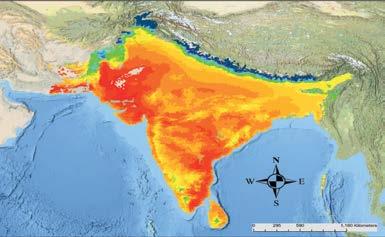
(continued)
e. South Asia’s flooded areas, 2000–18
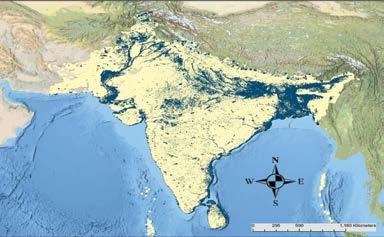
f. Distribution of projected heat exposure and population in 2030
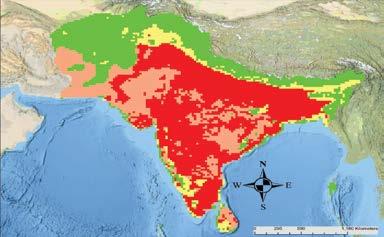
Sources: Center for International Earth Science Information Network–Columbia University 2018; Climatic Research Unit gridded Time Series 4.07 data set (University of East Anglia); ERA5-Land (Copernicus Climate Change Service 2019); Fathom; Flood Observatory; Li 2019; Trancoso et al. 2024.
Note: “Other EMDEs” are EMDEs excluding SAR. Panel a: Average maximum daily temperature in South Asian countries between 2017 and 2021. Panel b: The 2020 population and projected 2030 population exposed to heat and flood in South Asia. Heat exposure is based on a two-day temperature of 30°C or more. Flood exposure is based on one-in-100-year flood depth exceeding 15 centimeters. Panel c: Proportion of total land mass flooded in South Asia compared with other EMDEs excluding South Asian countries. Panel d: Average daily maximum temperature in South Asia between 2017 and 2021. Darker blue indicates temperatures of 20°C or lower, darker green indicates temperatures between 20°C and 26°C, darker yellow indicates temperatures between 27°C and 30°C, and darker red indicates temperatures of 30°C or higher. Panel e: Flooding in South Asia between 2000 and 2018. Blue indicates at least one flood; yellow indicates no floods in the time period. Panel f: Projected 2025–29 annual average maximum temperature in South Asia and population. Green indicates temperatures below 30°C and below-median population. Yellow indicates temperatures below 30°C and above-median population. Pink indicates temperatures above 30°C and below-median population. Red indicates temperatures above 30°C and above-median population. AFG = Afghanistan; BGD = Bangladesh; BTN = Bhutan; EMDEs = emerging market and developing economies; IND = India; LKA = Sri Lanka; MDV = Maldives; NPL = Nepal; PAK = Pakistan; RHS = right-hand side; SAR = South Asia.
Unequal exposure to weather-related risks. Which households in South Asia face the greatest recent and projected exposure to rising weather-related risks, and in what ways? Although the climate in most of South Asia is hot by global standards, there is above-average variation in average temperatures within the region (Copernicus Climate Change Service 2023). Sizable areas are mountainous with low average temperatures. In nonmountainous areas, average maximum temperatures range from 28°C to 34°C (refer to figure 2.1d). Similarly, exposure to flooding varies within provinces and districts (refer to figure 2.1e). Given this geographic variation in climate conditions, poor households may be disproportionately exposed to weather shocks because they may be more restricted in their locational choice than better-off households and face a more difficult trade-off between locational amenities and proximity to income-earning opportunities (Kim 2012). For example, poor households may reside in an area that faces high flood risk for affordable housing close to their workplace, thus increasing their exposure to flooding. Information on the location of the most exposed people—hotspot areas of recurrent shocks—can be one of the inputs into targeting mechanisms for social protection systems that can readily respond to shocks (Bowen et al. 2020).
Unequal impacts of weather shocks. A large body of literature suggests that, globally, poor households are not only more exposed to weather shocks but also more adversely affected than the average household (Hallegatte, Vogt-Schilb, et al. 2016; Kahn 2005; Triyana et al. 2024). With fewer resources to invest in protection, poor households tend to lose a greater share of their income and assets, have access to lower-quality housing and infrastructure, and face more difficulty responding to and recovering from shocks. They may also have less access to postdisaster relief mechanisms (Anttila-Hughes and Hsiang 2013). As a result, the impacts of weather shocks on poor households can persist and affect their long-term well-being (Carter et al. 2007).
The role of information. Households facing weather risks can, in principle, adapt to minimize impacts. However, their decisions on whether and how to adapt may be influenced by information on weather risks and perceived costs and benefits of specific adaptation strategies (Kahneman and Tversky 1979; Simpson et al. 2016). For example, households may lack information on shocks whose frequency and magnitude may be changing. In this context, access to early warning systems can provide timely information on upcoming extreme weather events so households can act to minimize impacts. However, they may face barriers to accessing information or the subsequent step of taking action to protect themselves (Hallegatte 2012; Perera et al. 2019; Rogers and Tsirkunov 2011).
This chapter explores the impact of weather shocks on households by addressing the following questions:
1. Which households are more exposed to weather shocks?
2. What is the distributional impact of weather shocks?
3. What role can early warnings play in mitigating the impacts of extreme weather events?
First, the analysis contributes to the rapidly growing literature on household exposure to weather shocks and their impacts by updating existing reviews and providing insight on South Asia (Hallegatte, Bangalore, et al. 2016; Hallegatte, Vogt-Schilb, et al. 2016; Triyana et al. 2024).
Second, less is known about the incidence of exposure to weather shocks. This chapter provides one of the first systematic analyses of the correlation between local wealth and historical and projected exposure to heat and floods at a finely detailed geographical level in South Asia. The analysis exploits recently published cross-sectional estimates of relative wealth on a 2.4 kilometer × 2.4 kilometer grid (Chi et al. 2022). The analysis is also one of the first to use a standardized measure of urbanicity to explore rural-urban differences in exposure to weather shocks—a definition that can be applied uniformly across countries and that overcomes the often arbitrary administrative categorization on which much of the literature relies (Nelson et al. 2019).
Third, the analysis uses newly collected data from the World Bank South Asia Climate Adaptation (SACA) Household Surveys. These household-level data from flood-affected areas in coastal Bangladesh and riverine parts of India’s Bihar state provide rich information on how the livelihoods of rural households have been affected by weather shocks, on households’ access to information on
weather shocks, and on their awareness of potential future impacts and responses. Recent evidence links information and beliefs on climate change to behaviors; however, most of the evidence comes from high-income countries or more educated populations in lower-income countries (Dechezleprêtre et al. 2022). The newly collected survey data complement existing relative wealth data by analyzing the link between exposure, access to information, and impacts among populations that tend to be costlier to reach and may be underrepresented in traditional surveys. The data provide new evidence on the impacts of weather shocks and access to information from regions of South Asia that are at the front lines of the growing risk of extreme weather-related events.
First, poor and agricultural households are more exposed to weather shocks. In aggregate (that is, looking across the entire region), places with lower wealth are significantly more exposed to heat, and urban areas with lower wealth are significantly more exposed to flooding. Riverine and coastal households in South Asia are exposed to recurrent and multiple shocks, with an average of three different shocks experienced per household in the past five years and 60 percent of households reporting annual exposure to at least one shock during that period. Households report being exposed to an average flood depth of 47 centimeters in the past five years. Among them, agricultural households are exposed to 5 percent more shocks and are 15 percent more likely to experience flooding.
Second, poor and agricultural households are more affected by weather shocks in part because their livelihoods are exposed to weather conditions. The channels of impact include human capital, income, and asset losses. Conditional on experiencing a shock, agricultural households are 10 percentage points more likely to report damages due to flooding.
Third, access to early warning varies with the shock, with virtually all households in the coastal and riverine survey areas receiving early warnings for cyclones, but fewer than half for floods and other shocks. Early warnings in vulnerable areas are associated with less damage, highlighting the important role of information in minimizing the impacts of weather shocks.
This chapter compiles data from multiple sources to analyze the determinants of exposure and impact of climate weather shocks in South Asia (refer to annexes 2A and 2B).
Novel household surveys. The World Bank SACA Household Surveys were collected from about 4,500 households in 300 villages in the Kosi River region in Bihar, India, and 5,000 households in 250 villages in coastal Bangladesh in 2024. SACA survey data provide novel, detailed data on weather shock exposure and impacts among households in parts of rural South Asia that are highly vulnerable to extreme weather events, especially flooding. Bihar, the Indian state where the survey was conducted, has the third-highest average floodwater depth in South Asia, and the coastal areas in Bangladesh where the survey was conducted are exposed to floodwater depths higher than the regional average. These surveys complement existing relative wealth data by providing more detailed information from flood-affected areas on socioeconomic characteristics, participation in
agriculture, self-reported exposure to weather shocks, and their impacts. Household wealth is proxied by an asset count, which is the sum of indicators for 30 assets. The shocks in the survey include floods, excess rainfall, droughts, heat waves, seasons changing, salinity changes, cyclones, and riverbank erosion. Households in the sample are generally more disadvantaged than the general population: they have a below-average Relative Wealth Index (RWI) and above-average flood risk. For early warnings, these survey data were complemented by another household survey in 2021. Information on access to flood early warning was collected from 2,000 households in urban and rural areas in 14 districts in Bangladesh.
Spatially detailed data. The chapter uses data from multiple sources to build a comprehensive and detailed picture of exposure to extreme weather throughout South Asia:
• Temperature. The historical temperature data consist of the gridded average daily maximum temperature in South Asia (Copernicus Climate Change Service 2019). Temperature projections come from the Climate Impact Lab and span the period 2025–29 (O’Neill et al. 2016). Both sets of temperature data are aggregated to the annual level and matched to relative wealth grids. The merged relative wealth and temperature data set contains about 606,000 spatial units, covering Bangladesh, Bhutan, India, Maldives, Nepal, Pakistan, and Sri Lanka.
• Flood. The empirical flood exposure data come from the Global Flood Database of Tellman et al. (2021). This database measures a location’s complete flood history at a 250 meter × 250 meter resolution from 2000 to 2018 using satellite data and machine learning predictions. These spatial flood data are complemented with extensive household survey reports on the timing, depth, frequency, and damage of flood exposure, as well as exposure to other weather shocks. With the coordinates of relative wealth grids, locations that have been flooded between 2000 and 2018 are identified. Similarly, relative wealth grids are merged with flood projections from Fathom, a flood map provider, to identify expected water depth due to once-in-a-decade coastal, pluvial, or fluvial flooding in 2030 (Wing et al. 2024).
• Urbanicity. Urbanicity is defined in terms of travel distance to cities with populations of at least 10,000. Travel distance is the fastest travel time across land and water from a given location to the nearest city and is calculated using a least-cost path algorithm (Nelson et al. 2019).
• Relative wealth. The RWI uses a combination of machine learning algorithms, satellite data, nationally representative ground survey data, and other publicly available data sets to estimate the wealth distribution at granular spatial resolution (Chi et al. 2022). The ground survey data come from household surveys between approximately 2011 and 2019.
Systematic literature review. Results for South Asia on exposure and channels of impact are compared with those from a systematic review and meta-analysis of more than 70 studies on exposure to and impact of weather shocks on poor households. The studies were selected using a list of 11 index articles and a search of three databases. Search results were restricted to articles in economics or general-interest, peer-reviewed journals and reports published between 2000 and 2023.
Estimation strategies. The analysis uses several strategies (refer to annexes 2A and 2B and box SL.1).
Ordinary least squares (OLS) regressions were run to estimate the correlation between temperature or
flooding and relative wealth, as measured with the RWI. The analysis includes regressions with stateor province-level fixed effects to estimate the correlation between temperature and relative wealth in subnational units. OLS regressions were also run to estimate the relationship between several outcomes related to weather shocks using the household surveys from Bihar’s Kosi River region (hereinafter, riverine Bihar) and coastal Bangladesh. The outcomes include self-reported exposure to multiple weather shocks, impacts of those shocks (conditional on exposure), expectations of future shocks, and plans for future adaptation. The analysis includes village fixed effects, and some specifications include shock characteristics. A meta-analysis regression was conducted using studies on household exposure to weather shocks and their impacts.
Poorer South Asian households experience more extreme heat than the average household. In urban areas, poorer households also experience more recurrent flooding. Riverine and coastal households face recurrent, multiple extreme weather events, and they face such events with increasing frequency. Agricultural households in these areas are also more exposed to flooding.
Population exposed to extreme heat and floods in South Asia. About 46 percent (860 million) of the population is currently exposed to extreme heat—defined as temperatures above 30°C for two consecutive days—and the average temperature in South Asia is expected to increase. Based on temperature projections, about 89 percent (1.8 billion) of the population will be at risk of extreme heat by 2030 (refer to figure 2.1b). This is partly due to extreme heat exposure in more populated areas (refer to figure 2.1f). Similarly, about 402 million (21 percent) of South Asia’s population are exposed to flooding, and 462 million (22 percent) of the population are projected to be exposed to flooding with an average depth of more than 15 centimeters by 2030 (refer to figure 2.1b).
Relative wealth and heat exposure. Exposure to extreme heat is not just high, but also unequal. Spatial data reveal that South Asian households with lower wealth are more exposed to higher temperatures than better-off households, particularly in urban areas (refer to figure 2.2a). In urban South Asia, the RWI is 0.3 standard deviations lower in locations with an average temperature of at least 32°C (the 75th percentile) than in locations with temperatures at the regional average. This difference is equivalent to approximately 40 percent of the wealth gap between urban and rural areas. For comparison, the per capita expenditure gap between urban and rural areas in Bangladesh is about 50 percent, and it is almost 70 percent in India (Ministry of Planning 2023; Ministry of Statistics & Programme Implementation, National Statistics Office 2024). In rural areas, the direction of the relationship is similar but not statistically significant (refer to figure 2.2b). Furthermore, the most extreme projected warming trends are concentrated in poorer locations, particularly in rural areas (refer to figures 2.2c and 2.2d). These results suggest that although inequality of exposure already exists in urban areas, it is projected to worsen in rural areas. As in the rest of the world, poor households are more exposed to heat in South Asia (Hallegatte, Bangalore, et al. 2016; Hallegatte, Vogt-Schilb 2016; Triyana et al. 2024).
Households with lower wealth are more exposed to extreme heat, especially in urban areas.
a. Urban areas: Association between relative
b. Rural areas: Association between relative wealth and temperature
c. Urban areas: Association between relative wealth and projected temperature change Temperature (˚C) Temperature (˚C)
d. Rural areas: Association between relative wealth and projected temperature change
Sources: ERA5-Land (Copernicus Climate Change Service 2019); Li 2019; Relative Wealth Index; World Bank.
Note: SSP2-45 and SSP5-85 are moderate- and high-emissions climate scenarios, respectively, used by the Intergovernmental Panel on Climate Change to model future climate change impacts. Orange whiskers indicate 95 percent confidence intervals. State fixed effects included; standard errors are clustered at the state level. Panels a and b: Ordinary least squares regression coefficients showing the relationship between relative wealth and temperature in urban and rural areas, respectively. Temperature bins (in degrees Celsius) on the x-axis. Regression results are shown in annex 2A, table 2A.1a. Panels c and d: Ordinary least squares regression coefficients showing the relationship between relative wealth and projected temperature in urban and rural areas, respectively. Temperature projections based on moderate-emissions scenario under SSP2-45 and high-emissions scenario under SSP5-85. Regression results are shown in annex 2A, table 2A.1b. RWI = Relative Wealth Index; SSP2 = Shared Socioeconomic Pathways.
Relative wealth and flood exposure. Exposure to flood risk is also heterogeneous. In urban areas, locations with repeated flood exposure have lower wealth on average (refer to figure 2.3b). In addition, the urban areas where projected flood risk in 2030 is greater tend to be poorer (refer to figure 2.3d). In contrast, in rural areas, flooding is associated with significantly higher relative wealth (refer to figure 2.3b). These results—that poor households are systematically more exposed
to flooding in urban areas but not in rural areas—are consistent with similar findings from the literature (Gandhi et al. 2022; Hallegatte et al. 2020). The results for rural areas reflect an important facet of South Asia’s geographic characteristics and rural dependence on agriculture: the region’s floodplains are fertile areas and hence productive for agriculture (Banerjee 2007, 2010). The long-term productivity benefits of living in such flood-prone but fertile areas is that they generate wealth despite the flood risk.
In urban areas, households with lower wealth are more exposed to flooding, whereas in rural areas, households with lower wealth are less exposed to flooding.
b. Association between relative wealth and number of floods, 2000–18
c. Association between relative wealth and projected flood exposure
Association between relative wealth and projected flood depth
Sources: Fathom; Flood Observatory; Relative Wealth Index; World Bank.
Note: Regressions include state fixed effects; standard errors are clustered at the state level. Orange whiskers indicate 95 percent confidence intervals. Panels a and b: Linear regression coefficients showing the relationship between relative wealth and the presence of floods and the number of floods between 2000 and 2018 in urban and rural areas, respectively. Regression results are shown in annex 2A, table 2A.2a. Panels c and d: Linear regression coefficients showing the relationship between relative wealth and projected flood exposure and projected flood depth in urban and rural areas. The regression results are shown in annex 2A, table 2A.2b. RWI = Relative Wealth Index.
Findings from the literature. How do these findings on differential weather-related risks relate to the literature? A systematic review and meta-analysis of the literature reveals that across a wide range of study contexts and weather shocks, poor households tend to be more exposed to such shocks than nonpoor households. Of 184 estimates across 70 studies in which the income incidence of climate shocks could be identified, 68 percent found that poor households are statistically significantly more exposed than others (refer to spotlight, figure S1.3a). Compared with studies of other natural disasters, studies of heat were 22 percentage points more likely to find that poor households had been more exposed. Studies on droughts were 19 percentage points more likely to find that poor households were more exposed, and studies on floods were 29 percentage points more likely to find that poor households were more exposed (refer to spotlight, figure S.1.3). Among other mechanisms, stronger constraints on geographic mobility tend to make poor households more vulnerable (Hallegatte, Fay, and Barbier 2018; Kim 2012).
Frequency of exposure to weather shocks. Nearly 40 percent of households residing in riverine Bihar, India, and coastal Bangladesh were exposed to at least one weather shock in the past five years, with exposure particularly high for flooding, excessive rainfall, extreme heat, and cyclones (refer to figure 2.4a). The high self-reported exposure to flooding is consistent with the surveyed areas’ average flood depth, which is higher than the regional average. Households report being exposed to an average flood depth of 35 centimeters in Bangladesh and 57 centimeters in Bihar, similar to the satellite-based estimate of flood depth in the surveyed areas. Households in these areas also tend to be repeatedly exposed, with annual exposure rates of about 60 percent for cyclones, 50 percent for flooding, 40 percent for extreme heat, and 30 percent for excessive rainfall (refer to figure 2.4b). Consistent with climate models, a majority of households reported increasing frequency of exposure to events in the past five years (refer to figure 2.4c).
Exposure to multiple extreme weather events. Exposure to multiple extreme weather events has been pervasive in South Asia: surveyed households experienced an average of three different shocks in the past five years, usually involving combinations of extreme heat, flooding, or excessive rainfall. About 40 percent of households experienced both extreme heat and excessive rainfall, about 30 percent faced flooding and excessive rainfall, and 25 percent were exposed to heat and drought (refer to figure 2.4d). Because different shocks may require different coping strategies, exposure to multiple shocks erodes households’ ability to adapt, given their limited resources.
Long-term flood risk. Evaluating flood risk over the longer term reveals remarkably high levels of vulnerability in the survey sample. The surveyed areas in Bihar were exposed to seven floods and those in Bangladesh to 19 floods, with varying severity, between 2000 and 2018. A particularly severe flood in Bihar’s Kosi River region (hereafter riverine Bihar) occurred in 2008. About 3 million people were affected, and the 2008 flood was considered India’s worst in 50 years (Government of Bihar, World Bank, and GFDRR 2010). About 70 percent of households in riverine Bihar reported being flooded in 2008. This self-reported exposure is similar to the satellitebased estimate in the surveyed area, with only mild underreporting (refer to figure 2.4e). During the 2008 flood, the average flood depth for exposed households was high, at 1 meter, reflecting the
catastrophic nature of the flood (refer to figure 2.4f), and homesteads remained flooded for up to three weeks. These findings are consistent with reported depth and the time taken for the water to recede, suggesting reliable recall of flooding events nearly two decades later (Reliefweb 2008; UNDP 2012). For the past 10 years, almost 75 percent of coastal residents in Bangladesh reported experiencing flooding, lower than satellite-based estimates. The reported worst flood was about 40 centimeters deep, and it took about a week for the water to recede. This reflects the more frequent experience of flooding in coastal Bangladesh relative to riverine Bihar.
Relationship between wealth and exposure. The negative wealth gradient of weather shock exposure in the spatial data (refer to figures 2.2 and 2.3) is more nuanced in the survey data. Among riverine and coastal households, the relationship between wealth—proxied by an asset count—and exposure to weather shocks in the past five years is not statistically significant (refer to figure 2.5a). Similarly, there is no significant association between the total number of shocks experienced and household wealth. However, wealth is an important predictor of longer-term flood risk. Wealthier households were less likely to be exposed to flooding over the past 10 years in Bangladesh or in 2008 in Bihar. A 1 standard deviation increase in wealth reduces multihazard risk by just over 2 percentage points—a small but statistically significant amount—suggesting that wealthier households may be better able to protect themselves from exposure to severe shocks.
Households surveyed were exposed to multiple, recurrent extreme weather shocks in the past five years and their exposure in the past 10–15 years suggests that they also face flood risks in the longer term.
a. Household exposure to weather shocks in the past five years (2019–24)
b. Annual exposure in the past five years (2019–24)
c. Share of households reporting increased frequency of exposure in the past
years (2019–24)
e. Exposure to long-term flood risk
d. Share of households exposed to multiple shocks
f. Severity of long-term historical flood
Sources: South Asia Climate Adaptation Survey; World Bank.
Note: “Others” include riverbank erosion, salinity, and seasons changing. All shares are unweighted. Panel a: Bars show the share of households exposed to a shock over the past five years (2019–24). Horizontal line shows the share of households exposed to at least one shock in the past five years. Panel b: Share of households exposed to at least one shock every year over the past five years (2019–24). Panel c: Share of households reporting an increase in the frequency of weather shocks experienced by their community over the past five years (2019–24). Panel d: Share of households exposed to more than one type of weather shock in addition to flood, heat, and rain. Panel e: Blue bars represent the share of households that reported experiencing the 2008 flood in Bihar and the most severe flood in their community over the past 10 years in Bangladesh. Red bars represent the share of households that experienced these floods according to satellite data. Panel f: Flood depth of the 2008 flood in Bihar and the most severe flood in their community over the past 10 years in Bangladesh.
Agriculture. Two-thirds of surveyed households are engaged in agricultural production. Agricultural households, who depend on the weather for their livelihood, were exposed to 5 percent more weather shocks than nonagricultural households in the past five years (refer to figure 2.5b). These households were also 6 percentage points (15 percent) more likely to be exposed to drought and 4 percentage points (5 percent) more likely to be exposed to flooding in the past five years (refer to figure 2.5a). However, over the past two decades, the difference in flood
risk between agricultural and nonagricultural households has not been statistically significant. This difference in short- and long-term exposure may relate to South Asia’s geography. The floodplains in South Asia tend to be more fertile, so there may be benefits to small short-term risks of flooding for agricultural households (Banerjee 2007, 2010). However, such fertility benefits are not enough to compensate for the risk of longer-term, severe floods, and hence agricultural households move out of places subject to severe risks.
Other household characteristics. Other dimensions of disadvantage may also relate to shock exposure. However, households in the survey areas are generally disadvantaged, with larger household sizes, lower per capita expenditure, and lower education levels than the national average. In this setting, there is no significant education or gender gradient in exposure to weather shocks (refer to annex 2B, table 2B.2c).
Agricultural households were more exposed to extreme weather shocks in the past five years than other households surveyed. Wealthier households were less likely to be exposed to long-term flooding.
a. Association between exposure to extreme weather shocks in the past five years and household characteristics
b. Exposure to multiple extreme weather shocks and long-term historical flooding
Agricultural households Household assets
Sources: South Asia Climate Adaptation Survey; World Bank.
Note: Household characteristics include agricultural household, land ownership, asset count, and education of the head of the household. The asset count is the sum of indicators of 30 assets that a household may own. Village fixed effects include robust standard errors. Orange whiskers indicate 95 percent confidence intervals. Panel a: Standardized linear regression coefficients showing the relationship between exposure to each extreme weather shock in the past five years and household characteristics. Regression results are shown in annex 2B, table 2B.2a. Panel b: The two bars on the left show standardized linear regression coefficients for the relationship between the number of shocks in the past five years and household characteristics. The two bars on the right show standardized linear regression coefficients for the relationship between the exposure to the 2008 Bihar flood or the most severe flooding in the past 10 years and household characteristics. Regression results are shown in annex 2B, table 2B.2b.
Conditional on exposure, poor households are more affected by weather shocks than nonpoor households. Among riverine and coastal households, the impacts operate through human capital, income, and asset losses. Agricultural households, whose livelihoods depend on the weather, experience larger damages from weather shocks than nonagricultural households.
Weather shocks and health. Weather shocks can cause morbidity and mortality. The impacts may vary by age and may also depend on the nature of the shocks. Deaths and injuries related to weather shocks in the past five years were reported by about 2 percent of households in the survey, with an average of 0.2 deaths and 1.3 injuries per affected household. Conditional on experiencing a shock, about 45 percent of households experienced illness as the result of the shock (refer to figure 2.6a). This may be related to damage to infrastructure related to water, sanitation, and hygiene (WASH) services, which affected more than 50 percent of shock-exposed households in the survey—with the share rising to 65 percent for floods.
Households surveyed were affected by extreme weather shocks through human capital, earnings, crop losses, and damages to their homes. Agricultural households report more damages than other households.
Sources: South Asia Climate Adaptation Survey; World Bank.
Note: Panel a: Share of households reporting health impacts from flooding and from all shocks in the past five years (2019–24). Panel b: Share of households reporting being affected through each channel, averaged across flooding and heat, and all types of shocks. Panel c: Standardized linear regression coefficients showing the relationship between the probability of reporting negative impacts and household characteristics. Panels c and d: Household characteristics include agricultural household, land ownership, asset count, and education of the head of the household. Shock characteristics include timing of the shock and selfreported flood depth and its quadratic term. Village fixed effects include robust standard errors. Whiskers indicate 95 percent confidence intervals. Regression results are shown in annex 2B, table 2B.3. Panel d: Standardized linear regression coefficients showing the relationship between the severity of self-reported damages and household characteristics. Severity index is the average severity of losses, ranging from 0 (no damages) to 4 (total loss). HH = household; HH asset = sum of indicators of 30 assets that a household may own; WASH = water, sanitation, and hygiene services.
Weather shocks and education. Weather shocks may also affect children’s education directly through school closures that affect schooling days or indirectly through illness, displacement, or household income. Extreme heat may affect children by impairing cognitive functioning, consequently lowering their test scores and later-life educational outcomes (Garg, Jagnani, and Taraz 2017; Park 2017; Park, Behrer, and Goodman 2021; Park et al. 2020). A major concern with the effects of weather shocks on children is their persistence into adulthood (Almond, Currie, and Duque 2017; Currie and Vogl 2013; Maccini and Yang 2009).
Weather shocks and the labor market. The economic impacts of weather shocks can operate through asset losses, labor market adjustments, and migration and displacement, with some effects persisting in the longer term. Workers can be affected by weather shocks through negative productivity shocks, sector-specific effects, and sectoral reallocation (Kirchberger 2017; Masuda et al. 2021; Mueller and Osgood 2009; Mueller and Quisumbing 2010, 2011; Rexer and Sharma 2025; Somanathan et al. 2021). In the survey sample, about 15 percent of households were
displaced because of extreme weather events, including floods, heavy rain, or cyclones, in the past five years. Additionally, displaced households are 8 percentage points more likely to report damages. Migration and shocks are also related: households suffering damages from flooding, excessive rainfall, or drought are 3–10 percentage points more likely to report migration, and households suffering damages from flooding and excessive rainfall are 3–5 percentage points more likely to intend to migrate. Although these survey findings are not causal, migration may be a response to weather shocks. The positive association is consistent with earlier findings on weather shocks increasing migration, both voluntary migration and displacement (Baez et al. 2017; Gröger and Zylberberg 2016; Mueller et al. 2020).
Impacts on agricultural productivity and earnings. Among rural agricultural households, weather-induced declines in agricultural productivity may result in income losses (Miller, Tack, and Bergtold 2021; Schlenker and Michael 2009; Xie et al. 2018; Zaveri and Lobell 2019). Among households affected by heat in the survey, one-third report losses to their crops, and almost half report earnings losses. The effects of flooding on agricultural productivity are more nuanced, because floodplains in South Asia tend to be more fertile (Banerjee 2007, 2010). About 40 percent of households report earnings losses after weather shocks in the past five years, with the figure rising to 50 percent for flooding and almost 60 percent for heat (refer to figure 2.6b).
Almost half report damages to crops and their homes or dwellings. Damages to livestock are less prevalent, with only one-third of households reporting such losses. These findings suggest economic damages can be substantial and that it may take time for households to recover. However, recurrent shocks may force households to continually recover instead of improving their well-being.
Community impacts of weather shocks. Weather shocks can damage roads, clinics, power grids, and other community infrastructure, thereby affecting household well-being immediately after the shocks and possibly in the longer term if damaged infrastructure is not promptly repaired. More than half of the surveyed households report damage to community infrastructure and roads in the past five years (refer to figure 2.6b). For households without private WASH facilities, reported damage to community-level WASH facilities may be linked to illnesses following flooding. These findings suggest that investing in resilient infrastructure can mitigate impacts at both community and household levels.
Findings from the literature. Poor households may be more affected by weather shocks because of their limited ability to protect themselves from damages and recover from the shocks. In a metaanalysis of 61 studies on the effects of weather shocks, 80 percent of studies that focus on income effects show worse outcomes for poor households. A similar finding emerges among studies that focus on human capital effects (refer to spotlight, figure S.1.5b). Food security is an important mechanism driving negative effects for poor households; for example, food security declined substantially during Pakistan’s 2022 floods (Anttila-Hughes and Hsiang 2013; Baron et al. 2022; Hallegatte, Fay, and Barbier 2018). Indeed, all studies in the sample that examine postshock food security show that poor households are more adversely affected. These disproportionate effects can
be long-lasting. In the sample of studies, three-fourths of estimates found that poor households still suffer impacts more than one year after the shock, suggesting that they struggle to recover from shocks. When there are other market failures, such as credit constraints, weather shocks can exacerbate those failures. For near-poor and poor households, weather shocks can push people into persistent poverty even after the shock abates.
Impacts by household wealth. The literature shows that poor households are, on average, more affected by weather shocks through channels such as human capital and income losses. However, the wealth gradient may be less clear among households residing in vulnerable areas. Based on the household survey (SACA), asset ownership is not significantly associated with the likelihood of experiencing damages from excessive rainfall, flooding, or cyclones (refer to figure 2.6c). There is a statistically significant relationship but a quantitatively small negative relationship between household wealth and damages from cyclone exposure (refer to figure 2.6d). Although this seems to contradict findings from the literature, the results may reflect the relatively disadvantaged population in the survey.
Impacts on agricultural households. The livelihoods of agricultural households depend critically on climatic conditions, and, indeed, they are more likely to report damages from weather shocks (refer to figure 2.6c). They are more affected by flooding (10 percentage points), excessive rainfall (17 percentage points), drought (39 percentage points), and heat (26 percentage points) than nonagricultural households (refer to annex 2B, table 2B.3). These findings suggest the importance of targeted policies, which may involve broader reforms in agriculture or livelihood diversification away from agriculture to build resilience.
Impacts by other household characteristics. Women may be more affected by weather shocks because of their agricultural work or gender norms that can lead girls to leave school when households experience negative shocks (Afridi, Mahajan, and Sangwan 2022; Corno, Hildebrandt, and Voena 2020; Garg, Gibson, and Sun 2020; UN Women 2022). Similarly, those with lower education may be more affected by weather shocks because of lower access to information and services such as postdisaster relief (De Silva and Kawasaki 2018). However, among households in the survey, there are no differential impacts by the gender or education of the head of household (refer to annex 2B, table 2B.3).
Access to information through early warnings varies by shock, with wealthier households more likely to receive flood warnings. Access to early warnings is associated with lower subsequent damages.
Early warning systems. These systems can provide households with information on upcoming extreme weather events and guide how governments, communities, and individuals can act to minimize impacts. These systems are built on risk knowledge, observation and forecasting, communication, and response (World Meteorological Organization 2023). The SACA household surveys and the flood early warning survey in Bangladesh focus on information dissemination and household response.
Access levels vary. Households in the survey report varying levels of access to early warning systems, depending on the type of weather shock experienced. Nearly all households reported receiving early warnings for the most recent cyclone in Bangladesh, highlighting a strong response in this area (refer to figure 2.7a). However, access to early warnings for other shocks is lower: fewer than half of households received flood warnings; fewer than one-third received warnings for excessive rainfall; and fewer than one-fifth, for heat waves, droughts, or other shocks. Both the SACA survey and the flood early warning survey indicate that wealthier households are more likely to receive flood early warnings. These results present an opportunity for expanding early warning systems to better reach disadvantaged populations as well as to include multihazard risk.
Effectiveness of communication varies. For flooding, the flood early warning survey in Bangladesh shows that the most effective modes of communication are similar in urban and rural areas (refer to figure 2.7c). Specifically, word of mouth from family members, friends, or neighbors and television are the most common and effective modes of communication. In rural areas, male family members play a central role in delivering this information. Although this may suggest a gender-related barrier to access, female-headed households are no less likely to receive flood warnings. Households in urban areas report community loudspeakers (“miking”) as one of the main sources of flood warnings. Among those who received early warnings, more than half of those who reported difficulty understanding the warnings were poor. The barriers to effective early warnings include the use of technical language that made the warning difficult to understand and the lack of community-relevant information, highlighting the important role of easily understandable information.
There are no systematic differences in the education levels of households receiving flood warnings. Households with access to early warnings report less damages after some types of shocks, especially if they subsequently keep monitoring for new information.
b. Determinants of access to early
c. Most effective modes of flood warning by urbanicity
d. Action taken after a flood warning
e. Relationship between damages and access to early warning systems
f. Relationship between damages and action after receiving early warning
Sources: Flood early warning survey; South Asia Climate Adaptation Survey; World Bank.
Note: Panel a: Share of households exposed to extreme weather shocks in the past five years that reported receiving early warnings (2019–24). Panel b: Linear regression coefficients showing the relationship between the probability of receiving early warnings and household characteristics. Household characteristics include agricultural household, land ownership, asset count, and education of the head of the household. Village fixed effects include robust standard errors. Whiskers indicate 95 percent confidence intervals. Regression results are shown in annex 2B, table 2B.4a. Panel c: Share of households reporting the most effective modes of flood warnings in urban and rural Bangladesh. Panel d: Share of households taking action after receiving flood warnings. Panels e and f: Linear regression coefficients showing the relationship between damages and receiving early warning (panel e). Linear regression coefficients on the sample of households with early warnings showing the relationship between damages and taking action after receiving early warning (panel f). Coefficients standardized by the standard deviation of the covariate. Household characteristics include agricultural household, land ownership, asset count, and education of the head of household. Shock characteristics include timing of the shock and self-reported flood depth and its quadratic term. Village fixed effects include robust standard errors. Whiskers indicate 95 percent confidence intervals. Regression results are shown in annex 2B, tables 2B.4b and 2B.4c.
Actions taken in response to early warnings. Early warnings should allow households to act to minimize impacts. Evacuation orders are likely issued when severe flooding or a cyclone is expected, but other types of information for less severe events can also help households to take
action to prevent damages. Among households that received a flood warning, the majority stocked up on emergency supplies, about one-quarter evacuated immediately, and others protected livestock, moved to higher ground, or stayed updated on the situation (refer to figure 2.7d).
Damages and access to early warnings. Access to early warnings is associated with lower subsequent damages for excessive rainfall and cyclones, whereas the association is negative but not statistically significant for flooding (refer to figure 2.7e). However, among households with access to early warnings for flooding, staying updated on the situation is associated with a lower probability of damages and less severe impacts (refer to figure 2.7f).
Early warnings provide households with information to prepare for and minimize damages from weather shocks, but early warning systems do not provide households with enough time to invest in adaptation. For example, major investments to reinforce homes to allow them to withstand flooding typically cannot be undertaken in the short time frame provided by early warning systems. This suggests that early warning systems should be complemented with information on longerterm extreme weather risks to encourage investment in adaptation (Burlig et al. 2024; Molina and Rudik 2024; Shrader 2021).
Improving early warning systems. The survey findings suggest that vulnerable households respond to early warning systems by taking mitigating actions. However, there are gaps in the coverage of these systems, and they could be made more cost-effective by providing low-cost messages that are easy to understand and specific to the location. Strengthening early warning systems to provide households with information early enough for them to take action may require greater investment and policy coordination among national, regional, and local governments, as well as cross-sectoral coordination (Hallegatte 2012; Rogers and Tsirkunov 2011; refer to deep dive 4).
Targeting policy support. Severe exposure of poor households to one or multiple weather shocks underlines the importance of investing in social protection systems that can provide timely assistance to poor, vulnerable households in the event of shocks (refer to deep dive 3). Because poor households are disproportionately exposed to extreme heat and, in urban areas, to floods, more detailed heat and flood exposure projections from climate models could improve the targeting of policy support.
Addressing constraints to household adaptation. Finally, the findings of this chapter highlight the importance of identifying and addressing obstacles that prevent households from adapting to the growing risk of weather shocks. In addition to constraints on spatial mobility, such factors could include a lack of information, as well as access to cost-effective technological adaptation options and credit, to name a few. Chapter 3 examines this issue.
This chapter highlights a growing body of research on household exposure to weather shocks and their impacts. Future work could address two issues for which the evidence remains limited.
First, recent evidence shows social protection and access to credit mediate human capital losses when weather shocks occur, and some of these effects persist in the longer term (Adhvaryu et al. 2018;
Garg, McCord, and Montfort 2025; Lane 2024; Rosales-Rueda 2018). Further evidence on the longterm effects and mechanisms of such policies will shed light on cost-effectiveness and targeting and inform policy prioritization.
Second, early warning systems that target potential impacts and multiple hazards can effectively reduce damages (Šakić Trogrlić et al. 2022). However, gaps remain in effective information dissemination and behavioral response. Further research is needed to inform the development of early warning systems that minimize damages, especially for vulnerable populations.
Data sources. The Relative Wealth Index (RWI), developed by Meta’s Data for Good team, uses a combination of machine learning algorithms, satellite data, ground survey data, and other publicly available data sets to estimate wealth distribution at a granular spatial resolution. Each RWI data point represents the center of a 2.4 kilometer x 2.4 kilometer square. The index uses cross-sectional household-level data from the nationally representative Demographic and Health Survey (DHS) from multiple countries, linked to additional data, such as satellite imagery (Chi et al. 2022). The DHS is a series of nationally representative surveys conducted in many countries, including South Asia.
Urban and rural areas are defined and measured based on population density, nightlight activities, built environment characteristics, infrastructure indicators, and other relevant data. It is possible to compare the RWI between urban and rural areas within the same country. However, because urban RWI is systematically higher, the analysis separates the urban and rural samples.
Estimation method. The following specifications are used:
RWI sg = Temp28sg + Temp29sg + Temp31sg + Temp32sg + Temp33sg + Temp34sg + v s + u sg (1) and RWI sg = Any floodsg + v s + u sg , (2)
where RWI sg is the average RWI at grid cell g in state or province s . In the first specification, the variable TEMP sg includes indicators for the average maximum temperature between 29°C or lower and 36°C, relative to 30°C (refer to table 2A.1a). Using projected temperature change, the same specification is run using the moderate-emissions scenario (Shared Socioeconomic Pathways [SSP2]-4.5) and the high-emissions scenario (SSP5-8.5) (refer to table 2A.1b). For flooding and projected flooding, the specification uses the variable Any flood sg, an indicator that takes the value of 1 if a location is ever flooded between 2000 and 2018 or expected to be flooded in 2030 (refer to table 2A.2). To analyze the relationship with the number of flooding events, the same specification is run (refer to table 2A.2a). To analyze expected flood intensity, the same specification is run using projected flood depth in 2030 (refer to table 2A.2b). The analysis includes state or province fixed effects, v sg . All standard errors are clustered at the state level (second administrative unit). The regressions are run separately for urban and rural samples.
TABLE 2A.1 Relationship between Relative Wealth and Temperature
a. Historical temperature
b. Projected temperature
Sources: Behrer et al. 2024; Chi et al. 2022; Copernicus Climate Change Service 2019; World Bank. Note: Urban = places within 10 minutes from cities with more than 10,000 people. Dummy variables for temperatures bins ranging from below 28°C and 36°C are used. The omitted temperature bin is 30–31°C. State fixed effects are included; standard errors are clustered at the state level.
*p < 0.10 **p < 0.05 ***p < 0.01
a. Historical flooding
b. Projected flooding
Sources: Behrer et al. 2024; Chi et al. 2022; Tellman et al. 2021; Wing et al. 2024; World Bank.
Note: Urban = places within 10 minutes from cities with more than 10,000 people. Panel a includes an indicator for any flooding and the number of floods between 2000 and 2018. Panel b includes an indicator for any projected flooding and flood depth using projections for one-in-10 flood event in 2030. State fixed effects are included; standard errors are clustered at the state level.
*p < 0.10 **p < 0.05 ***p < 0.01
Data sources. The South Asia Climate Adaptation (SACA) Household Surveys, conducted in flood-vulnerable locations in Bangladesh and India, aim to shed light on the vulnerabilities households face from weather shocks and the strategies they adopt to adapt, along with their perceptions and beliefs about climate change. The surveys use a core standardized module to harmonize data across multiple collection sites. In addition to gathering demographic and socioeconomic data—such as education levels, household labor market outcomes, assets, and expenditures—the surveys also elicit respondents’ subjective beliefs about climate change, as well as their experiences with extreme weather events and the climate adaptation measures they have undertaken or plan to implement in the future. Throughout the analysis, data are pooled across the two survey sites, except when specific variables are available only in one survey or in Box 3.1 when studying the impact of embankments in northern India.
South Asia Climate Adaptation Household Survey in Bangladesh. This SACA survey was collected as part of a planned research project on climate adaptation conducted by the South Asia Chief Economist Office (SARCE) and the Disaster Risk Management Practice Group of the World Bank. Its goal is to understand how households in coastal Bangladesh are affected by disasters and climate change, the adaptation strategies they use, and the support they receive or expect from the government. The survey was administered to approximately 4,980 households in coastal areas, selected using a multistage stratified random sampling technique. The sampled households are distributed across 249 villages in seven districts. Data were collected between October and December 2024 through face-to-face interviews with the head of each household. Enumerators recorded survey responses using tablets, which also captured the precise geolocation of each household.
This survey gathers both quantitative and qualitative data on a broad range of topics. Specifically, it includes general household characteristics, housing quality, and household expenditure and finances. In addition, it contains detailed sections exploring households’ experiences with extreme weather events, beliefs about climate change, risk preferences, and adaptation investments and constraints, as well as past migration and relocation intentions. Weather events covered in the survey include floods, excess rainfall, droughts, heat waves, seasons changing, salinity changes, cyclones, and riverbank erosion. Furthermore, it includes an in-depth section on land ownership, agricultural practices, livestock, and other labor income sources for each household member, including any business activity operated by the household.
Asia
This SACA survey was conducted by SARCE and the Bihar Kosi Basin Development Project (BKBDP) team of the World Bank. The survey aims to assess the impact of the World Bank’s BKBDP, a comprehensive floodrisk management program in northern India. A central component of BKBDP was the rehabilitation of embankments to minimize breaches and reduce flood risk for local residents. The evaluation of BKBDP’s impact was based on a multilevel stratified sampling strategy, described in detail in Annex 3C. A total of 4,561 households in 304 villages across seven districts were surveyed in the project catchment area, consisting of districts most affected by the 2008 floods. Data were collected between April and May 2024 through face-to-face interviews with the head of each household. Enumerators recorded survey responses using tablets, which also captured the precise geolocation of each household.
The survey covers general household characteristics, household finances and expenditures, livelihoods, labor earnings, agricultural production, and durable assets. It also features comprehensive sections examining households’ experiences with extreme weather events, their views on climate change, risk preferences, and adaptation efforts and challenges, as well as past migration and relocation plans. The following weather shocks are included: floods, excess rainfall, droughts, heat waves, and seasons changing.
Sample characteristics. Households in the sample are generally disadvantaged and more exposed to flooding (refer to table 2B.1). The average self-reported flood depth in surveyed areas in both
Bangladesh and Bihar is above the regional average. Households in the survey have lower relative wealth than the national average; this is true for both the coastal Bangladesh and the riverine Bihar sample.
A comparison between the SACA survey in Bangladesh and the nationally representative 2022 Household Income and Expenditure Survey shows that households surveyed in Bangladesh have household sizes similar to the rural average. However, heads of household in the SACA survey have higher rates of primary education and lower rates of secondary or postsecondary education.
A comparison between data from the 2011 Census of India and the SACA survey in Bihar shows that villages in the SACA survey have higher population, a higher share of the population employed but a higher share in agriculture and lower irrigation rates, lower literacy, and lower access to health clinics.
Estimation method. Linear regressions are run using the following specification:
The outcomes of interest, yiv for household i in village v, include self-reported exposure to weather shocks (refer to table 2B.2), damages (refer to table 2B.3), and access to early warning systems (refer to table 2B.4). Xiv includes the following household characteristics: agricultural household, education, land ownership, and asset count. In some specifications, additional covariates include self-reported community-level damages and the following shock characteristics: timing of flood, self-reported depth, and its square term. Village fixed effects, a v, are included in the analysis.
a. Household characteristics: SACA Surveys
TABLE 2B.1 Sample Characteristics (Continued)
(continued)
(Continued)
b. Sample comparison: RWI and water depth
South
c. Sample comparison: Household characteristics in Bangladesh
d. Sample comparison: Population characteristics in Bihar, India
Sources: Fathom; Relative Wealth Index; South Asia Climate Adaptation Survey; World Bank. Note: Panel a presents harmonized data from the SACA surveys of households in Bihar, India, and coastal Bangladesh. The survey in Bihar includes about 5,000 households in 300 villages. The survey in coastal Bangladesh includes about 5,000 households in 250 villages. Panel b presents a comparison of the RWI in the SACA sample and the national average, as well as the average flood depth (in meters) in the SACA sample and the national average. Panel c presents a comparison of household characteristics in the nationally representative 2022 HIES and the SACA household survey in Bangladesh. Panel d presents a comparison of village characteristics in Bihar using the 2011 Census of India and the SACA sample in Bihar. HIES = Household Income and Expenditure Survey; RWI = Relative Wealth Index; SACA = South Asia Climate Adaptation Surveys; SD = standard deviation.
TABLE 2B.2 Relationship between Exposure to Weather Shocks and Household Characteristics
a. Exposure in the past five years, 2019–24
b. Exposure to multihazard risk and long-term flood risk
TABLE
c. Exposure by gender
Sources: South Asia Climate Adaptation Survey; World Bank. Note: Panel a uses self-reported exposure to shocks in the past five years (2019–24). Panel b uses self-reported total number of shocks experienced in the past five years (column 1), self-reported exposure to either the 2008 flood for Bihar or any flooding in the past 10 years for coastal Bangladesh (column 2), column 3 uses the sample from Bihar, and column 4 uses the sample from Bangladesh. Panel c uses the same specification as panel a and adds female-headed household as covariate. Village fixed effects include robust standard errors. *p < 0.10 **p < 0.05 ***p < 0.01
a. Determinants of impact
(continued)
TABLE 2B.3 Relationship between Impacts of Weather Shocks and Household Characteristics (Continued)
b. Determinants of impact: Additional household characteristics
c. Determinants of impact
(continued)
d. Determinants of severity of impact Variable
e. Migration and impact of weather shocks
f. Migration intention and impact of weather shocks
Sources: South Asia Climate Adaptation Survey; World Bank. Note: Panels a–c use the number of items reported lost or damaged from weather shocks. Panel d uses the severity of self-reported damages and household characteristics and controls for community-level damages. Severity index is the average severity of losses or damages, ranging from 0 for no damages to 4 for total loss. Panel e uses probability of migration. Panel f uses any migration intention. Each cell of panel b comes from a linear regression that includes household characteristics: agricultural household, education, asset count, and land ownership. Panels c–d include shock characteristics: timing of the shock and self-reported flood depth and its quadratic term. Village fixed effects include robust standard errors.
*p < 0.10 **p < 0.05 ***p < 0.01
a. Determinants of access to early warnings
b. Determinants of damages by access to early warnings
c. Determinants of damages by action after early warnings
Variable
Evacuated immediately
Moved to a higher place
Stocked up on emergency supplies
Reinforced home with sandbags and waterproofing measures
Stayed updated through local news and weather alerts
(0.072)
(0.054)
(0.139)
(0.076)
Took measures to protect livestock and pets 0.006 (0.079)
Other action
household
Land owner
(0.410)
(0.041)
(0.065) 0.122** (0.039)
(0.105)
(0.075)
(0.079)
(0.051)
(0.075) 0.248*** (0.050)
(0.236)
(0.276)
(0.054)
(0.079)
(0.064)
(0.071)
(0.059)
(0.044) Secondary education
(0.091)
count
Sources: South Asia Climate Adaptation Survey; World Bank.
(0.013)
(0.009)
Note: Panel a uses the probability of receiving early warnings. Panel b uses the number of items reported lost or damaged from weather shocks. Additional controls include community-level damages, timing of the shock, and self-reported flood depth and its quadratic term. Panel c uses the number of items reported lost or damaged from weather shocks. Sample restricted to households that received early warnings. Additional controls include community-level damages, timing of the shock, and self-reported flood depth and its quadratic term. Village fixed effects include robust standard errors.
*p < 0.10 **p < 0.05 ***p < 0.01
Adhvaryu, A., A. Nyshadham, T. Molina, and J. Tamayo. 2018. “Helping Children Catch Up: Early Life Shocks and the PROGRESA Experiment.” Working Paper 24848, National Bureau of Economic Research, Cambridge, MA.
Afridi, F., K. Mahajan, and N. Sangwan. 2022. “The Gendered Effects of Droughts: Production Shocks and Labor Response in Agriculture.” Labour Economics 78: 102227.
Almond, D., J. Currie, and V. Duque. 2017. “Childhood Circumstances and Adult Outcomes: Act II.” Working Paper 23017, National Bureau of Economic Research, Cambridge, MA.
Anttila-Hughes, J., and S. Hsiang. 2013. “Destruction, Disinvestment, and Death: Economic and Human Losses Following Environmental Disaster.” Unpublished manuscript, posted February 19, 2013. https://papers.ssrn.com /sol3/papers.cfm?abstract_id=2220501
Baez, J., G. Caruso, V. Mueller, and C. Niu. 2017. “Heat Exposure and Youth Migration in Central America and the Caribbean.” American Economic Review 107 (5): 446–50.
Banerjee, L. 2007. “Effect of Flood on Agricultural Wages in Bangladesh: An Empirical Analysis.” World Development 35 (11): 1989–2009.
Banerjee, L. 2010. “Effects of Flood on Agricultural Productivity in Bangladesh.” Oxford Development Studies 38 (3): 339–56.
Baron, J., M. Bend, E. M. Roseo, and I. Farrakh. 2022. Floods in Pakistan: Human Development at Risk. Special Note. Washington, DC: World Bank.
Behrer, P., J. Rexer, S. Sharma, and M. Triyana. 2024. “Household and Firm Exposure to Heat and Floods in South Asia.” Policy Research Working Paper 10947, World Bank, Washington, DC. http://documents.worldbank.org /curated/en/099327010072426463.
Bowen, T., C. del Ninno, C. Andrews, S. Coll-Black, U. Gentilini, K. Johnson, Y. Kawasoe, A. Kryeziu, B. Maher, and A. Williams. 2020. Adaptive Social Protection: Building Resilience to Shocks. International Development in Focus. Washington, DC: World Bank. https://doi.org/10.1596/978-1-4648-1575-1
Burlig, F., A. Jina, E. Kelley, G. Lane, and H. Sahai. 2024. “Long-Range Forecasts as Climate Adaptation: Experimental Evidence from Developing-Country Agriculture.” Working Paper 32173, National Bureau of Economic Research, Cambridge, MA.
Carter, M. R., P. D. Little, T. Mogues, and W. Negatu. 2007. “Poverty Traps and Natural Disasters in Ethiopia and Honduras.” World Development 35 (5): 835–56.
Chi, G., H. Fang, S. Chatterjee, and J. E. Blumenstock. 2022. “Microestimates of Wealth for All Low- and MiddleIncome Countries.” Proceedings of the National Academy of Sciences 119 (3): e2113658119.
Copernicus Climate Change Service. 2019. “ERA5-Land Hourly Data from 1950 to Present.” London: Copernicus Climate Change Service Climate Data Store.
Copernicus Climate Change Service. 2023. “Complete ERA5 Global Atmospheric Reanalysis.” London: Copernicus Climate Change Service Climate Data Store.
Corno, L., N. Hildebrandt, and A. Voena. 2020. “Age of Marriage, Weather Shocks, and the Direction of Marriage Payments.” Econometrica 88 (3): 879–915.
Currie, J., and T. Vogl. 2013. “Early-Life Health and Adult Circumstance in Developing Countries.” Annual Review of Economics 5: 1–36.
Dechezleprêtre, A., A. Fabre, T. Kruse, B. Planterose, A. S. Chico, and S. Stantcheva. 2022. “Fighting Climate Change: International Attitudes toward Climate Policies.” Working Paper 30265, National Bureau of Economic Research, Cambridge, MA.
De Silva, M., and A. Kawasaki. 2018. “Socioeconomic Vulnerability to Disaster Risk: A Case Study of Flood and Drought Impact in a Rural Sri Lankan Community.” Ecological Economics 152: 131–40.
Gandhi, S., M. E. Kahn, R. Kochhar, S. Lall, and V. Tandel. 2022. “Adapting to Flood Risk: Evidence from a Panel of Global Cities.” Working Paper 30137, National Bureau of Economic Research, Cambridge, MA.
Garg, T., M. Gibson, and F. Sun. 2020. “Extreme Temperatures and Time Use in China.” Journal of Economic Behavior & Organization 180 (12): 309–24.
Garg, T., M. Jagnani, and V. Taraz. 2017. “Human Capital Costs of Climate Change: Evidence from Test Scores in India.” Unpublished manuscript, posted March 28, 2017; last revised April 21, 2020. https://papers.ssrn.com/sol3 /papers.cfm?abstract_id=2941049
Garg, T., G. C. McCord, and A. Montfort. 2025. “Can Social Protection Reduce Damages from Higher Temperatures?” Journal of Environmental Economics and Management 131: 103152.
Government of Bihar, World Bank, and GFDRR (Global Facility for Disaster Reduction & Recovery). 2010. Bihar Kosi Flood (2008) Needs Assessment Report. Washington, DC: GFDRR. https://www.gfdrr.org/sites/default /files/publication/pda-2010-india.pdf
Gröger, A., and Y. Zylberberg. 2016. “Internal Labor Migration as a Shock Coping Strategy: Evidence from a Typhoon.” American Economic Journal: Applied Economics 8 (2): 123–53.
Hallegatte, S. 2012. “A Cost Effective Solution to Reduce Disaster Losses in Developing Countries: Hydro-Meteorological Services, Early Warning, and Evacuation.” Policy Research Working Paper 6058, World Bank, Washington, DC.
Hallegatte, S., M. Bangalore, L. Bonzanigo, M. Fay, T. Kane, U. Narloch, J. Rozenberg, D. Treguer, and A. VogtSchilb. 2016. Shock Waves: Managing the Impacts of Climate Change on Poverty. Washington, DC: World Bank.
Hallegatte, S., M. Fay, and E. B. Barbier. 2018. “Poverty and Climate Change: Introduction.” Environment and Development Economics 23 (3): 217–33.
Hallegatte, S., A. Vogt-Schilb, M. Bangalore, and J. Rozenberg. 2016. Unbreakable: Building the Resilience of the Poor in the Face of Natural Disasters. Washington, DC: World Bank.
Hallegatte, S., A. Vogt-Schilb, J. Rozenberg, M. Bangalore, and C. Beaudet. 2020. “From Poverty to Disaster and Back: A Review of the Literature.” Economics of Disasters and Climate Change 4 (1): 223–47.
Hsiang, S., and R. E. Kopp. 2018. “An Economist’s Guide to Climate Change Science.” Journal of Economic Perspectives 32 (4): 3–32.
IPCC (Intergovernmental Panel on Climate Change). 2014. IPCC, 2014: Climate Change 2014: Synthesis Report. Contribution of Working Groups I, II and III to the Fifth Assessment Report of the Intergovernmental Panel on Climate Change. Geneva: IPCC.
Kahn, M. E. 2005. “The Death Toll from Natural Disasters: The Role of Income, Geography, and Institutions.” Review of Economics and Statistics 87 (2): 271–84.
Kahneman, D., and A. Tversky. 1979. “Prospect Theory: Analysis of Decision under Risk.” Econometrica 47 (2): 263–91.
Kim, N. 2012. “How Much More Exposed Are the Poor to Natural Disasters? Global and Regional Measurement.” Disasters 36 (2): 195–211.
Kirchberger, M. 2017. “Natural Disasters and Labor Markets.” Journal of Development Economics 125 (3): 40–58.
Lane, G. 2024. “Adapting to Climate Risk with Guaranteed Credit: Evidence from Bangladesh.” Econometrica 92 (2): 355–86.
Letsch, L., S. Dasgupta, and E. Robinson. 2023. “Tackling Flooding in Bangladesh in a Changing Climate.” Policy Brief, Grantham Research Institute on Climate Change and the Environment, London School of Economics. Li, L. 2019. “CAS FGOALS-G3 Model Output Prepared for CMIP6 CMIP” [data set]. Earth System Grid Federation.
Maccini, S., and D. Yang. 2009. “Under the Weather: Health, Schooling, and Economic Consequences of Early-Life Rainfall.” American Economic Review 99 (3): 1006–26.
Masuda, Y. J., T. Garg, I. Anggraeni, K. Ebi, J. Krenz, E. T. Game, N. H. Wolff, and J. T. Spector. 2021. “Warming from Tropical Deforestation Reduces Worker Productivity in Rural Communities.” Nature Communications 12 (1): 1601.
Miller, N., J. Tack, and J. Bergtold. 2021. “The Impacts of Warming Temperatures on US Sorghum Yields and the Potential for Adaptation.” American Journal of Agricultural Economics 103 (5): 1742–58.
Ministry of Planning. 2023. Household Income and Expenditure Survey: HIES 2022. Dhaka: Bangladesh Bureau of Statistics, Statistics and Informatics Division.
Ministry of Statistics & Programme Implementation, National Statistics Office. 2024. Household Consumption Expenditure Survey: 2023–24. New Delhi: Government of India.
Molina, R., and I. Rudik. 2024. “The Social Value of Hurricane Forecasts.” Working Paper 32548, National Bureau of Economic Research, Cambridge, MA.
Mueller, V., and D. E. Osgood. 2009. “Long-Term Impacts of Droughts on Labour Markets in Developing Countries: Evidence from Brazil.” Journal of Development Studies 45 (10): 1651–62.
Mueller, V., and A. Quisumbing. 2010. “Short and Long-Term Effects of the 1998 Bangladesh Flood on Rural Wages.” Discussion Paper 00956, International Food Policy Research Institute, Washington, DC.
Mueller, V., and A. Quisumbing. 2011. “How Resilient Are Labour Markets to Natural Disasters? The Case of the 1998 Bangladesh Flood.” Journal of Development Studies 47 (12): 1954–71.
Mueller, V., G. Sheriff, X. Dou, and C. Gray. 2020. “Temporary Migration and Climate Variation in Eastern Africa.” World Development 126: 104704.
Nanditha, J. S., and V. Mishra. 2024. “Projected Increase in Widespread Riverine Floods in India under a Warming Climate.” Journal of Hydrology 630: 130734.
Nelson, A., D. J. Weiss, J. Van Etten, A. Cattaneo, T. S. McMenomy, and J. Koo. 2019. “A Suite of Global Accessibility Indicators.” Scientific Data 6 (1): 266.
O’Neill, B. C., C. Tebaldi, D. P. Van Vuuren, V. Eyring, P. Friedlingstein, G. Hurtt, R. Knutti, et al. 2016. “The Scenario Model Intercomparison Project (ScenarioMIP) for CMIP6.” Geoscientific Model Development 9 (9): 3461–82.
OSHA (Occupational Safety and Health Administration). 2017. “Heat—Heat Hazard Recognition.” In OSHA Technical Manual. Section III. Washington, DC: OSHA. https://www.osha.gov/otm/section-3-health-hazards /chapter-4#heat_hazardassessment
Otto, F. E. L., M. Zachariah, F. Saeed, A. Siddiqi, S. Kamil, H. Mushtaq, T. Arulalan, et al. 2023. “Climate Change Increased Extreme Monsoon Rainfall, Flooding Highly Vulnerable Communities in Pakistan.” Environmental Research: Climate 2 (2): 025001.
Park, J. 2017. “Temperature, Test Scores, and Human Capital Production.” Working Paper, Harvard University, Cambridge, MA.
Park, R. J., A. P. Behrer, and J. Goodman. 2021. “Learning Is Inhibited by Heat Exposure, Both Internationally and within the United States.” Nature Human Behaviour 5 (1): 19–27.
Park, R. J., J. Goodman, M. Hurwitz, and J. Smith. 2020. “Heat and Learning.” American Economic Journal: Economic Policy 12 (2): 306–39.
Perera, D., O. Seidou, J. Agnihotri, M. Rasmy, P. Coulibaly, H. Mehmood, and V. Smakhtin. 2019. “Flood Early Warning Systems: A Review of Benefits, Challenges and Prospects.” UNU-INWEH Report Series 08, United Nations University Institute for Water, Environment and Health, Hamilton, Ontario, Canada.
Reliefweb. 2008. “India: Bihar Flood 2008.” Weekly Report 22, Situation Report, September 26, 2008.
Rexer, J., and S. Sharma. 2025. “Heat, Firms, and Reallocation in the Non-Farm Sector: Evidence from India.” Working Paper. World Bank: Washington, DC.
Rogers, D., and V. Tsirkunov. 2011. “Costs and Benefits of Early Warning Systems.” Global Assessment Report, International Strategy for Disaster Reduction and World Bank, Washington, DC. https://documents1.worldbank .org/curated/en/609951468330279598/pdf/693580ESW0P1230aster0Risk0Reduction.pdf
Rosales-Rueda, M. 2018. “The Impact of Early Life Shocks on Human Capital Formation: Evidence from El Niño Floods in Ecuador.” Journal of Health Economics 62: 13–44.
Šakić Trogrlić, R., M. van den Homberg, M. Budimir, C. McQuistan, A. Sneddon, and B. Golding. 2022. “Early Warning Systems and Their Role in Disaster Risk Reduction.” In Towards the “Perfect” Weather Warning: Bridging Disciplinary Gaps through Partnership and Communication, 11–46. Cham, Switzerland: Springer International. Schlenker, W. R., & J. Michael. 2009. “Nonlinear Temperature Effects Indicate Severe Damages to U.S. Crop Yields under Climate Change.” Proceedings of the National Academy of Sciences of the United States of America 106 (37): 15594–8.
Shrader, J. 2021. “Improving Climate Damage Estimates by Accounting for Adaptation.” Working Paper, Columbia University, New York, NY.
Simpson, M., R. James, J. W. Hall, E. Borgomeo, M. C. Ives, S. Almeida, A. Kingsborough, T. Economou, D. Stephenson, and T. Wagener. 2016. “Decision Analysis for Management of Natural Hazards.” Annual Review of Environment and Resources 41: 489–516.
Somanathan, E., R. Somanathan, A. Sudarshan, and M. Tewari. 2021. “The Impact of Temperature on Productivity and Labor Supply: Evidence from Indian Manufacturing.” Journal of Political Economy 129 (6): 1797–827.
Tellman, B., J. A. Sullivan, C. Kuhn, A. J. Kettner, C. S. Doyle, G. R. Brakenridge, T. A. Erickson, and D. A. Slayback. 2021. “Satellite Imaging Reveals Increased Proportion of Population Exposed to Floods.” Nature 596 (7870): 80–6.
Trancoso, R., J. Syktus, R. P. Allan, J. Croke, O. Hoegh-Guldberg, and R. Chadwick. 2024. “Significantly Wetter or Drier Future Conditions for One to Two Thirds of the World’s Population.” Nature Communications 15 (1): 483.
Triyana, M., A. W. Jiang, Y. Hu, and M. S. Naoaj. 2024. “Climate Shocks and the Poor: A Review of the Literature.” Policy Research Working Paper 10742, World Bank, Washington, DC. UNDP (United Nations Development Programme). 2012. Kosi Floods 2008: How We Coped! What We Need?
Perception Survey on Impact and Recovery Strategies. New York, NY: UNDP. https://www.undp.org/india /publications/kosi-floods-2008-how-we-coped-what-we-need-perception-survey-impact-and-recovery-strategies
UNFCCC (United Nations Framework Convention on Climate Change). 2007. Climate Change: Impacts, Vulnerabilities, and Adaptation in Developing Countries. Bonn: UNFCCC. https://unfccc.int/resource/docs /publications/impacts.pdf
UN Women. 2022. “Explainer: How Gender Inequality and Climate Change Are Interconnected.” News, February 28, 2022. https://wrd.unwomen.org/explore/insights/ explainer-how-gender-inequality-and-climate-change-are-interconnected
Watts, N., W. N. Adger, S. Ayeb-Karlsson, Y. Bai, P. Byass, D. Campbell-Lendrum, T. Colbourn, P. Cox, M. Davies, and M. Depledge. 2017. “The Lancet Countdown: Tracking Progress on Health and Climate Change.” Lancet 389 (10074): 1151–64.
Wing, O. E. J., P. D. Bates, N. D. Quinn, J. T. S. Savage, P. F. Uhe, A. Cooper, T. P. Collings, N. Addor, N. S. Lord, S. Hatchard, et al. 2024. “A 30 m Global Flood Inundation Model for Any Climate Scenario.” Water Resources Research 60 (8): e2023WR036460.
World Meteorological Organization. 2023. “Early Warnings for All.” https://wmo.int/activities/early-warnings-all.
Xie, L. L., S. M. Lewis, M. Auffhammer, and P. Berck. 2018. “Heat in the Heartland: Crop Yield and Coverage Response to Climate Change Along the Mississippi River.” Environmental and Resource Economics 73 (2): 485–513. Zaveri, E., and D. Lobell. 2019. “The Role of Irrigation in Changing Wheat Yields and Heat Sensitivity in India.” Nature Communications 10 (1): 4144.
Jonah Rexer and Margaret Triyana, with contributions from Siddharth Sharma and Megan Lang
Rising exposure to climate risk in South Asia has increased pressure on households to adapt, but current adaptation strategies among rural households are inadequate for the scale of the problem. Although 80 percent of surveyed households in South Asia have adapted to climate change in some way, 80 percent of these adapting households rely on accessible, low-technology methods, with limited use of more advanced tools such as weather insurance or climate-resilient agricultural inputs. Limited access to credit, land, and information constrains household adaptation. Extreme weather events lead to short-lived adaptations whose longerterm effectiveness may be limited, and underestimation of future climate risk leads to inadequate investment in adaptation. Protective public infrastructure tends to substitute for private adaptation. This removes some of the burden on households but carries a risk of investing in places rather than people, generating lock-in and forestalling necessary reallocations. Policies to alleviate financial and land market failures and information constraints can help households adapt in place, while faster job creation in nonagricultural sectors and urban areas would help them move to more productive sectors and locations.
As global temperatures continue to rise, estimates suggest that climate change could reduce South Asian gross domestic product (GDP) per capita by as much as 7 percent by 2050 (refer to chapter 6). The economic costs will be particularly severe for rural households, given the high sensitivity of agriculture to rising temperatures and extreme weather events (Nath 2020). In the IPCC’s worst-case climate scenario (Representative Concentration Pathway, RCP8.5), agricultural output across South Asia is projected to fall 7.4 percent below the no-climate-change baseline, on
average, by 2050, compared with an average reduction of just 4.7 percent in other emerging markets (refer to figure 3.1a). Rural, agricultural, and poor households face particularly high risks of a wide range of climate-change-related shocks and face larger economic costs when shocks arrive (refer to chapter 2).
Given these projected economic costs, climate adaptation is an urgent imperative for South Asian households, with large potential gains. For the purposes of this chapter, climate adaptation is defined as household actions that attempt to reduce the economic losses from weather shocks. In chapter 6, model-based estimates reveal that autonomous adaptation—such as firms changing to less-exposed suppliers or workers shifting to less-exposed sectors—can offset one-third of the cost of climate change in South Asia, provided markets are sufficiently flexible to allow such shifts. The effects of different adaptation behaviors by households, farms, and firms have been extensively explored in the literature (refer to spotlight). Households have in some cases adapted in ways that almost completely offset the damage from climate change (i.e., with adaptation ratios close to 1; refer to figure 3.1b). These successful adaptations cover a wide range of actions, from technology adoption (such as the introduction of air conditioning and climate-resilient seeds) to resource reallocations (such as intersectoral shifts and changes in the type of crop). Government action is also important, particularly through the provision of public goods such as cash transfers and health clinics.
But financing the adaptations that are needed will be difficult. UNEP (2024) reports that, according to national adaptation plans, annual climate adaptation financing needs in the region up to 2030 will amount to nearly 2.4 percent of regional GDP, larger than in any other EMDE region (refer to figure 3.1c). Given the fiscal challenges faced by countries in the region, such financing may be difficult to mobilize from public resources, so the private sector will need to fill the gap (refer to figure 6.2).
Despite ongoing adaptation efforts, global estimates from Burke et al. (2024) suggest that significant adaptation gaps persist: the climate sensitivity of a variety of key variables—from mortality to agricultural productivity—has not decreased over time. This is consistent with the relatively low adaptation ratios found in the literature by Rexer and Sharma (2024): on average, adaptation by households and farmers has reduced the losses from weather shocks by just 40 percent, despite the availability of much more effective adaptations.
The combination of large damages from climate change, high private returns to many adaptations, and limited actual adaptation raises a central question. Why do households fail to take privately profitable actions that would increase their resilience to a changing climate? This chapter seeks to answer this overarching question by breaking it down into the following narrower questions:
• How do households adapt to climate change?
• What factors influence the choice of household adaptation strategies?
• What are the primary constraints households face in adapting to climate change?
• Does public investment in resilient infrastructure complement or substitute for private investment in adaptation?
South Asia is expected to suffer substantial economic losses from climate change in the coming decades, particularly in agriculture. Financing needs for climate adaptation are estimated to be much higher than in most other EMDE regions. One of the adaptation strategies available to farming households is exiting agriculture, but adaptation in South Asia has been hampered by the slow pace of nonagricultural employment growth.
a. Agricultural output losses under RCP8.5 warming scenario
b. Distribution of household adaptation ratios documented in the literature
c. Annual adaptation financing needs, 2020–30
d. Nonagricultural employment ratios
Sources: FAOStat; International Food Policy Research Institute; International Labour Organization; Rexer and Sharma 2024; UNEP 2024; World Bank; IFPRI 2022: https://doi.org/10.2499/9780896294257
Note: Panel a: Change in total agricultural output with climate change calculated relative to counterfactual with no climate change, under RCP8.5 warming scenario, from IFPRI 2022. Regional aggregates are weighted by total country-level crop output in 2022. Panel b: Plot shows distribution of estimates of adaptation ratio from meta-analysis of climate change studies on households and farmers. 0 = ineffective adaptation; 1 = fully effective adaptation. Adaptation ratio is defined as the share of climate damages offset by adaptation; refer to spotlight and Rexer and Sharma 2024 for details. Panel c: Adaptation financing needs for 2020–30 from UNEP 2024 are normalized by 2022 regional GDP in nominal US dollars. Panel d: Sample consists of 128 EMDEs. EAP = East Asia and Pacific; ECA = Europe and Central Asia; EMDEs = emerging market and developing economies; GDP = gross domestic product; LAC = Latin America and the Caribbean; MNA = Middle East and North Africa; RCP8.5 = Representative Concentration Pathway 8.5; SAR = South Asia; SSA = Sub-Saharan Africa.
In addressing these questions, the chapter makes several novel contributions to the literature.
Novel climate adaptation survey across multiple locations in South Asia. The existing literature provides evidence for climate adaptation obtained primarily from data on behavioral responses to weather shocks available in preexisting household surveys. Such behavioral responses include migration (Baez et al. 2017; Gröger and Zylberberg 2016; Mueller, Gray, and Kosec 2014), shifts in employment (Branco and Féres 2021; Chaijaroen 2019), credit market responses (Czura and Klonner 2023; Demont 2022), and agricultural decisions (Aragon, Oteiza, and Rud 2021; Taraz 2017). The reliance on standard household surveys has led to an overemphasis on labor market and agricultural adjustments that can be easily measured (refer to spotlight). In contrast, the analysis described in this chapter is based on the recent World Bank South Asia Climate Adaptation (SACA) household survey, which represents one of the first systematic attempts to directly measure households’ climate adaptation behaviors, climate expectations, and socioeconomic characteristics and which provides comparable data for two areas in India and Bangladesh. These unique data allow for the investigation of climate adaptation strategies and the role of climate expectations with a degree of granularity previously unavailable, revealing common strategies that have received little attention in the literature.
Study of embankment infrastructure. There is an emerging policy literature on the role of protective public infrastructure in climate adaptation strategies (Hallegatte, Rentschler, and Rozenberg 2019). But there is limited evidence regarding the impacts of these infrastructure projects. This report provides one of the first rigorous studies of a large-scale public investment in climate adaptation infrastructure. It is also the first to estimate the impact of such infrastructure on household climate beliefs and to study the substitutability between public and private adaptation investment (refer to box 3.1).
Role of beliefs. Beliefs about the future climate shape the perceived costs and benefits of adapting to climate change (Carleton et al. 2024). In the literature, the role of beliefs remains understudied because of a lack of data. This report helps to fill this gap, presenting new evidence for South Asia on (1) the relationship between household adaptation and reported climate beliefs, (2) the differences between surveyed beliefs and state-of-the-art climate forecasts, and (3) the drivers of beliefs and their deviation from expert forecasts.
Drivers of adaptation. The data in the SACA survey allow for analysis of the correlates of adaptation in unprecedented detail. Previous research has studied at most a few possible determinants. This chapter examines a wide variety of plausible correlates of adaptation—including economic costs and benefits, demographics, climate expectations, and climate risk—and compares their relationships with adaptation in a unified empirical framework.
Current adaptation is insufficient. Results from the SACA household survey reveal that although nearly 80 percent of households are adapting to climate change in some way, they tend to rely on an array of low-technology adaptations, such as rainwater harvesting to cope with drought or
reinforcing housing to protect against cyclones. In the flood-prone areas covered in the survey, a small set of protective housing upgrades—such as raising the house foundation—are common, but adoption of more sophisticated financial products and technologies—such as flood insurance and flood-resistant crop varieties—is rare. Estimates from a meta-analysis of the climate adaptation literature show that existing adaptation choices recover only 39 and 42 percent of the damage from weather shocks for farmers and households, respectively (refer to spotlight). Given the scale of the damages that households in these areas face from recurrent flooding (refer to chapter 2), this suggests underadaptation. This chapter focuses primarily on the adoption and effectiveness of adaptation rather than its cost because these aspects are better measured in both the SACA household survey and the literature.
Public investment in protective infrastructure can play an important role in climate adaptation, though empirical evidence is scarce. In Bihar, India—where recurrent flooding from the Kosi River poses risks to lives and livelihoods—large-scale investments in embankment improvements boost households’ optimism about future flood risk. This optimism, in turn, reduces overall adaptation among protected households but also encourages a shift from rudimentary protective measures to higher-return technological solutions. Migration and off-farm work also fall, suggesting that embankment protection discourages labor from shifting out of exposed sectors and locations. These findings underscore the powerful and complex influence of public infrastructure on long-term resilience strategies, highlighting important trade-offs around public-private substitution and the potential for behavioral lock-in.
Rising disaster risk due to climate change may necessitate public investment in large-scale protective infrastructure, such as seawalls, elevated highways, and embankments. How do such public goods change the beliefs of private agents and interact with, or displace, private adaptation investments? Despite the potential magnitude of such investments, there is very little rigorous evidence on the impacts of such climate adaptation infrastructure. Hsiao (2025) estimates the moral hazard effects of urban protection in Jakarta, Indonesia, as seawalls delay inland migration in response to sea level rise. There is also a small literature on the private housing price gains from embankments in Europe and the United States (Benetton et al. 2022; Kelly and Molina 2023). However, no studies have explicitly linked climate infrastructure to beliefs or adaptation behaviors.
Do such large public investments serve as complements to or substitutes for private adaptation investments? If public and private adaptation are pure substitutes, then public spending might be inefficient, because private agents could otherwise provide the same
(continued)
adaptation services, and public funds have an opportunity cost. However, if adaptation investments are public goods or generate positive externalities, then they cannot be fully substituted for by the private sector. The existing literature on substitution between public and private adaptation comes primarily from the domain of crop insurance in the United States, where evidence suggests that public provision of insurance encourages farmers to adopt more heat-sensitive (less-adaptive) crops, suggesting a high degree of substitution in the insurance domain (Annan and Schlenker 2015).
This box asks two key questions:
1. What is the impact of large-scale protective public infrastructure investments on household beliefs and adaptation?
2. Do large-scale protective infrastructure projects generate lock-in effects, preventing spatial and sectoral reallocations in response to long-run climate risks?
Contribution. There is an emerging policy literature on the role of large-scale resilient and protective public infrastructure in overall climate adaptation strategies (Hallegatte, Rentschler, and Rozenberg 2019). Nevertheless, the evidence base evaluating the effects of these infrastructure projects remains limited. This box adds to this evidence in two ways. First, it provides one of the first rigorous studies of large public investment in climate adaptation infrastructure. Second, it is the first study to estimate the impact of such infrastructure on household climate beliefs, to investigate the substitutability between public and private adaptation investment, and to consider lock-in effects on sectoral and spatial reallocation.
Study context. The villages in India’s northern floodplain in Bihar—known as the Kosi River Basin—are subject to recurrent flooding from the Kosi River during monsoon rains. Since the 1950s, embankments built by the Government of India have protected these areas from flooding. However, catastrophic flooding in 2008, which affected over 3.3 million people and caused an estimated $1.2 billion in damages, exposed critical gaps in the state’s flood protection infrastructure.
The embankment project. In response, the Government of Bihar, with support from the World Bank, launched a phased recovery and resilience-building effort. The Bihar Kosi Flood Recovery Project, implemented from 2010 to 2018, focused on the immediate rehabilitation of select embankment sections and restoration of other damaged infrastructure. Building on these early efforts, the Bihar Kosi Basin Development Project (BKBDP) was initiated in 2016 to undertake a more comprehensive approach to flood management. Spanning nearly a
(continued)
decade, the BKBDP aimed to strengthen and modernize embankment infrastructure across 98 sites, primarily along the eastern Kosi embankment, significantly improving resistance to floodwaters during heavy rains. The BKBDP also included support for livelihoods and improved connectivity through investments in local roads and bridges.
Study design. The goal of the study design was to identify villages with increased flood protection because of the embankment rehabilitation (treated villages) and match them with villages that were similar in underlying flood risk and other characteristics but were not protected by rehabilitated embankments (control villages). Treated villages were defined as those that would otherwise be flooded by embankment breaches at BKBDP project locations. To determine these areas, the Bihar Water Resources Department conducted flood scenario modeling based on potential breach points at BKBDP embankment sites. The resulting maps show flooded areas at different breach points along the embankment, yielding the villages that were now protected after the project (refer to annex 3C, figure 3C.1). Potential control villages were those that were not flooded under these simulations and therefore not protected by the new embankments. From this sampling frame, villages were randomly sampled and stratified so that the samples were balanced on historical flood exposure and current flood risk. The study area, with treated and control villages highlighted, is shown in annex 3C, figure 3C.1b. The sampling approach was able to closely match the distributions of these key flood risk characteristics across treatment and control villages (refer to annex 3C, figure 3C.2). In addition, other village-level characteristics not targeted by the study design were also balanced on average across the groups (refer to annex 3C, figure 3C.1c). As such, differences in flood beliefs and adaptive behavior between treated and control groups are likely to be driven by the embankment construction rather than spurious factors. To quantify the impact of embankments, an ordinary least squares regression is estimated in which the outcome of interest (i.e., beliefs or adaptation) is regressed on a binary indicator for treatment classification, as well as controls for exposure to flooding in 2008. Further details on the evaluation design are provided in annex 3C.
Beliefs. Households were aware of the intervention and updated their climate beliefs. Eightyfive percent of treated households living within 5 kilometers of the embankment were aware of BKBDP embankment construction (refer to figure B3.1.1). This figure falls to just 56 percent among households living 25–30 kilometers away, at the edge of the sample area. Information about increased flood protection changed beliefs. Treated households had beliefs about the severity of future flooding that were 0.26 standard deviation more optimistic than their control counterparts (refer to figure B3.1.1b; estimates in annex 3C, table 3C.2). This pattern of information exposure also implies diminishing effects based on distance.
(continued)
BOX
Investment and Private Adaptation: Evidence from India (Continued)
Households protected by embankments were aware of the intervention and updated their beliefs about flood risk, becoming more optimistic. This led to a reduction in overall adaptation and a shift from protective to technological adaptations.
a. Knowledge of BKBDP embankment project
b. Flooding beliefs by treatment status
Flood severity belief index
Distance to embankment (km)
c. Flooding adaptation by treatment status
Flood adaptation index
d. Treatment effect on composition of adaptation
Percent adopting flood adaptation
(continued)
FIGURE B3.1.1 Impacts of Embankments on Beliefs and Private Adaptation (Continued)
e. Distance to the embankment and belief effects
f. Distance to the embankment and adaptation effects
Distance to embankment (km)
Distance to embankment (km)
Sources: South Asia Climate Adaptation Survey; World Bank; World Bank BKBDP.
Note: Sample includes only households in the Bihar, India, survey. Orange whiskers show 95% confidence intervals estimated with standard errors clustered at the village level. All models control for satellite-derived measures of 2008 flood exposure and strata fixed effects. Treated households are classified as those that are protected by the BKBDP embankment intervention. Panel a: Sample is treated households only. Panel b: Flood severity belief index averages beliefs across three different measures, with larger values indicating more optimistic beliefs. Bars are coefficients from a treatment effects regression (refer to annex 3C, table 3C.2). Panel c: Flood adaptation index is the number of flood adaptations adopted at the household level. Bars are coefficients from a treatment effects regression (refer to annex 3C, table 3C.3). Panel d: Bars are coefficients from a treatment effects regression (regression model in annex 3C). Grouped flooding adaptation categories are not mutually exclusive. BKBDP = Bihar Kosi Basin Development Project.
Adaptation. Public investment changed the level and composition of flood adaptations. Once households became aware of greater protection and updated their beliefs accordingly, they also reduced their investment in flooding adaptations. Treated households adopted 8 percent fewer flooding adaptation investments (refer to figure B3.1.1c; estimates in annex 3C, table 3C.3). This suggests that, on net, public embankment infrastructure and private flooding adaptation were substitutes. This is reasonable, considering that private flooding adaptation generally occurs in the type of protective strategies that are clear substitutes for embankments (refer to figure 3.2b). From the perspective of household welfare, the embankment program is beneficial because reduced investment in flood protection frees up capital for more productive uses. But the composition of adaptation investments also changed. Whereas adoption of protective and infrastructural adaptations fell significantly, adoption of technological adaptations rose (refer to figure B3.1.1d). This suggests that resilient public infrastructure substitutes for costly but rudimentary protective infrastructure but complements investments in higher-value technological adaptations.
(continued)
Distance to the embankment. The intervention was more salient for households that lived closer to the embankment. This suggests that they should have updated their beliefs more positively and subsequently reduced their flooding adaptation to a greater extent. This is tested by allowing the treatment effect to linearly vary with the household’s distance to the embankment, with predicted effects plotted in 10-kilometer intervals. Households close to the embankment saw much larger predicted changes in beliefs: a 0.45 standard deviation increase in optimism relative to controls for those living at the embankment, compared with just a 0.1 standard deviation for those living 60 kilometers away (figure B3.1.1e). Similar patterns are observed for adaptation, where the reduction in flooding adaptation is 2.2 times larger at the embankment than further away (figure B3.1.1f). The interaction term on treatment and distance is statistically significant across a variety of regression specifications (refer to annex 3C, tables 3C.2 and 3C.3).
Migration and labor markets. One concern about large fixed investments in climate infrastructure is that they generate lock-in, reducing incentives for households and firms to engage in necessary autonomous adaptation (refer to chapter 6), such as migrating to less-exposed areas or working in less-climate-sensitive sectors. By increasing the optimism of household beliefs, the BKBDP embankment investment significantly reduced both out-migration from the Kosi Basin and nonagricultural wage employment within the area (refer to figure B3.1.2; estimates are in annex 3C, tables 3C.4 and 3C.5). This suggests that lock-in concerns are not unfounded.
Conclusion
The results of the BKBDP study show that households updated their beliefs toward optimism, reducing their adaptation and shifting from protective measures toward technology adoption as a result. Households also reduced their off-farm work and migration rates. The results suggest substitution between public interventions and private adaptation choices and provide evidence of lock-in effects, including a reduction in the typical spatial and sectoral responses to climate risk. If urban areas or nonfarm employment offer greater long-term potential for productivity growth, then such infrastructure could delay necessary reallocations that are ultimately more efficient forms of adaptation. However, households could be better off if embankments reduce risk and raise agricultural profits in the long run by more than the potential short-run wage gains from moving out of agriculture. Similarly, migration is costly, and allowing households to remain in place reduces the burden of these costly investments. Ultimately, the existence of lock-in presents a trade-off, rather than providing clear evidence of welfare effects.
(continued)
Embankment protection reduced rates of nonfarm wage employment and, to a lesser extent, out-migration, suggestive of lock-in effects.
b. Migration rate by treatment status
Sources: South Asia Climate Adaptation Survey; World Bank; World Bank BKBDP.
Note: Sample includes only households in the Bihar, India survey. Orange w hiskers show 95% confidence intervals estimated with standard errors clustered at the village level. All models control for satellite-derived measures of 2008 flood exposure and strata fixed effects. Treated households are classified as those that are protected by the BKBDP embankment intervention. Panel a: Nonfarm wage employment rate is the share of households in which at least one household member reports working in nonfarm wage employment as their primary job in the seven days prior to the survey. Bars show estimates from annex 3C, table 3C.4. Panel b: Migration rate is the share of households in which at least one member migrated in the 12 months prior to the survey. Bars show estimates from annex 3C, table 3C.5. BKBDP = Bihar Kosi Basin Development Project.
Note: This box was prepared by Jonah Rexer, with contributions from Siddharth Sharma, Margaret Triyana, Megan Lang, Ashley Pople, and Mehul Jain. The embankment case study was conducted in partnership with Disaster Risk Management South Asia and benefited from inputs from Ashley Pople and Mehul Jain.
Adaptation is constrained by finance. Over 70 percent of households report financing as a major constraint on climate adaptation investments. Household wealth, as measured by either durable physical assets or landholdings, is strongly correlated with climate adaptation. In addition, access to credit from formal—but not informal—financial institutions is associated with greater adaptation. Climate exposure spurs adaptation. Agricultural households adapt more than nonfarm households, reflecting the fact that their livelihoods are more sensitive to climate change risks (refer to chapter 2). Consistent with results from the literature, prior exposure to extreme weather spurs adaptive behavior. South Asian households that have experienced deeper, more frequent, more damaging, and more recent flooding tend to adapt more. However, flooding adaptation decisions tend to be excessively driven by recent flooding experience, a phenomenon known as recency or availability bias, suggesting behavioral biases that might lead to inefficient adaptation (Cole, Stein, and Tobacman 2014).
Beliefs matter. Even though households respond to flooding by adapting ex post, adaptation is fundamentally a forward-looking decision, requiring households to form expectations about future risk and make investments that only pay off in the years to come. Household beliefs about the severity of future floods are three times more predictive of current adaptation behavior than the severity of the most recently experienced flood. In fact, household beliefs are empirically the strongest predictor of adaptation. However, there is complementarity between beliefs and credit constraints, with the adaptation response to beliefs being strongest among the richest households.
Overoptimistic beliefs. The median rural household in flood-prone regions of South Asia underestimates its short-run flood risk, relative to model forecasts, by approximately 26 percent, implying a tendency toward underadaptation. Lacking access to information on climate trends, households base their climate beliefs on their own recent experience with weather shocks. This process of belief formation based on recent experience puts households with limited exposure at a learning disadvantage. However, more educated households form beliefs that are closer to state-ofthe-art forecasts, pointing to the importance of closing information gaps.
Public-private interactions. To the extent that public investment in resilient infrastructure substitutes for private adaptation, it can free up household capital that would otherwise be spent on private protective investments for other productive uses. A study of public flood embankment investments shows that households protected by improved embankments became less pessimistic about their flood risk, reduced overall private investments in adaptation, and shifted remaining adaptation investments away from protective infrastructure and toward technology adoption. However, they also migrated and exited agriculture at lower rates, suggesting that the public investments may have generated lock-in effects in which spatial and sectoral reallocations are forestalled.
Policies to support household adaptation. Frictions in financial and input markets, inadequate information about climate trends, and behavioral biases in the learning process all tend to distort adaptation investment decisions. But the analysis also highlights a critical policy trade-off between helping households adapt in place or facilitating their transition to new, potentially more productive locations, sectors, and activities. This trade-off is sharpened by the slow pace of nonagricultural employment creation in the region, which hinders labor mobility (refer to figure 3.1d). To facilitate private adaptation in South Asia, policy makers can consider the following:
• Interventions aimed at easing credit constraints, particularly by expanding access to formal credit institutions
• Measures to improve the equity and efficiency of land markets and other input markets
• Information campaigns for farmers, on both technologies (through extension and leveraging farmer networks) and future climate trends (through expanded early warning systems and longrange forecasts)
• Decision supports or nudges to reduce the costs of behavioral biases, including those that tend to give excessive weight to recent experience
• Policies that account for the interactions between public and private adaptation and prioritize public investment that does not lock people into high-risk places
• Policies that promote faster job creation in urban areas and nonagricultural sectors
• Financial incentives and targeted training programs that support households in transitioning to less exposed, more productive jobs and locations.
The analysis of climate adaptation and its determinants in South Asia described in this chapter is based on data compiled from several sources (refer to annex 3A).
Climate survey. The core of the data comes from the SACA household survey, a survey of 9,451 households across 14 primarily rural districts in Bihar, India, and coastal Bangladesh. Given the particularly large costs of climate change for agricultural households, the survey focuses on a primarily rural sample. The survey provides rich data on households’ experience with weather shocks, beliefs about future climate risks, adaptation choices, and demographic and socioeconomic characteristics. Although the survey captures household adaptation and beliefs across a wide array of shocks, special attention is paid to beliefs and adaptation relating to flooding. Both survey sites are highly flood-prone; floods are costly events, and adaptation to flooding is highly salient (refer to chapter 2). Household adaptation to flooding is measured on the basis of responses to a 21-question module. The flood adaptation index is calculated as the sum of all flood adaptations adopted at the household level. This summary index assumes more adaptation is better, and, given data limitations, it is impossible to weight the index toward more cost-effective adaptations. However, the subsequent analysis frequently disaggregates adaptation types where appropriate. Flooding beliefs are measured as the expected depth, in centimeters, of the most severe flood in the next 10 years. Throughout, the sample is all households for which data for the relevant variables are available.
Flooding projections and exposure. Modeled projections of short-run flood risk come from the Global Flood Map (version 2.0), the flagship product of Fathom, a platform for global water and flood risk data. Fathom provides estimates of the projected depth of a one-in-10-year flood at a 30-meter resolution (Wing et al. 2024), matched to each household via GPS coordinates. Household beliefs are benchmarked by calculating the difference between climate model projections and respondent beliefs regarding flood risk elicited in the household surveys. A spatially disaggregated, detailed history of flood exposure comes from the Global Flood Database (GFD; Tellman et al. 2021). These data measure any location’s complete flood history at a 250-meter resolution from 2000 to 2018 using satellite data and machine learning predictions. These spatial flood data are complemented with household survey reports on the timing, depth, and frequency of floods and the damage caused by them, as well as households’ experience with other extreme weather events. Additional spatial and census data for the design and sampling of the Bihar embankments study were provided by the Water Resources Department of the Government of Bihar, the Socioeconomic High-resolution Rural-Urban Geographic Platform for India, and the World Bank Bihar Kosi Basin Development Project (Asher et al. 2021).
Most rural South Asian households engage in some form of adaptation to climate change, particularly in relation to flooding, using a variety of strategies, including adopting new technologies, changing cropping choices, accessing credit, and reinforcing housing. However, most adaptation actions take only a few basic, protective forms, with relatively few cases of more complex adaptations that are likely to yield higher returns. Labor market responses to extreme weather events are less common, partly because nonagricultural rural employment opportunities are limited and tend to weaken further in response to local weather shocks. Overall, existing private adaptations have not been sufficient in scale or scope to offset likely damages from weather shocks.
Household adaptation choices. Households adapt to climate change in various ways. The most common general adaptation is rainwater harvesting (33 percent), where households collect rainwater to prepare for drought. The second most common adaptation is reinforcing housing structures, which is intended to protect households at risk of flooding and cyclones (26 percent) (refer to figure 3.2a). Financial market adaptations are also common, with 34 percent of households relying on borrowing or savings but with almost no insurance purchases. More sophisticated adaptations involving the adoption of new technologies—such as climate-resilient crop varieties—are rare, apart from irrigation, which is practiced by 88 percent of the sample of agricultural households. Adaptation methods differ substantially between agricultural households, which are much more likely to adopt new technologies and reallocate resources, and nonagricultural households, which are more likely to rely on social safety nets, transfers, and negative coping strategies—such as reduced food consumption or child labor—to cope with climate change (refer to figure 3.2d).
Flooding adaptation. With respect to flooding adaptations, households tend to adopt a few wellknown protective strategies, such as raising the house structure to protect it from flooding and planting trees to prevent soil erosion (refer to figures 3.2b and 3.2c). Thus, although about threequarters of households adapted in some way (77 percent and 78 percent for general and flooding adaptations, respectively), they tended to use only a few low-tech methods. It is not possible to infer adaptation effectiveness from a single cross-sectional survey, and these practices may be effective, locally tailored, low-cost solutions. However, the near absence of other adaptation choices suggests that households are forgoing effective strategies identified in the literature, such as flood insurance (financial markets) or flood-tolerant seeds (technology adoption).
Is adaptation effective? The spotlight contains a meta-analysis of findings in the literature on the effectiveness of adaptation, measured by the adaptation ratio—the share of climate change damages offset by adaptation—across a wide range of adaptation choices, weather shocks, and economic outcomes. The literature indicates that the most effective adaptation strategies for households and farmers have been to take advantage of the provision of public goods, transfers, and technological innovation, with adaptation ratios of 64 percent, 52 percent, and 47 percent, respectively. However, these adaptation strategies are not commonly observed in the SACA survey data, which suggests that the most effective adaptations may not be available to households in the survey sample.
Rural households in flood-prone regions of South Asia tend to rely on a few rudimentary adaptations, with limited adoption of more advanced technologies. Technology and resource reallocation are more common among agricultural than nonagricultural households.
General adaptations to climate change
Flooding adaptations
c. Percent of households reporting general adaptation measures by number of measures
d. Adaptation choices in agriculture and other sectors
Sources: South Asia Climate Adaptation Survey; World Bank.
Note: Sample is all households. Panels a and b: Estimates show share of households reporting each adaptation choice. Categories are not mutually exclusive. Panel c: Variable on categorical axis is the number of flooding adaptation measures reported in the 12 months preceding the survey at the household level. Panel d: General adaptations in panel a are grouped into 10 mutually exclusive categories, although households may engage in multiple adaptations and categories. Agricultural sample is all households engaged in any crop cultivation in either of the two cropping seasons (Rabi and Kharif) preceding the survey.
Labor market adjustments: evidence from the literature. Labor market adjustments are among the most common household adaptations studied in the literature, with migration playing an outsize role (refer to spotlight). For example, in the wake of a major flooding event in Bangladesh in 2014, internal migration increased significantly among low-wealth households, and international migration increased among high-wealth households (Giannelli and Canessa 2022). In India, households adapted to long-run groundwater depletion by shifting their labor off the farm (Blakeslee, Fishman, and Srinivasan 2020). Still, on average, such labor market adjustments recover just 14 percent of climate-related economic losses (refer to spotlight; Rexer and Sharma 2024). Migration, off-farm work, and other labor market choices typically do not require government assistance, technology, or support from financial markets, though greater access to training and secondary education would help improve the effectiveness of these strategies. Given these low barriers to adoption, labor market strategies are common among the world’s poor households, but they have been broadly ineffective in reducing risks associated with climate change.
Migration: survey results. Migration rates are not significantly associated with flood exposure; however, exposure to extreme heat more than doubles the migration rate, from 9.2 to 18.6 percent (refer to figure 3.3a). This is consistent with the results of Mueller, Gray, and Kosec (2014), who find that migration rates in rural Pakistan do not respond to flooding events but do respond
Migration serves as a response to heat stress but not to flooding. Off-farm employment rises following exposure to either heat or floods, but the effects are small.
Sources: South Asia Climate Adaptation Survey; World Bank.
Note: Sample is all households. Orange whiskers show 95% confidence intervals from robust standard errors. Panel a: Bars show the share of households migrating based on their exposure to heat and floods within the past five years. Migration rate is defined as the share of households with at least one long-term migrant in the 12 months preceding the survey. Panel b: Bars show the share of households engaging in off-farm employment based on their exposure to heat and floods within the past five years. Off-farm employment rate is defined as the share of households with at least one household member working in nonfarm wage employment in the week preceding the survey.
strongly to long-run heat stress. One possible explanation is that relief efforts—which typically respond to large natural disasters like floods but not to rising temperatures—discourage migration in response to flooding but not to warming. However, the survey may underestimate the prevalence of migration as an adaptation strategy if households migrate as a unit and therefore do not appear in the sample.
Off-farm employment: survey results. Exposure to either heat or flooding raises the share of households engaged in off-farm wage employment by just 2.2 percentage points, or roughly 6.5 percent (refer to figure 3.3b). This apparently small effect may reflect limited opportunities for off-farm work in rural areas; the share of households engaged in nonagricultural wage employment is just 36 percent. More dynamic nonagricultural job creation in rural areas could thus incentivize greater labor market adjustment for climate adaptation. At the same time, although nonfarm sectors are less vulnerable to climate risk, extreme weather shocks tend to dampen local nonagricultural labor demand, reducing the value of off-farm labor as a risk mitigation strategy (Liu, Shamdasani, and Taraz 2023; Rexer and Sharma 2025; Rijkers and Söderbom 2013). These results also suggest a bias in the literature, which relies primarily on general household surveys that do not directly measure adaptation behaviors. Once adaptation is measured more granularly, the data reveal more local solutions and less prevalence of migration and other labor market strategies.
Household adaptation is a decision driven by the uncertain costs and benefits of adaptive choices and beliefs about future climate damages. Empirically, household wealth, credit, and land constraints are important economic predictors of adaptation choices, whereas information constraints appear to play a role primarily in technology adoption. The frequency, severity, and damage of prior weather shocks all prompt households to adapt. But the main determinant of adaptation is households’ beliefs about future climate risk, even after accounting for past exposure. However, the median household underestimates flooding risk by 26 percent relative to model projections and exhibits substantial recency bias, suggesting a role for policy in promoting dissemination of climate information to improve adaptation choices.
Dynamic adaptation problem. Following Carleton et al. (2024), household climate adaptation can be considered a dynamic choice problem. Budget-constrained households choose whether to invest in a variety of possible adaptive strategies, which may be anticipatory or reactive to weather shocks. Anticipatory (ex ante) investments, for example, include adopting flood-tolerant seeds in anticipation of a flood, whereas reactive (ex post) adaptations might include migrating temporarily for work during a heat wave or using irrigation during a drought. Weather conditions are uncertain, but households have beliefs about the climate and learn from their experience with the weather. A welfare-maximizing household should choose adaptations that equalize their marginal costs and benefits. The key theoretical insight is that experience with weather shocks will drive ex post adaptations and beliefs about the climate will drive ex ante adaptations, though in practice these two are not always perfectly separable. In addition, features of the economic environment
that determine the costs and benefits of adaptation—such as credit constraints, input market failures, and the exposure of household livelihoods to weather risk—will also affect adaptation.
Behavioral biases. Several information failures and behavioral biases can distort adaptation decisions. For some adaptation choices, households may exhibit recency bias, overreacting to recent shock experience and underweighting more distant ones in adaptation decisions. For ex ante investments, households may have overoptimistic beliefs about future climate risks and consequently underinvest in potentially profitable adaptations. Households may also face uncertainty about the technology itself: they may be unaware of the costs, benefits, or even the existence of profitable adaptation technologies.
Adaptation regression. To model the correlates of adaptation, a linear regression is estimated in which the outcome variable is the number of flooding adaptations adopted by a household, and there are three sets of explanatory variables. The first consists of economic factors that structure the costs of, returns to, and constraints on adaptation: household wealth, access to finance, land ownership, education, and indicators for agricultural and wage-employed households. The second set of variables captures the household’s prior exposure to weather shocks, including past flooding experience—based on both satellite and self-reported data—as well as the severity of the most recent flood, measured by self-reported depth and its square, to capture nonlinear effects. The final set of variables captures expectations about future climate risk, measured by households’ expected depth of the next one-in-10-year flood, which in some specifications is interacted with the household wealth index to capture the moderating effect of credit constraints on beliefs in driving adaptation (refer to annex 3B). Because the regression includes both flooding experience and beliefs, the variation in beliefs across respondents is driven by idiosyncratic risk perceptions unrelated to recent experience.
Self-reported constraints. Households reported financing as the primary constraint on adopting adaptations (75 percent) (refer to figure 3.4a). However, a substantial number of households also reported a lack of technical knowledge about adaptation technologies (37 percent) as a constraint, suggesting an important role for information gaps. Credit and information constraints both feature prominently in the household adaptation problem. However, beliefs about climate change, prior exposure to weather shocks, and input market failures may also play significant roles. The remainder of this section analyzes these factors in detail.
Credit constraints. Burgess et al. (2017) show that Indian districts with more bank branches had less excess mortality during heat waves. In a study on Nicaraguan households, Macours, Premand, and Vakis (2022) show that randomly assigned cash transfers allowed households to diversify income sources and become more resilient to weather shocks. The microfinance nongovernmental organization BRAC has provided emergency credit for poor households in Bangladesh, allowing for less-costly adaptation investments and greater resilience to flooding shocks (Lane 2024). Similarly, Demont (2022) demonstrates that informal credit networks have acted countercyclically to help smooth consumption during monsoon shocks in India. Rajan and Ramcharan (2023) show that farmers with greater access to credit during the droughts of the 1950s in the United States
were more able to adopt irrigation technology, ultimately contributing to greater long-run local economic development. In the SACA sample, just 39 percent of households accessed a formal credit product in the preceding 12 months, mostly from the microfinance sector. Among households without access to formal credit, 30 percent utilize the informal sector, suggesting substantial unmet credit demand.
Uninsured risk. Index-based insurance—in which policyholders are paid when a weather index crosses some strike threshold indicating an extreme event—has had promising effects on agricultural investments and technology adoption in Bangladesh (Hill et al. 2019), Ghana (Karlan et al. 2014), and Mozambique and Tanzania (Boucher et al. 2024). Nevertheless, index insurance markets face weak demand and scalability problems in practice—only 1.1 percent of households in the SACA sample used a weather insurance product, despite large government insurance programs in India, as well as Nepal and Sri Lanka (refer to deep dive 1). Low adoption stems in part from high premiums, lack of trust, and basis risk, in which individual outcomes may diverge from index triggers (Giné, Townsend, and Vickery 2008).
Credit constraints and adaptation. The SACA data show a strong and significant positive correlation between household wealth and climate adaptation, measured by the number of flooding adaptations adopted by the household (refer to figure 3.4b). Moving from the bottom to the top decile of household wealth is associated with a 14 percent increase in the number of flooding adaptations. The estimated relationship is highly robust to many combinations of fixed effects and control variables (refer to annex 3B, table 3B.1). Household wealth may be taken as an inverse
Limited access to formal finance constrains adaptation, resulting in higher adaptation rates among wealthier households. Land ownership is strongly correlated with adaptation, particularly agricultural technology adoption; South Asia’s high rate of rural landlessness may therefore limit adaptation.
b. Adaptation and household wealth
FIGURE 3.4 Adaptation and Economic Factors (Continued)
c. Adaptation and access to finance d. Landlessness and tenancy
e. Adaptation and ownership of land
Land ownership and adaptation type
Sources: South Asia Climate Adaptation Survey; World Bank.
Note: Sample is all households for which relevant variables are nonmissing. Flood adaptation index is the number of floodingspecific adaptations adopted at the household level. Orange whiskers show 95% confidence intervals estimated with robust standard errors. Panel a: Estimates show share of households reporting each constraint to climate adaptation. Panel b: Asset index is defined as the number of assets owned by the household. Scatterplot is binned at 20 quantiles of the distribution of the independent variable. Model includes village fixed effects. Linear fit is estimated on the underlying data. Panel c: Formal credit indicates household borrowing from formal sources—commercial banks, credit unions, and microfinance institutions. Informal credit covers all other borrowing sources. Bars represent coefficients from a regression of the flood adaptation index on economic factors, beliefs, flood experience, and village fixed effects, with robust standard errors (details are in annex 3B; refer to table 3B.1). Panel d: Sample for landless is all households, sample for rent land is all agricultural households. Landlessness is defined as owning no land. Panel e: Log landholdings is measured as the natural log of total land in acres owned by the household. Scatterplot is binned at 20 quantiles of the distribution of the independent variable. Model includes village fixed effects. Linear fit is estimated on the underlying data. Panel f: Bars represent coefficients from regressions of indicator variables for adoption of each general adaptation subcategory on log landholdings, economic factors, and village fixed effects (estimates in annex 3B, table 3B.6). CSA = climate-smart agriculture.
proxy for credit constraints, but even conditional on household wealth, access to the banking network matters. Consistent with the results from Lane (2024), households with active lines of credit from formal financial institutions—such as banks and microfinance lenders—take 4.3 percent more flooding adaptations than households without such credit access (refer to figure 3.4c). Importantly, no such relationship exists for households borrowing from informal sources such as local moneylenders and social networks. This suggests an important role for financial inclusion in enhancing climate resilience in remote rural areas, where the reach of the formal financial system is limited—such as in India’s branch licensing policies targeting underbanked districts (Burgess and Pande 2005; Young 2017).
Land market imperfections. Land, a key factor market in agriculture, looms particularly large in the South Asian context, which is characterized by low rates of household land ownership, high levels of tenancy, and a prevalence of small farms (Besley and Burgess 2000). Thirty-seven percent of households in the SACA sample do not own any land, 54 percent of farming households rent land, and the average farm size is just 2.3 acres (refer to figure 3.4d). Several key types of climate adaptation, including adoption of climate-resilient seeds, some irrigation techniques, and some climate-smart agricultural practices, are more feasible with larger and more secure landholdings (Emerick et al. 2016). Aragon, Oteiza, and Rud (2021) find that increases in area planted and changes in crop mix offset some yield losses to heat in Peru, but such adaptations require larger farm sizes than are typically found in South Asia. As such, land market inefficiencies that contribute to low rates of ownership, excessively high rates of tenancy, and small farm sizes will tend to discourage investment in adaptation. Tenure security also matters: Asfaw and Maggio (2016) show that women-owned plots in Malawi are less resilient to temperature shocks because of less investment in agricultural technology, owing to weaker tenure security. Among SACA households, landholdings are highly positively correlated with the number of adaptations per household (refer to figure 3.4e). This evidence supports the notion that the low rate of household land ownership among South Asia’s rural poor tends to reduce adaptation. This seems particularly true for the adoption of high-return technologies (World Bank 2024a). Indeed, among types of adaptation, adoption of agricultural technology and resource reallocation are most highly correlated with household landholdings (refer to figure 3.4f; ordinary least squares regression estimates are in annex 3B, table 3B.6).
Information constraints. The availability of information about new technologies has been important in driving agricultural technology adoption in lower- and middle-income countries (Emerick and Dar 2021). The diffusion of information about potentially profitable new technologies is subject to substantial frictions, is confined in social networks, and tends to be underprovided because of positive externalities (for example, learning by doing; Bandiera and Rasul 2006; BenYishay and Mobarak 2019; Conley and Udry 2010). In the case of adaptation, households need information about both the costs and benefits of adaptive technology and the likelihood of future weather shocks. In the case of flooding, data from the SACA survey indicate that households in South Asia generally implement only a few readily available adaptations (refer to figure 3.2c); few households adopt more technologically advanced adaptations with potentially higher returns, like flood-resistant crop varieties. These chosen adaptations may indeed be optimal,
but households also frequently cite lack of information about alternative adaptations as a primary constraint (refer to figure 3.4a). Education levels are only modestly predictive of overall adaptation but play an important role for adaptations that either require technology adoption—which is associated with higher education levels—or involve labor market shifts, which are associated with lower education levels (refer to figures 3.5a and 3.5b). These results suggest that limited information is an important barrier specifically to adopting high-return adaptive technology.
Flooding. There is an extensive literature on the role of weather shocks in driving adaptation, which is reviewed in Rexer and Sharma (2024) and in the spotlight. In the framework of Carleton et al. (2024), this literature primarily covers ex post adaptations in response to realized weather shocks, which are designed to recover damage caused by actual weather shocks, not to limit or prevent damage expected from future shocks. Households in the SACA survey sample are highly
On average, the relationship between adaptation and household educational attainment is weak. However, this obscures differences across forms of adjustment: technology adoption increases with education, whereas labor market adjustments—such as a shift from agricultural to nonagricultural jobs—decline.
a. Adaptation and household education level
b. Technology, labor markets, and household education level
Sources: South Asia Climate Adaptation Survey; World Bank.
Note: Orange whiskers show 95% confidence intervals estimated with robust standard errors. Education levels are measured for the primary survey respondent and grouped into four categories: no education, up to primary, up to secondary, and tertiary, with no education serving as the omitted group. Panel a: Flood adaptation index is the number of flooding-specific adaptations adopted at the household level. Sample is all households for which relevant variables are nonmissing. Bars represent coefficients from a regression of the flood adaptation index on education group indicators, economic factors, beliefs, flood experience, and village fixed effects (refer to annex 3B, table 3B.1). Panel b: Technology adoption and labor market adaptation are binary indicator variables for adoption of that adaptation.
exposed to flooding, though the nature of exposure depends on location. According to satellite data, in coastal Bangladesh the average household was flooded 19 times during 2000–18, or roughly annually, whereas in northern India floods occurred less than half as often (refer to figure 3.6a). However, the depth of the most recent flood was 80 percent greater in India, where flooding has generally been less common but more catastrophic. Consistent with the literature, the SACA survey sample shows that flooding experience, frequency, and depth all encourage greater adaptation (refer to figure 3.6b–d). However, such frequent flooding makes it difficult to distinguish between ex ante and ex post adaptation.
Households that have experienced deeper, more frequent, or more recent floods tend to undertake more adaptation. Agricultural households adapt more than wage earners, reflecting the higher climate risk they face.
a. Flood experience by survey location
b. Flood experience and adaptation: Satellite- and self-reported data
Number of floods Flood adaptation index
c. Flood depth and adaptation
d. Flood frequency and adaptation Depth of most recent flood (cm) Average depth (cm)
Satellite-reported flood Self-reported flood
(continued)
e. Adaptation and date of flood experience
f. Agriculture, wage employment, and adaptation
Flood adaptation index Flood adaptation index
Sources: GFD (Tellman et al. 2021); South Asia Climate Adaptation Survey; World Bank.
Note: Sample is all households for which relevant variables are nonmissing. Flood adaptation index is the number of floodingspecific adaptations adopted at the household level. Orange whiskers show 95% confidence intervals estimated with robust standard errors. Panel a: Average flood depth is self-reported data from the most recent flood and equals zero for households never exposed to flooding. Flood count is the total number of floods derived from satellite imagery in 2000–18 according to the GFD. Panel b: Satellite-reported flood indicates that the household was ever flooded according to the GFD. Bars are coefficients from the adaptation regression, conditional on economic factors, beliefs, and village fixed effects (refer to annex 3B, table 3B.1). Panel c: Average flood depth is self-reported data from most recent flood and equals zero for households never exposed to flooding. Dashed line indicates quadratic relationship estimated on the underlying data. Panel d: Categorical axis is the number of self-reported flooding events in the past five years. Panel e: Years refer to the timing of the most recent flood, which is self-reported and includes both flooding and cyclone events. Coefficients are conditional on village fixed effects and relative to nonexposed households (refer to annex 3B, table 3B.4). Panel f: Bars are coefficients from the adaptation regression, conditional on economic factors, beliefs, and village fixed effects (refer to annex 3B, table 3B.1). GFD = Global Flood Database; RHS = right-hand side.
Other shocks. In the SACA survey sample, households that experienced extreme heat and cyclones implement the most adaptations, whereas drought and flood exposure are associated with smaller gains in adaptation (refer to figure 3.7a). With regard to damages, losses from changing seasonal patterns and excessive rainfall lead to the most adaptation, whereas damages from flooding lead to the least (refer to figure 3.7b). One explanation for the relatively weak response to flooding is that, because the survey areas have long been highly flood prone, households have already implemented the basic protective strategies (refer to figure 3.2b). Nevertheless, relieving additional constraints on adaptation could help households adopt more effective adaptations.
Agriculture and exposure. Agricultural households adapt more, and households engaged in wage employment adapt less (refer to figure 3.6f). This is consistent with the greater damage from flooding faced by farming households and the larger negative effects of climate change overall on agricultural productivity (refer to chapter 2, figure 2.6; Burke and Emerick 2016; Conte et al. 2021; Nath 2020). Shifting labor out of agriculture is a commonly studied adaptation, but in the SACA survey sample, the rate of off-farm employment by households that had experienced heat or floods was only about 2 percentage points (7 percent) higher than for households that had not experienced these events (refer to spotlight; figure 3.3b). This apparently small effect might be due
For all types of weather shocks, adaptation responds to their occurrence and to the damages they cause, with the strongest responses observed for heat, cyclones, and changes in seasonal patterns.
a. Adaptation by
b. Adaptation by damages
Adaptation index
Sources: South Asia Climate Adaptation Survey; World Bank.
Note: Sample is all households for which relevant variables are nonmissing. Adaptation index is the number of general climate adaptations adopted at the household level. Orange whiskers show 95% confidence intervals estimated with robust standard errors. Bars show coefficients from regressions of the general adaptation index on weather shock exposure indicators (panel a) or damage variables (panel b), controlling for economic covariates and district fixed effects (refer to annex 3B, tables 3B.7 and 3B.8). Seasons refer to changing seasonal patterns; rainfall refers to spells of excessive rainfall. Panel b: Climate damages are calculated as the average of survey-reported damages of the most recent shock to crop harvest, livestock, food stock, dwelling, machinery and production equipment, and displacement. All damage indices are standardized to give the effect of a 1 standard deviation increase in damages.
to the fact that local nonagricultural labor demand is also negatively affected by extreme weather shocks (Rexer and Sharma 2025). It could also be explained if labor market adjustment is accompanied by migration of entire households to less-exposed areas, which would not be captured in the survey.
Recency bias. Recency bias in adaptive behavior, or overreaction to recent shocks, is a well-known phenomenon in the literature on weather insurance take-up. Demand for weather insurance tends to surge after an extreme weather event but reverts to pre-event levels after a relatively short period (Cole, Stein, and Tobacman 2014; Dougherty et al. 2020; Gallagher 2014). This suggests that farmers overweight recent experience in forming beliefs about the future. The SACA survey data suggest that this is also true of households in South Asia in their adaptation to flooding (refer to figure 3.6e). Although households who experienced flooding prior to 2010 adopt 59 percent more adaptations than households without any flood exposure, this effect rises steadily for more recently experienced floods—to 97 percent for flooding in the most recent year (refer to annex 3B, table 3B.4). This could be explained partly by ex post adaptation investments intended to repair or limit flood damage, which may naturally conclude after a weather shock dissipates. However, it may also be due to a tendency for households to give unduly heavy weight to recent experience in
belief formation, and the evidence on expectations about flooding illustrated in figure 3.9e seems to corroborate this explanation.
Role of beliefs about the weather and climate. Beliefs about the weather and climate are a critical determinant of the expected costs and benefits of adaptation and hence household decisionmaking. If households expect benign climate conditions, they will invest less in ex ante adaptation. An emerging, yet still small, literature documents the important consequences of imperfect information for beliefs and adaptation. Patel (2023) finds that farmers who underestimate soil salinity also underinvest in salinity-tolerant rice in coastal Bangladesh. In the United States, households that underestimate their flood risk because of insurance classification errors engage in less adaptation to reduce flood risk (Mulder 2024). Beliefs also affect how adaptation responds to weather shocks: households in Bangladesh whose expectations are closer to the projections of climate models irrigate more in response to drought shocks (Zappalà 2024).
Measuring beliefs. To measure households’ beliefs about the short-run risk of local flooding, the SACA survey elicited the expected depth of the worst flood in the next one-in-10-year flood. The distributions of these responses for each study site are shown in figure 3.8a. The mean and median expectations are similar for both areas, ranging between 60 and 70 centimeters. However, the right tail of the distribution for India has more mass, reflecting the greater likelihood of extreme flooding events there (refer to figure 3.6a). These beliefs are positively correlated with adaptation actions (refer to figures 3.8b and 3.8c). Beliefs over not just risk but also flood damages should affect adaptation decisions; unfortunately, the SACA survey is not able to measure these.
Beliefs versus experience. The importance of beliefs suggests that climate adaptation is fundamentally forward-looking. The comparison between the impact of flood experience and flood beliefs helps to reveal whether adaptation in this context is primarily ex post or ex ante. Regression results reveal that although both prior exposure and future expectations are strong independent predictors of flooding adaptation, beliefs are the single strongest and most robust predictor of adaptation behavior (refer to annex 3B, table 3B.1). Thus, although a 1-meter increase in the depth of the most recent flood is associated with a 6 percent increase in flooding adaptation relative to the sample mean, an equal increase in the expected depth of the next 10-year flood is associated with an increase in adaptation that is three times larger, at 19 percent (refer to figure 3.8c). In fact, even among households that experienced no recent flooding events, beliefs are strong predictors of adaptation, ruling out concerns that such expectations merely reflect the role of experience in driving beliefs (refer to annex 3B, table 3B.5). Flooding adaptation thus appears to be primarily forward-looking, which suggests that policies to promote adaptation should seek to intervene before weather shocks are realized. Anticipatory cash transfers that provide relief in advance of extreme weather events are a promising intervention along these lines, particularly when credit constraints bind (Pople et al. 2022).
Adaptation is mainly a forward-looking decision. However, credit and wealth constraints can prevent households from acting on their beliefs.
flood
050100150200 250 Expected depth of 10-year ood (cm) India Bangladesh
c. Expected versus experienced flood depth in driving adaptation
d. Relationship between flood expectations and adaptation, by wealth and credit constraints
Sources: South Asia Climate Adaptation Survey; World Bank.
Note: Sample is all households for which relevant variables are nonmissing. Adaptation index is the number of general climate adaptations adopted at the household level. Orange whiskers show 95% confidence intervals estimated with robust standard errors. Panels a and b: Flooding severity beliefs are measured as the reported expected depth of the next one-in-10-year flood in centimeters. Scatterplot is binned at 20 quantiles of the distribution of the independent variable. Linear fit is estimated on the underlying data. Panel c: Bars show the impact of a 1-meter increase in the depth of either the most recently experienced flood or the expectation of the next one-in-10-year flood on the adaptation index, controlling for economic covariates, flood exposure variables, and village fixed effects (refer to annex 3B, table 3B.1). Panel d: Predicted effects of flood beliefs are split by bottom and top quintiles of the asset index (household wealth) or formal credit by interacting beliefs with these variables in the regression and obtaining predicted beliefs effects, controlling for economic covariates, flood exposure variables, and village fixed effects (refer to annex 3B, table 3B.3).
Credit constraints and beliefs. Beliefs may interact with other constraints on adaptation. For example, households may hold accurate climate beliefs that imply optimal adaptation choices, but credit or input market constraints may prevent them from acting on these beliefs. To test for this possibility, beliefs are interacted with wealth and credit constraints in the adaptation regression (refer to annex 3B, table 3B.3). The flooding adaptation actions of households in the top wealth quintile are nearly twice as responsive to their flooding beliefs as those of households in the bottom wealth quintile (refer to figure 3.8d). The results are similar for households with access to lines of credit from formal financial institutions, relative to households with no such access. The results suggest that adaptation responds to beliefs only when credit constraints are not binding.
Benchmarking beliefs. Given the centrality of beliefs, it is important to understand how they compare with expert predictions from climate models. An emerging literature looks at the accuracy and heterogeneity of climate beliefs. Overall, households’ beliefs often deviate from forecasts, are highly variable, and do not always update rationally in response to information (Patel 2023; Zappalà 2023, 2024). This is perhaps unsurprising, given the inherent difficulties and uncertainties involved in weather and climate forecasting, even for experts. However, when provided with expert climate forecasts, households and farmers tend to update their beliefs, reduce their biases, and make more efficient adaptation choices (Burlig et al. 2024; Mulder 2024; Patel 2023).
Overoptimism in flood beliefs. When household expectations of the depth of the next 10-year flood are compared with granular predictions from Fathom flood risk models, it is found that households are generally overoptimistic in their flood projections: the median expectation of flood depth is 26 percent lower than the model projection, and there is a wide spread of beliefs around the median (refer to figure 3.9a). However, deviation of beliefs from model forecasts differs substantially between the two samples. In Bangladesh, where smaller floods occur more frequently, median beliefs are essentially the same as the forecast, whereas in India, beliefs are both further from forecasts and more variable (figure 3.9b). Much of the overoptimism is driven by households that expect no flooding, a large share of which have not experienced recent flooding. This points to the importance of experience, particularly recent experience, in forming beliefs. Overoptimism because of limited recent experience can lead to underadaptation, leaving households vulnerable to the next flooding shock.
Beliefs and flooding exposure. Households learn from their experience with weather shocks. An additional 10 centimeters of depth in the most recent flood is associated with an additional 2.9 centimeters expected depth of future floods—a 4.4 percent increase relative to the sample mean (refer to figure 3.9c). This relatively small effect suggests that households are not updating sufficiently in response to experience, consistent with overoptimism. More frequent flooding tends to raise expectations about future flood risk. Households that experienced annual flooding over the past five years have median beliefs that are identical to model projections. In contrast, the median beliefs of households that experienced at most one flood are 25 centimeters more optimistic than flood model projections (refer to figure 3.9d). Households also exhibit behavioral biases in learning when exposed to shocks. Although households exposed to recent flooding have significantly more pessimistic beliefs, households flooded only before 2010 have more optimistic beliefs, on average, than those that were never flooded at all. This recency bias in the formation of beliefs is similar to that found in adaptation behavior in response to flooding (refer to figures 3.6e and 3.9e).
Learning from rare events. Extreme weather events can be rare, offering households limited opportunities to refine their beliefs about future risk. It can be even harder to identify, and learn from, slow-moving climatic processes like rising global temperatures or sea level rise (Deryugina 2013). In the SACA survey sample, information also matters by helping households refine their beliefs. More-educated households tend to have more accurate median beliefs than less-educated ones in Bangladesh, where regular exposure makes learning possible, but not in India—suggesting a complementarity between experience and external information in the learning process (refer to figure 3.9f). Improved dissemination of long-range forecasts could play an important role by providing information on future weather conditions, allowing households to plan adaptations in advance (Burlig et al. 2024).
Households tend to underestimate flood risk relative to model forecasts and hold a wide range of beliefs—particularly in India where flooding occurs less frequently. Repeated experiences of flooding tend to move beliefs closer to expert forecasts. Households attach too much weight to recent experience in the formation of their beliefs.
a. Distribution of flooding beliefs relative to expert forecast
b. Distribution of flooding beliefs by survey location
Probability density
c. Flooding beliefs and experience
d. Deviations of flooding beliefs from forecast and frequency of experience
Median belief-Fathom difference (cm)
e. Flooding beliefs and date of flood experience
f. Deviations of flooding beliefs from forecast and household education level
Median belief-Fathom difference (cm)
Sources: Fathom version 2; South Asia Climate Adaptation Survey; World Bank.
Note: Sample is all households reporting flooding beliefs for which Fathom version 2 (V2) flood risk predictions are available. Flooding severity beliefs are measured as the reported expected depth of the next one-in-10-year flood. Orange whiskers show 95% confidence intervals estimated with robust standard errors. Panels a, b, d, and f: Belief deviation from expert forecast is measured as the difference between reported expected depth of the next one-in-10-year flood and the projected depth of a one-in-10-year flood from Fathom V2, in centimeters. Fathom V2 depth is calculated as the maximum fluvial flood depth within 1 kilometer of the household global positioning system coordinates. Panel c: Scatterplot is binned at 20 quantiles of the distribution of the independent variable. Model includes village fixed effects. Linear fit is estimated on the underlying data. Panel e: The timing of the most recent flood is self-reported and includes both flooding and cyclone events. Coefficients are conditional on village fixed effects and relative to nonexposed households (refer to annex 3B, table 3B.4).
Migration and beliefs. Migration of households from more-exposed, less-productive rural areas to less-exposed, more-productive urban areas is likely to yield productivity gains that can help offset some of the costs of climate change (Cruz and Rossi-Hansberg 2023). In South Asia, migration primarily serves as an escape from heat, rather than floods, consistent with prior results from Pakistan (refer to figure 3.3a; Mueller, Gray, and Kosec 2014). Although households’ current migration decisions are not affected by their beliefs about future heat severity, their future migration intentions are strongly correlated with such expectations (refer to figures 3.10a and 3.10b). This suggests that, like other adaptation responses, migration is forward-looking, even though it is typically classified as an ex post behavior. As climate beliefs update in response to increasing warming, rural-urban migration is likely to intensify across the region. Productive jobs in cities will become increasingly important to absorb migration flows. Colmer (2021) shows that local economic losses from heat in India would be 69 percent higher without labor reallocation to nonfarm employment.
Adaptation regression estimates. Estimates from the regression of household-level adaptation choices on economic factors, household flood experience, and flooding beliefs can be found in annex 3B, tables 3B.1 and 3B.2. Most adaptation predictor variables remain statistically significant across a range of models and choices of fixed effects, with the exception of education, which remains a weak and statistically insignificant predictor of adaptation across all specifications.
Although current migration activity is not significantly affected by expectations about future heat severity, migration intentions are.
a. Current migration and expectations of
b. Migration intentions and expectations of
Expected belief of
Sources: South Asia Climate Adaptation Survey; World Bank.
Note: Scatterplots are binned at 20 quantiles of the distribution of the expected belief of future heat severity. Expected future heat severity is defined as the reported number of heat waves expected by the respondent to occur in the next 10 years that will be as bad as the worst heat wave in the past 10 years. Linear fit is on the underlying data. All models include village fixed effects and controls for extreme heat exposure in the past five years. Panel a: Migration in the past year is defined as the share of households in which any household member has migrated in the past year. Panel b: Migration intentions are defined as the share of households in which at least one member reports the intention to migrate in the next year.
Embankments in India. Box 3.1 presents evidence from a case study of a large-scale flood embankment project in northern India’s Kosi River Basin. The embankments increased households’ flood protection and reduced their perceived risk of flooding. As a result, households undertook fewer adaptations and shifted their remaining adaptations from protective investments, off-farm employment, and out-migration to more productive strategies such as technology adoption. These results suggest that public and private investments in adaptation are at least partly substitutable. Although embankment protection reduced the burden of adaptation on households, it also generated lock-in effects and dissuaded households from moving to less exposed places and sectors. The results underscore the need to carefully consider how public investments interact with household decisions and the trade-offs between protecting places or enabling people to move to less exposed, more productive areas.
Household adaptation to climate change in South Asia faces many constraints, from imperfections in credit and land markets to biased beliefs and difficulty learning. Policies that promote targeted financial products, land market improvements, better information about technologies and
climate trends, and behavioral nudges can all help address these constraints. Although large-scale public infrastructure investment will often be required to protect vulnerable locations, policy makers must account for the trade-offs between investing in people versus places, balancing lock-in effects against the economic gains of adapting in place.
Ease risk constraints. Asset-poor households with limited access to credit from formal financial institutions are constrained in their ability to adapt to climate change. But persistently low take-up of weather insurance products suggests challenges in scaling insurance markets, including basis risk, high premiums, and lack of trust in insurance providers (Giné, Townsend, and Vickery 2008). However, these problems are not insurmountable. Using randomized discounts, Hill et al. (2019) reveal that index insurance in Bangladesh requires subsidies of at least 15 percent of the actuarially fair price to encourage uptake. However, Boucher et al. (2024) show that observing the effectiveness of insurance increases adoption in Africa, suggesting that subsidies could fall as households become more sensitized to the benefits of index insurance.
Ease credit constraints. At the same time, credit market expansion—particularly through increasing penetration of microfinance institutions—should be a priority. But financial products must be tailored to the reality that the benefits of certain adaptive investments only accrue over time and after successive shocks, so repayment periods may need to be extended. In addition, a sizable share of households, particularly in the nonagricultural sector, rely on social safety nets and transfers to blunt the effects of weather shocks. Anticipatory transfers can magnify the effectiveness of social safety nets by helping households invest in adaptation before shocks arrive (Pople et al. 2022). In some cases, public subsidies may be required in the presence of severe credit market failures; for example, emergency credit in Bangladesh increased farmers’ resilience to flooding (Lane 2024).
Improve land markets. Input market failures may constrain technology adoption. Household land ownership makes adaptation easier, particularly when it involves experimentation or the adoption of new resilient agricultural technologies. Such adaptation may be discouraged among landless poor households and small-scale farmers, who make up a substantial share of the population in rural South Asia. Just as land reforms—including ownership formalization and titling programs— have been shown to improve incentives to invest in productivity-enhancing land improvements and agricultural technologies, so too are such reforms likely to increase investment in agricultural climate resilience (Ali, Deininger, and Goldstein 2014; Banerjee and Iyer 2005; Besley and Burgess 2000; Deininger and Jin 2006; Deininger, Jin, and Nagarajan 2009).
Provide information about new technologies. Farmers in South Asia report limited awareness of climate-resilient agricultural technologies. This reflects the well-known fact that markets tend to undervalue the positive externalities stemming from the adoption of new technologies, leading to suboptimal uptake (Bandiera and Rasul 2006). This indicates a need for interventions to encourage adaptations that are privately costly but socially beneficial—for example, assistance in the diffusion of adaptive agricultural technologies through agricultural extension agents or social networks (BenYishay and Mobarak 2019; Conley and Udry 2010).
Improve dissemination of accurate climate information. Households have highly heterogeneous and mildly overoptimistic beliefs about flood risk. Correcting biased beliefs with high-quality information on flood risk is a low-cost solution with potentially large impacts on adaptation. Emerging evidence shows that improved information helps households form more realistic beliefs and make necessary adaptive investments. Jagnani and Pande (2023) show that access to flooding early warning systems in Bihar substantially increased ex ante adaptation, and Burlig et al. (2024) show that the provision of six-month monsoon forecasts to farmers in India enabled them to update their beliefs and tailor agricultural input choices to weather forecasts. In Bangladesh, Patel (2023) shows that correcting farmers’ incorrect beliefs about soil salinity increased demand for salinity-tolerant rice, raising agricultural profits. Such interventions represent low-hanging fruit with high cost-benefit ratios. They may be particularly effective in settings where learning is especially difficult or costly because of the rarity or severity of weather shocks. However, for information dissemination to help, weather forecasts must be accurate. In many low-income countries, poor weather station infrastructure reduces forecast accuracy (Linsenmeier and Shrader 2023). Investments in improving land- and air-based meteorological systems will also help facilitate adaptation.
Target behavioral biases. This report adds to a growing body of evidence that climate beliefs and adaptation behaviors are prone to a wide array of behavioral biases and errors, such as incorrect beliefs, difficulty learning, and recency bias. Nudges to reduce behavioral biases and other decisionsupport tools might also be low-cost interventions to facilitate more household adaptation. For example, reminders of households’ risk levels—particularly for households that have not experienced a shock recently—or framing the provision of weather information in the context of ex ante adaptive actions, could increase the salience of adaptation. There is limited empirical evidence on the effectiveness of such interventions for climate adaptation, though such approaches have been widely and effectively applied in other areas, such as demand-side energy conservation (Gillingham, Keyes, and Palmer 2018). This is an area where there may be substantial value in building an evidence base of effective interventions.
Good development is good adaptation. In South Asia, wealthier households tend to adapt more, suggesting that economic development and adaptation go hand in hand. In addition, adaptation involving the public sector tends to be more effective than purely private adaptations by households and farmers (Rexer and Sharma 2024; refer to spotlight). These public sector interventions need not be specifically focused on climate adaptation to increase resilience. Households rely on public clinics to stay healthy during heat waves (Banerjee and Maharaj 2020) and on roads and bridges to access markets during floods (Brooks and Donovan 2020). These basic public goods have double dividends for both development and climate resilience and can be highreturn adaptation investments.
Infrastructure investment helps households. Government provision of climate adaptation infrastructure can reduce the burden of adaptation on households. The evidence from embankments in Bihar shows that such infrastructure can allow households to redeploy investment to other productive uses and may even be complementary with technology adoption. There is also a clear public goods rationale for publicly providing infrastructure like embankments and seawalls, which would not be provided by the market. But because public funds are limited and have opportunity costs, investing in public infrastructure may not be the most efficient way to improve climate resilience if it simply replaces private adaptation—unless it provides significantly greater benefits than private solutions. Although the meta-analysis in the spotlight suggests that public strategies may indeed be more effective, more research is needed.
Place-based policies imply trade-offs. Investments in protective infrastructure represent fixed investments in vulnerable locations rather than vulnerable people. These choices may generate undesirable lock-in effects, delaying or preventing necessary spatial and sectoral reallocations (Hsiao 2025). Such autonomous adaptations (refer to chapter 6) could conceivably do more to offset the productivity losses from climate change than investment in infrastructure (Colmer 2021), though this is by no means guaranteed. The opportunity cost of these fixed investments in protective infrastructure is instead redeploying public funds to help households overcome frictions and move their labor to less vulnerable, more productive sectors and locations—for instance through migration subsidies (Bryan, Chowdhury, and Mobarak 2014) or job training programs (Carranza and McKenzie 2024).
Job creation: the missing link. For labor to reallocate away from high-risk agricultural employment in rural areas, nonagricultural jobs must be available, particularly in urban areas. Colmer (2021) shows that in Indian states with robust manufacturing sectors and flexible labor markets, rising temperatures increased formal sector manufacturing output as factories absorbed new labor. But South Asia overall has struggled with job creation, even as overall economic growth has continued apace. Nonagricultural employment growth has barely kept pace with working-age population growth, with almost no rise in employment ratios over the past two decades (World Bank 2024). Removing constraints on firm growth—such as overly restrictive labor regulations, financial market imperfections, and barriers to international trade, as well as enhancing workers’ human capital with reskilling programs—would help ease the adjustment costs of climate-induced reallocations.
Flooding data are compiled by the Global Flood Database (GFD; Tellman et al. 2021). The data represent a comprehensive spatial layer of all flood events that occurred worldwide from 2000 to 2018, according to flood lists provided by the Dartmouth Flood Observatory (DFO; Kettner et al. 2021). DFO floods are identified through a combination of news reports, government data, instrumental observations, and remote sensing technologies, including satellite imagery. GFD then
takes all flood events identified by DFO and applies remote sensing techniques to Moderate Resolution Imaging Spectroradiometer satellite imagery to produce spatial raster layers identifying flooded areas at a 250-meter resolution, as well as the start and end dates of each flooding event period. These spatial flooding data are intersected with household survey Global Positioning System (GPS) coordinates using 1-kilometer buffers. The total number of floods over the period, exposure to the 2008 flood (for Bihar), and an indicator for any flood exposure from 2000 to 2018 are calculated.
Modeled flood risk data come from Fathom, a platform for global water and flood risk data. Their flagship product is the Global Flood Map, a detailed flood hazard data set that provides highresolution (30 meter × 30 meter) spatial data on modeled risks for pluvial (rainfall-induced), fluvial (riverine), and coastal flooding across the globe (Wing et al. 2024). Fathom models incorporate both historical and climate-conditioned projections, enabling analysis of flood risks for multiple return periods (e.g., one-in-five-, 10-, 25-, 50-year floods, and so forth) under different future climate scenarios up to 2100. The Global Flood Map provides worldwide, standardized, granular geographic variation in current and future flood risk. This chapter takes the current fluvial flood risk of a one-in-10-year flood (measured in centimeters) from Fathom’s version 2 release and matches it to households using survey GPS coordinates. Data for households with missing flood risk values are imputed using the village-level average flood risk. However, given gaps in the model prediction, high-resolution flood risk estimates could be derived for only 64 percent of households in the sample.
Additional data include administrative data on the location of project embankments from the Bihar Kosi Basin Development Project (BKBDP), breach scenario flood modeling projections from the Bihar Water Resources Department, and 2011 population census data from the Socioeconomic High-resolution Rural-Urban Geographic Platform for India (Asher et al. 2021). These data sources are used in the sampling strategy for the BKBDP impact evaluation (see annex 3C for details).
The adaptation regression framework estimates adaptation as a function of economic characteristics, experience with weather shocks, and climate beliefs. For household i in village v, the following regression is estimated:
where the adaptation choice yiv—measured by the number of flooding adaptations adopted—is a function of
• The economic constraints and returns to adaptation Xi This includes household wealth (an asset index measuring the number of durable goods owned), access to finance (indicator variables for formal and informal borrowing), access to key agricultural inputs (a land ownership indicator), access to information (proxied by indicators for three education categories), and the sensitivity of the household’s livelihood to weather shocks (indicators for agricultural households and nonagricultural wage earners).
• The household’s risk environment, captured by experience with prior flooding shocks, Zi. These shocks are captured with indicator variables for past flood experience, measured using both satellite and self-reported data. Severity of exposure is captured using the depth of the most recent flood and, in some specifications, its square, to account for nonlinearities. To capture dynamic effects and recency bias (refer to table 3B.4), exposure is measured using indicators for year groups of the most recent flood exposure.
• Expectations about the future distribution of weather shocks Ei. These beliefs are measured by the expected depth of the next 10-year flood and, in some specifications, its square to capture nonlinearity.
Location fixed effects δ v, usually at the village level, are also included. The village fixed effect controls for location-specific heterogeneity, so that all variation in the independent variables is within village. Therefore, variance in beliefs, Ei, does not result from differential exposure or risk environment, but rather from between-household idiosyncratic variation in how information is processed. Standard errors are robust to heteroskedasticity.
Sources: GFD (Tellman et al. 2021); South Asia Climate Adaptation Survey; World Bank. Note: Robust standard errors are in parentheses. Adaptation index is the number of climate change adaptations adopted at the household level in the 12 months preceding the survey. Wealth index is measured as the number of durable assets owned by the household. Flood belief is the respondent’s expected depth of the worst flood in the next 10 years. All other variables are binary indicators unless otherwise specified. Sample is all households for which all variables in the regression model are nonmissing. FE = fixed effect; GFD = Global Flood Database; HH = households.
*p < 0.10 **p < 0.05 ***p < 0.01
TABLE 3B.1 Adaptation Regression (Continued) (continued)
TABLE 3B.2 Adaptation Regression: Extensive Margin (Continued)
Sources: GFD (Tellman et al. 2021); South Asia Climate Adaptation Survey; World Bank. Note: Robust standard errors are in parentheses. Any flood adaptation is an indicator variable equaling 1 if the household adopted any climate change adaptations adopted in the 12 months preceding the survey. Wealth index is measured as the number of durable assets owned by the household. Flood belief is the respondent’s expected depth of the worst flood in the next 10 years. All other variables are binary indicators unless otherwise specified. Sample is all households for which all variables in the regression model are nonmissing. FE = fixed effect; GFD = Global Flood Database; HH = households.
*p < 0.10 **p < 0.05 ***p < 0.01
TABLE 3B.3
Adaptation Regression: Interaction Term
(continued)
× wealth index
Sources: GFD (Tellman et al. 2021); South Asia Climate Adaptation Survey; World Bank. Note: Robust standard errors are in parentheses. Adaptation index is the number of climate change adaptations adopted at the household level in the 12 months preceding the survey. Wealth index is measured as the number of durable assets owned by the household. Flood belief is the respondent’s expected depth of the worst flood in the next 10 years. All other variables are binary indicators unless otherwise specified. Sample is all households for which all variables in the regression model are nonmissing. FE = fixed effect; GFD = Global Flood Database; HH = households.
*p < 0.10 **p < 0.05 ***p < 0.01
TABLE 3B.3 Adaptation Regression: Interaction Term (Continued) (continued)
Sources: GFD (Tellman et al. 2021); South Asia Climate Adaptation Survey; World Bank. Note: Robust standard errors are in parentheses. Adaptation index is the number of adaptations adopted at the household level in the 12 months preceding the survey. Flood belief is the respondent’s expected depth of the worst flood in the next 10 years. Year coefficients are estimates on indicator variables for most recent self-reported flood exposure at different temporal lags. Flood depth is the self-reported depth of the most recent flood. Sample is all households for which all variables in the regression model are nonmissing. FE = fixed effect; GFD = Global Flood Database; HH = households.
*p < 0.10 **p < 0.05 ***p < 0.01
TABLE
Sources: GFD (Tellman et al. 2021); South Asia Climate Adaptation Survey; World Bank.
Note: Robust standard errors are in parentheses. Any flood adaptation is an indicator variable equaling one if the household adopted any climate change adaptations adopted in the 12 months preceding the survey. Adaptation index is the number of climate change adaptations adopted at the household level in the 12 months preceding the survey. Flood belief is the respondent’s expected depth of the worst flood in the next 10 years. Sample is all households for which all variables in the regression model are nonmissing. FE = fixed effect; GFD = Global Flood Database. n.a. = not applicable; — = not available.
*p < 0.10 **p < 0.05 ***p < 0.01
Sources: GFD (Tellman et al. 2021); South Asia Climate Adaptation Survey; World Bank.
Note: Robust standard errors are in parentheses. Each column gives a different binary outcome for a general adaptation subcategory adopted by the household over the 12 months preceding the survey. Log landholdings is the natural log of total household land acreage (including agricultural and nonagricultural land). The wealth index is measured as the number of durable assets owned by the household. All other regressors are binary variables. Sample is all households with landholdings greater than zero. Asset = asset sales; CSA = climate-smart agriculture; FE = fixed effect; Fin = financial markets; HH = households; Infra = protective infrastructure; Labor = labor markets and migration; Negative = negative coping; Realloc = reallocation; Tech = technology; Transfer = transfers and safety nets.
*p < 0.10 **p < 0.05 ***p < 0.01
Sources: South Asia Climate Adaptation Survey; World Bank.
Note: Robust standard errors are in parentheses. Adaptation index is the number of climate change adaptations adopted at the household level in the 12 months preceding the survey. Shock variables are binary variables indicating whether the household has experienced that shock in the five years preceding the survey. Wealth index is measured as the number of durable assets owned by the household. All other regressors are binary variables. Sample is all households with landholdings greater than zero. FE = fixed effect; HH = households.
*p < 0.10 **p < 0.05 ***p < 0.01
Sources: South Asia Climate Adaptation Survey; World Bank.
Note: Robust standard errors are in parentheses. Adaptation index is the number of climate change adaptations adopted at the household level in the 12 months preceding the survey. Shock variables measure a damage index from the most recent shock across crop harvest, livestock, food stocks, dwellings and buildings, machinery and equipment, and displacement. Damage indices are standardized within each shock, and so coefficients show impact of a 1 standard deviation increase in shock damage. Wealth index is measured as the number of durable assets owned by the household. All other regressors are binary variables. Sample is for each regression all who experienced that shock within the past five years. FE = fixed effect; HH = households.
Introduction
This section explains, in detail, the steps followed to produce the final village-level sample for the Bihar Kosi Basin Development Project (BKBDP) household climate adaptation survey, conducted from April to June 2024. The sampling procedure involved two steps. First, flood modeling maps were used to identify villages that were protected by BKBDP—that is, villages that would have been flooded by embankment breaches at BKBDP locations. This information facilitated the division of villages into treatment and control groups. Second, a random sampling strategy was designed in which the final sample was as similar as possible across treatment and control groups, despite substantial differences between these two types of village in the broader sampling frame. Of particular interest was balance on previous flood experience, distance to embankments, and projected future flood risk.
First, flood scenario maps were obtained from the Bihar Water Resources Department (WRD). These maps provide the area flooded at different breach points along the embankment. These maps were used to identify the areas that became protected, given the reinforcement of embankment spurs by BKBDP. Five breach scenarios were modeled, one for each of the program components. Each of the breaches modeled had the same parameters: a breach width of 500 meters, maximum discharge of 10,509 cubic meters/second, and a breach date of July 12, 2019. These parameters were set in consultation with the modelers at WRD. The breach points were as follows:
1. Package 1A: Breach at spur_id = 06
2. Package 1B: Breach at spur_id = 16
3. Package 1C: Breach at spur_id = 34
4. Package 2: Breach at spur_id = 49
5. Package 3: Breach at spur_id = 58
6. Package 4: Breach at spur_id = 82.
These spur points were selected by WRD to maximize the coverage of the flooded zone. An example flood map is shown in figure 3C.1a.
Next, these flood maps were overlaid with a map of all villages in Bihar to determine which villages are flooded under each scenario. The sampling frame for treatment villages was defined as all villages affected by flooding in any of the preceding scenarios, with the exception of package 4. The sampling frame for control villages was defined as all villages not affected by flooding in these scenarios. Note that villages flooded in the package 4 scenario, which is on the western bank of the river, were not considered treated. Data on the location of all villages come from the 2011 Census of India, digitized by the Socioeconomic High-resolution Rural-Urban Geographic Platform for India, published by the Development Data Lab (Asher et al. 2021).
A study of flood embankments in Bihar, India, used flood modeling to identify treated and control villages. These study group areas were similar in targeted flood risk levels, but also in untargeted baseline socioeconomic characteristics.
a. Areas flooded under embankment breach simulations
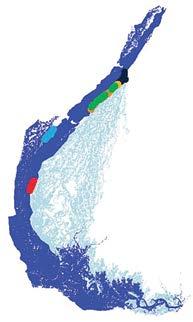
b. Map of the study area treatment and control villages
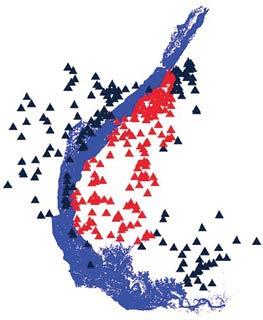
d.
flood
Sources: Global Flood Database (Tellman et al. 2021); Socioeconomic High-resolution Rural-Urban Geographic Platform for India (Asher et al. 2021); South Asia Climate Adaptation Survey; World Bank; World Bank BKBDP.
Note: Orange whiskers show 95 percent confidence intervals estimated with standard errors clustered at the village level. Panels a and b: Plots show Kosi River and surrounding survey area flooded based on WRD simulations of embankment breaches at program sites (panel a) and area with locations of treatment and control villages (panel b). Program package locations are based on BKBDP program data and indicate phases of program implementation when embankment upgrading work was undertaken. Panels c and d: Estimates are based on regressions of village-level census characteristics measured in most recent population census (2011) on treatment status. Treatment-control differences are measured as a percentage of the control group mean. BKBDP = Bihar Kosi Basin Development Project; HH = household; STSC = Scheduled Tribes and Scheduled Castes; WRD = Water Resources Department.
Before randomly sampling in treatment and control groups, the following sample restrictions were imposed:
• Outside of embankment. Villages must be outside the embankment, because these villages rely on the embankment for protection. The protection status of villages within the embankment is difficult to ascertain.
• Within 30 kilometers of embankment. Sampled villages must be reasonably close to the embankment, so that all villages in the sample are in the Kosi River floodplain.
• District restriction. For survey logistical purposes, the sample was restricted to the districts of Araria, Darbhanga, Madhepura, Madhubani, Purnia, Saharsa, and Supaul.
• Latitude. For geographic compactness of the sample, control villages were restricted to be north of 25.5° latitude and treatment villages north of 25.7° latitude.
From this sampling frame, 152 treated villages and 152 control villages were randomly sampled. The sampling was stratified along two variables—distance to the river and flood history—to ensure these were balanced between treatment and control. Distance to the river was split into five bins, in kilometers: 0–2, 2–5, 5–10, 10–20, and >20. Historical flood exposure was split into four bins: 0 floods, 1–5 floods, 6–10 floods, and >10 floods. The interaction of these two groups gives 20 total sampling strata.
Treatment group strata were formed by generating 25 groups that intersect the five program packages (assigned to villages by nearest embankment spur) with the five river distance bins.
The sampling probabilities are shown in table 3C.1. With these two sets of strata in hand, sampling then proceeds in three steps:
1. Randomly sample treatment villages according to the probabilities of selection in table 3C.1.
2. Randomly sample control villages such that they match the treatment group distribution of the strata. That is, for each of the 20 strata groups, randomly sample controls where the probability of selection is equal to the share of that group in the treatment villages. This ensures balance between treatment and control along these strata.
3. Finally, sample replacement villages randomly (without stratification) from the remaining sample frame. This was ultimately redundant because no replacement villages were used during the fielding of the survey.
TABLE 3C.1 Sampling Probabilities, by Program Package
Source: World Bank.
This sampling routine was run 100 times, each with a different random seed. Candidate final samples were those that satisfied the following conditions:
• The sample selected more than 150 control villages. Note that this condition was not binding for treatment villages, which were sampled in proportion to the program packages. Instead, because control villages had to match the treated villages across the 20 strata, this constraint occasionally caused difficulty in obtaining the full sample size required among controls.
• The mean differences between treated and control groups were not statistically significant across the following characteristics: (1) number of historical floods from 2000 to 2018, (2) the distance to the embankment, (3) the distance to the Kosi River, and (4) the modeled depth of a one-in-five-year fluvial flood from Fathom version 2.
The sampling strategy targeted balance on key flood risk characteristics, including distance to the embankment and number of historical preintervention floods. The stratified sampling approach successfully balanced the distributions of these characteristics.
a. Distance to embankment, sampling frame
b. Distance to embankment, sample
c. Number of floods, 2000–18, sampling frame
Probability density
d. Number of floods, 2000–18, sample
Probability density
Sources: Global Flood Database (Tellman et al. 2021); South Asia Climate Adaptation Survey; World Bank.
Note: Figures show distributions of matching variables at the village level for study sampling design. Sampling frame is all possible villages that are protected (treatment) or not protected (control) by Bihar Kosi Basin Development Project embankment upgrading within 30 kilometers of any Kosi River embankment. Sample is 347 villages selected by sampling routine explained in this annex. Panels a and b: Distance to embankment measured at the village level in kilometers. Panels c and d: Historical flood exposure measured as the number of floods affecting any part of the village from 2000 to 2018 according to satellite data.
The final sample was able to effectively match the distributions of the four key characteristics targeted by the sampling strategy in treatment versus control villages (refer to figure 3C.2). The effect of the sampling strategy was to bring the control distributions in line with those of the treatment group. However, the sampling strategy also achieved substantial balance across other nontargeted village-level characteristics from the 2011 census (refer to figure 3C.1c). Still, a handful of village characteristics—including the literacy rate and access to roads and banks—were not balanced between treatment and control villages in the final sample.
The treatment effects regression for household i in village v is yiv = α + βtreat v + yflood08i +
iv, (2) where yiv is one of the outcomes: beliefs, adaptation, off-farm employment, or migration. Flooding beliefs are measured as a standardized index across three different measures of flooding severity. Adaptation is measured using the flood adaptation index—the total number of flooding adaptations adopted by the household in the 12 months preceding the survey. treat v is a binary variable indicating whether the village is treated by the embankment construction or not, and β gives the impact of the treatment under the assumption that treatment assignment is unconfounded. To further control for exposure to the most salient major flooding disaster, the specification also includes flood08i, a binary measure of whether household i was affected by the 2008 flooding event, measured either by satellite data or by self-reports, depending on the specification. Standard errors are clustered at the village level.
TABLE 3C.2
Sources: South Asia Climate Adaptation Survey; World Bank.
Note: Standard errors are in parentheses and clustered at the village level. Belief index is the average of three measures of flooding severity beliefs, standardized such that larger values represent more pessimistic beliefs. Embankment and spur distance measure distances to any river embankment and the reconstructed Bihar Kosi Basin Development Project spurs, respectively, in kilometers. Satellite flood is a binary variable indicating that the household was flooded in 2008. All models include strata fixed effects. Sample is all households for which belief index is nonmissing.
*p < 0.10 **p < 0.05 ***p < 0.01
Sources: South Asia Climate Adaptation Survey; World Bank.
Note: Standard errors are in parentheses and clustered at the village level. Flood adaptation index is the number of flooding adaptations adopted at the household level in the 12 months preceding the survey. Embankment and spur distance measure distances to any river embankment and the reconstructed Bihar Kosi Basin Development Project spurs, respectively, in kilometers. Satellite flood is a binary variable indicating that the household was flooded in 2008. All models include strata fixed effects. Sample is all households for which flood adaptation index is nonmissing.
*p < 0.10 **p < 0.05 ***p < 0.01
Sources: South Asia Climate Adaptation Survey, World Bank.
Note: Standard errors are in parentheses and clustered at the village level. Nonagricultural wage employment is an indicator variable taking the value 1 if there is at least one household member working in nonagricultural wage employment. Embankment and spur distance measure distances to any river embankment and the reconstructed Bihar Kosi Basin Development Project spurs, respectively, in kilometers. Satellite flood is a binary variable indicating that the household was flooded in 2008. All models include strata fixed effects. Sample is all households for which nonagricultural wage employment is nonmissing.
*p < 0.10 **p < 0.05 ***p < 0.01
Sources: South Asia Climate Adaptation Survey; World Bank.
Note: Standard errors are in parentheses and clustered at the village level. Any migration in the past year is an indicator variable taking the value 1 if there is at least one household member who migrated in the past year. Embankment and spur distance measure distances to any river embankment and the reconstructed Bihar Kosi Basin Development Project spurs, respectively, in kilometers. Satellite flood is a binary variable indicating that the household was flooded in 2008. All models include strata fixed effects. Sample is all households for which migration in the past year is nonmissing.
*p < 0.10 **p < 0.05 ***p < 0.01
Ali, D. A., K. Deininger, and M. Goldstein. 2014. “Environmental and Gender Impacts of Land Tenure Regularization in Africa: Pilot Evidence from Rwanda.” Journal of Development Economics 110: 262–75.
Annan, F., and W. Schlenker. 2015. “Federal Crop Insurance and the Disincentive to Adapt to Extreme Heat.” American Economic Review 105 (5): 262–6.
Aragon, F. M., F. Oteiza, and J. P. Rud. 2021. “Climate Change and Agriculture: Subsistence Farmers’ Response to Extreme Heat.” American Economic Journal: Economic Policy 13 (1): 1–35.
Asfaw, S., and G. Maggio. 2016. "Gender, Weather Shocks, and Welfare: Evidence from Malawi." The Journal of Development Studies https://www.tandfonline.com/doi/full/10.1080/00220388.2017.1283016
Asher, S., T. Lunt, R. Matsuura, and P. Novosad. 2021. “Development Research at High Geographic Resolution: An Analysis of Night-Lights, Firms, and Poverty in India Using the SHRUG Open Data Platform.” World Bank Economic Review 35 (4): 845–71. https://doi.org/10.1093/wber/lhab003.
Baez, J., G. Caruso, V. Mueller, and C. Niu. 2017. “Heat Exposure and Youth Migration in Central America and the Caribbean.” American Economic Review 107 (5): 446–50.
Bandiera, O., and I. Rasul. 2006. “Social Networks and Technology Adoption in Northern Mozambique.” Economic Journal 116 (514): 869–902.
Banerjee, A., and L. Iyer. 2005. “History, Institutions, and Economic Performance: The Legacy of Colonial Land Tenure Systems in India.” American Economic Review 95 (4): 1190–213.
Banerjee, R., and R. Maharaj. 2020. “Heat, Infant Mortality, and Adaptation: Evidence from India.” Journal of Development Economics 143: 102378.
Benetton, M., S. Emiliozzi, E. Guglielminetti, E. Loberto, and A. Mistretta. 2022. “Do House Prices Reflect Climate Change Adaptation? Evidence from the City on the Water.” Occasional Paper No. 735, Bank of Italy, Rome.
BenYishay, A., and A. M. Mobarak. 2019. “Social Learning and Incentives for Experimentation and Communication.” Review of Economic Studies 86 (3): 976–1009.
Besley, T., and R. Burgess. 2000. “Land Reform, Poverty Reduction, and Growth: Evidence from India.” Quarterly Journal of Economics 115 (2): 389–430.
Blakeslee, D., R. Fishman, and V. Srinivasan. 2020. “Way Down in the Hole: Adaptation to Long-Term Water Loss in Rural India.” American Economic Review 110 (1): 200–24.
Boucher, S. R., M. R. Carter, J. E. Flatnes, T. J. Lybbert, J. G. Malacarne, P. P. Marenya, and L. A. Paul. 2024. “Bundling Genetic and Financial Technologies for More Resilient and Productive Small-Scale Farmers in Africa.” Economic Journal 134 (662): 2321–50.
Branco, D., and J. Féres. 2021. “Weather Shocks and Labor Allocation: Evidence from Rural Brazil.” American Journal of Agricultural Economics 103 (4): 1359–77.
Brooks, W., and K. Donovan. 2020. “Eliminating Uncertainty in Market Access: The Impact of New Bridges in Rural Nicaragua.” Econometrica 88 (5): 1965–97.
Bryan, G., S. Chowdhury, and A. M. Mobarak. 2014. “Underinvestment in a Profitable Technology: The Case of Seasonal Migration in Bangladesh.” Econometrica 82 (5): 1671–748.
Burgess, R., O. Deschenes, D. Donaldson, and M. Greenstone. 2017. “Weather, Climate Change and Death in India.” LSE Working Paper, London School of Economics and Political Science, London. Burgess, R., and R. Pande. 2005. “Do Rural Banks Matter? Evidence from the Indian Social Banking Experiment.” American Economic Review 95 (3): 780–95.
Burke, M., and K. Emerick. 2016. “Adaptation to Climate Change: Evidence from US Agriculture.” American Economic Journal: Economic Policy 8 (3): 106–40.
Burke, M., M. Zahid, M. C. Martins, C. Callahan, R. Lee, T. Avirmed, S. Heft-Neal, M. Kiang, S. Hsiang, and D. Lobell. 2024. “Are We Adapting to Climate Change?” Working Paper 32985, National Bureau of Economic Research, Cambridge, MA.
Burlig, F., A. Jina, E. Kelley, G. Lane, and H. Sahai. 2024. “Long-Range Forecasts as Climate Adaptation: Experimental Evidence from Developing-Country Agriculture.” Working Paper 32173, National Bureau of Economic Research, Cambridge, MA.
Carleton, T., E. Duflo, B. K. Jack, and G. Zappalà. 2024. “Adaptation to Climate Change.” Working Paper 33264, National Bureau of Economic Research, Cambridge, MA.
Carranza, E., and D. McKenzie. 2024. “Job Training and Job Search Assistance Policies in Developing Countries.” Journal of Economic Perspectives 38 (1): 221–44.
Chaijaroen, P. 2019. “Long-Lasting Income Shocks and Adaptations: Evidence from Coral Bleaching in Indonesia.” Journal of Development Economics 136: 119–36.
Cole, S., D. Stein, and J. Tobacman. 2014. “Dynamics of Demand for Index Insurance: Evidence from a Long-Run Field Experiment.” American Economic Review 104 (5): 284–90.
Colmer, J. 2021. “Temperature, Labor Reallocation, and Industrial Production: Evidence from India.” American Economic Journal: Applied Economics 13 (4): 101–24.
Conley, T. G., and C. R. Udry. 2010. “Learning about a New Technology: Pineapple in Ghana.” American Economic Review 100 (1): 35–69.
Conte, B., K. Desmet, D. K. Nagy, and E. Rossi-Hansberg. 2021. “Local Sectoral Specialization in a Warming World.” Journal of Economic Geography 21 (4): 493–530.
Cruz, J.-L., and E. Rossi-Hansberg. 2023. “The Economic Geography of Global Warming.” Review of Economic Studies 91 (5): 2674.
Czura, K., and S. Klonner. 2023. “Financial Market Responses to a Natural Disaster: Evidence from Credit Networks and the Indian Ocean Tsunami.” Journal of Development Economics 160: 102996.
Deininger, K., and S. Jin. 2006. “Tenure Security and Land-Related Investment: Evidence from Ethiopia.” European Economic Review 50 (5): 1245–77.
Deininger, K., S. Jin, and H. K. Nagarajan. 2009. “Land Reforms, Poverty Reduction, and Economic Growth: Evidence from India.” Journal of Development Studies 45 (4): 496–521.
Demont, T. 2022. “Coping with Shocks: How Self-Help Groups Impact Food Security and Seasonal Migration.” World Development 155: 105892.
Deryugina, T. 2013. “How Do People Update? The Effects of Local Weather Fluctuations on Beliefs about Global Warming.” Climatic Change 118 (2): 397–416.
Dougherty, J. P., J. E. Flatnes, R. A. Gallenstein, M. J. Miranda, and A. G. Sam. 2020. “Climate Change and Index Insurance Demand: Evidence from a Framed Field Experiment in Tanzania.” Journal of Economic Behavior & Organization 175: 155–84.
Emerick, K., and M. H. Dar. 2021. “Farmer Field Days and Demonstrator Selection for Increasing Technology Adoption.” Review of Economics and Statistics 103 (4): 680–93.
Emerick, K., A. De Janvry, E. Sadoulet, and M. H. Dar. 2016. “Technological Innovations, Downside Risk, and the Modernization of Agriculture.” American Economic Review 106 (6): 1537–61.
Gallagher, J. 2014. “Learning about an Infrequent Event: Evidence from Flood Insurance Take-Up in the United States.” American Economic Journal: Applied Economics 6 (3): 206–33.
Giannelli, G. C., and E. Canessa. 2022. “After the Flood: Migration and Remittances as Coping Strategies of Rural Bangladeshi Households.” Economic Development and Cultural Change 70 (3): 1159–95.
Gillingham, K., A. Keyes, and K. Palmer. 2018. “Advances in Evaluating Energy Efficiency Policies and Programs.” Annual Review of Resource Economics 10 (1): 511–32.
Giné, X., R. Townsend, and J. Vickery. 2008. “Patterns of Rainfall Insurance Participation in Rural India.” World Bank Economic Review 22 (3): 539–66. https://doi.org/10.1093/wber/lhn015
Gröger, A., and Y. Zylberberg. 2016. “Internal Labor Migration as a Shock Coping Strategy: Evidence from a Typhoon.” American Economic Journal: Applied Economics 8 (2): 123–53.
Hallegatte, S., J. Rentschler, and J. Rozenberg. 2019. Lifelines: The Resilient Infrastructure Opportunity. Washington, DC: World Bank. http://hdl.handle.net/10986/31805
Hill, R. V., N. Kumar, N. Magnan, S. Makhija, F. De Nicola, D. J. Spielman, and P. S. Ward. 2019. “Ex Ante and Ex Post Effects of Hybrid Index Insurance in Bangladesh.” Journal of Development Economics 136: 1–17.
Hsiao, A. 2025. “Sea Level Rise and Urban Adaptation in Jakarta.” Working Paper, Stanford University, Stanford, CA. Jagnani, M., and R. Pande. 2023. “Including vulnerable communities in extreme weather early warning systems.” Yale Economic Growth Center News. February 6. https://egc.yale.edu/news/230206/including-vulnerable -communities-extreme-weather-early-warning-systems
Karlan, D., R. Osei, I. Osei-Akoto, and C. Udry. 2014. “Agricultural Decisions after Relaxing Credit and Risk Constraints.” Quarterly Journal of Economics 129 (2): 597–652.
Kelly, D. L., and R. Molina. 2023. “Adaptation Infrastructure and Its Effects on Property Values in the Face of Climate Risk.” Journal of the Association of Environmental and Resource Economists 10 (6): 1405–38.
Kettner, A. J., G. R. Brakenridge, G. J.-P. Schumann, and X. Shen. 2021. “DFO—Flood Observatory.” In Earth Observation for Flood Applications, edited by G. J.-P. Schumann, 147–64. Amsterdam: Elsevier. Lane, G. 2024. “Adapting to Climate Risk with Guaranteed Credit: Evidence from Bangladesh.” Econometrica 92 (2): 355–86.
Li, L. 2019. “CAS FGOALS-G3 Model Output Prepared for CMIP6 CMIP” [data set]. Earth System Grid Federation.
Linsenmeier, M., and J. Shrader. 2023. “Global Inequalities in Weather Forecasts.” Preprint, December 7, 2023. https://osf.io/preprints/socarxiv/7e2jf_v1
Liu, M., Y. Shamdasani, and V. Taraz. 2023. “Climate Change and Labor Reallocation: Evidence from Six Decades of the Indian Census.” American Economic Journal: Economic Policy 15 (2): 395–423.
Macours, K., P. Premand, and R. Vakis. 2022. “Transfers, Diversification and Household Risk Strategies: Can Productive Safety Nets Help Households Manage Climatic Variability?” Economic Journal 132 (647): 2438–70. Mueller, V., C. Gray, and K. Kosec. 2014. “Heat Stress Increases Long-Term Human Migration in Rural Pakistan.” Nature Climate Change 4 (3): 182–5. Mulder, P. 2024. “Mismeasuring Risk: The Welfare Effects of Flood Risk Information.” Unpublished manuscript, posted October 23, 2024; last revised October 29, 2024. https://papers.ssrn.com/sol3/papers .cfm?abstract_id=4966795
Nath, I. 2020. “The Food Problem and the Aggregate Productivity Consequences of Climate Change.” Working Paper 27297, National Bureau of Economic Research, Cambridge, MA.
Patel, D. 2023. “Environmental Beliefs and Adaptation to Climate Change.” Unpublished manuscript, posted November 30, 2023; last revised January 4, 2025. https://papers.ssrn.com/sol3/papers.cfm?abstract_id=4636825
Pople, A., S. Dercon, R. Hill, and B. Brunchkhorst. 2022. “Anticipatory Cash Transfers in Climate Disaster Response.” CSAE Working Paper 2021–07, University of Oxford, Oxford. Rajan, R., and R. Ramcharan. 2023. “Finance and Climate Resilience: Evidence from the Long 1950s US Drought.” Working Paper 31356, National Bureau of Economic Research, Cambridge, MA.
Rexer, J., and S. Sharma. 2024. “Climate Change Adaptation: What Does the Evidence Say?” Policy Research Working Paper 10729, World Bank, Washington, DC.
Rexer, J., and S. Sharma. 2025. “Heat, Firms, and Reallocation in the Non-Farm Sector: Evidence from India.” Working paper. World Bank, Washington, DC.
Rijkers, B., and M. Söderbom. 2013. “The Effects of Risk and Shocks on Non-Farm Enterprise Development in Rural Ethiopia.” World Development 45: 119–36.
Taraz, V. 2017. “Adaptation to Climate Change: Historical Evidence from the Indian Monsoon.” Environment and Development Economics 22 (5): 517–45.
Tellman, B., J. A. Sullivan, C. Kuhn, A. J. Kettner, C. S. Doyle, G. R. Brakenridge, T. A. Erickson, and D. A. Slayback. 2021. “Satellite Imaging Reveals Increased Proportion of Population Exposed to Floods.” Nature 596 (7870): 80–6.
UNEP (United Nations Environment Programme). 2024. Adaptation Gap Report 2024: Come Hell and High Water— As Fires and Floods Hit the Poor Hardest, It Is Time for the World to Step up Adaptation Actions. New York, NY: United Nations.
Wing, O. E. J., P. D. Bates, N. D. Quinn, J. T. S. Savage, P. F. Uhe, A. Cooper, T. P. Collings, et al. 2024. “A 30 m Global Flood Inundation Model for Any Climate Scenario.” Water Resources Research 60 (8): e2023WR036460.
World Bank. 2024a. Access to Land in South Asia–The World Bank Guidance Note. Washington, DC: World Bank. http://documents.worldbank.org/curated/en/099032824093529033.
World Bank. 2024. South Asia Development Update: Jobs for Resilience. Washington, DC: World Bank. http:// documents.worldbank.org/curated/en/099061824200022003.
Young, N. 2017. “Banking and Growth: Evidence from a Regression Discontinuity Analysis.” EBRD Working Paper 207, European Bank for Reconstruction and Development, London.
Zappalà, G. 2023. “Drought Exposure and Accuracy: Motivated Reasoning in Climate Change Beliefs.” Environmental and Resource Economics 85 (3–4): 649–72.
Zappalà, G. 2024. “Adapting to Climate Change Accounting for Individual Beliefs.” Journal of Development Economics 169: 103289.
Megan
Lang and Siddharth Sharma, with contributions from Jonah Rexer and Margaret Triyana
Increasingly frequent and severe weather shocks reduce revenues, damage physical assets, and require costly shifts in products, markets, and labor practices for South Asian firms. Firm managers in the region expect that increasingly frequent and severe weather shocks will cause damages in 2025–29 that are three times as great as those experienced in 2019–24. More experienced and highly skilled managers tend to have expectations about future weather shocks that are more aligned with consensus forecasts. They also expect lower damages, possibly because better managers tend to be better able to adapt to extreme weather.
Nonfarm enterprises are central to economic growth in South Asia. Across South Asian economies, nonagricultural enterprises accounted for roughly four-fifths of gross domestic product on average during 2013–23 (refer to figure 4.1a).
Growing challenges from rising global temperatures. South Asia has already experienced an increase in the frequency of extremely high temperatures that was the second largest among emerging markets and developing economies between 1980–2008 and 2009–23, after the Middle East and North Africa (refer to figure 4.1b). If firms do not adapt to the challenges posed by the changing climate, economic growth will suffer. Extremely hot temperatures will make workers less productive and can even make outdoor work impossible. Natural disasters like storms and floods can damage physical assets, interrupt productive operations, cause lost days of work, and reduce demand for the goods and services that firms produce.
Nonagricultural sectors account for the majority of GDP in South Asian economies. Firms across the region have experienced some of the most significant temperature increases.
a. Sectoral shares of GDP and GDP growth, 2013–23
b. Increase in days per year above 35°C between 1980–2008 and 2009–23
Sources: Enterprise Surveys, World Bank (https://www.enterprisesurveys.org/en/enterprisesurveys); ERA5-Land (Copernicus Climate Change Service 2023); World Bank; World Development Indicators, World Bank (2023; https://databank.worldbank.org/source/world-development-indicators).
Note: Panel a: Value added as a percentage of GDP in industry and service sectors in South Asia and other EMDEs, measured in constant 2015 US dollars. Other EMDEs include 128 economies. Average between 2013 and 2023. Panel b: Difference in the number of days where temperatures exceed 35°C between 2009–23 and 1980–2008, by global region, based on the location of firms in the World Bank Enterprise Surveys. EAP = East Asia and Pacific; ECA = Europe and Central Asia; EMDEs = emerging market and developing economies; GDP = gross domestic product; LAC = Latin America and the Caribbean; MNA = Middle East and North Africa; SAR = South Asia; SSA = Sub-Saharan Africa.
Governments can help firms adapt to new weather conditions, but fiscally constrained governments need to target their support to the firms that are most vulnerable. This chapter builds a detailed picture of firms’ exposure to climate change in South Asia: the weather shocks firm managers believe are affecting their businesses the most and their estimates of the associated damages.
This chapter addresses the following questions:
• Which weather shocks are affecting firms in South Asia the most?
• Which types of firm managers have expectations about future weather shocks that align most closely with expert forecasts?
• Which firms are most exposed to, and most damaged by, weather shocks?
Using novel data from recent surveys of firm managers in three South Asian countries, this analysis uncovers new insights on firms’ vulnerability to weather shocks, the associated costs, and the characteristics of the firms that best anticipate weather shocks and limit damages.
Comprehensive coverage of weather shocks. This analysis examines a comprehensive set of weather shocks and their effects using survey data from a broadly representative sample of firms in three South Asian countries.
Past research has examined the impact of weather-related shocks on firms in specific contexts or locations—for example, the impact of floods on supply chains in one country (Rentschler et al. 2021) or the impacts of extreme heat on firms in selected sectors in one city (for example, Adhvaryu, Kala, and Nyshadham 2020; Somanathan et al. 2021). Cross-country work has focused on a single type of weather shock, such as heat (Berg et al. 2025; Huppertz 2025; Pankratz, Bauer, and Derwell 2023) or hurricanes (Pelli and Tschopp 2017).
Comparing the expectations of firm managers with expert forecasts. The analysis in this chapter is one of the first to examine firms’ perceptions of weather-related risks and damages, including firms’ expectations of specific weather shocks and the damage from them. By comparing the survey-based data with spatially detailed temperature projections by climate experts, this chapter examines how closely firms’ expectations align with expert forecasts. The results speak to the importance of information provision in public policies to promote adaptation. Identifying the characteristics of firms that are most vulnerable, are the least informed, and suffer the largest costs from weather shocks can guide the design of adaptation policies.
Firms already face challenges from weather shocks. Three-quarters of firm managers in South Asia report that they have experienced at least one weather shock in the past five years (refer to figure 4.2a), with average damages per year from all shocks equivalent to 17 percent of annual revenues (refer to figure 4.2b). Exposure is largely a function of firms’ location rather than economic activities.
Expected increase in the frequency of weather shocks. More than three-quarters of firms in South Asia expect to experience all types of weather shocks more in the next five years than in the past five years (refer to figure 4.2a). Firms expect to face new types of weather shocks and expect shocks to occur more frequently.
Varying expectations about the future. On average, firm managers in South Asia are familiar with expert weather forecasts for extreme heat in the next five years. However, how closely their expectations align with expert forecasts varies widely. Firms whose managers have lower levels of educational attainment and have less access to credit, for example, are more likely to expect a lower frequency of extreme heat than predicted by expert forecasts (refer to figure 4.2c).
Growing damages. Most firms expect that shocks will become more costly in the next five years than they were in the past five years (refer to figure 4.2b). Firms, on average, expect the costs arising from weather shocks in the next five years to be triple the costs in the past five years. This is partly due to an expected increase in the frequency of shocks and partly due to an increase in their severity. Comparisons with estimates from the literature indicate that managers in the survey may be overestimating both past and future damages.
Higher management and worker skills are associated with better outcomes. Although variations in the occurrence of extreme weather events are almost entirely explained by firm location, firms with better management practices and more skilled workers are estimated to have lost 2–3 percent less revenue each year to weather-shock-related damages than other firms (refer to figure 4.2d). This suggests that efforts to improve management practices and skills can be helpful in partially offsetting the effects of weather shocks.
South Asia Climate Adaptation (SACA) firm survey. Data on firm-level experiences and expectations of weather shocks and their effects come from a survey of firms conducted in 2024 in districts throughout Bangladesh, Pakistan, and three of the most industrialized states in India (Gujarat, Maharashtra, and Tamil Nadu) that also had the highest concentrations of firms and tended to experience different types of weather shocks (refer to annex 4A). The data from the survey are representative of a plurality of firms in the three countries. The survey interviewed firm managers, defined as the person responsible for making all important day-to-day decisions about the operation of the firm. The survey asked managers about their past experiences and future expectations of extreme heat, floods, waterlogging, storms, and droughts.1
Firms in South Asia expect more frequent weather shocks and an increase in damages from them. Managers with higher skill levels have expectations of high temperatures that more closely align with expert forecasts, and they expect lower damages.
c. Firm characteristics and differences between firms’ expectations and expert forecasts
Correlation
d.
Sources: Gergel et al. (2024); South Asia Climate Adaptation Survey; World Bank.
Note: Weights are constructed to make the data representative of firms in the districts included in the survey. Panel a: Past weather shocks are those experienced over the past five years (2019–24). Expected weather shocks are those expected to be experienced over the next five years (2025–29). Bars show the weighted proportions of firms in the survey whose managers report that a given shock directly affected their business in the past five years or is expected to affect it in the next five years. Panel b: Past five years indicates the average annual total cost associated with a given type of event over the past five years (2019–24) as a percentage of a firm’s annual revenues and accounting for all different cost categories. Expected next five years indicates the average annual total costs expected over the next five years (2025–29). Average annual costs are calculated by dividing total costs over the relevant five-year period by five. All calculations are unconditional on experiencing a given shock, meaning that any firm that does not report experiencing a shock or expecting to experience a shock enters the calculation as a zero. Panel c: Bars represent coefficients from regressions of the absolute value of the difference between manager predictions of the number of days that temperatures will be above 35°C in the next five years and expert forecasts on firm characteristics, including only firms whose managers underestimate exposure by more than 20 days per year. The finance index is an index capturing the firm’s access to finance. Domestic inputs are the percentage of inputs that the firm sources domestically. Manager experience is the number of years of experience the manager has in the sector of the firm. Bachelor’s and above indicates whether a firm manager has at least an undergraduate degree. Skilled workers are the percentage of the firm’s employees who have completed secondary school. Orange whiskers show 95 percent confidence intervals calculated using standard errors clustered at the survey strata level. Regressions include district fixed effects. Annex 4B, table 4B.2, shows the full regression results, where all coefficients are reported. Coefficients for all continuous variables show the association between a 1 standard deviation change in the variable and the difference from the expert forecast. Panel d: Bars represent coefficients from regressions of total expected damages in the next five years (2025–29) from all weather shocks on indicators for which shocks a firm expects to be exposed to and firm characteristics. Skilled workers are the percentage of the firm’s employees who have completed secondary school. Management practices index reflects the quality of a firm’s management practices. Regulatory burden is an index of the burden a firm faces from labor, trade, and licensing regulations. Domestic inputs are the percentage of inputs that a firm sources from domestic markets. Orange whiskers show 95 percent confidence intervals calculated using standard errors clustered at the survey strata level. Annex 4B, table 4B.3, shows the full regression results, where all coefficients are reported. Regressions include district fixed effects to control for firm location. Coefficients for all continuous variables show the association between a 1 standard deviation change in the variable and the expected damages.
The survey data on firms’ expectations were compared with contemporaneous expert forecasts of extreme heat, and the differences were correlated with firm characteristics. The survey results also provided information about the costs of weather shocks to firms, adaptive actions taken or planned by firms, and a range of information about firms’ characteristics and performance. As with all surveys, data were self-reported. If firm managers had biased or inaccurate perceptions of the incidence or costs of weather shocks, the survey data will reflect those biases.
Most firms in South Asia have experienced at least one type of weather shock in the past five years, and most firms expect to experience more shocks in the next five years. Firm location is highly predictive of past experiences of a weather shock, but few other firm characteristics predict shock experience conditional on location. Two important exceptions are that exporters have tended to experience fewer shocks, whereas firms reporting high regulatory burdens have tended to see more.
Variation in weather and climate across locations means that firms in different locations face different risks. Documenting which types of weather shocks firms have experienced in the past and expect in the future, and identifying the key predictors of exposure to weather shocks, are first steps to understanding the challenge of changing weather for firms.
The survey asked firm managers to report on all weather shocks that had directly affected their businesses in the past five years (2019–24) and on all weather shocks they expected to directly affect their business in the next five years (2025–29) (refer to annex 4A, “Survey Instrument” section). Firms’ responses provide a basis for a detailed understanding of the weather risks that different types of firms perceive.
Experience of weather shocks. Seventy-three percent of firms in the survey experienced at least one weather shock over the past five years (refer to figure 4.3a). Excessive rainfall with waterlogging was the most common shock, with 42 percent of firms reporting experiences, followed by extreme heat, which 32 percent of firms had experienced. Another 15–20 percent of firms had experienced flooding and storms, and fewer than 5 percent had experienced sea level rise, drought, or cyclones.
Expectations of the frequency of weather shocks. Firms expect more frequent weather shocks, and a larger variety of weather shocks, in the next five years than in the past five years. Thus, 78 percent of firms expect to experience at least one weather shock in the next five years, a statistically significant 7 percent increase from the past five years (refer to figure 4.3a). They expect three times as many storms, translating to six more storms per year, and a doubling in the frequency of droughts, implying an additional drought every two years (refer to figure 4.3b).
Firms also expect flooding, excessive rainfall, heat, and cyclones to increase in frequency by over 35 percent. Only expectations of sea-level rise differ insignificantly from past experiences, consistent with the more gradual nature of the phenomenon.
FIGURE 4.3 Increasing
Firms in South Asia are highly exposed to multiple shocks, which are expected to increase over time.
a. Experience and expectations of weather shocks
b. Expected changes in frequency of weather shocks
Sources: South Asia Climate Adaptation Survey; World Bank. Note: Weights are calculated to make the data representative of firms in the districts included in the survey. Panel a: Past weather shocks are those experienced over the past five years (2019–24). Expected weather shocks are those expected over the next five years (2025–29). Bars show weighted proportions of firms in the survey whose managers report that a given shock directly affected their business in the past five years or will affect their business in the next five years. Panel b: Bars show weighted averages of the change in frequency firm managers expect to experience each shock in the next five years relative to the past five years. Calculations are conditional on the firm having experienced the shock in the past five years.
Variety of shocks. More firms in the survey expect to experience all types of shocks in the future than in the past. The largest increases in the proportion of firms expecting specific weather shocks are for heat, excessive rainfall, and cyclones. Thirty-eight percent of firms expect to face extreme heat in the next five years, an increase of 19 percent (6 percentage points) from the past five years. Forty-eight percent of firms expect excessive rainfall, an increase of 14 percent (6 percentage points), and 9 percent of firms expect to experience a cyclone, an increase of 125 percent (5 percentage points). The finding from the survey that firms expect increases in both the frequency and the variety of weather shocks indicates that firms understand that the climate is changing.
Location predicts experiences of weather shocks. Firm location—the district in which the firm operates—is a key predictor of a firm’s experience of weather shocks. Firm location explains 23 percent of the variation in experience of weather shocks across firms, whereas the combination of sector, size, managerial education and experience, and a host of other firm characteristics explains only 15 percent. Experience of weather shocks varies strikingly across districts, and hence between individual districts and national averages, with some districts having up to 40 percentage
points more firms experiencing any weather shock than the country average (refer to figure 4.4). The distribution of district-level shock experience also varies significantly among different types of shocks. Flooding affects relatively few districts, but it affects a large proportion of firms in districts where it occurs, whereas heavy rainfall and extreme heat have more even distributions across districts.
Factors other than location as predictors. To identify the characteristics of firms associated with more and less experience of weather shocks in any district, multiple linear regressions were estimated. The regressions used experiences of different shocks as the dependent variable and firm characteristics and district fixed effects as explanatory variables (refer to annex 4B, “Predictors of Exposure” section).
4.4 D istribution of Weather Shocks, by Location
Firms’ experience of weather shocks varies significantly depending on the district in which they are located.
Exporters are less exposed. Firms that export are 16 percentage points less likely to have experienced any type of weather shock than those whose sales are all to the domestic market, conditional on location and a wide range of firm characteristics (refer to figure 4.5a). The estimated association is meaningful: it is the equivalent of moving from a district at the 75th percentile of exposure to one at the median. Exporters are 8 percentage points less likely to have experienced excessive rainfall and flooding and 5 percentage points less likely to have experienced extreme heat. Owner-managed firms are 5 percentage points less likely to have experienced any type of shock than non-owner-managed firms, though the difference is not statistically significant for flooding and extreme heat. The other significant predictor is regulatory obstacles reported by firms: a 1 standard deviation increase in an index of the obstacles to growth from trade, labor, and licensing regulations reported by firms is associated with a 5 percentage point increase in the likelihood of any reported weather shock, a 7 percentage point increase in the likelihood of excessive rainfall and flooding, and a 3 percentage point increase in the likelihood of heat (annex 4B, table 4B.1, shows the full set of regression results).
Exporters and firms reporting low regulatory burdens tend to have been less exposed to both flooding and extreme heat, and family-managed firms have tended to experience fewer weather shocks. Several sectors have experienced more flooding or extreme heat than others.
Firms’
Correlation with exposure to shock
Any shock Flood Heat
Sources: South Asia Climate Adaptation Survey; World Bank.
Note: Blue bars represent coefficients from regressions of firm characteristics (panel a) or significant sectors (panel b) on an indicator variable for whether the firm experienced any shock in the past five years. Red and yellow bars represent coefficients from the same regressions on whether the firm experienced flooding or extreme heat, respectively, in the past five years. Exporter indicates whether a firm is an exporter. Family managed indicates whether a firm is managed by the owner or a member of the owner’s family. Regulatory burden is an index capturing how great an obstacle regulation poses to firm growth. Hospitality is a variable indicating whether a firm operates in the hospitality sector. Food production indicates whether a firm operates in the food manufacturing sector. Textiles is a variable indicating whether a firm operates in the textiles sector. Orange whiskers show 95 percent confidence intervals calculated using standard errors clustered at the survey strata level. Annex 4B, table 4B.1, shows the full regression results, where all coefficients are reported. Regressions include district fixed effects to control for firm location. Coefficients for all continuous variables show the association between a 1 standard deviation change in the variable and the likelihood of exposure.
Sectoral exposure varies by shock. The regression estimates also indicate that, conditional on a firm’s location, a firm’s sector helps predict exposure only to specific types of shocks. For instance, firms in the textiles sector are 11 percentage points more likely to have experienced any shock or excessive rainfall and flooding, but they are 5 percentage points less likely to have experienced heat (refer to figure 4.5b). Conversely, firms in the food production sector are 12 percentage points less likely to have experienced extreme heat but 3 percentage points more likely to have experienced excessive rainfall and flooding.
The firm characteristics that predict different experiences of weather shocks highlight the importance of designing and targeting policies that are tailored to different weather risks. The predictive power of location for experiences of weather shocks also points to the potential for firms to reduce their risk by choosing less exposed locations. Although there is prior evidence that firms can adjust plant locations to adapt to weather shocks, the factors predicting their ability to do so are not well understood (Balboni, Boehm, and Waseem 2024).
On average, firm managers’ expectations about the frequency of extremely high temperatures in the next five years coincide with expert forecasts. However, there is wide variation. Among firms whose managers expect fewer episodes of extreme heat than expert forecasts, the differences are significantly smaller for those with more educated and experienced managers, better access to finance, and a higher proportion of highly skilled workers, suggesting that firms with these characteristics are better able to forecast future weather shocks. No such patterns are found among firms whose managers expect more episodes of extreme heat than expert forecasts.
Forecasting the weather is necessarily subject to errors, which tend to be larger the further into the future the forecast extends. Ideally, errors should be randomly distributed. If firm managers systematically under- or overestimate weather shocks, the damages they suffer should be partially avoidable through improved forecasting that enables adaptive actions.
Firms’ expectations and expert forecasts. This section compares survey-based data on firm managers’ expectations about extreme heat with expert forecasts. In addition to asking about each type of shock in general terms, the survey asked firm managers, “How many days do you expect temperatures to be above 35°C, on average, in the next five years?” These expectations are compared with forecasts of the number of days per year with temperatures exceeding 35°C taken from the Climate Impact Lab’s Global Downscaled Projections for Climate Impacts, which are based on state-of-the-art climate models (Gergel et al. 2024). The expert forecasts are made comparable with the data on firms’ expectations using firm Global Positioning System coordinates. The section starts by comparing firm managers’ expectations of high temperatures with expert forecasts. It then explores the firm characteristics that are associated with expectations that are closer to expert forecasts using descriptive multiple linear regression. Annex 4B, “Predictors of Forecast Quality” section, describes these methods in detail.
The comparison focuses on extreme heat for two reasons. First, firms’ expectations of the number of days above 35°C are simple to elicit and directly comparable to expert forecasts.
Other weather phenomena are more difficult to translate between the metrics used in expert forecasts and nonexpert expectations. Thus, most managers would struggle to estimate or predict the number of days that a location gets more than 10 centimeters of rainfall. Second, most, if not all, firms in the sample are likely to have experienced extreme heat, whereas experiences of storms, flooding, and other weather events tend to apply only to subsets of firms depending on their location.
Expectations vary widely relative to expert forecasts. On average, firm managers expect more days of extreme heat than are forecast by the experts: the average firm manager’s estimate of the number of days above 35°C is 9.5 days per year higher than the average of 56 days per year forecast by experts (refer to figure 4.6a). However, the distribution of differences has wide tails. Managers at the 25th percentile expect 21 fewer days per year and managers at the 75th percentile expect 50 more days of extreme heat per year than the experts.
Differences between managers’ expectations and expert forecasts could be driven by the fact that the expert forecasts are averaged over wide geographic areas, potentially obscuring local variation. If so, then differences should be random and uncorrelated with firm characteristics, conditional on location. If instead firm managers’ expectations differ systematically from expert forecasts, then differences will be correlated with the relevant firm characteristics. Given that different characteristics may be predictive of positive and negative differences, the analysis examines the two types of differences separately.
Where the expected number of days with extreme heat by firm managers was less than expert forecasts, the differences were smaller when firm managers were more highly skilled. Differences between manager and expert predictions were smaller where managers had a higher level of education, had longer work experience, complained more about regulatory burdens, employed a higher share of skilled workers, and had greater access to finance (refer to figure 4.6b). The number of days expected by a manager with at least an undergraduate degree differed from expert forecasts, on average, by six days fewer than less-educated managers’ expectations. A 1 standard deviation increase in manager experience or in the firm’s access to finance index is associated with a three- to four-day smaller difference from expert views. Taken together, these patterns suggest that managers with more experience, education, and access to financial tools to make adaptive investments tended to have expectations about future weather that were closer to those of the experts.
When firms’ expectations about high temperatures exceeded expert forecasts, the differences were largely random. Few firm characteristics were found to be correlated with differences between firm expectations and expert forecasts among firms with higher expectations of extreme heat than the experts (refer to annex 4B, table 4B.2). The exceptions are that expectations of extreme heat among firms with higher past damages from weather shocks and firms in the textiles and other service sectors tended to exceed the expert forecasts by more than the other firms. This suggests that when firms’ expectations exceed expert forecasts, the size of the difference is largely random.
Firm managers’ expectations about episodes of extreme heat align with expert forecasts on average. Among firms whose expectations are below expert forecasts, differences are smaller for those with more experienced and educated managers.
a. Distribution of differences between firms’ expectations and expert forecasts of the number of days per year above 35°C in the next five years
Weighted mean = 9.5 days
Forecast differences (days)
b. Firm characteristics and forecast differences for firms with expectations below expert forecasts
Correlation with forecast differences (days)
FinanceindexDomesticinputsManagerexperienceBachelor’sandaboveSkilledworkers
Sources: Gergel et al. (2024); South Asia Climate Adaptation Survey; World Bank.
Note: Panel a: Bars show the weighted distribution of differences between forecasts from firm managers and expert forecasts about the average number of days that will exceed 35°C in the next five years, using the SSP245 (moderate-emissions) scenario. Note that results are similar using the SSP585 (high-emissions) scenario, given the short time frame considered. Negative numbers indicate that a manager’s forecast was below the expert forecast, meaning that the manager is underestimating exposure to extreme heat. Positive numbers mean that a manager is overestimating exposure. Weights are calculated to make the data representative of firms in the districts included in the survey. Panel b: Bars represent coefficients from regressions of the absolute value of the difference between manager predictions of the average number of days that temperatures will be above 35°C in the next five years and expert forecasts on firm characteristics, including only firms whose managers underestimate exposure by more than 20 days per year. Finance index is an index capturing the firm’s access to finance. Domestic inputs are the percentage of inputs that the firm sources domestically. Manager experience is the number of years of experience the manager has in the sector of the firm. Bachelor’s and above indicates whether a firm manager has at least an undergraduate degree. Skilled workers are the percentage of the firm’s employees who have completed secondary school. Orange whiskers show 95 percent confidence intervals calculated using standard errors clustered at the survey strata level. Annex 4B, table 4B.2, shows the full regression table with all coefficients. Regressions include district fixed effects. Coefficients for all continuous variables show the association between a 1 standard deviation change in the variable and the difference from expert forecasts. SSP = Shared Socioeconomic Pathways; SSP245 and SSP585 = moderate- and high-emissions climate scenarios, respectively, used by the Intergovernmental Panel on Climate Change to model future climate change impacts.
Firm managers expect the damages from weather shocks during 2025–29 to be triple the damages experienced during 2019–24. The largest damage is expected to be lost revenue from lower sales; other damages include the costs of repairs to physical assets and adjustments to products and workforces. Given location and controlling for past experiences of shocks, firms with more skilled managers tend to have suffered smaller damages.
The impacts of weather shocks on firms in South Asia are a function of both the nature and the frequency of the shocks and firms’ ability to limit damage, cope, and adapt. Consider a firm with much higher historical experience of extreme heat. The manager may have already invested in cooling technology, which may limit or even eliminate any impacts of extreme heat on the firm’s performance. Conversely, if a firm with high historical experiences of extreme heat faces constraints to adaptation, such as low access to finance or poor information, then it may continue to experience significant damage each year. This section provides novel empirical evidence on the magnitude and distribution of weather-related damage among firms in South Asia.
Measuring damage. The analysis in this section is based on data from the SACA firm survey on the past and expected costs of specific weather shocks. For each weather shock, firm managers reported losses in total revenue, costs to repair or replace damaged physical assets, costs associated with labor adjustments, and costs of other adjustments, such as changes in the type of products sold or in the markets where firms sell. Firms’ responses, in principle, provide the basis for a comprehensive estimate of the costs of weather shocks.
Identifying the most affected firms. The survey data are used for two types of analysis. The first is to document the size and nature of the damages that firms have experienced from weather shocks and to compare these estimates with estimated damages reported in the literature. The second aims to identify the firm characteristics associated with the largest weather-shock-related losses. This analysis uses multiple regressions similar to those used to estimate the determinants of experiences of weather shocks, with the key difference being that each regression controls for firms’ experience of different types of weather shocks, in addition to firm location, sector, and key characteristics. Annex 4B, “Predictors of Damages,” describes the methodology in detail.
Weather shocks are costly for firms. On average, each time a firm in South Asia experienced a flood or sea-level rise in the past five years, it suffered costs equivalent to around 6 percent of annual revenues (refer to figure 4.7a). Damages were smaller but still meaningful for other types of shocks, with the average drought or cyclone costing 4–5 percent of annual revenue and storms, excessive rainfall, or extreme heat costing 2–4 percent of annual revenue.
Costs of weather shocks are expected to rise. Firm managers expect the costs of all types of weather shocks to be higher, per incident, in the next five years than they were in the past five years. Firm managers expect that each flood they face in the next five years will cost them 12 percent of annual revenues in damages and each incident of sea-level rise will cost them 10 percent of annual revenues, in both cases double their estimate of corresponding costs in the past five years (refer to figure 4.7a). Managers expect the costs associated with each cyclone to more than double from 4 percent to 9 percent of annual revenues and the costs of incidents of excessive rainfall to double from 2 percent to 4 percent of annual revenues. Although the proportional increases in damages expected from storms, heat, and drought are smaller, they are all substantial. Such striking expected increases in the damages from individual weather shocks underscore the urgency of adaptation.
Given that firm managers expect shocks to become both more frequent and more costly in the next five years than in the past five years, total expected damages from weather shocks are also substantially higher. However, the magnitude of the increase suggests that managers may be overestimating future damages. Firm managers estimate that the average annual costs of damages from all weather shocks in the past five years were equivalent to 17 percent of annual revenues (refer to figure 4.7b). Managers expect this to triple to 52 percent in the next five years. The largest damages are expected to be caused by excessive rainfall, heat, and floods, with costs in each case amounting to 11–17 percent of annual revenues. Despite having some of the highest per-shock costs, sea-level rise, cyclones, and droughts are expected to cause damages costing less than 5 percent of annual revenue, reflecting the small number of firms expecting to experience those shocks.
Forms of damage. Weather shocks cause damage and impose costs on firms in multiple ways. Extreme weather events can disrupt access to markets and lead to local income losses, which depress sales revenues. They can also require adjustments in working hours—for instance, to cooler
FIGURE 4.7 Firms’ Actual and Expected Weather-Related Damages
Weather shocks were already costly for firms in South Asia over 2019–24, but managers expect shocks to be even costlier over 2025–29. Expected increases in both the frequency and the severity of shocks imply that, on average, costs to firms from all weather shocks in the next five years will be nearly triple those costs in the past five years.
a. Costs associated with a single incident of each weather shock
b. Total average annual costs from weather shocks
Sources: South Asia Climate Adaptation Survey; World Bank.
Note: Weights are calculated to make the data representative of firms in the districts included in the survey. Panel a: Past five years indicates the per-shock costs associated with a given type of event over the past five years (2019–24) as a percentage of a firm’s annual revenues, accounting for all different cost categories. Expected next five years indicates the per-shock costs expected over the next five years (2025–29). Bars show weighted averages of firms in the survey whose managers report that a given shock directly affected their business in the past five years or will affect their business in the next five years. Panel b: Past five years indicates the average annual total costs associated with a given type of event over the past five years (2019–24) as a percentage of a firm’s annual revenues, accounting for all different cost categories. Expected next five years indicates the average annual total costs expected over the next five years (2025–29). Average annual total costs are calculated by dividing total costs over the relevant five-year period by five. All calculations are unconditional on experiencing a given shock, meaning that any firm that does not report experiencing a shock or expecting to experience a shock enters the calculation as a zero.
but more expensive night shifts—or cause higher rates of absenteeism and sickness. They can force firms to change their product offering, their target markets, or their suppliers. And they can cause damage to physical assets. The firms surveyed reported that in the past five years, 46 percent of total damages resulted from declining sales; 21–23 percent, from the costs of adjustments to labor practices, products, and marketing; and 9 percent, from the costs of repairing or replacing damaged physical assets (refer to figure 4.8a).
Among the various types of damage, revenue losses accounted for the largest share for all shocks, ranging from 38 percent to 61 percent of shock-specific damages (refer to figure 4.8b). Labor adjustment costs were equivalent to at least 7 percent of annual revenues in the case of floods, sea-level rise, and excessive rainfall; 3–4 percent in the case of extreme heat; and less than 2 percent in the case of storms and cyclones. The cost of changing product offerings or target markets followed a similar pattern. Only 55 percent of firms reported any damage to capital, leading to low overall estimates of capital costs from weather shocks. Costs associated with repairing or replacing
Revenue losses account for the largest share of weather-shock-related damages for most shocks, but labor adjustment costs, market or product adjustment costs, and the costs of repairing and replacing fixed assets and inventories account for significant shares of damages from some types of shocks.
Sources: South Asia Climate Adaptation Survey; World Bank.
Note: Weights are calculated to make the data representative of firms in the districts included in the survey. Panel a: Bars show weighted means of the percentage of annual revenue going to revenue loss, labor adjustment costs, product adjustment costs, and capital costs due to all types of weather shocks from 2019 to 2024, among firms that experienced at least one weather shock during that time period. Panel b: Bars show weighted means of the yearly costs associated with each type of weather shock expressed as a percentage of annual revenue, conditional on experiencing the shock from 2019 to 2024. Dark blue indicates the average share of costs stemming from revenue losses; orange, the share of costs from labor adjustments; red, the share coming from adjusting the products sold or markets in which the firm sells; and yellow, the share coming from repairing and replacing damaged capital and inventory.
physical assets were highest for floods, droughts, cyclones, and storms, at 4–5 percent of annual revenues, but they were small for other types of shocks.
Comparison of managers’ estimates of damage from weather shocks with estimates in the literature. It is more difficult to compare manager reports and expectations about weather-related damage than it is to assess manager reports and forecasts of exposure to weather shocks. It is not always possible to directly compare the severity of weather shocks across contexts or to compare different measures of damage. Reports of damage to specific parts of the firm from particular shocks provide the most direct comparisons with existing evidence in the literature.
In recent years, a small but growing number of studies have used rigorous econometric methods to credibly estimate the causal impacts of weather shocks in firms (Goicoechea and Lang 2023). Firm managers’ estimates of revenue losses from cyclones are much higher than causally estimated damages. Pelli et al. (2023) find that cyclones in India between 1995 and 2006 lowered annual sales by 3.1 percent, compared with 14.0 percent reported by managers in the survey. Losses from floods show similar patterns. Balboni, Boehm, and Waseem (2024) estimate that floods in Pakistan caused sales to drop by 1.3 percent from 2011 to 2018, substantially less than the 17.0 percent estimated by firm managers in the survey. Similarly, Huppertz (2025) estimates that extreme heat lowered sales by 7.1 percent across a global sample of firms from 2009 to 2022 and by 4.0 percent among firms selling domestically, smaller than the 11.0 percent estimated by firm managers in the survey. It is unclear what drives these differences. Managers in the survey may use a high bar for exposure, causing only the most damaged firms to report exposure. The intensity of shocks may differ between the studies in the literature and the surveys. It may also be difficult for managers to estimate damages over a year rather than damages from a particular shock. However, the magnitude of the differences between managers’ estimates and those in the literature suggests that managers are likely overestimating impacts on revenue.
Comparison of survey estimates of labor adjustment costs of extreme heat with estimates of effects on labor productivity in the literature. Studies of the impacts of weather shocks on labor have primarily focused on effects on labor productivity rather than labor adjustment costs. For instance, multiple studies document that extreme heat tends to lower short-run labor productivity by approximately 3–4 percent for every 1°C increase in the wet bulb temperature above 19°C (Adhvaryu, Kala, and Nyshadham 2020; Chen et al. 2023; Chen and Yang 2019; Masuda et al. 2021).2 Somanathan et al. (2021) provide a more direct comparison by estimating that output would fall by 2.1 percent if average temperatures rose by 1°C, driven by lower labor productivity and higher absenteeism. Average labor adjustment costs from extreme heat in the survey are equivalent to 4.4 percent of annual revenues. Although managers do not report actual temperatures, there are 7.5 heat waves per year, on average. If the average heat wave lasted for around one week and had temperatures that were 10°C above average, annual temperatures would be 1.4°C higher. This translates into adjustment costs of roughly 3 percent per degree above average per year, in line with estimates from the literature.
Comparing estimates of damages to physical assets. There are fewer estimates in the literature of the costs of repairing or replacing physical assets (buildings, capital equipment, and inventories). Pelli et al. (2023) estimate that cyclones reduced fixed assets by an amount equivalent to
1.3 percent of annual revenues in Indian firms, lower than the average of 4.2 percent reported by managers in the survey. Wu et al. (2023) find that each day of extreme precipitation lowered capital productivity by 1.62 percent in Chinese firms. Managers in the survey report that extreme precipitation leads to capital costs of 2 percent of annual revenue and that they experience extreme precipitation around four times per year, indicating somewhat smaller estimates. Although studies like Asgary, Anjum, and Azimi (2012); Bahinipati et al. (2017); Neise and Revilla Diez (2019); and Rentschler et al. (2021) examine impacts of floods on firms’ capital stocks, their findings are primarily qualitative.
Reconciling estimates. These comparisons of managers’ reports of weather-related damage with the literature indicate that managers may be overestimating damages. However, it is important to note that both only represent averages. As with predictions of weather shocks, there is likely to be variation in the accuracy of managers’ estimates across firms that simple comparisons of averages obscure. Estimating future damages involves somewhat complex calculations. Managers must predict the number of times they expect to be hit by a given shock and the likely severity of each shock. It is possible that managers in the survey overestimate the likelihood of experiencing a particular shock, so that the number of shocks they expect is overestimated along with the potential damages.
Expectations about government assistance. Although firms expect increased costs from weather shocks in the next five years, relatively few expect government assistance to help them cope. Only 28 percent of firms expect to receive government assistance if they experience a weather shock (refer to annex 4C, table 4C.1). However, expectations vary markedly by type of shock. Over 70 percent of firms that expect to experience sea-level rise expect government assistance, compared with 36 percent of firms that expect extreme heat and just 22 percent of firms that expect cyclones. For all shocks except sea-level rise and excessive rainfall, most firms expect no government assistance.
The damages that firms expect from future weather shocks will depend partly on their expectations of weather shocks and partly on their expectations of their success in adapting.
Expected damages vary by location. Weather-shock-related damages vary widely by location. In over 40 percent of the districts included in the survey, firms expect annual damages from all types of shocks to be equivalent to less than 5 percent of annual revenues, on average, between 2025 and 2029. However, in 20 percent of districts, average annual expected damages are equivalent to more than 20 percent of annual revenues (refer to figure 4.9). The geographic distribution of expected damages also varies with the type of shock. In half of the districts in the survey, expected average damages from floods and excessive rainfall exceed 10 percent of annual revenues, whereas in only 35 percent of districts do expected average damages from heat exceed 10 percent of annual revenues. Such large geographic variations in expected damages point to the importance of prioritizing protection in the most vulnerable locations and against the most damaging shocks.
Expected damages from future weather shocks vary significantly by district. Although firms in some districts expect little to no damage in the next five years, firms in other districts expect damages of more than 15 percent of annual revenues.
a. Distribution of expected damages: All weather shocks
b. Distribution of expected damages: Flooding
c. Distribution of expected damages: Excessive rainfall or waterlogging
d. Distribution of expected damages: Extreme heat
Sources: South Asia Climate Adaptation Survey; World Bank.
Note: Each panel shows the distribution of weighted mean expected damages from a given type of weather shock across the districts represented in the survey, as a percentage of annual revenue. Weights are calculated to make the data representative of firms in the districts included in the survey.
Limited sectoral variation in expected damages. Given that firms in similar sectors are often located in proximity to each other, geographic variation in expected damages could be associated with sectoral variations. However, managers’ expectations of damages are similar across most sectors, on average (refer to figure 4.10a). The two exceptions are firms in the health care sector, where managers expect higher damages, and firms in financial and technical sectors, where managers expect lower damages. Managers in all other sectors expect damages to be equivalent to 30–40 percent of annual revenues.
Firms in manufacturing and financial and technology sectors expect smaller increases in damages in the next five years than those in other service sectors. More skilled managers tend to expect smaller damages.
a. Firms’ expected change in total damages in 2025–29 relative to 2019–24
b. Firm characteristics and expected total damages
Correlation with expected damages
Percent of revenues
Sources: South Asia Climate Adaptation Survey; World Bank.
Note: Panel a: Bars show weighted averages of the annual change in damages managers expect to experience in the next five years compared with the last five years, expressed as a percentage of annual revenue. Weights are calculated to make the data representative of firms in the districts included in the survey. Panel b: Bars represent coefficients from regressions of total expected damages in the next five years (2025–29) from all weather shocks on indicators for which shocks a firm expects to be exposed to and firm characteristics. Skilled workers are the percentage of the firm’s employees who have completed secondary school. Management practices index is an index of good management practices. Regulatory burden is an index of the burden a firm faces from labor, trade, and licensing regulations. Domestic inputs are the percentage of inputs that a firm sources from domestic markets. Orange whiskers show 95 percent confidence intervals calculated using standard errors clustered at the survey strata level. Annex 4B, table 4B.3, is the full regression table with all coefficients. Regressions include district fixed effects to control for firm location. Coefficients for all continuous variables show the association between a 1 standard deviation change in the variable and the expected damages.
Better management practices and more skilled workforces are associated with lower damages. More skilled workforces, better management practices, and more diversified suppliers are associated with lower expected damages from weather shocks in the next five years (refer to figure 4.10b and annex 4B, “Predictors of Damages” section). A 1 standard deviation increase in a firm’s management practices index or in the percentage of highly skilled workers employed is associated with annual expected damages that are lower by 2–3 percent of annual revenues. Firms with these characteristics may be better adapted to the increasing risk of extreme weather events or less likely to overestimate damages.
Domestic sourcing of inputs is associated with larger damages. The survey also shows that a 1 standard deviation increase in the proportion of inputs a firm sources domestically is associated with an increase in annual expected damages equivalent to 3 percent of annual revenues. The pattern holds even after controlling for other firm characteristics. This could be because these firms and their domestic suppliers face common shocks, potentially exacerbating direct weather-shockrelated damages by disrupting supply chains.
Critical knowledge gaps persist about how weather-related risks influence firm location decisions, which damages can be prevented through firm-level adaptation measures and which are difficult to avoid, and which factors most cost-effectively mitigate weather-related losses.
Firm managers in South Asia expect their firms to experience more frequent and more severe weather shocks in the next five years. They also expect weather-shock-related damages to increase, which indicates that they do not expect to implement adaptations that would substantially limit weather-shock-related damage.
Many open questions remain about how firms experience and cope with weather shocks. It is unclear whether and how firms take expected weather shocks and climatic trends into account when deciding where to locate. If provided with better information about weather risks, would firms locate in different places, or is weather secondary to considerations like proximity to suppliers and markets? Further research is also required on factors that cause and limit damage from weather shocks and the cost-effectiveness of different adaptations. Related to this is the need for more work on which types of damage can be profitably averted through investments and changes to business practices and which will be difficult for firms to avoid. Chapter 5 explores the types of adaptations firms have already undertaken, which types of firms have adapted, which plan to take adaptive actions in the coming years, and what may be constraining firm-level adaptation.
Bangladesh. The sample frame in Bangladesh was the 2019 business registry. Districts were selected for the sample first by considering which districts had the largest number of firms, then by ensuring that there was good coverage of the different types of weather shocks firms in Bangladesh may experience. An equal number of firms were randomly sampled from each district.3 Within each district, the sample was stratified by broad sector (manufacturing compared with services) and size according to the World Bank Enterprise Survey classification (<20 employees, 20–100 employees, and >100 employees). If a district-sector-size stratum was exhausted, the sample was first taken from firms in the same sector of different sizes, then from firms in the same district in a different sector. This resulted in the distribution of firms across strata (refer to table 4A.1).
Weights were constructed such that each district in the sample had an equal weight. Within districts, the inverse probability of a given firm being selected was calculated by dividing the total number of firms in the 2019 Bangladesh business registry in a sector-size stratum by the number of firms in the sample in that stratum. Inverse probabilities were divided by the sum of all inverse probabilities within a district, such that the weights in a district summed to one.
India. The sample frame was the Sixth Economic Census of India (2013–14) for three of the most industrialized states in India: Gujarat, Maharashtra, and Tamil Nadu. Districts within these states were selected for the sample first by considering which districts had the largest number of firms, then by ensuring that there was good coverage of the different types of weather shocks firms in these states may experience. An equal number of firms were randomly sampled from each district. Within each district, the sample was stratified by broad sector (manufacturing compared with services) and size according to the World Bank Enterprise Survey classification (<20 employees, 20–100 employees, and >100 employees). This resulted in the distribution of firms across strata (refer to table 4A.2).
Weights were constructed so that each district in the sample had an equal weight. Within districts, the inverse probability of a given firm being selected was calculated by dividing the total number of firms in the Sixth Economic Census of India in a sector-size stratum by the number of firms in the sample from that stratum. Inverse probabilities were divided by the sum of all inverse probabilities within a district, such that the weights from a district summed to one.
Pakistan. Cities in Pakistan were selected to ensure coverage of areas with the highest concentrations of firms and a representative range of weather shocks to which firms may be exposed. An equal number of firms were sampled from each city and within each broad sector, although information about firm size was not available at the time of sampling. It was not possible to obtain a full listing of firms, as was done for Bangladesh and India. Therefore, the sample frame consisted of two components. The first was a list of firms from previous work the survey firm had undertaken. The second was random-walk sampling within industrial clusters in each city. This yielded the firm distribution shown in table 4A.3.
Weights were constructed using the 2022 Pakistan Enterprise Survey. Manufacturing and services dummy variables were created by classifying food, textiles, garments, chemicals and chemical products, nonmetallic mineral products, motor vehicles and transport equipment, and other manufacturing as manufacturing and retail, accommodation, and other services as service. For each region-sector-size grouping, the sum of median weights in the Enterprise Survey was calculated to estimate the total number of firms in the group, which served as the numerator for inverse probability calculations. The number of firms in the firm-level South Asia Climate Adaptation (SACA) survey in each group was calculated to estimate the denominator of the inverse probability. As with India and Bangladesh, the inverse probabilities were rescaled such that they summed to one for each city in the sample. Note that the correspondence in table 4A.4 was used to map the cities in the adaptation survey to the regions in the Enterprise Survey.
The key assumption in the weighting for Pakistan is that a large majority of firms within regions in the Enterprise Survey are concentrated in the cities represented in the SACA survey, such that the
distribution of firms in the Enterprise Survey provides a good estimate of the underlying distribution of firms in the cities in the SACA survey.
The survey was conducted with the manager of the firm, who was defined as the person primarily responsible for making day-to-day decisions about the operations of the establishment. However, the manager was encouraged to consult with others in the firm when necessary (for example, employees in the accounting department during the module on firm finances). The survey consisted of the following modules:
Basic information. This covers demographic information about the manager, the primary product sold by the firm, and basic information about firm location and age.
Infrastructure and suppliers. This covers access to and quality of infrastructure (electricity, water, and internet), supply chain interruptions, and basic information about the firm’s most important supplier.
Anticipated local damages. This module elicited anticipated incidence of various weather shocks and their estimated impact on different parts of the firm, as well as information on where the firm is learning about weather and how trustworthy the firm finds its sources.
Investments and business practices. This includes investments and changes to the business that the firm has undertaken in the past five years, along with information about which changes were weather induced. For those that were weather induced, the firm was asked to provide information about costs. For those that the firm had not undertaken, the manager reported why not.
Weather shocks already experienced. This covers incidence of various weather shocks in the past five years, estimated costs to different parts of the business, and how much more or less frequently the firm expects different incidents to occur in the future.
Sales and supplies. This covers total annual sales revenues, percentages of exports, and percentage of inputs sourced domestically versus imported.
Management practices. This collects information on systems for recordkeeping and whether the firm monitors performance indicators.
Innovation and technology use. This covers the use of the internet, technologies used for production planning and supply chain management, and investments in cooling technologies.
Finance. This includes investments over the past year, financing sources, and whether the firm has a checking account, a line of credit, and access to an overdraft facility.
Labor. This covers the number and skill level of permanent or full-time and temporary employees and obstacles posed by labor regulations, trade regulations, and licensing requirements.
Income statement. This module collects comprehensive accounting of revenues and common costs for the firm over the fiscal year prior to the survey.
Exposure to weather shocks (binary). This is based on firm managers’ reports on whether a given weather shock had directly affected their firm’s operations in the five years prior to the survey and whether they expect a given weather shock to directly affect their firm’s operations in the five years following the survey.
Change in frequency of weather shocks. For each weather shock that a manager reported directly affected their business, they then estimated the number of times the shock had occurred in the five years before the survey. They did an analogous exercise for the shocks they expect to affect their business in the five years after the survey. The change in the frequency of weather shocks is the difference between anticipated and past frequency divided by past frequency. As such, this is only calculated for firms reporting exposure in the five years before the survey.
District-level exposure. This is the weighted mean of exposure to a given shock within a district.
Country-level exposure. This is the weighted mean of exposure to a given shock within a country.
Forecast difference. This is the difference between a firm manager’s expectations about the average number of days that will exceed 35°C from 2025 to 2029 and expert forecasts (Gergel et al. 2024). Expert forecasts are provided at a resolution of 27.8 kilometer × 27.8 kilometer square and merged with survey data using firm coordinates. The main results use expert forecasts based on Shared Socioeconomic Pathways (SSP) 245 (moderate-emissions scenario). Given the relatively short time span of the forecasts, results using SSP585 (high-emissions scenario) are similar and can be provided on request.
Total damages. This is the sum of all types of damages from a given weather shock, expressed as a percentage of annual revenue. Managers could report damage estimates as a percentage of annual revenues or in monetary terms. For those that report in monetary terms, estimates are converted to percentages by dividing them by reported revenue per worker, winsorized at the 1st and 99th percentiles, multiplied by the number of workers. Estimates are then winsorized at the 95th percentile.
Damages per shock. These are the total damages from a given shock divided by the number of times a firm experienced (or expects to experience) the shock.
Damages to specific parts of the firm. This is based on reported damages from a given shock to specific parts of the firm (revenue loss, costs to repair and replace capital, labor adjustment costs, and costs to adjust the product sold or the markets in which it sold). All values are winsorized at the 99th percentile.
District-level damages. This is the weighted mean percentage of annual revenue from weather shocks within each district.
Country-level damages. This is the weighted mean percentage of annual revenue from weather shocks within each country.
Age. This is the difference between the year the manager reports the firm started operations and the year of the survey.
Bachelor’s degree. This is an indicator for whether a manager has at least an undergraduate degree.
Percent high skilled. This is the percentage of a firm’s employees that have completed secondary school, winsorized at the 99th percentile.
Number of employees. This is the number of full-time, permanent employees in a firm.
Managerial experience. These are the years of experience the manager has working in the sector of the firm they currently manage.
Owner managed. This is an indicator variable equal to 1 if the manager of the firm is the owner of the firm or if the manager is a family member of the firm’s owner.
Exporter. This is an indicator variable equal to 1 if the firm exports any of its products.
Has website. This is an indicator variable equal to 1 if a firm reports having a website.
Percent domestic inputs. This is the percentage of inputs the firm reports sourcing domestically.
Management practices index. This is the sum of indicator variables for whether the firm keeps records, whether the firm tracks performance indicators, and whether the firm sets production targets; note that this is conditional on tracking performance indicators. As such, the index takes on values from 0 to 3.
Access to finance index. This index is composed of four variables. The first is the share of working capital financed externally, meaning not from internal earnings or through personal loans. This has 50 percent of the total weight in the index. The second is whether or not the firm has a bank account. The third is whether or not the firm has an overdraft facility. The fourth is whether the firm has taken a loan from a formal financial institution. The index runs from 0 to 1, with 1 denoting that the firm finances all working capital externally, has a bank account, has an overdraft facility, and has borrowed from a formal financial institution.
Regulation index. This index is formed from questions of the form “How much of an obstacle are [insert type of regulation]?” Managers answer on a scale from 0 to 4, where 0 is no obstacle and 4 is very severe obstacle. There are three questions. The first asks about labor regulations, the second about customs and trade regulations, and the third about business licensing requirements. The index is simply the sum of the answers to the three questions, normalized such that the index runs from 0 to 1.
Sector definitions. Given that the sample was only stratified on manufacturing versus services, it is useful to create slightly more granular sectors to explore heterogeneity between firms. To do so, two-digit International Standard Industrial Classification of All Economic Activities sectors were grouped together to form sectors with at least 50 firms. Table 4A.5 provides the correspondence between sector names in the regression tables and the two-digit sectors.
TABLE 4A.1 Distribution of Firms across Strata in Bangladesh
Sources: South Asia Climate Adaptation Survey; World Bank.
Note: According to the World Bank Enterprise Survey, small firms are categorized as having fewer than 20 employees, medium firms have between 20 and 100 employees, and large firms are those with more than 100 employees.
TABLE 4A.2 Distribution of Firms across Strata in India
Sources: South Asia Climate Adaptation Survey; World Bank.
Note: According to the World Bank Enterprise Survey, small firms are categorized as having fewer than 20 employees, medium firms have between 20 and 100 employees, and large firms are those with more than 100 employees.
TABLE 4A.3 Distribution of Firms across Strata in Pakistan
Sources: South Asia Climate Adaptation Survey; World Bank.
Note: According to the World Bank Enterprise Survey, small firms are categorized as having fewer than 20 employees, medium firms have between 20 and 100 employees, and large firms are those with more than 100 employees.
TABLE 4A.4 Mapping between World Bank Enterprise Survey Regions and SACA Cities in Pakistan
Islamabad
Punjab Lahore, Rawalpindi, Faisalabad, Sialkot, Multan
Sindh Karachi, Hyderabad
Sources: Pakistan 2022, World Bank Enterprise Survey; South Asia Climate Adaptation Survey; World Bank.
TABLE 4A.5 Sector Groupings
Sources: South Asia Climate Adaptation Survey; World Bank.
Note: Broad sectors are defined by two-digit ISIC sectors obtained in the SACA firm survey. Groupings were formed to ensure that each broad sector contained at least 50 firms. ISIC = International Standard Industrial Classification of All Economic Activities.
The following specification is used to estimate predictors of exposure to a given weather shock conditional on firm location:
Firms are indexed by i, districts by d, and strata by c. Exposurei is an indicator variable for whether firm i was exposed to a given shock from 2019 to 2024, as reported by the firm manager. Xi is a vector of firm characteristics. Si is an indicator for the sector of the firm, where financial and technical services are the omitted sector. γd is a district fixed effect used to condition on firms’ locations. Standard errors are clustered at the survey strata level.
The following specification is used to estimate predictors of alignment between the expectations of firm managers and expert forecasts:
Firms are indexed by i, districts by d, and strata by c. Forecast Differencei is the difference between the forecast of the average number of days above 35°C in the next five years provided by the manager of firm i and expert forecasts. Xi is a vector of firm characteristics, including whether the firm has been exposed to any weather shock in the five years prior to the survey and the total weather-related damages the firm has incurred in the five years before the survey. Si is an indicator for the sector of the firm, where financial and technical services are the omitted sector. γd is a district fixed effect used to condition on firms’ locations. Standard errors are clustered at the survey strata level. The equation is estimated separately for managers overestimating versus underestimating exposure to extreme heat, and it is only estimated for managers with differences of greater than 20 days per year in absolute value.
The following specification is used to estimate predictors of damages:
Firms are indexed by i, districts by d, and strata by c. Damagei is the anticipated total damages for firm i from 2025 to 2029. Xi is a vector of firm characteristics. Exposurei is a set of indicator variables for different types of weather shock. Each variable is equal to 1 if the firm anticipates being exposed to the shock between 2025 and 2029. Si is an indicator for the sector of the firm, where financial and technical services are the omitted sector. γd is a district fixed effect used to condition on firms’ locations. Standard errors are clustered at the survey strata level.
TABLE 4B.1 Predictors of Exposure to Any Weather Shock, Flood or Excessive Rainfall, and Heat
TABLE
Sources: South Asia Climate Adaptation Survey; World Bank.
Note: Any, rainfall or flooding, and heat are indicator variables for exposure to any weather shock, flooding or excessive rainfall, or heat in 2019–24. All continuous variables are reported in terms of standard deviations. All other variables are indicator variables. Age refers to firm age. Bachelor’s degree indicates whether the firm manager has at least an undergraduate degree. All regressions include district fixed effects and cluster standard errors at the survey strata level, reported in parentheses. FE = fixed effects.
*p < 0.10 **p < 0.05 ***p < 0.01
TABLE
(continued)
Sources: Gergel et al. (2024); South Asia Climate Adaptation Survey; World Bank. Note: Column 1 shows results among firm managers who overestimate exposure to extreme heat by 20 days or more relative to expert forecasts. Column 2 shows results among firm managers who underestimate exposure to extreme heat by 20 days or more relative to expert forecasts. All continuous variables are reported in terms of standard deviations. All other variables are indicator variables. Any past shock is an indicator equal to 1 if a firm reports being significantly affected by any type of weather shock in the five years prior to the survey. Age refers to firm age. Bachelor’s degree indicates whether the firm manager has at least an undergraduate degree. All regressions include district fixed effects and cluster standard errors at the survey strata level, reported in parentheses.
a. dfs = 1,024 and 1,136, respectively.
*p < 0.10 **p < 0.05 ***p < 0.01
Variable
Expect flood
Expect sea level rise
Expect excessive rainfall
Expect heat
Expect drought
Expect storms
Expect cyclones
Age (SD)
Bachelor’s degree
Percent high skilled (SD)
(4.682)
(13.293)
(3.567)
(4.555)
(12.824)
(5.979)
(8.225)
(1.274)
(3.327)
(1.867)
Number of employees (SD) −0.476 (1.084)
Managerial experience (SD) −2.111 (1.336)
(5.897) (continued)
Sources: South Asia Climate Adaptation Survey; World Bank.
Note: All continuous variables are reported in terms of standard deviations. All other variables are indicator variables. Expect (shock) is an indicator equal to 1 if a firm reports that it expects to experience the given shock in the five years following the survey. Age refers to firm age. Bachelor’s degree indicates whether the firm manager has at least an undergraduate degree. All regressions include district fixed effects and cluster standard errors at the survey strata level, reported in parentheses. FE = fixed effects. *p < 0.10 **p < 0.05 ***p < 0.01
TABLE 4C.1 Manager Expectations on Receiving Gover nment Assistance to Assist in Coping with Weather Shocks
Sources: South Asia Climate Adaptation Survey; World Bank.
1. After piloting the sur vey instrument, it became clear that managers often associated flooding only with riverine floods. The team therefore added waterlogging to describe flooding from rainfall and insufficient drainage.
2. The wet bulb temperature accounts for both temperature and humidity and is therefore always less than air temperature. At 100 percent humidity, the wet bulb globe temperature is the same as the air temperature reading.
3. In general, districts follow administrative boundaries. However, instead of being limited to Dhaka district, Dhaka in the sample consists of the greater Dhaka area.
Adhvaryu, A., N. Kala, and A. Nyshadham. 2020. “The Light and the Heat: Productivity Co-Benefits of EnergySaving Technology.” Review of Economics and Statistics 102 (4): 779–92.
Asgary, A., M. I. Anjum, and N. Azimi. 2012. “Disaster Recovery and Business Continuity after the 2010 Flood in Pakistan: Case of Small Businesses.” International Journal of Disaster Risk Reduction 2: 46–56.
Bahinipati, C. S., U. Rajasekar, A. Acharya, and M. Patel. 2017. “Flood-Induced Loss and Damage to Textile Industry in Surat City, India.” Environment and Urbanization ASIA 8 (2): 170–87.
Balboni, C., J. Boehm, and M. Waseem. 2024. “Firm Adaptation in Production Networks: Evidence from Extreme Weather Events in Pakistan.” Working Paper, Private Enterprise Development in Low Income Countries, Center for Economic and Policy Research, Washington, DC. https://pedl.cepr.org/sites/default/files/WP%207253%20 Balboni%20Boehm%20Waseem%20-%20Firm%20Adaptation%20in%20Production%20Networks.pdf
Berg, C., L. Bettarelli, D. Furceri, M. Ganslmeier, A. Grover Goswami, M. Lang, and M. Schiffbauer. 2025. “FirmLevel Climate Change Adaptation: Micro Evidence from 134 Nations.” Policy Research Working Paper 11081, World Bank, Washington, DC.
Chen, J., M. A. Fonseca, A. Heyes, J. Yang, and X. Zhang. 2023. “How Much Will Climate Change Reduce Productivity in a High-Technology Supply Chain? Evidence from Silicon Wafer Manufacturing.” Environmental and Resource Economics 86 (3): 533–63.
Chen, X., and L. Yang. 2019. “Temperature and Industrial Output: Firm-Level Evidence from China.” Journal of Environmental Economics and Management 95: 257–74.
Copernicus Climate Change Service. 2023. ERA5 Hourly Data on Single Levels from 1940 to Present. London: Copernicus Climate Change Service Climate Data Store. https://cds.climate.copernicus.eu/datasets/reanalysis -era5-single-levels?tab=overview
Gergel, D. R., S. B. Malevich, K. E. McCusker, E. Tenezakis, M. T. Delgado, M. A. Fish, and R. E. Kopp. 2024. “Global Downscaled Projections for Climate Impacts Research (GDPCIR): Preserving Quantile Trends for Modeling Future Climate Impacts.” Geoscientific Model Development 17 (1): 191–227.
Goicoechea, A., and M. Lang. 2023. “Firms and Climate Change in Low- and Middle-Income Countries.” Policy Research Working Paper 10644, World Bank, Washington, DC.
Huppertz, M. 2025. “Sacking the Sales Staff: Weather Shocks to Labor Productivity, Complementary Input Adjustments, and Their Climate Policy Implications.” Working Paper, University of Michigan, Ann Arbor.
Masuda, Y. J., T. Garg, I. Anggraeni, K. Ebi, J. Krenz, E. T. Game, N. H. Wolff, and J. T. Spector. 2021. “Warming from Tropical Deforestation Reduces Worker Productivity in Rural Communities.” Nature Communications 12 (1): 1601.
Neise, T., and J. Revilla Diez. 2019. “Adapt, Move or Surrender? Manufacturing Firms’ Routines and Dynamic Capabilities on Flood Risk Reduction in Coastal Cities of Indonesia.” International Journal of Disaster Risk Reduction 33: 332–42.
Pankratz, N., R. Bauer, and J. Derwall. 2023. “Climate Change, Firm Performance, and Investor Surprises.” Management Science 69 (12): 7352–98.
Pelli, M., and J. Tschopp. 2017. “Comparative Advantage, Capital Destruction, and Hurricanes.” Journal of International Economics 108: 315–37.
Pelli, M., J. Tschopp, N. Bezmaternykh, and K. M. Eklou. 2023. “In the Eye of the Storm: Firms and Capital Destruction in India.” Journal of Urban Economics 134: 103529.
Rentschler, J., E. Kim, S. Thies, S. De Vries Robbe, and A. Erman. 2021. “Floods and Their Impacts on Firms: Evidence from Tanzania.” Policy Research Working Paper 9774, World Bank, Washington, DC.
Somanathan, E., R. Somanathan, A. Sudarshan, and M. Tewari. 2021. “The Impact of Temperature on Productivity and Labor Supply: Evidence from Indian Manufacturing.” Journal of Political Economy 129 (6): 1797–827.
Wu, Z., T. Zhou, N. Zhang, Y. Choi, and F. Kong. 2023. “A Hidden Risk in Climate Change: The Effect of Daily Rainfall Shocks on Industrial Activities.” Economic Analysis and Policy 80: 161–80.
Megan Lang and Siddharth Sharma, with contributions from Seema Jayachandran, Jonah Rexer, and Margaret Triyana
South Asian firms are acting to mitigate the impact of weather-related shocks on their business, with 63 percent of them having undertaken at least one such action in the past five years. But these firms have largely relied on low-cost upgrades to buildings and equipment for adapting to the growing risk of weather shocks rather than major upgrades to capital, technologies, or business practices. Firms that have experienced, or expect, more weather shocks have been more likely to undertake adaptations, whereas firms with less-advanced management practices, and firms facing greater financial and regulatory obstacles, have adapted less. These results suggest that there is scope for policies to encourage adaptation by improving access to information about adaptation options, by helping firms to strengthen managerial capabilities, and by easing regulatory burdens and expanding access to finance.
Manufacturing and services firms in emerging market and developing economies (EMDEs) are exposed to multiple risks from extreme weather events. Extremely high temperatures harm the performance of workers: across a wide range of industries, labor productivity in firms has been found to fall by approximately 3-4 percent per 1°C increase in the wet bulb temperature above 19°C (Adhvaryu, Kala, and Nyshadham 2020; Chen et al. 2023; Masuda et al. 2020). Adverse weather can damage physical capital, with firms’ fixed assets experiencing damage from cyclones (Pelli et al. 2023) and extreme precipitation (Wu et al. 2023). Firms can also suffer from supplychain disruptions, particularly in the event of flooding (Balboni, Boehm, and Waseem 2023; Rentschler et al. 2021). Overall, firms’ revenues can drop sizably if there are cyclones (Pelli et al. 2023), floods (Balboni, Boehm, and Waseem 2023), or extreme heat (Huppertz 2025).
With South Asia being especially vulnerable to the growing incidence of weather shocks among EMDE regions (refer to chapter 2), its firms have already faced major disruptions from extreme weather events and expect them to intensify and become more frequent. Over 70 percent of firm managers in South Asia report that they experienced at least one weather shock in the past five years (refer to chapter 4). They expect such shocks to become more frequent and damaging and, on average, expect the total annual costs of weather shocks in the next five years to be triple those in the past five years.
If left unaddressed, the growing vulnerability of South Asia’s firms to extreme weather could compound the challenge that the region already faces in creating jobs for its rapidly expanding working-age population. Agricultural adaptation to climate shocks will exert further pressure to reallocate jobs from agriculture to firms in the nonfarm sector (refer to chapter 3). But South Asia has lagged other EMDEs in its ability to facilitate the reallocation of jobs from agriculture to manufacturing and services, partly as a result of the more challenging institutional and economic environment faced by the region’s firms (World Bank 2024). Moreover, the industries that drove economic growth in recent decades—such as the export-oriented ready-made garments sector in Bangladesh—have been struggling in the face of external and internal pressures (Lopez-Acevedo et al. 2017).
The expectation by South Asian firms that they will be subject to significant damages from extreme weather in the future (refer to chapter 4) suggests that they do not expect to fully adapt to the growing risk of weather shocks, despite evidence that these steps can be effective (Goicoechea and Lang 2023; Rexer and Sharma 2024). Some of the firm-level adaptations studied in the literature have been found to significantly offset the damage from weather shocks, suggesting there is an untapped potential for effective adaptation in South Asia’s nonfarm private sector (refer to spotlight). This chapter explores this potential. It identifies the adaptation measures that South Asia’s nonfarm private sector is undertaking and the factors that predict them.
Specifically, this chapter examines the following questions:
• How prevalent is adaptation to the growing risk of weather shocks among firms in South Asia, and what forms does it take?
• What factors predict the adaptation actions of firms in South Asia?
• What policies can be used to address obstacles to firm-level adaptation in South Asia?
This chapter makes several contributions to the understanding of firm-level adaptation to the growing incidence of weather-related shocks and its policy implications for South Asia.
Comprehensive analysis using novel survey data. A small but growing body of empirical research examines the impacts of weather shocks and adaptation actions among EMDE firms (e.g., Adhvaryu, Kala, and Nyshadham 2022; Balboni, Boehm, and Waseem 2023; Somanathan et al. 2021). However, in general, these studies examine specific adaptation mechanisms and do not provide estimates of the prevalence of adaptation among EMDE firms. Using new data from tailored surveys of firms in three South Asian countries, the analysis in this chapter provides the first comprehensive estimate of the prevalence and scale of different types of adaptations among firms in an EMDE setting.
Internal and external predictors of firm-level adaptation. This chapter examines the predictors of adaptation by EMDE firms, considering both factors internal to the firm (such as managerial capability and expectations about weather and climate) and factors external to it (such as access to finance and the regulatory environment). Past research in this area has been limited by a scarcity of firm-level data on specific adaptation responses, expectations about weather shocks, and potential determinants of adaptive investments and changes in business practices (Goicoechea and Lang 2023; Rexer and Sharma 2024).
Policy options for encouraging adaptation. Evidence on how policy interventions affect adaptation by firms in EMDEs is limited because the literature has focused on the methods and impacts of adaptation (Rexer and Sharma 2024). The chapter adds to the evidence by combining new insights from the empirical analysis of the predictors of adaptation with lessons from the literature on the upgrading of firms in EMDEs (Verhoogen 2023).
Reliance on low-cost adaptation. Firms in South Asia have largely relied on low-cost upgrades to buildings and equipment for adaptation. Sixty-three percent of firm managers in the region report having undertaken some form of climate adaptation in the past five years, with investments in fans, air conditioning, and building upgrades being the most common adaptation methods (refer to figure 5.1a). But once low-cost investments are excluded, the share of adapting firms nearly halves. Adoption of new technologies and management practices, which the literature finds to be the most effective firm-level adaptation, is not common. For example, fewer than 5 percent of firms have undertaken nonminor changes to the workforce for weather-related reasons. Total annual adaptation spending among firms that have undertaken adaptation amounts to a modest 3 percent of annual revenue (refer to figure 5.1b).
Beliefs predict adaptation. Compared with firms that do not expect to be affected by any weather shocks in the next five years, those that do expect to be affected have a 0.6-point higher adaptation index—a measure of adaptation that averages 1.8 across South Asian firms (refer to figure 5.1c). Given the wide variation in expectations about future weather among South Asian firms, this suggests that improved information about science-based medium-term weather and longer-term climate assessments could lead to better adaptation decisions.
Better management, access to credit, and regulations predict more adaptation. Firms with more advanced management practices and better access to finance undertake more adaptations. Districts where firms report less restrictive labor regulations are characterized by more adaptation by firms (refer to figure 5.1c). Financially unconstrained firms spend twice as much as financially constrained firms on adaptation per unit of expected damage from weather shocks (refer to figure 5.1d).
Policy implications. These findings suggest that policies that address information and other market failures and make it easier for firms to improve their managerial capabilities, obtain financing for adaptation investments, and make adjustments to their labor force could facilitate adaptation in South Asia. Many of these measures could be implemented even by fiscally constrained governments, and some may help lift firm productivity more broadly.
Sixty-three percent of firms have undertaken an adaptation, mostly in the form of low-cost building and equipment upgrades. More adaptation has been undertaken by firms that have experienced or expect more weather shocks, use more sophisticated management practices, and have better access to finance. The relationship between adaptation spending and expected damage from weather shocks is stronger among less financially constrained firms.
a. Firms that undertook adaptations, 2020–24
b. Average annual expenditure on adaptation among adapters, 2020–24
c. Increase in adaptation index with beliefs, management and external constraints
d. Change in adaptation spending with climate damage: among all firms and financially unconstrained firms
Sources: South Asia Climate Adaptation Survey; World Bank.
Note: Estimates based on firm-level survey data. Orange whiskers depict 95 percent robust confidence intervals. Panel a: Each bar in the chart is composed of two parts representing the weighted mean percentage of firms that implemented either minor or nonminor adaptation measures in response to climate shocks. Minor adaptations are defined as those for which annual expenditure over the past five years was less than 1 percent of the firm’s annual revenue in 2024, and nonminor adaptations involve expenditures of at least 1 percent. The full list of adaptations is shown in annex 5A, table 5A.1. Panel b: The full list of adaptations is shown in annex 5A, table 5A.1. Panel c: The chart depicts the coefficients from OLS regressions of the adaptation index on a dummy for whether the firm expects a weather shock in the next five years and a dummy for whether it experienced a weather shock in the past five years (regression results in annex 5B, table 5B.1), on the management index and digital technology index (regression results in annex 5B, table 5B.3), and on district averages of the labor regulation index and access-to-finance index (regression results in annex 5B, table 5B.4). Panel d: The chart depicts the coefficients on expected and past damage from climate shocks (as percent of revenue) in an OLS regression with adaptation expenditures as the dependent variable, comparing the full sample with the sample restricted to firms with finance index above the 75th percentile. Corresponding regression results in annex 5B, table 5B.5. ACs = air conditioners; OLS = ordinary least squares.
Adaptation definition and forms. Adaptation by firms is defined in this chapter as any firm-level action that attempts to reduce the losses from weather shocks. The conceptual framework of this chapter follows recent literature, which models climate adaptation as forward-looking behavior to maximize the firm’s present value of expected payoffs based on beliefs about the climate (Bilal and Rossi-Hansberg 2023; Carleton et al. 2024; Hsiang 2016; Lemoine 2018). Firms can undertake two types of adaptation. First, they can respond to current or recent weather conditions, undertaking what is termed as reactive or autonomous adaptation. For example, they can increase the use of air conditioning and reallocate tasks to minimize adverse productivity impacts on vulnerable workers during a heat wave. Second, firms can undertake anticipatory, up-front
investment based on their beliefs about future weather shocks. This is known as ex ante or directed adaptation. For example, firms can invest in upgrading buildings to protect against future flooding, install new cooling technologies to minimize disruption from future heat waves, and diversify suppliers and plant locations in anticipation of future weather shocks.
Factors influencing adaptation. The literature suggests that both forward-looking and reactive adaptation choices depend on several external and internal factors (Carleton et al. 2024). They could depend, first, on current (or recent) weather shocks and on firms’ expectations of future weather shocks. Second, they could be influenced by external factors such as information about adaptation options, the costs of adaptation options, financial constraints and other market frictions, and business regulations. For example, financially constrained firms are likely to find it harder to make desired investments in adaptation that have large up-front costs. Finally, internal factors such as management capacity and complementary worker skills may influence adaptation choices by affecting the costs of adaptation or the ways decisions are made and expectations are formed. For example, firms with weak management capacity may find it harder to implement changes in business practices needed for adaptation.
World Bank South Asia Climate Adaptation (SACA) firm survey. The main data source for the analysis in this chapter is the SACA firm survey conducted in 2024 in Bangladesh, Pakistan, and three states of India: Gujarat, Maharashtra, and Tamil Nadu. The survey covers a broadly representative sample of 3,019 firms from services and manufacturing. The details of the survey methodology are presented in annex 4A (refer to chapter 4).
Adaptation measures taken by firms. The adaptation data are based on a survey module that elicited adaptation actions undertaken by firms in the past five years, with adaptations defined by a list of types of actions. For each type of action undertaken by a firm, the firm was asked if it was done for weather-related reasons. If it was, it was considered to be an adaptation action. The regression analysis of the predictors of adaptation uses as the dependent variable a summary measure, the adaptation index, defined as the total number of adaptations undertaken by the firm in the past five years, with all adaptations given equal weight. The survey also collected information on the cost of each adaptation action, which is used to measure adaptation spending by firms. The analysis also uses data from a separate survey module that elicited specific actions undertaken in response to each weather shock experienced by the firm in the past five years. Finally, the chapter draws on a survey module that elicited adaptations that the firm expected to make in the next five years.
Qualitative information. Survey data are supplemented with qualitative information gathered in interviews and a focus group discussion conducted with firms in Bangladesh during the design phase of the surveys.
Meta-analysis. When discussing the effectiveness of adaptation in reducing the damage from weather shocks, this chapter draws on a meta-analysis of adaptation effectiveness (Rexer and Sharma 2024), which is discussed in depth in the spotlight.
South Asian firms have relied mainly on low-cost upgrades to buildings and machinery for adaptation to the growing risk of extreme weather, with the installation of fans being the most frequently reported adaptation. Adaptation through new technologies, which has been found in prior research to be more effective at reducing climate damage, has been less common. Adaptation by contingency planning or by adjusting inputs, outputs, or plant location is also uncommon. Among firms that have undertaken adaptation in the past five years, average annual spending on adaptation is equivalent to just 3 percent of revenues, with only 25 percent of those firms spending more than 2.5 percent of revenues. Adaptation rates vary across locations more than across economic sectors or activities, echoing patterns of variation in the frequency of weather shocks.
Widespread adaptation. In the past five years, 63 percent of firms have undertaken an investment or an action for weather-related reasons (refer to figure 5.2a). However, if only those adaptation measures on which firms report spending at least 1 percent of revenue on an annual basis are considered, then the share of firms that have made at least one adaptation falls by half to 31 percent (refer to figure 5.2b).
Low-cost capital upgrading: the most common type of adaptation. The most frequently reported adaptation is the installation of fans (46 percent of firms). Air conditioners (ACs) are the second most common adaptation (30 percent). Fans may be the more viable indoor cooling option for many firms because of their low cost. Other commonly reported adaptations include building upgrades and the adoption of energy-efficient appliances (about 25 and 22 percent, respectively). If adaptations on which less than 1 percent of annual revenue was spent are ignored, then the share of firms that have implemented building upgrades is 16 percent, and the share that have installed ACs and energy-efficient machinery is around 10 percent. This is consistent with previous firmlevel research in South Asia, which suggests that the large-scale adoption of advanced energyefficient and climate-control technologies is uncommon (World Bank 2023). Qualitative information gathered in firm interviews suggests a preponderance of adaptation through small-scale building upgrades, such as raising the floor of the factory entranceway to prevent minor flooding and replacing outside glass with other materials to block sunlight in the aftermath of a heat wave. This observation is supported by the survey data because many reported upgrades involve expenditures that are minor relative to the scale of the firm.
Almost 60 percent of firms undertook some adaptation in the past five years but mostly through low-cost upgrades to buildings and equipment. Adaptations made in response to specific weather shocks experienced by firms also consist largely of capital upgrades.
a. Firms that undertook adaptations in the past five years
b. Firms that undertook nonminor adaptations in the past five years
c. Firms that acted in response to a shock in the past five
d. Actions taken in response to flood and heat among firms experiencing those shocks
Sources: South Asia Climate Adaptation Survey; World Bank.
Note: Estimates based on firm-level survey data. Panel a: The full list of adaptations is shown in annex 5A, table 5A.1. Panel b: The full list of adaptations is shown in annex 5A, table 5A.1. Minor adaptations are defined as those whose annual expenditure over the past five years was less than 1 percent of the firm’s annual revenue in 2024. Panel c: The chart depicts the percentage of firms that reported undertaking an action in response to a specific type of shock, among those firms that experienced that type of shock in the past five years. Rain refers to excessive rainfall, and heat refers to a period of abnormally high heat lasting at least two days. Panel d: The chart reports the share of firms taking different types of actions in response to flood and heat shocks; in each case, the number is expressed as a percentage of the firms that experienced that type of shock. Labor adjustment refers to change in worker hours or other business practices. The full list of responses is shown in annex 5A, table 5A.2. ACs = air conditioners.
Adaptation through reallocation. Firms have been known to adapt to weather shocks partly by reallocating resources to less vulnerable uses, such as by shifting production locations, by switching to less weather-sensitive inputs, or by diversifying suppliers to reduce risks from weather shocks. For example, research has shown that after experiencing supply interruptions as a result of floods, firms have shifted toward suppliers located in less flood-prone areas (Balboni, Boehm, and Waseem 2023; Castro-Vincenzi et al. 2024). Firms have also redeployed heat-sensitive workers across work teams to mitigate the impacts of extremely high temperatures (Adhvaryu, Kala, and Nyshadham 2022). In the car industry, firms have shifted production away from factories affected by floods and chosen factory locations that diversify climate risk (Castro-Vincenzi 2023). Reallocation can also help firms take advantage of expected changes in market conditions induced by climate change. For example, a consumer durables manufacturer interviewed for the survey had expanded its product range in expectation of rising demand for low-cost refrigeration. However, the SACA survey suggests that such adaptation through changing business practices and within-firm reallocation has been uncommon in South Asia. Fewer than 15 percent of firms report making changes in target markets, workforces, products, or suppliers for weather-related reasons, and these rates drop below 10 percent if minor adaptations are excluded (refer to annex 5A, table 5A.1).
Contingency planning. Given the well-documented adverse impacts of high temperatures on labor productivity in South Asian firms (Adhvaryu, Kala, and Nyshadham 2020; Somanathan et al. 2021) and the prevalence of extreme heat in much of the region, contingency planning for heat waves may be a cost-effective strategy for mitigating heat-related damages. For example, a firm interviewed for the survey had made plans for adjusting work shifts and distributing hydrating drinks to workers on hot days. Surprisingly, though, only 22 percent of firms report having a heat contingency plan (refer to figure 5.2a). Planning for floods could also help. As discussed in chapter 4, 20 percent of South Asian firms expect flooding and 40 percent expect excessive rainfall with waterlogging in the next five years, but only 13 percent of firms have made a flood contingency plan (refer to annex 5A, table 5A.1). About half of the reported heat and flood contingency plans involved only minor expenditures, which may indicate that such contingency planning need not be costly.
Shock-specific responses. About 50 percent of the firms that experienced a flood in the past five years took adaptive action in response (refer to figure 5.2c), usually in the form of building upgrades or protective capital investment (refer to figure 5.2d). Similarly, the most common responses to heat shocks involve capital investment: investment in cooling, protective capital, and building upgrades. Workforce adjustment (such as changes in shift timing) is another common response to heat and floods, but responses involving hiring, firing, relocation, and changes in inventory management are less common (refer to annex 5A, table 5A.2). These results on reactive adaptations are similar to the patterns discussed earlier for all adaptations, in that they show firms’ heavy reliance on capital investment as an adaptive strategy.
Expenditures on adaptations. On average, among firms with at least one type of adaptation undertaken in the past five years, the total adaptation spending per year was a moderate 3 percent of revenue (refer to figure 5.3a). Average annual spending on the largest spending category, building upgrades, among firms that have undertaken them for weather-related reasons, was 1.7 percent of annual revenues. Relocation and air conditioning rank next, at about 1 percent each.
On average, annual adaptation expenditure by firms that undertook adaptation in the past five years amounts to just 3 percent of annual revenues. While there is a small upper tail of high spenders, 75 percent of adapters spent less than 2.6 percent of revenue annually on adaptation.
a. Average expenditure on adaptation among adapters
b. Distribution of adaptation expenditures among adapters
c. Distribution of expenditures on adaptation through building upgrades
rms
Total adaptation costs (percent of 2024 revenues)
d. Distribution of expenditures on adaptation through ACs
rms
Sources: South Asia Climate Adaptation Survey; World Bank.
Note: Estimates based on firm-level survey data. Total annual adaptation expenditures expressed as a percentage of annual revenue in 2024. Panel a: The chart reports the average annual total expenditure (as a percentage of revenue) on a given type of adaptation among firms that undertook that type of adaptation in the past five years. The full list of adaptations is shown in annex 5A, table 5A.1. Panel b: Distribution of annual adaptation expenditures among firms that undertook at least one adaptation in the past five years. Values are top coded at 99th percentile for visual legibility. Panel c: Distribution of building upgrade expenditures among firms that undertook adaptation through building upgrades in the past five years. Values are top coded at the 99th percentile for visual legibility. Panel d: Distribution of air conditioning expenditures among firms that undertook adaptation through air conditioning in the past five years. Values are top coded at the 99th percentile for visual legibility. ACs = air conditioners.
But these means hide skewed distributions, with a preponderance of small spenders (relative to firm revenues) and an upper tail of high spenders. Among firms that have undertaken at least one adaptation in the past five years, about 85 percent have spent less than 5 percent of their annual revenues per year on adaptation (refer to figure 5.3b). The top 10 percent of spenders report spending, on average per year, more than 30 percent of their revenues on adaptation. Among firms that have upgraded buildings for weather-related reasons in the past five years, 75 percent have spent less than 2.7 percent of their revenues on that adaptation per year (refer to figure 5.3c). Seventy-five percent of firm adaptations involving ACs cost less than 1 percent of annual revenues (refer to figure 5.3d).
Adaptation methods: survey results versus prior research. As discussed in the spotlight, the empirical research literature on firm adaptation is smaller than that on household and farmer adaptation, although it is growing rapidly. The types of adaptations that the survey results show to be prevalent among firms in South Asia resemble those found in this literature to be common among firms adapting to climate change, but with some exceptions. The most common adaptations found in earlier research on nonagricultural firms involve technological innovation, capital equipment upgrades and reallocation (for example, the installation of ACs or energyefficient appliances), adjustments to suppliers, and workforce management. Such adaptations are also observed frequently in the survey, but a notable absence from the earlier research is building upgrades—a major method of adaptation according to the survey but not observed extensively in prior research. Conversely, the use of credit or grants is not reported as a major response to weather shocks in the survey but has been found in prior research to be an effective adaptation tool (De Mel, McKenzie, and Woodruff 2012; Elliott et al. 2019).
Increasing adaptation, especially by previous adapters. A large share of South Asian firms are considering investments and changes in business practices for weather-related reasons in the next five years, suggesting that plans to act to limit damage from possible weather shocks are spreading across firms. Plans for future adaptations are more frequently reported by firms that have undertaken adaptations in the past five years (refer to figures 5.4a and 5.4b). Thus, among past adapters, 50–60 percent of firms plan to install air conditioning, adopt energy-efficient appliances, upgrade buildings, or adjust workforces for weather-related reasons (refer to figure 5.4d). But among past nonadapters, only between 20 and 40 percent of firms, depending on the adaptation action, plan to take such action (refer to figure 5.4c). This suggests that although adaptation may become more widespread across firms, the gap in adaptation between early and late adapters may grow. In part, this gap may reflect persistent differences in exposure to weather shocks, a question explored in the next section.
Diversification of adaptations. Comparing past and planned adaptations among firms that have already undertaken some adaptation, the prevalence of technological innovation (energy-efficient appliances) and reallocation (workforce and market adjustment), relative to that of capital upgrades, is increasing. This suggests that firms are diversifying their adaptations away from capital upgrades.
Firms that have already undertaken adaptations are more likely to have plans for future adaptation. Reallocation and technological innovation are more common among planned adaptation methods than among adaptations undertaken in the past five years.
a. Planned adaptation
b. Main planned adaptation types among firms that have, and have not, done past adaptation
of rms
No past adaptationHad past adaptation
c. Planned adaptations among firms with no past adaptations
No past adaptationHad past adaptation Building upgrade or EE. appliances Buy fans or ACs
d. Planned adaptations among firms with past adaptation
Sources: South Asia Climate Adaptation Survey; World Bank.
Note: Estimates based on firm-level survey data. Planned adaptations are those planned in the next five years. Panels c and d: The full list of adaptations is shown in annex 5A, table 5A.1. ACs = air conditioners; EE = energy efficient.
Spatial variation. The prevalence of adaptation varies significantly across locations in South Asia. Consider the district-level averages of the share of firms that have adopted at least one adaptation in the past five years, expressed as a percent deviation from the corresponding country-specific mean and dubbed the adaptation rate. The adaptation rate in nearly half of the districts in the sample differs from the country mean by more than 50 percent (refer to figure 5.5a). This may reflect spatial variation in the exposure to weather shocks (as discussed in chapter 4) or in the ability of firms to respond to them (as discussed later in this chapter).
Sectoral variation. Adaptation rates also vary across economic sectors, but not by as much as across locations. The sector-level averages of the share of firms that have adopted at least one adaptation in the past five years cluster more tightly around the South Asian mean than their district-level counterparts (refer to figure 5.5b). Technology- and product-specific variation in exposure to weather shocks and adaptation opportunities may be less than spatial variation in these factors.
Adaptation prevalence varies significantly across locations, but less so across sectors.
a. Distribution of the deviation of district-level adaption rates from country averages
b. Distribution of the deviation of sector-level adaption rates from SAR average
deviation from mean adaptation rate
Sources: South Asia Climate Adaptation Survey; World Bank.
Percent deviation from mean adaptation rate
Note: Estimates based on firm-level survey data. Panel a: The chart is a histogram of the percent deviation of the district-level average of the adaptation index from the respective country average. Panel b: The chart is a histogram of the percent deviation of the sector-level average of the adaptation index from the pooled sample average. SAR = South Asia.
Effectiveness of adaptation methods. The SACA survey data are not suitable for evaluating the effectiveness of the reported adaptations in mitigating weather-related damages because they are cross-sectional; in a cross-section, the association between damages and adaptation actions could reflect two-way causation. However, the spotlight discusses a meta-analysis of empirical studies of adaptation impacts that estimates that, on average, firm-level adaptations can reverse 75 percent of the damage from weather shocks.
Difference in adaptation actions. This literature-based estimate of effectiveness is driven largely by studies that examine adaptation through new technology adoption and better management. In South Asia, however, the surveys suggest that such highly effective adaptations are uncommon. Furthermore, the effectiveness of the adaptation may depend on the size of the investment. Hence, the average estimate of adaptation effectiveness from the literature may be an overestimate of the effectiveness of the adaptations currently being undertaken in South Asia.
Difference between effectiveness and cost-effectiveness. Although the meta-analysis enables a quantification of the effectiveness of adaptation measures (that is, the share of the damage averted by them), it cannot measure their cost-effectiveness (that is, the averted damage relative to the spending on the adaptation measure). The SACA survey, too, cannot be used to evaluate costeffectiveness because it measures adaptation spending but not the damage averted by it. It is possible that the low-cost adaptation measures reported in the SACA survey are cost-effective. It is also difficult to judge whether they are being implemented at a scale sufficient to fully avert damages from the relevant weather shock, though the low average spending on them relative to firm turnover suggests otherwise.
Firms’ expectations about the prevalence of—and damage from—weather shocks are robust predictors of adaptation: firms that expect more weather shocks, and expect greater damage from them, undertake more adaptations. Firms that have experienced more weather shocks also undertake more adaptations. Better management practices, greater use of general-purpose digital technologies, better access to finance, and less constraining labor regulations are all also significantly associated with more adaptation by firms.
Regression framework. This section of the chapter uses ordinary least squares regressions to understand how adaptation is associated with potential governing factors. The first set of regressions explores the role of firms’ beliefs and experience with weather shocks. Adaptation outcomes are regressed on measures of weather shock experience and expectations, along with a set of control variables. The second set of regressions includes management capabilities—proxied by the sophistication of management practices and digital technology use—in the set of regressors. The third set includes external governing factors—measures of financial access and business regulation constraints—among the explanatory variables. Unless otherwise specified, the baseline set of control variables includes firm size, industry (fixed effects for level 2 International Standard Industrial Classification categories), and location (district fixed effects). The inclusion of these fixed
effects helps mitigate potential distortions in the estimated relationships between adaptation and its determinants because of unobserved differences in firms and external factors across industries and locations. With the inclusion of these fixed effects, the regressions quantify the relationship between adaptation levels and governing factors within industries and districts. The details of the regressions are presented in annex 5B. These relationships should not be interpreted in causal terms: the explanatory variables could be correlated with unobserved determinants of adaptation, and there could be reverse causation from adaptation to the explanatory variables.
Regulatory constraints. The analysis of regulatory constraints uses district-level averages of subjective regulatory measures reported by firms. This approach is intended to mitigate the effects of potential reverse causation from adaptation to subjective regulatory measures. In the survey, firms are asked if regulation is an obstacle to their performance.1 Hypothetically, consider two firms subject to the same objective level of labor regulation. One of them is adapting by adjusting its labor use and may therefore report labor laws as an obstacle. The other firm is not adjusting labor and may have a less negative perception of labor laws. District-level averaging helps mitigate this issue and also yields a meaningful measure because districts are a primary administrative unit for the implementation of regulations.2
Adaptation outcomes. The regression analysis uses the adaptation index as its main outcome measure. However, the results are generally robust to using indicators of specific types of adaptations and of expenditures on adaptation as the outcome variable. When relevant, the regressions presented in the chapter also consider total expenditure on adaptation as an outcome measure.
Weather shock expectations and adaptation. As predicted by models of anticipatory adaptation behavior, firm-level expectations about future weather shocks are significantly associated with adaptation. Controlling for firm size, district, industry, and shock experience, a firm that expects to be affected by at least one weather shock in the next five years has a 0.6-point higher adaptation index than a firm that expects no shocks (refer to figure 5.6a). This is an economically large effect, being equivalent to about one-third of the sample mean of the adaptation index (1.8).
Furthermore, the expectation of each type of weather shock, except for cyclones and droughts, is significantly associated with greater adaptation. The absence of a relationship between drought expectations and adaptation could reflect limited impacts of droughts on nonfarm firms. The absence of a relationship with expectations of cyclones is harder to explain, although it could be that firms conflated cyclones with storms in their survey responses, making it difficult to distinguish between them in the regressions.
Uncertainty and adaptation. Firms’ adaptation is less sensitive to their beliefs about expected weather shocks if those beliefs are less certain. The survey elicited the total economic damage expected from weather shocks in the next five years and the firms’ level of certainty about that forecast. A higher expected future damage is significantly associated with a higher adaptation index, and this relationship is significantly stronger among firms that are certain or somewhat certain about the expected damage amount than among those that are uncertain about it (refer to figure 5.6b).
Firms that expect climate shocks adapt more—especially those that are more certain in their expectations. Firms that have experienced a shock also adapt more.
d. Predicted adaptation index: High versus low past weather shock damages
e. Percentage of firms that have noticed changes in the climate in the past 20 years
f. Increase in adaptation index with perceived increase in weather shocks
Correlation with adaptation index
Sources: South Asia Climate Adaptation Survey; World Bank.
Note: Estimates based on firm-level survey data. Orange whiskers depict 95 percent confidence intervals. The sample mean of the adaptation index is 1.8. Panel a: The chart depicts coefficients on expected shock dummies from OLS regressions of the adaptation index on shock dummies, firm size controls, and district and sector fixed effects. Regression results are in annex 5B, table 5B.1. Panel b: The chart depicts the predicted adaptation index for those who expect damage from climate shocks and are certain or somewhat certain about it compared with those who are not certain about it, using the coefficient on an interaction of expected damage with a certainty dummy. Corresponding regression results are in annex 5B, table 5B.1 (column 4). Panel c: The chart depicts coefficients on past shock dummies from OLS regressions of the adaptation index on shock dummies, firm size controls, and district and sector fixed effects. Regression results are in annex 5B, table 5B.1. Panel d: The chart depicts predicted adaptation index for low (25th percentile) and high (75th percentile) values of the total damage from past climate shocks, based on regression coefficients. Corresponding regression results are in annex 5B, table 5B.1. Panel e: The chart shows firm perceptions of climate change in the past 20 years for any climate change and an increase or decrease in specific weather phenomena. Rain refers to excessive rainfall, and heat refers to abnormally high heat lasting at least two days. Panel f: The chart depicts coefficients from OLS regressions of the adaptation index on dummies for whether the firm has noticed an increase in specific types of weather phenomena in the past 20 years. For each type of weather phenomenon, the dummy is zero if the firm has not noticed a change or noticed a decrease in it. Rain refers to excessive rainfall, and heat refers to a period of abnormally high heat lasting at least two days. Regression results are in annex 5B, table 5B.2. OLS = ordinary least squares.
Shock experience and adaptation. Firms that report being affected by a weather shock in recent years are significantly more likely to have undertaken adaptation in the past five years, a pattern that is in line with the idea of reactive adaptation in response to current or recent weather shocks (Carleton et al. 2024; Lemoine 2018). Controlling for firm size, district, industry, and shock expectations, a firm that has experienced a shock in the past five years has a 0.8-point higher adaptation index than a firm that has not. This difference is statistically significant and of sizable magnitude, given that the sample mean of the adaptation index is 1.8 (refer to figure 5.6c). As with shock expectations, each type of weather shock experienced in the past is significantly
associated with greater adaptation, except for cyclones and droughts. Moreover, conditional on having experienced a weather shock in the past five years, higher total damage from weather shocks in the past five years is associated with a significantly higher adaptation index. A firm at the 75th percentile of the scale of shock damage has twice the adaptation index of a firm at the 25th percentile (refer to figure 5.6d). Note that since the shock damage is measured as a percentage of firm revenue, it implicitly accounts for firm size.
Perceptions of trends in extreme weather and adaptation. In addition to its own shock experience and expectations about future shocks, a firm’s general perception of trends in extreme weather may influence its assessment of future market conditions and hence prompt it to undertake adaptive measures. Eighty-five percent of firms report having noticed a change in the climate over the past 20 years (refer to figure 5.6e). Most of them have noticed a worsening in extreme weather events, which is generally aligned with expert predictions—though locationspecific predictions are varying and uncertain. For example, 61 percent and 26 percent of firms, respectively, have noticed a rising trend in heat waves and floods. Such firms—those perceiving a generally intensifying trend in extreme weather—are more likely to adapt (refer to figure 5.6f). Specifically, controlling for own shock experience and expectations, firms that have noticed more heat waves, temperature variability, and strong winds (storms) have significantly higher adaptation index values than those that have noticed the opposite trend or no trend in these variables.
Differences between firms’ weather expectations and expert forecasts and suboptimal adaptation. As discussed in chapter 4, the SACA survey shows high variability in the differences between expert forecasts and firms’ expectations about future heat, with differences in both directions in evidence. Given that firms’ expectations are strongly predictive of adaptation, it may be that firms with more pessimistic expectations will tend to overadapt and those with more optimistic expectations will tend to underadapt.
Prior research on expectations and adaptation. These results from the survey data are consistent with findings from earlier empirical studies. Several studies have found that weather forecasts affect adaptive behavior, such as in the fishing industry (Shrader 2021), farming (Burlig et al. 2024; Rosenzweig and Udry 2014), and financial markets (Lemoine and Kapnick 2024). Related research has shown how farmers use their observations of the weather to infer climate trends and how best to adapt to them (Kala 2017; Kelly, Kolstad, and Mitchell 2005; Taraz 2017). There is growing evidence on firms’ weather expectations and adaptation. Firms’ location and supply-chain choices in Pakistan show that they update expectations of flooding after experiencing floods and base adaptation decisions on the revised expectations (Balboni, Boehm, and Waseem 2023). Similarly, in China, firms that have experienced more typhoons are more likely to buy insurance (Ding and Deng 2024). Unlike the present study, which is based on survey data, such studies have generally lacked direct measures of firms’ weather experience and expectations and have indirectly inferred that expectations matter in adaptation decisions by studying responses to expert weather forecasts and past weather. They have also been unable to distinguish between adapting in response to past shocks and forward-looking adaptation in response to expectations about future shocks. There are a few exceptions, though: Pankratz, Bauer, and Derwall (2023) find that analysts underestimate heatrelated impacts on adaptation; Lin, Schmid, and Weisbach (2019) find that places where climate
change is more certain see larger investments in flexible power plants; and Pankratz and Schiller (2024) find evidence that firms make decisions about suppliers that are forward-looking with respect to the weather.
Management practices and adaptation. Research on the drivers of firm-level upgrading in EMDEs may hold lessons for understanding adaptation (Verhoogen 2023). A notable finding of this research is the negative effect of weak management practices on firm performance.3 Consistent with this evidence base, the surveys suggest that better-managed firms are more likely to undertake adaptations in South Asia. A one-standard-deviation increase in a firm-level index of management quality (equivalent to moving 70 percentiles up in the distribution of the index) is associated with a 0.5-point higher adaptation index. The index of management quality is constructed from measures of the use of computerized recordkeeping, production targets, and key performance indicators. Additionally, a one-standard-deviation increase in a digital technology index—which measures the use of general-purpose digital technologies in the day-to-day running of the firm—is associated with a 0.2-point higher adaptation index (refer to figure 5.7a), both statistically significant effect sizes. These patterns echo recent research on management quality and response to shocks among garment manufacturers in India, which finds that good managers can mitigate the impacts of air pollution spikes by reallocating workers more sensitive to air pollution to other tasks on poor air quality days (Adhvaryu, Kala, and Nyshadham 2022).
Firms with more advanced management practices, better access to credit, and fewer regulatory obstacles tend to adapt more. The relationship between expectations of weather damage and adaptation spending is weaker among more financially constrained firms.
b. Change in adaptation index with regulatory and financial constraints
Correlation with adaptation index
(continued)
c. Change in adaptation spending with expected weather damages: Financially unconstrained compared with all firms
Correlation with adaptation expenditure
d. Change in adaptation spending with past weather damage: Financially unconstrained compared with all firms
Correlation with adaptation expenditure
Expected damage, all rms
damage, nancially unconstrained rms
Sources: South Asia Climate Adaptation Survey; World Bank.
Past damage, all rms Past damage, nancially unconstrained rms
Note: Estimates based on firm-level survey data. All four indices are normalized so that their coefficients can be interpreted as the marginal effect of a one-standard-deviation increase in them. Orange whiskers show 95 percent confidence intervals. Panel a: The chart depicts coefficients from OLS regressions of the adaptation index on management quality and digital technology indices. Higher values of the management quality and digital technology indices indicate more sophisticated practices. Corresponding regression results are in annex 5B, table 5B.3. Panel b: The chart depicts coefficients from OLS regressions of the adaptation index on district-level means of an access-to-finance index and labor regulation indices. The access-to-finance index has three components: share of working capital financed by banks and other external sources, whether the firm has a bank account and a line of credit, or whether the firm has a loan from a bank. Higher values indicate better access. The labor regulation index indicates if the firm perceives labor regulations as a business obstacle, with higher values indicating severity of perceived obstacle. Corresponding regression results are in annex 5B, table 5B.4. Panel c: The chart depicts the coefficients on expected damage from climate shocks (as percent of revenue) in a regression with adaptation expenditures as the outcome, comparing the full sample with the sample restricted to firms with a finance index above the 75th percentile. Corresponding regression results are in annex 5B, table 5B.5. Panel d: The chart depicts the coefficients on past damage from climate shocks (as percent of revenue) in a regression with adaptation expenditures as the outcome, comparing the full sample with the sample restricted to firms with finance index above the 75th percentile. Corresponding regression results are in annex 5B, table 5B.5. OLS = ordinary least squares.
Behavioral biases and adaptation decisions. Behavioral biases such as present bias and loss aversion could affect managers’ propensity to adapt to rising extreme weather risks. For example, it has been hypothesized that loss-averse managers may underinvest in insurance because they are averse to the loss of insurance premium fees when the shock being insured against does not occur and there is no insurance payout (Kremer, Rao, and Schilbach 2019). In a study using a specially designed module in the World Bank Firm-Level Climate Adaptation Survey in Bangladesh, Jayachandran, Lang, and Sharma (2025) build on this insight and apply a behavioral lens to better understand the decision-making of EMDE firms on weather-related issues (refer to box 5.1). The study examines firm managers’ willingness to pay for a contract that provides insurance against heat shocks by giving a payout if the number of hot days in the year exceeds a predetermined threshold. It offers managers a choice between two types of contracts.
The first contract is of a regular type, giving a payout only if the heat threshold is exceeded. The second contract gives a lower payout than the first one if the heat threshold is exceeded but gives a rebate on the premium fee otherwise. The first contract has a higher expected payout than the second one and would be preferred by managers with standard risk preferences. However, sufficiently loss-averse managers would value the premium rebate and hence prefer the second contract. In the study, a large share of managers preferred the second contract, a choice consistent with loss aversion. Such choices were more common in smaller, less sophisticated firms.
Firm managers’ decisions about purchasing a weather-related insurance contract are consistent with loss aversion—a type of behavioral bias—affecting their decision-making. The bias affects firm decisions more in smaller, less sophisticated firms. Policies targeting less sophisticated firms with climate-specific information or financial support interventions may work best by helping improve general managerial quality alongside more climatespecific measures.
Behavioral biases such as present bias and loss aversion could affect managers’ propensity to adapt to the growing risk of extreme weather. Present-biased firm managers undervalue the future as they make decisions, which could cause them to underinvest in adaptive actions that incur costs today to prevent future losses. Loss-averse managers may underinvest in insurance because they are averse to losing their premium in years without insurance payouts (Kremer, Rao, and Schilbach 2019). More sophisticated firms may have processes in place to prevent the biases of a single manager from overly influencing the decisions of the firm, but biased managers are likely to make independent decisions in smaller or less sophisticated firms. As such, it is important to understand the degree of behavioral biases among firm managers and the extent to which these biases affect firm decisions.
Key questions. This box asks two questions:
• Are managers’ decisions to invest in weather-related insurance affected by behavioral factors?
• Do managers’ behavioral biases affect firms’ decisions about weather insurance more in smaller or less sophisticated firms?
Contribution. A small but growing body of empirical research provides evidence that is consistent with behavioral biases affecting decisions in emerging market and developing economy (EMDE) firms (Beaman, Magruder, and Robinson 2014; Bloom et al. 2013; (continued)
Kremer et al. 2013). However, few studies take an explicitly behavioral perspective on firms in EMDEs (Kremer, Rao, and Schilbach 2019), and there is a lack of evidence on behavioral biases affecting EMDE firm decisions in the context of weather shocks (Goicoechea and Lang 2023). The study on which this box is based (Jayachandran, Lang, and Sharma 2025) is the first to apply a behavioral lens to better understand decision-making of EMDE firms on climate-related issues.
Main findings. The main findings are as follows:
• Managers’ willingness to pay for a heat-related insurance contract, and their choices of contract types, are consistent with behavioral biases affecting firms’ decision-making.
• Differences in willingness to pay for insurance and in contract choice across firms are consistent with managers’ loss aversion affecting firms’ decisions more strongly in smaller, less sophisticated firms.
Jayachandran, Lang, and Sharma (2025) study a sample of firm managers from Bangladesh through a specialized module in the South Asia Climate Adaptation firm-level survey. They analyze the managers’ willingness to pay for an insurance contract that pays out in the event of hot days. The study asked managers to state a willingness to pay for a contract that would pay out if the number of days exceeding 35°C in 2025 was higher than a given threshold. The threshold was set such that the insurance would pay out one-third of the time, on average.
The study used the incentive-compatible Becker-DeGroot-Marschak (BDM) procedure to incentivize firm managers to report their true valuation of the contract. In this procedure, the research team randomly selected a price after the manager stated their willingness to pay. It was explained to the manager beforehand that if the price was lower than the stated willingness to pay, they would pay that price and receive the insurance contract.
Before drawing the random BDM price, the study also asked whether the firm manager would prefer the traditional contract or one that paid less when the threshold was reached but offered a small rebate if it was not reached. Put otherwise, the expected value of the second contract was lower, and the amount the firm would receive in the event of heatrelated damages was lower, but it ensured that the firm would receive at least a small payout under all weather conditions. This rebate feature of the second insurance contract was designed to appeal to loss-averse managers who are averse to losing their premium in years when the threshold is not reached.
The authors find that willingness to pay for insurance against extreme heat is significantly higher among large firms than it is among medium and small firms (refer to figure B5.1a).
Qualitatively, they also find that willingness to pay for insurance is lower among firms that are managed by the owner or a family member, a rough proxy for the sophistication of the firm. Both results suggest that managers’ behavioral biases may affect decisions more in less sophisticated firms.
The authors also examine which of two insurance contracts for extreme heat the firm would prefer: one with a higher overall expected value or one with a lower expected value and less insurance but that pays out a small amount even in a relatively cool year. Nearly 40 percent of firms choose the low-value contract.
Larger firms exhibit a higher willingness to pay for a heat insurance contract. Family-managed firms prefer a dominated insurance contract—one that has a lower expected value than the standard contract but offers a small rebate in case of a relatively cool year.
a. Willingness to pay for heat insurance contract and firm attributes b. Preference for dominated heat insurance contract and firm attributes
Sources: Jayachandran, Lang, and Sharma 2025; South Asia Climate Adaptation Survey; World Bank.
Note: Estimates based on firm-level survey data. Orange whiskers show 95 percent confidence intervals. Panel a: The chart presents the coefficients from an OLS regression of firms’ elicited willingness to pay for a heat-related insurance contract on dummies for firm size and being managed by the owner or owner’s family. Corresponding regression results are presented in table B5.1.1. Panel b: The chart presents the coefficients from an OLS regression of a dummy equal to one if the firm expresses a preference for a dominated heat-related insurance contract on dummies for firm size and being managed by the owner or owner’s family. The dominated insurance contract has a lower expected value than the standard contract but offers a small rebate in case of a relatively cool year. Corresponding regression results are presented in table B5.1.1. OLS = ordinary least squares.
(continued)
Larger firms are less likely to choose the low-value contract than small and medium firms (refer to figure B5.1b). Firms managed by the owner or a family member are significantly more likely to choose the low-value contract. Although descriptive, these patterns are consistent with manager loss aversion affecting decisions more in less sophisticated firms.
Conclusion
The results in Jayachandran, Lang, and Sharma (2025) underscore the importance of understanding the roots of adaptation-related decision-making in different types of firms. For instance, providing more information to firms about their exposure to weather shocks may not increase adaptive behaviors if managers are present-biased, as they will undervalue future weather-related damages. Instead, policies targeting less sophisticated firms may work best by helping improve general managerial skills alongside more climate-specific measures.
TABLE B5.1.1 Climate Change Decisions, by Firm
Sources: South Asia Climate Adaptation Survey; World Bank.
Note: The unit of observation is the manager. Firm size categories are based on the number of permanent, full-time employees only. Small firms refer to firms with less than 20 employees, medium firms refer to firms with 20–99 employees, and large firms refer to firms with over 100 employees. Robust standard errors are in parentheses WTP = willingness to pay.
*p < 0.10 **p < 0.05 ***p < 0.01
Note: This box was prepared by Seema Jayachandran, Megan Lang, and Siddharth Sharma.
Regulatory obstacles and adaptation. Inflexible regulations could pose a barrier to adaptation by preventing firms from reallocating resources. For example, interviews with managers prior to the structured survey revealed that some firms had considered changing work shift timings during heat waves but were constrained by labor laws. Firms also report that changes in products and target markets could be constrained by business licensing and trade regulations. The question of whether adaptation has been affected by regulations is explored using survey measures of regulatory obstacles related to labor practices, business licenses, and trade. The econometric estimates suggest that labor regulations have been a significant constraint on adaptation. Thus, a one-standarddeviation increase in the district average of the labor regulations index—a measure of the severity of the obstacles posed by labor regulations—is associated with a 1.3-point lower adaptation index (refer to figure 5.7b). The effect is statistically significant. This finding is consistent with prior research on how labor laws can prevent EMDE firms from adjusting labor inputs to weather shocks (Adhvaryu, Chari, and Sharma 2013).
Credit constraints and adaptation. Research on financial development, credit constraints, and growth suggests that EMDE firms are constrained by limited access to credit (Banerjee and Duflo 2014; Bau and Matray 2023; Bazzi et al. 2023; Buera, Kaboski, and Shin 2011; Cai and Szeidl 2024; De Haas et al. 2023; De Mel, McKenzie, and Woodruff 2008). For example, studies find that positive financial supply shocks increase investment by firms (Banerjee and Duflo 2014; De Mel, McKenzie, and Woodruff 2008). In line with this evidence base, the survey suggests that credit constraints limit upfront adaptive investments. Firms in districts with a one-standarddeviation higher mean value of an access-to-finance index have a statistically significant 0.7-point higher adaptation index (refer to figure 5.7b).4
Credit constraints could be limiting how much firms can spend in response to anticipated and past weather shocks. On average, among firms that expect a weather shock in the next five years, a 1 percentage point increase in the annual total expected damage from weather shocks (as a percent of revenue) is associated with a 0.03 percentage point increase in total adaptation spending (refer to figure 5.7c). This relationship between expected shocks and adaptation spending is stronger among firms with better-than-average access to credit. Considering only financially unconstrained firms— defined as those in the top quartile of the access-to-finance index—a 1 percentage point increase in the total economic damage from weather shocks in the next five years is associated with a 0.07 percentage point increase in total adaptation spending—a near doubling of the effect size. This differential effect of credit on the response of spending to past shocks is statistically significant (refer to annex 5B, table 5B.5, column 4). Similarly, the relationship between total past economic damage from weather shocks and adaptation spending is stronger the less financially constrained the firm (refer to figure 5.7d).
Policies that improve firms’ access to expert medium-term weather forecasts and adaptation options could help them make more informed adaptation choices. The analysis in this chapter points to two additional policy options for addressing constraints to firm-level adaptation that are also
aligned with government aspirations to boost private sector growth in South Asia. First, improving firm-level access to finance could help bring investments in adaptation within early reach of more firms. Second, firms’ capacity to adapt could be strengthened by advisory programs that remove obstacles to firm-level upgrades in technology and management, and business environment reforms could grant firms more flexibility in adjusting to weather shocks. Careful piloting and evaluation could help fine-tune these broad policy approaches for promoting adaptation.
The survey evidence indicates that firms’ adaptation actions are influenced by their expectations about the likelihood of weather shocks, suggesting that better access to expert weather forecasts, climate assessments, and information about adaptation options would help firms make better decisions about adaptation. The strong correlation between management practices and adaptation actions observed in the SACA survey suggests that helping firms build managerial and technological capacity could help them devise and implement more effective adaptations to weather risks and climate change. The survey also suggests that improved access to finance and a business environment that eases the cost of adjusting factors of production, outputs, and plant location would also facilitate adaptation by firms. Although there is limited rigorous empirical evidence on the effects of policy interventions on adaptation by firms, the literature on firm productivity and private sector growth in EMDEs provides a starting point for identifying policy solutions.
Survey evidence suggests that firms would benefit from better information about expert weather forecasts and climate assessments and about adaptation. Experiments have found that firms respond when they are provided with better information about macroeconomic fundamentals like inflation and that firm managers seek out information that most directly affects their businesses (Coibion, Gorodnichenko, and Kumar 2018; Coibion, Gorodnichenko, and Ropele 2018; Hunziker et al. 2022). The damage estimates reported in chapter 4 indicate that managers expect climate change to have large impacts on their businesses, giving them strong incentives to obtain the best information on weather and climate. However, the survey evidence shows a wide range of differences between managers’ expectations and expert forecasts about future weather shocks and no correlation between these differences and the damages expected by firms. It is therefore clear that many managers have imperfect information about weather, climate, and their potential implications, even though they have strong incentives to find accurate information.
Policies that improve access to information on medium-term weather and longer-term climate prospects, rather than just on the short-term weather outlook, could facilitate firm-level adaptation, including by lowering uncertainty about rising global temperatures and their potential future costs. Coibion, Gorodnichenko, and Ropele (2018) find that providing expert forecasts on long-term macroeconomic trends significantly affected firms’ longer-run expectations, with associated changes in employment and investment. Policy makers will need to pilot similar approaches to providing information on weather and climate prospects in a way that managers find digestible and trustworthy. Encouragingly, the SACA survey indicates that managers are adept at assessing the quality of weather-related information. Among managers whose expectations of occurrences of
extreme heat were less than expert forecasts, those who rated at least one source of weather information as highly accurate had expectations that differed from expert forecasts by 25 percent less than managers who did not (refer to chapter 4). Given the importance of weather for businesses, managers are likely to be attentive to high-quality weather information.
As evidence grows, it will also be useful for governments to facilitate the provision of up-to-date information on damages from weather shocks and the effectiveness of specific adaptive investments. For instance, Adhvaryu, Kala, and Nyshadham (2020) estimate a dose-response function that shows how labor productivity in manufacturing has tended to respond to variations in temperature. Such information can help managers understand the benefits of cooling technologies and enable them to derive better estimates of the returns to specific adaptive investments. Facilitating access to such information is central to creating an enabling environment for private adaptation.
Financing gaps. The analysis in this chapter suggests that limited access to finance constrains South Asian firms in their adaptation efforts. This could be because some types of adaptations, such as building and equipment upgrades, involve high upfront costs and long payback periods. Evidence on financial sector reforms and interventions in the specific context of financing climate adaptation by firms is lacking. However, since adaptations such as building upgrades resemble other investments with high upfront costs and long-term, uncertain paybacks, a broader improvement in access to finance could ease financial constraints on adaptation investments. There is certainly room for improvement in firm-level access to credit in South Asia: as shown in deep dive 2, South Asian countries lag in indicators of private sector financial development.
Upgrading financial infrastructure and modernizing lending practices. In recent years, reforms of financial infrastructure and innovations in financing practices driven by improvements in technology and data availability have shown promise in improving firms’ access to finance. One such innovation is the acceptance of movable assets such as equipment and machinery as collateral for loans, which can allow firms that have insufficient traditional collateral in the form of fixed assets to obtain bank credit. Countries that have introduced registries for firms’ movable assets have seen an increase in credit to firms, especially small- and medium-sized enterprises (Love, Martinez Pería, and Singh 2016). Another example of financial innovation is the introduction of hirepurchase agreements in Pakistan, which a randomized study found had allowed a microfinance lender to sustainably and safely increase lending to client firms (Bari et al. 2024). A randomized experiment in the Arab Republic of Egypt suggests that lenders could incorporate psychometric data on borrowers to improve credit allocation to small firms (Bryan, Karlan, and Osman 2024). Such innovations in lending could be applied to the case of adaptation financing and facilitated and safeguarded by reforms that upgrade financial regulations and infrastructure to align them with changing technologies (World Bank 2022).
Credit guarantee programs for adaptation financing. As discussed in deep dive 2, credit guarantee schemes could help unlock private financing for adaptation. Such guarantees, commonly
extended by government agencies or other public institutions, reduce lenders’ risks when extending credit to firms lacking adequate collateral or credit histories and have been found to impose a smaller fiscal burden than government-backed grants or direct lending (Corredera-Catalán, di Pietro, and Trujillo-Ponce 2021). The evidence on their use is limited; it suggests that they increase credit availability and lower borrowing costs for firms but have limited impacts on their investment spending and possibly negative impacts on loan recovery rates (De Blasio et al. 2018; D’Ignazio and Menon 2020; Zecchini and Ventura 2009). This suggests that careful piloting and evaluation of credit guarantee schemes for adaptation financing would be advisable before any large-scale rollout in South Asia.
Direct financial support to firms. Governments sometimes provide direct subsidies or matching grants to help firms finance technological innovations. However, the evidence suggests that their success has been mixed. It suggests that such subsidy programs can have a significant positive impact on innovative investments—such as in the case of a small-business innovation grants program in the United States (Howell 2017)—but that subsidy allocations may be inefficient and politically influenced (Cheng et al. 2019). As with credit guarantee schemes, piloting and impact evaluation would be useful before any full-scale rollout of such programs.
The evidence discussed in this chapter suggests that better-managed firms are better able to adapt. It also suggests that firms’ adaptive capacity depends on their access to new, cost-effective technologies and on their ability to reorganize their workforce, inputs, and products. The growing evidence on factors associated with upgrades to EMDE firms’ capabilities and performance may help identify policy options to strengthen firms’ adaptive capabilities (Verhoogen 2023; World Bank 2017).
Business advisory programs for strengthening adaptive capabilities. The survey finds that management practices and technologies are commonly rudimentary among South Asian firms, which is consistent with earlier evidence (see, for example, Bloom et al. 2012; Bloom and Van Reenen 2010; Gu, Nayyar, and Sharma 2021; McKenzie and Woodruff 2017; Verhoogen 2023).
More than 50 percent of firms use manual, noncomputerized methods for production planning and supply-chain management. Fifty percent do not set production targets, 45 percent do not track any Key Performance Indicators, 45 percent still use paper-based record-keeping, and about 10 percent maintain no formal financial records (refer to figure 5.8a). Smaller firms, firms managed by the owner or their family, and firms whose managers do not have a college degree are significantly more likely to exhibit these characteristics of underdeveloped management practices (refer to figures 5.8b and 5.8c). These findings are consistent with prior research suggesting that weak management practices in EMDE firms reflect a combination of informational market failures, human capital constraints, business environment constraints, and weak contractual institutions that prevent the delegation of responsibility to professional managers in family-owned firms (Bloom et al. 2019; Bloom and Van Reenen 2010).
Most South Asian firms use only rudimentary management practices. South Asian countries’ regulations relating to the business environment score below the EMDE average.
a. Firms with rudimentary management practices
b. Change in management practices index with firm attributes
d. Business environment regulatory framework: Other EMDEs versus SAR
Sources: South Asia Climate Adaptation Survey; World Bank; World Bank B-READY 2024.
Note: Panel a: Estimates based on firm-level survey data. The chart summarizes the share of firms using noncomputerized methods for production planning and SCM, maintaining no production targets and KPI, using paper-based recordkeeping, and not keeping records. Panels b and c: Estimates based on firm-level survey data. The chart depicts coefficients from OLS regressions of the management index (panel B) or digital technology index (panel C) on firm attributes. Whiskers are 95 percent robust confidence intervals. Higher values of the management and digital technology indices indicate more sophisticated management practices and digital technology use in general business processes, respectively. Family managed indicates whether the firm is managed by the owner or a member of the owner’s family. The default firm size category in both regressions is large, and the default manager education category in both regressions is below undergraduate. Corresponding regression results are in annex table 5B.6. Panel d: The chart depicts GDP-weighted regional averages of World Bank B-READY 2024 indicators of the business environment regulatory framework pillar. The indicator scores range from 1 to 100, and higher scores mean better. SAR countries included in B-READY 2024 are Bangladesh, Nepal, and Pakistan, and other EMDEs consist of 39 countries and territories. B-READY = Business Ready; EMDEs = emerging market and developing economies; GDP = gross domestic product; KPI = key performance indicator; OLS = ordinary least squares; SAR = South Asia; SCM = supply-chain management.
Programs that deliver business advice and training have been found to be effective in spurring firms to adopt better business practices, with lasting impacts on firm performance (Bloom et al. 2013, 2020; Bruhn, Karlan, and Schoar 2018; Iacovone, Maloney, and McKenzie 2022). Such programs could be adapted to the management of weather-related risks.
International connectedness and knowledge flows. Firms in South Asia could learn about adaptation methods from the practices of foreign firms, as suggested by the evidence on the impact of trade and foreign direct investment (FDI) on the upgrading of firms. In China, for example, firms that participate in joint ventures with foreign firms have benefited from their knowledge (Bai et al. 2020). Other research has found similar benefits for firms that supply to FDI-receiving sectors (Javorcik 2004) and multinational corporations (Macchiavello and Miquel-Florensa 2019). Even if international connectedness does not directly improve access to knowledge on adaptive technologies, it may indirectly spur adaptation by boosting firm capabilities. For example, exporting to more sophisticated foreign markets helps firms learn how to upgrade their product quality (Atkin, Khandelwal, and Osman 2017), and exposure to multinational corporations is associated with better management practices (Bloom et al. 2019).
Business environment reforms. Regulations and institutions that govern entry, exit, hiring, contracting, and other business activities may have a major effect on firms’ ability to adapt to climate change through input and output reorganization. For example, the analysis in this chapter shows that labor regulations can affect firms’ ability to reorganize their workforce. Similarly, industrial land regulations may constrain firms’ options to relocate or make building upgrades for weather-related reasons. The ease of changing inputs, suppliers, and buyers may also be restricted by weak contract enforcement, which may force firms to rely on inflexible, relationship-based contracts (Banerjee and Duflo 2000; Macchiavello 2022; McMillan and Woodruff 1999). South Asian counties have enacted reforms to simplify regulatory compliance in recent years (Lopez-Acevedo et al. 2017). However, the region still lags behind EMDE averages in the quality of its business regulatory framework (refer to figure 5.8d).
It may be worthwhile for governments in the region to review their regulations of private sector business activity to assess how they may be hindering adaptive reorganization by firms and to identify reforms that would make them more supportive of adaptation. For example, such a review may identify features of labor laws that make it harder for firms to adjust shift timings during heat waves. Working in collaboration with firms, worker associations, and regulatory experts, they may find it possible to amend laws or regulations to facilitate shift adjustments without compromising other objectives.
Future research on commonly observed but understudied firm-level adaptations, informational interventions, and business environment reforms for facilitating adaptation would be useful for policy design.
As discussed in this chapter and the spotlight, a growing body of research is examining how firms in EMDEs are adapting to the rising risk of weather-related shocks. Future research could address three issues for which evidence is currently wanting.
First, future studies could examine the effectiveness of adaptations such as building or equipment upgrades and investments in protective capital, which are common among firms in South Asia but understudied. Although prior research has examined adaptations such as the introduction of air conditioning (Somanathan et al. 2021), reallocation (Balboni, Boehm, and Waseem 2023), and changes in management practices (Adhvaryu, Kala, and Nyshadham 2022), the impact of minor capital upgrades is not well understood. How effective are rudimentary protective capital investments by firms, and do they substitute for or complement public investments in resilient infrastructure?
Second, research on how to address informational constraints on adaptation and help firm managers make better adaptation decisions would be helpful. The correlation between weather expectations and adaptation discussed in this chapter highlights the potential of better firm-level information on the likelihood of weather shocks and potential adaptation solutions. However, unlike the case of farmers, there is little evidence on the effects of information programs on adaptation by firms. The question of how business training programs can be adapted to the context of weather shocks—such as by including modules on contingency planning for extreme weather events—could be a fruitful avenue for research. Furthermore, given the evidence discussed in this chapter on how management quality and behavioral biases appear to influence adaptation by firms, it is possible that better information would be more effective if combined with policies to improve overall management quality. This is another important question for future research.
Third, research on understanding financial and regulatory constraints on adaptation by firms would also be useful. For example, more research on whether labor laws influence adaptation by constraining workforce adjustments would be helpful, as would research on how to spur the development and adoption of sound credit and insurance products to help firms invest in adaptation.
TABLE 5A.1 Past and Planned Adaptation Measures among Firms: Prevalence and Spending
in past five years
next five years
Sources: South Asia Climate Adaptation Survey; World Bank.
Note: Surveyed firms were asked about actions undertaken by them in the past five years using a predefined list of options. For each action undertaken by the firm, a follow-up question asked if it was done for weather-related reasons. Actions reported to be undertaken for weather-related reasons are considered adaptations. An adaptation is considered minor if the annual expenditure on it over the past five years was below 1 percent of the firm’s annual revenue in 2024. Columns (1) and (2) present the percent of firms reporting each type of adaptation, with column (2) excluding minor adaptations. Column (3) presents the mean annual expenditure on each type of adaptation among firms that undertook it in the past five years. Columns (4) and (5) summarize the percentage of firms planning to undertake each type of adaptation in the next five years, among firms that implemented adaptation measures in the past five years (column 4) and those that undertook no adaptation in the past five years (column 5). Changed workforce refers to a change in the type of workers that firms hire in terms of skill sets or technical expertise, age, or gender profile. Estimates for insurance are for Bangladesh only. ACs = air conditioners. n.a.= not applicable; — = not available.
Sources: South Asia Climate Adaptation Survey; World Bank.
Note: Column (1) depicts the percentage of firms that undertook each of the listed actions in response to a flood, among firms that experienced a flood in the past five years. Column (2) depicts the percentage of firms that undertook each of the listed actions in response to a heat wave, among firms that experienced a heat wave in the past five years. Labor adjustment refers to the change of worker hours or other business practices.
Regression data and specification. Ordinary least squares regressions are used to understand how adaptation is associated with potential influencing factors. The regressions are estimated on the South Asia Climate Adaptation firm-level survey data (refer to annex 4A, chapter 4). The basic regression specification is as follows:
Adaptationi = aXi + βYi + θZi + Districti + Sectori + ei (1)
In this equation, Adaptationi is firm i’s adaptation outcome (the adaptation index or spending on adaptation). Xi are measures of weather shock experience and expectation. Yi are measures of internal constraints (management index and digital technology index) and external constraints (access-to-finance index and business regulation constraints). These indices are described in annex 4A. Zi are controls such as firm size and manager education. Unless otherwise specified, the baseline set of control variables also includes industry (specifically, fixed effects for level 2 International Standard Industrial Classification categories) and location (specifically, district fixed effects).
The analysis of regulatory constraints (table 5B.4, columns 2–5) uses district-level averages of subjective regulatory measures reported by firms. This is to mitigate the effects of potential reverse causation from adaptation to subjective regulatory measures. Since the regulatory variable does not vary within districts by construction, these regressions do not include district fixed effects.
Variable
Expects flood 0.618*** (0.137)
Expects sea rise 1.098*** (0.262)
Expects rain 0.213** (0.088)
Expects heat 0.615*** (0.086)
Expects drought 0.281 (0.249)
Expects storm 0.303*** (0.113)
Expects cyclone −0.151 (0.174)
Expects damage 0.223* (0.116)
Expects*certain 0.325** (0.137)
Experienced flood 0.556*** (0.150)
Experienced sea rise 1.825*** (0.277)
Experienced rain 0.551*** (0.093)
Experienced heat 0.387*** (0.089)
Experienced drought 0.242 (0.297)
Experienced storm 0.653*** (0.116)
Experienced cyclone 0.121 (0.197)
(continued)
TABLE 5B.1 Relationship between Adaptation Index and Weather
District
Sector
Sources: South Asia Climate Adaptation Survey; World Bank.
Note: Ordinary least squares regression estimates using firm-level survey data. The explanatory variables are dummies for weather shock experienced and expected in the past five years (for any shock and each type of shock) and the total damage (as percentage of revenue) from weather shocks in the last five years (column 4). Expects*certain is an interaction term between Expects damage and a dummy indicating certainty about the expectation. The sample mean of the dependent variable, the adaptation index, is 1.8. Robust standard errors are in parentheses. FE = fixed effects.
*p < 0.10 **p < 0.05 ***p < 0.01
TABLE
(Continued) (continued)
and expectations control
education control
Sources: South Asia Climate Adaptation Survey; World Bank.
Note: Ordinary least squares regression estimates using firm-level survey data. The explanatory variables are dummies for whether the firm has noticed any change in the climate in the past 20 years and if it has noticed an increase in specific types of weather phenomena in the past 20 years. For each type, the dummy is zero if the firm has not noticed a change or noticed a decrease in the weather phenomenon. The sample mean of the dependent variable, the adaptation index, is 1.8. Robust standard errors. FE = fixed effects.
*p < 0.10 **p < 0.05 ***p < 0.01
education and other attribute controls
Sources: South Asia Climate Adaptation Survey; World Bank.
Note: Ordinary least squares regression estimates using firm-level survey data. The digital technology index sums up two dummies indicating if the firm uses computerized methods for production planning and supplychain management. The management index sums up three dummies indicating if firm maintains computerized recordkeeping, production targets, and Key Performance Indicator monitoring. The indices are normalized so that their coefficients can be interpreted as the marginal effect of a one-standard-deviation increase in them. Manager controls include education category dummies, years of experience in the sector, and a dummy for whether the manager is the owner or a member of their family. The sample mean of the dependent variable, the adaptation index, is 1.8. Robust standard errors. FE = fixed effects.
*p < 0.10 **p < 0.05 ***p < 0.01
District
Shock experience and expectations control
Standard error: clustered District District District District District
Sources: South Asia Climate Adaptation Survey; World Bank.
Note: Ordinary least squares regression estimates using firm-level survey data. The finance index has three components: share of working capital financed by banks and other external sources, whether firm has a bank account, and whether it has a line of credit or loan from a bank. Labor, license, and trade regulation indices are based on whether the firm perceives these types of regulations as business obstacles—the higher their value, the greater the perceived obstacle. Columns (2)–(5) use district-level means of these indices as explanatory variables. Column (1) uses the firm-level finance index as an explanatory variable. The indices are normalized so that their coefficients can be interpreted as the marginal effect of a one-standard-deviation increase in them. The sample mean of the dependent variable, the adaptation index, is 1.8. Robust standard errors are clustered at the district level. FE = fixed effects.
*p < 0.10 **p < 0.05 ***p < 0.01
Sources: South Asia Climate Adaptation Survey; World Bank.
Note: Ordinary least squares regression estimates using firm-level survey data. The dependent variable is average of total spending on adaptation in the past five years (as percent of 2024 revenue) and its mean value for the pooled sample is 3 percent. Columns (1)–(3) restrict the sample to firms that expect damage from weather shocks in the next 10 years, regressing expected adaptation spending on total climate damage (as percent of revenue), with column (3) restricting the sample to firms whose finance index is above the 75th percentile value. Column (1) includes an interaction of the damage with the finance index. Columns (4)–(6) repeat these regressions, restricting the sample to firms that experienced damage from weather shocks in the past five years and using total climate damage during the period instead of expected damage. The finance index has three components—share of working capital financed by banks and other external sources, whether the firm has a bank account, and whether the firm has a line of credit or loan from a bank—with higher values indicating better access. Robust standard errors. FE = fixed effects.
*p < 0.10 **p < 0.05 ***p < 0.01
TABLE 5B.6 Relationship between firm management and firm attributes Variable
Family managed
Small firm
Medium firm
(0.035)
(0.048)
(0.046)
(0.036)
(0.049)
(0.047) Exporter
Manager degree: Undergraduate 0.283*** (0.038) 0.280*** (0.038)
Manager degree: Post-graduate
Observations
(0.042) 0.451*** (0.042)
District FE Yes Yes
Manager experience in sector control Yes Yes
Sources: South Asia Climate Adaptation Survey; World Bank.
Note: Ordinary Least Squares regressions, estimated using pooled data from the World Bank’s 2024 Climate Adaptation Surveys conducted in Bangladesh, Pakistan, and the Indian states of Gujarat, Maharashtra, and Tamil Nadu. The dependent variables are: (1) management practices index, and (2) digital technology index. Higher values of these indices indicate greater sophistication in management practices and broader adoption of digital technologies in general business processes, respectively. Firm size categories are based on the number of permanent, full-time employees only. Small firms refer to firms with less than 20 employees, medium firms refer to firms with 20–99 employees, and large firms (omitted category) refer to firms with over 100 employees. The omitted manager education (degree) category is below undergraduate. FE = fixed effects.
1. These questions are adopted from the standard business regulation module in the World Bank Enterprise Surveys.
2. Note that since the regulatory variable does not vary within districts by construction, these regressions do not include district fixed effects. In the case of an explanatory variable measuring financial constraints—based on more objective firm-level questions—the rationale for the taking district means is weaker. The financial constraint results are shown to be robust to not taking the district mean of the constraint measure and including district fixed effects.
3. The finance index has three components—share of working capital financed by banks and other external sources, whether the firm has a bank account, and whether it has a line of credit or loan from a bank—with higher values indicating better access. Since this variable is based on objective questions, it is not subject to the reverse causation concern that motivated the use of district-level averages of regulatory measures. As expected, the financial constraint results are robust to replacing the district mean of the finance index with its firm-level counterpart and including district fixed effects (refer to annex 5B, table 5B.4).
4. The finance index has three components—share of working capital financed by banks and other external sources, whether the firm has a bank account, and whether it has a line of credit or loan from a bank—with higher values indicating better access. Since this variable is based on objective questions, it is not subject to the reverse causation concern that motivated the use of district-level averages of regulatory measures. As expected, the financial constraint results are robust to replacing the district mean of the finance index with its firm-level counterpart and including district fixed effects (refer to annex 5B, table 5B.4).
Adhvaryu, A., A. V. Chari, and S. Sharma. 2013. “Firing Costs and Flexibility: Evidence from Firms’ Employment Responses to Shocks in India.” Review of Economics and Statistics 95 (3): 725–40.
Adhvaryu, A., N. Kala, and A. Nyshadham. 2020. “The Light and the Heat: Productivity Co-Benefits of EnergySaving Technology.” Review of Economics and Statistics 102 (4): 779–92.
Adhvaryu, A., N. Kala, and A. Nyshadham. 2022. “Management and Shocks to Worker Productivity.” Journal of Political Economy 130 (1): 1–47.
Atkin, D., A. K. Khandelwal, and A. Osman. 2017. “Exporting and Firm Performance: Evidence from a Randomized Experiment.” Quarterly Journal of Economics 132 (2): 551–615.
Bai, J., P. J. Barwick, S. Cao, and S. Li. 2020. “Quid Pro Quo, Knowledge Spillover, and Industrial Quality Upgrading: Evidence from the Chinese Auto Industry.” Working Paper 27644, National Bureau of Economic Research, Cambridge, MA.
Balboni, C., J. Boehm, and M. Waseem. 2024. “Firm Adaptation in Production Networks: Evidence from Extreme Weather Events in Pakistan.” Working Paper, London School of Economics.
Banerjee, A. V., and E. Duflo. 2000. “Reputation Effects and the Limits of Contracting: A Study of the Indian Software Industry.” Quarterly Journal of Economics 115 (3): 989–1017.
Banerjee, A. V., and E. Duflo. 2014. “Do Firms Want to Borrow More? Testing Credit Constraints Using a Directed Lending Program.” Review of Economic Studies 81 (2): 572–607.
Bari, F., K. Malik, M. Meki, and S. Quinn. 2024. “Asset-Based Microfinance for Microenterprises: Evidence from Pakistan.” American Economic Review 114 (2): 534–74.
Bau, N., and A. Matray. 2023. “Misallocation and Capital Market Integration: Evidence from India.” Econometrica 91 (1): 67–106.
Bazzi, S., M. Muendler, R. F. Oliveira, and J. E. Rauch. 2023. “Credit Supply Shocks and Firm Dynamics: Evidence from Brazil.” Working Paper 31721, National Bureau of Economic Research, Cambridge, MA.
Beaman, L., J. Magruder, and J. Robinson. 2014. “Minding Small Change among Small Firms in Kenya.” Journal of Development Economics 108 (5): 69–86.
Bilal, A., and E. Rossi-Hansberg. 2023. “Anticipating Climate Change across the United States.” Working Paper 31323, National Bureau of Economic Research, Cambridge, MA.
Bloom, N., E. Brynjolfsson, L. Foster, R. Jarmin, M. Patnaik, I. Saporta-Eksten, and J. Van Reenen. 2019. “What Drives Differences in Management Practices?” American Economic Review 109 (5): 1648–83.
Bloom, N., G. Christos, R. Sadun, and J. Van Reenen. 2012. “Management Practices across Firms and Countries.” Academy of Management Perspectives 26 (1): 12–33.
Bloom, N., B. Eifert, A. Mahajan, D. McKenzie, and J. Roberts. 2013. “Does Management Matter? Evidence from India.” Quarterly Journal of Economics 128 (1): 1–51.
Bloom, N., A. Mahajan, D. McKenzie, and J. Roberts. 2020. “Do Management Interventions Last? Evidence from India.” American Economic Journal: Applied Economics 12 (2): 198–219.
Bloom, N., and J. Van Reenen. 2010. “Why Do Management Practices Differ across Firms and Countries?” Journal of Economic Perspectives 24 (1): 203–24.
Bruhn, M., D. Karlan, and A. Schoar. 2018. “The Impact of Consulting Services on Small and Medium Enterprises: Evidence from a Randomized Trial in Mexico.” Journal of Political Economy 126 (2): 635–87.
Bryan, G., D. Karlan, and A. Osman. 2024. “Big Loans to Small Businesses: Predicting Winners and Losers in an Entrepreneurial Lending Experiment.” American Economic Review 114 (9): 2825–60.
Buera, F. J., J. P. Kaboski, and Y. Shin. 2011. “Finance and Development: A Tale of Two Sectors.” American Economic Review 101 (5): 1964–2002.
Burlig, F., A. Jina, E. Kelley, G. Lane, and H. Sahai. 2024. “Long-Range Forecasts as Climate Adaptation: Experimental Evidence from Developing-Country Agriculture.” Working Paper 32173, National Bureau of Economic Research, Cambridge, MA.
Cai, J., and A. Szeidl. 2024. “Indirect Effects of Access to Finance.” American Economic Review 114 (8): 2308–51.
Carleton, T., E. Duflo, B. K. Jack, and G. Zappalà. 2024. “Adaptation to Climate Change.” Working Paper 33264, National Bureau of Economic Research, Cambridge, MA.
Castro-Vincenzi, J. 2023. “Climate Hazards and Resilience in the Global Car Industry.” Working Paper, Harvard University, Cambridge, MA.
Castro-Vincenzi, J., G. Khanna, N. Morales, and N. Pandalai-Nayar. 2024. “Weathering the Storm: Supply Chains and Climate Risk.” Working Paper 32218, National Bureau of Economic Research, Cambridge, MA.
Chen, J., M. A. Fonseca, A. Heyes, J. Yang, and X. Zhang. 2023. “How Much Will Climate Change Reduce Productivity in a High-Technology Supply Chain? Evidence from Silicon Wafer Manufacturing.” Environmental and Resource Economics 86 (3): 533–63.
Cheng, H., H. Fan, T. Hoshi, and D. Hu. 2019. “Do Innovation Subsidies Make Chinese Firms More Innovative? Evidence from the China Employer Employee Survey.” Working Paper 25432, National Bureau of Economic Research, Cambridge, MA.
Coibion, O., Y. Gorodnichenko, and S. Kumar. 2018. “How Do Firms Form Their Expectations? New Survey Evidence.” American Economic Review 108 (9): 2671–713.
Coibion, O., Y. Gorodnichenko, and T. Ropele. 2018. “Inflation Expectations and Firm Decisions: New Causal Evidence.” Working Paper 25412, National Bureau of Economic Research, Cambridge, MA.
Corredera-Catalán, F., F. di Pietro, and A. Trujillo-Ponce. 2021. “Post-COVID-19 SME Financing Constraints and the Credit Guarantee Scheme Solution in Spain.” Journal of Banking Regulation 22 (3): 250–60.
De Blasio, G., S. De Mitri, A. D’Ignazio, P. Finaldi Russo, and L. Stoppani. 2018. “Public Guarantees to SME Borrowing. A RDD Evaluation.” Journal of Banking & Finance 96: 73–86.
De Haas, R., R. Martin, M. Muûls, and H. Shweiger. 2023. “Managerial and Financial Barriers during the Green Transition.” Management Science 71 (4): 2890–921.
De Mel, S., D. McKenzie, and C. Woodruff. 2008. “Returns to Capital in Microenterprises: Evidence from a Field Experiment.” Quarterly Journal of Economics 123 (4): 1329–72.
De Mel, S., D. McKenzie, and C. Woodruff. 2012. “Enterprise Recovery Following Natural Disasters.” Economic Journal 122 (559): 64–91.
D’Ignazio, A., and C. Menon. 2020. “Causal Effect of Credit Guarantees for Small- and Medium-Sized Enterprises: Evidence from Italy.” Scandinavian Journal of Economics 122 (1): 191–218.
Ding, Y., and P. Deng. 2024. “Learning from Natural Disasters: Evidence from Enterprise Property Insurance Take-Up in China.” Journal of Risk and Uncertainty 68 (3): 299–334.
Elliott, R., Y. Liu, E. Strobl, and M. Tong. 2019. “Estimating the Direct and Indirect Impact of Typhoons on Plant Performance: Evidence from Chinese Manufacturers.” Journal of Environmental Economics and Management 98 (4): 102252.
Goicoechea, A., and M. Lang. 2023. “Firms and Climate Change in Low and Middle-Income Countries.” Policy Research Working Paper 10644, World Bank, Washington, DC. https://openknowledge.worldbank.org/ handle/10986/40775.
Gu, Y., G. Nayyar, and S. Sharma. 2021. Gearing Up for the Future of Manufacturing in Bangladesh. Washington, DC: World Bank. http://documents.worldbank.org/curated/en/702731624306432211.
Howell, S. T. 2017. “Financing Innovation: Evidence from R&D Grants.” American Economic Review 107 (4): 1136–64.
Hsiang, S. 2016. “Climate Econometrics.” Annual Review of Resource Economics 8 (1): 43–75.
Hunziker, H., C. Raggi, R. Rosenblatt-Wisch, and A. Zanetti. 2022. “The Impact of Guidance, Short-Term Dynamics and Individual Characteristics on Firms’ Long-Term Inflation Expectations.” Journal of Macroeconomics 71: 103380.
Huppertz, M. 2025. “Sacking the Sales Staff: Weather Shocks to Labor Productivity, Complementary Input Adjustments, and Their Climate Policy Implications.” Working Paper, University of Michigan, Ann Arbor.
Iacovone, L., W. Maloney, and D. McKenzie. 2022. “Improving Management with Individual and Group-Based Consulting: Results from a Randomized Experiment in Colombia.” Review of Economic Studies 89 (1): 346–71.
Javorcik, B. S. 2004. “Does Foreign Direct Investment Increase the Productivity of Domestic Firms? In Search of Spillovers through Backward Linkages.” American Economic Review 94 (3): 605–27.
Jayachandran, S., M. Lang, and S. Sharma. 2025. “Behavioral Biases Hinder Firms’ Climate Change Adaptation: Evidence from Bangladesh.” Working Paper, World Bank, Washington, DC.
Kala, N. 2017. “Learning, Adaptation, and Climate Uncertainty: Evidence from Indian Agriculture.” Working Paper 23, Massachusetts Institute of Technology, Cambridge, MA.
Kelly, D. L., C. D. Kolstad, and G. T. Mitchell. 2005. “Adjustment Costs from Environmental Change.” Journal of Environmental Economics and Management 50 (3): 468–95.
Kremer, M., J. Lee, J. Robinson, and O. Rostapshova. 2013. “Behavioral Biases and Firm Behavior: Evidence from Kenyan Retail Shops.” American Economic Review 103 (3): 362–8.
Kremer, M., G. Rao, and F. Schilbach. 2019. “Behavioral Development Economics.” In Foundations and Applications, edited by B. D. Bernheim, S. DellaVigna, and D. Laibson, 345–458. Vol. 2 of Handbook of Behavioral Economics Amsterdam: Elsevier.
Lemoine, D. 2018. “Estimating the Consequences of Climate Change from Variation in Weather.” Working Paper 25008, National Bureau of Economic Research, Cambridge, MA.
Lemoine, D., and S. Kapnick. 2024. “Financial Markets Value Skillful Forecasts of Seasonal Climate.” Nature Communications 15 (1): 4059.
Lin, C., T. Schmid, and M. S. Weisbach. 2019. “Climate Change, Operating Flexibility and Corporate Investment Decisions.” Working Paper 26441, National Bureau of Economic Research, Cambridge, MA.
Lopez-Acevedo, G. C., D. Medvedev, V. Palmade, and P. Saraf. 2017. South Asia’s Turn: Policies to Boost Competitiveness and Create the Next Export Powerhouse. Washington, DC: World Bank. http://documents.worldbank.org/curated /en/560331475748929073.
Love, I., M. S. Martinez Pería, and S. Singh. 2016. “Collateral Registries for Movable Assets: Does Their Introduction Spur Firms’ Access to Bank Financing?” Journal of Financial Services Research 49 (1): 1–37.
Macchiavello, R. 2022. “Relational Contracts and Development.” Annual Review of Economics 14 (1): 337–62.
Macchiavello, R., and J. Miquel-Florensa. 2019. “Buyer-Driven Upgrading in GVCs: The Sustainable Quality Program in Colombia.” Discussion Paper 13935, Center for Economic and Policy Research, Washington, DC.
Masuda, Y. J., T. Garg, A. Ike, N. H. Wolff, K. L. Ebi, E. T. Game, J. Krenz, and J. T. Spector. 2020. “Heat Exposure from Tropical Deforestation Decreases Cognitive Performance of Rural Workers: An Experimental Study.” Environmental Research Letters 15 (12): 124015.
McKenzie, D., and C. Woodruff. 2017. “Business Practices in Small Firms in Developing Countries.” Management Science 63 (9): 2967–81.
McMillan, J., and C. Woodruff. 1999. “Interfirm Relationships and Informal Credit in Vietnam.” Quarterly Journal of Economics 114 (4): 1285–320.
Pankratz, N. M. C., R. Bauer, and J. Derwall. 2023. “Climate Change, Firm Performance, and Investor Surprises.” Management Science 69 (12): 7352–98.
Pankratz, N. M. C., and C. M. Schiller. 2024. “Climate Change and Adaptation in Global Supply-Chain Networks.” Review of Financial Studies 37 (6): 1729–77.
Pelli, M., J. Tschopp, N. Bezmaternykh, and K. M. Eklou. 2023. “In the Eye of the Storm: Firms and Capital Destruction in India.” Journal of Urban Economics 134: 103529.
Rentschler, J., E. Kim, S. Thies, S. De Vries Robbe, A. Erman, and S. Hallegatte. 2021. “Floods and Their Impacts on Firms: Evidence from Tanzania.” Policy Research Working Paper 9774, World Bank, Washington, DC.
Rexer, J., and S. Sharma. 2024. “Climate Change Adaptation: What Does the Evidence Say?” Policy Research Working Paper 10729, World Bank, Washington, DC.
Rosenzweig, M. R., and C. Udry. 2014. “Rainfall Forecasts, Weather and Wages over the Agricultural Production Cycle.” Working Paper 19808, National Bureau of Economic Research, Cambridge, MA.
Shrader, J. 2021. “Improving Climate Damage Estimates by Accounting for Adaptation.” Working Paper, Columbia University, New York, NY.
Somanathan, E., R. Somanathan, A. Sudarshan, and M. Tewari. 2021. “The Impact of Temperature on Productivity and Labor Supply: Evidence from Indian Manufacturing.” Journal of Political Economy 129 (6): 1797–827.
Taraz, V. 2017. “Adaptation to Climate Change: Historical Evidence from the Indian Monsoon.” Environment and Development Economics 22 (5): 517–45.
Verhoogen, E. 2023. “Firm-Level Upgrading in Developing Countries.” Journal of Economic Literature 61 (4): 1410–64.
World Bank. 2017. The Innovation Paradox: Developing-Country Capabilities and the Unrealized Promise of Technological Catch-Up. Washington, DC: World Bank. http://documents.worldbank.org/curated/en/322521507638821474
World Bank. 2022. World Development Report 2022: Finance for an Equitable Recovery. Washington, DC: World Bank. http://documents.worldbank.org/curated/en/408661644986413472.
World Bank. 2023. South Asia Development Update: Toward Faster, Cleaner Growth. Washington, DC: World Bank. http://documents.worldbank.org/curated/en/099061824200036329
World Bank. 2024. South Asia Development Update: Jobs for Resilience. Washington, DC: World Bank. http://documents.worldbank.org/curated/en/099061824200022003
Wu, Z., T. Zhou, N. Zhang, Y. Choi, and F. Kong. 2023. “A Hidden Risk in Climate Change: The Effect of Daily Rainfall Shocks on Industrial Activities.” Economic Analysis and Policy 80: 161–80.
Zecchini, S., and M. Ventura. 2009. “The Impact of Public Guarantees on Credit to SMEs.” Small Business Economics 32 (2): 191–206.
Weifeng Larry Liu, Warwick McKibbin, Franziska Ohnsorge, and Siddharth Sharma
Because of South Asia’s already-high average temperature and reliance on rain-fed agriculture, rising global temperatures could lead to aggregate output and per capita income losses by 2050 that are larger than those in the average emerging market and developing economy (EMDE). Higher temperatures would cause significant damage in the most vulnerable sectors, such as agriculture, but more limited damage in the most resilient sectors, such as services. About one-third of the total climate damage could be reduced if the private sector could flexibly shift resources across activities and locations in response to these climate-induced changes in relative prices and incomes. Even South Asia’s fiscally constrained governments have scope to facilitate these shifts, including by expanding access to finance, improving transport and digital connectivity, and providing well-targeted and flexible social benefit systems.
Introduction
South Asia’s vulnerability to rising global temperatures. Among EMDEs, South Asia is particularly vulnerable to rising global temperatures. With its glacier-fed rivers, predominantly rain-fed agriculture, low-lying river deltas and islands, high average temperatures, widespread poverty, and large population, it is ranked as the most vulnerable EMDE region according to the climate vulnerability index of the Notre Dame Global Adaptation Initiative (ND-GAIN; refer to figure 6.1; Ohnsorge and Raiser 2023). This index captures three factors: exposure to biophysical risks, such as seawater rise; reliance on highly affected sectors, such as agriculture; and ability to adapt, such as access to paved roads (University of Notre Dame 2024). South Asia and East Asia
This chapter was originally published in South Asia Development Update, April 2025: Taxing Times.
and Pacific are the EMDE regions that have experienced the most floods and extreme temperature events over the past two decades, and these events have become more frequent. Since 2015, 67 million people per year, on average, have been affected by natural disasters in South Asia. Although there has been a decline in the number of deaths caused by floods over the past decade, deaths from extreme temperatures have risen. Even in the absence of extreme weather events, an average of six hours a day are considered to be too hot for people to work safely outside in four South Asian countries (Bangladesh, India, Pakistan, and Sri Lanka), and this is expected to rise to seven or eight hours a day by 2050.
South Asia is highly vulnerable to climate change, with the most people affected by natural disasters among EMDE regions. It faces frequent floods, extreme temperatures, and increasing heat-related deaths, and it has a large land area that is regularly drought affected.
a. Vulnerability to climate risk, 2017–21 average
b. Number of people affected by natural disaster, 2015–24 average
c. Number of extreme weather events, 1980–2024
of occurences
d. South Asia: Deaths by event type
=
(continued)
f. Number of hours when it is too hot to work outside
1991–2001 average 2050 if global temperatures rise e. Land area affected by extreme drought, 2013–22
Land area affected Percent increase (RHS)
Sources: International Disaster Database (EM-DAT; https://www.emdat.be/ ); Lancet Countdown on Health and Climate Change Data Sheet (2023); Notre Dame Global Adaptation Initiative; World Bank.
Note: Panel a: Regional aggregates computed using 2015 GDP as weights. Values shown are average over 2017–21. Sample includes 148 EMDEs (22 in EAP, 22 in ECA, 31 in LAC, 18 in MNA, 8 in SAR, and 47 in SSA). Panel b: Population affected by natural disasters, total (bars) and shares (diamonds), averaged over 2015–24. Sample includes 144 EMDEs (22 in EAP, 20 in ECA, 31 in LAC, 18 in MNA, 8 in SAR, and 45 in SSA). Panel c: Regional aggregates are computed as population-weighted averages of cumulative extreme weather events for 1980–2024. Panel d: The number of deaths due to extreme heat and flood and storm events, indexed to 100, for 1975–84. Panel e: Figure shows total land area affected by extreme drought at least once per year, on average, during 2013–22. Horizontal lines show percent increase of at least one month of extreme drought per year from 1951–60 to 2013–22. Panel f: Average daily hours of moderate or higher heat stress risk during light outdoor activity, based on the 2021 Sports Medicine Australia Extreme Heat Policy criteria (using temperature and humidity). Includes 2050 projection for 2°C warming scenarios. AFG = Afghanistan; BGD = Bangladesh; BTN = Bhutan; EAP = East Asia and Pacific; ECA = Europe and Central Asia; EMDEs = emerging market and developing economies; GDP = gross domestic product; IND = India; LAC = Latin America and the Caribbean; LHS = left-hand side; LKA = Sri Lanka; MDV = Maldives; MNA = Middle East and North Africa; NPL = Nepal; PAK = Pakistan; RHS = right-hand side; SAR = South Asia; SSA = Sub-Saharan Africa.
Economic impact of rising global temperatures. The economic damage caused by rising temperatures and extreme weather is well documented (refer to annex 6A, table 6A.1). Rising temperatures and extreme weather have been shown to lower agricultural and industrial output, reduce labor productivity, and damage human health and biodiversity. They have been associated with the loss of physical assets, such as buildings and infrastructure, as well as increased emigration. And they raise, or change the composition of, demand for energy and transport.
Adaptation options in South Asia. South Asia’s development path will depend on its ability to adapt to rising global temperatures. However, the ability of South Asian governments to invest in adaptation, and thus the scope for government-directed adaptation, is severely constrained by fiscal pressures. On average, South Asian countries’ government debt (relative to GDP) and government interest payments (relative to revenues) are the highest among EMDE regions (refer to figure 6.2).
As a result, much of the burden of adaptation to rising global temperatures will fall on the private sector— households, farms, and firms—and will reflect autonomous responses to changing conditions rather than being directed by public policy. International experience suggests that,
South Asian governments’ ability to support climate adaptation through spending is severely constrained by fiscal pressures, including high debt and interest spending.
a. Government debt, 2023
b. Government interest spending, 2023
Percent of revenues
Sources: World Economic Outlook database, International Monetary Fund (https://data.imf.org/en/datasets/IMF.RES:WEO); World Bank.
Note: Unweighted averages. Interest spending is defined as the difference between primary and overall net lending or borrowing. EAP = East Asia and Pacific (21 economies); ECA = Europe and Central Asia (22 economies); GDP = gross domestic product; LAC = Latin America and the Caribbean (32 economies); MNA = Middle East and North Africa (18 economies); SAR = South Asia (7 economies); SSA = Sub-Saharan Africa (46 economies).
because they can access finance to invest in adaptation technologies, firms tend to be better able to mitigate climate damage than households, which are largely reliant on government services (including social benefits) and labor market adjustment such as migration or shifts to off-farm jobs (Rexer and Sharma 2024).
Questions. This chapter addresses the following questions:
• What are the relative roles of autonomous and directed adaptation in mitigating the damage from rising global temperatures in South Asia?
• What are the policy implications?
The literature on climate-related topics falls into three broad categories: damage caused by rising global temperature and extreme weather events, climate mitigation, and climate adaptation. Many studies estimate damage from rising global temperatures and extreme weather events either using structural models (Fernando, Liu, and McKibbin 2021; Kompas, Pham, and Che 2018; Weyant 2017) or deriving econometric estimates (Dell, Jones, and Olken 2014; Hsiang 2016; Tol 2024). Damage is estimated through a wide range of channels, including agricultural output, labor productivity, human health, asset losses from sea-level rise, migration, and energy demand (refer to annex 6A, table 6A.1).
Studies of mitigation, especially in the context of nationally determined contributions and net-zero emissions targets since the 2015 Paris Agreement, examine macroeconomic policy options and design (for example, Krogstrup and Oman 2019) and macroeconomic impacts of mitigation policies (for example, Böhringer et al. 2022; Chateau et al. 2022; Jaumotte, Liu, and McKibbin 2021; Liu et al. 2021; Riahi et al. 2017).
The literature on adaptation, and especially economy-wide modeling of adaptation, is still sparse (Fankhauser 2017). In part, this reflects the difficulty of estimating adaptation costs and the dependence of any cost estimate on the objectives or adaptation, as well as model definitions and methods (UNEP 2021; UNFCCC 2022). As a result, there has been limited progress in developing estimates of global adaptation costs (UNEP 2023). And adaptation is poorly represented in current global modeling frameworks (Van Maanen et al. 2023).
This study makes several contributions to the literature on adaptation.
First, it explores the macroeconomic effects of adaptation at the global level using a global dynamic general equilibrium model. Researchers have begun to analyze adaptation using multisector computable general equilibrium models (Wei and Aaheim 2023) and aggregate macroeconomic models (World Bank 2022). But most modeling studies are local, national, or regional—rather than global—and focused on agriculture, with less work on nonagricultural sectors. Another strand of the literature on adaptation has been engineering based or focused on the distributional effects of rising global temperatures (World Bank 2019). In contrast to these general equilibrium studies, this analysis allows for cross-country as well as intersectoral linkages and generates dynamic macroeconomic effects over time.
Second, this study distinguishes autonomous from directed adaptation. Autonomous adaptation refers to the response of individuals and firms to relative price and income changes caused by rising global temperatures through market mechanisms. Directed adaptation refers to government or private actions specifically aimed at dampening the actual or expected effects of rising global temperatures. Both autonomous and directed adaptation play important roles in climate adaptation (Carleton et al. 2024). Autonomous adaptation allows individuals and firms to tailor their adaptation strategies to their circumstances. Directed adaptation by the public sector supports and complements private adaptation, especially in the face of large-scale, systemic climate effects.
Third, this study particularly focuses on South Asia in the global context, because the region is one of the most vulnerable to rising global temperatures. This means that the region provides a key case study for understanding risks and adaptation strategies.
Several findings emerge from this study.
First, current trends could, without any adaptation, reduce South Asia’s output and per capita income by almost 7 percent below a baseline scenario without rising global temperatures by 2050, even in the absence of extreme weather events or nonlinear effects such as tipping points.
Second, rising temperatures would cause disproportionate damage to the most vulnerable sectors in South Asia and would encourage market pressures for a reallocation of resources. The resulting autonomous adaptation, through the general equilibrium response of households and firms to changes in relative prices and incomes, would reduce the damage from rising temperatures in South Asia by 2050 by about one-third—provided workers and firms can move across locations and activities as assumed in the model.
Third, directed public investment in more weather-resilient agricultural practices, crops, and technologies could reduce output losses further, beyond the gains from autonomous adaptation. Even if climate damage does not materialize as projected, the opportunity cost from this public investment would be modest compared with the output losses avoided if damage does materialize.
Fourth, in light of the severely constrained fiscal positions of South Asian countries, the policy priority is to support autonomous adaptation in a cost-effective way: by removing obstacles to resource reallocation at limited fiscal cost. This includes policies that allow clearer market signals and facilitate shifts of workers and capital across sectors, regions, and firms. Such policies could include broader access to finance, better connectivity, and well-targeted and flexible social benefit systems.
Methodology. To address these questions, this study develops a variant of the G-Cubed model (Liu and McKibbin 2022; McKibbin and Wilcoxen 2013) that features detailed economic disaggregation for Asian countries, including those in South Asia. The G-Cubed model has been widely used to estimate the impact of rising global temperatures and mitigation policies (Bems 2024; Fernando, Liu, and McKibbin 2021; Jaumotte, Liu, and McKibbin 2021; Liu et al. 2021).
To apply this model to climate adaptation, investment in adaptation is assumed to reduce the damages from rising temperatures directly, without the feedback loop of reducing carbon emissions and slowing the global temperature increase. Two strategies of adaptation are considered: first, autonomous adaptation as households and firms adjust to climate-induced changes in market prices and, second, investment to make agriculture more resilient to changing weather patterns.
Particularly because there are few studies modeling adaptation, some broad concepts warrant upfront clarification before they are applied to the modeling exercise conducted here.
Definitions. Climate damage is the damage caused by rising global temperatures and more frequent and severe extreme weather events, such as floods, droughts, and heat waves. Climate adaptation refers to the process of adjusting to actual or expected changes in global temperatures and their effects. Although mitigation aims to reduce greenhouse gas emissions and thus slow the pace of temperature increases, adaptation aims to increase resilience to rising temperatures to minimize its damaging effects (Berg, Kahn, and Shilpi 2025).
Types of adaptation. There are essentially two types of adaptation (IPCC 2001).
• Autonomous adaptation refers to endogenous responses to a changing climate and the associated changes in the economic environment. In a modeling context, autonomous adaptation is
typically captured by allowing resources to move across sectors, or be reorganized within sectors, in response to rising temperatures and their effects on relative prices and incomes. Examples include increased use of household cooling in Mediterranean countries; the switch from beef to sheep farming in South America; the global shift from maize, wheat, and rice farming toward soybean farming; and the greater global use of irrigation (Auffhammer and Mansur 2014; Eskeland and Mideksa 2010; Fankhauser 2017; Rentschler et al. 2021; Seo, McCarl, and Mendelsohn 2010; Sloat et al. 2020).
• Directed adaptation refers to deliberate government or private sector decisions, not in reaction to changing market prices but based on actual or expected changes in global temperatures, to take the action necessary to return to, maintain, or achieve a desired state (IPCC 2001). Examples include the reorganization of supply chains among firms in Tanzania that were affected by floods, the construction of raised roads, and better drainage of railway lines (World Bank 2019; Rentschler et al. 2021).
Maladaptation. Both autonomous and directed adaptation could have the perverse effect of amplifying climate damage, as has been documented in some cases. Such maladaptation typically involves shifting vulnerabilities across locations, time horizons, or actors (Chi et al. 2021; Juhola et al. 2016; Magnan et al. 2016). Examples include the elimination of flood plains in Bangladesh, the introduction of agricultural climate insurance in the United States, and migration out of farm employment in Ghana (Magnan et al. 2016; Schipper 2020). Maladaptation does not occur in the modeling exercise conducted here.
Cost of adaptation. Modeling climate adaptation requires estimates of its costs and benefits. Cost estimates are underdeveloped, notwithstanding some efforts by IPCC (2022) and UNEP (2023, 2024). In part, this reflects the fact that costs can vary widely depending on the choice of adaptation action, the degree of ambition in adaptation, and the economic context. Adaptation action can have direct costs (or resource costs, such as the cost of public investment), indirect costs (or general equilibrium effects), and opportunity costs (shortfalls in spending on competing needs amid uncertain damage from rising temperatures). In the modeling exercise here, autonomous adaptation is assumed to have no direct costs but to have indirect costs, at least in the short run, because physical capital is reallocated only gradually and real wages adjust only slowly. In the long run, these indirect costs are also eliminated. This indicates a role even for fiscally constrained governments, to smooth market functioning and thus shorten the period during which short-run costs are incurred. Directed adaptation is assumed to have direct costs (specifically, investment in agricultural research and development), as well as indirect costs. A stochastic model would be needed to fully capture the opportunity cost of either type of adaptation. Such a model goes beyond the scope of this study, but a thought experiment is conducted to give a flavor of this type of cost.
G-Cubed model. The model variant used here is a 21-country, six-sector intertemporal general equilibrium model. Details are set out in annex 6A. The model includes four South Asian countries— India, Bangladesh, Pakistan, and Sri Lanka—as well as major advanced economies and other EMDEs
or EMDE regions (refer to annex 6A, table 6A.2). Each of these countries or regions has six sectors of production: agriculture, durable manufacturing, nondurable manufacturing, services, mining, and energy. Households make decisions on consumption and saving by maximizing intertemporal utility subject to binding liquidity constraints; firms make decisions on investment, employment, and production based on maximizing their expected value of the firm; governments tax and spend subject to an intemporal budget constraint; and central banks follow interest rate policy rules that balance competing macroeconomic objectives (typically low inflation and high employment). The 21 countries and regions of the world trade bilaterally; financial capital is perfectly mobile internationally; physical capital is sector-specific and immobile and can only shift between sectors through depreciation and investment; and labor markets are domestic only and adjust with a lag, such that labor is assumed to move between sectors within countries and only gradually.
Baseline outlook. South Asia’s medium-term growth prospects are robust, especially compared with those of other EMDE regions. Kasyanenko et al. (2023) estimate South Asia’s potential growth rate during the 2020s at around 6 percent per year, well above the EMDE average. Growth will be supported by ample potential for catch-up productivity growth, a still-growing working-age population, and a decade of strong expansion of government investment. The baseline scenario is a counterfactual one in which global temperatures remain at their 1985–2005 average levels (refer to annex 6A).
Impact channels. A large literature has identified several channels through which rising global temperatures cause economic damages (refer to annex 6A, table 6A.1). Higher temperatures, especially when they rise above thresholds that are frequently exceeded in South Asia, have been associated with lower labor productivity, shortened workdays, higher mortality, poorer learning outcomes among students, and lower crop yields, especially for maize and wheat. Sea-level rise and an increased frequency and intensity of floods and cyclones that are likely to accompany rising temperatures tend to cause asset losses. This study focuses on the following channels: lower labor productivity because of the impact of heat on effort and health, lower economy-wide total factor productivity because of land loss from rising sea levels, and lower total factor productivity in agriculture because of heat. These will cause output losses in the sectors directly affected but also, through intersectoral linkages, in other sectors, even apart from effects of changes in relative prices and incomes.
Temperature rise. The climate damage scenario assumes that global temperatures rise by about 2°C between the 1985–2005 average and 2050—or by 1.3°C between 2025 and 2050—in line with temperature increases in the SSP58.5 scenario (refer to annex 6A; IPCC 2022). Average temperatures in South Asia, too, are expected to rise by 1.3°C between 2025 and 2050, broadly in line with the average EMDE, but from a higher average baseline temperature (refer to figure 6.3a).
Past estimates of damage. Roson and Satori (2016) estimated the impact of global warming on sea-level rise, agricultural productivity, and labor productivity for each additional degree of temperature. This study uses their damage functions to quantify the effect of assumed future temperature changes on labor productivity and total factor productivity in each sector and country.
Their estimation of labor productivity losses includes two channels: heat stress and morbidity. This study expands their estimation to also take into account the effects on mortality estimated by Bosello, Roson, and Tol (2006). Because all these estimates are derived from past data, they may implicitly already incorporate some degree of adaptation. For each country, the estimated effects depend on the degree of warming as mapped out by the IPCC (2022).
Impact of rising temperatures on productivity in South Asia. These assumptions imply that, on average in South Asia, rising temperatures will lower labor productivity by 11 percent below the baseline by 2050—the largest productivity loss of any EMDE region (refer to figure 6.3c). Because South Asia’s baseline average temperature is already about 10 percent higher than that of other EMDEs, the labor productivity loss from further temperature increases is about one-half higher than in other EMDEs. In agriculture, which is particularly sensitive to rising temperatures, the rise in temperatures is assumed to further depress yields by lowering total factor productivity by at least 4 percent below the baseline (refer to figure 6.3b). This is about three times the productivity loss in agriculture in other EMDEs, reflecting South Asia’s higher baseline temperatures and greater reliance on rain-fed agriculture.
Impact of rising temperatures on output and per capita income in South Asia. Climate damage itself is defined as consisting of two components: the output loss because of direct damage in each sector and the indirect output loss through intersectoral linkages. The assumptions used here imply that climate damage, without any adaptation, could lower South Asia’s output and per capita income by 2 percent below the baseline by 2030 (refer to figure 6.4a). The gap would grow such that, by 2050, output losses would amount to 7 percent, even without any extreme weather. This damage would be more than one-half larger in South Asia than in the average EMDE because of South Asia’s already-high average daily temperatures and its unusually heavy reliance on agriculture.
Because South Asia’s temperatures are already high and the region’s agriculture sectors are large and mostly rain-fed, productivity losses (in agriculture and economy wide) are expected to be larger than in the average EMDE. But potential productivity gains from agricultural improvements would be larger in South Asia than in other regions.
a. Average temperatures
b. Change in total factor productivity in agriculture because of rising global temperatures
FIGURE 6.3 Sc enario Assumptions (Continued)
c. Change in economy-wide labor productivity because of rising global temperatures
d. Impact of agricultural research and development on agricultural productivity
Sources: Roson and Sartori (2016); World Bank.
Note: Panel a: Population-weighted averages. Panel b: SAR and other EMDEs are GDP-weighted averages (at 2010–19 average prices and exchange rates). EMDEs = emerging market and developing economies; GDP = gross domestic product; SAR = South Asia.
FIGURE 6.4 Im pact of Rising Global Temperatures: Autonomous Adaptation
Climate damage is expected to be larger in South Asia than in the average EMDE, in part because of the region’s larger agriculture sector. Climate damage is also expected to be more heterogeneous across sectors, triggering greater relative price and income changes and, therefore, more autonomous adaptation. Autonomous adaptation would reduce climate damage by about one-third.
a. South Asia: Output losses because of climate change
b. Share of climate damage reduced by autonomous adaptation, 2050
Share of climate damage
(continued)
c. Cross-sectoral range of labor productivity shocks because of rising global temperatures, 2050
d. Cross-sectoral range of total factor productivity shocks due to rising global temperatures, 2050
Relative range of total factor productivity losses
Source: World Bank.
Note: GDP-weighted averages (at 2010–19 average prices and market exchange rates). Panel a: Climate damage without adaptation is defined as the output loss from direct and indirect climate damages (including those transmitted through sectoral interlinkages), without general equilibrium effects in response to relative prices and incomes. Panel b: Share of climate damages remaining after accounting for direct and indirect effects (including those transmitted through sectoral interlinkages) and autonomous adaptation. Panels c and d: Bars indicate the difference between maximum and minimum damage relative to average damage to labor productivity (panel C) or total factor productivity (panel D) across sectors. EMDEs = emerging market and developing economies; SAR = South Asia.
The additional damage between 2025 and 2050 would be more than twice the damage that appears to have already occurred during 1985–2024. Global temperature increases are expected to be less detrimental in the Himalayan countries, but there the poorest households tend to be most exposed to, and most hurt by, climate damage (Behrer et al. 2024; Triyana et al. 2024).
Other considerations. Several considerations go beyond the scope of the modeling exercise conducted here. First, extreme weather events are excluded; modeling them would require a stochastic model. Second, the exercise here only takes into account the damage that can be captured by labor or total factor productivity and for which data for estimation are available for a large sample of countries. Third, the estimates are based on country-level data and do not take into account regional or distributional differences within countries. Fourth, although some macroeconomic feedback loops are taken into account, the model does not take into account nonlinear effects such as tipping points or broader feedback loops such as loss of human capital because of learning losses or accelerated depreciation of physical capital owing to greater climate variability.
Autonomous adaptation. The distinction between autonomous and directed adaptation is model specific, with more complex modeling exercises attributing more adaptation to the autonomous type (Wei and Aaheim 2023). Here, autonomous adaptation is defined as the general equilibrium responses to changes in prices and incomes that occur because of rising temperatures.
Directed adaptation: Agricultural research and development. An illustrative example of directed adaptation is investment to develop more climate-resilient agricultural crops, technologies,
and practices. Through the Consultative Group on International Agricultural Research and National Agricultural Research Systems, countries around the world are investing in research for more weather-resilient crops and agricultural practices.
• Investment in agricultural research and development. Similar to other EMDEs, South Asia is assumed to increase investment in weather-resilient crops and practices by about 0.1 percent of 2015 GDP (for South Asia, US$1.1 billion at 2005 prices and exchange rates) per year over 2015–50.
• Potential productivity gains. This magnitude of research investment has been estimated to raise global agricultural productivity by up to 17 percent between 2015 and 2050, on average, across 42 commodities (Rosegrant et al. 2017). Here, the expected productivity gains for each of these crops are prorated to the shorter forecast horizon of 2025–50. Taking into account the composition of agricultural crops, agricultural productivity in South Asia would be 10 percent higher in 2050 than without such research and development. That is well above the EMDE average because some of the largest productivity gains are expected in rice cultivation, which accounts for 30 percent of South Asia’s agricultural production.
• Technology adoption by farmers. Farmers would only gradually phase in the new technologies needed to realize these productivity gains. In the United States, for example, it has been found that only 10 percent of farmers adopt new technology within a decade of its introduction and 25 percent of farmers adopt it within 25 years (Chen 2020). Because the average EMDE farmer has smaller land holdings and less access to finance than the average US farmer, the scenario assumes that only 10 percent of farmers adopt new technologies and practices within the 25-year forecast horizon.
• Directed adaptation: Weather-resilient infrastructure. Agricultural research and development is one example of sector-specific investment in weather resilience with particularly high returns in a particularly large and climate-vulnerable sector in South Asia. An alternative assumption could be a similar amount of investment in weather-resilient infrastructure spread across all sectors. Whether this would be more or less effective than the investment assumed in agricultural research and development is unclear, given the absence of well-established estimates of productivity gains from weather-resilient infrastructure investment in the literature. This alternative assumption is therefore not explored here.
Autonomous adaptation. Autonomous adaptation—defined as the general equilibrium responses of households and firms to changing prices and incomes—could mitigate damage from rising temperatures. The estimation suggests that, by 2050, autonomous adaptation could reduce damage in South Asia by about one-third, more than twice as much as in the average EMDE (refer to figure 6.4b). Because of South Asia’s above-average initial temperatures, further temperature increases would cause above-average damage in the most vulnerable sectors, such as agriculture, and more limited damage in the most resilient sectors, such as services. These differential effects will generate larger changes in relative prices, and therefore greater pressures for reallocation of resources, in South Asian economies than in the average EMDEs (refer to figures 6.4c and 6.4d). As a result, a larger share of damage is being offset by autonomous adaptation in South Asia than elsewhere.
Autonomous and directed adaptation in the private sector. Apart from its involvement in autonomous adaptation, through responses to changes in relative prices and incomes, the private
sector can engage in directed adaptation by actively attempting to preempt expected future damage. For example, farmers in India have been found to adjust their planting decisions based on information from long-range weather forecasts (Burlig et al. 2024). A recent meta-regression analysis of a wide range of studies from around the world found that private adaptation behaviors—both autonomous and directed—offset, on average, just less than one-half of damage, but with wide variation because of such factors as access to finance and information, which can affect the private sector’s ability to adapt (Rexer and Sharma 2024).
Directed adaptation: Agricultural research and development. Because South Asia’s agriculture sectors are larger and more vulnerable to rising global temperatures than those in the average EMDE, damage in agriculture accounts for a larger share of output losses, even after autonomous adaptation: by 2050, agricultural damage would account for about one-third of overall output losses resulting from rising global temperatures (refer to figure 6.5a). Estimates from the International Food Policy Research Institute suggest that even modest investment in agricultural research and development could uncover new technologies, crops, and practices that would generate sizable gains in agricultural yields in the event of global warming. Even if only a fraction of farmers adopted more weather-resilient crops, technologies, and practices by 2050, the resulting productivity gains could reduce output losses that remain after autonomous adaptation by just over one-tenth (refer to figure 6.5b).
In South Asia, the adoption of more climate-resilient agricultural practices—an example of directed adaptation—could offset some of the remaining output losses from rising global temperatures after autonomous adaptation.
a. Contribution of agriculture to output losses, by 2050
b. Output losses offset by directed adaptation, by 2050
of output losses after autonomous adaptation
Sources: Investment and Capital Stock data set, IMF; World Bank.
Note: GDP-weighted averages (at 2010–19 average prices and market exchange rates). Panel a: Output losses because of agricultural climate damage only (after autonomous adaptation) relative to output losses because of all climate damage (after autonomous adaptation). Panel b: Share of output losses because of climate damage (after autonomous adaptation) that are offset by agricultural productivity gains (10 percent in SAR) generated by government investment in agricultural GDP (0.1 percentage point of GDP per year). Technology adoption rate is assumed to be 10%. EMDEs = emerging market and developing economies; GDP = gross domestic product; SAR = South Asia.
Uncertainty and the opportunity cost of directed climate adaptation. There is considerable uncertainty about the magnitude of future climate damage. This uncertainty is a challenge for fiscally constrained governments that need to choose between competing spending needs. But many public spending possibilities promote both growth and climate adaptation. These include investment in weather-resilience infrastructure (Hallegatte, Rentschler, and Rozenberg 2019; World Bank 2019) and weather-resilient agriculture (Baedeker et al. 2018). If weather resilience is not embedded in such investment, rising temperatures and extreme weather events will erode the productivity of the asset. Other, often equally pressing, spending needs may be largely climateneutral and face only limited risks from climate damage. Such spending could include investment in childhood vaccination, digital connectivity, and teacher training.
Uncertainty and directed adaptation: A thought experiment. Consider a scenario in which there is uncertainty as to whether damage will be minimal or as assumed earlier. Amid this uncertainty, governments have to decide between two options for investing an additional 0.1 percentage point of GDP per year, which is small relative to South Asia’s public capital stock of 56 percent of GDP in 2019 (refer to figure 6.6b). The first option is to invest in climate-resilient agriculture to avert climate damage—the directed adaptation previously discussed. If climate damage materializes as assumed, this investment will generate agricultural productivity gains. But these gains will not be realized if climate damage is minimal. The second option is to invest in climate-neutral assets that, regardless of climate damage, are assumed to generate economy-wide returns as estimated by Calderón, Moral-Benito, and Servén (2015): a 10 percent increase in the public capital stock increases aggregate productivity by 0.7–1 percent over the long run. If governments invest in the first option, there are two possible outcomes:
• If climate damage materializes as modeled here, the benefit will be large (refer to figure 6.6a). About one-tenth of the damage could be prevented by 2050. The GDP losses avoided would be six times the additional investment, a benefit that is near the estimates of Hallegatte, Rentschler, and Rozenberg (2019). This benefit would be one-and-a-half times larger than the benefit from the alternative, weather-neutral investment.
• If climate damage turns out to be minimal, the productivity gains from greater weather resilience in agriculture would not materialize, and governments’ investment in climate resilience would have diverted funding from weather-neutral investment, which would have yielded benefits. The additional investment in weather resilience would have generated some growth-boosting fiscal stimulus in the short term, but this growth impulse would eventually be offset by rising debt stocks and interest cost.
The choice between the two options will depend on the probability distribution of climate damages, as assessed by policy makers, and the degree of risk aversion of policy makers. A riskneutral policy maker, for example, would compare the probability-weighted average of the gains under different scenarios for climate damages against the assumed cost of 0.1 percentage point of GDP.
FIGURE 6.6 Impact of Rising Global Temperatures: Uncertainty about Climate Damage and Public Choice
Governments might overinvest if they spend on research and development for more weather-resilient agricultural practices and climate damage turns out to be minimal. However, the overinvestment is small relative to the potential gains if climate damages are sizable.
a. Output gains (or avoided output losses) from climate-resilient or climate-neutral investment, 2050
b. Public capital stock, 2019
Sources: Investment and Capital Stock data set, IMF; World Bank.
Note: Panel a: Avoided output losses because of climate-resilient agricultural investment or climate-neutral investment by 2050, relative to magnitude of additional investment (0.1 percentage points of GDP per year). Panel b: GDP-weighted public capital stock (at 2010–19 average prices and market exchange rate). EMDEs = emerging market and developing economies; GDP = gross domestic product; SAR = South Asia.
These results suggest that rising global temperatures could weaken South Asia’s prospects considerably more than they would weaken those of other EMDE regions. South Asian governments have very limited fiscal room for increases in spending to avert this threat.
South Asian governments, households, and firms will need to bear the main burden of adapting to changing weather patterns. In the modeling exercise conducted here, South Asia’s private sectors can reduce about one-third of the climate damage by 2050 with their autonomous responses to climate-induced changes in relative prices and incomes— provided there are no obstacles to these responses.
The model includes some frictions that impede resource reallocations—such as capital adjustment costs, wage rigidity, and liquidity constraints—and thus can amplify climate damage. In practice, however, frictions are likely to be much more widespread and persistent than those captured in the model, especially in EMDEs with weak institutions
and governance. Thus, agricultural workers may struggle to find employment outside agriculture; farms may struggle to access the finance needed to invest in more capitalintensive or climate-resilient farming practices or to access information about such practices; firms and households may struggle to operate productively in overcrowded cities; and government benefits intended to help climate-vulnerable areas may raise reservation wages and discourage relocations.
In particular, the model does not capture the interaction between South Asia’s lagging structural transformation and climate adaptation. Agriculture employs about 42 percent of South Asia’s work force compared with 31 percent in other EMDEs, and South Asia has lower agricultural labor productivity than any other EMDE region. The share of nonagricultural employment has risen more slowly in the region than in the average EMDE (Ohnsorge and Raiser 2024; Ohnsorge, Rogerson, and Xie 2024). As a result, South Asia has a large reservoir of agricultural labor that could be redeployed into less climate-affected, as well as more productive, nonagricultural jobs.
It is essential for successful climate adaptation that governments support autonomous adaptation. This means that policies are needed to make markets work better to help firms, farms, and households adapt. One way of allowing clearer market signals would be to remove distortive subsidies and price controls. Access to finance can be expanded so that firms and households can invest in cooling technologies and farms can invest in irrigation and climate-resilient crops. Financial instruments can be developed that offer insurance against climate disasters. Social benefit systems can be better designed to rapidly ramp up support in the event of climate shocks. Transport and digital connectivity can be improved to allow labor to move out of the most climateaffected areas. Education and training can be strengthened to help workers move out of agriculture into nonagricultural jobs.
In addition, government investment in climate resilience, including in agriculture, could reduce the climate damage that remains after autonomous adaptation. However, because South Asia’s fiscal positions are fragile, the ability of governments to undertake such investment is severely constrained.
The constraints on public investment in many EMDEs also indicate the importance of the role that advanced economies and other EMDEs can play in accelerating adaptation by sharing and transferring climate-related technologies. For instance, the Consultative Group on International Agricultural Research can play a significant role in funding agricultural innovation in EMDEs.
This analysis uses a variant of the G-Cubed model (Liu et al. 2020; McKibbin and Wilcoxen 1999, 2013), which contains 21 countries and regions suited for analyzing the effects of rising global temperatures and adaptation in Asia, especially South Asia, but in the global context.
The G-Cubed model incorporates standard features of large macro models that describe short-run dynamics and long-run equilibrium.
Households. Households are assumed to be of two types, with one group making decisions using forward-looking expectations and the other following simple rules of thumb. They are subject to an intertemporal budget constraint.
Firms. Firms are also assumed to be of two types, with one group making decisions using forwardlooking expectations and the other following simple rules of thumb. Firms are modeled separately within each sector. They are subject to an intertemporal budget constraint.
Labor markets. The labor market features sticky nominal wages that adjust over time. The mechanisms for adjustment are specific to each country, given different labor contracting laws and regulations. The labor market clears with firms hiring until the marginal product of labor equals the real wage in each sector and with those who are not hired becoming unemployed. Nominal wages adjust to clear the labor market in the long run. Short-term unemployment rises or falls in response to aggregate demand and supply shocks.
Governments. Stocks and flows of physical and financial assets are accounted for in the model, so budget deficits accumulate into government debt. An intertemporal budget constraint applies to governments, which means that long-term equilibrium in stock variables is reached slowly over time through changes in asset prices. That is, interest rates adjust to equilibrate government fiscal positions. Government spending is exogenous, and the government deficit is endogenous. The fiscal rule imposing fiscal sustainability is a lump sum tax on households that equals the change in the interest servicing costs. This implies that fiscal deficits can permanently change, but the stock of debt to GDP will eventually stabilize at a new level.
Central banks. Money is issued by central banks for all transactions, with central banks setting short-term nominal interest rates to target their macroeconomic mandates, such as inflation, unemployment, and the exchange rate. Inflation rates are anchored in the long run, but short-term fluctuations are allowed by the monetary policy rules. The Henderson-McKibbin-Taylor monetary rule governs monetary policy in each country and region in the model.
Balance of payments. Countries are linked through international trade and capital flows. An intertemporal budget constraint also applies to countries, so current account deficits accumulate into foreign debt. Real exchange rates adjust to equilibrate the balance of payments.
To introduce the life cycle of consumers, the model assumes that individuals live over an infinite horizon but are subject to a constant probability of death at any point of time across all consumers (Liu and McKibbin 2022).
The model is solved from 2018, adjusting forward-looking variables so that the model solution for 2018 replicates the database for 2018. To generate a baseline into the future, the key input is exogenous projections of age-specific population growth and sectoral labor-augmenting productivity growth by country. The dynamics of endogenous variables, including national and sectoral output from 2018 onward, are driven by labor force and productivity growth.
Individuals in each region are assumed to have an identical, hump-shaped age-productivity profile. Population change is assumed to affect all economic sectors equally. Labor-augmenting productivity is different across sectors but independent of age. If labor-augmenting productivity increases in a particular sector, all workers in the sector experience the same productivity growth regardless of their ages. The labor-augmenting productivity in all sectors in the most advanced (or frontier) region, the United States, is normalized to one. This assumes that the US economic structure is stable on a balanced growth path and that the productivity differences across sectors will remain unchanged into the future.
Population data are sourced from the United Nations World Population Prospects 2024 (the medium variant). The database contains annual data on population projection by age up to 2100 for 237 countries. The age-specific population data are aggregated from 237 countries to G-Cubed regions.
For age-related productivity, age-earning profiles are sourced from the National Transfer Account database. The transfer database provides age-specific labor incomes in particular years for 66 countries, including 15 Asian countries. These age-earning profiles are mapped to the G-Cubed regions.
For labor-augmenting productivity, a catch-up model is used where the productivity in each sector in every region catches up with that in the same sector in the frontier region. There are three components: productivity growth in the frontier region, initial productivity levels, and catch-up rates. The United States is assumed to be the frontier region, and the model assumes that all sectors in the United States grow at a constant rate of 1.4 percent every year in the future (Congressional Budget Office 2024). The initial productivity levels by sector are calculated based on the 2023 Groningen productivity database. The database provides sectoral labor productivity for 12 sectors in 84 countries in 2017, measured in the local currency. The sectoral productivity is measured by value added per worker in each sector. Their countries and sectors are mapped to G-Cubed. Initial productivity levels are normalized in all sectors in the United States to be 100, and relative productivity levels are calculated for all other regions. Non-US regions are assumed to catch up with the United States by sector unless special adjustments are made. This implies that regions behind the United States would grow faster than the United States.
Citation Sample Climate trend or shock
Impact on GDP and per capita incomes
AnttilaHughes and Hsiang (2013)
Burke, Hsiang, and Miguel (2015)
Cachon, Gallino, and Olivares (2012)
Carleton and Hsiang (2016)
Philippines; household triannual data; 1985–2006
Cyclones
Cross-country annual data; 166 countries; 1960–2010
Temperature trends
Difference-indifferences
Comment
Increase in wind exposure by 1 m/s increases death toll and economic losses by about 22%. Losses mitigated by access to electricity, sanitation, buildings, and information.
Panel regression Rising temperatures lower or raise output if baseline temperature is >13°C or <13°C, respectively.
Firm-level weekly data for 64 automobile plants; United States; January 1994–December 2005
Temperature and precipitation shocks
16 papers from 2007 to 2016 are summarized, and metaregression analysis is based on 197 papers.
Panel regression
Trends Literature review, meta-regression analysis
A week with 6 days of temperatures >90°F lowers output by 8.75%. A week with 2–4 snow days lowers output by 2.78%. A week with 6 days of rain lowers output by 5.9%. A week with wind speeds 44 mph lowers output by 7.91%.
Temperature and rainfall trends have lowered some crop yields by up to 4%–48%, with the largest reductions in SSA and in maize and wheat. Rising temperatures have lowered average growth by 0.25 percentage point from 1960 to 2010. Cyclones have lowered GDP growth by 1.27 per year.
Dell, Jones, and Olken (2012)
Fernando, Liu, and McKibbin (2021)
Cross-country annual data; 125 countries; 1950–2003
Temperature trend
Average daily and monthly data for 193 countries; 2006–2100
Temperature trends and shocks
Panel regression
A 1°C increase in temperature raises annual growth by 0.561 percentage points on average but lowers it by 1.394 percentage points in developing economies.
Macroeconometric model
RCP2.6 scenario: Output losses of 0.6%–3.2% percent by 2050
RCP8.5 scenario: additional output losses of 0.5%–1.5% by 2050
(continued)
Citation Sample
Hsiang (2010)
Hsiang and Jina (2014)
Nordhaus (2010)
Yang (2008)
Sectoral annual data; 28 of 31 Caribbean basin countries from 1970 to 2006
Country-level annual data; 1950–2008
Grid-level annual data; United States; 1900–2008
Country-level annual data; 1970–2002
Impact on labor markets
Barreca (2012)
Beine and Jeusette (2021)
Currie and RossinSlater (2013)
Dasgupta et al. (2021)
Deschenes and Greenstone (2011)
Fishman, Carrillo, and Russ (2019)
County-level annual data; 373 countries in the United States; 1973–2002
51 papers published from 2003 to 2017
Individual-level annual data; US state of Texas; 1996–2008
Worker-level data; 106 countries; 1986–2005
Individual-level annual data; United States; 1968–2002
Climate trend or shock
Cyclones
Methodology
Panel regression
Cyclones
Temperature trends
Cyclones
Difference-indifferences
Two-stage leastsquares and quantile regressions
Quasi-experiment
Temperature shocks
Climate trend or shock
Cyclones
Panel regression
Hadley CM3 (A1F1) model for mortality
Meta-regression analysis, literature review
IV panel regression
Temperature trends
Climate trend or shock
Individual-level data; Ecuador; 1950–80
Temperature trends
Panel regression
Panel regression
Hadley CM3 (A1F1) model for mortality
Panel regression
Comment
A cyclone lowers output by 2.5%. In a cyclone, output losses in nonagriculture and agriculture are 2.4% and 0.1% higher, respectively, with a 1°C increase in temperature.
A 1 m/s increase in wind speed lowers output by 0.38 percentage point 15 years after the cyclone
The annual cost of hurricane damage is 0.071% of US GDP if there is no global warming, and it will be 0.15% of US GDP if there is global warming.
A 1-point increase in the mean storm index lowers GDP by 0.423% 3 years after the storm.
A temperature >90°F is associated with 5.4 more deaths per 100,000 inhabitants than a temperature of 60°–70°F.
Climate change increases the probability of migration by 20%–30% and by 5–10 percentage points more in developing economies than elsewhere.
A hurricane within 30 km during the last month of pregnancy increases the risk of abnormality in the newborn by 0.0379 percentage point.
3°C global warming will lower labor productivity by 18% in low-exposure sectors and 6%–18% in Asia.
Climate change will raise annual mortality by 1.8 percentage points.
A 1°C higher temperature in utero leads to 0.7 lower earnings as adults.
(continued)
Citation Sample Climate trend or
Garg, Jagnani, and Taraz (2020)
Individual-level and districtlevel annual data; India; 2006–14
Park (2016) County-level annual data; United States; 1986–2012
Kaczan and Orgill-Meyer (2020)
Kjellstrom et al. (2009)
Kudamatsu, Persson, and Strömberg (2012)
Maccini and Yang (2009)
Niemelä et al. (2002)
Romanello et al. (2021)
Niemelä et al. (2002)
Literature review; 17 articles; 2004–18
Grid-level daily and annual data; 21 countries or regions; 1960–2005
Temperature trends
Temperature trends
Climate trend or shock
Comment
Quasi-experiment 10 extra days with average daily temperature above 29°C relative to 15%–17°C reduce math and reading test performance by 0.03 and 0.02 standard deviation, respectively. Mitigated by NREGA.
Panel regression
1 additional day with daily mean temperatures 80°–90°F lower per capita wages by 0.028% in that year; a year with an additional day above 90°F lowers it by 0.048%.
Literature review N/A
Temperature shocks Descriptive statistics In Southeast Asia and Latin America and the Caribbean, climate change will lower labor productivity by 11.4%–26.9%.
Individual-level monthly data; 28 SSA countries; 1984–2011 Drought Panel regression Drought raised child mortality rates by 0.05%.
Individual-level annual data; Indonesia; 1953–74
Daily data from two call centers in Finland; July–October, unspecified year
Rainfall IV regression with 2SLS
Temperature
Literature review Climate trend or shock
Daily data from two call centers in Finland; July–October, unspecified year
Quasi-experiment, panel regression
Women born in years with 20 percent higher rainfall at birth are 3.8 percentage points less likely to self-report poor health.
A 1°C increase in temperature above 25° C lowers call center productivity as much as 5%–7%.
Descriptive statistics N/A
Temperature Quasi-experiment, panel regression
A 1°C increase in temperature above 25° C lowers call center productivity as much as 5%–7%.
(continued)
Citation Sample
Romanello et al. (2021)
Schmitt, Graham, and White (2016)
Zander et al. (2015)
Graff Zivin and Neidell (2014)
Das and Somanathan (2024)
Literature review
Climate trend or shock
Climate trend or shock
Literature review; 20 papers Heat waves, cyclones
Methodology
Descriptive statistics N/A
Comment
Literature review Heat waves were more costly than hurricanes.
Worker-level data; Australia; 2013–14 Temperature trends Descriptive statistics
Individual-level survey data; United States; 2003–06
Worker-level data for 400 workers in Delhi slums; summer 2019
Impact on agriculture
Auffhammer (2018)
Carleton and Hsiang (2016)
At least 15 studies published between 2009 and 2018
Summary of 16 papers published between 2007 and 2016; regression analysis based on 197 papers
Temperature trends OLS regression
Heat wave Regression
Heat lowered incomes by 0.33%–0.47%.
At temperatures >85°F, workers in industries with high exposure to climate reduce daily labor supply by as much as 1 hour at the end of the day.
Every 1°C increase in wet bulb temperature was associated with a fall in gross earnings of 13 percentage points and an increase in the self-reported probability of sickness of the worker or a family member of 6 percentage points. Net earnings were 40 percent lower during the two heat waves that occurred during the study period.
Trends Literature review N/A
Trends
Dell, Jones, and Olken (2014)
At least 60 papers published between 2003 and 2013
Meta-regression analysis; literature review
Temperature and rainfall trends have lowered some crop yields by up to 4%–48%, with the largest reductions in SSA and for maize and wheat. Rising temperatures have lowered average growth by 0.25 percentage point in 1960–2010. Cyclones have lowered GDP. growth by 1.27 per year.
Trends Literature review; panel data estimation N/A
(continued)
Citation
Schlenker, Hanemann, and Fisher (2005)
Guiteras (2009)
County-level annual data; United States; 2,197 dryland nonurban counties, 514 irrigated nonurban counties, and 227 urban counties; Data from 1982, 1987, 1992, 1997, and 2002
District-level annual data; India; >200 districts
IMF (2020) N/A
Keane and Neal (2020)
Schlenker and Lobell (2010)
Lobell, Schlenker, and CostaRoberts (2011)
Mendelsohn, Nordhaus, and Shaw (1994)
Schlenker and Roberts (2009)
County-level annual data; United States; 1950–2015
Country-level annual data; for at least 39 SSA countries; 1961–2006
Global sample; geophysical data; 1980–2008
Comment
Climate trend Panel regression In dryland nonurban counties (not others), climate change unambiguously leads to annual loss of about $5–$5.3 billion.
County-level annual data; United States; 3,000 counties; 1951–80
County-level data; United States; 1950–77 compared with 1978–2005
Climate trend Panel regression
Climate change will lower agricultural yields by 4.5%–9% during 2010–2039.
Climate trend Discursive N/A
Temperature trends Mean observation OLS model
Temperature trends Panel regression
Climate trend Panel regression
A day with temperatures 1°C over 29°C lowers crop yield by 0.82%–0.89%.
A temperature increase into a higher temperature bracket lowered yields by 22%, 17%, 17%, 18%, and 8% for maize, sorghum, millet, groundnut, and cassava, respectively.
Climate change has lowered yields by 3.8%–5.5% during 1980–2008.
Climate trend Cross-section regressions N/A
Temperature trends or shocks Nonlinear panel regression, using interaction terms
Temperatures above 29°C, 30°C, and 32°C lower yields for corn, soybeans, and cotton, respectively.
(continued)
Citation
Cachon, Gallino, and Olivares (2012)
Dell, Jones, and Olken (2012)
Hsiang (2010)
Somanathan et al. (2021)
Weekly vehicle production in 64 automobile plants in the United States for the period January 1994–December 2005; daily weather conditions at the sample of vehicle assembly plants
Cross-country annual data; 125 countries; 1950–2003
Sectoral annual data; 28 of 31 Caribbean-basin countries from 1970 to 2006
Temperature and precipitation shocks
Comment
Panel regression A week with 6 days of temperatures >90°F lowers output by 8.75%. A week with 2–4 snow days lowers output by 2.78%. A week with 6 days of rain lowers output by 5.9%. A week with wind speeds 44 mph lowers output by 7.91%.
Chen et al. (2023)
Pycroft, Abrell, and Ciscar (2016)
Temperature trend Panel regression A 1°C increase in temperature raises annual growth by 0.561 percentage points on average but lowers it by 1.394 percentage points in developing economies.
Cyclones Panel regression A cyclone lowers output by 2.5%. In a cyclone, output losses in nonagriculture and agriculture are 2.4% and 0.1% higher, respectively, with a 1°C increase in temperature.
Individual-level data from selected firms in three industries: cloth weaving, garment sewing, and the production of large infrastructural steel products; India between February 2000 and March 2003 Temperature shocks
Individual-level monthly data for a silicon wafer maker; China; September 2013–August 2017 Temperature shocks
Sectoral annual data for 129 countries or regions, 57 commodities
regression
35°C lowers annual output by 0.22%.
Floods Computable general equilibrium model (Climate Assessment General Equilibrium model)
In the highest sea-level rise scenario (1.75 m by the 2080s), global GDP would fall 0.5 percent below baseline, with larger losses in northern Central Europe, North and parts of Southeast Asia, and South Asia.
(continued)
Citation Sample
Asuncion and Lee (2017)
Dasgupta (2024)
Hallegatte (2012)
Hinkel et al. (2014)
Papers from 1990s–2016
Nolan et al. (2018)
Review of 100 papers; 1971–2020
Review of more than 70 papers; 1956–2009
Climate trend or shock
Methodology
Sea-level rise Literature review, descriptive statistics
Biodiversity Literature review, descriptive statistics
Sea-level rise Literature review, descriptive statistics
Global geophysical data Floods Four different climate models from Coupled Model Intercomparison Project Phase 5
Review of 594 published papers that refer to data 21,000 and 14,000 years before present
Pelli et al. (2023)
Pörtner et al. (2023)
Rozenberg and Fay (2019)
Firm-level annual data for 6,037 manufacturing firms; India; 1995–2006
Review of at least 167 papers from 2005–23
Biodiversity Discursive
Cyclones Panel regression
Comment
Sea-level rise could cause economic losses of 0.15%–9.3%.
Biodiversity Literature review, descriptive statistics
Large sample of EMDEs Climate change Range of modeling exercises
Current extinction rates of species are estimated to be 100–1,000 times higher than the average extinction rate over the past tens of millions of years.
The economic impact of sea-level rise could lead to a significant reduction in GDP, although the exact figures are challenging to quantify with current knowledge.
Without adaptation, 0.2%–4.6% of the global population could be flooded annually by 2100, causing economic losses of 0.3%–9.3% of global GDP. The costs of building and maintaining coastal defenses are $12–$71 billion per year by 2100.
The probability of large compositional change in biodiversity is <45% under low-emission scenarios and >60% under high-emission scenarios.
An average tropical cyclone in India results in destruction of approximately 2.2% of a firm’s fixed assets and a reduction in sales by about 3.1%. These effects are temporary.
Climate change is projected to cause species shifts and biodiversity loss globally.
Infrastructure investment needs to meet SDGs, including climate adaptation, range from 2%–8.2% of GDP per year.
(continued)
Citation Sample
Impact on energy demand
Mansur, Mendelsohn, and Morrison (2008)
van Ruijven, De Cian, and Wing (2019)
Source: World Bank.
Individual-level annual data for residential and commercial energy consumers; United States; data derived from earlier studies and surveys conducted in the 1990s
Country-level annual data; 204 countries; 1978–2014
Climate trend or shock Methodology
Temperature trends Two-stage least squares regression
Comment
Climate change will increase electricity consumption on cooling but reduce the use of other fuels for heating. 2.5°C warming would cause damages of approximately $26 billion per year.
Climate trend or shock
Panel regression, descriptive statistics.
In RCP4.5, world energy demand will increase 18%–21% relative to baseline by 2050.
Note: Refer to "List of Papers Cited in Table 6A.1" at the end of this annex for additional details. EMDEs = emerging market and developing economies; GDP = gross domestic product; IV = instrumental variable; N/A = not applicable; NREGA = Mahatma Gandhi National Rural Employment Guarantee Act, 2005; OLS = ordinary least squares; RCP = Representative Concentration Pathway; SDGs = Sustainable Development Goals; SSA = Sub-Saharan Africa; 2SLS = two stage least square.
Baseline scenarios. The baseline projection is based on actual data from 2018, which already reflects climate impacts up to that year. To establish a no-climate-damage baseline for assessing the impacts of rising global temperatures, the baseline scenario neutralizes temperature shocks exceeding the 1985–2005 average by introducing a counteracting shock to offset the climate shock in 2024. This adjustment ensures that, when simulating climate shocks starting in 2025, the new baseline is isolated from historical climate damage. For climate impacts after 2024, net climate shocks are calculated relative to the 2024 level. Consequently, the future climate effects relative to the no-climate-damage baseline include the cumulative effects of rising global temperatures from the historical average temperatures up to 2024 plus additional changes from 2025 onward.
Climate damage scenario. The climate damage scenario envisages the same temperature path as the IPCC’s (2022) RCP8.5 scenario and the associated SSP5 scenario. For the full horizon until 2011, some have argued that this scenario is extreme (for example, Sarofim et al. 2024). At least until 2050, the time frame considered here, the RCP8.5 scenario appears to be somewhat above, and the RCP4.5 scenario somewhat below, temperature increases under current and stated policies (Schwalm, Glendon, and Duffy 2020).
TABLE
Region groups and codes Regions
Advanced economies
USA United States
JPN Japan
EUW Western Europe
AUS Australia
KOR Republic of Korea
ADV Rest of advanced economies
Developing Asia
CHN China
IND India
IDN Indonesia
PHL Philippines
VNM Viet Nam
THA Thailand
MYS Malaysia
PAK Pakistan
BGD Bangladesh
LKA Sri Lanka
ROA Rest of Asia (continued)
TABLE 6A.2 Country Coverage (Continued)
Region groups and codes
Other developing regions
LAM
AFR
MEN
ROW
Source: World Bank.
Regions
Latin America
Sub-Saharan Africa
Middle East and North Africa
Rest of world
Anttila-Hughes, J. K., and S. M. Hsiang. 2013. “Destruction, Disinvestment, and Death: Economic and Human Losses Following Environmental Disaster.” Unpublished manuscript, posted February 19, 2013. SSRN Electronic Journal https://papers.ssrn.com/sol3/papers.cfm?abstract_id=2220501
Asuncion, R. C., and M. Lee. 2017. “Impacts of Sea Level Rise on Economic Growth in Developing Asia.” ADB Economics Working Paper 507, Asian Development Bank, Manila.
Auffhammer, M. 2018. “Quantifying Economic Damages from Climate Change.” Journal of Economic Perspectives 32 (4): 33–52.
Barreca, A. I. 2012. “Climate Change, Humidity, and Mortality in the United States.” Journal of Environmental Economics and Management 63 (1): 19–34.
Beine, M., and L. Jeusette. 2021. “A Meta-Analysis of the Literature on Climate Change and Migration.” Journal of Demographic Economics 87 (3): 293–344.
Burke, M., S. M. Hsiang, and E. Miguel. 2015. “Global Non-Linear Effect of Temperature on Economic Production.” Nature 527 (7577): 235–9.
Cachon, G., S. Gallino, and M. Olivares. 2012. “Severe Weather and Automobile Assembly Productivity.” Columbia Business School Research Paper 12/37, Columbia University, New York, NY.
Carleton, T. A., and S. M. Hsiang. 2016. “Social and Economic Impacts of Climate.” Science 353 (6304): aad9837.
Chen, J., M. A. Fonseca, A. Heyes, J. Yang, and X. Zhang. 2023. “How Much Will Climate Change Reduce Productivity in a High-Technology Supply Chain? Evidence from Silicon Wafer Manufacturing.” Environmental and Resource Economics 86 (3): 533–63.
Currie, J., and M. Rossin-Slater. 2013. “Weathering the Storm: Hurricanes and Birth Outcomes.” Journal of Health Economics 32 (3): 487–503.
Das, S., and E. Somanathan. 2024. “Heat causes large earnings losses for informal-sector workers in India.” Environmental Research Letters, 19 (12): 124019.
Dasgupta, P. 2024. The Economics of Biodiversity: The Dasgupta Review. Cambridge: Cambridge University Press.
Dasgupta, S., N. Van Maanen, S. N. Gosling, F. Piontek, C. Otto, and C. Schleussner. 2021. “Effects of Climate Change on Combined Labour Productivity and Supply: An Empirical, Multi-Model Study.” Lancet Planetary Health 5 (7): e455–65.
Dell, M., B. F. Jones, and B. A. Olken. 2012. “Temperature Shocks and Economic Growth: Evidence from the Last Half Century.” American Economic Journal: Macroeconomics 4 (3): 66–95.
Dell, M., B. F. Jones, and B. A. Olken. 2014. “What Do We Learn from the Weather? The New Climate-Economy Literature.” Journal of Economic Literature 52 (3): 740–98.
Deschenes, O., and M. Greenstone. 2011. “Climate Change, Mortality and Adaptation: Evidence from Annual Fluctuations in Weather in the U.S.” American Economic Journal: Applied Economics 3 (4): 152–85.
Fernando, R., W. Liu, and W. J. McKibbin. 2021. “Global Economic Impacts of Climate Shocks, Climate Policy and Changes in Climate Risk Assessment.” CAMA Working Paper 37/2021, Centre for Applied Macroeconomic Analysis, Australian National University, Acton, ACT, Australia.
Fishman, R., P. Carrillo, and J. Russ. 2019. “Long-Term Impacts of Exposure to High Temperatures on Human Capital and Economic Productivity.” Journal of Environmental Economics and Management 93: 221–38.
Garg, T., M. Jagnani, and V. Taraz. 2020. “Temperature and Human Capital in India.” Journal of the Association of Environmental and Resource Economists 7 (6): 1113–50.
Graff Zivin, J., and M. Neidell. 2014. “Temperature and the Allocation of Time: Implications for Climate Change.” Journal of Labor Economics 32 (1): 1–26.
Guiteras, R. 2009. “The Impact of Climate Change on Indian Agriculture.” Working Paper, University of Maryland, College Park.
Hallegatte, S. 2012. “A Framework to Investigate the Economic Growth Impact of Sea Level Rise.” Environmental Research Letters 7 (1): 015604.
Hinkel, J., D. Lincke, A. T. Vafeidis, M. Perrette, R. J. Nicholls, R. S. J. Tol, B. Marzeion, X. Fettweis, C. Ionescu, and A. Levermann. 2014. “Coastal Flood Damage and Adaptation Costs under 21st Century Sea-Level Rise.” Proceedings of the National Academy of Sciences 111 (9): 3292–7.
Hsiang, S. 2010. “Temperatures and Cyclones Strongly Associated with Economic Production in the Caribbean and Central America.” Proceedings of the National Academy of Sciences of the United States of America 107 (35): 15367–72.
Hsiang, S., and A. Jina. 2014. “The Causal Effect of Environmental Catastrophe on Long-Run Economic Growth: Evidence from 6,700 Cyclones.” Working Paper 20352, National Bureau of Economic Research, Cambridge, MA.
IMF (International Monetary Fund). 2020. World Economic Outlook, October 2020: A Long and Difficult Ascent Washington, DC: IMF.
Kaczan, D. J., and J. Orgill-Meyer. 2020. “The Impact of Climate Change on Migration: A Synthesis of Recent Empirical Insights.” Climatic Change 158 (3): 281–300.
Keane, M., and T. Neal. 2020. “Climate Change and U.S. Agriculture: Accounting for Multidimensional Slope Heterogeneity in Panel Data.” Quantitative Economics 11 (4): 1391–429.
Kjellstrom, T., R. S. Kovats, S. J. Lloyd, T. Holt, and R. S. J. Tol. 2009. “The Direct Impact of Climate Change on Regional Labour Productivity.” Archives of Environmental & Occupational Health 64 (4): 217–27.
Kudamatsu, M., T. Persson, and D. Strömberg. 2012. “Weather and Infant Mortality in Africa.” Discussion Paper 9222, Centre for Economic Policy Research, Paris and London.
Lobell, D. B., W. Schlenker, and J. Costa-Roberts. 2011. “Climate Trends and Global Crop Production Since 1980.” Science 333 (6042): 616–20.
Maccini, S., and D. Yang. 2009. “Under the Weather: Health, Schooling, and Economic Consequences of Early-Life Rainfall.” American Economic Review 99 (3): 1006–26.
Mansur, E. T., R. Mendelsohn, and W. Morrison. 2008. “Climate Change Adaptation: A Study of Fuel Choice and Consumption in the US Energy Sector.” Journal of Environmental Economics and Management 55 (2): 175–93.
Mendelsohn, R., W. D. Nordhaus, and D. Shaw. 1994. “The Impact of Global Warming on Agriculture: A Ricardian Analysis.” American Economic Review 84 (4): 753–71.
Niemelä, R., M. Hannula, S. Rautio, K. Reijula, and J. Railio. 2002. “The Effect of Air Temperature on Labour Productivity in Call Centres—A Case Study.” REHVA Scientific 34 (8): 759–64. Nolan, C., J. T. Overpeck, J. R. M. Allen, P. M. Anderson, J. L. Betancourt, H. A. Binney, S. Brewer, et al. 2018. “Past and Future Global Transformation of Terrestrial Ecosystems under Climate Change.” Science 361 (6405): 920–3. Nordhaus, W. D. 2010. “The Economics of Hurricanes and Implications of Global Warming.” Climate Change Economics 1 (1): 1–20.
Park, J. 2016. “Will We Adapt? Temperature Shocks, Labor Productivity, and Adaptation to Climate Change in the United States (1986–2012).” Harvard Project on Climate Agreements, Belfer Center, Cambridge, MA.
Pelli, M., J. Tschopp, N. Bezmaternykh, and K. M. Eklou. 2023. “In the Eye of the Storm: Firms and Capital Destruction in India.” Journal of Urban Economics 134: 103529.
Pörtner, H.-O., R. J. Scholes, A. Arneth, D. K. A. Barnes, M. T. Burrows, S. E. Diamond, C. M. Duarte, et al. 2023. “Overcoming the Coupled Climate and Biodiversity Crises and Their Societal Impacts.” Science 380 (6642): eabl4881.
Pycroft, J., J. Abrell, and J. Ciscar. 2016. “The Global Impacts of Extreme Sea-Level Rise: A Comprehensive Economic Assessment.” Environmental and Resource Economics 64 (2): 225–53.
Romanello, M., A. McGushin, C. D. Napoli, P. Drummond, N. Hughes, L. Jamart, H. Kennard, et al. 2021. “The 2021 Report of the Lancet Countdown on Health and Climate Change: Code Red for a Healthy Future.” Lancet 398 (10311): 1619–62.
Rozenberg, J., and M. Fay. 2019. Beyond the gap: How countries can afford the infrastructure they need while protecting the planet. Washington, DC: World Bank.
Schlenker, W., W. M. Hanemann, and A. C. Fisher. 2005. “Will U.S. Agriculture Really Benefit from Global Warming? Accounting for Irrigation in the Hedonic Approach.” American Economic Review 95 (1): 395–406.
Schlenker, W., and D. B. Lobell. 2010. “Robust Negative Impacts of Climate Change on African Agriculture.” Environmental Research Letters 5 (1): 014010.
Schlenker, W., and M. J. Roberts. 2009. “Nonlinear Temperature Effects Indicate Severe Damages to U.S. Crop Yields under Climate Change.” Proceedings of the National Academy of Sciences 106 (37): 15594–8.
Schmitt, L. H. M., H. M. Graham, and P. C. L. White. 2016. “Economic Evaluations of the Health Impacts of Weather-Related Extreme Events: A Scoping Review.” International Journal of Environmental Research and Public Health 13 (11): 1105.
Somanathan, E., R. Somanathan, A. Sudarshan, and M. Tewari. 2021. “The Impact of Temperature on Productivity and Labor Supply: Evidence from Indian Manufacturing.” Journal of Political Economy 129 (6): 1797–827.
van Ruijven, B. J., E. De Cian, and I. Sue Wing. 2019. “Amplification of Future Energy Demand Growth due to Climate Change.” Nature Communications 10 (1): 2762.
Yang, D. 2008. “Coping with Disaster: The Impact of Hurricanes on International Financial Flows, 1970–2002.” B.E. Journal of Economic Analysis & Policy 8 (1): 1–45.
Zander, K. K., W. J. W. Botzen, E. Oppermann, T. Kjellstrom, and S. T. Garnett. 2015. “Heat Stress Causes Substantial Labour Productivity Loss in Australia.” Nature Climate Change 5 (7): 647–51.
Anttila-Hughes, J. K., and S. M. Hsiang. 2013. “Destruction, Disinvestment, and Death: Economic and Human Losses Following Environmental Disaster.” Unpublished manuscript, posted February 19, 2013. SSRN Electronic Journal. https://papers.ssrn.com/sol3/papers.cfm?abstract_id=2220501
Asuncion, R. C., and M. Lee. 2017. “Impacts of Sea Level Rise on Economic Growth in Developing Asia.” ADB Economics Working Paper 507, Asian Development Bank, Manila.
Auffhammer, M. 2018. “Quantifying Economic Damages from Climate Change.” Journal of Economic Perspectives 32 (4): 33–52.
Auffhammer, M., and E. T. Mansur. 2014. “Measuring Climatic Impacts on Energy Consumption: A Review of the Empirical Literature.” Energy Economics 46: 522–30.
Baedeker, T., C. Corner-Dolloff, E. Girvetz, G. Godefroy, P. Laderach, M. Lizarazo, T. N. Nguyen, A. Nowak, C. S. Sova, and M. Wallner. 2018. Bringing the Concept of Climate-Smart Agriculture to Life Insights from CSA Country Profiles across Africa, Asia, and Latin America. Washington, DC: World Bank. http://documents. worldbank.org/curated/en/917051543938012931
Barreca, A. I. 2012. “Climate Change, Humidity, and Mortality in the United States.” Journal of Environmental Economics and Management 63 (1): 19–34.
Behrer, P., J. Rexer, S. Sharma, and M. Triyana. 2024. “Household and Firm Exposure to Heat and Floods in South Asia.” Policy Research Working Paper 10947, World Bank, Washington, DC.
Beine, M., and L. Jeusette. 2021. “A Meta-Analysis of the Literature on Climate Change and Migration.” Journal of Demographic Economics 87 (3): 293–344.
Bems, R. 2024. “Climate Policies and External Adjustment.” Working Paper 2024/162, International Monetary Fund, Washington, DC.
Berg, C., M. Kahn, and F. Shilpi. 2025. Rethinking Resilience: Empowering People for a Changing Climate Washington, DC: World Bank.
Böhringer, C., C. Fischer, K. E. Rosendahl, and T. F. Rutherford. 2022. “Potential Impacts and Challenges of Border Carbon Adjustments.” Nature Climate Change 12 (1): 22–9.
Bosello, F., R. Roson, and R. S. J. Tol. 2006. “Economy-Wide Estimates of the Implications of Climate Change: Human Health.” Ecological Economics 58 (3): 579–91.
Burke, M., S. M. Hsiang, and E. Miguel. 2015. “Global Non-Linear Effect of Temperature on Economic Production.” Nature 527 (7577): 235–9.
Burlig, F., A. Jina, E. Kelley, G. Lane, and H. Sahai. 2024. “Long-Range Forecasts as Climate Adaptation: Experimental Evidence from Developing-Country Agriculture.” Working Paper 32173, National Bureau of Economic Research, Cambridge, MA.
Cachon, G., S. Gallino, and M. Olivares. 2012. “Severe Weather and Automobile Assembly Productivity.” Columbia Business School Research Paper 12/37, Columbia University, New York, NY.
Calderón, C., E. Moral-Benito, and L. Servén. 2015. “Is Infrastructure Capital Productive? A Dynamic Heterogeneous Approach: Is Infrastructure Capital Productive?” Journal of Applied Econometrics 30 (2): 177–98.
Carleton, T., E. Duflo, B. K. Jack, and G. Zappalà. 2024. “Adaptation to Climate Change.” In Handbook of the Economics of Climate Change, edited by L. Barrage and S. Hsiang, Volume 1, 143–248. Amsterdam: Elsevier.
Carleton, T. A., and S. M. Hsiang. 2016. “Social and Economic Impacts of Climate.” Science 353 (6304): aad9837.
Chateau, J., W. Chen, F. Jaumotte, and K. Zhunussova. 2022. “A Comprehensive Package of Macroeconomic Policy Measures for Implementing China’s Climate Mitigation Strategy.” Working Paper 2022/142, International Monetary Fund, Washington, DC.
Chen, C. 2020. “Technology Adoption, Capital Deepening, and International Productivity Differences.” Journal of Development Economics 143: 102388.
Chen, J., M. A. Fonseca, A. Heyes, J. Yang, and X. Zhang. 2023. “How Much Will Climate Change Reduce Productivity in a High-Technology Supply Chain? Evidence from Silicon Wafer Manufacturing.” Environmental and Resource Economics 86 (3): 533–63.
Chi, C. F., S. Y. Lu, W. Hallgren, D. Ware, and R. Tomlinson. 2021. “Role of Spatial Analysis in Avoiding Climate Change Maladaptation: A Systematic Review.” Sustainability 13 (6): 3450.
Congressional Budget Office. 2024. The Budget and Economic Outlook: 2024 to 2034. Washington, DC: Congressional Budget Office. https://www.cbo.gov/system/files/2024-02/59710-Outlook-2024.pdf
Currie, J., and M. Rossin-Slater. 2013. “Weathering the Storm: Hurricanes and Birth Outcomes.” Journal of Health Economics 32 (3): 487–503.
Dasgupta, P. 2024. The Economics of Biodiversity: The Dasgupta Review. Cambridge: Cambridge University Press.
Dasgupta, S., N. Van Maanen, S. N. Gosling, F. Piontek, C. Otto, and C. Schleussner. 2021. “Effects of Climate Change on Combined Labour Productivity and Supply: An Empirical, Multi-Model Study.” Lancet Planetary Health 5 (7): e455–65.
Dell, M., B. F. Jones, and B. A. Olken. 2012. “Temperature Shocks and Economic Growth: Evidence from the Last Half Century.” American Economic Journal: Macroeconomics 4 (3): 66–95.
Dell, M., B. F. Jones, and B. A. Olken. 2014. “What Do We Learn from the Weather? The New Climate-Economy Literature.” Journal of Economic Literature 52 (3): 740–98.
Deschenes, O., and M. Greenstone. 2011. “Climate Change, Mortality and Adaptation: Evidence from Annual Fluctuations in Weather in the U.S.” American Economic Journal: Applied Economics 3 (4): 152–85.
Eskeland, G. S., and T. K. Mideksa. 2010. “Electricity Demand in a Changing Climate.” Mitigation and Adaptation Strategies for Global Change 15 (8): 877–97.
Fankhauser, S. 2017. “Adaptation to Climate Change.” Annual Review of Resource Economics 9 (1): 209–30.
Fernando, R., W. Liu, and W. J. McKibbin. 2021. “Global Economic Impacts of Climate Shocks, Climate Policy and Changes in Climate Risk Assessment.” CAMA Working Paper 37/2021, Centre for Applied Macroeconomic Analysis, Australian National University, Acton, ACT, Australia.
Fishman, R., P. Carrillo, and J. Russ. 2019. “Long-Term Impacts of Exposure to High Temperatures on Human Capital and Economic Productivity.” Journal of Environmental Economics and Management 93: 221–38.
Garg, T., M. Jagnani, and V. Taraz. 2020. “Temperature and Human Capital in India.” Journal of the Association of Environmental and Resource Economists 7 (6): 1113–50.
Graff Zivin, J., and M. Neidell. 2014. “Temperature and the Allocation of Time: Implications for Climate Change.” Journal of Labor Economics 32 (1): 1–26.
Guiteras, R. 2009. “The Impact of Climate Change on Indian Agriculture.” Working Paper, University of Maryland, College Park.
Hallegatte, S. 2012. “A Framework to Investigate the Economic Growth Impact of Sea Level Rise.” Environmental Research Letters 7 (1): 015604.
Hallegatte, S., J. Rentschler, and J. Rozenberg. 2019. Lifelines: The Resilient Infrastructure Opportunity. Washington, DC: World Bank.
Hinkel, J., D. Lincke, A. T. Vafeidis, M. Perrette, R. J. Nicholls, R. S. J. Tol, B. Marzeion, X. Fettweis, C. Ionescu, and A. Levermann. 2014. “Coastal Flood Damage and Adaptation Costs under 21st Century Sea-Level Rise.” Proceedings of the National Academy of Sciences 111 (9): 3292–7.
Hsiang, S. 2010. “Temperatures and Cyclones Strongly Associated with Economic Production in the Caribbean and Central America.” Proceedings of the National Academy of Sciences of the United States of America 107 (35): 15367–72.
Hsiang, S. 2016. “Climate Econometrics.” Annual Review of Resource Economics 8 (1): 43–75.
Hsiang, S., and A. Jina. 2014. “The Causal Effect of Environmental Catastrophe on Long-Run Economic Growth: Evidence from 6,700 Cyclones.” Working Paper 20352, National Bureau of Economic Research, Cambridge, MA.
IMF (International Monetary Fund). 2020. World Economic Outlook, October 2020: A Long and Difficult Ascent Washington, DC: IMF.
IPCC (International Panel on Climate Change). 2001. Climate Change 2001: Impacts, Adaptation, and Vulnerability: Contribution of Working Group II to the Third Assessment Report of the Intergovernmental Panel on Climate Change Cambridge: Cambridge University Press.
IPCC (International Panel on Climate Change). 2022. “The IPCC Sixth Assessment Report WGIII Climate Assessment of Mitigation Pathways: From Emissions to Global Temperatures.” Geoscientific Model Development 15 (24): 9075–109.
Jaumotte, F., W. Liu, and W. J. McKibbin. 2021. “Mitigating Climate Change: Growth-Friendly Policies to Achieve Net Zero Emissions by 2050.” Working Paper 2021/195, International Monetary Fund, Washington, DC.
Juhola, S., E. Glaas, B. Linnér, and T. Neset. 2016. “Redefining Maladaptation.” Environmental Science & Policy 55: 135–40.
Kaczan, D. J., and J. Orgill-Meyer. 2020. “The Impact of Climate Change on Migration: A Synthesis of Recent Empirical Insights.” Climatic Change 158 (3): 281–300.
Kasyanenko, S., P. Kenworthy, C. S. Kilic, F. U. Ruch, E. Vashakmadze, and C. Wheeler. 2023. “The Past and Future of Regional Potential Growth: Hopes, Fears, and Realities.” Policy Research Working Paper 10368, World Bank, Washington, DC.
Keane, M., and T. Neal. 2020. “Climate Change and U.S. Agriculture: Accounting for Multidimensional Slope Heterogeneity in Panel Data.” Quantitative Economics 11 (4): 1391–429.
Kjellstrom, T., R. S. Kovats, S. J. Lloyd, T. Holt, and R. S. J. Tol. 2009. “The Direct Impact of Climate Change on Regional Labour Productivity.” Archives of Environmental & Occupational Health 64 (4): 217–27.
Kompas, T., V. H. Pham, and T. N. Che. 2018. “The Effects of Climate Change on GDP by Country and the Global Economic Gains from Complying with the Paris Climate Accord.” Earth’s Future 6 (8): 1153–73.
Krogstrup, S., and W. Oman. 2019. “Macroeconomic and Financial Policies for Climate Change Mitigation: A Review of the Literature.” Working Paper 2019/185, International Monetary Fund, Washington, DC.
Kudamatsu, M., T. Persson, and D. Strömberg. 2012. “Weather and Infant Mortality in Africa.” Discussion Paper 9222, Centre for Economic Policy Research, Paris and London.
Liu, L., Y. Yao, Q. Liang, X. Qian, C. Xu, S. Wei, F. Creutzig, and Y. Wei. 2021. “Combining Economic Recovery with Climate Change Mitigation: A Global Evaluation of Financial Instruments.” Economic Analysis and Policy 72: 438–53. Liu, W., and W. J. McKibbin. 2022. “Global Macroeconomic Impacts of Demographic Change.” World Economy 45 (3): 914–42.
Liu, W., W. J. McKibbin, A. Morris, and P. Wilcoxen. 2020. “Global Economic and Environmental Outcomes of the Paris Agreement.” Energy Economics 90: 104838.
Lobell, D. B., W. Schlenker, and J. Costa-Roberts. 2011. “Climate Trends and Global Crop Production Since 1980.” Science 333 (6042): 616–20.
Magnan, A. K., E. L. F. Schipper, M. Burkett, S. Bharwani, I. Burton, S. Eriksen, F. Gemenne, J. Schaar, and G. Ziervogel. 2016. “Addressing the Risk of Maladaptation to Climate Change.” WIREs Climate Change 7 (5): 646–65.
Mansur, E. T., R. Mendelsohn, and W. Morrison. 2008. “Climate Change Adaptation: A Study of Fuel Choice and Consumption in the US Energy Sector.” Journal of Environmental Economics and Management 55 (2): 175–93.
McKibbin, W. J., and P. J. Wilcoxen. 1999. “The Theoretical and Empirical Structure of the G-Cubed Model.” Economic Modelling 16 (1): 123–48.
McKibbin, W. J., and P. J. Wilcoxen. 2013. “Chapter 15—A Global Approach to Energy and the Environment: The G-Cubed Model.” In Handbook of Computable General Equilibrium Modeling, edited by P. B. Dixon and D. W. Jorgenson, Volume 1, 995–1068. Amsterdam: Elsevier. Mendelsohn, R., W. D. Nordhaus, and D. Shaw. 1994. “The Impact of Global Warming on Agriculture: A Ricardian Analysis.” American Economic Review 84 (4): 753–71.
Niemelä, R., M. Hannula, S. Rautio, K. Reijula, and J. Railio. 2002. “The Effect of Air Temperature on Labour Productivity in Call Centres—A Case Study.” REHVA Scientific 34 (8): 759–64.
Nolan, C., J. T. Overpeck, J. R. M. Allen, P. M. Anderson, J. L. Betancourt, H. A. Binney, S. Brewer, et al. 2018. “Past and Future Global Transformation of Terrestrial Ecosystems under Climate Change.” Science 361 (6405): 920–3.
Nordhaus, W. D. 2010. “The Economics of Hurricanes and Implications of Global Warming.” Climate Change Economics 1 (1): 1–20.
Ohnsorge, F. L., and M. Raiser. 2023. South Asia Development Update: Toward Faster, Cleaner Growth. Washington, DC: World Bank. http://documents.worldbank.org/curated/en/099061824200036329
Ohnsorge, F. L., and M. Raiser. 2024. South Asia Development Update: Jobs for Resilience. Washington, DC: World Bank. http://documents.worldbank.org/curated/en/099061824200022003
Ohnsorge, F., R. Rogerson, and Z. Xie. 2024. “Jobless Development.” Policy Research Working Paper 10928, World Bank, Washington, DC.
Park, J. 2016. “Will We Adapt? Temperature Shocks, Labor Productivity, and Adaptation to Climate Change in the United States (1986–2012).” Harvard Project on Climate Agreements, Belfer Center, Cambridge, MA.
Pelli, M., J. Tschopp, N. Bezmaternykh, and K. M. Eklou. 2023. “In the Eye of the Storm: Firms and Capital Destruction in India.” Journal of Urban Economics 134: 103529.
Pörtner, H.-O., R. J. Scholes, A. Arneth, D. K. A. Barnes, M. T. Burrows, S. E. Diamond, C. M. Duarte, et al. 2023. “Overcoming the Coupled Climate and Biodiversity Crises and Their Societal Impacts.” Science 380 (6642): eabl4881.
Pycroft, J., J. Abrell, and J. Ciscar. 2016. “The Global Impacts of Extreme Sea-Level Rise: A Comprehensive Economic Assessment.” Environmental and Resource Economics 64 (2): 225–53.
Rentschler, J., E. Kim, S. Thies, S. D. V. Robbe, and A. Erman. 2021. “Floods and Their Impacts on Firms: Evidence from Tanzania.” Policy Research Working Paper 9774, World Bank, Washington, DC.
Rexer, J., and S. Sharma. 2024. “Climate Change Adaptation: What Does the Evidence Say?” Policy Research Working Paper 10729, World Bank, Washington, DC.
Riahi, K., D. P. van Vuuren, E. Kriegler, J. Edmonds, B. C. O’Neill, S. Fujimori, N. Bauer, et al. 2017. “The Shared Socioeconomic Pathways and Their Energy, Land Use, and Greenhouse Gas Emissions Implications: An Overview.” Global Environmental Change 42: 153–68.
Romanello, M., A. McGushin, C. D. Napoli, P. Drummond, N. Hughes, L. Jamart, H. Kennard, et al. 2021. “The 2021 Report of the Lancet Countdown on Health and Climate Change: Code Red for a Healthy Future.” Lancet 398 (10311): 1619–62.
Rosegrant, M., T. B. Sulser, D. Mason-D’Croz, N. Cenacchi, A. N. Pratt, S. Dunston, T. Zhu, et al. 2017. “Quantitative Foresight Modeling to Inform the CGIAR Research Portfolio.” International Food Policy Research Institute, Washington, DC.
Roson, R., and M. Sartori. 2016. “Estimation of Climate Change Damage Functions for 140 Regions in the GTAP 9 Data Base.” Journal of Global Economic Analysis 1 (2): 78–155.
Sarofim, M. C., C. J. Smith, P. Malek, E. E. McDuffie, C. A. Hartin, C. R. Lay, and S. McGrath. 2024. “High Radiative Forcing Climate Scenario Relevance Analyzed with a Ten-Million-Member Ensemble.” Nature Communications 15 (1): 8185.
Schipper, E. L. F. 2020. “Maladaptation: When Adaptation to Climate Change Goes Very Wrong.” One Earth 3 (4): 409–14.
Schlenker, W., W. M. Hanemann, and A. C. Fisher. 2005. “Will U.S. Agriculture Really Benefit from Global Warming? Accounting for Irrigation in the Hedonic Approach.” American Economic Review 95 (1): 395–406.
Schlenker, W., and D. B. Lobell. 2010. “Robust Negative Impacts of Climate Change on African Agriculture.” Environmental Research Letters 5 (1): 014010.
Schlenker, W., and M. J. Roberts. 2009. “Nonlinear Temperature Effects Indicate Severe Damages to U.S. Crop Yields under Climate Change.” Proceedings of the National Academy of Sciences 106 (37): 15594–8.
Schmitt, L. H. M., H. M. Graham, and P. C. L. White. 2016. “Economic Evaluations of the Health Impacts of Weather-Related Extreme Events: A Scoping Review.” International Journal of Environmental Research and Public Health 13 (11): 1105.
Schwalm, C. R., S. Glendon, and P. B. Duffy. 2020. “RCP8.5 Tracks Cumulative CO2 Emissions.” Proceedings of the National Academy of Sciences 117 (33): 19656–7.
Seo, S. N, B. A. McCarl, and R. Mendelsohn. 2010. “From Beef Cattle to Sheep under Global Warming? An Analysis of Adaptation by Livestock Species Choice in South America.” Ecological Economics 69 (12): 2486–94.
Sloat, L. L, S. J. Davis, J. S. Gerber, F. C. Moore, D. K. Ray, P. C. West, and N. D. Mueller. 2020. “Climate Adaptation by Crop Migration.” Nature Communications 11 (1): 1243.
Somanathan, E., R. Somanathan, A. Sudarshan, and M. Tewari. 2021. “The Impact of Temperature on Productivity and Labor Supply: Evidence from Indian Manufacturing.” Journal of Political Economy 129 (6): 1797–827.
Tol, R. S. J. 2024. “A Meta-Analysis of the Total Economic Impact of Climate Change.” Energy Policy 185:113922. Triyana, M., A. W. Jiang, Y. Hu, and M. S. Naoaj. 2024. “Climate Shocks and the Poor: A Review of the Literature.” Policy Research Working Paper 10742, World Bank, Washington, DC.
UNEP (United Nations Environment Programme). 2021. Adaptation Gap Report 2021: The Gathering Storm Adapting to Climate Change in a Post-Pandemic World. New York: United Nations.
UNEP (United Nations Environment Programme). 2023. Adaptation Gap Report 2023: Underfinanced. Underprepared. Inadequate Investment and Planning on Climate Adaptation Leaves World Exposed. New York: United Nations.
UNEP (United Nations Environment Programme). 2024. Adaptation Gap Report 2024: Come Hell and High Water—As Fires and Floods Hit the Poor Hardest, It Is Time for the World to Step up Adaptation Actions. New York: United Nations.
UNFCCC (United Nations Framework Convention on Climate Change). 2022. Synthesis Report on the Cost of Adaptation—Efforts of Developing Countries in Assessing and Meeting the Costs of Adaptation: Lessons Learned and Good Practices. Bonn: UNFCCC.
University of Notre Dame. 2024. “ND-GAIN: Notre Dame Global Adaptation Initiative: Country Index.”
https://gain.nd.edu/our-work/country-index/
Van Maanen, N., T. Lissner, M. Harmsen, F. Piontek, M. Andrijevic, and D. P. Van Vuuren. 2023. “Representation of Adaptation in Quantitative Climate Assessments.” Nature Climate Change 13 (4): 309–11.
van Ruijven, B. J., E. De Cian, and I. Sue Wing. 2019. “Amplification of Future Energy Demand Growth due to Climate Change.” Nature Communications 10 (1): 2762.
Wei, T., and A. Aaheim. 2023. “Climate Change Adaptation Based on Computable General Equilibrium Models— A Systematic Review.” International Journal of Climate Change Strategies and Management 15 (4): 561–76.
Weyant, J. 2017. “Some Contributions of Integrated Assessment Models of Global Climate Change.” Review of Environmental Economics and Policy 11 (1): 115–37.
World Bank. 2019. “Overview of Engineering Options for Increasing Infrastructure Resilience: Final Report.” No. 137853. World Bank, Washington, DC.
World Bank. 2022. Pakistan Country Climate and Development Report. Washington, DC: World Bank. https://hdl.handle.net/10986/38277
Yang, D. 2008. “Coping with Disaster: The Impact of Hurricanes on International Financial Flows, 1970–2002.” B.E. Journal of Economic Analysis & Policy 8 (1): 1–45.
Zander, K. K., W. J. W. Botzen, E. Oppermann, T. Kjellstrom, and S. T. Garnett. 2015. “Heat Stress Causes Substantial Labour Productivity Loss in Australia.” Nature Climate Change 5 (7): 647–51.
Jonah Rexer and Siddharth Sharma, with contributions from Margaret Triyana
South Asia’s high vulnerability to rising global temperatures and increasingly common weather shocks, combined with constrained fiscal positions limiting public adaptation measures, means the burden of adaptation will fall disproportionately on firms and households—particularly poor households, which are more vulnerable to weather shocks. A comprehensive and systematic review of research identifies a variety of adaptation strategies used by households, firms, and farmers. These strategies have reduced the damage from weather shocks by 46 percent, on average, in the examples covered by the literature. Adaptations that involve new resilient technologies or public support—typically in the form of core public goods such as roads and health systems that help access jobs and protect human capital—tend to be the most effective in reducing the damage from weather shocks. Compared with households and farmers, firms have access to more effective adaptation strategies, typically technology related. The analysis suggests that policy should be guided by three principles: (1) implementing a comprehensive package of policies, (2) prioritizing policies that generate double dividends, and (3) designing policies that target broader developmental goals in a manner that does not set back adaptation-related goals.1
Introduction
South Asia’s vulnerability. South Asia is highly vulnerable to rising global temperatures and associated climatic developments, ranking highest among all the emerging market and developing economy (EMDE) regions in the vulnerability index of the University of Notre Dame’s Global Adaptation Initiative (refer to figure S.1a). This reflects South Asia’s geography, which leaves it
exposed to changes in groundwater availability, floods, extreme heat, and rising sea levels. It also reflects the fact that a large share of the region’s population lives in areas that are particularly exposed to climate hazards. Furthermore, increasingly rapid melting of the region’s mountain glaciers creates risks of flash floods, landslides, and disruptions in water supply (Mani 2021). On average, about 67 million people annually have been affected by natural disasters in South Asia since 2010, more than in any other region in the world (refer to figure S.1b).
Channels of vulnerability in South Asia. The potential economic damage to South Asia from rising global temperatures is sizable, driven by both extreme weather events and slow-moving climate trends. These developments are projected to reduce agricultural yields, industrial output, labor supply, productivity, and human capital (see, for example, Auffhammer 2018; Carleton and Hsiang 2016; Dell, Jones, and Olken 2014; Fernando, Liu, and McKibbin 2021; IMF 2022). The income losses will be a particular challenge for the 9 percent of the South Asian population living in extreme poverty (less than $2.15 per day) and the 34 percent living on the brink of extreme poverty (between $2.15 and $3.65 per day; World Bank 2022). The agriculture sector, which employs almost half of South Asia’s working-age population, is especially susceptible to changing weather patterns and weather shocks. For example, changes in temperature and precipitation patterns could reduce India’s agricultural output by 25 percent or more in the long run (Guiteras 2009). The nonfarm sector, too, is vulnerable to extreme weather. In India, 2.2 percent of firmlevel assets are lost in the average cyclone, and the annual output of manufacturing factories falls by 2 percent for every degree Celsius of warming because of lower labor productivity (Pelli et al. 2023; Somanathan et al. 2021).
Government responses in South Asia. Faced with rising global temperatures and increasingly common weather shocks, South Asian governments have launched major programs, such as the Bangladesh Delta Plan 2100 (Government of Bangladesh 2018), to build resilient infrastructure and disaster preparedness systems. However, fiscal constraints limit how much public investment can be channeled into such adaptation efforts. In most South Asian countries, governments’ debtto-gross-domestic-product (GDP) ratios are well above the EMDE average, whereas government revenue-to-GDP ratios are far below the EMDE average (refer to figures SL.1c and SL.1d). These constraints hinder the effectiveness of public spending on climate adaptation and require a larger focus on facilitating climate adaptation through the private sector. Effective climate adaptation may require not only supporting specific adaptation mechanisms but also targeting the most vulnerable groups of households and firms.
This spotlight examines four questions crucial for rigorous policy prioritization.
• Which households, firms, and farms are most exposed to, and hurt by, weather shocks?
• How do households, firms, and farms adapt to rising global temperatures and increasingly common extreme weather shocks?
• How effective is climate adaptation by households, firms, and farms?
• What are the implications for South Asia’s policy priorities?
South Asia is more vulnerable to rising global temperatures than other EMDE regions and has seen the largest share of its population affected by extreme weather events among all EMDE regions in recent years. Governments in South Asia have limited spending capacity to finance climate adaptation because of large and growing government debt and low revenues.
a. Climate Change Vulnerability Index, 2017–21 average
b. People affected by natural disasters, 2013–22 average
Total affected
Total share of population affected (RHS)
Sources: International Disaster database (EM-DAT; https://www.emdat.be/ ); International Monetary Fund (https://data.imf.org /en/datasets/IMF.RES:WEO); ; Notre Dame Global Adaptation Initiative; World Bank; World Development Indicators, World Bank (https://databank.worldbank.org/source/world-development-indicators); World Economic Outlook database, national sources. Note: Panel a: Bars show the climate vulnerability index of the Notre Dame Global Adaptation Initiative, averaged over 2017–21. Regional aggregates are weighted by country GDP in 2015. Panel b: Bars show the total population affected by natural disasters, and diamonds show the share of total population affected; annual averages over 2013–22. Sample includes 144 EMDEs (22 in EAP, 20 in ECA, 31 in LAC, 18 in MNA, 8 in SAR, and 45 in SSA). Panel c: Bars show unweighted averages (at 2010–19 average prices and market exchange rates). Orange whiskers indicate minimum–maximum range for seven SAR economies and interquartile ranges for EMDEs. Panel d: EMDE average computed using 2015 GDP as weights. Bars show 2020–22 averages of government revenue. BGD = Bangladesh; BTN = Bhutan; EAP = East Asia and Pacific; ECA = Europe and Central Asia; EMDE= emerging market and developing economies; GDP = gross domestic product; IND = India; LAC = Latin America and the Caribbean; LKA = Sri Lanka; MDV = Maldives; MNA = Middle East and North Africa; NPL = Nepal; PAK = Pakistan; SAR = South Asia; SSA = Sub-Saharan Africa.
Effectiveness versus cost-efficiency. The adaptation strategies that firms and households ultimately adopt will depend on effectiveness relative to cost, as well as on such constraints as access to finance. Although a particular adaptation strategy may be highly effective, it may not be adopted if it is prohibitively expensive. This spotlight focuses solely on one aspect of this cost-benefit analysis by summarizing the literature on the effectiveness of adaptation strategies. Estimates of the cost of these strategies are beyond the scope of this spotlight.
Contributions. This spotlight makes several contributions.
First, it draws on Rexer and Sharma (2024) to present the only statistically rigorous meta-analysis of the estimated impacts of climate adaptation that have been reported in the economics literature.2 Adaptation is defined as any household or firm action that attempts to reduce the economic losses from weather shocks. Examples include adoption of climate-resilient technologies, reallocation of resources to less climate-sensitive economic activities, migration, and the use of transfers to help households and firms cope with weather shocks. Rexer and Sharma (2024) introduce a novel standardized measure of the impact of adaptation, the adaptation ratio. It measures the share of the damage from a weather shock that is offset by adaptation. It can be derived from estimates commonly presented in studies and compared across studies of different types of adaptation mechanisms, weather shocks, agents involved, and outcomes.
Second, this spotlight systematically analyzes differences in the average effectiveness of adaptation across agents and adaptation mechanisms.
Third, this spotlight uses the main messages of the review of climate adaptation research to identify policy priorities for South Asia that will help ensure effective climate adaptation by a combination of public and private actions.
Fourth, this spotlight complements previous literature reviews that have discussed the disproportionate exposure to, and impact of, weather shocks for poor households. In contrast to previous research that examined these relationships in depth, this spotlight aims for breadth by covering as large a body of research as could be assembled. This includes estimates featured in the World Bank’s Country Climate and Development Reports (CCDRs).
Main findings. The main findings of the spotlight are as follows:
• Poor households are typically more exposed to, and more adversely affected by, weather shocks than more-affluent households. Less is known about firms, but less-productive firms appear to be more adversely affected than more-productive ones.
• Households, firms, and farmers have adopted a variety of strategies to adapt to rising global temperatures that, on average, have mitigated 46 percent of damages from weather shocks. Firms’ adaptation strategies have been the most effective, offsetting 72 percent of the damage, while farmers’ strategies have been the least effective, offsetting 38 percent of the damage. Adaptation has rarely fully offset weather shock damage.
• Firms have better access to the most effective adaptation strategies, typically technology related, whereas households tend to rely on less-effective strategies, such as labor market adjustments, including migration and shifts from farm to nonfarm activities. Adaptations that are supported by public policies tend to be more effective than purely private ones.
• Policy priorities include support for adoption of technologies in the private sector and investment in broad public goods. In addition, social protection systems remain an important tool in blunting the negative effects of weather shocks on households. The choice of policies can be guided by three principles: implementing a wide range of policies, prioritizing policies that generate dividends beyond climate adaptation, and designing policies aimed at goals other than climate adaptation in a manner that does not set back climate-related goals.
Poor households are usually more exposed to, and more adversely affected by, weather shocks than more-affluent households. Few studies have examined the impact on firms and the evidence on this is mixed.
Methodology. A systematic review of the research was conducted to identify whether poor households are more exposed to weather shocks and, if weather shocks occur, whether they are more adversely affected than more-affluent households. From a pool of 1,303 potentially relevant studies, 70 were identified that include 829 quantitative estimates (refer to box S.1). Then a probit estimation was conducted to quantify the probability that a study of a particular type of climate shock documents that poor households are either more exposed to weather shocks than other households or more adversely affected by weather shocks.
About two-thirds of studies find that poor households are more exposed to weather shocks than more-affluent households, and four-fifths of studies find that poor households are also more adversely affected by these shocks. Income and human capital losses tend to be particularly concentrated among poor households, whereas the evidence is more mixed for other impacts, such as mortality or household expenditure cuts.
Weather shocks are expected to become more unpredictable as the rise in global temperatures accelerates (UNFCCC 2007). Similar to other regions, South Asia is expected to face a growing number of extreme weather events. With fiscal resources severely constrained in most South Asian countries, policy makers will need to focus their efforts on the groups most severely affected by rising global temperatures.
Poor households may be more exposed to weather shocks than better-off households because they tend to live or work in locations that are prone to weather shocks (in part
(continued)
because they have fewer options to choose from) and face a more difficult trade-off between locational amenities, including climate risks, and proximity to income-earning opportunities (Hallegatte, Fay, and Barbier 2018; Kim 2012). In addition to greater exposure to risks, poor households are likely to have fewer resources to invest in protective measures against climate risks, lose a larger fraction of their income or assets, have access to lowerquality housing and infrastructure, be less able to respond to shocks after they happen, and have less access to postdisaster relief mechanisms (Anttila-Hughes and Hsiang 2013; Hallegatte, Fay, and Barbier 2018). As a result, weather shocks can trap poor households in poverty for prolonged periods (Carter et al. 2007).
Using a meta-regression analysis, this box distills the findings of a large and rapidly growing body of research on the distributional consequences of weather shocks. It examines the following questions:
• Are poor households more exposed to weather shocks than other households?
• Are poor households more hurt by weather shocks than other households?
Contributions. This box contributes to the literature in several ways. First, it is a review of the literature that deliberately aims for breadth of coverage. Previous literature reviews have described groups of studies in detail (for example, Hallegatte, Fay, and Barbier 2018) and have examined specific channels through which poor households are more affected, such as physical infrastructure (Hallegatte, Rentschler, and Rozenberg 2019). In contrast, the goal here is to cover the literature as comprehensively as possible, although in less detail. Second, since the literature is growing rapidly, this study updates previous literature reviews (for example, Hallegatte et al. 2016, 2020). One-quarter of the studies reviewed here were published during 2020–23, including all 37 Country Climate and Development Reports (CCDRs) that offer quantitative estimates.
Vulnerability and resilience. Since this box aims to quantify the main messages from as large a literature as possible, it is constrained in its degree of granularity. For example, Hallegatte et al. (2016) distinguish among exposure, vulnerability, and resilience of households to shocks. Unfortunately, less than a handful of papers offer estimates on resilience. As a result, this box merges vulnerability and resilience into a single category to describe the impact of shocks once they materialize.
Main findings. The main findings of the box are as follows:
• First, about two-thirds of the studies in the literature find that poor households are significantly more exposed than other households, especially to drought and floods. For other types of weather shocks, the evidence is mixed.
(continued)
• Second, disproportionate impact on poor households has most often been documented for income and human capital losses. The evidence for other impacts, such as mortality or household expenditure cuts, is mixed.
Sample of studies. A systematic review of the research and policy literature was conducted, starting with 11 index studies that seeded a backward-and-forward citation search (Triyana et al. 2024). This was supplemented with a database search. The search results were then restricted to studies published after 2000 to ensure the included studies would closely reflect current policy settings. Finally, all Country Climate Development Reports (CCDRs) published by the World Bank were included (World Bank 2022, 2023).a These reports include an analysis of the link between weather shocks and poverty. Starting with a pool of 1,303 potentially relevant studies, the results were restricted to articles in economics, general-interest peer-reviewed journals, and reports. After reviewing abstracts and the full text, a total of 70 studies that featured quantitative estimates were selected. Most of these studies document estimates for multiple specifications.
Characteristics of the selected studies. These 70 studies—of which 37 are empirical estimates and the rest include a variety of methods, including simulations—yield 701 estimates that are combined into the meta-regression analysis. Most non-CCDR studies examine the greater impact of weather shocks on poor households, whereas the overwhelming majority of the evidence for greater exposure of poor households comes from the World Bank’s CCDRs (refer to figure S1.1a). The level of analysis includes studies at the individual household, subnational, or country level. Most household- or individual-level studies are about nonfarm households but just about one-quarter include farmers. The studies cover a wide geographic range (refer to figure S1.1b).
Estimation. The studies vary widely in the outcomes examined and in the definitions of outcomes, shocks, and levels of analysis. Consequently, only a general categorization of outcomes is feasible for comparing results across studies. The findings have two outcomes: either poor households are more exposed to weather shocks or poor households are more adversely affected by weather shocks. A probit regression is used to estimate the probability of poor households’ greater-than-average exposure to, or damage from, specific weather shocks controlling for the study’s region and the level of analysis (refer to annex SA).
Weather shocks are broadly classified into categories: natural disasters; extreme temperatures, including extreme heat; unusual rainfall patterns; flooding; droughts; earthquakes; landslides; and other climate-related shocks.
(continued)
Differences in the exposure to, and impact of, weather shocks between poor and more-affluent households have been examined for a wide range of countries, at multiple levels of analysis, and for many types of shocks. Although most non-CCDR studies examine the greater impact of weather shocks on poor households, the bulk of the evidence indicating greater exposure of poor households comes from the World Bank’s CCDRs.
a. Number of studies, by source
b. Number of studies, by region
CCDRs Other studies
Source: World Bank.
Note: CCDR = Country Climate and Development Report; EAP = East Asia and Pacific; ECA = Europe and Central Asia; LAC = Latin America and the Caribbean; MNA = Middle East and North Africa; SAR = South Asia; SSA = Sub-Saharan Africa.
Types of shocks. South Asia stands out as the EMDE region with the largest number of people exposed to weather shocks over the past decade. Similar to other regions, the most common type of disaster is flooding (refer to figure S1.2a). South Asia suffers more frequent floods, but fewer severe storms, than the rest of the world (refer to figure S1.2b).
(continued)
Floods are the most common type of disaster, including in South Asia. Drought and extreme heat, however, are more common in South Asia than elsewhere.
a. Distribution of natural disasters
b. Average annual number of natural disasters per country
Sources: International Disaster database (EM-DAT; https://www.emdat.be/ ); World Bank.
Note: “Other” includes earthquakes and landslides as well as unspecified natural disasters or weather shocks. SAR = South Asia.
Greater exposure of poor households: Droughts and floods. More than two-thirds (68 percent) of study estimates found that poor households were statistically significantly more exposed to weather shocks (refer to figures S1.3a and S1.3b). Among estimates not derived from CCDRs, 61 percent documented greater exposure of poor households, especially to droughts and floods (about three-quarters of estimates). This is confirmed in the regression analysis that controls for other factors. Compared with studies of other climate events, studies of droughts and floods were significantly more likely to find that poor households were more exposed to the disaster than average households (refer to table SA.1 in annex SA). In part, the prevalence of studies finding that poor households are more exposed to shocks may reflect the samples included in these studies. For example, there is some evidence that poor households are more exposed to floods than other households— but only in urban areas, not in rural areas where the poorest households tend to live (Hallegatte et al. 2020).
(continued)
Greater impact on poor households: Drought and floods. Four in five (80 percent) studies in the sample found that poor households were more adversely affected by weather shocks than other households—a finding that emerges from both CCDRs and non-CCDR studies (refer to figures S1.3a and S1.3b). Greater impacts on poor households were identified most frequently in studies of droughts (92 percent), extreme heat (100 percent), and floods (88 percent; refer to figures S1.4a and S1.4b). Compared with studies of other shocks, studies of droughts and floods were significantly more likely to show a greater impact on poor households than on other households.
Most studies find that poor households are more exposed to extreme weather shocks than the average household, especially to droughts, extreme heat, and floods.
a. Share of studies that report greater
b. Marginal probability of a study documenting greater exposure of the poor to extreme weather shocks
Source: World Bank.
Note: Only CCDRs estimate the impact of extreme heat. Sample covers 33 studies, of which 22 are CCDRs. Panel a: The share of studies that document greater exposure of poor households to heat, floods, and droughts. Horizontal line indicates 50 percent. Panel b: Probability of a study of a specific shock documenting poor households being more exposed than other households, as a deviation from the probability of the same finding in studies of other shocks. Whiskers indicate 95 percent confidence intervals. The unit of observation is the study estimate. The regression results are shown in table SA.1 in annex SA. CCDR = Country Climate and Development Report.
(continued)
Most studies find that poor households are more adversely affected by climate shock than the average household, especially in the case of droughts and floods.
a. Share of studies that report greater impact of weather shocks on poor households
b. Marginal probability of a study documenting greater exposure of the poor to extreme weather shock
Source: World Bank.
Note: Only CCDRs estimate the impact of extreme heat. Sample covers 61 studies, of which 34 are CCDRs. Panel a: Horizontal line indicates 50 percent. Panel b: Probability of a regression estimate for a specific shock documenting a greater impact on poor households than on other households, as deviation from the probability of the same finding in studies of other shocks. Whiskers indicate 95 percent confidence intervals. CCDR = Country Climate and Development Report.
Types of impact on poor households: Income and human capital losses. The studies in the sample covered a wide variety of effects of weather shocks, including loss of income, household expenditure, welfare, assets, education, or mortality. Most estimates of the impact for poor households focus on income (27 percent), followed by human capital (education, health, and crime, 17 percent; refer to figure S1.5a). Among studies that focus on income, 80 percent show worse outcomes for poor households. A similar finding emerges among studies that focus on human capital (refer to figure S1.5b).
Food security is an important mechanism in settings such as Pakistan’s floods in 2022 (Baron et al. 2022). Indeed, all studies in the sample that examine postshock food security show that poor households are more adversely affected. In the sample used here, threefourths of estimates found that poor households still suffer impacts more than one year after the shock, suggesting that poor households also struggle to recover.
(continued)
FIGURE S1.5 D isproportionate Income and Human Capital Losses for Poor Households
Studies of income and human capital losses mostly find that poor households suffer larger losses than moreaffluent households. Evidence for other impacts, such as mortality or expenditure reduction, is mixed.
a. Share of studies on
and
and other
b. Share of studies that document the poor suffer larger losses from weather shocks
Source: World Bank.
Note: Sample covers 61 studies, of which 34 are CCDRs. Income includes earnings. Human capital includes education, health, crime, and food security. Sample includes 123 estimates of income (11 studies), 74 estimates of human capital (16 studies), 17 estimates of household expenditure cuts (5 studies), 12 estimates of asset losses (8 studies), and 28 estimates of mortality (5 studies). Horizontal line indicates 50 percent. CCDR = Country Climate and Development Report.
Conclusion
Research finds that poor households are often more exposed to weather shocks, especially droughts and floods, and that poor households typically suffer greater income and human capital losses than other households. This suggests that support for poor households should be prioritized when strained fiscal resources require trade-offs among spending priorities.
Note: This box was prepared by Margaret Triyana. a. For a list of CCDRs reviewed for this report, see annex SB.
Disproportionate impact on poor households’ income. About two-thirds of the studies find that poor households are more exposed to weather shocks, especially to droughts and floods, than more-affluent households (refer to figure S.2a). In addition, because they are less able to adapt and respond, poor households usually also suffer greater damage from weather shocks, with four-fifths of studies supporting this finding. Income and human capital (education and health) losses tend to be particularly concentrated among poor households, whereas evidence for other impacts, such as household expenditure cuts or mortality, is mixed (refer to figure S.2b).
The research literature on the exposure to, and impact of, weather shocks indicates that poor households tend to be more exposed to, as well as more adversely affected by, weather shocks than better-off households. In particular, poor households tend to suffer larger income and human capital losses than more-affluent households.
a. Share of studies documenting that poor households are more exposed to or more adversely affected by weather shocks
Percent of studies
b. Share of studies documenting that the poor suffer larger losses from weather shocks
Percent of studies
Incomeloss capitalHumanlossExpenditurereductionAssetloss Mortality
Source: World Bank.
Note: Horizontal line indicates 50 percent. Panel a: CCDR sample includes 70 studies. Panel b: Share of studies documenting that poor households suffer greater losses than more-affluent households. Includes CCDRs as well as academic studies. CCDR = Country Climate and Development Report.
Mixed evidence thus far. Very few studies have examined the differing impacts of weather shocks on firms, and none has examined differences in exposures to shocks across firms. In the United States, agricultural firms (Nath 2021) and firms that predominantly serve local markets (Gallagher, Hartley, and Rohlin 2023) suffered greater damage from weather shocks than manufacturing and services firms. Unsurprisingly, perhaps, firms involved in reconstruction after natural disasters benefited (Indaco, Ortega, and Taspınar 2021). In India and Indonesia, weaker-performing firms were more affected by natural disasters (Pelli et al. 2023; Xie 2022). In contrast, in China, weather shocks appear to have had similarly adverse effects across various types of manufacturing firms, including labor-intensive and capital-intensive industries, light and heavy manufacturing, and high- and low-tech sectors (Zhang et al. 2018).
Households, firms, and farmers have adopted a variety of strategies to adapt to rising global temperatures. Firms have had the most success at reversing the damage from weather shocks (72 percent), and farmers have had the least success (38 percent). The research reviewed here has robustly documented only a few instances of maladaptation.
Review sample. Starting with a pool of more than 5,000 studies and applying comprehensive filters for relevance and quality, the review in Rexer and Sharma (2024) compiles a database of 324 studies on adaptation in 10 advanced economies and 34 EMDEs in South Asia, Sub-Saharan Africa, Latin America and the Caribbean, and East Asia and Pacific, as well as 50 global or regional studies.3 In addition to systematically assessing these studies, it conducts a meta-analysis using a subset of 80 studies for which statistical analysis of standardized quantitative estimates of the effectiveness of adaptation is feasible and 52 studies for which estimation of standard errors is feasible.
Scope. The review targets studies in the 250 top-ranked economics journals in the Research Papers in Economics (RePEc) repository. This is done to ensure consistency in methodological approach. The sample of reviewed studies includes ones from top cross-disciplinary journals such as Science and Nature that are included in the RePEc list. However, it does not include more specialized journals in, for example, risk management, operations research, or climate sciences. It also excludes papers that use a case study approach or engineering estimates to assess the cost and impact of adaptation and that lack econometric estimates based on observational data. The reviewed studies use econometric techniques for measuring the effectiveness of observed adaptation strategies. In general, they estimate the impact of a specific adaptation strategy by comparing it against a control group that does not adopt the strategy but may well adopt other, unspecified strategies. The review sample covers a wide range of climate hazards, including both natural disasters and long-run climatic shifts such as rising temperature or changing rainfall patterns (refer to figure S.3a).
The research literature on climate adaptation has focused less on firms than on farmers and households. Temperature and rainfall extremes are the most-studied weather shocks. On average, adaptation offsets 46 percent of the damage from weather shocks, but there is considerable variation among households, firms, and farmers.
a. Number of climate change adaptation studies reviewed, by agent and shock
b. Adaptation ratio estimates: Households
c. Adaptation ratio estimates: Firms
d. Adaptation ratio estimates: Farmers
Sources: Rexer and Sharma (2024); World Bank.
Note: Panel a: Bars show the number of studies by agent and climate shock for the full sample of 324 studies reviewed in Rexer and Sharma (2024). Individual studies that analyze more than one climate shock or agent type are counted separately for each shock-agent pair, resulting in a total that may exceed 324. Panels b–d: Charts plot all the adaptation ratios from household (panel b), firm (panel c), and farmer (panel d) studies, as estimated in Rexer and Sharma (2024). Each diamond represents an estimated adaptation ratio, and the corresponding horizontal bar represents its 95 percent confidence interval. Vertical lines indicate adaptation ratios of 0 (ineffective adaptation) and 1 (fully effective adaptation). In total, they represent 110 estimates from 51 papers. For visual clarity, eight estimates with extremely large confidence intervals are dropped. Technical details are explained in Rexer and Sharma (2024). Adaptation ratio = the share of the damage from a climate shock that is offset by adaptation.
Coverage in the literature. Households are the best-represented group in the research on climate adaptation, examined in 48 percent of the 324 reviewed studies. Temperature (extreme heat and cold) is the most common climate dimension examined (refer to figure S.3a). There are also numerous studies of adaptation by households to abnormal rainfall, floods, droughts, and other natural disasters.
Labor market adjustments. The most common adaptations by households in the reviewed studies involve labor markets, accounting for 34 percent of household studies. For example, a significant number of households affected by a major flood in Bangladesh in 2014 migrated, mostly within Bangladesh in the case of low-wealth households and to international destinations for high-wealth ones (Giannelli and Canessa 2022). Remittances from migrants helped households deal with the income loss from the floods.
Sectoral labor reallocation. Another common adaptation strategy for households is moving between economic sectors. Because farm activities are generally more sensitive to climate than nonfarm activities, workers switching to nonfarm activities help rural households adapt to rising global temperatures. For example, abnormal temperatures have been linked to an increase in nonagricultural employment in India, and it is estimated that local economic losses from rising global temperatures could be up to 69 percent higher if such labor reallocation were not possible (Colmer 2021).
Resource transfers. Another common household adaptation mechanism identified in the reviewed literature is reliance on transfers, often provided through government relief programs. In Bangladesh, an anticipatory cash transfer to households at risk of flooding helped prevent food deprivation when floods struck in 2020 and significantly improved the well-being, assets, and income-earning potential of recipient households (Pople et al. 2021). Timely disaster relief may even ease the mental cost of natural disasters. In Pakistan, households reported significantly lower aspirations after experiencing the abnormal rainfall that led to the devastating 2010 floods. However, this decline in aspirations was significantly less pronounced in villages that received disaster relief in the form of cash transfers for each of the three years following the floods (Kosec and Mo 2017).4
Technology adoption. Households may also adopt technology as an adaptation mechanism, although this occurred less commonly than labor market adjustments or transfers in the studies reviewed. For example, in India, households reported a reduced ability to work during extremely hot days, but this effect was significantly less in households with access to electricity and desert coolers, which are a low-cost evaporative cooling technology (Heyes and Saberian 2022).
Overall. On average, adaptive behaviors mitigate 49 percent of the damage from weather shocks among households. There is substantial variation in the adaptation ratio across the 56 estimates in the household meta-analysis (refer to figure S.3b).
Wide range of effectiveness. The most effective adaptation mechanisms observed among households involve access to finance and infrastructure in rural areas. An example from South Asia is the expansion of rural bank branches in India, which improved access to credit and is estimated to have significantly reduced heat-related deaths among rural poor households by allowing them to meet health care expenses (Burgess et al. 2013). Another example is bridge construction in rural Nicaraguan villages facing seasonal floods—a situation not dissimilar to parts of South Asia. The presence of bridges almost completely mitigated the adverse impact of seasonal flash flooding on incomes by improving access to off-farm labor markets, inputs, and outputs (Brooks and Donovan 2020). Conversely, studies that consider private labor market adjustments alone tended to yield smaller adaptation effects (Gao and Bradford 2018; Giles 2006).
Coverage in the research literature. Firms are the least-represented group, making up only 13 percent of the reviewed studies. This share rises to 22 percent in the top tier of economics journals. Most firm-level studies of climate adaptation examine adaptation to abnormal temperatures or climate disasters (refer to figure S.3a).
Technology adoption. Firms frequently adapt to climate shocks by adopting new technologies, with this adaptation mechanism comprising 19 percent of the firm-level studies in the full review sample. Cooling technology is particularly important for firms to adapt effectively to rising temperatures. A recent study from India found that workers’ productivity in garment factories fell by almost 15 percent on hot days. This heat-related productivity decline disappeared when the garment factories had climate control technology (Somanathan et al. 2021). Modern, energyefficient technologies can combine climate adaptation with reductions in energy costs. For example, the adoption of energy-efficient LED lights by a garment factory in India reduced productivity losses on hot days by generating less ambient heat (Adhvaryu, Kala, and Nyshadham 2020). In the absence of cooling technology, workers may use second-best adaptation strategies, such as increased work breaks, which ultimately reduce labor productivity (Masuda et al. 2021).
Improved management practices. Adopting modern management techniques may also enhance firms’ capacity to adapt to rising global temperatures. For example, when faced with adverse environmental conditions, managers can reallocate workers: those who are more sensitive to those conditions can be shifted to less critical tasks. The resulting improvement in worker-task matches can reduce the adverse impact of environmental conditions on overall labor productivity, as shown in a recent study of management, air pollution, and firms’ productivity from India (Adhvaryu, Kala, and Nyshadham 2022).
Reallocation of inputs and outputs. In response to increasingly severe weather events, firms may also alter the composition of their buyers and suppliers. In Pakistan, flooding prompted firms to diversify their supplier base and shift purchasing to suppliers less likely to be affected by future floods. They also moved to less flood-prone areas (Balboni, Boehm, and Waseem 2023). Firms in Tanzania similarly adjusted their supply networks while also building up inventory and backup capacity in response to flood risk (Rentschler et al. 2021). Weather shocks also induce reallocation
across firms. In India, cyclones have prompted the reallocation of resources and market share to higher-quality firms (Pelli et al. 2023). This indicates that capital and labor mobility is likely to be important to facilitating economy-wide adaptation.
Transfers and credit. Capital injections can also help firms cope with extreme weather and natural disasters. Relief in the form of cash grants helped Sri Lankan microenterprises recover from the December 2004 tsunami, offsetting 80 percent of the tsunami’s effect on firms’ monthly profits (De Mel, McKenzie, and Woodruff 2012). Access to credit has also helped firms recover faster from natural disasters such as typhoons (Elliott et al. 2019).
Overall. The meta-analysis finds that, on average, adaptation offsets 72 percent of the climate damage among firms. As with households, there is considerable variation in the estimated adaptation ratio across different studies (refer to figure S.3c). Although this is a small sample of 13 estimates, it appears that, compared with households and farmers, a larger share of the reviewed firm-level studies find adaptation ratios near or even exceeding 1, indicating a full offset of climate damage.
Double dividends. Most of the cases in which adaptation ratios among firms are estimated to be larger than 1 involve technology and management practices. These mechanisms tend to have benefits beyond aiding climate adaptation and hence have the potential to generate a double dividend. For example, in one study, better monitoring and task allocation of workers by supervisors is estimated to entirely offset the adverse impact of air pollution on labor productivity (Adhvaryu, Kala, and Nyshadham 2022). Combined with the evidence that better management practices improve firm performance, these findings suggest that upgrading management quality may generate double dividends for climate adaptation in firms (for example, Bloom et al. 2013, 2020). Similarly, technologies such as energy-efficient lights may improve resilience to extreme weather, productivity, and energy conservation. By also reducing energy use, such technologies may even constitute a triple dividend (Brandon et al. 2022).
Coverage in the literature. Farmers are well represented in the literature on climate adaptation, with 47 percent of the reviewed studies examining extreme weather impacts on and adaptation by farmers. Unlike in firm and household studies, rainfall and temperature shocks are studied roughly equally for farms (refer to figure S.3a). Weather shocks related to rainfall and drought together make up 50 percent of farm studies, reflecting the importance of rain-fed agriculture in many of the countries in the sample.
Reallocating land. Farmers may shift land into crops that are less sensitive to extreme climate conditions or plant a larger variety of crops in response to climate change. For example, in India, farmers who faced dry years shifted to less water-intensive crops (Taraz 2017). During the Green Revolution, crop diversity declined in large parts of India because of the growing dominance of a small set of high-yield seed varieties. Farming in these areas is now less drought resistant than in areas with greater crop diversity (Auffhammer and Carleton 2018).
Climate-smart agriculture (CSA). The adoption of climate-smart agricultural practices is another common adaptation among farmers in the reviewed studies. CSA refers to a set of agricultural practices—including crop rotation, intercropping (growing two or more crops in a field simultaneously), and preservation of biodiversity and green cover—that are more sustainable and resilient to weather shocks. For example, legume intercropping has been found to protect against floods and droughts, and green belts have been found to protect against floods in rural Malawi (McCarthy et al. 2021). However, there may be a trade-off, at least in the short run, between maximizing yields in normal conditions and minimizing yield loss in extreme weather. For example, in Zimbabwe, adoption of CSA reduced the damage from poor rainfall but may have reduced yield in normal rainfall years (Michler et al. 2019). Almost all the CSA studies in the meta-analysis are from Sub-Saharan Africa, and none are from South Asian countries. Given the differences in agricultural conditions and practices between these regions, it is unclear to what degree the literature’s main findings about CSA can be generalized to South Asia.
Technology adoption. As with households and firms, the adoption of new technology is another common adaptation among farmers in the reviewed studies. The introduction and dissemination of new crop varieties that are more tolerant of extreme growing conditions has been a major development. In India, switching to a new flood-tolerant rice variety reduced the adverse impact of floods on yields by 45 percent (Dar et al. 2013).
Public investments. Broad public investments, such as irrigation systems, may help farmers adapt to rising global temperatures. Irrigation expansion in India has increased average yields while also reducing the heat sensitivity of yields: irrigated wheat fields are 75 percent less heat sensitive than fully rain-fed fields (Zaveri and Lobell 2019). Investments in irrigation have also increased resilience to dry conditions; however, their potential to help adapt to a changing climate may become increasingly constrained by limits on groundwater availability (Fishman 2018).
Overall. The meta-analysis finds that, on average, adaptation recoups only 38 percent of the damage from weather shocks among farmers. This is considerably lower than for households (49 percent) or firms (72 percent; refer to figure S.4a). As is the case with household studies, there is substantial variation in the estimated adaptation ratio across the 59 estimates (refer to figure S.3d). However, no adaptation mechanisms consistently yield high adaptation ratios.
Trade-offs and unintended responses. One of the adaptation mechanisms examined in the metaanalysis involved an unintended private response, with the perverse effect of exacerbating the effects of weather shocks. A subsidized federal crop insurance program in the United States expanded access to crop insurance for corn and soybean farmers, but it also reduced the incentive for these insured farmers to switch to less heat-sensitive crop varieties and made yields more sensitive to rising temperatures (Annan and Schlenker 2015). Although there is no similar reported case in the reviewed studies from South Asia, the US example is a reminder of the need to resolve potential conflicts between multiple policy goals.5
The most effective adaptation strategies, typically involving new technologies, are available to firms and the least effective are those used by households, often involving labor market adjustments. Purely private adaptation strategies tend to be less effective than those supported by public policies.
Comparison across households, firms, and farmers. On average, adaptation strategies are most effective for firms, followed by households and then farmers (refer to figure S.4a). The difference between the mean adaptation ratio of firms and those of households and farmers is statistically significant. This largely reflects the types of adaptation strategies that firms can access.
The least effective adaptation strategies: labor market adjustments. Labor market adjustments, the most common adaptation among households, are the least effective, offsetting just 14 percent of climate-related economic losses (refer to figure S.4b). Migration, off-farm work, and other labor market adjustments typically do not require government assistance, technology, or support from financial markets. Given these low barriers to adoption, labor market strategies are commonplace among the world’s poor households but are broadly ineffective in the face of rising climate risks.
The most effective adaptation strategies: public goods. Adaptations that leverage public and private investments are among the most effective. State-provided public goods have the highest adaptation ratio of all studied adaptation strategies (refer to figure S.4b). The public goods studied in this meta-analysis are not climate-specific investments but rather consist of the standard set of goods and services typically provided by the state—roads, bridges, health systems, irrigation canals, and piped water. These public goods not only serve their primary use but also improve resilience to extreme weather. For example, Burgess and Donaldson (2010) show that access to railroads in India reduced the likelihood of famine in times of drought by improving market integration. In the health sector, access to local clinics in India reduces the impact of heat on infant mortality (Banerjee and Maharaj 2020). A state capable of providing basic public services represents an important form of climate adaptation.
The most effective adaptation strategies: technology adoption. Private investments are also important for adaptation. Technology adoption is the second-most effective adaptation studied, with an adaptation ratio of 0.62 (refer to figure S.4b). These technological solutions are varied, including air conditioning, improved seeds, and management practices, and may or may not be climate specific. Additional regression analysis shows that high returns to technology adoption and greater technology adoption among firms at least partially explain the advantage that firms have in effectively adapting.
Private versus public adaptation. On average, purely private adaptation strategies, spanning both effective and less-effective approaches, tend to offset only 41 percent of climate damage (refer to figure S.4c). This is considerably below the effectiveness of public adaptation strategies—consisting of both public goods and government transfers—which on average across households, firms, and farmers offset 58 percent of climate damage.
Studies involving firms report a higher average adaptation ratio (0.72) than those involving households (0.49) and farmers (0.38). The two types of adaptation mechanisms with the highest mean adaptation ratios are public goods and technologies. On average, public adaptation mechanisms have higher adaptation ratios than private ones. Studies from South Asia have a higher mean adaptation ratio than those from other emerging market and developing economies and from advanced economies. There is no significant difference in adaptation impacts across weather shocks.
a. Mean adaptation ratio among households, firms, and farmers
Adaption ratio
c. Mean adaptation ratio: Public compared with private adaptation mechanisms Private Public goods and transfers
Sources: Rexer and Sharma (2024); World Bank.
Adaption ratio
b. Mean adaptation ratio, by adaptation mechanism
d. Mean adaptation ratio, by climate shock
Note: Adaptation ratios measure the share of climate damage that is offset by climate adaptation. Technical details are explained in Rexer and Sharma (2024). The bars represent the mean adaptation ratios disaggregated by agent type (panel a), adaptation mechanism type (panel b), public versus private adaptation (panel c), and weather shocks (panel d). Whiskers represent 95 percent confidence intervals. The total sample consists of 118 estimates from 52 papers included in the meta-analysis of adaptation in Rexer and Sharma (2024).
Types of climate shocks. There is no significant difference in the average adaptation impacts across different types of weather shocks (refer to figure S.4d). The average effectiveness of adaptation strategies is highest among flood studies, but the confidence interval is exceptionally wide.
Income and region variation in effectiveness of climate adaptation. Studies focusing on South Asia have a higher mean adaptation ratio than those of other EMDEs and of advanced economies (refer to figure S.5a). Given that the South Asian countries in the sample are all middle-income countries, this may be due to how the adaptation ratio varies by the income level of the study setting in an inverted U-shaped relationship (refer to figure S.5b). The lowest adaptation ratios are observed in low- and high-income countries, which offset only 32 percent and 34 percent of climate losses, respectively. In contrast, the highest ratios are in middle-income countries, where adaptation mitigates over 50 percent of climate damage on average. In low-income countries, constraints to technology adoption and provision of high-quality public goods may be severe, and so observed adaptations tend to be less effective. In advanced economies, the most effective adaptations may already be widespread, reducing baseline climate damages and the marginal value of an additional adaptation.6 In middle-income countries, however, there may be both fewer constraints to adaptation than in low-income countries and more remaining high-value adaptations than in high-income settings.
Studies from South Asia have a higher mean adaptation ratio than those from other EMDEs or from advanced economies. This is explained in part by the relationship between adaptation impact and income: studies set in high- and low-income countries have lower adaptation ratios than those in middle-income countries.
Sources: Rexer and Sharma (2024), World Bank.
Note: Adaptation ratios measure the share of climate damage that is offset by climate adaptation. Technical details are explained in Rexer and Sharma (2024). The bars represent the mean adaptation ratios disaggregated by World Bank regions (panel a) and income group (panel b). Whiskers represent 95 percent confidence intervals. The total sample consists of 118 estimates from 52 papers included in the meta-analysis of adaptation in Rexer and Sharma (2024). “AEs (no insurance)” excludes studies on crop insurance. AEs = advanced economies; EMDEs = emerging market and development economies; HIC = high-income country; LIC = low-income country; LMIC = lower-middle-income country; SAR = South Asia region; UMIC = upper-middle-income country; WBG = World Bank Group.
Overall, the literature suggests that adaptations supported by public policies generally outperform purely private sector responses and that firms are better able to adapt than households and farmers. This points to two main policy priorities: supporting private technology adoption and investing in fundamental public goods. In addition, social protection systems remain an important tool for blunting the negative effects of weather shocks, especially on poor households. The choice of policies can be guided by three principles: implementing a wide range of policies; prioritizing policies that generate double dividends; and resolving conflicts among policy goals, taking into account likely private responses to policy measures.
Wide range of policies. Although most adaptation mechanisms are effective at reducing climate damage, almost none can fully offset it. Public adaptation mechanisms are more effective than purely private ones on average, but even they mitigate only about 58 percent of the climate damage on average. Adaptation approaches should therefore ideally involve a combination of mechanisms. This should involve labor market adjustments (migration and nonfarm diversification), input and output markets (reallocation), financial instruments, technology adoption, government relief and disaster management programs, and public goods (including at the local level). Robust social protection systems are critical to support poor households, which tend to be disproportionately exposed to, and affected by, several types of weather shocks.
Double dividends: public goods and technology adoption. The most effective adaptation mechanisms are technology adoption and public goods that provide access to markets, essential services, and inputs. Examples include bridges (Brooks and Donovan 2020) and piped water systems (Costa, Sant’Anna, and Young 2023). These mechanisms have the potential to generate double dividends because they can improve productivity, resource allocation, and human capital accumulation in addition to building resilience to weather shocks. Building infrastructure that is resilient to weather shocks should also remain a policy priority (Hallegatte, Rentschler, and Rozenberg 2019). There is limited evidence on the barriers to adoption of technologies that help adapt to rising global temperatures. However, interventions that have been successful at spurring technology adoption among EMDE households, farmers, and firms in other contexts may also be relevant for climate adaptation (Foster and Rosenzweig 2010; Hall 2005; Verhoogen 2023; Williams and Bryan 2021).
Designing policies that target nonclimate goals in a manner that does not set back climaterelated goals. Researchers have identified examples of unintended adaptation responses that increase climate vulnerabilities. The most prominent example is the crop insurance programs in the United States that discouraged the adoption of climate-resilient crop varieties (Annan and Schlenker 2015). The primary purpose of the crop insurance program is income support for farmers in the event of weather shocks (which it achieves), rather than solely climate adaptation (which it fails to achieve). This is a reminder of the need to design policies in a manner that resolves potential conflicts between different policy goals.
Addressing key knowledge gaps. Climate adaptation is a growing but still nascent research topic, and major knowledge gaps remain. Evidence on firm adaptation outside of heat-related contexts is scarce. The literature has examined how households, firms, and farmers adapt and
how effective they are at adapting, but not what constrains them from undertaking more effective adaptation strategies. In addition, there is little evidence on the relative costeffectiveness of different adaptation mechanisms.
Selection of studies. A meta-analysis typically begins with a database search, using at least two databases, followed by title and abstract screening, full-text screening, and finally the meta-analysis regression. The database search involves identifying keywords based on 11 index articles that were previously identified and with which a backward-and-forward citation search is conducted. The keyword search looks for poor households’ exposure to natural disasters and the impact of natural disasters on poor households. A search for potential studies was conducted in the following three databases: Scopus (80 studies), CORE (320 studies), and JSTOR (450 studies). After removing duplicates, 655 studies remained. These 655 studies were combined with the 648 results from forward-and-backward citation searches for a total of 1,303 articles and reports. Search results were restricted to articles in economics or general-interest peer-reviewed journals and reports published between 2000 and 2023. This restriction removed 518 studies.
An artificial intelligence model, GPT4-32k, was used to screen abstracts for climate risks. A reviewer and the artificial intelligence model identified a total of 361 relevant abstracts. Three reviewers then conducted full-text screening. Conflicts in inclusion and exclusion were reconciled by a fourth reviewer to yield 70 articles and 701 estimates for analysis. Each estimate was assigned an indicator that took the value 1 when poor households are more exposed to weather shocks and 0 when they are not. Similarly, an indicator for impact took the value 1 if poor households are more adversely affected by weather shocks and 0 otherwise.
Estimation. Probit regressions were estimated for the probability that a study would document that poor households were disproportionately exposed to, or affected by, weather shocks.
The specification is as follows:
where Pi is an indicator that takes the value 1 if estimate i shows that poor households are more exposed to weather shocks; Typei covers indicators for types of weather-related shocks; Regioni covers indicators for Africa, East Asia and Pacific, Europe and Central Asia, Latin America and the Caribbean, Middle East and North Africa, South Asia, the United States, and an excluded category for global or multicountry studies; Level of Analysisi covers subnational, household, individual, and an excluded category of country-level analysis. The estimates were clustered at the study level.
The regression for adverse impact also covers indicators for the outcomes considered in the study to analyze the channels through which poor households may be adversely affected. The channels included declining income, the risk of falling into poverty, and all other outcomes. Income includes household or individual income, household or individual earnings, household expenditure, and household consumption. Human capital outcomes included health, education, crime, and food security. Other outcomes include mortality, welfare, productivity, and growth. Table SA.1 shows the regression results.
TABLE SA.1 Marginal Probability of Study Documenting Above-Average Effect for Poor Households
Country or region United States
(0.134)
(0.009)
South Asia
East Asia and Pacific −0.235*** (0.017)
(0.065)
(0.026)
(0.097)
(0.049)
(0.017)
(0.009)
(0.007)
(0.072)
(0.067)
(0.005)
(0.001)
Latin America and the Caribbean −0.423*** (0.014) −0.762*** (0.056) 0.309*** (0.039) 0.246*** (0.032)
Europe and Central Asia
−0.239*** (0.049)
Middle East and North Africa 0.107*** (0.041)
(0.049) Number
Source: World Bank.
Note: Marginal probabilities from a probit regression of the probability that a regression estimate in a study finds a greater exposure of poor households to weather shocks (columns 1–2) or a greater impact of weather shocks on poor households (columns 3–4) than for other households. Sample includes 70 studies, of which 37 are CCDRs. Even columns exclude the CCDRs. Excluded shock category is any natural disaster; excluded region or country is global. Level of analysis dummies: subnational, household, and individual, and country is the excluded category. Standard errors (in parentheses) clustered at the study level. CCDRs = World Bank Country Climate and Development Reports.
*p < 0.10 **p < 0.05 ***p < 0.01
World Bank. 2022a. Angola Country Climate and Development Report. Washington, DC: World Bank. https://hdl .handle.net/10986/38361
World Bank. 2022b. Argentina Country Climate and Development Report. Washington, DC: World Bank. https://hdl .handle.net/10986/38252
World Bank. 2022c. Bangladesh Country Climate and Development Report. Washington, DC: World Bank. https://hdl .handle.net/10986/38181
World Bank. 2022d. Cameroon Country Climate and Development Report. Washington, DC: World Bank. https://hdl .handle.net/10986/38242
World Bank. 2022e. China Country Climate and Development Report. Washington, DC: World Bank. https://hdl .handle.net/10986/38136
World Bank. 2022f. Egypt Country Climate and Development Report. Washington, DC: World Bank. https://www .worldbank.org/en/country/egypt/publication/egypt-country-and-climate-development-report.
World Bank. 2022g. G5 Sahel Region Country Climate and Development Report. Washington, DC: World Bank. https://hdl.handle.net/10986/37620.
World Bank. 2022h. Ghana Country Climate and Development Report. Washington, DC: World Bank. https://hdl .handle.net/10986/38209.
World Bank. 2022i. Iraq Country Climate and Development Report. Washington, DC: World Bank. https://hdl.handle .net/10986/38250.
World Bank. 2022j. Jordan Country Climate and Development Report. Washington, DC: World Bank. https://hdl .handle.net/10986/38283
World Bank. 2022k. Malawi Country Climate and Development Report. Washington, DC: World Bank. https://hdl .handle.net/10986/38217
World Bank. 2022l. Morocco Country Climate and Development Report. Washington, DC: World Bank. http:// documents.worldbank.org/curated/en/099655011022211130
World Bank. 2022m. Nepal Country Climate and Development Report. Washington, DC: World Bank. https://hdl .handle.net/10986/38012
World Bank. 2022n. Pakistan Country Climate and Development Report. Washington, DC: World Bank. https://hdl .handle.net/10986/38277
World Bank. 2022o. Peru Country Climate and Development Report. Washington, DC: World Bank. https://hdl .handle.net/10986/38251
World Bank. 2022p. Philippines Country Climate and Development Report. Washington, DC: World Bank. https://hdl .handle.net/10986/38280.
World Bank. 2022q. Rwanda Country Climate and Development Report. Washington, DC: World Bank. https://hdl .handle.net/10986/38067.
World Bank. 2022r. South Africa Country Climate and Development Report. Washington, DC: World Bank. https://hdl .handle.net/10986/38216.
World Bank. 2022s. Türkiye Country Climate and Development Report. Washington, DC: World Bank. https://hdl .handle.net/10986/37521.
World Bank. 2022t. Vietnam Country Climate and Development Report. Washington, DC: World Bank. https://hdl .handle.net/10986/37618
World Bank. 2023a. Azerbaijan Country Climate and Development Report. Washington, DC: World Bank. http://documents.worldbank.org/curated/en/099112723161524095
World Bank. 2023b. Benin Country Climate and Development Report. Washington, DC: World Bank. https://openknowledge.worldbank.org/handle/10986/40688
World Bank. 2023c. Brazil Country Climate and Development Report. Washington, DC: World Bank. https://openknowledge.worldbank.org/handle/10986/39782
World Bank. 2023d. Cambodia Country Climate and Development Report. Washington, DC: World Bank. http://documents.worldbank.org/curated/en/099092823045083987
World Bank. 2023e. Colombia Country Climate and Development Report. Washington, DC: World Bank. https://openknowledge.worldbank.org/handle/10986/40056
World Bank. 2023f. Côte d’Ivoire Country Climate and Development Report. Washington, DC: World Bank. https://openknowledge.worldbank.org/handle/10986/40560
World Bank. 2023g. Democratic Republic of Congo (DRC) Country Climate and Development Report. Washington, DC: World Bank. https://openknowledge.worldbank.org/handle/10986/40599.
World Bank. 2023h. Dominican Republic Country Climate and Development Report. Washington, DC: World Bank. https://openknowledge.worldbank.org/handle/10986/40674
World Bank. 2023i. Honduras Country Climate and Development Report. Washington, DC: World Bank. https://openknowledge.worldbank.org/handle/10986/39820
World Bank. 2023j. Indonesia Country Climate and Development Report. Washington, DC: World Bank. http://documents.worldbank.org/curated/en/099042823064027780
World Bank. 2023k. Kenya Country Climate and Development Report. Washington, DC: World Bank. https://openknowledge.worldbank.org/handle/10986/40572
World Bank. 2023l. Mozambique Country Climate and Development Report. Washington, DC: World Bank. http://documents.worldbank.org/curated/en/099113023154021937
World Bank. 2023m. Republic of Congo Country Climate and Development Report—Diversifying Congo’s Economy: Making the Most of Climate Change. Washington, DC: World Bank. https://openknowledge.worldbank.org /handle/10986/40433
World Bank. 2023n. Romania Country Climate and Development Report. Washington, DC: World Bank. https://openknowledge.worldbank.org/handle/10986/40500
World Bank. 2023o. Tunisia Country Climate and Development Report. Washington, DC: World Bank. https://openknowledge.worldbank.org/handle/10986/40658
World Bank. 2023p. Uzbekistan Country Climate and Development Report. Washington, DC: World Bank. https://openknowledge.worldbank.org/handle/10986/40608
World Bank. 2023q. West Bank and Gaza Country Climate and Development Report. Washington, DC: World Bank. https://openknowledge.worldbank.org/handle/10986/40673.
1. This spotlight was initially published in South Asia Development Update, April 2024: Jobs for Resilience.
2. Balboni, Bhogale, and Kala (2023) and Goicoechea and Lang (2023) are other recent reviews of climate adaptation. By contrast, Rexer and Sharma (2024) conduct a meta-analysis and systematic stock-taking of papers, focus on adaptation, exclude mitigation studies, and consider households and farmers, not just firms.
3. The baseline pool of papers is built up from studies cited in Balboni, Bhogale, and Kala (2023) by collecting all articles citing or cited by these studies.
4. Cash transfers may also have spillover effects on local labor and goods markets, with unclear implications for aggregate welfare (Egger et al. 2022). This may hold true for other adaptations as well.
5. However, Avner and Hallegatte (2019) argue that this moral hazard effect may be small.
6. More broadly, severity and frequency of shocks may affect the choice and effectiveness of adaptations (Hallegatte et al. 2016). The exercise here cannot distinguish the effectiveness of adaptation strategies by the severity or frequency of weather shocks.
References
Adhvaryu, A., N. Kala, and A. Nyshadham. 2020. “The Light and the Heat: Productivity Co-Benefits of EnergySaving Technology.” Review of Economics and Statistics 102 (4): 779–92.
Adhvaryu, A., N. Kala, and A. Nyshadham. 2022. “Management and Shocks to Worker Productivity.” Journal of Political Economy 130 (1): 1–47.
Annan, F., and W. Schlenker. 2015. “Federal Crop Insurance and the Disincentive to Adapt to Extreme Heat.” American Economic Review 105 (5): 262–6.
Anttila-Hughes, J., and S. Hsiang. 2013. “Destruction, Disinvestment, and Death: Economic and Human Losses Following Environmental Disaster.” Unpublished manuscript, posted February 19, 2023. https://papers.ssrn.com /sol3/papers.cfm?abstract_id=2220501
Auffhammer, M. 2018. “Quantifying Economic Damages from Climate Change.” Journal of Economic Perspectives 32 (4): 33–52.
Auffhammer, M., and T. Carleton. 2018. “Regional Crop Diversity and Weather Shocks in India.” Asian Development Review 35 (2): 113–30.
Avner, P., and S. Hallegatte. 2019. Moral Hazard vs. Land Scarcity: Flood Management Policies for the Real World. Washington, DC: World Bank. https://hdl.handle.net/10986/32420
Balboni, C., S. Bhogale, and N. Kala. 2024. “Climate Adaptation.” VoxDev Lit 7 (1). https://voxdev.org/sites/default /files/2023-09/Climate_Adaptation_Issue_1.pdf
Balboni, C., J. Boehm, and M. Waseem. 2023. “Firm Adaptation in Production Networks: Evidence from Extreme Weather Events in Pakistan.” Unpublished manuscript. https://jmboehm.github.io/Pakistan_Floods.pdf
Banerjee, R., and R. Maharaj. 2020. “Heat, Infant Mortality and Adaptation: Evidence from India.” Journal of Development Economics 143: 102378.
Baron, J., M. Bend, E. M. Roseo, and I. Farrakh. 2022. “Floods in Pakistan: Human Development at Risk.” Special Note. Washington, DC: World Bank. http://documents.worldbank.org/curated/en/099523112072218789
Bloom, N., B. Eifert, A. Mahajan, D. McKenzie, and J. Roberts. 2013. “Does Management Matter? Evidence from India.” Quarterly Journal of Economics 128 (1): 1–51.
Bloom, N., A. Mahajan, D. McKenzie, and J. Roberts. 2020. “Do Management Interventions Last? Evidence from India.” American Economic Journal: Applied Economics 12 (2): 198–219.
Brandon, C., H. Heubaum, T. Tanner, S. Surminski, and V. Roezer. 2022. The Triple Dividend of Building Climate Resilience: Taking Stock, Moving Forward. Washington, DC: World Resources Institute.
Brooks, W., and K. Donovan. 2020. “Eliminating Uncertainty in Market Access: The Impact of New Bridges in Rural Nicaragua.” Econometrica 88 (5): 1965–97.
Burgess, R., O. Deschenes, D. Donaldson, and M. Greenstone. 2013. “The Unequal Effects of Weather and Climate Change: Evidence from Mortality in India.” Unpublished manuscript.
Burgess, R., and D. Donaldson. 2010. “Can Openness Mitigate the Effects of Weather Shocks? Evidence from India’s Famine Era.” American Economic Review 100 (2): 449–53. https://econ.lse.ac.uk/staff/rburgess/wp/WD_master _140516_v3.pdf
Carleton, T. A., and S. M. Hsiang. 2016. “Social and Economic Impacts of Climate.” Science 353 (6304): aad9837. Carter, M. R., P. D. Little, T. Mogues, and W. Negatu. 2007. “Poverty Traps and Natural Disasters in Ethiopia and Honduras.” World Development 35 (5): 835–56.
Colmer, J. 2021. “Temperature, Labor Reallocation, and Industrial Production: Evidence from India.” American Economic Journal: Applied Economics 13 (4): 101–24.
Costa, L., A. A. Sant’Anna, and C. E. F. Young. 2023. “Barren Lives: Drought Shocks and Agricultural Vulnerability in the Brazilian Semi-Arid.” Environment and Development Economics 28 (6): 603–23.
Dar, M. H., A. de Janvry, K. Emerick, D. Raitzer, and E. Sadoulet. 2013. “Flood-Tolerant Rice Reduces Yield Variability and Raises Expected Yield, Differentially Benefitting Socially Disadvantaged Groups.” Scientific Reports 3 (1): 3315.
De Mel, S., D. McKenzie, and C. Woodruff. 2012. “Enterprise Recovery Following Natural Disasters.” Economic Journal 122 (559): 64–91.
Dell, M., B. F. Jones, and B. A. Olken. 2014. “What Do We Learn from the Weather? The New Climate-Economy Literature.” Journal of Economic Literature 52 (3): 740–98.
Egger, D., J. Haushofer, E. Miguel, P. Niehaus, and M. Walker. 2022. “General Equilibrium Effects of Cash Transfers: Experimental Evidence from Kenya.” Econometrica 90 (6): 2603–43.
Elliott, R., Y. Liu, E. Strobl, and M. Tong. 2019. “Estimating the Direct and Indirect Impact of Typhoons on Plant Performance: Evidence from Chinese Manufacturers.” Journal of Environmental Economics and Management 98 (4): 102252.
Fernando, R., W. Liu, and W. J. McKibbin. 2021. “Global Economic Impacts of Weather Shocks, Climate Policy and Changes in Climate Risk Assessment.” Working Paper 37/2021, Centre for Applied Macroeconomic Analysis, Australian National University, Canberra, ACT, Australia.
Fishman, R. 2018. “Groundwater Depletion Limits the Scope for Adaptation to Increased Rainfall Variability in India.” Climatic Change 147 (1): 195–209.
Foster, A. D., and M. R. Rosenzweig. 2010. “Microeconomics of Technology Adoption.” Annual Review of Economics 2 (1): 395–424.
Gallagher, J., D. Hartley, and S. Rohlin. 2023. “Weathering an Unexpected Financial Shock: The Role of Federal Disaster Assistance on Household Finance and Business Survival.” Journal of the Association of Environmental and Resource Economists 10 (2): 525–67.
Gao, J., and M. F. Bradford. 2018. “Weather Shocks, Coping Strategies, and Consumption Dynamics in Rural Ethiopia.” World Development 101: 268–83.
Giannelli, G. C., and E. Canessa. 2022. “After the Flood: Migration and Remittances as Coping Strategies of Rural Bangladeshi Households.” Economic Development and Cultural Change 70 (3): 1159–95.
Giles, J. 2006. “Is Life More Risky in the Open? Household Risk-Coping and the Opening of China’s Labor Markets.” Journal of Development Economics 81 (1): 25–60.
Goicoechea, A., and M. Lang. 2023. “Firms and Climate Change in Low and Middle-Income Countries.”
Working Paper 1064, World Bank, Washington, DC. Government of Bangladesh. 2018. “Bangladesh Delta Plan 2100: Bangladesh in the 21st Century.” Dhaka: General Economics Division, Ministry of Planning, Government of Bangladesh.
Guiteras, R. 2009. The Impact of Climate Change on Indian Agriculture. College Park: University of Maryland. Hall, B. 2005. “Innovation and Diffusion.” In The Oxford Handbook of Innovation, edited by J. Fagerberg, D. C. Mowery, and R. R. Nelson, 459–84. Oxford: Oxford University Press.
Hallegatte, S., M. Fay, and E. B. Barbier. 2018. “Poverty and Climate Change: Introduction.” Environment and Development Economics 23: 217–33.
Hallegatte, S., J. Rentschler, and J. Rozenberg. 2019. Lifelines: The Resilient Infrastructure Opportunity. Sustainable Development Series. Washington, DC: World Bank.
Hallegatte, S., A. Vogt-Schilb, M. Bangalore, and J. Rozenberg. 2016. Unbreakable: Building the Resilience of the Poor in the Face of Natural Disasters. Washington, DC: World Bank.
Hallegatte, S., A. Vogt-Schilb, J. Rozenberg, M. Bangalore, and C. Beaudet. 2020. “From Poverty to Disaster and Back: A Review of the Literature.” Economics of Disasters and Climate Change 4 (1): 223–47.
Heyes, A., and S. Saberian. 2022. “Hot Days, the Ability to Work and Climate Resilience: Evidence from a Representative Sample of 42,152 Indian Households.” Journal of Development Economics 155: 102786.
Hsiang, S., and R. E. Kopp. 2018. “An Economist’s Guide to Climate Change Science.” Journal of Economic Perspectives 32 (4): 3–32.
IMF (International Monetary Fund). 2022. World Economic Outlook: War Sets Back the Global Recovery. Washington, DC: IMF.
Indaco, A., F. Ortega, and A. S. Tapınar. 2021. “Hurricanes, Flood Risk and the Economic Adaptation of Businesses.” Journal of Economic Geography 21 (4): 557–91.
Kim, N. 2012. “How Much More Exposed Are the Poor to Natural Disasters? Global and Regional Measurement.” Disasters 36 (2): 195–211.
Kosec, K., and C. H. Mo. 2017. “Aspirations and the Role of Social Protection: Evidence from a Natural Disaster in Rural Pakistan.” World Development 97: 49–66.
Mani, M. 2021. Glaciers of the Himalayas: Climate Change, Black Carbon, and Regional Resilience. Washington, DC: World Bank.
Masuda, Y. J., T. Garg, I. Anggraeni, K. Ebi, J. Krenz, E. T. Game, N. H. Wolff, and J. T. Spector. 2021. “Warming from Tropical Deforestation Reduces Worker Productivity in Rural Communities.” Nature Communications 12 (1): 1601.
McCarthy, N., T. Kilic, A. de la Fuente, S. Murray, and J. Brubaker. 2021. “Droughts and Floods in Malawi.” Environment and Development Economics 26 (5–6): 432–49.
Michler, J. D., K. Baylis, M. Arends-Kuenning, and K. Mazvimavi. 2019. “Conservation Agriculture and Climate Resilience.” Journal of Environmental Economics and Management 93: 148–69.
Nath, I. 2021. “Climate Change, the Food Problem, and the Challenge of Adaptation through Sectoral Reallocation.” Journal of Political Economy 133.
Pelli, M., J. Tschopp, N. Bezmaternykh, and K. M. Eklou. 2023. “In the Eye of the Storm: Firms and Capital Destruction in India.” Journal of Urban Economics 134: 103529.
Pople, A., S. Dercon, R. Hill, and B. Brunckhorst. 2021. “Anticipatory Cash Transfers in Climate Disaster Response.” Working Paper 2021-07, Centre for the Study of African Economies, University of Oxford, Oxford, England.
Rentschler, J., E. Kim, S. Thies, S. De Vries Robbe, A. Erman, and S. Hallegatte. 2021. “Floods and Their Impacts on Firms: Evidence from Tanzania.” Policy Research Working Paper 9775, World Bank, Washington, DC. https://hdl .handle.net/10986/36282
Rexer, J., and S. Sharma. 2024. “Climate Adaptation: What Does the Evidence Say?” Policy Research Working Paper, World Bank, Washington, DC. http://documents.worldbank.org/curated/en/099832003202474878
Somanathan, E., R. Somanathan, A. Sudarshan, and M. Tewari. 2021. “The Impact of Temperature on Productivity and Labor Supply: Evidence from Indian Manufacturing.” Journal of Political Economy 129 (6): 1797–827.
Taraz, V. 2017. “Adaptation to Climate Change: Historical Evidence from the Indian Monsoon.” Environment and Development Economics 22 (5): 517–45.
Triyana, M., A. W. Jiang, Y. Hui, and S. Naoaj. 2024. “Weather Shocks and the Poor: A Review of the Literature.” Policy Research Working Paper 10742, World Bank, Washington, DC. http://documents.worldbank.org/curated /en/099019303282434041
UNFCCC (United Nations Framework Convention on Climate Change). 2007. Climate Change: Impacts, Vulnerabilities, and Adaptation in Developing Countries. Bonn: United Nations Framework Convention on Climate Change.
Verhoogen, E. 2023. “Firm-Level Upgrading in Developing Countries.” Journal of Economic Literature 61 (4): 1410–64.
Williams, H., and K. Bryan. 2021. “Innovation: Market Failures and Public Policies.” In Handbook of Industrial Organization, Volume 5, edited by K. Ho, A. Hortaçsu, and A. Lizzeri, 281–388. Amsterdam: North-Holland. World Bank. 2022. Country Climate and Development Reports. Washington, DC: World Bank. https://www .worldbank.org/en/publication/country-climate-development-reports World Bank. 2023. Country Climate and Development Reports. Washington, DC: World Bank. https://www .worldbank.org/en/publication/country-climate-development-reports Xie, V. W. 2022. “Heterogeneous Firms under Regional Temperature Shocks: Exit and Reallocation, with Evidence from Indonesia.” Economic Development and Cultural Change 72 (2): 559–690.
Zaveri, E., and D. Lobell. 2019. “The Role of Irrigation in Changing Wheat Yields and Heat Sensitivity in India.” Nature Communications 10 (1): 4144.
Zhang, P., O. Deschenes, K. Meng, and J. Zhang. 2018. “Temperature Effects on Productivity and Factor Reallocation: Evidence from a Half Million Chinese Manufacturing Plants.” Journal of Environmental Economics and Management 88: 1–17
Part 2 comprises four policy deep dives that analyze climate adaptation in urban and rural settings, adaptation financing, and the role of social protection in climate adaptation. Each deep dive presents sector-specific strategies for climate adaptation.
Ademola Braimoh, Harideep Singh, and Ashesh Prasann
South Asian agriculture faces significant challenges from rising global temperatures, compounded by the sector’s existing constraints, including the predominance of smallholder farming and low productivity. Rising temperatures, water scarcity, irregular rainfall patterns, and more-frequent extreme weather events such as droughts and floods threaten to reduce South Asia’s agricultural output by 7.5 percent by 2050, considerably more than in other emerging market and developing economy (EMDE) regions. The key strategies needed to build agricultural resilience are the promotion of climate-smart farming practices, expansion of weather insurance markets, redirection of inefficient input subsidies, modernization of irrigation infrastructure, and leveraging of digital technologies to deliver weather information and advisory services to farmers.
Introduction
Agriculture in South Asia is highly vulnerable to climate change. Rising temperatures, shifting rainfall patterns, sea-level rise, and increasing water scarcity pose significant threats to productivity and rural livelihoods. The region’s heavy reliance on smallholder farming, combined with intensive land use, overuse of synthetic fertilizer, and overextraction of groundwater, exacerbates these challenges.
The impacts of climate change on agriculture in South Asia are projected to be severe. Rising temperatures and heat stress are expected to reduce yields of staple crops such as wheat, rice, and
maize, with some estimates predicting declines of 5–25 percent over the coming decades (IFPRI 2022). In addition, shifting precipitation patterns and the depletion of groundwater reserves pose significant risks to food security, particularly in regions heavily reliant on rain-fed agriculture. Increased frequency of extreme weather events, such as floods and droughts, also threatens both seasonal crop cycles and long-term agricultural productivity.
After years of progress, rural extreme poverty stands at just 12 percent in the region, or 146 million people (refer to figure D1.1c). However, without targeted interventions, climate-related challenges could exacerbate rural poverty, disrupt food supply chains, and undermine economic growth and employment in a region heavily dependent on agriculture for both (refer to figures D1.1a and D1.1b).
This deep dive examines key policy measures and best practices that can enhance climate adaptation in South Asia’s agricultural sector. It addresses the following questions:
1. What are the major climate risks for agriculture in South Asia?
2. What are the most effective policy interventions for improving agricultural resilience in South Asia?
Although South Asian economies are more dependent on agriculture than other EMDEs, both for output and employment, extreme poverty remains low in rural areas.
a. Contribution of agriculture to GDP, 2022–23
b. Contribution of agriculture to total employment, 2023
of employment
c. Rural poverty in South Asia, 2018–22
d. Rain-fed agriculture as a share of total cropped area
poverty line
Rural population below different poverty lines
Share of rural population below different poverty lines (RHS)
Sources: FAOStat (https://www.fao.org/faostat/en/#home); International Food Policy Research Institute; World Bank; World Development Indicators, World Bank (https://databank.worldbank.org/source/world-development-indicators).
Note: Panel a: Agricultural value added as a share of GDP is averaged over 2022–23. Regional estimates are weighted by country-level GDP in 2023. Panel b: Regional estimates are weighted by the country-level working-age population (age 15 and older) in 2023. Panel c: Bars show the population in poverty under different poverty thresholds in urban South Asia. Diamonds present the share of the population in poverty under different poverty lines in urban South Asia. Data are from the most recent available year between 2018 and 2022. Panel d: Estimates come from the IFPRI Spatial Production Allocation Model ( https://www.mapspam.info/ ) and use data from 2020. Rain-fed area is the share of total planted area that is not irrigated. Other EMDEs include 136 economies; AEs include 36 economies. AEs = advanced economies; AFG = Afghanistan; BGD = Bangladesh; BTN = Bhutan; EMDEs = emerging market and developing economies; GDP = gross domestic product; IND = India; LKA = Sri Lanka; MDV = Maldives; NPL = Nepal; PAK = Pakistan; RHS = right-hand side; SAR = South Asia.
Holistic framework. This deep dive contributes to the existing literature by synthesizing policy recommendations that address both short- and long-term adaptation strategies in South Asia’s agricultural sector. Although previous studies have focused on specific aspects such as climatesmart agriculture (CSA) or water management, this deep dive takes a wider view by considering financial, technological, and institutional solutions to the climate adaptation challenge in South Asia’s agricultural sector. By drawing on case studies from across the region and other EMDEs, it highlights practical lessons that can inform scalable policy actions. Additionally, it identifies gaps in current adaptation efforts and suggests priority areas for future research and investment.
This deep dive identifies five critical policy takeaways for strengthening climate resilience in South Asia’s agricultural sector:
CSA. Accelerating the adoption of CSA and resilient seed technologies would mitigate climate risks but requires targeted financial support, expanded research efforts, and improved agricultural extension services.
Water governance. Improving water governance through pricing reforms, modernized irrigation infrastructure, and public-private partnerships can alleviate water scarcity risks.
Weather insurance. Expanding climate-responsive insurance programs, particularly weather-indexbased models, can reduce financial risks for farmers and improve resilience to weather shocks.
Input subsidies. Repurposing input subsidies toward sustainable practices, such as precision nutrient management and crop diversification, can enhance productivity while reducing environmental harm.
Digital advisory services and climate information. Investing in digital climate advisory services, including real-time weather forecasting and localized extension support, can improve farmers’ ability to effectively respond to changing weather conditions.
This deep dive synthesizes qualitative evidence from a range of sources, including national climate adaptation plans, World Bank and FAO reports, and recent academic research on agricultural resilience. Case studies from India, Kenya, Pakistan, Viet Nam, and West Africa illustrate the implementation challenges and successes of various climate adaptation strategies.
Quantitative data on farm size in 2017 are sourced from Lesiv et al. (2019), who combine spatial data with crowdsourcing techniques to identify field sizes globally. Data on agricultural employment for 2022 are drawn from the World Bank’s World Development Indicators. Data on irrigation prevalence (2020–22), agricultural yield and output (2021–23), and cropland area (2022) are obtained from FAOStat (https://www.fao.org/faostat/en/#home). Estimates of the agricultural output losses from climate change under various scenarios are generated using the IFPRI IMPACT model (IFPRI 2022), and estimates of country-level agricultural climate vulnerability as of 2024 are provided by the Notre Dame Global Adaptation Initiative Country Index (ND-GAIN; University of Notre Dame 2025). All regional averages are weighted by agricultural land or total crop output, where appropriate.
South Asian agriculture is characterized by smallholder farming and low productivity, which hamper adaptation. Climate change poses substantial risks to the region’s farming systems, including rising temperatures, water scarcity, changing rainfall patterns, and extreme weather events, such as droughts and floods. These risks are expected to reduce crop yields and agricultural output significantly by 2050.
Agricultural dependence. South Asian economies are heavily dependent on agriculture for both income and employment. Some 62 percent of the region’s population live in rural areas, compared with the global average of 43 percent. The agricultural sector plays a crucial role in supporting rural livelihoods. It employs 42 percent of the working-age population and contributes 16 percent of total value added, compared with just 26 percent and 7 percent for other EMDEs, respectively (refer to figures D1.1a and D1.1b).
Small farms. Much of South Asia’s agricultural employment and output comes from small-scale farmers. An estimated 93 percent of South Asia’s farms can be classified as very small (less than 0.6 hectares) or small (2.6 hectares or less), compared with 60 percent for other EMDEs and just 25 percent for advanced economies (refer to figure D1.2a). South Asia’s dense population and predominance of small farms imply very low levels of land cultivated per agricultural worker. On average, South Asian countries have just 0.6 hectares of farmland per agricultural worker—less than half of the world average (refer to figure D1.2b). Of the region’s large countries, this figure is lowest in Bangladesh, consistent with the country’s high population density. These patterns suggest overemployment in agriculture relative to available land, meaning that the average farmer faces severe land constraints. In addition, small farms tend to be less able to adapt to climate change (refer to chapter 3).
High input intensity. Because farmers in South Asia are land constrained, agricultural production is exceptionally input intensive. Over 50 percent of South Asian farmland is equipped for irrigation, a rate 1.7 times greater than other EMDEs, and the share of rain-fed cropland is 21 percent lower than in other EMDEs (refer to figures D1.1c and D1.1d). South Asia’s nitrogen fertilizer use per hectare is the second highest among EMDE regions, and its agricultural sector contributes three times as much to water stress as does the average EMDE (refer to figures D1.2e and D1.2f).
Low productivity. Despite intensive use of irrigation, fertilizer, and other modern inputs, yields in South Asia remain lower than in advanced economies and other EMDEs (Coggins et al. 2025). Average aggregate cereal yield in South Asia is just 3.7 tons per hectare, compared with the EMDE average of 4.8 and the AE average of 6.9 (refer to figure D1.2d). Every country in the region has a cereal yield below the EMDE average, except for Bangladesh, which just reaches the average.
High vulnerability to climate change. In 2024, South Asia was second only to Sub-Saharan Africa among regions with the greatest agricultural vulnerability to climate change, according to the ND-GAIN Index. Nearly all South Asian countries have a vulnerability rating higher than the average EMDE and substantially higher than advanced economies (refer to figure D1.3a). This high vulnerability is driven by the region’s exposure to the physical impacts of climate change, including warming, floods, changing rainfall patterns, and sea-level rise. India is the region’s most vulnerable country owing to its exposure to several intersecting climate change risks. The impacts of climate change are expected to hurt the region’s poorest people and marginal groups the most (refer to chapter 2), making it imperative to incorporate social protection in adaptation actions (refer to deep dive 3; World Bank 2021a).
Rising water scarcity. Despite South Asia’s high irrigation rates (refer to figure D1.2c), rain-fed agriculture extends over large regions, particularly in the mountains and central uplands, areas with difficult access to inputs and often home to the poorest people. In India alone, there are 650 million people in rain-fed areas, half of whom are in climate hotspots (World Bank 2021b). Water scarcity and droughts, already major issues, are expected to intensify in large areas of Afghanistan, India, and Pakistan and be felt most acutely in the rain-fed agriculture and rangeland areas of the region’s mountainous countries and central India.
Agricultural systems in South Asia are characterized by small farm sizes and severe land constraints. As a result, farming is input intensive, with high rates of water and fertilizer use. This intensive farming contributes to water stress, even as productivity remains low.
a. Distribution of farm sizes, 2017
b. Land area per agricultural worker, 2022
c. Percent of agricultural land equipped for irrigation, 2020–22
d. Agricultural yield per hectare, cereals, 2021–23
Tons per hectare
Other EMDEs AEs (continued)
e. Fertilizer use per hectare, 2020s
f. Agricultural contribution to water stress, 2021
Sources: Aquastat; FAOStat (https://www.fao.org/faostat/en/#home); Lesiv et al. (2019); World Bank; World Development Indicators (https://databank.worldbank.org/source/world-development-indicators).
Note: Regional averages weighted by the total agricultural output (panels a and c) or total cereal output (panel d). Panel a: Very small farms are those under 0.6 hectares, whereas small farms are between 0.6 and 2.6 hectares. Farm sizes are identified in Lesiv et al. (2019) using spatial data and crowdsourcing. SAR countries exclude Maldives, for which no data are available. Other EMDEs include 114 economies; AEs include 33 economies. Panel b: Bars show total hectares of agricultural land per agricultural worker. Other EMDEs include 140 economies. Panel c: Share of agricultural land equipped for irrigation is calculated using country-level averages from 2020 to 2022. SAR countries include Afghanistan, Bangladesh, Bhutan, India, Nepal, Pakistan, and Sri Lanka. Data for Maldives are unavailable. Other EMDEs include 142 economies; AEs include 32 economies. Panel d: Cereal yield calculated using country-level averages from 2021 to 2023. Other EMDEs include 140 economies; AEs include 32 economies. Panel e: Data for 151 EMDEs; annual average of available data since 2020. Panel f: GDPweighted average (at 2010–19 average prices and market exchange rates) of agriculture’s contribution to water stress. Other EMDEs include 128 economies. The most recent available data are for 2021. AEs = advanced economies; AFG = Afghanistan; BGD = Bangladesh; BTN = Bhutan; EAP = East Asia and Pacific; ECA = Europe and Central Asia; EMDEs = emerging market and developing economies; GDP = gross domestic product; IND = India; LAC = Latin America and the Caribbean; LKA = Sri Lanka; MDV = Maldives; MNA = Middle East and North Africa; NPL = Nepal; PAK = Pakistan; SAR = South Asia; SSA = Sub-Saharan Africa.
Groundwater depletion. Even in heavily irrigated areas such as the Indus River basin, depletion of groundwater reserves threatens agricultural productivity (Sayre and Taraz 2019; Zaveri et al. 2016). For example, since 1980, water table depth below ground level has doubled in northwestern India, with depletion particularly severe in the states of Rajasthan, Haryana, Punjab, and Gujarat (Rodell, Velicogna, and Famiglietti 2009). In addition to water scarcity, intensive rainfall events and concomitant flooding are especially problematic in agricultural lowlands and coastal areas.
Declining cropland suitability. Climate projections suggest that, by 2050, almost half of the Indo-Gangetic Plain—South Asia’s primary food-producing region—may become unsuitable for wheat cultivation because of heat stress (Ortiz et al. 2008). Large areas will also need to shift out of agricultural production entirely, with Bangladesh potentially seeing a 6.5 percent reduction in cropland by 2040 (World Bank 2019). Some analyses seem to show potential benefits of higher temperatures in more elevated areas, such as Afghanistan, Bhutan, and Nepal (IFPRI 2022). However, the extent of agricultural expansion may be constrained by other physical limits, such as soil suitability, terrain ruggedness, and the incidence of other extreme events, such as landslides. Overall, the substantial and more pervasive negative impacts of climate change are expected to far outweigh any localized benefits.
Agricultural systems in South Asia are substantially more vulnerable to climate change than in other EMDEs and AEs. The most extreme climate scenarios would result in large losses in agricultural output across the region.
a. ND-GAIN agricultural vulnerability to climate change, 2022
b. Expected loss in total agricultural output by 2050 under the RCP8.5 climate scenario
Sources: FAOStat (https://www.fao.org/faostat/en/#home); IFPRI (2022); ND-GAIN Country Index; World Bank.
Note: Panel a: Estimates come from the ND-GAIN agricultural vulnerability index (University of Notre Dame 2025). Regional averages are calculated as the simple average of the index values of the countries within each region. Other EMDEs include 147 economies; AEs include 37 economies. Panel b: Estimates reflect the percentage change in agricultural output by 2050 in scenarios with and without climate change under the RCP8.5 climate change scenario, as estimated by IFPRI (2022). Regional averages weighted by total agricultural output in 2022. SAR countries exclude Maldives, for which no data are available. Other EMDEs include 120 economies. AEs = advanced economies; AFG = Afghanistan; BGD = Bangladesh; BTN = Bhutan; EMDEs = emerging market and developing economies; IFPRI = International Food Policy Research Institute; IND = India; LKA = Sri Lanka; MDV = Maldives; ND-GAIN = Notre Dame Global Adaptation Initiative; NPL = Nepal; PAK = Pakistan; RCP8.5 = Representative Concentration Pathway; SAR = South Asia.
Effects on yields. Climate risks are likely to reduce crop yields and agricultural production substantially. Rising temperatures reduced wheat yields by 5.2 percent between 1981 and 2009, despite adaptation efforts (Gupta, Somanathan, and Dey 2017). Declines in major cereal yields—5–10 percent for wheat, 5–10 percent for rice, and 10–30 percent for maize—are expected in practically all countries over the next 20–30 years (Aryal et al. 2020). Under the most pessimistic climate projections (Representative Concentration Pathway, RCP8.5), total agricultural output could fall by 7.5 percent in South Asia by 2050, considerably more than the decline expected in other EMDE regions (refer to figure D1.3b).
Case studies on climate adaptation from India, Kenya, Pakistan, Viet Nam, and West Africa highlight adaptation mechanisms to increase resilience in agriculture. These adaptations include increasing the adoption of climate-smart agricultural practices, scaling up weather insurance markets, repurposing wasteful input subsidies, modernizing irrigation systems, and leveraging digital technology for weather information and advisory services.
Climate-smart agriculture. CSA is a set of agricultural technologies and management practices that aim to boost productivity, build resilience to weather shocks, and lower environmental impact through, for example, efficient irrigation, adoption of stress-tolerant crops, diversified farming, and soil management. Heat-tolerant seeds can increase rice and wheat yields by between 10 and 30 percent under heat stress, and submergence-tolerant rice increases yields by up to 45 percent in flood-prone lowlands (Anantha et al. 2016; Bailey-Serres et al. 2010; Sarkar and Bhattacharjee 2011; Singh and Dwivedi 2016). Although up to 60 percent of farmers have taken up improved varieties in some parts of the region, fewer than 30 percent on average and even fewer smallholders have adopted more integrated CSA systems such as soil and water management practices in addition to resilient varieties (CIAT 2017). Through public investments in agricultural research and development (R&D) that focus on adaptive, customized, and localized responses in South Asia’s complex landscapes, new initiatives can build on historical success in raising productivity in the region (Fuglie et al. 2020).
Constraints on CSA adoption in South Asia. Distortions in sector policy supports, underinvestment in public programs, and deteriorating infrastructure—particularly for irrigation— all constrain the adoption of CSA in South Asia. Several structural problems also play a role. First, South Asian farms are small and fragmented, resulting in high transport and transaction costs for delivery of agricultural extension services, inputs, and financial services (refer to figure D1.2a). Second, financing is a constraint (refer to chapter 3). Upfront costs and short-term risks constrain adoption, especially among smallholders. In some cases, the immediate result of CSA is a decline in yields before stabilizing at a higher level, which can deter smallholders who already face low returns. Third, the national adaptation plans of South Asian countries frequently identify social and cultural barriers as well as a lack of skills as obstacles to adoption (Crumpler et al. 2020).
Producer organizations. Most South Asian countries have extensive experience with various types of producer organizations, including cooperatives and self-help groups. These producer organizations can help improve adoption of climate-smart agricultural practices by linking farmers to information, finance, value chains, and markets. The Bangladesh Missing Middle Initiative, financed by the Global Agriculture and Food Security Program, and Bank-financed projects in India, Nepal, and Sri Lanka have demonstrated the power of producer organizations to overcome constraints to adoption of CSA. Boosting the membership of smallholders and landless farmers in unions and cooperatives across the region has the potential to increase adoption substantially.
Background. Rice farming in Viet Nam is highly vulnerable to rising sea levels, salinity intrusion, typhoons, floods, and droughts. Salinity has made it difficult for traditional rice varieties, which are sensitive to salt, to thrive. Fluctuations in water availability disrupt rice growing cycles, leading to crop losses and inconsistent yields. Rice farming is also threatened by typhoons, whose heavy rains and strong winds damage crops and affect productivity. In addition, unsustainable farming practices, such as excessive water use and the overreliance on chemical fertilizers, have degraded soil
quality and water resources. To address these challenges, the World Bank and the Viet Nam Ministry of Agriculture and Rural Development collaborated to introduce a series of climate-smart rice farming practices and resilient rice varieties.
Key program components
• R&D on resilient rice varieties. Research conducted by the Vietnamese Agricultural Genetics Institute and other research bodies led to the development of salt-, flood-, and drought-tolerant rice varieties.
• Climate-smart cultivation practices. The program promoted climate-smart agricultural practices for rice, including improved fertilizer management, integrated pest management, alternate wetting and drying, and a system of rice intensification. These techniques aimed to improve water and fertilizer use efficiency, reduce methane emissions, improve soil health, and increase yields under varying climatic conditions. The program also promoted several water management techniques, such as rainwater harvesting and precision irrigation.
• Extension services. Farmer Field Schools, which provide hands-on training in climate-smart farming practices and allow farmers to learn by doing, promoted resilient rice adoption and climate-smart agricultural practices. In addition to training, agricultural extension workers and local government staff provided on-the-ground support to farmers, facilitating the adoption of new practices and technologies.
Impacts. More than 1 million farmers have been trained in climate-smart rice farming practices, and farmer-to-farmer knowledge sharing has helped expand the adoption of these practices. The introduction of salinity-, flood-, and drought-resistant rice varieties has made rice farming more resilient to climate-induced stresses. Climate-smart practices, particularly the use of improved varieties and better soil and water management techniques, have raised rice yields by 5–15 percent (Ho and Shimada 2019; Nguyen and Hung 2022). The use of more sustainable farming practices has also reduced environmental impacts, including greenhouse gas emissions from rice paddies and overuse of fertilizers and pesticides.
Weather insurance in South Asia. Scaling up weather-index-based crop and livestock insurance can help facilitate adaptation and resilience by enabling producers to return to productive activity soon after adverse weather events (refer to chapter 3). Insurance markets are underdeveloped in South Asia, with mixed experience with a range of crop insurance schemes in several South Asian countries (Aryal et al. 2020). Examples of success, mainly from India, have benefited from government subsidies and infrastructure.
Government-sponsored insurance in South Asia. Parametric crop insurance—which triggers payouts when a predefined weather index, such as temperature or vegetation, crosses a certain threshold—is increasingly being used in India through the Modified National Agricultural Insurance Scheme and its successor, the Pradhan Mantri Fasal Bima Yojana. The government shares the premium for crop insurance, and farmer premiums are capped. In India, these expenditures
make up nearly 12 percent of total agricultural spending. The coverage rate reached nearly 40 percent of total cropped area in 2023–24, buttressed by a large network of weather stations that facilitate more accurate weather indexing (Government of India 2024). Weather-index-based insurance is a new tool for Nepal, but recent pilot schemes have yielded limited success. Similarly, Sri Lanka introduced a weather index scheme for paddy farmers in 2010 as a pilot project, but with low uptake. Weather insurance has seen greater success in India than in Nepal and Sri Lanka for several reasons. India benefits from a dense network of weather stations, generating more accurate information and reducing basis risk. Its hybrid model has also been an asset: the government supplies agrometeorological and satellite data and subsidizes premiums, and private insurers handle actuarial modeling and risk underwriting. In contrast, limited data infrastructure and weaker government support in Nepal and Sri Lanka have constrained the expansion of weather insurance.
Background. Kenya’s agricultural sector is highly vulnerable to climate shocks. Droughts and erratic rainfall, in particular, pose significant risks to smallholder farmers. In response, the government of Kenya, with support from the World Bank, launched the Kenya Agricultural Insurance Program (KAIP) in 2015. The program aimed to protect smallholder farmers from weather-related income losses by offering index-based crop and livestock insurance. It was designed to encourage investment in productivity-enhancing technologies by reducing financial risk and to enhance financial inclusion by linking insurance coverage with agricultural credit. The initiative was also intended to reduce reliance on government-funded postdisaster relief programs by enabling farmers to build resilience through preemptive risk management strategies.
• Weather index insurance. KAIP introduced index-based insurance products for both crops and livestock. The crop insurance scheme provided coverage for staple crops such as maize and wheat using a weather index model based on satellite data. Farmers were compensated if rainfall levels dropped below or exceeded a critical threshold. For livestock, the Kenya Livestock Insurance Program (KLIP) targeted pastoralist communities in arid and semiarid areas, using a vegetation health index derived from satellite imagery as a trigger.
• Cost sharing. The Kenyan government played a crucial role in making the insurance affordable by subsidizing 50 percent of insurance premiums, significantly lowering the cost barrier for smallholder farmers. The remaining 50 percent was paid by farmers either individually or through cooperatives and financial institutions. To ensure efficiency in claims processing, KAIP leveraged Kenya’s well-established mobile money platforms, such as M-Pesa, allowing farmers to receive payouts instantly on their mobile phones.
Coverage. Since its launch in 2015, KAIP has grown from a small pilot covering 5,000 farmers to a national program benefiting over 700,000 farmers by 2023. The expansion has been driven by strong government support, increased awareness, and improvements in risk modeling technologies. Between 2015 and 2022, the program disbursed over $22 million in insurance claims to insured farmers.
Impacts. The availability of insurance has encouraged greater investment in agricultural productivity. Studies show that farmers insured by the livestock component, the KLIP, were 65 percent less likely to sell their assets, such as livestock, to cope with droughts, compared with uninsured farmers (Janzen and Carter 2018). The use of satellite data and automated payment systems not only increased efficiency but also reduced fraud, a common challenge in traditional indemnity-based insurance schemes. Another critical factor was the strong collaboration between the public and private sectors. The government partnered with local insurance companies and global reinsurers to ensure risk was well distributed and sustainable in the long term. Although premium subsidies made insurance affordable, policy makers explored blended finance models to ensure long-term viability (refer to deep dive 2).
Distortionary input supports. Worldwide, governments provide around $650 billion in annual support to agricultural producers (FAO, UNDP, and UNEP 2021). These support policies are diverse, and they include price supports, trade measures, and input subsidies. In many countries, fertilizer support narrowly focuses on provision of subsidized nitrogen fertilizers through parastatals, with poor targeting and outdated fertilizer use recommendations. Although such supports indeed contribute to ensuring higher levels of production of key staples, these measures often undermine crop diversification, lead to fertilizer overuse, and worsen water scarcity, inhibiting climate resilience (Damania et al. 2023). Potential policy reforms focus on redirecting fertilizer subsidies to more effective investments, such as support for adoption of resilient technologies, R&D investments, agricultural extension programs, and agricultural credit and insurance schemes. In fact, redirecting just 15 percent of global agricultural supports from the most distortive subsidies to green innovations could yield cumulative global gains of $2.4 trillion by 2040, while reducing food prices by 18 percent (Gautam et al. 2022).
Fiscal costs in South Asia. These interventions have substantial fiscal costs. In Bangladesh over the past four years, input subsidy programs amounted to $2 billion annually, accounting for an average of 44 percent of total agriculture-specific public expenditures. The OECD (2023) has estimated that India’s total input subsidies for variable inputs totaled nearly $50 billion in 2022, or roughly 5 percent of total government expenditures. In Nepal, 24 percent of public expenditures are transfers to producers and agribusinesses, including a major fertilizer subsidy program, which represents 50 percent of the budget of the Ministry of Agriculture and Livestock Development. Such agricultural support measures tend to crowd out longer-term investments in foundational public goods and services, implying that these subsidy programs entail a high opportunity cost (FAO, UNDP, and UNEP 2021).
Background. India has long subsidized fertilizers to support smallholder farmers and ensure food security, with such subsidies making up over 10 percent of its agricultural budget in 2024 (Biswas 2024). The fertilizer subsidy program, particularly for urea, has played a crucial role in
keeping input costs low for farmers. However, this system has led to imbalanced fertilizer use, overuse of nitrogen-based fertilizers, soil degradation, and environmental damage. More broadly, distortionary input subsidies (on fertilizers, power, and water), minimum support prices, and trade restrictions have led to overspecialization in water- and energy-intensive crops like rice, wheat, and sugarcane. In addition, inefficient subsidy targeting has also resulted in leakages and financial burdens on the national budget. The Government of India has recently embarked on a comprehensive program to reform and repurpose existing fertilizer subsidies to increase efficiency and resilience.
• Direct Benefit Transfer. In 2018, the Government of India introduced the Direct Benefit Transfer system, under which the subsidy is transferred to fertilizer companies only after retailers confirm sales to farmers using biometric authentication at the point of sale.
• Nutrient-based subsidy. Since 2010, subsidies for phosphatic and potassium fertilizers have been linked to their nutrient content, rather than fixed pricing. This has encouraged farmers to use a balanced mix of nutrients and reduced the fiscal burden by allowing market-driven pricing for nonurea fertilizers.
• Climate-resilient subsidy models. Recent initiatives have explored innovative ways to repurpose fertilizer subsidies to promote sustainable agricultural practices. These include pilots in Andhra Pradesh and Maharashtra that link fertilizer subsidies to the adoption of soil health cards and integrated nutrient management; incentives for organic, plant-based, and biofertilizers; and the promotion of nanofertilizers, such as nano urea, which can replace 50 percent of conventional urea without yield losses (Kumar et al. 2024). Additional initiatives include repurposing subsidies into support for adoption of precision farming techniques (such as drip fertigation, which reduces excessive fertilizer application and water usage) and crop diversification. Statelevel programs, such as organic farming incentives in Odisha and Sikkim, provide financial support for shifting away from chemical fertilizers.
Impacts and challenges. These reforms have led to meaningful improvements. The Direct Benefit Transfer has reduced leakages and improved transparency in fertilizer distribution. Farmers are increasingly using soil health cards, leading to better fertilizer decisions. The adoption of nanofertilizers is rising. However, challenges remain. Many distortionary supports are still in place, leading to continued inefficiencies in fertilizer, energy, and water usage. Lack of awareness and access has dampened farmer demand for new nanofertilizers. Finally, there is need for stronger private sector engagement in organic and biofertilizer markets.
Water management challenges. Water management is the most frequently mentioned adaptation measure in the national climate plans of South Asian countries (Crumpler et al. 2020). Since 50 percent of agricultural land is equipped with irrigation systems in South Asia, countries spend considerable resources on infrastructure rehabilitation, maintenance, and water subsidies (refer to figure D1.2c). Despite these expenditures, much of the infrastructure is poorly maintained,
resulting in water losses. Groundwater levels are receding in lowland and plains areas in India and Pakistan, exposing farmers to the negative effects of increasingly frequent droughts. Effectively functioning irrigation infrastructure and improved water management are key adaptation actions to improve resilience in the region.
Groundwater pricing. With groundwater pricing a rarity, there is often little incentive for users to apply water-saving practices; this results in highly inefficient water use (Fishman et al. 2016; Hagerty and Zucker 2024). Where groundwater pricing exists, such as in Pakistan, current approaches are skewed against smallholder farmers and in favor of large landowners. Reforming water pricing regimes—for example, by switching from flat area-based fees to water-volume-based fees or by charging for electricity for pumps that is currently free—would provide incentives to adopt water-saving practices. Revenues could also help to cover the cost of operation and maintenance of irrigation infrastructure.
Background. Pakistan is one of the most water-stressed countries in the world, with agriculture consuming over 90 percent of its available freshwater resources (CIAT 2017). In Punjab, the country’s most productive agricultural region, inefficient irrigation practices, excessive groundwater extraction, and outdated farming techniques have led to significant water losses, declining water availability, and reduced farm productivity.
Irrigation modernization program. To address these challenges, the World Bank–financed Punjab Irrigated Agriculture Productivity Improvement Project was launched in 2012 to enhance water productivity, promote modern irrigation technologies, and encourage a transition to highvalue, water-efficient crops. The program improved water channels, installed high-efficiency irrigation systems, constructed water harvesting ponds, and provided land-leveling services. These interventions reduced water losses in irrigation, improved resilience by storing rainwater for availability during dry periods, and reduced runoff, increasing irrigation efficiency. A 40:60 costsharing mechanism between farmers and the government encouraged the adoption of modernized irrigation systems and improved cost-effectiveness. The project resulted in water savings of 57 percent, increased cereal yields by 14–31 percent, and raised the total water efficiency of production by 9–45 percent (World Bank 2022).
Weather variability and information. Climate change leads to increased weather variability. Weather information that is near real-time and locally tailored is essential to help producers take action to contain or mitigate their losses (Burlig et al. 2024). Efficient hydrometeorological (hydromet) and agricultural meteorological (agromet) services can support climate adaptation by allowing producers to better understand and prepare for changing climate conditions, enabling them to make informed decisions regarding planting times, water management, and disaster preparedness. Limited information on future climate trends can affect both short- and long-term adaptation planning (refer to chapter 3).
Availability of weather information services in South Asia. Weather information services are evolving in South Asia, with varying degrees of adoption across countries. India leads the region, with over 5,000 rainfall stations nationwide and the Integrated Agrometeorological Advisory Service delivering tailored, weather-based advisories to millions of farmers. Other South Asian nations are beginning to develop comprehensive services to address sparse networks, data quality, and consistency issues (Qamer et al. 2021). For example, Bangladesh has established a national agromet service with the support of the World Bank Bangladesh Weather and Climate Services Regional Project. Under the program’s auspices, the Bangladesh Agro-Meteorological Information System (BAMIS) has extended forecast time frames and increased spatial resolution. More accurate and localized information feeds into actionable advisory messages delivered to farmers through a dedicated portal. BAMIS information, covering both seasonal guidance and extreme weather alerts, has been viewed 7.7 million times since its establishment in 2016 (World Bank 2024).
Background. The World Bank Digital Climate Information and Agriculture Advisory Delivery Mechanism in West Africa leverages digital technology to provide real-time weather and climate data alongside tailored agricultural advice, empowering farmers to make informed decisions about their practices and adapt to climate change.
Key program components
• Digital delivery of information and advisory services. The Digital Green Climate Smart Agriculture Program delivers climate-smart agricultural advice to farmers across West Africa through digital platforms, including mobile apps, Short Message Service (SMS), and voice messages. This program integrates weather forecasts, agricultural extension services, and adaptation strategies into a comprehensive digital tool, offering farmers advice on crop varieties, planting schedules, water management, pest control, and climate resilience practices. Ghana’s Climate Smart Agriculture App, for example, allows farmers to receive real-time weather forecasts, early warnings about pests and diseases, and advice on crop management. The Agrometeorological SMS Service in Mali sends climate and agricultural advisory messages directly to farmers’ mobile phones.
• Radio and phone services. Radio Rurale in Burkina Faso broadcasts daily climate and agricultural advisory programs to rural communities, providing weather updates, best practices for climate adaptation, and disaster preparedness tips. Community radio reaches a wide audience, including those without access to mobile phones or internet services. The Farmers’ Call Center in Niger allows farmers to call a toll-free number to get advice on weather forecasts, agricultural practices, and pest management.
• Meteorological data and forecasts. The West African Climate Outlook Forum provides seasonal climate forecasts in West Africa. The West African Agricultural Productivity Program, developed by the Agrometeorological Advisory Services, combines weather data with agricultural advice, which is tailored to local crops, farming systems, and climate conditions.
• Early warning systems. The Climate Information and Early Warning Systems in Senegal integrates weather and climate data with early warning systems for agriculture, particularly focusing on droughts and floods. The system includes a mobile application that delivers climate forecasts and alerts to farmers.
Challenges. Despite the promise of these innovative programs, several challenges remain. First, in some rural areas, farmers still struggle to access mobile phones, reliable internet, or electricity to use digital platforms. Second, for digital climate advisory services to be effective, high-quality, localized data are crucial. In some regions, weather stations and data collection networks need strengthening to provide accurate forecasts. Finally, ensuring that farmers and local extension officers have the necessary skills to use digital platforms effectively is essential for the success of these services. With continued investment in infrastructure, data accuracy, and capacity building, these digital delivery mechanisms have the potential to significantly improve food security and agricultural productivity across the region.
These case studies suggest a two-pronged policy approach. A first set of policies can directly improve climate resilience. These include better provision of meteorological information, weatherlinked insurance, and the dissemination of climate-resilient crops and practices. For these mechanisms to be most effective, government investment in agricultural research and development, extension services, digital infrastructure, and meteorological measurement is needed. A second set of policies centers on shifting farmers’ incentives toward climate-smart practices, particularly around conserving inputs to avoid exacerbating the impact of rising global temperatures. These include water pricing and the repurposing of wasteful agricultural input subsidies. Even if an outright elimination of subsidies or a switch to market pricing is politically challenging, existing programs can be used to incentivize the adoption of climate-resilient practices.
Expand agricultural insurance. Public investment in strengthening data collection through expanded weather station networks can improve risk modeling, and partnerships with the private sector can help develop more cost-effective agricultural insurance products. Global experience suggests that subsidizing weather-index-based crop and livestock insurance would help increase insurance adoption, particularly among smallholder farmers. Integrating insurance schemes with agricultural credit programs can encourage investment in climate-adaptive farming practices.
Invest in digital climate advisory services. Public investments in weather data infrastructure, combined with private sector involvement, can strengthen forecasting accuracy and dissemination. Expanding mobile-based and digital advisory platforms can provide real-time weather forecasts, adaptation guidance, and early warning systems to farmers. Integrating hydromet services with agricultural extension efforts, and ensuring advisory content is localized and accessible in regional languages, can help make the information accessible and relevant to farmers.
Accelerate adoption of CSA. Strengthening agricultural extension services and integrating CSA into national adaptation plans can help ensure widespread uptake of CSA. Governments may also consider targeted financial support for the latter, particularly for smallholders, by offering subsidies
for climate-resilient seeds, soil management practices, and water-efficient irrigation. Support for producer organizations can help farmers overcome information, financing, and market access constraints to adoption. Finally, investment in R&D and expanded research collaborations with international institutions can help accelerate the development of locally adapted, climate-resilient crop varieties.
Improve water governance and pricing mechanisms. Water pricing reforms, such as transitioning from flat rates to volumetric pricing, can encourage efficient use and conservation, both of which are essential in the face of rising temperatures and groundwater depletion. This can be complemented by investments in modern irrigation infrastructure, including micro-irrigation systems and rainwater harvesting. Public-private partnerships can support technological solutions like smart irrigation scheduling and groundwater monitoring to mitigate overuse and depletion.
Repurpose wasteful input subsidies for climate resilience. Linking fertilizer subsidies to sustainable practices, such as precision nutrient management and organic inputs, will help reduce environmental damage while maintaining productivity. Direct benefit transfers for agricultural inputs can improve efficiency and prevent distortions in fertilizer use. Incentives for crop diversification and regenerative agriculture should be embedded into subsidy programs to enhance resilience.
Anantha, M. S., D. Patel, M. Quintana, P. Swain, J. L. Dwivedi, R. O. Torres, S. B. Verulkar, M. Variar, N. P. Mandal, A. Kumar, and A. Henry. 2016. “Trait Combinations That Improve Rice Yield under Drought: Sahbhagi Dhan and New Drought-Tolerant Varieties in South Asia.” Crop Science 56 (1): 408–21.
Aryal, J. P., T. B. Sapkota, R. Khurana, A. Khatri-Chhetri, D. B. Rahut, and M. L. Jat. 2020. “Climate Change and Agriculture in South Asia: Adaptation Options in Smallholder Production Systems.” Environment, Development and Sustainability 22 (6): 5045–75.
Bailey-Serres, J., T. Fukao, P. Ronald, A. Ismail, S. Heuer, and D. Mackill. 2010. “Submergence Tolerant Rice: SUB1’s Journey from Landrace to Modern Cultivar.” Rice 3 (2–3): 138–47.
Biswas, A. 2024. “India’s US$20-Billion Fertilizer Subsidies Could Do More for Farmers—Here’s How.” Nature 635 (8037): 35–8.
Burlig, F., A. Jina, E. Kelley, G. Lane, and H. Sahai. 2024. “Long-Range Forecasts as Climate Adaptation: Experimental Evidence from Developing-Country Agriculture.” Working Paper 32173, National Bureau of Economic Research, Cambridge, MA.
CIAT (International Center for Tropical Agriculture). 2017. “Climate-Smart Agriculture.” CSA Country Profiles for Asia Series. Washington, DC: International Center for Tropical Agriculture.
Coggins, S., A. J. McDonald, J. V. Silva, A. Urfels, H. S. Nayak, S. R. Sherpa, and M. L. Jat. 2025. “Data-Driven Strategies to Improve Nitrogen Use Efficiency of Rice Farming in South Asia.” Nature Sustainability 8 (1): 22–33.
Crumpler, K., S. Dasgupta, S. Federici, A. Meybeck, M. Bloise, V. Slivinska, M. Salvatore, et al. 2020. “Regional Analysis of the Nationally Determined Contributions in Asia: Gaps and Opportunities in the Agriculture and Land Use Sectors.” Environment and Natura Resources Management Working Paper 78, Food and Agriculture Organization of the United Nations, Rome.
Damania, R., E. Balseca, C. de Fontaubert, J. Gill, K. Kim, J. Rentschler, J. Russ, and E. Zaveri. 2023. Detox Development: Repurposing Environmentally Harmful Subsidies. Washington, DC: World Bank. https://hdl.handle .net/10986/39423
FAO (Food and Agriculture Organization of the United Nations), UNDP (United Nations Development Programme), and UNEP (United Nations Environment Programme). 2021. A Multi-Billion-Dollar Opportunity–Repurposing Agricultural Support to Transform Food Systems. Rome: Food and Agriculture Organization of the United Nations.
Fishman, R., U. Lall, V. Modi, and N. Parekh. 2016. “Can Electricity Pricing Save India’s Groundwater? Field Evidence from a Novel Policy Mechanism in Gujarat.” Journal of the Association of Environmental and Resource Economists 3 (4): 819–55.
Fuglie, K., M. Gautam, A. Goyal, and W. F. Maloney. 2020. Harvesting Prosperity: Technology and Productivity Growth in Agriculture. Washington, DC: World Bank.
Gautam, M., D. Laborde, A. Mamun, V. Piñeiro, W. Martin, and R. Vos. 2022. Repurposing Agricultural Policies and Support: Options to Transform Agriculture and Food Systems to Better Serve the Health of People, Economies, and the Planet. Washington, DC: World Bank and International Food Policy Research Institute. https://hdl.handle .net/10986/36875.
Government of India. 2024. Pradhan Mantri Fasal Bima Yojana (PMFBY) Statistics. New Delhi: Government of India.
Gupta, R., E. Somanathan, and S. Dey. 2017. “Global Warming and Local Air Pollution Have Reduced Wheat Yields in India.” Climatic Change 140 (3–4): 593–604.
Hagerty, N., and A. Zucker. 2024. “Price Incentives for Conservation: Experimental Evidence from Groundwater Irrigation.” Working Paper IND-22167, International Growth Centre, London. Ho, T. T., and K. Shimada. 2019. “The Effects of Climate Smart Agriculture and Climate Change Adaptation on the Technical Efficiency of Rice Farming—An Empirical Study in the Mekong Delta of Vietnam.” Agriculture 9 (5): 99.
IFPRI (International Food Policy Research Institute). 2022. “IMPACT Projections of Aggregate Food Production with and without Climate Change: Extended Country-Level Results for 2022 GFPR Table 1A.” Harvard Dataverse. https://doi.org/10.701-/DVN/DVOY7B.
Janzen, S. A., and M. R. Carter. 2018. “After the Drought: The Impact of Microinsurance on Consumption Smoothing and Asset Protection.” American Journal of Agricultural Economics 101 (3): 651–71.
Kumar, A., P. Sheoran, S. Devi, N. Kumar, K. Malik, M. Rani, and A. Kumar. 2024. “Strategic Switching from Conventional Urea to Nano-Urea for Sustaining the Rice–Wheat Cropping System.” Plants 13 (24): 3523.
Lesiv, M., J. C. Laso Bayas, L. See, M. Duerauer, D. Dahlia, N. Durando, and R. Hazarika. 2019. “Estimating the Global Distribution of Field Size Using Crowdsourcing.” Global Change Biology 25 (1): 174–86.
Nguyen, H. T. T., and P. X. Hung. 2022. “Determinants of System of Rice Intensification Adoption and Its Impacts on Rice Yield in the Upland Region of Central Vietnam.” Asian Journal of Agriculture and Rural Development 12 (4): 306–15.
OECD (Organisation for Economic Co-operation and Development). 2023. Agricultural Policy Monitoring and Evaluation 2023: Adapting Agriculture to Climate Change. Paris: OECD Publishing.
Ortiz, R., K. D. Sayre, B. Govaerts, R. Gupta, G. V. Subbarao, R. Ban, D. Hodson, J. M. Dixon, J. I. OrtizMonasterio, and M. Reynolds. 2008. “Climate Change: Can Wheat Beat the Heat?” Agriculture, Ecosystems & Environment 126 (1–2): 46–58.
Qamer, F. M., M. A. Matin, B. Zaitchik, K. Shakya, Y. Fan, N. Khanal, and W. L. Ellenburg. 2021. “A Regional Drought Monitoring and Outlook System for South Asia.” In Earth Observation Science and Applications for Risk Reduction and Enhanced Resilience in Hindu Kush Himalaya Region, edited by B. Bajracharya, R. B. Thapa, and M. A. Matin, 59–78. Cham: Springer International Publishing.
Rodell, M., I. Velicogna, and J. S. Famiglietti. 2009. “Satellite-Based Estimates of Groundwater Depletion in India.”
Nature 460 (7258): 999–1002.
Sarkar, R. K., and B. Bhattacharjee. 2011. “Rice Genotypes with SUB1 QTL Differ in Submergence Tolerance, Elongation Ability during Submergence and Re-Generation Growth at Re-Emergence.” Rice 5 (1): 7.
Sayre, S. S., and V. Taraz. 2019. “Groundwater Depletion in India: Social Losses from Costly Well Deepening.” Journal of Environmental Economics and Management 93: 85–100.
Singh, P., and S. K. Dwivedi. 2016. “Effect of Nursery Nutrient Management on Plant Survival, Physiological Traits and Yield of Rice (Oryza sativa) Genotype Swarna-Sub1 Under Submerged Rainfed Lowland Ecosystem.” Agricultural Research 5 (1): 35–42.
University of Notre Dame. 2025. “ND: GAIN: Notre Dame Global Adaptation Initiative: Country Index.” https:// gain.nd.edu/our-work/country-index/.
World Bank. 2019. Bangladesh Climate-Smart Agriculture Investment Plan. Washington, DC: World Bank. https://hdl .handle.net/10986/32742.
World Bank. 2021a. Inclusive Resilience: Inclusion Matters for Resilience in South Asia. Washington, DC: World Bank. https://documents1.worldbank.org/curated/en/219851614941632074/pdf/Inclusive-Resilience-Inclusion-Matters -for-Resilience-in-South-Asia.pdf
World Bank. 2021b. World Bank Group Climate Change Action Plan 2021–2025: South Asia Roadmap. Washington, DC: World Bank. https://hdl.handle.net/10986/36321.
World Bank. 2022. Pakistan—Punjab Irrigated Agriculture Productivity Improvement Project: Environmental Assessment. 2 vols. Washington, DC: World Bank. http://documents.worldbank.org/curated/en/420401468287140313
World Bank. 2024. Bangladesh Weather and Climate Services Regional Project. Washington, DC: World Bank. http://documents.worldbank.org/curated/en/392781568293226532
Zaveri, E., D. S. Grogan, K. Fisher-Vanden, S. Frolking, R. B. Lammers, D. H. Wrenn, A. Prusevich, and R. E. Nicholas. 2016. “Invisible Water, Visible Impact: Groundwater Use and Indian Agriculture under Climate Change.” Environmental Research Letters 11 (8): 084005.
Ashley Charlotte Pople, Dhriti Pathak, Hagen Kruse, and Thomas Michael Kerr
Dedicated adaptation finance meets only a fraction of South Asia’s needs for climate adaptation. This gap stems from limited fiscal space for public funding and financial market imperfections that limit private financing. To help finance public goods for adaptation, governments can mobilize resources by eliminating distortions like fossil fuel subsidies, scaling up innovative instruments like blended finance, and strengthening institutional capacity to access concessional sources of climate finance. Credit and insurance market failures that limit access to adaptation financing can be overcome through standardized metrics to improve lending decisions, strategic use of public finance for derisking private credit, emergency credit guarantee schemes, and expanded markets for weather index insurance.
Introduction
South Asia’s adaptation gap. The scale of financing required for South Asia to adapt to rising global temperatures is substantial: according to countries’ National Adaptation Plans (NAPs), adaptation finance needs for the region will be 2.4 percent of gross domestic product (GDP; $104 billion) per year through 2030 (refer to figure D2.1a; UNEP 2024). However, tracked climate adaptation finance for the region—which measures targeted adaptation investments that address specific climate risks—amounted to only $6 billion in 2021–22, just one-twentieth of estimated needs. The $45 billion in total climate finance flows directed toward South Asia in 2021–22, for both mitigation and adaptation, represents only 3.6 percent of global climate finance, even though the region is the most vulnerable to rising temperatures (refer to chapter 1, figure 1.1f). Tracking precise adaptation finance flows is complex because of the blurred boundary between adaptation and development investments, with current methodologies omitting many private sector contributions to climate resilience. Nevertheless, the adaptation financing gap remains substantial.
Fiscal constraints. Despite these substantial needs, many South Asian countries face severe fiscal constraints. Half of the region is at high risk of or in debt distress and has the highest government debt-to-GDP ratio across emerging market and developing economy (EMDE) regions (refer to figure D2.2a; World Bank 2025). This suggests that international financial flows and private sector actors must play a large role in adaptation finance.
Market failures in climate finance. Adaptation finance is constrained by several market failures. First, many adaptation investments, such as flood protection infrastructure or climate-smart agricultural research, feature broad societal benefits but limited commercial returns. These investments, many of which are public goods, will be underprovided by the private sector and must be either subsidized or directly provided by South Asia’s fiscally constrained governments. Second, adaptations that are privately beneficial to households and firms may not be adopted because of financial market failures (refer to chapters 3 and 5). Information asymmetries, lack of collateral, and high credit risk restrict bank lending to households and firms for adaptation investments. In insurance markets, adverse selection and moral hazard also constrain supply, leaving households, firms, and governments exposed to uninsured weather risk.
This deep dive addresses three key questions:
1. What is the current state of adaptation financing?
2. What financing options can fund public goods for adaptation?
3. How can credit and insurance market failures be overcome to expand private adaptation investments?
This deep dive makes two contributions to the literature. First, it assesses the state of climate adaptation financing in South Asia, comparing regional flows with other EMDE regions and analyzing their distribution by source, use, and sector. Second, it reviews the academic literature and international policy experience to draw lessons for successful mobilization of public and private adaptation finance in South Asia.
This deep dive reports three findings:
1. First, although South Asia has made progress in attracting adaptation finance, significant gaps remain between financing needs and available resources. Total tracked adaptation financing in South Asia was just $6 billion in 2022, whereas the cost of addressing climate impacts has been estimated to range between $24 billion and $104 billion per year. Public funding— predominantly from international sources—accounts for nearly all tracked adaptation investments. Underdeveloped financial markets and adaptation-specific informational constraints not only limit private financing for climate adaptation but also hinder accurate measurement of these investments.
Adaptation financing needs for countries in South Asia are substantial and concentrated in coastal protection, infrastructure, and water and flood management. South Asia’s adaptation finance is substantially smaller than mitigation finance and funded mostly by multilateral and bilateral development banks.
a. Adaptation costs and finance needs until 2030, by region
b. Modeled adaptation costs in South Asia until 2030, by sector
c. Climate finance in South Asia, by source and use, 2021–22
d. Public adaptation finance in South Asia, by source, 2021–22
Sources: CPI Global Landscape of Climate Finance 2023 (database); UNEP; World Bank.
Note: Parts a and b: Adaptation finance needs are taken from countries’ Nationally Determined Contributions and National Adaptation Plans, and modeled adaptation costs are estimated using global sectoral models that quantify the costs of reducing the economic damages of climate change (UNEP 2024). Parts c and d: Data on climate finance flows come from various sources; see Buchner et al. (2023). DFI = development finance institutions; EAP = East Asia and Pacific; ECA = Europe and Central Asia; LAC = Latin America and the Caribbean; MNA = Middle East and North Africa; SAR = South Asia; SSA = Sub-Saharan Africa.
2. Second, policy options for financing public goods for adaptation include removing distortions by repurposing fossil fuel subsidies or introducing pollution taxes, as well as integrating climate risk into planning. It will also be important to boost revenues by improving tax administration, eliminating loopholes, streamlining tax codes, and strengthening enforcement. Dedicated financial instruments such as blended finance and green bonds can also help finance public goods. To improve access to concessional climate finance, institutional capacity needs to be strengthened, and global frameworks for adaptation finance need to be clarified.
3. Third, policy measures to address credit market failures include the development of standardized metrics and frameworks for loan assessment, credit guarantee schemes, and derisking mechanisms based on domestic and international public finance commitments. Measures to address insurance market failures include contingent financial products such as catastrophe bonds and postdisaster emergency credit, as well as scaling up weather index insurance for households and firms.
South Asia faces a significant adaptation finance gap, with current financing flows falling far short of the substantial needs in the region. Most global climate financing—particularly from private sources—is directed toward mitigation rather than adaptation initiatives. Adaptation accounts for only 13 percent of climate finance in South Asia, almost entirely from public sources like multilateral and bilateral institutions. Measurement challenges may lead to an underestimation of the true scale of adaptation-related investments.
Distinguishing adaptation from development financing. Adaptation finance refers to investments that aim to reduce vulnerability and increase the resilience of human and ecological systems to adverse climate impacts (UNFCCC 2022). This widely used definition has a somewhat narrower scope than the literature reviewed in the spotlight, which includes investments in broad public goods that would not fall under climate adaptation financing as defined by UNFCCC (2022). Tracking the flow of adaptation finance is complex. Global databases tend to capture targeted adaptation interventions that specifically address climate risks or vulnerabilities. The Climate Policy Initiative collects data on financial flows from private and public financial institutions and tags these deals as adaptation using a machine learning classification algorithm (Buchner et al. 2023). However, reducing vulnerability to climate volatility also requires broader development of economic resilience (World Bank 2024b). Investments that promote development more broadly— poverty reduction programs and investments in public goods such as roads, bridges, health clinics, and piped water—also have high returns in enhancing resilience to climate shocks (World Bank 2024c). These investments often go uncounted in estimated adaptation financing flows, which, therefore, understate the true scale of adaptation-related investments.
Technical estimates of adaptation finance costs. In South Asia, adaptation financing needs and costs for countries are substantial (refer to figure D2.1a). The estimated annual cost of addressing climate impacts in South Asia using sectoral modeling amounts to $24 billion. A high concentration of the costs is estimated to be in coastal protection, infrastructure, and water and
flood management (refer to figure D2.1b). These estimates are derived from global sectoral models that assess economic climate impacts and adaptation costs to reduce them. However, they have limited sector coverage and underrepresent private adaptation investments, thereby underestimating true costs (UNEP 2024). However, if the private sector can provide certain adaptations more efficiently without government support, then adaptation needs may also be overestimated.
Nationally determined adaptation finance needs. Self-reported adaptation finance needs in South Asian countries’ Nationally Determined Contributions (NDCs) and NAPs are estimated at $104 billion annually until 2030 (refer to figure D2.1a). These substantially larger estimates are typically derived from program- or project-level assessments that capture costs beyond baseline development investments, although they sometimes also include these baseline costs. Although more comprehensive in scope than modeled estimates, they rarely fully account for private sector adaptation needs. Although South Asia ranks among the regions with the highest self-reported adaptation finance needs globally, it ranks fourth when considering modeled costs. Sectoral comparisons remain difficult because of the limited number of NDCs and NAPs that provide detailed sectoral cost breakdowns or use consistent methodologies.
Adaption finance gap in South Asia. A large adaptation finance gap exists in South Asia, with current financing flows falling short of adaptation needs. In 2021–22, total adaptation financing in South Asia was just $5.8 billion (refer to figure D2.1c). This is considerably below the $24 billion forecasted annual cost of addressing climate impacts in the region (refer to figure D2.1a). Most global climate finance is earmarked for mitigation purposes, with adaptation representing only 5 percent of total global climate finance and 13 percent of total South Asian climate finance in 2021–22 (Buchner et al. 2023).
Sources of climate finance. South Asia’s adaptation investments rely almost exclusively on public funding, accounting for almost 99 percent of total adaptation finance in 2021–22 (refer to figure D2.1c). Multilateral and bilateral development finance institutions were the primary sources of such public sector–financed adaptation, followed by national governments and dedicated climate funds (refer to figure D2.1d). By contrast, mitigation investments attract substantial private sector participation, with private finance constituting two-thirds of all mitigation funding. However, measurement challenges likely result in significant underreporting of private sector adaptation financing, since private actors do not typically report or label financing for adaptation investments. Moreover, current methodologies fail to capture significant private sector activities, including investments in small and medium enterprises offering adaptation solutions, related consumer spending, specialized insurance products, and venture capital funding directed toward climate resilience (Buchner et al. 2023).
Sector composition of adaptation financing needs. Another factor contributing to the limited flow of private climate finance into adaptation may be the sectoral composition of adaptation financing needs. The sectors estimated to have the greatest adaptation needs in South Asia—coastal protection, infrastructure, and water and flood management—are either public sector responsibilities or offer limited revenue-generating potential (Buchner et al. 2023).
Given limited fiscal space, governments in South Asia have three options for expanding finance for public goods critical to climate adaptation. First, they can mobilize additional domestic resources by eliminating distortions, for example, by repurposing fossil fuel subsidies or introducing pollution pricing, as well as integrating climate risk into planning processes. Second, they can scale up innovative financing instruments, such as blended finance facilities and green bonds. Third, they can strengthen institutional capacity and policy frameworks to access more multilateral and bilateral international climate finance.
Role and source of funds for public adaptation investments in South Asia. Public finance plays a critical role in adaptation by providing public goods and addressing market failures, particularly in sectors with limited private investment. For example, public investment in weather forecasting and early warning systems is essential for informing government responses to weather shocks and addressing information gaps that hinder adaptation (refer to deep dive 1). Public goods such as resilient roads, water and sanitation facilities, and protective infrastructure are key elements of adaptation strategies, as is other development spending, such as support for local health clinics that reduce infant mortality during floods and heat waves (Rexer and Sharma 2024). Because of large social returns that cannot easily be internalized by the private sector, these adaptive investments are likely to be underprovided without government intervention.
South Asia’s fiscal constraints. The ability of South Asian governments to invest in adaptation is severely constrained. On average, government debt (relative to GDP) and interest payments (relative to revenues) are the highest among EMDE regions (refer to figures D2.2a and D2.2b). Moreover, large public adaptation projects can potentially crowd out private sector investment by reducing available credit in domestic financial markets, particularly in countries with less developed capital markets.
Mobilizing domestic public finance. South Asian governments can mobilize additional domestic resources for adaptation in several ways. First, distortionary subsidies for fossil fuels, which amount to 1 percent of GDP in India and more in Bangladesh, Maldives, and Pakistan, could be redirected to programs that strengthen the adaptative capacity of vulnerable populations, such as social protection (refer to figure D2.2c; World Bank 2024a). Second, governments can improve tax administration and broaden the tax base by eliminating loopholes, streamlining tax codes, strengthening enforcement, and facilitating compliance. Introducing pollution pricing could also boost revenues while simultaneously addressing the region’s high pollution levels (World Bank 2025). For instance, Nepal has leveraged fuel taxation as a significant revenue source, with valueadded taxes, excise taxes, and customs duties on petroleum products generating 7.4 percent of total tax revenue in 2019 (World Bank 2022c), and has expanded this approach with a “green tax” on fossil fuels in 2024. Third, governments can promote cost-effective adaptation by integrating climate risk considerations into planning and public finance processes. Such planning has been shown to yield $4 in benefits for each dollar invested (Hallegatte, Rentschler, and Rozenberg 2019). Early integration of adaptation considerations is particularly important since retrofitting existing assets to make them resilient may not be economically viable. For example, in rapidly urbanizing Colombo, Sri Lanka, the active preservation of wetlands illustrates how integrating climate risk considerations into urban planning can reduce future flood risks and protect infrastructure and services.
Although targeted adaptation investments are urgently needed to address the expected impacts of rising global temperatures, South Asian governments face fiscal constraints to expanding public support for climate adaptation. Mobilizing international funding and repurposing fossil fuel subsidies to public adaptation investment can increase government funding envelopes for adaptation.
d. MDB climate finance in 2023, by region
Sources: AfDB et al. (2024); CPI Global Landscape of Climate Finance 2023 (database); Fossil Fuel Subsidies database, IMF (https://www.imf.org/en/Topics/climate-change/energy-subsidies); IMF; IMF World Economic Outlook; World Bank. Investment and Capital Stock database.
Note: Parts a and b: EAP includes 21 economies; ECA includes 22 economies; LAC includes 32 economies; MNA includes 18 economies; SAR includes 7 economies; and SSA includes 46 economies. Unweighted averages. Interest spending is defined as the difference between primary and overall net lending and borrowing. Part c: Horizontal line depicts the median across all other 125 EMDEs. Part d: Bars show total MDB commitments explicitly tracked as climate finance as of 2023. MDBs included in the sample are the African Development Bank, Asian Development Bank, Asian Infrastructure Investment Bank, Council of Europe Development Bank, European Bank for Reconstruction and Development, European Investment Bank, Inter-American Development Bank, Islamic Development Bank, New Development Bank, and World Bank Group. BGD = Bangladesh; BTN = Bhutan; EAP = East Asia and Pacific; ECA = Europe and Central Asia; EMDEs = emerging market and developing economies; GDP = gross domestic product; IND = India; LAC = Latin America and the Caribbean; LKA = Sri Lanka; MDB = multilateral development banks; MDV = Maldives; MNA = Middle East and North Africa; PAK = Pakistan; SAR = South Asia; SSA = Sub-Saharan Africa.
Green and resilience bonds. Green bonds are debt instruments used to finance projects with environmental benefits. According to IMF data, green bonds represent a much larger source of financing than blended finance facilities. Global green bond issues from 2014 to 2022 totaled $2.1 trillion, compared with just $81 billion in blended finance. India’s first green bond, a debt-based financing instrument, was issued in 2015. By 2023, the country had cumulative issuances exceeding $21 billion, although lower yields compared with regular bonds have at times softened investor demand. Pakistan issued its first green Sukuk (Islamic green bond) in 2017. The Asian Infrastructure Investment Bank’s Climate Adaptation Bond, issued in 2023, raised $328 million and targeted projects with adaptation shares of 20 percent or more (AIIB 2023). For now, these bonds have only been available to large emerging markets with relatively well-developed financial systems at the time of issuance. Green bond issues in South Asia from 2018 to 2022 represented just 0.5 percent of initial public debt stocks, the lowest among EMDE regions and far below levels in advanced economies (refer to figure D2.3b). Although green bonds have had success in mitigation, it remains unclear whether investors would be willing to pay a premium for adaptation financing. However, investors might have an interest in financing nature-based solutions through green bonds (refer to deep dive 4).
Blended finance deals mostly support mitigation projects, rather than adaptation, in both South Asia and other EMDE regions. South Asian green bond issues are the lowest of all EMDE regions.
a. Blended finance deals, 2021–23
b. Green bond issues as a share of total public debt, 2018–22
Sources: Convergence Blended Finance 2024; Climate Change Indicators Dashboard, IMF; World Economic Outlook, IMF; Refinitiv; World Bank; World Development Indicators (https://databank.worldbank.org/source/world-development-indicators).
Note: Panel a: Bars show the share of blended finance deals within each region going to adaptation. Diamonds show the share of total blended finance deals going to each region. Panel b: Bars show total new green bond issues from 2018 to 2022 as a share of the initial public debt stock in 2018. Sample consists of three South Asian countries (Bangladesh, India, and Pakistan), 34 EMDEs, and 34 AEs. AEs = advanced economies; EAP = East Asia and Pacific; ECA = Europe and Central Asia; EMDEs = emerging market and developing economies; LAC = Latin America and the Caribbean; MNA = Middle East and North Africa; SAR = South Asia; SSA = Sub-Saharan Africa.
Mobilizing international public finance for adaptation. Multilateral development banks (MDBs) and bilateral partners are a significant source of adaptation investment in South Asia. For instance, MDBs committed about $75 billion in total climate finance to EMDEs globally in 2023, of which approximately $25 billion was directed toward adaptation (AfDB et al. 2024). SubSaharan Africa received the highest share of this adaptation finance, followed by South Asia (refer to figure D2.2d).
Enabling conditions. Innovative public finance instruments have largely not been tested at scale in South Asian countries and would benefit from more evidence as well as strengthened policy frameworks and institutions. For example, greater use of green bonds would require deeper capital markets, an expanded base of investors and issuers, and implementation of standardized guidelines and transparent issuance frameworks. Accessing dedicated climate financing often includes complex accreditation processes, lengthy preparation times, and cofinancing requirements that strain limited domestic resources. To better access international climate finance for adaptation, countries can strengthen their institutional capacity by developing robust project pipelines, improving implementation capabilities, and enhancing monitoring and evaluation systems. Examples of institutionalized efforts to mobilize international finance in South Asia include Sri Lanka’s Climate Fund and Maldives’ National Strategic Framework for Mobilizing International Climate Finance (Ministry of Environment 2020).
Public sector capacity constraints. There is scope to improve government capacity to absorb and effectively deploy adaption financing in many South Asian countries. Low absorption capacity often stems from limited technical expertise and institutional capabilities to implement complex adaptation projects. Bureaucratic inefficiencies and regulatory hurdles can further delay project execution and reduce effectiveness (World Bank 2022a).
South Asia faces significant challenges in financing private sector climate adaptation, even where private returns are high, because of underdeveloped financial markets, information asymmetries, and adaptation-specific constraints, such as difficulty of quantifying returns based on avoided future losses. Policy solutions include developing standardized metrics and taxonomies to improve information for loan assessment, implementing credit guarantee schemes to reduce lending risks, and leveraging public and blended finance to derisk private investments and reduce financing costs. Policy measures to help cover uninsured climate risks and improve resilience include supporting the scale up of index insurance and emergency credit schemes for the private sector while securing contingent and prearranged financing for large-scale disaster relief.
Growing demand and market for private adaptation. South Asian households and firms are increasingly investing in adaptation measures to cope with the consequences of rising global temperatures, including building retrofits, installing cooling solutions, and adopting more resilient crop seeds (refer to chapters 3 and 5). These investments often involve sizable upfront costs,
generating substantial demand for credit. This growing need also presents profitable market opportunities for businesses offering adaptation-related products and services (Collins et al. 2024). For example, India’s green building sector alone represents an investment opportunity of $1.25 trillion for residential buildings and $228 billion for commercial buildings. As the market for cooling solutions expands, innovative technologies such as energy-efficient brushless direct current fans, which reduce energy consumption by over 50 percent, are becoming commercially viable. The need for energy-efficient solutions is especially critical considering that residential and commercial air conditioning is projected to account for 45 percent of India’s peak electricity demand by 2050. Companies like Ecozen and Inficold are already scaling up renewable energy-based cooling solutions for agricultural cold chains, thereby reducing food waste and loss (World Bank 2022b).
Limited private sector access to finance in South Asia. Like other forms of investment finance, access to credit for the purpose of private adaptation investments in South Asia is constrained because of credit market failures involving information asymmetries and gaps in financial market development (World Bank 2024a). The region lags behind EMDE averages on key indicators of private sector financial access. The share of households with a loan and an active account with a formal financial institution in South Asia is significantly below the average of other EMDEs (refer to figure D2.4a). Between 2019 and 2023, South Asia’s private credit averaged 47 percent of GDP, less than half the average in other EMDEs. Only 15 percent of firms in South Asia reported having bank loans or lines of credit in 2021–22, compared with about one-third of firms in other EMDEs (refer to figure D2.4b).
Information asymmetries in adaptation financing. In addition to general financial market imperfections, adaptation financing presents unique challenges. First, unlike traditional collateralizable assets, adaptation investments such as drainage systems and elevated factory floors (refer to chapters 3 and 5) are integrated into houses and factories, making them difficult to seize or liquidate in the event of default. Second, adaptation investments typically yield returns in the form of avoided future losses rather than direct financial gains. The complexity of making these types of assessments can dampen lenders’ willingness to finance these activities (World Bank 2024b).
Standardized metrics and monitoring frameworks. Standardized metrics and green taxonomies help overcome information barriers by enabling financial institutions to better assess the risks and returns of resilience investments (CBI 2024; CPI and GCA 2023; UNDRR, Standard Chartered Bank, and KPMG International 2024). These frameworks can improve market transparency and help policy makers identify cost-effective interventions. Standardized metrics are also essential for the monitoring, reporting, and verification systems that underlie results-based financing instruments, which have yet to be leveraged widely for adaptation. Recent years have seen numerous new adaptation taxonomies proposed, but their lack of standardization and coherence hinders effective tracking and measurement. Nevertheless, frameworks developed by Standard Chartered Bank and the Climate Bonds Initiative offer promising solutions (CBI 2024; UNDRR, Standard Chartered Bank, and KPMG International 2024). South Asian countries are also progressing in this area, with green taxonomies encompassing both mitigation and adaptation either under development or published in Bangladesh, India, and Pakistan.
The financial sector is shallower in South Asia than in other EMDEs. Households and firms have lower levels of access to financial products, and credit to the private sector is a smaller share of the economy.
a. Households: Financial access
b. Firms: Financial access
Sources: Demirgüç-Kunt et al. (2022); World Bank; World Development Indicators (https://databank.worldbank.org/source/world -development-indicators).
Note: Panel a: The bars show four indicators of household financial access in SAR and other EMDEs, expressed as a percent of the population age 15 and older. The indicators are based on the most recent available country-level data from either 2021 or 2022 and include whether (1) individuals borrow from a formal financial institution, (2) they have an account at a financial institution, (3) they have an inactive account, and (4) they are able to come up with emergency funds within 30 days without difficulty. Regional averages are weighted by the average real GDP for 2021 and 2022. Other EMDEs include 98 countries. SAR does not include Afghanistan and Maldives, for which data were unavailable. Panel b: The bars represent firm-level financial access in SAR, and the diamonds indicate the corresponding situations for other EMDEs. The first two indicators—(1) the share of firms with a bank loan or line of credit and (2) the share of firms identifying access to finance as their greatest obstacle—are based on the average of country-level data from 2019 to 2024. The third indicator—private sector credit as a percentage of GDP—is based on the average from 2019 to 2023. All three indicators are weighted by average real GDP (in constant terms) over 2019 to 2024. For the first two indicators, data from 67 EMDEs are used; for private credit to GDP, 125 EMDEs are included. Afghanistan, Maldives, and Sri Lanka are excluded from SAR averages because data were unavailable. GDP = gross domestic product; EMDEs = emerging market and developing economies; RHS = right-hand side; SAR = South Asia.
Climate risk disclosure. Establishing climate risk disclosure requirements and guidelines helps safeguard the financial system by making climate-related risks more transparent to investors and insurers while incentivizing borrowers to adapt. For example, Nepal’s central bank, the Nepal Rastra Bank, recently amended its unified directives to require banks and financial institutions to report on their borrowers’ climate exposures. Nepal is also developing climate risk guidelines with reporting and disclosure requirements for securities and insurance markets (World Bank 2022c). These efforts align with global initiatives such as the Task Force on Climate-related Financial Disclosures. Emerging evidence suggests a positive relationship between corporate climate risk disclosures and firm outcomes, such as market value, as well as financial performance and innovation (Ilhan et al. 2023; Kouloukoui et al. 2019; Vestrelli, Fronzetti Colladon, and Pisello 2024). However, this relationship may evolve as climate impacts become more severe and widespread.
Blended finance facilities. Blended finance instruments can help solve credit market failures and reduce the cost of finance by leveraging concessional resources from public and philanthropic sources alongside commercial finance to reduce cost (or risk) and attract private investors to sustainable development projects. The public and philanthropic partners in a blended finance project typically provide funds on below-market-rate terms to lower the overall cost of capital or offer guarantees or insurance to reduce risk to the private partners. For example, the Microfinance for Ecosystem-based Adaptation project brings together public and private stakeholders to provide microfinance products to climate-vulnerable populations in Sub-Saharan Africa and Latin America (World Bank 2024b). There is substantial room to scale up blended finance for adaptation in South Asia, which accounted for only 14 percent of global climate-related blended finance projects in 2021–23, of which only 18 percent were exclusively for adaptation purposes (refer to figure D2.3a).
Credit guarantee schemes. These schemes could help unlock private financing for adaptation by lowering risks to lenders that extend credit to firms lacking adequate collateral or credit histories. These guarantees, typically provided by government agencies or public institutions, impose a smaller fiscal burden than government-backed grants or direct lending (CorrederaCatalán, di Pietro, and Trujillo-Ponce 2021). Evidence suggests that credit guarantees increase credit availability and lower costs for borrowing firms, but with limited impacts on investment and potentially negative effects on loan recovery rates (de Blasio et al. 2018; D’Ignazio and Menon 2020; Zecchini and Ventura 2009). However, in South Asia, promising results from Bangladesh suggest that guaranteeing credit access during floods improved both ex ante input investments and ex post consumption outcomes for farmers (Lane 2024). The mixed evidence underscores the need for careful piloting and evaluation before large-scale implementation of such schemes.
Derisking private adaptation investment. Domestic and international public finance commitments can help reduce risks for private sector involvement. The Global Climate Fund (GCF) represents a successful example of this model. Funded through Paris Climate Accords contributions, the GCF has committed over $700 million to a portfolio of private sector adaptation projects in EMDEs, mobilizing an additional $1.6 billion in private capital.
Emergency credit. Viewing adaptation as a risk management problem highlights the crucial role of credit and insurance in building resilience to rising temperatures and extreme weather events. For instance, emergency credit provided after disasters in the United States has been effective in helping small businesses recover, increase employment and revenues, and unlock additional private credit (Collier, Howell, and Rendell 2024). Similarly, following the 2004 tsunami in Sri Lanka, a one-off cash grant to small firms supported business recovery after large initial economic losses, although this support did not always lead to full-scale business revival. In both contexts, credit constraints emerged as a major hindrance that significantly slowed recovery for firms experiencing substantial
damages (De Mel, McKenzie, and Woodruff 2012). In Pakistan, the Climate Risk Facility currently being established will provide similar contingent credit and liquidity support to the microfinance sector, helping micro- and small businesses recover from flood disasters while simultaneously incentivizing climate adaptation measures through partnerships with agricultural technology companies (Abdel Ghany 2023).
Index insurance. Weather index insurance can be an effective tool for protecting against extreme weather events, particularly in agriculture. Index insurance helps mitigate moral hazard, since payoffs are not tied to the outcomes of individual decisions. Evidence from Bangladesh shows that such products can provide effective protection against both yield losses and increased production costs associated with drought during monsoon seasons (Hill et al. 2019). Studies from Kenya demonstrate that insured pastoral households are less likely to engage in distress sales of livestock following climate shocks and are better able to maintain food consumption (Janzen and Carter 2018). In Ghana, insurance enabled farmers to expand cultivated land by nearly an acre more and increase spending on modern inputs like fertilizer by approximately 24 percent (Karlan et al. 2014). However, index insurance entails a basis risk—individual weather shocks may diverge from the weather index that determines payouts, which has been a major constraint in scaling up insurance markets (refer to chapter 3 and deep dive 1).
Sovereign-level disaster risk financing. Governments can establish prearranged financial instruments for postdisaster payouts through two approaches: (1) risk-retention mechanisms (for example, budget reserves and contingent credit), where governments remain liable for financial losses, particularly for events where risk transfer is not cost-effective, and (2) risk transfer solutions (for example, catastrophe bonds) for more expensive, large-scale disasters. Risk-retention instruments include contingent lines of credit that provide rapid postdisaster funding, often triggered by predefined parameters to ensure speed and predictability, such as the World Bank’s loans with Catastrophe Deferred Drawdown Options established in Bhutan, Maldives, and Nepal. Despite their benefits, such mechanisms remain underused in South Asia, which received less than 3 percent of prearranged finance from development institutions between 2017 and 2021 (Plichta and Poole 2023).
Catastrophe bonds. For catastrophic events, governments may opt for risk transfer solutions like catastrophe insurance or catastrophe bonds. The World Bank’s catastrophe bonds, which require sponsoring governments to pay premiums in exchange for rapid, parametric-triggered payouts from capital markets when specific disaster conditions are met, protect national budgets from disaster impacts. Unlike traditional insurance, which requires lengthy damage assessments, these bonds disburse funds immediately when trigger thresholds are reached. Although Mexico pioneered this approach in 2006 and has since sponsored 20 catastrophe bonds, no South Asian country has adopted this instrument. The low adoption of prearranged financing instruments in South Asia stems in part from their novelty, high costs, and risk profiles. Additional barriers include insufficient institutional and regulatory frameworks, limited fiscal capacity for upfront investments and ongoing premium payments, and a lack of technical expertise to manage such mechanisms.
Abdel Ghany, A. S. M. 2023. Appraisal Environmental and Social Review Summary—Jamuna River Sustainable Management Project 1—P172499. Washington, DC: World Bank. http://documents .worldbank.org/curated/en/099041823131542318
AfDB (African Development Bank), Asian Development Bank, Asian Infrastructure Investment Bank, Council of Europe Development Bank, European Bank for Reconstruction and Development, European Investment Bank, Inter American Development Bank, IDB Invest, Islamic Development Bank, New Development Bank, and World Bank. 2024. 2023 Joint Report on Multilateral Development Banks’ Climate Finance. Washington, DC: Inter-American Development Bank. https://publications.iadb.org/publications/english/document/2023-Joint-Report-on -Multilateral-Development-Banks-Climate-Finance.pdf
AIIB (Asian Infrastructure Investment Bank). 2023. “AIIB Issues First Climate Adaptation Bond Targeting Resilient Infrastructure.” Press release, May 11, 2023. Asian Infrastructure Investment Bank. https://www.aiib.org/en/news-events/media-center/_common/download/AIIB_Logo.zip.
Buchner, B., J. Connolly, G. Miao, N. Marini, B. Naran, R. Padmanabhi, S. Stout, C. Strinati, and D. Wignarajah. 2023. Global Landscape of Climate Finance 2023. San Francisco: Climate Policy Initiative.
CBI (Climate Bonds Initiative). 2024. Climate Bonds Resilience Taxonomy Methodology. London: CBI.
Collier, B., S. Howell, and L. Rendell. 2024. “After the Storm: How Emergency Liquidity Helps Small Businesses Following Natural Disasters.” Working Paper 32326, National Bureau of Economic Research, Cambridge, MA.
Collins, L., U. Ashfaq, T. Baatarchuluu, E. Downing, T. Guelig, J. Koh, and L. Lee. 2024.
The Unavoidable Opportunity: Investing in the Growing Market for Climate Resilience Solutions. New York: Global Adaptation and Resilience Investment Group.
Convergence Blended Finance. 2024. State of Blended Finance 2024: Climate Edition. Toronto: Convergence Blended Finance.
Corredera-Catalán, F., F. di Pietro, and A. Trujillo-Ponce. 2021. “Post-COVID-19 SME Financing Constraints and the Credit Guarantee Scheme Solution in Spain.” Journal of Banking Regulation 22 (3): 250–60.
CPI (Climate Policy Initiative) and GCA (Global Center on Adaptation). 2023. State and Trends in Climate Adaptation Finance. Rotterdam: CPI and GCA.
de Blasio, G., S. De Mitri, A. D’Ignazio, P. Finaldi Russo, and L. Stoppani. 2018. “Public Guarantees to SME Borrowing. A RDD Evaluation.” Journal of Banking & Finance 96: 73–86.
De Mel, S., D. McKenzie, and C. Woodruff. 2012. “Enterprise Recovery Following Natural Disasters.” Economic Journal 122 (559): 64–91.
Demirgüç-Kunt, A., L. Klapper, D. Singer, and S. Ansar. 2022. The Global Findex Database 2021: Financial Inclusion, Digital Payments, and Resilience in the Age of COVID-19. Washington, DC: World Bank. https://documents1.worldbank.org/curated/en/099818107072234182/pdf/IDU06a8 34fe908933040670a6560f44e3f4d35b7.pdf
D’Ignazio, A., and C. Menon. 2020. “Causal Effect of Credit Guarantees for Small- and MediumSized Enterprises: Evidence from Italy.” Scandinavian Journal of Economics 122 (1): 191–218.
Hallegatte, S., J. Rentschler, and J. Rozenberg. 2019. Lifelines: The Resilient Infrastructure Opportunity. Washington, DC: World Bank. https://hdl.handle.net/10986/31805.
Hill, R. V., N. Kumar, N. Magnan, S. Makhija, F. De Nicola, D. J. Spielman, and P. S. Ward. 2019. “Ex-Ante and Ex-Post Effects of Hybrid Index Insurance in Bangladesh.” Journal of Development Economics 136: 1–17.
Ilhan, E., P. Krueger, Z. Sautner, and L. T. Starks. 2023. “Climate Risk Disclosure and Institutional Investors.” Review of Financial Studies 36 (7): 2617–50.
Janzen, S. A., and M. R. Carter. 2018. “After the Drought: The Impact of Microinsurance on Consumption Smoothing and Asset Protection.” American Journal of Agricultural Economics 101 (3): 651–71.
Karlan, D., R. Osei, I. Osei-Akoto, and C. Udry. 2014. “Agricultural Decisions After Relaxing Credit and Risk Constraints.” Quarterly Journal of Economics 129 (2): 597–652.
Kouloukoui, D., Â. M. O. Sant’Anna, S. M. Da Silva Gomes, M. M. De Oliveira Marinho, P. De Jong, A. Kiperstok, and E. A. Torres. 2019. “Factors Influencing the Level of Environmental Disclosures in Sustainability Reports: Case of Climate Risk Disclosure by Brazilian Companies.” Corporate Social Responsibility and Environmental Management 26 (4): 791–804.
Lane, G. 2024. “Adapting to Climate Risk with Guaranteed Credit: Evidence from Bangladesh.” Econometrica 92 (2): 355–86.
Ministry of Environment. 2020. National Strategic Framework to Mobilize International Climate Finance to Address Climate Change in the Maldives 2020–2024. Malé: Ministry of Environment.
Plichta, M., and L. Poole. 2023. The State of Prearranged Financing for Disasters. London: Centre for Disaster Protection.
Rexer, J., and S. Sharma. 2024. Climate Change Adaptation: What Does the Evidence Say? Policy Research Working Paper 10729, World Bank, Washington, DC.
UNDRR (United Nations Office for Disaster Risk Reduction), Standard Chartered Bank, and KPMG International. 2024. Guide for Adaptation and Resilience Finance. Geneva: UNDRR.
UNEP (United Nations Environment Programme). 2024. Adaptation Gap Report 2024: Come Hell and High Water—As Fires and Floods Hit the Poor Hardest, It Is Time for the World to Step up Adaptation Actions. New York: United Nations.
UNFCCC (United Nations Framework Convention on Climate Change). 2022. Submission of the United States of America: Climate Finance Definitions. Bonn: UNFCCC.
Vestrelli, R., A. Fronzetti Colladon, and A. L. Pisello. 2024. “When Attention to Climate Change Matters: The Impact of Climate Risk Disclosure on Firm Market Value.” Energy Policy 185: 113938.
World Bank. 2022a. Bangladesh Country Climate and Development Report. Washington, DC: World Bank. https://hdl.handle.net/10986/38181
World Bank. 2022b. Climate Investment Opportunities in India’s Cooling Sector. Washington, DC: World Bank. https://documents1.worldbank.org/curated/en/099920011222212474/pdf/P157433 00f4cc10380b9f6051f8e7ed1147.pdf
World Bank. 2022c. Nepal Country Climate and Development Report. Washington, DC: World Bank. https://hdl.handle.net/10986/38012
World Bank. 2024a. Maldives Country Climate and Development Report. Washington, DC: World Bank. https://hdl.handle.net/10986/41729.
World Bank. 2024b. Rising to the Challenge: Success Stories and Strategies for Achieving Climate Adaptation and Resilience. Washington, DC: World Bank. https://openknowledge.worldbank.org /bitstreams/a7094bd9-b5fe-4fbe-a705-cb3776d67bc4/download.
World Bank. 2024c. South Asia Development Update: Women, Jobs, and Growth. Washington, DC: World Bank. https://hdl.handle.net/10986/42002.
World Bank. 2025. South Asia Development Update: Taxing Time. Washington, DC: World Bank. https://hdl.handle.net/10986/42891
Zecchini, S., and M. Ventura. 2009. “The Impact of Public Guarantees on Credit to SMEs.” Small Business Economics 32 (2): 191–206.
Javier Sanchez-Reaza and Sarah Coll-Black
Social protection systems can help strengthen resilience before a shock strikes by reducing poverty and once a shock strikes by supporting those who are most vulnerable. These programs can also help build resilience to climate change by encouraging adaptation, asset accumulation, and income diversification. However, although South Asia’s social protection systems have good coverage at 77 percent of the population, they are underfunded, with expenditure at only 4 percent of gross domestic product (GDP), less than half the emerging market and developing economy (EMDE) average. These programs are also generally not well targeted and not rapidly scalable, which could be addressed with investments in information systems and program design. Case studies from Bangladesh, India, and Pakistan show that well-targeted social assistance programs, combined with up-to-date information, can be rapidly scaled up to respond to shocks and provide support for poor and vulnerable households.
South Asia is particularly vulnerable to extreme weather shocks because of a combination of environmental and socioeconomic factors. The Notre Dame Global Adaptation Initiative (University of Notre Dame 2025) ranked South Asia as the most vulnerable to extreme weather shocks and rising temperatures among all the EMDEs. Furthermore, the region is home to roughly 186 million extremely poor people (living on less than $2.15 per day) and an additional 391 million people on the edge of extreme poverty (living on between $2.15 and $3.65 per day). Poor households are more exposed to and more affected by extreme weather shocks—especially
floods and droughts—and experience greater concentration of income and human capital loss when compared with their more affluent counterparts (Rigolini 2021; Triyana et al. 2024; World Bank 2024).
Because poor households are more vulnerable to shocks, social protection can reduce overall vulnerability by reducing poverty (Costella, McCord, et al. 2023). Social protection is defined as a set of policies and programs that aim to prevent and protect all people from poverty, vulnerability, and social exclusion throughout their life cycle. At its most basic, social protection provides income support to ensure that poor and vulnerable households attain a minimum level of subsistence. It can be further leveraged to directly improve resilience to extreme weather shocks among poor households by implementing bundled, multisectoral interventions that enhance asset transfer and accumulation, improve savings, promote livelihood diversification, and support other welfare outcomes, such as education and food security (Costella, Clay, et al. 2023; Leon Solano et al. 2024; UNESCAP 2024; World Bank 2025). Poverty in low-income and lower-middle-income countries would have been 2.4 percentage points higher in the absence of fiscal responses such as subsidies and cash transfers, highlighting the pivotal role social protection can play in mitigating the impact of natural-disaster-induced poverty (World Bank 2022).
Social assistance programs, such as cash transfers, can provide ex post support to those affected by weather shocks and help build resilience over the medium to long term. These programs can also aid those trapped in chronic poverty who require assistance during any shock, as well as those who are vulnerable but not poor who are not covered by social protection before the shock (Bowen et al. 2020; Costella, Clay, et al. 2023; Costella, Van Aalst, et al. 2023). Social protection can channel additional resources quickly and provide timely assistance to those most affected by extreme weather shocks. In addition, social protection can promote climate adaptation by encouraging the transition to and adoption of sustainable, climate-resilient livelihoods and coping strategies (Costella and McCord 2023).
This deep dive examines the role of social protection in climate adaptation by addressing the following key questions:
• How does South Asia’s social protection compare with best practices?
• Which policies can improve South Asia’s social protection for climate adaptation?
First, this deep dive builds on case studies and reports to systematically summarize South Asia’s social protection landscape and compare it with global best practices in terms of funding, targeting, and impact on poverty reduction and resilience building.
Second, it presents evidence-based policy recommendations that address South Asia’s constraints while using social protection to promote resilience.
First, although South Asia’s social benefit systems have high coverage (77 percent of the population), their benefit adequacy, at 8 percent, is lower than the EMDE average (23 percent). Social assistance programs are the most common program type in South Asia, with an expenditure of about 1 percent of GDP. Expenditures on public sector pensions and subsidies are equally high, but neither typically targets poor and vulnerable households.
Second, although South Asia’s social protection systems generally have good information to identify and provide support to shock-affected households, they often lack mechanisms to rapidly expand support in response to shocks.
Third, South Asia’s social assistance systems can become more effective in strengthening resilience by improving funding and investing in information systems and program designs that enable better targeting of poor households and rapid scalability. Beyond social assistance, social protection systems can also help build resilience by encouraging adaptation through program requirements, making benefits portable, and using active labor market programs to support the shift toward more resilient livelihoods.
This deep dive uses information on social protection from the Asian Development Bank (2019), the Atlas of Social Protection Indicators of Resilience and Equity (https://www.worldbank.org/en /data/datatopics/aspire), and the World Social Protection Data Dashboards (https://www.social -protection.org/gimi/WSPDB.action?id=19). Data on the share of the population without national identification came from Leon Solano et al. (2024), and data on financial and digital inclusion came from the World Bank’s Global Findex (Demirgüç-Kunt et al. 2018). The analysis included a review of the literature, a synthesis of World Bank reports, and detailed case studies of social protection programs in South Asia. A case study from Bangladesh presents findings from an anticipatory cash transfer program, and case studies from India and Pakistan present findings from well-targeted adaptive social assistance programs.
South Asia’s expenditure on social protection, at 4 percent of GDP, is below the EMDE average of 11 percent of GDP. The region has high benefit coverage, at 77 percent of the population, but its benefit adequacy, at 8 percent, is lower than the EMDE average of 23 percent. Although South Asia’s social protection systems generally have good information to identify and provide transfers to shock-affected households, they lack mechanisms to rapidly expand support in the event of shocks. Case studies from India and Pakistan show that well-targeted programs, combined with accurate information, can rapidly expand and provide support for poor and vulnerable households.
Social protection and poverty reduction. Poor households are more affected by extreme weather risks—a vulnerability that social protection systems can help address (Triyana et al. 2024). Social protection helps reduce poverty and improve human capital, provided it is well funded and effectively targeted at poor households. For example, a meta-analysis shows that households participating in social protection programs had 13 percent higher food consumption, were 14 percent more likely to own livestock, were 35 percent more likely to have farm productive assets, and increased the value of their savings by 61 percent (Hidrobo et al. 2018).
A review of the empirical literature on the impact of cash transfers found positive and longlasting effects on schooling, incomes, food security, expenditures, and savings (Grisolia 2024). Furthermore, social assistance programs designed to stimulate education and health services enhance the human capital of future generations (Fiszbein, Schady, and Ferreira 2009; Ralston, Andrews, and Hsiao 2017).
Inadequate funding in South Asia. At 4 percent of GDP, social protection expenditure in South Asia is well below the global average (13 percent of GDP) or the EMDE average (11 percent of GDP; ILO 2024; refer to figure D3.1a). On average, the region has the highest level of coverage at 77 percent but the lowest benefit adequacy at 8 percent (refer to figure D3.1b).1
South Asia’s social protection system is underfunded, with expenditures below the EMDE average. Coverage is relatively high, but its adequacy is lower than the EMDE average. The region’s contribution of social assistance to poverty reduction is also slightly below the EMDE average.
(continued)
Sources: Atlas of Social Protection Indicators of Resilience and Equity (https://www.worldbank.org/en/data/datatopics/aspire); International Labour Organization (ILO 2024); Leon Solano et al. 2024; World Bank; WDI (https://databank.worldbank.org/source /world-development-indicators?Series=SE.XPD.CTOT.ZS).
Note: Panel a: Bars represent public social protection expenditure as a percentage of GDP in 2023. Blue bars show the global and EMDE averages, weighted by GDP. Red bar shows the South Asia average. Panel b: The y-axis shows social protection coverage as a percentage of the population. Blue bars show the global and EMDE averages. Social protection coverage is measured by the percentage of the population (including direct and indirect beneficiaries) participating in social protection and labor programs. Diamonds represent adequacy of social protection benefits. Adequacy is measured by the total transfer amount received by the population participating in social insurance, social safety nets, unemployment benefits, and active labor market programs as a share of their total welfare. Aggregated indicators are calculated using weighted averages of countrylevel social protection indicators across categories (regions, country income groups, and lending classifications) using the latest available survey year between 2010 and 2019. Weights are based on countries’ populations from the WDI for the corresponding year. Panel c: Bars represent the components of social protection expenditure as a percentage of GDP in South Asia. The components include social assistance, public sector pensions, and subsidies. Pakistan is implementing a comprehensive subsidy reform aimed at reducing inefficiencies and addressing circular debt. The subsidy reform is expected to align any future electricity and gas subsidies with the Benazir Income Support Programme, Pakistan’s flagship social protection program, to improve targeting efficiency. These reforms are expected to change the composition of social protection expenditure as a percentage of GDP. Panel d: Bars represent the contribution of social assistance to the reduction in the incidence of poverty between 2010 and 2020. This indicator is for the poorest households (1st quintile) and covers all social assistance. The indicator measures impacts on poverty by comparing per capita welfare of the poorest household before and after the transfers. This aggregated indicator is calculated using weighted averages of country-level social protection indicators across categories (regions, country income groups, and lending classifications) using the latest available survey year between 2010 and 2019. Weights are based on countries’ populations from the WDI for the corresponding year. AFG = Afghanistan; BGD = Bangladesh; BTN = Bhutan; EMDEs = emerging market and developing economies; IND = India; GDP = gross domestic product; LHS = lefthand side; LKA = Sri Lanka; LPG = liquefied petroleum gas; MDV = Maldives; NPL = Nepal; PAK = Pakistan; RHS = right-hand side; SAR = South Asia; WDI = World Development Indicators.
Weak poverty targeting in South Asia. For social protection to maximize the impact of every dollar spent, appropriate targeting mechanisms and programs should be used. Notwithstanding significant heterogeneity across South Asian countries, social assistance is the preferred form of poverty targeting in the region (refer to figure D3.1c). The next-most-common program types are public sector pensions and subsidies, which, typically, are programs not designed to target poor and vulnerable households. In the region, categorical criteria are often used to target distinct demographic groups; for example, Nepal’s social assistance programs target elderly individuals, people of endangered ethnicities, widows, and those with disabilities (Leon Solano et al. 2024). Many, but not all, individuals within these groups are poor and vulnerable. For example, in Nepal, 27 percent of the top wealth quintile received social assistance (Leon Solano et al. 2024).
Impacts on poverty reduction and resilience in South Asia. Well-targeted social assistance programs in South Asia have played a vital role in reducing poverty, despite their low levels of expenditure. Overall, social assistance has helped reduce the incidence of poverty in South Asia by 6 percent, only slightly below the EMDE average (refer to figure D3.1d). For example, India’s Public Distribution System addresses poverty by providing food assistance to extremely poor and poor households, covering 67 percent of the total population (Leon Solano et al. 2024). Pakistan’s Benazir Income Support Programme (BISP) is another example of a social assistance program that reduces poverty and improves human capital outcomes by (1) using proxy means testing scores to identify poor households and (2) complementing cash transfers with behavioral change elements focused on health and education (refer to box D3.1; Leon Solano et al. 2024).
Shock responsiveness of social protection systems. There is increasing support for broadening social protection to include nonpoor but vulnerable households, which are normally selfsufficient but would require assistance during a large shock (Johnson and Walker 2022). To be effective, shock-responsive social protection needs to identify affected beneficiaries quickly, determine appropriate benefit amounts, and deliver assistance rapidly. Horizontal expansion temporarily includes new beneficiaries from disaster-affected communities, whereas vertical expansion provides a temporary increase in benefit values to meet the additional needs of existing beneficiaries.
Background. The Benazir Income Support Programme (BISP) is Pakistan’s largest social assistance program. Launched as an unconditional cash transfer program to offset the impact of inflation in 2008, it initially covered 1.8 million beneficiaries, providing 10 percent of the average consumption among the 20 percent of households (Guven, Majoka, and Jamy 2024). By 2024, program coverage had increased to 9.3 million (Majoka et al. 2024).
Targeting. BISP identifies beneficiaries using proxy means testing, derived initially from Pakistan’s 2010–11 social registry, the National Socio-Economic Registry (NSER). In 2013, more than 60 percent and less than 10 percent came from the bottom two quintiles and the top quintile of per capita pretransfer consumption, respectively (World Bank 2018). The NSER was updated in 2019–20 and transitioned to an on-demand registration system in 2023, which will ensure a complete data update every four years (Leon Solano et al. 2024; Majoka et al. 2024).
Program improvement. BISP has improved program design and invested in a digital delivery system to increase accessibility and responsiveness to the needs of its target population (Guven, Majoka, and Jamy 2024; Leon Solano et al. 2024). The program authorizes payments using a biometric verification system linked to the national identification database (National Database and Registration Authority), enabling prompt beneficiary verification. BISP is currently piloting a new payment system to be more beneficiary-centric by providing beneficiaries with bank accounts that allow for multiple cash withdrawal options (Guven, Majoka, and Jamy 2024).
Program impact. BISP has had a positive impact on beneficiaries’ food consumption, consumption expenditure, child nutrition security, asset retention, women’s mobility, investments in health and education, and savings (Cheema et al. 2016; Guven, Majoka, and Jamy 2024). Complementary conditional cash transfer programs that target health and education have further improved these outcomes.
Emergency assistance. Investing in infrastructure and technology has allowed BISP to quickly respond to emergencies. During the 2022 flood, affected families could register for temporary relief using their national identification by calling a dedicated number or selfregistering at over 600 centers. BISP provided 2.8 million families with one-time assistance of PRs25,000 (US$122). Payments were processed through BISP’s delivery mechanisms, which also allowed for complaint filing (Leon Solano et al. 2024).
Expansion capacity in South Asia. Dynamic inclusion mechanisms, or providing assistance to anyone in need at any time, as well as mechanisms for quickly adjusting coverage and benefit amounts to circumstances, are rare in South Asia. Maldives and Pakistan are the exceptions, because both provide a self-registration option, and Pakistan has also developed a wellestablished social registry. Pakistan’s BISP emergency cash program—a regional first—used an innovative, fully automated, and demand- and data-driven approach during the COVID-19 pandemic to provide one-time financial aid to about 12 million vulnerable or newly poor families (refer to box D3.1; Leon Solano et al. 2024). Some countries in South Asia have modified existing social protection programs to be shock responsive. For example, Bangladesh developed a shock-responsive version of the Employment Generation Program for the Poorest Plus. Similarly, India’s Mahatma Gandhi National Rural Employment Guarantee Scheme (MGNREGS) includes a provision for 50 days of unskilled manual labor to address additional shocks. This provision enabled the government to increase the number of beneficiaries by 52 percent as part of its COVID-19 response (refer to box D3.2; Johnson and Walker 2022). Investments in delivery and payment systems are critical not only in accommodating an increase in the number of beneficiaries but also in ensuring a rapid and efficient shock response, as demonstrated during the COVID-19 pandemic in South Asia.
Identification of beneficiaries and payment systems in South Asia. South Asia’s systems face several challenges in their ability to identify and reach beneficiaries quickly. Many countries in the region still rely on a multitude of mostly static, nonintegrated social and management information systems as well as program-specific registries and databases (Leon Solano et al. 2024). System integration would require resolving several issues. For instance, although several South Asian countries have established foundational identification systems like national identification (ID), women and those in the bottom 40th percentile of the income distribution are more likely to be unregistered (refer to figure D3.2a; Johnson and Walker 2022; Leon Solano et al. 2024). These disparities would need to be eliminated to improve the accuracy of a shock response. Similarly, adoption of digital payment mechanisms for the disbursement of benefits requires financial and digital inclusion, which remains low in South Asia (refer to figure D3.2b; Leon Solano et al. 2024). Although banking access in South Asia is only slightly lower than the EMDE average, about 30 percent of bank accounts have been inactive for the past year, about four times the EMDE average (refer to figure D3.2c). Furthermore, only about one-third of South Asia’s adult population is likely to engage in digital payments, likely from a lack of internet access because nearly a billion people in the region have no fixed internet connection (Leon Solano et al. 2024).
Financing of shock-responsive programs in South Asia. Countries in South Asia finance shock responses through a mix of dedicated reserves, contingency funds, budget reallocations, and external aid. Ex post instruments and external aid are the two main sources of funding to finance social protection during an emergency. However, these funding sources are generally not linked to social protection.
Background. India’s shock-responsive public works scheme, the Mahatma Gandhi National Rural Employment Guarantee Scheme (MGNREGS), guarantees up to 100 days of unskilled manual labor per beneficiary per year to enhance rural livelihood security. Women are guaranteed one-third of the jobs available. Daily wage rates are adjusted for inflation annually and are based on each state’s minimum wage. The program is self-targeted, providing wages such that nonpoor individuals are unlikely to demand work. In 2022, the program provided employment to 77.3 million people, 14 percent of the labor force (Leon Solano et al. 2024). In 2024, the government of India allocated 1.78 percent of its budget (0.26 percent of gross domestic product) to the program (Nair 2024).
Built-in, shock-responsive element. The program allows for vertical expansion by providing an additional 50 days in case of natural calamities. Since it is a self-targeted program, it can horizontally expand when more people demand work. For example, during the COVID-19 pandemic, the number of beneficiaries was 52 percent higher than in 2019 (Johnson and Walker 2022). Although MGNREGS is overseen by the Ministry of Rural Development, state governments may allow additional days or higher wage rates using their own funds, thus providing state-level flexibility. The scheme has successfully created work for rural communities.
Building climate resilience. The program builds climate resilience by creating integrated natural resource management and soil conservation infrastructure, such as dams, afforestation and land development works, and agriculture-based investments such as irrigation channels (Shahi and Chopra 2021). The physical assets created are linked to livelihoods and aim to promote agricultural productivity. Projects can also support broader disaster risk reduction and climate-proofing existing assets. By the end of 2022, the program included 8.8 billion days of work related to natural resource management (Leon Solano et al. 2024).
Impacts on nutrition, employment, and agriculture. The program had a positive impact on nutrition; participants increased their energy and protein intake by 7 percent after one year of program exposure (Deininger and Liu 2019). Districts with MGNREGS cushioned job losses significantly, especially among rural women (Afridi, Mahajan, and Sangwan 2022). In Odisha, it led to a 90 percent improvement in agricultural production, an 85 percent increase in crop diversity, and a 40 percent increase in irrigation (Bowen et al. 2020).
Agricultural vulnerability also fell as a result of MGNREGS and the natural resource–based assets it created (Bowen et al. 2020).
Financial inclusion. Payments are electronically and directly transferred to workers’ bank accounts in 95 percent of India’s villages (McCord 2018). The beneficiary’s Aadhaar number, a 12-digit unique identity code, is used for identification verification. Approximately 99 percent of beneficiaries receive direct wage benefit transfers, which has helped avoid payment delays (Leon Solano et al. 2024). However, 44 percent of wages are still paid late because of the limited capacity of local financial institutions (McCord 2018).
South Asia’s social protection can improve resilience by increasing financing for, and investing in, information systems and program designs that better target poor households and more rapidly scale. A case study from Bangladesh shows the importance of up-to-date information and planning to provide timely transfers. Beyond social assistance, social protection can also help build resilience by encouraging adaptation using program requirements, making benefits portable in the case of migration, and using active labor market programs to support resilient livelihoods.
Planning ahead. Timely shock response depends heavily on the capacity of existing systems, processes, and infrastructure (Johnson and Walker 2022). Leveraging existing social protection systems to provide emergency relief is not only effective and faster but also cheaper (Cabot Venton et al. 2012). Thus, building a solid foundation of social protection during normal times can significantly improve response capacity during shocks.
FIGURE D3.2 Inclusion in Supporting Systems for Social Protection in South Asia
South Asia’s limited access to national identification systems, low digital inclusion, high share of inactive bank accounts, and low spending on labor market programs limit the region’s ability to rapidly scale up social protection during shocks.
Sources: ADB 2019; Demirgüç-Kunt et al. 2018; Leon Solano et al. 2024; World Bank; WDI ( https://databank.worldbank.org /source/world-development-indicators?Series=SE.XPD.CTOT.ZS).
Note: Panel a: Bars represent the share of the adult population without national ID in 2018. Adults are defined as individuals age 15 years and older. The red and yellow diamonds indicate the shares of women and men, respectively, without a national ID. Panel b: Red bars represent the share of adults with internet access as a percentage of the adult population. Blue bars represent the share of adults who own a mobile phone. Horizontal lines show the EMDE averages. Adults with an account include people age 15 years and older who report having an account (alone or jointly) at a bank or another financial institution (financial institution account) or who report personally using a mobile money service in the past year (mobile money account). Weights are based on countries’ populations from the WDI for 2022. Panel c: Blue bars represent the share of adults who have inactive accounts as a percentage of adults with an account. The red bar shows the share in South Asia. The light blue horizontal line shows the EMDE average. Adults are defined as people age 15 years and older. Diamonds show the share of the adult population with access to digital payments. The orange horizontal line shows the average share of account holders with access to digital payments in EMDEs. Active accounts may be held at banks, other types of financial institution, or through mobile money providers. Accounts are considered inactive when the owner neither deposited into nor withdrew from them during the past year (including making or receiving any kind of digital payment). Weights are based on countries’ populations from the WDI for 2022. Panel d: Bars represent the labor market program expenditure as a percentage of total social protection expenditure. The horizontal line shows the EMDE weighted average, using 2015 GDP values as weights. The sample includes 22 EMDEs. Labor market programs include skills training, economic inclusion, entrepreneurship, job search, and employment support programs. AFG = Afghanistan; BGD = Bangladesh; BTN = Bhutan; EMDE = emerging market and developing economy; GDP = gross domestic product; ID = identification; IND = India; LKA = Sri Lanka; MDV = Maldives; NPL = Nepal; PAK = Pakistan; SAR = South Asia; WDI = World Development Indicators.
Coordination and investment in information systems. Social protection, disaster risk management, and environmental sectors should coordinate to gather and share information, a key requirement in monitoring, managing, and delivering a shock response through social protection (Bowen et al. 2020; Johnson and Walker 2022; World Bank 2025). Social registries, early warning systems, and digital payment platforms are examples of information systems that can help better plan and execute a social protection shock response. Early warning systems are especially powerful tools to improve the understanding of extreme weather risks, highlight vulnerable areas, plan and deploy a timely social protection response, and even trigger early action (Johnson and Walker 2022, chapter 2). For example, the government of Niger implemented an early social protection response to drought using satellite-based triggers in 2022 (Pople, Premand, et al. 2024). By integrating early warning, national IDs, social registries, delivery systems, and payment platforms, social protection systems can be rapidly expanded to reach affected populations. For example, with their advanced biometric identification, financial inclusion, and mobile phone penetration, India and Pakistan were able to provide assistance within weeks of the start of the COVID-19 lockdowns in March 2020 (Sherburne-Benz, Paternostro, and Majoka 2020).
Rapid response and program scalability. A design that allows for rapid expansion in coverage and benefit amounts, underpinned by robust and up-to-date data and information systems, is key to making social protection more scalable to respond to extreme weather shocks. There is evidence of the significant benefits of early action and rapid social protection response and disaster relief after a disaster and, increasingly, of action in advance of anticipated weather shocks (Pople et al. 2024; Tanner et al. 2019). For example, Bangladesh’s anticipatory cash transfer program leveraged early warning and digital payment systems to provide timely relief to flood-affected households (refer to box D3.3; Pople, Hill, et al. 2024). In the case of the World Food Programme in Nepal, households that received early transfers had better outcomes than those who received assistance weeks later (Pople and Coll-Black 2024). After tropical cyclone Winston in Fiji, poor beneficiary households that received additional transfers through the Poverty Benefit Scheme were able to recover to precrisis levels of assets more quickly relative to near-poor, nonbeneficiary households that did not receive assistance (Mansur, Doyle, and Ivaschenko 2017).
Targeting. Improving access to digital and financial services and digitizing national ID systems can improve targeting accuracy while ensuring effective use of limited resources. In India, the Aadhaar system’s use of biometric verification for beneficiaries has significantly reduced leakages (Leon Solano et al. 2024). Well-targeted social protection can be further enhanced by incorporating requirements for program benefits or conditionalities that could strengthen adaptive capacities and facilitate livelihood adaptation. The Enhancing Resilience to Natural Disasters and the Effects of Climate Change (ER) program in Bangladesh improved the coping and adaptive capacity of poor and vulnerable households by integrating short-term employment, asset building, and resiliencebuilding community training among those who were ultrapoor (Staskiewicz and Khan 2013).
Using a coping strategy index, Hernandez et al. (2016) found that the ER program strengthened beneficiaries’ capacity to handle shocks.
In Bangladesh in 2020, the World Food Programme instituted a one-time anticipatory cash transfer to provide preemptive relief for households vulnerable to flooding along the Jamuna River. Early warning systems (EWS), ex ante financial arrangements, and digital payment platforms were used to facilitate the transfers. Forecasts of upstream water flow detected by EWS triggered a two-stage response by (1) initiating payment preparations 10 days prior to the predicted floods and (2) releasing cash transfers five days before the flood peak. The program used predictive analytics and prearranged financing to respond to foreseeable humanitarian needs. Households without mobile money wallets were excluded, underscoring the need for an inclusive digital payment system. Households that received cash were 36 percent less likely to go a day without eating during the flood (Pople et al. 2024). Three months after the flood, households that received the transfer reported higher child and adult food consumption and well-being, fewer asset losses, less costly borrowing, and higher earnings potential (Pople et al. 2024). Even receiving cash one day before the flood peak improved welfare outcomes (Pople and Coll-Black 2024).
Financing. A comprehensive disaster-risk financing strategy relies on risk layering and uses different financial instruments to respond to shocks of varying magnitude and frequency (Bowen et al. 2020; Johnson and Walker 2022). This can help make social protection more shock responsive and reduce reliance on ex post budget reallocation and international aid. Every dollar spent on planning, including ex ante financing based on triggers, preparedness plans, and systems, can save five in program costs (Wiseman and Hess 2007). South Asia has made progress toward establishing preplanned financial instruments for disaster preparedness, with Nepal being a notable example. Nepal has developed a national disaster risk financing strategy, albeit not yet linked to social protection (Johnson and Walker 2022). Compared with ex post financing, this proactive approach to financing can facilitate early action, save lives, reduce cost, and lessen long-term impacts (Bowen et al. 2020; Johnson and Walker 2022; refer to deep dive 2).
Beyond social assistance. In addition to providing social assistance, social protection programs can be leveraged to encourage climate-smart agriculture, asset accumulation, and income diversification (Rigolini 2021).
Promoting pro-environmental behaviors. Programs that offer payments for environmental services directly incentivize communities to adopt or expand positive environmental practices through cash transfers (Costella et al. 2021; Rigolini 2021). For example, Brazil’s Bolsa Floresta,
Mexico’s Pago por Servicios Ambientales, and Paraguay’s Poverty, Reforestation, Energy and Climate Change program all support behavioral change through cash transfers to manage critical forest and land ecosystems (Rigolini 2021). Such cash transfer programs can be designed to facilitate the transition out of vulnerable agricultural practices in South Asia. For example, although not part of a social protection program, the rollout of India’s flood-tolerant rice variety resulted in a 45 percent yield increase and disproportionate gains for socially disadvantaged groups (Dar et al. 2013).
Active labor market programs. Labor market programs that support skill development, job matching, and asset accumulation can help people transition to more resilient livelihoods. For example, India’s MGNREGS provided employment opportunities for Odisha’s fisherfolk who lost their livelihoods because of fishing bans (refer to box D3.2; Leon Solano et al. 2024). Elsewhere in South Asia, government spending on labor market programs is still low, with Bangladesh and Bhutan being the only countries that spend more than the EMDE average (refer to figure D3.2D). Additionally, governments could consider how to temporarily or permanently reconfigure such programs to better address the needs of poor and vulnerable households, including those without access to any social protection, such as farmers and informal workers (Bowen et al. 2020; Johnson and Walker 2022). As extreme weather risks push people out of unsustainable livelihoods, a wider range of assistance may be required for the working-age population in the rural and informal sector (Johnson and Walker 2022). Policy makers should consider designing and scaling labor market interventions that support workers during transition periods and increasing their physical assets to be more resilient to extreme weather (Rigolini 2021).
Climate adaptation programs. These programs can also directly respond to the impact of extreme weather shocks on people’s lives, particularly those in severely affected locations. In Bangladesh, the Chars Livelihood Program paid participants to raise homesteads above the highest recorded flood water line. As a result, 95 percent of core and noncore households with raised homesteads were able to remain in their villages and protect their assets during the 2012 floods (World Bank 2013).
Note
1. Benefit adequacy is measured by the total transfer amount received by the population participating in social insurance, social safety net, unemployment benefits, and active labor market programs as a share of their total welfare.
Asian Development Bank. 2019. The Social Protection Indicator for Asia: Assessing Progress. Manila: Asian Development Bank.
Afridi, F., K. Mahajan, and N. Sangwan. 2022. “Employment Guaranteed? Social Protection During a Pandemic.” Oxford Open Economics 1: odab003.
Bowen, T., C. del Ninno, C. Andrews, S. Coll-Black, U. Gentilini, K. Johnson, Y. Kawasoe, A. Kryeziu, B. Maher, and A. Williams. 2020. Adaptive Social Protection: Building Resilience to Shocks. Washington, DC: World Bank.
Cabot Venton, C., C. Fitzgibbon, T. Shitarek, L. Coulter, and O. Dooley. 2012. The Economics of Early Response and Disaster Resilience: Lessons from Kenya and Ethiopia. Economics of Resilience Final Report. Nairobi: Development Learning and Communication Initiative.
Cheema, I., S. Hunt, S. Javeed, T. Lone, and S. O’Leary. 2016. Benazir Income Support Programme: Final Impact Evaluation Report. Oxford: Oxford Policy Management.
Costella, C., T. Clay, M. Donoghoe, and L. Giron. 2023. “Pathways to Climate-Resilient Economic Inclusion: A Framework for Integrating Climate Action in Economic Inclusion Programs.” PEI in Practice No. 9. Washington, DC: World Bank. http://documents.worldbank.org/curated/en/099140310302341355
Costella, C., and A. McCord. 2023. Rethinking Social Protection and Climate Change. Canberra: Department of Foreign Affairs and Trade, Australian Government.
Costella, C., A. McCord, M. van Aalst, R. Holmes, J. Ammoun, and V. Barca. 2021. “Social Protection and Climate Change: Scaling up Ambition.” Social Protection Approaches to COVID-19 Expert Advice Service (SPACE).
Hemel Hepstead, UK: DAI Global UK Ltd.
Costella, C., M. Van Aalst, Y. Georgiadou, R. Slater, R. Reilly, A. McCord, R. Holmes, J. Ammoun, and V. Barca. 2023. “Can Social Protection Tackle Emerging Risks from Climate Change, and How? A Framework and a Critical Review.” Climate Risk Management 40: 100501.
Dar, M. H., A. de Janvry, K. Emerick, D. Raitzer, and E. Sadoulet. 2013. “Flood-Tolerant Rice Reduces Yield Variability and Raises Expected Yield, Differentially Benefitting Socially Disadvantaged Groups.” Scientific Reports 3 (1): 3315.
Deininger, K., and Y. Liu. 2019. “Heterogeneous Welfare Impacts of National Rural Employment Guarantee Scheme: Evidence from Andhra Pradesh, India.” World Development 117: 98–111.
Demirgüç-Kunt, A., L. F. Klapper, D. Singer, and S. Ansar. 2018. “Financial Access.” In The Global Findex Database 2021: Financial Inclusion, Digital Payments, and Resilience in the Age of COVID-19, 7–46. Washington, DC: World Bank. http://documents.worldbank.org/curated/en/099818107072234182
Fiszbein, A., N. Schady, and F. Ferreira. 2009. “Conditional Cash Transfers: Reducing Present and Future Poverty.” Policy Research Working Paper 47603, World Bank, Washington, DC.
Grisolia, F. 2024. “Can Cash Transfers Really Be Transformative? A Literature Review of the Sustainability of Their Impacts.” Discussion Paper 2024.02, Universiteit Antwerpen, Institute of Development Policy, Antwerp, Belgium.
Guven, M., Z. Majoka, and G. N. Jamy. 2024. The Evolution of Benazir Income Support Programme’s Delivery Systems: Leveraging Digital Technology for Adaptive Social Protection in Pakistan. Washington, DC: World Bank. http://documents.worldbank.org/curated/en/099022924085074880
Hidrobo, M., J. Hoddinott, N. Kumar, and M. Olivier. 2018. “Social Protection, Food Security, and Asset Formation.” World Development 101: 88–103.
International Labour Organization. 2024. World Social Protection Report 2024–26: Universal Social Protection for Climate Action and a Just Transition. Geneva: International Labour Organization. Johnson, K., and T. Walker. 2022. Responsive by Design: Building Adaptive Social Protection Systems in South Asia. Washington, DC: World Bank. https://documents.worldbank.org/en/publication/documents-reports/ documentdetail/099192003212311865/p17869108018a10c50822c05d3eea25a5e9
Leon Solano, R., J. Alaref, M. Dorfman, Z. Majoka, M. A. Sabbih, and E. M. Lorenzo. 2024. Rethinking Social Protection in South Asia: Toward Progressive Universalism. Washington, DC: World Bank. Majoka, Z., C. Wieser, M. Qazi, D. Guzman Fonseca, T. Pave Sohnesen, and I. Khan. 2024. Mind the Gap: Assessing Pakistan’s National Socio-Economic Registry (NSER). Washington, DC: World Bank. http://documents.worldbank .org/curated/en/099110524081521753.
Mansur, A., J. J. G. Doyle, and O. Ivaschenko. 2017. “Social Protection and Humanitarian Assistance Nexus for Disaster Response: Lessons Learnt from Fiji’s Tropical Cyclone Winston.” Working Paper 113710, World Bank, Washington, DC. https://hdl.handle.net/10986/26408
McCord, A. 2018. Linking Social Protection to Sustainable Employment: Current Practices and Future Directions. Social Protection for Employment Community. Washington, DC: World Bank; Geneva: International Labour Organization.
Pople, A., and S. Coll-Black. 2024. “Adaptive social protection to support poor and vulnerable people in Bangladesh, Nigeria, Nepal, and Niger.” In Rising to the Challenge: Success Stories and Strategies for Achieving Climate Adaptation and Resilience. Washington, DC: World Bank.
Pople, A., R. Hill, S. Dercon, and B. Brunckhorst. 2024. “The Importance of Being Early: Anticipatory Cash Transfers for Flood-Affected Households.” Working Paper Series, Centre for the Study of African Economies, Oxford.
Pople, A., P. Premand, S. Dercon, M. Vinez, and S. Brunelin. 2024. “The Earlier the Better? Cash Transfers for Drought Response in Niger.” Policy Research Working Paper 11138, World Bank, Washington, DC. https://hdl .handle.net/10986/43301
Ralston, L., C. Andrews, and A. Hsiao. 2017. “The Impacts of Safety Nets in Africa: What Are We Learning?” Policy Research Working Paper 8255, World Bank, Washington, DC.
Rigolini, J. 2021. “Social Protection and Labor: A Key Enabler for Climate Change Adaptation and Mitigation.” Social Protection and Jobs Discussion Paper 2108, World Bank, Washington, DC. http://documents.worldbank .org/curated/en/356911638776148708
Shahi, A., and S. Chopra. 2021. Draft Regional Report on Adaptive Social Protection in India. Washington, DC: World Bank.
Sherburne-Benz, L., S. Paternostro, and Z. Majoka. 2020. “Protecting South Asia’s Poor and Vulnerable against COVID-19.” End Poverty in South Asia (blog). July 2, 2020. https://blogs.worldbank.org/en/ endpovertyinsouthasia/protecting-south-asias-poor-and- vulnerable-against-covid-19.
Staskiewicz, J., and S. I. Khan. 2013. “Bangladesh’s Enhancing Resilience Programme.” Paper presented at A New Dialogue: Putting People at the Heart of Global Development, Conference Report from the Hunger, Nutrition and Climate Justice Conference, Dublin, April 15–16, 2013.
Tanner, T., B. Gray, K. Guigma, J. Iqbal, S. Levine, D. MacLeod, K. Nahar, K. Rejve, and C. Cabot Venton. 2019. “Scaling up Early Action: Lessons, Challenges and Future Potential in Bangladesh.” Working Paper 547, ODI Global, London.
Triyana, M., A. W. Jiang, Y. Hu, and M. S. Naoaj. 2024. “Climate Shocks and the Poor: A Review of the Literature.” Policy Research Working Paper 10742, World Bank, Washington, DC. http://documents.worldbank.org/curated /en/099019303282434041
UNESCAP (United Nations Economic and Social Commission for Asia and the Pacific). 2024. Protecting Our Future Today: Social Protection in Asia and the Pacific. Social Outlook for Asia and the Pacific 2024. Bangkok: United Nations.
University of Notre Dame. 2025. “ND: GAIN: Notre Dame Global Adaptation Initiative: Country Index.” https://gain.nd.edu/our-work/country-index/
Wiseman, W., and U. Hess. 2007. “Reforming Humanitarian Finance in Ethiopia: A Model for Integrated Risk Financing.” Working Paper, World Food Programme, Rome.
World Bank. 2013. Bangladesh’s Chars Livelihood Programme (CLP): Case Study. Washington, DC: World Bank. http://documents.worldbank.org/curated/en/248441468013823819
World Bank. 2018. The State of Social Safety Nets 2018. Washington, DC: World Bank. https://documents1 .worldbank.org/curated/en/427871521040513398/pdf/124300-PUB-PUBLIC.pdf
World Bank. 2022. Poverty and Shared Prosperity 2022: Correcting Course. Washington, DC: World Bank. https://hdl .handle.net/10986/37739
World Bank. 2025. How the World Bank Supports Adaptive Social Protection in Crisis Response: An Independent Evaluation. Independent Evaluation Group. Washington, DC: World Bank. https://ieg.worldbankgroup.org/sites /default/files/Data/Evaluation/files/report-evaluation-Adaptative-Social-Protection.pdf
Yan Zhang, Capucine Riom, and Asmita Tiwari
Just like South Asia’s rural population, its urban population is also highly exposed to extreme weather shocks, and this exposure is projected to grow. By 2050, 394 million (25 percent of the urban population) are projected to be exposed to flooding, and 1.5 billion (94 percent) are projected to be exposed to extreme heat. Large and growing concentrations of vulnerable population groups in cities add to the region’s challenge of building urban resilience to extreme weather. South Asian cities can build climate resilience by better integrating climate risk data into urban planning and regulation, further investing in early warning systems and resilient infrastructure, supporting targeted interventions for vulnerable populations, and strengthening the technical capacity of city governments to implement resilience-related programs.
Cities in South Asia are particularly exposed and vulnerable to extreme weather shocks because of their high-risk geographical locations, the large number of urban poor individuals, and substantial fiscal constraints. Unplanned and rapid urbanization can also increase extreme weather risks by further straining local natural resources.
As hubs of productivity growth, innovation, and economic mobility, South Asian cities hold immense potential for adaptative and resilient development. A large portion of South Asia’s building and infrastructure stock for 2050 has yet to be built, presenting an opportunity to implement resilient designs that can prevent costly retrofits and future damages. A range of policy instruments are available to help cities adapt and grow sustainably, including identifying and
integrating extreme weather risk into urban planning and development, enhancing early warning systems, investing in resilient infrastructure, and prioritizing the needs of those who are poor and vulnerable.
This deep dive examines urban climate adaptation by addressing the following questions:
• How prepared are South Asian cities for extreme weather shocks?
• What policy tools can South Asian cities use to improve climate adaptation?
First, this deep dive provides detailed projections of urban, semiurban, and rural populations at risk over time, combining location-specific temperature, flood, and urbanization projections.
Second, this deep dive assesses urban vulnerabilities to extreme weather and recommends policy options for building urban resilience in South Asia through a systematic review of the literature on urban policies for climate adaptation as well as case studies.
First, the exposure of South Asia’s urban population to extreme weather shocks, especially flood and heat, is not only high but projected to grow, partly because of rapid and poorly planned urban expansion. By 2050, 394 million people (25 percent of the urban population) are forecast to be exposed to flooding, and 1.5 billion people (94 percent) are projected to be exposed to extreme heat.
Second, South Asia’s cities generally need better shock preparedness by building on improved risk data for comprehensive risk assessments and planning. The region’s urban infrastructure also lacks resilience.
Third, cities in South Asia are constrained from implementing adaptation options that depend on formal markets and institutions because of the prevalence of informal settlements, informal labor markets, and widespread urban poverty, with 8 percent of the population living on less than $2.15 a day.
Fourth, South Asia can improve urban climate adaptation by integrating extreme weather risk into urban planning and regulation, further improving early warning and response systems, investing in resilient urban infrastructure, and targeting support for vulnerable urban populations while strengthening the institutional and financial capacities of cities to implement resilience policies.
This deep dive used granular spatial data from Global Human Settlement Layer GHS-SMODR2023A (Schiavina, Melchiorri, and Pesaresi 2023) and Wang, Meng, and Long (2022). The analysis used a database of observations and projections of heat-related extremes that provides highresolution historical temperature data and models heat exposure under a moderate-emissions scenario, the Shared Socioeconomic Pathways (SSP) 2-4.5 (Williams et al. 2024). For floods, the Fathom version 3 global flood model was used for fluvial, coastal, and pluvial flood hazards, without taking into account investments in flood defense (Sampson et al. 2015; Wing et al. 2024). The analysis also included a review of the literature and presented case studies that are relevant to South Asia from the global evidence base.
The urban population exposed to extreme weather risks is large and expanding, and many South Asian cities are not fully prepared to withstand weather shocks. These cities are also home to dense concentrations of highly vulnerable populations, including low-income and marginalized groups.
Growing urban populations exposed to extreme weather. About 1.6 billion (87 percent) South Asians are currently exposed to extreme weather, including floods, heat, and cyclones (Doan et al. 2023; refer to figure D4.1a). South Asia’s share of urban population is low compared with other regions, but it is growing rapidly (refer to figure D4.1b). By 2050, the region’s urban population is expected to grow to 1.6 billion, a 45 percent increase from the current urban population of 1.1 billion (refer to annex D4A). The combination of intensifying extreme weather and high urban population growth is projected to increase the urban population’s exposure to weather shocks.
Increasing urban flood exposure. Floods remain the most critical risk to people and infrastructure in South Asia because a single flood event can wipe out major development gains. For example, the 2022 flooding in Pakistan caused over $30 billion in losses and damages and pushed an additional 8.4–9.1 million people into poverty (World Bank 2022a). About 261 million (24 percent) of South Asia’s urban population are currently exposed to floods (refer to figure D4.1 and annex D4A). Flood risks include coastal floods (including those resulting from cyclones), fluvial and pluvial floods, and secondary risks such as landslides and health hazards. Based on the moderate emissions scenario, SSP2-4.5, urban flood exposure is expected to increase to 322 million (24 percent of the urban population) by 2030 and to 394 million (25 percent) by 2050.
Urban expansion and population growth in flood-prone areas. Population growth in risky areas that are already urbanized likely accounts for the large share of the projected increase in urban population exposure to flooding in the next 25 years. Specifically, the increase that is attributable to population growth is projected to be 59 percent by 2030 and 80 percent by 2050 (refer to annex D4A).
In many regions, urban settlement growth and developments in hazardous and previously avoided areas, such as riverbeds and floodplains, is outpacing growth in nonexposed areas (Rentschler et al. 2023). This is especially true in South Asia, where urban population exposure to flood risk is the second-highest globally (refer to figure D4.1d). The increase in the share of new settled land exposed to high flood risk across the region between 1985 and 2015 ranged from 60 percent in India to 240 percent in Bhutan (refer to figure D4.1e).
Increasing urban heat exposure. Globally, South Asia’s urban population is the most exposed to extreme heat (Tuholske et al. 2021). About 1 billion (90 percent) of the urban population in South Asia is currently exposed to heat waves of at least two consecutive days per year with maximum wet-bulb globe temperatures of at least 30°C. This figure is expected to rise to 1.2 billion (92 percent) by 2030 and 1.5 billion (94 percent) by 2050. Because of an aboveaverage population growth rate in urban centers most affected by extreme heat, the increase in exposure to heat in urban areas that is attributable to population growth is projected to be 60 percent by 2030 and 90 percent by 2050 (refer to figure D4.1f and annex D4A). Forecasts predict that, by mid-century, 1.3 billion (86 percent) of South Asians are expected to be exposed to extreme heat for more than 30 consecutive days. By 2050, every urban resident is projected to be exposed to an average of 171 days of extreme heat per year, a 30 percent increase from the current average of 132 days.
South Asians are highly exposed to extreme weather. The urban population that is exposed to heat and flooding is projected to increase substantially by 2050, partly because of urban growth in risky areas.
a. Population exposed to any weather risk
b. Share of urban population
(continued)
c. Population
flooding
e. Increase in the share of settled land exposed to high flood risk (1985–2015)
d. Urban population exposed to heat and flooding
Share of settlement (RHS) Heat exposure (LHS)
EMDEs
f. Population exposed to heat
Population (million)
Sources: Doan et al. 2023; Fathom; Rentschler et al. 2023; Schiavina, Melchiorri, and Pesaresi 2023; Tuholske et al. 2021; Williams et al. 2024; World Bank.
Note: Part a: Bars represent the population in each region exposed to any shock; diamonds show the percentage of the population exposed to any shock. The shocks include floods, droughts, heat waves, and cyclones. Part b: Bars show the share of urban population by region. The horizontal line indicates the EMDE average. Regional averages are weighted by population. Part c: Population exposed to flooding in 2020 and projected flood exposure for 2030 and 2050 under the moderate-emissions SSP2-4.5 scenario in rural, semiurban, and urban centers in South Asia. Part d: Blue bars show the share of the global increase in the heat-exposed urban population from 1983 to 2016 occurring in each region. Heat exposure is defined as total persondays exposed to a daily maximum wet-bulb globe temperature higher than 30°C. Red bars show the share settlements exposed to high flood risk in 2015. High or very high flood risk refers to settlements estimated to experience inundation depths of over 0.5 meters or 1.5 meters, respectively, during a one-in-100-year flood event. Horizontal lines show the EMDE averages. Part e: Growth in the share of settled land in high flood risk areas between 1985 and 2015 for each South Asian country. Part f: Current and projected heat exposure under SSP2-4.5 scenario in rural, semiurban, and urban centers in South Asia for 2030 and 2050. Heat exposure defined as 30 consecutive days with a wet-bulb globe temperature higher than 30°C. AFG = Afghanistan; BGD = Bangladesh; BTN = Bhutan; EAP = East Asia and Pacific; ECA = Europe and Central Asia; EMDEs = emerging market and developing economies; IND = India; LAC = Latin America and the Caribbean; LHS = left-hand side; LKA = Sri Lanka; MDV = Maldives; MNA = Middle East and North Africa; NPL = Nepal; PAK = Pakistan; RHS = right-hand side; SAR = South Asia; SSA = Sub-Saharan Africa; SSP = Shared Socioeconomic Pathways.
Urban heat islands. Urban areas experience higher average temperatures than rural areas because of concrete structures, roads, and other impermeable infrastructure, which absorb solar energy and reemit it at night—a phenomenon known as the urban heat island effect. Coupled with global warming, this phenomenon could diminish real gross domestic product (GDP) by 1.4–1.7 percent for the median city by 2050. For the most affected cities, this estimate rises to nearly 11 percent by this century’s end (World Bank 2023).
Urban water scarcity. Rapid urbanization and population growth are also straining water resources, leading to water scarcity in many cities (World Bank 2020). As water tables recede, groundwater, which is vital for piped drinking water in many South Asian cities, is under stress (Hirji, Mandal, and Pangare 2017). Growing urban populations, poor watershed management, and more frequent and intense droughts are likely to further reduce water availability and quality. In Chennai, India, the 2019 water crisis caused by extreme drought and heat waves left the city’s reservoirs dry, affecting millions of residents and highlighting the critical need for sustainable water management.
Natural-disaster-driven migration to urban areas. By 2050, natural disasters could result in the migration of up to 35.7 million internal migrants in South Asia, many of whom are expected to gravitate toward urban areas (Clement et al. 2021; Kugelman 2020). In Bangladesh, for example, 4.1 million people (2.5 percent of the population) are estimated to have been displaced by natural disasters in 2019. This number could potentially triple to 13.3 million by 2050 (Rigaud et al. 2018). Although migration may generate new economic opportunities, it could also strain urban infrastructure, create social tensions, and increase vulnerabilities for women and households (Ahsan, Kellett, and Karuppannan 2014; Kugelman 2020).
Limited early warning systems. Many countries in South Asia have invested in improved hydrometeorological and early warning services that have saved lives and helped combat poverty (WMO and UNDRR 2024). Notable examples include Bangladesh’s cyclone warning system, India’s impact-based forecasting system, and Nepal’s flood early warning system. However, coverage of impact-based warning and response systems is still limited, and specific data on early warning system implementation at the city level are also scarce (refer to figure D4.2a).
Lack of resilient infrastructure. South Asia’s infrastructure lags behind that of its peers in Asia in both quantity and quality (Bizimana et al. 2021). The need for resilient infrastructure is reflected in the region’s high infrastructure vulnerability, proxied by an index that includes projected changes in hydropower generation capacity, projected changes in sea-level rise impacts, dependency on imported energy, population living below 5 meters above sea level, electricity access, and disaster preparedness (refer to figure D4.2b). South Asia’s infrastructure investment needs are estimated at 8.8 percent of GDP when accounting for adaptation costs (ADB 2017). Building resilient infrastructure ensures that essential systems—including the physical assets and the services
they provide—remain functional and recover quickly from extreme events, minimizing both repair costs and economic losses. Disruptions to essential infrastructure and supply chains can lead to larger indirect economic losses than the direct physical damages caused by the weather shocks themselves (Noy and Patel 2014; World Bank 2024a).
South Asia’s urban areas are vulnerable to shocks, with limited early warning system coverage, high poverty, and large slum populations. The region has the highest projected loss in working hours because of heat stress by 2030 and the second-lowest per capita climate financing among EMDE regions.
a. Coverage of early warning systems
b. Infrastructure vulnerability by region
(continued)
e. Working hours lost due to heat stress f. Per capita climate financing by region
Sources: International Labour Organization 2019; ND-GAIN (University of Notre Dame 2025); Press-Williams et al. 2024; WMO and UNDRR 2024; World Bank; World Development Indicators (https://databank.worldbank.org/source/world-development -indicators?Series=SE.XPD.CTOT.ZS); World Meteorological Organization.
Note: Part a: The CREWS provides financial support to least-developed countries and small island developing states to establish early warning systems at the national or regional level. CREWS is implemented by three partners: the United Nations Office for Disaster Risk Reduction, the World Bank Global Facility for Disaster Reduction and Recovery, and the World Meteorological Organization. Bars show the regional coverage rate of CREWS. Part b: Bars show the ND-GAIN infrastructure climate vulnerability index by region. The index includes projected change of hydropower generation capacity, projected sea-level rise impacts, dependency on imported energy, population living below 5 meters above sea level, electricity access, and disaster preparedness. The horizontal line shows the EMDE average. Part c: Bars show the population living in poverty under different poverty thresholds in urban South Asia. Diamonds present the share of population in poverty under different poverty lines in urban South Asia. Part d: Bars show the share of the slum population by region. The horizontal line shows the EMDE average. Part e: Bars show the percent of working hour losses because of heat stress in 1995 and projected total working hour losses in 2030 under Representative Concentration Pathway 2.6 simulation scenario in each region. Horizontal lines show EMDE averages in 1995 and 2030. Part f: Bars show the average climate financing per capita in each region in 2021–22. CREWS = Climate Risk and Early Warning Systems Initiative; EAP = East Asia and Pacific; ECA = Europe and Central Asia; EMDEs = emerging market and developing economies; LAC = Latin America and the Caribbean; LHS = lefthand side; MNA = Middle East and North Africa; ND-GAIN = Notre Dame Global Adaptation Initiative; RHS = right-hand side; SAR = South Asia; SSA = Sub-Saharan Africa.
High urban poverty. Despite progress in poverty reduction, urban poverty remains high in South Asia, where 8 percent of the urban population live on less than $2.15 per day and 69 percent of the urban population live on less than $6.85 per day (refer to figure D4.2c). Among EMDE regions, South Asia is expected to experience the most significant increase in urban poverty because of intensifying weather shocks. With low climate impacts, up to 20.3 million urban residents are projected to fall into poverty, and this number could rise to 77.3 million with higher climate impacts (Bangalore et al. 2016).
Large informal urban settlements. South Asia has the second largest share of the slum population globally (refer to figure D4.2d). In 2020, about 334 million of South Asia’s urban population lived in slums or inadequate housing conditions (World Bank 2020b). These residents are highly vulnerable to extreme weather events because of poor housing, limited adaptation capacity, and inadequate infrastructure (Satterthwaite et al. 2020).
Extensive labor informality. Between 2010 and 2017, approximately 75 percent of the region’s nonagricultural workforce was employed informally. Informal workers are more vulnerable to shocks than formal workers, who have access to social protection and protections under labor laws (Bussolo and Sharma 2023). Informal workers are also more likely to engage in manual or outdoor labor, increasing their exposure to heat. Rising heat and humidity present a significant economic risk to South Asia, for which the ILO (2019) projects a 5.3 percent loss in working hours because of heat stress by 2030, the highest rate globally (refer to figure D4.2e).
South Asian cities can build climate resilience by integrating risk data into urban planning and regulation, further investing in early warning systems and resilient infrastructure, protecting the most vulnerable populations, and strengthening institutional and financial capacities. Given the region’s significant urban climate financing gap, coordinated approaches offer high returns. Early warning systems yield benefit-cost ratios ranging from 2:1 to 10:1, and incorporating resilience features into infrastructure incurs significantly lower upfront costs than retrofitting.
Integrating climate risk data into urban planning. Urban policies that facilitate timely, accurate collection and effective dissemination of weather risk data strengthen land-use planning and inform development standards. Cities and utilities worldwide use forward-looking risk assessments to guide infrastructure planning (Santos and Leitmann 2016). Although some South Asian countries like Bangladesh and India have established disaster risk databases, these resources often remain disconnected from urban planning processes, and the information is insufficiently updated and detailed (Bangladesh Bureau of Statistics 2018; GSDMA 2005).
Private sector partnership. Cities can better understand how timely weather data can be integrated into decision-making through private sector collaborations. For example, the Philippines’ Energy Development Corporation integrated climate risk management into its operations by adopting advanced weather modeling and effectively collaborated with the government to establish disaster units and train community first responders (Tall et al. 2021).
Participatory mapping. Citizen-led mapping provides cost-effective risk data while enhancing public awareness. For example, in South Africa, residents of Tshwane, Buffalo City, and Cape Town participated in an innovative heat mapping project in which citizen scientists attached heat sensors to cars and drove along preplanned routes, gathering thousands of temperature readings (Kahn and
Mazibuko 2024). Similar citizen mapping projects are being conducted in several cities across South Asia, including Surat, India.
Climate-informed urban planning and zoning for resilience. Climate-informed land use planning requires robust city-level environmental risk data systems and cross-sector collaboration (World Bank 2025). Effective zoning regulations can restrict expansion in high-risk areas and implement corrective measures for existing structures. For example, zoning reforms prevent new development in high-risk areas in Norfolk, Virginia, and regulations limiting impermeable surfaces reduce flood risks, protecting private investments from potential climate-related damages (World Bank 2018). After Hurricane Sandy, New York made emergency rebuilding rules permanent to encourage flood-resistant designs. Similarly, Boston’s Coastal Flood Resilience Overlay District enforces elevation requirements, flood-resistant materials, and stormwater regulations. Although these measures mitigate weather risks, policy makers should balance them against potential negative consequences like housing shortages and increased informal development.
Early warning systems and community engagement. Effective and impact-based early warning systems provide timely warning and response support to affected citizens, helping mitigate damages and safeguarding weather-sensitive sectors of the economy, such as water, tourism, and aviation (refer to chapter 2). Early warning systems have been shown to be cost-effective, with every dollar spent generating economic benefits between 2 and 10 times as much (Pillai 2018). Large urban centers like Kolkata and Jakarta have developed sophisticated early warning systems that incorporate weather forecasting, real-time data collection, and community engagement. In Bangladesh, integrating early warning systems with community networks has proven particularly effective. The country’s extensive cyclone warning system leverages mobile technology and local knowledge to disseminate alerts quickly, allowing vulnerable populations to evacuate in a timely manner (Davison 2022).
Urban heat action plans. Heat action plans include protocols for implementing mitigating measures such as emergency hotlines, home visits to those who are vulnerable, shelter and water provision, and health care access during heat waves (Casanueva et al. 2019). Ahmedabad was one of the first cities in South Asia to develop and implement a heat action plan, which India’s National Disaster Management Authority recognized as a national model (Jones et al. 2024; Knowlton et al. 2014). The plan integrates both immediate and long-term measures. During active heat waves, it uses localized temperature thresholds based on mortality data to trigger sector-specific actions across health, labor, and public communication systems. Long-term cooling strategies include vegetation and building design. The plan is estimated to prevent approximately 1,200 deaths per year (Hess et al. 2018).
Real-time monitoring and forecasting. Digital platforms and smart sensors can be used to implement integrated urban heat monitoring systems. In Busan, Republic of Korea, the heat monitoring system is supported by weather sensors across 55 key locations that collect real-time data for monitoring and forecasting, which are then used to inform early action. Busan also
established the Busan Life Map in 2017, which, among other things, provides details about the locations of heat-relevant infrastructure, such as cooling shelters and shade canopies for residents (Busan Metropolitan City 2022).
Integrating resilience in urban infrastructure. Building resilient infrastructure initially costs an average of only 3 percent more, with a 4:1 benefit-cost ratio, whereas retrofitting costs four to 10 times more (Hallegatte, Rentschler, and Rozenberg 2019). Hence, cities benefit from integrating resilient infrastructure early. Brazilian cities demonstrate this by combining flood risk management with sustainable stormwater practices: Belo Horizonte integrated detention ponds with sanitation services, and Porto Alegre established a comprehensive stormwater utility with management plans across 26 urban watersheds (World Bank 2025).
Nature-based solutions. Nature-based solutions leverage local geographical features such as green spaces and wetlands to cost-effectively build urban resilience to flooding and heat. For example, coastal mangrove protection has shown benefit-cost ratios exceeding 5:1 (Global Commission on Adaptation 2019). In Colombo, Sri Lanka, the Metro Colombo Urban Development Project incorporated urban wetlands into the landscape. These wetlands reduced flood risk for over 200,000 residents while regulating the local climate, supporting biodiversity (260-plus species), and earning international recognition as the first Ramsar Wetland City (Democratic Socialist Republic of Sri Lanka, Ministry of Urban Development and Housing 2022). Similarly, in Beira, Mozambique, a project combining natural solutions with conventional drainage infrastructure— including a 45-hectare park with botanical gardens—successfully limited flooding in the city center when Cyclone Idai struck (World Bank 2022b).
Nature-based solutions also offer cost-effective cooling by incorporating geographical and architectural elements. Guangzhou, China, implemented a comprehensive cooling pilot that harnessed natural wind patterns along mountains and water systems, used vertical greening on buildings to reduce façade temperatures, restored traditional architectural features like doublelayered tiled roofs for heat insulation, and redesigned urban layouts with wider streets, lightcolored coatings, green rooftops, and increased water features (Wang and Wu 2023).
Targeting poor households. High urban poverty rates in South Asia underscore the need for climate adaptation solutions that specifically target urban poor households (refer to figure D4.2c). Proven strategies include upgrading informal settlements, urban safety nets, and targeted infrastructure. Ensuring that the voices of local urban poor households are heard can enhance the effectiveness of adaptation efforts (Satterthwaite 2017).
Upgrading informal settlements. Cities can work with low-income communities to identify and comprehensively upgrade settlements. In South Asia, successful local initiatives have incorporated measures specifically aimed at helping urban poor households in informal settlements. Awarded the World Habitat Awards in 2023, Jaga Mission’s statewide slum upgrading program is one of the
world’s largest and most successful slum land titling and upgrading initiatives (World Habitat 2023). Implemented in 2,919 slums across 114 cities in Odisha, India, between September 2020 and May 2022, the program achieved full coverage of piped water connections in 2,724 slums and provided individual toilets to all the households in 666 slums. Government subsidies enabled slum dwellers to build permanent homes, improving resilience to floods and cyclones, particularly in high-risk zones where many of these settlements are located. In Ahmedabad, the city’s 2017 Heat Action Plan introduced cool roofs to address extreme summer temperatures, in collaboration with the Mahila Housing Trust, a grassroots nongovernmental organization that facilitated microfinance loans for cool roofs for informal settlers (Vandana 2023).
Urban safety nets. Integrating targeted safety net interventions with urban planning can effectively build resilience. For instance, in Bangladesh, the Urban Resilience Project combines disaster risk management with social protection by providing microloans and livelihood training to slum residents, enabling rapid recovery from urban flooding. In Afghanistan, the Community Resilience and Livelihoods Project provided 20 percent additional financing for subprojects that enhance community resilience to natural disasters (World Bank 2024b; refer to deep dive 3). Gujarat designed one of the first social insurance schemes for extreme heat, which has been taken up by more than 20,000 self-employed female workers, with small insurance payouts triggered automatically when a temperature threshold is met for three consecutive days (Dickie, Jessop, and Patel 2023).
Infrastructure, equipment, and regulations for vulnerable groups. Special measures can be implemented to protect vulnerable groups from extreme weather risks. In Busan, Republic of Korea, the city operates cooling buses in high-traffic areas to transport vulnerable populations such as children, elderly individuals, and members of low-income households during heat waves. The city also allocates water and cooling devices to community organizations for further targeted distribution (Busan Metropolitan City 2022). Many cities, including London and Barcelona, provide free cooling shelters in public buildings in areas with high concentrations of vulnerable individuals. To protect workers, some countries like China and Qatar regulate sectors that are most exposed to heat (ILO 2019). More evidence on the effects of these regulations and alternative policies can shed light on the most effective ways to protect vulnerable workers.
Strengthening urban policy and institutional frameworks. South Asian cities face two key institutional barriers to building resilience: inadequate policy frameworks across government levels and insufficient cross-sectoral coordination. First, systematic implementation of resilience measures requires higher levels of government (provincial and national) to foster a more enabling environment, including clear regulatory frameworks, allocation of responsibilities, and financing mechanisms. In this regard, the Indian state of Kerala has demonstrated effective multilevel integration. Following Cyclone Ockhi in 2017, it conducted a Joint Rapid Disaster Needs Assessment in 2018 and established the Rebuild Kerala Initiative to oversee comprehensive reforms spanning river basin management, climate-resilient agriculture, and risk-informed land use. Second, cross-sectoral coordination is essential to prevent maladaptation that inadvertently
increases vulnerability (Juhola et al. 2016). Without it, interventions can backfire, as seen when Jakarta’s sea walls encouraged risky coastal development (Hsiao 2025) and when Viet Nam’s flood defenses worsened downstream flooding and erosion (De Vries Robbé et al. 2020). Effective urban resilience requires both vertical integration across government levels and horizontal coordination across sectors.
Capacity building. Many municipal governments in South Asia would benefit from capacitybuilding initiatives to gain the technical expertise and resources required to develop and implement climate adaptation plans (Ellis and Roberts 2015). They would also gain from greater autonomy over personnel decisions, enabling them to hire the right experts for resilience building without concurrence and clearance from the states or provinces (Gogoi, Bahadur, and Rumbaitis del Rio 2017).
Financing. Funding is a critical barrier to effective adaptation in South Asian cities (World Bank Group 2025). The estimated urban climate finance investment requirements for South Asia exceed $13 billion, yet the region has received the second-lowest per capita climate-related financing from multilateral development banks (MDBs) across all regions (refer to figure D4.2f; Deuskar et al. 2025). Approximately 32 percent of the total MDB urban climate finance ($9 billion over the 2015–22 period) was allocated for adaptation, primarily focusing on water and wastewater management. It is important to note that external funding sources can be unpredictable and insufficient for long-term projects. For example, although Pakistan has made strides in climate resilience planning, its reliance on international aid limits its ability to implement consistent and sustainable initiatives (World Bank 2020).
Exploring new financing mechanisms. South Asian cities can explore several financial instruments to fund resilience investments:
• Subnational fiscal instruments can promote resilience while generating revenue. Cape Town implemented water tariffs that encourage conservation by charging higher rates for excessive usage (City of Capetown 2024). However, such approaches risk being regressive for low-income residents.
• Land value capture mechanisms range from simple developer impact fees to complex tax increment financing that leverages future property tax increases for infrastructure investment (Kaganova, Peteri, and Kaw 2024). These tools have primarily been implemented in highercapacity cities like New York, London, and Hong Kong as well as in some cities in Colombia (Borrero 2011; Deuskar et al. 2025; Suzuki et al. 2015; White and Wahba 2019).
• Public-private partnerships (PPPs) offer separate but complementary financing approaches. India’s 2015 Smart City Mission facilitated over 200 PPPs across more than 50 cities for transit hubs, rooftop solar, and waste-to-energy projects. Similarly, in Pakistan, PPPs with local private companies are developing sustainable waste management models. Although these projects can bring efficiency gains in service delivery, they can also pose fiscal risks (Hess et al. 2018).
• Catastrophe (CAT) bonds transfer disaster risk to capital markets without affecting debt limits or credit ratings. The New York Metropolitan Transportation Authority issued $200 million and $125 million in CAT bonds against natural disaster damages, and the Philippines secured
$225 million in earthquake and hurricane risk coverage (Solomon 2019). Financial management of disaster risk through insurance and CAT bonds is in the early stages of development in South Asia.
Evidence and institutional foundations for innovative financing. Establishing innovative financing mechanisms such as CAT bonds and PPPs requires robust institutional, fiscal, and regulatory systems (White and Wahba 2019). These tools work best within well-established frameworks for climate-resilient fiscal management, purpose-built legal structures, developed local currency bond markets, appropriate capacity building, and data-driven pricing models. However, evidence on the effectiveness and implementation challenges of these financial instruments in South Asian contexts remains limited. Further research on their performance, distributional impacts, and contextual adaptations is needed to guide policy makers in selecting and designing appropriate financing strategies for urban resilience.
Data and method. The analysis was performed to compare current, 2030, and 2050 flood and heat hazard exposure. For 2030 and 2050, the analysis used the moderate Shared Socioeconomic Pathway 2-4.5 (SSP2-4.5), a scenario used in global and regional analyses to explore how societal development might evolve in the future and interact with climate change. SSP2-4.5 assumes moderate urbanization following historical trends, with balanced growth between urban and rural areas. It represents a world with radiative forcing stabilizing at 4.5 watts per square meter by 2100, indicating moderate climate policy and renewable energy adoption, keeping global warming around 2°–3°C. This is one of the most commonly used SSPs and appears across World Bank products.
• Country boundaries. Official country boundaries for the South Asia region—Afghanistan, Bangladesh, Bhutan, India, Maldives, Nepal, Pakistan, and Sri Lanka—are provided by the World Bank (https://datacatalog.worldbank.org/search/dataset/0038272/world-bank -official-boundaries).
• Level of urbanization. Urbanization levels from the Global Human Settlement Layer GHSSMOD-R2023A for 2020 and 2030 were used (Schiavina, Melchiorri, and Pesaresi 2023).
Areas coded as semiurban and urban center were merged as urban, and other nonwater grid cells were categorized as rural.
• Population. Gridded population data from Wang, Meng, and Long (2022) were used. The data account for dynamics across various SSPs and include projections through 2050. Although differing underlying spatial extent assumptions may lead to bias in classifying the urban population, we assume this to be the most adequate high-resolution population database available that extends to 2050.
Urban heat hazard exposure. This approach combines different methods and data sets to estimate extreme heat exposure in South Asia, using 2050 projections and focusing on the urban population. The analysis used a database of high-resolution observations and projections of heatrelated extremes that provides historical weather information—including temperature, relative humidity, wet-bulb globe temperature (WBGT) at high resolution between 1983 and 2016. It then applies the same annual variation profiles to 2030 and 2050 using estimated deltas for SSP2-4.5 and SSP5-8.5 (Williams et al. 2024). Only SSP2-4.5 was used as the moderate-emissions scenario. A WBGT formula derived from the Heat Index was used. The index is empirical in nature but partially accounts for human comfort factors (Williams et al. 2024). An alternative approach, which calculates WBGT from wet-bulb temperature (assuming no direct solar radiation), yields very similar values (Stull 2011).
• Urban flood hazard exposure. For flooding, the Fathom version 3 global flood model was used for fluvial, coastal, and pluvial flood hazards, and SSP2-4.5 was used for 2020, 2030, and 2050 (Wing et al. 2024). The analysis used undefended coastal and fluvial data, along with defended pluvial data because of the study’s development focus and the fact that vulnerable populations commonly do not benefit from flood defenses, as highlighted in previous World Bank studies (Doan et al. 2023). To simplify the analysis, the maximum flooding value across all three hazard data sets was taken, and only the resulting layer was used as input to avoid double counting. Exposure was defined as a 15-centimeter one-in-100-year flood, in alignment with previous work. A 30-centimeter threshold was also determined to quantify exposure to deeper flooding.
Decomposition of change in exposure. The decomposition of the change in hazard exposure into contributions from changing extreme weather risks (flood and heat) and population growth was conducted by comparing population distributions at different points in time with corresponding future risk profiles (refer to table D4A.1). Specifically, populations in 2030 and 2050, combined with their respective future hazard conditions, are compared against earlier populations (2020 or 2030) under the same future hazard conditions. This allows the analysis to isolate the change in exposure driven by changes in hazard levels versus the share driven by population growth. An interaction term, representing areas where population growth and increased hazard simultaneously occur, is considered negligible and was therefore not explicitly included in this analysis.
Differences with the existing literature. Note that differences exist between this analysis and the flood exposure analyses produced by Rentschler et al. (2022). These differences can be explained by the use of different data sets. This analysis used Fathom version 3, which relies on the FARDEM elevation model (30-meter resolution). Rentschler et al. (2022) used Fathom version 2, which relies on a 90-meter-resolution elevation model, and they used a separate data set for coastal flooding. In addition, this report used the 1-kilometer gridded population data set from Wang, Meng, and Long (2022), whereas Rentschler et al. (2022) used the WorldPop data for 2020 (Corbane et al. 2018).
TABLE D4A.1 Population Exposed to Extreme Heat and Flooding in South Asia
a. Population
b. Population exposed to two-day heat wave and 15-centimeter flooding
(continued)
(Continued )
c. Population exposed to 30-day heat wave and 30- and 100-centimeter flooding
heat
(30°C)
Sources: Fathom; Schiavina, Melchiorri, and Pesaresi 2023; Williams et al. 2024; World Bank.
Note: The data set combines high-resolution gridded population data, considering various dynamics across different SSPs, with a focus on the SSP2-4.5 moderate-emissions scenario for 2030 and 2050. This data set is merged with high-resolution climate change data, which include observations and projections for temperature, relative humidity, and wet-bulb globe temperature. The table reports results for both 2030 and 2050, using estimated delta values for SSP2-4.5. The maximum flooding values across different flood types (fluvial, pluvial, and coastal) are used, merged with the population data for those flood-prone areas. Urban includes both urban center and semiurban classifications. SSPs = Shared Socioeconomic Pathways. — = not available.
Asian Development Bank. 2017. Meeting Asia’s Infrastructure Needs. Manila: Asian Development Bank. Ahsan, R., J. Kellett, and S. Karuppannan. 2014. “Climate Induced Migration: Lessons from Bangladesh.” International Journal of Climate Change: Impacts and Responses 5 (2): 1–15.
Bangalore, M., S. Hallegatte, L. Bonzanigo, T. Kane, M. Fay, U. Narloch, D. Treguer, J. Rozenberg, and A. VogtSchilb. 2016. Shock Waves: Managing the Impacts of Climate Change on Poverty. Washington, DC: World Bank. https://hdl.handle.net/10986/22787
Bangladesh Bureau of Statistics. 2018. Disaster Prone Area Atlas of Bangladesh: Barguna Zila. Dhaka: Bangladesh Bureau of Statistics.
Bizimana, O., L. Jaramillo, S. Thomas, and J. Yoo. 2021. “Scaling Up Quality Infrastructure Investment in South Asia.” In South Asia’s Path to Resilient Growth, edited by R. Salgado and R. Anand, 261–82. Washington, DC: International Monetary Fund.
Borrero, O. 2011. “Betterment Levy in Colombia: Relevance, Procedures, and Social Acceptability.” Land Lines 23 (April): 14–19.
Busan Metropolitan City. 2022. The 3rd Busan Metropolitan City Climate Change Adaptation Action Detailed Implementation Plan (2022–2026). Busan: Busan Metropolitan City.
Bussolo, M., and S. Sharma, editors. 2023. Hidden Potential: Rethinking Informality in South Asia. Washington, DC: World Bank. https://hdl.handle.net/10986/38282
Casanueva, A., A. Burgstall, S. Kotlarski, A. Messeri, M. Morabito, A. D. Flouris, L. Nybo, C. Spirig, and C. Schwierz. 2019. “Overview of Existing Heat-Health Warning Systems in Europe.” International Journal of Environmental Research and Public Health 16 (15): 2657. City of Capetown. 2024. Tariff Policies 2024/25 Budget. Cape Town: City of Cape Town. Clement, V., K. K. Rigaud, A. de Sherbinin, B. Jones, S. Adamo, J. Schewe, N. Sadiq, and E. Shabahat. 2021. Groundswell Part 2: Acting on Internal Climate Migration. Washington, DC: World Bank. https://hdl.handle .net/10986/36248
Corbane, C., A. Florczyk, M. Pesaresi, P. Politis, and V. Syrris. 2018. GHS Built-Up Grid, Derived from Landsat, Multitemporal (1975–1990–2000–2014), R2018A. Brussels: European Commission, Joint Research Centre. Davison, C. 2022. “The Country Trailblazing the Fight against Disasters.” British Broadcasting Corporation, July 19, 2022. https://www.bbc.com/future/article/20220719-how-bangladesh-system-fights-cyclones-climate-disasters Democratic Socialist Republic of Sri Lanka, Ministry of Urban Development and Housing. 2022. Metro Colombo Urban Development Project. Projection Completion Report IBRD-8145LK. Colombo: Ministry of Urban Development and Housing.
Deuskar, C., S. Murray, J. S. Leiva Molano, I. A. Khan, and A. Maria. 2025. Banking on Cities: Investing in Resilient and Low-Carbon Urbanization. Washington, DC: World Bank. https://hdl.handle.net/10986/43183
De Vries Robbé, S., J. Rentschler, J. Braese, D. H. Nguyen, M. Van Ledden, and B. Pozueta Mayo. 2020. Resilient Shores: Vietnam’s Coastal Development Between Opportunity and Disaster Risk. Washington, DC: World Bank. https://hdl.handle.net/10986/34639.
Dickie, G., S. Jessop, and S. Patel. 2023. “Insight: Heat Insurance Offers Climate Change Lifeline to Poor Workers.” Reuters, May 22, 2023. https://www.reuters.com/sustainability/heat-insurance-offers-climate-change-lifeline -poor-workers-2023-05-19/
Doan, M. K., R. Hill, S. Hallegatte, P. Corral, B. Brunckhorst, M. Nguyen, S. Freije- Rodriguez, and E. Naikal. 2023. “Counting People Exposed to, Vulnerable to, or at High Risk From Climate Shocks: A Methodology.” Policy Research Working Paper 10619, World Bank, Washington, DC. http://documents.worldbank.org/curated/en /099602511292336760
Ellis, P., and M. Roberts. 2015. Leveraging Urbanization in South Asia: Managing Spatial Transformation for Prosperity and Livability. Washington, DC: World Bank. https://hdl.handle.net/10986/22549
Global Commission on Adaptation. 2019. Adapt Now: A Global Call for Leadership on Climate Resilience. Washington, DC: World Resources Institute.
Gogoi, E., A. V. Bahadur, and C. Rumbaitis del Rio. 2017. “Mainstreaming Adaptation to Climate Change within Governance Systems in South Asia: An Analytical Framework and Examples from Practice.” Learning Paper, Action on Climate Today, Oxford Policy Management, Oxford. GSDMA (Gujarat State Disaster Management Authority). 2005. Gujarat Hazard Risk & Vulnerability Atlas. Gandhinagar: Government of Gujarat.
Hallegatte, S., J. Rentschler, and J. Rozenberg. 2019. Lifelines: The Resilient Infrastructure Opportunity Washington, DC: World Bank. https://hdl.handle.net/10986/31805.
Hess, J. J., S. Lm, K. Knowlton, S. Saha, P. Dutta, P. Ganguly, A. Tiwari, et al. 2018. “Building Resilience to Climate Change: Pilot Evaluation of the Impact of India’s First Heat Action Plan on All-Cause Mortality.” Journal of Environmental and Public Health 2018: 973519.
Hirji, R., S. Mandal, and G. Pangare, editors. 2017. South Asia Groundwater Forum: Regional Challenges and Opportunities for Building Drought and Climate Resilience for Farmers, Cities, and Villages. New Delhi: Academic Foundation.
Hsiao, A. 2025. “Sea Level Rise and Urban Adaptation in Jakarta.” Working Paper, Stanford University, Stanford, CA.
ILO (International Labour Organization). 2019. Working on a Warmer Planet: The Impact of Heat Stress on Labour Productivity and Decent Work. Geneva: ILO.
Jones, N. K. W., A. Tiwari, N. Kikutake, S. Takacs, and N. Souverijns. 2024. “Prioritizing Heat Mitigation Actions in Indian Cities: A Cost-Benefit Analysis under Climate Change Scenarios.” Policy Research Working Paper 10960, World Bank, Washington, DC.
Juhola, S., E. Glaas, B. Linnér, and T. Neset. 2016. “Redefining Maladaptation.” Environmental Science & Policy 55 (Part 1): 135–40.
Kaganova, O., G. Peteri, and J. K. Kaw. 2024. “Land Value Capture: Guidance for Practitioners.” Paper presented at World Bank Land Conference, May 14–16, 2024, Washington, DC.
Kahn, A., and S. Mazibuko. 2024. “Heat Mapping by Citizen Scientists Points the Way to a Cooler Future.” World Bank Blogs, March 15, 2024. https://blogs.worldbank.org/en/africacan/heat-mapping-citizen-scientists -points-way-cooler-future-afe-0324.
Knowlton, K., S. P. Kulkarni, G. S. Azhar, D. Mavalankar, A. Jaiswal, M. Connolly, A. Nori-Sarma, et al. 2014. “Development and Implementation of South Asia’s First Heat-Health Action Plan in Ahmedabad (Gujarat, India).” International Journal of Environmental Research and Public Health 11 (4): 3473–92.
Kugelman, M. 2020. “Climate-Induced Displacement: South Asia’s Clear and Present Danger.” Wilson Center (blog). September 30, 2020. https://www.wilsoncenter.org/article/climate-induced-displacement-south-asias-clear -and-present-danger
Noy, I., and P. Patel. 2014. “Floods and Spillovers: Households after the 2011 Great Flood in Thailand.” SEF Working Paper 11/2014, School of Economics and Finance, Victoria University of Wellington, Wellington, New Zealand.
Pillai, P. 2018. “Managing Climate Risks in South Asia: A ‘Bottom up’ Approach.” End Poverty in South Asia (blog). April 18, 2018. https://blogs.worldbank.org/en/endpovertyinsouthasia/managing-climate-risks-south-asia -bottom-approach
Press-Williams, J., P. Negreiros, P. de Aragão Fernandes, C. Meattle, H. Abdullah, A. Viera, J. Doaz, and B. Melling. 2024. The State of Cities Climate Finance 2024: The Landscape of Urban Climate Finance. 2nd ed. London: Cities Climate Finance Leadership Alliance.
Rentschler, J., P. Avner, M. Marconcini, R. Su, E. Strano, M. Vousdoukas, and S. Hallegatte. 2023. “Global Evidence of Rapid Urban Growth in Flood Zones since 1985.” Nature 622 (7981): 87–92.
Rentschler, J., M. Marconcini, R. Su, E. Strano, S. Hallegatte, C. Riom, and P. Avner. 2022. “Rapid Urban Growth in Flood Zones: Global Evidence since 1985.” Policy Research Working Paper 10014, World Bank, Washington, DC. https://hdl.handle.net/10986/37348.
Rigaud, K. K., A. De Sherbinin, B. Jones, J. Bergmann, V. Clement, K. Ober, J. Schewe, S. Adamo, B. McCusker, S. Heuser, and A. Midgley. 2018. Groundswell: Preparing for Internal Climate Migration. Washington, DC: World Bank.
Sampson, C. C., A. M. Smith, P. D. Bates, J. C. Neal, L. Alfieri, and J. E. Freer. 2015. “A High-Resolution Global Flood Hazard Model.” Water Resources Research 51 (9): 7358–81.
Santos, V. J. E., and J. L. Leitmann. 2016. Investing in Urban Resilience: Protecting and Promoting Development in a Changing World. Washington, DC: World Bank. http://documents.worldbank.org/curated/en /739421477305141142
Satterthwaite, D. 2017. “Successful, Safe and Sustainable Cities: Towards a New Urban Agenda.” Commonwealth Journal of Local Governance 19: 3–18.
Satterthwaite, D., D. Archer, S. Colenbrander, D. Dodman, J. Hardoy, D. Mitlin, and S. Patel. 2020. “Building Resilience to Climate Change in Informal Settlements.” One Earth 2 (2): 143–56.
Schiavina, M., M. Melchiorri, and M. Pesaresi. 2023. GHS-SMOD R2023A—GHS Settlement Layers, Application of the Degree of Urbanisation Methodology (Stage I) to GHS-POP R2023A and GHS-BUILT-S R2023A, Multitemporal (1975–2030). Brussels: European Commission, Joint Research Centre.
Solomon, R. K. A. 2019. “World Bank Catastrophe Bond Transaction Insures the Republic of Philippines against Natural Disaster–Related Losses Up to US$225 Million.” Press release, November 25, 2019. https://www .worldbank.org/en/news/press-release/2019/11/25/world-bank-catastrophe-bond-transaction-insures-the-republic -of-philippines-against-natural-disaster-related-losses-up-to-usd225-million.
Stull, R. 2011. “Wet-Bulb Temperature from Relative Humidity and Air Temperature.” Journal of Applied Meteorology and Climatology 50 (11): 2267–9.
Suzuki, H., J. Murakami, B. C. Tamayose, and Y. Hong. 2015. “Financing Transit-Oriented Development with Land Values: Adapting Land Value Capture in Developing Countries.” Urban Development Series 93686. Washington, DC: World Bank. https://hdl.handle.net/10986/21286
Tall, A., S. Lynagh, C. Blanco Vecchi, P. Bardouille, F. Montoya Pino, E. Shabahat, V. Stenek, et al. 2021. Enabling Private Investment in Climate Adaptation and Resilience: Current Status, Barriers to Investment and Blueprint for Action. Washington, DC: World Bank. https://hdl.handle.net/10986/35203
Tuholske, C., K. Caylor, C. Funk, A. Verdin, S. Sweeney, K. Grace, P. Peterson, and T. Evans. 2021. “Global Urban Population Exposure to Extreme Heat.” Proceedings of the National Academy of Sciences 118 (41): e2024792118. University of Notre Dame. 2025. “ND–GAIN: Notre Dame Global Adaptation Initiative: Country Index.” https://gain.nd.edu/our-work/country-index/
Vandana, K. 2023. “The White Roofs Cooling Women’s Homes in Indian Slums.” British Broadcasting Corporation, June 28, 2023. https://www.bbc.com/future/article/20230628-the-white-roofs-cooling-womens-homes -in-indian-slums.
Wang, X., X. Meng, and Y. Long. 2022. “Projecting 1 Km-Grid Population Distributions from 2020 to 2100 Globally under Shared Socioeconomic Pathways.” Scientific Data 9 (1): 563.
Wang, X., and J. Wu. 2023. “How Nature-Based Urban Solutions Can Help Cities to Stay Cool: The Case of Guangzhou.” East Asia & Pacific on the Rise (blog). November 9, 2023. https://blogs.worldbank.org/en /eastasiapacific/how-nature-based-urban-solutions-can-help-cities-stay-cool-case-guangzhou.
White, R., and S. Wahba. 2019. “Addressing Constraints to Private Financing of Urban (Climate) Infrastructure in Developing Countries.” International Journal of Urban Sustainable Development 11 (3): 245–56.
Williams, E., C. Funk, P. Peterson, and C. Tuholske. 2024. “High Resolution Climate Change Observations and Projections for the Evaluation of Heat-Related Extremes.” Scientific Data 11 (1): 261.
Wing, O. E. J., P. D. Bates, N. D. Quinn, J. T. S. Savage, P. F. Uhe, A. Cooper, T. P. Collings, et al. 2024. “A 30 m Global Flood Inundation Model for Any Climate Scenario.” Water Resources Research 60 (8): e2023WR036460. WMO (World Meteorological Organization) and UNDRR (United Nations Office for Disaster Risk Reduction). 2024. Global Status of Multi-Hazard Early Warning Systems: 2024. Geneva: WMO and UNDRR.
World Bank. 2018. Financing a Resilient Urban Future. Washington, DC: World Bank. https://hdl.handle.net /10986/31068
World Bank. 2020. Managing Groundwater for Drought Resilience in South Asia. Global Water Practice. Washington, DC: World Bank. https://hdl.handle.net/10986/33332
World Bank. 2022a. Pakistan Floods 2022: Post-Disaster Needs Assessment–Supplemental Report. Washington, DC: World Bank. http://documents.worldbank.org/curated/en/099910001032330716
World Bank. 2022b. “Building Resilience through Green–Gray Infrastructure: Lessons from Beira.” World Bank Features, January 31, 2022. https://www.worldbank.org/en/news/feature/2022/01/31/building-resilience -through-green-gray-infrastructure-lessons-from-beira
World Bank. 2023. Unlivable: What the Urban Heat Island Effect Means for East Asia’s Cities. Washington, DC: World Bank. http://documents.worldbank.org/curated/en/099071723235510237
World Bank. 2024a. Global Facility for Disaster Reduction and Recovery (GFDRR): Bringing Resilience to Scale—Annual Report 2024.” Umbrella Trust Fund Annual Report. World Bank, Washington, DC. http://documents.worldbank .org/curated/en/099548302262528656.
World Bank. 2024b. Afghanistan Community Resilience and Livelihoods Project. Washington, DC: World Bank. http://documents.worldbank.org/curated/en/099941005092220009.
World Bank. 2025. Towards Resilient and Prosperous Cities in India. Washington, DC: World Bank.
World Habitat. 2023. Working to End Slums in Indian State—World Habitat Awards Bronze Winner 2023. Leicester, UK: World Habitat.
South Asia is the most climate-vulnerable region among emerging markets and developing economies. With governments having limited room to act due to fiscal constraints, households and firms will shoulder most of the burden of climate adaptation. This book documents the extent to which households and firms are aware of climate risks, are taking actions, and are hindered in their actions by their circumstances. The findings point to actions that even fiscally constrained governments can take to help their households and firms build climate resilience. The book draws on extensive global experience to offer detailed policy options for vulnerable sectors and groups.
By providing an analytically rigorous, evidence-based, and comprehensive treatment of climate adaptation in South Asia, this book is a model for how to use economics to help poor people. It will definitely feature in my syllabus, as well as in many others.
Shanta Devarajan Professor of the Practice of International Development, Edmund A. Walsh School of Foreign Service, Georgetown University
This is a timely report for at least two reasons. First, recent disaster events and longer-run environmental changes across South Asia, ranging from massive floods in Pakistan, heat waves across India, and an increase in water and soil salinity in the coastal areas of Bangladesh, West Bengal, and Orissa, imply the climate crisis is already affecting millions of lives. It has become urgent to give private and public sector decision-makers in the region some ideas for policy tools to deal with these crises. Second, because households and firms have already started experiencing these changes, social scientists can finally observe how people mitigate and adapt to these shocks. This implies that the new insights that are now emerging from research studies based on actual empirical observations of people’s reactions to shocks are more robust and dependable than past studies that relied on counterfactual modeling of future climate scenarios. Social science research is on a much more solid footing when we analyze observations of actual changes, than on predictions of future changes. It is important for the World Bank to use its considerable convening power and analytical capabilities to summarize and highlight these new insights for decision-makers in the region.
Ahmed Mushfiq Mobarak Jerome Kasoff ’54 Professor of Economics and Management, Yale University
ISBN 978-1-4648-2152-3