Logging aTicket
Havean ulwazi-related problem / query?
No
Using ulwazi to teach
Is the problem / query related to...
Haveyou consultedFAQs orResourcesonthe HMNStaff SupportSite?
Other T&L queries / problems
Yes
Allsorted, thanks! Idon'thave access
Clickthe selfenrolment link
NOTE: Avoidloggingyourticket simultaneouslywith ulwazihelpandtheHMNT&L Unit,asthiscausesconfusion andcreatesadditional adminwork.
Course (re)design:
- One-on-One Coursedesign support
Staff development & faculty training offerings:
- AcademicInternTraining Blended/ online learning strategies
- CourseDesign Retreats Project sites
Contact nora-lee.wales@wits.ac.za
- ulwaziCrashCourse
- ulwaziAdvancedCourse
- TutorTraining
Ididn'tfindan answer
Sendanemailto staffsupport.hmn@wits.ac.za
Contact catherine.tam@wits.ac.za
Essential info checklist:
-Coursecode(s)
-Staff/studentnumber(s)
-Screenshots,whererelevant
Essential info checklist:
-Relevantquerytype
-Querydescription
-Coursecode
-Staffnumber
-Relevantscreenshots
-CoursedesignsupportformorProjectSite requestform
-Detaileddescriptionofthe problem/query
HMNSummaryPositiononAI-mattersinT&L:HE Teaching STAFF
“Artificial Intelligence” (AI) does not refer to a single agentic “thing”; it is a complex sociotechnical projectinclusive of AI technologies.
Different AI technologies can perform different functions. Generative AI(GenAI)isone subtypeofAI technology.
EssentialAIInformation
AI technologies are notisolated. These technologies (particularly GenAI) are being integrated into many software platforms.
GenAI use is not automatically misconduct. Attemptsto detect GenAImisusewithdetection softwareareadeadend, now & in the future. AI detection reports are unlikely to constitute conclusive evidence of the use of AI.
KeyDecision-MakingPrinciples
Centreacademicpurposeindecision-making
Thoughtful course, lesson activity and assessment design are critical for promotinglearning in the age of pervasive AI technologies. AssessmentFORlearning is recommended. For example, formative (instead of summative) online quizzes with diverse question types are recommended FOR learning
Learningisa processand not just a product. AI-technology use that bypasses learning processes should be avoided.
AI-technology use that aligns with learning objectivesand supportslearning can be incorporated into learning activities for specific purposes. AI use shouldbeFOR learning
Considerwhether GenAI usage would bypass or support learning in your course,for eachlearningactivity& assessment.Consider how markingcriteriaand feedbackpracticesreward or bypass learning. This includes use by students, tutors & teachers.
GenAI technologies and outputs can be T&L resources.
AI as a sociotechnical project and GenAI outputs can be topics for critical scholarship.
Learning is social and involves interactions. GenAIisnowapartof learninginteraction architecturealong with students, teachers & content.
De-centre,butincludeAImattersindecision-making
Duediligence cannot be outsourced by students or teachers. Fact checking, source verification, critical engagement and human oversight are necessities in T&L processes GenAI use for marking can undermine essential student-teacher interactions for learning.UseofGenAItomarkassignments isnotadvisable. Automated marking in quizzes does not qualify as AI use for marking.
DueDiligence:Necessary Actions & Responsibilities of University Teachers**
Designthe course,learning activities,assessments& markingcriteria to safeguard & enhance learning processes & objectives (with or without GenAI use). Ensure feedback & marking criteria & practices align with learning objectives,reward evidenceoflearning& do not reward GenAI misuse.
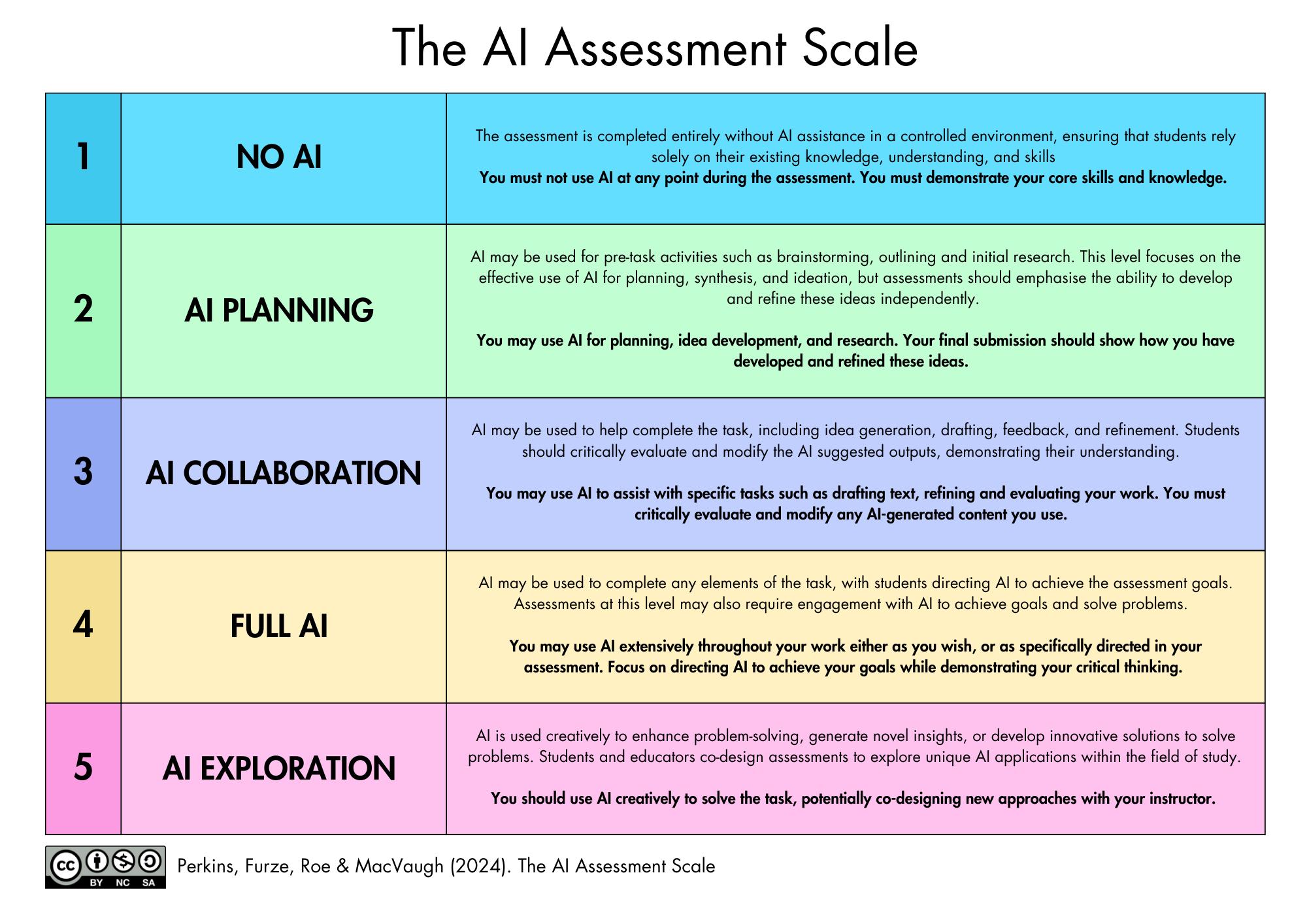
Communicate the AIuse instructions* as related to learning objectives. The communication should be at course, activity & assessment levels. This means answering the if,why,what,when, where,&howquestions of AI use & misuse (inclusive of the AIAssessment ScaleLevel,Perkins et al. 2024). Provide statementsoftransparency to acknowledge AI use by teachers.
Embed relevant academicliteracies support in learning activities. This is inclusive of guidance on using AI software safely & appropriately, as well as critical AI literacies.
*Note1:Should students not comply with instructions, consult the academic misconduct policy & corresponding structures for guidance.
**Note2: Attend Faculty T&L unit offerings to learn pedagogical strategies.
Written by Catherine Tam, Nora-Lee Botha-Wales, Lindiwe Tshuma and Annie Mafunganyika-Ndlovu, 2025,
Clearcommunication & reciprocaltransparency are essential for learning. All GenAI use during learning processes needs to be recorded (including prompts, outputs & adaptations) & acknowledged.
Protectyourselfandyour students: Be careful when using or instructing others to use AI technologies outside of approved university software For example, external AI software may store & use inputs for software training purposes which may contravene ethical academic practices.
University of the Witwatersrand, Johannesburg. Endorsed by the Humanities Assistant Deans of Teaching and Learning (Laura Dison) and Undergraduate Studies (Thabisile Nkambule).