R i g g i n g 1 0 1 O u t o f t h e A s h e s T h e L i f e a n d Wo r k o f J o h n Wa u g h
Dearest Readers of The Bowside,
We’re back with a bang (in more ways than one) Perhaps the overconfidence resulting from managing to pull together 3 issues parallels Icarus, perhaps it’s simply that time of year. This issue is months, and simultaneously just a week or two, in the making Hard and soft deadlines were grossly overshot, and it almost seemed like we wouldn’t make it What’s a girl to do without some reckless ambition?
This final issue of the year features a reworked and slightly updated article that I have some attachment to It is the very same one discussed in the first issue of 2025, which originally appeared in the Boat Race themed issue produced last year for the WUBC centenary dinner (how intertextual) The timeline of the creation of that issue may have foreshadowed this one.
It’s been restructured for a more general audience (sort of), I (unconvincingly) attempted to get lastminute commentary from UCT alumni of 1980, and hope the result is a decent patchwork history of the South African Universities’ Boat Race. Andy Pike’s column is a complement to the 1980s season of WUBC with the tortuous [full of twists and turns] but ultimately redemptive story of a terrible accident in 1981 on the way to Buffalo Regatta As a point of interest, Andy wrote this through a combination of speech-to-text and slow onehanded typing while recovering from a shoulder operation – potentially related to the injuries he’d
Mr Saloojee is training us up in Rigging 101, while Mr Moore trains us up to read dense reviews of training science (I attempted a glossary of sorts, for myself and everyone who isn’t regularly chomping down on academic human physiology and exercise science papers).
The main feature of this issue is “The Life and Work of John Waugh,” quite a hefty story Robert Waugh and I have been corresponding since the start of the year, and a journey it has been It’s hard not to like Rob, he’s enthusiastic about rowing in a way that only a man whose father hand-made boats could be. An absolute delight, and a wealth of knowledge – it seems his mother instilled her meticulous record-keeping in him I must profusely thank Rob for the time he has so generously given me to put this together I hope we do your dad justice, he must’ve been an incredible character
Each and every contributor makes this magazine what it is, thanks to Rebecca for making the amazing articles pretty in an outrageous timeline, thanks to Jenna and Lesedi for sifting through thousands and thousands of words with me to get them in line, and thank you to everyone who writes, photographs, draws, and proofreads this project into existence. Special thanks to our readers for letting our stories live on in your hearts and minds
sustained 44 years ago.
It’s that time again, Therese has reminded me that my Bowside article is running late (as usual) Honestly, I should have paid more attention in Mr Mitchell’s and Mr Broderick’s English classes, or maybe I should be outsourcing this to the far more erudite (biggest word I know) Paul Marketos, Trevor Dedlow or Warwick Van Breda
Truthfully, it is a pleasure to add my odd story to this wonderful initiative I now keep my hard copies of The Bowside lined up in a special spot in my study, realising how special it is to be reminded about the various characters who have and do make up our community
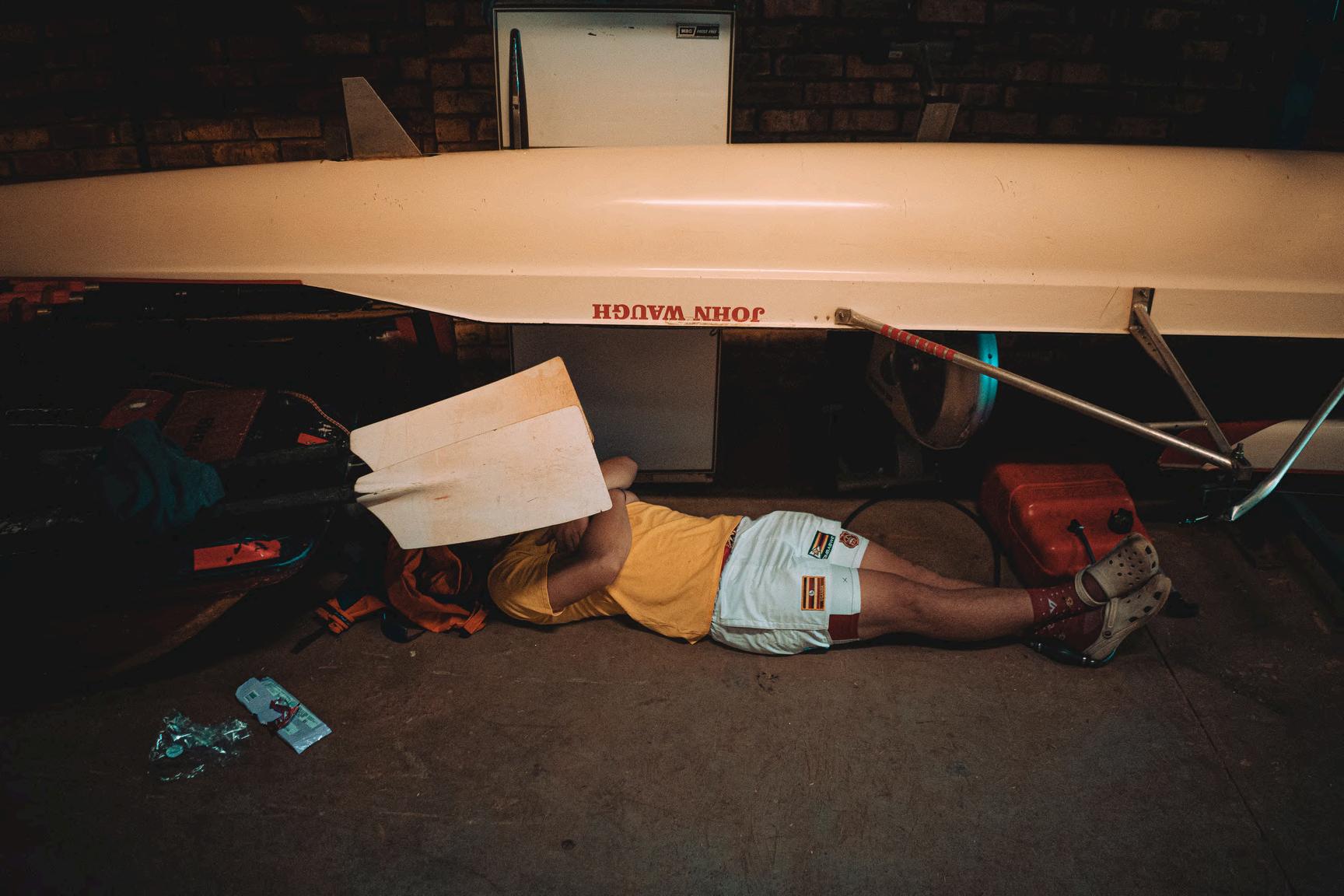
Amid the many interwoven stories being shared through this wonderful magazine celebrating South African rowing, there are individuals whose contributions we must remember One such person is John Waugh, the master boat builder whose legacy continues to be seen across our waters In fact, Mr Skinner has been winning in his JW for many years (he writes through gritted teeth)
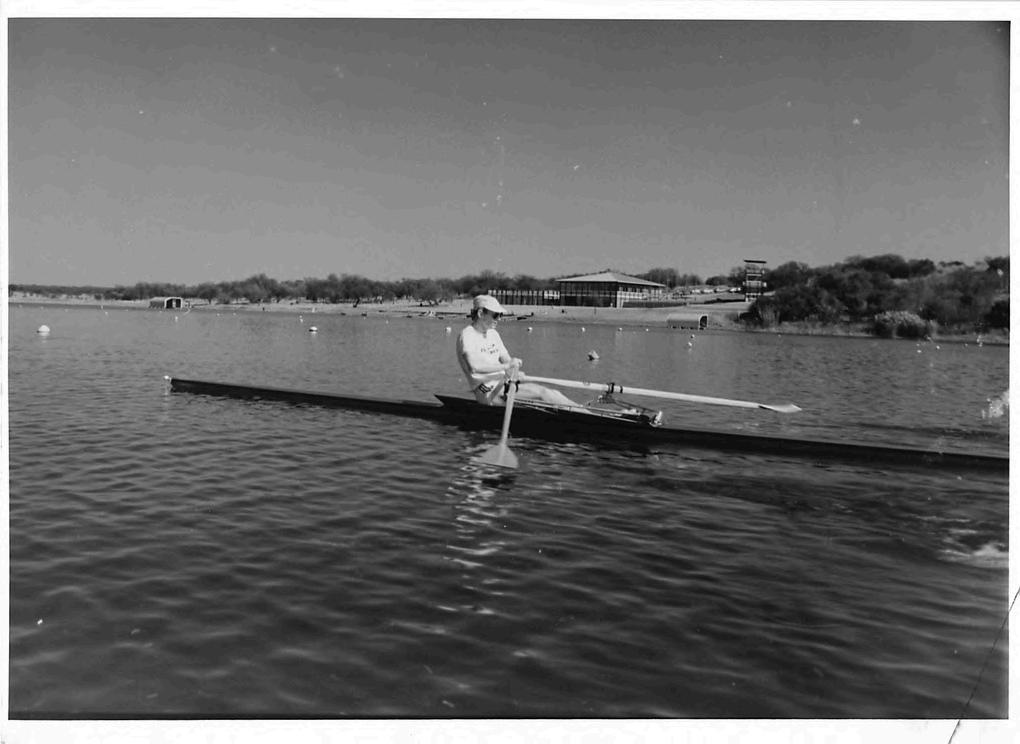
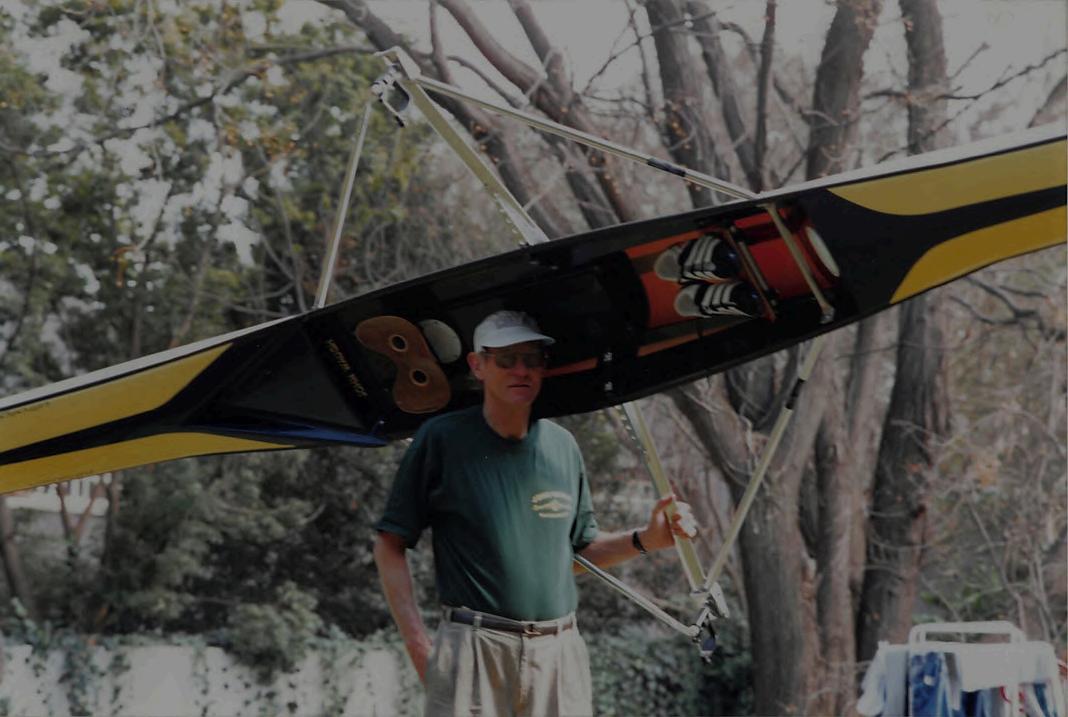
John was a boat builder, and so also an artist, a craftsman, and a quiet guardian of the sport’s soul He loved sculling, often seen on a winter morning out on Roodeplaat, rowing impeccably (although with his trademark, bent back) in one of his beautifully restored wooden skiffs
But his true passion lay in building sculls His iconic J-shape single scull (If anyone knows the story behind that shape, please share it. I did hear once that it was a collaboration between John and Phil Johnson, and hence the name ‘J-Shape’) remains, in my view, one of the fastest and most elegant designs ever built.
I remember being twenty-four, having finally saved enough money (by working night shift at Woolworths with Sean Kerr and Wayne Severin) to buy my own boat, a rare feat at the time Few schools had top-tier sculls, and owning one often meant your parents really loved you I approached John, only to find that prices had just risen due to Kevlar import duties He took me aside, asked how much I had, and told me he would build the boat for that amount (R12,500), but under no circumstances should I tell his wife, who managed the commercial side of the business
When I came to collect the boat, John was beaming (those who knew John know what that almost cheeky, maniacal smile looked like) It was not a commercial transaction, but rather a moment of passing on his craft, his passion, and his belief in the next generation. With resin wrinkled hands, he had infused the shell with purpose and pride I genuinely loved that boat, and it had a significant impact on my rowing career and, consequently, my life I remain forever indebted to him. His generosity is a testament to the kind of people who make our rowing community so special
How I started: I started rowing when I was 13, as my elder sister rowed I just fell in love with the sport and knew that I wanted to continue
Their answers remind us how the sport continues to shape, teach, and connect us
How I started: I was 14, and had moved to St Dunstans in grade 8 I really wanted to try a sport my previous school hadn’t offered, so it was between waterpolo and rowing On my first day I happened to make friends with a rower and my fate was decided!
What I’d tell my younger self: Don’t worry about how big an athlete looks or what school/club/country they row for You have to believe you belong on the start line.
What I’d tell my younger self: to keep training hard because it’s all worth the effortThe early mornings, hard sessions and tough races pay off in the end Rowing opens doors for me and creates unforgettable memories
How I started: I started rowing at 12, during a Learn-to-Row camp at Somerset College I used to watch my dad row at Roodeplaat on the weekends when we lived in JHB, and I wanted to row like him
What I’d tell my younger self: when I made the A final this year, it was a different experience, I was used to being filled with pressure and overwhelmed by the task. But this year I was excited I would tell my younger self to enjoy it more, and that my result doesn’t define who I am as a person, nor how worthy I am of other’s approval Big lesson for a kid, but an important one that I wish I learned sooner
How I started: I was 15 when I first started rowing I decided to start after a running injury that limited the sports I was able to participate in
What I’d tell my younger self: rowing would take me further than I ever imagined That every early morning and tough session would lead to amazing races, great teammates, unforgettable moments, and lifelong friends
How I started: I started rowing at 13 years old because my older brother rowed and I would often come along to all the regattas anyway, so it gave me a soft launch into understanding the sport
What I’d tell my younger self: trust the process, even when things feel tougher than ever And always find a reason to want to race, whether it's for a greater cause or, more importantly, for yourself This gives you something to fight for and a reason to love what you do.
Traditional endurance training theory suggests that long bouts of rhythmic, low-to-moderate intensity work gradually stresses oxidative metabolism , enhances capillarisation , and upregulates mitochondria production . In endurance sports, high volumes of mitochondria in the cells are associated with higher V02 max scores in elite athletes 1 2 3 4
In simpler terms: long, low-intensity, steady pieces are widely believed superior in generating the more endurance-forward components of physiology, the primary ones being more mitochondria, more capillaries and more oxidative enzymes. [In actually simpler terms: steady state is considered the most effective way to help your body adapt to become a high-endurance machine by improving its ability to use oxygen and produce energy]
The “80/20 rule” (or “polarised training”) has become a dominant heuristic [rule-of-thumb] in endurance sport: ~80% of training time at low (Zone 1/2) intensity and ~20% at high (Zone 3+) intensity (or sometimes high + threshold) Originally observed in elite endurance athletes, many coaches and athletes now apply it broadly, even to sub-elite, amateur, or recreational rowers But is it always appropriate?
Higher intensity pieces have been thought to only contribute to other components such as lactate buffering and hydrogen ion tolerance This difference in energy system function has led many to believe that higher intensity training is inferior in producing the endurance components (ie mitochondria, capillaries and enzymes) in comparison to lower intensity training 5 6
A recent systematic review [a study that compiles and analyses all prior research on a question] and meta-regression of human training interventions reported that low/moderate continuous (endurance) training (ET) increases markers of mitochondrial content by about 23% on average. At the same time, high-intensity interval or continuous training (HIT) yielded about 27% increases, and sprint interval (SIT) also 27% (ie relatively similar gross gains) 7
However, when normalised per hour of training, SIT was found to be ~2 3× more efficient than HIT, and 39× more efficient than ET; HIT itself was 17× more efficient than ET.
Further support comes from the “Effects of Exercise Training on Mitochondrial and Capillary Growth” review, which also noted that training load (volume × intensity) is a predictor of mitochondrial adaptation; but importantly, the gains per unit time differ across intensity modalities [types of training]
8
In addition, Yamada et al (2021) showed that highintensity training with intense contractions produced larger improvements in fatigue resistance and mitochondrial function than more modest workloads in animal muscle preparations9
A more recent controlled human/animal molecular study (Jahangiri et al. 2025) reported that HIIT increased expression of PGC-1α, mitofusin-2, OPA1 , and down-regulated fission genes, demonstrating favourable mitochondrial biogenesis and dynamics changes in response to intermittent high-intensity stimuli
10 11
The 80/20 prescription emerged from observational data in elite endurance sports (cycling, running, cross-country skiing) where athletes already sustain high weekly volumes Drew Ginn, from the famous Australian “awesome foursome” is quoted as saying that most elite rowers spend 30 hours per week training (which is more than four hours per day!) This means a total of 6 hours per week is dedicated to high-intensity-only work for these athletes In such contexts, allocating ~80% to low-intensity can help manage fatigue while still accumulating the volume necessary for adaptation But applying that same ratio to lower-volume, time-constrained athletes may be misaligned
If a recreational rower is doing 6–8 hours per week (compared to 20–30+hrs) with 80% low-intensity, this leaves less than 2 hours a week for high-intensity That high-intensity quota might not be enough to sufficiently stress mitochondrial adaptation in welltrained muscle In contrast, elite athletes might invest 4–5+hrs at high intensity (20 % of 20–25 h), which produces greater cumulative stimulus [overall training effect on the body over time].
Amateur rowers spend significantly lower time training per week (6-10 hours) and therefore it could be hypothesised that applying an 80/20 principle to these lower volumes could risk losing important gains that are facilitated with the high-intensity training already described
Dr Ross Tucker (through Real Science of Sport) is a thoughtful voice in the intersection of rigorous exercise science and athletic pragmatism While he does not offer a one-size-fits-all prescription, his commentary often emphasizes:
Scepticism of dogmatic “golden rules” (eg that 80/20 is sacrosanct [untouchable or beyond question, sacred]).
The necessity of adapting “optimal” trainingintensity distributions to athlete context, volume, and goals
Moreover, Li et al (2025) provided direct evidence that HIIT (versus moderate continuous work) is superior for mitochondrial biogenesis and volume density in skeletal muscle 12
These findings do not imply that low-intensity work is useless – it likely remains essential for capillarisation, structural remodelling, recovery, and fat-oxidation efficiency – but they do challenge the notion that most adaptation is best driven via vast volumes of low-intensity in all contexts
13
The idea that time-efficient strategies (i.e. more high-intensity per limited available time) often outperform slavish adherence to low-intensity quotas
The importance of internal load, recovery, context, and periodisation (ie how one layers intensity over training blocks)
For example, in several episodes Tucker and Finch critique overemphasis on “Zone 2 only” ideology, arguing that context (athlete level, training history, available time) must guide balance of intensity domains.
Start from your volume.
Determine the realistic weekly training volume (in hours) that you can sustain over months (not just ideal) Let that be your constraint
If 80/20 is the distribution of intensity for an elite 30 hour training week, then change the ratio according to your training week hours The lower the hours, the more intensity that body can likely handle and adapt to
Maintain a “durability base” but don’t overdo low-volume steady-state
Keep low-intensity sessions (Zone 1/2) for recovery, fat oxidation, capillarisation, technique, and mitochondrial “tuning,” but don’t treat them as the lion’s share if volume is low
As the evidence for an 80/20 training distribution only comes from elite athlete programs, research suggests that it is worth trying out different/more high-intensity session distributions in non-elite training volumes (which tend to be significantly lower than elite programs) in order to benefit from, and maximise, training adaptations for performance
Richard has written separately in his book “Tangled Toes, Pins and Needles” about the accident and his miraculous recovery from his debilitating injuries. Our recollections differ on a few points, but we have no real way of determining whose version is more correct, given that both of us had taken a physical hammering and were probably verging on delusional. Suffice it to say that the situation was chaotic and memories blurred, both with the trauma and the passing of more than 40 years. *Editor’s note: the oldest sibling is always (the most) right, in my (not) unbiased opinion.
It was January 1981, the start of the new rowing season, filled with hope and some mild anxiety Quo vadis, Wits?
Wits had slain all comers the year before, winning all major championships In addition, our senior eight had been runners-up in the Henley Ladies Plate finals, bronze medallists in the British national championships and collected a few other pots along the way on our UK tour The eight went on to be awarded Springbok colours en masse on our return from the UK
We could not have asked for a better season, but most of the senior rowers left at the end of the season to continue their careers, and some to emigrate or go to the army I had been appointed as Club Captain for the coming year and was faced with developing and executing a strategy to rebuild the club.
We still had quite a bit of underlying junior strength and a selection of what I would call “senior-juniors” with whom we could crew the more senior boats, but probably not at the level necessary to be truly competitive in Senior A
We decided to call up my younger brother, Richard (who was just completing his national service) and pull him into the boat early in the season, before he had technically enrolled at Wits We filled the senior eight with a number of other oarsmen showing a lot of promise, but who had never raced at Senior A level From what I recall, I was the only remaining member of the 1980 crew
The Buffalo Regatta was always held a week or so before we went back to university, meaning quite a bit of training in December and January. In preparation for our trip to East London, we agreed that Jeremy Nichol, one of our oarsmen coming through the ranks, would (with me) co-drive the truck pulling the trailer and entire fleet of boats to East London Guy Muller and I gave him a few lessons in towing before we left I remember us discussing whether the trailer brakes were working properly at the time. I’m not sure that we resolved any doubt we may have had. In the end it seems
likely that our doubt had been justified Be that as it may, we set out early on the Thursday morning before the weekend’s regatta
Richard, Jeremy and I occupied the front seats of the truck. Hamilton Wende, Gary Stanley and Coenie Wesselink were in the canopy section of the truck, sharing it with luggage and mattresses
The route to East London in those days took us through Villiers and on through the Free State, skirting the Transkei and Ciskei and finally ending up in what is now Buffalo City.
After topping up for fuel at Villiers, I suggested that Jeremy should take the wheel for a while The Free State was relatively flat, and it would give a novice driver a good feel for towing the boats
As we trundled quietly through the flat Free State mielie fields, all seemed idyllic. Eventually, we started going down a hill – straight and not particularly steep, but a good km or two in length
I was sitting next to Jeremy on the front seat so that I could give him instructions if necessary Richard was sitting next to the passenger door, and none of us were strapped in, principally because the truck did not have seatbelts (they were not mandatory in those days) Fortuitously, our lack of seatbelts probably saved our lives*
As we rolled down the hill, I noticed the nose of the truck starting to sway from left to right and back again in rhythmic fashion. I remember saying to Jeremy, “Take it easy,” which he took to mean “Put the brakes on” In any event, he did put the brakes on, and what had started as a gentle sway turned into a massive swinging of the tail of the truck to the left and to the right, building in oscillation Jeremy was desperately turning the wheel this way and that, and probably still had his foot on the brake As the nose of the vehicle swung to the right for what would be the last time, I saw the tail end of the trailer jack-knifed out of Jeremy‘s window
With that, the truck flipped over on its left front corner, rolling several times I left the vehicle first, catapulted through the windscreen at around 70–80 km/h Richard followed close behind me, but without the benefit of a windscreen to slow his flight. Jeremy was somehow tossed out of the driver’s window
I don’t remember hitting the ground or picking myself up My main recollection was walking around, surveying debris and mayhem all around me: broken pieces of rowing boats, a truck with its roof flattened to dashboard level, glass, baggage, mattresses, an unrecognizable trailer. I could hear someone yelling in the background – it turned out to be Richard, who had broken his spine and pelvis I was hunting around vaguely for my identity book (all I could think of was how hard it is to get a new one) As I walked, I bumped into Hamilton Wende, who, shocked, said: “Look at your face And your arms!” I had no idea what he was talking about, but I could see that I was covered in blood. More blood was gushing out of my left arm For some reason I found I couldn’t lift my right arm to look It turned out that the windscreen had slashed me open in a few places and my crash-landing on the side of the road had caused some structural damage
Hamilton went to see what he could do for Richard. He soon realized that Richard was in real danger: firstly because he had figured out that he had broken his back and secondly, because fuel was pouring out of the vehicle very close to Richard Hamilton then crouched down and held Richard stationary for several hours before a helicopter could arrive and evacuate him from the scene. I have no doubt that the reason Richard can walk today is because of what Hamilton did for him on that dreadful day
I continued wandering aimlessly through the debris until a passing farmer stopped, took one look at me and loaded me into the back of his bakkie. I suppose I must’ve been with someone, but I can’t remember who We then did this open-air dash to the closest provincial hospital in the village of Reitz, some 40 km away
By then, I was feeling pretty sore, with a number of broken bones and bleeding from many sources. An intern at the hospital gave me a huge dose of pethidine or morphine, which helped numb me down and moved me into the matrix He then looked at my face, said that he had done a rotation in plastic surgery, and he would have a go at the repair job. I really didn’t care at that moment. I clearly needed something done. He stitched the gash in my face with 30 to 40 small stitches: not exactly invisible mending He also set about repairing the various other puncture wounds and removing what gravel he could No one checked for broken bones
At some time around midnight, John Stark arrived from Johannesburg in his Kombi, loaded me in the back, and drove me the four or five hours back to Garden City Clinic Richard arrived around the same
time by helicopter I have no idea how the other four guys in the van got back home: what a mess!
Four of the oarsmen involved in the accident were members of the senior eight and, naturally, couldn’t row because of injuries and the inconvenient aftermath of our Free State debacle. The remainder of the club made it to East London, but, of course, sans boats On race day they borrowed boats and competed as best they could If I’m not mistaken (my brain was somewhat addled over that period), somehow or another, four rowers were found to fill the empty seats in the senior eight. In a borrowed boat, they went on to win. Nothing short of extraordinary!
Richard underwent 10 complicated hours of surgery, months of rehab, and finally, somehow, learned to walk again about 6 months later His spinal cord had been all but severed, so some mobility could be restored, but it took at least two years before the damage was more or less healed
I had an easier healing path: I had lost patches of skin over a fair area of my body, but those healed over time A broken right collarbone put paid to any rowing for the next two months. Aggravating this were a couple of broken ribs (together with the rest of my ribs, which had detached themselves from my sternum), all of which made coughing, sneezing, and general physical activity a major challenge for the next six months
During my downtime, I decided to coach a senior D crew, comprising eight remarkably enthusiastic and athletic individuals I spent hours in the cox‘s seat, steering with one hand (frequently into the bulrushes) as I taught them whatever I knew To cut a long story short, we set ourselves some targets for the season and massively exceeded them From rank novices, they went on to win senior B eights at the SA national championships.
We had a pretty competent senior A four who carried on after the accident They competed well for the season, given the low base they were coming off
As Captain, I set a target for the club which was to win inter-varsity that season I wasn’t exactly sure how we were going to do it given how thinly
stretched we were, but I knew it was realistic and that the club needed some purpose
Two months after the accident, I got into a sculling boat for the first time ever, did a good amount of swimming, paddled in circles with my weak arm, but eventually became vaguely competitive in senior C or D I also managed to get into an eight Although I was not exactly in prime condition, I think I made some contribution
When inter-varsity came round, I encouraged members of the club to aim to win the event. However, the only way we could do so was to row in as many events as we could possibly enter Even if there was little hope of winning, at least we could accumulate points in the lesser positions On race day, every Club member to a man rowed his heart out, typically competing in three or four events in the day, some of which included heats. Astonishingly, at the end of the day, Wits had won the inter-varsity
You might be wondering what we did for boats, given that we had written off the entire fleet in the accident We were dismally under-insured: the insurers paid out somewhere between 10 and 20% of what we needed to restock the club.
Heartwarmingly, the entire rowing community clubbed together to raise funds for a new fleet of boats for the students Overnight we migrated from tired and flexing wooden boats to a new Kevlar eight and several other high-spec smaller wooden boats.
In the 1982 season, we had rebuilt the club, drawing on everyone we had (including those awesome novices whom I had the privilege of coaching) At the Buffalo Regatta, we won the senior eight and a number of other pots For the rest of the season, we were competitive, setting the base for the club renaissance.
is a candidate attorney, and an on-and-off freelance digital artist using Procreate She drew for PDBY while
Digital artwork by Rayna Naidoo
Rayna
at Tuks.
“If your boat is correctly rigged your technique should follow naturally” – Hamish Bond
“Rig Boats when it is sunny, and have a bottomless toolbox.” – Jurgen Grobler
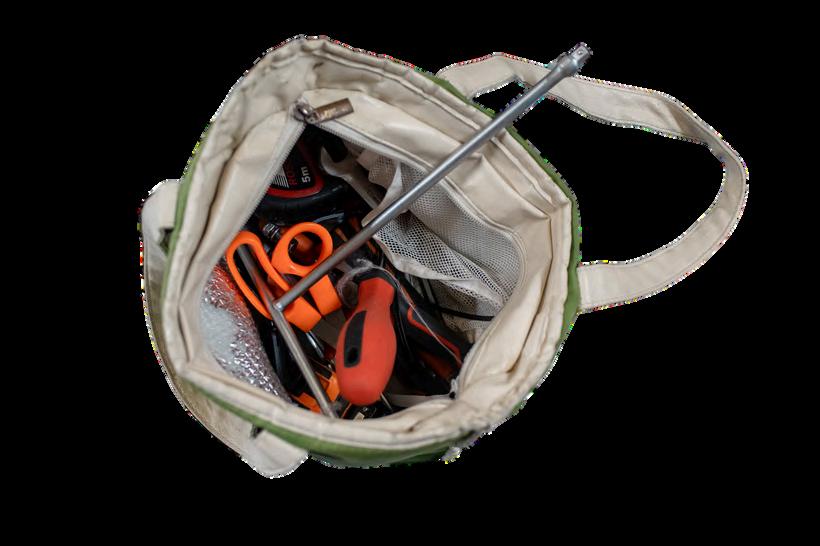
Boat strap (for securing the hull)
2 x 10mm spanners
1 x 13mm
2 x 17mm
2 x 19mm
2m spirit level
Star and flat Screwdrivers
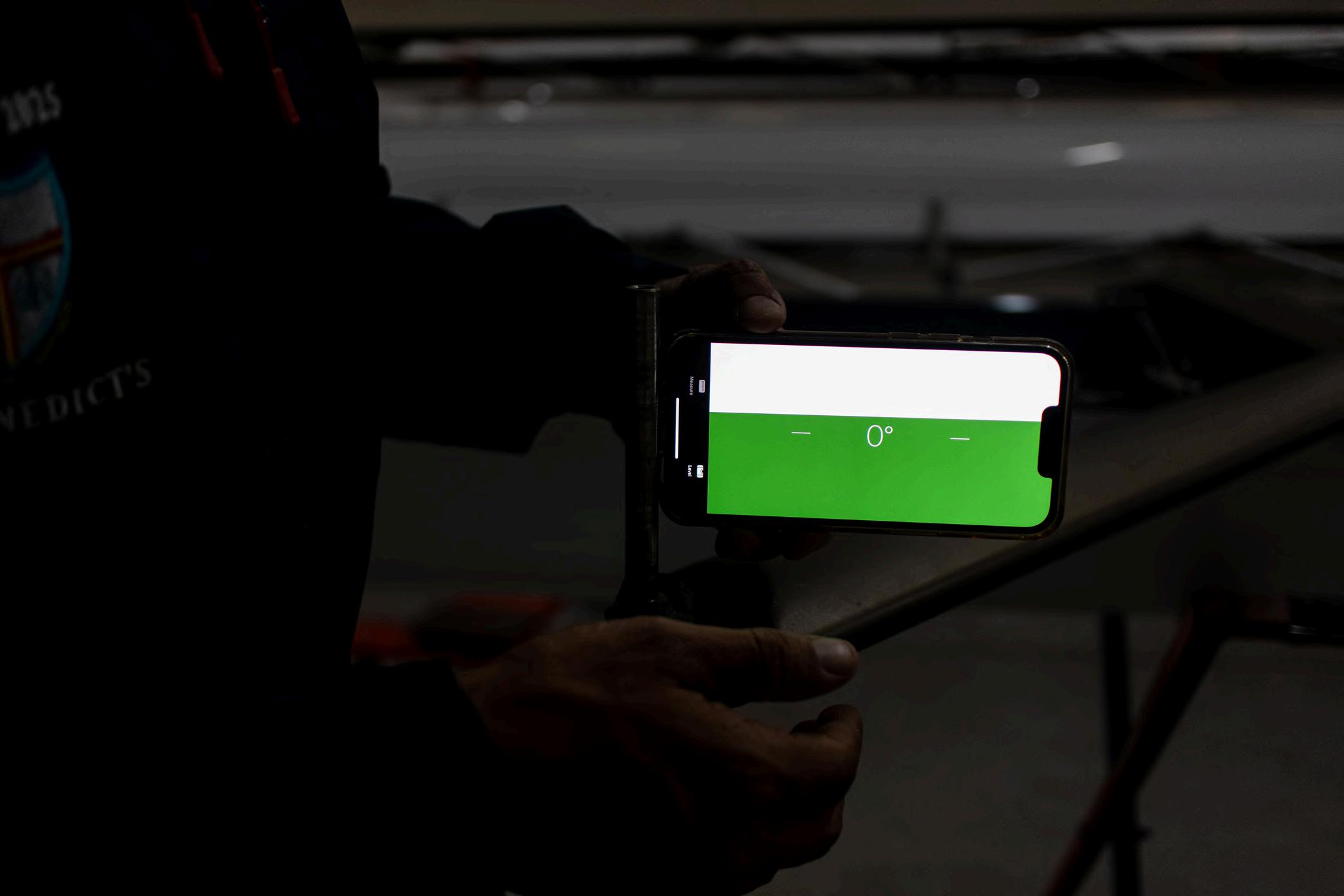
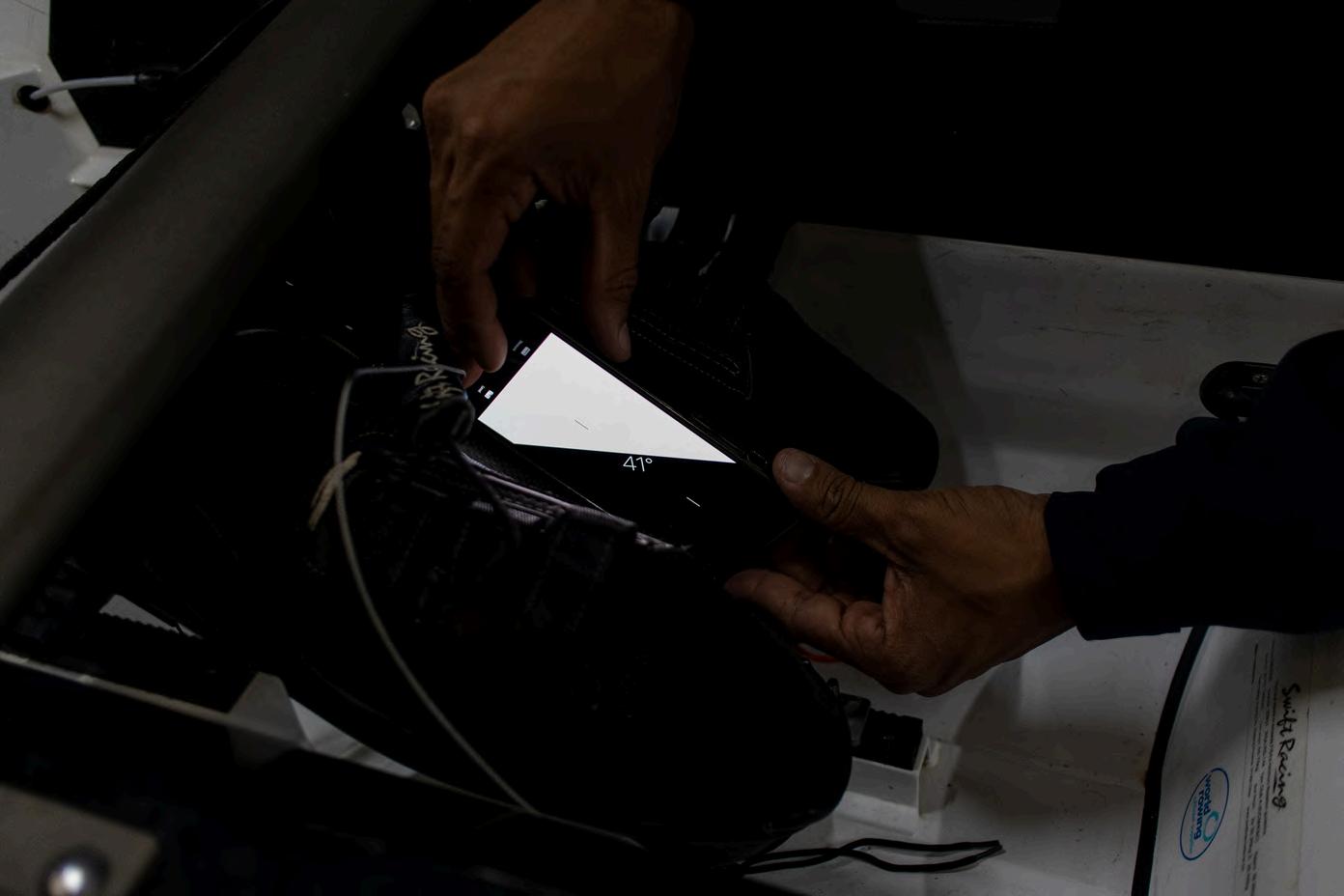
iPhone or pitch gauge
Hammer
Insulation tape
Scissors
Allen keys
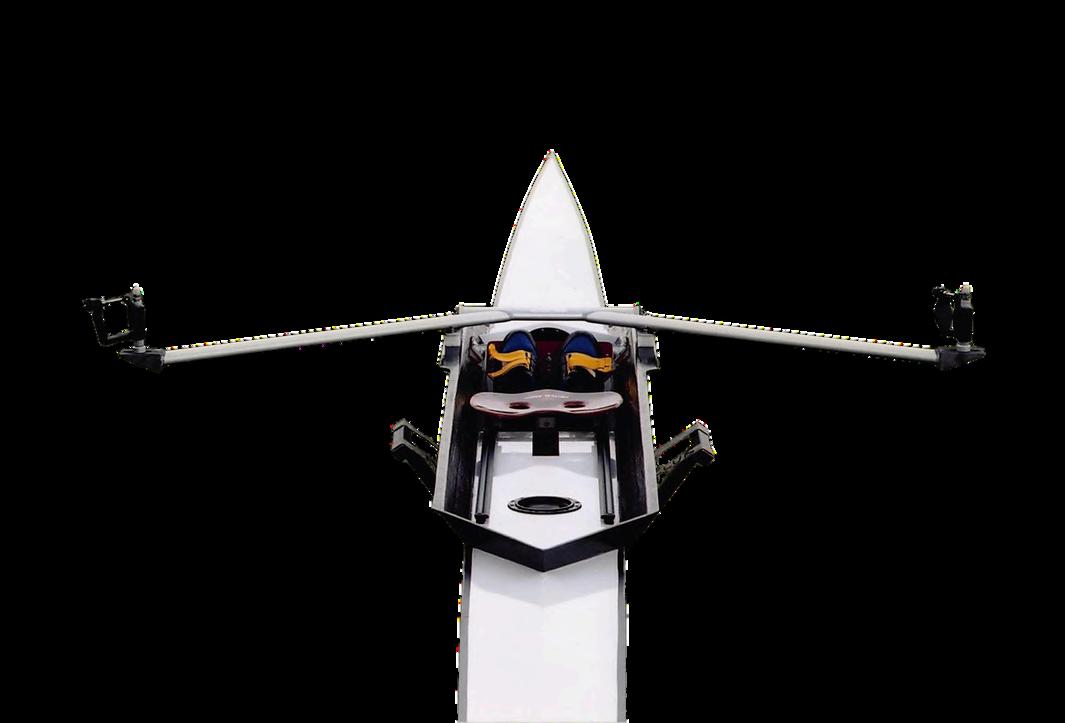
A well rigged boat allows the athlete to easily and more naturally execute correct technique For junior rowers, a well rigged boat ensures that the athlete is limited only by their own ability, as the only variable directly under the influence of the coach has already been controlled for Having your finish angles set makes it easier to balance the boat; a correctly set boat provides a good platform to coach from
Poor rigging on the other hand, can ruin good rowing:
Incorrect Pitch → blades dig into the water or wash out
Uneven span in sculling → the boat to pulls to one side
Incorrect footboard height and angle → restricts athletes from properly compressing and pushing their legs
Incorrect gate height → excessive knucklescraping and difficulty getting blades out and off the water easily and comfortably.
That being said, rigging is not a silver bullet Still, good rigging makes for a far more comfortable, enjoyable and biomechanically correct experience A more comfortable athlete is a happy athlete and a happy athlete is a fast athlete
There’s nothing worse than trying to set a boat that’s rocking like a metallica concert you’re trying to set the span when the spirit level crashes to the ground, closely followed by your tools and every single nut, bolt and washer you’ve ever laid eyes on. So, tie the boat down first, your spirit level will thank you later
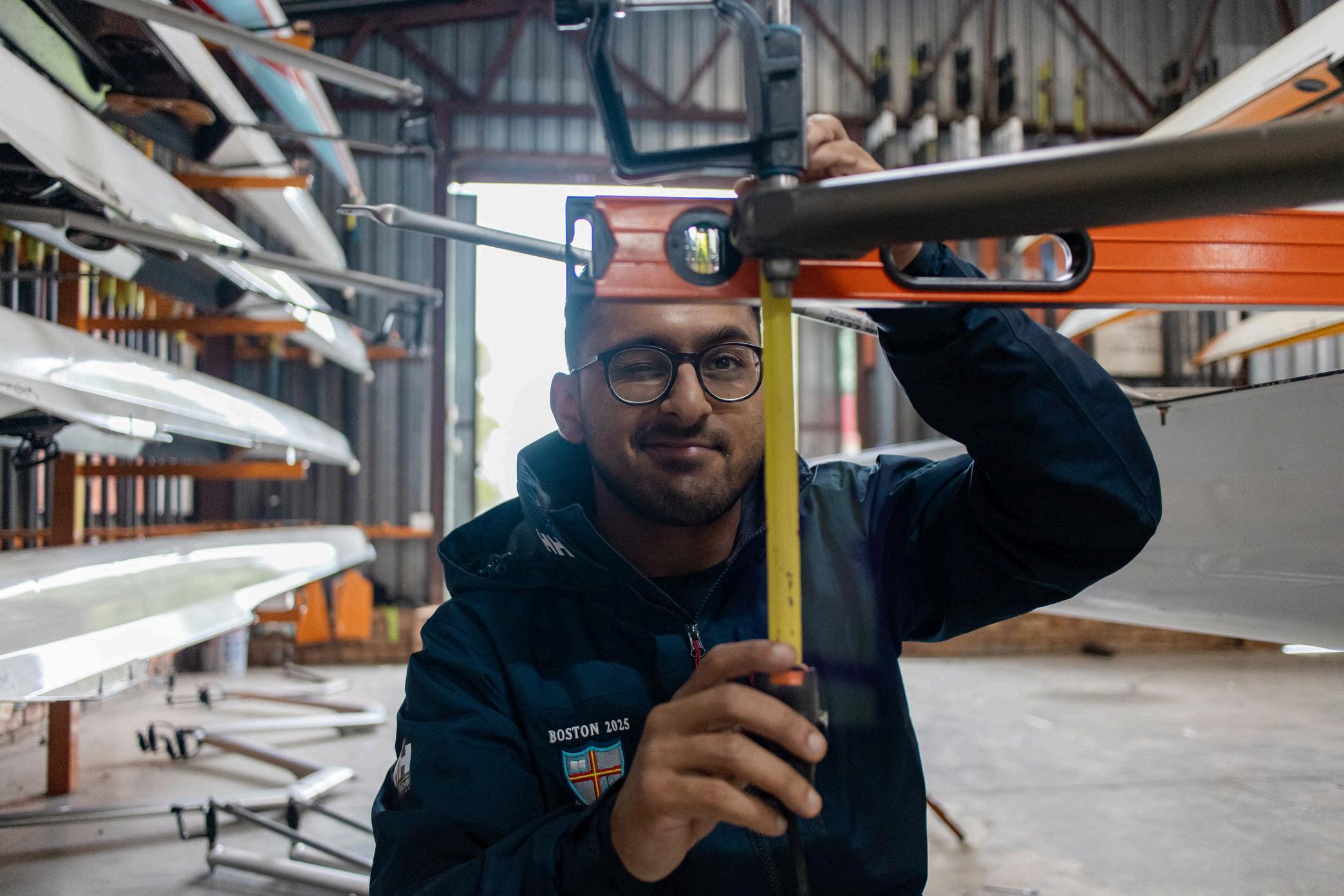
Now that the boat’s stable, it’s time to make sure everything’s tight and level.
Start with the small spanners and systematically work through the boat: Take the 2 x 10mm spanners and firmly (but not forcefully) tighten every rigger until it is secure If you’re getting a workout, it’s probably too tight Save your strength for the pins
Then grab a 2 x 17mm and/or 2 x 19mm spanner (the Big Boys) and tighten all the pins Make it “vas vas”
The line of work marks where the oar is perpendicular and the work is being applied directly in the direction we want the boat to go The line of work should line up with the face of the gate This is crucial for understanding where the 90° point is and where the most effective part of the stroke is
Simply explained, at the catch you're pushing out and at the finish you're pushing in, there's only a short period where you're applying the force in the most effective way and understanding and seeing that makes it easier to coach the athlete about how to take advantage of that point It also provides a marked and consistent measurement point for you to use when setting everything else (more on that later)
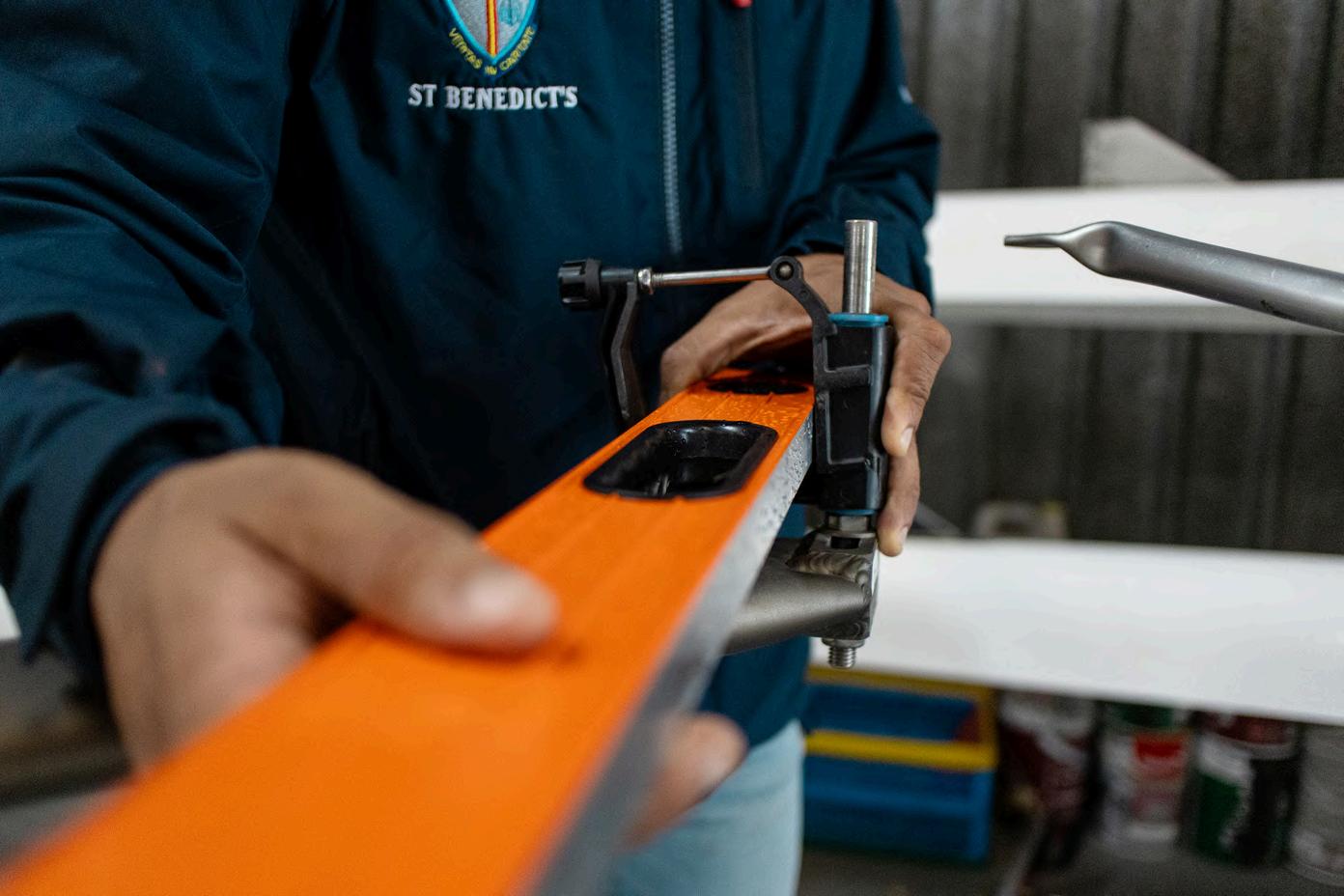
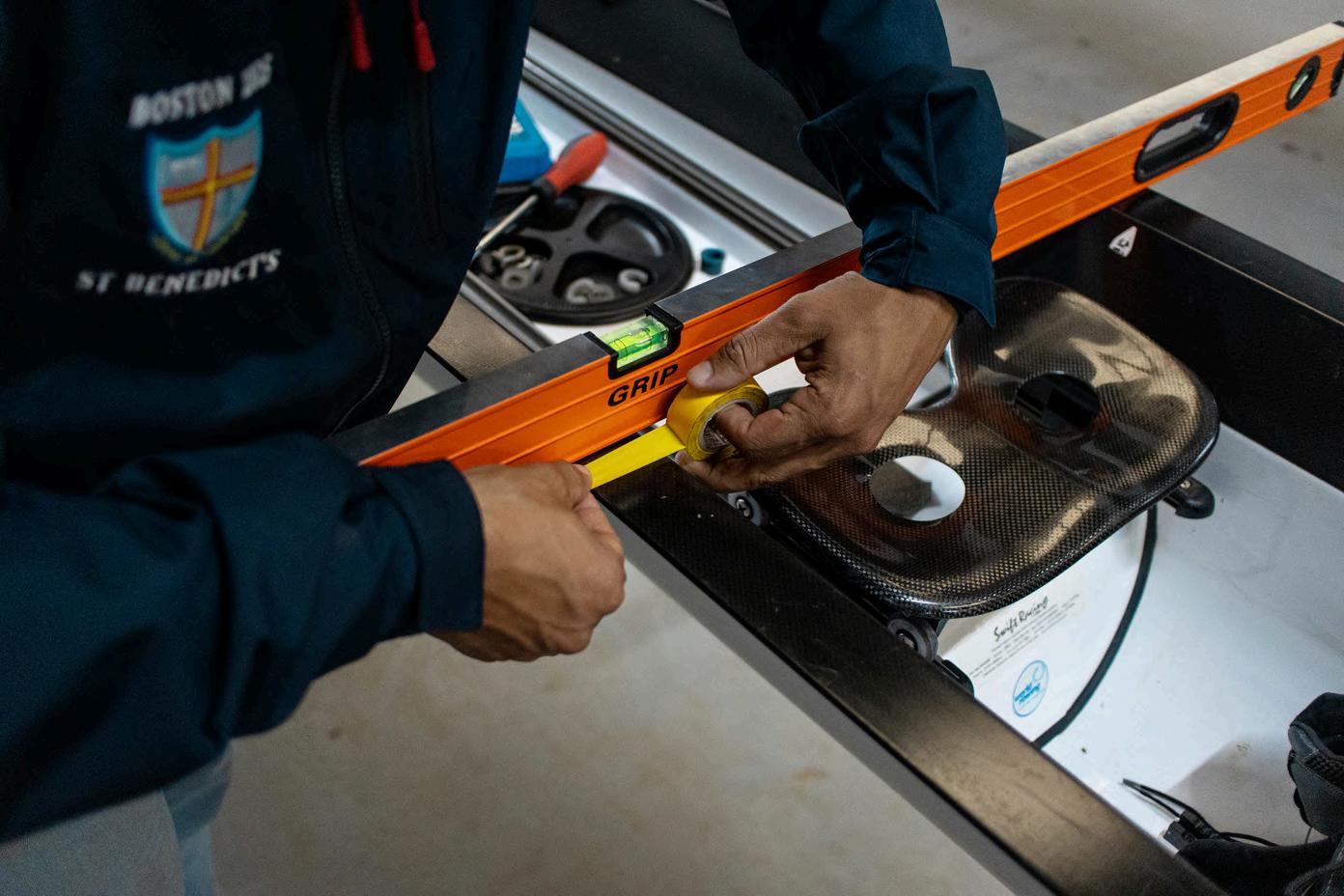
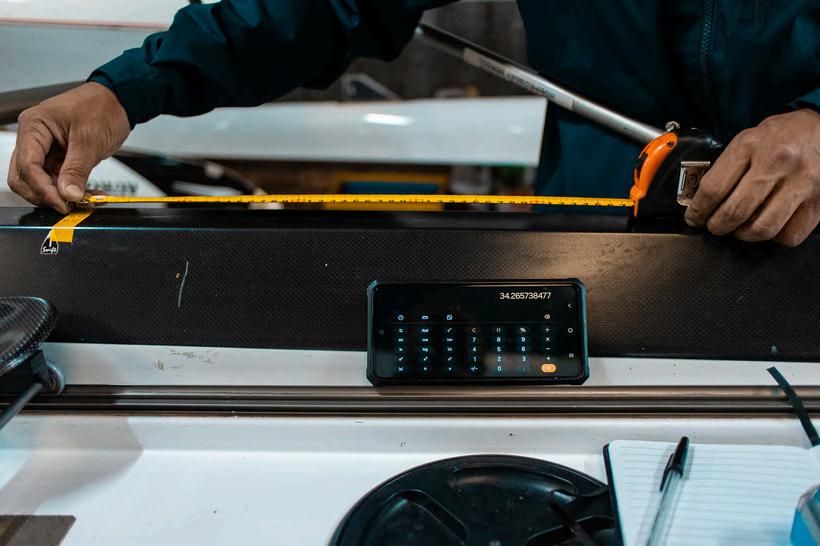
1 Place the spirit level perpendicular to the gunwale If you have a front or side rigger, get it flush against the back of the rigger
2 Apply insulation tape along the gunwale in front of the spirit level.
3. Place the spirit level in the gate, holding it flush against the gate like the oar would sit Looking straight down, align the back edge of the level with the front edge of the tape
4 Front of tape = Line of work
Your pin should be at zero laterally and zero stern/bow In general, all pins should be zero with 4/4 inserts All that means is that the pin should be zero and the gate should have a pitch plug with a 4 on both sides
If your pin isn’t at zero, you may need to bend the pin to get the lateral to zero To do this, use a nice solid trestle or pole with a hole and bend it If getting the stern pitch on the pin to zero isn’t happening, try to get it to at least -3 or +3 If you have -3 stern pitch and use a 7/1 insert with the 7 facing toward the stern on the top and the 7 facing toward the back on the bottom, your pitch on the gate will be 4. For -2 use a 6/2, -1 use a 5/3 and 0 use a 4/4 (reference table below)
After you’ve successfully performed advanced transfiguration on the pins, you can shift to the span.
Lateral (On Pin)
Stern (On Pin)
Insert (1st number faces forward on the top and back on the bottom)
SCULLING BOATS
2 Calculate the gunwale-to-pin (GP) Write it on the tape (you’ll use this later for finish angles)
3 Span(3) = M + GP
The handle should sit at about sternum height and the athlete should be able to sit with their wrist and elbow level when the blade is square and buried.
1 Bow side should be 1 cm higher than stroke
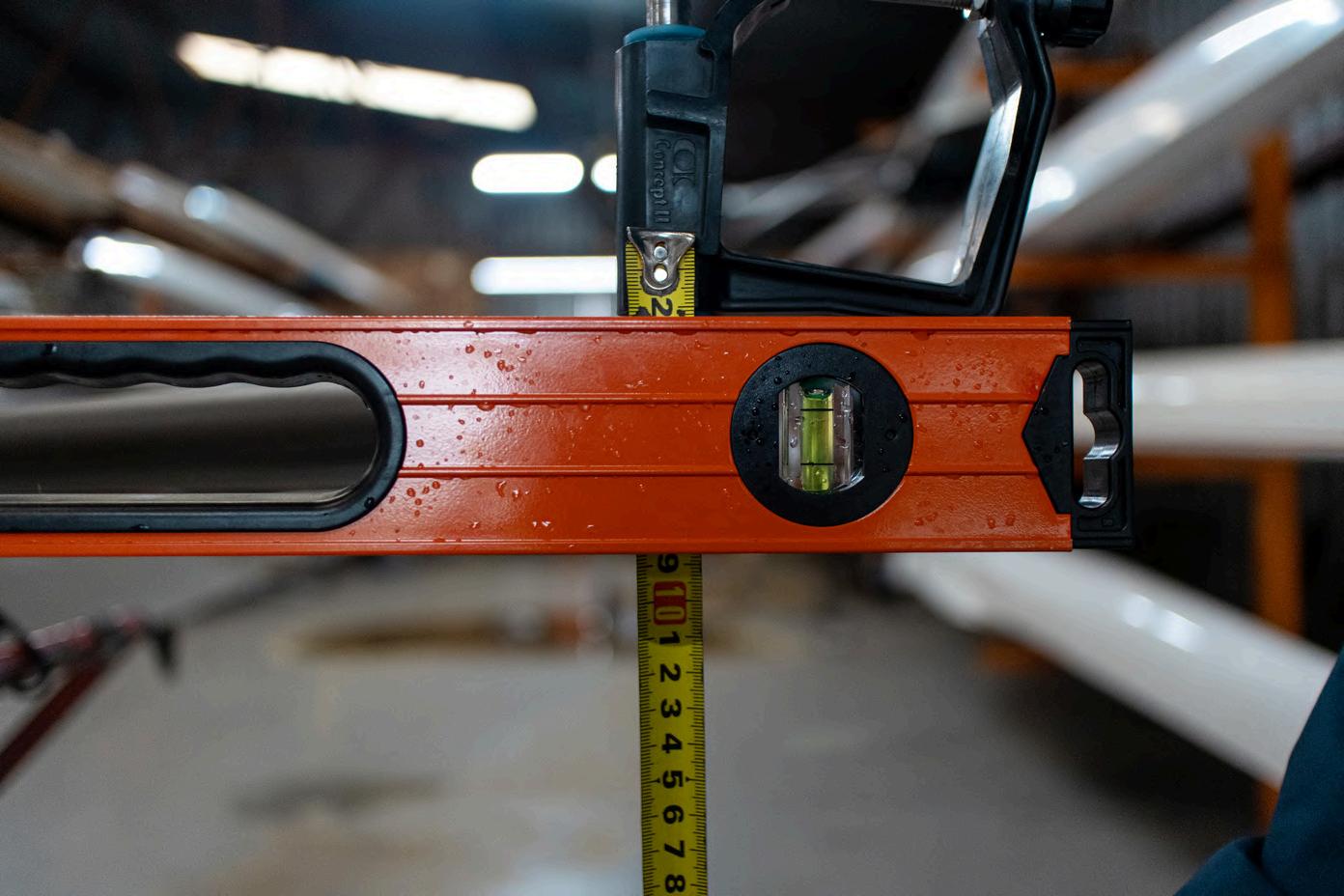
2 Hook your measuring tape on the groove on the gate and measure to the bottom edge of the level (gateto-gunwale)
3 Seat-to-gunwale + gate-to-gunwale = Gate Height
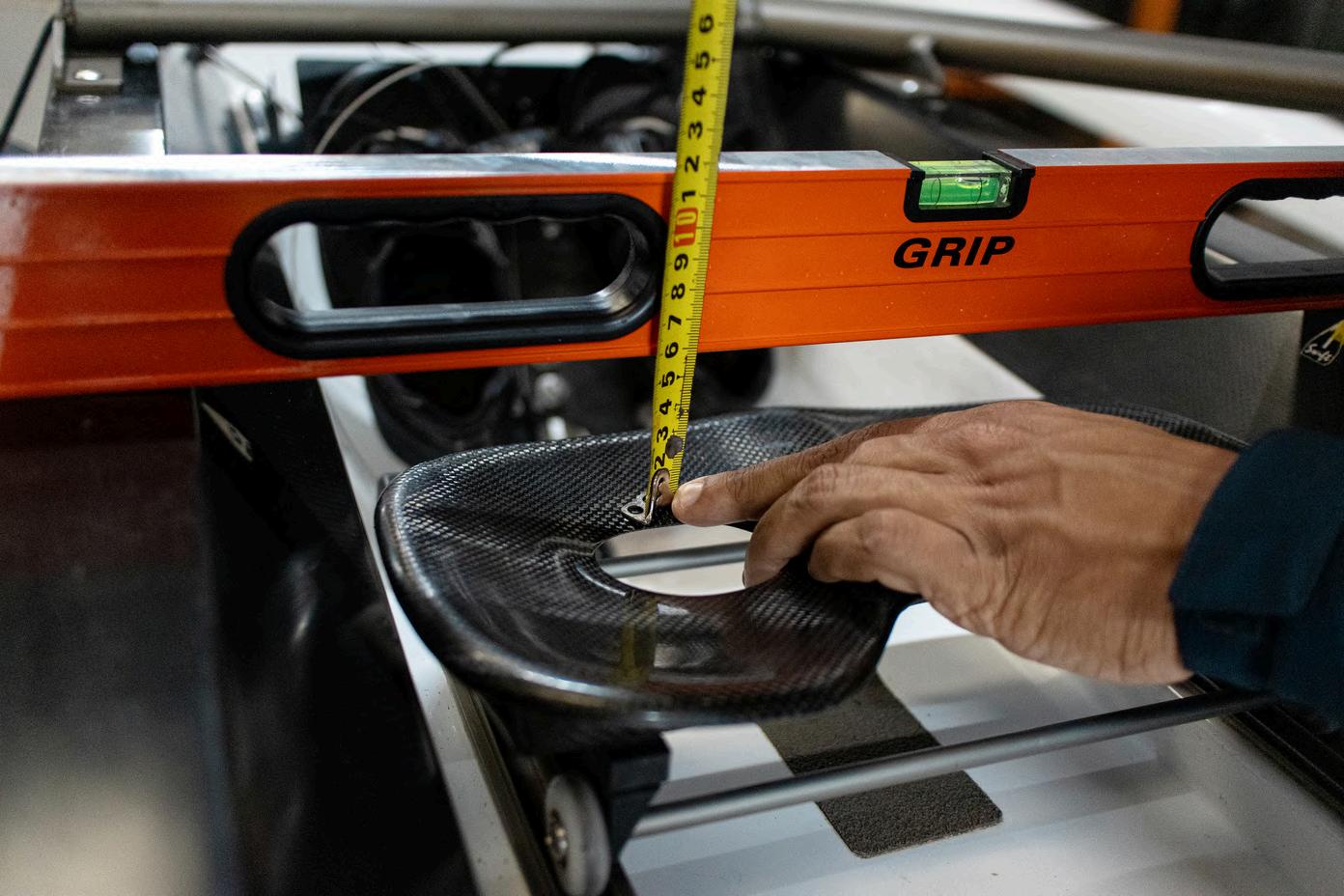
My personal favourite, and the most underrated setting This strongly impacts comfort and the ability to slide forward and engage the legs. Too little and you can’t compress comfortably, too little and you’re overcompressing and feel like you’re pushing down A steeper angle means more horizontal force which is good but that require good mobility. A less steep angle means easier compression but less horizontal force As with all things, use the Goldilocks method
Use this as an opportunity for some maintenance. Remove the footplate so the screws can be tightened and the angle easily measured Once you’ve set the angle, put the shoes back on and then set heel/footboard height.
The athlete should be able to comfortably get to vertical shins and it should relatively restrict overcompression.
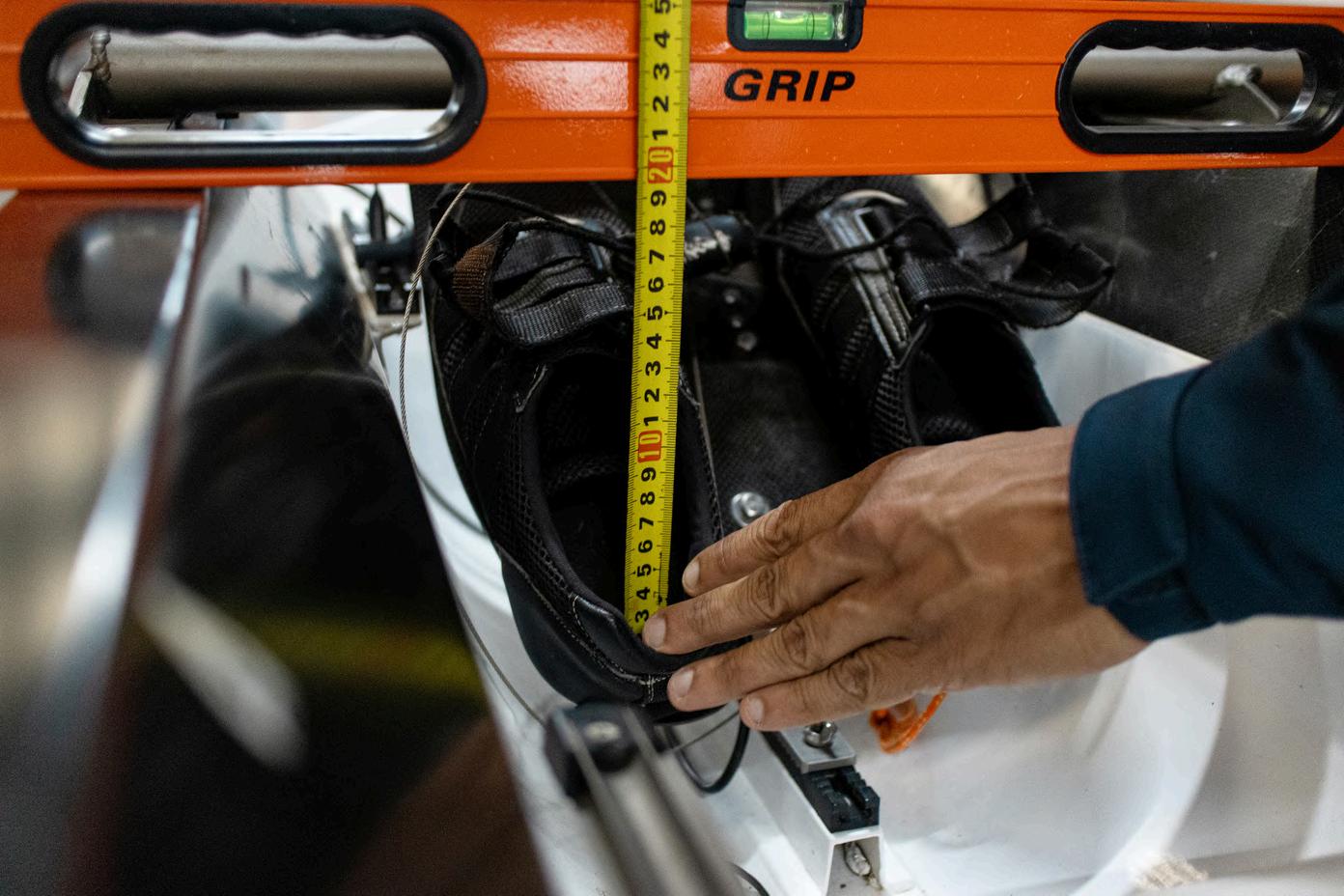
1 Secure footboard
2 Place spirit level directly over the point you’re measuring from
3. Push the heel flat
4 Measure from the inside of the heel to the bottom edge of the spirit level (heel to gunwale)
5 Heel-to-gunwale - seat-to-gunwale = Heel/Footboard Height
There’s no perfect setting and usually it’s best to be somewhere in the middle Adjust up or down after testing for a week
For example, if the recommended range is 83 to 85cm span, then you should start at 84cm and adjust based on your observations and research The manual recommends 38-42 degrees, start at 40 rows for a week and then adjust, decrease for those struggling and increase for those overcompressing or easily compressing
For school rowers 370 to 373 is the recommended range, I’d suggest not going longer than 370 and not longer than 373
Adjust the length by 1cm and assess its effect by measuring their ease with which they can generate speed and how much longer they can sustain it.
Ask for help and read the manual – it has 99% of what you need (https://worldrowing.com/document/coaching-manual-level-2/)
Ideally have someone come and help you by showing you while you’re doing it
Strip everything down and clean it before you start working on it
Write everything down.
Mark everything clearly, so you can easily see when things have moved
Write it all down! If you change something and go faster, you’ll know why.
Be accurate and do it right the first time
There’s a scene in the movie Burnt where the hotshot chef explains why people pay more for his food than for Burger King, and he talks about consistency: consistency is death Of course, in rowing, we know that’s not true Consistency counts, wins races, and sells boats If you buy a Filippi, a Hudson or an Empacher you know exactly what you’re getting, and you can row one here in South Africa and a different one in Europe And as long as they’re the same model and roughly the same age, they’ll give you the same feel and outcome. This is obviously better for the sport and for high performance
But I can’t help feeling that we’ve lost some of the pleasure and joy of boats with individual personalities.
The first time I really understood the unique personalities of boats was in the mid-nineties, when I rowed winters with a guy from
KES (I was at Jeppe) They had a pair and we had a pair, and Adin and I swapped between the boats depending on where we were.
Both boats were the same shape, same material, and same weight But the KES pair (I think the name might have been Ares?) was like rowing a couch – pure comfort all the way. You could row 70 km in a weekend, and it wouldn’t have given you a single blip Not fast, not slow, not rocky, not anything other than smooth like butter You really had to work to get the boat to do anything, and you had to properly mess up a stroke to get it to go wrong. Jeppe’s boat, Albion, was the complete opposite, like a twitchy racehorse, raring to go, ready at every stroke to spring out of the water and fly along Until you did something it didn’t like, such as blinking wrong, and then it firmly let you know
We had a single at Jeppe called Skien Du, and rowing in it ten years later was like a trip down memory lane: the acceleration, the places you pushed and didn’t push to get the best out of it
Sam Hudson has a single that I rowed a winter in, and it’s the same – completely different to any other single I’ve rowed
All of that comes before you start getting into the customisations that were so popular in John’s boats He was always spending time with crews and clubs to work out where something could change, something could be done that just might make the boat a little better Sometimes those changes worked, sometimes they didn’t (anybody who rowed the KES eight, Raka, about 3 years after they removed ribs throughout the boat to make it lighter, will know all about things that didn’t work!)
The point is, you don’t get that anymore, because boat builders (and I say this with respect, I completely understand why this is the case) are boat builders. They’re following a template and putting the bits together like a very complicated and precise LEGO set
I can’t help but feel that for all we’ve gained in boat technology, we’ve lost some of the pleasure of needing to really get to know your boat – your personality-filled craft
ohn Waugh’s career as a boatmaker started as a hobby in his garage in response to a problem he needed to solve Indeed, an appropriately South African response (well, I’ll just make my own!), resulting in a brilliant and unexpected career that is woven into the very fabric of rowing in South Africa
Thank you to Robert Waugh for your efforts in compiling all we needed to put this together, we could honestly write a book with all you provided (but I hope this will do, for now), and to Zak Wood and Wig Dreyer for your corrections and additions And, naturally, to John Waugh himself, for living a thoroughly good life
Born Arthur John Barrow Waugh to rigorously educated parents, John entered the world as a pre-empted legacy on the 25th of May 1945 in Cape Town to Harold (“Wuff”) Waugh and his wife Margaret (née Donald), a family already steeping in rowing-adjacent territory; boasting Cambridge and Oxford degrees left and right, and his mother’s medical degree from the Royal Free Hospital in London centre. Not to mention John’s uncle, Prof Dr Ian Donald CBE, the father of ultrasound in medicine
Along with his sister Liz, John spent much of his childhood growing up along the banks of the Lunga River. Great bushveld stories of big game, tiger fishing, fierce snakes under the bed at night, hornbills swooping to steal butter from the dining table, and a leopard cub as a childhood pet abound.
Although a bush baby, John was also an English public school boy, educated at Whitestone School in Bulawayo, and Blundell’s School in Devon After their mother’s early death, John and Liz’s aunt, Dame Alison Munro DBE took charge of their care in England Previously Britain’s Minister for Aviation, and high mistress of St Paul’s School, Aunt Alison was a formidable family matriarch More than that, she was always right* . Not just as a parental figure, but also about a boy band that she thought had promise, and a mum at her school that she thought could well become Prime Minister
The Beatles and Margaret Thatcher certainly didn’t let her down
Often staying at her beach cottage for summer holidays, John and his cousins were administered a few healthy doses of terror It is difficult to say who the real tyrant in that dynamic was, especially on the occasion when John and his cousin Robert managed to ground Aunt Alison’s beloved sailing boat on a sandbar directly in front of the sailing club clubhouse for which Alison was commodore
Whilst doing his Masters in Durban, John often supervised undergraduate students in their field work, particularly on trips to inspect beach rock pools for molluscs (John’s field of research). With a dashing young John Waugh arriving at the beach in a red convertible Alfa Spider, and the students typically arriving with their surfboards, more fun than research took place!
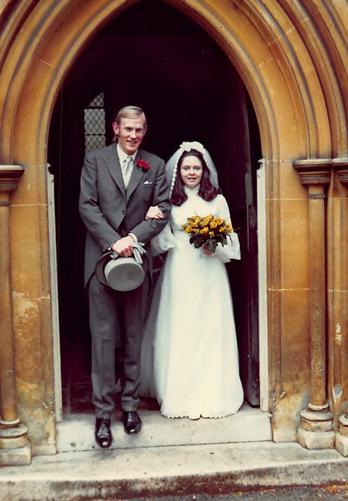
He later returned to England and married Barbara in 1972
Barbara June Bishop, born 9 April 1946 to Sheila (née Porteous) and George Bishop, near Hampton Court Palace, had attended boarding school in England, initially at St Mary’s in Horsell near Woking. She often stayed with her grandmother, Mary-Lee Porteous (née Dunn), at 6 Netherton Road near Twickenham stadium, where her grandfather William Porteous had been the “engineer in charge” of the delivery of the “new East Stand” in 1925
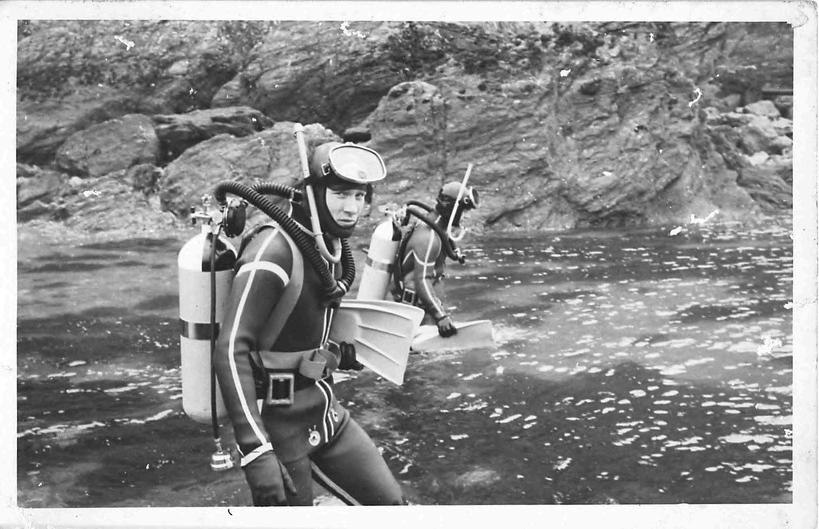
As a student in England, John often holidayed at his uncle Ian Donald’s cottage on Loch Fyne in Scotland. In those days, wet suits were not widely available commercially, so John had to make his own! Not much stopped him. Whilst at Loch Fyne, he and a friend dived on the wreck of an abandoned grain barge. Unfortunately, once through the hatch into the dark cargo hold, the sediment they kicked up blocked any light and any way to find the exit. John, cool-headed as ever, followed the perimeter of the hold in the deep pitch dark with rapidly reducing air until they found the exit hatch, and their way out
Barbara took a secretarial course at Brooklands Technical College, before working in London, initially for a marketing agency, and later for a city lawyer.
As newlyweds, Barbara and John lived in Twickenham, where John was quickly elected captain at Twickenham Rowing Club While he was keen to learn to scull, the long-standing head coach, George Plumtree, had other ideas He immediately put John in the stroke seat of the eight for a highly successful Tideway regatta season: winning at Kingston, Putney, Metropolitan and Mortlake regattas, and culminating in racing at Henley in the Thames Cup in 1973, where they were sadly knocked out by Brown USA
Later on, John (who was always up for a challenge) sculled his Sims wooden single upriver from Twickenham to Eton (via a number of locks and roughly 25 miles or 40 km upriver!) Upon arriving exhausted in Eton, the kindly boatman quietly remarked to a very tired looking John, “Been a long way then have you sir?”
In 1976 the family moved to Pretoria, where John joined the Council for Scientific and Industrial Research (CSIR) Although by all accounts one of the more productive scientists, he spent most of his time in the library researching hull shapes and boat construction technology, with a view to building a replacement for his faithful Simms
In 1974 John and Barbara moved to Durban along with a sculling boat and a new Triumph TR6 sports car John joined Durban Rowing Club and was immediately elected Captain and put back into the stroke seat for yet another successful regatta season While in Durban, John built the extension to the DRC boathouse, and his first son, Robert, was born in 1975.
Shortly after arriving, John was appointed as the inaugural captain of Roodeplaat Rowing Club He had placed the first boat in the empty boathouse and personally tried out every rack before settling on the one that today bears his memorial plaque He also selected and declared the club’s founding colours: Claret and Old Gold
John and Barbara settled happily into the big, thatched house on Thelma Avenue in Clubview, where they would live for many years. Alison, their daughter, was born in Pretoria in January 1978
John had brought his trusty Simms wooden single from England, but as it aged, replacing it became unavoidable Since importing a new boat from Europe was prohibitively expensive, he decided to build one in his garage
As a scientist at the CSIR, he had the government's finest scientific library at his disposal Convenient for researching hull shapes, boat technology and construction techniques (and for the occasional power nap after some late night boat building) This quickly became an all-consuming passion
Not long after joining CSIR, and ably assisted by Barbara, he built his first wooden sculling boat around 1978
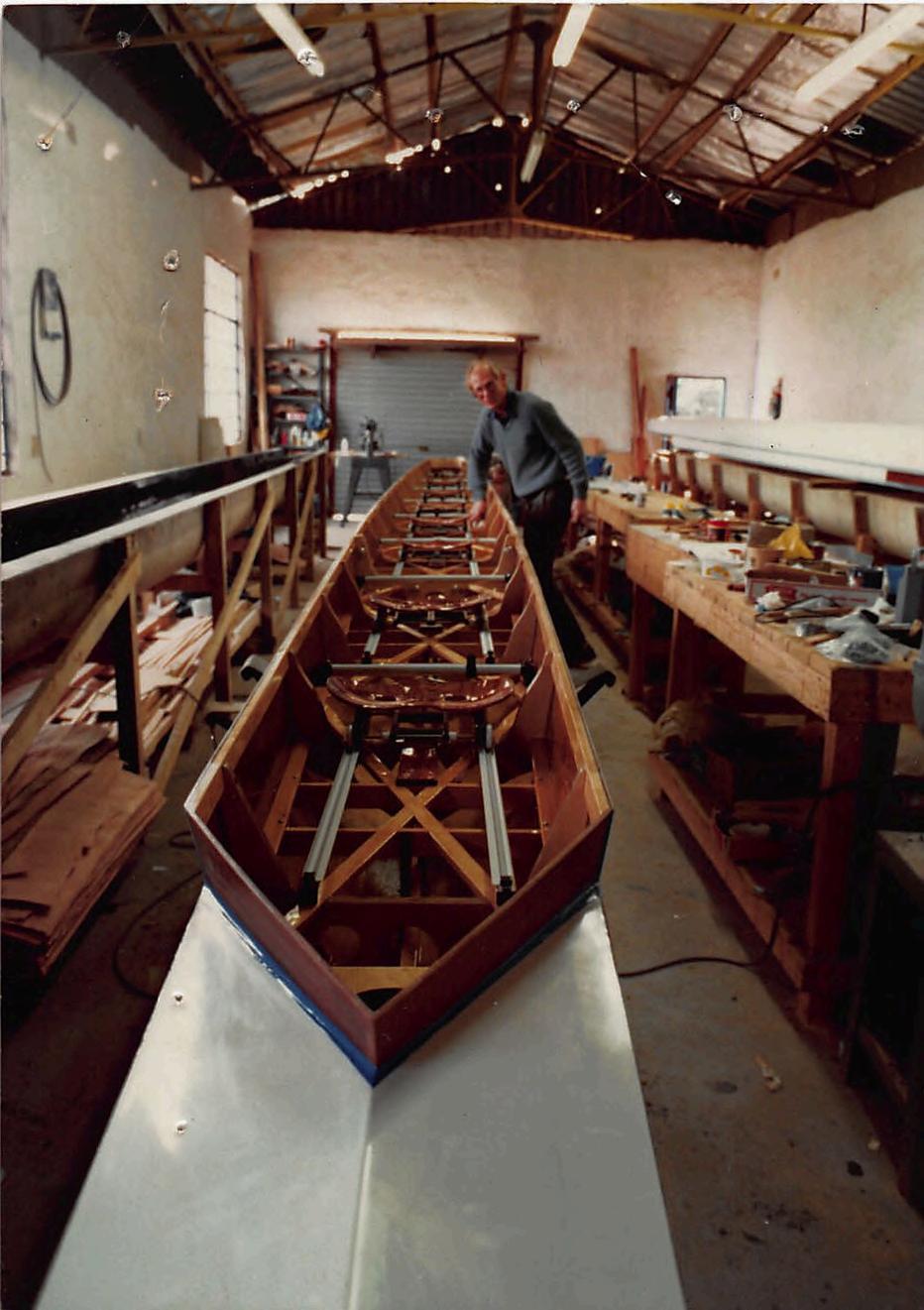
He’d set up “the singles bench” in the back of his double garage knocking through a storeroom to widen the space Good as John was on a bench in the gym, this was more of a precision engineering rig: a long timber plank, firmly mounted at chest height, with sturdy legs spaced at four foot intervals, meticulously checked for straightness and stability Above it was a pair of horizontal sight lines made from fishing line, arranged one above the other, to ensure everything below remained symmetrical.
Next came the formers: like ribs along a ribcage, cross-sections providing the shape around which the thin plywood shell would be formed Around the top and sides of the formers, he threaded the timber keel and side “inwales” to create the spine of the boat. Because the hull was built upside down, the keel was on top Delicate cross-bracing was crafted to link the inwales to one another and to the keel, locking the structure into a stiff lattice skeleton, and wooden saxboards were added to be trimmed to line later
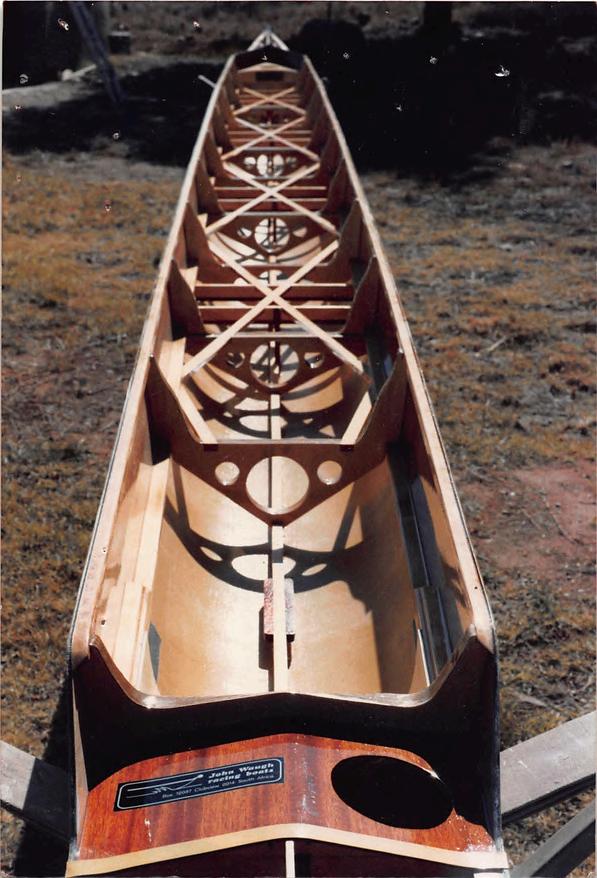
The thin plywood skin was then steamed and formed around the skeleton Once shaped and trimmed, the hull was released from the bench, flipped right-side up, and the formers (excluding the main shoulders) were removed Foredecks, stern decks and a V-shaped breakwater then needed to be formed. One of the trickier components was the diagonally sloped sluice, which was patterned by using a light source to project the shadow of a former onto a piece of wood at a sloped angle Voila! This difficult pattern was revealed, ready for tracing and cutting
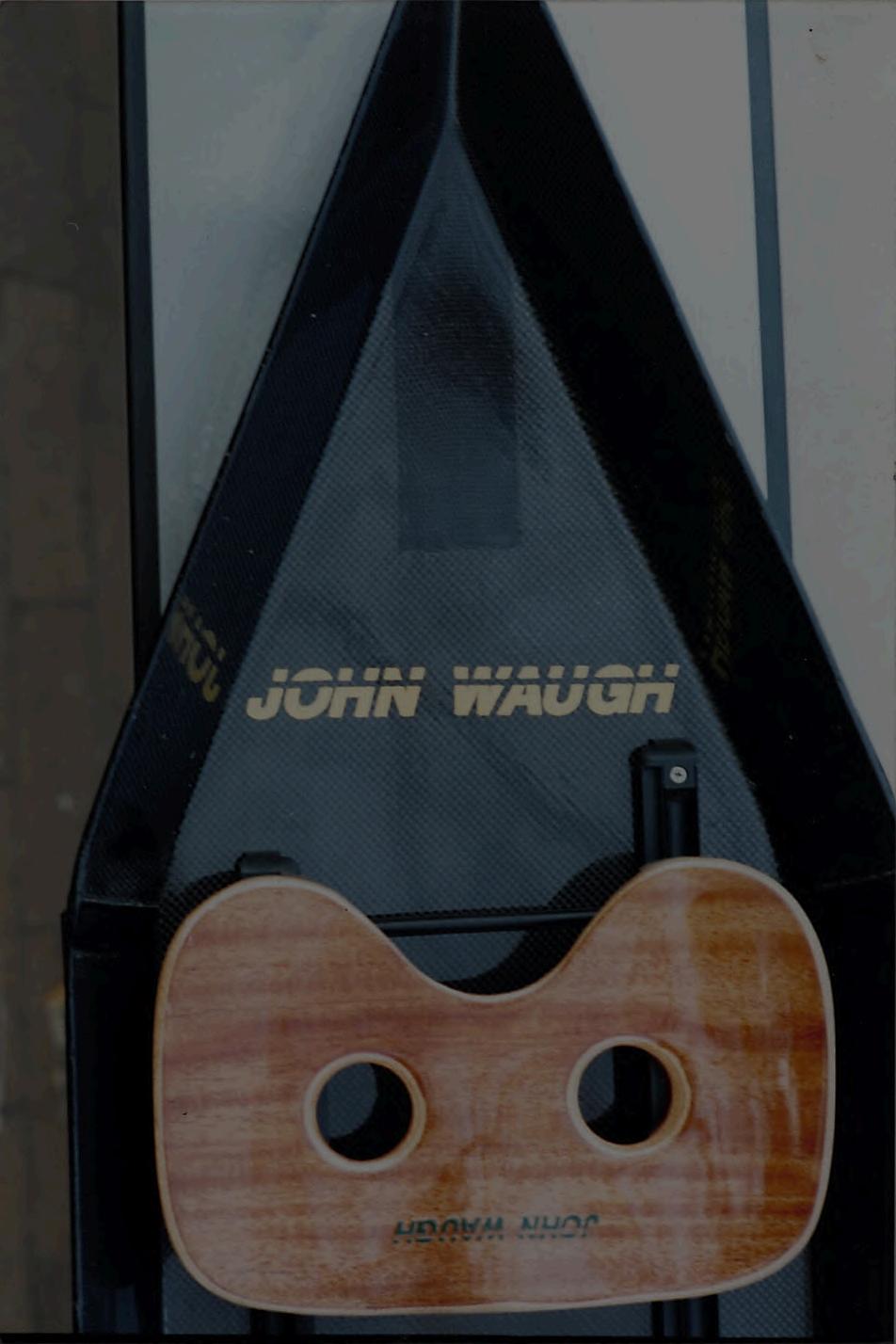
After hand-sanding the woodwork, the hull received perhaps seven coats of marine varnish bringing the finish to a high gloss The finest available wood was used: airgrade Sitka spruce for the frame (light, stiff and strong), marine ply for the shell, and beautiful mahogany or cedar for fine finishes in the exposed cockpit Even the sliding seats were individually carved by hand from a solid billet of mahogany. The fittings were equally premium: white leather calfskin Adidas rowing shoes; Len Neville, Neaves or Carl Douglas riggers; and Empacher or Stӓmpfli hardware
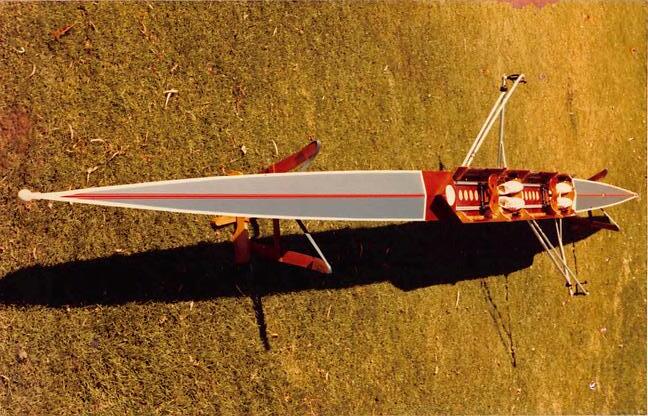
These wooden boats were beautiful masterpieces, a true labour of love and craftsmanship, each taking nearly three months to complete John’s own boat, Windrush* , was the third he made; others included those for John Reid, Colin Graham, Ivan Pentz, Phil Johnson, Bernard Janisch, Doug Munton, Bob Tucker, Keith Maybery, Henry Watermeyer, Ernest Gearing, Mark Shuttleworth (now owned by Wig Dreyer) and many others Custom wooden singles included Steve Lockwood’s ‘lunch box’ boat, which included a compartment below the runner deck, sized to snugly fit two long-tom beer cans, and Phil Johnson’s early wooden single used a custom rigger design that skipped the middle shoulder to allow a narrower, faster hull shape A handful of
wooden pairs followed (c.1982), including Dan and Derek for Wits and Wemmer
By this time John had left his day job, as his boatbuilding “hobby” started taking up more and more of his time A longer bench was built under a lean-to along the garden wall for constructing pairs, including Dan and Derek He produced over 30 wooden singles but only a handful of these wooden pairs.
But three months per boat was not sustainable and modern technology was on the march
In the interim, John continued to race competitively with fierce rivalry in the masters singles against Keith Mayberry, Bernard Janisch (BJ), Brian Chrisite, Derek Read, Phil Johnson and many others
With the help of his friend Jack White (a highperformance glider pilot with an industrial fibreglass factory), John started exploring composite materials He acquired two moulds for fibreglass trainer singles (a standard and a smaller “mini” version) and used them to build his initial fibreglass training boats while learning this new technology and skill. He produced over 70 fibreglass trainer singles
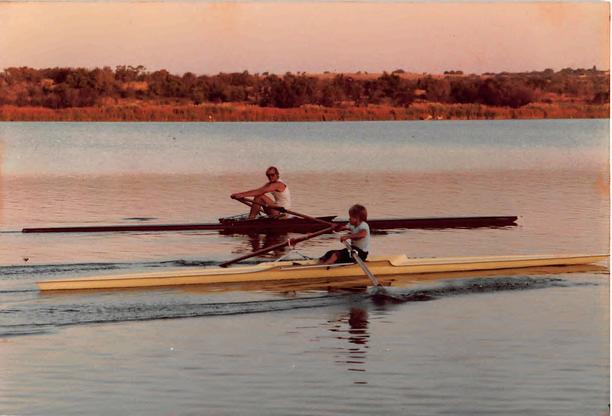
Many rowers started off in these boats South African Olympian Rogan Clarke learnt in one of the full-size sculls, while John’s son Robert started off in a yellow mini-scull that Barbara named Starlight. Phil Johnson collaborated with John during this period, producing riggers and other fittings for these early fibreglass boats
Whilst John endeavored to optimise these designs, fibreglass technology of the day was seldom as light or stiff as the best wooden singles, hardly the stuff of hi-tech, high-performance dreams, still a crucial step towards the composite era that followed
The next evolution in John’s boatmaking came with the shift from fibreglass to Kevlar and carbon fibre, laying thin shells over traditional wooden frames to create hybrid composite boats that combined the stiffness of wood with the speed and responsiveness of modern materials (the best of the old and new) The new process dramatically reduced construction time, and orders skyrocketed. Although he started out making only singles this way, John quickly began to dabble in doubles, which became fours and quads, and eventually the first composite eight produced in South Africa
To keep pace with international developments and fast-track his learning, John visited the workshops of Europe’s builders – Empacher, Stämpfli and even Janousek He also spent many happy hours in deep technical discussion with Klaus Filter, the legendary East German designer whose work for Berlin Bootsbau (BBG) helped shape modern racing shells and contributed to their success against their West German rivals and Empacher Filter, a founding member and longserving head of FISA’s Materials Commission, was also one of the forefathers of modern composite boat technology as he designed the world’s very first composite rowing hull in 1960
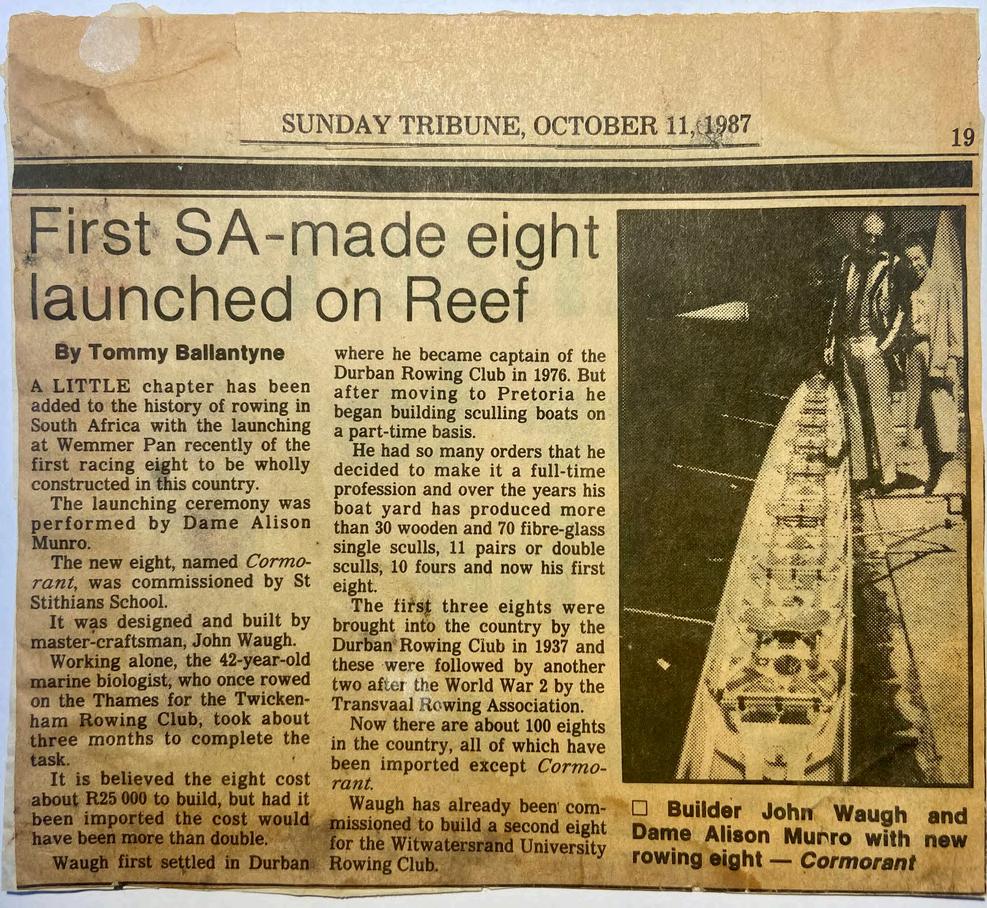
John initially designed his own single hull shape, but as he moved into larger boats, he adopted hull shapes from the best international brands. This culminated in the mould for the Empacher eight used to build a new boat for St Stithians
The resulting boat (the first eight ever built in Africa!) was christened Cormorant by John’s beloved aunt, Dame Alison Munro DBE, who flew out from London for the ceremony There were many fabled eights from this variant including the second of type, AngloVaal for Wits Boat Club (WUBC) as well Strenue for KES/Eds, Isis for St Andrews and many others.
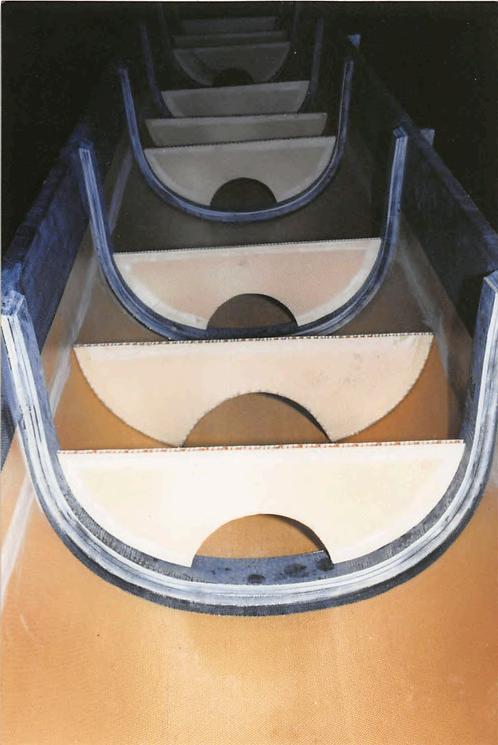
Advances in aerospace materials soon made monocoque construction possible: hulls where the skin itself carries the structural load, eliminating the need for an internal frame Lightweight cores such as Nomex honeycomb, sandwiched between layers of carbon or Kevlar, produced stiffer and far lighter boats
John quickly adopted these radical new technologies He used Nomex honeycomb as the core between a sandwich of carbon fibre of Kevlar, or combinations of the two Production rates catapulted again, and John managed to make several new moulds including Empacher and BBG shapes for singles, lightweight sizes for pairs and fours from Filippi and others, and a big heavyweight eight from the latest Empacher of the day recently acquired by the national squad
Of course there were also risks Standard practice in composite construction was to spray a forgiving gel coat into the mould first; to avoid air pockets and allow for easier finishing. Many builders also waited to spray the hull with its final paint finish only after it was released from the mould
John radically rejected both steps. In his fanatical quest for the minimum weight and maximum performance, he sprayed the final paint finish directly into the mould and laminated the outer layer of the sandwich (carbon/Kevlar skins) directly onto this Whilst still wet, he then laid the honeycomb core down before securing the entire structure under a vacuum bag to cure
This incredibly high-stakes, high-precision process meant that even one small part of the process failing could ruin the entire hull – a heavy gamble Working from an agricultural shed in Irene, John jury-rigged a set of heating lamps overnight to help accelerate curing He was known to sleep under the boat through cold winter nights to monitor the cure due to frequent power failures that would affect both the vacuum pump and the array of heating lamps
Once successfully cured, the second skin layer was applied to complete the sandwich, and the hull could be released from the mould – a truly nervewracking moment, with any sticking or trapped air pockets potentially proving catastrophic Hopefully, the only minor blemishes were on the fine bow or stern tips, which could be easily repaired and small cosmetic bow and stern tip paint trim applied Foredecks, stern decks and runner platforms were made using the same two-stage vacuum process, then trimmed and bonded to the hull to complete the monocoque
Shoulders evolved from wood to wood-faced with carbon to fully carbon components Fittings were drawn from the best international suppliers, while stainless-steel hardware like nuts and bolts were sourced locally Shoes first came in the form of track shoes from local sports shops, then, as demand increased, had to be imported (it’s tough to supply eight pairs of identical size 12 middle distance spikes on short notice!)
John rapidly mastered the new technologies and produced every class of boats (from singles to eights) in multiple configurations (although never a coxed pair!), steadily increasing his production speed Amongst many of the rigger suppliers, Neaves alone produced at least 72 different rigger configurations for his boats.
John’s scientific training made him an expert in hull shapes and hydrodynamics He developed several designs, including:
the J-type (with Phil Johnson) the E-type (Empacher shape) the M-type, based on the boat Swedish Olympian and heavyweight world champion sculler Maria Brandin brought to Roodeplaat for altitude training
He constantly sought input from South Africa’s highest performing athletes to get their feedback, aiming to be at the cutting edge of design, innovation and technology He was passionate about ensuring his boats delivered the highest possible performance, working with clients to push the performance envelope
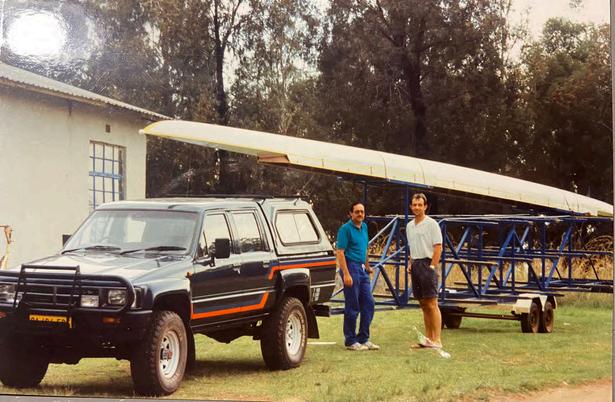
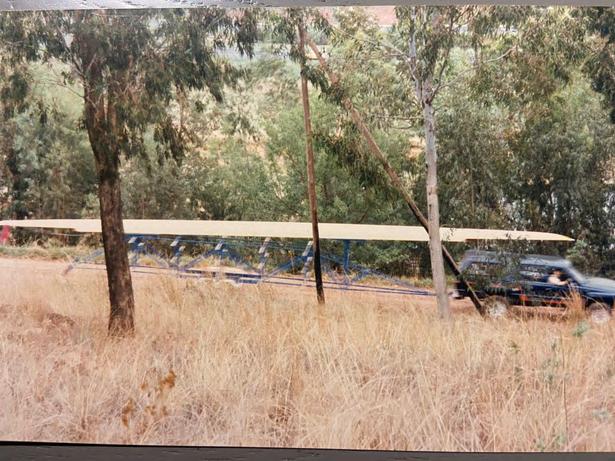
One of his most ambitious projects was the Viking eight, Odin: a sectionless eight (to reduce weight and increase stiffness) that had wide wing riggers that skipped the middle shoulder at each seat It was unbelievably advanced for its time, but was also so long that the trailer had to be modified to allow it to extend forward over the towing vehicle (something of this length would be illegal to tow today) Awesome for racing but not exactly practical (or safe) to transport, particularly when maneuvering around tight corners with lamp posts involved
Later boats also adopted the latest wing riggers as John continued to evolve in the pursuit of performance
Another standout of the era was AngloVaal, built for Wits Boat Club. Known for its exceptional stiffness and speed, it became one of the most admired boats John ever produced Other notable boats included Cormorant, of course, Strenue (Eds), Challis (for KES and named after Chris Challis’s son), Isis (St Andrews under Oxford Blue, Martin “Machine” Kennard)
As John’s business grew, so did his workspace. From the garage loft, he moved to a lean-to “pair oar bench,” then to Mountain Hiney Farm in Irene, first occupying the large shed and later an even bigger one Finally, he relocated closer to home to “the plot” on End Road, also known as “the office”
Key staff over the years included Philemon, Lucas, and David, along with short-term rower assistants such as Rod McKinnon, Andy Mac, and Wayne Sevrin
Precisely how many hundreds or thousands of boats John made is unknown, but their impact on South African rowing has been profound. John’s boats have probably carried nearly every South African Olympian at some point in their careers and have probably held every single major South African rowing record
John Price, who knew John Waugh well, reminisced that in the 1990s, when South Africa hosted the African Championship, the Egyptian crew complained that they had been allocated the John Price (a local John Waugh boat), while the SA crew had the Empacher South Africa offered to swap and consequently won while setting a new course record.
The supply of John Waugh boats underpinned the explosive growth in South African schools rowing, which grew into a three-day regatta with endless racks of boats – mostly John Waughs, hundreds of them! John would proudly mark the results sheets each year, highlighting the winners and course records won in John Waugh boats. For many years it was almost a clean sweep at both seniors and schools’ levels, from first eights down to first singles, and throughout much of the field too
John’s youngest son, Geoffrey, was born in Sandton in August 1984, shortly after John’s long European study tour through Empacher and other boatyards
Unsurprisingly, both sons went on to win the Youngest Oarsman Trophy at Wemmer Sprint: Robert in 1986 (age 11) and Geoffrey in 1994 (age 10)
John proudly watched Robert row for Wits in the 1995 Boat Race final. Despite a fierce race, Wits was ultimately beaten by Rhodes (with a magnificent photo taken by John!) In the Wits boat were: Sean Kerr (cox), Iain “Iron” Macualay (stroke), Guy du Sautoy, Richards Ehlers, Vaughan “Magnum” Adnams, Tristan Bergh, EJ Scott, Rory Hudson and Robert Waugh (bow) The Rhodes crew comprised: Andrew Grant (stroke), Andrew MacLachlan, Luke Hartley, Rich Steele Grey, Barry Banks, Gregor Calderwood, Richard Dickerson and Warren Bolttler (bow)
Over the years, John was also a keen Viking and later a member of the Vikings Beefeaters Society Outside of rowing, he was a passionate collector of classic sculling boats, vintage Mercedes Benz’s, fine English antiques and silver And grandsons (amassing a total of six)
In 2011 John and Barbara survived a violent home invasion from which John never fully recovered They left their beloved thatched house in Thelma Avenue, but found new happiness at Heritage Hill where they lived together blissfully for many years
John passed away peacefully on 18 July 2018 with family at his side and his sixth grandson having just arrived that very same day
John’s contribution to South African rowing is immeasurable His boats supported the rise of school rowing, dominated SA Schools and Champs podiums for decades, and helped build the foundation for South Africa’s modern international success
His wooden single remains on display at St Alban’s College, where his memorial service was held (and both of his sons were educated). His ashes were scattered at sunset on the Thames near Twickenham Rowing Club and on the waters of Roodeplaat Dam
A collection of his wooden singles is displayed at the Blades Hotel, on the banks of Roodeplaat Dam, courtesy of Bruce Turvey, Paul Backes and Ramon DiClemente, including a wooden Stӓmpfli akin to that used by Olympic champion Pertti Karpinnen, and a custom three-section Max Schellenbacher single*
Further memorial items include:
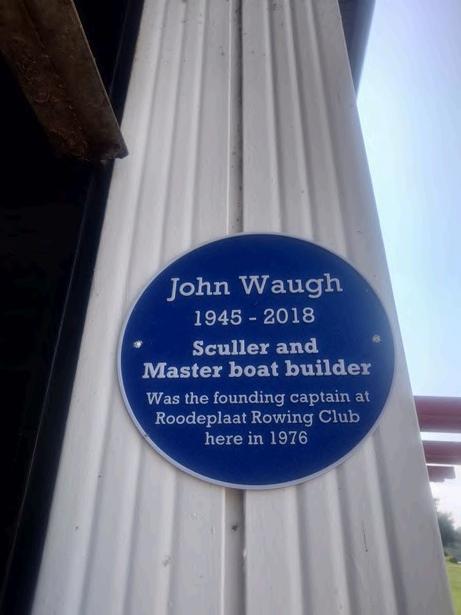
a London-style blue plaque at Roodeplaat Rowing Club
a brass plaque marking his favourite rack
a memorial bench under the trees overlooking the dam (as Barbara always wished for) trophies at SA Schools Champs named in his honour (including the John Waugh Trophy for Boys U14 Octuples, Waugh Trophy for Boys U14 Single Sculls, and the John Waugh Plate for Girls U14 Octuples)
the “John Waugh Rock the Boat” regatta series launched by Olympic champions James Thompson and Matthew Brittain
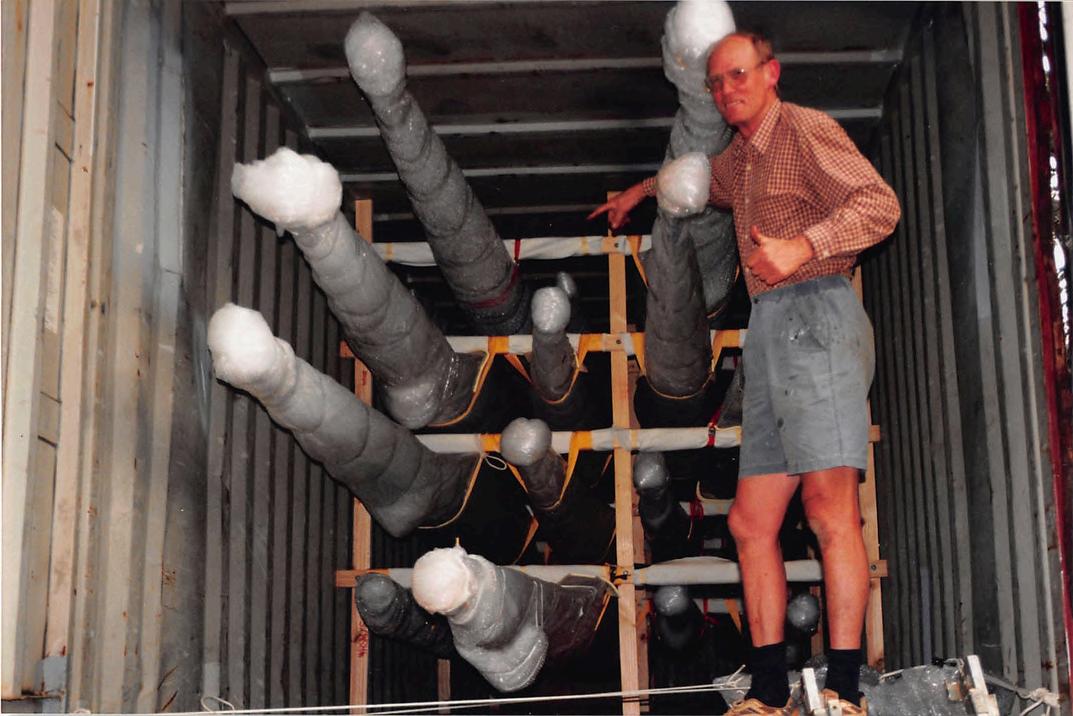
Outside of South Africa, St Edmund Hall, Oxford, has an eight built by John. A container shipment of John's boats was also exported to Ireland and several still appear on the Thames Tideway His work has been featured in Forbes Magazine and documented on Wikipedia
Above all, John Waugh was a loving husband and father to his family, and a master craftsman whose boats shaped a nation’s rowing heritage.
Barbara lived a full and vibrant life at Heritage Hill, where she tended her beloved garden, joined her favourite clubs, and was cherished as the community’s English Rose (using the very administrative and organisational skills, vital to John’s boatmaking endeavours, in the clubs she joined). She travelled far and wide to visit her scattered family, carrying with her the wry smile and the spark of mischief in her eye that made her so loved. A devoted wife, mother and grandmother, she and John left behind three children and six grandchildren across England, Australia and beyond, all of whom carry their memory with deep affection.
This regatta recap will be different to any of the others that came before, because, for once, I was in the boat Will my experiences add some flavour to what is essentially a straightforward retelling of results? Hopefully
I’ll start the personal reflections right here: rowing is hard To get fit and strong as quickly as possible, training must align with school, work, sleep, relationships, and friendships It's relentless! I had always appreciated that rowing demands integration with every facet of one’s life, but I’d forgotten what it meant to fully embrace that In my role as “emergency fillin” for the 2025 Wits Boat Race men’s squad, I briefly – if you can call six weeks of punishing myself “brief” – felt the pressure of choosing between rest and training for the sake of eight other people chasing a goal weeks away from realisation I found myself taking naps between classes in the back seat of my car. I found myself wolfing down serving upon serving of pasta, much to my family’s dismay I even downloaded Strava The hard work and sacrifice excited me, reminding me about what I loved about this sport and about Boat Races: the community

This year’s Universities’ Boat Race, hosted on the Kowie River in Port Alfred by Rhodes University, took place from the 11th to the 13th of September. The weather leading up to the event was incredible, with warm temperatures, clear skies, and light winds Heats day, predictably, had none of that Judging by how wet my shoes were when I went to retrieve them from the balcony, it had rained overnight It was cold too Our shake-down row that morning was disrupted by gale-force winds between the Shipwreck Corner and the finish line Inside the Halyards breakfast buffet (highly recommended for people who suffer from tapeworms – we ate enough toast to cause a grain shortage in the Eastern Cape), the atmosphere was only slightly less frosty No one spoke Whenever I made eye-contact with one of the opposition rowers, their expressionless stares reminded me that we were about to watch the greatest test of strength on the rowing calendar I had never been keener
For the uninitiated: Heats Day is the most crucial day of the regatta Each crew races a time trial down the course, from the old Men’s Start, via the dogleg and old Women’s Start, through the Killing Fields, around Brierley’s Bog, through the Bay of Biscay and Shipwreck Corner, under the bridges, and all the way to the finish line In all, the distance is about five-and-a-half kilometres, although the best coxes with the best lines and best water conditions tend to shorten the course to around five kilometres
The crews are ranked according to their race time, then sorted into two-boat finals from the fastest to the slowest, with the first two (in the A-final) racing for the gold medal, the next two (the B-final) racing for the bronze medal, and so on Crews cannot change positions beyond their final, and so a successful regatta hinges on a solid performance during the Heats.

The first heats of the weekend were the Women’s B 8+ As has become tradition, the University of Pretoria recorded the fastest time of the trials by some margin They were followed into the gold medal race by the University of Stellenbosch, who are enjoying a successful season and showing immense strength-in-depth The Universities of Johannesburg and Cape Town finished third and fourth, respectively, qualifying for the bronze medal race. The University of the Western Cape ‘B’, another promising rowing program, finished fifth, beating UWC ‘C’ Nelson Mandela University put together a composite crew which, although qualifying fourth overall on time, rounded out the qualifying in seventh place
Conditions deteriorated as the day wore on, although the tide rushing out kept times quick. The Men’s Bdivision races largely stuck to the form guide
Pretoria’s “Beast Crew” and UCT’s “Pelican Crew” made up the Afinal, while the “Boets” from Stellenbosch, the University of Johannesburg, and the University of the Western Cape arranged a date for the bronze medal. There was drama in the early phases of the heats: UWC lost their skeg and found themselves turned perpendicular to the course, which, thankfully, had no effect on the result, as a UWC composite crew (with Wits, UJ, and Rhodes all sending athletes) was ineligible to race a higher final, and UCT ‘C’ was excluded
As the Women’s A crews launched, the race conditions were probably the worst they could possibly be The course had stretches of rolling waves more suited to Jeffrey’s Bay than the Bay of Biscay: the Boat Race challenge facing these athletes, already intense, now verged on formidable. The crew from the University of Pretoria (which I would argue is one of the best crews ever assembled for a Boat Race) steamrolled the opposition to win the time trial, beating runners-up UCT by over two minutes, and cementing their status as favourites for the gold medal Stellenbosch and a resurgent University of the Witwatersrand prepared themselves to battle for bronze, while last season’s silver medalists, the University of Johannesburg, qualified for the C-final, where they would face UWC
Both lower finals were all-Eastern Cape affairs, with Nelson Mandela University facing Walter Sisulu University for seventh, while hosts Rhodes would race the University of Fort Hare for ninth place.
The last of the heats saw the Men’s A-crews take to the water The University of Cape Town beat Pretoria by a mere seven seconds to set up a tantalizing gold medal race – perhaps less tantalizing was the bronze medal match-up, in which an unbelievable Stellenbosch crew (which narrowly missed out on the top two) would line up against a University of Johannesburg crew which qualified three-and-a-half minutes adrift of their opponents Wits would face Fort Hare in the C-final; Nelson Mandela University would take on UWC for seventh Rhodes and Walter Sisulu University would clash for ninth place
As the sun (finally) shone again at midday on Friday, the first finals of the regatta were raced Nelson Mandela University’s composite crew dominated the C-final of the Women’s B-division, beating both UWC crews by a three-minute margin The bronze medal in the Men’s B-division went to Stellenbosch, who beat UJ by just under two minutes The first Adivision final, the Women’s 9 & 10 race, saw Fort Hare beat Rhodes by a minute, while the corresponding Men’s final saw Walter Sisulu beat Rhodes by a minute-and-a-half, closing out the day
UJ dominated their final against UWC to finish fifth, while Fort Hare came back from a length down to beat Wits to fifth place in the Men’s event The University of Pretoria won their first gold medal of the weekend in the Women’s Bdivision event, beating Stellenbosch by five lengths UCT narrowly came third, beating UJ for the second time, after the race had to be re-rowed following an appeal the previous day. The Men’s B-division title also returned to Pretoria, after the TUKS men easily beat UCT to close out the division
Excitement built on the bank in anticipation of the A-division medal races. Each corner was crowded and buzzing, adding to the feeling that we were about to witness history Neither bronze medal race in the A-division was particularly close: Stellenbosch’s women beat Wits by just over two minutes, while the Stellenbosch men beat UJ by just under two minutes
Oh well The gold medal races would have to deliver the excitement, then
Finals Day (during which 11 medals would be awarded in several closerun races) began with a series of tight finals in the non-medal races WSU beat NMU for seventh place in the Women’s A event, while NMU beat UWC in the Men’s equivalent
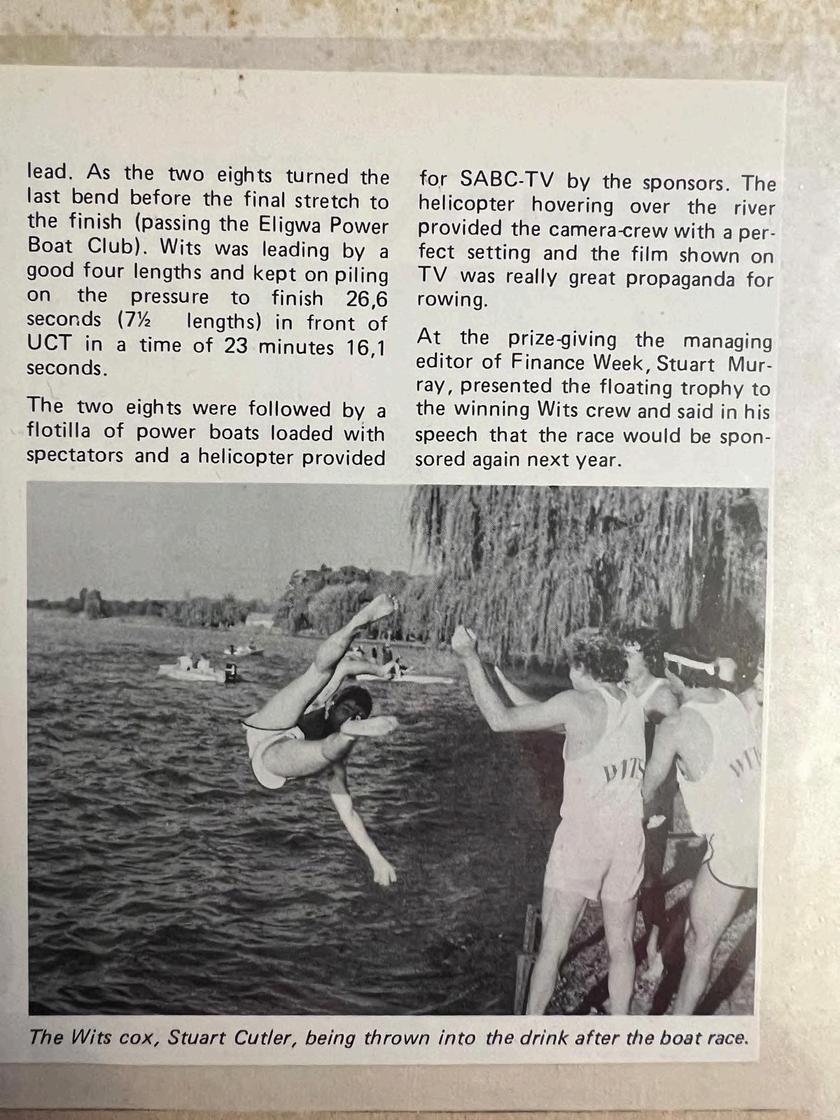
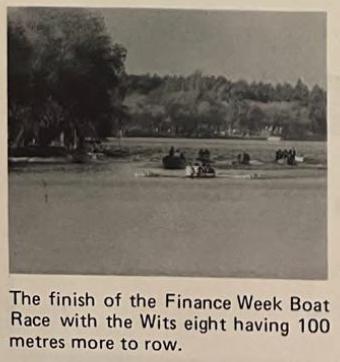
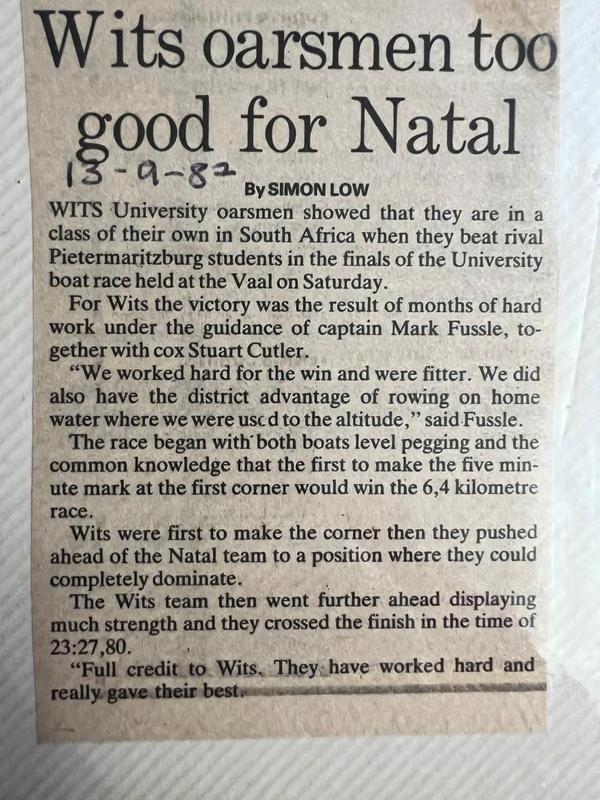
In front of a fiercely partisan crowd, the TUKS women won the A-division by the largest gap of the day, beating UCT by nearly twoand-a-half minutes and extending their winning streak into its midteenage years The faithful crowd, desperate by now for some excitement, were finally repaid for our patience as we watched UCT overturn a two-length deficit at Ladies Corner to beat an unbelievable Pretoria crew – for a third consecutive year – by four lengths to claim the Men’s Boat Race title



September to November marks the opening half of the school rowing calendar And so far so good! A massive thank you to everyone who has made the incredible regattas so far, possible In Gauteng, there has been some super exciting racing across all age groups and divisions The Western Cape is also in full swing, as their calendar format focuses on their preparation for the big Schools Boat Race in December Eastern Cape is also a province to keep your eye on, especially with the return of a cult favourite regatta –Settler Sprints
and turns Clarendon came out on top in the girls 1st Quads, trumping DSG St Andrews College proved triumphant in the coxed and coxless fours, beating Grey and Selborne At the epic Settler Sprints Regatta, Selborne were dominant in the Open scull, winning the 500m and the 3000m events Overall, a strong start for the Eastern Cape schools, especially as the Schools Boat Race looms over the horizon in Port Alfred
of school girl rowing by winning the 1st Quad, Double and Scull at the St Stithians Regatta and Gauteng Champs St Stithians Girls are a force to be reckoned with this season, winning the quad at the St John’s Regatta At the same regatta, St Dunstans won the scull, and St Marys won the double St Benedicts claimed the boys overall, and St Andrews won the girls overall club
In the Western Cape, the big rivalry between Bishops, SACS and Rondebosh heats up again At the Cape Peninsula Champs on the 18th and 19th of October, the three shared the spoils in the fours, Bishops winning the quad, SACS winning the coxless four and Bosh winning the coxed four Rondebosh picked up the gold in the eight, followed quite closely by SACS in second and Bishops in third They went at it again at the Western Cape Champs on the 25th and 26th of October, with the 1st 8+ results staying the same, but a turn around for Rondebosh winning the quad and Bishops taking the coxed four On the girls side, it’s a two club clash between PGRC and Somerset; PGRC won the quad at Cape Peninsula while Somerset won at WC
The Eastern Cape has begun ramping up its regatta season with the Head of the Z Regatta on the 27th of September An epic 35 km boat-race-style regatta on the Zwartkopps River, where Clarendon, DSG, Grey High, St Andrews and Selborne all competed in winds, sandbanks
Gauteng has had a strong spread of regattas so far, culminating in Gauteng Schools Champs and Africa Champs There has been interesting developments in the boys 1st 8+s, with St John’s College claiming gold at the St John’s and St Stithians Regattas in September and October, with KES and St Stithians Boys not far behind them The small boats have been a challenge for the blue side of Houghton, with their red neighbours proving quite capable in the pairs and sculls, winning both events at the St Stithians Regatta. The Red Army’s kept up the pressure at the highly anticipated The Mile Regatta, winning the 1st 8+ against Saints Boys, while hosts St Andrews beat Saints Girls in the 1st 4x+ St Benedict's first full outing came at the Gauteng Schools Champs, where they flexed their dominance, winning the eight, coxless four, and pair St Andrews Girls are still carrying their momentum from the previous season, cementing their place as the top girls program in the province, scoring the hat-trick of
The recap would not be complete without mentioning the racing at the African Continental Championships, hosted over the same weekend as Gauteng Schools Champs African Champs was a phenomenal event, with a number of school athletes representing the country. Matthew Keus (SJC) raced in the Senior Men’s Quad alongside Olympian Chris Baxter, and finished second to Egypt Gabby Manson (SASG) won the Junior Women’s Scull, and fellow St Andrew’s teammate Jade Burnand won the Under 23 Women’s Scull South Africa also won the Junior Men’s Double, composed of King Edward boys Andrew van der Zee and Matthew van der Vyver The medal pile was topped with a silver medal performance in the Junior Women's Double, Robyn Moore (SASG) and Hannah Webb (HRS) Overall, school athletes contributed to 7 of the 11 medals South Africa won at the regatta
Hello!
Anna from Viking here! You may have seen bits of my commentary in previous issues of The Bowside, and hopefully you found them interesting, as this is now my official bid to become a regular writer!!
Though it has been a flurry of school regattas since September, it’s awesome to see masters rowing gaining momentum. More and more masters rowers are diving back into competition for the thrill (and they’re pretty great at it!) Juniors might be interested to know that masters don’t just race each other, they also measure themselves against junior times!
Having a look at the St. Andrew’s Indoor Regatta (13 September)
Thirty men’s masters rowers from Category A (minimum 27 years old) through to Category E+ (55+ years old) raced 1000m individually Leading the pack was Luca Bezzi from Viking, who won Category A (and fastest overall time) with a quick 3:084
In second place for overall time was Category C’s (44-50 years old) champion Thomas Van Der Zee from Old Ed’s who clocked in 3:16 2 Meanwhile, we had a tie for thirdplace between Category C’s silver medalist Andrew Miller (also Old Ed’s), and Category E’s champion Philip Da Costa from Ravens, who both achieved exactly 3:16 8!
The oldest men’s entry, Keith Bradley from Wemmer Pan finished with a respectable 4:01 3 and was actually faster than four of his younger counterparts. There were lots of masters’ entries throughout all the age categories, meaning the older masters rowers showed the whippersnappers what’s what
On the ladies’ side, we had 14 entries across Categories A to Category D (51-55 years old). Darcy Carpenter from Old Ed’s won Category A in a time of 3:527 – her first indoor race after only four months of rowing. Category D’s Dimitra Sikiotis from Ravens, claimed the fastest overall lady in a time of 3:520 (faster than seven of her younger counterparts!)
Two brave souls, Steven Wilkins and Pavel Dabrytski, both from Viking, opted to face off against Seniors in the 2000m rather than the 1000m, winning silver and bronze with times of 6:491 and 6:52 2, respectively Both are 13 years older than 25-year-old Seniors champion Sebastian Prince from Old Ed’s who won in 6:473!
In case you missed it, masters and seniors events are now available at school regattas Sculls are always the first event of the day, and then there are certain 2x/- and 4x/events available I’d like to give a shoutout to the dedicated competitors Terence Temlett from Ravens, and Pavel Dabrytski from Viking, who compete in virtually every available sculling event Their support for the school regattas is inspiring Keep an eye out for them at the next one!
Each regatta typically sees 10-20 entries from masters, with entries in both 1000m and 2000m Terence Temlett remains undefeated over 1000m in the masters 1x across all regattas, with other rowers beating him over 2000m – Rob Riccardi from Ravens at St. John’s Regatta (27 September), and Anna Fisher from Viking at St. Stithian’s Regatta (18 October), who respectively achieved third and first place in their senior 1x events
One unforgettable sculling race was the masters 1x of St. Mary’s Regatta (4 October) – it was tip defying, adrenaline-fueled, and more about surviving than competing (unless you’re Terence, who managed to sub-5 whilst the rest of us fought the tough conditions to finish the race) My home ground is a tidal river, often with strong winds from typhoons that blow by the area, and I can confidently say this race was one of the most harrowing experiences of my rowing career! I stuck to 18=20spm for fear of tipping, finishing in 6:35 29 for 1000m (2:30ish slower than usual!)
Moving onto crew boats, the Viking men’s quad with Luca Bezzi, Sean Cloete, Sean Croxford, and Gregory Kent (Category B, average age 36–42) came first in their heat, and third overall in a time of 3:5998 against JM15A 4x at the St. Benedict’s Regatta (20 September). Meanwhile, a composite ladies quad from Viking, VLC, and Old Ed’s with Anna Fisher, Tracey Goodwin, Sam Johnson, and Karen King (Category D, average age 5025) matched the high standard set by the Viking quad and came first in their final against JW19 2nd 4x+ in a time of 8:32.44, gapping second place by 38 seconds!
It was exciting to see a number of masters competing in the senior events for The Mile Regatta (11–12 October), with many advancing to the finals before ultimately facing crews from the University of Pretoria Well done to Old Ed’s, Viking and VLC crews who showed fighting spirit in the Senior finals across M4-, M4x, and W4x! In the masters events, the doubles had a wild ride; what began as a helpful tailwind morphed into a fierce headwind halfway down the course Sam Johnson from VLC and Karen King from Old Ed’s raced against Jacqueline Lundberg and Dimitra Sikiotis from Ravens,
emerging victorious to claim The Tusks trophy Rob Holness from VLC and Terence Temlett from Ravens then went head-to-head against Andrew Craig and Tom Price from Old Ed’s in the finals, with Rob and Terence ultimately winning The Horns trophy
Masters came out in full force for the St. Dunstan’s Regatta (25 October) with the largest contingent of the school regattas thus far. Racing in every available category: M1x, W1x, M2x, W2x, M4x, W4x The 2x events were riveting, with both ladies and men facing off against the younger JM/W15 2x competitors Thanks to the high number of entries, everyone had their own heats Out of six ladies’ masters 2x, three clocked the fastest overall times: Sam Johnson from VLC and Karen King from Old Ed’s (again!), Toni Wadley and Elmari Verhage from VLC, and Alexa Marketos and Tracey Williams from VLC In the men’s masters 2x, five masters crews challenged six JM15B 2x boats, and all five finished at the top of the overall times The fastest boat was rowed by Rob Holness and Ian Johnson from VLC, who crossed the line in 3:51.73. In fifth place, we had Wig Dreyer from Viking and Andy Schlict from Wemmer Pan (Category G, average age 67) with a time of 4:2114 (they beat the next boat by 19 seconds!)
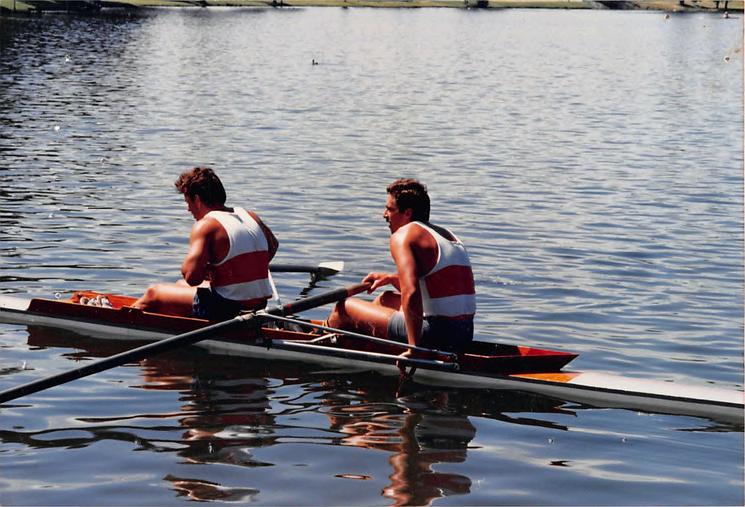
Kudos to all our masters for showing us how it’s done I hope you enjoy my regatta recap and stay tuned for more updates in the next issue!
When and where did you start rowing?
I started rowing at General Smuts High School, Vereeniging during Standard Eight During Standard Nine, our crew went from the 4th to the 1st division in one season.
When was your first time representing South Africa internationally?
My first international trip was during 1980 with the Wits Crew to The Henley Royal Regatta We raced as WUBC in the Ladies Plate where we beat Harvard in the Semi-final and lost to Yale in the Final.
We then raced as Trident at the Bedford Regatta where we didn’t lose a race
After that, we went on to race as Thames Rowing Club at the British National Champs on Holme Pierrepont outside Nottingham where we won a Bronze.
The crew were awarded Springbok Colours upon our return to SA
Our Cantabrigian crew (1984):
During 1984, South Africa sent an Eight to race in the Thames Cup at Henley During the Semi-final on the Saturday, we broke the record at every station and were the fastest crew of the day including the Grand times
On Sunday, we were on the back pages of every major newspaper under a “flag of convenience” row Cantabrigian was a nondescript club from Cambridge that hadn’t competed at HRR for twenty years They were subsequently also banned from HRR for a further 10 years We also received Springbok colours upon our return
Tell me about your experience in Banyoles in 1992?
In the first heat we posted a time 0f 05:37 taking 20 seconds of the Africa record. We were half a length behind GB that came 6th in the A-final
In the Semi-final, we caught a crab out of the start which put us into the B-final
We came 2nd in the B-Final
World Masters was held in South Africa in 2023, what crews did you race in, and did that inspire you to go to Banyoles for World Masters in 2025?
David Brittian, Ivan Pentz, Bryan Hodgkinson and Justin Hagerman competed in the E4- (third) and in the F4- (Gold) Ivan Pentz and Justin Hagerman came 2nd in the F2-. We also competed in the Men’s D8+ where we won Gold
Banyoles was a great venue during 1992, and after tasting international competition again, we thought it would be a great idea to revisit the place
7
Previously in the Cantabrigian crew.
Tell us about your crews in Banyoles 2025? How did your racing go?
The same Four that raced at Plaat got together for Banyoles We changed from a tandem rig to a conventional rig with Pentz moving to the bows. We entered for the E4-, E4+ with Andrew Lonmon-Davis (ALD), F4- and F4+
We came 4th in the E4- racing out of our age group (racing younger crews) Gold in the F4- It was a great race where I called a push at 200m winning at the end by ½ a boat length from a very tidy French crew.
We withdrew from the E4+ to save ourselves for the F4+ where we won Gold The Coxed Four won by a length from Chinook from the USA
There was a wonderful ceremony for the 1992 Olympians on Thursday at Banyoles. It was very special to see you (in your 1992 jacket) and Andrew Lonmon-Davis up on the stage along with some other rowing royalty. What were your feelings while standing on the stage?
We didn’t recognise too many of the ’92 athletes except for Matthew Pinsent who I got to know quite well while stationed in the UK from 1998 to 2001 where I rowed for Leander.
ALD coxed the GB Eight with Matthew stroking, at the Riviera Vaal Regatta during 1992 I chatted to an Aussie lady next to me on the podium that had raced in the W2- Turns out she was a good friend of Professor John Myburgh (1980 Wits and Cantabrigian #6) Small world!
I must say that I was very proud standing on the podium with the other ’92 athletes
For aspiring Olympians and masters rowing, what is the impact that rowing has had on your life over the years?
Rowing is a very special sport teaching one: esprit de corps, discipline, teamwork and dedication Most of my good friends are oarsmen and have been for decades The majority of the blokes that I have rowed with, have become world leaders in their fields of work, which sets rowing apart as a sport It also helps me pass my bi-annual flying medical!
Rowing is a unique sport. Each time someone asks me what I do, I cringe on their behalf for the oncoming passion and excitement as I proceed to give a crash course in rowing to that unsuspecting stranger Being able to expose people to a world that operates beneath the conventional radar is just one of the many aspects I enjoy about rowing
Why do we row? There must be a reason It comes down to the choices we made, listening to where our hearts desire It took me a while (and a lot of thought) to discover what I enjoy about rowing Is it the training? The early mornings? The late evenings at Plaat or maybe even the sunburns? None of these are particularly thrilling daily choices! However, watching the people beating you is a great place to start
I keep coming back for the deep sense of accomplishment of being able to put my body, mind and soul through rigorous training routines and learning opportunities that come along with rowing at any
level There is always a reason we find ourselves in places unique to each of our journeys I am grateful that mine is in rowing It is humbling when you meet people who recognise this niche sport Many of whom are meaningfully touched by the sport I guess this, too, is an aspect of rowing that I adore and that keeps me coming back
What does one need to attempt, continue and succeed in rowing? Some would argue that one needs to be disturbed or maybe even slightly crazy, and in our own ways, we are While it is not a prerequisite to have a screw loose, it helps Joking aside Anyone willing to take up the challenge of rowing as a novice will quickly learn how swiftly rowing will humble you
Rowing requires a person to submit themselves to building a brand-new skill with a bit of grit and determination to prove to themselves that they can do anything they put their minds to If this first step does not totally dismantle the urge to try rowing, then congratulations, you are now a fully-fledged rower
There is no going back, and what an amazing community to be a part of
There’s a saying in rowing: the boat moves fastest when everyone pulls in rhythm
That rhythm – between clubs, universities, and the national system – is what we’re rebuilding Shanghai was proof that the rhythm is starting to take hold
On the waters of Dianshan Lake, South Africa took its place among the best in the world
Our crews stood on the start line with quiet belief, forged through months of preparation, countless kilometres, and the shared ambition of a nation finding its footing again Although this year isn’t an Olympic qualifying year, both boats finished in Olympic qualifying positions – inside the world’s top 10, achieving our goal
It was a clear marker of progress, acting as proof that our approach is working and that South African rowing is back in the conversation on the world stage.
The real success lies in how we got there, through collaboration, trust, and a new system empowering coaches and athletes at every level to contribute to the national cause
This decentralised model (now in its first full season) is a philosophical shift. We’re moving from a model of collection to one of creation.
For decades, national programmes around the world have wrestled with a question: how do you grow excellence without losing identity?
Our answer is simple: you build excellence through identity
The new selection model requires athletes to train with their clubs and universities, instead of needing to train with a particular crew and coach at a specific location, to have the chance to be selected as a national rower. This asks clubs to support athletes on their rowing journey in a much more hands-on way This requires the facilitation of such training through building high-performance structures while giving athletes who might not be able to train elsewhere the opportunity to train from an accessible club.
Additionally, this approach strengthens individual Boat Clubs, affording them sustainability and longevity that they have long been struggling to retain Every coach now has the mandate, and the opportunity, to develop crews and athletes capable of racing for selection Every athlete has the ability to follow a pathway towards elite rowing through their respective club, rather than in spite of it The impact that this system has on the health of rowing clubs across the country should not be discounted. Rowing is an expensive sport, and even well-established clubs with many years of history are struggling to stay open A strong, competitive senior rowing scene is a hugely exciting prospect for clubs and rowers alike, with enormous potential for South Africa’s international rowing presence.
It’s not perfect yet (new systems rarely are), and a system like this takes time to develop It’s met with questions, critique, and healthy debate But underneath it all lies the same truth: this is how we grow depth This is how we ensure that when a talented athlete reaches the national stage, they’re already tested, supported, and ready
We’re chasing connection and community
What we’ve begun to see this year is inspiring Clubs that once saw themselves as outsiders to the national process are now active participants Student programmes are producing athletes capable of racing internationally Coaches are sharing data, comparing notes, and aligning training philosophies because they see the value in collective growth. When a club athlete steps onto a world stage, the victory is shared by every coach, teammate, and volunteer who pulled an oar in their development, resulting in a culture of shared investment, pride, and collective progress
Our crews raced with courage and composure in Shanghai, thanks to our strong preparation. The margins were fine, the competition world-class, but what stood out most was our consistency
Paige delivered an incredible performance in the Women’s Single Scull, producing an exhilarating final that placed her inside the world’s top eight, in a year where the event was arguably at its highest calibre And let me tell you, she doesn’t intend to stop there Her progression has been a reflection of relentless intent, technical refinement, and belief These are the hallmarks of what we want this new era of South African rowing to represent.
It reaffirmed what we’ve believed all along: South African rowing has the talent, resilience, and the coaching calibre to climb higher still This year has served as the foundation And as we look toward another season with this new training philosophy, there’s genuine excitement We’ve seen what’s possible Now the focus shifts to climbing the rankings, step by step, stroke by stroke
There’s still plenty to refine in terms of our coordination, communication, and calibration –but that’s the beauty of being in year one. This is the build. The foundation. The moment before the momentum. The structure we’re laying now will define how South African rowing competes for the next decade.
Our goal remains simple: to make every club a place where national dreams are built, not just discovered.
The next Olympian might already be out there: pulling strokes on a quiet morning, coached by someone who believes that excellence can be grown anywhere.
A Message to the Athletes and Coaches Who Aspire to Wear the Green and Gold: Show up for yourself.
Every great journey starts with the choice to commit to giving your best, and to keep showing up even when no one is watching. Wearing the green and gold is earned through consistency, belief, and effort that builds over time
What’s exciting about where we are now is that international representation is no longer confined to one central system or squad. The national programme remains the heartbeat, but excellence can now emerge from anywhere in the country –from clubs, universities, or provincial centres that are embracing the same high-performance philosophy
If you bring intent, discipline, and purpose to your training environment, you’re already part of the system we’re building Because this new chapter of South African rowing is about how you train, why you train, and the standard you hold yourself to every day, rather than where you train
Show up for yourself, and in doing so, you’ll help lift the standard for all of us.
I knew that I wanted to take rowing to an elite level during my Under-16 season
It was then that I realised that my aunt Colleen Orsmond had rowed at the 1996 and 2000 Olympic Games for South Africa, and so, my dream of following in her footsteps came to life
Since that season, I’ve been working hard to achieve the highest honour in sports by winning an Olympic Gold Medal, and I will continue to work towards that goal and fight for my dream for as long as I can
Many people have asked how long I will row for, and honestly, the answer is as long as I can As long as my body will allow me to It's my true passion, and I will keep going until either I can't go on any longer or I've reached my dream
What stands as your favourite race you’ve ever raced, win or lose?
My favourite race has got to be the Cambridge vs Oxford Boat Race It was unlike anything I’ve ever experienced before.
First off, the media and build up to the actual race was incredible As rowers, we don’t normally get that kind of media coverage and hype It was really cool to see rowing broadcast so widely and to have so many people following us
It’s estimated that more than 100 million people watch the race globally, with between 200 000 –300 000 people actually on the banks The only silent part of the race is the warm up, which is done upstream from the starting position The whole of Putney Bridge was full of people waiting to watch the start, and thousands of people took to the banks to catch even a glimpse of the race It was spectacular having so many people cheering for the entire race
It was an epic race from start to finish Being a river race, there are many more elements to it than a classic 2km straight course. You have the tides, the different stations (Middlesex and Surrey), the twists and turns of the river, and obviously the distance (6 8km) It is a long race and you must be prepared for anything It is common for the race to have a bit of a drama, ours had no shortage of that when our cox made a bold steering move, gaining a favourable line on one of the bends. We had to put in a huge push to ensure that we were fast enough to legally make that move without being disqualified
The race is win or lose; there is no second place Crossing the finish line knowing we had won was an incredible feeling.
Head Coach – Rowing South Africa
The history of the South African Universities' Boat Race, now the long-established staple of the South African University rowing season, is shrouded in some level of mystery for many current and recently graduated students Dr Google was not particularly helpful on the topic – for that I owe sincere thank yous to Wynand Dreyer (WUBC member 1969–1975), Peter Maher (Wits Alumni Office Head), Marco Sass (WUBC 2020–2022), Lesley Carstens (WUBC 1984–1989), Andrew Lonmon-Davis (WUBC 1983– 1989 ),
Stuart Cutler (WUBC, 1978–1983), and Craig Levieux (WUBC 1979–1982).
The updated version of ‘Wits Sport: An Illustrated History of Sport at the University of the Witwatersrand, Johannesburg’ by Jonty Winch, now a much more concise ‘Wits Sport 100’ , forms the primary source material, with the aforementioned alumni providing the bulk of the supplementary material
A reworked version of the article that got the idea of this magazine into my head
Unfortunately, this history is less than comprehensive, and many details have been left off, not least due to this account already being excessively long Still, I hope it is a decent attempt at a (reworked) patchwork history of the South African Universities' Boat Race from a largely Wits-centred perspective.

The Wits University Rowing Club, the original 1920s name (a controversial topic today), was established on the 26th of September 1924 at a general meeting After a less-than-enthusiastic six years, the process of re-establishing the club began with a new name (Wits University Boat Club) and a new constitution in 1931 – the self-same year that a truly novice crew (in true Wits spirit) took on a regatta while their coach was on holiday, flipping the boat before a single stroke had been rowed. Some races were won and some lost, and in 1934 the first ‘non-official’ intervarsity was held at Port Alfred, won by Natal University College (later University of Natal, eventually merging with University of DurbanWestville in 2004 to form the University of KwaZuluNatal)


For a number of years, UCT and Rhodes raced annually in September on the Kowie River, and in 1980 UCT decided to challenge Wits to a one-on-one race – this, of course, came during an incredibly successful year for WUBC, who had “peaked and totally dominated Senior rowing.” In any case, UCT had been going on about how they would outperform Wits, somehow convinced that they could win against a crew which had already given them a hiding over 2000m, thus UCT issued the challenge to Wits to settle the (non)argument once and for all
The first South African Universities' Boat Race, held on the 10th of May 1980, was on the Vaal River
“The atmosphere was huge The race was very personal for everyone involved because people were affiliated with one crew or another, whether geographically or historically There was a huge flotilla of motor boats that followed us to the start, flags flying and generally a carnival-esque atmosphere. Adding to this chaotic scene was an SABC film crew on board a helicopter following the event There had never been a regatta of its sort before, and even non-rowers were engrossed with the intrigue Both crews wore sponsors’ vests, but with WUBC or UCT written on our backs, so we never raced in our university colours
As unimportant as it was in the greater scheme of things, both crews felt like rock stars It was pretty scary, even feeling fairly confident that we were the stronger crew The anxiety was driven by both the weight of expectation and the fear of screwing up in front of a national audience. We were already a tight-knit crew who had swept all before us that season We had plans to go to Henley later in the year, and also didn’t enjoy the arrogance of the UCT crew, so we needed very little more to motivate us However, more than anyone, John Myburgh (our captain) vocalised very well what we were all thinking. He was an aggressive sort of leader, passionate, with a big personality. We couldn’t help wanting to go to war for him
My overwhelming memory was of 30–40 motor boats lined up behind us at the start, set to follow the race, and the deafening din of the helicopter We couldn’t hear ourselves think, let alone any commands from within the boat. There was massive motor-boat-wash bouncing off the banks of the Vaal and I remember feeling deeply concerned about it When the starter dropped his flag, the wash was still huge, making our start more a question of survival than a thing of beauty It took at least 500m of fighting against the wash and trying to avoid crabbing, but we could see UCT also battling as we untidily took a 2-length lead at the start
As we had clear water pretty early on, Stuart had complete control of the river bends We finally found some rhythm and just kept opening the gap. Once we had regathered our wits, it was an awesome sight to see the flotilla following us in a wall of boats
However, as we were substantially in the lead, the bloody helicopter kept hovering just ahead of or above us, so we could hardly hear Stuart For quite a while we just had to follow Bubs and John Stark (our stroke pair), but after a couple of seasons behind them, we were so in tune that we could manage without hearing the cox. As long as they could hear Stuart, we could easily follow
More seriously, the down draft from the chopper rotors created a massive headwind for us and quite a bit of turbulence, so we rowed most of the way with a handicap. We never really tapped off, but with the disadvantage of the chopper only opened up about 10-15 lengths by the finish We should really have won by a lot more
At the finish, the motor boat wash was so big that we decided to jump out of the boat into the river to avoid damaging the boat on the jetty. Bad idea! We almost drowned trying to stay afloat and protect the boat, but somehow survived
The relief was palpable and the winning celebrations a thing to behold!”
“My recollection of the boat race coming about was that the UCT crew had fancied themselves and were not impressed with WUBC's performance during the SA season In fairness, they had produced their best crew in about a decade, but unfortunately for them it wasn't enough, and Peter Jones had taken Wits to another level.
There was quite a bit of chatter from UCT about how good they were during the season, but we only got to race them for the first time at Intervarsity in Cape Town In the first of the Senior A events, 4+, we partially sank halfway down the course as the Zeekoeivlei waves broke the canvas on the bow, and we came last Chatter volume increased exponentially, as we had sort of announced our intention to tour to Henley We won the 4- and the 8 race, but that didn't deter them They were quite vocal even after our UK tour, so it seems they spoke themselves into a challenge race which they could never win, a bit like dogs chasing a car. There wasn't a good vibe between Wits and UCT in those days
Wits was at its peak, and we were in our backyard It was a river we trained on and Stu Cutler knew it like the back of his hand – where the channels were, the fastest parts of the bends, etc
The article on the Boat Race website about the 1980 event must have been written by a UCT supporter, especially the bit about the helicopter Yes, there was a helicopter but no, it had no influence on the start It had an influence later, after we were about 4 lengths up, and at the halfway mark when it descended on us to get some close-ups and we were suddenly rowing in a hurricane, with Stu frantically waving them off (two-fingered salutes while trying to steer) We lost about a length before the pilot got the message The helicopter was there because the race was to be on TV, would you believe? Although it wasn’t live, it was aired about 3 weeks later
The producer wanted some close-up action, so the cameraman was put in the cox's seat to get some footage in the boat The problem was that we couldn't row at anything more than 50% As soon as we went up, he would complain that he was getting hurt by hitting his back against the seat and couldn't hold the camera steady. We thought they were going to reject the footage or use it as part of the build-up, not the race itself, but they put it into the footage of the race and we looked like we were out for a Sunday stroll It looked super cool in the middle of the race, rating 20, but our non-rowing mates who saw the footage ripped us mercilessly about how pathetic our sport was as serious exercise. Anyway, we were never under pressure in the race and won it comfortably It actually turned out to be a nice send-off for the crew as a last ever paddle together, and also gave the sport some minor exposure on national TV
In truth, the Boat Race wasn't high on our priorities, but it was fun – we were going to Henley on a 5week UK tour that July We needed to do some varsity work catch-up after the UK tour, which was the real story of the Wits 1980 crew – bless them, an my mates Guy Muller and Peter Jones”
The Cambridge Rudder, and a silver cup from Finance Week were awarded to the winning crew According to the Wits Sport 100, the Wits crew crossed the finish seven strokes ahead of UCT
Amusingly, Bruton recalled that the sluice gates had been opened on the first night of their stay at the Vaal, prior to the race, and the crew made a schoolboy error, rowing down for about 30 minutes, not realising how fast the river was flowing.
Once they turned around, they took about 3 ½ hours to row back up, much to their chagrin – at least they were thoroughly warmed up for the race
Later, in July, at Henley, Wits ended up beating Ridley College in the quarter finals, similarly besting Harvard in the semi-finals – in each race Wits’ competitors led for most of it, but in the last 300m or so, Wits overtook them, winning by about a canvas – ultimately losing to Yale in the final A fantastic result for the crew
First awarded in 1980 to the winners of the very first South African University Boat Race, the Wits University men’s crew by the Cambridge University Engineers Association; an honest-to-goodness rudder, decorated in Cambridge with the crests of the University of the Witwatersrand and University of Cape Town, from the Lady Margaret Boat Club VII Cambridge later declared that only university crews could compete for the rudder.
Thanks to the widespread publicity, the race had 5 universities competing in 1982, that year the race was moved to September
In ’84 came the move from the fresh water, gradual bends, and good conditions of the Vaal River to the salt water, tight bends, sandbanks, and unpredictable variable conditions famous to the course of the Kowie River Part of the motivation for the move was that UCT and Rhodes had a longstanding annual tradition of racing on the Kowie, so the organisers felt it would be a more appropriate venue. According to Craig Levieux, the race was shortened to its current 5.5km around ’85 or ’86 to be parallel to the finish (which is a requirement for a fair race in terms of distance rowed by each crew), as the river narrows on the corner just prior to the current start In the early years, there had been a bridge, with such narrow spans that boats couldn’t always pass without the oars being retracted, a few hundred metres from the finish – though it seems that the issue has since resolved itself
In 1988, women competed in the Universities' Boat Race for the first time Wits’ women’s crew won convincingly, winning the Isis Blade
First awarded in 1980 to the winners of the very first South African University Boat Race, the Wits University men’s crew by the Cambridge University Engineers Association; an honest-to-goodness rudder, decorated in Cambridge with the crests of the University of the Witwatersrand and University of Cape Town, from the Lady Margaret Boat Club VII Cambridge later declared that only university crews could compete for the rudder
Carstens kindly recounted a rather embarrassing-at-the-time, but now hilarious, incident at the 1989 Universities' Boat Race: The sinking of the Wits Ladies’ 8+ in the Bay of Biscay
The morning was horrifically windy, and as the women’s crew, coxed by Danielle Brittain, cut around the corner they faced directly into the wind, no longer able to hear one another in the slightest. Mandy Reid, seat 3, leapt into the water soon after a wave shipped a not-insignificant amount of water into the boat. The other ladies started bailing while Lesley, seat 7, and Nicki Jooste, the stroke, were still rowing, oblivious of what was happening behind them Both ladies did end up jumping into the water along with Danielle, ending the eventful morning by dragging their wooden boat to the jetty (thankfully Wig was in the umpire’s boat with Martin Kennard to help with the rescue) The fun didn’t end there, the race was filmed, and footage of the Wits women abandoning ship was replayed on TV for a week! The crew returned to Wits, unable to escape their classmates’ teasing Years later, Lesley seems to think back on their dramatic loss quite fondly
Clichés are cliché for a reason, and the Universities' Boat Race is a cox’s race, more so than any other Wynand Dreyer is of the opinion that Stuart Cutler and Andrew Lonmon-Davis are two of the finest coxes that WUBC has ever seen I have yet to be told otherwise by anyone coxed by either. As mentioned, UCT alumnus Bryan Hodgkinson recently rowed in the coxed four at the World Rowing Champs in Spain, coxed by none other than Andrew Lonmon-Davis.
Stuart Cutler, who started coxing for Wits while he was still a schoolboy at KES in 1974/75, detailed their many achievements, including their brilliant performance on their 5-week tour that included Henley He discussed the inaugural Boat Race, citing his use of the familiar bends of the Vaal as a part of their winning strategy. Of coxing he said: “Coxing is easy, you can either cox or you can’t You become the eyes, ears, and brains of the boat, and if a cox cannot truly feel every aspect of the boat, they cannot cox Self-belief helps too, you have got to be firm and believe in your crew completely”
As an honourable mention to Cutler’s strategic coxing, a Reunion Boat Race was held in 1990 during the Universities' Boat Race According to Bruton, Wits had managed to get most of their ’80 crew back together, while UCT ended up in a composite crew with 2–3 of their original guys and some Maritzburg rowers. The morning before the race, Cutler had noticed a sandbank and pushed the opposing crew into it – almost everyone was in stitches Bruton recalled that the Umpire was quite upset, and on restarting the race wanted to give the UCT composite boat a ¾ length head start
Bruton called out, “Give them a full length!” which didn’t help their chances. Despite the odds, Wits still won
Later, when I interviewed Andrew Lonmon-Davis, “a brilliant cox, and good friend” according to Cutler, he wanted to clarify that “coxing well is easy, but I often feel very concerned seeing the coxes on the water with no sense of anticipation, it’s quite worrisome.” When it comes down to it, there is something that is either in a person or not, something that leads them to being brilliant, the vast majority don’t have that innate sense of what needs to be done
As Pike recalls, “Stuart was the best cox I ever experienced He was just so utterly unflappable, but also self-assured about what was happening around him that we trusted him always to make the right call In a crew you can’t really afford to secondguess the cox: if you do, you risk everything. Even when he made a call that wasn’t in the original race plan, we would go with it because he had an incredible intuition for what was needed, and we knew that He was a real student of the sport, but more importantly he understood what was happening in the boats around us and what it would take to counter what they were doing. His powers of observation were immense – he truly missed nothing, inside or outside the boat”
Lonmon-Davis had been identified by the St Stithian’s coach, Peter Jones – who started coaching Wits on Sundays in 1980, and Cutler as someone with immense potential in coxing Cutler claimed that the two of them had known he was brilliant from the start, and they weren’t wrong He had initially tried coxing at a rowing camp, at the suggestion of Jones, himself a cox. Lonman-Davis later started coxing for Wits after the schoolboy season in ’83, and so had a head start with the crew for the ’84 season His 8+ was selected to go overseas and went on to win the Thames Cup Lonmon-Davis feels that great coxing can lead to building trust with your crew far quicker than usual, and can even develop within a few weeks –something that was illustrated when after the Olympics, a GB eight (including Matthew Pincent and Steve Redgrave) came over to South Africa without a cox, but had no problem getting things together rapidly when Lonman-Davis stepped in
Part of what makes the Universities' Boat Race special is the fact that you have to fight for the best course over a far longer distance than usual, meaning that there is a greater chance for the cox to differentiate themselves, assuming they can steer straight. As a cox, the ‘secret’ to building trust with your crew comes down to making sure you put your crew in the best possible position, both physically and mentally, according to their individual needs. The crew must understand your capabilities and know that you will do your job as a cox. That deep trust is how, when an oarsman once blew with 1 km left to go, Lonman-Davis got the crew to the finish.
Regattas, Gordon Dodge (UCT), USSA-R Trustee, and Bradley Pirie (UJ, 2018), the previous Head of Transformation and Development, who originally gave Marco the idea. While training for those extra kilometres may have caused some quiet grumbles, when the 2022 Boat Race came around, most of the varsity women found the race challenging, but conquering what has now become the norm was a reward in itself.
And there it is, an attempt at the history of the Universities' Boat Race! I admit that I’ve included huge swaths of quotations from my fellow alumni, especially those of Pike and Bruton, as I feel that their storytelling abilities are far greater than what my own reimagining of their tales might be. I can only hope that in the years to come I will grow into a storyteller even half as good as any of the ‘70s and ‘80s WUBC alumni.
Whether your first Universities' Boat Race experience was watching the crew you coached row their very first one; the culmination of blood sweat and tears to get to the highlight of your University rowing years – resulting years later in a novel; learning to row on the Kowie on the Tuesday of the week of the Regatta – oblivious to the many who came before you; perhaps even the start of your highly successful rowing career (looking at you, Colleen Orsmond): we can all agree that the South African Universities' Boat Race now has a legacy far beyond any one of us. Note: Many years of Boat Races have been omitted from this article (scandalous!) Feel free to write in with additions and amendments, especially welcome are high-quality scans of newspaper clippings.
Note: Many years of Boat Races have been omitted from this article (scandalous!) Feel free to write in with additions and amendments, especially welcome are high-quality scans of newspaper clippings.
We’re still getting this little non-profit magazine off the ground, and truth be told, our wallet’s not exactly in racing shape
If you re able to chip in toward photography, printing, website hosting, or any of the other unglamorous-butessential costs, our bank account (and our hearts) would be very grateful
Not into donations? No problem If you d rather advertise your company, club, school, product, event, university, or, yes, even your pet fish, we ’ ve got ad rates for that
Just email therese@thebowside co za, and we ll be sure to tell the world about your darling fishs birthday party in our next issue
If you'd like to contribute, donations can be made via EFT:
Bank: Capitec Business
Account Name: The Bowside NPC
Account Number: 1053377401
Branch Code: 450105
Reference: Your Name + "Donation"
Visit our website: www thebowside co za Or our instagram: @thebowside