Feeder Sale, Friday January 16th 6990 head from 153 consignors
It was a good day, we had an awesome crew loading out of 5 chutes and I believe we shipped just over 50 truck loads from the Friday feeder sale.
Dispite Texas Agriculture secretary Sid Miller flapping his trap about New World Screwworm and crashing the futures by nearly $9, the cattle sold extremely well. He has tried every trick in the book to get the Mexican border opened, he newest tactic is to try and convince everyone it’s already here. His logic is, if it’s here already, why not just open the border? USDA Secretary Brooke Rollins has come out and said there have been no confirmed cases of New World Screwworm in Texas. Apparently Mexico Miller was just getting everyone stirred up to move the market for his campaign donors.
We had a great sale Friday on an absolutly gorgeous January day, (I don’t mind this global warming). We saw active bidding from the buyers there in person, on the phone and some internet, although not as active as last month. We figured with nearly 7000 head we would not be able to get done in 1 day but by 3 pm we were way over half done. With most of the small lots already sold and big sets remaining, we decided to roll on. Finished around 10:30 pm Friday night thanks to an amazing crew. Market stayed steady all day long and some of the records we set were close to the end of the sale as buyers were fighting to finish loads.
Next feeder sale is just a short 2 weeks away on February 6th and then another on February 20th. We’ve already got some nice bunches of cattle consigned for the 6th. Expecting 3000 to 4000 head. Watch for Facebook videos and updates. If you want your cattle advertised on our Facebook page please send information to 661 305 2699.
Thanks sellers, buyers and our crew for another great sale.
2055 Trento Lane, Fallon, NV. 89406 •
Small Bar n at 11:00am (Goats, Sheep, Pigs) Cattle Sale at 1:00pm (Steers, Heifers, Cows, Bulls, Horses)
February 10 & March 10
On the road again!
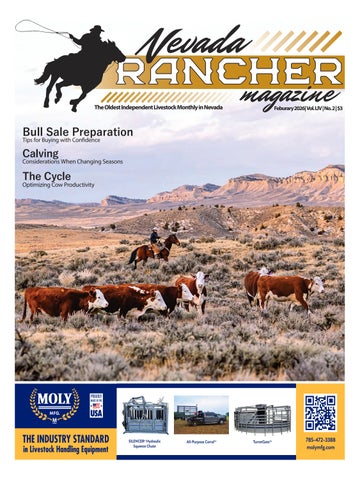
Wow- check out this fresh look for the Nevada Rancher Magazine! After almost 10 years with the publication, I haven’t been so excited about our product until now.
This edition is jam-packed full of amazing seedstock producers and various other industry leading companies. I truly hope you will support these advertising businesses.
Nevada ranchers in February are working through some cold mornings. Calving season is in full swing, demanding vigilance and patience. Praying for some snowpack for a successful Spring. Every task reflects resilience shaped by weather, land, and generations of hard-earned knowledge.
This February month is full of travel for the magazine. We hope to see you on the road!
Please enjoy this edition! - Ashley
Subscribe today for Just $16 per year! (775) 623-5011
Read back issues digitally: issuu.com/winnemuccapublishing7 www.greatbasinsun.com
The Nevada Rancher (ISSN 0047-9489) (USPS #003-257)
Published monthly at Winnemucca Publishing, 1022 S. Grass Valley Road, Winnemucca, NV 89445
Call us toll free at (866) 644-5011
Periodical Postage Paid at Winnemucca, 89445
• Nevada Cattlemen’s Association Update
• Anipro Xtraformance Feeds- Part 1 of a 5 Part Series
• Nevada Beef Council
• Top of the Line Bull Genetic Producers
ON THE COVER:
Photo by Angela Vesco
Angela Vesco was featured as the NV Rancher magazine’s September 2021 edition’s cover story. Since then this Nevada rancher has continued to grow her photography passion. Angela offers commercial photography and videography for ag based businesses. She excels in providing Seedstock producers bull photos and videos, social media and catalog production. She additionally works with ag brands for their marketing content.
Angela compiles her work annually into a stunning photo calendar, although 2026 is sold-out, stay tuned for the 2027 calendar announcement this December.
To get in touch or to view more of her photography please visit, www.angelavescophotography.com
President: Peter Bernhard
Publisher & Editor:
Ashley Buckingham
Sales Representative: Ashley Buckingham
Office Manager: Tracy Wadley
Graphic Design:
Ashley Buckingham
Joe Plummer
Emily Swindle
Jen Anderson
Contributors
Martin Paris
Randi Johnson
Heather Smith-Thomas
The Nevada Rancher does not assume responsibility for statements by advertisers nor products advertised within, and The Nevada Rancher does not assume responsibility for opinions expressed in articles submitted for publication. The publisher reserves the right to accept or reject advertising or editorial material submitted for publication. Contents in The Nevada Rancher may not be reproduced, in whole or in part, including, but not limited to original contents and original composition of all ads (layout and artwork) without prior written permission. Subscription rate: $16.00 per year. All content copyrighted, February 2026.
POSTMASTER: Send address changes to:
The Nevada Rancher, Winnemucca Publishing, 1022 S. Grass Valley Road, Winnemucca, NV 89445
Roping and Squeeze Chutes, Smarty and Heelomatic Roping Dummies in Stock.
TACK SHOP 559-779-5856
By: Martin Paris, Executive Director, Nevada Cattlemen’s Association
Awarding ScholarshipThree Opportunities
The Nevada Cattlemen’s Association (NCA) is eager to announce three scholarship opportunities this year. The NCA Scholarship will be awarded to a first-year college student beginning to pursue an education within the agricultural industry. This scholarship is open to all Nevada High School graduating seniors planning to attend a community college or four-year college/university and majoring in an agriculture- related field. The amount of this scholarship for 2026 will be $1,500!
Eligibility & application requirements for the NCA Scholarship include: Applicant must be a senior graduating from a Nevada High School.Applicant must plan to attend a Community College or a 4-year College/University. Applicant must be seeking a degree in an agricultural related field. Applicant must have at least a 2.5 GPA. A copy of the
student’s official transcripts is required. Applicant must submit a cover letter describing themselves and how your future plans tie into the future of the cattle industry, background in the beef industry, and how this scholarship may benefit them.
NCA is also pleased to announce the Marvel/Andrae Scholarship, which is available to graduating high school seniors or students currently enrolled in college. To be eligible, students must be pursuing a degree in agricultural economics, agricultural business, or the animal/meat science fields. The 2026 Marvel/Andrae Scholarship award will be $2,500!
The Nevada Cattlemen’s Association would like to thank Agri Beef for their continued support of the Marvel/Andrae Scholarship. This scholarship recognizes the legacies of Tom & Rosita Marvel and Jim & Sharon Andrae, and the many contributions these two Nevada ranching families have made to our industry.
Eligibility & application requirements for the Marvel & Andrae Scholarship include: Applicant must plan to attend or be currently attending a Community College or a 4-year College/
University. Applicant must be from Nevada and pursuing a degree in agricultural economics, agricultural business, or the animal/meat science fields.Applicant must have at least a 2.8 GPA. A copy of the student’s official transcripts is required.
Students that were previous recipients of the NCA Scholarship and meet the eligibility requirements of the Marvel-Andrae Scholarship are eligible to apply. Applicant must submit a cover letter describing themselves, background, goals, future plans, and how this scholarship may benefit them.
In its third year, the NCA will also be offering the Walt Leberski Memorial Scholarship. The Walt Leberski Memorial Scholarship will be awarded to a graduating high school senior or currently enrolled college/ trade school student. Applicants must be pursuing a degree/certificate in an agriculture related field at a community college, 4-year university, or trade school. The amount of this scholarship for 2026 will be $5,000!
Eligibility & application requirements for the Walt Leberski Memorial Scholarship include: Applicants must be born in
Nevada and have or will be graduating from a Nevada High School. Applicant must plan to attend or be currently attending a Community College, University, or Trade School. Applicant must be pursuing a degree or certificate in agricultural related field. Applicant must have at least a 2.8 GPA. A copy of the student’s transcripts is required.
Students that were previous recipients of the NCA Scholarship or Marvel-Andrae Scholarship will be eligible to apply for the Walt Leberski Memorial Scholarship.
Applicant must submit a cover letter describing themselves, background, goals, future plans, and how this scholarship may benefit them.
Scholarship application forms can be downloaded from the Nevada Cattlemen’s website at www.nevadacattlemen.org. Applicants can call the NCA office at 775-738-9214 or send a request to nca@nevadabeef. org for a copy as well.
Completed applications need to be postmarked by April 1st, 2026, and can be mailed to: Attn: Research & Education Committee, c/o Nevada Cattlemen’s Association, P.O. Box 310, Elko, NV 89803; or submitted by email to nca@nevadabeef.org.
Subsidy ~ State grants to help industry and business to reduce prices
By: Dave Baker, President, Nevada Cattlemen’s Association
I recently read an article that described public lands grazing as one of the federal government’s bedrock subsidy programs. It reminded of the “Cattle Free by 93” effort of the early ‘90s. It was the same old comparison of federal grazing fees verses the fees charged for renting private pasture. I think that most readers of this article are well aware of the differences in expenses between running cattle on public land verses private pasture, so I won’t go back to 1992 and list them. Instead, I want to discuss subsidies in general.
Consider roads. According to a U.S. Government Accountability Office study, a single 18-wheeler causes road damage equivalent to almost 10,000 cars (GAO, 1980). Collectively, trucks account for 91-99% of vehicular-caused road
damage. The American Trucking Associations say that the claim is greatly exaggerated, but assuming that it is correct, and that fuel taxes pay for road maintenance and repair, cars are greatly subsidizing the trucking industry. If my pickup burns half as much fuel per mile as an 18-wheeler, it could be claimed that the subsidy is $5,000 to $1. Fuel taxes actually only cover about half of costs, but it is claimed that taxpayers are subsidizing the trucking industry by $87.6 billion every year. So, if anyone is concluding that owning a truck must be the way to get rich – well, I’ll sell you a truck. We all know that the trucking industry is highly competitive and none of us care whether our calves are loaded on a blue truck from Idaho or a red truck from Nebraska. So who ends up with the subsidy? That’s hard to pin down, but it’s obviously some combination of businesses that are shipping/receiving and
the consumers. It could be argued that some of that subsidy should be spent on railroads and ports.
Let’s look at National Parks as well. Millions of taxpayers who will never visit a National Park help pay the expenses for the people who do enjoy our National Parks. That is a subsidy. Great Basin National Park was created while I was in college, which prompted me to take a Parks and Recreation class. In that class, it was claimed that even if someone never visited a National Park, they derived value from knowing that it existed. It made me wonder if people derive value from knowing that food exists on grocery store shelves. Obviously, the taxpayer who subsidizes the National Park visitor is also helping support many local, private businesses. Just as the ranches that depend on public land grazing do.
Turning to farm subsidies, farms and ranches produce commodities that are interchangeable with other goods of the same type. Price is determined by the
market, and individual producers are “price takers” with no control over the market price. In the long run, the commodity producer breaks even. While it is politically palatable to give subsidies to farmers, any consistent subsidy will be transferred to others in the production chain that hold more market power or leverage. Think John Deere, ADM, JBS, and the consumer. Insurance programs are a different matter; they shouldn’t be consistent. Ideally, they stabilize a low-profit industry that relies heavily on personal knowledge and experience to be profitable and efficient.
I’ve just shared a lot of information that most of you probably already know, but it’s been on my mind. Subsidies are complicated. Claiming that one thing or another is subsidized is easy if you don’t chase the money around. With respect to public lands grazing, it is the best use of the resource, and it would be irresponsible to not use a renewable natural resource to produce food for people.
Buying the Right Bull! Using EPDs to Make Sound Genetic Decisions
Bull selection is more than a numbers game — it’s a long-term investment that has to work in a demanding environment. High elevation, variable forage, wide temperature swings, and large pastures all put pressure on genetics. While Expected Progeny Differences (EPDs) are one of the most valuable tools available to cattle producers today, they’re only effective when used with a clear understanding of local conditions and production goals. These tips outlines how Nevada ranchers can use EPDs wisely.
Start With
the
Ranch, Not the Catalog
Before studying EPD tables, it’s critical to define what the bull needs to accomplish on your operation.
Ask a few fundamental questions: Are the bulls being used on heifers, mature cows, or both?
Will replacement females be retained?
Are calves marketed at weaning, as yearlings, or retained through finishing?
A bull that excels in one system may create problems in another. In the Great Basin, where cows must often travel long distances for forage and calve under range conditions, moderation and functionality usually outperform extremes.
Understanding What EPDs Really Tell You
EPDs are predictions, not guarantees. They estimate how a bull’s
calves are expected to perform on average compared to calves from another bull of the same breed, raised under similar conditions.
A few key points to remember: EPDs are breed-specific and should only be compared within the same breed.
They represent genetic potential, not actual performance.
Management, nutrition, and environment still play major roles.
Used correctly, EPDs help reduce risk and improve consistency across calf crops.
Key EPD Traits for Great Basin Operations
Calving Ease and Birth Weight For operations calving in large pastures or breeding heifers, Calving Ease Direct (CED) should be a priority. Higher CED values indicate a greater likelihood of unassisted births.
Birth Weight (BW) EPDs are
useful, but calving ease incorporates additional data and is generally the better selection tool, especially for heifer bulls.
Growth Traits- Weaning Weight (WW) reflects genetic potential for growth to weaning.
Yearling Weight (YW) indicates post-weaning growth. Producers selling calves at weaning may emphasize WW, while those retaining ownership or backgrounding cattle may place more value on YW. In forage-limited environments, extreme growth potential should be balanced with cow size and maintenance requirements.
Maternal Traits- Milk and maternal EPDs affect a cow’s ability to raise a heavier calf. While more milk can increase weaning weights, excessive milk production may strain cows in dry years or marginal range conditions. Moderate maternal traits often lead to more sustainable cowherds in the Great Basin.
Carcass Traits- For producers
marketing cattle on value-based grids or retaining ownership through finishing, carcass EPDs such as marbling and ribeye area can add value. These traits are less critical for strictly weaning-based marketing programs but still contribute to long-term herd improvement.
Accuracy, Genomics, and Risk
EPD accuracy values indicate how much confidence can be placed in a particular number. Young bulls typically have lower accuracy due to limited progeny data.
Genomic-enhanced EPDs help reduce uncertainty by incorporating DNA information, making them especially useful when buying yearling bulls. Lower accuracy doesn’t mean a bull is a poor choice — it simply means there is more potential for the EPD to change as more data is collected.
Continues on page 8
Driving Innovation to Combat NWS and Prevent its Northward Spread
U.S. Secretary of Agriculture Brooke L. Rollins announced the launch of the New World Screwworm (NWS) Grand Challenge. This funding opportunity marks a pivotal step in USDA’s comprehensive strategy to combat NWS and prevent its northward spread.
“This is a strategic investment in America’s farmers and ranchers and is an important action to ensure the safety and future success of our food supply, which is essential to our national security,” said Secretary Brooke Rollins. “These are the kinds of innovations that will help us stay ahead of this pest and protect our food supply and our economy, protecting the way of life of our ranchers and go towards rebuilding our cattle herd to lower consumer prices on grocery store shelves. We know we have tried-and-true tools and methods to defeat this pest, but we must constantly look for new and better methods and innovate our way to success. Together, through science, innovation, and collaboration, we can ensure we’re utilizing the latest tools and technology to combat NWS in Mexico and Central America and keep it out of the United States.”
As part of the Grand Challenge, USDA’s Animal and Plant Health Inspection Service (APHIS) will make up to $100
million available to support innovative projects that enhance sterile NWS fly production, strengthen preparedness and response strategies, and safeguard U.S. agriculture, animal health, and trade.
Priority Areas for Funding
APHIS invites proposals that support one or more of the following objectives:
Enhance sterile NWS fly production
Develop novel NWS traps and lures
Develop and increase understanding of NWS therapeutics/treatments (i.e. products that could treat, prevent, or control NWS) for animals.
Develop other tools to bolster preparedness or response to NWS-The notice of funding opportunity, including application instructions, eligibility, and program requirements, is available on the NWS Grand Challenge webpage. Applicants can also find information on the ezFedGrants website or Grants.govEligible applicants are invited to submit proposals that align with and support these priorities by the deadline on February 23, 2026 at 11:59 PM ET.
Entities interested in submitting a proposal should ensure they are registered with the U.S. Government System for Award Management (SAM). Learn more about the basics of the funding process and how to get ready to apply.
For more information about NWS, visit screwworm.gov.
- Continued from page 7
Buying the Right Bull!
Selection Indexes: A Useful Starting Point
Economic selection indexes combine multiple traits into a single value based on specific production goals. They can be helpful for narrowing down a large group of bulls, but they should not replace individual trait evaluation.
Indexes work best when they align closely with how calves are marketed from your operation.
Don’t Ignore the Bull in Front of You
EPDs don’t walk, breed cows, or cover rough country — bulls do.
Soundness remains critical: Strong feet and legs for rocky terrain.Adequate body capacity and structural balance. Good disposition. Acceptable scrotal circumference as an indicator of fertility.
A bull with elite EPDs but poor structure can become an expensive problem in large Nevada pastures.
Practical Buying Considerations
Review sale catalogs and EPDs ahead of time. Know breed averages and percentiles so numbers have context. Buy from breeders who maintain good records and stand behind their bulls. Schedule a breeding soundness exam before turnout. Set a realistic budget and avoid chasing extremes.
A Balanced Approach Pays Off
The most successful bull purchases combine EPDs, phenotype, and common sense. In the Great Basin, durability, fertility, and adaptability are just as important as performance numbers.
When used correctly, EPDs help ranchers make informed decisions that improve herd consistency and profitability over time — without sacrificing the kind of cattle that can thrive on various range.
California’s livestock marketing leader
The Parnell family
CALIFORNIA REPRESENTATIVES
Jake Parnell 916-662-1298
Walter Schalla, Manager 719-252-6607
George Gookin ....................... 209-482-1648
Rex Whittle............................... 209-996-6994
Mark Fischer ............................ 209-768-6522
Top Consignments from throughout California and Nevada will be Showcased in these Specials:
SPECIAL FEEDER SALES
WEDNESDAY, FEBRUARY 25
WEDNESDAY, MARCH 18
WEDNESDAY, APRIL 15
FEEDER SALES
EVERY WEDNESDAY
Join Us Ringside at 12 p.m.
PAIR & BRED COW SALES
WEDNESDAY, JUNE 24
SATURDAY, JULY 25
CALL TO CONSIGN TO THESE WESTERN VIDEO MARKET SALES:
February 27 – Cottonwood, CA
CONSIGNMENT DEADLINE: FEBRUARY 19
March 20 – Cottonwood, CA
CONSIGNMENT DEADLINE: MARCH 12
April 10 – Cottonwood, CA
CONSIGNMENT DEADLINE: MARCH 26
May 1 – Coalinga, CA
CONSIGNMENT DEADLINE: APRIL 23
May 20 – Galt, CA
– Broadcast Live from Cattlemen’s Livestock Market –CONSIGNMENT DEADLINE: MAY 12
Calving Season- What to Consider Before you Change your Herd
By: Heather Smith Thomas Special to the Nevada Rancher
There are many factors involved when making a decision about when to calve. Whether a stockman calves in January-February (early calving), March-April (spring), May-June or June-July (summer) or September-October (fall) often hinges on region and climate, marketing goals, feed costs and availability, breeding season considerations, constraints of management, and other factors that might enter into this decision. There is no perfect time to calve, and each producer must weigh the pros and cons of each season to find what works best for his/her own situation and goals.
Years ago the Rex Ranch, in western Nebraska has moved their calving season back 60 days, from February-March to May. The most significant reason was to reduce winter feed. The amount of hay fed went down from 2200 pounds down to 300 pounds per cow, including the first calf heifers, basically cutting hay costs by about 80 to 90%. They still feed a 30%protein cake, at a slightly higher cost than in the past, but hay costs have dropped dramatically.
The cattle graze year-round,
on deeded rangeland and don’t have to share breeding pastures with other operators, so this was a major factor in being able to go to a later calving/breeding season, with cows bred during summer. The ranch raises their own bulls.
One thing to think about when changing calving seasons is marketing. Calving later means selling lighter calves or selling them later in the year, or holding them over as yearlings. Having the lighter calf at weaning may not be a disadvantage since it can work to run some yearlings for drought management flexibility. Selling those yearlings in the following summer market has been a fairly good option over the years.
The disadvantage to calving later is that bulls are going out with the cows the end of July. The weather is usually hot by then, and declining nutrient density in the grasses at that point. When calving and breeding earlier, the cows had most of June to get the first 25 days of breeding accomplished, when the grass was higher quality.
The other concern is that the calves are born later and are not able to use that good May-June grass as effectively as a calf born earlier. Average daily gains on
the calves may drop since they are not old enough to fully utilize that good May-June grass— which is probably the best grass, and by the time they are really ready to graze, the grass is drier. But these drawbacks are often offset in lower feed costs, and better weather to calve. This can improve a rancher’s quality of life during calving season. It may be less labor intensive. One downside is having to change marketing
strategy on cows that breed late. When calving early, there are usually some other ranchers who like to buy you May-June calving cows, so can leave the bulls in longer to accommodate that market. If you move the calving to later, you can no longer supply that market.
The Cycle
Submitted By: Anipro
Part one of a five part series
During a 12-month period, there are specific physiological stages a cow progresses through and certain opportunities, challenges and goals we need her to navigate to ensure we optimize our productivity, which simply stated is to produce a weaned calf every year. Unlike the poultry and hog industries, we get one progeny per year in the beef cattle business and it is incumbent on us to ensure our cost decisions are properly balanced with our production goals in order to optimize performance and profitability.
Period 1: The Calving/ Post-Calving Period is approximately 80 days in length and the single most important objective is for the cow to give birth to a live and healthy calf. Our feeding program needs to be at
its best as the cow’s nutrition requirements are at their highest due to lactation. Additionally, one of our major goals is that this feed program sustain peak lactation. In beef cows this is normally 75-90 days. A final challenge during this period is to recondition the reproductive tract for breedback. All elements of the feed and supplement program (protein, energy, minerals and vitamins) must be in the right amounts and proportions to ensure optimum nutrition during this critical stage.
Period 2: During the next 125 days, we are concerned with Maintaining Lactation. Nutrient requirements, while lower than the previous period, still remain high as we try to sustain lactation as long as possible. My assumption has always been that a cow can grow a calf much cheaper than buying feed to grow the calf. Therefore,
ensuring nutrient levels remain high through good supplementation practices on emerging forages is critical. Cows should gain weight and increase body condition and most importantly, breed back and maintain early pregnancy.
Period 3: Mid-Gestation
Mid- Gestation is the period I have always felt we can catch up. This is primarily because we will wean our calf during this period, and as the cow dries up, because of reduced calf demand, we are able to utilize mature forages to increase cow weight, flesh and body condition before entering the last stage of production. Adding critical body condition at this time is optimal because there are plenty of days between now and calving so that the daily requirements for gain are smaller. However, if we cheat the cow nutritionally then our average daily gains must increase
as we get closer to pre-calving to achieve the body condition to ensure successful calving and breed back.
Period 4: As we reach the Pre-Calving Period (60-90 days prior to calving), we see a significant increase in nutrient requirements for the cow. 70%-80% of fetal development occurs during the last trimester of gestation which results in a tremendous spike in fetal protein requirements. If nutrition from the combination of our feed and supplement program does not meet this increase we run the risk of poorly developed calves, reduced vigor, reduced colostrum value to properly develop the calves immune system and a host of other problems. Additionally, the body condition of the cow at calving dictates the ability to return to estrous in 90 days following calving to ensure we have that 1 calf every 12 months.
Simple Ingredients, Solid Nutrition
By Kori Dover, RD Nevada Beef Council
Meals built from pantry staples like pasta, canned tomatoes, herbs, and ground beef can still help deliver the nutrients that matter. These ingredients may be simple, but together they provide a balanced mix of protein, fiber, and key vitamins and minerals that can support energy, satiety, and overall wellness. Using pantry staples can make it easier to get a nutritious meal on the table without a lot of prepping, showing that convenience and good nutrition can go hand in hand.
This fresh tomato beef penne pasta comes together in under 30 minutes. With lean ground beef for high-quality protein and tomatoes for flavor and nutrients like potassium and vitamin C, it’s a fast and satisfying option for busy days that doesn’t compromise on nutrition.
Fresh Tomato, Beef & Penne Pasta
Recipe from BeefItsWhatsForDinner.com, Funded by the Beef Checkoff.
Ingredients:
1 pound Ground Beef (93% lean or leaner)
3 teaspoons fresh minced garlic
2 cups chopped tomatoes
3/4 teaspoon salt
1/4 teaspoon pepper
1-1/2 cups uncooked penne pasta, cooked
2 tablespoons sliced fresh basil leaves
3 tablespoons grated Parmesan cheese
Cooking:
1. Heat large nonstick skillet over medium heat until hot. Add
Ground Beef and garlic; cook 8 to 10 minutes, breaking into 3/4-inch crumbles and stirring occasionally. Pour off drippings.
2. Stir in tomatoes, salt and pepper; cook over medium heat 5 minutes, stirring occasionally. Add pasta and basil; toss. Sprinkle with cheese.
650 acres on the Humboldt River with over 300 acres of surface water rights. Just East of Elko approx. 13 miles. Has access onto the Ryndon Exit. With the new conjunctive management of water by the state, this should add future value to
property. Price: $950,000 Lots of irrigation water from springs that arise on the ranch. Mine owner wants to reserve some water rights and Sage Grouse Credits and 100 acres on East side of ranch. 2597 deeded with approx. 1000 water righted out of the springs, 5 homes plus multiple other barns, shops and outbuildings. Full line of equipment and multiple pivots.
Price: $4,000,000
HUMBOLDT RIVER ACREAGE W/ WATER RIGHTS
Time to Go
There’s a time to stay and a time to go, In with the spring rain, out with the falling snow, Maybe you will stay, for a year or ten, But the time will come and you’ll move on again, Maybe the owners changed, or your kids grew up, Perhaps the owner don’t like dogs and you got a new pup, The winters are getting colder, or your partner moved on, Got demoted from cowboy crew to fencing and mowing the lawn, Maybe the rough string put too many aches in your bones, Or the wife wants to move back, closer to her home, Maybe the absentee owner moved in permanent, Or the month is too long after the paycheck is spent, Whatever your reason, excuse, or complaint, The time will come, and to the road you will take, To some other spread where the grass looks green, But there’s an underlying reason that cowboys up and leave, It’s a wandering soul and a pair of itchy feet, And the hunger for a new view from your saddle seat, A tireless restless spirit that always seems to win, Like Will James, just gotta see the other side of the mountain.
Written By Randi Johnson, The Cowboy’s Daughter 2015
We ar e exper ts in State of Nevada Water Rights. We pr ovide a wide r ange of water right and r esour ce development ser vices that can be customized to meet your needs.
Our team wor ks dir ectl y with you to develop the best solution for your far m, r anch, business or home.
Nevada Agricultural Foundation Scholarship, Grant, and Sponsorship Application Period Now Open
The Nevada Agricultural Foundation (NAF) is now accepting Scholarship Applications from Nevada students pursuing an agriculture-related college degree. Scholarship applications are accepted from Nevada high school seniors or students in progress with their college education who graduated from a Nevada high school.
The deadline for scholarship applications is March 15, 2026. Scholarships are for the 2026-2027 academic year. Over $50,000 in scholarships will be awarded this year.
Research and Development (R&D) grant applications are also being accepted until March 1, 2026. The NAF will be awarding up to $50,000 in total grants for 2026.
Along with R&D grants, the NAF is accepting sponsorship applications for this year. If interested in receiving a sponsorship from NAF in 2026, now is the time to apply.
For more information and application forms, visit NAF’s website: info@nevadaagriculturalfoundation.org
John Fredrick Witzel
1937-2026
John Fredrick Witzel was born on February 15, 1937, in Hines, Oregon, to Fred and Pearl Witzel. He passed away on January 20, 2026.
Fred grew up on the family ranch near Frenchglen. He had three older half-sisters –Marion, Betty and Daisy. He went to grade school in Frenchglen, and graduated from Crane High School in 1954. While in high school, he met a girl from Drewsey, that would become his lifelong partner.
On Dec. 1, 1954, Fred and Darlene Newell, along with his parents drove to Winnemucca, Nev., and the two were married. Their first home was on the family ranch, raising cattle in the Krumbo valley and Steens Mountain. Fred and Darlene had four children. Their first child, Vicki, was born in Ontario, in 1956; John was born in Ontario, in1959; Debbie was born in Ontario, in 1962; and Mike was born in Burns, in 1966.
Through the years, Fred and Darlene continued
to expand and improve their cattle operations. In addition to their commercial cattle, they ran a small registered red angus herd for a time. They were the first in the area to modernize their haying process from loose hay to bales. Fred was selected to receive the Grassman of the Year award, because of the ranching and farming improvements and innovations he and Darlene made.
In 1973, they moved their ranching operations to Diamond, after buying Fred’s uncle’s ranch on McCoy Creek. Fred and Darlene continued to raise cattle there until they sold out in 1988, and moved to Burns.
Fred’s interests and talents were complex. As a young man, he got his pilot’s license and used it for fun as well as work. He took to the air in airplanes and helicopters for doctor appointments in Idaho, hunting coyotes, running wild horses, checking on cattle, and even flying to visit friends for an afternoon. He passed his passion for flying down through his family, and has grandsons that are now pilots.
Along with Darlene and a neighboring couple, Fred was in a band that played music for community dances throughout the county. They traveled many miles, with Fred’s guitar, amp and cases full of sheet music, playing western music for the attendees to enjoy. He
also played the saxophone, beginning while in the high school band. When one of his granddaughter’s showed interest in learning to play, he gifted his saxophone to her, and then attended many school concerts to hear her.
A cowboy at heart, Fred continued to help friends with cattle work, even after moving to town. He was in great demand during branding season, and very seldom had a day when he wasn’t roping calves somewhere.
When it was time to ship calves, he again had a full calendar and could be counted on to show up in rain, sleet, or snow. He liked the work, but also enjoyed visiting, pulling pranks, and giving the younger cowboys a hard time.
Fred spent several summers on Steens Mountain, guiding pack trips. He was a hit with the guests, and always had comical stories to tell about the trips.
Throughout his life, Fred spent 1,000s of hours volunteering. He served on the Harney County Fair Board, as well as the Fair Association, as director of the livestock division and horse racing. The time and work that he put in for the fair was recognized and honored in 2003, as he was selected to be that year’s Grand Marshal.
boards, budget boards and the FSA board
He was an outstanding equipment operator, and could mechanic on just about any machine put in front of him. If he didn’t immediately know how to repair something, he would figure it out. When home computers and internet became available, he quickly learned how to use technology as his instructional guide.
After selling the ranch, Fred and Darlene had the time to travel and see new country. They made trips throughout the western states, into the Midwest, and to Canada. He was always ready for an adventure – this took him on wild pig hunts in California and Arizona, car deliveries to Alaska, opal mine operations in Nevada, bull truck driving through Chicago, water skiing in Catlow Valley and the list goes on and on.
Fred also served as a member of local school
Fred is survived by his children, Vicki (Jim) Baker, John Witzel, Debbie (Hoot) Raney, and Mi n; a great-great-granddaughter to be born in May; and several nieces and nephews. He was preceded in death by his wife of 69 years, Darlene; his parents; and his three half-sisters. At his request, there will be a private family service. Contributions in his memory may be made to the Crane Booster Club, in care of LaFollette’s Chapel, P.O. Box 488, Burns, OR 97720; or sent directly to the Club, P.O. Box 828, Crane, OR 97720
Why are Meadows Important the Climate?
By Kylie Papson
University of NV Reno
Associate Professor Ben Sullivan explores the connections between local meadows and the health of the environment
When most people think of solutions to environmental degradation, meadows are not usually the first thing that comes to mind. But research by Ben Sullivan, a soil ecologist in the University of Nevada, Reno’s College of Agriculture, Biotechnology & Natural Resources, has brought new attention to the power of meadows in defending the environment, restoring watersheds and supporting ecosystems. His work may offer an opportunity to address the pressing climate issues we face today.
“I love all meadows, no matter what meadow I happen to be standing in, regardless of condition or location or surroundings” said Sullivan, who also conducts research as part of the University’s Experiment Station “Their magic lies not only in their thriving flora and fauna, but in their
significance to protecting surrounding ecosystems and the people who rely on them.”
Below, Sullivan, director of the Nevada Soil Ecology Lab and faculty at the Tahoe Institute for Global Sustainability, answers questions about meadows, their role in ecosystems and why they matter to the climate.
What are meadow ecosystems and are there different types of meadow ecosystems?
Meadow ecosystems are hard to define, but broadly they are locations dominated by herbaceous, grassy plants that have or could have water near the soil’s surface for at least part of the year. There are many different types of meadows. They vary depending on what types of plants live there, how much water they get, and how long the soil stays wet for. There can be steep meadows on hillsides and flat meadows in valley bottoms. Most people don’t know that many of our urban areas were once meadows. Reno, Washoe Valley, and parts of Carson City and Truckee were once meadows. South Lake Tahoe has
lots of meadows throughout it, and many of them have been impacted by development.
Notably, meadows have been and still are incredibly important to our local Indigenous groups, who have been advocating for their protection for years – long before we even started researching meadows ourselves.
Why are meadows important as an ecosystem and what factors influence their ecology?
ecosystems.
You and the Nevada Soil Ecology Lab have worked in meadows across the Sierra Nevada for more than a decade. What have you found?
NEW LISTINGS:
Cross L Ranch, Railroad Valley, Nevada
*3,314 deeded acres *Water Rights *Winter and Summer Range *339,266 acres of BLM to run cattle on *1500-1800 tons per year (to feed and sell)
*Cattle and Equipment Included *several home for the help and new home for ranch manager
$12,000,000
Segura & Fish Creek Ranch, Tonopah, Nevada
*1,075 acres *support 450-500 head of cattle & 2,500+ sheep *500,000 contiguous BLM land, AUMs for both cattle and sheep with over 1,186,411 acres with 250,725 operating acres *Two 120 acre pivots and a 60 acre pivot *diesel powered wells *50 acres gravity fed irrigation from a pond *1,000 tons of feed annually *sheep pens *home $8,000,000
Old Lynn Farm, Railroad Valley, Nevada
*113 acres water rights *Permit 27491 for 111.08 ac. ft. *Permit 38565 for 368.92 ac. ft. *Newer pivots
*Small house *Great Starter Farm
$479,000 Make offer!
Wildhorse Ranch, North Elko County, Nevada
*Owyhee River Watershed *4,500 contiguous acres with 3116 acre feet of water rights plus 908 supplemental water rights *native grasses *runs
600+ cow calf pairs *summer ground for 1,5001,700 head of yearlings *private land $8,000,000
2623 N Canyon Road, Lamoille, Nevada
*3.68 acres *Corner Lot *Fenced and cross fenced *perfectforlivestock/horses*naturalgrasses
*smaller corrals *old single wide *large shed *bunkhouse *Amazing views of the Majestic Ruby Mountains. $350,000
Log Home on the Jarbidge River, in historic Jarbidge, Nevada
Updated cabinets, countertops, appliances, and custom built-ins for storage, new flooring runs throughout, with updated walls, backsplash, and finishes. Soaring ceilings and new Pella windows and doors flood the space with natural light. The layout includes a spacious open living area, 2 bedrooms, 2 bathrooms, and laundry area in the hallway. Plus a connex provides extra storage for ATVs, snowmobiles, and yard tools.
11 Acres - Godchaux Road
*Paradise Valley Junction *Ag-residential District
*Breathtaking Views *Build your Dream Home *30 minutes north of Winnemucca. $20,000
Meadows provide food, water, and habitat for animals of all kinds, and that food and shelter is important in dry mountain environments, like we have in the Lake Tahoe Basin. Meadows provide cool, clean water downstream by retaining water below ground and filtering solids that would otherwise wash downstream. They have soils with lots of organic matter, as much as the carbon and nutrient-rich material like mulch or compost that we often add to our home gardens. This organic-rich soil makes meadow plants tremendously productive if there is enough water. Meadow plants can be so productive that one acre of meadow can store as much carbon in a year as one acre of tropical rainforest, and unlike in the rainforest, most of this carbon ends up below ground, in the soil. The thing that most influences meadow ecology is the hydrology because plants and soil follow water. If there is water, plants are productive, and the soils gain organic matter. Unfortunately, if management actions have resulted in drying and draining of a meadow, the meadow’s productivity suffers, storing less carbon and affecting the health of both the meadow and downstream
We have learned that meadows can gain or lose huge amounts of carbon in soil organic matter depending on how much water a meadow gets. Meadows are wildly productive even compared to Sierra Nevada forests: one acre of meadows can gain as much carbon in a year as six acres of surrounding forest. We have learned that restoration of historically degraded meadows can improve meadow soil organic matter in just a few years, which is an exciting finding as we work to discover ways to continue to protect the environment for years to come.
What can we do to help conserve and restore our meadow ecosystems?
Support our regional water and meadow restoration organizations! The Lake Tahoe region is fortunate to have great folks doing the work of identifying meadows that need help and finding the resources to get the work done. The California Tahoe Conservancy, American Rivers, South Yuba River Citizens League, Truckee River Watershed Council and Plumas Corp are examples of these organizations. Many take donations or hold fundraisers and have opportunities to do hands-on volunteering to restore meadows. This work results in meaningful changes for our montane ecosystems. These organizations work with us to learn the science behind how meadows function and how management can make them healthier.
SALE MANAGER:
Matt Macfarlane (916) 803-3113 (cell) m3cattlemarketing@gmail.com www.m3cattlemarketing.com
AUCTIONEER Rick Machado (805) 801-3210
elling 150 Bulls
SATURDAY 12 NOON • VALE, OREGON
FEBRUARY 28
18-MONTH OLD ANGUS BULLS
ALSO INCLUDING A DOZEN SIMANGUS BULLS AND A SELECT GROUP OF BRED AND OPEN FEMALES
Our age-advantaged bulls are available in volume! These bulls out of top sires can increase consistency and marketability in your calf crops.
As the second-largest registered Angus cowherd in Oregon calving out 600-plus females a year, you get the Advantage of only the cream-of-the-crop! The top 50% of our bulls have extremely large contemporary groups to increase predictability, consistency and quality for our customers, and are from a cowherd that has been around for nearly 40 years.
Ruthless culling for feet and legs, plus structure gives you the Advantage when it comes to bull selection. Our bulls are extremely athletic. They run in big pastures over the summer after weaning. They are developed in extremely large lots that require them to travel up and down hills over rocky, hard ground everyday between a high-roughage feed source and water to ensure soundness and longevity.
Our intense AI program utilizes the most current and sought-after genetics in the Angus breed, with herdsires infused and utilized that rival the most popular AI sires in the breed for genetic value and potency.
Volume and repeat discounts are available, and delivery is free. Bulls are backed by a Zoetis HD50K DNA evaluation, ultrasounded with complete performance and fertility evaluation, and backed by an industry best guarantee. Many bulls qualify for the CAB Targeting the Brand Program. THE AKER NGUS DVANTAGE
2175 Bench Rd.
Vale, OR 97918
Jerry Baker (208) 739-3449
Samuel Mahler, Herdsman (208) 739-0475
CONNEALY COMMERCE
710 Grass Valley Rd | Winnemucca, N V 894 45 775- 623-5053| 775-304-1503 | ronsseed@gmail.com
Your Seed, Fertilizer & Chemical Headquarters for Nevada