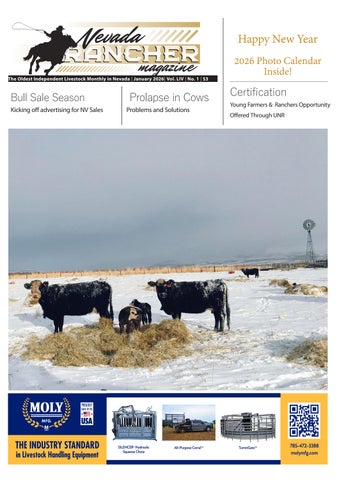
Nevada Rancher January 2026 Edition

Page 1


Friday Feeder Sales January 16th, February 6th & February 20th

Thank you sellers, buyers, truckers and our awesome crew at Nevada Livestock Marketing for another great year! We are now on our 20th year here at the salebarn in Fallon, Nevada. Crazy to think I was 27 years old when we started this business. What I wouldn’t give to have those legs again combined with today’s knowledge of the cattle industry and auction business.

It’s been a hell of a ride and we couldn’t have done it without all of you! Thank you for your support.

Good times ahead in the cattle business, I honestly think this market is the new normal. And it needs to be because overhead is so high. We had alot of interest in replacement heifers this week and that is why you see our 6 weight heifers were higher than their brothers.

No sales during Christmas week or News Years week. We are going to be busy busy weaning more calves at the ranch and pushing cows into some great winter country we haven’t been able to use in several years. Thank goodness for new leadership at the Department of Interior in Washington DC, enough pressure was applied to Nevada BLM they finally had to do their job.

Feeder Sale January 16th.

We have 2000 head consigned from just 5 ranches for this sale and 2000 more from 10 other ranches. In Our license with The Nevada Department of Agriculture we are only allowed to have sales on the 1st and 3rd Friday of the month, and the first Friday of January fell on the 2nd which was just too close to the holidays. Only one feeder sale in January but we have decided to schedule another feeder sale February 6th.

So one feeder sale in January but two in February. If you are on the fence about when to market, We might suggest holding until February. This market should just keep gaining ground as numbers continue to tighten up.

If you are planning to consign for January 16th, please get them in early. If you want to advertise on our Facebook page please send videos/pictures and information to 661 305 2699. Thank you and Happy New Year!

Happy New Years to all of our friends, family and customers. We couldn’t do it without you!

New Year!

STEERS

300-400 LBS

400-500 LBS

500-600 LBS

600-700 LBS

700-800 LBS 800-900 LBS

HEIFERS

300-400 LBS 400-500 LBS 500-600 LBS 600-700 LBS 700-800 LBS

Subscribe today for Just $16 per year! (775) 623-5011

Read back issues digitally: issuu.com/winnemucca publishing7

The Nevada Rancher (ISSN 0047-9489) (USPS #003-257)

Published monthly at Winnemucca Publishing, 1022 S. Grass Valley Road, Winnemucca, NV 89445

Call us toll free at (866) 644-5011

Periodical Postage Paid at Winnemucca, 89445

President: Peter Bernhard

Publisher & Editor: Ashley Buckingham

Contributors

Martin Paris, Randi Johnson, Heather Smith Thomas, Norma Elliott

Sales Representative:

Ashley Buckingham

Office Manager: Tracy Wadley

Graphic Design:

Ashley Buckingham

Joe Plummer

Emily Swindle

Jen Anderson

The Nevada Rancher does not assume responsibility for statements by advertisers nor products advertised within, and The Nevada Rancher does not assume responsibility for opinions expressed in articles submitted for publication. The publisher reserves the right to accept or reject advertising or editorial material submitted for publication. Contents in The Nevada Rancher may not be reproduced, in whole or in part, including, but not limited to original contents and original composition of all ads (layout and artwork) without prior written permission. Subscription rate: $16.00 per year. All content copyrighted, December 2025.

POSTMASTER: Send address changes to:

The Nevada Rancher, Winnemucca Publishing, 1022 S. Grass Valley Road, Winnemucca, NV 89445

As the New Year arrives, ranching life continues under quiet blankets of snow (finally)!

Frosty mornings and steady chores remind us to slow down, breathe deeply, and respect the rhythm of the land. This year, choosing the word Peace reflects a hope for calm hearts, steady minds, and balance amid hard work. Peace in the pasture, peace in purpose, and peace carried through every season ahead.

Chosing this words to carry through the year in different aspects of my life is something I am very much so looking forward to. The chaos, hustle and always on the go mentality is going to see a much needed change as I embrace this new year.

Are you one for resolutions?

This edition will finally be the last edition printed on newspaper print. Looking forward and kicking off the bull sale season with the glossy magazine is so

exciting!

We produced a great 2026 calendar as a gift for you all! If you need additional copies please call the office.

I pray your family is healthy, your heart is full of hope and calving season goes smoothly.

I hope you enjoy this edition! - Ashley

• Pg 8- Cowboy Pastor's Wife

• Pg 12- Prolapse in Cows

• Pg 16- Partyline Cookbook Recipes

• All throughout BULL SALE Ads! Shop for your herd's seed stock

SALE MANAGER: Matt Macfarlane (916) 803-3113 (cell)

m3cattlemarketing@gmail.com www.m3cattlemarketing.com

elling 150 Bulls

SATURDAY 12 NOON • VALE, OREGON

FEBRUARY 28

18-MONTH OLD ANGUS BULLS A SELECT GROUP OF BRED AND OPEN FEMALES

Our age-advantaged bulls are available in volume! These bulls out of top sires can increase consistency and marketability in your calf crops.

As the second-largest registered Angus cowherd in Oregon calving out 600-plus females a year, you get the Advantage of only the cream-of-the-crop! The top 50% of our bulls have extremely large contemporary groups to increase predictability, consistency and quality for our customers, and are from a cowherd that has been around for nearly 40 years.

Ruthless culling for feet and legs, plus structure gives you the Advantage when it comes to bull selection. Our bulls are extremely athletic. They run in big pastures over the summer after weaning. They are developed in extremely large lots that require them to travel up and down hills over rocky, hard ground everyday between a high-roughage feed source and water to ensure soundness and longevity.

Our intense AI program utilizes the most current and sought-after genetics in the Angus breed, with herdsires infused and utilized that rival the most popular AI sires in the breed for genetic value and potency.

Volume and repeat discounts are available, and delivery is free. Bulls are backed by a Zoetis HD50K DNA evaluation, ultrasounded with complete performance and fertility evaluation, and backed by an industry best guarantee. Many bulls qualify for the CAB Targeting the Brand Program.

AUCTIONEER Rick Machado (805) 801-3210 2175

Jerry Baker (208) 739-3449

Samuel Mahler, Herdsman (208) 739-0475

Nevada Cattlemen’s Association

Nevada Cattlemen’s Association

HappyNew Year! I hope everyone had a great Christmas. Another year has come and gone in what seems like the blink of an eye. Before I turn the page on 2025, NCA was engaged in a wide range of issues throughout this past year, including our state legislative session, targeted grazing legislation, trespass and public land access issues, species management, grazing regulations, and so much more. In each case, NCA had a seat at the table, ensuring that our members' voices were heard.

NCA was successful on several measures during the Nevada Legislative Session, including stopping a proposal that would have allowed agricultural workers to collectively bargain and would have required employers to pay overtime to agricultural employees. NCA also helped stop a measure that would have doubled liability insurance minimums for trucks hauling more than 26,000 lbs. We successfully worked to introduce the Strategic Grazing to Reduce the Risk of Wildfire Act in the United States Senate with the help of Senator Cortez-Masto, which would develop a strategy to graze vacant allotments and establish temporary permits to promote targeted fuel reduction using livestock grazing, among various other livestock grazing centric strategies.

NCA and our partners continued to engage with the current Administration on the successful revocation of the Bureau of Land Management’s “Public Lands Rule”, which inappropriately placed conservation as a use on par with other multiple uses. NCA also helped fend off an attempt to designate several Areas of Critical Environmental Concern within Nevada, which were also tied to more stringent sage grouse management regulations across public lands.

These aforementioned items are just a small snapshot of the work NCA engages in. As we turn the calendar to 2026, there is no doubt that a lot more work will need to be done. NCA will continue engaging with the entire political spectrum to make sure livestock producers’

interests, concerns, and needs are known and addressed.

NCA has our sights set on several high priority issues as the new year begins to take shape. These include getting new BLM grazing regulations out the door and in place, endangered species listings and amendments to the law itself, continued engagement on trespass on private land, and ensuring Nevada’s water law remains viable and intact, just to name a few. It’s important to hear from you should you feel something needs to be brought forward. Remember, NCA works for you.

Before I close, I want to thank everyone who consigned cattle to the Silver State Classic Feeder Sale last month at Fallon Livestock LLC. There were a lot of great cattle through the ring this year and prices remained strong. A big thank you to Fallon Livestock LLC for their support year after year.

There are also a few noteworthy events taking place in the first part of 2026. The University of Nevada, Reno will again be hosting the annual Cattlemen’s Update in person and virtually from January 12 -16. The University has hosted these sessions across Nevada for more than 40 years to provide ranchers with current, researchbased information about issues that may affect the efficiency, productivity, profitability, and sustainability of Nevada’s cattle industry. Please be sure to check out their website, extension.unr.edu/cattlemens - for additional information on session locations and times during the week of January 12-16.

Lastly, if you’re in need of bulls this upcoming season please mark February 14, 2026, on your calendars for the 4th Annual Great Basin Bull Sale in Fallon, NV at the Rafter 3C Event Center If you’re looking to improve the genetics of your operation, there’s no doubt you will be able to find what you’re looking for at the upcoming sale. For more information please check out their website at www. greatbasinbullsale.com.

Until next time.

As of this writing, it is still dry in Snake Valley. This extreme drought has forced us to sell cows and our replacement heifers. We are adapting, but continue to hope that weather patterns will change.

The Nevada Cattlemen’s Association (NCA) is a policy driven organization. These policies are developed through resolutions that are considered at our annual membership meeting, after the individual proposals are introduced and reviewed by the appropriate committees. Environments, business models, and needs throughout the state vary significantly. Because of the diverse range of operations in Nevada, some issues have proven difficult to form a cohesive policy position.

As with any collaborative effort, unanimous support is not always attainable. While our members acknowledge this fact, we must recognize the importance of continued cooperation to support and protect our industry’s interests. Although we may disagree on individual issues, we understand that the NCA is important because of the numerous other industry issues that we face.

We depend on our membership to bring us knowledge and experience with issues, including marketing, labor, wildlife, trespassing, and everything in between - all of which are complicated and often intertwined. We have to advocate appropriately, and can only do so with the active participation of our members.

Much akin to making difficult decisions when faced with environmental changes (for instance selling a significant number of cows during

a severe drought), some of these difficult conversations regarding policy need to be revisited when political climates change as well. While we can agree to disagree for a time, it is vital that we leave these doors open to further discussion as things evolve.

The NCA has the privilege of having a voice at local, state, and federal levels. As such, we must continue to be a respectful and knowledgeable resource or representative on any of these stages.

Nevada is a Purple State – while we currently have a Republican governor, the House and Senate are Democrat controlled, as they have been for nearly a decade. We must work to maintain relationships with both parties to the best of our ability. The political pendulum will continue to swing, and we need to be able to effectively communicate as power changes hands so we can keep a seat at the table.

Additionally, the unfamiliarity of our industry and issues is abundant in our state. About 94% of Nevada’s population resides in urban areas. We need to understand this and view it as an opportunity to educate reasonable people with urban backgrounds. We cannot alienate people and expect to be effective in the long run as power shifts and times change.

As President, I view myself more as a representative than anything else – not a dictator or policy creator. But with our membership actively engaged, I know we can continue to establish effective policies and, at the same time, respect other positions and perspectives within and outside of the NCA. That’s my rant for

Registration opens for certification supporting beginning and established farmers and ranchers

University of Nevada, Reno training covers plant and soil science, finance, processing and marketing

For Nevadans starting or expanding a small farm or ranch, navigating finance, regulations and day-to-day operations can feel overwhelming. To help bridge that gap, University of Nevada, Reno Extension’s Herds & Harvest Program is offering the Beginning Farmer & Rancher Level 1 Certification, which provides guidance on starting and running an agricultural operation.

The training has weekly online sessions on Wednesdays, 6-8 p.m., Jan. 21–March 11. In-person sessions (dates to be determined) include tours of farms and ranches in Reno and in Douglas County, followed by a farmto-fork dinner. Participants may choose to attend a field tour or one of Extension’s agricultural conferences.

The certification curriculum draws on small-acreage and farm-to-fork principles presented by local producers; researchers from the University’s College of Agriculture, Biotechnology & Natural Resources; and small business development experts from the College of Business.

Online course topics planned at this time include:

Jan. 21: Introduction

Jan. 28: Meat quality, processing and training

Feb. 4: Plant and soil health

Feb. 11: Value-added programs

Feb. 18: Livestock production

Feb. 25: Partners, funding and certification programs – Hosted live at the Roots 2 Results Conference in Las Vegas, with in-person and virtual participation options

March 4: Farm financial management

March 11: Nevada water laws and regulations

To receive the Beginning Farmer & Rancher Level 1 Certification, participants must complete the online course sessions, attend an in-person field trip, complete a business plan, and participate in an individual business plan review.

The cost for the program and the online registration fee is $81.88. Full details and registration are available online.

For more information, contact Kaley Chapin, lead agriculture program coordinator, at kaleys@unr.edu or 702-467-2668; or Staci Emm, Extension professor, at emms@unr.edu or 775-475-4227. Persons in need of special accommodations or assistance should contact Paul Lessick, civil rights and compliance coordinator, at plessick@unr.edu or 702-257-5577 at least five days prior to the scheduled event.

Extension’s Herds & Harvest Program provides a series of workshops focused on business management, mentoring and agricultural skill-building to support Nevada producers.

Over 275 head entered

Cardey Ranches, CA

Carter Cattle Company, NV

Cope Cattle, CA

Dixie Valley, CA

Hamilton Angus, MT

Hone Ranch, NV

Bishop Cattle Company, ID

EARLY FALL PERFORMANCE CONSIGNORS

One Equals One Simmental and Angus, ID

Popovits Family Ranch, CA

Riverbend Meadow Ranch, CA

Westwind Ranch Angus, IL Wright Farms, OR

LATE FALL PERFORMANCE CONSIGNORS

Cardey Ranches, CA

Carter Cattle Company, NV

Cope Cattle, CA

Neal Cattle Company, CA

One Equals One Simmental and Angus, ID

Popovits Family Ranch, CA

Riverbend Meadow Ranch, CA

Steve Smith Angus and Gelbviehs, UT

Westwind Ranch Angus, IL

Wright Farms, OR

SPRING YEARLING CONSIGNORS

Bishop Cattle Company, ID

Bullhead Ranch

Carson Angus Ranch, UT

Cunningham Land and Livestock, IL

Diamond L, GA

Dixie Valley, CA

Gem State Angus Ranch, ID

Hone Ranch, NV

Jorgensen Charolais, CA

Rafter 9, NV

Rafter Bar B, NV

RC Cattle, CA

Rio Segura, NV

Riverbend Meadow Ranch, NV

Romans Angus and Brangus, OR

Steve Smith Angus, UT

Wild West, OR

Wright Farms, OR

RANGE BULL CONSIGNORS

Brunson Cattle Company, NV

One Equals One, ID

Romans Angus and Brangus, OR

Dixie Valley, CA

Hone Ranch, NV

Steve Smith Angus & Gelbviehs, UT

Rafter 9 Ranch, NV

Flying RJ , CA

Wild West Angus , OR

Mrnak Herefords West, NV

Exciting announcement

Amador Angus, CA

Easterly Romanov, CA

WC Carpenter Red Angus

Hertlein Cattle Company, CA

Heluva Ranch, ID

Wooden Shoe Farms, ID

Gudel Cattle Co., CA

Gem State Angus Ranch, ID

Kern Cattle, CA

We’re thrilled to share that Joe Nichols will be headlining this year’s event — bringing hit songs like “Tequila Makes Her Clothes Fall Off” and “The Impossible.” Join us Thursday, February 12, from 7–9 PM at the Rafter 3C Arena for an unforgettable evening of live music. Tickets are $65 per person and go on sale December 1.

Ledgers And New Year’s Resolutions

The Christmas decorations have barely been tucked away, and already the "drift" has begun. Five days ago, my desk was a pristine landscape of productivity, a cleaned out horse trailer,of sorts,freshly swept, of all the crap that had landed on it prior to family arriving. Today, it has become a graveyard of holiday remnants. It is a curious phenomenon how quickly a flat surface surrenders its identity. Currently, my workspace hosts a small wooden cabin, brought up from the basement, a Connect Four game the grandkids intended to play but forgot in the rush of opening gifts, a local newspaper, several scattered blank pages of computer paper, and a handful of loose batteries lying closest to my keyboard. Finally, there are my new L.L. Bean house shoes—the wrong size, a silent errand waiting to be run.

It is tempting to look at this clutter and feel a sense of failure, as if the house is winning a war against my organized self. But there is a hidden grace in the mess. During the holidays, we make a conscious choice: we do not ignore the house full of family to clean the office. We clear the dishes, we load the dishwasher, and we put away tons of food, but we do not run through the halls with a dust cloth while Uncle Rob tells a story about falling through the pergola with a running chainsaw, no sir, this ones too good to miss. Our focus is the guest, not the house. The clutter on my desk is simply the physical evidence that my heart was in the right place.

As I sit here today, feeling the heavy lethargy of a "sugar and carb overload," I am reminded that the transition into a New Year isn’t just about the physical act of cleaning out closets or clearing desks. It is about a spiritual recalibration. It is about clearing the mind to gain what the Scriptures call a "heart of wisdom."

The Shadow of the Greats

I often find myself looking back at the "great ones"— those writers who seemed to possess a direct pipeline to Truth. Chief among them for me is C.S. Lewis. I have watched The Most Reluctant Convert, three times now, and mentioning it here makes me want to watch it a fourth. There is something intoxicating about Lewis’s world: the rich vocabulary, the profound education facilitated by a private tutor (the Great Knock), and a father whose wealth granted him the privilege of a life among books.

Yet, as I sit at my cluttered desk, I realize I will likely never attain that specific level of academic greatness. We don’t speak as they did in those days; our world is faster, louder, and perhaps a bit shallower. But Lewis’s true greatness didn’t lie in his father’s bank account or his Oxford pedigree. It lay in his hunger. He was a man who let his fingers do the talking until the words in his head finally aligned with the Truth of the Gospel. He understood that writing is a form of thinking. Whether we have a private tutor or are self-taught at a desk covered in Connect Four pieces, the goal is the same: to use our words to find our way home.

The Audit of Grace: The Annual Ledger

Recap

To find that way home, I have developed a practice that goes deeper than the modern "resolution." Every year, I open last year’s ledger. This is not a book of finances, but a book of days. I record weddings Wendel has officiated, and the reminder of our weekly, Biblical counsel to the couple before the event. I also have recorded birthdays, trips, and the special memories. I write down funny sayings from the grandkids that would otherwise be forgotten. I record guest

speakers at church, arena events, and the improvements we’ve made to our little property.

But a true ledger must also account for the "Losses." I record the things we tried that didn't work, the studies that didn't resonate, and the mistakes that led me to write in the margin: "Hey! Never do that again!" This summary is an essential antidote to the "nothing happened" syndrome. In the quiet of a cold winter day, as I review the pages, I find that even in the years I felt stagnant, God was moving. There were small wins I had forgotten and moments of protection I had overlooked. I then read this summary to my husband. Together, we reflect, pray, and make plans. This isn't just "goal setting"; it is an audit of grace. We are practicing the mandate of Psalm 90:12: “Teach us to number our days, so that we may gain a heart of wisdom.” To number our days is to realize they are finite, and therefore, every entry in the ledger matters.

Depth Over Distance in the Word

One of the most common New Year’s resolutions is the "Bible in a Year" plan. While noble, I have begun to wonder if we are fulfilling the most important goal if our primary motivation is simply to check a box. If we hurry through the minor prophets just to say we stayed on schedule, we might miss the very wisdom we claim to seek.

This year, I am leaning toward depth over distance. I want to approach the text like a researcher or an explorer. If I am reading Colossians, I want to know the "who, when, and why." To whom was this letter written? What was the specific atmosphere of that church? What were their struggles, and what were their "good attributes" that the author felt compelled to praise. When we read a book as a letter—

Continues on page 14

B ottari & A ssociates Realty

PENDING

650 acres on the Humboldt River with over 300 acres of surface water rights. Just East of Elko approx. 13 miles. Has access onto the Ryndon Exit. With the new conjunctive management of water by the state, this should add future value to this property. Price: $950,000 Lots of irrigation water from springs that arise on the ranch. Mine owner wants to reserve some water rights and Sage Grouse Credits and 100 acres on East side of ranch. 2597 deeded with approx. 1000 water righted out of the springs, 5 homes plus multiple other barns, shops and outbuildings. Full line of equipment and multiple pivots.

Price: $4,000,000

HUMBOLDT RIVER ACREAGE W/ WATER RIGHTS

Western Nevada CattleWomen's Annual Fundraiser

Dealing with Vaginal Prolapses in Cows

Two reproductive tract problems that sometimes occur in cows are prolapse of the uterus and prolapse of the vagina. Uterine prolapse is much more serious, and occurs right after the cow calves (the uterus comes out after the calf is born), whereas vaginal prolapses generally occur before calving--usually in a heavily pregnant cow but sometimes as much as several weeks before calving. Occasionally a vaginal prolapse may occur at earlier stages of pregnancy or even (more rarely) from the irritation of being bred. The cow may strain for several hours or even a day after being bred, and may push out the vaginal wall.

These two prolapse conditions should not be confused. A vaginal prolapse is a pinkish-red mass of tissue about the size of a large grapefruit or even as large as a volleyball, whereas a uterine prolapse is a much larger, longer mass, more deep red, and covered with the protruding “buttons” (cotyledons) upon which the placenta attached. Another way to describe the difference is that a vaginal prolapse involves the walls of the birth canal pushing out through the vulva, rather than the calf bed (uterus) coming out.

A vaginal prolapse is caused by too much relaxation of the tissues surrounding the vagina. In late gestation there is increased volume and size of the abdomen (with the enlarging fetus and its surrounding fluids in the uterus) and more pressure on those vaginal structures. There is also a gradual loosening/relaxing of the pelvic muscles and the supportive tissues, in preparation for calving; the birth canal must stretch quite a bit to accommodate passage of the calf. This loosening/relaxing can increase the likelihood of a vaginal inversion. A portion of the vaginal wall starts protruding through the vulva.

There are some breed differences in how common this problem might be; vaginal prolapses occur more frequently in some breeds than others. Herefords, for instance, tend to have the problem more often than some other breeds, but vaginal prolapses occasionally occur in any breed.

Many things can cause a cow to strain until the vagina prolapses, including vaginitis (inflammation of vagina), estrus (being in heat), breeding (some cows strain a lot after being bred), or the calf's head or feet pushing into the pelvic canal in late pregnancy. You may see the cow lying down, with a pinkish, round protrusion at the vulva. The protrusion might be only the size of an orange. Maybe she lies there and strains a little to pass manure, and her straining pushes the prolapse out farther.

Then when she stands up, it usually goes back in. The next time she lies down, however, it may bulge out again, especially if she is lying with her hind end downhill. There is a point of no return on some of these prolapses, if the tissue becomes irritated and a little more swollen; the prolapse doesn’t go back in when she stands up. The bulge then becomes swollen, and dirty (from manure falling on it when she defecates) and stays outside the body.

Other causes for vaginal prolapse include previous injury at calving, obesity, and extended feeding or grazing of low-quality forage. Eating overly mature, stemmy, dry forage with low protein content slows digestion (the rumen microbes need adequate protein to break down the forage) and if there’s not enough protein available in the diet, the whole process slows down. This increases the volume of feed in the rumen and GI tract because it’s not moving through like it should. This situation often leads to constipation—with the cow straining

to defecate because the manure is so firm and dry. If a cow has a vaginal prolapse in cold weather, there may be frostbite damage to the exposed tissues. If the vaginal tissue pops out when the cow is lying down or straining to defecate, injury from cold temperature creates more swelling. In freezing temperatures, the problem can become an emergency because the delicate vaginal tissues that are bulging out can be more readily damaged.

A vaginal prolapse, if it hasn’t been out very long and is small (about the size of a grapefruit and not very swollen) is a lot easier to clean up and replace than if it’s been out for several days and is dirty, dry and very swollen. The blood supply to the prolapsed tissue continues pretty well because the arteries are deeper in the tissues, but sometimes the veins and blood return going back into the cow are compromised. The longer it stays out, the more swelling there will be, and the larger the mass of tissue becomes.

Some cows have an inherited structural weakness of the reproductive tract that allows part of the vagina to prolapse during late pregnancy. This genetic weakness can come via the sire or the dam. Some bulls (whose mothers or female ancestors had this weakness) sire daughters that prolapse easily; they may pass this tendency to offspring. Never keep a bull from a cow that prolapses, because his daughters may inherit this trait, and never keep a heifer from a cow that prolapses.

My husband and I learned this lesson many years ago when we were starting out on our ranch and building our cow herd. One of the Hereford bulls we bought had very nice daughters (good-looking cattle with mellow disposition) but we soon found that many of his daughters developed vaginal

Deadline: January 21 | Broadcast live from Red Bluff Bull and Gelding Sale | Red Bluff, CA Thursday, January 29

Deadline: February 19 | Broadcast live from WVM Headquarters | Cottonwood, CA Friday, February 27

prolapses in late pregnancy. We were able to deal with those and became good at cleaning them up and putting them back in—and stitching across the vulva to keep them in— but eventually we sold those cows because it was too much nuisance to deal with this problem every year.

If a cow has this structural weakness, the most common cause of vaginal prolapse is the pressure and weight of the large uterus in late pregnancy--which may cause the vaginal tissue to prolapse. Mild prolapses (a bulge the size of an orange or grapefruit) will usually go back in when the cow gets up. But if she strains while she is lying there, those tissues may be forced out farther--to the point they cannot go back in. Sometimes just the presence of a mild prolapse will stimulate the cow to begin straining, making the situation worse. Then she has a mass of vaginal tissue bulging out, becoming dirty, and possibly infected.

The vaginal wall is not a sterile environment to begin with, so infection is not the main concern. The problem is that once these tissues are turned inside out, returning blood supply from the prolapsed area becomes restricted, making the tissue swell. The longer it's outside the body, the more swelling occurs, and the harder it is to replace it. If the cow is near calving, this swelling may make birth difficult. A vaginal prolapse should be repaired as soon as possible, even though it's not life threatening.

The vaginal prolapse is a smooth, pink ball and doesn’t hang down very low. A less common variation is a cervical prolapse, in which the cervix is coming out first. This looks a little different. The swollen ridges of the cervix are obvious. It’s the same size as a typical vaginal prolapse, but not as smooth and round because it has some lines and ridges, and the inverted cervix is hanging down. If you aren’t sure about what this is, you could take a photo with a cell phone and send it to your veterinarian. Sometimes the cow’s bladder is entrapped in the prolapsed tissue and she cannot urinate until the prolapse is pushed back inside.

A vaginal prolapse should be gently washed off and pushed back in. Depending on how long the tissue has been out, it may still be clean and moist, or it may be dry and dirty. In that situation there’s more cleaning up to do, and you hope the tissue isn’t too damaged. Once it’s cleaned up and pushed

back in, sutures should be placed across the vulva to make sure the vaginal prolapse doesn’t come out again. If the prolapse is large (volleyball size) the bladder may be involved; the urinary passage has pressure on it and the cow cannot urinate until the prolapsed tissue is pushed back inside. She may strain to urinate but cannot, with the additional size and pressure of the full bladder aggravating the problem even more.

You can call a veterinarian to come out and correct the problem, or haul the cow to town to a vet, but if you are in a remote area and don’t want to have to do that, it’s not difficult to deal with this yourself. Restrain the cow in a headcatch or stanchion so she can’t run off or move around as you wash up the prolapse and push it back. If the tissue has been prolapsed for several hours or longer, it will be covered with manure. It should be cleaned off before being pushed back into the cow, or irritation from contamination will cause inflammation and infection. Wash it gently with warm water and a mild disinfectant before pushing it back in. If a prolapse has been out for several days, the tissues may be dry and damaged, and harder to clean up and push back in. Scrub it very gently to avoid causing more damage to the dirty, dried-out tissues.

After pushing the cleaned-up tissue back inside, take several stitches across the vulva to hold it closed and prevent future prolapses. Umbilical tape (a white, wide cloth tape) is ideal suture material for this purpose--less apt to pull out than regular suture thread. A curved surgical needle (large size) is best for making the stitches, but if you don’t have one, a big needle for trussing up a turkey (for cooking) will work. The eye of the needle is large enough to put thick butcher’s string through it—or any of the thick cooking strings used for stitching up the cavity of a pig, lamb or goat to be cooked on a spit. If you don’t have any of this thick string, clean curtain cord will also work. You just need something fairly thick and strong that won’t pull out.

These stitches should be anchored in the haired skin at the sides of the vulva. This skin is thick and won't tear out as easily as the skin of the vulva itself and is also less painful for the cow when you are stitching. It usually takes at least three cross stitches to keep the vulva safely closed so the inner tissue cannot prolapse if the cow strains. She

"Some cows have an inherited structural weakness of the reproductive tract that allows part of the vagina to prolapse during late pregnancy. This genetic weakness can come via the sire or the dam. Some bulls (whose mothers or female ancestors had this weakness) sire daughters that prolapse easily; they may pass this tendency to offspring.

is still able to urinate through the stitches, but the vulva cannot open enough for prolapse.

If the cow is stitched, however, she must be watched closely as her time approaches to calve. The stitches must be removed when she starts to calve or she'll tear them out or have difficulty calving. When she goes into labor, the stitches can be cut (with surgical scissors, tin snips or a sharp knife--whatever you have on hand that can cut them quickly and easily without poking the cow), and pulled gently out.

If you are unable to monitor the cow and remove the stitches when she goes into labor, there can be severe damage to the vulva as she calves (tearing out as the calf pushes through), or the stitch does too good a job of holding and the calf cannot be born and eventually dies. If you can monitor the cow, however, she will generally have a normal calving after you remove the stitches in early labor. Most people try to get safely through the birth process and let the cow raise her calf, and then sell the cow before she calves again. To be fair to the next owner, however, it’s best to sell that cow as a cull for beef (or butcher her yourself) than as a pregnant cow, or the problem will be perpetuated for the unsuspecting new owner.

A vaginal prolapse is not that difficult to deal with if you are monitoring pregnant cows

and see it happen. It can become serious however, if a cow prolapses at a time of year you're not watching her. Some cows prolapse in earlier stages of pregnancy. If they're on summer pasture or out on the range and not being observed, the prolapsed tissue that's swollen, dried out and fly-blown may eventually become a life-threatening situation. Infection from seriously damaged tissue can make the cow seriously ill.

The most common instance of prolapse, however, is when a cow is near calving. Some cows in late pregnancy tend to have a small prolapse every time they lie down. They may do this every year before calving, and it’s no big deal, but as they get older it may get worse; at some point the prolapse stays out and needs attention.

Most people cull a cow once she prolapses, because of the likelihood she'll repeat the situation next year, with the nuisance of having to deal with the problem again. It’s best to cull any cows that have had a vaginal prolapse because they tend to do it again the next year. Sometimes, however, there might be a rare case in which a cow consumed a feed containing a mold that has estrogen-like compounds, which could make her prolapse, and it’s not a genetic fault. A cow might also be straining too much because of a uterine or urinary tract infection. This

the way it was originally intended—the words stop being ancient ink and start being living instructions.

The point is not to see how much of the Bible we can get through, but how much of the Bible can get through to us. A good study Bible is a help, but a hungry heart is a necessity. Wisdom is not found in the speed of the reading, but in the lingering over the Truth.

The Theology of the "To-Do" List

This pursuit of wisdom inevitably flows into our daily work. Whether we ranch, farm, build, stay at home to raise children, or own a business, we are instructed to be workers. The Bible is starkly practical: if we don't work, we don't eat. But there is a second layer to this: Colossians 3:23 tells us to work "as unto the Lord."

This is a revolutionary concept for the New Year. If we work only for "man"—for a boss we think is unfair or a paycheck we think is too small—we will eventually justify laziness. We will give back exactly the amount of effort we feel we are being paid for. But if our "Boss" is the Creator of the universe, our work ethic changes. Even if we hate our current place of employment, working "unto the Lord" means we do so with all our heart while we patiently look for the next job.

wExcellence is a form of witness. Stewardship vs. Vanity

Finally, we come to the most popular and perhaps most frustrating resolution: the physical body. After a season of sugar-heavy celebration, the desire to "get in shape" is strong. But here, too, the heart’s intention is the deciding factor. Are we doing this for vanity—to fit into a certain size or mirror a certain image—or are we doing it to take care of the "Temple" God has entrusted to us?

I have always been a researcher of natural remedies. Since high school, I’ve experimented on myself and my family. I still feel a twinge of guilt for the homemade pepper spray I once had my boys use for their allergies—it might have singed a few nose hairs and caused some temporary brain cell displacement, but they survived! My passion for health comes from a desire to be a good steward of the body, but I have to be careful. It is easy to let "wellness" become an obsession that rivals our devotion to God. When we spend excessive time and money on the outward appearance while the "ledger" of our inner soul remains empty, we have lost our way.

The Purposeful Quiet

Outside, the air is biting and the sky is gray—perfect weather for cold-weather activities. My

plan for today is set. I will do a workout, I will spend time in my new sauna, and I will slowly reclaim my desk from the Connect Four game and the L.L. Bean shoes. I will tidy the house, not out of a sense of drudgery, but to prepare the space for the next season of life.

But before I pick up a single battery or piece of paper, I will sit with my ledger and my Bible. I will watch The Most Reluctant Convert and be reminded that the path from reluctance to faith is paved with questions and words. We do not need the wealth of a C.S. Lewis to live a life of meaning. We simply need to be faithful in the "small things"— like clearing a desk, raising a family, and numbering our days with a heart for wisdom.

As the New Year begins, let us not just promise to be "better." Let us promise to be more discerning, more diligent, and more deeply rooted in the things that remain long after the Christmas clutter is gone.

Thank you for reading,

A

Healthier Soils and Stronger Herds

Every grazing decision leaves a mark on the land and affects the herd that depends on it.

Effective land stewardship goes beyond isolated practices, requiring an understanding of how each decision affects forage growth, cattle performance and long-term stocking rates. When land is the foundation of the business, producers are more likely to invest time and resources into managing it intentionally.

Certified Angus Beef’s Kirsten Nickles, Ph.D., and Hugh Aljoe, director of ranches, outreach and partnerships at Noble Research Institute, discussed land stewardship practices at the 2025 Angus Convention in Kansas City, Mo., in November.

Noble Research Institute research shows how adaptive grazing can dramatically increase grazing days. In the study, cattle moved daily or multiple times per day produced significantly more available forage compared to herds rotated less frequently.

“I’m getting 43 percent more grazing days through

and adjusting numbers based on rainfall variability. Using a region’s typical rainfall pattern, Aljoe explained that producers often plan around an average, which rarely occurs. Some years come in well above and others fall short, meaning forage supply varies more than many expect. The goal is to understand the range of rainfall across many seasons and adjust stocking numbers so the herd stays in harmony with what the land can produce.

Noble Research Institute shared databacked management practices for land

“When we start thinking about land stewardship, think about the legacy of the land,” Aljoe said. “All of us want to be more profitable. All of us would like to see our land improve. But how do we go about intentionally making it happen?”

Aljoe expressed how management directly affects soil biology, forage recovery and carrying capacity. Concepts such as maintaining adequate residual forage, shortening grazing periods and extending recovery periods were explained as essential tools for producers who seek to protect and improve their resources.

“We want to minimize the disturbance, and we want to minimize the impact,” Aljoe said. “If we’re going to be grazing, we want to graze for a short period of time.”

this methodology over our prescriptive [grazing] approach, which is a good rest rotation,” Aljoe said. “That’s where the power of applied adaptive grazing really begins.”

What are the first steps someone can take to move toward more sustainable land stewardship? First, evaluate your stocking rate as the most critical decision made each year. Key drivers of profitability and land resilience include managing below carrying capacity

Tools that track soil health and grazing patterns reveal how small changes influence forage recovery and long-term productivity. By documenting pasture conditions, tracking decisions and assessing outcomes, you can better identify opportunities to strengthen both land and herd performance.

“Ranch management begins with intentional land stewardship, and its applied practices that align with soil health principles,” Aljoe said. “So how do you know when they’re messing up? Which one is the weakest ecosystem process that needs to be addressed first? That’s what you get a taste of as you go into these Land Stewardship modules.”

Noble Research Institute, in collaboration with Certified Angus Beef, offers a free online Land Stewardship course designed for producers looking to strengthen their land management practices. The course teaches you how to achieve healthier soil, more resilient grazing land and greater profitability through better land management, reducing inputs and optimizing natural resources. Learn more at https://cabcattle.com/land-stewardship/

Cross L Ranch, Railroad Valley, Nevada

*3,314 deeded acres *Water Rights *Winter and Summer Range *339,266 acres of BLM to run cattle on *1500-1800 tons per year (to feed and sell)

*Cattle and Equipment Included *several home for the help and new home for ranch manager

$12,000,000

Segura & Fish Creek Ranch, Tonopah, Nevada

*1,075 acres *support 450-500 head of cattle & 2,500+ sheep *500,000 contiguous BLM land, AUMs for both cattle and sheep with over 1,186,411 acres with 250,725 operating acres *Two 120 acre pivots and a 60 acre pivot *diesel powered wells *50 acres gravity fed irrigation from a pond *1,000 tons of feed annually *sheep pens *home $8,000,000

Old Lynn Farm, Railroad Valley, Nevada

*113 acres water rights *Permit 27491 for 111.08 ac. ft. *Permit 38565 for 368.92 ac. ft. *Newer pivots *Small house *Great Starter Farm $479,000 Make offer!

Wildhorse Ranch, North Elko County, Nevada

*Owyhee River Watershed *4,500 contiguous acres with 3116 acre feet of water rights plus 908 supplemental water rights *native grasses *runs 600+ cow calf pairs *summer ground for 1,5001,700 head of yearlings *private land $8,000,000

2623 N Canyon Road, Lamoille, Nevada

*3.68 acres *Corner Lot *Fenced and cross fenced *perfectforlivestock/horses*naturalgrasses *smaller corrals *old single wide *large shed *bunkhouse *Amazing views of the Majestic Ruby Mountains. $350,000

Log Home on the Jarbidge River, in historic Jarbidge, Nevada Updated cabinets, countertops,

Stetson

I love the history of settling the West, and I especially love knowing about all the little things. There aren’t many things more quintessentially western than a Stetson hat. The first branded Stetson rolled out of a small Philadelphia workshop in 1865. Given that man has been wearing hats since at least 3200 BC, Stetson should have been grievously late to the party; but, ol John saw a great big hole in the market, and was industrious enough to plug it.

John B. Stetson was born in 1830 in Orange, New Jersey. He was the youngest of at least four brothers, the oldest of whom inherited control of their father’s hatmaking business. Luckily, John still managed to learn the art and business of hatmaking. Unfortunately, John was also chronically ill with a lung ailment and doctors didn’t give him much chance of surviving for long.

With limited time, John did what many young men of his era did, he went West, hoping the reportedly drier western climate might be a tonic for his illness or at least, fill his last days with a bit of adventure. In the early

1850s, the Western frontier wasn’t all that far West, and for John, it meant St. Joseph, Missouri. Indeed, the drier Missouri air immediately began to heal young John’s lungs. That was the good news. The bad news was that he had a limited skill set for the jobs available in St. Jo. He worked for a bit as a bricklayer and then in a factory; but, when a flood took the factory he worked at, John took it as a sign to move on. Unemployed, but feeling lots better, he decided to try his luck as a prospector in Colorado.

John didn’t find much in the way of precious ore. When he finally arrived home in Philadelphia, he had less than $100 to his name. Hardly one to feel defeated, he was giddy over a new business idea (or at least a clear view of an unserved niche in the hat market).

John realized that the beans of settlers heading out west were very poorly outfitted, hat wise. There was no standard Western hat at the time. Most men came out west with the hats that they’d worn in the cities of the East—top hats, bowlers, and derbies. But with relatively narrow

brims, these hats couldn’t stand up to life out West. Heck, even ladies wearing bonnets had more protection from the sun and weather than their dandy looking husbands.

When John did occasionally see settlers with wide-brimmed hats, they were often made of wool, which would droop when soaked and were hard to repair or reshape. He also saw a few straw hats, mostly made by and worn by slaves. He knew that fur felt hats would serve wearers better and even made a few prototypes during his time in the West. The widest-brimmed model he made while out West had friends laughing, until it was quickly bought by a passing cowboy.

By 1865, and home in Philadelphia, John found his eldest brother uninterested in his new hat design, so he struck out on his own with borrowed equipment and very little cash. He founded the John B. Stetson Company, specializing in high-end felt hats like the one he’d built with while out West. His most famous model was, the Boss of the Plains. It came with a dome-shaped crown, which called to mind the widely worn bowler hat, but

with a far broader brim. Stetson kept things simple by avoiding any preset creases or fancy decorations. Over the years cowboys made his designs their own…

John’s eldest brother’s hat business closed shortly after the turn of the twentieth century.

And as for John, the sickly young man whose last ditch trip out West aimed at restoring his own health; well, he designed a hat made to protect the men who Won the West (or water a thirsty horse or dog)…and his name and hats live on, and are still admired and worn by everyone from working buckaroos to Hollywood stars.

Kris Stewart is a rancher in Paradise Valley, Valley NV.

Editor's note:

"Meanwhile back at the Ranch" is typically a weekly column in our partner publication, the Great Basin Sun. It is a newspaper that covers the Lander, Pershing, and Humboldt counties of Nevada. Read past columns online at www.thegreatbasinsun.com

How well do you know your Ranch? Cattle Nutrition

Throughout a typical production year on most ranches, cows and heifers face a range of nutritional and environmental pressures. Their nutrient needs rise and fall with stage of production, weather, and forage availability. Understanding when these high-stress periods occur—and where deficiencies are most likely—allows ranchers to manage cows more effectively and economically.

Knowing your ranch is key. Nevada operations vary widely, and each has strengths and limitations. Wet meadows, irrigated ground, annual forages, wind protection, or access to crop aftermath can all be leveraged to help meet nutritional demands. Identifying gaps early allows you to plan affordable strategies to fill them.

Cost is always a factor. It is rarely feasible to meet a cow’s full nutrient requirements year-round. Instead, smart planning focuses on building body condition when requirements are lowest, then allowing cows to draw on those reserves during higher-demand periods. Feed is one of the largest expenses in cow–calf systems, so understanding supplement types, timing, and nutrient content helps stretch dollars while meeting animal needs.

‘Water

Management decisions have long-term impacts. Questions about calving difficulty, rebreeding success, genetic fit, pasture sustainability, and calf performance all reflect how well nutrition and management align. Vigorous calves, adequate colostrum production, low sickness rates, and strong weaning weights are indicators that cows are being managed effectively.

Body condition scoring (BCS) is one of the most practical tools available. Using the nine-point scale helps evaluate herd nutrition and guides feeding decisions. For spring-calving herds, key scoring periods include late summer, fall, weaning, 45 days post-weaning, and 90 days before calving. The most economical time to add condition is after weaning, with 90 days pre-calving being the last cost-effective opportunity. Sorting cows by condition allows for targeted feeding and better use of feed resources. Knowing both the quantity and quality of available feed—and testing it—supports more strategic supplementation, especially for young and thin females.

A cow’s highest energy demand occurs around peak milk production, roughly 60 days after

calving, which coincides with breeding. Mature cows should calve at a BCS of at least 5, while first-calf heifers should be closer to a 6. Separating heifers from mature cows at least three weeks before calving is recommended, as intake declines significantly prior to calving. Higher-energy, higher-protein diets help offset this reduction.

During late gestation, a mature 1,200-pound cow has relatively modest requirements, which can often be met with low-quality forage supplemented with a moderate-protein source. Once calving and lactation begin, energy needs rise sharply, and energy—not protein—becomes the first limiting nutrient. Matching supplementation to these changing demands is

Masters’ documentary highlights local water issues

Data

centers, population growth in Northern Nevada increase water need; College of Engineering faculty look for solutions

Water is precious in Nevada, now more than ever.

As population growth and industrial needs increase the demand for water, researchers at the College of Engineering’s Nevada Center for Water Resiliency (NCWR) seek solutions. The issues are highlighted in a new 30-minute documentary, “Water Masters,” which premiered in December at the University of Nevada, Reno.

Produced by Emmy-winning director Dan Druhora, “Water Masters” explores water use along the Truckee River Watershed, the water system connecting Lake Tahoe to Pyramid Lake. The film examines the concept of upstream and downstream users, highlighting how population growth and the expansion of industry — such as new data centers that require water for cooling — increase water needs.

“I think what I would like people to take from ‘Water Masters’ is just how important water is, and how precious it is,”

NCWR director Sage Hiibel said.

Established in 2023 with a grant from the U.S. Army Engineer Research and Development Center (ERDC), the NCWR researches and tests new technologies in water treatment, focusing on non-potable (drinking) water reclaimed from a variety of water resources. Hiibel, a chemical engineering associate professor, focuses on water reuse in the industrial sector, while other NCWR researchers address such topics as advanced water treatment or the quantification and characterization of emerging contaminants.

“Water Masters” is the third in a four-part documentary series, “Flowing Forward,” which explores water research at the University of Southern California, University of Arizona and the Army ERDC. View it on Vimeo: https://vimeo. com/1129685525?fl=pl&fe=cm

USDA Launches New Regenerative Pilot Program to Lower Farmer Production Costs and Advance MAHA Agenda

Washington, D.C., – U.S. Secretary of Agriculture Brooke L. Rollins, alongside U.S. Health and Human Services Secretary Robert F. Kennedy, Jr., and Centers for Medicare & Medicaid Services Administrator Dr. Mehmet Oz announced a $700 million Regenerative Pilot Program to help American farmers adopt practices that improve soil health, enhance water quality, and boost long-term productivity, all while strengthening America’s food and fiber supply.

Building off the Make Our Children Healthy Again Strategy released in September, the U.S. Department of Health and Human Services (HHS) is also investing in research on the connection between regenerative agriculture and public health, as well as developing public health messaging explaining this connection.

“Protecting and improving the health of our soil is critical not only for the future viability of farmland, but to the future success of American farmers. In order to continue to be the most productive and efficient growers in the world, we must protect our topsoil from unnecessary erosion and improve soil health and land stewardship. Today’s announcement encourages these priorities while supporting farmers who choose to transition to regenerative agriculture. The Regenerative Pilot Program also puts Farmers First and reduces barriers to entry for conservation programs,” said Secretary Brooke Rollins. “This is another initiative driven

by President Trump’s mission to Make America Healthy Again. Alongside Secretary Kennedy, we have made great strides to ensure the safe, nutritious, and affordable food our great farmers produce make it to dinner tables across this great country.”

“In September, under President Trump’s leadership, we released the MAHA Strategy Report, which includes a full section on soil health and land stewardship,” said HHS Secretary Kennedy. “Today’s regenerative farming

announcement directly advances that deliverable. If we intend to Make America Healthy Again, we must begin by restoring the health of our soil.”

“We cannot truly be a wealthy nation if we are not also a healthy nation. Access to wholesome, nutritious, and affordable foods is a key tenet of the Make America Healthy Again agenda, which President Trump has directed this administration to execute across all government agencies,” said CMS Administrator Dr. Mehmet Oz. “I commend Secretary Rollins and Secretary Kennedy for today’s efforts to strengthen our nation’s food supply.”

Protecting Soil and Reducing Production Costs

In response to the Dust Bowl in the 1930s, Congress created the USDA Natural Resources Conservation Service (NRCS) to help people help the land and improve conservation of the nation’s soil and water resources.

This action led to improved soil health and natural resources management which, in turn, has led to increased productivity. Between 1948 and 2021, total U.S. farm production increased 190% while total farm inputs—such as land, labor, and water—decreased 2% in the same period.

However, current conservation programs at USDA have become overly burdensome and farmers are bogged down with red tape whenever they try to adopt soil health and regenerative agriculture practices. Even with the improved soil health since the creation of NRCS, USDA data shows that farmers recently reported that 25% of acres had water-driven erosion concerns and 16% of acres had wind-driven erosion concerns.

The Regenerative Pilot Program directly addresses these challenges by cutting administrative burdens for producers, expanding access to new and beginning farmers, and boosting yields and long-term soil resilience across operations.

About the Regenerative Pilot Program Administered by NRCS, this new Regenerative

Continues on page 19

Pilot Program delivers a streamlined, outcome-based conservation model— empowering producers to plan and implement whole-farm regenerative practices through a single application. The initiative highlights USDA’s commitment to putting Farmers First and advancing the Make America Healthy Again (MAHA) agenda by building a healthier, more resilient food system.

In FY2026, the Regenerative Pilot Program will focus on whole-farm planning that addresses every major resource concern—soil, water, and natural vitality—under a single conservation framework. USDA is dedicating $400 million through the Environmental Quality Incentives Program (EQIP) and $300 million through the Conservation Stewardship Program (CSP) to fund this first year of regenerative agriculture projects.

Producers can now bundle multiple regenerative practices into one application, streamlining the process and increasing flexibility for operations. The program is designed for both beginning and advanced producers, ensuring availability for all farmers ready to take the next step in regenerative agriculture.

Chief’s Advisory Council

To keep the Regenerative Pilot Program grounded in practical, producer-led solutions, NRCS is establishing the Chief’s Regenerative Agriculture Advisory Council. The Council will meet quarterly, with rotating participants, to

advise the Chief of NRCS, review implementation progress, and help guide data and reporting improvements. Its recommendations will shape future USDA conservation delivery and strengthen coordination between the public and private sectors.

Public + Private Partnerships

There is a growing desire among private companies to fund conservation practices that improve natural resources management. This announcement unlocks new opportunities for USDA to leverage existing authorities to create public-private partnerships within NRCS conservation programs. These partnerships will allow USDA to match private funding, in turn stretching taxpayer dollars further, and bringing new capacity to producers interested in adopting regenerative practices.

Companies interested in partnering with USDA NRCS in the Regenerative Pilot Program can email regenerative@ usda.gov for more information.

How to Apply

Farmers and ranchers interested in regenerative agriculture are encouraged to apply through their local NRCS Service Center by their state’s ranking dates for consideration in FY2026 funding. Applications for both EQIP and CSP can now be submitted under the new single regenerative application

University of Nevada, Reno Extension seeks input to guide efforts in northern Nevada Outreach arm of the University provides educational programs to address community needs

If you’ve ever got advice on caring for your landscape from a Master Gardener, enrolled your child in a 4-H Youth Development Program, or picked up a Living With Fire handout on how to prepare your home for the threat of wildfire, you’ve interacted with Extension, a unit of University of Nevada, Reno that is engaged in communities across the state, presenting research-based knowledge to address critical community needs.

Periodically, Extension conducts surveys, or “needs assessments,” to get direct input at the community level on what programming is needed. Extension has launched a survey to assess needs in 12 northern Nevada counties, and is asking citizens to go online to participate by Jan. 31.

“We really want to hear from our stakeholders, whether it’s families, teachers, businesses or local officials,” said Abbey Pike, Extension’s coordinator in Washoe County. “Needs and challenges are constantly changing and evolving. This is an opportunity for everyone to have their voices heard, and for us to step back and take a look at what our priority areas of programming should be over the next several years.”

Extension is unique, in that it is a

county-state-federal partnership with offices and programs throughout the state charged with providing needs-based practical education to people, businesses and communities. It’s housed in the University’s College of Agriculture, Biotechnology & Natural Resources, as many of its programming areas overlap with that college’s areas of focus. Extension’s programming spans the fields of agriculture and horticulture, health and nutrition, natural resources, personal and family development, and community development.

For this particular survey, Extension is focused on obtaining input from residents in northern Nevada counties, including Carson City, Churchill, Elko, Eureka, Humboldt, Lander, Lyon, Mineral, Pershing, Storey, Washoe and White Pine. Participants will have the chance to enter a drawing for one of the available $50 gift cards in each county.

Pike says Extension county leaders will analyze the survey responses, interview key stakeholders and review previous evaluations to determine the most urgent needs in each county. These findings will help guide Extension’s efforts to deliver programs that can have the most impact to strengthen Nevada communities. Contact Pike at abbeypike@unr.edu or your local Extension office for more information.

Lifetime Pipe for Agriculture & Mining

Time prioritize cooking more home-cooked meals to support better health, especially for our ranchers whose work is physically demanding. Long days on the land require steady energy, strong muscles, and good overall wellness. Preparing meals at home allows for better control of ingredients, portion sizes, and nutrition, helping reduce reliance on processed foods. Balanced meals with lean proteins, whole grains, and fresh produce can improve stamina, heart health, and recovery after hard labor. By making home cooking a habit, you can nourish your bodies, support long-term health, and ability to stay strong for the tasks love.

Homecookin' & Heart Health

BUCHMAN CABBAGE SOUP

1 large onion, chopped

1lb. hamburger

1 large can tomato juice

1/2 c. ketchup

1/2 c. sugar

1/2 lemon, juiced

1 or 2 tsp. salt

1/4 tsp. baking soda

1/2 tsp. citric acid

Pepper to taste

1 large can tomatoes, diced or crushed (or canned whole tomatoes, chopped)

1 or 2 cabbages, chopped (we like to mix purple and green cabbage)

Mix it all together in a big pot. Simmer a long time. As with most soups, it's better the next day.

Lori Buchman is a retired school teacher who lives with her husband, Tim, in Fields, OR. They have two dogs, two cats, and enjoy target shooting.

HOT TURKEY SALAD

(1995)

2 c. cubed cooked turkey

1/2 c. onions, chopped

2 Tbsp. lemon juice

1/2 c. mayonnaise

1/4 c. melted butter

2 c. chopped celery

1/4 to 1/2 c. cashews

1 tsp. salt

Sliced Swiss cheese

1 c. cracker crumbs

Combine everything, except cheese, butter, and cracker crumbs, in a casserole. Layer sliced cheese over turkey mixture. Mix cracker crumbs and butter and sprinkle over cheese. Bake at 350° for 30 minutes.

By Mary Jo Dufurrena
Mary Jo Dufurenna is also a retired school teacher in Denio, NV. She lives with her husband Dan.

November 13 1952September 17, , 2025

Evan Albert (Buzz) Zimmerman Jr. passed away September 17, 2025, surrounded by his family. Buzz was born November 13, 1952, to Evan & Tillie Zimmerman in Winnemucca, NV, being their youngest of 5 boys. He had many great experiences throughout his life but always seemed to navigate back to the Humboldt County area to call his home. He enjoyed being outdoors, was an avid hunter, always first to rise with the sun. He loved his family and was always available for them. He loved sports and was first to attend all games and practices of his grand-

children. Hard-working, always willing to help and never left a job unfinished, but he found pleasure in all that he did. You couldn’t go anywhere with him without him stopping to say hi and catch up with someone he was passing by. He was like that, never inconvenienced to spend the time to catch up.

Buzz is preceded in death by his son Travis, and by his father and mother, Evan & Tillie. He is survived by his wife Judy Zimmerman, his son Cory (Tina) Zimmerman, his daughters Christina (Mike) Clark, Jackie (Matt) Growcock, Briana (Billy) Campbell, and Jillian Stockton, as well as 17 grandchildren and 1 great-grandchild. He is also survived by his 4 brothers: Ross (Dodie) Zimmerman, Ted (Julie) Zimmerman, Dennis (Linda) Zimmerman, and Arnie (Kayla) Zimmerman.

A celebration of life will be held on Saturday March 7, 2026, at 2:00 p.m.

James Alvin Queen Jr.

June 9, 1939November 13, 2025

James Alvin Queen Jr. passed away on November 13, 2025, at his home in Winnemucca, Nevada. He was born on June 9, 1939, in Atlanta, Georgia to James Alvin Sr and Mary Queen.

Jim served in the United States Air Force from November 13, 1956 to November 10, 1960. He was an airman second class at the time of his discharge. After his time in the military, he moved to Winnemucca, Nevada. He was a lifetime member of the Elks Lodge and when the Winnemucca Lodge closed, he joined the Fallon Lodge. He was also a member of the American Legion for some time.

Jim owned Jim’s Auto Body Shop. He worked hard in auto body repair. He loved camping and fishing. And he would make household items out of horseshoes.

He loved to sing karaoke; he was usually at the Boondocks Bar on karaoke nights. He loved to sing the Jim Reeves song “Hell, have to go” and the Faron Young song “Hello Walls”

along with many others.

Jim never said, “I love you” it was always “Nothing has changed” when he was told “I love you”, he always said if anything changed on his end, he would say so. We all knew he loved his family and “nothing changed”. We all get the last “We love you” and that will never change.

He is survived by his children, Jamie Ann (Jim) Bender, Winter (Chris) Queen-Rand, and James Matthew (Heather) Queen. His grandchildren, Dakota Lynn Corbin, Crystal Rose Queen, James Matthew Queen Jr. James (Danielle) Bender, Joseph (Marilee) Bender, Erin Bender, his great-grandchildren, Grace, LJ, Eli, Micah, Joseph, Alexis, Briley, Madison, Waylon and Stormi and his great-great-grandchildren, Angelo and Elliana. His sister, Cathy (Barry) Payne. He is also survived by several stepchildren, Tony Beaman, Robyn Christensen, Rhonda Phillips along with their children and grandchildren.

He is preceded in death by his parents, James Alvin Queen Sr. and Mary Cole Queen. His

Advice

It’s sometimes funny the advice us ranch girls get, Always act like a lady but still watch where you spit,

It’s okay to work like a man, your Dad’s old shirt,

But always keep on hand, high heels and a lacy skirt, All sunshine makes a desert, Don’t bank on the weather,

Trust your neighbor but brand your cattle, Don’t bring a knife into a gun battle, There is a difference between a cowboy and a cattleman,

And he is neither if he won’t shake your hand, You shouldn’t ask a man the size of his spread, But you’ve a right to know if you’re going to be wed, Keep your mind in the middle and your forked end down,

And dress to kill when you dress for town, No horse can run faster than you can ride, Let someone know when you take a colt outside, Always be aware of what is around you,

The best riding is done when the skies aren’t blue, Paint your toenails so when you’re sleeping in desert sand,

You can pull socks on and remember that you’re still a woman,

But the one that surpassed them all I think, Was Brian Neubert telling me, “Just don’t go marryin a dink."

Poem by Randi Johnson 2013 The Cowboys Daughter.

We are experts in State of Nevada Water Rights. We provide a wide range of water right and resource development services that can be customized to meet your needs.

Our team works directly with you to develop the best solution for your farm, ranch, business or home.

Evan Albert (Buzz) Zimmerman Jr.

CALIFORNIA REPRESENTATIVES

Jake Parnell ............................... 916-662-1298

Walter Schalla, Manager .... 719-252-6607

George Gookin ....................... 209-482-1648

Rex Whittle 209-996-6994

Mark Fischer 209-768-6522

Kris Gudel .................................. 916-208-7258

Steve Bianchi .......................... 707-484-3903

Jason Dailey ............................. 916-439-7761

NEVADA REPRESENTATIVES

Tod Radelfinger ....................... 775-901-3332

Bowdy Griffin 530-906-5713

Brett Friend 510-685-4870

WEDNESDAY WEEKLY SCHEDULE

Butcher Cows 8:30 a.m.

Cow-Calf Pairs/Bred Cows ...... 11:30 a.m.

Feeder Cattle 12 p.m.

AUCTION MARKET

12495 E. STOCKTON BLVD., GALT, CA

Office......................................... 209-745-1515

Fax ............................................. 209-745-1582

Website/Market Report www.clmgalt.com Web Broadcast www.lmaauctions.com California’s livestock marketing leader

Happy New Year

FEEDER SALES

EVERY WEDNESDAY Join Us Ringside at 12 p.m.

SPECIAL FEEDER SALES � PAIR & BRED COW SALES

Follow Us on Social Media for Upcoming Dates or Visit Our Website: www.clmgalt.com

CALL TO CONSIGN TO THESE WESTERN VIDEO MARKET SALES: January 29 – Red Bluff, CA – Call Now with Special Female Section Consignments –CONSIGNMENT DEADLINE: JANUARY 21

February 27 – Cottonwood, CA CONSIGNMENT DEADLINE: FEBRUARY 19

March 20 – Cottonwood, CA

CONSIGNMENT DEADLINE: MARCH 12

April 10 – Cottonwood, CA CONSIGNMENT DEADLINE: MARCH 26

May 1 – Coalinga, CA CONSIGNMENT DEADLINE: APRIL 23

May 20 – Galt, CA – Broadcast Live from Cattlemen’s Livestock Market –CONSIGNMENT DEADLINE: MAY 12

The Parnell family

Turn static files into dynamic content formats.

Create a flipbook
Issuu converts static files into: digital portfolios, online yearbooks, online catalogs, digital photo albums and more. Sign up and create your flipbook.