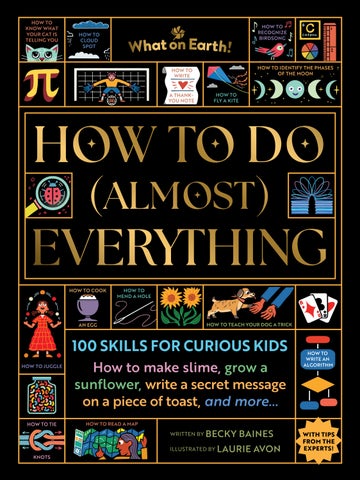
HOW TO KNOW WHAT YOUR CAT IS TELLING YOU

HOW TO CLOUD SPOT


HOW TO FLY A KITE


HOW TO RECOGNIZE BIRDSONG

![]()
HOW TO KNOW WHAT YOUR CAT IS TELLING YOU

HOW TO CLOUD SPOT


HOW TO FLY A KITE


HOW TO RECOGNIZE BIRDSONG


HOW TO IDENTIFY THE PHASES OF THE MOON HOW TO JUGGLE


How to make slime, grow a sunflower, write a secret message on a piece of toast, and more…


HOW TO WRITE AN ALGORITHM

WRITTEN BY BECKY BAINES
ILLUSTRATED BY LAURIE AVON


Megan Pugh Author of America Dancing: From the Cakewalk to the Moonwalk, Hannah Redfearn Dance Practitioner
If you’ve ever wanted to impress the crowd with a move so cool it’s out of this world, then look no further than the Moonwalk. With practice, it’s fairly simple to master, so you don’t need to be a great dancer to pull it off. Think of it less as dancing and more as walking backward—with style!


You might know of this smooth move from pop legend Michael Jackson, who first performed it to his hit song “Billie Jean,” in 1983.
Smooth surface

Bit of space (your act will look a lot less slick if you walk backward into a chair)


STEP 1: PUT ON YOUR SOCKS AND SELECT YOUR SURFACE
You want as little resistance between your feet and the floor as possible, so choose socks without grips and a smooth surface.

But he didn’t invent it. From as early as the 1920s, African-American performers—including jazz singer Cab Calloway, stage performer Johnny Hudgins, and tap dancer Bill Bailey—were performing their own versions of the “backslide,” as it was then known. Although he is most commonly associated with the move today, Jackson likely learned it from dancers on the TV music show Soul Train in the 1970s.
It’s not essential to wear mismatched socks when performing the Moonwalk. It just helps to explain the moves (see next page).


STEP 2: POSITION YOUR FEET

Standing with your feet about 4 inches (10 cm) apart, slide your left foot in front of your right. This is your starting position.

STEP 3: MOVE!

Lift your right heel and bend your right knee, so you are standing on your right toes.
NOW REPEAT!


Smoothly slide your left foot straight back, so it passes your right foot and takes the back position. Keep your left foot flat on the floor as it slides, and keep your left leg straight as you slide it back—no bending at the knee!
But this time, each foot will be doing the opposite role.

Make sure your weight is on the ball of your left foot.


Smoothly slide your right foot straight back, so it passes your left foot and takes the back position.


Lift your left heel up and bend your left knee, while placing your right heel flat on the ground.


Lift your right heel up, while placing your left heel down.


STEP 4: PICK UP THE SPEED

Believe it or not, you are Moonwalking already! It just may not look like it quite yet. That’s because this dance is all about smoothness—connecting one movement to the next in a fluid fashion. Once you get comfortable with the steps, pick up the speed a little bit. Try to connect one move directly into the next.


STEP 5: HANDS - OFF!
You may be wondering what to do with your hands. In this case, nothing! When Michael Jackson performed the Moonwalk, he kept his hands by his sides in his pockets, or simply touched his hat.

Want to juggle at the same time?
Turn to page 193 to learn how!


If you’ve ever played a video game without looking at the controller, or practiced the piano without looking at the keys, you’ll have mastered muscle memory. This brilliant brain phenomenon explains how you are able to reproduce movements you’ve made a hundred times before without thinking about them. Your brain’s memory log stores the actions and sequences to replicate them without instruction. The same thing goes for dances and sports. Once you’ve locked them in, you can perform them with ease.


It’s squishy… it’s stretchy… it’s sticky… it’s sublime… it’s slime! What makes this gooey gloop so compelling? Well, for starters, it’s fascinating. It’s not quite a solid, but it’s not a liquid either. So, what exactly is it? Slime is a polymer, just like its key ingredient, glue. A polymer is made up of chains of molecules. In glue, the chains are long and straight, meaning they slip and slide around easily. To transform glue into slime, you need one other key ingredient: borax. Borax contains borate ions, which, when added to glue, link those long chains together, thickening the glue into sticky, stretchy slime! Contact-lens solution contains
borax, which is why it’s an important ingredient if you want to make your own slime. (Some solutions contain boric acid, which works in a similar way.) The baking soda helps to firm up your slime mixture. But why do we love slime so much? It’s because different textures stimulate our senses and help us to feel calm and even happy. They activate parts of our brain that release feel-good hormones that put us right in the chill zone. So, playing with the gloopy texture of slime really puts us in a good mood! To enjoy it safely, be careful around your eyes, mouth, and any cuts, and always wash your hands afterward.


With this book by their side, every curious child will gain a dazzling range of skills for real-life adventures, including: how to read a map; how to bake a cake; how to star-spot (without a telescope); how to solve a Rubik’s cube; how to do a magic trick; how to use Morse code; how to find your way out of a maze—and much more! Every skill comes with the seal of approval from top experts, and their stellar tips are threaded throughout the book, too.
Lavishly illustrated with step-by-step diagrams, exuberant illustrations, and stunning photography, this book offers the skills every child needs to make the most out of every day.
This beautiful hardback makes a great gift that the whole family across the generations can enjoy together as they (re)learn 100 skills.
Features over fifty expert consultants, for example: an aircraft designer gives advice on making paper airplanes, a structural engineer gives advice on building a den, and a computer scientist gives advice on writing an algorithm.

U.S. ORDERS
— Publishers Group West
The perfect book to help kids engage with the real world (and each other!), in a time of weariness with screens.
This book is a visual feast, and includes 500 illustrations, step-by-step diagrams, infographics, and photographs.
Tel: (866) 400-5351 • Fax: (800) 838-1149 • ips@ingramcontent.com
Submit orders to your sales representative, or via the IPS Cart on Ingram iPage at ipage. ingramcontent.com • EDI using IPS SAN: 6318630
CANADA ORDERS
— The Manda Group
Tel: (855) 626-3222 | Fax: (888) 5638327 • info@mandagroup.com
PR AND MARKETING—Publisher Spotlight

Pub date: 09/01/2026 • Price: $30.00 • Size: 8.3 x 11 in Format: Hardcover • Extent: 320 pages • Age: 8-12 • ISBN: 9781804661758
Tel: (615) 930-2110 • ellen@ publisherspotlight.com @whatonearth_books @What on Earth! @whatonearthbook @whatonearth_books @WhatonEarthPublishing


ISBN 978-1-80466-175-8
9 781804 661758