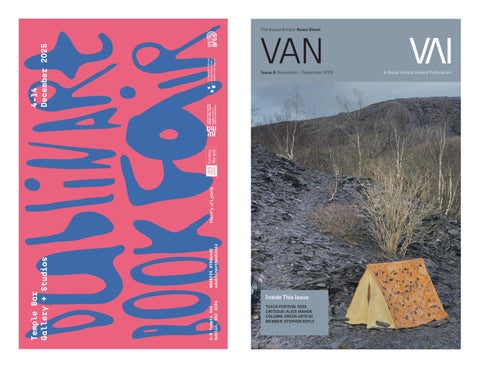
The Visual Artists' News Sheet – November December 2025

Page 1


TULCA FESTIVAL 2025
CRITIQUE: ALICE MAHER
COLUMN: GREEN ARTS NI
MEMBER: STEPHEN DOYLE

The Visual Artists’ News Sheet

November – December 2025

On The Cover

Mair Hughes, Spoil Shelter, 2025, from The Borderlands / Y Gororau project; photograph by Mair Hughes, courtesy of TULCA Festival of Visual Arts.

First Pages

5. News. The latest developments in the arts sector.

6. Roundup. Exhibitions and events from the past two months.

Columns

8. Piering Eyes. Cornelius Browne recalls the mystery and lore of Atlantis House in Burtonport, County Donegal. Dublin Gallery Weekend. John Daly gives details of Dublin Gallery Weekend 2025, taking place from 6 to 9 November.

9. Art Made By Walking. Lian Bell outlines the importance of walking as creative practice and a refusal of productivity. Dreaming Disability Futures. Alex Cregan discusses a recent disability justice workshop at Void Art Centre.

10. Flock. Guest Curator Dr Selina Guinness outlines programme highlights for Dublin Art Book Fair in December.

11. A Greener Future. Stephen Beggs outlines the activities of Green Arts NI – a sustainability network for Northern Ireland. Issues of Our Time. Niamh O’Malley discusses the 2025 RDS Visual Art Awards at the RHA.

Organisation Profile

12. A Crazy Vocation. Aengus Woods interviews John Daly about the 30-year evolution of Hillsboro Fine Art.

Festival / Biennial

14. Strange Lands Still Bear Common Ground. Clodagh Assata Boyce interviews Beulah Ezeugo, curator of TULCA 2025.

16. A Borderless Romance. Rachel Macmanus reports on Convergence Festival presented by Live Art Ireland in August.

Exhibition Profile

17. Ends and Infinity. Aengus Woods reviews a recent exhibition at Solstice Arts Centre.

18. Hometown. Dorothy Smith discusses Jason McCarthy’s recent exhibition at Droichead Arts Centre.

Critique

19. Alice Maher, Sibyl I, 2025.

20. Alice Maher at Kevin Kavanagh

21. ‘SYSTEM ARMING’ at Luan Gallery

22. ‘New Irish Art’ at Lavit Gallery

24. ‘Bíodh Orm Anocht’ at Ormston House

VAI Event

25. Connected Horizons. Brian Kielt reports on VAI’s ongoing Connected Horizons programme.

26. Get Together 2025. Joanne Laws and Thomas Pool report on Ireland’s annual networking event for visual artists.

29. New Institutional Approaches to Curating. Joanne Laws and Thomas Pool report on VAI’s inaugural curatorial presentation.

Residency

30. Jump Cuts & Tree Judgements. Joanne Laws interviews Katie Breckon and Kate O’Shea about THE IMMA Fremantle Residency Exchange.

Member Profile

32. The Spirit of the Place. Cristín Leach reflects on the Brigid’s Well paintings of Mary Fahy.

33. The Dysphoric Age. Stephen Doyle outlines their evolving practice and recent exhibition at Highlanes Gallery.

34. Echolocations. Sorcha McNamara outlines the evolution of her artistic practice.

Last Pages

36. VAI Lifelong Learning. Upcoming VAI helpdesks, cafés and webinars.

37. Opportunities. Grants, Awards, Open Calls, and Commissions.

The Visual Artists’ News Sheet:

Editor: Joanne Laws

Production/Design: Thomas Pool

News/Opportunities: Thomas Pool, Mary McGrath, Lewis Olivier

Proofreading: Paul Dunne

Visual Artists Ireland:

CEO/Director: Noel Kelly

Office Manager: Grazyna Rzanek

Member & Artists Advice, Advocacy & Development: Mary McGrath

Advocacy & Advice NI: Brian Kielt

Services Design & Delivery: Emer Ferran

News Provision: Thomas Pool

Publications: Joanne Laws

Accounts: Grazyna Rzanek

Special Projects: Robert O‘Neill

Impact Measurement: Rob Hilken

Shared Island Advocacy: Brian Kielt

Board of Directors:

Deborah Crowley, Michael Fitzpatrick (Chair), Lorelei Harris, Maeve Jennings, Gina O’Kelly, Deirdre O’Mahony (Secretary), Samir Mahmood, Paul Moore, Ben Readman.

Republic of Ireland Office

Visual Artists Ireland

First Floor

2 Curved Street

Temple Bar, Dublin 2

T: +353 (0)1 672 9488

E: info@visualartists.ie

W: visualartists.ie

Northern Ireland Office

Visual Artists Ireland

109 Royal Avenue

Belfast

BT1 1FF

T: +44 (0)28 958 70361

E: info@visualartists-ni.org

W: visualartists-ni.org

Evans’ Home, John’s Quay Kilkenny, R95 YX3F
Brian Harte Hut Oil on Canvas, 180 × 150 cm, 2025.

The Kiosk Project Art Space is a new interdisciplinary arts venue established in late 2024 by artist and producer Brian Hegarty (thirtythree-45) in collaboration with the Droichead Arts Centre and its partners. Rita Hynes has since joined this curation team to assist with their 2026 programme.

The aim of The Kiosk Project Art Space is to showcase and support the work of artists and groups at any stage of their practice, by invitation or open call, cultivating a creative environment with an artist-led approach. The physical space of The Kiosk is tiny, versatile and adaptable, providing a dynamic setting that can accommodate temporary exhibitions, projects, residencies and events.

Budget 2026

The Minister for Culture, Communications and Sport, Patrick O’Donovan TD, and the Minister of State for Sport and Postal Policy, Charlie McConalogue TD, announced details of €1,514,678,000 in funding allocated to the Department in Budget 2026, which will see increases across all areas with a total 9.5% rise across the Department. Funding for 2026 is increasing for all areas under the Department while supports for agencies in sectors continue to grow. Budget 2026 will enable the continuation of key supports in the Arts and Media sectors, while allowing for the delivery of ambitious projects across Communications, Sports and in our National Cultural Institutions.

The Department’s Arts and Culture programme aims to support and develop engagement with, and in arts, culture and creativity by individuals and communities thereby enriching lives through cultural and creative activity; to promote Ireland’s arts, culture and creativity globally; and to drive a more vibrant and diverse Night-Time Economy.

• Provision made, subject to Government approval, for a successor scheme to the Basic Income for the Arts Pilot, which will finish in February 2026. The research proves that the BIA successfully sustains artists careers and reduces the income precarity which is a feature of a career in the arts

• Completion of the repository project in the National Archives in 2026

• Commencement of the major redevelopment of the Crawford Art Gallery

• Commence redeveloping the National Concert Hall with the Discover Centre project (a music learning and engagement centre) in the old Pathology block

• A new €6m capital works scheme will be developed to fund arts capital projects in line with the commitment in the Programme for Government, providing support for communities across the country

• Screen Ireland 2026 allocation increased by €2.1m to develop new

THE LATEST FROM THE ARTS SECTOR

In just over a year, The Kiosk Project Art Space has delivered an exciting programme as a gallery, residency space, and community hub. Recent highlights include exhibitions by Gee Vaucher, Helen McDonnell, Boz Mugabe, and Cathal Carolan; a pop-up radical bookshop called Cailleach Books; and creative residencies with Conor McMahon and Oksana So.

The year’s end will bring a new small press imprint called Paraphrase, and two exhibitions: ‘Cartomania’ – presenting nineteenth-century photographic portraits from Drogheda by historian Dr Orla Fitzpatrick – and ‘SWEAT, SOUNDS & STORIES’, a love letter to old band t-shirts, curated by Cliona Murphy and Brian Hegarty.

strategies to grow the gaming and special effects sectors in Ireland and for increased support to the indigenous and incoming screen industry

• An additional allocation of €600,000 to Comhaltas Ceoltóirí Éireann who celebrate their 75th Anniversary in 2026

• €1m in funding, double the 2025 allocation, for the 2026 round of the Grassroots Music Venue Support scheme to support independent music venues and artists across the country.

• Culture Ireland 2026 allocation increased by €800k, to help develop and sustain Irish artists’ international careers

Ballinamore Public Art Commission

Leitrim County Council announced that artist Fiona Murphy has been awarded The Junction – Ballinamore Public Art Commission for her proposal, Hand to Land and Thread in Hand, following a nationwide open call and a highly competitive two-stage selection process. The commission is funded under the council’s Per Cent for Art programme.

Rooted in Ballinamore’s flax-growing and linen-making heritage, Murphy’s site-specific design takes the form of an undulating, fabric-like seating structure at The Junction in Ballinamore, County Leitrim. Drawing upon twists of linen for its form, its surface features mosaic in warm ochres, yellows, browns, flecks of gold, and accents of flax-flower blue, with the artwork harmonising with the surrounding architecture. The sculpture’s organic form, evoking the twists and folds of linen fabric, invites visitors to rest, explore, and interact. Community collaboration is central to the artwork’s creation, and as part of this approach, Murphy has been delivering a series of workshops with Transition Year students at Ballinamore Community School and is working with a local craft group, selected through a separate open call earlier this year. The group is developing a companion project as part of the Creative Ireland programme, building on social engagement and the participatory ethos at the heart of the artist’s design and concept.

Ardú Street Art Returns

Ardú Street Art, the open-air gallery that has transformed Cork city since 2020, returned in September with an exciting new programme of large-scale murals and artistic talent. Supported by Creative Ireland, Cork City Council Arts Office, Pat McDonnell Paints, and Cork Airport, this year’s project once again brought colour, conversation, and creativity to the streets of Cork.

The first mural of 2025, The Wonder of Travel, was recently unveiled at Cork Airport. A collaboration between Cork-based artists Peter Martin and Shane O’Driscoll, the work celebrates the history of air travel through Cork Airport since 1961, while looking forward to its bright future and development.

In addition, Ardú announced two new large-scale murals for Cork city centre by artists Kone.one (at Water Street) and Hixxy (at Liberty Street).

IMMA Wins 2025 Art Museum Award

The Irish Museum of Modern Art (IMMA) has won the 2025 Art Museum Award, presented by the European Museum Academy (EMA). This prestigious honour recognises IMMA as one of Europe’s leading cultural institutions, celebrated for its pioneering, inclusive, and socially engaged approach to contemporary museology. The award was presented to IMMA’s Director, Annie Fletcher, at a ceremony in Budapest on Saturday 27 September 2025, where cultural leaders from across Europe gathered to celebrate excellence in museum practice.

The EMA Art Museum Award which is supported by the A.G. Leventis Foundation, highlights institutions that use art in innovative and creative ways to address pressing social issues. It champions museums as ‘social arenas’, spaces for civic dialogue, inclusion, and community building. The Award recognises museums that explore themes such as participation, inclusion, accessibility, gender equality, migration, racial justice, decolonisation, sustainability, climate change, and public health.

IMMA was selected from a highly competitive shortlist of outstanding institutions, including the Centre Pompidou-Metz (France), Reykjavik Art Museum (Ice-

land), Lithuanian National Museum of Art (Lithuania), Museum of Contemporary Art of Montenegro (Montenegro), State Ethnographic Museum (Poland), Museum of Naïve and Marginal Art (Serbia), and Birmingham Museum & Art Gallery (United Kingdom).

Reel Art 2025

The Arts Council announced Éanna Mac Cana and Yvonne Mc Guinness are the recipients of the Reel Art 2025 awards, while Jesse Jones is the successful recipient of the Authored Works 2025 award.

Éanna Mac Cana is a successful recipient of the Reel Art 2025 award for his film Sink a Death Stop which is a close look at the life, artistry and worldview of pioneering performance artist Alastair MacLennan. At the forefront of the Belfast art scene for a number of decades, the resonance of MacLennan’s work has led him to being considered one of Ireland’s leading and most influential performance artists. This film will move between Alastair’s one-of-akind archive and new recordings, revealing a deeply insightful and delicate portrait of a highly acclaimed performance artist.

Yvonne McGuinness is also a recipient of the Reel Art 2025 award for her film

The Buildings are Listening. The Buildings are Listening is a poetic, playful, and politically resonant journey through Ireland’s beloved but threatened cultural buildings told through the voices of the buildings themselves. Mixing vérité, archival footage, re-staged memory, and magical realism, the film is about presence, absence, legacy and the power of place.

Reel Art is the Arts Council’s long-running arts documentary scheme which provides film artists with the creative and editorial freedom to make highly creative, imaginative and experimental documentaries on an artistic theme for cinema exhibition. The Dublin International Film Festival is the Arts Council’s exhibition partner for Reel Art and Sink a Death Stop and The Buildings are Listening will premiere at DIFF in 2027.

Kiosk Project Art Space Opens
The Kiosk Project Art Space, Drogheda; photograph by Cathal Carolan, image courtesy of Brian Hegarty.

Dublin

Belfast

Dlr LexIcon

Dún Laoghaire-Rathdown County Council presents ‘An Outer Reflection of an Inner Reality’, showing new work by Karen Ebbs. The exhibition featured large, colourful oil paintings, mirrored plexiglass, and sculptures. Ebbs’s work invites viewers to explore themes of reflection, perception, and the nature of reality. At the heart of the work is colour – life-affirming and transformative – which the artist uses as a quiet rebellion against grey apathy, to offer hope. The exhibition continues until 9 November 2025.

dlrcoco.ie

National Botanical Garden

‘Sculpture in Context’, celebrated its 40th anniversary at the National Botanic Gardens, Glasnevin, Dublin, from 4 September to 10 October this year. As part of the anniversary celebration, the exhibition also welcomed several distinguished invited artists. Among them were Eilis O’Connell, Alison Kaye, Ken Drew, Ana Duncan, Seamus Gill, Beatrice Stewart, Ciaran Patterson, Penelope Lacey, Michelle Maher, and Richard Healy, whose contributions further enriched this 40th anniversary exhibition.

opw.ie

REDS Gallery Dublin

‘In Transit’ by Maria Ginnity ran from 9 to 15 October at REDS Gallery Dublin on Dawson Street. The exhibited works capture the choreography of public transport. Ginnity turned the daily ritual of commuting into a quiet theatre of human behaviour, navigating intimate proximity with strangers – with glances avoided, elbows angled, phones in hand, and bags clutched like protective armour. An emerging artist, Ginnity has recently qualified with a Diploma in Painting and Drawing (Distinction) from the RHA School.

@reds_gallery_dublin

mother’s tankstation

Christopher Steenson’s ‘They haven’t gone away you know’, comprises a series of artworks that explore power struggles between the individual and the state, from both human and more-than-human perspectives. This body of work, collectively titled ‘The Long Grass’ (2022-24), was borne through an extensive period of research surrounding the corncrake – a bird that is now almost extinct, with the bird’s call now only heard in remote sections of Ireland’s west coast. On display from 25 September to 22 November.

motherstankstation.com

Pallas Projects/Studios

Gary Farrelly’s first solo exhibition in Ireland in fifteen years, ‘Quasi-Autonomous Stitch’, takes its name from a sewing procedure devised as a method of overwriting and absorbing images and surfaces. The works here are restless, shifting between seams, carbon traces, labels, blueprints, photographs, and logbooks. At stake are languages of construction, obsolescence, staging, and transmission – creased, overwritten, redacted, repaired, forced into proximity. On display from 9 to 25 October.

pallasprojects.org

Slane Castle

Named after the Irish word for sanctuary, ‘CAIM’ is Slane Castle’s new art programme, dedicated to exploring nature and sanctuary through contemporary art. In September, ‘CAIM’ launched its inaugural exhibition at the 18th-century estate, fostering dialogues between international contemporary art and Ireland’s cultural heritage. The exhibition brought together 19 Irish and international contemporary artists working across various mediums, generations, and cultural backgrounds, including Niamh O’Malley, Lee Welch, Kathy Tynan, and Fergus Martin. On display from 12 to 30 September. caimatslane.com

Belfast Exposed

Belfast Exposed presents three concurrent exhibitions, showcasing the work of four seminal Polish photographers: Zofia Rydet, Anna Beata Bohdziewicz, Teresa Gierzyńska, and Aneta Grzeszykowska. Each artist explores how photography has been used across generations to question identity, memory, and the visibility of women’s lives. They each turn the camera into a tool for self-definition, resistance, and storytelling, reclaiming image-making as a way of shaping how women are seen, and how they see themselves. Runs until 20 December. belfastexposed.org

Rónán Ó Raghallaigh’s exhibition ‘Turais Taibhsí’ was on display at Culturlann in Belfast from 7 August to 11 September. Each painting in this exhibition is the result of a personal pilgrimage to a sacred place within the Irish landscape. The titles of the paintings are in Irish, honouring the original names of these places and the memories they hold. Ó Raghallaigh spent time researching the folklore imbued in these places, their logainmneacha (Irish place names), and archaeology.

culturlann.ie

PS²

‘Meeting The Lough On Its Own Terms’ (4 to 27 September) by artist Ami Clarke, delivered in partnership with Friends of the Earth, Digital Art Studios, Sonic Arts Research Centre and PS2, and Banner Repeater (London). Expanding upon her previous work on complex systems, and informed by a collective writing project with Friends of the Earth NI, Clarke worked with many local people to record something of the multiple scales and temporalities of Lough Neagh, combining 4K drone footage with cinematography, underwater filming, and microscopic footage. pssquared.org

Catalyst Arts

Alex Keatinge and Niamh Hannaford presented ‘non-stick frying pan’ from 2 October to 6 November. The non-stick pan is a mass-produced household staple. Practical and easy to clean, its non-stick coating makes cooking and cleaning more efficient than stainless steel alternatives. Using the non-stick frying pan as a vehicle for discussion, this exhibition and public programme positioned the western domestic space as an active site, where socio-political, economic and imperial systems are perpetuated and sustained.

catalystarts.org.uk

Golden Thread Gallery

‘Radical Hope’, a group exhibition developed in collaboration with Arsenal Gallery in Białystok, Poland. The exhibition is curated from ‘Collection II’, one of Poland’s most significant collections, which traces the evolving landscape of contemporary art in Poland and Eastern Europe over the past three decades. The collection is a living archive: dynamic, growing, and responsive to the shifting narratives of our time. ‘Radical Hope’ reflects on uncertainty, resilience, and the transformative potential of art. On display from 13 September to 8 November. goldenthreadgallery.co.uk

Threshold Gallery

‘Glimpses’ by Jennifer Alexander ran from 4 September to 31 October. In her exhibition, which launched on 4 September for Late Night Art Belfast, Alexander interpreted Aristotle’s imagining the cosmos as 56 celestial spheres by creating a series of acrylic sketches on linen. Each fragment invited a shift in perspective, exploring in-between spaces, identity beyond the body, and our place in the universe – a constellation of moments that ask who we are, and how we find meaning.

flaxartstudios.org

[Left]: Maria Ginnity, Boots, 2025 , oil on canvas, 50 x 40 cm; image courtesy of the artist and REDS Gallery.[Middle]: Ami Clarke, ‘Meeting the Lough On Its Own Terms’, 2025, installation view, PS2; image courtesy of the artist and PS².
[Right]: Ciara Roche, street in the evening 2025, oil on paper, 15 x 21 cm; image courtesy of the artist and Lavit Gallery.

Regional & International

Butler Gallery

‘Cities of the World’ by Kathy Prendergast and Chris Leach was on display from 9 August to 27 October. Although the two artists have never met, they are intrinsically linked by their subject matter, which they realise in different ways. The juxtaposition of their work prompted wider discussion on geography, architecture and politics – what cities say about us, and what they don’t. Additionally, a film programme, ‘City as Character’, aimed to highlight iconic cities in both mainstream and art house cinema.

butlergallery.ie

Munster Technological University

‘COLLECTED EXPRESSION: MTU Alumni in the Arts Council Collection’ ran from 15 September to 15 October. The exhibition was a multi-venue exhibition, showcasing selected artworks from the Arts Council Collection by national and international artists who are alumni of MTU Crawford College of Art & Design. It was presented by MTU Arts Office supported by the Arts Council Collection. The main exhibition took place at the James Barry Exhibition Centre, MTU Bishopstown Campus, in Cork.

arts.mtu.ie

Solas Art Centre

Two concurrent exhibitions ran from 5 September to 3 October at Solas Art Centre: Senga Sharkey’s ‘Somewhere Between Two Extremes’ and Sylvia Thirlway’s ‘Elemental Spaces’. Sharkey, a Fermanagh-based artist, explores a delicate artistic balance between the abstract and the familiar, with her latest exhibition emphasising the power of storytelling. Sylvia Thirlway’s exhibition is inspired by the state of the planet, and the ways in which many societies have forgotten how to value the natural world and all its wonders.

solasart.ie

Clifden Arts Festival

Clifden Arts Festival is Ireland’s longest-running community arts festival. What began in 1977 as a small school-based event has grown into an 11-day celebration of creativity that transforms the town each September. At its core, Clifden Arts Festival remains deeply rooted in community. The people of Clifden and the wider region are not only the audience but active participants. The festival ran from 17 to 28 September, delivering an extensive programme of exhibitions, workshops, and events.

clifdenartsfestival.ie

Lavit Gallery

‘A kind of dark’ by Ciara Roche and Daniel Coleman was on display from 2 to 25 October at Lavit Gallery. Roche’s paintings are all about the places we like to imagine ourselves living, and places in which we wish to be seen, all relating to things we assign value to, such as glamourous homes, gardens, fancy cars, high-end hotels, restaurants and bars. Daniel Coleman explores the impermanence of life and the significance of the everyday. His work is steeped in symbolism and meaning, in relation to his rural Irish upbringing. lavitgallery.com

The Model ‘Inheritance’ runs from 11 October to 31 December. The group exhibition features artists: Marcus Coates, Miriam de Búrca, Susan Hiller, Anna Maria Maiolino, Kathy Prendergast, Cornelia Parker, and Selvagem – Cycle of Studies. In the mid-2020s, we live in the aftermath of a pandemic, widening social polarisation, the threat of climate collapse, and geopolitical instability. The exhibition brings together a constellation of artworks that confront the legacies that shape our present moment, and ask how we can create a better future for humanity. themodel.ie

Grilse Gallery

‘In Search of Presence’ by Dorota Borowa, ran from 19 September to 12 October. Rather than depicting nature, Borowa sought to collaborate with it, exploring her relationship with the natural world. The process is central to her inquiry, seen as lessons in humility, openness, attentiveness, mindfulness, patience, determination, and forgiveness. Dorota works with water as an active collaborator in the creation of an image. Mixing it with oil paint, watercolour, or ink, she allows the materials to interact organically on paper or board.

grilse.ie

Palazzo Provana di Collegno

Thomas Brezing’s exhibition in Turin, ‘I Think I Made You Up Inside My Head’, confronted the viewer with a meditation on the fragile architecture of identity and memory. The architecture of the palazzo, a space where history, education, and ideology converge, becomes the ideal stage for an inquiry into the human face as both mask and mirror, portrait and vanitas. The building’s dual legacy as a theatre of power and education echoes the artist’s own inquiry into how the human face becomes a vessel for change, reflection, and impermanence. museoschneiberg.org

Wexford Arts Centre

‘Siren’ by Ursula Burke is an expansive exhibition that incorporates ceramic sculpture, textile sculpture, tapestry and mosaic sculpture. Greco-Roman inspired, surrealist mosaic sculptures take centre stage, framed by major new monumental tapestry work. Having lived for over 20 years in post-conflict Belfast, during and after the peace process, Burke has developed a unique continuum of exploration between political and aesthetic inquiries into trauma, wounding and repair in her practice. Continues at until 6 December. wexfordartscentre.ie

Island Arts Centre

‘Common Threads’ is the second edition of the Northern Ireland Linen Biennale’s headline exhibition, where flax and linen serve as the common thread, across a range of art practices. Curated by artist and creative producer Meadhbh McIlgorm, the exhibition ran from 21 August to 13 September, celebrating the slow, considered, and skilful labour of artist-makers. This year, an undercurrent of weaving ran through much of the presented works, highlighting interdependence over fragmentation: as in a weave, no thread stands alone.

linenbiennalenorthernireland.com

Rubin Foundation NYC

‘Romance, Regret, and Regeneration in Landscape’, a group exhibition, ranging from the poetic to the political, is on display until 9 December at the Rubin Foundation in NYC. The featured artists – Francis Alÿs, Joseph Beuys, Boyle Family, Chagos Research Initiative, Anya Gallaccio, Michele Horrigan, Sanam Khatibi, Ishmael Marika, Megs Morley and Tom Flanagan, Richard Mosse, Winfred Rembert, Alexis Rockman, Clement Siatous, and Yang Yongliang – engage with the environment through a range of approaches. the8thfloor.org

Wexford County Council

‘Sidelong Glances: An Oblique Look at the Sea’ is a group exhibition, curated by Catherine Bowe, which runs from 13 October to 21 November. The exhibition features work from IMMA’s National Collection and invited Irish and international artists. It draws inspiration from a poem, written by Marianne Moore in 1921, titled The Grave, which stems from Moore’s personal experience of observing the sea with her mother. The exhibition extends Moore’s examination of the sea as a powerful, indifferent force – a place of both beauty and death.

wexfordcoco.ie

[Left]: Ursula Burke, Busted Nose 2024, mosaic glass and custom mahogany frame, 58 x 37 cm; image courtesy of the artist and Wexford Arts Centre.[Middle]: Kathy Prendergast, Stack, 1989, cloth, string, paint, wood, 270 x 260 x 70 cm; image courtesy of the artist and Wexford County Council. [Right]: Thomas Brezing, A Lifelong Friend Never Met 2024, oil on canvas, 150 x 120 cm; image courtesy of the artist.

Plein Air Piering Eyes

CORNELIUS BROWNE RECALLS THE MYSTERY AND LORE OF ATLANTIS HOUSE IN BURTONPORT, COUNTY DONEGAL.

IN THE LATE seventies, sometime around the death of Elvis Presley, my parents bought a bottle-green car that they managed to keep on the road until sometime around the shooting of John Lennon. Unspooling along the routes of Donegal brought a hitherto unknown and short-lived freedom, for never again would we own a car. A short run, made often, carried us to a weathered mobile home that housed a family of eight on Burtonport Pier. Through the cacophony of children, I zeroed in on my cousin and her fisherman husband, whenever they mentioned The Screamers.

Drives to ‘The Port’ in those days meant navigating a hallucinatory interlude. Vehicles slowed passing the Georgian mansion. Necks craned. Nose pressing against chilly glass, my gaze gobbled baffling symbols. Above the gaily-coloured doorway, large letters spelled ATLANTIS. My eyes climbed to the second-storey windows to meet the stare for which this house was infamous. The pair of enormous red eyes watched, unblinkingly, the dogged tides and mortals clinging to these penurious shores.

During one visit, I left behind the caravan chatter and pelted up the hill from the pier with my sketchbook. An overnight snowfall had left the ground patchy white. Christmas trees twinkled in windows. Upon reaching Atlantis House, already fumbling a pencil out of my gaberdine pocket, I froze at the sight of a Screamer perched atop a long ladder. Balancing a paint tin, she was adding another zodiac sign to her constellation.

The Beatles sang from an eye, painted around an open window. Just as I was about to turn and flee, the muralist peeked over her shoulder and raised her paintbrush in greeting. She went back to painting, and I began drawing. Might this have been Jenny James, founder of the Atlantis Primal Therapy Commune? As my icy fingers conjured onto paper the house and its matriarch, the squall of all I knew of the cult blew through my brain: kidnappings, violence, and the padded room where the 30 inhabitants thrashed and screamed to exorcise inner

demons. Fresh snowflakes beginning to fall, I titled my drawing in scrawly pencil, piering eyes. Whether this was a misspelling of ‘peering’ or ‘piercing’, or wordplay, the pier being so near, I can no longer recall.

During the first summer of the nineties, my girlfriend and I fell into wintry homelessness. Both art students, about to embark on our final year, that autumn we failed to return to college, instead seeking refuge under my parents’ roof. By November, my childhood home finally became uninhabitable. The old slates were letting in so much rain that the electricity company cut our supply. Christmas was celebrated in darkness. In the New Year, my parents and younger siblings moved into a caravan. Paula and I settled into a rat-infested outbuilding in Burtonport, within the grounds of a once-grand house filled with echoes of its illustrious past. Many mornings, we roved the pier with our easels, sometimes painting side by side within sight of Atlantis House. The Screamers had long since sailed to Colombia, their tale ending amid blood and beheadings.

Rechristened St. Bride’s and transformed into a boarding school for adult women, where canings were commonplace, the house now belonged to the Silver Sisterhood. In their full-length dresses, shawls, and bonnets, the maids, as they termed themselves, were a familiar sight in town throughout my teenage years. Recreating a Victorian household, these women lived without electricity by choice, their evenings bathed in the glow of oil lamps and candles, as they listened to records on a windup gramophone.

Painting Atlantis House today, the jigsaw of its history is more complete. Jack the Ripper stalked the imaginations of the maids, leading them to design the first ever ‘18’ certificate video game. The murals of Jenny James lie buried under hefty layers of paint, yet her ‘piering’ eyes have never fully closed.

Cornelius Browne is a Donegal-based artist.

Exhibitions

Dublin Gallery Weekend

JOHN DALY GIVES DETAILS OF DUBLIN GALLERY WEEKEND 2025, TAKING PLACE ACROSS THE CITY FROM 6 TO 9 NOVEMBER.

DUBLIN GALLERY WEEKEND (DGW) was started by Ireland’s Contemporary Art Gallery Association (CAGA) a few years ago with a mission to support visual artists, expand audiences, deepen public engagement, foster a culture of collecting, and elevate the profile of contemporary art in Ireland. CAGA’s core belief is around the primacy of the artist; when artists thrive, so does the entire arts ecosystem.

So, in many ways, DGW is more than just a visual arts festival; it’s a catalyst for a stronger, more vibrant art scene in Ireland. This year’s DGW takes place from Thursday 6 November to Sunday 9 November and is set to be our largest showcase yet. There are over 60 free events, offering opportunities to experience the ambition, quality and creative energy of Irish contemporary art.

More than 40 galleries, cultural institutions, creative spaces, and artist studios across Dublin will present brand new exhibitions, featuring work from over 100 of Ireland’s most exciting contemporary artists. From painting to sculpture, installation to performance, digital art to street art, the programme spans the full spectrum of artistic practice.

For the first time, Dublin’s leading contemporary galleries will join forces with the major public institutions – including the Irish Museum of Modern Art, Douglas Hyde Gallery, and National Gallery of Ireland – in a city-wide programme of exhibition launches, live demonstrations, film screenings, concerts, artist talks, panel discussions, tours, studio visits, workshops for children and families, and much more. There are also studio tours and gallery brunches, curated art trails, and late-night socials, talks, workshops and neighbourhood art events.

The weekend kicks off with an opening reception in the Grand Hall at IMMA, bringing together artists, collectors, supporters, sponsors, and key stakeholders for an evening of artistic celebration and exchange. Within the public institutions, I am thrilled that Chilean artist Cecilia Vicuña will present her first exhibition in Ireland, ‘Reverse Migration, a Poetic Journey’ at IMMA, while Dublin-based

Japanese artist Atsushi Kaga will have a much-anticipated show at the Douglas Hyde Gallery.

The National Gallery of Ireland presents ‘Pablo Picasso: From the Studio’, an exhibition that includes paintings, sculptures, ceramics, and works on paper, as well as photographic and audiovisual works –sure to be a cultural highlight of the year. Sinéad Ní Mhaonaigh exhibits a new series of paintings entitled ‘Snáithe’ at The LAB Gallery, while at Temple Bar Gallery + Studios, Frank Sweeney’s film, Go Ye Afar (2025), follows an Irish-Nigerian taxi driver on a miraculous voyage through the streets of Dublin and Calabar.

Ahead of her representation of Ireland at the 61st Venice Biennale next year, Isabel Nolan’s ‘Look at the Harlequins!’ at Kerlin Gallery offers insights into the artist’s practice across a range of media. ‘Patrick Graham: Gilboa Iris’ at Hillsboro Fine Art sees the artist, now in his 80s, making his strongest work ever. Sculptor Corban Walker is at the Solomon Gallery, David Eager Maher’s hyper-detailed landscapes, rendered in vibrant colour, are on show at Oliver Sears Gallery, and there are very interesting group exhibitions at both the Taylor Galleries and at Olivier Cornet.

At the Guinness Storehouse, ‘Rising Conversations: These Walls’ brings together artists Hazel O’Sullivan and Niall de Buitléar to revisit a pivotal chapter in Irish art history: the ROSC exhibitions of 1984 and 1988, which introduced contemporary Irish and international art to Dublin, while platforming the industrial architecture of the former hop store as a site for cultural exchange.

Many renowned contemporary curators and members of the international art press will be attending this year’s event, so hopefully their presence and engagement will help to shine a global spotlight on Dublin as a leading cultural capital on the European stage. Programme details can be found at: dublingalleryweekend.ie

John Daly is Director of Hillsboro Fine Art and Chair of the Contemporary Art Gallery Association (CAGA). hillsborofineart.com

Cornelius Browne painting Atlantis House; photograph by Paula Corcoran, courtesy of the artist.
Patrick Graham, Half God I (Lough Owell) 2024, oil on canvas, 160 x 320 cm (diptych); image courtesy of the artist and Hillsboro Fine Art.

Surface Travel

Art Made By Walking

LIAN BELL OUTLINES THE IMPORTANCE OF WALKING AS CREATIVE PRACTICE AND A REFUSAL OF PRODUCTIVITY.

White supremacist, capitalist, (post-)colonial, ableist, patriarchy*

WALKING WITH THESE women, together and apart, has given me a way to think about what walking means for me as a part of a creative practice. Walking as art itself. That’s a frustrating, slippery, and liberating thought. It’s that slippiness that draws me back, and that is where I think the art is. If it were just frustrating or just liberating, I don’t think I would call it art.

The structure for this project was created in the doing. We decided to meet. We decided to walk together. We took it from there. There was a great deal of not knowing. We refused to be rushed.

There is a great deal of NO in our walking. There is a great deal of refusal. We are refusing productivity, busy-ness, the guilt-making pull of what work should look like. We are refusing to be certain and we are refusing to be overwhelmed by uncertainty. We let the walking itself, the being together while walking, guide us, rather than structuring something from the outset. In January, as we walk together almost each week, my father emails me to tell me about the term ‘negative capability’, used by the poet John Keats in 1817. Wikipedia says it is “the capacity of artists to pursue ideals of beauty, perfection and sublimity even when it leads them into intellectual confusion and uncertainty... the ability to perceive and recognise truths beyond the reach of what Keats called ‘consecutive reasoning’.” I add my definitions: the capacity to refuse the rational and still function. The capacity to do something that seems non-sensical, but through the doing of it, grows a sense. We are refusing to forget the layers some of us can see under what a landscape looks like now. We are sharing our knowledge of these layers. We are talking about the village that died when the peat industry stopped, as well as talking about the sculptures in the rewilded bog around us. We are talking about the trees that are missing from the beautiful bare hills and the flats that are missing from the beautiful city fields. We are talking about the urban infrastructure hidden under the grassy skin of those fields and the homes that were once in those patches of sky. We are talking about what used to be in place of the student accommodation, how the roads used to run in our childhood. We are talking about how our dead aunt’s belongings passed through this particular charity shop. We are talking about the places where the fairies cross over into our world, and the places where we touch theirs. We are talking about the light that will be lost when the next hotels are built. We are talking about poor people on rich land, and rich people on our land. We don’t talk about it much, but we wear green, black and red badges that feel heavier than they are.

There is also a great deal of kindness. The walking is not always easy. Our bodies are changing and getting older. One body gives birth to another during our time together. One body loses the body that gave birth to it. We are worrying about others, and we are taking care of them. We are overworked, or underworked. We drink tea and coffee and eat together, we seem to drift in our conversations, we laugh. In the context of Art Made By Walking, this is all the work that doesn’t look like work.

I use my Art Made By Walking time to develop a personal practice called Municipal Walker that is something about walking with intent for the good of the city. Or is something about civic responsibility at times of overwhelm. The conversations we have as a group help clarify my thinking about the practice, so that I am able to talk about it in the world, although it’s still slippery, and frustrating, and liberating.

I remember the term ‘mitching’, and because I am pleased with it as a small regular act of refusal, on a walk in Birr we talk about it, and I begin to use it more in my own work. I begin to invite others to mitch. I invite you to mitch. Remember these words of refusal and kindness in the coming days. Step away from something, even at a point where you don’t think it’s possible. Tell no one. Go outside. Start to walk.

* with gratitude to bell hooks

This text was read aloud on 22 April at the opening of an exhibition in Axis Ballymun; the culmination of a long and slow research process called Art Made By Walking. Four artists, who use walking in different ways in their practice, were commissioned by Axis to take part. Maeve Stone (project instigator, in her capacity as lead artist for the Green Arts Department at Axis), Shanna May Breen, Veronica Dyas, and I were joined by creative producer Niamh Ní Chonchubhair. We walked together in Dublin, Offaly, and Clare. To mark the end of a year and a half of walking (and talking about walking), the group collectively assembled an exhibit – a kind of loose scrapbook of ideas and experiences that had emerged – traces of which are now available on my website.

Lian Bell is an artist and arts worker based in Dublin. lianbell.com

Access Dreaming Disability Futures

ALEX CREGAN DISCUSSES A RECENT DISABILITY JUSTICE WORKSHOP IN OCTOBER AT VOID ART CENTRE IN DERRY.

DREAMING DISABILITY FUTURES was a workshop I ran on Saturday 4 October at Void Art Centre in Derry as part of Bounce Arts Festival 2025. The workshop ran for four hours, with a one-hour break. It is based on the book, Care Work (Arsenal Pulp Press, 2018) by Leah Lakshmi Piepzna-Samarasinha – a collection of essays, lists, and personal notes around the topic of disability justice and collective care.

The book highlights disability justice as a model coined by QTBIPOC activists and artists in the face of an ever-growing disability rights movement that did not represent them.1 They pushed for a more radical model that foregrounded the most marginalised, taking an intersectional, non-curative approach, and borrowing from the social model of disability.

The workshop had two distinct parts, the first being a discussion around concepts explored in the book – most notably care webs, disability justice, care as a form of work, and what to do if the medical system of care lets us down. The second part was a free-writing and creating session, based on these discussions. While free-writing was my original plan, I didn’t want to restrict the creative output of participants, so I provided space for sound-making, mark-making, and visual art.

The motivation behind this workshop was simple: the growing inequality for d/ Deaf, disabled, and neurodivergent people, not only on the island of Ireland, but beyond. Examples of inequality in the UK include proposed reform of the Personal Independence Payment (PIP) and removal of the Limited Capability for Work-Related Activity (LCWRA) group from state benefits, as well as the increasing privatisation of the NHS. Many disabled people are facing insurmountable questions: What do we do when all our resources are stripped from us? Who do we turn to when the government won’t protect us?

It was these questions that I found addressed by Care Work, and it was these questions I wanted to discuss. They are not easily answered. However, the talks that unfolded, as well as the creation that happened, was a beautiful jumping-off point.

The attendees of the workshop were a diverse group: all were of marginalised genders (transgender people and cis women); most of us were queer; all of us were neurodivergent and/or had invisible disabilities; and all of us had had greatly different experiences with care and our own disabilities. These differences and marginalisations greatly influenced our conversations.

Immediately, when introducing ourselves, the elephant in the room became clear: most, if not all, of us had experienced or witnessed harm within the mainstream care model and were desperately seeking an alternative.

Most of us are afraid of our autonomy

being called into question, or of having care forced upon us, in the form of institutionalisation, especially given the harm we had observed or experienced in the past. For a variety of reasons, many of us feel the spectre of autonomy loss hanging over us, whether due to aging (leading to presumed incompetence), worsening mental health (in the face of worsening living conditions), or a variety of other factors.

Most of us want care, but want it on our own terms, at our own pace, in our own capacities. We don’t want to be forced into a one-size-fits-all model that the medical model of care often adopts – one that may not understand our specific quirks, identities, needs, wants, or desires.

Care webs were explored as an alternative to, or accompaniment to, the medical or government-issued healthcare model. Care webs are formed when a collective of people get together and support a disabled person. Often (but not always), these webs are reciprocal to some degree, with care being passed back and forth along the strands. Different people have different capacities, and a perfectly divided 50/50, in giving and receiving, simply isn’t possible for a lot of people. More often, things are fluid. We discussed communication within these webs, boundary setting, and knowing our own abilities.

Some of us, no matter the time, place or desire, would never be able to provide some kinds of physical care, such as lifting someone out of their wheelchair. Some care is messy, vulnerable, even scary, and above all, care webs rely on the community around you to show up.

Further questions emerged: What does a person do if they fall out with their care web? What does a person do if they feel ostracised from their community? How does a person build a care web from scratch? What if you, genuinely, have no one who can support you?

These situations aren’t easily resolved or magically fixed; however, movement has begun in our own lives and practices to dream and create something better than a system that harms us. The connections made between disabled people of different backgrounds, showing solidarity and care to one another, felt like something necessary in the face of hopelessness. This workshop felt more like the beginning of something than a one-off. It feels as though these dreams will grow beyond the confines of the workshop, for its participants and beyond.

Alex Cregan is a writer, poet, and creative facilitator from Derry.

@flo.raldisaster

1 Queer, Trans, Black, Indigenous, and People of Colour (QTBIPOC) communities advocate for disabled people who experience intersectional forms of marginalisation. See, for example: Care Work pp 20–21.

Publishing Flock

GUEST CURATOR DR SELINA GUINNESS OUTLINES PROGRAMME HIGHLIGHTS FOR DUBLIN ART BOOK FAIR IN DECEMBER.

EACH YEAR, DUBLIN Art Book Fair (DABF) is produced by Temple Bar Gallery + Studios and presents a wide range of unique artist books and titles from creative, small, and independent publishers alongside an events programme of talks, tours, workshops and book launches. As part of the wider DABF programme, a Guest Curator is invited to create their own programme of events and selection of titles under a chosen theme.

As DABF 2025 Guest Curator, my theme ‘Flock’ examines all thing pastoral. This includes topics such as humans and beasts as herding creatures; the relational arts of shepherding; the impact of flocks on habitats, and how wary scapegoats, too, may flock together to combat predation. Two decades of farming sheep in the Dublin Mountains while teaching at IADT have focused my mind on the kinds of habitat required to sustain different flocks – when one ewe fails to thrive, the whole flock needs to move onto better pasture.

In September, my first event for DABF was a successful preview at Philip Maguire’s farm on Newtown Hill, Glencullen. This farm walk and herding demonstration introduced a small group to the farming community who work to make a living from grazing animals in full view of the city. Returning to TBG+S, the remaining events I have curated for the DABF 2025 programme aim to provide a creative commons, where human flocks can meet, graze and find sustenance in mutual regard and a shared commitment to collective welfare.

DABF 2025 launches on Thursday 4 December in TBG+S main gallery with a Guest Curator’s Talk to discuss ten titles chosen to expand on this theme, with the opening reception to follow.

On Friday 5 December is Cowboys & Shepherds, Fieldwork & Studio, a curatorial panel discussion with acclaimed artists and farmers, Miriam O’Connor and Orla Barry, about what counts as work in art and agriculture, co-moderated with Adam Stead (SETU). When wool is worthless, and farming beef-cattle barely viable, how do we value pastoral lives? What does it mean to breed, feed and mind the sheep and cows we send to slaughter? We will focus on the work of raising flocks and explore the lives of shepherds and cowherds as disruptive pinch-points in late-stage capitalism, as they tend to people, place, produce and practice in the contested rural environment.

On Friday 12 December, the second of my curatorial panel talks, Of Human Flocks & Other Species, sees acclaimed artist, Isabel Nolan, and two exceptional writers, Darran Anderson and Cathy Sweeney, discuss the complexities of their relations with particular flocks, human and non-human. How do other species instruct us in what counts as work and care? The conversation will explore the ambivalence of artists and

writers as shepherds and sheep in negotiating real and creative habitats, drawing on Nolan’s dynamic practice, and two literary works sparked by a compulsive desire for perspective: Darran Anderson’s Derry memoir, Inventory (Farrar Straus & Giroux, 2020), and Cathy Sweeney’s debut novel, Breakdown (Weidenfeld & Nicolson, 2024). We will take a hard look at flock dynamics, and the new habitats formed by strays, scapegoats and outcasts, while questioning how artists fare when penned up individually.

A highlight of DABF 2025 is a new Publisher’s Series made possible through a partnership with the Culture Office of the Creative Europe Desk (Ireland). For this, we are inviting acclaimed Palestinian author, Adania Shibli, and her Fitzcarraldo Editions publisher, Tamara Sampey-Jawad, to discuss her astonishing novel, Minor Detail (2017). A Palestinian woman sets out to locate the site of a war crime committed in 1948, only to find the familiar maps to be of no use in navigating disputed territories. Minor Detail vividly enacts the experience of military surveillance, violent dispossession, and land confiscation suffered under occupation.

This special event on Saturday 6 December will reflect on the work of Fitzcarraldo Editions, a staple at the Dublin Art Book Fair, and the vital importance of literary translation in protecting our intellectual commons against aggressive polarisation. In addition to Minor Detail, and in keeping with the DABF theme ‘Flock’, our honoured guest, Adania Shibli, will present selected works by Palestinian artists who have continued to create, and counter subjection, while living under colonial and genocidal conditions.

Full details of DABF 2025 (4 – 14 December), including the events I have curated and mentioned above, are available on the TBG+S website. DABF 2025 is proudly sponsored by Henry J Lyons and supported by Dublin UNESCO City of Literature.

Dr Selina Guinness is Guest Curator of Dublin Art Book Fair 2025. She is also Head of Teaching and Learning at IADT, where she works to promote transdisciplinary pedagogies across IADT’s provision. iadt.ie/about/staff/dr-selina-guinness

[Top]: Dublin Art Book Fair 2024, Temple Bar Gallery + Studios, featuring Ella Bertilsson, THE MOLE FLIPPED THE SUNSHINE SWITCH, 2024, wall-based artwork; photograph by Evanna Devine, courtesy of TBG+S. [Middle]: Dublin Art Book Fair 2024, Temple Bar Gallery + Studios; photograph by Evanna Devine, courtesy of TBG+S. [Bottom]: DABF event, Philip Maguire’s farm, Newtown Hill, Glencullen, September 2025; photograph by Sadbh O'Brien, courtesy of TBG+S.

Ecologies A Greener Future

STEPHEN BEGGS OUTLINES THE ACTIVITIES OF GREEN ARTS NI –

A SUSTAINABILITY NETWORK FOR NORTHERN IRELAND.

IN SEPTEMBER THIS year, Green Arts NI was delighted to attend VAI’s Get Together in TU Dublin. For the first time, we were able to engage widely with artists from the Republic of Ireland and discuss the challenges of making sustainable work in a world where climate change and the ecological crisis are all around us. What we found so encouraging was the level of positivity at the event. In the face of a highly uncertain future, artists continue to present solutions – sounding alarms whilst celebrating the wonder in everyday life. We continue to welcome new members from across the island of Ireland.

Green Arts NI is a sustainability network, supported by Belfast City Council, covering all art forms. We have over 100 members across more than 50 organisations, ranging from freelance artists of many disciplines to venues, festivals, umbrella bodies, and production companies. We work collectively to reduce our environmental impact across Northern Ireland and use creativity to inspire our communities in relation to climate action. We have found that this collaborative approach across artforms and member types has enabled us all to work more effectively within small budgets and limited capacities, in terms of time and personnel.

To this end, our website was designed to be useful as well as informative. It features case studies on our members’ green projects; resources that can be used by individual creatives and companies of any size to make their practices more sustainable; and a section for signing up to be part of our growing community (greenartsni.org). Membership is free and is accessible to all. We also hold regular members meetings in Belfast and online, where everyone can come together, share the latest news, ask others for support, and plan for the various events in which we take part throughout the year.

In June, Green Arts NI members curated an event as part of the Summer Solstice celebrations at Brink! This amazing organi-

Exhibitions

sation brings people together from all walks of life to think, play, discuss, and take action on climate-related issues. Our members delivered workshops, talks, an art exhibition, and film screenings. In previous years, we have also contributed to the Climate Craic festival in Belfast, and the next few months will see us presenting at IETM’s Focus Event in Bradford and Wild Belfast’s National Park City gathering.

In October, Green Arts NI launched its second round of ‘Good Green Ideas’. This micro-bursary scheme allows members, either individually or in collaboration, to try out an idea that they might not be in a position to explore otherwise. Once the proposals have been submitted, our members vote on which ones should go forward. Happily, last year we were able to make all three proposals happen. Ideas could include a study trip or exchange to improve knowledge that can then be applied or shared, supporting a community microproject, or buying items that can be shared by members to help everyone’s work. In the previous round, The Oh Yeah Music Centre established a bee colony on their roof in Belfast City Centre – a refuge and resource for pollinator insects. They installed two bee hives on the roof along with a range of planters filled with year-round flowering plants. Tinderbox Theatre Company delivered a project called ‘The Sustainable Storyteller’ in partnership with Professor John Barry of Queen’s University and supported by the university’s Centre for Sustainability, Equality, and Climate Action.

Maybe it’s because of its relatively small size, but the arts community in Northern Ireland is well connected, especially when it comes to combating environmental challenges. Green Arts NI epitomises this supportive artistic collaboration, in our collective action for a greener future. Join us!

Stephen Beggs is Co-Chair of Green Arts NI. greenartsni.org

Issues of Our Time

NIAMH O’MALLEY, CURATOR OF THE RDS VISUAL ART AWARDS 2025, DISCUSSES THIS YEAR’S EXHIBITION AT THE RHA.

IT’S A COMPLICATED thing, the idea of selecting some of the ‘best’, when it comes to the vast number of excellent art graduates we have on our island every year. I have the privilege of being the 2025 curator of the RDS Visual Art Awards, opening in the RHA Gallery on 21 November. I’m hopeful that exhibitions like this can demonstrate the diversity and quality of practice being produced and allow us to consider how these new and innovative voices are speaking – and why.

A large, committed panel of curators and artists arrived at a shortlist this year that includes artists like Charlie Yris, who has used a process of photographic and video documentation to both compile and reimagine a list of derelict buildings in Limerick. In their work, these buildings shift in our consciousness by the simple placement of phrase on a ceramic plaque – an ode to home or its possibility. Their activism confronts vacancy and produces a poetic protest in a way that generates future thinking and vision.

The building blocks of materials that make a life, a home, a space – the functional and the aspirational – are also evident in the work of Vicky Ochala, who presents a fullscale steel frame of a room in her childhood home, where her grandparents still live. Her work considers post-communist Polish architecture but also smell and décor, furniture and floorplans. Her video, Come, let me tell you something (2025), blends archival footage of communist media propaganda with her own recordings.

Clara McSweeney allows the architecture itself to speak in her work, Now Listen Closely, Fellow Humans (2024), as she responds to the peculiarities of three vacant buildings in Dublin city centre. Monologues spoken by actors are played through speakers in a drainpipe, air vent and intercom. We are invited to eavesdrop on these recordings, which the artist describes as ‘confessions’, in which the buildings themselves are voicing their deepest fears, anxieties and confusions.

The sense that material realities support and distort our lives, as well as ‘speak’ in their own particular way, is also present in the work of Éile Medb Ní Fhiaich. In her sculptural assemblages, combinations of found and made forms, such as industrial plastic, metal and foam, connect and entangle with each other via handmade interventions of silicone, ceramic and stuffed fabric. Her works consider material adaptation, support and transformation as they elongate, hold, and rely on each other.

Lily Mannion’s delicate composition, Maybe if I sit and watch the sun fully set (2025), uses resin, steel, hair and skin cells, as part of her material and linguistic inquiry. This work is vulnerable in its fears, concerns and overwhelm. It positions its very physical compositions, which also include

ceramic, felt and steel, as a new kind of script – maybe even a spell – to reconnect and touch past and future.

The subject of touch is equally present in the work of Anastassia Varabiova as they reflect on the absurdity and odd behaviours of a screen-based lifestyle. Blending dread and humour, their iPhone installation, Try Normal Life Maxxing (2025), combines spirituality and wellness content with marketing footage from sex doll factories and snippets of the artist’s performance. This physically small yet potent video, played on a caged phone, questions the role of the algorithm in the construction of reality.

In a deliberate negation of the problematics of the digital, Charlie Dineen’s film, The City Beneath Me (2025), casts his analogue camera on the landscape of Kerry, examining ritual, ancestral memory and mythology. This stark and overt nod to our landscape and heritage summons an empathy of touch, rhythm, and reignites a relationship with the physical and divine land.

In a strikingly different but equally beautiful setting, Thais Muniz’s two-channel work, The Kite Ballet (2024), shows people flying kites in a semi-barren, white, sandy landscape with blue skies. Contested land and environmental issues are spoken directly to and with the wind. Thais presents this joyful activity, producing curiosity, community and solidarity by considering ‘play as a revolutionary act’. Alongside Charlie Dineen, she also harnesses indigenous knowledge systems, identity, traditions and ritual, as well as land and climate.

Exploring the physicality of the sensing and evolving human body, Susanne Horsch maps, sews and produces outsize cloths of touch and labour. Swimming in Space (2025) draws from autobiography as well as feminist and queer theories to realise an immersive installation of enlarged bodily shapes, torsos, breasts, sperm and genitalia as fabric, stitch, dyeing and quilting.

Billie Adele O’Regan flies the flag for the alchemy of painting. Billie describes exaggerated and amorphous bodily forms that sit within histories of horror, sci-fi and the occult. Strange beauty – equally monstrous and compelling – is generated through the messy truth of paint and puddle, brush mark and stain.

These ten innovative artists speak to many issues of our time, from housing and ecology to the relationship of our weighty, complicated bodies in the physical world. Come and see the work – it will do the speaking.

Niamh O’Malley is an artist based in Dublin. niamhomalley.com

The RDS Visual Art Awards 2025 exhibition runs at the RHA Gallery from 21 November 2025 to 25 January 2026. rds.ie

Members of the Green Arts NI steering committee celebrating the organisation’s first birthday, 2025; photograph by Megan Keenan, courtesy of Green Arts NI.

Aengus Woods: Tell me about your background and how you came into the world of visual arts.

A Crazy Vocation

AENGUS WOODS INTERVIEWS JOHN DALY ABOUT THE THIRTY-YEAR EVOLUTION OF HILLSBORO FINE ART.

John Daly: I’m from Dublin – my family have lived in the same house since 1882, and I have collected art since I was about 15. Most kids were trying to buy motorbikes, but my parents wouldn’t let me, so I bought a rare print at auction in Christie’s. That was the first artwork; it was by Victor Pasmore, an English artist. I don’t know what possessed me. We had no art in the house, and my parents had no interest really. I am very academic and if I like something, I aim to read every book by that person, and I do the same with art. I first learned about modern British art and that became my collecting focus. I read all about the artists, and their lives were fascinating.

AW: How did Hillsboro Fine Art get started?

JD: Well, Hillsboro is actually the name of my house. It’s a big old house and I would use the downstairs for exhibitions. I’d open on a Friday evening and weekends for a month or two, before changing shows around. I did the first solo show in my house with Terry Frost. We would meet people in London in the Arts Club and places, and he’d say, “Oh, do you not know John? You know, he’s got the best gallery in Ireland!” He was so supportive. And all of these guys, like Howard Hodgkin, because they’re so polite, they would say, “Oh, yes, that’s right, I remember him now!” And so, they all gave me their work, but I was showing it in my house! I first moved the gallery to Anne’s Lane, then later to Parnell Square, and kept up the relationships with those important international artists. Once you get the trust of one artist, particularly if they are already well-connected, then that trust spreads.

Gallerist John Daly at the exhibition, ‘The 1980s: A Return to Painting’, April 2025; photograph courtesy of Hillsboro Fine Art.

AW: Which gallery shows have stood out in your memory over the years?

JD: When I started, a lot of the big artists, like Basil Blackshaw, Patrick Graham and Gwen O’Dowd, were already showing with other galleries. I knew a lot about postwar British art and so I approached Terry Frost first and he introduced me to Anthony Caro. I asked him to do a show, and then also John Hoyland. The art world at that level is a small one. The major international sculptors and painters all know each other. So, if they saw your enthusiasm and passion and knew it was financially okay to give you work, it would all be fine. At that stage, I began to attract artists from other galleries. John Noel Smith would have been one of the first. He had exhibited for years in another gallery, but he was living in Berlin at the time. There’s also Michael Warren. I had already collected quite a bit of his work before I even met him, but later he became one of my closest friends.

AW: Michael sadly passed away in July 2025. Tell me more about your history with him.

JD: We both had a very international outlook on art. He was unusual for his time, in that he studied in the Brera Academy in Milan. When Michael went there, he was hoping that Marino Marini would be his tutor, but unfortunately Marini left just the semester before. Nonetheless, Michael ended up with Luciano Minguzzi as his tutor. All this just told me that Micheal wanted to pitch himself against these people and not be confined to a small parochial environment. I appreciated that.

AW: How, then, do you understand the role of the gallery? Is there a distinction between nurturing younger artists and showing more established figures?

JD: The reason for first bringing in the more established artists was to let people know I was serious about what I was doing. It’s not necessarily a commercial thing. I mean, it has to somehow pay its way, but the word ‘commercial’ is a misnomer for most galleries in Ireland. It’s more about showing work that you believe in. When selecting younger or newer Irish artists, you’re picking them on the basis that they can sit comfortably beside the best of what is out there already. Artist Gerald Davis once advised me to only show work that I love, because I’ll probably end up with most of it! And that’s true, in the sense that I don’t show anything that I wouldn’t want myself.

AW: Are the collectors an important part of the equation?

JD: Oh, very much so. Most of them have become lifelong friends. We’d be in each other’s houses, and they would ask advice, not just about work from my gallery, but in other spaces or at auction. The main eight to ten galleries in Dublin are all serving the function of showing art that they believe in. Most of the galleries have a mix of Irish and work from elsewhere. But having the personalities of each of those people gives a different curatorial flavour to each gallery.

AW: What are your plans for the future of the gallery?

JD: Onwards and upwards! Some galleries have a group of 20 artists, and they just show them in rotation forever and that’s fine. But I like to inject a bit of something

into it to keep myself interested. So, I will always be looking for artists. In a way, the previous exhibition, Karl Weschke ‘Painting Order Out of Chaos’, is probably the most important one I’ve done. Weschke has become a bit forgotten about, but he was a friend of Bacon and Auerbach and there are eight of his paintings in the Tate. I usually try to show at least one big international name each year. And I collect things as well with the idea of putting together thematic shows. I did that with Cecil King. I gathered a body of his work over the years, and then during his retrospective in IMMA, I exhibited those pieces. Similarly, when IMMA had their Alex Katz exhibition, I did a show with him here. I went to his studio and then carried the entire show in a plastic bag through customs – those are the fun bits!

This is a crazy vocation. You don’t do it for the money, because you’d be disappointed. However, you end up meeting the most wonderful people. Every day is different. Even though one could say I am very tied to the gallery, it’s changing all the time; every month there’s a new exhibition. Every month for 30 years – that’s an awful lot of shows. The other thing that people don’t realise is that it’s quite tough physical work. I’m not getting any younger, so at some stage, I’m going to have to only show miniatures!

Aengus Woods is a writer and critic based in County Louth. @aengus_woods

John Daly is Director of Hillsboro Fine Art and current Chair of the Contemporary Art Gallery Association (CAGA). hillsborofineart.com

[Top]: Seamus Heaney opening Jack Pakenham’s exhibition, ‘The Doll Paintings’, at Hillsboro Fine Art in Anne’s Lane, 17 August 2006; photograph courtesy of Hillsboro Fine Art.
[Bottom]: Orla Whelan, ‘Coloured into Shape’, installation view, Hillsboro Fine Art, September 2024; photograph by Colin Carters, courtesy of the artist and Hillsboro Fine Art.

Clodagh Assata Boyce: TULCA Festival of Visual Arts 2025 is titled Strange lands still bear common ground. Can you explain why you chose this title?

Strange Lands Still Bear Common Ground

CLODAGH ASSATA BOYCE INTERVIEWS BEULAH EZEUGO, CURATOR OF TULCA FESTIVAL OF VISUAL ARTS 2025.

Beulah Ezeugo: I chose this title because I enjoy a statement that can gather its own kind of energy. I also enjoy the trend of past editions of TULCA that lean into the poetic by using longer, slightly awkward titles. When a phrase is repeated enough, it can act like a shared refrain that shapes a shared language for that moment in time. This feels suitable for something as quick and celebratory as a festival.

The words in this title carry ideas that conjure very specific definitions that shift based on where you ask and who is speaking: the strange, the common, the land. When I am in Galway, the presence of the Atlantic feels significant. So, conceptualising the festival began with thoughts about Galway’s mercantile past, but also with the discourses taking place around migration now. Both of which make me wonder how arrival is felt on an island – a place that can feel protected by distance yet also vulnerable to outside forces. Earlier on, I came across an image of a medieval Burmese Map of the World. It depicts a teardrop-shaped island rising from the ocean, with smaller islands drifting below, detached from the mainland. Where the image shows up online it is captioned something along the lines of ‘The Himalayas are shown by a horizontal green line: above is the magical land of seven lakes and Mount Meru; below is where strangers come from.’ It suggested that to know the world is to expect strangeness, and that this encounter is not only inevitable but also vital. We meet the world through others, and in that sense, we are all strangers to someone else.

CAB: This exhibition sets out to chart new ways of relation. Can

[Left]: Bojana Janković and Nessa Finnegan, an entry from the Shared Migrants (Archive) 2025; image courtesy of the artists and TULCA Festival. [Right]: Mair Hughes, Spoil Shelter, 2024, image from The Borderlands / Y Gororau project; photograph by Mair Hughes, courtesy of TULCA Festival.

you tell us a little bit about how this cartographical approach has shaped your curatorial and exhibition-building choices?

BE: Maps and borders hold a decisive place in contemporary art. For this exhibition, I was drawn to their paradoxes. Maps have long served as instruments of colonial power, but they can also act as anti-colonial tools, capable of encrypting, concealing, and revealing the limits of hegemonic knowledge.

In the curatorial process, I approached exhibition-making as a form of map-making: a search for pathways, a desire to document encounters, a projection of curiosity and intention across discrete spaces, and a pursuit of familiarity with the unknown alongside a willingness to be transformed by it. The exhibition follows this impulse, inviting audiences to navigate the worlds presented by the artists with openness and attentiveness.

The festival also borrows from cartographic methods to define its guiding themes. Much of the work begins from a specific historical or cultural vantagepoint and then from there, documents situated encounters with land, the sea, the creature, the stranger, and so on. So, re-orientation became a central theme and is understood as the act of unsettling assumed stances, turning again, and opening the possibility of encounter and contact.

CAB: How do you see the role of ‘the other’ and what is the role of art in shifting that?

BE: By evoking the idea of ‘the other’ I am evoking the ways of knowing and experiences that have been pushed aside or ignored by the dominant systems of power. The margin can also be an advantageous position. If every margin is someone else’s centre, then the task is to keep shifting our point of view toward the many centres that exist, noticing what becomes marginal from each new vantage point. Much of the work in the festival is a relational encounter with a powerful external presence, whether another person, another state, a non-human species, a mythical or spiritual figure. At times, the work itself shifts perspective from the margins, moving through overlooked or excluded positions to open new ways of seeing and being. Although art has the capacity to propose new considerations and ways of seeing, at the same time, it’s dif-

ficult to think of how exactly contemporary art makes significant shifts. I am aware that a festival, no matter how ambitious, cannot do that much. What it can do is create proximity and enable an artist or an audience into intimate relations with an idea, and then hopefully spark the impulse to act in a different way.

CAB: What can audiences expect from this year’s festival?

BE: The festival includes a performance, artist talks, various exhibitions in Galway and one in New York, a book, and several audio works shared online and broadcasted over radio. There are many films in the programme that move fluidly across different geographies, as well as cultural and historic points. I am particularly excited to share Kate Morrell’s film ...Y el barro se hizo eterno (...And the Mud Became Eternal) (2021), which explores ‘guaquería’, a type of political resistance that involves excavating the earth to loot archaeological treasures and indigenous cultural property.

I also look forward to the festival’s ephemerality. Many of the works are ongoing or exist as part of a larger continuum, so work in different states of completion will be able to converge and momentarily come into conversation with others. Marie Farrington’s Diagonal Acts (2025) appears here in its fourth, site-specific iteration, engaging with Galway’s Geology Museum and the knowledge embedded within it. There is also new work by Bojana Janković and Nessa Finnegan that brings together a living archive, related to crossing Ireland’s north-south border – a project that will continue to evolve during the festival and beyond.

CAB: Can you tell us about the accompanying publication?

BE: The publication extends the festival’s core questions around contact and proximity. It brings together several writers who explore the politics of place through poetry, prose, and experimental forms. Some of the writers involved in the festival also contribute to the publication, for example, the broader themes around Ireland’s revolutionary potential, presented in Caroline Mac Cathmhaoil’s film, Mirror States (2025), are extended through the publication in a more intimate register. Other contributors share writing that is rooted in research as well as personal experience, which

reflect on how lived histories and places intersect. The publication includes responses to a range of environments, with particular attention to architectural and natural landscapes.

CAB: To what extent does international collaboration play a critical role this year?

BE: Through the open call, the festival emphasised collaboration and cross-border exchange – not to showcase a particular kind of work, but to create conditions for a certain type of exchange. In much art-making, the focus is on the final outcome or exhibited work, so the life of thinking and making, including the negotiations and the frictions that led to it, often remains invisible. Artists who work collaboratively are especially compelling because of their ability to establish through shared systems that support this way of working. Considering global interconnectedness felt particularly important, in order to invite reflection on the kinds of relationships that sustain solidarity and those that do not.

Some of the festival’s collaborative duos were already established, while others developed through the open call or expanded from individual practices. Mair Hughes, who has been exploring dual identity through excavations along the Welsh border, began with a solo project but invited collaborators Emily Joy and Durre Shahwar, who are now contributing artists in their own right. Peter Tresnan, a painter based in New York, has created a project which explores diasporic identity, drawing connections between Galway and New York. This has led to a secondary outpost of TULCA; an exhibition at 334 Broome Street in New York, organised by Peter, which will feature his work alongside contributions from other TULCA artists, and local artists working within similar themes.

Clodagh Assata Boyce is a Dublin-based independent curator and artist, who is influenced by the radical traditions of Black feminist thought. bio.site/Clodaghboyce

Beulah Ezeugo is curator of the 23rd edition of TULCA Festival of Visual Arts, which takes place across venues in Galway City from 7 to 23 November. tulca.ie

[Left]: Caoimhín Gaffney, And you leave the rest of yourself behind 2024, medium format photograph, 103 x 86 cm; photograph by Caoimhín Gaffney, courtesy of TULCA Festival.
[Right]: Chris Zhongtian Yuan, still from All Trace Is Gone, No Clamour for A Kiss 2021-22, single-channel video, 16mm

A Borderless Romance

RACHEL MACMANUS REPORTS ON CONVERGENCE FESTIVAL PRESENTED BY LIVE ART IRELAND IN AUGUST.

CONVERGENCE FESTIVAL TOOK place in Milford House, North Tipperary, from 8 to 10 August. Since 2020, Live Art Ireland has carved out a hugely important role within the Irish performance art landscape, offering support, residential space, and opportunities to both international and Ireland-based artists. The mission of their biannual festival is to present the latest in live art practice alongside local and national musicians, complemented by workshops designed to foster creative exploration and cultural dialogue.

This year’s festival was curated by Deej Fabyc of Live Art Ireland and delivered in partnership with County Clare-based performance collective, p(art)y Here and Now, taking the theme, ‘A Borderless Romance’. Artists were selected through invitation and an international open call and were asked to consider borders and boundaries – of the body, of countries, of genders, of topography, or from an ecological perspective.

Arriving on Friday afternoon, in time for the opening processional performance by Monstera Deliciosa, I encountered the artist slowly moving through the wooded area behind Milford House, their long train of shiny fabric dragging behind them, reflecting the bright sunshine. This was a fitting launch for the weekend’s events. Mid-afternoon in the barn, there was a two-hour durational work by Sarajevo-born sound

and visual artist, Maja Zećo, who created a crackling, bubbling soundscape using their body attached to piano strings. This was an immersive, atmospheric, and highly constructed experience.

Next up was the first in a series of five performances from London-based artist, Katharine Meynell, whose witty, incisive works were interspersed over the three days of the festival. Shirani Bolle, a self-taught Limerick-based artist, then performed, Comfort Fruit (2025), a multi-layered work dealing with social media, apathy, and the modern paradox of caring from a distance. Rounding off Friday’s events was a performance talk by art historian and lecturer, Laura Leuzzi, offering an insightful exploration of the sonic, gendered body.

Saturday morning kicked off with Juliette Murphy, a multi-disciplinary artist based in Spain, who utilised giant dice and poetry for her outdoor performance. Dublin-based multimedia artist Fergus Byrne performed Vapour (2025) at midday – a high-octane piece with text, vocals, and mixed media. The afternoon featured a workshop facilitated by visual artist, Denys Blacker, incorporating martial arts techniques and breathwork, followed by a participatory performance outdoors in the sunshine.

The final performance of the day was from internationally renowned artist and

researcher, Sandra Johnston. Using the two adjoining rooms in the upper floor of the barn, Johnston worked with materials sourced onsite, creating an atmosphere so still that one could focus on the dust floating through beams of light coming through cracks in the window shutters. Her work was a masterclass in considered control and power, guiding the audience to pay attention to the smallest action and the force required to carry it out.

Sunday’s programme commenced with a high-energy workshop from p(art)y Here and Now, which finished with a participatory performance event for both artists and audience. At midday, Marie-Chantal Hamrock, an Irish artist based in Scotland, integrated seaweed and texts into their evocative piece on the use of laminaria digitata (a common seaweed) as a ‘backstreet abortion’ method until the mid-twentieth century.

Dublin-based multidisciplinary artist, Renn Miano, then took us into Milford House, where they cleverly utilised audience participation to create a multi-layered work dealing with housing and belonging. Late afternoon featured the screening of the powerful film, Letter to my Tribe (2024), by Toronto-based filmmaker BH Yael.

Closing out the festival was a live linkup with US-based ecosexual artists and filmmakers, Annie Sprinkle and Beth Stephens, with an onsite introduction from their col-

laborator and ambassador, Lady Monster. Annie and Beth’s appearance followed a screening of their latest documentary feature film, Playing with Fire – An Ecosexual Emergency (2025). This insightful story of their evacuation from Boulder Creek, California, due to wildfires, is also a portrait of queer community supporting planetary healing, and an interrogation of fire itself –its meanings and uses socially, symbolically, and physically.

The diverse musical line up for the weekend, curated by Caelan Bristow and Maggie McEntee, included Hot House Flowers frontman, Liam Ó Maonlaí, singer songwriters Nic an tSaoi and Cáit Ní Riain, Dublin band Mary and the Pigeons, and salsa electronic fusion from Vatican Jail.

The roster of artists and musicians at the top of their game, coupled with the thoughtful curation and scheduling of performances, all contributed to this kaleidoscopic weekend of cultural highlights. The unique environment and historic house and grounds of Milford House as the host venue further galvanise the reputation of Convergence as “an art and music festival like no other.”

Rachel Macmanus is a multi-disciplinary artist based in County Clare. rachelmacmanus.art

[Left]: Sandra Johnston performing at Convergence Festival, Milford House, 9 August 2025; photograph by Mariya Hoyin, courtesy of the artist and Live Art Ireland. [Right]: Fergus Byrne, Vapour, 2025, Convergence Festival, Milford House, 10 August; photograph by Sandra Corrigan Breathnach, courtesy of the artist and Live Art Ireland.

Ends and Infinity

AENGUS WOODS REVIEWS A RECENT EXHIBITION AT SOLSTICE ARTS CENTRE.

INFINITY IS ONE of those rare concepts that does not so much pervade western thought as haunt it. Since the calculations of Dedekind, Godel and Cantor, we tend to think of infinity primarily as the concern of mathematicians. Yet, starting with Zeno’s paradoxes, going all the way to Hegel’s distinction between two forms of infinity, we see that its ability to create aporias and vanishing points within and without the fabric of reality has driven philosophers and artists to distraction for millennia.

‘Of Peras and Apeiron: ends and infinity’, the superb group show at Solstice Arts Centre in Navan (6 September – 25 October 2025), takes its title from the ancient Greek terminology. Aristotle notoriously relegated infinity to the realm of the potential (rather than the actual) in keeping with the classical world’s generalised fear of the infinite. The ancient Greek worldview prized order, proportion and clear delineations. Infinity, on the other hand, promised chaos and disorder, with yawning chasms lurking in the fabric of time. Infinity and its repercussions return and return, throughout the history of art and philosophy. The perspectival advances of early renaissance drawing, and the complex computations around modern quantum physics would be unthinkable without Cantor’s multiple infinities.

Nonetheless, despite its full embrace by modern mathematics, something of the Greek anxiety around infinity remains with us. Descartes claimed that it was the only concept that could not be produced by humans and must be seeded in our minds by God. Hegel, by contrast, argued that it is

precisely the mind that is infinite. We, ourselves, would then be the very source of that which so de-stabilises us.

This odd tension between the concept and the mind, between system and individual, pervades this exhibition. Works by Ray Johnston, Gerald Caris, Ronnie Hughes and Neil Clements, at first glance, seem to be working within the legacies of minimalism and Op art. But these presentations are wonderfully deepened and enriched by the inclusion of a substantial number of works by Channa Horwitz, dotted throughout the exhibition. Horwitz, a remarkable conceptual artist who only achieved due recognition in the last years of her life, produced works based on complex numerical and spatial systems of her own devising. Her Rhythm of Line works, exquisite drawings on Mylar and utilising gold leaf, bring to mind Sol Lewitt, but they are executed with a delicacy and sense of colour that elevates them entirely to their own realm. Add to this her Sonakinatography compositions, dating from 1969 to 1996, expansive hand-written systems of numbers on graph paper. They are mysterious and suggestive, at once reflecting the focused energies of the scientist and the obsessive ruminations of the outsider artist.

The Sonakinatography works are essentially scores; systems of notation to be interpreted at will by others. This intimate connection between system and practitioner, between the concept and the mind considering it, is key to Horwitz’s works, and in turn provides a connective tissue between the other artists in the show. Across the presented works, human touch

grounds abstract complexities or provides the essential input for systems that might otherwise be detached from anything beyond themselves. Sixteen rotated forms (i), (ii), (iii), (iv) (1975) by Roy Johnston are a case in point. Each of the 16 units that from the individual work are composed of grey painted fabric, stretched over three-dimensional constructions, organised in shifting patterns. The austere and programmatic language of the work is, however, softened by its painterly sensibility and the tangibility of the artist’s touch.

Likewise, Ronnie Hughes’s paintings, at first glance, seem to represent complex geometrics of colour and shape. However, closer inspection reveals traces of the hand. The pull of the paint bears traces of brushstrokes; clusters of triangle and diamond, in their various undulations, point to long hours taping and tracing lines and shapes. Neil Clements’s clean, tight paintings are pleasingly rigorous but his choice of tread plate as a painting surface also points to the human life and labour underpinning their execution, and the art-historical intellectualism they evince.

The labour of the artist bleeds into questions of labour more generally in the works of Grace McMurray. Knitted objects, fabrics and woven materials draw parallels between aesthetic systems and those of social organisation and labour hierarchies. Made of painted and woven satin ribbons, We aren’t on the same wavelength (2022), by virtue of its abruptly fragmentary appearance, points to a system that is, at least in principle, both spatial and temporally endless.

The works of Dannielle Tegeder and Suzanne Triester share with Horwitz that inclination toward the obsessive that might be most optimistically taken as the human mind attempting to make sense of the sheer plethora of reality. Tegeder’s pieces feel richly symbolic. Conjuring ladder with handbook of one shape meaning, and Standard line, with Fixed Element (2024), in particular, seems totemic in its presentation of finely crafted patterns in painted wood, suspended, drawing the eye upward. Treister’s prints, in their invocations of Kabbalah and shamanism, reverberate with that other abiding association with the infinite: mysticism and the precise mechanisms of how the individual can, or indeed perhaps cannot, maintain themselves in the grand flux of being and time.

Overall, the show intriguingly brings to light the attractions and the challenges of system thinking, while dual notions of infinity permeate everything as creation and dissolution. Nonetheless, of the many minimalist, conceptual or systematic artists, hovering in the background of this show, none seems more pertinent than Agnes Martin. Her grids, lines and dots incessantly highlight the attractiveness of systems, to which the exhibiting artists are evidently in thrall. And while these systems can exceed and evade our control, extending ad infinitum, they can sometimes be tamed and shaped, at least momentarily, by the hand and the mind.

Aengus Woods is a writer and critic based in County Louth. @aengus_woods

[Left]: Roy Johnston, Sixteen Rotated Forms (i), (ii), (iii), (iv) 1975, acrylic on cotton duck; image courtesy of the artist and Solstice Arts Centre.[Right]: GERARD CARIS [L-R]: Helix 2-2 branching, 2002, stainless steel, 64.5 x 34 x 28 cm; Kites and darts series #98, 2017, pencil and wax pastel on paper, 73 x 51cm; photograph by Denis Mortell, courtesy of Gerard Caris Estate and Solstice Arts Centre.

Hometown

DOROTHY SMITH DISCUSSES JASON MCCARTHY’S RECENT SOLO EXHIBITION AT DROICHEAD ARTS CENTRE.

DEMONSTRATING WHAT IS held dear, what there is affection for, and what holds meaning, Jason McCarthy’s exhibition ‘Hometown’ at Droichead Arts Centre (19 September – 25 October) explored this thematic terrain with a gentle hand and an individual perspective.

McCarthy’s black and white photographs take us from the core of the historic city of Drogheda to its suburban periphery – from the post-industrial to the edgelands – where urban and rural play out an uneasy relationship.

Eschewing obvious subject matter, we are shown the backs of houses, not the fronts. We observe river water from the Boyne closeup and dark on a receding tide, exposing rich, liquid mud at its base. In ‘Greytown’, a smaller series within the broader exhibition, we see attention paid to utilitarian concrete walls, and to the traces etched by time, weather, and use.

Local landmarks, such as the railway viaduct, are considered, as are bricked-up doorways, metal facades, yards, walls, and corrugated sheds – all presented to us as intrinsic components of this hometown.

McCarthy’s portraits are of the people who inhabit these places; they speak of autonomy and belonging. The importance of the relationship of the sitters to their locations is evident. All are looking directly at the camera, and therefore at the viewer, each person shown as confident in their body language, style, and individuality.

Many images reflect on the place of nature in this human-centric landscape. Nature fits in spaces, leftover or reclaimed from our industrial heritage, in an ongoing and relentless urban and suburbanisation. McCarthy’s photographs claim presence, despite our lack of due care and consideration.

The interrelation of the spaces we call home is evident in these images – the changing and evolving functions, driven by

use and adaptation, the spatial typologies, and the layering that, over time, creates a rich living palimpsest.

All of this receives an almost loving attention. This really is McCarthy’s personal ode to Drogheda, his hometown. It is a thoughtful, unhurried body of work that asks you to take your time. Taken over a ten-year period (2015–25), the photographs reflect this considered distillation and the care and connectedness of their creator.

For ‘Hometown’ and ‘Greytown’, McCarthy worked with film in both medium (6 x 7cm) and large (5 x 4 inch) format, the images demonstrating subtle texture and rich tonal range. The negatives were transferred into digital imagery, inkjet-printed on Ilford paper, and then bonded to aluminium panels.

To coincide with ‘Hometown’, McCarthy has published a catalogue of the same name. This large format, 96-page, hardback publication contains all the photographs shown in the exhibition and others from the ‘Hometown’ series. The selection and sequencing of the photographs – the placing, scaling and relationships between the images – give a rhythm to the book which unfolds slowly, revealing new perspectives on the lives, individuals, places and spaces that create this town.

‘Hometown’ is part of Droichead Art Centre’s key strategy of supporting local professional artists and developing a thriving arts ecosystem in the northeast region. Further information, prints, and the publication are available from the artist’s website (jasonmccarthy.ie). The publication is also available from Photo Museum Ireland (photomuseumireland.ie) and in person from Droichead Arts Centre in Drogheda.

Dorothy Smith is Curator-in-Residence at Droichead Arts Centre. droichead.com

Jason McCarthy [Top Left]: Rathmullan Park, Drogheda 2020; [Top Right]: Chord Road, Drogheda 2018; [Bottom]: Danny Rooney & Fírinne McIntyre 2025; images © and courtesy of the artist.

The Visual Artists’ News Sheet

Critique

Edition 82: November – December 2025

Alice Maher, Sibyl I detail view, 2025, charcoal, graphite and chalk on Somerset satin white 410gsm paper, 245 x 152 cm; image courtesy of the artist and Kevin Kavanagh.

Critique

Alice Maher ‘The Sibyls’ Kevin Kavanagh Gallery

11 September – 11 October 2025

KEVIN KAVANAGH RECENTLY presented ‘The Sibyls’ by Alice Maher, comprising a series of five large-scale drawings in charcoal, graphite and chalk. Four works, Sibyl I-IV (2025), hang unframed, side by side as a series with impressive scale (at 245 x 152cm each). The subject of each drawing is a female nude or Sibyl, who is engrossed in spewing and tending to a vast skein of her own black hair that falls into untidy rolls, forming misshapen, dense columns.

The Sibyls are drawn in simple outline, with minimal rendering of anatomical form, while the hair is deeply etched with trompe l’oeil definition, bursting with movement and energy. The incongruity of weight and form is both dynamic and devotional. Maher’s drawing skills pack considerable force, most notably in the strange light that leaks through the rolls of hair like stained glass. The overall hanging arrangement and subdued gallery lighting further create an oratory atmosphere.

On the floor in front of each Sibyl are four separate sculpture pieces, Vox Sibyllae I-IV, comprising circular black mirrors, upon which Maher has placed handsized, nickel-plated, cast bronze ‘gobs’ of amorphous material, like squished plasticine that a child might discard.

The Sibyls were prophetesses in Greek civilisation who, during the Renaissance, provided scandal-free cover for the depiction of beautiful women, subjected to the male gaze. Maher invests her Sibyls with composed agency and enigmatic self-absorption that refuses the gaze of the viewer. They are entirely focussed on themselves as they tend to their mounds of hair that either obscure their faces or distract them away from view. They casually hold their precarious positions on pillars of hair that oscillate dramatically.

Narrative drawing forms part of Maher’s oeuvre, which has consciously and effectively borrowed from and paid homage to centuries of art history. Sibyl II reclines sensually as Marie-Louise O’Murphy did in Boucher’s La Blond Odalisque (1751); Sibyl IV could be enjoying Le Déjeuner sur l’herbe (1863) by Manet;

while Sibyl I, in a casual display of strength and balance, brings to mind Artemisia Gentileschi’s Judith, as she slays Holofernes. Sibyl III is a familiar and recurring character of Maher’s own creation – a sturdy young girl, grounded in a deep connection to the land and spirit world, capable and persistent under the weight of her ungainly burden.

On the opposite wall, sadly, The Supplicant (160 x 110 cm) has fallen under the weight of her hair; she is submerged with only her foot and outstretched arms visible, her palms pressed together, and fingers entwined, as if pleading or praying. No circular mirror sits on the floor below her.

The juxtaposition of Vox Sibyllae I-IV directly in front of each of the Sibyls I-IV results in an upsidedown reflection of each drawing in the mirror below. These dark pools in the terrazzo floor have a strange black patina that reflects the drawings perfectly, while creating the illusion of bottomless depth, causing a moment of sensory disorientation for the viewer that even the silvery forms on their surfaces cannot break.

On the pristine white paper, the Sibyls are graceful, metaphysical characters; however, in the mirrors, they are inverted and distorted in a darkened underworld. This duality is familiar within Maher’s broader practice, conceptually fuelled by dichotomies, borderlines and transgressions. The “gobs of misunderstood language”1 transgress the grand mythical narratives of the Sibyls, while providing a grounding in the bogs and fields, playgrounds and encyclopaedias of our childhoods.

‘The Sibyls’ is a visually and intellectually compelling exhibition that also serves as a sanctuary of contemplation.

Carissa Farrell is a curator based in Dublin.
1 Quote from a public conversation between Alice Maher and Jesse Jones on 11 September at Kevin Kavanagh, Dublin.
[Top]: Alice Maher, Sibyl III, 2025, charcoal, graphite and chalk on Somerset satin white 410gsm paper 245 x 152 cm; image courtesy of the artist and Kevin Kavanagh. [Bottom]: Alice Maher, ‘The Sibyls’, installation view, October 2025; photograph by Ros Kavanagh, courtesy of the artist and Kevin Kavanagh.

‘SYSTEM ARMING’

Luan Gallery, Athlone

17 September – 16 November 2025

WHAT SYSTEMS ARE armed against us and how can we defend ourselves? This is but one of the many urgent questions raised in Luan Gallery’s latest exhibition, ‘System Arming’. The title is taken from the technical term for activating an electronic security or monitoring system – highly appropriate for an exhibition featuring artistic practices that focus on digital technologies and surveillance systems. ‘System Arming’ also serves to signpost the viewer towards ‘systems aesthetics’ as a critical framework for engaging with the exhibition.

‘System Arming’ was formally launched on 20 September by writer and academic, Dr Francis Halsall, who has contributed enormously to understandings of systems aesthetics as a relevant critical tool for contemporary art, including digital art. Drawing on information science and biology, systems aesthetics highlights the shift from the modernist belief in the self-contained art object, to a post-formalist focus on process, and the relationship between objects within systems.

American writer and critical theorist, Jack Burnham (1931–2019), was an early exponent of systems aesthetics for the analysis of art practice emerging in the 1960s and 1970s. In an essay for Artforum in 1968, Burnham stated that: “Art does not reside in material entities, but in relationships between people and between people and the components of their environment.”1 Almost 60 years later, Burnham’s assertion deeply resonates with the artworks presented in this exhibition, all of which have process-driven and relational components, highlighting the relationship of art to an ever-more digitalised world.

Nadia J Armstrong’s intriguing installation, GIRLHERO (2025), in common with her video, EDIFICE UNBOUND (2022), is a fantastical work of the imagination. It uses a range of digital and analogue systems to create what the artist calls the ‘quantum imaginary’. Combining the antiquated and the futuristic, her sculpted artefacts, made for this exhibition, are ‘protected’ by bell jars, or what were called ‘glass parlour domes’ in the Victorian era. This adds both humour and temporality to her presentation, as well as, possibly, a subtle art-historical reference to the ‘real time systems’ in the pioneering work of systems artist, Hans Haacke. Interactive systems are in evidence in Aisling Phelan’s work. Her visually compelling film, Goodbye Body (2024) explores themes of identity and the possibility of transformation and shows the artist’s practice of creating processes using advanced technologies. Phelan creates digital versions of herself and other people and invites the viewer to interact with them. She thereby sets up a system of relationships between object, process, and spectator. With the mixed-media installation, Spares & Repairs (2024) the artist enquires further into the territory of transhuman possibilities.

The artist duo Kennedy Browne’s expanded installation, Real World Harm (2018), is another exemplar of a systems aesthetic process. By incorporating interconnected audio and visual systems and wide-ranging research, Kennedy Browne expose the sinister world of technofeudalism – a term developed by key thinkers like Greek economist, Yanis Varoufakis, to refer to digital capitalism as a modern economic system of control. Elements of this complex and multi-layered presentation include: Max Schrems’ Retrieved Facebook data (2018), a five-channel sound installation; a black vinyl mat used by the artists to present a series of ‘digital self-defence’ classes; and a wall-mounted guide to the video. The work also comprises text that has been laser-etched onto an Oculus Go VR headset, used to experience the 360-degree video. The overall effect is powerful and disturbing.

The inclusion of a substantial body of recent paintings by distinguished artist, Colin Martin, is an affirmation of the visual power of figurative painting. Yet, Martin’s paintings go well beyond the purely representational, and are underpinned by his process of research, using

primarily digital sources. In this way, the paintings do not exist in isolation but are linked to other ‘objects’ and systems. Martin’s exploration of cybernetics and digital systems in his paintings sits comfortably within the exhibition and shares thematics and processes with the other artists. Recurring themes include state surveillance, both contemporary and historical. Martin’s oil paintings on canvas make for engrossing viewing. The artist uses a limited palette, with grey predominating, thus adding a sense of alienation and oppression. Among the works on show are the unsettling, though strangely beautiful, Robot (Anthromimetic) (2021) and the vertiginous Procedural City (Zorn Palette) (2025). Martin’s richly detailed paintings powerfully convey

the precarity and anomie that comes with life under techno-oligarchy.

With ‘System Arming’, Aoife Banks has curated an expansive and multifaceted exhibition that challenges the cultural complacency arising from the ubiquity of technology, and, most significantly, situates artistic imagination at the frontier of digital resistance. It is an achievement that has profound relevance for a digitised world.

Mary Flanagan is an art writer and researcher based in County Roscommon.

1 Jack Burnham, ‘Systems Esthetics,’ Artforum, September 1968.

Colin Martin, Crowd, 2019, oil on canvas, 140 x 240 cms; image courtesy of the artist and Luan Gallery.
Aisling Phelan, Goodbye Body, 2024, video, 5 mins 27 secs; image courtesy of the artist and Luan Gallery.

‘New Irish Art’

Lavit Gallery

4 – 27 September 2025

THEMATIC GROUP SHOWS are always an ambitious endeavour, while an exhibition that seeks to survey the ‘Irish art scene’ is an equally admirable but daunting venture. To capture and reflect a given time may seem futile, but shows like these are necessary and serve an important critical function. They are a call and response; an invitation, a mark, a pause, or rupture, that initiate a welcome review of the current terrain, before we hurtle into the future. The inaugural ‘New Irish Art’ exhibition at the Lavit Gallery in Cork City, curated by Brian Mac Domhnaill, is one such provocation.

Through this curatorial lens, we can examine and debate what constitutes ‘new’, both formally and temporally. A timeline and narrative are proposed; the exhibition features works spanning painting, sculpture and printmaking by artists John Behan, Tom Climent, Cecilia Danell, Nuala O’Donovan, Deirdre Frost, Kaye Maahs, Samir Mahmood, Louise Neiland, Martha Quinn, Jennifer Trouton, Dominic Turner, Amna Walayat, and Conor Walton.

Tom Climent’s abstract paintings are amongst the most prominent and immediately recognisable contemporary Irish landscapes. His geometric, colourful, and jagged planes are composed into three small-scale works. Land of Poems (2025) is particularly playful: a Crayola-esque rainbow of halfmoon shapes slip and slide against one another, simultaneously evoking Brigid’s mythological patchwork cloak, roving hills, or geological depictions of the earth’s strata. The work’s title further alludes to Ireland’s magnified literary history, often extolled in connection to the rugged majesty of our topography. Climent’s palette, however, offers a fresh outlook that eschews the nostalgic, bog-standard, 40 shades of green.

This energised engagement with the natural world is mirrored in the large-scale paintings of Cecilia Danell. Her hallmark Swedish woodland scenes are particularly impressive in the abundant natural light of the gallery. Thick, lush, broad strokes are arranged into the fluid drooping leaves of pine trees. The stylised patterns of natural forms combine with heightened colours to create a psychedelic experience. Soft Rain Will Fall (2023) perpetuates an intense psychological state; the strange mound of leaves rising to meet the canopy conjures a realm of fiction.

The ‘newness’ of the show’s mission is exemplified in Deirdre Frost’s novel approach to her medium. In Red Earth (2024), Frost manipulates the natural grain of her wooden surface to create background impressions of sky, and details of collapsing architecture in the painting’s foreground. She presents an unusual laser-cut surface in the smaller-scale work, Faoi Ghriain (2025) – a strange kaleidoscopic shape that contains both geometric hard edges and the blooming swirl of foliage.

Part of the curatorial framework aims to consider the term ‘new Irish’ in relation to parochialism and themes of national identity. Amna Walayat’s self-portrait series, originally commissioned for EVA International in 2023, grapples with the nuances of this discourse most explicitly. Walayat employs traditional and neo-In-

do-Persian techniques along with her own personal visual language and symbolism to reflect her cultural hybridity. In Self-portrait (Untitled) (2023), Walayat presents a twin image of herself. One of her representations is wearing a life vest, and the other is wearing a suicide bomber jacket. The symbolism is a powerful commentary on how Muslim bodies are outwardly perceived during times of crisis in the West.

Jennifer Trouton also presents a twist on historical traditions in her politically charged oil painting, Bring Down the Flowers III (2025). The title is a Victorian euphemism for inducing a woman’s period and the meticulously rendered still life arrangement is made exclusively from abortifacient flowers. Another fastidious display of labour is evident in the work of Nuala O’Donovan. Three of her handmade porcelain sculptures, displayed on plinths, carefully study the patterns of natural forms. Moments of manual aberration in Teasel – Enclosing Eden (2024) echo the organic irregularities that can occur in the plant’s structure.

Ideas of fluctuation and divergence resonate in three works by Samir Mahmood. Engaging with traditional miniature painting from the Indian subcontinent, Mahmood’s bodies often extend and expand beyond the borders that typify the style. In The Exam (2021), a figure is levitating above a balcony while a ‘shadow self’ lies below, suggesting transcendence. A hazy cloud emerges either side of the enlightened body and continues upward, beyond the internal framing, visually referencing the wings of an angel. Engaging with the margins in this way, Mahmood subverts standardised grammar in an act that can be understood as ‘queering’ – a challenge to, or disruption of, heteronormative power codes.

The experience of the exhibition allows connections between artists to percolate. This serves to amplify shared and persisting interests, such as the landscape or portraiture, while also highlighting the idiosyncrasies of their individual practices.

Sarah Long is an artist and writer based in Cork.

[Top]: Samir Mahmood, The Exam, 2021, tea wash, gouache, pigments on wasli; photograph by Simon Mills, courtesy of the artist and Lavit Gallery. [Bottom]: ‘New Irish Art’, installation view featuring works by Louise Neiland, John Behan, and Kaye Maahs; photograph by Brian Mac Domhnaill, courtesy of the artists and Lavit Gallery.
‘New Irish Art’, installation view featuring works by Deirdre Frost [Top] and Tom Climent and Nuala O’Donovan [Bottom]; photographs by Brian Mac Domhnaill, courtesy of the artists and Lavit Gallery.

Critique

‘Bíodh Orm Anocht’

Ormston House

29 August – 26 October 2025

I, LIKE SO many, was very sad to hear of the recent passing of Manchán Magan. He showed us the Irish language as otherworldly and rooted in the land – a living thing, full of poetry, weather, and innate wisdom. A far cry from the dull, punishing version of Irish that many of us were taught in school. In remembering him, what lingers is his lightness, humour, and humility. Buíochas ó chroí, a Mhanchán

I think Manchán would have loved ‘Bíodh Orm Anocht’ – a group exhibition, developed by Ormston House in collaboration with EVA International. The sound, poetry, and temperature of the title alone, which loosely translates as “be with me tonight,” holds an entire story of longing and presence that feels profoundly aligned with his gentle ways of communicating.

Like Manchán’s work, the exhibition felt quietly revolutionary; an intimate space of tenderness and kinship with all species, stories, and unseen forces, highlighting the world’s quieter correspondences.

The exhibition opened with Seán Hannan’s LUCK (2022/2025), a short video paired with a single egg, encased in a flight case on a plinth. The work draws on the Irish folk tradition of piseóga (curses), with the video offering context, while the object itself anchored the installation with minimalist simplicity. The curatorial decision to place the screen on the floor was quietly brilliant, allowing the ominous egg to dominate the space. This gesture signalled the exhibition’s broader engagement with modes of knowing that precede and exceed our techno-rational era, leaning instead towards older, more mystical registers. The all-caps title, LUCK, functions as a catchall incantation: a good or bad word that gives shape to the shapeless.

Laura Ní Fhlaibhín’s wonderfully titled Extendable comb for giant ghost ponies (2025) sits horizontally, like a railing. Carved from the softness of ash, its delicacy is offset by a grounded, tactile weight. At its tip, a small equine comb gestures toward care and grooming. Beside it, Spirited Rein (2025) comprises horsehair and burnt reins, suspended from a bent ash dowel. The reins fall and sweep like a calligraphic mark. Highly sensitive and barely there, the piece somehow holds a monumental and elegant sorcery.

In Ní Fhlaibhín’s Bob Shíafra Alannah Seán (2025), Himalayan rock salt licks – provided for ponies to access essential minerals – stand on glass rods, embedded in logs of ash, ravaged by dieback. A sacred tree bridging earth and sky, Ireland’s native ash is disappearing. This piece invites us to remain attuned, even as the world grows quieter. Ní Fhlaibhín’s practice suggests an epistemic shift – a turning toward knowledge rooted in feeling, a kinder way of knowing the world.

In a related rhythm, Kiera O’Toole’s Affective Cartography: Limerick (2025) translates this sensibility into drawing. Her vast, on-site wall work unfolds as collaged circles that cluster and expand across a constellation of graphite lines, moving through the city’s geometry. Up close, it pools and dissolves into tremulous lines, scribbles, and knots – intimate gestures that scatter,

bleed, and pulse with life and messiness. An embodied record of how place is felt.

A stacked edition of digital drawings by Ciarán Ó Dochartaigh in collaboration with Alex Feldmann, entitled An Loch Fada Thoir (2025), chart the collapse of the rare Arctic Char. The work does not shy from naming the forces at play: human intervention causing ecological imbalance, and long histories of exploitation. Through a depth of detail and supposition, the work bears witness, connecting our actions to the silence of a lost species, framing ecological decline as inseparable from historical ignorance and violence.

Other powerful works by Ó Dochartaigh include Caoimhín (2022/2025), a glazed ceramic rendering of the artist’s late father’s intestines, meticulously hung on the wall. The work feels alive and dead at the same time, its sickly glaze unsettling, its worm movements near vile. Here, the gut is gut-wrenching – a tunnel of instinct, agony, memory, and grief. Grief lives here not symbolically but physically, drawing the viewer into the lonely, ungainly, terrible meat and foul of mourning.

Seán Hannan’s Received at the Graveyard (2025) traces how forgotten voices and rituals might ripple forward in time. A custom AI, trained on archival recordings of Caoineadh – the near-extinct Irish keening tradition – wails out through an old transistor radio, its aerial stretched skyward, an antenna to the past. The collision of machine learning and obsolete technology collapses the centuries, allowing ancestral sound to emerge through the static. Strange, frail, and obviously ghostly, the work gives free passage into the laments of a not-so-distant past. It opens a mode of listening attuned to the echoes, absences, and the subtle stirrings within us.

Ormston House and EVA International always cultivate an ecology of support and inclusivity through their programming, which deserves the highest praise. Their provision, for example, of accessible, plain-English exhibition texts, alongside a rich series of talks, workshops and offsite happenings, creates an inviting framework for engagement.

In this light, ‘Bíodh Orm Anocht’ felt both enchanting and essential. It reclaimed Irishness not as a fixed identity but as a realm of openness, poetry, and welcome. Here, folklore and ritual, landscape and language are not emblems of belonging, but channels of connection. This commitment resonates profoundly at a moment where Irish flags are being wielded for xenophobic ends. If Manchán showed us that speaking Irish could be an act of love, ‘Bíodh Orm Anocht’ demonstrates that making art in this spirit can keep that love alive – luminous, fragile, and shared.

Sheenagh Geoghegan is an artist and writer from Tipperary. sheenaghbgeoghegan.com

[All images]: ‘Bíodh Orm Anocht’, installation view, Ormston House, September 2025; photographs by Jed Niezgoda courtesy of the artists and Ormston House.

Connected Horizons

BRIAN KIELT REPORTS ON VAI’S ONGOING CONNECTED HORIZONS PROGRAMME.

AT ITS CORE, the Connected Horizons programme is about opening doors, sparking conversations, and creating lasting networks among artists and organisations across Ireland. Designed as a two-year initiative, it brings artists together through a structured series of events that prioritise knowledge sharing, critical dialogue, and professional development. By the end of the programme, we anticipate that artists and organisations from every county in Ireland and Northern Ireland will have taken part, contributing to a truly island-wide exchange.

Each round follows a three-part structure: balancing listening, reflecting, and connecting. The first event centres on presentations from both organisations and artists – a chance to hear directly from established institutions, while introducing individual practices. The second event is a peer critique session, encouraging open and constructive discussion of work-in-progress or professional queries. Finally, each round concludes with an in-person networking day and one-to-one clinics at the VAI office in Dublin. Together, these components build a framework that combines visibility, reflection, and opportunity.

A deliberate feature of the programme is that each round includes one county from Northern Ireland alongside counties in the Republic, strengthening not only local networks but also wider cultural connections across the border.

The first round, held between March and April 2025, welcomed artists from Cork, Derry/Londonderry, Mayo, Monaghan, and Wexford. Participating organisations reflected this spread, with presentations from CCA Derry~Londonderry, Sample-Studios and Triskel Arts Centre, the Tyrone Guthrie Centre, Ballina Arts Centre, and Creative Places Enniscorthy. These sessions offered artists valuable insights into each organisation’s ethos and support opportunities, while allowing organisations to meet artists beyond their usual reach.

The second round, in September 2025, brought together artists from Antrim, Clare, Kildare, Kilkenny, and Leitrim, with presentations from Catalyst Arts, Burren College of Art, Riverbank Arts Centre, Brown Mountain Diamond, and Solas Art Gallery. As with round one, the combination of online and in-person elements proved particularly effective: online sessions fostered initial introductions, while the in-person clinics and networking day deepened those connections through direct dialogue.

Reflecting on her experience, Belfast-based artist Charys Wilson said:

“The Connected Horizons [sessions] were great –being able to meet and speak with curators in a relaxed environment, learning about their spaces and programmes, and how best to go about working with them in the future. Connections were also made in the interim and greeting session, being able to speak with other artists that were also attending the event. I received some beautiful seeds in the post the other day from a fellow artist after speaking with each other about our gardens and the things we’re growing.”

Martina McDonald, Curator of Visual Arts Engagement at the Riverbank Arts Centre said of the programme:

“Connected Horizons was a thoroughly enjoyable experience. The meet and greet offered a relaxed platform to speak one-to-one with artists, gaining insight into their practices. Its national focus also opened new connections with arts organisations across the country.”

The third round, taking place in November 2025,

continues this structure and welcomes artists from Fermanagh, Laois, Limerick, Sligo, Roscommon, and Wicklow. Organisations presenting include Hambly & Hambly, Dunamaise Arts Centre, Spacecraft Studios, The Model, Roscommon Arts Centre, and Mermaid Arts Centre – each bringing distinct perspectives on regional practice, collaboration, and support.

Alongside the main programme, a strand of standalone webinars broadens the scope, looking not only north-south but also east-west to the UK and Europe.

In May 2025, the ‘Expanding Focus’ webinar brought together Photo Museum Ireland and The Photographers’ Gallery, London, offering insights into their approaches to lens-based practice. ‘Working with Galleries’ featured Hugh Mulholland (The MAC, Belfast), Fiona Kearney (The Glucksman, Cork), and Rosa Harvest (Gasworks, London), who each discussed building relationships with curators and institutions.

Another highlight was a showcase of the ‘Freelands Fellowship’, delivered in partnership with the Freelands Foundation, where attendees could listen to past and current fellows speaking about their experiences of participating in a major UK artist-support scheme.

Most recently, a webinar featuring Dublin’s Pallas Projects/Studios and Temple Bar Gallery + Studios, alongside Berlin-based SomoS Arts and ZK/U Centre for Art and Urbanistics explored residencies, collaborations, and international networks. This Dublin-Berlin session marks the first in what is hoped will become a series of ‘twinned city webinars’, pairing arts communities across Europe and beyond.

The ambition of Connected Horizons is not only to support individual artists but to strengthen the wider arts ecosystem. By structuring the programme on a county-by-county basis, it ensures representation and engagement across the island, avoiding the concentration of resources in a handful of urban centres. Over its two-year lifespan, the programme will reach every county, and the connections made will, it is hoped, extend well beyond its formal end.

A small but telling example came from a group of Mayo-based artists who, after the first two sessions online, travelled together to Dublin for the in-person day – the beginnings of a new peer group that continues to grow.

At a time when many artists work in isolation or feel disconnected from infrastructures, Connected Horizons provides a framework for visibility, dialogue, and access. It highlights the value of both peer-to-peer exchange and institutional knowledge, recognising that both are essential to sustaining artistic practice. By its conclusion, artists will have had the opportunity to present their work, receive constructive feedback, and begin professional relationships by sitting down with organisations that could help shape their professional futures. Just as importantly, organisations themselves will have expanded their networks of artists across the island, potentially laying the groundwork for future collaborations, residencies, exhibitions, and other opportunities.

Brian Kielt is VAI Advocacy and Advice for Northern Ireland and Shared Island Advocate. visualartists.ie

[Top]: Connected Horizons: Networking and Clinics (Antrim, Clare, Kilkenny, Kildare, and Leitrim), VAI Dublin Office, 24 September 2025 [L-R]: Mariette Baptist-Fruin (Solas Art Gallery), Charys Wilson (Visual Artist), Martina McDonald (Riverbank Arts Centre), Frances Bermingham (Visual Artist); photograph by Brian Kielt, courtesy of Visual Artists Ireland. [Bottom]: Connected Horizons: Networking and Clinics (Cork, Derry, Mayo, Monaghan and Wexford), VAI Dublin Office, 30 April 2025 [L-R]: Brian Kielt (VAI), Ann Conmy (Visual Artist), Martina O’Connor (Visual Artist); photograph by Aoibhie McCarthy (Sample Studios, Cork), courtesy of Visual Artists Ireland.

VAI GET TOGETHER 2025 took place on 7 September in TU Dublin’s Grangegorman campus. The general thematic for this year’s event was Creativity, Sustainability and Climate Action in the Visual Arts, since artists have a unique opportunity to contribute to society’s understanding of the major issues we face together, including the Climate Emergency.

Get Together 2025

JOANNE LAWS AND THOMAS POOL REPORT ON IRELAND’S ANNUAL NETWORKING EVENT FOR VISUAL ARTISTS.

A compelling keynote address, titled Topologies of Air, was delivered by Danish-Scottish artist Shona Illingworth in East Quad’s state-of-the-art concert hall. Illingworth is a Professor of Art, Film and Media at the University of Kent, and her work examines the impact of accelerating military, industrial and environmental transformations of airspace and outer space. Illingworth’s childhood near a NATO live-fire bombing range in northern Scotland has deeply informed her interest in the socio-political and environmental implications of airspace. Growing up during the Cold War, she had a constant fear of nuclear annihilation. She later set up the Airspace Tribunal with human rights lawyer Nick Green, to examine the impact of air travel and aerial warfare on communities around the world.

Illingworth’s work surrounding the forced evacuation of the St Kilda islands to create a NATO radar station, as well as her multi-screen installation, Lesions in the Landscape (2015), dismantle notions of the sky as an “open and empty pasture”, reframing it as a space that rigidly imposes the “cartography of the ground onto the clouds,” allowing for military incursion into the air. She also discussed Cold War-era atomic bomb testing in the Marshall Islands, which caused islanders to experience radioactive fallout as ‘snow’. The community was never warned, countless Marshallese died, and the meaning of the sky changed forever.

A series of timely and interesting panel discussions took place

All Images: VAI Get Together 2025, East Quad, Grangegorman Campus, TU Dublin, 7 September 2025; photographs by Gareth Chaney, courtesy of Visual Artists Ireland.

throughout the day, in a dedicated lecture theatre in East Quad. Four themed panels were developed in consultation with John Thorne, Sustainability Coordinator at Glasgow School of Art, and involved contributions from 20 artists and researchers, who travelled by ferry, train, and bus from Scotland, England, and from across Ireland.

Ethical Making

The first panel of the day, titled ‘Ethical Making’, highlighted artists, craftspeople, and designers working with sustainable materials, techniques and processes. Lead panellist, Emma Hislop, is a Scottish multidisciplinary artist working with sculpture across metal, glass, ceramics, and plant life. Hislop’s presentation outlined how she engages traditional craft techniques, such as foundry casting and basket weaving, which carry ancestral knowledge, reflect sustainable rhythms of making, and deepen her connection to land, labour, and storytelling.

Síofra Caherty founded Belfast-based sustainable design studio, Jump the Hedges, after working for brands such as Adidas, Levi’s, and Portwest. Caherty discussed the studio’s ‘material-led approach’ to product creation, as opposed to the fashion industry’s design-led approach. Bags are created from reclaimed truck tarpaulin, aeroplane seat parts, and waste leather, while clothing is created from regenerative and organic materials. The studio recently launched an innovative Farm to Garment project, which tracks the complex journey of a t-shirt from field to factory floor (jumpthehedges.com).

Katerina Gribkoff is an artist and practice-based PhD researcher at the Burren College of Art, where she maintains a dye garden and grows plants for pigments that she uses in her work. Gribkoff’s practice includes quilting, sculpture, and film photography, and incorporates permaculture, systems thinking, and ecological concepts.

Olana Kucher is an interdisciplinary designer, researcher, and educator with over 25 years of experience in interior design, fashion, and applied arts. She is the founder of Art Silk Ball studio in Kilkenny. Her presentation focused on the blending of traditional craft with sustainable innovations, working with silk, biomaterials, textile waste, and circular design principles.

Dr Karen Westland graduated from the silversmithing and jewellery course at Glasgow School of Art before completing the Bishopsland fellowship in traditional silversmithing. As outlined in their presentation, Karen lectures part time at GSA and firmly believes in skill and knowledge transfer – continually learning from master craftspeople – and reciprocates through volunteer work within the creative industries.

Reactions to Climate Emergency

The second panel, ‘Reactions to Climate Emergency’, focused on creative and critical responses to ecological challenges. Lead panellist, Darren Cullen, is a satirical artist, writer, and campaigner from Leeds based in southeast London. Cullen discussed one of his best-known projects, Hell Bus (2017 –ongoing) – a biodiesel-powered bus, which he brought to COP26 in Glasgow in 2021, with the aim of exposing the greenwashing of the oil industry and satirising its attempts to deny and delay action on global warming.

Kate V Robertson is a Glasgow-based

visual artist and co-founder of Sculpture Placement Group, Circular Arts Network, and Arts Resource Management Scotland – organisations dealing with second life, sustainability, and sharing. Robertson discussed her extensive research on changing the way art is commissioned, made, and shown. Recently, the artist has been working in cast bronze and aluminium, while developing a zero-waste practice using almost entirely recycled materials, offcuts, and leftovers.

Lennon Taylor is the collaborative practice of Marilyn Lennon and Sean Taylor – experienced social art practitioners and educators, who were joint programme leaders of MA SPACE (2010-20) at LSAD. The duo discussed their long-term public art initiative, The KinShip Project, located in Tramore Valley, Cork, on a former landfill site. The project aims to create deeper connections between the community and the site by fostering a sense of ‘kinship’ with the park’s evolving ecosystem, through creative and ecological activities.

Róisín Foley is an artist, curator, writer and permaculturalist based in West Cork. She discussed the ‘Art(s) of Climate Action’ programme she curated for Skibbereen Arts Festival, and her involvement with The Glitter Heap Collective – a biodynamic gardening and art collective focused on sustainable art practices informed by horticulture permaculture. Foley has just commenced an MA in Art and Environment through TU Dublin. Sophie von Maltzan is a socially engaged environmental artist whose work over two decades has bridged social and ecological practice. She discussed some of her previous projects involving various stakeholders – from schools and museums to residents groups and public agencies – that empower people to work collectively to improve their environment.

Our Place in the Digital & Natural Worlds Panel three, ‘Our Place in the Digital & Natural Worlds’, explored interconnections between art, nature, technology, politics, and society. Leading this discussion was Rachy McEwan, an interdisciplinary artist and researcher based in London. McEwan discussed various recent projects that bridge the natural, artificial, and non-human worlds, such as Money Trees (2024) – a mapping interface that aims to transform how we economically value urban trees.

Mella Shaw is an artist using clay to make objects and installations centred on themes of balance, tipping-points, fragility and loss. Her approach has roots in activism and publicly engaged environmental work, with an intention to bring lesser-known subjects to new audiences and enact change. Shaw discussed her award-winning work, Sounding Line (2023) – a large-scale ceramic installation addressing the devastating effect on whales of marine sonar pollution, caused by the navy, or those searching for oil and gas reserves.

Jennifer Mehigan is an artist previously based in Singapore and Belfast, who now lives in County Limerick. Mehigan’s prints and paintings explore the awkwardness of making images as they are overproduced and harvested. Her research focuses largely on systems and ‘defaults’, from computers to domestic and public environments.

Last up was Robin Price, an artist-inventor who holds an MPhys in Theoretical Physics from the University of Wales,

Swansea, and a PhD in Composition and Creative Practice from Queen’s University, Belfast. Price discussed Do Algorithms Dream – his autopoietic laser photography installation in Dublin 8 – and Air of the Anthropocene, an going documentary photography project investigating air quality around the world. The latter uses a custom-built LED light painter that makes visible pollution levels through light dots in a long-exposure photograph. As the sensor detects pollution, it increases the density of light particles in the photograph (stuffwhatidid.com).

World-Building

The final panel of the day foregrounded interdisciplinary approaches to world-building through storytelling, fragmentary narratives, speculative fiction, and digital media. The panel was led by curator and educator, Zaiba Jabbar, who discussed HERVISIONS (est. 2015) – a London-based, femme-focused, curatorial agency, platform and digital art studio that produces innovative commissions, exhibitions, and events focusing on the intersection of art, technology, and culture. Projects highlighted in Jabbar’s presentation included: Underground Resistance, Living Memories by Josepha Ntjam at The Photographers Gallery; Yours to Make: Fluid Imaginarium (2021), a motion art installation at Saatchi Gallery, using gaming technology to reflect the fluidity of British youth culture; and Wild Wired! Rewilding Encounters of Langthorne Park, a digital artwork for ‘Radical Landscapes’ at the William Morris Gallery (21 October 2023 – 18 February 2024).

Cameron Mackay is a Scottish filmmaker and Celtic music producer who runs an environmental impact-focused film production company in Glasgow. Mackay discussed Climate Action: Highlands and Islands (2023), his 30-minute documentary film telling the stories of communities in the Highlands and Islands. The film featured an original Scottish folk soundtrack, with traditional tunes from the local communities – two of which Mackay played live on the fiddle, to the delight of the assembled audience!

Artist, filmmaker and writer, Caoimhín Gaffney, discussed the exploration of queer histories, collective resistance, and speculative fiction in his work. This includes Expulsion (2020), which chronicles a fictional Queer State, guided meditation, and archival footage of queer activists; and his exhibition ‘All at Once Collapsing Together’, at Butler Gallery last year, spanning film, photography, writing, and fiction to imagine healing ways of relating to the natural world.

Jaki Irvine’s presentation comprised short clips of two artworks: Se Compra: Sin é (2014) – a multilayered film and soundtrack combining the soundscapes of Mexico City with traditional Irish Sean-nós singing; and footage of Ack Ro (2019), an immersive video and sound installation with neon elements, presented at Kerlin Gallery in 2020, which considers popular music as both respite and repository against fading memory.

John Thorne concluded the fourth panel with reflection on his role as Sustainability Coordinator at Glasgow School of Art, where he engages students and staff on environmental and social justice issues.

John states that, for him, there is no better place for an environmentalist to work than in an art school, since design and art are key to changing how we live on our planet. Economic and social systems can be redesigned, with art to emotionally connect and to bring about positive change.

Artists Speak

For Artists Speak, we heard from visual artists, working across a range of disciplines, who discussed their materials, processes, career paths, and personal experiences. The morning session commenced with artist Marie Hanlon, whose video and sculptural installations explore political and environmental themes. Hanlon discussed her most recent solo exhibitions, including ‘Water – More or Less’ (2021–22); ‘Salt / Water’ (2023); and ‘LAST ACT’ (2024), which will be presented at the MAC, Belfast, later this year. Next up was Jamie Burke, an Irish visual artist based in County Clare, who works with photography and video. Burke discussed themes of isolation, mystery, nature, and urban decay in his work, as well as its surreal and dystopian atmospheres. Taïm Haimet is a French-Syrian multidisciplinary artist based in Galway. During her presentation, she discussed recent installation, sculpture, video, and sound works, which are deeply informed by her Arab identity, and intertwined with the memories of colonialism, displacement and war. Concluding the morning session was visual artist, agriculturalist, and educator, Adam Stead, who talked about recent exhibitions and commissions exploring contemporary land custodianship, ecology and the environment, as well as his interdisciplinary PhD research, ‘Alter-Rurality: Interpreting and mediating agricultural practices and narratives through the visual arts’.

Artists Speak continued in the afternoon with Esther O’Kelly, a Belfast-based visual artist working primarily in paint. Showing images of her abstract paintings and sketchbook studies, O’Kelly explained that she draws inspiration from the intersections of landscape, abstraction, and folklore. New York-born, Dublin-based visual artist Ishmael Claxton’s presentation was titled ‘Migration/Integration in the Afrofuturist Context’ and featured arresting analogue photographic images, some of which use prisms and double layering to create a 3D effect. Kathy Tynan is an artist and lecturer based in Dublin. Her presentation focused on the evolution of her figurative painting practice, while mentioning some art historical influences, including Philip Guston. Tynan is a resident artist at the Dún Laoghaire Baths Studios and is represented by Kevin Kavanagh.

The ever-popular Speed Curating returned for Get Together 2025, allowing attendees to book one-to-one sessions with curators to introduce their practice in a fast-paced but friendly environment. Specialist Clinics offered advice across a range of topics relevant to the professional careers of artists, from working with local authorities and regional art centres, to creative coaching and generating exhibitions. The eventful networking day was infused with so many moments of collective interest and joy, in response to this robust showcase of contemporary practice. To conclude the event, there was a raffle draw for a twonight stay in Belfast, to coincide with Late Night Art.

New Institutional Approaches to Curating

JOANNE LAWS AND THOMAS POOL REPORT ON VAI’S INAUGURAL CURATORIAL PRESENTATION.

THIS YEAR, FOLLOWING the successful and well attended Get Together event at TU Dublin on 7 September, VAI hosted a second networking event on 16 September –an online conference, titled ‘New Institutional Approaches to Curating: Questions Facing Visual Arts Institutions in the Contemporary World’. Five leading curators from major European institutions presented their perspectives on commissioning, mediation, and the frameworks that sustain artistic production today. This was a rare chance to hear directly from practitioners shaping the institutional landscape at a decisive moment.

Starting off the day was John Kenneth Paranada, a British-Filipino curator, critic, researcher, writer, and the inaugural Curator of Art and Climate Change at the Sainsbury Centre, University of East Anglia. Offering case studies from his work, Paranada provided a useful introduction to the conference’s prevailing themes – namely, ongoing critical debate surrounding the decolonisation of collections, and the role of museums as agents of climate action –dual conversations that are, as we discovered, inherently connected.

Robert and Lisa Sainsbury donated their extraordinary art collection to the University of East Anglia in the early 1970s, which led to the creation of the Sainsbury Centre for Visual Arts to house the donation. Interestingly, the Sainsbury family did not want the objects to be classified according to traditional museum categories; rather, they wanted objects from different timelines and cultures to coexist, creating rhizomatic connections across 5,000 years of human creativity, thereby generating a radical new concept of the museum.

Paranada went on to explain that while museums care for objects, they don’t usually care for ecologies, or consider whether indigenous wisdoms are still alive. When artefacts enter museums, their cultural connection already feels dead and gone. He also articulated how the ideology of extractivism that underpinned the imperial age of empire has now created an inhabitable earth, through our unsustainable obsession with fossil fuels. This sits in direct contrast to indigenous societies, who see themselves as part of nature, and not separate from it.

Paranada spoke about regenerative models for the museum of the 21st century and its role in building resilience and optimism, while adapting to the realities of environmental collapse. The Sainsbury Centre has been exploring zero-waste types of engagement for exhibition-making, including borrowing materials to be returned afterwards, mentioning the Arte Povera movement of the late 1960s, characterised by scarcity and the use of basic materials. The key, he stressed, is an interdisciplinary approach to art practice and the world.

Next up was Lucia Pietroiusti, a curator, programmer, strategist, and Head of Research & Emergence at Hartwig Art

Foundation – a major new contemporary art museum, set to open in Amsterdam in 2028. Until August, Pietroiusti was Head of Ecologies at Serpentine, London, where she founded the General Ecology project. Pietroiusti discussed her curation of Sun & Sea (Marina) (2019), a dystopian-techno opera performance about the climate crisis, set on an artificial indoor beach; appearing as beachgoers, the singers sunbathe and relax on deckchairs. The work was presented in the Lithuanian Pavilion at the 59th Venice Biennale, where it won the Golden Lion award. The piece later toured and was slightly adapted for each venue, since each locality has different issues at stake, regarding climate and environmental justice. For instance, in Santiago, Chile, they invited a Mapuche singer to sing about dehydration but later discovered that the entire theatre festival was funded by a mining company that was poisoning the indigenous community’s water supply. The company mines lithium, a crucial component for transitioning from oil and gas to electric, which draws into question the cost of green economy climate solutions at a local level.

Jon Uriarte is an independent curator, researcher and educator. He was Digital Curator at The Photographers’ Gallery in London, where he developed programmes and exhibitions at the intersection of photography, networked culture, and technological change. His work addresses the impact of digital platforms, AI, and new media tools for the production, circulation, and reception of images. Uriarte previously curated Getxophoto International Image Festival, taking place on the streets and unconventional spaces of Getxo in Spain. He currently curates POV, a monthly meet-up on digital cultures at Tabakalera, International Center of Contemporary Culture, in San Sebastian, Spain. Uriarte, whose background is in photography, discussed the process of organising several large curatorial projects in different kinds of institutions. His presentation outlined how computers, phones, digital cameras, and the internet have dramatically altered the role of the image – an enduring interest and focus of his practice. Uriarte’s research also examines the increasing ubiquity of mass surveillance technology in daily life, noting that the use of face paint to mimic the ‘dazzle’ camouflage patterns, used on WWI naval ships, is one way to disrupt facial recognition technology.

The afternoon session commenced with Linsey Young, an independent curator and writer whose work focuses on feminist and socially engaged exhibition-making. She is the curator of the major touring exhibition, ‘Women in Revolt! Art and Activism in the UK 1970–1990’. Conceived during her tenure as Curator of British Contemporary Art at Tate, the exhibition is the first major institutional survey of feminist art in the UK. Young spoke about coming from a Scottish working-class background,

receiving funding for her undergraduate and postgraduate education, and working in various institutions, including the National Galleries of Scotland and the British Council, before starting at Tate in 2016. Young, who was lead curator of the Turner Prize for several years, said it was a huge privilege to work at Tate, but that she always felt like an outsider, due to issues of class, political positioning, and her own expectations of what institutions can and should do.

Young wanted to explore ways of telling the stories of British art that would reflect the social history of the Thatcher-era –from racial politics and Section 28 to feminist activism and the AIDS epidemic – but found that the museum collection did not reflect any of those pivotal concerns. She decided to focus on the history of working-class women, inspired by her mother (an NHS nurse), whose generation was not represented within museum collections. Young assembled a panel of exhibition advisors (including Griselda Pollock), devised institutional partnerships (with the National Galleries of Scotland and The Whitworth Art Gallery in Manchester), and began researching women artists, activists, feminist collectives, and community groups, who were working collaboratively in the 70s and 80s to oppose various political structures. ‘Women in Revolt!’ ended up being the largest exhibition Tate ever mounted, comprising over 350 artworks and 350 archival elements. However, ultimately, it is a tribute to Young’s late mother, who died in 2020, which, she believes, significantly impacted how the show was made and received.

Lastly was Aliyah Hasinah, a Lon-

don-based curator, writer, and filmmaker whose work focuses on decolonial approaches. She is founder of Black Curatorial, a curatorial agency with a mission to connect Black artists, curators, and archives to create global cultural shifts. They work with artists, curators, brands, communities, and organisations to better equip them with robust conceptual ideas, activations, scholarships, and archives, to ensure that they are tapping into the source of Black arts and culture across the world. Black feminist thought and anti-colonial thought are the backbones of their work. In 2017, Hasinah co-curated the exhibition, ‘The Past is Now’ at Birmingham Museum and Art Gallery. To prepare for a project that would inevitably be in deep tension with the institution, she travelled to Barbados, Brazil, and New York, to look at the different ways that Black communities were curating and developing exhibitions. She also worked on projects at Eastside Projects and Ort Gallery – artist-led spaces in Birmingham. She stressed the importance of using Indigenous knowledge to heal the planet. Alongside curating, Hasinah produces films, writes, and develops creative strategies, with a practice centred on care, community, and reimagining possibilities. Involved in Black Lives Matter UK since 2015, Hasinah discussed her approach to Black curatorial practice, and how, ultimately, she believes that UK institutions cannot be decolonised. Other topics touched on included the harms of social media for self-image, the pitfalls of working within an institutional setting, and the institutional racism that she has experienced, as well as the work and impact of her late friend and colleague, Dr Melz Owusu (melzowusu.com).

‘A World of Water’, installation view, Sainsbury Centre, University of East Anglia; photograph by Kate Wolstenholme, courtesy of John Kenneth Paranada.

Joanne Laws: Why were you interested in participating in the IMMA Fremantle Residency Exchange programme?

Jump Cuts & Tree Judgements

JOANNE LAWS INTERVIEWS KATIE BRECKON AND KATE O’SHEA ABOUT THE IMMA FREMANTLE RESIDENCY.

Katie Breckon: For years, I envisioned a project that would lead me toward my Celtic heritage, assuming this journey would take me to Scotland. However, the IMMA residency brought me to Ireland, where I discovered an insatiable thirst for Irish stories and culture. I only recently became aware of my family’s connection to County Galway. Though I hadn’t researched it in detail, simply knowing this connection exists, quietly grounded the entire project. My grandmother, now 105 years old, often spoke of her father’s Scottish ancestry, while her mother’s Irish roots were rarely mentioned. She would recite Celtic poems and songs as she moved through the house or before sleep. I later realised those were the only cultural threads still active in our family – remnants of her childhood, recited aloud to herself and to anyone truly listening. During the IMMA residency, I read If Women Rose Rooted (September Publishing, 2019) by Sharon Blackie, which mirrored the deeper questions of belonging I was navigating at the time.

Kate O’Shea: In 2020, I was awarded the Just City Residency by Common Ground in Dublin 8, during the first Covid-19 lockdown. A key part of this residency was an online reading group I ran, which my friend and collaborator Enya Moore joined from Gadigal Country (Sydney). For a long time, I have been witnessing and sharing in Enya’s journey of learning what it means to live and work on stolen land in Australia. The online space meant that Enya was also building relationships with people I was learning from and practicing with in Dublin. We later co-organised the programme, ‘Networks of Solidarity’, featuring many collaborators from Ireland and Australia. When the Fremantle Arts Centre

(FAC) residency
Katie Breckon, Tree Judgements, 2024, suspended charred plants of the Bretha Comaithchesa, installation view, IMMA residency studio, December 2024; photograph © and courtesy of the artist and IMMA.
Kate O’Shea and Aideen O’Donovan, ‘JUMP CUTS’, installation view, Moores Building Art Space, August 2025; photograph by Marilyn Tuna and Michael McKelvie, courtesy of the artist and Fremantle Arts Centre.

was advertised, I saw an opportunity to live and work on Whadjuk Noongar Boodjar Country (in Western Australia) and build long-term connections between Ireland and Australia on the ground. My original proposal aimed to examine the contradictions and paradoxes that arise when people from colonised countries are displaced and, in new contexts, become entangled in colonial structures on other peoples’ lands. The residency was scheduled from March to May 2025, but after a few weeks, FAC offered me an exhibition in August, so I extended my stay.

JL: Can you describe the kind of research you undertook during the residency?

KB: Looking for Ócar (the Irish word for ochre) set a course for travel throughout Ireland; along the routes I took to find it, I visited loughs, waterfalls and wells. The locations for each Ócar pigment were unknown to me before arriving in Ireland. Ochre is a natural, ironrich earth pigment, embedded in cultural practices worldwide. My interest in earth pigments stems from my time working with Mowanjum Aboriginal Art and Culture Centre in the Kimberley, north-west Australia. The cultural protocols surrounding ochre collecting and use in Australia and New Zealand inspired research into pigments grounded within Celtic contexts, following a line of curiosity into my own cultural lineage. Looking for Ócar was more about the journey into a landscape, through which I could learn and connect with Irish culture, stories and existing pigment foragers. This process naturally led me to the north, south, east, and west of the country.

KOS: Before arriving, I was in conversation with Ron Bradfield Jr., a Bardi, Jawi saltwater artist and storyteller. He was the first of many to generously share stories, books, music recommendations, and road trips with me. Reading, making, listening, and conversations shaped the early stages of my residency. Visitors and introductions opened many paths for exploration. Friends and collaborators influenced the work profoundly. Erin O’Brien, an urban planner, joined me for the first month, and together we hosted a public discussion with Ron about land, diaspora, collective grief, and colonial legacies. Enya visited from Gadigal Country, to work with me in the studio on an artwork that will feature in TULCA Festival. Aideen O’Donovan joined to develop the exhibition ‘JUMP CUTS’. Having previously studied architecture together, we explored a practice of ‘soft architecture’ in the gallery setting. FAC’s large, high-ceiling studio allowed me to scale up work. I hand-painted words on second-hand fabrics and created installations.

JL: Was your residency informed by interactions with the art centre staff?

KB: I arrived with a clear project focus, but I learned a great deal from conversations with IMMA staff and gallery visitors who shared how culture, mythology, and superstitions remain relevant in contemporary Ireland. Janice Hough, IMMA’s residency curator, was incredibly supportive, connecting me with many valuable contacts in Dublin, including OPW head gardener Mary Condon, who oversees the care of the IMMA grounds. I was warmly welcomed by IMMA staff, particularly the engagement and learning team, who included me in social gatherings, exhibition walkthroughs, and educational events. To give back, I ran several Ócar pigment workshops for interested staff members. These workshops became a meaningful way to connect with people across different areas of the museum.

KOS: The FAC staff were incredibly welcoming and pivotal to my work. They introduced me to people, gave me tickets to gigs, and helped me feel at home. My ground-floor studio meant that I met many people passing through the centre. The exhibition programme opened up new ideas and connections. Studio Coordinator, Bevan Honey, created a supportive, pressure-free environment, while Curatorial & Collections Lead, Abigail Moncrieff, and Exhibitions Manager, Pete

Volich, encouraged me to develop an exhibition and helped make it possible.

JL: Has the residency highlighted any recurring interests in your practice?

KB: I keep returning to mark-making and drawing. Creating Tree Judgements (2024) in my IMMA studio was completely absorbing. Placing marks one by one into space feels very different from the repetitive, fast-paced incisions I make when drawing into paper or metal. In one process, marks are expelled through the body onto a surface; in the other, they are placed deliberately, each placement sharpening my awareness of how the drawing resonates with me and the surrounding space.

KOS: The residency and exhibition brought together strands of my practice I’ve wanted to connect for some time. In her commissioned essay, Enya Moore describes ‘JUMP CUTS’ as a “way to contend with events that happened a long time ago and still play out in the present… with many stops, starts, and jumps between stories.” This resonates deeply with my practice – working across fragmented timelines and histories, finding ways to weave archives, disciplines, and voices, so that multiple stories can coexist in one space. The residency reinforced that large-scale, immersive installations can hold archival, collaborative, and socially engaged strands of my work together, while making them visible to others.

JL: How will this new body of work inform the development of your ongoing practice?

KB: Tree Judgements began as an archive of plants protected under early Irish law and became a poetic acknowledgement of Ireland’s old forests – and a wish for reforestation. I have worked with three-dimensional/spatial drawing for some time, but integrating charred plants is new, emerging from years of experimentation, trials and wrong turns, and an inward inquiry into belonging. I am developing new drawings now, though limited studio space can restrict how far I can advance this approach.

KOS: Over the last year, I’ve been developing a potential exhibition: ‘Mycelium: An Archive of Archives and Archivists’, with my mentor Dr Áine O’Brien. I hadn’t imagined developments would progress so quickly in

Australia, but ‘JUMP CUTS’ feels like the first stage of this work. The 50-metre fabric print, along with a central circular structure made by Aideen, created infrastructure for engaging with 33 artists from Ireland and Australia. Seeing this unfold in the gallery was magical; it allowed community-based and individual studio practices to coexist in one immersive installation.

JL: What’s next? Do you have any forthcoming projects on the horizon?

KB: I don’t have a fixed address at the moment, so I do what I can, while moving and advancing projects through studio residencies. Early next year, I will be artist-in-residence at the Dunedin School of Art, completing the Taieri Wetlands series. In the second half of the year, I will be based at Fremantle Arts Centre, developing new work arising from my IMMA residency. Before leaving Ireland, I charred and ground plants into a fine charcoal powder; from this, I will make ink for incised drawings of the waterways I visited en route to each Ócar site.

KOS: I want to continue this methodology – creating large-scale structures that hold multiple voices, archives, and practices. I aim to develop and exhibit the next stage in Ireland, while maintaining the transnational connections that began on Walyalup.

Katie Breckon is an interdisciplinary artist from Aotearoa, New Zealand living between her homeland and remote west Australia. breckon.co

Kate O’Shea is a socially engaged artist whose work spans printmaking, archiving, large-scale installation, performance, and publishing. @kateosheaartist

As part of the IMMA Fremantle Residency Exchange, Katie Breckon undertook a residency at IMMA in Dublin from October to December 2024, while Kate O’Shea was in residence at Fremantle Arts Centre in Western Australia from March to August 2025. imma.ie fac.org.au

Katie Breckon, Tree Judgements 2024, installation view, IMMA residency studio, December 2024, featuring [L-R]: Kate O’Shea, Katie Breckon, and Janice Hough; photograph courtesy of IMMA.

The Spirit of the Place

CRISTÍN LEACH REFLECTS ON THE BRIGID’S WELL PAINTINGS OF MARY FAHY.

AT LISCANNOR NEAR the cliffs of Moher on the west coast of Ireland there is a holy well. Around 1829, the antiquarian George Petrie painted Pilgrims at Saint Brigid’s Well, Liscannor, County Clare, a delicate watercolour later bequeathed to the National Gallery of Ireland. Quaint now to our eyes, and probably even then, it shows women in shawls with children and babies kneeling and crossing from the lower to the upper bank of an abundant, meandering stream. It’s a painting that offers a documentarian’s pseudo-romantic vision of one of Ireland’s ancient curiosities, a place filled with mysterious earthy wisdoms; still, a precious place. People have made pilgrimage here for centuries. In 2025, on a wall outside the now much-altered well, a message for visitors reads: “All that is tangled will be unravelled.”

‘Unravelled’ is a weighty word, double-edged. It means untangled and also undone; made neat but also pulled apart.

The well was determined not to let me find it on the day I visited. At her home-studio, the artist Mary Fahy had just been showing me her paintings of the objects visitors have amassed at this place. Afterwards, she set me on the road with, “You know where you’re going?” “Yes,” I said. I put the coordinates into the maps app, attached my phone to the dash, and left. Three times I put the coordinates in, and three times I was brought to different locations where the well was not.

Finally, via a single-car backroad over stonewall-bound fields, I arrived to find the well clearly marked and visibly present at a junction on the main road. Dabhach Bhríde or Brigid’s Bath is not hard to find, but the first three times I drove by, it simply was not there. There’s no explanation for this. The digital map led me to a narrow dead end, to a triangular turning place, and to a kind of nowhere before depositing me at the well. At first, I thought the well did not wish to be visited that day. Once there, it felt more likely that the place simply wanted this visitor to have to work hard to find it, to really want to get there.

Inside, too many faces line the walls. I walk in and walk straight back out.

Mary Fahy first started painting at Liscannor’s Brigid’s Well in 2019. Today, its pooling water is contained at the end of a stone-built corridor filled to the roof with objects that pilgrims and tourists have left: toys, mass cards, rosary beads, medical paraphernalia, personal memorabilia, and many, many photographs of lost loved ones. Sitting and painting there for hours at first, the artist was filled with a strong sense of what she calls ‘object memory’: “All of these are private moments that people have had. Everything that’s left there is charged with that emotion, in that place.” Around 2022, the paintings began to form a distinct body of work.

In these paintings, layers of beads choke statues of the artist’s namesake, the Virgin

Mary. Broken statues are laden with notes and trinkets. There are items peeling, damaged and mouldering. The sound of constant water trickling into the well is at once calming and at odds with what looks on arrival like a mass of human-made detritus.

Raised Catholic, Fahy’s earliest experience of art was of the statues and imagery she saw at mass. She studied icon painting in Greece as part of her fine art degree. She feels conflicted about religion now, but when she speaks of her connection with and attraction to the well and this work, she talks of memories enmeshed with traditions, some long gone: going door to door as a child looking for money for Bridget on Brídeóg Eve; the island women of Inisheer who would come to this well on the Feast of the Assumption to keen and pray; pattern day traditions which continue now; and spiritual affinities even more ancient than all of that.

The Virgin is meant to have the gift of foresight. In Seer (2023), Fahy has painted her almost blinded by blue plastic rosary beads, the blurred faces of two children in images wedged into the cowl of layered offerings around her neck. She is draped and adorned in the weight of the gifts of others seeking her spiritual intercession, acknowledgement, mercy, help. In Pleas (2022), Mary appears gagged by the mounting layers of beads and medals draped over her shoulders. Her mouth is covered by the most recently placed item, her lips pressed to it. Her hands wide in welcome and love, the openness of her stance is drowned and muffled in the weight of the supplications of visitors. She is burdened with their need and want, and yet she stands, eyes lowered in vacant looking sorrow.

For Fahy, these works have become a conduit for thinking about human nature, humanity, death, illness, faith, and the world beyond the well. Watch (2022) was painted on 27 March 2022, as Russian tanks rolled into Ukraine while the world watched on TV. Recent work addresses Israel’s war on Gaza. In Peek-a-boo (2023), the Child of Prague offers a one-eyed stare, his crown replaced by a hole in the top of his infant head. The incongruity of children’s toys next to medical devices at the well, the juxtaposition of religious iconography with human stuff, and reminders of the daily thresholds between life and death are everywhere in this work.

Fahy is interested in ritual, rites and the significance of leaving objects as much as in the objects themselves. “What they’ve left is their feeling and their intention,” she says, “that’s what’s left.” Artistic influences include Christian Boltanski, Kathy Prendergast, Louise Bourgeois. Some of the paintings are assembled still-life works made beyond the well. A vase that belonged to her aunt Evelyn and a statue given to her by her aunt Patricia, both of whom were nuns, appear in Peace Lily and Child of Prague with Severed Hand (2025). The

artist is just visible in a blurred reflection in Self-Portrait with Jesus, Donald and the Claw (2023).

Ceangal (Tie) – Child of Prague (2023),with its almost absurd garlanding and slightly manic look in the statue’s eyes, points to the visual overwhelm of it all. Quieter works, including Ag Fanacht (Waiting) (2023) and Lean (2024) offer tender moments painted in more muted tones. As the weathered Virgin cradles her infant god-son, there is a feeling of the two travelling together, companions in interdependent unison. Where a statue of Mary has fallen against the back of another, entangled in beads and threads and tethered to this place and to each other, they emerge like a pair of weary beacons in the darkness of the cave-like route to the well. And the work keeps getting better. Miraculous Medal – Sending Prayers (2025) has a painterly rigour and gestural and compositional directness that Fahy has been refin-

ing since this project began. At the well, objects jostle and crowd almost as a distraction from the spiritual heart of the place. It’s hard to look and hard to really see. The layers of detritus contain endless strata of human stories. What Fahy is doing is trying to really look, to really see, and to connect with the place and the spirit of what’s going on here. What can paintings of broken and worn religious statues weighed down with the pleas of human hurt tell us about ourselves? That we are bad at letting go, and we are good at it. That we know individual loneliness and seek community. That ritual is part of grief and pain, and certain places hold presence and memory, and draw people to them. That hope, solace and connection are profound human needs, and although the world might keep changing, that much does not.

Cristín Leach is a writer and critic based in Cork.

Mary Fahy, Peace Lily and Child of Prague with Severed Hand, 2025, oil on canvas, 30 x 40cm; photographs by Aleks Skibniewska, courtesy of the artist.

The Dysphoric Age

STEPHEN DOYLE OUTLINES THEIR EVOLVING PRACTICE AND RECENT EXHIBITION AT HIGHLANES GALLERY.

I AM A member of Backwater Artist Studios in Cork, and a graduate of Crawford College of Art and Design, having completed a BA in Fine Art in 2017. My work explores Queer identity through the relationship between figuration and the politics of representation, primarily through painting and installation. I create figurative depictions of LGBTQIA+ people, often incorporating symbolic objects into the paintings – a gesture of ‘othering’ that mirrors the subject matter under investigation.

This approach has involved intertwining a range of subject matter to reflect the complex realities of Queer experiences. Moving fluidly across materials has become a key part of the process. It allows for a more authentic rendering of identity and resists the urge to reduce or sanitise Queer expression to fit within more traditional or heteronormative painting styles.

In July, I presented a body of work in a two-person exhibition with visual artist Peter Bradley titled ‘Dysphoric Euphoria’ at Highlanes Gallery in Drogheda. This show examined the polarising extremes of Queer existence – the coexistence of joy and hardship – through painting and installation. Working collaboratively allowed us to consider not only shared themes but also our distinct approaches to visual storytelling. Our works explored subjects such as societal exclusion, the enduring influence of religious power, and Queer identity in contemporary Irish society.

My work in the exhibition centred around dysphoria, aiming to give form to discomfort through the handling of paint and installation. The intention was to evoke some of the emotional and psychological obstacles facing the LGBTQIA+ community today, and to challenge the systems of power and oppression that create and reinforce those barriers.

In Our Nest (2025), for example, both private and public experiences of intimacy are made visible. The painting depicts a sense of warmth and sanctuary – spaces Queer people have carved out in contemporary society to allow the necessary conditions for relationships to grow. The curtain suspended in front of the painting acts as a shield, creating a barrier that both protects and conceals. The viewer is welcome to share this space but is forced to consider their own complicity.

Now that ‘Dysphoric Euphoria’ has concluded, I find myself still deeply immersed in the ideas it raised. A new, independent body of work is beginning to take shape, one that feels more direct and unapologetic. There’s a controlled anger emerging in the work, directed toward organisations and ideologies that continue to “respectfully disagree” with the legitimacy of LGBTQIA+ existence. A quote from theorist Judith Butler has resonated with me in the making of this work:

“For gender to be identified as a threat to all of life, civilization, society, thought, and

the like, it has to gather up a wide range of fears and anxieties, no matter how they might contradict one another, package them into a single bundle, and subsume them under a single name.”1

This tactic of collapsing a multitude of fears into a singular threat feels increasingly present in the rhetoric of authoritarian and far-right regimes. In response, the new work aims to centre the figure within staged scenes that draw from unrelated social panics. These compositions are intended to act as conduits for viewers, encouraging them to unpack the deeper narratives and ideologies at play.

An exhibition catalogue for ‘Dysphoric Euphoria’ is now available through Highlanes Gallery. It features an essay by Dr El Reid-Buckley and a poem by William Keohane, alongside installation photography by Eugene Langan.

Stephen Doyle is a visual artist based in Cork.

@stephendoyleart stephendoyleartist.ie

1 Judith Butler, Who’s Afraid of Gender? (London: Allen

Lane, 2024)
Stephen Doyle, Our Nest, 2025, oil on canvas with curtain, 120 x 105 cm; photograph © and courtesy of the artist.
Stephen Doyle, Anathema 2025, oil on canvas, installation view, Highlanes Gallery, July 2025; photograph courtesy of the artist and Highlanes Gallery.

AS AN ARTIST, I’ve never been fond of using the term ‘emerging’ to describe a stage of career or a phase of time. I, like most, first emerged out of my mother some time ago. I have since been merging, submerging, and diverging from the world, as I move through it.

Echolocations

SORCHA

MCNAMARA OUTLINES THE EVOLUTION OF HER ARTISTIC PRACTICE.

My practice is interoceptive – by which I mean I feel my way around certain kinds of material to see what happens. It’s a mild obsession for what things do and how they are. Attaching language to this interoception can sometimes feel redundant. Yet, in moderation, it can lead to a certain clarity that may form the beginnings of something else, an alternative or interrelated line of inquiry, and the cycle continues. But in my case, the line is more of a curve, or a wave, or a particle.

I studied painting in Limerick School of Art & Design. After graduating in 2019, I spent some time waitressing in a café in Knock, County Mayo. In between working, I set up a studio in a room at my family home and attempted to build the momentum of a practice. I applied for opportunities I was woefully underdeveloped for. At a certain point, I got into a cycle of doing international residencies, gaining support through Arts Council Agility Awards, leaving home and country for a few months or weeks at a time, only to return and begin searching for the next one. Residencies can be wonderful, generative and replenishing, but they are also a way of avoiding life.

My first solo show was with Oonagh Young Gallery in Dublin in 2022, as part of their ‘Readymade’ series of exhibitions. While working with Oonagh was brilliant, at the time I was fraught with nerves, seeing the exposed vulnerability of my work in such a beautiful space. Things I would reckon as failures often act as motivators for me to take towards the next opportunity. Each subsequent

exhibition has thus been a little easier, or has revealed something new, whether in the work itself or through conversation and collaboration with others.

Moving through my practice, it became clearer that I was less interested in making paintings and more interested in making painting take up space in ways that it normally would not. This position is neither new nor radical yet is still compelling enough for me to use as a gateway to record the strangeness of experience, the infrastructural particularities of feeling, of attention, through material.

My most recent solo exhibition, titled ‘Echo/ Locate’, was presented in the Linenhall Arts Centre, Castlebar from 15 August to 27 September. Up to this point, my strategy of exhibition-making revolved around improvisation: showing up to a given space with my work and allowing something to happen, a sort of calculated ad-hocism. I still wanted to maintain this energy but coupled with a more intentional sense of planning and finesse. To do this, I worked with the architect Aidan Conway, who constructed a small-scale model of the gallery: a tangible, portable visualisation tool that enabled me to physically echolocate the room from a distance. In the space between the preparation and the opening of the show, I received a Residential Award from Fire Station Artists’ Studios, where I am currently based, along with being shortlisted for the 2025 Golden Fleece Award, which provided vital sup port for the exhibition.

Outside of exhibition projects, my practice is sus tained by observation, documentation, shared exchang es, reading, thinking, feeling, leaving, returning. In my work, my brain often needs time to catch up with my hand, such is the gap between knowledge and real isation. The value of having time, space, and support structures to exist as an artist cannot be understated, and I feel incredibly fortunate to have these things in the present moment, however temporary they may be.

Sorcha McNamara is an artist living and work ing in Fire Station Artists’ Studios, Dublin. sorchamcnamara.com

Sorcha McNamara, Nonesuch (Ensemble), 2023, oil on cotton sheet with recycled frame and metal, 87.6 x 158.2 x 32cm; photograph by Aidan Conway, courtesy of the artist and Linenhall Arts Centre.
‘Echo/Locate’, installation view, Linenhall Arts Centre, September 2025; photograph by Aidan Conway, courtesy of the artist and Linenhall Arts Centre.

Winter 2025 Lifelong Learning

Webinars & Online Clinics

CONNECTED HORIZONS: ORGANISATIONS & SHOW AND TELL FERMANAGH | LAOIS | LIMERICK | ROSCOMMON | SLIGO | WICKLOW

Date: Tuesday 4 November

Time: 2pm – 4:30pm

Places: Unlimited

Cost: €5 (Artists based in Fermanagh, Laois, Limerick, Roscommon, Sligo, Wicklow); €5 (VAI Members); €10 (General Admission)

CLEAR FINANCE FOR SUCCESSFUL GRANT APPLICATIONS WITH JACKIE RYAN

Date: Tuesday 18 November

Time: 11am – 12:30pm

Places: Unlimited

Cost: €5 (VAI Members); €10 (General Admission)

CONNECTED HORIZONS: PEER CRITIQUE SESSION FERMANAGH | LAOIS | LIMERICK | ROSCOMMON | SLIGO | WICKLOW

Date: Tuesday 18 November

Time: 2pm – 4pm

Places: Unlimited

Cost: €5 (Artists based in Fermanagh, Laois, Limerick, Roscommon, Sligo, Wicklow); €5 (VAI Members); €10 (General Admission)

CONNECTED HORIZONS: WORKING WITH COMMERCIAL GALLERIES

Date: Tuesday 25 November

Time: 2pm – 3:30pm

Places: Unlimited Cost: €5 (VAI Members); €10 (General Admission)

ARTISTS STUDIOS AND COLLECTIVES: A PLATFORM TO BUILD YOUR PRACTICE.

Date: Thursday 27 November

Time: 11am – 12:30pm

Places: Unlimited

Cost: FREE (Counties Clare, Limerick, Tipperary); €5 (VAI Members); €10 (General Admission)

SOCIAL MEDIA PRESENCE FOR ARTISTS WITH EMANUEL DE SOUZA.

Date: Wednesday 3 December

Time: 11am – 12:30pm

Places: Unlimited

Cost: FREE (Counties Clare, Limerick, Tipperary); €5 (VAI Members); €10 (General Admission)

In Person Events

BELFAST

ARTIST MENTORSHIP TRAINING WITH DAMIAN MCCOURT

Location: VAI NI Office, 109–113 Royal Avenue, Belfast, BT1 1FF

Date: Wednesday 5 November

Time: 9.30am – 3:30pm

Places: 12

Cost: €25 (only payable if selected)

DUBLIN

CONNECTED HORIZONS: NETWORKING & 1-1 CLINICS

FERMANAGH | LAOIS | LIMERICK | ROSCOMMON | SLIGO | WICKLOW

Location: VAI Office, First Floor, 2 Curved Street, Dublin 2, D02 PC43

Date: Wednesday 26 November

Time: 2pm – 4:30pm

Places: 20

Clinic Cost: €5 (Only for artists based in Fermanagh, Laois, Limerick, Roscommon, Sligo, Wicklow)

BALBRIGGAN

CREATIVE PLACES FINGAL

Location: The Lark Concert Hall, Church Street, Balbriggan, K32 YV56

Date: Thursday 4 December

Time: 2pm – 4:30pm

Places: 20

Cost: FREE (Fingal-based artists)

NEWBRIDGE

THE ARTIST AND THE GALLERY: BUILDING THE RELATIONSHIP WITH RONAN LYONS MOLESWORTH GALLERY.

Location: Riverbank Art Centre, Newbridge, W12 D962

Date: Wednesday 3 December

Time: 7pm – 9pm

Places: 25

Cost: FREE (Kildare-based Artists)

VAI Helpdesks

HELPDESK WITH MARY MCGRATH

Date: Thursday 6 November

Time: 2pm – 4:30pm

Places: 5

Cost: Free

HELPDESK WITH MARY MCGRATH

Date: Thursday 13 November

Time: 2pm – 4:30pm

Places: 5

Cost: Free

HELPDESK WITH MARY MCGRATH

Date: Friday 21 November

Time: 10:30am – 1pm

Places: 5

Cost: Free

HELPDESK WITH MARY MCGRATH

Date: Thursday 4 December

Time: 2pm – 4:30pm

Places: 5

Cost: Free

HELPDESK WITH MARY MCGRATH

Date: Thursday 11 December

Time: 10:30am – 1pm

Places: 5

Cost: Free

HELPDESK WITH MARY MCGRATH

Date: Thursday 18 December

Time: 10:30am – 1pm

Places: 5

Cost: Free

VAI NI Helpdesks

NI HELPDESK WITH BRIAN KIELT

Date: Monday 3 November Time: 2pm – 4:30pm

Places: 5

Cost: Free

NI HELPDESK WITH BRIAN KIELT

Date: Wednesday 19 November Time: 2pm – 4:30pm

Places: 5

Cost: Free

NI HELPDESK WITH BRIAN KIELT

Date: Monday 24 November

Time: 2pm – 4:30pm

Places: 5

Cost: Free

NI HELPDESK WITH BRIAN KIELT

Date: Wednesday 3 December

Time: 2pm – 4:30pm

Places: 5

Cost: Free

NI HELPDESK WITH BRIAN KIELT

Date: Wednesday 10 December

Time: 2pm – 4:30pm

Places: 5

Cost: Free

NI HELPDESK WITH BRIAN KIELT

Date: Tuesday 16 December

Time: 2pm – 4:30pm

Places: 5

Cost: Free

Information and Bookings

ROI Information and Bookings

To register a place or to find information on any of our upcoming Professional Development events in the Republic of Ireland, visit: visualartists. ie/professional-development

Fees

VAI members receive preferential discount of 50% on fees for all VAI training and professional development events.

NI Information and Bookings

To contact the NI Helpdesk or to inquire about upcoming Professional Development events in Northern Ireland, visit: visualartists.ie/ni-portal/ help-desk-advice

GRANTS, AWARDS, JOBS, OPEN CALLS, COMMISSIONS

Funding / Awards / Commissions

Bealtaine Touring Award

Age & Opportunity, the national organisation dedicated to empowering older people through arts, physical activity, personal development, and active citizenship, is pleased to announce the call for applications for the Bealtaine Touring Award 2026.

This award is part of their commitment to supporting artists, arts organisations, and audiences through our annual Bealtaine Festival – Ireland’s national celebration of the arts and ageing. In 2026, the festival will mark its 31st year, with the theme “Lust for Life”, inspired by Iggy Pop’s iconic anthem of vitality, ambition, and second chances.

Selected projects will receive:

• A platform for presentation as part of the Bealtaine Festival.

• Partial financial support of approximately €5,000, representing around 20% of total production income.

• Co-production support from Age & Opportunity, while applicants retain full responsibility for all aspects of the production and tour.

Deadline Wednesday 12 November, 12pm

Web bealtaine.ie

Email arts@ageandopportunity.ie

Library Fellowship Programme

PhotoIreland is launching a new fellowship programme to invite individuals to engage with and mediate the PhotoIreland Collection housed at the International Centre for the Image. The opportunity is open annually to two individuals who will receive a fee and will benefit from access to the facilities as well as guidance from the PhotoIreland team.

This opportunity is presented to encourage research on publishing within contemporary arts practice, considering the importance of art books of any type, from photobooks, fanzines, and artist books to theory or resource books, or any other published ephemera. Applicants are asked to identify a specific theme to research within the collection that suits their own practice or current inquiry.

International Architecture Exhibition

Culture Ireland and the Arts Council are inviting expressions of interest to curate Ireland’s representation at the 20th International Architecture Exhibition at Venice, La Biennale di Venezia in 2027.

La Biennale di Venezia serves as a global platform for Irish architecture and is a unique opportunity to connect with international architects, curators and collaborators.

Culture Ireland in partnership with the Arts Council is committed to supporting Ireland’s representation at La Biennale di Venezia building on Ireland’s growing reputation in previous years. Through Ireland’s participation we aim to raise the profile of Irish architecture and create opportunities for Irish architects internationally.

Proposals are sought from Irish architects, architecture practices, curators or teams with expertise in architecture by the deadline of noon Wednesday, 12 November 2025.

Deadline Wednesday 12 November, 12pm

Web cultureireland.ie

Email info@cultureireland.gov.ie

2026 Golden Fleece Award

The Trustees of the Golden Fleece Award invite applications for the 2026 Award.

The Golden Fleece Award provides funding for artists working in all forms of visual, craft and applied arts. It is the largest prize open to both artists and makers in Ireland. It aims to provide resources for creative practitioners to innovate and develop their work at a critical point in their careers.

Specific Criteria:

• Emerging, mid-career, and established artists and makers currently resident in or originally from the island of Ireland are eligible to apply.

• Applications must be made via the Online Application Form on the Golden Fleece Award’s website before the deadline: 5pm, Friday 28 November 2025.

• There is no entry fee. Updates on the status of applications will be shared with entrants in February 2026.

To keep up-to-date with the latest opportunities, visit: visualartists.ie

FIAP Martinique 2026

Organized by curators Annabel Guérédrat and Henri Tauliaut, with the aim of combining the theory of performance art history and performance itself, the International Performance Art Festival in Martinique brings together art critics, academics, and performers from Europe, the Caribbean, North America, and Latin America.

FIAP is looking for applications from performance artists, choreographers and visual artists working in transdisciplinary, contextual, ecological, queer, and/or decolonial practices.

For the 2026 edition, FIAP Martinique aims to explore contemporary issues using the Caribbean as a critical lens.

Themes:

• Caregiving

• Queerness

• Engaging with Afro-diasporic and Amerindian worlds

• Merging with nature

Deadline Saturday 15 November

Web fiap-martinique.com

Email fiapmartinique@gmail.com

Individual Mobility Grant

Are you an artist or do you work in the field of culture and would like funding support to carry out a project in another country?

Culture Moves Europe offers mobility grants to individual artists and cultural professionals willing to implement a project abroad.

Through this action, Culture Moves Europe aims to support artists and cultural professionals to develop their careers internationally, learning and cooperating beyond borders. Applicants are free to choose who they want to work with, as well as the outline and goals of their project.

Culture Moves Europe’s call for individual mobility targets artists and cultural professionals working in the following sectors: Architecture; Cultural Heritage; Design & Fashion Design; Literature; Music; Performing Arts; Visual Arts.

Residencies

Deadline Friday 28 November, 5pm

Web image.museum

Email admin@photoireland.org

Deadline Friday 28 November, 5pm

Web goldenfleeceaward.com

Email info@goldenfleeceaward.com

Deadline Thursday 30 April 2026

Web creativeeuropeireland.eu

Email aoife.tunney@artscouncil.ie

TBG+S/TOKAS Residency Exchange

TBG+S/TOKAS International Residency Exchange will support an artist to spend three-months in residence at TOKAS, 1 September – 30 November, 2026. The awarded artist will have access to on-site private accommodation (single room) and shared studio access at TOKAS Residency, Sumida City, Tokyo. A stipend of €8,000 is awarded to cover the artist’s living and working expenses, and travel to and from Tokyo. The residency includes opportunities to build professional networks, engage with a small community of Japanese and international resident artists, visit museums, galleries and other cultural organisations in a major city, present new work and ideas, and offers time to research and make work in a new context. This is an opportunity to live and work in Tokyo, Japan, and meet local and international artists and curators.

Deadline Thursday 13 November, 5pm

Web templebargallery.com

Email sadbh@templebargallery.com

2026 Parenting Artist Residency

Cow House Studios, with the support of Wexford County Council is pleased to offer an annual two-week residency designed specifically for parenting artists. The Parenting Artist Residency makes it possible for awarded artists to dedicate time to their work by offering all the support necessary. We recognize many artists discover they must drop or drastically curtail their creative practice while having children, leaving a cultural gap. This residency supports parenting artists at this key stage in their lives, assisting them to have productive and rewarding careers as they rear their families.

The Parenting Artist Residency is designed specifically for parenting artists with dependants between two and twelve years old; children and partners are welcome. Through an open call, this residency will allow participating artists to develop new work, progress existing projects, or return to their practice after taking time to have children. This residency offers childcare, a stipend of €500, accommodation, and meals.

Deadline Sunday 4 January 2026

Web cowhousestudios.com

Email frank@cowhousestudios.com

18 October – 23 December

Cristina De Middel Journey to the Center

18 October – 23

Turn static files into dynamic content formats.

Create a flipbook
Issuu converts static files into: digital portfolios, online yearbooks, online catalogs, digital photo albums and more. Sign up and create your flipbook.