California counties must jump through new hoops to get homelessness funds
by Marisa Kendall and
Ben
Christopher
Linda Vazquez, 52, eats noodle soup outside of her tent on Cedar Street in San Francisco on Nov. 19, 2024. City workers tell Linda and other unhoused people to move on a regular basis during homeless sweeps and cleaning operations.
Photo by Jungho Kim for CalMatters
Gov. Gavin Newsom has threatened many times to withhold state homelessness funds from cities and counties that aren’t doing enough to get people off the streets.
This year, those threats seem more real than ever.
Newsom’s administration and the Legislature are adding new strings to that money, which they hope will help address one of the state’s most obvious policy failures: Despite California’s large recent investments in homelessness, encampments are still rampant on city streets. But cities and counties already are chafing under the tightening requirements, which they worry will make it harder to access crucial state funds without directly improving conditions on the street.
To access state Homeless Housing, Assistance and Prevention money, cities and counties are being pressured to enact a policy regulating homeless encamp-
see FUNDS, page A-5
Driver rescued after crashing, tumbling 200’ down I-15 embankment
Bryce Grant
A driver was rescued by Cal Fire, Urban Search and Rescue and North County Fire late Monday after a chain-reaction crash sent his vehicle over the embankment along northbound Interstate 15 near the Lilac Bridge, according to the California Highway Patrol.
The collision was reported about 11:20 p.m. on the northbound I-15 connector near Lilac Road.
CHP logs indicate the driver first rear-ended another vehicle, then struck a call box and several road signs, scattering debris across the freeway before the vehicle went over the side of the roadway.
The vehicle traveled approximately 150 to 200 feet down an embankment and came to rest in a ravine. The driver was trapped and had to be rescued. The patient was extricated and hauled up the hill with a Stokes Basket and rope system, a process that took about 25 minutes, according to information provided at the scene. NCFPD Medic 114 transported the driver to Palomar Hospital, Code 3, according to Battalion Chief 3311 on scene. Witnesses told dispatchers the driver attempted to get out of the vehicle and may have struck his head during the crash.
see CRASH, page A-3
Soboba Tribal Chairman Vivanco honored with ‘Warrior Award’
The American Indian Chamber of Commerce of California awarded Soboba Tribal Council Chairman Isaiah Vivanco with the Warrior Award. This is one of the highest honors presented by the AICCCA. It recognizes individuals whose leadership, perseverance, and service have significantly strengthened Native American communities and advanced economic opportunity for Native-owned businesses throughout California.
AICCCA President Tracy Stanhoff said Vivanco was nominated for the Warrior Award by members of the Chamber and past Warrior awardees and finalized in selection for this honor by the Chamber’s Board of Directors.
Recipients are typically Tribal leaders, business owners, executives, or community advocates whose efforts have created measurable, lasting impact.
Isaiah Vivanco, a proud Tribal Member of the Soboba Band of
see SOBOBA, page A-6
Diane Sieker
A search for missing hikers near Anza ended in tragedy Saturday night when one hiker was found dead in a remote mountainous area, according to the Riverside County Sheriff’s Office.
Deputies responded at 8:26 p.m. Jan. 17 to the 56000 block of East State Highway 74 after a caller reported that four members of a hiking group had not returned from an early-morning hike. Concerned they may have been in distress, another member of the party went out to look for them and later contacted authorities.
The Riverside County Sheriff’s Aviation Unit and Riverside Mountain Rescue Unit were requested to assist in the search.
see HIKER, page A-3
The Riverside County Sheriff’s Aviation Unit searches for missing hikers Saturday, Jan. 17. Anza Valley Outlook/ Diane Sieker photo
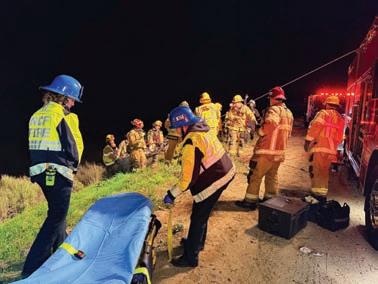
Photo: Cal Fire, Urban Search and Rescue, and NCFPD crews surround the patient and transfer him from the Stokes Basket to the ambulance after he plunged 200’ down the embankment. Valley News/Brian Briggs photo.
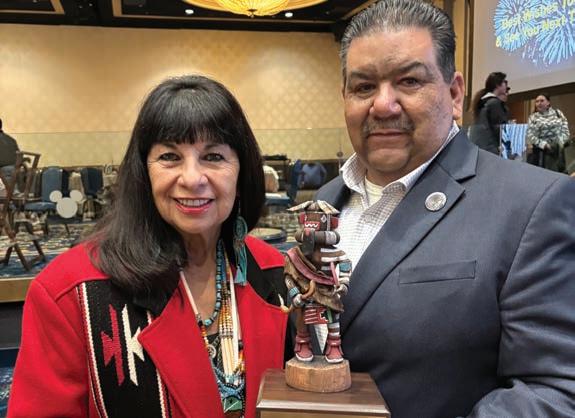
Soboba Tribal Chairman Isaiah Vivanco is congratulated by Yuhaaviatam of San Manuel Nation Chairwoman Lynn Valbuena after receiving the American Indian Chamber of Commerce of California’s Warrior Award.
Protesters Demonstrate Against Trump Admin, ICE in Washington, Across America
Nathan Worcester Senior Reporter
WASHINGTON—One year into the second Trump administration, demonstrations against a presidency marked by intensified enforcement against illegal immigration took place across the United States, including the nation’s capital.
On the evening of Jan. 20, a few hundred protesters took to the chilly streets of Washington to denounce U.S. Immigration and Customs Enforcement (ICE).
Led by a Marxist group, the Party for Socialism and Liberation (PSL), and escorted by law enforcement, the demonstrators marched over a mile, ending just outside Lafayette Square near the White House.
Posts on social media showed actions planned for Jan. 20 throughout the country, from New York City’s Bryant Park to Chicago’s Federal Plaza and Los Angeles City Hall.
At least some were organized in conjunction with the Free America Walk Out, an event
partnering with the Women’s March, and with affiliates of the American Civil Liberties Union and Indivisible, among other organizations.
A website maintained by the Women’s March lists more than a dozen Jan. 20 demonstrations in Washington and nearby communities, including the protest involving the PSL.
Twin Cities Heat Up
The marches and walkouts come just weeks after driver Renee Good was shot and killed in her car by Immigration and Customs Enforcement agent Jonathan Ross on Jan. 7 in Minneapolis.
Video from the incident shows
Good suddenly accelerate her vehicle toward Ross, who then fired repeatedly at her. Federal officials said the officer was hit by the vehicle and opened fire in self-defense.
That incident occurred amid a surge of ICE agents in the Twin Cities, spurred at least in part by investigations into alleged welfare fraud committed primarily
by Somali immigrants.
In the days after the Good shooting, anti-ICE demonstrators turned out in Minneapolis by the tens of thousands. Some protested and even attacked hotels they believed were hosting immigration law enforcement. Others have targeted what they believe to be ICE operations by blowing whistles to alert people of the officers’ presence.
Immigration and Customs Enforcement (ICE) agents confront protestors in front of the Bishop Henry Whipple Federal Building in Minneapolis, Minn., on Jan. 12, 2026. John Fredricks/The Epoch Times On Jan. 18, chanting demonstrators disrupted a service at a St. Paul church where an ICE field director is a pastor. They were joined by former CNN anchor Don Lemon, who livestreamed the event.
Assistant Attorney General Harmeet Dhillon announced plans to charge those who rushed into the Cities Church building, suggesting that charges could potentially be leveled under
the FACE Act and the Ku Klux Klan Act.
ICE has continued to take action in the area amid the rallies and after a Jan. 16 ruling from a federal judge restricting agents’ use of pepper spray and other non-lethal weapons against non-violent demonstrators.
Homeland Security Secretary Kristi Noem announced on Jan. 19 that DHS agents had apprehended more than 10,000 illegal aliens convicted of crimes.
The numbers are in keeping with a much larger trend of immigration law enforcement arrests, deportations, and other departures by illegal immigrants from the United States over the past year.
As of Dec. 10, 2025, over 2.5 million illegal immigrants had left the United States since the start of the second Trump administration, according to DHS.
The View From Washington
On the anniversary of Inauguration Day 2025, the evening’s anti-ICE demonstration in Washington contrasted starkly with the larger and more chaotic activities
that have unfolded in the Twin Cities.
The march, which remained peaceful, began as a rally surrounded on all sides by law enforcement.
People join a march to protest against Immigration and Customs Enforcement operations in Washington on Jan. 20, 2026. Madalina Kilroy/The Epoch Times In addition to the PSL activists, those on the ground included anti-war activist Medea Benjamin of Code Pink as well as a speaker representing a local Somali youth organization.
ICE operations were just one of multiple issues raised by protesters.
Speakers decried American foreign policy, including the recent ouster of Venezuelan leader Nicolás Maduro.
Several weeks after Maduro was captured by American Delta Force operators and taken to New York to face narco-terrorism charges, one man at the march declared that Venezuela’s leftwing Bolivarian Revolution is “won constantly.”
More Than 10,000 Illegal Immigrants Arrested in Minnesota: Noem
Arjun Singh
Secretary of Homeland Security Kristi Noem announced on Jan. 19 that more than 10,000 criminal illegal immigrants had been arrested by federal law enforcement officers during ongoing immigration-related operations in Minneapolis.
“We have arrested over 10,000 criminal illegal aliens who were killing Americans, hurting children and reigning terror in Minneapolis,” Noem wrote on X. “In the last 6 weeks, our brave DHS law enforcement have arrested 3,000 criminal illegal aliens, including
vicious murderers, rapists, child pedophiles and incredibly dangerous individuals. A HUGE victory for public safety.”
Many law enforcement officers of U.S. Immigration and Customs Enforcement (ICE), as well as other agencies, have been deployed to the Minnesota cities of Minneapolis and St. Paul since Dec. 1, as part of Operation Metro Surge.
Local Democratic Party officials and progressive groups have voiced their opposition to this effort, with many protesters demonstrating against law enforcement officers while they are conducting arrests, and have
sued the administration to enjoin the law enforcement operations. The tension grew after protester Renee Nicole Good was shot and killed by an ICE officer. Federal officials said Good drove her SUV into the ICE officer, who shot her in self-defense.
Operation Metro Surge is one of many recent actions the Trump administration has undertaken against Minnesota amid allegations of welfare fraud and racebased discrimination.
The state has been sued by the U.S. Department of Justice for alleged violations of the Civil Rights Act for alleged racial
discrimination in state hiring, and is under investigation by the Department of Housing and Urban Development for alleged violations of the Fair Housing Act arising from “racial favoritism.”
Furthermore, dozens of members of the Somali community in the state have been indicted or convicted of fraud involving the theft of public funds on a massive scale. The Department of Homeland Security has also taken other immigration actions that affected the community, such as terminating Temporary Protected Status (TPS) for Somalia’s citizens and reviewing past asylum and natu-
ralization applications for fraud.
In her post, Noem referenced an ongoing scandal involving the fraudulent misuse of COVID-19 pandemic relief funds in Minnesota, which has implicated Gov. Tim Walz and other Democratic Party officials in the state government.
“There is MASSIVE Fraud in Minneapolis, at least $19 billion and that’s just the tip of the iceberg,” Noem stated. “Our Homeland Security Investigators are on the ground in Minneapolis conducting wide-scale investigations to get justice for the American people who have been robbed blind.”
Tom Homan describes what ICE requires to detain a U.S. Citizen
Mariane Angela News Reporter
Border czar Tom Homan said Tuesday that federal immigration agents may briefly detain a U.S. citizen during an enforcement operation if officers have reasonable suspicion.
During an appearance on “The Will Cain Show,” host Will Cain pressed Homan on claims that United States Immigration and Customs Enforcement (ICE) improperly targeted a U.S. citizen during a Minneapolis enforcement action. Homan responded that agents may briefly detain
American citizens during operations when they have reasonable suspicion, while probable cause is required for an arrest.
“ICE can detain a U.S. citizen if they have probable cause or this person may have committed a crime. Detainment, short detainment and questioning, all you need is reasonable suspicion,” Homan told Cain. “If they’re going to actually arrest a person and charge them, they need probable cause.”
A Minnesota man claims federal agents briefly detained him during an enforcement action, saying officers entered his home,
www.berry-bellandhall.com
restrained him, and escorted him outside while they worked to verify his identity. ChongLy Thao, 56, a naturalized U.S. citizen who goes by Scott, said agents later released him and returned him home.
Homan pushed back against claims of improper enforcement. He walked through the sequence of events that led agents to a Minneapolis home, saying the operation focused on tracking down two illegal immigrants with violent criminal records.
streets of this nation. So I said a target enforcement operation pulled over a vehicle that was licensed to one of these sexual predators. The driver of the car was identified as not being one of them. But his statement to the officer was, ‘The guy you’re looking for is at the house right now. I left it. I just left that house.’” Homan said agents went to the residence after receiving information that the suspects lived there and encountered an individual who matched their description.
traffic stop, coming just a week after another ICE agent fatally shot Renee Nicole Good.
Homan: “Let’s make it clear: ICE can detain a US citizen if they have probable cause that this person may have committed a crime. A short detainment and questioning, all you need is reasonable suspicion.” pic.twitter. com/wa4XNusKDc
— Aaron Rupar (@atrupar) January 20, 2026
Democrats and anti-ICE protesters erupted in anger over the agency’s operations following Good’s shooting on Jan. 7, prompting demonstrations across the city, with activists warning residents when agents are nearby. Speculation grew that President Donald Trump could invoke the Insurrection Act. Democratic Minneapolis Mayor Jacob Frey reiterated that he supports protesters resisting ICE’s presence in the city.
“So ICE went to the house where these two people are reportedly living. And they went in there, and they located this individual,” Homan said. “This individual who matched the description, but they couldn’t verify his identity because he was uncooperative. He failed to do a fingerprint, a quick fingerprint check. He failed to do facial recognition. So ICE detained him until they found out who he was.”
“Let’s look at the facts of that case. ICE was looking for two illegal aliens with criminal convictions. One, sexual assault of a child. The other one, domestic violence, to include obscenity and sexual assault. So both these people shouldn’t be walking the
Violent opposition to immigration enforcement intensified in Minneapolis after an ICE agent shot one of three men who ambushed him during a Wednesday
All content created by the Daily Caller News Foundation, an independent and nonpartisan newswire service, is available without charge to any legitimate news publisher that can provide a large audience. All republished articles must include our logo, our reporter’s byline and their DCNF affiliation. For any questions about our guidelines or partnering with us, please contact licensing@dailycallernewsfoundation.org.
People join a march to protest against Immigration and Customs Enforcement operations in Washington on Jan. 20, 2026. Madalina Kilroy/The Epoch Times
Tensions over U.S. Immigration and Customs Enforcement have escalated after weeks of turbulent protests in Minneapolis.
DOJ Reportedly Investigating Tim Walz, Jacob Frey For Obstructing Law Enforcement
Harold Hutchison Media Reporter
The Department of Justice is reportedly investigating Democratic Gov. Tim Walz of Minnesota and Democratic Mayor Jacob Frey of Minneapolis for obstruction, a local news outlet reported.
Two federal officials on Friday told WCCO, a Minneapolis-area TV station, that a federal investigation was looking into whether Walz and Frey tried to block United States Immigration and Customs Enforcement (ICE) from carrying out operations to enforce immigration law. Reports of the investigation come after increased tensions in the area after an ICE agent fatally shot Renee Nicole Good during a Jan. 7 immigration enforcement operation after being struck by her vehicle and receiving hospital treatment for internal bleeding. (RELATED: Jonathan Turley Compares Anti-ICE Resistance To Southern Governors Defying Civil Rights Laws)
HIKER from page A-1
Sheriff’s officials said the aviation unit located the four missing hikers and safely hoisted them out of the area. The group was transported to the Lake Hemet Mountain Station, where they were medically evaluated.
The search then continued for the additional hiker who had gone out to look for the group.
The aviation unit later located that hiker near the bottom of an approximately 150-foot rock face. Rescue personnel with Riverside Mountain Rescue Unit reached the hiker and pronounced
NEW: US officials confirm to @CBSNews the Department of Justice is investigating both @ GovTimWalz and @MayorFrey for conspiracy to obstruct law enforcement. Dep AG Todd Blanche has called both out for “encouraging violence against law enforcement.” @WCCO — Jonah Kaplan (@JonahPKaplan) January 16, 2026
Both Walz and Frey denounced the shooting, claiming the agent murdered Good, despite cell phone video taken by the ICE agent who fired the fatal shots showing that Good appeared to ignore commands from other ICE agents before backing up her car, looking right at the agent and accelerating towards him after her girlfriend shouted, “Drive, baby, drive!”
ICE deployed hundreds of agents into the Minneapolis area following reports of welfare fraud in Minnesota prompted President Donald Trump to announce in November he would end “Temporary Protected Status” for Somalis in Minneapolis.
them deceased at the scene.
The Riverside County Coroner’s Bureau responded and assumed the investigation. Rescue personnel assisted in recovering the decedent from the rugged terrain. The identity of the deceased hiker has not been released.
The investigation remains ongoing. Anyone with information related to the incident is encouraged to contact Deputy Francisco Lopez at the Hemet Sheriff’s Station at (951)791-3400.
Diane Sieker can be reached by email at dsieker@reedermedia.com.
Federal officials estimate at least $9 billion in funds have been stolen by Somali scammers from various welfare programs, and the Treasury Department launched a probe following a report that some of the money stolen in the fraud scheme went to the Somalia-based radical Islamic terrorist group AlShabaab.
The DOJ probe is focusing on whether Walz and Frey, among other Minnesota officials, violated 18 U.S.C. § 372, which prohibits conspiring “to prevent, by force, intimidation, or threat, any person from accepting or holding any office, trust, or place of confidence under the United States, or from discharging any duties thereof,” CBS News reported. Walz and Frey reportedly have been subpoenaed as part of the investigation, The Washington Post reported.
Frey said Minneapolis police would not cooperate with the federal immigration enforcement operation during an interview with WCCO that aired
CRASH from page A-1
Medics were requested but later declined for the car that was rear-ended after the driver reportedly refused medical treatment. The extent of any injuries was not immediately known.
CHP officers responded to the scene and coordinated recovery efforts, including requesting a tow truck to remove the vehicle from the ravine. No lane closures were reported, and it was unclear whether the driver of the other vehicle involved was injured.
The cause of the crash remains under investigation, but reports from the scene suggested the driver may have fallen asleep before crashing.
Dec. 7. Minneapolis police have been criticized for failing to respond when anti-ICE rioters attacked federal agents and independent journalists.
Walz, in a Wednesday livestream, urged Minnesota residents to film ICE agents and said Trump and Secretary of Homeland Security Kristi Noem were carrying out an “occupation” of the state and that ICE was “dragging pregnant women.”
“If you see these ICE agents in your neighborhood, take out that phone and hit record. Help us create a database of the atrocities against Minnesotans, not just to establish a record for posterity, but to bank evidence for future prosecution,” Walz said.
“This is an obvious attempt to intimidate me for standing up for Minneapolis, our local law enforcement, and our residents against the chaos and danger this Administration has brought to our streets. I will not be intimidated. My focus will remain where it’s always been: keeping
our city safe,” Frey claimed in a statement to the Daily Caller News Foundation. “America depends on leaders that use integrity and the rule of law as the guideposts for governance. Neither our city nor our country will succumb to this fear. We stand rock solid.”
Walz and the Department of Justice did not immediately respond to requests for comment from the DCNF.
This article has been updated with a statement from Minneapolis Mayor Jacob Frey.
All content created by the Daily Caller News Foundation, an independent and nonpartisan newswire service, is available without charge to any legitimate news publisher that can provide a large audience. All republished articles must include our logo, our reporter’s byline and their DCNF affiliation. For any questions about our guidelines or partnering with us, please contact licensing@dailycallernewsfoundation.org.
The patient has been carried up a 200’ embankment on a Stokes Basket before he is transferred to the ambulance that will transport him to a local hospital. Valley News/Brian Briggs photo
Sonic Rocket: local hand-built launchpad for creative dreams
Julie Reeder
Publisher
Tucked away in Fallbrook, a 1,500-square-foot building once used as a cabinet shop now hums with the unmistakable electricity of creativity. Sonic Rocket, one of North County’s most impressive boutique recording studios, wasn’t born from a business plan, an investor packet, or a corporate blueprint. It was born from Christoper Cash’s obsession—an early love of sound, the joy of experimentation, and a lifetime of refusing to give up on what music could be.
A Childhood Spark That Never Faded
The studio’s origin story begins with a reel-to-reel tape recorder in high school. It was a simple machine, the kind that let you record over earlier tracks without erasing them. The moment the young musician discovered he could stack sound on sound— until the recording dissolved into what he fondly remembers as “indistinguishable mush”—he was hooked. That messy, magical experiment lit a fuse that never went out.
The First Studios: Loud, Improvised, and Full of Heart
Like many determined musicians, he scraped together whatever space he could find. A tiny rented practice room in Alhambra. Then another. And another. He called the place Roaring Silence Sound and partnered with an eccentric Cal Tech employee who cooled his Dr. Peppers in liquid nitrogen. It was a shoestring operation—more passion than polish—but it was enough to keep the dream alive.
By day, he worked construction with his father. By night, he was a fledgling recording engineer teaching himself the craft with limited gear and unlimited curiosity. Then came the moment that
down, asked her to stop, and walked away. It was clear that trying to get paid for making music was strangling the joy of making it.
He stepped away. But the fire never really went out.
A Second Chance—This Time on His Terms
We create the WOW
Fast-forward through years of home-studio experiments and creative tinkering. In 2016, he made a decision: he would try again, but only if he could build something that rekindled his love for music rather than diminished it.
He found the perfect place—a Fallbrook home with a 1,500-square-foot detached building. The previous owner used it as a cabinet shop. He saw a blank canvas.
This time, he bought the property outright. No more sinking time and money into someone else’s walls.
He sketched out his dream studio, hired a contractor for the biggest structural challenges, and spent a full year constructing what he would eventually call Sonic Rocket. Friends Shea Thompson and John Saccoman poured in countless hours alongside him. Together, they transformed raw lumber and concrete into a creative launchpad.
The result is a meticulously crafted space with the comfort of a mid-century living room and the acoustics of a world-class sound lab. The control room is warm and welcoming. The live room—21 by 18 feet with a 12-foot ceiling—feels spacious enough for inspiration to breathe.
Two isolated booths make it ideal for everything from vocals to drums to cinematic sound design.
A Studio That Feels Like Home—Because It Is Walk through the front door today, and the owner still hears himself breathe the same words: “Damn… this is a dream come true.”
Sonic Rocket isn’t just a recording studio; it’s a community hub. A place where neighbors, local artists, and professional musicians alike step in, feel instantly at ease, and leave with something they’re proud of. The space offers full audio production, video capabilities, photography, social media content creation — everything a modern artist needs under one roof.
But more than that, Sonic Rocket was built with intention. It’s designed to make creativity fun again — to strip away the pressure, replace it with possibility, and remind people why they fell in love with making music in the first place.
Launching Dreams, One Track at a Time Fallbrook is renowned for its avocado groves, its close-knit community, and its picturesque rolling hills. But tucked quietly within those hills is one of the region’s most unique creative spaces — a hand-built recording studio with a beating heart.
Today Cash works with Matt Day, Nathan Scott, and Josh Burke, and they work as a team at Sonic Rocket, which is exactly what its creator intended: A place where artists gather, where ideas ignite, and where dreams, big or small, launch. Because sometimes, the most powerful thing you can give a community is a room where people are free to make beautiful music together.
changed everything. He was recording “You Light Up My Life” for a woman who was—by
his own account—spectacularly unprepared to sing it. The session was so miserable he set his bass
Christopher Cash is the owner/creator of Sonic Rocket studio in Fallbrook.
Village News/Courtesy photos
Sonic Rocket has a modern control room.
Sonic Rocket studio includes a live performance space.
This former cabinet shop is now a music studio.
Mt. San Jacinto College and AAUW Redlands Branch Host 32nd Annual STEM Conference for Eighth-Grade Girls
San Jacinto, CA – January 15, 2026— Mt. San Jacinto College (MSJC), in partnership with the American Association of University Women (AAUW) Redlands Branch, proudly hosted the 32nd Annual AAUW STEM Conference for EighthGrade Girls, welcoming 264 students from across the Pass Area for a full day of handson learning, exploration, and inspiration in science, technology, engineering, and mathematics (STEM).
Held on MSJC’s San Jacinto campus on January 8, 2026, the annual conference continues a more than three-decade tradition of encouraging young women to explore STEM pathways through direct engagement with female professionals, educators, and industry leaders from throughout the Inland Empire. Participating students represented the Banning Unified School District,
the Hemet Unified School District (including Idyllwild and Anza), and two Yucaipa charter schools—Competitive Edge and Inland Leaders.
The event opened with welcoming remarks from Kathryn Brown, JD, AAUW Redlands Co-President; Diana Galindo, MPA, Vice President of Human Resources at Mt. San Jacinto College; and Betsy Grimes, STEM Conference Co-Chair. For the second consecutive year, Erica Alfaro, award-winning author, international keynote speaker, and education advocate, delivered the keynote address, “You Can Succeed Despite Adversity,” inspiring students to embrace resilience, curiosity, and confidence as they pursue their academic and personal goals. Alfaro also remained on campus to connect with students during lunch in the MSJC Café, offering a more personal opportunity for con -
versation and encouragement.
“For 32 years, this conference has demonstrated the power of access, mentorship, and possibility,” said Dr. Roger Schultz, Superintendent/ President of Mt. San Jacinto College.
“By welcoming these eighthgrade students to our campus and connecting them with women leaders in STEM, we are helping them see themselves as scientists, engineers, innovators, and problem-solvers. MSJC is proud to partner with AAUW Redlands Branch to continue a tradition that opens doors and expands futures.”
Throughout the day, students rotated through interactive workshops spanning a broad range of STEM disciplines. Sessions included civil engineering and flood protection, physics and materials science held in MSJC’s general science
laboratory, forensic science and crime scene investigation, health care and rehabilitation fields such as physician assistant studies, physical therapy, and occupational therapy, as well as museum science and collections management led by educators from the Western Science Center.
Professionals from Garner Holt Education through Imagination led animatronics workshops in MSJC’s Makerspace, exposing students to careers in design, engineering, and creative technology.
“This conference reflects AAUW’s mission to advance gender equity through education and advocacy by removing barriers to success in both education and the workplace,” said Pamela Ford, co-chair of the conference. “By reaching girls before they make their high school course selections, we help counter early disen -
gagement from STEM subjects, expand awareness of real-world career pathways, and introduce students to MSJC’s STEM facilities and the college environment.”
AAUW Redlands Branch expressed sincere appreciation to the organizations and individuals whose support made the conference possible, including the Morongo Band of Mission Indians, Laura May Stewart Foundation, Sun Lakes Country Club Charitable Trust Board, Carole Nagengast, Debbie Wilson, and Susan Bentley, as well as many additional community supporters.
The day’s success was further supported by MSJC student volunteers who served as campus guides, helping students navigate workshops and campus spaces.
Supervisors authorize bids to resurface Contreras Road and Johnson Road
Joe Naiman for the Valley News
The Riverside County Board of Supervisors approved the bid process to resurface two Anza roads.
A 5-0 vote January 13 authorized the advertisement for bids of a construction contract to resurface Contreras Road and Johnson Road. The action also approved the plans and specifications for the project, set a February 4 bid opening date, and found that the resurfacing project which does not create additional traffic lanes and involves negligible or no expansion of the existing road-
way and associated facilities is categorically exempt from California Environmental Quality Act review.
The project will resurface 0.7 miles of Contreras Road from Johnson Road to one-quarter of a mile north of State Route 371 and Johnson Road from Contreras Road to half a mile east of Contreras Road. Both roads have two travel lanes. Contreras Road is a north-south street with a road width varying between 24 and 57 feet. Johnson Road is an east-west street with a width between 16 and 23 feet. Resurfacing is needed on both streets due to deteriorated pavement conditions.
The existing asphalt concrete paving will be pulverized, or ground in place. Grindings with native soil will be mixed and compacted to provide a base which will be overlaid with hot mix asphalt. Excess pulverized material at the end of the new resurfaced road segments will be removed and the remaining base material will be graded, compacted, and overlaid with hot mix asphalt for a smooth transition to the existing pavement. The improvements will also reconstruct asphalt concrete dike, reconstruct concrete and asphalt concrete driveway approaches, construct asphalt concrete overside drainage,
place safety edge and shoulder backing to protect the outside edge of the pavement, and provide traffic stripes, thermoplastic pavement marking, and roadside signs.
The bid package is structured with a base bid for the resurfacing and associated improvements and an alternate bid which covers Frontier Communications facilities adjustments and will become part of the contract if Frontier approves that section of the low responsible bid. The director of the county’s Transportation Department has the authority to sign reimbursement agreements of up to $100,000 without Board
of Supervisors approval, so if Frontier accepts the alternative bid the reimbursement agreement will be approved administratively.
The estimated cost including the amount which would be reimbursed by Frontier Communications is $1,001,936. The county will use gas tax revenue for the expenses which will not be reimbursed.
The resurfacing is expected to begin in spring 2026 and take approximately two months to complete. The work will be phased to keep the road open during construction as much as possible.
Supervisors fund Code Enforcement officer in Lakeland Village
Joe Naiman for the Valley News
The Riverside County Board of Supervisors amended the county’s 2025-26 budget to fund a Code Enforcement officer in Lakeland Village.
A 5-0 vote on January 13 approved $115,000 of Unincorporated Communities Initiative
funding for the Code Enforcement officer and directed the county’s Auditor-Controller to make the appropriate budget adjustments.
The Code Enforcement officer will provide Code Enforcement services in the unincorporated communities of Lakeland Village, Temescal Canyon and Lake Elsinore. The funding covers $80,000 for salary and $35,000 for benefits.
FUNDS from page A-1 without proving that they’re using them wisely. The new message to locals is clear, said Assemblymember Sharon Quirk-Silva, a Democrat from La Palma in Orange County: “The state has been moving forward, not only with the investment in dollars, but also with legislation. Now it is your time to show that if you want these dollars…you have to show us what you’re doing.”
ments that passes state muster – a potential challenge in a state where local jurisdictions’ rules on encampments vary greatly, and many localities have no policy at all. The state also wants localities to get a “prohousing designation” – a special status awarded to places that go above and beyond to build housing. It’s a distinction that only 60 of California’s 541 cities and counties (home to just 15% of the state population) have achieved so far.
Newsom, the Legislature, local officials and other stakeholders likely will spend the next several months fighting about those terms, and hashing out the conditions for the $500 million in homelessness funding proposed in this year’s budget.
Until those details are resolved, exactly what standard cities and counties will be held to – and what will happen to those that don’t comply – is unclear. But one thing is clear: The state is done freely handing out cash.
Some counties are already feeling the heat. They report increased scrutiny as they apply for the homelessness funds already approved in the 2024-25 budget (which, thanks to lengthy bureaucratic delays, have just been made available.)
“They’re holding the counties’ feet to the fire,” said Megan Van Sant, senior program manager with the Mendocino County Department of Social Services.
Newsom’s administration and legislators in favor of the new accountability measures say cities and counties for too long have been scooping up state funds
But the new requirements may make it more burdensome to access crucial homelessness funds.
“I worry that, one, we may leave more cities out,” said Carolyn Coleman, executive director and CEO of the League of California Cities, “and, two, that we may cause delays in the ability to get more people housed sooner, which I think is the goal.”
A tougher application process
Applying for state homelessness funds “absolutely” feels different now than it did last year, and the state is asking tougher questions, said Robert Ratner, director of Santa Cruz County’s Housing for Health program.
Fortunately, the county just approved an encampment policy in September, and has started working on getting a pro-housing designation, he said. But the state still returned the county’s application with plenty of notes.
“It has felt, at times, like the goal post keeps moving a little bit,” Ratner said.
The county’s application still hasn’t been approved, but it seems to be getting close, Ratner said.
In Mendocino County, the state appears to be holding funds hostage until the county can explain its plans to pass an encampment ordinance, said Van Sant. The
In November 2020, the Board of Supervisors created the Unincorporated Communities Initiative to improve the infrastructure and services provided to residents of unincorporated communities with an emphasis on disadvantaged unincorporated communities. The program is funded through the Unincorporated Communities Fund,
county board of supervisors is working on such an ordinance, though it hasn’t come up for a vote yet.
But the state’s requirement puts Van Sant and her team in an awkward position. As housing administrators, they have no say in any rules the county passes that regulate or prohibit encampments on local streets.
“I wanted to stay out of it,” Van Sant said. “I still want to stay out of it. We’re housing providers. We try to figure out how to provide people housing. We don’t want to weigh in on enforcement. At all.”
This year, the requirements may get even stricter. Under the current rules, the state seems to be satisfied as long as a city or county can show how it plans to get a prohousing designation or pass an encampment policy. In the next round of funding, local leaders worry the state will withhold funds unless cities and counties have actually achieved those benchmarks.
It’s all about accountability
At issue is the state Homeless Housing, Assistance and Prevention program, which provides the main source of state money cities and counties use to fight homelessness.
Though Newsom introduced the first round of funding, $650 million, as a “one-time” infusion of cash for local governments in 2019, it became a recurring feature of his administration’s strategy to reduce homelessness over the next five years.
For four years in a row, the state awarded $1 billion a year to be divvied up between counties, big cities and federally-recognized regional homelessness funding
which is allocated during the annual budget process. The county’s 2025-26 budget, approved June 24 included $12,500,000 for the Unincorporated Communities Fund, divided evenly between the five Supervisorial Districts. The Code Enforcement officer will be funded from the Second District budget of Karen Spiegel. Unincorporated Communities
groups known as Continuums of Care. Each round of funding was described as “one-time.” Even so, at least a quarter of the money has gone to day-to-day operating programs, according to data collected by the state.
How HHAP became one of California’s “main sources of homelessness dollars”
Spending split across counties, big cities and regional Continuums of Care
How HHAP spending breaks down between cities, counties and continuums of care between 2019 and 2024, with totals of $640 million in 2019, $300 million in 2020, $800 million in 2021, $800 million in 2022, $870 million in 2023, $760 million in 2024. There was no HHAP spending in 2025. In 2026, the proposed total is $500 million.
Last year, things changed. The budget lacked any extra cash for grant funds, and the state’s main homelessness program received no new money. Instead, the Legislature committed to spend $500 million — a 50% reduction from the last round of funding — in the coming fiscal year contingent on “clear accountability requirements.”
Those requirements for localities, spelled out in a follow-up budget bill signed into law last fall, include: Having a state-approved housing plan, known as a housing element
Having a “Prohousing Designation” from state housing regulators Having local encampment policy “consistent with administration guidance” Ponying up some local funding to match the state contribution
Initiative funding has been used annually for the Code Enforcement officer in Lakeland Village since 2023. The additional enforcement will ensure continued proactive and timely code response, particularly with regard to rapid deployment to priority level one calls and addressing illegal dumping throughout the region.
Demonstrating “progress” and “results” on housing and homelessness metrics These new demands didn’t come out of left field. For several years now, “accountability” has been one of Newsom’s favorite words when discussing homelessness funding. “People have just had it,” he said in 2023. “We want to see these encampments cleaned up.” He has repeatedly threatened to withhold funds, and has gradually ramped up the strings attached to homelessness dollars.
But the current list represents an especially stringent set of requirements for locals hoping for a cut of what has been one of the state’s signature funding sources to combat homelessness.
Quirk-Silva noted that the current list of requirements is not final. She expects the administration to release additional legislative language in February. Legislators will fight over the details through the June budget deadline. She expected particularly fierce pushback over any kind of “prohousing designation” requirement. Revoking funds from areas of the state that lack such a designation would be “penalizing service providers for something that is outside of their control,” said Monica Davalos, a policy analyst with the California Budget and Policy Center, a left-leaning think tank.
San Jose Mayor Matt Mahan wishes the state would focus on more concrete measures of success, such as the number of people housed using state dollars, instead of things like a “prohousing” stamp.
“We’re making this way too complicated,” he said.
Driver ejected on I-15; Empty vehicle launches over wall onto residential sidewalk
Jacob Lavoie and Brian Briggs
MURRIETA — A violent rollover crash on Interstate 15
Tuesday afternoon ended with a driver being ejected onto the freeway shoulder and their vehicle launching over a perimeter wall, landing on a sidewalk in a nearby residential neighborhood.
The accident occurred at approximately 12:56 p.m. on the southbound I-15, just north of California Oaks Road.
According to preliminary reports from the scene, the vehicle rolled over on the freeway, ejecting the driver. The driverless vehicle then continued its momentum, vaulting over the brick sound wall that separates the interstate from the community.
It came to rest on the sidewalk in front of a home on Cadenza Drive.
Emergency responders found the driver conscious on the freeway side of the wall. Paramedics and Murrieta Fire & Rescue units were dispatched to both locations—the freeway to treat the patient and Cadenza Drive to secure the vehicle.
No injuries have been reported among residents on Cadenza Drive, though the vehicle landed dangerously close to homes.
Southbound traffic on I-15 is impacted as crews work to treat the victim and investigate the crash scene. Residents on Cadenza Drive can expect a continued police and fire presence as the vehicle is recovered.
CHP investigating the crash of a car that launched over the freeway perimeter wall, ejecting the driver onto the freeway shoulder and then landing in a residential neighborhood. Valley News/Brian Briggs
Luiseño Indians, is currently serving his third term as Chairman for the Soboba Tribal Council. This is his eighth Council term overall, having served as Vice-Chairman for four terms and one term as Treasurer. He is a former Executive Board member for the Compact Tribes Steering Committee and was recently re-elected to his fourth two-year term as Treasurer for CNIGA to assist with its efforts to promote and protect Tribal sovereignty and gaming.
He is the current Pacific Region Delegate on the national Indian Gaming Association Board of Directors. In 2021, Isaiah was elected to the California Fee-to-Trust Consortium Board of Directors, which assists Tribes in reclaiming lands and placing them into trust status. For eight years, he served on the Soboba Foundation and was Tournament Chair for the annual Soboba Foundation & Soboba Casino Resort Charity Golf Tournament. Since 2022, Isaiah has served as Chairman of the Tribal Nations Advisory Council for the American Indian Science & Engineering Society (AISES). He is a member of the Southern California Tribal Chairmen’s Association (SCTCA) and has been on the Riverside County District Attorney’s Tribal Advisory Board since 2023. He sits on the 7G Board of Directors as Vice President, supporting young Native athletes. He was elected to the First Nations Experience (FNX) Board of Directors, which supports television exclusively devoted to Native American and world Indigenous content.
Vivanco enjoys playing Peon, watching his children, and now 10 grandchildren, sing and dance at Bird Singing gatherings. He also likes golfing and fastpitch softball. Isaiah works hard to deliver strong leadership for his Tribe in promoting sustainable economic development. It is very important to him to provide for the current membership as well as future generations to come.
The AICCCA event took place during its 30th annual Native American Heritage Month Luncheon on Nov. 21 at the Disneyland Hotel/Disneyland Resort in Anaheim. At the luncheon, Vivanco was presented with its annual Warrior Award, which honors those who embody the spirit of a “warrior” in the contemporary sense—people who: champion Native entrepreneurship; advocate for Tribal sovereignty and Native economic self-determination; demonstrate exceptional dedication, courage, and integrity; serve their communities through mentorship, advocacy, and long-term commitment; and build meaningful
partnerships between Tribes, Native businesses, and statewide industries.
The first person to speak as an introduction for Vivanco was Pechanga Tribal Member Andrew Masiel, who serves as a Pechanga Development Corporation Board member and has known Vivanco for a number of years. “As a young man growing up on the (Soboba) Reservation, he participated in a lot of activities with the Tribe,” Masiel said. “He exhibited a lot of ambition, a lot of desire and involvement.” Tomas Tortez Jr., former Torres Martinez Desert Cahuilla Tribal Council Chairman, received the Warrior Award last year and said it was an honor to know Chairman Vivanco. “I’ve known him as a mentor during my eight-year chairmanship,” Tortez said. “I would see Isaiah in every aspect of advocacy for Tribal matters. I’d see him in Sacramento and Washington, D.C. whenever there were legal battles to be held. It takes being away from the family to be there, so I appreciate that he not only spent time doing that but also talked to me about various issues, especially with us being a smaller non-gaming site. All events, activities, and advocacy shared with Chairman Vivanco truly show his worthiness of the Warrior Award. I think all the accomplishments he has made will carry on for generations. It’s more than showing up—you have to speak and be
heard, which he articulates so well. When you’re running your government, it takes a lot of dedication, a lot of time, a lot of effort—so thank you for all you do, Chairman.”
Audrey Martinez, Council Secretary for Yuhaaviatam of San Manuel Nation, said she has gotten to know Vivanco over the past few years and found him to be very dedicated with tremendous leadership skills. “And like Tomas said, he’s everywhere,” she said. “You need someone like that in these leadership positions. It takes a lot of time, dedication and effort when running your government. Thank you, Chairman, for all your hard work.”
Yuhaaviatam of San Manuel Nation Chairwoman Lynn Valbuena, who also serves as Chairwoman of TASIN said, “I concur with all the words that have been said by others. Chairman, thank you for all the years you’ve been doing this. We are very appreciative of all the sacrifices that our Tribal leaders make to be somewhere, and we always say if we didn’t have the support at home, it’s not going to happen. When you have that support at home and have the passion to love what you do, you go out and do it as it comes to dedication and commitment. Chairman Vivanco sits on many boards and is now on many steering committees with different organizations. We’re very honored to see you getting this award and we ap -
preciate everything you do with your Tribe; the collaboration, the work and the long, long hours. Thank you again.”
Soboba Tribal Member and former Tribal Council Chairwoman Rosemary Morillo was the last to speak before inviting Vivanco to the stage. “Council always faces many challenges. It’s constant juggling with all that has to be done. In leadership, you have the oldest to the youngest, you have to be responsible for on your reservation; you have to include their needs. We want to take care of what we have currently but also plan for the future. In leadership, you have to think of all those things and have contingency plans in place, and help everyone understand this is why we do this, this is the process. He has a long list of accomplishments and all he is involved in but there’s more to those boards you’re sitting on. It takes a lot of time away from your family and from everyone but there can be good that comes out of it all. It takes a lot to be standing in leadership; it’s a lot of weight on you.”
Chairman Vivanco thanked the American Indian Chamber of Commerce of California for the recognition. He also thanked those who offered such heartfelt words of support.
He praised his fellow Tribal Council members for being so engaged and active, which allows opportunity for him to serve, network, and maintain
important relationships with various boards.
“Potential board appointments are discussed with our Council to weigh the pros and cons of how it will benefit Soboba,” Vivanco said. He was proud to be re-elected to the California Nations Indian Gaming Association (CNIGA) board by 57 California Tribes where he can continue to assist the group in its efforts to promote and protect Tribal sovereignty and gaming.
He said this is a critical time for all Tribes as the threat of illegal event contracts through prediction markets has never been more real or impactful.
“CNIGA is at the heart of this fight and having a seat at that table is so important,” Vivanco said. “I’m grateful that we have such a strong Council that allows me to represent Soboba in trying to protect what we have.” Serving on the American Indian Science and Engineering Society (AISES) board as Tribal Nations Advisory Council Chairman helps him keep pace with what is needed to ensure Soboba’s youth are getting the education and tools needed to have successful futures.
“If we do not continue to adapt to this rapidly changing, technology-driven world, we risk being left behind” Vivanco said.
Submitted by the Soboba Band of Luiseño Indians
SOBOBA from page A-1
Guest speakers shared words about Chairman Vivanco before presenting him with the Warrior Award on Nov. 21. From left, Audrey Martinez, Tomas Tortez Jr., Rosemary Morillo, Isaiah Vivanco, Lynn Valbuena, and Andrew Masiel.
Photos courtesy of the Soboba Band of Luiseño Indians
Trump Unveils New Health Care Affordability Plan
The plan includes key Trump initiatives, such as reduced prescription drug prices and price transparency for providers.
Lawrence Wilson Senior Reporter
President Donald Trump on Jan. 15 released his administration’s new health care affordability plan, which aims to lower prices through marketplace reforms that include price negotiation, increased competition, and greater price transparency.
Trump’s “Great Healthcare Plan” includes actions the administration has already introduced or is working to implement. If codified in federal law rather than being enforced through executive orders and federal regulations, the provisions are expected to carry greater weight and be more likely to last through future administrations.
“Instead of putting the needs of big corporations and special interests first, our plan finally puts you first and puts more money in your pocket,” Trump said in a video announcement. He called on Congress to pass the health care plan.
Reducing Prescription Drug Prices
The Trump administration has so far negotiated reduced drug prices for Medicaid patients with
15 pharmaceutical manufacturers through Trump’s Most-Favored Nation Prescription Drug Pricing plan.
The plan calls for pharmaceutical manufacturers to offer their lowest price on drugs to Medicaid customers, as well as to sell some drugs directly to U.S. patients at lower prices, introduce any new medications into the U.S. market at the lowest available price, and reinvest revenue realized from higher drug prices in other developed nations into the U.S. economy.
The policy is aimed at leveling prices between the United States and other developed nations, which have long enjoyed a price advantage over the United States.
Dr. Mehmet Oz, administrator of the Centers for Medicare and Medicaid Services, said the lower drug prices will save Americans far more than the cost of the prescription.
“When you reduce obesity-related complications from hypertension and diabetes—and the downstream effects of that, heart attacks, kidney failures, stroke, dementia, liver issues—you actually start saving enough money to justify more investments [in new medications],” Oz told reporters
on Jan. 15.
Trump is asking Congress to make the policy law, with a grandfather clause for preexisting deals made by the administration.
The plan would also allow more medications that are proven to be safe to be dispensed without a prescription, reducing prices by increasing competition and avoiding the expense of consulting a doctor.
Direct Payments to Consumers
The Trump plan prioritizes making federal assistance in purchasing health care directly available to consumers rather than channeling the funds through insurance companies.
This contrasts with the Affordable Care Act—former President Barack Obama’s health care law, known as Obamacare—which operates by providing tax credits to consumers, which are paid directly to health insurers. Republicans have argued that the practice is both inflationary and a potential source for fraud. Democrats have suggested making them permanent.
“The president thinks that is far too narrow a view on what is
ailing our health care system, and that is why he is putting something out that is much broader on how to improve affordability for American patients, not just in Obamacare,” a White House spokesperson told reporters on Jan. 15.
A plan to provide funded Health Savings Accounts as an alternative to extending the Obamacare enhanced subsidies, which expired in December 2025, failed to advance in the Senate.
A bipartisan group of senators continues to work on a compromise plan that would both extend those enhanced subsidies and combat fraud. After learning of Trump’s plan, Sen. Lisa Murkowski (R-Alaska) said she will not give up the effort to extend the enhanced subsidies.
“I think we have to respond to the immediacy of the situation that we have now,” Murkowski told reporters on Jan. 15, referring to the sharp rise in health insurance premiums this year.
Price Transparency
Trump’s plan would compel health insurers to provide more information to consumers by adopting a “Plain English Insurance” Standard in com -
HOME & GARDEN
A Safer Way to Stop Household Pests
Valley News staff
When creepy-crawly pests show up in your home, the instinct is often to reach for the strongest chemical spray available—or call an exterminator. But before you do either, there’s good news: many common household pests can be eliminated safely, naturally, and inexpensively.
One of the most effective tools can be food-grade diatomaceous earth, often called DE.
Diatomaceous earth is a fine, off-white powder made from fossilized marine algae. Under a microscope, it looks like tiny shards of glass. To insects, that’s bad news. When crawling pests such as ants, cockroaches, silverfish, centipedes, fleas, or bedbugs come into contact with it, the
powder damages their exoskeletons, causing them to dehydrate and die.
The best part? Food-grade diatomaceous earth is non-toxic to humans and pets. It contains no chemicals, no poisons, and no fumes. In fact, some people even use it internally for health purposes.
The key is making sure you purchase food-grade DE, not pool-grade, which is chemically altered and unsafe for household use.
How to Use It
Apply DE using a flour sifter, salt shaker, or bulb duster. Lightly dust: Along baseboards Around doors and windows Under sinks and appliances
municating rates and coverage comparisons in simple terms.
Insurers would be required to publish information on their websites on the percentage of revenue paid out in claims, the percentage of claims denied, and the average wait time for routine care.
Health care providers who accept Medicare or Medicaid would be required to prominently post their pricing and fees in their offices for patients to see.
Increased transparency lowers prices by affecting the shopping choices of individuals and also employers, who are the largest purchasers of health coverage, according to the White House.
“Large employers are very, very desperate to get clear information on how they can be negotiating better prices,“ the White House spokesperson said. ”They have perhaps the best incentives within the system.”
The first Trump administration instituted a 2019 requirement that hospitals disclose their prices to the public. However, enforcement and compliance were limited.
The Trump administration proposed an updated transparency rule in December 2025.
• In cracks and crevices
• Around the exterior foundation of your home
Because the powder is very fine, it’s wise to wear a mask during application to avoid inhaling dust.
For flea problems, sprinkle DE into carpets, work it in with a broom, let it sit for 24–36 hours, then vacuum thoroughly. Dispose of the vacuum bag afterward. For ants, lightly dust entry points and trails. Once they walk through it, the problem usually resolves itself quickly.
Many people assume insects disappear in winter. In reality, cold weather drives them indoors in search of warmth, food, and moisture.
Common winter pests include ants, cockroaches, silverfish, centipedes, and spiders. If you suddenly notice more activity during colder months, it’s not unusual—it’s seasonal.
• Vinegar: Removes scent trails that ants follow.
• Cedar blocks or chips: Naturally repel insects in closets and pantries.
Diatomaceous earth is also effective outdoors. It helps control aphids, slugs, and other soft-bodied pests and even adds trace minerals like calcium and magnesium to the soil. Apply it around plant bases or mix it lightly into the soil. Just avoid using it directly on flowers where pollinators are active, and reapply after rain. If you want to go fully chemical-free, here are a few more effective options: Peppermint oil: Mix with water and spray around doors and windows to repel ants and spiders.
• Bay leaves: Help deter roaches and pantry pests.
• Pre vention: Seal cracks, fix leaks, and store food in airtight containers.
• Diatomaceous earth is one of the safest and most effective pest-control tools available. It’s affordable, easy to use, and environmentally friendly—making it an excellent first step before turning to chemical treatments.
For more practical, money-saving tips and uses for food-grade diatomaceous earth, visit: EverydayCheapskate.com/DE
A cockroach. Pexels Photo
If you have pests at home, like ants, you can consider trying natural products like diatomaceous earth. Photo by Mizanur Rahman/pexels
CALENDAR OF EVENTS
To submit an upcoming community event, email it to valleyeditor@reedermedia.com, and put “attention events” in the subject line.
CHILDREN’S EVENTS
ONGOING – MilVet Jr. is a MilVet program for our youngest heroes in training. Meetings take place on the first Tuesday of the month. Locations will vary between the MilVet office and local venues. Activities that focus on learning teamwork, leadership, and community are geared for ages 5-11, but all children are welcome to join. Limited spots available, so sign up at milvet.org/milvetjr.
COMMUNITY EVENTS
Jan. 26 – 5:30 p.m. A history presentation called “The Expeditions of Juan Bautista De Anza - 1774, 1775-76” to be given by Riverside County historian Steve Lech at the Temecula Valley Historical Society, the red barn next to Kohl’s in south Temecula. The event is free, and light refreshments will be served. For more information, contact Rebecca Farnbach at info@temeculahistory.org
Jan. 31 – 6-8 p.m. Arts Council Menifee 16th Year Celebration of Creativity and Community at Kay Ceniceros Senior Center, 29995 Evans Rd., Menifee. Enjoy a lively reception showcasing local artists, talented entertainers, a Carol South silent auction, and complimentary dishes from our wonderful local restaurants. Admission is free.
Feb. 6 – 6-10 p.m. Arts Council Menifee Spring Music & Art Showcase at MSJC Menifee, 27587 La Piedra Rd., Menifee. Santa Rosa Academy Middle & High School choirs will perform surrounded by student art displays. Admission is free.
Feb. 21 – 8 a.m.-12 p.m. Free Bulky Item Drop-Off Event for Menifee residents, at MSJC Menifee Campus, 28237 La Piedra Blvd., Menifee. Must show proof of residency. Open until the bins are full. Accepted items include appliances (limit 3 per vehicle), air conditioners, barbecue grills, bundled branches, bagged green waste, chairs, couches, furniture, mattresses (limit 3 per vehicle), microwaves, patio furniture, used tires (no rims, 4 ft. diameter ONLY, limit 9 per vehicle), and e-waste. Please be prepared to off-load your own items. For more information, visit www.cityofmenifee.us/menifeerecycles.
ONGOING – Wednesdays, 7 a.m. Grandfathers for Golf is holding weekly fundraiser golf outings at Golden Era Golf Course in San Jacinto (19871 Gilman Springs Road). Cost to play is $25, which includes 18 holes of golf and a golf cart, and supports the Grandfathers for Golf nonprofit that teaches area children golf for free. NOTE: Golden Era will be closed the month of October for reseeding, but Wednesday golf outings will resume in November and run indefinitely.) Book a tee time at 951-604-1312.
ONGOING – Saturdays, 8 a.m. to noon. The Sun City Farmers Market meets every Saturday at the Sun City Civic Association at 26850 Sun City Blvd., in Sun City, with local vendors and crafts.
ONGOING – Riverside Transportation Commission is offering Park and Ride lots to connect with carpools, vanpools, and transit systems in Beaumont at 600 E. Sixth Street; in San Jacinto at 501 S. San Jacinto Avenue, and in Temecula at Grace Presbyterian Church, 31143 Nicolas Road, open from 5 a.m.
to 10 p.m. but not on weekends.
ONGOING – Line dancing classes are held on Wednesdays from 3:30 to 5 p.m. at Lake Elsinore/Wildomar Elks Lodge, 33700 Mission Trail, in Wildomar, across from the Animal Friends of the Valleys. Classes have a DJ with learning levels beginning to intermediate. $5 per lesson. Contact Joyce Hohenadl at 951-674-2159.
ONGOING – Sun City Civic Association Monthly Square Dance sessions are held on Sundays from 1:30-5 p.m. at 26850 Sun City Boulevard.
ONGOING – If you know a homebound older adult, resources in Menifee are available, including grab-and-go, cooked, and frozen food for pickup. Courtesy pantry items and meals delivered with no contact. Three days of emergency food can be delivered immediately, or restaurant meal delivery for those who don’t qualify for food assistance programs. Call the California Department of Aging at 800-510-2020 for help.
ONGOING – Saturdays and Sundays only, 7 a.m. to 3:30 p.m. The Winchester Swap Meet continues at 33280 Newport Road in Winchester. The small local swap meet is only 50 cents for entry, and anyone under the age of 10 has free admission. No dogs allowed.
ONGOING – 9 a.m. to 1 p.m.
Every Sunday, the Murrieta Village Walk Farmers Market is at Village Walk Place in Murrieta. The Sunday morning farmers’ market at Village Walk Plaza is a place to buy fruits and veggies, gourmet food, and crafts. Come to the center in the northwest corner of Kalmia/Cal Oaks at the Interstate 215 exit in Murrieta.
ONGOING – Temecula’s Farmers Markets are offered in Old Town Temecula on Saturdays from 8:30 a.m. to noon, 4100 Main Street in Temecula; at Promenade Temecula, 40640 Winchester Road, outside JCPenney every Wednesday from 9 a.m. to 1 p.m., and at Vail Headquarters, 32115 Temecula Parkway, every Tuesday from 9 a.m. to 1 p.m. In compliance with the Centers for Disease Control and Prevention and Riverside County Public Health orders, the farmers’ markets will be restricted to agricultural products only. Follow the Old Town Temecula Farmers Market on Facebook to stay updated. No pets allowed.
WORKSHOPS & MEETINGS
Jan. 22 – 10 a.m.-2 p.m. Veterans Expo at French Valley Library, 31526 Skyview Rd., Winchester. Sponsored by Third District Supervisor Chuck Washington and Riverside County Veterans Services, this event offers veterans free support and community resources, such as benefit assistance, housing support and disability services. Visit with over 20 area nonprofits. Learn more at https://rivcoveterans.org/ events/veterans-expo.
Feb. 28 – 8 a.m.-1 p.m. Master Composter Training Program at Wildomar City Hall, 23873 Clinton Keith Rd., Wildomar. Trainees will explore various home composting methods and acquire the skills to troubleshoot issues and effectively utilize finished compost. Students must attend all 4 Saturday class sessions (Feb. 28, March 14, 21, and 28), read the course material, and submit online quizzes. Students who successfully complete the program will receive a certificate of completion. Register at https://rcwaste.org/MCT.
ONGOING – 10 a.m. The Temecula Valley Republican Women meet each month at the Wilson Creek Winery, 33960 Rancho California Road, Temecula. For questions, please contact info@tvrwomen.org
ONGOING – Temecula Valley Genealogical Society hosts the Family History Research Assistance Program for those interested in learning more about their family roots. The society offers free research assistance through this volunteer program. Appointments are available in person or via Zoom. Contact the TVGS Family Research Coordinator at tvgs.research.assist@ gmail.com
ONGOING – Temecula’s Path of Honor at the Temecula Duck Pond, 28250 Ynez Road. A program to give a place to remember and honor veterans from the U.S. Army, Navy, Marines, Air Force, Coast Guard, and the World War II Merchant Marines with a permanent paver. The pavers cost $185. Orders may be placed year-round and are consolidated, engraved, and placed on the path annually each November. For more information, visit http://TemeculaCA.gov/ Veterans or contact the Temecula Community Services Department at 951-694-6480.
ONGOING – Want to help deployed American troops remotely? Help shop for the most needed items without leaving home, as an easy way to help support deployed men and women by purchasing items remotely and having them delivered to MilVet at designated drop-off locations for packing. All items on the list are special requests from deployed military men and women. MilVet is a nonprofit organization that holds monthly packaging events at different
community locations in the area. For drop-off locations and packaging locations, visit www.milvet.org/military-care-packages.
ONGOING – Assistance League of Temecula Valley hosts a meeting for its member volunteers and guests every first Tuesday of the month (dark in July) at their facility at 28720 Via Montezuma, Temecula at 9:30 a.m. social and 10 a.m. meeting. The meeting room is adjacent to the thrift shop. Anyone interested in exploring volunteering or learning more about the organization is welcome to attend. Email altemecula@yahoo.com for more information.
ONGOING – Multiple Sclerosis Support Group meets on the third Monday of each month at the Mary Phillips Senior Center, 41845 Sixth Street, in Temecula from 10 a.m. to noon. For more information, email gaugustin206@gmail.com or join the meeting.
ONGOING – Sons of Norway/ Scandinavia meets at noon the first Saturday of every month, September to June, at the Heritage Mobile Park Clubhouse, 31130 S. General Kearny Road, in Temecula.
ONGOING – 10-11:30 a.m. Michelle’s Place Cancer Resource Center and The Elizabeth Hospice host a virtual support meeting for caregivers every second and fourth week of the month via Zoom. Get helpful tips and learn from others who are also dealing with similar challenges. For more information and to register, contact The Elizabeth Hospice Grief Support Services at 833-349-2054.
ONGOING – Food Addicts in Recovery Anonymous, a free 12-step recovery program for anyone suffering from food obsession, overeating, undereating or bulimia, has meetings throughout the U.S. and the world. Contact 781-932-6300, or for local meetings, call 925321-0170 or visit www.foodaddicts.org.
ONGOING – The Murrieta Garden Club meets each month at the Murrieta Community Center, 41810 Juniper St. Anyone who likes to garden or is interested in plants is welcome. Membership is $10 per year. Find more information about the monthly event or project on Facebook.
ONGOING – Temecula Valley Rose Society meets each month. For more information and new meeting dates and places, visit www.temeculavalleyrosesociety.org.
ONGOING – Menifee Toastmasters meets every Thursday at noon for one hour at a designated place to have fun, enhance speaking capabilities, gain self-confidence, and improve social skills. For new dates, call 760-807-1323 or visit www. MenifeeToastmasters.org for more information.
ONGOING – Homeless veterans can receive free help by dialing 877-424-3838 for 24/7 access to the VA’s services for homeless, at-risk veterans. Chat is confidential for veterans and friends. Visit www.va.gov/ homeless
ONGOING – The Dorland Scribblers meet on the second Sunday of each month from 1-3 p.m. at 36701 Highway 79 South, Temecula. We welcome fiction, non-fiction, poets, memoirs, and screenwriters. We host writing-craft discussions; attendees may read up to a five-minute excerpt from their work for feedback/critique. RSVP at www.dorlandartscolony.com/sunday-scribblers.html.
“28 Years Later: The Bone Temple”
Bob Garver
Audiences largely left last June’s zombie threequel “28 Years Later” thinking the same thing: “That was a good movie, but what the heck was up with that ending?” They were referring to the last-minute saving of young protagonist Spike (Alfie Williams) from a horde of Infected by a gang of blonde-wigged, tracksuit-wearing ruffians led by long-missing earlier character Jimmy (Jack O’Connell). The tone of the sequence was one of stylized action, which clashed with the more ominous, meditative horror (short of the obvious Infected attacks) of the rest of the movie. Now, a mere seven months later, “28 Years Later: The Bone Temple” provides answers as to exactly what the heck was up with that ending.
It turns out that the gang, known as The Fingers (because together they form a mighty fist), while they like to take out the Infected, aren’t much kinder to uninfected humans. They’re a cult of serial killers, all stripped of their original names and now called Jimmy, who serve a Satanic deity known as Old Nick. O’Connell’s leader, now going by the name Sir Lord Jimmy Crystal, agrees to take in Spike if he can kill a Jimmy in a battle to the death. Spike lives to be inducted, but he lives in terror. Sadly, that’s his one mode through the entire movie. In “28 Years Later,” the character had a great arc where he abandoned his lying father and safe-haven community to get help for his sick mother and then face an uncertain future, but here he’s just scared all the time. Granted, I’d be consistently scared if I had to spend my life around the vicious Fingers, but it’s not much of a “hero’s journey.”
The story sometimes breaks from Spike and The Fingers to spend time with Dr. Ian Kelson (Ralph Fiennes), a character from the last movie who built The Bone Temple, a tall pile of skulls, as a memorial to the dead, and not, as some thought, a collection of weirdo trophies. He subdues an “Alpha Infected,” whom he names Samson (Chi Lewis-Parry), and takes strides to study him, as there may be something inside his head (psychologically) that may be the key to overcoming not just the Infected, but the 28-year-old infection.
Most of the movie is a noticeable step down from “28 Years Later.” Sure, charging Infected and satanic murderers are scary and all, but it’s missing that certain sense of timing and heartfelt touch given to it by Oscar-winning director Danny Boyle (Nia DaCosta, of the mixed-bag “Candyman” remake, is at the helm this time).
That is, until the two stories converge. Once some of The Fingers become convinced that Dr. Kelson is their god Old Nick (thanks to his iodine-coated red skin), Sir Lord Jimmy Crystal has to find a way to keep his own hold on the group. And that’s where the musical number comes in. It’s not Jack O’Connell performing as he did in “Sinners,” but there is a show-stealing musical number and a climax that redeems the entire movie… and then a poorly-kept secret surprise after that.
“28 Years Later: The Bone Temple” can be a slog at times, and by “at times” I mean pretty much the entire first hour. It shouldn’t be a slog, given the high-stakes subject matter, but I could never shake this feeling that I was just watching a lesser version of a world I had spent just enough time in only seven months ago. But then that ending is so explosive that all is forgiven. Supposedly Danny Boyle will be back to direct a fifth movie in this series (my guess is it will be the third with “Years” in the title, to complete the trilogy within the larger continuity), and if he can seamlessly add his sensitive touch to the spectacle of this movie’s most memorable sequence, we’ll have a horror movie for the ages.
Grade: B“28 Years Later: The Bone Temple” is rated R for strong bloody violence, gore, graphic nudity, language throughout, and brief drug use. Its running time is 109 minutes. Contact Bob Garver at rrg251@nyu.edu.
Rancho Christian basketball teams continue to dominate Ivy League play
JP Raineri Sports Editor
TEMECULA – The Rancho Christian Eagles boys’ and girls’ basketball programs asserted their dominance in the Ivy League with commanding victories last week.
The boys’ team maintained its first-place position in the league standings, improving to 12-8 overall and a perfect 4-0 in league play after an 81-60 win over Orange Vista last Wednesday. The Eagles established control early at the Val Center, jumping out to a 21-5 lead in the first quarter and never relinquishing it. Jeremiah Profit led all scorers with 19 points. James Wilson contributed 15 points, while Tony Rutledge
added 16 points, including four three-pointers. Following the victory over Orange Vista, Rancho Christian continued its winning streak with two more decisive wins. The Eagles defeated Riverside Poly 60-35 and secured an 83-53 victory against Rancho Buena Vista on Jan. 17. With only six games remaining in the regular season, the team faces a challenging week ahead with matchups against Rancho Verde, Hillcrest, and La Mirada.
Meanwhile, the Rancho Christian girls’ team delivered an overwhelming performance in their recent home game against Hemet.
The Eagles demonstrated why they are a top team in the region, starting the game with a 10-0 run on their way to a staggering 113-19 victory over the Bulldogs.
Ebony Taylor-Smith was the high-point scorer for the Eagles, finishing with 33 points, which included seven three-pointers.
Addison Archer was a major force, pouring in 29 points, and Naomi Kemle chipped in with 13 points. The win improves the girls’ team record to 16-4 on the season as they continue their impressive campaign.
Send local sports tips and info to sports@reedermedia.com.
AnzA VAlley OUTLOOK
AnzA VAlley
Photos by Valley News/David Canales
Rancho Christian Women’s basketball team improves to 16-4 with a 113-19 win over Hemet
Ebony Taylor-Smith drops seven 3-pointers on her way to a game high 33points for the Eagles
Super Freshman Addison Archer adds a smooth 29 points
Naomi Kemle drives to the basket for two of her 13 points
Eagles cap off successful Coaches vs. Cancer event with dominant win
JP Raineri Sports Editor
TEMECULA — The Val Center Gym at Rancho Christian High School was filled with energy Saturday as top girls’ basketball programs from across Southern California gathered for the 4th annual Coaches vs. Cancer event. The daylong tournament brought together teams from Yucaipa to San Diego to raise funds and awareness for cancer research.
The event featured seven games throughout the day, drawing a steady crowd to the campus. Players and coaches donned pink attire and accessories, uniting competitors in support of a common cause. Participating schools included The Bishop’s School, Carlsbad, Grossmont, Hillcrest, La Cañada, Lincoln, Montgomery, Patrick Henry, San Diego, Scripps Ranch, and Yucaipa High School.
Rancho Christian, serving as the host school, closed the night with a commanding performance. The Eagles defeated Lincoln High School of San Diego with a final score of 8640. The victory capped off a full schedule of competition designed to bring the community together for more than just basketball.
“Rancho Christian and our Girls’ Basketball Program are proud to host this event, bringing together top teams for a common cause — saving lives from cancer,” event organizers stated.
The tournament continues to grow as a staple of the January sports calendar in Temecula, combining high-level athletic competition with significant community impact.
Send local sports tips and info to sports@ reedermedia.com.
Rancho Christian’s Jeremiah Profit scores 19 points for the Eagles in Wednesday night Ivy league contest
Valley News/David Canales photos
Answers to puzzle on page A-8.
James Wilson drives to the basket for two of his 15 points
[right] Tony Rutledge connects on four 3-pointers on his way to 16 points on the night
Temecula community rallies in wake of student-athlete’s passing
JP Raineri Sports Editor
TEMECULA - A profound sense of loss has settled over Temecula following the recent death of Kale Anderson, a sophomore and football player at Temecula Valley High School. His passing after an accident has left family, friends, and the wider community grappling with an immense and sudden void.
The Anderson family confirmed the news, sharing their grief through a memorial fundraiser page. “It is with the heaviest hearts that we share the passing of our beloved Kale,” the family stated. “There are no words that can truly capture the pain our family is feeling, nor the depth of love we have for him.”
Described as loving, kind, and funny, Kale was a source of light for those who knew him. “He meant everything to us. He was our heart, our joy, and a light in the lives of everyone who knew him,” the family’s message continued. “The world feels unbearably quiet without him.” The shock of the loss has been
felt deeply at Temecula Valley High School. The school’s football program expressed its sorrow in a social media post. “His loss is gut-wrenching, and our hearts are shattered as we try to process this unimaginable tragedy,” a member of the team’s staff wrote.
In response to the tragedy, the Temecula Valley Unified School District has taken steps to support its students and staff. Crisis team members and support staff were made available on campus Monday to help the school community navigate their grief, with plans for them to remain accessible over the coming weeks. School officials have encouraged anyone needing support to reach out to their counselors, reinforcing that the well-being of the students remains their highest priority.
As the community mourns, many have sought ways to support the Anderson family during this difficult time. A GoFundMe campaign was established to assist the family
with significant and unexpected financial burdens, including medical expenses and other related costs.
“Many members of our community have reached out asking how they can help support the Anderson family during this incredibly painful time,” the football team’s post stated.
“Donating to this GoFundMe is a meaningful way to come alongside the Anderson family and help ease some of the weight they are carrying during this season of grief.”
The fundraiser has seen an outpouring of support, reflecting the community’s desire to stand with the grieving family.
“Any donation, share, or kind word is more appreciated than we can ever express,” Graves wrote on the campaign page.
“Thank you for surrounding our family with love, prayers, and support during the most difficult time of our lives.”
The community continues to come together, offering prayers and compassion for the Ander-
son family as they navigate their unimaginable loss.
Funeral Arrangements Announced
The Anderson family has shared funeral arrangements for those wishing to support Kale’s loved ones. Services will be held on Sunday, Jan. 25, at Greenwood Memorial Park and Mortuary, located at 4300 Imperial Avenue in San Diego. The services will take place at the Salli Lynn Chapel within the Memorial Park.
The schedule for the services is as follows:
To support the Anderson family, you can visit the GoFundMe page: https://www.gofundme. com/f/2nz7b-in-loving-memory-of-kale
Send local sports tips and info to sports@reedermedia. com.
Joshua Cervantes (red corner) and Devin Gallardo engage in a fierce exchange of punches during Hendo’s Fight Night bout in 2023. Valley News/Action Captures Media Group
Dan Henderson shares stories and laughs with fans at Hendo’s Barrel House, creating a lively atmosphere after an action-packed fight night. Valley News/Courtesy photo
Kale Anderson was a beloved Temecula Valley High School student and football player remembered for his kindness and humor. Valley News/ Courtesy photo
An empty Temecula Valley High School football field stands as a quiet reminder of a community mourning the loss of one of its own. Valley News/ Courtesy photo
RivCo Vote brings voter outreach to Anza swap meet
Diane Sieker Staff Writer
Shoppers at the Anza swap meet had an opportunity to register to vote and learn more about the election process Saturday, Jan. 17, when representatives from the Riverside County Registrar of Voters set up an outreach table at the Anza Community Hall. Alberto Perez, Frances Hernandez and Jonathan Williams greeted residents with flyers, informational materials and a friendly presence, answering questions and helping eligible voters complete registration forms. The team engaged attendees in conversations about voting, election timelines and how to participate in upcoming elections.
The outreach event is part of Riverside County’s broader effort to expand voter education and engagement, particularly in communities that have historically experienced lower voter turnout compared to the county as a whole. The Registrar of Voters works closely with community-based organizations to bring information directly to residents in familiar, accessible settings.
As part of this initiative, the county provides targeted voter outreach and education in both English and Spanish, along with Spanish-language ballots and election materials. The program also includes Spanish translation of public-facing documents and Spanish interpretation at Registrar of Voters meetings and hearings.
Hiker found dead after search near Anza
Mountain Station, where they were medically evaluated.
A search for missing hikers near Anza ended in tragedy Saturday night when one hiker was found dead in a remote mountainous area, according to the Riverside County Sheriff’s Office.
Deputies responded at 8:26 p.m. Jan. 17 to the 56000 block of East State Highway 74 after a caller reported that four members of a hiking group had not returned from an early-morning hike. Concerned they may have been in distress, another member of the party went out to look for them and later contacted authorities.
The Riverside County Sheriff’s Aviation Unit and Riverside Mountain Rescue Unit were requested to assist in the search.
Sheriff’s officials said the aviation unit located the four missing hikers and safely hoisted them out of the area. The group was transported to the Lake Hemet
The search then continued for the additional hiker who had gone out to look for the group. The aviation unit later located that hiker near the bottom of an approximately 150-foot rock face. Rescue personnel with Riverside Mountain Rescue Unit reached the hiker and pronounced them deceased at the scene.
The Riverside County Coroner’s Bureau responded and assumed the investigation. Rescue personnel assisted in recovering the decedent from the rugged terrain. The identity of the deceased hiker has not been released.
The investigation remains ongoing. Anyone with information related to the incident is encouraged to contact Deputy Francisco Lopez at the Hemet Sheriff’s Station at (951)791-3400.
Diane Sieker can be reached by email at dsieker@reedermedia.com.
Valentine’s Art & Craft Show to be held at Emerald Creek Winery February 14 - 15
Diane Sieker Staff Writer
Diane Sieker Staff Writer
Alberto Perez, left, Frances Hernandez and Jonathan Williams greet residents with flyers, informational materials and a friendly presence, answering questions and helping eligible voters complete registration forms at the Anza swap meet Saturday, Jan.17. Anza Valley Outlook/Diane Sieker photo see RIVCO, page B-3
see SHOW, page B-3
The Riverside County Sheriff’s Aviation Unit searches for missing hikers Saturday, Jan. 17. Anza Valley Outlook/Diane Sieker photo
Warner Springs Artisan Guild member Laurie Roberts exhibits her paintings at an art show in 2024.
Anza Valley Outlook/Diane Sieker photo jewelry, and apparel, offering visitors a perfect opportunity to find unique gifts for their loved ones. Located just twenty minutes south of Temecula, Emerald Creek Winery is a 750-acre estate vineyard nestled in the foothills of Palomar Mountain.
ANZA’S UPCOMING EVENTS
If you have an upcoming community event, email it to valleyeditor@reedermedia.com, put “attention events” in the subject line. Readers should call ahead on some listed events for the latest updates. Please also email us if any of these listings have new or updated information. Thank you!
Regular Happenings
Anza Farmers’ Market
– Located at 56333 CA-371, Anza farmers’ market hours are every Thursday from 4 to 8 p.m. through October. Various farmers, musicians, artisans and food vendors set up weekly. Ample parking in the field and lot to the west and east of the field. The market is operated by the High Country Conservancy, a 501(c)(3), and is a California certified farmers market. Market
JULIE
MALINA GUGEL,
JENNA
Editorial
J.P. RAINERI,
SHANE GIBSON, Staff Photographer
DIANE SIEKER, Staff Writer
JOE NAIMAN, Ind. Contractor
ROGER BODDAERT, Ind. Contractor
Advertising Sales
JOSEPHINE MACKENZIE
ANNA MULLEN
CINDY DAVIS
ANDREW REEDER
Production
KARINA YOUNG, Art Director
FOREST RHODES, Production Assistant, IT
SAMANTHA GORMAN, Graphic Artist
Manager Annika Knoppel can be reached at 951-234-1314 or email anzafarmersmarket@ gmail.com
Anza Community Hall Swap Meet - Every 1st and 3rd Saturday of the month. $15 for a spot with membership. $18 for a spot without membership. Vendors wanted. The hall is located at 56630 CA-371 in Anza. See membership information under “Organizations.”
Mobile Food Pantry – Anza Electric Cooperative and F.I.N.D. Food Bank offers a free mobile food pantry the second Saturday of every month at the AEC office, 58470 CA-371, from 8 to 10 a.m. All are welcome. Cal-Fresh application assistance and free community health services are also available. Bring your own reusable bags to take food home. Volunteers welcome. For more information, contact the AEC office at 951-763-4333.
Friends of Anza Valley Community Library – Anza Valley Community Library is located at Hamilton High School, 57430 Mitchell Road. The library is open to the public, but not during school hours. Hours are 4-7 p.m. on Thursday and Friday, 10 a.m.-4 p.m. Saturday and 12-4 p.m. on Sunday. Closed Monday through Wednesday.
Hamilton High School – Find out what is happening using Hamilton’s online calendar at www.hamiltonbobcats.net/apps/ events/calendar.
Hamilton Museum – 10 a.m. to 2 p.m. Open Wednesdays and Saturdays at 39991 Contreras Road in Anza. For more information, call 951-763-1350 or visit www.hamiltonmuseum. org. Find them on Facebook at “Hamilton-Museum-and-RanchFoundation.”
Backcountry Horsemen Redshank Riders – Meetings on the second Thursday of each month at 6 p.m. Locations change, so please contact Mike by email at stumblinl55@gmail. com or by calling 951-760-9255.
Health, exercise, resources and recovery meetings Fit after 50 – 10:30-11:30 a.m. Tuesday and Friday mornings at Anza Community Hall. Free. Wear comfortable clothes and supportive shoes. Call or text instructor Teresa Hoehn at 951751-1462 for more information.
Veterans’ Gathering
Mondays – 9-11 a.m. The Church of Jesus Christ of Latter-day Saints, 39075 Contreras Road in Anza. Men and women veterans come to share and help each other deal with post-traumatic stress disorder and other difficulties. Call John Sheehan at 951-9236153. If you need an advocate to help with VA benefits, call Ronnie Imel at 951-659-9884.
The Most Excellent Way – A Christ-centered recovery program for all kinds of addiction meets once a week on Fridays from 6-8 p.m. Program is court approved. The group meets at Valley Gospel Chapel, located at 43275 Chapman Road, Anza.
AA Men’s Meeting – 7 p.m. Meetings take place Thursdays at 39551 Kirby Road in Anza,
south of CA-371.
Alcoholics Anonymous – 8 p.m. Wednesday and Friday evenings at Shepherd of the Valley Lutheran Church, 56095 Pena Road in Anza. For more information, please email Barbara at chicasita55@gmail. com
Bereaved Parents of the USA – The Aguanga-Anza Chapter of BPUSA will hold its meetings at 6 p.m. on the 1st and 3rd Wednesday of each month at 49109 Lakeshore Blvd. in Aguanga. For more information, contact chapter leader Linda Hardee at 951-551-2826.
Free Mobile Health Clinic – Open every third Wednesday of the month from 9 a.m. to 2 p.m. No appointment is needed. Uninsured may only be seen in the Anza Community Hall’s parking lot or inside the hall.
Medication Assistance and Treatment for Opioid Dependence – Get treatment for heroin addiction. Transportation to the clinic is provided. For more information, contact Borrego Health’s Anza Community Health Center, 58581 CA-371, Anza. For more information, 951-763-4759.
Narcotics Anonymous –Tuesday meetings, 8 p.m. at Shepherd of the Valley Church, Anza, 56095 Pena Road, Anza. For more information, please email Barbara at chicasita55@ gmail.com
Women’s Alcoholics Anonymous –Thursdays at 12 noon. Meetings at Shepherd of the Valley Church, 56095 Pena Road in Anza. For more information, please email Barbara at chicasita55@gmail. com
Food ministries
Food for the Faithful – 8 a.m. The food bank hands out food the last Thursday of the month until the food is gone. Emergency food handed out as needed at Sacred Heart Catholic Church. FFF is a nondenominational nonprofit. All in need are welcome; call Esther Barragan at 951-763-5636.
Bible studies
Living Hope Thursday Men’s Breakfast and Bible Study – 8 a.m. at 58050 CA-371 in Anza. All are welcome.
Living Hope Christian Fellowship Sunday Service –10 a.m. at the Anza Community Hall, 56630 CA-371 in Anza.
The Church of Jesus Christ of Latter-day Saints in Anza’s Sunday Sacrament is at 10 a.m.; Sunday School is 11 a.m. Priesthood/Relief Society meets at noon; Wednesday, Boy Scouts gathers 6 p.m. and Youth Night is 7 p.m. For more information, call Ruiz at 951-445-7180 or Nathan at 760-399-0727. The Wednesday Genealogy/Family History Class, 5-8 p.m., is open to the public at 39075 Contreras Road in Anza.
Native Lighthouse Fellowship – 10 a.m. The group meets the first Saturday of the month, and breakfast is served. All are welcome to fellowship together at the “Tribal Hall” below the casino in Anza. For
more information, call Nella Heredia at 951-763-0856.
Monthly Christian Men’s Breakfast – 9 a.m. Breakfast takes place the 4th Saturday of each month and rotates to different locations. Contact Jeff Crawley at 951-763-1257 for more information.
Shepherd of the Valley Lutheran Church – 10 a.m. Weekly Wednesday Bible study takes place at 56095 Pena Road in Anza. Call 951-763-4226 for more information.
Valley Gospel Chapel – 7 a.m. Saturday Men’s Study meets weekly with breakfast usually served at 43275 Chapman Road in the Terwilliger area of Anza. For more information, call 951763-4622.
Anza Baptist Church - Begin your week with Sunday School for adults at 9 a.m. followed by Sunday morning worship at 10:30 a.m. We have an optional Children’s Church service during the main service. On Sunday nights from 6:00 p.m. to 7:00 p.m. we have a rotating schedule of Bible Studies, fellowship, and prayer. We also have a prayer circle which meets on Wednesday mornings at 11 a.m. The church office is open Wednesday through Friday from 9 a.m. to 3 p.m. The church is located at 39200 Rolling Hills Road, just off Burnt Valley Road, in Anza. For more information, please contact the church at 951763-4937 or visit https://www. anzabaptistchurch.com
Clubs Anza Valley VFW Post 1873, Capt. John Francis Drivick III Post – The Ladies’ and Men’s Auxiliaries are located at 59011 Bailey Road in Anza. Mail P.O. Box 390433. Request monthly newsletter and or weekly menu by email at vfw1873anzaca@gmail. com. For more information, call 951-763-4439 or visit http:// vfw1873.org. High Country 4-H Club – 4 p.m. Meetings are on the third Tuesday of the month, except February, at Anza Community Hall. 4-H Club is for youth 5 to 19 years old offering a variety of projects. High Country 4-H Club is open to children living in the Anza, Aguanga and surrounding areas. For more information, call Allison Renck at 951-663-5452. Anza Valley Artists Meetings – Meetings at 1 p.m. are the third Saturday of each month at various locations. Share art, ideas and participate in shows. Guest speakers are always needed. For more information, call president Rosie Grindle at 951-928-1248. Find helpful art tips at www.facebook.com/ AnzaValleyArtists. Anza Quilter’s Club Meetings are held at 9:30 a.m. on the first Tuesday of each month at the Shepherd of the Valley Lutheran Church, 56095 Pena Road, Anza. For more information see our Facebook page or contact Pat Sprint at jpsprint@gmail.com or Ellen Elmore at luvtoquilt2@gmail. com
Anza Valley Lions Club – The Anza Valley Lions Club has been
reinstated and is open to all men and women who want to work together for the betterment of the community. The group is working on securing a new venue for meetings. Meetings and events are posted on the Anza Lions Club of Anza Valley Facebook page at www.facebook.com/ LionsofAnzaValley. For more information, email president Greg Sandling at President. AnzaLions@gmail.com or Chris Skinner at Secretary. AnzaLions@gmail.com Fire Explorer Program – 6 p.m. The program meets every second, third and fourth Tuesday of the month at Fire Station 29 on CA-371 in Anza. Call 951-7635611 for information.
Anza Thimble Club – The club meets the 1st Thursday of the month at the Anza Community Hall, 56630 CA-371, Anza, CA 92539. The social hour is 11:30 a.m., and lunch is served at noon. Contact Carol Wright at 951-7632884 for more information.
Organizations Terwilliger Community Association – 6 p.m. Second Monday of the month at VFW Post 1873, 59011 Bailey Road, in Anza. Potluck dinner open to all. For more information, call Tonie Ford at 951-763-4560. Civil Air Patrol – Squadron 59 is looking for new members of all ages. For more information, call squadron commander Maj. Dennis Sheehan from the Anza area at 951-403-4940. To learn more and see the club’s meeting schedule, visit www.squadron59. org
Anza Community Hall 7 p.m. General membership meetings are held the fourth Thursday of the month. Single memberships are $30 and include discounts to events for one person and 1 vote in elections and meetings. Family memberships are $50 and include discounts for a family up to 5 members and 1 vote in elections and meetings. Business memberships are $50 and allows an employer to receive discounts for up to 5 people, including themselves, and includes 1 vote on elections and meetings. No government funds are allocated for the Hall, which pays its bills through memberships and swap meets. Mail membership to: Anza Community Building Inc. at P.O. Box 390091, Anza, CA 92539. The hall is located at 56630 CA-371 in Anza. For more information, call 951-2824267 or email achageneral@ gmail.com or visit www. anzacommunitybuilding.org. Anza Civic Improvement League – 9 a.m. meets the first Saturday of each month at the Little Red Schoolhouse. The league maintains Minor Park and the Little Red School House, which are both available to rent for events. No government funds are allowed; the membership pays the bills – $10 a person, $18 family or $35 business membership. For more information, visit www. anzacivic.org.
ANZA VALLEY OUTLOOK
ANZA LOCAL
Sheriff’s Blotter
Diane Sieker Staff Writer
The Anza Valley Outlook Sheriff’s Blotter is a list of calls that allows residents to see what law enforcement activity is occurring in their communities.
The Sheriff’s Blotter data is obtained from the official calls for service records kept by the Riverside County Sheriff’s Department. However, calls where the release of the information could cause harm to an individual or jeopardize the investigation of a criminal case are excluded.
All calls listed are for service within the Sheriff’s Department jurisdiction in the unincorporated areas of Anza, Lake Riverside Estates, Cahuilla and Aguanga from Jan. 11 through Jan. 17.
Local residents welcomed the RivCo Vote representatives and expressed appreciation for having voter resources available close to home. Organizers said the positive response makes it likely the team will return to Anza for future outreach events.
For more information, visit the Riverside County Registrar of Voters at https://voteinfo.net/. Diane Sieker can be reached by email at dsieker@reedermedia.com.
Representatives from RivCo Vote are ready to assist local voters at the Anza swap meet Saturday, Jan.17. Anza Valley Outlook/Diane Sieker photo
SHOW from page B-1
Live music will be provided from noon to 4:00 p.m. each day. Saturday’s lineup will feature the duo Teagan, and Sunday’s music will be provided by Joey Hambrick. Bocce ball and horseshoe games will be available. Supervised children and well-behaved, leashed dogs are welcome to attend.
“We’re excited to offer something special for Valentine’s weekend,” said the winery’s tasting room manager and events coordinator Kathleen Veasey.
5000 *** block St. Hwy. 371, Cahuilla
Assist other department - 11:44 a.m., address undefined, Anza
*** block La Cima Rd., Anza, report taken Prowler - 05:41 a.m., 4100 *** block Lakeshore Bl., Lake Riverside
No assumption of criminal guilt or affiliation should be drawn from the content provided in the Sheriff’s Blotter.
Residents with information regarding any crimes are encouraged to contact the Hemet Sheriff’s Station at (951)791-3400. Criminal activity can also be reported through the WeTip Crime Reporting Hotline, (909)987-5005 or https://wetip. com.
Diane Sieker can be reached by email at dsieker@reedermedia.com.
“We’ll be offering a curated wine-tasting experience so guests can savor desserts designed to complement the flavors of the wine.” The event will also feature a presentation of local artists. Guests will be able to meet friendly, creative folks and browse original paintings and one-of-a-kind crafts.
“Warner Springs Artisan Guild is a wildly diverse group of talented artists working in mediums from fine art to woodworking, pottery, weaving, jewelry, and
more,” said Aguanga painter Sacha Hope. “We’re an interesting art guild with so much new and original work to share.” Building on the success of past events offered by the Warner Springs Artisan Guild and Emerald Creek Winery, the Valentine’s Art & Craft Show is a chance to experience the heartfelt hospitality and peaceful pace of a rural region reminiscent of Old California. A visit to Emerald Creek Winery on Valentine’s Day weekend will offer a memorable experience that combines the
best of nature, craftsmanship and romance.
The Warner Springs Art Guild is a non-profit group of thirty professional artists and artisans working in many media.
“We are painters, sculptors, glass artists, jewelers, woodworkers, photographers, potters, leatherworkers and textile artists,” said artist Liisa Kyle.
The Guild was formed to provide opportunities for local artisans to connect, collaborate, and market their work as well as to foster creative and business
opportunities in the community. For more information, please visit: www.WarnerSpringsArtisanGuild.com. Emerald Creek Winery is located at 38642 Highway 79 in Warner Springs. For more details about the Valentine’s Art & Craft Show, please visit: warnerspringsartisanguild.com/events1, email wsartisanguild@gmail.com or call (818)399-9209. Diane Sieker can be reached by email at dsieker@reedermedia.com.
Walsh addresses efficiencies in low-income services at ACWA conference
Joe Naiman for the Valley News
Last month, the Association of California Water Agencies’ 2025 fall conference included Eastern Municipal Water District senior director of policy and governmental affairs Jolene Walsh as part of a December 3 panel.
The presentation was called “Connected Intelligence: Using Shared Data to Deliver Smarter Service” and addressed water agencies working with utilities to identify low-income customers who may be eligible for income-based financial assistance. California Water Association Executive Director Jennifer Capitolo was the moderator of the panel, which also included State Water Resources Control Board member Laurel Firestone and California Public Utilities Commission Low-Income Oversight Board Chair Benito Delgado-Olson.
“Whenever we can share, I think it’s great,” Walsh said.
The California Water Association represents agencies that are regulated by the California Public Utilities Commission as well as by the State Water Resources Control Board. In 2005, the CPUC, through its Water Action Plan, encouraged large regulated water utilities to offer low-income rate assistance programs.
In 2009, the CPUC initiated a rulemaking process to establish low-income data sharing rules, and in 2011, a formal decision was issued that determined and developed those rules for data sharing between regulated water and energy utilities.
In 2017, the CPUC initiated a rulemaking process for low-income rate assistance. In 2019, Eastern filed a petition requesting that the CPUC adopt criteria to allow for the sharing of low-income customer data by regulated energy utilities with municipal water utilities, and such sharing was approved in 2021.
Approximately 15 percent of
eligible customers were enrolled in a low-income rate assistance program in 2006. By 2015, approximately 35 percent of eligible customers were enrolled, and that increased to 80 percent of eligible customers by 2024.
Including wholesale water delivery to the Fallbrook Public Utility District and the Rainbow Municipal Water District the Eastern Municipal Water District service area of 682 square miles has a population of approximately 1,000,000 residents and extends from Moreno Valley to northern San Diego County. It is the sixth-largest public water utility and the seventh-largest wastewater utility in California.
“About a third of our service area is considered low-income,” Walsh said.
Eastern utilizes non-profit partners to provide assistance to customers struggling to pay their bills. The Help2Others program is administered by United Way and was implemented in September 2020. That program provides a one-time $100 credit to the bill and uses non-operating revenues, so it is not subject to Proposition 218 procedures, which require water and sewer rate increases to be based on a cost of service study. Should the external funding be available, Community Action Partnership of Riverside County administers a program that provides one-time assistance to customers who demonstrate a financial hardship; the payment is made directly to the customer’s account. Eastern also has payment arrangement programs, including a level pay plan based on average charges.
Southern California Edison has a California Alternate Rates for Energy program, which provides a discount on monthly energy bills to qualifying low-income households. Eligible customers receive a discount of approximately 30 to 35 percent on their electricity bills and 20 percent on their natural gas bills. In 2024,
The Southern California Corvette Club (SCCC) would like to invite Corvette car owners to our monthly lunch runs.
We are looking for new members all the time. Text (619) 665-3999 for more information or email magerkurths@yahoo.com
B. McDONALD
Excavating & Grading for New Homesites, Roads, Barn Pads, Ponds & Agricultural Developments License #359625-A Cell: (760) 644-7541 MBM@McDonaldWestern.com
Eastern signed a memorandum of understanding with SCE, which allows Eastern to receive SCE’s CARE program customer lists.
The matching process utilizes SCE’s CARE accounts with the ZIP codes of Eastern’s service area. A secure file transfer protocol that meets data privacy and cybersecurity standards is used to transfer data on a quarterly basis. The spreadsheet provides only the names and addresses of the low-income customers. The data for the fourth quarter of Fiscal Year 2024-25 (April through June 2025) identified 64,424 SCE customers in the EMWD service area.
After that data was received EMWD staff matched the data with the EMWD customer data base. The matching utilized the customer’s first or last name and address and identified 27,849 verified EMWD accounts for the fourth quarter of 2024-25. The number of CARE accounts has subsequently been updated.
The match accounts are uploaded onto EMWD internal reports. District staff reviews the data in depth and extract information for outreach.
“We have the most current information,” Walsh said.
The outreach is not limited to the data obtained from SCE.
“When we’re out at community events, we just have that awareness,” Walsh said. “We have a fantastic opportunity to help our customers in a way that doesn’t impact our bottom line tremendously.”
Eastern uses a tiered rate structure based on usage with a billing unit of 100 cubic feet (approximately 748 gallons). The district assigns a water budget for each account based on factors such as household size, landscaped area of the property, and evapotranspiration factors (which are adjusted during the year based on temperature). The first 20 percent of the water budget is billed at the Tier 1 rate, usage between 21 and
100 percent of the water budget is billed at Tier 2, Tier 3 billing for excessive usage is for 101 percent to 150 percent of the baseline, and Tier 4 is designated as wasteful usage and is for over 150 percent.
Eastern’s outreach programs include guidance on water use reduction, including the provision of water-saving devices. The CARE customers who are also EMWD customers were not utilizing excess water. The highest bill tier over the period of the past 180 days (as of the date of review) was Tier 2 for 17,778 of the CARE customers, Tier 1 for 1,387 CARE households, Tier 3 for 5,813 CARE residents, and Tier 4 for 2,692 accounts.
The CARE data also allowed Eastern to compare demographics and payment history between 28,570 CARE customers and the other 138,751 customers. The average household size was 4 for CARE accounts and 3 for others. Only 2.25 percent of CARE customers were over their budget for the past 12 months, while 3.12 percent of other accounts exceeded their budget. Although 52 percent of CARE ratepayers were assessed late fees that figure was 50 percent for the others.
Eastern offers an automatic payment program for both low-income customers and other customers. The autopay option was used by 15.58 percent of CARE ratepayers and 21.81 percent of other customers.
“It’s a great tool to prevent being late,” Walsh said.
The outreach programs also include promoting enrollment to receive leak notifications, verifying the irrigated area as well as household size and contact information, and targeting water use efficiency programs, including the Landscapes for Living residential outdoor water use efficiency program and turf conversion rebates. A home water audit is also offered at no charge.
Landscapes for Living is open to all EMWD residential custom-
ers with irrigated landscapes in their front, side, or back yards. The program offers detailed instructions, customer support by EMWD staff, and landscape design plans. The free services include one-hour consultations at the customer’s residence. Eastern provides free installation of weather-based irrigation controllers and drip irrigation equipment. Weather-based irrigation controllers automatically adjust irrigation schedules based on changes to yard and weather conditions. Drip irrigation systems save water and nutrients by allowing water to drip slowly to plant roots. Customers can contact EMWD for assistance with rebate applications, and EMWD will also provide information about licensed landscape contractors who have completed the required training for the program. Information for contractors is also part of the Landscapes for Living program.
“We are refocusing our resources on customers who need it most,” Walsh said. “It allows us to kind of refine our initiatives with our low-income customers and offer them opportunities.” Walsh noted that funding is necessary for the continued success of the low-income assistance programs. “Long-term, that external funding is going to be important,” she said.
“Affordability is one of EMWD’s policies,” Walsh said. “Doing it in a way that doesn’t impact our budget is really important.”
The involvement of multiple EMWD departments is also required. “It takes customer service, finance, and public affairs,” Walsh said.
Walsh added that government affairs staff also become involved to ensure the necessary access as well as to promote funding opportunities.
“We just want to make sure that our income-qualified customers really have all the tools that they need,” Walsh said.
Ten $2,000 Scholarships Available to Riverside County High School Seniors
INDIO — The Riverside County Fair & National Date Festival presented by Fantasy Springs Resort Casino is now accepting applications for its 2026 Date Festival Scholarship Program. Part of a proud 78-year tradition, the program will award $20,000 total to ten Riverside County high school seniors in the Class of 2026, with $2,000 scholarships distributed directly to each recipient’s college or university. Scholarship winners will also receive a Season Pass to the 2026 Fair & Date Fest.
“The Date Festival Scholarship extends the event’s celebra-
tion of the very best Riverside County has to offer—from Blue Ribbons to college tuition,” said Chris Pickering, CEO of Pickering Events. “The Butler and Pickering families enjoy learning about these exceptional students through the interview process each year; it strengthens our hope for the future.”
The scholarship is open to Riverside County residents who are graduating seniors with a minimum 3.0 unweighted GPA. Generous support from Butler Amusements and Pickering Events makes this opportunity possible. All eligible submis -
sions will be reviewed, with finalists notified by Monday, January 26.
“This scholarship program is an investment in Riverside County’s students and the future of our community,” said V. Manuel Perez, Riverside County Fourth District Supervisor. “We’re proud to support opportunities that help local seniors take their next step toward higher education.”
In addition to financial support, scholarship recipients will be honored as part of the Fair & Date Fest’s Presidents’ Day celebrations, including being
featured in the Presidents’ Day Parade on February 16 and recognized that morning at the Presidents’ Day Breakfast alongside local elected officials and community representatives. Application requirements include a completed Date Festival Scholarship Application; a 500-word essay on “The Importance of Community”; unofficial transcripts showing cumulative unweighted GPA (official transcripts required prior to award); and a school ID. All materials are due by Tuesday, January 20 at 11:59 p.m. Scholarship recipients will be selected following
interviews with a judging panel and announced on Wednesday, February 4 on the Festival website.
The 2026 Riverside County Fair & National Date Festival runs February 12 through March 1. The community is invited to celebrate with family and friends throughout the Fair & Date Fest. To learn more, please Email: scholarships@datefest. org Phone: (760) 863-8247 Mail: Riverside County Fairgrounds ATTN: Scholarship Coordinator 46350 Arabia St, Indio, CA 92201
OLATHE, Kansas (January 13, 2026) - MidAmerica Nazarene University announced its President’s List, Dean’s List and Honor Roll for the fall 2025 semester. A total of 480 students qualified for one of the honors, including
FROSTBURG, MD
(01/16/2026)-- Solana Mottola, of Temecula, CA, received a Bachelor of Science degree in Psychology from Frostburg
TROY, AL-- Arlene Kilmer Nesbitt of Temecula, CA has been named to the Chancellor’s List at Troy University for the Fall Semester/Term 2 of the 2025-2026 academic year.
Dakoda Hobbs from Murrieta, who made the Dean’s List. All students in traditional undergraduate programs who carry 12 or more semester hours and have a term GPA between 3.2 and 4.0 may qualify for one of these
academic honors. The President’s List is a 4.0 grade point average for the semester; the Dean’s List ranges from 3.5 to 3.99; and the Honor Roll is 3.2 to 3.49.
MidAmerica Nazarene University is a private, Christian, com-
prehensive university of 1,500 students. Offering more than 70 areas of study, the university is also known for its accelerated professional and graduate programs. The campus is minutes from Kansas City on 105 acres
State University, Frostburg, Md., at its 167th commencement ceremony in December, during which 452 undergraduate and graduate degrees were
conferred. Situated in the mountains of Allegany County, Frostburg State University is one of the 12 institutions of the University
System of Maryland. FSU is a comprehensive, residential regional university and serves as an educational and cultural center for Western Maryland.
in Olathe, Kansas. More information may be found at www. mnu.edu
The Chancellor’s List honors full-time undergraduate students who are registered for at least 12 semester hours and who earn a grade point average of 4.0. About Troy University
Troy University is a public, historic, international university with and more than 170,000 alumni. Students choose TROY for its quality academic programs, reasonable costs and
availability of financial aid, outstanding faculty, and flexible inclass and online class offerings. Students on the Troy, Ala. campus enjoy a traditional college experience, while adult students are the
For more information, visit frostburg.edu or Facebook. Follow FSU on X.
centers of attention at campuses in Dothan and Montgomery, Ala. as well as at locations around the world and online.
HEMPSTEAD, NY
(01/14/2026)-- Jaelyne Blas of Menifee excelled during the fall 2025 semester at Hofstra, achiev-
ing a GPA of at least 3.5 to earn a spot on the Dean’s List. Jaelyne’s major is Psychology. Hofstra University’s primary
mission is to provide a quality education to its students in an environment that encourages, nurtures, and supports learning.
At Hofstra, new ideas take shape through collaboration, engagement, and interaction. Hofstra students create their success with
small classes and dedicated faculty, alongside a beautiful campus, plus all the opportunities of New York City within easy reach.
Process
EDUCATION
First 2026 Riverside County Educators of the Year named during surprise visits to Alvord and Jurupa Unified School Districts
RIVERSIDE AND JURUPA
VALLEY – Confetti, cameras, and cheering colleagues converged in parking lots and board rooms as a pair of surprise visits from Riverside County Superintendent of Schools, Dr. Edwin Gomez, revealed the first 2026 Riverside County Educators of the Year.
Each year, Dr. Edwin Gomez, conducts surprise visits to name the seven Riverside County Educators of the Year, who are selected from the more than 40,000 employees serving 430,000 students in more than 500 schools. All honorees will be recognized at the 2026 Celebrating Educators Luncheon set for May 6, at the Riverside Convention Center.
The first surprise visit took place in the Alvord Unified School District, where Instructional Coach, Casey Rogers, was busy constructing theater sets for the district’s Mary Poppins, Jr., expanded learning program production that will take the stage at the Fox Theater in downtown Riverside next week. Casey and colleagues took a break from using their saws and screwdrivers as Dr. Edwin Gomez led a group of educators in announcing that Casey is the 2026 Riverside County Site Support Employee of the Year.
“Mr. Rogers is known for building systems that operate seamlessly behind the scenes, creating meaningful experiences for students on fields, stages, and campuses,” said Riverside County Superintendent of Schools, Dr. Edwin Gomez. “He fosters environments for students to gain confidence, teamwork skills, and pride, through athletics and the arts, resulting in increased participation and a strong sense of belonging.”
“I just show up to work and do my job every day. We have a great team that helps in every aspect,” said Alvord Unified School District Instructional Coach, Casey Rogers, immediately after learning he is the 2026 Riverside County Site Support Employee of the Year. “When I was nominated for the district award and heard I might be recognized, I told everyone it’s only because we all work together to help and support each other.”
One hour later, an unsuspecting information technology professional was summoned to the board room inside the district office of Jurupa Unified School District on the premise that a technology challenge needed his attention. Database Analyst Daniel Whitman soon entered the room and found the surprise collection of family members, educators, and Riverside County Superintendent of Schools, Dr. Edwin Gomez, who gathered to celebrate the news that Daniel is the 2026 Riverside County Classified Employee of the Year.
“Over the last 21 years, Daniel has dedicated his career to education, including the last 14 as a classified employee at Jurupa Unified School District,” said Riverside County Superintendent of Schools, Dr. Edwin Gomez. “There are over 21,000 classified staff members across our county. So, to be selected as the one person who represents this group is a huge honor.”
“I’m a little taken aback at the moment, but this is amazing. I never would have thought about this award. I don’t do my job for this (recognition),” said Jurupa Unified School District Database Analyst, Daniel Whitman, following the surprise visit where he was named the 2026 Riverside County Classified Employee of the Year. “I’m really glad my wife told me to dress nicely today,” added Daniel.
About the 2026 Site Support Employee of the Year – Casey Rogers
Instructional Coach of Athletics – Expanded Learning, Alvord Unified School District
Before his current role as an instructional coach supporting after-school sports and theater arts productions at 18 schools in Alvord Unified School District’s Expanded Learning Opportunities Program, Casey Rogers served as a physical education
teacher in elementary and middle schools, as well as a coach at multiple school districts and San Bernardino Valley College.
He is motivated by the belief that athletics and arts unite families across schools and neighborhoods. From constructing stage sets to organizing athletics leagues, he helps students build confidence and the capability to take risks and discover new strengths.
Colleagues describe Casey as “approaching every challenge with optimism, grace, and an unwavering belief in students.”
Others describe his leadership as “ensuring that thousands of students have a place to engage in healthy activities, discover new passions, and be part of something larger than themselves.”
Casey earned a bachelor’s degree in kinesiology, a master’s degree in teaching, and holds a single-subject teaching credential in physical education. He is currently enrolled in a preliminary administrative credential program with the Riverside County Office of Education’s School of Education. Casey is an Eagle Scout and a resident of Riverside.
About the 2026 Classified Employee of the Year – Daniel Whitman
Database Analyst – Jurupa Unified School District
Daniel Whitman’s world revolves around data. His goal is to create systems and processes that enable educators to spend less time compiling, formatting, and analyzing information, allowing them to better focus on the needs of their students.
A graduate of the district where he now works, Daniel began his career as an instructional aide, serving students in special education. During his 21 years in education, Daniel has earned multiple promotions and currently serves as a database analyst. His expertise has been instrumental in building reports, dashboards, and data collection and processing systems that assist coaches, school nurses, counselors, teachers, and administrators in achieving strategic goals aimed at student success.
Daniel’s colleagues describe him as an “unsung hero” with a unique full-circle experience, having attended the district as a student, working in special education, as an on-campus registrar, and now offering expertise through “an unparalleled understanding of the end-user experience.” Daniel holds an associate’s degree in social and behavioral studies. He is a resident of Jurupa Valley.
The full list of categories and honorees for the 2026 Riverside County Educators of the Year:
Riverside County Site Support Employee of the Year: • Casey Rogers • Instructional Coach of Athletics – Expanded Learning, Alvord Unified School District
Riverside County Classified Employee of the Year
• Daniel Whitman • Database Analyst, Jurupa Unified School District
Riverside County Confidential Employee of the Year – TBD in January 2026
Riverside County Certificated Administrator of the Year – TBD in January 2026
Riverside County Classified Administrator of the Year – TBD in January 2026
Riverside County Principal of the Year – TBD in January 2026
Riverside County School Counselor of the Year – TBD in January 2026
The Riverside County Educators of the Year are selected from the more than 36,000 educational employees in the county. The rigorous application process starts with nominations by teachers, classified employees, and school district administrators throughout the county. Applications are then submitted to the Riverside County Office of Education, where an outside selection committee selects the honorees before the county superintendent’s announcement. Along with the 2026 Riv -
erside County Teachers of the Year named previously, all 2026 Riverside County Educators of the Year will be honored at the Celebrating Educators Luncheon, set for Wednesday, May 6, at the Riverside Convention Center.
Clarification: The 2026 Riverside County Teachers of the Year were named mid-2025 to align with the 2026 California State Teacher of the Year competition. The 2027 Riverside County Teachers of the Year will be announced in May/June of 2026 and will vie for the 2027 California State Teacher of the Year award, which will be named in
the fall of 2026 by the California Department of Education and the State Superintendent of Public Instruction. The 2027 Riverside County Teachers of the Year will be honored at the Celebrating Educators Event in May 2027. 2026 Riverside County Teachers of the Year (named in mid2025)
Anthony Segura Preschool Teacher Edward Hyatt World Language Academy San Jacinto Unified School District
Ziba Mayer Biology/Forensics Teacher Temecula Valley High School Temecula Valley Unified School District
Marisa Gaytan 4th Grade Dual Language Teacher Mecca Elementary School Coachella Valley Unified School District
Lisa Moe 6th Grade Teacher
Philistine Rondo School of Discovery Corona-Norco Unified School District
U.S. Religious Freedom Group Urges Support for Imprisoned South Korean Pastor
Valley Editorial Staff
A U.S.-based religious liberty organization is urging American pastors and political leaders to speak out on behalf of a South Korean pastor who has been imprisoned for his religious and political speech, calling the case a growing threat to religious freedom in the longtime U.S. ally.
Advocates for Faith & Freedom, a Murrieta-based legal organization focused on constitutional and religious liberty issues, recently sent a letter to pastors across the United States asking for prayer and public support for Pastor Hyun-bo Son, who has been jailed in South Korea for more than three months.
The letter asks pastors to devote “30 seconds from the pulpit” to mention Son’s case, encourage prayer, and direct congregants to a petition calling for his release.
“Just days after meeting with Charlie Kirk and Pastor Rob McCoy, Pastor Hyun-bo Son was arrested in South Korea,” the letter states. “He has now spent over three months in prison for doing what pastors have always done: preaching, praying, and speaking biblical truth.”
The organization says Son is being prosecuted under South Korea’s Public Official Election Act, which restricts political expression by certain leaders. Authorities allege Son violated the
law by praying for and publicly supporting a political figure and criticizing South Korea’s current president.
According to Advocates for Faith & Freedom, Son was arrested in September 2025 and remains jailed while prosecutors seek a sentence of at least one year. The group says his detention is unprecedented and represents a dramatic escalation in the enforcement of political speech restrictions against religious leaders.
“Historically, violations of this law resulted in small fines, not imprisonment,” the organization said. “This is a significant departure from past practice.”
Son, a former South Korean special forces soldier, has led Segero Church in Busan since 1993. The congregation has grown to more than 10,000 members. He also played a prominent role in organizing a large 2024 worship gathering opposing South Korea’s proposed Comprehensive Anti-Discrimination Law.
Supporters argue that his arrest reflects a broader pattern of government pressure against Christian leaders and political dissenters. Advocates for Faith & Freedom cited statements from former U.S. Secretary of State Mike Pompeo, who previously warned that increasing restrictions on religious liberty in South
Korea undermine democratic principles.
The group is now calling on U.S. officials to intervene. A formal letter addressed to President Donald Trump and Secretary of State Marco Rubio urges diplomatic action, including public condemnation of the prosecution and efforts to secure Son’s release.
“The United States once shed blood to defend freedom on the Korean peninsula,” the letter states. “We cannot remain silent while those freedoms are stripped away.”
The petition argues that Son’s detention dishonors the legacy of American service members who fought in the Korean War and threatens the future of religious
REGIONAL NEWS
freedom in South Korea. Advocates for Faith & Freedom is a nonprofit legal organization dedicated to protecting religious liberty, free speech, election integrity, parental rights and the rights of children, both born and unborn. More information about the case and the petition can be found at www. faith-freedom.com.
Newsom plans no new journalism funding despite $175 million funding deal with Google
by Yue Stella Yu
Gov. Gavin Newsom’s budget proposal includes no money for a fund formed last year to boost the state’s local newsrooms, casting doubt on whether a heralded effort to help California journalists will amount to anything and how serious Newsom is about supporting the struggling industry.
It’s a significant walkback from an August 2024 deal between state leaders and Google in which they agreed to jointly spend $175 million over five years to fund local journalism.
The deal, which Newsom hailed as a “major breakthrough in ensuring the survival of newsrooms” at the time, was reached after Google spent a record sum — $11 million — lobbying state lawmakers successfully to drop two proposals that would have forced Google to pay newsrooms for using their content. Under the agreement, the state would pay $70 million and Google $55 million into the newly established California Civic Media Fund for local news outlets. Google would also continue issuing its annual $10 million newsroom grants.
But in May 2025, citing budget restraints, Newsom slashed the state’s first-year commitment to just $10 million for fiscal year 2025-26, with no future state funding guaranteed. Google subsequently said it would match the state’s $10 million investment but no more.
Google was clear in the deal that “its contributions were contingent” on state funding, similar to its journalism funding deal in Canada, said Erin Ivie, spokesperson for Assemblymember Buffy Wicks, an Oakland Democrat who brokered the deal in 2024.
A 2019 study by the trade group News Media Alliance estimated that Google made $4.7 billion from news sites in 2018. Google’s parent company, Alphabet, made over $100 billion in the third quarter of 2025 alone — its “first ever $100 billion quarter,” said Alphabet and Google CEO Sundar Pichai. By Wednesday, Alphabet’s market cap was over $4 trillion.
None of the $20 million pledged has reached local news outlets, drawing disappointment from journalism advocates. The
Governor’s Office of Business and Economic Development, which administers the funds, has received the money and expects to distribute it this year, said agency spokesperson Willie Rudman.
Newsom is ‘more interested in the billionaires and his friends than he’s interested in journalists who are out on the street.’ California News Publishers Association President Chuck Champion
“At this point right now, nobody should be jumping up and down and getting excited,” California News Publishers Association President Chuck Champion said.
Newsom’s lack of proposed funding for future years angered Champion, who said the governor failed to keep his promise.
“He’s more interested in the billionaires and his friends than he’s interested in journalists who are out on the street,” Champion said. “He talks about democracy, he talks about how critically important it is, and then he allows our journalists to starve on the vine.”
The lack of future commitment from the state also raises the question whether Google will deposit anything into the fund
next year. Google News Initiative did not immediately respond to a CalMatters inquiry for comment.
Newsom’s office did not respond to questions about his decision to skip the funding this year, directing CalMatters to the state Department of Finance and Rudman.
Lawmaker promises to fight for more funding
“There’s no going back on the deal,” Department of Finance Director Joe Stephenshaw stressed to reporters during a budget briefing last week, saying that the state has already contributed the $10 million promised last year.
Wicks said budget restraints forced Newsom’s hand last year.
“What you saw last year was the budget being what it was,” she said. “Programs across the board got cut and sliced, either got completely zeroed out or significantly reduced, and this is no different.”
But she said she will fight for more funding.
“I’ve been operating on the assumption that (the state) will honor the multiyear commitment,” Wicks said.
But even the full amount of the Google deal may not be enough to “arrest the collapse of indepen-
dent community news in California,” said former state Sen. Steve Glazer, an Orinda Democrat who authored a bill that would have offered tax credits to employers of journalists by charging a fee to platforms like Google.
“Leaders can’t just talk about protecting our democracy,” he said. “They need to act to direct the resources to support independent news reporting that provides the oversight and accountability of our democratic institutions.”
The journalism industry nationwide has been diminishing. Between 2005 and 2024, more than 3,200 newspapers shut their doors, according to a 2024 report by the Local News Initiative at Northwestern University.
As of that year, California had 1.5 news outlets for every 100,000 residents, ranking 45th among all 50 states and Washington, D.C. Between 2013 and 2024, the number of newspaper journalists in California dropped by more than half.
To make matters worse, Congress last year voted to strip public broadcast stations nationwide of federal funding, putting dozens of stations across California in peril. The Corporation for Public Broadcasting, a national
nonprofit that has funded public media since 1967, announced its dissolution due to the funding cuts last week.
California’s public broadcasters stand to lose as much as $30 million a year due to the federal cuts, said Assemblymember Chris Ward, a San Diego Democrat, in a letter last month to legislative budget leaders requesting state funding for public media. Ward, along with 11 other Democratic assemblymembers, is asking for $70 million next year for public broadcast stations.
“California is one of only 16 states that do not provide funding for public media,” he said in the letter. “California’s 33 non-profit public media organizations provide coverage to over 90% of the state, and serve diverse communities in both (the) largest metropolitan areas and rural communities — services that not only include arts, culture, and community engagement, but emergency alerts and education.”
CalMatters CEO Neil Chase was involved in the 2024 deal as a board member for Local Independent Online News Publishers. His views do not necessarily reflect those of the organization, newsroom, or its staff.
CalMatters reporters at the office in Sacramento on Oct. 4, 2022. Photo by Rahul Lal, CalMatters
Pastor Hyun-bo Son speaking to a congregation in Korea before he was arrested. CBN YouTube screenshot
CalMatters reporters at the office in Sacramento on Oct. 4, 2022. Photo by Rahul Lal, CalMatters
OPINION
Federal Judges Uphold Massive Blow To GOP House Control In 2026 Midterms
Mary Rooke Commentary and Analysis Writer
President Donald Trump has roughly three years left in his second term to advance his bold agenda for a stronger America. Yet the 2026 midterms will largely determine his governing power, and a federal court just handed Democrats a huge advantage that puts Trump’s legacy in jeopardy.
Trump benefits from Republican control of both chambers of Congress. Even with a razor-thin majority in the House and an obstinate GOP, he knows he isn’t going to face the all-out war against his agenda that would come with Democratic control. However, this window is fleeting. The 2026 midterms, with the new congressional map at play, now represent an existential threat to sustained GOP control.
A federal three-judge panel in California issued a 2-1 ruling on Wednesday, upholding the state’s new congressional map, which voters approved via Prop 50 in November. This map explicitly aims to create approximately five additional Democratic-leaning U.S. House seats, countering a similar Republican-favorable redistricting in Texas. It effectively eliminates a potential structural
buffer for the GOP in the narrowly divided House.
We modeled 2026 House tossups using 2024 margins + Cook PVI and tested them under D+4 to D+7 environments.
Each dot shows the expected Democratic margin; seats flip when they cross zero.
Republicans are under pressure but the map caps the scale of Democratic gains. pic.twitter.com/ c1Z19pnS4c
— Quantus Insights (@QuantusInsights) January 15, 2026
This development heightens the risk of Republicans losing control of the House in the 2026 midterms, potentially ushering in divided government for the final two years of Trump’s presidency and imposing severe constraints on his policy priorities.
California has 52 U.S. House seats, the largest delegation. Under the pre-2025 map drawn by the independent California Citizens Redistricting Commission after the 2020 census, there are about 43 Democratic districts and nine Republican districts. However, after the court upheld the Prop 50 map, the boundaries shifted, netting Democrats five House seats. California’s map neutralizes Texas’ new map (upheld by the U.S. Supreme Court), which saw
Republicans gain five seats in the Lone Star state.
On the surface, this results in a net-zero structural shift from these two actions. However, party control in 2026 will hinge on a handful of seats nationwide. However, to understand the severity of this blow, consider the precarious state of the Republican House majority entering 2026. Republicans (218) hold a 5-seat control over Democrats (213) in the House. In such a closely divided chamber, every structural shift matters immensely.
And while the national playing field remains roughly as it was under previous maps, Republicans will have to contend with the reality that their strongest election-day showings have come when Trump was on the ticket. A rising tide lifts all boats. But for the midterms, there will be no presidential coattails to ride. Instead, they’ll have to sell the American people on their record, which is hardly something to write home about.
Additionally, the midterms almost always favor the opposing party, which in this case helps Democrats. Since 1932, the president’s party has lost House seats in nearly every cycle, averaging around 26 losses. In 20 of 22 midterm elections since 1938, the incumbent party has lost seats. Forecasts for 2026 already project
significant Republican vulnerabilities, with models suggesting historical losses.
The California ruling exacerbates this problem. Without the Prop 50 map, Texas’ redistricting would have provided Republicans a unilateral 5-seat advantage, potentially absorbing any midterm erosion. Now that California’s map parity has been restored, Democrats need only a modest national swing to flip the handful of seats required for a majority.
NEW @CookPolitical House ratings show Dems as modest favorites for control, as Republicans would need to win two thirds of Toss Ups (67%) to keep the majority. https://t.co/mAdCOtLpRZ
Lean/Likely/Solid Dem: 211
Lean/Likely/Solid GOP: 206 Toss Up: 18 pic.twitter.com/ CVM2N7PT6t — Dave Wasserman (@Redistrict) January 15, 2026
A Democratic House majority would fundamentally alter Trump’s legislative landscape, shifting from a somewhat proactive policymaking body to defensive gridlock. Measures like mass deportations and asylum restrictions require funding and statutory changes, which Democrats would withhold appropriations to block. Instead, they would subpoena administration officials and initiate oversight
probes into enforcement practices. Echoing the last years of Trump’s first term, Democrats would turn the House into a one-stop shop for investigations into the Trump administration. They have already signaled their intent for aggressive probes into Trump’s administration, business dealings, and policy execution. It will be two years of nonstop subpoenas for Trump officials, probes into enforcement practices, and baseless impeachment proceedings.
Instead of governing, Trump would be on the defensive, relying heavily on his veto powers and executive actions to advance his policy agenda. Internationally, perceived domestic weakness would embolden our greatest adversaries on trade and national security. Unlike when Republicans control Congress, Democrats are unafraid to use the power the voters have given them.
The California ruling transforms Trump’s second term from one of American dominance, both foreign and domestic, into a potential fight for life. While the GOP isn’t perfect and, in its own way, stalls Trump’s agenda, Democrats regaining the House would significantly diminish his presidential powers.
Follow Mary Rooke on X: @ MaryRooke
The empire behind the curtain, why Greenland, NATO, and Trump’s fight with the old order are connected
Julie Reeder Publisher
I’ve been listening to some ladies who have been studying the British Empire and it’s involvement in American politics as well as broader geopolitics, both historically and today. I took notes from one of their interviews and here’s my editorial using some of Susan Kokinda’s information.
For nearly a century, Americans have been taught to view global politics through a narrow lens: democracy versus communism, the United States versus Russia or China, NATO as a benevolent force for stability. But history tells a more complicated story — one that is resurfacing now as former President Donald Trump reopens debates that many in Washington hoped would remain buried.
A hundred years ago, U.S. military planners understood something few modern Americans do: Britain, not Russia or China, was considered the most likely strategic adversary of the United States.
Remember that the British were involved with Russiagate, trying to take down Trump with a fake dossier that was paid for by Hillary Clinton’s campaign. The British have been involved in many American events. Now, the British think tank Chatham House (More on that later) has decided they are backing and supporting former Vice President Mike Pence for the 2028 presidential election. They need someone who is nice and compliant and will go along with what the British, the EU, and the globalist financiers, etc. want to do. The main thing is for Americans to continue to foot the bill for whatever they want to do, but
Trump is reconsidering everything in light of American sovereignty, and if it makes financial sense. Why should we pay for everything?
In the 1920s, the U.S. War Department drafted “War Plan Red,” a detailed contingency plan for a potential conflict with the British Empire. Canada was designated as Britain’s forward operating base. The plan was serious, studied, and refined over years. It reflected a hard geopolitical reality of the time — that empires and republics have fundamentally incompatible interests.
That understanding disappeared after World War II, when the United States absorbed much of Britain’s global infrastructure and helped construct what became the modern Atlantic alliance. NATO emerged from that transition, along with the financial, political, and military systems that have governed the West for the last eight decades.
Today, those systems are cracking.
When Donald Trump raises questions about Greenland, the media portrays it as reckless, bizarre, or dangerously provocative.
But the reaction from Europe tells a different story. British and European policy institutions are openly alarmed — not because Trump is being irrational, but because he is challenging assumptions that have gone unchallenged since 1945.
Britain’s premier foreign policy think tank, Chatham House, recently warned that Europe may have to rethink its alliances if the United States becomes “unpredictable.”
Denmark’s intelligence services have reportedly classified the United States as a potential security concern. NATO allies have openly
discussed “protecting” Greenland from America — a staggering admission considering the United States is NATO’s principal military backbone.
That response reveals the deeper issue: Greenland is not really about minerals, military bases, or China. It is about control.
Greenland remains, in effect, a colonial possession of Denmark. Despite limited self-rule, it has no independent control over its defense, foreign policy, or currency. Danish authority over Greenland is a remnant of European imperialism that has never truly been resolved. Even Greenlandic leaders themselves have increasingly criticized Copenhagen’s control and expressed interest in negotiating directly with the United States.
This is where the historical thread tightens.
When American planners developed War Plan Red, they did so under leaders who understood the British Empire from direct experience. Navy Secretary Charles Francis Adams III — whose grandfather served as Abraham Lincoln’s envoy to Britain during the Civil War — knew how close London had come to siding with the Confederacy. The Adams family understood that Britain’s interests were never aligned with those of an independent American republic.
That insight has been forgotten for decades. But it appears to be reemerging.
Trump’s challenge to NATO orthodoxy, his willingness to confront European assumptions, and his refusal to treat the postwar order as untouchable all stem from the same principle: the United States should not subordinate its sovereignty to
systems designed to preserve old imperial influence.
This helps explain why European institutions are reacting with such alarm. If the United States disengages from its traditional role as enforcer of the Atlantic order, the entire structure weakens. That includes NATO, the financial architecture of postwar Europe, and the quiet assumption that Washington will always foot the bill.
It also explains why the battle is not just foreign, but domestic.
The same financial forces that shaped the postwar global system operate inside the United States today. Housing consolidation by massive investment firms. Defense contractors are enriching shareholders instead of producing equipment. Healthcare monopolies are extracting wealth from families while delivering declining outcomes.
Trump’s recent policy moves target those structures directly.
His push to block large institutional investors from buying single-family homes challenges the financialization of housing that has priced younger Americans out of ownership. His direction to Fannie Mae and Freddie Mac to increase mortgage liquidity aims to break the cycle of permanent renting. His pressure on defense contractors to halt stock buybacks and refocus on production strikes at the heart of the military-industrial complex President Eisenhower warned about.
These are not isolated actions. They are connected.
They reflect a worldview that sees monopolies — whether financial, military, or political — as incompatible with a functioning republic.
They challenge a system in which economic power has been central-
ized, financialized, and detached from the well-being of ordinary citizens.
That is why the reaction has been so intense.
When Trump questions Greenland’s status, he is not simply talking about territory. He is questioning the legitimacy of a postwar order built on imperial inheritance. When he challenges NATO’s assumptions, he is challenging the idea that American power exists to stabilize other nations’ interests at the expense of its own people. When he takes on Wall Street and defense contractors, he is confronting the domestic beneficiaries of that same system.
The throughline is sovereignty — economic, political, and national. For decades, Americans were told that these structures were permanent, benevolent, and necessary. That history was settled. That the empire, though never named as such, was benevolent.
But history has a way of resurfacing.
War Plan Red was shelved, not disproven. The conflicts it anticipated were deferred, not resolved. And today, as old alliances strain and economic realities shift, the question is no longer whether the postwar order will change — but who will shape what comes next. That is the fight now underway.
And it is why Greenland, of all places, has suddenly become a fault line in a much larger struggle over sovereignty, power, and the future of the American republic.
The British were once the center of power. Now the new world powers are likely to be Russia, China, and the US. Will the US continue to pay for NATO, etc? We’ll see.