
Biostimulant Applications in Watermelon Production
Evan Ch ristensen, Milena M. T. de Oliveira , Youping
Introduction
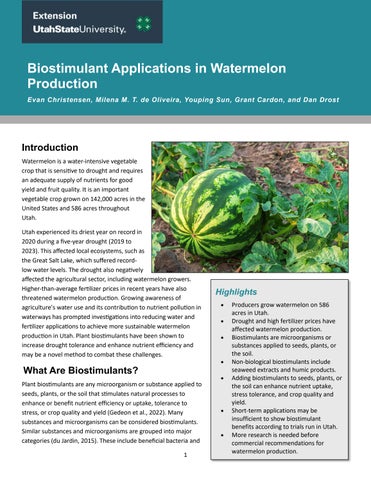
Watermelon is a water-intensive vegetable crop that is sensitive to drought and requires an adequate supply of nutrients for good yield and fruit quality. It is an important vegetable crop grown on 142,000 acres in the United States and 586 acres throughout Utah.
Utah experienced its driest year on record in 2020 during a ļ¬ve-year drought (2019 to 2023). This aļ¬ected local ecosystems, such as the Great Salt Lake, which suļ¬ered recordlow water levels. The drought also negatively aļ¬ected the agricultural sector, including watermelon growers. Higher-than-average fertilizer prices in recent years have also threatened watermelon production. Growing awareness of agriculture's water use and its contribution to nutrient pollution in waterways has prompted investigations into reducing water and fertilizer applications to achieve more sustainable watermelon production in Utah. Plant biostimulants have been shown to increase drought tolerance and enhance nutrient eļ¬ciency and may be a novel method to combat these challenges.
What Are Biostimulants?

Highlights
⢠Producers grow watermelon on 586 acres in Utah.
⢠Drought and high fertilizer prices have affected watermelon production.
⢠Biostimulants are microorganisms or substances applied to seeds, plants, or the soil
⢠Non-biological biostimulants include seaweed extracts and humic products.
Plant biostimulants are any microorganism or substance applied to seeds, plants, or the soil that stimulates natural processes to enhance or beneļ¬t nutrient eļ¬ciency or uptake, tolerance to stress, or crop quality and yield (Gedeon et al., 2022). Many substances and microorganisms can be considered biostimulants. Similar substances and microorganisms are grouped into major categories (du Jardin, 2015). These include beneļ¬cial bacteria and

⢠Adding biostimulants to seeds, plants, or the soil can enhance nutrient uptake, stress tolerance, and crop quality and yield.
⢠Short-term applications may be insufficient to show biostimulant benefits according to trials run in Utah.
⢠More research is needed before commercial recommendations for watermelon production.


Sun, Grant Cardon, and Dan Drost
fungi, seaweed extracts (and botanicals), humic products, protein hydrolysates and other nitrogen compounds, chitosan and other biopolymers, and some inorganic compounds. Another useful way to classify them is biological or nonbiological biostimulants.
Biological Biostimulants
Biological biostimulants aim to foster relationships between plants and microbes that have evolved over millions of years. Bacteria and fungi are abundant in soil with around 108 and 105 individuals per gram of soil, respectively. The rhizosphere, which is the zone of soil inļ¬uenced by plant roots, has a greater number of organisms, increased microbial activity, and altered microbial diversity from the bulk soil. Plants inļ¬uence soil microbial diversity through changes in molecules excreted by roots. These āroot exudatesā serve as nutrition and attractants for microbes. Exudates are composed of amino acids, carbohydrates, enzymes, organic acids, phenolics, proteins, and sugars. Plants can recruit speciļ¬c microbes to manage environmental stress, like drought, and satisfy nutrient needs based on plant growth stage. While many microbes associate with plants (actinomycetes, algae, archaea, bacteria, and fungi), biological biostimulants are primarily beneļ¬cial bacteria and fungi.
Beneficial Bacteria
Beneļ¬cial bacteria have been used on watermelon in greenhouse transplant production and ļ¬eld production, with reported increased growth and drought tolerance.


Bacteria can live in the bulk soil, the soil around the root, on the root surface, or within plant tissue Some bacteria are beneļ¬cial to the plant, many are harmless, and others can cause disease. Beneļ¬cial bacteria, also called plant growth-promoting rhizobacteria, have been shown to promote growth through many modes of action, including nutrient uptake, stress tolerance, and the production of plant growth regulators. A well-known example of this class of biostimulant is Rhizobium bacteria that are associated with legumes and ļ¬x atmospheric nitrogen that then becomes available to the plant. The modes of action diļ¬er by bacterial species and plant host. Beneļ¬cial bacteria have been used on watermelon in greenhouse transplant production and ļ¬eld production, with reported increased growth and drought tolerance.
Beneficial Fungi
Another category of biological biostimulants is beneļ¬cial fungi. Mycorrhizae are the most prominent type, although nonmycorrhizal fungi have also been shown to transfer nutrients to plant roots and may have an application in agricultural systems (du Jardin, 2015). Mycorrhizal fungi are classiļ¬ed as ectomycorrhiza (outside) and endomycorrhiza (inside). Ectomycorrhizal fungi grow in the intercellular space between plant root cells and are mostly associated with woody plants. This makes them important in forestry and nursery applications. Ectomycorrhizal fungi have been shown to have an association with pecan trees and may be useful in some orchard settings.
Multiple species of mycorrhizal fungi have been shown to infect watermelon roots
Arbuscular mycorrhizal fungi (AMF) are endomycorrhizal fungi that have associations with 78% of vascular plants (Gentry et al., 2021). AMF have been shown to help plants increase nutrient eļ¬ciency and acquisition (especially phosphorus) and aid in stress protection (du Jardin, 2015), either directly or through changes to the gene expression of host plants (Ma et al., 2024). AMF grow inside of plant root cells and form structures called arbuscules, and most form vesicles that are ļ¬lled with lipids (Gentry et al., 2021). AMF are sensitive to biological, chemical, and physical disturbances (Verzeaux et al. 2017) In high disturbance agricultural systems, AMF products could supplement the native soil population. AMF can form tripartite interactions with plants and rhizobacteria (du Jardin, 2015), and multiple species of AMF can infect the same host plant (Verzeaux et al., 2017). Multiple species of mycorrhizal fungi have been shown to infect watermelon roots


Non-Biological Biostimulants
Non-biological biostimulants are an important portion of the biostimulant market. Products containing seaweed extracts and humic substances are popular non-biological biostimulants. Substances such as chitosan, protein hydrolysates, plant extracts, and inorganic compounds are also considered biostimulants and are widely used. While some non-biological biostimulants may be derived from living organisms, they are not alive when applied and cannot propagate.
Seaweed Extract
Seaweed extract products are popular biostimulants. Seaweed has a long history of use in agriculture as a source of organic matter and fertility in coastal regions (Battacharyya et al., 2015). Seaweed extract products are derived from brown, green, or red seaweed through multiple extraction processes that aim to keep active molecules intact. Carbohydrates, amino acids, limited quantities of phytohormones, osmoprotectants, and proteins are the proposed mechanisms for the biostimulant eļ¬ect (Leļ¬ et al., 2023), although there is evidence that regulating hormone synthesis genes may be the true mechanism (du Jardin, 2015).
Humic Substances

Humic substances are another popular biostimulant. Humic substances naturally occur as part of soil organic matter, but humic and fulvic acid products are extracted from peat, soils, compost, and mineral deposits for application to crops (Ampong et al., 2022). Historically, humic substances were broken down into three subclasses based on molecular weight and solubility (du Jardin, 2015). These include humic acids, fulvic acids, and humins which are characterized by their solubility in water, acidic, or alkaline solutions (Ampong et al., 2022). Humic acids are widely used in agriculture and can improve soil water holding capacity and structure, increase microbial populations, and enhance soil nutrient availability (Ampong et al., 2022). A precipitation reaction can occur between humic acids and heavy metals in the soil, reducing metal uptake by plants and toxicity (Ampong et al., 2022).
Biostimulants in Watermelon: USU Trials
To investigate the possibility of using biostimulants to reduce water and fertilizer applications, Utah State University (USU) researchers conducted trials on watermelon. Researchers used seven commercially available biostimulant products and investigated the eļ¬cacy of using biostimulant products in watermelon transplant production. Those showing promising performance were applied to ļ¬eld-grown watermelon under reduced applications of water and fertilizer. Experiments were conducted in 2023 and 2024 in North Logan, Utah. And ļ¬nally, outreach trials were established on grower-cooperator ļ¬elds throughout Utah using the same seven commercially available biostimulant products that were tested in the greenhouse
Greenhouse Transplant Production Case Study
Most watermelon production in the U.S. uses seedless cultivars, which are typically grown in greenhouses and transplanted due to poor seed germination and slow establishment in the ļ¬eld. The objectives were to: (1) evaluate commercially available biostimulants to improve watermelon transplant production, and (2) select superior products for
later ļ¬eld applications. Researchers selected and tested seven biostimulant products on watermelon seedlings (cv. āCrimson Sweet ā) to evaluate their eļ¬ects on seedling emergence and growth:
⢠Three bacterial products (Continuumā¢, Spectrum DSā¢, and TribusĀ® Original)
⢠Two mycorrhizal products (Mighty Mycorrhizae and MycoApply® Endo).
⢠One seaweed extract product (Kelpak®).
⢠One humic product (Huma Pro® 16)
Products, except Kelpak, were incorporated into a peat-based soilless potting media. Seeds were sown into the inoculated media, and plants were grown for 30 days after emergence. Three trials were performed. Kelpak was applied at the ļ¬rst true leaf stage, so no conclusions can be drawn on this productās eļ¬ect on seedling emergence. Generally, applying biostimulant products had little eļ¬ect on watermelon seedling emergence. After 30 days of growth, researchers weighed the seedlingsā shoots and roots (Table 1) and measured the leaf area. No diļ¬erences in shoot growth or leaf area were noted between biostimulant-treated seedlings and the untreated control. In two trials we noted no diļ¬erence in root weight between untreated and biostimulant treated seedlings. In one trial, a root rot aļ¬ected the seedlings. Diļ¬erences between treated seedlings and the control occurred, suggesting that these products may help plants manage biotic stress. While no diļ¬erences in growth were noted, three products (Continuum, Spectrum DS, and Mighty Mycorrhizae) had numerically higher shoot weight and were selected for ļ¬eld studies.
Table 1. Shoot and Root Fresh Weight (g) of Greenhouse-Grown Watermelon Seedlings (cv āCrimson Sweetā)
Biostimulant
(g)
A, B, C Different letters within a column indicate significant differences at α = 0.05 using Tukeyās Honestly Significant Difference test.
Notes. Trials were conducted three times in 2023. Seedlings were untreated (control) or treated with: bacterial biostimulants (Tribus Original, Continuum, or Spectrum DS); mycorrhizal biostimulants (MycoApply Endo, or Mighty Mycorrhizae); seaweed extract Kelpak; or humic acid Huma Pro 16.
Field Production Case Studies
Three products selected from greenhouse trials were tested in the ļ¬eld. The two bacterial biostimulants, Continuum and Spectrum DS, and the mycorrhizal biostimulant, Mighty Mycorrhizae, were incorporated into soilless growth media, and watermelon transplants were produced. āCrimson Sweetā (seeded) and āFascinationā (seedless) were planted in 2023 and 2024. Seedlings were transplanted into raised beds with drip tape and plastic mulch in late May. Water and fertilizer were applied through the drip tape throughout the season.
Irrigation applications were based on evapotranspiration (ET) models, soil texture, and the use of soil moisture sensors. Water was applied at 100% ET (recommended irrigation) or 75% ET (water stressed) in the late season during fruit sizing. Fertilizer applications were based on soil test results and recommendations from the Utah Vegetable and Pest
Management Guide (Volesky et al., 2020). Plants were fertilized at 100% (recommended fertilizer) or 67% (nutrientstressed) levels over the entire growing season.
No diļ¬erences were observed in vine growth, yield, or fruit quality based on biostimulant treatments (Tables 2, 3, and 4).
Reducing irrigation from 100% ET to 75% ET in the late season did not reduce yield in either year but did increase soluble solids content. Reducing fertilizer applications by 1/3 had no eļ¬ect on yield or fruit quality in 2023, although a reduction in vine growth was observed. In 2024, the recommended fertility treatment had a higher yield and fruit number per meter squared than the reduced fertility treatment.

A Different letters within a column indicate significant differences at α = 0.05 using Tukeyās Honestly Significant Difference test.
Notes. Watermelon plants were subjected to standard management practices (control), added bacterial biostimulants (Continuum or Spectrum DS), or added fungal biostimulant (Mighty Mycorrhizae). Plants were fertilized at 100% or 67% levels of fertility or irrigated at 100% or 75% (in the late season) of evapotranspiration on top of biostimulant treatments.
Table 3. Fertility Trial: Total Yield (lbāacre-1) and Soluble Solids Content (SSC in °Brix) of Watermelon Fruits Grown in 2023 and 2024
Biostimulant
A, B Different letters within a column from the same factor indicate significant differences at α = 0.05 using Tukeyās Honestly Significant Difference test.
Notes. Watermelon plants, seeded āCrimson Sweetā and seedless āFascinationā, were subjected to standard management practices (control), added bacterial biostimulants (Continuum or Spectrum DS), or added fungal biostimulant (Mighty Mycorrhizae). Plants were fertilized at 100% or 67% levels of fertility rate on top of biostimulant treatments.
Table 2. Length of Watermelon Vines (m) Grown in 2023 and 2024
Table 4. Irrigation trial: Total Yield (lbāacre-1) and Soluble Solids Content (SSC in °Brix) of Watermelon Fruits Grown in 2023 and 2024
Biostimulants
A, B Different letters within a column from the same factor indicate significant differences at α = 0.05 using Tukeyās Honestly Significant Difference test.
Notes. Watermelon plants, seeded āCrimson Sweetā and seedless āFascinationā, were subjected to standard management practices (control), added bacterial biostimulants (Continuum or Spectrum DS), or added fungal biostimulant (Mighty Mycorrhizae). Plants were irrigated at 100% or 75% (in the late season) of evapotranspiration on top of biostimulant treatments.
Grower Cooperator Case Study
Studies were established in watermelon ļ¬elds in Cache, Emery, and Utah counties (Table 5). Products were applied as a soil drench at manufacturer recommended rates to watermelon seedlings before transplanting into the ļ¬eld. Cultivars used were chosen by the grower, and treated plants were spaced according to each growerās speciļ¬cation. Products were reapplied to the soil at one-month intervals throughout the growing season. Field variability is likely a large contributor to the overall performance variability and may not be related to treatments.

There were large yield diļ¬erences between farms. The low yield at Farm 3 was likely due to high plant mortality on edge rows of the ļ¬eld. Due to scheduling conļ¬icts, some fruits were harvested by growers before data was taken, further contributing to the data variability. While some diļ¬erences are observed from treatment to treatment, the responses are not consistent from farm to farm. While no conclusions can be drawn from these trials, they aided in improving our techniques, providing preliminary data, and strengthening relationships between researchers at USU and melon growers throughout the state.
Table 5. Yield (lbāacre-1) of W
From Three Farms Across Utah
Pro 16
,500
Notes. Plants were subjected to standard management practices (control) or the addition of the bacterial biostimulants Tribus Original, Continuum, or Spectrum DS, mycorrhizal biostimulants MycoApply Endo or Mighty Mycorrhizae, the seaweed extract Kelpak, or the humic acid Huma Pro 16.
Conclusion
No signiļ¬cant diļ¬erence in greenhouse-grown seedlings (size, weight) was observed between plants treated with biostimulant products and the untreated control. We found that biostimulant applications had no eļ¬ect on plant growth, fruit yield, or fruit quality in the ļ¬eld. Biostimulants hold promise in improving crop productivity, and their long-term applications in the ļ¬eld may oļ¬er robust beneļ¬ts that our short-term greenhouse or ļ¬eld work could not fully capture. This warrants further investigation before recommending their use for commercial melon production.
References
Ampong, K., Thilakaranthna, M. S., & Gorim, L. Y. (2022). Understanding the role of humic acids on crop performance and soil health. Frontiers in Agronomy, 4. https://www.frontiersin.org/articles/10.3389/fagro.2022.848621
Battacharyya, D., Babgohari, M. Z., Rathor, P., & Prithiviraj, B. (2015). Seaweed extracts as biostimulants in horticulture. Scientia Horticulturae, 196, 39ā48. https://doi.org/10.1016/j.scienta.2015.09.012
du Jardin, P. (2015). Plant biostimulants: Definition, concept, main categories and regulation. Scientia Horticulturae, 196, 3ā14. https://doi.org/10.1016/j.scienta.2015.09.021
Gentry T J , Fuhrmann, J J , Zuberer, D A (Eds.). (2021) Principles and applications of soil microbiology (3rd ed). Elsevier https://doiorg.dist.lib.usu.edu/10.1016/C2018-0-05260-3
Gedeon, S., Ioannou, A., Balestrini, R., Fotopoulos, V., & Antoniou, C. (2022). Application of biostimulants in tomato plants (Solanum lycopersicum) to enhance plant growth and salt stress tolerance. Plants, 11(22).
Impello® Biosciences. (2025). Continuum⢠https://impellobio.com/
Lefi, E., Badri, M., Hamed, S. B., Talbi, S., Mnafgui, W., Ludidi, N., & Chaieb, M. (2023). Influence of brown seaweed (Ecklonia maxima) extract on the morpho-physiological parameters of melon, cucumber, and tomato plants. Agronomy, 13(11), 2745. https://doi.org/10.3390/agronomy13112745
Ma, J , Zhao, Q , Zaman, S , Anwar, A , & Li, S. (2024) The transcriptomic analysis revealed the molecular mechanism of arbuscular mycorrhizal fungi (AMF) inoculation in watermelon. Scientia Horticulturae, 332, 113184. https://doi.org/10.1016/j.scienta.2024.113184
Verzeaux, J., Hirel, B., Dubois, F., Lea, P. J., & TĆ©tu, T. (2017). Agricultural practices to improve nitrogen use efficiency through the use of arbuscular mycorrhizae: Basic and agronomic aspects. Plant Science, 264, 48ā56. https://doi.org/10.1016/j.plantsci.2017.08.004
Volesky, N , Murray, M , Olds, A , & Carey, B. (2024) Utah vegetable production guide (5th ed ). Utah State University Extension. https://digitalcommons.usu.edu/extension_curall/2460
In its programs and activities, including in admissions and employment, Utah State University does not discriminate or tolerate discrimination, including harassment, based on race, color, religion, sex, national origin, age, genetic information, sexual orientation, gender identity or expression, disability, status as a protected veteran, or any other status protected by University policy, Title IX, or any other federal, state, or local law. Utah State University is an equal opportunity employer and does not discriminate or tolerate discrimination including harassment in employment including in hiring, promotion, transfer, or termination based on race, color, religion, sex, national origin, age, genetic information, sexual orientation, gender identity or expression, disability, status as a protected veteran, or any other status protected by University policy or any other federal, state, or local law. Utah State University does not discriminate in its housing offerings and will treat all persons fairly and equally without regard to race, color, religion, sex, familial status, disability, national origin, source of income, sexual orientation, or gender identity. Additionally, the University endeavors to provide reasonable accommodations when necessary and to ensure equal access to qualified persons with disabilities. The following office has been designated to handle inquiries regarding the application of Title IX and its implementing regulations and/or USUās non-discrimination policies: The Office of Equity in Distance Education, Room 400, Logan, Utah, titleix@usu.edu, 435-797-1266. For further information regarding non-discrimination, please visit equity.usu.edu, or contact: U.S. Department of Education, Office of Assistant Secretary for Civil Rights, 800-421-3481, ocr@ed.gov or U.S. Department of Education, Denver Regional Office, 303-844-5695 ocr.denver@ed.gov. Issued in furtherance of Cooperative Extension work, acts of May 8 and June 30, 1914, in cooperation with the U.S. Department of Agriculture, Kenneth L. White, Vice President for Extension and Agriculture, Utah State University. July 2024 Utah State University Extension
The authors used no generative AI in the creation of this content, and it is purely the work of the authors. This content should not be used for the purposes of training AI technologies without express permission from the authors.

January 2026
Utah State University Extension
Peer-reviewed fact sheet