White Bryony (Bryonia alba) Taun Beddes, Michael Caron, Jacob Hadfield, and Cory Ransom
Why White Bryony Awareness Matters White bryony is more than just a nuisance plant. It is an aggressive, perennial vine that threatens riparian ecosystems, agricultural lands, and residential landscapes by destructively smothering vegetation. Additionally, its toxicity poses risks to people, livestock, and pets. Early detection and consistent management are critical to reducing its spread in Utah. • • • • • •
Origin: native to Europe through northern Iran. Introduction: brought to the United States as a medicinal plant (Kujawska & Svanburg, 2019). Toxicity: highly poisonous; ingestion can cause death. Habitat: thrives in permanently moist soil. Spread: seeds are primarily dispersed by birds. Status: listed as a noxious weed in Oregon, Washington, and Idaho; present in several Utah counties.
Highlights • •
Identification
•
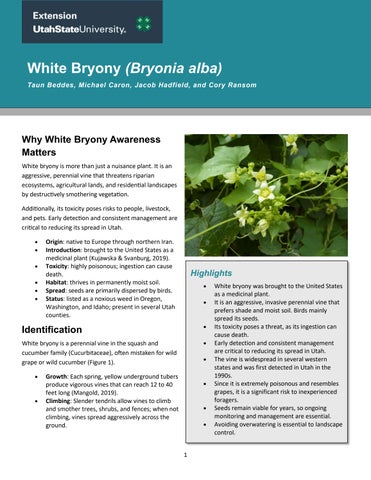
White bryony is a perennial vine in the squash and cucumber family (Cucurbitaceae), often mistaken for wild grape or wild cucumber (Figure 1).
•
•
•
•
Growth: Each spring, yellow underground tubers produce vigorous vines that can reach 12 to 40 feet long (Mangold, 2019). Climbing: Slender tendrils allow vines to climb and smother trees, shrubs, and fences; when not climbing, vines spread aggressively across the ground.
•
• •
1
White bryony was brought to the United States as a medicinal plant. It is an aggressive, invasive perennial vine that prefers shade and moist soil. Birds mainly spread its seeds. Its toxicity poses a threat, as its ingestion can cause death. Early detection and consistent management are critical to reducing its spread in Utah. The vine is widespread in several western states and was first detected in Utah in the 1990s. Since it is extremely poisonous and resembles grapes, it is a significant risk to inexperienced foragers. Seeds remain viable for years, so ongoing monitoring and management are essential. Avoiding overwatering is essential to landscape control.