At Uppingham, we offer a wide variety of GCSE subjects so you can choose the ones that suit your interests, strengths, and future plans. GCSEs are a great chance to grow your skills, explore new ideas, and build a strong foundation for whatever comes next in your learning journey.
To all pupils due to enter the Lower Fifth at Uppingham (and their parents)
We’ve put together this Options Guide to help you make your choices. Each subject is explained by the Head of Department, and there’s also helpful advice to guide you in making decisions that feel right for you.
The Lower Fifth marks the beginning of your GCSE studies. The good habits you’ve built in the Fourth Form will be more important than ever—but most of all, staying motivated matters. That’s why it’s so important to choose subjects you enjoy and feel confident in.
When thinking about your options, try to balance what you enjoy learning with what you’re good at and how well you’re progressing in each subject
It’s best to avoid choosing a subject if your teachers feel it might be difficult for you to achieve a strong grade. Your GCSE results will be part of what universities look at when offering places, so it’s worth choosing carefully.
You won’t be making these decisions alone. Your teachers, Heads of Department, tutors, and Housemasters or Housemistresses are all here to support you.
Please also take time during the February half term to talk things through with your parents or guardians.
You’ll receive a choices form, which should be completed by Monday 2 March 2026.
The timetable for next year will be built around the choices you make now. If you want to make changes later, they’ll only be possible if there’s space in the teaching sets provided and if the combination of subjects can be accommodated in the timetable.
Miranda Melville-Coman Deputy Head Academic January 2026
Core Curriculum
(choose the language)
Extended Curriculum
(choose 3 options)
English Language English Literature Mathematics Science Language: Art
French Classical Greek*
Spanish Computer Science
Latin Design & Technology
Classical Greek* Drama
French Geography
Whilst we intend to run these courses as advertised please note that the School may need to limit
The Core Curriculum
At Uppingham, all pupils follow a Core Curriculum for GCSE. This includes:
• English Language
• English Literature
• Mathematics
• Science
• One Modern or Classical Language
The Science course leads to either a Dual Award (two GCSEs) or a Triple Award (three GCSEs). Your teachers will help guide you towards the most suitable option later in the Lower Fifth. There is no choice to make regarding Science pathways at this stage. See page 7 for more details.
All pupils are expected to study at least one language (modern or classical) as part of the Core Curriculum. Many pupils choose to study two languages, by selecting a second one in the Extended Curriculum.
Please note: you cannot begin a new language in the Lower Fifth unless you’ve studied it before.
In exceptional circumstances, pupils with specific learning needs or English as an additional language may be exempt from their modern or classical language option. If so, they may choose a fourth Extended Curriculum subject instead.
The Extended Curriculum
Most pupils will choose three subjects
In exceptional circumstances, subjects, as explained in the Core
numbers if some courses are over-subscribed or withdraw courses that attract insufficient interest.
subjects from the Extended Curriculum.
pupils may be allowed to choose four Core Curriculum section.
Academic Enrichment
In addition to your GCSE subjects, there are opportunities to take part in accredited academic enrichment programmes that extend your learning beyond the classroom. These are not selected as part of your options form, instead, your teachers will advise you if one of these is suitable for you and invite you to take part in these courses, if they are appropriate for you.
Higher Project Qualification (HPQ): Worth half a GCSE, this builds on your Fourth Form Individual Project. It’s a great way to explore a topic you’re passionate about and develop your research and thinking skills. See page 7 for more details.
Algebra Level 3 Qualification: This advanced mathematics course is offered to pupils who show strong mathematical ability. If you’re invited to take part, it’s a chance to stretch your thinking and deepen your understanding. See page 25 for more details.
DELF (A1 and A2): Pupils studying French may be invited to work towards the DELF qualifications at A1 or A2 level. These internationally recognised certificates focus on practical communication skills in French. See page 19 for more details.
DELE (A1 and A2) : Pupils studying Spanish may be invited to work towards the DELE qualifications at A1 or A2 level. These internationally recognised certificates focus on practical communication skills in Spanish. See page 30 for more details.
Classical Greek: If a small number of pupils choose Classical Greek, it will be offered through an alternative enrichment model. You’ll work more independently, supported by a subject mentor who will guide you and provide resources to help you prepare for the GCSE.
Sixth Form considerations Science
Higher Project Qualification
Pupils are required to have achieved a minimum of three GCSE grades at 7 and three GCSE grades at 6 for entry to the Sixth Form, and a grade of 7 or above is usually expected in any subject to be taken in the Sixth Form.
In mathematics, sciences and modern languages, continuation into the Sixth Form is only possible if a pupil achieves the subject-specific tariffs, as laid out in the Sixth Form Options Guide.
In the Lower Fifth, all pupils will follow the Dual Award Science (DAS) course. This route involves the study of all three sciences (Biology, Chemistry and Physics) and leads to two adjacent IGCSE grades (for example, 8-8 or 7-6) which are awarded based on performance across three examination papers.
Towards the end of the Lower Fifth, the Science Department will advise a number of pupils to move to the Triple Award Science (TAS) course. Pupils on this pathway will then be prepared through the Upper Fifth for an extra examination paper in each Science, ultimately leading to three separate IGCSE grades.
Whether you take DAS or TAS, you will have full access to A Level science courses, subject to meeting the tariff for studying the science they choose.
In addition to their GCSE courses, pupils may choose to take the Higher Project Qualification. This standalone qualification carries the value of half of a GCSE and is an extension of the Individual Project undertaken in the Fourth Form, providing an opportunity for pupils to extend their studies beyond the confines of their other subjects, and further their research and analytical skills. The project takes the form of a 2,000 word academically structured piece of writing, allied with a presentation and a question-and-answer session. The taught element of the project takes place through seminar sessions held outside of the academic school day, meaning that pupils who take this qualification need to be self-motivated and prepared to develop independent study skills.
ART
Qualification
Course overview
Additional information
Trips
Resource provided
Assessment overview
Costs
Contact
Pearson Edexcel GCSE (9–1) Fine Art (1FA0)
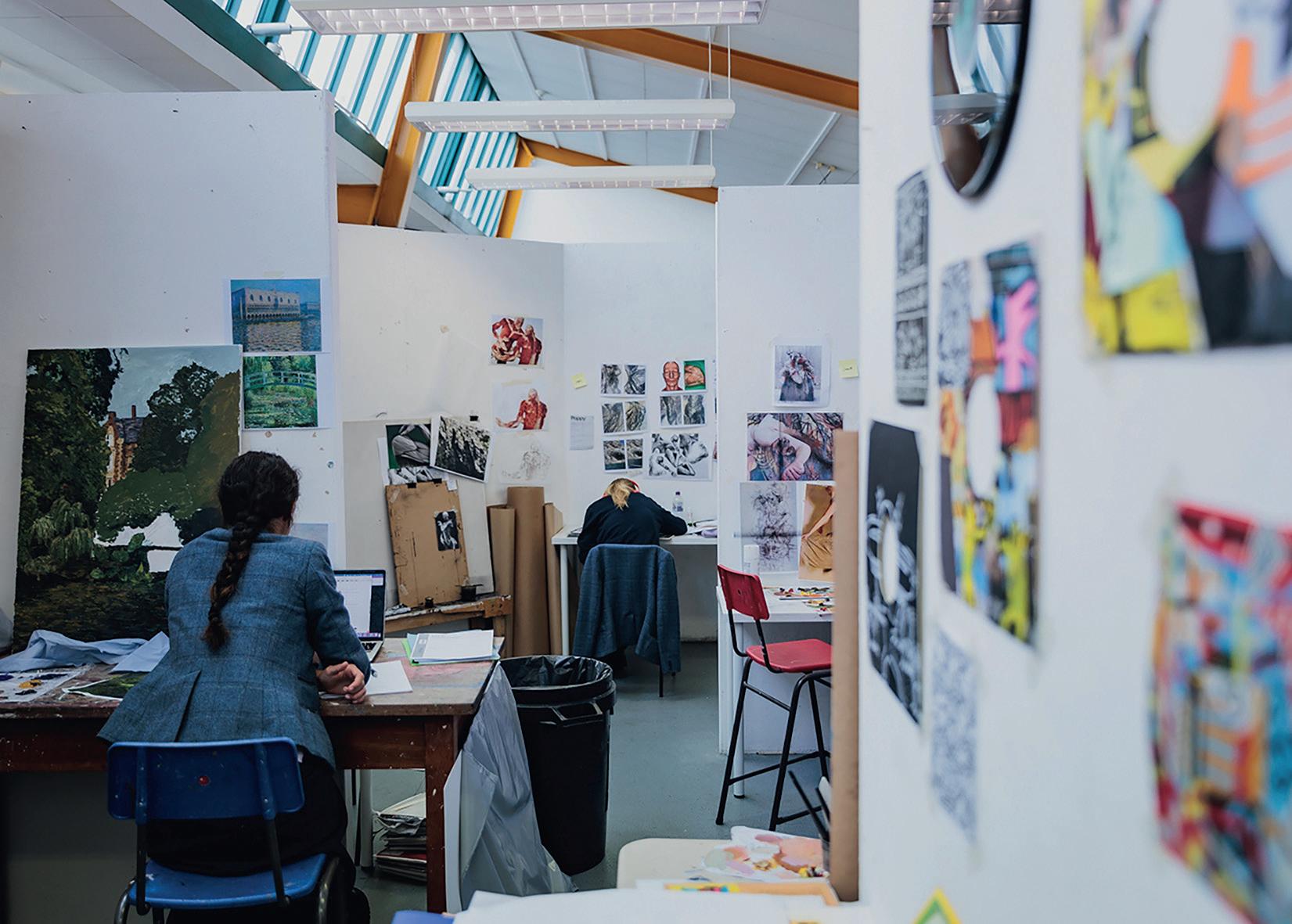
Develop a wide range of practical skills, exploring:
• drawing
• painting
• printmaking
• sculpture
• photography
• mixed media
• digital processes.
Alongside practical work, pupils learn how to research artists, analyse artworks, and develop their own creative ideas.
Pupils engage with visual art practices through observational, imaginative, expressive and conceptual approaches
This course encourages independent thinking, experimentation, and refinement of personal outcomes.
There are opportunities to visit galleries, museums, and exhibitions (such as Tate Modern, The National Gallery and local galleries).
The trips are designed to support contextual studies and inspire practical coursework.
Sketchbooks for pupils to document their research, idea development and refinement.
Component 1: Personal Portfolio
Component 2: Externally Set Assignment
A contribution to specialist studio materials.
There may also be additional costs for gallery trips.
Miss Reid
ARR@uppingham.co.uk
BIOLOGY
Qualification
Course overview
Additional information
Trips
Resource provided
Assessment overview
Costs Contact
Edexcel 4BI1 or Edexcel 4SD0
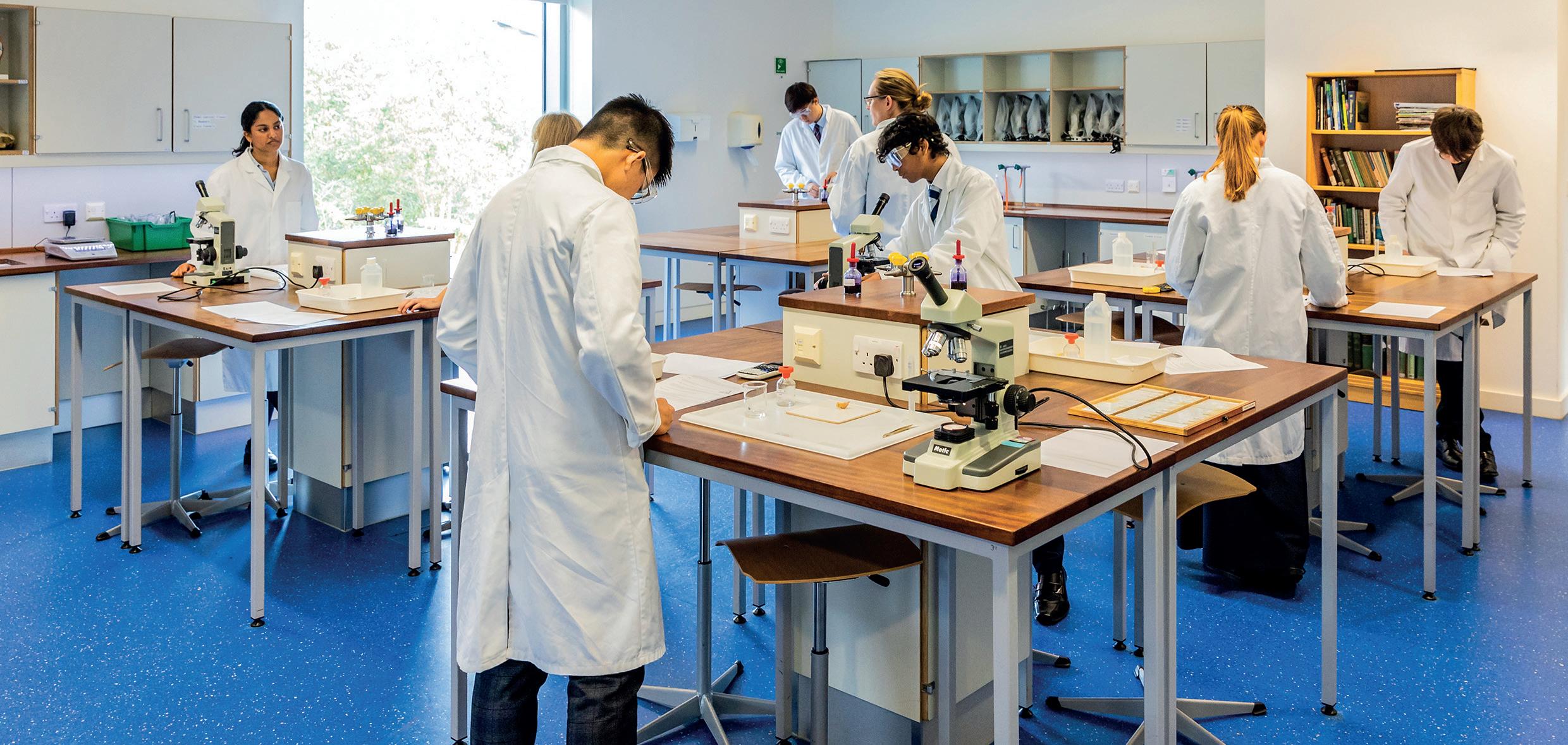
Acquire knowledge and understanding of biological facts, terminology, concepts, principles and practical techniques. Topics covered include:
• The nature and variety of living organisms
• Structures and functions in living organisms
• Reproduction and inheritance
• Ecology and the environment
Develop experimental, investigative and field work skills based on correct and safe laboratory/ field techniques.
Analyse, interpret and evaluate data and experimental methods, drawing conclusions that are consistent with evidence from experimental activities and suggesting possible improvements.
Please see details at the start of the options guide for information about Double Award Science and Triple Award Science.
There are no compulsory trips, but we offer some optional enrichment opportunities with the enrichment programme, including the popular Anatomy Club.
A revision guide is provided in the Fourth Form lasts for the duration of the course. We also use online quizzing platforms such as Educake and Learning By Questions
For Biology 4BI1:
One 2 hour written exam worth 61.1% of the final grade and one 1 hour 15-minute written exam worth 38.9% of the final grade.
For Double Award Science 4SD0:
Two hour written exam weighted at 33.3% alongside Chemistry and Physics to form two final grades.
There are no compulsory costs, however, replacement revision guides are recharged, and optional revision materials may be suggested.
Mrs Cowling ALC@uppingham.co.uk
CHEMISTRY
Qualification
Course overview
Additional information
Trips
Resource provided
Assessment overview
Costs Contact
Edexcel 4CH1 or Edexcel 4SD0
Acquire knowledge and understanding of facts, terminology, concepts, principles and practical techniques. Topics covered include:
• Scientific investigation – planning and conducting experiments safely
• Data handling – interpretation of results, spotting patterns
• Chemical understanding - reactions, bonding and the behaviour of substances
• Mathematical applications in chemistry – including formulas and calculations, for example, moles and concentrations
• The role of chemistry in industry, the environment and everyday life
Please see details at the start of the options guide for information about Double Award Science and Triple Award Science.
There are no compulsory trips, but optional enrichment opportunities are offered.
A revision guide is provided in the Fourth Form which lasts for the duration of this course.
All pupils have access to GCSE Chemistry Online. We also use online quizzing platforms such as Educake and Learning by Questions.
For Chemistry 4CH1:
Two-hour written exam (worth 61.1% of final grade)
1 hour 15-minute written exam (worth 38.9%)
For Double Award Science 4SD0:
Two hour written exam weighted at 33.3% alongside Biology and Physics to form two final grades
There are no compulsory costs, however, optional revision resources may be suggested and these, alongside any replacement revision guides, would be re-charged.
Mr King RAK@uppingham.co.uk
COMPUTER SCIENCE
Qualification
Course overview
CIE 0984
Develop a deep understanding of the principles and practices of computation and computational thinking, and their application in designing and developing computer systems.
Learn to express computational thinking through programming, creating computer-based solutions using algorithms and a high-level programming language. Topics covered include:
• Computational thinking and problem-solving
• Programming and algorithm design
• Testing and evaluating computing solutions
• Current and emerging technologies
• Ethical issues and risks in computing
Build technical skills alongside the ability to analyse, test and refine solutions. This course provides the underpinning knowledge for science and engineering disciplines and equips pupils with transferable skills for everyday life and future study.
Trips
Resource provided
Assessment overview
Costs Contact
No compulsory trips. Pupils will be invited to attend a trip to Bletchley Park and the Museum of Computing.
Digital access to a Computer Science textbook is provided.
Two exams, each one hour 45 minutes.
Paper 1: Computer Systems - assesses understanding of how computers work, including binary and hexadecimal number systems, data transmission, internet functionality, peripheral devices, operating systems and emerging technologies.
Paper 2: Algorithms, Programming and Logic - focuses on designing algorithms, creating pseudocode and flowcharts, and using data structures effectively.
There is no coursework.
None
Mr Moosajee ASM@uppingham.co.uk
DESIGN AND TECHNOLOGY (Resistant Materials)
Qualification
Course overview
Cambridge IGCSE 0979
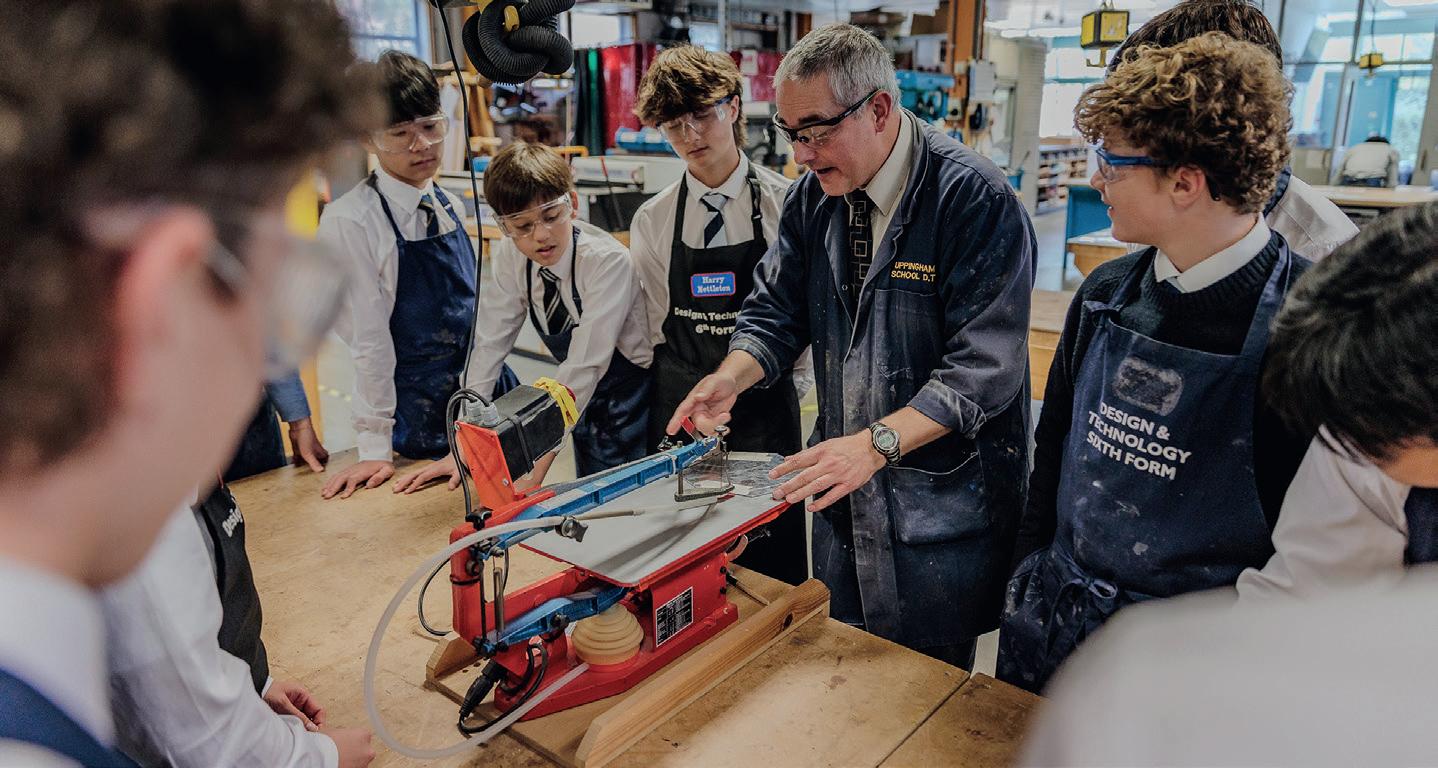
Candidates will study resistant materials (primarily wood, metal, and plastic). They will design and make products in these materials and study products and industrial processes that use these materials. Resulting outcomes will be a full size, fully functioning product that matches its specification, with examples including lighting, furniture, and speakers.
The course is designed to allow students to demonstrate their creativity and design and technology capability by combining skills with knowledge and understanding to produce high quality products. Skills are developed within the context of materials and their processing. Students engage with the practical elements of the course on a frequent basis to gain a broad understanding of design and technology.
Knowledge/Skills acquired:
• Classification, selection and understanding of materials.
• Preparing, processing, manufacturing and finishing of components and products.
• Ability to design, research, model and make following an iterative process.
• Core skills using CAD and CAM (including Solidworks, 3D printing and laser cutting).
• Technical knowledge of CAD/CAM, materials, working drawings, planning and evaluation.
Resource provided
Assessment overview
Costs
Contact
Course Textbook and all materials
Coursework (Thorough portfolio and practical outcome) – 50%
Theory Paper – 25%
Design Paper – 25%
£15.00 per pupil to contribute towards course materials and their final project
Mr Harrison HJH@uppingham.co.uk
DRAMA
Qualification
Course overview
Eduqas C690QS
Acquire knowledge and understanding of drama and theatre through a blend of practical performance and theoretical study. This course develops creativity, collaboration and analytical skills while offering opportunities to specialise in performance or design. Topics covered include:
• Devising original theatre using dramatic conventions
• Performing extracts from a chosen play
• Interpreting theatre through written analysis and evaluation
• Exploring design elements such as lighting, sound, set and costume
Develop skills in acting, stagecraft and design, supported by research and critical reflection. Pupils will attend and analyse live theatre, evaluate the work of practitioners and demonstrate understanding through the assessments for this course.
This course provides a strong foundation for further study in drama and the performing arts.
Additional information
Trips
Resource provided
Assessment overview
Costs
Contact
There are no foundation options available.
Pupils are required to watch live theatre performances as part of the curriculum.
Textbooks are provided as well as all resources required for the practical components.
Two examined practical components and a written paper.
The set text which is studied is recharged, as are the costs of the trips to live theatre performances.
Miss Krisiloff SDK@uppingham.co.uk
ENGLISH LANGUAGE
Qualification
Course overview
Trips
Resource provided
Assessment overview
Costs
Contact
Pearson Edexcel 4EA1
Develop a close knowledge and understanding of the English language, exploring how it shapes meaning, identity and communication across a range of contexts.
Learn to analyse the structure, form and features of spoken and written language, and examine how writers and speakers use these to create meaning and effect. Investigate the ways language changes over time and varies according to audience, purpose and situation.
Gain insight into the social, cultural and historical influences that shape language use, and consider how these factors affect interpretation.
Throughout the course, you will make connections between different forms of language, developing analytical and evaluative skills that provide a strong foundation for further study in linguistics, communication and the humanities.
There are no compulsory trips for this subject.
Pupils have access to valuable resources such as JSTOR and Massolit. The English Department subscribes to literary publications such as Emag
Non-Fiction Texts and Transactional Writing: pupils study ten non-fiction texts and are required to compare one of these texts with an unseen non-fiction text. They are also required to produce one piece of transactional writing.
Coursework: Pupils write two pieces of coursework (imaginative writing; poetry and prose essay), which account for 40% of their final grade.
There are no additional costs.
Mrs Kinmond
VLK@uppingham.co.uk
ENGLISH LITERATURE
Qualification
Course overview
Trips
Resource provided
Assessment overview
Costs
Contact
Pearson Edexcel 4ET1
Develop a close knowledge and understanding of a wide range of literary texts while fostering a critical style and personal engagement with literature.
Learn to analyse the language, form and structure used by writers to create meaning and effect, and explore the relationships between texts across genres and periods.
Gain insight into the historical, social and cultural contexts in which works were written, and examine how these shape interpretation.
Throughout the course, you will make connections and draw links between texts, developing analytical and evaluative skills that provide a strong foundation for further study in literature and the humanities.
Where possible, pupils will have the opportunity to see a live production of the drama text they are studying.
Pupils have access to valuable resources such as JSTOR and Massolit. The Department subscribes to literary publications such as Emag.
Poetry and Modern Prose: pupils write one comparative essay on modern and heritage poetry from the Edexcel Anthology, one essay on a modern novel and one essay on an unseen poem.
Coursework: pupils write one essay on a modern drama text and one essay on a Shakespeare text, this element accounts for 40% of their final grade.
Pupils are charged approximately £30 over the course for the texts they are studying, so they can annotate and highlight their own copies.
Mrs Kinmond
VLK@uppingham.co.uk
Qualification
Course overview
AQA GCSE French (8652)
Acquire knowledge and understanding of French vocabulary, grammar, pronunciation and communication strategies. Topics covered include:
• Conversational language within the personal sphere
• People and lifestyle
• Popular culture
• Communication and the world around us
Develop skills in listening, reading, speaking and writing in French, supported by explicit pronunciation practice and wider metalinguistic understanding.
Analyse, interpret and respond to spoken and written French, building a foundation for further language study.
Additional information
Trips
Resource provided
Assessment overview
Costs Contact
The AQA GCSE has both higher (grades 1-9) and foundation (grades 1-5) options. All pupils will work towards the higher option. Pupils who are identified as less likely to achieve at least grade 6 may be moved onto a foundation pathway and this is done on a case-by-case basis.
All pupils take the DELF A1 or A2 in the Lower Fifth. Pupils who take DELF A1 have the option of taking the A2 in the Upper Fifth. The DELF exam is globally recognised by both universities and employers, as well as UCAS and may be useful for gap year employment and studies abroad. It is also excellent preparation for the GCSE, giving pupils the experience of a ‘live’ speaking exam ahead of their GCSEs as well as gaining an extra qualification as part of their language option.
There is a pen-pal exchange for the whole GCSE French cohort with a middle school in Paris.
There is an optional exchange in Year 11 where all pupils host our visitors and can choose to attend the return trip.
Digital access to Kerboodle and OUP textbook, Language Gym are provided.
Listening: listening comprehension questions to be answered in English or non-verbally and a dictation into French. Speaking: the format is the same at Foundation tier and Higher tier, but with different stimulus materials for the role-play and the reading aloud task. Reading: reading comprehension questions to be answered in English or non-verbally; a translation from French to English. Writing: a combination of short sentences, translations into French, short writing (90 words) and long writing (150 words) tasks
The DELF exam entry fee; DELF exam costs are £85 for A1 and £90 for A2; an optional revision guide is recommended. We enrol all pupils onto This is School, a digital platform for practicing listening and interactive language practice, and the annual cost is approximately £5.
Mrs Hunter ZJRH@uppingham.co.uk
GEOGRAPHY
Qualification
Course overview
Trips
Resource provided
Assessment overview
Costs
Contact
Edexcel / Pearson 4GE1 (01 and 02)
Equips pupils with a broad range of academic and practical skills through the study of both physical and human geography. Key skills developed include:
• Critical thinking and decision-making – assessing real-world geographical issues and proposing sustainable, evidence-based solutions.
• Communication skills – explaining complex concepts clearly in written and visual forms.
• Numerical and statistical skills – interpreting and analysing data from graphs, maps and tables, including averages, percentages and measures of spread.
• Map and graphical skills – interpreting maps, diagrams and digital tools such as GIS.
• Fieldwork and enquiry skills – collecting, presenting and analysing field data, drawing conclusions and evaluating methods to understand realworld environments.
There are various local field trips throughout the programme to consolidate essential fieldwork and data collection skills.
Occasional optional overseas trips, for example, to Iceland.
Textbook provided and revision guide (if needed).
Paper 1: Physical Geography – river environments and hazardous environments (1 hour 10 minutes).
Paper 2: Human Geography - economic activity and energy, urban environments, and development and human welfare (1 hour 45 minutes).
There is no coursework nor controlled assessment, but practical fieldwork is an important element of the course and is examined in the final exams in the form of structured questions. This ensures that that classroom learning is applied to the real world, where pupils acquire certain skills, which they can use in everyday life, including the skills of observation, experimentation, investigation, problem solving, teamwork, communication and decision-making.
No additional costs, unless an optional trip is taken.
Mr Davies TPD@uppingham.co.uk
GREEK
CR J292
Acquire knowledge and understanding of Greek language and literature, developing analytical and linguistic skills that support wider academic study. Key skills and benefits include:
• Analytical and logical thinking: Greek grammar is highly structured and logical. Learning it strengthens your ability to recognize patterns, follow rules, and apply logic – much like math or coding.
• Attention to detail: Greek requires close attention to word endings, sentence structure, and syntax. A small change in form can drastically change meaning.
• Improved English vocabulary and grammar: Around 40% of English words have Greek roots, especially in academic, scientific, legal, and medical fields. Greek boosts your vocabulary and enhances understanding of English grammar.
• Translation skills: Greek trains you to move between languages with precision, which improves your understanding of meaning, nuance, and phrasing.
• Memory and concentration: Memorizing vocabulary, conjugations, and declensions exercises and improves your memory and mental discipline.
• Critical reading and interpretation: The texts we study are philosophical, poetic, or rhetorical. You learn to read deeply, interpret literary devices, and analyse meaning
• Cultural literacy: Greek provides direct access to Greek literature, history, philosophy, law, and mythology– deepening your understanding of Western culture.
• Problem-solving: Translating Greek is like solving a puzzle: you use clues, context, and rules to piece together meaning.
• Historical understanding: Greek connects you with the ancient world, including Roman politics, society, and thought-supporting skills in history and classical studies.
• Academic discipline: Greek is mentally demanding. It cultivates patience, persistence, and precision – habits essential in any scholarly or professional field.
Greek is also the origin of the Romance languages (French, Spanish, Italian, Portuguese, Romanian), so it helps if you plan to learn one of those.
No compulsory trips. Pupils may have the opportunity to go on a biennial trip to explore classical sites.
Textbooks and workbooks are provided for each topic, in addition to a dedicated OneNote page rich in subject resources.
One language paper and two literature papers.
Language paper: some comprehension and a full translation. Literature papers: a number of short answer questions and a longer analysis and essay question.
There are no compulsory costs.
Mr Addis
DWJA@uppingham.co.uk
Qualification
Course overview
CIE 0977
Develop investigation, analysis, evaluation and communication skills through the study of significant events, people and periods.
Gain a deep understanding of key historical concepts such as cause and consequence, change and continuity, and similarity and difference, applying these to interpret the past.
Learn to construct well-reasoned arguments rooted in an appreciation of the nature and use of historical evidence, while exploring how interpretations are shaped by context.
The course covers International Relations from 1919 to 1989, the post-war world with focus on the Korean War, 1962 Missile Crisis and the Vietnam War. This is also a depth study of Germany from 1919 to 1945.
This course encourages critical thinking and informed judgement, providing a strong foundation for further study in history and related disciplines.
Trips
Resource provided
Assessment overview
Costs
Contact
There is an optional trip to Berlin in the Upper Fifth.
Textbooks, exercise books and files
Paper 1: short, medium and long answer questions based upon a knowledge and an ability to use knowledge to construct explanations and arguments.
Paper 2: five questions based upon a set of unseen historical sources. It assesses skills of analysis, contextualisation and comparison.
Coursework: 2,000 word essay based upon pupil research project.
None
Mr Kirkby BMK@uppingham.co.uk
LATIN
Qualification
Course overview
OCR J282
Acquire knowledge and understanding of Latin language and literature, developing analytical and linguistic skills that support wider academic study. Key skills and benefits include:
• Analytical and logical thinking: Latin’s structured grammar strengthens pattern recognition and logical reasoning.
• Attention to detail: Precise understanding of word endings, syntax and sentence structure.
• Improved English vocabulary and grammar: Around 60% of English words have Latin roots, enhancing vocabulary and grammatical awareness.
• Translation skills: Develop precision and nuance when moving between languages.
• Memory and concentration: Build mental discipline through vocabulary and grammar recall.
• Critical reading and interpretation: Engage with philosophical, poetic and rhetorical texts, analysing meaning and literary devices.
• Cultural literacy: Access Roman literature, history, philosophy, law and mythology.
• Problem-solving: Translation exercises encourage logical thinking and contextual analysis.
• Historical understanding: Connect with Roman politics, society and thought.
• Academic discipline: Cultivate persistence, patience and precision essential for scholarly success.
Latin is also the foundation of the Romance languages (French, Spanish, Italian, Portuguese, Romanian), and can assist in the learning of those languages.
Trips
Resource
Assessment
Costs
Contact
No compulsory trips. Pupils may have the opportunity to go on a biennial trip to explore classical sites.
Textbooks and workbooks are provided for each topic, in addition to a dedicated OneNote page rich in subject resources.
One language paper and two literature papers.
Language paper: some comprehension and a full translation. Literature papers: a number of short answer questions and a longer analysis and essay question.
There are no compulsory costs.
Mr Addis DWJA@uppingham.co.uk
MATHEMATICS
Qualification
Course overview
Edexcel 4MA1
Develop knowledge and understanding of mathematical concepts and techniques in:
• Numbers and algebra – number system, equations, formulae, identities, sequences, functions, graphs.
• Shape, space and measure – geometry, vectors, transformations.
• Handling data – statistics and probability.
Pupils are assessed on their knowledge of processes and skills, and on their ability to solve problems by identifying suitable techniques and applying them effectively.
Additional information
Trips
Resource provided
Assessment overview
Costs Contact
Additional qualifications:
Extension: For pupils on track to achieve grade 8 or 9, and who intend to study A Level Mathematics there is the Edexcel Level 3 Qualification in Algebra, which bridges the gap between Mathematics iGCSE and A level courses. Material for this course is taught alongside the iGCSE content for pupils in the upper sets.
Foundation: there is a Foundation option for the IGCSE course. Pupils are examined on a subset of the course content outlined above and can therefore focus on mastery and fluency of a smaller syllabus. By the end of the Lower Fifth, we have covered enough material and collected sufficient data to advise pupils on whether or not this might be a sensible pathway for them.
None
Sparx Maths, Dr Frost Maths, and other online revision tools.
Two exams, two hours each, full course coverage.
There is no coursework.
Usually none.
Optional calculator (£25–£30) or revision guide (<£10). The replacement of lost exercise books re-charged.
Mr Partridge
JWP@uppingham.co.uk
MUSIC
Qualification
Course overview
Trips
Resource provided
Assessment overview
Costs Contact
Edexcel 1MU0
Explore creativity and deepen understanding of music through performance, composition, and listening.
Gain practical experience in playing instruments or singing, while also exploring how to compose original music, inspired by set works and their own interests.
Enhance listening skills by studying a variety of musical genres and set works, learning to recognise key musical element features and historical contexts.
There are no compulsory annual trips, however, there may be occasional opportunities to attend concerts when repertoire is pertinent to the course.
Focus on Sound - this is an online platform to support understanding of musical elements and set works, with interactive revision lessons and quizzes.
Performance: solo and ensemble performance on chosen instrument/s. The difficulty level of the pieces should be approximately grade 5 standard.
Composition: composition of two pieces of music, using the Sibelius or Logic software. One composition is a free choice; the other is a response to the exam board’s set brief.
At the end of the course, students sit a listening exam answering musical elements-based questions on both familiar and unfamiliar pieces of music.
As the performance element of the assessment equates to 30% of the overall course, pupils are expected to take instrumental lessons in school on their examined instrument for the duration of the GCSE Music course. The lessons are recharged.
The Anthology of Music contains the set works study scores, into which pupils write their notes, providing a revision aid for the examination. The Anthology usually costs £30.
Mr Moore
TM3@uppingham.co.uk
PHYSICAL EDUCATION
Qualification
Course overview
OCR J587
Develop a deep understanding of the science behind sport while applying practical experience to theoretical concepts. This course explores how the human body functions and can be optimised for performance, the psychological and socio-cultural factors influencing participation, and practical performance skills. Topics and skills developed include:
• Anatomy and physiology: Understanding muscular, skeletal, cardiovascular and respiratory systems and their role in performance.
• Training principles: Designing, implementing and evaluating training programmes using principles such as overload, specificity and progression.
• Performance analysis: Identifying strengths and weaknesses in personal and peer performance.
• Health and well-being: Exploring the impact of diet, mental health and lifestyle on fitness.
• Critical thinking: Analysing barriers to participation and psychological preparation for performance.
• Written communication: Explaining concepts clearly using accurate terminology.
• Data interpretation: Reading and evaluating fitness test results and performance statistics.
• Research skills: Gathering evidence to support coursework tasks such as training plans and performance reviews.
Additional information
Trips
Resource provided
Assessment overview
Costs
Contact
There are optional revision support groups plus drop-in sessions available to all pupils with any GCSE PE member of staff.
None
Everleaner – enables pupils to access recall quizzes, checkpoints, content videos and practice questions.
Work booklets and an A4 folder for notes organisation. Subject specific OneNote and Teams links are populated with revision resources and digital copies of the work booklets.
There are two examined papers:
Paper 1: Applied anatomy and physiology – physical training (one-hour written paper).
Paper 2: Socio-cultural influences – sports psychology, health, fitness and well-being (one-hour written paper).
In addition, there are coursework and practical assessments in three sports.
Everlearner platform costs approximately £9 per pupil per year.
Ms Sunderland NLS2@uppingham.co.uk
PHYSICS
Qualification
Course overview
Additional information
Trips
Resource provided
Assessment overview
Costs Contact
Edexcel 4PH1 or Edexcel 4SD0
Discover how the physical world works while developing essential scientific and transferable skills. Key skills and benefits include:
• Understanding fundamental principles: Explore forces, energy, waves, electricity, magnetism and the structure of matter.
• Scientific reasoning: Apply logical thinking to explain phenomena and solve problems.
• Problem-solving: Use mathematical and conceptual approaches to tackle complex questions.
• Critical thinking: Evaluate evidence, interpret data and draw informed conclusions.
• Clear communication: Present ideas and solutions logically using precise scientific language.
• Practical skills: Conduct experiments safely and accurately, analysing results to support conclusions.
Please see details at the start of the options guide for information about Double Award Science and Triple Award Science.
There are no compulsory trips, but we aim to offer some optional enrichment opportunities.
A revision guide is provided in the Fourth Form which lasts for the duration of this course.
Access to the department subscription to GCSE Physics Online and quizzing platforms such as Educake and Learning By Questions.
For Physics 4PH1:
Two-hour written exam (worth 61.1% of final grade)
1 hour 15-minute written exam (worth 38.9%)
For Double Award Science 4SD0:
Two-hour written exam weighted at 33.3% alongside Biology and Chemistry to form two final grades
There are no compulsory costs, however, optional revision resources may be suggested and these, alongside any replacement revision guides, would be re-charged.
Mrs Ellis ELE@uppingham.co.uk
RELIGIOUS STUDIES (Philosophy & Theology)
Qualification
Course overview
AQA GCSE 8062MA
Through Religious Studies GCSE pupils have an opportunity to explore life’s most profound questions while developing essential academic and personal skills. It encourages open-mindedness, critical thinking, and effective communication - all of which are valuable in further education and future careers.
Pupils engage with religious and non-religious perspectives, learning to analyse complex ideas and consider diverse viewpoints with fairness and respect. The subject encourages independent thought, weighing evidence and forming balanced conclusions on issues of belief, morality, and society.
By examining topics such as justice, conflict, and human responsibility, pupils gain empathy and global awareness. Religious Studies also strengthens written and verbal expression, helping pupils communicate clearly and persuasively. Ultimately, it is not about learning what to think, but how to think - equipping pupils with curiosity, insight, and confidence for modern life.
Trips
Resource provided Assessment overview
Costs
Contact
Trips abroad are not essential for this course, but pupils are usually taken to local places of worship. Depending on the destination, these trips may include a small travel fee.
Pupils are given access to the Christianity and Islam online textbooks. Also available to purchase are a variety of textbooks, workbooks, revision guides and ready-made revision cards. There are many free online resources like BBC Bitesize created for this course.
There are two written examinations; there is no coursework element.
Component 1: The Study of Religion (Christianity and Islam), which examines key aspects of faith and practice, including the nature of God, forms of worship, sources of authority, moral duties, and ethics.
Component 2: Thematic Studies, which addresses some of the most pressing moral and philosophical issues of our time, including relationships and families, religion and life, crime and punishment, and peace and conflict.
Small travel fee for trips to local places of worship.
Mrs Bonin SLB@uppingham.co.uk
SPANISH
Qualification
Course overview
Additional information
Trips
Resource provided
Assessment overview
Costs Contact
AQA GCSE Spanish 8692
Acquire knowledge and understanding of Spanish vocabulary, grammar, pronunciation and communication strategies. Topics covered include:
• Conversational language within the personal sphere
• People and lifestyle
• Popular culture
• Communication and the world around us
Develop skills in listening, reading, speaking and writing in Spanish, supported by explicit pronunciation practice and wider metalinguistic understanding.
Analyse, interpret and respond to spoken and written Spanish, building a foundation for further language study.
The AQA GCSE has both higher (grades 1-9) and foundation (grades 1-5) options. All pupils will work towards the higher option. Pupils who are identified as less likely to achieve at least grade 6 may be moved onto a foundation pathway and this is done on a case-by-case basis.
We anticipate that pupils will be able to take the DELE exams at A1 or A2 level. The DELE exam is globally recognised by both universities and employers, as well as UCAS, and may be useful for gap year employment and studies abroad.
There is a pen-pal exchange for the whole GCSE Spanish cohort with a school in Burgos (Spain).
There is an optional trip to Burgos, which is a combination of a cultural visit with a hotel stay and a language exchange (pupils shadow their partners in a Spanish school for two mornings).
OUP GCSE Spanish Higher textbook (with access to Kerboodle with both Foundation and Higher options). Subscription to The Language Gym
Listening: listening comprehension questions to be answered in English or non-verbally and a dictation into Spanish.
Speaking: the format is the same at Foundation tier and Higher tier, but with different stimulus materials for the role-play and the reading aloud task.
Reading: reading comprehension questions to be answered in English or non-verbally; a translation from Spanish to English.
Writing: a combination of short sentences, translations into Spanish, short writing (90 words) and long writing (150 words) tasks.
Workbook - OUP GCSE Spanish Higher Grammar Vocabulary & Translation Workbook costs approximately £5 per pupil. DELEL entry costs of £130 for A1 and £185 for A2.
Mrs Gadd AG2@uppingham.co.uk
TEXTILES
Qualification
Course overview
Edexcel (1TE0)
Develop technical skills through working with a broad range of media, materials, techniques, processes and technologies.
Cultivate an understanding of the textiles and fashion industries through the exploration of current artists and designers.
Explore a range of textiles techniques, including:
• pattern cutting
• fashion design
• constructed textiles and digital textiles
• dyed and printed fabric
• soft furnishings, stitched textiles and embellished textiles.
Additional information
Trips
Resource provided
Assessment overview
Costs
Contact
Invitations may be offered to attend the Textiles Scholars’ sessions.
There will be a trip, to support Component 1 submission, to Birmingham, to see the botancial gardens and sea life centre.
Basic textiles consumables will be provided.
Assessment 1: Coursework (Portfolio), an internally set brief.
Assessment 2: Examination (40%), a project set by the exam board and completed in 10 hours (with a flexible period of preparation time, which is normally around eight weeks).
There is a charge for materials of approximately £15 in Lower Fifth and £20 in Upper Fifth.