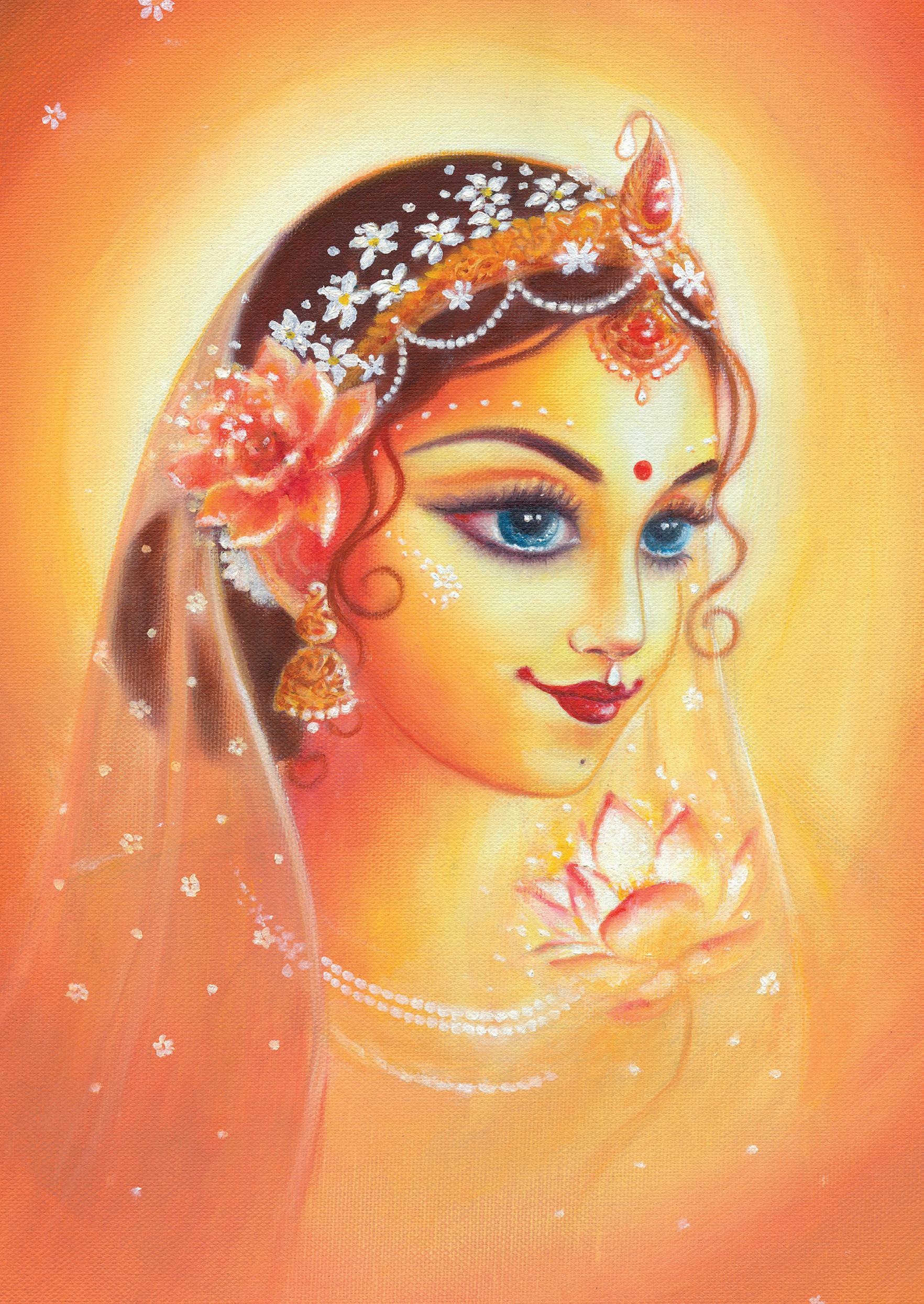
Śrī Rādhā
The Embodiment of the Ocean of Kṛṣṇa-prema
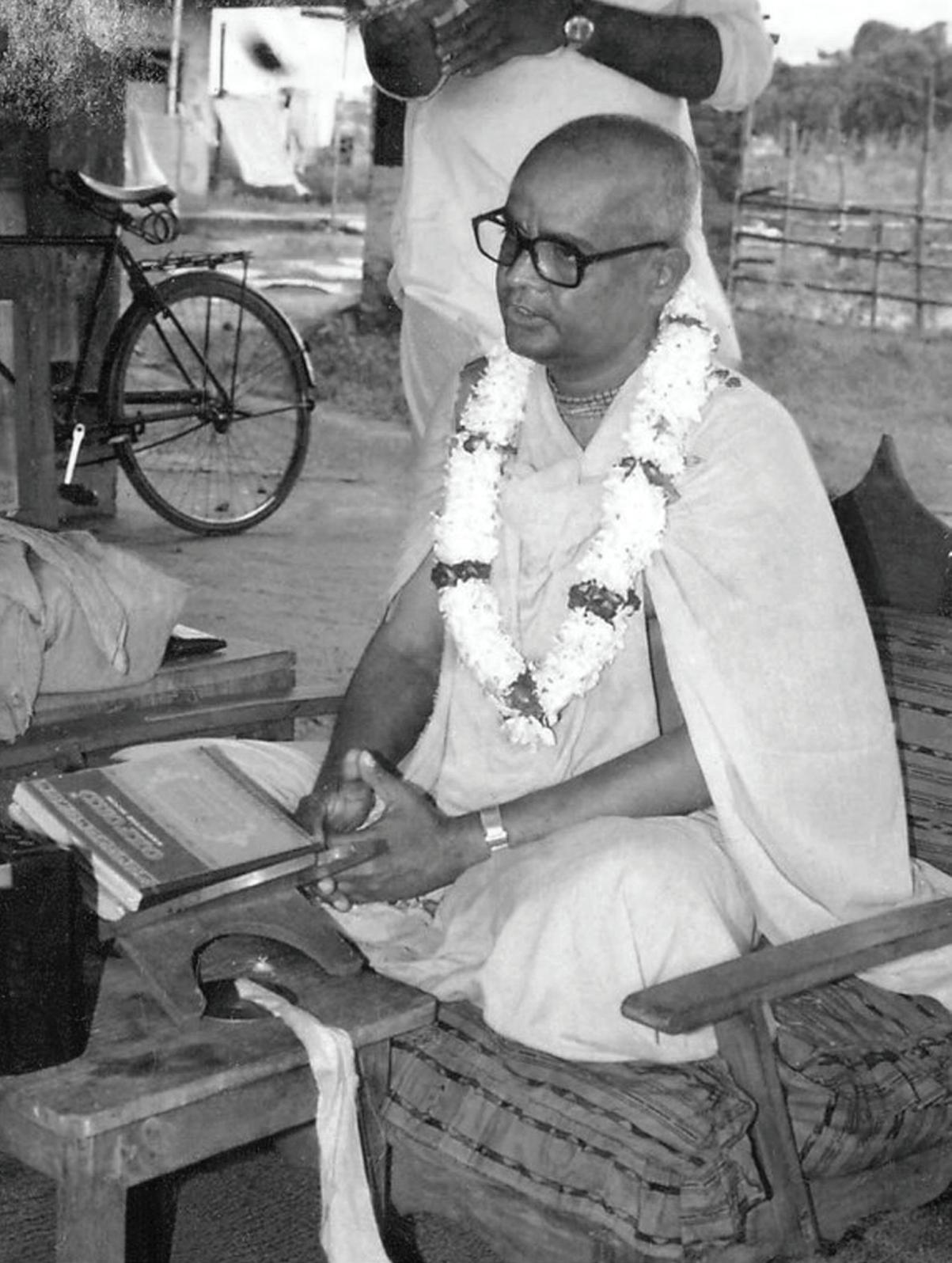
Śrī Śrīmad Gour Govinda Swami Mahārāja
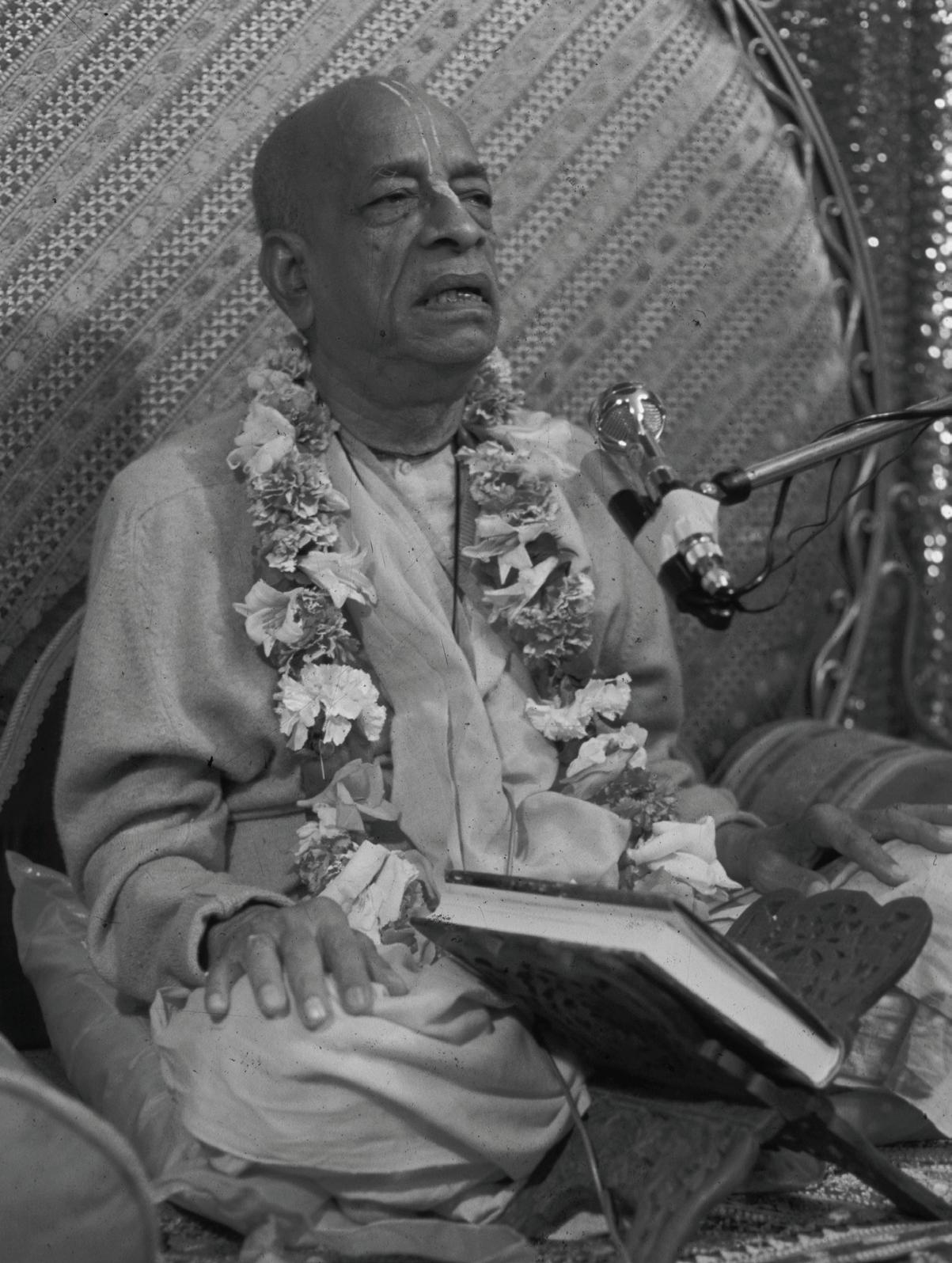
Śrīla A.C. Bhaktivedanta Swami Prabhupāda
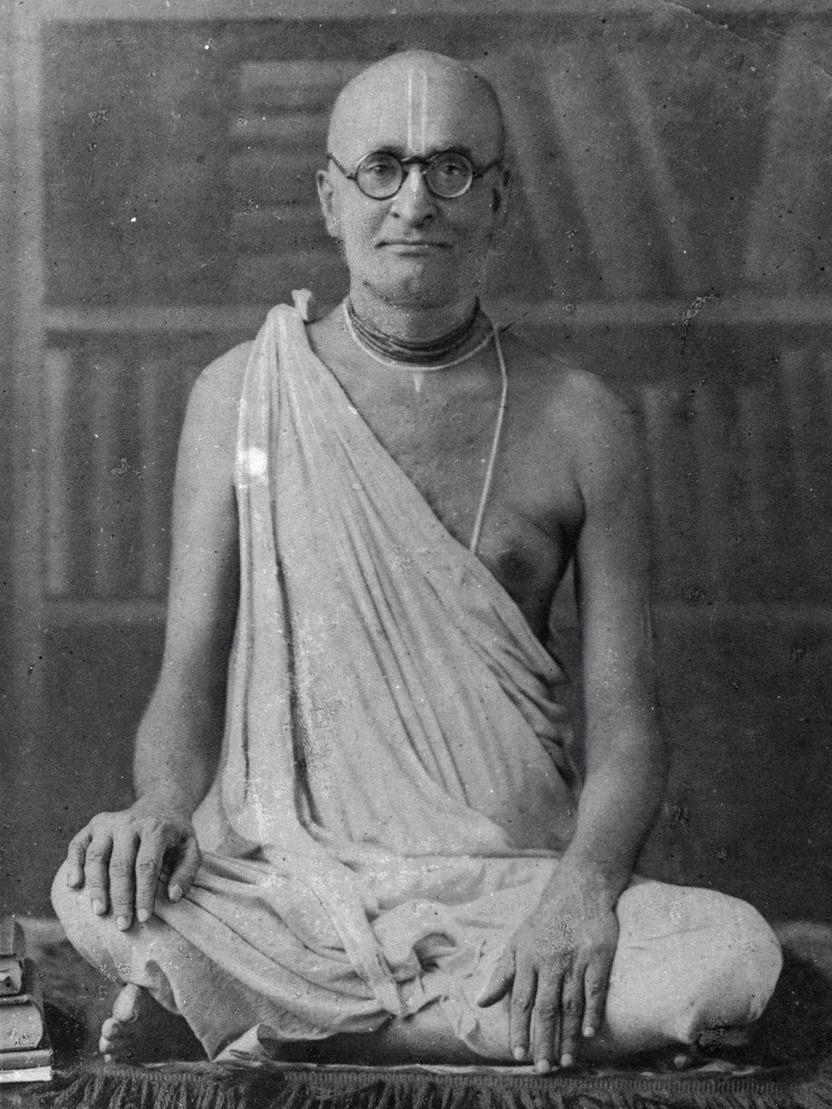
Śrīla Bhaktisiddhānta Sarasvatī Ṭhākura Prabhupāda
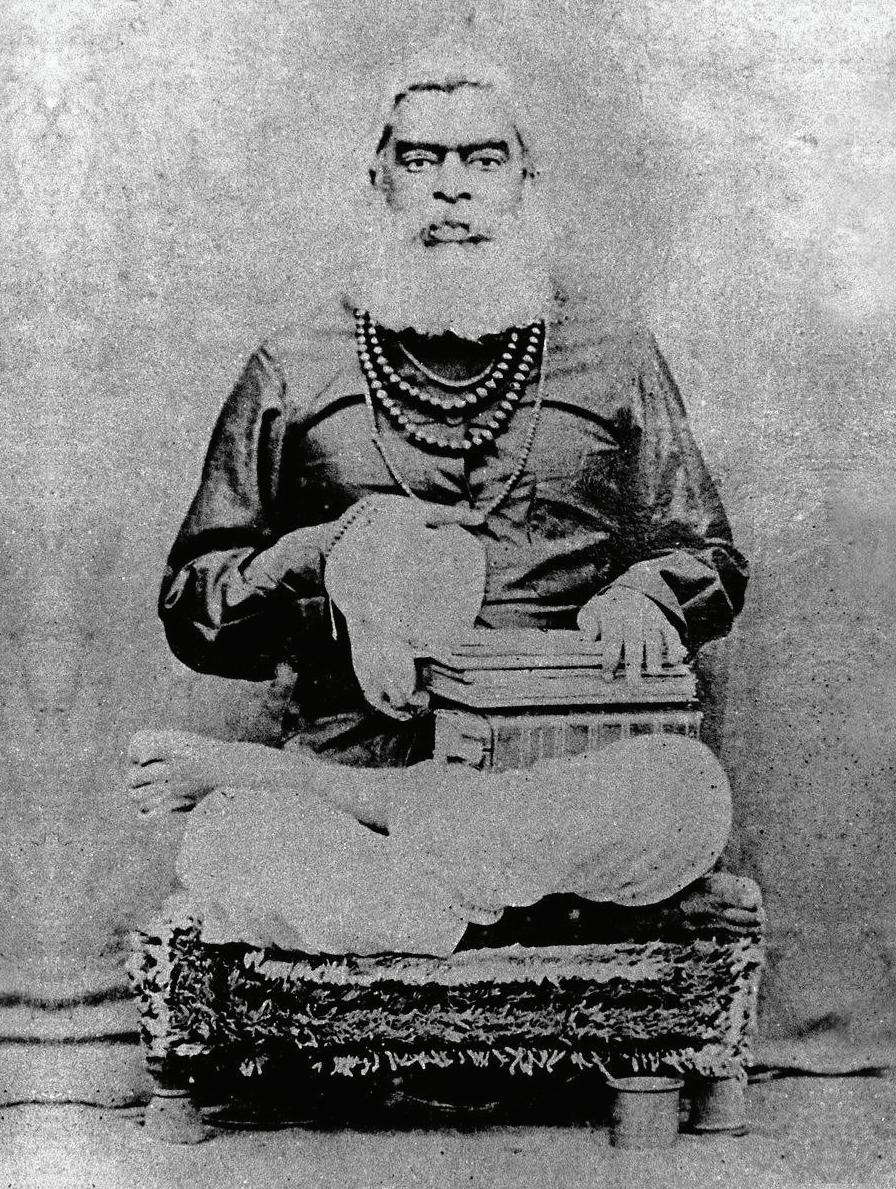
Śrīla Saccidānanda Bhaktivinoda Ṭhākura
nirdhūtāmṛta-mādhurī-parimalaḥ kalyāṇi bimbādharo vaktraṁ paṅkaja-saurabhaṁ kuharita-ślāghā-bhidas te giraḥ aṅgaṁ candana-śītalaṁ tanur iyaṁ saundarya-sarvasva-bhāk tvām āsādya mamedam indriya-kulaṁ rādhe muhur modate
“My dear auspicious Rādhārāṇī, Your body is the source of all beauty. Your red lips are softer than the sense of immortal sweetness, Your face bears the aroma of a lotus flower, Your sweet words defeat the vibrations of the cuckoo, and Your limbs are cooler than the pulp of sandalwood. All My transcendental senses are overwhelmed in ecstatic pleasure by tasting You, who are completely decorated by beautiful qualities.”
Śrīla Rūpa Gosvāmī
Lalita-mādhava 9.9
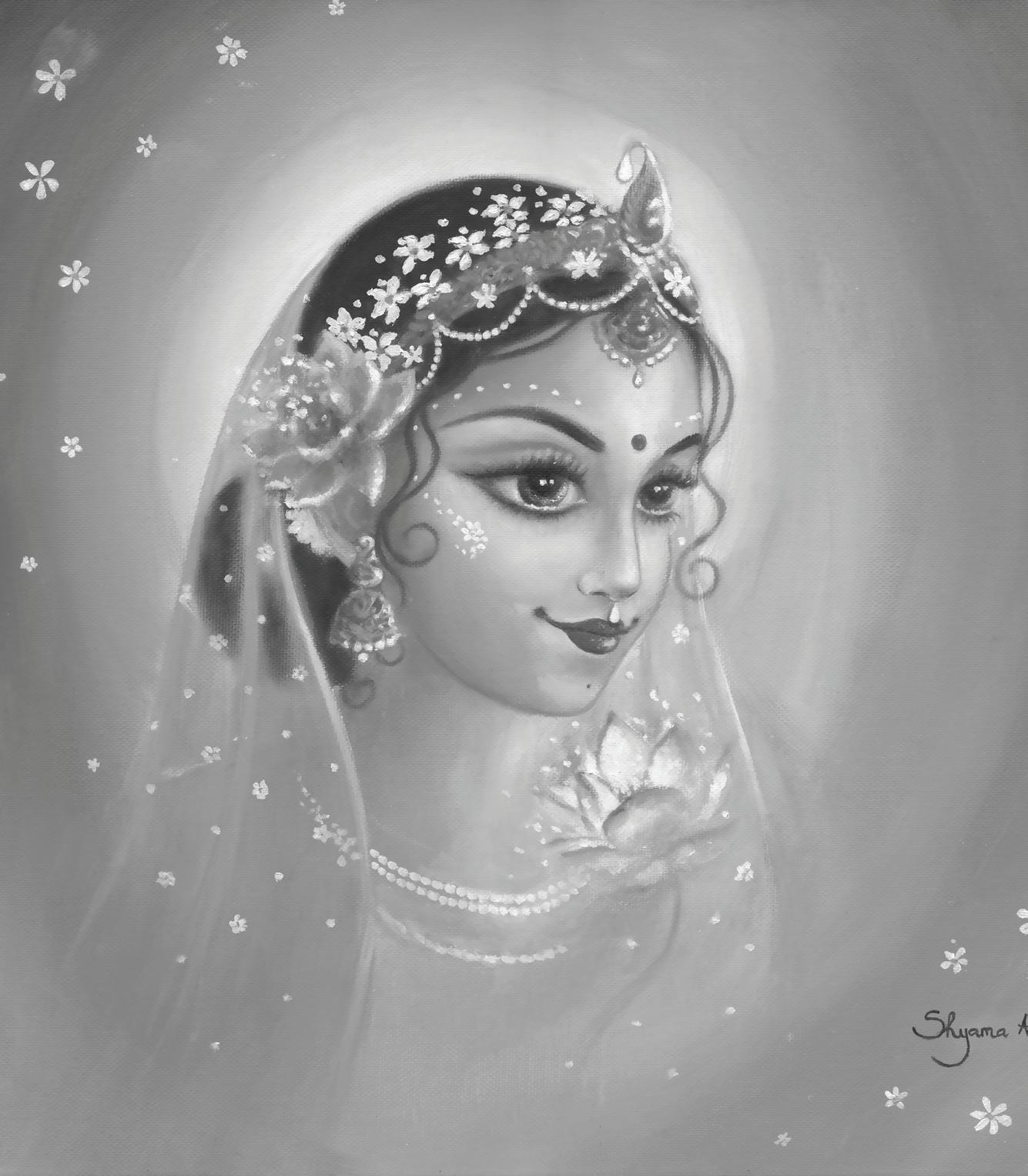
Śrī Rādhā - The Embodiment of the Ocean of Kṛṣṇa-prema
The information in this book is a compilation of lectures and informal talks delivered by Çré Çrémad Gour Govinda Swami Mahäräja.
Quotes from the books and lectures of Çréla A.C. Bhaktivedanta Swami Prabhupäda are copyrighted © The Bhaktivedanta Book Trust International. Image of Çréla A.C. Bhaktivedanta Swami Prabhupäda courtesy of The Bhaktivedanta Book Trust International, Inc. www.Krishna.com. Used with permission.
First Edition 1,000 copies - 2023 Printed at: Samrat offset Pty Ltd, Delhi, India.
ISBN: 978-0-6450973-9-9
© 2023 TATTVA VICÄRA PUBLICATIONS
SOME RIGHTS RESERVED. EXCEPT WHERE OTHERWISE NOTED, CONTENT ON THIS BOOK IS LICENSED UNDER THE CREATIVE COMMONS ATTRIBUTION-NO DERIVATIVES 4.0 INTERNATIONAL LICENSE.
To view a copy of this license, visit http://creativecommons.org/licenses/by-nd/4.0/ Permissions beyond the scope of this license write to info@tvpbooks.com
Front cover painting by Shyäma Ramaëé Art. Used with permission. Inside drawings by Poonam Sharma. Used with permission.
Finalised on the first day of Kärtika 29 October 2023, Murwillumbah NSW Australia.
Table of Contents
Maṅgalācaraṇa
Auspicious Invocation
Introduction
Rādhikā Stava
Rādhā-Bhajana Mahimā - Rādhā-Bhajane Jadi
Maṅgalācaraṇa
Auspicious Invocation
Compiled by Çré Çrémad Gour Govinda Swami, who would recite these verses each time before giving a class on Çré Caitanya-caritämåta.
oà ajïäna-timirändhasya
jïänäïjana-çaläkayä cakñur unmélitaà yena tasmai çré-gurave namaù
“I was born in the darkest ignorance, and my spiritual master opened my eyes with the torch of knowledge. I offer my respectful obeisances unto him.” (Çré Prema-bhakti-candrika)
çré-caitanya-mano-’bhéñöaà sthäpitaà yena bhü-tale svayaà rüpaù kadä mahyaà dadäti sva-padäntikam
“When will Çréla Rüpa Gosvämé Prabhupäda, who has established within this material world the mission to fulfill the desire of Lord Caitanya, give me shelter under his lotus feet?”
(Çré Prema-bhakti-candrika)
vande ‘haà çré-guroù çré-yuta-pada-kamalaà çré-gurün vaiñëaväàç ca
Śrī Rādhā - The Embodiment of the Ocean of Kṛṣṇa-prema
çré-rüpaà sägrajätaà saha-gaëa-raghunäthänvitaà taà sa-jévam sädvaitaà sävadhütaà parijana-sahitaà kåñëa-caitanya-devaà çré-rädhä-kåñëa-pädän saha-gaëa-lalitä-çré-viçäkhänvitäàç ca
“I offer my respectful obeisances unto the lotus feet of my spiritual master and unto the feet of all Vaiñëavas. I offer my respectful obeisances unto the lotus feet of Çréla Rüpa Gosvämé along with his elder brother Sanätana Gosvämé, as well as Raghunätha Däsa and Raghunätha Bhaööa, Gopäla Bhaööa, and Çréla Jéva Gosvämé. I offer my respectful obeisances to Lord Kåñëa Caitanya and Lord Nityänanda along with Advaita Äcärya, Gadädhara, Çréväsa, and other associates. I offer my respectful obeisances to Çrématé Rädhäräëé and Çré Kåñëa along with Their associates Çré Lalitä and Viçäkhä.” (Caitanyacaritämåta, Antya-lélä 2.1)
he kåñëa karuëä-sindho déna-bandho jagat-pate gopeça gopikä-känta rädhä-känta namo ‘stu te
“O my dear Kåñëa, You are the friend of the distressed and the source of creation. You are the master of the gopés and the lover of Rädhäräëé. I offer my respectful obeisances unto You.”
tapta-käïcana-gauräìgi rädhe våndävaneçvari våñabhänu-sute devi praëamämi hari-priye
“I offer my respects to Rädhäräëé, whose bodily complexion is like molten gold and who is the Queen of Våndävana. You are the daughter of King Våñabhänu, and You are very dear to Lord Kåñëa.”
väïchä-kalpatarubhyaç ca kåpä-sindhubhya eva ca patitänäà pävanebhyo vaiñëavebhyo namo namaù
“I offer my respectful obeisances unto all the Vaiñëava devotees of the Lord. They can fulfill the desires of everyone, just like desire trees, and they are full of compassion for the fallen souls.”
namo mahä-vadänyäya kåñëa-prema-pradäya te kåñëäya kåñëa-caitanyanämne gaura-tviñe namaù
“O most munificent incarnation! You are Kåñëa Himself appearing as Çré Kåñëa Caitanya Mahäprabhu. You have assumed the golden colour of Çrématé Rädhäräëé, and You are widely distributing pure love of Kåñëa. We offer our respectful obeisances unto You.” (Caitanya-caritämåta, Madhya-lélä 19.53)
yad advaitaà brahmopaniñadi tad apy asya tanu-bhä ya ätmäntaryämé puruña iti so ‘syäàça-vibhavaù ñaò-aiçvaryaiù pürëo ya iha bhagavän sa svayam ayaà na caitanyät kåñëäj jagati para-tattvaà param iha
“What the Upaniñads describe as the impersonal Brahman is but the effulgence of His body, and the Lord known as the Supersoul is but His localised plenary portion. Lord Caitanya is the Supreme Personality of Godhead, Kåñëa Himself, full with six opulences. He is the Absolute Truth, and no other truth is greater than or equal to Him.” (Caitanya-caritämåta, Ädi-lélä 1.3)
Śrī Rādhā - The Embodiment of the Ocean of Kṛṣṇa-prema
rädhä kåñëa-praëaya-vikåtir hlädiné çaktir asmäd ekätmänäv api bhuvi purä deha-bhedaà gatau tau caitanyäkhyaà prakaöam adhunä tad-dvayaà caikyam äptaà rädhä-bhäva-dyuti-suvalitaà naumi kåñëa-svarüpam
“The loving affairs of Çré Rädhä and Çré Kåñëa are transcendental manifestations of the Lord’s internal pleasuregiving potency. Although Rädhä and Kåñëa are one in Their identity, They separated Themselves eternally. Now these two transcendental identities have again united, in the form of Çré Kåñëa Caitanya. I bow down to Him, who has manifested Himself with the sentiment and complexion of Çrématé Rädhäräëé although He is Kåñëa Himself.” (Caitanyacaritämåta, Ädi-lélä 1.5)
ciräd adattaà nija-gupta-vittaà sva-prema-nämämåtam aty-udäraù ä-pämaraà yo vitatära gauraù kåñëo janebhyas tam ahaà prapadye
“The most munificent Supreme Personality of Godhead, known as Gaurakåñëa, distributed to everyone, even the lowest of men, His own confidential treasury in the form of the nectar of love of Himself and the holy name. This was never given to the people at any time before. I therefore offer my respectful obeisances unto Him.” (Caitanya-caritämåta, Madhya-lélä 23.1)
gauraù sac-caritämåtämåta-nidhiù gauraà sadaiva-stuve gaureëa prathitaà rahasya-bhajanaà gauräya sarvaà dade gaurädasti kåpälu-ratra na paro gaurasya bhrityo bhavaà gaure gauravamäcarämi bhagavan gaura-prabho rakña mäm
Maṅgalācaraṇa ‒ Auspicious Invocation
“I pray to Çrémän Gauräìga Mahäprabhu whose ecstatic transcendental pastimes are like a river of nectar. Gaura has given the path of confidential devotional service. I will completely surrender to Gaura. Is there anyone more merciful than Gaura? I will become a servant of Gaura. I shall preach the glories of Gaura. May my Lord Gaura protect me.” (Gauräìgavirudävalé by Çréla Raghunandan Gosvämé)
mädhuryaiù-madhubhiù sugambhi-bhajana svarëam bhujänäà vanam käruëyämåta nirjharair upacitah sat-prema hemacälaù bhaktämbodhara dharaëé vijayané niskampa-sampävalé daivo na kula-daivatäà vijayatäà caitanya-kåñëa-hariù
“I worship the golden hued Çré Caitanya Mahäprabhu Who is absorbed in the enchanting mellows of madhurya rasa. May the transcendental love of Kåñëa that Mahäprabhu is distributing, pour down on this earth like a waterfall of nectar. All glories to that Çré Kåñëa Caitanya Mahäprabhu.”
(Gauräìga-virudävalé by Çréla Raghunandan Gosvämé)
äjänu-lambita-bhujau kanakäva-dätau saìkértanaika-pitarau kamaläya-täksau visvambharau dvija-barau yuga-dharma-pälau vande jagat-priya-karau karuëävatärau
“I worship Their Lordships Çré Caitanya Mahäprabhu and Nityänanda Prabhu whose long arms extend down to Their knees, whose beautiful complexions are radiant yellow like molten gold and whose elongated eyes are like red lotuses. They are the topmost brähmaëas, the guardians of religious principles for this age, the most munificent benefactors of all living entities, and the most compassionate incarnations of Godhead. They initiated the congregational chanting of the names of Lord Kåñëa.” (Caitanya-bhägavata, Ädi-khaëòa 1.1)
Śrī Rādhā - The Embodiment of the Ocean of Kṛṣṇa-prema
anarpita-caréà cirät karuëayävatérëaù kalau samarpayitum unnatojjvala-rasäà sva-bhakti-çriyam hariù puraöa-sundara-dyuti-kadamba-sandépitaù sadä hådaya-kandare sphuratu vaù çacé-nandanaù
“May that Lord, who is known as the son of Çrématé Çacédevé, be transcendentally situated in the innermost chambers of your heart. Resplendent with the radiance of molten gold, He has appeared in the age of Kali by His causeless mercy to bestow what no incarnation ever offered before: the most sublime and radiant spiritual knowledge of the mellow taste of His service.”
(Vidagdha-mädhava 1.2)
çré-kåñëa-caitanyadeva rati-mati bhave bhaja prema-kalpa-taru-bara-dätä çré-vraja-räja-nandana rädhikä-jévana-dhana aparüpa ei saba kathä
“O brother, always worship Çré Kåñëa Caitanyadeva who is the great philanthropist giving away the treasure of the desire tree of pure love for Kåñëa. This Lord Caitanya is actually Lord Kåñëa, the prince of Vraja and the life of Çrématé Rädhäräëé. Descriptions of Him are spiritual sounds. They are not at all material.” (Prema-bhakti-candrikä, 10.12)
navadvépe avatari’ rädhä-bhäva aìgékari’ täìra känti aìgera bhüñaëa tina väïchä abhiläñé’ çacé-garbhe parakäçi’ saìge laïä pariñada-gaëa
“Lord Kåñëa desired to appear in Navadvépa to understand the intense love Çrématé Rädhäräëé felt for Him, and accept
Maṅgalācaraṇa ‒ Auspicious Invocation
Her golden complexion as His bodily ornament. In order to fulfill these three desires, the Lord appeared in Çacédevé’s womb. When the Lord appeared like this in the material world, all His associates followed Him, and also appeared in the world.” (Prema-bhakti-candrikä, 10.13)
gaura-hari avatari ‘premera vädara kari’ sädhilä manera tina käja rädhikära präëa-pati kivä bhäve käìde niti ihä bujhe bhakata-samäja
“The Lord appeared in the golden form of Lord Caitanya, and preached the message of pure love for Kåñëa. In this way He fulfilled the three desires in His mind. Only the devotees are able to understand in what a wonderful way Kåñëa, who is the Lord of Çrématé Rädhäräëé’s life, continually cried in ecstatic love of God.” (Prema-bhakti-candrikä, 10.14)
uttama adhama kichu na bächila yäciyä dilaka kola kahe premänanda emana gauräìga hådaye dhariyä bola bhaja gauräìga kaha gauräìga laha gauräìga näma (re) ye jana gauräìga bhaje sei haya ämära präëa (re)
“Never discriminating who was a fit candidate, elevated or degraded, the son of mother Çacé magnanimously accepts one and all onto His lap in a loving embrace crying; ‘Come to My fold, come to My fold!’ The poet Premänanda Däsa begs you all to constantly chant the sweet name of Kåñëa while holding tightly to that son of mother Çacé in the innermost core of your heart. Worship Gauräìga! Speak about Gauräìga! Oh please take to gaura-näma! Whoever worships Gauräìga is my life and soul.” (Premänanda Däsa)
Śrī Rādhā - The Embodiment of the Ocean of Kṛṣṇa-prema
yasyaiva pädämbuja-bhakti-läbhyaù premäbhidhänaù paramaù pum-arthaù tasmai jagan-maìgala-maìgaläya caitanya-candräya namo namas te
“O Lord Caitanyacandra, by devotedly serving Your lotus feet one can attain the pure love for Lord Kåñëa that is the ultimate goal of all endeavours. O Lord Caitanyacandra, O great auspiciousness of the world, I offer my respectful obeisances unto You. I offer my respectful obeisances unto You.” (Çré Caitanya-candrämåta, text 9)
änanda-lélä-maya-vigrahäya hemäbha-divyac-chavi-sundaräya tasmai mahä-prema-rasa-pradäya caitanya-candräya namo namas te
“O Lord Caitanyacandra, O Lord whose form is full of blissful pastimes, O Lord whose complexion is as splendid as gold, O Lord who gives in charity the nectar of pure love for Lord Kåñëa. I offer my respectful obeisances unto You. I offer my respectful obeisances unto You.” (Çré Caitanya-candrämåta, text 11)
yan näptaà karma-niñöhair na ca samadhi-gataà yat tapo dhyäna-yogair vairägyais tyäga-tattva-stutibhir api na yat tarkitaà cäpi kaiçcit govinda-prema-bhäjäm api na ca kalitaà yad rahasyaà svayaà tan nämnaiva präduräséd avatarati pare yatra taà naumi gauram
“Not attainable by the faithful performers of pious deeds, not understood by those engaged in austerity, meditation, and yoga, not guessed by those absorbed in detachment, renunciation
viii
‒ Auspicious Invocation
of the fruits of work, philosophical speculation or recitation of prayers, and unknown even to the devotees full of love for Lord Govinda, the secret of pure devotional service has been revealed by the holy name during Lord Gaura’s advent. Let me glorify that Lord Gaura.” (Çré Caitanya-candrämåta, text 3)
Introduction
The Original Potency
Śrī Rādhikā Stava
Çré Çré Rädhikä Päda-Padme Vijïapti Çréla Rüpa Gosvämé
(1)
rädhe! jaya jaya mädhava-dayite gokula-taruëé-maëòala-mahite!
“O Çrématé Rädhikä! O beloved of Mädhava! O You whose glories are sung by the young maidens of Gokula-maëòala! All glories to You! All glories to You!”
(2)
dämodara-rati-vardhana-veçe! hari-niñkuöa-våndä-vipineçe!
“O You who dress Yourself in such a way as to increase Lord Dämodara’s love and attachment for You! O Queen of Våndävana, which is the pleasure grove of Lord Hari!”
(3)
våñabhänüdadhi-nava-çaçi-lekhe! lalitä-sakhi guëa-ramita-viçäkhe!
Śrī Rādhā - The Embodiment of the Ocean of Kṛṣṇa-prema
“O new moon who has arisen from the ocean of King Våñabhänu! O friend of Lalitä! O You who make Viçäkhä loyal to You due to Your wonderful qualities of friendliness, kindness, and faithfulness to Kåñëa!”
(4)
karuëäà kuru mayi karuëä-bharite sanaka-sanätana-varëita-carite!
“O You who are filled with compassion! O You whose divine characteristics are described by the great sages Sanaka and Sanätana! O Rädhä, please be merciful to me!”
Śrī
Rādhā-Bhajana Mahimā - Rādhā-Bhajane Jadi
Glorification of Worshipping Çré Rädhä
(Gétävalé-Çréla Bhaktivinoda Öhäkura)
(1)
rädha-bhajane jadi mati nähi bhelä kåñëa-bhajana tava akäraëa gelä
“If the desire to serve Çrématé Rädhäräëé does not appear in my heart, then my worship of Kåñëa is simply useless.”
(2)
ätapa-rohita süraya nähi jäni rädhä-virahita mädhava nähi mäni
“Just as the sun cannot be perceived without sunlight, in the same way I do not recognise Mädhava without Rädhä.”
Introduction - The Original Potency
(3)
kevala mädhava püjaye, so ajïäné rädhä anädara koroé abhimäné
“Those who worship Mädhava alone are ignorant; they simply neglect Çrématé Rädhikä out of their mundane pride.”
(4)
kabahé nähi korobi täkora saìga citte icchasi jadi braja-rasa-raìga
“Do not ever associate with such persons if you desire the loving playfulness of vraja-rasa to appear in your heart.”
(5)
rädhikä-däsé jadi hoya abhimäna çéghraé milaé taba gokula-käna
“If you develop pride in being Çrématé Rädhikä’s exclusive maidservant, then very quickly you will meet Gokula Käna.”
(6)
brahmä, çiva, närada, çruti, näräyané rädhikä-pada-raja püjaye mäni’
“Brahmä, Çiva, Närada, the Çruti-cari åñis, and Näräyané all honour and worship the dust of Çrématé Rädhikä’s lotus feet.”
(7)
umä, ramä, satyä, çacé, candrä, rukminé rädha-avatära sabe - ämnäya-väëé
Śrī Rādhā - The Embodiment of the Ocean of Kṛṣṇa-prema
“The ämnäya, revealed scriptures, declare that Umä, Ramä, Satyä, Çacé, Candrävalé, and Rukmiëé are all Rädhä’s expansions.”
(8)
heno rädhä-paricaryä jäìkara dhana bhakativinoda tära mägaye caraëa
“Bhaktivinoda is begging at the lotus feet of those whose wealth is the service of Çrématé Rädhärani.”
Rādhikā-Caraṇa-Padma (Gétävalé-Çréla Bhaktivinoda Öhäkura)
(1)
rädhikä-caraëa-padma, sakala çreyera sadma, jatane je nähi ärädhilo rädhä-padmäìkita dhäma, båndäbana jära näma, tähä je nä äçraya korilo
(2)
rädhikä-bhäva-gambhéra, citta jebä mahädhéra, gaëa-saìga nä koilo jévane kemone se çyämänanda, rasa-sindhu-snänänanda, labhibe bujhoha eka-mane
“One who has failed to carefully worship the lotus feet of Çrématé Rädhikä, which are the abode of all auspiciousness; who has not taken shelter in the transcendental abode known as Våndävana, which is decorated with the beautiful lotus flower named Rädhä; who in this life has not associated with the devotees of Rädhikä, who are very wise and whose devotion for Rädhä is very deep-
Introduction - The Original Potency
how will such a person ever experience the bliss of bathing in the ocean of Lord Çyäma’s sublime mellows? Please understand this most attentively.”
(3)
rädhikä ujjvala-rasera äcärya
rädhä-mädhava-çuddha-prema vicärya
“Çrématé Rädhikä is the exemplary teacher of the brilliant mellows of conjugal love. This pure love between Rädhä and Mädhava is worthy of discussion and contemplation.”
(4)
je dharilo rädhä-pada parama jatane se pailo kåñëa-pada amülya-ratane
“He who has grasped hold of the lotus feet of Rädhä with great care obtains the lotus feet of Kåñëa, which are like priceless jewels.”
(5)
rädhä-pada vinä kabhu kåñëa nähi mile rädhära däséra kåñëa sarva-vede bole
“Without taking shelter of the lotus feet of Rädhä, one can never personally meet Lord Kåñëa. The Vedic scriptures declare that Kåñëa is the property of the maidservants of Çré Rädhä.”
(6)
choòata dhana-jana, kalatra-suta-mita, choòata karama geyäna rädhä-pada-paìkaja, madhurata sevana, bhakativinoda paramäna
Śrī Rādhā - The Embodiment of the Ocean of Kṛṣṇa-prema
“Abandoning wealth, followers, wife, sons, and friends, and giving up materialistic activities and intellectual knowledge, being absorbed in the sweetness of service to the lotus feet of Çrématé Rädhäräëé-this is Bhaktivinoda’s conviction.”
Ramaṇī-śiromaṇi
(Gétävalé - Çréla Bhaktivinoda Öhäkura)
(1)
ramaëé-çiromaëi, våñabhänu-nandiné, néla-vasana-paridhäna chinna-puraöa jini’, varna-vikäçiné, baddha-kabaré hari-präna
“The beloved daughter of King Våñabhänu is the crest-jewel of all young women. She is fond of wearing blue garments. Her radiant complexion is very pleasing and conquers the beauty of freshly cut gold, Her locks of hair are nicely arranged, and She is the life and soul of Lord Kåñëa.”
(2)
äbharaëa-manòita, hari-rasa-panòita, tilaka-çusobhita-bhälä kaïculikäcchäditä, stana-maëi-manòitä, kajjala-nayané rasälä
“She is artfully adorned with jewels, She is very learned in the science of Hari-rasa, and Her forehead is nicely decorated with tilaka. Her breasts are covered with a beautiful corset and adorned with valuable gems, and Her eyes are anointed with
Introduction - The Original Potency
black collyrium. Thus She appears to be relishable sweetness personified.”
(3)
sakala tyajiyä se rädhä-caraëe däsé ho’ye bhaja parama-jatane
“Giving up everything and becoming a maidservant at the lotus feet of Rädhä, just worship and serve Her with great care and attention.”
(4)
saundarya-kirana dekhiyä jäìhära rati-gauré-lélä garva-parihära
“Beholding Her effulgent rays of pure beauty, the goddesses Rati, Gauré, and Lélä abandon all their pride.”
(5)
çacé-lakñmé-satya saubhägya bolane paräjita haya jäìhära caraëe
“The good fortune attributed to the goddesses Çacé, Lakñmé, and Satyä is completely defeated in the presence of Rädhä’s feet.”
(6)
kåñëa-vaçékäre candrävalé-ädi paräjaya mäne hoiyä vivädé
“The group of rival gopés led by Candrävalé are forced to accept their defeat before Çrématé Rädhäräëé, for She alone controls Kåñëa. Thus they always sulk and simply remain quarrelsome.”
Śrī Rādhā - The Embodiment of the Ocean of Kṛṣṇa-prema
(7)
hari-dayita rädhä-caraëa prayäsé bhakativinoda çré-godruma-väsé
“Bhaktivinoda, a resident of Çré Godruma, always endeavours for the lotus feet of Rädhä, the most beloved of Lord Hari.”
Śata-koṭi gopī
(Gitavali - Çréla Bhaktivinoda Öhäkura)
(1)
çata-koöi gopé mädhava-mana, räkhite närilo kori jatana
“Millions of cowherd damsels are unable to please the mind of Mädhava although endeavouring to do so.”
(2)
veëu-géte òäke rädhikä-näma, eso eso rädhe! òakoye çyäma
“The flute song calls the name of Rädhikä “Come here, come here, Rädhe!” Çyäma calls out in the night.”
(3)
bhäìgiyä çré-räsa-maëòala tabe, rädhä-anveñaëe calaye jabe
“When the Çré-räsa-manòala comes to a halt in search of Beloved Rädhä He then goes.”
Introduction - The Original Potency
(4)
dekhä diyä rädhe! räkhoha präëa! boliya kändaye känane käna
“‘Please appear, O Rädhe! Kindly save My life!’ calling out while weeping Käna in the forest.”
(5) nirjana känane, rädhäre dhori, miliyä paräëa juòäya hari
“In a secluded grove embracing Rädhikä regaining His life and soul Hari is relieved.”
(6)
bole, ‘tuìhu vinä kähära räsa? tuìhu lägi’ mora baraja-bäsa’
“Saying, ‘Without You, where is the räsa dance? Only because of You do I live in Vraja.’”
(7)
e heno rädhikä-caraëa-tale, bhakativinoda käìdiyä bole
“At the lotus feet of such a Rädhikä this Bhaktivinoda says weeping,”
(8)
“tuwä gaëa-mäjhe ämäre gaëi, kinkoré koriyä rakho äpani”
Śrī Rādhā - The Embodiment of the Ocean of Kṛṣṇa-prema
“Among Your personal associates please count me also; making me Your maidservant keep me as Your own.”
Śrīla Raghunātha dāsa Gosvāmīra
The Song on Life’s Goal of Çréla Raghunätha däsa Gosvämé
By Çréla Gaura Kiçora däsa Bäbäjé Mahäräja
(1)
kothäy go prema-mayi, rädhe rädhe rädhe rädhe go, jaya rädhe rädhe
“Where is She who is full of prema? All glories to Çré Rädhä.”
(2)
dekhä diye präëa räkha, rädhe rädhe tomära käìgäl tomäy òäke, rädhe rädhe
“O Rädhä! Please give me Your darçana and save my life. Your wretched beggar calls out to You, ‘Rädhe! Rädhe!’”
(3)
rädhe våndävana-viläsiné, rädhe rädhe rädhe känu-mana-mohiné, rädhe rädhe
“O Rädhä, You enjoy pleasure pastimes in the forest of Våndävana wherein You enchant the mind of Kåñëa.”
(4) rädhe añöa-sakhér çiromaëi, rädhe rädhe rädhe våñabhänu-nandiné, rädhe rädhe (gosäi) niyam ka’re sadäi òäke, rädhe rädhe
Introduction - The Original Potency
“O Rädhe, You are the crest-jewel among Your eight principal sakhés. O Rädhä, daughter of Våñabhänu Bäbä. Raghunätha däsa Gosvämé was always calling out, ‘Rädhe! Rädhe!’”
(5)
(gosäi) ek-bär òäke keçé-ghäöe, äbär òäke vaàçé-vaöe, rädhe rädhe (gosäi) ek-bär òäke nidhuvane, äbär òäke kuïjavane, rädhe rädhe
“Sometimes at Keçé Ghäöe, sometimes at Vaàçé Vaöa. Sometimes in Nidhuvan, sometimes in Sevä Kuïja.”
(6)
(gosäi) ek-bär òäke rädhä-kuëòe, äbär òäke çyäma-kuëòe, rädhe rädhe (gosäi) ek-bär òäke kusuma-vane, äbär òäke govardhane, rädhe rädhe
“Sometimes at Rädhä Kuëòa, sometimes at Syäma Kuëòa. Sometimes at Kusuma Sarovara, sometimes at GiriräjaGovardhana.”
(7)
(gosäi) ek-bär òäke tälavane, äbär òäke tamälvane, rädhe rädhe (gosäi) malin vasan diye gäy, vrajer dhüläy gaòägaòi jäy, rädhe rädhe
“Sometimes at Tälavana, sometimes at Tamälvana. Raghunätha däsa wears simple cloth which appears to be dirty because he is always rolling on the earth crying out, ‘Rädhe! Rädhe!’”
Śrī Rādhā - The Embodiment of the Ocean of Kṛṣṇa-prema
(8)
(gosäi) mukhe rädhä rädhä bale, bhäse nayanera jale, rädhe rädhe (gosäi) våndävane kuli kuli kende beòäya rädhä boli’, rädhe rädhe
“Calling out ‘Rädhe! Rädhe!’ his eyes are bursting with a flood of tears. He wanders throughout the lanes of Våndävana crying out, ‘Rädhe! Rädhe!’”
(9)
(gosäi) chäpänna daëòa rätri-dine jäne nä rädhä-govinda bine, rädhe rädhe
“He knows nothing but Rädhä-Govinda throughout the day and night. Rädhe! Rädhe!”
(10)
tär par cäri daëòa çuti’ thäke svapne rädhä-govinda dekhe, rädhe rädhe
“He takes rest for only four daëòas (equal to: one hour and thirty six minutes). At that time in his dreams he receives darçana of Rädhä-Govinda. Rädhe! Rädhe!”
The Original Potency
In the transcendental abode of Çré Våndävana, under a madhavi, creeper, Kåñëacandra was once sitting alone on a golden throne, thinking how to relish the nectarean mellow of His pastimes. As soon as He thought like that, by His mere willing, Çrémati Rädhäräëé appeared from the left side of His body. Rädhäräëé is known throughout the universe as ädé-çakti, the original potency. When She appeared Her bodily complexion was the colour of molten gold. Her body was decorated with varieties of ornaments; a flower bouquet adorned Her braided hair. A necklace of pearls (muktämäla) lay on Her breast and a belt (mekhala) encircled Her waist. Her ears were decorated with beautiful golden earrings. The nüpura, anklets, on Her feet produced tinkle-bell sounds as She walked. Mädhava-mohini rädhä-mädhava-mohila — Rädha enchanted Mädhava. In the räsa dance She gave so much pleasure to Mädhava and again She thought, how can I give more pleasure to Mädhava. With this thought immediately innumerable gopés came out from Her body. They all looked like Rädha. In order to relish the nectarean pastime, They appeared as two bodies. [This is a description from Brahma-vaivarta Puräëa]
Now I will relate the description in the Padma Puräëa about the appearance of Rädhä. Çivajé is speaking to Pärvaté-devé. In the Padma Puräëa, Uttara Khaëòa it is mentioned:
våñabhänu puré räjä våñabhänu mahäçaya mahäkula praséda so sarva çästra vicärada
tasya varya mahäbhaga çrématé kértidä buyaù rüpa yovana sampanna mahäbäja kulad bhäva
Śrī Rādhā - The Embodiment of the Ocean of Kṛṣṇa-prema
tasyäm çré rädhikä jata çrémad våndävaneçvaré bhadre maçi siddhas tasyam madhyane çubha däyine
våñabhänu name räjä bhakata pradhäna añöa nidhi tära ghare sadä vidyamäna
tära patné kértidä näme mahäpatni vrata tähära garbhe janamilä rädhä jaganmätä
bhadra çukläñöamé dine madhyäna kälete janmile na vrajeçvaré harira icchäte
paränandamoya hoila gopa paribära sakala gokula bhari änanda apära
sabära väsanä pürëa sukhera prakäça kanyä ratna daraçane sabära ulläsa
tabe bhänu kanyä janme dila bahu däna deva dvija ädikari’ karilä sämäna
näta bäta ädi kari’ jata dina jäne däna dila bhänuräja baòa sukhé mane
heno mate vrajeçvaré janmila gokule na bhujite päre keho tähäì mäyä bole
iti madhye eka kathä çuna bhakta gaëa je mate närada päi rädhikä darçana
eka déna muni çreñöha närada tapa dhana bhramite bhramite loya bhänu rädhä vana
kuçala vä ratnamaëé bhänure puñila bhanuräja namrachitte kahite lägila
Introduction - The Original Potency
tomära prasäde sab kuçala ämära påthévi pavitra hoy paraçe tomära
sarva päpa täpa jäi tomär darçane sarva çubha dayä haya tomär ägamane
tomära caraëa reëu sarva tértha-maya tomär parasile citte hari-bhakti haya
eteka baliya bhänu kanyä vilakale rädhära parase muni änanda vihale
premete pürila deha netre açru jhare sarväìga pulakävali sättvika vikäre
antare antare muïi rädhära caraëa hådaye òäriyä preme kara ceñöä vana
tumi haripriya devé mahäbhäva-rüpa govinda-mohiné tumi änanda svarüpa
tumi bhakti tumi tapa tumi sarva rüpa tomära caraëa dhyäna kare sarva deva
tomära aìgsete mahä-lakñmé janaméla gopé mohisi ädi sakale hayaila
tumi ädya-çakti haya kåñëera mohiné tumi kåñëa präëa rüpa sabära janané
munira eteka väëé çuni rädhä dhané dekhäilä nija rüpa kåpäye äpani
divya kalpa taru tale divya ratnäsane bosiyächena vrajeçvaré sakhi gaëa sane
Śrī Rādhā - The Embodiment of the Ocean of Kṛṣṇa-prema
cämara vyajana tale kon sakhé jana divya çveta chatra dhare parama çobhana
rädhä aìge diyä väsa alaìkära çobhä prati aìga dolamana hari-mana lobha
sundara sindhura bindu laläte çobhana kati tate känci ämära apürva darçana
ratna härävali sahe kaëa maëi pare caraëe nüpura däma hari citta hare
aìgera chatäye dik haya älokita rüpa heri muni vära parama vismita
nayaëe premera dhära gada gada väëé pulake purala tanu kichu nähi jäni
e saba carita keha näre likhi bare rädhära kåpayä mätra närada néhäre
puëya çiçu rüpe rädhä munira kalete çuyiä rahila keha närila bhujite
öabe muni vara kanyä bhänu kale dila bhänu kértidäri òaki kahite lägila
mahä-bhägyaväna doìhe jagata mäjhäre eno aparüpa kanyä haya jära ghare
kamalä pärvaté ära arundhaté saté çacé satyabhämä ära jata eka yuvati
Introduction - The Original Potency
sabära aàçiné rädhä jäna bhälo mate tära sama hari-priya nä äcche jagate
e kanyä prabhäve saba gokula maëòala sakala sampada päbe läbhibe maìgala
kanyä boli mane kichu duùkha nähi kara iha hoite bahu yaça hoibe tomära
tabe bhänuräja bole juòiduti kara
kibä pati habe bhavi kaha muni bara
muni bole habe mahä-puruñera näré hoibe nayaëa käle cädha duùkha väri
bära bhägyaväne doìhe jagata mäjhäre ateke boliyä muïi kalila satare
padma-puräëera çiva durgära väratä äçraya kahila kichu rädhä janma kathä
Çrématé Rädhäräëé ki jaya!
Våñabhänu-nandiné Rädhäräëé ki jaya!
Känu-mana-mohiné Rädhäräëé ki jaya!
Çré Çré Rädhäsöamé-mahä-mahotsava ki jaya!
In the Padma Puräëa it is mentioned that there was a great devotee, an opulent king named Våñabhänu. His wife, Kértidä was chaste and devoted. From her womb Rädhä, jagan-mätä, the mother of the whole world, took birth. On this day, in the month of Bhadrava, the eighth day of the bright fortnight, at noon, by the will of Lord Hari, Rädhäräëé appeared. All the gopa families of Gokula became very, very blissful, all of Gokula was joyful. Every
Śrī Rādhā - The Embodiment of the Ocean of Kṛṣṇa-prema
one’s desires were fulfilled seeing a very beautiful daughter was born and everyone felt great joy and happiness. King Våñabhänu gave immense amounts of charity to brähmaëas, to Vaiñëavas, to bhärtas, to naöas, to poor men. In this way Vrajeçvaré, that is Rädhäräëé, took birth in Gokula. No one could understand it because of Her mäyä.
Nārada Muni’s Prayer
One day Närada Muni came to King Våñabhänu’s quarters to have darçana of Rädhäräëé. Närada Muni inquired of all auspiciousness. King Våñabhänu humbly replied, “By your mercy everything is auspicious. You are a great sädhu, wherever you travel all-auspiciousness appears there. Wherever you go, that place becomes a tértha. By your mercy everyone can have haribhakti.”
Saying this King Våñabhänu picked up his daughter and placed her on the lap of Närada Muni. When Närada Muni felt the touch of Rädhäräëé he became ecstatic, his hair stood on end, tears poured down from his eyes in torrents, and in his heart Närada Muni offered a prayer to Rädhäräëé, “You are hari-priya, dear to Lord Hari; You are mahäbhäva-svarüpä, the embodiment of mahäbhäva, govinda-mohiné, the enchantress of Govinda. You are änanda svarupa, the embodiment of all bliss. You are bhakti, You are tapa, You are everything. All demigods, beginning from Brahmä and Çiva meditate on Your lotus feet. All gopés, mahiñis, queens, and Mahälakñmé, are your plenary portions. You are adyaçakté, the original potency, energy; kåñëer-mohéni, You enchant Kåñëa; kåñëa-präna-rüpa, You are Kåñëa’s life and soul. You are jagan-mätä, the mother of the whole world.”
Introduction - The Original Potency
Rādhārāṇī Showed Nārada Muni Her Form
Out of mercy hearing Närada Muni’s prayers Rädhäräëé showed him Her form. Närada Muni saw Rädhäräëé sitting on a divya-raöëa-siàhäsana, a throne studded with divine gems, under a transcendental kalpa-våkça, wish-fulfilling tree, surrounded by innumerable sakhés. Some of the sakhés were fanning, some sakhés were waving cämaras, and some sakhés were holding white umbrellas. He saw Rädhäräëé’s body covered with beautiful transcendental garments, and he saw the vermillion points, sindhura-bindu on Her forehead. He saw around Her waist, khate thäke, a belt, and ratna harävali suveñöa-maëi-male, a necklace of gems on Her chest. He saw nüpura, ankle bells clasped to Her feet. He saw the effulgence coming from Her body. Närada Muni’s voice faltered and his whole body was ecstatic. No one knew, no one else could see, only by Her mercy, Närada Muni saw this beautiful form of Rädhäräëé.
The Most Fortunate Parents in the Whole World
Now, again as a baby, Rädhäräëé was lying on the lap of Närada Muni. Then Närada Muni returned that baby daughter to Her father Våñabhänu. Våñabhänu called his wife Kértidä. Våñabhänu and Kértidä sat down before Närada Muni. Närada Muni said, “Both of you are the most fortunate mother and father in the whole world. You are very, very fortunate, mahä-bhägyavan, because you have such a wonderful daughter. Kämala, Pärvati, Arundhäti, Sacé, Satyabhama, all are the portions and portions of this girl Rädhäräëé. She is hari-priya. No one is as dear to Lord Hari as She is dear. Because of this daughter, the whole of Gokula-maëòala will be filled with every kind of opulence. Do not feel sorry that it is a daughter. Your glory will be spread far and wide.”
Śrī Rādhā - The Embodiment of the Ocean of Kṛṣṇa-prema
After hearing this from Närada Muni, King Våñabhänu asked, with folded hands, “Who will be Her husband?” Närada muni said, “She will be the wife of that supreme puruña, parama-puruña, mahä-puruña.” At that time Her eyes were not open. Närada Muni said, “In due course of time Her eyes will open. You are the most fortunate mother and father in the whole universe.” Saying this, Närada Muni left that place.
This is mentioned in the Padma Puräëa. Çivajé is speaking to Pärvaté-devé. Then Pärvaté enquires:
pärvaté jijïäse puëaù çaìkara caraëe netra khüli rädhä kena nä kare darçane
çaìkara bolena — devé kara avadhäna kahiba se saba kichu apürva äkhyäna
jabe hari avatära mane icchä kaila rädhäre òakiyä kichu bolite lägila
mora mane martya loke tumi jänamive tathä e vicitra lélä tomä sane habe
kave rädhä kahe çuna kamala locana mate janme habe para puruña darçana
tava rüpa vinä muïi äna nähi pheri tatha e janmile mora duùkha habe bhari
kåñëa bole çuna devé kona duùkha nähi tatha e ämära rüpa dekhibe sadäi
eteka bolilä hari nanda gopa ghare janama labhila çégra sädhu rakña kore
Introduction - The Original Potency
rädhä o kértidä garbhe janama labila ubhaya ra janme viçva sukha maya haila
näkalila netra dyuti rädhikä sundaré dekhiyake cidamane duùkha pai vare
kahila pärvaté puna çivera caraëe çré rüpe päila rädhä äpana nayaëe
çiva bole çuna devé se kathä kahiba yahära çravaëe citte änanda päiba
kanyä janma sabe bhänu sabäre dakhila viçeñe nandera ghare ämantra nandila
bhänu ämantrane nanda putra patné sane sakate toriyä hela bhanura bhavane
bhänuräja agrasvari nandera anila yaçodä e kértidä äliìgana kaila
bhänu nanda kolä kulé gharite lägila kértidä yaçodä anta pure äliìgilä
vividha bäjana baje änanda khola hola rädhä janma sarve gopa kariche maìgala
Çrématé Rädhäräëé ki jaya!
Rädhäñöamé mahä mahotsava ki jaya!
Känu-mana-mohiné Rädhäräëé ki jay!
antapüre palinkite rädhä nidrä jäi antaryämé harita jänila ihaye
Śrī Rādhā - The Embodiment of the Ocean of Kṛṣṇa-prema
alakse äila kåñëa rädhä äsane dane dekhiyä priyara mukha äse mane mane
kara padma vila-çégra ihära nayaëe kåñëa kara paçe rädhä kahe kåñëa päne
nayaëe nayaëe doìhara haila milana änande magana haila duìha kara mana
eta banu jäya çéghra ela kanyä päsa dekhila kanyära haila nayaëa prakäça
änande duïhare kole laila takñaëa bolena rädhära netra kåñëa kailä däna
e çiçu hoibe rädhä paräëa samäna çuniya yaçodä-devé baòa sukha päïa
änanda haila baòa kértidä bhavane kåñëera acintya lélä dekhare varnane
puräëa vidhäne kathä alasamäpana hari-guru päda padma koriyä smaraëa
hare kåñëa hare kåñëa kåñëa kåñëa hare hare hare räma hare räma räma räma hare hare
Rādhārāṇī Did Not Open Her Eyes
Pärvati again inquired at the lotus feet of Çivajé, “Why is Rädhäräëé not opening Her eyes?”
Çivajé said, “O Devé, that is a very wonderful story. When Lord Hari wanted to descend here to the material world He called
Introduction - The Original Potency
Rädhä and said, “You will also take birth in the material world, with Me. We will manifest wonderful léläs there.” Rädhä said, “O My dear lotus-eyed Hari, if I take birth in the material world I will be very distressed. I only see Youå form. I cannot see the form of other men.” Kåñëa said, “O Devé, You will not feel any distress. You will always see My form. You will not see any other male form.”
After saying this, Lord Hari took birth as the son of Nanda Mahäräja, in order to protect the sädhus – sädhu rakhya-kare. Rädhä took birth in the womb of Kértidä as the daughter of Våñabhänu. At the birth of Rädha and Kåñëa the whole universe became supremely joyful. Seeing that Rädhä had not opened Her eyes, Kértidä felt distressed.”
Kṛṣṇa’s Family Visits Vṛṣabhānu’s Palace
Again Parvati inquired, “Please tell me how Rädhäräëé’s vision returned.” Çivajé said, “I’ll tell you a wonderful story, hearing which everyone will feel transcendental happiness.”
King Våñabhänu performed a grand festival on the auspicious occasion of Rädhä’s birth. He invited all the cowherd men and women, with a special invitation to Nanda Mahäräja and Yaçodaräné. Nanda Mahäräja and Yaçodaräné came to King Våñabhänu’s palace seated on a bullock cart. Mahäräja Våñabhänu went outside to welcome Nanda Mahäräja, and Kértidä went outside to welcome Yaçoda-mätä. Våñabhänu and Nanda embraced, and Kértidä and Yaçoda embraced each other in the inner quarters. A lively festival was in progress with the music of drums, kettle-drums, bugles, violins, véëä. In the inner quarters Rädhä was sleeping in a cradle. Antaryämé-hari, He who dwells
Śrī Rādhā - The Embodiment of the Ocean of Kṛṣṇa-prema
within, understood it. No one noticed when baby Kåñëa went to Rädhäräëé as She slept in the cradle. Seeing the face of His dear consort, Kåñëa was smiling, laughing in His mind. Then He put His lotus palm on Rädhäräëé’s eyes. As soon as Rädhäräëé felt the touch of Kåñëa’s lotus palm immediately She opened Her eyes and saw Kåñëa’s face.
Çrémati Rädhäräëé ki jaya!
Känu-mana-mohéné Rädhäräëé ki jaya!
Våndävana viläsiné Rädhäräëé ki jaya!
Añöa-sakhéra-çiromaëi Rädhäräëé ki jaya!
Våñabhänu-nandiné Rädhäräëé ki jaya!
Eye-to-Eye Union
There was eye-to-eye union, Rädha and Kåñëa. Both of Them were very, very blissful. At that time Kértidä went to her daughter’s cradle and saw that Rädhä had opened Her eyes. Kértidä was overjoyed and placed her daughter on her lap. She said, “O, Kåñëa has given eyes to Rädhä, therefore this baby Rädhä will be very dear to Kåñëa.” Hearing this mother Yaçoda was very happy. There was a joyous festival in King Våñabhänu’s palace. No one can describe this inconceivable lélä of Kåñëa. The léläs mentioned in the Brahma-vaivarta Puräëa and the Padma Puräëa are described by the mercy of hari-guru. This is all about the appearance of Çrémati Rädhäräëé.
bhadra çukläñöamé tithi, viçakhä nakñatra tithi çrématé janama sei käle
madhya dina gata ravi, dekhiyä bälikä chabi jaya jaya dei kutühale
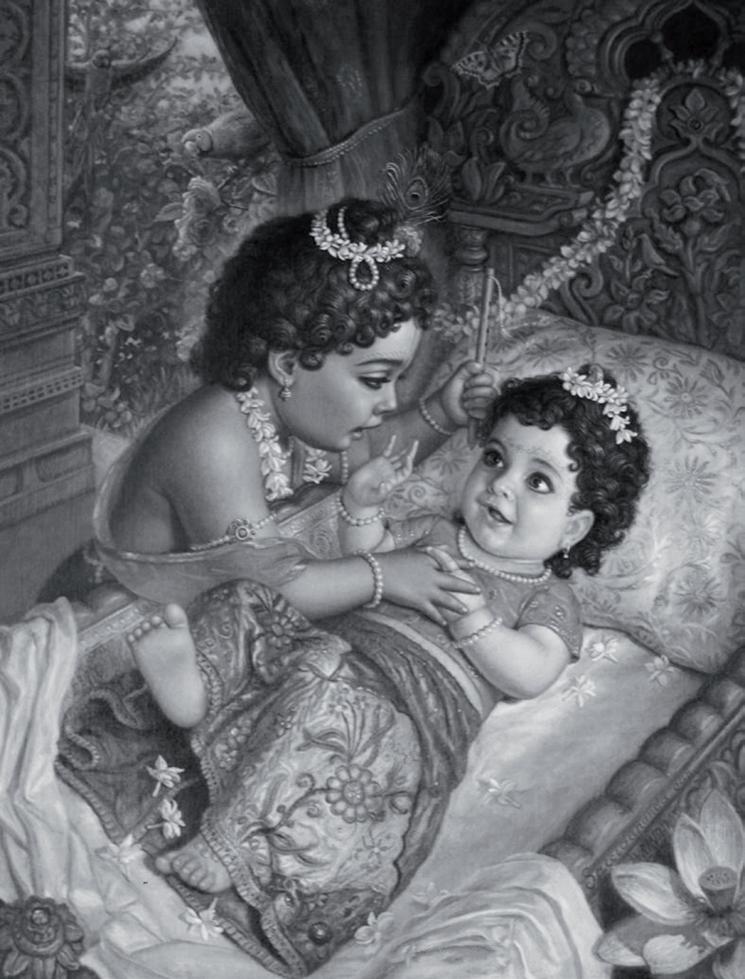
våñabhänu püre, prati ghare ghare jaya rädhe çri rädhe bole
rädhe jaya jaya mädhava-dayite gokula-taruëé-maëòala-mahite
kanyära cäìda-mukha dekhi räjä haila mahä sukhé däna dei brähmaëa sakale
våñabhänu püre prati ghare ghare jaya rädhe çri rädhe bole
rädhe jaya jaya mädhava-dayite gokula-taruëé-maëòala-mahite
nänä dravya haste kari nagarera jata näré sabhe hailä kértidä mandire
Śrī Rādhā - The Embodiment of the Ocean of Kṛṣṇa-prema
aneka puëyera phale daiva hoilä anuküle e heno bälikä mili tare
modera mane hena laya e hatama nirçya noy kon cäle kebä janamilä
dhana-çyäma däse kaya nä kariyä saàçaya kåñëa-priya sadaya haila
våñabhänu püre prati ghare ghare jaya rädhe çri rädhe bole
kothäy go prema-mayi rädhe rädhe rädhe rädhe go, jaya rädhe rädhe
våndävana-viläsiné, rädhe rädhe känu-mana-mohiné, rädhe rädhe
añöa-sakhér çiromaëi, rädhe rädhe
våñabhänu-nandiné, rädhe rädhe
rädhe, rädhe go, jaya rädhe, rädhe kothäya go prema mayi rädhe rädhe
känu-mana-mohini, rädhe rädhe våndävana-viläsiné, rädhe rädhe våñabhänu-nandiné rädhe rädhe
Çrémati Rädhäräëé ki jaya!
känu-mana-mohiné rädhäräëé ki jaya!
våndävana viläsiné rädhäräëé ki jaya! añöa-sakhér çiromaëi rädhäräëé ki jaya!
våñabhänu-nandiné rädhäräëé ki jaya!
Chapter One
Desiring to Understand the Glories of Rādhā’s Love
ñañtha-çlokera ei kahila äbhäsa müla çlokera artha çuna kariye prakäça
“I have given a hint of the sixth verse. Now please hear as I reveal the meaning of that original verse.”
(Caitanya-caritämåta, Ädi-lélä 4.229)
Before Çréla Kaviräja Gosvämé began to write the Caitanyacaritämåta, he first wrote fourteen verses. Those fourteen çlokas, verses are known as maìgalä caraëa, the invocation. Out of these fourteen verses, five have already been discussed. Here he is speaking about the sixth verse. What is the sixth verse?
çré-radhäyäù praëaya-mahimä kédåço vänayaiväsvädyo yenädbhuta-madhurimä kédåço vä madéyaù saukhyaà cäsyä mad-anubhavataù kédåçaà veti lobhät tad-bhäväòhyaù samajani çaci-garbha-sindhau harénduù
Śrī Rādhā - The Embodiment of the Ocean of Kṛṣṇa-prema
“Desiring to understand the glory of Rädhäräëé’s love, the wonderful qualities in Him that She alone relishes through Her love, and the happiness She feels when She realises the sweetness of His love, the Supreme Lord Hari, richly endowed with Her emotions, appears from the womb of Çrématé Çacé-devé, as the moon appears from the ocean.” (Caitanyacaritämåta, Ädi-lélä 4.230)
You should know this verse. It gives the reason why Lord Kåñëa incarnated Himself as Gauräìga. We have already discussed this many times. There are two types of reasons; bahiraìga, the external cause, and antaraìga, the internal cause. In this verse the internal cause is stated, antaraìga käraëa. What are the external causes?
The Two External Causes of Mahāprabhu’s Appearance
He came to teach love of God by chanting the holy name of Kåñëa. He chanted, tasted the mellow, and He also taught. He distributed it to one and all indiscriminately. This is one cause. An avatära comes in every Kali-yuga, but Caitanya Mahäprabhu does not come in every Kali-yuga, just like Kåñëa Himself does not come in every Dväpara-yuga. Who comes? His aàça, a plenary portion. However, in this current Kali-yuga, which is a special Kali-yuga, Mahäprabhu Himself came.
But there is another cause. In Çrémad-Bhägavatam it is stated, bhaktecchopätta-rüpäya paramätman namo ’stu te [10.59.25] When a very dear and intimate devotee of the Lord calls the Lord to come down, He comes down, bhaktecchopätta-rüpäya. So, who called Him? Advaita Äcärya. Before the coming of Çré Caitanya Mahäprabhu, Advaita Äcärya, who is an incarnation of SadäÇiva, came. He is viñëu-avatära. He lives in Vaikuëöha. He saw the miserable condition of the people of Kali-yuga, so he thought,
Chapter One ‒ Desiring to Understand the Glories of Rādhā’s Love
“Unless Kåñëa Himself comes, this miserable condition of the people of Kali-yuga cannot be mitigated.” So, he made a promise, “I must call Kåñëa, I must make Kåñëa come down here, otherwise my name is not Advaita Äcärya.” He made such a great promise. Every day he was worshipping çälagräma-çilä with Ganges water and tulasé leaves, and with a thunderous voice he would call Kåñëa, “O Kåñëa, come down!” So Kåñëa came. That is the second external cause. Kṛṣṇa
Came as Gaura to Fulfill His Three Desires
Thus, there are two types of causes: external and internal. Why are they called external and internal? A cause is a cause. Why is one cause external and one internal? What does it mean? The external cause is for others, to give them näma-prema, and the internal cause is for Himself.
How many reasons are there as internal causes? There are three reasons, that are known as tri-viddhovaïcha, three desires that Kåñëa had, which remained unfulfilled when He came down as Kåñëa five thousand years ago.
It is expressed in this sixth verse what those three desires are that remained unfulfilled and for which He came back as Gaura to fulfill. It is said in this verse that Kåñëa developed greed. What sort of greed do you have? Many different types of greed to enjoy material nature, to lord it over and enjoy, isn’t it? You should give it up. If someone develops this greed to enjoy material nature, what will be the consequence?
Śrī Rādhā - The Embodiment of the Ocean of Kṛṣṇa-prema
Durgā-devī Will Give You Lashes with Her Trident
Devotee: I will have to go to hell.
Çréla Gour Govinda Swami: You know it, then why do you develop such greed? Do you want to go to hell? That you will go to hell is the ultimate result, but the immediate result is that the material nature will give you a severe beating. Do you know that the material nature is Durgä-devé? You may have seen a picture or a statue of Durgä-devé. She holds a triçüla, a trident in her hand. It is one of her many weapons. She is the wife of Lord Çiva, Bhaväné. If someone develops greed to enjoy her, she will say, “Alright, please come. If you want to enjoy me then you have to accept the beating of my trident.” So, she will give you a beating with her trident! Then why do you develop greed to enjoy material nature? You should not do that. Give up that greed! You should develop a different type of greed.
The Three Enemies of a Human Being
tri-vidhaà narakasyedaà dväraà näçanam ätmanaù kämaù krodhas tathä lobhas tasmäd etat trayaà tyajet
“There are three gates leading to this hell; lust, anger, and greed. Every sane man should give these up, for they lead to the degradation of the soul.” (Bhagavad-gétä 16.21)
The Çrémad Bhagavad-gétä states that käma, krodha, lobha, lust, anger and greed are very bad. These three are considered the enemies of a human being. Kåñëa instructs here to give them up. If you are captured by these three enemies, then you will go
Chapter One ‒ Desiring to Understand the Glories
of Rādhā’s Love
to hell, naraka-dvära. It will open the gates towards hell. Greed is one of these enemies. So, we should not develop such greed; however, greed can be utilised for the service of Kåñëa. Everything, käma, krodha, lobha – lust, anger and greed – can be utilised for His service. If you utilise them for your own service, then they become your enemies, but when you utilise them for the service of Kåñëa, then that is very good.
Kāma – Lust
How can you utilise käma, lust for Kåñëa, käma kåñëärpane? The gopés are very lusty. How do they utilise lust for the service of Kåñëa? We should utilise our lust for the service of Kåñëa like them.
Krodha – Anger
Kåñëa abhakta dvesi jane, there is a general saying that a Vaiñëava should not be angry. Mahäprabhu has said in His Çikñästaka, taror iva sahiñëunä, do not get angry, be as tolerant as a tree. Similarly, Jesus Christ said that if someone gives you a slap on one cheek, you should present them the other cheek. Anger is an enemy. So how can it be utilised for the service of Kåñëa? Show your anger towards the offenders of the Vaiñëavas, the offenders of Kåñëa, and the offenders of the Vedic scriptures – sädhu-kåñëa-çästraniëòa, in the same way that the great devotee Hanumän showed his anger toward Rävaëa. That is the utilisation of anger for the service of Kåñëa; otherwise, there is no need for a Vaiñëava to be angry. Only under those circumstances should you be angry; you should not tolerate it. In other cases, we will be tolerant and not become angry.
Śrī Rādhā - The Embodiment of the Ocean of Kṛṣṇa-prema
Lobha – Greed
Kåñëa shows Himself to be greedy. He developed three types of greed. This verse states; rädhäyäù praëaya-mahimä kédåço, desiring to understand the glory of Rädhäräëé’s love. This greed is for Kåñëa, not for us. Then how can we utilise greed in Kåñëa’s service? You must become very, very greedy to have more and more association of sädhus and listen to hari-kathä. Develop such greed. One should not give up this type of greed.
sädhu-saìge kåñëa-näma ei mätra cäi saàsära jinite ära kona vastu näi (Çré Prema-vivarta 6.13)
“Besides sädhu-saìga and kåñëa-näma – nothing else is essential in this world. There is no other auspicious practice whereby one can become free from the cycle of saàsära, the repetition of birth and death.”
One’s sole desire, therefore, should be to chant çré-kåñëa-näma in the association of sädhus. Only this is needed: how to have sädhu-saìga, association of pure Vaiñëavas and listen more and more to nectarean hari-kathä. One should be very greedy for that. You should develop that type of greed and you should never give up this greed. This is the proper utilisation of greed. We should not develop greed for the acquisition of material possessions, for sense enjoyable objects.
It is stated what the characteristics of Kåñëa are. We, as His parts and parcels, have those same characteristics. Because Kåñëa has greed, we also have greed, but we abuse it when we are greedy to enjoy material nature or acquire more and more material
Chapter One ‒ Desiring to Understand the Glories of Rādhā’s Love
objects than necessary. However, if we can utilise greed in the previously mentioned way, then it is good.
Only Rādhārāṇī Relishes Kṛṣṇa’s Sweetness Completely
Kåñëa states,
ei prema-dväre nitya rädhikä ekali ämära mädhuryämåta äsväde sakali
“Only Rädhikä, by the strength of Her love, tastes all the nectar of My sweetness.” (Caitanya-caritämåta, Ädi-lélä 4.139)
So that greed developed. Rädhäräëé relishes the beauty of Kåñëa the most. Kåñëa does not know His own beauty. How can He Himself know it? But once in Dvärkä-dhäma, it so happened that He could see His own reflection in a pillar made of all types of shining jewels, which reflected it as a mirror. When He saw His own reflection, He was very astonished. Çréla Kaviräja Gosvämé quotes this verse from Lalita-mädhava näöaka [8.92], a drama written by Çréla Rüpa Gosvämé,
aparikalita-pürvaù kaç camatkära-käré sphurati mama gariyaë eña mädhuraya-püraù ayam aham api hanta prekñya yaà lubdha-cetäù sa-rabhasam upabhoktuà kämaye rädhikeva
“Upon seeing His own reflection in a bejeweled pillar of His Dvärakä palace, Kåñëa desired to embrace it, saying, “Alas, I have never seen such a person before. Who is He? Just by seeing Him I have become eager to embrace Him, exactly like Çrématé Rädhäräëé.” (Caitanya-caritämåta, Madhya-lélä 8.149)
Śrī Rādhā - The Embodiment of the Ocean of Kṛṣṇa-prema
If you see your own image in the mirror, can you say this? No. You say, “Oh, it is me.” But Kåñëa said, “Who is this very, very beautiful handsome young man? When I see this, a love arises in My heart like that of Rädhäräëé’s. I want to embrace this handsome young man, as Rädhäräëé wants to embrace Me.” This is radhikeva1 .
One cannot enjoy his own beauty, so how can Kåñëa enjoy His own beauty? Only Rädhäräëé enjoys it. Therefore, He developed such greed, “I want to know this, I want to realise it.” Therefore, to fulfill these three desires of His that could not be fulfilled when He came as Kåñëa He came back as Gaura. We were singing the following song before class. Tina vaïcha means three desires.
navadvépe avatari’ rädhä-bhäva aìgékari’ täìra känti aìgera bhüñaëa
tina väïchä abhiläñé’ çacé-garbhe parakäçi’ saìge laïä pariñada-gaëa2
“Lord Kåñëa desired to appear in Navadvépa to understand the intense love Çrématé Rädhäräëé felt for Him, and accept Her golden complexion as His bodily ornament. In order to fulfill three desires, the Lord appeared in Çacé-devé’s womb. When the Lord appeared like this in the material world, all His associates followed Him, and also appeared in the world.”
What Is the Glory of Rādhārāṇī’s Love?
A question arises regarding Rädhäräëé. Çré-radhäyäù praëayamahimä kédåço, what is the glory of Rädhäräëé’s love? Kåñëa developed the greed to know and realise that. How many things are there in Rädhäräëé’s love? Do you know? It is all written in
1. rädhikä iva– like Çrématé Rädhäräëé.
2. Prema-bhakti-chandrikä by Çréla Narottama Däsa Öhäkura section 10, verse 13.
Chapter One ‒ Desiring to Understand the Glories of Rādhā’s Love
Çréla Rüpa Gosvämé’s books. These are very, very subtle internal things that only very, very elevated Vaiñëavas can understand and discuss. It is not generally discussed. The general population cannot understand it. Rather they will misinterpret it. Therefore, Çréla Prabhupäda never gave any purport on it because ordinary people cannot understand it. Especially when he was speaking to the people in the Western world. They are very, very materially addicted. They cannot understand it. By chanting hare kåñëa, their heart will be purified, they will make some progress on the spiritual path, and then they will enquire. This will be told and explained to them when they will enquire, otherwise not. Are you enquiring about it? No, but even without your enquiry I am going to speak about it. Are you enquiring about Rädhäräëé’s love? There are three extraordinary things in Rädhäräëé’s love.
Kåñëa never becomes old. He has ever-fresh youth, nityaà navanaväya-mänam. It is always new, ever fresh, ädyaà-puräëa-puruñaà nava-yauvanaà ca. 3 He is the oldest person, puräëa-puruña, ädipuruña, the original puruña, but He is always young. He never grows old, and His kathä also never grows old. One must develop greed to hear more and more nectarean kathä again, and again, and again.
There Are Three Significant Points in Rādhārāṇī’s Love
1: Çré Kåñëa is all-beautiful. His beauty excels that of crores of Cupids! So, when someone in Rädhäräëé’s mood, a great devotee, sees such extraordinary beautiful Kåñëa, he must become mad, unmäda4.
3. Brahma-saàhitä 33
4. The word unmäda is explained in the Bhakti-rasämåta-sindhu as extreme joy, misfortune and bewilderment in the heart due to separation. Symptoms of unmäda are laughing like a madman, dancing, singing, performing ineffectual activities, talking nonsense, running, shouting and sometimes working in contradictory ways. (Caitanya-caritämåta, Madhya-lélä 2.66, purport A. C. Bhaktivedanta Swami Prabhupäda)
Śrī Rādhā - The Embodiment of the Ocean of Kṛṣṇa-prema
2: When someone like Rädhäräëé relishes that beauty of Kåñëa, the happiness he or she gets by relishing that beauty is qualitatively very, very great, millions of times more than Kåñëa’s own happiness. That happiness is so great.
3: In English, viruddha dharma means that there are two opposites and they are united.
All these three are in rädhä-prema. Now I will explain one by one. Number one is madness. When Rädhäräëé sees the extraordinary beauty of Lord Kåñëa, a type of madness comes up, unmäda gataù and that madness is only found in rädhä-prema. You cannot find it elsewhere. It is only coming upon seeing the beauty of Kåñëa. You will never see such beauty somewhere else other than in Kåñëa and you will never feel such kind of madness elsewhere other than upon seeing the beauty of Kåñëa.
Kåñëa is so extraordinarily beautiful that He is always ever fresh. His beauty never grows old and it enchants the entire world. All are mad after that beauty, even Kåñëa Himself is mad when He sees His own beauty. This is very, very extraordinary and wonderfully astonishing. People of the three worlds are enchanted by Kåñëa’s beauty. They turn mad when they can see His beauty, but that Kåñëa Himself now became mad by developing the desire to know the glory of Rädhä’s love, radhäyäù praëaya-mahimä kédåço.
Why Does a Person Become Mad?
Now a question arises: Why does a person become mad? How many causes are there for becoming mad? There are three. You should note down. It is very important. It is coming from Çréla Rüpa Gosvämé.
Chapter One ‒ Desiring to Understand the Glories of Rādhā’s Love
Number 1: If you think about some subject very deeply, if you keep thinking deeply about it, then more deeply, then most deeply, then you may turn mad. This is the number one cause of madness.
Number 2: Every individual has some capacity to relish some subject, to have or to hold it, but that capacity is limited. If one crosses that limit, then one becomes mad.
Number 3: Sometimes ignorance covers us over. When there is excessive ignorance and it covers up pure knowledge, then one becomes mad. It is a material kind of madness but a similar type of madness is found on the spiritual platform. That is the third cause.
So, there are three causes due to which an ordinary man becomes mad. Now we will analyse them one by one in respect to Kåñëa, to see how they may be applicable to Him or not. Apparently these three causes cannot be applicable to Kåñëa, it is not possible. Will it be possible? No, not at all. It is only applicable to ordinary people, not to Kåñëa. That is stated.
So first, atyadika abhiniveça thinking about something more and more and repeatedly, very deeply and always, one becomes mad. This is the first cause of madness. Then let us analyse this. It is not applicable to Kåñëa. Why is it not applicable? Because Kåñëa is self-satisfied ätmäräma, äptakäma, and self-sufficient, paripürëa, He is completely full with all mellows, rasa, He is the source of all mellows, and He gives pleasure to one and all. How will it be possible on the part of Kåñëa to think of something very deeply and become mad? It is not at all possible. Kaviräja Gosvämé writes the same thing in Caitanya-caritämåta:
Śrī Rādhā - The Embodiment of the Ocean of Kṛṣṇa-prema
kåñëera vicära eka ächaye antare pürëänanda-pürëa-rasa-rüpa kahe more
“Once Lord Kåñëa considered within His heart, ‘Everyone says that I am complete bliss, full of all rasas.’”
ämä ha-ite änandita haya tribhuvana ämäke änanda dibe—aiche kon jana
“All the world derives pleasure from Me. Is there anyone who can give Me pleasure?”
ämä haite yära haya çata çata guëa sei-jana ähladite päre mora mana
“One who has a hundred times more qualities than Me could give pleasure to My mind.”
(Caitanya-caritämåta, Ädi-lélä 4.238-240)
Is there anyone who has so many more qualities than Kåñëa and is a hundred times greater? No, because Kåñëa is full in all respects. Kåñëa Himself said: mattaù parataraà nänyat kiïcid asti dhanaïjaya (Bg. 7.7) “There is no one superior to Me.” So, how is it possible? This is very, very astonishing. So, this is number one, we analysed it and we found that it cannot be applicable to Kåñëa. Thus, Kåñëa cannot become mad in this way. How will it be possible on the part of Kåñëa to become mad? It is not possible at all. That we have analysed now.
The second and third causes we will analyse later and draw a conclusion.
Chapter Two

The Green & The Yellow Mango
e saba siddhänta güòha, — kahite nä yuyäya nä kahile, keha ihära anta nähi päya
ataeva kahi kichu kariïä nigüòha bujhibe rasika bhakta, nä bujhibe müòha
hådaye dharaye ye caitanya-nityänanda e-saba siddhänte sei päibe änanda
“All these conclusions are unfit to disclose in public. But if they are not disclosed, no one will understand them.”
(Caitanya-caritämåta, Ädi-lélä 4.231)
This Caitanya-caritämåta is a post-graduate study, as my beloved Guru Mahäräja has said. It is also stated here, “All these
Śrī Rādhā - The Embodiment of the Ocean of Kṛṣṇa-prema
conclusions are unfit to disclose in public.” These subject matters are discussed among advanced Vaiñëavas, those who are in the bhäva stage. The people in general cannot understand them because their heart is not purified. However, here Çréla Kaviräja Gosvämé has said, “But if they are not disclosed no one will understand them.” Therefore, they must be disclosed.
Then Kaviräja Gosvämé says,
“Therefore I shall mention them, revealing only their essence, so that loving devotees will understand them but fools will not.” (Caitanya-caritämåta, Ädi-lélä 4.232)
“Anyone who has captured Lord Caitanya Mahäprabhu and Lord Nityänanda Prabhu in his heart will become blissful by hearing all these transcendental conclusions.”
(Caitanya-caritämåta, Ädi-lélä 4.233)
The Mercy of Lord Caitanya and Nityānanda Is Required
Here Çréla Kaviräja Gosvämé has said that those who have captured these two Lords in their hearts will get pleasure by hearing these transcendental conclusions; others cannot get pleasure by doing so. We have discussed previously that Särvabhauma
Bhaööäcärya, who was a great-learned Vedic scholar, could not understand Çré Caitanya Mahäprabhu and His mood, because he was not a devotee, whereas his brother-in-law Gopénätha Äcärya could, because he was a great devotee. Särvabhauma
Bhaööäcärya was an empiric philosopher who, after receiving the blessings of Çré Caitanya Mahäprabhu, was able to understand Him clearly and he became a very dear devotee of the Lord. The same point has been made here by Çréla Kaviräja Gosvämé. This
Chapter Two ‒ The Green & the Yellow Mango
is most important: Unless you receive the mercy of Çré Caitanya Mahäprabhu or Nityänanda Prabhu, you cannot understand these elevated topics.
How Do You Get Their Mercy?
Their mercy is required, but there is something else, vinä na gaura-priya-päda-seväà vedädi-duñpräpya-padaà vidanti (Çré Caitanya-candrämåta 22)1
This is what Çréla Prabhodänanda Sarasvatépad has said about how to get the mercy of Çré Caitanya Mahäprabhu and Nityänanda Prabhu. How do you get it? This is stated herein: if you cannot get the mercy of the dear devotees of Lord Gauräìga, you cannot approach Nityänanda Prabhu and Caitanya Mahäprabhu. Thus, the first undertaking is to approach a dear devotee of Nityänanda Prabhu and Gauräìga Mahäprabhu. If you receive his mercy then you will get Nityänanda Prabhu’s mercy, and then you will get Mahäprabhu’s mercy. This is the process. Then you can understand this tattva, yugala-périti, rädhä-kåñëa tattva.
1. äcarya dharmaà paricarya viñëuà vicarya térthäni vicarya vedän vinä na gaura-priya-päda-seväà vedädi-duñpräpya-padaà vidanti
“One may go on executing varnäçrama-dharma, one may offer opulent worship to the vigraha of Lord Viñëu, one may travel and visit thousands and thousands of holy places, and one may be engaged in Vedic study and acquire Vedic knowledge, but without taking shelter and serving the lotus feet of a gaura-priya-jana, a dear devotee of Gaura, no one can enter into Våndävana, which is the chief viläsa-kshetra of Rädhä-Govinda – where prema-lélä is going on eternally.” (Translation by Çréla Gour Govinda Swami)
Śrī Rādhā - The Embodiment of the Ocean of Kṛṣṇa-prema
We Should Pray to Śrīla Rūpa Gosvāmī
rüpa-raghunätha-pade haibe äkuti kabe häma bhujabo se yugala-périti
“Only if I become attached to the instructions given by the six Gosvämés, headed by Çréla Rüpa Gosvämé and Çréla Raghunätha däsa Gosvämé, will it be possible for me to understand the conjugal love of Rädhä and Kåñëa.”
We sing this song written by Çréla Narottama däsa Öhäkura. Çréla Rüpa and Raghunätha Gosvämés are very dear devotees of Çré Caitanya Mahäprabhu. We also chant:
çré caitanya-mano-‘bhéñöhaà sthäpitaà yena bhü-tale svayam rüpaù kadä mahyaà dadäti sva-padaëtikam,
Who knows best Caitanya Mahäprabhu’s mano ‘bhéñöha, the desire of Caitanya Mahäprabhu’s heart? Çréla Rüpa Gosvämé. Therefore, we should pray to him: “When will you be so kind to me to shower your blessings on me? When, out of your mercy, will you put your feet upon my head? When can I get the dust from your lotus feet, so that I can understand rädhä-kåñëa-tattva, gaura-tattva?”
Rädhä-kåñëa tattva is gaura-tattva because Gauräìga is Rädhä and Kåñëa combined, ekätmänäv api bhuvi purä deha-bhedaà gatau tau caitanyäkhyaà prakaöam adhunä tad-dvayaà caikyam äptaà. 1 If you can understand gaura-tattva then you can understand rädhä-kåñëa tattva.
1. “Although Rädhä and Kåñëa are one in Their identity, previously They separated Themselves. Now these two transcendental identities have again united, in the form of Çré Kåñëa Caitanya.” (Caitanya-caritämåta, Ädi-lélä 1.5)
Chapter Two ‒ The Green & the Yellow Mango
To Taste the Mellows of His Transcendental Pastimes
Rädhä is energy, çakti, and Kåñëa is energetic, çaktimän. In Rädhä and Kåñëa you will find that çakti and çaktimän are two entities: Rädhä and Kåñëa. However, our philosophy is çakti çaktimän abhinna, there is no difference between the energy and the energetic. They are one. They are non-different, abhinna but also bhinna, different. This is acintya, inconceivable, how there is simultaneously difference and non-difference; this is called acintya bhedäbheda-tattva.
One cannot separate çakti from çaktimän. They cannot be separated at all. An example is given of the sun and its heat or light, which are inseparable, and another of måga-mada, musk, and its fragrance. There is a type of deer known as kastüré-måga, muskdeer; it has a very nice scented substance, måga-mada or kastüré, musk, found in its navel region. That musk gives a very nice fragrance. That fragrance cannot be separated from musk. So çakti and çaktimän cannot be separated, although deha-bhedam gatau tau, we see two bodies, one being Rädhä and the other one Kåñëa, we find two separate vigrahas, two Deities, Rädhä and Kåñëa. Why is that? It is stated in Caitanya-caritämåta, Ädi-lélä,
rädhä-kåñëa aiche sadä eka-i svarüpa lélä-rasa äsvädite dhare dui-rüpa
“Thus, Rädhä and Lord Kåñëa are one, yet They have taken two forms to enjoy the mellows of pastimes.” (Caitanyacaritämåta, Ädi-lila 4.98)
Śrī Rādhā - The Embodiment of the Ocean of Kṛṣṇa-prema
Rādhā and Kṛṣṇa in One Body
Devotee: Mahäräja, I was told that Rädhä and Kåñëa appeared as Rädhä-kuëòa and Çyäma-kuëòa in order to merge into each other.
Çréla Gour Govinda Swami: These are the very dear ponds. Where Rädhäräëé was bathing is Rädhä-kuëòa, and where Kåñëa was bathing is Çyäma-kuëòa. They are side-by-side in Våndävana.
Devotee: But there is a connection between them.
Çréla Gour Govinda Swami: Yes, there is a connection. Because, as there is Rädhä and Kåñëa, similarly there are two ponds, Rädhäkuëòa and Çyäma-kuëòa. Those who are fortunate enough can take bath in these kuëòas, and thus get the mercy of Rädhäräëé and Kåñëa, but it is not so easy to take bath there. Any ordinary person may just take an ordinary bath in their waters, and so he cannot get their mercy. One should be endowed with that high bhäva. One who is a very elevated devotee, a very dear devotee of Rädhä and Kåñëa, can receive benefit by bathing there, others cannot. They think it is only water, or only a pond, so how can they get it?
Devotee: What I was told was that Rädhä and Kåñëa appeared as Rädhä-kuëòa and Çyäma-kuëòa so that They can merge into each other.
Çréla Gour Govinda Swami: Yes, They merged into each other when Gauräìga came: Rädhä and Kåñëa in one body.
Çréla Prabhupäda, my beloved spiritual master, said there should be three altars here in this Bhubaneswar centre: one is for GauraNitäi, then in the middle it is for Kåñëa-Balaräma, and then the other one is for Jagannätha, Balabhadra and Subhadrä. So, many ask this question, “How is it that in all ISKCON centres in the world there is Rädhä and Kåñëa, but there is no Rädhä here?” I said, “Why is there no Rädhä? There is Gauräìga, thus Rädhä is here!
Chapter Two ‒ The Green & the Yellow Mango
Gauräìga appeared assuming rädhä-bhäva. If you find Gauräìga, then you should know that Rädhä is there. Gauräìga means that in Him the major percentage is Rädhä, and the minor percentage is Kåñëa. As Rädhäräëé was feeling pangs of separation and was crying for Kåñëa, similarly Gauräìga Mahäprabhu was crying for Kåñëa as if He were Rädhä. He Himself has said in Caitanya-caritämåta:
gaura aìga nahe mora—rädhäìga-sparçana gopendra-suta vinä teìho nä sparçe anya-jana
“Actually, My body does not have a fair complexion. It only appears so because it has touched the body of Çrématé Rädhäräëé. However, She does not touch anyone but the son of Nanda Mahäräja.”
täìra bhäve bhävita kari’ ätma-mana tabe nija-mädhurya kari äsvädana
“I have now converted My body and mind into the ecstasy of Çrématé Rädhäräëé; thus, I am tasting My own personal sweetness in that form.”
(Caitanya-caritämåta, Madhya-lélä 8.287-288)
Mahäprabhu Himself said: “My body is not the body of Gauräìga, it is Rädhäräëé’s body.” So, who can touch this body? Only the son of the king of the gopas, Kåñëa, no one else.
Thus, if you see Caitanya Mahäprabhu on the altar, how can you say that there is no Rädhä? You cannot. Rädhä is already there if Caitanya is there. Therefore, it is stated that there may be Rädhä-Govinda Deities in a temple, but if there is no GauraGovinda we will not go there. It is a very, very confidential purport.
Śrī Rādhā - The Embodiment of the Ocean of Kṛṣṇa-prema
Gaurasundara is Çyämasundara Himself. Çyämasundara Himself becomes Gaurasundara, They are the same. What is the difference?
The Green & the Yellow Mango
You can understand the tattva of Çyämasundara and Gaurasundara if I give you a very simple example. Have you seen a mango? Let us take a ripe mango and a green mango. Just think of these two types of mangoes. What is the difference between a green mango and a ripe mango? The colour is different; one is green and the other one is yellow. The colour differs, but it is the same; a mango. Çyämasundara means blue or green, and Gaurasundara means yellow. What is another difference between a green mango and a ripe mango? When a mango is yellow, it is ripened, it is very tasty, very sweet. A green mango is never sweet. Similarly, that is the difference in Çyämasundara and Gaurasundara; Çyämasundara means green, unripe, and Gaurasundara means yellow, ripe. Çyämasundara means the rasa or mellow is not ripened. Here [in Bhubaneswar], the rasa or mellow is ripened, it is very sweet, that is Gaurasundara. If there is no Gaurasundara, or Gaura-Govinda, the mellow is not ripened. There may be Çyäma, Rädhä-Govinda, but the mellow is green, unripe. This is the difference. Therefore, as I just mentioned, there may be Rädhä-Govinda Deities, but if there is no Gaura-Govinda we will not go there because the mellow is not ripened.
Chapter Three

Who Can Give Me Pleasure?
e saba siddhänta haya ämrera pallava bhakta-gaëa-kokilera sarvadä vallabha (Caitanya-caritämåta, Ädi-lélä 4.234)
“All these conclusions are like the newly grown twigs of a mango tree; they are always pleasing to the devotees who in this way resemble cuckoo birds.”
So, here, Çréla Kaviräja Gosvämé speaks about all these conclusions.
e saba siddhänta güòha,—kahite nä yuyäya nä kahile, keha ihära anta nähi päya (Caitanya-caritämåta, Ädi-lélä 4.231)
“All these conclusions are unfit to disclose in public. But if they are not disclosed no one will understand them.”
Śrī Rādhā - The Embodiment of the Ocean of Kṛṣṇa-prema
What Are the Conclusions?
They are the reasons for the appearance of Çré Caitanya Mahäprabhu. There are two main reasons, antaraìgä and bahiranga, external and internal. Lord Caitanya appeared after having seen the miserable condition of the living entities. He came himself to establish yuga-dharma by chanting the holy name. External is for the jéva, and the internal reason, is for Himself, it is to taste the mellow of Çrématé Rädhäräëé.
çré-rädhäyah praëaya mahimä kédåço vänayaivä svädyo yenädbhuta-madhurimä kédåço vä madéyah saukhyam cäsyä mad-anubhavataù kédåçaà veti lobhät tad-bhäväòhyah samajani çacé-garbha-sindhu harénduù
“Desiring to understand the glory of Rädhäräëé’s love, the wonderful qualities in Him that She alone relishes through Her love, and the happiness She feels when She realises the sweetness of His love, the Supreme Lord Hari richly endowed with Her emotions, appears from the womb of Çrématé Çacédevi as the moon appears from the ocean.”
(Caitanya-caritämåta, Ädi-lélä 4.230)
These Conclusions Are Very Difficult to Understand
These are the conclusions. They are very, very difficult to understand. They are very confidential, very subtle tattvas. “All these are unfit to disclose in public, but if they are not disclosed no one will understand them. Therefore, I shall mention them, revealing only their essence so that loving devotees will understand them but fools will not. Anyone who has captured Lord Caitanya Mahäprabhu and Lord Nityänanda Prabhu in his
Chapter Three ‒ Who Can Give Me Pleasure?
heart will become blissful by hearing all these transcendental conclusions.”1
The Difference Between the Crow and the Cuckoo Bird
The cuckoo’s voice is very sweet. Generally, during spring time the cuckoo sings, “coo-coo-coo.” The crow and cuckoo are similar in appearance, but the difference is in their voices. The crow says, “kaw-kaw-kaw-kaw”, and the cuckoo says, “coo-coo-coo.”
The cuckoo’s voice is very sweet, whereas the crow’s voice is very harsh and no one likes to hear it. There is also another difference concerning their food.
Here in Çré Caitanya-caritämåta, Çréla Kaviräja Gosvämé who is an authority, a mahäjana, has said,
arasa-jïa käka cüñe jïäna-nimba-phale rasa-jïa kokila khäya premämra-mukule
“Those who are devoid of all transcendental mellows are like the crows that suck the juice from the bitter fruits of the nimba tree of knowledge, whereas those who enjoy mellows are like the cuckoos who eat the buds of the mango tree of love of Godhead.” (Caitanya-caritämåta, Madhya-lélä 8.258)
This was spoken by Rämänanda Räya when he and Caitanya Mahäprabhu were discussing rädhä-tattva. Now a similar topic has come up here.
“All these conclusions are like the newly grown twigs of a mango tree; they are always pleasing to the devotees, who in
1. (Caitanya-caritämåta, Ädi-lélä 4.231-233 translations)
Śrī Rādhā - The Embodiment of the Ocean of Kṛṣṇa-prema
this way resemble cuckoo birds.” (Caitanya-caritämåta, Ädi-lélä 4.234)
The crow is ärasa-jïa. It cannot taste the sweet mellow, rasa. What does it eat? Jïäna-nimba-phala, bitter neem fruit.
One of the names of Caitanya Mahäprabhu is Nimäi because He was born under a neem tree 500 years ago. The fruit of the neem tree is very bitter. The crow eats it because he is ärasa-jïa. It cannot taste the sweet mellows, whereas the cuckoo is rasajïa, it tastes rasa, mellow. So, it eats mango twigs. Here in text 234, it is stated, ämrera pallava. “All these conclusions are like the newly grown twigs of the mango tree.” The flower of the mango tree, or its newly grown twigs are sweet and the cuckoo eats them, whereas the crow does not. The crow eats the bitter neem fruit. That is the difference between them. The bhaktas are like cuckoos.
Çréla Kaviräja Gosvämé says the dear devotees of Lord Caitanya Mahäprabhu get pleasure hearing His pastimes.
A Drop of this Ocean Can Inundate the Whole World With the Flood of Love
We sing this song, gauräìgera madhura-lélä, jär karëe praveçilä, hådaya nirmala bhelo tä’ra1
If the pastimes of Çré Caitanya Mahäprabhu, which are very sweet enter the ear of a devotee, his heart is purified.
1. Gauräìgera Duöi Pada second part of verse 1 from Prärthanä by Çréla Narottama däsa Öhäkura
Chapter Three ‒ Who Can Give Me Pleasure?
In another place it is stated:
caitanya-caritra ei—‘amåtera sindhu’ jagat änande bhäsäya yära eka-bindu
“The pastimes of Çré Caitanya Mahäprabhu are an ocean of nectar. Even a drop of this ocean can inundate the whole world with transcendental bliss.”
(Caitanya-caritämåta, Madhya-lélä 18.228)
‘Are you like the cuckoo or the crow? You are like a crow I think, but you should be transformed into a cuckoo, which will happen when you constantly hear these very sweet pastimes of Çréman Caitanya Mahäprabhu. This caitanya-carita is like an ocean of nectar, amåtera sindhu, a drop of that ocean will inundate the whole world with the flood of love.
If a drop of that ocean will be available to us, we will think ourselves to be very, very fortunate. That depends upon the mercy of Çrémän Caitanya Mahäprabhu, especially upon His dear devotees’ mercy.
So, all these conclusions are always pleasing to the cuckoo-like devotee. Here Çréla Kaviräja Gosvämé states, abhakta uñöra2, “the camel-like non-devotees cannot enter into these topics therefore there is special jubilation in my heart.”
Why Is Śrīla Kavirāja Gosvāmī Very Jubilant?
So, what does the camel eat? Thorny leaves from thorny plants. While eating them its mouth bleeds; it is thinking that
2. Caitanya-caritämåta, Ädi-lélä 4.235
Śrī Rādhā - The Embodiment of the Ocean of Kṛṣṇa-prema
it is eating very nice food, whereas it is actually eating his own blood! Kaviräja Gosvämé compares the non-devotees with the camel, because, like it, they eat their own blood thinking it is very sweet. He says, “Camel-like non-devotees cannot enter into these topics.” Why? Because they are not rasa-jïa, they cannot taste the sweet mellow of Caitanya Mahäprabhu’s pastimes. Furthermore, Kaviräja Gosvämé says, “Therefore there is special jubilation in my heart.” Why is he very jubilant? Because these topics are meant for special devotees, those who can taste the mellow. He feels very jubilant, because if non-devotees enter everything will be spoiled.
ye lägi kahite bhaya, se yadi nä jäne ihä va-i kibä sukha äche tribhuvane
“For fear of them I do not wish to speak, but if they do not understand, then what can be happier in all the three worlds?”
(Caitanya-caritämåta, Ädi-lélä 4.236)
The camel-like non-devotees do not understand these topics. This gives much happiness to Kaviräja Gosvämé because they cannot enter into them, which are especially meant for those dear devotees of Lord Caitanya Mahäprabhu who are qualified to relish the nectarean pastimes of Çrémän Caitanya Mahäprabhu. Therefore, he is jubilant.
ataeva bhakta-gaëe kari namaskära niùçaìke kahiye, tära hauk camatkära
“Therefore, after offering obeisances to the devotees, for their satisfaction I shall speak without hesitating.”
(Caitanya-caritämåta, Ädi-lélä 4.237)
Chapter Three ‒ Who Can Give Me Pleasure?
Without hesitation Kaviräja Gosvämé now speaks of these nectarean pastimes of Çré Caitanya Mahäprabhu, because this will give satisfaction and pleasure to the cuckoo-like devotees. To please the devotees means to please the Lord. When the devotees will be pleased, the Lord will be pleased, yasya prasädäd bhagavat prasädo. 1 If we can please the spiritual master, who is a cuckoolike devotee of Lord Caitanya Mahäprabhu, then we can please the Supreme Lord Kåñëa, otherwise it is not possible.
Is There Anyone Who Can Give Me Pleasure?
kåñëera vicära eka ächaye antare pürëänanda-pürëa-rasa-rüpa kahe more
Once, Lord Kåñëa considered within His heart, “Everyone says that I am complete bliss, full of all rasas.”
(Caitanya-caritämåta, Ädi-lélä 4.238)
ämä ha-ite änandita haya tribhuvana ämäke änanda dibe—aiche kon jana
“All the world derives pleasure from Me. Is there anyone who can give Me pleasure?”
(Caitanya-caritämåta, Ädi-lélä 4.239)
Kåñëa is all-beautiful, mädhuryaka-nilaya. His beauty excels the beauty of crores of Cupids, kandarpa koöi kämaniya viçeña çobhaà. He is the source of all mellows of love, raso-vai-saù. He is rasikaçekara, rasa lampaöa, nägarendra. All these qualities are spoken about Him. It is mentioned here that He was thinking, “All the
1. Çré Gurvañöakam, Çréla Viçvanätha Cakravati Öhäkura, verse 8.
Śrī Rādhā - The Embodiment of the Ocean of Kṛṣṇa-prema
worlds derive pleasure from Me. So, is there anyone who can give Me pleasure?”
Who Has a Hundred Times More Qualities than Kṛṣṇa?
ämä haite yära haya çata çata guëa sei-jana ählädite päre mora mana
“One who has a hundred times more qualities than Me could give pleasure to My mind.”
(Caitanya-caritämåta, Ädi-lélä 4.240)
Is there anyone like that? No, because Kåñëa is supreme in all respects. In his Bhakti-rasämåta-sindhu Çréla Rüpa Gosvämé has described sixty-four qualities of Çré Kåñëa. They are all mentioned in The Nectar of Devotion. In that book Çréla Prabhupädajé Mahäräja has written only the essence of the Bhakti-rasämåtasindhu in English. Out of those sixty-four qualities, fifty qualities are in very minute proportion in the jévas, and fifty-five qualities – five more – are there in the demigods, but not in full, also in minute proportion. Then there are sixty qualities in all the incarnations, the viñëu-tattvas.
The Four Special Qualities of Kṛṣṇa
Kåñëa has sixty-four qualities in unlimited quantity and four special qualities, which cannot be found even in any of His incarnations. What are those four special qualities?
Devotee: His form, His pastimes, His flute, and His loving relationship with devotees.
Çréla Gour Govinda Swami: Yes, rüpa-mädhuré, lélä-mädhuré,
Chapter Three ‒ Who Can Give Me Pleasure?
veëu-mädhuré, and the fourth one is rati-mädhuré, His loving relationship with Rädhäräëé and the gopés. These four special qualities are only found in Kåñëa, not in any other viñëu-tattvas. Therefore, kåñëas tu bhagavän svayam, that Kåñëa is Bhagavän. He is supreme in all respects. These words, rüpa-mädhuré, lélä-mädhuré, veëu-mädhuré, and rati-mädhuré, are specific. You should know all of them.
Rādhā Alone Can Give Me Pleasure
Kåñëa was thinking, “One who has a hundred times more qualities than Me could give pleasure to My mind, but such a person cannot be found, so who can give Me pleasure?” Then He thought,
ämä haite guëé baòa jagate asambhava ekali rädhäte tähä kari anubhava
“One more qualified than Me is impossible to find in the world, but in Rädhä alone I feel the presence of someone who can give Me pleasure.” (Caitanya-caritämåta, Ädi-lélä 4.241)
So, Rädhä is superior in quality to Kåñëa according to these conclusions. He Himself admits, “But in Rädhä alone I feel the presence of one who can give Me pleasure, not in anyone else.” Only Rädhä can give Him pleasure.
The Three Special Characteristics of Rādhārāṇī’s Love
Previously we were discussing what the three special characteristics of rädhä-prema are. Can you remember it? What is the first one? Her prema makes Kåñëa mad. Why does
Śrī Rādhā - The Embodiment of the Ocean of Kṛṣṇa-prema
a man become mad? There are three reasons. Sometimes Kåñëa was spending the whole night hiding behind the berry tree in Rädhäräëé’s courtyard. In order to be close to Her, He would sometimes come in disguised forms, as a barber’s wife, as a washerman’s wife, and as a candaniné, a lady who sells sandalwood paste. These are the symptoms of a madman. We have covered only this one. Then comes number two.
If someone can taste the love that Rädhäräëé tastes, then he can get millions of times more pleasure than Kåñëa Himself. What is the difference between Kåñëa and Rädhä? Kåñëa is the enjoyer, Rädhäräëé is the enjoyed. In other words, Kåñëa is viñaya-vigraha, and Rädhä is äçraya-vigraha. Kåñëa is the only viñaya-vigraha, no one else. Rädhäräëé, Her followers, devotees, and gurudeva, are all äçraya-vigraha. Our spiritual master is a rädhä-priya-sakhé, one of the dear girl companions of Çrématé Rädhäräëé, so he is äçrayavigraha. It is mentioned here: äçraya-vigraha sukha, viñaya-vigraha sukha – the pleasure of the viñaya and the pleasure of the asraya. The conclusion is that the happiness derived by the äçraya is greater than that of the happiness enjoyed by the viñaya-vigraha. Therefore Kåñëa, who is Himself the supreme viñaya, wants to become äçraya. This is the reason why Kåñëa became Gauräìga.
Greedy to Taste the Mellow of Rādhārāṇī’s Love
Gauräìga is Kåñëa Himself, but He assumes the mood of a devotee, Rädhäräëé, who is the äçraya. That is stated,
äçraya-jätéya sukha päite mana dhäya yatne äsvädite näri, ki kari upäya
Chapter Three ‒ Who Can Give Me Pleasure?
“My mind races to taste the pleasure experienced by the abode, but I cannot taste it, even by My best efforts. How may I taste it?” (Caitanya-caritämåta, Ädi-lélä 4.134)
Kåñëa thought, “I want to relish that happiness, the äçrayajätéya sukha, but I am not the äçraya, I am the viñaya. So, what shall I do? How can I relish that mellow?” Then He thought, “If I can get the opportunity to become the äçraya, then I can relish it. How will it be possible?”
kabhu yadi ei premära ha-iye äçraya tabe ei premänandera anubhava haya,
“If sometime I can be the abode of that love, only then may I taste its joy.” (Caitanya-caritämåta, Ädi-lélä 4.135)
eta cinti’ rahe kåñëa parama kautuké hådaye bäòaye prema-lobha dhakdhaki
“Thinking in this way, Lord Kåñëa was curious to taste that love. His eager desire for that love increasingly blazed in His heart.” (Caitanya-caritämåta, Ädi-lélä 4.136)
He was very eager, “How can I relish that mellow? Oh! I will become äçraya jätéya.” He was thinking very, very deeply, premalobha dhakadhaki. Çréla Kaviräja Gosvämé uses this specific word, lobha, which is a typical word to indicate greed. Thus, Kåñëa was very greedy to taste the mellow of Rädhäräëé’s love, and that very intense greed in His heart was increasing more and more.
What is the symptom of intensity? For example, when making condensed milk, khira, the milk is mixed with rice and sugar, and cooked until it becomes very thick. What is it like then?
Śrī Rādhā - The Embodiment of the Ocean of Kṛṣṇa-prema
If you have ever made that preparation, have you noticed how intense it is? When it is boiling it becomes thick and condensed, it bubbles up and makes the sound dhak-dhak-dhak-dhak. So, in Kåñëa’s heart, it was like that, dhak-dhak-dhak-dhak. Çréla Kaviräja Gosvämé writes that, prema-lobha dhakdhaki, the intensity was so great in His heart.
That greed developed in the heart of Kåñëa, “How can I relish rädhä-prema? How can I become like that?” This is about the second characteristic of Rädhä’s love.
The Third Characteristic of Rādhā’s Love
ämi yaiche paraspara viruddha-dharmäçraya rädhä-prema taiche sadä viruddha-dharma-mäyä
“Just as I am the abode of all mutually contradictory characteristics, so Rädhä’s love is always full of similar contradictions.” (Caitanya-caritämåta, Ädi-lélä 4.127)
The third characteristic is that there are two opposite qualities, two opposite factors in Rädhäräëé’s love, viruddha dhana, which are combined. It is hot, and at the same time cold. I will give some examples of how it is to have two opposites combined. This is very, very confidential, niguòha. Only loving devotees, rasika-bhaktas, will understand, but fools will not, bhujibe rasika bhakta, nä bhujibe müòhä. However, it is also very, very difficult to express it in the English language. I feel difficulty when I try to do so. Çréla Rüpa Gosvämé expressed it in Sanskrit, and Çréla Kaviräja Gosvämé, who compiled Caitanya-caritämåta, expressed it in Bengali. I will try my best, but I may fail to express it. It is so confidential.
Chapter Three ‒ Who Can Give Me Pleasure?
When we analyse this third point, we find three things: tattvaavagähé, aiçvarya avagähé, and mädhurya avagähé. You should know these three words. Çréla Rüpa Gosvämé has explained all these tattvas. Kåñëa says in the Gétä; janma karma ca me divyaà evaà yo veti tattvataù. 1 In English tattvataù means one who knows it in essence. We have two types of considerations: one is the apparent consideration – aparä-vicara, and the other is the absolute consideration – tattva-vicära. Our whole Vaiñëava philosophy rests on tattva-vicära, the absolute consideration, not on the apparent consideration.
The Unification of Two Opposites
In parambrahma-tattva there is the unification of two opposites, viruddha dharma. It is brahma-gata, kåñëa-gata, rädhä-prema-gata. In other words, this applies respectively to Brahmä, Kåñëa, and Rädhäräëé’s love. In these three you will find two contradictions, two opposites simultaneously present, paraspara viruddha dharma. Tattva-avagähé is regarding Brahmä, aiçvarya-avagähé is related to Kåñëa, and rasa-avagähé is concerning rädhä-prema, Rädhäräëé’s love.
The first one, tattva-avagähé, is regarding how there are two opposites in Brahmä. Do you know it? No, you do not know. Therefore, it is said that it is a very, very confidential tattva, niguòhatattva. It is said that Brahmä is nirguëa, and also that Brahmä is saguëa. Nirguëa means without qualities, guëa. Saguëa means with qualities, saguëa. Nirguëa and saguëa. These are paribhäsä, technical terms. Thus, Brahmä is nirguëa – without qualities, but at the same time saguëa – with qualities. These are the two 1. “One who knows the transcendental nature of My appearance and activities.” (Bhagavad-gétä 4.9)
Śrī Rādhā - The Embodiment of the Ocean of Kṛṣṇa-prema
opposites simultaneously found in Brahmä. The brahmavädés, the impersonalists, say about Brahmä, quoting the Upaniñads, brahma apäëi-päda, brahma acakñu, and brahma akarëa. Brahmä has no hands and no legs, apäëi-päda. But at the same time, it is said in the same çästra that Brahmä accepts everything. If he has no hands, how can he accept? This is quite contradictory; these are two contradictions. How is it possible when it is said apäda – he has no legs – but it is also said that he moves swiftly? It is contradictory. These are two opposites at the same time. Brahma acakñu, Brahmä has no eyes but he sees everything. These are two opposites. Brahma akarëa, Brahmä has no ears however he hears everything. This is a contradiction. So, this is regarding Brahmä, how two opposites are united.
Then come the two opposites regarding Kåñëa. Kåñëa has unlimited opulences, He is aiçvarya sägara, an ocean of opulence. Regarding Him there is aiçvarya-avagähé and mädhurya-avagähé. Aiçvarya means opulence and mädhurya means all beauty, all sweetness. These are two opposites. No one possesses more opulence than Kåñëa therefore He is vibhu, great. He is unlimited in opulence, but in mädhurya, in beauty, we find some limitations in Him. He is limited. How? One who is unlimited brahma, He is a human being. When He comes in His svarüpa, He comes as a human being. He has two hands, two legs. He holds a flute, muralédhara, and sings very sweetly. He wears a yellow garment, pitämbara. His stature is kiçora, a boy of ten or twelve years old, or at best He becomes a young man and never grows old. Although He is unlimited, here He is limited. Two opposites are there in Kåñëa.
Chapter Three ‒ Who Can Give Me Pleasure?
The Supremely Independent Is Dependent on the Love of His Devotees
Then there is a third one. In opulence, He is sarva tantra, He is supremely independent, éçvara parama kåñëa, He is supreme in all respects. So, in respect to independence, He has supreme independence. He is supremely independent but at the same time, He is bhakta paratantra, He is dependent on the love of His devotees.
In Çrémad-Bhägavatam Ninth Canto, He says,
çré-bhagavän uväca ahaà bhakta-parädhéno hy asvatantra iva dvija sädhubhir grasta-hådayo bhaktair bhakta-jana-priyaù (Çrémad-Bhägavatam 9.4.63)
He who is fully independent is saying to Durvasa Muni, “No, I am not independent. I am bhakta parädhéno, I am under the control of My devotees, bhakta paratantra.”
He says, “I am under My devotees, I am not supreme. I do what My devotee says. I am obedient to My loving devotees, and to their orders.” These are two opposites; to be supremely independent and to be controlled by His devotees, bhakta paratantra, and bound by their love, bhakta-prema-bhaça. In aiçvarya, in opulence, He is ätmäräma and ätmäkäma. He is self-sufficient. He never needs anything. But in mädhurya-premé, in sweet love, He is in need, He is rasa lampaöa, He hankers after love as if He has nothing. So,
Śrī Rādhā - The Embodiment of the Ocean of Kṛṣṇa-prema
these are two opposites. Se kämé krodhé caura michäcari, He steals that which is sweet; He is a butter thief, He steals the garments of the gopés, and He is a heart-thief.
He has stolen my heart. Has Kåñëa also stolen your heart or is it with you? You examine. Go to a doctor, “Please examine if there is a heart inside me or not.” One who is a dear devotee of Kåñëa, Kåñëa steals his heart. So, if you are a dear devotee of the Lord, then your heart has been stolen, it is not there anymore. And if your heart is there, it is not so. Actually, there is no need to go to any doctor. Become your own doctor and examine yourself!
Is the Supreme Truth a Liar?
He is a caura, He steals. He is the supreme thief, caura gragaëyam, because He is supreme in all respects. He is the leader of the thieves. He is mithyäcäri, a liar, He sometimes tells lies. When there was a complaint that Kåñëa had eaten earth, Mother Yasoda asked, “O Kåñëa! Have You eaten earth?” “No Mother, I have not eaten any.” But actually, He had eaten earth. So, He is a mithyäcäri, a liar. He is known as the Supreme Truth but at the same time as a liar! You will find two contradictions in Kåñëa. This is a subtle point. In aiçvarya He is the embodiment of unlimited opulence, but in mädhurya He is like a child, He is limited. These are two opposites. This is regarding Kåñëa.
There Are Two Opposites in Rādhā-prema
Then come the contradictions regarding Rädhä’s love. So tomorrow I will speak on Rädhä, how there are two opposites in rädhä-prema. One is tapta-ikñu-carvaëa, it is like chewing hot sugar cane juice. It is very sweet, but when it is hot, it is burning; but
Chapter Three ‒ Who Can Give Me Pleasure?
although it is burning your mouth, still you cannot spit it out because it is so sweet. These are two opposites. I gave you that example of, tapta-ikñu-carvaëa, chewing hot sugar cane juice. It is very confidential. One should understand it in tattva, in essence. No apparent considerations are there. Çréla Rüpa Gosvämé, who is our rasäcärya, has written all this.

Chapter Four

The Enchantress of Govinda
koöi-käma jini’ rüpa yadyapi ämära asamordhva-mädhurya—sämya nähi yära
mora rüpe äpyäyita haya tribhuvana rädhära darçane mora juòäya nayana
“Although My beauty defeats the beauty of ten million Cupids, although it is unequalled and unsurpassed, and although it gives pleasure to the three worlds, seeing Rädhäräëé gives pleasure to My eyes.” (Caitanya-caritämåta, Ädi-lélä 4.242-243)
mora vaàçé-géte äkarñaye tri-bhuvana rädhära vacane hare ämära çravaëa
“The vibration of My transcendental flute attracts the three worlds, but My ears are enchanted by the sweet words of Çrématé Rädhäräëé.” (Caitanya-caritämåta, Ädi-lélä 4.244)
Śrī Rādhā - The Embodiment of the Ocean of Kṛṣṇa-prema
Is there Anyone Superior to Kṛṣṇa?
These are the statements of Çré Kåñëa Himself about Rädhäräëé. He has spoken something more about Rädhäräëé, praising Her. So Rädhäräëé should be praised, not Kåñëa. We say éñvaraù paramaù kåñëah. 1 Kåñëa Himself also said, mattaù parataraà nänyat kiïcid asti dhanaïjaya2, “There is no one superior to Me, O Arjuna.” Kåñëa is known as the Supreme Personality of Godhead, asamordhva tattva. It is also stated here, asamordhva mädhurya-sämya nähi yära. Asamordhva means unequalled and unsurpassed. Sämya nähi yära means that there is no one equal to Him. No one is superior to Kåñëa, this has been said, but is it true? No, it is not true at all; there are superiors to Kåñëa. Who? Çrématé Rädhäräëé and His dear devotees.
çré-bhagavän uväca ahaà bhakta-parädhéno hy asvatantra iva dvija sädhubhir grasta-hådayo bhaktair bhakta-jana-priyaù
“The Supreme Personality of Godhead said to the brähmaëa, ‘I am completely under the control of My devotees. Indeed, I am not at all independent. Because My devotees are completely devoid of material desires, I sit only within the core of their hearts. What to speak of My devotee, even those who are devotees of My devotee are very dear to Me’.” (ÇrémadBhägavatam 9.4.63)
1. éçvaraù paramaù kåñëaù [Bs 5.1]. Paramaù means supreme. He controls everyone or everything, but He is not controlled by anyone.
2. Bhagavad-gétä 7.7
Chapter Four ‒ The Enchantress of Govinda
Kåñëa Himself said to Durväsä Muni, “No, I am not supremely independent, ahaà bhakta parädhéno, I am subordinate to My pure dear devotee. I am dependent on him.”
“That sädhu, that devotee has occupied My heart”, sädhubhir grastha-hådaya. It is generally said that Kåñëa steals everyone’s heart. Your heart has been stolen, hasn’t it? You just examine if your heart is inside your body. No heart is there? Go to the doctor and get yourself examined, “O doctor, please examine if my heart is inside my body, I don’t feel it.” Or has someone stolen it? If so, who has stolen your heart? Who is that thief? Who is the supreme thief? Kåñëa is the supreme thief, isn’t He? You cannot be a better thief than Kåñëa. Are you a thief?
Devotee: Sometimes. Çréla Gour Govinda Swami: Sometimes? Are you imitating Kåñëa? Do not imitate Kåñëa. You cannot imitate Him. He is the supreme thief! He has said this in the Bhagavad-gétä, dyütam chalayatäm asmi3, “I am the supreme cheater”. “Do you want to cheat Me? You cannot surpass Me, even in the act of cheating”. He is supreme in all respects. However, this is not true. His pure devotee and Rädhäräëé are superior to Him. He begs with folded hands to Rädhäräëé, dehi päda-pallavam udäram4, “O Rädhäräëé, will You please give Your feet to Me? Let Me serve Your feet.” Such is Kåñëa; He really is very wonderful.
You Cannot Get Kṛṣṇa Without Rādhārāṇī’s Mercy
We were discussing previously how there are two opposites or contradictions in Kåñëa, and now we will discuss how there are 3. Bhagavad-gétä 10.36 4. Çré Gétä-govinda 10.8
Śrī Rādhā - The Embodiment of the Ocean of Kṛṣṇa-prema
also two opposites in Rädhäräëé. Yesterday Nåhari said, “Today is Räma-navami; it is fasting and also feasting.” Two opposites: fasting, and at the same time feasting. This is going on by the arrangement of Kåñëa and Rädhäräëé. Who has arranged this? Çrématé Rädhäräëé has. Otherwise, you could not get the feast. You would remain hungry, with an empty stomach. If Rädhäräëé does not shower Her mercy upon you, you cannot get prasäda, your stomach will remain empty. Pray to Rädhäräëé, “O Rädhäräëé!” She will give you very nice, excellent prasäda. Do you know Rädhäräëé?
Devotee: Only by name.
Çréla Gour Govinda Swami: Only by name? Try to see Her! How can you get Rädhäräëé’s mercy? If you do not get the mercy of Rädhäräëé, you cannot get Kåñëa.
By Whom Is Kṛṣṇa Enchanted?
govindänandiné rädhä, govinda-mohiné govinda-sarvasva, sarva-käntä-çiromaëi
“Rädhä is the one who gives pleasure to Govinda, and She is also the enchantress of Govinda. She is the be-all and endall of Govinda, and the crest jewel of all His consorts.”
(Caitanya-caritämåta, Ädi-lélä 4.82)
Kåñëa has said:
koöi-käma jini’ rüpa yadyapi ämära asamordhva-mädhurya—sämya nähi yära
Chapter Four ‒ The Enchantress of Govinda
mora rüpe äpyäyita haya tribhuvana rädhära darçane mora juòäya nayana
“Although My beauty defeats the beauty of ten million Cupids, although it is unequalled and unsurpassed, and although it gives pleasure to the three worlds, seeing Rädhäräëé gives pleasure to My eyes.”
(Caitanya-caritämåta, Ädi-lélä 4.242-243)
Therfore, Rädhäräëé is superior. Kåñëa is known as Madanamohana, He enchants Madana, Cupid. The most beautiful person in this material world is Cupid. Here, it is stated, koöi-käma-jini, which means crores of Cupids, and the Brahmä-Saàhitä [5.30] states, kandarpa-koöi-kamanéya-viçeña-çobhaà, Kåñëa’s beauty surpasses the beauty of crores of Cupids. He is so beautiful!
Here He has also said; mora vaàçé géte akarñaye tribhuvana, “The vibration of My transcendental flute attracts the three worlds.”
Kåñëa gives pleasure to one and all and Kåñëa enchants everyone; but by Whom is Kåñëa enchanted? Rädhäräëé, govindänandiné rädhä, She enchants Kåñëa. Rädhäräëé, govinda-mohiné, She gives pleasure to Kåñëa. Kåñëa says: “I give pleasure to the three worlds, but Rädhäräëé gives pleasure to Me.” Govinda is everything for Rädhäräëé; there is nothing except Govinda for Rädhäräëé –govinda-sarvasva.
Devotee: Is Govinda-mohiné a name of Rädhäräëé?
Çréla Gour Govinda Swami:Yes, one who enchants Govinda is govinda-mohiné, She is sarva-käntä-çiromaëé; çiraù means on the head, maëim means a jewel – so She is the crest jewel of all käntä, women. And Her mercy is required in order to attain Kåñëa.
Śrī Rādhā - The Embodiment of the Ocean of Kṛṣṇa-prema
How Can I Taste the Mellow of My Own Beauty?
Therefore, Kåñëa has now become greedy, “How can I taste the mellow of My own beauty that is tasted by Rädhäräëé? I cannot taste my own beauty.” Can you taste your own beauty? You cannot; nobody can taste his own beauty. It is only tasted by others. This fact is also applicable to Kåñëa. He says, ekali rädhikä äsväde sakali1, “Rädhäräëé alone completely tastes My beauty. Therefore, He assumed Her mood and came as Çré Caitanya Mahäprabhu. Thereby, He tastes His own beauty, and therefore He is praising Rädhäräëé. It is a fact; Rädhäräëé is superior to Kåñëa. So, She should be praised.
How Can You Get the Mercy of Śrī Caitanya?
mora vaàçé-géte äkarñaye tri-bhuvana rädhära vacane hare ämära çravaëa
“The vibration of My transcendental flute attracts the three worlds, but My ears are enchanted by the sweet words of Çrématé Rädhäräëé” (Caitanya-caritämåta, Ädi-lélä 4.244)
In the following verses, Kåñëa is praising Rädhäräëé with so many words. Unless Rädhäräëé is pleased, unless She showers Her mercy on us, we cannot get Kåñëa. It is not possible at all. Therefore, it is stated that if you get the mercy of Çré Caitanya Mahäprabhu, then you can get the mercy of Kåñëa, you can get
1. ei prema-dväre nitya rädhikä ekali mära mädhuryämåta äsväde sakali
“Only Rädhikä, by the strength of Her love, tastes all the nectar of My sweetness.” (Caitanya-caritämåta, Ädi-lélä 4.139)
Chapter Four ‒ The Enchantress of Govinda
Kåñëa, because Caitanya Mahäprabhu assumed the mood of Rädhäräëé, rädhä-bhäva. So how can you get the mercy of Çré Caitanya?
Devotee: Through a gaura-priyä-jana, a devotee dear to Çré Gauräìga.
Çréla Gour Govinda Swami: A gaura-priyä-jana, yes. If you can get the mercy of Çré Nityänanda Prabhu, then you can get the mercy of Çré Caitanya Mahäprabhu. How can you get the mercy of Nityänanda Prabhu?
Devotee: Through the spiritual master.
Çréla Gour Govinda Swami: Yes, through the mercy of the spiritual master, because the spiritual master is a manifestation of Nityänanda Prabhu. In other words, if you can get the mercy of dear devotees of Gaura and Nitäi, then you can get Nityänanda Prabhu’s mercy. That has been shown in the life of Raghunätha däsa Gosvämé. How did he get Çré Caitanya Mahäprabhu? First, he received the mercy of Nityänanda Prabhu by making the ciòadadhi festival, cuòä-dadhi-mahotsava, offering a feast of ciòa-dadhi (chipped rice and curd) to all the devotees. That cuòä-dadhimahotsava is commemorated in the month of June in Päëihäöé (Bengal) in the very place where Çréla Raghunätha däsa Gosvämé received the mercy of Çré Caitanya Mahäprabhu through Nityänanda Prabhu’s mercy. This is the process to receive Çré Gauräìga’s mercy.
The
Contradictions in Rādhā-prema
So, our discussion is about rädhä-prema, the love of Rädhäräëé, and how there are two opposites or contradictions in it. Rädhäprema is not fire, yet it burns. Two opposites. This is wonderful.
Śrī Rādhā - The Embodiment of the Ocean of Kṛṣṇa-prema
It is not water, but it floods; everything is flooded by it. Again, two opposites. This is amazing!
If someone tastes that prema, it feels as if he is being poisoned, but at the same time it is nectarean. Again, these are two opposites: poison and nectar. This is a cause of great wonder.
Çré Rüpa Gosvämépäda said that rädhä-prema is not a weapon –a weapon will pierce your body – but it pierces the heart. This is again two opposites. This is wonderful!
It is a very, very confidential topic, nigüòha tattva. This rädhäprema is unlimited, unequalled, and incomparable. That which is unlimited has no end. Can it be developed? It cannot because there is no end to it! For something to be developed, it means that it has some end, and then beyond that it can develop, it is possible. But if it is unlimited, how can it be developed? It is quite impossible, but still, it is stated that rädhä-prema is always developing. This is again two opposites, isn’t it? This is wonderful.
There are two more opposites in it: pleasure as well as distress. When there is union, there is pleasure, and when there is separation there is distress. Both are there in rädhä-prema: union and separation. Sometimes Rädhä is united with Kåñëa, and sometimes She is feeling pangs of separation from Him, doesn’t She? Çréla Rüpa Gosvämé has described this in his Ujjvala-nélamaëi.
Why Kṛṣṇa Accepted Rādhā-prema as His Guru
vibhur api kalayan sadäbhivåddhià gurur api gaurava-caryayä vihénaù muhur upacita-vakrimäpi çuddho jayati mura-dviñi rädhikänurägaù1
1. This is a verse from the Däna-keli-kaumudé (2) of Çréla Rüpa Gosvämé.
Chapter Four ‒ The Enchantress of Govinda
“All glories to Rädhä’s love for Kåñëa, the enemy of the demon Mura! Although it is all-pervading, it tends to increase at every moment. Although it is important, it is devoid of pride. And although it is pure, it is always beset with duplicity.”
(Caitanya-caritämåta, Ädi-lélä 4.131)
Çréla Rüpa Gosvämé has written this verse. Vibhu means the supreme master. Rädhä-prema is vibhu, supreme; thus rädhä-prema is guru. Kåñëa says,
rädhikära prema guru, ämi çiñya naöa sadä ämä nänä nåtye näcäya udbhaöa
“The love of Rädhikä is My teacher, and I am Her dancing pupil. Her prema makes Me dance various novel dances.”
(Caitanya-caritämåta, Ädi-lélä 4.124)
Kåñëa is the guru of the whole world, vande kåñëam jagadguruà. 2 Our disciplic succession comes from Kåñëa, doesn’t it? There is no one before Kåñëa in our guru-paramparä, isn’t it? But here Kåñëa says, rädhä-prema guru, ämi çiñya naöa, “I have a guru.”
Who is it? “It is rädhä-prema. Rädhä-prema is My guru; I am Her disciple.” Whatever the spiritual master orders, the disciple does, isn’t it? If I say, “You, Nåhari, stand up!”, so you will stand up, and if I say, “Nåhari, sit down!”, then you will sit down. “Stand up, down, stand up, sit down!”, it is like a dancing course. This is what the spiritual master can do. Similarly, when rädhä-prema is the spiritual master, then Kåñëa is the disciple. So rädhä-prema orders and Kåñëa the disciple obeys. So rädhä-prema makes Kåñëa dance, stand up and sit down, stand up and sit down, stand up and sit down. Kåñëa does like that. He says, ämi çiñya naöa, “I am a dancer in the hands of Rädhä.”
2. Çré Garga saàhitä/Närada Païcarätra.
Śrī Rādhā - The Embodiment of the Ocean of Kṛṣṇa-prema
Who is jagad-guru? Kåñëa is, and that jagad-guru is the disciple of rädhä-prema. This is again two opposites. In the disciplic succession, you have your guru, your guru has his guru, his guru has his guru. In this way you go up to Kåñëa. But then, if you go further back, who is the guru of Kåñëa? That is rädhä-prema. So, rädhä-prema is the topmost guru, not Kåñëa, isn’t it? He said that, sei prema jagad-guru, kåñëa çiñya naöa. If Kåñëa does not accept rädhä-prema as His guru, He cannot fulfill His desires. He cannot fully taste all the mellows of love. It is impossible on His part; therefore He has accepted rädhä-prema as His guru.
Poison and Nectar
Do you know what heroin is? It is a very strong intoxicant, a great poison. Have you tasted it? If one takes heroin, he will become mad. But this rädhä-prema is a greater intoxicant than heroin or any intoxicant in the world.
When poison was produced from the churning of the milk ocean by the demons and the demigods, Çivaji drank that poison and saved the whole world. Rädhä-prema is even more poisonous than that poison, käla-küöa, but at the same time, it is very, very nectarean. It is both poisonous and nectarean. Two opposites are there in it, bähye viña-jvälä haya, bhitare änanda haya: externally it is burning, and internally there is a great happiness. If you drink poison, what will happen to you? A burning sensation will come inside of you from the poison. So rädhä-prema is burning outwardly, but internally it gives great pleasure; that is its nature.
bähye viña-jvälä haya, bhitare änanda-maya, kåñëa-premära adbhuta carita
Chapter Four ‒ The Enchantress of Govinda
“Externally there appeared severe tribulation, as if He were suffering from poisonous effects, but internally He was experiencing bliss. This is characteristic of transcendental love of Kåñëa.” (Caitanya-caritämåta, Madhya-lélä 2.50)
ei premä-äsvädana, tapta-ikñu-carvaëa, mukha jvale, nä yäya tyajana sei premä yäìra mane, tära vikrama sei jäne, viñämåte ekatra milana
“If one tastes such love of Godhead, he can compare it to hot sugarcane. When one chews hot sugarcane, his mouth burns, yet he cannot give it up. Similarly, if one has but a little love of Godhead, he can perceive its powerful effects. It can only be compared to poison and nectar mixed together.”
(Caitanya-caritämåta, Madhya-lélä 2.51)
Rädhä is tasting the mellow of kåñëa-prema. She says that to taste kåñëa-prema is like chewing very, very hot sugar cane; it is so hot that your mouth is burning – mukha jvale, but although it is burning one cannot take it out from one’s mouth because it is so sweet. One who has tasted that prema knows how there are two opposites in it: poison and nectar.
In his Vidagdha-mädhava Çréla Rüpa Gosvämé has described what Paurëamäsé said:
péòäbhir nava-käla-küöa-kaöutä-garvasya nirväsano nisyandena mudäà sudhä-madhurimähaìkära-saìkocanaù premä sundari nanda-nandana-paro jägarti yasyäntare jïäyante sphuöam asya vakra-madhuräs tenaiva vikräntayaù1
1. This verse is spoken by Paurëamäsé to Nändémukhé in the Vidagdha-mädhava (2.18) of Çréla Rüpa Gosvämé.
Śrī Rādhā - The Embodiment of the Ocean of Kṛṣṇa-prema
“He sundari! O beautiful one, this love relating to Nandanandana Kåñëa is very wonderful. If someone has such prema in his heart, there are two opposites in it: it is burning like hot sugar cane, and at the same time it is very, very sweet. It is very poisonous and at the same time very nectarean. It has two paths: one straight, and another crooked. And it acts in two opposite ways. How? Do you know? Sambhoga and vipralambha, union and separation, are two opposites. Sambhoga, union, is when lover and beloved unite, and vipralambha, or viraha, is when they are separated. So, in union it is like nectar, but in separation it is far greater than snake poison.”
Antaraṅgā and Bahiraṅgā
The External and Internal Causes
Devotee: Lord Caitanya appeared for five reasons. What are those five reasons?
Çréla Gour Govinda Swami: There are two general reasons or causes: antaraìgä and bahiraìgä. Bahiraìgä means the external cause, antaraìgä means the internal cause. One external cause is that He appeared in order to perform saìkértana and to give nämaprema. Another external reason is that He came down due to the calling of Çré Advaita Äcärya, a very great devotee who desired Him to appear. Caitanya Mahäprabhu stated that Himself. These are the external causes, bahiraìgä. The internal cause is:
çré-rädhäyäù praëaya-mahimä kédåço vänayaiväsvädyo yenädbhuta-madhurimä kédåço vä madéyaù saukhyaà cäsyä mad-anubhavataù kédåçaà veti lobhät tad-bhäväòhyaù samajani çacé-garbha-sindhau harénduù
Chapter Four ‒ The Enchantress of Govinda
“Desiring to understand the glory of Rädhäräëé’s love, the wonderful qualities in Him that She alone relishes through Her love, and the happiness She feels when She realises the sweetness of His love, the Supreme Lord Hari, richly endowed with Her emotions, appeared from the womb of Çrématé Çacédevé, as the moon appears from the ocean.”
(Caitanya-caritämåta, Ädi-lélä 1.6)
So, there are five causes in total. There are three internal causes, the three desires that Kåñëa could not fulfill in His lélä, and two external causes, which are, first, yuga-dharma pravartana, näma-prema dhana, to spread the religious process for this age and distribute love of God through the chanting, and second, answering the calling of Advaita Äcärya.
Chapter
Five
Stealing the Wealth in Śrī Rādhā’s Heart
yadyapi ämära gandhe jagat sugandha mora citta-präëa hare rädhä-aìga-gandha
yadyapi ämära rase jagat sarasa rädhära adhara-rasa ämä kare vaça
yadyapi ämära sparça koöéndu-çétala rädhikära sparçe ämä kare suçétala
ei mata jagatera sukhe ämi hetu rädhikära rüpa-guëa ämära jévätu
“Although My body lends fragrance to the entire creation, the scent of Rädhäräëé’s limbs captivates My mind and heart.”
“Although the entire creation is full of different tastes because of Me, I am charmed by the nectarean taste of the lips of Çrématé Rädhäräëé.”
Śrī Rādhā - The Embodiment of the Ocean of Kṛṣṇa-prema
“And although My touch is cooler than ten million moons, I am refreshed by the touch of Çrématé Rädhikä.”
“Thus, although I am the source of the happiness for the entire world, the beauty and attributes of Çré Rädhikä are My life and soul.” (Caitanya-caritämåta, Ädi-lélä 4.245-248)
Rādhārāṇī
Has More Captivating Power than Kṛṣṇa
Kåñëa, the Supreme Personality of Godhead who is all-beautiful, wonderfully fragrant and supreme in all respects, says,
yadyapi ämära gandhe jagat sugandha mora citta-präëa hare rädhä-aìga-gandha
“Although My body lends fragrance to the entire creation, the scent of Rädhäräëé’s limbs captivates My mind and heart.”
(Caitanya-caritämåta, Ädi-lélä 4.245)
How is this possible? This is wonderful! Kåñëa is captivated! All are captivated by Kåñëa, but He Himself is captivated by Rädhäräëé! What does that mean? It means that She has more captivating power than Kåñëa because She captivates He who captivates the entire world.
yadyapi ämära rase jagat sarasa rädhära adhara-rasa ämä kare vaça
“Although the entire creation is full of different tastes because of Me, I am charmed by the nectarean taste of the lips of Çrématé Rädhäräëé.” (Caitanya-caritämåta, Ädi-lélä 4.246)
Chapter Five ‒ Stealing the Wealth of Śrī Rādhā’s Heart
Kåñëa is the source of all rasas. He is known as raso vai saù –the reservoir of all pleasure, rasika-çekhara, the enjoyer of the transcendental mellows of love, rasa lampaöa1 , and rasa-nägara. 2 These are names of Kåñëa. That same Kåñëa says that He is charmed by the taste of Çrématé Rädhäräëé’s lips. It means that She has more mellow than Kåñëa, because He is charmed by the nectarean taste of Her lips.
I Am Refreshed by the Touch of Śrīmatī Rādhikā
yadyapi ämära sparça koöéndu-çétala rädhikära sparçe ämä kare suçétala
“Although My touch is cooler than ten million moons, I am refreshed by the touch of Çrématé Rädhäräëé.”
(Caitanya-caritämåta, Ädi-lélä 4.247)
This shows that Kåñëa, whose touch is cooler than ten million moons, gets His cooling power, with which He cools the whole creation, both spiritual and material, from Çrématé Rädhäräëé.
Rādhārāṇī Is the Source of the Taste of the Mellow of Kṛṣṇa
ei mata jagatera sukhe ämi hetu rädhikära rüpa-guëa ämära jévätu
“Thus, although I am the source of happiness of the entire world, the beauty and attributes of Çrématé Rädhikä are My life and soul.” (Caitanya-caritämåta, Ädi-lélä 4.248)
1. Rasa lampaöa – He will do anything to relish transcendental love. 2. Rasa-nägara– The hero of sweetness.
Śrī Rādhā - The Embodiment of the Ocean of Kṛṣṇa-prema
Who is superior, Kåñëa or Rädhä? Kåñëa Himself says, “I am not superior to Rädhäräëé; She is superior to Me.” Kåñëa is the Supreme Personality of Godhead, the source of all mellows, rasas. He gives different tastes to the entire creation, but He says that the taste of Rädhäräëé’s lips enchants Him. So, this shows that Kåñëa gets that taste or mellow, which He gives to the entire creation, from the lips of Çrématé Rädhäräëé. So Rädhäräëé is the source of the taste of mellow of Kåñëa. He is the ocean of mellows, rasa-sägara, but His source is Çrématé Rädhäräëé. This is wonderful!
They have Taken Two Forms to Taste His Nectarean Pastimes
Äcäryas say that Kåñëa is çaktiman-tattva and Rädhäräëé is çakti-tattva. Çaktiman and çakti mean energetic and energy. Kåñëa is the energetic, çaktiman. Rädhäräëé is the energy, çakti. There is no difference between çaktiman and çakti, the energetic and the energy, but we none-the-less find that there are two persons: Rädhä and Kåñëa. If there is no difference between the energy and the energetic, if They are one, then why are there two persons? Indeed, we can see two bodies: one is Kåñëa and the other is Rädhä. Why is it so? Actually, unless there are two elements, the energetic and the energy, the rasa cannot be tasted. If there is only one person, how can He taste Himself? Is it possible? No, not at all. In order to taste His nectarean pastimes, there are two forms, lélä-rasa äsväditedhare dui-rüpa3, otherwise They are one, and there is no difference between Them.
3. Caitanya-caritämåta, Ädi-lélä 4.98.
Chapter Five ‒ Stealing the Wealth of Śrī Rādhā’s Heart
Kṛṣṇa’s Promise Is Broken
There is one verse in Çrémad Bhagavad-gétä that states, ye yathä mäà prapadyante täàs tathaiva bhajämy aham4 , “As they surrender unto Me, I reward them accordingly.” Kåñëa says there that one is rewarded by Him according to the degree of one’s surrender, but this statement of His has been proved to be false, because there is one verse in the Tenth Canto of Çrémad-Bhägavatam, wherein Kåñëa Himself says that He has been defeated by the love of the gopés and cannot pay them back.
na päraye ’haà niravadya-saàyujäà sva-sädhu-kåtyaà vibudhäyuñäpi vaù yä mäbhajan durjara-geha-çåìkhaläù saàvåçcya tad vaù pratiyätu sädhunä
“I am not able to repay My debt for your spotless service, even within a lifetime of Brahmä. Your connection with Me is beyond reproach. You have worshipped Me, cutting off all domestic ties, which are difficult to break. Therefore, please let your own glorious deeds be your compensation.”
(Çrémad-Bhägavatam 10.32.22)
Kåñëa is always paying back. If you give Him something, He pays you back tenfold or hundredfold. He never remains indebted, but here in this verse of the Tenth Canto He told the gopés, “You gopés are coming to Me leaving your household affairs. Household life is like a very strong chain, durjara-geha-çåìkhaläù. That bondage is so strong that no one can break it, but you gopés broke that very strong chain and ran to Me. Therefore, I am now unable to pay back the love you have developed for Me. Thus, I have become indebted 4. Bhagavad-gétä 4.11
Śrī Rādhā - The Embodiment of the Ocean of Kṛṣṇa-prema
to you.” The promise that He had made in Çrémad Bhagavad-gétä (4.11) was broken and proved to be false. This is most astonishing!
How Can Kṛṣṇa Pay Back His Debt?
Then He thought, “How can I pay back My debt towards the gopés? I have no such wealth in My storehouse to pay it back.” If you incur some debt, you have to pay it back, but if you have no wealth, how can you pay it back? What will you do? According to my spiritual master, you have to ‘beg, borrow or steal’. You beg money, borrow it, or if that is not possible you steal it. Stealing is the last option.
So Kåñëa was thinking, “I have no wealth to pay back this debt, but such wealth exists. Rädhäräëé possesses that wealth. She is prema bhaëdäré, the storekeeper of that wealth of love. So, what shall I do? If I beg Her to give it to Me, She will not agree. If I say, ‘Alright, please Rädhäräëé, lend it to Me, I will pay You back,’ She will still not give it to Me. So, what shall I do? I will have to steal it from Her.” Kåñëa is a great thief, He is actually the supreme thief. Thus, He decides to steal that wealth to pay back His debt.
The Wealth in the Core of Śrīmatī Rādhārāṇī’s Heart
Then, if everyone loves Kåñëa, the following question is raised: Doesn’t Kåñëa love everyone? The answer may be ‘yes’ or ‘no’. If it is ‘yes’, affirmative, if Kåñëa loves everyone, then He, who is the viñaya-vigraha5 , becomes the äçraya-vigraha6. If the question of love arises, then two persons are needed: a lover and a beloved. There
5. viñaya-vigraha - The object of love.
6. äçraya-vigraha - The abode of love.
Chapter Five ‒ Stealing the Wealth of Śrī Rādhā’s Heart
cannot be only one person, there must be two of them, otherwise the mellow of love cannot be tasted. Therefore, this question arises: Kåñëa is the viñaya-vigraha, but can He also be the äçraya-vigraha and develop love? This is a very important question because it is said that Kåñëa is the only object of love. Yes, He is the viñayavigraha, but He may also be the äçraya, the abode of love.
So, we saw that Kåñëa was thinking that He did not have the type of wealth He needed in His storehouse. “It is only with Çrématé Rädhäräëé. It cannot be found anywhere else. She has this wealth and it is stored in Her heart, but I cannot obtain it by begging or borrowing it from Her so I must steal it.” He thought very deeply about how to steal it. “It is stored in a very, very inaccessible place: the core of Çrématé Rädhäräëé’s heart. So how can I enter into it, and steal it?” He was thinking in this way. When He came as Kåñëa, He tried His best to get it, but He failed. Çréla Jayadeva Gosvämé has written that He requested Rädhäräëé, “O Rädhé, will you kindly give Your feet to Me?”
smara-garala-khaëòanaà mama çrirasi maëòanaà dehi pada-pallavamudäram (Çré Gétä-govinda 10.8)7
Kåñëa requested Rädhäräëé in this way because She has the wealth He is yearning for. “Somehow, I have to please Rädhäräëé, and then I can get access to that wealth. Unless I please Her, how can I enter into Her heart and steal it?”
7. smara-garala-khaëòanaà mama çirasi maëòanaà dehi pada-pallavam udäram jvalati mayi däruëo madana-kadanänalo haratu tad-upähita-vikäram
“O My beloved! The delirium of love has lodged in My head. Place the fresh petals of Your enchanting feet there to counteract its poison, and let those feet pacify the harsh fire of amorous desires burning within.”
Śrī Rādhā - The Embodiment of the Ocean of Kṛṣṇa-prema
So Kåñëa wanted this, although He is the object of love for everyone. This is a very, very subtle and deep philosophy. Then, what did He do? He meditated on Rädhä. All meditate on Kåñëa, but Kåñëa was meditating on Rädhä. Not publicly, He never does so publicly. He chants the name of Rädhä, but not publicly. He also serves Rädhäräëé, but not publicly, He does it secretly lest it be known to all the gopés. They cannot know about it. Çréla Kaviräja Gosvämé has given a very nice description in Caitanya-caritämåta about this.
So, He was thinking very deeply, and the more deeply He thought, the more His eagerness developed: “How can I get it?” Çréla Rüpa Gosvämé has written about this because he is Rüpa Maïjaré in kåñëa-lélä and she knows all this, therefore he gives a description:
apäraà kasyäpi praëayi-jana-våndasya kutuké rasa-stomaà håtvä madhuram upabhoktuà kam api yaù rucam sväm ävavre dyutim iha tadiyäà prakaöayan sa devaç caitanyäkåtir atitaräà naù kåpayatu
“Lord Kåñëa desired to taste the limitless nectarean mellows of the love of one of His multitude of loving damsels [Çré Rädhä], and so He has assumed the form of Lord Caitanya. He has tasted that love while hiding His own dark complexion with Her effulgent yellow colour. May that Lord Caitanya confer upon us His grace.” (Caitanya-caritämåta, Ädi-lélä 4.52)
What did Kåñëa do when He was very eager to steal that great wealth from the core of Çrématé Rädhäräëé’s heart? He just covered His own colour, çyäma varna and assumed Her colour; He became Caitanya Mahäprabhu. Then it became easy for Him to steal the
Chapter Five ‒ Stealing the Wealth of Śrī Rādhā’s Heart
wealth He coveted; otherwise, it was not an easy feat to accomplish. This is one of the reasons He became Gaura. Çyämasundara became Gaurasundara.
Now, as Gaura He could put into application the plan He had prepared when He was contemplating the means to achieve His goal, “How can I go and enter into the depth of the heart of Çrématé Rädhäräëé and steal that wealth?” Kåñëa was thinking very deeply of Rädhä. Therefore, He thought, “This is what I must do, otherwise it is not possible. I must cover this present bodily hue of Mine and assume the bodily hue of Rädhäräëé.” So, He became Gaura. How did He do it? That is another very confidential and deep philosophy. This is enough for today.
Questions & Answers
Kåñëa was eager. Unless you have eagerness, how can you get it? You should develop greed for it. You should be very greedy for it. You should be very, very eager, otherwise how can you get it?
Devotee: The first problem or obstacle is that I am living abroad. Everything is happening here in your association in Bhubaneswar. It is very different abroad. So how can I get it?
Çréla Gour Govinda Swami: If you develop that greed, if you are so eager, then Kåñëa can make it possible. There is nothing impossible on the part of Kåñëa who can do anything. He can enter into the core of Rädhäräëé’s heart and steal the wealth therein.
Devotee: Another thing, Guru Mahäräja; Kåñëa is known as yogéçvara, He has all mystic power to do anything.
Çréla Gour Govinda Swami: Yes, but Kåñëa is the supreme thief, you see. He only stole in this case. He never exhibited His mystic
Śrī Rādhā - The Embodiment of the Ocean of Kṛṣṇa-prema
power here. That power would fail. So, you pray to that supreme thief, “O Kåñëa, supreme thief, please steal me.” Otherwise. . .
Devotee: Kåñëa wants to steal the wealth from the core of the heart of Rädhäräëé. But how can He steal me because I’m . . .
Çréla Gour Govinda Swami: So, you are thinking that He won’t steal you. That He will kick you, “Get out! I don’t need you, get out!”
Devotee: Yes, I feel like that, because that wealth is certainly more important than me.
Çréla Gour Govinda Swami: Then you should develop that wealth now, then Kåñëa will steal you. So, pray to Rädhäräëé. Instead of praying to Kåñëa, pray to Rädhäräëé now. Then you will be a devotee of Rädhäräëé. If Rädhäräëé showers Her mercy on you, then it will be possible, otherwise it is not possible.
Devotee: These things I think are only coming by causeless mercy. I don’t know how to pray to Çrématé Rädhäräëé.
Çréla Gour Govinda Swami: You should learn all this; otherwise, how can you obtain all this wealth?
Devotee: My god-brothers [in Bhubaneswar] are learning every day.
Çréla Gour Govinda Swami: Then steal from them. Become a thief. (laughing) First try approaching them, “My god-brothers, you are possessing this wealth. I am begging you.” And if they won’t give it, then steal it.
Devotee: Then they will say, “No!”
Çréla Gour Govinda Swami: If they do not give it to you, you steal it. So, you should learn the art of stealing. Now you cannot steal it.
Chapter Five ‒ Stealing the Wealth of Śrī Rādhā’s Heart
Devotee: Yes, it is quite impossible.
Çréla Gour Govinda Swami: Quite impossible. Yes. But that devotee, Çyäma-singara, the grey-headed one, he is very munificent. He has a magnanimous heart. Approach him, he may give you. These young men cannot give it. They are very greedy. They don’t want to share it. The old men can give it to you.
Kåñëa devised so many plans. He requested Rädhäräëé, “Rädhé, please give Me Your lotus feet.” Dehé-pada-pallavamudäram8 At last, He thought, “No, I will steal it. There is no other way. But how can I steal it? It is very, very difficult to approach Rädhäräëé and enter into Her heart. It is inaccessible.” But Çyämasundara Kåñëa is very wonderful, supremely wonderful. So, He covered up His own bodily hue and assumed a golden hue, the complexion of Rädhäräëé, and then He stole the wealth. Yes, we cannot do anything unless Rädhäräëé showers Her mercy. So, pray to Rädhäräëé. This is the only way. There is no other way.
Devotee: I have no devotion.
Çréla Gour Govinda Swami: You should develop devotion. You have come to this path to develop devotion.
Devotee: First one has to learn.
Çréla Gour Govinda Swami: Yes, you have to learn. Therefore, I said that you should develop greed for it, because you are greedy in respect to so many other things but you should develop greed for this, otherwise it will not be possible to get it.
8. Çréla Jayadeva Gosvämé, Gétä-govinda10.7
Chapter
Six
Only Rādhārānī Relishes The Beauty
of Krsna
ei mata anubhava ämära pratéta vicäri’ dekhiye yadi, saba viparéta
“In this way My affectionate feelings for Çrématé Rädhäräëé may be understood, but on analysis I find them contradictory.”
rädhära darçane mora juòäya nayana ämära darçane rädhä sukhe ageyäna
“My eyes are fully satisfied when I look upon Çrématé Rädhäräëé, but by looking upon Me, She becomes even more advanced in satisfaction.”
paraspara veëu-géte haraye cetana mora bhrame tamälere kare äliìgana
Śrī Rādhā - The Embodiment of the Ocean of Kṛṣṇa-prema
“The flutelike murmur of the bamboos rubbing against one another steals Rädhäräëé’s consciousness, for She thinks it to be the sound of My flute. And She embraces a tamäla tree, mistaking it for Me.”
kåñëa-äliìgana päinu, janama saphale kåñëa-sukhe magna rahe våkña kari’ kole
“‘I have received the embrace of Çré Kåñëa,’ She thinks, ‘so now My life is fulfilled.’ Thus She remains immersed in pleasing Kåñëa, taking the tree in Her arms.”
anuküla-väte yadi päya mora gandha uòiyä paòite cähe, preme haya andha
“When a favourable breeze carries to Her the fragrance of My body, She is blinded by love and tries to fly into that breeze.”
tämbüla-carvita yabe kare äsvädane änanda-samudre òube, kichui nä jäne
“When She tastes the betel chewed by Me, She merges in an ocean of joy and forgets everything else.”
ämära saìgame rädhä päya ye änanda çata-mukhe bali, tabu nä päi tära anta
“Even with hundreds of mouths I could not express the transcendental pleasure She derives from My association.” (Caitanya-caritämåta, Ädi-lélä 4.249-255)
Chapter Six ‒ Only Rādhārāṇī Relishes the Beauty of
The Ointment of Love
This is postgraduate study; it is very, very deep philosophy. You need to develop some pure intelligence to understand it. In these verses from Caitanya-caritämåta, the extraordinary beauty of Kåñëa is mentioned and it is stated that only Rädhäräëé tastes and enjoys it. There is one significant point about Kåñëa’s beauty. Do you know it? Have you seen Kåñëa?
Devotee: No.
Çréla Gour Govinda Swami: You must see Him. In order to do so you should develop special eyes, because you cannot see Kåñëa with these material eyes – premäïjana-cchurita-bhakti-vilocanena santaù sadaiva hådayeñu vilokayanti. 1 That eye is required. There is one type of ointment known as premäïjana, the ointment of love. If you smear that ointment on your eyes, then you can see that allbeautiful Kåñëa. Why don’t you do it? Do you have that ointment? No, you do not. Why don’t you get it? Go and purchase it from someone, somewhere! Go to that factory where that ointment is being manufactured.
Devotee: I have no qualification.
Çréla Gour Govinda Swami: It is no question of qualification. There is a factory where that ointment is being manufactured. Go there and get it!
Devotee: Is it by hearing from you? The factory is ‘hearing’?
Çréla Gour Govinda Swami: Yes, the factory is ‘hearing’. You are in that factory right now. Then why don’t you get it? You are a worker in the factory, aren’t you? Still, you cannot get that factory’s ointment. It is astonishing.
1. Çré Brahma-saàhitä 5.38.
Śrī Rādhā - The Embodiment of the Ocean of Kṛṣṇa-prema
Devotee: It is not an ordinary factory.
Çréla Gour Govinda Swami: Yes, that is a fact. You should try to get that ointment. One significant point is that the extraordinary beauty of Kåñëa is not always the same. It is ever-changing, and at every moment it becomes newer, newer, and newer; new beauty, new beauty. This is wonderful. So, try to get that ointment and smear it on your eyes and then see this beauty.
Who Can See Kṛṣṇa’s Ever Changing Beauty?
One question also arises: How can you know that it is newer, newer, and newer? We, ordinary people, cannot understand it. Who can understand it? Who can enjoy it? Who can see it?
Devotee 2: One who has the ointment of love …
Devotee 1: One who has the vision, given by the ointment of bhakti.
Çréla Gour Govinda Swami: Yes, that is a fact. One who has smeared that ointment of love on his eyes can see it. But there is another point; he can see the all-beautiful Kåñëa. Kåñëa is allbeautiful, mädhuryaka-nilaya, He is the storehouse of all beauty. So, he can see this much, but he cannot see how Kåñëa is more and more beautiful, and differently beautiful at every moment, how He changes. He cannot see that. Then who can see it? What I am saying is that if you can smear that ointment of love on your eyes you can see the all-beautiful Kåñëa, who is extraordinarily beautiful, who is the source of all beauty. But His beauty is ever new; it is changing every moment. You cannot see that changing beauty. Then who can see it?
Devotee 2: Rädhäräëé.
Çréla Gour Govinda Swami: Yes, only Rädhäräëé sees it. We
Chapter Six ‒ Only Rādhārāṇī Relishes the Beauty of Kṛṣṇa
cannot see it. This is a special quality of Çrématé Rädhäräëé. It is not possible in the case of others; it is only possible in Her case. Do you know how beautiful you are? Can anyone know his own beauty? No, only other persons who can see you, know it. That is a fact. But if one stands before a mirror, then he can see the reflection of his own beauty. Similarly, Kåñëa’s beauty is reflected. Where is it reflected?
That
Ever New Beauty Is Expressed in the Union of Rādhā and Kṛṣṇa
Rädhäräëé’s heart is like a mirror, and in that mirror Kåñëa’s beauty, which is ever new, is reflected. In that mirror set-up in Her heart, it looks ever new, ever new, ever new. Only Rädhäräëé knows that, no one else. This is the point. Kåñëa cannot see it, but now He tries to see it.
I gave that example previously of the sugar candy and the tongue. Generally, it is said that sugar-candy is very sweet, but the question arises: where is that sweetness? Is it in the sugarcandy or in the tongue? Actually, it is in neither of them; it is in the meeting of both. Similarly, the extraordinary beauty of Kåñëa, which is ever new, is not in Kåñëa. Where is it? Just like when the sugar-candy and the tongue unite together then sweetness is tasted, similarly, when the all-beautiful Kåñëa and mädanäkhyamahäbhäva-mayé, Çrématé Rädhäräëé, unite together, that beauty is expressed. That ever new beauty cannot be expressed separately; it is in the union of Rädhä and Kåñëa. Therefore, that example is given of sugar-candy and the tongue.
Śrī Rādhā - The Embodiment of the Ocean of Kṛṣṇa-prema
Rādhārāṇī’s Aspiration Is Ever Increasing
So, you can understand that Çrématé Rädhäräëé is always very, very eager to see the extraordinary beauty of Kåñëa. This is a question of eagerness. Otherwise, if there is no eagerness, there is no question of enjoyment. Rädhäräëé has developed such great eagerness to enjoy that beauty. In other words, as Kåñëa’s beauty is ever increasing, ever new, ever new, similarly Rädhäräëé’s aspiration for tasting it is also ever increasing. Both are increasing in a parallel way; Kåñëa’s beauty and Rädhäräëé’s aspiration. This is the philosophy, the tattva. This is an example. It is difficult to understand, and therefore the äcäryas give that example of the tongue and sugar-candy.
Then another point that the äcäryas raise: When sugar-candy and the tongue are united, who tastes the sweetness?
Devotee: Who possesses the tongue.
Çréla Gour Govinda Swami: That is correct. The tongue tastes, isn’t it? Similarly, if there is something very, very beautiful, a beautiful sight or a beautiful object, when we see it, we say, “It is very beautiful.” Don’t we? So, we can all see it and we all see that it is beautiful. But why is it said that only Rädhäräëé is tasting the beauty of Kåñëa? That it cannot be seen or tasted by anyone else than Rädhäräëé? Why is that? Do you know?
Devotee: She is always eager. Her eagerness is the reason.
Çréla Gour Govinda Swami: Yes, that is the answer. It is because of Her eagerness, Her great irrepressible eagerness.
If someone is blind, he does not have the power of vision. If there is something, can he see anything? No, because he is blind.
Chapter Six ‒ Only Rādhārāṇī Relishes the Beauty of Kṛṣṇa
He has no proper of vision to see it. Then one philosophical point is raised: If an object is there, a blind man cannot see it. So, the object is here, the man is there, but he cannot see it. So, what is needed for seeing?
Devotee: The eyes.
Çréla Gour Govinda Swami: Yes, the eyes. Vision. But suppose it is a dark night; can he see then? No. He has the power of vision and eyes, but still he cannot see. You have the power of vision, you have eyes, but can you see in a very, very dark night? No. What is needed to see?
Devotee 2: Light.
Çréla Gour Govinda Swami: Light, yes. There should be eyes, or power of vision, and light, both. If there is light but you have no power of vision, you cannot see. Can you? And if you have eyes, but there is no light, you cannot see. Both are needed. This is a philosophical point.
Love and Eagerness
Therefore, two things are required: eyes and light. One is proper vision and another is light. From this perspective, you can now think of the all-beautiful Kåñëa, the external beauty of Kåñëa. What are those two things that are required to see His external beauty? Do you know? One of those things is light. What is the light in this case?
Devotee 1: Rädhä-prema.
Çréla Gour Govinda Swami: Yes. That light is love. Prema is like light, and that type of eye which is very eager to see is also required.
Śrī Rādhā - The Embodiment of the Ocean of Kṛṣṇa-prema
Devotee 1: Prema and eagerness.
Çréla Gour Govinda Swami: Yes. Prema is like light, and eagerness is that sort of eye. These two are required. Love, prema, is the most important factor here, and therefore it is said: premäïjanacchurita-bhakti-vilocanena.
Who Sees Kṛṣṇa as He Is?
Then there is another philosophical point. Let us say that Kåñëa is now here before all of us, and we also have vision; we are not blind. Can all of us see the same beauty in Him? No, we cannot. We can see it, but differently. What is the reason? Why is our vision of His beauty different?
Devotee 1: Because of the different degrees of love, the eagerness. Çréla Gour Govinda Swami: If someone has no eagerness, can he see anything?
Devotee 2: No.
Çréla Gour Govinda Swami: He cannot see Kåñëa. He will only see a mere boy, an ordinary person.
avajänanti mäà müòhä mänuñéà tanum äçritam paraà bhävam ajänanto mama bhüta-maheçvaram
“Fools deride Me when I descend in the human form. They do not know My transcendental nature and My supreme dominion over all that be.” (Bhagavad-gétä 9.11)
Çréla Gour Govinda Swami: Do you know that verse?
Devotee 1: Kåñëa is covered by yoga-mäyä. So, the müòhäs, rascals do not want to surrender unto Him.
Chapter Six ‒ Only Rādhārāṇī Relishes the Beauty of Kṛṣṇa
Çréla Gour Govinda Swami: So, they cannot see Kåñëa?
Devotee 1: No.
Çréla Gour Govinda Swami: Correct. They will say, “He is a mere cowherd boy, just a boy who tends cows.” Won’t they? They say Kåñëa is an ordinary human being, avajänanti mäà müòhä mänuñéà. So, their vision of Him is quite different. Then who sees Kåñëa as He is?
Devotee 1: A surrendered soul; a pure bhakta.
Çréla Gour Govinda Swami: Yes. A pure bhakta who is endowed with that eye, premäïjana-cchurita-bhakti-vilocanena, sees Him in tattva, in truth. Therefore, Kåñëa’s beauty is seen differently, because different people have a different mood. And most of them, meaning those who are not pure devotees, also have no aspiration, no eagerness. So how can they see?
Only Rādhārāṇī Tastes the Beauty of Kṛṣṇa Completely
Another point is that the beauty of Kåñëa is always new and fresh. It is not always the same, but nava-yauvanaà, ever changing, ever fresh. So, if someone wants to see that beauty, and taste it, what is required?
Devotee 1: Bhakti.
Çréla Gour Govinda Swami: Yes, but prema-bhakti, not ordinary bhakti. Prema-bhakti is required. That means prema must be in the storehouse of that bhakta, and that prema should be ever increasing. Otherwise, he cannot see and enjoy the ever increasing and everchanging beauty of Kåñëa. This is all very, very deep philosophy. It is not ordinary. So, this type of love exists only in Rädhäräëé; you cannot find such love even in the society of the gopés. It is
Śrī Rādhā - The Embodiment of the Ocean of Kṛṣṇa-prema
never found even among them. Therefore it is said: ekalé rädhikä äsväde sakalé, only Rädhäräëé tastes and enjoys this ever changing, ever fresh and new beauty of Kåñëa completely; no one else.
Rādhārāṇī Remains Immersed in Pleasing Kṛṣṇa
Devotee 1: What you are speaking is what is happening between Kåñëa and Rädhä, but what is our position there? What are we doing? What is our business there?
Çréla Gour Govinda Swami: First you should know what you are. What are you?
Different people have different businesses. Not all people have the same business. Why do you think people have the same business?
Devotee 1: What I mean is, to understand this philosophy, specifically what is our role in what is happening between Rädhä and Kåñëa. So, we are living entities, parts and parcels of Kåñëa… Çréla Gour Govinda Swami: Yes, but we cannot become Rädhä. We can never rise to Her level, Her position.
Devotee 1: So, what is our position?
Çréla Gour Govinda Swami: We are maidservants, like the servant of the servant of the servant of Rädhä and Kåñëa, a position like that. We cannot do what Rädhä is doing. Therefore, Kåñëa only talks in those verses about Her, how She is so eager to enjoy His association. He is not speaking about us. He says here, “The flutelike murmur of the bamboos rubbing against one another steals Rädhäräëé’s consciousness, for She thinks it to be the sound of My flute. And She embraces a tamäla tree, mistaking it for Me.”
Chapter Six ‒ Only Rādhārāṇī Relishes the Beauty of Kṛṣṇa
“Thereby She thinks, ‘I have received the embrace of Çré Kåñëa. So now My life is fulfilled.’ Thus, She remains immersed in pleasing Kåñëa, taking the tree in Her arms.”
How eager She is! It is also said:
“When a favourable breeze carries to Her the fragrance of My body, She is blinded by love and tries to fly into that breeze.”
“When She tastes the betel chewed by Me, She merges in an ocean of joy and forgets everything else.”
“Even with hundreds of mouths I could not express the transcendental pleasure She derives from My association.”
Only Rädhäräëé experiences this; no one else can achieve this. We cannot become Rädhä; Rädhä is Rädhä.
Transcendental Love that
Cannot Be Expressed by Material Words
Devotee 2: Rädhäräëé is mistaking a tree for Kåñëa and is embracing that tree. Can the gopés see Her mistake?
Çréla Gour Govinda Swami: Yes, the gopés can see it. But we cannot find any mistake in Her; we are very ordinary persons. In our consideration there will be no mistake in Her at all, because we are ordinary persons. How can we find fault with Rädhäräëé? We cannot. The gopés are very, very elevated personalities, whereas we are very, very low. We cannot even think of it; it is inconceivable on our part. Why shall we bother our heads? Is there any fault? No
Śrī Rādhā - The Embodiment of the Ocean of Kṛṣṇa-prema
fault is there in our consideration. Even if there is something that is seen as a fault only from a very external point of view. What we are dealing with is not an ordinary occurrence; we cannot conceive of it. This is a loving affair which is not material; it is transcendental love that cannot be expressed by material words. We cannot express it properly.
Devotee 1: We have to develop love; love of Godhead. Is it love for Kåñëa, or love for Rädhä?
Çréla Gour Govinda Swami: Why do you forget that example of the sugar-candy and the tongue? If you can remember that, then you can understand. Godhead cannot be one-sided; it must have both aspects. There must be two persons, not one, when the question of love arises. Then why do you ask whether our love belongs to Kåñëa or belongs to Rädhä?
Rādhārāṇī Has Extraordinary Eagerness
Rädhäräëé has extraordinary eagerness. Such eagerness cannot even be found in the society of the gopés. Therefore, only Rädhäräëé relishes Kåñëa completely. Even Lakñmé-devé cannot do so. She underwent penance in beauty of Kåñëa completely for hundreds of years to get Kåñëa. Still she failed. She could not. So then what is our position? If Lakñmé-devé failed, then what to speak of us? Because we are very, very low and insignificant creatures. Aren’t we? But this is our philosophy, so we can try to understand and just have an idea of what this love is. Just form some idea of how extraordinary, how wonderful, the love between Rädhä and Kåñëa is.
Chapter Six ‒ Only Rādhārāṇī Relishes the Beauty of Kṛṣṇa
Be Eager to Understand
The Literature of the Gosvāmīs
rüpa-raghunätha-pade ha-ibe äkuti kabe häma bujhaba se yugala-périti
“When I shall develop great attachment to the lotus feet of Çré Rüpa Gosvämé and Çré Raghunätha däsa Gosvämé and shall be eager to understand the literature given by them, then I shall be able to understand the transcendental love affairs of Rädhä and Kåñëa.” (Çréla Narottama däsa Öhäkura)
Become a Dedicated Follower of the Gosvāmīs
It is stated that Çréla Rüpa Gosvämé is Rüpa Maïjaré. So, he knows everything about Their loving relationship and has revealed it in his writings, and so has Raghunätha däsa Gosvämé. We cannot understand the love between Rädhäräëé and Kåñëa. It is very difficult to understand because it is not material; it is transcendental. Why is it so difficult? Because we are in the material world, we have a material body, our mind is material, and our thinking or conceiving something in the mind is all material. So, we cannot conceive it because it is completely transcendental. Therefore, it is said: One who is fortunate enough to become a dedicated follower of Sanätana Gosvämé, Rüpa Gosvämé, Jéva Gosvämé, and Raghunätha däsa Gosvämé, and develop great devotion towards their lotus feet will develop great eagerness to study their writings and will be able to understand that divine love by their mercy.
Chapter Seven
Krsna Becomes a Disciple of Rādhārānī
lélä-ante sukhe iìhära aìgera mädhuré tähä dekhi’ sukhe ämi äpanä päçari
“Seeing the lustre of Her complexion after Our pastimes together, I forget My own identity in happiness.”
doìhära ye sama-rasa, bharata-muni mäne ämära vrajera rasa seha nähi jäne
“The sage Bharata has said that the mellows of lover and beloved are equal. But he does not know the mellows of My Våndävana.”
“According to expert sexologists like Bharata Muni, the male and the female enjoy equally in material sexual pleasure. But in the spiritual world the relationships are different, although this is unknown to mundane experts.” (Caitanyacaritämåta, Ädi-lélä 4.257 purport)
Śrī Rādhā - The Embodiment of the Ocean of Kṛṣṇa-prema
anyera saìgame ämi yata sukha päi tähä haite rädhä -sukha çata adhikäi
Kåñëa says, “The happiness I feel when meeting Rädhäräëé is a hundred times greater than the happiness I get from meeting others.” (Caitanya-caritämåta, Ädi-lélä 4.256-8)
Rādhā-prema Is My Spiritual Master
Kåñëa is the spiritual master of the whole world, we pray, “kåñëa vande jagad guru.” If we go back in the guru-parampara in ascending order, where will we reach? The disciplic succession begins from Kåñëa. So, we will reach the first of all spiritual masters, Kåñëa. However, that same Kåñëa says:
rädhikära prema—guru, ämi—çiñya naöa sadä ämä nänä nåtye näcäya udbhaöa
“The love of Rädhikä is My teacher, and I am Her dancing pupil. Her prema makes Me dance various novel dances.”
(Caitanya-caritämåta, Ädi-lélä 4.124)
That jagat guru Kåñëa says, “Rädhä-prema is My spiritual master. I am Her disciple.” Thus, greater than Kåñëa is rädhäprema, Rädhäräëé. She is the spiritual master of Kåñëa. When the spiritual master orders his disciple, “You, get up! Chant hare kåñëa and dance!” Then you will get up, chant hare kåñëa and dance. The spiritual master can make his disciple dance. Similarly, Kåñëa says, “My spiritual master, rädhä-prema, makes Me dance. I am a dancing disciple.” He dances different dances.
Who Can Make Kṛṣṇa Mad?
Previously we discussed how Kåñëa becomes mad. He, who is jagat guru, who is the Supreme Personality of Godhead, becomes mad after Rädhäräëé. We have also discussed philosophically and analytically that no one can surpass the Supreme Personality of Godhead, who is full in all qualities.
Kåñëa has sixty-four transcendental qualities. Out of those, the jéva has fifty qualities in very minute quantity. The demigods have fifty-five qualities, five more, still in much lesser quantity than the Lord. And the other incarnations, viñëu-tattvas, have only sixty qualities, whereas Kåñëa has sixty-four qualities. So, kåñëa stu bhagavän svayam, therefore Kåñëa is Bhagavän. No one can surpass Him. But that Kåñëa becomes mad. Who can make Him mad? Only a person or object that has more qualities, or is qualitatively greater than Him can make Kåñëa so. Otherwise, how can He become mad? Thus, it can be understood that this source of His madness, which is Rädhäräëé, has more qualities than Him. Therefore, Kåñëa becomes mad for Her. As a madman forgets himself, and does not know what he is doing, similarly when the Supreme Personality of Godhead Kåñëa becomes mad, He displays the same behaviour.
We have already mentioned that Kåñëa spends the whole night behind the berry tree in Rädhäräëé’s courtyard, because He is hiding there out of fear. He never comes in front because Rädhäräëé’s mother-in-law, Jaöilä, and Her sister-in-law, Kuöilä, will scold Him. “O You non-sensical Kåñëa, why have You come here, doing all kinds of mischief?” So out of fear, He is hiding behind that berry tree and spends the whole night there. This is the activity of a madman.
Śrī Rādhā - The Embodiment of the Ocean of Kṛṣṇa-prema
When Rädhäräëé takes bath upstream in the Yamunä, Kåñëa takes bath downstream. Why? He wants the flowers from the body and hair of Rädhäräëé that come floating down to touch His body. He also wants that the scented oil and the kuàkum from Rädhäräëé’s body that come floating on the water will touch His body. This is the behaviour of a madman.
Then again, sometimes Kåñëa disguises Himself as a washerman’s wife and goes to Rädhäräëé. “O Rädhäräëé, I have come. Please give Me Your clothes, I will wash them.” Sometimes He assumes the form of a barber’s wife and goes to Her and requests Her, “Rädhäräëé, I will decorate Your feet with alta1. Please show Me Your feet.”
Sometimes, He goes dressed in nice garments as a mäléné, the wife of a mälé, the flower garland maker, “O Rädhäräëé, I have brought very nice garlands for You. Please come, I will put these garlands around Your neck.”
Sometimes He disguises Himself as a gandhiné, the wife of a sandalwood paste grinder, and takes that sandalwood paste to Rädhäräëé. “O Rädhäräëé, please come. I have nice scented sandalwood paste. Let Me put it on Your forehead.” He does all these things just to touch Her body. This is the way of a madman. Kåñëa has become mad for Rädhäräëé.
Here Kåñëa says, “Seeing the lustre of Her complexion after Our pastimes together, I forget My own identity in happiness.” Thus, we can understand that Rädhäräëé’s complexion is so
1. Alta is a red dye that is applied to the hands and feet of women, mainly in the Indian sub-continent. It is applied with a cotton swab or brush to the hands and feet during marriage ceremonies and festivals.
Chapter 7 ‒ Kṛṣṇa Becomes a Disciple of Rādhārāṇī
great that Kåñëa forgets His own identity, and He gets so much happiness out of that.
When Can I Understand the Love Between Rādhārāṇī and Kṛṣṇa?
doìhära ye sama-rasa, bharata-muni mäne ämära vrajera rasa seha nähi jäne
“The sage Bharata has said that the mellows of lover and beloved are equal. But he does not know the mellows of My Våndävana.” (Caitanya-caritämåta, Ädi-lélä 4.257)
Bharata Muni is an expert on mundane sexology, but he cannot know the love between Rädhäräëé and Kåñëa.
rüpa-ragunätha pade haiba äkuti kabe häma bujhabo se yugala-périti
Yugala piréti – yugala means two: Rädhäräëé and Kåñëa. Here in this verse2 Çréla Narottama däsa Öhäkura says, “I cannot understand the love between Rädhäräëé and Kåñëa. Çréla Rüpa Gosvämé is Rüpa-maïjaré in kåñëa-lélä. “If Rüpa Gosvämé and Ragunätha Gosvämé, rüpa-ragunätha, shower their mercy on me only then I can understand the love between Rädhäräëé and Kåñëa. Otherwise, I cannot.”
“When will that day come when I can understand the love between Rädhäräëé and Kåñëa?” He prays like that because it is not a mundane affair. We have a poet in Orissa, Abhimanyu, who has written Vidagda-cintämaëi, a kavyä or poem where he 2. From the song Gauräìga Bolite Habe, verse 4.
Śrī Rādhā - The Embodiment of the Ocean of Kṛṣṇa-prema
has described this love between Rädhä and Kåñëa, aprakåtaprema murti jaya rädhä hari. He has said that it is aprakåta-prema, not material love but transcendental love. Mundane poets and mundane sexologists like Bharata Muni cannot understand this.
How Can I Taste My Own Beauty?
anyera saìgame ämi yata sukha päi tähä haite rädhä-sukha çata adhikäi
“The happiness I feel when meeting Rädhäräëé is a hundred times greater than the happiness I get from meeting others.”
(Caitanya-caritämåta, Ädi-lélä 4.258)
Rädhäräëé is like that. Rädhäräëé is tasting the beauty of Kåñëa – mädhurye keli-léläya kåñëa, kandarpa-koöé-kamanéya-viçeñaçobhaà. Brahmä-saàhitä says that Kåñëa’s beauty excels the beauty of crores of Cupids. Kåñëa has such beauty. Ekali rädhikä äsväde sakali – Rädhäräëé tastes that beauty of Kåñëa the best. No one else tastes the beauty of Kåñëa as She does. So Kåñëa, the Supreme Personality of Godhead, who is a greedy person developed greed to know about it, “How can I taste My own beauty as Rädhäräëé tastes it?”
He then appears as Gaurahari to fulfill three of His desires that were not fulfilled in His pastimes as Kåñëa. What are those three desires?
çré-rädhäyäù praëaya-mahimä kédåço vänayaiväsvädyo yenädbhuta-madhurimä kédåço vä madéyaù saukhyaà cäsyä mad-anubhavataù kédåçaà veti lobhät tad-bhäväòhyaù samajani çacé-garbha-sindhau harénduù
Chapter 7 ‒ Kṛṣṇa Becomes a Disciple of Rādhārāṇī
“Desiring to understand the glory of Rädhäräëé’s love, the wonderful qualities in Him that She alone relishes through Her love, and the happiness She feels when She realises the sweetness of His love, the Supreme Lord Hari, richly endowed with Her emotions, appeared from the womb of Çrématé Çacédevé, as the moon appeared from the ocean.”
(Caitanya-caritämåta, Ädi-lélä 1.6)
These are the three desires, and to fulfill them Çyämasundara became Gaurasundara.
The Last Resort
In the previously mentioned verses, Çréla Kaviräja Gosvämé says, quoting Kåñëa’s own words, that Rädhäräëé’s love is greater, and that the happiness Kåñëa feels when meeting Her is hundreds of times greater than the happiness He gets from meeting others.
In previous classes we have already discussed how Kåñëa became indebted towards the gopés and how He could not pay back this debt, because He has no wealth to pay it with. He, who is the wealthiest person, Kåñëa, says, “I have no such wealth to pay back this debt. What shall I do?” If you have no wealth to pay back a debt, what should you do? You beg, borrow or steal. You might beg from someone, or you might borrow, or if you fail in begging and borrowing, then you steal.
So Kåñëa found out that only Rädhäräëé possesses this wealth, and that it is secured in Her heart. He thought, “If I beg Rädhäräëé, ‘Please give Me’, She will not give it to Me. If I say, ‘Let Me borrow it. I will pay it back,’ still She will not give it to Me. Therefore, I have to steal it. That is the last resort.”
Śrī Rādhā - The Embodiment of the Ocean of Kṛṣṇa-prema
Kåñëa is the supreme thief. He is Supreme in all respects. No one can excel Him in any domain, whether quality or action. He is the supreme thief, so He decided to steal that wealth. Kautuké rasa sthänam tudvä – Çréla Rüpa Gosvämé has described how Kåñëa steals that mellow, that rasa which is in the heart of Rädhäräëé, and then became Gaura. Otherwise, it was not possible on His part to pay back this debt.
Why Does Kṛṣṇa Become a Disciple of Rādhārāṇī?
Kåñëa, the Supreme Personality of Godhead, becomes a disciple of Rädhäräëé. Why does He become a disciple? Is there any need?
Devotee: Because, as you said, Çrématé Rädhäräëé has more qualities than Kåñëa Himself.
Çréla Gour Govinda Swami: For this reason only? Remember: Kåñëa became indebted. He could not pay back the debt He incurred due to the loving behaviour of the gopés and especially Rädhäräëé’s. So, He thought, “What shall I do to pay back this debt?” When He understood that only Radha had the wealth He could liquidate His debt with, but that She would not give it to Him, then another question came up: “How to steal it? How to get that wealth from Rädhäräëé whereby I can pay back this debt?” He thought, “If I become Her disciple, then it will be easier for Me to get it, because the spiritual master is very pleased with that disciple who serves him the best, so whatever he has, he gives everything to this disciple.” Therefore, Kåñëa wanted to become Her disciple. “Unless I become Her disciple I cannot get that wealth, so I cannot pay back My debt.” That is stated.
A Vaiñëava äcärya poet writes in the song Çré Vraja-DhämaMahimämåta – the nectarean glories of Vraja-dhäma,
Chapter 7 ‒ Kṛṣṇa Becomes a Disciple of Rādhārāṇī
jaya rädhe, jaya kåñëa, jaya våndävana, çré-govinda, gopénätha, madana-mohana
“All glories to Çré Rädhä and Kåñëa and the divine forest of Çré Våndävana. All glories to the three presiding Deities of Våndävana – Çré Govinda, Gopénätha, and Madana-Mohana.”
In that song it is stated,
jaya jayojjwala-rasa sarva-rasa-sära parakéyä-bhäve jähä brajete pracära
“All glories, all glories to çåìgära rasa, which is the essence and most excellent of all rasas, and is propagated in Vraja as parakéyä-bhäva.”
In all mellows, ujjvala mädhurya rasa is the best, and in Vraja it is known as parakéyä-bhäva. There are two types of conjugal relationships, svakéyä and parakéyä. Kåñëa’s love with His wedded wives – Çré Rukmiëé, Jämbavaté, Satyabhämä, etc. is svakéyä – and His love outside of wedlock with the vraja-gopés, headed by Rädhäräëé is known as parakéyä. Parakéyä love is superior to svakéyä love.
These are all fully spiritual matters. Transcendental love is not material. We cannot conceive of it because our mind is a material substance. We cannot even think what that immaterial love is. So, we just must hear about it. When we will make advancement on the spiritual path by the mercy of our spiritual master and all the previous äcäryas – Rüpa Gosvämé, Raghunätha Däsa Gosvämé, etc., then we will be able to understand it, otherwise it is not possible on our part to understand this.
Śrī Rādhā - The Embodiment of the Ocean of Kṛṣṇa-prema
rüpa-ragunätha pade haibe äkuti kabe häma bujhabo se yugala piréti
Therefore, great devotees like Narottama däsa Öhäkura pray like that.
Devotee: äçraya-vigraha is the enjoyed, and viñaya-vigraha is the enjoyer, right?
Çréla Gour Govinda Swami: The enjoyer, yes, in a broad sense, just so that you can form an idea. There are some subtle meanings that you cannot understand, you cannot conceive of. Kåñëa is viñaya-vigraha. The gopés, headed by Rädhäräëé, and all the devotees are äçraya-vigraha. And Rädhäräëé is the super-most of all äçraya-vigrahas. So, when Kåñëa developed intense greed to relish that mellow of Rädhäräëé’s love, to fulfill His three desires, how could He do so unless He became äçraya? He is viñaya-vigraha. Unless He became äçraya, He could not. Therefore, He became Gaura. He assumed bhakta-bhäva, the mood of a devotee, because devotees are in the category of äçraya-vigraha. That was the only way He could pay back His debt. There was no other way.
Unalloyed Devotion
Now we will discuss what are the significant points in rädhäprema, Rädhäräëé’s love. There are five points in Her love. You should try to understand and remember.
In loving affairs there are two sides, the lover’s side and the beloved’s side. The specific words we use are: praëayi-pakñyä and praëayiné-pakñyä. You should know these words. Praëayi means lover and praëayiné means beloved.
Kåñëa is viñaya, and Rädhäräëé is äçraya. So Rädhäräëé is praëayiné-pakñyä, She is on the beloved side. The first symptom
Chapter 7 ‒ Kṛṣṇa Becomes a Disciple of Rādhārāṇī
and first significant point of Her love is that She is eka niñöhä, She has unalloyed devotion. This word ‘unalloyed’ means it is not multi-pointed. Rädhäräëé’s love is single pointed because She loves only Kåñëa. She always thinks of Kåñëa. She is always engaged in giving pleasure to Kåñëa, no one else, and She always fulfills the desires of Kåñëa.
govindänandiné rädhä, govinda-mohiné govinda-sarvasva sarva käntä çiromaëi
“Rädhä is the one who gives pleasure to Govinda, and She is also the enchantress of Govinda. She is the be-all and endall of Govinda, and the crest jewel of all His consorts.”
(Caitanya-caritämåta, Ädi-lélä 4.82)
You should know this verse and remember it. These are very important verses regarding Rädhäräëé. Govindänandiné means ‘who gives pleasure to Govinda’. Govinda-mohiné means She who enchants Govinda. Madana, Cupid enchants one and all. He has a bow and five arrows. He shoots those arrows then all are enchanted. But Kåñëa enchants Cupid. So, He is known as Madana-Mohana. Rädhä-saìge yadä bhäti tadä ‘madana-mohanaù’1 (Cc.M. 17.216). It is specifically said that when Kåñëa is with Rädhäräëé then He becomes Madana-Mohana. Otherwise, if He is not with Her, then He is madan-mohita, enchanted by Mohana.
1. rädhä-saìge yadä bhäti tadä ‘madana-mohanaù’ anyathäviçva-moho ’pi svayaà ‘madana-mohitaù’
The female parrot said, “When Lord Çré Kåñëa is with Rädhäräëé, He is the enchanter of Cupid; otherwise, when He is alone, He Himself is enchanted by erotic feelings even though He enchants the whole universe.” (Govinda-lélämåta 13.32)
Śrī Rādhā - The Embodiment of the Ocean of Kṛṣṇa-prema
That is a significant point of Rädhäräëé – She is govindamohiné. That means She enchants Govinda, govinda-sarvasva. Govinda is everything for Rädhä, for Her nothing is there except Govinda. And sarva-käntä-çiromaëi, çiromaëi means the crestjewel. Rädhäräëé is the crest-jewel of all the Lord’s beloveds.
One-pointed Love
Then comes the second significant point in rädhä-prema. As we saw earlier, Kåñëa is viñaya-vigraha in loving affairs, and Rädhäräëé is äçraya-vigraha. There are five main rasas: çänta, däsya, sakhya, vätsalya and mädhurya. Kåñëa is Rasika-sekara, Nagavendra, sakalarasa viñaya-vigraha the viñaya or enjoyer and object of love of all these rasas. He is not the viñaya-vigraha for only one rasa, but for many rasas. Thus, His love is multi-pointed. How can it be one-pointed? It cannot be, whereas Rädhäräëé’s love is onepointed. Do you understand the difference?
Why Kṛṣṇa Became Indebted
Sometimes Kåñëa is absorbed in tasting the flavour of däsya-rasa, sometimes that of sakhya-rasa, sometimes that of vätasalya-rasa, sometimes that of mädhurya-rasa, so His love is not one-pointed, whereas Rädhäräëé’s love is one-pointed: only mädhurya. Kåñëa cannot remain in one place, in one rasa only. He must move, whereas rädhä-prema, is one-pointed. It is always in mädhuryarasa, not in other rasas. That is why Kåñëa became indebted towards Rädhä but could not pay back that debt when He was displaying His pastimes as Kåñëa. From one angle of vision, Kåñëa’s pastime is not complete – apari-pürëa, it is incomplete. It became complete in gaura-lélä, when He came as Gauräìga. At that time,
Chapter 7 ‒ Kṛṣṇa Becomes a Disciple of Rādhārāṇī
He assumes the mood and complexion of Rädhäräëé, as if He is Rädhä. He says,
gaura aìga nahe mora—rädhäìga-sparçana gopendra-suta vinä teìho nä sparçe anya-jana
“Actually, My body does not have a fair complexion. It only appears so because it has touched the body of Çrématé Rädhäräëé. However, She does not touch anyone but the son of Nanda Mahäräja.” (Caitanya-caritämåta, Madhya-lélä 8.287)
“My body is not gauräìga [fair-complexioned], so it is not the body of Gauräìga. It is rädhäìga, it is Rädhäräëé’s body.” Mahäprabhu Himself says this.
“Only Gopendra-suta, the son of Nanda Mahäräja can touch this body. No one else can.” Then, is it the body of Mahäprabhu? It is the body of Rädhäräëé.
He says: “Only Gopendra-suta, only the son of Nanda Mahäräja can touch this body.” That means only Kåñëa can touch it, no one else can. That also means that He Himself, Mahäprabhu, is Kåñëa.
Uttering the Name of Gaurāṅga
gauräìga bolite habe pulaka çaréra ‘hari hari’ bolite nayane ba ‘be néra
This is a famous song by Çréla Narottama däsa Öhäkura. Gauräìga bolite habe pulaka çaréra, – if someone utters the name of
Śrī Rādhā - The Embodiment of the Ocean of Kṛṣṇa-prema
Gauräìga then his body will be blissful, the hairs on his body will stand on end. Why?
The next line says, ‘hari hari’ bolite nayana ba ‘be nira – He Himself, Gauräìga, is Hari but He is uttering “Hari”, He is crying for Hari. Tears are rolling down from His eyes. This is the reason why if someone utters the name of Gauräìga he will be very, very blissful and the hairs all over his body will stand on end.
Çréla Rüpa Gosvämé gives the meaning: namo mahä-vadänyäya kåñëa-prema pradäya te kåñëäya kåñëa-caitanya nämne gaura-tviñe namaù (Caitanya-caritämåta, Madhya-lélä 19.53)
Çré Kåñëa Caitanya is giving kåñëa-prema. Therefore, He is known as mahä-vadänyayä avatära, the most munificent incarnation. In other incarnations the Lord has not given it. It is only in gaura-avatära that He gives kåñëa-prema and He does so indiscriminately, to one and all. He is endowed with rädhäprema and He distributes it. That is why by uttering the name of Gauräìga one will be so blissful that the hairs on his body will stand on end, because He is Hari Himself and uttering the name of Hari He cries, ‘hari hari’ bolite nayane ba ‘be néra. It means that now Kåñëa as Gauräìga is practicing how to develop one-pointed love, as Rädhäräëé has. So now He is paying back the debt He had incurred towards Her while He was Kåñëa. This is the second significant point. The other points we will discuss tomorrow.
Chapter Eight
Rādhārānī’s Beauty
nirdhütämåta-mädhuré-parimalaù kalyäni bimbädharo vaktram paìkaja-saurabhaà kuharita-çläghä-bhidas te giraù aìgaà candana-çétalaà tanur iyaà saudarya-sarvasva-bhäk tväm äsädya mamedam indriya-kulaà rädhe muhur modate
“My dear auspicious Rädhäräëé, Your body is the source of all beauty. Your red lips are softer than the sense of immortal sweetness, Your face bears the aroma of a lotus flower, Your sweet words defeat the vibrations of the cuckoo, and Your limbs are cooler than the pulp of sandalwood. All My transcendental senses are overwhelmed in ecstatic pleasure by tasting You, who are completely decorated by beautiful qualities.” (Caitanya-caritämåta, Ädi-lélä 4.259)
This verse, spoken by Lord Kåñëa to Rädhä, is recorded in the Lalita-Mädhava (9.33) of Çréla Rüpa Gosvämé. (Caitanyacaritämåta, Ädi-lélä 4.259 purport.) .
Śrī Rādhā - The Embodiment of the Ocean of Kṛṣṇa-prema
By Their Instruction I Shall Be Able to Understand the Loving Affairs of Rādhā and Kṛṣṇa
This is a description about the transcendental beauty of Çrématé Rädhäräëé and Her transcendental qualities.
govindänandiné rädhä, govinda-mohiné govinda-sarvasva, sarva-käntä-çiromaëi
“Rädhä is the one who gives pleasure to Govinda, and She is also the enchantress of Govinda. She is the be-all and endall of Govinda, and the crest jewel of all His consorts.”
(Caitanya-caritämåta, Ädi-lélä 4.82)
Govinda sarvasva, Govinda is everything for Rädhäräëé. You cannot find anywhere descriptions like that. The best of all Vedic scriptures is the Çrémad-Bhägavatam, sarva vedanta sära, but you will not find them there. You will find these descriptions only in the writings of the Gosvämés, especially those written by Çréla Rüpa Gosvämé and Çréla Raghunätha däsa Gosvämé.
rüpa-raghunätha-pade haibe äkuti kabe häma büjhäba se jugala périti
“When shall I be very much eager to study the books left by the six Gosvämés, headed by Çréla Rüpa Gosvämé and Çréla Raghunätha däsa Gosvämé? By their instruction I shall be able to understand properly the loving affairs of Rädhä and Kåñëa.”
(Lälasä-mayé)1
1. Song 1 from Prärthanä by Çréla Narottama Däsa Gosvämé.
Chapter Eight ‒ Rādhārāṇī’s Beauty
Çréla Raghunätha däsa Gosvämé has written the book Premämbhoja-maranda wherein he describes the transcendental qualities and bodily beauty of Çrématé Rädhäräëé.
mahä-bhävojjvalac-cintä-ratnodbhavita-vigrahäm sakhé-praëaya-sad-gandha-varodvartana-suprabhäm
“The love of the gopés for Kåñëa is full of transcendental ecstasy. It appears to be a brilliant jewel, and, enlightened by such a transcendental jewel, Rädhä’s body is further perfumed and decorated with kuìkuma.”
käruëyämåta-vécibhis täruëyämåta-dhärayä lävaëyämåta-vanyäbhiù snapitäà glaptendiräm
“In the morning, Çrématé Rädhäräëé bathes in the nectarean waves of compassion, at midday She showers in the ambrosial stream of youthfulness, and in the evening She submerges Herself in the invigorating inundation of beauty. She eclipses the goddess of fortune, Lakñmédevi.”
hré-paööa-vastra-guptäìgéà saundarya-ghusåëäïcitäm çyämalojjvala-kastüré-vicitrita-kalevaräm
“Her dress is composed of various kinds of silken garments, which may be compared to Her natural shyness. Her beauty is more and more enhanced, being decorated with kuìkuma, which is compared to beauty itself, and with blackish musk, which is compared to conjugal love. Thus Her body is decorated with different colours.”
kampäçru-pulaka-stambha-sveda-gadgada-raktatäù unmädo jäòyam ity etai rathanir navabhir uttamaiù
Śrī Rādhā - The Embodiment of the Ocean of Kṛṣṇa-prema
kÿptälaìkåti-saàçliñöäà guëäli-puñpa-mäliném
dhérädhiratva-sad-väsa -paöa-väsaiù pariñkåtäm
“Her ornaments embody the natural symptoms of ecstasy: trembling, tears, jubilation, being stunned, perspiration, faltering of the voice, bodily redness, madness, and dullness. In this way the entire body is bedecked with these nine different jewels. Over and above this, the beauty of Her body is enhanced by Her transcendental qualities, which hang as a flower garland on Her body. The ecstasy of love for Kåñëa is known as dhéra and adhéra, sober and restless. Such ecstasy constitutes the covering of Çré Rädhä’s body, and it is adorned by camphor.” (Çré Prema-marandäkhya-stava-räja, verses 1-5)
In this way Raghunätha däsa Gosvämé wrote so many verses.
mahä-bhävojjvalac-cintä-ratnodbhavita-vigrahäm sakhé-praëaya-sad-gandha-varodvartana-suprabhäm
The last stage of rati is mahä-bhäva. Mahä-bhäva svarüpa rädhäöhäkuräné, Rädhäräëé is said to be mahä-bhäva svarüpa, Her form is the embodiment of mahä-bhäva and Her love for Kåñëa is like sad-gandha-varodvartana-suprabhäm. The aroma coming from the transcendental body of Rädhäräëé surpasses the aroma of kuìkuma, which is a very nicely scented red powder.
Rādhārāṇī
Takes Her Bath in Nectar
Pürvanye käruëyämåta, madhyäne täruëyämåta, sandhyane lävaëyämåta snätaù. The words forenoon, noon and afternoon in Sanskrit are pürvanya, madhyäna and säyama. You should know
Chapter Eight ‒ Rādhārāṇī’s Beauty
this. Rädhäräëé’s body seems to be bathed, snätaù, three times a day during these periods: forenoon, noon and afternoon. You should remember that Rädhäräëé never bathes in ordinary water. She takes Her bath in nectar, as stated in this verse. Generally, She takes bath in the Yamunä River. Have you taken bath in the Yamunä? If you have then you are very fortunate, because Rädhäräëé and Kåñëa took bath in the Yamunä. The Yamunä is a very sacred river. When Rädhä and Kåñëa descended in this world 5,000 years ago and were manifesting Their transcendental loving pastimes in Våndävana, They were often playing in the water of the Yamunä River, jala-kådä. So the Yamunä is very, very fortunate.
However, here Raghunätha däsa Gosvämé says something else. He says that Rädhäräëé takes Her bath in nectar. What type of nectar? Käruëyämåta, täruëyämåta, and lävaëyämåta. Kärunya means ‘mercy’. Mercy is like nectar. She takes Her bath in that nectar, kärunyämåta, before noon. Täruëyämåta is also like nectar. Taru means ‘youth’. And Rädhäräëé takes Her bath in that nectar at noon. Then lävaëyämåta, lävaëya means ‘beauty’. That is also like nectar and She takes Her bath in that nectar in the afternoon. This has a very, very deep meaning; it is very difficult to understand.
Rādhārāṇī’s Two Garments
Then Çréla Raghunätha däsa Gosvämé gives a description of Her dress and garments.
‘näma’, ‘vigraha’, ‘svarüpa’—tina eka-rüpa tine ‘bheda’ nähi,—tina ‘cid-änanda-rüpa’
Śrī Rādhā - The Embodiment of the Ocean of Kṛṣṇa-prema
“The Lord’s holy name, His form and His personality are all one and the same. There is no difference between them. Since all of them are absolute, they are all transcendentally blissful.”
(Caitanya-caritämåta, Madhya-lélä 17.131)
There is no difference between the name and the vigraha form of Rädhäräëé and Kåñëa. By seeing the Deity, we can know it. Rädhäräëé has two garments, one upper garment and one lower garment. If you become a püjäri and make çåëgära1 for Rädhäräëé, you should remember that Her upper garment is red and Her lower garment is blue. Do not dress Rädhäräëé in only one colour, or only one säré. There should be two garments: an upper and lower garment of red and blue.
Shyness Has Become Her Cloth
However, here Raghunätha däsa Gosvämé has said something else again. It is pratéka varëana – an allegorical description; Rädhäräëé’s cloth is lajjä rüpa parä-vasta pari-dhana. Lajjä means ‘shyness’. Shyness has become Her cloth.
The Natural Ornament of Women
It is stated that shyness, lajjä-çélä, is a natural ornament of women, vinäbha lajjä-çélä. Mahäprabhu has said in the first verse of Çikñäñtaka: vidyä-vadhü-jévanam. Vidyä means ‘knowledge’, not material knowledge but transcendental knowledge, parä-vidyä, not aparä-vidyä. That vidyä is like a vadhü. Vadhü means ‘newly wedded girl’. When a girl who has been living in her parents’ house grows up and accepts a husband, she becomes vadhü, a 1. Çåëgära: proper decorating and dressing.
Chapter Eight ‒ Rādhārāṇī’s Beauty
bride. Have you seen a newly wedded Indian bride? She is not half naked like your Western women. She wears a nice säré and she puts a veil over her head. She never shows her face – she is very shy, and when she walks her body is bent. She walks very slowly not to produce any sound. That is vadhü, ‘who is endowed with shyness’.
Shameless women or girls never put a veil on their head, they are half naked, and their body is never bent; it is straight. They never wear särés, or if they put on a säré, it is without a veil. It is stated here, lajjä rüpa parä-vasta pari-dhana, shyness is the garment of Rädhäräëé. This is a natural ornament of women. You should all know this. If any woman is bereft of this ornament, then she is shameless, nirlajja! She walks straight; she is half naked; she wears high-heeled shoes and gallops like a mare, ‘tak tak tak tak’. Goòhi bagyan açruti ‘heyeyeye!’ – laughing like a mare, heyeyeye! We call her in our language, gadha muhi. Muhi means ‘face’, and gadha means ‘horse’. A horse face is high. Such a shameless woman’s head is not bent over, but she holds it high and she laughs like a mare, ‘heyeyeye!’
Rādhārāṇī’s Body Is Decorated with Transcendental Love
Thus, lajjä rüpa parä-vasta pari-dhana – shyness is the cloth Rädhäräëé wears and sundarya rüpe kuìkuma sobhita çyäma varëa – Her beauty is like kuìkuma. Çåìgära rasa rüpa kastüré dvärä citra kalevarä, generally Kåñëa and Rädhä decorate Their face with kastüré, kastüré tiläkam. Kasturé-tilakaà laläöa-paöale vakñaù-
Śrī Rādhā - The Embodiment of the Ocean of Kṛṣṇa-prema
sthale kaustubhaà. 1 This is a prayer for Kåñëa. Both, Kåñëa’s and Rädhäräëé’s faces are decorated with tilak made from kastüré, musk. It is a very nice scented substance called måganädi kastüré, coming from the navel of one very small type of deer, called kastüré måga. It is very costly. It is stated, saundarya çåìgära rasa rüpa kastüré dvärä citra kalevarä. Çåìgära means ‘transcendental love’. This kastüré is like transcendental love and Rädhäräëé’s body is decorated with that musk.
Kṛṣṇa Belongs to Rādhārāṇī
We should pray for the mercy of Çrématé Rädhäräëé. Our aim is to get Kåñëa, but how can we get Him? Unless we get Her mercy we cannot get Kåñëa. Rädhära kåñëa, govinda sarvasva – Kåñëa belongs to Rädhäräëé. If Rädhäräëé is merciful upon us, then we can get Kåñëa, otherwise it is not possible. Therefore we take shelter at Her lotus feet.
The Meaning of ‘Hare
Kṛṣṇa’
When we chant hare kåñëa hare kåñëa kåñëa kåñëa hare hare, hare räma hare räma räma räma hare hare, we first pray to Rädhäräëé, “O Hare”. Hare means ‘O Rädhäräëé’. The word ‘hare’ is used to 1. kasturé-tilakaà laläöa-paöale vakñaù-sthale kaustubhaà näsägre vara-mauktikaàkaratale veëuù kare kaìkaëam sarväìge hari-candanaà sulalitaà kaëöhe ca muktävalé gopa-stré-pariveñöito vijayate gopäla-cüòämaëiù (Çré Gopäla Sahasra Näma, text 28)
“His forehead is decorated with musk tilak, upon His chest rests the Kaustubha jewel, an exquisite pearl adorns the tip of His nose, His lotus hand holds the flute, bracelets adorn His wrists, His entire form is anointed with candana, a necklace of pearls graces His very charming neck, and He is surrounded by cowherd maidens – all glories unto He who is the crest jewel of cowherd boys!”
Chapter Eight ‒ Rādhārāṇī’s Beauty
address Harä, Kåñëa’s internal potency, Çrématé Rädhäräëé. Then we chant ‘kåñëa’, “O Kåñëa”. First we chant, “O Rädhäräëé”, because by obtaining Her mercy we can go to Kåñëa. Otherwise you cannot approach Him. That is why we chant first ‘hare’ and then ‘kåñëa’. This is the meaning of ‘hare kåñëa’. Thus we have to take shelter at the lotus feet of Çrématé Rädhäräëé.
Rādhā-Padāmbhoja Reṇu The Dust at the Lotus Feet of Śrīmatī Rādhārāṇī
The Gosvämés have written many verses about Çrématé Rädhäräëé, because they are very dear to Her. And because they are Her dear devotees, they have obtained Kåñëa. I will chant just a few of the verses written by them.
anärädhya rädhä-padämbhoja-reëum anäçritya våndäöavéà tat padäìkäm asambhäñya-tad bhäva-gambhéra-cittän kutaù çyäma-sindho rasasyävagähaù
“If you have not worshipped the dust of the lotus feet of Çrématé Rädhäräëé, or the land of Vraja that is marked with Her lotus feet, or have not served the lotus feet of Her devotees, who have become profound by meditating upon Her; how can you become attracted to that blackish ocean of nectar known as Çyäma, Kåñëa?” (Sva-saìkalpa-prakäça-stotra, Verse 1)
rädhä-padämbhoja-reëu nähi ärädhile täìhära padäìkä-puta-vraja nä bhajile
Śrī Rādhā - The Embodiment of the Ocean of Kṛṣṇa-prema
nä sevile rädhikä-gambhéra-bhäva-bhakta çyäma-sindhu-rase kise habe anurakta?1
Rädhä-padämbhoja-reëu, reëu means ‘dust’. Ambhoja means ‘lotus’ and pada means ‘feet’. You should know all these words. If you do not worship the dust at the lotus feet of Rädhäräëé, then you cannot get Kåñëa. Täìhära padäìkä-puta-vraja nä bhajile. How have the dust and the land of Våndävana become purified? They have become purified because Rädhäräëé is always walking on it. Çrématé Rädhäräëé’s mere walking has purified the whole earth.
Nä sevile rädhikä-gambhéra-bhäva-bhakta çyäma-sindhu-rase kise habe anurakta? If you do not serve Rädhäräëé’s mood, which means Kåñëa who assumed that mood of Rädhäräëé and became Gauräìga, then how can you get Kåñëa? Çyäma sindhu rase kisekhäbe anurakta, that çyäma-rasa is like an ocean. If you do not worship Gauräìga and serve Gauräìga, then you cannot be interested in that ocean.
Assume the Mood of the Gopīs
abhimänaà parityajya präkåta-vapur-ädiñu çré-kåñëa-kåpayä gopé-dehe vraje vasämy aham rädhikänucari bhutvä pärakéya-rase sadä rädhä-kåñëa viläseñu paricaryäà karomy aham
“After giving up false identification with this material body, may I obtain the body of a gopé and reside in Vraja by the mercy of Çré Kåñëa. Becoming a maidservant of Çré Rädhä,
1. Çré Bhajana-rahasya, text 10. A poetic rendition by Çréla Bhaktivinoda Öhäkura of the previous Sanskrit verse by Çréla Raghunätha däsa Gosvämé.
Chapter Eight ‒ Rādhārāṇī’s Beauty
may I always serve and attend Rädhä and Kåñëa, who enjoy pastimes of paramour love (pärakéya-rasa).2
sthüla-dehädite ätma-buddhi parihari’
kåñëa-kåpa-äsraye nitya-gopé-deha dhari’ kabe ämi pärakéya rase nirantara
rädhä-kåñëa-sevä-sukha labhiba vistara3
The first teaching in Bhagavad-gétä is, ‘I am not this body; I am a spirit soul.’ Here it states sthüla deha, which means ‘the gross body’. We, the conditioned souls, think this gross body to be the self, but it is stated in this verse to give up this buddhi, the conception of this gross body as the self.
Then it states kåñëa-kåpa-äsraye nitya-gopé-deha dhari’. Kåñëa is known as Gopékäntä, Gopénäth, the husband of the gopés, the beloved of the gopés. So if we want the mercy of Kåñëa, we should pray to obtain a body like that of the gopés. Otherwise how can you get Kåñëa? That should be your prayer. You cannot imagine it. You think: Oh, I have a male body, a very nice body, why shall I ask for a female body? No, that is not what I mean. We speak about the mood.
The Gosvämés – Rüpa Gosvämé, Jéva Gosvämé, Sanätana Gosvämé, and Ragunätha däsa Gosvämé are like that, their body is like that of a gopé. That means their mood is like the mood of the gopés. As I said, this is allegorical. Although outwardly their body is a male body, in a spiritual sense it is a gopé-deha, a body like that
2. Quoted in Çré Bhajana-rahasya 5.11.
3. Çré Bhajana-rahasya, text 11. A poetic rendition by Çréla Bhaktivinoda Öhäkura of the previous Sanskrit verse by Çréla Raghunätha däsa Gosvämé.
Śrī Rādhā - The Embodiment of the Ocean of Kṛṣṇa-prema
of the gopés. Unless you have such a body or mood, you cannot serve Gopénätha Kåñëa, Gopékäntä. Bhaktivinoda Öhäkura has written a song called Gopénätha.
gopénäth, mama nivedana çuno, viçayi durjana, sadä käma-rata kichu nähi mora guëa
“O Gopénätha, Lord of the gopés, please hear my prayer. I am a wicked materialist, always addicted to worldly desires, and no good qualities do I possess.”
gopénätha, ämära bharasä tumi, tomära caraëe, loinu çaraëa, tomär kiìkara ämi
“O Gopénätha, You are my only hope and therefore I have taken shelter at Your lotus feet. I am now Your eternal servant.”
Therefore it is said, çré-kåñëa-kåpayä gopé-dehe vraje vasämy aham, kåñëa kåpä sahe nityä gopé-deha dhari – assume a body like that of the gopés, and then stay in Vrajabhümi under the mercy of Kåñëa. Kabe ämi pärakéya rase nirantara, rädhä-kåñëa-sevä-sukha labhiba vistara – when will that auspicious day come, that I will be endowed with the mellow of pärakéya-rasa? Then I may have the opportunity to serve Rädhä-Kåñëa.
Become a Maidservant of Śrīmatī Rādhārāṇī
düräd apäsya svajanän sukham artha-koöià sarveñu sädhana-vareñu ciraà niräçaù
Chapter Eight ‒ Rādhārāṇī’s Beauty
vañantam eva sahajädbhuta-saukhya-dhäräà çré-rädhikä-caraëa reëum ahaà smarämi
“The desire for the pleasure received from relationships with family and friends; for the four goals of life namely dharma, artha, käma and mokña; and for countless wealth and so forth, are the causes of anarthas. Knowing this, I abandoned them all. I worship the foot-dust of Çré Rädhä, which showers natural, wonderful happiness, and I always hold this foot-dust upon my head.” (Çré Rädhä-rasa-sudha-nidhi, verse 33)
The concluding instruction of Kåñëa in Çrémad Bhagavad-gétä (18.66) is, sarva-dharmän parityaja mäm ekaà çaraëaà vraja. Here it is said, take shelter at the lotus feet of Rädhäräëé.
svajana-sambandha-sukha, catur varga-artha sakala-sädhana chäòi’ jäniyä änartha sahaja-adbhuta-saukhya-dhärä våñöi kari rädhä-päda-reëu bhaji, çire sadä dhari’1
The Gosvämés pray for the dust of Rädhäräëé’s lotus feet, “How can I get it and put it on my head?” This is the sum and substance of this verse: I will give up all my worldly relationships. There are five types of relationships in this material world: husband and wife, father and son, relationships with friends, master and servant, and other relationships. By giving up all these relationships I also give up the four purusärthas: dharma, artha, käma, and mokña. I will give up all types of sädhana, because these are all anarthas. These are all material and very, very troublesome. Sahaja-adbhuta-saukhyadhärä våñöi kari, rädhä-pada-reëu bhaji, çire sadä dhari’. The easiest
1. Çré Bhajana-rahasya, text 12. A poetic rendition by Çréla Bhaktivinoda Öhäkura of the previous Sanskrit verse by Çréla Raghunätha däsa Gosvämé.
Śrī Rādhā - The Embodiment of the Ocean of Kṛṣṇa-prema
path is to ask for the dust from the lotus feet of Çrématé Rädhäräëé. When shall I get that dust and put it on my head? In other words,
açäsya däsyaà våñabhänu-jäyäs tére samadhyäsya ca bhänu-jäyäù kadä nu våndävana-kuïja-véthiñv ahaà nu rädhe hy atithir bhaveyam
“O Rädhä! O Våñabhänu-nandiné! When will I, with the hope of becoming Your maidservant, reside on the bank of the Yamunä as a guest on the pathways of Våndävana’s kuïjas?”
(Çré Rädhä-rasa-sudha-nidhi, verse 198)
våñabhänu-kumäréra haiba kiìkaré kalinda-nandiné tére ra’ba väsa kari’ karuëä kariyä rädhe e däséra prati våndäöavé kuïja kabe haiba atithi 1
When will that day come that I will be a maidservant of the daughter of Våñabhänu, Çrématé Rädhäräëé? You have to pray for this. That is the only prayer.
Kalinda-nandiné tére ra’ba väsa kari’, kalinda-nandiné means the river Yamunä, the daughter of Kalinda. When will that day come that I will reside on the banks of the Yamunä River? Pray in this way because the Yamunä River is the favourite of Çrématé Rädhäräëé. In which She would take Her bath. If I stay there then I will get Her kind association and then She may listen to my prayer. Karuëä kariyä rädhe e däséra prati våndäöavé kuïja kabe haiba atithi – O Rädhäräëé! He Rädhe! Please shower Your mercy on me. I am Your maidservant. Please accept me as such, and shower 1. Çré Bhajana-rahasya, text 13. A poetic rendition by Çréla Bhaktivinoda Öhäkura of the previous Sanskrit verse by Çréla Raghunätha däsa Gosvämé.
Chapter Eight ‒ Rādhārāṇī’s Beauty
Your mercy on me. You should become a maidservant of Çrématé Rädhäräëé. Otherwise you cannot get Kåñëa. This is our prayer. Vånda kabi kuïja kabe haiba atithi, when will that day come that I will be waiting on the path in Våndävana that leads me to the kuïja where Rädhä and Kåñëa meet? This is our prayer. Kṛṣṇa
Is Always with Rādhārāṇī
Devotee: Often, it is said that we can’t chant the name of Çrématé Rädhäräëé, that it is like sahajyä because we do not know Çrématé Rädhäräëé, and so, we cannot worship Çrématé Rädhäräëé without Kåñëa.
Çréla Gour Govinda Swami: No, no, no, no. Kåñëa is always with Rädhäräëé. He is never without Rädhäräëé.
Devotee: They say we cannot chant ‘jaya rädhe, jaya rädhe’? They say it is not good.
Çréla Gour Govinda Swami: ‘jaya rädhe’ means Rädhe with Kåñëa. Kåñëa is always with Rädhä.
Devotee: We cannot chant only ‘rädhä’. We cannot chant ‘jaya rädhe, jaya rädhe’.
Çréla Gour Govinda Swami: Why not? It is glorifying Çrématé Rädhäräëé. Rädhäräëé is never alone. She is always with Kåñëa, and Her mercy is required to approach Kåñëa. Therefore we pray to Çrématé Rädhäräëé by chanting ‘hare kåñëa’. First we chant ‘hare’, and then ‘kåñëa’. How can you say that we are not chanting Rädhäräëé’s name? Hare means ‘Rädhäräëé’. Yes, that is our kértana, that is our prayer; that is our job; that is our remembrance, smaraëa, everything.
Śrī Rādhā - The Embodiment of the Ocean of Kṛṣṇa-prema
hare kåñëa hare kåñëa kåñëa kåñëa hare hare hare räma hare räma räma räma hare hare
Devotee: What is the best way to pray to Çrématé Rädhäräëé?
Çréla Gour Govinda Swami: Chanting ‘hare kåñëa’!
Devotee: Many people chant ‘hare kåñëa’ but they cannot get the dust from Rädhäräëé’s lotus feet.
Çréla Gour Govinda Swami: Because they don’t want it. They never desire it. So how can they get it? One should be very eager to get the mercy of Çrématé Rädhäräëé, the dust of Her lotus feet.
The Spiritual Master’s Real Form
Devotee: We have to pray to the spiritual master or...
Çréla Gour Govinda Swami: Who is the spiritual master? What is his real form? The spiritual master is a girl companion of Çrématé
Rädhäräëé, rädhä-priya-sakhé. Nikuïja-yüno rati-keli-siddhyai. This spiritual master, he or she, is a very dear girl friend or companion of Çrématé Rädhäräëé.
Devotee: So that means we have to go to Çrématé Rädhäräëé because the spiritual master is there?
Çréla Gour Govinda Swami: First approach the spiritual master, then you can approach Rädhäräëé, and then approach Kåñëa. Otherwise it is not possible.
My Body Is the Body of Śrīmatī
What did Gauräìga Mahäprabhu, who is non-different from Kåñëa, say?
Chapter Eight ‒ Rādhārāṇī’s Beauty
gaura aìga nahe mora—rädhäìga-sparçana gopendra-suta vinä teìho nä sparçe anya-jana (Caitanya-caritämåta, Madhya-lélä 8.287)
“This body of Mine is not Gauräìga, it is rädhäìgasparçana, it is the body of Çrématé Rädhäräëé. Only gopendrasuta, the son of Nanda Mahäräja, can touch this body. No one else can touch this body.”
Devotee: When we are worshipping Kåñëa, unless we think that Caitanya Mahäprabhu is Himself Kåñëa, it is not possible to worship Kåñëa as Gauräìga, isn’t it?
Çréla Gour Govinda Swami: Yes. Gauräìga means two bodies, Rädhä and Kåñëa, united – yugala tanu. Rädhä and Kåñëa, Their two bodies mixed become Gauräìga.
Rādhā-Bhāva Is Predominating in Gaurāṅga
Devotee: When we chant ‘hare kåñëa’ we are worshipping Lord Caitanya Mahäprabhu.
Çréla Gour Govinda Swami: Yes. And we always first chant rädhäbhäva aëgikari, at the beginning of the Caitanya-caritämåta class.
navadvépe avatari’ rädhä-bhäva aìgékari’ täìra känti aìgera bhüñaëa tina väïchä abhiläñé’ çacé-garbhe parakäçi’ saìge laïä pariñada-gaëa
“Lord Kåñëa desired to appear in Navadvépa to understand the intense love Çrématé Rädhäräëé felt for Him, and to accept Her golden complexion as His bodily ornament. In order to fulfill these three desires, the Lord appeared in Çacédevé’s
Śrī Rādhā - The Embodiment of the Ocean of Kṛṣṇa-prema
womb. When the Lord appeared like this in the material world, all His associates followed Him, and also appeared in the world.” (Prema-bhakti-candrikä, verse 13)
He incarnated Himself in Navadvépa, assuming the mood of Rädhäräëé, täìra känti aìgera bhüñaëa. His body has the complexion of Rädhäräëé; His bodily hue, His bodily effulgence, everything is Rädhäräëé’s. That is Gauräìga Mahäprabhu. His mood is mostly Rädhäräëé, not Kåñëa. Therefore, if you are a püjäri, and if there are Deities of Caitanya Mahäprabhu and Nityänanda, do not dress Caitanya Mahäprabhu as Kåñëa. Do not put a peacock feather on His head. A püjäri should know all these things. I have seen that many püjäris dress Gauräìga Mahäprabhu and put a peacock feather on Him. That is not pleasing to Gauräìga Mahäprabhu, no! He thinks Himself to be Rädhä, rädhä-aìga. He said, “This is the body of Rädhäräëé, only gopendra-suta, the son of Nanda Mahäräja can touch this body. No one else can touch this body.”1 That means that in Him rädhäbhäva, the mood of Rädhäräëé, is the predominating bhäva, not the bhäva of Kåñëa. That is the mood of Gauräìga Mahäprabhu.
1. gaura aìga nahe mora—rädhäìga-sparçana gopendra-suta vinä teìho nä sparçe anya-jana
“Actually My body does not have a fair complexion. It only appears so because it has touched the body of Çrématé Rädhäräëé. However, She does not touch anyone but the son of Nanda Mahäräja.” (Caitanya-caritämåta, Madhya-lélä 8.287)
täìra bhäve bhävita kari’ ätma-mana tabe nija-mädhurya kari äsvädana
“I have now converted My body and mind into the ecstasy of Çrématé Rädhäräëé; thus I am tasting My own personal sweetness in that form.” (Caitanya-caritämåta, Madhya-lélä 8.288)
Chapter Eight ‒ Rādhārāṇī’s Beauty
kva nanda-kula-candramäù kva çikhi-candrakälaìkåtiù kva mandra-muralé-ravaù kva nu surendra-néla-dyutiù kva räsa-rasa-täëòavé kva sakhi jéva-rakñauñadhir
nidhir mama suhåt-tamaù kva bata hanta hä dhig vidhim
“My dear friend, where is Kåñëa, who is like the moon rising from the ocean of Mahäräja Nanda’s dynasty? Where is Kåñëa, His head decorated with a peacock feather? Where is He? Where is Kåñëa, whose flute produces such a deep sound? Oh, where is Kåñëa, whose bodily lustre is like the sheen of the blue indranéla jewel? Where is Kåñëa, who is so expert in räsa dancing? Oh, where is He, who can save My life? Kindly tell Me where to find Kåñëa, the treasure of My life and best of My friends. Feeling separation from Him, I hereby condemn providence, the shaper of My destiny.”
(Caitanya-caritämåta, Antya-lélä 19.35)
What Is Pleasing to Mahāprabhu?
Gauräìga Mahäprabhu was crying in this way when He saw Svarüpa Dämodara Gosvämé and Rämänanda Räya, who were Lalita-sakhé and Visakha-sakhé in kåñëa-lélä. Rädhäräëé was crying before Viçakha-sakhé and Lalita-sakhé, “How can I get that Kåñëa, nanda-kula candramäù, çikhi kälaìkåtiù?” Çikhi means ‘peacock feather’. Similarly, Mahäprabhu was crying when He saw Svarüpa Dämodara Gosvämé and Rämänanda Räya. She was crying for Kåñëa, and He was crying for Him too. Thus, rädhäbhäva is predominating in Gauräìga, not the bhäva of Kåñëa. So do not dress Gauräìga Mahäprabhu as Kåñëa. He will never be pleased. Although He is non-different from Kåñëa, His mood is Rädhäräëé’s mood. This is important. And not to dress Him as Kåñëa, is pleasing to Him.
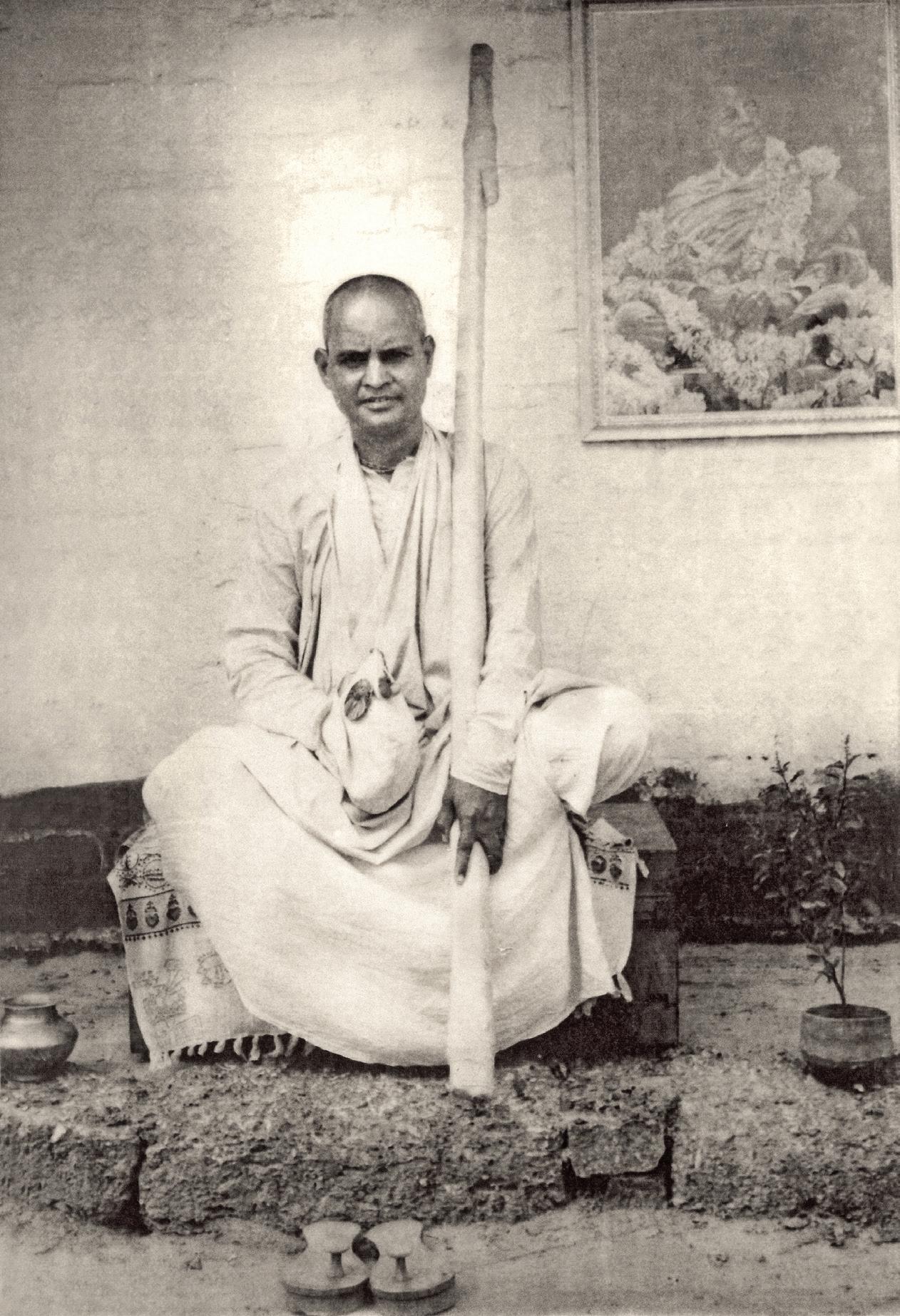
Śrī Śrīmad Gour Govinda Swami Mahārāja
ÇAbout the Author
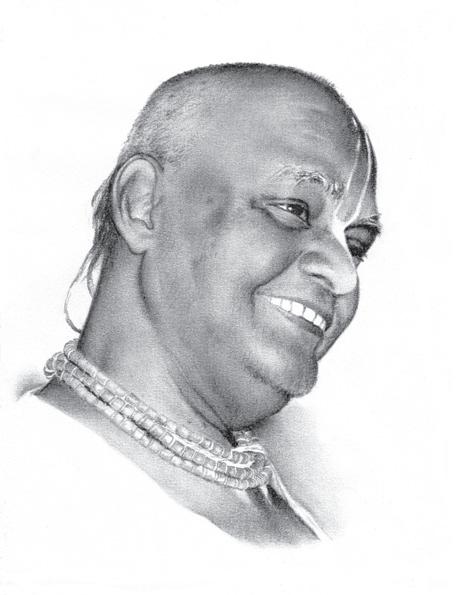
ré Çrémad Gour Govinda Swami appeared in this world on 2 September 1929 in the village of Jagannäthapura in the Indian state of Orissa (Odisha). Both the paternal and maternal sides of his family have been Vaiñëavas for hundreds of years, dating back to the time of Çyämänanda Prabhu, and prior to that, for many, many centuries. His divine appearance was not like the birth of an ordinary being, he came to this world solely to fulfill the order of Çré Caitanya Mahäprabhu.
Tattva-Vicāra
Çré Çrémad Gour Govinda Swami dedicated his whole life to preaching the absolute consideration of Gauòéya Vaiñëava philosophy, tattvavicära, and spoke uncompromisingly against accepting apära-vicära, the apparent consideration. Speaking in his own words, Çré Çrémad Gour Govinda Swami said, “ ... I am stressing only tattva. In all my lectures I stress this, tattva-vicära. Do you know the real tattva (truth)? You are all following this apparent consideration (apära-vicära), not tattva-vicära. That mistake is there. You do not know who you are, who Kåñëa is, who is a guru, who is a sädhu, and what the relationship is between them, you do not know these tattvas...”
Śrī
By Kṛṣṇa’s Arrangement
Çré Çrémad Gour Govinda Swami is a disciple of His Divine Grace Çréla A. C. Bhaktivedanta Swami Prabhupäda (1896-1977), the Founder-Äcärya of The International Society for Krishna Consciousness. By Kåñëa’s arrangement they met in the sacred land of Çré Våndävana Dhäma in 1974.
This transcendental meeting has been nicely described by Gunärnava däsa, in the book Just Try to Learn the Truth. Though they had not met previously, there was immediate recognition between the two great souls; sad-guru and sad-ñiñya. Çréla Prabhupäda commented on his disciple Çré Çrémad Gour Govinda Swami saying (at different times), “... Kåñëa has sent him...”, “... Gour Govinda Swami is a devotee from birth...”, and “…Gour Govinda Swami is an ideal Vaiñëava…”
The Three Sevās
Çréla Prabhupäda entrusted Çré Çrémad Gour Govinda Swami with three important seväs (services):
1. To stay in Orissa and build a temple like the famous Temple of Jagannätha in Puré, as Orissa is a very important place in Çré Caitanya Mahäprabhu’s lélä.
2. To translate Çréla Prabhupäda’s books from English into Oriya.
3. To accept disciples and train them in Kåñëa consciousness.
Upon receiving these instructions from his spiritual master, Çré Çrémad Gour Govinda Mahäräja immediately returned to Orissa and started working earnestly on plans for what would become the famous Çré Çré Kåñëa-Balaräma Temple in Bhubaneswar, which Çréla Prabhupäda famously predicted, “This temple will be one of the best ISKCON temples in the world. This place will be the heart of the city.” Gour Govinda Swami also embraced the sevä of translating Çréla
Prabhupada’s books into Oriya as a sacred duty which he continued every day without fail for the rest of his life.
While Çré Çrémad Gour Govinda Mahäräja immediately began to execute the first two instructions given by his spiritual master, the third and final instruction he received from Çréla Prabhupäda was to prove more difficult to carry out. After many years, he very hesitantly took on the role of being a spiritual master himself, as he understood the position of guru was a very heavy responsibility.
Lord Jagannātha Is in Bhubaneswar
Çréla Prabhupäda had accepted many Western disciples and taught them the glories of Puruñottama-kñetra, Jagannätha Puré Dhäma, where Mahäprabhu performed many pastimes in the eighteen years He resided there. However, when Çréla Prabhupäda’s disciples went to visit Jagannätha Puré they were refused entrance to the famous Temple of Lord Jagannätha because they were considered foreigners and not Hindus. Çréla Prabhupäda said, “I will build a temple in Bhubaneswar like the Temple of Jagannätha in Puré, because my Western disciples are not allowed there. Lord Jagannätha will come and stay in Bhubaneswar, so all my disciples can go there and have His darçana.” Çréla Prabhupäda, who had been donated land in Bhubaneswar, instructed Gour Govinda Swami to stay on the land and build a temple. He entrusted to Çré Çrémad Gour Govinda Swami the mission of establishing ISKCON in Orissa, the most important place of Mahäprabhu’s pastimes, and told him, “Gour Govind, you will take me to Orissa.”
Under Extreme Conditions
Çré Çrémad Gour Govinda Swami returned to Orissa and stayed on the ISKCON land (near the Nayapalli village) in Bhubaneswar under the most extreme and austere circumstances. There were no facilities at all on the land, no shelter, no building, no running water, no toilet,
Śrī Rādhā - The Embodiment of the Ocean of Kṛṣṇa-prema
no electricity, no telephone, no nothing! To take bath one would have to go to a far off paddock where there was a pump and take a bath from that pump. The only light available for reading and writing in the early hours of the morning and late in the evening came from a castor oil lamp. Wild bears, tigers and elephants would wander the area, which was also frequented by dacoits (thieves).
On Ekädaçé Çré Çrémad Gour Govinda Mahäräja would fast and chant the whole Bhagavad-gétä and on other days he would recite one chapter of Bhagavad-gétä. He would often walk up to twenty kilometres a day to collect donations to build the temple, print literature and to buy foodstuffs to prepare and offer to the Lord.
Seventeen Days
Çréla Prabhupäda visited Bhubaneswar in 1977 and stayed for seventeen days on the ISKCON property in the mud hut, which had been constructed for him by Gour Govinda Swami. On 2 February 1977, the auspicious appearance day of Lord Nityänanda, Çréla Prabhupäda laid the foundation stone of the Çré Çré Kåñëa-Balaräma Mandir. This Temple in Bhubaneswar was to be Çréla Prabhupäda’s last founded project.
Instruction Fulfilled
After sixteen years of determined endeavour, and with practically no outside help, (in one of the poorest regions of India) Çré Çrémad Gour Govinda Swami fulfilled the instruction of his most beloved spiritual master when the magnificent Çré Çré Kåñëa-Balaräma Mandir was inaugurated in Bhubaneswar in 1991. Lord Jagannätha, Baladeva and Subhadradevé came of Their own accord, as Çréla Prabhupäda prophesied, and this Temple now attracts thousands of people to Kåñëa consciousness.
Travelling the World
Çré Çrémad Gour Govinda Swami spent many years travelling the world preaching Kåñëa consciousness. His travels took him to Europe, North America, South America, Canada, Africa, Mauritius, Australia, Asia – Malaysia, Singapore, Indonesia and Bali, the Caribbean –Guyana, Suriname, Trinidad and he preached vigorously throughout the Indian subcontinent, especially in the state of Orissa, where he most notably constructed the glorious Temples of Çré Çré Kåñëa-Balaräma, Çré Çré Rädhä-Gopénätha and Çré Çré Rädhä-Gopäl Jéu.
Spellbound
Wherever he went Çré Çrémad Gour Govinda Swami would leave his audience spellbound by his dynamic presentation of the philosophy of Kåñëa consciousness. He would often speak for up to four hours at a time on topics about Kåñëa, leaving his audience enchanted and always eager to hear more. On occasions he would speak on a single verse of the Çrémad-Bhägavatam, both morning and evening for seven days. There was no question put to him that he could not answer, and hearing from Çré Çrémad Gour Govinda Swami on a regular basis would melt even the hardest heart, convincing one to seriously take to the path of bhaktiyoga.
Çré Çrémad Gour Govinda Swami was an expert in his understanding of the çästras and from the depth of his conviction was able to dispel the doubts [sarva-saàçaya-saàchettä] of those who came to him for spiritual guidance by the depth of his spiritual conviction. He would place great importance on chanting‚ encouraging and inspiring everyone to chant the holy names of Kåñëa without offence, to chant the pure name and thereby achieve the goal of life; to get Kåñëa and develop kåñëa-prema in this very life.
Śrī Rādhā - The Embodiment of the Ocean of Kṛṣṇa-prema
Śrī Kṣetra
Jagannātha Purī - Bhubaneswar Dhāma
One of the most important aspects of Çré Çrémad Gour Govinda Swami Mahäräja’s preaching was to reveal the innermost secrets of Puré-Bhubaneswar Dhäma, of Lord Jagannätha, and the reason why Çré Caitanya Mahäprabhu stayed in Jagannätha Puré. He gave the most subtle and clear understanding of the Lord’s pastimes in Jagannätha Puré and why Bhubaneswar is so important for the Gauòéya Vaiñëava community.
Storehouse of Knowledge
While astrologers predicted that he would live up to the age of ninety and deliver many conditioned souls, Çré Çrémad Gour Govinda Swami left this world by his own volition while speaking kåñëa-kathä on 9 February 1996, in Çré Mäyäpura Dhäma on the holy appearance day of Çréla Bhaktisiddhänta Sarasvaté Öhäkura Prabhupäda.
He left behind a veritable storehouse of knowledge concerning the truth about the jéva, mäyä, and the Absolute Truth Bhagavän Çré Kåñëa.
Source Material
Introduction
The Original Potency
A lecture delivered by Çréla Gour Govinda Swami on Rädhäñöamé, 2 September 1995, Gadai Giré, India.
Chapter One
Desiring to Understand the Glories of Rädhä’s Love
A lecture given by Çréla Gour Govinda Swami on Caitanyacaritämåta, Ädi lélä 4.229-230, 6 April 1989, Bhubaneswar, India.
Chapter Two
The Green and the Yellow Mango
A lecture given by Çréla Gour Govinda Swami on Caitanyacaritämåta, Ädi lélä 4.231-233, 7 April 1989, Bhubaneswar, India.
Chapter Three
Who Can Give Me Pleasure?
A lecture given by Çréla Gour Govinda Swami on Caitanyacaritämåta, Ädi lélä 4.234-241, 13 April 1989, Bhubaneswar, India.
Chapter Four
The Enchantress of Govinda
A lecture given by Çréla Gour Govinda Swami on Caitanyacaritämåta, Ädi lélä 4.242-244, 14 April 1989, Bhubaneswar, India.
Chapter Five
Stealing the Wealth in Çré Rädhä’s Heart
A lecture given by Çréla Gour Govinda Swami on Caitanyacaritämåta, Ädi lélä 4.245-248, 20 April 1989, Bhubaneswar, India.
Śrī Rādhā - The Embodiment of the Ocean of Kṛṣṇa-prema
Chapter Six
Only Rädhäräëé Relishes the Beauty of Kåñëa
A lecture given by Çréla Gour Govinda Swami on Caitanyacaritämåta, Ädi lélä 4.249-255, 21 April 1989, Bhubaneswar, India.
Chapter Seven
Kåñëa Becomes a Disciple of Rädhäräëé
A lecture given by Çréla Gour Govinda Swami on Caitanyacaritämåta, Ädi lélä 4.256-258, 27 April 1989, Bhubaneswar, India.
Chapter Eight
Rädhäräëé’s Beauty
A lecture given by Çréla Gour Govinda Swami on Caitanyacaritämåta, Ädi lélä 4.259, 28 April 1989, Bhubaneswar, India.
Verse Index A
abhimänaà parityajya präkåta-vapur-ädiñu 102 äcarya dharmaà paricarya viñëuà 15 ahaà bhakta-parädhéno 35, 40
äjänu-lambita-bhujau kanakäva-dätau v ämä ha-ite änandita haya tribhuvana 12, 27
ämä haite guëé baòa jagate asambhava 29
ämä haite yära haya çata çata guëa 12, 28 ämära saìgame rädhä päya ye änanda 66
ämi yaiche paraspara viruddha-dharmäçraya 32 änanda-lélä-maya-vigrahäya viii anärädhya rädhä-padämbhoja-reëum 101 anarpita-caréà cirät karuëayävatérëaù kalau vi anuküla-väte yadi päya mora gandha 66 anyera saìgame ämi yata sukha päi 80, 84 apäraà kasyäpi praëayi-jana-våndasya kutuké 60 aparikalita-pürvaù kaç camatkära-käré 7 arasa-jïa käka cüñe jïäna-nimba-phale 23 açäsya däsyaà våñabhänu-jäyäs 106 äçraya-jätéya sukha päite mana dhäya 30 ataeva bhakta-gaëe kari namaskära 26 ataeva kahi kichu kariïä nigüòha 13 avajänanti mäà müòhä 72 B bähye viña-jvälä haya, bhitare änanda-maya, 48
caitanya-caritra ei—’amåtera sindhu’ 25 ciräd adattaà nija-gupta-vittaà iv
Śrī Rādhā - The Embodiment of the Ocean of Kṛṣṇa-prema
D
doìhära ye sama-rasa, bharata-muni mäne 79, 83 düräd apäsya svajanän sukham artha-koöià 104
E
ei mata anubhava ämära pratéta 65 ei mata jagatera sukhe ämi hetu 53, 55 ei premä-äsvädana, tapta-ikñu-carvaëa, 49 ei prema-dväre nitya rädhikä ekali 7 e saba siddhänta güòha, — kahite nä yuyäya 13, 21 e saba siddhänta haya ämrera pallava 21 eta cinti’ rahe kåñëa parama kautuké 31
G
gaura aìga nahe mora—rädhäìga-sparçana 19, 90, 109 gaura-hari avatari ‘premera vädara kari’ vii gauräìga bolite habe pulaka çaréra 91 gauräìgera madhura-lélä, jär karëe praveçilä, 24 gauraù sac-caritämåtämåta-nidhiù gauraà sadaiva-stuve iv gopénätha, ämära bharasä tumi, 104 gopénäth, mama nivedana çuno, 104 govindänandiné rädhä, govinda-mohiné 42, 89, 94
H
hare kåñëa hare kåñëa kåñëa kåñëa hare hare
108 he kåñëa karuëä-sindho ii hådaye dharaye ye caitanya-nityänanda 13 hré-paööa-vastra-guptäìgéà saundarya-ghusåëäïcitäm
J
jaya jayojjwala-rasa sarva-rasa-sära
95
87 jaya rädhe, jaya kåñëa, jaya våndävana, 87
K
kabhu yadi ei premära ha-iye äçraya 31 kampäçru-pulaka-stambha-sveda-gadgada-raktatäù 95 käruëyämåta-vécibhis täruëyämåta-dhärayä 95 kÿptälaìkåti-saàçliñöäà guëäli-puñpa-mäliném 96 koöi-käma jini’ rüpa yadyapi ämära 39, 42 kåñëa-äliìgana päinu, janama saphale 66 kåñëera vicära eka ächaye antare 12, 27 kva nanda-kula-candramäù kva çikhi-candrakälaìkåtiù 111
L
lélä-ante sukhe iìhära aìgera mädhuré 79
M
mädhuryaiù-madhubhiù sugambhi-bhajana svarëam v mahä-bhävojjvalac-cintä-ratnodbhavita-vigrahäm 95, 96 mora rüpe äpyäyita haya tribhuvana 39, 43 mora vaàçé-géte äkarñaye tri-bhuvana 39, 44
N
‘näma’, ‘vigraha’, ‘svarüpa’—tina eka-rüpa 97 namo mahä-vadänyäya iii namo mahä-vadänyäya kåñëa-prema pradäya te 92 ñañtha-çlokera ei kahila äbhäsa 1 na päraye ’haà niravadya-saàyujäà 57 navadvépe avatari’ rädhä-bhäva aìgékari’ vi, 8, 109 nirdhütämåta-mädhuré-parimalaù kalyäni bimbädharo 93
O
oà ajïäna-timirändhasya i
Śrī Rādhā - The Embodiment of the Ocean of Kṛṣṇa-prema
P
paraspara veëu-géte haraye cetana 65 péòäbhir nava-käla-küöa-kaöutä-garvasya nirväsano 49
R
rädhä-kåñëa aiche sadä eka-i svarüpa 17 rädhä kåñëa-praëaya-vikåtir hlädiné çaktir asmäd iv rädhä-padämbhoja-reëu nähi ärädhile 101 rädhära darçane mora juòäya nayana 65 rädhikära prema guru, ämi çiñya naöa 47, 80 rüpa-raghunätha-pade haibe äkuti 16, 77, 83, 88, 94
S
sädhu-saìge kåñëa-näma ei mätra cäi 6 smara-garala-khaëòanaà mama çrirasi maëòanaà 59 çré-caitanya-mano-’bhéñöaà i, 16 çré-gurün vaiñëaväàç ca i çré-kåñëa-caitanyadeva rati-mati bhave bhaja vi çré-rädhäyah praëaya mahimä kédåço vänayaivä 1, 22, 50, 84 sthüla-dehädite ätma-buddhi parihari’ 103 svajana-sambandha-sukha, catur varga-artha 105
Ttäìra bhäve bhävita kari’ ätma-mana 19 tämbüla-carvita yabe kare äsvädane 66 tapta-käïcana-gauräìgi ii tri-vidhaà narakasyedaà 4
uttama adhama kichu na bächila yäciyä dilaka kola vii
V
väïchä-kalpatarubhyaç ca iii vande ‘haà çré-guroù çré-yuta-pada-kamalaà i vibhur api kalayan sadäbhivåddhià 46 vinä na gaura-priya-päda-seväà 15 våñabhänu-kumäréra haiba kiìkaré 106
Y
yad advaitaà brahmopaniñadi tad apy asya tanu-bhä iii yadyapi ämära gandhe jagat sugandha 53, 54 yadyapi ämära rase jagat sarasa 53, 54 yadyapi ämära sparça koöéndu-çétala 53, 55 yan näptaà karma-niñöhair na ca samadhi-gataà viii yasyaiva pädämbuja-bhakti-läbhyaù viii ye lägi kahite bhaya, se yadi nä jäne 26
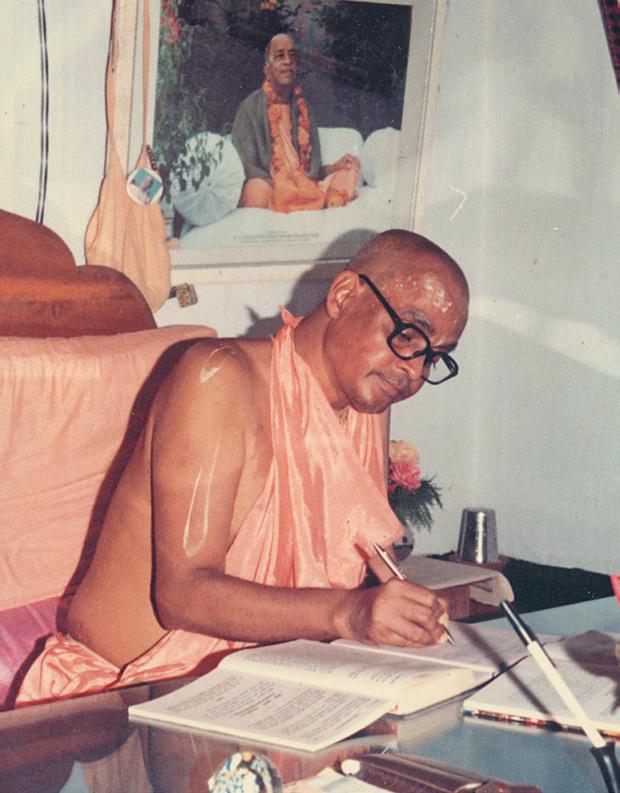
Śrī Rādhā
The Embodiment of the Ocean of Kṛṣṇa-prema

You should remember that Rādhārāṇī never bathes in ordinary water. She takes Her bath in nectar, as stated in this verse. Generally, She takes bath in the Yamunā River. Have you taken bath in the Yamunā? If you have then you are very fortunate, because Rādhārāṇī and Kṛṣṇa took bath in the Yamunā. The Yamunā is a very sacred river. When Rādhā and Kṛṣṇa descended in this world 5,000 years ago and were manifesting Their transcendental loving pastimes in Vṛndāvana, They were often playing in the water of the Yamunā River, jala-kṛdā. So the Yamunā is very, very fortunate.
However, here Raghunātha dāsa Gosvāmī says something else. He says that Rādhārāṇī takes Her bath in nectar. What type of nectar? Kāruṇyāmṛta, tāruṇyāmṛta, and lāvaṇyāmṛta. Kārunya means ‘mercy’. Mercy is like nectar. She takes Her bath in that nectar, kārunyāmṛta, before noon. Tāruṇyāmṛta is also like nectar. Taru means ‘youth’, and Rādhārāṇī takes Her bath in that nectar at noon. Then lāvaṇyāmṛta, lāvaṇya means ‘beauty’. That is also like nectar and She takes Her bath in that nectar in the afternoon. This has a very, very deep meaning; it is very difficult to understand.

— Śrīla Gour Govinda Swami
Excerpt from Chapter Eight