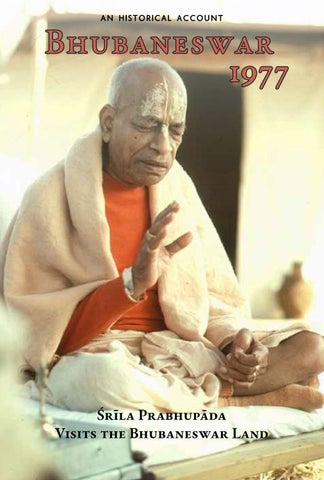
Bhubaneswar 1977

Page 1


Bhubaneswar 1977

Śrīla Prabhupāda

Visits the Bhubaneswar Land

Bhubaneswar 1977

Śrīla A.C. Bhaktivedanta Swami Prabhupāda

Visits the Bhubaneswar Land

BHUBANESWAR 1977

This book has been compiled from interviews with disciples of Çréla A.C. Bhaktivedanta Swami Prabhupäda, friends, godbrothers, and followers of Çréla Gour Govinda Swami Mahäräja.

Quotes from the books and lectures of Çréla A.C. Bhaktivedanta Swami Prabhupäda are copyrighted © The Bhaktivedanta Book Trust International. Image of Çréla A.C. Bhaktivedanta Swami Prabhupäda courtesy of The Bhaktivedanta Book Trust International, Inc. www.Krishna.com. Used with permission.

First Edition 1,000 copies - 2026 Printed at: Thomson Press India Private Ltd, Delhi, India.

ISBN: 978-0-645-92845-7 © 2026 TATTVA VICÄRA

PUBLICATIONS

SOME RIGHTS RESERVED. EXCEPT WHERE OTHERWISE NOTED, CONTENT ON THIS BOOK IS LICENSED UNDER THE CREATIVE COMMONS ATTRIBUTION-NO DERIVATIVES 4.0 INTERNATIONAL LICENSE.

To view a copy of this license, visit http://creativecommons.org/licenses/by-nd/4.0/

Permissions beyond the scope of this license write to info@tvpbooks.com

Front cover picture: Çréla AC Bhaktivedanta Swami Prabhupäda in Bhubaneswar, 1977. Back cover pictures: Top - Çréla AC Bhaktivedanta Swami Prabhupäda arrives in Bhubaneswar. Bottom - The ISKCON Bhubaneswar land with one hut (right) built by Çréla Gour Govinda Swami and power had been newly provided to accomodate Çréla Prabhupäda’s translating work.

Bhubaneswar 1977

Śrīla A.C. Bhaktivedanta Swami Prabhupāda

Visits the Bhubaneswar Land

Compiled by Nimäi Paëòita däsa

TATTVA VICARA PUBLICATIONS

Çréla AC Bhaktivedanta Swami Prabhupäda in Bhubaneswar, 1977

Preface

This publication is derived from Always Embraced by Kåñëa, Volume One, Part Two, the authorised biography of Çréla Gour Govinda Mahäräja, with information extracted from chapters 7, 8, 9, 10, and 11 of that work.

In truth, laying the cornerstone and installing the Ananta Çeña Deity could have been accomplished in two to three days. Yet, Çréla Prabhupäda chose to remain there for seventeen days, in a remote mud hut. The reasons for this decision remain unknown. During this period, numerous private unrecorded meetings occurred between Çréla Prabhupäda and Çréla Gour Govinda Mahäräja. With only the two of them privy to their contents, what was discussed remains a mystery for all time.

Your lowly servant,

Çréla AC Bhaktivedanta Swami Prabhupäda with his disciple

Çréla Gour Govinda Swami

I ntroduct I on

AfterÇréla Gour Govinda Mahäräja’s sannyäsa initiation, on Rama Navami 1975, at the opening of the Çré-Çré-Kåñëa-Balaräma Temple Räman-reti in Våndävana India, he received pertinent instructions from his spiritual master, Çréla Prabhupäda, regarding his service in Bhubaneswar. Following this, Çréla Gour Govinda Mahäräja returned to Orissa, and stayed on rural land donated to ISKCON, enduring harsh and extreme conditions. The area was still home to wild bears, tigers and elephants, and many dacoits [brigands]. It was during this time that his work started on what would later become the beautiful KåñëaBalaräma Temple. He also began, in earnest, translating of Çréla Prabhupäda’s books into the Oriya language – a seva that Çréla Gour Govinda Mahäräja would continue every day for the rest of his life. Sitting crossed-legged on the floor, he produced hand-written transcripts, using his metal trunk as a desk. He did not use any electronic devices for this service; it was all done manually using pen and paper.

Śrīla Prabhupāda’s Sulkiness

Çréla Prabhupäda, who is a dear devotee of Çré Caitanya Mahäprabhu and has received His full mercy, spread His message throughout the world and fulfilled His prophesies. Çréla Prabhupäda accepted many Western disciples and taught them the glories of Puruñottamakñetra, Jagannätha Puré-dhäma where Mahäprabhu had performed so many of His pastimes. However, when his Western disciples went to visit Puré, they were unceremoniously refused entry to the well known Jagannätha Temple – a restriction that still remains in place. When they reported this to Çréla Prabhupäda, he was deeply saddened. He was preaching Mahäprabhu’s and Lord Jagannätha’s glories throughout the world but now the Puré pandas would not allow his disciples into the Temple. In his shock and sorrow, Çréla Prabhupäda developed a sense of sulkiness. After this incident, he said that he would not travel to Orissa, especially not to Jagannätha Puré, the place where Mahäprabhu spent His last eighteen years.

Gour Govind, You Will Take Me to Orissa

After Gour Govinda Swami’s hari-näma initiation in Mäyäpur, Çréla Prabhupäda had said to him, “Gour Govind, you will take me to Orissa.” He then added, “I will build a temple in Bhubaneswar similar to the

Jagannätha Temple in Puré because my Western disciples are not allowed there. Lord Jagannätha will come and stay in Bhubaneswar, so all my disciples can go there and have His darçana.”

When many of Çréla Prabhupäda’s senior disciples wanted to abandon the Bhubaneswar temple project in favour of starting a larger one in Jagannätha Puré, Çréla Prabhupäda prophesied that one day the temple in Bhubaneswar would become as famous as the Jagannätha Temple and would be the centre of the city.

In early 1977 [January-February], Çréla Prabhupäda came to Bhubaneswar, where only a small hut stood in the deserted area. Although arrangements had been made for him to stay comfortably in the state government guesthouse, he at once rejected this proposal, saying, “I will only stay where my disciple Gour Govind has built a mud hut for me.” He took residence in that hut for seventeen days, during which he laid the foundation stone for the future temple on the auspicious occasion of Lord Nityänanda’s appearance day. This was Prabhupäda’s one-hundred and eighth and last founded project. The venture was entrusted to virtually a new disciple of Çréla Prabhupäda [Çréla Gour Govinda Mahäräja], and by his endeavours it came to fruition.

Currently, as prophesied by Çréla Prabhupäda, the area where the temple now stands has become

the centre of the city, with the GPO and many other important buildings relocating there. The Bhubaneswar Temple has gained significant fame, attracting hundreds of thousands of pilgrims and visitors.

Your lowly servant,

Maïjumedhä devé däsé.

At Lord Śiva’s Invitation

From an evening darçana with Çréla Gour Govinda Swami

Lord Śiva Invited My Guru Mahārāja

Çréla Gour Govinda Swami: I was saying, how in Mäyäpura, Lord Çiva invited my Guru Mahäräja, ‘Please come, please come to this kñetra.’ My Guru Mahäräja had developed some sort of sulkiness, so he was not intending to come here [Orissa, Bhubaneswar]. Lord Çiva, who is a great Vaiñëava has stated: païca-bhautika-dehä ye martyaloka-niväsinaù bhagavad-bhakti-rasikä namasyä mädåçäà sadä

“People like myself should also always bow down to offer respect to them who, although living in the earthly planets, and although possessing material bodies made of the five elements, are expert at always

tasting the nectar mellows of pure devotional service to the Supreme Personality of Godhead.”1

Çréla Gour Govinda Swami: So, Lord Çiva has said that a sädhu who has taken birth in this material world, in the body consisting of five gross elements, he is a very great devotee of the Lord. He is worshipped even by me. I worship such a person; I pay my respects to him. Çiva says, ‘He is so dear; I am not so dear as he is dear.’

When my Guru Mahäräja developed some sulkiness, he would not come here. Lord Çiva repeatedly requested, ‘Please, O Bhaktivedanta Swami, please come, please come.’ At last he accepted Lord Çiva’s request.* So, he came here to this Çiva kñetra, which is the entrance to the Puruñottama Kñetra. Thus, Bhaktivedanta Swami came to this place. He stayed at the entrance, and thought of building this Kåñëa-Balaräma temple at the entrance of the kñetra.

Lord Śiva Is Welcoming You

One cannot deny that this desire has taken shape. Anyone who comes to enter this kñetra, he must first visit this temple of Bhubaneswar [ISKCON Çré Çré Kåñëa-Balaräma Temple], “Oh, a nice temple is here!’’ First, he must pass through the entrance, then * Author’s note: It has also been said by Çréla Gour Govinda Swami Mahäräja that he was personally present when Lord Çiva came to see Çréla Prabhupäda to invite him to Bhubaneswar and to Çré Jagannätha Puré-dhäma.

he enters Çré Kñetra, the näbhi, the middle portion, and sees Jagannätha. At the entrance Lord Çiva is welcoming you, ‘Come, come.’ Çiva is welcoming you here. Çréla Prabhupäda did not think of opening a temple at Jagannätha Puré. He first thought of building a temple at the entrance to Puré (Bhubaneswar). ‘No, I will do that first, then the next thing is Puré, but that will be in the future.’ First the entrance, a nice gate, ‘See, this is such a nice kñetra; let me enter it.’ This is the significance of Bhubaneswar.

Please Come and See Jagannātha

To this place of pilgrimage, this tértha, or dhäma, Mahäprabhu came. First, He entered here (Bhubaneswar), visited the Lingaräja temple – Lord Çiva. He danced there, did kértana and took bath in Bindu-sarovara. He visited Lord Çiva. Lord Çiva is a great devotee; he is kñetra-pala – one who guards the kñetra. Before entering the kñetra, you must see kñetra-pala and receive his permission. ‘O Lord, please let me enter.’ So, devotees are cordially invited, welcomed. Lord Çiva with folded hands says, ‘Please come and see Jagannätha.’

This Is a Very Famous Kṣetra

All the history of this kñetra is mentioned in the Skanda Puräëa, in the Utkala Khaëòa. There is a special

volume: Çré Kñetra, Jagannätha. There is everything about this kñetra. To circumambulate this Çré Kñetra, you must first approach Lord Çiva. If you avoid Him, then you will commit an offence. Your dhämavasa and parikramä will not be fruitful.

This is a very famous kñetra. This climate is very pleasant and the water is very nice. The Kedara-Gauri water in Bhubaneswar is very famous. Çréla Prabhupäda took the water from there every day. He had found some relief here, so he stayed here so many days. Also, when he was very, very sick in Våndävana during his last days, he asked for this water. We sent it to Våndävana. We brought that water for him every day. Have you seen that place? It is in old Bhubaneswar, where the Lingaräja, the Lord Çiva temple is. There are many Çiva temples, but Lingaräja is the biggest and the first temple. Kedaresvara is one of the liìgas, and Gauri is his wife. Their temple is known as KedaraGauri. The water from the well there is very good for the stomach.

When I first came to Orissa after my Guru Mahäräja sent me, I stayed in Cuttack, then I came here to old Bhubaneswar, where I stayed in two dharma-çäläs very close to that Lingaräja Temple. I came here on foot, such a long way I walked to find a place to stay, and to see where to build a hut here on this land. I stayed just in front of the mango grove, in another mud hut. Then

I built this mud hut.* Its shape was not as it is now. Now it is nice looking. Originally the bricks were set up with mud, loose. In that room Prabhupäda stayed for seventeen days.

The original hut on the Bhubaneswar land (far right)

* The original hut on the Bhubaneswar land, consisting of Çréla Gurudeva’s room/samädhi and Çréla Prabhupäda’s bhajana-kuöér, now demolished.

Çréla Prabhupäda in Bhubaneswar 1977

Śrila Prabhupāda in Bhubaneswar

Part One

18 January - 24 January 1977

The Instruction of All Ācāryas

Çréla Gour Govinda Swami: In this way you can do hari-kértana, otherwise you cannot do it. Think yourself more humble than a blade of grass lying in the street and be as tolerant as a tree. It is a question of tolerance, sahiñëunä. Those sädhu Vaiñëavas tolerate it. My Guru Mahäräja’s instruction and all other äcäryas’ instruction is to cooperate and tolerate, tolerate and cooperate. Çréla Prabhupäda has said that. Especially he has told me many times in Bhubaneswar, “Gour Govind, cooperate and tolerate, cooperate and tolerate, cooperate and tolerate.” Yes, it is a question of tolerance. This is Vaiñëava. This is sädhu. 1

Out of Your Causeless Mercy

Çréla Gour Govinda Swami: I am taken back to the far-off days of January–February 1977, when Your Divine Grace [Çréla Prabhupäda], out of your causeless mercy, placed your holy feet on the longcherished soil of Bhubaneswar, the capital of Orissa, the land of Lord Jagannätha and of the sacred pastimes of Çrémän Gauräìga Mahäprabhu. Demonstrating the ideal quality of Vaiñëava simplicity, you preferred to remain for seventeen days in a mud hut that had been built on the land donated to you here in Bhubaneswar instead of at the nearby, well-built and well-arranged government State Guest House. By your very divine presence, those then out-of-the-way outskirts of Bhubaneswar were delightfully surcharged with the pure transcendental energy of the unalloyed, nectarean sweet love of Godhead, Kåñëa. Thus, that otherwise usual site was turned into a rare spiritual sight and a memorable pilgrimage for many fortunate aspirants and sincere seekers of your divine darçana. 2

Çréla Gour Govinda Swami: “Nothing was here, only that one hut, and the jungle. So, I arranged for some tents to be pitched. I was thinking, “Prabhupäda is coming, that means many Western devotees, men and women, will come and thousands of people will gather here. How will I accommodate them? How will I feed them? I have no money! Anyhow, this is Prabhupäda’s mercy.”

January 18

“On the evening of January 18, at 8:30 p.m., we set off by train for Bhubaneswar. We arrived the next morning, 19 January, at 7:30 a.m. and were met by Gour Govinda Swami and other devotees who had driven all night in Çréla Prabhupäda’s car so that he would have some transport available while he was in Bhubaneswar.

“Çréla Prabhupäda and his entourage drove through the town and out a distance to the land. No one was very optimistic about its prospects when they saw it. However, Çréla Prabhupäda was very positive and felt that in a few years it would be an important place, because it was right on National Highway No. 5, which goes through to Madras [now Chennai] in the south. The Bhubaneswar land is right on the side of the National Highway, and Gour Govinda Swami had managed to get it fenced all around and he had two small brick structures erected on the site. So Çréla Prabhupäda was optimistic about building a temple there and was encouraging Gour Govinda Mahäräja to organise it.” (From Hari Çauri däsa notes.)3

January 19

Çréla Gour Govinda Swami: Çréla Prabhupäda came by train the next day. There were other devotees, like his secretary, Rämeçvara, and Pradyumna Miçra, who had come a little ahead of Prabhupäda. Pradyumna Miçra was travelling with a trunk load of books and a typewriter.

We came in that car to pick up Prabhupäda. One devotee was driving his car. When I brought him to the car from the railway station, I was going to sit in the front, but Prabhupäda called me to sit beside him in the back seat. “Gour Govind, come, sit, sit here.” I was feeling somewhat hesitant and shy, thinking “How can I sit beside my spiritual master?” But he made me sit there, just close to him. He is so merciful. I was sitting in the middle in the front, but he said, “No, no. Sit in this seat, sit with me.” He is so merciful! This is causeless mercy, definitely.

Prabhupäda stayed there in that hut. He was so humble: He used to live in palatial buildings but he stayed here. I told him, “I have arranged a nice guest house…” but he said, “No, no; I will stay here.” There was nothing here, only this mud hut, only these two rooms.

Deva-dharma däsa: Then Çréla Prabhupäda arrived in grand style with so many senior devotees. It seemed like a mini Mäyäpura festival, with about eight to ten sannyäsés and GBC members. There were also thirty to forty devotees travelling with Çréla Prabhupäda.

In the Dust of Orissa

Conditions on the ISKCON Bhubaneswar land were primitive: two small mud-walled huts with thatched roofs. Çréla Prabhupäda stayed in one eightby-twelve room in one of the cottages, and his servant and secretary were in the other room just on the other

side of the wall. Electricity had been installed on the land a few days before, so Hari-çauri had placed an electric lamp and the dictation machine on Çréla Prabhupäda’s desk.

The second small building, about twenty-five feet from Çréla Prabhupäda’s hut, was a tiny temporary temple room. A shabby canvas roof spanned the open area between the two buildings, and Çréla Prabhupäda’s vyäsäsana was beneath this, arranged so he could lecture at outdoor gatherings. Two rented tents had also been erected on the land, to accommodate visiting devotees during Çréla Prabhupäda’s stay. Çréla Prabhupäda’s outdoors toilet, about twenty-five feet behind his hut, consisted of a latrine and a separate area for bathing.

Çréla Prabhupäda did not mind the simple facilities; in fact, he liked them. Although he was ill and for personal comfort could have been residing in his choice of buildings in the West, he felt perfectly at home and happy living in a simple mud hut with a thatched roof, on a secluded patch of land in the dust of Orissa. (From Çréla Prabhupäda-lélämåta)4

Deva-dharma däsa: Çréla Prabhupäda was very much at ease, very relaxed and quite content to be housed in one room of the äçrama. He felt perfectly at home in this humble setting and never complained about anything. He was able to conduct all his worldwide affairs and entertain all sorts of guests, including two of the richest men in Orissa, just from this one small room.

Çréla Gour Govinda Swami: I do not know how Çréla Prabhupäda was so happy here. I had nothing, no money, no men, nothing. Still, he was so happy here. He accepted my humble service. Anyhow, he is so merciful... And he established a centre here, in spite of all the objections of his senior disciples [GBC’s and sannyäsés]. This is his mercy. And he gave me many important instructions, which he whispered into my ears in that room. They were not recorded. Usually, every word of his was recorded; a tape recorder was always on, but he even asked his secretary to vacate the room. He just whispered in my ear. He gave me so many instructions.* Why he is so merciful to me? I do

* Author’s note (i): Many witnessed these very private meetings between Çréla Prabhupäda and Çréla Gurudeva Gour Govinda Swami. This included B. däsa, Deva-dharma däsa and Jayadharma däsa. As for what Çréla Prabhupäda and Çréla Gurudeva discussed, no one will ever really know.

*Author’s note (ii): Çréla Gurudeva told the author of this book that it was at these many private meetings that Çréla Prabhupäda told him to take disciples. There is more to the story, however, which will be narrated at a later date!

*Author’s note (iii): One can become guru when he is ordered by his guru.

Indian man (1): When did you begin to become the spiritual leader of Kåñëa consciousness?

Prabhupäda: What is that?

Brahmänanda: He’s asking when did you become the spiritual leader of Kåñëa consciousness?

Prabhupäda: When my Guru Mahäräja ordered me. This is the guruparamparä.

Indian man (1): Did he just...

Prabhupäda: Try to understand. Don’t go very speedily. A guru can become guru when he’s ordered by his guru. That’s all. Otherwise, nobody can become guru. (Continue on next page)

not know. What have I done for him? I have not done anything. Still, I am carrying out his order the best I can. Anyway, he is so merciful! It is causeless mercy.5

“...I remembered that Çréla Prabhupäda used to tell everyone to leave the room and then he would have private talks with Çréla Gour Govinda Mahäräja. When Çréla Gour Govinda Mahäräja would leave the room [Çréla Prabhupäda’s room] I would see him shining very effulgently. I thought at the time, WOW he must be getting some powerful mercy from Çréla Prabhupäda...

“...This was all given to him by Çréla Prabhupäda in Bhubaneshwar when Çréla Prabhupäda was there in January 1977. Çréla Prabhupäda could not give this knowledge to any of his Western disciples since we were not qualified to understand such things....”6

Indian lady: [Hindi]

Prabhupäda: [Hindi] Çädhi mäà prapannam. “I am surrendered to You. Whatever You say, I shall carry out.” That’s all.

Indian man (1): When did he tell you to...?

Prabhupäda: What is the business, when did he tell me? And why shall I disclose to you? It is so very insignificant thing that I have to explain to you?

Indian man (1): No, I am just curious to know when.

Prabhupäda: You should be curious within your limit. You should know that one can become guru when he is ordered by his guru. This much. (Class Bhagavad-gétä 7.2 — October 28, 1975, Nairobi)

*Author’s note (iv): It seems that Çréla Prabhupäda did not want to disclose when his own spiritual master told him to become guru. It was enough through word of mouth that Çréla Prabhupäda said he did. Thus, we will never really know what took place in those meetings, between Çréla Gour Govinda Swami and Çréla Prabhupäda, however it was definitely not for Çréla Prabhupäda’s fledgling Western disciples!

The Ability to Accept Whatever Kṛṣṇa Provides

Kusha devi dasi: I was there in 1977 staying in a farm house. We travelled with Çréla Prabhupäda from the Kumbha-melä and Mäyäpura to see the newly acquired land Gour Govinda Swami was presenting. Çréla Prabhupäda stayed in a mud hut. We were all impressed with his humility and ability to accept whatever Kåñëa provides. He set the standard for all of us to make an effort to follow. That mud hut represents the surrender and sacrifice of both our dearly beloved A.C. Bhaktivedanta Swami Prabhupäda as well as his dearmost disciple Gour Govinda Mahäräja. They were both willing to do the needful to spread the glories of the Lord, even if it meant personal simplicity and living according to ancient traditions.

Prabhupāda

Did Something Very Wonderful

There were many room discussions that took place with Çréla Prabhupäda and his GBC disciples, and the tape player was recording every word; however, in the many private meetings that took place between Çréla Prabhupäda and Çréla Gour Govinda Swami, no tape recorder was on, the discussions were not taped. The GBC wanted to make a large temple in Puré, but Çréla Prabhupäda wanted a temple in Bhubaneswar.

Many years later, just after the installation of the Deities in the Çré Çré Kåñëa Balaräma Temple in Bhubaneswar, which was Çréla Prabhupäda’s last founded project, Çréla Gour Govinda Swami was walking up the stairs with a few followers and said: “...Prabhupäda did something very wonderful: he built a temple at the gateway to the Puré Dhäma, which is Bhubaneswar. There is the same number of stairs here as in the Puré temple: there are 22 stairs to climb. As in Puré the same Jagannätha is here, everything is the same...”

I am not Going Because My Disciples Are Not Allowed

Room Conversation - January 19, 1977

- Orissa

Gargamuni: There’s those two plots on that main street. I drove all around. But the other plots are too small. And also, they’re out of the city, more out of reach. They’re not in that area which is the best area (…) And all the hotels are there, so all the top people are there. (…) That Puré Hotel was packed up with foreigners and with local people very nicely dressed. And this plot is just near the Puré Hotel. So, it’s a nice area, and there’s a very nice breeze from the ocean. So, if we build a nice multi-story, that breeze will be very healthy (...) So perhaps, if you would like to see

it the following day, we can drive there and show you the plot as soon as I get more information.

Rämeçvara: Would you like to do that, Çréla Prabhupäda?

Çréla Prabhupäda: Oh yes.

Hari-çauri: Have you been to Puré for a long time?

Çréla Prabhupäda: Oh, several times.

Hari-çauri: I mean in recent years or...

Çréla Prabhupäda: No. Recently I’m not going because my disciples are not allowed. I don’t wish to go (...)

The last time I went was before going to the USA, in 1958. After that, I had no chance of going.

Rämeçvara: There’s no doubt that if we build a temple there [Jagannätha Puré] it must be very, very magnificent.

Gargamuni: In front of the temple, though, there are so many beggars. You cannot walk peacefully. So many beggars, and no one is giving...

Çréla Prabhupäda: In 1920 I came to Bhuvaneçvara.

So, I was thronged with so many beggars (…) So much beggars have now come. It’s a very poor country.

Gargamuni: We could have very big prasädam distribution there, in Puré. Right on the beach we could set up a whole prasäda distribution.

Çréla Prabhupäda: If you arrange for prasäda distribution, you’ll become very popular.

Rämeçvara: Of course, all the pilgrims that come to Puré for the temple festivals, they’ll also come to our temple if it is very big.

Çréla Prabhupäda: Yes, naturally.

Rämeçvara: But what style will it be? It will be a different style of architecture.

Çréla Prabhupäda: Våndävana? That will be new

introduction here (...)

Gargamuni: Shouldn’t it be higher than the Puré temple? Or less?

Rämeçvara: We can make it higher for not too much extra cost. The height is not that expensive. I was talking...

Gargamuni: Because you can see the Puré temple from the road ten miles away.

Rämeçvara: It would be suitable, appropriate, if this temple was taller.

Çréla Prabhupäda: That can be done.

Gargamuni: Because then it could be seen from miles away. Along the road, they have a sign, “Look to your right, and you will see Puré in your sight.” They have a sign, rhyming like a poem. And sure enough, coming up, about ten miles out of the city, you see that temple. So similarly, if we have a very high temple it can be seen (…)

Rämeçvara: “Look to your left.” (chuckling) This is very exciting, this idea of building in Puré. And Prabhupäda said the main Deities would be Kåñëa and Balaräma.

Hari-çauri: If we build in Puré, will we have Jagannätha?

Çréla Prabhupäda: Yes. Jagannätha, Nitäi-Gaura, Guru-Gauräìga (…) and Kåñëa-Balaräma like in Våndävana.

Rämeçvara: And very big Deities. That would be good if there were big Gaura-Nitäi Deities.

Gargamuni: Yes, there should be huge Deities.

Hari-çauri: Like in Hyderabad. There’s those very big Deities there, five feet or something.

Çréla Prabhupäda: Five feet? We can get Deity done here also. But there is no white stone. Other stone is available here.

Gargamuni: Yes, they have stone, but no marble… They have that red stone in Rajasthan, like in Våndävana. You’ve seen that red stone? It’s very nice. I saw a big hotel in Bombay where they have used that red stone, very beautiful, that you see in Våndävana. It’s the first time I saw it in Bombay (...) That Kesighäöa that is made of that red stone.

Çréla Prabhupäda: Yes. The red stone is very durable.

Gargamuni: Stone or marble.

Çréla Prabhupäda: In Bhuvaneçvara you can have stone (…)

Rämeçvara: To build such a big temple you’ll need many devotees: püjärés, cooks, collectors, life members. You need at least fifty devotees. So, it’s going to take a little while to get...

Çréla Prabhupäda: Big temple means at least fifty men... *

January 20

“One of the buildings on the land has two rooms, 8’x12’ and 8’x10’. It has single brick walls and a thatched roof. The interior wall ends at head height and there are bamboo slats between it and the roof. Each room has a single small window with steel bars

*Author’s note: As time has shown, only Çréla Gour Govinda Swami was able to stay there, in Bhubaneswar, under those harsh conditions. Also, it was observed that those who opposed the construction of the temple in Bhubaneswar had difficulty in their spiritual life, however, Çréla Gour Govinda Swami did not.

and wooden shutters instead of glass. The doors are secured with a couple of steel links anchored to the door by a pin and this loops over a steel ring driven into the doorframe.

The bigger room has been set up for Prabhupäda. Myself, Rameswar and Pradyumna stay in the other. Because the brick wall stops just above head height, we have to be very quiet so as not to disturb Prabhupäda.

The building is situated sixty yards from the road and at right angles to it. The other smaller building is a temporary temple room and is about fifteen feet from the first, and further from the road. Inside there are pictures of the Panca-tattva, Çréla Prabhupäda, Çréla Bhaktisiddhänta [Sarasvaté Öhäkura Prabhupäda]. It has two wooden doors at the front. The area in front of the buildings has been partially covered by a very shabby looking canvas canopy about fifty feet square and Gour Govinda Swami has had a vyäsäsana placed under it for Prabhupäda to lecture from.

At the side of our land there are two large tents erected to accommodate visiting devotees. Bhägavata däsa has brought Prabhupäda’s desk lamp, brassbathing buckets, a few bedding items and other necessities from the Kumbha-melä, and they will be permanently installed here in Bhubaneswar.

As for the toilet and the bathing facilities, these lie between Prabhupäda’s room and the road. Nearest the boundary are the toilets with a simple cement base and two Indian squat style basins surrounded by catai fencing. Prabhupäda asked Gour Govinda Swami to get a western seat because the other is too

difficult for him to use now.

The bathroom is simply a square concrete base a foot high with four posts supporting an enclosing catai screen [a coarse mat made from palm-leaves or bamboo]; it lies between the rooms and the toilets. Prabhupäda does not seem to mind the very simple facility and in fact seems to prefer it. His bed consists of a simple wooden frame with criss-crossed string for its base, onto which we have placed the cotton mattress that was brought from the [Kumbha-]melä on the train with us, along with the sheets.

The electricity was put on just a couple of days ago so Prabhupäda will be able to translate if he desires; and I have set up his dictaphone under the table and laid out his books. Prabhupäda was a bit uncertain about how long he will stay, but it seems until the 3rd of February. The ceremony for laying the cornerstone of the proposed temple is on Nityänanda’s appearance day, which is on the second, and he plans to leave the day after.

Prabhupäda has actually come here to see if he can improve his health as well as to give a boost to the project. The fresh water from Bindu-sarovara which he drank in Våndävana helped his digestion and increased his appetite, so he hopes that a stay here will help his health. (In October 1976 a Calcutta devotee brought two large metal drums of water from Bindu-sarovara lake at Bhubaneswar for Prabhupäda to drink, because it is said to improve one’s digestion).

The climate is also very nice, warm at night and hot in the day. He has instructed Gour Govinda Swami he may begin advertising an evening program and he

will meet with any interested persons he brings along in the afternoons. He wants to lecture in the evening and have prasäda distribution.” (Notes of Hari-çauri däsa when in Bhubaneswar 1977)7

Bhubaneswar Will Help Me

Çréla Prabhupäda had been suffering health problems; many thought that it was his digestion. When he went to Bhubaneswar, he made the point that Bhubaneswar will help me, meaning that the water from this area will assist him and his health will recover.

Çréla Prabhupäda: They’re devotees of Lord Çiva.

Çréla Gour Govinda Swami: Ananta Väsudeva temple.

Çréla Prabhupäda: Which one? This one?

Çréla Gour Govinda Swami: Yes.

Çréla Prabhupäda: Durbhikña. Anävåstya durbhikñä kara-péòitaù [Çrémad-Bhägavatam 12.2.9].* There will be no crores, and they will tax three hundred crores… on this beach.(?) And before giving twenty*Verse quoted by Çréla Prabhupäda: çäka-mülämiña-kñaudraphala-puñpäñöi-bhojanäù anävåñöyä vinaìkñyanti durbhikña-kara-péòitäù

“Harassed by famine and excessive taxes, people will resort to eating leaves, roots, flesh, wild honey, fruits, flowers and seeds. Struck by drought, they will become completely ruined.” (Çrémad-Bhägavatam 12.2.9)

five crores, the other three hundred crores they will divide amongst themselves. (chuckles) That’s all. [break](in a car driving through traffic.)

Çréla Gour Govinda Swami: [After killing] two demons, Pärvaté devi was feeling thirsty. So, Lord Çiva with the end of his trident created this hole. And then he sent his bull carrier to gather waters from all the sacred rivers in the universe. And then Lord Brahmä came...

Çréla Prabhupäda: [This is] Bindu-sarovara. Drop by drop. Bindu means drop. So, the sarovara came into existence by contribution from all rivers. [break] Bhuvaneçvara will help me. I have got little hint.8

The Depth of Love Śrīla

Prabhupāda Had

for Śrīla

Gurudeva

Çacénandana däsa: Çréla Prabhupäda, who had earlier said to Çréla Gurudeva, “Now Gour Govind, you will take me to Orissa,” arrived in Bhubaneswar in 1977.

So, we all arranged his accommodation at the State Guesthouse. I did this in conjunction with Dikpati Prabhu and Mr. Padhi, who was an architect. The state guesthouse had all manner of comforts, but Çréla Prabhupäda sacrificed this offer and said, “No, I want to stay there where my disciple Gour Govind has built a hut for me.” So, this was the depth of love Çréla Prabhupäda had for Çréla Gurudeva.

A Sādhu Living in a Mud Hut

Despite Çréla Prabhupäda’s advanced age (eightyone years) he preferred to stay on the ISKCON property, with very primitive facilities. The local people were saying, “He is a real sädhu because he has no attachment.” Çréla Prabhupäda was showing that he was not attached to any sort of convenience; whatever Kåñëa had sent along, that was good enough.

The Spiritual Movement for this Age Will Begin in Utkal - Orissa

Sitting on the outdoor vyäsäsana, Çréla Prabhupäda spoke to a small gathering of devotees and some local villagers. Çré Caitanya Mahäprabhu, he said, had two favourite places: Bengal and Orissa. And in Orissa (Jagannätha Puré) He spent the last eighteen years of His life. He went to Våndävana and South India but then returned to Orissa to stay with His personal associates, Çré Rämänanda Räya, Särvabhauma Bhaööäcärya and Çikhi Mähiti. Çréla Prabhupäda quoted a scriptural reference indicating that the spiritual movement for this age will begin in Utkal, or Orissa. He said that Orissa was very special to the Gauòéya Vaiñëavas and that his own Guru Mahäräja was also born there, in Puré. “Now we have got a little place here,” he said. “It doesn’t matter if it takes time, but slowly and surely, we can develop this

centre. Especially since Bhubaneswar is going to be the capital of Orissa. In the future many tourists will come to see the attractions of Orissa. Now it is up to the Oriyans to develop this idea.”

(From Çréla Prabhupäda-lélämåta)9

The Holy Place of Jagannātha Purī in Orissa

Hy Utkale Puruṣottamāt

sampradäya vihénä ye manträs te niñphalä matäù ataù kalau bhaviñyanti catväraù sampradäyinaù

çré-brahma-rudra-sanakä vaiñëaväù kñiti-pävanäù

catväras te kalau bhävyä hy utkale puruñottamät

“Unless one is initiated by a bona fide spiritual master in the disciplic succession, the mantra he might have received is without any effect. For this reason, four Vaiñëava disciplic successions, inaugurated by Lakñmé-devé, Lord Brahmä, Lord Çiva, and Sanatkumära, will appear in the holy place of Jagannätha Puré in Orissa [hy utkale puruñottamät] and purify the entire world during the age of Kali.”10

rämëujaà çréù své-cakre madhväcåyaà caturmukhaù

çré-viñëu-sväminaà rudro nimbädityaà catuùsanaù

“Lakñmé-devé chose Rämänujäcärya to represent her disciplic succession. In the same way Lord Brahmä chose Madhväcärya, Lord Çiva chose Viñëu Svämé, and the four Kumäras chose Nimbärka.”11

The Garga Saṁhitā

Also, in the Garga Saàhitä it is stated:

“Viñëusvämé, Madhväcärya, Rämänujäcärya and Nimbärkäcärya appear respectively as portions of Vämana, Brahmä, Ananta and Sanaka-kumära.”

“These four saviours will inaugurate the four authorised and empowered spiritual channels of disciplic succession as Rudra, Brahmä, Çré and Kumära Vaiñëava sampradäya’s calculated from the reign of King Vikrama [54 B.C.] for the 432,000 years of the Kali Yuga.”

“These four authorised and empowered Vaiñëava channels of disciplic succession are to be fully accepted by all living beings; as any word, combination of words or formulation of sound frequencies invoked or addressed, audible or inaudible, secret or revealed, contemporary or ancient outside of their auspices prove to have absolutely no efficacy.” (Canto Ten, Chapter Sixty-one, verses 23-26)

Śrīla Gour Govinda Mahārāja

Was a Most Cultured Man

Choudhary Jagannath Prasad: When Çréla Prabhupäda came, my wife and I met him the following night. He was speaking about the proposed temple and the construction. We were very impressed. We were impressed with his everything… I was greatly influenced by Çréla Prabhupäda and Çréla Gour Govinda Swami, by their way of preaching… Çréla Gour Govinda Mahäräja was a most cultured man and he was expert in the translating of Çréla Prabhupäda’s books.

They Were Both Very Impressed With Śrīla Prabhupāda

Choudhary Jagannath Prasad had been in search of a spiritual master; he wanted initiation. His father and his uncle were initiated into the Vaiñëava line. They had taken from the Rasa Bihari Matha Ashram, but he was not one hundred percent convinced that this was the right thing to do. Then when he met Çréla Prabhupäda, whom Çréla Gurudeva had glorified so much since Çréla Gurudeva’s arrival in the area, Choudhary Jagannath Prasad became very satisfied and he and his wife were inspired to take initiation from Çréla Prabhupäda. They were both very impressed with Çréla Prabhupäda’s lectures, books and spiritual discourses.

Śrīla Prabhupāda’s Dust Fell Here

Çréla Gour Govinda Swami: Çréla Prabhupäda came. His desire, his dust fell here. He said, “This will be the centre of the city”. He also said, “This will be one of the best ISKCON temples in the world”. That is Çréla Prabhupäda’s mercy; his words are perfect, he could see. By his mercy everything is growing, growing, so I am begging for his mercy, nothing else. I have no other qualification. Still, I am a most worthless fellow, not at all worthy of it. Anyhow, he stayed in this room. This hut was not like this [1992], it was much humbler, and there were holes in the wall still, Çréla Prabhupäda stayed here for 17 days. He did not go to stay in the State Guesthouse. I had arranged electricity, and we arranged one cot. Çréla Prabhupäda stayed on this side. We made one cement platform here for bathing, and covered it with bamboo mats. Hariçauri, his servant would bring water in a bucket. I also set one toilet there, where this campa (frangipani) tree is, but Prabhupäda said, “I cannot use it. I need a commode style toilet.” So, we immediately brought one and set it up there, and covered it with bamboo mats. And electricity was brought up to that place. This side would be closed with a thick cloth curtain and no one could enter into this area. It was January, during the winter season. Many devotees followed when Çréla Prabhupäda came. The atmosphere was very nice; many devotees were coming and going. There were no amenities. They

would lie down outside in the open air in the biting cold on one large tarpaulin that I had arranged. And another tarpaulin was set up to sleep under. Also, three tents were pitched for the sannyäsés and some senior devotees, and this area was covered, and everyday Prabhupäda would sit there in a cot with some cushions and we would offer guru-püjä. He gave a Bhägavatam class and also lectured at night. Many people would come. He said, “Gour Govind, whoever comes should get prasäda”. All in all, many thousands of people came. I had no money at that time. Anyhow, by his mercy money came. Prabhupäda said it must be done; I could not think of how it would be possible, as I had no money, no men, nothing.

In the two-roomed cottage, there was one room for Çréla Prabhupäda’s accommodation and another room for Çréla Gurudeva and three other devotees: Çréla Prabhupäda’s secretary’s, Ramesvara Swami and Satsvarupa Mahäräja, Hari-çauri däsa, who was Prabhupäda’s servant, and Pradyumna däsa, with his trunks of books. Everyone else either lived in the tents or on the ground out in the open.

Ramesvara Swami had been acting as secretary for one month, which meant that he finished his month in Bhubaneswar and then he left. Then Satsvarupa Mahäräja came and became secretary for one month. Pradyumna däsa stayed in the hut because he was

editing tapes. Çréla Prabhupäda made recordings on the dictaphone and the tapes would go to Pradyumna’s wife and she would type them out. The typed material would then come back to Pradyumna and he would edit it. He had all his reference books with him.

We Were Out in the Paddocks

Jayadharma däsa: Well, we arrived in Bhubaneswar to see Çréla Prabhupäda; we had heard that he was going to build a temple there. So, we caught a train to Bhubaneswar from Calcutta. (By the way, there was a riot on the train that we were booked on, and we had to stand all the way to Bhubaneswar for twelve hours.) Anyway, we arrived there and had a rickshaw-wallah to take us to a particular place out of town, the ISKCON land. We had a driver who knew the way. It took us twenty minutes and we were out in the paddocks. We were a bit shocked to find that in the middle of one paddock were just a mud hut with a grass roof and a couple of tents, along with one of those pumps for water, and that was it! We stayed there in the tent for about ten days. It was very austere.

Where Were the Good Sweet Shops?

Deva-dharma däsa: There must have been about 40 devotees travelling with Çréla Prabhupäda. When all the different devotees came, their main concern was to find the good sweet shops in town. Then they

were driving into town and were bringing back boxes full of sweets, nice sandeça, rasagullä and all sorts of nice sweets.

Of course, in the six or seven months that I had been there in Bhubaneswar I never even dreamt of going into a sweet shop and buying sweets; the thought had never entered my mind, because we were contented, you know. You become satisfied with the simple pleasures of life. We would have thought that some nice bananas would be pleasurable.

January 21

“Again, a quiet day, no one came and Prabhupäda followed his regular routine. Prabhupäda has decided he wants to walk, and this morning we went out to the Bindu Sarovara, which is in the centre of Bhubaneswar. It is a medium sized lake with a temple of Lord Çiva at one end, in the style of the Puré temple but smaller. The road goes all around with no footpath, so there is no place for Çréla Prabhupäda to walk.” (From Hari- çauri däsa notes.) 12

On that day, Çréla A.C. Bhaktivedanta Swami

Prabhupäda had the following discussion with his disciples:

Gargamuni: Just like Gaura (Gour) Govinda, he’s bringing many villagers here.

Çréla Prabhupäda: Oh, yes. He’s good preacher. Hari-çauri: Yes, he’s doing nicely. 13

The Journalist’s Question

On the third day of Çréla Prabhupäda’s visit to Bhubaneswar a well-known journalist, Mr. Jitendra Singh, who was highly respected in top parliamentary circles, came to Bhubaneswar to hear him speak. He arrived in a taxi accompanied by a devotee whom he had asked to help him find the way, and with a Mr. Prafula Mahapatra. All three went to have the darçana of Çréla Prabhupäda.

They found him in the hut, engaged in describing the initial difficulties he had encountered in the West, the United States, when he travelled there to preach the mission of Kåñëa consciousness and encountered the highly materialistic atmosphere of New York. But when he was about ten or fifteen minutes into his talk, he suddenly interrupted it and directed one of his Western disciples to bring the Çré Caitanyacaritämåta, open it to a particular chapter, and read a particular verse and its purport. This behaviour on Çréla Prabhupäda’s part was very puzzling, because there seemed to be no connection between the reading the section from Çré Caitanya-caritämåta and what Çréla Prabhupäda had been talking about. The devotee who had accompanied the journalist was thinking to himself what could be going on.

No sooner had this thought come into his mind, than Çréla Prabhupäda called him, and asked him to

bring the Bhagavad-gétä, also, find a certain chapter, and read a specific verse and purport. The devotee, even more surprised, did as he was instructed. When he had finished, he and the two men offered their obeisances to the lotus feet of Çréla Prabhupäda and returned to the car. No sooner had they reached it then, the journalist, who was sixty-five years of age, was overcome with emotion; deeply moved, he said, “At last I have been able to get the darçana of the living Caitanya!”

He explained that for forty long years he had a really deep and important spiritual question in his mind, and a powerful need to find the answer to it. He had sought out as many spiritual leaders as possible to that end and asked them his question. He had been to the Vatican a number of times to speak to the Pope; he had been to meet the spiritual head of the Kaaba in Mecca; he had been to the Aurovinda Society and to many other organisations, to Sai Baba, to Sri Chinmoy and all the so-called gurus. He had put forward his question to them all but none could give him an answer.

Finally, he desired to ask his question to Çréla Prabhupäda, and that consideration had come to him without knowing of his greatness. Initially, for the first fifteen minutes, Çréla Prabhupäda talked about his experiences in the West. The journalist then began to think about directing his question to Çréla Prabhupäda. Having formulated the question in his mind and preparing to present it, at that moment Çréla

Prabhupäda directed his disciple to bring Çré Caitanyacaritämåta and read from it. When he heard the verse and its purport about the Supreme Absolute Truth, he immediately understood the answer, an answer he had been seeking for forty years, from when he was twenty-five years of age until then, when he was sixtyfive. His joy knew no bounds. He said, “The tissues of my body started dancing.”

But as the Çré Caitanya-caritämåta excerpt was being read, a counter question developed in his mind at that point Çréla Prabhupäda called for the second reading, from the Bhagavad-gétä, and answered that question too. Jitendra Singh was completely overwhelmed by the incredible extent of Çréla Prabhupäda’s understanding what was on his mind, and by his greatness, his inconceivable greatness.

Just See How Degraded Is this Man!

January 22

“Prabhupäda gave his first lecture tonight with about 150 to 200 people attending. During the question period, one man asked, “What is Kåñëa? What does Çréla Prabhupäda mean by Kåñëa?”

Prabhupäda became angry with him, “Just see how degraded is this man!” he said loudly, and again he preached to them that, “You are Indian; you must know who is Kåñëa.” Then Gurukrpa and his men had kértana. They were all staying in the tents, and

afterwards there was prasäda distribution, which was very well received, especially by about two hundred villagers who came for that, Prabhupäda was generally pleased with the program.”14

January 23

“Ramesvara left today and Satsvarupa took over as secretary up to the Mäyäpura festival*. Prabhupäda had his walk at the Bindu Sarovara again, but it is not such a good spot for this. Again, a nice program in the evening with a good attendance, and Prabhupäda speaking in English with [Çréla] Gour Govinda [Swami] translating into Oriya.” (From Hari Çauri däsa notes.)15

There Were Many Problems

Çréla Gour Govinda Swami: There were problems, many problems; people were coming, so many devotees, hundreds were coming, everyday more devotees. Where to accommodate them? “There is no place. Lie down here, underneath the tarpaulin.” All lay down here, all were going outside to answer nature’s call. They were taking a bucket and loöä for bathing.

Some women also came. Çréla Gurudeva wondered, “Where to put them? Where is a place for them to stay?” There was no real facility. Alongside the land

*Gaura-pürëimä: Appearance of Çré Caitanya Mahäprabhu, 5 March 1977.

was a mango grove, where Çréla Gurudeva had stayed at first before he constructed the mud hut. So, he put them there. He said, “There is a well, they can fetch water, they can go out to the open field early in the morning and then take bath, and have some privacy.”

“...All the cooking was done on open fires. Çréla

Prabhupäda had said, ‘Gour Govind, whoever comes must be fed, give him prasäda, no one should go without being fed prasäda. Make kicharé, at least give kicharé’...” 16

So Many Miracles

Çréla Gurudeva always replied, “Yes, Prabhupäda.” But he thought to himself, “I have no money!” Then Çréla Prabhupäda said to him, “I want to see that the häëòa (pots) are always full.” “Yes, Prabhupäda,” Whatever Prabhupäda said, Çréla Gurudeva would always reply, “Yes, Prabhupäda.”

He wondered what he could do. He had no money and many, many people were coming every day. How could he feed them all? But miraculously all were fed. So much cooking had to be done. Çréla Gour Govinda Swami did not know where he would get the money to do this and every morning, someone would come for money: “Gour Govinda, give money! So much needs to be purchased!”

And he would reply, “Alright, wait, wait, wait! Let me go out, see, I am going out somewhere. Somehow

some money may come.” Then money would come, miraculously. Then he would say, “Alright, take the money and purchase what you need!”

Many years later Gurudeva said, “So many miracles! All miracles. Yes, how it was done, I cannot think. Prabhupäda’s mercy is miraculous!”

Orissa’s Cooking Is Very Nice

Çréla Gour Govinda Swami: Previously Prabhupäda had come to Orissa, and the Orissan cooking is very good. Prabhupäda said, “You please arrange a good brähmaëa who will cook nice food. Orissa’s cooking is very nice.” Prabhupäda wanted to taste it. Prabhupäda was very fond of that mochha ghant, plantain flower, and that kathal, unripe jackfruit. Mahäprabhu was very fond of it, Kåñëa was very fond of it and Prabhupäda was very fond of it. We arranged one Oriya cook. Still Prabhupäda had his own cook. Palékä däsé, a Western disciple was cooking also. 17

An Out of the Way Place

Daily, people came, and every day Prabhupäda would give lectures. And then more people came; he was meeting so many people. Devotees were coming to give reports on their preaching in India and in the West. Çré Çrémad Gour Govinda Swami was not so much involved with that.

Çréla Prabhupäda went out every morning for walks and Çré Çrémad Gour Govinda Swami and other devotees would go with him. They had many talks on different subjects. Çréla Prabhupäda was not bothered at all by the primitive conditions in Bhubaneswar; he just said that he was waiting for the appearance day of Nityänanda Prabhu, to lay the corner stone for the beginning of the building of the temple. But there was opposition. Some senior disciples had said, “No, we will not construct here (Bhubaneswar), Prabhupäda no one will come here! It is an out of the way place, a jungle!”

The ISKCON Bhubaneswar land was undeveloped at that time. It was all vacant and it was not on a bus route. There were no toilets; everyone went to the open field, taking a loöä. There was only one bed and one western style toilet, and these were only for Çréla Prabhupäda.

Many years later Çré Çrémad Gour Govinda Swami Mahäräja would tell his disciples, “Çréla Prabhupäda told me that they objected to opening a centre in Bhubaneswar. Members of the GBC,* sannyäsés and some senior devotees said, “No, do not build a temple here; no one will come here, it is an out of the way place. Why should we construct a temple and spend money here? We will do it in Puré and we can keep the

* GBC: Governing Body Commission. The members of the management council set up by Çréla Prabhupäda are to make sure that his society (ISKCON) is managed nicely around the world.

Bhubaneswar land as an agricultural field.” But Çréla Prabhupäda firmly said, “No! I will do it here!”

You Should Accept Disciples

Çréla Gour Govinda Swami: Çréla Prabhupäda sent them out of the room, everyone, because his every word was being taped. He told everyone to vacate the room. Then he called me in only. “Gour Govind”, he whispered, “they are objecting to opening a temple here in Bhubaneswar. They want it in Puré. But I said, “No; I will build it here [Bhubaneswar] and see this project done, and this will be one of the greatest ISKCON temples in the world.” He whispered so many things in my ear. Indicating the Westerners, he said, “These people [my disciples] have problems, they cannot stay here. They will come and go, but they will help you. Keep friendship with them. You have to stay here and see this through; they cannot!”

He said, “You should have your own men, you should accept disciples, train them; otherwise, how can you manage?” He told me like this in that room over there; there was only he and I, no one else; he sent everyone out; that was in 1977. “Your own men, train them, otherwise how can you manage?”

It is Taped in My Heart

His every word was taped, but no tape was on then. It is taped in my heart. So, he said everything will be there; deities will be there, made in Orissa,

and made of brass. Everything he said only to me, no one else was there. This, that, that, that, so many things he told me; we spoke confidential things. I’m not saying everything, only as is required I am saying. At last, he said, “Tolerate and cooperate.” Bas [That’s all].*

Çréla Gour Govinda Swami: Tejas däsa was here with me; he was a good devotee, a good collector; he collected much money and helped me a lot in building this temple. I told him that Prabhupäda had said that the deities should be made of brass, and what kind of deities there should be, but he was not prepared to accept it. But I was firm, “No! Prabhupäda told me to do so. If you will not do, I will do. If you will not allow those deities to be established in this temple, I will build a separate temple and establish them there. I must fulfill the words of my Guru Mahäräja.”

*Author’s comment: It seems that sädhus record information in the heart, not by mechanical device. After all the path of bhakti is about the path of transcendental emotion. It does not stem from brainwork, false ego, the mundane mind or the polluted intellect. The great Vaiñëava Äcärya Çréla Bhaktivinoda Öhäkura wrote his famous poem, “He reasons ill” in 1871, with the great Vaiñëava äcärya Çréla Haridäsa Öhäkura in mind:

“He reasons ill who tells that Vaiñëavas die, when thou art living still in sound! The Vaiñëavas die to live, and living, try to spread the holy name around.”

Thomas Alva Edison did not develop the first piece of equipment to record sound until 1876, so what is that sound that the great Çréla Haridäsa Öhäkura is still living in?... The hari-kathä of pure Vaiñëavas is recorded in their hearts.

Anyhow, by disobeying Prabhupäda, he committed offence, so subsequently the circumstances were such that he could not stay here. He left.18

Tṛṇād Api Sunīcena

“...In this way you can do hari-kértana, otherwise you cannot do it. Think yourself more humble than a blade of grass lying in the street and be as tolerant as a tree. It is a question of tolerance, sahiñëunä. Those sädhu Vaiñëavas tolerate it. My Guru Mahäräja’s instruction and all other äcäryas’ instruction is to cooperate and tolerate, tolerate and cooperate. Çréla Prabhupäda has said that. Especially he has told me many times in Bhubaneswar, “Gour Govind cooperate and tolerate, cooperate and tolerate, cooperate and tolerate.” Yes, it is a question of tolerance. This is Vaiñëava. This is sädhu...” 19

As an Uprooted Tree Falls on the Ground

Whenever Çréla Prabhupäda called Çréla Gour Govinda Swami, he would immediately stop what he was doing, make his way quickly to Prabhupäda’s room and offer his obeisances, falling flat on the ground like a stick. “Yes Prabhupäda”, he would say. “You called me?” Some devotees thought Çréla Gour Govinda Swami was going to hurt himself because he hit the ground with his whole body and it made a slapping sound. Of course, when the disciple comes before his

spiritual master, the disciple should always prostrate himself on the floor in front of him.*

Çréla Gour Govinda Swami: Mahäprabhu said;

tåëäd api sunécena taror iva sahiñëunä amäninä mänadena kértanéyaù sadä hariù

Be as tolerant as a tree, otherwise you cannot serve Mahäprabhu. You cannot serve and please Guru and Gauräìga unless you tolerate and cooperate. Mahäprabhu’s teaching is most important; otherwise, you cannot do hari-bhajana. No pride, and with great humility, much humbler than a blade of grass lying in the street. Unless you become like that, unless you become as tolerant as a tree, unless you pay respect to one and all and do not demand respect for yourself, you cannot do hari-bhajana, you cannot serve Guru and Gauräìga. That is Mahäprabhu’s teaching; you see, a most important instruction. “I am teaching you.” Çréla Kåñëadäsa Kaviräja Goswami has said,

* yatra yatra guruà paçyet tatra tatra kåtäïjaliù praëamed daëòavad bhümau chinna-müla iva drumaù

“Anywhere that one sees his spiritual master, he should, with folded hands and in a humble mood, pay his obeisances to him just as an uprooted tree falls on the ground.” (Çré Hari-bhakti-viläsa 1.90, quoted from Devé-ägama and spoken by Çré Närada Muni.)

“Make a garland of this verse,* put it around your neck and do hari-bhajana,” If you do so, you will become a real Vaiñëava; otherwise you cannot. That is a fact. By our own effort we cannot do anything, but by the mercy of Guru and Gauräìga,** who are so powerful, we can develop this mood, otherwise there is no possibility. Always be begging mercy at gurudeva’s lotus feet.

“This is the only prayer to offer, “I am a speck of dust at your lotus feet. Please accept me. I have no qualification; I am a worthless fellow. I am completely dependent on your mercy, O my beloved revered spiritual master.” Yes! What he says, what comes from his lips, just accept it as it is. Do not add any deliberation to it, and do not twist it. That will be your asset and if you take it seriously and execute it at any cost, then you will get the mercy. It is super powerful.

* ürdhva-bähu kari’ kahoì, çuna, sarva-loka näma-sütre gäìthi’ para kaëöhe ei çloka

“Raising my hands, I declare, “Everyone please hear me! String this verse on the thread of the holy name and wear it on your neck for continuous remembrance.” (Çré Caitanya-caritämåta, Ädi-lélä 17.31)

** “...From Çré Gaurasundara’s statements we have come to know about the duty of our human life. He did not give a single prescription for our material advancement. Rather, He instructed us to give up all hope of lording it over material nature and for mundane fame. He taught us to respect even those who are not respectable, and to become as tolerant as a tree when others attack us. He said to become lower than a blade of grass and more tolerant than a tree – and then to chant the holy name constantly...” (Excerpt from: Çréla Bhaktisiddhänta Sarasvaté Öhäkura Gosvämé Mahäräja Prabhupäda. “Vaktrtävalé: Garland of Divine Discourses.” Touchstone Media, 2014)

mükaà karoti väcälaà

paìguà laìghayate girim yat-kåpä tam ahaà vande çré-guruà déna-täraëam

“Then the dumb can become eloquent speakers of the Veda and the crippled can climb mountains, by the mercy of Guru and Gauräìga.” It is so powerful.

He Is so Sincere

Deva-dharma dasa: Çréla Gour Govinda Swami led the evening kértanas. On one occasion, Çréla Prabhupäda, in his room in his hut, sat back and listened to the kértana. He asked his disciples who were with him, “Who is chanting?” They responded, “Oh, that’s Gour Govinda Swami.” To this Çréla Prabhupäda replied, “Oh! Gour Govinda Swami. He is so sincere!”

Only Two People Were Enthusiastic About the Bhubaneswar Project

Nimäi Paëòita däsa: Guru Mahäräja, Hari Çauri däsa sent me notes from his diary that he made when he was here. In them he said that when Çréla Prabhupäda was here in Bhubaneswar, there were only two people who were enthusiastic about this project, that was Çréla Prabhupäda and you, Guru Mahäräja.

Çréla Gour Govinda Swami: Yes, he said that, “You should have your own men, and you should accept disciples, you should train them. You should have your own men; otherwise, how can you manage?” I said to Prabhupäda, “I do not want to be the head; I want to be the tail.” But Prabhupäda replied, “I want!” And I said, “All right!” I know that to become the head means so many beatings; blows will come. But Prabhupäda said, “I want!” “When you [Çréla Prabhupäda] want, I should accept all these head beatings. All right, very good; it is pleasing to my guru.”*

Orissa Is a Very Poor State

Çréla Prabhupäda wanted Çréla Gour Govinda Swami to be the head of the temple and assume the responsibility of taking disciples,** but Çréla Gour Govinda Mahäräja did not want to accept that responsibility. Çréla Gour Govinda Swami recalls the following conversation between Çréla Prabhupäda and him in Bhubaneswar, 1977. Bearing in mind no tape player was on and all discussions between Çréla Prabhupäda and Çréla Gour Govinda Swami were in private. Çréla Prabhupäda entrusted the entire project

* conversation in Bhubaneswar, 1992.

** There is much more to this story, as I have previously written. However, I will not present that information as it may offend some, due to their preconceived/sectarian ideas, and it may shock some of you. Our beloved Gurudeva spoke more on this topic in 1991 after the deities were installed in Bhubaneswar, to only a very few followers and no tape recorder was present.

to Çréla Gour Govinda Swami, knowing full well that he would stay and see the project through. When Çréla Gour Govinda Swami explained to Çréla Prabhupäda that Orissa was a very poor state, and a significant amount of money could not be collected there, Çréla Prabhupäda said in Bengali, “Gour Govind, ämi jäni –Gour Govind, I know it.”

There Was Only One Amount Paid

Çréla Gour Govinda Swami: Prabhupäda made one arrangement at that time. He told me, “Gour Govind, I will give 50%, and you will give 50%, matching grant.” First, he gave 50,000 rupees. I deposited it in the Punjab National Bank. Then he told, “You fill in, whatever you give, I will give the same amount: You provide 50% and I will provide 50%; whatever you collect for the project, I will match it.” He did this for Orissa, not for any other place. But as soon as Prabhupäda disappeared it stopped. There was only one amount paid. The grant would come from the MVT, Mäyäpura Våndävana Trust. But the devotees who were handling it did not listen to me. “No, no, no. If we will give such money then the fund will be exhausted. You should take a loan.”

“But I cannot take a loan. I have no money. How can I pay it back? Prabhupäda has said so.” They answered, “No, no, no.”

Then Tejas däsa took a loan of something like two lakhs of rupees from them. He was collecting funds so he could have paid it back, but he is now no longer

here. But they were just calculating: “Now with compounded interest, from two lakhs it is ten lakhs.” I said, “How can I pay it back? I cannot pay it back as I have no money. Rather you should pay me money. Anyhow, you can go on calculating. I cannot pay it. I have no money. I need money. You should help me.”

Prabhupäda had said, “These people will help you. Co-operate and tolerate.” And I was doing that: That Bhägavata däsa, Tejas däsa [will help you]. I tolerated very much, always remembering what my Guru Mahäräja had said: “Tolerate, tolerate, cooperate.” I said, “Alright, you put a thunderbolt on my head, I will tolerate.” Anyhow, by his mercy now it is going up, and his desires will be fulfilled. When a pure devotee of Kåñëa desires, it must be fulfilled, sooner or later.20

India Has Spiritual Vision and The West Has Money

Together They Can Function Nicely

Jayadharma däsa: At that time, in Bhubaneswar, Çréla Prabhupäda was saying that India was a lame man, he had no money, he was limited, but India had the vision, spiritual vision. In contrast, the West was like a blind man; he had money but no spiritual vision. So now if the West can pick up the lame man, who can see, then they can help each other.

So, India or Kåñëa consciousness has spiritual vision and no wealth, whereas the West has wealth but no spiritual vision. If you combine the two, the

blind West can carry the lame India and together they can function nicely. Çréla Prabhupäda liked this concept very much, and the money collected was to go to the preaching in India. In Bhubaneswar, Çréla Prabhupäda was very enthusiastic about preaching in India; all India (Kåñëa consciousness) needed was lakñmé.

January 24

“Bhägavata däsa arranged for Prabhupäda to have his walk at the local zoo. When we arrived, we went first into the big cats’ section where there were two cages side by side with lions in them. A whole family was in one of them. From Prabhupäda’s reaction it was obvious he was not so happy to see them locked up in their tiny cells and he did not linger long.

After that, he completed his walk around the zoo and then we drove back to our land. As the car neared the entrance, he asked us, “So what is the lesson from this visit to the zoo?” Getting no reply, he said, “The lesson is that the lion is a prisoner, therefore, however strong one may be, there is always some greater control.”

Again, the program was nice and went on in the usual fashion. Gargamuni came back and having arranged for Prabhupäda to visit Puré tomorrow, the 25th.” (From Hari Çauri däsa notes.)21

Çréla Prabhupäda in Bhubaneswar 1977

In Purī with Śrīla Prabhupāda

25 January to 26 January

Snāna-yātrā & Jagannātha-kathā

rädhä kåñëa-praëaya-vikåtir hlädiné çaktir asmäd ekätmänäv api bhuvi purä deha-bhedaà gatau tau caitanyäkhyaà prakaöam adhunä tad-dvayaà caikyam äptaà rädhä-bhäva-dyuti-suvalitaà naumi kåñëa-svarüpam

“The loving affairs of Çré Rädhä and Kåñëa are transcendental manifestations of the Lord’s internal pleasure-giving potency. Although Rädhä and Kåñëa are one in Their identity, previously They separated Themselves. Now these two transcendental identities have again united, in the form of Çré Kåñëa Caitanya. I bow down to Him, who has manifested Himself with the sentiment and complexion of Çrématé Rädhäräëé although He is Kåñëa Himself.”

(Çré Caitanya-caritämåta, Ädi-lélä 1.5)

Śrī Jagannātha Purī Dhāma

Çré Jagannätha Puré Dhäma is situated in the fascinating state of Orissa. The cultural heritage of Puré has a long-recorded history beginning from third century BCE till present day; others say that it predates that by thousands of years. The temples and religious sanctity, the way of life of the people and their rich tradition attest emphatically that Puré is the cultural and spiritual heart of Orissa. Indeed, Puré is considered the cultural capital of Orissa. The culture here has flourished with its manifold activities.

Çré Caitanya Mahäprabhu, Lord Kåñëa Himself, Who appeared over five hundred years ago, in the mood of His own devotee to taste the sublime emotions of ecstasy of the chanting of the holy name of Kåñëa, stayed in Puré Dhäma for eighteen years. Stalwart scholars of Puré, such as Särvabhauma Bhaööäcärya, (a great Sanskrit paëòita, who was also the Räja Paëòita, the king’s priest) and many others converted to Vaiñëavism, followed Çré Caitanya Mahäprabhu’s teachings and flocked to His prema-näma-saìkértana movement. Kings and ministers during Çré Caitanya Mahäprabhu’s physical presence became His disciples. King Prataparudra the king of Puré, especially became His great admirer and ardent follower. One of the most grand and opulent events associated with Lord Jagannätha is the Nava Kalavera. Literally

meaning the “New Body” (nava - new, kalevarabody),* it takes place when one lunar month of Ashadha is followed by another lunar month of Ashadha. This can take place in 8, 12 or even 18 or 19 years. Many millions of people witness the festival, and the budget for this event is enormous. The event involves installation of new Deities in the temple and burial of the old ones. The year 1977 was one such year.

Çré Çrémad Gour Govinda Swami has commented:

In Vaiñëava-tantra it is mentioned:

mathurä dvärakä-lélä yäù karoti ca gokule néläcala sthitaù kåñëas tä eva racati prabhuù

“Whatever léläs of Çré Kåñëa are manifest in Gokula, Mathurä and Dvärakä are all found in Néläcala, Çré Kñetra.”

* Caitanya Candra däsa: “...It is interesting to note that our Guru Mahäräja [Çré Çrémad Gour Govinda Swami Mahäräja] left this world in a year similar [1996] to the one that saw the disappearance of Your Divine Grace [Çréla A.C. Bhaktivedanta Swami Prabhupäda]: in this year, as in 1977, Lord Nityänanda’s appearance day is February 2nd, and this year also Lord Jagannätha’s Nava-kalevara ceremony is taking place. Lord Jagannätha’s Nava-kalevara is not a regular occurrence...” (Taken from the Vyäsa-püjä offering to Çréla Prabhupäda in 1996 by Çré Caitanya Candra däsa).

Snāna-Yātrā

The Appearance Day of Lord Jagannātha

Çréla Gour Govinda Swami: Snäna Purnima, this is the auspicious full moon day of Lord Jagannätha’s snäna-yäträ, bathing ceremony. You may have seen in Jagannätha Puré, how on this day Lord Jagannätha, Baladeva and Subhadrä Devi are bathed publicly. Why are They bathed in public on this day? What is the occasion? Does anyone know?

Devotee: It is Lord Jagannätha’s appearance day.

Çréla Gour Govinda Swami: Yes. Today is the appearance day of Lord Jagannätha. Jagannätha is Kåñëa, but Kåñëa appeared on the eighth day of the dark fortnight, Kåñëäñöami, in the month of Bhädra, so how is it that today is the appearance of Jagannätha? That is another question.

Devotee: It is the appearance day of Kåñëa’s manifestation as Jagannätha. Çréla Gour Govinda Swami: Yes. Jagannätha manifested on this day. Jagannätha, Baladeva and Subhadra appeared in Their forms today, as three logs of wood. This is mentioned in the Skanda Puräëa. Therefore, on this day They are given a public bath. After the bathing festival, Lord Jagannätha retires from public darçana and is repainted. Fifteen days later, He gives darçana in His freshly painted and young appearance, known as nava-yauvana veça, during the cart festival [Ratha-yäträ].1

Why are They in this Form?

Çréla Gour Govinda Swami: Jagannätha is Kåñëa. Why have Jagannätha, Balaräma and Their sister Subhadrä assumed these forms with big, big dilated eyes, and Their hands and legs shrunken? Why is that? Does anyone know why They are in this mahäbhäva form? What is it? Why is it mahä-bhäva?

Devotee: Jagannätha is Kåñëa feeling separation from Rädhäräëé.

Çréla Gour Govinda Swami: Kåñëa feels separation. What about Balaräma and Subhadrä? Why have They also assumed that form?

Devotees: We were hearing a story.

Çréla Gour Govinda Swami: What story?

Devotee: A story that is told in Våndävana.

Çréla Gour Govinda Swami: Why is Jagannätha carved like that? That is what you should understand, why this form of Jagannätha manifested.

Devotee: It is an unfinished form of the Lord.

Çréla Gour Govinda Swami: Why is it unfinished? Why did He appear in that form?

Devotee: Because the king [Mahäräja Indradyumna] promised that …

Çréla Gour Govinda Swami: That is not the reason. Everything takes place by the will of the Lord, so why does the Lord appear in that form? It is not that the

Deities are not finished because of the king’s promise. That is an external reason, bhaiya. You should understand what the real reason is.2

Kṛṣṇa’s Heart is in Vrajabhūmi

Çréla Gour Govinda Swami: Kåñëa left Vrajabhümi for Mäthura, and then went to Dvärakä where He married more than sixteen thousand wives. They all served Him very nicely, but still Kåñëa was not happy. He was there physically, but with His mind and heart, He was always with the damsels of Vrajabhümi, especially Rädhäräëé, as well as His father Nanda and mother Yaçodä, and the cowherd boys, because they were all very dear to Him. Sometimes while Kåñëa was asleep He would deliriously call out, “rädhe, rädhe, rädhe! gopé, gopé, gopé!” His queens would think, “What is this? We are taking so much care of Kåñëa. Why is our most beloved husband thinking like this? He is uttering these names, “rädhe, gopé!” like a delirious madman, who are They?”3

His Queens’ Love Is Mixed with Jñāna and Aiśvarya

Çréla Gour Govinda Swami: His queens do not understand this, and they have no access to Vrajabhümi because they are aiçvarya-mayé, full of opulence. Vraja-lélä is mädhurya-mayé-lélä, very sweet transcendental léläs, where there is no question of aiçvarya, opulence. Aiçvarya is covered over with

mädhurya in Vrajabhümi, whereas in Mathurä and Dvärakä, mädhurya is covered over with aiçvarya. Therefore, the queens in Dvärakä, Rukmiëé, Satyabhämä, Jämbavaté and Kåñëa’s other wives have no access there. They are aiçvarya-mayé, while the damsels of Vrajabhümi, of whom Rädhäräëé is the chief, are all mädhurya-mayé. Their love is not mixed with jïäna and aiçvarya, it is pure love, whereas the love of the queens in Dväräka is mixed with jïäna and aiçvarya, and therefore is not pure. When love is mixed with jïäna and aiçvarya, then that love becomes shrunken, préti-saìkucita. 4 *

Vraja-Līlā Is Intoxicating

Çréla Gour Govinda Swami: Wanting to know the reason why Kåñëa was sometimes uttering, “rädhe, rädhe, gopé, gopé!”, the queens [of Dvärakä] went to Rohiëé Mätä and asked, “Mother, please tell us why Kåñëa is always acting like this? We are taking care of Him so nicely.”

Mother Rohiëé replied, “O, vraja-lélä is such a sweet, mädhurya-mayé-lélä. It is nectarean and intoxicating. How can I describe it? It is such an attractive lélä, that if I speak about it, even Kåñëa and Balaräma will be attracted.”

[The queens of Dvärakä requested], “Please tell us about it. We have no access to it, and we are not able to go there, but at least we can hear about it. We cannot take part in the räsa dance, we are also

* Lecture on Snäna-Yäträ by Çré Çrémad Gour Govinda Swami, 23 July, 1994.

deprived of that.” In this way they requested Mother Rohiëé to speak. Rohiëé agreed. 5

Subhadrā Blocked the Entrance

Çréla Gour Govinda Swami: When all of Kåñëa’s wives were assembled in a big hall, Mother Rohiëé began, “I will tell you the story, but there is one condition. I have already told you that this lélä is so attractive that Kåñëa and Balaräma will also be attracted. If They come here everything will be ruined and I will not be able to speak anymore, so one of you should stand at the door and keep guard. If that person sees Kåñëa and Balaräma coming then she has to signal me to stop speaking.” They were all interested in hearing Mother Rohiëé speak, but who would guard the door? They requested Subhadrä Devi, “Please Subhadrä, can You go and guard the door?” Subhadrä agreed and went to the doorway and stretched Her arms out and blocked the entrance.6

Subhadrā Could Not Signal to Rohiṇī

Çréla Gour Govinda Swami: Mother Rohiëé began narrating the intoxicating léläs. Everyone was listening with concentrated attention. Even Subhadrä, while standing guard at the door, was listening to vrajalélä kähäëé and became ecstatic. Her hands and legs shrunk into Her body, and Her eyes dilated. In the meantime, Kåñëa and Balaräma came to the door, but Subhadrä, who was already intoxicated, was

not able to give any signal to Rohiëé to stop speaking. With Kåñëa on one side and Balaräma on the other side of Subhadrä, They listened to Rohiëé speaking, “Oh! Vraja-lélä, it is so sweet!” Then the two of Them became also ecstatic. Their hands and legs shrunk into Their bodies, Their eyes became dilated, and in this way the three forms of Jagannätha, Baladeva and Subhadrä stood there stunned in the doorway.7

Nārada’s Request

Çréla Gour Govinda Swami: Çré Närada Muni from a distance saw these three ecstatic forms, mahäbhäva-prakäça, of Jagannätha, Baladeva and Subhadrä. As Närada approached Them, those ecstatic forms vanished, and Their natural appearance came back. Närada said, “I saw these forms! I already saw Them! I desire that these forms appear again and be worshipped.” Närada was referring to Jagannätha, Balabhadra and Subhadrä in that ecstatic form and this was his request.8

Festival of the Chariots

There are many festivals each year in Puré. The most important festival is the Ratha-yäträ or the Chariot festival in June. This spectacular festival includes a procession of three huge chariots bearing the Deities of Jagannätha, Balabhadra and Subhadrä through the Bada Daëòa, the Grand Avenue of Puré till Their final

destination, the Guëòicä temple. Millions of devout followers attend this festival of the chariots.

Ratha-yātrā

General Instructions

“...In Viñëu Dharma it is stated that, añäòhasya site pakñe dvitéyä puñyä saàyutä, in the month of Añäòha, on this tithi, the second day of the bright fortnight, on the puñyä-nakñatra, when the star (nakñatra) of Puñyä appears, that is the day scheduled for Jagannätha Ratha-yäträ to be held. This is also described in the Skanda Puräëa. Jagannätha will come outside with Subhadrä and Balaräma in ratha and one should observe this festival. That nakñatra does not come every year; it only comes in a special year. If there is no puñyä-nakñatra on this tithi, the second day of the bright fortnight of Añäòha, then Ratha-yäträ should still be observed according to the tithi. However, when the puñyä-nakñatra comes then it is very auspicious.

The Ratha-yäträ festival should be observed by preparing many varieties of nice palatable sweet food for Jagannätha, Baladeva and Subhadrä. You may distribute and feed the brähmaëas and Vaiñëavas.

For seven days the ratha should stay at the Guëòicä Mandira. In the Western world the Guëòicä Mandira may be on the seashore or on the bank of a river. It is also mentioned in Viñëu Dharma that you may keep the ratha on the seashore or the bank of a river for seven days. Perform a festival there, decorate the ratha

nicely again with flowers and nice cloth, and then do the return Ratha-yäträ. The return Ratha-yäträ falls on the tenth day, daçamé tithi and sometimes it will fall on an Ekädaçé day. The return Ratha is also a very, very auspicious and rare occasion, and one who sees Bhagavän Viñëu or Kåñëa, Jagannätha on His ratha will definitely get mukti...”9

Yei Kṛṣṇa - Sei Gaura - Sei Jagannātha

“...There are many misconceptions about Lord Jagannätha and Ratha-yäträ. We should understand the tattva that Mahäprabhu spoke about and manifested, because Mahäprabhu is the supreme authority. Who is Jagannätha? There is no difference between Mahäprabhu, Kåñëa and Jagannätha – yei kåñëa, sei gaura, sei jagannätha. People in general do not understand this; there are so many speculations and concoctions. They may be proud of their material learning, merit, intelligence and knowledge, but one cannot understand the Supreme Lord without the mercy of the Lord. That is the only requirement, and that mercy is received through sädhu, guru and Vaiñëavas, without which no one is able to understand Him. Many speculations are going on and they are just creating a hue and cry, filling the whole atmosphere with it. Those of you who have been to Jagannätha Puré for Ratha-yäträ may have heard how they are speaking, with big microphones, all kinds of speculation and nonsense, filling the whole atmosphere with their misconceptions...”10

Mahāprabhu

Came as an Ācārya

“...Only one who is a dear devotee of Jagannätha, Kåñëa and Mahäprabhu can understand what Mahäprabhu has actually said. Mahäprabhu came as an äcärya, sädhu-guru, and He has spoken about the tattva behind Ratha-yäträ. It is not an easy topic to understand. In Çrémad-Bhägavatam it is stated, paramo nirmatsaräëäm satäà vedyam, only a devotee or Vaiñëava who is non-envious can understand such topics. Without this quality, people may listen but still they are unable to understand it. It will not enter into their ears; thus, they cannot hear it...”11

King Pāṇḍyavijaya and the Material History

“...In the third century BC, in South India, Draviòadeça (Tamil Nadu), there was a very powerful king named Päëòyavijaya who ruled over an area known as Päëòyadeça. Päëòyavijaya had a priest named Deveçvara who was a great devotee of Lord Viñëu. On the instruction of Deveçvara, King Päëòyavijaya re-established sanätana-dharma. * This powerful King Päëòyavijaya rescued the Deities of Jagannätha, Balabhadra and Subhadrä from the clutches of the Buddhists after they had stolen Them. He rescued Them and then put Them in a ratha and started Ratha-yäträ.

* Sanätana-dharma: literally, the eternal activity of the soul, or the eternal religion of the soul, to render service to the Supreme Lord, Çré Kåñëa (God).

He took the Deities from the original temple, Jagannätha-mandira, known as Néläcala, to Sundaräcala or the Guëòicä-mandira, where the Deities were kept in the beautiful gardens. When Mahäprabhu was physically present, He would often take rest there. After several days King Päëòyavijaya brought the Deities back on Their rathas to the original temple. According to empirical history, Ratha-yäträ started at that time, but as we have seen according to the scriptural history, from the Skanda Puräëa, it started many, many years before.

When the Deities of Jagannätha, Baladeva and Subhadrä are taken from the mandir to Their rathas, during that haàsaà, performance, the dayitäs holding the Deities lift Them, and rock Them from side to side, moving the Deity forward from one cushion to another all the way to the ratha. That performance we do here [Bhubaneswar Temple]*, also. This is known as Pähaëòi-vijaya or Paëòu-vijaya or Päëòyavijaya, after King Päëòyavijaya. The King’s chief minister, Deveçvara, had a son called Devatanu, who took tri-daëòa sannyäsa and became Viñëusvämé, the original Äcärya of the Rudra-sampradayä. He started the añöotara-çäta system of 108 sannyäsa names, as he was the first to take tri-daëòa sannyäsa. This is all part of the history of Lord Jagannätha...” 12

* Author’s note: Çré Çrémad Gour Govinda Swami inaugurated the RathaYäträ festival in Bhubaneswar 1991. It is currently still performed yearly at exactly the same day and time as the Ratha-Yäträ festival in Jagannätha Puré.

Early One Morning

Since arriving in Bhubaneswar, Çréla Prabhupäda had several times talked about going to Jagannätha Puré, which is about a one-hour journey by car. He had not been to Puré since 1958. Since his Western disciples were not allowed to enter the Jagannätha Temple, Çréla Prabhupäda said he would not enter either. However, early one morning Çréla Prabhupäda set out in his car for Puré, on the Bay of Bengal. (Hari Çauri däsa notes)13

Mahāprabhu Pulled the Ratha from Kurukṣetra to Vṛndāvana

“...Mahäprabhu was in rädhä-bhäva, gopé-bhäva, so during Ratha-yäträ day, with that same sentiment and mood, He pulled the ratha and sang this song,

“sei ta paräëa-nätha päinu yähä lägi’ madana-dahane jhuri’ genu”

(Caitanya-caritämåta, Madhya-lélä 13.113)

“Today I found the Lord of My heart, paräëanätha, the Lord of My life, after a long separation. Feeling such acute pangs of separation, I was dying, being pierced by the arrows of Madana, Cupid.”

Where did Mahäprabhu pull Jagannätha’s chariot from? He pulled it from Kurukñetra. Therefore, Néläcala is Kurukñetra, and Mahäprabhu pulled

Jagannätha to Sundaräcala, which is Våndävana. That means during Ratha-yäträ, Jagannätha (Kåñëa) is brought from Néläcala to Sundaräcala, which means from Kuruñetra to Våndävana. This is the tattva behind Ratha-yäträ that Mahäprabhu revealed.

When Kåñëa left Vrajabhümi and went to Mathurä and then Dvärakä, the Vrajaväsés, the inhabitants of Vrajabhümi, especially the gopés, were feeling acute pangs of separation from their Lord. They were drowning in the ocean of separation, viraha. Drowning and dying, they were burning up in that blazing fire of separation. Kåñëa was King in Dvärakä enjoying so much royal opulence, while in Vraja the gopés were dying! Separated from Kåñëa for so long, they were crying day and night, but now, they finally met again, “Oh, sei ta paräëa-nätha päinu, we have found that Lord of our hearts for whom we have been pierced by the sharp arrows of Cupid.” While singing in this way, Mahäprabhu pulled the ratha of Jagannätha...”14

January 25

“The morning Prabhupäda went out by car to visit Jagannätha Puré, we went early in the morning and it took about an hour to get there.

We drove to a beachfront hotel called Tourist Bungalow Number One. To reach it we went through the main street in front of the temple where the ratha carts are drawn annually. I was surprised to see how wide it is, and at one end there is the famous

Guëòicä temple where Their Lordships stay for one week before returning to the temple. As we went, Prabhupäda pointed out to us the house where Çréla Bhaktisiddhanta Sarasvati Öhäkura [Prabhupäda] was born.

At the hotel Prabhupäda was given a room at the end of the first-floor veranda and myself and Satsvarupa camped out in front of his door on the veranda itself. Gargamuni and Gurukrpa and their men got rooms elsewhere. Prabhupäda took some breakfast and rested and later, in his room I massaged him.” (Hari Çauri däsa notes) 15

Jayadharma däsa: One day Çréla Prabhupäda wanted to go to Puré, so all the devotees went to Jagannätha Puré along with him. There were many devotees, and we all stayed in the Tourist Bungalow Number one on the beach there. We went swimming, and when Çréla Prabhupäda saw us swimming too much, he sent a message down that we should not spend too much time on the beach, but rather we should chant hari-näma. He did not mind a little swimming but no ‘loitering swimming’.

Let there be Ratha-Yātrā Every day!

“...The heart of a Vaiñëava, especially a gaurapriya-jana, who is a dear devotee of Gauräìga, is Våndävana. Therefore, Çréla Prabhupäda said if you want to, do Ratha-yäträ any day. If you can, do it every day. So, let there be Ratha-yäträ every day! Drag Kåñëa to Våndävana, which means to your heart,

every day. That is why Çréla Prabhupäda has said that we can hold Ratha-yäträ any day. However, those who do not understand criticise us, “Why do the ISKCON devotees perform Ratha-yäträ at any time of the year? They do not follow the scripture that has the fixed date for Ratha-yäträ, on asäda vidyä sakala tithi.” They criticise this and what Çréla Prabhupäda implemented. Although this is the tattva, they do not understand it and therefore they criticise. When one understands this in tattva, where is the room for criticism? One who understands this will say, “Yes, let them do it every day. Drag Kåñëa to Våndävana, to your heart.” That should be done every day. It is a daily activity. So why should there be any criticism? It is only because they do not understand this point. This is tattva-vicära, the tattva behind Ratha-yäträ...”16

The Purī Paṇḍās

Jayadharma däsa: The temple brähmaëas (Puré paëòäs) came to the Tourist Bungalow and invited Çréla Prabhupäda to go to the Jagannätha Temple, but he refused to go as long as his disciples were not allowed entrance into the very famous Jagannätha Puré Temple.

“Çréla Prabhupäda stayed a day at the beachside Tourist Bungalow, and one of his Godbrothers, Syamasundara brahmacäré, from the local [Çré] Purushottama Gauòéya Math, visited. After he left, Çré Sevasiva Rath, a member of the püjäré committee of

the Jagannätha Temple, also came to visit. Prabhupäda spoke to him about the possibility of ISKCON devotees entering the Jagannätha Temple. To bar the Western Vaiñëavas from entering the temple was prejudiced and ignorant. Since the members of the Kåñëa consciousness movement were fully engaged in spiritual life, they should not be considered unfit simply because of their birth status or race. Sevasiva Rath was friendly and agreed with Çréla Prabhupäda; he promised he would do what he could to help. He also told Çréla Prabhupäda about a book he had just published and invited him to attend a small paëòala meeting the next evening, at which the book would be inaugurated. Çréla Prabhupäda agreed.” (From the Çréla Prabhupäda-lélämåta)17

January 26

“After breakfast and his rest, Prabhupäda called me in to ask what I thought about his bathing in the sea. We all thought it would be a very good idea as the seawater is supposed to be good for health and digestion. So, he decided to try it. He had his massage in the bedroom and then he walked down to the beach with his towel on over his gämchä. A concrete path took us 150 yards to within a few yards of the shore, and leaving his towel on the sand Prabhupäda stepped carefully down to the water’s edge. All the members of the näma-haööa stood around him in the water with Bhägavata, Jayadharma who had his camera, and others.

As the water came in and swirled around his lotus feet almost up to his knees and then out again. I began to scoop up some water and wash Prabhupäda’s body. I began with his arms and then his chest and then his back and his head, washing off all the oil. First of all, I did it, then Gargumuni, Gurukåpä and then everyone started to scoop a little water and pour it on Prabhupäda’s body. Prabhupäda laughed and it became like a transcendental abhiñeka as all the devotees cried out ‘Jaya Prabhupäda, Hari bol!’

After about ten minutes in the water Prabhupäda came out and then changed into his clothes and went back up to the hotel.” (Hari Çauri däsa notes)18

Jayadharma däsa: Then Çréla Prabhupäda came for a swim himself, and he said that he felt a regaining of his life since bathing in the ocean at Jagannätha Puré.

There were many devotees there; the whole Näma Haööa party from Japan was there, which was about fifteen men; Bhägavata däsa was there, Satsvarupa Mahäräja, and Çréla Prabhupäda’s servant. Gargamuni and his travelling party were there, which must have been at least twenty men; and a couple of devotees from the Gauòéya Math. That would have been well over fifty devotees.

Jayadharma däsa: We started chanting on the main street of Puré; that pleased Çréla Prabhupäda very much. We had a big hari-näma in the main street for hours, in front of the Puré temple. Also, a

paëòala program was organised. Many, many people were there and the people wanted Çréla Prabhupäda to speak in Bengali, but he did not; he spoke in English because, as he said, ‘They are all my disciples here and it is my duty to enlighten them.’ We really relished Çréla Prabhupäda for that.

A Brief History of the Sākṣi-gopāla Deity

“...Çréla Bhaktivinoda Öhäkura gives the following summary of the Fifth Chapter in his Amåta-pravähabhäñya. After passing through Yäjapura, Çré Caitanya Mahäprabhu reached the town of Kaöaka (Cuttak) and there went to see the temple of Säkñi-gopäla. While there, He heard the story of Säkñi-gopäla from the mouth of Çré Nityänanda Prabhu.

Once there were two brähmaëas, one elderly and the other young, who were inhabitants of a place known as Vidyänagara. After touring many places of pilgrimage, the two brähmaëas finally reached Våndävana. The elderly brähmaëa was very satisfied with the service of the young brähmaëa, and he wanted to offer him his youngest daughter in marriage. The young brähmaëa received the promise of his elder before the Gopäla Deity of Våndävana. Thus, the Gopäla Deity acted as a witness. When the two brähmaëas returned to Vidyänagara, the younger brähmaëa raised the question of this marriage, but the elderly brähmaëa, due to obligations to his friends and wife, answered that he could not remember his promise. Because of this, the younger brähmaëa

returned to Våndävana and narrated the whole story to Gopälajé. Thus Gopälajé, being obliged by the young man’s devotional service, accompanied him to southern India. Gopälajé followed the younger brähmaëa, who could hear the tinkling sound of Gopälajé’s ankle bells. When all the respectable gentlemen of Vidyänagara were assembled, Gopälajé testified to the promise of the elderly brähmaëa. Thus, the marriage was performed. Later, the king of that country constructed a fine temple for Gopäla...”19 *

“...After visiting the temple of Kñéra-corägopénätha of Remuëä at Balasore in Orissa, the Lord proceeded towards Puré and on the way visited the temple of Säkñi-gopäla, who appeared as a witness in the matter of two brähmaëa devotees’ family quarrel. The Lord heard the story of Säkñi-gopäla with great pleasure because He wanted to impress upon the atheists that the worshippable Deities in the temples approved by the great äcäryas are not idols, as alleged by men with a poor fund of knowledge. The Deity in the temple is the arcä incarnation of the Personality of Godhead, and thus the Deity is identical with the Lord in all respects. He responds to the proportion of the devotee’s affection for Him. In the story of Säkñigopäla, in which there was a family misunderstanding by two devotees of the Lord, the Lord, in order to mitigate the turmoil as well as to show specific favour to His servitors, travelled from Våndävana to Vidyänagara, a village in Orissa, in the form of His

* Çré Caitanya-caritämåta, Madhya-lélä Chapter 5, Summary: The Activities of Säkñi-gopäla.

arcä incarnation. From there the Deity was brought to Cuttack, and thus the temple of Säkñi-gopäla is even today visited by thousands of pilgrims on the way to Jagannätha Puré. The Lord stayed overnight there and began to proceed toward Puré...”20 *

Śrīla Prabhupāda Visits

The Sākṣi-Gopāla Temple

“So, at 7.30 p.m. we set off for Bhubaneswar, and as we drove back, we passed through a small town called Säkñi-gopäla, named after the famous Deity mentioned in the Caitanya-caritämåta, who is resident there. Because of the desire of the devotees Prabhupäda agreed to visit the Deity for darçana. Previously there had been some difficulty with the püjärés, they had not wanted our men to come in, but they relented.”

“As we drove in under the big sign over the entrance, I noted it said that this was the Säkñi-gopäla Temple and no admission fee was charged. I thought that if there is no fee then why even advertise it? Why not just allow people to come in without saying, ‘Oh, we are not charging.’ It obviously meant that the püjärés were money conscious. So, we got out and proceeded down the left side of the raised darçana area to the end and then began to make our ascent to the deity room viewing area. As we mounted the first steps, a number of men appeared at the top clearly

* Çrémad-Bhägavatam. Introduction by A.C. Bhaktivedanta Swami Prabhupäda.

bent on intimidating us not to come any further. First, they tried to tell us we should go to another temple over to our left for darçana but we insisted, ‘No. Säkñigopäla is this way,’ and were making our way to the top of the stairs. Then they drew a large bamboo pole across their front to block us. We were shocked that they were daring to do this in front of Prabhupäda and the whole situation became very tense. We were concerned that it was Prabhupäda who was coming up for darçana and it was Prabhupäda who was being checked.”

“Then another man appeared at the top and seeing Prabhupäda, he immediately dispersed the others and allowed us up. It was very distasteful.

“So Prabhupäda was allowed to walk right into the deity room and a few of us that could fit squeezed in and we found ourselves standing only one or two feet from the beautiful majestic six-foot-high form of Säkñi-gopäla. Even though the floor was covered with pools of water Prabhupäda got down and offered his obeisances and we followed him. After standing for about half a minute he turned to go out and was immediately crowded by the temple püjärés.

“Gurukåpä told him they were now expecting some money and he handed a fifty rupee note to him to give to the men. I was again surprised at the amount, as Prabhupäda would never normally give such a large donation for this kind of thing. However, he passed out the note to an outstretched hand, and as he did so several men at the back strained over their comrades’ shoulders to see how much. When

they saw it was fifty rupees they began to say, ‘Fifty! It’s only fifty. We want one hundred and fifty!’ this was still in the deity room.

“Prabhupäda did not stop to discuss the issue and he walked right out and proceeded to the car, followed by the men asking for more. He walked steadily without giving them any recognition. As we came into the courtyard another man came from the front and offered us some mahä-prasäda in the form of some large läòòu balls. However, after giving a small amount to Prabhupäda, he began breaking off the tiniest of pieces and after dropping them into our open palms he also began demanding his payment.

“We ignored him and climbed into the car after Prabhupäda and thus we drove off. One or two of them continued to pursue the car as we went out the entrance and back on our way to Bhubaneswar, still shouting for their one hundred rupees. The whole thing was a very unpleasant experience. Prabhupäda’s only comment was, ‘The Säkñi-gopäla Deity is not properly dressed.’

“Finally, we arrived back in Bhubaneswar at 9.30 p.m.”

(Hari-çauri däsa notes) 21

Śrīla Prabhupāda in Bhubaneswar

Part Two

27 January - 3 February 1977

He Must be a Great Vaiṣṇava

Jayadharma däsa: We had a wonderful time in Puré. Then we came back to Bhubaneswar and it was very austere, passing stool in the open paddocks, bathing under a pump and eating in the open, sleeping on the ground. For us Westerners, it was really difficult. I think that the bodily distress was so great that it really clouded the intelligence at that time. It was so austere!

In retrospect, for Gour Govinda Mahäräja to stay there on that piece of land, living in that mud hut and building that wonderful temple under such harsh conditions, he must be a great Vaiñëava! This is not a normal occurrence. The vision for the temple was

Gour Govinda Mahäräja and Çréla Prabhupäda’s and no one else was into it.1

Completed in Bhubaneswar

In discussion with his disciples many years later, Çréla Gour Govinda Swami said this about Çréla Prabhupäda in Bhubaneswar:

Devotee: When Çréla Bhaktisiddhänta Sarasvaté Öhäkura Prabhupäda was talking with [Çréla A. C. Bhaktivedanta Swami] Prabhupäda, just some time before he left, he said there would be fire in the maöha, meaning some trouble would come. Before [Çréla A. C. Bhaktivedanta Swami] Prabhupäda left, did he tell you that ISKCON would go through any disturbance like that? Did [Çréla A. C. Bhaktivedanta Swami] Prabhupäda tell you anything before he left? How ISKCON would progress?

Çréla Gour Govinda Swami: No, he did not say anything about that. He said other things that I cannot tell you, as they are very, very confidential. I expressed what could be expressed of what he told me. He said many things pointing out the Western devotees. He also told me not to tell them.

Devotee: To be tolerant. How can we be tolerant?

Çréla Gour Govinda Swami: Mahäprabhu said, “tåëäd api sunécena”, “Be as tolerant as a tree.” Mahäprabhu set an example. Äcäryas have set an example and so they are teaching. How tolerant they are, and how

humble they are! They are setting an example and teaching and then you pick up how they are doing it. It should be done like that, otherwise you cannot do hari-bhajana.

Devotee: [Çréla A. C. Bhaktivedanta Swami]

Prabhupäda started translating the Tenth Canto…

Çréla Gour Govinda Swami: He completed the Ninth Canto. At the end of the Ninth Canto he noted; “Completed in Bhubaneswar,” and started the Tenth Canto.

Devotee: Could you hear him translating into the dictaphone here?

Çréla Gour Govinda Swami: Yes, he went to bed very early and then he would get up very early. When all were sleeping, he was translating. He only said, to bring the electricity. He needed it for his dictaphone. I had already applied for it and then it came before his arrival.

January 27 – January 30

“On 28 January at 2.50 a.m. Prabhupäda completed the Ninth Canto of the Çrémad-Bhägavatam and began the chapter summary of the ninety chapters of the Tenth Canto. Pradyumna was so excited he stayed up and recorded the time and listened on the other side of the partition wall as Prabhupäda translated.*

Prabhupäda had a visit from Nityananda Kanungo, a former governor of Bihar. He gave us this land

* Author’s note: Also, awake listening to this momentous work was Çréla Gour Govinda Swami.

here and is still a very influential man. Prabhupäda received him very warmly and he has agreed to come for the foundation-stone laying ceremony on the appearance day of Lord Nityananda on February 2nd.”

(Hari-çauri däsa notes) 2

While Çréla Prabhupäda was in Bhubaneswar in January 1977, two old acquaintances of Çré Çrémad Gour Govinda Swami (who knew him as Brajabandhu Manik, the school teacher) had met up with each other in a place called Naulo. They were Subhash Biswal* and Sukadeva Mallik.** Sukadeva Mallik had lost contact with Brajabandhu (who was now Çré Çrémad Gour Govinda Swami) when Brajabandhu had left for Håñikeça in April 1974. When Sukadeva Mallik met Subhash Biswal, Subhash said to him, “You were doing this Gétä-yajïa and you brought along this Balaram Das to speak on the Gétä, but there was another bäbu you brought: Brajabandhu Manik. He is now in Nayapalli. He has taken sannyäsa and is there preaching.” Upon hearing this news, Sukadeva Mallik immediately set off for the Bhubaneswar-Nayapalli area, to meet up with his old friend Brajabandhu Manik.

Sukadeva Mallik arrived in Bhubaneswar and saw Çréla Prabhupäda. He recalls, “Çréla Prabhupäda

* Author’s note: Subhash Biswal was later initiated by Çréla Gour Govinda Swami and given the name Svayambhü däsa. Svayambhü däsa was a great paëòita

** Author’s note: Sukadeva Mallik was later initiated by Çréla Gour Govinda Swami and given the name Çré Garbha däsa. Çré Garbha däsa arranged for the päda-yäträ in Orissa.

was very old, very, very old, at that time, and a lot of devotees came; I remember seeing fifty to sixty Western devotees. Some paëòitas from Puré were there, the King was there, Nityananda Kanungo was there, and the opening took place where the Lotus Temple is being constructed now [1994].”

Çré Garbha däsa: I spoke to Gurudeva [Çréla Gour Govinda Swami], and even though he was among so many people, Gurudeva was very happy to see me. During the years when I had lost touch with Gurudeva, I was still doing this Gétä-yajïa, but with a bäbäjé, Balaram Das. This Balaram Das was from a deviant sampradäya. In Orissa they call them, ‘Not so good.’

Gurudeva was very happy to see me, and said, ‘I will not let you go. I will keep you here for three days.’ So, while I was there, Gurudeva served me prasäda with his own hands.

While Sukadeva Mallik was in Bhubaneswar, he asked Çréla Gour Govinda Swami to attend the next Gétä-yajïa and speak there. But Çréla Gour Govinda Swami said that he could not come back to the place where he had done the Gétä-yajïa previously. He said, it was not correct to go to where his family members were, as he was now in the renounced order of life. But Sukadeva Mallik convinced him and said to him, “No, no, you have to do it.” Çréla Gour Govinda Swami agreed. After this Sukadeva Mallik left to do bhikñä [collect donations] for the next Gétä-yajïa.

31 January

Initiations

Then on Tuesday 31 January, 1977 Çréla Gour

Govinda Mahäräja went to see all the prospective initiates with regards to their up-and-coming initiation by Çréla Prabhupäda. At approximately 8.30–9.00 p.m. he arrived at the house of Choudhary Jagannath Prasad and explained to him and his wife that the next day would be their initiation. He told them to please make themselves ready.

Since Çréla Gour Govinda Swami’s arrival in the area, he had been preaching vigorously and had encouraged some of the local people to take initiation from Çréla Prabhupäda.

Choudhary Jagannath Prasad: I was surprised. All of a sudden Gour Govinda Swami was at our door and told me, ‘Tomorrow Çréla Prabhupäda will give you initiation. Prepare yourself. Obtain new clothing and everything necessary for initiation.’

1 February

Choudhary Jagannath Prasad: On the next day, Wednesday 1 February, 1977, we took initiation from Çréla Prabhupäda. On the following day, 2 February 1977, the corner stone was laid by Çréla Prabhupäda. I cannot express the spiritual development I

experienced after my association with Gour Govinda Swami Mahäräja and Çréla Prabhupäda.

Most of the Oriya devotees who were initiated that day had in some way or other been helping Çréla Gour Govinda Swami to develop Kåñëa consciousness in that area. They were contributing either by giving donations, going with him on preaching programs and or arranging different speaking engagements for him to speak at, so as to solicit help for his present and future plans for developing Kåñëa consciousness in the area or for the building of the proposed temple.

The Oriya people initiated were: Anapurna Das (the wife of Mr. Vasudeva Das); her name became Anasüyä devé däsé; her son Visnu Prasad Das also took initiation; his name became Viñëu Devänanda däsa; Choudhary Jagannath Prasad and his wife; his new name became Jagadänanda däsa and his wife’s name became Maya devé däsé; Digamma Pattanaik; his new name was Dikpati däsa and Upendra Sahoo became Upananda däsa. Also, Pauruña däsa from Australia took initiation from Çréla Prabhupäda.

Anasüyä devé däsé: Then, after our initiation, I went to Çréla Prabhupäda and offered my obeisances at his lotus feet. I asked Çréla Prabhupäda, ‘O great Çréla Gurudeva [Prabhupäda] when you will visit us next?’ Then Çréla Prabhupäda told me, ‘Don’t worry, I will come definitely when the temple is inaugurated…’

Do Not Call Him ‘Bābā’

Anasüyä devé däsé would address Çréla Gour Govinda Swami as ‘bäbä’. Çréla Prabhupäda heard her addressing Gour Govinda Swami as bäbä. He turned to her and said, “Do not call him ‘bäbä’! Call him ‘Mahäräja’. You should come to him and learn Vaiñëava etiquette and the basis of Kåñëa consciousness. You will advance in spiritual life under his guidance.” She was quite taken back, and never used the term bäbä again when addressing Çré Çrémad Gour Govinda Swami.

2 February

Lord Nityānanda’s Appearance Day

“After walking in the park, Prabhupäda returned and gave a very nice lecture on Nityänanda Prabhu’s appearance. He had Gurukåpä Mahäräja sing nitäi pada-kamala before he began. The theme of his lecture was how our movement is going on because we are surrendering to Nityänanda-Balaräma who is the original guru.” (Hari-çauri däsa notes) 3

The Source of Spiritual Strength

The Appearance Day of Śrī Nityānanda Prabhu

His Divine Grace A.C. Bhaktivedanta Swami Prabhupäda Gave a lecture in Bhubaneswar on February 2, 1977

Kṛṣṇa

is Śrī Caitanya Mahāprabhu and Balarāma is Nityānanda Prabhu

Today is the appearance day of Nityänanda Prabhu. Nityänanda Prabhu is Baladeva, Baladeva-tattva.

Narottama Däsa Öhäkura has sung, vrajendra nandana yei, çacé süta haila sei, balaräma haila nitäi: “He who was formerly the son of Nanda Mahäräja has appeared as the son of Çacédevé.” [Caitanya Mahäprabhu’s mother’s name was Çacédevé]. So Kåñëa is Çré Caitanya Mahäprabhu, and Balaräma is Nityänanda Prabhu.

No Information of Spiritual Strength

In the Vedic literature it is said, näyam ätmä bala-héëena labhyaù: “One cannot understand the Absolute Truth

without bala.” Bala means ‘strength’. Sometimes rascal philosophers say that bala means ‘bodily strength’. They propagate the philosophy that “Unless you are bodily stout and strong, you cannot achieve spiritual salvation. You must be very strong and stout and eat meat and fight, and then you’ll get a spiritual birth in your next life.”

No! The strength – bala – required to understand the Absolute Truth is different. This is spiritual strength. The difficulty of the present situation is that although we are moving on account of spiritual strength, people have no information of spiritual strength. They are thinking of material strength.

Material Disease

Ahaìkära-vimüòhätmä

That is expressed by Narottama Däsa Öhäkura’s song: ahaìkäre matta hoiyä, nitäi-pada päsariyä, asatyere satya kori mäni. The misconception of thinking that bala means bodily strength is due to ahaìkära, false ego. By the spell of mäyä, people are thinking, “We are independent. We can do whatever we like.” This is called ahaìkära-vimüòhätmä. Under false prestige, everyone is thinking, “We are independent. We can find the solution of the problems of life by material adjustment.”

So that is the material disease – ahaìkära-vimüòhätmä. Bewildered people do not understand that the real strength is spiritual strength. We see daily that a person may be very strong, very powerful, have a good brain, be a very good scientist—but what is the person’s real strength? The strength is ätmä. As soon as the ätmä, or the soul, goes out

of the body, the intelligence, the strength – so many things – they are nothing.

That is the difference between a dead man and a living man. A living man may be very powerful and in a very good position, but as soon as he dies, he is lying down on the floor. And if you kick him on his face, he’ll not protest. So where is the strength? The strength is gone. That is spiritual strength.

On spiritual strength, the body moves. Suppose you have a very good car – Mercedes or Rolls Royce. When there is no petrol, how will the car move? It is not possible. There is a kind of spirit required – “petrol spirit.”

Balarāma Means Guru-tattva

Similarly, real strength is spiritual strength. That spiritual strength is Balaräma. Therefore, we have to take shelter of the lotus feet of Balaräma. Balaräma means gurutattva. Balaräma represents guru. If we want to understand Caitanya Mahäprabhu, if we want to understand Kåñëa, then we must take shelter of Balaräma.

Näyam ätmä bala-héëena labhyaù. This Vedic injunction means, “Without the mercy of Balaräma you cannot realise your spiritual identity.” Balaräma comes as Nityänanda Prabhu. Therefore, we must take shelter of Nityänanda.

As Cooling as Millions of Moons

This song by Narottama Däsa Öhäkura begins by nitäi-pada-kamala, koöi-candra-suçétala: “The lotus feet of Nityänanda are as cooling as millions of moons.” If we

take shelter of Nityänanda Prabhu, we’ll get peace. For example, in daytime, especially in the summer, we become exhausted by the heat. But in the evening, as soon as there is moonshine, we become satisfied. All the day’s labour and fatigue are immediately removed. One moon gives us so much pleasure. And the shade of Nityänanda Prabhu’s lotus feet is as pleasing as the moonshine of millions of moons!

If You Want Peace

Take Shelter of Nityānanda Prabhu

If we actually want peace of mind, if we actually want to be free from material fatigue, we must take shelter of Nityänanda Prabhu. Nityänanda Prabhu is strength, spiritual strength. And without spiritual strength, you cannot approach Kåñëa.

Näyam ätmä pravacanena labhyaù: “If you are a good speaker, that does not mean you’ll understand Kåñëa.” Na medhasä: “Neither by a good brain.” Because you have a very good brain, you’ll understand Kåñëa? No. Na bahunä çrutena. You think that because you are a very good scholar, a university degree holder, you can understand Kåñëa? No. That is not possible.

We must have spiritual strength. The source of spiritual strength is Balaräma, Kåñëa’s first manifestation, prakäçavigraha. Kåñëa is manifesting Himself through Balaräma. So, we have to take shelter of Nityänanda Prabhu.

Je chäyäy jagata juräy. The whole world is suffering, but if you want peace, take shelter of Nityänanda Prabhu.

Dance with Kṛṣṇa

Heno nitäi bine bhäi, rädhä-kåñëa päite näi, dåòha kori’ dharo nitäi päy. Our real aim of life is how to go back home, back to Godhead, and associate with Rädhä-Kåñëa. In another song the same author says, manuñya-janama päiyä, rädha-kåñëa nä bhajiyä, jäniyä çuniyä biña khäinu. Unless you come to Rädhä-Kåñëa, you cannot get real pleasure. If you want to dance and get pleasure, don’t dance independently. Dance with Kåñëa.

We Have no Anxiety

Just like here, in our temple, we are also eating, but we are eating the remnants of food left by Kåñëa. That is real pleasure. It is not that we stop eating. We are not dry philosophers. All over the world we are eating Kåñëa prasädam. At least ten thousand men and women are taking Kåñëa prasädam, but we have no anxiety. A family consists of a few members. They are full of anxiety about how to maintain the family. We are maintaining a family of ten thousand, and we have no anxiety. Just see practically. We require thousands and thousands of rupees for maintaining in Europe, America—a costly affair. But because we are under the shelter of Nityänanda Prabhu, Balaräma, we have no anxiety.

Material life means anxiety. You cannot avoid anxiety if you lead a material life. That is Prahläda Mahäräja’s instruction. He was asked by his father, “My dear son, what is the best thing you have learned from your teachers?”

He replied, “My dear best of the asuras, the whole human society is suffering, at least suffering from one disease— anxiety.”

That Which Will not Exist Permanently

Ask anybody. Take a small ant and take a big elephant. Take the President of the United States or take a street beggar. Ask them, “Are you free from anxiety?” Nobody will say, “Yes.” They will say, “I am full of anxiety.” That’s a fact. Why are they full of anxiety? Prahläda Mahäräja has replied, sadä samudvigna-dhiyäm asad-grahät: “They are unhappy because they have accepted asad-vastu—that which will not exist [permanently].”

Everything—whatever we have—will not exist [forever]. Our body will not exist. And this is the main platform of our present existence. In the material world, you exist only as long as the body is there. So Prahläda Mahäräja said, “The real solution to the problems of life is to get out of this material condition. That is the best thing, in my opinion.”

Go to Real Existence

A Vedic injunction says, asato mä sad gamaù: “Don’t live in this asat, this material condition.” Sad gamaù: “Go to real existence.” Real existence means spiritual life. If we actually want life, blissful life, we must get out of material existence. That is Prahläda Mahäräja’s instruction. Samudvigna-dhiyäm. And if you remain in material existence, you must suffer some anxiety. You will not be exempt. So Prahläda Mahäräja advises, hitvätma-pätaà gåham andha-küpaà vanaà gato yad dharim äçrayeta. The real problem is anxiety. And anxiety will continue as long as you are in material existence. Therefore, real life is to get out of material existence.

Material Civilisation is Killing the Soul

Ätma-pätam means “killing the soul.” Material civilisation is killing the soul. People have no information of the soul. They do not know how to become peaceful, how to become blissful. They are trying to be peaceful through the external material energy. They are thinking that by constructing big, big buildings they will be peaceful. Here in Bhubaneswar they are doing this. They are building big roads and travelling with motorcars. And they are thinking that this is advancement of civilisation. No. It is not advancement of civilisation. It is increasing their anxiety. There is no solution to the anxiety.

Formerly There was no University

Formerly there was no university. The university was in the cottage. Vyäsadeva was writing the Çrémad-Bhägavatam and all the Puräëas in a cottage. That was the university. Who can produce such literature as that which Vyäsadeva has given? From any angle of vision—from the literary point of view, from the philosophical point of view—everything that he has written is perfect: the Mahäbhärata, the Puräëas, the Vedänta-sütra…

Peacefulness - Self-Control - Austerity

There was no need of universities. His writing required a clear brain, and that was achieved through brahminical qualities: peacefulness, self-control, austerity, purity, tolerance, honesty, knowledge, wisdom, and religiousness.

Where is the education today to teach these qualities? Technical education—how you can very nicely hammer— will not solve the problems of life.

The Shelter of Lord Nityānanda’s Lotus Feet

If we want the real solution to the problems of life, our first duty is to take the shelter of Lord Nityänanda’s lotus feet. Then we’ll be happy. We’ll be soothed by the moon rays emanating from His lotus feet, and all our fatigue will subside.

Sei sambandha nähi jä’ r, båthä janma gelo tä’ r. If you have no connection with Nityänanda Prabhu, you’re simply wasting time.

Se paçu boro duräcär. Here Narottama Däsa Öhäkura has used a very strong word. “Anyone who has no connection with Nityänanda Prabhu is a paçu.” Paçu means animal. How can an animal get happiness? That is not possible. From childhood the dog searches after food. The street dog cannot get food. Unless a dog has a master, he’s always unhappy.

So, it is better to become a dog of Nityänanda Prabhu instead of becoming a dog of so many other people. Then we shall be happy. Everyone is a dog. Everyone is searching after a master to serve. But no one is satisfied because such a master is a false master. When you take the real master, Nityänanda Prabhu, you’ll be happy.

Society, Friendship and Love

Bhaktivinoda Öhäkura has sung, vaiñëava öhäkura, tomära kukkura, boliyä jänaha more: “My dear Vaiñëava Öhäkura, kindly accept me as your dog. I am a dog already, but I am mäyä’s dog. I’m not a Vaiñëava’s dog. So kindly accept me.” If we do not become a dog of Nityänanda Prabhu, a Vaiñëava, or a guru, there is no question of happiness. Nitäi nä bolilo mukhe, majila saàsära-sukhe. One who has no connection with Nityänanda Prabhu and who does not say, “Jaya Nitäi! Jaya Gaura!” becomes absorbed in material enjoyment. Majilo saàsära-sukhe means to think, “Society, friendship, and love [are] divinely bestowed upon man.” Materialist persons say like that. In saàsära, material existence of repeated birth and death, there cannot be sukha, happiness. But the materialist is attracted by material existence.

Vidyä kule ki koribe tär. What help will a university education or birth in a big family be? These will not help. Why are we accepting these false solutions?

The Mercy of Lord Nityānanda

Ahaìkäre matta hoiyä, nitäi-pada päsariyä, asatyere satya kori mäni. Misled by false prestige and false ego, we are accepting the body, which will not exist. We have taken the body as reality. But if we take shelter of Nityänanda Prabhu, we’ll get enlightenment.

Nitäiyer koruëä habe, braje rädhä-kåñëa päbe, dharo nitäi-caraëa du’khäni. Therefore, Narottama Däsa Öhäkura

advises that if you want the association of Rädhä-Kåñëa, you must first achieve the mercy of Lord Nityänanda. Today is Nityänanda Prabhu’s appearance day. Let us at least remember today the lotus feet of Nityänanda Prabhu. That is wanted.

Nitäiyer caraëa satya, tähära sevaka nitya. The reality is nitäi caraëa, the lotus feet of Nityänanda Prabhu. And anyone who is a servant of Nityänanda Prabhu is transcendental. One who becomes the dog of Nityänanda Prabhu gets eternal life. We are eternal, but under the misconception of material identification we are under the subjugation of mäyä. It is very much a botheration, but people do not know this. We are going from one body to another, transmigrating. And there is no guarantee what our next body will be. But people have no science, no knowledge about this, the very first instruction of Bhagavadgétä. They are rascals, and they are proud of their education, their universities. This is going on.

Nitäi-pada sadä koro äça. Therefore, we should always desire to be under the shelter of Nityänanda’s lotus feet.

Narottama boro duùkhé. Narottama Däsa Öhäkura is an äcärya, a great spiritual master. But he is presenting himself as a common man. He is not duùkhé, unhappy, but he’s presenting himself as duùkhé. Äcäryas are never duùkhé. But taking the common man’s position, he says, “Narottama is very unhappy.” Narottama means “the best of the human beings.” Here in the material world one may be the best of the human beings—in a very exalted position—but everyone is duùkhé, unhappy.

Nitäi more koro sukhé: “Only Nityänanda can make me happy. Otherwise, it is not possible to be happy.”

Räkho räëgä-caraëera päça. So, we should always pray to Nityänanda Prabhu, “Kindly keep me under Your shelter. I am very unhappy. Under the shelter of Your lotus feet I shall be happy.” That is real happiness. Thank you very much.4

That Bhuvaneśvara Was Also Important

In Bhuvaneçvara on February 2nd, the appearance day of Lord Nityänanda, Çréla Prabhupäda held the cornerstone-laying ceremony. About a thousand people came during the day to take prasädam. Sevasiva Rath attended and spoke. Prabhupäda’s disciple Svarüpa Dämodara also spoke, as did Prabhupäda himself. Later, Prabhupäda discussed with his disciples about how to manage the Bhuvaneçvara centre. Some of the sannyäsés admitted to Prabhupäda that they did not see much potential there.

“Why not?” questioned Prabhupäda. “This is the capital of Orissa. People are coming here. We have to have centres in every town. Even if it is not a big centre, some have to work and stay here. Even if the people are coming every night only to eat the kicharé, that is also preaching.”

One of the devotees said that it was too far from town and that Orissa was too poor. A better idea might be to try to build a big temple in Jagannätha Puré. Çréla Prabhupäda replied that to build in Jagannätha Puré was all right, but that Bhuvaneçvara was also important. Prabhupäda’s Oriya disciple,

Gaura-govinda Swami, told Prabhupäda that as soon as the annual India pilgrimage was over, all the devotees would leave, and he would be left alone with one or two brahmacärés. He was particularly suited to translating Prabhupäda’s books into Oriya, so he asked Prabhupäda to give him someone to help manage the centre. (From Çréla Prabhupäda Lélämåta)5

It is a half-day fast, then a feast, and at 11.00 a.m. Prabhupäda came out into the pandala. This had been set up on the back half of the land and was quite large. To the left of the stage as the audience faces it, a hole had been dug where the cornerstone laying ceremony was to take place. Pradyumna had set up the fire yajïa and the chief guest speaker was Sevasiva Rath whom Prabhupäda had invited for this evening.

The chief guest was Mr. Kanungo, who was here with his whole family. Actually, it was his daughter who gave us the land. After Prabhupäda had come onto the stage Pradyumna performed the ceremony and did the fire yajïa. Throughout the day at least a thousand people came and took prasäda, and Prabhupäda was very pleased by this. He stayed for an hour in the morning and then went through his usual routine of massage, bathing, prasäda and rest.” (Hari-çauri däsa notes) 6

3 February

“Prabhupäda is very pleased with the work Bhägavata is doing here in Bhubaneswar and has

therefore appointed him temple president, so that Gour Govinda can concentrate on his translation work. He also told Nandakumara that he too should remain here and help him. He was praising Bhägavata by calling him Bhägavata Mahäräja and then he said a little seriously, ‘Well, do you still want to take sannyäsa?’ Bhägavata replied that he thought he should wait a little while, as he wasn’t sure that he was properly qualified just yet. Prabhupäda smiled and said, ‘Yes, one should not take sannyäsa unless he is firmly convinced. One should wait until 50 years old. We are giving so many young men sannyäsa for preaching, but that has not turned out so well.’’’ (Hari-çauri däsa notes) 7 *

* Çréla Prabhupäda comment: “... This should be strictly outlawed, no more sannyäsés. And those sannyäsés who have fallen, you get them married, live like a... No more this show bottle, cheating. It is very ludicrous. Even there is a promise that “We shall not fall down again,” that is also not believable. What is the use? Better go and speak philosophy in your gåhastha dress, not this dress, but you have nice coat, pants, gentleman...” (Room Conversation - January 7, 1977, Bombay)

*Çréla Prabhupäda comment: “...And this kind of hypocrisy - they have taken sannyäsa and mixing with woman. This is not to be allowed. If you want women you get yourself married, live respectfully. We have no objection. But this hypocrisy should be stopped. There have been so many fallen down. First of all there will be no sannyäsé anymore. I have got very bad experience. And at least, we are not going to create new sannyäsés. And those who have fallen down, let them marry, live like respectable gentlemen. I have no objection. After all, young man, fallen down – that’s all right. It is by nature’s way. But marry that girl. That I am insisting from the very beginning, that no friendly liaison. If you want, get one nice... They are, all of them qualified. Get one wife and live like a gentleman. Similarly, woman. Live with one husband fastidiously, with children...” (Room Conversation — January 7, 1977, Bombay) (Cont. next page)

Deva-dharma däsa: Then one day Gour Govinda Swami Mahäräja mentioned to Çréla Prabhupäda that a devotee was planning to leave. That was me! Çréla Prabhupäda said, ‘Why must he leave! Bring him here!’ Then I went to see Çréla Prabhupäda. Satsvarupa Mahäräja introduced me to Çréla Prabhupäda and said, ‘Çréla Prabhupäda, this is Devadharma däsa; he wants to leave and go to Bombay because he doesn’t think he’ll be able to get along with Bhägavata.’ Çréla Prabhupäda looked as if he had been shot in the heart. He put one hand to his brow, gestured with the other and said, ‘This is the whole problem. He cannot get along with Bhägavata and Bhägavata cannot get along with Gargamuni, and what are we supposed to do?’

Needless to say, I felt like the lowest dog on the planet and I just had to agree to stay.

The cornerstone laying ceremony for the future temple, was on the appearance day of Lord Nityänanda, 2 February 1977. Çréla Prabhupäda left Bhubaneswar after he had performed the customary rituals for

Author’s comment: The moratorium for sannyäsa was instituted on January 7, 1977. However, sannyäsa was reinstated by the GBC at Mäyäpura 1982 festival and many new sannyäsés were created, which on retrospect could be arguably questionable. Some important quotes, in this regard by Çréla Prabhupäda from the above conversation have been included in the notes below:

1. “...This should be strictly outlawed, no more sannyäsés...”

2. “...And this kind of hypocrisy - they have taken sannyäsa and mixing with woman...”

3. “...First of all there will be no sannyäsé anymore...”

this. He also made Orissa a separate zone: Çréla Gour Govinda Mahäräja could now deal directly with Çréla Prabhupäda concerning all matters. Thus, Çréla Prabhupäda, inadvertently became the GBC for Orissa.

When he departed from Bhubaneswar so did most of the devotees, which left Çréla Gour Govinda Swami by himself again, with one or two other devotees, to push on. That place which was a jungle but would become the centre of the city, and the temple which would become one of the best temples in ISKCON.

Çréla Prabhupäda gave Çréla Gour Govinda Swami a further instruction, which now made three very important instructions: 1. to develop the land and build a magnificent temple there, 2. to translate Çréla Prabhupäda’s English translations of the ancient Sanskrit Vedic scriptures into Oriya, and 3. to make his own disciples, to help him with the spreading of the mission of Krsna consciousness and to help complete and maintain the temple in Bhubaneswar.

Prior to leaving the Bhubaneswar project Çréla Prabhupäda dug his cane into the ground and said, “I leave all my mercy here. I leave all my mercy here. I leave all my mercy here.”*

“In the late afternoon, we got everything packed ready to leave, and the sannyäsés and some other

* Author’s note: Çréla Gour Govinda Swami said many times that anyone who assists in this Bhubaneswar project will definitely get the mercy of Çréla Prabhupäda, since he left all his mercy here!

leading men all crowded into Prabhupäda’s room. He talked with them for an hour or so, covering many different topics, until it was time to catch the train back to Calcutta, which left at 10.55 p.m. We arrived in Calcutta at 8.30 a.m. on 4 February.” (Hari-çauri däsa notes) 8

Tolerate and Co-operate!

Çréla Gour Govinda Swami explains the last instruction Çréla Prabhupäda gave to him:

“…My Guru Mahäräja gave the same instruction. The last thing he told was to tolerate and cooperate. You have to tolerate. Many obstructions and impediments will come, suffering and pain will come, unexpected things will come, and insults will come. Praise will not come; rather blame will come to you. Tolerate! Tolerate! Tolerate and co-operate! Then you will be able to pass any test put before you. Thereby you will get Mahäprabhu’s mercy, Nityänanda Prabhu’s mercy, and Kåñëa’s mercy, and then all glory will come to you. It may not come during this lifetime, but it must come afterwards. Do not expect that it will come. Do not have such expectation. ‘Whatever difficulties may come; I will not give up my attachment to the lotus feet of Kåñëa. I will not give up my service, I will never leave’.

This determination is the fixed steadiness of the mind you should have. This is unalloyed devotion, real love, affection and attachment for Kåñëa. Without

this determination how can you have the mercy of Kåñëa?”9

B. dāsa: At that time, we were preparing to install the Ananta Çeña Deity for the new temple to be constructed in Bhubaneswar. I remember Gour Govinda Mahäräja would go into the room with Prabhupäda, and they would sit for a long time and talk about many things. Prabhupäda was giving him special instructions. Actually, there was nothing here, only a mud hut. You could look for miles in every direction and there was just vacant land. All these big GBCs and Mahäräjas, who came to be with Prabhupäda, were saying to him, “This place is useless. It is just a mud hut in the middle of the desert. There is nothing here. We should simply close this down and build something in Puré. Why are we wasting our time and money here?” Prabhupäda looked at them and shook his head, and said, “You do not understand. Someday, this temple will be in the centre of the city and it will be one of the most important temples in our whole movement.”

A Small Island of Dust

The fact of the matter was that the Bhubaneswar land (the ISKCON Project) was a small island of dust in the middle of nowhere. Wild animals would roam about freely. It did not matter which direction you looked there was nothing. Çréla Prabhupäda had sent one lone warrior, one lone sädhu, Çréla Gour Govinda

Swami, to tame the wilds of Orissa, and build that temple. A project that nearly everyone said could not be completed. A place some of Çréla Prabhupäda’s so called, senior men, stated was of no value at all.

The Çré Çré Kåñëa-Balaräma Temple in Bhubaneswar

The Glories of Bhubaneswar & The Surrounding Area

Excerpts from informal talks by Çréla Gour Govinda Swami Mahäräja

Bhubaneswar is a Vaiṣṇava-kṣetra

The Çrémad-Bhägavatam was first spoken in Bhubaneswar:

Lord Çiva spoke the Çrémad-Bhägavatam to Goddess Pärvaté in Ekämra Känana [Bhubaneswar]. At that time, a çuka, parrot, also came to listen. At first Pärvaté Devé was saying, “Hmm, hmm, yes, yes” while listening. However, she fell asleep. The parrot, which wanted to keep on listening, kept on saying, “Hmm, hmm, hmm.”

At first Çivajé could not understand it was the parrot doing so, however, after a while, he noticed that Pärvaté had fallen asleep. He then wondered who was saying, “Hmm, hmm, hmm.” Then he saw the

parrot, who was imitating Pärvaté. He got up and ran towards it, but the parrot flew away. Çiva chased it up to Badarikäçrama in the Himalayas, where that parrot entered into the mouth and then the womb of Vyäsadeva’s wife. He later became Çukadeva Goswami. Çivajé has said:

ahaà vedmi çuko vetti vyäso vetti na vetti vä bhaktyä bhägavataà grähyaà na buddhyä na ca öékayä

“I know the Çrémad-Bhägavatam; I know Çukadeva knows the meaning of Çrémad-Bhägavatam, but I don’t know if Vyäsadeva knows it or not. The ÇrémadBhägavatam can only be understood by bhakti, [not by intelligence, speculation or commentaries].” (Çré Caitanya-caritämåta, Madhya-lélä verse 24.313)

That is how Çukadeva knows the Bhägavatam. This is such a famous place, this Bhubaneswar-dhäma. Bhubaneswar-kñetra is a Vaiñëava-kñetra.

Lord Śiva Guards the Kṣetras

Vaiñëavänäà yathä sambhuù Lord Çiva is a great Vaiñëava. He is known as kñetrapäla, the guardian of the dhämas or kñetras.

In Vraja Maëòala you will find that there are nine kñetrapäla mürtis of Lord Çiva, Mahädeva: In Våndävana you will find Gopéçvara Mahädeva and in Kämyavana

Kämeçvara Mahädeva. In Govardhana there is Cakreçvara Mahädeva, and in Nandagräma Nandéçvara Mahädeva. In Mathurä you will find Bhüteçvara, Gokarëeçvara, Çukleçvara, Bhadreçvara and Raìgeçvara and many other Çiva temples besides these.

In the Ädé-varäha Puräëa it is mentioned that Lord Viñëu gave the following order to Çivajé: “In Mathurä you shall become the kñetra-päla, to guard My kñetra. If someone pays respect to you and has your darçana, he will actually obtain the result of visiting My kñetra.” So those who circumambulate Våndävana are supposed to visit Bhüteçvara Liìga in Mathurä at the beginning and at the end of their parikrama.

This Bhubaneswar-kñetra is also Çiva’s dhäma. It is mentioned in the Skanda Puräëa that Lord Väsudeva Kåñëa told Lord Çiva, “My kñetra is Puruñottama-kñetra and in the north of that kñetra is Ekämra Känana. I give you that very beautiful and auspicious place, which can give bhukti* and mukti. ** It will become famous as Bhubaneswar. Go and reside there and become the guard of that kñetra, as the kñetra-päla.” Thus, Lord Çiva, by the order and mercy of Janärdana, has become the kñetra-päla.

Hence, Bhubaneswar is also known as ‘Hemäcala’ and ‘Svarnadé Kñetra’. In this kñetra there are crores and crores of Çivajés, koöi-liìga. There is also the añöa-tértha, the eight famous térthas. Bhubaneswar is considered superior to Väräëasé and is also dearer to Lord Çivajé.

* Bhukti: material enjoyment.

** Mukti: liberation from material attachment.

In the Svarnadé-Mahädeva-grantha, * we find that Vyäsadeva once came here and has described its glories. It is mentioned herein that once Devé Bhagavaté, goddess Pärvaté, heard the glories of Ekämra Känana from the lips of Lord Çiva. She came here to see this kñetra. She saw the Mahä-liìga, the form of Çiva that is worshipped, which is half white and half black, sétäséta-varëa. She also offered püjä to that Mahä-liìga.

One day, Devé saw hundreds of cows coming out of a nearby lake. They poured milk from their udders onto the Mahä-liìga, circumambulated it and then went away.

The next day, it happened again. So, she assumed the form of a gopäliné, a cowherd girl, and followed the cows. At that time, there were two demon brothers named Kåti and Väsa, who were greatly enchanted by the beauty of Pärvaté Devé. They approached her and expressed their desire to have her as their wife. She immediately disappeared from that place. She went to Lord Çiva and told him everything. He then assumed the form of a gopa and went to the place of the Mahä-liìga. Understanding the history of these two asuras, he revealed to her that Kåti and Väsa were the sons of Drumila Räkñasa, a demon who had worshipped many demigods. The demigods had become greatly pleased and gave him the boon that his sons could not be killed by any weapon. Çivajé then said, “Now they will be killed by you, O Devé. You kill them! They cannot be killed by any weapons; therefore, I cannot kill them.”

As instructed by Çivajé, Devé came again before those two demons in the form of a cowherd girl and told them, “I shall fulfill your desires, however I have one condition: I

* Svarnadé-Mahädeva-grantha: a book written by Çréla Vyäsadeva glorifying Bhubaneswar.

shall be the wife of whichever one of you can carry me on his head or shoulder.”

Bhagavaté-devé then manifested her potency and assumed the form of Viçvambharé, viçvambharé-rüpa. She placed one foot on the shoulder of one demon and the other on the shoulder of the other, and crushed them. Viçva means universe. She expanded as Viçvambharé and crushed them.

Bindu-sarovara

After killing the two demons Kåti and Väsa, Bhagavatédevé became very tired and was also very thirsty. She wanted water, so Çiva, with his trident, Triçüla, pierced a hilltop and a great well was created, which is known as “Çaìkara Bamph.” But Devé said, “I want water from a great sarovara, (lake), which will exist eternally.”

Çivajé then ordered his bull carrier Nandé, to install the sarovara. All the térthas came to that place, and all the holy rivers, such as Käveré, Gomaté, Kåñëä, Yamunä, Sarasvaté, Gaëòaké, and Åñikulyä Mahänadé also came. Also, the Mandäkiné and Kñérodaka came from the heavenly planets. When Lord Çiva saw that all the holy rivers had come, he asked all those holy rivers and térthas to please pour water there, drop by drop. Bindu means ‘drop’. This they did and Lord Brahmä installed that sarovara (lake) which is known as Bindu Sarovara. Bhagavän Janärdana and all the demigods, headed by Lord Brahmä, bathed in that lake. This is how Bindu-sarovara was installed.

If one bathes in Bindu-sarovara, it will be as though he has bathed in all térthas, because all the térthas are there. If one goes to the Ananta Väsudeva Temple, and has darçana

of Ananta Väsudeva, it is considered the same as seeing the Supreme Lord.

Ananta Vāsudeva

After the appearance of Bindu-sarovara, Lord Çiva paid his obeisances to Lord Janärdana and the Lord placed Anantadeva on the eastern side of Bindu-sarovara. Çiva became the kñetra-päla, the guardian of the dhäma, and Anantadeva became the controller of the kñetra. Here Anantadeva stays with His sister, Subhadrä-devé. He is known as Lord Väsudeva. He fulfilled Lord Çiva’s desires, and to do so, He stayed on the eastern side of Bindu Sarovara. He is still there. In the front wall of His temple you will find Lakñmé Devé and also the Sudarçana Cakra.

Here in Bhubaneswar, Ananta Väsudeva and Madana Mohana who have a four-handed form, are the Lords of Liìgaräja Çiva. During the time of Candana-yäträ, Çivajé, Ananta Väsudeva and Madana Mohana ride a swing and go to the festival. The Candana-yäträ festival at Bindu-sarovara is observed simultaneously with the Candana-yäträ at the Puré Temple, where there are three famous Çiva liìgas that accompany Madana Mohana to Candana-yäträ.

In the Ananta Väsudeva Mandira, Vaiñëavé Bhagavaté herself cooks bhoga for Ananta Väsudeva. First Ananta Väsudeva is worshipped with this offering, and then His prasäda goes to the Çiva Temple. Çiva, who is always very desirous of Ananta Väsudeva’s prasäda, becomes very pleased.

This is the Vaiñëava process. The Vaiñëavas first worship Lord Viñëu by offering Him bhoga, and then they offer His

prasäda to Çiva. This is how a Vaiñëava worships Çiva. This is the system that is used in the Jagannätha Temple. You will find the goddess Durgä there, and also Çiva and Lakñméjé. The Jagannätha prasäda is offered to Çiva, and there is no [direct] Çiva prasäda. That is the Vaiñëava process, and we accept it. But one who is not a Vaiñëava will directly offer bhoga in one’s worship of Çiva; therefore, a Vaiñëava can never accept such prasäda.

The Reasons Why the Vaiṣṇavas Visit The Temple of Śivajī

Çré Våndävana Däsa Öhäkura has mentioned in the Çré Caitanya-bhägavata that on His way to Jagannätha Purédhäma, Çrémän Mahäprabhu passed through Bhubaneswar. He visited the Liìgaräja Temple, because Lord Çiva is a very dear servant of Anantadeva, and He chanted and danced before the Bhubaneswar Liìgaräja.

We should not disrespect the demigods. Although the demigods are not the Supreme Lord, they are the servants of Kåñëa. Mahäprabhu has taught this principle. He visited Liìgaräja Çiva and paid him respect.

Lord Çiva is also bhakti-pradätä; because he is a great Vaiñëava, he can give you bhakti if he is pleased. He can also give you the adhikära, the right, or qualification, to serve the dhäma of the Lord. He can give you dhäma-seväadhikära and bhakti. For these reasons, the Vaiñëavas go to the temple of Çivajé; they pay their respects to Çiva and pray for the mercy of Lord Çiva so they may obtain kåñëabhakti. Also, since Mahäprabhu went there. Following in His footsteps, the gaura-priya-janas, the dear devotees of Gauräìga Mahäprabhu, also visit Lord Çiva temples.

The Glories of Śrī Bhubaneswar Dhāma

Excerpts from the Skanda Puräëa found in the Çré Caitanya-bhägavata by Çréla Våndävana däsa Öhäkura

How Did Lord Śiva Come to Bhubaneswar?

The Skanda Puräëa describes that Lord Çiva and his consort Parvaté were living contently in Käçé for a very long time. Then they went to Kailäça and left Käçé to be ruled by kings. Soon a king named Käçéräja ascended the throne. He was an ardent worshipper of Lord Çiva. By the will of destiny, he suddenly lost everything in a war. He was determined to destroy his conqueror in battle. This was none other than Çré Kåñëa, who was present on earth at that time.

With vengeance in his heart Käçéräja sat down to perform the most severe austerities, meditating on Lord Çiva. By the potency of his austerity, Lord Çiva was attracted to appear before him and offered him a boon. Käçéräja eagerly asked, “I pray only for one boon from you, my Lord: that I may avenge my defeat and destroy Kåñëa in battle.” Lord Çiva is a magnanimous personality. No one can say how he will grace someone with his favour. He said to Käçéräja, “King, prepare for battle. My army of followers will be right behind you in the battle. Let me see who is strong enough to defeat you as long as I am behind you with my weapon, Päçupata.” Reassured by Çiva’s words, the foolish king Käçéräja went to battle against Kåñëa, smiling confidently. Lord

Çiva, accompanied by his associates and his followers, followed the army of Käçéräja. His intention was to fight for the king. Kåñëa, the Supersoul situated within everyone’s heart, understood immediately what was happening. He swiftly sent His disc weapon, Sudarçana, to destroy the enemy. The Lord’s Sudarçana disc is invincible, so it went unchallenged straight to Käçéräja and severed his head from his body. The Sudarçana then started destroying the city of Käçé, the capital of Käçéräja. This enraged Lord Çiva. Seeing that his abode was being plundered, he released his terrible Päçupata weapon. But what can any other weapon, however powerful, do against Sudarçana?

The Päçupata weapon quickly retreated in fear. Sudarçana went after Lord Çiva himself. Lord Çiva fled from the awesome weapon. The power and heat from the Sudarçana covered the whole world, and Çiva had no place to hide. He found himself in the same predicament as the sage Durväsa when he became the target of the fearsome weapon. Lord Çiva understood that only Lord Kåñëa could help him out of his dilemma. Remembering Him and taking shelter at His lotus feet, he began to offer prayers to the Lord:

“All glories to the Supreme Godhead, Çré Kåñëa, the son of Mother Devaké. You are omnipresent and the shelter of all living entities. You give men both good intelligence and ill motivations. You are the creator, maintainer and protector. You never see the faults of others and You are an ocean of compassion. You are the only well-wishing friend of those who are suffering. You are the forgiver of all offences, so kindly forgive my offences, since I have asked for Your shelter.”

Lord Kåñëa, being appeased by Lord Çiva’s prayers, recalled His Sudarçana and appeared before him. Lord Çiva saw Him faintly smiling, although His eyes were still stern. Surrounded by His cowherd boyfriends and the Våndävana damsels, Çré Kåñëa said, “O Çiva, you are well aware of My position and power, therefore what suddenly prompted you to act in this fashion? That degraded King Käçéräja is no better than an insect, yet you are fighting against Me, siding with him. Now you have seen the fearsome form of My Sudarçana disc, which not even you could counter. All the most powerful weapons like Brahmästra and Päçupatästra put together are no match for Sudarçana. The unique feature of the Sudarçana disc is to chase after and destroy the one who sends counter weapons. Now I am feeling that there is no one in the entire creation who dislikes Me more than you.”

Hearing these somewhat angry words of chastisement, Lord Çiva felt trepidation. He threw himself down on the ground and caught hold of Lord Kåñëa’s lotus feet. Surrendering himself to the Lord, he said, “O Lord, the entire creation is subservient to Your will. Who can claim to act independently? Just as dry straws are strewn by the wind, so does the entire material nature bend to Your commands. Everyone executes Your wishes. There is no one who can disobey Your instruction.

“Somehow You have given me this feeling of false pride, and blinded by this, I was unable to see anything else but myself as great and powerful. I am helpless, my Lord, since it is You only who made me think in this manner. Your lotus feet were always my life and soul, and I stayed in

the forest and meditated solely on Your lotus feet. Yet You churned this mood of arrogance within me. What can I do? I acted as You desired.

“In spite of everything, I committed serious offences at Your lotus feet. Now kindly forgive me and bless me with Your mercy. And I pray for this boon: May I never again develop such evil intelligence. I have been rightly punished for my arrogance. Now kindly tell me where I can stay, for who else but You can I turn to with such problems?”

Lord Kåñëa smiled slightly and spoke kindly. “Listen, My dear Çiva, I am giving you a very beautiful place. Live there with all your associates and followers. This place is known as Ekämra Känana*. In these idyllic surroundings you will appear and be worshipped as Koöidigéçvara. This place is in every way as captivating as Käçé. Besides, this place is also extremely spiritually elevated. This, however, is not known to all.

“Today I will reveal to you the esoteric significance of this place, which is so dear to Me. On the shore of the ocean, covering a very large area is the place known as Niläcala. It is also known as Puruñottama-ksetra. It has a most pleasing and peaceful atmosphere. Even at the time of the cosmic annihilation it remains intact, unscathed. I reside eternally here and daily receive opulent offerings of foodstuffs. This area is spread over eighty square miles.

“Through the influence of this place, all living entities living within this area, possess four-handed forms, though this is visible to only the demigods and the residents of Vaikuëöha. The demigods glorify this place as the

* Ekämra Känana: ‘The forest that contains a giant mango tree.’

most auspicious of all places of pilgrimage. The act of sleeping here is equivalent to deep meditation or samädhi. Similarly, lying down accrues the pious result of offering obeisances to the Deity. Simply walking here is the same as circumambulation [parikramä], and all speaking is glorification [kértana]. These are all enumerated in the Vedas. Such is the potency of this kñetra. This place is very dear to Me, hence it is known by My name. It is outside the jurisdiction of Yamaräja, the guardian of death. Here I am the judge who decides on the evil and the pious deeds and their results.

The place I have designated as your residence lies north of My abode, known as Puré. This place will be famous as Bhubaneswar. One can very easily attain liberation and bliss there.”

The glories of Jagannätha Puré greatly impressed Lord Çiva. He again embraced the Lord’s lotus feet and began to speak, “O Lord of my life, I have one prayer. I am always falsely proud; therefore, if I remain far away from Your association, it is detrimental for me. I am yearning in my heart to stay close to You. If You consider me Your servant, then kindly allow me a place in Your own abode. After hearing the wonderful glories of Your dhäma from Your lotus lips, I feel an uncontrollable urge to live there. Living very humbly, I want to render menial service to You. All I pray for is just a little space in Your dhäma.” His voice choked with emotion and tears flowed down his cheeks.

The Lord was very pleased with Çiva’s words and He embraced him firmly, saying, “Hear Me, O Çiva. You are as precious to Me as My own self. One who is dear to you is even more dear to Me. I reside always within you; there is

no doubt about this. I allow you to stay in all My abodes. In fact, you are the protector and maintainer of all the dhämas. And I am giving to you this place known as Ekämra Känana. Stay here and make it your home. This place is also My favourite. I will be pleased if you stay here always. One who claims to be My devotee but disregards you is only making an artificial show of devotion to Me.”

This is how Lord Çiva came to reside in this famous place, Bhubaneswar.

Śrī Caitanya Mahāprabhu Visits Bhubaneswar

Lord Caitanya knew the significance of the Bindusarovara Lake situated in Bhubaneswar and that it was Lord Çiva’s favourite. He took His bath in this lake and further increased its auspiciousness.

The liìga form of Lord Çiva that is worshipped here, the Liìgaräja, was self-manifested. Lord Caitanya went to see that liìga and mingled with the crowd of Çiva devotees, who were loudly chanting the glories of Lord Çiva. Small ghee lamps, set in rows, offered by the visiting devotees, surrounded the Liìgaräja. Lord Caitanya was pleased to see the opulence of His beloved devotee Lord Çiva. The Lord’s associates were also very happy in that devotional atmosphere. Lord Çiva is always immersed in meditation on the Supreme Lord, which makes him relish the nectar of devotion, and inspires him so much that he cannot keep from dancing. That same Supreme Lord Gauracandra, his master, was dancing ecstatically in front of him in order to teach everyone that Lord Çiva is very dear to Lord Kåñëa.

He was now practically demonstrating all the instructions of Lord Kåñëa as they are found in the Puräëas and other Vedic scriptures. Clapping His hands and dancing, He sang, “Çiva Räma Govinda” and then offered worship to Lord Çiva with all His devotees. The Supreme Lord is the supreme instructing spiritual master. One who does not follow His instructions makes a grievous mistake and suffers because of it.

The Lord took His disciples and went around Bhubaneswar, visiting the different temples of Lord Çiva.

The Liìgaräja Temple in Bhubaneswar

End Note

That ‘out of the way place’, the ‘dust of Orissa,’ a place that is ‘only good for agricultural land...’

It seemed that within the ISKCON society, there were only two persons that new the tattva (truth) behind the glories of Bhubaneswar and the Surrounding Areas: Çréla A.

C. Bhaktivedanta Swami Prabhupäda and his dear disciple Çréla Gour Govinda Swami Mahäräja; For this reason, they were the only ones positive about the project. No one else was really in favour of the project, as they were unaware of the glories of Bhubaneswar and the Surrounding Areas.

As has been noted, above Bhubaneswar [Ekämra Känana] is the gateway to the Puré-dhäma. Bhubaneswar is the abode of Lord Çiva, the kñetra-päla, or guard, of this holy place, and it is the place where the Çrémad-Bhägavatam was first spoken. In ancient days, Bhubaneswar was called Ekämra Känana, the place of a giant mango tree. In his commentary on the Çré Caitanya-bhägavata, Çréla Bhaktisiddhänta Sarasvaté Öhäkura Prabhupäda writes that this mango tree extended for two miles, (3.2 kilometres). As already quoted in this volume, that out of the way place, the dust of Orissa, a place that is only good for agricultural land, is actually a very famous place, a very auspicious place and a very important place for Vaiñëavas!*

* For quotes from Çréla Bhaktisiddhänta Sarasvaté Öhäkura Prabhupäda on this topic please see the publication The Glories of Sri Bhubaneswar and Bindu-sarovara: https://issuu.com/tvpbooks/docs/book_bbsr_web.

I Leave All My Mercy Here

I reiterate, that prior to leaving the Bhubaneswar project, Çréla Prabhupäda dug his cane into the ground there and said, “I leave all my mercy here. I leave all my mercy here. I leave all my mercy here.”

So, where did he leave that mercy? In the buildings, that were not there! In the ground, or the trees or the animals that were roaming wild in that area. No! He left that mercy there with that one lone sädhu, Çréla Gour Govinda Swami, who spearheaded the Orissa (Odisha) ISKCON preaching. In the land of Lord Jagannätha, the place where the Golden Avatära Çré Caitanya Mahäprabhu completed His manifest pastimes; without the presence of Çréla Gour Govinda Swami, there would have been no ISKCON preaching and temples established there.

Chapter One

n o T es & R efe R en C es

1. Çré Båhad Bhägavatämåtam verse 1.3.54.

Chapter Two

1. From a lecture by Çréla Gour Govinda Swami, The Heart of a Vaiñëava - 24.10.91 - Çrémad-Bhägavatam 7.9.44 - St. Louis, USA.

2. From an offering by Çréla Gour Govinda Swami, to His Divine Grace Çréla Prabhupäda, Çré Vyäsa-püjä - 25 August, 1989.

3. Notes of Hari-çauri däsa when in Bhubaneswar 1977.

4. Çréla Prabhupäda-lélämåta, BBT. 1983 © Vol. 6 page 234.

5. Spiritual Master Must Have Prema, a darçana with Çréla Gour Govinda Swami in Bhubaneswar 24.11.1989.

6. Offering by Bhägavat däsa now BV Bhägavat Mahäräja. The first disappearance festival of Çréla Gour Govinda Swami, February 1996.

7. Notes of Hari-çauri däsa when in Bhubaneswar 1977.

8. Morning Walk Excerpt — January 20, 1977, Bhuvaneçvara.

9. Çréla Prabhupäda-lélämåta, BBT. 1983 © Vol. 6 page 235.

10. Padma Puräëa: Quoted by Çréla Baladeva Vidyäbhüñaëa in Prameya-ratnävalé verse 5.

11. Padma Puräëa: Quoted by Çréla Baladeva Vidyäbhüñaëa in Prameya-ratnävalé verse 6.

12. Notes of Hari Çauri däsa when in Bhubaneswar 1977.

13. Source: vanisource.org

14. Notes of Hari-çauri däsa when in Bhubaneswar 1977.

15. Notes of Hari-çauri däsa when in Bhubaneswar 1977.

16. From a lecture by Çréla Gour Govinda Swami 2.11.1989 Çréla Prabhupäda disappearance.

17. From a lecture by Çréla Gour Govinda Swami 2.11.1989 Çréla Prabhupäda disappearance.

18. From a lecture by Çréla Gour Govinda Swami 2.11.1989 Çréla Prabhupäda disappearance.

19. From a lecture by Çréla Gour Govinda Swami, The Heart of a Vaiñëava - 24.10.91 - Çrémad-Bhägavatam 7.9.44 - St. Louis, USA.

Bhubaneswar 1977

20. From a lecture by Çréla Gour Govinda Swami, 2.11.1989 Çréla Prabhupäda disappearance.

21. Notes of Hari Çauri däsa when in Bhubaneswar 1977.

Chapter Three

1. Snäna-Yäträ, Lecture by Çréla Gour Govinda Swami 23 July 1994.

2. Snäna-Yäträ, Lecture by Çréla Gour Govinda Swami 23 July 1994.

3. Snäna-Yäträ, Lecture by Çréla Gour Govinda Swami 23 July 1994.

4. Snäna-Yäträ, Lecture by Çréla Gour Govinda Swami 23 July 1994.

5. Snäna-Yäträ, Lecture by Çréla Gour Govinda Swami 23 July 1994.

6. Snäna-Yäträ, Lecture by Çréla Gour Govinda Swami 23 July 1994.

7. Snäna-Yäträ, Lecture by Çréla Gour Govinda Swami 23 July 1994.

8. Snäna-Yäträ, Lecture by Çréla Gour Govinda Swami 23 July 1994.

9. The Confidential Meaning of Ratha-Yäträ, by Çréla Gour Govinda Swami, 11 July 1994-Bhubaneswar.

10. The Confidential Meaning of Ratha-Yäträ, by Çréla Gour Govinda Swami, 11 July 1994 Bhubaneswar.

11. The Confidential Meaning of Ratha-Yäträ, by Çréla Gour Govinda Swami, 11 July 1994 Bhubaneswar.

12. The Confidential Meaning of Ratha-Yäträ, by Çréla Gour Govinda Swami, 11 July 1994 Bhubaneswar.

13. Notes of Hari Çauri däsa when in Bhubaneswar 1977.

14. The Confidential Meaning of Ratha-Yäträ, by Çréla Gour Govinda Swami, 11 July 1994 Bhubaneswar.

15. Notes of Hari-çauri däsa when in Bhubaneswar 1977.

16. The Confidential Meaning of Ratha-Yäträ, by Çréla Gour Govinda Swami, 11 July 1994 Bhubaneswar.

17. Çréla Prabhupäda-lélämåta, BBT. 1983 © Vol. 6.

18. Notes of Hari-çauri däsa when in Bhubaneswar 1977.

19. Çré Caitanya-caritämåta, Madhya-lélä Chapter 5, Summary: The Activities of Säkñi-gopäla.

20. Çrémad-Bhägavatam Introduction by A.C. Bhaktivedanta Swami Prabhupäda.

21. Notes of Hari-çauri däsa when in Bhubaneswar 1977.

Chapter Four

1. From an interview with Jayadharma däsa Cooroy Queensland, Australia, 1991.

2. Notes of Hari-çauri däsa when in Bhubaneswar 1977.

3. Notes of Hari-çauri däsa when in Bhubaneswar 1977.

4. A lecture by His Divine Grace AC Bhaktivedanta Swami Prabhupäda in Bhubaneswar Orissa India. Quoted from Back to Godhead Magazine.

5. From Çréla Prabhupäda Lélämåta, Uniting Two Worlds, Chapter titled Chant Hare Kåñëa and Fight.

6. Notes of Hari-çauri däsa when in Bhubaneswar 1977.

7. Notes of Hari-çauri däsa when in Bhubaneswar 1977.

8. Notes of Hari-çauri däsa when in Bhubaneswar 1977.

9. From a lecture given by Çréla Gour Govinda Swami, on the 6 March 1993, Çrémad-Bhägavatam 8.22.29-30 Bhubaneswar Orissa India.

www.tvpbooks.com

www.issuu.com/tvpbooks

Jaya-dharma dāsa: Well, we arrived in Bhubaneswar to see Śrīla Prabhupāda; we had heard that he was going to build a temple there. So, we caught a train to Bhubaneswar from Calcutta. We arrived there and had a rickshaw-wallah to take us to a particular place out of town, the ISKCON land. We had a driver who knew the way. It took us twenty minutes and we were out in the paddocks. We were a bit shocked to find that in the middle of one paddock were just a mud hut with a grass roof and a couple of tents, along with one of those pumps for water, and that was it! We stayed there in the tent for about ten days. It was very austere.

Deva-dharma dāsa: Śrīla Prabhupāda was very much at ease, very relaxed and quite content to be housed in one room of the āśrama. He felt perfectly at home in this humble setting and never complained about anything. He was able to conduct all his worldwide affairs and entertain all sorts of guests, including two of the richest men in Orissa, just from this one small room.

Turn static files into dynamic content formats.

Create a flipbook
Issuu converts static files into: digital portfolios, online yearbooks, online catalogs, digital photo albums and more. Sign up and create your flipbook.