![]()


New Furniture+ Cover Product by Warranty Expert Designed for Living. Protected with Confidence.


Scan QR Code to register your pre-launch interest now!

01424 776101
paul.farley@lewisbusinessmedia.co.uk
@FurnitureNewsED
@Furniture News
www.furniturenews.net
“How pleasing it is to see a plan come together so effectively
To quote Robert Burns, “The best laid schemes o’ mice an’ men gang aft agley.”
We all know from (often bitter) experience that preparation does not guarantee success. How pleasing it is, then, to see a plan come together so effectively, in a small town at the foot of Scotland’s Ochil Hills.
Described by Sterling Home as “the ultimate family shopping destination”, the retailer’s 250,000ft2 flagship store in Tillicoultry (‘Tilly’ to the locals) has undergone a multi-million-pound refurb that it describes as “big, bold and bursting with inspiration”.
Given the personal and professional challenges Sterling’s team has faced in recent years, the transformation signals the start of a more positive phase for the family business. In this month’s lead article, Sterling’s marketing and digital director Euan Graham speaks exclusively to Furniture News about new management, brand loyalty, and how a reimagined layout has helped create a store “every bit as inspiring as its scale suggests” (p8).
Another heritage name turning a corner is Steed Upholstery, which entered voluntary liquidation as it turned 60 last year. On p22, new owner Tan Munir explains why he acquired the brand subsequently, and how former director Caroline Steed is helping revive it with refreshed (yet on-brand) designs.
Design is in the spotlight again from p16, as Stephen Clark (Clark & Co Design) takes the hot seat to explain how he approaches the discipline, adroitly balancing creative and commercial imperatives.
You’ll also find insights from industry ESG, ethics, compliance and risk specialist Gareth Mayhew (p24), an assessment of the sector’s sustainability progress from Oakdene Hollins’ Sonia Sanchez (p36), and a snapshot of CSIL’s latest World Furniture Outlook courtesy of Giulia Taveggia (p14).
At the heart of this month’s issue, we cosy up with the kings of comfort, as spokespeople from some of Britain’s top bed brands share their perspectives on the popular pillowtop mattress segment (from p30).
In our Opinion pages (from p40), Bira’s Andrew Goodacre joins regular columnists Steve Pickering, Kate Hardcastle, Gordon Hecht and Natalia Samodina to tackle the issues affecting the industry, ACID’s Dids Macdonald urges the industry to rethink its approach to intellectual property, and our feedback panellists reveal what they’d like to change in their business (but can’t).
In closing, I’d like to thank this month’s advertisers, and the British Furniture Association (BFA) in particular, whose cover story outlines what visitors can expect to find at this year’s Furniture Component Expo (p26).
Next month, we’ll be looking back at the season’s trade events, including the January Furniture Show and its inaugural Excellence in Furniture Awards, INDX Furniture and Spring Fair – to discover which exhibitors’ best-laid plans truly came to fruition on the show floor.
In the meantime, enjoy the read!


Paul Farley 01424 776101
paul.farley@lewisbusinessmedia.co.uk
SALES
SALES AND MARKETING DIRECTOR
Sam Horscroft 07764 650655
sam@lewisbusinessmedia.co.uk
COO Emma Sharp emmas@lewisbusinessmedia.co.uk
PRODUCTION
COPY ADMINISTRATOR Steve Merrick steve@lewisbusinessmedia.co.uk
DIGITAL MANAGER Nyall McCurrach nyall@lewisbusinessmedia.co.uk
ART EDITOR Sarah Crowhurst sarah@lewisbusinessmedia.co.uk
DESIGNER Tony Godwin
PRODUCTION EDITOR Allan Norbury allan@lewisbusinessmedia.co.uk
SUBSCRIPTIONS
Kay O’Brien kay@lewisbusinessmedia.co.uk
PUBLISHER AND CEO Simon Lewis
SUBSCRIPTIONS (UK-£65, Europe-£85, RoW-£95)
REPRO, PRINT AND DISTRIBUTION Stephens & George
LEWIS BUSINESS MEDIA (ARTS) LTD
Suite A, Arun House, Office Village, River Way, Uckfield, East Sussex TN22 1SL, UK 01825 983105
info@lewisbusinessmedia.co.uk
WWW.FURNITURENEWS.NET


Retailer Loom Loft has published its financial results for the year ended 30th September 2025, its sixth year of trading since opening its first store in Clitheroe in 2019. Turnover for the year was £10,257,548, up 47% YoY. Its operating profit was £515,700, an increase of 79%, while EBITDA stood at £698,826, up 69%. Cash reserves at the year end amounted to £869,458, up 67% YoY.
The year saw the company forced to absorb £200,000 in additional Government-related costs, reflecting six months of increased charges implemented as part of the Government’s Budget
measures, effective from 1st April 2025. It adds that, with inflationary pressures across all business operators, there has been further navigation around manufacturers’ and suppliers’ price increases.
Headcount rose to 110 employees as of 30th September, compared to 87 in the previous year. The period also saw Loom Loft open its fifth store, in Lytham, which contributed seven months of trading to the FY results. The retailer adds that its bistros in the Clitheroe and Preston stores continue to be “an important contributing factor” to the business’ performance.
Community initiatives across the year included supporting the BBC’s DIY SOS, assisting Child Action North West, and becoming the stadium sponsor of Clitheroe Football Club. Since the financial year end, the company has completed a redevelopment of its website. Trade in Q1 (1st October to 31st December 2025) was up 30% YoY.
Feather & Black has opened two new standalone stores in Kingston and on Tottenham Court Road, the brand’s first dedicated stores since joining the Dreams business in 2020.
Dreams says each store has been designed to showcase “the craft, comfort and elevated aesthetic that define the Feather & Black brand”. Feather & Black says the new stores, which opened before Christmas, mark “a significant moment in the brand’s retail strategy and reflect a renewed commitment to physical retail”.
The Kingston store opened on 18th December and spans 2,554ft2, while the Tottenham Court Road location, which opened on 19th December, covers
2,184ft2. The openings have created a total of 12 new jobs.
Over the past five years, Dreams has introduced Feather & Black concessions in Dreams stores and created a dedicated team to evolve the brand’s instore experience and broader offering.
Jonathan Hirst, Dreams’ CEO, says: “We are seeing continued consumer demand for highquality, design-led bedroom furniture and a desire to experience before buying. Opening these new standalone Feather & Black stores squarely responds to this trend, giving customers an additional, premium touchpoint with the brand, and underscores our confidence in its long-term growth potential.”
The UK furniture and floorcoverings market is set to outperform the total non-food market through 2029 as economic conditions improve and consumers feel more confident about making big-ticket purchases again, according to a new report from GlobalData.
“This momentum is already under way in 2025, with the market forecast to grow 2.2%, and it will maintain this growth out to 2029,” says the data and analytics company.
GlobalData’s report, UK Sector Series: Furniture & Floorcoverings 2024-2029, reveals that the furniture and floorcoverings market is forecast to grow by 10.0% between 2025-29, nearly a percentage point higher than the total non-food market (+9.1%).
Matt Walton, senior data analyst of retail at GlobalData, comments: “The market is poised to gain from a strengthening economic backdrop that is restoring confidence in big-ticket spending, alongside a recovering housing market that
reinforces a core demand driver for furniture.
Continued real wage growth through to 2029, combined with consumers allocating a smaller share of income to savings, will further underpin market expansion.”
“More affluent shoppers have supported the market in 2025, as they are more able to make bigticket purchases and have seen a greater uplift in their discretionary incomes,” adds GlobalData, “and this has led to a shift towards more premium retailers and ranges as quality is pivotal to these shoppers, a trend reflected across all customer groups.”
Consumer data in the report revealed that quality is the main factor in determining if a furniture and homewares product is good value for money or not, as shoppers see furniture purchases as a long-term investment. This is a trend that GlobalData expects to continue throughout the forecast period as more shoppers become able to trade up.
The Branded Furniture Company has partnered with Irish presenter Vogue Williams to create its latest licensed sofa range.
Joseph James Furniture Outlet will open its fourth store on 7th February, in the 80,000ft2 former M&S building at Golden Square Shopping Centre in Warrington.
The National Bed Federation has partnered with Furniture Sales Solutions to provide discounted bed-specific sales training for its NBF Retail Champions.
Sofa.com is marking its 20th year by delivering a new take on 12 of its most popular models, alongside new launches.
Zofa has secured its first physical store in London. The new two -floor sofa showroom on Fulham Road is due to open early this month.
La-Z-Boy Inc has confirmed the closure of its UK manufacturing facility in Colne, which it acquired in 2021. The brand says it remains committed to its UK business.
OKA has reported sales up 21% YoY over the 10-week trading period to 28th December, and says momentum over its Black Friday sale had continued through its winter sale period, with record performances across furniture, lighting and accessories.
The Cotswold Company has opened its first retail park showroom, on Portfield Retail Park, Chichester. For the 10 weeks to 28th December, the retailer reported continued strong sales of £23.2m – up 17% (£3.3m) YoY.
Sofa Club has appointed Paul Brennan (ex-JW Anderson, Yoox Net-A-Porter Group, Browns, Marc Jacobs, JW Anderson, John Lewis) as MD, and has formalised Faye Leadbeater’s consulting role by appointing her as brand and creative director.
Dreams has appointed Matt Richardson (ex-Bensons for Beds, Steinhoff UK Beds, Hilding Anders) as its new director of production.
Andrew Martin has unveiled its refurbished flagship showroom on Walton Street, Chelsea.
Bensons’ owner Alteri Investors has acquired kitchen brands Magnet, Gower and CIE from Sweden’s Nobia Group.
ATM Retail, the group behind home and garden retailer Laura James, has acquired outdoor furniture brand Rattan Direct.
Maxfurn plans to open a new 17,500m2 distribution hub and 2,400m2 head office and showroom near its base in Uden, Netherlands, in December 2026. The supplier opened its new distribution centre in Oradea, Romania, last month.
The Very Group announced “resilient” trading results for the six weeks to 27th December. Its flagship brand, Very UK, delivered retail sales growth of 1.9% YoY, driven by strong performances in categories including Home (+7.9% YoY).
Barclays’ latest data reveals that consumer card spending declined 0.2% YoY in 2025, after growing 1.6% in 2024 and 4.1% in 2023, and that furniture store spend saw its most sustained growth since 2020.

DFS Furniture has shared a trading update for the 26 weeks to 28th December 2025 and beyond, reporting a “strong financial performance”. In H1, the group’s underlying profit before tax and brand amortisation (PBTu(A)) is expected to be £30-31m, up £13 to +£14m YoY. Group order intake during the period was up +2.3%YoY, with both DFS and Sofology brands achieving growth, against strong comparatives and in a “broadly flat market”.
Gross sales recognised on delivery of orders to customers are expected to be up some 8.7% YoY, “driven by the conversion to delivered orders of the elevated opening order bank as previously guided, and the continued positive order intake performance”, says DFS, while strong free cashflow generation during the period resulted in net bank debt reducing from £107m to £60-61m at 28th December.
Moving on to more recent trading, DFS says the key winter sale trading period has started
in line with its expectations, adding: “Whilst the macroeconomic and consumer outlook remains hard to predict, as a result of the strong first half performance and our trading performance through the second half to date we now expect full year PBTu(A) to be between £43-50m, ahead of current consensus of £41m.”
Group chief executive Tim Stacey adds: “Our three key enablers of scale and vertical integration, utilising data and harnessing our unique culture are strengthening our market-leading proposition and driving order intake across both DFS and Sofology in a broadly flat market. We have continued to make good progress growing our gross margins and managing our cost base effectively. As a result, I am pleased to report an upgrade to our full year profit expectations following a strong first half performance.
“I am confident that the business is well positioned to continue delivering against our strategy and we remain committed to achieving our medium term targets of £1.4b revenue and 8% PBT margin and delivering attractive returns for our shareholders as the market recovers.”
DFS also announced the upcoming appointment of Dominique Highfield in May as its permanent CFO. Dominique is currently CFO at Bloom and Wild, and previously held senior finance and operational roles at Purplebricks, Pentland and Amazon.
Heritage furniture manufacturer Vale Bridgecraft, based in Hedben Bridge, West Yorkshire, has signalled its intent to expand and evolve by appointing Nichola Bell (ex-Alpha Designs, Westbridge, and a member of the British Furniture Association’s board) as its group commercial director.
Since transferring to new ownership last summer, the manufacturer has secured a stable platform for long-term growth, alongside a strengthened leadership structure, says Nichola, speaking exclusively to Furniture News, adding that her appointment as its new commercial director reflects
“a clear focus on continuity, retailer relationships, and ensuring the brand is well positioned for its next stage of development”.
Design consultant Simon Stack confirms that Vale Bridgecraft’s team is striving to maintain the heritage of the well-established brand by being respectful to the classic shapes, but “updating them in line with the expectations of today’s customer. We have done this by focusing on proportions, comfort, and updated luxury fabrics and finishes”.
Hampton Furniture Group acquired the business in July last year, and kept MD Jonathan Robinson (exVale Upholstery) in place to lead the operation.
Dunelm posted sales growth of 1.6% in its Q2 (the 13-week period ended 27th December 2025) to £498m, with digital participation up. This performance meant total sales in H1 were up 3.6% to £926m, with PBT expected to be approximately £112m-£114m – yet the retailer now expects FY26 PBT to be at the lower end of expectations (£214m-£227m).
“Following a strong Q1, trading was more challenging in the second quarter, particularly around Black Friday and continuing into
December, highlighting the ongoing challenging macroeconomic environment,” Dunelm explains.
“Overall we are reporting a solid performance for the first half, with strong sales in Q1 followed by a softer Q2, reflecting consumer behaviour.”
CEO Clo Moriarty comments: “Whilst the UK retail environment remains variable, we have acted on some clear lessons from the first half, including targeted steps to improve availability, ensuring customers can access our fantastic ranges seamlessly, however they are shopping with us.”

Founded in a disused paper mill in 1973 by George Knowles Snr, Sterling’s 250,000ft2 Tillicoultry store is now Scotland’s largest furniture showroom, leading a nine-strong Sterling Home store portfolio. With a multi-millionpound refurb cementing Tillicoultry’s place as the “ultimate family shopping destination”, Sterling’s marketing and digital director Euan Graham speaks exclusively to Furniture News about the difficult journey behind making the family business fit for the future …


It’s no secret that Sterling has been through some tough times in recent years. What was this principally down to?
As with all businesses, we have come up against challenges, and I’m extremely proud of the way we’ve dealt with them, grown, and evolved.
the brand and hold a shared view that the focus will always remain to be on our customers. Their direction has allowed the next generation of our leaders at Sterling Home to implement the changes the business needed.
You are in a better place now though, right? We are, absolutely. The last year has been about doing the hard yards to get the business to a healthy place. We have simplified the organisational structure, invested properly in our stores and modernised our digital platforms.
The market is still challenging, but the business is moving forward with confidence. We are building again. The teams feel the momentum. And most importantly, customers can see the improvements in our stores.
Let’s talk about the changes you’ve made to the Tillicoultry flagship store. What prompted the overhaul, and what were its most challenging and rewarding aspects?
Tillicoultry has always been the flagship, but during the Sterling Home rollout through the Covid years we needed to ensure that it kept its sparkle.
Bringing back the magic became a real labour of love. It is the largest family-owned furniture store in the UK and a destination for so many people, so it deserved to feel special again.
The scale was the biggest challenge. Reworking a 250,000ft2 site while keeping it trading meant unpicking decades of incremental layout changes and creating a logical flow through each area of the store.
But the reward has been huge. The store now has a clear journey, with defined atmospheres that make sense for the modern shopper. Whether you are moving from the Leather Lounge into the calm Fabric Loft, or from the Dining Room into Casa Italia or the Luxe Galleries, each area has its own identity and its own sense of occasion. You can feel the pride in the teams and see the reaction from customers every day.
How is the Leather Lounge performing, and how does it fit into your wider upholstery offer?
“The market is still challenging, but the business is moving forward with confidence
There have been multiple factors and a combination of pressures. The industry was under strain after Covid – costs were rising fast and customer expectations were changing quickly. At the same time, the business was going through a generational handover, in the middle of which, we sadly lost my mum.
This period brought a huge amount of emotion and reflection on who we are as a family business and what we want to stand for.
We’ve also had natural transition in the leadership team, and in the past year, made some exceptional hires. Stewart Robertson (CEO) and Bernard Dunn (chairman) have been central to this reset. They are steady, grounded leaders who care deeply about
The Leather Lounge has performed brilliantly, but more importantly it set the tone for everything that followed. It showed us what happens when you give a category its own story, its own sense of space and a clearer reason to explore. That same approach shaped the Fabric Loft, the development of the Dining Room, the Brand Hall and the creation of Casa Italia and the Luxe Galleries.
Customers are spending longer in the store, engaging more with the product and taking their time. That is exactly what we want. We want people to enjoy being here and to feel inspired.
What does your balance of white-label and branded lines look like now, and why?
We believe in the combination. We have strong exclusive ranges that give us great value and flexibility, and we combine those with brands

that bring design, craft and confidence. We’re not interested in racing to the lowest price point. Our customers want quality and long-term value, and the right mix of brands helps us deliver that.
Any recognisable names new in (or out)?
We’ve invested heavily in strengthening our branded offer. We have added or reintroduced names such as Porada, Cattelan Italia, Stone International and Eichholtz, which all bring something special to the upper end of the range – plus new galleries from At The Helm, Duresta, G Plan, Parker Knoll and others. We’re also now working closely with The Branded Furniture Company team at Whitemeadow.
We are grateful to all our brand partners, longstanding and new. They’ve stood by us through the transformation and helped us re-establish Sterling as a serious player again.
What qualities do you look for in a brand partner, and what advice would you give to anyone hoping to be on your floor?
Partnership is the key word. We want to work with people who share our values, who take pride in what they do and who see the customer experience as the heart of everything. Reliability, consistent quality and a clear identity matter. If a brand offers something distinctive and is prepared to work with us for the long term, then we will always have a conversation.
What operational improvements have taken place behind the scenes, and what impact have they had? Every part of the business has been modernised. We were running far too many manual, people-heavy
“The Leather Lounge set the tone for everything that followed
processes, which made us slow, expensive and difficult to scale.
Efficiencies needed to be tightened. Not too long ago we were even running different warehouses for different brands, which meant a customer could buy from two of our stores five miles apart and the deliveries would come out of separate depots. With rising costs, it simply wasn’t sustainable.
That has all changed. We’ve invested in a fully integrated Shopify website, invested heavily into new systems and brought Buicks and Anderson & England into the Sterling Home identity so we operate as one unified brand.
The improvement is clear. We are faster, leaner and more consistent, and the whole customer journey runs with far more reliability than it did before.

“Customers want spaces that inspire rather than overwhelm

What have you learned from Tillicoultry that will inform the rest of the estate?
Clarity, calm and storytelling matter. Customers want spaces that inspire rather than overwhelm. They want layouts that make sense and zones that help them visualise their home. Tilly reminded us that when we get those fundamentals right, everything else follows.
Where does Sterling go from here?
The next major milestone was the transformation of our Forrest Furnishings location on South Street in Glasgow, which became a Sterling Home store in December. We’ve kept the furniture and flooring ranges customers know, with new product categories to be introduced over time, and we’re updating the store so it aligns with the look and feel of our other

Sterling Home locations. It’s a significant moment for us, and reflects the strength of having one unified brand.
In 2019 we had 14 stores trading under seven different names. Now Forrest has been rebranded, we have nine stores under a single identity. That clarity is powerful for customers, suppliers and our own teams. With the estate now streamlined, we are ready to grow again. We have three new stores in the pipeline and expect to confirm a major 2026 opening soon. Our long-term plan is measured and sustainable. The aim is to build a stronger business for the next generation while staying true to our family values.
What does your management structure look like now?
It is much simpler. We removed the layers of middle management that had been added in the earlier period and brought decision making closer to the customer. We now have a group board of shareholders, CEO, chairman and head of finance. Alongside this, the executive team brings together the key leaders from operations, retail and marketing. It is a lean structure that moves quickly and stays well aligned.
How are the financials stacking up, given all this investment?
We are very honest about where we are. The P&L is still recovering because we’ve been dealing with legacy issues, but the fundamentals of the business are strong. Our freehold property estate gives us real stability and long-term strength, and we now have a highly supportive banking partner in RBS who understand our plan and back the direction we are taking.
We’re in a much healthier position than we were, we have a clear strategy, and the work we are doing
now is putting the business on very solid ground for the future.
The business had to make some tough decisions last year. How have those cuts impacted what you do?
We’ve had to make some difficult decisions, which is a position that no business ever wants to be in. We approached it carefully and respectfully and made sure customer-facing roles were protected throughout.
The reality is that the business had grown and we had to realign things to make Sterling fit for the future. It was tough, but it was done with the long-term health of the company in mind, and we are now more focused and better structured as a result.
How hands-on has Stewart Robertson been?
Stewart has been a steadying hand. He gives clear direction and stability but also trusts the team to get on with the work. He has allowed the next generation of the family to take ownership of the transformation while always being there to support and guide. That balance has been invaluable.
Has your customer base changed in recent years?
And do Scottish customers differ from those south of the border?
Customers today arrive much more informed. They are more design aware, more confident in what they like, and expect a smooth experience between online and in-store. People want clarity, inspiration and trust, and they want to feel that the retailer understands their home and their style.
As for differences between Scottish and English customers, it really does depend on where you are. There are taste differences even between Edinburgh and Glasgow, so geography always plays a part.
What I can say is that we know the Scottish customer better than anyone because it is the only customer we serve. They value honesty, warmth and a genuine welcome. They appreciate family businesses that take pride in what they do. And many still enjoy making a day of it, which is why a destination like Tillicoultry resonates so strongly.
Stores: Nine large-format, multi-category home stores across Scotland. The flagship store is Tillicoultry (approximately 250,000ft2), while Edinburgh, Glasgow, Uddingston, Aberdeen and Dunfermline are also home to large-format stores
Headcount: Approximately 360 Ownership: Scottish family-owned since 1973, with a freehold property estate comprising over £20m in assets


What can you tell us about the design approach to the refurb?
The redevelopment at Tillicoultry was comprehensive. We rethought the zoning, the navigation and the way customers move through the building. Lighting, materials and colour were all chosen to create a calm, inspiring atmosphere with a strong sense of Scottish character. We wanted each area to feel distinct but still part of the same story.
We refresh the space seasonally and update visual merchandising weekly, so it always feels alive. Technology supports the experience quietly in the background. QR codes help customers access extra product detail. Shopify has given our sales teams new tools like basket-building and 3D product customisation. In-store digital PoS will come in the next phase, to bring the full omnichannel experience together.
The goal was simple – make the store feel every bit as inspiring as its scale suggests, and give customers a reason to stay longer and explore. The store looks amazing and we’ve had extremely positive feedback from customers, which makes the transition period that we’ve been through extremely worthwhile.
“The aim is to build a stronger business for the next generation while staying true to our family values
According to the latest CSIL World Furniture Outlook, world furniture production reached an estimated $472b in 2025, with international trade accounting for nearly $180b – around 1% of all the manufactured goods traded worldwide. Giulia Taveggia, senior researcher at the Milan-based economic research institute, shares more of the headlines …
By Giulia Taveggia

Asian countries – above all China, Vietnam, and emerging players in South East Asia – have consolidated their role as the world’s production backbone. Europe and North America remain powerful consumer markets, but an increasing share of what they buy is made elsewhere.
Against this backdrop, furniture has increasingly become a global business, in which supply chains, production platforms and consumer markets span multiple continents. For companies and institutions alike, understanding the sector today requires a global analytical perspective.
Over the past decade, internationalisation has intensified dramatically. All the leading markets have shown a greater degree of openness, with advanced economies such as the US, Germany, the UK and France continuing to expand their dependence on imports, with import penetration ratios surpassing 40-50% in many cases.
But in recent years, the global picture has become less predictable. International trade of furniture is in a state of unprecedented uncertainty. Trade policy and tariff unpredictability seems likely to continue.

CSIL’s preliminary estimates for 2025 indicate a very slight growth of world trade of furniture compared to the previous year in current USD. Still, the effects of tariffs may become evident this year. Future prospects are negatively affected by trade policy uncertainty that remains high in the absence of clear and durable agreements among trading partners.
In response to this climate, CSIL introduced a new measurement tool, the Country Vulnerability Index/ Furniture Export (FEXVI). This composite indicator
quantifies the susceptibility of a country’s furniture industry to external shocks by analysing trade dependencies and competitive positions.
High FEXVI scores (up to 100%) indicate high risk. Countries such as Cambodia, Mexico and Vietnam exhibit the highest FEXVI scores, often linked to their significant export shares destined for the US. These findings underscore how geopolitical tensions and policy unpredictability are now central considerations for investment decisions and business strategy across the furniture sector.
While trade flows are becoming more intricate, the outlook for global demand remains cautiously positive. After a period of stagnation linked to inflation, high interest rates and weakening consumer confidence, furniture consumption is expected to gradually recover over the next two years.
Growth will likely be modest, but it will be geographically differentiated – the Asia-Pacific region is set to remain the most dynamic market, while North America and Europe are projected to grow at a slower pace.
In this landscape, companies, institutions and fair organisers must navigate a world where global dynamics intersect with local strengths. In a sector where uncertainty has become the new normal, the ability to decode global patterns will be essential. The companies that succeed will be those able to combine international awareness with strategic agility – adapting to new markets, new rules and new competitive landscapes while continuing to innovate in products, processes and design.
www.worldfurnitureonline.com
“International trade of furniture is in a state of unprecedented uncertainty


Freelance furniture designer Stephen Clark (Clark & Co Design) believes good design should be accessible to all. Having built his career with the likes of Next, Argos and Homebase, he now offers a range of design, development, visualisation and support services that puts that ethos to good use. Here, Stephen tells Furniture News how he approaches his work and shares his thoughts on the wider furniture design scene …
Where did you study?
York St John University.
What was the most valuable part of your education?
Product Design at YSJ is a practical course that requires you to split your time between the design studio and the workshop. The time spent in the design studio teaches you essential CAD skills, refining design practices and essential research techniques. The time spent in the workshops teaches you how to prototype designs and various manufacturing techniques. Most importantly, you are taught how to design a product that can actually be made.
What was your first design job?
Assistant designer at the Home Retail Group, designing furniture for Argos and Homebase.
Please outline some of your biggest achievements …
My biggest motivation throughout my career has been the drive to design furniture for the masses. I have a personal ethos that centres around the idea that ‘good design should not just be exclusive to luxury price points, good design should be accessible for all’ – and by following this ethos, I’ve worked for some of the largest furniture retailers in the UK, both as an in-house designer and as an external design agency, developing new and exciting furniture ranges that are of good quality, great design and easy to assemble. My proudest achievement is simply seeing these furniture ranges become bestsellers. There’s nothing more satisfying than seeing your furniture in other people’s homes.
What are you currently working on?
I’m currently working with a UK brand that launched around 20 new sofa and bed designs at imm cologne


last month – it was an exciting opportunity to show off the wide capabilities of their manufacturing base, high quality and great value.
We’ve been working hard on developing these new products so they were ready to launch along with high-quality visuals, inspiring room sets and a new brochure that shows off the amazing benefits of working with their teams.
How do you mentally prepare yourself for work each day?
Creativity comes to us all in different ways. For me, fresh air and a good breakfast in the morning is the best way to kickstart the day and get the ideas flowing. I usually sit down at my desk with a cup of tea and make my way through the most difficult tasks first, giving me the rest of the day to explore and develop key concepts.
A blank sheet of paper can be daunting – what inspires you to fill it?
The key to starting is to remind yourself of the key development point and what you are looking to achieve. It could be a new space-saving dining table, or maybe there’s a new material combination coming through high-end trends. By starting with the customer need you can start putting pen to paper and working through ideas that develop upon these needs.
“There’s nothing more satisfying than seeing your furniture in other people’s homes

Designs are often compromised to make them commercial – how do you maintain your quality despite such pressures?
This is the biggest challenge of my ethos that ‘good design should be for the masses.’ Designing details into furniture often adds cost and can be difficult to achieve with materials like foil and board. The quality of a product should not be dictated by the price point to a huge extent. Yes, a fully assembled product will likely be stronger and harder wearing than something that is KD, but it should not be any less considered.
This is where experience in designing for mass manufacture becomes important. Knowing manufacturing techniques that allow details to be added with minimal cost, and knowing which details are worth the investment and which are not, can often be the difference between a design becoming too expensive and pushing it past a commercial price point. The key to developing product that delivers the key design details is knowing which are the most important to your customer and the target price point your customer is willing to pay.
Which area of your work do you enjoy the most –and the least?
that is too open and vague – this can often lead to mixed messaging, and without a clear mission for the product being developed it can become a product for everyone and a product for no-one.
Please describe one of your favourite designs, and explain why it inspires you …
One of my favourite designs is the CH24 chair (wishbone chair) by Hans J Wegner. I’ve loved these chairs since I first started to learn about furniture design and design classics. The mix of craftsmanship and manufacturability raised the bar for mass production, where the designer found a balance between production at scale and hand-made techniques. From an aesthetic point of view it is also perfectly balanced – nothing needs to be added and nothing needs to be taken away.
Which is your favourite designer retailer, and what is it doing right?
I have a few favourite retailers but they each offer something very different. Dunelm is doing a great job in developing its furniture range to a more aspirational place while remaining affordable. The overall offer is curated and designed with thought.
Roomix, an online-only retailer, offers a level of customisation that is completely unique. It has the ability to meet customers’ unique needs while also providing affordable prices.
From an aspirational point of view, Ercol will always be one of my all-time favourite British brands. The history of the brand, the design aesthetic and the quality of product makes this one particularly special for me.
Pick three words that sum up UK domestic furniture design today …
Diverse (the range of interior styles is vast), valuedriven (good value for money is key), and customer awareness. Customers are not as loyal as they used to be (unless you’re a Next Home customer). UK customers shop around and are aware of the market and what is available.
What aspects of it make you despair? And, conversely, hopeful?
I absolutely despair about furniture that has been lazily designed or not designed at all and just taken off the shelf as it is. There are lots of examples in the UK market where furniture has mis-matched wood effects, poor-quality fittings, or materials that are not fit for purpose.
“Good design should be for the masses
I absolutely love collaborating with different brands, delving into how to extract all of their brand identity and apply it to new product development that’s based on key market knowledge. I also love working closely with the manufacturers on development samples, ensuring that the quality, finishes and assembly are all going to meet and exceed customers’ expectations.
The area of least enjoyment is working on a brief
What makes me hopeful is the diversity of furniture and interior styles that are popular in the UK. There is not one stand-out style that works, but a range within modern, classic and traditional styles. This gives furniture retailers a much wider spectrum of product to offer.
Do you feel that the industry adequately supports designers?
From my experience, UK brands understand the
OPEN TO ALL TRADE CUSTOMERS SAVE THE DATE!
20 - 21 MAY 2026

Elevate Your Business at the Spring Furniture & Bed Show 2026
Discover the latest trends and innovations in furniture and bedding while enjoying a relaxed and approachable atmosphere. The Spring Furniture and Bed Show 2026 is designed for professionals both new and experienced, making it easy to connect, collaborate, and feel inspired.
Find out more: springfurnitureshow.co.uk
50+ EXHIBITORS
LUNCH INCLUDED FREE PARKING LEADING BRANDS

“It’s more important than ever to ensure the customer can see value
benefit of working with a designer to create a new product that is authentic, aligned with market trends and aligned with their customers’ expectations. Whether this is in-house or using an external designer, the UK market is a competitive place where the need to stand out from the crowd is more important than ever.
What’s the future of furniture design?
There are two key factors that look to be of growing importance in the UK furniture market. The first is smart furniture. Once just a buzzword that was applied to anything with a USB port, now it is a genuine development opportunity. By identifying how people live and move around the home, we can use smart lighting, wireless charging and adaptable ergonomics to allow furniture to work with your lifestyle.
The second focuses on shopping habits. Customers are looking to make smarter choices and invest into key pieces that stand the test of time. This doesn’t necessarily have to be solid wood, but can be well-designed and well-built flatpack furniture too.

Which industry event or platform gives a designer the best step up?
The best starting point for exposure is probably New Designers. This event is usually sponsored by one or two furniture retailers and gives you a fantastic opportunity to network. After this, I think getting out to the January Furniture Show and Long Point, as they’re absolutely the places to be.
What design website do you visit most often?
Without a doubt, trend research websites are my most visited. They give me the knowledge and understanding of what is happening in the wider world, which then allows me to figure out how this will become relevant in the UK.
What’s the biggest challenge you face?
As a designer the biggest challenge about the industry has become the importance of showing added value. With a downturn in the economy, it’s more important than ever to ensure the customer can see value in furniture pieces.
It’s not necessarily just about lowering retail prices to become more affordable, but ensuring that they can see the value in the product. This might mean ensuring that the wood effects are an accessible design, but are tactile and textured. Maybe the addition of wireless helps to keep a bedside less cluttered. Successful products have a clear addedvalue message.
How do you think the industry views designers?
I think a lot of designers are viewed as just being there for the ‘fluffy stuff’ (a phrase I have heard thrown around many times in my career). Designers are an integral part of any furniture team. Paired with buyers, merchandisers and technical teams, designers are an equally important pillar to any successful team.
When designers leave university, it’s easy to assume that you just design ‘nice things’, and that that is what furniture design is all about. In fact, it’s quite the opposite – in retail you are designing for a specific customer, who has their own views of what a design trend looks like. Designers need to understand customer preferences and convert them into new ranges, based on market research and trend knowledge.
What advice would you give to young designers just starting out in the industry?
Learn how to communicate your designs. By this, I don’t just mean clearer drawings or better CAD. When it comes to designing a new furniture range and looking for signoff, you may be presenting to a room of people who do not see the opportunity as clearly as you do. It is important to be able to clearly communicate your work, research, moodboards and design concepts so that they come on the journey with you. Design only reaches its full potential when it is communicated with clarity.
We’re looking back at the season’s key trade events in our March issue, so it’s the perfect opportunity for any business looking to cement their exhibition activity or celebrate an industry win!
January Furniture Show Review
INDX Furniture Review
Spring Fair Review
Excellence in Furniture Awards (official winners’ feature)
Furniture Component Expo Preview
Aftersales, Care and Repair
Our regular look at Dining, Living, Bedroom and Trade Services
Whatever your budget, Furniture News can take your business to market. Get in touch today!


ADVERTISING – Most advertising does not work very well. If yours isn’t, stop wasting your money now. Don’t blame the media, blame your message. Re-design your advertising in a benefitsorientated-style. Call Greenwood for effective copywriting and marketing know-how.
PRODUCTS – Be ruthless with your precious floor space. If a product or collection isn’t performing after being given a fair trial, then clear it and replace it with a faster selling line. Test and measure the selling potential (or not) of your products in an accelerated Greenwood Sale.
SELLING SKILLS – Get good at selling. Most retailers don’t employ a proper retail sales process for big ticket goods. The most successful ones do. Invest time and money in quality sales knowhow. Call Greenwood to arrange an effective sales training course for your team.
COMPETITION – Check your competition to find out what they are offering. Avoid all-out price wars. Out-perform your competition on the most relevant beneficial points including choice, quality, value and service. Call Greenwood to mystery shop your competitors.
PROMOTION – Promote your business effectively. Every good retailer from Aldi to Harrod’s does. Consider using a Greenwood Sales Promotion to increase sales, turn stock into cash and win future market share, while protecting your profit at the same time. Call Greenwood!
Grow your business, build your order book and win future market share with a Greenwood Promotional Sale, or realise the enormous value of your goodwill using a Greenwood Business Closing / Retirement strategy. Either way you can generate record-breaking sales and profits.
Greenwood Sales work. To find out more, call or email me Bernard Eaton now on 07771 700247, and I’ll explain the exciting options and possibilities for your Greenwood Sale without obligation.
CALL 07771 700247

UK & Ireland’s Leading Experts in Retail Sales Promotion sales@greenwoodretail.com www.greenwoodretail.com

When Steed Upholstery went into voluntary liquidation last autumn (just as it reached 60 years of business), the industry mourned the loss of yet another heritage furniture brand, brought low by falling demand and a lack of diversified revenue streams – so Furniture News was relieved to hear news of the brand’s subsequent acquisition, from its new custodian, Tan Munir, the MD of fellow Long Eaton upholstery manufacturer, Wallace & Howe …
What’s your background in the trade?
I grew up around the manufacturing industry as my father owned a textile business in Nottingham. I learned a lot just by going into work with him as a child. I set up my first upholstery company 12 years ago, which is still going strong, but Wallace & Howe has really grown over the last couple of years so most of my time is now being spent ensuring its growth is properly managed.
How did you come to acquire the Steed brand, and what aspects of it have survived?
These are very trying times in the upholstery trade and it’s always sad when a well-established company closes down. There have been a number of firms that have closed recently in Long Eaton, so when there was the chance to rescue one that had the reputation and 60 years of history that Steed has, I was determined to do whatever I could to help resurrect the name.
As part of the deal, on 1st November Wallace & Howe acquired both the Steed and Peter Guild brands, and we have moved into the Steed factory. One important factor is that we have been able to secure the services of key personnel who know and understand the quality craftsmanship that goes into making these high-end upholstered products.
How does the brand fit alongside your existing offer?
One of the exciting things for me in acquiring Steed and Peter Guild is that it opens up a new market for us. Wallace & Howe works mainly with interior designers, but we now have access to a number of retailers. Whilst both sides of the business make highend upholstered products, Wallace & Howe designs are more contemporary, whereas the Steed products tend to be more traditional.
What’s your vision for the brand, and how do you plan to achieve it in the short term?
Sixty years of trading history is quite a feat! I think it is important to respect that legacy, but I do think we need to look at some of the designs and update some of the ranges.
In the short term, I want to get a handle on our costs and pricing to ensure that we remain as competitive as we can whilst still being profitable. Our focus so far has been on ensuring we get all pre-Christmas deliveries out, but this year we will be spending some time working on the ranges with a view to relaunching the brands later in the year.
If Wallace & Howe can bring back the success that Steed has enjoyed for so many years and re-establish it as one of the ‘go-to’ brands, I think we will have achieved what we set out to do!
How can interested parties find out more?
By calling 0115 973 4166 or emailing info@wallaceandhowe.com.
www.wallaceandhowe.com


Long-time customers will be pleased to know that Caroline Steed, a former director of the family business, continues to represent the upholstery brands.
“Our quality and ethos remains the same –hopefully we’ll move forward with a fresh look at design, but keeping the same traditions,” she comments.
“My role is now freelance, but I’m helping to grow the interior design portfolio along with retail, something which is new to Wallace and Howe. I’m hoping that, going forward, both Tan and I can pool our knowledge and connections to grow both Wallace and Howe, and Steed.”
“I was determined to do whatever I could to help resurrect the name
The MD of Roundhill Consultancy, Gareth boasts decades of strategic expertise in risk, compliance, ESG and quality. He previously led compliance at the likes of TCM Living, Silentnight and QFC, and now advises businesses on governance, sustainability, and operational excellence.
How might a child describe what you do?
He’s the police man (or rather, the man who helps the police stop bad products).
What’s the biggest long-term challenge you face?
Dealing with the industry slowdown has caused budgets to shrink, and therefore, the reprioritisation of resources within a business. My main contract comes from outside the industry, and that is telling when you consider just how much legislative change is on the horizon and how ill-prepared businesses are for selling in Northern Ireland.
If you had 10 x your working budget, what would you spend it on?
Development of an off-the-shelf, updated compliance system that would integrate with every business, sharing the burden of testing and ensuring that consumers buy a safe and compliant product that is also environmentally sound.
In turn, this would level the cost playing field for the businesses that are already striving forward with compliance. They would perhaps feel as though the others would now be spending proportionately the same on compliance and environmental issues.
What would be the title of your autobiography?
I’m not the ‘Sales Prevention Officer’, honest
What does ‘work/life balance’ mean to you? Everything. You’re only alive once, and we already spend a huge amount of time at work. Don’t keep planning for the future – use work-life balance to live.
Who’s been your most influential professional mentor?

What advice would you give your younger self?
Don’t panic about not knowing what you want to do when you grow up – it all works itself out in the end.
What’s been your best day in business to date?
At Roundhill, it was the most recent British Furniture Association (BFA) technical day, finally allowing me to reach a big audience.
In the industry, it was certainly the day that QFC donated sofas to the flood victims of the Lake District. We wanted to do more, but we hope what we managed was just enough to help some folks out.
What’s the biggest myth about our industry?
That compliance is costly. It is if you attack it piecemeal, but if you afford investment up front into a risk-based system, then it doesn’t need to be, and can be a direct cost as opposed to an overhead.
What should everyone in our industry either stop or start doing?
Start considering the future of your product during the design cycle. How can you re-monetise, but keep the product with customers longer? How can you benefit from the re-use economy (that is, find a commodity value to returned items, both financially and for re-use purposes)?

I’ve been lucky to work with five great people in our industry: Sara Jackson and Andy Pinder, who were my reports at QFC, but who pushed me every day to be better and learn more; Rob Livingstone, who let me run with ideas far above what was probably safe for his sanity; Angela Moran, who, as well as someone who is fiercely loyal to her colleagues, also had an insatiable appetite for pushing the ESG agenda at Silentnight (I learnt so much about ESG from her); and finally, Tristine Hargreaves, who was my first mentor as I joined the industry, and has taught me all I know about standards and testing.
Where do you see the industry going in the next 5-10 years?
The UK manufacturing base is at risk from imports. However, we make a great product here and should be more ‘Italy’. Exporting has to be a viable way to combat imported products. As no-one wants Trumpstyle tariffs in the UK, we should also strive to export as much or more than what we import.
Gareth can be reached by email at gareth.mayhew@roundhillconsultancy.co.uk
“Compliance is costly if you attack it piecemeal, but it doesn’t need to be


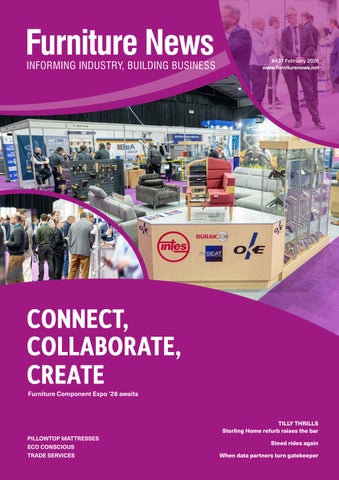
The UK’s only dedicated showcase for the full furniture and bedding supply chain, bringing together machinery, materials, components and services under one roof for two days of focused networking, buying and learning, the Furniture Component Expo returns to Telford on 11th and 12th March, and is set to be the biggest edition yet, says its organiser, the British Furniture Association (BFA) …

Set against the backdrop of a sector undergoing rapid change in sustainability, automation and design, the 2026 edition is also shaping up to be the most ambitious yet, with a larger exhibitor lineup, international exhibitors and the launch of an Innovation Trail that will spotlight some of the most forward-thinking suppliers in the market.
The expo continues to grow YoY, and the upcoming edition will see 18 new exhibitors join an already comprehensive cross-section of the industry, from foam and fillings to timber, components, logistics, machinery and fabrics.
Visitors walking the show floor can move from specialist ply forming and woodworking at 3D Ply, through advanced cutting technologies from Assyst Bullmer, to PU foam giant Carpenter, before exploring everything from springs and timber to labels, nonwovens and logistics – all in a single visit.
Among the many UK-based names, visitors will find long-established suppliers such as Fibreline, Peak Converters, Livedale Foam & Sundries, Wade Spring and Yorkshire Foam & Fibre, each bringing deep expertise in comfort components, foam conversion and spring technology to support both upholstery and bedding manufacturers.
international pull, with companies travelling from Turkey, Australia, Germany, Italy and Lithuania to connect with the UK and Irish markets. Textile and fabric specialists such as Erdem Fabrics and Sebatex UK, both with strong Turkish manufacturing roots, will be joined by other global players across foams, nonwovens, machinery and components, giving visitors “a genuinely international sourcing opportunity without leaving Telford”, says the BFA. Core sectors are all represented, with exhibitors covering foam and fibre, timber and panel products, fasteners, fixings and adhesives, CAD/CAM and automated cutting, packaging, nonwovens, upholstery fabrics and logistics.
Visitors will be able to explore solutions from companies like Ramsey Timber and Service Timber on the raw materials side, through to Plasfoils’ interior and exterior foils, Jet Press and FR Scott for fastenings, and Pronto Logistics for freight and warehousing support, enabling end-to-end supply chain conversations at stand level.
“A practical, business-first environment
The show also offers access to a wide ecosystem of essential partners, including SATRA Technology for testing and technical support, the Furniture Industry Research Association (FIRA) for standards and guidance, and the Furniture Industry Sustainability Programme (FISP) for independently certified sustainability best practice.
International
The 2026 exhibitor list underlines the event’s growing
New for 2026, the Innovation Trail, sponsored by Blum UK, will guide visitors to exhibitors pushing the boundaries of process, product or sustainability. Participating stands – including 3D Ply, Cordeks Nonwoven, Comfortex, Ramsey Timber, Carpenter, Mobus Fabrics, Plasfoils, Vita Group, Cirtex UK and Redwood-UK – will be clearly signposted on the floorplan, and marked on the carpet with ‘We’re in the Innovation Trail’ floor stickers to make it easy for buyers and designers to build an innovation-focused route through the halls.
“The Innovation Trail is designed to help visitors use their time more effectively,” the BFA explains, “whether they are looking for greener material
options, production efficiencies or value-adding surface and comfort technologies. With a mix of foam, timber, fabrics, nonwovens, finishing and circular solutions represented among the Innovation Trail exhibitors, the feature will encourage conversations that cut across traditional product silos and open up new collaboration opportunities.”
Running alongside the exhibition, the seminar theatre programme will again deliver a curated mix of technical insight, regulatory updates, market intelligence and best-practice case studies, giving design, production and leadership teams plenty of reasons to step away from the stands for an hour.
Topics across previous editions have ranged from flammability and compliance to skills, exports and sustainability, and visitors in 2026 can expect similarly practical, business-focused content shaped around the challenges facing manufacturers and their suppliers.
As the event’s organiser, the BFA will again use the show as a platform to support members and the wider sector through advice, advocacy and networking.
Reflecting on the growth and momentum behind the 2026 edition, BFA MD Phil Spademan says: “Furniture Component Expo has quickly become a focal point in the calendar for UK furniture and bedding manufacturers, because it brings the entire supply chain together in a practical, business-first environment that is all about solving problems, discovering new ideas and building long-term relationships.
“That sense of community runs throughout the show, from long-standing exhibitors who supported the launch edition, through to the new companies coming in for 2026. For buyers, designers, production managers and owners, it offers a rare chance to step back from the day-to-day and benchmark suppliers, explore alternatives and sense-check future investment plans in one concentrated visit.”
Telford International Centre’s central location makes attending straightforward for teams travelling from across the UK and Ireland. The venue is well connected by road and rail, with easy access from the M54 and within 15 minutes’ walk of the station, while a wide choice of hotels on and around the site makes it simple to turn a day visit into an overnight stay when needed.
On-site facilities are designed with trade visitors in mind, from catering through to business-friendly public spaces for informal meetings. Parking at Telford International Centre is free for Furniture Component Expo visitors, making it cost effective for teams to travel by car and reducing friction for those bringing multiple colleagues to walk the show together, says the BFA.
BeA Group is confirmed as the show’s headline sponsor, Carpenter returns as headline and


registration sponsor, Furniture & Joinery Production is supporting the seminar theatre and drinks reception, while Blum UK is taking the lead as sponsor of the Innovation Trail, reinforcing the focus on product and process innovation across the show.
With only a few remaining stands available, suppliers that wish to be part of the 2026 edition are encouraged to move quickly. Prospective exhibitors can contact Sarah Green at the BFA via sarah.green@ bfa.org.uk or follow the stand enquiry links on the show website to discuss availability and options. For visitors, pre-registration is now open, and is strongly recommended to ensure faster entry on the day and to receive the latest show news in the run-up to the event. Free visitor registration can be completed at https://bit.ly/3NA35YW, enabling attendees to plan their visit in advance and make the most of their time at Furniture Component Expo 2026.
“The Innovation Trail will encourage conversations that cut across traditional product silos
www.woodmanchairs.co.uk
Woodman Chairs is a trusted manufacturing partner to the furniture trade, supplying high-quality chairs and tables for both residential and commercial use.
With a strong emphasis on durability, accuracy and repeatability, Woodman’s products are designed to meet the demands of retailers, contract suppliers and

www.gallerydirect.co.uk

While furniture remains central to Gallery’s offer, SS26 will also see it spotlight the strength and depth of its non-furniture categories, reinforcing the brand’s position as a complete lifestyle supplier.
Wall decor sees one of its most confident introductions to date, with fresh art collections led by

interior specifiers alike, and it works with a wide range of timbers and finishes, ensuring flexibility across different price points and project requirements.
In addition to its standard ranges, Woodman offers a bespoke service, regularly working from drawings, samples or concepts to produce custom chairs, tables, and specialist wooden components. Its capabilities enable it to adapt dimensions, profiles and construction methods to suit specific briefs, whether for small batch production or larger commissions.
Beyond furniture, Woodman can also manufacture other turned components and custom wood items, supporting other manufacturers and joinery businesses with precision-made parts. From legs and spindles to detailed turnings and shaped elements, the manufacturer is equipped to handle complex requirements with consistent quality.
“By combining skilled craftsmanship with efficient production processes, we provide the trade with a reliable, responsive and knowledgeable partner for all aspects of wooden furniture and component manufacture,” concludes Woodman Chairs.

on-trend colour palettes, contemporary framing and statement showcase pieces. With a strong focus on texture and added-value detailing, the range includes new abstracts, florals and inspiration-driven themes.
An expanded clock collection introduces architectural wood veneer designs, large-scale fashion clocks and a modern take on the cuckoo clock. New mirror ranges span oak, heritage-inspired Italian designs and coastal finishes, complementing both classic and contemporary interiors.
Soft furnishings and textiles bring further newness, with the introduction of luxury duvets, pillows and toppers, alongside a refined 100% Egyptian cotton bedding range. Lightweight bedspreads, outdoor showerproof cushions and a cohesive coastal story across cushions, throws and table linen further enrich the offer.
Home accessories complete the story, with expanded dining collections, new candle colourways, characterful country-style photo frames and a significantly enhanced artificial plant and planter offering, including oversized statement pieces designed for maximum visual impact.
“Together, these categories elevate SS26 beyond furniture alone, delivering considered, design-led newness that enables customers to build cohesive, high-value lifestyle spaces from a single supplier,” states Gallery.

For that feeling of instant comfort, pillowtop mattresses are in a league of their own. Soft, sumptuous and unquestionably luxurious, these premium models promise an unrivalled night’s sleep – if firmness is no issue. This month, Furniture News is getting cosy with the pillowtop market – what’s hot, what’s available, and what its future might look like …
Simply put, a pillowtop is a bed on a bed – more specifically, a topper on a mattress, multiplying the comfort layers to offer a deeper, more enveloping sleep surface.
Typically comprising a padded layer atop a traditional mattress, pillowtops are known for their unique comfort and feel, offering a different level of pressure relief and a more luxurious experience for consumers that prefer their bed soft.
Pillowtops are sometimes criticised for that softness, which will not suit everybody. Due to their construction, they cannot generally be turned over to prolong their lifespan, and often have a tendency towards settlement in the areas under the most pressure. Due to all those extra components, they typically come at higher prices than their non-topped counterparts.
Yet pillowtops continue to perform well for many of the nation’s biggest bed brands. Their expense, which could be perceived as a weakness in a somewhat straitened economy, seems to be no barrier to purchase when so many consumers are taking their sleep more seriously, and willing to trade up when
presented with a higher-quality option.
And the format is evolving. Many manufacturers are working hard to make pillowtops more affordable, while others are providing models with removable tops for easier cleaning and replacement, or creating alternative designs – such as Sealy’s Posturepedic EuroTop, which offer a similar look and feel to a pillowtop, but with arguably greater durability.
Pillowtops took pride of place on many stands at last year’s NBF Bed Show, proving that there is plenty of life in this well-established format, and that the instant tactility it provides is hard to top (pun intended).
This month, Furniture News asks various leading pillowtop purveyors about the state of the market, what’s so special about their star model, and how they see demand evolving in the segment. Sharing their thoughts this month are: Amy Curtis (marketing director, Sleepeezee); David O’Mahoney (sales director, Relyon Beds); Mark Cort (group commercial director, Hypnos Beds); Fara Butt (director, Shire Beds); Ross Thurston (sales and marketing director, Millbrook Beds); and Nick Booth (MD, Harrison Spinks Beds).
“The instant tactility pillowtops provide is hard to top


Amy Curtis: We have found pillowtop mattresses become more popular YoY. Often customers are trying to emulate the soft comfort they find in hotels, which has led to an increase in demand, as well as pillowtops now being more accessible at a mid- to entry-level price. Visually in-store, pillowtops have become deeper and more deluxe-looking over time, giving the impression to a consumer of ‘more for your money’ when weighing up their options. They are also great for helping alleviate pressure relief, particularly for side sleepers, having more cushioned ‘give’ around a sleeper’s unique body shape.
David O’Mahoney: In the UK market, pillowtop mattresses continue to perform strongly within the premium sector, reflecting a sustained consumer appetite for superior comfort and considered craftsmanship. As customers become more discerning about sleep quality, we are seeing demand move beyond surface softness towards pillowtop designs that deliver long-term support, breathability and durability.
From our perspective, growth in this segment will be driven by expertly engineered constructions, natural and responsibly sourced materials, and a deeper understanding of how comfort layers interact with the core of the mattress. Pillowtops are no longer viewed as just an indulgence, but as a carefully chosen solution for better sleep – and it is this focus on balance, quality and longevity that will shape demand in the years ahead.
Mark Cort: Hypnos have always been renowned for making fabulous pillowtop models, and our Origins Pillow Top Collection features strongly in our range portfolio. There are four models in this collection, each with clear features and benefits, and available in a medium and firmer tensions to suit different support needs.
Fara Butt: Comfort, sleep quality and health. Overall, mattress-related markets are expanding, with premiumand comfort-focused products gaining traction.
Ross Thurston: The pillow top segment is performing particularly well in the UK’s premium


mattress market, driven by consumers seeking enhanced comfort, pressure relief, and a visible sense of luxury. Pillowtops provide an immediate tactile benefit at PoS, which remains a powerful driver in higher-value purchasing decisions.
Crucially, the market is maturing. Consumers and retailers alike are moving away from purely cosmetic pillowtops and towards models that are properly engineered. Demand is strongest for products that combine indulgent comfort with zoned support systems and proven construction methods, ensuring long-term performance rather than short-term softness.
Nick Booth: Pillowtop mattresses continue to form a very strong part of our overall offer, and for some of our customers they are among the bestselling mattresses we manufacture. Visually they are very appealing, but it’s the comfort story that really resonates with consumers. In particular, pillowtops give a distinctive feeling of sleeping in the mattress, rather than on it. It’s a unique feeling, and one you don’t get with traditional mattresses.
At Harrison Spinks, our unique approach to mattress design, combining innovative micro-spring technology with high-quality natural fillings, allows us to deliver a superb balance of support and comfort. While the pillowtop provides that immediate, soft cushioning and sense of indulgence, the main body of the mattress continues to deliver excellent, longlasting support. This combination is a big part of why pillowtops are so popular – they feel luxurious without sacrificing the underlying support consumers need for a healthy night’s sleep.
Pillowtops are strongly associated with luxurious, indulgent sleep, and we’re seeing that reflected clearly in demand across our business. Natural materials play a big role in that appeal. We place huge value on responsibly sourced fibres, and we were the first bed manufacturer to partner with British Wool through the Traceable Wool Scheme, giving consumers confidence in both comfort and provenance.
“It’s the comfort story that really resonates with consumers
Amy Curtis: One of our most popular pillowtop models is our Centurial 03. Crafted in celebration of our centenary, this luxuriously soft pillowtop model is filled with natural materials including British wool, Talalay latex and alpaca, as well as horsehair for added support. All fillings are glue free, and each model can be 100% recycled at the end of life. We were extremely proud to receive the National Bed Federation (NBF) Bed Product of the Year award upon launch, and it continues to be a strong seller for us within the Centurial collection.
David O’Mahoney: Our star model is our Carisbrooke Wool mattress, with an innovative zip-off pillowtop. What makes it special is that it combines luxury comfort with everyday practicality. The pillowtop can be easily unzipped and removed, making maintenance simple and hygienic – something traditional pillowtop mattresses don’t offer.
Over time, the zip-off design also allows for easy rejuvenation – instead of replacing the entire mattress, the pillowtop can be refreshed or replaced, extending the life of the product. This means customers can enjoy long-lasting comfort, improved cleanliness, and better value without compromising on that
plush, hotel-quality feel. In short, it delivers premium comfort, smarter maintenance, and sustainable longevity in one stand-out design.
Mark Cort: We continue to see success in the premium end, and our Pillow Top Elite model is the stand-out. This benefits not only from our Reactive Pro spring technology with firmer edge support, but also boasts Adaptiv Comfort springs, layers of natural latex and plenty of breathable British wool in the pillowtop itself. It really is a very comfortable bed!
Fara Butt: One of our bestselling ranges is the Ravello, and the Ravello 3000 pillowtop is our bestselling pillowtop model. It has a pillowtop unit made of 2,000 microsprings, and is a hand-sidestitched damask mattress.
“It really is a very comfortable bed!


Ross Thurston: The Divine Luxury 4750 Pillow Top, which represents the very best of Millbrook’s craftsmanship and technical innovation. At the heart of the mattress is our SmoothTech inner-tufted pillowtop technology. This allows us to internally secure the comfort layers without traditional surface tufts, resulting in a smooth sleep surface while maintaining durability and integrity over time. This is complemented by our zoned spring system, which provides targeted support across key areas of the body. Softer zones offer enhanced pressure relief where it’s needed most, while firmer zones deliver stability and spinal alignment. The combination of responsive zoned springs and a deeply comfortable pillowtop creates a balanced sleep surface that is both indulgent and supportive. Handcrafted using natural, chemical-free fillings, the Divine Luxury 4750 is a true hero product, designed for consumers who want uncompromising comfort and for retailers looking to differentiate on quality and craftsmanship.
Nick Booth: Rather than one stand-out model, we offer a wide range of pillowtop mattresses across different price points. This breadth allows us to meet varying comfort preferences while maintaining the same high standards of design and craftsmanship. One of the biggest recent developments has been the growth of loose pillowtop ‘enhancers’. These take an already-luxurious mattress to the highest possible level of comfort, while still relying on the supportive core beneath. They offer flexibility and a truly premium sleep experience, allowing customers to fine-tune that balance between comfort and support. Innovation is central to everything we do. We pioneered the use of the micro springs and continue to incorporate them into the topper, where their small, highly responsive nature allows them to contour to the body. By supporting our natural fibres more effectively, micro springs help reduce body impressions and significantly improve durability.
SINCE 1858


“The future of this segment lies in thoughtful design, skilled manufacturing and a clear commitment to quality
Amy Curtis: I believe we will continue to see strong demand for pillowtop models within our category, with consumers consistently looking for more value and comfort when shopping for a new mattress. They offer a perceived luxury over other models on first look, and with continued material enhancements can provide pressure relieving support and durability that matches the longer guarantees on offer within our category now.
David O’Mahoney: Looking ahead, we expect demand for pillowtop mattresses to become increasingly focused on refinement rather than excess. UK consumers are seeking reassurance that comfort is engineered with purpose, favouring pillowtop designs that enhance pressure relief while maintaining the correct spinal support and temperature regulation.
There is also growing appreciation for natural, breathable materials and for mattresses that are built to perform over time, rather than deliver short-term softness. As a result, the future of this segment lies in thoughtful design, skilled manufacturing and a clear commitment to quality – areas where long-standing expertise and a deep understanding of sleep continue to set premium manufacturers apart.
Mark Cort: We certainly see more demand for firmer pillowtops, which is why we introduced firmer tensions across the collection. At Hypnos, we also see the growing success of our mattress comfort
layers (or toppers) and the total flexibility that this offers in combination with our mattresses. These handcrafted, separate layers can be removed and revived, and customers can choose from a choice of sumptuous fillings to suit their comfort needs.
Fara Butt: Pillowtops are attractive as consumers upgrade existing mattresses. There is also a trend to have a separate pillowtop-style modular topper unit, and instead of replacing full mattresses consumers replace the topper but they are still seen as a luxury option.
As disposable incomes rise in key markets, more consumers opt for luxury comfort – benefiting higherend pillowtop designs with natural or eco materials, so there could be a gradual shift. I believe this market segment has a lot of potential for growth.
Ross Thurston: We expect demand for premium pillowtop mattresses to continue growing as UK consumers place increasing emphasis on sleep quality and long-term wellbeing. Products that successfully combine luxury comfort with technical credibility, such as zoned spring support and advanced pillowtop construction, will lead this category.
We also anticipate greater focus on transparency around materials, build quality and longevity. Pillowtop mattresses that can demonstrate both immediate comfort and lasting performance will outperform lower-quality alternatives, giving retailers the opportunity to trade customers up and reinforce value rather than price-led selling.
Nick Booth: We expect interest in pillowtop mattresses to continue to grow this year. Consumers are becoming more knowledgeable about mattress construction and are increasingly focused on longterm comfort without compromising on support.
As expectations around sleep quality rise, and with continued influence from the hospitality sector, pillowtop mattresses that combine craftsmanship, innovation and durability are particularly well placed. When that’s paired with traceable, natural fillings and responsible manufacturing, it creates a compelling proposition that we believe will drive demand well into the future.

Louis De Poortere has launched its Ecorugs Collection 2026, now made with 70% recycled materials, and with every style now ready for outdoor use.
Louis De Poortere describes its Ecorugs collection as “a vision of sustainable, circular design”. Made with recycled polyester, it demonstrates how tradition can adapt to support a healthier planet.
This year, the manufacturer has taken another step towards complete circularity for Ecorugs, with all styles now made with 70% recycled polyester from plastic bottles (up from 40% in 2025). Alongside

At Grays Transport, we specialise in tailored furniture transport and logistics solutions, proudly supporting leading manufacturers and retailers across the UK.
We offer a range of services to the furniture industry. With efficient, cost-effective services, we simplify logistics, reduce costs, and ensure your goods reach their destination swiftly and securely. Our expert handling means fewer damages, greater flexibility, and reliable deliveries every time.
Our commitment goes beyond delivering goods - we deliver reliability, traceability and excellence every time.


comes a collection that is machine washable, and with every style now suitable for outdoor use.
For 2026, the Gallery, Meditation and Craft collections feature new designs, while Lagoon, Chess, Ribbon and Berber are available in new colourways.
The Ecorugs range has also been expanded with new organic shapes, continuing the exploration of form started with the introduction of circular rugs in 2024. Baobab, Berber and Craft are now also available in 3m-wide rolls, allowing for custom sizes and shapes as the weaver continues to bring freedom and creativity to interior designers and homeowners.
Sales director Alan Russell says: “When we launched the Ecorugs collection in 2023, we began a journey towards true circularity. We set out with the intent to make every rug from 100% recycled material, much of which would come through rugs reclaimed through our Take Care Program, and I’m pleased to say that we’re on the way to realising that ambition.
“Impressively, this also comes alongside our pursuit of creative freedom, with new organic shapes as standard, as well as the introduction of custom sizes and shapes for interior designers and home owners wanting something perfectly fitted and entirely unique. 2026 really is an exciting year for us and I’m looking forward to working with our retail partners to help them make the most of this transformative collection.”


Last month, sustainability and circular economy consultancy
Oakdene Hollins published its latest Furniture & Mattress
Sustainability Benchmark Report, which aims to help the industry benchmark performance, pinpoint gaps, and prioritise its next steps under tightening UK/EU expectations. Furniture News asked Sonia Sanchez, senior managing consultant at Oakdene Hollins, how the results reflect the sector’s journey to greater sustainability …
“The furniture sector’s sustainability story is moving from intent to implementation,” states Oakdene Hollins in the report’s foreword. “This report distils where the market really is, what’s driving action, which levers companies are pulling, and where progress still lags. Its aim is to help industry players benchmark their performance against peers, pinpoint gaps, and prioritise next steps.”
Why is it important to benchmark progress?
Benchmarking creates clarity and accountability in a space that is inherently complex. Sustainability spans many different topics, from carbon and energy to circularity and biodiversity. It can be difficult to know where to focus, particularly for businesses without the knowledge, resources or external support to undertake a full materiality assessment. Looking at what peers are actually doing helps signal the sector’s priorities and what is currently workable from a business perspective, given available technology, infrastructure, market demand and cost constraints. With this report, Oakdene Hollins aims both to spark informed conversation and to support faster progress by making visible what more advanced players are already doing, while also clearly identifying the shared challenges where collaborative action across the sector will be essential.
What are the key headlines from the latest report?
There are three key takeaways: sustainability is moving from aspiration to action, but progress is inconsistent across the sector; carbon management is gaining momentum, yet truly science -based ambition remains the exception rather than the norm; and circular initiatives are emerging, but adoption is still limited and far from scale.
What were the most alarming findings?
There is a lot of cause for optimism in the findings, but the most concerning issue is speed and scale. Progress is happening, yet not fast enough to match the urgency of the climate and biodiversity emergencies.
… and the most encouraging?


in the UK furniture and mattress sector, because their size means they are more likely to have formal reporting, data and documented commitments that can be assessed consistently. They include IKEA, West Fraser, The Vita Group, Orangebox, Silentnight, Leggett & Platt, Harrison Spinks, Simba Sleep, Vispring, Hypnos, John Cotton, and Loaf.
“Progress is happening, yet not fast enough to match the urgency of the climate and biodiversity emergencies
A key opportunity is greater collaboration. Moving from a linear to a circular system requires co-ordinated action across the value chain. There is real potential for the sector to accelerate impact by working together, grounded in science, and shared goals.
Two very positive stats are that 58% of assessed companies report active resource and energy efficiency programmes, and 83% source paper and timber with a responsible forestry certification.
The report principally references data drawn from large companies – which businesses were involved? This report primarily draws on publicly available disclosures and survey responses from key players
We are very conscious that many small- and medium-sized businesses are doing excellent – often pioneering – work on sustainability. The challenge is that smaller companies are frequently less resourced when it comes to formal reporting and outward communication, which makes it far harder to capture their progress in a structured benchmark, despite the real impact they are having.
How might the findings be applicable to smaller businesses?
For smaller businesses, the value of the report lies in signalling direction of travel. It shows where the sector as a whole is focusing, which approaches are proving workable today, and what is realistically

achievable. Many smaller players can use this as inspiration and reassurance to prioritise their efforts, adapt ideas to their own scale, and focus on actions that are already gaining traction across the industry.
What is the biggest challenge facing the sector?
Scaling circularity. Moving from a linear, ‘take -make -waste’ model to circular systems requires changes across product design, materials, business models, reverse logistics and end- of-life solutions, none of which are easy or cheap. While individual businesses can make meaningful progress, circular models become faster to implement, more robust and more cost effective when there is greater alignment and collaboration across the value chain. Shared infrastructure, common standards and joined-up thinking make it easier for circular solutions to move beyond pilots and embed into mainstream practice.
How much impact does politics have on the industry’s environmental strategies?
Contemporary politics undoubtedly shapes the context for environmental action, but our findings suggest that commitment within the furniture sector remains strong. We are not seeing widespread roll-back. If anything, many businesses are moving from broad commitments to more practical, implementation-focused action, particularly around efficiency, carbon and circularity.
While political uncertainty can affect the pace or sequencing of investment, the overall direction of travel is clear and consistent. The majority (78%) of the survey respondents stated that sustainability sits at the heart of their short-, medium- and long-term strategy, and, according to a study by Deloitte, 83% of executives interviewed increased sustainability investment in 2025.
How have your services evolved in recent years?
What are the most important factors driving demand for your expertise in this sector?
Our services have evolved alongside the sector’s shift from strategy and ambition to delivery and
implementation. A few years ago, the focus was on setting high-level sustainability commitments. Today, companies are looking for practical support –measuring what matters, turning data into decisions, and embedding sustainability into day-to - day operations and investment planning.
In response, our work has expanded from carbon baseline assessments and mandatory reporting into decarbonisation roadmaps that include circular business models and eco - design strategies, biodiversity and value chain engagement, and product-level tools such as LCAs, EPDs and product carbon footprints.
The main drivers of demand in the furniture sector are clear. Regulation is tightening, customer and retailer expectations are rising, and businesses are under increasing pressure to demonstrate progress with reliable data. At the same time, companies are seeing sustainability more clearly as a commercial lever for cost reduction, risk management, supply-chain resilience and long-term competitiveness.
How are you planning to work with the sector in 2026?
Our focus is on supporting faster, more joined-up progress across the sector. Using insights like those in this report, we want to spark informed conversation, facilitate collaboration and make the sustainability journey easier for companies, whatever their starting point. We’re particularly keen to work more closely with groups of companies across the value chain, where shared challenges can be addressed more effectively together.
What one key message would you like everyone to take away from these findings?
The findings show a sector that is making real progress. The opportunity now is to raise the level of ambition and delivery and turn good practice into best practice at scale.
To access the report, visit https://bit.ly/4qOYlNK. www.oakdenehollins.com
“There is real potential for the sector to accelerate impact by working together
In furniture retail today, offering an extended cover or protection plan is standard practice, writes end-to-end insurance and cover solutions provider Warranty Expert. Yet for the strategic retailer, a critical commercial question emerges – are you providing customers with a robust, regulated insurance policy, or a less substantive protection plan?
“The choice defines your value proposition and customer trust,” explains Warranty Expert, which says it is introducing its Furniture+ product to the Irish market with “the unequivocal clarity and substance of a fully underwritten insurance policy, establishing a new commercial and service benchmark for value, terms and security”.
The critical difference
“A ‘protection plan’ or ‘service contract’ can often be an unregulated administrative agreement between a retailer and a customer,” Warranty Expert continues. “Its terms can be restrictive, and if a dispute arises, the consumer’s recourse options may be limited.
“In stark contrast, Furniture+ fully underwritten insurance policy is a regulated financial product. This is not a matter of semantics – it is a fundamental guarantee of consumer rights.
“The Furniture+ policy is backed by regulated insurers, offering superior financial security. Crucially, it provides customers with access to the Financial Services and Pension Ombudsman (FSPO) in Ireland – an independent, statutory dispute resolution service. This ensures a clear, formal path for recourse, a safeguard entirely absent from typical protection plans.
“This regulated framework is the bedrock upon which that promise stands. We offer better terms and better recourse by design. Our cover is clear, competitive, and backed by a partner-first, customercentric approach.

If replacement is the most appropriate remedy, we ensure a swift and seamless process. This philosophy of delivering the optimal outcome, not just the easiest claim, is the defining advantage of Furniture+.
“In a market accustomed to less, Furniture+ offers decidedly more
The proof is in the partnership
The true value in any insurance product is proven at the moment of claim, says Warranty Expert: “Our premium service is distinguished by its foundational commitment to the right solution. We focus on a quality resolution tailored to the specific claim.
“When expert restoration can return an item to ‘as good as new’ condition, that is our first choice.

“We have partnered with Walsh’s Furniture Repair & Assembly as our exclusive repair provider, a provider whose reputation for excellence is unparalleled. It is not merely a service contractor – it is the authorised repair partner for numerous furniture manufacturers and elite retailers across Ireland and Northern Ireland. This institutional standing guarantees a level of craftsmanship that perfectly aligns with our premium promise.”
Shane Walsh, MD at Walsh’s Furniture Repair & Assembly, comments: “We’re excited to be partnering with Warranty Expert on their new Furniture+ product. Together, we are delivering a seamless 360° approach to the market, combining comprehensive cover with trusted service and repair partnerships.
“With our expertise in upholstery, leather and timber repairs, as well as professional furniture assembly, we provide the skilled workmanship and premium care every piece deserves. Through this partnership, we are helping set a new standard in furniture cover and service across Ireland.”
Warranty Expert explains that this strategic partnership is a cornerstone of its value proposition:
“Our customers will benefit from master craftspeople dedicated to preserving the integrity, beauty and value of their furniture. This commitment delivers better value to the customer and reinforces the retailer’s brand promise of offering premium, lasting products. It transforms a claim from a transactional inconvenience into a testament to quality and care.”

Boots on the ground
A policy is only as good as the service that delivers it.
“Unlike distant, outsourced call centres, Furniture+ operates with a dedicated, ‘boots on the ground’ team across Ireland,” says Warranty Expert.
“This local presence is transformative. When a customer has a claim, they speak to a real person embedded in the local market, who understands their needs and can act with context and empathy.
“This structure enables an efficient claims process that prioritises the customer. Decisions are made promptly by empowered, local experts, not delayed by remote bureaucracies or AI. From the initial call to coordinating with our premier repair partner, the journey is seamless, personal and transparent. This is the essence of our complete end-to-end service model, managed entirely in-house to ensure control, quality and speed at every step.
“Furniture+ leverages this insurance foundation to provide cover that is comprehensive and thoughtful. We bridge the gap left by manufacturer warranties, covering accidental damage from spills, scratches and breakages. Our policy extends to outdoor furniture and home accessories, protecting a customer’s entire curated living space.
“Critically, we have built in an inflation protector, which provides a buffer against inflation by automatically increasing the sum insured in line with a pre-defined index – a feature often missing in all other plans currently in the market. Furthermore, we empower customers with specialist cleaning kits for minor incidents, demonstrating a proactive partnership in care.”
Raising the bar for Ireland and beyond Warranty Expert says its entry into Ireland’s furniture retail landscape, with its Furniture+ policy, represents more than just a new product launch: “It is a

deliberate move to elevate market standards. With over 13 years of experience designing and managing fully underwritten insurance products across the EU, we are applying a proven model of integrity and service excellence to the Irish furniture sector.
“For the retailer, it’s a premium proposition that drives attachment rates through genuine value. For the consumer, it is the definitive choice – a fully regulated insurance policy that offers superior protection, guaranteed recourse, a premier repair service, and a local, human-led claims experience.
“In a market accustomed to less, Furniture+ offers decidedly more – better value, better terms, and better recourse. It is not just protection – it is insurance with assurance.”
www.warranty.expert/en
“Furniture+ operates with a dedicated, ‘boots on the ground’ team across Ireland
Good data management is at the heart of any successful furniture business, with websites, EPoS systems, ERPs, CRM platforms and product databases ensuring efficient and intelligent management. But what happens if you fall out with the specialists entrusted with your data, and your service partners turn into gatekeepers? Our regular legal contributor, The Interior Design Lawyer Natalia Samodina, shares her thoughts …
By Natalia Samodina

Osman’s The Impossible Fortune features a cold storage vault buried hundreds of metres underground – a “hole in the ground” rented for a small fortune by clients mistrustful of the digital world. They wanted their secrets and treasures where they could touch them, where only they had access to them and – most crucially – where they are hidden from prying eyes.
Ironically, in furniture retail and in commerce more generally, the opposite is true – our lifeblood now flows through invisible channels of code and cloud.
Websites, EPoS systems, ERPs, CRM platforms and product databases hold the operational DNA of a business. They promise efficiency, insight and competitive advantage.
Yet they also create a vulnerability – dependence on third-party service partners who, by design or otherwise, can become gatekeepers to your own data.
The digital dependence problem
Covid-19 didn’t just accelerate ecommerce, it rewired the industry. EPoS providers store years of sales history. ERP systems hold supplier terms and stock levels. Website hosts control domains and CMS credentials. Marketing agencies manage mailing lists and analytics. Each partner holds a piece of your puzzle – and often, the business cannot function without them.

This interdependence works beautifully, allowing you to focus on the most important while providers
take care of your security, marketing and admin … until it doesn’t.
Flashpoints arise when you: migrate to a new system and want to terminate a contract, consolidate platforms, or ask to audit data handling for compliance. Suddenly, data you assumed was ‘yours’ is locked in proprietary formats, accessible only via paid tools, or subject to restrictions buried in the small print. Some providers refuse to release data until disputed invoices are settled. Others claim IP rights over website content they were commissioned to build. To be clear, such behaviours are not legal or ethical and are not a rule. They are very much an exception. But they do happen.
The result? Operational paralysis at the worst possible moment – when you intended to inject more efficiency into your business, or save costs, or both.
So, what can you do if your tech service partner (a domain host, a web developer/administrator, etc) is holding your data hostage? Let’s jump in.
Here’s the good news – under UK GDPR and the Data Protection Act 2018, furniture traders hold significant rights. Where personal data is involved – and in the furniture trade it almost always is – the retailer is the data controller and the service provider acts as the data processor. This distinction matters.
A processor cannot lawfully withhold personal data from its controller. It cannot refuse to return data,
“Picture this – your website (your glossy digital shop) is suddenly locked behind a door for which you don’t hold the key
assert ownership or repurpose it. Any obstruction may amount to a breach of data protection law, exposing the provider to regulatory investigation, contractual or statutory liability.
Processors must act strictly on the controller’s documented instructions. If a furniture trader instructs a provider to export, delete or transfer personal data, compliance is mandatory unless doing so would breach a genuine legal obligation (for example, a court order, statutory notice or regulatory requirement).
No other excuse – whether of commercial inconvenience, administrative difficulty, cost or a business policy – is lawful.
Where your provider refuses to grant you access to your systems and data, your escalation pathways might include:
Formal notice: Issue a written notice identifying the breach and demanding compliance, warning of escalation to the Information Commissioner’s Office (ICO).
Regulatory escalation: If your written demand is not heeded, lodge a formal complaint with the ICO.
Legal enforcement: This should be your last resort as litigation is expensive, time-consuming, stressful and generally disruptive. But if all else fails, instruct a solicitor to issue the notice, signalling readiness to pursue legal remedies.
In practice, step one is often enough. Most entities will seek to avoid the disruption and reputational damage of an ICO investigation.
The contractual foundations (or lack thereof)
Having robust contractual rights gives a direct route to enforcement, without the need to rely on the fallback of statutory rights. Sadly, many businesses sign technology agreements drafted entirely in the provider’s favour, often without negotiation.
These may include vague or restrictive data return clauses, fees for extraction, proprietary formats that hinder migration, unclear IP ownership over content, and termination provisions allowing suspension before data retrieval.
Instead, a robust contract should guarantee ownership of all client data (personal and nonpersonal); prompt return in a usable, industrystandard format; clear IP assignments for content and code; continued access during notice periods; and co-operation obligations on exit.
Without these, businesses risk being locked-in long after the relationship ceases to be beneficial.
When a website becomes a hostage
Picture this – your website (your glossy digital shop) is suddenly locked behind a door for which you don’t hold the key. The developer or hosting company controls the domain name, CMS credentials, even the server environment. You’re left rattling the handle while your customers queue outside. What can you do?
In this truly nightmarish scenario, first remember that contracts matter. They’re your first line of defence. Review the entirety of your contract (if you have one), bearing in mind that relationships built on standard terms and conditions typically have specific annexes, customer orders or similarly worded documentation which relates to you specifically – and it is the entirety of all these pieces that comprises your contract. Review your rights and the provider’s duties and responsibilities towards you – as this is your most direct route to demanding compliance. This is where you might need a specialist solicitor to help you out.
If your contract is silent, unhelpful or altogether missing, intellectual property law can step in. Unless you’ve signed it away, copyright in your content belongs to you.
And if the domain itself is the problem – registered in someone else’s name – Nominet’s Dispute Resolution Service (DRS) can be a lifeline. As a public benefit company, its DRS is cheaper and faster than litigation, starting with a formal letter and, if necessary, escalating to adjudication.
But what if the developer isn’t just holding the keys, but misusing your creative assets? That’s where Anti-Copying in Design (ACID) earns its stripes. Membership gives you more than a badge – it gives you access to legal templates to assert your rights, guidance on enforcement strategies, and access to specialist lawyers who understand the nuances of design and digital IP. In short, ACID helps you fight back when your brand identity is being treated like a bargaining chip.
Of course, prevention beats cure. Make sure every digital asset – domains, hosting accounts, CMS logins and trademarks – is registered to your business, not the agency.
As the industry becomes more digitally integrated and relies increasingly on AI, disputes over data access, migration and intellectual property rights will only increase.
To acquire digital resilience, you need to keep yourself and your workforce up to date on developments in the digital ecosystem and the corresponding legal regimes, strengthen your contracts and, ideally, invest in an internal technology security specialist whose loyalty will belong solely to your business. As an added benefit, a specialist on payroll is likely to cost less than a permanent external resource. External forces may be beyond our control. But the way we structure digital relationships is not. In a world where data is as valuable as inventory, those who treat digital resilience as seriously as financial resilience will thrive.
This article comprises general information only and does not constitute legal advice. For tailored guidance, contact Natalia at natalia@ interiordesignlawyer.co.uk.
“External forces may be beyond our control, but the way we structure digital relationships is not
In this month’s extract from her new book The Science of Shopping, consumer expert Kate Hardcastle envisions a retail future in which physical stores are not just places where transactions occur, but destinations which offer shoppers immersive, personalised experiences …
By Kate Hardcastle

The retail environment is no longer confined to the traditional purpose of facilitating transactions. It has evolved into a dynamic space where brands engage with consumers in meaningful ways, blending commerce with experience, culture and innovation.
Retail spaces are now designed to inspire and connect, transforming shopping into an activity that resonates emotionally and socially.
This shift has been driven by changing consumer expectations and technological advancements, forcing retailers to reimagine their physical spaces. As we look to the future, stores will need to do more than house products – they must offer experiences that are immersive, personalised and reflective of the values consumers hold dear.
Retail spaces are becoming destinations, offering far more than products on shelves. By incorporating dining, entertainment, wellness services and cultural activities, retailers are creating spaces that encourage longer visits and foster deeper engagement.
For example, flagship stores such as those of Nike and Lululemon have integrated fitness studios and event spaces, creating communities around their brands. The future of retail lies in this shift from functional spaces to experience-driven environments.
Advanced technologies like augmented reality (AR), virtual reality (VR) and artificial intelligence (AI) are redefining how consumers interact with brands in-store. These tools allow for tailored experiences –think virtual try-ons, personalised recommendations, or smart mirrors that adjust lighting and style suggestions. Beyond enhancing customer satisfaction, these technologies provide valuable insights into consumer preferences, helping retailers refine their offerings and optimise their strategies.
A greater commitment to sustainability
As consumer demand for eco-conscious practices grows, retail spaces must integrate sustainability into their design and operations. From sourcing eco-friendly materials for store interiors to minimising energy consumption and waste, sustainability is no longer optional – it’s a necessity.
Brands that align with these values not only appeal to ethically minded consumers but also contribute to long-term business resilience.
The rise of pop-up shops, hotel boutiques and hybrid spaces demonstrates how brands are breaking away from traditional retail formats. These innovative spaces often combine shopping with social, cultural or lifestyle experiences, such as art galleries or cafes.
For example, Glossier’s pop-up shops serve as community hubs, blending retail with brand storytelling and interactive installations. These flexible formats offer retailers opportunities to test markets, experiment with concepts and engage consumers in new ways.
Retail’s power lies in its ability to engage all five senses. Sensory elements – like inviting scents, curated playlists, tactile displays or even sampling stations – help consumers form emotional connections with brands.
For example, Abercrombie & Fitch is known for its signature scent, which creates a distinctive and recognisable atmosphere. By appealing to the senses, retailers can create memorable experiences that foster loyalty and enhance the shopping journey.
The evolution of retail spaces is a response to changing consumer needs, technological innovations and societal shifts. Physical stores are no longer merely places to shop – they are platforms for storytelling, interaction and discovery. Successful retailers are those that understand the future of retail lies in creating environments that resonate emotionally and reflect consumer values.
As the retail environment continues to evolve, one thing remains constant – the need to connect with consumers in meaningful ways. By embracing innovation, prioritising sustainability, and creating spaces that engage the senses and inspire, retailers can redefine the purpose of physical stores.
These evolving places are not just where transactions happen – they are where brands come to life, where stories are told and where consumers find experiences that matter. The future of retail lies in spaces that are as dynamic and multifaceted as the people they serve.
Excerpt from The Science of Shopping, courtesy Kogan Page. To buy a discounted copy, visit bit.ly/3Jo5xQb and enter code KOGANPAGE25 at checkout.
“Stores must offer experiences that are immersive, personalised and reflective of the values consumers hold dear

Like county fairs, shoppers come and go, says business growth and development consultant Gordon Hecht, writing for US trade magazine Your Source News – your store might not get more than one chance to turn a shopper into a customer, so your ‘elevator pitch’ has to count …
By Gordon Hecht

As I write, it’s autumn in the Midwest. That means football, raking leaves, and street fairs. This past weekend we enjoyed all three, including BurgFest in our small Missouri town.
If you’ve never been to a local Midwest fair, here’s what you’re missing. Car shows, carnival rides, healthy food choices. Mostly dipped in hot lard, sprayed with more lard, and then rolled in sugar. Added to that are vendors – crafts, books, toys, water softeners and insurance
It’s great exposure for those vendors. The fair brought about 3500 people in. More selling opportunities in 12 hours than your shop may see in a year. Unlike your shop, there is little chance of getting a returning shopper, AKA a ‘be-back’. Vendors have one chance to meet, greet, and close the deal.
But it may not be so different than traditional retail. Word on the street is shoppers are going to 1.5 stores before making a decision. That means, if they walk out of your store, they are likely to purchase at the next retailer they visit.
We bought kettle corn, homemade root beer, and ice cream at BurgFest. We also bought one durable

item for more dough than I ever spent at a fair. It came about because of a great elevator pitch. If you hadn’t heard of it, an elevator pitch is a 30-second conversation you have with a prospect to entice them to learn more about your goods and services. Let me tell you about it.
Because it was Football Saturday, my everlovin’ bride and I were sporting jerseys of our favourite college team, the Ohio State Buckeyes. We wandered past the various vendor booths until a young man working in a tent shouted, “Hey Buckeyes, welcome to Missouri!” We exchanged hellos. He asked us what the connection was between us and Ohio. We chatted a bit. He then said that he was a student at the local college. He introduced us to two more students, all undergrads pursuing business and marketing degrees.
I mentioned that I also studied business and marketing, not at Ohio State, but rather at my alma mater, Tumbleweed Tech. One student, a co-ed, said that she heard that ol’ Tumbleweed was a great school, and she’d like to visit it someday.
Next, they told me what they were doing at the fair. They were fulfilling a requirement to form a business
“Word on the street is shoppers are going to 1.5 stores before making a decision. That means, if they walk out of your store, they are likely to purchase at the next retailer they visit
that aided our small community. They designed an all-weather blanket with straps and a handle. It can be easily rolled and carried, lightweight, rain-proof, and extra warm. All profits go to the local food bank, which services families and kids who are in a rough patch.
The third student let us know their product has three purposes. First, to help them learn about business with practical knowledge, the second was giving back to our town, and third, if we decided not to purchase the blanket, we could donate to the food fund and still help kids. He pointed to a glass container brimming with notes.
We agreed to purchase the blanket, but I did not have enough greenbacks in my wallet. No worries, we were told. They took Apple Pay, Google Pay, Venmo, bank cards, and cheques. I had never used the first three methods. They never used the last one. I handed over my plastic card – they waved it over a wireless reader, and we were on our way.
Retailers and sales staff who base their business on returning shoppers (which are different from returning customers – shoppers have no loyalty, but customers can become loyal raving fans, so always engage your previous clients/customers to become repeat buyers) have a dark future. It was reported that the Be-Back Bus broke down on the freeway and everyone is stranded. Today’s competitive world, coupled with declining store traffic and scarce discretionary dollars, makes first-time closing a must.
It starts with a great greeting. Our student looked
for a way to engage us. He sought common ground to encourage conversation. The next step was to introduce us to his classmates, turning us from prospect to friend. The co-ed found something to compliment us on, building trust.
They told us their mission statement. Learn about business, serve the community, and provide a useful and convenient product. They closed with two buying options – purchase the blanket or make a donation. The glass container was full of midsize bills, giving the impression that ‘everyone was doing it’ and that George Washington’s portrait had no place with Lincoln, Hamilton and Jackson already taking up space. No cash, no problem. These Gen Z-ers rarely pay with bills. Venmo, Apple or Google Pay are ingrained in them. If you don’t have these options, you’ll lose them pronto.
Start today by crafting your elevator pitch – 30 seconds that will make or break your business. Tell shoppers your mission, how you will make their world better. Add in the story about why you and the goods you sell are unique. Give multiple buying options to buy, and collect the funds.
Adolescents would say, “It’s not fair.” There will be winners and losers. Because in our business, the fair packed up and left town.
This article was originally published by Your Source News. Gordon can be reached at gordon.hecht@aol.com.
“Today’s competitive world … makes first-time closing a must
Since reading Traction by Gino Wickman, Steve Pickering, the ‘unorthodox’ CEO of independent bed retail chain Sussex Beds, has been captivated by the idea of personalised KPI dashboards for every team member in a business …
By Steve Pickering

In the book, Gino introduces the concept of each person having one key number they own. This idea is powerful for several reasons:
Clarity and focus: Assigning each team member a specific Key Performance Indicator (KPI) eliminates confusion and ensures everyone knows exactly what they’re responsible for. This clarity helps individuals focus on what truly matters for their role and the company’s success.
Accountability: When each person owns a number, it creates a strong
sense of accountability. They become directly responsible for tracking, improving and reporting on that metric, fostering ownership and commitment to results.
Empowerment: Owning a number empowers individuals to take initiative and make decisions that directly impact their metric. This can lead to increased engagement, creativity, and problem-solving.
One of the key drivers behind our IT systems overhaul in 2024 was to bring this vision to life. And, dashboard by dashboard, it
became a reality, with everyone having personalised dashboards tailored to their specific roles and responsibilities. From sales to finance, marketing to operations, each person sees the numbers and key metrics that matter most to them.
They don’t just see their numbers – they own them.
Discover more of Steve’s thoughts at www.linkedin.com/ in/steve-pickering-unorthodoxceo/ or listen to his podcast, An Unorthodox CEO www.sussexbeds.co.uk
“Dashboard by dashboard, it became a reality, with everyone having personalised dashboards tailored to their specific roles and responsibilities
In the first of a series of regular columns, Andrew Goodacre, CEO of the British Independent Retailers Association (Bira), talks this month about how AI can help any business, including those within the furniture sector, compete more effectively in an increasingly digital marketplace …
By Andrew Goodacre

The retail landscape has transformed dramatically over recent years. Online competition intensifies daily, customer expectations evolve constantly, and operating costs continue rising. Yet amidst these challenges, a powerful opportunity has emerged that levels the playing field between independent businesses and major chains – accessible artificial intelligence (AI).
When retailers hear ‘AI’, many assume it’s complex technology requiring substantial investment and technical expertise. This misconception could prove costly. AI tools are now remarkably accessible, often free or low-cost, and designed for non-technical users. The question isn’t whether your business can afford AI – it’s whether you can afford to ignore it whilst competitors and customers embrace it.
In a recent episode of Bira’s High Street Matters podcast, I explored this topic with Melissa Minkow, global director of retail strategy and insights at technology transformation specialist CI&T, and Thomas Akintan, co-founder of AI training provider Avalon Insights. Their insights revealed just how significant this opportunity has become.
Recent research from CI&T surveying 2,000 UK consumers reveals a striking reality – 61% have used AI tools when shopping, with 53% doing so often or very often. Yet 68% cannot name a single retailer delivering a memorable AI experience. This gap represents significant opportunity.
Consider what furniture customers actually want. They’re researching room layouts, comparing styles, seeking inspiration, and making substantial purchasing decisions. These activities increasingly involve AI tools. Customers might ask ChatGPT for sofa recommendations based on room dimensions, use AI image tools to visualise colour schemes, or seek advice on materials and durability. If your business isn’t visible in these AI-powered searches, you’re missing potential customers.
The practical applications are numerous and immediately actionable. Product descriptions often consume considerable time – AI can draft compelling copy highlighting features, materials, and styling suggestions in minutes. Social media content creation becomes manageable when AI helps generate post ideas, captions, and even visual concepts. Customer service responses to common enquiries about delivery times, care instructions or product specifications can be templated and personalised efficiently using AI assistants. Email
marketing, crucial for promoting seasonal sales or new collections, becomes less burdensome. AI can suggest subject lines, draft promotional copy, and even recommend optimal sending times based on customer behaviour patterns. For businesses managing inventory across multiple product lines, AI tools can analyse sales data to identify trends, predict demand and inform buying decisions.
The beauty of AI lies in augmentation rather than replacement. As Thomas emphasised in our discussion: “Start small, test the use case, make sure your customers are happy with it, make sure your internal employees are happy with it, and make sure it works before you roll it out.” This technology doesn’t eliminate the expertise that distinguishes independent businesses – it enhances it.
Your staff’s knowledge about construction quality, material characteristics and design trends remains invaluable. AI simply frees them from time-consuming administrative tasks, allowing more focus on what truly matters – helping customers make confident purchasing decisions about significant home investments.
Cost concerns are understandable, but AI tools span remarkable affordability ranges. Free versions of ChatGPT, Claude and Jasper offer substantial capabilities. Paid subscriptions typically cost £10-30 monthly – less than a single hour of staff time – yet can save multiple hours weekly.
Trust matters enormously when customers make considered purchases. The CI&T research found 83% of consumers say data breaches impact shopping decisions, with data privacy being the top concern about AI. Independent businesses can turn this into a competitive advantage by being transparent about AI use whilst maintaining personal customer relationships that larger competitors cannot replicate.
My advice is straightforward – start small and be brave. If you haven’t explored ChatGPT, Claude or Jasper, visit them this week. Experiment with writing a product description or social media post. You’ll likely find it surprisingly intuitive.
The businesses who thrive will be those brave enough to explore accessible technology that amplifies their existing strengths. AI isn’t replacing the expertise, personal service and design knowledge that independent businesses offer – it’s freeing you to deliver more of what customers value most.
www.bira.co.uk
“AI technology doesn’t eliminate the expertise that distinguishes independent businesses – it enhances it


The furniture and interiors industry thrives on creativity, craftsmanship and commercial know-how. For those working in design, sales, manufacturing or retail, a job interview is a crucial opportunity to showcase skills and ambition – but it is also a space where personal vulnerability can surface, and where candidates must be alert to their legal rights, explains Michelle Bruce, an associate at Buckles Solicitors …
By Michelle Bruce

Understanding what employers can and cannot ask, and how discrimination is prevented by law, ensures that career prospects are not undermined by issues that should never influence hiring decisions.
What can and can’t be asked?
Interview questions should relate only to your ability to do the job. Employers cannot ask about your marital status, childcare, or family plans. Even casual remarks, like “Do you live locally?” or “Would looking after children affect late nights at the showroom?” can cross a legal line if used to influence decisions.
Pregnancy is never something you are obliged to disclose. Nor should assumptions be made about a parent’s commitment or flexibility. If a question is not tied to the essential requirements of the role, it should not be asked.
The Equality Act 2010 applies before an offer is made. This means that the way interviews are arranged, and the reasons for selecting or rejecting a candidate, must be fair and free of bias.
For instance, offering interviews only outside standard hours, with no alternative for those with childcare responsibilities, could amount to indirect sex discrimination. Employers have a duty to avoid arrangements that disadvantage certain groups.
Bias may be subtle, but if it influences the process it may be unlawful. Candidates who suspect discrimination should seek advice before acting, as many concerns can be resolved through discussion.
If you have a disability or long-term health condition, you are entitled to request reasonable adjustments. In the furniture sector, this might mean receiving product information in advance, extra time for tests, or holding an interview in an accessible location.
Employers must act once they are informed of the need. Failure to provide reasonable adjustments could amount to disability discrimination. Crucially, requesting support should never harm your prospects.
Furniture businesses often involve varied hours, travel to clients, and show season demands. It is lawful, and wise, to raise flexible working at interview. Employers cannot reject you simply for making such a request.

If a refusal disproportionately affects you because of a protected characteristic, there may be grounds for a discrimination claim. Having the discussion early promotes transparency and helps both parties assess fit.
Equal pay law entitles you to the same pay as a colleague of the opposite sex for the same or equivalent work, unless differences can be justified. In negotiations, focus on your value and experience, not previous salary, which can perpetuate inequalities. It is reasonable to ask how pay is determined and whether a transparent structure is in place. In a competitive sector like furniture, this helps ensure fairness.
Some roles, particularly in finance, logistics or senior management, may involve background checks. These must be proportionate. A credit check for a finance role may be reasonable, but less so for a showroom assistant.
Employers also have a duty to handle your personal information confidentially, in line with data protection law. Sensitive details should only be seen by those directly involved in recruitment and deleted when no longer needed.
An interview should be an empowering step – a chance to demonstrate your creativity, expertise and commercial insight. It should never leave you fielding inappropriate questions or facing unfair treatment. By knowing your rights, you can approach the process with confidence and clarity. And where uncertainty arises, seeking early legal advice can protect your position.
www.buckles-law.co.uk
“An interview should be an empowering step … It should never leave you fielding inappropriate questions or facing unfair treatment
From cracking down on copycats, seizing the creative advantage and the rise of AI, Dids Macdonald OBE, the co-founder of Anti Copying in Design (ACID), explains why it’s time for the UK furniture industry to rethink its approach to intellectual property …
By Dids Macdonald


The furniture sector is the most copied sector in the UK – as many will know to their cost. As designled businesses increasingly trade online, and as competitor manufacturers race to mirror bestselling products, the rise in lookalike and copycat activity has become both more visible and more damaging. This hurts those who invest in original design and whose skills and expertise acts as a differentiator in a crowded market.
With the closure of the IPO Designs Consultation, for which ACID had campaigned for over 10 years, there are growing calls for far-reaching, robust deterrents, and the message is clear – this sector must be more vigilant than ever.
These reforms include punitive damages for culprits and directors, held to account in a call for the intentional infringement of an unregistered design to become a crime. After all, intellectual property (IP) is a property right, and stealing property is a criminal offence.
Furniture is particularly vulnerable because originality is often expressed through form and functionality, comfort and ergonomics, aesthetics, materials and craftsmanship, structure and stability proportion and sustainability, rather than overt branding. These nuances are easy to photograph, replicate and distribute globally at speed.
Online marketplaces and social platforms have further fuelled the problem, enabling infringing products to reach consumers quickly, often at lower prices that undercut legitimate innovators. Without strong protection and swift action, original designers face erosion of brand value, lost sales and weakened confidence to invest in innovative ideas.
Many leading businesses recognise that IP is not an afterthought, but a strategic asset. Protecting designs through registered and unregistered design rights, trademarks, and copyright, where applicable, creates both a legal shield and a commercial signal –this business values originality and will defend it.
Clear documentation of the design process, dated records and professional photography can all strengthen enforcement. Just as importantly, education across teams, from idea to marketplace,
ensures everyone understands what makes a product distinctive and how to spot potential infringement early. This year of constant IP headlines has also shone a spotlight on Artificial Intelligence. AI offers exciting opportunities for the furniture sector – faster concept generation, improved visualisation, mass customisation, and more efficient marketing. Used responsibly, it can help brands innovate, reduce waste, and respond more closely to consumer needs.
However, AI also carries real risks. Training models on unlicensed designs, unknowingly reproducing protected designs, or allowing automated tools to blur the line between inspiration and imitation can expose businesses to legal and reputational harm. A clear AI policy, grounded in IP awareness and ethical use and practical training for teams is now essential. By campaigning for stronger deterrents, raising awareness and offering practical, down-to-earth advice, ACID helps businesses focus on growth rather than constant firefighting. Its proven success in mediating disputes within the furniture sector is a powerful example. By bringing disputing sides together early, the time, cost and stress associated with litigation is vastly reduced, often achieving pragmatic, best-practice solutions that allow businesses to move forward.
Creating an IP strategy should be seen as a positive, proactive step. It clarifies ownership, strengthens partnerships, reassures investors, and sends a clear message to the market that originality matters. ACID is here to help at every stage, from prevention to intervention, with a track record of campaigning, collaboration and real-world results.
The call to action for the sector is simple but urgent – sign ACID’s IP and AI Charter, at www.acid.uk.com/ become-a-charter-signatory/. By doing so, businesses publicly commit to respecting and protecting design rights, fostering a fairer, more innovative marketplace. In a sector where copying is rife, collective vigilance can turn IP protection into a shared strength rather than a solitary burden.
www.acid.uk.com
“The rise in lookalike and copycat activity has become both more visible and more damaging


The geographical disadvantage resulting from our footprint of current stores being in a region with a relatively small population, and the effect this has on driving greater sales volumes
Peter Harding, Fairway Furniture
Nothing – there’s always a way – it may be a time/cost issue, but, if the motivation is there it can be changed! Never say never …
Clare Bailey (Retail Champion)
Its name
Wayne Robbins, Iconography
If only we could eliminate packaging entirely due to the costs of disposal and taxation involved! It is such a critical – and often underestimated – consideration in product development, to ensure safe loading, safe transit and safe storage of finished goods, but at the same time it is also a lot of material content for one-time usage
Ian Priestley, Furntech
I’d change how reliant we are on outdated systems that don’t scale with the pace of modern retail. But change is tied up in cost, training and risk, so we balance progress with patience, even when it’s frustrating
Steve Pickering, Sussex Beds
The disconnect between the people making the decisions and the people closest to the customer. As an experienced agent, I’m on the ground hearing what’s working and what isn’t, but I’m not always part of the conversation when it matters most Paul Groves, sales agent
Bernard
Eaton, Greenwood Retail
More customers! Easy to say, but until there’s a step change in the way that compliance is viewed (product or environmental), budgets will always be prioritised elsewhere
Gareth Mayhew, Roundhill Consultancy
Ideally we would love to change our Rainham store location with free on-site parking to replicate the ‘shed’ store we have developed in Sittingbourne
Kathryn Lukehurst, Lukehursts
A move to an everyday fair market price, where (as an industry) we can move away from sales and discounts
Steve Adams, Mattress Online
• Follow Furniture News on LinkedIn
• Join us on X @FurnitureNewsED
• For editorial enquiries, email paul.farley@lewisbusinessmedia.co.uk
• To advertise email sam@lewisbusinessmedia.co.uk
• For anything else, see p5