‘It’s a moment of grief’: Nepalese students hold vigil for those killed in Gen Z protests
BY MALEAH EVANS arts@thesunflower.com
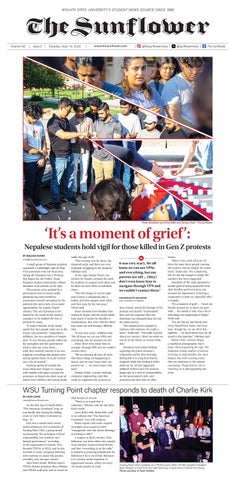
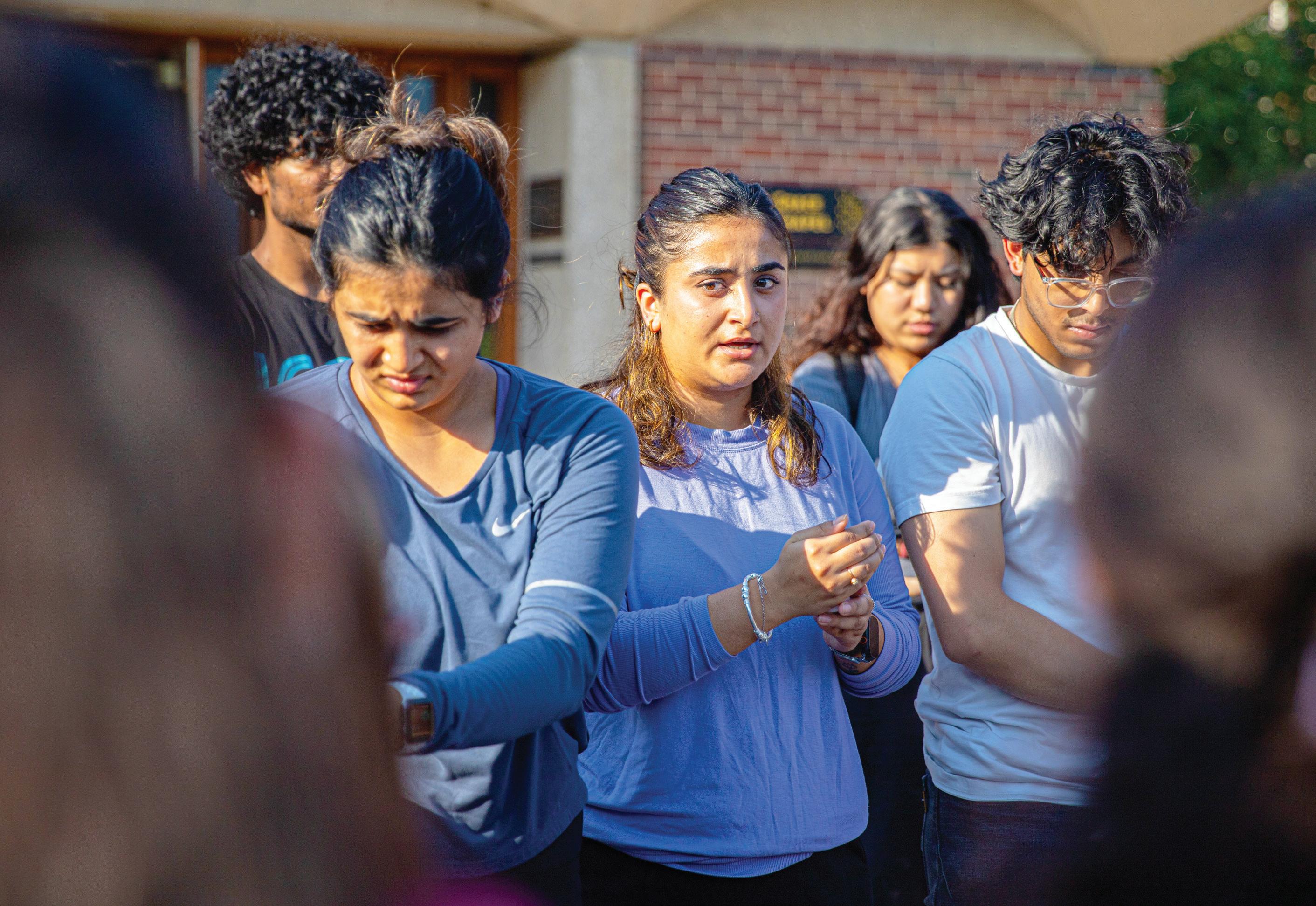
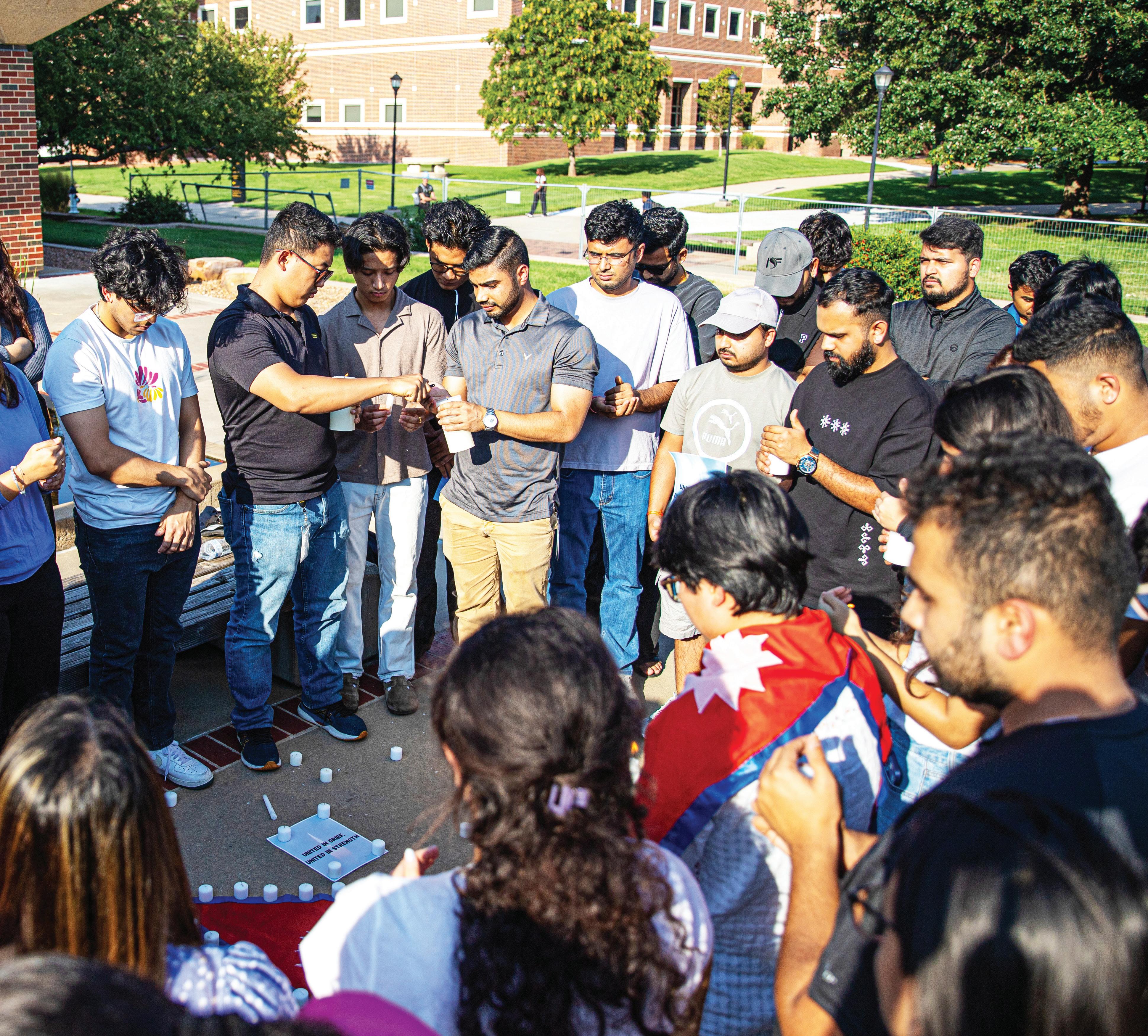
A small group of Nepalese students organized a candlelight vigil on Sept. 9 for protestors who lost their lives during the Nepalese Gen Z Protests that began the day before. Some Nepalese Student Association cabinet members were present at the vigil.
The protests were sparked by a government ban on social media platforms but were fueled by resentment toward corruption by the political elite and a lack of economic opportunities for regular Nepali citizens. This set of protests is led largely by the youth of the country, causing it to be dubbed the Gen Z protests by many.
“It wasn’t because of the social media ban that people came out to the streets and protested,” Aakankshya Adhikari, the vice president of NepSA said. “It was because people called out for corruption and the government tried to shut our voice down … what they actually wanted to do was suppress everything that people were saying against them, so it just turned into a lot of turmoil.”
Students gathered outside the Grace Memorial Chapel on campus with candles and signs to honor the protestors in Nepal who died, most of whom were children and young adults
under the age of 28.
“This evening was for them, the departed souls, and there are a lot of people struggling in the hospital,” Adhikari said.
At the vigil, Sarjan Tiwari, the advisor for NepSA, stressed the need for students to support each other and be there for each other in turbulent times.
“The best thing we can do right now is have a community, like a family, and then support each other and then pray for the lost ones,” Tiwari said.
Some students have families that remain in Nepal, and the social media bans made it harder for families to communicate. But even with the lifted ban, some are still having a difficult time.
“It was very scary,” Adhikari said.
“We all know we can use VPNs and everything, but our parents are old … (they) don’t even know how to navigate through VPN and we couldn’t contact them.
“We are hearing all sorts of news that these things are happening in Nepal, and we don’t know how our parents are … we never know who died.”
Deepan Dulal, a senior studying computer engineering, said that while he supported the protests as
It was very scary. We all know we can use VPNs and everything, but our parents are old … (they) don’t even know how to navigate through VPN and we couldn’t contact them.”
AAKANKSHYA ADHIKARI Vice President of NepSA
they started, seeing the footage of the protests and deaths “traumatized” him, and the response after the shootings was disappointing and not the right answer.
“You should never respond to violence with violence. It’s really a mess,” Dulal said. “I’m really worried about my country. I don’t see what we can do in the future to recover from this.”
Attendees had mixed feelings regarding the prime minister’s resignation earlier that morning, feeling like it is a big deal that he resigned while also feeling it didn’t make up for all that happened. Adhikari believes that the protests began due to a lack of accountability on the government’s side, and protestors felt they had no other
choice.
“Since I was a kid, till now, it’s been the same three people running the country, and he resigns, he comes back,” Dulal said. “It’s a small win, but it’s not big enough to justify the murders that have happened.”
Attendees of the vigil expressed a similar grief of being separated from their families and loved ones, but stressed the importance of having a community to lean on, especially after a tragedy.
“It’s a moment of grief … I have my friends around me to share my pain with … my family is safe, but a lot of bad things are happening in Nepal,” Dulal said.
“For my friends and family and every Nepali back home, and even here: though far, we are all in this together … let them know that we all stand in this together,” Adhikari said.
Editor’s Note: Garima Thapa, a Sunflower photographer, had a large role’in organizing the vigil. The Sunflower avoids conflicts of interest involving its staff members but must balance that with covering events that are important to the campus community. Thapa had no role in reporting on or photographing this event.
WSU Turning Point chapter responds to death of Charlie Kirk
BY KASS LEWIS news@thesunflower.com
On the first leg of Charlie Kirk’s
“The American Comeback” tour, he was fatally shot during his tabling event at Utah Valley University on Sept. 10.
Kirk was a conservative social media influencer and co-founder of Turning Point USA, a group aimed at promoting “the principles of fiscal responsibility, free markets, and limited government,” according to the organization’s website. Kirk founded TPUSA in 2012, and he has traveled to many campuses debating with students on topics like gender, sexuality, race and gun control.
After Kirk’s death, Wichita State’s TPUSA chapter president Ryan Whalen said TPUSA staff were told to return to
their homes as of now.
“There is so much that is unknown,” Whalen said the day after Kirk’s death.
Later, Kirk’s wife, Erika Kirk, said in an address that “The American Comeback” tour will continue.
Police reports said some unspent cartridges were engraved with “transgender and anti-fascist ideology,” according to ABC7.
A suspect in Kirk’s murder, Tyler Robinson, has been taken into custody.
Utah Attorney General Derek Brown said that “everything is on the table” in regards to pursuing punishment for Robinson if he is convicted. Robinson is in custody under suspicion of aggravated murder, which can carry the death penalty in Utah.
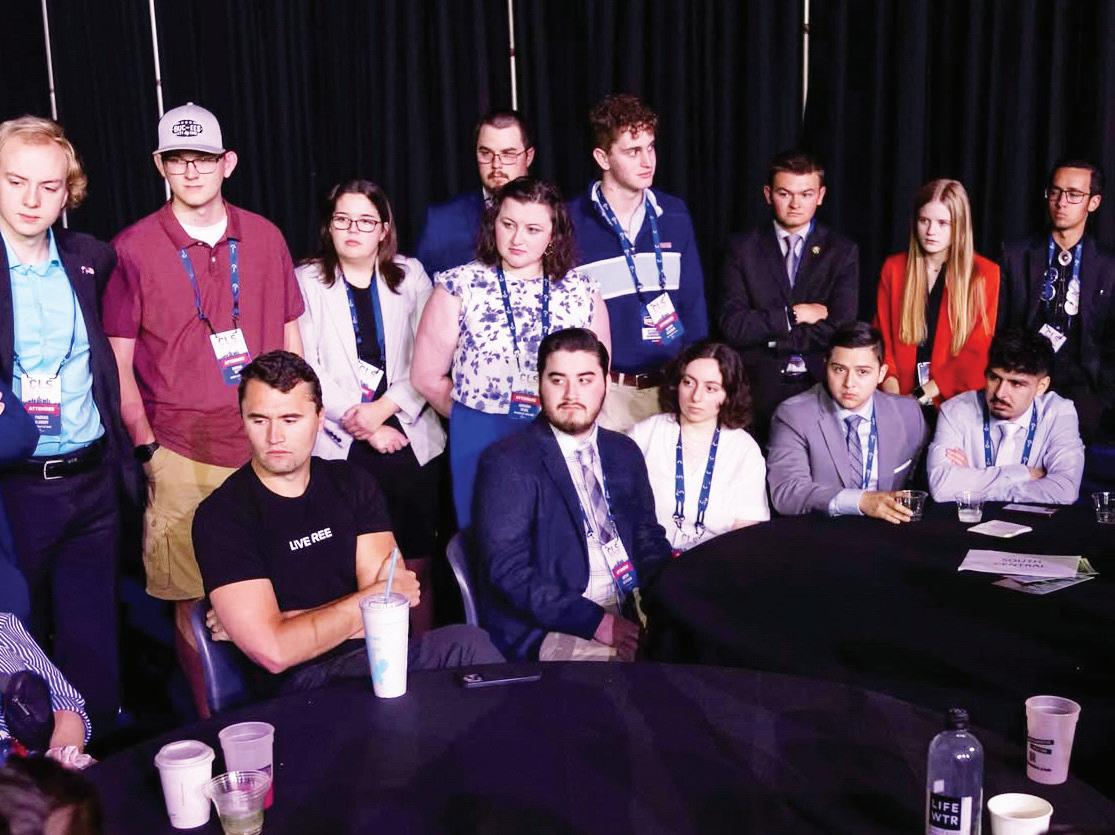
Turning Point USA members at a TPUSA event. WSU TPUSA Chapter President
Ryan Whalen is third from the right standing. Charlie Kirk is farthest left sitting.
Photo courtesy of Ryan Whalen.
Letter to the editor:
Death of a conservative — A warning to college campuses
Fear ran through me as I climbed the stairs of the student center for a campus debate. I called my father and grandfather to attend, not for encouragement, but for safety. That’s the reality of being a conservative on many college campuses today. People didn’t just disagree with me — they hated me. They hated what I believed, hated who I was, and some openly wished harm upon me and others like me. I entered politics in college because I cared deeply about my country, my faith and my values. But from the start, it was clear that these beliefs put a target on my back. I was warned for “politicizing” when I pointed out the obvious: universities are overwhelmingly biased toward the left. That bias doesn’t just tilt discussions — it fuels hostility. It empowers students and faculty alike to treat conservatives as enemies to be silenced.


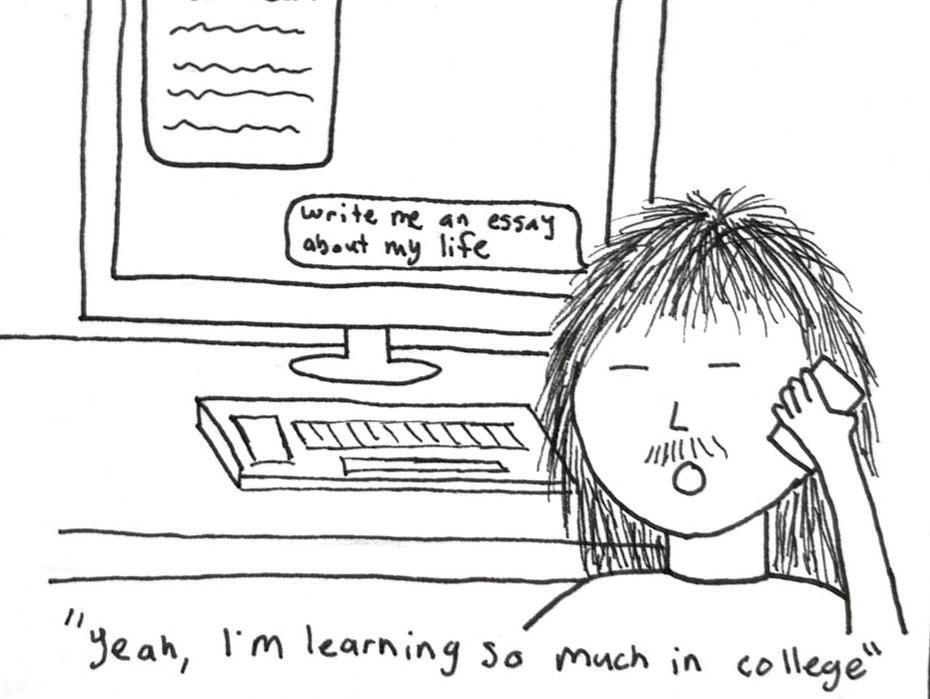
At this point in time, AI, generative AI in particular, feels like an incredibly powerful force. It doesn’t matter how you approach the technology; you can’t deny that its presence in our digital ecosystem is utterly inescapable.
Nine times out of 10, the first search result on Google is an AI summary. Pictures, songs and paragraphs can be created from simple text inputs. College students brag about passing classes with ChatGPT on social media.
AI-generated Italian brainrot is the hot new trend.
There are concerns about AI replacing human jobs in creative and technical industries. The environmental impact is welldocumented at this point. It’s a wild west out there, and Wichita State has recently embraced it, with caution, through the implementation of Copilot into certain lesson plans and administrative workflow.
The implementation is by no means a unified and complete technological overhaul, however. Depending on what classes you take or what department you work in, AI is used quite differently throughout campus.
“We are using AI tools for some coding projects and stuff like that that we do here in the MRC (Media Resources Center) and that’s a great use case for us,” MRC Executive Director John Jones said. “We’re doing a lot of this stuff so we’re using it a lot but academic advising may not use it at all or may use it only in small ways.”
Jones said that the reason behind this implementation has to do with preparing students for the workforce.
“If our role as an institution is to prepare students for the workforce they’re going to enter, that workforce is going to be one that has AI in it,” Jones said. “And if you walk into that room, that space, without skills that let you operate those tools, then you’re going to be at a disadvantage compared to other people. So, it’s not necessarily that we love everything about it. It’s that it’s a reality that we have to face.”
One important distinction in the university’s use of Copilot has to do with the collection of data. More specifically, under the contract between Microsoft, Copilot’s owner, and the university, Microsoft retains zero ownership of the “information stream,” as Jones puts it.
“In the case of our enterprise contract with Copilot, the information stream doesn’t flow back to the AI to continue to retrain the AI,” Jones said. “And so there is no risk of that information going back into the system, and they claim no ownership of it. So it’s through legality and the severing of that feedback loop that provides us some security, some safety there.”
The university taking steps to curb data collection is a step in the right direction, but what does the implementation of Copilot entail for our students and faculty?
I’m personally not a big fan of generative AI, I think that within our society, these tools are being commercialized and accepted way too quickly, without regard to their potential negative impacts.
But those same tools can be undeniably useful in certain
contexts. I actually use AI programs to speed up the transcriptions of my interviews. I guess that makes me a hypocrite, but I think there’s more to it than that.
To me, a lot of this implementation seems to be dependent on transparency and AI being used in the “right” context, at least according to Jones.
“I think that a big part of that ethical use is about transparency,” Jones said. “So if I use AI to generate something, I’ll usually at one point in or another, I will disclose that AI was used to create this or at least in the process.”
The thing is though, I used that program to speed up the transcription process, but I still manually went through the interviews to make sure I put everything down correctly.
To me, that’s AI being used in the “right” context, but that right context could look different to somebody else, and that’s where things start to get problematic. It’s a slippery slope, and once you go down far enough, it’s no wonder that these programs can make us stupider.
It doesn’t help that a lot of the official WSU AI guidelines and use-cases are rather vague and could apply to just about anything. If we’re to prevent this behavior going forward, a more specific set of these guidelines is paramount. To a certain degree, WSU has been cautious in its encouragement of AI, but cheating is still an issue, and if we’re continuing to encourage these tools the way we are now, it’ll only exacerbate things. After seeing the prevalence of AI in the English department, associate professor and chair Francis Connor has a similar perspective.
Shocker Sports Grill and Lanes is back with its new pizza of the month, and they are no stranger to chicken bacon ranch. When I first asked for my pizza they gave me their chicken bacon ranch wrap instead. It seems that they are able to do chicken bacon ranch when it comes in a wrap, but not other times.
When I finally got my pizza, I was excited because the smell was mouthwatering, but when I picked
When I finally got my pizza, I was excited because the smell was mouthwatering, but when I picked up my first piece, it smushed in my hand.
WILLOW
up my first piece, it smushed in my hand. The dough was undercooked and immediately stuck to my fingers. The whole piece was moist up to the crust. While the last pizza of the
month, hot honey pepperoni, was underseasoned, this month’s is the opposite. The first bite of this chicken bacon ranch seemed to punch me. The pizza seemed to be entirely coated in what tasted like every flavoring they could get their hands on. When I finally tasted a piece of the chicken, it popped in my mouth, almost like a boba pearl.
I was unable to even finish my personal pizza due to the strong flavoring and doughy texture. It just was not my cup of tea, but if you like your food extra flavored and extra wet, then this pizza might just be for you.
“There are so many cases that instructors just don’t know what to do with all of these students,” Connor said. “Do we report everyone to academic affairs and get everyone kicked out of school? How do we assess papers? Do we just grade them as if it was a normal paper?”
At this point, according to Connor, it’s easy for the English department to distinguish between what’s written by AI and what isn’t.
“I will say, we can tell when something was written with AI,” Connor said. “It does not synthesize information well.”
Ultimately, I think the way WSU is approaching the AI boom with Copilot is worthy of some praise, but the vagueness of their policy is counterproductive and doesn’t account for personal interpretation. I’m hopeful that we’ll be able to get past this AI craziness though, just in general, and that we’ll be able to approach these tools with more nuance as they get more efficient, much in the same way that we were able to approach the internet in academia.
“I think we came to a kind of equilibrium with online resources where, you know, over time we can instruct students what good and bad uses of that are,” Connor said “And, you know, I rarely in the past couple of years saw people just steal Google pages, and put them in a paper as I did in like 2004 and 2005.
“I’m hoping we get to that sort of thing by AI. I’m hoping students get tired of having their essays evaluated as, you know, ‘This sounds like AI,’ and want to do them for themselves.”
The recent death of Charlie Kirk, who personally supported me during my political journey, only sharpens this truth. His loss is a tragedy, but it also reveals the dangers conservatives face for daring to speak their minds. Am I justified now in the fear I felt? Is it finally clear that this climate of hostility has consequences beyond words? On campus, I never wanted to harm anyone. I never wanted to make anyone feel lesser. All I wanted was the freedom to share my perspective — to say I love this country, I love God, and I believe in traditional values — without fearing that someone with a rifle on a rooftop might end my life for saying so.
The left often claims conservatives are the ones who threaten others, who wish violence on groups they disagree with. But look closely: it is conservatives who are increasingly silenced, attacked, and even killed. I reject violence of any kind. It should never be the answer.
Charlie Kirk’s memory should remind us of what’s at stake. As conservatives, his death will not drive us into silence. It will make us stronger. We will not back down. We will not be erased.
Universities — and this country — must remember that free speech is not a partisan privilege. It is a human right.
God rest Charlie Kirk’s soul, bless his family and protect them. And may his loss serve as a wake-up call: freedom of thought and speech must be defended — before it’s too late.
Mitchell Adamson, Graduate student in the mental health and counseling department
Jonas Lord legobricklords@gmail.com OPINION
SPENCE Sunflower reporter “
Illustration by Kami Steinle / The Sunflower
Shocker Grill and Lanes’ pizza of the month, chicken bacon ranch. Photo by Willow Spence / The Sunflower