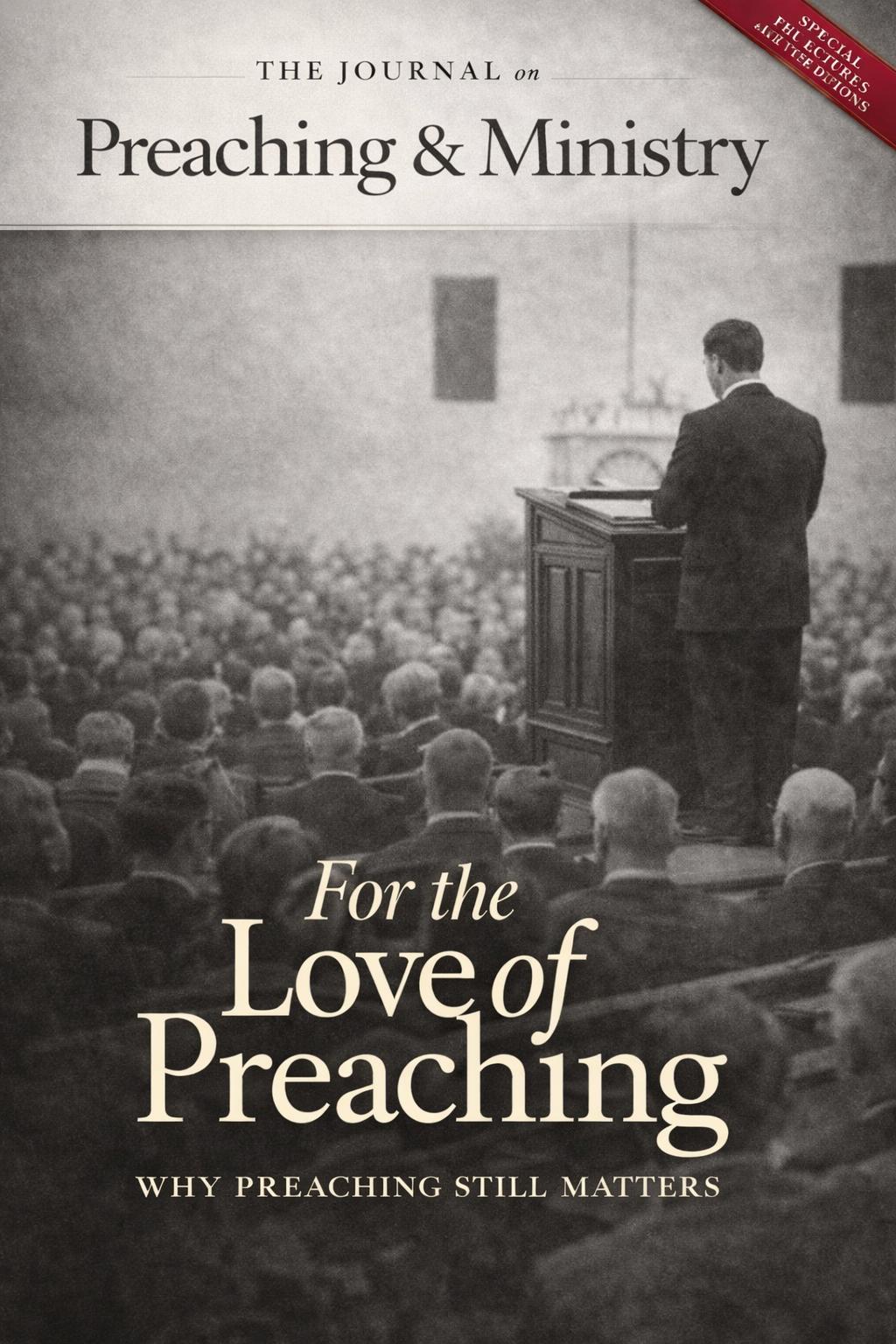


One of the highlights of OUR FHU Lectureships has become the release each year of the Special FHU Lectureship edition of The Journal devoted to preaching. This year, we decided to focus on various “sorts” of preaching. We mean to say things like Courage, Conviction, and Compassion. Each of our writers is an FHU Lectureship speaker.
OR
Hold the presses, WERE to be Lectureship speakers. While the committee made the hard call, given generational conditions, to postpone the lectures to next year and just move everyone forward, we decided to go forward with the Journal, as it was already 90% complete.
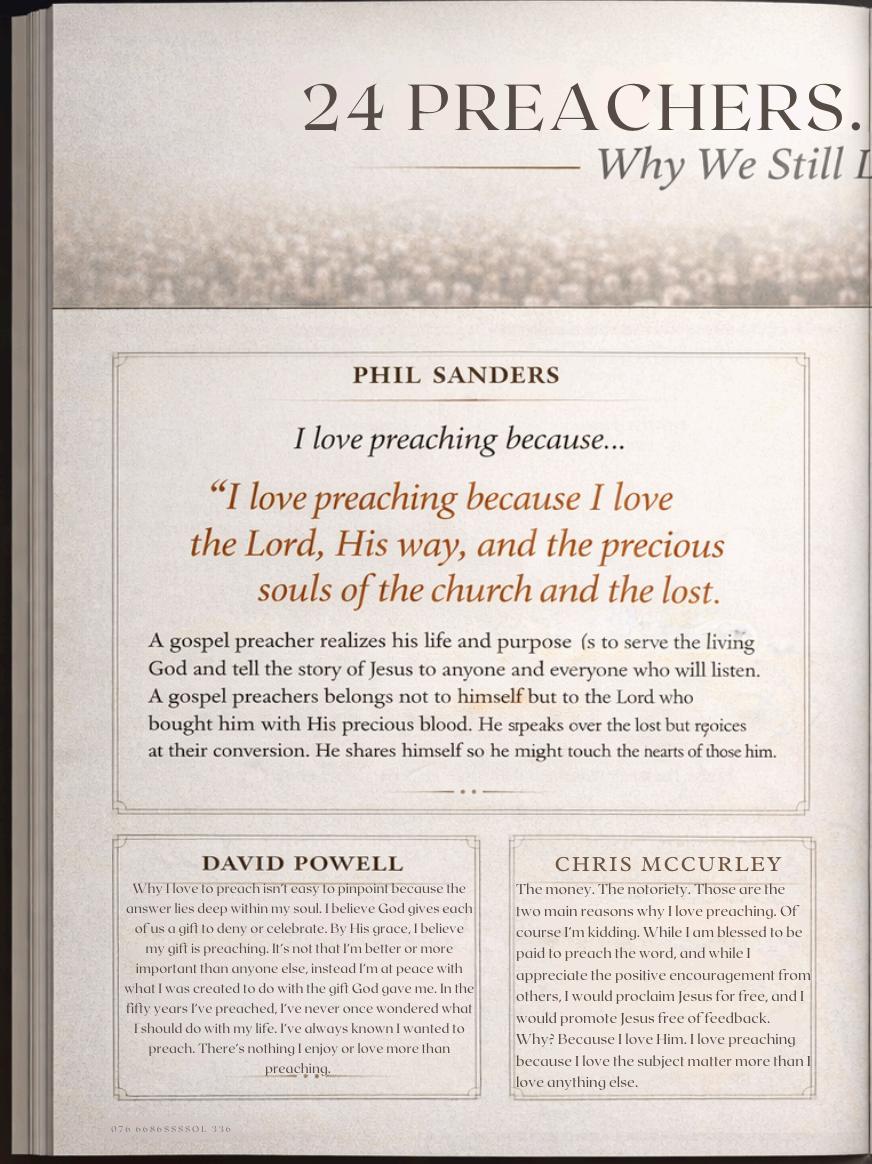
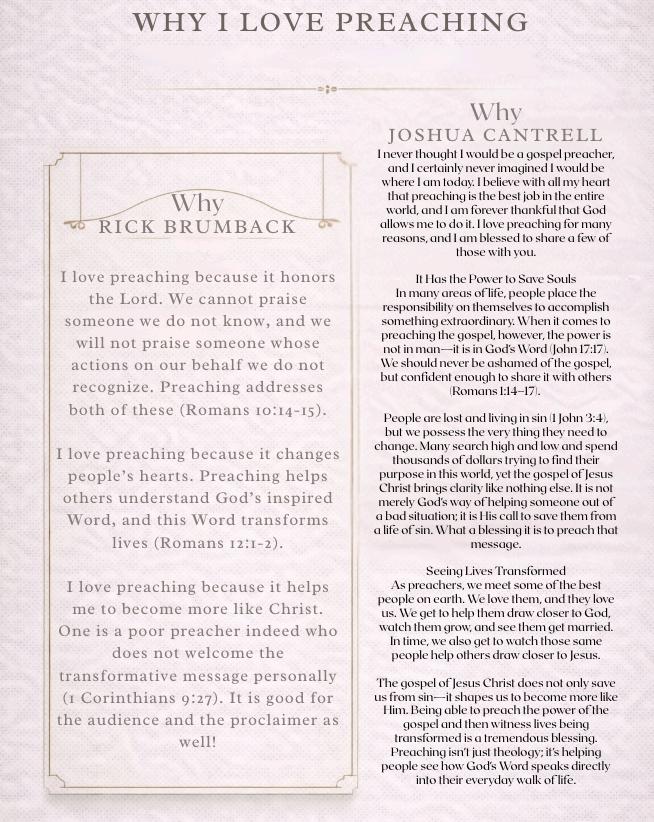
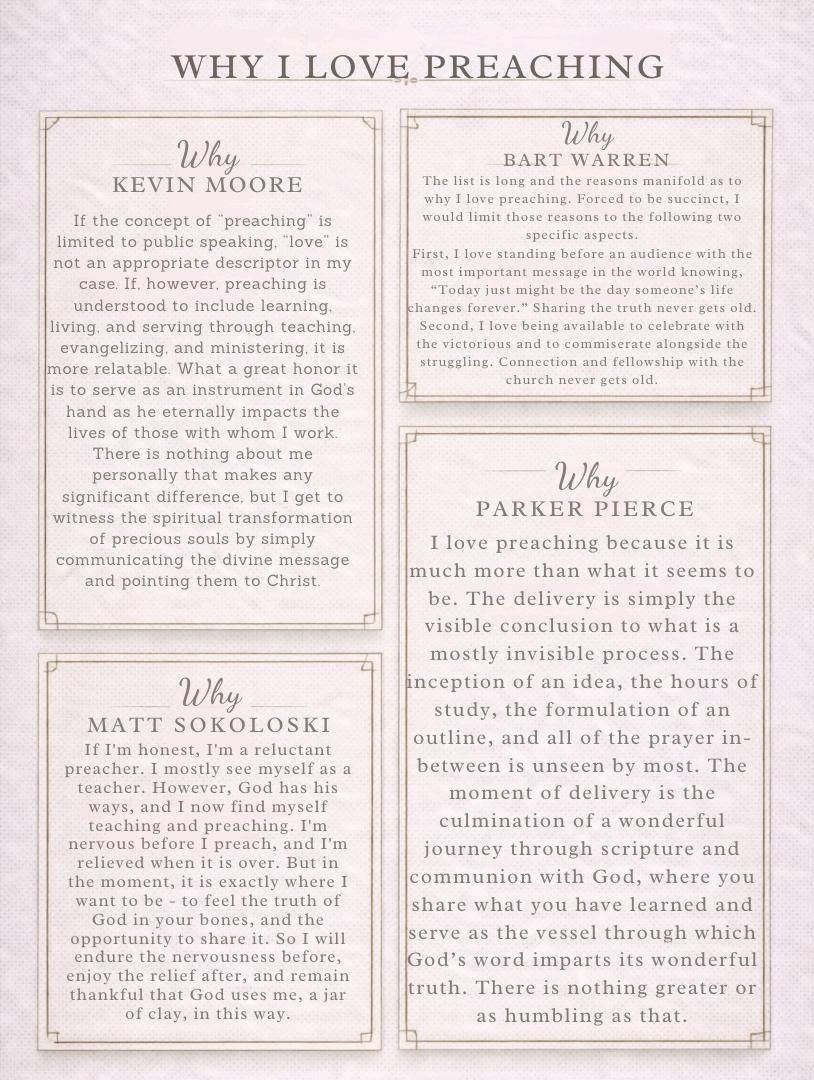
We hope you are blessed by this edition. In the middle of it all, we decided to do something pretty unique, we asked a number of the speakers (25 to be exact) to write a short piece on Why I love Preaching. This is rich, will delight your soul, and inspire you to renewal.
We thank you for what you do and for joining with us in this celebration of preaching!
Je & Dale


Early one December Sunday morning during my sophomore year at FHU, I received a phone call from a faculty member who preached for a rural congregation an hour and a half away. He was ill and asked if I could possibly preach for him that Sunday. Since I did not have an appointment to preach that day I gladly accepted and enjoyed a wonderful Lord’s Day with those sweet brethren. The family that hosted me for the afternoon asked if I knew a certain teacher who had preached for them before their current preacher. Upon affirming that I did, they said, “Well, we like him, but we love Bro. because we can understand him.” The vocabulary of the former was a bit too sophisticated for those humble folks, whereas the language of their current preacher was their language, clear, plain, and easy to comprehend. I have not forgotten that invaluable lesson. It was as though they were describing the preaching of Jesus, of whom Mark says, “And the great throng heard Him gladly” (Mark 12:37 ESV).
possible to every person in every nation. There is no higher honor, nor greater responsibility, than to be entrusted with what Paul calls “the deposit” (1Ti 6;:0) as a gospel preacher. That message is the truth of God, of course, but it must also be truth correctly understood to accomplish its purpose, “to seek and save the lost” (Luke 19:10). Whether teaching in a public or private setting, our prayer must be that of Paul’s, “to declare the mystery of Christ, that I may make it clear, which is how I ought to speak” (Col 4:3-4).

Preaching with clarity begins with the preacher himself, not ju the time he spends in the pulpit but his whole manner of life, what we know as his character. As a man of God his life is an open bk…
The Speaker
A message designed to save the world must be presented as clearly as
Preaching with clarity begins with the preacher himself, not just the time he spends in the pulpit but his whole manner of life, what we know as his character. As a man of God his life is an open book, not just to his family, but to the congregation he serves and the community where he lives. “Preaching is not the art of preparing and delivering a sermon, but the art of making a preacher and delivering that!” (William A. Quayle, The PastorPreacher, 1910). The one who proclaims the truth must live that truth. He will be the same person outside the pulpit as he is in the pulpit, with no mask, façade, or improper motives. When people know their preacher is
genuine, “what you see is what you get,” they welcome him into their hearts, their homes, and anticipate each of his lessons from God’s Word. His sincerity and earnestness will help him communicate clearly.
The development of such character consists of certain characteristics, personal qualities that attract people to the love for God and His Word. In addition to the fruit of the Spirit (Gal 5:22-23) and the Christian graces (2Pe 1:5-7), God’s man must have the mind of Christ (Phi 2:5-8) as a servant leader, a comprehensive knowledge of Scripture, a knowledge of human needs generally and the specific needs of his people, with a heart of courage to disturb the comfortable balanced by a heart of compassion to comfort the disturbed. Paul said it best, “The Lord’s servant must not be quarrelsome but kind to everyone, able to teach, patiently enduring evil, correcting his opponents with gentleness” (2Ti 2:24-25).
The Subject
Preaching with clarity also depends upon the choice of subjects, topics, themes, and texts from which the preacher builds his lessons. A program of planned preaching from year to year draws from a variety of sermon possibilities, whether their structure be

expository, textual, or topical, deductive or inductive, biographical or narrative in design.
The forceful mandate to “preach the word” (2Ti 4:2) limits us to the timeliness and timelessness of Scripture for our lesson content while preach is to make the message plain, the process of effective human communication, and true communication is definitely a process to be learned and practiced. Sermons require prayerful planning and painstaking, but joyful, preparation. No one should be more blessed by preaching than the preacher, for he has the opportunity to study every biblical topic over time and explain it to his hearers in language, illustrations, and claims they can understand and apply to daily life. He must be a man of depth, ever the student of life and eternity, able to answer questions, provide solutions to problems, and give hope in times of despair.
A brief survey of the preaching of Jesus reveals the scope of topics He addressed, both simply and profoundly: angels, anxiety, assurance, authority, baptism, behavior, commitment, confession, conversion, criticism, demons, discipleship, divorce, eternal life, faith, Father God, forgiveness, the future, generosity, grace, heaven, hell, Holy Spirit, humility, hypocrisy, the kingdom, love, marriage, mercy, mission, new birth, obedience, peace, possessions, prayer, pride, priorities, relationships, repentance, responsibility, salvation, Satan, service,
sin, sincerity, stewardship, success, suffering, unity, and worship.
There was no subject He was unwilling or failed to address, no question He couldn’t answer, no problem He could not solve, and no concept His hearers could not understand. Well did the voice of God exclaim from the Mount of Transfiguration, “This is my beloved Son, with whom I am well pleased; listen to him” (Mt 17:5).
The Style
When we speak of style we normally think of a person’s unique personality, disposition, or manner of expression. However, the technical meaning of style is the use of words. Words are the tools with which the speaker works; they are the bridges over which his ideas are transported into the minds of his hearers. “He who wants to persuade should put his trust not in the right argument, but in the right word. Give me the right word and the right accent and I will move the world” (Joseph Conrad, A Personal Record, 1912). Preaching with clarity ultimately depends on a preacher who knows both the word and the effective use of words.
“The preacher should think with the learned but speak with the common people” (John Stott quoting John Wesley, Between Two Worlds, 1982). There is no better example of this than the Lord Jesus, who created no new words during His ministry.
Even at age twelve He was able to challenge the thinking of Jewish scholars while using the vocabulary of a youth (Luke 2:46-47). In the Sermon on the Mount, seventy-nine percent of His words consists of one or two syllable words. He came not to close the minds of His audiences but to open their eyes and their hearts to the wonderful words of life (John 6: 68).
While our vocabularies are continually expanding as we grow, the words we choose in our daily life and work are the very words we carry into the pulpit. Here are types of words spoken first in our daily life and work that we carry into the pulpit: Simple words. We do not preach and teach to impress but to inspire through “the unsearchable riches of Christ” (Eph. 3:8). Remember the power of words like love, life, faith, hope, peace, and home, all one syllable words that are packed with meaning. Specific words. If you are describing a building, is it a cathedral, hotel, log cabin, palace, mansion, barn, school, or store? We can be far too general in our description of people, places, and things; specific words paint pictures to remember. Remember the Lord’s use of salt and light, the pearl of great price, the lost coin, the mustard seed, farmers, fishermen, and shepherds. Familiar words. There is a reason certain words become familiar: they are clear and plain, needing no explanation as they express beautiful images, evoke warm feelings, and awaken precious memories. Is there a
more touching phrase than “I love you?”
Vivid words. We must learn the art of illustration, what Spurgeon called “windows into the sermon.” The listener can not only hear the truth being taught but see it in action, feel it’s impact, and be moved by its power. Jesus made use of stories, examples, parables, proverbs, principles, Scripture, questions, controversy, conversations, and applications. There is so much to learn from our beloved Master Preacher and Teacher
day? We must envision the Lord Himself as a member of every audience we address. Let’s place Paul there, too; what would they think of your character, your choice of topic, and your use of understandable words to communicate God’s message of hope and everlasting life to dying people? You simply cannot do this work without love for the Lord, love for His word, and love for people. May we fall to our knees in tears and humble recognition of our need for our Father’s help, not just every hour, but every second as we do our

We close this plea and encouragement for clarity in your preaching and teaching with a sobering question: Why in the world would one consider the work of preaching without striving to make his lessons as clear as
best in His work:
Let the words of my mouth and the meditation of my heart be acceptable in Your sight, O Lord, my Rock and my Redeemer (Psalm 19:14).
In the fall of 2005, I was in my first seminar in the PhD program at the seminary in New Orleans. While I was excited about learning and progressing in my studies, I still had a lot to learn about writing a paper. When it was time to present my paper, my major professor showed a lot of grace in grading my work, but basically told me that I had filled a lot of space with good facts but had not really made a clear claim with supporting arguments. I learned then that it is possible to dump a lot of data and meet a page requirement, but not really say anything that helps the reader. While I am still learning in many ways, I wonder whether it is possible for a preacher to fill the allotted time and speak eloquently with an impressive slide presentation without seeking to convert souls to Christ?
book How to Read a Book, Adler and Van Doren suggest that people sometimes read for information, but also for entertainment and transformation. Perhaps in any audience, there are those who are listening simply to learn the basics about God or what the Bible has to say. This hearer is listening for information. Others might really enjoy the presenter's style or his engaging illustrations and therefore find themselves listening (at least in part) to be entertained. Yet, the goal of biblical preaching is for every hearer to be “pricked in the heart” by the word and to respond to God by coming to faith and being transformed by his will.
I wonder whether it is poible for a preacher to fi the aoed time and speak eloquently with an impreive slide presentation without sking to convert souls to Chri?
What is the purpose of preaching? A good comparison might be made to the purpose of reading. In the well-known 1972
Preaching the Word of God should seek to not only convict one’s hearers, but to aid them in being converted by God to walk in his ways. It must be said that conversion is the work of God. The job of the preacher is to help his hearers know the formula made plain in Ephesians 2:8-9 that we are saved “by grace through faith.” God
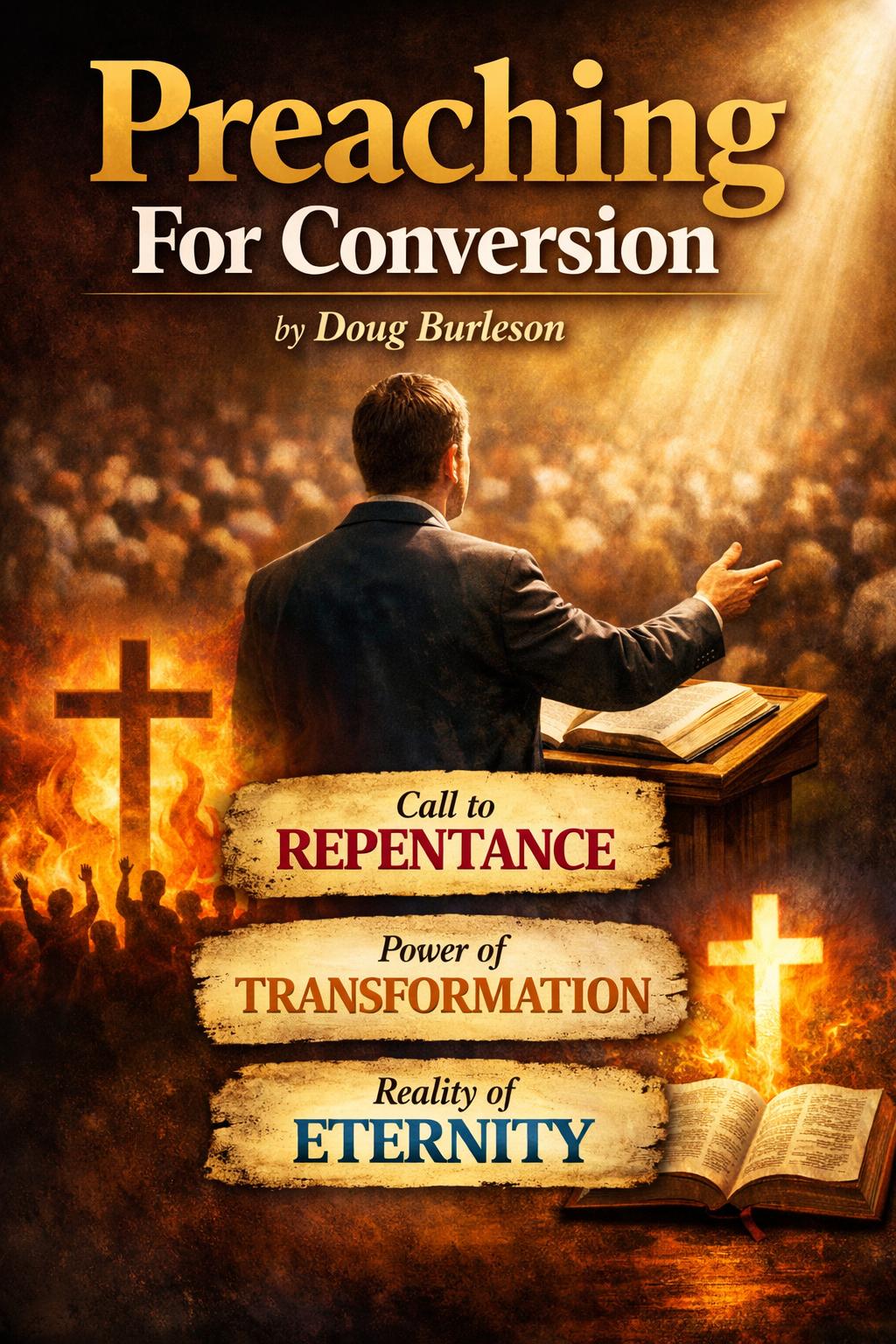
desires that “all people be saved and to come to the knowledge of the truth” (1Ti 2:4). Preachers should share the Word in a way that makes clear that the catalyst for any word of hope to humankind is the gracious initiative of God.
When the word is preached, listeners should come to know more about God’s gracious initiative and the opportunity he has given for hearers to respond in faith. Preachers share the Word and let God work. The message preached is not about big words or loud volume. Though important, the sermon is not about our introduction or illustrations.
Preaching, at its foundational level, is about proclaiming the word of God and inviting listeners to respond to what God has done and is doing, with the promise that he will save and bring transformation to the lives of the faithful. While preaching for conversion means that preachers are specific about God’s gracious initiative, we must also be specific about repentance, transformation, and judgment.
Preaching for conversion means that preachers are specific about repentance. In addition to the reminder that “the kingdom of God was at hand,” the preaching of John the Baptizer could be summarized by the simple message, “Repent!”
(Mk 1:4; Mt 3:2; 4:17). Jesus himself reminds us that, “I have not come to call the righteous but sinners to repentance” (Lk 5:32). To call hearers to repentance, preachers must be specific about the destructive nature of sin and the danger of life without a relationship with God. May preachers, like Ezekiel, not be afraid to proclaim God’s words with clarity and consistency, saying “repent and turn away from your idols” or “transgressions” (14:6; 18:30).
Preaching repentance may also help a wayward child return to the Father (Lk 15:11-32).
Secondly, preaching for conversion means that preachers are specific about how God can change one’s life. Paul did not shy away from helping his hearers see the changes Christ had brought to his life. This was the message he shared before Felix, Festus, and Agrippa (Acts 22, 26). The same apostle could commend his readers for allowing Christ to help them turn from idols to serve the living God (1Th1:9).
Preaching for conversion also means that the word is shared with everyone without partiality. The rich and poor, men and women, young and old, people of every race are invited not only to hear but to be changed by our gracious God (Jms 2:1-7). The fruit yielded by this
change in Christ will impact families, congregations, communities, and the whole world (Gal 5:22-23). Behold the power of preaching the word of God!
Finally, preaching for conversion means that preachers are specific about the coming judgment, the joys of heaven, and the horrors of hell. In Matthew alone, Jesus, who had more to say about eternal reward or judgment than anyone else in the New Testament, spoke plainly about the destruction of those who disobeyed his teaching (Mt 5:22, 29-30; 10:28;18:9; 23:15, 33) and the hope that awaited those who obeyed (5:3, 10, 12; 6:1; 7:21). It is no longer culturally acceptable to preach the whole counsel of God. Perhaps even among God’s people, there is a reluctance to talk about judgment or eternity because of the harshness of some who have preached on these themes before, but this part of God’s instruction is still true.
Preaching may be culturally defined as a 25-minute presentation with a compelling introduction, illustrations, an invitation, and perhaps even an engaging multimedia component, but that definition might also apply to a motivational speech. Biblical preaching says something. Biblical preaching makes a God-given claim and supports it with biblical truth. Biblical preaching makes it plain that God has made an opportunity available to all people to be saved and to come to a knowledge of the truth. Biblical preaching seeks the conversion of sinners and the restoration of the saved by proclaiming specifically the need for repentance, the change God can bring to our lives, and the reality of a coming judgment and eternity spent either with God or away from him. May God help every preacher to proclaim the word for the purpose of seeking conversion. Let us preach the word and trust that God will continue to work through the power of the gospel as he has promised for “everyone who believes” (Ro 1:16).
FOR ELDERS ONLY: LAST MONDAY OF EACH MONTH AT 7AM CST. SIGN YOUR SHEPHERDS UP TODAY. SEND THEIR CELL NUMBER TO TJI@TJI.LIFE

been for quite some time. With rapid social changes, increased globalization, and the seemingly endless noise of the digital age, some would say that preaching isn’t what it used to be. However, it has always been that the task of the preacher is to proclaim the truth of God’s Word in such a way that the
hearer connects God’s truth with the needs of his or her life. Preaching is not just about sharing ancient truths—it’s about making those truths resonate with the real lives and perspectives of people sitting right in front of you. So, how do we preach in a way that truly connects? That’s where cultural engagement comes in. Preaching for cultural engagement is more than a buzzword or a trendy approach. It’s about building bridges between yourself as a preacher and the members of your congregation. It involves fostering understanding and creating opportunities for real transformation—both in individuals and in the life of the congregation.
Contextual understanding is vitally important in our preaching. If we want to engage people, we need to really know where they’re coming from. As preachers, we need to listen to our members so that we can understand what they are experiencing in their lives. We need to be connected to the broader life of our community and tune in to the wider culture. We do this so that we can discover what keeps people up at night? What are their hopes and worries? By understanding these things, preaching stops being just a speech and becomes a conversation—a bridge linking God’s eternal wisdom to today’s world.
...how do we preach in a way that truly connects?
Think about it this way. If we walk into a room without really knowing the people in the room, it’s easy to talk past them or miss what really matters most in their lives. Maybe our congregation includes young professionals worried about job security, parents exhausted by the demands of work and family, or older adults navigating loneliness or the changing social landscapes. Maybe we are in a neighborhood where immigration is common and cultures blend. Or perhaps our congregation is mainly made up of people who have grown up together for decades. Just as God created us all distinctly unique, every community has its own unique makeup, its own joys, struggles, and stories.
To be effective as preachers, we need to maintain a curious mindset. We can do this by continually seeking to understand our context. We can attend community events, read local newspapers, join conversations online, and ask people questions about their lives. What’s on their minds? What do they
celebrate and what do they fear? The better we understand our community, the more relevant and meaningful our preaching becomes.
Cultural engagement isn’t only about the people in the pews, it’s also about how we approach the Word of God. The words of Scripture that God has preserved for us have shaped lives for centuries, but they also provide refreshing insight into the issues of today. When we read Scripture with the current moment in view, new connections and insights will inevitably emerge. That said, it’s not as though God is revealing something “new,” but God’s Word provides relevancy throughout all generations. For example, the parable of the Good Samaritan might speak powerfully to discussions about immigration, compassion for outsiders, or even racial tensions. The Exodus narrative can resonate with communities seeking liberation from addiction, from poverty, or from prejudice. As preachers, when we are attuned to both the world of the Bible and the world of today, we will be more effective in helping people see that faith isn’t just about the past. Our faith is alive. Our faith is active. And our faith is relevant.


As preachers, when we are attuned to both the world of the Bible and the world of today, we will be more effective in helping people see that faith isn't just about the past. Our faith is alive. Our faith is active. And our faith is relevant.
As we preach, we want to communicate with relevance and respect. Being culturally engaged doesn’t mean watering down our beliefs. Instead, it’s about finding language and examples that connect with our church family. Communicating with relevance may be addressing news stories, moral dilemmas, or even generational shifts. It may involve speaking to a current issue or experience within the congregation. Whatever the topic, respectful and honest dialogue are vital. When we show humility and openness in our preaching, our sermons start feeling less like a lecture and more like a meaningful exchange. Maybe there is something dominating the headlines— maybe it’s about cultural change or shifts, political unrest, or a tragedy in the community. The people in our congregations are thinking about these things, talking about them at work or over dinner. If we acknowledge those events in our sermons, we demonstrate that faith speaks to real life. Even when we don’t have all the answers, simply showing that we care can open up dialogue and
trust. For example, not long after I began my time in ministry, I was preaching through a series on the Minor Prophets. We had an older couple in our congregation that were tragically killed in a car accident. It was a tremendously painful time for our congregation of 40 people. If I had stepped into the pulpit that next Sunday and continued my series, that would have seemed cold and out of touch. We must make sure that we are seeking to be relevant and respectful in our preaching.
So, what are some practical strategies for preaching for cultural engagement? keeping up with trends community. We need to use aware of what is trending blogs, and have what our people are need to bring in whether from the Bible modern life, to show faith action right now. We need to share anecdotes from our own lives. We can ask permission to share the experiences of our members or others the community. When people see themselves in the stories tell, our message sticks and inspires action. we need to involve our in the message. This through surveys, Q&A sermon, or through the can also encourage our topics that will be used in

future sermons. When we engage our members in the message, there is a deeper connection that results.
Finally, we need to spend time in collaboration with local leaders or experts to address what matters most to our community. This involves connecting with local officials and seeking to discover the needs of the community members. Collaboration not only enriches our message but also shows that the Church is invested in the well-being of the whole community. When preaching is plugged into the culture, it helps people live out their faith in genuine and compassionate ways. Instead of feeling lost in a complicated world, our church members find encouragement to meet the challenges of life with wisdom and grace. In a time when so much divides us, culturally engaged preaching can bring unity, understanding, and hope. Culturally engaged preaching invites everyone into a deeper conversation about what really matters. Over time, our congregations will become more resilient, more welcoming, and more connected to one another and to the world around them. Through our preaching for cultural engagement, our congregations become places where it’s safe to ask hard questions, to dream big dreams, and to step out in faith. Our congregations will send people out not just as hearers of God’s Word, but as doers. Our members will be advocates for justice in a world that is begging for a greater sense of justice. Our members will be agents of healing in a world that desperately needs to be made whole. And our members will be builders of community in the face of a world that is increasingly individualistic.
Preaching for cultural engagement isn’t a one-time project or an item on a checklist to complete. It’s an ongoing conversation—a way of being that evolves as communities and cultures change. It’s about staying curious about what is driving the lives of our members and our communities. It’s about demonstrating the humility of Jesus in our lives and preaching. It’s about showing up, again and again, with a willingness to listen, learn, and love.
So, the next time you step up to preach, ask yourself, “Who’s in the room? What burdens are they carrying? What are they celebrating or grieving? And how can I speak in a way that honors their lives and points them toward hope in Christ?” When you preach with cultural engagement in mind, you’re not just sharing a message; you’re opening up a space for transformation, belonging, and grace. That’s a gift our congregations and the world desperately need.


Adrian Rogers recounts the story of a man who was bragging loudly about cutting off the tail of a man-eating lion with only his pocketknife. Someone eventually asked him, “Why didn’t you cut off the lion’s head? Cutting off the tail wouldn’t really do anything, would it?” The man quietly responded, “Someone had already done that.”
It really does not take much courage to cut off the tail of a ferocious lion when someone else has already cut off the head. But I believe it does take a great deal of courage to preach the word of God. Preaching does not primarily address issues that are physical and temporal, but those that are spiritual and eternal. Because of that, preaching requires us to address difficult topics. It can
be uncomfortable and intimidating. At times, we feel anxious when we think about how people will feel about or respond to what we preach. Because of this, we stand in need of courage.
it does take a great deal of courage to preach the Word of God.
My mind goes to what is often called “The Limited Commission” in Matthew 10:5–42. Jesus sent out His twelve apostles (v. 5) to go to the lost sheep of the house of Israel (v. 6). He warned them that they would be sent out as sheep in the midst of wolves (v. 16).
He cautioned them, “Beware of men, for they will deliver you over to courts and flog
you in their synagogues, and you will be dragged before governors and kings for my sake, to bear witness before them and the Gentiles” (vv. 17–18). They will be hated by all people (v. 22) and persecuted in every town (v. 23). Yet in the midst of the difficulty they will face, Jesus told them not to be anxious (v. 19) or afraid (vv. 26, 28, 31). He instructed them to endure courageously to the end (v. 22). Despite the challenges ahead, Jesus called on His apostles not merely to preach but to preach with courage. But how is that possible? How was it possible for the twelve apostles over two thousand years ago? And how is it possible for us today? In the face of opposition and obstacles, how can we preach courageously? Let’s look at what Jesus says to His disciples

courageously when we preach the message Jesus has given to us. Jesus told the apostles exactly what they were to proclaim: “And proclaim as you go, saying, ‘The kingdom of heaven is at hand’” (v. 7). This is the same message preached by John the Baptist (Mt 3:2) and by Jesus Himself (4:17). Later Jesus said, “When they deliver you
be anxious are to speak or are to say, for are to say given to you that hour. For it not you who speak, but the of your Father speaking through you” (vv. 19–20). Whatever spoke to in the dark, were to in the light; He whispered they were to the (v. 27). Jesus the message. someone them, they also both the Father and the Son (v. 40). While we have not had face-to-face interaction with Jesus like the apostles did, and while the Holy Spirit does not miraculously speak through us in the same way He did through them, the principle remains the same: Jesus has told us exactly what to preach. In the Scriptures, He has given us the message we are to boldly proclaim.
We can be courageous in our preaching because the message does not originate with us. It comes from Jesus Christ. And if people reject us, they are ultimately rejecting both the Father and the Son. Second, we can preach courageously when we trust that God will take care of us. Jesus told His apostles, “Acquire no gold or silver or copper for your belts, no bag for your journey, or two tunics or sandals or a staff, for the laborer deserves his food. And whatever town or village you enter, find out who is worthy in it and stay there until you depart” (vv. 9–11). Jesus gave these instructions so His disciples would learn to rely not merely on human generosity but on God’s providence, care, and provision. He wanted them to see that God would take care of them. Later, Jesus emphasized that God knows when even a seemingly insignificant sparrow falls (v. 29). If God cares for sparrows,
will He not care for His servants? Jesus assured them that they were worth more to God than many sparrows (v. 31). They were so valuable to God that even the hairs on their heads were numbered (v. 30).
Regardless of how people treat us, gossip about us, or seek to harm us, God will take care of us. As we seek to do His will, our courage does not come from ourselves but from trusting His provision. God knows when we hurt. God knows our needs. When we grasp how deeply He loves and values us, we can preach with courage.
Third, we can preach courageously when we fear God rather than people. Jesus told His apostles, “Do not fear those who kill the body but cannot kill the soul. Rather fear him who can destroy both soul and body in hell” (v. 28). The apostles would
face powerful people who could take their lives. In fact, tradition tells us that most of the apostles died as martyrs for their faith in the risen Christ. Yet Jesus reminded them that those who kill the body have limited power. They were to maintain a reverent fear of God, who holds eternal authority. If we are going to preach courageously, we cannot be controlled by how people might react to the message of Christ. The worst a person can do is kill the body and send us into the presence of Christ (Philippians 1:21). If we are going to preach courageously, we must reverently fear God. The worst that men can do to us is not even close to the worst that God can do.
Fourth, we can preach courageously when we look forward to our reward. As Jesus
concluded His instructions to the apostles, He mentioned the word “reward” three times in just two verses (vv. 41–42). We preach courageously now because we know there is a reward awaiting us in eternity. We preach courageously because we want others to share in that reward, as well. As Paul told Timothy, “Keep a close watch on yourself and on the teaching. Persist in this, for by so doing you will save both yourself and your hearers” (1Ti 4:16). Brothers, let’s preach courageously.
“For God gave us a spirit not of fear but of power and love and selfcontrol. Therefore do not be ashamed of the testimony about our Lord, nor of me his prisoner, but share in suffering for the gospel by the power of God” (2Ti 1:7–8).

Every sermon should be designed to change the listeners. Sermons designed only to entertain, to inform, or to condemn simply do not match the pattern of preaching described in the New Testament. The fundamental call of Jesus’ preaching is to “Repent, for the kingdom of heaven is at hand” (Mt 4:17). In His commission to the apostles, Jesus said, “that repentance for forgiveness of sins would be proclaimed in His name to all the nations, beginning from Jerusalem” (Lk 24:47).
The preaching of repentance did not end with salvation. In His messages to the seven churches, Jesus called for five of the seven congregations to “repent” (Rev 2:5; 2:16; 2:21-22; 3:3; 3:19). Make no mistake: when Jesus proclaimed His message to human beings—saved and unsaved alike—He called for change in the form of repentance. So should we.
How do we encourage our listeners to change? How do we craft our sermons and lessons to maximize their effect? Here are four essential strategies:
I.
Preach to the People Present
As a young preacher, people gave me great encouragement. Sometimes, a sermon would stir listeners to repeat a point back to me afterward because they agreed so strongly. They would say, “I wish so-and-so could hear that,” or, “My son-in-law surely needs to listen to that one.” However, I rarely had a non-member or an outsider react the same way.
After studying and listening to other preachers, I realized I wasn't actually calling anyone in our congregation to change. I was only calling for change in people who weren't even in the room. I needed to learn to preach sermons that challenged people to grow, instead of just reaffirming what they already know. Preaching against the sins of society (Hollywood, politics, other denominations) can make people feel righteous without requiring them to reflect on themselves. The danger is creating pride instead of holiness.
Our listeners need to hear the truths of Scripture that address the shortcomings and struggles in their own lives—not just be equipped to defeat external errors. I grew the most as a preacher when I struggled to preach on topics that were entirely spiritual and answered no sectarian disagreements. Topics like Worship in Spirit, the Holiness of God, Biblical Conflict Resolution, Gratitude, and Generosity required far more effort because they called my own practices into question, as well as the practices of brothers and sisters.
Bottom line: Preaching should not focus only on what the listeners already agree with; it must point out the specific areas in which they need to grow.
II. Clearly Visualize the Change Needed
In a college communications class, we were assigned to write evaluations of a certain number of speeches. Several of us attended a speech given by a military instructor, invited to speak on campus regarding U.S. bombing strategy during the Vietnam war, the subject of his PhD. Afterward, a student asked the speaker to describe the purpose of his presentation. He stammered before saying something like, “To inform people about the bombing.” He had no specific outcome in mind, and it showed. Although he wasn't there to rescue people from the fires of hell, preachers are. We cannot afford to be aimless in our sermons, or even to aim at anything less than eternal goals.
Unfortunately, some preachers seem to give little thought to the change a specific sermon aims to bring about. Some sermons seem like they were designed merely to fill the time allotted. Others feel like the speaker is simply unburdening himself of personal frustrations. Some seem to be an overview of the material the preacher is studying in his graduate program. A few even sound like they were designed to convince people the situation is hopeless. Brothers, we need to be clear about the goal of each sermon.
Before composing your sermon, ask yourself: 'What do I want the

listener to do differently or think differently when they walk out the door?' If you cannot answer that in one sentence, you aren't ready to preach.
In stating your aim, avoid broad generalizations. Phrases like “move closer to God” or “increase their faith” are probably too generic to be helpful. We need to visualize specific change. A sermon on the Lord’s Supper might be designed to stir deep gratitude for the sacrifice of Jesus and to prompt reflection in those harboring secret sin. My upcoming sermon, "Forgetting the Past," is designed to encourage people to let go of sin, guilt, and grudges, so they can fix their sights on the path to heaven. I want them to leave feeling duty-bound to prevent the past from distracting them from serving Christ.
Bottom line: Get specific about the exact change your sermon is designed to cause.
III. Emphasize Christlikeness
Every sermon should specifically call people to closer conformity to Jesus. “A disciple is not above his teacher, nor a slave above his master. It is enough for

Every principle of Scripture can be related to, and usually illustrated by, the life of Jesus. He is the unequivocal proof of God’s love, the assurance that life after death is available, and the example that shows the world’s value system is destructive. Every sermon designed to cause change should show how that transformation brings us closer to His image.
Bottom Line: Our listeners should always understand we are asking them to more closely conform to the person of Jesus.
IV. Fuel Change with Hope
Advertisers know that fear is a powerful motivator. In the Bible, God uses fear to motivate us to align with Him, and as preachers, we must warn people to flee the wrath to come (Mt 3:7). However, those warnings must be balanced with love and hope.
No one can truly understand God if they do not appreciate the love that motivated the deeds and truths recorded in Scripture. To see God only through the lens of fear is to miss the glory of His calling. Similarly, to assume people already understand the hope Jesus offers is to ignore the best part of the message—the part that calls the soul to soar.
Without hope, no person ever obeyed the gospel or sacrificed for the Kingdom of Christ. God forbid our sermons fail to proclaim the glorious promises that anchor our hope. A sermon without explicit hope is a sermon unlikely to motivate lasting change.
Bottom Line: Relating to an infinite being is inherently frightening. Our preaching must never ignore the fear, but must always show the love and offer the hope of Christ.
Conclusion
Biblical sermons must be designed to create change. Preachers should clearly visualize that change for every message, considering how it applies to different hearers. That change should always point toward Christlikeness, fueled by the love and hope of God. A sermon that fails to invite the hearer closer to Jesus is a sermon lacking the power it was meant to have.

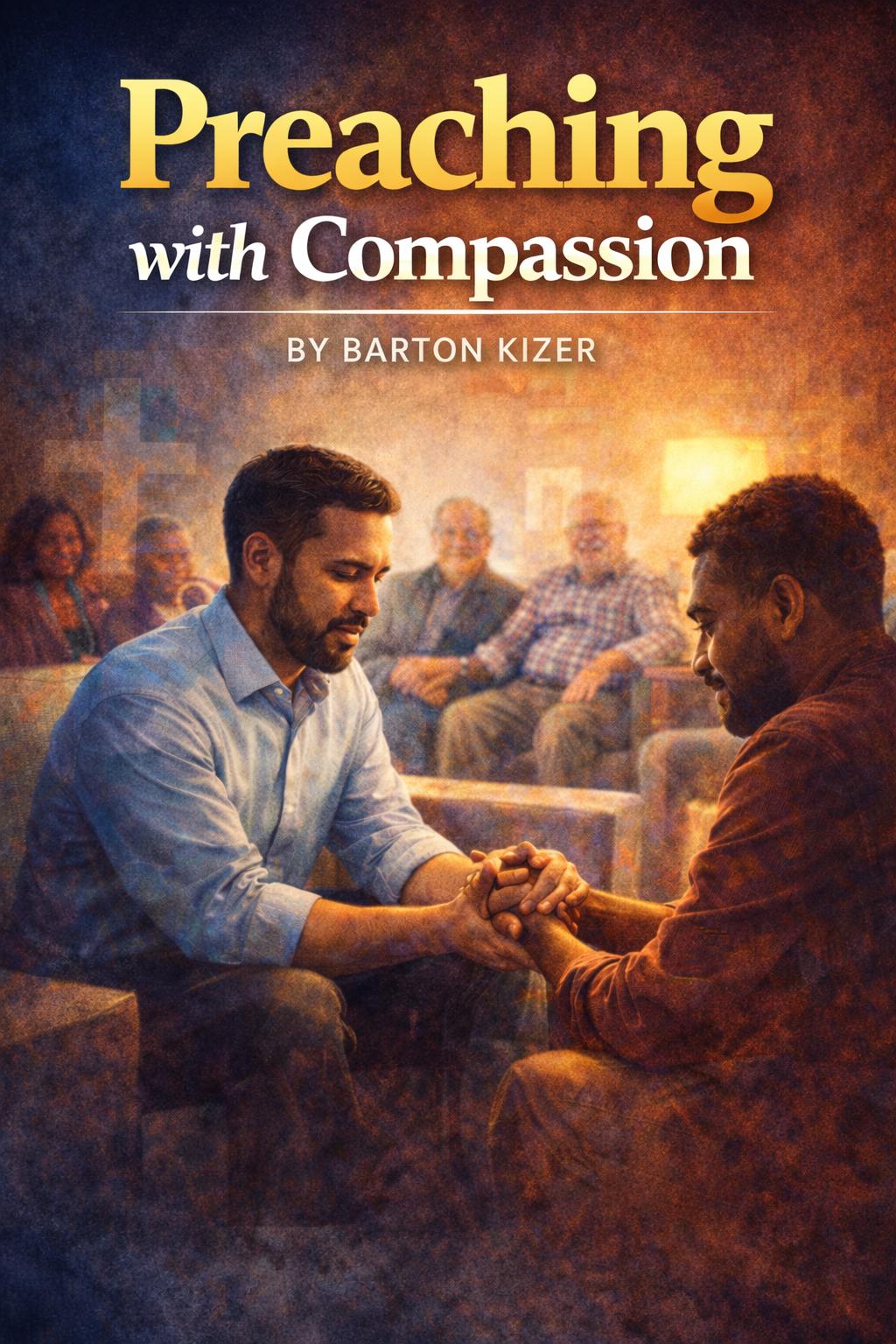
Preaching with compassion doesn’t begin in the study or the pulpit, but by being in the homes of those who gather with the church. An intellectual knowledge of Scripture isn’t enough; compassion grows out of the experience of walking with someone else.
For example, I preached often during the ten years I lived and served as a church planter in Cusco, Peru. It was in the home where I met and came to know Jorge. Whether it was at his place or mine, I learned that he was a recovering alcoholic, estranged from his family, crippled by personal debt, and caring for a son who suffered from schizophrenia. My love and care for Jorge grew during the countless hours we spent together as I listened to him express his worries and hopes. Consequently, his story, and many others in the congregation, informed the way I shared Scripture and preached lessons.
How can a preacher grow in compassion? How can he move from the study to walking with others throughout the week? In 2 Corinthians, Paul gives us three insights into compassion.
The Source of Compassion
“Blessed be the God and Father of our Lord Jesus Christ, the Father of mercies and God of all comfort” (2 Corinthians 1:3)[i]. A preacher cannot grow in his compassion for others until he is wholly aware that his Father has compassion for him. He is a fallen person in need of his Creator’s comfort and grace.
Henri Nouwen describes the inner life as being “like a banana tree filled with monkeys jumping up and down.”[ii] Everyone who reads that description knows exactly what he means. Life can be described in many positive ways, but it is also very much a struggle filled with anxiety and fear. The preacher needs a constant connection with the Author of Compassion. As flight crews always instruct: we must put on our own oxygen mask first before helping others with theirs.