




I grew up. It wasn’t professional sports (genetics ruled that out) or engineering (math and I never got along). No—I wanted to be a youth minister. Three incredible youth ministers had poured into me during middle and high school, and I dreamed of God using me to impact teenagers the same way.
For thirteen years at three different churches, that’s what I did. I loved (almost) every minute of it. “Almost,” because those who have worked with teens know that there are moments where everything went horribly wrong. Some of the greatest moments were baptisms, watching insecure middle-schoolers grow into strong spiritual leaders, and sharing all the laughs and tears. Few things compare to watching former students raise their own families as faithful followers of Jesus. As 3 John 4 says, “I have no greater joy than to hear that my children are walking in the truth.”
After 13 rewarding but demanding years in youth ministry, I transitioned in July 2018 to another ministry role. Looking back, I see clear signs it was time. Don’t get me wrong – I was terrified that I was making a huge mistake. But God guided my family and me faithfully through that transition and blessed us more than I could have ever imagined. Leaving wasn’t failure or burnout—it was obedience to a new season. If you’re wondering whether you’re in that season too, here are some signs I recognized in my own journey.
So how do you know if/when it’s time to leave youth ministry?
A shifting calling. Around three years before I transitioned out of youth ministry, I began to sense a different calling from the Lord. I have always enjoyed preaching. One of my great joys was filling in for the preacher when he would be out of town or even preaching regularly on a Sunday evening. Starting around 2015, about three years before I left, that desire to preach more often began to grow. Most youth ministers have been asked this question – “So when are you going to become a real preacher?” I would always laugh at the question. Youth ministers are real preachers; they just preach to a younger audience. By late 2017, I knew it was time. So, we began to pray for God to provide the right opportunity at the right time.
Do you sense a shifting calling? Do you feel a holy discontent in your heart? It’s a persistent uneasiness that God is stirring a new vision within you. Do you have a desire to take a broader role in church leadership? Or do you have a desire to teach and minister to a different age group?
Impact on the family. Another major sign for me was when youth ministry began negatively affecting my family—the very people God calls me to lead and love first. My wife was an allstar, joining nearly every trip with young kids in tow. But once our children started school, the late nights and frequent goodbyes became harder—events often ended too late or left them exhausted for the next day. The ministry had become more of a burden than a blessing to our family. As a result, we made a family decision that it was time to focus more on our family.

Are you noticing your spouse or kids quietly withdrawing from ministry life? Are you missing more bedtimes, ball games, or family dinners than you’re comfortable with?
Loss of passion or burnout. One of the clearest signs it might be time to leave is when the fire that once fueled your ministry begins to dim. Burnout in youth ministry is painfully common. I’ve walked alongside friends who reached a point where even the thought of another lock-in or parent meeting filled them with dread rather than anticipation. For me— thankfully—it was a quieter loss of passion for certain aspects of the role. I’m deeply grateful that I never hit true burnout in my 13 years. God sustained me through the highs and lows, and I still loved so much of the work. But toward the end, I noticed a subtler shift: a gradual loss of passion for some of the ‘extra’ elements that doing youth ministry well often requires. I still lit up at the big moments—the youth conferences where teens encountered God in fresh ways, the retreats that built deep community, the summer Bible camps filled with worship and life-change. Those never lost their spark.
What began to fade was my enthusiasm for some of the ongoing programmatic pieces: planning yet another midweek event, coordinating the endless calendar of fun outings or service projects, or managing the administrative side that kept everything running. These weren’t bad things—they’re often essential for effective youth ministry—but they started feeling like obligations rather than joys.
At the same time, I felt a growing hunger for new teaching challenges: deeper adult discipleship, preaching to the whole church, or exploring theology with people in different life stages. It wasn’t that I’d stopped caring about teenagers; it was that my gifts and energy were being tugged toward something new.
If you’re honest with yourself (and maybe a trusted friend or spouse), would you describe your current state as sustained passion, subtle fading in specific areas, or something closer to full burnout? Are there specific areas of the role that have started feeling heavier than they used to, even though they're valuable and necessary?
As I look back on my years in youth ministry, I’m filled with profound gratitude. Those years shaped me, stretched me, and allowed me to witness God’s transforming power in countless teenage lives. If you’re sensing some of the signs I’ve shared—a shifting calling, strain on your family, or a dimming passion in certain areas—know this: recognizing them doesn’t mean you’ve failed or that youth ministry wasn’t your true calling. It may simply mean you’ve faithfully completed a season.
Whatever you’re feeling right now, bring it honestly before the Lord. Pray, seek wise counsel, and trust that the same God who called you into youth ministry is faithful to guide you forward—whether that means staying with fresh vision, making adjustments, or courageously transitioning. Your worth isn’t tied to a title or a specific role; it’s rooted in Christ. He’s not finished with you, and His plans for your future are good. If it’s time for you to turn the page, step forward in faith. God will meet you there, just as He met me.


I didn’t get into ministry because I dreamed about ministry.

Honestly, the idea scared me to death.
I wasn’t a preacher. I didn’t lead singing. I wasn’t one of those guys. I had a business degree and nearly three years of experience working in computer software. From the outside, my life looked fine. Stable. Sensible. But inwardly, I was bored—and worse than bored, I was empty.
I had all the things I thought I needed, yet something was missing. God was stirring something in me, even though I didn’t yet have language for it.
When God Uses People (and Comments) You Don’t Expect
Some of you know Chuck Morris. Chuck and I grew up together—and so did Rennie. In fact, Rennie and I were best friends growing up. Life took us in different directions for a time, but Chuck always saw the potential for something more. In the end, God used Chuck to bring Rennie and me back together—this time for good.
I also credit Chuck with introducing me to ministry. He encouraged me toward youth ministry and even invited me to Savannah for a summer internship. I thought he was nuts. No chance.
Zero interest.
But God was working from angles I didn’t see.
Rennie’s mom, Ms. Judy, stayed in touch with me over the years, even though Rennie and I were living separate lives for a long time before marriage. In 1999, email was still fairly new, and one day I forwarded a funny email to everyone in my address book—about 30 people. Ms. Judy was included.
She “replied all.”
Her message was completely out of the blue: “Russ, you would make a wonderful preacher!”
Every one of my friends saw it. I got several hilarious responses. I laughed it off. Good grief, I thought, that’s the most random thing ever.
Turns out, it wasn’t random at all.
A Leap That Changed Everything
Eventually, I took a huge leap of faith. I left my full-time job for a summer youth internship. No guarantees. No long-term plan. I figured I had nothing to lose.
God rewarded that leap with far more than I expected.
That summer was wonderful. And God gave me Rennie. We ended the summer with no ministry job—but we had a wedding to plan. I’d do it all over again without hesitation.
Three months later, in December 2000, I was hired into youth ministry in my hometown. That moment launched 18 years of congregational youth ministry.
I was a happy youth minister. But over time, something else started to form inside me.

When Youth Ministry Is No Longer the Whole Picture
Youth ministry gave me a foundation. It shaped me. It stretched me. But after nearly two decades, I started to realize something important: I had tools in my toolbox I wasn’t using.
I could have stayed in youth ministry. I truly could have. But I felt restless—not in a sinful way, not in a selfish way, but in a God-is-nudging-me way.
I was done with trips.
Done with ping-pong tables. Done with church vans.
Done with signup lists and many of the familiar frustrations of congregational youth ministry.
But I was not done with ministry.
What I loved—what I always loved—was teaching the Bible.
The question was: What now?
Done with ping-pong tables. Done with church vans.
Done with signup lists and many of the familiar frustrations of congregational youth ministry.
But I was not done with ministry.
What I loved—what I always loved—was teaching the Bible.
The question was: What now?
Fear, Uncertainty, and the Question of “What’s Next?” I never thought of myself as a “speaker.” A teacher? Yes. A preacher? Absolutely not.
The thought of preaching week after week for a large congregation made my stomach turn. I admire those men deeply—but I never aspired to be one of them. I didn’t know what God was calling me to, and that frightened me.
I worried about my kids. I worried about my bride. I considered sales. I considered other paths.
I had no clear direction.
Except for one thing: God.
My Wife Saw What I Couldn’t Rennie wanted an adventure.
Over seven years, she had walked with her mother through pancreatic cancer. She had also walked with me through three major surgeries. Life had refined her faith and clarified her priorities.
She wasn’t chasing comfort. She was chasing obedience.
Sometimes God confirms His calling through a spouse who sees more clearly than we do.
A Small Pulpit and a Big Lesson
Eventually, God led us to Culleoka, Tennessee—a small congregation willing to be patient with a 42-year-old “young” preacher who had preached maybe five times a year for 18 years.
That’s not much practice.
I didn’t have all the tools I thought a preacher should have. But I did have a desire to serve—and God had a plan.
At first, I assumed this transition was the transition: youth ministry to the pulpit. Straight line. Logical. Predictable.
But God wasn’t done expanding my toolkit.
“Are
You Sitting Down?”
Those were the words spoken to me by James, the president of Columbia Academy and a trusted friend. I had interviewed for two full-time positions there and hadn’t gotten either one.
But they needed a part-time Bible teacher.
That, combined with preaching, made everything workable. We packed up the truck and moved to Columbia, Tennessee.
And that’s when I truly learned something important.
Beyond the Teen Room
Youth ministry wasn’t ending—it was expanding.
I still preach, and I love the church in Culleoka. They’ve been faithful and patient. But at Columbia Academy, I teach the Bible to students who might never walk into a church building.
In one week of teaching at school, I reach more unchurched students than I often did in months of congregational youth ministry. In the teen room, the focus was almost always on church kids—and that’s not wrong. It’s necessary. But it is limited. At school, I regularly share the gospel with students who have little to no church background at all.
I build relationships with kids and families I would never have met otherwise. Students have to be there. They have to engage Scripture. It’s part of their daily formation.
And I love it.

“Don’t confuse God’s training ground with His finish line.”
A Final Word to Youth Ministers
If you’re a youth minister wondering what’s next, hear me clearly:
There is life beyond the congregational teen room.
That doesn’t mean youth ministry failed. It means God may be calling you to use what you’ve learned in new, broader ways. Teaching. Preaching. School ministry. Counseling. Administration. Missions. Something you haven’t even imagined yet.
Don’t limit God to the title on your business card. Expand your toolkit. Trust the process. And be ready—because God often leads us not just to the pulpit, but beyond it



schedules. As a preacher, you are typically not going to plan, manage, and direct those big and exhaus8ng events like camps, retreats, and (everyone’s favorite) lock-ins. But the weekly pace or cadence never lets up because there is always another class, devo8onal, or sermon on the horizon. Everyone’s schedule and paDern are different, but aFer spending eleven years in youth ministry and seven years preaching, I would suggest that the cadence is the most notable difference.
As someone who enjoys both cycling and running, I feel there is a good way to illustrate the difference between the rhythms and cadences of youth and preaching ministries. When I served in youth ministry, it felt more like riding a bike. I was always moving forward, but some 8mes were really difficult, like riding up a steep hill (e.g., summer was a giant hill). But then some 8mes were less intense, and it was more like riding down a hill, where I s8ll needed to pedal to keep the pace up, but it was much easier (e.g., the first few weeks in fall when students returned to school and I had breathing room to plan for the rest of the year).
Then there is preaching, which feels more like running to me. It’s step, aFer step, aFer step. There are s8ll hills you have to climb (e.g., three deaths in a week and a wedding on Saturday), and you have to keep moving forward. And there are downhills (e.g., the rare, unexpected week when all you have to do is preach and teach). But all along the way, you have to keep your feet moving, because there is no coas8ng. Just like in real life, riding a bike is a lot more fun than running. That’s right—I love and enjoy both youth ministry and preaching, but youth ministry was admiDedly more “fun” than preaching.
Both ministries are vitally important, but if I am being honest, they each have a way of draining us physically, emo8onally, and spiritually. That’s why the prophet’s words recorded in Isaiah 40.31 speak to my heart as a minister so deeply:
but they who wait for the Lord shall renew their strength; they shall mount up with wings like eagles; they shall run and not be weary; they shall walk and not faint. Regardless of our role or 8tle, the Lord provides our strength and enables us to accomplish the goals He has set for us and our ministries.
Mindset
Before we get into an example of developing sustainable rhythms in preaching, I would like us to consider our mindset, because your mindset will develop your paDerns and rhythms. With preaching, there is another old saying you may have heard, “Do you have something to say? Or do you have to say something?” Think about the difference between those two statements for a moment. If you are preaching and your mindset is that you constantly “have to say something,” you’ll panic, be quick to cut corners, and maybe even make unwise compromises to have something to say. But if your desire to teach comes from a true excitement for the Lord and what He has done, you will be mo8vated to share that excitement with your congrega8on in the most effec8ve ways possible.

So, how is all that accomplished? Everyone has their own method and prac8ces, but I’d love to share some of mine with you. For me, it is all about se`ng up sustainable goals and rou8nes throughout the week to help both guard my 8me to study, write, and prepare sermons, classes, and devo8onals, while also making 8me to make calls, visit, and write cards. For me, having set aside 8me for both ensures neither regularly squeezes the other out of my schedule. That prac8ce minimizes stress and allows margin for flexibility elsewhere. For example, if I know I have 8me set aside on Tuesday aFernoon to write a sermon without interrup8ons, I can spend Tuesday morning visi8ng or catching up with members in need without feeling extra stress and pressure. The way I see it, by giving both a defined 8me and a defined schedule, I make myself more available than if I were winging it each week. Will the unexpected s8ll occur and occasionally upend my schedule—of course. But se`ng weekly rhythms helps me have a road map to return to and minimize the stress of “what’s next?” when the fog clears.
A very simple example of my Monday and Tuesday morning schedule looks like this: Monday morning, I review Sunday updates, take note of any visitors and prayer requests, and iden8fy anyone who needs to be contacted or followed up with. Then I reach out to those contacts. I then spend the rest of the morning studying for upcoming lessons. Monday aFernoon is dedicated to study 8me, when I set my phone to do not disturb and out of reach so I can con8nue studying, taking notes, and crea8ng an outline. Of course, once or twice throughout the aFernoon, I’ll check for any messages or missed calls. Tuesday morning, I handle any follow-up visits or outreach to members. On Tuesday aFernoon, I go off-site to complete the Sunday-morning sermon, graphics, PowerPoint, and small-group guide.
Inten8onal rhythms are key. By taking 8me during certain parts of my week to put the phone away and even step out of the office, I free up more 8me to be not only more available but also focused and aDen8ve. Each minister’s schedule will look different based on their abili8es, congrega8on size, ministry staff, responsibili8es, and lesson load. But if you are making the transi8on from youth ministry to the pulpit, I urge you to take the different aspects of your schedule and block out 8me to focus on them. And then—this is where the discipline part comes in—do them. When I say I will have the Sunday morning lesson ready to go on Tuesday aFernoon, I mean it. I reserve a study room at my local library on Tuesday aFernoon, and I don’t leave un8l I’m done. That’s normally at the end of the workday, but some8mes it takes an extra hour or so. But by se`ng personal checkpoints throughout the week, I’m able to focus on the task at hand. Do emergencies pop up? Absolutely. Do I some8mes need to leave the library and rush to the hospital to visit someone? Yeah, I do. But that structure helps me be the best I can be for my congrega8on and family by inten8onally crea8ng a framework to complete my necessary tasks, so I can be fully present in the lives of the people I love.
A Final Note of Encouragement
Youth ministers, I have some great news. The teens and children you have been inves8ng in and developing over the years are growing up and becoming the adults in our congrega8ons. And guess who knows them best and already has a rapport with them. YOU! That truth is both exci8ng and rewarding. So if you are considering making the move from youth ministry to preaching, or you have made the change recently, don’t stress, because your excitement and dedica8on to faithfully working for youth is exactly what you need to roll into the preaching role. Will it look different? Of Course it will. But don’t stress. In fact, go out for a bike ride and think about how that flow mimics your youth ministry. Then, hop off the bike and go for a run, and consider that rhythm and cadence. At first, this transi8on may feel strange, but you can do it, and we are all here cheering you on.


A few years ago, my lawnmower needed a battery. I installed the new one, and it cranked without issue. The next time I needed to mow, it was dead. I jumped it off, and mowed with no problems. When I would crank it, it kept happening. A brand new battery wasn't operating like one. I panicked at first, "Something might be wrong with the lawnmower itself." Then thought about it more, "Maybe I just bought a bad battery and need to swap it out." Then, finally (after longer than I care to admit), "I could start by checking the cable connections." After I tightened those fully, I have not had an issue in the years since.
It's easy to fall into the same cycle in ministry. When reality doesn't meet our expectations, we might immediately think we are the problem. With a little time, we calm down, but are annoyed at the inconvenience. Then we finally land with the small but obvious solution. In ministry (as with the lawnmower battery)...check the connection.
If you're making the transition from youth ministry to preaching, plenty of moments will challenge your expectations and cause you to question yourself. You're learning new responsibilities and priorities in ministry, and you're learning a new relationship with the people you're serving. Additionally, you might be learning new people in a new place.
Both roles are tremendous blessings in the kingdom because of the God who empowers your work.

One of the most glaring expectations when we leave traditional youth ministry relates to our time. There are objective reasons: you will take fewer ministry-related trips; you will spend more nights at home; and your "average" day will look more "average" (work during the day, be with family in the evening). As family commitments grow, this can become a motivation for moving on from youth ministry into a different role. However, these expectations and the relief we might anticipate need to be managed responsibly.
There are some objective reasons why you will have less "free time" despite being at home more often: you are responsible to more people across every generation; you are assigned significant administrative, organizational, and leadership tasks; and Sunday happens every week. Do not underestimate these factors. They all represent time commitments.

Additionally, do not underestimate how those differences are not always the heaviest demands. You will have more demands for your time, and you will have even more reasons why you feel like you have less time: your sermons and lessons will rarely feel finished; your visits, prayers, conversations, and studies with people will rarely feel complete; your empathy for their pain will rarely go away; your fear for their soul's condition will rarely subside; your personal/private prayer and study habits will rarely feel sufficient; and more people will hold you to a high standard of authority, for better or worse.
When we find ourselves having "free time," thoughts and emotions from these categories will slip in. And when they do, they can quickly overwhelm us.
The differences between youth ministry and preaching will manifest themselves for years to come. Resist the urge to create a list. Refuse to label either role as "better" or "worse." You do not have to envy or speak ill of your previous schedule in youth work. You do not have to resent or boast about your new one in preaching. Both roles are tremendous blessings in the kingdom because of the God who empowers your work.
No matter how we define "free time," it is neither our primary goal nor a selfish pursuit. When we grow defensive and resentful toward others because they do not respect our "free time," we are in serious need of awareness and repentance. But neither do we need to feel guilty for enjoying time away from ministry responsibilities and church members.
Because Christ is our master, we find freedom in our service to him (Galatians 1:10; 5:1; see also John 8:31-32, 36; Romans 6:16; and 2 Corinthians 3:17-18). When we are truly "crucified with Christ," we have joyfully submitted to using all of "our time" for his glory and loving others (Galatians 2:20; 5:13-14). Through this daily commitment, we bear the fruit of God in our relationships (Galatians 5:22-23). This framework is true for every Christian, no matter his or her profession. When these principles are missing or are out of balance, then we will produce the works of the flesh instead (Galatians 5:19-21).
Freedom is already our present reality; therefore, fruit is our purpose. No matter how much time we have or feel that we have, fruit is our purpose and God's expectation (John 15:8).
God produces fruit when we are connected to Jesus and actively living from that connection (John 15:4-5; 1 Corinthians 3:6-9). We cannot control the timing or specific outcome of the fruit. But we can always control these two factors: connection and activity. If you feel your time is depleted in your new role, check your connection. Don't wait until you feel rested or comfortable to courageously act for him. Your work will never feel finished because His work in you is never finished this side of eternity (John 9:4-5; Philippians 1:6). Rejoice and thank God that the commitments that feel unfinished are the very commitments that last (Psalm 1:3; 92:14; Proverbs 11:30).

I am a PK (preacher’s kid). My grandfather was a preacher, and my uncle still currently preaches. All my life I was encouraged to preach and had made the determination by my senior year in high school that I indeed want to go into preaching. However, during college I did some youth ministry internships and began to fall in love with the idea of youth ministry. My path started to steer in that direction, and to be completely transparent, part of that determination was that I did not feel like I was a good enough speaker to jump right into pulpit ministry.

Seeing as I was turned down by several congregations, others may have felt the same. Youth ministry, at first, seemed like a consolation prize and something that would be easy until I had a few more years of experience under my belt. I quickly became ashamed of that attitude, realizing that youth ministry is legitimate ministry and that I genuinely loved and felt called to do that work. It was rewarding, felt natural to me, and I genuinely believed I would be a “lifer.”
Time marched on and something began to shift in my perception of my work. I still loved and cared for the families to whom I ministered, but I was feeling a drain on my emotional side that I could not seem to let go of. I began to realize that my heart was turning back to the pulpit. The desire to study and teach, the opportunities to minister more frequently to all ages, and my growing family’s schedule began to bring me back to that initial desire from my own youth. And so once again, there was that nagging feeling that I was simply trying to make my life easier or more suited to my desires. Leaving youth ministry at times, felt like a cop out to an easier form of service based on a more predictable schedule, less late nights, a more pronounced job description, and less pizza! That guilt was misplaced. Paul said that the requirement for a good steward of God is that they “be found faithful” (1 Corinthians 4:2). Faithfulness in the pulpit or faithfulness during VBS is still faithfulness.
Little did I realize that “easier” or “harder” are still relative concepts. Marcus Buckingham is credited for having said, “What is easy for you is not easy for everyone—and what is hard for you is not hard for everyone.” Some of the things that I initially thought would improve, have only gotten worse. My frantic schedule, especially in the summers with camps, mission trips, Vacation Bible School, devotionals, etc. have only been exacerbated due to my own children’s involvement in these activities. My excitement over having hours and hours a week to prepare my classes and sermons has been replaced with often frenzied scrambles to wake up early or stay up late, to study while I drive, or to have to occasionally not have the “absolute perfect” sermon every Sunday.
I will admit that certain things have gotten easier. People do tend to view the pulpit minister’s job as a legitimate profession and look at the youth minister with suspicion regarding “what on earth he does with his time.” That is not to say those same sentiments are absent from the minds of those in the pews, but it is less likely to be expressed. However, many of the things that I view as easier or worse are more descriptive of my personality than an expression of the actual job. For example, I absolutely loathe the planning and execution of youth events. There is a high degree of pressure to have everything right and a level of expectation that I feel often does not get met by the students, parents, or both. And so, to be out of the “event planning” part of the job is a major relief. But there are plenty of youth ministers who love that part of the work. I really enjoy just spending time with our members and chatting, getting to know them and learning from them. Some youth ministers who swap over to the pulpit struggle with the bridge-building, broad relationship aspect that comes with the pulpit territory. So, back to the quote from Marcus Buckingham, I believe that most of what is “easier” or “harder” in regards to either one of these ministry positions will have a direct correlation to our own strengths and weaknesses and our own personality leanings and less to do with the jobs themselves.
Ministry is not easy. If it was, Paul would not have charged us to “not growing wearing in doing good” (Galatians 6:9), but it is rewarding. Whether in the pulpit or in the lives of young people we are going to struggle with certain aspects of the job and others will be considered second-nature. The key to our success is to do the hard things and focus on the end goal of “reaping” in due season (Galatians 6:9).
ELDERS ONLY: LAST MONDAY OF EACH MONTH
7-7:30am CST. TEXT CELL NUMBER OR EMAIL ADDRESS FOR INVITES 972 861-2434

Each preacher reflects on their early experiences: delivering their first sermon, hospital visits, challenging encounters, admonitions, funerals, wedding rehearsals, and realizing that ministry is both complex and sacred. The first year and the following five years serve as a testing ground in which one grows into the preacher God desires.
There are challenges, needs, obstacles, and growth strategies faced during those early years of ministry. Paul encouraged Timothy in a ministry setting by saying, “Take heed to yourself and to the doctrine. Continue in them, for in doing this you will save both yourself and those who hear you” (1 Timothy 4:16 NKJV). Personal evaluation and doctrinal strength are crucial for successful ministry. But when difficulties arise, what do ministers do?
First, consider the challenges facing ministers, including time constraints, unwritten expectations, financial limitations, conflicts, isolation, and burnout. Always remember,

ministry does not start in the pulpit; it begins in the heart. As you grow in understanding and experience, keep your top priorities as a minister in mind. First, sermons. You have been hired to excel in the pulpit, so do so. Second, Bible classes. Be the kind of teacher who is never forgotten. Deeply embed scripture into the hearts and minds of eager Christians. Third, visiting. Visit everyone, but make sure to visit the elderly members first. You need to know them well, because their funerals will come first.
Second, consider the needs of a minister. As you start, it is easy to neglect your family and take them for granted. Manage your time well so that your family can experience the joy of ministry. Remember, you have “P. K’s.” That means, “Preacher’s Kids.” Occasionally, a preacher’s kid will enter the ministry. That is a wonderful thing for his family and the local congregation. He grew up in ministry, has seen behind the curtain, and does not have to be spoon-fed. However, many ministers do not come from a ministry family and must learn through trial and error. If this applies to you, you need to guard your wife and children carefully. Help them see the positives, joys, successes, and honor of ministry. Your son may follow in your footsteps, or your daughter will seek to marry a minister. Overall, guard your precious family; they are your lifeline.
Third, consider the obstacles of ministry. Like any profession, there are good days and bad days. Often, when facing a challenge, it can become a roadblock or a deadend. Criticism, loneliness, discouragement, and burnout are real. So, do three things: first, expect these obstacles will come, so do not be surprised; second, use the obstacle as a chance to improve. If the criticism is valid, adjust and grow. If burnout hits, learn from it so you can help others who are struggling. If loneliness and discouragement weigh you down, seek positive relationships and work to strengthen your resolve so you can face the next challenge with confidence. Third, forget it. Don’t dwell on failure or futility. Put the obstacle in your rear-view mirror and leave it behind. Most importantly, recognize a higher reality: It is not always greener on the other side of the fence. If your grass is struggling, give it the “water of life” and watch it flourish.
Fourth, consider growth strategies. Reflect on the following practical helps for growing ministers:
· Study, study, study – ministers never stop learning. Wake up early and burn the midnight oil. Remember, you cannot share what you do not know, so do not fake it.
· Visit, visit, visit—maintain a close presence among the members. Love them, and they will love you back. Why? The time will come when you need to “Bring the Hammer Down” (i.e., challenging sermons about topics like modesty, marriage, and maturity). If your relationship with the congregation is based on love, respect, and sincerity, tough sermons will be accepted and appreciated because they love you, and you love them.
· Pray, pray, pray – not just for the members, but with the members. Let them hear your words of care and concern come from your lips. Hold their hands and hug their hearts. Prayer will strengthen your relationship with them and your relationship with God.
· Grow, grow, grow – read good books, listen to good preachers, build strong relationships with fellow preachers. If you are not growing, the congregation will be the first to notice. Lazy preachers are unemployed preachers.
· Praise, praise, praise - recognize good deeds, joyful accomplishments, and humble service. Remember, Great Congregations Have Great Things to Talk About. Foster encouragement, praise, positive affirmation, and edification in the hearts, minds, and souls of members. Lead by example with humility and sincerity.
Make sure that you are a “man of the book” in public and private. Let the congregation and your family see consistency, integrity, maturity, and fidelity in your daily walk with God.
My dad, Glenn A. Posey, preached for 60 years in North Alabama. Many said he was a well-balanced preacher and minister. He always considered that a compliment. The home he and Mom built was fantastic. I loved more than anything growing up in a “preacher’s family.” We always laughed, sang, entertained Christians and fellow preachers, attended every Gospel Meeting, Vacation Bible School, Worship service, Lectureship, Funeral, Wedding, and Church gathering that took place. It was a joy, privilege, and honor. But what drew me to follow in my father’s footsteps was not the prestige, pageantry, or perception of ministry; it was the consistency I saw in him—my father, my minister, my preacher. The man I saw in the pulpit on Sunday was the same man I saw in the kitchen on Monday morning cooking breakfast. Dad knew that virtue begins at home for the Christian, preacher, and minister. He said, “The reality of a Christian is what he is in his heart and in his home.” Dad lived Christianity, and what I saw in him was what I wanted to do with the rest of my life.
The first year of ministry will shape you, and the next five will define you. Always remember that the work is essential and that God remains faithful.
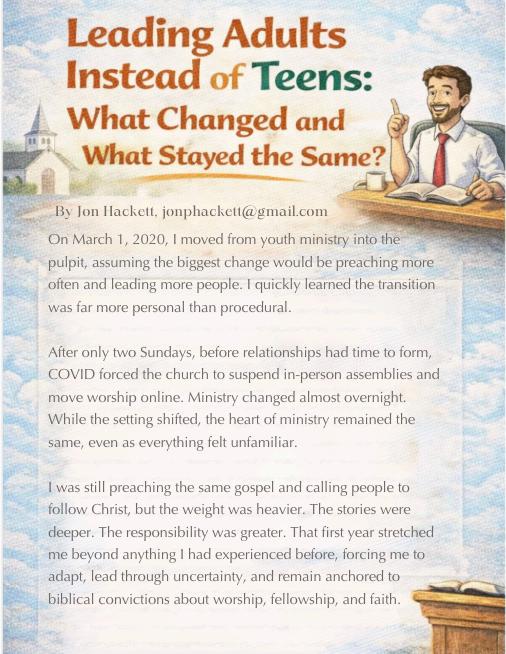

Some lessons surprised me. Others confirmed what youth ministry had already taught me. Many were learned through trial and error. Now, after more than five years in the pulpit, I offer a few reflections on what changed, and what stayed the same, when I moved from leading teens to ministering and leading adults in the local church.
It’s Different:
Authority Isn’t Assumed, It’s Earned
In youth ministry, authority often comes with the role. Students may test boundaries, but they generally accept your position. Leading adults in the church works differently. Titles alone carry little weight. Trust carries everything.
Adults in the congregation watch carefully. They listen to how you handle Scripture, how you work with the elders, how you treat people in disagreement, and how you respond when things are difficult. I learned quickly that influence in the pulpit is not automatic. It is built slowly through faithful preaching, consistent character, and genuine care for people.
Adults Bring Their Entire Story into the Assembly
Teenagers are still forming their identity. Adults arrive with decades of life already lived. Every sermon is filtered through marriages, parenting struggles, grief, church hurt, regret, faithfulness, and unanswered prayers.
That reality changed how I preached. Truth did not become softer, but it became more careful. I realized people were not just asking, “Is this biblical?” They were also asking, “Does this speak to the life I am living right now?” Teaching adults requires patience, empathy, and a deep respect for the faith journeys people carry with them into the pews.
Growth Slows Down, but It Goes Deeper
Youth ministry often feels fast-paced. Camps, retreats, mission trips, and visible decisions mark progress. Adult ministry feels quieter. Change happens slowly and often invisibly.
There were seasons when I wondered if anything was happening at all. Then someone would quietly share how a sermon preached months earlier helped them forgive, persevere, or remain faithful. I learned that adult discipleship is less about momentum and more about long-term spiritual formation rooted in God’s Word.
Conflict Becomes More Complex
Teen conflict is usually immediate and obvious. Adult conflict is layered with history, relationships, and emotion. Disagreements are not always spoken openly. Resistance may appear as silence or withdrawal rather than confrontation.
Leading adults required me to slow down, listen more carefully, and work closely with the elders during moments of tension. Ministering through conflict shaped my leadership far more than organizing programs ever could.
It’s the same:
Relationships Still Matter Most
One of the greatest gifts youth ministry gave me was a deep appreciation for relationships, and that did not change in the pulpit.
Adults still want to be known. They want to know their minister cares beyond the sermon. Hospital visits, phone calls, Bible studies, and shared moments of grief and joy often do more to strengthen ministry than any outline or illustration. The pulpit may be public, but effective ministry in the church is always personal.
Authenticity Still Wins
Teenagers can spot insincerity instantly. Adults can too they are just more reserved in how they respond.
Congregations do not expect perfection, but they do expect sincerity and faithfulness. I learned that authenticity builds trust in a way that polish never can. When people know your faith is genuine and your life aligns with your teaching, they listen more openly, even during difficult conversations.
Clear, Biblical Teaching Still Transforms Lives
Youth ministry taught me the value of clarity, and I carried that lesson directly into the pulpit. Adults do not need complicated sermons filled with unnecessary language. They need Scripture explained accurately and applied faithfully to everyday life.
Stories still help. Illustrations still connect. Application still matters. What changes is depth. Adults want teaching that challenges them to grow in knowledge, conviction, and obedience to Christ.
Vision Still Moves the Church Forward
Casting vision was central in youth ministry, and it remains essential in congregational leadership. Adults want to understand why the church exists, where it is headed, and how they can participate in God’s work.
When vision is clear and grounded in Scripture, the church moves from attendance to engagement, from routine to purpose.
Enthusiasm Still Matters at Every Age
One lesson that has remained constant is the importance of enthusiasm. Teens respond to passion, but so do adults. Enthusiasm is not hype; it is visible conviction.
Whether preaching to teenagers in a classroom or adults from the pulpit, enthusiasm communicates belief. When a minister genuinely loves the Lord, loves the church, and believes in the message he is preaching, people notice. Especially in difficult seasons, enthusiasm fuels encouragement, perseverance, and hope.
The Biggest Shift: From Programs to People
The most significant change for me was learning to focus less on events and more on people. Youth ministry often revolves around schedules and activities. Pulpit ministry centers on walking with people through the seasons of life within the local church.
Somewhere along the way, I realized I had not just changed roles. I had grown into a deeper understanding of what it means to serve God’s people faithfully.
Final Encouragement
Youth ministry is not a lesser preparation for the pulpit. It is one of the best training grounds imaginable. It teaches adaptability, communication, relational leadership, and gospel clarity.
Leading adults requires growth, patience, and wisdom, but the heart of ministry remains unchanged: loving people, preaching Christ, and pointing others toward transformation through God’s Word. What changes is the audience. What stays the same is the calling.



Having a youth ministry that touches and serves all other life stages has its value. By design, our family driven approach to youth ministry meant that parents and children from cradle roll to 12th grade spent time not only together, but also in service to other groups within our church family. What quickly became apparent to me was that in this ministry design, relationships were being built with intergenerational connections. I remember people saying, “You are more than a Youth Minister to us.” What a beautiful expression, right? Well, yes and no. I always felt that what I did was full of substance, so I never felt like my youth ministry was anything less than, well, ministry. I know they meant well, but it almost sounded like they had the idea that youth ministry was childish and that one day they might “make a preacher” out of me.
Years passed by and my hair got grayer, my ministry became focused more on family dynamics and with that, loads of experience and opportunities to share more with the congregation at large came my way. Our preacher of 20 years retired amid Covid and all the sudden, we were in the middle of a search. I had always “stayed in my lane” and focused on one-on-one ministry in addition to teaching and offering spiritual guidance to those in crisis. But now, my name was mentioned as a candidate for the newly vacated preaching position. In full disclosure, I wasn’t sure I was ready or willing to begin with. I had preached only 18 times in 21 years. Was I prepared enough? Experienced enough to lead a large congregation that way? Our preacher had been so steady and solid in the pulpit that I never even let the thought enter my mind. The question came at lightning speed, “Do you want it?” Man. Great question. I just wasn’t ready to give an answer. Could I? Am I wired for that? Can I handle the scrutiny? Am I the right person for this church? My father always taught me to have “alligator skin” in ministry but being a preacher, being recorded on livestream every Sunday was something I had yet to experience.
Well, I went through the full process: resumé, questionnaire, two interviews, and a lot of prayers and silent waiting. I prayed for God to put the best person in place for our church family and left it up to Him. God did something amazing. He brought our shepherds to a beautiful conclusion: two preachers. Andrew Itson and I agreed to share the role of preaching. It was brilliant because Andrew had the decade of rich preaching experience that I was lacking and I had two decades worth of knowledge and relationships in our church family. The thought was that I would offer insight into Andrew’s experience and that I would find a blessing in preaching alongside a younger, but more experienced preacher. It has been wonderful.
Here's few things I would suggest to anyone in youth ministry with an opportunity to preach at the same congregation.
1) Accept the challenge to dig deeper in God’s word. In youth ministry, we are often lulled into spiritual hibernation because of cyclical curriculums. Preaching requires us to break out of teen-friendly topics and calls us into deeper investigation of God’s word. This will convict you, challenge you, and transform your communication of the gospel
2) Be patient with yourself. Comfort and poise come with experience. Let God and His spirit transform you. The power is in Him, not you. Repeat that.
3) Leverage your relationship equity. Because you have already been serving alongside them, use your connections to gain insight into the struggles and challenges the church family is experiencing and give biblical answers to their questions. This will deepen their appreciation for relevant teaching.
4) Continue to invest in youth ministry. Because you have a new role does not mean you lose connection with teens. They will likely be so proud that you are getting an opportunity to build influence in the church. They will be your greatest supporters and will be excited to bring their friends to worship.
5) Be proactive in touching all life stages. Because some will continue to see you as the youth minister, be intentional in connecting with the elderly and empty nesters. This will build trust and confidence in your maturity.
6) Engage in prayer with your shepherds. When opportunities arise, join the shepherds in prayer for the church family. Gain a deeper insight into the challenges they are facing so you can be a clear communicator on their behalf.
7) Create healthy boundaries to protect study time. Ministry, especially youth ministry, is built on availability and personal contact. Carving out successive hours to focus on your message without interruption will give you time to get your thoughts settled but will also free up time to build relationships when time avails.
I did not realize how much ministry takes place when preaching. One might think that happens mostly person to person, but I am constantly reminded that God’s Word is powerful and active, penetrating the heart. Delivering it with passion and humility has a way of touching people in their soul, convicting, motivating, and feeding a hungry heart. Preaching ministry changes the messenger and inspires others to do the same. That’s something we can all be excited about.

You loved working with young people, and teaching God’s word, and now the opportunity to preach fulltime presents itself. Maybe you had no plans to preach. If that was you, I can relate. I had worked 20 years in youth ministry and Christian education, and I thought this would be my call in life. It has been said God often laughs at our plans, and I feel like He laughed at mine. I was a late comer to preaching at the age of 40, but I am so glad God has made it possible. His ways are above our ways. I have often said I wish every preacher had the chance to teach God’s word to young people. Because to be successful with young people, you must develop many skills that will aid your efforts in reaching the lost and teaching the gospel. One vital aspect of your move to the pulpit is to recognize these strengths and the ways they can be helpful when moving to the pulpit.

Teaching young people forces youth ministers to develop the ability to keep their attention. You know they can be distracted, disaffected and unfocused and it caused you to do all kinds of things to make sure they were engaged during Bible class. When presenting God’s word from the pulpit the same need exists, but the approach may differ. One of the aspects of the move to preaching you will enjoy is the overall audience is more mature and invested in learning than the average young person. However, adults are distracted as well, and the skills you learned in keeping their attention can help. While silly games, projects, and childlike illustrations will need to be replaced with variety in lesson styles, illustrations that reach a broader age spectrum, and a focus on the art of clear, concise communication skills with an audience that doesn’t interact, your ability to keep the attention of others will still be paramount.
Successful youth ministry is about relationships and so is preaching. The biggest difference is the number of relationships increases. While it will be natural in connecting with children, the youth group, and college age members, you must now give special attention to the rest of the congregation. This will take time, but the principles stay the same. Learn their names, spend time with them, get to know what is important to them. Take the initiative to reach out and let them know you are available. Show them you care for them. This will take time, but the relationship will and must grow. Just like students, congregations will listen to you if they know you care about them. So keep building relationships.
Successful youth ministers stay in touch with the world we live in and so do good preachers. Youth ministry involves keeping up with brain rot, memes, and youth culture to know and reach your audience. Preaching will call for the same skill, but you will simply have to expand your search for connections and ways to relate. Use your time making relationships to become aware of the cares, concerns and thoughts of older members. As you prepare your lesson make sure to take in perspectives from all stages of life as you strive to inspire, illustrate, and make applications to the word. Make a conscious effort to address all age groups at least once in each lesson. You know what it takes, make sure to relate.
Successful Youth ministers know how to “Keep it Real” and so do preachers. Young people know how to sniff out pretenders, and a key to any successful youth ministry is being genuine. As you move to the pulpit, keep this trait. Don’t pretend or try to be someone or something that you are not. Just be yourself. Learn from other preachers, but don’t try to imitate them. Give as much energy developing your love for the Lord and for others as you do your abilities in presenting the word and let that love shine through in your ministry. It will take years to develop your knowledge and expertise in presenting God’s word, but your ability to be genuine can bless your ministry from day one. Do your best to avoid arrogance, conceit, and being absorbed with visions of grandeur of all you will do. Instead, be sober in all things, endure hardship, do the work of an evangelist, fulfill your ministry (II Timothy 4:5). In doing these things you will keep it real. May God bless you as you make this move into a new stage of ministry and remember to keep and add to these strengths as your move forward.