College repairs union flood damage
By Christina Lewis Assistant Editor
The college is replacing dry wall, baseboards, ceiling tiles, and carpet in three rooms after the union flooded last week, according to Vice President for Administration Richard Péwé.
Extremely cold temperatures caused a pipe to burst, filling AJ’s Cafe, the formal lounge, and the hallways near the bookstore with a couple inches of water.
“We will run the fans and monitor daily for any signs of damage, until we are confident all moisture is gone out of the floors of AJ’s,” Péwé said. “We feel good about moisture and air quality.”
During construction, contractors had removed insulation to perform their work, according to Péwé. They ordered supplemental heaters to keep
Vote
for
these seniors next week
Voting for Oustanding Senior Man and Woman opens next week. The results will be announced on Feb. 13.
Nominees for Outsandting Senior Man:
Daniel Doyle
Kevin Pynes
Patrick Scott
Jonathan Williams
Nominees for Outstanding Senior Woman: Sydney Green Emma Kate Mellors
Ashley Poole
Ellyana Tierney
the pipes from freezing, but the heaters did not arrive on time, so the pipes froze when the temperature dropped. Cold air coming down from the tower shaft caused a two-inch fire suppression pipe in the ceiling above the Raese Room to freeze and break.
To stop the union from flooding further, maintenance crews turned off the water supply, Péwé said. The college brought in a professional cleaning company to remove all unseen moisture.
“At night they have been pushing air into the ceiling between floors to ensure all the moisture has been addressed,” Péwé said. “They have been testing for moisture and air quality along the way.”
Contractors replaced the insulation and repaired the pipes, Péwé said. Contractors also put
supplemental heaters and increased the heat in the building to account for the colder weather outside.
After fire alarms sounded in the union at 3:50 p.m. on Jan. 21, students evacuated the building.
Senior Ashlyn Linton was in orchestra practice when she got an email notifying her that a pipe burst and that Metz would serve dinner in the Searle Center.
“I think people were actually very excited, because it was something new,” Linton said. “And some people had videos of the union flooding, so everyone crowded around and watched it and had fun.”
Metz served dinner that night and breakfast the following morning in the Searle Center. The dining hall was open by lunchtime on Jan. 22.
“It was usual Saga food, but I really liked this meal,” junior Anne Crites said. “I liked the Mexican rice and chicken, and it was fun to eat with my orchestra friends.”
Vice President for Student Affairs Diane Philipp said the college is grateful for the quick response by the maintenance team, Dow Center, and Metz staff.
“Everyone came together and began solving the problem immediately,” Philipp said. “We are blessed to work with such dedicated and professional co-workers.”
Senior Makayla Hanna said she was amazed to see how quickly the college got everything back up and running.
“I’m sure everyone involved worked really hard that night to solve the problem,” Hanna said.
‘Life has infinite value’:
Students rally at March for Life
By Adriana Azarian Assistant Editor
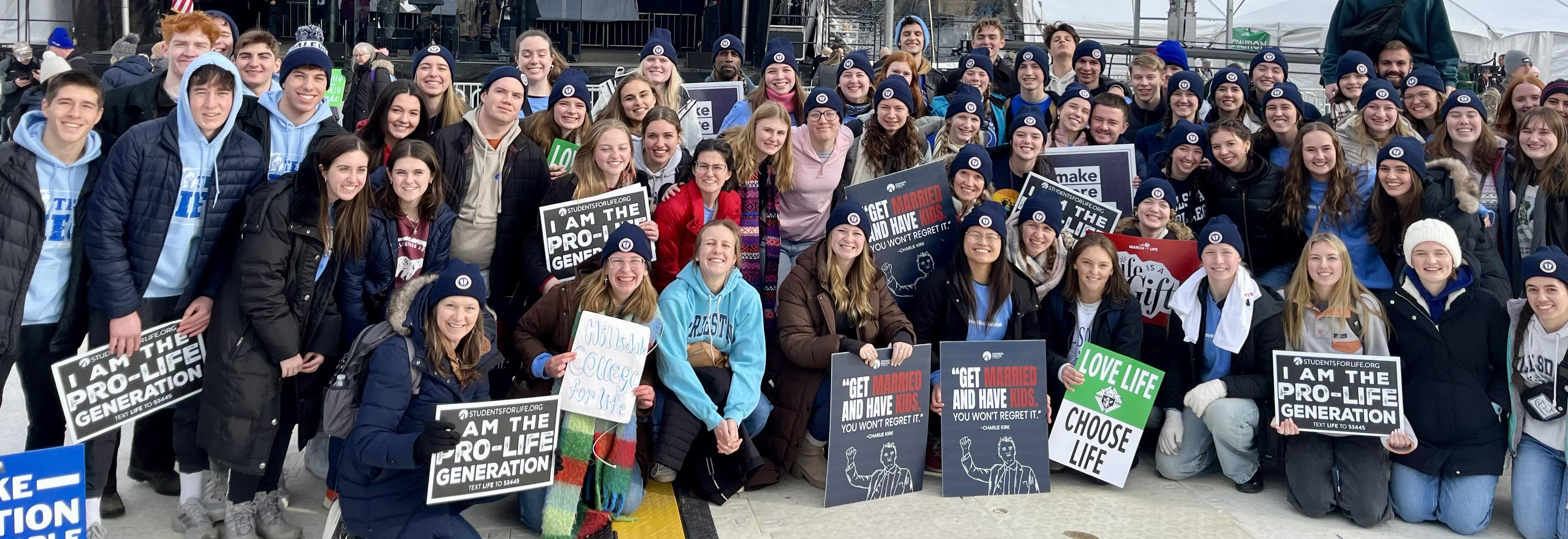
Crowds of college and high school students, nuns and clergymen, and even babies gather annually in Washington, D.C., to celebrate the sanctity of life
“This year, at the March for Life, I saw thousands and thousands of people, young and old, who live under the conviction that life is a gift from God, and no matter what it takes to protect that life and to save that life, we are willing to do that, especially as Christians,” said Meredith VanDerWeide, senior and president of Hillsdale College for Life.
Nearly 100 Hillsdale College and Hillsdale Academy
students were among the thousands of school and col lege campuses, organizations, and religious communities who marched from the Na tional Mall to march in front of the Supreme Court and the Capitol.
“It wasn’t just fight ing against the evil of abortion, it was also building up strong fam ilies and promoting good things that can really trans form the culture,” sophomore Maya Miller said.
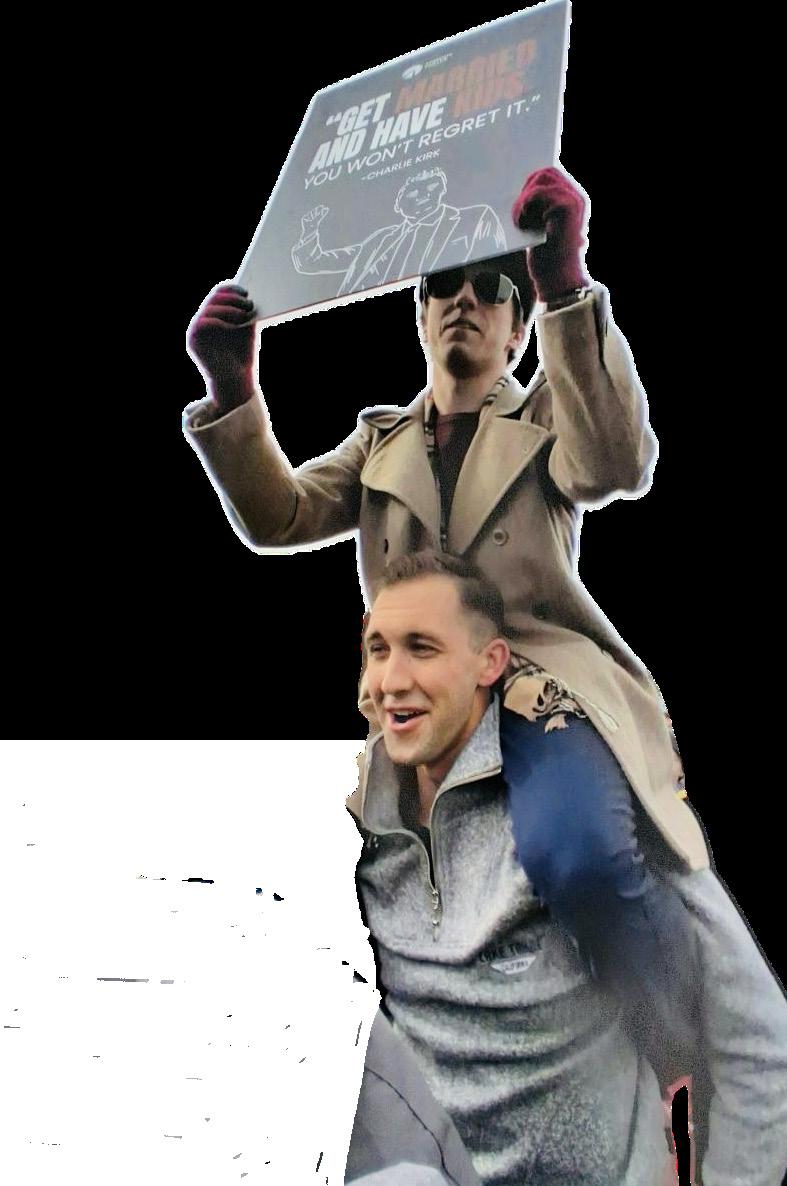
Miller and sophomore Mi cah Vawter took that to heart as they got engaged on the trip, celebrating their oneyear anniversary since they began dating at last year’s March for Life.
The pro-life cause is per sonal for Vawter, whose mother was advised to abort
Hillsdale public schools pension debt totals $18M
By Eleanor DeGoffau Senior Reporter
Eighteen million dollars.
That is how much unfunded pension debt burdens the Hillsdale Intermediate School District, according to official state audit reports. It’s worth nearly 80% of the district’s assets.
For Chuck North, superintendent of the special education district, this number isn’t alarming — it is a sign of a teacher pension system being reformed for the better.
“It’s not a completely broken system that’s going to break schools at some point,” North said. “We just need to let the system work and be maintained as it currently is for the future.”
“Lawmakers are doing what they can to catch up,” Hohman said.
According to Hohman, Michigan currently has $28 billion of unfunded pension debt due to underfunding the system for years.
his brother, Matthew, who was diagnosed with Down syndrome vere heart
Hillsdale to release new film in theaters
By Ty Ruddy Culture Editor
With the help of Fathom Entertainment, Hillsdale College will release its first film in theaters on Memorial Day weekend this May. “Revolutionary America” will hit cinemas on May 31 and is expected to play on 1,000 screens across the country until June 2, Jeremiah Regan, executive director of online learning at Hillsdale College, said. The documentary will tell
the story of the decades that led to the American Revolution and the story of the war itself. College President Larry Arnn; Wilfred McClay, professor of history; Paul Moreno, professor of history; Thomas West, professor of politics; Kevin Slack, associate professor of politics; and John Grant, associate professor of politics will all feature in the documentary. John Lovell, founder and CEO of the Warrior Poet society; Michael Knowles, host of “The Michael Knowles
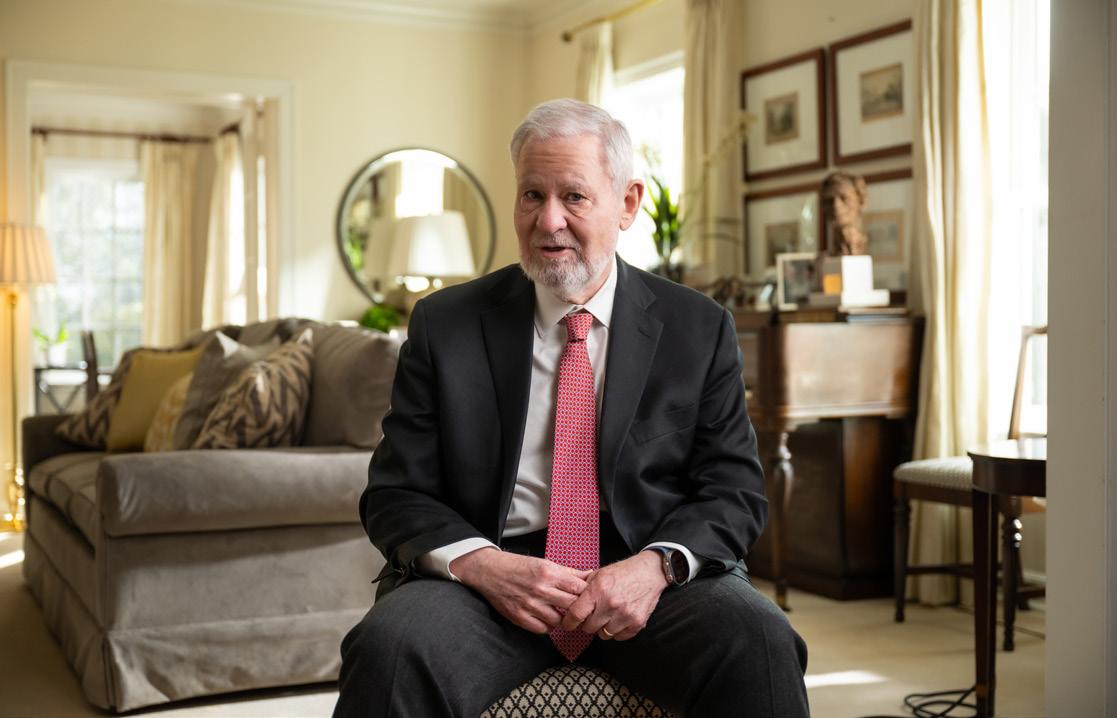

Show”; and popular author and biographer Eric Metaxas will also give lectures in “Revolutionary America.” Regan and Arnn said the documentary works well as a celebration of the 250th anniversary of America’s founding.
“The 250th needs celebrating, as it is worthy of both celebration and study,” Arnn said in an email. “We hope to provoke both.”
out to
still
Between 2021 and 2025, Hillsdale ISD’s long-term liability debt from pensions dropped from $24 million to $18 million, while Hillsdale Community School District’s debt dropped from $31 million to $19 million, according to publicly available school data.
The cause? Mackinac Center for Public Policy Director of Fiscal Policy James Hohman said Michigan legislators woke up to the massive debt facing public schools and made effective changes.
“The state constitution requires that pensions are funded as they are earned, and we just kind of failed to live up to that constitutional standard,” Hohman said. “We’ve been doing that for a very long time.” Michigan teachers can contribute to an investment fund that will continue to pay a portion of their salary during retirement. Under the current pension system, newly-hired teachers can choose contribution rates, or how much of a percentage comes out of their paycheck, based on different retirement dates and expected retirement returns — their contribution rates range from 0-6%, according to the Michigan Office of Retirement Services. The public schools are also required to contribute to the employee’s pension, with contribution rates ranging from 15-30% of the employee’s paycheck.
Basketball beats Ashland for first time in 12 years
By Robert Matteson Collegian Reporter
After a 75–49 loss at Findlay University Jan. 22, the Chargers defeated four-time reigning Great Midwest Athletic Conference champions Ashland University 53–52 Jan. 24 for the first time since 2014.
“That was a tough win versus a very good team,” head coach Brianna Brennan said.
Hillsdale’s victory over Ashland snapped the Eagles’ six-game win streak and improved the Chargers’ record to 7–0 at home.
“After losing our prior two games, we put together a real-
ly elite and competitive practice the day before the Ashland game,” Brennan said. “I was really proud of how our team showed up ready to move forward and get back to our standards.”
Junior forward Savannah Smith scored a career-high 27 points and added a career-high 12 rebounds to lead the Chargers at both ends of the floor.
“I knew I was going to have a good game in the beginning of the second half when I realized Ashland hadn’t adjusted their defense from the first half to stop us,” Smith said.
“My teammates helped me to get good looks by continuously making good reads when passing the ball to me.”
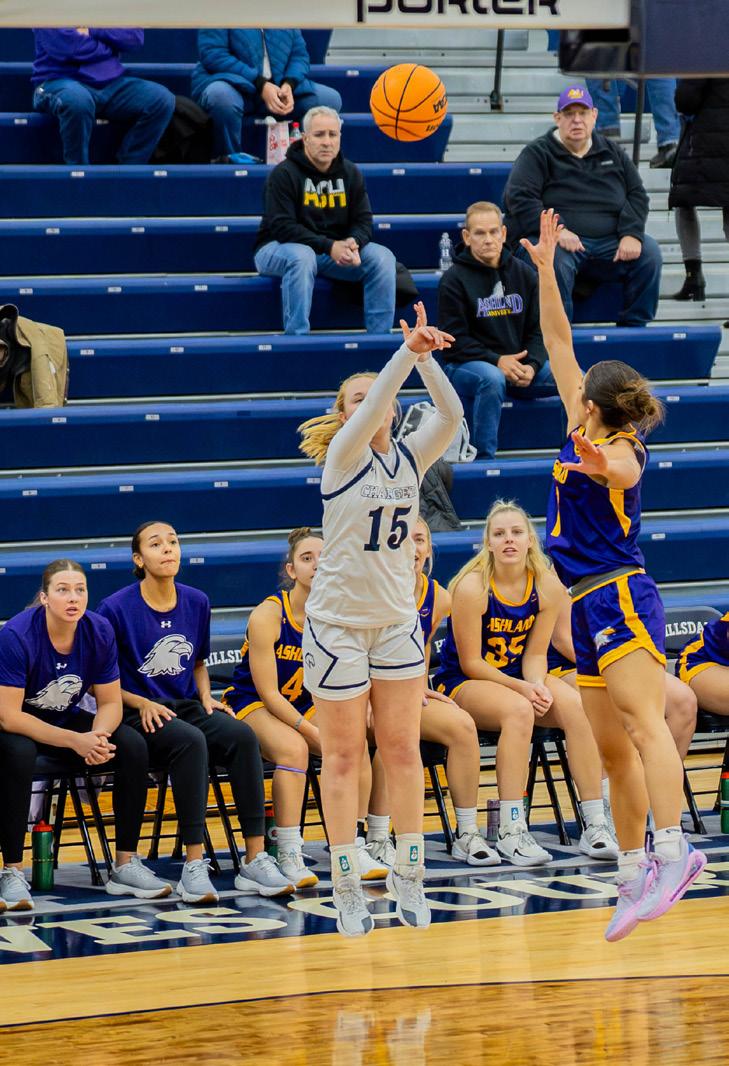
Despite jumping out to an early 9-point lead in the first quarter, Hillsdale trailed the Eagles 28–26 at halftime. The Chargers did not regain the lead until senior guard Emma Ruhlman made a 3-pointer to put Hillsdale ahead 51–49 with 2:53 remaining in the game.
Regan said he reached
Fathom Entertainment, and the college wrote a proposal and submitted a marketing plan. Though the college is
waiting on the final terms of the deal, Fathom accepted the package and has agreed to help Hillsdale promote its first theatrical release.
Nearly 100 Hillsdale College and Hillsdale Academy students attended the March for Life over the weekend. Courtesy | Meredith VanDerWeide
Kevin Slack and the production team behind-the-scenes of the new documentary. Courtesy | John Woracheck
Larry Arnn in the documentary.
Courtesy | John Woracheck
Senior Andrew VanDevere on freshman Theodosius Santalov’s shoulders at the March for Life.
Courtesy | Áine Schroeder
Freshman Maddie Smith shoots a 3-pointer against Ashland. Courtesy | Ashley Van Hoose
Hillsdale to launch new media app by fall semester
By Trinity Gentry Freelance Reporter
Hillsdale College will release a new website and app by this fall, with the website designed to unify all of the college’s current websites into one, and the app will place the college’s online teaching material in one location.
Executive Director of Online Learning Jeremiah Regan ’08 said Hillsdale’s new website will centralize its many sites, simplifying navigation for students and faculty.
“If you go to hillsdale.edu right now and you click on the banner on top, you can go to something like 40 different websites,” Regan said. “If you’re trying to learn something about what’s going on on campus, where do you go? Depends, right?”
The college is doing a
complete online overhaul, Regan said. The new website will make it easier to navigate Hillsdale’s resources and keep up-to-date with campus activity.
The transition period to the new website will be in phases, Regan said. “It won’t be turn-key and everything you know goes away,” Regan said. “There’ll be transition periods and there’ll be announcements so that you’re not wondering, ‘Well, I used to go through this complicated pathway to get to this information. And that’s gone.’ There’ll be briefings on how you do it now, but it’ll be easier.”
Along with the new website, Hillsdale plans to create an app that will centralize its teaching resources for a growing audience, and allow the college to branch out into
other forms of media, Regan said.
Juan Dávalos, executive director of brand management, said the college’s current websites were not built to teach the level of people interested in its resources.
“Our current websites are very old, and they’re a product of many years of development by different people that have done a great job, but nothing that was prepared for something like teaching such a large number of people,” Dávalos said.
Chief of Staff Kyle Murnen ’09 said the target audience for the app has been increasing.
“The percentage of people taking our online courses on their phones has steadily increased for the last five years. We want to make it easier for people to take those courses
— and to learn with Hillsdale in a variety of ways — through the app,” Murnen said.
Dávalos said College President Larry Arnn charged the college with the goal of teaching 50 million people by 2030.
“What we needed to do is look at our entire digital ecosystem and essentially reconstruct it from the ground up, because to continue the same analogy, we’re going to need essentially a skyscraper for the kind of traffic that we want to reach to,” Dávalos said.
The methods of teaching will stem from social media posts and online courses to Imprimis and the K-12 education program, he said.
In order to achieve this goal, the college needs to expand its media outreach, Regan said, to media forms such as social suites.
“So think about ‘The Mi -
chael Knowles Show’ or ‘The Brett Cooper Show,’” he said.
“We’re going to start trying to develop some programming like that, that we consistently release with students and faculty.”
Having a platform that ties together all of the college’s resources will create a more immersive learning experience, Regan said. Providing multiple methods of learning from Imprimis to podcasts to online courses, the app will integrate it all onto a single digital platform, and make it easier for the college to design new material.
Because this project is still early in its development, there is not a definite timeline for completion. However, Murnen said the goal is to release the app by this coming fall.
A major motivating factor
Spalding’s new book aims to explain the founding
By Ellie Fromm News Editor
As Americans begin to celebrate the 250th anniversary of the Declaration of Independence, Matthew Spalding, dean of the Van Andel Graduate School of Government, released his latest book in December. His book, titled “The Making of the American Mind: The Story of our Declaration of Independence,” aims to teach readers the creation and consequences of the declaration.
“I’ve been studying this and teaching this for a long time, going back to my time as an undergraduate and a graduate student, and now teaching regularly for Hillsdale,” Spalding said. “So it’s been on my mind for quite some time.” The book aims to educate readers on the process and thoughts found in the Declaration of Independence, Spalding said, adding that at the time of its signing, the concept of a “gothic” document was widely accepted, but modernity has rejected this. A “gothic” constitution is one where the writers recognize that it cannot be perfect because its writers are not perfect.
“We expect history to live up to our standards, not only
the standards of perfection, but also according to our current opinions,” Spalding said. “And so we look backward when we study history. And I think that’s just incorrect. It’s not fair to them. We should study history and try to understand what they were doing. But the more general point is that man is an imperfect being. We’re human beings, after all, and so that’s our lot.”
College President Larry Arnn praised Spalding’s book.
“Matthew has prepared all his life to write this book, and it comes at just the right time,” Arnn said in an email. “It will be important.”
anniversary,” Spalding said. “I wanted to write a book for that moment, but also one that really captured the full story and made a case for the Declaration. But that is also done in a way that was a story to draw people in and then teach them something in a way that inspires a sense of patriotism.”
Wilfred McClay, Hillsdale’s
ing on to absorb key elements of the English constitutional tradition, and culminating in the best ideas of the Enlightenment,” McClay said in an email.
While Spalding has spent years studying and teaching this subject, he said he was surprised by some of the research for this book, such as the question of religious language in the declaration.
“We expect history to live up to our standards, not only the standards of perfection, but also according to our current opinions.”
Spalding, who is also Hillsdale’s vice president of Washington operations, said this book was especially important to him because America is celebrating the 250th anniversary of the signing of the Declaration of Independence this year.
“I have great memories, very vivid memories, of being a child in 1976, and so there’s a really unique moment to learn about these things again, given this
Victor Davis Hanson Chair in classical history and Western civilization, has known Spalding for 30 years. He credited Spalding’s book with presenting an account of not only the formation of the Declaration, but its effects.
“Spalding shows how the Declaration was the crowning expression of the West’s long tradition, beginning with its roots in the teachings of Judaism and Christianity, as well as classical roots in Greece and Rome, go-
“There’s always been the debate about where the declaration fits in terms of America’s religious heritage, or in the history of religion in the American colonies in the United States,” Spalding said. “I found, by kind of working through that and working through the declaration, that indeed there is a powerful theology of the declaration, as I put it in my book, that is even more powerful than I thought before, despite the fact that my own professors and teachers had often kind of broadly referred to it. I think it’s actually more substantive than I previously thought.”
Spalding’s favorite part of
his book is Chapter Five, which explains the list of grievances against King George III.
“It’s never taught. It’s largely ignored,” Spalding said. “Well, I spent a long time on that.
Probably the longest segment of my book research was going through those in detail, trying to figure them out. I would say that was probably the most rewarding in terms of a scholar, kind of digging into those and trying to find a pattern.”
Spalding will give a lecture at Hillsdale College on Feb. 9 at 7 p.m. in the Searle Center about the book.
“He is a lifelong student of the career of George Washington, and we’re very fortunate to have him as an integral part of our Hillsdale community, in which he serves as both professor and dean at the College’s Washington, D.C. campus,” McClay said in an email. “Few people have done more than he has to remind Americans of the significance of their Declaration of Independence, and now, on the eve of the 250th anniversary of that great document’s emergence, he has published a wonderful account of its formation and its effects.”
New documentary follows Lewis and Tolkien’s friendship
By Anna Northcutt Collegian Reporter
A preview for “The Forge of Friendship,” a five-part documentary series produced by Eastgate Creative about C.S. Lewis and J.R.R. Tolkien, premiered at Hillsdale College Jan. 22.
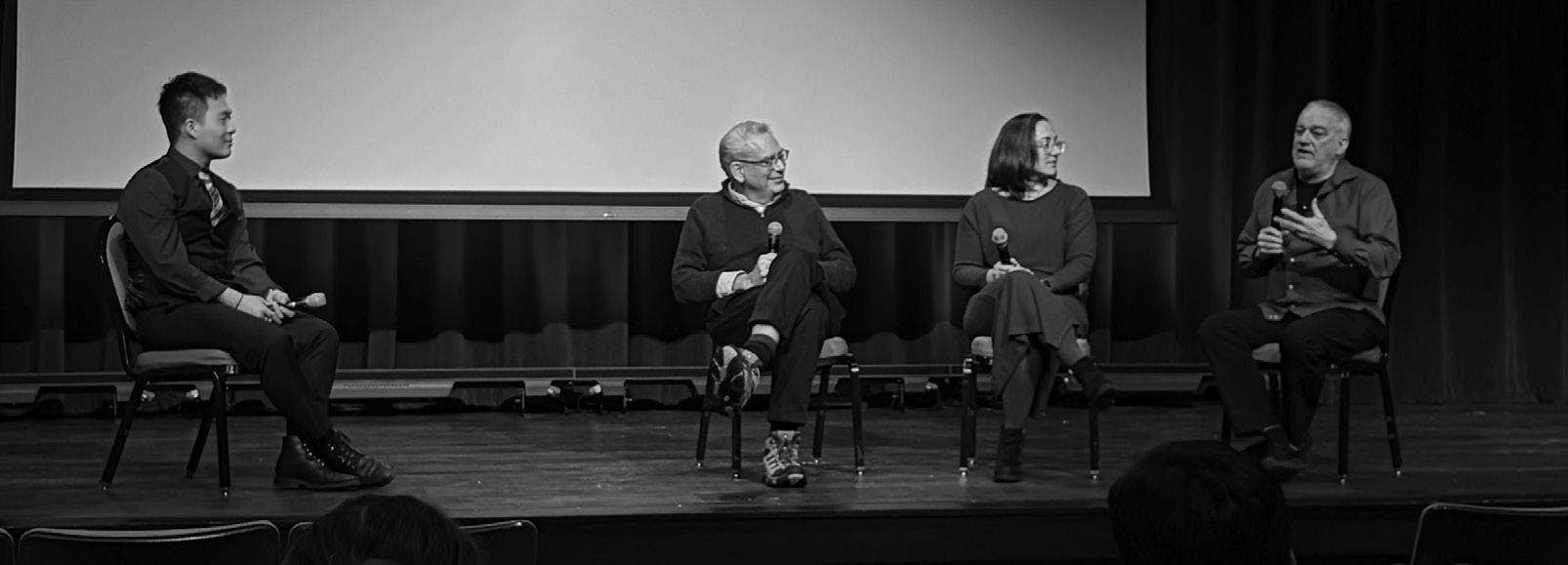
Following the hour-long preview, the movie’s producer, Kirk Manton, joined Bradley Birzer, professor of history, and Elizabeth Fredericks, associate professor of English, for a panel discussion and Q&A.
The preview featured a variety of clips, ranging from interviews with scholars to vivid reenactments of Lewis and Tolkien’s lives.
The film also features more than 40 scholars, Tolkien and Lewis specialists, and friendship experts. Interspersed between narrative episodes of the two men’s lives will be segments specifically devoted to their friendship and what viewers today can learn from them in an age in which many people struggle to develop or maintain close relationships, Manton said.
According to Fredericks, the documentary is a testament to what intellectual friendships can produce.
“We think about Lewis as a sole author, but behind everything he does are all these other people that are around the margins and in between the lines of each particular work,” Fredericks said.
Manton said they landed on the idea of friendship because it stood out as a recurring theme in their interviews with scholars.
“We asked them all some very simple questions: ‘What is your area that you know the
Eastgate Creative has raised about $600,000 so far and hopes to raise another $350,000 in order to finish the documentary by the end of the year, according to Manton.
“Our business model is everything debt free. When the money comes in from distribution, it wraps back into the nonprofit for the next productions,” Manton said.
The combination of Eastgate Creative’s status as a nonprofit and personal rela-
terprise would be allowed to have.
“They feel it’s their mandate to honor these people who died, and to utilize their images, especially their more intimate images,” Manton said. “You saw guys walking through the trenches, and you see their faces — you don’t see that in commercial productions.”
As far as reenactment scenes, filming footage from the trenches proved especially difficult when arrangements
most about these two people? Tell us about that.’ We let them lead us where they wanted to go, and we looked for the common themes. We allowed contradictions to be there, and then, as we saw the theme of friendship, we realized that would be our thesis,” Manton said.
tionships built over three decades has led to many unique opportunities, according to Manton.
Not only have all 45 scholars contributed their expertise for free, Manton said, but the Imperial War Museum granted the filmmakers access to footage no commercial en-
fell through at the last minute, Manton said. Through providential intervention, however, they were able to capture what they needed, anyway.
for the college to create this app is found in the mission of the school itself, Murnen said. The goal to make the college’s resources accessible and widespread dates back to its founding.
“In our Articles of Association, the college is founded in the belief that ‘the diffusion of sound learning is essential to the perpetuity’ of civil and religious freedom and intelligent piety in America,” Murnen said.
Dávalos said the most transformative things to his character have been his faith and education, and that’s what Hillsdale does for its students.
“What we want to do is take what happens here on campus and have it radiate across the country,” Davalos said.
“Releasing something in theaters allows us to reach an audience that is much wider than Hillsdale, an audience that would go to a movie but wouldn’t take an online course,” Regan said. “Learning occurs best when it’s done with others. This definitely helps expand Hillsdale’s reach.”
In recent years, Hillsdale has ramped up production of online courses and other film content. Distant Moon, a production company based out of Washington, D.C., has partnered with Hillsdale for the online courses, as well as for the “Revolutionary America.”
In November of last year, Hillsdale and Distant Moon premiered “Colonial America,” a six-part docuseries that told the story of America before the revolution. “Revolutionary America” will be the sequel to “Colonial America,” according to Regan. A six-part cut of “Revolutionary America” will be released around July 4th, Regan said. Hillsdale plans to explore more options for theater and streaming releases as its films gain traction.
“We have several projects in development slated for theater release,” Regan said. “The ultimate goal is to garner a streaming deal with a mainstream platform like Apple TV+ or Paramount+.” Arnn confirmed that the college is looking to extend its reach in that way.
According to Manton, the goal of the movie for himself and the director and cinematographer is to create something meaningful.
“The three of us have had full careers in commercial and film work,” Manton said.
“We have a good living. Now we want to bring to a generation that’s not reading more and more, and maybe turn the tide on some of that.”
Freshman Chloe Ross said Lewis has always been very important to her and her family, so she was excited to see Eastgate’s approach to the story.
“It’s obvious that they took a lot of care with it, and it’s a story that they are telling trying to get to the heart of why Lewis and Tolkien are so special, and how they impacted each other deeply,” Ross said.
“It was really exciting to see people take care of the story.”
“A guy in our crew said, ‘Oh, you need trenches? I know a guy who’s got trenches in his backyard,’” Manton said. “We get on the phone, and he says, ‘Yes, I have a full trench system in the backyard. Do you need soldiers?’ A whole troop of reenactment guys came, and we filmed it all the same day.”
“We have some ideas and we are learning,” Arnn said. “Whatever we do in theaters is likely to be on streaming services, too.”
For now, McClay said he thinks Hillsdale’s “Revolutionary America” will be a sufficient antidote to an elitist retelling of the Revolution. McClay said he was disappointed with Ken Burns’s recent release, “The American Revolution,” which he said failed to tell the story in an intelligible and convincing way. Hillsdale’s documentary, McClay said, is superior.
“The Hillsdale account does not dismiss the complexities of the story, but it does not get lost in them,” McClay said. “I believe our viewers will walk away with an enduring story.”
Film from A1
From left to right: Charlie Cheng, Brad Birzer, Elizabeth Fredericks, and Kirk Manton. Anna Northcutt | The Collegian
Hillsdale podcasting reaches landmark downloads 2 years after creation
By Anna Northcutt Collegian Reporter
The Hillsdale College Podcast Network amassed more than 3 million downloads in 2025, about 500,000 more than in 2024, according to a press release from the college.
The college created the network in 2023 to provide a centralized location for all of the college’s audio content, according to Scot Bertram, director of the network and host of “Radio Free Hillsdale Hour” and the “Hillsdale K-12 Classical Education Podcast.”
“Hopefully it makes it easier for people who hear one show to then go deeper and to experience and listen to other shows that we’re producing,” Bertram said.
According to Bertram, the network currently hosts 10 shows, with “Hillsdale Dialogues” attracting the most views on a consistent basis, while specific episodes on the “The Larry Arnn Show” garner the most views individually.
Seniors and faculty invited to closed-door event
By Ellie Fromm News Editor
Leadership honorary Omicron Delta Kappa will host the second-annual closed-door event for seniors and faculty Feb. 4, featuring a mystery professor as its speaker.
“We want to have a space where students can engage in an honest and authentic way with faculty about questions concerning life, life in general, but also the work of the college,” senior and ODK president Erik Teder said. “We think that students who are seniors, who have spent by this point, pretty much four years here, are best equipped to engage in those sort of conversations in a proactive way.”
The event will follow the Chatham House Rule, which allows attendees to speak about what was said at the event but not by whom it was said. They are also not allowed to reveal the identity of the guest speaker, according to Teder.
“We will also be taking cell phones and smart watches and stuff at the door as well, so there won’t be any recording,” Teder said. “So that’s part of fostering an open environment.”
Senior and ODK Vice President Aidan Kowatch said operating under these rules allows for truthful discussions without fear of rumors.
“I would say that really just helps with openness,” Kowatch said. “I know people can sometimes be worried about what’s going to be said outside of a classroom or outside of a conversation. So it’s really so we can have a real and genuine and unique conversation that we might not be able to do in other places or other times.”
The event is open to all seniors and faculty and will be hosted in the Hoynak Room in the Dow Hotel. Social hour begins at 6:45 p.m., and the guest lecturer will begin speaking at 7:30 p.m.
“We hope a lot of people can come so we can have interesting and unique conversations,” Kowatch said.
Across the network, around 25-30 people are involved in planning, producing, and executing the various shows, including people from the K-12 office, online courses team, and video production crew, Bertram said.
“It’s moments like that where it’s nice to know that we are actually reaching people. People are actually listening to this,” said Lilly Duncan, communications manager for the Hillsdale K-12 education office.
Bertram and Shadrach Strehle, the network’s manager not only serve as quality control, ensuring all of the network’s 10 shows enjoy smooth uploading and a pleasant listening experience across various platforms, but also seek to provide a cohesive, consistent message across the shows, Bertram said. “Scot and Shad deserve a lot of credit for the work they’ve done in building the podcast network,” Executive Director of Online Learning Jeremiah Regan said. “They’re
a joy to work with. I’m really proud of them and glad I get to participate.”
Regan, who teams up with Executive Director of Brand Management Juan Dávalos to host “The Hillsdale College Online Courses Podcast,” said he had never hosted a podcast before but enjoys it immensely.
Although everyone puts in effort to make the online course videos beautiful, Regan said he understood the importance of having audio-only versions as well.
“Many people commute much farther to work than I do, or they go on trips, and they like something educational to listen to that will develop their minds and improve their hearts, and the podcast allows them to do that,” Regan said. “I would much rather someone listen instead of watch than not learn at all.”
Similarly, Strehle said that among Hillsdale’s many teaching methods, podcasts provide a uniquely personal medium.
“If you’re watching a vid -
eo, you have it up in front of you, and it’s got your whole attention,” Strehle said. “But there’s something even more powerful about something being with you when you drive to work or do the laundry or wash the dishes or run errands.”
According to Duncan, the “Hillsdale K-12 Classical Education Podcast,” which she helps coordinate, is targeted toward anyone interested in classical education, from teachers honing their craft to a parent looking at a school and wondering what classical education is meant to be.
“We want the podcast to be a place where they can come in and search and look for answers that they’re trying to find,” Duncan said.
Duncan said she had little exposure to classical education growing up. Shortly after graduating college, however, she was struck by the difference she saw between herself — who had been raised in a Christian home and taught to believe in objective truth and
similar values — and many of her peers.
“That summer, there was a lot of stuff going on, and I was just thinking, ‘What’s the difference between me and my friends who are out protesting? We’re all looking for justice.’ I think their actions came from a very good place. But they didn’t know how to have that conversation,” Duncan said.
While studying to get her master’s in politics at Hillsdale College, Duncan said she learned about classical education and realized she wasn’t the only person who recognized this discrepancy.
After earning her master’s degree in 2022, Duncan said she realized she wanted to get involved in classical education because no matter what happened politically, there would always be a need for educated, grounded, and virtuous people.
Duncan said she and others involved with the show hope to figure out how to organize the podcast — which just
posted its 378th episode — in such a way that people can easily find the content most relevant to their interests.
“Because there’s such a variety of episodes, we’re trying to figure out what we can do to make it clear that, for example, if you’re a Latin teacher and you’re new to classical education, here’s 10 episodes that you should probably listen to or things like that,” Duncan said.
Podcast listeners can look forward to a new Hillsdale media app launching in the fall 2026, which will serve as a home for all the learning the college makes available to the world, including but not limited to, podcasts, according to Regan.
“The app will make it even easier for people to listen to the podcast and then flip to the video, or vice versa, so the work that the podcast team has done will bear even more fruit in the near future, and we’re excited to be part of it,” Regan said.
Mock trial sweeps Princeton at first spring competition
By Elijah Guevara Assistant Editor
Several Mock Trial competitors took home outstanding individual awards, with Hillsdale’s A Team placing fifth in a tournament that moved onto Zoom due to bad weather Jan. 24-25.
Hillsdale’s A Team was supposed to compete at Georgetown University. It swept Princeton University 2-0 in the first round, swept Penn State University’s B Team 2-0 in the second round, lost 0-2 to Tufts University in the third round, and went 1.5-0.5 against Penn State University’s A Team in the final round. Junior Jon Hovance took home an outstanding attorney award with 17 ranks.
“Jon’s closing arguments were incredible — some of the best I have seen,” senior and A Team co-captain Patrick McDonald said. “His delivery style and pathos drew each round to a satisfying conclusion for our side. Also, I thought Gabriel Higbie’s performances as a witness were excellent. He played a very convincing forensic pathologist — not an easy role,
but he nailed it.” McDonald said the team adapted well to the changes of remotely participating in the tournament.
“We had to screenshare all of our evidence, which required last-minute changes,” McDonald said. “Much of the fun of mock trial is getting to compete in actual, real-life courtrooms with a bench, jury box, counsel tables, etc. So, I’m definitely looking forward to getting back to that when we compete in-person.”
This season, Hillsdale’s A Team includes McDonald, Hovance, co-captain and senior Chloe Noller, senior Nathan Emslie, junior Gabriel Higbie, sophomore Erin McDonald, and sophomore Gabriel Zylstra.
Hillsdale’s B Team was supposed to travel to Indiana University over the weekend but also ended up competing via Zoom. They ended the tournament with a final ballot record of 4.5-3.5, losing to Indiana University 0-2 in the first round, sweeping the University of Illinois Urbana-Champaign 2-0, defeating Miami University 2-0, and ending 0.5-1.5 against
the University of Wisconsin–Madison.
Junior Ty Tomasoski won an 18-rank individual award, according to team co-captains junior Elizabeth Gaines and senior Ella Lovins.
“Ty gave one of his best performances as a witness this week,” Gaines said. “He was very engaging and energetic on both direct and cross examination.”
Lovins said the team was notified on short notice that they would compete over Zoom.
“We spent the entire weekend competing in Lane Hall,” Lovins said. “Since all three Hillsdale teams were competing virtually, we got to spend time together. Dr. Kiledal graciously helped with every part of the weekend, from making food to setting up rooms, so we’re very grateful for all her help.”
Hillsdale’s B Team consists of Gaines, Lovins, Tomasoski, junior Miriam Ahern, junior Brennan Berryhill, sophomore Aaliyah Moore, sophomore Zoe Katsaros, freshman Ellie Bear, freshman Margaret Ellen Jackson, and freshman Sammy Thompson.
Hillsdale’s C Team was also originally slated to travel to Indiana University before moving online. They ended with a final ballot of 2.5-5.5, sweeping Miami University 2-0, losing to Case Western University 0-2, going 0.5-1.5 against Indiana University, and being defeated by the University of Michigan 0-2.
Freshman William Adkison earned a 16-rank outstanding attorney award, according to sophomore Ethan Scroggins.
“Will performed incredibly well over the weekend,” Scroggins said. “He served as a great example to the rest of us.”
Scroggins said overall he was happy seeing the improvement the team had made over the weekend.
“Our rounds on Sunday were cleaner, our performance was more polished, and our memorization was sharper,” Scroggins said. “Unfortunately, we just happened to face much harder teams.”
Hillsdale’s C Team includes Scroggins, Adkison, senior Victoria Rossmiller, and freshmen Charlee Amason, Sarah Lange, Asher
McGlinchy, Robert Nordin, Robert Rodenbush, and Ella Schuberg.
As Mock Trial looks forward to in-person competitions, each team will be competing for bids to the Opening Round Championship Series — a semi-final where top teams from regional competitions advance to a spot at the American Mock Trial Association National Championship.
Scroggins said the Mock Trial teams hope to secure Hillsdale’s first-ever “open bid,” where more than two programs win a bid to ORCS. “Each Mock Trial program is allowed only two bids to ORCS, so if a program wins more than two, the extra becomes ‘open,’” Scroggins said. “The team winning an open bid wouldn’t actually get to compete at OCRS, but earning one is kind of a flex, and Hillsdale’s never done it before.”
Scroggins said he expects both A and B teams to bid for ORCS, and that he hopes Hillsdale’s C Team does well enough to secure the open bid.
Blake Center acquires most expensive Lincoln portrait ever
By Tayte Christensen Features Editor
Hillsdale’s Blake Center for Faith and Freedom has acquired a collection of rare portraits and sculptures of American founding figures, including the most expensive portrait of Abraham Lincoln ever sold.
The college obtained the collection, announced Jan. 28, via a purchase and gift annuity arrangement with Shane Newell.
“It is uniquely satisfying for an art collector to see his carefully curated collection remain intact rather than be sold at auction,” Newell told The Collegian in an email. “The sale to Hillsdale and matching Charitable Gift Annuity allowed me to support the college I believe is most important to our country, while ensuring my lifelong pursuit of American portrait art remains assembled.”
The college acquired the Blake Center, located in Sommers, Connecticut, in 2019 and opened the center in 2020. Named after its donors Prestley and Helen Blake, the Blake Center property includes 100 acres of land and a replica of Thomas Jefferson’s Monticello.
“Shane Newell in particular has spent a good part of his
adult life amassing a collection of American art,” Alan Crippen, Blake Center executive director and chaplain told The Collegian. “He came to envision his art hanging in Monticello, which makes a lot of sense.”
Crippen, who took the helm of the center in 2025, said the art has been on display in the Blake Center for years, but is now entering into the college’s permanent collection.
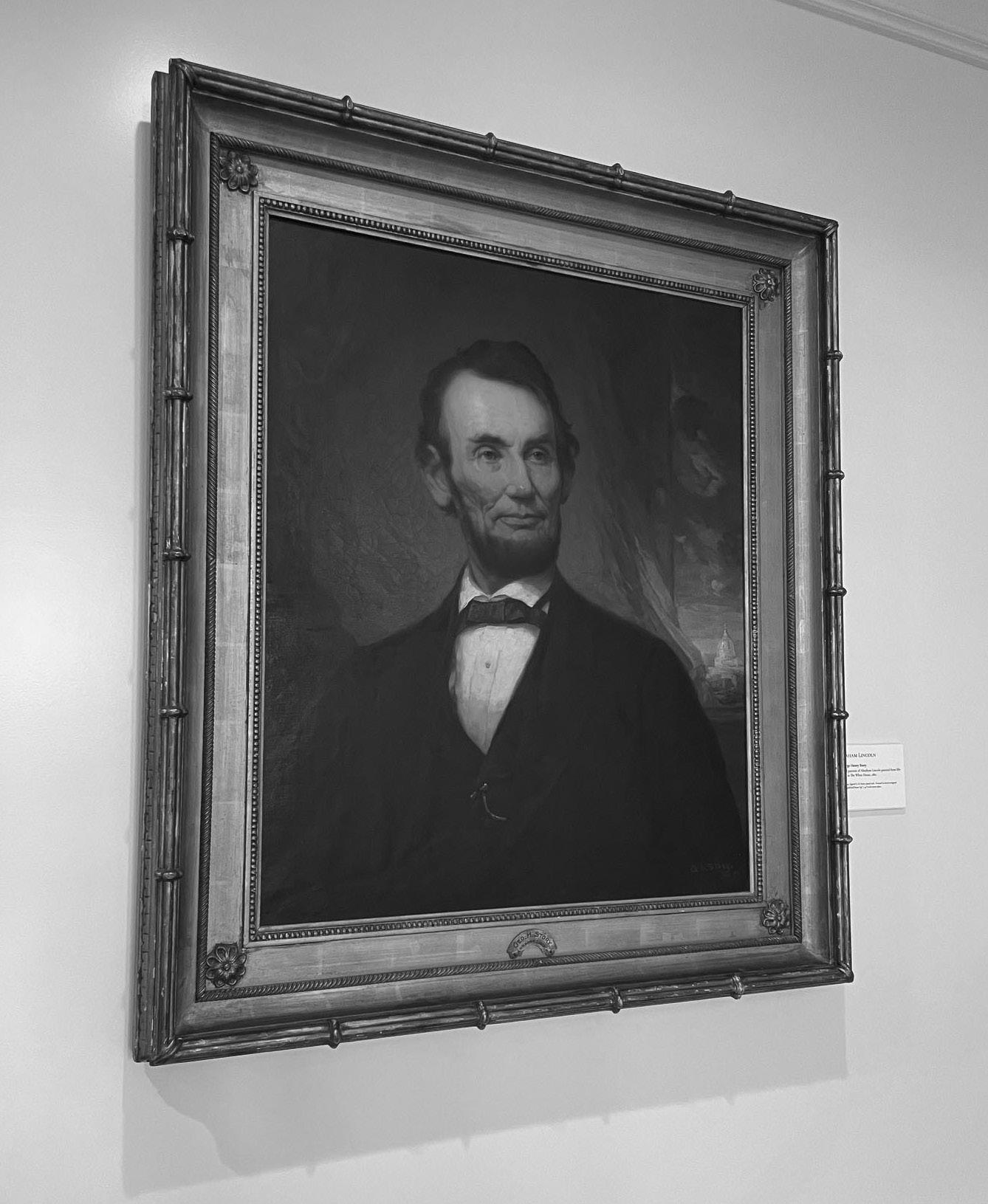
The art collection contains George Henry Story’s last portrait of Abraham Lincoln — the most valuable portrait of Lincoln ever sold, and the only one in a private collection. Story’s other works of Lincoln are displayed in the Oval Office, the Metropolitan Museum of Art, and the Smithsonian Museum of American Art.
and became a friend of Lincoln. As a 26-year-old, Story was invited to draw sketches of Lincoln as he went about
that became Story’s magnum opus and the most expensive painting of Lincoln ever sold.
his daily life. Then, on a visit to Washington, D.C. in 1916, Story noticed the lack of paintings of Lincoln in the city and began painting portraits of Lincoln, earning the name “the man that painted Lincoln.”
Story, an artist from Connecticut born in 1835, built a studio in Washington, D.C.
In 1918, art dealer Charles Duveen commissioned Story to paint the portrait of Lincoln
The 13-piece collection features several sculptures and busts of America’s Founding Founders, as well as original paintings from the 18th and 19th centuries. The paintings range from historical to modern in style and include depictions of Benjamin Franklin, Paul Revere, and George Washington, as well as men including Jonathan Trumbull and Dr. Joseph Warren.
“This collection is a New England treasure and magnificent addition to the college’s art holdings,” Crippen said in the press release. “We are thrilled to have it on display.”
Crippen said the patriotic collection adds depth to the Blake Center’s main rooms, where the college hosts lecture series promoting faith and freedom throughout the year.
“Jefferson assembled an art collection at Monticello that expressed the highest ideals of mankind,” an intro to the exhibit reads. “In his view, great
works of art had the power to inspire and uplift the human spirit, fostering a sense of unity and shared identity among people. Jefferson’s love of art and sculpture was also a reflection of his broader vision for America as a nation. Jefferson’s American Art Collection played a vital role in shaping the cultural identity of the young republic.”
This year, the center is hosting the “America at 250” lecture series, which features 12 lecture series from various Hillsdale and visiting professors on topics celebrating elements of the American founding.
Crippen said the collection will bolster the center’s dedication to American values and freedoms, and will enhance visitors’ experience of the Blake Center.
“The collection belongs there. It really finishes the building in a way that is affirming of the college’s values,” Crippen told The Collegian. “And it’s all happening, which is serendipitous, in the first month of the 250th anniversary of American independence. It’s another way for all of us — from college friends to college alumni — to celebrate this great country.”
George Henry Story’s portrait of Abraham Lincoln. Couresty | Hillsdale College
Opinions RFK takes aim at fake bread
(517) 607-2415
Online : www.hillsdalecollegian.com
Editor in Chief | Thomas McKenna
Executive Editor | Moira Gleason
Design Editor | Anna Broussard
Senior Editor | Catherine Maxwell
News Editor | Ellie Fromm
Opinions Editor | Caroline Kurt
City News Editor | Alessia Sandala
Sports Editor | Elaine Kutas
Culture Editor | Ty Ruddy
Features Editor | Tayte Christensen
Social Media Manager | Skye Graham
Circulation & Ad Manager | Henry Fliflet
Assistant Editors | Christina Lewis | Sophia Bryant | Elijah
Guevara | Jayden Jelso | Adriana Azarian | Gemma Flores | Christian Papillon | Jamie Parsons | Francesca Cella | Grace Brennan
D.C. Correspondents | Lauren Bixler | Megan Li | Lewis Thune
Web & Puzzle Editor | Matthew Tolbert
Illustrator | Maggie O’Connor
Faculty Advisers | John J. Miller | Maria Servold
The editors welcome Letters to

Netflix ruins climbing
By Moira Gleason Executive Editor
Netflix may have just introduced a new genre, and I’m not a fan.
Alex Honnold, the professional climber best known for the 2017 documentary “Free Solo,” climbed the tallest building in Taiwan, Taipei 101, without ropes Saturday. More than six million people tuned in to watch the climb live on Netflix. The ascent? Awesome. The livestream? Not so much.
As a semi-washed-up sport climber who follows Honnold, I could not stomach watching the event live. One slippery ledge or misplaced toe hook, and he would have plummeted to his death on camera. Instead, I watched updates on my phone as he climbed, story by story, up the 101-floor building. Once I knew he was safely at the top and reunited with his wife, I watched the entire event.

Honnold’s ascent was the most incredible feat of athleticism and mental strength I have ever witnessed. In comparison, the fanfare of the broadcast seemed sensational and ridiculous.
No, Honnold doesn’t have a death wish, and he’s not totally crazy. When he climbs, he has control of his body and his mind in a way most of us will never experience. The best part of the event was his smile when he summited.
“Sick!” he said before snapping a few selfies on top of the building’s spire. Honnold will be remembered as one of the greatest climbers ever to strap on a pair of La Sportiva shoes.
But “Skyscraper Live” was a mistake.
From advertisements for the livestream, the draw was clear: Tune in and you might get to watch the “Free Solo” guy die. Thousands placed bets
Blame American farming for wheat that wrecks your gut
By Tayte Christensen Features Editor
My doctor wrote me a unique prescription two summers ago: a long trip to Europe. He didn’t want me to take this jaunt for leisure or to relieve stress. Instead, he wanted me to escape the poison that is American-grown wheat.
I’ve been one of those gluten-free weirdos ever since my body randomly decided to quit processing wheat proteins in 2019. Since then, it’s gotten worse. Not only am I forbidden to enjoy gluten-filled delicacies like authentic Chicago-style pizza or a glass of beer, but at one point I couldn’t even touch gluten-containing foods without breaking out in a rash.
But I’m not the only person who has experienced a sudden onset of gluten sensitivity. Now more than ever, gluten sensitivity and celiac disease numbers are on the rise.
partment of Health and Human Services has outlined its plans to improve American agriculture, including production of wheat. Eliminating these toxins is something the administration should continue to pursue in order to free future generations of Americans from this plague.
HHS Secretary Robert F. Kennedy Jr. said he will target glyphosate, the leading chemical in the herbicide Roundup and a pesticide commonly used on American-grown crops, including wheat. These chemicals, and others like them, impact the quality of the wheat on American shelves. The Interdisciplinary Toxicology study found when fish were exposed to glyphosate, they acquired digestive problems similar to that of celiac disease in humans.
with celiac disease, the study found glyphosate contributes to other diseases, including Alzheimer’s disease and Parkinson’s disease.
Some European countries also use the pesticide, and in 2023, the European Commission ruled to allow the use of it for the next 10 years. While there is no ban across the entire European Union, many individual nations, including Austria, Belgium, France, Germany, and the Netherlands have independently restricted its use.
But wheat quality does not hinge merely upon pesticide use; the variety of wheat grown is a key factor. This factor has changed over the past century and has led to the increase of recorded gluten sensitivities.
wheat is easier to digest, contains less gluten, and is friendlier to those with gluten sensitivities.
In his book “Wheat Belly,” cardiologist William Davis discusses this problem.
online for whether he would succeed, quit, or “otherwise not complete” the solo.
During the broadcast itself, pre-recorded content about Honnold, climbing, and Taipei 101 aired in a split screen as if a man climbing 1,667 feet up the side of a steel skyscraper wasn’t entertaining enough. Spectators waved at him through the windows as he climbed, a helicopter and drones buzzed overhead, and commentators bantered with him through his earpiece when he took a rest. Two of the three commentators, sports anchor Elle Duncan and WWE star Seth Rollins, clearly knew nothing about climbing.
“You know this building,” Duncan said. “It’s a symbol of what humans can build. But today it’s the villain. Alex is trying to conquer the villain. Can he do it?”
Emily Harrington — the only pro climber on the panel — hardly got the chance to speak. It felt wrong to watch a life-or-death situation with commentary that would be more fitting for the Macy’s Thanksgiving Day Parade. For Honnold, none of the fanfare mattered.
“I would do it for free,” Honnold told The New York Times. “If there was no TV program and the building gave me permission to go do the thing, I would do the thing because I know I can, and it’d be amazing.”
Climbing skyscrapers without permission is illegal, and he’s had his eye on Taipei 101 for years. Selfies, stupid questions, and six figures in compensation were just part of the deal.
Netflix, meanwhile, cashed in on morbid curiosity and cheapened the experience in the process.
Given the success of “Skyscraper Live,” other streaming companies will likely scramble to bring death-defying spectacles to live television. But I’m holding out hope this was a one-and-done. Free soloing should not have an audience — let alone online betting and commentary.
Moira Gleason is a senior studying English.
Celiac disease, an autoimmune disorder that inhibits a person’s ability to digest gluten and causes damage to the small intestine, affects approximately 3 million people in the United States, according to the Celiac Disease Foundation. A 2020 study by the Celiac Disease Foundation found the number of people living with celiac disease has risen throughout the 21st century by an average of 7.5% per year.
“The signal is clear that diagnoses are increasing, which means more people are living with a celiac disease diagnosis today than ever before,” the study reported.
According to a 2013 study by the Interdisciplinary Toxicology journal, the pesticides and genetically modified wheat American farmers use may contribute to the increase in these numbers.
In recent months, the Trump administration’s De -
A May 2025 “Make Our Children Healthy Again” report outlined the administration’s plan for addressing issues causing these health problems.
“Children are exposed to an increasing number of synthetic chemicals, some of which have been linked to developmental issues and chronic disease,” the report stated. “The current regulatory framework should be continually evaluated to ensure that chemicals and other exposures do not interact together to pose a threat to the health of our children.”
Additionally, the report outlined the FDA’s plan to develop guidelines for treatment of food allergies, including celiac disease and other allergens. Those plans include requiring the disclosure of specific ingredients known to affect health conditions, like wheat with celiac disease.
“Celiac disease is associated with imbalances in gut bacteria that can be fully explained by the known effects of glyphosate on gut bacteria,” the study reported. Along
In early 1900s America, many suffered from undernourishment, and the U.S. government was desperate to provide a solution. So, agricultural scientists began experimenting and developing varieties of wheat that grew easily and resisted diseases. These strains of wheat solved the food problem in part by their increased gluten content, which produced higher volumes of bread to feed more people. In the long run, however, people suffered due to the poor quality of these wheat varieties.
The strains of wheat developed to solve this issue have been modified through the years and are still used today, much to the chagrin of Americans with gluten intolerance and doctors alike.
Many with gluten sensitivities find they are able to eat gluten-containing goods across the pond because of the more traditional types of wheat European nations grow and use in their products. Because the wheat they use has not been bioengineered like the United States’ has, their
“Modern commercial wheat production has been intent on delivering features such as increased yield, decreased production costs, and large-scale production of a consistent commodity,” Davis wrote. “All the while, virtually no questions have been asked about whether these features are compatible with human health.” The wheat varieties American scientists created solved the problem of hunger in the 20th century, but the 21st-century response should be to imitate Europe by trading them in for traditional grains that have not been tampered with. As Davis pointed out, for American farmers to embrace traditional wheat would mean a more expensive product for consumers. But if it means healthier lives, Americans should be willing to pay the price.
While Kennedy’s “Make America Healthy Again” administration cannot cure existing gluten sensitivities, they should ban the use of glyphosate and other chemicals that would prevent others in the future from dealing with this issue.
My doctor may be right that a stay in Europe is what I need, but I hope when I take that trip, it’s just for the fun of it — to enjoy croissants in Paris and schnitzel in Germany — and not to avoid Wonder Bread in America.
Tayte Christensen is a senior studying history.
Letter to the Editor
Trump’s Venezuela policy isn’t contradictory
By Joshua Waechter Guest Writer
Assistant Professor of History Miles Smith’s recent Opinions article (“Reject brazen interventionism,” Jan. 22) helpfully warns against the perils of toppling foreign governments. However, the article fails to address the most important justification for the Venezuela operation: self-defense. President Donald Trump’s decision to remove Venezuelan leader Nicolás Maduro is entirely consistent with both his 2016 platform and the foreign policy of the Founders.
To set the record straight, Trump has never campaigned for strict “non-interventionism.” He famously remarked during the 2016 campaign that he would “bomb the shit” out of ISIS and that “you have to take out their families.” Since 2011, Trump has repeatedly stated that Iran must be stopped from developing a nuclear weapon “by any and all means necessary.”
What Trump has consistently opposed is not “interventionism” as such,
but rather, entanglements in faraway places like Iraq and Afghanistan that lack a clear goal, drag on for years, and waste American lives and resources. Around 7,000 servicemen and 8,000 military contractors died in Iraq and Afghanistan. It’s estimated that around $1.6 trillion in direct congressional appropriations went toward the conflict, with the total cost reaching around $8 trillion.
The capture of Maduro was a precise mission that accomplished a limited, achievable objective with no loss of American life, demonstrating American hegemony in the Western Hemisphere. The muscular foreign policy on display during Trump’s second term is not a repudiation of his original platform.
The Founders’ foreign policy principles are easy to state, though sometimes difficult to put into practice. In short, sovereign states are obligated by the law of nations to treat one another as equals whenever possible. Consequently, the Founders’ foreign policy prohibits na -
tion-building, but permits aggressive actions whenever foreign powers threaten the safety and happiness of the American people.
This includes countries so badly governed that they constitute a threat to our national defense. For example, James Monroe justified Andrew Jackson’s 1818 invasion of Florida on the basis of Spain’s inability to govern its territory, thus allowing it to become a base for piracy and hostile Indian raids. A similar situation existed in Venezuela. As Secretary of State Marco Rubio clearly stated on several occasions, Maduro actively facilitated a steady flow of deadly narcotics into the U.S. that has caused the deaths of many thousands of American citizens. Furthermore, his regime’s disastrous domestic policies created the second-largest population displacement in modern history (behind Syria). Over the last decade, nearly 20% of Venezuelans left their country, including large numbers of violent criminals whom Maduro intentionally released from prison.
Smith himself has acknowledged Maduro’s responsibility for facilitating mass migration, posting on X in January 2025 that “if Trump really wants to play warlord and invade somewhere that would 1) help democracy and 2) mitigate the immigration crisis, Venezuela would be a good option.” I agree. Far from causing chaos or betraying his voters, Trump’s decision to remove Maduro from power is yet another example of him keeping his promise to “Make America Safe Again.”
The Venezuela operation does not herald another Iraq or the establishment of a Trumpian “neo-mercantilist” empire. Rather, it was an act of self-defense entirely consistent with his campaign platform and the principles that shaped our nation’s early foreign policy.
Joshua T. Waechter is a Ph.D. candidate at the Van Andel Graduate School of Statesmanship.
By Elijah Guevara Assistant Editor
Mr. Mamdani, collectivism isn’t warm
Rugged individualism may have its pitfalls, but collectivism is not compassion.
When New York City mayor Zohran Mamdani affirmed his intent to carry out campaign promises on affordability, child care, and a rent freeze, one promise in particular stood out.
“We will replace the frigidity of rugged individualism with the warmth of collectivism,” Mamdani said in his Jan. 1 inaugural address. “If our campaign demonstrated that the people of New York yearn for solidarity, then let this government foster it.”
For the opening shot of an administration built on the promises of progress and compassion, Mamdani could
not have picked an ideology more averse to those ends. While he uses governmental collectivism almost as a synonym for compassion and social cohesion, collectivism is, above all, a dangerous ideology that has resulted in more than 100 million deaths in the past century. New Yorkers — and all Americans — ought to reject it as a remedy for modern-day problems and political frustration.
Since Mamdani’s mention of collectivism was only a single buzzword in a 24-minute-long speech, this may seem like a non-issue. In fact, it may even seem on-brand for Mamdani: a bold, self-proclaimed democratic socialist who isn’t afraid to step on toes and flaunt an anti-establishment persona.
Whether Mamdani knows
it or not, collectivism signifies more than an alternative to capitalist greed and poverty.
One of the first traces of collectivism in Western civilization appeared in JeanJacques Rousseau’s 1762 work, “The Social Contract,” in which he argued that individuals ought to surrender some freedoms in favor of the general will of the people.
The idea could almost pass as harmless. Collectivism itself — especially in Marxist socialism and communism — even seems to promise a more progressive and compassionate society, as Mamdani also does.
But when taken to an extreme, the ideology justifies radical democracy and collective decision-making by removing individuals’ rights through governmental force.
Collectivism has always
been taken to this extreme. Rousseau did not advocate violent revolution. Nonetheless, nearly a decade after his death, the French Revolution began in 1789, culminating in the Reign of Terror — a collectivist uprising that saw churches destroyed, thousands killed, and free speech thoroughly suppressed.
In the 20th century, the Soviet Union, fascist Italy, Nazi Germany, and communist China contributed to millions of deaths. Even in recent years, collectivist regimes in Cuba, North Korea, and Venezuela have proven to be nothing short of disastrous for their people.
Many of these regimes promised compassion, progress, and even better lives for their people. But in the end, they were about none
On America’s 250th, be a true patriot
By Adriana Azarian
Assistant Editor
Americans have been sold a cheap kind of patriotism.
We celebrate American holidays and drape our flags, but true love of country is more rare than we think. Americans, especially young Americans, do not know our history enough to love it, and we don’t love it enough to preserve it.
Our 250th anniversary is an occasion to revive American patriotism.
America250 is a step in the right direction. The bipartisan initiative educates on American history, encourages volunteer service, and tells the stories of extraordinary citizens. With efforts from the White House, members of the Trump Administration, the Smithsonian museums, and members of Congress, America250’s goal is “350 by 250” — to involve all 350 million American citizens in participating through various writing, photo, and video submissions and volunteer work by July 4, 2026.
Hillsdale College is partnering with the White House’s America 250 Task Force to produce the “Story of America” video series, which features Hillsdale President Larry Arnn and Professor of History Wilfred McClay in the retelling of America’s founding. In his “Defense of Patriotism,” G.K. Chesterton bemoaned the education of British schoolchildren: “If we are judged, it will not be for the merely intellectual transgression of failing to appreciate other nations, but for the supreme spiritual transgression of failing to appreciate ourselves.”
Modern Americans are guilty of this very problem. A June 2025 Gallup poll found only 58% of Americans to be “extremely proud” or “very proud” to be American. This compares to the 90% who reported the same high feelings of patriotism between 2002 and 2004. Among Gen Z, the numbers are more alarming. Only 41% of Gen Z reports feeling extremely or very proud of their citizenship.
This is problematic but not particularly surprising. America is the first of its kind, a country based on ideas — and people change their ideas quickly. With a poor education system and corrupt media, we no longer share a common understanding of what it means to be American. If we hope to preserve our country, we must frequently remember our founding principles: self-government, equal human dignity, and natural rights that unite us all.
We all owe our country a debt of love and loyalty. However, we’ve long heard voices from the left calling America unlovable because of deeply embedded oppression and racism. Now we’re hearing more voices on the right echoing this sentiment from a different angle, calling America lovable only by those “Heritage Americans” whose ancestors lived here long enough. Both attitudes are deeply flawed, un-American, and harmful to our republic and its citizens.
If we want to preserve our
great nation, we must set the record straight: Our country is good and worthy of celebration, and, moreover, every American citizen has a place in America’s story. With each initiative, America250 encourages Americans to adopt a common understanding of history, serve their fellow Americans, and appreciate the opportunities America offers its citizens. At a time when our country is confused and fractured, America250 reminds Americans of our history and gives us a common experience and knowledge to draw from, bringing communities closer and inspiring greater love for our unique nation. It reminds Americans that we all have a stake in the country’s character and direction.
America demands true patriotism, not shallow sentiments. In our 250th year, we must learn to appreciate ourselves once again.
Adriana Azarian is a senior studying politics.
US visas should be hard to get
By Christina Lewis Assistant Editor
The Department of State, under the guidance of President Donald Trump, announced earlier this month a temporary pause on immigrant visa issuances from 75 countries — including Afghanistan, Iraq, and Somalia — to review vetting procedures.
America’s immigration system is far from perfect, but admitting large numbers of people without thorough review only compounds its existing flaws, straining resources and undermining public confidence.
As an immigrant, I know firsthand how complex and demanding the process can be. When my family moved to the U.S. from India, my parents navigated countless obstacles to secure passports and visas. We waited in long lines and spent many hours completing paperwork — all while knowing we could be forced to leave the U.S. at any moment if my dad’s employer did not extend his work contract and sponsor our visas. It was only after 15 years of living in this country that we became naturalized American citizens. Historically, the U.S. has denied visas to people who have a criminal record or will likely become dependent on public welfare. The Biden administration, however, treated
these policies as mere suggestions and admitted thousands of people without going through the traditional vetting process. As a result, the American immigration system has turned into one that prioritizes speed and volume over maintaining standards that protect citizens. This leaves Americans to contend with preventable cases of fraud, criminal activity, and longterm welfare dependence.
“President Trump has made clear that immigrants must be financially self-sufficient and not be a financial burden to Americans,” the U.S. Department of State stated Jan. 14. “The Department of State is undergoing a full review of all policies, regulations, and guidance to ensure that immigrants from these high-risk countries do not utilize welfare in the United States or become a public charge.”
Weak oversight and enforcement of laws invite misuse. Consider the alleged Somali daycare fraud uncovered last month by independent journalist Nick Shirley in Minnesota. After visiting multiple Somali-run daycares receiving funding through Minnesota’s Child Care Assistance Program, Shirley reported finding daycares with no children present. This is just one instance of how weak immigration enforcement can invite abuse. The government
should not squander taxpayer dollars through inconsistent enforcement. A well-managed immigration system can reduce such vulnerabilities.
Public safety is another key responsibility of the government. Allowing people without thorough vetting — particularly during emergency evacuations — only invites trouble by putting American citizens at risk. Since many countries do not keep good records of their citizens, the U.S. does not have a lot of data to go off of when admitting these people in the country.
After former President Joe Biden’s catastrophic withdrawal from Afghanistan in 2021, the Biden administration evacuated 80,000 Afghans as part of Operation Allies Refuge. While many evacuees posed no threat, the speed and scale of the operation limited the government’s ability to conduct comprehensive screenings.
One evacuee, Rahmanullah Lakanwal, who had previously worked with the U.S. Intelligence in Afghanistan, was indicted by the U.S. District Court on charges related to the killing of National Guardsman Sarah Beckstrom and serious injury of National Guardsman Andrew Wolfe near the White House on Nov. 26, 2025. This case shows the dangers of a rushed vetting process. America is not the world’s
of those things — they were about control.
No matter how attractive it may seem when presented in a savvy social media campaign or by a charismatic mayor, collectivism has only devastated every nation in which it has been attempted. Mamdani’s attempt to invoke collectivism while ignoring its obvious history will fail. As the Wall Street Journal’s editorial board put it, “He can almost make socialism sound appealing if you missed the last century, which as it happens he did.”
This is not to fearmonger about Mamdani’s administration or even to dismiss the authentic concerns about issues like the cost of living in New York City. Mamdani is correct that New Yorkers need affordability — something I wish
conservative politicians even pretended to care about. New Yorkers also need compassion. Many immigrants, who make up roughly one-third of the city’s population, need the American dream they came to our country for.
But Mamdani shouldn’t pretend that turning a blind eye to some of the most crucial historical lessons of the past century will solve these present-day problems. Collectivism has been tried, tested, and found wanting — not in theory, but in human cost. By any means, Mamdani won’t be the next Lenin. But New Yorkers deserve solutions rooted in reality, not amnesia.
Elijah Guevara is a sophomore studying history.
Talk to thy opp
By Daniel Johnson Collegian Reporter
Social media has its uses, but shaping our political and religious beliefs should not be one of them. We’re better off speaking face-to-face.
The structure of social media guards us from uncomfortable ideas that challenge our assumptions and the people who hold them, but these discomforts are what we need to develop our convictions well.
When was the last time a debate on X helped you understand your opponent’s perspective, or an Instagram reel challenged one of your deepest assumptions?
I doubt you can remember.
The social media platforms where an increasing amount of our public discourse takes place amplify messages you already agree with — especially those that make you angry and demonize your opponents.
To know the truth and confidently live it out, we must know the “why” behind what we believe. This requires challenging our assumptions and wrestling with alternative bids for the truth. Social media shelters us from these essential challenges.
result is more hatred. In contrast to online conversations, face-to-face conversations force us to see our opponent as a person rather than an avatar. Sitting across from another or walking alongside them, we see someone like ourselves: someone with pains and hopes, a story, scars, and dignity. It’s far harder to cuss someone out while eating dinner with them than on Reddit. Speaking face-to-face, we’re also forced to confront tough questions we’d scroll past online. When asked a question over a meal, one can’t simply scroll down. In real life, one is forced to challenge assumptions we’d rather let rest, face facts we’d rather ignore, and come head-to-head with how little we truly know.
These conversations are essential to a free society. To quote the late Charlie Kirk, “When people stop talking, that’s when you get violence.” When we speak with real people with real challenges to our beliefs, it’s far harder to see them as an enemy we must attack.
savior. Like any other nation, it must balance sympathy with responsibility and prioritize the security of its own citizens. The less money spent on addressing immigration fraud and criminal activities, the more resources the U.S. can devote to creating a smoother and more efficient immigration process for people seeking to contribute to this country and make it their home.
Out of the 80,000 Afghans who came to the U.S. as part of Operation Allies Refuge, 72,550 were paroled, lacking visas, special immigrant visa status, or refugee designation, according to a report by the Center for Immigration Studies. This additional influx strained traditional screening processes and underscored the need for clearer immigration standards.
Temporarily revoking visa issuances from these countries will give the federal government the time it needs to sort out its policies and procedures. This pause will allow the government to create a system that will benefit all, with the hopes of improving visa processing times. America is a nation shaped by immigrants, but not without order and accountability.
Christina Lewis is a senior studying history.
Studies in moral psychology at Princeton University have revealed that we engage far more quickly with emotionally-charged and inflammatory messages online than with rationally measured ones. Social media algorithms only exacerbate this tendency, amplifying the most provocative posts.
Programmers have testified that algorithms on platforms like Facebook, Instagram, YouTube, and X are designed to feed us more of what we already believe. These algorithms reinforce our own biases and reflect our assumptions back to us. They present a world in which our existing beliefs are obviously correct and those of our opponents are indefensible, stupid, or perhaps even evil.
Research has established that people act with less restraint online. This tendency, known as the online disinhibition effect, is a result of the very nature of online communication: You are anonymous, you face no immediate reaction to your words, and you are speaking to people you don’t know. You can say whatever you want, avoid uncomfortable questions, and spew vitriol at the disembodied entity you’ve come to believe is stupid and evil.
Our beliefs are deeply connected to our identity. Truly meaningful conversations where we learn and grow can only start once we each recognize each other’s dignity. When we don’t, the
It’s easier to pontificate from a keyboard. But all who want to know the truth would do well to heed the words of Solomon: “The first to present his case seems right, until another comes forward and questions him.”
We humans hold our beliefs for far less rational reasons than we often suppose. That’s a humbling realization, but an essential one. As Socrates said, “The only true wisdom is in knowing that you know nothing.” Technology lets us ignore our ignorance, but talking with people in the flesh exposes it. Exposure hurts. However frustrating, it is the hard road to the kind of understanding that sees past one’s own biases to any kind of truth. I don’t have the whole picture, and neither do you, but if we sit down and hash it out with patience, there’s a chance we’ll have a more complete picture at the end of it all. Whatever one’s political persuasion or religious conviction might be, none of us have a monopoly on truth. But the more accurate the map, the less lost you’ll get, and the closer you are to truth, the better you’re able to live.
Wrapped up in a fiery debate over deportation? Sure that classmate on the other side of the reformation is a godless radical? Put down the phone, find one of those radicals, and have coffee with them. Talk to thy opp.
Daniel Johnson is a sophomore studying philosophy and religion.
City News

Residents fear state intervention over solar farm
Fayette Township Board holds emergency meeting to accept resignations from clerks
By Thomas McKenna Editor-in-ChiEf
Residents in and around Fayette Township are concerned that the company behind a plan to turn 1,350 acres of farmland into a solar farm will ask the state government to step in if local opposition halts the project.
About 15 residents spoke against the project at an emergency meeting of the Fayette Township Board held at Jonesville High School in the afternoon of Jan. 23. Almost every resident who spoke during public comment was against the project, saying the panels would disrupt the view of the landscape and potentially disrupt wildlife and water sources. No speakers voiced support for the project.
The solar project, called “Heartland II” by Chicago-based Ranger Power company, is the second phase of the similar Heartwood I project approved by the township board in 2022. The company needs the green light from the township’s planning commission, but roughly 200 people attended a planning commission meeting last week to voice opposition to the project.
State Rep. Jennifer Wortz, a Republican who represents parts of Hillsdale and Branch counties, urged the township board to hire a law firm that could help them establish a Compatible Renewable Energy Ordinance, or CREO. This type of ordinance, Wortz said, would let the township set its own zoning rules for building new renewable energy facilities.
A state law that took effect last year now allows the Michigan Public Service Commission, a state regulatory agency with three Democratic members appointed by Gov. Gretchen Whitmer, to bypass
local authorities and approve solar projects despite opposition. If the township adopts a CREO, the state commission would be unable to override local zoning guidelines that could prevent the project, Wortz said.
“Make sure you have a
mitting locally,” Friss said. “That said, the state process exists, but we don’t intend to use it.”
The township board publicly announced Friday afternoon’s meeting less than 24 hours in advance with a notice posted outside the township
body voted to add Jared Jordan ’17, chief financial officer and logistics manager at Mar-Vo Mineral Company in Hillsdale, to the planning commission. The planning commission was unable to conduct any business at its meeting last week because it
ship, just north, adjacent to Fayette Township, and attended school in the township my whole life,” Jordan said. “I’ve grown up here. I care about it.
I’ve got two young boys and a third baby on the way. I just care about making sure it’s a good place to live and a good

CREO,” Wortz told the township board during public comment. “That’s what I’m encouraging all my townships to do.” Brady Friss, a development manager for Ranger Power overseeing the Heartland II project, told The Collegian that asking the state commission to override the local authority is a “last resort.” Friss said he couldn’t say “with 100% certainty” that going to the MSPC is “totally off the table,” but it is not the company’s intention to use it.
“We’re committed to per-
office. Township Supervisor Nate Baker said the meeting was called quickly to accept the resignations of the clerk and deputy clerk, so that it could begin the search to fill the vacancies. The loss of a clerk leaves a vacant fifth seat on the township board, which will need to be filled within 45 days, according to state law.
“If you guys know somebody, we’re looking,” said Scott Playford, the trustee member of the township board.
At the meeting of the full township board Jan. 23, the
lacked a quorum. One of the seven members was absent, one seat was vacant, and two members had recused themselves due to conflicts of interest with the solar project.
Adding Jordan, who graduated from Hillsdale College with a degree in economics, will give the planning commission the quorum it lacked at its Jan. 19 meeting. Jordan declined to comment on the solar project, saying he wants more time to look into the details of the issue.
“I grew up in Scipio Town-
place to raise a family.”
Friss said Ranger Power has worked to build relationships with local landowners and community members.
“These projects are completely voluntary,” Friss said. “We won’t have eminent domain or any type of acquisitions for this type of project.
Private landowners think this is the best use for their private property and a project that they want to participate in.”
Friss said the company conducts extensive environmental reviews, including effects on
water sources, before starting construction on the project.
“We do a lot of work early on to minimize concerns of wetland or threatened and endangered species habitat impacts,” Friss said. “The projects do field surveys of the whole project area.”
Ranger Power has contributed $30,000 to supplies and programs at Jonesville Community Schools, as well as local food pantries, Friss said. The company has also partnered with the Hillsdale County Sheriff’s Office to provide funding for equipment and training. At the project’s completion, Ranger plans to establish long-term endowments for schools and other local needs totaling more than $500,000.
“That money would be continually put into the community year after year,” Friss said, “directly into local schools, directly to teachers who are able to benefit residents’ lives and students’ lives year after year.”
Two members of the seven-person planning commission, Dale Baker and Steve McElroy, have recused themselves from any business dealing with the solar project, since they both have personal stakes in the project. Baker said he has entered an agreement with Ranger Power to lease about 850 acres for the project, more than half of the project’s land.
Dale Baker’s son, Nate Baker, is the township’s supervisor. He has recused himself from votes related to the project.
Planning Commission Chair Jane Munson said the body is trying to meet the second weekend in February, when Munson said the seven-member commission hopes to have a quorum.
Property owners oppose new road repair plans
By Gemma Flores AssistAnt Editor
Residents from Oak and South streets are gathering signatures to reject the city’s special assessment district proposal before a Monday deadline.
“I believe the real mission is just getting the word out there so that everyone understands what’s going to happen if we don’t stand together on this,” said Jill Hardway ’89, one of the petition organizers.
A special assessment district designates roads deemed dilapidated by the city for repair and funds the work by taxing property owners in the specified district up to $5,000. If 51% of the parcel owners reject the proposal in a petition, the council would need a super-majority of seven votes to impose the taxes.
“We have just a little over a week to gather signatures from 51% of the residents on both Oak and South streets to successfully reject the proposal from the city,” said Elyse Apel ’24, a South Street resident. “We are very hopeful we will be able to meet that goal — especially as we have yet to have someone refuse to sign our petition.”
Hardway said a cap of $5,000 is too high for many Hillsdale residents.
“In just getting the general consensus of my neighbors, they can’t afford it,” Hardway said. “Things are very expensive right now.”
Though the city offers payment plans to help offset the cost for residents, Hardway said the interest accrued ends up hurting residents, too.
“The problem with that for me is that it’s still going to cost the homeowner about $1,200 to $1,500 more in interest alone, which goes directly to the city,” Hardway said. “So then you’re not talking about a $5,000 assessment. You’re talking about a $6,200 or $6,500 assessment.”
Apel said that, though the residents of Oak and South streets tried to compromise with the city, they were not met with support.
“We tried to negotiate with the city council to cap the special assessment at $2,800, but they refused,” Apel told The Collegian. “They took a ‘we don’t negotiate with terrorists’ position, except those ‘terrorists’ are their own neighbors.”
City staff did not respond to requests for comment.
In 2025, Barry Street residents successfully overrode their proposed SAD. Ward 4 Councilman Matthew Bentley said this set the precedent for more residents to do the same.
“There is not any neighbor-
hood in this town, in my opinion, that will now sit back passively and allow themselves to be billed
$5,000 out of the blue,” Bentley said. “And now we’re seeing that on Oak and South streets.”
Bentley said he did not see a way forward other than lowering the cap.
“In my opinion, if it’s something less than $3,000, homeowners are not going to organize themselves to stop it,” he said. “But for $5,000, I don’t think there’s a neighborhood in this town that will, because of Barry Street.”
Apel said the residents in the districts were not adequately informed about the SAD proposal.
“The only reason we even know we are in the petition period is because we have been paying attention to what the city council is doing,” Apel said.
Hardway said this petition is how Hillsdale residents can make their voices heard.
Hardway said she hopes to see legislation against SADs in the near future.
“I would love to see this on the ballot. So then, everyone in the city of Hillsdale could vote on this, because then nobody else would have to be going through this,” Hardway said.
Apel agreed that SADs are unfair to Hillsdale residents, especially considering the added funding the city received from the Michigan Road Funding Package passed in early 2025.
“Property owners in Hillsdale already pay property taxes,” she said. “The most obvious purpose of those taxes, and of city government, is to fix the roads. This year, the city also received an estimated $400,000plus increase in local road funding from the state, yet they decided to continue levying special assessments. It is time for them to end special assessments and the undue financial hardship they are to the citizens of Hillsdale.”
Council will hold a public hearing on this and other proposed SADs for the 2026 construction year Feb. 16. Bentley said he’s “pessimistic” about the outcome.
“It was a high-stakes game of chicken,” Bentley said. “It’s going to be a train wreck. And I don’t know how we pick up
“People have jobs and lives. They don’t have time to be watching city council meetings on YouTube,” Hardway said. “Nor will they have time to go stand at the podium and say how they really feel like they have today when they’ve come to my door.”
from this.”
The Fayette Township planning commission held an emergency meeting Jan. 23 . Thomas m cKenna | c ollegian
Car accidents rise as temperatures drop
By Skye Graham Social Media Manager
Hillsdale has suffered more snow-related car crashes this season as the county faces historically low temperatures, according to the Hillsdale County Sheriff’s Department.
“We have seen an increase in slide-offs and in two-car accidents in the county this year with the amount of snow that we received,” Undersheriff Nate Lambright said. “That has increased our personnel to be traveling all over the county.”
At the Jan. 20 city council meeting, Ward 4 Councilman Joshua Paladino and Ward 2 Councilman Will Morrissey questioned Director of Public Services Jason Blake about how efficiently the Hillsdale roads are being cleared in response to the weather.
“You’ve heard this probably even before you took the job: why can you drive to Jackson County, Lenawee County, Branch County, and the roads improve a thousand percent, and yet you know exactly when you pull into Hillsdale County,” Morrissey said.
Blake explained that the roads are not cleared outside
of normal working hours unless there are more than four inches of snow or freezing rain conditions, as prescribed by city policy. He said, however, that he makes exceptions to the policy depending on the forecast.
“Every storm is a living, breathing thing. It’s so different,” Blake said. “If the temperatures tomorrow are projected to go below 15, 20, or zero, then we’re going to try and get off as much as we can before that cold snap. As soon as it’s on, it’s on for weeks.”
Hillsdale County tends to have lower-quality roads than the surrounding areas due to lower traffic levels, Blake said. When traffic is heavy, roads clear off faster because the heat from the cars reacts with the salt, melting the ice, according to Blake at the Jan. 20 city council meeting.
Southeast Michigan this winter saw its coldest temperatures since the 2019 polar vortex, which caused windchills of between minus 20 and minus 40 degrees. In the past five days, more than eight inches of snow have fallen in Hillsdale, and the cold gives it little chance to melt.
The Hillsdale County Road
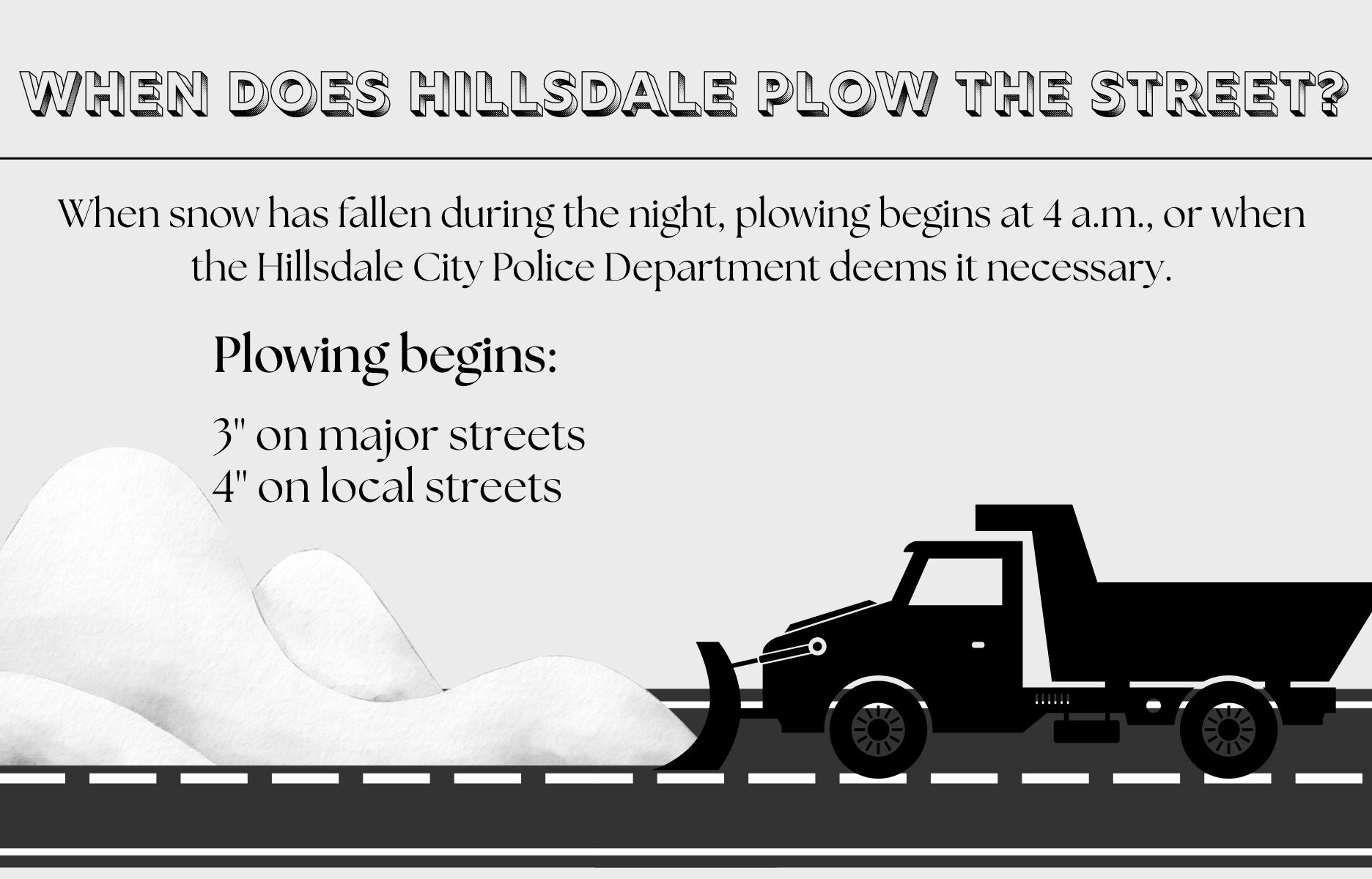
Commission said its drivers are working hard to clear the roads during harsh weather in a Jan. 25 Facebook statement.
“Unfortunately, with the snow coming down, we aren’t able to make much headway,” HCRC said. “We are focusing on paved roads. We appreciate
your patience as we continue to fight Mother Nature.”
Paladino said this winter is abnormally cold, making residents more concerned about road conditions.

schools fit this overall Michigan pattern.
As a result, Hohman said schools are required to pay for pensions through these state-mandated compensation rates but could not pay down more if they wanted to.
“Their responsibility is pretty limited,” Hohman said. “The state says, ‘All right, Hillsdale Community Schools, every time you pay a teacher $1, you have to send us a check for 40 cents or 27 cents or 35 cents.’”
According to a report from the Reason Foundation, in 2023, Michigan public schools had an average long-term debt of more than $46,000 per student — greater than the national average of more than $26,000.
According to Jordan Campbell, the managing director of government finance and senior quantitative analysis at Reason Foundation, Michigan has a higher debt-per-student ratio because of how it distributes the debt.
Campbell said Michigan is one of the few states that “assigns” debt from the Michigan Employee Retirement System to individual schools, although the schools have no control over how fast to pay down the debt.
“The pension liability that Michigan has gets distributed among the county or the school district,” Campbell said. “But how that is distributed depends a little bit from state to state, and a lot of it comes from state plans.” Campbell said Hillsdale
“What you see, particularly with Hillsdale schools, with both the county Intermediate School District and the Community School District, the majority of that long-term debt is just in pension obligations,” Campbell said.
Although seeing the huge debt balance on the school’s debt sheet is unsettling, North said distributing the debt to the schools helped increase awareness of the pension issues amongst districts.
“I think it became more prevalent, or more well known by people when districts had to start listing it on their audits, even though they don’t have to pay that,” North said. “When I had to list that $9 million of debt on my audit when I was at Reading Schools, then people were like, ‘Gosh, what is this?’ So then it raised awareness for it.”
“I think the only abnormal thing about this year so far is that Michigan has had very mild winters for several years until now,” Paladino said. “I think we’ve just gotten used to the snow hitting the ground and basically melting, so that might be part of the reason that there’s some more concern.” Paladino said the city council has not prioritized snow removal as much as other issues in recent years because there’s no simple solution to the problem.
“I don’t think it’s come up as a major issue during my time on council,” Paladino said. “It comes up occasionally, but I get the impression that it’s not something we can have some sort of revolutionary policy approach to.”
According to Blake, the city will
always prioritize major roads such as Hillsdale Street, M-99, and Manning Street over smaller local roads and culde-sacs.
Anthony LoPresto, Hillsdale resident and United States Postal Service employee, said the conditions on the roads impede his ability to do his job safely.
“Back roads are obviously the worst and get little to no attention,” LoPresto said. “It’s not uncommon for me to be the first one to even travel down many of these roads after a fresh snow or ice storm.
Unfortunately, as a mail carrier, you’re expected to at least attempt to drive down the roads regardless of the condition.”
LoPresto said he would like the HCRC to consider prioritizing back roads to make it safer for drivers.
“Obviously, you can’t please everybody, but Michigan winters are notorious for being extremely dangerous,” LoPresto said. “Prioritizing maintenance on roads that turn into sheets of ice should be taken very seriously.”
Robert Baxter, owner of Baxter Lawn and Snow, a lawn care and snow removal company in Hillsdale, said the salt shortage, which primarily impacts Michigan, complicates his ability to clear roads
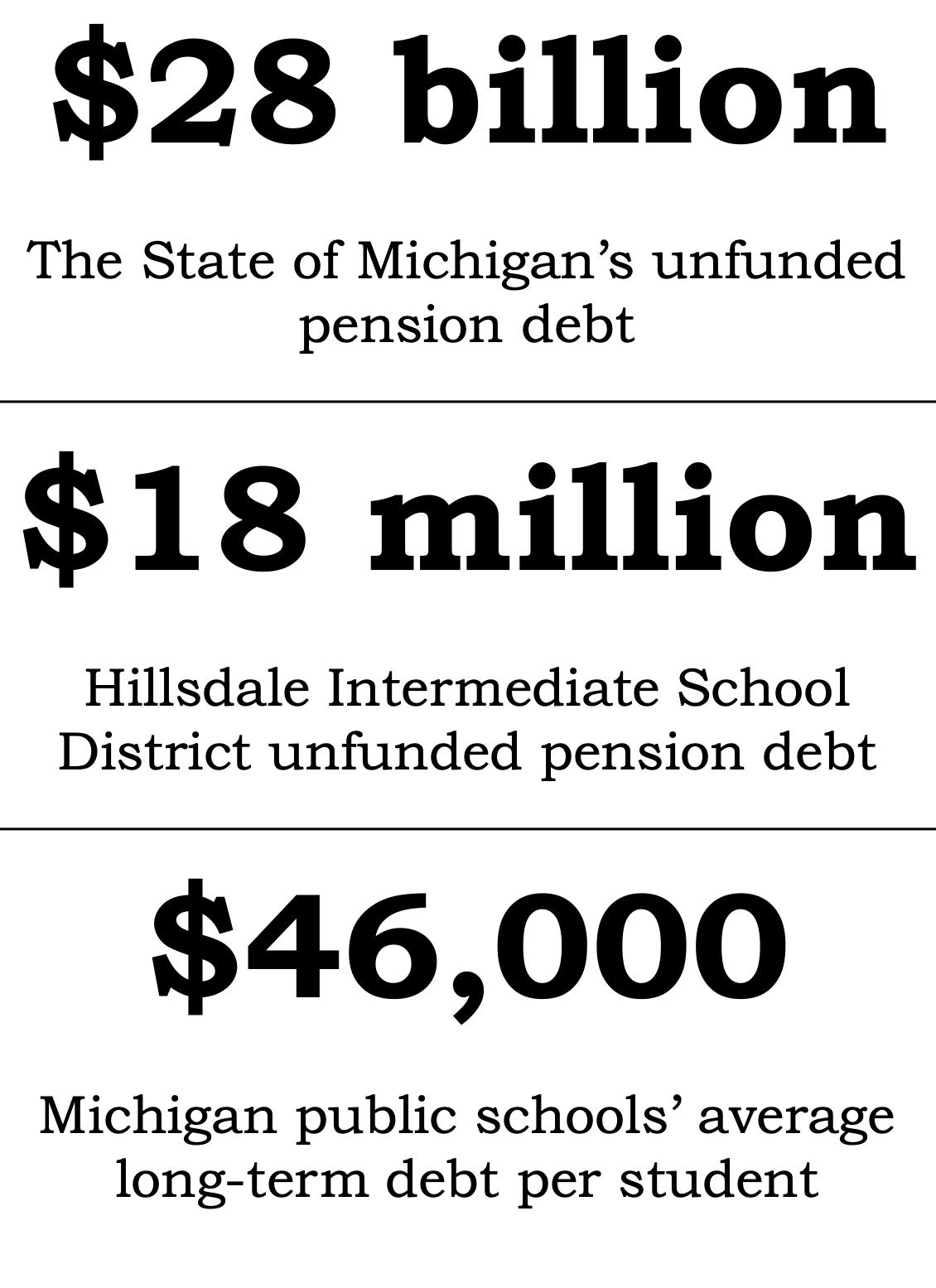
North said Hillsdale ISD’s pension debt has no effect on the daily business of the school.
“For any educator, during their day-to-day, it doesn’t necessarily affect them,” North
said. “When they get their paycheck, they can see how much they have to contribute to the retirement system, but then they will also see how much the district contributes to the retirement system on their behalf. So day to day probably doesn’t affect a whole lot, but in the big picture, it does make a difference.”
Ted Davis, superintendent of Hillsdale Community Schools, declined to comment due to a lack of expertise on the subject.
Michigan’s enormous pension debt started accumulating 51 years ago, according to Hohman, because of poor financial decisions by the state.
“The problem with the state system is that it’s never had enough money to pay for what it owes,” Hohman said. “It is perennially underfunded. Over the total value of all the pensions, they’ve been underfunded in 50 out of the past 51 years.”
North said the state failed to invest money properly in the
effectively.
The shortage, Baxter said, is also driving up the costs of salt.
“The salt shortage has been causing quite a bit of a mess for everyone,” Baxter said. “We are all feeling the struggle, and to make it worse, the salt price has tripled.”
According to the Lansing State Journal, the “salt shortage” is less about a lack of salt availability and more about the difficulty of getting the salt delivered.
Baxter said his workers are always well prepared before a snowstorm hits, and work hard removing snow during early mornings and late nights. Baxter said his company communicates well with Hillsdale’s city government and is willing to help the city with snow removal if it needs assistance.
“It’s a tough, demanding job, but Hillsdale has a great group of guys that rise to the challenge in these poor weather conditions,” Baxter said.
pension system, reduced contributions, and kept outdated death estimates for retirees.
“There’s just been some poor planning over the years that have contributed to the debt,” North said.
Hohman said lawmakers changed assumptions on market returns and put more money into the pension system, all changes that are helping to manage the debt.
“There were a lot of years where lawmakers weren’t even paying the interest costs of their debt,” Hohman said. “But we’re not doing that anymore.”
North said it helped to have newer, less expensive pension tracks for teachers rather than to apply one expensive plan to everyone.
“The more expensive pensions over time will start to fade away, the newer pension choices that don’t cost as much will then become the majority, and it doesn’t cost as much,” North said. “If the state continues to contribute like they have on a regular basis, then each year they will be able to chip away at that debt.”
Between 2023 and 2024, the state put $738 million into the retirement system, decreasing the debt from $5.4 billion to $4.8 billion and accounting for much of the drop in the Hillsdale school debt.
North said the current system will pay off Michigan’s $28 billion debt in the year 2038.
“It’s a little bit in the future,” North said. “But it will fix itself.”
Debt from A1
One of Hillsdale College’s snowplows.
Skye Graham | Colle G ian
SportS
Saddle up for fall 2026
By Anna Northcutt Collegian Reporter
Students in the Hillsdale College Equestrian Club dedicate themselves to taking weekly lessons and competing in horse shows several times a semester, according to junior Sarah Morris, president of the club.
Students usually participate in the club while taking “English Riding,” a one-credit class offered by the college, Morris said. The class provides eight riding lessons at the stable Teetor Equestrian under instructor Betsy Teetor ’05. Students are assigned a different horse to ride at each lesson, providing unique challenges based on the horses’ varying personalities.
“I like the community when you start riding, because you ride with the same group every time,” freshman Ava Fosdick said. “I started riding with two girls last semester, and we got really close by the end of it. It was fun seeing all of us improve.”
According to Morris, students take lessons in the hunter-jumper style.
“I like to think about hunter-jumper as the opposite of a cowboy,” Morris said. “It’s more based on your decorum and your attitude and kind of the whole look. You have a certain uniform that you have to wear, and you are judged based on how you ride the horse and how you look and things like that.”
According to Morris, the club will be at the Source fall 2026, offering an opportunity to anyone interested in horses, regardless of past experience.
“If they want to ride and show horses, then we start the process of getting them registered in our show circuit,” Morris said.
The club had its start when Teetor was a student at Hillsdale, according to Morris.
“When she went to Hillsdale, she and one other girl didn’t have a place to ride, so she would go down to the fairgrounds and ask
random people or get to know people in town and ask them to ride their horses, and that’s how they would practice,” Morris said.
After Teetor graduated, the club died out, but Morris said Bri Bertsch ’24 revived it in her sophomore year. Around the same time, Teetor became the club’s coach.
“When I moved back to Michigan after several years of working in Indiana, I was put in touch with the Hillsdale coach through one of my previous college contacts, Kathy Connor, ” Teetor said. “The previous coach has since moved on, and I was able to assume the coaching position in 2020.”
At shows, students can compete in flat classes, consisting of walk-trotcanter, or over fences, according to Morris.
“Typically, the commute to a horse show is about an hour to an hour and a half from campus,” Morris said.
“The furthest one is about two and a half hours away.”
Since paying for a hotel room isn’t feasible for the level the club currently competes at, Morris said Hillsdale students usually pick one of the two days the show will take place to attend. They’ll leave around 5:45 a.m. and will often be at the
show until the mid- to late afternoon.
This spring, Morris will compete at regionals at the end of February. If she places in the top two in her class, she’ll advance to zones.
“I don’t know if that’s going to happen, so hypothetically, February is the end of our season,” Morris said.
Although the club is mostly for people who want to show, Morris said anyone can take the English Riding class.
“If you love horses, then it’s a lot of fun,” Fosdick said. “It doesn’t matter how much riding experience you really have.”

Baseball
Poll projects 3rd in conference
By Christian Papillon Assistant Editor
After an appearance in the Great Midwest Athletic Conference semifinals last season, the Hillsdale baseball team is projected to finish third in the G-MAC North Division, according to the preseason coaches poll, and will start its season with three-game series against the University of Montevallo in Montevallo, Alabama, Jan. 30, 31, and Feb. 1.
Last season, the team finished with a 17–15 regular season record in the G-MAC and is returning with the majority of the starting team from last season.
“We have a unique mix of youth and experience,” head coach Tom Vessella said. “We’re returning seven starters, and they’re all just juniors and sophomores, so it bodes well for the future. I’m excited about where we are in the program.”



Vessella said the team’s experience playing together will be helpful in the upcoming season.
“They’re a close-knit group, and I think they come together as a team really well,” Vessella said. “Especially with the freshmen this year, it was a seamless transition for bringing everybody in and showing them what to do.”
According to Vessella, the fact that many of the starters got regular time as freshmen has helped with welcoming this year’s freshman class to the team.
“A handful of our freshmen are going to contribute right away, and that’s just a testament to what our returners have done to get them up to speed,” Vessella said.
Sophomore pitcher Luke Miller said he is confident that this year’s team can improve from last year.
“I think we’re going to have
a really good pitching staff this year,” Miller said. “It’s good to see some of the young guys developing, and we’ve got some guys back from injury who haven’t pitched in a while. I think we’re going to put a lot of different pieces together to shape out a really good team this year.”
Both Miller and sophomore pitcher Josh Novak made appearances in 2024 before redshirting the 2025 season with injuries.
“I’m looking forward to pitching, because I haven’t pitched in two years,” Novak said. “I’m also looking forward to everybody who was previously injured getting to play.” Vessella said he is looking forward to the team’s opening series.
“It’ll be a really good test for us,” Vessella said. “When our team hits our stride, we could be really dangerous.”
Women's Basketball
Chargers
from A1
“As soon as I shot it, I knew it was going in,” Ruhlman said. “That was my only one of the game, and it couldn’t have come at a better time. It was awesome.”
Sophomore center Ellie Bruce scored a layup with 2:02 remaining, putting the Chargers up by four. Ashland answered with a 3-pointer to cut the lead to one, and after Hillsdale failed to score on their final possession, the Eagles missed two free throws that would have won or extended the game.
Junior guard Annalise Pietrzyk scored 13 points for the Chargers, and sophomore guard Emilia Sularski contributed 6 points. Ruhlman added eight rebounds.
The Chargers held Ashland to 23% shooting in the fourth quarter and only 8 points.
“I am really proud of how hard our girls fought and how locked in we were on defense,” Brennan said. “It
will be crucial that we maintain that defensive intensity as we head on the road for two away games this week.” With a loss to Findlay and a win against Ashland, the Chargers’ record moved to 9–7 overall and 5–5 in conference play.
“This performance gives me confidence that we can beat any of the top teams that come our way,” Smith said. “By beating Ashland, we proved to ourselves and everyone else that we are a top team and we can compete with the best.” Hillsdale plays at Ursuline College Jan. 29 and at Walsh University Jan. 31. The Chargers will return home to play Tiffin University Feb. 5.
“Ashland is a powerhouse in women’s basketball, so to beat them just goes to show we can hang with the best,” Ruhlman said. “We have to use this win to carry us into next week and get two road wins against Ursuline and Walsh.”
Left and below: Freshman Ava Fosdick competes in the fall.
Courtesy | Sarah Morris
Junior Sarah Morris trots her way to first place in a fall 2025 competition.
Courtesy | Sarah Morris
Alumnus Athlete
Joe Reuter finds pro basketball success in Luxembourg
By Christian Papillon Assistant Editor
Joe Reuter ’25 is playing professional basketball in Luxembourg after finishing his college basketball career with the Hillsdale Chargers last March.
“I knew going to the NBA would be awesome to do, but not super realistic, so I thought playing overseas in Europe was a great next option for me,” Reuter said.
Reuter plays for the Avanti Mondorf of the Luxembourg Nationale 2 league, which is the second of three all-Luxembourg basketball leagues. The top two teams in Nationale 2 after each season earn a promotion to the top-ranked Luxembourg Basketball League.
Reuter played four seasons for the Chargers and earned recognition in the Great Midwest Athletic Conference each season. Reuter was G-MAC Freshman of the Year in 2022, Second Team All G-MAC in 2023, and First Team All-GMAC in 2024 and 2025. He
finished his career with 1,362 points. His 140 steals are 10th all-time in Charger history.
Athletic Director John Tharp was the head men’s basketball coach during Reuter’s first two years at Hillsdale.
“Joe Reuter may have been the hardest-working player I’ve ever coached at Hillsdale,” Tharp said. “His commitment to improving his game, the program, and the college was truly amazing. You want to talk about student athletes and somebody who gave everything he had to Hillsdale College basketball and Hillsdale College, Joe Reuter was an example of everything we’d want in a student athlete.”
Ashton Janowski, senior and captain of the Hillsdale basketball team, said Reuter brought a special work ethic to the Chargers.
“He was a really hard worker,” Janowski said. “He wanted to win at all costs, and he was going to do whatever it took to get there and to be successful.”
Current head coach Keven Bradley said he was not sur-
prised that Reuter wanted to play professionally after graduation.
“Joe has just always had a very professional approach to the things that he does on a daily basis,” Bradley said. “As far as his conditioning and taking care of himself, and his mental prep, and his academics, he’s always been incredibly professional.”
Reuter said adjusting to the new rigors of European basketball was difficult at times.
“You really start right away,” Reuter said. “In college and in the states, there’s usually a month and a half of preseason. As soon as I got off the plane, I had practice the next day, and it was right into it. It was an experience getting used to coming into the season right away and being 100% from day one.”
Reuter has found early success in the league, currently standing in the top 10 in points per game, rebounds per game, steals per game, and 2-point shooting percentage. He had a career game Dec. 5, racking up 39 points,
16 rebounds, four assists, and four steals against the Black Star Mersch.
Reuter said he noted differences in the strategy between the European and American games.
“It’s definitely a lot more tactical,” Reuter said. “There’s a lot more focus on the halfcourt and a lot more screening, cutting, and moving. Hillsdale was pretty similar to the European system. It’s much more intellectual and much more focused on rules.”
In addition to the strategic differences in Europe, Reuter said some of the rules are also different. European basketball features more relaxed rules for goaltending, wider paint, and a different definition of traveling. In Europe, a dribble counts when the ball hits the court, as opposed to when it leaves the hand.
Reuter said he likes the freedom of workouts and team practice in European basketball.
“There’s much more emphasis on individual improvement,” Reuter said. That’s
how it works for a foreign player trying to work his way up. You really only see your teammates during practice. It’s pretty independent and at your own pace. They expect you to be in shape, but it’s more on yourself. There’s not a lot of team lifts going on. You have to bet on yourself to really improve.”
Janowski said Reuter hopes to continue playing professional basketball.
“He really does like it over there,”
Janowski said. “It’s a once-in-alifetime experience, and I’m happy for him that it’s
worked out. He’s playing a lot, he’s playing well, and the last time I talked to him, he said he really wants to make a career out of it.”

Meet the only Hillsdale golfer who owns a kilt
By Frederick Woodward Collegian Reporter
Andrew Irvine might be the only man on campus who owns a kilt — and wears it proudly.
Irvine is a transfer student from Scotland and who arrived on campus spring semester of 2025. Now in his sophomore year, Irvine has forged an identity on campus as a Hillsdale Charger and an avid golfer.
While he has not yet competed in a tournament with the golf team, Irvine averaged a 77.29 in last semester’s qualifier. Additionally, the team benefits tangibly from Irvine’s presence and personality, according to head golf coach Luke Kelly.
“Andrew has been great on the team,” Kelly said. “He sets a really good example during practice, works hard, and really gels with the other guys.”
Born in Dunbar, a small town east of Edinburgh along Scotland’s North seaside, Irvine came to Hillsdale for one reason: to play golf. Since then, he says he’s found many
reasons to stay. But until his senior year of high school, Irvine said he never even considered the thought of studying in America.
“I didn’t think it was a possibility,” Irvine said. “But then my friend I went to high school with, who was a runner, got accepted into Wake Forest University, and he encouraged me to look into it.”
Irvine had not heard of Hillsdale before he began his American college search. In late 2024, his recruiter in Scotland pitched him to Kelly, and he was admitted with the spring 2025 transfer class with 11 other students.
“It was kind of strange to end up at the only college you talk to,” Irvine said. “But it has worked out great. I wanted somewhere that was going to challenge me academically and also have golf, and Hillsdale seemed like the perfect fit. It was nice straight away.”
Irvine’s first time in America came a few months before his acceptance to Hillsdale, when he played in a golf tournament and visited Hillsdale’s campus.
“I looked around and I really liked the place,” Irvine said.
Irvine credits his father, a shot put contestant in Scotland’s annual Highland Games, for instilling in him the athletic spirit that has fueled his love for golf.
“My dad got me started playing golf when I was 11,” Irvine said.
“My dad is someone I definitely look up to in most things, but especially in athletics. He’s very dedicated to his sport, which is very different to golf, but his work ethic is definitely something I look up to, and I hope that translates a little bit into golf.”
tween the pace of classes and his athletic requirements, he said he hasn’t had much time to miss home.
“Right now, we’re not properly in season, but I still try to get in two or three hours of gym practice every day,” Irvine said.
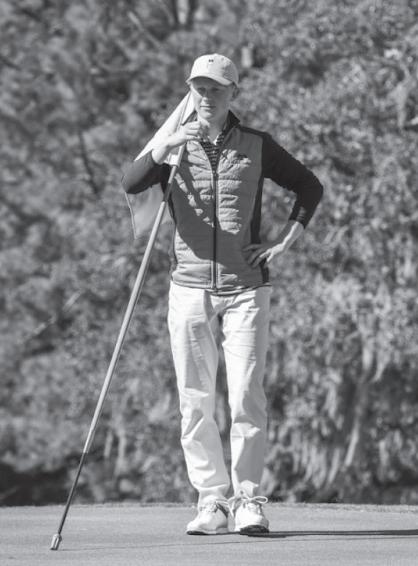
The community at Hillsdale has been a particularly high point, Irvine said. Be-
Charger
What's your biggest takeaway from your basketball career?
The work ethic it has instilled in me. It’s taught me that if you work hard enough to become good at something, you absolutely can.
What horror movie scenario do you think you could survive?
Honestly, none of them. I think I would freeze in fear and get killed.
What would your superhero power be? And what would your name be?
Teleportation. My name would be Emma Elsewhere.
“During the season, it’s about 20 hours per week we spend on golf alone. So between that and studies, I haven’t found that I’ve been too homesick.
I think the people here are so kind and so welcoming that that has really helped as well.”
Kelly said he was initially unsure of how well Irvine would fit with the team since he was the first international athlete he had ever worked with. But since Irvine’s arriv-
al, Kelly said all his hesitancies have evaporated.
“For me as a coach, he’s a pleasure working with,” Kelly said. “He always accomplishes what’s asked of him, and he does so competently and with a smile. So it’s been great having him here.”
Sophomore Theodosius Santalov, one of Irvine’s fellow transfer class admittees, said he recalled meeting the Scotsman for the first time and immediately gaining an appreciation for his character.
“I have so much respect for those individuals who don’t just explore their opportunities but actually follow through with them,” Santalov said. “Andrew could have gone to a school with favorable rates like St. Andrew’s back in Scotland. But Hillsdale saw something in him and offered a deal to him that he took, and I’m grateful that he did.”
Santalov said he thought that both Irvine and Hillsdale were the better for the arrangement. Not only was Irvine being immersed in the best of American literature
Chatter

and intellectual culture, Irvine was also able to experience a small-town American culture that many travelers from the U.K. simply aren’t able to.
“There’s a lot of blue collar people out here in Hillsdale,” Santalov said. “Hillsdale will get an ambassador to Scotland and to the world, and Andrew will receive the best of both an American education and a localized cultural experience that we can offer.”
And as far as the kilt goes, for Irvine, it’s become something of a staple.
“I’ve worn it twice,” Irvine said. “To the President’s Ball and to the Garden Party last year — I love wearing the kilt, but it’s the flood and tartan pattern, which is not my family’s ancestral pattern. The Irvine plaid is blue and green, and I will be receiving that privilege and honor when I turn 21 next year.”
Regardless, the kilt will stay in Hillsdale — even if the pattern is subject to change.
If you had a theme song for your life, what would it be?
"You’re Gonna Go Far" by Noah Kahan.
What is something you learned embarrassingly late in life?
That the saying “we will play it by ear” is not “we will play it by year”. I always said year up until a couple months ago.
If you could take over a country, which would it be and why?
Ireland, so I can go live with the other redheads.
Emma Ruhlman, Women's Basketball
Compiled by Malia Thibado
Photo Courtesy | Hillsdale College Athletic Department
International Athlete
Irvine in South Carolina’s Watson Cup Tournament last season. Courtesy | Andrew Irvine
Reuter competing for the Luxembourg League. Courtesy | Joe Reuter
C harger S port S
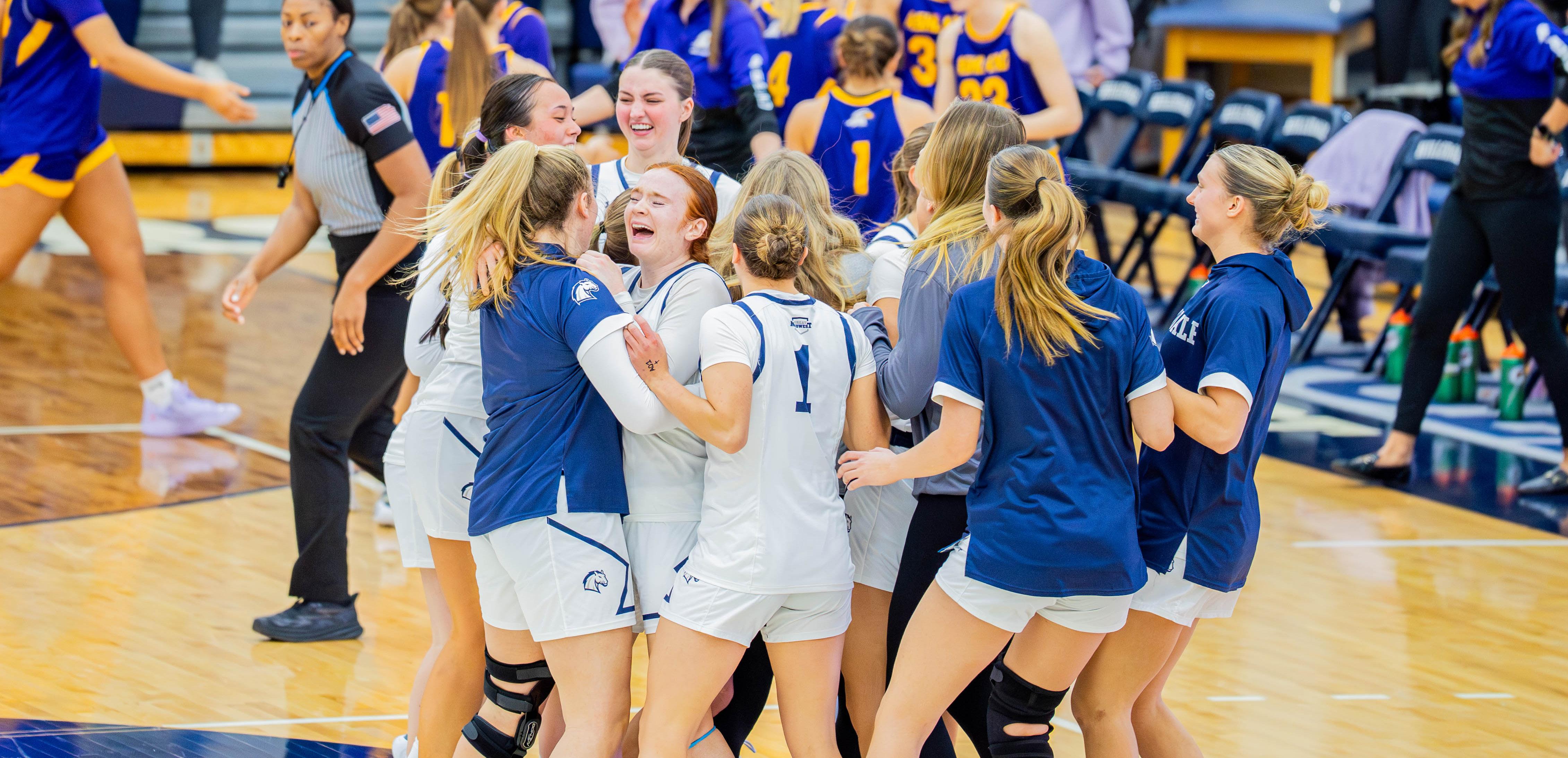
Team places second, Haas moves to first
By Francesca Cella Assistant Editor
Men’s weight throw took the top three places at the Wide Track Classic in the Biermann Athletic Center Jan. 23, as the Hillsdale track and field team won seven events and placed second overall.
The men’s track and field team is now ranked 17th in the nation and the women’s team is eighth for NCAA Division II.
Senior and defending DII national weight throw champion Ben Haas reclaimed the top spot in national rankings and placed first with a mark of 21.65 meters.
the DII provisional qualifying mark in the 3K with a time of 9:48.68. She has now qualified to compete in both the 3K and the 5K at the DII Indoor Championships in March.
Kuzma also placed third in the mile with a time of 5:05.32, followed by junior Savannah Fraley who came in sixth with

Sophomore Dominic Scharer and junior Dimitry Ermakov followed, hitting marks of 19.76 and 17.86 meters, respectively.
Scharer said despite battling illness earlier in the week, he was pleased with his performance.
“I hadn’t been feeling great all week, with a little bit of sickness, and a little bit of small, nagging injuries, but it was in the range of where I wanted to be,” Scharer said. “I was very happy with how it went.”
Sophomore Ally Kuzma hit
cesca Federici came in third at 26.04, and senior Anna Lamoreaux placed fourth with a time of 26.06.
In the men’s triple jump, senior Alfonso Garcia took first with a mark for 13.48 meters, followed by junior Christian Heinrichs, who came in third at 11.90 meters.

a time of 5:20.33. Kuzma said the meet was a chance for her to set a benchmark for the rest of the season.
“Our goal wasn’t really to have a full out race,” Kuzma said. “It was more to have a good standard for the conference. Obviously, it was a good effort, but it wasn’t an all out performance.”
Senior Lucy Minning placed first in the 60 and 200-meter dashes with times of 7.70 and 25.27. Senior Fran-
some taking weight throw with a mark of 18.58 meters.
Sophomore Yahli Salzman threw a personal record in shot put and placed third with a mark of 15.45 meters. Junior Jack Childress also threw a personal record 13.95 meters.
Salzman said he was glad he beat his record on home turf.

Women jumpers also performed well, with senior Erika Mogelvang taking third in the high jump and triple jump with marks of 1.59 and 10.68 meters. Sophomore Katie Kennedy closely followed her, placing fourth in the triple jump with a mark of 10.38 meters.
The Charger women won both throws events, with junior Amelia Lutz placing first in shot put with a throw of 15.41 meters, and Olivia New-
“I love throwing at home,” Salzman said. “It’s the people that I train with every day, it’s my friends being able to come, and people that I have in classes that are able to see the sport for the first time. I was really happy about where we were and that I was able to throw really far at home.”
The Chargers will compete in the Jet’s Pizza Invite at Saginaw Valley State University Jan. 30 and 31.
Findlay victory, Ashland defeat
By Evelyn Shurtliff Collegian Freelancer
The Hillsdale men’s basketball team defeated Findlay 78–72 Jan. 22, but fell to Ashland 82–72 at home two days later. The Chargers now have a 5–6 conference record and an 8–11 overall record.
With their victory against their long-time rival Findlay, the Chargers took a step toward evening the season record between the two teams.
Senior guard Ashton Janowski said the history between these two teams strengthened the intensity of the game.
“We came in knowing it was a rivalry game and that they beat us both times last year, which didn’t sit well with us,” Janowski said. “We also knew that if we followed our gameplan, that we would be successful, so between our energy starting the game and our attention to detail, we were able to pull off a great start.”
Hillsdale took the lead quickly and outscored Findlay 47–25 in the first half.
Senior guard Cole McWhinnie said the team’s first-half performance was crucial for the win.
work to build a lead early on that we were able to respond and pull out a big road win in a fun environment,” McWhinnie said.
Against Ashland, Hillsdale struggled defensively, allowing a 67.2% shooting percentage and 64 points in the paint but managed to keep the game close. The Chargers held a lead through the first half and into the second.
As the game continued, Hillsdale experienced foul trouble and put Ashland in the bonus, allowing them to score points at the line and close the gap. Ashland put together a 13-2 run after the game was tied at 66-all which proved too much for the Chargers to counter.
“You always worry after a great road game that you might come out flat the next game — people call it a trap game because of this,” head coach Keven Bradley said. “So I was really proud of the guys because we did not do that but built ourselves a lead and played well for the first half. Unfortunately, we just did not do a good job of maintaining our concentration and executing some things, which led them to a big run and lots of fouls on our end which allowed them to get the win.”
Sophomore forward Connor Stonebraker said the team is looking forward to their upcoming games.
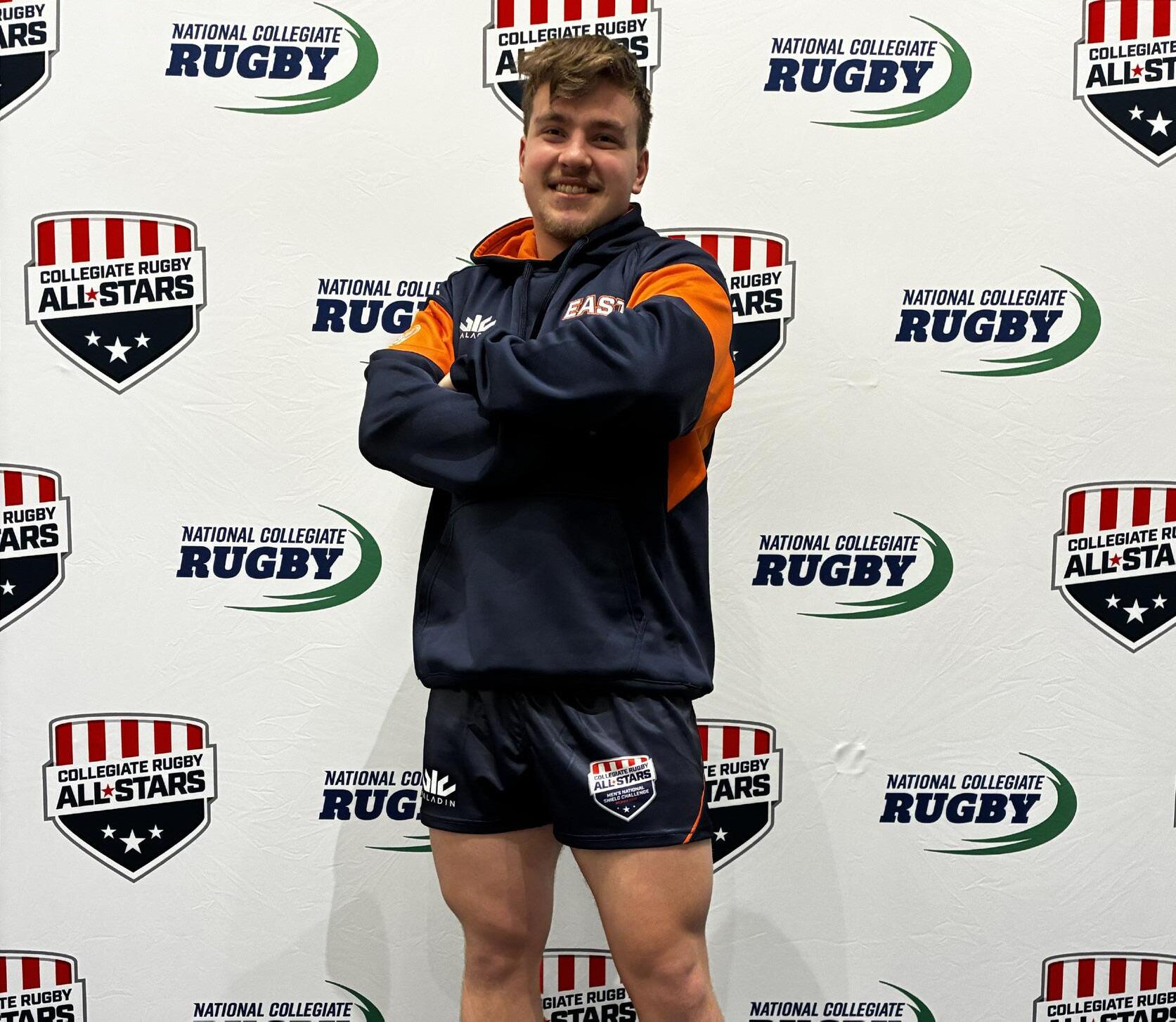
By Elaine Kutas Sports Editor
“We did a really nice job taking care of the ball against Findlay’s pressure and making them play the game at our pace,” McWhinnie said. “We took away their transition opportunities and made them execute in the half court, which made them uncomfortable as an up-tempo team.”
Hillsdale produces a 'Rising Star'
Junior Chris Dickinson of the Club Rugby team was selcted to compete in the Collegiate Rugby Rising Stars game Jan. 17-18. He played for the East region that went 2-1 overall.
“The main thing I learned from this is the intentionality that needs to be behind the game,” Dickinson said. “Everyone was very driven and focused and that is something I want to bring to the rest of my time at Hillsdale.”
As one of three players from Allegheny Rugby Union conference selected, Dickinson competed against all levels of student-athletes.
“I was playing with guys who have been playing for their whole lives,” Dickinson said. “It was still fun to play along with them and see how I ranked up against them.” Club Rugby
The Chargers held their lead for the rest of the game, holding Findlay back 74–70 with 17 seconds left of the game to piece together a run that left the game within two possessions.
“In the second half, we had some defensive lapses that led to easy baskets for Findlay, but we did enough
“Coming off a loss, I know the team will be hungry to get back on the court for another opportunity,” Stonebraker said. “It is our job to continue to work to reach our full potential as a team, no matter the outcome of a previous game.”
The Chargers next will face Walsh University on the road Jan. 31.
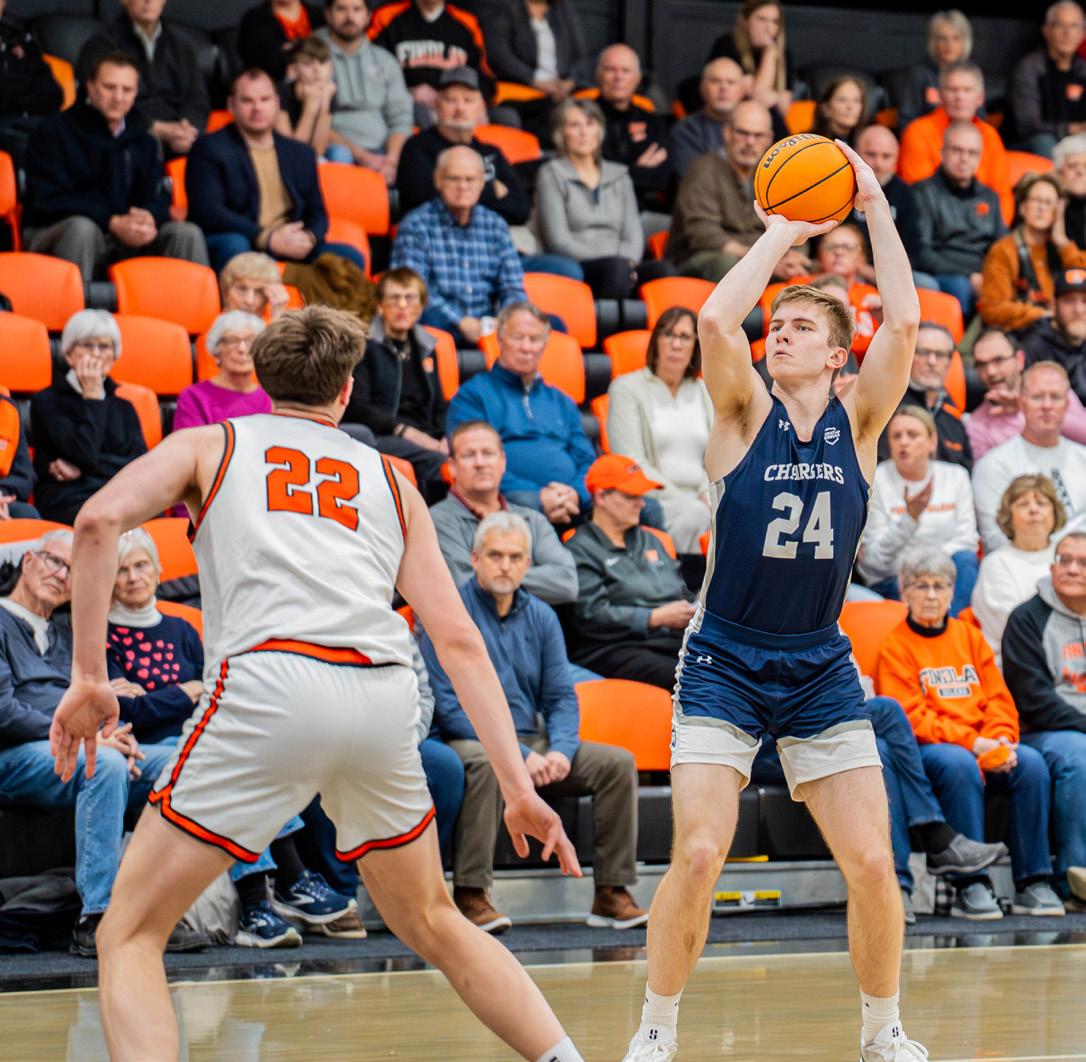
The
Ashley Van Hoose
Freshman Luan Kummel, left, in the men's long jump; sophomore Ally Kuzma, middle, in the 3K; and senior Ben Haas, right, in weight throw.
Courtesy | Ashley Van Hoose
C ourtesy | Chris Dickinson

‘Beauty on a pedestal’: Through the lens of Max Cote
By Grace Brennan AssistAnt Editor
If you’ve recently seen drone footage of campus covered in golden foliage, or videography of Chargers football or The Harry James Orchestra, you’ve seen the work of junior and art major Max Cote.
Cote has taken photography classes at Hillsdale College since he was a freshman, along with the design and drawing classes required for his art major. But his interest in photography began at a young age.
“I would say that most of my interest in this area comes from my mom, because she’s a very creative person,” Cote said. “She’s super talented in what she does, and I’ve grown up in that culture my whole life, watching her do graphic design and photography.”
Max Cote’s mother, Shanna Cote, is the executive director of digital experience design for the
college. Shanna Cote said her son has always been creative.
“He was always drawing and redesigning covers for books and DVDs, and he could spend hours inventing things — like cardboard vending machines,” Shanna Cote said. “He’d often gather his siblings to make ‘movie trailers’ at home. Every week there was a new project or idea he was excited about.”
After spending the summer of 2025 working on the media team at Damascus Summer Camp in Centerburg, Ohio, Max Cote was hired by Hillsdale College Admissions to film campus events in the fall of ‘25. Cote said Associate Director of Admissions Ben Strickland was the first person at Hillsdale to give him an opportunity to show off his abilities.
“I hired Max because he fit the vibe I was going for in our Instagram — high quality production and fun, aesthetic ideas — these were perfectly exempli-

fied by his football reel,” Strickland said.
Cote now works for the sports marketing team filming men’s and women’s basketball. He also works for the college’s marketing department, where he’s been surprised with important work such as editing a video of President Donald Trump.
“I called my brother, Jack, when I was editing the video and I told him, ‘This might be the craziest thing I’ll ever have
Max Cote has been hired by Cana Wedding Co. to create a few reels a week to help grow their company. Cote also has an Instagram account, @maxcotevisuals, for his own creative portfolio.
“It gets to show a more creative side of myself that you wouldn’t normally get to see as much in the marketing side of digital media,” Cote said.
The most recent personal video he put together was from a trip he took to Washington

to edit,’” Cote said. “I don’t think I’m gonna edit a video of the president ever again.”
Jack Cote ’25 said he’s impressed with his brother’s work.
“I think he does a great job of pushing boundaries and experimenting specifically when it comes to color,” Jack Cote said. “It’s very obvious he’s progressed a lot in editing and color grading when you compare his early work to the work he’s producing now.”
Outside of campus jobs,
state with junior Henry Webster.
“We went on a couple hikes. I took videos and photos there,” Cote said. “I posted some photos that were from Beacon Rock, which is beautiful. Then we took a day trip to Seattle, and I took different videos of the city that day.”
According to Webster, Cote brought multiple cameras with him when they went sightseeing, and would often get sidetracked.

“He was taking shots of pretty much everything he thought could be good content,” Webster said. “He would kind of go off on his own. We left him behind in a few instances.”
Webster said Cote has a special eye for composition.
“I think he has a really good eye for what he wants to film,” Webster said. “Walking around in a public space he’ll just look at something that he wants to go to, then film from there. I think he’s really good at having a vision for what he wants the video to look like.”
Cote said he wanted to capture a city scene similar to videos he’d seen on Instagram of Chicago and San Francisco.
But beyond that initial plan he didn’t know what the video was going to look like. He wanted to tell a story through his film.
“I had this song I started editing with. I hated it,” Cote said.
“So I trashed that song, and I ended up choosing one that was more chill. I found that with the
stillness I had in my shots, and focus on the angles and beauty of the city, I should choose something that’s slow.”
Cote said he loves the process of editing and especially enjoys matching his work with the right music.
“I have a whole playlist right now of songs that I want to make content with,” Cote said.
After he finally finished editing his video “A Day In Seattle” — shots of city skylines, a Ferris Wheel, and bustling common places — Cote said he felt pleased with what he created.
“I was celebrating in my room a little bit. I was very proud of my work,” Cote said.
Cote said the joy he gets from capturing special moments and replicating those moments through his art comes from the joy of sharing it with others.
“I think I try to tell a very human story,” Cote said. “I’m kind of putting beauty on a pedestal for people to see.”
The power and the humor of nature: Bob Kuhn draws on instinct
By Elaine Kutas sports Editor
Before photography was widespread, illustrators filled magazine pages with their life-like drawings of animals and nature. Robert Frederick
“Bob” Kuhn was one of the most influential wildlife illustrators of his time.
“Bob Kuhn: Drawing on Instinct” is on display in the Daughtrey Art Gallery through March 22. This exhibit showcases selections of Kuhn’s work, and, in conjunction with the Nimrod Education Center, seeks to educate viewers about nature and the conservation of natural resources.
By age 25, Kuhn had made a name for himself by creating cover art for Outdoor Life, a popular magazine in the mid-20th century. From
the 1940s to the 1960s, Kuhn created illustrations for many magazines and books such as
“Bambi: A Life in the Woods.”
In 1970, Kuhn transitioned to creating fine art, specifically acrylic paintings that still showed the movement and detail that his sketches expressed.
Visiting Assistant Professor of Art Roxanne Kaufman said despite the fame he earned from his sketches and illustrations, Kuhn’s personal favorites were the paintings created at the end of his career. The gallery gives a full perspective of his life’s work, showing pieces from the beginning of his career to his death in 2007.
“He has a large body of work that is on display at the National Wildlife Museum of Art, and that’s where a large portion of the show is borrowed from,” Kaufman said.

“But the paintings in the exhibit are on loan from Kuhn’s daughters. All the acrylic paintings here are theirs, and they were Bob’s personal favorites that he had kept and that had never been sold.”
During his time as an active artist, Kuhn traveled to Africa and Alaska as well as across the continental United States, spending his time observing animals to create the most realistic depictions he could.
“You can tell he spent a lot of time observing animals and out in the wilderness because there’s a good variety of both power — like their livelihood of hunting — and humor, like the coyote scratching itself,” Kaufman said. “I think his work spoke to so many people because he showed all sides of the animals’ personalities.” Sophomore Gabrielle Wood
said seeing the drawings in the exhibit is different from anything else she has seen at the art gallery, and she admires Kuhn’s talent.
“His ability to capture movement is impressive, because he did a lot of his drawings from life,” Wood said. “He had to look at the animal and take it all down super fast, which I find to be really skillful and makes his pieces like little snapshots.”
Senior Cecila Jansen echoed Wood’s admiration for seeing a professional’s sketches and the beauty they hold.
“A lot of the shows we have seen in the gallery have finished and polished paintings,” Jansen said. “But I think it’s cool to see how even the beginning stages of the sketches can even capture his mastery.”
More views from Beacon Rock. Courtesy | Max Cote
Cote posts his personal projects on Instagram. Courtesy | Max Cote
A view from Beacon Rock. Courtesy | Max Cote
“Bobcat,” by Bob Kuhn Courtesy | Martha Kennedy
C U L T U R E
Seniors hit the note at annual aria competition
By Sophia Mandt Collegian RepoRteR
Seniors Ellia He, Samuel Jarząb, and Ashlyn Linton will perform with the Hillsdale College Symphony Orchestra after winning the annual Aria Music Competition Jan. 25. He will join the violin section of the Symphony, Jarząb will be with the clarinets, and Linton will play piano in Markel Auditorium March 28.
The college’s Aria Competition is an annual contest where distinguished instrumental and vocal students compete for a chance to perform with the Hillsdale College Symphony Orchestra. The competitors prepare repertoire with their individual music teachers and perform before a panel of three guest judges in Howard Musical Hall.
Though the students were competing against each other, Professor of Music James Holleman said they remained enthusiastic and supportive of their friends’ accomplishments.
“At a conservatory or ma-
mezzo soprano performances of Jules Massenet’s “Werther! Werther!” and Pietro Mascagni’s “Voi lo Sapete, o Mamma.” LaBonte said she had no formal vocal training prior to her freshman year.
“I think the challenge for every performance is just meeting the song where it is in the moment and allowing the emotion to express itself there for the audience. It’s new every time,” LaBonte said. “There’s not always a ton you can do to prepare for that particular thing. When I’m doing something, I only think about that thing, because it doesn’t work to get stressed about all the things at once.”
Holleman told the audience he’s never before heard this level of competitive concerto performance.
“This is my 29th year teaching full time,” Holleman said. “Here, it really gives me a chance to listen to the growth of what’s going on, the level of the students we’re recruiting. “And I’m able to see this evolution, this progress of our students and

jor university, it can get pretty backstabbingly competitive,” Holleman said. “So to use the word ‘competition’ evokes kind of an edge that we simply don’t have here. Everybody’s going out there to do their personal best, and they are in complete support of their friends who have put in the same amount of work.”
Jarząb performed the first movement of Aaron Copland’s Clarinet Concerto, and Linton played the first movement of Sergio Rachmaninoff’s “Concerto No. 1 in F-sharp minor, Op. 1.” Ellia He was inspired to play Tomaso Vitali’s “Chaconne in G Minor” while going through a difficult time.
“I first heard this piece right before Covid, and my family was going through a lot,” she said. “I was a very angry and bitter person at the time, and when I first heard the piece, there were daggers going through me. It was so sad, and I wanted to cry.”
She said that the hours spent working on the piece brought back painful memories of her life, and made the piece a song of weeping.
“Sometimes when somebody is grieving, it’s like a black hole,” she said. “Sometimes music helps or it can touch emotions that you don’t have the wherewithal to express.”
She said that to her surprise, audience members were also emotionally touched by her performance. They told her they thought they heard a story behind the song she was playing, but were unsure of what the story was. In He’s case, the story she told was the grief she felt from family strife, and the comfort she found in music.
“That really touched me,” she said. “I hope this piece captures the gratefulness for God’s love, and the sorrow and grief that love also bears, because I think it has equal parts of grief and joy and depths and heights, and this really is something incomprehensible and wonderful.”
Senior Sophia LaBonte was the first runner-up for her
From teenage dream to ‘Marty Supreme’

By Lonán Mooney Collegian RepoRteR
“It’s no use, Jo.”
Any Gen-Z woman can quote the rest of the dialogue between Laurie (Timothée Chalamet) and Jo (Saoirse Ronan) from Greta Gerwig’s 2019 “Little Women.”
A young and zealous Chalamet delivers a fervent performance as Laurie, embodying the loverboy persona of his early career. This beloved Chalamet is a far cry from what audiences see in his recent projects. But Chalamet’s range across his career demonstrates he is still honing his craft, the mark of a great actor.
I’m really in pursuit of greatness.
I know people don’t usually talk like that but I want to be one of the greats,” Chalamet said, raising his award. “This doesn’t signify that, but it’s just more fuel, a little more ammo to keep going.”
Some regard Chalamet’s dramatic shift away from tear-filled eyes and floppy hair as a rejection of so many years of films in which he played roles within a designated stereotype. Many remain entirely agnostic about whether he has the range and raw talent required for true acting “greatness” like Daniel-Day Louis or Denzel Washington.
“Beautiful Boy” (2018), and “Little Women.” In all of these performances, his emotional range only goes from playful youth to depressive. While he played these characters well, it is understandable that such monotony could be stifling for an actor. While many noted a definitive change in his demeanour around his SAG acceptance speech, the change began well before that.
His career and film choices over the past couple years were intentional and strategic, beginning with his role as Willy Wonka in 2023’s “Wonka,” a deliberate echo back to his musical theatre years in high school and his broadway debut as Jim Quinn in “Prodigal Son” (2016).
When Chalamet followed his whimsical role as Willy Wonka with his starring role in “Dune,” many fans of the books were skeptical that this wiry, adolescent-looking man could personify Paul Atredes. Yet Chalamet stunned audiences with a commanding and domineering screen presence in both Dune films. After this, he began work on his role as Dylan, proving he could use his musical talent, lean more into method acting, and take on the identity of an American icon.
the quality of the teaching that’s going on in the studios.”
Holleman said when he was first hired at Hillsdale, others told him they wanted music coming out of every pore on campus and that over the years, the college’s music program has improved.
“So many faculty members try to make the school they’re teaching look like the school they graduated from, and most of us are from large universities. If you try to apply that to a small liberal arts college, you’re going to fail,” Holleman said.
Holleman said that students at smaller schools tend to participate in music only if they focus on nothing else but music.
Holleman said Hillsdale’s music program opens its doors to students who want opportunities for musical involvement, while studying a different subject.
“We say, oh, well, you still can grow as a musician, and we’ll work with you. We’ll work with your schedule, and we’ll maintain high standards for you,” Holleman said.
Senior music major Hillary Kuhlmann said she attended the competition to support her peers.
“I really enjoy seeing people put themselves out there and just give everything they have for music,” Kuhlmann said. “I love seeing performers perform. It’s such a human experience. And to share and connect the music on the stage that’s within the person, and have it come out and touch the audience is truly remarkable.”
Kuhlmann said she finds live music real and raw, as the performers can’t hide anything in front of a live audience.
“You have to be the most ‘yourself’ you can possibly be,” Kuhlmann said. “Everyone does their best, and you hope mistakes don’t happen, but sometimes that makes it even better and more human.”
Anyone watching Chalamet as Laurie would find it difficult to believe the same actor would later play Bob Dylan, feature on a British Scouse rapper’s song, and cause a ruckus online with his acceptance speech at the 2024 Screen Actors Guild Awards. Based on his demeanor early in his career, his fans might have expected a modest thanks when he took home best Male Actor in a Leading Role for “A Complete Unknown.” Instead, Chalamet delivered a monologue that shocked both Hollywood and his fans.
“I know the classiest thing would be to downplay the effort that went into this role,” Chalamet said. “I know we’re in a subjective business, but the truth is,
Chalamet has been open about fresh ambition and direction. “The Bob Dylan metaphor is ‘going electric,’” he said in a 2023 interview with Vogue magazine, referring to the moment at the Newport Folk Festival in 1965, in which Dylan shocked his loyal fans with rock and roll. He used the interview to say experimentation and expansion in the name of art is worthwhile, even if it’s shocking. Chalamet may sound arrogant, comparing his own early career to Dylan’s acoustic career. Yet his analysis was pertinent at the time and can act as a beacon of hope for Hollywood, even if this Chalamet sounds very different from the actor’s sensitive artistic beginnings.
Chalamet first made a name for himself in “Lady Bird” (2017), “Call Me By Your Name” (2017),
All of these choices climaxed in his SAG acceptance speech.
Straying further from audience expectations, Chalamet emerged with a strong social media presence in December 2025 to promote his new A24 film, “Marty Supreme,” in which he plays a star ping pong player. If one only watched the trailer for “Marty Supreme,” the role appears analogous to Chalamet’s so-called arrogance. Chalamet portrays a character who strives for “greatness,” exploring a cautionary tale of the American dream and the importance of integrity and morals, undoubtedly a pertinent allegory regarding his stage in his acting career. Marty must come face to face with fame and becomes morally defunct because of it. The public’s response to Chalamet in the last year is puzzling. Articles from The Free Press and British GQ praised his expansion, while hardcore fans on TikTok mourned his artistic and “indie prince” era, as The Guardian called it. While it’s still to be determined if he has the talent to be the Daniel Day Lewis of our time, his pursuit of acting greatness and his focus on craft is conservatism and classicism at its finest. In the narcissistic and mediocre air of the celebrity world, Chalamet offers a fresh, classic talent to modern cinema.

Louis Tomlinson takes a new direction
By Gianna Lodice Collegian RepoRteR
Louis Tomlinson’s third album, “How Did I Get Here?” released Jan. 23, is the former One Direction member’s answer to that very question. Through an upbeat mix of songs ranging from indie-rock to synth-pop, Tomlinson’s lyrics tell the story of an artist who has finally become comfortable with his own distinctive sound. The album is not just another collection of generic pop songs. It is a thoughtfully written and assembled body of music that showcases both Tomlinson’s creativity and his growth as a vocalist.
Tomlinson was the primary songwriter for one of the biggest boy bands of the 21st century.
Characteristically, this role was less flashy than his bandmates’ positions. He wrote their songs “Night Changes,” “Story of My Life,” “Perfect,” and “No Control.” Though his voice never had as much exposure as those of Harry Styles and Liam Payne, Tomlinson’s presence in the band was essential.
In a 2022 interview with The Telegraph, Tomlinson said One Direction’s split in 2016 and the subsequent prospect of a solo career was “a bit daunting.”
“I’d be lying if I said it didn’t bother me at first,” Tomlinson said. “Only because I didn’t know where to place myself, and really my only point of reference was other members of the band.”
With the release of the 12-track, 36-minute “How Did
I Get Here?,” Tomlinson has established himself as not only an independent songwriter but also an artist who has carved out his own musical space after a long process of discovery, heartbreak, and healing.
The album starts on a high note with its leading single, “Lemonade.” The bass-heavy, pop-rock song is catchy and incorporates a breadth of sounds that give it a summertime flavor.
This beginning track opens the gates to not only a musically varied but a lyrically sophisticated half-hour of listening.
In the chorus of the next song, “On Fire,” Tomlinson sings, “I was complacent / Comfortably jaded / I never knew / You came and erased it / Now I’m a wasteland / What can I do?” Tomlinson makes use of every lyric to artfully address his questions — and furthermore invites the audience to take a glimpse inside his mind.
Each track introduces a distinctive sound while combining with the others to create a cohesive album. “Sunflowers,” tones back the pace with an ’80s ballad type of sound. “Lazy” is an indie rock track that layers catchy lyrics with a nice bassline. “Jump The Gun” and “Last Night” are reminiscent of One Direction’s sound, which even for the non-Directioner is sure to rekindle the nostalgia of the 2010s music scene.
“Palaces” and “Imposter,” the other two singles to come off the album, are two of its stronger tracks. As with the rest of the album, each offers something
different and unexpected.
“Palaces” aligns with the sunnier melodies of the album’s earlier songs while bringing in strong guitar and bass lines, giving it a bright yet grungy feel reminiscent of Oasis. “Imposter” has a darker melody than the earlier tracks, giving audiences a definite sampling of Tomlinson’s experimentation with edgier sounds. He sings, “I think there’s a stranger in my bed / My heart’s beating faster / I can’t get the feeling out my head / That I am the imposter” — lyrics that may reveal how Tomlinson was feeling when he undertook an album of this artistic scope.
Perhaps the most emotional song Tomlinson offers on this album is “Dark to Light,” an ode to the grief of loss. Having lost his mother in 2016, his sister in 2019, and former bandmate and close friend Liam Payne in 2024, Tomlinson has some powerful words to share on the topic: “I wish you could / See how you look / In my eyes / … Could it bring you from dark to light?” Tomlinson’s musical experimentation has paid off with “How Did I Get Here?” The confident and emotionally driven album offers something different to every listener. Whether or not you’ve previously known Tomlinson as just one of the members of One Direction or as a solo artist, this album will certainly challenge any and all preconceptions of
It is a true display of an artist who has finally found and embraced a new sound with diverse and reliable roots.
Tomlinson.
Chalamet starred in “Little Women” in 2019. Courtesy | Pinterest
Chalamet starred in “Marty Supreme” last December. Courtesy | Pinterest
Senior Ellia He performs Tomaso Vitali’s “Chaconne in G minor.”
Courtesy | Austin Thomason
“How Did I Get Here?” album cover. Courtesy | Louis Tomlinson Instagram



Houses for Rent for 2026-2027
January 22, 2026
The following houses are for rent for the 2026-2027 school year:
● 85 East Fayette Street - This is a very spacious, recently renovated, partially furnished, five-bedroom, one and a half bath Victorian home that is two blocks from campus It is centrally air conditioned, has a large eat-in-kitchen with a garbage disposal and dishwasher, separate dining room, living room, parlor, large front porch, deck off the back, unfinished basement useful for storage, and is equipped with a washer and dryer The rent is $550 per student per month based upon five student occupants Available August 1, 2026 (earlier if desired)
● 173 West Street – This is a partially furnished three-bedroom, onebath Victorian home that is only two blocks from campus It has a separate dining room, living room, and unfinished basement that can be used for storage and is equipped with a washer and dryer The rent is $525 per student per month based upon three student occupants A fourth student may be added at a reduced rate if desired Available August 1, 2026
● 171 West Street – This is a three-bedroom, one bath Victorian that is two blocks from Campus It has a living room, den, eat-in-kitchen, and an unfinished basement available for storage that is equipped with a washer and dryer The rent is $525 per student per month based upon three student occupants A fourth student may be added at a reduced rate if desired Available August 1, 2026
If you are interested, please call Berry LeCompte at: 847 809-4843 (cell phone; preferred), 847 381-2514(office) or email at cblecompte@aol.com.

FEATURES
Who sends winter storm warnings? Fires
By Sophia Bryant Assistant Editor
While most people stayed at home last weekend bracing for a coming snow storm, meteorologists at the National Weather Service office in Syracuse, Indiana worked overtime.
The NWS Northern Indiana office serves Hillsdale County and several other counties in southwest Michigan, northern Indiana and northwest Ohio. Rachel Cobb manages 60 sites across the region that measure local temperature, rain, and snow. Cobb said meteorologists in their office coordinated with surrounding local offices and national offices to track the winter storm that hit last weekend.
The NWS recorded that the storm caused 4.1 inches of snowfall in Hillsdale by 8 a.m. on Jan. 26.
“The computer models showed the storm moving in for a week ahead of time,” Cobb said. “All the forecast offices were looking at it.”
The NWS office is situated in a one-story red brick building, located nearly two-hours from Hillsdale. A large white satellite dish is outside. Inside, six meteorologist’s desks sit side by side in an open room. Computers and screens on desks and walls display radars, maps, and graphs.
Cobb said the NWS sent out its hurricane hunter airplane to sample the winter storm’s atmospheric conditions as it developed over the Pacific Ocean.
‘Our main goal is protecting lives’
tions that take surface observations at ground level, which measure temperature, humidity, pressure, wind, sky cover, and solar radiation. Weather balloons measure temperature, humidity, and wind, and satellites take pictures and measure how much moisture and energy are in the atmosphere, according to Cobb.
The NWS uses a dual-polarization radar, which sends out a beam of energy that bounces off a raindrop or snowflake and comes back.
Computers turn that into a three-dimensional picture that shows the characteristics of the raindrop or snowflake, such as its size and speed. This radar helps them see what’s happening inside storms.
“It’s fluid dynamics,” Cobb said. “If you think of the sky, think of how the ocean is, with currents. The atmosphere is the same way. We just can’t see it because it’s clear, but it
to get those out.”
Two meteorologists are on shift 24 hours, 7 days per week, working in three different eight or nine hour shifts. They rotate through all three shifts throughout the year. More meteorologists come in when severe weather is expected, according to Cobb.
Several cubicles are situated beside the forecaster’s office space. Cobb’s desk is inside one of these cubicles. Outside the forecasters’ rooms are offices, a room for computer servers, and a room for electronics technicians. The office staffs 17 people, 10 of whom are forecasters, according to meteorologist Kyle Brown.
Cobb said one of the hardest parts of her job is working weekends, holidays, and nights.
“Sometimes you think your shift is over at four, but thunderstorms are breaking out. They need you to stay,”
rain, and snow by quality controlling their data, archiving it, and maintaining their equipment.
John Hinsberger, the information technology officer, is responsible for IT related to their Windows PC and other adjacent software, according to Brown.
“I’m responsible for a bunch of servers across the region, and make sure they have the latest updates,” Hinsberger said. “I respond to any trouble tickets that come in. There are about 50 servers.”
Cobb said she grew interested in meteorology in high school, when the 1996 movie “Twisters” came out.
Cobb attended Valparaiso University in Indiana for meteorology and took a storm chasing class in the summers. She thought she wanted to be a storm chaser, but she realized it was not a practical job.

really just flows the same way. It’s water vapor, so it’s the gas form of oceans.”
“Normally the hurricane hunters are for hurricanes,” Cobb said. “But when there’s a big Pacific storm that’s going to come in and affect half the country like this one did, they’ll send it out there, because we’re not in hurricane season.”
No weather balloons are over the ocean, so they need the planes to gather temperature, humidity, and pressure samples in developing storms, according to Cobb.
“If we can get a good idea of what the storm is doing at that time, it’s easier, then, to predict how it will evolve over time,” Cobb said.
Meteorologists entered the samples into their computer models to understand how the storm would develop, according to Cobb. The NWS uses several computer models, which are composed of data from surface observations, weather balloons, satellites and radars.
Hillsdale Municipal Airport and other airports across the country have automated sta-
March from A1
“Matthew is 18 now, and is constantly proving that his life has infinite value to everyone around him and in and of itself,” Vawter said.
“I wanted to fight for all of them, the unborn babies, especially those with special needs that Matthew has.”
For the second year in a row, the March for Life rally featured a video message from President Donald Trump and speeches from Vice President J.D. Vance and House Speaker Mike Johnson R-La. Vance, whose family recently announced they’re expecting their fourth child, spoke on the efforts of the Trump administration to protect and provide for human life in America and around the world.
“We know that life is a
The NWS coordinates county-based severe weather watches with the Storm Prediction Center in Norman, Oklahoma, and surrounding offices, according to Cobb. It declares a winter storm watch two or three days in advance, since they know the storms are coming. The NWS issued a winter storm watch on Jan. 22 for the snow storm that hit Michigan Jan. 25. It tries to declare a thunderstorm watch in the morning if the conditions are right.
Cobb said within 24 hours of a winter storm’s arrival, the NWS decides to put out a warning if it expects six to eight inches of snow, or heavy impacts on civilians, like school or road closures. This past weekend, Hillsdale County was under a winter weather advisory.
“For thunderstorms, we watch the radar, and if a storm looks like it’s going to be severe, then we issue the severe warning,” Cobb said. “We can’t do that 24 hours ahead. Fifteen minutes to half an hour ahead of time is when we try
gift. We know that babies are precious because we know them and we love them and we see the way they can transform our families,” Vance said at the rally. “We know that family is not just the source of great joy, but it’s part of God’s design for men and women, a design that extends outward from the family to our neighborhoods, to our communities, and to the United States of America itself.”
VanDerWeide said she is excited about the progress made in the legal and political realm regarding abortion but that the movement ought to focus on supporting women in their own communities.
“Whether abortion is legal or illegal, no matter how accessible it is,
Cobb said.
The NWS also does a seven-day public forecast, monitors the temperature to issue cold weather advisories and extreme heat advisories, monitors rivers for flooding, tracks drought, and manages their automated equipment.
Hillsdale’s forecast as of Jan. 28 predicted a high of 15 and a wind chill around minus 10 for Thursday, Jan. 29, a high of 12 and a low of minus 6 for Friday, Jan. 30, a high around 14 and a low of minus 3 for Saturday, Jan. 31, and a high of 19 and a low of six on Sunday, Feb. 1, with a chance of snow after 1 a.m.
Meteorologist Lonnie Fisher works on making the forecast. He said they gather information in their grid graphically, then the computers give a text product or a forecast using that data.
“We’ve got offices in Michigan, Illinois, southern Indiana, and then over to Ohio that we all coordinate with for the forecast,” Fisher said.
As observing program leader, Cobb manages sites run by civilian volunteers and at water treatment plants that measure local temperature,
“A lot of it was just sitting out in hot, dusty fields in the middle of the plains, just waiting for little clouds to turn into thunderstorms,” Cobb said. “And sometimes they did, sometimes they didn’t.”
Throughout her career, Cobb has worked on computer models and national forecasting maps in Maryland, forecasting and fire weather predictions for firefighters in California, Colorado, Idaho, Oregon, Utah, Washington, and Wyoming and studied hurricanes in South Carolina.
Cobb said while she worked in South Carolina, she learned about severe weather, like major thunderstorms and tornadoes, so she could get a job in the Midwest, where her family lives.
Forecasters know about winter storms days in advance, and people tend to be careful about them, but high winds during thunderstorms and tornadoes are the biggest hazard in this region, according to Cobb.
Cobb said the best part of working for the NWS is interacting with the public. She’s worked at public events like the Elkhart County Fair and boat shows on Lake Michigan by providing weather briefings for event organizers. She said the most challenging part of her job is the stress of forecasting the weather accurately.
“There’s the stress of trying to get it right, especially when there’s big events, because our main goal is protecting lives,” Cobb said. “So you want to make sure you get those thunderstorm warnings and tornado warnings, especially, and you want to make sure they’re right, so people take shelter and nobody gets hurt.”

from B6
The sudden increase in rental housing demand from thousands of displaced fire victims made the cost of renting living space in neighboring cities rise astronomically, making affordable rentals virtually non-existent for months. Two families I know paid $18,000 per month for a four-bedroom rental, for a total of $90,000 for five months, all while pleading with their insurance providers to cover the cost. Residents’ budgets constricted as they navigated the cost of losing valuable homes and belongings and finding new lodging, sometimes without important documents they were unable to retrieve while evacuating.
While many have attempted to help fire victims financially, much of this money may not reach Altadenans. One prominent example of outright fraud disguised as help for victims is FireAid, a benefit concert that raised millions of dollars intended for affected residents and business owners. A large amount of the funds allegedly went to political action organizations and other groups unrelated to charitable efforts for fire victims, according to a House Judiciary Committee interim staff report.
The ecological impact of the Eaton Fire appeared as soon as the fire did. As I mentioned in my last article, coyotes and rats became bolder, venturing into the open to escape their burning dens and nests. It’s more common to see packs of coyotes roaming the streets, causing hazards for drivers and the large number of residents who walk throughout the neighborhood, especially those walking their dogs.
The rats living in neighbors’ houses sheltered in ours, forcing us to deal with the infestation. Bears are a more common sight, too; four new bears live on our street now and play in my neighbors’ yards, pools, and fruit trees, and use Altadenans’ basements as their dens. The large number of unmaintained pools and empty home foundations collecting water also facilitated an exponential increase in the mosquito population.
In addition to the wildlife woes that Altadena now faces, the mountains above us are unstable. The vegetation helping hold the mountains together with its root systems suffered, and heavy rain in the weeks and months following the fire caused flash floods and mudslides, some of which narrowly missed our property.
Altadena’s small-town culture and charm also suffered from the fire. Many of
women are always going to find a way to access it. And so laws are not enough to stop it,” VanDerWeide said.
“We need to create communities of love and support so that women don’t even think of abortion as an option.”
Both guest speeches and participants’ signs at the March for Life not only called for the protection of unborn babies but also promoted marriage and families.
Asked what impact this march left on them, multiple students used words like “excited,” and “enthusiastic.”
“I saw a lot of young people like us, and it was clear that they were passionate about not just saving the unborn, but also life itself, from their enthusiasm and their joy that they brought to the march,” sophomore Sophia Carey said.
the now-empty streets were lined with countless historic homes built in the 1920s and 1930s. These houses contributed greatly to Altadena’s beauty and character, and their loss is deeply felt by those who enjoyed living in the environment that the houses helped create. Many residents are concerned that affordable housing projects replacing individual homes and developers purchasing lots will change the character of the neighborhood. Some of these concerns are legitimate: several of my neighbors’ lots were purchased by Chinese developers, whose plans for the lots are unknown.
Popular restaurants and shops such as Fox’s Restaurant and Altadena Hardware were incinerated, taking with them some of the neighborhood’s culture. Additionally, many residents’ plans for their lives in Altadena were upended. Some of my elderly neighbors who had lived in the neighborhood for decades and intended to retire there, must reconsider their plans. Young families who hoped to raise their children beneath the palm trees dotting the landscape have to evaluate whether they want their children to live in a construction zone for the next five to 10 years.
State and local governments promise to build back better, but many residents want Altadena to be just the way it was. For now, the remaining houses stand in stark contrast to the empty lots next door and across the street being scraped clean of debris. Many residents and other Californians observing the fallout from the fires are increasingly disillusioned with the state and local governments’ corruption, mismanagement, and flawed policies that led to these disasters and made matters worse afterward.
Unfortunately, people not only lost homes and pets, but neighbors as well. Currently, the number of fatalities directly caused by the Eaton Fire stands at 19, more than any of the other fires burning simultaneously with Altadena’s.
The memory of the 19 residents that tragically perished in the flames is a reminder that those who survived have much to be grateful for. My family and many others are blessed that our house and property survived along with us, and for now, we plan to stay.
Santalov said many joyful people attended the March for Life.
“Marchers are excited about everything that has to do with life, right? They’re excited about worshiping God. They’re excited about raising their children. They’re excited about living,” Santalov said. “In this day and age where there’s so much negativity in the news and in public discourse, it’s cool to go somewhere where everyone is in agreement that life is good, life is sacred, and life must be preserved.”
Juniors Maria Adamow, Katharine Reyes, Jacqueline Roth, and Amelia King participated in the 52nd March for Life.
COURTESY | AMELIA KING
Meterologist Lonnie Fisher tracks last week’s winter storm.
SOPHIA BRYANT | THE COLLEGIAN

FEATURES
‘Scorched remains’: Reflections on California fires one year later
that contributed
By Avedis Maljanian Collegian Freelancer
As the Eaton Fire ravaged my hometown of Altadena, California last year, my family and our neighbors focused on our lives and our property. We just wanted to survive. As the fire subsided, we didn’t know it was only the beginning of our community’s struggle. In the restoration process since the fire, I’ve seen the insurance, health, and economic problems that surfaced in the aftermath of this historic disaster.
The fire began in January 2025 and burned for 24 days, destroying more than 9,000 buildings. While my family was blessed to return to an unburnt house, thousands of others found only their chimney standing, their homes scorched remains strewn around it.
I evacuated with my family on the evening of Jan. 7, returning the
discovered our house had escaped the worst of the blaze. We fought fires around our property and street while warding off potential loot ers, including one who ran through our backyard. After several days of guarding the house, I returned to school Jan. 12 while my parents continued to protect the property. I described these events in the Jan. 23, 2025 edition of The Collegian. The immediate issue for residents was their inability to return home. As the fire abated, the California National Guard and law enforcement encircled the neighborhood in a defensive line known as a cordon to stop looting and prevent civilians from dis rupting the firefighters. While this kept out looters, guardsmen and

erties even with proof of residence.
In my previous article, I mentioned that my parents relieved me from guarding our property so I could rest. After I left, I couldn’t re-enter the cordon, and if my parents left, they wouldn’t be allowed back in. I could hand supplies across the cordon, but that was it. Residents within the cordon, including my parents, went without power, running water, and gas to our homes for weeks.
The physical, mental, and emotional effects on residents began immediately after the fire. Many Altadena houses, including ours built in 1930, contained lead paint, asbestos insulation, and other toxins
other heavy metals to the smoke.
Exposure to toxins and extreme stress caused respiratory, cardiovascular, and other temporary and chronic issues for those in and near the burn zone. I have a chronic illness, and due to stress, strenuous activity, and smoke inhalation, I experienced internal bleeding and respiratory issues while at college following the fire.
In addition to health problems from smoke inhalation, hazards remained in the ash coating our properties.
When I re-entered my house months after the fire before the house was cleaned, I developed a severe headache if I remained indoors without a mask for 10 minutes.
Along with physical effects, many residents report post-traumatic stress from the shock of losing homes, possessions, and pets, and seeing their neighborhood destroyed.
Returning to our houses brought mixed feelings, as we had to commute from our temporary homes to our lots through a starkly different neighborhood. I’m grateful that my house survived, but after months of seeing it in disarray surrounded by empty lots, it didn’t feel like home.
A major issue was home insurance policies’ coverage. In recent years, homes rose in value, but homeowners were not told to change their coverage accordingly. After the fires, insurance companies attempted to shortchange many homeowners what they were owed in payout.
In my family’s case, our insurance company tried to deny responsibility for items included in
confronted with evidence,dodged the issue and left the claim unsolved for nine months. This obfuscation forced my family to relocate to various rentals, uncertain if insurance would compensate for housing costs. My parents and other residents hired public adjusters to hold our insurers accountable for short-changing us. While some insurance companies have paid policy holders their due already, many residents report the battle with their insurers dragging on to this day.
Just a few weeks before Christmas, my parents finally moved back into our house, while most of our furniture is still waiting to be cleaned more than one year later. The economic fallout of the Eaton Fire has yet to be fully realized, but it will be historic.
Compiled by Robert Matteson Collegian Reporter
In this Quick Hits, Artist and Teacher of Piano Daniel Kuehler discusses Top Gun, Legos, and concerts.
As a child, what did you want to be when you grew up?
A garbage man. Who wouldn’t want to hang on the back of a garbage truck and swing around? Then I wanted to work for NASA but quickly gave it up when I realized I couldn’t just look at galaxies and nebulae all day through a telescope.
Who is your biggest musical inspiration?
There are so many, but I would have to say my piano professor from my doctorate, Natalya Antonova. Every lesson with her was a lesson in life. Born and raised in Russia, she concertized all over the world from a very young age and was friends with many of the great pianistic giants of the 20th century. Not only is her imagination the most active I’ve come across, but her amazing and hilarious stories have left an indelible mark on my brain.
If you were a pilot in “Top Gun,” what would your name be?
Keys What is the best and worst Christmas gift you have ever received?

to redeem myself from 4th grade.
What is the best concert you have ever attended?
Berlin Philharmonic. Ann Arbor. 2024. I cried twice in the concert, and that never happens.
If you could describe your entire life in three words, what would they be?
of guy, but it would be cool to do keyboard fills for John Mayer, Matchbox 20, or 311, because those musicians defined a particular chapter of my high school/college life.
If you could move Hillsdale College to any location in the world, where would you move it to?
Cinque Terra, Italy. Gorgeous coastal views.
If you could eat one meal for the rest of your life, what would it be?
The best gift was by far this Lego Technic red sports car (called Super Street Sensation, set 8448) which had a functioning V8 engine with moving pistons, a legit rackand-pinion steering wheel, and the ability to turn it from a coupe into a convertible. As far as the worst, I remember receiving this woolen polar bear sweater as a kid. The polar bear was cool, but it was so scratchy that wearing the darn thing was torture.
If you were not a professor, what would you do professionally?
I would most likely be a music director for a parish with a side hustle power washing anything and everything. Before and after pictures are so satisfying.
Holy Spirit moments. It’s a trend that I look back on my life and realize the Holy Spirit at work every step of the way. In the moment, life events don’t make sense. In hindsight, it’s very clear to see the bigger plan God has had in store. I call those Holy Spirit moments because they are graces, unmerited gifts of clarity and perspective.
If you could play any sport at Hillsdale for one game, which sport would you choose?
Basketball, because I need
If you could play piano in any band, which one would you choose?
I’m not a band piano kind
Cacio e pepe pasta as made by a specific restaurant in St. Louis: Pastaria. The pasta is a little al dente, a little gummy, and the grainy, peppery cheese sauce is salty and way too delicious.
In your opinion, what is the prettiest sounding instrument?
Well, piano. But I’m biased.
cordon didn’t allow Altadenans to access
to a noxious smoke. In addition,
The Eaton Fire tears through California last January. COURTESY | AVEDIS MALJANIAN
The same backyard as left, taken almost a year after the blaze. COURTESY | AVEDIS MALJANIAN