By Thomas McKenna and Ellie Fromm Editor In Chief and News Editor
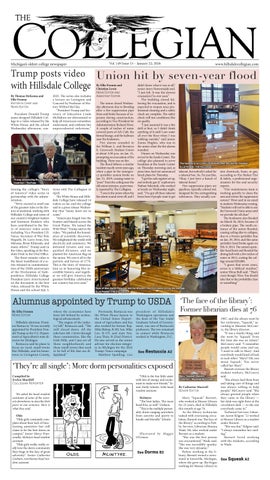
President Donald Trump
name-dropped Hillsdale College in a video released by the White House and the school Wednesday afternoon, con -
2025. The series also includes a lecture on Lexington and Concord by Professor of History Wilfred McClay.
“President Trump and Secretary of Education Linda McMahon are determined to help all Americans remember, understand, and celebrate this unprecedented milestone,”
tinuing the college’s “Story of America” video series in partnership with the administration.
“We’re excited to retell one of the greatest tales in the history of mankind, working with Hillsdale College and some of our country’s brightest leaders and foremost thinkers who have contributed to the ‘Story of America’ video series including Vice President J.D. Vance, Secretary of War Pete Hegseth, Dr. Larry Arnn, Eric Metaxas, Brian Kilmeade, and many others,” Trump said in the video, speaking at the Resolute Desk in the Oval Office.
The three-minute video is the latest installment of a series released in commemoration of the 250th anniversary of the Declaration of Independence. Hillsdale College President Larry Arnn lectured on the document in the first video, released by the White House and the school July 3,
told The Collegian in April.
The White House and Hillsdale College have released 14 videos so far, and the college said in a press release Wednesday that “many more are to come.”
“Americans forged into the frontier and blazed across the Great Plains. We tamed the Wild West,” Trump said in the video. “We pushed the boundaries of scientific discovery. We enlightened the world with electricity and commerce. We defeated tyrants and vanquished dictators, and we planted the American flag on the moon. We owe it all to the patriots and heroes of 1776. This is the story of America. Join us in honoring this incredible history, and together we will give America the greatest birthday celebration our country has ever seen.”
Union hit by seven-year flood
By Ellie Fromm and Christina Lewis News Editor and Assistant Editor
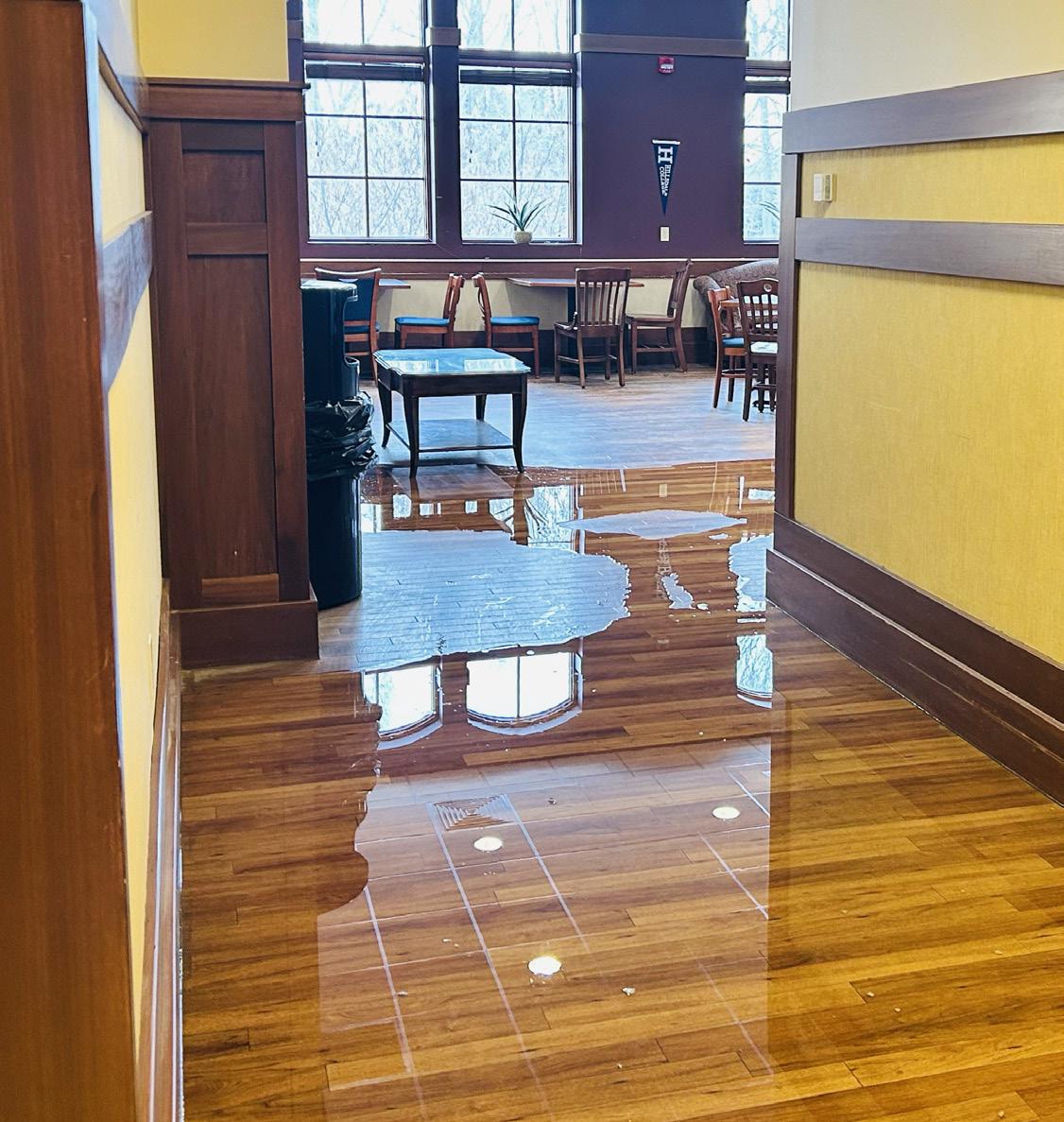
The union closed Wednesday afternoon due to flooding after a fire-suppression pipe froze and broke because of exposure during construction, according to Vice President for Administration Richard Péwé. A couple of inches of water covered parts of AJ’s Café, the formal lounge, and the hallways near the bookstore.
Fire alarms sounded in the William L. and Berniece E. Grewcock Student Union at about 3:50 p.m. on Jan. 21, prompting an evacuation of the building. There was no fire.
The flood follows a similar incident exactly seven years ago, when a pipe in the emergency sprinkler system broke on Jan. 21, 2019, causing water to “pour” from the ceiling near the old union entrance, as previously reported by The Collegian.
“I was in the union when the fire alarm sound went off, and I
didn’t know what it was at all,” senior Avery Nowowiejski said. “I just left. It was the slowest evacuation I’ve ever seen.”
The building closed following the evacuation, and is expected to reopen once professional cleaning and a safety check are complete. The safety check will test conditions like air quality.
“I just assumed it was a fire drill at first, so I didn’t think anything of it until I saw water all over the floor when I was walking outside,” said junior Zanna Hughes, who was in the union when the fire alarms sounded.
Dinner on Wednesday was served in the Searle Center. The college also planned to serve breakfast at the Searle Center on Thursday morning and, at press time, had not announced lunch plans for Thursday.
“I got the cash register set up, and nobody got it,” sophomore Nathan Salemink, who worked at Searle on Wednesday night, said. “I’ve got all these takeout boxes here if people want to get
takeout, but nobody’s asked for a takeout box. So, I’m just like, ‘Okay, I just have a bunch of takeout boxes.’”
Fire suppression pipes are pipelines, typically colored red, designed for fire-extinguishing substances. They usually con-
Alumnus appointed by Trump to USDA
By Ellie Fromm News Editor
Hillsdale alumnus Domi-
nic Restuccia ’16 was recently appointed by President Donald Trump as the U.S. Department of Agriculture’s state director for Michigan.
tain chemicals, foam, or gas, according to Pye Barker Fire & Safety, a professional organization for fire and security experts.
“Our maintenance team is working quickly to clean the area and restore the suppression system,” Péwé said in an email to students Wednesday evening. “Students will not be able to use the Grewcock Union areas until we provide the all clear.”
The bookstore also flooded on March 26, 2014, because of a broken pipe. The south entrance of the union flooded, causing ceiling tiles to collapse, due to a frozen sprinkler line on Jan. 29, 2014, and this same sprinkler head broke again on Feb. 8, 2014. The union’s sprinkler head burst and flooded the dining hall with a few inches of water in 2013, costing the college around $50,000.
“I guess that seven years, seven is a biblical number,” senior Elena Bull said. “That’s crazy though. Wow. You should take that to the probability class or something.”
Restuccia said he plans to focus on rural, small towns like Hillsdale, and his hometown in Livingston County, where the economies have been left behind by technological advancement.
Compiled by Evelyn Shurtliff Collegian Reporter
We asked the head resident assistants of some of the women’s dormitories to describe their peers in one sentence. Here is what they said:
Olds
“Olds girls constantly complain about their lack of functioning amenities but still claim to be the best dorm on campus.” Junior Mercy Franzonello, McIntyre head resident assistant.
“Olds girls really, really, really love the dorm community they forge in the face of great adversity.” Senior Catherine Graham, townhomes head resident assistant.
“The engine of the industry left,” Restuccia said. “The mill closed down. All the jobs have left. I drive through these communities, like the Irish Hills, and I just see all these neighborhoods and these small towns that used to be full of life that are dilapidated.”
Previously, Restuccia was the White House liaison to the United States Department of Agriculture and has also worked for former Rep. Mike Bishop, R-MI, Sen. Mike Lee, R-UT, and state Sen. Lana Theis, R-22nd District. He also served as the senior adviser for election integrity in Michigan for the 2024 Trump–Vance campaign.
Matthew Spalding, vice
president of Hillsdale’s Washington operations and the dean of the Van Andel Graduate School of Government, was one of Restuccia’s professors. The two remained in contact while Restuccia worked in Washington, D.C.
“Olds is the fun little sister with lots of energy and excitement to make new friends.” Senior Emily Schutte, Sohn head resident assistant.
McIntyre
“The best ladies. The most head RAs, as well.” Graham.
“This is the multiple personality dorm ranging anywhere from sorority and sporty to fundie and friendly.” Schutte.
Illustrated by Maggie O’Connor.
‘The face of the library’: Former librarian dies at 76
By Catherine Maxwell Senior Editor
Mary “Squeak” Barnett, who worked at Mossey Library for 23 years, died in Hillsdale this month at age 76.
As the library technician tasked with overseeing circulation, Barnett was “the face of the library,” according to Public Services Librarian Brenna Wade ’08, who worked under Barnett as a student.
“She was the first person you encountered,” Wade said. “She was incredibly spunky. She was very dynamic.”
Before working at the library, Barnett owned a newsstand in Jonesville, Michigan, where she grew up. She began working for Mossey Library in
1987, and she always went by her nickname, “Squeak,” according to Maurine McCourry, the library director.
“It was a family thing, and she went by ‘Squeak’ from the time she was an infant,” McCourry said. “I remember people would come and say, ‘I need to talk to Mary.’ And everybody would kind of look at each other: ‘Mary? Oh, you mean Squeak.’ You never called her Mary.” Barnett oversaw the library student workers, McCourry said.
“She always had them busy and taking care of things and was always willing to help people,” McCourry said. “She always greeted people when they came in the library — her desk was right there at the circulation desk — so she saw everybody come in.” Technical Services Librarian Aaron Kilgore ’12 worked at Mossey Library as a student under Barnett.
“She was fun,” Kilgore said. “I always remember her smiling.”
Barnett loved working with the students, according to Wade.
Michigan’s oldest college newspaper
See Restuccia A2
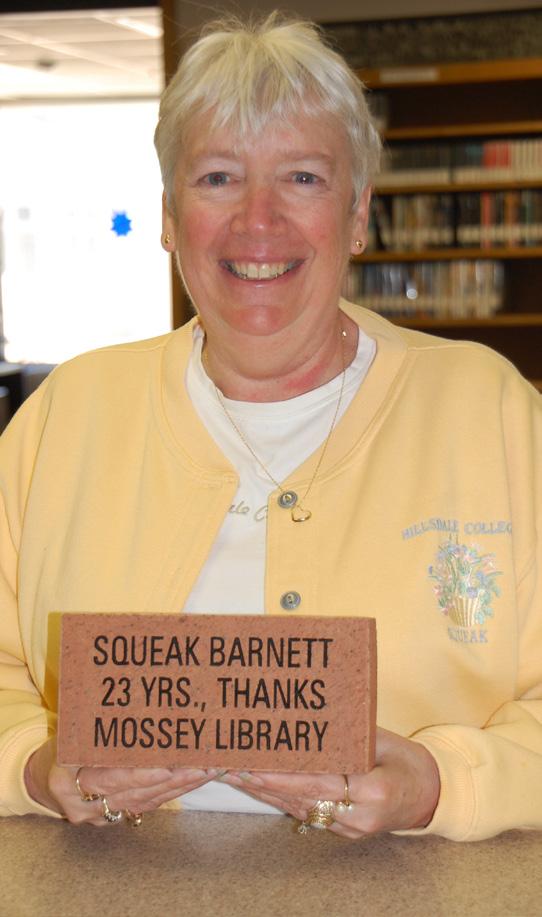
Mary “Squeak” Barnett. Courtesy | Maurine McCourry
Arnn
Dean of Men Aaron Petersen and the Winston Churchill statue survey the damage. Ellie Fromm | The Collegian
The hallway to AJ’s Café 20 minutes after the alarms sounded. Ellie Fromm | The Collegian
Trump announcing the partnership with Hillsdale College. Courtesy | YouTube
DC campus renovations to accomodate growth near completion
said in an email.
By Sophia Bryant Assistant Editor
Hillsdale’s campus in Washington, D.C., is almost finished with the renovation of the Kirby Center after nearly two years of construction.
The Allan P. Kirby Jr. Center for Constitutional Studies and Citizenship, the D.C. campus’ building for graduate students and undergraduates on the Washington-Hillsdale Internship Program, is now attached to the Van Andel Graduate School of Government building on the first and third floors, after construction began in March 2024, according to Executive Director of Washington Operations Andrew Heim.
Heim said the Kirby Center renovations include a new chapel, five seminar rooms, and 10 new faculty and staff work spaces. The lecture hall has new carpet, lighting, acoustic paneling, audio-visuals, and custom millwork. Crews also renovated the main lobby, entrance, and library.
“Everything now has a beautiful and elevated feel that draws your attention to the important work being done here,” Heim said.
Junior Olivia Eames, a student on WHIP, described the architecture of the building as “ornate, intentional, and tasteful,” and said the building felt like Hillsdale.
“For me, living here during this time of growth for the college and the 250th anniversary of our nation inspires an even greater sense of patriotism and appreciation for both my country and college,” Eames
“Hillsdale’s growing programs in D.C. required more space. This campus is it,” Heim said in an email. “Everything was designed intentionally to serve the important work of teaching and learning that happens here at Hillsdale in D.C.”
Junior Whitney Wilkinson, another student on WHIP, said she walked through the building, and her favorite room was the formal library.
“It’s just beautiful,” Wilkinson said. “The shelving, the architecture — it’s like the Heritage Room, but with lighting.”
Senior Rebekah George, who is currently on WHIP, agreed the library is amazing. She said although it was completely furnished, there are no books yet.
“I am so excited for it to be done,” George said. “Everyone on staff is super excited for it to be completed. They’re telling us that we’re all guinea pigs. I guess, in a sense, that’s kind of scary and nerve-wracking. But I think for the most part, it’s going to be really, really nice to have that space so close to the Hillsdale house.”
Eames said she is excited to have the beautiful area to share with other students. Since they
live in different apartments, students on WHIP are more independent than students on campus, so the Kirby Center will be a great place to spend time together, according to Eames.
“It’s really interesting to be the transitional generation of WHIP students,” Wilkinson said. “We’re kind of the first
ones in the new building, in a more modernized version of the program as it’s developing, it’s pretty amazing to know that and be here during it.”
Heim said construction on the townhouses adjacent to the Kirby and Van Andel buildings is set to begin soon, and those will not be completed until later this year. These will be used for the D.C. undergraduate programs and student housing.
“We hope folks will come to visit us and see this beautiful campus for themselves,” Heim said. “There is something special going on here, and we are excited to share it with everyone who comes through our doors.”
Halter Center to host open competition
By Daniel Johnson Collegian Reporter
The John Halter Shooting Sports Education Center will host the LaPorte Reagan FiveStand Winter League Jan. 21Feb. 28 for a second year inside the heated Drummond FiveStand Building.
The league is a sporting clays competition, in which participants shoot clay targets coming from various trajectories from each of the five indoor towers each week. Each competitor shoots 50 clays per week, contributing to the total score out of 250, with the lowest weekly score dropped.
“It’s a great way to enjoy the shooting sports and get some practice in even while it’s cold,” said Jonathan Calabrese, clay shooting sports program manager at the Halter Center.
“I’m very hopeful for him, very proud of him, and wish him the best,” Spalding said. “I always say, it’s one of the greatest things as a professor, to see students who go out and are very successful in keeping up the argument. That’s extremely rewarding.”
Restuccia said he wants to assist smaller Michigan communities with their economic opportunities and job growth which, he believes, will help the towns become vibrant and grow.
“This is indicative of so many of these communities where it’s predominantly retirees who moved there, where the jobs were good and whose children have left, except for some of those who either chose to stay behind and make sacri-
The five-week league is open to any shooter with at least intermediate-level experience with a shotgun for a $25 weekly fee, with a 10% discount for those who pay up front, according to the Halter Center. Those who pay an extra $50 have the chance to receive cash prizes if they place highly at the end of the five weeks. Prizes will be based on the number of participants.
Shotguns can be rented and ammunition purchased for the event onsite. Participants need to have an intermediate level of shooting experience, as no on-site instruction will be provided.
“The request for intermediate experience is due to safety,” Calabrese said. “Intermediate experience simply entails someone who is comfortable shooting clay targets and has
fices to do so, or who just didn’t have the economic opportunities elsewhere,” Restuccia said.
Trump’s presidential campaign message reflects the work Restuccia is planning at the USDA, Restuccia said.
“I think that for President Trump in particular, the almost central campaign promise was, ‘The forgotten men and women will no longer be forgotten,’” Restuccia said. “I think that rural development is one of the key tools to helping to fulfill that promise, because it serves a lot of the communities that would not otherwise perhaps have access to the kind of capital, grant money, or investments to maintain that municipality.”
Restuccia said he wants to use the taxpayers’ money responsibly, and that the money invested will be paid back to the government in payments feasi-
the ability to do so safely.”
Final scores for the league will be measured according to the Lewis Class system, which categorizes participants into classes based on their scores and ability levels and ranks them within that class.
The league is a great way for recreational shooters to develop their skills comfortably according to shotgun team captain and junior Madeline Corbin.
“If people are on the fence about signing up, I would recommend doing it, because five-stand is a great way to start shooting clay targets,” Corbin said. “And the five-stand at Halter is heated, so it is perfect for shooting in the winter.”
Shotgun head coach Jordan Hintz added that the sport is safer than is often assumed.
“The fact that the sport has to do with firearms makes a lot
ble for the community.
“We do some grants, that’s a piece of the portfolio, but the majority of the dollars that go out are direct and guaranteed loans,” Restuccia said. “So, this really isn’t a handout, as it is a hand up.”
of people think that it’s inherently dangerous,” Hintz said. “But it’s really a safe sport, and it’s something you can keep doing your whole life.”
For those with no shooting experience, gun safety and shooting courses are available at the Halter Center, according to Calabrese.
“The Halter Center offers one on one instruction that will teach a shooter how to improve their skills and understand the safety required in shooting sports,” he said.
Participants in the league may shoot from noon to 6 p.m. on Wednesdays or on Saturdays 9 a.m. to 3 p.m. Registration for the league is open until the end of the second week of the league, Jan. 31, at 2:30 p.m.
them to “serve elderly, disabled, and low income households with yard work, home repair, and service tasks,” according to its website.
“I just remember leading crews into different folks’ homes and there was just a lot
“Dom loves our country, and he loves our state, and he knows policy very well , and a lot of that stuff he learned at Hillsdale.”
Restuccia said he saw this need when he helped found A Few Good Men, a Hillsdale College volunteering opportunity for students that allows
of need there,” Restuccia said. “It kind of emphasized how many people were isolated, alone in the community and fractured.”
“She was the person that you dealt with the most on a daily basis,” Wade said. “She’s the one who told you what to do on your shift. She was good at her job, and she was a good presence at the library, and really good with the student workers. She was just very friendly and engaging.”
She said some of her fondest memories came from the library’s team building exercise in the winter, which featured dinner and games for staff and students.
“Squeak always went all out for it,” Wade said. “I just remember her being very involved in the games, very good at the games.”
In addition to running circulation, Barnett helped the library grow its collection of popular novels, according to McCourry.
“She kept up on what people were interested in reading,” McCourry said. “She spent a lot of time talking with people about what they were reading for fun, and she kind of helped us out a lot with buying materials like that.”
Because the library did not have access to the Michigan eLibrary yet, McCourry said, Barnett helped Mossey grow its collection.
“I think the newspaper stand experience helped her with that,” McCourry said. “She knew how to feel people out about what they were interested in reading.”
Barnett was also the go-to source for navigating Hillsdale, according to Wade.
“I did student teaching, when we still had an accredited program, and I needed to get to Reading,” Wade said.
Alumna Emma (Vinton)
Restuccia ’16, Dominic Restuccia’s wife, said Hillsdale College formed her husband for the position he now holds. Emma Restuccia was an assistant features editor at The Collegian for two years.
“Dom loves our country, and he loves our state, and he knows policy very well, and a lot of that stuff he learned at Hillsdale,” she said. “Hillsdale really shaped him into the man he is, and gave him the relationships and friendships that have kind of carried him forward into his career.”
Restuccia will be moving back to Michigan after working the last year in Washington, D.C., away from his young family. He said he worked during the week and flew home to Michigan on the weekend when he was a White House liaison.
“I’m like, ‘Squeak, how do I get to Reading?’ And she gave me this back roads way. And I basically just memorized it to figure out how to get back there. She was the contact for navigating the town.”
Beyond working at the library, Barnett also enjoyed bowling and snowmobiling with her husband, Larry, — but McCourry said she bonded with Barnett over their shared love of fishing.
“My husband and I would fish for bluegill on Middle Sand Lake, and Squeak and her husband would fish for bluegill on South Sand Lake,” McCourry said. “She would always tell us when the bluegill were there, and where she was catching them. She always had news about fishing for me.”
The two also bonded over both having one daughter, according to the library director.
“She had a little child-sized rocking chair at home, and she brought it because I would bring my daughter to work a lot in the afternoons, and she brought the little rocking chair so that Stella would have a place to sit when she was in my office,” McCourry said. “And we kept it there until Stella was too big for the chair.”
The library gave Barnett a brick when she retired in 2011, according to McCourry.
“Squeak embodied the mission of the college, the service aspect — that’s what she was here for, to serve the college and the students and the mission,” McCourry said. “She just lived that, and she did everything she could to help the students learn.”
“The commute is a lot shorter now,” Restuccia said. “It was a privilege and an honor, honestly, to be able to serve out in D.C. the past year as White House liaison. I don’t think a lot of people get that kind of opportunity. And my wife, she’s a saint and by far the better and smarter half, and she put up with a lot for the past year for me to be able to have this opportunity.”
Emma Restuccia said she is excited to see her husband move home and still have the opportunity to serve the president.
“It has been challenging for our family, but obviously a great career step for him,” she said. “It’s great that he’s moving back to Michigan. He’ll be in Michigan full time. That’s great for our family, and obviously a great career step for him. I’m super proud of him.”
Restuccia from A1
Squeak from A1
A new room in the Kirby Center.
Courtesy | Andrew Heim
The renovated exterior of the Kirby Center.
Courtesy | Andrew Heim
‘I was not laughing’: Freshman’s abstract accepted by Brown medical conference
By Sophia Mandt Collegian Reporter
A Hillsdale College freshman was one of 131 international medical students to have her research abstract accepted by Brown University’s eighth Annual Student Neurology & Neurosurgery Research Conference. The results were announced on Nov. 27, 2025.
“It was a very mixed feeling,” said Samiksha Yadav, who intends to major in biochemistry. “I was not laughing. I wasn’t smiling. It was just a very big shock I got, and it took two weeks to recover.”
Yadav’s abstract, titled “Discipline of Neuroinformatics in Somatotopy: Diffusion Tensor Imaging in Region of Postcentral Gyri and Nerve Pathways,” was published in Brown University’s Warren Alpert Medical School’s digital repository. Normally, applicants for the conference are already Ph.D. and M.D. students. Yadav said that for her, the conference made an exception. Her abstract summarized research she had made in neuroscience.
Yadav said her earliest experience conducting research focused on cancer genetics while still attending high school in India. At 16, Yadav was already doing part-time research in university. After graduating from high school, Yadav came to Hillsdale College.
“I became the youngest researcher to get my work published at Jawaharlal Nehru University,” Yadav said.
Adding to her accomplishments, Yadav said she has been nominated twice for India’s Young Scientist Award and scored 94% on the American Chemical Society’s General Chemistry 1 exam in her first semester at Hillsdale.
Unbeknownst to her, at a conference where Yadav had the opportunity to celebrate her accomplishments in New Delhi, College President Larry Arnn was among those in attendance. When Arnn heard that Yadav wanted to become a medical professional, he encouraged her to attend Hillsdale College.
“Things happen like that,” Yadav said. “And then when I came here, my mom and I
formally met President Arnn.” Yadav said she was first exposed to neuropsychology while dual-enrolling in college classes, and she spent over a year studying neuroanatomy in preparation for the project.
“Neuroinformatics is the study of understanding the brain from the perspective of imaging,” Biology Core Lab Manager Kayari Suganuma ’25 said. “So the tensor diffusion imaging that she’s talking about, that tracks the water molecule within the brain, and it allows you to track how different components of the brain are moving.”
Suganuma said the brain’s white matter is comparable to a leg that sticks out and connects to other neurons, allowing for communication. By mapping white matter, researchers can determine how the brain’s neurons communicate with one another.
“With the brain, you would have a region that controls movement, that controls thought process, that controls emotion,” Suganuma said. “And the study that she’s doing is specifically on sensory regions. Different receptors can
process different information. But I think she’s specifically looking at how those pathways — like pain and touch sensors — are different.”
Suganuma said the brain has different components controlling different parts of the body. The somatosensory cortex focuses on sensations like touch, heat, and pain. This sensory information is processed in the somatosensory cortex, which Yadav’s study analyzes. In addition, Yadav’s use of dermatome mapping studies how each region of the brain controls different parts of the body.
Yadav said her research on genetic mutations at Jawaharlal Nehru University introduced her to radiation, and how radiation causes environmental mutations. There, she studied how midbrain regions are affected by radiation from sources like mobile phones and internet networks.
“Once I studied radiation as a mutant, I got to know about DTI, or diffusion tensor imaging,” Yadav said. “It is like a very colorful graph or map where you will see green, pink, yellow, all dif -
ferent strands correlate with white matter and DTI.”
Yadav said she realized that fMRI, a type of MRI brain scan that tracks the most active parts of the brain by measuring blood flow, could be correlated with DTI.
Yadav said she was nervous for the first time while presenting her work at Brown, thinking her topic was small in comparison to other medical students’ work.
“I saw a very good debate between medical students. Everyone was an elder, everyone was either MD or at least had a Ph.D., and I was a pre-med freshman,” Yadav said.
Ultimately, Yadav said she thought her presentation went well.
“I’ve always wanted to be a neurology professional,” Yadav said. “I’ve always found a keen interest in oncology and neurosystems. Cancers and nervous systems are two things I really like studying. That’s why I’m taking genetics as my subject in my second semester as a freshman.”
Freshman Marisol Saez said she befriended Yadav after living in the same hall
‘A household name’: Alumnus hired to grow college awareness
By Christina Lewis Assistant Editor
Joseph Pappalardo ’18 joined the college as associate director of media planning Dec. 1.
During his time as a student at Hillsdale, Pappalardo studied marketing with a journalism minor, and almost completed a minor in computational mathematics.
“When I came to Hillsdale in 2014, I had planned to pursue computer science, but the professor retired before I could complete all the courses,” Pappalardo said. “Luckily, Hillsdale’s liberal arts curriculum made it easy to pick up a marketing major and graduate with a very diverse background. I became responsible for the branding and website for The Collegian while still publishing stories and columns.”
Pappalardo said it’s always shocking to alumni how campus has changed, but much is still the same. Some of the
dorms did not have air conditioning and the Searle Center was a construction site during his years on campus, he said. Hillsdale Executive Director of Brand Management Juan Dávalos said Pappalardo was the best candidate for the position.
“The job of the media planner is to create a media strategy for the college’s marketing initiatives and execute that strategy. Joe is working closely with our external agency partners to ensure that every dollar we spend in the market is well spent and yields a good return on our investment,” Dávalos said. “I consider myself blessed to have Joe on our team. He is an incredible asset to the marketing department and the college.”
The marketing department’s goal is to teach 50 million Americans by 2030, Pappalardo said. That number includes Hillsdale’s social media followers, online course enrollees, and other statistics.
“When I tell people I attended Hillsdale, they only recognize it if they’re very conservative,” Pappalardo said. “Our goal is to make Hillsdale a household name.”
Pappalardo said his goal as the media planner is to decide the best channel mix to efficiently grow Hillsdale’s audience.
“Where can we spend our money the best? If you’re running ads on Facebook and YouTube, and YouTube has a better response, you might shift budget there,” Pappalardo said. “We’re also changing the way we promote ourselves on these platforms. We partner with influencers across podcasts and social media. Their audiences receive personalized ads, often read by these media figures, that invite people to try our online courses.”
Pappalardo said he is excited to work with the college’s marketing team to support College President Larry P. Arnn’s vision for the college.
“Also, I love the Midwest, and it’s great to have a business excuse to visit more often.
Cincinnati is only a four-hour drive, so my parents are already looking for ways to time their President’s Club visits around my in-person meetings.”
Pappalardo is the oldest of five sons from Cincinnati, Ohio. He recently became engaged to Caroline Downey, a National Review staff writer and frequent guest on Fox and CNN.
“She’s a huge Hillsdale fan and recently posted a YouTube video wearing a Hillsdale sweater she stole from me,” Pappalardo said. “We both live in New York City and are getting married in Palm Beach, Florida, in February 2027.”
Vice President of Marketing Jon Hall said part of Pappalardo’s job will be working to grow awareness of Hillsdale in the country.
“We’re going to be changing a lot of the way that we define media, and Joe is going to be a
huge part of modernizing our media capabilities,” Hall said.
Hall said the college is planning to launch Hillsdale Studios in May, and will also launch an app that Americans can download to view Hillsdale publications, such as the online courses and podcasts.
“We’re evolving our media arm from Imprimis to be more social-led, social first. We’re developing a major app,” Hall said. “With all of what’s going on here, we needed somebody to manage all of our different media.”
Hall was part of the search committee that hired Pappalardo and describes him as smart, driven, motivated, and accountable.
“I would describe him as somebody that you want on your team if you’re trying to win a game,” Hall said. “He’s great.”
Student radio guns for fourth-straight statewide title
By Thomas McKenna Editor In Chief
Hillsdale College’s student radio station hopes to win its fourth-straight statewide title for College Audio Station of the Year after the Michigan Association of Broadcasters once again named the station a finalist for the award this week.
The organization also drew more than 40% of its finalists for particular shows, features, and broadcasts from WRFH Radio Free Hillsdale 101.7 FM, including a Hillsdale student in 12 of the 13 categories. All three nominees for the “Commentary” category — a minute-long segment featuring the broadcaster’s opinion — are students from Hillsdale. WRFH has won top station in the state for the past three years.
The organization will announce first, second, and third place awards on March 26 at the MAB Student Broadcast Awards Luncheon in Lansing, Michigan.
“The audio-radio program has been around now for 10 years,” said Scot Bertram, the station’s general manager and a lecturer in journalism. “We have a track record of success, and we have a culture and an environment that encourages people not just to do their best, but perhaps to do even a little better than the people who came before them.”
The announcement follows Hillsdale’s nomination by the national Intercollegiate Broadcasting System as a finalist for best college or university radio station with under 10,000 students. Three Hillsdale radio students also placed as finalists in the 2025 College Broadcasters Inc. awards in October.
Senior Evan Mick, who has served as a sports director at the station for three years, is a finalist for his broadcast coverage of a Charger basketball game from last February and two sports features on Hillsdale athletes.
“Last year, he had all three finalist slots in the sports feature category,” Bertram said. “This year, he only has two of the three finalist spots. As you can tell, it’s quite the disappointment.”
One of the sports features is on former Hillsdale College football player and now Detroit Lions wide receiver Isaac TeSlaa.
“Evan is a kicker on the football team, and he has these athletes from other sports on and does these quick feature style interviews,” Bertram said.
“Generally five to 10 minutes, from very creative angles, and I’m always interested to see what he comes up with.”
Junior Luke Miller is a finalist in three categories: “Promotional Announcement,” “Public Service Announcement,” and “Talk Show/Podcast.” His
podcast episode, “Alamo in the Pacific,” is about an early World War II battle in the Pacific after Pearl Harbor.
Bertram said Miller has taken his “Advanced Radio Production” class and is currently in his “Elements of a Talk Show” course.
“From the beginning, he had a great sense of what worked with audio and these sort of longer form production pieces,” Bertram said.
“It’s really an honor to be recognized among a great group of talented people in broadcasting across the state,” Miller said. “It says a lot about Mr. Bertram and the radio program here that WRFH has so many finalists for these awards each year, and it feels like a great personal accomplishment to be among that group.”
List of the finalists:
Commentary
“Music Festivals” by Lilly Faye Kraemer
“The Death of Charlie Kirk” by Quinn Delamater
“Word to the Wise: Activism” by Ariel McDowell
Daily Newscast/News Feature
“History Off Script: Thanksgiving” by James Joski
Sports Coverage
Music Feature or Special
“The Timbrel and the Lyre” by Gwen Thompson
On-Air Personality or Team
“Undetected” by Alessia Sandala, Megan Li
Promotional Announcement
“WRFH Station Promo” by Luke Miller
Public Service Announcement
“Sneeze in Your Sleeve” by Emily Schutte
Public Service Announcement – Sponsored by the Michigan Human Trafficking Commission
in McIntyre together during her first semester at Hillsdale where they quickly became friends. Saez said she loves hearing Yadav talk about neuroscience.
“It’s exciting to see how much she knows about this thing that is completely foreign to me,” Saez said. “I could never do that, but hearing her talk about it brings me joy.
Saez remembers when she and Yadav first began walking to the dining hall together. She said that, while waiting for cars to pass, Yadav told her that because of India’s busy traffic, this was the first time in her life that she could safely cross the street by herself.
“I thought it was funny that she was so shocked at the idea of crossing the street here,” Saez said. “I’m just really glad to have her as a friend.”
College to host men’s retreat
By Christian Papillon Assistant Editor
Hillsdale College will hold its seventh-annual silent retreat Jan. 30-31 in Christ Chapel and the Hoynak Room.
The retreat is open to all male students and will run from 6 p.m. on Friday to 9 p.m. on Saturday. The event will provide dinner on Friday and breakfast, lunch, and dinner on Saturday.
“The most important relationship in our lives is our relationship with God,” Dean of Men Aaron Petersen said. “It is he who guided us here to Hillsdale, who guides us every day while we’re here, and who will guide us after. We recognize the challenge of living our vocation through our relationship with God.”
In addition to prayer times and vespers, the silent retreat will feature lectures from Professor of English Justin Jackson, Associate Professor of English Kelly Franklin, Associate Professor of Philosophy Ian Church, Associate Professor of Theology Jonathan Mumme, Professor of History Darryl Hart, and Assistant Professor of Education Jonathan Gregg.
“Human Trafficking: Get Help” by Quinn Delamater
“Human Trafficking: Listen” by Luke Miller
Sports Feature
“After the Combine with Isaac TeSlaa” by Evan Mick
“New Rules: Magdalena Sularski” by Evan Mick
Sportscast
“4 Man Front” by Lewis Thune, Paden Hughes, Mark Ayers, Patrick Hamilton
Talk Show/Podcast
“Alamo of the Pacific” by Luke Miller
“WRFH St. Patrick’s Day
Special” by Gavin Listro, Lilly Faye Kraemer, Gwen Thompson
Use of Social Media
WRFH Social Media by Mattie Grace Watson, Carissa Nisly
“When Jesus began his public ministry right after his baptism, he went out into the desert for a time of preparation and a time of prayer. I think that was probably a time of silence,” Franklin said. “I think we can do that in imitation of our Lord.”
Franklin said the retreat will be a good opportunity for the men of Hillsdale to share in spiritual brotherhood and to hear the still small voice of God speaking.
Petersen said he hopes the retreat will motivate the men to attend more retreats in the future.
“It is our sincere hope that our men will try these 28 hours of silent solitude with God, with the hope that someday they will make time in their lives for a three-day silent retreat and then a five-day silent retreat,” Petersen said.
Live
Basketball: Hillsdale vs. Kentucky Wesleyan, February 2, 2025, by Gordie Lafontaine, Evan Mick
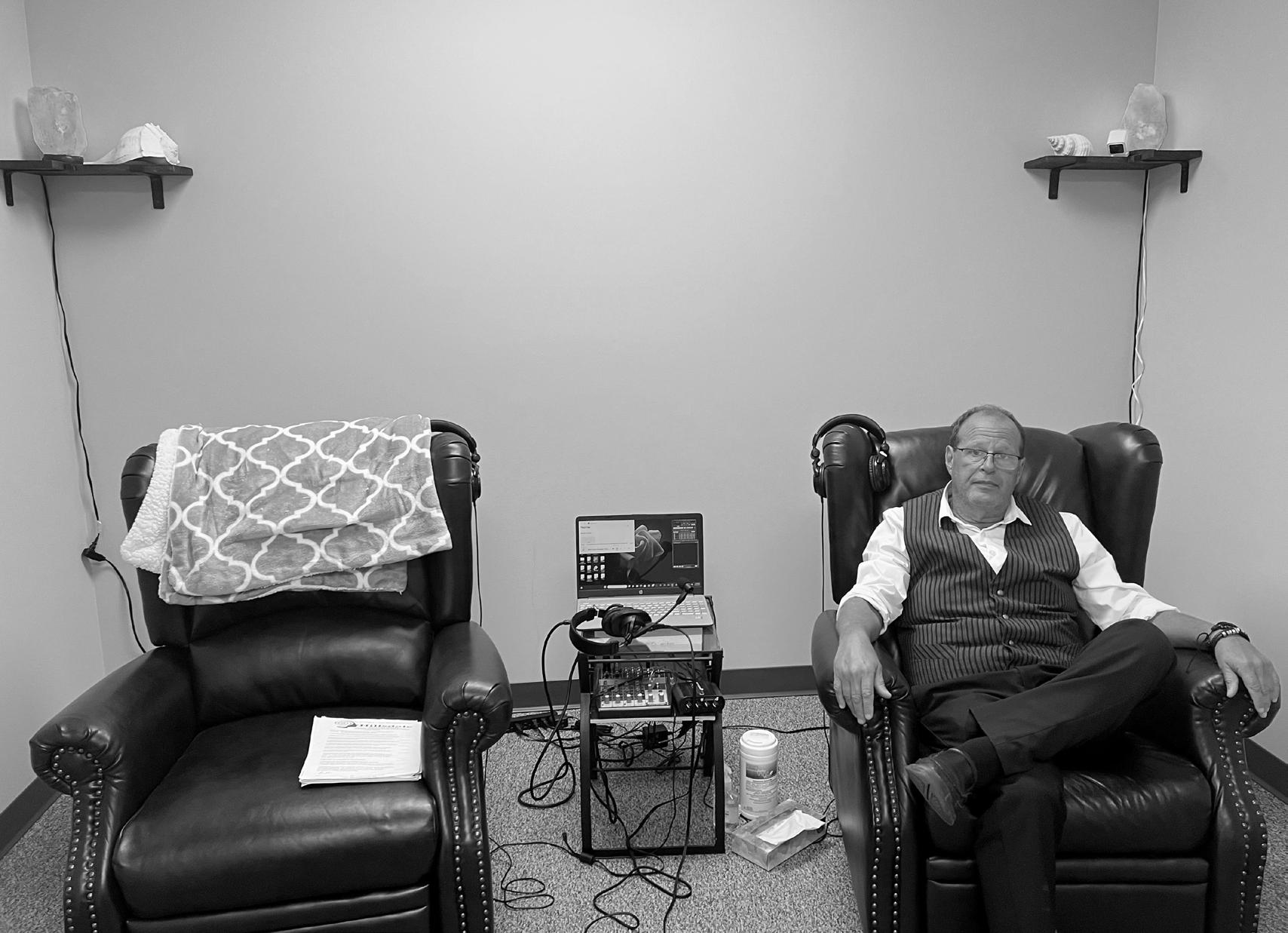
Senior Evan Mick in the Radio Free Hillsdale studio.
Courtesy | Scot Bertram
O pinions
Exodus 90 isn't for everyone
By Francesca Cella Assistant Editor
A man in a bright orange shirt that read “Cold Showers and Holy Hours” noted that I was a young, unmarried woman, and handed me a sticker at the Catholic youth conference SEEK24 in St. Louis: “I only date Exodus Men.” Beneath the tagline was a QR code that would evidently lead any love-stricken young man seeking my hand to the Exodus 90 app.
I didn’t put the sticker on my laptop — not just because it’s tacky to advertise one’s dating requirements on the back of a computer, but also because a man doesn’t have to participate in a regimented 90-day spiritual program to be a faithful Catholic or a good prospective husband.
to the
at ckurt@hillsdale.edu before Saturday at 3 p.m.
Meth won't bring you love
By Caroline Kurt Opinions Editor
“Looksmaxxing” is the name young men have given to their quest for physical perfection. Internet forums advise looksmaxxers to perfect their jawlines through “bone smashing” (exactly what it sounds like), take steroids or testosterone supplements, or undergo leg-lengthening surgeries. Some even use crystal meth to stay skinny. My 8th-grade friends and I could have come up with this had we hated ourselves just a little more.
Looksmaxxers subscribe to a pattern of thought more ofen upheld by 8th-grade mean girls: that appearance is one’s most important characteristic and can be objectively ranked. Tat ranking — looksmaxxers have developed a numerical system — controls one’s likelihood of f nding a desirable woman, achieving success in the workforce, and having the sort of life Regina George would deem worth living.
Most Hillsdale students aren’t hammering their jaws to get a date. But the internet has a way of watering down the craziest ideas until we accept their more palatable ofshoots: here, the idea that in dating, our looks matter more than our hearts.
There’s nothing wrong with seeking to improve one’s physical appearance. But looksmaxxing without the crystal meth is still destructive to the soul. The practice encourages a self-preoccupation that undermines the express purpose of looksmaxxing: dating. Te growing online prevalence of looksmaxxing conditions us to accept a fattened and self-destructive idea of attraction.
T ough the f rst looksmaxxer might have been Patrick Bateman in the 2000 movie “American Psycho,” the movement is inconceivable apart from the internet age. The online romantic marketplace puts a greater
emphasis on personal appearance than ever before. In social media or dating app prof les, we become a mere series of images and quantifable characteristics. If one’s desirability is indeed reduced to what a screen can show, it’s understandable some young men would take such drastic action.
But ofine, looksmaxxing quickly becomes ridiculous. In the dating world outside the internet, you can’t get away with being a peacock, not forever. Writers for centuries have poked fun at the pathetic man more in love with the mirror than the woman in his life — recall Austen’s Sir Walter Elliot, a man whose “vanity was the beginning and end of [his] character,” objecting to men joining the Navy because it destroyed their good looks.
Plenty of average-looking men win the hearts of beautiful women. Tey’ve fgured out what looksmaxxers haven’t: that attraction reaches beyond physical appearance to apprehend the beauty of the other’s soul.
Attracting a woman in the real world isn’t about “mogging,” or upstaging the next guy, but magnanimity. Set a preening, image-obsessed snob next to a funny, generous, and slightly scruffy guy, and the choice is obvious. Women want the kind of man who will ask them thoughtful questions on dates, laugh at himself, and help her with a heavy box.
Testosterone replacement therapy, looksmaxxers have discovered, is pretty cheap. But love isn’t for sale.
Forget the middle school mean girls and their looksmaxxing sidekicks. Take care of your body, but take even more care of your soul. T ere’s someone out there who will love you for both.
Caroline Kurt is a senior studying English.
Since Exodus 90 launched in 2015, it’s become common and almost trendy for Catholics to extend the 40-day Lenten season by entering a penitential season of prayer and fasting for the 90 days preceding Easter. In just 10 years, 250,000 men have completed the Exodus 90 program alone, including my dad. Exodus 90 calls on men to
detach themselves from the comforts of the world and build a stronger prayer life. Participants don’t just abstain from sweets and alcohol. Exodus men commit to sleeping eight hours per night, taking cold showers, exercising several times a week, praying for an hour every day, avoiding unnecessary screen time, and fasting twice a week, among other disciplines.
Several women’s versions have launched since then, such as Fiat 90 and Magnifcat 90, which include similar ascetic practices but tailor the program to women’s spiritual needs, with participants studying the women of the Bible and fostering devotion to the Virgin Mary.
In the whirl of Catholic peer pressure and internal scrupulosity, it’s easy for the zealous faithful to forget that it’s not necessary to participate in Exodus or Fiat in order to have a good spiritual life. What’s true with other trends is also true with these programs — just because everyone else is doing it doesn’t mean you have to.
I’ve done Fiat for the past two years, and it was beautiful to grow in faith with a group
of other women, but I’m not doing it this year. I was just beginning to solidify a new prayer routine over Christmas break when Fiat started, and I wanted to spend the frst weeks of the semester strengthening my own disciplines.
Tat’s not to say having a life of prayer is a trend. On the contrary, the reason you don’t have to do Exodus or Fiat is that a prayerful life isn’t a trend, but a relationship with God. It doesn’t depend on a Catholic app developed in the last decade.
If Christianity invites a personal relationship with God, one should practice the penances and spiritual rhythms that meet his soul’s needs. That might not include Fiat 90. Te person who struggles with scrupulosity or comparison shouldn’t participate in a spiritual accountability group. A spiritual director or a priest will provide sage counsel to an aspiring penitent while considering the struggles of that particular soul in a way that a group of people your age who also struggle with your faults cannot.
Perhaps you need to grow
in one particular area of your spiritual life, or the Exodus discipline list does not encompass the virtues in which you want to grow. Form the compilation of devotions and habits that you need to live virtuously.
For those doing Exodus or Fiat, don’t forget that you are not just participating in a club — you are on a spiritual retreat. Your disciplines are commendable, but don’t wear your cold showers and Instagram fasts on your sleeve. Remember the words of the Gospel, and don’t let your lef hand know what your right hand is doing.
If you have a friend participating in a 90-day program, pray that it is fruitful for them, but don’t feel guilty for not participating. Lent is a liturgical season of the Church; Exodus is not. Rest in your decision to refrain from participating, and prepare your heart for Lent. Te Lord will rejoice in your Lenten journey. It’s OK if you didn’t join Matt Fradd in Exodus 90 — join Jesus in the desert 40.
English.
Make Messi work: Move the penalty spot
By Ellie Fromm News Editor
Lionel Messi places the ball on the penalty spot and glances down the feld to where the French goalkeeper, Hugo Lloris, stands, anticipating the coming shot. All Messi has to do is land the ball somewhere within the 24-foot wide by 8-foot tall goal a mere 12 yards away — in the presence of nearly 90,000 spectators and millions viewing online. It is the 23rd minute of the 2022 FIFA World Cup fnal, a matchup between Argentina and France.
He makes the shot, placing it in the bottom right corner of the goal and bringing Argentina into an early 1–0 lead. Tey would go on to win the game in a penalty shootout, 4–2.
A penalty kick 12 yards from the 24-foot-long goal line is an unjust way to punish the defensive team for a penalty, especially at the largest soccer event in the world.
A rule change to move the penalty spot to the 18-yard line in professional soccer would challenge players and ensure that a penalty in the box is not, practically speaking, a goal. Currently, approximately 75% of professional penalty kicks result in a goal. Tis conversion rate is too high and takes the competitiveness out of the game at this level.
Just because the ball was in the 18-yard box at the time of the foul does not mean that play had a 75% chance of re-
sulting in a goal; yet the current penalty line seems to suggest that the play would have almost assuredly resulted in a goal had there not been a foul. Tis is incorrect. Te ofensive team was fouled, but 12 yards does not rebalance the fairness scale, it only tips the scale in the opposite direction.
Manchester City Football Club forward Erling Haaland has a penalty kick conversion rate of 85.9%, Inter Miami CF forward Messi’s conversion rate is 77.9%, and Real Madrid CF forward Kylian Mbappé’s conversion is 82.35%. Tere is nothing challenging these professional players and forcing them to improve their penalty kicks.
Te 2026 Men’s World Cup will run from June 11 to July 19 this year, with games held at stadiums across the Americas, including in Boston, Mexico City, and Toronto. No spectator wants to recreate the fnal match from four years ago.
At a 12-yard distance, the odds are stacked, unfairly, against the goalkeeper. Yes, the ofensive team should have an advantage because it was the team that took the foul, but the defending team should still have a reasonable chance of saving itself. With the conversion rate this high, goalkeepers and their teams are practically doomed once the referee blows the whistle inside the 18-yard box. Te only exceptions to this rule are special actions, such as goalkeeper infringements, which rarely happen
and award the opposing team an indirect free kick.
Moving the line back 6 yards forces the player taking the kick to overcome more distance, which is a fair challenge. Te accuracy of a penalty kick is crucial. A player must be able to place it wherever he likes, preferably one of the bottom two corners, to avoid the goalkeeper. These bottom corners are the hardest for goalkeepers to cover and finding the perfect window will become more difcult for players, thus challenging players to improve their accuracy.
Te near-certainty of penalty kicks adding a mark to the scoreboard also encourages players to fake a foul or seek other avenues of drawing an ill-awarded foul. A player can know that, should a foul be awarded in the 18-yard box, they will score a goal. This practice encourages players to fake fouls while simultaneously discouraging ofcials from calling true fouls because the stakes are high if they do.
This proposed change would also assist the goalkeepers by granting them a few more seconds to make decisions and act — making it harder for the player taking the penalty kick. Currently, goalkeepers have 0.3 seconds to react to a penalty kick. Because of the lack of reaction time, goalkeepers ofen study game footage of their opponents before matches, especially their penalty kicks. Goalies are encouraged to use this in-
formation to choose the corner they will dive to before the penalty kick is taken. Maybe this change would give goalkeepers a complete half-second to react to a direct shot. Imagine sitting at a game for more than 90 minutes to see one goal — basically an automatic goal — and nothing else. Te goal was not an amazing action shot, did not have an impressive pass, and did not force ofensive players to outsmart defenders. Instead, the ball was placed directly 12 yards in front of the goal, with the goalkeeper having 0.3 seconds to respond. Tis is widely anticlimactic and unjust. Should a game end with a 0–0 score, the teams and their supporters can rest knowing that, at the very least, the teams battled and no unjust goals were awarded by the ofcials. If the goal of athletic rules is to establish an outline of conduct that ensures legitimate skill triumphs, and penalties are awarded when the conduct is breached, then penalties must match the severity of the foul. Otherwise, athletic rules are not accomplishing their end, and are not serving the game as they were intended to. If this is the case, referees might as well begin awarding the ofensive team a goal instead of a penalty kick in the interest of time.
Ellie Fromm is a junior studying history.
This January, sit before the hearth
By Grace Brennan Assistant Editor
Don’t take January for granted. Enjoy the fruits of winter. Dreary November excites us with the promise of the frst snow, and childlike wonder rushes through us the second it falls. Once the worn and tired earth is blanketed and the busy sounds of life are mufed, we allow ourselves to be still — to rest with the earth in a new and pure world.
Yet by January, we are restless to return to the bustle and warmth of livelier seasons. Though spring and summer
are more enjoyable, heatwaves make us lazy, and we take long-desired comfort for granted. Winter, harsh and unavoidable, forces us to grow in a diferent way. The wind wails, saying what we’ve tried to keep quiet, and the glimmering ice grins, pleased with its power over our senses. When the usually inviting sights are buried beneath the snow, we are lef with self-refection. Winter forces us to look inside ourselves and dig deeper into our relationships.
A bleak atmosphere becomes the purest comfort when we take up the tradition of the
hearth. The ancient Greeks thought so highly of the hearth that they fashioned her into a goddess, Hestia, who brings purity, stability, and family unity. Te hearth is a place for family and friends to gather and bond in confidence and prayer without the distractions of everyday life. Often, as college students on a busy campus, we need reminders to slow down. Hillsdale winters force us to do just that. We can cherish the tradition of the hearth even in freplace-less college dorms, by spending time with our peers to focus on something beyond
the stress of college. Tat might look like board games or baking, movie marathons, or winding conversations. Rather than feeling battered by the wind, surrender to the season just like the fora and fauna do when blanketed by snow. Enjoy the opportunity to rest with the earth in the simplicity of winter. Sit by the hearth, watch the snow fall, and talk with your loved ones face-to-face about what matters most.
Grace Brennan is a sophomore studying English.
Francesca Cella is a junior studying
Make the library loud again
By Adriana Azarian Assistant Editor
I was prepared for the campus to be destroyed by construction. But I wasn’t ready for the campus community to be collateral damage.
At this point, nearly every student gathering place is under construction. Te library has taken a special blow, with fewer students gathering on the top foor, “Heaven,” where students have traditionally socialized. Now, it’s shockingly quiet.
When I ask friends of all ages why they don’t congregate in the library anymore, they tell me something like “ T e library is just too depressing with the construction.” My fellow students, construction may have wrecked our quad, our student union, and our library, but we cannot let it destroy our vibrant student body.
For those too young to remember the before times, allow me to explain. Study groups (that maybe studied sometimes), friend groups, and outgoing individuals all focked to the whole frst foor library, especially afer dinner. It was a gathering place over which the entire student body bonded. We even had a study room — “the fshbowl” — with a large chalkboard visible to those outside the library with silly poll questions and doodles. Tis wasn’t your grandma’s library of hushed tones and serious academic pursuits. No, we went to the library for a fun time.
Common areas are vital for building a sense of belonging and shared experience among the student body. At Hillsdale, the top foor of the library had long been a place where students from across campus communed for academic and social pursuits.
It was a common ground for all students regardless of club, athletic, or Greek afliations,to intermingle. Hillsdale has no lack of smaller communities, but we do risk losing our overarching community if we continue limiting our social circles to what’s familiar, convenient, or just not under construction.
Te beauty of Hillsdale is, among other things, the various personalities and interests of our student body. Your dorm room, even your dorm building, is not enough. Your Saga table is not enough. Your sorority or fraternity is not enough. If you keep yourself isolated or comfortable with the familiar, you will miss your only opportunity to meet some incredible people. Please don’t make a wall and muted drilling sounds the reason you leave this institution without ever knowing them.
For us juniors and seniors, we have been fortunate to enjoy a campus with all its amenities. Most of us will be out of here soon enough and none of this will matter, but we should care for the freshmen and sophomores who haven’t had the same opportunity. That’s not to say they haven’t formed equally meaningful friendships. But it does mean they haven’t adequately experienced the dynamic, youthful, quirky character of Hillsdale — Hillsdale at its fullest.
So gather in Heaven once again. Debate obscure theological facts. Laugh with each other. Commiserate over your midterms. Whatever you do, please just make the library loud again.
Adriana Azarian is a senior studying politics. Illustrated by Maggie O'Connor.
The food
By Henry Flifet Circulation & Ad Manager
T e f rst dodgy substance
I experimented with here at college wasn’t drugs or alcohol, but raw milk in a Mason jar. I think hyper-processed foods are worse than cigarettes, and the only foods you should eat regularly are those your grandparents would have recognized.
So yes, I want Americans to be healthier. Something needs to change, but the new food pyramid, released by Health and Human Services Secretary Robert F. Kennedy Jr. earlier this month, won’t bring about any meaningful diference to the state of American health. Nevermind the new food guideline’s dubious claims and problems of inconsistency — obesity and chronic disease won’t be solved by the government issuing a nice picture, a slick website, and a press release into the current cacophony of easily accessible health information that already exists.
More than 70% of American adults are overweight or obese, and nearly one-third of adolescents have prediabetes, according to the Centers for Disease Control and Prevention. Almost 90% of health care spending goes toward treating chronic disease, much of it linked to diet and lifestyle.
Initiatives issued by the
pyramid is still silly
government encouraging the general public to eat healthy rarely succeed.
When the first simplified guidelines, published in 1980, encouraged people to “eat a variety of foods to assure an adequate diet,” the national obesity rate was around 15%, according to the National Library of Medicine. In 1992, when the now-infamous original food pyramid with its six to 11 servings of grain per day was introduced, that rate was 23.3%. When the Department of Health published the remarkably bland and insipid MyPlate diagram in 2011, it was up to 34.9%.
Maybe these guidelines have done something to combat obesity, but clearly not enough. Te new food pyramid isn’t that di ferent from previous guidelines. The insistence on healthy fats and picture of juicy red steak seem heterodox, but the text of the guidelines include the previous recommendation to limit saturated fat to less than 10% of total calories. Tis is almost impossible to maintain with an actual dietary emphasis on the steak, butter, and healthy fats the pyramid champions. Even if people don’t regularly follow them, the government does use nutrition guidelines to dictate things like school lunches. While some critics point out that updating school lunches could strain funding,
these cafeterias are already providing the healthiest meals Americans eat, according to a 2021 study by Tufs University. Even if you accept that it is the government’s responsibility to directly change dietary habits, the obesity epidemic is coming from outside the state’s realm of direct infuence.
As an archetype, Americans do their own thing, but given our proclivity for ignoring the government, combined with the fact that the pyramid doesn’t introduce as much new information as it seems, and a lack of infrastructure to enable change in school cafeterias, the new food pyramid just isn’t going to change all that much. We are at an extraordinary point in history. A calorie surplus instead of defcit is now the norm, and many of those calories are designed to be as addictive as possible. Te problem Kennedy highlights is real, but he’s misled to assume the issue is one of education or information. Like calories, the world’s knowledge — including basic benefcial eating habits — is at our fngertips, if we look for it. Te government informing people to “Eat Real Food,” while commendable, only adds to the noise. A goofy upside-down triangle won’t Make America Healthy Again.
Henry Fliflet is a junior studying English.
Reject brazen interventionism
By Miles Smith IV Guest Writer
President Donald Trump ordered a mission to capture and extradite de facto Venezuelan ruler Nicolás Maduro from a military installation outside Caracas last week. Te mission was successful, but controversial and kicked off a debate over presidential war powers. Te president should return to the non-interventionism of his 2016 platform. Maduro’s capture has reignited the long-standing argument about the United States’ relationship with other countries in the Western Hemisphere. Te president has articulated what is being called the Trump Corollary to the Monroe Doctrine, an aggressive reassertion of the United States’ military and political preeminence in the Western Hemisphere, predicated on military assertiveness and aggressive unilateral diplomatic posturing.
Tere is promise and peril in the Trump Corollary. Journalists and historians painting Trump’s actions as uniquely aggressive or invasive have to reckon with the history of the United States since the 1840s. Te Mexican War saw American soldiers invade Mexico and annex territory from that republic. In 1853, American expansionist Democratic diplomats tried to strongarm Cuba away from the Kingdom of Spain.
Republicans in the 1860s picked up right where Democrats lef of. President Ulysses S. Grant wanted to annex the Dominican Republic in 1868, but was defeated by the Senate. The 1898 Spanish-American War placed U.S. soldiers in Cuba and Puerto Rico; the former became an independent republic. The latter turned into a U.S. commonwealth. Troughout the 1920s and 1930s, U.S. soldiers and Marines participated in a series of “Banana Wars” to stabilize the region, which oscillated between democratic governance and military dictatorships. Te pattern continued during the Cold War.
Trump’s interventionism is not unusual with regard to his predecessors. Most American presidents get involved in Latin America somehow, and
Venezuela has ofen played an outsized role in those interventions. Jay Sexton, the leading historian of the Monroe Doctrine, noted that "historically, Venezuela has been the pretext or the trigger for a lot of corollaries to the Monroe Doctrine.” Going back to the 19th century, according to Sexton, Venezuela has “been a divided, fractious country that’s had difcult relations with foreign powers and has also courted relationships with rivals of the United States.” In some ways, Trump’s raid to nab Maduro is nothing new under the sun.
But in another sense, Trump’s policy breaks with his predecessors. His coalition was built on a rejection of neoconservative interventionism, wherein the United States set out on supposedly ill-fated adventures to bring liberal democracy to unwilling populations. Trump rejects neoconservatism, but seems willing to firt with extractive neo-mercantilist empire; American arms guarantee American extractive access to Venezuelan raw material, particularly petroleum. While there is nothing wrong with American companies wanting to trade in Latin America, doing so at the point of a gun, with a Marxist dictatorship still largely in place, presents as many potential difculties as would neoconservative interventions in support of regime change. In 2016, the then-candidate Trump indicted his predecessors for interventionism and laid out his own independent foreign policy course.
“We will stop racing to topple foreign regimes that we know nothing about, that we shouldn't be involved with,” Trump said in a 2016 speech near Fort Bragg. Trump said policies of “intervention and chaos” would come to an end. During his frst term, he kept his promise. American interventions were few and measured. The 45th president rightly earned the goodwill of Americans for this approach to foreign policy. It is in his interests, and that of the United States, to re-adopt it for the duration of his presidency.
Food pyramid marks a return to common sense
By Evelyn Knifen Collegian Freelancer
President Ronald Reagan had it right when he said that “I’m from the government and I’m here to help” was a frightening phrase. Yet sometimes the American government succeeds in “helping,” or remedying, past mistakes. Flipping the food pyramid is one of those successes.
Te Department of Health and Human Services, led by Robert F. Kennedy Jr., just replaced decades of “health science” with one simple phrase: “Eat Real Food.” Instead of pushing highly processed, sugary foods, the government’s food-focused website, realfood.gov, promotes minimally processed proteins, vegetables, and healthy fats as the baseline for a good diet. Te inversion of the food pyramid of the 1990s recognizes the dangers of highly processed foods.
Until the recent pivot, the HHS’s dietary guidelines were shaped by the research of a physiologist named Ancel Keys. In the 1950s, Keys analyzed data from seven countries, claiming to demonstrate that diets high in saturated fats — meat, butter, cheese, etc. — caused high cholesterol levels,
leading to heart disease. Te only problem? Keys omitted data from 16 countries that didn’t ft his model. A nutritionist named John Yudkins identifed a link between sugar consumption and health problems like cavities, Type 2 diabetes, and obesity, but his studies were sidelined. Corporations like the Sugar Research Foundation funded studies that agreed with what was quickly becoming a mainstream opinion: Saturated fats were dangerous. Te federal government’s stance on food influences what ends up on our shelves, in schoolchildren’s cafeteria lunches, and what thousands of Americans on SNAP or WIC bene fts can buy. T e US Department of Agriculture and the Food and Drug Administration, buying into studies like Keys’s, allowed companies to substitute fat in dairy or meat products for sugar, soy protein, artifcial f avor, and polyunsaturated seed oils. High-carb, nutritionally dead foods were promoted as “healthy” because they didn’t have saturated fat or cholesterol. Te food pyramid and MyPlate diagram of the past represented those decisions, and the American people sufered for it.
Failing to pay attention to a policy doesn’t eliminate its impact. Since 2025, 19 states have enacted legislation keeping soda and candy off the list of products that SNAP programs will subsidize, and the FDA has pledged to work with food manufacturers and retailers to phase petroleum-based food coloring out of the food supply.
Tese are improvements, but the new food pyramid doesn’t solve everything. American farmers feed commercial livestock corn and soybeans, giving them diabetes, and the chemicals farmers use to fertilize our felds are poisonous. Until we address those problems, and others, it’ll be hard to call any food that we haven’t grown ourselves truly healthy.
But despite all of the steps we still need to take, one thing about the new food pyramid, and the administration’s stance on health, is diferent from a month ago: It’s a little closer to reality.
Knifen is a freshman studying the liberal arts.
Miles Smith IV is an assistant professor of history.
Evelyn
City News
‘This is not the American dream’
Fayette Township residents oppose solar project that would cover more than 1,000 acres
By Christina Lewis AssistAnt Editor
Residents of Fayette Township and the City of Hillsdale once again spoke against a project to turn 1,350 acres of farmland into a solar farm as Fayette’s planning commission considers moving forward with approval of the plan.
Roughly 200 people showed up to Fayette Township’s planning commission meeting on Monday, with no one voicing support for a project by Ranger Power, a Chicago-based solar energy company, which plans to build the solar farm on land in Fayette Township. The company needs the approval of the township’s planning commission, and a meeting last week of the township’s main board became a flashpoint for local opposition to the project.
The project is similar to one approved by the local authority in 2022, when Fayette Township authorized the Heartwood I solar project. This converted roughly 900 acres of land into a solar farm in the western part of the township. The following year, Michigan’s Democrat-controlled House, Senate, and governorship passed the Clean Energy & Jobs Act, which set a mandate of 100% clean energy by 2040.
“I had no idea that you had approved that one out on the west end of town,” Nancy Ashton, a resident of Fayette Township, told Fayette’s planning commission at its Jan. 19 meeting. “It’s my own fault for being ignorant and just trusting my neighbors to be doing
the right thing for the community.”
The Heartwood II solar project, proposed by Ranger Power, would build on the east side of the township. Some members of the planning commission with personal stakes in the project have recused themselves. The township’s supervisor’s parents have property in Heartwood I and Heartwood II, according to the Hillsdale Daily News. Due to the recusal, the meeting lacked enough members for a quorum and was adjourned after public comment.
Ranger Power could move forward with this project by going directly to the Michigan Public Service Commission, but it is faster and cheaper for them to stay local with fewer restrictions and oversight, said Steve Oleszkowicz, Fayette Township resident and founder of No Solar Fayette.
regular meeting in February, or they schedule an emergency meeting, minimum hour notice. Once appointed and sworn in, then the com-
Look at the deer.’ They’re not going to be saying that if there are solar panels wrapped right around my house.”
Hillsdale College’s Gener-
get this right, then you’re going to be looking at potential lawsuits. So, it’s important that we get the law right, that we go by the book.”
mission can schedule a new meeting.”
During the public comment section, Chester Bryner, a Fayette Township resident, said he is concerned about the effects solar panels will have on wildlife and natural scenery.
“The planning commission needs to appoint one new member to achieve a quorum, four people minimum,” Oleszkowicz said. “The new member has to be voted on by the board. They have to hold a meeting for that. So they either wait until their next
“We moved here to be out in the country and live the American dream. This is not the American dream, looking out at solar panels and reflections,” Bryner said. “People come to our swimming pool and they sit around and say, ‘Boy, this is beautiful. Wow.
al Counsel, Bob Norton, and Deputy Counsel Neil Brady also attended the meeting on behalf of the college. Brady said Fayette Township should develop an ordinance, such as a Compatible Renewable Energy Ordinance, before the planning commission votes on the project so that solar developers are required to take their plans through the township first.
“The bylaws for the commission are very onerous,” Brady said. “They’re tough to comply with, and if you don’t
Adopting a CREO would allow Fayette Township to set its own standards, aligned with state law. Brady said the college is “willing to help as much as it can” to create the ordinance.
“This is not a minor change. It’s an industrial land use conversion that will reshape this region for many decades,” Norton said.
The proposed area for the Heartwood II solar project cuts into the headwaters region of the St. Joseph River watershed, which originates in Hillsdale County and spans state lines, Norton said.
“This watershed supports sensitive aquatic life, including the clubshell muscle, a federally endangered species that inhabits the St. Joseph River and its connecting waterways,” Norton said. “Consequently, the township has a responsibility to prioritize water protection, ensuring the proper steps and permits are granted before any issues arise.”
Norton said although solar
farms do not directly consume water like traditional power plants, a project of this magnitude will alter the land.
“These changes include grading, compaction, draining patterns, access roads, and long-term vegetation management that also includes super sites,” Norton said. “These alterations impact runoff, erosion, and groundwater recharge. We should not accept vague assurances of best practices language. We need enforceable standards.”
Jane Munsford, chair of the planning commission, interrupted the public comment portion of the meeting to clarify that the commission is working on the ordinances.
“We have been working with a consultant for a couple of years on improving and bringing our ordinances up to date,” Munsford said. “And I know this is a concern, I have to say we are not anywhere near, we haven’t even begun to discuss this new project.”
Fayette Township Resident Scott Manifold ended his public comment with a prayer, saying it was necessary to pause.
“I pray that you would guide our commission down a path of righteousness and integrity, that they may represent the township as a whole,” Manifold prayed. “Lord, please protect our township from the influences both inside and outside our beautiful community that seek to alter our landscape for their financial gain.”
Hillsdale Renaissance to restore train stop
By Trinity Gentry CollEgiAn rEportEr
Real estate development firm Hillsdale Renaissance recently purchased the historic railway freight house, located at 16 Hillsdale St., which it plans to convert into a community hub.
Luke Robson ’17 said he is working to restore the historic charm of downtown Hillsdale with his company, Hills dale Renaissance LLC, founded in 2022. The company is a real estate development and proper ty management firm that restores historical build ings, hosts events, and aids local businesspeo ple in improving their operations, according to the Hillsdale Renaissance website.
“These buildings are great. Most of them are built in the mid to late 1800s, and they’ve got all these cool eccentricities and sort of architectural features,” Robson said. “And the stuff we’re doing, it’s going to be historically sensitive.”
The restoration of the freight house will include updating the electrical service, improving access to the building, and restoring the platforms for tourists. Robson said he hopes to create a welcoming place for the customers of the Indiana Railroad Experience, which offers rides on historic steam trains across Indiana, Michigan, and Ohio.
“In the summers and falls, the steam engines and diesel engines that bring tourists into Hillsdale right now, they just get dropped off in the Indiana Northeastern’s spare parts yard,” Robson said. “It’s just not a terribly welcoming thing. So we want to rebuild the old platform that was on the freight house. Then those trains can pull right up, unload into the freight house, and have it be a good place for those people to be introduced to Hillsdale.”
Robson said he plans to purchase the railyard space that stretches from the
freight house to Monroe Street within the year.
“That’s owned by the Michigan Department of Transportation,” Robson said. “MDOT has a lifetime lease on that to the Indiana Northeast Railroad. They’re interested in moving, and we’ve been working on a deal for two years now to relocate the current railroad operations. We’ve purchased a space in Jonesville for them to move to. So hopefully, relatively soon we will own it, but right now it’s still under negotiation.”
Robson said he hopes to
turn the railyard space into a park.
“A nice place to come and sit with the kids,” Robson said. “They’ll be right by the bike trail and walking distance for all these families and students.”
He said he hopes Hillsdale Renaissance will break ground on this project between October 2026 and March 2027, with construction lasting another 18 to 24 months.
Robson said he will maintain the character of the building to preserve its history.
“Hillsdale used to have a festival called Roosevelt Days that commemorated when Teddy Roosevelt came through on the rail to do his campaign,” Robson said. “He spoke just right down there near the freight house — probably closer to the depot that is now the
house project was not only motivated by Hillsdale Renaissance’s goal of restoring downtown Hillsdale, but also by the desire to bring Hillsdale College and the town together.
“We kind of view it as a sort of psychological block between the college and the downtown,” Robson said.
“When you’re walking along, it kind of feels like a natural break.”
Colm Maines, chief operating officer of Hillsdale Renaissance, emphasized the importance of the freight house building to their project. Maines said the freight house is the most important part of the first phase of a development package involving 15 buildings.
“It’s the most important building for the project because of its location right on the highway,” Maines said.
“It is a gateway to downtown
“Hillsdale used to have a festival called Roosevelt Days that commemorated when Teddy Roosevelt came on the rail to do his campaign.”
Presbyterian church — and gave a campaign speech.
I’d love to see some of that brought back to life.”
Robson said the freight
in many ways.”
Maines said the buildings will regain their character through the project.
“Some of them are fine and are perfectly functional but have lost the historic character that we all associate with the town of Hillsdale,” Maines said. “And the goal is to restore them back to that historical character, restore the facades with as much historical accuracy as we can, and the general goal is to bring back businesses and revitalize the area to make it feel like the vibrant town it was as recently as the ’90s, I would say.”
Andrew Gelzer, who owns and operates Gelzer’s Hardware, said he has a family connection with the freight house going back decades.
“That was originally a partnership between a number of old community leaders from a past generation, specifically Grant Baker and Bill Nash,” Gelzer said.
According to Maines, these community leaders attempted to develop the property, but lacked the necessary time to negotiate with the Indiana Northeast Railroad and MDOT. Baker, Gelzer’s cousin, held onto the property in hopes of developing it and keeping the building standing.
“It wasn’t until Luke came along that I found someone that actually had the vision, the time, and the patience to develop that property correctly,” Gelzer said.
Roughly 200 people attended the Fayette Township planning commission meeting Jan. 19 . Christina Lewis | Co LL egian
Alex Bertram (left) and Tim Stockdale (right) at the Railroad Festival hosted by Hillsdale Renaissance in October. Courtesy | Scot Bertram
City council sets public hearings for road repair plans
By Gemma Flores AssistA nt Editor
The Hillsdale City Council scheduled public hearings for Feb. 16 to establish 2026 Special Assessment Districts.
Director of Public Services
Jason Blake and City Engineer
Robert Stiverson introduced a three-phase SAD plan for the 2026 construction year. The plan would repair just under two miles of roads deemed dilapidated by the city and would cost between $3 million and $3.4 million dollars, according to Blake. A SAD designates run-down roads for repair and funds the work by taxing property owners in the specified district up to $5,000.
Assistant City Manager Sam Fry explained council must agree to set public hearings for the three phases of the proposed SAD plan before construction can move forward.
“If council wants to set up public hearings for these three projects, you would go ahead and adopt the resolutions to do so,” Fry said. “The purpose of a public hearing is we also have to verify, if we get any petitions, whether they are coming from folks inside that district.”
The work for 2026 would be broken down into three overarching districts. The first would repair sections
of Arch Avenue, Industrial Drive, and Proctor Drive and would cost an estimated $1.3 million. Part of the cost of the Arch Avenue SAD would be offset by federal funding, as previously reported by The Collegian.
“What we’re doing right now, or what we’ve proposed, is roughly $3.5 million of road work effectively, with about $900,000 or so coming from special assessments,” Fry said.
While the first phase of the 2026 SADs is relatively certain, the second two have sparked controversy.
get allocations. Now, we’re proposing to transfer the cost of decades of neglect directly onto the shoulders of residents who are already struggling to make ends meet,” Jill Hardway, an Oak Street resident, said at Tuesday’s meeting. “This is not just an inconvenience. It’s a poten -
on getting these signatures. The council can then override a SAD rejection if seven of the nine council members agree.
Socha suggested returning the discussion to committee so as to avoid the projects being shot down.
“If the caps are lowered or we change the percentage that’s assessed, we’d have to scale back the work,” Fry said.
“If there aren’t seven of us that are willing to vote against
The second SAD would repair South Street from South Broad Street to Reading Avenue and would cost roughly $775,000.
The third SAD would repair Oak Street from the St. Joseph River to East Fayette Street, with an optional addon of East Fayette to East College Street. Depending on whether the city goes ahead with the optional add-on, the cost could be either $960,000 or $1.3 million.
Ward 2 Councilman Matthew Bentley told The Collegian Oak Street residents have been fighting the proposed SAD for months. Typically, SADs are capped at $5,000 per parcel. According to Bentley, Oak Street residents have been requesting that the cap be lowered to $2,800 each.
“Our city has systematically failed to maintain our streets through regular bud-
tial financial catastrophe for working families and seniors living on a fixed income.”
It is possible for the residents in a proposed SAD to reject the proposal if it can acquire signatures from 51% of its parcel owners, according to Ward 4 Councilman Robert Socha. Then, it can petition the city council to reject the road repairs. Currently, Oak Street residents are working
those letters of opposition, then I would suggest that we not spend the city’s resources to do any further work on those projects,” Socha said.
Socha proposed the council discuss lowering the SAD cap from $5,000 to something more manageable for residents. City staff pushed back against this, however, saying that it would delay construction substantially.
Ward 4 Councilman Joshua Paladino told The Collegian that he believed construction would continue at the same pace should the cap be lowered, thanks to added funding from the college’s city endowment and the Michigan Road Funding Package passed in early 2025.
Paladino expressed his frustration with Hillsdale’s system of road funding in general.
“I think we need a new funding source, long story short,” Paladino said. “These debates are not going anywhere; there will always be a claim of injustice or inequity, and parties will be right, and Councilman Socha will be right in saying that we just need to move on. And everyone will be saying something that’s correct, but we’re not really getting anywhere.”
The council agreed to set the public hearing for Feb. 16, but will meet before then to discuss possible changes to the cap, according to Paladino.
“If we don’t do something, the projects are going down,” Bentley said.
Couple revives Allen antique store and village
By Grace Brennan AssistAnt Editor
A couple from Grandville, Michigan, sells everything from golden loveseats and Coca-Cola fridges to license plates and comics at their thrift store, Le Vintage Rose, in Allen, Michigan.
The property of the Antique Village was abandoned and forgotten for more than a decade, until Mary Nguyen-Frei and her husband, Emerson, filled it with their collection of historical items.
“My dream was always to run a fun shop that has everything,” Nguyen-Frei said.
“Because growing up, I didn’t have much. I was raised by my grandparents with 10 kids, so I had a lot of handme-downs, and that’s how I got into secondhand fashion. I learned that it’s actually a fun, cool, and affordable way to be different.”
board flooring and the same soda-pop-shop counter it had when it was a diner.
“When I was in college, on Saturdays we would go to Allen to a store called Poor Richard’s. The lady at the store there sold lots of vintage hats,” Sue Walberg ’83 said. “We would buy vintage hats, then we would go over to The Wooden Nickel, which is now the Le Vintage Rose. They had a porch and an old jukebox there.
disappointed when the Antique Village was closed for so long, and that she’s pleased to bring back the history of the property and the individual buildings.
“Everyone is so thankful that we are here now to bring it to life again,” Nguyen-Frei said.
According to Nguyen-Frei, she and her husband have a lot of events and new businesses they want to add on to Le Vintage Rose. This
tracts a lot of creative people, and she hopes to use some of the small, eclectic buildings
en them, and I feel like they need to be known,” Nguyen-Frei said. “That is what
Nguyen-Frei poses at the register.
Walking into the antique store, customers are greeted by old Hollywood faces in photographs and posters — people of the past who have marked the fashion industry.
Racks of thrifted and collected clothing fill the room with all sorts of fabrics and patterns — denim, velvet, animal prints, and stripes — from various decades. Glass cases are filled with jewelry, watches, brooches, and masquerade masks.
An adjoining room is filled with eclectic finds. One shelf holds ornate china and colorful glasses, while the next has vintage model cars and rare Pokémon cards.
The next room still has black and white checker -
We would sit there all afternoon and play the Jukebox and drink coffee and dance.
The people who owned the Wooden Nickel just let us stay there all afternoon and enjoy their restaurant.”
The Antique Village has 27 historic buildings on its property, 20 of which were moved in the 1980s from different places in the area by one of the former owners, Jim Klein. Five of the buildings are currently in use or have plans for renovation. Nguyen-Frei said she hopes to polish up the antique store as well as revive the old buildings — a pink chapel, a one-room schoolhouse, and a vintage candy store — to their original purpose.
Frei said the locals were
spring, they are hosting a Galentines party themed as a masquerade ball and a Mother’s Day fashion show. Bigger plans involve opening an Airbnb and restaurant.
“We are starting an Airbnb next month with a queen bed and three twin beds,” Nguyen-Frei said. “I thought it would be a good idea since I always hear about Hillsdale parents needing a place to stay.”
the artist, the collector, the thrifter, and the old soul, according to junior Anne
on the property as vendor spots for her creative friends.
“I recognize all
I’d like to do here, mainly, to bring everyone together and let everyone flourish here. We’re meant to be here — to help them display their art.”
Crites said she loves the variety Le Vintage Rose has to offer.
According to Nguyen-Frei, Le Vintage Rose at-
the people I talk to for the true gift that God has giv -
“I came here last semester to get off campus, and I thought it was really cute,” Crites said. “It has a lot of different things like clothing, jewelry, and candy.”
Walberg said she is excited for the future of the store.
“When I saw that Mary opened that store, I stopped there, and I told them it was where I used to go all the time, and I brought her some vintage hats,” Walberg said. “I feel that
Le Vintage Rose has something for everyone —
Crites.
Le Vintage Rose is going to have great success.”
Mary
Grace Brennan | c olle G ian
One of Le Vintage Rose’s historic buildings.
Grace Brennan | c olle G ian
A jukebox inside Le Vintage Rose. Grace Brennan | c olle G ian
SportS
Club wrestling receives first national ranking
By Charles Hickey Collegian Reporter
The Hillsdale Club Wres-
tling team finished eighth in the country in the National Collegiate Wrestling Association’s Division I rankings, earning a national ranking for the first time on Jan. 4.
“It wasn’t the result itself which was shocking,” sophomore John Paul Peck said. “It was how fast the club developed and how fast we were able to earn that ranking.”
The wrestling team was founded in 2021, but did not compete at the intercollegiate level until the fall of 2023.
Club coach Carter Ballinger said the club’s national ranking was particularly impressive because of the level of competition in the NCWA.
“The NCWA is the biggest national organization for wrestling in college,” Ballinger said. “There’s more teams in the NCWA than in NCAA Division I wrestling. It’s a big deal.”
Ballinger, the former wres-
Battleship
tling coach at Jonesville High School, said he anticipated the national recognition because of the exceptional individual performances of club members during the last two seasons.
“I think it’s a testament to what we’re doing with the club,” Ballinger said. “The guys work really hard, they compete well, and it was only a matter of time.”
Ballinger singled out the club’s president, senior Matt Riehle, as one of the reasons the club still exists.
“He deserves a lot of the recognition,” Ballinger said. “He’s done a lot of the legwork to build this club. A couple years ago, it seemed like Matt was just dragging it by himself.”
Ryan Perkins, director of club sports, said Riehle shepherded the club after Perkins helped start it as a student at Hillsdale in 2021.
“A friend named Aiden Johnson and I kind of converted what was the grappling club at that time and just completely switched it to wrestling,” Perkins said. “Aiden was the one who
pushed it from the start, and then Matt took over. But from that point, Matt has really carried it.”
tler and a phenomenal leader,” Perkins said. “He has been the champion of the team, in the sense that he has really pushed it
In the spring of 2024, during the club’s first season competing as an official club sport, Riehle qualified for the NWCA national tournament, finishing in the top 12 with a 3–2 record.
“Matt is a standout wres-
along, built the team and paved the way for its success. ”
In 2025, Riehle qualified for nationals again, where he placed fourth in the 174-pound bracket. Senior David Gregory and sophomore Stephen Petersen
also qualified that year, and both posted top 16 finishes in their respective weight classes.
“Going into that next year, having David and Stephen compete as strongly as they did as well, that helped gain a lot of traction,” Perkins said. “And this year, all of a sudden, the club has taken off in a new way.”
The trio’s standout performance at the national tournament in 2025 attracted new recruits, which Perkins said contributed to the club’s national recognition.
“It’s because we had seven or eight guys go and compete early this fall and rack up a ton of points against good opponents that we were able to bump up into that ranked position,” Perkins said.
According to Gregory, another factor of the club’s recent success was Ballinger, who started coaching full time this season.
“I think having him make everything more official and serious gave guys a real sense of commitment to really settle down and make the team a pri-
ority,” Gregory said. Riehle said he expects the club to perform even better this season.
“We’re getting new guys every day — guys that are experienced, want to be there, and like it,” Riehle said. “I’d be shocked if we didn’t qualify at least five guys for nationals.”
Perkins said the club will host the regional Great Lakes tournament during spring break on March 14.
“There’ll be about eight schools competing, including big schools like the University of Michigan and The Ohio State University,” Perkins said. “We could have anywhere from 80-100 wrestlers there. Anyone who’s here over spring break should go.” Peck said the “biblical” sport of wrestling compliments the mission of the college.
“I think a part of what makes Hillsdale special is that what we do here is rejoicing in the challenge,” Peck said. “We do hard things. I think wrestling encapsulates that, in a physical sense.”
By Jamie Parsons Assistant Editor
Students in the Hillsdale Ski Club say they are excited for ski mountaineering to debut at the 2026 Winter Olympic Games in Milan and Cortina, Italy, Feb. 19 and 21. Other students however, are unfamiliar with the sport, also known as skimo, despite the sport dating back 5,000 years and gaining recent popularity.
Olympic Skimo — what to look out for
The Olympics will feature three skimo events: men’s sprint, women’s sprint, and mixed gender relay. Thirty-six athletes will compete, with Americans Anna Gibson and Cam Smith qualifying in the mixed gender relay.
“I don’t know people who are good at ski mountaineering, but I’m excited for it to start so people can compete,” Marcelle Little, a sophomore on the Hillsdale Ski Club, said. “I am curious to see how interesting it will be to watch, because I’ve not watched professionals do it, but growing up and traveling in Colorado and California, I have seen people practice ski mountaineering.”
The sprint events will cover around 70 meters of elevation and take athletes a maximum of three minutes to complete. Athletes will begin the race course climbing up the mountain, using rubber membranes, also known as skins, on the bottom of their skis to prevent them from sliding backwards. When competitors enter the on-foot portion of the ascent, they will remove their skis and attach them to their backpack. A little ways away from the top, competitors will place their skis back on. At the top, competitors will remove their skins from their skis and race down the mountain.
The mixed-relay is raced the same way as the sprint event, but has a longer course and is a total of four laps. Partners alternate racing a lap, with the woman being the first to go. At the Olympics, the mixed-relay will cover around 140 meters of
elevation and take roughly 30 minutes.
The skimo sprints will be held Feb. 19, and the mixed-relay will be held Feb. 21. Sophomore and vice president of the Hillsdale Ski Club Peter Kaiser said he has never tried skimo, but he thinks it would be harder than regular skiing because there is no ski lift to bring you up the mountain.
“It would require a lot more skill and physical training, because you have to have good endurance,” Kaiser said. “I mean, climbing up a snowy peak is not easy — you have to have balance and not slip or anything.”
New to the Olympics but an ancient practice
Before skimo became a sport, it was a necessity. Ancient Nordic populations invented skis as a means of transportation during the winter season. Later on, different cultures adopted skimo to hunt, trade, and transport soldiers through rugged terrain because skimo’s climbing element makes it different from regular skiing.
During the late 19th century, English tourists visiting the Alps took up skimo to reach peaks that ski lifts and roads could not reach. Skimo transformed into a fun and competitive activity, with the use of skis and mountaineering skills appearing in the Olympics in Military Patrol, a demonstration sport that evolved into the modern biathlon.
The first ski mountaineering competition, Mezzalama Trophy, was held in 1933 in Italy, and was organized by the friends of Ottorino Mezzalama, a pioneer of Italian skimo who died in an avalanche accident. The Mezzalama Trophy helped establish skimo as a sport in the world of skiing, allowing skimo to return to Italy less than a hundred years later as a sport in the 2026 Olympics Little said she didn’t know much about skimo or had done it herself, but was glad to know it had been added to the Olympics.
“I definitely think it’s a
great thing that they are widening the palette of snow sports in the Olympics,” Little said. “It will draw more attention to the different types of ski sports that there are, and open more opportunities for people who are good at those sports.”
Similarly to Little, Kaiser is also in favor of skimo being added to the 2026 Olympics, because the mixed-relay event adds a level of competitiveness that the audience, himself included, will find entertaining.
“The fact that they are adding this, which seems like a very fun, more high adrenaline sport because it is a tagteam relay as well, you can actually root for these people in a race instead of just judging them on technique,” Kaiser said.
Students react
Little and Kaiser said they feel the Winter Olympics is less popular than the Summer Olympics, adding they hope if the Winter Olympics continues to expand its program, winter sports will gain more traction and people will be more inclined to give winter sports such as skiing and snowboarding a chance.
“It’s an incredible way to enjoy the natural beauty of the world and spend time with friends,” sophomore and president of the Hillsdale Ski Club, Connor O’ Donohue, said.
Little said simply the act of skiing is wonderful.
“I love how freeing it is,” Little said. “I love the feeling of flying down a mountain as fast as I can, or just challenging myself on mobiles.”
Kaiser said he predicts skimo’s debut at the Olympics will be received well by winter athletes and by people watching from home.
“It’s definitely going to deliver a unique challenge for people to train toward and I could see it being a huge staple for the Olympics to come because you can see it on the faces of the people competing in it,” Kaiser said. “They are enjoying it, they really get into the
Senior Matt Riehle during last year's nationals quarterfinal match.
Courtesy | David Gregory
U of M basketball eyes national title
By Nathan Furness Collegian Freelancer
The University of Michigan
men’s basketball team wasted no time making noise in the 2025-26 season, posting historic numbers through its first 13 games. The Wolverines have come back to earth since their ethereal start, but remain the clear favorite to win both the Big Ten and NCAA National championship.
Michigan cleaned up against the Indiana University Hoosiers on Tuesday night with a convincing 86–72 victory. Despite their recent football success, the Hoosiers got cooked by a Wolverines team that has looked otherworldly this season.
Under second-year head coach Dusty May, Michigan opened the season with a commanding stretch of games, establishing itself early as one of the nation’s most dominant teams. This stretch was highlighted by a statement performance at the Players Era Festival in Las Vegas, where the Wolverines dismantled San Diego State University, Auburn University, and Gonzaga University — three high-level programs — by a combined 110 points to capture the early-season tournament title.
In order to quantify the historic 13–0 start for the Wolverines, a few mind-boggling statistics stand out. Most notably, Michigan became the first team in AP poll history to win three consecutive games by 30 points or more against ranked opponents. They averaged a whopping 34.5 margin of victory through 13 games. They also broke a Big Ten record for most wins by 40 points or more in a season with six. They did this in just 12 games.
Through their first 14 games, the Wolverines recorded a +39.43 rating on KenPom, a nationally respected computer metric that evaluates teams based on efficiency per possession. The mark ranks as the second-highest in KenPom history: one that trails only the 1999 Duke University Blue Devils, an unbelievable statistic.
The Wolverines are one of just three teams in the nation with eight players averaging
at least 19 minutes per game, a rare level of balance that allows Michigan to roll multiple lineups without a significant drop off.
This level of balance is due in part to May’s success in the transfer portal.
Michigan landed the nation’s top-ranked transfer class this past offseason, bringing in four of its five starters through the portal, including Elliott Cadeau, Morez Johnson, Yaxel Lendeborg, and Aday Mara. May’s exceptional coaching ability takes these talented players from diverse backgrounds and systems and turns them into a cohesive team able to thrive at the highest level of competition.
Michigan also boasts the number one defense in the country, according to KenPom, a stat aided most by the inability of teams to score in the paint. The Wolverines’ starting lineup consists of three players of 6’10 or taller, with Mara leading the lineup at 7’3. This height has made it impossible for opposing offenses to find rhythm in the two-point game, forcing them to try their luck from deep.
Despite their early dominance, the Wolverines have hit a few bumps during the onset of their Big Ten schedule. They squeaked by a horrendous Penn State team on the road by just two points, then dropped their first game of the year at home against Wisconsin — a loss resulting only from Wisconsin’s miraculous second-half three-point shooting (the only way to beat Michigan’s lock-down interior defense).
However, after back-toback double-digit West-Coast road victories over the University of Washington Huskies and University of Oregon Ducks and their win over the Hoosiers on Tuesday, the Wolverines look to carry this momentum into their next few games, capped off by a pivotal top-10 matchup against the undefeated University of Nebraska Cornhuskers.
As long as teams don’t turn into prime Steph Curry from beyond the arc against the Wolverines, they are going to continue to be nearly impossible to beat.
'I win': The Cignetti Cinderella story
By Anna Broussard Design Editor
When Curt Cignetti was hired as head coach at Indiana University, no one could imagine his team would become national champions in just two years.
“I win. Google me,” Cignetti told the press in 2023. It didn’t take long for college football to take him seriously as he changed the narrative for the team with the most losses in college football.
The Indiana Hoosiers defeated the University of Miami Hurricanes 27–21 in the College Football Playoff National Championship on Monday.
The Hoosiers became the first team since 1996 to win a national title without previously winning.
“You don’t go to war with warm milk and cookies,” Cignetti told the press leading up to the game against Miami.
The team, with not one fivestar recruit, was the epitome of a well-coached and disciplined team, proving a fairy-tale season going 16–0 — the first time a college football team has done that since Yale University in 1894.
“We are just a bunch of misfits,” 2025 Heisman Tro -
phy winner and quarterback for the Hoosiers, Fernando Mendoza, said after winning in the Peach Bowl against the University of Oregon 56–22.
Mendoza, who grew up in Miami and was a Hurricanes fan, attempted to walk on to the team for his freshman year of college. He was rejected.
Mendoza then attended the University of California, later transferring to Indiana and now defeating his former dream school for the na tional title.
that changed the course of the game during the third quarter.
The game ended with Miami’s quarterback, Carson Beck throwing the only interception in the championship.
Against the Hurri canes, Cignetti called a historic fourth-and-4 play, changing the atmosphere of the game with 9:27 left. It was a quarterback draw, and Mendoza rushed 12 yards, broke tackles, and dove into the end zone for a touchdown to make the game 24–14.
The game, which encapsulated the magical season for the Hoosiers, had a miraculous blocked-punt touchdown
Swim Babenko leads team
By Jamie Parsons Assistant Editor
Freshman Sasha Babenko
earned Great Midwest Athletic Conference Women’s Swimmer of the Week for a second time after the Hillsdale swim team placed first in two invitationals at California University of Pennsylvania Jan. 16-17.
The Chargers competed in the California (PA) Winter Frenzy on Friday afternoon, winning six of 14 events to finish with 233 points and place first out of five teams.
Babenko won the 100 freestyle in 53.78, and led off the winning team in the 400 medley relay that finished in 4:06.14, thanks to the help from freshman Kate Potwardowski, and sophomores Ella Malone and Ella Schafer. The Chargers also won the 200 freestyle relay in 1:43.27.
Charger
If a movie were made about your life, who would you cast as yourself? Emma Watson.
If you could be any kind of animal, what would you be and why?
I would be a horse because they are fast, they work hard, and they can also run for a long time without getting tired.
For a million dollars, would you rather spend a year in space or a year in a submarine?
Submarine, because I've always been interested in the ocean and what random creatures are down there.
Potwardowski said she thought the relay did well given the team had a hard week of training.
“Sasha gave me the lead that we needed, but all of us put our best effort forward, and I think we all did really well,” Potwardowski said.
Other swimmers who secured wins in their individual races include Schafer in the 50 freestyle with a time of 25.48 and freshman Rylee Harris in the 500 freestyle with a time of 5:29.93.
The 400 individual medley had a stacked podium with freshman Avery May finishing second in 4:48.80, junior Isabel Ondracek finishing third in 4:47.34, and senior Rotem Andegeko finishing fourth in 5:00.70.
The Chargers returned to the same pool the following day to compete in the Vulcan
This Hoosier team represents a new step forward in college football. It brings the history of coaching, grit and hard work to programs that are becoming increasingly more professional.
The team shows the world that you don’t always need the five-star players — although they help — or the lengthy career as a Division I head coach to put together a Cinderella-season.
What the team lacked in star power, it compensated for with players who had ample experience, as nearly all Indiana starters had at least three seasons of college football. It was discipline that Cignetti pushed for throughout the whole team.
“There’s no secret, there’s no magic pill,” said center Pat Coogan. “The secret is in the work.”
The Hoosiers proved to all of college football that history is still being made in sports, regardless of the industry evolving. The misfits, transfer portal, and rejected players coming together to build a team with a 16–0 run will become the stories that animate sports history. Coached by Cignetti, an emotionless man who will crack a beer in celebration of winning the national title, whose mission was outright from the beginning, the Hoosiers can win it all. The 2025 Hoosiers represent the ever-true underdog story, delivering a title to a fanbase that never believed it could happen and now will celebrate this win and changing tide to college football.
“We won the national championship at Indiana University,” Cignetti said after the game ended. “It can be done!”
Invitational, winning all nine events to secure their second invitational title.
Both Babenko and May secured three invitational titles, winning both their individual events and their relay event. Babenko and May competed in the same 400 freestyle relay team alongside Harris and Malone to finish in 3:42.54.
Junior Olivia Leathers said she was happy with how the team performed over the weekend, and said head coach Kurt Kirner expressed the same feeling.
“He said that we did a lot better than he expected because of our week-long training trip in Florida right before school started, and also because he has been kicking our butts in practice,” Leathers said.
Andegeko said she also thought the meet went well
given there were only six lanes in the pool. With only six lanes, there were no extra lanes for the swimmers to warm down after their races. Instead, the meet ran three events, took a pause for swimmers to cool down, and then resumed.
“I had the 200 breast as the first event and then the 200 freestyle two events later with no break in between, so I didn’t get to warm down or warm up before my 200 freestyle,” Andegeko said. “So I definitely think that affected my performance in the 200 freestyle.”
The Chargers have one meet left before the G-MAC championship, competing in a tri meet against Malone University and Fairmont State University in Canton, Ohio, Jan. 24.
Social media manager for a big track account and get to travel and interview all of my favorite athletes.
What is your guilty pleasure song? Clocks by Coldplay because I LOVE the intro music.
What is something you can't live without?
Probably my phone, to be honest, which sounds bad, but it's probably my most used item.
Do you have any random skill or talent that not many people know about?
I can play the piano and organ and I sing at Mass.
Anna Roessner, Track and Field
C harger S port S
Men's Basketball
Chargers go 1-1 first week back
By Evelyn Shurtliff Collegian Freelancer
The Hillsdale men’s basketball team won at home 84–71 against Cedarville University Jan. 15 but fell on the road 56–60 against Tiffin University Jan. 17, making their conference record 4–5 and overall record 7–10.
The Chargers gained the lead early against Cedarville and fought a close battle, leading 41–34 at the half. They maintained their lead throughout the entirety of the second half, finishing with a 13-point lead.
“We did a really nice job of guarding a very skilled Cedarville team who really challenges you coming off ball screens and spacing the floor,” head coach Keven Bradley said. “They were averaging more than nine made 3-pointers per game, and I thought our guys did a really wonderful job defending that 3-point line. We only gave up five, so holding the team to under their average was a big goal and the key for us defensively.” Sophomore forward Connor Stonebraker played one of his best games, shooting 7 for 12 from the floor and 8 for 8 from the line, finishing with a career high of 23 points and seven rebounds. Junior forward Caleb Glaser contributed 17 points and five rebounds, assisting Hillsdale in pulling away to take the win.
struggled to come back from a 14-point deficit at the half. They managed to piece together a run during the second half, which tied the game at 52 with just under three minutes remaining. Janowski knocked down two 3-pointers to lead off the run, and the Chargers had great success at the free throw line, going 10 of 13 on foul shots during that stretch. Senior guard and captain Cole McWhinnie hit a long 3-pointer that tied the game. Despite their run, the Chargers were not able to pull off the win.
Junior guard Jacob Meyer said the team could improve on translating what they practice into game play.
“It’s important to be really focused and think during practice how you will actually execute the drills in a game and during the game, to keep the details in mind,” Meyer said.
Although the Chargers lost to Tiffin, freshman Braylon Morris had an opportunity to come off the bench, and he contributed six points and two steals against Tiffin, demonstrating some of the young talent on the team.
Track and Field
Lutz breaks record, team secures awards
By Francesca Cella Assistant Editor
Junior Amelia Lutz was named Great Midwest Athletic Conference Women’s Field Athlete of the Week for the first time in her career after breaking the school and conference record in women’s shot put at the University of Akron Campbell Invitational Jan. 16. The Hillsdale track and field team also won five events and brought home two more weekly conference honors.
Lutz, who is currently ranked second in the nation in shot put won the event with a throw of 16.54 meters, beating her previous school record of 15.64 meters, which she set in December, and the G-MAC record of 16.08 meters.
Lutz recently returned from a redshirt season and said she was much calmer throwing this meet.
“When I went into December, I put a lot of pressure on myself, and it took the fun out of it,” Lutz said. “Going into this one, I prepped myself way better. The whole week I was preparing, and then I went in and I was like, ‘I’m just gonna have the most fun. I’ve had it
in me, and I’m going to just relax and let it go.’”
Men’s weight throwing was also successful. Senior and defending NCAA Division II weight throw national champion Ben Haas won weight throw with a mark of 21.55 meters and shot put with a mark of 17.79 meters. Haas’ performance earned him the G-MAC Men’s Field Athlete of the Week award, placing him second in the nation for weight and ninth for shot put. Sophomore Dominic Scharer placed second in weight throw, hitting 20.03 meters and ranking seventh in the nation.
In the women’s high jump, sophomore Baelyn Zitzmann received runner-up honors with a clearance of 1.65 meters, and senior Erika Mogelvang tied for third with a personal best clearance of 1.60 meters.
Senior Alfonso Garcia placed fourth in the men’s triple jump, with a mark of 13.54 meters.
On track, the sprinters also performed well. Freshman Anna Roessner won the 200-meter dash with a time of 24.62, followed by senior Lucy Minning, who placed third
By Robert Matteson Collegian Reporter
Senior guard and captain Ashton Janowski said getting off to a good start is really important to the Chargers’ success as a team.
“When we play from behind, that’s when we struggle,” Janowski said. “So setting the tone offensively and defensively right from the tip-off is crucial for us.” Against Tiffin, the Chargers were down early and
“I think we’ve grown a lot from the beginning of the season,” Meyer said. “Our younger guys are starting to become a little more consistent and giving more and more on the floor within their roles. This year, we’ve been slower on the court than I’ve seen in the past, and I think that comes from having a young team. Our inexperience shows on our record, but we’ve made big strides as a team, and I think we still have time to pull the season together.”
The Chargers will take on
After a 83–65 win against Cedarville University at home Jan. 15, the Chargers lost to Tiffin University 80–52 on the road Jan. 17.
The Chargers shot 54% from the field, scored 56% from beyond the arc, made 15 three-pointers, and held Cedarville to 40% shooting from the field en route to a double-digit victory against the Yellow Jackets.
“Our outside shots were on fire, and we did a great job finding our shooters and getting them great passes so they could knock them down,” head
coach Brianna Brennan said.
Sophomore guard Magdalena Sularski scored a career high 18 points, including
shooting 4–5 from three-point range to lead the Chargers in scoring.
“My teammates did a great job finding me on the court and getting me open looks,” Sularski said. “They recognized that I had the hot hand and continued to trust me with the ball.”
Senior guard Emma Ruhlman contributed 14 points, shot 4–5 from three-point range, and led the team with seven rebounds. Junior guard Annalise Pietrzyk added 14 points and led the team with seven assists.
“Annalise got to showcase how much of a threat she is on the floor as a facilitator too,” Brennan said. “She scored the ball as she always does, but finished the game with seven assists.”
with a time of 24.95. Roessner also took second in the 60-meter dash, with a time of 7.50. She was named the G-MAC Women’s Track Athlete of the Week, is ranked first in the nation for the 60m dash, and 20th in the 200m.
Roessner said she was hoping for better times, but is on track to meet her season goals.
“School records are pretty much my goal in every area,” Roessner said. “I broke the 60-meter dash in the first meet, so I want to break it in all my events.”
Freshman Watson Magwenzi finished ninth in the 60-meter, tying his personal best of 6.99. He also placed fourth in the 200-meter with a time of 22.13.
Freshmen Wyatt Widolff and Jack Polizzi finished ninth and 10th in the 400-meter dash, with respective times of 49.91 and 50.14, and Widolff setting a new personal best. Senior Gabriel Phillips placed eighth in the mile with a time of 4:21.17.
Senior Ross Kuhn placed first in the
800-meter with a time of 1:53.32, beating his former personal record.
“I wanted to be a little bit quicker, but it’s an indoor PR, so I can’t really complain too much,” Kuhn said. “I’m getting ready to run my actual race. I’m a miler, so we’re just getting ready to try to break four minutes in Indianapolis two Fridays from now.”
The Hillsdale track and field team will host the Wide Track Classic Jan. 23 in the Biermann Athletic Center, starting at 10 a.m.
Sophomore guard Emilia Sularski added 15 points by shooting 5–8 from three-point range. Junior forward Savannah Smith scored 10 points to become the team’s fifth double digit scorer in the game.
We minimized turnovers and shared the ball really well on offense,” Brennan said.
Against Tiffin University, the Chargers struggled from the field, shooting 34% and 19% from beyond the arc.
Pietrzyk led the team with 15 points. Smith added 12 points and Ruhlman contributed 10 points and seven rebounds.
Hillsdale plays at the University of Findlay at 5:30 p.m. Jan. 22 and returns home to play Ashland University at 1 p.m. Jan. 24.
“We have a big week this coming week,” Ruhlman said. “We need to bounce back from our loss this weekend, and those are two teams that it would be really nice to do it against.”
Sophomore center Ellie Bruce added 9 points and seven rebounds for the Chargers. With the split, the Chargers record moved to 4–4 in conference play and 8–6 overall to remain in the middle of the Great Midwest Athletic Conference standings.
Sophomore Connor Stonebreaker pushes through for the layup. Courtesy | Ashley Van Hoose
SeniorAshton Janowski weaves through Cedarville players. Courtesy | Ashley Van Hoose
Junior Amelia Lutz at the Al Campbell Invite. Courtesy | Ashley Van Hoose
Senior Emma Ruhlman and junior Annalise Pietrzyk celebrate mid game.
Courtesy | Ashley Van Hoose Junior Savannah Smith goes up for a basket. Courtesy | Ashley Van Hoose
C u l t u r e
‘Back home in the studio:’ Inside the mind of an artist
By Lonán Mooney Collegian Freelan C er
When I came to Hillsdale I knew I wanted to get involved with the art department in some way, but I wasn’t entirely sure of how to do so. I saw an opening for an art model position for Chairman and Associate Professor of Art Julio Suarez’s “Drawing 2” course, a welcome break from the bustling state of campus affairs and involvement. Once I got the position, I entered into a fascinating and creative facet of campus, filled with jars of paintbrushes, chalky surfaces and splattered canvasses. At the center of this place is Suarez. It was a privilege to watch his creative process, neither entirely serene nor fiery, but rather the careful and thoughtful work of a true craftsman, a blend of necessity and passion. This week I sat down with Suarez after his semester-long sabbatical to gain a better understanding of the mind of an artist on sabbatical and the adjustment to being back on campus, at “home” as he would say, with his students once again.
‘Wake
By Caroline Kurt opinions editor
Did you work on a specific project on sabbatical?
“These days a lot of my work revolves around painting marine subjects on location. The plan was to travel around the state looking to paint what is left of Michigan’s commercial fishing industry.”
Did you stay here or go somewhere for inspiration?
“Besides driving to the lakes here in Michigan, I traveled to South Carolina to paint the shrimp fishing fleet just north of Charleston. I also painted the coast of Maine and in the Cape Ann peninsula of Massachusetts.”
Who are your biggest artistic influences?
“That is a difficult list to narrow down. John Paul Leon, Edgar Degas, Wayne Thiebaud, Giorgio Morandi, Bob Dylan, Stanley Kubrick, John Singer Sargent.”
What motivates you to create?
“It is my work, and working is good.”
How is navigating your creativity here on campus, working with talented students, compared to being able to focus on your own creation?
“The fact that I see myself equally as a teacher and a painter makes it easier to manage. I am always doing both, but at different times one takes precedence over the other.”
What did a typical day on sabbatical look like for you?
“Most days I left my house in Jackson early in the morning and drove to a marina and yacht club on Lake Erie just north of Toledo. I would spend the day there painting the boats in the changing light. I would usually be back home in time for dinner.”
How does it feel to be back?
“I greatly enjoyed the time away, but I am grateful to be back home in the studio with my students.”
What would you say is your greatest inspiration?
“I am inspired by wanting to continue learning my craft and getting better at what I do.”
Is creating art something you would call easy?
“It is not easy for me, and I can’t think of anyone I know who does it professionally who would say that it is. Why should it be, and why would one want it to be?”
Does an artist need to “get away” to create?
“An artist needs to learn to work in whatever circumstances he find himself in.”
Up Dead Man’ revives Christian storytelling
better Christian storytelling than explicitly Christian media.
A good priest is hard to find
— that is, if Hollywood has anything to do with it. As a cradle Catholic, I’ve learned to be wary of media depictions of Catholic liturgy, clergy, and belief. Even works made with good intentions have a tendency to distort key aspects of what is, admittedly, a complex and counter-cultural religion. So when I learned the latest installment of Rian Johnson’s “Knives Out” series would be set in a Catholic parish and star a Catholic priest, I rolled my eyes. And then I watched “Wake Up Dead Man.” Twice. And I can’t wait to see it again. This secular film by a secular director is
Unlike most detective films, the most interesting part of “Wake Up Dead Man” wasn’t the whodunnit.
Private investigator Benoit Blanc (Daniel Craig) delivered his usual drawling magic, but the mystery plot quickly became farfetched. Instead, Johnson beckoned the audience to detach themselves from the puzzle to examine a different question, using the one character with the most at stake in the investigation.
Fr. Jud Duplenticy (Josh O’Connor) arrives “young, dumb, and full of Christ” to his first parish assignment, where before long he becomes the primary suspect in the Good Friday murder of his superior, the charismatic and twisted Monsignor Jefferson Wicks (Josh Brolin). Blanc materializes to sort things out, but just as he is about to make a breakthrough, Jud stops cooperating with the investigation.
It starts with a scene many Catholic viewers would find familiar. Fr. Jud is about to hang up on a mystery-related phone call when the woman on the other end of the line asks him to pray for her.
At first, Jud tries to hurry her along — he and Blanc have a mystery to solve and his name to clear. But as the woman unfolds
her heart to Jud over the phone, the impatience drains out of his body. He sits down to pray with her, while Blanc fidgets in the other room.
“I’m done,” he tells the detective soon afterward. He’s spent days chasing down clues with Blanc instead of tending souls.
“We’re looking for a murderer,” Blanc retorts. “This is not a game.”
“It is a game. Solving it, winning it, getting your big checkmate moment,” Jud says. “You’re setting me against my real and only purpose in life, which is not to fight the wicked and bring them to justice, but to serve them and bring them to Christ.”
Here is where “Knives Out” goes from a good to a great movie — not just because it gives a priest awesome lines, but because it examines modern secularity and Christianity with equal honesty and refuses to give a pat answer to the question of belief.
Blanc, the atheist, isn’t a caricature of his kind. The more advanced Biblical references he makes reveal what is today a common story: a Christian upbringing that gave way to adulthood skepticism. Yet Blanc engages Jud with respect and openness, soon becoming an affectionate friend of the desperate young man.
Johnson consulted with a real-life Catholic priest in the making of “Knives Out,” as the National Catholic Register re-
ported. Jud’s shortcomings, Wicks’ failures, and the parishioners’ eccentricities expose the uncomfortable reality of a Church made up of sinners, and Johnson asks hard questions about the role of such a religion in the modern world.
What he doesn’t do is go the way of most “Christian” movies and deliver trite victory to Jud and the Catholics. Declining Jud’s invitation at the end of the film to stay for Mass, Blanc remains the kind-hearted atheist he was at the start of the film, albeit with more wonder and appreciation for Jud and his ilk.
The film is colorful, in more ways than one. Though they serve a central purpose to the plot, several scenes involving sacrilege, sexual immorality, and murder are a lot to stomach. The gritty moments, though, are redeemed by the sheer splendor of the cinematography, which is vivid and deeply intentional. Though not a Catholic himself, Johnson translates to the silver screen a Catholic appreciation for imagery — “storytelling,” as Jud puts it.
“Knives Out 3: Wake Up Dead Man” is a masterpiece: entertaining, bold, and gorgeously shot. It’s been lingering with me ever since I saw it, as great movies do. Watch it, if nothing else, to see a secular film accomplish what Christian media constantly fails to: telling a good story.
Mitch Albom delivers his best novel yet
By Ty Ruddy Culture editor
Mitch Albom’s newest novel is so good you’ll want to read it “Twice.”
Published last fall, the story follows amateur musician and hopeless lover Alfie Logan in pursuit of his childhood sweetheart, Gianna. He stumbles over himself and slips up as often as any of us would. But there’s a catch: Alfie gets to do things twice. He can jump back to undo or redo any action anytime he wants, but he must live with the result of his second chance.
When Gianna is suspected of aiding an illegal gambling operation in the Bahamas, Alfie’s testimony will prove her innocence and, he hopes, his own love.
“Twice” achieves the narrative vigor of Albom’s most creative novels like “The Time Keeper” and the “Stranger in the Lifeboat.” The story weaves between the present-day stress of the police chase and the countless other lives Alfie Logan has lived until then. The author leaves enough questions unanswered in the main storyline, the present day, that readers won’t quit until they discover which of Alfie’s second chances, which success or repeat blunder, led to the trouble.
Though a longtime fan of Albom’s work, I have found most of his fictional characters underdeveloped. They are all made of stock images. Not so with “Twice.” Albom sketches every character — from the lovers to the curmudgeonly cop Vincent LaPorta and Gianna’s sleazy college boyfriend Mike — with extreme attention. Each member of the cast of “Twice” is as human as Albom’s real-life professor and mentor Morrie Schwartz (“Tuesdays With Morrie”). Each character is drawn with as much personality as Chika, Albom’s adopted daughter (“Finding Chika”), and Albom himself. Alfie’s second chances raise a question about human evil. “Because men are fallen,” Albom seems to say, “a second chance won’t fix everything.” And that’s okay. Alfie, Gianna, and LaPorta all must learn to meet mistakes head-on rather than run from them. Each learns that love is less about what you say and more about what you do. I recommend Albom’s newest novel to anyone. Fellow English majors will be happy to hear “Twice” ends on a rather bleak note. But Albom leaves enough ambiguity that the hopeful reader might see a way forward and a chance for the lovers to start... again.
“Gull Lake Marine” by Julio Suarez.
Courtesy | Julio Suarez
The poster for “Wake Up Dead Man.”
Courtesy | Wake Up Dead Man instagram
C U L T U R E
Analog media solves the Netflix problem
By Lonán Mooney Collegian FreelanCer
When news broke that Netflix wanted to purchase Warner Bros. Discovery Inc. studios, the film industry responded in horror. Concerned articles and explosive statements cited the dreaded consequences, fearful of ethical concerns regarding Netflix’s screenwriting regulations. The solution is to abandon streaming altogether and return to the “analog” roots of media-viewership.
Though the deal has not closed due to regulatory concerns, the proposal is the purchase of the entirety of Warner Bros. film, TV and streaming assets for the sum of $82 billion, roughly $27 per share. This would also entail the purchase of HBO Max, which is currently owned by Warner Bros. Paramount attempted to rival Netflix, posing an all-cash offer of $30 per share, roughly $108 billion total. But Warner Bros. is still favoring Netflix’s offer.
Both the Directors Guild of America and the Writers Guild of America expressed their
films without the use of streaming is virtually impossible, as filmmakers no longer have the second round of revenue that would occur with the DVD release.
Meanwhile, movie writing is decreasing in quality. A January 2025 report in N+1 magazine by Will Tavlin revealed that Netflix screenwriters are being given assignments that are required to meet the “two-screen” expectation of viewing. This means the screenwriters are to write in such a way as to account for viewers not paying full attention to the show or film. They were to write for an audience that scrolls more than it watches. This could explain notably awkward tangents of repeated exposition in even Netflix’s most popular shows, as many viewers noted in the new season of “Stranger Things,” which ended in December of last year. Netflix has made clear their ways, and those who love film as an art have reason to be anxious. But the solution depends upon the individual.
In a culture dominated by trends, one of the most recent to appear is a return to “analog”
concerns for the future of filmmaking and film distribution from this move. They made the case that such a consolidation would mean an anti-diversification of talent and a serious loss in jobs — not to mention that it would demolish the movie theater market. Actress and activist Jane Fonda called the move “catastrophic” and urged the Department of Justice to become involved. Co-CEO of Netflix Ted Sarandos responded to criticisms earlier this month in an interview with The New York Times, saying Netflix aims to make profit on Warner Bros.’ business in movie theatres, and assured this is not an attempt to bury it entirely in favor of streaming. He also explained that if the current deal goes as intended, Netflix will ensure that films have a minimum 45day run in theatres upon release. Still, the grave nature of such a consolidation is concerning. The destructive nature of streaming as a form of movie-watching in itself has been a rapid and alarming process. The first consequence was with the dramatic drop in the sales of DVDs, as actor and filmmaker Matt Damon described in a 2021 episode of “Hot Ones”: “DVD was a huge part of our business, our revenue stream, and technology has just made that obsolete.” Damon argued that making more independent
media, including CDs, DVDs, tapes, and record players. It may sound laughable to older generations, but this is a decisive pendulum swing by the youth who reject the era of the“iPad kid.”
The return to physical media is more beneficial to the attention span. Therefore, it is not surprising that individuals are prioritising viewing films in the cinema, taking the time to shut off second screens and revel in the experience of movie-going. But the movie theater situation will have to get worse before it can improve. It is an imprudent choice on the part of Warner Bros. to take the deal from Netflix, ignoring the historical importance of the studio and disregarding cultural downfall for the sake of monetary gain. Not to mention disregard on the part of Warner Bros. towards the effects to follow and the pleas of filmmakers. Though the ramifications of this deal by Netflix are yet to be fully revealed, if movie watchers support local movie-theatres and independent filmmakers and screenwriters, the art form may continue to live on in its true state.
Illustrated by Maggie O’Connor
A beloved original turns to a stranger thing
By Sophia Douglass Collegian FreelanCer
“Stranger Things” season five relies on nostalgia and fan devotion to the detriment of good storytelling.
The Duffer Brothers’ sci-firetro show, known for its lovable characters, small-town mystery, and eldritch horror, lost its roots in its final season. Season five starts with a bang: 7-year-old Holly Wheeler (Nell Fisher) is kidnapped, and our beloved group of heroes scramble to save her from the humanoid monster Vecna (Jamie Campbell Bower.) Holly becomes a critical character for the season, but that decision was a mistake. Fisher aces the role, but introducing Holly as a main character highlights the show’s fundamental problem — there are too many characters. By focusing on Holly, the show’s focus drifts away from the main
Dorms from A1
Mauck
“Despite being a two-second walk from campus and having a bajillion windows, few people actually see Mauck residents on a daily basis.” Franzonello
“For having a reputation that is solely ‘the quiet dorm,’ I hear about the weirdest shenanigans over there.” Graham
“Mauck is rather quiet without much going on. I never really know what to make of it.” Schutte
characters, especially the core kids who have defined the show from the beginning. The shift causes this season’s storyline to feel ill-paced and clumsy, as several beloved characters do little to nothing throughout its episodes, while a previously unimportant character dominates the screen.
As the last episode began, many fans were expecting the final battle to be intense and epic, but they were mistaken — the final showdown between the Hawkins gang and Vecna was lackluster. Vecna and the Mindflayer were once menacing and mysterious. By season five, they lost some of their horror, leaving some fans confused online. The final battle was yet another instance of the choppy storyline of season five, but even more so of the excessive world building throughout the past several seasons. The Duffer Brothers try to make each sea-
Benzing
“Everyone there either wants to get married or binge watch the Lord of the Rings perpetually.” Franzonello
“I’ve only ever heard bad things about living there — though some of my good friends live in Benzing! I’ve never been, personally.” Graham
“She is like the sister you never hear from.” Schutte
Kirn
“They try to hype up their dorm by putting on events at Penny’s, but no one wants to go because nothing is free.” Franzonello
“This is the first year I can tell the New Dorm RAs apart. I also spend far more time there than I ever have before. I would say I like it.” Graham
“It went from sorority adjacent to scholarly academic within two years.” Schutte
son bigger and more exciting than the preceding one, but the finale falls short. Not only did they abandon the small-town mystery and eldritch horror themes of seasons one and two, but their world-building causes the storyline to spin out of control. There are simply too many obstacles and questions for season five to acknowledge, causing the directors to revise or disregard certain details of the Upside Down, like its toxicity back in season one or its Demobats in season four, whenever such edits were necessary.
The epilogue of season five’s finale, on the other hand, was a feat of storytelling and its saving grace. Despite the many issues throughout the season, the epilogue is well-crafted. The final 30 minutes echo back to the themes and elements of season one, concluding the show on a bittersweet note. With “Landslide” by Fleetwood Mac setting
the tone, we see the characters begin to move on with their lives, hopeful for what the future holds but saddened that their time together is coming to a close.
Eleven’s (Millie Bobby Brown) ending in particular is left ambiguous, and her character’s absence can be felt throughout the epilogue. Some fans wonder if she, or any other of the Hawkins gang, will return in the future. As reported by PEOPLE, the Duffer Brothers are set to expand the “Stranger Things” universe with a couple new shows coming out in the next couple years, including one secret project. Could this be another project with the main cast? The actors say they are open to returning to the “Stranger Things” universe, but every tale comes to an end, and I believe it is finally time to say goodbye to the town of Hawkins.
Dow
“Honestly nobody knows about them, but they’re just friendly grandmas who like drinking tea and avoiding people.” Franzonello
“Paul House? Dow House? Isn’t that where the other music fraternity — you know, the fedora one — lives?” Graham
Sohn
“It’s like a really nice hotel, but their only visitors are the fire department.” Franzonello
“From what I can tell, the effort to establish immediate dorm culture consisted of Audrey Hepburn. I never understood it, but I’m oddly at peace with it.” Graham
The Townshoues
“They’re the rejects of off-campus and dorm life.” Franzonello
“Basically all the seniors who didn’t go off campus but wanted to separate from campus life.” Schutte
The Other Ones
“They’re trying to tell us it’s a men’s dorm, but after seeing the residents we all know the truth.” Franzonello (on Koon)
“Lovely. Not really a dorm, though.” Schutte (on Waterman)
“Not sure where the name came from, because they don’t have drinkable water and they’re all single.” Franzonello (on Waterman)
Illustrated by Maggie O’Connor
Houses for Rent for 2026-2027
January 22, 2026
The following houses are for rent for the 2026-2027 school year:
● 85 East Fayette Street - This is a very spacious, recently renovated, partially furnished, five-bedroom, one and a half bath Victorian home that is two blocks from campus It is centrally air conditioned, has a large eat-in-kitchen with a garbage disposal and dishwasher, separate dining room, living room, parlor, large front porch, deck off the back, unfinished basement useful for storage, and is equipped with a washer and dryer The rent is $550 per student per month based upon five student occupants Available August 1, 2026 (earlier if desired)
● 173 West Street – This is a partially furnished three-bedroom, onebath Victorian home that is only two blocks from campus It has a separate dining room, living room, and unfinished basement that can be used for storage and is equipped with a washer and dryer The rent is $525 per student per month based upon three student occupants A fourth student may be added at a reduced rate if desired Available August 1, 2026
● 171 West Street – This is a three-bedroom, one bath Victorian that is two blocks from Campus It has a living room, den, eat-in-kitchen, and an unfinished basement available for storage that is equipped with a washer and dryer The rent is $525 per student per month based upon three student occupants A fourth student may be added at a reduced rate if desired Available August 1, 2026
If you are interested, please call Berry LeCompte at: 847 809-4843 (cell phone; preferred), 847 381-2514(office) or email at cblecompte@aol.com.
FEATURES
Hypnotherapy: It’s not mind control, it’s a new reality
By Eleanor DeGoffau Senior Reporter
Julie Karr knew how to lose weight. She knew she needed to eat less and eat healthier, but no matter how much she knew, she couldn’t quiet that urge inside her to eat quickly and reach for that bag of chips. The problem wasn’t in her lack of knowledge — it was in her mind.
So when the 55-year-old Hillsdale resident saw a business card for a local hypnotist, who was also a coworker of hers at the hospital, she called the number. Karr never expected hypnotherapy to work for her — she was just willing to try anything. But after one month of treatment, Karr was shocked to find she lost 24 pounds.
“I just did not expect to lose that much weight,” Karr said. “I was pleasantly surprised that I did lose the weight, and it’s still coming off.”
Karr attributes her success to Paul Taylor, Hillsdale’s local hypnotist at the Hillsdale Hypnosis Center. Through hypnotherapy, Taylor said, he has helped other people like Karr quit smoking, lose weight, reduce anxiety, sleep better, and make other life improvements.
“I’m working with anxiety, phobias, smoking, weight,
and some athletes,” Taylor said. “Everyone has his own limiting beliefs. If somebody thinks, ‘I just can’t do that,’ they’re not going to be able to do that. I help them do that thing.”
As a hypnotist certified by the International Certification Board Of Clinical Hypnotherapy and practicing in Hillsdale for more than three years, Taylor said he’s helped many people find lasting change in their lives through hypnosis.
“These people get in their head, and they don’t know what to do to get out of it,” Taylor said. “So I give them a simple tool to get away from that and get them out of there. And it works.”
Taylor is used to people silently judging his career choice. For many people, the idea of hypnotism conjures up images of mind-control, mesmerizing clocks, and creepy doctors. But Taylor said a hypnosis-like state is more normal than people realize.
According to Taylor, people enter into a shallow hypnosis state anytime they are simultaneously relaxed and focused. This happens when people zone out while watching TV, or even while driving on the highway. Many people have experienced the sensation of traveling on a familiar route,
arriving at their destination, and then completely forgetting the drive there — that is a hypnotic state.
“I always like to tell people that we’re hypnotized 60 to 80% of our waking hours anyway,” Taylor said. “Whether it’s in a daydream, stuck in a good book, or watching a movie, it’s a light trance. I hate the term ‘hypnosis’ because of Hollywood, so I like to use the phrase ‘trance state’ instead.”
Taylor induces this trance state with specific phrases, objects, music, and other tools. Once a person is in a trance, the conscious part of his mind, or the “critical faculty,” according to Taylor, turns off, making the person highly open to suggestion. This allows Taylor to influence the subconscious part of the mind, which often drives harmful habits like smoking or fearful thinking.
feel like I’m melting.”
Karr said being hypnotised doesn’t feel like she is losing her consciousness.
dence surrounding smoking and weight-loss conditions.
“After you speak to the subconscious for a while, the message gets put back in the subconscious part of the mind, and you change your behavior,” Taylor said.
In this way, hypnosis is like a powerful placebo effect — it persuades the mind of a new reality. Taylor once convinced a man through hypnosis he was eating hot dogs in a hot dog competition, despite no hot dogs being present. It worked so well the man nearly got sick.
“He was a diabetic, and his mind was so convinced that he was eating hot dogs, his blood sugar shot up 180 points,” Taylor said. “He actually was getting sick, and his actual blood sugar went up. The mind is a powerful thing.”
Although hypnosis can even stop bodily pain, Taylor said hypnotism is not mind control. The subconscious can only be influenced to do something it already wants to do to a certain extent, Taylor said.
“I can’t make you do something you don’t want to do,” Taylor said. “I don’t have the kind of power to control someone’s mind. Otherwise, I wouldn’t be here. I’d be on my own island somewhere, going to the bank again, saying, ‘Hey, give me another million dollars.’ You have to really want to change.”
“I always like to tell people that we’re hypnotized 60 to 80% of our waking hours anyway.”
Additionally, some people are more easily hypnotized than others. Taylor said some patients see change within one hypnosis session, others require six, and some cannot be hypnotised at all — it all depends on the person.
In Karr’s case, Karr chose to save time and money by using Taylor’s custom-made audio recordings instead of going into his office. Every morning and evening, Karr would listen to audio of Taylor’s voice encouraging her to eat healthier.
“He starts off and he says, ‘Get into a comfortable place,’” Karr said. “And, ‘Sit down, relax your face, relax your jaw’, and you just start relaxing. There’s one part that he says, ‘You feel yourself melting into the chair.’ And I literally do
“I’m still aware of what’s going on around me,” Karr said. “It’s not like the movies where they put you in a trance and you just don’t have any clue what’s going on. I know what’s going on around me.”
After listening to the recordings, Karr said she felt more motivated to make healthy choices.
“I do want to have less pain in my life, so I make better choices although I didn’t always do that.” Karr said. “I would go for a bag of chips or something like that. Now I’ll get an avocado. I don’t cheat nearly as often as I used to.”
Recent clinical research has found some support for the benefits of hypnosis. One meta-analysis of several studies on hypnosis and clinical pain found that the average hypnotized patient reduced more pain than 73% of all non-hypnotized people.
“Our findings strengthen the assertion that hypnosis is a very efficacious intervention for alleviating clinical pain,” the study said.
According to Jared Parker, assistant professor of psychology, research literature shows evidence that hypnosis improves conditions such as pain, anxiety, and sleep problems, but there is little evi -
“Meta-reviews of clinical research have found no clear evidence that it helps with smoking cessation,” Parker said in an email. “With other issues such as weight loss and personal improvement, the research literature is very sparse.”
Parker said hypnosis is good at producing rapid, focused changes altering perception-related conditions — not for causing deep psychological reorganization.
“My understanding is that hypnosis can be good at changing specific, short-term states of mind, like helping people with a fear of needles right before a blood draw,” Parker said. “With deeper or more pervasive psychological problems, like severe depression or ingrained habits, I am doubtful that hypnosis could do much.”
Karr said she highly recommends the treatment, especially for relaxation.
“It’s worth every penny,” Karr said. “I’m very busy, but the relaxation alone was worth it. Losing weight is great too — that’s what my goal was. But the relaxation I get from it is just amazing.”
From Adidas to Hillsdale: Watson joins marketing department
By Faith Miller Collegian Reporter
After teaching at Ave Maria University and spending almost 10 years in marketing at Adidas, Neil Watson joined the Hillsdale College marketing department as an instructor last semester.
Watson said he will use his experience from working for Adidas, Tillamook Creamery, and an accounting firm to enhance students’ understanding of real-life marketing.
“Marketing is very much a practiced art, so you need to draw on all those interdisciplinary backgrounds, and you need to know a little bit of everything, but it’s very important that you’re able to go ‘do’,” Watson said. “Having stories to share from my career or being able to come from the industry world and bring it here to students enriches their experiences.”
Watson is teaching three courses this semester: “Marketing Management,” “Consumer Behavior,” and “Nonprofit Marketing.”
“The way I try to approach the classes is: ‘We’re going to build on this theory and then put it into practice and try
to actually run and do projects that are very real to life,” Watson said. “So it helps me to have had that experience, to bring it into the classroom here for students, so that they are really, truly ready to encounter the same kind of scenarios in their careers and be career ready in a unique way with that liberal arts foundation.”
Watson’s previous experience in marketing helps students grasp marketing concepts better and feel more confident in their abilities, according to junior Katie Holford, a student in two of his courses.
“In marketing, we learn a lot about concepts, but it can sometimes be difficult to apply those to real-life scenarios,” Holford said. “So when he introduces concepts in class and then follows them up with how you can apply them in a real-life business setting, it helps me become more confident in my marketing abilities to be able to apply the concepts I learned.”
Watson said Hillsdale’s core curriculum and liberal arts education drew him to the college because he thinks marketing builds on every as-
pect of the liberal arts.
“Marketing draws on every discipline,” Watson said.“You need to know some psychology. You need to know storytelling really well. You need to know data and analytics and some of the science. We draw from all these different disciplines that lets me and our students explore marketing from all these unique perspectives.”
Watson said Hillsdale offers an opportunity for students interested in marketing to build off of the strong liberal arts foundation and operate in the world with the formative education of Hillsdale.
Watson makes class applicable to real life, which draws students to take his courses, said senior Analise Hess, a student in Watson’s “Digital Marketing” course, and the “Sports Marketing” course he taught last semester.
“He’s very relatable and personable,” Hess said. “He tries to make the class really engaging by asking thought provoking questions throughout the lecture. He also dedicates time at the end to a hands-on activity, usually related to a real world topic applicable to the lecture ma-
terial.”
Watson said he has “shoe laced” across the globe, living in California, Washington, D.C., Germany, Hawaii, and most recently Florida before he moved to Michigan.
“Being able to enjoy a proper fall and see the colors — although that early snow was shocking — has been great,” Watson said.
Watson and his wife have three sons and welcomed a daughter, Rosie, in November.
“I think we’re settling in very nicely and finding the community very welcoming,” Watson said. “We’re parishioners at St. Anthony’s, and that has been a very welcoming community. And the faculty,
have been very helpful in orienting me.” Watson said he is enthusiastic about teaching and getting to know the students.
“I think in some ways, marketing and the business department have been some of our best kept secrets here.” Watson said. “Hopefully we get more students coming into the department. I’m very eager to meet as many as possible. I hope they stop by my office anytime — the door is usually open.”
my colleagues here,
Paul Taylor sits in a chair where he often hypnotizes people.
Eleanor DeGoffau | The Collegian
Watson with his wife and their three sons. The family welcomed a daughter in November. Courtesy | Neil Watson
After he helps a patient break their smoking habit, Taylor asks the patient to place his cigarettes in a container.
Eleanor DeGoffau | The Collegian
Campus Character FEATURES
Alumna hits 100K, travels North America
By Elaine Kutas Sports Editor
“If you reach 100K by the end of the year, we can travel North America for a month.”
Izzy Messinger, a ’25 Hillsdale alumna, posted a video of her running with that soundbite on Instagram Oct. 22, the first in her journey of becoming an Instagram influencer. What initially began as a joke between Izzy and her husband, Aiden, quickly became an attainable reality as she gained followers exponentially, achieving their goal of 100,000 followers on the day after Christmas.
“It kind of started with us thinking ‘this would be cool if it happened, but it probably won’t,’” Messinger said. “And then it started gaining traction because I played around with hooks, which are the first one to five seconds, and then found a hook that works multiple times. So I hit the ground running with that, and that’s what hon-
The series that showed her progress was what she called her “100 Series,” where she would run 100 meters for every 100 followers she gained in the past day. Monday through Saturday, Messinger would find time in her day to run and vlog it for all of her new followers. This approach also allowed her to tangibly see the growth of her account, and even meant she had to split the run into two parts for the day when she gained more than 8,600 followers between Dec. 14 and 15. Her page saw tremendous growth between Dec. 12, when she reached 50,000 followers, and Dec. 26, when she reached 100,000, only two weeks after hitting the halfway point.
Today, she has more than 106,000 followers.
Messinger’s younger sister, sophomore Haven Socha, said she is proud of the work her sister has put into pursuing her dreams.
“I’m amazed at how fast her
estly made my account explode and actually gain reach. And people who wanted to join in the journey decided to follow.”
Messinger describes herself as a lifestyle creator because she makes videos about her morning routine, funny clips with her husband, workout content, and overall inspirational content on her account @mylifeas1zzy. Although she just started her Instagram page, Messinger said she has always had a passion for creating fun content, even if it was just for her own entertainment.
“I have actually been vlogging most of my life, but just not posting them, and I have been wanting to do this for the past five or six years, but never had the capacity or the time,” Messinger said. “I finally had the time after graduating and having a baby, and I was like, ‘I have so much time to figure things out,’ so I decided, ‘what better time than now.’”
account grew,” Socha said. “I particularly enjoyed joining some of her daily runs and some silly dances with her. We have always bonded over dancing and laughing together.”
Despite being a new mother, Messinger said she sees her time as a stay-at-home mom as the perfect excuse to begin pursuing her dreams. She said she hopes that in time, she will be able to turn the hobby into a job that can help support her family, even if in a small way.
“I am really hoping to be able to stay home with Judah, but also support Aiden and me in making a little bit of money,” Messinger said, referring to her son, Judah. “I also didn’t like the idea of being a stay-at-home mom and not having hobbies or extra things to do on the side.”
Beyond just posting on Instagram, the Messingers have recently launched a couple’s YouTube channel, @izzyandaiden, that currently contains short-
form content, but Messinger hopes to expand their reach with longer day-in-the-life or sit-down videos.
Since Messinger reached 100,000 followers, she and her husband have already traveled Canada, where they visited several sights, including the Canadian Tire Centre hockey arena and a BeaverTails joint, a Canadian restaurant chain. Viewers can follow Messinger’s travels on her account. The rest of their travel plans remain uncertain, but Messinger hopes to continue making content whether or not their plans happen soon.
“My word for this year is ‘consistency,’” Messinger said. “If I can be consistent and be an internet bestie to people, that’s one of my goals right now. And if I could also be able to help support my family in it
and make it a job, that would be amazing. But if I just stay consistent, I’ll get to see where it takes me.”
Former track and field teammate and senior Erika Mogelvang said her internet personality is completely genuine and comes from her faith.
“Izzy’s faith in the Lord is unmatched, and her personality embodies his glory,” Mogelvang said. “During her time at Hillsdale, she inspired me to be a better Christian and friend. I believe that as an influencer, Izzy will pour out the Holy Spirit onto many and inspire thousands to seek our Lord and Savior. She is more than suited for this vocation. I send her my prayers, knowing she will fulfill this calling and do what Izzy does best: to spread His word to all who meet her.”
• AIDAN CHRISTIAN •
Aidan Christian is a senior theology major with minors in Greek and classical education. He is from Atlanta, Georgia, and is involved with Theta Epsilon music fraternity, Theta Alpha Kappa theology honorary, and the Tower Players. He works in the Admissions Office as a data assistant and is the lead singer in the student band Jett Cruz and the Bahama Mamas. He is also a vice president of the Casablanca Executive Board. After graduation, he will marry senior Catherine Graham.
What’s the best thing about being a theology major?
Doing the hardest thing all the time. There’s only one thing that’s impossible for humans to know, and my whole job is to try my best to know about that one thing. Our minds can’t encapsulate God, and the whole job of someone who does theology is to try and understand God. There’s a framework for answers, but there’s infinite space for more answers and more things we can know about God.
What’s your advice for guys who are afraid to ask a girl out?
Your feelings shouldn’t make you uncomfortable. If you feel like you love somebody, know that there’s nobody out there that doesn’t want someone to feel that way about them. Even if they don’t want you to feel that way about them, it’s not embarrassing to feel that way, because to give yourself to somebody else every day in love and charity is honor. Just be honest with yourself and be honest with them — it’s not going to go your way most of the time, in my experience, but when it does, it’ll be really special.
Have you ever been involved in dorm prank wars?
Oh yeah, when I was a freshman, we had a bunch of pumpkins from Halloween still in Galloway Residence, so we took some of them, loaded them into my car, and drove to the front of Simpson. We started throwing pumpkins at their door, and they were rotting, so they splatted everywhere. But in the process of doing so, when the guy in the passenger seat (whom I will not name) rolled down the window, it was so cold the window shattered. So not only did we get pumpkin guts everywhere, but also we had to replace my window, which was not a cheap endeavor — but cars never are.
What’s something fun you’d like to do before you graduate?
Perform in CHP. It’s been a dream since I was a freshman, and I’ve fallen just short every year. This year, I have faith in my bandmates and just enough self-confidence to hopefully get there. I think we’re not half bad this year.
What’s your favorite place to study?
My bedroom. I don’t really do any work or anything outside of there. I like to be enclosed by four walls with nobody else in the room, and the clutter helps me think. It’s comfortable, it’s familiar — at this point, it’s been four years, and I think I’ve probably only ever done my homework or studying outside of my bedroom during finals week, because then you have to have other people study with you.
What advice would you give your freshman self?
You can’t be scared to trust people. Given my past, I have every right to feel wary about trusting people, but you can’t build true friendships or true relationships without trust. You shouldn’t be scared to bear yourself honestly to others, even strangers. Just like asking someone out, if you trust somebody and they burn you, you shouldn’t be dismayed but take that as a sign that you are building virtue, because trust is a virtue. Keep your head high about it, and keep walking in the path of trust, because that’s so important to living the rest of your life as an adult.
Where’d you get your pope costume?
Halloween is really crazy at my high school — people reserve slots in the hallways to put on sets and shows and stuff like that. I wanted to be equally crazy, so I bought a pope costume. I got a really ornate Bible, and I got a really fancy rosary made of metals and fake diamonds and stuff, and I walked around campus. It was before I was a professing Christian, so I sort of did it to make fun of Catholicism, but I walked around campus and sprayed water on people from a little makeup sprayer. It’s kind of a shameful story, but now I wear it to be a mascot for the
Would
Compiled by Anna Northcutt Collegian Reporter
Christian with Cranky Kong at Universal Epic Universe.
Courtesy | Aidan Christian
The Messingers attended a hockey game during thier Canadian travels. Courtesy | Instagram
Izzy and Aiden Messinger record a video for the Instagram page. Courtesy | Instagram
Messinger ran 1 meter per follower on the road to 100k followers. Courtesy | Instagram
Me ssinger’s husband challenged her to get 100K followers by the end of 2025. Courtesy | Instagram