Students say GW must choose a ‘side of history’ after failing to stand against Trump-era policies
RYAN
Students say GW’s relative silence on President Donald Trump’s policies targeting higher education, immigrant communities and D.C. has left vulnerable students unsupported and sent the message that officials are tailoring their actions to the administration’s priorities.
Over 30 students said GW has remained too quiet on Trump’s controversial policies aimed at D.C., vulnerable communities and higher education, including his continued deployment of National Guard troops across the city, crackdown on diversity, equity and inclusion initiatives and heightened Immigration and Customs Enforcement operations near campus and across the country. Students say they want the University to take stronger action, like joining lawsuits other universities have signed onto, issuing specific public statements rebuking Trump’s policies and providing stronger protections for students and communities directly targeted by the administration’s policies.
“GW has the power to be doing a lot, and I am disappointed by how little they truly are doing,” said sophomore Rhiannon Novick.
Universities nationwide have navigated unprecedented challenges since Trump returned to power a year ago, including federal funding cuts, crackdowns on diversity, equity and inclusion initiatives, national debates over “wokeness,” tax changes, reductions in federal loans and stricter visa and travel policies. At GW, officials are battling a budget deficit that faculty and experts partly attribute to Trump’s higher education policies, with federal research funding cuts,
University-wide layoffs and shifting policies hurting international student enrollment and graduate funding options.
Officials over the last year signed onto an open letter demanding Trump restore slashed federal funding and condemned the federal government’s “undue” overreach into higher education. They also joined a lawsuit supporting federal funding restoration, confirmed they are not considering
Trump’s higher education compact and launched a student loan task force to provide students with additional options to finance college after the Trump administration slashed the Grad PLUS program.
But officials in recent months have faced mounting criticism from left-leaning community members who say the University is curtailing to the Trump administration, evidenced by officials quietly rolling back DEI initia-
tives, refusing to disinvite ICE from a GW Law career fair and sponsoring a trip for students to see Melania Trump’s documentary. Students said Trump’s administration is targeting vulnerable communities, and by failing to directly condemn these actions, officials are signaling a lack of support for students under attack.
Novick, the sophomore majoring in political science and Spanish, said as a university in the heart
Community warns potential FY2027 cuts will erode GW’s academic mission
MADELEINE PHILLIPS
REPORTER
SOFIA ANG REPORTER
Community members warned that another round of budget cuts could undermine GW’s educational commitment to students and further strain faculty and staff, already stretched by the fiscal year 2026 reductions.
More than half a dozen faculty, staff and student leaders said further University-wide budget cuts in FY2027 — which officials foreshadowed at a Faculty Senate meeting earlier this month — could result in layoffs and a second straight year without merit pay increases, reducing research capabilities, faculty hires and student services. They urged officials to ensure proper consultation with community members during the budget-cut process, noting they have yet to hear from unit leaders about how GW is developing contingency plans, what criteria will guide potential reductions or how they will uphold shared governance throughout the decisionmaking process. Their comments come after University President Ellen Granberg said officials asked school and unit leaders to prepare contingency budget plans for FY2027
with reductions at the five, 10 and 15 percent levels, in light of the financial impact of President Donald Trump’s travel bans and visa policy changes, which preliminary University data shows has led to a drop in international student applications.
GW is a tuition-dependent institution, with tuition accounting for more than 63 percent of its total operating revenue in FY2025. Though officials haven’t provided updates on undergraduate international student enrollment, GW enrolled 293 fewer new international graduate students this fall — a blow to GW’s finances as international students often pay the full cost of attendance, given they aren’t eligible to receive federal aid and typically don’t receive needbased financial aid.
University spokesperson Kathleen Fackelmann said final enrollment figures and budget decisions will not be determined until later this spring, following consultation with deans and unit leaders. She declined to comment on projected revenue losses for FY2027 or how faculty will be involved in budget decisions. She also declined to comment on how officials are addressing the impact of consecutive years of budget cuts on the University’s
academic programs and operational capacity but said officials are focused on “protecting core academic priorities” as discussions progress and appreciate the community’s patience as they work through the potential cuts.
Faculty Senate Executive Committee Chair Guillermo Orti said officials’ budget contingency plans are a “very severe exercise” that may lead to major program restructuring, consolidation or cancellations as a whole. Orti, who is also the chair of the biological sciences department, said faculty don’t fully know officials’ processes for building budget plans, though faculty senators at their meeting earlier this month made it clear they need to be involved in conversations about modifying programs or decisions that may include laying off faculty.
Orti said officials will “probably” cut faculty and staff’s annual merit-based salary increase again next fiscal year if they implement further cuts, despite Chief Financial Officer Bruno Fernandes’ December commitment that they would reinstate the increases in FY2027. Officials halted merit salary increases at the beginning of FY2026, a decision they said they planned to revisit later in the year after determining fall enrollment revenues.
of the nation’s capital, GW’s response to Trump administration policies “sets a tone” for colleges nationwide. They argued that officials should be more explicit in rejecting the administration, particularly given the University’s repeated expression of support for free speech, as Trump is challenging students’ rights at other schools.
In deals with other schools to restore frozen federal funding or conclude investigations, members of Congress and civil liberties groups accused Trump of coming after the academic freedom and freedom of speech of college students as administrators prioritize safeguarding federal funding. A deal the administration made with Columbia University last year requires the school to, among other things, adopt a contested definition of antisemitism some faculty at the institution allege restricts their freedom of speech.
“We should really be not taking any of the nonsense that he’s pushing onto campuses,” Novick said.
Savanna Jones, a first-year international affairs major, said officials have positioned themselves as neutral on Trump-era policies, rarely issuing statements or communicating with the community about the administration’s actions, even after events on campus, like the ICE raid at Circa in September. She added that the administration’s silence on key issues creates the impression that officials may be tacitly supportive of the Trump administration.
“They are a little too neutral when it comes to what he’s doing and when it comes to having people on our campus, having ICE raids in our campus, not really a big enough response to things like that,” Jones said.
GW renames 10th Diversity Summit
Officials renamed GW’s annual Diversity Summit the OneGW Community Summit after postponing the event twice and signaling plans to rebrand amid President Donald Trump’s attack on diversity, equity and inclusion initiatives.
GW’s 10th annual summit, which officials scheduled for March 26-27 after postponing it twice as they worked to “reimagine a new opportunity” for the diversityfocused event, will focus on “community, culture and inclusion.” Interim Provost John Lach in November said officials were adapting the summit to expand beyond diversity to topics like civil discourse, a revamp coming as the Trump administration intensifies its DEI crackdown, including a DOJ review of diversity’s role in GW’s admissions practices.
GW’s revamp and removal of the word “diversity” from the summit’s title come as universities face mounting pressure from Trump to eliminate DEI on their campuses through executive orders, targeted investigations and stripping federal funding. Students have voiced concerns that GW’s recent actions — including halting the search for a top diversity official, pushing the summit and shuttering the law school’s DEI website — signal a wide-reaching institutional rollback of DEI.
The Hatchet directed questions to Lach about the summit’s name change and programming, but University spokesperson Kathy Fackelmann returned the request. She said officials “intentionally connected” this year’s summit to the University’s strategic framework, which GW launched in October aiming to foster a stronger sense of community by investing in initiatives that “deepen school spirit and belonging.”
Fackelmann declined to comment on why officials removed the word “diversity” from the summit’s title, whether the change was influenced by Trump administration pressure to curb DEI, which officials were involved in the decision or what community input, if any, they sought when redesigning the summit’s programming.
GWPD staffing surged 20 percent since August: officials
LAKSHMI DEV REPORTER
The GW Police Department boosted staffing by about 20 percent since August after two years of high departmental turnover, officials confirmed.
GWPD Captain of Administration Ian Greenlee said at January’s Mount Vernon Campus community meeting the department had filled 78 percent of its open positions as of January, up from 59 percent in August. GWPD Chief Victor Brito took the helm in August and has sought to rebuild the department, which faced two years of vacancies in senior positions and high turnover amid national hiring challenges, mass officer departures and the former chief’s resignation over concerns of gun safety violations and arming procedures — which were largely confirmed by a third-party investigation into the department.
“We still have some postings up on the job site,” Greenlee said “We’re in the middle of a sergeant’s hiring process with a couple good candidates, so that number is going to steadily climb.”
The D.C. Department of Licensing and Consumer Protection has licensed six new officers to work at GWPD since August, according to its website. GWPD currently lists two openings on the GW jobs
board — one for a detective and one for a sergeant — which they posted in December. Candidates for the sergeant position must have at least five years of relevant experience as a police officer if they only hold a high school diploma or GED, but one year of relevant experience if they have a bachelor’s degree or higher in a relevant area of study, per the job posting. The posting states sergeants’ salary range sits between $66,010.50 and $87,387.58 per year.
Preferred qualifications for the job include a commitment to GW’s values, “very” high energy and a “roll-upthe-sleeves orientation,” according to the job posting.
The Hatchet directed questions about the staffing increase to Brito and Associate Vice President for Cam-
pus Safety Katie McDonald, but University spokesperson Kathleen Fackelmann returned the request. She declined to comment on how many officers GWPD currently employs and the exact number the department has hired since August. Brito told The Hatchet during a sit-down interview in October he is prioritizing finding quality officers who are strong communicators and show compassion and empathy, as opposed to rushing to fill open positions. Fackelmann said despite the staffing increase, only seven officers are currently allowed to carry a firearm while on duty, one less than Brito and McDonald reported in September and less than half the 22 supervisory officers officials intended to arm in their 2023 plan.
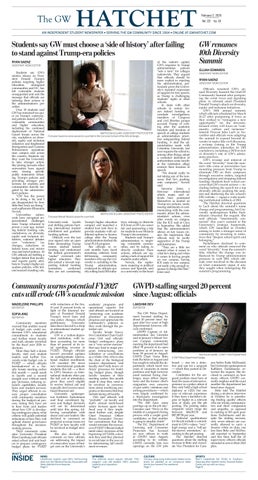
First-year Savanna Jones poses for a portrait in the Corcoran School of the Arts & Design.
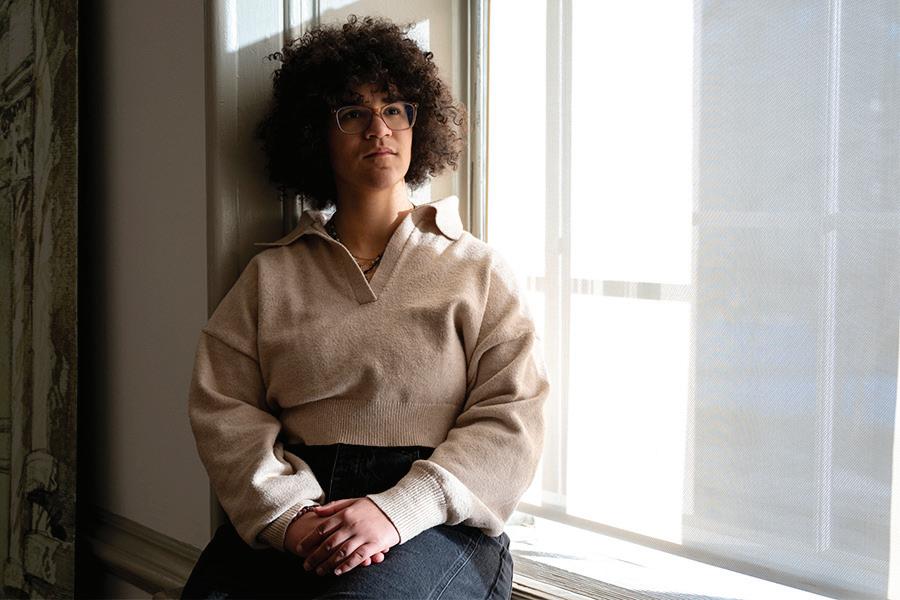
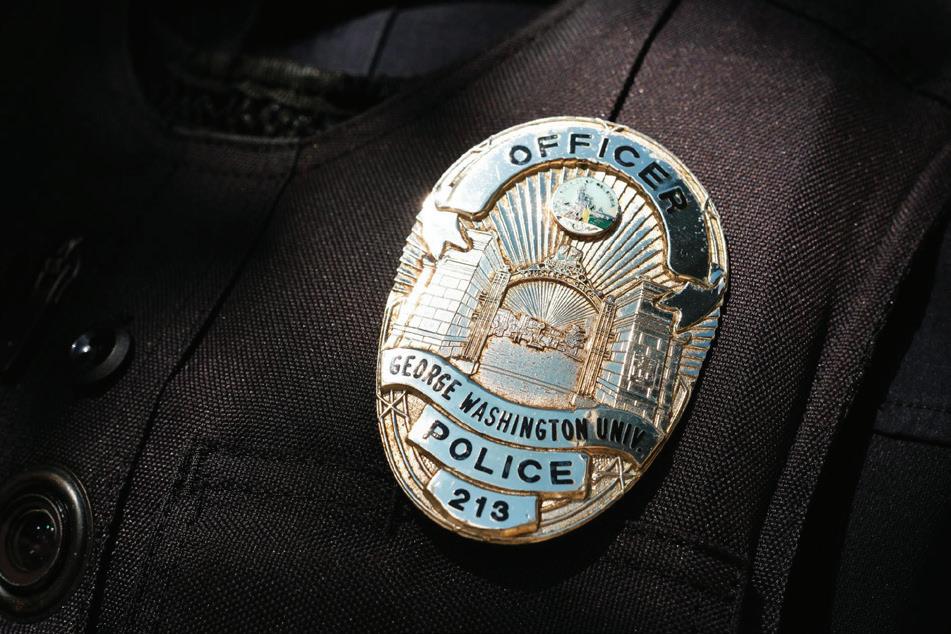
NICHOLAS WARE | STAFF PHOTOGRAPHER A GW Police Department badge.
MATHLYDA DULIAN | ASSISTANT PHOTO EDITOR
First-year Moriah Musick poses for a portrait.
Trump to close Kennedy Center for two years
JENNA LEE SENIOR NEWS EDITOR
President Donald Trump announced Sunday the Kennedy Center will close for two years in July as the center undergoes renovations.
Trump in a Truth Social post Sunday night said he determined the best way to bring the center to the “highest level of success” is to close it for two years starting July 4, though he noted the decision requires approval from the center’s board of trustees, which he chairs and filled with his family and administration officials. The move comes after the board voted to rename the center the Trump-Kennedy Center in December and as several performers have pulled out of their scheduled performances at the venue to boycott Trump’s overhaul.
“I have determined that the Trump-Ken-
nedy Center, if temporarily closed for Construction, Revitalization, and Complete Rebuilding, can be, without question, the finest Performing Arts Facility of its kind, anywhere in the World,” Trump said in the post.
The White House and the Kennedy Center did not immediately return a request for comment.
Trump fired Chair David Rubenstein and multiple other board members last February because they did not share the same “vision for a golden age in arts and culture.” He has since appointed media figures, like Laura Ingraham, and supporters of his administration, like White House Chief of Staff Susie Wiles and U.S. Attorney General Pam Bondi, to the board.
SNAPSHOT
GW’s pending deal with UHS will bring stability back to MFA, experts say
ARUSHI AGARWAL
REPORTER
RACHEL LEMOULT
REPORTER
Universal Health Services’ forthcoming deal with GW over the Medical Faculty Associates represents what healthcare experts say was likely the only viable path to stabilize the medical enterprise and relieve the University of its financial support.
Officials anticipate finalizing an agreement with UHS, GW Hospital’s owner and operator, to end the University’s financial support for the MFA, building on an initial October deal that had already halved GW’s financial responsibility while negotiations continued. Following six consecutive years of losses that have led GW to loan the enterprise more than $370 million, half a dozen healthcare experts agreed GW could not have stabilized the MFA alone, making UHS — a for-profit hospital with a longstanding relationship with the University — a logical partner to restructure its operations as its resources can overhaul the enterprise’s ineffective management.
Healthcare experts said UHS’ differing management practices as a for-profit company can ensure costcutting measures and restructuring that could stabilize the MFA’s books. But they warned restructuring could also lead to physician layoffs — a less favorable outcome to reach financial stability.
The Hatchet directed questions to Chief Financial Officer Bruno Fernandes regarding the University’s decision to engage with UHS to end its financial support for the MFA, but
a University spokesperson returned the request, saying GW, UHS and the MFA continue their “complex negotiations” over the future of the MFA’s operations. The spokesperson said the parties are prioritizing achieving a sustainable financial model for the MFA and the long-term stability and excellence of GW’s medical education mission, though declined to answer The Hatchet’s questions further, citing ongoing negotiations. UHS did not return a request for comment about why they entered into negotiations with GW and the company’s plans for the MFA following a finalized deal with the University.
Martin Gaynor, a professor emeritus at Carnegie Mellon University specializing in health care competition, said sustained losses like the MFA’s are ultimately unsustainable without management changes, adding that a new hospital operator like UHS could introduce new leadership that is better equipped to stabilize the MFA’s finances. GW in 2018, under former University President Thomas LeBlanc, restructured its relationship with the MFA, granting the University expanded administrative authority over the physician’s practice. The changes gave GW the authority to manage the MFA’s budget, approve its CEO, amend its bylaws and appoint members to the Board of Trustees.
But since the restructuring, the MFA has suffered six consecutive years of losses since its first full year under GW’s control, wracking up $100 million in losses in FY2025, $107 million in FY2024, $78 million in FY2023, $78 million in FY2022, $48 million in FY2021 and $43 million in FY2020. GW
has loaned the MFA more than $370 million since 2022 — when officials first began to report the loans — to keep the practice afloat.
The MFA wavered in profitability before GW brought it under its wing, also facing deficits in 2015 and 2016, which pushed GW to lend the MFA $20 million in 2016 after the enterprise spent $61 million more than its revenue in FY2015. Officials forgave that $20 million line of credit in 2019, which former GW CFO Mark Diaz said at the time was to increase the MFA’s stability and to help the group through its fiscal turbulence — though GW’s loans to the MFA have since exponentially increased by tens of millions of dollars.
“Something needs to change, and whoever is managing them now is not getting it done,” Gaynor said.
Officials pledged numerous times that bringing in healthcare executive Bill Elliott as the MFA’s CEO in May 2024 would help them solve the MFA’s debt issues. Elliott has served in the role of CEO for over a year and a half, during which the medical enterprise saw its second-highest loss ever on record. Matthew Gillmor — a director and equity research analyst with the financial services firm KeyBanc Capital Markets, who has researched UHS — said he thinks GW and UHS’ deal will provide financial security to the MFA, given both parties having incentives to ensure its stability as GW has an interest in maintaining its clinical education, and UHS owns GW Hospital. He said GW and UHS’ finalized deal likely won’t be profitable for UHS, though it will provide stability to the physician group and the services it provides GW Hospital.
CRIME LOG
LIQUOR LAW VIOLATION
South Hall
1/27/2026 – 11:56 p.m.
Closed Case
The GW Police Department and the GW Emergency Response Group responded to a report of an intoxicated female student. EMeRG conducted a medical evaluation of the student and cleared her after determining further medical treatment was unnecessary. Case closed. Referred to Conflict Education & Student Accountability.
SIMPLE ASSAULT
2100 Block of I Street NW
1/25/2026 – 1:30 p.m.
Closed Case A male GW student reported an unknown male punched him in the face as he walked past him Case closed.
DRUG LAW VIOLATION
607 21st Street NW
1/23/2026 – 5:31 p.m.
Closed Case GWPD responded to a report from the administrator on call regarding drugs and paraphernalia belonging to a male student observed during a routine inspection. Officials transported the items to a storage room for safekeeping. Case closed. Referred to Conflict Education & Student Accountability.
DRUG LAW VIOLATION
Shenkman Hall
1/23/2026 – 4:54 p.m.
Closed Case
GWPD responded to a report from an administrator on call regarding drug paraphernalia belonging to a male student observed during a routine inspection. Officials transported the items to a storage room for safekeeping. Case closed. Referred to the Metropolitan Police Department.
THEFT II/FROM BUILDING
Thurston Hall
1/23/2026 – 1:36 p.m. through 3:30 p.m.
Closed Case A female GW student reported a food item stolen from their grocery delivery. Case closed. Referred to Conflict Education & Student Accountability.
—Compiled by Bryson Kloesel
Junior sprinter Kamryn Holness set a new program record in the 60-meter hurdle at Saturday’s Patriot Games Indoor Track meet.
Students report rising interest in studying abroad after Trump’s return to power
RYAN SAENZ ASSISTANT
Students say attending school in D.C. during President Donald Trump’s second term has increased their interest in studying abroad, though concerns about how they might be received in countries that view the United States unfavorably are shaping where they choose to go.
Twenty undergraduate students say they are more inclined to spend a semester abroad following Trump’s first year back in office, seeing it as a temporary escape from U.S. politics and an administration that has advanced controversial policies and sparked frequent nationwide protests. Many also expressed concern that the United States’ waning favorability abroad could make it harder to connect with people in other countries, as they fear locals will judge them based on their perceptions of the United States under Trump.
University spokesperson Claire Sabin said student participation in study abroad programs has risen since the COVID-19 pandemic, with
just under 1,000 students going abroad at some point this academic year — more than double the number in 2021-22. She said students remain most interested in European destinations, though the Office for Study Abroad supports programs in 49 countries.
Sabin said several countries have complex student visa processes, like Italy and Spain, but the Office for Study Abroad offers additional support for students looking to enter programs in those countries. Sabin declined to comment on if students have struggled to apply for study abroad programs due to Trump-related policies like a travel ban impacting just under 40 countries.
Xin Van Horn, a sophomore majoring in political science, said she feels even more inclined to go abroad amid heightened Immigration and Customs Enforcement activity nationwide, especially in Minneapolis, which makes her worry for the nation’s stability. She said because of recent political developments in the United States — like increased ICE activity — she’s also considering getting a job in
politics abroad after she graduates.
“Maybe there’s some job opportunities abroad where that might be a little bit more stable,” Van Horn said. “Definitely, the Trump administration has made me want to explore my horizons a little bit more.”
Van Horn said she’s looking at programs in London primarily but is open to studying in other cities in Western Europe. She said she’s looking for countries that are typically more friendly to U.S. travelers, as global perceptions of the nation turn sour, in hopes of reducing the risk of friction with locals who may mistake her for supporting Trump’s policies.
She said she knows universities and academic institutions are generally more accepting of diverse ideas, but she’s still worried about facing resentment from locals as an American studying abroad.
Van Horn said she’s also noticed her peers shifting their study abroad searches to countries more sympathetic to the United States, including those they’ve already visited, because they have a better sense of how people may react to Americans.
“I think people are kind of afraid and are trying to go towards cultures that are a little bit more similar to the U.S.,” Van Horn said. “Which honestly is kind of sad because I feel like the point of study abroad is to go experience different cultures and things like that.”
Ella Fleureton, a sophomore majoring in international affairs, said she’s a member of the Global Bachelor’s Program and completed her first semester abroad in Belfast, Northern Ireland, last fall. She said she’s hoping to go to Brazil over the summer but is worried about the political climate in the country and in South America as a whole in the wake of Trump’s military operation in Venezuela in early January that captured Venezuelan President Nicolas Maduro and his wife.
“I’m paying definitely more attention to U.S. involvement in South America as a whole, paying attention, seeing if any other issues could arise or might interfere with my time there,” Fleureton said.
Meredith Kinkade, a sophomore studying international affairs and a member of the Global Bachelor’s Program, said when she was in Bel-
fast this past fall semester, political discussions in her classes quickly shifted to the Trump administration and U.S. politics since it dominated international headlines. She said students — mostly Belfast locals — would first ask her about her stance on Trump before continuing discussions with her because they wanted to know whether they were talking to an American who disliked of Trump.
“It was jarring to go over there and have people ask that as the first question,” Kinkade said.
Talar Hovsepian, a sophomore studying civil engineering and physics who is abroad in Dublin, said she felt eager to leave the country after Trump stepped back into office and she saw his domestic policy unfold over the last year.
“I am not happy with the way our administration treats its citizens, noncitizens, anybody who is working and being diligent members of the United States,” Hovsepian said. “I don’t think that the way that the administration is treating these people is correct at all, and this kind of became a really good escape for me.”
Hundreds strike, march to Capitol in protest of Minneapolis ICE shootings
ARJUN
GIANNA
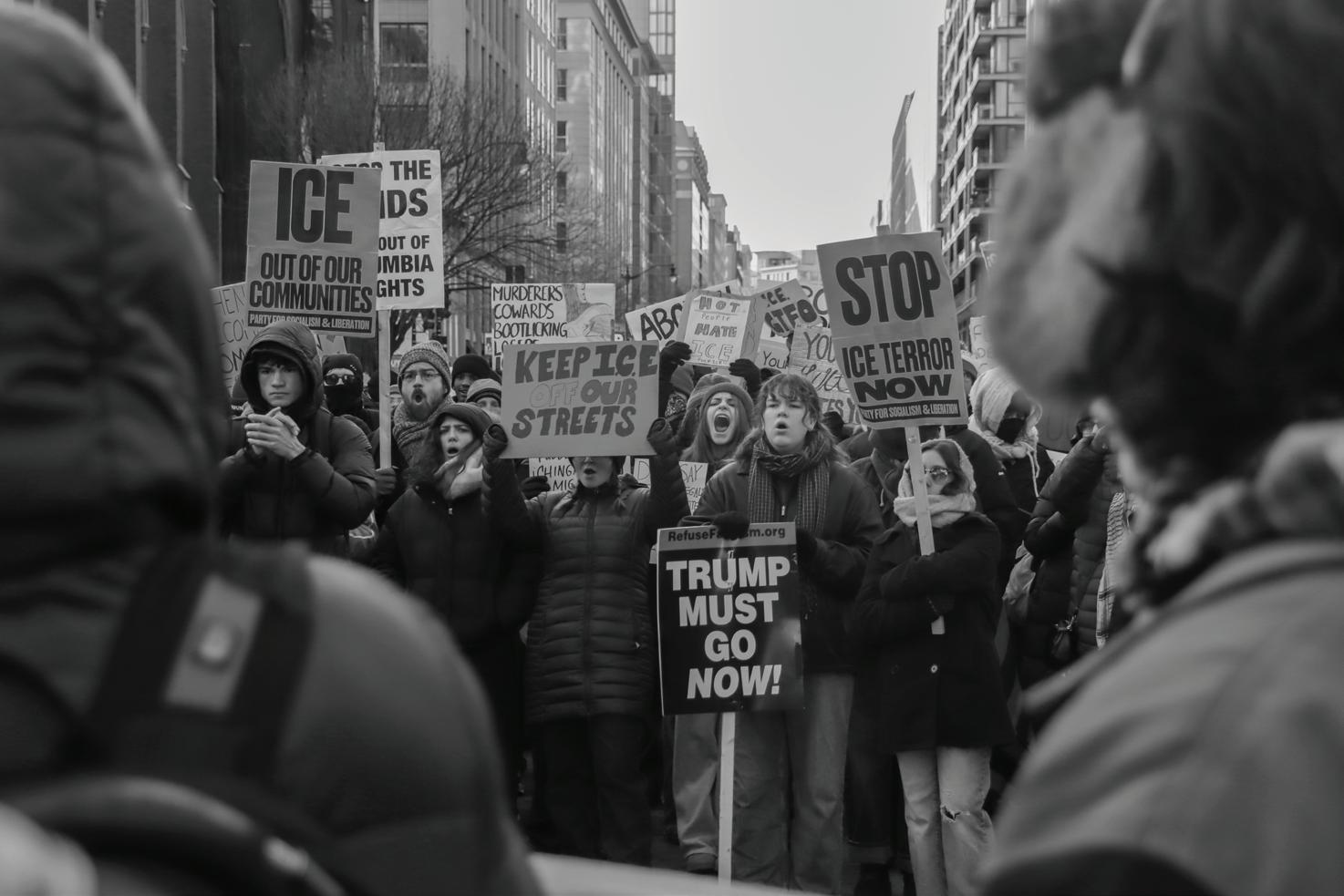
Hundreds of picketers marched from Chinatown to the Capitol Friday to protest President Donald Trump’s escalated U.S. Immigration and Customs Enforcement actions as part of a nationwide general strike following the fatal shootings of two U.S. citizens by immigration officers in January.
The “ICE Out” strike — organized by the anti-Trump grassroots activist group 50501 and endorsed by over 15 DMV organizations, including several GW student organizations — began at 3 p.m. at 7th and H streets near the Gallery Place-Chinatown metro stop before demonstrators holding picket signs with phrases, like “Stop Minnesota Massacre” and “ICE is the Gestapo,” marched to the Capitol. Speakers and demonstrators called for a national econom-
ic shutdown, urging protesters to call out from work or school and refrain from shopping after federal agents fatally shot Renee Good and Alex Pretti in Minneapolis last month.
Several GW student groups endorsed the D.C. march, including the Socialist Action Initiative, Reproductive Autonomy and Gender Equity and Asian American Student Association. The strike was part of a nationwide movement to organize against ICE Friday, which came after thousands protested in Minneapolis on Monday against ICE’s aggressive policing tactics in the city.
Various D.C. businesses, including Solid State Books, L’Enfant Gallery and Spot of Tea, closed Friday to observe the national strike in protest of Trump’s immigration crackdown, while several others pledged to donate proceeds from Friday’s sales to Ayuda, a D.C. nonprofit that advocates for immigrants.
Tensions against ICE have surged in Minneapolis and across the country after an agent fatally shot Good, a 37-year-old Minneapolis resident, in January during an encounter in South Minneapolis. Though federal officials have characterized the shooting as self defense, claiming Good was attempting to run the agent over, video footage has contested the government’s account, with many arguing the video shows Good was attempting to drive away, not run the agent over.
Tensions were further inflamed last week after Border Patrol officers shot and killed Pretti, a 37-year-old Minneapolis resident and ICU nurse, as they tried to arrest him for allegedly interfering with federal immigration operations, just weeks after Good was killed. The Justice Department on Friday said it opened a civil rights investigation into Pretti’s shooting.
The crowd began with a round of chanting, including phrases, like “No justice, no
peace, we want ICE off our streets” and “Get out the way ICE, get out the way.”
Rhea Biswas, who attended the strike with the Party of Socialism and Liberation, condemned the killings of Pretti and Good in her speech, adding that Americans need to expand the strike to further its effect. Biswas said the Trump administration has walked back some of its most “vicious” claims because of protests, pointing to Trump’s statement that officials will be “reviewing everything” related to Pretti’s killing and Senate Republicans’ call for investigations into ICE.
Since Pretti’s killing, officials removed Border Patrol Commander Greg Bovino from his role in Minnesota and directed ICE officers to avoid engaging with “agitators” as they carry out their immigration operations.
Biswas — who graduated from GW last year and was formerly part of SAI — said in an interview that picketers were answering the call
for students in Minneapolis who called for a nationwide shutdown. She said the main call to protest came from the University of Minnesota’s Black Student Union and Somali Student Association, leading student leaders on campuses nationwide uniting to protest ICE’s actions.
Biswas called on GW officials to meet with students who have been protesting ICE and ensure them that they’ll protect immigrant students.
“The University needs to commit to that because it’s part of the larger D.C. community,” Biswas said. “It’s part of that struggle as well, and they have not made any progress.”
A student speaker with SAI said GW’s austerity measures, like the budget cuts GW officials implemented, are made at the expense of working class people — pointing to federal cuts to SNAP benefits and Medicaid for the working class that mirror University cuts, like staff layoffs and a hiring
freeze that ended in October.
“Education strikes represent our vision for the world,” the speaker said. “That’s why it’s important for us to show up for workers as students.”
Another speaker, who identified himself as Michael from the Washington Teachers Union, said the only way to de-escalate tensions with ICE is for the government to withdraw all federal agents and for Congress to cut funding to the Department of Homeland Security. The government partially shut down Saturday as the House considers a Senatepassed bill to fund the government, though the bill notably isolates DHS funding after Democratic lawmakers threatened to block the funding bill if DHS funding wasn’t removed.
“Congress has a very clear choice ahead of them,” Michael said. “Will they keep funding this machine of racism, violence and fear, or will they listen to the people?”
Trump-era policies worsen already faltering graduate admissions, experts say
ALBRECHT
WRITER
VICTORIA SMAJLAJ
WRITER
Experts say President Donald Trump’s higher education and immigration policies have exacerbated an already declining graduate enrollment at GW, driven by a sharp drop in international students and ongoing concerns about the cost of attendance in recent years.
Graduate enrollment fell 6 percent from the 2024-25 academic year, reaching a record low of 12,936 students in 2025 — the largest single-year decline since graduate enrollment began dropping from 15,821 students in 2017. Eight higher education enrollment experts said concerns about the return on investment of advanced degrees and changing visa policies for international students likely contributed to the graduate enrollment decline in recent years, and Trump-era policies, like cuts to graduate funding options in the One Big Beautiful Bill Act, will drive further drops in the coming years.
GW’s graduate enrollment continues to fall, even as national graduate enrollment has edged up, with a one percent increase at schools na-
tionwide since last year, according to National Student Clearinghouse Research Center data last updated Jan. 15. Trump’s cuts to federal research funding, stricter visa policies for international students and the elimination of uncapped Grad PLUS loans have disrupted graduate enrollment across the country. Starting this July, new graduate students will face tighter borrowing limits under the bill, which eliminates the Grad PLUS program. Nonprofessional graduate students are now capped at $20,500 per year and $100,000 over their lifetime, while professional students can borrow up to $50,000 per year with a $200,000 lifetime limit. Previously, Grad PLUS loans allowed students to borrow up to the full cost of attendance.
Vice President and Dean of Enrollment Management and Student Success Jay Goff said international enrollment has been a challenge since the COVID-19 pandemic, with the University now navigating visa appointment delays and federal immigration policy changes. He also said domestic part-time enrollment and international enrollment have both been inhibited by changes in the workforce landscape since the pandemic.
GW’s graduate enrollment has plummeted since the pandemic, dropping about 18 percent from 2020 to 2025, according to enrollment data. National graduate enrollment increased 7.2 percent during the same period, according to the National Student Clearinghouse Research Center.
“Market shifts, changes in work patterns, reductions in DMV area federal jobs, and evolving employer graduate tuition support have all contributed to this trend,” Goff said in an email.
The number of new graduate students at GW dropped from 4,985 in 2023 to 4,632 in 2024 and 4,468 in 2025. GW’s graduate international student population fell from 1,218 in 2023 to 1,003 in 2024 and 710 in 2025, with the number of domestic students dropping from 3,767 in 2023 to 3,629 in 2024 and rising to 3,758 in 2025, according to a presentation Goff gave at a December Faculty Senate meeting. Goff attributed declining numbers to Trump-era travel bans and the lingering effects of the COVID-19 pandemics.
Philip Altbach, an emeritus professor and founding director of the Center for International Higher Education at Boston College, noted that Trump-era visa restrictions and other policies have significant-
ly contributed to declining international student enrollment nationwide and at GW over the past year. Altbach said international students face multiple barriers that did not exist a decade ago, like visa uncertainty under the Trump administration, which has asked that they unlock their social media accounts for government officials to view.
“I think the big one is the general negative policies from the Trump administration about visas, visa cancellations, students having
their visas yanked once they’re in the U.S., which gets lots of publicity overseas, and that sort of thing, general negativism,” Altbach said. Michael Horn, an adjunct lecturer at the Harvard Graduate School of Education, said as the
and
recovered from COVID-19 relatively
fewer students see graduate school as a necessary step toward employment and have instead decided to enter the workforce directly after getting their bachelor’s degree.
NAOMI BONE URBINA | PHOTOGRAPHER
Protesters march under the Friendship Archway in Chinatown on Saturday.
ABBY BROWN | STAFF PHOTOGRAPHER
GW Students chant at the “ICE OUT” strike Friday.
economy
labor market have
well,
KARSYN MEYERSON | STAFF PHOTOGRAPHER
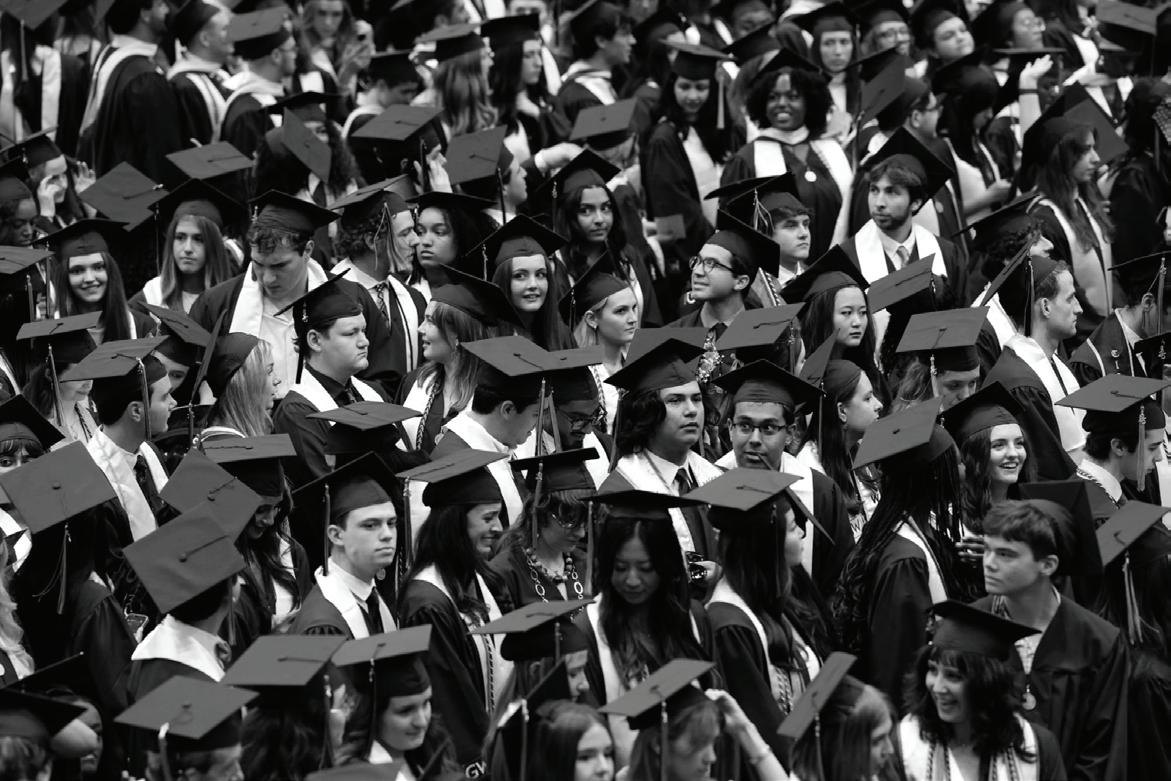
The Elliott School of International Affairs graduation ceremony last year.
First-generation students launch podcast to aid transition to college life
A group of first-gen-
eration students, with the help of a GW staff member, launched a podcast to share resources on college applications and the transition to university life for prospective students who are first in their families to attend college.
Members of the First Steps Forward podcast said they founded the group in January after First Generation Program Associate Sean Watley recruited them to form and develop a podcast breaking down the struggles first-generation students face and providing solutions. The podcast members said they want to provide a resource for first-generation students navigating the application process and the transition to college — something they didn’t have when they first came to GW.
Nearly 16 percent of GW’s new undergraduate student enrollment in 2025 were firstgeneration college students, according to enrollment data.
The group released their first episode on Jan. 15, titled “What is First-Gen,” providing an overview of what it means to be a first-generation student and detailing some of the struggles that come with it, like having imposter syndrome and common issues with understanding financial aid forms. They said they plan to release further episodes on financial aid and professional opportunities on the first Friday of each month.
Sophomore Zendmeni Ganzorig, president of the First Steps Forward podcast, said she joined the podcast because she wanted to give back to the community that had supported her when
she first enrolled at GW. Ganzorig, a first-generation student herself, said she is from a low-income area of Maryland where few people attend college and initially struggled to adjust to life at GW and navigate the University’s social dynamics.
“There is a huge learning curve and a difference in priorities and culture that a lot of us don’t really recognize,” Ganzorig said. “And even as a first-gen student who’s facilitating a discussion on what that is, I’m still learning things as well.”
GW organizes programs for first-generation college students, like Blaze the Trail, a living-learning community
for first-year, first-generation students, and Founding Scholars, a two-day program on campus in the summer for first-generation students before their first year at GW.
Ganzorig said she participated in Blaze the Trail and Founding Scholars during her first year at GW and was motivated to join First Steps Forward when Watley shared the idea with her because she hoped to further foster the tight-knit community of first-generation students at GW that helped her during her first year.
“Now I’m just trying to give back because they really helped me last year,” Ganzorig said. “I have to repay my debt.”
Researchers find gut bacteria could be tied to cognitive decline, Alzheimer’s
GW researchers released a comprehensive review that found evidence that imbalances in gut bacteria are linked to memory decline and Alzheimer’s disease last Thursday, though they cautioned that the results do not prove causation.
The researchers, led by Assistant Professor of Clinical Research and Leadership Leigh Frame, synthesized the findings from 58 human studies conducted from 2018 to 2022 that found differences in gut bacteria composition between people with mild cognitive impairment and cognitively healthy individuals, suggesting that changes in gut bacteria composition could be associated with Mild Cognitive Impairment and Alzheimer’s. Frame said the findings are significant because Alzheimer’s disease remains one of the most pressing public health challenges of aging, affecting an estimated 55 million people worldwide, yet human evidence linking gut microbiome differences to cognitive decline has remained fragmented and difficult to interpret because studies use different methods and measures, making results difficult to compare.
Frame said while many individual studies had reported microbiome differences in people with MCI and Alzheimer’s disease, no prior review had systematically synthesized the human evidence.
“We wanted to determine whether consistent patterns existed and what gaps remained in the literature generally and as a comparator for our clinical trial results,” Frame said in an email.
Gut microbiomes are the bacteria and other microorganisms that are in the intestines. Research shows these microbes can communicate with the brain through immune responses and chemical signals that influence inflammation throughout the body, a system often referred to as the gut-brain connection. Changes in the system have been associat-
ed with processes linked to cognitive decline, including chronic inflammation.
The review notes that some gut microbes are associated with anti-inflammatory activity, while others are linked to inflammation that has been implicated in neurodegeneration, leading to cognitive decline. When the balance of bacteria shifts, the authors wrote, it may be associated with inflammatory processes linked to cognitive decline and Alzheimer’s disease.
Frame said the study provides a human-evidence framework for studying the microbiota-gut-brain axis — the communication network linking the gut and the brain — by identifying consistent patterns in the literature and gaps that future research can address. She said animal studies had previously demonstrated that experimentally changing the composition of gut bacteria could affect memory and learning, a notion that researchers later explored in human observational studies.
The multidisciplinary team consisted of 11 GW researchers and trainees in medicine, public health, nutrition and the microbiome, and the researchers conducted the comprehensive search in February 2023. Frame said the team was “special” because it featured students and early-career scientists with training in combining findings from various studies and faculty with expertise in transferring research to practice and microbiome methodology, who supported them.
She said the main challenge throughout the pro-
cess was the lack of consistency in the methodologies used across the studies, which made it difficult to directly compare and synthesize the findings and establish definitive causation between gut bacteria and cognitive decline.
Still, she said a “major success” of the review was researchers’ ability to identify reproducible microbial patterns across multiple independent human studies, though she conceded the overall evidence remains limited by study heterogeneity and is not yet strong enough to support causal conclusions.
“The biggest lesson is the importance of scientific restraint,” Frame said. “The microbiome is often overhyped. Our study shows that associations exist but also that better-designed human studies are required before clinical application is appropriate.”
Allison Warren, an adjunct assistant professor at the School of Medicine & Health Sciences and a co-author of the review, said the study represents a “small but important” step toward future studies because it helps researchers and clinicians see where consistent patterns exist in the human evidence and where further investigation is needed.
She said the review gives researchers a clearer foundation for designing future studies that can more directly test how gutbrain relationships may relate to cognitive decline.
“We also hope it contributes, even in a modest way, to strengthening the quality of longitudinal human evidence in this area,” Warren said.
Junior Careld Cruz, cohost of First Steps Forward and a Founding Scholars orientation leader, said joining the podcast has allowed her to serve as a voice for the community, especially since many first-generation students tend to be more reserved.
Cruz said she moved to the United States eight years ago after growing up in Central America and struggled to adapt to a new language and culture as a teenager. That disconnect created additional challenges during the college application process, she said, adding that she had to teach herself to
navigate financial aid forms with no family experience to guide her.
“I felt like I was going through that by myself because in a way, I really just became a parent to my parents,” Cruz said. “I had to learn everything and then go teach it to them so they can understand. They didn’t even know what FAFSA was.”
Cruz said the podcast will discuss topics like paying for college, dealing with financial aid, the challenges first-generation students face and how to build a social life at school, drawing on her own experiences to share with other first-generation students.
“I was really eager to do it, just because I felt like there’s so many great stories out there for people that need to be shared and aren’t shared enough,” Cruz said. “And so I was like, maybe I can’t share everybody’s, but at least I can do something to help other people feel seen.”
Senior Emma Hawryluk — also an orientation leader for Founding Scholars and one of the podcast’s co-hosts — said first-generation students face financial burdens that often act as a barrier to attending college, including navigating high tuition and financial aid forms.
“A lot of first-generation kids try work and fund things for themselves without having to rely on parents and money that might not always be there,” said Hawryluk.
Hawryluk said that while Ganzorig writes the script outlines, she reviews them before recording and finds ways to incorporate her own experiences into the podcast. She said many first-generation students experience imposter syndrome, feeling their success isn’t deserved, and the podcast aims to show that these feelings are normal as the hosts have experienced them themselves.
“I know we’ve talked about imposter syndrome a lot, being in university,” Hawyrluk said. “I think that’s one of the things that I’ve definitely struggled with the most, every internship rejection or every class I’ve missed.”
Members of First Steps Forward confirmed the organization is unofficial due to the university’s ongoing freeze on new student groups and cannot receive funding, even while working with a GW staff member.
GW professor helps identify 2.6 million
year-old fossil of early human relative
LAKSHMI DEV REPORTER
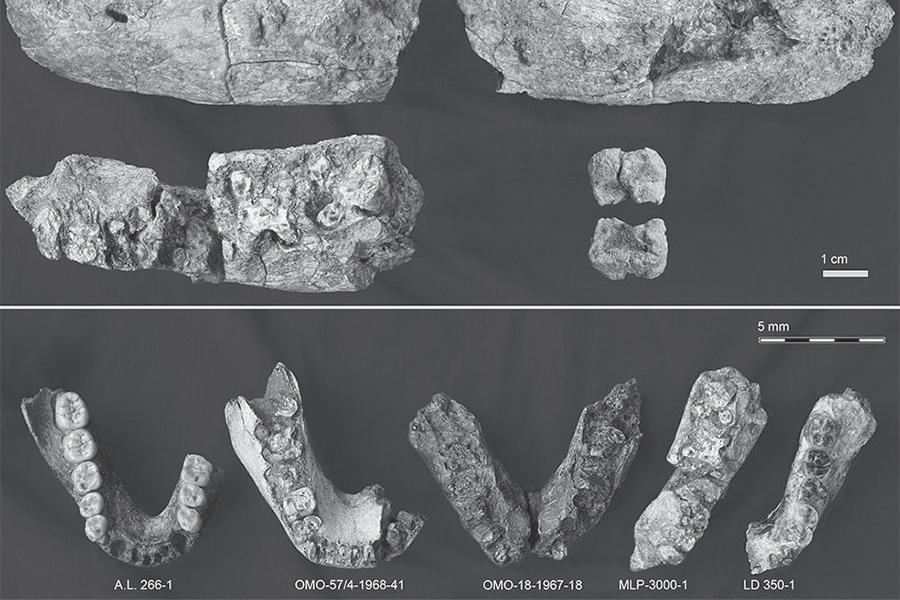
A GW professor helped discover a 2.6 million-yearold fossil in a dry, deserted region in Ethiopia, which is reshaping scientists’ understanding of one of humanity’s earliest relatives.
A team of researchers, including Anthropology Professor Andrew Barr, discovered a Paranthropus fossil — an extinct hominin genus that coexisted with early humans and was previously thought to only be able to survive in specific environments — in 2019 about 1,000 kilometers north of its previous occurrence and published a study last Wednesday about the discovery. Barr said the discovery suggests that Paranthropus may have been far more adaptable to different habitats than previously believed by scientists, highlighting the fact that paleoanthropology — the study of human evolution through fossil evidence — is a constantly changing field where researchers are consistently challenging long-standing theories.
Paranthropus is an extinct hominin, a group that includes modern humans and their close extinct relatives, that lived in Africa more than two million years ago.
Barr said scientists historically viewed Paranthropus as highly specialized because of its massive teeth
and powerful jaws, often calling it a “nutcracker.”
Barr said its anatomical features led researchers to believe the genus relied on specific hard or tough foods and could not survive across a wide range of environments that may not have access to these foods, unlike early members of the genus Homo, which humans belong to.
Paranthropus fossils were previously found between southern Ethiopia and southern Africa, with the new fossil in the Afar region of Ethiopia showing the genus had expanded farther north.
The seven researchers discovered the fossil in January 2019 during a paleontological survey while doing field work at the site and recovered it in four pieces, according to the study. The team then sent the fossil to the National Museum of Ethiopia for further research and conducted CT scans at the University of Chicago.
“What we initially thought of as a very niche hominin, a very specialized hominin, may be actually much more generalized than we thought, and able to thrive in a lot of different places,” Barr said.
Environmental evidence from the site further supports the study’s finding that Paranthropus was not limited to one area or geography, Barr said, adding that sediments at the site indicate a major ecologi-
cal transition from dense, wooded landscapes to more open savanna environments around the time the fossil dates to.
Barr said the fossil dates to about 2.6 million years ago, when the environment was shifting toward more open grasslands, indicating that Paranthropus was present at the site during that ecological transition.
“There seems to be a shift in the environment at about two and a half million years ago, which is right around the time when this specimen dates, from a more forested, highly vegetated environment towards a more open grassland,” Barr said.
Barr said the team’s discovery ultimately depended on persistence in a “boot-killing” landscape as they searched across terrain covered in sharp volcanic basalt, where fossils are difficult to spot and fieldwork quickly wears down boots and vehicles.
Beyond its scientific implications, Barr said the discovery underscores that paleoanthropology is a discovery-driven field, in which new finds can overturn what scientists thought they knew. He said it can be easy for scientists to think they know who was where and what exactly was going on.
“Then you find a fossil that just makes you say, ‘I thought we knew that,’” Barr said.
HATCHET FILE PHOTO
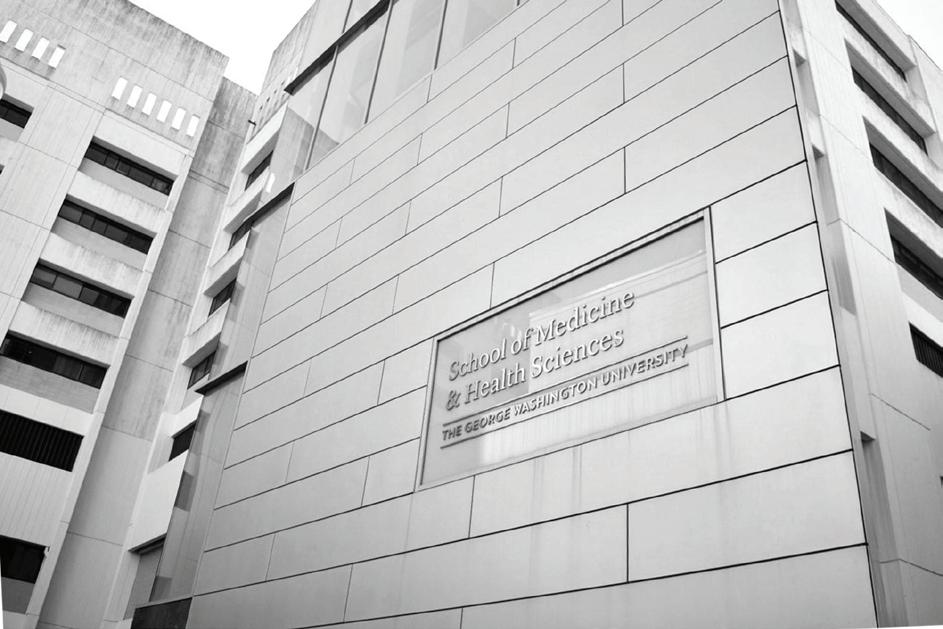
The School of Medicine & Health Sciences on I Street.
COURTESY OF JUSTIN LIU
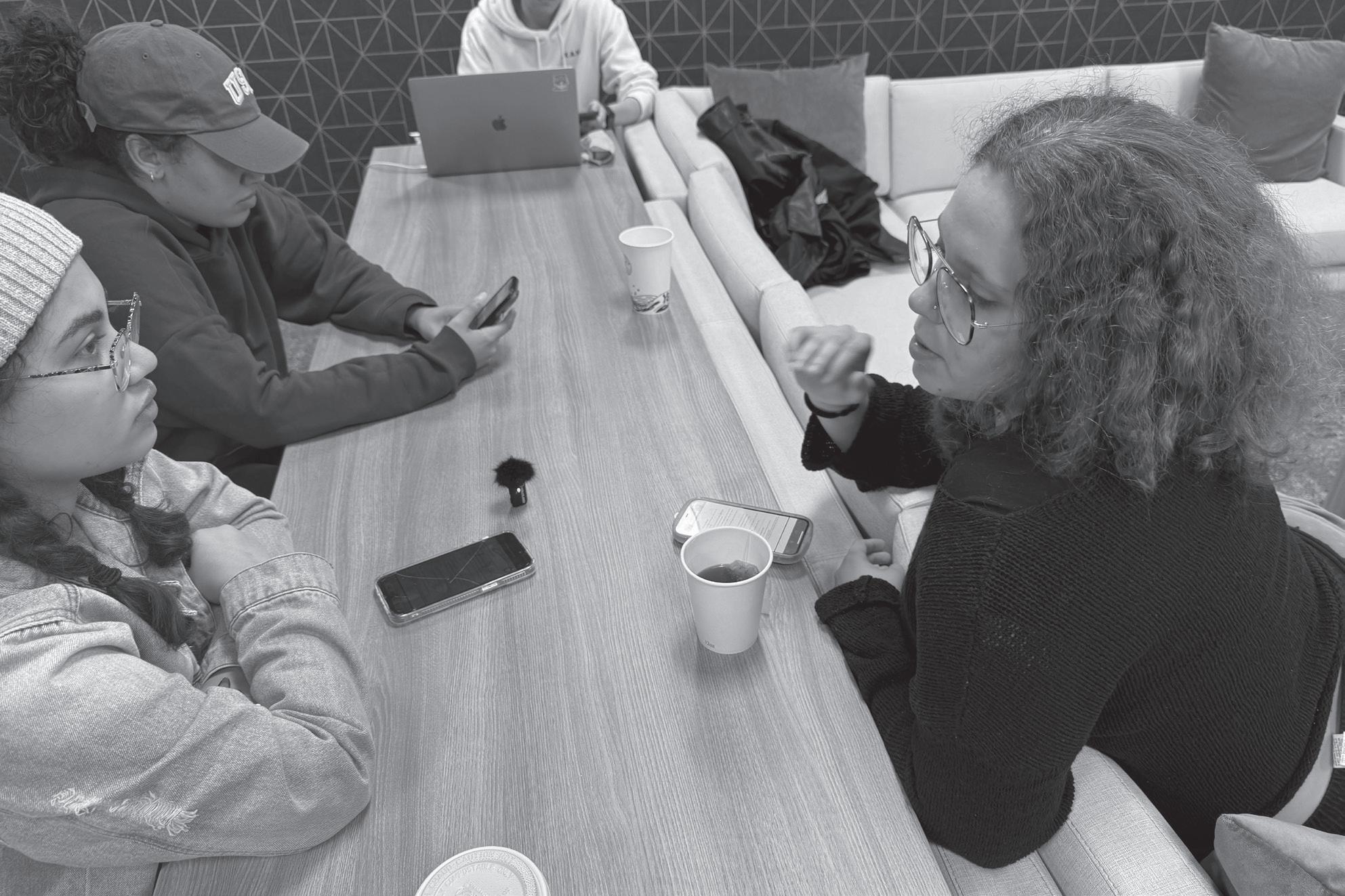
Members of the First Steps Forward podcast record an episode.
Palestinian restaurant coming to Foggy Bottom this April
A Palestinian restaurant is set to open in Foggy Bottom this April, with its founder and owner citing GW students’ history of pro-Palestinian activism as one factor that made the campus-adjacent location appealing.
Ayat, a Michelin Guide-featured restaurant that initially opened its doors in Brooklyn in 2020, is now expanding to D.C. with a location at 2112 Pennsylvania Ave., just behind the Campus Store. CEO and founder Abdul Elenani said he sees the restaurant as aligned with the University’s “energy,” particularly after observing GW students’ protests over the war in Gaza in recent years.
“Foggy Bottom felt like the right place for us. It’s a neighborhood where government, culture and education all intersect,” Elenani said. “We wanted to be somewhere central and accessible, where people already gather and where Palestinian food and culture could be part of the everyday fabric of the city.”
Since the onset of the war in Gaza on Oct. 7, 2023, GW community members have organized robust pro-Palestinian
activism, with students staging numerous demonstrations and setting up a pro-Palestinian encampment in University Yard for 13 days in spring 2024, rebuking the University’s investments with companies that have ties to Israel.
Elenani said when choosing the Foggy Bottom location, he knew GW students’ long history of pro-Palestinian activism.
“Students have played a major role in leading dialogue and advocacy, starting at Columbia and expanding across campuses nationwide,” Elenani said. “Being near GW felt aligned with that energy and with the kind of community Ayat has always attracted”
Elenani said he is excited to be expanding to the District and hopes to focus on building a “meaningful” presence in Foggy Bottom, adding he is not concerned about receiving backlash for being openly Palestinian. Elenani said he looks forward to building a community similar to the one they have created in New York City.
“Being here feels especially meaningful to us as it gives us the opportunity to help shift the narrative in favor of Palestinian humanity and visibility,” Elenani said.
Ayat is named after Elenani’s wife and has always been “unapologetically Palestinian,” Elenani said. The restaurant serves authentic cuisine, including traditional Palestinian dishes like mansaf and chicken ouzi, according to its website.
The website states that the restaurant offers casual bistro dining and dishes “steeped in tradition.”
“For me, Ayat is about more than just food. It’s about preserving culture, building community and creating a space where people can experience
Palestinian hospitality for themselves,” Elenani said. When Ayat first opened in Brooklyn, there were not many restaurants that openly called themselves Palestinian, Elenani said. He said he felt it mattered to be clear about what Ayat was.
“We didn’t want to water anything down. Our food is meant to be shared, the tables are meant to be full and the space is meant to feel warm and welcoming,” Elenani said. “I think that honesty is what people connect with.”
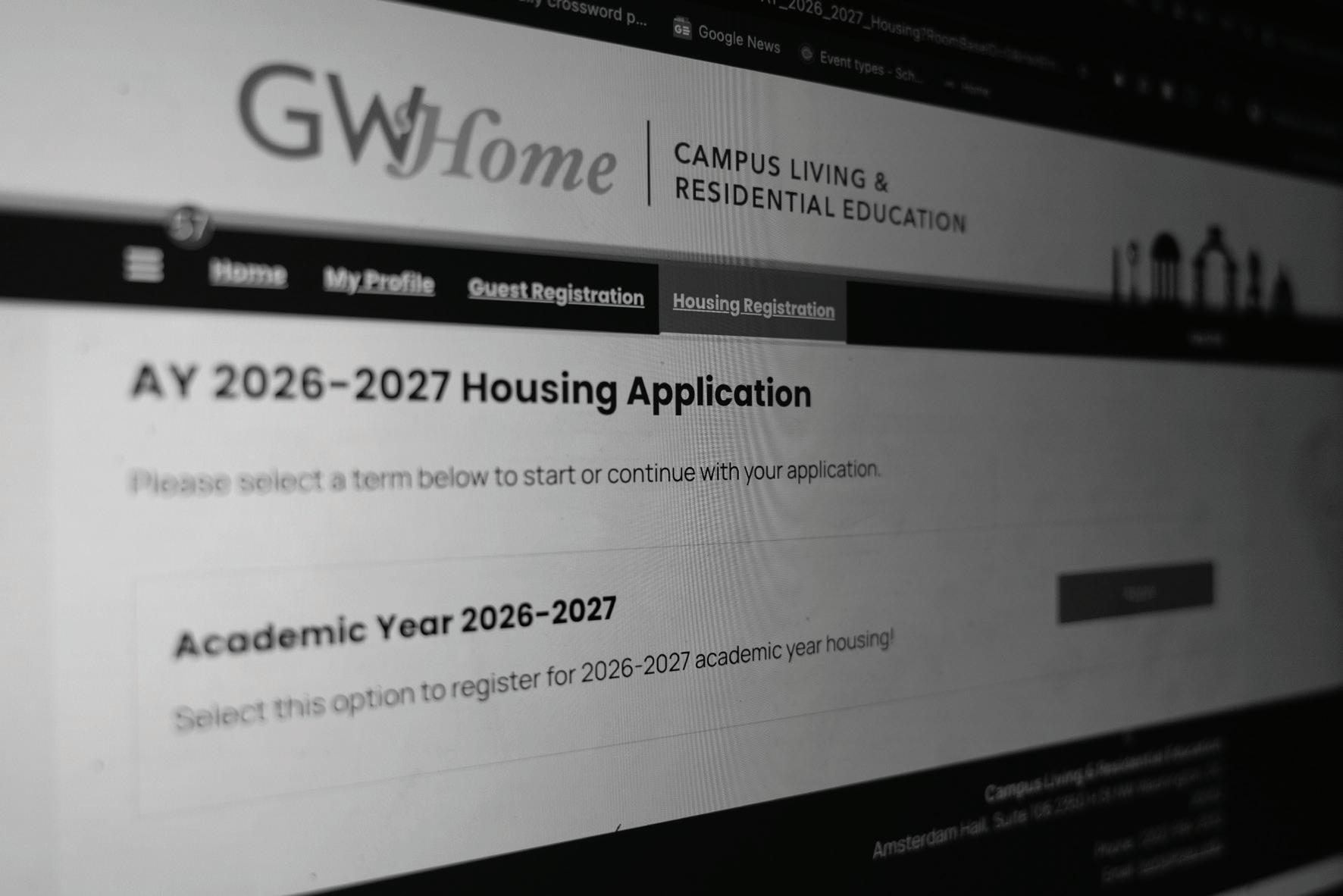
CLRE unveils earlier, split housing registration after years of student complaints
THOMAS KIM REPORTER
Campus Living and Residen-
tial Education moved housing registration up by about a month and staggered registration periods for rising upperclassmen and sophomores for the 2026-27 academic year after students reported delays in securing housing assignments.
University spokesperson Nadia Payne said CLRE consulted the Student Government Association and Residence Hall Association last year and opted to stagger registration from late January through early March, with rising juniors and seniors registering first and rising sophomores registering later. The change — a divergence from last year when all returning students registered together with officials releasing housing assignments in April — comes after CLRE placed some students required to live on-campus on waitlists, prompting the SGA and RHA to form a working group in 2024.
Payne said the feedback CLRE collected from student groups indicated the University should up the registration timeline and split the process so juniors and seniors register in January and receive assignments in February, while sophomores receive theirs in March after registering in February.
Payne said officials split reg-
istration into two windows, giving rising juniors and seniors an earlier registration period from Jan. 27 to Feb. 10 and Feb. 19 assignment notifications, while rising sophomores will register Feb. 11 to Feb. 25 and receive assignments by March 5. Late housing registration will open
March 6.
Housing registration last year opened later in the spring, with room renewal and Disability Support Services registration running from Jan. 28 to Feb. 11, general registration for both sophomores and upperclassmen running from Feb. 20 to March 7
and officials sending assignment notifications by April 11, according to an archived registration page.
Payne said the earlier timeline may allow the University to use some housing for graduate students, but did not specify how. GW hasn’t provided gradu-
ate students housing since it sold The Aston in 2022 — now the District’s first noncongregate housing shelter.
SGA senators in 2023 passed legislation calling on the University to again provide designated graduate housing. Associate Vice President of Business Services Seth Weinshel said at an SGA town hall in November earlier room assignments may allow the University to find empty room space to dole out to graduate students while they land on a more permanent solution. Payne said the University does not anticipate a waitlist for students required to live on campus — which includes those in their first and second years. Recent years have seen GW place as many as 250 students on the waitlist, down from about 700 in 2011. CLRE also said they did not expect a housing waitlist for the 2024-25 school year but that in April it placed rising sophomores and juniors on the list, though it declined to reveal how many.
The University ended its junior on-campus housing requirement in fall 2023 after years of student pushback and larger tranches of juniors receiving exemptions each year, but a University agreement with the D.C. Board of Zoning Adjustment still requires freshmen and sophomores to live in University housing.
Officials share potential Campus Plan designs with students at town hall
LEANNA JOJU REPORTER
The Campus Planning team presented four urban design scenarios at a virtual town hall for students Wednesday, drawing from student and community feedback to show how officials could redesign the campus over the next 20 years.
The planning team shared the results of an interactive online survey that collected data from more than 900 campus community members, asking questions about where they saw the boundaries of campus and how they move through campus to inform how officials can improve GW’s campus in the next plan.
Tyler Patrick, a representative from Sasaki Associates, the consulting firm officials hired to assist with the designing of the plan, said the team used the survey results and other community feedback to develop four different design concepts, which officials will refine into one cohesive framework in the spring or summer.
GW’s current campus plan is set to expire in 2027, two decades after District zoning officials approved the plan in 2007.
The four design concepts for the 2027 plan focus
on different development strategies targeting areas, like Kogan Plaza and the University Student Center, which students identified as the “heart” of campus in the survey, Patrick said. One concept emphasizes shifting the campus center toward H Street by adding new buildings and revitalizing outdoor gathering spaces in the area.
The 2007 campus plan also detailed areas where officials planned to concentrate development, specifically along 22nd Street, which the 2007 plan identifies as the “core of campus.”
“Over time, the center of GW has actually shifted to the North and to the West, and the anchor point is really this zone along H Street and the area that stretches from the Student Center and the academic center to the North, all the way down through the library, Kogan Plaza,” Patrick said.
Community members at town halls and other campus plan-related events in October said they wanted the plan to commit to adding more common spaces to campus where students can interact with each other.
With the campus community viewing the area surrounding Kogan as the heart of campus, the campus plan could include more invest-
ment into that space, Patrick said. He said the planning team would consider making the front of Gelman Library glass to make the library more “welcoming” as part of this development.
Several respondents also identified University Yard as the heart of campus, according to the presentation, and Patrick said GW’s next plan could include development in the area to make it a central hub like Kogan Plaza. Patrick said students told the team that U-Yard can feel “private” rather than like an open community space where they can gather.
Permanent fencing has surrounded U-Yard since December 2024, with officials originally installing fences around the park after Metropolitan Police Department officers cleared the 13-day-long pro-Palestinian encampment in May 2024.
The online survey results also showed popular diagonal paths between the Milken Institute School of Public Health building and the Flagg Building that students use to move through campus, according to the presentation, and the planning team used that data to create a design scenario reinforcing those routes. Patrick said the scenario would orient new buildings toward the paths
and add more pedestrian walkways to improve movement in the area.
In the survey, students identified areas of campus in need of “attention or repair,” suggesting upgrades, like nicer seating in quadlike spaces similar to U-Yard and an “equitable” approach across all buildings.
Two other urban design scenarios, which the planning team dubbed “Re-Grid the Grid” and “Celebrate the
Crossroads,” focus on developing popular pedestrian walkways and building up central campus areas to create spaces where students’ academic, social and cultural lives can converge, according to the presentation. The town hall is the most recent of many community events officials have held this academic year as they work to develop the 2027 campus plan, which will shape the University’s Foggy Bottom campus over the next 20 years. The Student Government Association, alongside the Residence Hall Association and GW’s campus planning team, co-sponsored the event. The campus plan is currently on its “framework development” stage, Patrick said. Officials will announce a preferred campus design direction in the spring or summer of 2026, according to the presentation.
Ayat, a Palestinian restaurant, will open soon at
PHOTO ILLUSTRATION BY MATHLYDA DULIAN
The Campus Living & Residential Education housing application portal.
HATCHET FILE PHOTO
GW’s Foggy Bottom campus.
OPINIONS
CCAS doctoral program cuts carry consequences for all of GW
GW is cutting admissions to its Columbian College of Arts & Sciences doctoral programs by 7 percent as universities nationwide scale back doctoral enrollments in response to strained budgets, federal research funding cuts under President Donald Trump, declining international student enrollment and broader structural challenges in graduate education. The Universities of Chicago and Washington and Harvard, Yale, Columbia, Brown, Boston and Michigan State universities are among others who have announced they are cutting, pausing or reducing program enrollment numbers next year. As an editorial board, we understand officials’ reasoning that the cut will allow them to better support current students and combat a budget deficit and Trump-era policy strains. But in shrinking these doctoral pipelines, officials are weakening the University’s research capacity and pipeline for future faculty and researchers.
These cuts could directly damage GW’s reputation and rankings, creating ripple effects that impact everyone on campus, regardless of their involvement in research. As an R1 institution — one of the nation’s top research universities — GW’s status depends heavily on the work of its faculty, graduate and doctoral students. Reducing the CCAS doctoral program will result in less research output, which could jeopardize the University’s standing as a top-tier research institution. In turn, this may make it harder to attract prospective students and faculty who seek strong research support and opportunities for their own scholarly work. Faculty will also likely face higher workloads to compensate for lost graduate student support.
The University also joined the Association of American Universi-
FSTAFF EDITORIAL
ties in 2023, reaching a long-term goal that signals national recognition of its growing research strength. But sustaining that status depends on robust research output and strong doctoral programs. For example, AAU membership criteria include continued excellence in graduate education and research. Cutting doctoral admissions could weaken GW’s research capacity, slow the production of new scholarly work and ultimately threaten the very metrics that underpin its place among the nation’s top research institutions.
The impact of cut doctoral admissions goes beyond faculty and graduate students. Fewer doctoral students mean less research output. That, in turn, may limit op-
Trump’s deportation
portunities for undergraduates to engage in cutting-edge research and reduce the University’s overall visibility and prestige in national and global rankings – indicators constituents across the University care about.
Cuts to programs, like clinical psychology, also affect society as a whole. With GW not admitting a new cohort, the University is contributing fewer trained professionals to a field already facing critical shortages. Doctoral students in clinical psychology conduct vital research that informs treatment practices, mental health policy and public health initiatives. By reducing the pipeline of scholars and practitioners, these cuts limit the flow of knowledge and exper-
agenda was never about legal status
or years, I have made the same point repeatedly: President Donald Trump’s push for immigrant deportations was never about legal status. It was never about whether immigrants were “illegal” or undocumented.
When Trump first started expressing his interest in running for a second term, my concern immediately went to how this would affect immigration policies. I could already imagine the heightened mass deportations, mistreatment of immigrants and racial profiling. My classmates told me Trump would need Congressional approval to enact many of his immigrationrelated policies. Professors told me the Supreme Court would strike down anything that was unfair or unconstitutional. Family members and acquaintances told me his immigration stance and corresponding policies in his first term “weren’t that bad,” so I didn’t really have a reason to be worried. Many said my concerns weren’t warranted because everyone the United States deported would be “just fine.” Yeah, right.
Since Trump’s return to power last January, his administration has deported over 600,000 people, and a
total of around three million immigrants have left the country, from both formal removal and self-deportations. The Supreme Court ruled last summer that the United States can deport immigrants to countries where they are not from. Last September, the Supreme Court issued an order that allowed Immigration and Customs Enforcement to racially profile people and use their race or ethnicity as a means for stopping them. Just last month, two American citizens — Renee Good and Alex Pretti — were shot and killed by ICE Agents in Minneapolis. Closer to home, ICE detained a woman from Maryland for 25 days despite being a U.S. citizen. And ICE has detained over 170 U.S. citizens over the past year.
Even when Trump entered his presidency, my peers at GW still felt Trump’s return wouldn’t seriously affect the immigrant community. When Trump was going after pro-Palestinian international students and tried to revoke their visas, a Hatchet staff member told me they didn’t think students were worried because international student deportations weren’t “actually happening.”
I understand it is difficult to grasp how an administration could be so violent and hateful. But we are seeing it play out in real time. The biggest misconception many seem to hold is that the Trump administration
only goes after undocumented immigrants.
We need to stop buying into this narrative that Trump’s hate lies solely with illegal immigration. His administration never had the intention of only getting rid of criminals or those who are undocumented — what they want is to get rid of all immigrants in the United States. I understand that many people’s first concern is not immigration. But what the Trump administration is doing is going after our classmates, neighbors and coworkers, regardless of their citizenship status.
Trump has completely disproven the argument of those who believed he was only going after undocumented immigrants, and even of those who believed he wouldn’t be able to find a way to push his callous agenda.
The Department of Homeland Security in December posted a photo of a sunny beach, captioned “America After 100 Million Deportations.” The United States has a population of around 340 million, around 53 million immigrants. Over 100 million people in the U.S. identify as non-white. This means that the Trump administration would have to deport American citizens. We have to stop believing this was ever about citizenship. —Andrea MendozaMelchor, a senior majoring in journalism and mass communication and creative writing, is the opinions editor.
Otise into the workforce, ultimately slowing progress in an area that has real-world consequences. Officials have described the decision as a temporary measure that will allow the University to offer more “competitive packages” in the future. CCAS Vice Dean of Programs and Operations Kimberly Gross said, “Like many universities, we have been taking a close look at how best to support our Ph.D. programs while maintaining the highest standards in doctoral education in a difficult fiscal environment.” As an editorial board, we recognize GW must make difficult choices to address its structural deficit and respond to federal research funding cuts under the Trump administration. But we also
ask that officials do everything they can to ensure these cuts don’t persist in the coming years.
We urge the University to honor its promise that these reductions are temporary. GW has signaled an intention to offer more competitive funding packages, particularly to support current graduate students. The University should deploy these resources strategically to ensure fair compensation while safeguarding the long-term viability of its doctoral programs as opposed to reducing or pausing them indefinitely.
At the same time, we ask that officials prioritize honoring the unionized graduate students, who are advocating for higher pay and expanded benefits. The University has cited these future contracts as a factor in its decision to cut programs, noting that budgets would be further strained to compensate the union fairly. But if faculty and students are overworked, research output declines, and the University attracts fewer students, these cuts will affect everyone across CCAS and beyond.
Our editorial board recognizes that GW made these cuts for strategic reasons. But as the University pauses and reduces admissions, it must think strategically about the future, ensuring that doctoral programs remain strong while offering fair compensation and benefits to graduate students. Citing new union contracts as a reason for these cuts risks placing undue responsibility on students advocating for equitable pay. Doctoral students, faculty and research are essential to GW’s academic success, and any reductions have consequences that ripple across the University. GW should use the next year to reinvest savings to sustain programs and avoid setting a precedent that could undermine research in the years ahead.
Fostering independence is GW’s greatest strength
nly children get a lot of slack for being spoiled. I don’t disagree with the sentiment. But everything changes once you arrive at college. GW, just like the only child, gets a lot of slack. Students argue the University lacks school spirit, a true “campus culture” and the laid back social environment found at many other schools. But it is precisely because of these insufficiencies that I’ve grown into the person I am. GW pushes its students toward a level of independence that prepares them well for the real world.
Traditional universities are often enveloped in their own bubble where the campus functions as a smaller town for students. With that comes a stronger sense of school spirit and
camaraderie. Our city campus lacks much of this. But in forcing us to navigate and make friends in a city environment, GW excels at preparing us for life after college — arguably a goal of every university beyond education. GW’s gift of independence is a blessing, albeit overwhelming at first. It is able to catapult the student body into versions of themselves that will prepare them for adulthood. That has been my experience at GW thus far.
The first time my friend and I hopped on the metro alone, I was scared. Spending my teenage years in Louisville, Kentucky, which isn’t known for its public transportation system, I had never gone on a train, bus or plane alone before coming to college. Coming to GW gave me the opportunity to do all of those things in the same week, something I would not have been able to experience at, say, University of Louisville, or another non-city school. With this adjustment came more freedom and responsibility.
Living in a city means we have to quickly adjust to a more adult-centered environment. GW is slowly shaping us into adults, mostly living on our own, as well as intelligent students at a place of learning and research. Our college years are the time to grow into our own distinct personalities. These years are our time to discover who we are and where we want to go.
GW somewhat uniquely, allows you the opportunity to gain firsthand experience in museums and the offices of government officials by finding jobs and internships through Handshake. Perhaps uniquely to GW, being located in Foggy Bottom, which is also a residential area and home to hundreds of offices — including the State Department — simply residing in D.C. grants students the opportunity to get to know professionals in their fields. Like any other college, GW forces you to learn life skills that you need to thrive independently, like grocery shopping on your own. That was one of the first times that I truly felt like an actual independent adult. I had to ride the bus around D.C. searching high and low for the cheapest grocery store. For students who want to go into something foreign affairs or politics oriented, I think that GW adequately prepares its students for the world of think tanks and convoluted acronyms in government. GW, in this manner, is actively prepping us for D.C. life, for graduation, through its immersive city experiences. I still call my mom when I’m sad, and I still have a debit card instead of a credit card. But now, I also commute to my job via metro without a second thought and walk into the TSA Pre-Check like I’m supposed to be there. GW has changed me for the better because just one and a half years ago, I was terribly nervous to even walk into The Hatchet’s townhouse. Now, I’m the contributing opinions editor. And when I graduate next year — a year early, partially because of GW’s help preparing me for what lies ahead — I will walk across the stage feeling more confident knowing that I am ready to take the next step into my future.
—Ava Hurwitz, a sophomore majoring in international affairs, is the contributing opinions editor.
Ava Hurwitz Contributing Opinions Editor
CAROLINE MORRELLI | STAFF CARTOONIST
CULTURE
Lerner student fitness instructors build community beyond weekly workouts
BRADY
EAGAN REPORTER
Three times a week, sophomore Caroline Connell opens each of her power yoga classes by guiding students into the mindset of the practice ahead, demonstrating poses and offering modifications along the way. Though the classes mirror the intensity and structure of boutique studios, like CorePower Yoga, [solidcore] or SoulCycle, they are taught by GW students at the Lerner Health and Wellness Center, where 14 undergraduates and alumni serve as paid group fitness instructors. By offering lowcost, semester-long fitness passes — which retail at $65 for students and $99 for community members — Lerner’s student-led program makes structured workouts more accessible while building a consistent, cross-campus community that extends beyond the studio.
For Connell, teaching at Lerner is as much about creating a welcoming space as it is about leading a workout. She began teaching yoga two years ago in her hometown of Cleveland, Ohio, before auditioning in January to become a power yoga instructor at GW, a role that allows her to blend strength, flexibility and mindfulness in a setting designed to meet students where they are.
Connell’s approach to teaching yoga is rooted in her own experience discovering the practice. She said she first began yoga in high school after attending classes with her mother following a competitive gymnastics injury, and although she initially found it boring, she gravitated toward more challenging classes and quickly began to
notice the benefits.
“After I’d been doing yoga for a long time, I was like ‘Wait, this is helping my mental health as well,’” Connell said. “So it started as a physical practice for me, and then I started using it as yoga and not just as an exercise, like something to better my entire life.”
That balance also shapes how Connell prepares for each class. Rather than following a rigid plan, she said she often begins by rolling out her mat and moving through sequences, building the lesson around what feels right for the day
and what she thinks will best serve her students.
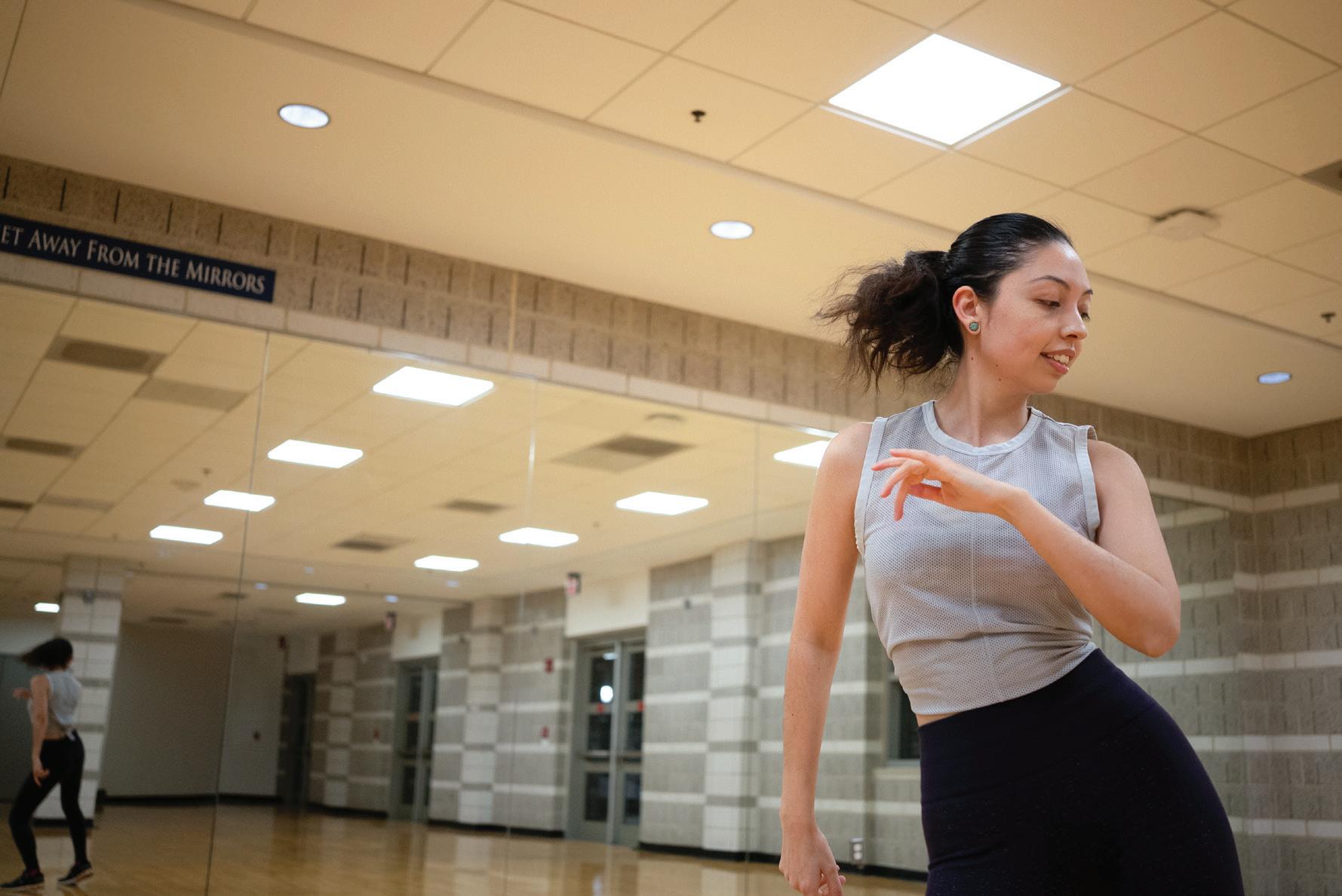
GW alum Alexandra Folleco, who earned her undergraduate degree in 2021 and her master’s in public health in 2023, has been teaching group fitness classes at GW since 2018 and now leads a weekly dance fitness class focused on cardio and strength. After a lifelong background in dance beginning at age three — including training in tap, jazz, contemporary and hip-hop — Folleco said she became certified in Zumba in her hometown in South Florida in 2018.
Campus ping-pong enthusiasts battle for intramural crown
After a week of snow days sidelined campus life, campus ping-pong enthusiasts bounced back Saturday by trading snow boots for paddles at an intramural table tennis tournament.
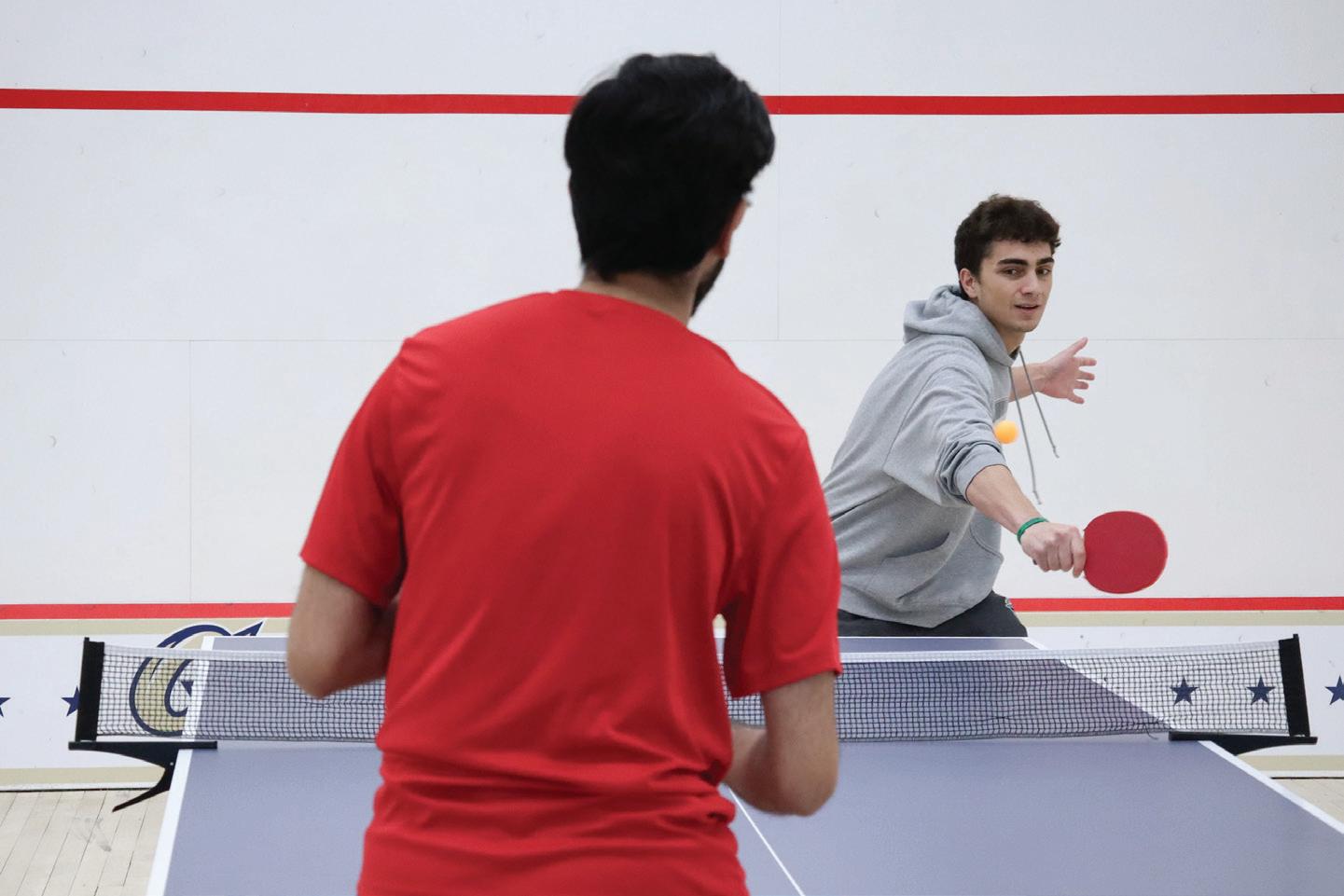
The University-hosted event transformed Lerner Health and Wellness Center’s fourth floor squash courts into a hub of fastpaced rallies, drawing 11 players — many riding a renewed wave of pingpong hype sparked by table tennis film Marty Supreme, a film inspired by 1950s table tennis star Marty Reisman — from seasoned competitors to casual enthusiasts for an afternoon of competition in single round games and community. Sameer Nadeen, a second-year doctoral student studying computer engineering, brushed off his rust to win the singles title, saying that despite not having played in over six months, a positive mindset helped him prevail across three matches to claim the championship.
Though nerves crept in during the opening points, he said the final point of his last match stood out as the most thrilling moment of the day, when he realized he was on the brink of winning the singles tournament.
“It’s always really nice to see people show up, and, even if they’re just playing for fun, you see it, and it’s nice to reflect and then play your best for them as well,” he said.
Nadeen said he has been playing ping pong for as “far as he can remember,” starting at home on a makeshift table before continuing the sport in a more competitive setting as a member of his undergraduate university’s table tennis team. Over time, the game became both a creative outlet and a reliable source of motivation, he said.
Alex Szawlewicz, a senior studying political science who lost in the first round of the singles bracket, said he enjoyed discovering new matchups at his first-ever ping-pong tournament, competing in both singles and doubles matches.
In his singles matches, Szawlewicz said he approached the competition more seriously, facing a skilled opponent, where he narrowly lost by two points after the match went into overtime following a tie.
After competing in his first tournament, Szawlewicz said he would participate again, citing the challenge of playing skilled opponents and the opportunity to meet others who share a passion for the sport.
First-year finance major Lennon Torres said he was inspired to sign up for the tournament as a way to have fun with friends, also adding that he was inspired to play after watching Marty Supreme. Torres said he valued the sense of community the tournament fostered, being able to not only show his skills but also learn other players’ tricks and techniques.
Although he placed seventh out of 11 players, he said he felt he had demonstrated he could go toe-to-toe with players of higher ability in competitive matches.
Torres said he usually plays two or three times a week for an hour or two, but has increased his playing time in the past few weeks, practicing with friends in Lerner. He said the snow prevented him from practicing as much as he’d like, but despite the setback, he felt confident in his skills ahead of the tournament.
Torres said despite the preparation and dedication that many ping-pong players give to the sport, many people don’t take it seriously as a professional sport and think of it only as a casual game.
“I think people should start seeing it both ways, as a fun game and also a professional sport,” Torres said.
Folleco said she noticed the physical benefits of consistently attending dance classes in college after her 15-year childhood dance career, which motivated her to continue dancing in college.
Once Folleco got to GW, she said she auditioned to become a Lerner instructor at the beginning of her sophomore year after seeing the then-president of Balance: The GW Dance Group, a university dance organization, lead her own fitness class.
Sophomore and exercise science major Lyla Souccar began
teaching strength, core and cycling classes at GW last semester and now leads barbell strength classes, a workout that focuses on weightlifting twice a week. She said she taught barbell classes in her hometown in New York two years ago and decided to continue teaching at GW because she wanted to help guide others through the workout world and create a community along the way.
Having taught a strength and core class with dumbbells at her former gym, Souccar said the barbell strength class feels different because students often find the equipment “more intimidating” and the setup requires more steps. She added that given there is so much online chatter about weightlifting and nutrition — especially protein intake — she wants to guide students through the information overload herself.
She said she has formed connections and built friendships with many of the attendees, creating a sense of community that extends beyond the workout itself.
On Mondays, Souccar said she typically focuses on legs, while Thursdays target upper body and core, though all barbell class exercises remain customizable. Through leading these classes, she said she’s built a consistent community that includes students, GW faculty and local attendees.
“It’s really nice to see everyone, their form consistently gets better each class, and you can really help them one-on-one with form and everything,” Souccar said. “Even nutrition — you’ll have people come and stay after and you can help them with what they’re eating. It’s just a really nice experience.”
Extended restaurant week offers lifeline as DC dining scene suffers
PARIS ALBRECHT STAFF WRITER
Restaurant owners say an extra week of Restaurant Week offers a rare financial cushion as rising food prices, labor costs and heightened immigration enforcement strain D.C.’s dining industry.
The Restaurant Association Metropolitan Washington decided to extend the promotion — initially slated for Jan. 19 to 25 — through Feb. 8 after last Saturday night’s snowstorm brought dining across the city to a halt. Created by the association to support local businesses during slower periods, Restaurant Week has increasingly become a lifeline for Foggy Bottom, Georgetown and West End restaurant owners who say the added traffic helps them survive in an industry facing rising food and labor costs.
RAMW asks restaurants to choose from two brunch/ lunch and three dinner pricing model options. For restaurants offering brunch and lunch service, RAMW lets participating restaurants pick between a $25 or $35-per-person option for brunch and lunch. Eateries advertising multi-course dinners have the option to use a $40, $55 or $65-perperson pricing model.
Paolo Dungca, owner and chef of Filipino cuisine restaurant Kayu, located in Dupont Circle, said Restaurant Week has “drastically” created an uptick in reservations, combating slower demand in recent months. He said he’s been encouraged by the surge in support for his small business during Restaurant Week.
“It’s tough times being a restaurant owner right now, but for me, it’s still rewarding, in a sense, where we still get to do what we love,” Dungca said.
The Trump administration’s implementation of tariffs in early 2025 on a range of foreign imports — including food staples like beef and seafood — has contributed to rising food prices and pushed up ingredient costs for the restaurant industry. According to industry data, D.C. saw 92 restaurants close in 2025,
a continuation of a multiyear trend of shuttered doors amid higher food and labor costs, with closures spanning casual eateries to acclaimed establishments like Michelin-starred Reverie and Capitol City Brewing Company after 33 years of business.
Dungca said heightened Immigration and Customs Enforcement presence in the city has not only made Kayu staff concerned about coming into work but makes customers less likely to dine out as people are more hesitant to visit restaurants amid this period of growing uncertainty. But he said the opportunity to participate in Restaurant Week has been a “good tool” in alleviating these pressures, citing an “uptick” in reservations.
Doris
“Ris” Lacoste, founder and owner of the West End American restaurant RIS, said Restaurant Week has been an effective way to boost reservations and bookings. Despite a brief dip in business during last Saturday night’s snowstorm, Lacoste said new reservations quickly followed after they announced the extension. A member of the RAMW board, she added that the organization has hosted Restaurant Week for 23 years and that RIS has participated since January 2010.
Lacoste said she used to craft a new menu specifically for Restaurant Week and offered her regular menu a la carte. Now, she said she opts to use her regular lunch and dinner menus in order to keep everything fresh and prevent food from sitting out. Lacoste’s menu
offers options like French Onion Soup Gratinée and Miso Salmon Tartare for appetizers and Mussels Frites and Scallop Risotto for entrees.
RIS offers a tiered menu, with lower-priced dishes such as clams linguini at $40 per person and higherend options — like chicken Milanese and duck leg confit — priced at $55 and $65. Guests can choose their meal based on the price tier they prefer.
Rafael Dolande, general manager at Imperfecto, a Mediterranean and Latin restaurant in West End, said the early winter months always slow demand for restaurants, but coupled with ongoing economic pressures, Restaurant Week has been a particularly helpful tool to boost business ahead of the summer months. The snow forced Imperfecto to close on Sunday and Monday, but Dolande said they were able to rebook the impacted guests.
To help increase visits and business, Dolande said the team at Seven Reasons — the restaurant group that owns Imperfecto — came up with a Restaurant Week “boarding pass,” where guests receive tiered discounts for visiting other restaurants within the Seven Reasons Group. After a guest visits all of the restaurants — which include Imperfecto, Seven Reasons, The Saga, Quadrant and Sureal — Dolande said the guest is given a $100 gift card to visit any restaurant in the group.
“Yesterday, I had eight guests that have visited all of our restaurants already,” Dolande said.
COOPER TYKSINSKI | ASSISTANT PHOTO EDITOR Ris displays extended dates for Restaurant Week.
CARSTEN HOLST | STAFF PHOTOGRAPHER
Alexandra Folleco dances in the Lerner Health and Wellness Center.
SPORTS
Women’s basketball pulls away late to prevail 66-54 over Dayton
Women’s basketball (1311, 5-6 Atlantic 10) earned a 66-54 road win over Dayton (11-11, 4-7 A-10) on Sunday, using a strong fourth quarter to secure the Revolutionaries’ thirdstraight conference victory.
The Revolutionaries trailed by four entering the fourth quarter but outscored the Flyers 27-11 over the final 10 minutes to secure the win. The victory improved GW to 13-11 overall and 5-6 in A-10 play, marking its longest winning streak since a seven-game run earlier this season, with sophomore guard Gabby Reynolds leading all scorers with 17 points.
Junior forward Sara Lewis added 8 points and five rebounds, providing production in the frontcourt, while other starters and reserves combined to fill the scoring column and maintain pressure on the Flyers at both ends of the floor.
Dayton grad student Nicole Stephens paced the Flyers, finishing with 15 points and 4 assists, while forward Molly O’Riordan pulled down nine rebounds to anchor Dayton on the glass. Despite those efforts, the Flyers were unable to keep pace as GW mounted their late surge.
Ball movement and shot selection were steady for the Revs, who finished the game shooting 44 percent from the field and 31 percent from 3-point range. At the free-throw line, GW converted 7 of 10 attempts.
Rebounding was an area of strength for GW, as the Revs outrebounded Dayton 39-31, limiting second-chance opportunities and securing possessions on both ends of the court. Senior guard and forward Emma Theodorsson and freshman guard Mia James shared the team lead with six boards apiece, with five of James’ coming on the defensive end.
The Revs offense started out very quietly, as a Dayton 3-pointer nearly five minutes into the game brought the Flyers’ early lead to 9-3. A quick 6-0 GW run evened the score, however, before the quarter ended with the Revs trailing 13-11.
A 3-pointer from freshman guard Mia James handed GW a 17-14 lead nearly three minutes into the quarter, but the Flyers kept answering back, with a 3-pointer and two free throws helping to give them a 23-21 lead. A pair of layups and a jumper brought GW back into a narrow lead to enter the break, at 27-26. In the third, the Revs found themselves in another back-andforth quarter, trading baskets with the Flyers. Theodorsson gave the Revs a 31-30 lead at the 6:05 mark, but Dayton responded to take their biggest lead of the quarter at the 4:23 mark at 38-33. The final four minutes of the quarter saw the Revs continue to
fight tooth and nail to find baskets bringing the score to 43-39 with one quarter to go.
Early in the fourth, Dayton continued to try to separate itself from the Revs, holding a 5-point lead just two minutes in. But the Revs responded with force, tying the game up on a layup from Lewis.
Down by one point, Reynolds’ layup found nylon at the 5:19 mark, giving the Revs a lead they would not relinquish. Lewis followed it up with a jumper to increase the lead to three, while sophomore guard Jaeda Wilson buried a three to make it a 6-point game.
Reynolds continued to build on her high-scoring day, adding a layup with
1:08 to play, giving the Revs a 60-54 lead. She would put the game on ice with a pair of free throws with 31 seconds left to secure a fifth A-10 victory.
GW’s ability to control possessions also played a role down the stretch as the Revs committed nine turnovers compared to Dayton’s 13, allowing GW to dictate pace during the closing minutes.
The win marks the Revs’ third-straight victory as they continue to climb up the conference standings, up to No. 8 as of Sunday night. In the first year under HWith the win, the Revs add a road victory in A-10 play as they look forward to playing Davidson on Saturday, Feb. 7, in North Carolina.
Swim and dive comes up short against Penn State ahead of A-10s
Men’s and women’s swimming and diving fell in their final duels of the regular season on Saturday, with the women’s team falling 18097 to Pennsylvania State University and men’s dropping 176-122.
Despite a strong performance in the distance events and solid showings on the diving board, the Revs came up short elsewhere in their final meet of the regular season. The regular season itself carried mixed success for both teams, including a rivalry win over Georgetown University, but finishing well below power conference teams like Virginia Tech University and the University of Minnesota.
Saturday’s meet marked the final competition before the postseason begins with the Atlantic 10 Championships on Feb. 18, a meet both teams have won in each of the last four seasons.
Six Revolutionaries divers have already qualified for the NCAA Zone Championships, scheduled for March 9-11, where they will compete for a chance to advance to the NCAA Swimming and Diving Championships at the end of March.
Both teams relied on their distance dominance, winning the 500-yard and 1000-yard freestyle contests. Senior Ava Topolewski won the two races in times of 4:50.77 and 9:53.01, while junior Daniel Choi won the men’s distance races with times of 4:29.02 and 9:14.16, respectively.
The men’s team swept the podium in the 200-yard freestyle with sophomore Matija Radjenovic reaching the wall first in a time of 1:37.70 and sophomore Gage Boushee and freshman Andres Brooks filling out the first three slots.
Freshman Heitor Napolitano Francisco Reis was fastest in the 200-yard butterfly, hitting the wall in a time of 1:48.11 On the diving board, the Revs held their own as Senior Olivia Paquette took home the top score in the 1-meter
Men’s basketball drops second straight in 79-65 loss to Fordham
Men’s basketball (139, 4-5 Atlantic-10) fell 7965 to Fordham (12-10, 3-6 A-10) Saturday afternoon at the Smith Center, marking the Revolutionaries’ second consecutive loss.
Head Coach Chris Caputo said postgame the loss was not only physical but mental as well. Coming off Tuesday’s defeat to Saint Louis, the Revolutionaries also had to contend with the absence of their top defensive rebounder, redshirt senior forward Rafael Castro, who was sidelined with an injury — factors Caputo said contributed to the team’s lack of energy on the court.
“In theory, you should have great confidence after our performances last week, but again, I don’t think today it was confidence,” Caputo said. “It was potentially a little bit of feeling sorry for ourselves in a moment when we tried to get them to not feel that way.”
Caputo said Castro injured his foot in practice on Thursday, and it is currently unknown when he’ll return to the court.
Fordham outrebounded the Revolutionaries 16-10 on the offensive glass and 3018 defensively. Junior guard Bubu Benjamin led GW in rebounding despite playing through an injury sustained during Thursday’s practice,
Caputo said. “Basketball is funny. The basketball gods always throw things at you,” Caputo said.
“For me, it’s been 25 years of,
‘Oh, your best rebounder — the best rebounder in the league — is out, and now you’re going to play the best rebounding team.’ That’s just how it works.
You’re always being tested, and you have to respond. We didn’t respond well enough today,” Caputo said.
Redshirt sophomore guard Christian Jones was the top scorer of the day, notching 13 points, while redshirt junior forward Garrett Johnson and graduate forward Tyrone
dive with a score of 257.85, but it wasn’t enough to bring up the overall team score. Junior Michael Wood finished second in the men’s 1-meter dive with a score of 291.30. The women’s team did not record a race victory outside of those by Topolewski and junior Colleen MacWilliams, who was the lone competitor in the 200-yard backstroke. MacWilliams also posted two runner-up finishes in the 200-yard freestyle and the 400-yard individual medley, totaling 17 points for the team.
The Revs will now shift their focus to the A-10 conference championships, looking to continue their conference dominance in Hampton, Virginia. The men’s team has won the last five conference championships while the women’s team has won the last four. The streak started under former Head Coach Brian Thomas and continued last year as Head Coach Chico Rego won his first conference championship since taking over the team in June of 2024. The conference also awarded Rego A-10 Coach of the Year last year, in his debut season. In an interview in September, Rego said winning the conference championship this year would mean more to him than last year’s championship because he said he “inherited” many of the scoring swimmers. On the women’s side, the Revs will count on Topolewski to continue to score points and last year’s A-10 Most Outstanding Diver, Paquette, to carry them on the diving board. The men’s team will count on a more balanced scoring distribution, including last year’s A-10 Most Outstanding Male Rookie Shae Stratton. Both men’s and women’s teams head into the conference championship as favorites. September’s preseason poll unanimously picked the men’s team to top the standings, while the women’s team received seven of ten first place votes, with two going to Richmond, the Revs’ top competitor.
been again, that has to change, because I don’t know how much we’re going to be able to do going forward, but that certainly was the case today.”
The first half of the game consisted of lots of backand-forth play with the lead switching between the Revs and Rams every couple of minutes. The largest Revs lead was four points and came with six minutes left in the first half. A buzzer beater three by Jones ended the first half, leaving the Revs only behind by a threepointer, 34-31.
The Rams started to pull away in the second half, securing a lead of 39-31 just two minutes into the half. Multiple three-pointers by Jones narrowed the deficit, only to be followed by more Fordham baskets that ultimately led them to take th e lead.
Their largest lead of 14 points would come with just 1:30 left in the game.
Caputo said the team panicked with their shots in the second half, which led to poor on-court decisions.
Marshall Jr. netted 11 points each. Caputo said numerous players are currently dealing with injuries and that the team has been unable to engage in live-contact practice. “Again, I just didn’t think we were up for it physically, the way I wish we would have
“We panicked a little bit there,” Caputo said. “Some turnovers there and then also actually shot a few in there. I thought our choices there were not as good again.”
The teamwill next play on Wednesday, Feb. 4, against the Saint Joseph’s Hawks in Philadelphia.
LEXI CRITCHETT | ASSISTANT PHOTO EDITOR
Junior forward Sara Lewis attempts to shoot during Wednesday’s game against Saint Louis.
LEXI CRITCHETT | ASSISTANT PHOTO EDITOR Freshman guard Colleen Phiri cheers during Wednesday’s game against Saint Louis.
SOPHIA CAPUTO STAFF WRITER
KRIS PARK | STAFF PHOTOGRAPHER
Redshirt junior forward Garrett Johnson looks toward the hoop during Saturday’s game against Fordham.