CCAS to shrink, halt doctoral program admissions in 7 percent package cut
GIANNA JAKUBOWSKI
ASSISTANT NEWS EDITOR
The Columbian College of Arts & Sciences will cut doctoral packages by about 7 percent next year, shrinking cohorts in 13 programs and pausing admissions in five — a move faculty warn will further erode the school’s research capacity and undermine programs’ missions.
Director of Graduate Studies for Economics Roberto Samaniego confirmed CCAS will fund 197 new doctoral packages in 2026-27, and officials reported that the clinical psychology, anthropology, human paleobiology, political science and mathematics Ph.D programs will admit no new funded students — a choice some program heads deemed unavoidable given the tiny cohort the school permitted post cuts. Several faculty said years of shrinking packages — which officials reportedly tied this year to a looming graduate student union
contract, set to raise student pay and benefits and fiscal strain stemming from President Donald Trump-era policies — will weaken research programs and leave clinics understaffed.
“Graduate student Ph.D student lines are the bread and butter for maintaining a research program at any university,” said Department of Biological Sciences Chair Guillermo Orti. “If you’re cutting Ph.D packages to recruit students, you’re basically cutting the capacity to do research at the University.”
“You’re basically cutting the capacity to do research.”
GUILLERMO ORTI
CCAS Vice Dean of Programs & Operations Kimberly Gross said the roughly 7 percent cut to CCAS-funded Ph.D packages is
a temporary measure designed to ensure the college can support current students while offering “more competitive” packages in the future. She said the college’s standard graduate teaching assistantship includes a stipend, salary and tuition support, and they also offer higher-value fellow packages to attract the “best students.”
The Hatchet contacted all 35 CCAS directors of graduate studies and department chairs asking if they planned to fund new Ph.D students in 2026-27. It’s unclear how many new students the American studies, chemistry, professional psychology, cognitive neuroscience, economics, English, history, physics, public policy and public administration and statistics programs will admit because the faculty either declined to comment, did not return a request or said they were waiting for more information from CCAS.
Samaniego said he did not know the exact number of Ph.D
“It is very detrimental and devastating for our program.”
packages the school funded this academic year, but Gross’ confirmation that CCAS cut about 7 percent for next year indicates officials funded about 212 new Ph.D packages in 2025-26. “Like many universities, we have been taking a close look at how best to support our PhD programs while maintaining the highest standards in doctoral education in a difficult fiscal environment,” Gross said in an email.
Some faculty in programs not admitting Ph.D students said officials offered them limited funding, but they declined to admit anyone, citing minimum class size rules and the need for student socialization. They also said
they’re concerned about the future viability of their programs, noting that doctoral students are essential to sustaining research. CCAS offers 18 doctoral degree programs across the humanities, social and behavioral sciences, clinical programs, natural sciences, mathematics and statistical analysis, forensic and natural sciences and policy and administration disciplines.
Mimi Le, the director of graduate studies for the clinical psychology Ph.D program, said they will not admit any new Ph.D students in 2026-27 despite consistently bringing in between three and five students in prior years. She said officials on Jan. 8 notified the Department of Psychological and Brain Sciences — which houses three doctoral programs — that it would receive funding for a total of two Ph.D students, which the department would have to divide across three programs.
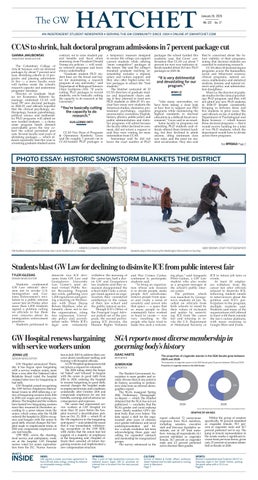
PHOTO ESSAY: HISTORIC SNOWSTORM BLANKETS THE DISTRICT

Students blast GW Law for declining to disinvite ICE from public interest fair
TYLER
Students condemned GW Law officials’ decision not to revoke U.S. Immigration and Customs Enforcement’s invitation to a public interest career fair on Friday after more than 1,000 students signed a petition calling on officials to bar them over concerns about its immigration enforcement practices.
Students petitioned to
disinvite two ICE divisions from GW Law and Georgetown University Law Center’s joint annual virtual Public Sector Recruiting Program last week, gathering over 1,200 signatures and gaining a meeting on Wednesday with Dean Dayna Bowen Matthew, who ultimately chose not to bar the organization, citing free expression, University policy and accreditation rules. While ICE’s legal arm voluntarily
withdrew the morning of the career fair, half a dozen GW and Georgetown law students said they remained disappointed the school didn’t take a stronger stand against an organization they considered antithetical to the values of their law school and the public interest sector.
Though ICE’s Office of the Principal Legal Advisor pulled out of the program, the second participating ICE division, the Human Rights Violators
GW Hospital renews bargaining with service workers union
JENNA LEE
GW Hospital announced Thursday it has begun open bargaining with a service workers union, more than a year after the National Labor Relations Board ruled the hospital violated labor laws by bargaining in bad faith.
GW Hospital ceased recognizing the 1199 Service Employees International Union in 2018 following a series of bargaining sessions from 2016 to 2018 over wages and working conditions. The hospital and the workers have hosted two bargaining sessions since they resumed in December, according to a press release from the union, which comes after the NLRB ordered the hospital in 2024 to recognize and bargain with the union in good faith, rescind changes the hospital made to employment terms in 2018 and compensate employees for any lost benefits.
1199 SEIU covers the cleaning, food service and ambulatory workers at the hospital. GW Hospital nurses voted for union representation from the D.C. Nurses Associa-
tion in July 2023 to address their concerns about insufficient staffing and training with hospital officials.
A GW Hospital spokesperson did not return a request for comment.
The 2024 ruling states the hospital “failed” and “refused” to bargain with the union in good faith from 2016 to 2018, ordering the hospital to resume bargaining in good faith, rescind changes the hospital made to employment terms and conditions unilaterally after October 2018 and compensate employees for any lost benefits, earnings and all adverse tax consequences and expenses.
The union had represented service workers at GW Hospital for more than 20 years before the hospital received a decertification petition on Oct. 25, 2018 — which 81 of the 156 employees in the bargaining unit signed — and notified the union that it was immediately withdrawing recognition of the 1199 SEIU with claims that the union had lost support of a majority of employees in the bargaining unit. Hospital officials then canceled all future bargaining sessions and implemented a new compensation structure.
and War Crimes Center, continued to participate, students said.
“To bring an organization whose sole mission is to divide people, make people feel unwelcome, remove people from spaces and create a sense of unsafety and unrest into that space — a space that so many people in this community have worked so hard to curate — was very insulting to the people who have tried to make this such a welcom -
ing place,” said Anapaula Pérez-Gaitan, a GW Law student who also works as a program manager at the school’s public interest center.
The petition, which was launched by Georgetown students on Jan. 16, called on officials from both schools to stand by their values of inclusion and justice by uninviting ICE from the career fair and refusing to invite the U.S. Department of Homeland Security or
ICE to future job fairs or events. At least 20 employers withdrew from the career fair after officials refused to disinvite ICE, following student emails to interviewers about the petition and ICE’s participation in the program, multiple students said. Students said many of the organizations still offered to meet with them outside the fair’s online platform, with many resorting to Google Meet and Zoom.
SGA reports most diverse membership in governing body’s history
ISAAC HARTE REPORTER
JUWON KIM
REPORTER
The Student Government Association is more gender and racially diverse than at any point in its history, according to preliminary data from an internal demographics report.
The SGA’s inaugural Spring 2026 Preliminary Demographics Report — which The Hatchet obtained but the SGA has not yet publicized — concludes that the SGA’s gender and racial makeup more closely matches GW’s student body than ever before. The data signal a shift for the organization after years of criticism over gender imbalance and racial underrepresentation and follow a senate resolution last term acknowledging those gaps and calling for expanded outreach and mentorship for marginalized groups. The survey referenced in the
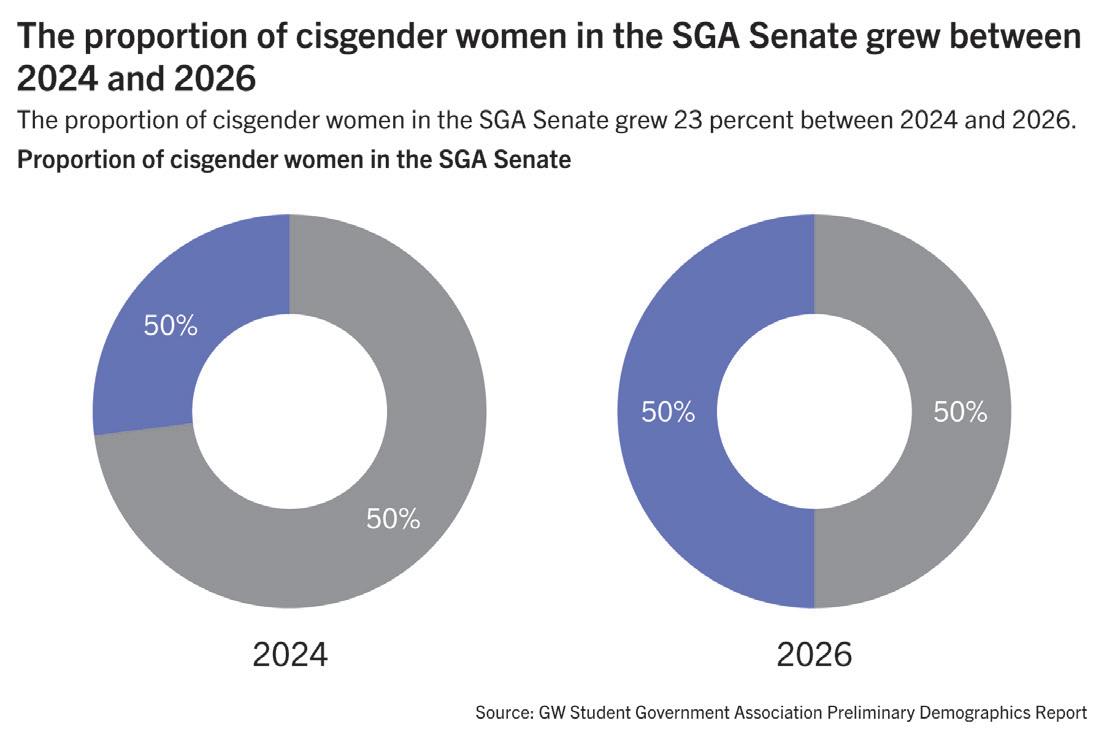
GRAPHIC BY AN NGO
report collected 72 anonymous responses from SGA members, including senators, executive staff and first-year legislative assistants, out of 137 total members. Among all respondents, 61.1 percent identified as cisgender female, 34.7 percent as cisgender male and 4.2 percent preferred not to disclose their gender.
Within the group of senators specifically, 50 percent identified as cisgender female, 39.3 percent as cisgender male and 10.7 percent preferred not to say. The jump in female representation in the senate marks a significant increase from previous terms, given only 27 percent of senators identified as female in 2024.
ARWEN CLEMANS | SENIOR PHOTO EDITOR
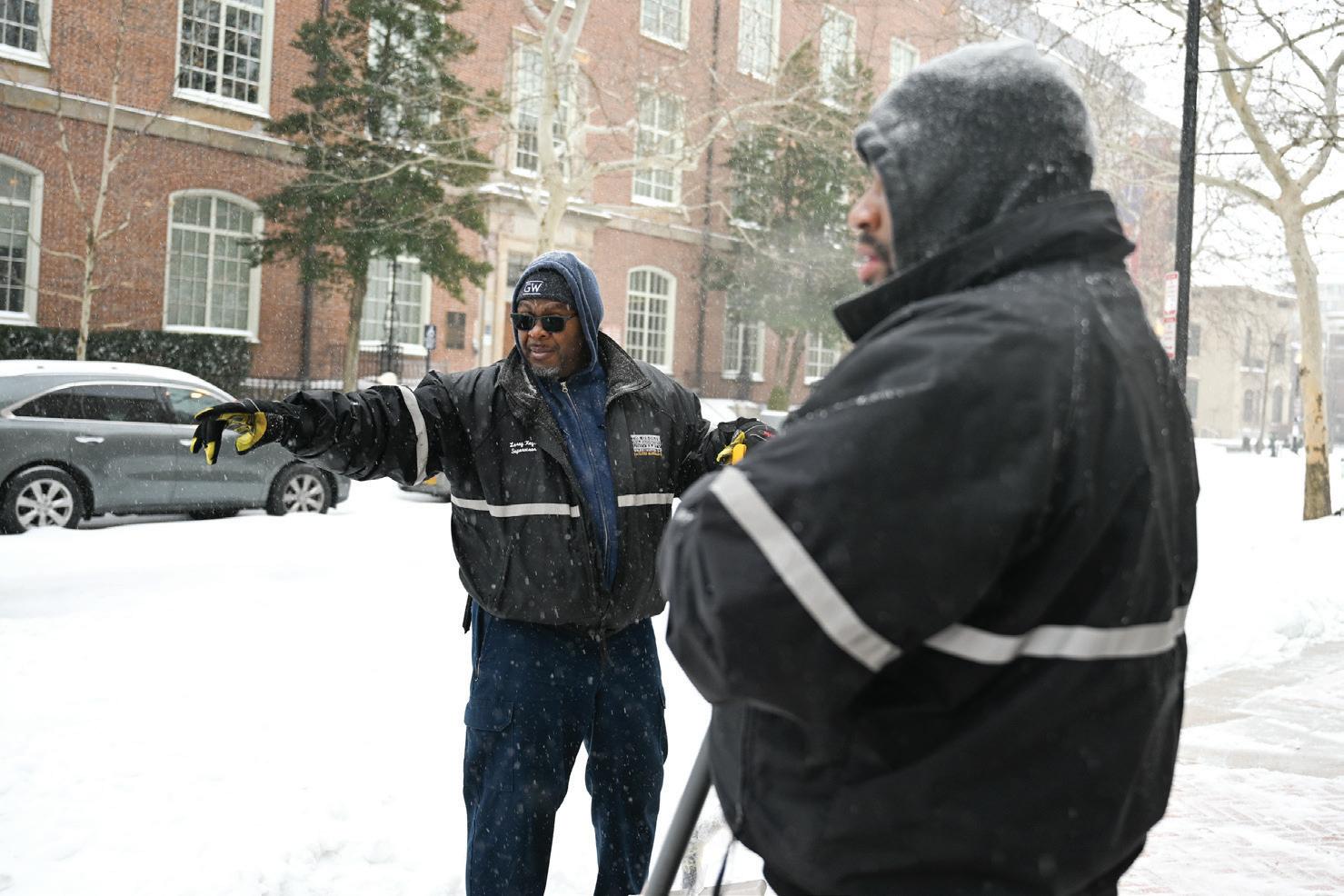
GW facilities employees shovel snow near Lisner Auditorium on Sunday.
MIMI LE
ABBY BROWN | STAFF PHOTOGRAPHER
Students play in the snow by the Washington Monument on Sunday.
GW turns to virtual power purchase agreement to meet carbon goals without REC reliance
GIANNA
JAKUBOWSKI ASSISTANT NEWS EDITOR
GW entered a virtual power purchase agreement to fund solar energy development, ending its reliance on the renewable energy credits it purchased in December to meet 2025 sustainability goals while continuing to draw power from the local grid.
Professors and researchers in energy sustainability said the University’s decision to advance its 2030 carbon neutrality goal by entering into a virtual PPA — a long-term energy contract between a renewable electricity project developer and consumer, permitting an institution to pay a fixed price for electricity generated off-site while still getting power from their grid — is a common approach for institutions that lack space for large-scale, on-site renewable projects. The agreement will allow GW to end its reliance on RECs, a move experts support but urge officials to expand direct on-campus sustainability efforts as they work toward full carbon neutrality.
University spokesperson Julia Garbitt said the 15-year PPA officials announced in December will come online later this year. She said GW acknowledges
the limitations of RECs — tradable certificates institutions can buy to pay the equivalent cost of their onsite carbon emissions — but is temporarily relying on them to ensure compliance with the 2025 40-percent carbon reduction goal in the interim.
Garbitt confirmed GW’s PPA is virtual, meaning the University is not directly buying and using actual renewable electricity, but rather purchasing the right to claim the environmental benefits of renewable energy generated elsewhere.
Environmental experts said GW’s urban location makes finding space for on-site renewable electricity generation difficult, which is likely why officials entered a virtual PPA to meet their sustainability goals — a measure they prefer over purchasing RECs since PPAs directly fund renewable energy development. Experts often criticize RECs because it is hard for buyers to guarantee if the purchases actually result in new renewable energy generation.
Still, the experts urged officials to pursue additional measures to reduce emissions directly on campus, like supporting composting initiatives and switching to LED and motion-censored light bulbs.
A REC represents one megawatt-hour of renewable energy generated, which companies can purchase to assist their carbon reduction goals. RECs allow companies to purchase the environmental benefits associated with renewable energy generated elsewhere instead of generating renewable energy on-site — an alternative companies turn to primarily in regions dominated by coal-powered grids to claim green energy usage instead of moving operations.
Barry Rabe, a professor emeritus of environmental policy at the University of Michigan, said he views virtual PPAs and RECs as offsets because they don’t actually reduce the daily emissions on campus. He said it seems GW decided the University can’t reach carbon neutrality on-site, so they turned to a PPA and RECs as alternatives.
Institutions’ use of VPPAs and RECs is at the heart of a long-standing dispute in the environmental community, as the purchases allow companies to legally claim they have reached a certain percentage of carbon neutrality while still relying on fossil fuels onsite. Critics say this option, while in theory providing an alternative measure for
urban institutions to reduce carbon emissions, makes it harder to measure the actual environmental impact of VPPAs and RECs.
“They’re very controversial on campuses because they’re harder to know for certainty,” Rabe said. “They’re harder to measure. They don’t necessarily reduce that immediate climate impact.”
Officials in a release last month said GW will match all electricity the University purchases from the grid with electricity generated from renewable sources in 2026 as a result of the 15-year PPA — a financial agreement as opposed to a direct physical supply of renewable power to campus.
Garbitt said the agreement, along with the solar project officials launched in North Carolina in 2015, will enable GW to reach 100 percent renewable electricity.
The release did not detail the terms of the agreement or who officials are working with, and Garbitt declined to specify. The release states the agreement expands on a similar partnership GW, GW Hospital and American University entered into in 2015 to tap into solar power from North Carolina, which officials say became one of the largest non-utility solar projects on the East Coast.
CRIME LOG
UNLAWFUL ENTRY
Academic Center
1/20/2026 – 6:11 a.m.
Closed Case The George Washington University Police Department responded to a report of an unknown person asleep in the restroom. Officers issued the person a bar notice and escorted them off GW property. Case closed. Subject barred.
LIQUOR LAW VIOLATION
Thurston Hall
1/18/2026 – 2:54 a.m.
Closed Case
GW Police and the GW Emergency Response Group responded to a report of an intoxicated female student. EMeRG conducted a medical evaluation of the student and transported her to the GW Hospital Emergency Room for further medical treatment. Case closed. Referred to Conflict Education & Student Accountability.
LIQUOR LAW VIOLATION
Munson Hall 1/17/2026 – 11:15 p.m.
Closed Case GW Police and the GW Emergency Response Group responded to a report of an intoxicated female student. EMeRG conducted a medical evaluation of the student and transported her to the GW Hospital Emergency Room for further medical treatment.
Case closed. Referred to Conflict Education & Student Accountability.
—Compiled by Bryson Kloesel
March for Life draws thousands as Trump enters second year of presidency
BRYSON KLOESEL
CONTRIBUTING NEWS EDITOR
RYAN SAENZ
ASSISTANT NEWS EDITOR
Thousands of anti-abortion protesters marched from the National Mall to the Capitol Friday for the annual March for Life, advocating for anti-abortion policies and urging political leaders to further restrict abortion access.
The 53rd annual March for Life brought anti-abortion activists, faith groups and students from across the country to D.C., a year into President Donald Trump’s second term, as the movement pushes for expanded abortion restrictions following the Supreme Court’s 2022 decision overturning Roe v. Wade. Rally speakers — including Vice President JD Vance and House Speaker Mike Johnson, alongside prerecorded remarks from President Donald Trump — touted policies to restrict funding to abortion providers and new family tax incentives but acknowledged that some supporters may feel the administration has not done enough to restrict abortion.
The rally began at 11 a.m. near the Washington Monument, with Vance speaking about an hour and a half later, followed by House Speaker Mike Johnson and U.S. Representative Chris Smith (R-NJ).
Vance began his remarks by reminding the crowd that life is a gift — nodding to his recent announcement that second lady Usha Vance will have another child — and thanked the crowd for braving the cold as temperatures hovered around 40 degrees.
“We thank you for your prayers,” Vance said. “We thank you for your perseverance, and we thank you that for today, we are all marching for life.”
Vance said the president “cares


deeply” about the anti-abortion movement, evidenced by Trump’s motivation to select three conservative justices to the Supreme Court to overturn Roe v. Wade —

the landmark 1973 case that legalized abortion access nationwide.
Vance said the administration is using federal policy — like expanding a policy restricting funds
to non-governmental charitable groups that promote or provide abortion to any large organization that crosses national boundaries — to curb abortion access and sup-
port anti-abortion groups. Still, he said, he had to address a fear he recognized among some members of the audience that the administration has not made enough progress over the last year in achieving key goals of the movement.
“I want you to know that I hear you and that I understand,” Vance said. “There will inevitably be debates within this movement.”
Trump has avoided publicly taking a staunch anti-abortion stance in his second term. He said on the campaign trail he would not sign a federal abortion ban if elected and told Republican members of Congress this month they would have to be “flexible” on the Hyde Amendment, which restricts the use of federal funds toward abortion.
Johnson followed Vance’s speech and touted recent legislation, like the One Big Beautiful Bill Act, which blocked all federal Medicaid payments for one year to certain community family planning clinics that provide abortion services.
“Every single one of you has the power to change hearts and minds and ultimately, to save lives,” Johnson said.
March for Life President Jennie Bradley Lichter introduced the rally’s theme — “life is a gift” — and played the theme video. She told the crowd the movement’s message was simple, even in difficult circumstances.
Organizers also turned the microphone over to student leaders. Elizabeth Oliver, the president of Georgetown Right to Life, said she had faced backlash while organizing on campus and urged marchers to keep pushing.
“Our members never know whether they’ll receive a supportive thumbs up or middle finger or simply the painful indifference of the many people who are just too busy to care,” Oliver said.
Officials to reduce seats in 13 CCAS PhD programs, pause admissions to five
From Page 1
Le said her program chose not to admit students next year because, even with funding for two new students, the clinical psychology program — accredited by the American Psychological Association — must maintain a sufficient cohort to meet socialization requirements.
“This is the first year that we have made this decision,” Le said. “I’ve been here for over 20 years, and I’ve never not had an incoming cohort, so it is very detrimental and
devastating for our program.”
Confirmation of cuts to CCAS Ph.D admits follows Gross and Associate Dean for Graduate Studies Antonio López’s email to department chairs and graduate study directors last month announcing the school was assessing doctoral enrollment and program funding. Gross and López formed an advisory group in August of five CCAS faculty members to review and make recommendations on doctoral education in the college and asked programs to report student
outcomes and minimum viable cohort size, which faculty said indicated officials’ intention to shrink programs.
The Ph.D cuts for next academic year reflect a nationwide trend of universities that, over the last two years, have announced plans to cut or suspend doctoral admissions in upcoming cycles, citing financial pressures, uncertainty with research funding under Trump and a hike in the endowment tax from Trump’s One Big Beautiful Bill, which went into effect after Dec. 31. Georgetown University faculty re-
ported earlier this month that the university will cut Ph.D admissions for fall 2026 and fall 2027 as an austerity measure, with plans ranging from partial cohort reductions for two years to full suspensions for one year.
Le said Department Chair Sarah Shomstein has been “very supportive” of faculty in light of the announcement, and faculty hope CCAS allocates more funding to their programs the following year. She pointed to budget constraints as the reason for the cuts, which she said were driven by slashes in grant
funding, ongoing graduate student union negotiations and a decline in incoming undergraduate applications and enrollment.
Le said the cuts will undermine her program’s mission, noting that its clinical psychology training clinic relies on incoming students and must now determine how to operate without them. She added that the reductions will ripple through the program’s research and its ability to train future mental health providers, a concern amid an existing workforce shortage.
Michael Miller, the director of graduate studies for the political science doctoral program, said faculty decided they will not admit any students in 2026-27 after officials notified them CCAS was unable to support the five-person cohort officials initially agreed to fund. He said the program could have admitted two or three students after receiving funding from CCAS, the Elliott School of International Affairs and a University professor fellowship program, but faculty felt the small cohort size proved infeasible.
PHOTOS BY MATHYLDA DULIAN, LILY KRAMP AND JESSIE ZHAO
Demonstrators and speakers at the March for Life rally on Friday.
GW cancels in-person classes, activities Monday as winter storm hits DC
ARJUN SRINIVAS CONTRIBUTING NEWS EDITOR
Officials will close all campuses and centers Monday as a snowstorm rolls through the District.
Officials announced in a community message Saturday they will cancel all in-person classes at the Foggy Bottom, Mount Vernon and Virginia Science and Technology campuses, along with the Biostatistics Center and the Alexandria and Arlington Education Centers. GW’s decision followed the National Weather Service’s forecast that the region could see up to 14 inches of snow between Saturday and Sunday nights, with the possibility of freezing rain as a historic winter storm moves from the Midwest to the Northeast.
Officials in the message said all in-
Spring sorority recruitment inches upward after 2025 dip
DIYA JHAWAR REPORTER
MICHAELA GONAZALEZ REPORTER
Overall participation in sorority recruitment rose by 12 percent this year, exceeding last year’s steep decline but not quite getting back on track with the upward trend sororities had been on since 2021.
Three hundred fourteen students participated in the Panhellenic Association’s annual recruitment process this spring, an increase from 280 participants in 2025 and a drop from 378 in 2024. Despite higher participation, sororities offered about the same number of bids to potential new members, with 207 accepting 209 offered bids this year compared with 202 accepted bids in 2025.
University Spokesperson Claire Sabin said “most” sororities accepted around 22 new members — consistent with previous recruitment numbers — though she declined to provide specific numbers
for each sorority. She said officials will continue to work with Panhel leadership, including supporting the organizations through continuous open bidding — an informal process that allows students to pursue chapters for a certain window following the conclusion of formal recruitment.
One hundred five potential new members withdrew before the end of the recruitment process “for a variety of reasons,” Sabin said. The number remains relatively consistent to previous years with 75 withdrawals in 2025 and 122 in 2024.
“Looking ahead, we are eager to partner with the Panhellenic Association (PHA) to evaluate the process,” Sabin said in an email. “Specifically, we aim to address the high number of withdrawals to improve retention in future cycles.”
This year’s recruitment took place between Jan. 6 and Jan. 11 in the University Student Center. After potential new members participated in orientation day — which introduced them to sorority life and the recruitment process — the
week consisted of four days of conversations that focused on themes like chapter values, philanthropy and sisterhood.
The process concluded with Bid Day, where participants received final offers from sororities and celebrated the conclusion of the recruitment process on the National Mall.
Charlotte McCourt, a junior and Panhel’s new president, said the distance between the Mount Vernon and Foggy Bottom Campuses often discourages Vern residents from participating in main campus events, which prompted Panhel to work to expand access to the Mount Vernon Express and provide meals .
“We got to talk to a lot of great people that were maybe on the fence about joining recruitment and then were able to go through the process and had an exceptional time.”
Chi Omega President Deepti Pillai said Panhel’s focus on making sure each potential new member had the same experience and equal opportunities to join one of GW’s 10 sororities made this year’s recruit-
person classes should be held online if possible. For in-person classes, like laboratories and studios, that professors cannot move online, they should communicate with students about potential cancellations. Essential on-site staff will remain on campus, and dining options will remain available on the Foggy Bottom and Mount Vernon Campuses, per the message. Officials will share transportation updates through Campus Advisories and the Transportation website, and it is “likely” that Mount Vernon Express shuttle operations will be impacted by the weather, according to the message. The message also states GW will cancel other campus events and activities and close libraries starting 8:30 p.m. Saturday.
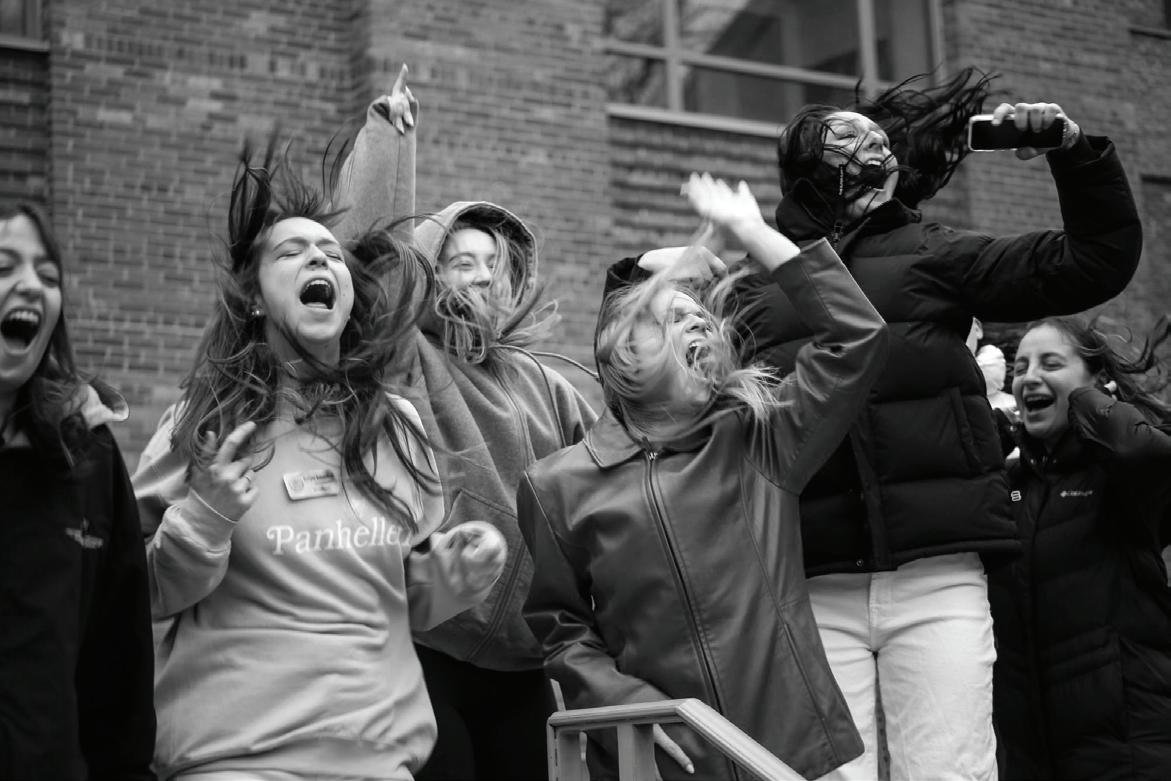
ment a success.
“It’s a pretty short week too, so getting to know people in kind of a short amount of time, but on a very deep level, because it is values based, and you have these important conversations.”
New group to foster Argentine community despite student organization pause
A group of Argentine students have faced challenges in launching an organization, which hopes to create community among Argentine students at GW and connect them to professional opportunities in D.C., as restrictions on creating new student organizations persist.
Argentine Student Society leaders said they founded the unofficial organization in October after noticing that, despite a significant Argentine student population on campus, current student groups lacked a formal space for Argentine students to find each other. Organizers said the society hopes to host community meals, social gatherings and opportunities to bond over shared traditions but is struggling to get its feet off the ground after officials paused the formation of new student organizations in July, limiting the group’s ability to reserve on-campus rooms, access funding and publicize themselves in campus spaces.
Matias Fridman, the society’s president and a sophomore majoring in international business and finance, said when he was a first-year student, he didn’t know any other Argentine students and had to rely on chance encounters with Spanish speakers to find a sense of community. This prompted him to create a place for

Argentine students to more easily meet each other on campus, he said.
“The Argentine Society is a place where all the Argentinians who get into school can find a safe place near home,” Fridman said.
“Also it’s a space for us as Argentinians who are already in school to gather, to have networking spaces, to feel at home in college.”
Fridman said he wants the organization to function as both a social and professional hub and hopes the organization will help current group leaders get to know first-year and other incoming Argentine students. He said they plan to host speaker events and panels with Argentine business professionals or politicians based in D.C. to connect students
to Argentine business and politics and open the door for social events.
Clara Durante, the organization’s marketing chair, said the society has a groupchat and Instagram to promote the organization’s events, but as an unofficial student organization, they’re not able to post flyers around campus, which has limited their ability to reach
people. She said this has set the group’s progress back as they are having to spend more time coordinating locations to hold events off campus and finding other sources of funding outside the typical Student Government Association subsidy that student organizations receive semesterly. The added time commitment has limited the or-
ANC urges Pinto to hold hearing on MPD cooperation with ICE
The Foggy Bottom and West End Neighborhood Advisory Commission voted Wednesday to call on Ward 2 Councilmember Brooke Pinto to hold a public hearing on a bill limiting Metropolitan Police Department cooperation with federal immigration enforcement.
ANC Chair and 2A03 Commissioner Trupti Patel asked Pinto — who represents Ward 2, encompassing Foggy Bottom and West End, and typically sends a staffer to ANC meetings as opposed to at-
tending herself — when the Council will hold a hearing on Ward 4 Councilmember Janeese Lewis George’s Safe Community Places and Policing Amendment Act of 2025, which would limit MPD cooperation with federal law enforcement. Pinto said she is reviewing the bill and plans to press Interim MPD Chief Jeffery Carroll on details of cooperation between local police and immigration enforcement officers in a separate Judiciary and Public Safety Committee hearing in February.
Newly elected Commissioner John Dolan, who filled the vacant 2A06 seat that includes The Aston unhoused shelter, attended the meeting as a commissioner-elect, weighing in on future decisions
about the homeless services site without voting because the body has not yet sworn him in.
ANC members are typically sworn in by their respective Councilmembers, and a swearing-in date for Dolan has not been announced.
Here are some highlights from the meeting: ANC passes bill urging Pinto to hold hearing on bill barring MPD cooperation with ICE George’s bill would bar District agencies from providing certain assistance for civil immigration enforcement — including transporting federal agents in District vehicles and conducting surveillance or patrols — unless officers
have a judicial warrant or court order. The bill would also limit joint enforcement activity at designated ‘safe community places,’ like shelters, schools and churches, absent a warrant or exigent circumstances.
“We’re exploring now what is an option on the table, including Councilmember Lewis George’s bill,” Pinto said. ANC 2A in 2025 approved seven resolutions relating to federal law enforcement activity in D.C. The resolutions condemned the federal takeover of MPD and broader federal intervention, sought notice compliance around Washington Circle encampment actions, criticized the city’s extended coordination with federal agencies and pushed for clear fed-
ganization’s ability to grow, which Durante said has been discouraging given the University had advertised the opportunity for students to build organizations from the ground up during tours.
“That creates not only discouragement but you almost don’t want to trust the University or what they say,” Durante said.
Mercedes Halliburton, the organization’s vice president and a sophomore double majoring in political science and economics, said the group’s unofficial status has prevented them from planning any professional events so far mainly due to their inability to reserve rooms in University buildings. For now, the group is focusing on organizing bonding activities among group members instead, she said.
She said the society remains committed to growth even as they navigate the challenges posed by its unofficial status. Once they officially register, she said the group hopes to collaborate with other Latino student organizations on campus, like the Puerto Rican Student Association, to host joint social and professional activities, like speaker events.
“There’s a lot of Argentinian students here that don’t know about us and that we don’t know about either,” Halliburton said. “They might not have an outlet for the things they want to do, for the language they want to speak, for the things they do at home.”
eral agent identification standards. They also reaffirmed D.C.’s sanctuary policies while opposing MPD cooperation with immigration enforcement.
George in an X post on Jan. 13 saiPinto led a Dec. 18 letter — cosigned by every D.C. Councilmember — asking MPD for details on its coordination with federal law enforcement, including which federal agencies have joined MPD on patrols. The letter also requested weekly arrest totals by offense category between Aug. 11 and Dec. 14. Patel moved a resolution to urge Pinto to hold a meeting on the bill, which the commission approved with 2A04 Commissioner Ed Comer abstaining and 2A08 Commissioner Jim Malec voting no.
RENEE PURCAIT STAFF WRITER
JOSH STEINBERG | STAFF PHOTOGRAPHER
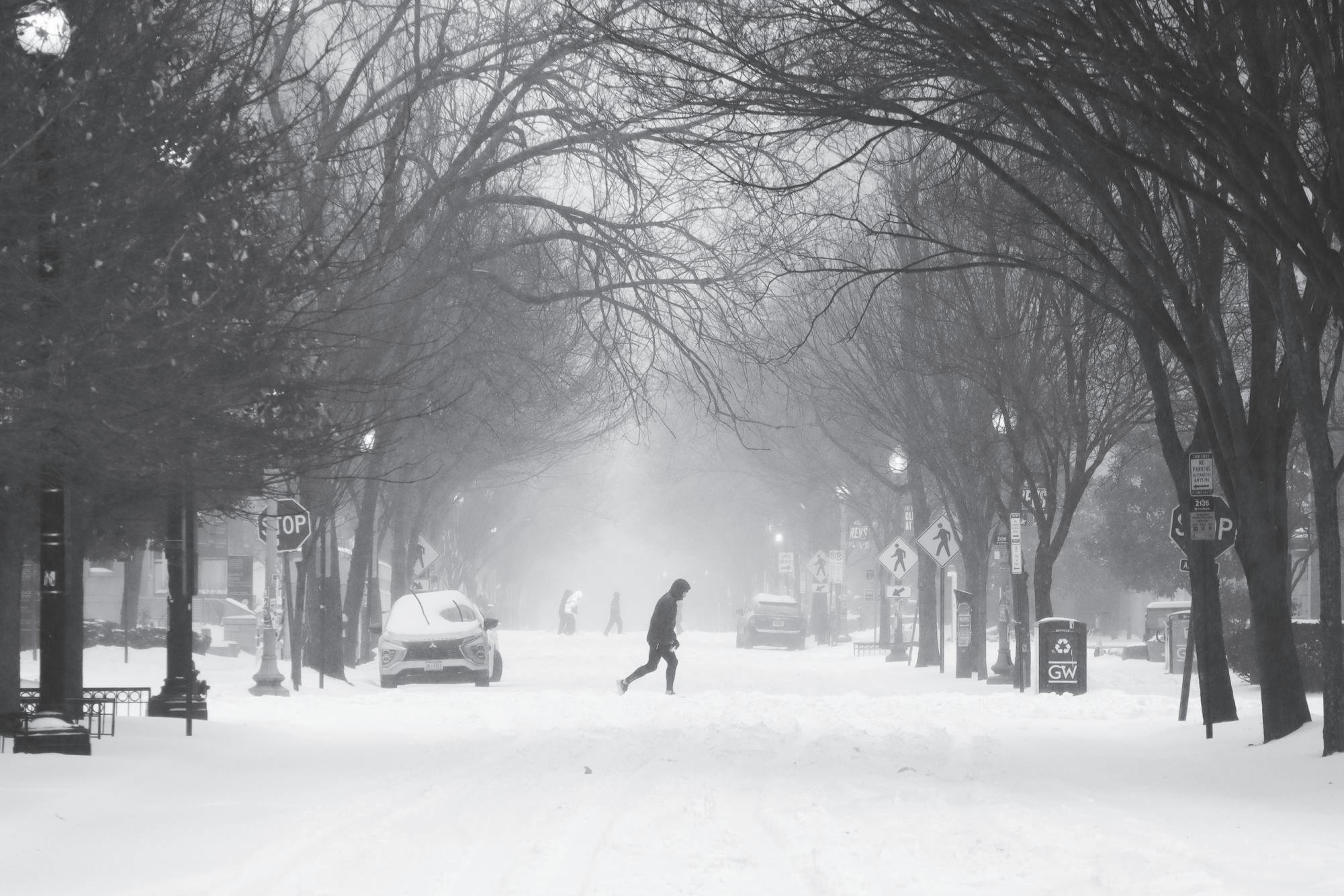
A student crosses H Street in the snow on Sunday morning.
NAOMI BONE URBINA | PHOTOGRAPHER
Argentine Student Society President Matias Fridman and Vice President Mercedes Halliburton pose for a portrait in Kogan Plaza.
First-year Odessa Javier, who received and accepted a bid from Alpha Delta Pi, said she decided to go through recruitment to find community on campus and to form “deep female friendships” similar to those she had at home.
JENNIFER IGBONOBA | STAFF PHOTOGRAPHER
Members of the Panhellenic Association’s executive board celebrate Bid Day in 2024.
WMATA officials begin upgrades to Foggy Bottom metro escalators
Washington Metropolitan Area Transit Authority officials began renovations, slated to last for the next five months, on two Foggy Bottom-GWU Metro station escalators last week, according to the WMATA website.
One Foggy Bottom station escalator between the street and mezzanine and another between the mezzanine and platform will continue undergoing modernization efforts over the next five months, according to the WMATA website. The station will remain open as both escalators receive new, more reliable and more energy-efficient motors, according to signage posted at
the station. All six escalators at the station will be replaced in the next “year or so,” a WMATA spokesperson said in an email.
The Foggy Bottom stop joins six other stations across the WMATA system that are undergoing modernization efforts over the next five months, per WMATA’s website. The escalator between the mezzanine and platform at Foggy Bottom will return to service on April 27, and the escalator between the street and mezzanine will return to service on May 11, the WMATA website states.
Metro officials in 2020 embarked on a $204 million escalator replacement project, aiming to replace
145 escalators throughout the system by 2027, according to a WMATA spokesperson. The new escalator units are 30 percent more energy effective than older units due to newer motors, the spokesperson said, adding that newer units also provide real-time data to Metro officials, allowing them to better monitor performance.
“Escalators are made up of thousands of moving parts and with heavy use over time, the parts become less reliable despite regular preventive maintenance,” the WMATA spokesperson said in an email. “Escalators are modernized every 20-25 years, which creates a more reliable experience for customers.”

SGA president works to confirm successor after JEC leader resigns
ELIJAH EDWARDS ASSISTANT NEWS EDITOR
The head of the Student Government Association’s election commission resigned from his post earlier this month, just months before candidates kick off campaigns, he confirmed Friday. Alex Wan, who SGA senators confirmed to lead the Joint Elections Commission in late October, said he voluntarily resigned from the role Jan. 12 due to a “combination of factors,” though he declined to comment further. SGA President Ethan Lynne said he nominated sophomore Eric Gitson as Wan’s successor last week, and Gitson is now serving in an acting capacity until senators can confirm him, which could occur as early as next Monday’s Senate meeting.
The JEC controls all aspects of SGA elections, including verifying the student signatures candidates collect, setting campaign rules and counting and verifying votes after elections. The commission also holds several candidate training sessions ahead of elections and is responsible for advertising and boosting student voter turnout — which fell 20.3 percent last year.
The SGA’s bylaws require that the body’s president appoint the JEC commissioner by Oct. 1 of the year preceding the elections and appoint the commission’s other members by the end of the fall semester — a deadline SGA officials failed to meet with Wan, who senators confirmed at their Oct. 27 meeting.
SGA Senate Pro Tempore José Dalmau said the SGA’s legislative and executive branch teams are currently working on refining and amending the JEC’s charter — which is housed in the SGA bylaws — to allow for Gitson’s confirmation after the current Oct. 1 deadline.
Gitson, a political science major who also serves as the GW College Democrats’ vice president of diversity and inclusion, said he is “working aggressively” in his acting capacity to offset the impact of delayed planning caused by his late appointment and Wan’s resignation. He said he is working to recruit additional members to join the commission and hopes to have it fully staffed in time for the elections.
“We are putting together a dedicated, skilled team for this election,” Gitson said in a message. “We are launching an ambitious effort to increase student engagement and turnout.”
Gitson said he expects the full SGA Senate to confirm him as commissioner at their next meeting scheduled for Feb. 2.
Gitson said this year’s SGA elections — which typically take place around the second week of April — will likely be “several days” later than normal, because the JEC wants to accommodate religious holidays, like Easter and Passover, at the beginning of the month. Gitson said his delayed start as commissioner did not factor into the decision to push the elections later.
“I’m very excited to lead the commission and administer campus elections this spring,” Gitson said. “SGA elections are an opportunity for students to select good leadership that hears our voices and works to address our concerns.”
Lynne said he appointed Gitson to the role because he knows he can “hit the ground running” and perform the job of commissioner well.
“Through his involvement working with SGA bylaws this semester to his work in other orgs and professionally, he’s proven himself to be a hard worker and the perfect person to ensure our elections run smooth,” Lynne said in a message.
Dalmau, who chairs the nominations committee, said Gitson is “competent,” but still needs to follow the established process to be confirmed by the body as commissioner. He said the commission will be “fully constituted and prepared” for the upcoming April elections.
After Lynne’s nomination of Gitson, he will go before the Committee on Governance and Nominations for questions from senators. If the committee approves his nomination, he goes before the full senate for a confirmation vote from senators.
“Gitson will be screened and evaluated by the Committee on Governance and Nominations and, if advanced, will be considered by the full senate,” Dalmau said in a message.
SGA peer mental health program looks to rebuild after inactive fall semester
ELIJAH EDWARDS ASSISTANT
NEWS EDITOR
NICOLE AKUMATEY REPORTER
The Student Government Association’s peer-to-peer mental health assistance program is working to recruit and train a new class of mentors after falling inactive during the fall semester.
The SGA’s Mental Health Assembly launched the program — dubbed “Resource Revolutionaries” — last April, aiming to help students navigate and connect with mental health resources on and off GW’s campus, according to its website. The Mental Health Assembly’s co-chairs and former and current mentors in the program said they are still working to recruit and train new peer mentors this year after fielding no cases
in the fall semester, which they attributed to leadership turnover and difficulties in scheduling training sessions with University administrators.
Jacob Wilner, who served as a co-chair of the Mental Health Assembly during the program’s launch, said the goal of the program was to raise awareness and increase accessibility of mental health resources at GW and throughout the District by allowing students to request peer mentors to help guide them to the right place. He said the region has a “plethora” of resources, which can feel overwhelming for students seeking help — something the program sought to solve.
“My goal now as a student at GW passionate about mental health is to allow students to know exactly what resources they have
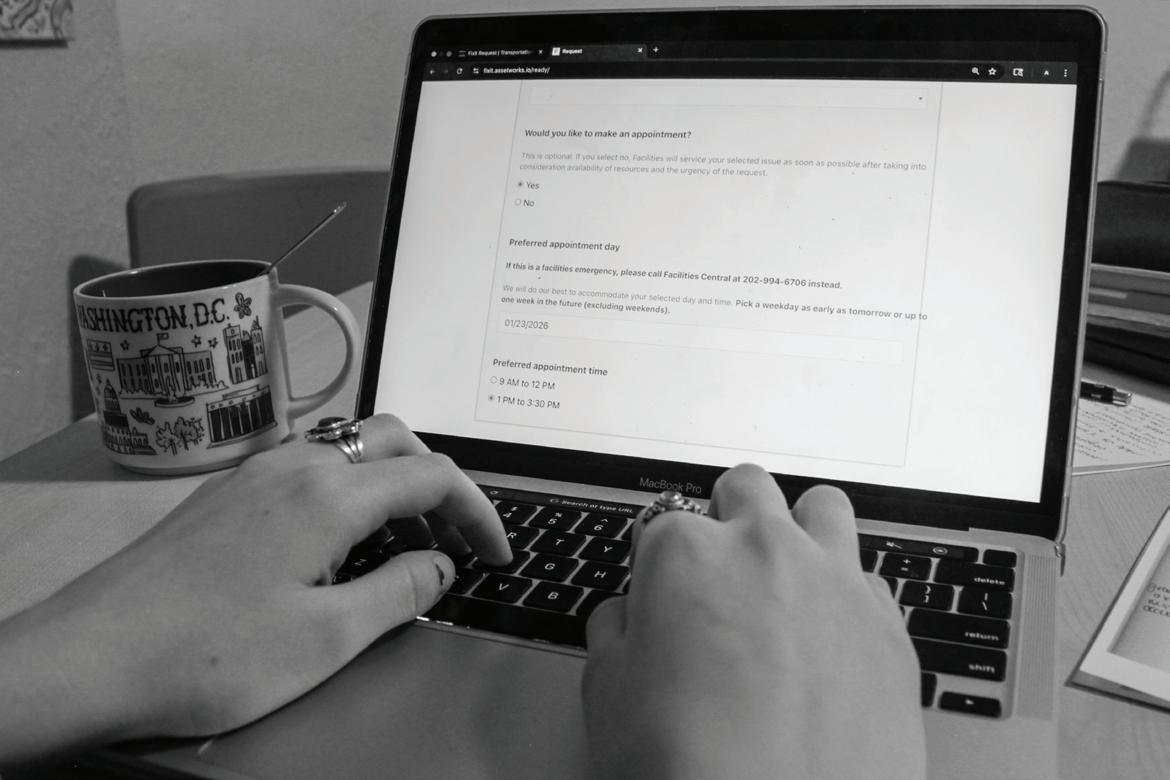
The Division of Safety and Operations officials launched a new FixIt appointment scheduler pilot program for South Hall and Lafayette Hall on Tuesday following student advocacy to reform GW’s maintenance process.
South Hall and Lafayette Hall residents are now able to select a two-to-three-hour window for technicians to arrive and conduct nonemergency FixIt repairs, according to an email DSO sent to the buildings’ residents. The joint initiative by Campus Operations and DSO followed Student Government Association concerns that unannounced visits by FixIt technicians and third-party contractors made students uncomfortable because technicians previously did not provide a timeframe for entering student rooms.
Both DSO and SGA will solicit feedback from students to see if the program should expand to other residence halls, University spokesperson Nadia Payne said.
“The halls in this spring’s pilot were chosen since they house upper class residents who have the historical knowledge of what was previously implemented and could provide feedback with past experience,” Payne said in an email.
Students in South and Lafayette can now choose either a morning or afternoon time frame or the earliest possible appointment when submitting a FixIt, per the DSO announcement email. Technicians
and feel empowered to take advantage of them,” Wilner said in an email. “I believe Resource Revs does just that and for that reason I hope the program stays active and visible.”
George Henry CannGudat, the SGA executive branch’s director for mental health policy and co-chair of the Mental Health Assembly, said the program was “not successful” last semester because turnover within the SGA executive cabinet and new co-chairs on the Mental Health Assembly made it difficult to adjust. Cann-Gudat said some mentors are still available for students who seek help, but the program did not field any cases last semester.
He said the program needs to do a better job advertising its presence and resources to students.
“There should definitely
will aim to arrive within the selected time frame and will notify residents if a different time is necessary, the email states.
Payne said Campus Operations will review the pilot throughout the spring semester and work with Campus Living & Residential Education to host focus groups and send out building-wide surveys to assess the program before deciding whether to expand the program to more residence halls. She said Campus Operations and the DSO have an active working relationship with the SGA and the Residence Hall Association to increase student input on their ongoing operations.
“Leadership from both organizations have consistently been supportive of this initiative and we will continue to work with them during this spring’s pilot program,” Payne said.
RHA President Urja Mehta said officials introduced the FixIt scheduler program at an RHA general body meeting, so the University could collaborate and generate feedback in conjunction with RHA.
The RHA office is located in South Hall, which will allow RHA members to be exposed to testing this new system and staying in tune with student reactions, she said.
“We are looking forward to collaborating and sharing feedback to improve the FixIt system to be more efficient and collaborative with busy student schedules,” Mehta said in an email.
SGA Vice President Liz Stoddard campaigned on reforming FixIt procedures, calling unannounced
be more promotion and outreach, and I think once we have this training this semester you will see a lot more outreach in terms of advertising the program,” Cann-Gudat said.
Cann-Gudat said there are 10 mentors who are waiting to be trained, but scheduling difficulties with the Health Promotion and Education office stalled training efforts last semester. The organization has not yet decided on a new training date but expects it to take place in the next month, he said.
Before mentors begin helping others, they are each required to go through an extensive training process with GW’s Assistant Director of Health Promotion and Education. The training process listening sessions and research on GW’s various resources, according to the program’s website.
visits a “huge invasion of privacy.” Stoddard said she heard complaints when she was a senator from students about FixIt workers entering rooms while students were asleep or in the shower and didn’t hear the knock on the door, adding that some Muslim students told her they felt uncomfortable when workers entered their rooms while they had their hijabs off.
“I know there are so many people in the SGA who actually live in those dorms, so we will still be using that on-the-ground, constituentservice-focused data collection for us and then also using the more aggregate data that facilities collects to monitor the focus,” Stoddard said.
SGA Women’s Caucus Chair Kassy Bonanno said a new FixIt scheduling system has been a key issue for the Women’s Caucus, adding that she has heard feedback in meetings about inconveniences caused by FixIt workers entering rooms unannounced. Bonanno’s predecessor, SGA Sen. Sofio Kipiani (ESIA-U), also called for a strict FixIt time window policy.
“FixIt scheduling provides students with advanced knowledge of when someone may be coming to visit their dorm,” Bonanno said in an email. “This small change gives students more peace of mind in their space.”
Students living in South Hall and Lafayette Hall supported the change, with junior Beatriz Leschziner, a South resident, saying the new FixIt system will be “way more convenient” for students.
“Before I feel like they would
Cann-Gudat said SGA leaders created the program with the goal of having knowledgeable volunteers who were able to direct students to the University’s various mental health resources they might not know about, like Counseling and Psychological Services and group therapy sessions.
“When someone goes through a crisis, it may not be easy for them to navigate all of the different resources that are available,” CannGudat said. “So having someone that they can go to and talk to them makes getting through the crisis so much easier.”
SGA Sen. Dhyana Holla (U-ESIA), who also co-chairs the Mental Health Assembly, said one of the program’s major struggles was adequately training mentors for their casework. Holla said staffing changes in
GW’s Student Health Center made scheduling training for mentors difficult, and the assembly hopes to begin training soon this semester.
“Right now, we are in direct contact with the Student Health Center and CAPS to formulate formal training for this semester, so students, the Resource Revolutionaries can get ready,” Holla said.
Holla said students can still reach out to a mentor through the form on the program’s website. She said there are currently 11 trained mentors who are still accepting cases from students.
“This could be, and has the potential to be, quite an excellent program that a lot of students can rely on,” Holla said. “And that is what the Mental Health Assembly is for, we are dedicated to mental health.”
show up whenever they could, which is fair for them, but sometimes we wouldn’t be home or it would be too early, and it would be a little inconvenient,” Leschiziner said. “I remember sometimes they just wouldn’t come back if we weren’t at home. If we were at home, we had to wake up running and let them in.”
Junior Avalon Ayres, who also lives in South, said she and her roommates recently had an incident where a FixIt technician entered their room and began taking apart their dishwasher when they had not submitted a ticket. Ayres was home and able to speak to the technician, alerting him that he was in the wrong room, but that experience has made her feel the need to
have someone present in the room every time they call for a FixIt.
“Everybody that I live with has really crazy schedules, and it would be really nice because we’re not really comfortable, especially with the most previous situation that happened, not being here when they’re here,” Ayres said. Nick Lolis, a sophomore living in Lafayette Hall, said scheduling a FixIt could be helpful, though he has not had problems with technicians entering his room to complete tickets when he or his roommates are not around.
“I think it’s just a matter of personal preference,” Lolis said. “I personally don’t care whether or not I’m there for the guy to come in and fix it.”
PHOTO ILLUSTRATION BY THEEYA CHEN
A student fills out a FixIt form on their computer.

Trump’s
immigrant visa pause doesn’t apply to student visas
impacting international student applications.
The State Department last week indefinitely halted immigrant visa processing for applicants from 75 countries, which will prevent students from applying for permanent visas only.
The State Department in a Jan. 14 press release said the department will use the pause to review its policies, regulations and guidance to ensure immigrants from the 75 countries do not use U.S. welfare or become a “public charge” — a person overly reliant on government resources.
University spokesperson Julia Garbitt said the pause should not impact student visa applications, but officials expect the current travel ban on 38 nations to continue
Milken joins
GW currently enrolls at least 278 students from the 38 countries facing a total or partial travel ban, per enrollment data.
“The University encourages impacted individuals to monitor updates from the U.S. State Department, and to contact a qualified immigration attorney for individualized guidance,” Garbitt said in an email.
Garbitt said officials expect President Donald Trump’s administration will indefinitely suspend new student visas from the 38 countries and territories with travel bans or temporary entry visa restrictions. 22 of the countries facing a travel ban are also on the new list of countries facing the pause on permanent immigrant visa process-
ing.
The Trump administration in June banned citizens from a dozen countries from entering the United States and placed heightened restrictions on citizens seeking to enter the country from seven other nations. Trump in December then expanded the list of total or partial travel bans to cover an additional 20 countries and the Palestinian Authority.
The immigrant visa pause will not impact most GW international students looking to apply for student visas, but Interim Provost John Lach cautioned at this month’s Faculty Senate meeting that the pause, coupled with the travel ban, could hurt the University’s international student enrollment.
SMPA announces student innovation competition to strengthen democracy
ARJUN SRINIVAS
CONTRIBUTING NEWS EDITOR
DYLAN EBS
ASSISTANT NEWS EDITOR
The School of Media & Public Affairs announced Tuesday it will launch an endowed competition next fall for students to develop ideas to strengthen democracy.
The SMPA Democracy Innovation Prize is open to GW students from all disciplines, SMPA Director Peter Loge said. He added that SMPA designed the competition to tap into students’ entrepreneurial instincts to confront challenges in politics and media, such as voter disillusionment and the decline of local newspapers.
“We’ve had a lot of really smart, interesting, creative, entrepreneurial classmates,” Loge said. “Let’s harness some of that and focus it and reward that for improving the democracy in which we are lucky enough to live.”
Officials have not yet announced the topic of the inaugural competition, according to an SMPA press release. Loge said the competition will offer a prize, potentially cash or startup funding, but they have not yet determined the details.
Loge said John Barth, a member of the SMPA National Council and former adjunct professor, endowed the prize after he called him in December with the idea of making an entrepreneurial competition for SMPA. Loge said he will reach out to a range of stakeholders, including GW students, alumni, advocacy groups and friends
Washington Performing Arts to bring music, dance to senior care facility
ISAAC HARTE
REPORTER
LAKSHMI DEV
REPORTER
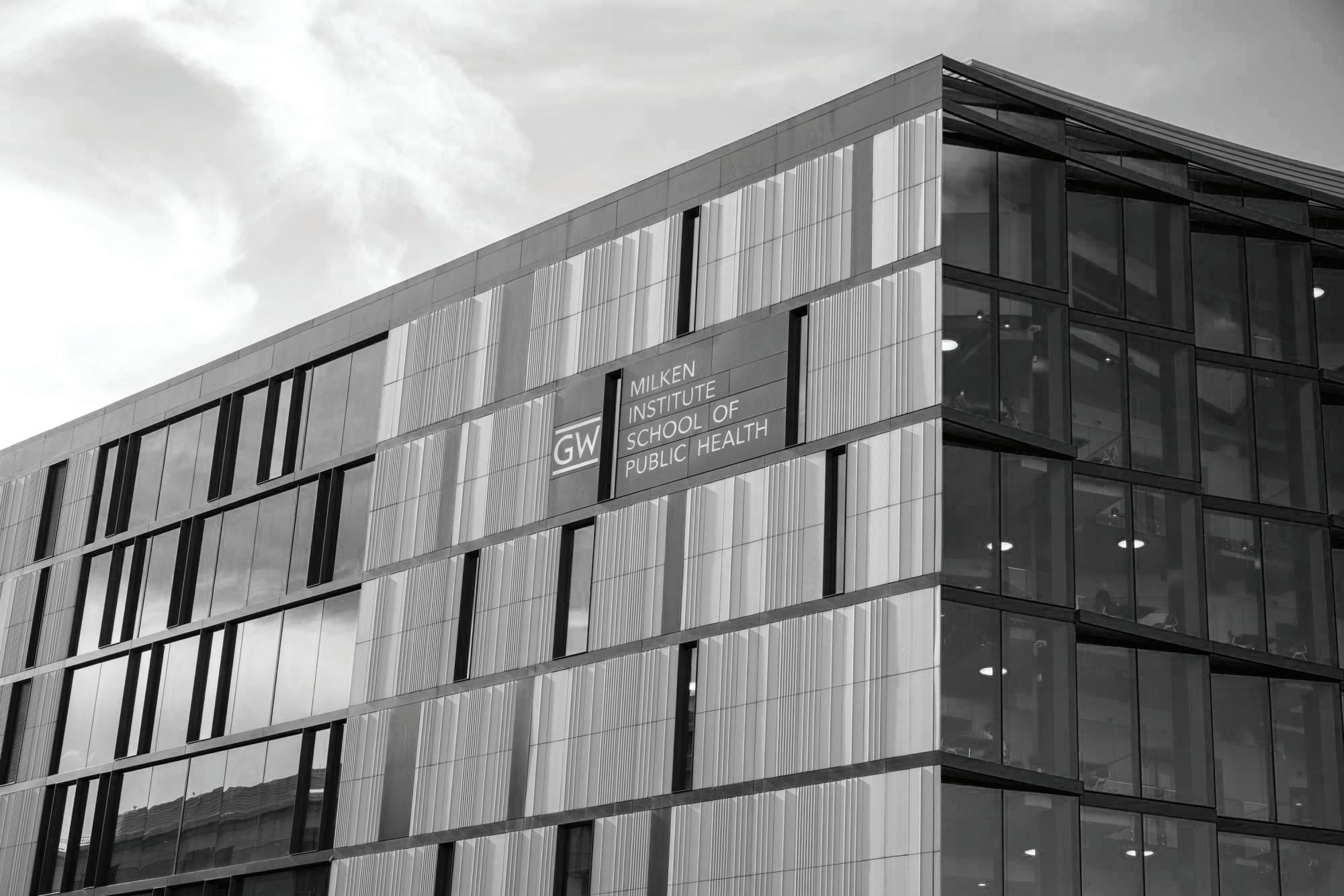
The Milken Institute School of Public Health and Washington Performing Arts are partnering to host weekly music and dance programs, created by graduate students, to support residents with dementia, Parkinson’s and Alzheimer’s at a Northwest D.C. senior living facility.
Two Milken graduate students will work this semester with Washington Performing Arts teaching artists to support the launch of the NeuroArts Collective, a dance and movement program for residents with Parkinson’s disease and a music program for residents with Alzheimer’s disease and dementia, as part of their practicum requirement for their degrees. One of the graduate students and a Washington Performing Arts official said they hope the programs will strengthen seniors’ sense of community and support their brain health and well-being.
Ciel Vidale, a public health master’s student who researches Parkinson’s disease and artsbased interventions, said she first presented information about the weekly classes to Ingleside at Rock Creek Engaged Living residents and staff in the fall semester to get feedback and preview what the sessions would look like. Vi-
dale said fellow graduate student Neneh Sheriff is working on the music program for residents with Alzheimer’s and dementia.
Neuroarts is a field that explores the effects of art on the human brain, and research has found that engaging with music or dance could improve one’s cognitive and physical well-being, especially in older adults.
Vidale said the weekly dance sessions at Ingleside will begin in February and last about 45 minutes to an hour. Vidale said some of the residents were initially hesitant to experiment with the dancing but loved it once they began.
“You’re moving the body, you’re remembering steps, you’re feeling rhythm and then you’re connecting with others all at once,” Vidale said. “So it’s like a full body experience.”
Vidale said only about seven people came to the first session in the fall but thinks word will spread as attendees talk about the program with others in the community. She added that the goal was to make the program feel accessible to residents who were unsure if they could participate because of mobility limitations or discomfort with dancing, adding that they can bring caregivers or loved ones.
Amber Pannocchia, the director of arts education and partnerships at Washington Performing Arts, said the teaching artists who work with the organiza-
tion will lead programming at Ingleside’s independent living and memory support and assisted living community. She said the NeuroArts Collective is a pilot program, and students are involved early on by helping craft and create programming that’s responsive to the needs of residents and work with teaching artists on implementation.
She added that having young people, like Vidale and Sheriff, working in senior care helps change preconceived notions among master’s students that geriatric healthcare is “sad or daunting.”
“I think that having the master students involved, not only from a perspective of educating future caregivers and future medical professionals or community members who, in the future, will have a large voice in public health is a huge support and being able to get those people at a younger age. But I think the other thing is it destigmatizes a lot for young people,” Pannocchia said.
Pannocchia added that Washington Performing Arts began exploring long-term programming for seniors after noticing that some patrons could no longer attend concerts or participate in traditional classes because of mobility changes or transportation barriers. She said the organization’s goal is to move beyond one-time performances and bring consistent programming directly to seniors.
from his career working in politics, to get feedback and suggestions for developing the competition.
“I’m already talking to people saying, ‘What do you think? What are we doing?’ We’ll get a bunch of good ideas, and we’ll give it a shot,” Loge said.
Loge said the competition will feature a panel of judges to select the best pitch. One judge will be from SMPA — which Loge said will likely be himself given he helped develop the idea. He added that they have not yet determined the remaining judges.
The Democracy Innovation Prize joins a collection of entrepreneurial competitions at GW, including InnovationFest, Pitch George and New Venture Competition, though none of the three directly focus on democracy or the media.
Barth said he came up with the idea after reflecting on the “challenging” crisis American democracy is facing, pointing to recent protests in Minnesota against federal immigration enforcement and the fatal shootings of civilians by federal agents as an example of citizens coming together.
“I wanted to inspire students, and a competition is one way to do it, to keep a focus on democracy front and center and also help students really feel material stake,” Barth said.
Barth said the competition’s topic will change each year to keep it relevant, with the hope that students’ strong ideas could be recommended to nonprofits and other organizations.
“This is not a purely academic exercise, right?” Barth said. “So what we’re hoping for is that by laying out a specific problem or case or issue for students every year, the responses do need to be practical, applicable and original.”
Barth said he was inspired by other initiatives SMPA has launched, like Planet Forward, a multiuniversity consortium that began in 2014 and focuses on sustainability, and the school’s “forward-thinking” approach to generative artificial intelligence.
“SMPA has a culture around innovative, timely ideas that they actually make happen,” Barth said.
SMPA Director of Strategic Initiatives Frank Sesno said a crucial aspect of a competition, like the Democracy Innovation Prize, is for students to be aware of the opportunity and to feel excited to submit an entry.
“Can we show that ideas, brilliant ideas, have traction with decision makers? Can we show that innovative ideas can be the core of an experiment that could actually lead to significant change? That’s a high bar, that’s aspirational, but it’s entirely reasonable and feasible,” Sesno said.
Sesno said the prize could become a long-term fixture at GW if the school builds a public platform around student work and shows that winning ideas can move beyond the classroom.
“Having a platform like this amplifies the work in a way that GW students will know, but so will the world,” Sesno said.

Officials reinstate transcript fees, reversing 2020
TYLER IGLESIAS
GW reinstated fees for official transcripts over the summer after stopping them in 2020, charging students for electronic copies. The University Registrar introduced a $15 fee for electronic delivery and raised the price of domestic mailed transcripts from $8 to $15 on July 1, 2025, which University spokesperson Nadia Payne said will help GW cover the costs of processing, maintain secure systems and deliver official transcripts promptly and accurately. She said officials reintroduced the fee after a “temporary suspension” amid the COVID-19 pandemic, though officials at the time claimed they made the change to reduce the hidden costs of attending GW.
“That suspension was implemented in response to the extraordinary circumstances of that time and was intended to ensure continued access to official records when many services were disrupted,” Payne said. She declined to comment on whether the University reintroduced the fee in part because of University-wide budget cuts. Officials have made cuts to various campus operations, programs and resources throughout FY2026, like reducing Mount Vernon Express shuttle service by 50 percent and laying off 43 staff members to close a structural deficit and mitigate the impacts of federal policy shifts under President Donald Trump. Payne said now that they have fully restored campus operations after the pandemic, GW returned to its “longstanding practice” of charging a modest fee for transcript services. She
changes
said GW recognizes that paying for transcripts may be “frustrating” to students, but unofficial transcripts are available for free on GWeb.
Students may need to obtain an official transcript to prove their academic record and standing when they’re looking to transfer to another institution, apply for graduate school or obtain a job.
Former Provost Brian Blake and former Chief Financial Officer Mark Diaz said they eliminated the electronic fee in December 2020 after advocacy from the Student Government Association to reduce buried costs and align the fees with the University’s commitment to career services.
GW charged $8 for an electronic transcript delivery in 2020, while a transcript by mail cost $11, and international mail delivery cost $25. In addition to terminating the electronic fee in December 2020, officials lowered the domestic mail fee to $8, though they increased the international mail delivery fee to its current rate of $30.
“I’ve had an interest to really disrupt this whole transactional culture at GW and what type of burden it places on students,” Diaz said at the time. “It’s been referred to in many various and sundry ways — ‘nickel and diming’ — by everyone to describe it.”
Blake said at the time part of GW’s commitment to career service should include making transcripts “readily available.”
“If we’re doing our job right, students place extremely well — and that just happens at GW,” Blake said. “But we can’t put any barriers in your way. The transcript fees were pretty buried.”
MATHYLDA DULIAN | ASSISTANT PHOTO EDITOR
The Milken Institute School of Public Health on New Hampshire Avenue.
SENIOR NEWS EDITOR
PHOTO ILLUSTRATION BY MATHYLDA DULIAN A student purchases their transcript.
NICHOLAS WARE | STAFF PHOTOGRAPHER
The White House on Pennsylvania Avenue.
RYAN SAENZ ASSISTANT NEWS EDITOR
OPINIONS
GW’s next provost should be an internal hire
STAFF EDITORIAL
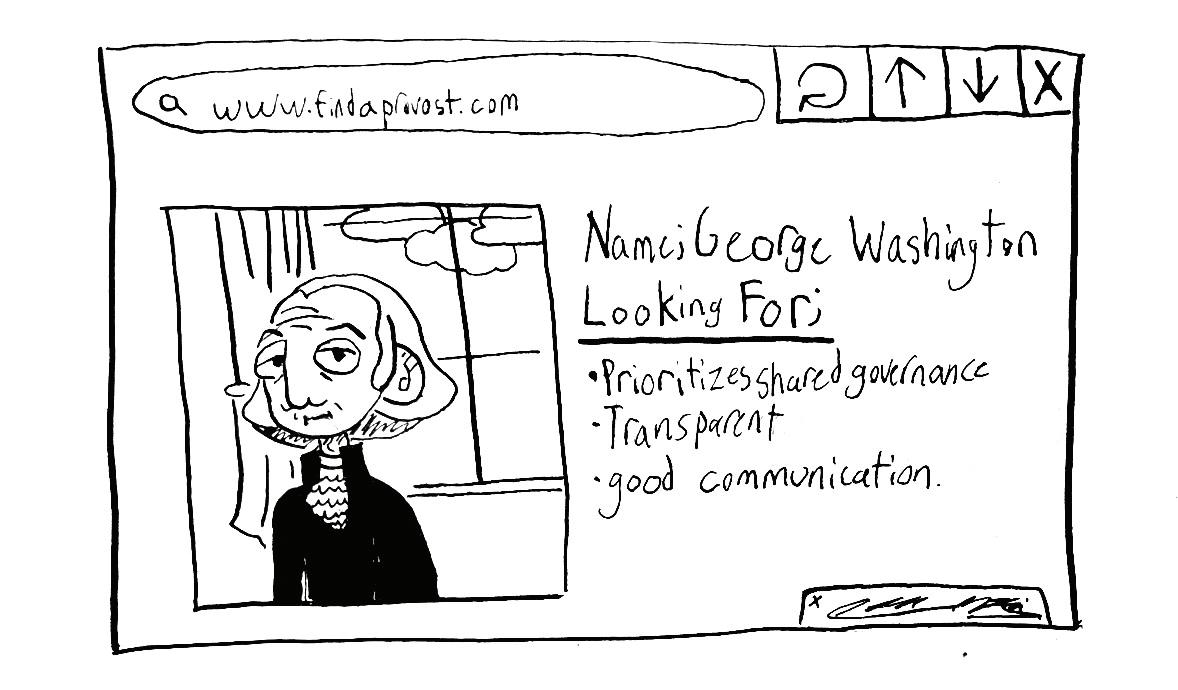
A wave of leadership turnover throughout the last year has compounded uncertainty fueled by budget cuts and President Donald Trump’s administration’s attacks on higher education. Departures include Vice President and General Counsel Charles Barber, who will step down in June, Vice President for Health Affairs and Dean of the School of Medicine and Health Sciences Barbara Bass, who leaves next month, and Board of Trustees Chair Grace Speights, expected to exit this spring. Other recent departures include the vice president for development and alumni relations and the deans of the Graduate School of Education and Human Development and Milken Institute School of Public Health. Particularly notable for many in the community was Provost Chris Bracey’s summer resignation, which came amid faculty and staff concerns over transparency and shared governance.
GW appointed John Lach, dean of the School of Engineering & Applied Sciences, as interim provost as officials launched a search for a permanent successor. The editorial board convened early in the week to evaluate Lach’s leadership style, contrasting it with Bracey’s and other top officials, and endorsed him for the permanent role. A day later, a University spokesperson said Lach did not apply for the position.
We were disappointed by the news, both because we valued Lach’s transparency and because much of our discussion underscored the importance of selecting the next provost from within. Officials appeared to view Lach as the strongest internal candidate, which we worry makes another GW appointment less likely. Still, we urge the University to prioritize an internal hire.
GW urgently needs stable leadership as it confronts Justice De-
partment probes, federal funding cuts, declining graduate enrollment, University-wide budget cuts and Trump-era policies affecting student loans, diversity, equity and inclusion initiatives, donations and operations across D.C. The University needs a chief academic officer — responsible for overseeing GW’s overall academic enterprise, directly supervising its 10 schools and colleges and managing the hiring and advancement of more than 2,800 faculty — who deeply understands faculty, student and staff concerns.
Part of why we supported the idea of appointing Lach to the permanent role was his direct involvement in the decisions shaping the University this year and in the
years to come. As interim provost, he signed off on the staff layoffs announcement, helped launch and implement GW’s new strategic framework and communicated with faculty about FY2026 budget cuts.
If GW instead brings in an external hire, they would need to learn the University’s recent decisionmaking while simultaneously convincing the community they fully support it. At a time when faculty, staff and students want a leader who genuinely understands how cuts and federal actions affect their day-to-day lives, we worry an outside hire would struggle to provide that reassurance while navigating a new role. They would undoubtedly learn how GW operates and what
My SMPA classes haven’t prepared me for a career in journalism
As a busy college student who spends a good chunk of her time doing work for The Hatchet, I appreciate a laidback class. Throughout my time at GW, these classes have helped balance out my stricter courses and editorial duties. But as I reflect on my years spent at The Hatchet and all of the courses I have taken alongside those responsibilities, it’s the blunt, direct and rigorous feedback that’s taught me how to write better. I’ve found this feedback to be incredibly rare at GW, or at least in the School of Media & Public Affairs.
It makes sense that when we first get to college, professors in introductory classes hold our hands a little more. But as we advance in our degrees, our classes should be directly preparing us for the workforce. This is especially important for careerfocused degrees, like journalism, which include a lot of field work, on-the-ground breaking news reporting and interviewing. Students can join organizations or get internships to help them prepare for the workforce, but those opportunities aren’t always guaranteed. What is guaranteed are the classes we are required to take to complete our majors. Those classes should fully
prepare students for the job market. At GW, it feels like many do not.
Looking back on my time at GW, I’m surprised by how much The Hatchet has taught me that my journalism classes did not. I remember the first time I wrote an article for the paper, my editor left a mountain of comments and highlighted sections — I needed to rewrite almost all of it to reach the newspaper’s editorial standard. It took me about two hours to go through all of the edits and comments, and the piece went through another two or three rounds. But when I wrote pieces for my SMPA classes, my professors would usually leave just a few comments if a lede was weak or the kicker could be stronger.
When I started writing for The Hatchet, I had already written some articles for my classes and thought my professors’ feedback would have accurately prepared me for the paper’s student editors. But my prior experiences barely scratched the surface of what I needed to know. Getting the article back all marked up was a bit discouraging, but it also taught me so much. This process has pushed me so many times to write better pieces — an experience I haven’t had much of at SMPA.
My editors taught me how to write a better lede and nut graf and memorize some of the rules of the AP Stylebook. One of my first
weeks as the opinions editor of The Hatchet was during the pro-Palestinian encampment in University Yard, and I had to learn on the spot how to help write and rewrite a staff editorial. As the opinions editor, I have also spent a great deal of time reinforcing these skills by editing other people’s work and having my own work edited.
Our classes should be challenging us and teaching us what the workforce might look like. I have only had a handful of professors who have left scary and extensive comments and edits on my papers, stories or articles, but it has been the blunt and overwhelming commentary that has helped me the most. Having higher grading standards would greatly benefit students preparing for a journalism career. We should be seeing this level of rigor across the board in our classes.
Professors shouldn’t be afraid to grade work harsher. College is the time to learn from our mistakes and grow as much as possible. As much as I dread spending late nights at my desk, that’s when I grow the most as a student and writer. If GW wants to ensure its students are prepared to head straight into the workforce after graduation, it must ensure the courses here reflect that rigor.
—Andrea MendozaMelchor, a senior majoring in journalism and mass communication and creative writing, is the opinions editor.
the community values, but we fear they would lack the time and bandwidth to offer the guidance and support the University needs during this period of constant change and instability.
We also like Lach because, from our perspective, he operates with a sense of transparency we didn’t see as much from Bracey and some other top officials. We believe he has made a concerted effort to understand the community’s concerns, hosting events like Pizza with the Provost and addressing questions directly at Faculty Senate meetings. We critiqued his comments about the future of DEI initiatives, notably his point that University resources and programs must be accessible to all students. But while we did not
agree with the framing, it reflected GW’s stance and gave us insight into officials’ thinking in a way other top leaders have not. We have appreciated his direct approach to communicating with stakeholders, as he has shown when addressing other issues, like budget cuts.
The next provost will need a deep understanding of the critical role shared governance plays at GW. Faculty senators, staff council members and student government representatives expect direct communication and updates on issues affecting the community. Many top officials, like Bracey, have faced significant criticism for failing to meet this expectation. We felt that Lach understood it — perhaps in part because of his experience as the engineering school’s dean.
GW has stated it is seeking a provost who will strengthen shared governance, advance research and navigate financial constraints while remaining transparent and approachable. In reviewing the position profile, we felt Lach embodies many of these qualities. We also believe it would be difficult for an outside hire to step in and meet these expectations before fully understanding GW’s priorities and current climate, which will take time.
Over the last decade, GW has had four different provosts, including Lach, and is now searching for someone who will fully commit to the University and help the community navigate budget cuts, declining international enrollment, DOJ investigations and Trump-era policy shifts. An internal candidate would already understand GW’s priorities, culture and community needs and would likely be better positioned to connect immediately with faculty, staff and students. We don’t know who the candidates are, but we urge officials to carefully weigh the benefits of selecting an internal hire in this search.
Students should pay attention to the Justice Department’s Title VI probes
Officials on Jan. 15 disclosed in a lengthy Weekly Federal Update email that the Department of Justice opened a Title VI compliance review into GW for diversity, equity and inclusion practices in the student admissions process. The Title VI compliance review frightens me for several reasons but especially because I fear it could result in the disappearance of the test-optional policy if the DOJ decides it is illegally racially discriminatory. It’s crucial that students stand by GW during these probes and take time to understand the value of policies like going test optional.
Ava Hurwitz Contributing Opinions Editor
Last year, the Department of Education sent a letter to universities that warned they could lose federal funding if the department found they considered race in admissions. The legality of outlawing test-optional admissions policies is highly contentious. Test-optional universities, like GW, say that standardized tests often are more reflective of socioeconomic status or access to testing centers or tutors than any actual academic prowess or college readiness.
We originally shifted to GW’s test-optional status
after research found other metrics could also accurately predict success in college. This status is now a cause for concern as colleges are being ordered by President Donald Trump to compile data on test scores and other admissions stats to ensure compliance. As a student from Kentucky, I know how difficult it is for people in many states to find access to testing centers for the ACT or SAT. GW’s test-optional policy functions as a positive entry point for students whose test scores or inability to take a standardized test may otherwise prevent them from even dreaming of entering an R-1 research institution or a school at the heart of the capital.
The alleged “corruption” of Title VI isn’t a new argument, with the Trump administration villainizing affirmative action. The Supreme Court struck it down in June 2023, finding it violated Title VI. Now, the Trump administration is attempting to use Title VI as a tool to prevent diversity in university settings. The Justice Department’s Title VI review could lead to GW losing their test-optional status and federal funding.
I am glad GW seems to have a strong handle on the situation, but it saddens me that it has come to this: that diversity has been weaponized as a negative thing, that heterogeneity is frowned upon and not celebrated. To me, it looks like GW is
doing what it can to combat this weaponization while still staying in compliance with the various laws and regulations. The Weekly Federal Updates ease some of my fears about the unknown at times. Give them a read because GW has made it clear through this communication that they are prepared to meet with the DOJ and that they have substantive evidence that they are compliant with Title VI. We must all continue to support our community by ensuring that marginalized perspectives are heard. Title VI was never intended to be interpreted in this way, in a manner that drowns out diverse voices. As a community navigating Trump’s second term, we can take notes from how GW is handling this situation — a sentence I never thought I would say. It may seem like kowtowing, but anything that informs or works to bring diversity into our lives is beneficial overall. And if GW can keep DEI in our lives, whether it is keeping optional standardized testing or still having diversity as an official GW value — then that makes our efforts worth it. It is our duty as responsible citizens, scholars and stewards of GW to keep working to protect our community and ensure that diversity is safeguarded.
—Ava Hurwitz, a sophomore majoring in international affairs, is the contributing opinions editor.
CAROLINE MORRELLI | STAFF CARTOONIST
Andrea Mendoza-
CULTURE
SMPA professor’s running store hits its stride in early months
KAVYA KARTIK REPORTER
After struggling to find specialized running gear in Prince George’s County, Maryland, School of Media & Public Affairs professor Jesse Holland decided to stop searching and start building. Holland and his wife, Carol Holland, used a $200,000 grant to open Haraka Run and Walk in Hyattsville, Maryland, softly launching the store on Dec. 24 ahead of its grand opening in February. The couple hopes the store will fill a long-standing gap in access to specialized running gear in the area while also serving as a community hub for local runners and walkers through events and group runs.
The Hollands are runners, he said, pointing to his wife’s NCAA DII 800 meter championship win at the U.S. Naval Academy in 1987 and their son, who is captain of his high school’s track and field team. That shared passion for the sport inspired them to plan a running store of their own, and they secured their storefront in June 2025.
Along the way, they discovered a grant from the Running Industry Diversity Coalition, which offered $200,000 in funding and mentorship to a single business with at least 51 percent Black ownership, and decided to apply. The Hollands, out of a pool of more than 100 applicants, won the grant in Nov. 2025, propelling them into the final sprint of opening their doors.
The process was fast, Holland said. He said the RIDC brought in the mentorship of other established running stores last winter, like Pacers and Charm City Run, located in Baltimore, among other consultants. That helped the Hol-

lands connect with major running brands such as Brooks, Hoka and ASICS, as well as apparel, sock and sunglasses companies whose products they now sell in the store.
“Without them, we would not have gotten the seed money to get this store up and off the ground, and working with them also helps remind us that running, walking, jogging is for everyone,” Holland said. Rooted in their mission is diversity and education, Holland said his wife picked the name “Ha-
raka” — a Swahili word meaning “movement” and “speed” — for the store. The couple wanted a name that represented both their African American identities and commitment to movement, he said.
Holland said they knew they wanted the shop to be located in Prince George’s County, adding that they eventually settled on Hyattsville because of its “great running community” and proximity to the University of Maryland.
Holland said he and his wife hold equal shares in the store but
Students with GW-employed parents blend home and school life on campus
CARSTEN HOLST REPORTER
MARLENE ORANTES
STAFF WRITER
For many students, college means putting distance between home and family. For senior Bella Costantino, home is just a short walk across campus — up the steps of the University Honors Program building, where her mother works.
Bella Costantino’s mother, Eydie Costantino, has worked at GW since 1994, first as an assistant director in the Columbian College of Arts & Sciences and now as assistant director of the University Honors Program. The Costantinos are one of several student-parent pairs who share the same campus, creating a college experience that blends family life with academics.
Bella Costantino said her mother’s proximity has been a vital part of her four years at GW, adding that the duo usually see each other a few times a week, often grabbing bagels from GW Deli and eating them in Eydie Costantino’s office. Bella Costantino also pointed to moments when her mom has delivered care packages while she’s sick or baked fresh brownies for her sorority as moments where she weaves parts of her home life into her campus life.
“I am a college student, I
have my own life at college,”
Bella Costantino said. “But I never felt like I wanted to be far away from her, or far away from home. So it does kind of meld together for me, however not in a bad way.”
Though they’ve struck a balance four years in, Eydie Costantino said it was difficult at first to give her daughter the full independence of a university student as her natural “mama bear” instincts often took over when Bella Costantino started college.
First-year Marissa Jacobs shared the same sentiment. She said her dad, Benjamin Jacobs, a professor at the Graduate School of Education and Human Development, supports her and her twin brother, who also goes to GW, while they’re away from home by taking them out to coffee to check in.
Plus, she said he brings items from home, like jackets that don’t fit into her luggage and Halloween candy, reminding her of home. Still, Marissa Jacobs said she’s been able to maintain her own freedom because her dad only comes to the District about twice a month, give or take, instead teaching mostly on Zoom from their New Jersey home. When he is on campus, she said she’s happy to see him.
Marissa Jacobs said her parents were enthused when both she and her
brother chose to attend GW as they’ve both been at the same school since daycare and have close family in Maryland.
The School of Business also welcomed a new family to its wings this year, with the school’s Vice Dean for Faculty and Research, Jorge Walter, occasionally crossing paths with his daughter, first-year business major Sophia Walter, around Duquès Hall. Sophia Walter said having family nearby has been a source of support and has helped her adjustment to college life.
Sophia Walter said GW ended up being one of the first schools she applied to, and their proximity has pushed her to have a closer relationship with her dad. She said sharing campus a parent has pros and cons, highlighting moments when she gets home-cooked food and the struggles of parents who know everything about the University.
Though he and his daughter live nearby, he said she is often busy with extracurriculars. But that doesn’t affect him, rather highlighting how happy he is that she is getting the full college experience.
“I think it’s important that she goes out on her own and has that experience as a student,” Jorge Walter said. “The student life here is so different than anywhere else in the world.”
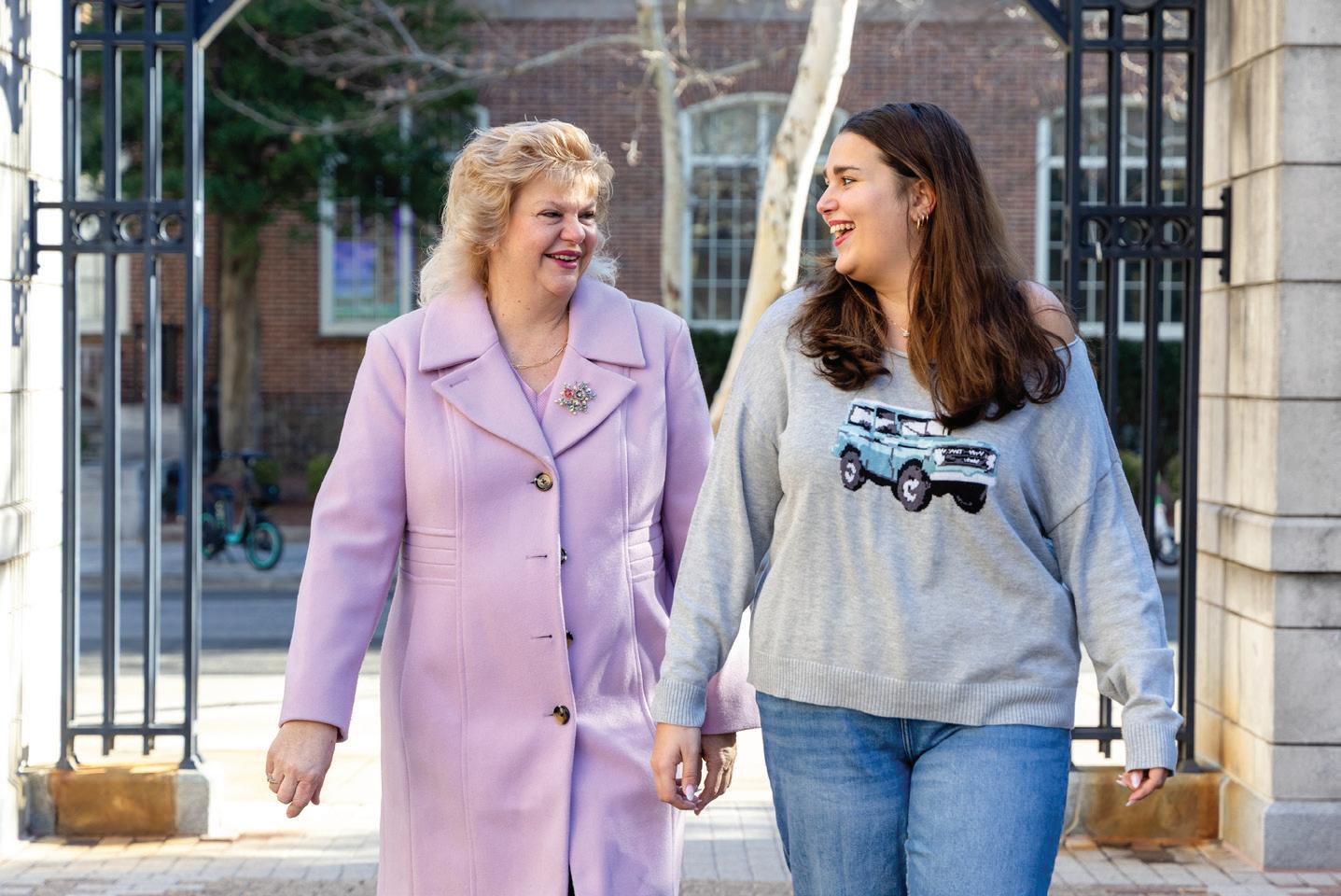
use their individual strengths to bolster different parts of the business. He said his wife’s engineering background puts her overseeing the design and construction aspects, like inventory, hiring and sales, while he uses his media skills to take on the front of the store responsibilities, like advertising, programming and customer service.
Also leaning on his journalism background, Holland said he developed The Underground Newsletter as a way to pass information
about store programming and running tips to those in the walking, jogging and running community in Prince George’s County. Holland said operating a business while working at GW full time is not as difficult in the winter because the running season hasn’t hit its stride yet — though he anticipates business to pick up after the grand opening and as the warmer weather motivates runners to dust off their shoes and get outside. He said the combination of hands-on staff at his store who are able to handle the day-to-day operations and his fellow SMPA staff’s encouragement to chase his dream has allowed him to work hard and be successful in both positions.
In line with Haraka’s mission of movement, he said the store hopes to hold monthly clinics to educate runners about the mechanics of running, bringing in doctors to teach about how to recover from an injury or how to stretch before and after movement. Plus, as the winter months subside, Holland said they also hope to restart their very first program at Haraka — their Wednesday Weekly Walk that allows community members to participate in a free three-mile walk, jog or run on the Rhode Island trolley trail.
Pausing for the cold weather, he said Haraka expects to begin again in the first week of March following the grand opening but not in an attempt to sell more store products, rather to help build a community of runners.
“That’s part of what we’re trying to do here,” Holland said. “We’re trying to build a community, and we’re trying to make sure everyone has the opportunity for movement.”
The Hatchet looks back at GW’s biggest stories in 2016
DIANA ANOS CULTURE EDITOR
As 2026 unfolds under political and social strain, a growing wave of online nostalgia is turning attention back to 2016 — a “simpler time” of Tumblr, skinny jeans and Music.ly.
People across Instagram and TikTok are digging up and sharing photos capturing the fashion, trends and products that dominated culture a decade ago. The Hatchet joined in on the trend, digging through archives to see what our staff was covering in 2016.
From President Donald Trump to high GW leadership turnover, some things never change. Take a look at some of The Hatchet’s biggest stories of 2016:
A year riddled with top leadership turnover
The 2015-16 academic year brought significant leadership shakeups at GW, a pace of departures that The Hatchet’s editorial board found troubling, arguing it strained University resources and left GW without consistent, strong leadership.
Among the notable departures, Dean of Admissions Karen Stroud Felton resigned after a six-year tenure marked by scandals, including internal reports of her involvement in GW inflating admissions data.
That summer, thenUniversity president Steven Knapp announced he would not renew his contract as president, which was up in July 2017, after a decade at the helm.
Vice President for Human Resources Sabrina Ellis also stepped down in January, prompting the University to reorganize GW’s human resources and finance offices.
That year GW cut to all administrative divisions by five percent due to revenue shortfalls, and implemented reductions to trim institutional bloat. Trump wins his first election
Many current GW students were on campus for Trump’s election, but students in 2016 lived through it first.

After working to register voters across the country for Secretary Hillary Clinton’s presidential campaign, College Democrats initially felt optimistic that the Democratic Party would keep the presidency. But by the end of the night, they held their hands over their heads in despair and trickled out of the then-Marvin Center’s grand ballroom as CNN’s coverage showed Wisconsin go red.
A few blocks down in the Elliott School of International Affairs’ City View Room, College Republicans hosted their own watch party. Donning red dresses and sport coats, students felt hopeful that Republicans would retain the Senate majority. After Trump’s victory, GW students reacted with walkouts, protests and University-organized panels. In a campus-wide walkout that began on Facebook, about 400 students joined the nationwide movement.
Men’s and women’s basketball teams set records, reach high rankings
The women’s basketball team achieved a 14-game winning streak in 2016, marking one of the team’s most successful seasons. In the Atlantic 10 Conference Championship, the thenColonials came out on top at No. 1 after coming back after being unable to take the lead, trailing Duquesne for 30 minutes.
In the regular season, forward and center Jonquel Jones — who went on to play for the New York Liberty, earn the WNBA MVP title and speak at GW’s com-
mencement last year — suffered a shoulder injury in January and could not rejoin until postseason play. The Revs then went on to the NCAA Tournament, where they lost by five points to Kansas State in the first round.
The men’s basketball team also had a standout season, winning the National Invitation Tournament Championship. The team made it to No. 20 in the Associated Press’ Top 25 and USA Today/Coaches Polls, receiving its first national ranking since being No. 6 in the country ten years earlier in 2006.
2016 fashion, employment, dating trends
Hatchet archives show GW students had style in 2016. Flannel shirts and jean jackets ruled the outerwear scene, while bold eyeliner, politically charged t-shirts and printed blouses added personality to campus looks. GW bested American University in sending the most students to the White House for the 2016 spring semester. Of 161 students nationwide, 13 Revolutionaries navigated the halls of the White House, running coffee errands for the Obama administration staff. Hatchet coverage also declared Tinder passe, as students explored alternative dating apps. They deemed Hinge too professional for college life and Coffee Meets Bagel — a food-themed app with a tricky point system — cumbersome. Bumble emerged as the favorite, with the bonus of sending GIFs to matches.
COLLAGE BY COOPER TYKSINSKI
Photos from The Hatchet’s 2016 archives.
RACHEL KURLANDSKY| STAFF PHOTOGRAPHER
Athletic attire at Haraka Run and Walk in Hyattsville, Maryland.
SPORTS

Men’s basketball completes season sweep of Richmond with 85-69 win
QUINN VAN-MOURIK
RUDNICK
REPORTER
SOPHIA CAPUTO
STAFF WRITER
Men’s basketball (13-7, 4-3 Atlantic 10) bounced back from consecutive losses to top-ranked A-10 teams with a 85-69 win over the Richmond Spiders (13-8, 3-5 A-10) on Saturday afternoon at the Smith Center — GW’s second victory over Richmond this season.
Graduate guard Tre Dinkins led the charge netting 16 points on four of seven 3-pointers. Redshirt sophomore guard Christian Jones added 14 points, while redshirt junior forward Garrett Johnson chipped in 12.
The Revolutionaries maintained a strong shooting performance, shooting 45 percent from deep and 48 percent from the field.
Dinkins said he believed the team’s strong performance was because of their dedication and their support for one another.
“It’s all about unity,” Dinkins said postgame. “We talk a lot about getting together, and things are going our way. I think we did a good job responding, so nobody put their head down. We just went out there fighting for each other and playing as hard as you can for the 30 minutes.”
The first half of the game opened up with two back-toback threes from Jones and junior guard Trey Autry. The Revs kept the momentum going, already securing a 15-3 lead just five minutes into the game. The squad continued to pull away, netting multiple threes and ending the first half of the game with a 52-32 lead.
Head Coach Chris Caputo said GW’s earlygame advantage came from a combination of strong scoring and dialed-in defense.
“I thought it was a very, very good first half defensively,” Caputo said. “They made a couple threes. But overall, that combination of your shot making early and I think pretty dialed in defense, obviously allows us to take a big lead going into half.”
The second half opened more slowly as both teams struggled to get the ball into the net. Nearly two minutes in, Richmond scored the first points of the half, netting two to bring
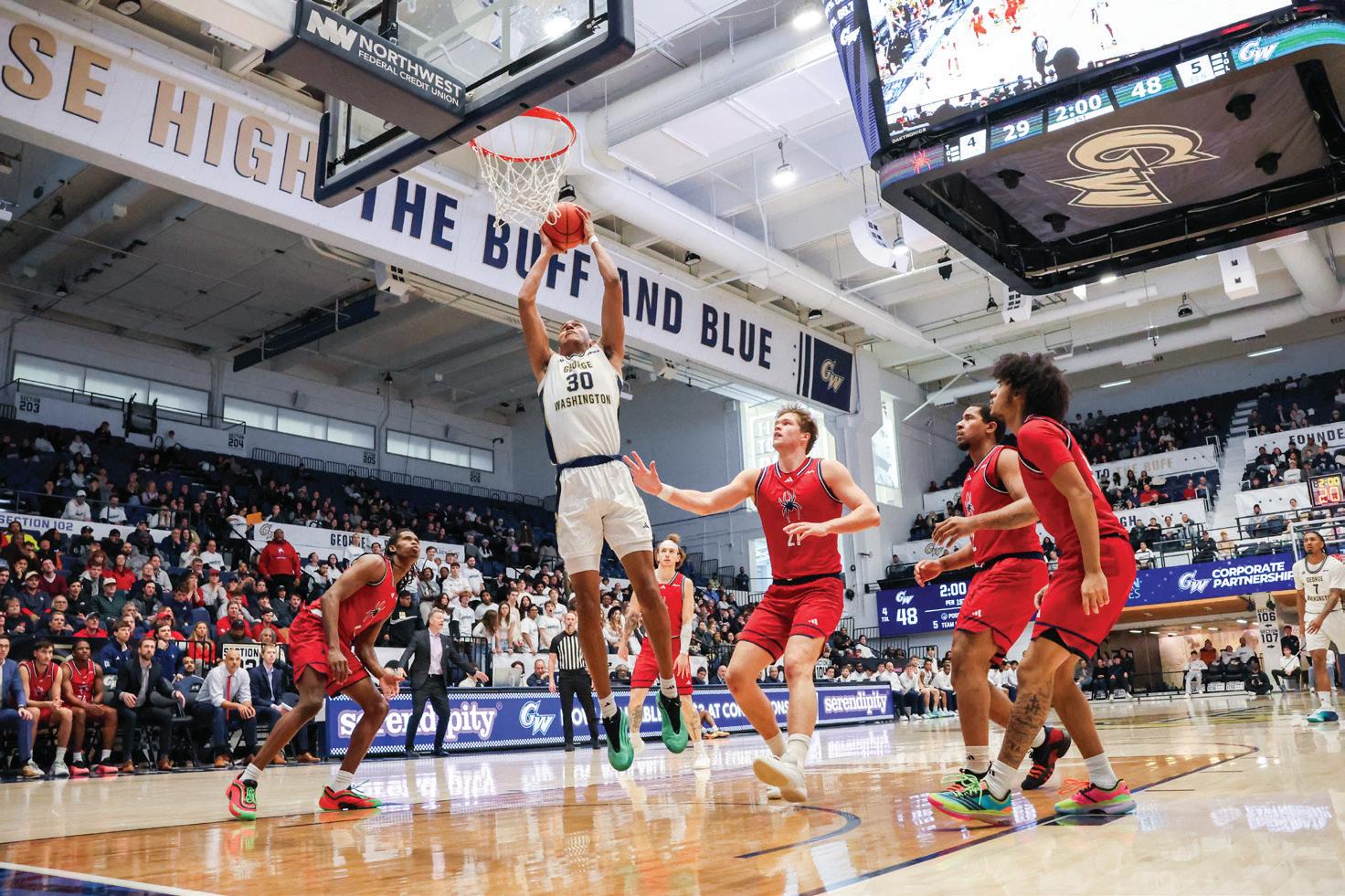

the score to 52-34. Johnson answered quickly, making a 28foot 3-point jumper with an assist from Autry, making the score 55-34 by the 17th minute. After Richmond lined up for a free throw, Johnson scored a second 3-pointer minutes afterwards and was closely followed by another three from Dinkins to bring the score to 61-36.
The rest of the half followed in a similar succession as the Revs led the game by 61-36 coming into the 15-minute mark. The Spiders struggled to find the net around the GW defense, even as they began to let their guard down.
“We kind of got a
little stagnant offense somewhere in the second half, they were able to make a few plays, but overall, good performance for us,” Caputo said.
With 10 minutes to go, the Revs held a 23-point margin over the Spiders, finding success at the 3-point mark as well as deep in the field.
Neither team netted any 3-pointers following Johnson’s in the 11th minute until three minutes remained in the game, when the Richmond graduate student guard Will Johnston was good from deep to bring the score to 76-62.
Coming into the last few minutes of gameplay,
the Revs’ defense began to ease up, and Richmond decreased their prior 25-point losing margin to just 16 points. The Spiders held the final score of the game with a free throw, just after Dinkins made a threefoot dunk for an 85-69 final.
Before the victory on Saturday, the Revs previously played the Spiders on Dec. 31, defeating them 99-85 in the A-10 season opener. The win also breaks their twogame losing streak after tough losses to George Mason and Davidson over the last two weeks.
The Revs will hit the road next playing Saint Louis, ranked first in the A-10, on Jan. 27 at 8 p.m.
Track and field warms up indoor season at VMI invite
Track and field competed in a condensed slate of four events at the Virginia Military Institute on Friday, where graduate student jumper Megan Heidebrecht won the triple jump with a mark of 12.13 meters.
The win marks Heidebrecht’s third victory of the season, following her sweep of the long jump and triple jump last Saturday at the Cardinal Classic with marks of 5.56 meters and 11.86 meters, respectively. In addition to Heidebrecht’s win, freshman Amaka Agwu placed seventh in the 400 meters with a time of 59.08 seconds, while Revolutionaries competing in the 60-meter dash and 60-meter hurdles failed to advance past the preliminary rounds.
The weekend competition came after the Revs opened their indoor season at the Marlins First Chance meet on Dec. 5, sweeping the distance events — the mile, 3000 meters and 5000 meters — and later captured a win in the distance relay medley at the Cardinal Classic last Saturday. Last week, the distance squad showed signs of early promise with a DMR-winning time of 12:02.17, ran by the team of sophomores Claire Bohan, Lainey Goldstein, Rylan Priest and Hadley Mahoney. That time would have been fast enough to score at last year’s Atlantic 10 championship — an event that the Revs didn’t compete in at the time.
The Revs were originally scheduled to compete at the Liberty Invite in Lynchburg, Virginia, on Friday and Saturday but changed their plans due to the forecasted winter weather, according to an athletics official. The Liberty Invite later cancelled their second day of competition slated for Saturday, citing the weather.
Senior sprinter Janae Russell was the fastest Rev in the 60-meter
Women’s basketball tops Fordham 58-47 behind lockdown defense
Women’s basketball (11-11, 3-6 Atlantic 10) prevailed over Fordham (9-11, 1-8 A-10) 58-47 on Saturday night in the Smith Center, securing a defensive win fueled by forced turnovers.
Sophomore guard Gabby Reynolds led the Revs with 14 points and six rebounds, anchoring a balanced team effort in the win. Junior forward Kamari Sims and sophomore guard Tanah Becker added eight points each, and GW put the game away with a decisive 10-0 run in the fourth quarter, extending its lead to 50-36 behind three-pointers from freshman guard Mia James and Sims.
The Revs pulled ahead late in a close first quarter, taking a 12-8 lead behind early three-pointers from Reynolds and senior forward Emma Theodorsson. They maintained a comfortable advantage throughout, converting 15 points off 19 turnovers in a strong defensive effort to secure their third conference victory.
“We’re really big here in our program of just learning and growing, right, and then every next opportunity is the most important,” Head Coach Ganiyat
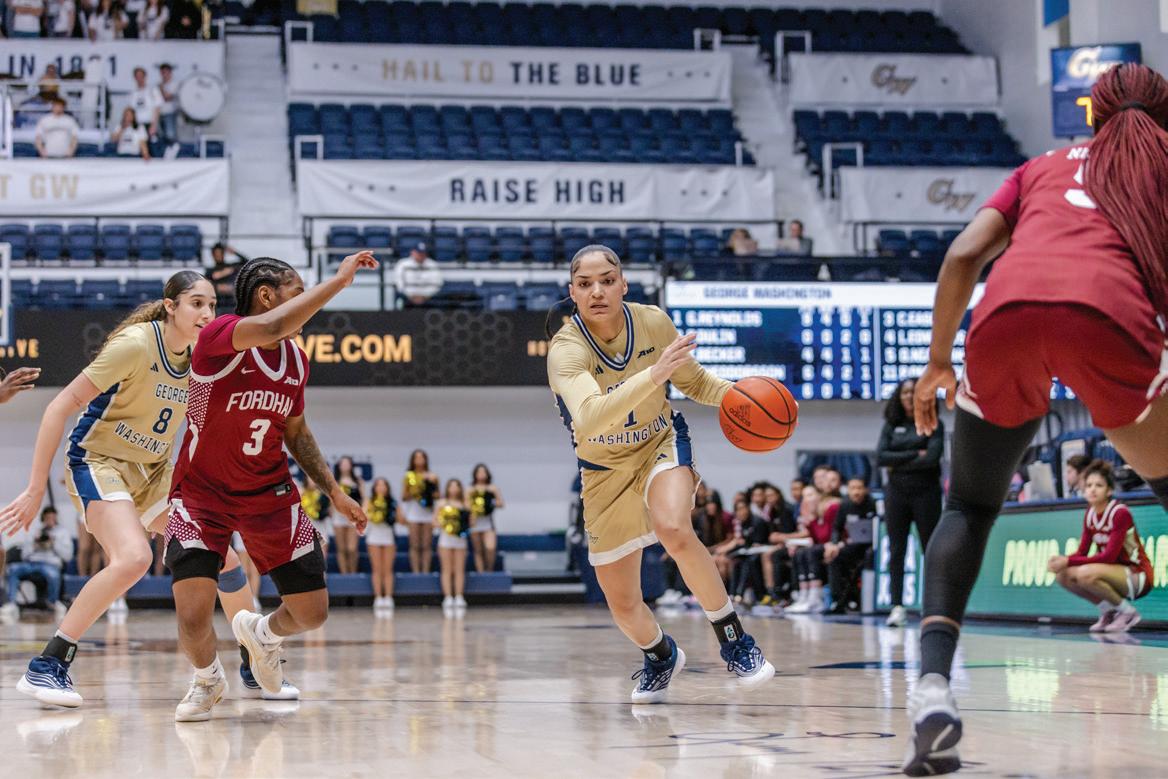
Adeduntan said postgame. “So I really appreciate our team’s response right to be ready to play in this game, to have a certain level of just fight and resilience for 40 minutes.”
The victory follows two consecutive conference losses, with the Revs falling 63-60 to Virginia Commonwealth on Wednesday and losing 53-48 to Loyola Chicago last week. Adeduntan said the win “feels great” after continued conference struggles this season. “We want to be a team that understands when a mistake
happens, we’re going to move on,” Adeduntan said. “But we’re celebrating and very happy and excited about this, because we know winning is not easy.”
The Revs held a comfortable lead throughout the first half, even without junior forward Sara Lewis, scoring 16 points in the second quarter, including two three-pointers from sophomore guard Jaeda Wilson and Reynolds.
The Revs struggled to secure the paint, conceding 41 rebounds to Fordham compared with their 34. Adeduntan said she knew they were going to miss Lewis’
dash with a time of 8.10 seconds. Junior sprinter Kamryn Holness ran the fastest time of the day for the Revs in the 60-meter hurdles crossing the line in 9.45 seconds, good for 12th in the meet.
The team is still gearing up to compete in a full slate of events but is starting to build off cross country’s runner-up finish in the conference with Heidebrecht transferring in and the return of a deep distance squad led by senior Sarah Mitchell. Mitchell placed second in the 5000 meter and sixth in the one mile at the indoor A-10 championships last year — the only individual Rev to place. The Revs still do not participate in a number of field events included in the A-10 championship, including shot put, high jump or pole vault due to program size, limiting their ability to compete for team victories, though Heidebrecht’s addition should allow the program to start scoring points in the field. Heidebrecht qualified for the NCAA East Regional and placed second in the Coastal Athletic Conference in the triple jump while competing at the College of William & Mary in 2024. She is the only jumper the program has had in at least the last five years. Last year, the Revs scored just 12 points at the conference indoor meet, placing last in the conference for the second year in a row. With the addition of Heidebrecht and Silver Spring native Agwu — who was named an Adidas Outdoor Nationals High School All-American as part of Springbrook High School’s 4×200 and 4×400 relay teams last year — the Revs have the potential to move up in the conference.
Next up, the Revs will head to George Mason for the Patriot Games on Saturday where they’ll face their first A-10 competition of the indoor season.
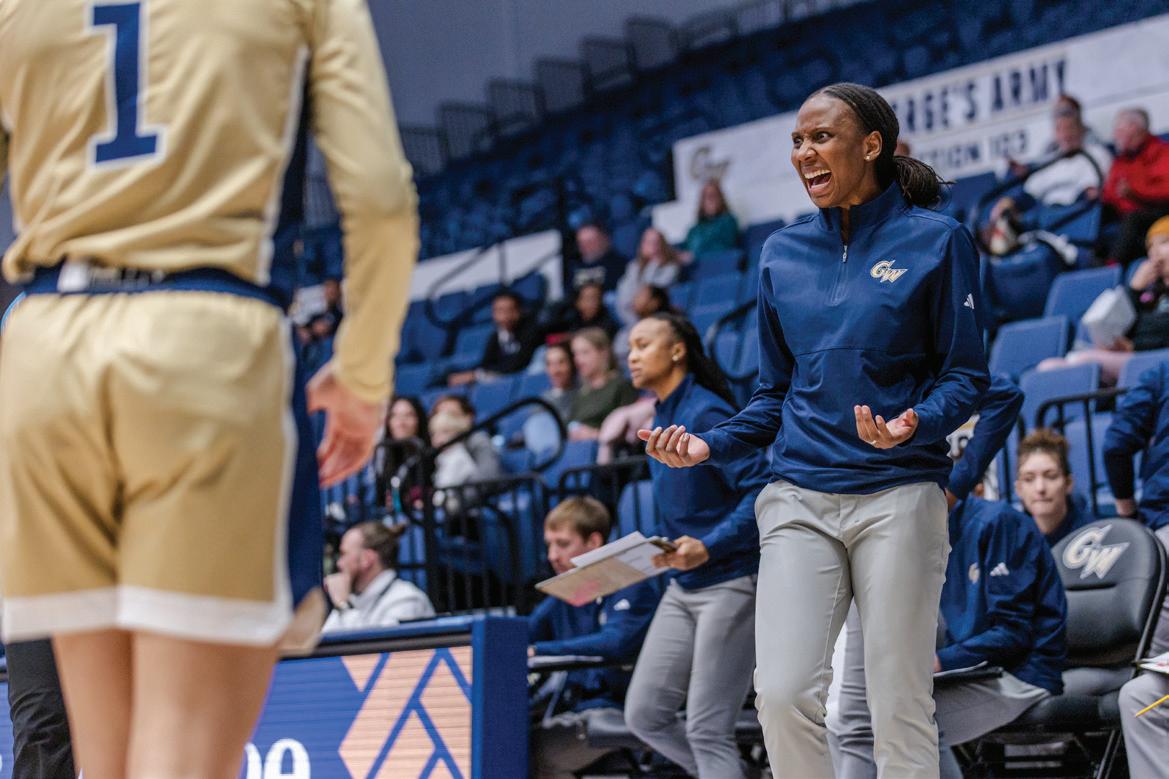
athletic rebounding, particularly on second-chance opportunities, but she was glad to see other members of the team, like Becker, make up for it with the team leading seven rebounds.
“We knew we’re going to miss that because of this team, that is their identity, is getting those second-chance opportunities, and it’s not just from one player, it’s all five of them really getting after it,” Adeduntan said. Fordham came out hot to begin the second half, closing the gap to 30-29 in the first three minutes of the third quarter. But a defensive rebound from Becker that led to two successive Revs
scores, including a three-point jumper by Theodorsson, swung the momentum back to GW to end the quarter 40-33.
The Revs carried that momentum to the end of the game, scoring 18 points in the fourth quarter and capitalizing on the Rams’ five turnovers. James came alive in the fourth quarter, scoring a three-pointer and three free throws, dishing out two assists and securing two defensive rebounds to propel the team to a 58-47 victory.
The Revs will face Saint Louis, currently fifth in the A-10, on Wednesday at 6 p.m. in the Smith Center.
GRANT PACERNICK
LILY KRAMP | STAFF PHOTOGRAPHER
Graduate center Rafael Castro shoots during Saturday’s game against Richmond.
RACHEL KURLANDSKY | STAFF PHOTOGRAPHER
Junior guard Trey Autry looks to shoot during Saturday’s game against Richmond.
LEXI CRITCHETT | ASSISTANT PHOTO EDITOR
Coach Ganiyat Adeduntan cheers after a play during Saturday’s game against Fordham.
LEXI CRITCHETT | ASSISTANT PHOTO EDITOR
Sophomore guard Gabby Reynolds drives the ball down the court during Saturday’s game against Fordham.