NEWS
New World screwworm reported past previously established biological barrier in Panama, raises concerns A2

New World screwworm reported past previously established biological barrier in Panama, raises concerns A2
Aerospace laboratory to send off satellite designed, built, operated entirely by A&M students in Spring 2026
By Erin Wunderlich News Reporter
Just southwest of the Zachry Engineering Education Complex sits an unassuming, square building. From the outside, it could easily be mistaken as an extension of Northside Garage, but inside, hundreds of students are designing projects that directly compete with industry and government standards.
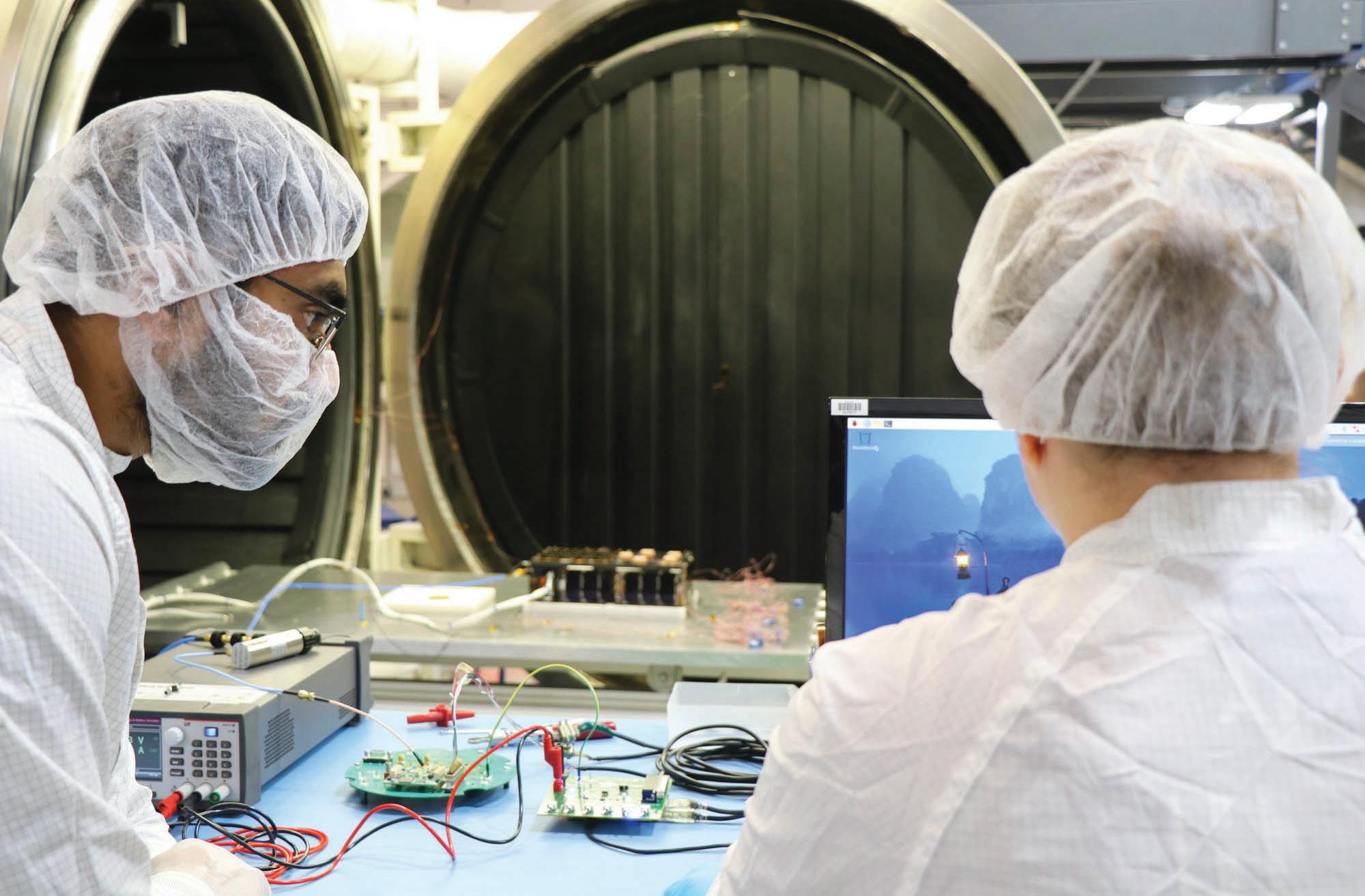
The Munnerlyn Astronomical Instrumentation Lab is Texas A&M’s hub for aerospace innovation. Inside the AggieSat Laboratory Student Space Program, students design, build and operate space-based engineering projects — including a satellite set to launch from Vandenberg Space Force Base by the end of Spring 2026.
AggieSat6, or AGS6, is a 6U CubeSat satellite designed to improve space situational awareness using radiofrequency. Sponsored by the University Nanosatellite Program, or UNP, the satellite was entirely designed and built by AggieSat students. It will launch alongside a satellite manufactured by Aggie-owned Aegis Aerospace Inc. — making the project an all-Aggie mission.
“I think a lot of us are achieving a dream that we didn’t think we’d achieve till several years after college, which is actually launching something in space,” interdisciplinary engineering senior and AGS6 Mission Director & Project Manager Avery Barriga said.
The AggieSat Lab operates as both a student organization and a research lab, with students taking ownership from idea generation all the way to operation.
AGS6 will fill a gap needed for tracking other satellites in space, from space. About as large as a family-sized cereal box, the satellite is equipped with five antennas arranged in a star shape — essentially functioning as a “big ear” by searching for radio frequencies.
Ground-based satellite detection methods, primarily used by the Department of Defense, need to sweep entire sections of sky to track other satellites over time.
AGS6 uses a targeted method to search specific frequencies, reducing tracking time from weeks to days.
“Using ground-based systems to track satellites is like trying to find a needle in a haystack, except you don’t even know where the haystack is,” aerospace engineering graduate student, Guidance Navigation and Control Lead and Mission Planner Shirish Pandam said. “AGS6 not only pinpoints other satellites more efficiently, but also has on-board data processing — hardware that has never been done in space before. Instead of sending down packets and packets of data, it will compute three numbers: the satellite’s azimuth, elevation and position to ground control.”
After its launch, AGS6 will focus on locating other satellites in the Iridium constellation — or a collection of satellites that all tune to the same frequency — as their positions are well documented and ideal for target practice.
By identifying the direction from which a signal originates, AGS6 can help locate non-cooperative satellites lost in space. One day, a group of multiple AGS6’s could eliminate the need for ground stations entirely.
“I’ve been working on this for over six years, so there’s definitely a sense of relief, accomplishment and pride to see it all come together,” Pandam said. “The launch is exciting, but the actual prize will be the first time it talks to us — because the mission doesn’t end until we get data back.”
Once in orbit, AGS6 will be operated from the Munnerlyn building by the lab’s mission
SPORTS
Welcome to the jungle: Aggies to take on two Tiger opponents following rough start in conference play A9
$50 billion apportioned to offset Medicaid cuts while providing base for change
By Jolie Jackson News Reporter
Texas will receive $1.4 billion from the federal government over the next five years for rural healthcare improvements.
The Texas A&M Rural Engagement Program is offering free consulting services with medical professionals for rural hospitals making proposals for a share of the funding.
The Rural Health Transformation Program is a $50 billion funding initiative as part of President Donald Trump’s One, Big, Beautiful Bill Act designed to support investments within rural healthcare entities across the United States, beginning in fiscal year 2026 and concluding in fiscal year 2030.
Half of the funds will be evenly distributed to all 50 states while the other half will be distributed based on applications from each state’s governor to the Centers for Medicare & Medicaid Services. Texas was the largest recipient, with $1.4 billion split evenly over the next five years awarded from its Rural Texas Strong application.
Six initiatives were included within the proposal, each designed to support investments in rural Texas healthcare. The initiatives included investments into the prevention and intervention of chronic diseases, consumer technology for access to reliable and coordinated care, innovative tools such as artificial intelligence and telehealth, workforce development for rural areas, improving data security and modernizing rural facilities.
Rural Texas hospitals will apply to the Texas Health and Human Services Commission with proposals based on the aforementioned six initiatives. Within the Rural Engagement Program, the A&M Rural and Community Health Institute, or ARCHI, collaborates with the Naresh K. Vashisht College of Medicine, College of Nursing and Irma Lerma Rangel College of Pharmacy.
“Since the Rural [Health] Transformation Program has only five years of funding, there is a large focus on creating initiatives that will be sustainable after the funding ends,” ARCHI Executive Director Dr. Kia Parsi said. “Creating such initiatives can be challenging. And what ARCHI can do, because of our expertise, is help these rural hospitals and clinics try to identify what type of programs are most appropriate for their community while also being sustainable.”
and flight directors. The spacecraft also carries a dosimeter, or a device that collects radiation data by sensing alpha and beta particles in space. All information collected will be sent to The Aerospace Corporation’s database to support ongoing small-satellite missions in low Earth orbit.
“We are a research lab in the Department of Aerospace, but by no means is it restricted to aerospace engineering,” aerospace engineering senior and Payload Sub-team Lead & Lab Program Manager Philip Mathews said. “The lab has given me a community that feels like a second home. If you’re passionate about space, there’s a place for you here.”
Mathews and computer science junior, Mission Planner and Command and Data Handling Lead Alex Halbesleben said the challenges of designing and building a satellite as undergraduate students helped them gain confidence in new technical skills.
“Philip and I were interns over the summer, and that was definitely a trial by fire,” Halbesleben said. “We needed to install a new radio for AGS6 late in the final phases of testing, and it was a learning curve. But now we’re experts on the integration between hardware and software — a skill I never would have dove into without working on this project.”
Students in the AggieSat Lab can take on engineering roles in project management, electrical, mechanical, computer and more, Mathews said. Program alumni have gone on to work for major aerospace employers, including SpaceX, the UNP and NASA.
“I joined the project at the end of my first semester freshman year, and it’s been a constant throughout my entire college experience,” Barriga said. “It became more than just building a spacecraft. It represents the people I care about most, along with hundreds of other students who put their time and effort into it. Seeing all of that work come together is incredible.”
One main problem within rural healthcare is workforce shortages, addressed in Initiative Four of the Rural Texas Strong application. The A&M Rural Medicine program is designed to combat this issue, as Executive Director Curtis Donaldson sends medical students to rural hospitals across the state.
“Texas A&M approached me five years ago to help them start up a rural medicine initiative because physicians were not returning back to rural Texas,” Donaldson said. “So, we piloted a program with two counties in Texas to get our students from our medical school to go spend two weeks at a rural location, learning about rural practice from a rural physician. And while they were there, we had the communities all geared up to host them and show off their community, kind of a recruitment style, if you will.”
Since then, Donaldson has led the program statewide, where he is able to gain information about what rural hospitals need as he communicates with the rural physicians leading the students’ educational experiences.
“I work daily with physicians in all of our locations, who are teaching our students while they’re out in these rural locations,” Donaldson said. “I engage daily with physicians across the state, so I’m in contact and do my best to understand, ‘What are the pinch points and how can we continue to help at Texas A&M?’ And so I was engaged in part of some of these conversations around the rural health transformation.”
Though A&M is doing its part to help rural Texas, it is currently unclear if the funding given by the Rural Health Transformation Program will be enough to offset the major cuts in Medicaid, according to Parsi.
“With Medicaid and Marketplace insurance cuts, there will likely be less people eligible for these types of insurance leading to more uninsured individuals,” Parsi said.

Charles Schwab gifts funds for new planning clinic
Foundation to support A&M financial planning students, community outreach efforts
By Taryn Stilson News Reporter
In partnership with the Charles and Helen Schwab Foundation, Schwab Advisor Services is gifting the Texas A&M Department of Agricultural Economics with funds to establish an Aggie Financial Planning Clinic. The clinic will be operational in Fall 2026 and will serve both financial planning students and Bryan-College Station community members.
The Department of Agricultural Economics, located within the College of Agriculture & Life Sciences, is home to majors including agribusiness, agricultural economics, and financial planning.
“Our financial planning major is different [from the others in the Department of Agricultural Economics],” Head of the Department of Agricultural Economics Simon Somogyi, Ph.D., said. “It focuses on developing students so that they can … be in good standing to take the Certified Financial Planner test to become financial planners.”
The Bachelor of Science in Financial Planning degree was added to the Department of Agricultural Economics in Fall 2023, Somogyi said. It had been a minor under the department for nearly a decade until sufficient student interest and funding from Bill Carter ‘69 of Carter Financial Management helped launch the program.
“It is very heavily invested and supported by numerous former students and a lot of corporate sponsors, such as Charles Schwab, which has come together to create a significant gift that will help those students become industry-ready,” Somogyi said.
The Aggie Financial Planning Clinic, with the support of the Charles Schwab Advisor Services and the Charles and Helen Schwab Foundation, will aim to advance the education of students studying financial planning using a unique, immersive learning model, as well as aid community members looking for financial guidance. Senior lecturer and primary lead on the Aggie Financial Planning Clinic project Nicholas Kilmer describes it as a tiered structure that will provide progressive development for students.
“Our financial planning students will have the opportunity to be financial educators,” Kilmer said. “They will be able to go out to the community, out to campus, and provide financial education workshops. Maybe it’s the Boys & Girls Club, maybe it’s through Posse scholars, and they’ll teach budgeting, financial goal-setting … and investing.”
Kilmer mentioned that students will also learn from financial planning professionals at the clinic. These professionals will be the providers of pro bono financial planning services to low-income community members in partnership with the REACH project.
Started by Max Gerall ‘18, the REACH project is built on the values of the selflessness and service. The mission of the nonprofit is to provide the Bryan-College Station community with homeownership support, financial education, youth leadership programs, and food distribution efforts. REACH is an A&M community partner and will play an integral role in how the Aggie Financial Planning Clinic will serve the local community.
Through a partnership with REACH, A&M financial planning students will engage in financial coaching with current REACH clients. Kilmer noted this will help students develop their public speaking and interpersonal skills and turn what they have learned into actionable practice.
“They will be meeting with REACH clients one-on-one and talking to them about the same things they’ve learned from the financial educators, like financial planning, debt repayment, retirement planning, things like that,” Kilmer said.
Involvement at the Aggie Financial Planning Clinic won’t just be an educational experience. Still, one where students will learn how to be leaders and guide community members down the path of homeownership or entrepreneurship, Kilmer said.
While most student involvement will be volunteer positions, a few financial planning students who demonstrate strong leadership and educational commitment will be selected as paid interns, according to Kilmer. These interns will coordinate the clinic, organize the financial planning sessions, and oversee the site with support from directors and staff running the clinic’s entrance.
“In a practical sense, [the clinic] will emulate a financial planning business … and it will be a hub for experiential learning,” Somogyi said. “It’s really going to give students a real-world experience so that our students are ready for their careers.”
According to the CFP Board, the career field of financial planning requires the recruitment and retention of new, talented advisors, as the demand for financial planning services is projected to continue growing.


Through Appetite to Travel, Kasey Lobb works to make allergy-accommodating recipes
By Sophia Munoz Associate Life & Arts Editor
In the quaint kitchen of a Navasota home and garden center, six to eight table stations line the room, each equipped with standing mixers, a set of instructions and various other cooking and baking supplies. The attendees, mostly regulars, listen eagerly as Kasey Lobb, RDN, cues them in on helpful dietary tips and cooking advice. For some of her cooking-class participants, this advice goes beyond a mere contribution to a lifestyle choice — it can help them cook around food sensitivities and autoimmune conditions.
Lobb has been a registered dietician nutritionist for the past 25 years, working to improve the lives of her patients through her private practice, food blogs and, more recently, her cookbooks and cooking classes. Since 2023, Lobb has taught the basics of nutrition through courses for students of all levels with her business, Appetite to Travel.
“She was very hands-on and patient,” class attendee Victoria Porter ‘24 said. “I asked a lot of questions, and she had all this knowledge and all this experience. Any questions I’d ask, she’d be able to explain or walk me through in a way that I understood. And even meeting me where I was, because I was a beginner and I don’t know anything about nutrition or gut health or anything like that.”
In February 2025, Porter and her husband took their first class with Lobb, a gluten-free sourdough bread-baking course. Being gluten intolerant herself, Porter said she found the class not only fun, but educa-
tional. The lesson lasted two hours, during which Porter learned to bake bread and have a home-cooked meal with Lobb in her personal home kitchen set up. Afterward, the couple left the tutorial with their own sourdough starter, freshly baked bread and recipe cards.
“They were very hungry for the information,” Lobb said. “‘How am I going to be cooking dinner? We’re now living on our own, we want to kind of elevate our nutrition and cook a little healthier.’ And so they were fantastic.”
When Lobb is not offering personal classes from her home kitchen, she regularly leads cooking presentations and workshops at Martha’s Bloomers, a Navasota home and garden center. There, regulars from the surrounding areas come to learn how to make healthy breads, pie crusts, muffins and various other foods.
“I prefer to call those workshops and put them at a much lower price point,” Lobb said. “People like it to be a little more social rather than like cooking school. The classes are a little bit more like cooking school to make sure you’re really learning the techniques, and you get time one-on-one, and you have your own workstation. But the workshops are a little bit more social, and we’re getting all the concepts. My classes are very specific, they’re usually longer, and they include an entire meal.”
When conducting her workshop-style classes, Lobb often teaches attendees with different food intolerances and allergies simultaneously. Through research and experimentation, she has learned how to edit her recipes to accommodate many different food allergies.
“She’s detail-oriented,” class attendee Evonne Crocker said. “And she gives you lots of information. It’s very informative and makes you think about your overall health, you know? So, it’s just a fun-type class.”
workshops have helped her manage her wheat allergy.
“One of the things that I’ve run into over the years is that when you try to create a gluten-free recipe, a lot of times it tastes like cardboard, it doesn’t have the right texture, the taste is a little bit off,” Browning said. “And with what she’s done with her book, I’m able to more closely mimic regular food, and, in fact, some of the folks that I’ve cooked for actually prefer her crepes recipe to
crepes.”
Lobb said she relies on word of mouth as her main source of advertising, and, recently, her method has reached campus. Her reputation has put her in contact with Texas A&M’s Department of Nutrition where she is planning to give guest-speaking presentations for nutrition courses.
As of late, Lobb has also been hosting workshop-style lessons for student organizations across campus. Her upcoming workshop for Kappa Alpha Theta will take place in late February.
“I love that every class is different,” Lobb said. “Because one of the things I’ve learned from my private practice is you meet people where they are. If they are all needing to be a little more social, then maybe I don’t give every single detail about every ingredient or anything. But if they’re wanting to be a little more academic, I love that, of course. And I can just geek out on all the food nerd information.”
Lobb hopes to continue offering more lessons to students at A&M, as she has always found them to be eager learners.
“I think I definitely have a targeted audience, right,” Lobb said “I know that my classes aren’t necessarily for everybody, but the people who find me and the people who have that need, that are hungry for that education, that is amazingly rewarding.”
Parasitic species reported 70 miles from Texas-Mexico border, poses biological threats
By Taryn Stilson News Reporter
In Sabinas Hidalgo, Mexico, new cases of New World screwworm, or NWS, have been confirmed by Mexico’s National Service of Agro-Alimentary Health, Safety, and Quality, according to the United States Department of Agriculture, or USDA. These reported cases in Mexico’s northern state of Nuevo León are less than 70 miles from the Texas-Mexico Border.
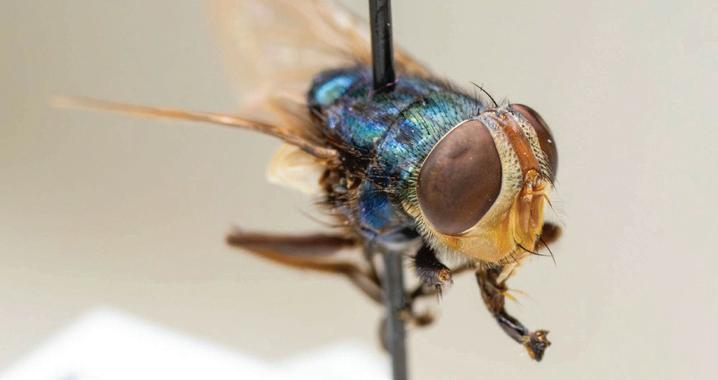
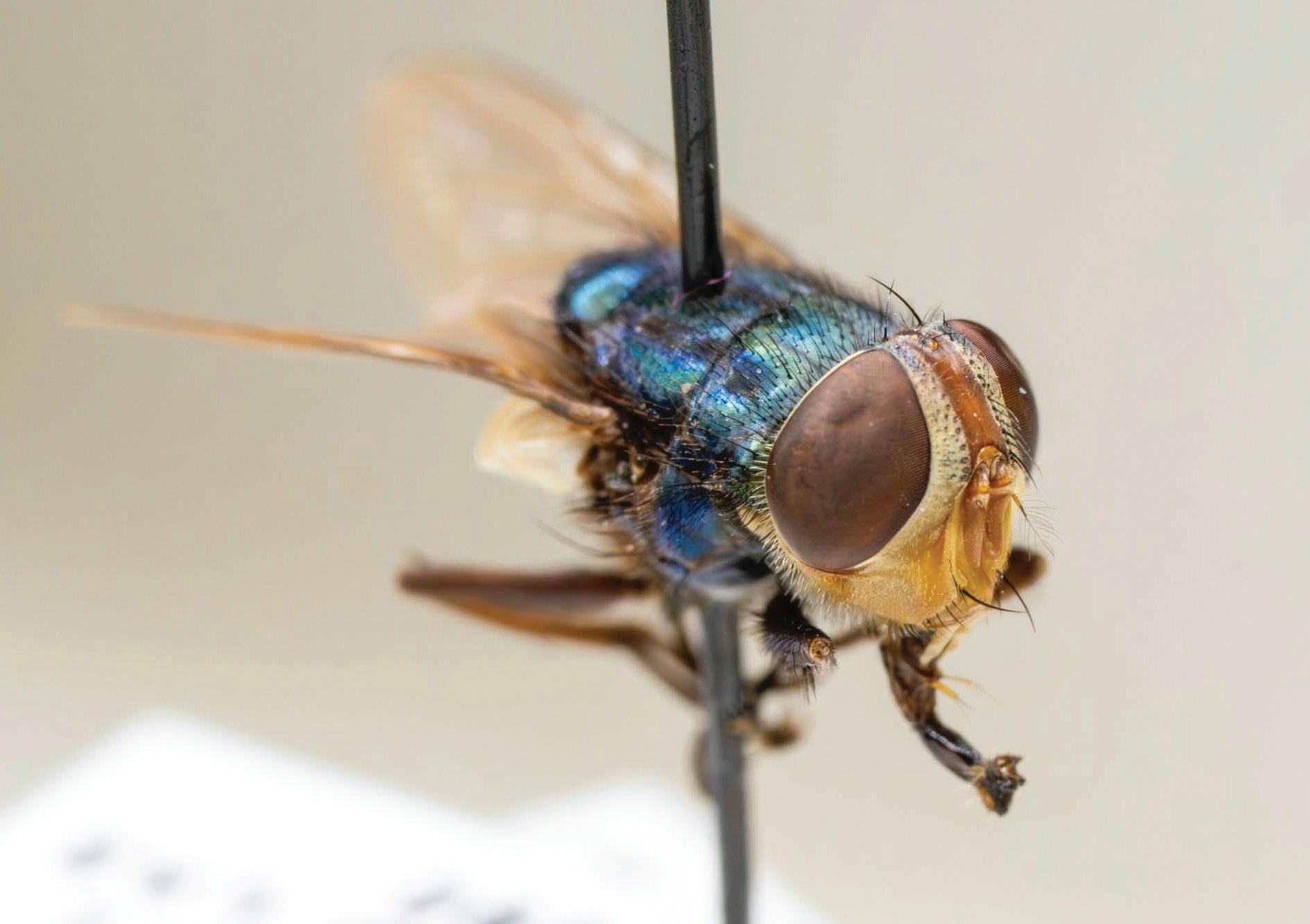
NWS is a type of parasitic blowfly whose maggots infest the living tissue of mammals through open wounds, according to Professor and Head of the Department of Entomology, Phillip Kaufman, Ph.D.
“[NWS] is different from other blue flies,” Kaufman said. “First of all, it’s a native species; it’s not an introduced or invasive species that we often see. Regular blue flies lay their eggs on dead animals, and then those larvae hatch, and the larvae eat the dead animal, which is a very good thing; they help recycle that material. But this fly is a parasite, so it feeds on live animals and, essentially, it’s a fly whose larvae eat their host alive.”
After a host is infected by NWS, the larvae grow rapidly and cause severe tissue damage as they eat away at their host, according to Kaufman. Symptoms progress quickly after infestation and can result in bacterial infection and septicemia, which is a bloodstream infection that triggers sepsis. Kaufman explained that untreated mammals have about five to seven days before the infection becomes fatal.
“It’s not a death sentence, but you do have to get to it early enough,” Kaufman
said. If caught quickly, veterinarians can remove the maggots from the mammal’s wound, clean and sew up the wound, and use Food and Drug Administration, or FDA-approved, anti-parasitic drugs to prevent NWS infestation. According to the FDA, Exzolt Cattle-CA1 is an approved drug effective in treating NWS cases.
Treating existing cases is only part of the problem; preventing the spread of NWS and movement toward re-eradication is the ultimate goal, according to the USDA.
“A lot of effort was put in back in the 50s and 60s to eradicate it from the U.S., which did work; they officially say we were screwworm-free in 1966,” Professor and Agrilife Extension Specialist Sonya Swiger, Ph.D, said.
According to the Kansas Department of Health and Environment, this most re-
cent outbreak of NWS is largely due to the breakdown of the biological barrier previously established at the Darién Gap in Panama.This barrier served as a firewall that kept NWS confined to a small geographical area.
“[The breakdown] has been attributed to … the large influx of individuals, both humans and animals, coming through [Central America], which also decreased the success of [those containment efforts],” Swiger said. “And then once it got into the animals in countries that weren’t familiar with [NWS] anymore, those animals were moved before realizing they were infested, and that also led to the growth [of NWS cases].”

Introduction to the trending ‘America First’ movement
By Aidan Zamany Opinion Writer
Although President Donald Trump may have narrowly escaped a sniper’s bullets to evade an assassination attempts, he may as well be dead.
Still early in his second term as president, we can already observe a significant erosion in Trump’s political support. Even among registered Republicans and ideological conservatives, public polling shows a drastic decrease in his approval rating.
At the moment, countless right-wingers are abandoning the “Make America Great Again” movement en masse. Moderates, Democrat candidates — and even Democratic Socialists — are becoming an increasingly preferable alternative to their Republican counterparts.
As Nick Fuentes put it, “I can’t get a job. My insurance has tripled. My healthcare is super expensive. If you’re right-leaning, you’re saying, ‘Illegals are still in my town. Crime is still rampant. We’re still giving money to Ukraine and Israel. Am I going to vote for the guy that’s behind all that; that is covering for Jeffery Epstein on top of it?’ … Gee, I wonder why Republicans lost.”
So, who is Fuentes?
Nicholas J. Fuentes, born to Catholic Italian and Irish-Mexican parents, comes from a middle-class household in an overwhelmingly homogenous Chicago suburb. His political and rhetorical skills were first discovered when he was elected president of his public high school’s student council and again when he volunteered to represent conservatives at a live debate while studying political science at Boston University.
His performance in the debate, hosted by the popular conservative student group Young Americans for Liberty, attracted the attention of mainstream neo-conservative media firms like The Daily Wire and Right Side Broadcasting Network.
However, according to Fuentes, his questions concerning Israeli influence in American politics and the “disproportionate power of the Jewish elite” quickly cut his career short.
After getting deplatformed, having his bank accounts frozen and being consigned to a No Fly List in 2021, Fuentes dropped out of college and retreated to his family home, where he started his own independent, amateur online talk show.
Within a year of its conception, “America First with Nicholas J. Fuentes” had garnered a viewership of over half a million.
His popularity among Gen Z fans, who call themselves Groypers, is apparent. Fuen-

tes speaks confidently on a variety of political topics while simultaneously maintaining a persona that his viewers find youthful and relatable. His shows consist of grand political commentaries and dramatic speeches on the state of society combined with humorous anecdotes and ironic exaggerations.
Near the end of his livestreams, Fuentes engages with his followers by accepting monetized “superchats,” to which he responds with a mix of ironic sarcasm and insults. This perceived indifference toward belittling the very audience that admires and sustains him paradoxically boosts his reception and drives even greater donations from individuals, with each participant hoping to earn their own personalized beratement.
While the foundational philosophy of the movement emphasizes certain anti-liberal
and anti-egalitarian tenets, Fuentes attracts support from a variety of ideological camps with potentially contrarian worldviews. He achieves this type of unity by propagating messages that are rife with traditionalist, nativist, identitarian and nationalist sentiment, which broadly appeal to most audiences in the modern alt-right without formally aligning with one group.
But the backing Fuentes has cultivated isn’t the only nuanced aspect of his platform: Although he persistently criticizes Israeli policy, Zionism, high-profile Jewish figures and unashamedly uses racial slurs, Fuentes frequently denies any genuine prejudice against racial minorities and Jews, stating, “I think everybody knows at this point … I don’t hate Black people and Jews, I just hate criminals and inconsiderate,
obnoxious people.”
“Anyone that has any genuine racial hatred, we have to just say there is something wrong with you,” Fuentes said. “That’s a low-IQ, dysfunctional thing. Yeah, it makes me mad, but I’m not filled with racial hatred for an entire group … even the Jews. I do actually like a lot of Jewish people, even though they have ruined my life in many ways, and they do horrible things; I don’t have a hatred for them as a group, and I can say nice things about them. That comes from being a Christian.”
The “America First” movement loosely embodies Fuentes’ personal ethos. It’s a juxtaposition of unserious online banter and consequential political strategy. While one faction of his followers participates on a superficial level — posting harmless tributes to Fuentes, making edits for Instagram Reels or engaging in internet debates — there is another, more prescient side.
Beyond the hobbyists of the “America First” movement exists a clique of ambitious followers who are ready and willing to commit their lives to their ideology. These individuals, united by a revolutionary worldview, are being primed to act.
“You’re not going to know how many of us there are, you’re not going to know which one of us we are,” Fuentes said. “You’re not going to get a good count, you’re not going to know all our names. Hold it close to the chest, we bleed for America. They know the next generation is with us, and they’re writing about it in the New York Times … they said between 30 and 40% of the White House staffers and Congressional staffers are Groypers — and that’s an underestimate, that’s an undercount.”
The idea that Western civilization is collapsing has left countless youths disillusioned with the current world order. As the United States and the European Union experience rapid demographic shifts, citizens feel that their cultural and moral dominance is waning.
Meanwhile, the political class of liberal-democratic governments are being judged as incompetent and unfaithful to the needs of their constituency, instead serving the interests of billionaires and an inconspicuous globalist elite.
Until they believe that agenda is abandoned and reversed, the “America First” movement will continue to grow expeditiously. The age of confrontation is soon to come; both sides are sharpening their blades. Now and in the near future, Groypers will be embedded in the highest echelons of society, waiting for the moment to strike — it is merely a matter of time.
Aidan Zamany is a political science sophomore and opinion writer for The Battalion.
Women hemorrhaging because of a miscarriage isn’t ideal, neither is our representation
By Sidney Uy Opinion Columnist
Roe is dead, and we have killed her.
More than 50 years of precedent is gone after the United States Supreme Court struck it down in 2022. The rise of whatever you want to call it — Constitutional originalism, religious fundamentalism or plain woman-hating — reigns supreme. Dobbs is the law of the land for now.
After the trigger ban, the Texas Heartbeat Act, or SB 8, went into effect, representatives who shouted “Life!” at the top of their lungs have accomplished nothing of the sort. Instead, they’ve done the opposite.
Bounty hunterism
Power was given back to the states to control the at-large reproductive healthcare system, and more specifically, states can seriously penalize or criminalize doctors for performing illegal abortions. More odiously, private citizens can also sue anyone who “aids or abets” an abortion procedure.
Now, hypothetically, a disgruntled ex-husband can sue his ex-wife’s friends for allegedly helping her get abortion medication or a procedure. According to SB 8, if he’s a successful plaintiff, he may be reimbursed a minimum of $10,000 in court costs for his “damages.”
This is not so hypothetical. It’s what one man tried to do.
In 2023, Marcus Silva sued his ex-wife’s friends in a lawsuit, alleging a “wrongful death.” The women counter-sued, and both sides ended up dropping their claims, though his ex-wife claimed that Silva tried to manipulate her into staying in their marriage. This is but one effect this draconian law has on women. It swells up women’s collective fears not only around pregnancy, but regarding marriage, financial stability and potential threats aimed at friends and family. More dangerously, the law doesn’t allow exceptions for rape or incest, only medical emergencies. This one exception is practi-
cally only in name, however.
Chilling healthcare
Doctors and midwives are scared of being accused of performing abortions, and that fear drives real public policy consequences such that medical emergencies aren’t treated properly.
Though abortions will continue to be performed illegally in the state, it may be without the medical oversight of professionals. The chilling effect becomes suppressing their own needs in order to save face — a deadly risk.
delaying medical care because of the threat of jail time, inducing political fear in our healthcare system. Even if women want to travel to get a safe abortion, the state is currently cracking down on programs that provide that service.
This month, the state created a new law banning government-supported funds that presumably help people travel for an abortion. San Antonio’s Reproductive Justice Fund helped fund abortion-related travels.
Attorney General Ken Paxton sued the city of San Antonio claiming that it was, “Attempting to undermine and subvert Texas law and public policy.” This

died after her doctor opted against an emergency procedure following a miscarriage. Ngumezi’s obstetrician gave her only a routine drug called misoprostol, but the bleeding didn’t stop. She died three hours later.
Medical experts reviewing her case agreed that Ngumezi needed a lifesaving “dilation and curettage” procedure, a common surgical procedure for abortions and miscarriages. At one of the most premier medical institutions not just in Texas, but the entire country, SB 8 prevented her from being properly treated. There are several reports of providers
juridical fight over women leaving to find doctors who will treat them doesn’t stay in state; Texas politicians seek to actively prosecute doctors outside of Texas for sending abortion pills.
The Texas governor’s lasso leaps out of the state to latch onto women — and doctors. The Supreme Court unanimously rejected that common abortion medications be banned. However, Texas politicians seek to
ban any and all access.
In December 2025, House Bill 7 went into effect. This bill allows private citizens to sue abortion pill providers and manufacturers. Now, Food and Drug Administration-approved abortion pills — a combination of mifepristone and misoprostol to end early-term pregnancies — are treated as contraband.
Citizen plaintiffs can sue distributors and be awarded $100,000 in damages. Theoretically, if a fearful teenage daughter talks to her family about seeking abortion medication, she puts them at legal risk for helping her. What if her own family forbids her from even thinking about having an abortion? Who will she go to then?
Roe sought to protect women’s privacy and her personal health concerns. These matters used to stay between herself and her trusted doctor. Yet, when she tries to access legal medical services outside of the state, the state attempts to nationalize their own abortion policies. It’s a clear attempt to terrorize pregnant individuals in Texas and elsewhere.
Agenda setting for midterms
In today’s post-Roe America, women are dying from the rules lawmakers claim will protect them.
When a law threatens your bodily autonomy, bans lifesaving medication and enables anyone — from ex-partners to complete strangers — to sue abortion providers and friends, there is no mistaking your freedoms are being threatened.
There’s no recourse for a vaguely written law that treats its own women as second-class citizens who are to be stalked, sued or stifled from accessing care from medical professionals or helping those that do. Our lawmakers probably never had to pee on a stick in the middle of a CVS and undergo the sheer violence these laws have produced.
Even if you think abortion is wrong, bad laws are never justified.
This year brings the midterms, and we must be eager to right these wrongs and pressure our Texas representatives to pass laws that empower us. No bodily autonomy should mean no votes.
Sidney Uy is a philosophy junior and opinion columnist for The Battalion.


It’s that time of the year again to mourn our impending future
By Wyatt Pickering Opinion Columnist
What’s up, Ags!
2025 was a year. Not a good one, but a year nonetheless. While every millennial and their mom learned about the Gen Z stare and tried to figure out what “6-7” meant, we have forgotten that 2026 is now our new reality. There has been a recent trend where people post photos of themselves from 2016 in an attempt to reclaim that same energy that made life then worth living. Unfortunately, that golden era is long gone, and we are instead subjected to a much crueler and chronically online present overtaken by artificial intelligence — and whatever a Labubu is.
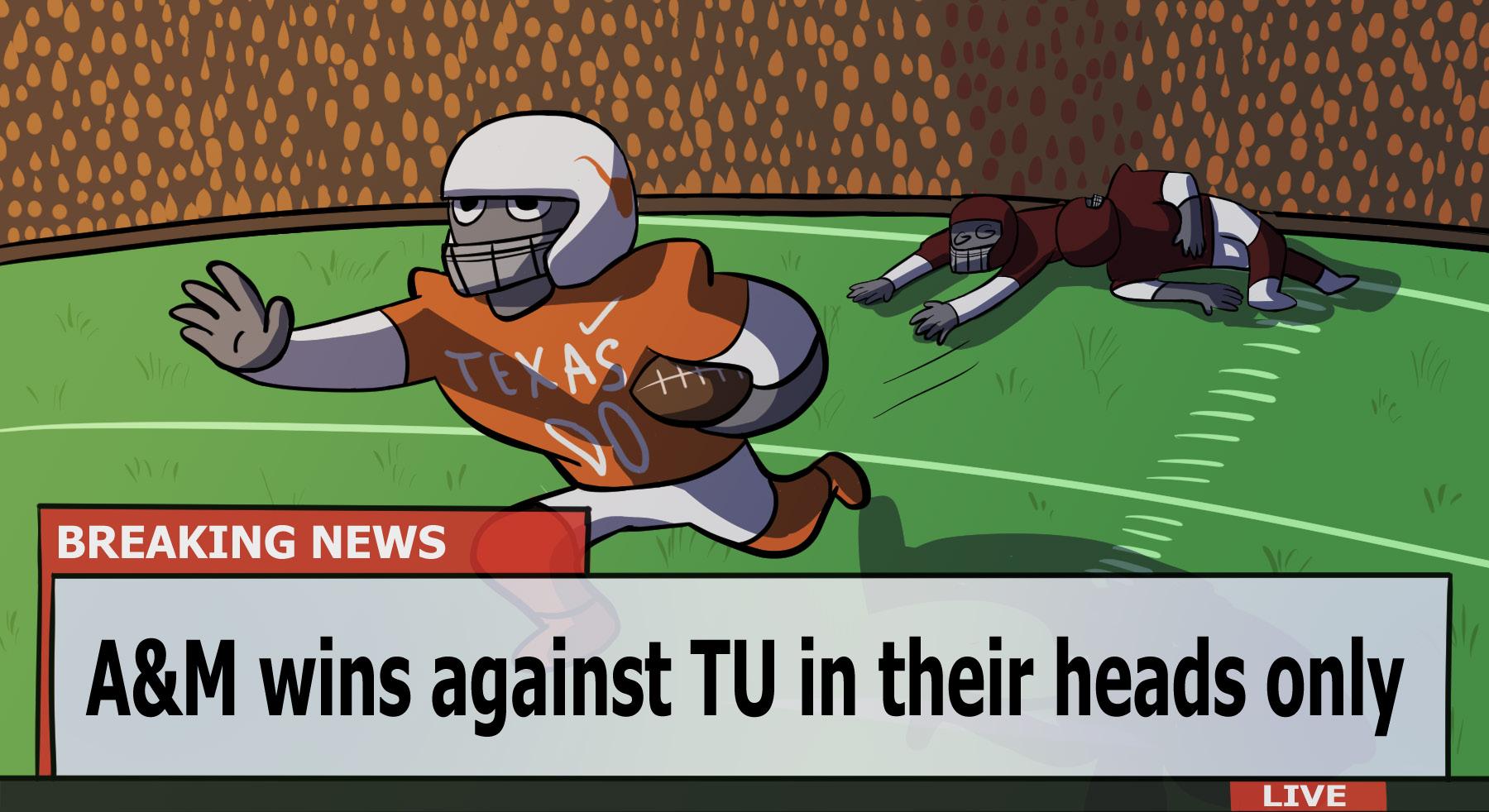
That raises the question of what I believe is going to happen this year: Will the Texas A&M Aggies finally beat the Texas Longhorns, or will I go bald like A&M head coach Mike Elko? Hopefully, whatever is best for my hairline will happen, but I am no optimist!
Here is a list of my predictions for 2026. May we hopefully reheat 2016’s nachos and have at least half of the number of wins as this year’s football season!
Jan. 30: Charli XCX’s mockumentary film “The Moment” is released, causing a nationwide shortage of cocaine.
Feb. 1: Addison Rae wins Best New Artist at the 68th Annual Grammy Awards. If this doesn’t end up happening, I will drop out of school and become a barista.
Feb. 3: Plato is revived from the dead and enrolls at A&M.
Feb. 8: Plato is arrested by A&M police for being “too woke.”
Feb. 20: Plato is sentenced to death for the crime of liberal indoctrination.
Feb. 25: Plato dies again, 2,400 years later — this time by lethal injection.
March 5: While giving a sermon at A&M, Sister Cindy predicts the end of the world and starts a cult to save as many hedonistic college students as possible.
April 11: Sombr releases good music — nobody ever said that my predictions had to be realistic!
May 8: Sister Cindy’s cult builds a commune on the remnants of the A&M University at Qatar campus.
May 15: The AI chatbot girlfriend of a computer science major graduates from
A&M after passing all classes with a 4.0
GPA.
June 8: Aidan Ross and Niall Horan perform at Kyle Field.
June 25: The next “6-7” is born: It’ll be called “129” and will represent the number of times that I had to listen to the “We Are Charlie Kirk” song on TikTok.
July 11: Dubai chocolate-flavored Ozempic is released.
Aug. 1: Taylor Swift ends her engagement to Travis Kelce.
Aug. 3: A rumor starts to spread that Marcel Reed is in a secret relationship with Swift.
Aug. 25: Former university president M. Katherine Banks is reinstated.
Aug. 26: As her first executive order in her new role, Banks shuts down The Battalion again. Nobody seems to care that much.
Sept. 5: The Aggie football season starts again! Swift is seen at Kyle Field, confirming that the Reed dating rumors are true.
Oct. 3: It’s October 3rd!
Oct. 24: Defeating Alabama at its home stadium, A&M has gone 8-0 with the support of Swift attending every game.
Nov. 1: Disappointed by the rise of feminism at A&M due to Swift’s presence, the A&M University System Board of Regents mandates every female Aggie listen exclu-
sively to Ye’s discography and Joe Rogan’s podcasts. They also fire Banks for being a woman.
Nov. 8: The Board of Regents rehires Mark A. Welsh III as the president of A&M — what could go wrong this time?
Nov. 26: Right before the rivalry game against Texas, Swift breaks up with Reed and starts dating Arch Manning. She also drops a surprise country album called “Moving on to Longhorn Pastures.”
Nov. 27: A&M loses to Texas.This would have happened even if Swift hadn’t broken up with Reed.
Dec. 4: In an attempt to recreate the success of “Heated Rivalry,” Netflix creates “Heated Robbery,” a passionate love story based on two of the male Louvre robbers.
Dec. 13: Labubus take over the world after being upset that everyone forgot about them for a whole year.
Dec. 18: A&M’s loss to Texas is so bad that they’re not even selected for the College Football Playoff. Battered Aggie Syndrome decimates the entire campus.
Dec. 27: Mike Elko gets a hair transplant. He no longer has to wear a hat all the time.
Wyatt Pickering is a business honors and finance junior and opinion columnist for The Battalion.
Revenge as a corrective, necessary, vicious cycle
By Isabella Garcia Opinion Columnist
Rating: 9/10
Spoilers ahead for “Kill Bill: The Whole Bloody Affair.”
Some things, once done, can never be undone. What ensues is vengeance — easy enough to enact on our enemies, sure.
But what about vengeance on those whom we love most? Who else has the power to hurt us so deeply, for that matter? And when is revenge ever truly justified?
This is exactly what Quentin Tarantino sets out to answer in the newly re-released “Kill Bill: The Whole Bloody Affair,” his original and fully colored cut of the “Kill Bill” saga in all of its unabashedly bloody, 4.5-hour glory.
The plot centers on Uma Thurman as Beatrix Kiddo, also known as “The Bride,” who awakens from a coma. Her former leader and lover, Bill — played by David Carradine — betrays Beatrix by ordering the other members of the Deadly Viper Assassination Squad, or DVAS — Vivica A. Fox as Vernita Green, Lucy Liu as O-Ren Ishii, Michael Madsen as Budd and Daryl Hannah as Elle Driver — to kill her, her fiance and everyone else with them during their wedding rehearsal.
In her final moments, as she’s speaking to Bill while lying beaten within an inch of her life, Beatrix reveals she was carrying his unborn child. He then proceeds to shoot her in the head.
Tarantino hence sets forth the impetus for what is perhaps the ultimate revenge story, with Beatrix determined to, as you might guess, kill Bill.
Deserving revenge
The film throws us in medias res with the confrontation between Beatrix and Green, as one member of the DVAS has already met their end at Beatrix’s hands off-screen. Green pleads with Beatrix to let her live: She’s a changed person now; she’s become a mother, and if she could go back and change things, she would.

But Beatrix tells Green’s 4-year-old daughter, Nikki, while standing over Green’s dead body: “Your mother had it coming.” In other words, revenge doesn’t give a damn; you deserve what’s coming your way.
The decision to begin in the middle of Beatrix’s vengeance story structurally echoes the notion that your actions have consequences, regardless of what you do or how much you change in the interim.
Yet, Tarantino shows us there are two sides to revenge. Green deserved to be killed, yes. But what of innocent Nikki? Why did she deserve to have her mother taken from her?
Beatrix says she’ll be waiting for Nikki when she grows up if she still feels “raw about it,” illustrating the nuance that deserving to enact revenge is just as important as deserving to receive it. This is the same reason Bill doesn’t want Beatrix to be poisoned while in her coma, despite knowing that she will come to kill them all if she ever wakes up.
Revenge is thus depicted as a comeuppance, and any attempts to unfairly thwart it — whether it be killing Nikki before she becomes old enough to fight back or preventing Beatrix from waking up from her coma — would be robbing someone of their rightful justice.
Beatrix narrates that fate has a way of smiling on revenge, making it seem as though not only does God exist, but you’re doing his will.
As such, we’re shown that revenge operates as a divine justice. Amplified by Beatrix’s samurai sword — the film’s ultimate and iconic revenge weapon — it is presented to us with heavenly music in the background and an almost ethereal glow.
But it isn’t always as straightforward as the simplistic, canonical depictions of revenge we’re all too familiar with.
On one hand, Bill is responsible for destroying the life Beatrix tried to build and killing the people she cared about — so she set out to kill him. Though we later find out her child was taken under Bill’s care, she spent every waking moment thinking her baby had died when he shot her.
As we come to learn, however, Beatrix and Bill were deeply in love, and she pursued her new life by abandoning him on her last assassination mission without so much as a goodbye.
So, on the other hand, Bill spent every waking moment thinking the love of his life had died.
Beatrix may not have physically harmed
Bill, but she nonetheless hurt him so deeply that she may as well have. It then becomes not a question of whether Beatrix deserved retribution, but how much. And when the man she betrayed was the leader of what is known as the world’s most deadly assassination squad, not only does the question answer itself, but — even if you don’t agree — what did you expect?
Betraying your true self
What seemed to be the ultimate betrayal to Bill, however, was not that Beatrix betrayed him, but rather that she betrayed herself.
In the film’s final chapter titled “Face to Face,” Tarantino gives us Bill’s infamous Superman monologue.
Other superheroes must put on an alter ego to assume their superhero form. But Superman was born Superman; he wakes up a superhero and goes to bed one. Similarly, Beatrix was born to be a killer, and the costume she put on with her new life as Arlene Plympton was no more indicative of her true self than Clark Kent of Superman, which she admits.
Bill’s actions are thus a result of Beatrix abandoning him for a life she wouldn’t even have been happy to live. But what Bill couldn’t understand is “once that strip turned blue,” it wasn’t about Beatrix anymore: It was about her daughter.
Yes, Beatrix would’ve been denying herself who she really wanted to be, but by removing the sway of Bill’s master-assassin presence as well, at least she would’ve granted her daughter the opportunity to grow up as whoever she wanted to be.
We all come to a point in our lives where we must decide whether living in bad faith justifies the path we’re on.
As Beatrix finally killed Bill, her existential battle ended with being a mother instead of being the deadliest woman alive. The lioness rejoined her cub, and all is right in the jungle.
And so, Tarantino concludes this odyssey with a simple message. Regardless of how vehemently you may try to avoid — or accept — your comeuppance, just remember this:You’ve got it coming.
Isabella Garcia is an economics senior and senior opinion columnist for The Battalion.





Preheating is in full swing as Aggies aim to bring
By Ava Loth Associate Sports Editor
The concept of an offseason is virtually nonexistent for golfers in Texas. With the conclusion of the fall semester, as days got shorter and temperatures started to drop, Texas A&M men’s golf continued to bring the heat.
The Aggies’ fall road run included five tournaments, from which they brought home two first-place titles and a third-place finish. With team trophies piling up in the display case, the Fightin’ Farmers figured the best way to get a hot start in the spring was to stay hot, even whilst not in season.
After a month-long hiatus, with the inaugural Maroon & White Cup in between, the Aggies navigated their way to tournaments across the globe — this time individually — in a proud display of maroon and white.
The White Sands Bahamas Men’s Invitational welcomed a recurring trio from the starting five. The efforts of one in particu-
lar, however, marked a pace greater than the majority of the 70-person field.
Just two strokes shy of first place, sophomore Wheaton Ennis settled in a spot he had grown all too familiar with. A threespot jump in the final day resulted in a tie for sixth place, marking his third sixth-place finish in three consecutive tournaments, two of which previously contributed to A&M’s first and third-place finishes that capped off its season.
The junior pair of Kris Kuvaas and Aaron Pounds joined the competition at The Ocean Club Golf Course at Atlantis as well.
As the newest Aggie addition, Kuvaas finished his three rounds at 1-under, landing him in a tie for 26th place.
Pounds had a successful fall run, as he took home one individual title along with two top-five finishes. Even with three atypical rounds in the Bahamas from The Woodlands native, he still managed to walk away with a 9-over three-day total.
With a sole appearance in the Aggie lineup over the course of the fall, sophomore Alex Long made his second showing in both the Orlando International Amateur Championship and the New Year’s Invitational.
The Florida native marked a placing he hadn’t yet reached in his collegiate career. A 6-under three-round total in Orlando secured Long a fourth place finish, just four strokes away from first.
Ennis settled for just a moment before he put back on the maroon and white, this time with an invitation to the Patriot All-America in Litchfield Park, Arizona.
Faced with 82 golfers from the cream of the collegiate crop, Ennis stood as the lone Aggie at the Wigwam Golf Club. Carding two rounds under par, he put up a 1-under three-round total and shared a tie for 11th place.
The Fightin’ Farmers will travel coast to coast this spring, with seven events on their plate before they enter the postseason in late April.
Last year, the Aggies dealt with sour endings during such title races. Enduring three rounds of stroke play and three rounds of match play, they bit the bullet in the final day against the then-No. 8 Florida Gators, 1-4, losing grip of what would’ve been the program’s first Southeastern Conference title.
A&M couldn’t find a break in its favor at the national level either. While the Aggies
marked a runner-up finish in the regional tournament, the championship was another story. Even with former student Phichaksn Maichon placing second and recording the best national championship finish in program history, the Aggies still couldn’t pull it off.
After four rounds, they missed the cutoff needed to advance to the match play portion of the championship by five strokes. However, the Aggie swings have seen some major strides in improvements since then.
Pounds jumped 134 spots in the national ranks since the end of the spring season, where he currently sits at No. 29. Ennis has maintained his position inside the top 100 at the No. 89 spot.
A&M’s head coach Brian Kortan will continue his fifth year leading the Maroon and White, and while he hasn’t brought a conference or national title home, he has strung together a group that is capable of doing so.
A&M now patiently awaits
A&M roster roundup ahead of anticipated 2026 season
By Matthew Seaver Sports Editor
In the modern age of college football, programs are required to reshape nearly their entire roster through the transfer portal, bidding on players while acting as a de facto collegiate free agency. Texas A&M football is certainly no stranger to the portal, having previously used it to bring in several key players en route to the Aggies’ historic 2025 campaign.
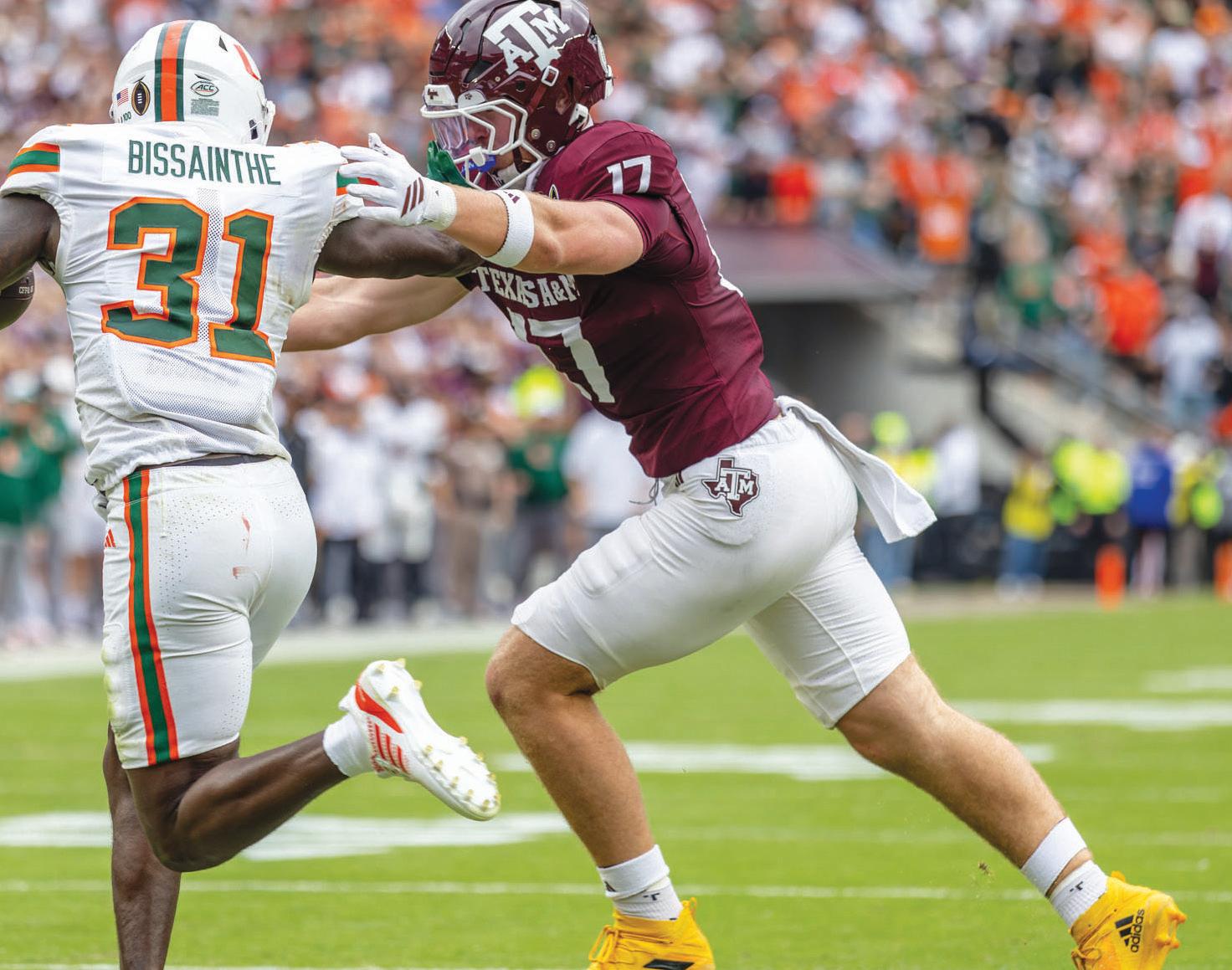
However, after National Championship runner-up Miami having its season ended A&M’s season in the first round of the College Football Playoff, the Aggies and head coach Mike Elko had no choice but to reshape the roster. The Aggies bid farewell to numerous contributors on both sides of the ball, as A&M was faced with massive roster turnover.
By the end of the 15-day window from Jan. 2-16, the Maroon and White acquired 17 players while losing 11 to other programs around the country. Senior safety Bryce Anderson was the lone player to withdraw from the portal, eventually deciding to return to College Station for his final year of eligibility.
A majority of the players who exited A&M were understudies in search of more playing time, headlined by redshirt freshman quarterback Miles O’Neill, who committed to North Carolina after spending last season as the Aggies’ backup. While the Aggies did not bring in any transfer talent to the QB room, they did retain freshmen QBs Brady Hart and Eli Morcos.
The trenches were by far the area requiring the most focus in the portal for the Fightin’ Farmers after losing 4 of 5 starting offensive linemen, as well as their entire starting defensive line. A&M made its commitment to overhauling the “Maroon Goons” evident by bringing in four offensive linemen in the portal, all of whom have starting experience in the Southeastern Conference.
Signees included a pair of LSU Tigers in redshirt freshman offensive lineman Coen Echols and redshirt sophomore OL Tyree Adams to go along with junior OL Trovon Baugh from South Carolina and redshirt sophomore OL Wilkin Formby from Alabama. Even so, A&M did lose a promising prospect in the portal after former four-star recruit freshman OL Jonte Newman transferred to rival Texas.
On the defensive side of the trenches, replacing 2025 SEC Defensive Player of the Year redshirt senior defensive end Cashius Howell is easier said than done. But Elko, newly promoted defensive coordinator Lyle Hemphill and rejoining defensive line coach Elijah Robinson did their best by recruiting five diverse D-linemen from around the country that boast a combination of proven experience and untapped potential.
Joining the Aggies’ pass rush are the duo of redshirt junior DE Ryan Henderson from San Diego State and redshirt junior DE Anto Saka from Northwestern, while reinforcing the interior are the trio of redshirt freshman defensive tackle Brandon Davis-Swain from Colorado, sophomore DT Angelo McCullom from Illinois and redshirt junior DT CJ Mims from North
Carolina.
Notable departures from the DL room include redshirt freshman DE Solomon Williams to Cal, redshirt sophomore DE Rylan Kennedy to Florida State and redshirt freshman DT Dealyn Evans to Mississippi State.
Another significant contributor A&M must replace on its defense is team captain and leading tackler junior linebacker Taurean York, who announced he will forgo his final year of eligibility in favor of entering his name for the 2026 NFL Draft. In an attempt to fill the gaps at linebacker, the Aggies brought in Tulsa junior LB Ray Coney and Houston Christian sophomore LB TJ Smith. In addition, A&M saw redshirt sophomore LB Tristan Jernigan head to Cal alongside Williams.
Coney is a freak athlete who has risen the college football ranks after beginning his career at East Tennessee State, while Smith is the older brother of current A&M commit in the 2027 class, four-star DL Myels Smith.
Names exiting the Aggies’ secondary in clude redshirt freshman S Jordan Prided to Southern Miss, freshman cornerback Co bey Sellers to Vanderbilt and junior CB Jay von Thomas to SMU. All three failed to find playing time in Aggieland and will seek to find the field with other programs.
Only two names transferred into the A&M secondary: Colorado junior S Tawfiq Byard and Tennes see junior CB Rickey Gibson III. Byard is a feisty box safety, unafraid of creat ing contact, while Gibson is a prototypical boundary corner with NFL potential.
Back on the offensive side of the ball and headlining the portal class for the Aggies is Alabama redshirt junior wide receiver Isaiah Horton, who led the Crimson Tide in re ceiving touchdowns last season with eight. Bringing the beef to the tight end room is the duo of UTSA redshirt junior TE Hous ton Thomas and Fresno State redshirt soph omore TE Richie Anderson III. Thomas is a College Station native and athletic pass catcher, while Anderson is a plus blocker at the position.
Another offensive departure is that of redshirt freshman WR Izaiah Williams, who followed former A&M offensive coordinator Collin Klein to Kansas State, where the latter will be making his head coaching debut. Rounding out the exits was redshirt junior TE Theo Melin Öhrström, who will be heading across the state to SMU after failing to break out in Aggieland.
Junior kicker David Olano from Illinois caps off the portal class for A&M on special teams. He will be a breath of fresh air for the 12th Man, replacing graduate K Randy Bond, who had the seventh-worst field goal percentage of any full-time kicker in the country. In two seasons with Illinois, Olano is 37-for-43 and notably hit two game-winning kicks in 2025.
Creating consistent success within a program is more difficult than ever. Nonetheless, the Aggies and Elko have certainly made a valiant effort by bringing in a significant amount of talent to College Station. A&M boasts the third-highest-ranked portal class according to On3, just behind Texas Tech and National Champion Indiana.Whether or not these portal players end up making a name for themselves with the Maroon and White remains to be seen, but Elko has clearly created an attractive location where competitive players can flourish.



Review of A&M’s top NFL producers on the big stage, with young bucks, savvy veterans
By Noah Ruiz Associate Sports Editor
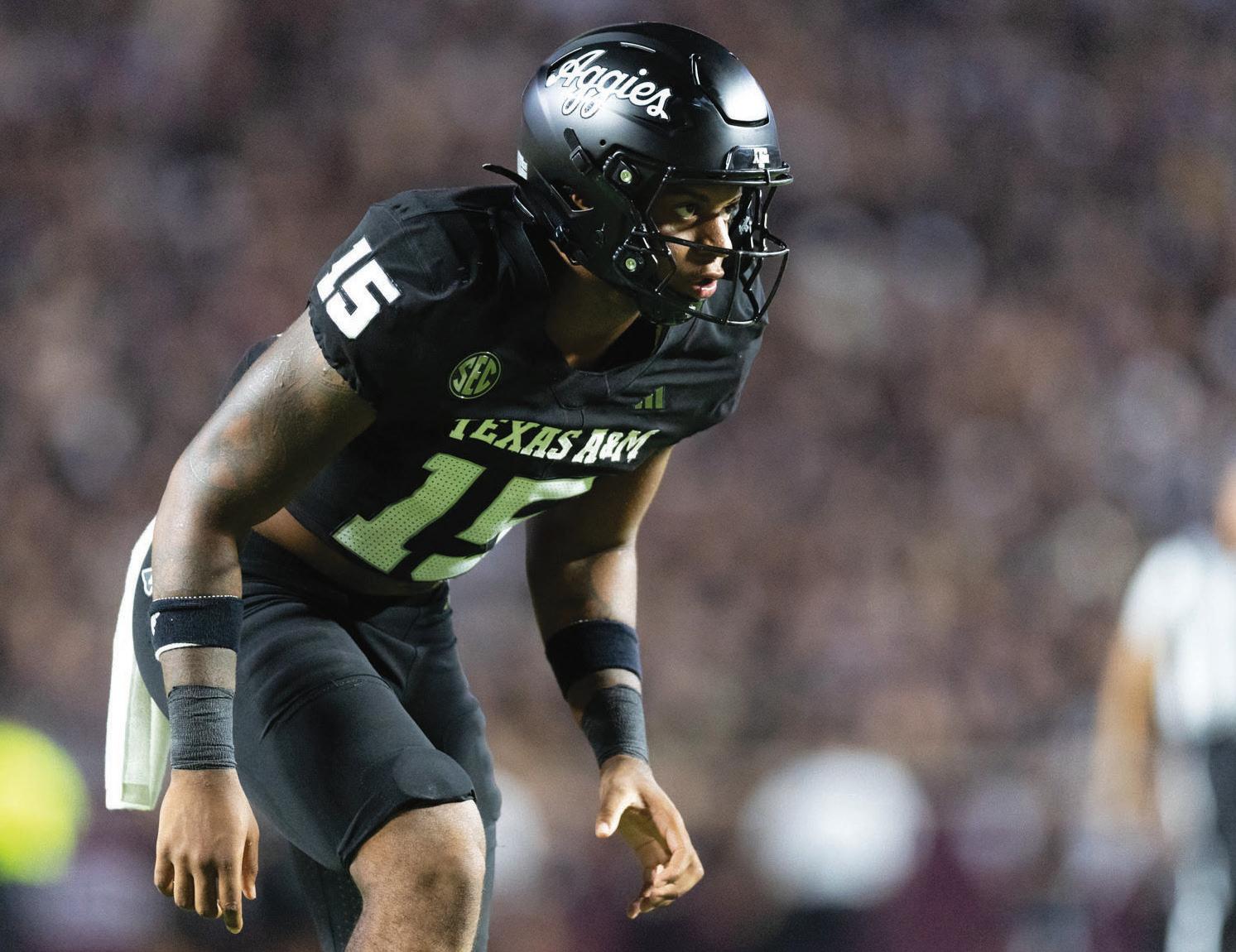
Forged from the fiery confines of Kyle Field, Texas A&M football is making its presence known across the NFL, with its former players changing the game for the better. From speedsters on offense to gridiron legends on defense, Aggies can be found across the professional landscape, showing off the talent they once flashed before the 12th Man.
With Super Bowl LX lying just over the horizon, it’s as fitting a time as ever to take a look at which former A&M big-shots have translated their College Station development into bona fide stardom in the 2025 NFL season.
Myles Garrett, defensive end, Cleveland Browns
The most obvious choice to begin the list is defensive end Myles Garrett, a former Aggie standout who has far exceeded expectations as the No. 1 overall pick in 2017. Fresh off a monster $160 million contract extension, Garrett proved to the Cleveland Browns — and the NFL — that he was indeed worth the money.
With his sixth straight All-Pro selection, Garrett delivered the greatest season ever from a defensive end, breaking the
single-season sack record with 23 in 2025. The feat was accomplished in 100 fewer pass-rushing snaps than the previous record holders of T.J. Watt and Michael Strahan, as Garrett will live on forever in NFL history and is en route to his second Defensive Player of the Year selection.
Antonio Johnson Jr., safety, Jacksonville Jaguars
A recent addition to the NFL Aggie club, safety Antonio Johnson played a critical role in rookie head coach Liam Coen’s AFC South-winning Jacksonville Jaguars squad. Johnson proved in 2025 as a former fifthround pick that talent can come from anywhere in the draft.
The three-year veteran snagged five interceptions this season, which is tied for the second most in the league. His latest pick was returned 58 yards for Johnson’s first career touchdown, as he helped clinch a playoff berth for the folks in Duval County, Florida.
De’Von Achane, running back, Miami Dolphins
Another member of the 2023 NFL Draft class alongside Johnson is running back De’Von Achane, who maintained his lightning quickness that once struck over 100,000 fans in Kyle Field. Achane’s first-ever Pro Bowl selection cushioned an otherwise dismal season from the Miami Dolphins, as the speedy back boasted prolific numbers in his first year as RB1.
Achane’s 1,350 rushing yards ranked fifth
in the league, while his 488 yards through the air ranked fourth among running backs, a testament to the sheer amount of versatility his position demands in the modern day of professional football. When adding in his 12 total touchdowns and lack of a single turnover to the equation, it’s clear to see Achane’s potential is sky high as his career continues to gain momentum.
Edgerrin Cooper, linebacker, Green Bay Packers
While some professionals seem to hit a sophomore slump in their second year in the NFL, linebacker Edgerrin Cooper was determined to ensure such a drop-off in production would play no part in his rookie season follow-up. A member of one of the league’s youngest and most physical linebacker corps, Cooper emerged as a vocal leader of Green Bay’s defense in 2025, posting the team’s second-best tackling tally with 118 total.
Whether it was stopping the run or dropping back in coverage, Cooper delivered the edge to all defensive situations with four passes defensed and 8.5 stuffs at the line of scrimmage. And with ample time to develop further with the Packers, Cooper has assuredly set a precedent of excellence in 2025.
Von Miller, outside linebacker, Washington Commanders
Youth is a fleeting commodity in the NFL, as rookie phenoms and other young bucks are often left chasing the highs of
their first moments in the league by the time they are deeper into their professional careers — but not in the case of outside linebacker Von Miller.
At 36 years old, Miller continued his 15-year terror in the backfield in 2025 by wrapping up quarterbacks nine times this season, ranking 19th in the league. More impressively, Miller was the second-oldest pass rusher in the NFL, behind only 39-year-old Arizona Cardinal Calais Campbell. While perhaps far removed from his Super Bowl 50 MVP heroics, Miller has ultimately withstood the test of time, with 2025 adding even more accolades to his Hall of Fame career.
Tyrel Dodson, inside linebacker, Miami Dolphins
Rounding out the list of NFL Aggies is LB Tyrel Dodson, a six-year veteran who is finding his place in Miami after bouncing around the league his first five seasons. After going undrafted in 2019, Dodson spent time with the Bills and the Seahawks before finally solidifying himself as a starter in two years with the Dolphins.
Like his Aggie teammate Achane, Dodson made the most of a disappointing Dolphins season, producing at a high level and tallying a career-high 129 tackles, good for second on the team.
Dodson did all one could ask of a linebacker, racking up five sacks, four passes defensed, a forced fumble and an interception. Good things happen to those who wait, and that’s exactly what Dodson is getting in his first full-time role with the Dolphins.


Struggling start to conference play puts A&M in must-win territory against LSU, Missouri
By Brody Vaughn Sports Writer
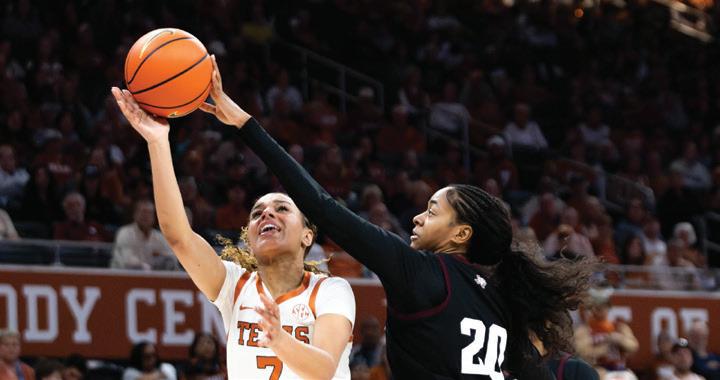
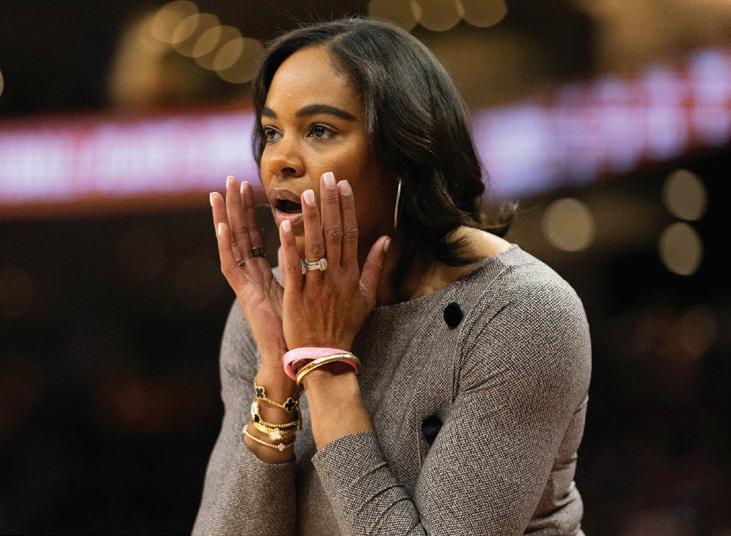
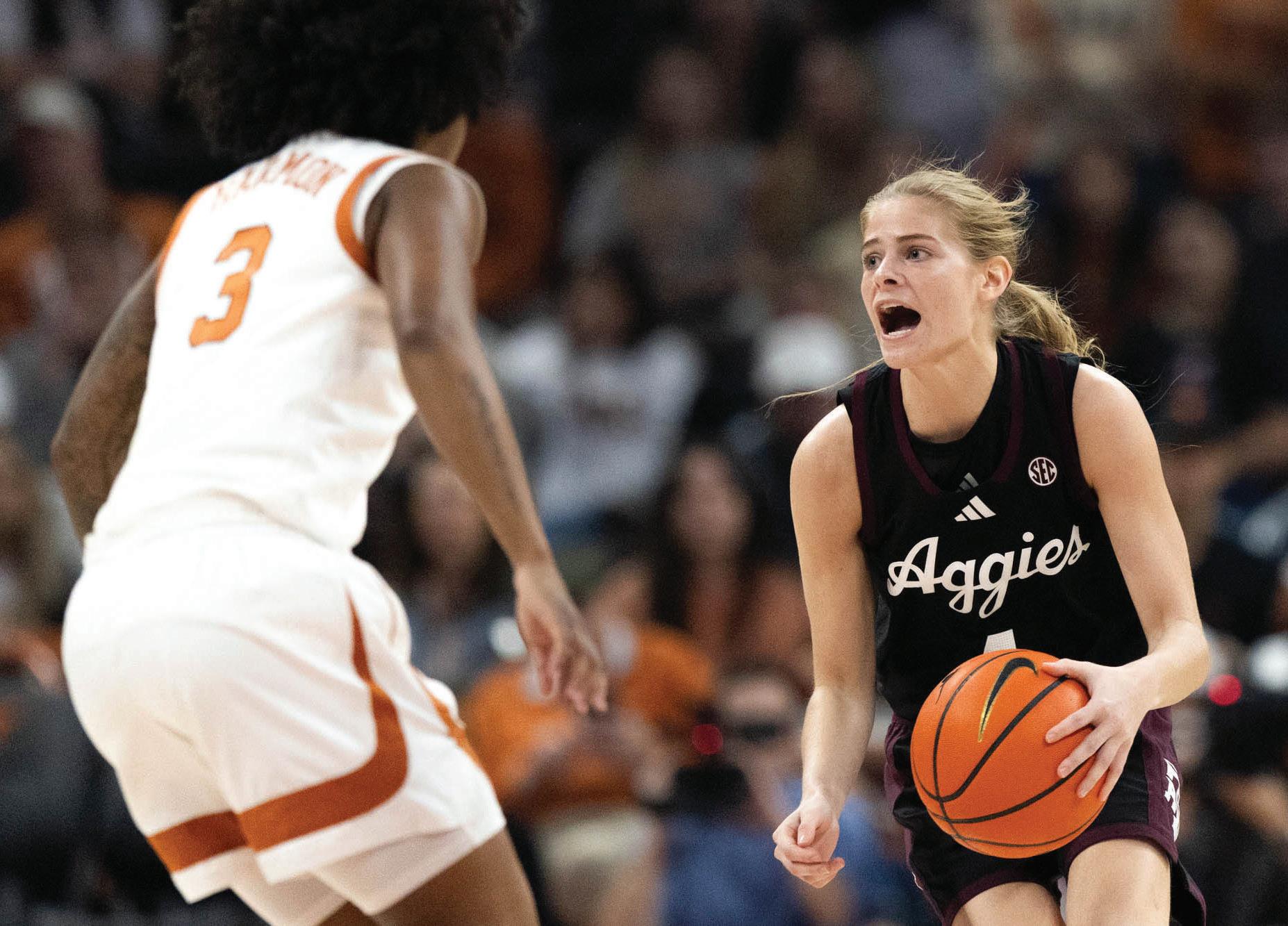
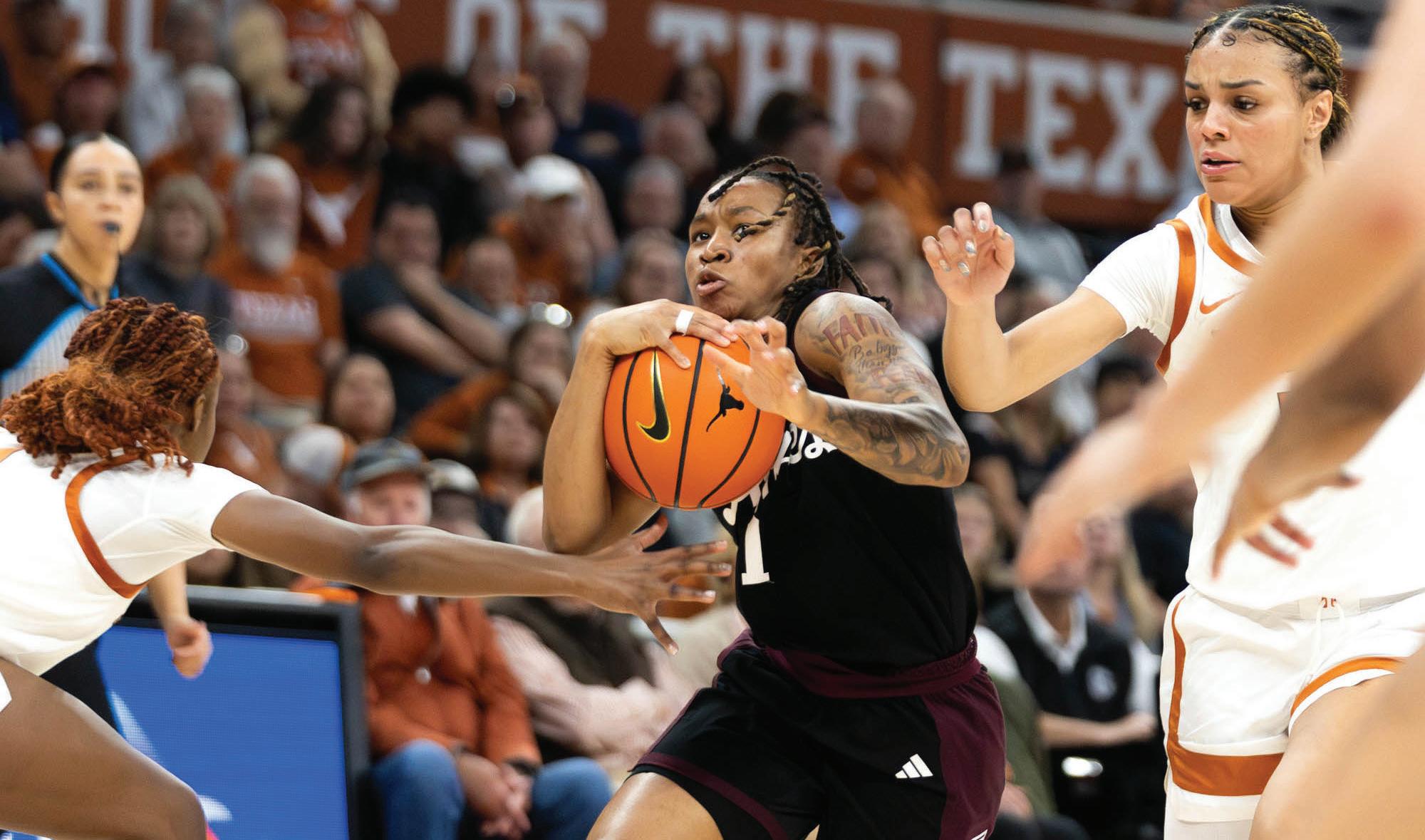
Coming off of a 1-4 start to Southeastern Conference play and a beatdown from rival No. 4 Texas, Texas A&M women’s basketball looks to get back on track against No. 6 LSU at Reed Arena on Thursday, Jan. 22, prior to traveling to Columbia, Missouri, to take on the Missouri Tigers on Sunday, Jan. 25.
The Aggies return to Reed Arena following an 80-35 blowout in the Lone Star Showdown. While only trailing by 10 at half, Texas went on to outscore A&M 46-10 in the closing quarters.
“That’s the thing that we need to get figured out, how we continue to maintain how we start,” head coach Joni Taylor said after the game against Texas. “We have to figure out how to finish the third and fourth quarter.”
The Maroon and White will need to handle their shooting woes to get back on track in conference play. A&M has dropped its shooting percentage to a mere 30.4% in conference games, a 10-point drop from its non-conference percentage of 40.4%.
For A&M, it will be a matter of flushing
its rocky start to conference play and looking forward to taking on its gauntlet schedule in the coming weeks.
“We got to get back in the film room, we got to figure out how to be better in the second half, but we have to learn from this game and move on,” junior guard Janae Kent said. “In this league you can’t sulk on losses. We just have to figure out how to get wins.”
Those wins won’t come easily, though, as the Maroon and White prepare to face the Tigers. Although LSU has gotten off to a 17-2 start, both of its losses have been to SEC opponents.
The Aggies will need to look out for senior G Flau’jae Johnson, who’s been electric beyond the arc this season. The Georgia native has shot 46% from three through 19 games, contributing to a team-leading 14.9 points per game. Additionally, A&M will need to keep an eye on junior G MiLaysia Fulwiley from the LSU bench, as she has been elite at drawing fouls this season. Her 50 made free throws this season lead the Tigers, and the Aggies will need to play clean to keep her away from the line.
LSU’s high-powered offense will give A&M plenty to handle on the court. The Tigers lead the country with 99.9 points per game, over nine points more than No. 1 UConn, who boasts a second-best of 90.1 points per game. If that wasn’t enough, the Tigers are also third in the nation in re-


bounds with 48.9 per game.
The Aggies will catch a bit of a break when they travel to Columbia to take on another Tiger squad on Jan. 25. Missouri is 13-8 going into this matchup, but like A&M, has struggled significantly in SEC play thus far, notching a 1-5 conference record.
A player to look out for is star junior G Grace Slaughter. Her 19 points per game rank 30th in the NCAA, while she also leads her team with 7.6 boards per game. As the Tigers’ offensive machine, the Aggies will need to keep Slaughter under control to leave Columbia with a win.
The Missouri defense is what A&M will need to exploit to find success as it ranks second worst in the SEC, allowing 72.1 points per game. The Aggies will have to shoot the ball at a high clip to capitalize on the Tigers’ defensive struggles.
“We need to figure out how to get a win at the end of the day,” Kent said. “Good game, bad game, it doesn’t matter, we have to get a win.”
These two matchups will be crucial for any postseason hopes the Aggies have left. As it sits 13th in the conference,Taylor’s unit is running out of time to boost its standing ahead of the SEC Tournament.
With a challenging slate ahead, the Aggies will need to flush their previous few blowouts and tame a pair of Tigers to keep their fleeting NCAA Tournament hopes