


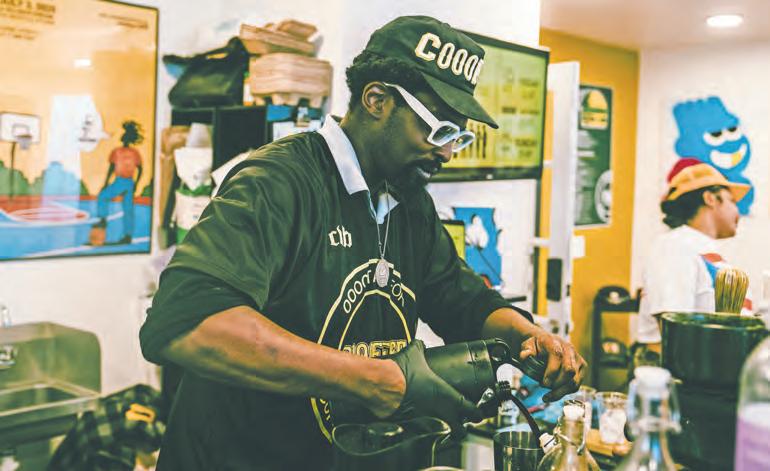
Coffee Was Black pours Black history, Caribbean flavors, and creative energy into every cup—redefining what coffee culture looks like in Atlanta. Photo by Tabius H. McCoy/The Atlanta Voice
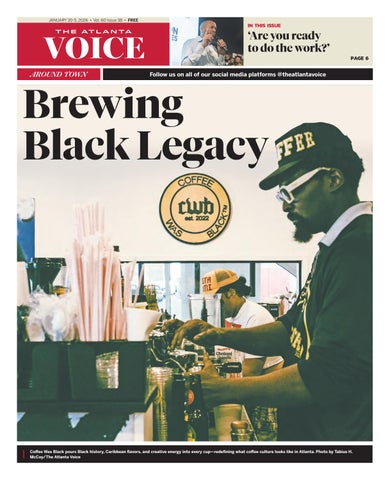
By TABIUS H. McCOy Report for America Corp
Within minutes of your feet clashing along the pavements of Auburn Avenue, the resonance of melanated excellence engulfs you. It’s a place where the heritage of Black ancestry, both the good, the bad, and the ugly, is embedded within its bricks, the air, and the soul of the avenue. The “richest Negro street in the world,” a title that history has tried to burn away, Ths Sweet Auburn Historic District still stands as the north star of what Black entrepreneurship is nearly a century later.
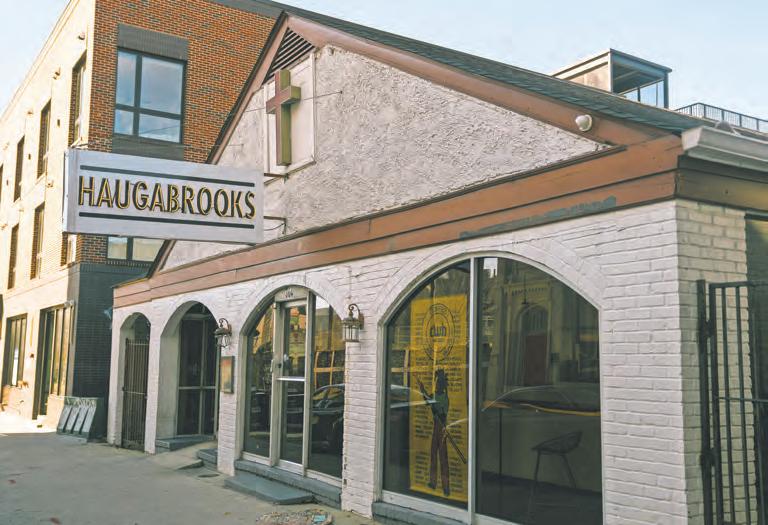
Along the street, the sound of a repetitive whisk and Black eclectic jazz creeps from the doors of the iconic Haugabrooks Funeral Home, clashing with the culturally
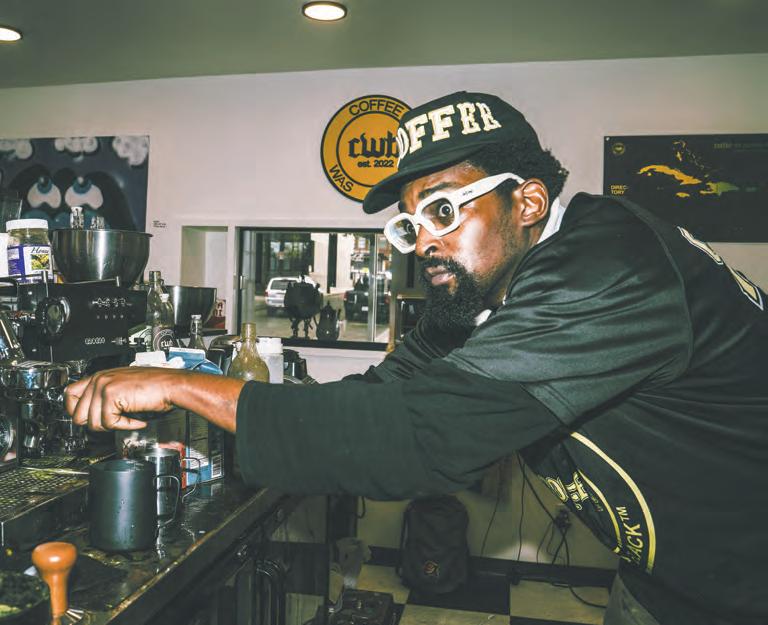
impending noise of highways 85/75. With green matcha dusted over his hands and his white spectacles popping against the melanin on his skin, Malcolm Voltaire moves with precision and accuracy, like that of a chemist or a state-of-the-art seamstress. The purple and green colors of the drinks fuse, creating a work of art with each drop.
On any given day, the room fills with a cross-section of Atlanta, from photographers, painters, and fashion designers to students, absorbing more than caffeine. There’s no rush to leave. Discussions in the room foster a unique synergy and ease the spirit, as paintings by local artists line the walls in an Afrocentric and artistic conclave. To the untrained eye, this is just a coffee shop. To those who know the soil, Coffee Was Black is a living extension of a history the textbooks

often leave out.
In 1929, Mrs. Geneva Morton Haugabrooks occupied and transformed this same room, doing what the world deemed impossible. She became a successful Black female multimillion-dollar business owner in the heart of Jim Crow. In an era when society, both intentionally and unintentionally, sought to make her a footnote in history, she instead created the blueprint. She was an architect of Black dignity, a titan of an industry who handled the souls of both those in legacy and in the present.
Today, Voltaire operates in that same place, pioneering in his own way. As a steward of her million-dollar blueprint, Voltaire and Coffee Was Black take a century-old drink and create a new generational twist, from its consumption to the energy and vibe it elicits. “Coffee Was Black is like the coffee for creatives,” is how Voltaire puts it best.
Raised in Atlanta, Voltaire carries the flavors of his Haitian father and Jamaican mother into every creation. In his early adulthood, his father transformed his view of coffee. “I thought coffee was nasty growing up,” Voltaire admits. “But my dad drank Bustelo every day. It connected us, and it changed how I saw coffee.” Signature drinks like Wah Gwan, Lion of Judah, and Yardie aren’t just names. They’re echoes of his lineage. Ingredients like ginger, hibiscus, and sorrel aren’t just flavors in the drinks he creates; they’re threads of heritage woven into each cup. The first drink he made, The Joy, was named after his mom.
“I named that after her because sorrel is one of those drinks that, when you talk to a Caribbean person, it doesn’t matter which island they’re from. Everybody’s got their own
See COFFEE on page 7
By DONNELL SUGGS
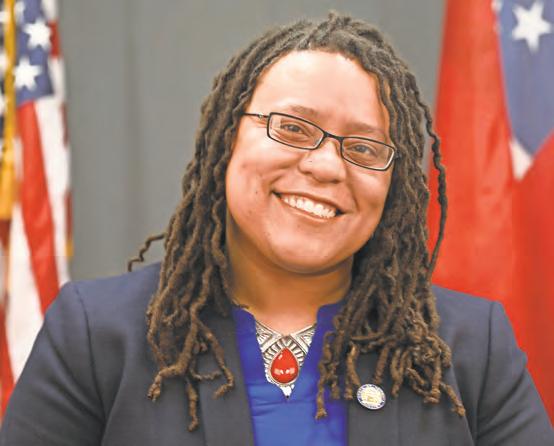
Georgia Senate Minority Whip Kim Jackson (D-Stone Mountain) recently introduced a bipartisan bill, Senate Bill 414, aimed at adding further protections for renters from landlords who might aim to hide important details of a rental agreement.
The bill, which is co-sponsored by Republican State Senator Russ Goodman, can be seen as an amendment to the Fair Business Practice Act of 1975, which protects renters of residential properties in Georgia. SB 411 will prohibit landlords from concealing the full rental price from tenants. Furthermore, the bill will keep landlords from charging fees that were not disclosed at the initial time of the rental agreement.
Jackson told The Atlanta Voice that the bill is important because rental fair practices aren’t always taking place in a city and metro area growing faster than any other in the country.
“It’s important to me because I am watching people get fleeced by their landlords,” Jackson said. “This bill is about people, it’s about affordability.”
Jackson said she not only hears rental nightmare stories from her constituents, but she has even heard a similar tale from her sister.
“It’s a bipartisan bill, so it should be supported,” Jackson said. “I’m hopeful.”
The bill summary is as follows:
A BILL to be entitled an Act to amend Part 2 of Article 15 of Chapter 1 of Title 10 of the Official Code of
Georgia Annotated, relating to the “Fair Business Practices Act of 1975,” so as to encourage transparency and fairness with respect to rent pricing for residential properties; to prohibit landlords from failing to disclose the total rental price of any residential property and charging hidden fees for any residential property; to provide for definitions; to provide for statutory construction; to provide for related matters; to provide for an effective date and applicability; to repeal conflicting laws; and for other purposes.
More than 32 percent of metro Atlantans rent, according to data from bestneighborhood.org. According to data from apartments.com, the average rent for an apartment in metro Atlanta is $1,600 per month.
By LAURA NWOGU
The Development Authority of Fulton County voted to provide a $16 million tax break to Amazon as the multinational tech company seeks to invest $500 million in an inactive warehouse on Campbellton Road and turn it into a robotics facility. The facility, much like the one located in Stone Mountain, will use robotics to store, package, and fulfill orders.
The investment would create 750 jobs for residents of South Fulton and is expected to generate nearly five times as much in tax receipts in a year.
Mayor Carmalitha Gumbs, South Fulton’s first female mayor, said the Amazon facility would be a “wonderful” opportunity for the city to position itself as one of the industry leaders in the region.
“Our city is still very young. We’re a nineyear-old city, and we’re still a bedroom community, so a lot of our tax base is based on our home ownership. Bringing in such a global partner will actually kind of help alleviate some of that tax burden,” Gumbs said.
“These are the types of things that we’ve been looking forward to as the city grows.”
Gumbs said that they’ll continue to show Amazon that South Fulton is a good partner and the right choice to develop the new facility.
“We’ll address any type of community relationships that we are trying to build. At this time, we are just hoping that they do decide to come to our city, but we will do our very best to make it a more inviting place so that they will have no other opportunity but to say yes to the City of South Fulton.”

By NANTALIE PORCHER
Across economic downturns, the same groups are affected first and helped last. This is not a coincidence. It is the result of how unemployment systems operate. These patterns repeat across industries and economic cycles. When layoffs occur, the same workers are typically the first to be pushed out. When recovery begins, the same workers are told to wait.
Education and effort do not change the order. The system does.
Job loss is not an abstract concern. Employers have announced more than one million job cuts nationwide in recent years, according to data tracked by the employment consulting firm Challenger, Gray and Christmas.
When the economy tightens, Black workers are consistently more exposed to layoffs and slower recoveries. According to the U.S. Bureau of Labor Statistics, Black unemployment has remained higher than white unemployment for decades, often at roughly double the rate.
That gap persists across economic conditions. It appears during recessions and in so-called strong labor markets. It also persists across education levels, which makes it clear this is not about work ethic or preparedness. It is about how the labor system functions under pressure.
Black women face additional strain inside that system.
They are more likely to work, shoulder caregiving responsibilities, and experience job instability when workplaces downsize. Analysis from the Economic Policy Instituteshows that Black women experience consistently higher unemployment rates than white women, even when overall employment is growing.
I did not learn this from charts alone. I learned it through my work building Buy From A Black Woman, where I spent years working alongside entrepreneurs, workers, and small business owners navigating layoffs, unstable income, and inconsistent access to support. I saw what happens when people follow the rules and still fall behind because

To change the “last-hired, first-fired” dynamic, Black workers need leadership that understands why it happens — and how to fix it. Photo credit: iStock.com/fizkes
the system moves slowly or rigidly — or does not respond at all.
When unemployment benefits are delayed, the impact is immediate. Missed income turns into missed rent. Gaps in work turn into childcare crises. Confusing processes often lead people to give up altogether. Those workers often disappear from the data, but not from the consequences.
Labor systems are often described as neutral. In practice, they reflect the assumptions on which they are built. When systems do not account for real-life situations — such as job gaps, caregiving, contract work, or transitions between industries — they reward flexibility and penalize instability. Over time, that design produces predictable outcomes.
That is why leadership matters.
In Georgia, that leadership structure is especially important. Georgia is one of only four states in which voters elect their
Labor Commissioner rather than an elected official appointing someone to the position. That means the person overseeing unemployment insurance, workforce development, and labor systems is directly accountable to the public, not insulated from it.
When negative employment outcomes persist, year after year, voters can ask why. And when systems fail to respond to the realities of work, leadership can be changed. That is why I decided to run for Georgia Labor Commissioner. I do not believe the outcomes we see in our labor system are inevitable, especially for the workers who have been left behind most consistently.
This is not about serving one group at the expense of another. It is about recognizing patterns and refusing to accept them as permanent. When a system produces the same unequal results year after year, the problem is not the people
moving through it; it is the system they are moving through.
Fixing that structure requires more than updated language or new timelines. It requires standards. Systems should be understandable without insider knowledge. They should respond to routine life changes without turning them into crises. And they should be evaluated based on outcomes, not intentions.
Black unemployment is not just a statistic; it is a signal. It tells us where systems fail under stress. Ignoring that signal does not make labor systems stronger. It makes the cost of failure higher for families, communities, and the economy as a whole.
That is the work I have been doing for years. And that is the work I am prepared to continue.
Nantalie Porcher is a Georgia-based workforce and small business advocate with experience in education and community development, and a candidate for Georgia Labor Commissioner.
FOUNDED
May 11, 1966
FOUNDER/EDITOR
Ed Clayton Immortalis Memoria
PUBLISHER/EDITOR
J. Lowell Ware
Immortalis Memoria
The Atlanta Voice honors the life of J. Lowell Ware.
PUBLISHER
Janis Ware
PRESIDENT/
GENERAL MANAGER
James A. Washington 2018-2024
EXECUTIVE ASSISTANT TO PUBLISHER
Chia Suggs csuggs@theatlantavoice.com
EDITOR IN CHIEF Donnell Suggs editor@theatlantavoice.com
GENERAL ASSIGNMENT REPORTERS
Isaiah Singleton isingleton@theatlantavoice.com
Laura Nwogu lnwogu@theatlantavoice.com
Noah Washington nwashington@theatlantavoice.com
BUSINESS REPORTER
Tabius H. McCoy tmccoy@theatlantavoice.com
EDITOR AT LARGE Stan Washington swashington@theatlantavoice.com
ADVERTISING, SALES & CIRCULATION
ADVERTISING ADMINISTRATOR
Chia Suggs advertising@theatlantavoice.com
SALES
RDW Jackson rdwadman@gmail.com
SUBMISSIONS editor@theatlantavoice.com
DIRECTOR OF PUBLIC RELATIONS
Martel Sharpe msharpe@theatlantavoice.com
CONTACT INFORMATION
633 Pryor Street, S.W. Atlanta, GA 30312 Office: 404-524-6426 info@theatlantavoice.com

By DONNELL SUGGS
State Rep. and gubernatorial candidate Ruwa Romman recently introduced House Bill 1012 at the Capitol. The bill would place a temporary moratorium on future data center projects in Georgia until 2027.
Romman sat down with The Atlanta Voice on Wednesday, January 21, to explain why she wanted to introduce the bill. “The goal is to allow municipal, county, and state-level government officials enough time to implement the proper regulations before we permanently alter the landscape of our state,” Romman said.
The Georgia Chamber of Commerce had already opposed the bill before sitting down with her, according to Romman.
Romman said the idea would be to give Georgians time to prepare for the upcoming Public Service Commission (PSC) election in November and the other seats that will need to be filled over the next year. The PSC seats play a major role in final decisions on energy-related projects. Current PSC Peter Hubbard, who won the seat in November 2025, will be back on the ballot in May for a full term. Another

seat on the commission is also up for a vote.
“All we’re saying is just give us some time to pass the legislation that makes sense, to allow Georgians to vote on PSC seats, to take a breather,” Romman said.
By DONNELL SUGGS
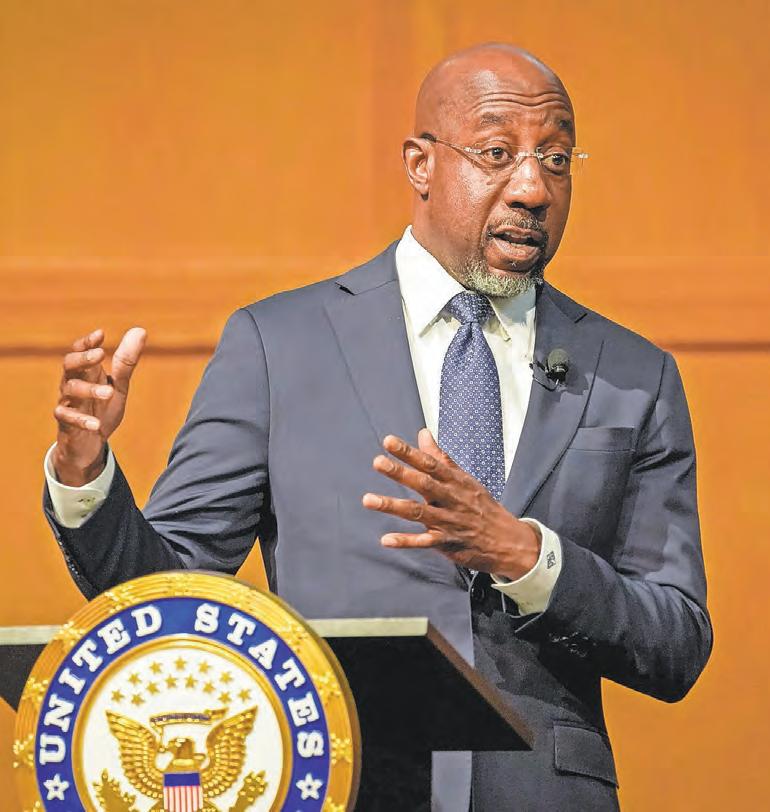
Georgia Senator Rev. Raphael Warnock and fellow lawmakers, including Georgia Congresswoman Nikema Williams, recently penned a letter to the Department of Justice and Attorney General Pam Bondi demanding the reversal of policy changes that are weakening gun violence prevention efforts and leaving Americans less safe.
“Routine gun violence should not be accepted as a fact of life, but I worry this administration’s efforts to dismantle investments in gun violence prevention will leave our communities less safe,” Warnock told The Atlanta Voice.
The letter opened with this statement: We write in service of our shared duty to keep all Americans safe from gun violence. By weakening programs that protect our communities from illegal firearms and stripping federal funding for violence intervention and prevention programs, the Department of Justice’s (DOJ) policies risk undoing crucial progress in mitigating the root causes of gun violence.
In September 2025, Warnock hosted a gun
violence prevention panel in Washington, D.C. The panel included Baltimore Mayor Brandon Scott, Birmingham Mayor Randall Woodfin, and former White House Office of Gun Violence deputy director Greg Jackson.
The letter used the reduction of gun violence in Baltimore as an example of how the programs that have faced reductions in funding helped keep the community safer.
Warnock’s home state of Georgia has also been affected by $3 million in cuts to DOJ grant funding, nearly $1 million of which was dedicated to youth violence intervention. There were 2,070 gun deaths in Georgia in 2023, according to data from a study done by Johns Hopkins Bloomberg School of Public Health. 129 of those deaths were of children ages 1-17.
Another line of the letter states: Americans of all political beliefs agree that we have lost too many lives to mass shootings and violent crimes in our country.
“That is why I’m demanding the administration reverse course on these changes so we can get back to work saving lives,” Warnock said.
committee for study and potentially brought back to the floor for a vote. Romman said she has bipartisan support for the bill.
“We’re not saying we don’t want data centers, we’re saying we want more time,” Romman said.
The news cycle in Georgia just doesn’t stop. Outside of the Capitol on that same day, a woman held a sign that read, “Georgia, treat our prisoners like human beings.” That woman, Dawn Arthan, is with the organization, Prison Health Georgia, and she was wearing a t-shirt that had the words “Incarcerated Lives Matter. She told The Atlanta Voice that she planned to return on Thursday. “I’ve been coming down here for years,” Arthan said.
While campaigning for governor, Romman said she has been hearing about how data centers are affecting people’s way of life all around the state.
The bill will need to be passed on to a
Across the street from the Capitol, in Liberty Plaza, multiple veterans organizations gathered for a rally opposing House Bill (HB) 108. The bill provides certain protections for veterans, but has not been supported by veteran-focused organizations. Democratic State Rep. and gubernatorial candidate Derrick Jackson, a United States Navy veteran, was in attendance. Several dozen veterans of all the branches of the military chanted “Kill the bill” during the peaceful protest.
By NOAH WASHINGTON
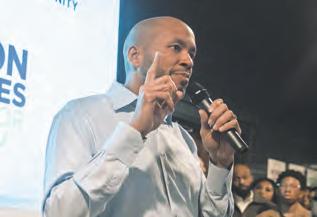
Even on the eve of an impending snowstorm, hopeful Georgians still gathered in fellowship to make sure they showed support for the man they’d like to become governor.
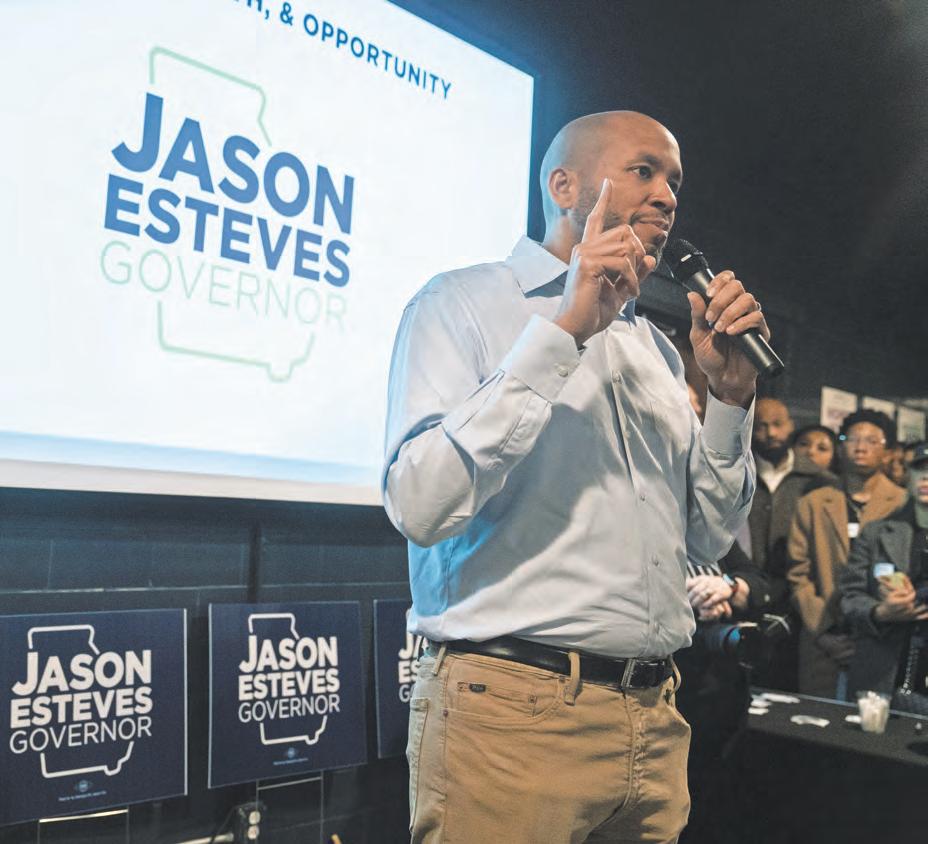
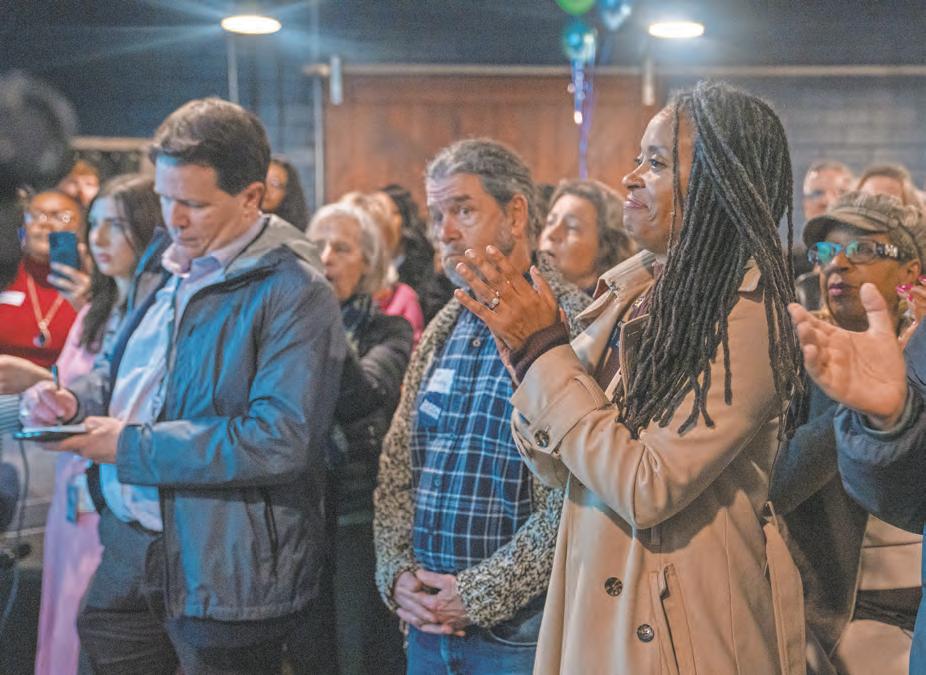
Supporters packed Wild Heaven Beer Thursday night for an election-year kickoff rally for former Democratic state Sen. Jason Esteves, as the 2026 race for governor begins to take shape. The event brought together students, longtime Democratic activists, educators, and first-time volunteers, many undeterred by weather forecasts calling for snow and freezing temperatures across parts of Georgia.
The Atlanta rally marked Esteves’ first major campaign event of the year in an effort to position himself as a unifying candidate focused on issues like education, health care, and economic opportunity. Attendees described the gathering as both celebratory and urgent, reflecting the stakes many Democrats see in Georgia after more than two decades of Republican control of the governor’s office.
“I think about the Georgia I’m about to inherit,” said Kennedy Washington, a junior at Spelman College who spoke to the attending crowd during the rally. “Will I be able to afford to live here? Will my family have access to health care? Will the jobs that are being promised actually exist?” she said,
adding that those questions drove her to support Esteves.
During the night, Esteves leaned heavily into policy proposals that have become central to his campaign. He outlined plans for universal child care, expanded
early learning, full funding for public schools, and new pathways to employment through apprenticeships and technical colleges. He also proposed creating a needbased college scholarship program, noting Georgia is one of only two states without one, and a low-interest loan fund aimed at helping small businesses and entrepreneurs access capital.
“This is a vision for the future of this state that gives people something to vote for, not just something to vote against,” Esteves said. “Georgia has the talent and the resources for all of us to have more.”
Before Esteves took to the rally stage, the former Senator described himself as an “education governor” who understands both where Georgia has been and where it needs to go. He said his administration would focus on what he called three core priorities: health, wealth, and opportunity.
“Georgians are working harder than they ever have and barely getting by,” he said. “As governor, I’m going to make sure people have the health care they need, the ability to keep more money in their pockets, and that our children and grandchildren have more opportunity than we had.”
Supporters in attendance said
Esteves’ emphasis on education resonated deeply. Melody Bray, a real estate agent who is volunteering for his campaign, said his track record with Atlanta Public Schools stood out to her.
“He helped APS recover from the cheating scandal, raised teacher pay, and increased graduation rates,” Bray said. “That showed me who he is isn’t just campaign talk. It’s who he is when no one’s watching.”
Paul Grant, a political science professor at Georgia Gwinnett College, said he believes Esteves is well-positioned to compete statewide, particularly with younger voters.
“He has the energy, the résumé, and the appeal to bring new people into the electorate,” Grant said. “After years of Republican leadership, it feels like the moment for something different.”
Attendees included state Sens. Kim Jackson, Harold Jones, and Rashaun Kemp, along with state Rep. Phil Olaleye.
As the rally concluded, Esteves urged supporters to turn enthusiasm into action, reminding them that vision alone would not win the election.
“Faith without works is dead,” he told the crowd. “So, Georgia, my question to you is: are you ready to do the work?”
By STAFF REPORT
Seven students from the Atlanta metropolitan area are among 100 teens nationwide selected to participate in the 2026 Disney Dreamers Academy, a prestigious mentorship and leadership program held at Walt Disney World Resort.
Chosen from thousands of applicants across the country, the Atlanta-area students will take part in a multi-day experience designed to help young people explore career paths, develop leadership skills and connect with mentors from a wide range of professional backgrounds. Disney announced the newest class ahead of the Martin Luther King Jr. Day holiday.
The Disney Dreamers Academy was created to inspire high school students to pursue their goals through education, mentorship and exposure to real-world opportunities. Participants attend workshops and seminars led by Disney
Continued from page 2
executives, industry professionals and celebrities, while also gaining hands-on experience in communication, leadership and networking.
The Atlanta-area students selected for the 2026 class are:
• Fiffy A., Fayetteville
• Kyla D., Lawrenceville
• Sam G., Milton
• Riley L., Mableton
• Alexis L., Hampton
• Azarii R., Douglasville
• Shakayah W., Snellville
In addition to professional development programming, students will experience Walt Disney World’s theme parks as part of the immersive academy experience. Each Disney Dreamer and one parent or guardian receive an all-expenses-paid trip to Florida.
Applicants are evaluated based on essays that highlight their personal stories, academic interests and dreams for the future. The program is part of
perspective on sorrel. For me, if I can take all of that and people just love the drink, I’m like, okay.”
A fashion designer by trade, Voltaire’s transition from textiles to the portafilter was a shift toward creating something easily affordable and universally appreciated. Prior

Disney’s broader effort to support students from diverse communities and encourage the next generation of leaders to think boldly about their potential.

Since its launch, Disney Dreamers Academy alumni have gone on to careers in fields such as journalism, engineering, the arts, technology and education. Many former participants later return to the program as mentors.
More information about the Disney Dreamers Academy is available at DisneyDreamersAcademy.com. Updates can also be found on Facebook at Facebook.com/DisneyDreamersAcademy and on Instagram at @ DisneyDreamersAcademy
to opening the tea and coffee club in 2022, he ran a fashion brand called Jesus Was Black, a concept Voltaire titles as more of an art project than anything. After gaining attention across the Southeast, a friend approached him at the end of a collection drop in Nashville and asked, “What’s next?”
“So on a drive back to Atlanta, a fourhour drive, his question just kept ringing in my ear,” Voltaire recalls. After pondering how to build upon the Black dollar, he thought, “Okay, what’s a $5 product that is easy? That’s a daily thing. Oh, coffee.” The concept of Coffee Was Black became another chapter of his fashion roots rather than the end of them. Voltaire explained that although Jesus Was Black was spiritually rooted, “You can’t necessarily expect people to get behind religious stuff. But something like coffee is universal. It’s a lot more palatable to digest.”
Building something like Coffee Was Black comes with quiet resistance. The brand’s name alone challenges comfort. Its presence on Auburn Avenue resists displacement narratives that suggest Black history should be commemorated but not continued. The name pays homage to the Ethiopian ancestors who discovered the coffee bean in the 9th century in the Kaffa region. In a world where traditional café beverages like lattes and cappuccinos are credited to an Italian, Eurocentric upbringing, Coffee Was Black aims to rewire the way coffee is seen and experienced.
“Italy currently controls how the world views coffee through the espresso machine. But if you go hundreds of years back, it was found in Ethiopia. So when do we as Black people get to claim what was found by us or our ancestors? That’s what Coffee Was Black is doing,” Voltaire said in a fervent tone.
For Voltaire, the brand is less about trend and more about permanence. “What if we





stopped drinking Arizona tea?” he asks. “We need to be drinking something that’s made for us, by us—for real. That’s the real play for Coffee Was Black. That’s where my vision really sees everything.”
Coffee Was Black exists to offer a nonconventional blueprint, particularly for what success looks like in the Black community.
“Where is the world where we are feeding into things that end with us?” Voltaire says. “And then it becomes a cycle, feeding back into us.”
At its core, Coffee Was Black is less about a beverage and more about resistance. Built inside a space with deep Black history, the brand shows what it looks like to create something sustainable, culturally rooted, and owned from start to finish. Voltaire’s work doesn’t ask for permission or validation. It simply exists, visible and intentional, offering a living example of how creativity, heritage, and business can coexist.

By DONNELL SUGGS
Awoman grabbed
D’Juan’s New Orleans Bistro owner, Donald Williams, by the shoulders and gave him a hug. Another woman came over, gave him another hug, and asked for a selfie. Williams held the restaurant’s grand opening on Monday, January 19, MLK Day, and the response from patrons has been nothing but positive.
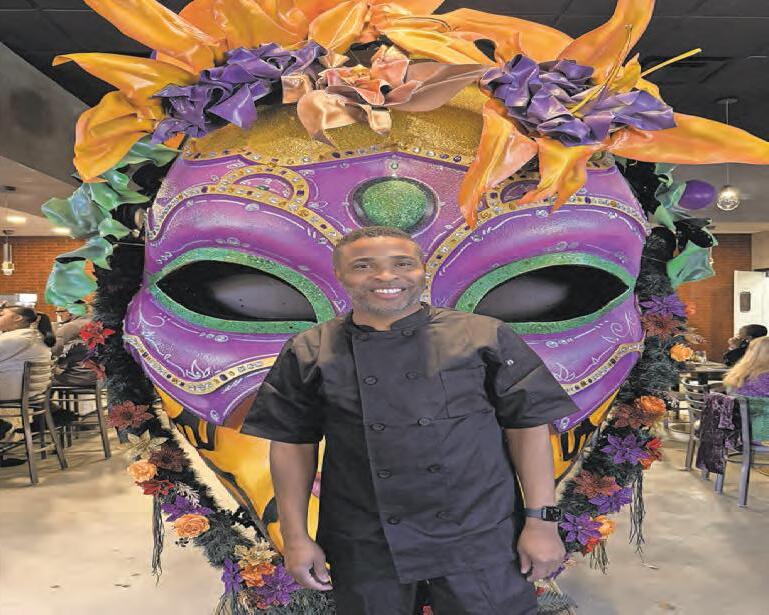
The restaurant was buzzing with customers when The Atlanta Voice dropped by to talk with Williams. Dressed in a black chef’s jacket and matching pants, Williams’ smile was present as he continued to greet guests.
“Today has me overwhelmed,” he said.
D’Juan’s is located within the MAA West Village, a live, work, play apartment complex in Smyrna. Walking into D’Juan’s, one will immediately notice a large Mardi Gras mask in the lobby by the host station. With the servers dressed in all black, it gives D’Juan’s a look of a classic fine dining establishment in the Crescent City. That’s all by design, says Williams.
Asked what he hopes to bring to Smyrna’s dining scene, Williams said he wanted diners to have an authentic New Orleans dining experience.
The New Orleans-born and bred chef and restaurateur added that he

There are no TVs inside D’Jaun’s at the moment, but there is a plan to get one by the full bar. The restaurant seats 140 people, and Williams said he wants them to be focused on the food, service, and environment when dining.
The po’ boy menu includes hot sausage, lobster, shrimp, oyster, and catfish sandwiches. The appetizer menu has gumbo, BBQ shrimp, catfish bites, wings served with fries, and stuffed crab cake egg rolls. The latter comes in four pieces (two egg rolls cut in half), with a drizzle of spicy mayo, and is served on a bed of lettuce.
The entree menu includes Big C’s rice bowl, a combination of seasoned rice, vegetables, and three grilled jumbo shrimp. Served with a side of oyster sauce, the dish was both fun to eat and flavorful.
learned to cook from a young age because, “I had to survive, I was hungry.” If anyone is familiar with the Big Easy, they know how embedded the food is in the culture of the city. That passion and dedication to cooking traditional New Orleans favorites like dirty rice, chargrilled oysters, red beans and rice, and po’ boys is being mixed in with innovative dishes like crab balls, crab cake egg rolls, and crawfish mac & cheese to give Georgia diners a unique experience. Williams calls D’Juan’s a portal to a place he knows well.
The beignet bites, smaller versions of the New Orleans-based goodness known the world over, were tasty. Along with powdered sugar, the warm beignets are dusted with cinnamon. Traditionally, that would be an issue at Cafe du Monde or Cafe Beignet, but in suburban Atlanta, it should work out just fine.
D’Juan’s is located within the MAA West Village, a live, work, play apartment complex in Smyrna. The bistro joins the local Waffle House, Five Guys, and Blue Moon Pizza as dining options for residents. Williams said he learned of the former location of a Thai restaurant from a patron, checked it out, and knew he

had found the right place.
“Let’s give it a shot,” Williams said. “We wanted to be somewhere near the perimeter, and the West Village is close enough to everything.”
The traffic at D’Juan’s hadn’t slowed down by midafternoon as Williams continued to greet people, talk to wait staff, and pose for pictures. He simply described his restaurant as, “An all-expense paid trip to New Orleans with every bite.”

By ISAIAH SINGLETON
State Representative Carl Gilliard (D-Savannah) and State Senator Donzella James (D-Atlanta) held a “Saving Lives Day” press conference to highlight legislation aimed at improving public safety in Georgia at the South Wing Steps of the State Capitol.
During the press conference, which took place on Wednesday, Jan. 28, Gilliard and James discussed the following legislation:
• Bill 419, “Eric’s ID Law,” which would allow individuals with physical or mental disabilities that are not immediately obvious or visible to request a symbol on the front of their driver’s license showing the presence of such a disability.
• House Bill 465, known as the “Autism Missing Person Alert System Act,” which would set up a rapid alert system for missing individuals with autism, like “Mattie’s Call.” HB 465 passed in the Georgia House during the 2025 legislative session and is currently awaiting consideration in the Georgia State Senate.
• House Bill 1011, known as “The Daren Lewis Saving Lives Act,” which aims to reduce fatalities and injuries from high-speed residential pursuits through preventative strategies and training for law enforcement.

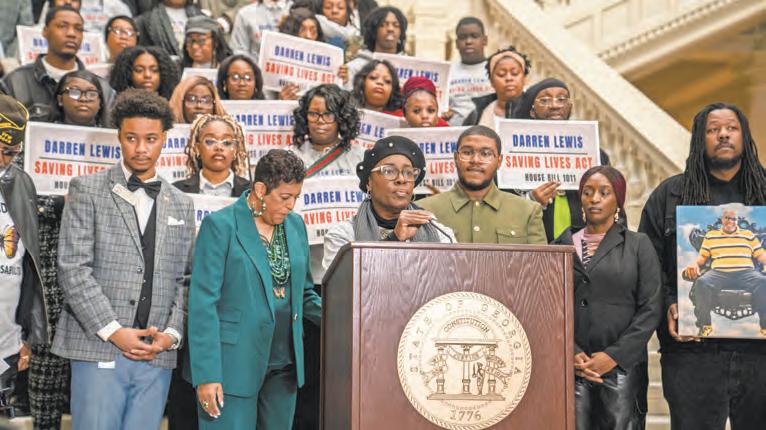
Following the floor presentation, Eric Carpenter-Grantham and his mother, Linda Carpenter-Grantham, spoke to the press about Eric’s ID Law being passed in Maryland in October 2025, and now they’re on a mission to get it passed in all 50 states.
Eric and his mom said they were excited to



be in Georgia, getting the opportunity to move Eric’s ID Law into the state.
“We hope and pray this bill gets passed here; however, during the press conference, I don’t know if they could hear us because everyone was talking, and it felt rude because this is about saving people’s lives, but we’re happy to
be here,” she said.
The idea of Eric’s ID Law started when Linda had a conversation with Eric after the horrifying realization that people with disabilities, especially autism, would be hurt, harmed, and killed by law enforcement.
Approximately 25% to 50% of people killed by police in the U.S. have a disability, with individuals with untreated mental illness being up to 16 times more likely to be killed during interactions with law enforcement. Nearly 1 in 5 young adults with autism will interact with police before age 21.
People with developmental disabilities like autism spectrum disorder (ASD) are, according to frequently cited government data, seven times more likely to encounter police than neurotypical people. This, in turn, creates a lot of opportunities for tragic outcomes because there is a substantial overlap between the signs of ASD and behaviors that police are trained to view as suspicious.
Some examples include avoiding eye contact, pacing, or repeating words. In other cases, a person with intellectual or developmental disabilities may be unable to understand or perform a command by police.


By STAFF REPORT
Earlier this week, Morris Brown College announced that it received substantial financial support to enhance campus security, along with additional funding for endowment scholarships and general operations. The school is located within the Atlanta University Center.
In a release to the press, the support totals $810,000 — with $700,000 of that through a grant sponsored by U.S. Congresswoman Nikema Williams (GA-05), who serves Georgia’s Fifth Congressional District and is a member of the Congressional Bipartisan HBCU Caucus. The appropriations bill (FY2026 Commerce, Justice, and Science, and Related Agencies Appropriations) was signed into law on January 23, 2026, following bipartisan approval by both the Georgia House and Senate.
“As Morris Brown College experiences significant growth, investments that strengthen campus security are especially impactful as we continue to prioritize the safety of our students, faculty, and staff,” said Morris Brown College President Dr. Kevin James. “During this period of continued resurgence, we are deeply grateful for philanthropic support and remain committed to being fertile ground for those who choose to invest in our mission.”
Continued from page 9
“I told Eric if he ever is pulled over by law enforcement, put your hands up, don’t reach for your phone because it can be very dangerous, yell out I have autism, yell out my number, and yell out someone call my mom,” she said. “Eric started to cry because he said he could do that, but he was worried about his friends who may be harmed because they are different on the spectrum than he is.”
On the Maryland state-issued ID, there is a butterfly symbol placed. The significance of the butterfly stands for hope, peace, freedom, and change. The colors inside of the wings are the colors for all hidden disabilities, according to Eric and Linda. If passed in other states, this would be the symbol placed.
Also, Linda said Eric told her some of his friends have ADHD where they cannot sit still or have sensory issues where they’re sensitive to light and sound.
“He said, ‘mom, we’ve got to do something and we gotta do it now.’ He later came back to me and talked to me about putting a symbol on Maryland state ID’s where we live to let officers know that he and his friends have an invisible disability,” she said. “Eric is a person of God and loves politics and he asked me if I could take him to congress and have a conversation with the House Speaker that would
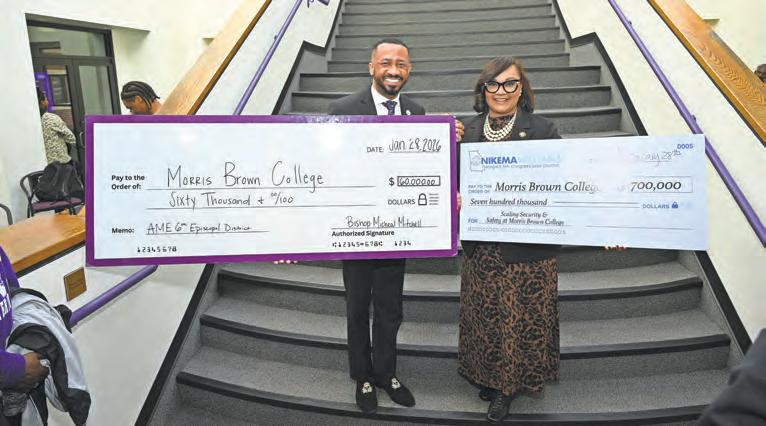
According to the release, the grant will support the following: creating coordination and emergency response plans; increasing safety awareness through media and public relations; improving safety personnel communications; upgrading public safety technology; conducting potential risk and threat assessments; and training and hiring additional public safety personnel.
create laws for him, his friends, and others to feel safe if ever stopped by the police.”
They both later met with their state senator Will C. Smith and Delegate Jheanelle Wilkins. The law didn’t pass the first time but eventually did afterwards.
“Our opposition came from a lot of people who do not look like us and not people of color,” she said.
So far, the duo has met with states like Delaware, New York, Pennsylvania, and had meetings with California, Arizona, Alabama, Illinois, Washington DC, Massachusetts, and now Georgia.
Senator James said she is immensely proud of Eric and his mother for having the strength and courage to push this law even against opposition.
“We have worked hard to look at so many safety laws. Autism is becoming an epidemic in our school system,” she said. “Even my second-born grandchild who is now 17 years old is autistic, and he might be on the high spectrum because he gets A’s and is a hardworker, but at one point, he was nonverbal. We’re screening our kids sooner and we’re finding out we have so many of our babies who are growing up with autism.
She also says Eric wasn’t only looking out for his best interests, but his friends’ who have disabilities as well.
“Eric understood that many of his friends or anyone with mental health issues may do something that the police may misunderstand,” she said. “We want to train our police officers and
Morris Brown also received $60,000 from the Sixth District of the AME Church. The $60,000 in funds for general operations was raised during the school’s 145th Anniversary, which was founded by the AME Church. In addition, Atlanta-based rapper/actor/producer Tip “T.I.” Harris, professionally known as T.I., donated $50,000 to Morris Brown to go toward endowment scholarships.
inform them that we have a lot of ‘invisible’ disabilities, because you can’t just look at them and tell. With Eric’s ID Law, there will be a symbol of a butterfly to notify officers that the individual has some mental health issue or disability.”
She also says this could prevent so many problems surrounding the misunderstanding of mental health and disabilities in dangerous situations that could result in a loss of life.
Additionally, Eric said his drive to get this law passed all over the nation is so people with disabilities can feel safe going outside in the world, which is also his number one priority.
“The disability community needs a voice, and I’ve been chosen to be that voice. I feel like because there are so many people who have come to me, cried, and said, ‘thank you, because my son, my daughter, or my loved one would speak about you and it brought me hope because they can speak like you one day’”, he said.
Eric also said he is trying to be that voice because there’s so many people who look like him who don’t have a voice, and he’s letting the world know he can hear you.
“I can hear you, my mom can hear you. It takes time because people don’t understand. My mom didn’t understand when I was born, but it took programs, research, and care,” he said. “With a lot of prayers and the help of my mom, this law is going to help people, and I don’t care how many doors are shut in my face, I’m still going to go through that door and get it done.”
“At a time that Morris Brown College is witnessing great growth, support that helps to enhance our campus security will truly make a difference as we prioritize the safety of our students, faculty, and staff,” said James. “As Morris Brown continues its resurgence, we are most appreciative of philanthropic support and will continue to be a good ground for people to pour into.”
Rep. Williams added, “This $700,000 for Morris Brown College reflects a simple truth: Our students deserve to feel safe where they learn. As our HBCUs continue to face increasing threats, these federal funds will support critical safety infrastructure so that students, faculty, and staff can learn and work in an environment that is secure, responsive, and prepared.
“I’m proud to stand with Morris Brown College and invest in the resilience and future of a campus that means so much to Georgia’s Fighting Fifth.”
Prior to the good news, the historically Black college had been in the news for all the wrong reasons. James took to social media to announce he had been fired, only for the school to announce, a week later, that his contract had been renewed.
The Atlanta Voice reached out to James for comment and was unable to get him on the record regarding the firing and subsequent rehiring.
Linda said she always told Eric he was created to stand out and not to fit in.
“He did not always feel like he fit in because he knew something was different about him, but I always tell him, you’re beautifully different. If people don’t want to be around you, it’s their loss,” she said.
Eric said as a person with autism, he wants the disability community to know this law was created for them and for him to feel safe and have a voice.
Furthermore, the mother and son duo said they want people to know they are pushing this law and it isn’t easy. With many prayers and tears, they have been given an assignment by God, and they want to see change happen.
“This is God’s idea that he gave Eric, and it’s his idea for us to because we had no idea, we would be moving this thing into America. It’s because of the public reaching out to us,” Linda said. “This is an assignment from God; we will not stop.”
Both Eric and Linda want this law to bring peace and make sure Eric’s ID Law brings voices for others and knowing your loved ones are safe in the world.
“I pray law enforcement will have time and patience to know that person might need help, how to communicate with them, so both parties can come into agreement and bring a peaceful transition,” Linda said. “Eric’s gonna bring change forever and ever, even when we are gone, it’s gonna bring change until the world ends.
By DONNELL SUGGS
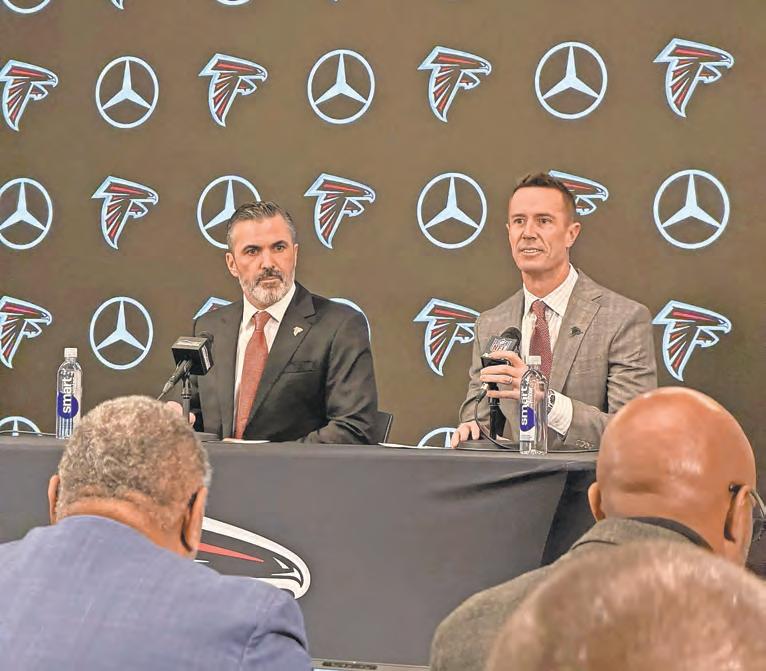
The Atlanta Falcons formally introduced new head coach Kevin Stefanski at Mercedes-Benz Stadium on Tuesday afternoon.
Former Atlanta Falcons quarterback and current President of Football, Matt Ryan, began the press conference by thanking the search committee. “We’re excited about the process and the progress,” Ryan said. He was complimentary of Stefanski during the interview process.
“Kevin separated himself,” Stefanski said. “He’s an excellent communicator. He’s clear, concise, and concrete.”
Stefanski comes to Atlanta with six seasons of head coaching experience, all with the Cleveland Browns. A native of Philadelphia, Stefanski, 43, had two 11-win seasons with the Browns. He also coached the team through four losing seasons, including a 5-12 record in 2025.
“I cannot wait to be in this building and feel this place shaking,” Stefanski said. “Atlanta is where I wanted to be.”
The Browns had quarterback issues this past season, and the Falcons will too if the position isn’t solidified during the offseason. Stefanski worked with a number of
young quarterbacks during his decades-long NFL coaching career and as a head coach in Cleveland. He said he was looking forward to working with the team’s players. One of those players is current Tampa Bay Buccaneers quarterback Baker Mayfield.
“We want to be an intentional group when it comes to developing players,” said Stefanski.
Stefanski also added that new offensive coordinator Tommy Rees will be responsible for calling plays. “I have the utmost confidence in Tommy,” he said.
Rees, a former Notre Dame quarterback, spent the 2025 season as the Browns’ offensive coordinator. At 33 years old, it was Rees’s first season as an offensive coordinator.
Stefanski said he’s learned from all his seasons as an NFL coach, and the club will get the best version of himself. “I wouldn’t change anything about the past,” he said.
The Falcons are retaining defensive coordinator Jeff Ulbrich, and Stefanski credited Ulbrich with doing a good job with the defensive unit last season. He said Falcons rookies Jalen Walker and James Pearce, Jr. are “very, very talented young men” and having them will continue to create matchup issues for opponents.
By DONNELL SUGGS
The Atlanta Hawks will face the Indiana Pacers, one of the worst teams in the Eastern Conference, if their overall record is any indication, on Saturday night. The fourth game of the week for the Hawks, Atlanta, will be in Indianapolis for this one. It’s also the third time the two teams have played this season. On Halloween 2025, Atlanta defeated Indiana 128-108 at Bankers Life Fieldhouse.
On Monday, January 26, at State Farm Arena, the second time the teams played this season, the Hawks were without Kristaps Porzingis and Zaccharie Risacher. Even though both players were out with injuries, the Hawks defeated the Pacers again, 132-116. The victory was the third straight for the Hawks. It’s been a long week for the Hawks. They were in Boston on Wednesday before returning home to host the Houston Rockets and Kevin Durant on Thursday night.
Atlanta managed to outscore Indiana by seven points during the third and fourth quarters. CJ McCollum (23 points) and Luke Kennard (13) combined to score 36 points off the bench, while the Hawks’ starting backcourt of Dyson Daniels (22) and Nickeil Alexander-Walker (21) led the way.
The Hawks didn’t have their first lead of the game, 93-92, until the 1:13 mark in the fourth quarter.
McCollum, who made three consecutive three-pointers during the first half, made a layup to put Atlanta ahead 95-92 at the end of the third quarter.
Atlanta led the rest of the way
The Pacers got out to a quick start, forcing a Hawks timeout at the 6:55 mark of the first quarter after going ahead 18-11. Hawks guard McCollum came off the bench and immediately made an impact, hitting two three-pointers to keep Atlanta close. McCollum’s 18.5 points per game off the bench has allowed
Alexander-Walker (20.3 points per game this season) to remain in the starting lineup and give Atlanta a pure scorer and shot creator on the floor, whether Jalen Johnson is on or off the court.
On Monday, the first quarter ended with the Pacers ahead 3834, behind 10 bench points from guard Bennedict Mathurin. Indiana would go ahead by double figures several times during the first half, including in the second quarter when Indiana took its first double-figure lead of the game with 2:30 remaining in the half.
The third quarter was Pacers All-Star forward Pascal Siakim’s turn to heat up. Only scoring seven points during the first half, Siakim helped Indiana grab its largest lead of the game, 85-70, midway through the third quarter, by scoring 14 points to start the period. Siakim finished with a team-high 26 points, nine rebounds, and four assists.

By DENNIS MALCOLM ByRON AKA ALE SHARPTON
Right off the bat, I am feeling Jeep’s dedication to explore the hybrid and all-electric sectors. Since documenting my enjoyment of the 2025 2025 Wrangler Willys ‘41 4xe, the Wagoneer S Limited 4xe was next up, blending the brand’s rugged nature with the luxury, comfort, technology, and plug in capability to name a few standouts. Ultimately, I truly enjoyed this SUV from bumper to bumper.
The Wagoneer S greets the eyes with a framework that is modern, yet muscular.
The striking Fathom Blue Pearl-Coat exterior paint is metallic, has a base of dark blue, with hints of purple that alters spending on how the light hits it. The exterior is complemented with 20-inch painted diamond-cut aluminum wheels, signature illuminated Jeep grille lighting, titanium exterior accents, and dark daylight opening moldings from the optional—and recommended—Dark Appearance Package to elevate the look. A dual-pane panoramic sunroof further enhances the exterior appeal while blessing the cabin with natural light and stargazing at night. A necessary enhancement to any car’s nod to the future, the Wagoneer’s lightwork flexes in numerous ways, including bi-function led premium reflector headlamps, door-handle

roof and mirror caps, low-profile exterior badging, 20-inch machined aluminum wheels, and a standard dual-pane panoramic sunroof.Photo courtesy of Jeep
approach lamps, and led fog lamps. Yes, this automobile is a looker.
Stepping inside this five-seater, the 4xe makes both tech and comfort a priority. The cabin features ambient LED interior lighting, heated front seats, and a heated steering wheel paired with a tilt-and-telescoping steering column to customize the driver’s positioning. The centerpiece is Jeep’s Uconnect 5 system with an expansive 12.3-inch touchscreen, paired by a secondary comfort control screen.
Wireless Apple CarPlay and Android connectivity; a wireless charging pad; 4G LTE Wi-Fi hotspot; and nine-speaker audio system with subwoofer collectively keep the cabin plush. Performance? No problem. This Wagoneer is powered by a 400-volt, 100-kW battery pack, delivering smooth, hushed acceleration topping off at 500 horsepower and 514 pound-feet of torque. With an EPA-estimated 93 MPGe combined, this version delivers a respectable driving range of up to 294 miles. With the
ability to charge at three different levels, Level 3 charges up to 80 percent in about an impressive 23 minutes. Jeep’s Selec-Terrain drive mode selector, all-speed traction control, and active driver assistance systems make sure the driver can take on virtually any terrain, which Jeep is proudly renowned for. On the practical side, welcomed touches like front trunk storage, remote climate control, and a hands-free power liftgate make everything from grocery runs to long excursions a lot more effortless.
Priced at a base of about $65K, with a total as tested of $67,790, the Wagoneer S Limited 4xe is the ideal balance of upscale amenities, innovation, and sustainability, backed by a mind-easing 8-year/100,000-mile battery and electric powertrain warranty. If you’re looking for a well-appointed, all-electric SUV that’s ready to take on whatever road comes its way, this is a solid consideration. For even more power, I am looking forward to reviewing the Launch Edition of the Wagoneer, flexing 600 horsepower to justify its name. Until then, the S Limited will do just fine.
Fuel Economy MPGe: 100 city/85 highway (93 MPGe combined)
Price: Starting at $65,200 and reviewed with all the packages and options totaling $67,790.
For more information, visit Jeep.com.



Vehicle
Vehicle 2006 Infiniti G35
JNKCV51E16M515420
Vehicle 2005 Ford E-Series VIN 1FTNE24L15HA95300
Vehicle

Vehicle