
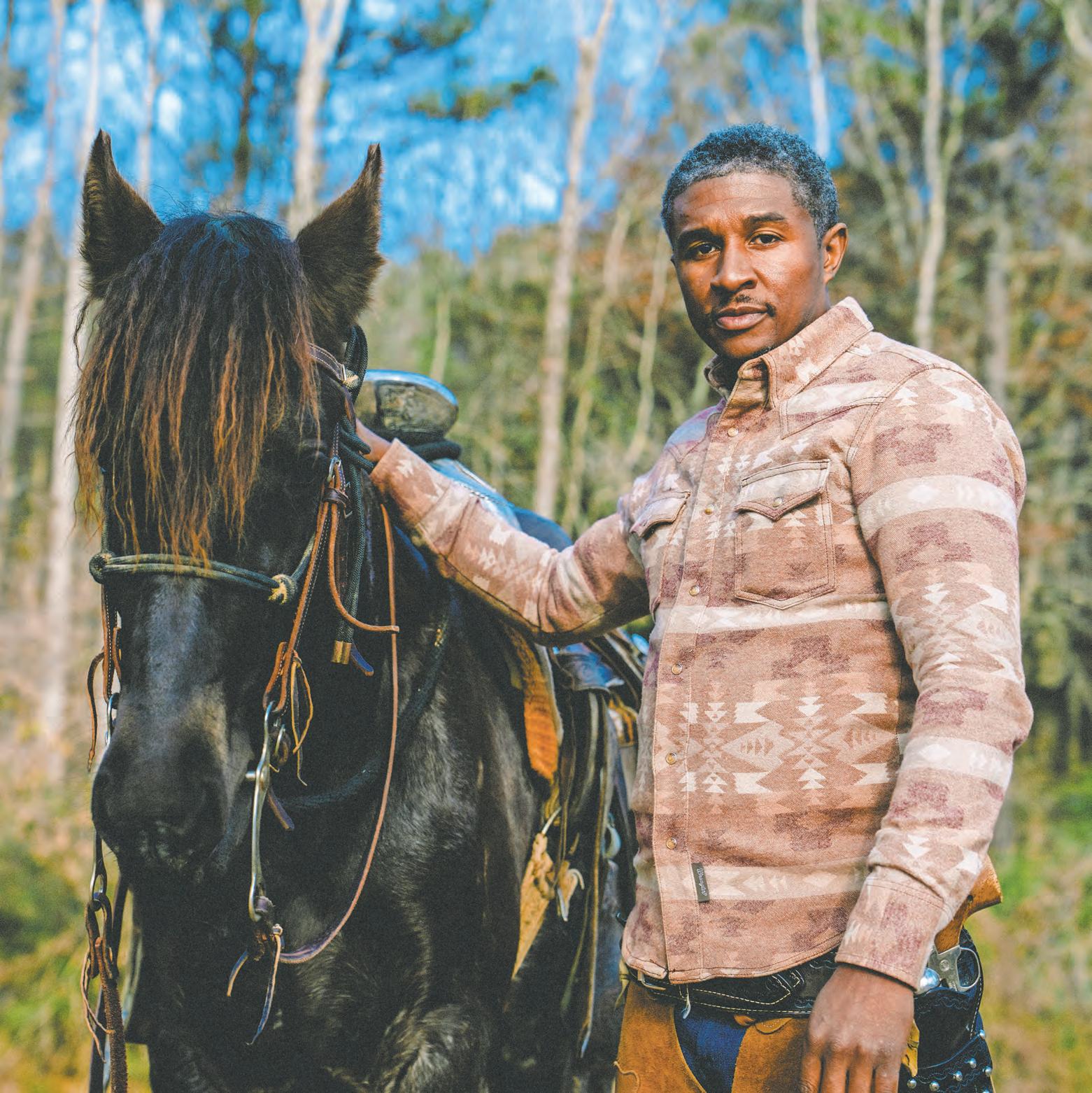
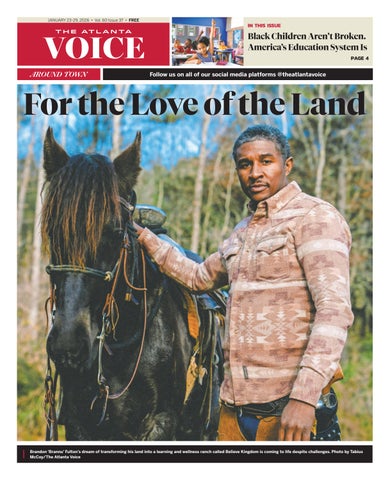
Brandon ‘Brannu’ Fulton’s dream of transforming his land into a learning and wellness ranch called Believe Kingdom is coming to life despite challenges. Photo by Tabius McCoy/The Atlanta Voice
By LAURA NWOGU
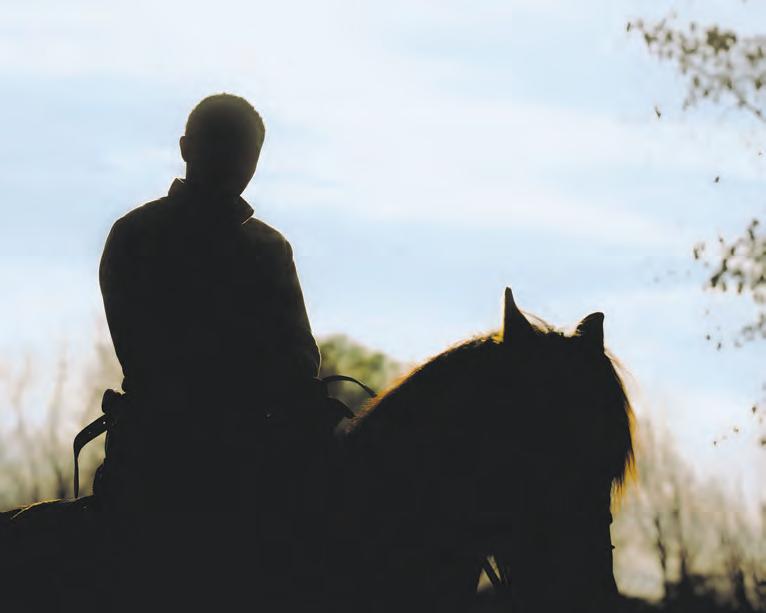
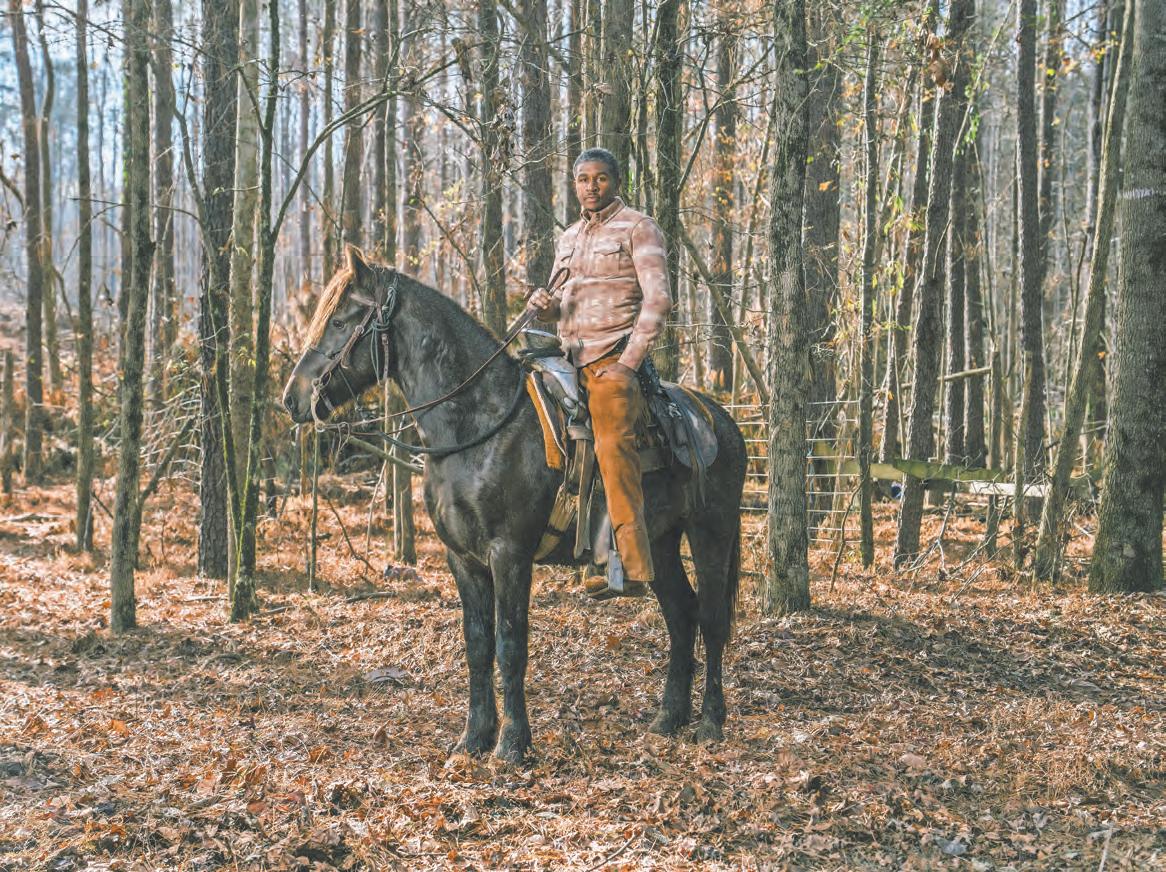
Red clay soil, wet from a day of rain, seeped into Brandon “Brannu” Fulton’s boots as he held the reins of an eye-catching Perilino horse he’d purchased three days prior. As the horse, with its ivory body and its gold mane, trotted along beside him past buildings under construction and steel containers, it was as if they were following a cadence only they knew. On Fulton’s 27 acres of land, poised for a dream and tucked away on the corner of Butner Road and Camp Creek Parkway, man and horse were right at home.
For the 44-year-old horseman and Clark Atlanta University graduate born in Brownsville, Brooklyn — long deemed one of New York’s most dangerous neighborhoods — it’s what dreams are made of. Dubbed the “Urban Cowboy” for riding horses through Atlanta’s streets, Fulton shared that his love of horses started with his grandfather, who would periodically take him riding at an academy in
Jamaica Bay. As a kid, it was a means of escape and one of his only outlets, but because it was on the other side of Brooklyn, the riding academy was hardly accessible to him without taking the bus and walking.
“It was something I knew I’d enjoy, and I felt it. But when you’re still finding yourself and you’re a boy, it’s hard. We all have the ability to feel something, but we just don’t know how to identify it,” Fulton said. “And if you don’t have that environment or influence around you to drive that interest, then it kind of falls to the side.”
The reigns were soon tucked away, and the turntables came out, as Fulton explored a life of professional DJing. It took him everywhere, from spinning at college parties and touring across the U.S. to entertaining big celebrity parties and becoming the DJ for hiphop artists such as St. Louis rapper J-Kwon. From the outside looking in, Fulton was living life. But the reality was that he felt lost.
The fight to fit in, from the designer clothes to perming his hair and navigating the politics of the business, became unenjoyable.
“My spirit was starting to become stronger versus reality, and I just became depressed.
I got so depressed, I wanted to commit suicide — I tried to. Because I felt like I didn’t know anything else. Horses were so out of my realm of thinking. I was like, “What am I gonna do?”
When he wrote the question, “Who are you?” On a piece of paper, the answer wasn’t that he wanted to sell out stadiums, own a diamond chain, have a platinum record, or drive a Ferrari. “It said, I just want to be happy. Be in a beach island environment, have a Jeep Wrangler with no doors, rusted. Have a simple little boat. Be around good music and ride horses.”
An unfulfilled dream was calling him. When Fulton encountered a horseman in Tijuana, Mexico, he realized that his dream wasn’t so out of reach — that it didn’t have to look a certain way and that he didn’t have to be wealthy to pursue his dream. The image of the unassuming man owning a bunch of horses resonated with him so much that he vowed to go all in once he left the life of DJing.
What started in a Brooklyn neighborhood soon began to flourish in Atlanta’s metro area. Fulton didn’t have any land or horses; all he had was an idea. He knew he still loved music and making people dance, so he incorporated that into his dream called Believe Kingdom, a place where the horses would become his records. His vision was to create a riding academy with American Paint horses, a breed known for its beautiful coat patterns.
“One of my hitting gems in the paint Academy was that it’s gonna be like a school, but the school will use horses as instrumental tools. I chose Paint Horses because I was drawn to them. When people looked at that Paint Horse, it didn’t matter if the horse was white, brown or black, you just saw the horse
By ISAIAH SINGLETON
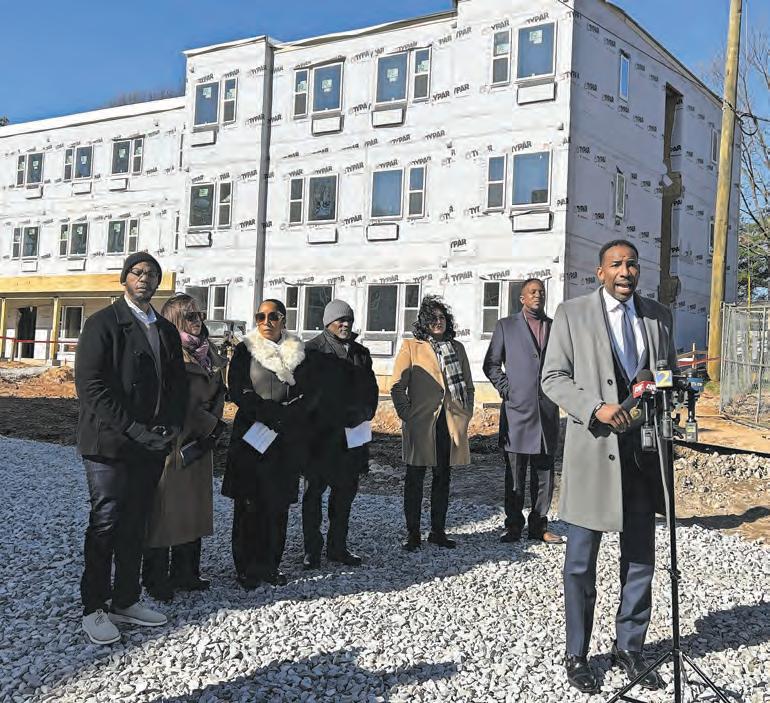
Atlanta Mayor Andre Dickens, Councilmember Jason Dozier, Fulton County Commissioner Mo Ivory, and Partners for Home gathered on a cold, windy Thursday, January 15, for a press conference and hard-hat tour of a new rapid-housing site at 405 Cooper St.
This rapid-housing site for unhoused residents of Fulton County will provide 100 units of supportive housing and 70 townhomes in the heart of the Mechanicsville community. The city and partners broke ground on the site just months ago and invited media partners for a sneak peek of the development progress.
Atlanta is home to over a quarter of the state’s homeless population of nearly 10,000, according to Atlanta Mission. According to Partners for Home, the 2025 Point-In-Time (PIT) Count, conducted the night of January 27 and followed by additional surveying the week following, recorded a 1% overall increase from 2024, suggesting a potential plateau.
Chronic homelessness fell 9% due to an ongoing focus on rehousing the most vulnerable individuals in permanent supportive housing (PSH), a housing intervention that pairs long-term leasing/rental aid with supportive s ervices like mental health services, employment help, and ongoing case management.
During the press conference, Dickens discussed the rising issue of homelessness in the U.S., emphasizing it has surpassed crime as a primary concern for mayors, including in Atlanta. He also highlighted visible encampments and the city’s multifaceted approach to addressing the problem, involving government, philanthropy, nonprofits, and innovative construction techniques.
“Seeing a growth and a climb in people experiencing homelessness, the unsheltered population across this country is rising,” he said. “I can’t tell you how many mayors that I talked to across the country that no longer is crime our number one concern and thing that we are most pressed about, but at this point in time, it is the growth of people that are having more money than money people that are unhoused in our communities across the country and Atlanta is no different.”
Additionally, Dickens mentioned the city’s commitment of $60 million to a homelessness opportunity bond, the highest in Atlanta’s history, which has helped house thousands over four years. He underscored the city’s determination to tackle homelessness collaboratively, with the city going first or last but never alone, and acknowledged the presence of key stakeholders in the effort.
“We’re trying to attack this problem with the help of community members and great-minded folks in the nonprofit business sector, etc. And this work is meaningful. We’ve been doing it for a long time,” he said. “My

administration has been doing a whole lot of work, but there’s still more work to be done.”
Ivory emphasized the need for permanent supportive housing to address Fulton County’s homelessness crisis. She highlighted Fulton County currently supports 302 supportive housing units but requires 550, with funding only secured through 2026. Ivory said fully funding supportive housing is cost-effective, reduces repeat jail bookings, and helps public safety.
When housing is missing, she said, those systems become the default response. Ivory also urges her colleagues to honor the commitment to helping their residents.
“I have told my colleagues to honor that commitment, and I hope that when we get to our meeting next Wednesday, when we vote on this budget, that they will do that,” she said. “They have not done that thus far. Fulton County should be a partner to its cities, not a hindrance to the vital services that its cities need. I fully support funding permanent housing services now and into the future beyond the 10 years that we committed to, but especially right now.”
Also, Dozier reflected on the importance of the work that’s been doing and how he experienced homelessness at an early age. Sharing in one of his earlier groundbreakings, he grew up in Atlanta, where his home of 16 years and the only home his mom ever owned was lost to foreclosure.
“We had all our things thrown out into the street and as a someone who was in my early 20s, I know what it was like to experience fear, to experience instability, to not know what roof was going to be over my head, where I was going to sleep, and I had to rely on the generosity of friends and family
members and neighbors sleeping on couches on cold days like to this turn on the oven to keep the house warm,” he said.
Dickens stressed the commitment of Fulton County Commission members and city council to distribute $4.8 million annually for 30 years to address homelessness, a small portion of their budget.
He also criticized some commissioners for attempting to pull back on this promise.
“We must be honest about some of the people who are supposed to be in this with us, and that is members of the Fulton County Commission, and we have one [Mo Ivory], who is here to support our efforts and the people that are in need,” he said.
Dickens also praised Governor Kemp for stepping up, saying he would pull $50 million towards housing the homeless and helping with wraparound services for urban areas like the city of Atlanta.
“That’s meaningful steps up towards helping us, so we need the county to do just what they said they were going to do and what their charter is for them to do, which is to help with the Health and Human Services,” he said. “Do what you say you’re gonna do, and for the next 30 years, you’re supposed to put up at a minimum $4.8 million. You can’t walk back from that.”
Furthermore, Dickens said they must have a partnership from the county to pay for the operations.
“That’s the agreement and we must keep them to their promises, promises made must be promises kept, or see you at the ballot,” he said.
The rapid housing units at 405 Cooper St., will be finished in the next two months, according to developers.
By SHARIF EL-MEKKI
Kasserian Ingera: Are the children alright?
El-Hajj Malik El-Shabazz, the civil rights leader better known as Malcolm X, once said, “Only a fool would let his enemy educate his children.” While it certainly might be easy to say that too many Black people have been foolish since emancipation from enslavement, the bigger issue is systemic racism in our school system.
Black education has always come under the authority of the white power structure, if for no other reason than because the liberation of Black people never came with land. Unlike our kinfolk throughout the diaspora, where independence movements saw the colonizer kicked out, ours wasn’t an independence movement but a liberation movement within the nation that oppressed us.
Thus, we sought freedom to be rather than freedom to be a nation. And that parallels how Black children are educated in America.
Advancing, Yet Falling Behind
Consider: African people are torn from their ancestral homes, enslaved, then shipped to a continent half a world away. Considered chattel, they were severely punished and sometimes killed for obtaining even a rudimentary education — learning to read and write — because knowledge is liberation from bondage. As slavery gave way to emancipation, freedom yielded to Jim Crow laws, forcing children into segregated and critically under-resourced schools. Yet white terrorists still burned many of those schools to the ground, punishment for communities that dared to educate Black children.
Upon winning the right to educational equality, African American students subsequently were made to assimilate into majority-white schools, with predominantly white teachers and anti-Black administrators. In turn, Black schools were closed, and Black educators — many with advanced educations, including doctoral degrees, who taught in those schools because they couldn’t work anywhere else — were suddenly unemployable.
Coupled with anti-Black policies, including presuppositions about inferior Black intelligence, culturally incompetent instructional and assessment methodologies, and disproportionate punitive discipline, Black

students fell behind their white peers across grade levels and schools.
To improve performance, policymakers treated schools like businesses, and assessment scores — specifically, statewide test scores — began to resemble profit-and-loss statements. They imposed unrealistic expectations, misaligned goals, and unproven theories on students — including radical educational strategies such as replacing phonics with whole language learning, reducing bathroom breaks, and eliminating instruction in art, science, social studies, and history. They even cut out recess. Instead, students were subjected to endless hours of reading and math, with rote memorization as the chief strategy for achievement.
Bureaucrats and politicians, insisting that a “calm” learning environment would boost those test scores, incentivized diagnosing children with behavioral challenges by increasing funding for “support” of disruptive kids. Nevertheless, Black students still performed worse than their peers, continued to be disciplined disproportionately, were more likely to be diagnosed with behavioral disorders or learning disabilities, and, as a consequence, struggled with mental health challenges.
And that’s before red-state politicians demanded the removal of Black history from classrooms
and curricula.
Racist Educational Power Structure
So, when someone asks, “Are the children well — Kasserian Ingera?” the answer, when it comes to Black children, is “Hell, no.” And schools are indeed the reason.
The larger context, however, is what Malcolm X hinted at: too many public school systems are white institutional spaces that were not — are not — created with the best interests of Black children in mind. That’s true for both private and charter schools, unless they are governed, administered, and informed by Black educators.
A consequence of reality is that education for Black children lay in the hands of an anti-Black racist power structure that facilitated the end of the first attempt at a multiracial democracy. It is no surprise, then, that systemic racism maintains its lineage in Black education dating back to the birth of a nation.
In his book “American Grammar: Race, Education and the Building of a Nation,” Dr. Jarvis Givens shows that the public education system was organized around the exploitation and control of Black and Indigenous people. Inequality has always been a defining feature. Black literacy was policed to the extent that it wouldn’t become a tool of liberation during enslavement. The legacy of this
history sadly shapes contemporary schooling, whereby Black children constantly test low, if not at the bottom, of standardized tests for reading across grades when compared to other racial student groups. The other realities of systemic racism compounded upon that legacy have done a lot of harm to Black children, which public schools are ill-equipped (or unwilling) to repair over time.
It’s unrealistic to think we African Americans can divest ourselves from public schools, lacking a plan and process to gather the fiscal resources and the community resolve to educate ourselves formally. Or is it?
Some Black parents have divested their children from schools, choosing to teach them at home, now more than ever before. Maybe we don’t need a massive system of schools for Black children to be educated through, where leaders must be chosen, a curriculum must be developed and piloted, funds must be collected, and sustainability plans created. We can adopt the idea in education, as we do within the community, that we are all leaders and that we create our own Freedom Schools to affirm and cultivate Black genius through education. It starts with a Saturday school at your home with your children or children in the neighborhood. From there, it can build into a school every day after school and then during the school day as its own school. And, with social media, the Black proverb, each one teach one, has evolved into each one teach one thousand
The COVID lockdown of schools was a chance for Black parents to divert their children from schools that weren’t centering their humanity. Folks began creating “detox centers” to protect their children from the harm caused by far too many anti-Black school environments.
We shouldn’t wait for another pandemic to create our affirming and loving learning spaces for our children. Just as many enslaved communities formed their own schools to teach one another, we can do the same. Instead of asking why, ask why not?
Or, we can watch and experience systemic racism work on us. Let’s make our answer to Kasserian Ingera different for this generation of students.
Sharif El-Mekki is the founder and chief executive officer of the Center for Black Educator Development.
FOUNDED May 11, 1966
FOUNDER/EDITOR
Ed Clayton Immortalis Memoria
PUBLISHER/EDITOR
J. Lowell Ware
Immortalis Memoria
The Atlanta Voice honors the life of J. Lowell Ware.
PUBLISHER
Janis Ware
PRESIDENT/ GENERAL MANAGER
James A. Washington 2018-2024
EXECUTIVE ASSISTANT TO PUBLISHER
Chia Suggs csuggs@theatlantavoice.com
EDITOR IN CHIEF Donnell Suggs editor@theatlantavoice.com
GENERAL ASSIGNMENT REPORTERS
Isaiah Singleton isingleton@theatlantavoice.com
Laura Nwogu lnwogu@theatlantavoice.com
Noah Washington nwashington@theatlantavoice.com
BUSINESS REPORTER
Tabius McCoy tmccoy@theatlantavoice.com
EDITOR AT LARGE Stan Washington swashington@theatlantavoice.com
ADVERTISING ADMINISTRATOR
Chia Suggs advertising@theatlantavoice.com
SALES RDW Jackson rdwadman@gmail.com
SUBMISSIONS editor@theatlantavoice.com
DIRECTOR OF PUBLIC RELATIONS
Martel Sharpe msharpe@theatlantavoice.com
CONTACT INFORMATION
633 Pryor Street, S.W. Atlanta, GA 30312
Office: 404-524-6426
info@theatlantavoice.com

By LAURA NWOGU
Local elected officials and Atlanta-area residents rallied on the south steps of the Georgia State Capitol on Tuesday afternoon amid growing tensions stemming from the increased violence and presence of Immigration and Customs Enforcement (ICE) across the U.S. The latest violent incident involves 37-year-old Renee Nicole Good, a U.S. citizen and mother of three, who was killed when an ICE agent shot into her vehicle on Jan. 7 in Minneapolis, Minnesota, during an immigration sweep.
The fatal ICE-involved shooting sparked protests nationwide. This is the second rally in Atlanta, coming days after The Party for Socialism and Liberation’s Atlanta Branch and Immigrant Rights Alliance held a demonstration at the Capitol to bring awareness to Good’s death.
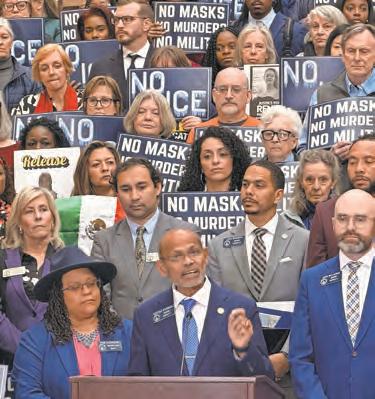
Senate Minority Whip Kim Jackson (D–Stone Mountain) held a press conference alongside members of the Senate
Democratic Caucus, including Sen. Josh McLaurin, Sen. Sheika Rahman, and Senate Minority Leader Harold Jones, to introduce legislation aimed at protecting Georgia residents. Attendees held signs calling for “No Masks, No Murders and No Militia” and “No ICE” as the officials introduced three Senate Bills: SB 391, 397, and 389.
“We cannot continue to allow the President to abuse the patriotism of the troops,” Jones said. “We must build a wall against him, and the legislation presented here today is a step towards protecting all U.S. citizens and making sure that we continue to pursue American ideals and goals.”
SB 391 restricts immigration enforcement without a warrant in “sensitive” areas such as schools, hospitals, places of worship, libraries and family violence shelters to protect due process, child safety, and community stability. SB 397 creates a civil cause of action against federal officials who violate constitutional rights. The last bill introduced, SB 389, requires ICE agents to
unmask and display identifying badges to reduce fear amongst the community and ensure accountability during enforcement actions.
“I’m dropping this bill today for all of the children who now grieve because their parents have either been deported, are somewhere in a detention center, or they’ve simply disappeared because they’re afraid that ICE might find them,” Jackson said. “Today, we are calling for ICE to be unmasked to end the terror and to end the fear.”
Atlanta resident Deja Hall said she visited the State Capitol for the first time on Tuesday to attend the press conference and understand how she can help immigrants in the city.
“When I think of immigrants, I think of people like me, too,” Hall said. “They’re not just trying to push out the Hispanics; it’s everybody. It’s Africans. It’s people from everywhere. I just want to hear what we can do as a community so that we can proceed to go the right way.”
By DONNELL SUGGS
The Georgia Legislature got back to work last week and campaign rallies and forums for upcoming elections and special elections for Georgia governor, Lt. governor, one of the state’s two Senate seats, and Marjorie Greene’s seat representing Georgia’s 14th District are picking up. That includes the first gubernatorial forum of the year which took place in Savannah last week and included all seven Democratic candidates.
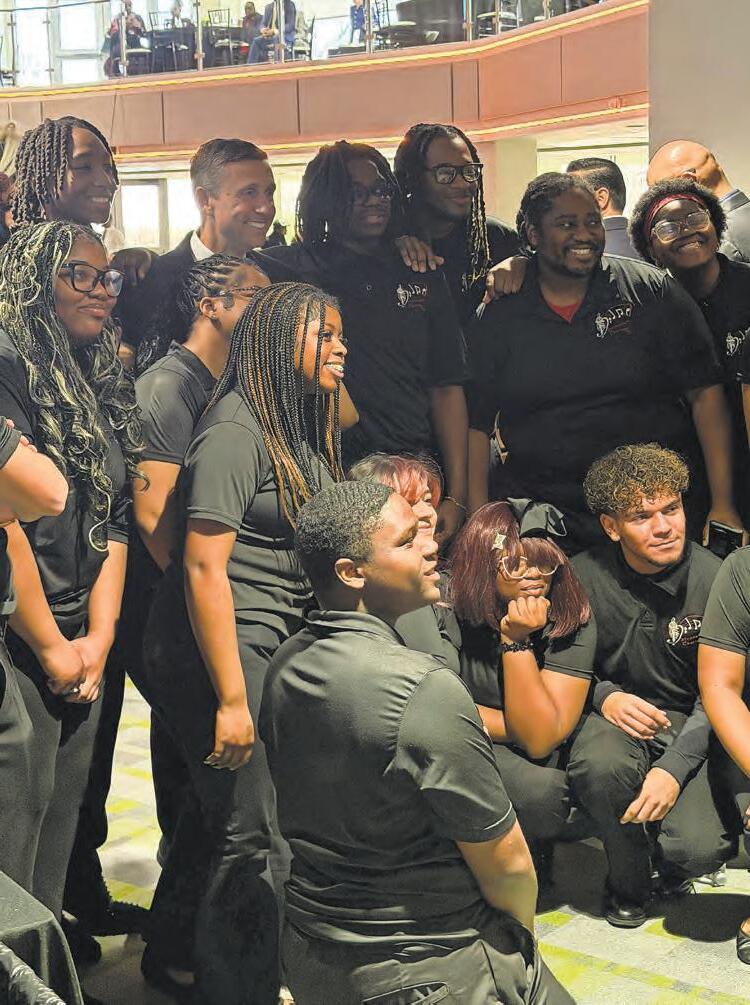
It may be a midterm election year, but the stakes are high in the Peach State, according to Democratic National Committee (DNC) Chair Ken Martin.
Martin was in town on Friday for an MLK Day breakfast in Savanna Hall at Zoo Atlanta. The speakers at the event included union leaders, labor leaders, local preachers, and local politicians like U.S. Rep. Lucy McBath (GA-D) and Stockbridge Mayor Jayden Williams. When it was Martin’s turn to speak to the large crowd in attendance, the majority of which was Black, he thanked Senator Jon Ossoff, who was also in attendance, and other Georgia politicians, including Public Service Commissioner Alicia M. Johnson, for holding the line for the South’s most crucial battleground state.
“When we organize everywhere, we can win anywhere,” Martin said.
Johnson is the first Black woman to hold a seat on the statewide Public Safety Commission. Martin told the crowd that Georgia has the opportunity to have a historic midterm election this year, but it will take a concerted effort long before the fourth quarter.
“We cannot keep showing up three months before an election and ask people to vote for us,” Martin said.
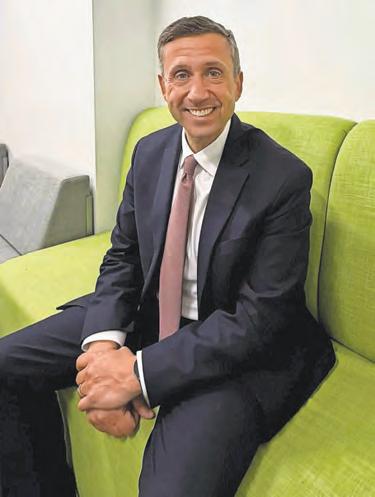
The Atlanta Voice sat down with Martin after he left the stage to talk about what he and the DNC is working on next. The District 14 special election will take place on Tuesday, March 10, asked how important that election was to the Democratic mission heading into November 2026, Martin said it was very important.
“This is an excellent opportunity to pick up a Congressional District,” Martin said, who added that Democratic candidate Shawn Harris, one of three Democrats running in the 22-person election, was a good candidate. There are 17 Republicans running for the seat.
“If you look at last year as an example, we had our most historic off-year election in the history of the Democratic Party,” he said.
The DNC Chair said people need to look even deeper into the political success of 2026, like in Mississippi, where three Legislative seats were turned blue. “Every inch of ground we gain adds up,” he said. “We know if we carry that forward, we can put this [Georgia] seat in play. We have a good candidate in Shawn, and a district that’s ripe for the taking, and so I say you can’t ignore any race and you can’t ignore any part of this country.”
Martin said the DNC will make voter registration a priority this election cycle. Young voter turnout has fallen in recent elections. According to data from Your Voice Matters, only 23% of 18-29-year-olds registered to vote and cast ballots in the 2022 midterms. That was four years ago, and registration and turnout of the youngest age group (18-19) is even lower.
“Young voters are the largest voting bloc in the country, but they vote at such low numbers,” Martin, a native Minnesotan and father of two sons, ages 23 and 21, said. “That is part of what our voter registration push is really focusing on, registering young voters, in particular young Black and brown voters.”
Martin said he understands why young
people are becoming more disenchanted with voting. “I sort of get it, they’re looking around at what is happening right now, they don’t see anything good happening in politics. They don’t see anything passing that is going to make a difference in their lives.”
He said there is a sense of despair in the air.
“We have to give young people some hope,” Martin said. “We have to give them hope that there are better days ahead.”
The DNC recently announced that it is launching a new voter registration effort, When We Count. The youth fellowship will aim to train hundreds of young people to register new voters, hopefully closing the voter registration gap that has grown over the past four years.
By ISAIAH SINGLETON
Outgoing Atlanta Board of Education Chair
Erika Mitchell is stepping down from her position, but she says she is not retiring—simply transitioning back into her previous role.
The Atlanta Board of Education recently swore in Jessica D. Johnson (At-Large, Seat 9) as the new chair and Dr. Ken Zeff (District 3) as vice chair. Since being elected to the Atlanta Public Schools Board of Education in 2018, Mitchell has emerged as a prominent public servant, actively engaging as a board member and emphasizing the importance of parent and community involvement.
Mitchell spearheaded several significant initiatives, including introducing District 5’s electronic newsletter, establishing community partnerships, advocating for the district’s planetarium renovation, and repurposing vacant school buildings into community centers.
Her leadership also extended to policy development, where she played a pivotal role in crafting the district’s first policies on literacy, domestic minor sex trafficking, trauma-informed practices, and restorative justice. She also co-authored the Atlanta Public Schools Equity Policy.
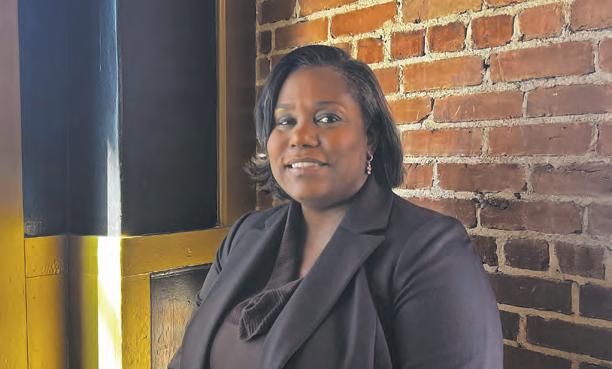
The Atlanta Voice sat down with Mitchell at The HIVE in Buckhead to discuss her legacy, her transition, and what lies ahead.
The Atlanta Voice: Why did you
decide to step down? Why now?
Erika Mitchell: It wasn’t a matter of why I wanted to leave, but more about the fact that you have new board members coming on. A lot of people want a shot at being board chair. A lot of people want a position and a title, and many times they don’t understand what comes with that. There’s a lot of work.
People might say, “Oh, you made it look easy,” but that’s because I did the work. As board chair, you always have a target on your back. There’s always someone standing in the corner wanting to be chair, and that’s just the reality. I took advantage of the first two years, but that doesn’t mean I won’t be board chair again in the future. Right now, the dynamics of the board have changed. You have eager, ambitious new board members who want a shot at leadership.
AV: You’re not retiring—just transitioning back into your former role. Talk to me about why you took the chair position in the first place.
EM: Back in 2023, we had a lot of uncertainty around district leadership, and four board members approached me about running for chair. My response was that we needed to talk to the current chair and figure out a plan moving forward.
I don’t like to get political. I told them, “If you want me to be chair, you have to get me the votes,” because I wasn’t going out campaigning myself. The reason was respect. We didn’t agree on everything, but I wasn’t
going to do another person that way. That’s not how leadership should work. You have to have conversations up front. Doing things behind people’s backs only erodes trust.
For me, stepping into the role was about putting into practice everything I’ve learned through seminars and workshops. One of my first successes as board chair was helping secure an 11% pay raise for teachers and paraprofessionals. I firmly believe that when you invest in your staff, your staff will invest in students.
That pay raise helped with teacher retention and ensuring we keep qualified educators in the district. Graduation rates also increased that year, and they continue to rise annually.
AV: What kind of legacy do you want to leave behind?
EM: When I think about the work I’ve done, it has always been student-centered. I look at the gains in literacy, numeracy, and closing achievement gaps. I look at the pay raises—not only for teachers, but also the additional 10% raises for frontline workers, including nutrition staff, custodians, bus drivers, and paraprofessionals. We must invest in our staff.
One of the policies I’m most proud of is the Honorary Diploma policy. It was inspired by what I witnessed at graduations and the tragedies that have impacted our district. Seeing parents walk across the stage to receive an empty diploma folder for a child lost to gun
violence deeply affected me.
I remember watching one parent cry uncontrollably while holding that empty folder. I asked myself, how could we honor that student?
The Honorary Diploma was our way of acknowledging and honoring their life. When you honor people—especially parents—that’s what it means to serve with care and intention.
That policy stands alongside literacy and restorative justice as some of the work I’m most proud of. I also look at the partnerships I’ve helped bring into the district, including the World Cup partnership. Shortly after this interview, I was headed downtown to meet with U.S. Soccer and FIFA to ensure our students are included—not excluded—from the World Cup experience. That’s especially important to me.
AV: As former chair, where would you like to see the Atlanta Board of Education in the future?
EM: I want to see board members who truly want to do the work. Too often, the board is used
as a steppingstone to other positions. But this work is about the future generation.
If students are receiving a quality education and we’re running the district effectively, you’ll see meaningful change in the city through the workforce those students eventually enter. That’s when you know the job has been done well.
I have very high hopes for the new chair. I’d like to see the board stabilize leadership by retaining a superintendent for six to eight years. We haven’t had that in a long time, and stability at that level is key to district success.
I’d also like to see board members receive a compensation increase. Last year, the Atlanta Compensation Commission recommended a $70,000 raise. We were the only entity that didn’t take the full raise— despite doing some of the most demanding work. Investing in board members helps retain good leaders, especially when many are forced to leave for other jobs simply to make a living.

By DONNELL SUGGS
Javoris Brown and Nora Pullen made their way to the fourth floor of the International Brotherhood of Electrical Workers (IBEW) building in Mechanicsville to tell their stories. Both owners of small businesses in Fairburn and Fayetteville, the separate parties were summoned downtown as witnesses to what failing to extend the Affordable Care Act (ACA) tax credits can do to the working class.
The pair are among the 1.4 million Georgians who saw their healthcare premiums rise. The Democratic Party of Georgia (DPG) held a press conference at I.B.E.W. on Tuesday afternoon.
The purpose was to shine light on the fact that three men running for Senator Jon Ossoff’s seat in November had not voted to extend ACA tax credits, and that, said DPG Chair Charlie Bailey, has led to premiums going up for everyday people in Georgia.
“Buddy Carter, Derek Dooley, and Mike Collins will be judged by their deeds,” Bailey said.
Alongside Bailey were DPG Minority Whip Sam Park and State Rep. Shea Roberts. All three took turns speaking to the press and, by extension, the public about why Ossoff should remain one of Georgia’s two senators after election day.
“What we’re seeing in Georgia is not hypothetical. It’s happening in real time,” Park said about Georgians choosing to live without healthcare due to how much it costs.
“As a Georgia voter, I will be doing everything in my power to re-elect Jon Ossoff,” Park said.
Roberts discussed rural hospitals being either stretched to the limit or closing. “That means jobs are lost, and Georgians have to travel even further for healthcare,” she said.
Bailey, Park, and Roberts pointed out that a three-year extension of the current ACA tax credit is on the table under the gold dome, but the
bipartisan support isn’t there to push it along, and that hurts Georgians.
“More Georgians are losing access to affordable healthcare,” Park said.
Both Brown and Pullen were given opportunities to share their stories during the press conference. Pullen and her husband own a wellness facility in Fayetteville, and she said she has decided to “roll the dice” and not pay for a healthcare plan at the moment, opting to pay out-of-pocket when costs arise.
Brown said Georgians should want Ossoff back in the Senate next year because “We need a fighter in Washington.”
By ISAIAH SINGLETON
Atlanta took part in the national “Free America Walk Out,” which is calling on Americans to leave school or work in defiance of the direction the country is heading under the current leadership.
Occurring on Jan. 20, the one-year anniversary of the start of Trump’s second term, dozens of people gathered at the State capital in solidarity to disagree with the current administration’s policies and agendas. Armed and masked law enforcement officers are seen smashing car windows, yanking people from vehicles, and chasing and wrestling others to the ground, hauling them away. The most recent event was an ICE agent shooting and killing Renee Good in Minneapolis, according to the Associated Press.
Additionally, to the massive ICE presence in many cities, the walkout also draws attention to strikes in Venezuela. The Trump Administration claims this was to help reduce the flow of drugs coming into the U.S. Other benefits were also mentioned, such as greater control of oil, according to the Associated Press.
To bring attention to what’s happening across the nation, like the “No Kings” protests from this summer, the nationwide walkout wants to “make visible how much our labor, participation, and cooperation are taken for granted and what happens when we withdraw them together.”

Atlanta took part in the national “Free America Walk Out,” who are calling on Americans to leave school or work in defiance of the direction the country is heading under the current leadership.
Chants of “No ICE in our streets,” “No Justice, No Peace,” “We built these streets,” and “If we don’t get it, shut it down,” echoed through the streets in the cold, windy weather.
Many protesters held up signs that took bold, boisterous stances such as “My son is not your toy soldier,” “Remember Renee Good (who was killed by ICE),” “Free Palestine,” “We
Stand with Venezuela,” and more.
Norcross resident Tim Andrease and his wife said they came to take part as Christian believers.
“We need to stand up for freedom, for tolerance, and for the real teachings of Jesus Christ of tolerance and liberation and all the best part of what a healthy soul experiences, we want to bring this goodness through our
words and through our presence,” he said. Andrease also said they’re hoping this is the beginning of a more generalized operation of doing what John Lewis counseled them to do to make “good trouble”, especially by leaving the workplace, using our power to show those who stand up for democracy are also those who are supporting the economy.
“Without the support for democracy, there is no support for the economy here,” he said.
Jazz Groves, a member of the Louisville chapter of the Democratic Socialists of America in Kentucky, visited Atlanta to take part in walkout protests. Groves also emphasized the importance of solidarity and physical presence in activism, criticizing the tendency towards “clicktivism.”
“I think it’s important to stand in solidarity with people who are in your community, even with people outside of your community, and to show up and do something,” she said. “In this era, we are in right now, it’s getting better, but sometimes we fall into a little bit of clicktivism, just like doing things from the comfort of our home, and it’s important to show up and show out. I’m really hoping that, like this is small, but I hope in the future, things get even bigger and even better.”
Groves said she learned about the protests through 5051 Kentucky and decided to join while visiting family in Atlanta, highlighting the significance of community action and the hope for future, larger, more impactful protests.
By LAURA NWOGU
At the intersection of North Decatur Road and Scott Boulevard, drivers honked their horns as they passed through the busy intersection on a Tuesday afternoon. It wasn’t due to traffic or an obstacle in the way, but in support of Free America Walkout protesters who stood on the sidewalks with signs condemning United States President Donald J. Trump and his “fascist regime.”
A man holding a bullhorn yelled for Trump to be “impeached, convicted, and removed.” He implored drivers not just to honk, but to get out of their cars and join them.
This protest was just one of many happening around the Atlanta area and nationwide at the same time. Organized by Women’s March as a series of walkouts, protestors were encouraged to walk out of work, school, and commerce. Women and men dressed in shades of red, white, and blue held signs calling for people to “Resist and push back” and “Save democracy and dump Trump.” For the protesters out there, the sounds of blaring horns
were a sign that people were eager to walk away from fascism and toward a free America.
The walkouts happened amid increased ICE raids and violence, troop occupation in many cities, and attacks on communities such as the trans community.
Jennifer Blake, a retiree, said she decided to withhold her participation in commerce to attend the protest.
“Every chance I get, I need to protest what’s happening. Where Trump is taking this country is just atrocious, and I don’t believe in what he’s doing, so I have to make my voice heard somehow,” Blake said. “You can see the people who are honking. They’re with us, even though they’re not standing on this corner. That’s good to hear that we’re not alone.”
Rebecca Flueckiger implored people to start preparing for the upcoming elections and working together to enact change.
“I’m hoping people have the courage to speak up, to talk to each other, to stand up and say something.”

By DENNIS MALCOLM ByRON AKA ALE SHARPTON
If you want to go the EV route, the battery is not the only thing electric regarding the 2025 Kia EV6 GT-Line, because the driving experience should also share that description. Considering 641 horsepower and 568 pound-feet in GT mode, the EV6 is simply electrifying. Combine that with bold styling in ‘26, all-wheel-drive maneuverability, and impressive efficiency with fast charging, this crossover hits the bullseye for drivers who want an EV that feels dynamic without simply “settling” for everyday comfort.
The body is more curvaceous, the Star Map LED lighting is futuristic, and overall exterior design lets the public know the GT-Line is not shy on power with its sporty look. However, the interior is arguably the
Continued from page 2
for what it was. And the message would be to the kids that it doesn’t matter if you’re white, brown or Black, just be pure and healthy.”
After he bought his first American Paint, which he named Spinderella, Fulton found a facility in Loganville that housed horses. Soon, the duo began being booked for kids’ parties, entertaining crowds with tricks and spins. As his knowledge of horses grew, so did his number of horses, with names such as Hip-Hop, Rhythm and Blues and NeoSoul. He later became a stunt coordinator for films, which allowed him to purchase his 27 acres of land for $150,000 in January 2016.
However, his vision was halted a year later. In 2017, Fulton was charged with twelve
most impressive regarding this year’s enhancements. KIA delivers a cabin that feels modern, sporty, and thoughtfully designed. A 12.3-inch digital instrument cluster flows seamlessly into a 12.3-inch touchscreen with navigation, creating a wide, high-tech display that anchors the dashboard. I dig that. Passengers also get some love with heated front seats, a heated steering wheel, and a power-adjustable driver’s seat with memory steps up the comfort. Wireless Apple CarPlay and Android Auto bring ideal connectivity, alongside a premium audio system, and the signature Kia Connect services collectively keep the driver content.
Safety and driver assistance are also a priority, with features like forward collision avoidance; blind-spot collision avoidance; lane keeping and lane following assist; smart
counts of animal cruelty after complaints were called in. Fulton County later arrested him and seized seven of his prized horses. While he was cleared of animal cruelty charges a few months later, Fulton’s horses were never returned to him. He is now battling the county, suing directly under the Fifth Amendment’s Takings Clause, which states that, “nor shall private property be taken for public use, without just compensation.”
Fulton said it was never about the horses, but about him owning the land and the desires of outside developers.
“There are gatekeepers in everything, and I didn’t know that. I’m not perfect, but I have heart. I didn’t have a criminal record until I came to Atlanta. I’ve never been arrested in New York City; never been in any gang.
“Here, I realized that everything has an expectation of how it should look based on how people are programmed to circumstances.


cruise control with stop-and-go; and parking distance warning. These systems work quietly in the background, enhancing confidence without all the often-annoying alerts some cars overdue.
With a total MSRP around $60K as equipped, the 2025 Kia EV6 GT-Line AWD positions itself as a premium, yet resourceful
electric crossover. It delivers head-turning design, mind-easing efficiency, and exhilarating performance in a package that feels well thought out. For drivers ready to go electric coupled with power without giving up style, the EV6 GT-Line continues to be one of the most recommended options in its class. For more information, visit Kia.com.

And for me, being here, there are a large group of people who don’t have the ability to see the beauty in what I’m doing the way I’m doing it, because to them, they haven’t been taught that that’s beautiful. I’m over here, walking through mud, dealing with the weather to keep them alive, to keep myself alive. It looks like a mess to you, but I’m trying to create something. And to create something, especially when you’re one person, it’s not as easy.”
However, the one-man army that is Fulton hasn’t let his troubles deter his vision. He still plans to create a safe community for children who want to ride or learn about horses but don’t readily have access to them.
He enthusiastically stood between his land and the stream of Camp Creek that runs through it, an area he’s named Brooke. He outlined his plans for different parts of Believe Kingdom, including picnic tables and hammocks, a barn for staging the horses,
cabins, and a souvenir shop. He also plans to incorporate a race track, a natural trail, and an area where wellness, music, and arts are the focus.
“I guess I’ve been chosen to be the person or the energy to create opportunities so other people won’t find themselves stuck at a job that they hate, and say, ‘Man, I wish I could have…’ For some reason, I was instilled with a spirit that’s given me the strength to go through all of this, because I was once the one deprived of it. So my story and everything they put me through actually helped me. Everything they put me through didn’t deter me from the goal.”
Fulton’s journey and the obstacles he’s had to jump over are now highlighted in a documentary directed by Adelin Gasana and produced by Julia Griggs.
‘The whole thing with me is showing that as long as you stay in your lane, you’ll make it no matter what you are. But you’ve got to go through some pain. You’ve got to be willing to take a few blows.”
By NOAH WASHINGTON
One Contemporary Gallery marked its first year in Atlanta with “Inner Views: Artists at Home,” a group exhibition that reimagines domestic spaces as sites of memory, reflection, and reinvention.
On view inside the Edgewood Avenue gallery, the exhibition features work by 14 contemporary artists, many of them created specifically for the anniversary show. Together, the works explore how ideas of home, intimacy, and community are shaped by lived experience.
The exhibition text describes Inner Views as a “collective musing on home, family and community,” using interior and lifestyle scenes to examine both everyday moments and deeper cultural histories.
Gallery director and curator Faron Manuel said the exhibition reflects both the growth of the gallery and the willingness of artists to take creative risks.
“It feels really good to be in the community in this way and to have people excited to come out to an anniversary exhibition,” Manuel

limits or rules to art.”
Veteran curator Tina Dunkley, a mentor to Manuel and former director of Clark Atlanta University’s museum, attended the opening and praised the strength of the work on view.
“I saw some really strong work by very accomplished artists,” Dunkley said. “The subjects and materials are engaging, and Faron Manuel is doing an awesome job.”
Dunkley said the exhibition reflects a broader shift in contemporary art, where artists feel freer to experiment without institutional pressure.
“It’s invigorating,” she said. “Learning about the artists and their materials without the stress of wondering if the work will end up in a major museum makes this a very pleasant time.”
said. “The artists really wanted to push themselves to the point where nearly half of the works in the show were created for this exhibition.”
Manuel said the gallery is currently
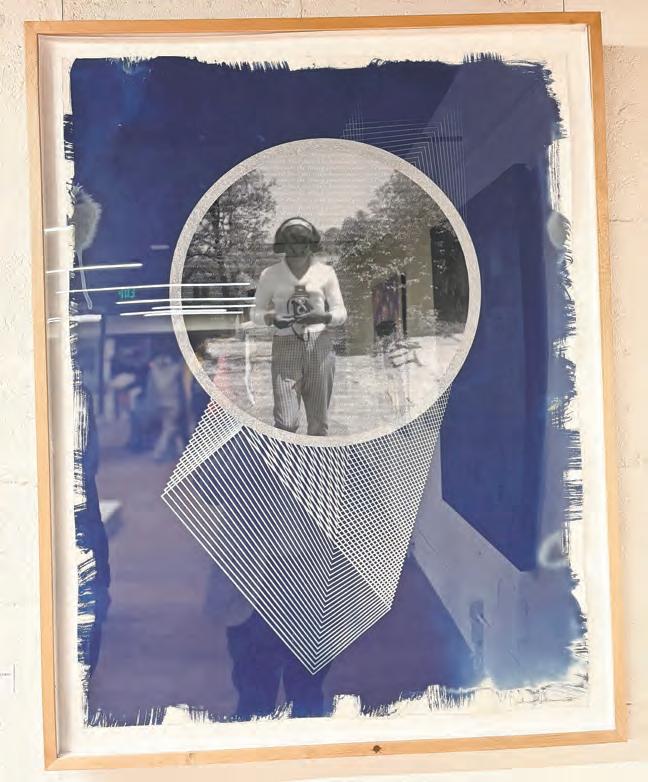
showing approximately 25 pieces, including a collaborative work by Petie Parker and Paper Frank that expanded the original artist list. One year in, he views the gallery’s progress as both measurable and personal.
“We’ve clearly become one of the recognizable galleries in Atlanta,” Manuel said, noting that One Contemporary was recently named in Atlanta Magazine’s “Best of Atlanta” issue. “But personally, I feel humbled. There’s a lot of unseen work that goes into putting a show like this together, and it means a lot to have the approval of the artists and the community.”
The exhibition’s focus on interiors allows artists to interpret home as both a physical and emotional space.
Painter Ariel Danielle contributes The Morning After, a work centered on food as a shared experience.
“I’m still thinking about food as a subject and how it brings people together,” Danielle said. The painting depicts an intimate morning scene of waffles, matcha and jam shared with an unseen companion. “It could be anybody, a loved one, a friend, a family member. The viewer gets to decide.”
Danielle, who also participated in the gallery’s inaugural exhibition, said the theme made the work a natural fit.
“It’s intimate, it’s inside,” she said. “That really aligns with the idea of home.”
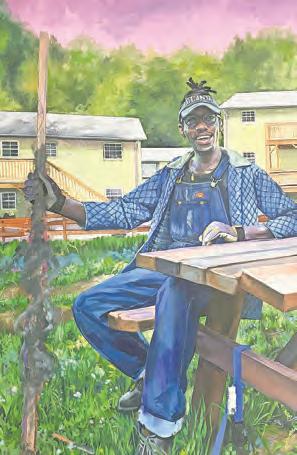
Artist Jurrell Cayetano has three works on display: Jay at the Community Farm, Panther (Profile) and Paula (Asleep). Cayetano said Jay at the Community Farm was inspired by a photograph taken during the COVID-19 pandemic.
“It was one of the first times being in contact with someone after a few months of quarantining,” Cayetano said. “Jay offered to give us some eggs from the chickens at their community farm.”
Cayetano said participating in the anniversary exhibition feels both reflective and communal.
“It feels great, kind of like a class reunion in a sense,” he said.
For artist Petie Parker, the exhibition also became an opportunity for spontaneous collaboration. His acrylic-on-canvas work Rent Free was completed in roughly 24 hours and features contributions from Paper Frank, a longtime creative partner.
“He was just in the studio, and he walked over and started drawing,” Parker said. “The imagery and the words were so powerful that I knew I had to build around it.”
The piece depicts a young figure immersed in imagination, reflecting Parker’s belief that creativity often begins in isolation.
“You might have minimal tools, but if you have your mind, you’re good,” Parker said. “There are no
Manuel said the gallery is also investing in the future of the arts by welcoming student interns from Georgia State University and the Savannah College of Art and Design, offering hands-on exposure to the inner workings of galleries and the art market.
For Manuel, the anniversary exhibition is less about marking time and more about momentum.
“It means a lot to have the artists believe in the space and for the community to show up,” he said. “That’s how you know you’re building something that matters.”
“Inner Views: Artists at Home” is on view at One Contemporary Gallery, 395 Edgewood Ave.
By LAURA NWOGU
Part of Atlanta’s charm
lies in its diverse food scene, from the rich culture to the bold flavors.
The saying often goes that “Atlanta isn’t a real place,” and what makes it unique is the bustling dining and drinking spots on every corner of the city’s neighborhoods, built to satisfy every palate. Lucky for locals and tourists alike, there’s never a shortage of places to visit, especially when new businesses are rolling in every month.
Here is a roundup of updates on your local favorites and recently opened:
EATS
600 Ponce De Leon Ave NE.
Fans of EATS on Ponce, rejoice. After announcing that it would permanently close its doors on Oct. 18, 2025, the popular eatery is back thanks to the team at Wild Heaven Beer. Known for its jerk chicken special, the restaurant was a staple in the city, and the news of its closure was met with sadness from locals. With plans to reopen at Wild Heaven’s West End location in the early spring, the beloved establishment’s 33-year-old legacy will live on.

Ponce City Market
675 Ponce De Leon Ave NE.
A wave of closures has hit Ponce City Market, with four food stalls recently closing, including Sugar Shane’s, La Metro, Ton Ton Ramen & Yakitori, and Miso Ko. While these closures paint a picture of
shifts in the economic market and can be linked to expensive and limited parking, two new stalls have been announced: NoriFish and Okiboru. Both restaurants focused on Japanese fare, with Okiboru serving up popular Michelin-rated ramen and NoriFish focused on
omakase-style sushi.
Recently-opened restaurants
Ruki’s Kitchen
1161 Ridge Ave SW Suite 15
The flavors of East Africa meet Atlanta with the opening of Ruki’s
Kitchen at Switchman Hall in Peoplestown. Owned by chef Ali Lemma, the restaurateur founded the Ethiopian eatery in 2021. After operating in a food hall in East Atlanta Village, a couple of residencies and organizing a series of pop ups around the city, Lemma opened the doors to his first brickand-mortar on Jan. 10. Known for his fusion dishes that married traditional Ethiopian dishes with other cultures, Lemma is focused on brining the beloved plates of Ethiopia, such as beef tibs and lentils, to the city.
Hours: Wednesday-Saturday, 12-8 p.m.
Incoming restaurants
Rosetta Bakery
101 High Street
Rosetta Bakery, an all-day Italian cafe and bakery that serves pastries, sandwiches, and pizzas, is opening its second location on Jan. 19. Located at Perimeter Center’s High Street, the bakery will celebrate its grand opening on Saturday, Jan. 24, from 3-5 p.m. The grand opening will feature a sample of sweet selections and beverages from the menu with live music and raffles.
Hours: Open Daily, 8 a.m.-8 p.m.
By DONNELL SUGGS
Brad Guzan is gone. He retired following the 2025 season. Bartosz Slisz is gone. He was transferred to Bronby IF of the Danish Superliga earlier this month. Ronny Deila is gone. The former Five Stripes manager was fired after his only season in Atlanta. Derrick Williams is gone. The former Atlanta center back is playing his football in English League One with Reading FC.
Last week began a new season for Atlanta United in more ways than one. And not all of those reasons are because players and coaches are no longer with the club.
Gerardo “Tata” Martino is back. The former MLS Cup championship manager has returned to run the club. Tomas Jacob is here. The Argentine center back will man the middle of the pitch in Mercedes-Benz Stadium as Williams did before him. The team also announced that defender Ronald Hernandez had been re-signed through the 2026 season with a team option for the 2027 season.
Amongst the chaos, Hernandez had a career year in 2025. He played in a career-high 21 games, starting 16 of those games in the

process. A key to a quality season for the Five Stripes will be having familiar faces on the back line in Hernandez, along with Stian Gergersen, Matt Edwards, Pedro Amador, and Juan Berrocal.
Preseason training camp began last week, and there’s a lot Atlanta United, Martino, his
coaching staff, and the Five Stripes supporters will want to put behind them from 2025.
Wednesday was the third day of preseason training camp, and the second day the media was allowed access to the team.
On Wednesday, January 14, the team underwent training, and later, Martino and
Atlanta United’s Chief Soccer Officer and Sporting Director, Chris Henderson, spoke with the media.
Atlanta United (5-13-16 overall in 2025) has released its 2026 preseason schedule. Along with a match at the Children’s Healthcare of Atlanta Training Ground, the team will play several matches in Texas.
Last season, Atlanta United finished at the bottom of the MLS Eastern Conference standings. The story of the 2025 season will include injuries to key players, 16 losses, tough draws, and ultimately, a coaching change, Deila was fired at the end of the season.
The preseason will also provide an opportunity for some of the team’s young players, such as Matt Edwards and 21-year-old goalkeeper Jayden Hibbert, to continue their development.
The Five Stripes will begin the preseason on their training grounds on Friday, January 30. The opponent, Lexington SC, is a United Soccer League club out of Kentucky. The match will take place at 11 a.m.
By NOAH WASHINGTON
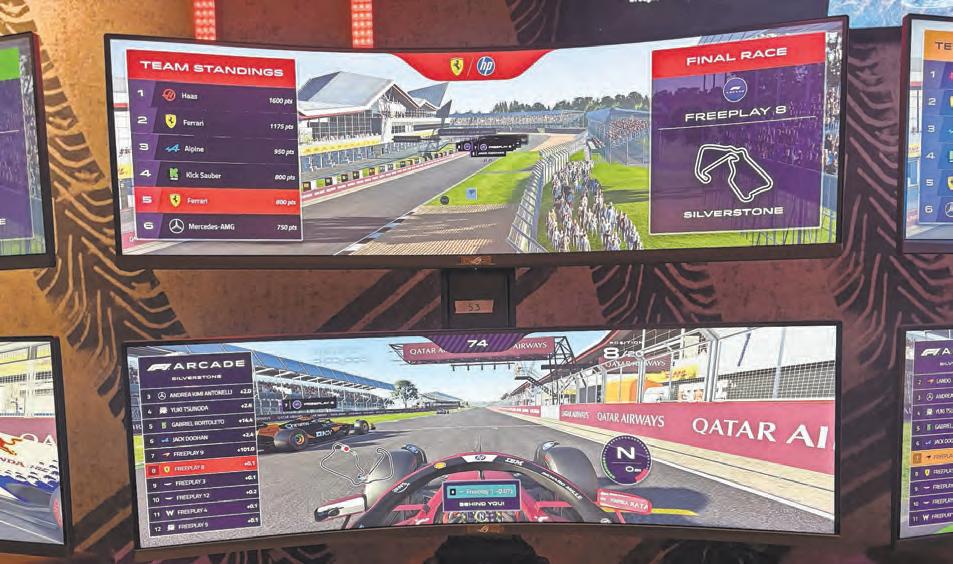
You may not have Brad Pitt’s jawline or Damson Idris’ movie deal, but at the new F1 Arcade at The Interlock in West Midtown, you can finally ( if only for a few laps), step into the driver’s seat and test your Formula One fantasy, without ever leaving the city.
A preview event held this week offered the first public look inside F1 Arcade, a high-energy motorsports entertainment destination opening next month in West Midtown at The Interlock. The Atlanta location will be the brand’s eighth worldwide and its first in Georgia, bringing an immersive racing simulation, chef-driven dining and a full-service bar to the area’s growing nightlife scene.
The 15,000-square-foot venue
features 68 full-motion racing simulators designed to replicate the feel of Formula One driving, complete with multiple skill levels to accommodate both first-timers and seasoned gamers. Guests do not need prior knowledge of F1 or even a driver’s license to participate.
“This is the world’s first Formula One social entertainment destination,” said Liz Norris, vice president of U.S. launch strategy and communications to the attending crowd. “If you know nothing about F1, let this be your introduction. You don’t need to know a thing to have a blast.”
Norris said the preview coincided with the opening of the reservation system, with the official grand opening scheduled for Feb. 6. While construction and staff training are still underway, attendees were invited to test simulators, tour the

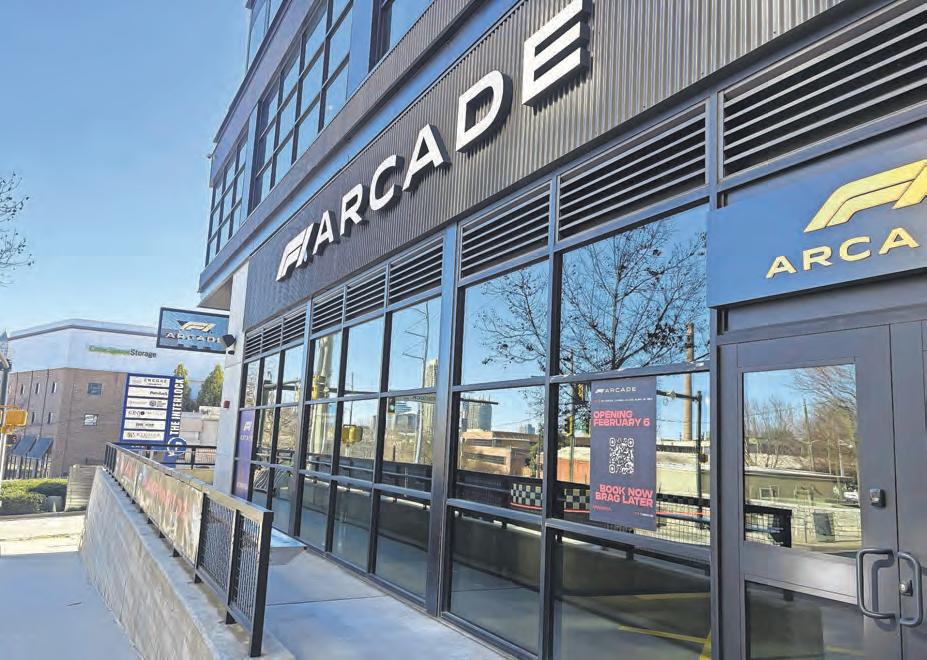
space and take part in a celebratory champagne toast.
Beyond racing, the venue aims to position itself as a social hub.
The bar program includes curated cocktails, including nonalcoholic options, while the menu is led by an executive chef. Music, DJ-led nights and private events are also planned.
Jonathan Peters, CEO of F1 Arcade, said Atlanta stood out as a strategic expansion city for the brand’s growing U.S. footprint.
“Atlanta is clearly one of the great cities in the U.S.,” Peters said.
“From an F1 point of view, there’s nothing really like this here yet.
People are crying out for experiential nights out, something that brings adrenaline but is still social
and accessible.”
Peters emphasized that the experience is designed to appeal beyond racing enthusiasts.
“You could have no interest in racing and still want to come here,” he said. “It’s about the environment, the food, the drinks, the music and being able to socialize. Ultimately, we want guests to leave happier than when they arrived.”
From a development perspective, the addition of F1 Arcade marks another major tenant for The Interlock, a mixed-use complex known for blending dining, retail and entertainment.
Adriana Siciliano, community manager and tenant relations manager at Stream Realty Partners, said
conversations to bring the venue to West Midtown began early last year after F1 Arcade began scouting the Atlanta market.
“Through months of communication and negotiation, we were able to land them here,” Siciliano said. “This location is the only one in the state of Georgia and one of the very few in the Southeast.”
Siciliano said the venue is expected to draw visitors from across Atlanta, the state and neighboring regions, whether they are longtime motorsports fans or simply looking for something new.
“Anyone and everyone,” she said. “If you’re interested in F1 or just want to try a new experience, this is the place to do it.”


& procedures to assess for med device mfg compliance as per FDA 21 CFR 820, ISO 13485:2016 ISO 9001:2015 & ISO 17025: 2017; (ii) developing audit scope, audit agenda & preparing audit reports explaining audit observations, findings & results; (iii) assessing potential new suppliers for technical, quality & mfg capabilities; (iv) providing tech support for intro of components from suppliers, ensuring smooth integration & quality standards compliance; (v) generating test protocols, monitoring testing processes, issuing qualification test reports & approving components for use in products according to quality standards; & (vi) analyzing incoming material defects, determining dispositions, investigating field failures rltd to supplier materials & developing Corrective Action Plans where necessary to prevent recurrence. Up to 40% domestic & international travel to supplier mfg sites is req’d. An EOE. 40 hrs/wk. Send resumes to AbbottJobs1@abbott.com or by mail to Abbott Laboratories, Attn: 26J14A, Willis Tower, 233 S. Wacker Dr., Floor 26, Dept. 32, Chicago, IL 60606. Refer to ad code: SJM-0070-ES