The Hoya: The Guide: January 30, 2026

Page 1


TELEVISION ‘Pluribus’ succeeds as an immersive sci-fi series, Juan Almanza (CAS ’29) says . B2

CONCERT Paulina Inglima (CAS ’27) raves about an emotional Del Water Gap show. B4

TELEVISION ‘Emily in Paris’ recycles plot with Parisian flair, Aarushi Maskara (MSB ’28) says. B6

JANUARY 30, 2026

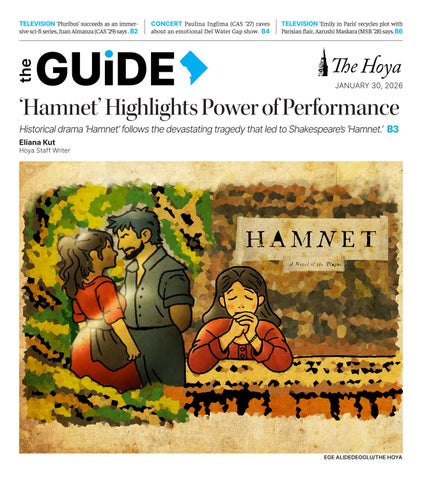
‘Hamnet’ Highlights Power of Performance

Historical drama ‘Hamnet’ follows the devastating tragedy that led to Shakespeare’s ‘Hamnet.’ B3

Eliana Kut Hoya Staff Writer
‘Pluribus’

IMDB

Juan Almanza (CAS ’29) found “Pluribus” to be an unorthodox but intriguing sci-fi show.

Is Thought-Provoking, Isolating, Delightfully Rebellious

Every Wednesday felt like a holiday during the release of “Pluribus.” Vince Gilligan, the masterful showrunner, succeeds yet again in creating a gripping, tense and reflective television series. Rhea Seehorn’s impeccable performance, paired with a compelling narrative, makes it easy to see why she earned her first Golden Globe.

The first thing you notice from the opening episode of “Pluribus” is the eerie quiet that falls over the world of the show. After months of research, a team of scientists finally crack the code on a genetic sequence received from outer space. When one of the lab rats spreads the engineered virus to a researcher, all hell, surprisingly, doesn’t break loose. As the virus spreads, the nature of the disease makes itself clear: Those infected are joined into a hive mind, sharing consciousness, being and self. The upside? Unending happiness for those infected.

Given enough time, the hive mind eventually unleashes the virus upon the world in an event they dub the “Joining.” By the end, ap-

proximately one billion people perish, yet the Joining succeeds in assimilating nearly everyone — except for 13. Among them is Carol Sturka (Rhea Seehorn), dubbed by the show’s synopsis as “the most miserable person on Earth,” who must now save the world from happiness.

The first season takes its time in establishing the world that Carol inhabits, with long, stretching shots of the desolate landscape of Albuquerque, N.M. Gilligan could have leaned on the classic science fiction trope of a hostile hive mind, hell-bent on converting (or even eliminating) the unconverted, but he subverts expectations completely.

The hive mind, at least in demeanor, appears to be absolutely benevolent. They don’t kill for sustenance (even farming is harmful in their eyes); instead, they collaborate. Even all the deaths that occurred during the initial joining were due to virus-related seizures rather than violence. As for the unconverted, the hive mind seems to want to take genuine care of them, even offering them anything they could ever want — and the word “anything” isn’t hyperbole.

From this subversion emerges an interesting relationship between Carol and

the hive mind, one of forced dependence despite her unyielding rebelliousness and desire for autonomy. Rhea Seehorn conveys this internal conflict perfectly, with every facial expression and dialogue delivered with an unflinching realness.

However, this doesn’t mean the season was perfect. Gilligan clearly sets up for a larger narrative to be played out in successive seasons (Apple TV has already ordered a second season), as the first season features a lot of worldbuilding. It matches the pace of his previous show, “Better Call Saul.” There are points in the show where it feels like some of this worldbuilding lags behind the more intriguing plotlines of the hive mind. One episode in particular (which I’ll refrain from speaking of in detail as this is a no-spoilers review, after all) was such a slog that I dropped the show for a little while after watching it.

This isn’t to say that the episode was bad, necessarily, but the ambitious sci-fi elements demanded a slightly faster pace.

When the worldbuilding hit, though, it left me speechless. There’s a vulnerability to Carol that is uncovered slowly, revealed the more you dig into her character. The show accom-

plishes this through long scenes featuring only her mannerisms and how she behaves. Carol’s wife passed away during the “Joining,” and her actions, whether she is reaching out to the other people who are immune or interacting with one of her assigned chaperones from the hive mind, reveal an underlying desire for connection. On the other side of that spectrum, the hive mind has the unending task of spreading their infection far and wide, regardless of whether the person wants it. This push and pull to become one with the hive mind or maintain one’s individuality is what makes “Pluribus” so compelling.

In order to avoid spoilers, I have omitted a lot of truly magnificent moments of this show, but if even a little bit of this review is intriguing, I recommend watching it. It’s one of those pieces that can’t be fully understood until you actually sit down and immerse yourself in it. Vince Gilligan has succeeded yet again in creating an immersive world with characters so well-written that they make the show feel indiscernible from reality. Though it occasionally suffers from pacing issues, overall, it’s a strong introductory season into the thought-provoking world of “Pluribus.”

‘Hamnet’: The Gripping Beauty of Intensity

Chloé Zhao’s “Hamnet” is a visually stunning breath of fresh air. Released in November 2025, the historical drama showcases breathtaking cinematography, a devastating score and an acting masterclass from Jessie Buckley as Agnes Shakespeare. Its ferocious intensity and poignant nature make it one of the year’s most memorable films. Based on real events, “Hamnet” follows the lives of Agnes and William Shakespeare (Paul Mescal) in the 1500s as they raise their children and ultimately wrestle with the death of their son Hamnet (Jacobi Jupe). The film primarily centers on Agnes as she meets William and starts a family with him. Raised in close proximity to nature, Agnes raises her children, Susanna (Bodhi Rae Breathnach) and twins Hamnet and Judith (Olivia Lynes), to be surrounded by nature as well. At age 11, Hamnet dies of the plague, and Agnes and William must cope with the grief and loss of their son. Hamnet’s death inspires William’s play “Hamlet,” and its initial staging at the

Globe Theatre displays the extraordinary healing powers of art as Agnes smiles again for the first time since Hamnet’s death. The film is less focused on being an accurate biography and more on the impact of loss and the journey to healing.

The film’s cinematography strikes a deep chord through its lush landscapes and soft lighting, conveying the story’s beauty and emotional intensity. From the beginning, there is a strong emphasis on Agnes’s connection to nature and her surroundings. Cinematographer Łukasz Żal emphasizes this connection through wide shots of the forests where Agnes spends her time, highlighting the light filtering through the trees and the freedom nature brings her. The interior shots are filled with darker colors and soft, moody lighting, a stark contrast to the vibrant open spaces of the English countryside. Both settings, however, feel fluid and connected as Żal’s camerawork shifts evenly and openly between shots. The home feels comforting, while nature provides balance through its wild, unknown tangles. There seems to be a close, almost symbiotic connection between the characters and the environment they

live in — every setting is tied to a specific character, and each is framed to seem most natural in that setting.

Max Richter’s minimalist score provides texture and cohesion to the film while capitalizing on its emotional nature. Richter uses a blend of orchestral and vocal elements that offers nuance and resonates with each of the characters’ emotional states, particularly Agnes’s. During moments of turmoil, a women’s choir can be heard, emphasizing the themes of women’s love and loss throughout the film. Overall, the score’s tonal quality is subtle and ethereal, yet full of emotion. The piece that stood out to me the most, however, was Richter’s “On the Nature of Daylight,” used during the film’s climax. The piece was originally part of a separate 2004 Richter album, “The Blue Notebooks,” but was ultimately included in the final score of “Hamnet.” The song’s quiet, building harmonies perfectly complement Agnes’s turmoil and final revelations as she watches the performance of “Hamlet” in the film’s finale.

While the film had a multitude of praiseworthy technical and directorial aspects,

IMDB

Eliana Kut (CAS ’29) says that “Hamnet” is a masterful showing in both cinematography and acting.

what ultimately stood out to me most was Buckley’s outstanding performance as Agnes. The film revolves almost entirely around her, allowing her to display a wide range of emotions and tremendous acting capabilities. Buckley’s raw, emotional performance stands out for its intensity, especially in its portrayal of the complexities of grief after familial loss. Her unfiltered physicality felt almost uncomfortable for its intensity. Buckley made Agnes feel real and alive, not just a historical figure, but a mother and wife dealing with separation and trauma. Her grounded fervor helped convey Agnes’s connection to the natural world she grew up in, and her anguish felt gritty and powerful. Buckley’s memorable performance is the heart of “Hamnet,” and her presence constitutes the final element the film needed to feel fully cohesive.

“Hamnet” struck me as a particularly beautiful effort to highlight the importance of performance and cohesion in cinema. Zhao’s stunning film had me in tears by the final moments, and while the depth of emotion a film induces should not be the defining factor of how good it is, its overall impact still left me stunned. I highly recommend it for its remarkable cinematography, soundtrack and performances. This is undoubtedly a film everyone should see at least once in their lives.

Del Water Gap Mesmerizes Crowd at DC 9:30 Club

Indie rock artist Samuel Holden Jaffe, better known by his stage name Del Water Gap, catapulted in popularity with his lyrically explosive song “Ode to a Conversation Stuck in Your Throat” in 2021. On Jan. 19, 2026, he opened his show at the sold-out 9:30 Club in Washington, D.C., with a slightly different vibe from his usual work — Chappell Roan’s “HOT TO GO.”

As the crowd bopped in anticipation of his performance to a seemingly endless playlist of 9:30 Club’s previous headliners like Olivia Dean and The 1975, Jaffe finally popped out of the small venue’s left-wing tower. He belted out a few lines of Roan’s hit single, of course, accompanied by its viral YMCAesque dance, before he hit the stage.

Unlike Roan’s tunes with which he opened, Jaffe’s set proved to be less upbeat and more emotionally devastating. However, as the night went on, this initial move set the tone for what the audience could expect from Jaffe that night — whimsical dance moves, booming vocals and the persistent feeling that every

AWARD TO THE WISE

song sung, joke made or sultry stare shot was just for you (well, for me, not you).

The concert, his third ever at the 9:30 Club, was part of his highly anticipated “Chasing the Chimera” tour, named after his third studio album. While it has received considerably less hype than his previous album, “I Miss You Already + I Haven’t Left Yet,” “Chasing the Chimera” holds a quiet maturity and lyrical depth that feels indicative of Jaffe’s growth as an artist.

While the album title appears elusive, Jaffe has publicly talked about its connection with the 2023 movie “La Chimera,” which he watched in the film club he runs with his grandmother (who is the subject of “Please Follow” on the album). On stage, Jaffe talked about the album’s meaning, saying it was about “reckoning with the line of satisfaction that keeps moving as you get older.” The chimera, a mythical Greek creature, represents the ever-torturous trap of grasping at the unattainable — whether that be relationships, addiction or just satisfaction with life — as Jaffe grapples with his own mortality. On stage, Jaffe masterfully balanced the slower and heavier weight of “Chimera” with the indie-pop cult classics from his earlier albums that originally captured his audience’s attention. While the set appeared

simple — a vaulted white tent and flashing light show — like much of his art, it was full of surprises, with cables pulling the fabric to arch differently throughout the night. For the jazzy “Eastside Girls,” a black and white live video of Jaffe was projected onto the screen, adding a nostalgic visual to its sultry sound.

Jaffe’s stage presence was palpable throughout the night. The power of seeing Jaffe live truly came through early in his set with “New Personality,” a song that he cautioned his 20-something audience of, saying, “this one’s about a situationship, God bless if you’re in one of those.”

On the album, the song’s quiet acoustics mask the punch of its lyrics with an understated, breathy tone. In contrast, seeing it live gave lyrics like “I wanna believe I can measure this Earth in / All the good deeds I pretend that I’ve done,” a feeling of devastation and harsh truth telling that hit hard. Jaffe’s final repeated refrains of “I could just have fun, I could just have fun,” complete with a strained desperation in his voice, brought an edge that made the words feel more like a plea than an idea. He solidified what many a college student has found out the hard way — the idea of being the chill person in a situationship is often more of a chimera than a real possibility.

Standout performances came through on “NFU” and “Beach House,” where the messy rawness of his earlier work, a strong synth and bass presence brought a viscerality to his sound. In “Beach House,” a song about the dark underbelly of a psychoactive trip on ketamine, Jaffe’s performance almost felt manic, as he jumped around the hazy purplelit stage during a booming electric guitar solo. Jaffe’s superpower is his ability to connect with the audience and make every song feel extremely personal. In “Coping on Unemployment,” a song from his last album that looks dead in the eye the tension of COVID-19-era relationships, lyrics like “I’m scared of turning into / A parody of myself,” dare the listener to confront hidden fears as he seemed to sing directly to each individual audience member. Lyrics like “I think your music got worse; once you got fully sober; At least now you won’t kill yourself,” felt confrontational yet almost therapeutic as the audience screamed the lyrics back. Whether it’s the poetic lyricism and maturity of “Chasing the Chimera” or the raw viscerality and recklessness of his earlier work, Del Water Gap’s performance was absolutely mesmerizing. While Jaffe may be chasing the unattainable, he sure got close to reaching it at the 9:30 Club.

2026 Oscar Nominations: Who Missed, Why It Matters

While many of this year’s Oscar nominations were as expected, a few omissions stood out, including Paul Mescal in best supporting actor for “Hamnet,” “It Was Just An Accident” in best picture and “Wicked: For Good” in categories across the board. These omissions point to an academy that drew firmer lines than expected on nomination morning and also reveal some of the academy’s surprising priorities this year. In the morning’s most puzzling omission, Paul Mescal was shockingly unable to secure a nomination for best supporting actor for his role as William Shakespeare in “Hamnet.” Unlike many actors on the fringe, Mescal did everything right. Up to nomination morning Jan. 22, he had received nominations at every major precursor, including the Screen Actors Guild (SAG), Critics’ Choice Awards, the Golden Globes and the British Academy Film Awards (BAFTA) longlist (the British academy had yet to release the shortlist as of Jan. 22). In recent weeks, Mescal was not seen as particularly competitive as “Hamnet” was slumping in the box office, but due to a lack of outside competition, he was part of a seemingly locked group of five. Award Expert’s Jan. 21 community consensus reflected this exact expectation, with 93% of users predicting Mescal to be nominated, even though he still ranked fifth. Mescal was pushed out by Delroy Lindo for his performance in “Sinners.” While Lindo’s efforts as Delta Slim generated respect, he saw considerably less success on the awards

circuit than Mescal, with Lindo’s only major note being a BAFTA longlist mention. As such, this was a very difficult upset to predict. The most plausible explanation for the snub is not that Mescal was particularly weak, but rather that the academy went head over heels for “Sinners,” a trend further visible in the film’s record-breaking 16 nominations across the board.

Although “Hamnet” could be classified as a more traditional “Oscar-bait,” the modern academy has strayed away from historical tendencies in recent years, which could also be playing a role here. However, although Mescal missed out on the best supporting actor nomination and “Hamnet” did not earn nominations in either best editing or best cinematography, the film’s lead actress Jessie Buckley and director Chloé Zhao still heard their names called.

Though Mescal’s absence was a surprise, the exclusion of “It Was Just An Accident” from best picture felt much more significant. The film boasts a number of awards that historically would have guaranteed inclusion. The film, directed by Jafar Panahi, won the Palme d’Or — the top prize at the Cannes Film Festival — and also secured a Golden Globe nomination for best picture. Since 2020, four of the five Palme winners have gone on to receive best picture nominations and, since 2016, films that both won the Palme and were nominated at the Globes are three-for-three for Best Picture nominations. When expanding to account for wider political discourse around the film, given that Panahi has been sentenced to jail in Iran

on charges of political propaganda, “It Was Just An Accident” belonged firmly within the awards conversation.

Even though “It Was Just An Accident” received nominations in best writing (original screenplay) and best international feature film, it was nowhere to be found in the academy’s top category, instead replaced by “F1.” “F1” gained most of its momentum late, as its only major precursor was a Producers Guild of America (PGA) nomination in January. However, even though “F1” ultimately overtook “It Was Just An Accident” in ranking, “The Secret Agent,” another Cannes premiere, actually stole most of the momentum “It Was Just An Accident” may have had. In the past, the academy has struggled to nominate more than two foreign-language films per year in best picture; hence, it may have been “The Secret Agent” that actually kept the Iranian director’s latest work out of the limelight.

Unlike with Mescal, this omission does not comment on a shift in the academy’s voting priorities, but it is still telling. On the heels of last year’s Oscar success of 2024 Palme d’Or winner “Anora,” many in the awards community were discussing the possibility that winning the Palme could lead to greater success in the modern, more internationallyoriented academy. However, “It Was Just An Accident” may just have been too barren or politically harsh to generate the widespread appeal necessary for a best picture push. Notably, the movie was filmed in secret, leading to a stripped-down feeling. Moreover, Palme d’Or winners that have lurched into

the mainstream recently tend to focus on social issues, like 2022 winner “Triangle of Sadness” with its takedown of capitalism. The third and most sweepingly snubbed film of the day was “Wicked: For Good.” As the sequel to 2024’s “Wicked,” which received 10 Oscar nominations, expectations were high for the film entering the season. While there had been warning signs for a while that it may not live up to its predecessor, including a drop in Metacritic score from 73 to 58, much of its awards campaign seemed intact. Notably, Ariana Grande received nominations at SAG, Critics’ Choice and the Golden Globes, and the film earned eight spots on the Oscars shortlists.

Despite significant visibility, the film was shut out of every category, going home with zero nominations, despite being a major contender in production design, costume design, makeup and hairstyling, visual effects and original song, alongside supporting actress. Unsurprisingly, “Wicked: For Good” also did not receive a best picture nomination. Even though Grande and Mescal had similar precursor routes, the academy simply declined to engage with “Wicked: For Good” entirely. As a whole, these snubs reveal that the academy took this year to generously award a few films that were highly loved, predominantly “Sinners” and “One Battle After Another,” rather than spreading nominations around. Whether these results represent a one-year outlier or a longer-term expansion of the academy’s current tendency to over-award individual films remains to be seen. For now, I’m just left to consider who will take best picture home.

‘American Boy’ Is a Hilarious, Triumphantly Good Time

In his debut stand-up special “American Boy,” Marcello Hernández unabashedly explores who he is and where he comes from through stories from his childhood in Miami to tales of culture shock in University Heights, Ohio. In his special, which debuted on Netflix on Jan. 7, the Gen Z “Saturday Night Live” (“SNL”) cast member invites viewers to get to know him through the personal setting of stand-up.

Hernández has been an “SNL” regular since 2022, finding huge success on the show. He is most known for his recurring character, Domingo, who first appeared in the “Domingo: Bridesmaid Speech” sketch featuring Sabrina Carpenter on Oct. 12, 2024, which now has over 20 million views on YouTube. Domingo has been the focus of three subsequent sketches and even starred in one for “SNL50: The Anniversary Special.”

The one-hour-long Netflix special “American Boy” marks Hernández’s first televised venture into the stand-up space, focusing heavily on his family, upbringing

and Latin American heritage. By opening the special by having his mother, Isabel Cancela, introduce him, Hernández preemptively establishes that she is a major supporter of his comedy. This sets a precedent that keeps Hernández’s sometimes unfavorable portrayal of his mother’s parenting and childhood lighthearted and funny rather than eyebrow-raising.

Hernández is at his strongest when telling a story, using frequent anecdotes to convey his character and talented rhythm as a comedian, favoring humorous, relatable situations over explicit punchlines. A standout moment was his recounting of accompanying his mother to various beauty appointments as a child, because he “had a single mother and didn’t listen good.” The recurring motif of Hernández’s inability to listen is a tool used to link seemingly unrelated stories, giving the set cohesion. Much of his storytelling revolves around his experience with unmedicated ADHD through childhood to adulthood, making “American Boy” a quintessential getto-know-you comedy debut.

Where the special distinguishes itself most clearly is in Hernández’s portrayal of women. Male comics have long made women the butt of their jokes or casually degraded their female

ON YOUR RADAR

DC AUTO SHOW

Join fellow Washington, D.C. car lovers as the annual D.C. Auto Show returns at the Walter E. Washington Convention Center. Experience the evolution of automobiles from early designs to the newest and fastest models. The show highlights a diverse international selection from the best of the best. The show starts Jan. 23 and ends Feb. 1, and tickets start at $16.25.

partners in the name of comedy. Hernández makes it a point to repeatedly mention that he grew up surrounded by women. His most precise and hilarious observation of the female psyche was his accurate satirization of the “violence” of beauty rituals. Brazilian waxes, eyebrow tweezing and the application of eyeliner through tears, Hernández points out, are brutal actions, directly contradicting the portrait of delicate femininity they attempt to achieve. Hernández does what few male stand-ups can: He writes jokes about women that would still be funny if they were told by a woman.

The special’s weaker moments lay in areas Hernández simply has yet to fully refine, likely due to growing pains in a format not wholly familiar to him. At times, certain jokes dragged on for minutes after their natural end, with no punchline strong enough to justify their continuation. This tendency also lends itself toward a choice that is overused in Hernández’s comedy—his frequent use of yelling or exaggerated emotion as a punchline in and of itself. This approach can only work to a certain extent, as it risks crossing the line between comedic howling and distracting, grating noise.

The most important and poignant aspect of Hernández’s comedy is his unapologetic pride in

his Cuban heritage. He goes further than satirizing growing up in an immigrant household, though he uses storytelling to confront anti-Latino racism in the United States. Through these stories, he explicitly rejects the narrative being pushed by the federal government and U.S. Immigration and Customs Enforcement (ICE) that Latino immigrants are a danger to our nation’s safety. His closing joke contrasts “white people crimes” as the crimes that belong in documentaries with “Latino crimes” as action movie material. This joke, no matter how lighthearted, exposes how right-wing media minimizes violence committed by white, natural-born citizens in attempts to justify mass deportation.

To conclude the special, Hernández looks directly into the camera, responding to ICE’s removal of Latino immigrants from the United States, and says, “We’ll be back.” Hernández’s promise leaves the viewer with a sense of hope rather than despair. As the only Latino cast member on “Saturday Night Live,” Hernández is an important figure for the representation of Latino Americans in comedy. The title of his special, “American Boy,” affirms both identities of his Cuban American community as just that — undeniably American — despite constant, vioent efforts to portray them as outsiders.

THIS WEEK’S THEME: A Winter’s Itinerary Indoors

CLUE

Make your way to the National Theatre to watch (and try to solve) the beloved story of “Clue,” live on stage. Following the six guests at Boddy Manor, each trying to solve a murder, the whodunnit play aims to keep the audiences captivated. Running from Jan. 27 to Feb. 1 only, it’s a must-see and a cult classic for a reason. Tickets start at $54.70.

WOMEN ON THE MOVE

From glamour to the mundane, Ruth Orkin’s photography is on display at the National Museum of Women in the Arts. Capturing women in their everyday lives throughout the mid-1900s, see 21 of Orkin’s most famous photographs. Admission is free for guests under 21; however, you must reserve your spot in advance.

THE OUTWIN 2025

Get up to date with contemporary art at “The Outwin 2025: American Portraiture Today.” The exhibition highlights the winners of the Outwin Bochever Portrait Competition, a triennial contest celebrating excellence in portraiture, selected from a pool of 3,000 submissions. With only 34 pieces by 35 artists, the experience boasts a wide representation of photography, painting and sculpture. The exhibition opens Jan. 24 and is open all spring at the National Portrait Gallery. Admission is free.

‘Emily in Paris’ Seems to Savor Style Over Substance

Outfits as bold as ever, love as messy as always. Emily Cooper (Lily Collins) returns to viewers’ screens for the fifth season of “Emily in Paris.” But, this time, the story feels like it got lost somewhere between the runway and the Eiffel Tower. The show, which once garnered praise with its charming and aspirational Parisian lifestyle, now struggles to maintain a solid narrative and character consistency. The latest season leans heavily on recycled plotlines and overdone romantic chaos, leaving viewers to question why the series continues at all.

The basics remain familiar: Emily navigates life as an American marketing professional in Paris, juggling her job and her personal life. She finds herself once again stuck in a love triangle between Gabriel (Lucas Bravo) and Marcello (Eugenio Franceschini), while her best friend, Mindy Chen (Ashley Park), makes a series of questionable romantic choices of her own. Rather than progressing character arcs, this season prioritizes drama over meaningful development. This season’s treatment of supporting characters is particularly disappointing. Mindy, built up to be a loyal friend in Emily’s adventure abroad, is inexplicably paired with Alfie (Lucien Laviscount), Emily’s former love interest. This plotline feels completely out of character —

the Mindy of previous seasons would likely never jeopardize her friendship with Emily by pursuing her ex. While the relationship was brief, it significantly undermined the integrity of her character and reduced the value of her subplot. Mindy’s arc, instead of providing meaningful growth or even comic relief, becomes frustrating and inconsistent for viewers who remember the character’s earlier loyalty.

Visually, the costume department had a lot of fun. Emily’s outfits are as creative as ever, featuring bold colors, funky patterns and fun silhouettes. Her switch from mid-length hair to a bob had me hoping for a change in her life — maybe a major shift from chaotic romance to a tidy ending? However, that couldn’t be further from the truth.

The repetition of the love triangle between Emily, Gabriel and Marcello highlights the show’s inability to provide a satisfying romantic resolution. Season 5 drags viewers through familiar territory as Emily goes back and forth between the two men, creating drama that ultimately resolves into … nothing. By the end of the season, Emily is left single and still in Paris, which made the entire season feel more like an excuse to extend the show rather than offer a potential statement about her independence or growth.

One of the few somewhat bright spots this season is Sylvie Grateau (Philippine Leroy-Beaulieu), Emily’s boss. Her plotlines are clear and give viewers more of a glimpse into Sylvie’s formerly mysterious life. This

season emphasizes the trust Sylvie places in Emily, a development that enriches their professional dynamic. Sylvie beginning to care for Emily rather than casting her aside as the dimwitted American was a stark contrast to Season 1. Sylvie’s wit, sophistication and occasional vulnerability are rare examples of character growth in a season with otherwise stagnant character arcs.

Still, the season’s biggest problem is its repetitive nature. Storylines feel too similar to previous seasons and character growth is minimal. Even the workplace drama seemed redundant with yet another situation where Emily emerges as the hero.

That being said, one thing is for sure: Even when the story wavers, the Parisian backdrop

remains a charming character. The sunlit streets, chic cafes and iconic landmarks make for a visually captivating setting, reminding viewers that “Emily in Paris” still has the ability to transport audiences to a world of style. Ultimately, “Emily in Paris” Season 5 is an example of a show that’s running past its prime. Mindy’s illogical romance, Emily’s endless indecision and the season’s lack of substantive events make it hard to justify the show’s continued production. Season 5 feels like a missed opportunity to conclude a series that never should have extended beyond its early charm. While the show may still be enjoyable in small doses or when played in the background, fans looking for a clean resolution and meaningful growth are likely to be disappointed.

‘Mercy’ Is Guilty of Being a Terrible, Horrible, Very Bad Movie

The best part of “Mercy” is the clock on the screen counting down to its end. The movie goes downhill from there.

“Mercy” relies entirely on science fiction cliches, stilted action sequences and hopelessly uninteresting performances from its two leads, registering as nothing more than a complete dud.

But before reaching a verdict, let’s present an opening statement. “Mercy” follows Los Angeles detective Chris Raven (a perfectly generic Chris Pratt) after he awakens in the Mercy Court, accused of the murder of his wife. The Mercy Court was established, a helpful exposition dump reveals, after a wave of violence in a near-future, dystopian Los Angeles led to soaring crime rates. With the traditional legal system overrun and failing to hold criminals accountable, Los Angeles turned to an option free from the “emotion” which supposedly clouds jury verdicts — artificial intelligence (AI).

Mercy Court is led by an AI judge, Maddox (Rebecca Ferguson), who gives defendants a conveniently movie-length 90 minutes to prove their innocence or face execution. Helpfully for the easily-distracted viewer, the court displays both a “guilt meter,” which

Raven must lower to 92% to be acquitted, and a clock, which counts down towards his execution if he fails.

As the movie’s opening sequence says without a hint of irony, Mercy Court acts as “judge, jury and executioner” and defendants are “guilty until proven innocent.” Throughout the movie, Maddox offers additional, boring exposition of her role and the setting. To portray Maddox’s artificiality and lack of emotion, Ferguson uses just one expression throughout the movie — quizzical.

However, the audience also learns that Raven played a key role in the establishment of the Mercy Court, which makes Maddox’s lines neither meaningful within the movie’s own framework nor beneficial to the audience’s experience. If, as the backstory reveals, Raven was intimately familiar with the Mercy Court’s operations, these lines, which occupy a significant portion of the runtime, are completely unnecessary for him. Further, the premise is already explained to the audience in the opening 90 seconds. At some point, Maddox’s diatribes on the court’s operation start to feel a lot more like blunt blows with a hammer than meaningful dialogue.

Raven, tied to a chair in a blank concrete room, has access to an alarming amount of data on the citizens of Los Angeles and can use that information to attempt to prove his innocence. His interlocutor, Maddox, is — by her artificial

nature — emotionless, but this fails to coax much in response out of Pratt’s acting, which is as wooden as his machine counterpart. While Raven has his emotional moments, they are so stock and lifeless that it is hard for the audience to get much out of them. Despite his character’s humanity and personal woes, Pratt’s acting renders Raven about as lively as his artificial counterpart.

If this sounds like the basic premise of “Minority Report,” poorly adjusted for the modern age, that’s because it is. “Mercy” steals many of its notions of what justice might look like in the near future from Steven Spielberg, but fails to do much with them. The twists in “Mercy” range from predictable to unearned and, while the solution to the movie’s central mystery is shocking in terms of the reversal of certain supporting characters, it is not particularly interesting nor does it merit the emotional response it was seeking.

In fact, the movie’s third act works to undermine much of its initial messaging about artificial intelligence. By the final minutes, AI becomes a force for good that, just like humans, makes mistakes but learns from them; nevermind the fact that those mistakes are the execution of innocents. There is little emotional satisfaction in the movie’s climax, which aims to resolve both the mystery and Raven’s personal problems, but leaves untouched what exactly happens to Mercy, Maddox and the city.

Perhaps the case will start to unravel with a little more detail. “Mercy” is the newest directorial effort from Timur Bekmambetov, the pioneer of “screen-life” filmmaking, which sets a movie on a computer screen. Much like the terrible 2025 adaptation of “War of the Worlds” (also produced by Bekmambetov), the format of “Mercy” is intriguing in theory but disappointing in practice. Though the movie is shot for IMAX and 3D, it is set almost wholly within a confined room with projected video calls to equally lifeless supporting characters. Around the midway point, the viewer may notice that almost every shot of a vapid Pratt or stone-faced Ferguson is center-framed. While “Mercy” is officially for premium formats, it feels like Bekmambetov intended the film to be watched in 60-second increments on a phone screen above Subway Surfers gameplay. This might explain the plot’s generic nature far better than anything else.

The video call setting robs much of the visceral feeling of the movie’s action sequences, despite a couple of nifty computer-generated imagery (CGI) tricks during a particular latter-half scene. For the most part, the cinematography and directing are just as generic as the story and acting.

The only reason to see “Mercy” is for the “so bad, it’s good” effect, but it’s hard to say that the film even reaches that mark. Like its AI judge, “Mercy” is one thing for sure — generic and emotionless. The prosecution rests.

IMDB
“Emily in Paris” season 5 is redundant but chic, says Aarushi Maskara (MSB ’28).

Blink, You Will Not Miss Even a Single Thing in ‘The Rip’

Matt Damon and Ben Affleck have been working together for over three decades, collaborating on 14 different projects (which could mean nothing). The lifelong friends, perhaps best known for their 1997 Oscar-winning film “Good Will Hunting,” reunite once again with “The Rip,” a crime thriller based on a true story set within the jurisdiction of the Miami-Dade Police Department. The film follows Lieutenant Dane Dumars (Damon) and Detective Sergeant JD Byrne (Affleck), members of a specialized narcotics team whose tight-knit dynamic begins to fracture after the murder of their captain (Lina Esco). When the unit stumbles upon millions of dollars, it becomes clear that one of them may be a traitor.

“The Rip” has all of the necessary elements to make an engaging and surprising crime thriller, but it falls short of expectations. The major reason for the Netflix film’s failure is that it was made for streaming. Nowadays, this means more than just denying a film a theatrical release. It alters the creative process in producing the film. In the case of “The Rip,” being a direct-to-streaming movie entailed overexplanation and a plot so spoon-fed that it felt like it was made for a crying baby or an audience scrolling through TikTok on full volume while the movie plays in the background.

The film seems terrified to lose the audience’s attention at any moment. As a result, nothing is

MUSIC

allowed to linger or be inferred. Rather, every plot point is written in bold and then circled with a bright red marker. This approach is most hurtful to the film’s central idea, the fact that someone in the team is betraying their comrades. This mystery could have driven the entire film if only the mole hadn’t been revealed less than halfway into the movie. From that point on, the movie doesn’t pivot to a deeper tension or relationship — instead, it simply keeps repeating itself. No need to worry if you don’t catch on the first time the mole is revealed, as you have about five more chances to figure it out before Damon and Affleck explain everything again in the climactic scene, just to be safe.

The obsession with repetition extends beyond the plot to the emotional storytelling. The most egregious example is the death of Dumars’ son. Rather than trusting the audience to remember or feel the weight of the loss, the film repeatedly shoves it down our throats with many cuts to Dumars’ phone, which features a black and white photo of his son as the wallpaper. Just in case you forgot, the photo is black and white because his son died. The phone is shown so frequently and conspicuously, I genuinely began to wonder whether the movie was less a crime thriller and more an extended iPhone commercial. Dumars’ grief is conveyed not through performance or writing, but through visual shorthand.

The dialogue compounds these issues. Every single character in the movie explains each action they take while taking it. You would think that for a movie about a team that cannot trust each other, everyone would keep their thoughts

to themselves, but instead, everyone voices their inner dialogue like they are recording their own autobiography. The result is a simplistic film that so clearly does not trust its audience’s intelligence or attention span.

Visually, the film has a separate set of problems. Everything is so dark. I understand the movie takes place at night, but darkness does not have to mean obscurity. Nighttime can be conveyed through thoughtful lighting choices and color grading without having to sacrifice clarity. Instead, “The Rip” plunges scenes into near-pitch-blackness, making it difficult to understand what is happening (not that you really need to see because everyone is narrating their actions). This is a widespread problem with many modern movies, but it is especially frustrating given the streaming aspect of this film. As a filmmaker, you should know that your audience is going to be watching a movie in their brightly lit living room as opposed to a pitch-black movie

theater. The gloomy lighting doesn’t make a film grittier; it just makes it harder to watch.

All of this makes the wasted talents especially disappointing. Along with Matt Damon and Ben Affleck, “The Rip” stars big names like Steven Yuen, Kyle Chandler and recent Academy Award nominee Teyana Taylor. These actors are capable of subtlety and depth, which we have seen from them time and time again, but the script of “The Rip” barely gives them any room to breathe. They aren’t allowed to imply, suggest or withhold anything, only explain.

“The Rip” is more a missed opportunity than a complete disaster. Despite a compelling mystery, it feels too engineered for distracted streaming to be anything remotely close to meaningful storytelling. While the philosophy behind the film makes sense for streaming platforms, it is simply poison to the suspense and thrill needed to make a good crime thriller, turning “The Rip” into little more than a reminder of how little faith streaming platforms have in their own audience.

‘Death in the Business of Whaling’ Is Heavy, Heartbreaking

“Yes, there is death in this business of whaling — a speechlessly quick chaotic bundling of a man into Eternity. But what then?” It is with this line in Herman Melville’s “Moby-Dick” that the protagonist Ishmael begins to question matters of life and death, of the body and the soul.

In his newest album, “Death in the Business of Whaling,” indie-folk singer-songwriter Alec Duckart — better known by his stage name Searows — pursues the same line of questioning as Melville, taking it to the extremes of emotional depth through his examination of the self, both in isolation and in fractured relationships. Holistically, the album is a masterpiece of melancholy and devastation, weaving together Duckart’s haunting lyrics, bittersweet instrumentals and powerful voice. The first of the album’s nine songs, “Belly of the Whale,” instantly establishes the hopelessness that characterizes the narrator throughout the album. Depicted through the biblical allusion when the prophet Jonah is swallowed by a whale, Duckart illustrates a scene of self-judgment — but unlike Jonah, the narrator might never be able to repent. This sentiment is visible in the lines “I’ve been here for a long time / I try and I fail.” The

permanence of the narrator’s entrapment, put forward through this line, is felt in the repetitive strumming of the guitar that closes the song.

The following two songs, “Kill What You Eat” and “Photograph of a Cyclone,” belabor the subject of failed and fracturing relationships — be they romantic, platonic or familial — and the resulting loneliness the narrator feels. Haunted by the tragic, newly excavated memory of a tarnished relationship, the narrator somehow finds comfort in their isolation. Though “Photograph of a Cyclone” deviates from the previous songs’ gloomy instrumentals with a surprisingly lively and upbeat arrangement, Duckart’s lyrics hammer in the narrator’s resignation. In what is clearly becoming a consistent theme across Duckart’s discography, these songs paint a palpable image of self-loathing and self-sabotage. In “Hunter,” Duckart delves even deeper into the fragments of the album’s central relationship. Drawing haunting parallels between hunting animals and the death of a relationship, the narrator questions the necessity of this pain, likening it to hunting for sport. Though all of Duckart’s lyrics across the entirety of his discography are masterfully crafted, resonating long after you listen, this song boasts what I find to be some of his best. The narrator’s earnest, emotional questioning drills deep into my heart with his raw, repeated “Doesn’t it? / Doesn’t it?.”

“Dirt” and “Dearly Missed” are perhaps the album’s most heartbreaking songs — a difficult feat to achieve given the album’s overarching depressive tone. The harrowing exploration of selfloathing and self-destructive mentalities raised in “Dirt” is undergirded by the bleak, reverbed strums of a guitar. Through rich natural imagery, “Dirt” evokes the stasis of such mentalities. The narrator addresses the void they have become, asking how they will satiate and satisfy it and how they can quell its endless hunger for meaning or completion. Duckart hearkens back to Ishmael’s contemplation in this song as well, his narrator responding to Ishmael’s assertion that his body is not him. The narrator says, “And it’s delusion, but it’s peaceful / That this body is not your own.” This line embodies the album’s grim thesis that pain is permanent and coping is futile. Throughout the album, the narrator wallows in painful memories, revisiting the destruction of their relationship and increasingly loathing themself.

Within the context of the narrator’s hopelessness in “Dirt,” the next track, “Dearly Missed,” is made exponentially more pitiful and agonizing. The song traces the process of an individual coming to and carrying out the decision to sell a loved one out. Brooding yet thoughtful instrumentals underscore this narrative of betrayal and death. I understand this song as the narrator addressing themself, with the death mentioned not an actual one, but metaphorical — the narrator leaving a version of

themselves behind, as good as dead. As one of the album’s lead singles, “Dearly Missed” shaped my expectations for the album as a whole, and it fits perfectly into the ensemble as the song and the album altogether are moving and truly beautiful.

The album’s throughline of hopelessness takes center stage in the next two songs, “Junie” and “In Violet.” In “Junie,” the aforementioned metaphorical death materializes through the narrator’s decision: “Leaving without saying goodbye / Move in with my grandma by the seaside / I want a whole ‘nother life.” But futility still reigns — in “In Violet,” it becomes clear that the narrator cannot accept moving on, saying, “I had it, I want it back.”

The album closes out with “Geese,” which finally takes a somewhat hopeful turn, hearkening back to Mary Oliver’s poem “Wild Geese” in both imagery and message. Seemingly addressed to the very self that is giving up, wallowing in the permanence of this relationship’s end, the narrator seems to be insisting that they don’t need to do good, but they just can’t do nothing. They must continue living. Overall, “Death in the Business of Whaling” is a beautiful but heartwrenching exploration of love and loss in human relationships. Vulnerability and raw emotion are palpable in Duckart’s skillful lyricism, supplemented by haunting and occasionally off-putting instrumentals that amplify the depth of the depression encountered on the album.

IMDB
“The Rip” is a movie made to watch while distracted, says Tanvi Gorripati (CAS ‘27).

Valentine’s Date Ideas You Will Love More Than Your Date

At Georgetown University, it’s far too easy to blame boring and overdone date ideas on the Georgetown bubble or being a broke student. However, it may be the lack of creativity that is really to blame. But don’t worry, I have come to your rescue in time for (trigger warning) Valentine’s Day. In each installment of “Hart to Heart,” I’ll give you recommendations for three date activities — eat, experience and engage — for three different price points. This month’s ideas will make you so excited, you’ll exclaim “EEE” (indulge me, please).

Eat Food is arguably the best part of any date. That being said, the same old recommendations — T-Sweet, Martin’s Tavern, Van Leeuwen and more — are getting a bit stale. During a good date, the food serves as a conversation starter, not just a way to kill time while you think about what to say next. What’s more romantic than room-temperature meat and sweating cheese? Room-temperature meat and sweating cheese that you get from the grocery store! As long as you keep it properly refrigerated, a DIY charcuterie board can be both endearing and cheap — easily under $15. CVS, Safeway, and, if you adore your Valentine enough to spend your hard-earned Flex dollars, Vital Vittles all have a very decent selection of fruits,

meats and cheeses. Pick a few of the following, and you’ll be all set: salami, cheese, strawberries, crackers, nuts, jelly or chocolates. Above all else, try to make the board look aesthetically pleasing. If your love for your date amounts to more than $15, you can go to Urban Roast at the Wharf and order their Hot Chocolate Flight for $18. The flight features three unique varieties of hot chocolate: white chocolate peppermint, caramel s’mores and toasted coconut. If anything can save a bad date, it’s probably hot chocolate.

Speaking of chocolate, nothing screams Valentine’s Day like a cheap box of chocolates bought at the last minute. I’ll do you a big favor and save your relationship from that fate — the Chocolate House DC hosts a well-reviewed Chocolate Tasting Class for $45 per person. At the very least, it beats out a subpar chocolate box.

Experience

The hallmark of a successful date is usually one that leaves you with a fun story to tell. After all, you don’t want your date telling her friends that you brought her to Epicurean’s on campus (unfortunately, a story of my own). The easiest way to accomplish this is to plan an experience. Lucky for you, Washington, D.C., is full of businesses that host a wide array of Valentine’s Day-themed events.

Planet Word is hosting Wordplay Wednesday: Valentine’s Edition on Feb. 11. Price is determined using a pay-what-you-can system with a minimum donation of $5 — which is what I, as a very

CROSSWORD

broke college student, would choose to pay. If you’re feeling touch deprived, this museum is very hands-on (no double-entendre intended). Your ticket includes complimentary snacks, and you can purchase alcoholic beverages at the museum. If you are a slightly less broke college student than I am, look into Dancesport Dupont’s Salsa Classes for $18 per person. As a Georgetown student, you have probably perfected the frat flick, in which case it’s probably time to move on to something new. There are many options for beginner couple dance classes, varying in price and style. However, my pick remains salsa, which is sure to (quite literally) bring couples together. Remember what I said about needing a good story to tell? Well, this one practically writes itself. “Romeo and Juliet” is the most well-known romance story of all time, ending with both love interests dead — spoiler alert! How can the actors make this story even more romantic? By getting drunk on stage, of course. For $39 or a more expensive Valentine’s price, you can attend Drunk Shakespeare and get drunk alongside the actors (assuming you’re 21 or older).

Engage

All of the aforementioned date ideas subtly aim to encourage you and your date to bond and connect. However, you can be a little less coy if you’re hoping to hurry past the awkward getting-to-know-each-other phase of dating and skip straight to the I-know-everythingabout-you phase (even if some things are prob-

ably better left unknown). The following three date ideas are designed to circumvent the surface-level conversations you have on dating apps. After all, there are only so many times I can talk about my dream travel destination. Are you feeling overtly bold? Are you hot enough that you can get away with objectively ridiculous date ideas? Start your first date with a bang by answering The New York Times’ “The 36 Questions That Lead to Love,” and then telling your date to stare into your eyes for four minutes.

In a slightly less brazen attempt to engage with your date, a vision board is a fun craft to chat about and easily costs less than $50. All you need is magazines and newspaper clippings (this author recommends picking out your least favorite newspaper or magazine for cutting up), glue and poster board.

Tarot cards can decipher if there’s a future for your relationship — to the utmost degree of accuracy, of course. Buy a pack of tarot cards and as you read each other’s cards, I recommend making each other cocktails or purchasing a nice bottle of wine. That way, you can drink away the feeling of impending doom!

At the very least, even if you decide not to plan any of the dates listed above, I hope you walk away from this column inspired to take someone out on an exciting date. Don’t waste your college years sitting in the same booth at The Sovereign every week; do something exciting that will make a good story someday.

Week’s Theme: Winter Weather

Turn static files into dynamic content formats.

Create a flipbook
Issuu converts static files into: digital portfolios, online yearbooks, online catalogs, digital photo albums and more. Sign up and create your flipbook.