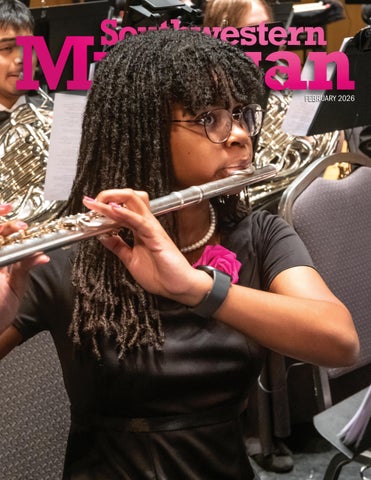
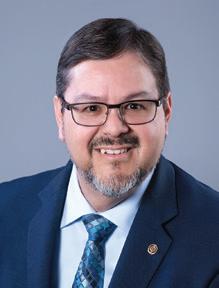
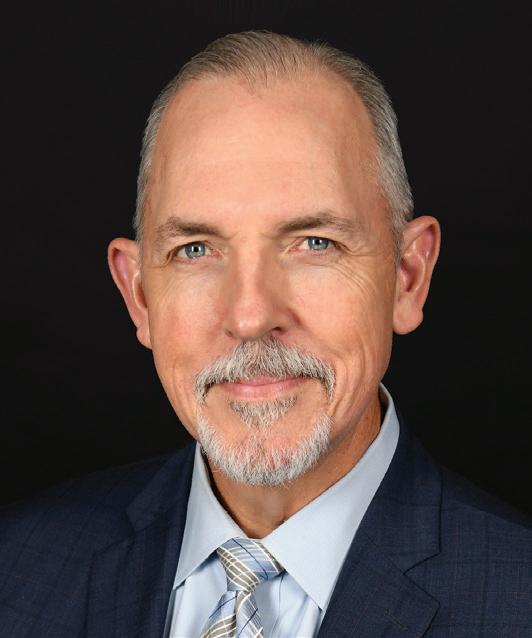
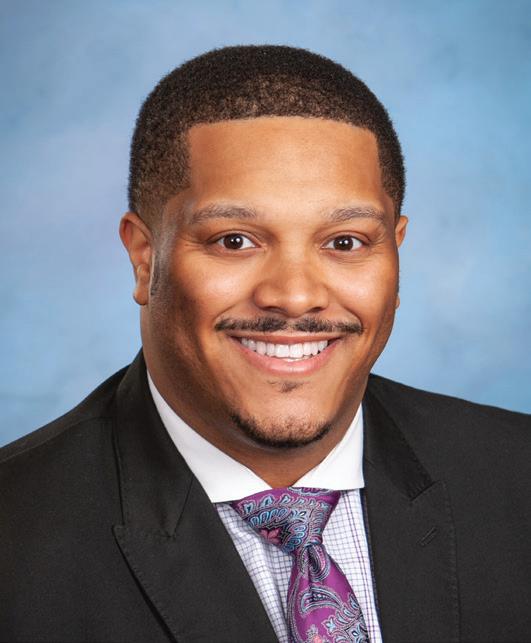
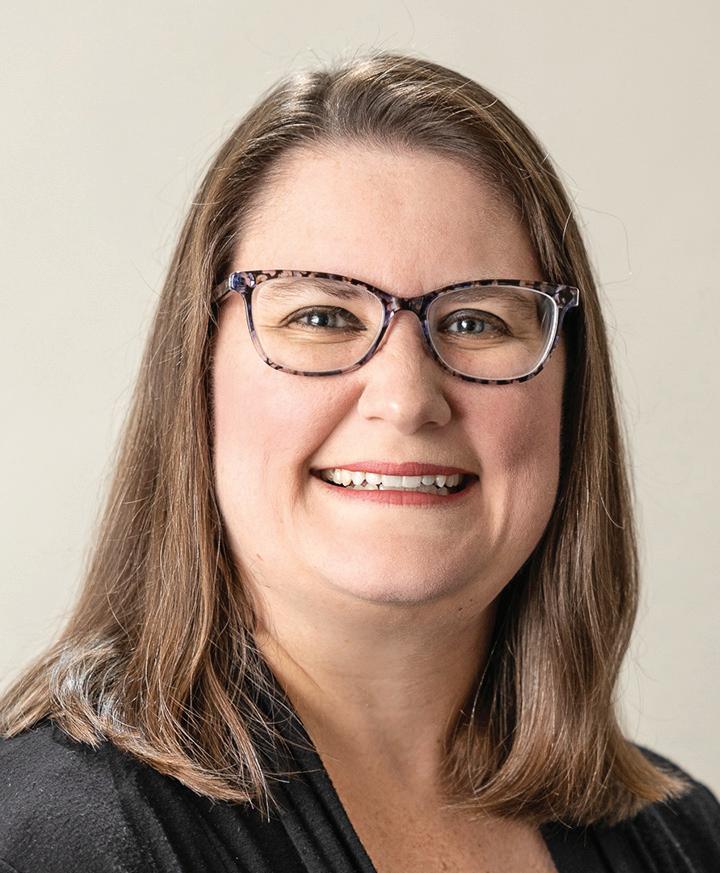
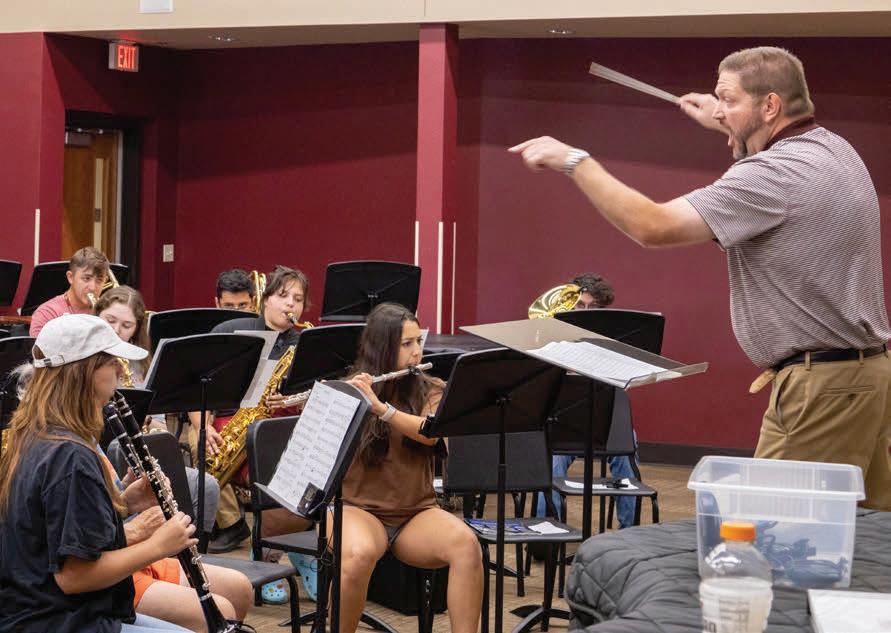
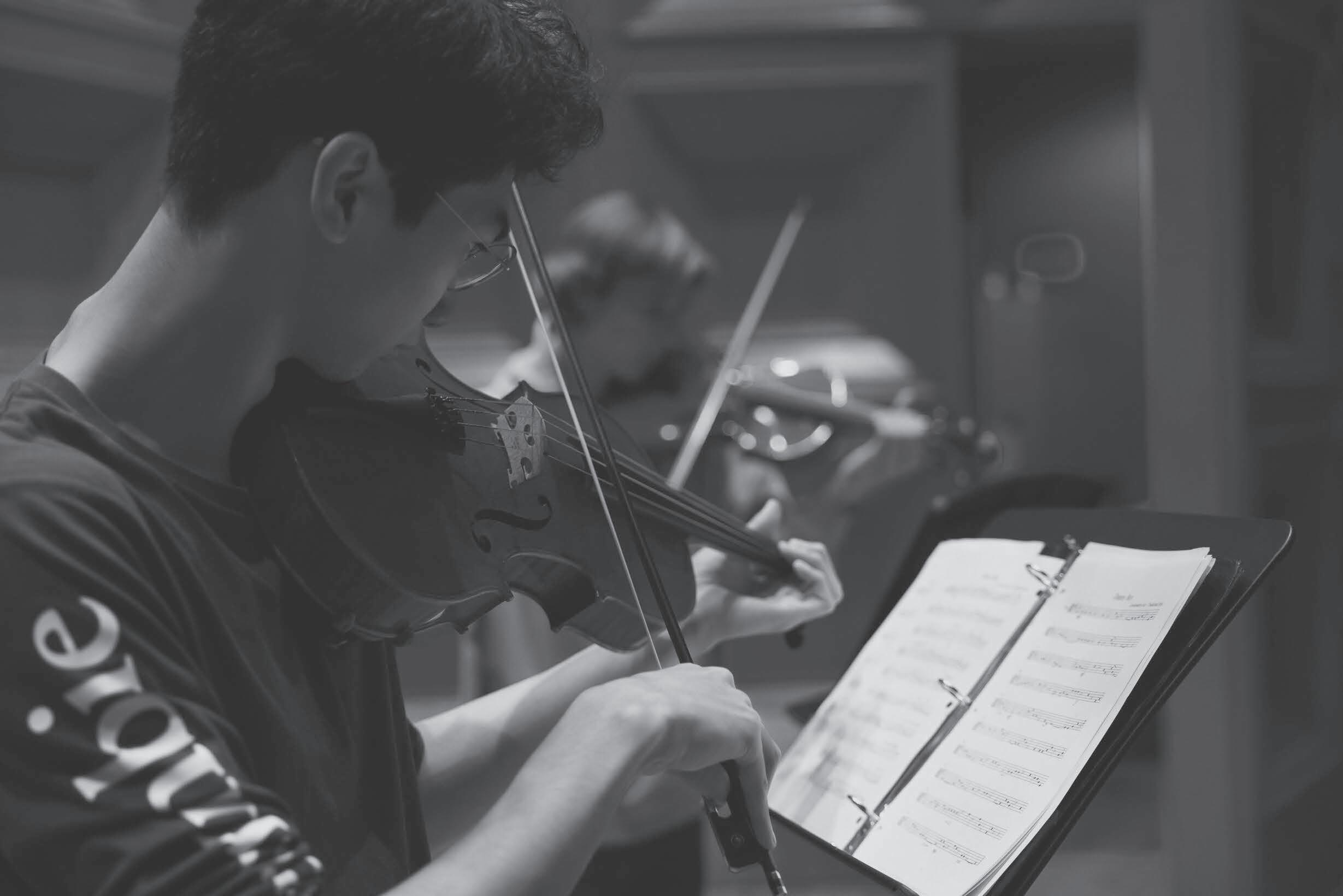
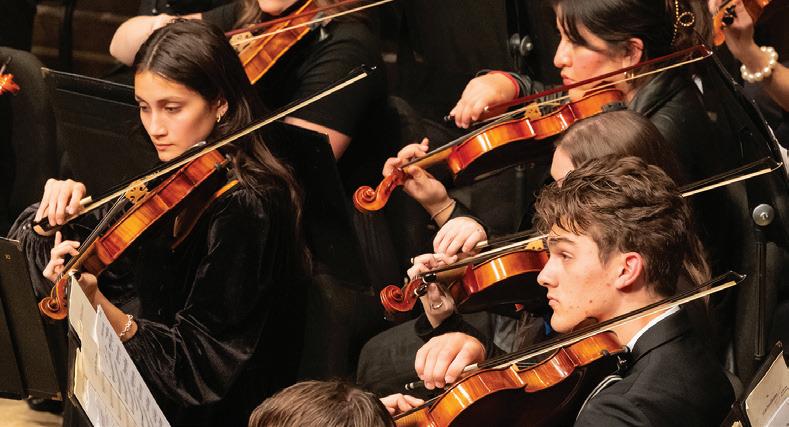
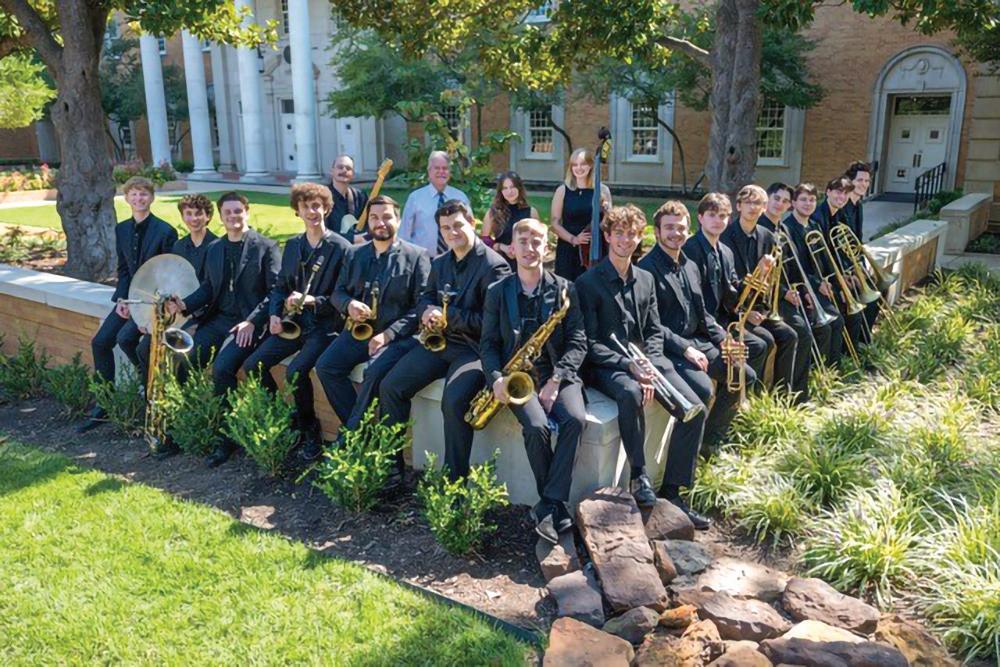
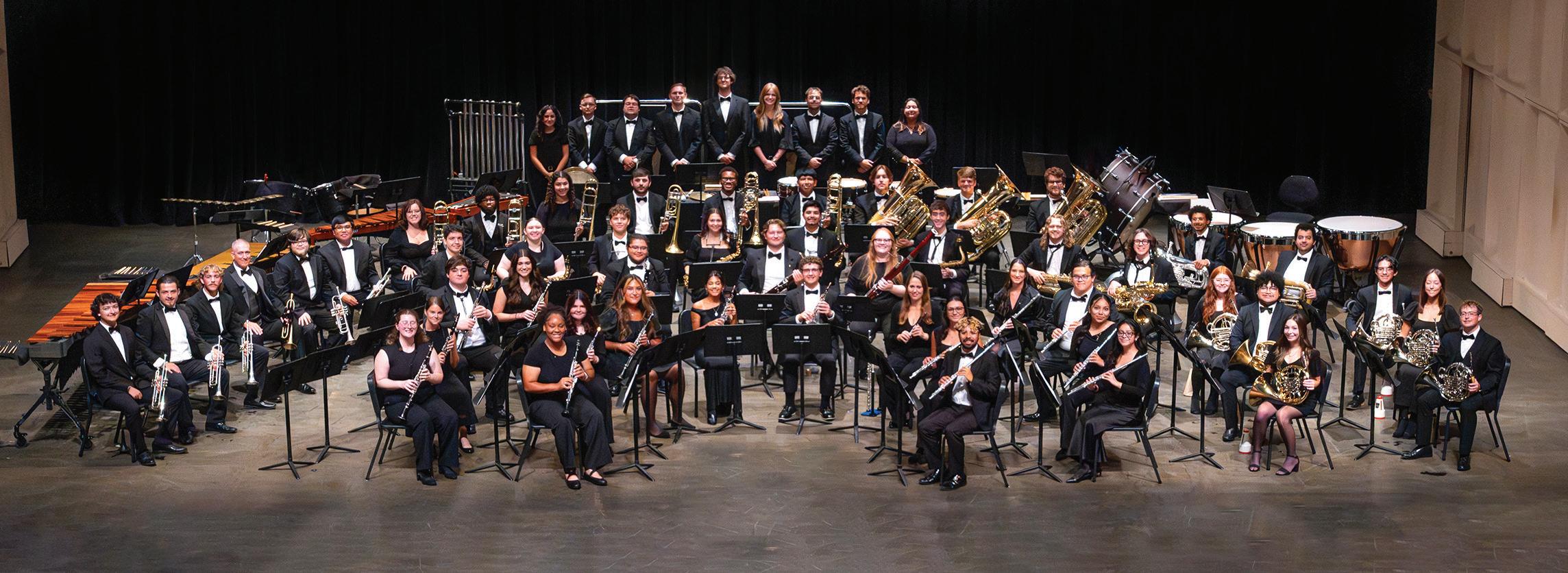
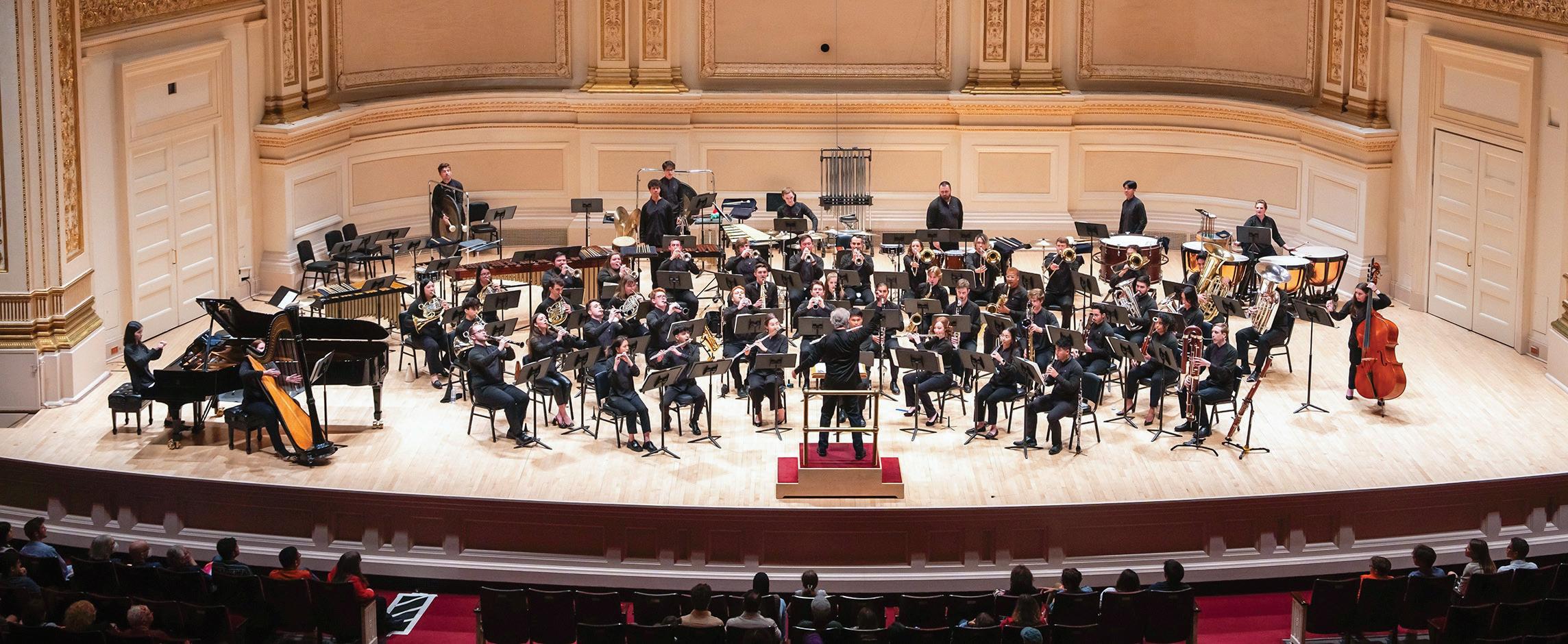
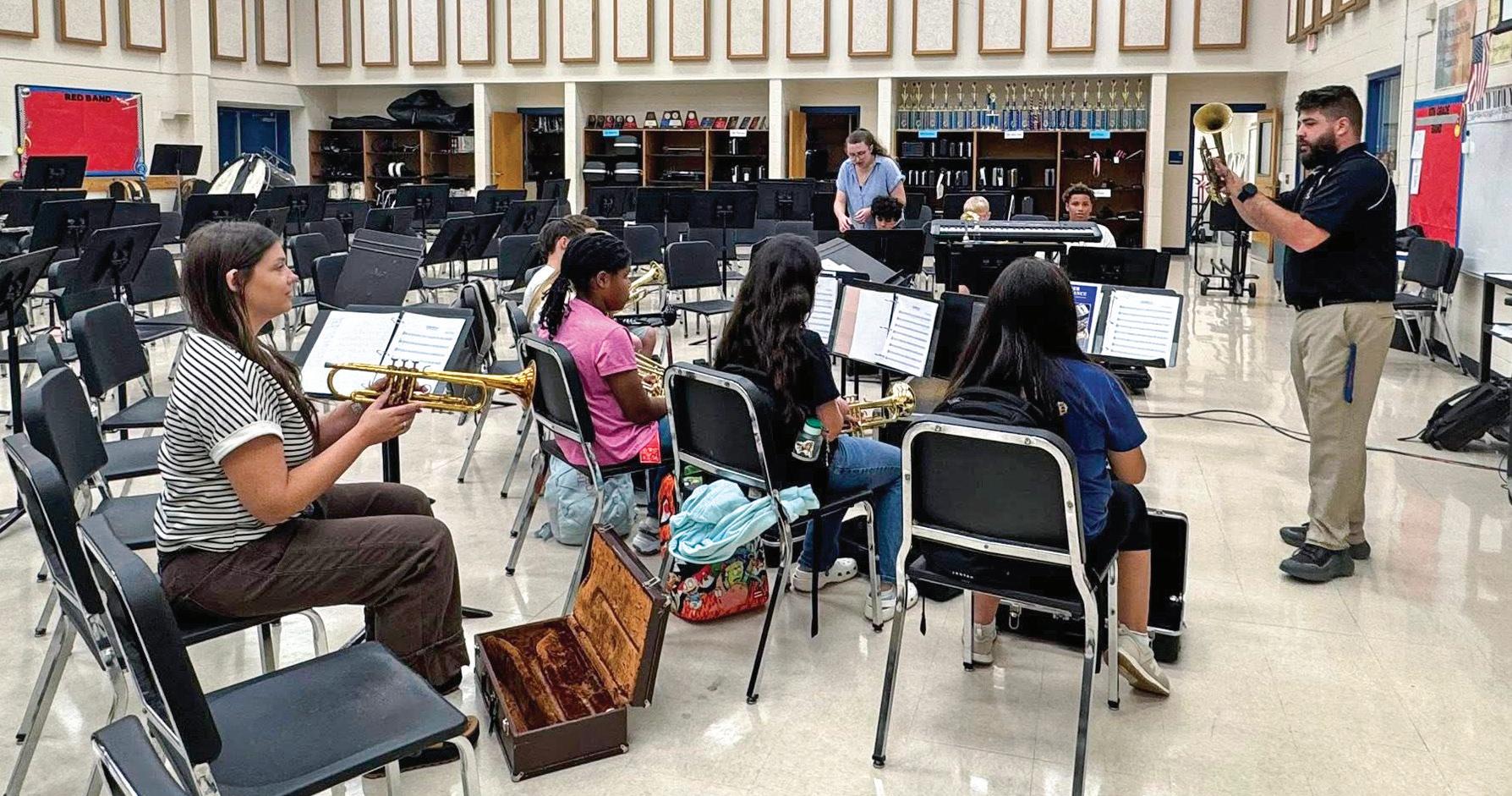
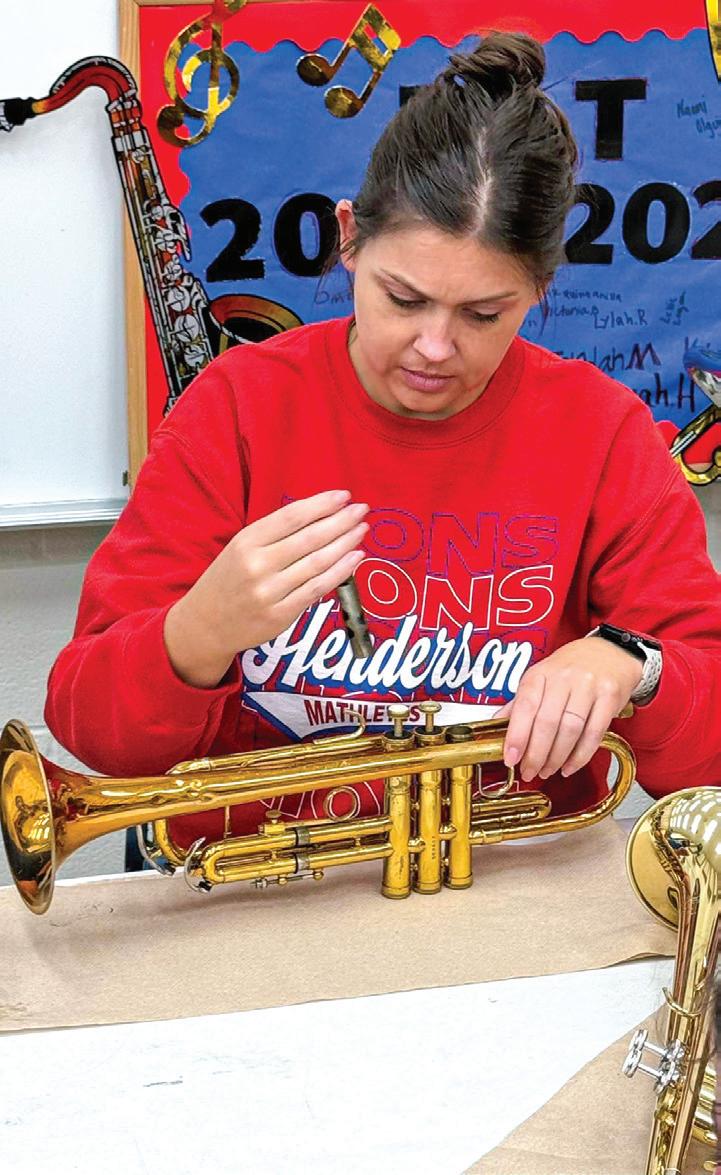
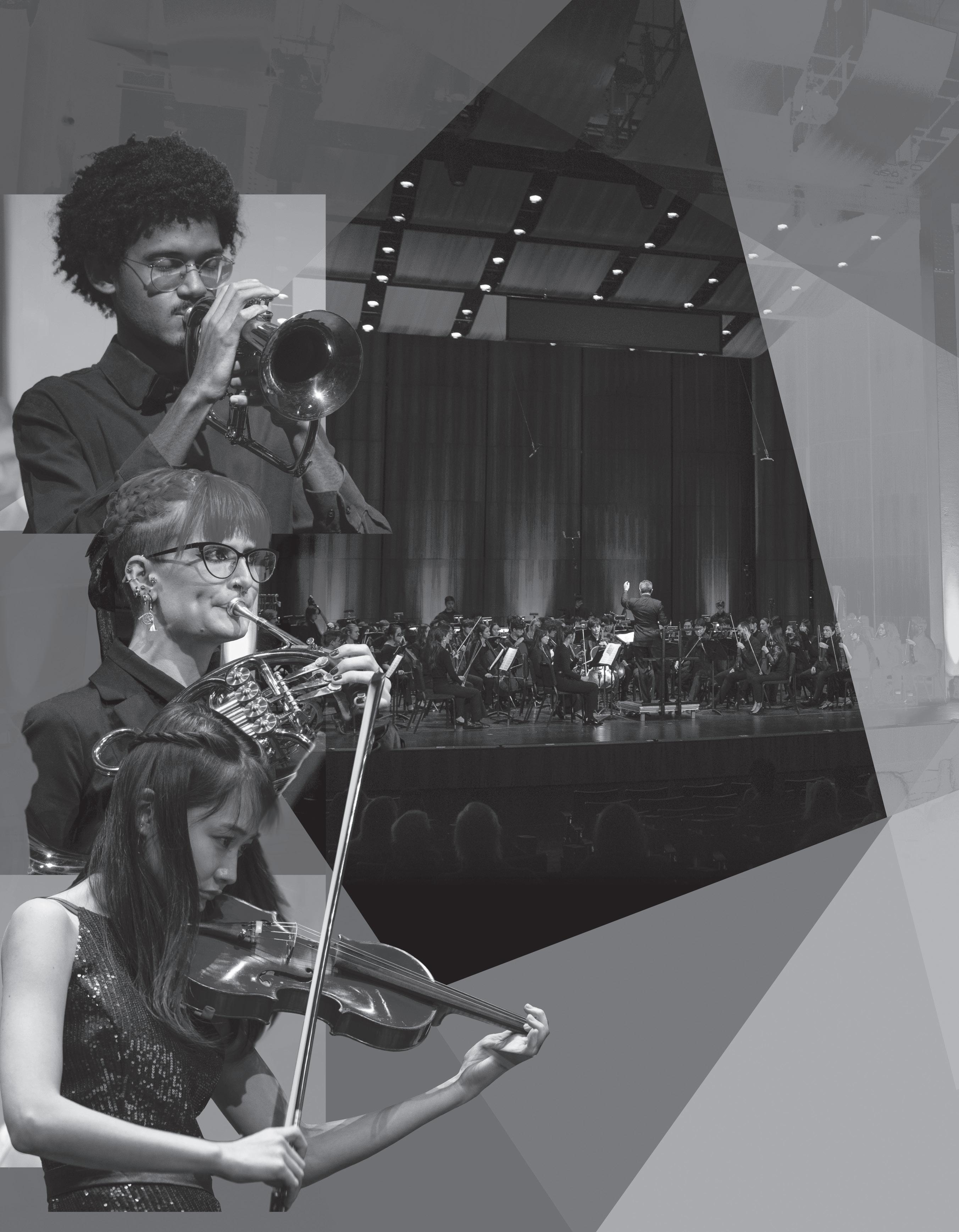
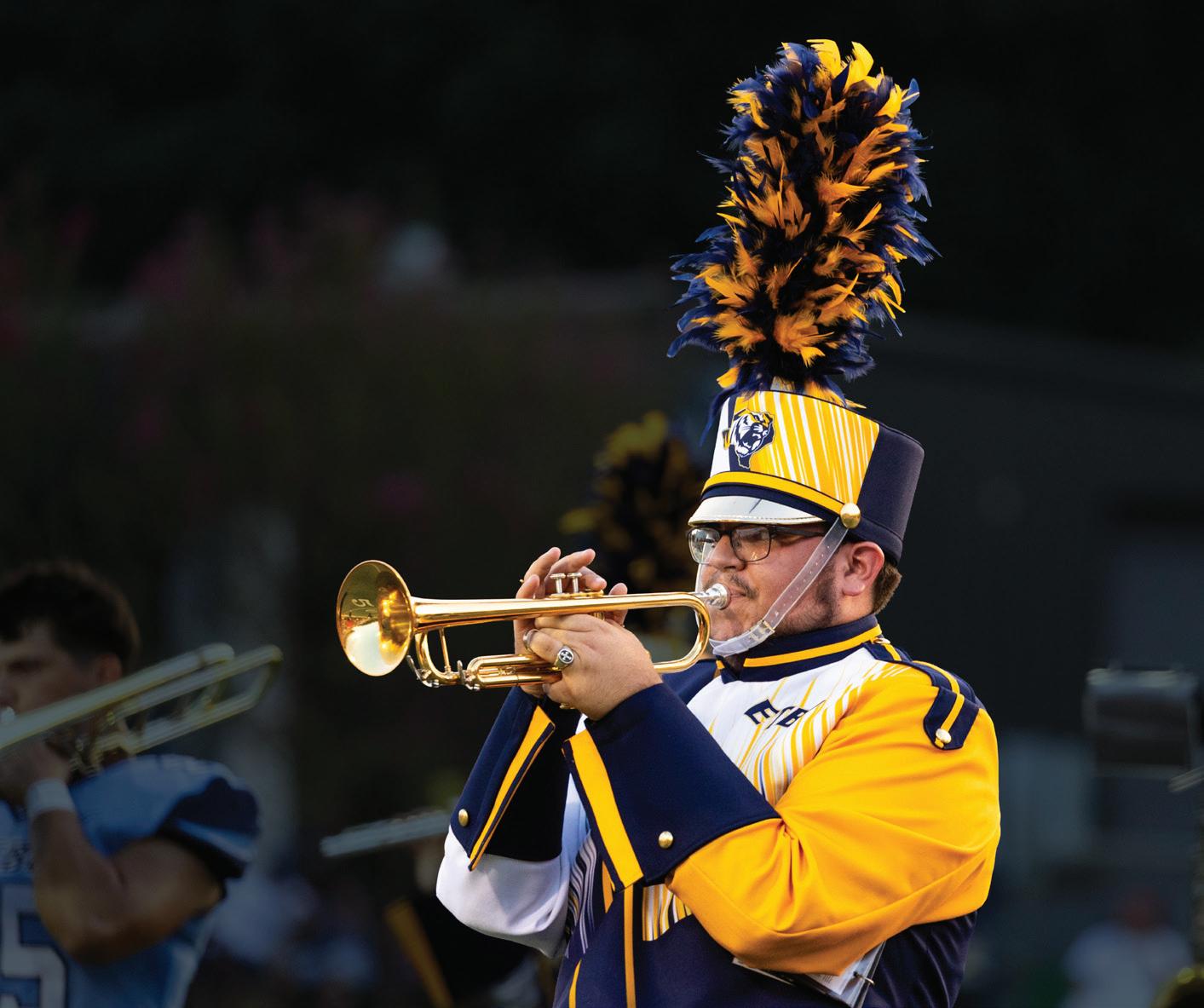
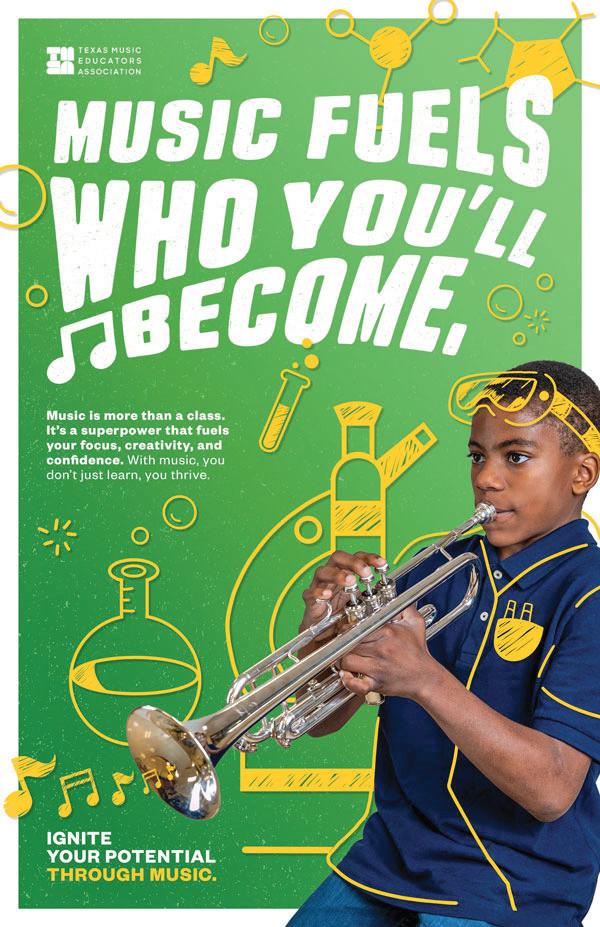
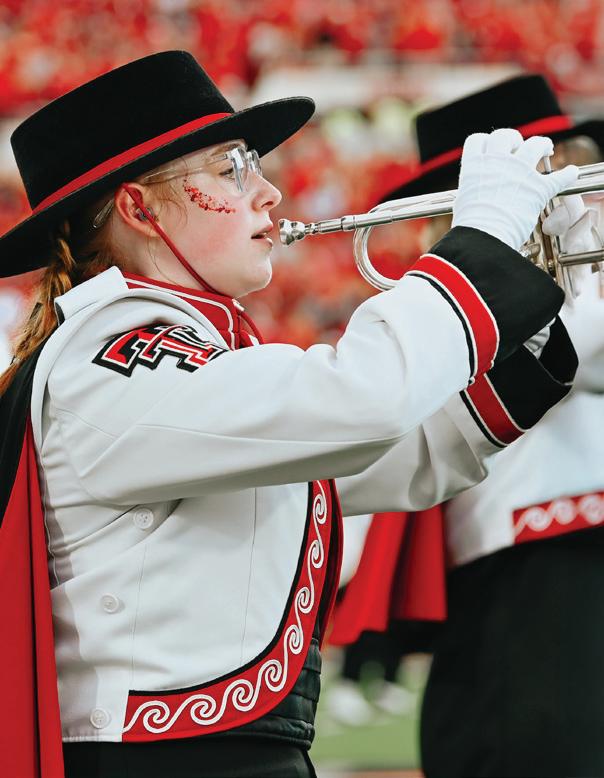
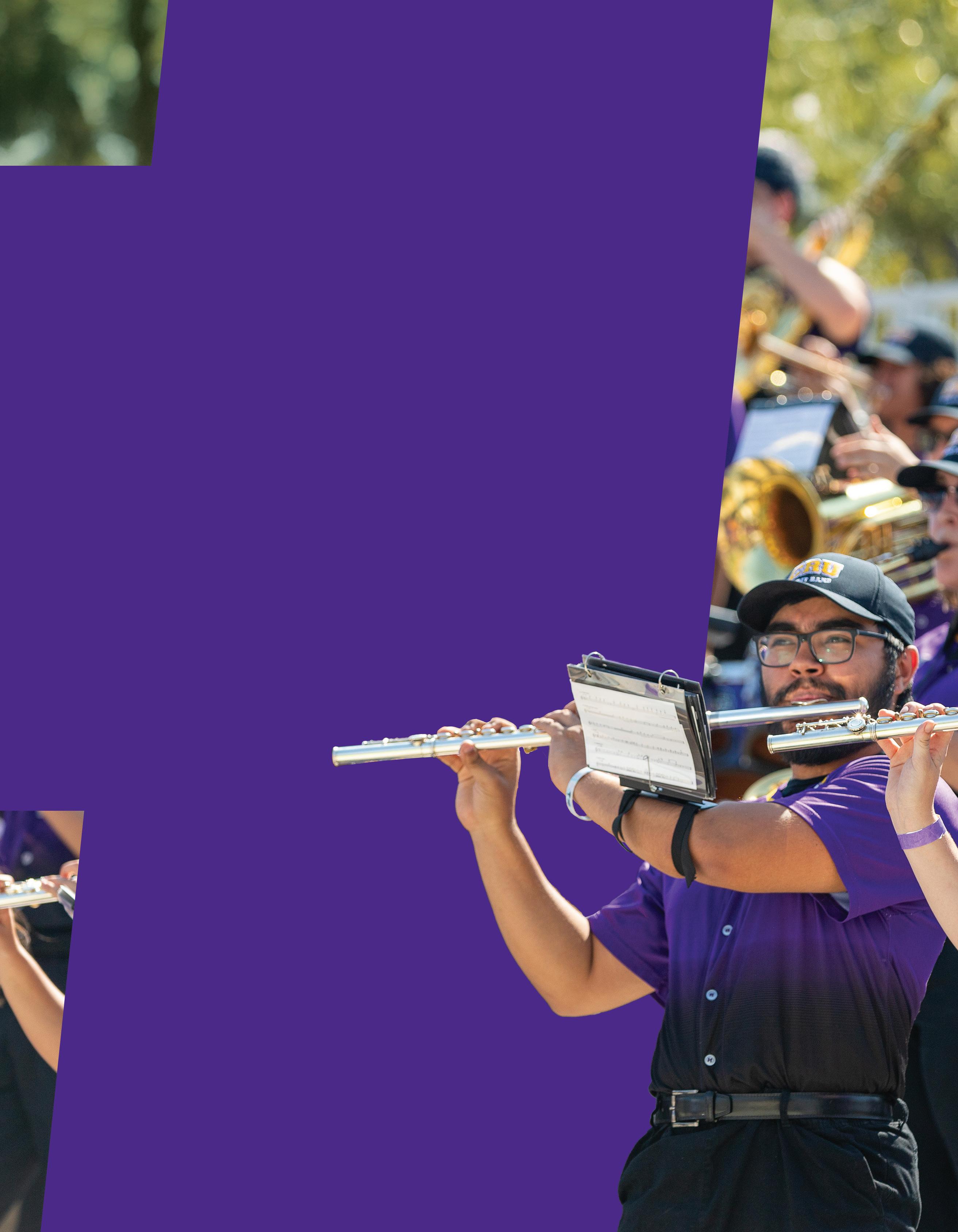
Joining her school’s sixth-grade trumpet class offered this middle school principal valuable insights about vulnerability, persistence, and the emotional resilience required for effective learning and leadership.
31 Cultivating a Music Classroom of Belonging
by
jocelyn ho and aline moore
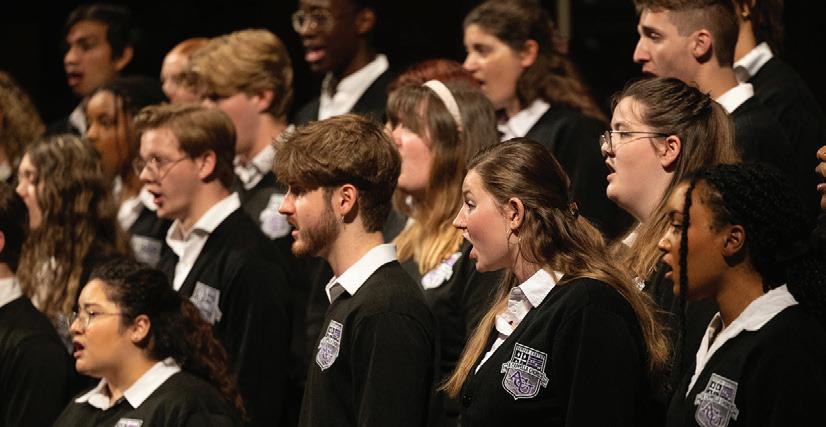
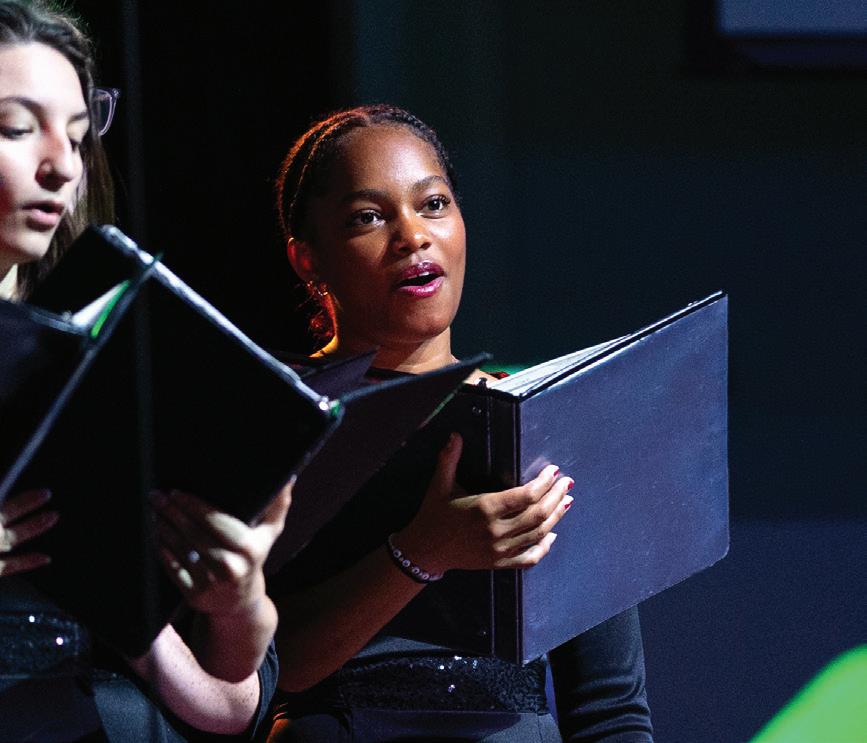
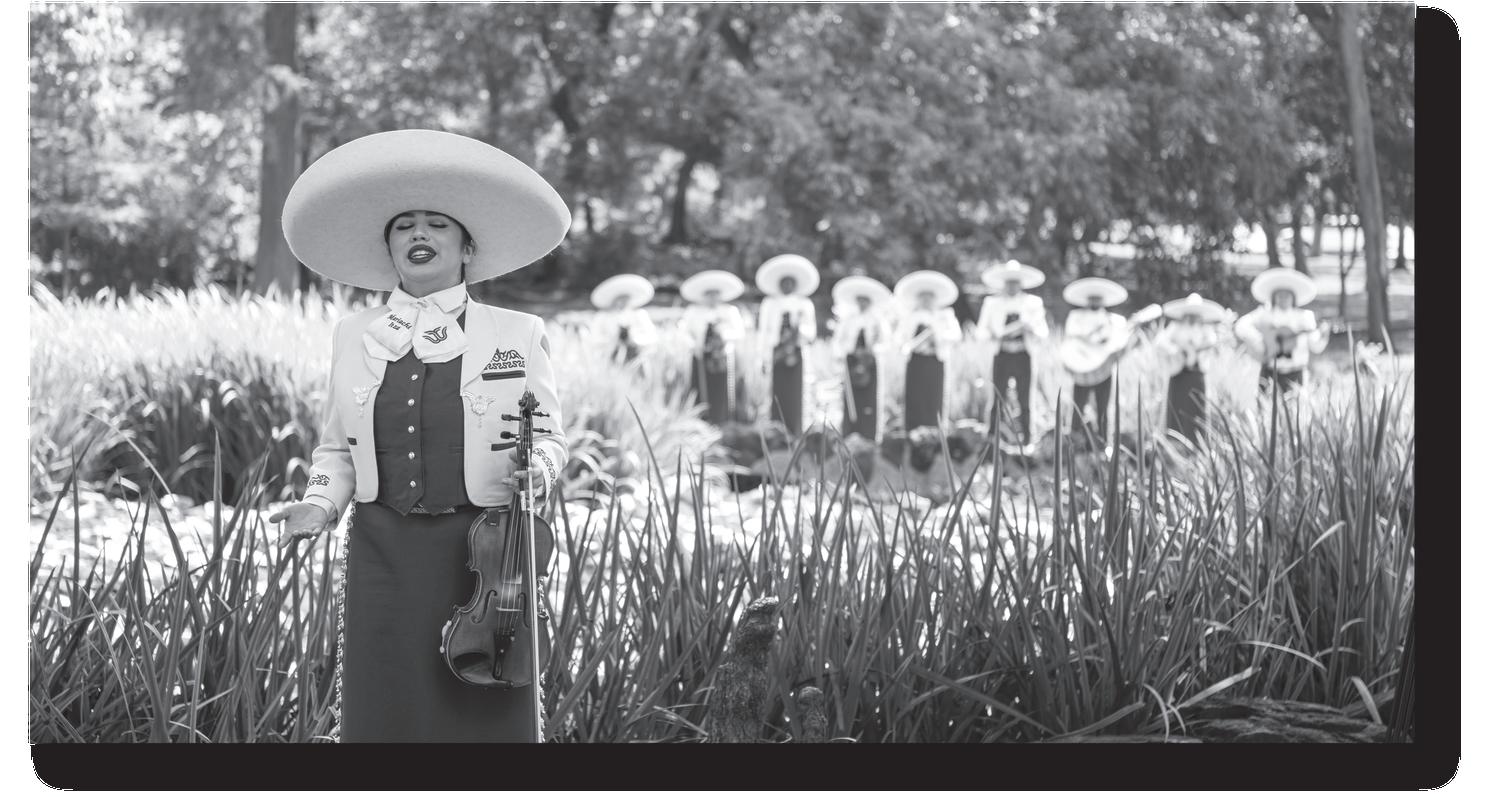
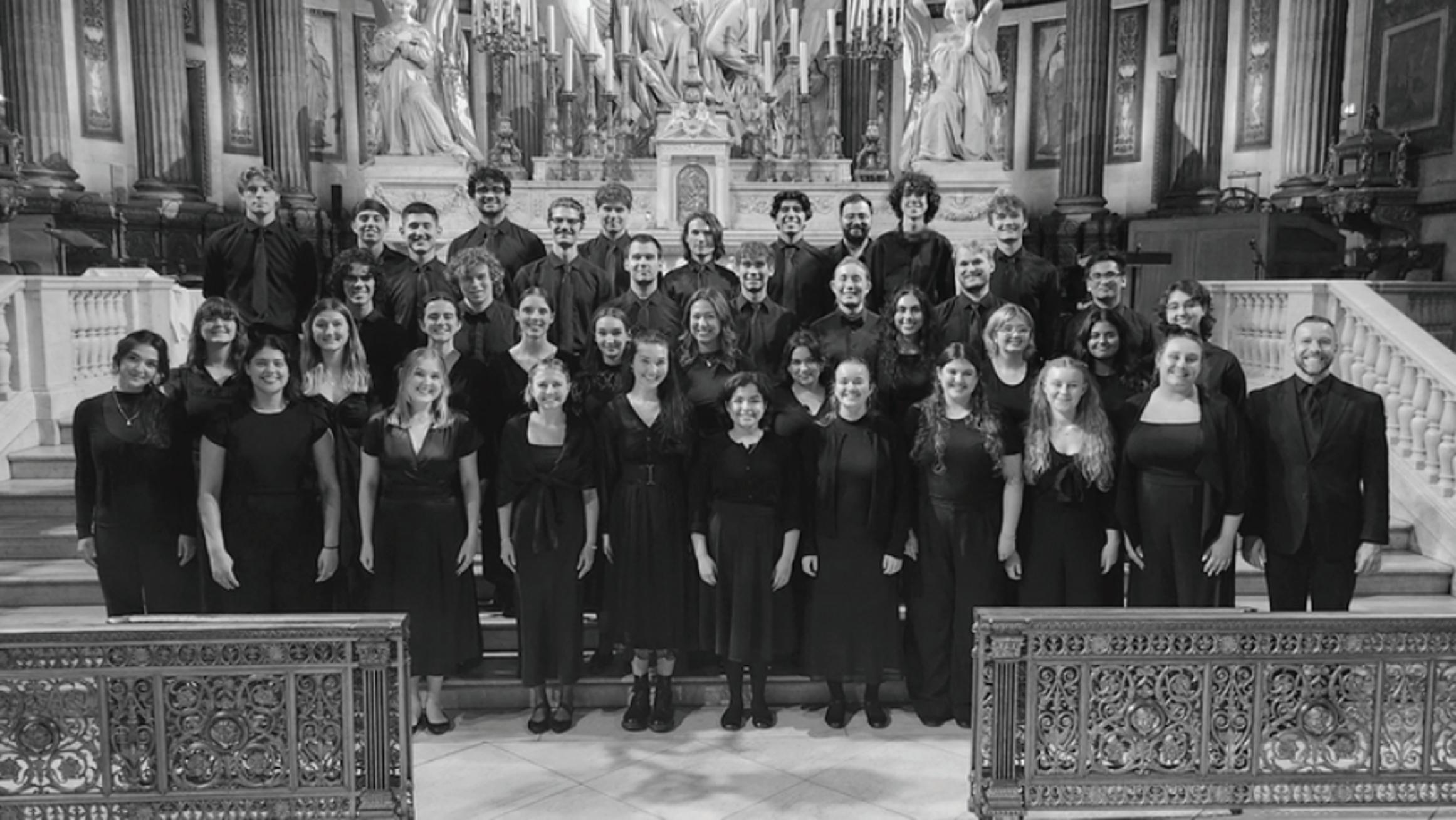
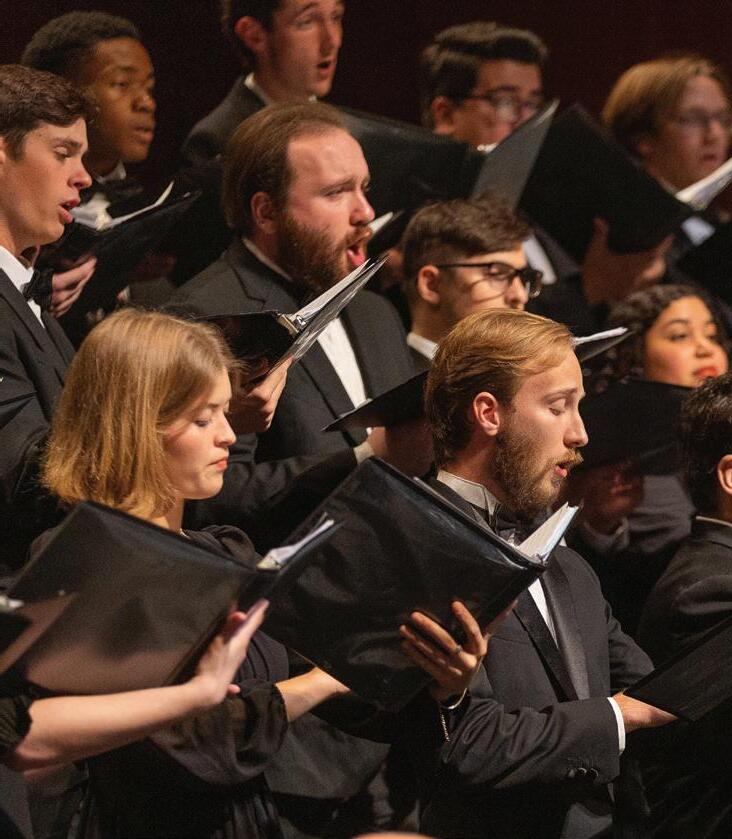
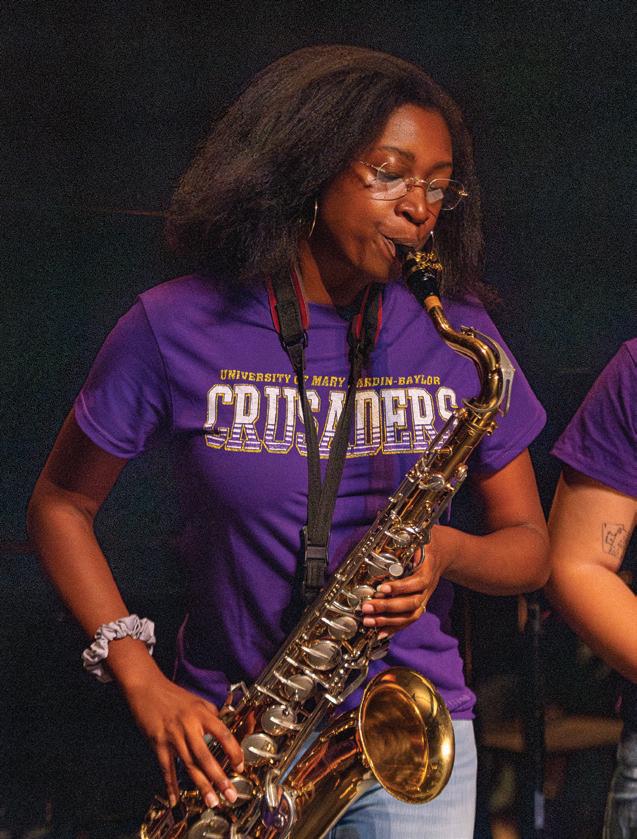
representing a variety of cultures through music instruction enhances students’ engagement, learning, and sense of belonging, and it aligns with the required music TEKS.
41 Everyone Makes Music
emily brackney
by
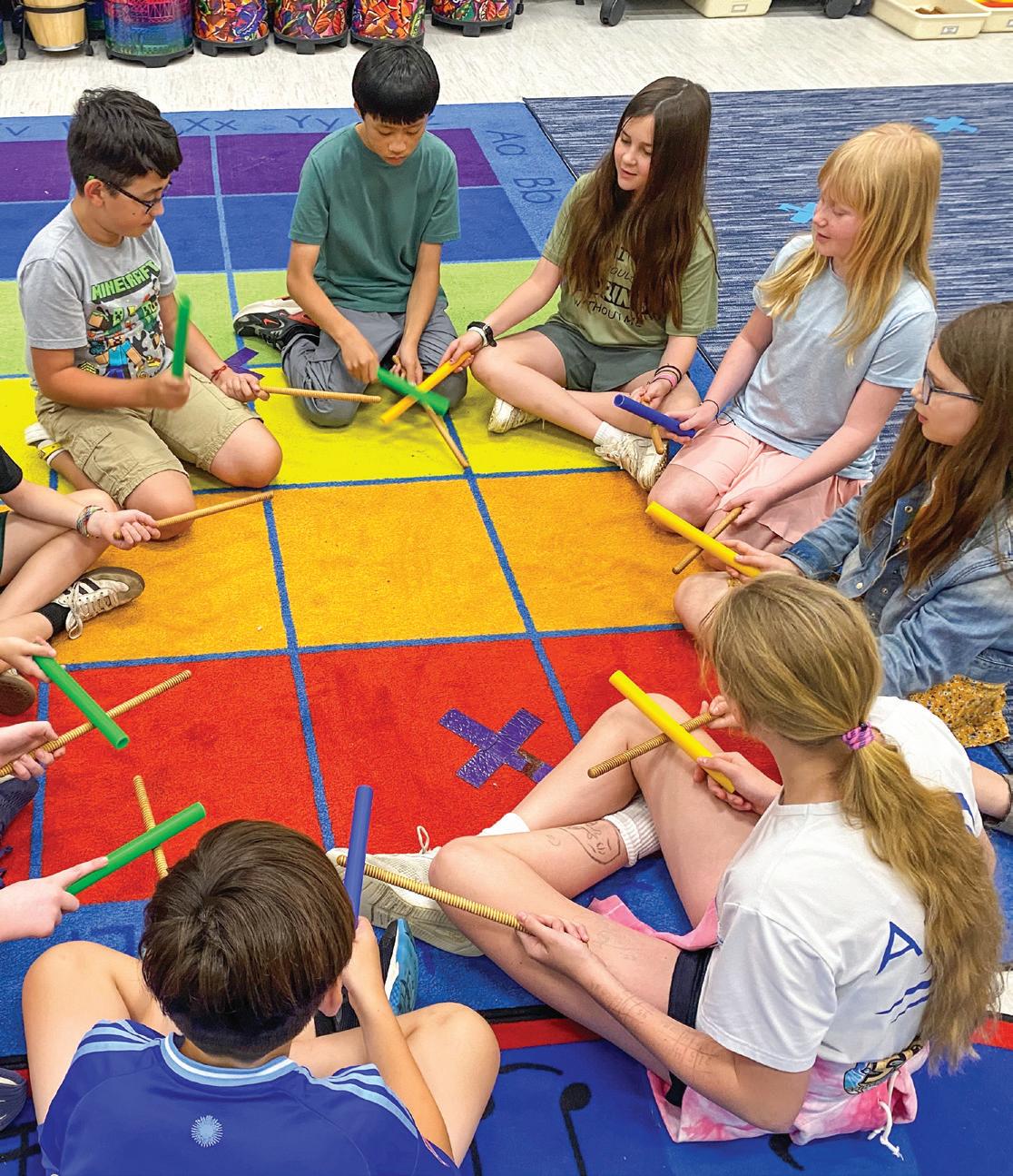
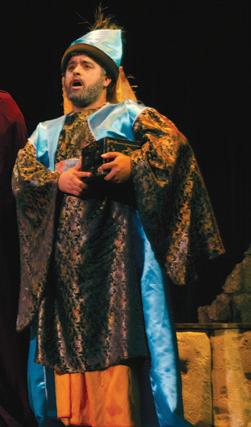
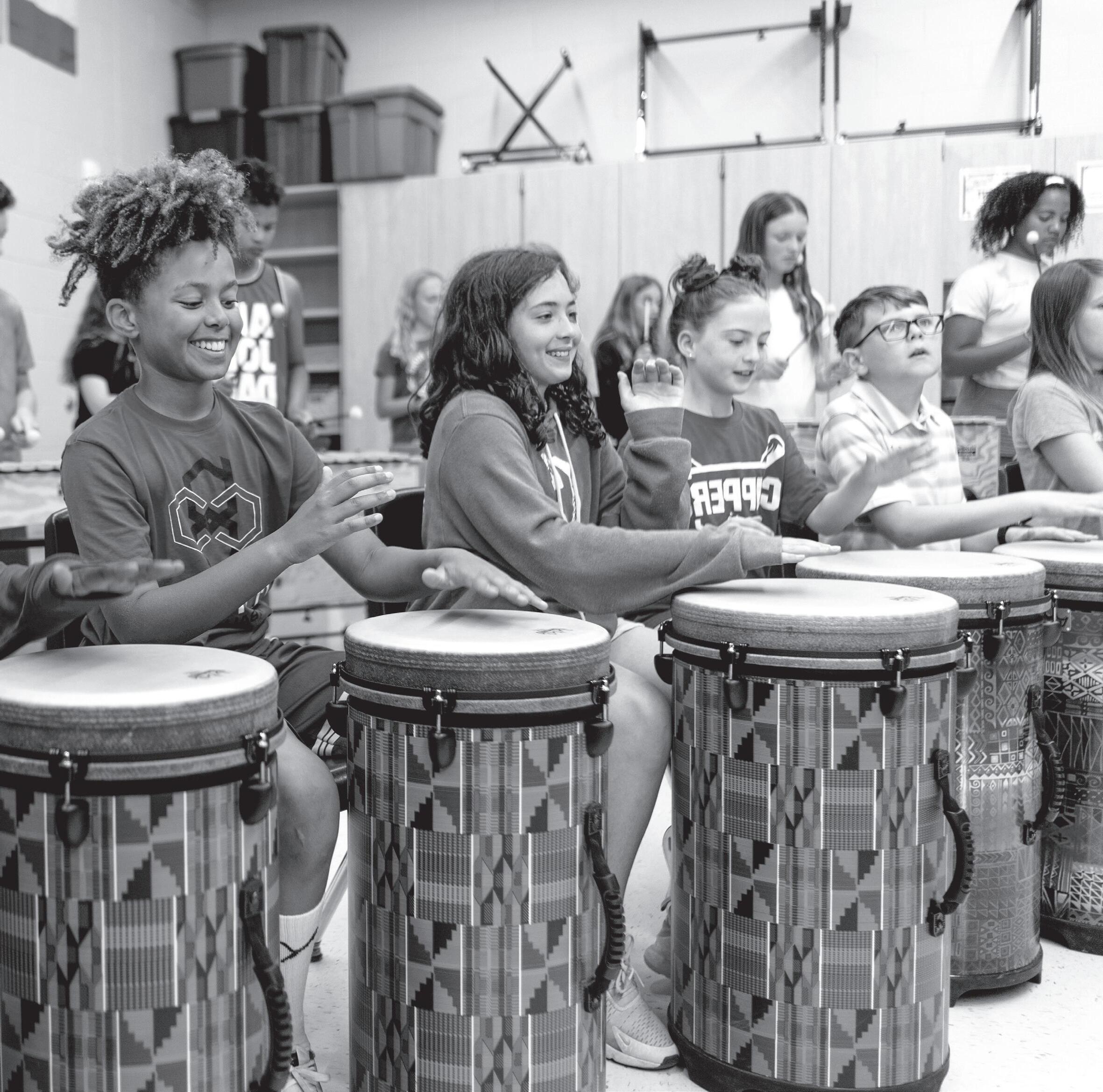
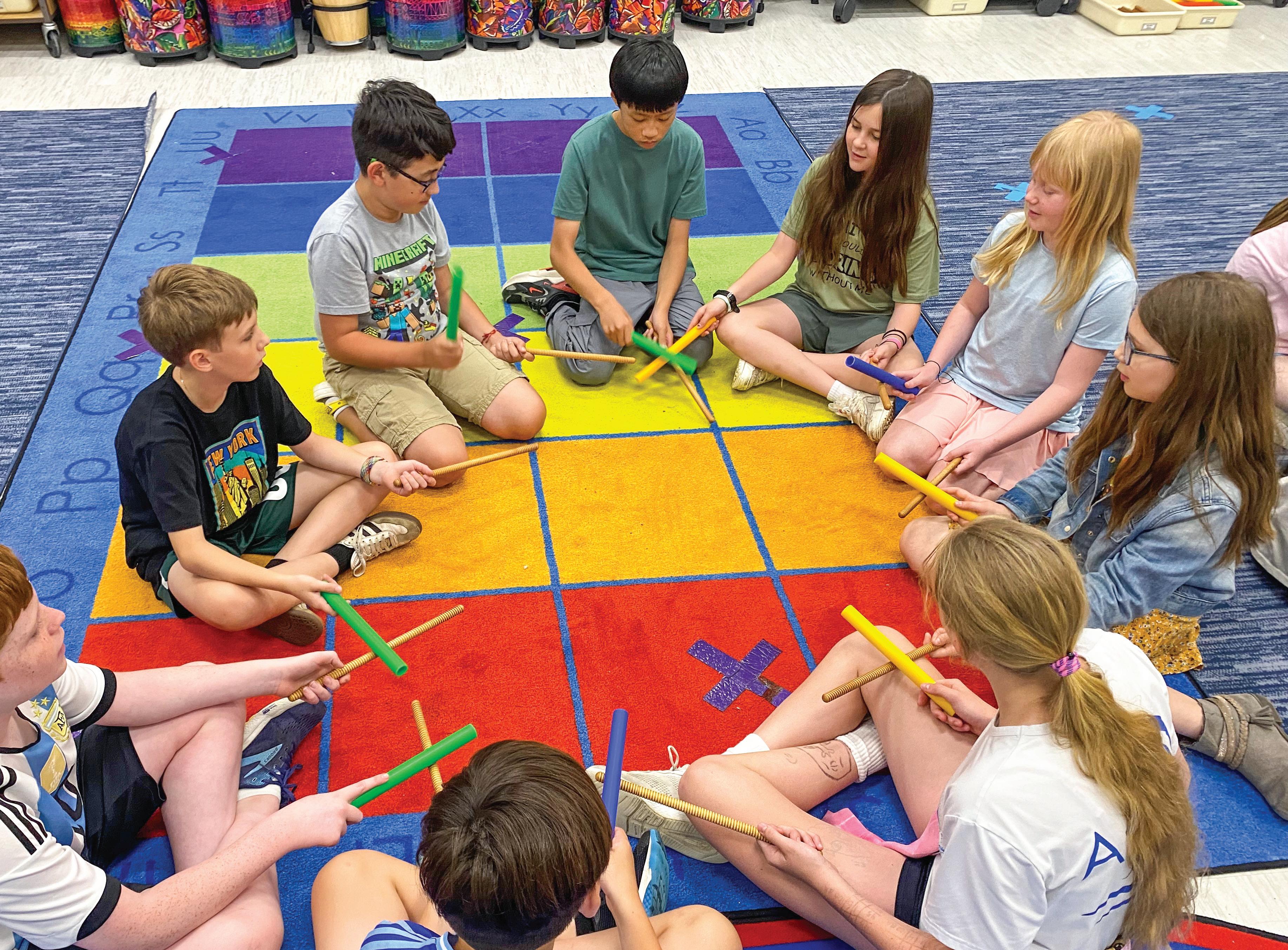
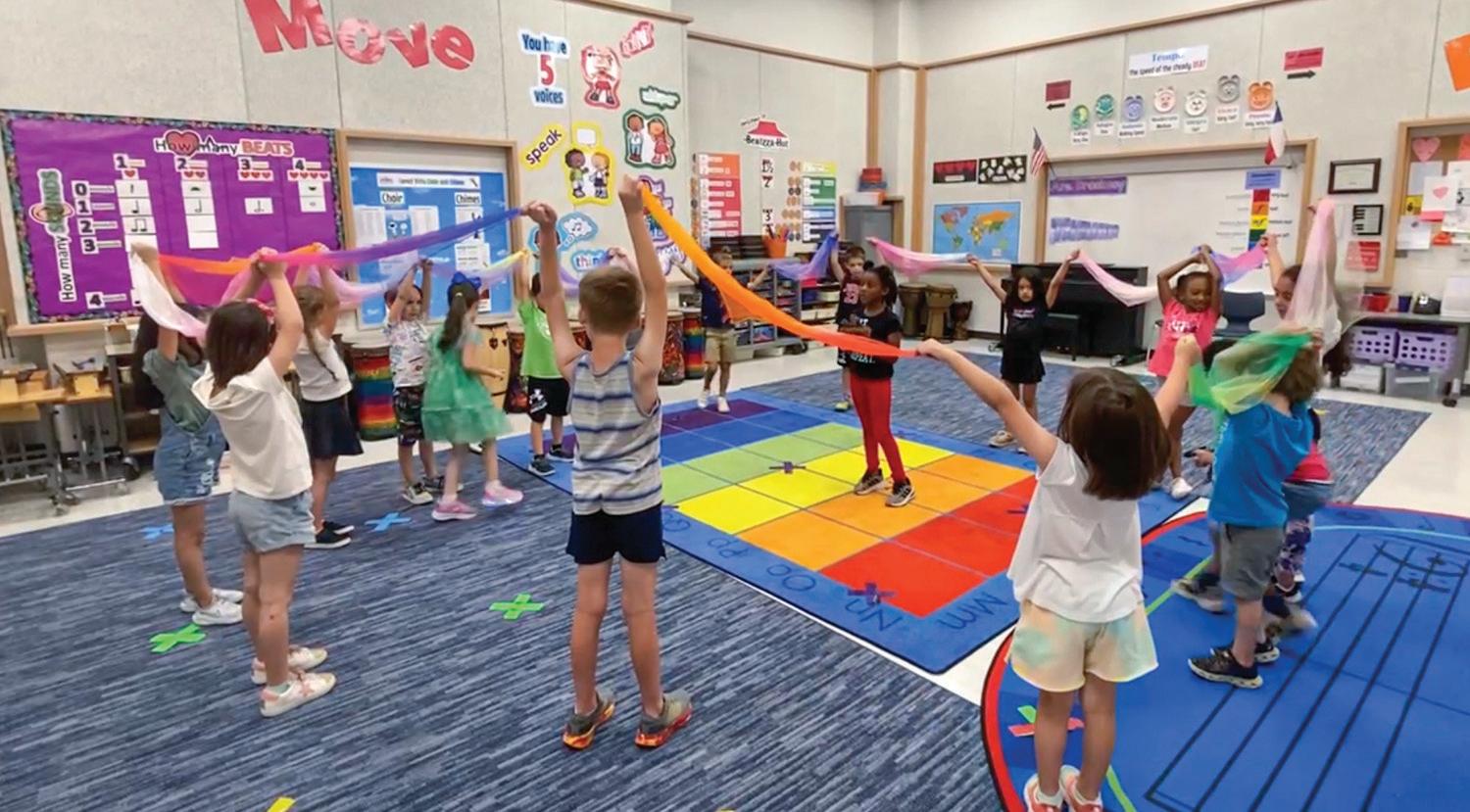
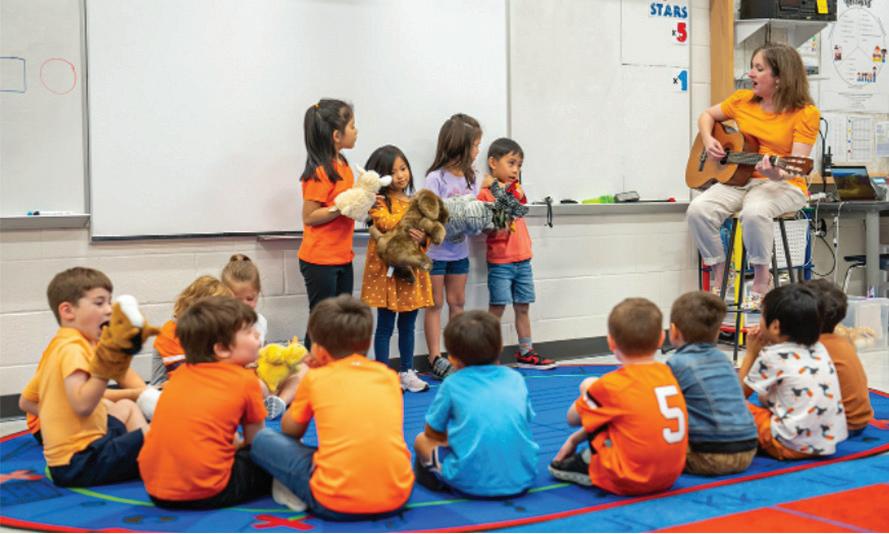
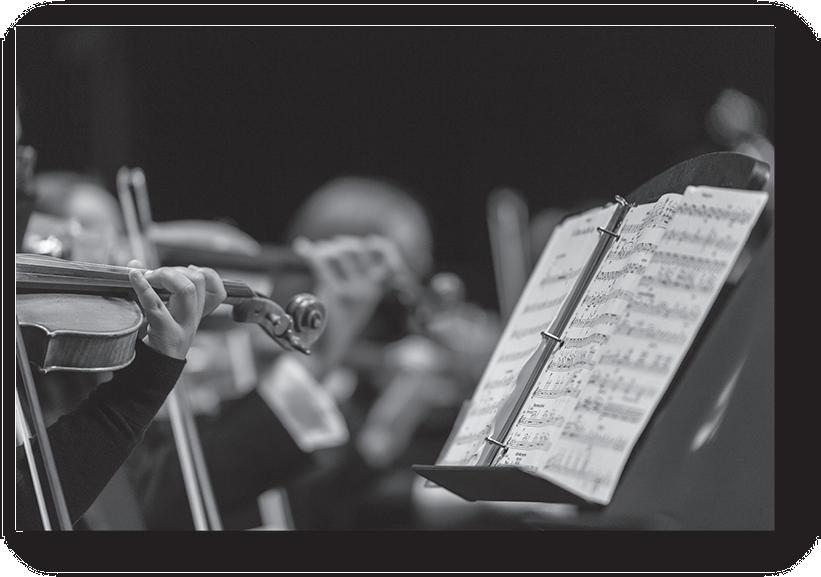
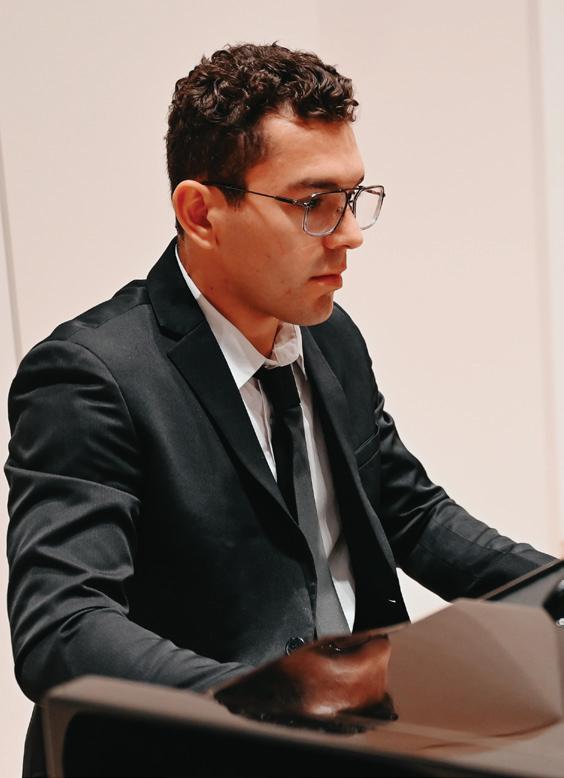
Gain practical strategies and adaptations that support diverse learners in elementary music class while enriching the overall educational experience for all students.
now
From the Editor
TMEA celebrates the diverse world of music education and the passionate individuals who make it thrive. Our annual meeting in San Antonio showcases the contributions that students, music educators, and music industry partners bring to create high-quality music education in Texas. The energy leading to our convention is surpassed only by the event itself. Music education is the beneficiary of the learning and experiences this month provides, and students and communities are the winners, because music educators will be inspired to new heights.
This issue of Southwestern Musician features examples of the beneficial content delivered during the convention. Feature articles focus on the significance of TEKS-based culturally diverse instruction in music education that enhances student connections, lessons learned from a middle school principal who became a beginner trumpet student, and strategies for adapting general music instruction for learners with special needs that benefit all students.
The popular Sound Ideas short features, written by music education colleagues, introduce division-specific strategies to improve your students’ and programs’ performance. These ideas can be immediately implemented to quickly realize positive results. Our Vice-Presidents’ columns provide division-specific information and details related to our upcoming convention.
The TMEA News keeps you informed about changes to the 2026 Clinic/Convention schedule and includes notes of gratitude to everyone who supports TMEA’s mission of advancing highquality music education in Texas. Look for information about a new location for one of our Music Showcase performance areas.
The TMEA Clinic/Convention is only one of the programs our association provides. Our work reaches students, educators, parents, administrators, and our music industry partners. You can find more information about other TMEA programs at www.tmea.org under the Programs menu.
The excitement of the New Year is eclipsed only by the energy of the TMEA Clinic/Convention. Student performances, diverse clinics, and a celebration of you and music education will help you bring to life these lyrics from Gloria Estefan:
Get on your feet
Get up and make it happen
Get on your feet
Stand up and take some action
It’s time for actions that will inspire your students and turn them into lifelong music lovers.
Joe Muñoz E xecutive Director jmunoz@tmea.org
Editor-in-Chief: Joe Muñoz
Managing Editor: K aren Cross
Advertising Manager: Zachary Gersch
TMEA Executive Board
President: Shane Goforth, North Shore Senior HS president@tmea.org / 713-516-7158
President-Elect: Jennifer Martin, Fort Worth ISD presidentelect@tmea.org / 817-814-2640
Immediate Past-President: Jesse Cannon II, Fort Worth ISD pastpresident@tmea.org / 817-814-2635
Band Vice-President: Andy Sealy, Hebron HS bandvp@tmea.org / 469-948-3011
OFFICIAL PUBLICATION OF TEXAS MUSIC EDUCATORS ASSOCIATION
2025–2026 TMEA
EXECUTIVE BOARD
In a ddition to their c ommitment as music e ducators, T MEA E xecutive B oard m embers dedicate countless hours to guiding our association. Their impact is clear in the outstanding c linic p rogramming a nd e ngaging c oncert p erformances t hat e levate o ur c onvention. Yet, T MEA represents m ore than just this event and their s ervice extends f ar b eyond i t.
We invite you to join us in honoring past officers who have significantly shaped our association and recognizing the current Board members who uphold their legacy of leadership.
Andy Sealy
TMEA News
By Joe Muñoz
Our annual pilgrimage to San Antonio is a time for us to celebrate music education and the people who bring it to life for the students in Texas. It is also the largest music education professional development opportunity in the nation. Another essential element of the TMEA Clinic/ Convention is your ability to communicate and take an active part in our association. Like your programs, TMEA can flourish only with active participation from members who volunteer as leaders and provide valuable insight into what is happening in the music classroom across the state. Whether you can attend this year’s convention or not, we welcome you to stay involved and lend your voice to shaping our association’s future.
GRATITUDE TO TMEA MEMBER LEADERS
One of the enduring qualities of our servant leaders is their dedication to TMEA’s success. Our Executive Board, State Board, Region officers, Region Chairs, and volunteers all contribute to the success of our TMEA programs. Our audition program supports over 150,000 students. The planning and programming of the TMEA Clinic/Convention require countless hours of dedicated service from our Executive Board and committee members, who assist in selecting sessions and reviewing materials to be presented at the annual convention.
Why is TMEA successful? It is because of our members’ willingness to contribute their time and talents to our work and mission. On behalf of the membership, thanks go to all who have contributed to our association’s success!
STAY INFORMED
As conveyed in our December convention preview issue, division business meetings and Region meetings are at different times than has been typical in past years. The division business meetings are scheduled at times that function best for the specific division’s schedule. This may also allow members to attend more than one division meeting. Our online voting for Vice-President posi-
ELECT r ONIC VOTING
Voting for TMEA President-Elect and Band and College Vice-Presidents will be conducted electronically (for offices with multiple nominees). Eligible members are not required to attend the convention to vote.
Learn about the candidates and prepare to vote February 12–13.
www.tmea.org/election
tions has enabled this flexibility in meeting times. In response to member feedback, adjustments were also made to schedule Region meetings to Friday morning.
Make sure to attend the General Session on Thursday morning. It will feature our All-State Large School Mixed Choir and Symphony Orchestra in an inspiring performance. The General Session will also feature Mickey Smith Jr. as our keynote speaker. You can learn more about him on page 16 of the December issue, available online at www.tmea.org/december2025.
TMEA ELECTIONS
Emails to eligible members will be sent on Thursday, February 12, for Vice-President and President-Elect elections. Eligible members will receive separate emails for each election. Information about election procedures and the candidates can be found at www.tmea.org/election. Voting closes on February 13 at 6 p.m. CT.
NEW MUSIC SHOWCASE LOCATION
New for this year, a music showcase performance area will be in the Tower View Lobby. This area is located on the second floor of the convention center across from CC 217 and CC 218. You can find its location on the second-floor map in the app.
Music showcases are 30-minute performances featuring a variety of ensembles and performers from middle school, high school, college, and professional groups. These performances are a great way to see the diversity of music education from across the state. Thanks go to our Music Showcase sponsors: Curtis Institute of Music, MusicFirst, and R&R Travel.
NEW MUSIC ADVOCACY MATERIALS
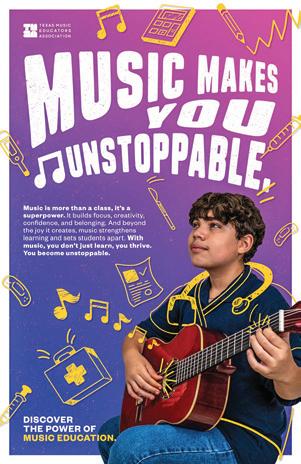
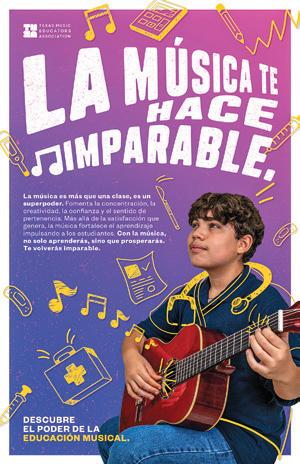
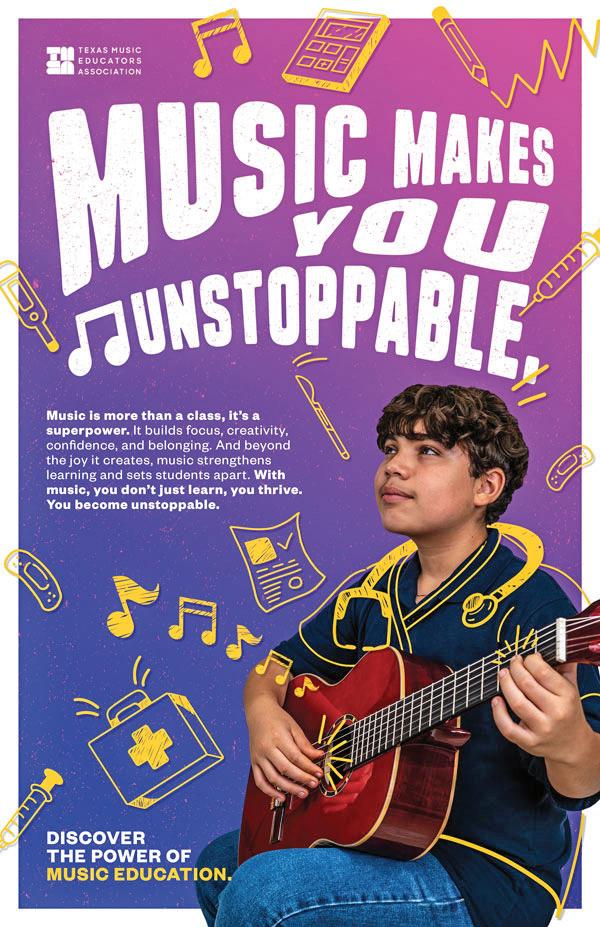
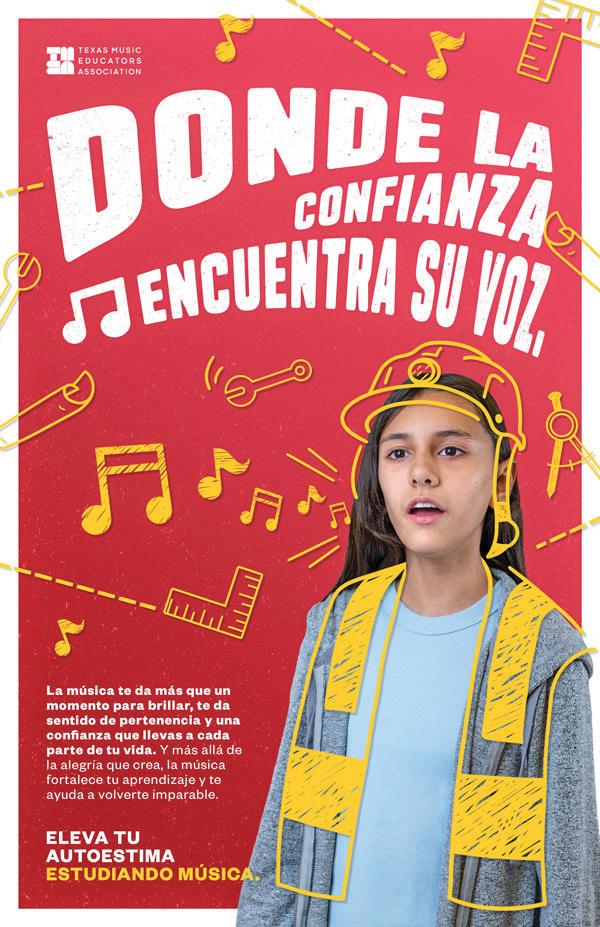
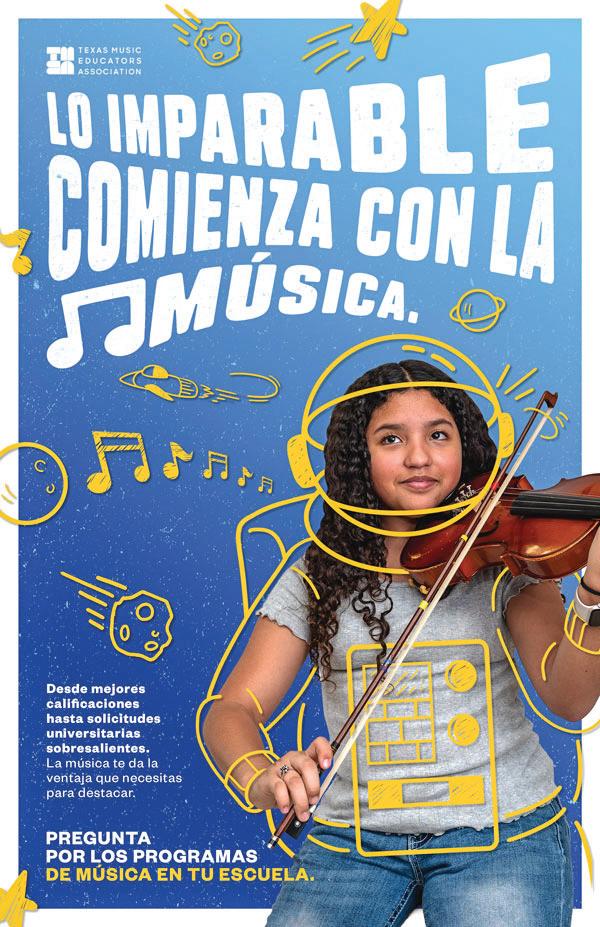
We’re excited to share a new set of advocacy resources created specifically for elementary and middle school classrooms. These materials are the culmination of the work TMEA contracted Lopez Negrete Communications, a PR firm in Houston, to conduct. The TMEA News installment on page 4 of the October issue offers more about the findings of the market research, which is the foundation for these materials. That issue is available online at www.tmea.org/october2025.
I hope all educators who teach at these levels will download and post these fantastic materials, available in English and Spanish. Spotlight how music education helps students realize their potential and become unstoppable in their academic and personal lives.
Go to www.tmea.org/unstoppable to access these resources. 0
2026 TMEA Clinic/Convention
February 11–14 • Henry B. González Convention Center • San Antonio
Know Before You Go
REGISTRATION HOURS
Wednesday: 1:00 p.m.–9:00 p.m.
Thursday: 7:30 a.m.–5:00 p.m.
Friday: 7:30 a.m.–6:00 p.m.
Saturday: 7:30 a.m.–1:00 p.m.
REGISTRATION FEES
• Active music educators: $95
• Retired music educators: $20
• College student members: $0 (included in $30 membership)
• Out-of-state attendees: $170
• Badge replacements: $10 each
Badge Pickup Location
Enter from the North Lobby of the convention center into Hall 1, near the main entrance that faces Market Street.
• PREPAID BADGE PICKUP: You can still register online. If you register before arriving, go through the Prepaid line. Scan your registration barcode (emailed the week before) or look up your record by name. Your badge will print at the kiosk. Then pick up your prepaid family badges and free items: official program, 2026 sticker and lanyard, and cash giveaway tickets.
• ONSITE REGISTRATION : If you haven’t registered when you arrive, go through the Registration line (to the left of the Prepaid line). Complete registration and payment (cash, check, or credit card [no POs]) to obtain your badge and more.
• TECHNOLOGY PRECONFERENCE : Go directly to the second floor of the convention center (south side) to the foyer of CC 214 to get your badge. This is a separate $50 registration (no POs). If paying by check, it must be made out to TI:ME. Do not combine payment with a TMEA registration check.
Onsite Payment
Visa, MasterCard, Amex, Discover, cash, or personal or school check (checks run same day) are accepted for onsite registration. Split payments cannot include a credit card.
Family Badges
Registered attendee family member badges are $15 each. Children 11 and under are free. Family badges cannot be used by a music educator, music minister, musician, or college music student. Badges purchased online by January 31 are provided when you get your convention badge. You can purchase family badges when you complete onsite registration or later at the visitors booth.
2026 President’s Concert
Wednesday • 8:00 p.m. • Lila Cockrell Theatre
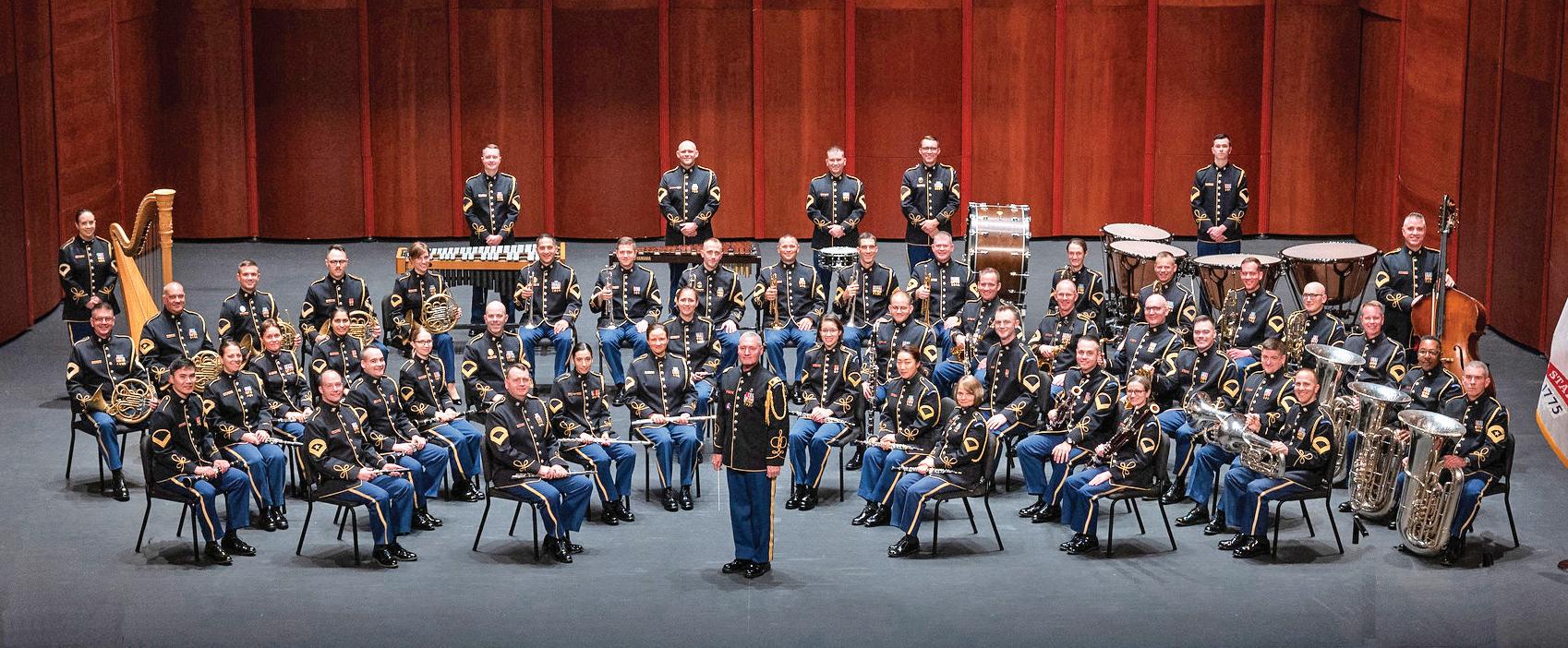
Attend this exciting convention kickoff concert, featuring the U.S. Army Band “Pershing’s Own,” established in 1922.
This concert is free (no tickets). Doors open at 7 p.m.
Get the 2026 App
Go to your app store and search for TMEA 2026 to download the official app (sign in using your primary email on your TMEA record to access all features). Then create your profile and schedule, download handouts, bookmark exhibitors, and more.
$15 Daily Parking + Free Shuttle
Thursday–Saturday, park for $15 daily at the Alamodome Lot B (entry before 5 p.m.). From that lot, ride the free shuttle, sponsored by Musically Minted, or use the walkway from the north side of the Alamodome that goes under I-37 for a safe walking route to the center.
TMEA PRESIDENT SHANE GOFORTH
As music educators, we often speak of excellence, rigor, and ratings, and while achievement is important, the fabric of legacy is woven in moments that no one applauds.
Legacy Is Alive
When you are elected to a position on the TMEA Executive Board, you are immediately aware of the legacy of leadership you have been grafted into. The list of our organization’s leaders includes many of our profession’s greatest minds. It’s a compendium of incredible teachers and leaders who understood and valued our history while continually moving our organization forward, making Texas music education an example of excellence for the country and the world. Working with the Board and our incredible staff every day to continue that work is equally awe-inspiring and humbling. As I write my final column, I find myself thinking a lot about the concept of legacy. I consider the invaluable legacy passed down to me by my teachers, mentors, and leaders, as well as the remarkable legacy that my friends and colleagues share with their students every day.
Legacy is a strange word. For some, it conjures images of record books, trophies hoisted high overhead, or names etched in stone on newly erected buildings. The truth is that legacy is built in small, quiet ways. It lives in skillful, calloused hands, in patient teaching, in the way someone believes in you before you have discovered how to believe in yourself.
For me, legacy sounds like singing. My father can build or repair almost anything. A self-educated
MARK YOUR CALENDAR
check www.tmea .org for updates
February—Renew membership, purchase liability insurance, register for the convention.
February 11–14—TMEA Clinic/Convention.
February 11, 8 p.m.— President’s Concert featuring the U.S. Army Band.
February 12, 8:00 a.m.—TMEA General Session at the convention.
February 12—TMEA Division business meetings at the convention (times vary).
February 12—TMEA emails eligible members their ballot for the Executive Board election.
February 13, 8:15 a.m.—TMEA Region meetings at the convention.
February 13, 6:00 p.m.— Executive Board election voting closes.
March 1—Texas Music Scholar online application opens.
A wide variety of scholarships are available. Contact Todd Ehle at tehle@delmar.edu for more information.
A wide variety of scholarships are available. Contact Todd Ehle at tehle@delmar.edu for more information.
architect, he can draw the plans and then pour the foundation, frame the structure, and roof the building. After finishing the plumbing, electrical, drywall, flooring, and everything else, he will pull his old pickup in the garage so he can pull the engine and rebuild it to exact specifications. From air conditioners to antique furniture to electric pianos, he is intimidated by nothing, pouring himself into projects with the knowledge that if human beings designed and built it, then we can take it apart and repair it. By his side for so many projects through the years, what I remember is not so much what he built or repaired, it is the way that he did it.
He sang.
Sometimes it was a hymn from his youth; other times, an old country tune. There were even times it was a song spontaneously composed for the situation we found ourselves in. Mostly with his voice, but sometimes with a whistle or drumming on his chest if his hands were free, the music always played. A sideways glance would let me know if I was more out of tune than usual when I joined in, but the performance quality never was particularly important. It was more the way the harmonic rhythm paced our day, and the melodies ornamented the details of our
work that mattered. What I didn’t realize at the time was that I was learning so much more than technical skills; he was teaching me a philosophy for life.
Work with joy.
If it’s broken, fix it.
If you need it, build it.
Music makes everything special.
As I entered middle school, I found that same spirit in a different location: the Frisco Band Hall.
I say the Frisco Band Hall because, at the time, there was just that single music room in the district. It was a large rectangle with a small office and two practice rooms that doubled as the library and percussion storage. It wasn’t the facility that mattered, but rather the man who taught there, Daryl Trent. Mr. Trent came to the elementary school and convinced nearly everyone in my fifth-grade class to be in band; then he proceeded to teach us all in that same room, at the same time, for 45 minutes a day. I soon discovered that not only could he teach all the instruments, but he could also play them as well. And when they didn’t work, he could fix them. He repadded flutes, replaced clarinet tenon corks, and straightened dropped saxophone
keys—he was unfazed by any necessary repair we managed to create. Watching him work felt incredibly familiar.
The same fearless confidence.
The same respect for craft.
The same belief that understanding how and why something works can make you a better musician and teacher.
Most importantly, Mr. Trent believed in me.
When I first walked into the band hall I knew two things: I loved music and I had no confidence I could do anything those high school kids were doing. Mr. Trent completely understood my thoughts and immediately went about celebrating the first and dismantling the second. He did so with faith that we could revolutionize music-making in our band hall and an expectation that we would take what we learned and go change the world for the better.
By breaking music and instruments down to their elemental parts, he showed me that not only was musicianship attainable, but also that its mastery should be expected. Through his limitless curiosity in areas that ranged from instrument manufacture to pedagogy to repertoire, he taught me that the deeper your understanding, the greater your potential for artistry. He taught me the balance essential for every musician. There is no art without craft and there is no need for craft without art.
He saw potential in me and believed without doubt that I could be the musician I dreamed of being, and that made all the difference.
With that belief he crafted legacy.
Standing in the kitchen of a Friendsgiving celebration recently, I looked out across the house and amidst all of the merrymaking I saw two of my former students, now colleagues, engaging one another with an intensity I knew only a work conversation could bring. One, with 12 years in the classroom, confident and forthright with the poise that only the wisdom of experience provides. The other, only three years into his journey as a music educator, thirsty for knowledge and hungry for success, asking questions and absorbing answers—being mentored.
I have known them both since they were in middle school. I have proudly watched
them perform at the SMBC and the Midwest Clinic. I traveled to their college performances and hired them for their first teaching jobs. And as I listened to them speak with passion and purpose about pedagogy, commitment to their students, and rehearsal planning, I realized they no longer had need for me. They are moving our profession forward all on their own.
It was legacy in motion.
As music educators, we often speak of excellence, rigor, and ratings, and while achievement is important, the fabric of legacy is woven in moments that no one applauds. It lives in the patience you exercise to explain something one more time, in the belief you have that they can do it, and in many other things that seem insignificant to everyone except for the student in front of you.
Legacy isn’t loud. It is not accompanied by pomp and fanfare. It grows quietly through consistency, care, and belief. It reveals itself in the fullness of time at a Friendsgiving table, in an instrument repair well done, or in the song you catch yourself singing while you work.
As you try to get through the hundreds of emails and stress about the performances you are preparing for this semester, I encourage you to listen for the quiet voice of legacy that has guided so much of your journey and remember that years from now, when your students work, the song that they sing will be yours.
Legacy is alive.
CLINIC/CONVENTION UPDATE
With our convention starting soon after you receive this issue, I hope that you are able to attend and are excited for the opportunity to experience so many reminders of why we all chose this profession. I look forward to being surrounded by so many educators who have shaped our association and by many more who are the face of its future.
Here are a few final reminders before you head to San Antonio:
If you’re eligible to vote, be informed about all candidates for the TMEA Executive Board positions that will be on your ballot. Go to www.tmea.org/candidates to learn about each and access information about voting. Ballots are emailed on Thursday,
Music Department
February 12 and voting closes at 6 p.m. CT on Friday, February 13.
Download the 2026 TMEA app, complete your profile, set your schedule (which you can export to your calendar), and bookmark exhibitors you want to visit. On your personal agenda, be sure to include these key events:
• Wednesday, 8:00 p.m.: President’s Concert in Lila Cockrell Theatre presented by the U.S. Army Band “Pershing’s Own.” This is a free concert, with no tickets.
• Thursday, 8:00 a.m.: TMEA General Session in Lila Cockrell Theatre.
• Thursday (times vary): TMEA Division business meetings (check the convention program and the app for your division’s meeting schedule).
• Friday, 8:15 a.m.: TMEA Region meetings. 0
Shane Goforth is Director of Bands at North Shore Senior HS in Galena Park ISD. president@tmea.org
Band • Pep Band Drum and Bugle Corps
Choir • Orchestra Song Keepers Private Lessons
Located in the beautiful Texas Hill Country of Kerrville, Texas, Schreiner University helps students of all majors achieve more, including the Bachelor
of Arts in Music degree (with an optional Minor in Teacher Certification). Students of all majors are eligible for competitive financial aid.
SOUND IDEAS
BAND: A CULTURE THAT SHAPES CHARACTER & BUILDS LEADERS
By Bennett Parsons
We’ve all seen it. We all desire it. Those rare moments when students lead each other by example. These moments take many forms: practice parties, 3D-printed mouthpieces, student-led rehearsals, and unexpected generosity in support of the greater good. These are the result of carefully maintained systems that empower students to own their learning and that equip them for future success. Positive band cultures require consistent maintenance and analysis. Student interests ebb and flow. New words are added to the lexicon (rizz, anyone?), and the things that worked for trombone class last year become irrelevant. As these changes eventually arrive on your doorstep, look for opportunities to reflect on what is working and reset your culture.
MOTIVATION AND ACCOUNTABILITY
Student motivation and accountability form the pillars of a great band culture. Ideally, students will lead with guidance from the directors on how to execute the plan. A copy is never as good as the original. Whatever systems exist within your band program, unless students fully buy in and understand their role within them, high-level success will remain out of reach. The better the buy-in, the easier it will be for students to hold each other accountable without much director intervention.
Begin with a clear vision and realistic expectations of how you want your band program to exist within the realm of your campus, district, and community. Map out the strengths and weaknesses of your program. Then, develop tangible and achievable goals that will serve your students and community. If you’re unsure where to begin, contact directors on campuses you consider peer band programs—ones with similar demographics—and use them as a model for developing similar systems for your campus. Above all, make sure that your content, music selections, and performance goals remain student-centered. Students will be motivated and contribute to the process if they know what’s in it for them.
CREATING MEANINGFUL EXPERIENCES
Once systems are clear, connect them to meaningful experiences. Our band program strategically plans “dopamine days.” These tailor-made moments are designed to give students warm fuzzies through quarterly social events, post-rehearsal snacks, section-ofthe-week doughnuts, or free-fruit Fridays. Our most memorable moments come from our rock-a-thon fundraiser: students torment the directors in a dunking booth, they ice-bucket us, pie us with shaving-cream pies, duct-tape us to the walls, and more. This event unites our entire sixth–eighth-grade band program, includes an army of parent volunteers, and allows our kids to just
have fun. The result is students forming stronger bonds with each other and the directors.
Every dopamine moment is designed around our core values. They allow directors and students to work collaboratively toward program goals. External motivators implemented as part of culture systems must help students take ownership of their band program. The goal is to inspire them to commit to the program, practice their instruments, work hard for each other, and make high-level music a priority. They’ll respect each other and the process much more when they see the results of their collective work. All efforts come back to the singular goal of character education through music. We develop the students’ passions to help them find their purpose in life and open a new world of possibilities.
EMPOWERING STUDENT LEADERSHIP
As students rise to the occasion through intentional systems, provide them opportunities to demonstrate their leadership. A few of my favorites include splitting classes into two groups and encouraging them to give feedback to each other. We use model grouping in beginner and full band rehearsals to help star students demonstrate our ideal for the music. Then, we have all students copy the model group. Top players on playing tests get special recognition when we post chairs. First-chair students in beginner classes receive a placard they proudly display on their stands throughout the week. You can also use this strategy for captions, such as best foot tap, posture, and tone quality.
Students crave opportunities to contribute, and they appreciate when adults seek their opinions. Create a small council of trusted students to help you vet potential concert music, complete concert reflections at the end of each concert cycle, and draft a list of fun song snippets to perform for recruiting and retention events. This allows you to stay updated on current trends without needing to spend hours on TikTok or potentially picking a cringe-inducing song. Have students prepare and read program notes at concerts.
An intentional band culture built on your values produces worthwhile rewards and experiences. Students level up and reach their potential through thoughtful and consistent culture building. These systems outlast trends in education and help students fall in love with music and build lifelong relationships. 0
Bennett Parsons is Director of Bands at League City Intermediate School (Clear Creek ISD).
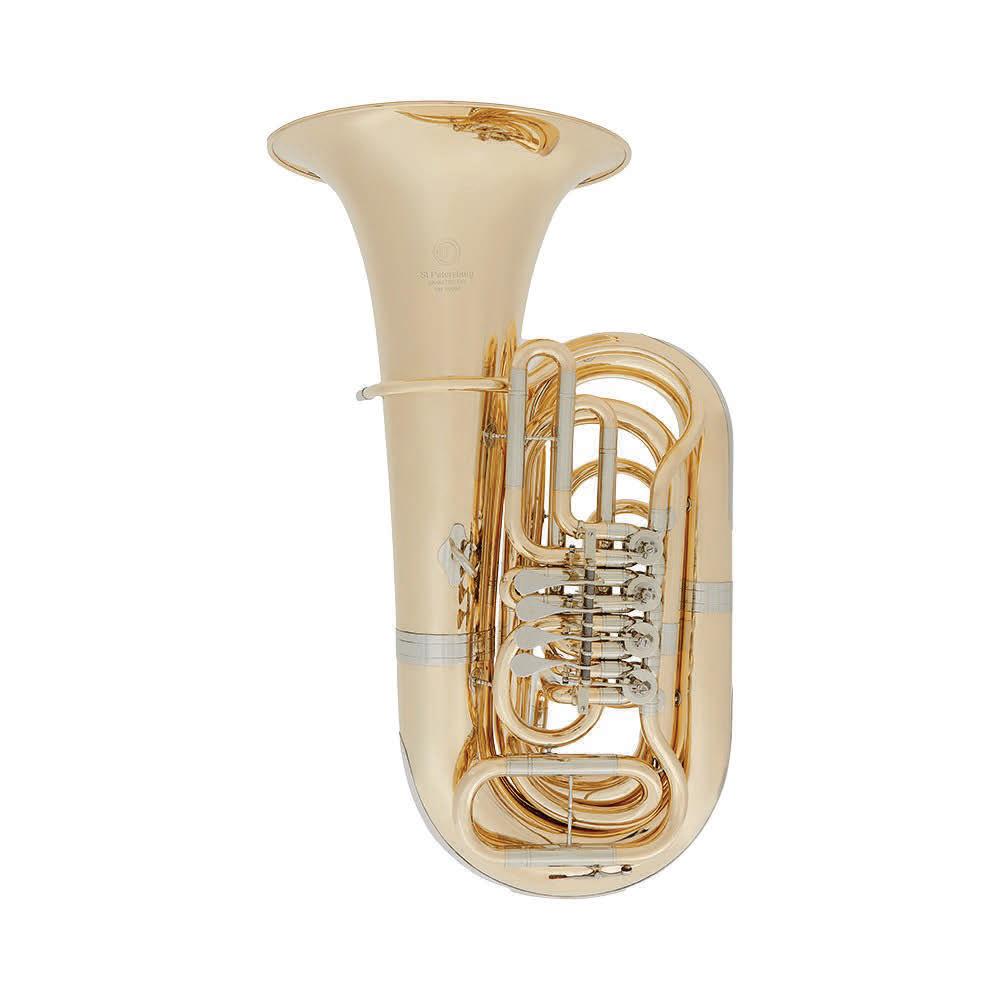
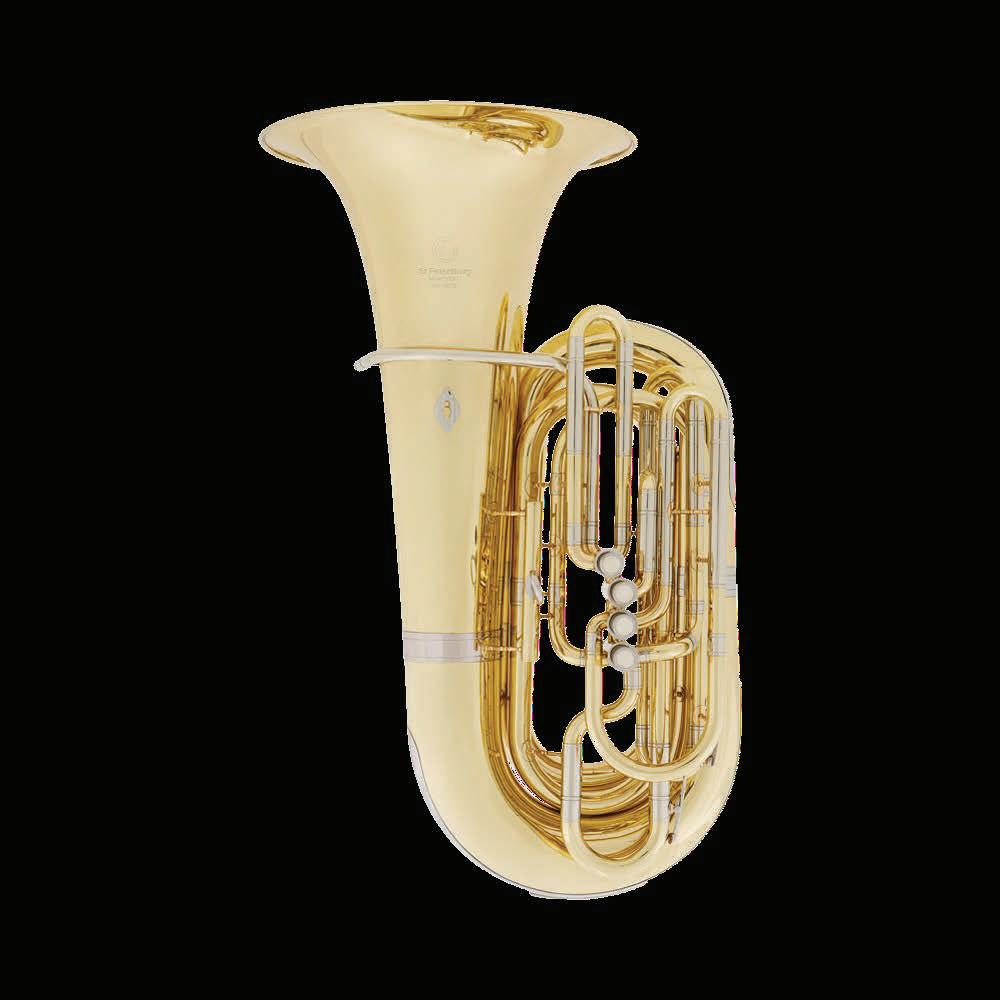
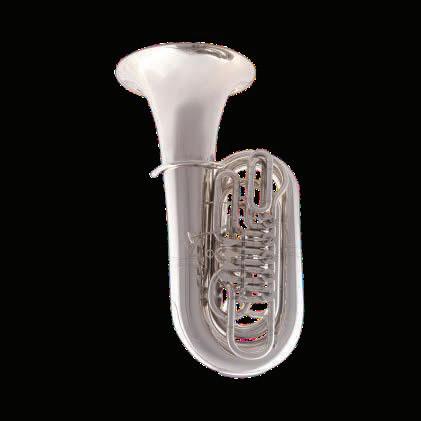
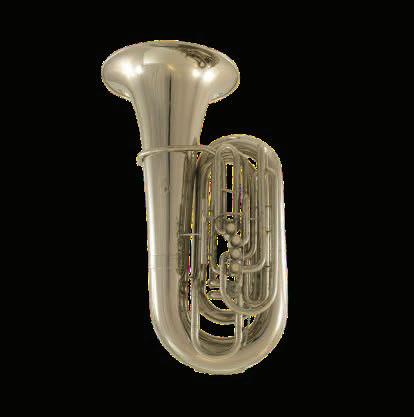
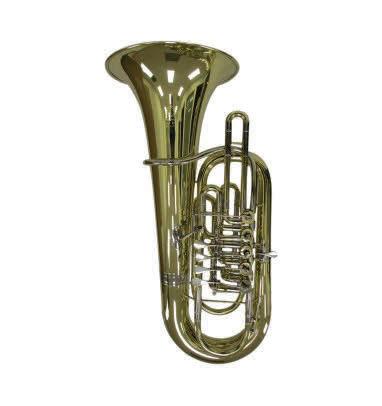
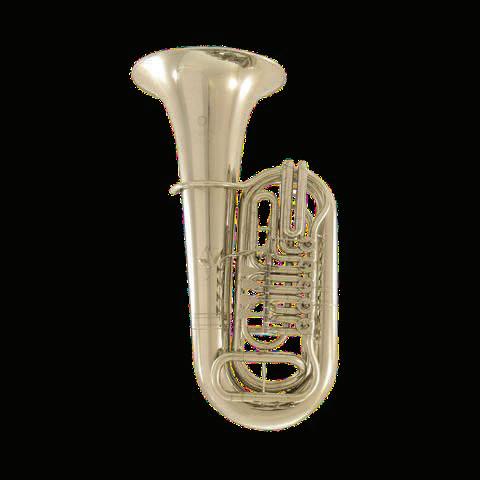
STP Carpathians BBb Tubas
Model: STP 202
Size: 4/4
Valves: 4 Rotary
Bore: 0.830”
Bell: 17.75”
Finish: Nickel (N) or Lacquer (LD)
Model: STP 203
Size: 4/4
Valves: 4 Piston
Bore: 0.750”
0.790”
Bell: 17.75”
Finish: Nickel (N) or
The STP Carpathians (St. Petersburg) 202 is the instrument of choice for any player looking for a 4/4, four rotary valve, BBb tuba with the best combination of great tone, great response, great intonation, and all of this at a great price! While its compact size is smaller than other full size tubas on the market, this affords a very comfortable fit for any size player. Its large 0.830" bore provides for a free blowing horn that produces a huge sound. All of this together delivers excellent playability throughout the entire range of the horn. Available in nickel plate or lacquer finish, yellow or gold brass. The STP Carpathians (St. Petersburg) 203 is the piston version of the classic 202. It is the choice for all those players looking for the great attributes of the STP 202, but in a piston tuba.
Other Models/Keys:
BAND DIVISION
ANDY SEALY, STATE VICE-PRESIDENT
Readiness is built through habits like showing up prepared, managing time, responding to expectations, and improving through feedback.
Band in a College and Career Ready World
This time of year, I have an increasing number of conversations with students and parents about enrolling in the band program for another year. These conversations are not just about the treacherous leap from middle to high school but also include families questioning continued membership in the current program, regardless of grade level. Directors know that recruiting and retention are ongoing efforts that span the entire year. We also understand elective offerings continue to grow, and families are concerned by time and financial commitments, as well as the potential effects on academic performance and household budgets. Adding to these mounting retention challenges is the relatively new focus on state-mandated college and career readiness.
College and career readiness is frequently defined by measurable outcomes like test scores, credits, certifications, and transcripts. However, readiness is not something students suddenly acquire as they toss their mortarboard at graduation. And, while these metrics matter, readiness is ultimately about what students can do. Readiness is built through habits like showing up prepared, managing time, responding to expectations, and improving through feedback. It is built through responsibility, accountability, reflection, and adaptation. These habits are the foundation of every successful band program and become
February—Renew membership, purchase liability insurance, register for the convention.
February 1— Honor Band entry opens online.
February 11–14—TMEA Clinic/Convention.
February 11, 8:00 p.m.— President’s Concert featuring the U.S. Army Band.
February 12, 8:00 a.m.—TMEA General Session at the convention.
February 12, 2:30 p.m.— Band Division business meeting at the convention.
February 12— Ballots for the Executive Board election are emailed to eligible members.
February 13, 8:15 a.m.—TMEA Region meetings at the convention.
February 13, 6:00 p.m.— Executive Board election voting closes.
March 1—Texas Music Scholar online application opens.
2/6/26 | 2/20/26 | 3/20/26
Schedule your audition today!
2/20/26 | 3/6/26
3/20/26 | 3/28/26
2/13/26 | 3/6/26 | 3/27/26
Degree Programs
Auditions:
January 17, 2026
February 7, 2026
March 21, 2026
Video Submissions Due:
April 18, 2026
Music Preview Day: November 14
Auditions are available in person or video submission.
Bachelor of Arts in Music
Bachelor of Music in Vocal Performance
Bachelor of Music (teacher certification)
Performance Opportunities
A Cappella Chorus
Big Purple Colorguard / Acuity Winterguard
Big Purple Marching Band
Concert Band
Gospel Choir
Jazz Combos
Jazz Ensemble
Opera
Orchestra
Percussion Ensemble
Steel Drum Band
University Chorale
Wind Ensemble
easily accessible advocacy talking points for directors as we engage with students and parents.
Step into any band hall during rehearsal and it becomes immediately clear that college and career ready skills are being taught. They just happen to sound like scales, chorales, and articulation studies. While band is often categorized as an addon, an enrichment, the work happening inside a rehearsal space closely mirrors the demands students will face in college classrooms and professional environments.
While it is always challenging to get students to practice independently and to prepare their music ahead of time, readiness is really built one rehearsal at a time. Directors can guide and support student preparation, but improvement depends on what students do independently. Successful independent practice requires self-motivation and intentional time management that balances practice time, academic coursework, and many times employment outside the school day. Our students quickly learn that personal preparation matters.
Coming to rehearsal without practicing affects more than an individual grade; it impacts the entire ensemble’s rehearsal experience and pace of learning. Students experience firsthand that their work matters, preparation cannot be postponed, and progress relies on consistent effort. In a way that few other classes replicate, this level of accountability mirrors postsecondary realities such as managing deadlines and project preparation.
A band rehearsal demands sustained focus and multitasking. Students simultaneously read music, watch the conductor, respond instantly to verbal and nonverbal instructions, listen to other performers across the ensemble, adjust pitch and balance, and remain aware of their role in the ensemble. These sustained cognitive demands mirror the concentration required in college classrooms, labs, and collaborative professional work settings. Unlike many other academic environments, band rehearsals make learning obvious. Growth is audible. Students hear how individual preparation and effort matter. This helps students develop honest self-assessment and an understanding of what it means to contribute meaningfully to a shared goal.
Band students do not simply work in groups; they function as a system. Each section depends on the others. They learn when to lead and when to follow. They learn to listen, adapt, and sometimes sacrifice personal preference for the good of the ensemble. Individual success is inseparable from collective success. These skills are not learned through lecture; they are developed over time through participation in sectionals, full rehearsals, and performances, where trust and coordination are nonnegotiable. All these experiences align directly with workforce expectations.
Band classrooms normalize feedback. Directors stop, diagnose, and rehearse the same passage multiple times. Mistakes are expected and addressed without judgment. Students learn that critique is not failure but rather an informative tool for growth and benchmarks toward mastery. Each repetition becomes either a lesson or a performance. This approach builds resil ience. Students learn to separate critique of their performance from critique of them selves. Students who can receive feedback, revise their work, and persist through challenges are better equipped to navigate intense college coursework, internships, and professional career expectations.
Band programs are great places to culti vate leadership. Student leaders and peer mentors learn how to guide others, com municate clearly, and model expecta tions. Even students without formal titles develop leadership through reliability, preparation, and positive influence. Band students understand that leadership is not about authority. It is about trust, con sent, service, and consistency. One of the most consistent and gratifying testimonial comments from band alumni is how their experiences in the program better prepared them for leadership roles in college organizations and how they use the training and concepts they learned in high school in their new professional settings daily.
ondary opportunities. Band programs contribute to college and career readiness by keeping students engaged and invested in their own learning.
The future that our band students are preparing for is unpredictable. Many will pursue careers unrelated to music, yet the skills they develop through band will follow them wherever they go. They learn how to work toward excellence, perform under pressure, collaborate with diverse peers, and adapt when things do not go as planned. These are not secondary
We know that for many students, band is more than a class—it is a community. The band hall is a place where students feel known, challenged, and supported. This sense of belonging plays a critical role in attendance, engagement, and persistence. Students who feel connected to the program and school are more likely to complete their education and pursue postsec-
outcomes of participation in our band programs. They are central to its purpose. When viewed through the lens of college and career readiness, band is not an extracurricular add-on. It is a high-impact learning environment that prepares students for life beyond high school.
TMEA CONVENTION UPDATES
The United States Army Band “Pershing’s Own” will present the President’s Concert at the TMEA Clinic/Convention
in February. The non-ticketed concert will be a great way to kick off our convention on Wednesday, February 11, at 8:00 p.m. Be sure to download the TMEA 2026 convention app to help you prepare to attend the convention (sign in with your primary TMEA email to access all features). Find clinic and concert schedule information and get the most out of your convention experience by using the Band Division Track to create your personal schedule. Be sure to include our Band Division busi-
ness meeting on Thursday, February 12, at 2:30 p.m., as well as your Region meeting Friday morning, when you build your personal convention schedule. I look forward to seeing everyone in San Antonio soon! Finally, I am excited to highlight our amazing Invited University Ensembles. Please include these outstanding concerts in your personal convention schedule!
TEXAS CHRISTIAN UNIVERSITY WIND SYMPHONY
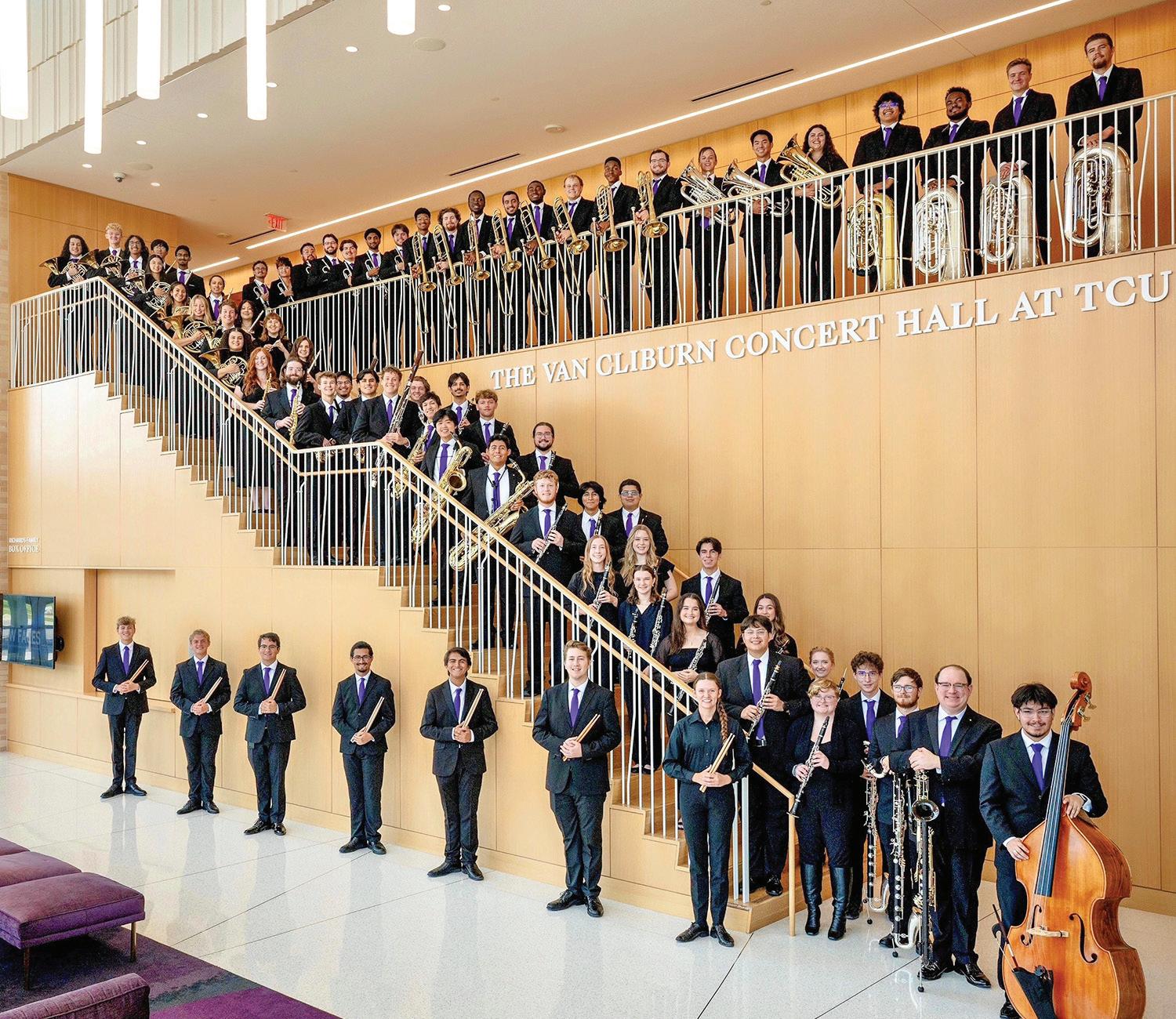
The TCU Wind Symphony, under the direction of conductor Bobby R. Francis, is recognized as one of the premier collegiate wind bands in America. From the Renaissance masters to the most recent prize-winning composers, the ensemble strives to perform a broad range of quality repertoire. The TCU Wind Symphony frequently collaborates with prominent guest artists and composers and is excited to perform at the 2026 TMEA Clinic/ Convention. Previously, the ensemble has been honored to perform at several CBDNA and TMEA conventions. Additionally, the ensemble has performed in Carnegie Hall and Bass Hall. Graduates of the TCU Band Program have gone on to become some of the finest music educators/conductors in the country, and many are successful performers in professional, military, and community wind bands and orchestras throughout the United States.
UNIVERSITY OF NORTH TEXAS TWO O’CLOCK LAB BAND
The University of North Texas Two O’Clock Lab Band, led by Rob Parton, consistently earns state and national honors and is a leading college jazz ensemble. The band has performed at prestigious events and venues, including the Wichita Jazz Festival, the TMEA convention, the International
BAND DIVISION BUSINESS MEETING
February 12 • 2:30 p.m. Convention Center
Hemisfair Ballroom 3
Texas Christian University Wind Symphony
University of North Texas Two O’Clock Lab Band
Association of Jazz Education Conference, the Jazz Education Network, FitzGerald’s in Berwyn, Ill., the Jazz Showcase in Chicago, and the Midwest Clinic. With over 20 acclaimed albums and multiple DownBeat Student Awards, it has been recognized as one of the top graduatelevel jazz ensembles over the past 40 years. Alumni have built careers in performance, education, and music production. Founded in 1946, the jazz studies program at UNT continues its tradition of excellence under Professor Rob Parton, supported by a faculty of 18 full-time members who provide an exceptional educational experience.
LAMAR UNIVERSITY WIND ENSEMBLE
The Lamar University Wind Ensemble is the premier instrumental ensemble of the Mary Morgan Moore Department of Music. Its membership consists primarily
of undergraduate students, with roughly 70% studying instrumental music education. The ensemble will be making its twelfth TMEA convention appearance, and its first under the direction of Andrew McMahan, who joined the Lamar faculty in 2017. In addition to its TMEA performances, the ensemble has performed at numerous national conferences and conventions over the past seven decades, as well as performing locally across southeast Texas. The Wind Ensemble’s performance will feature works by Paul Lovatt Cooper, Percy Grainger, and Lamar University alumnus Joel Love. The program will conclude with Karel Husa’s Music for Prague 1968.
THE UNIVERSITY OF TEXAS WIND ENSEMBLE
Conducted by Jerry Junkin, the University of Texas Wind Ensemble is making their
tenth appearance at a TMEA Clinic/ Convention. Through its appearances at such prestigious venues as the CBDNA and ABA conventions, as well as the World Association of Symphonic Bands and Ensembles, the Wind Ensemble has been praised for its “exhilarating color,” “truly profound music-making,” and “remarkable virtuosity.” In addition to its highly regarded recordings, the Wind Ensemble made its European debut in 1991 and has performed at Carnegie Hall three times. The ensemble undertook a 17-day European Tour during the summer of 2008 and made its California debut in 2007 in Napa Valley, followed by a 25-day world tour in 2014. 0
Andy Sealy is the Director of Bands at Hebron HS (Lewisville ISD).
bandvp@tmea.org
BACK TO BEGINNER Lessons Learned in a Sixth-Grade Trumpet Class
By Nikki Driver
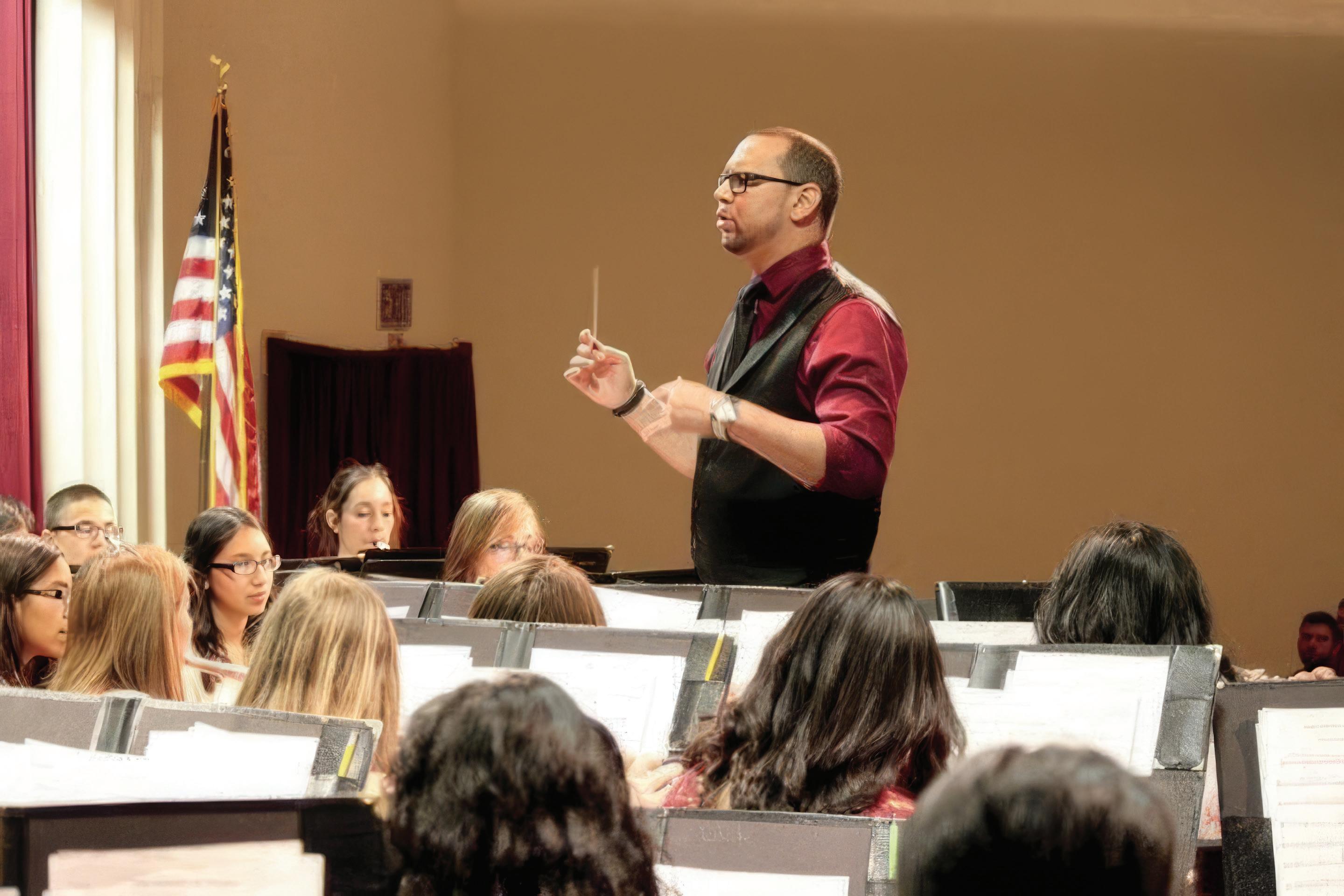
Last August, I did something I haven’t done in a long time. I became a student again. But this time, I didn’t return to school for another degree, nor did I join a leadership seminar. Those would have been safe spaces, where I would have been confident in my ability to succeed within that learning style. Instead, I joined a sixth-grade trumpet class.
That’s right, I voluntarily joined a room of eleven-year-olds who were armed with instruments and unbridled honesty. As the only one in my house who never learned to play an instrument, I thought the experience would be insightful and foster another common interest among my kids and me. I also viewed this as a rare opportunity to become a true beginner again, sitting in a student seat and learning something I had absolutely no background or natural aptitude in. I wanted to understand what our students experience every day when they are asked to learn something new.
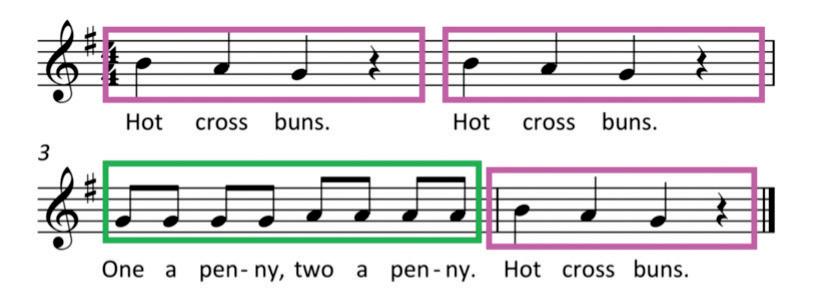
I expected to learn a little music theory and how to play “Hot Cross Buns.” What I didn’t expect was to feel humbled, embarrassed, frustrated, and ultimately transformed by what became the most profound professional development experience of my career.
THE HUMBLING RETURN TO BEGINNERHOOD
On my first day of class, I learned the difference between a quarter note and a whole note, and I learned how to distinguish between rests and notes. By week two, I was feeling confident. That was, until I tried to make a sound. Nothing. Not even a squeak was heard. I adjusted my lips and grip, my posture, and blew again. All that came out was an awkward sputter. Meanwhile, all around
me, the kids were getting it.
It took a few weeks before a student finally asked, “Why is Dr. Driver here?” When our band director explained that I was learning to play the trumpet, the student looked surprised and replied, “I thought principals had to know everything that was taught on their campus already.”
From that day on, my bright-eyed classmates noticed every sound I made—or didn’t make. While I eventually figured out how to produce a sound, it was unfortunately more akin to the sound of a dying animal than what I expected. The other students didn’t laugh cruelly, but they did laugh honestly in a way that seemed to say: Oh wow, the adult is struggling too.
Observing them as they witnessed my struggle wasn’t just humbling; it was illuminating. As adults, we so rarely put ourselves in situations where we’re bad at something. We build our lives around competence, in our jobs, our relationships, and even our hobbies. But being in a sixth-grade band room, completely stripped of authority and confidence, I found myself immersed in the experience. I was just Nikki, the student who could not make her trumpet cooperate.
The experience gave me a new appreciation for how exposed students feel every day. I have spent years telling them that learning requires grit, but it has been a long time since I’ve actually felt that. There is a huge difference between intellectually knowing that learning is a process and emotionally living it.
TEXAS LUTHERAN UNIVERSITY’S
JUNE 21 - JUNE 26, 2026 BAND | ORCHESTRA | CHOIR
MIDDLE & HIGH SCHO O L BANDS
ACHIEVEMENT- BASED SCHOLARSHIPS AVAILABLE FOR MORE DETAILS, EVENT UPDATES, AND TO REGISTER, VISIT TLU.EDU/SMA
CONFIDENCE IN LEARNING VS. CONFIDENCE IN CONTENT
Early on, I realized I had absolutely no natural aptitude for learning or playing music. In fact, I don’t think I have ever been as bad at anything in my life as I was at this. As a kid, I was a natural athlete, a strong reader and writer, and a generally creative person. When I tried something new, I quickly excelled at it. But life did not land me in a band class until I was 40 years old. What I discovered was that my lack of confidence in the content was eased by my confidence in my ability to learn. That distinction saved me.
When the notes wouldn’t come, I reminded myself of the years of learning and scholarship I had worked through to get where I was. I could lean on my memories of excelling through learning steps, processes, and adjustments if I became lost in the content.
As an educator, this realization really impacted me. Our students often lack that foundational confidence. I considered the implications for students going into grades six, seven, and eight, with no confidence in the content or in their ability to learn. If
they don’t have anything they feel successful at, they’re going to quit.
Confidence is the lifeline that keeps a student from drowning in self-doubt. It’s not a nice-to-have quality. It’s essential Ultimately, a student will lean heavily into whatever they can find that confidence in. This means the student who is successful only at making other students laugh in class will find great fulfillment in that; after all, the rest of their day is insurmountable. The implications of this for educators are huge.
As teachers and leaders, we must create opportunities for our students to see themselves succeeding, even in small ways. The goal isn’t to build their ego but to build their endurance, their stamina, and their general confidence in their ability to succeed in positive endeavors. Otherwise, what will they lean into?
FEEDBACK, DISCIPLINE, AND THE RHYTHM OF PROGRESS
As a lifelong writing teacher, I’ve preached the importance of feedback countless times. But learning the trumpet put me on the receiving end, and that changed everything. In band, feedback is immediate and unavoidable—you either hit the note, or you don’t. There’s no room for pretending, but there’s also no shame. There’s just adjustment, repetition, and progress.
At first, the immediacy of it felt brutal. But I quickly saw what a gift it was. The instant feedback, combined with a supportive environment, pushed us to grow faster than we realized. When one student finally landed a note after nine failed attempts, the whole room celebrated. The satisfaction was contagious.
It made me rethink how feedback functions in classrooms. Feedback without safety isn’t constructive; it’s simply a source of fear. Students must trust that correction is about growth, not judgment. When they do, they take risks, adjust, and improve.
The same goes for practice. Progress in any meaningful skill rarely resembles a straight ascent. It looks more like a heart monitor, with its ups, downs, flatlines, and spikes. Some days I played worse than the day before. Some days, nothing worked. Despite the frustrations, I practiced anyway.
Raising three kids who are in the high school band, I am the only one in our home still learning from scratch. They groan at my daily trumpet practice, but in showing up consistently, even when it feels pointless, I have learned what discipline really is. It’s not willpower. It’s persistence in the absence of visible progress.
Today’s students live in a world of instant gratification—reels, answers on demand, full seasons of shows binge-dropped. They’re rarely asked to wait for anything. But learning— real learning —demands patience. Students need structure, support, and permission to struggle long enough for growth to happen quietly, often when no one is watching.
EMOTIONAL RESILIENCE AND SAFE STRUGGLE
Studying trumpet reminded me what emotional resilience feels like—not in theory, but in practice. There were days I left class feeling stupid, and being a 40-year-old professional with a PhD and a published book didn’t protect me from that feeling. At times, I was embarrassed to play aloud. I was afraid the kids would hear how bad I sounded and lose confidence in me as their principal. But the more I allowed myself to sit in that discomfort, the more I understood my students’ daily experiences.
I discovered that real learning happens when confidence and struggle coexist. If students never feel challenged, they don’t grow. But if they never feel confident, they give up. The sweet spot is in that middle ground where students can fail without shame and try again without fear.
IMPLICATIONS FOR LEADERSHIP
As a school administrator, this experience has changed the way I view learning communities. I used to think my role was to create systems of support; now I see it is also about modeling vulnerability. If I expect teachers to take risks, I must take them too. If I want students to persist, I must show them what persistence looks like. And, I can ultimately do both by reclaiming the beginner’s mindset.
As I write this, the first semester is coming to a close, and I can play a recognizable tune. It still isn’t great, but it is music. More importantly, it is proof that persistence works. I haven’t just learned to play the trumpet; I have rediscovered what it
means to learn, especially in the face of a struggle. I relearned the value of patience, the necessity of confidence, and the critical role that feedback plays in the learning process. Along the way, I also acquired a newfound empathy that comes only from being in the shoes of someone who doesn’t have the answers.
We talk a lot in education about teaching the whole child , but this experience reminded me that we are whole learners, too. We must keep finding ways to challenge ourselves, to feel uncomfortable, and
to practice courage, because the truth is that the best professional development I’ve ever experienced didn’t happen in a conference room—it happened in a middle school band hall, with a trumpet in my hands and a reminder ringing in my ears: learning is hard, and that’s what makes it beautiful. 0
Dr. Nikki Driver is an Assistant Principal at Henderson MS (Henderson ISD).
You could pay more, but why? Unify and simplify for less
Performance Ensemble Solution
“ We partner with MusicFirst as it gives us more tools than other platforms and gives us the most flexibility in purchasing the tools we need.”
Aaron Michaelson, Orchestra Director & Department Chair, The Woodlands High School, Conroe ISD
“ We partner with MusicFirst because their comprehensive suite of tools supports every aspect of music education.”
Matt Wood, Director of Bands Ridgeview Middle School, Round Rock ISD
“ We love using PracticeFirst. It is easy to track students’ progress and provide feedback. We prefer MusicFirst because it is easier to understand and provides many software options and allows us to assess student learning.”
Ramón Niño III, Director of Mariachi North Side High School, Fort Worth ISD
TIA Fine Arts Assessments by
All Music… All Visual Art…
All Theatre… All Dance…
Any Grade Level
TEKS-Based, Customized Assessments to be Authentic to YOUR District’s Curriculum and Instructional Priorities
• Knowledge Assessments • Performance Assessments
• Sight Reading Assessments • Portfolios
Find out why MusicFirst is the only third-party resource for Fine Arts Assessment listed by TEA.
“ This data-driven approach not only supports instructional improvement but also plays a vital role in our district’s efforts to meet the requirements of TIA.”
Dana Grubb, Director of Curriculum & Professional Learning, La Vernia ISD
“MusicFirst has provided all fine arts areas with access to the TIA Incentive process through easy, effective, and approved pre- and post-test assessments tailored to our curriculum and specific needs. Our teachers are experiencing great success with this tool!”
Eric
Eakes, Director of Fine Arts, College Station ISD
“ We are so fortunate to have MusicFirst as a partner in our TIA process! I can’t imagine having to do everything that MusicFirst does for us on our own.”
Mark Rohwer, Director of Fine Arts, Carrollton-Farmers Branch ISD
Learn more & view samples
Keith
Dye,
Ed.D. Former Associate
Academic Dean, Texas Tech University College of Visual Arts & Performing Arts and Past-TMEA President, personally works with every partner to develop, customize, and refine all aspects of your Fine Arts TIA journey.
“I highly recommend MusicFirst. It makes the Teacher Incentive Allotment testing procedures smooth and stress free.”
Oscar
Gonzales, Supervisor of Bands, Rio Grande City CISD
“MusicFirst has made the creation and implementation of our pre-test/post-test assessment simple!”
Jenni Olges, Director of Fine Arts, Humble ISD
“ The work they do allows easy integration in every classroom and they take care of the details, allowing us to focus on our programs and our students.”
Jacob
Justice, Director of Fine Arts, Bryan ISD
SOUND IDEAS
ORCHESTRA: MODERN TOOLS FOR SIGHTREADING
By Joanna DeVoto and David DeVoto
Teaching sightreading can be a daunting task, and this isn’t always fun for directors or students. It’s tricky because the reading skills among the students may vary greatly, and the confidence of the class can rise or fall with each attempt. Getting everyone’s reading up to par and building confidence is a challenge. The key is repetition; keep it rooted in what the students already do, keep it practical, and most importantly, keep it engaging.
With limited rehearsal time, below are three quick strategies we use to prioritize sightreading in our daily routine. Implementing these tools is effective and doesn’t take up too much time. Depending on your budget and students’ device access, the right tools for you may vary, so we hope this information will help you seek solutions that best support your students’ efficient and effective learning.
RHYTHM RANDOMIZER IN WARMUPS
Rhythmic understanding is the first step in developing sightreading skills. We’ve found the Rhythm Randomizer to be an excellent tool for training students to read rhythms, from beginners through high school students. This is a free browser-based tool that allows the director to customize and create any rhythms they need. To keep the exercise musical, we combine rhythm work with finger pattern practice. Here’s how it works:
• Project a four-measure rhythm on the screen based on the current rhythmic concepts the class is working on (e.g., eighths and quarters for beginners; syncopation or dotted rhythms for more advanced students).
• Using our district’s five-note finger patterns, students play each measure of the Rhythm Randomizer exercise on one note of the finger pattern, ascending notes each measure. Repeat the four-measure exercise by descending the notes in the finger pattern, with the last measure ending on the open string. Beginners can start using Rhythm Randomizer by playing the whole exercise on a single note.
• After the exercise, rest for one measure while the director introduces a new rhythm. Then, perform the next finger pattern in the sequence.
MAKEMUSIC’S
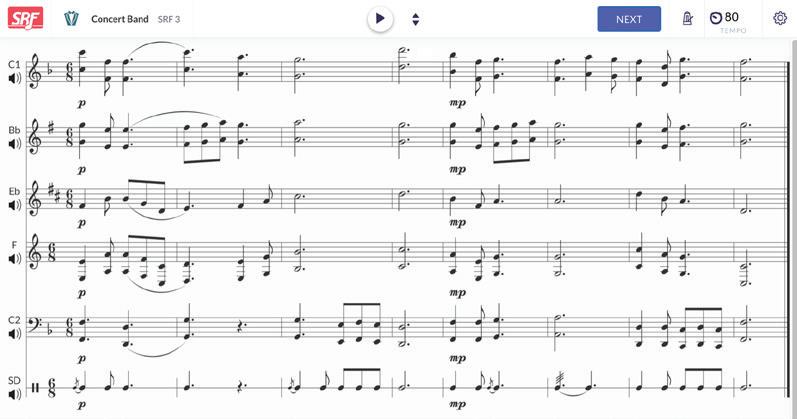
SIGHT READING STUDIO
MakeMusic’s Sight Reading Studio is a tool we have found helpful with our middle through high school students. All orchestra students in grades 7–12 use MakeMusic for their practice and assessments. A notable new feature, Sight Reading Studio builds on tools like Rhythm Randomizer by incorporating more musical elements such as dynamics and articulations. This studio also allows for the creation of five-part string orchestra scores, enabling students to read their specific parts, whether unison or differentiated, directly
For webpage links and image examples of these resources, go to www.tmea.org/devoto2026
from the score. Sightreading templates can also be created and shared for home practice.
UTILIZING GOOGLE DRIVE
Using Google Drive in an orchestra rehearsal is a powerful tool that can be overlooked. In Allen ISD, each student has a districtissued Chromebook and access to Google Drive, so we take full advantage by distributing sightreading folders digitally. If you teach in one of the many school districts that assign devices to their students, consider the following that a director can do, with just a few clicks:
• Share individual parts (violin, viola, cello, bass) to students’ devices in seconds.
• Display the score on the projector for score-reading activities.
• Use student devices for silent reading, marking, or quick reviews.
Students have their devices with them, so this makes the process quick and easy since it is paperless. We’ve found that this saves so much precious rehearsal time, especially during UIL season. Students can access these materials outside class as well, making practice more self-directed.
For advanced classes, we ask the students what they see when opening the music. The students identify rhythmic patterns, key changes, roadmaps, or any other challenges individually before they ever play. This reinforces the habit of scanning music quickly for information, which is a core sightreading skill.
Including sightreading in your daily rehearsals, even if it’s for a few minutes, will yield noticeable results, and the students will become more confident in their reading. We’ve found that engagement is usually higher when we can incorporate technology and when students can use their devices.
By separating rhythm from pitch, then adding in other musical elements, and finally giving students easy access to materials, we’ve seen huge gains in reading ability and confidence of our musicians. Stay consistent and watch the students turn into fantastic readers! 0
Joanna DeVoto is Orchestra Director at Ereckson Middle School (Allen ISD).
David DeVoto is Allen High School Orchestra Director (Allen ISD).
Your Music Belongs at Baylor
ORCHESTRA DIVISION
SABRINA BEHRENS, STATE VICE-PRESIDENT
Concert day is more than a performance—it’s a celebration of collaboration, growth, and community.
A New Perspective on Concerts
Hours of rehearsal lead up to one big moment—the concert. Concert day, and even contest day, are some of the most rewarding times of the year. They are honestly my favorite days of the year. The hard work is done, and now it’s in your students’ hands—and their instruments. It’s time to showcase everything they’ve accomplished. While concert day can feel stressful for some directors, with thoughtful planning and creativity, it can become a day you anticipate with excitement rather than dread.
Every successful concert begins with a clear vision. My assistant and I always ask ourselves what we want this concert to look like. From there, we map out logistics and identify tasks that can be delegated to parents or student officers. As high school directors, we often assign responsibilities like stage setup and teardown, program distribution, and even serving as concert emcees to our student leaders. This not only gives students ownership of the event but also lightens our workload. Don’t hesitate to involve parents or your booster club—they can assist with student check-in, ushering, and even concessions. When everyone plays a role, the concert becomes a true community effort.
Concerts don’t have to be confined to your auditorium or cafeteria. Explore alternative venues, such as local shopping centers with performance spaces or nearby colleges and universities. Many institutions
MARK YOUR CALENDAR check www.tmea .org for updates
February—Renew membership, purchase liability insurance, register for the convention.
February 11–14—TMEA Clinic/Convention.
February 11, 8:00 p.m.— President’s Concert featuring the U.S. Army Band.
February 12, 8:00 a.m.—TMEA General Session at the convention.
February 12, 1:00 p.m.— Orchestra Division business meeting at the convention.
February 12—TMEA emails eligible members their ballot for the Executive Board election.
February 13, 8:15 a.m.—TMEA Region meetings at the convention.
February 13, 6:00 p.m.— Executive Board election voting closes.
March 1—Texas Music Scholar online application opens.
are happy to host middle and high school ensembles and may even offer clinics for your students. Collaborating with feeder schools is another excellent way to create joint performances and strengthen community ties. The more varied the performance opportunities, the more your students grow—not just as musicians, but as confident performers who can adapt to any setting.
Ultimately, performing is what we teach our students to do—and it’s a skill that improves with practice. Look for ways to integrate performance into everyday life. Does your school’s awards ceremony need music? Send a string quartet. During the holidays, students can play in the lobby of a local business or greet faculty with music as they arrive on campus. While preparing for your pops concert, consider hosting lunchtime performances for the
impact beyond the classroom, their sense of purpose and pride grows exponentially.
A great concert deserves a great audience. About two weeks before the event, we set aside time for students to send personal email invitations to family and friends. Social media is another powerful tool— create countdowns, share flyers (Canva is fantastic for this), and tag other campus organizations. Encourage your students to attend band and choir concerts as well; supporting others often means they’ll support you in return.
Concerts aren’t just about the music— they’re about the people who make it possible. From parents who handle transportation, to booster clubs raising funds, to private lesson instructors and administrators who champion music programs— acknowledge them all. And of course,
growth, and community. When we plan with intention, delegate wisely, and create opportunities beyond the traditional stage, we transform concerts into experiences that inspire students and audiences alike. At the heart of it all is the joy of making music together—a joy worth sharing every chance we get. So, let’s embrace concert day not as a source of stress, but as a highlight of the year that reminds us why we teach, why our students learn, and why music matters.
TMEA CONVENTION UPDATES
With the convention just days away, make sure you download the TMEA convention app using your primary TMEA email to sign in and create your personal schedule (accessed from your profile page). A few important schedule notes for this event:
Region meetings are now on Friday morning at 8:15 a.m. Grab your coffee and join your colleagues at your Region meeting. There are also new venues for our division’s orchestra and mariachi clinics. Some will be held in Bridge Hall, so be sure to check out that space. There are exciting performances from our Honor Orchestras as well as performance–clinics from our Invited Spotlight Orchestras, and I hope you stay for the All-State concerts on Saturday, February 14.
The All-State Orchestras have an exciting combination of traditional orchestral literature with new and contemporary works. Selena fans will want to be sure to attend the All-State Mariachi Ensemble concert. The Symphony Orchestra will include a world premiere of Ennis Harris’s From the Wind, That Which Augurs. This performance will include collaboration from our All-State Jazz students as well. The AllState concerts are not to be missed!
ORCHESTRA DIVISION MEETING
The annual Orchestra Division business meeting will be on Thursday, February 12, at 1:00 p.m. in CC 221. Enjoy a performance by our invited HS Mariachi Ensemble, Mariachi Grulla de Plata, as well as a brief message from our invited clinician, Dr. LaSaundra Belcher. We will also have important updates for the Orchestra Division. I can’t wait to see you! 0
Sabrina Behrens is the Director of Orchestras at Travis HS in Fort Bend ISD.
orchestravp@tmea.org
Cultivating a Music Classroom of Belonging
By Jocelyn Ho and Aline Moore
Reflecting on our classes was often like looking in a mirror. Across the podium, our students resembled us in many ways—they were first generation, multicultural, and either children of immigrants or immigrants themselves. This shared identity underscored our responsibility as orchestra directors to embrace and represent their lived experiences as a strength and tool for instruction. By learning what is important to students, we put them—including their culture, experience, and musical identity—at the center of our instruction. Fernanda, one of Ms. Moore’s orchestra students, offered this about the impact of performing a piece by a Mexican female composer:
From my early years as a violinist, I was fascinated by how each section blended to create a unified ensemble. I connected deeply with every piece I played, but that connection reached new depths during my freshman year when I performed A Su Merced Don José by Nubia Jaime-Donjuán. Its vibrant rhythms and powerful composition resonated with my Mexican heritage, making me feel truly seen as a Latina violinist. It was an unforgettable and transformative experience.
Nithya, a student in Ms. Ho’s orchestra loves sharing the intricacies of Carnatic music from South India. She expressed how beautiful it was to see her culture reflected in the classroom and how meaningful it was to have teachers express interest in a prominent art form she and many of her peers participated in outside school:
Ms. Ho’s inclusion of Carnatic music in orchestra pieces brought out an aspect of my culture that growing up I thought wouldn’t be recognized. It made me feel represented in
orchestra and school. Not only did she allow students to learn more through her lessons, but she also learned from us, which is truly remarkable! It fostered an environment in which students such as myself felt a sense of belonging.
TRUTHS TO HOLD ONTO
Pedagogical theorist, educator, and author Gloria Ladson-Billings asserts that our students develop comprehensive musicianship skills when they receive culturally representative and sustaining musical instruction. This broadens their experiences and their understanding of different art forms. Students feel more seen and valued, and they develop a heightened sense of self-esteem when teachers include their culture and invite them to be an integral part of the instructional process.
In alignment with this perspective, the Texas Education Agency highlights the importance of cultural appreciation in its High School Music TEKS Guide, stating, “Texas has become one of the most ethnically and culturally diverse states in the country. Building an appreciation for cultural differences is critical for adolescents in our music classrooms. These cultural differences are very often illustrated in music. Through the study of music, students can gain greater insight into themselves and others.”
The Texas Essential Knowledge and Skills (TEKS) demonstrate how imperative it is for educators to consider a more holistic approach to programming music. For example, Music TEKS §117.208–.209 for middle school include the following expectations within the Creative Expression and Historical and Cultural Relevance sections:
Incorporating Mariachi, Carnatic, and Hindustani music into our programs has broadened our students’ understanding and experiences of different types of string playing at all levels.
• Perform independently and expressively a varied repertoire of music representing various styles and cultures.
• Perform music representative of diverse cultures, including American and Texas heritage.
• Examine written and aurally presented music representative of diverse genres, styles, periods, and cultures.
• Describe written and aurally presented music representative of diverse styles, periods, and cultures.
The TEKS encourage students to explore repertoire across genres, time periods, and world traditions. Giving our students agency and a voice in the music selection process provides them with a choice to reflect and represent the cultural heritage of their student body, community, and state. Students’ intrinsic motivation, ownership of learning, cultural competence, and understanding heightens the moment they actively participate and engage in their learning with a locally and globally representative lens.
MISCONCEPTIONS TO CHALLENGE
Educators wear many hats: teacher, conductor, counselor, coach, friend, mentor, club sponsor, parent, role model, cheerleader, and more. We understand it is intimidating to add more to this full plate. To that end, these are some common misconceptions about including cultural representation in instruction:
• Teaching that reflects students’ backgrounds is not curricular.
• When I’m being culturally representative, it takes too much time away from performance preparation and focusing on string fundamentals.
• I can’t teach the diverse music of cultures that aren’t my heritage.
We recognize that barriers to implementation, such as limited time, resources, and training, do exist. However, we believe that with dedicated professional development, collaborative learning committees, and appropriate resources—coupled with curiosity, respect, and intention—every educator can build an appreciation for cultural differences. Instruction through a cultural lens is essential, and it’s feasible.
For example, Ms. Moore invited some of her students who are trained dancers to choreograph a Bharatanatyam dance to accompany the group’s performance of Maharaja by Doug Spata. The students were thrilled to be part of the project, and it was a success in many ways. However, she later received the thoughtful feedback that featuring Bharatanatyam dancers in front of live musicians was not ideal, as it can draw focus away from the music
and did not align with the traditions of Indian classical dance. The following year, she adjusted her approach by using a recorded track instead of live musicians. She appreciated how this feedback was shared; it was another meaningful learning moment in her career.
A TOOL FOR SOCIAL EMOTIONAL LEARNING
Building positive relationships with our students is how we get them to buy into what we want to teach them. We encourage you to start with small, low-stakes strategies to model selfawareness, self-management, social awareness, relationship skills, and responsible decision-making in lesson planning and culture building. Consider these actions:
• Be curious about your students: what activities, cultures, art forms, foods, holidays, and languages fill their home?
• Find out who their role models are.
• Show your students videos of artists from varying performing groups.
• Eliminate hierarchy in seating practices with alternative, random, and circle seating.
• Showcase students’ cultures in your concerts with instruments, choreography, and more.
• Let students select and verify the authenticity of their music.
• Program music by composers from different backgrounds.
PRACTICAL APPLICATIONS: READY, SEAT, PLAY
What students play and where they sit shapes their learning experience. Seating them in the same spot for each class and concert limits growth in ensemble and rehearsal skills. To give everyone a chance to sit in the front, middle, and back of the ensemble, we encourage alternative seating methods—random, rotating, and circle seating. When possible, arrange the ensemble in a large circle so you can move freely to observe, address, and give feedback.
Encouraging our students to recommend music they enjoy and to evaluate its authenticity gives them ownership and empowers them to exercise their critical-thinking skills. Performing traditional folk songs and spirituals is an accessible way to teach historical, cultural, and performance context across different eras and countries. Incorporating Mariachi, Carnatic, and Hindustani music into our programs has broadened our students’ understanding and experiences of different types of string playing at all levels. Here are some of the pieces our students have enjoyed studying:
Grade 1:
• Cielito Lindo, arr. Jorge Vargas
• Mohanam Hop, Cooper Ford & Manjula Ramachandran
Grade 2:
• Deep River, arr. Carrie Lane Gruselle
• Chinese Folk Song Suite, arr. Chen Yi
Grade 3:
• Ó Abre Alas, Chiquinha Gonzaga/arr. Deborah Baker Monday
• Lamps of Deepavali, Cooper Ford & Manjula Ramachandran
We have highlighted Hispanic Heritage Month in our fall concert, Black History Month in our UIL evaluation concert, and Asian American and Pacific Islander Heritage Month in our spring concert. To honor these celebrations, we selected repertoire reflecting the richness of these cultures, such as Journey to Aconcagua by Nicolás Repetto, Valsa para Sofia by Bianca D’Ávila do Prado, A Tender Moment in Time by Adrian Gordon, Korean Simple Suite by Han-Ki Kim, and Viraha by Cooper Ford and Manjula Ramachandran.
Additionally, we dedicate a few minutes in each class to highlight influential musicians from the featured cultures, such as Florence Price, Michelle Zauner, Marian Anderson, Bad Bunny, Arturo Márquez, and many others.
Beyond repertoire selection, we promote cultural understanding by incorporating brief educational components in our concerts and rehearsals. During each performance, students read program notes to educate our audience about the works and composers. This collaborative process nurtures musical growth and heightens cultural awareness and appreciation among our community.
We also host an annual multicultural Friendsgiving in November, designed to celebrate the many cultural traditions represented in our orchestra program. The event is our most well-attended social event. For this potluck meal, students sign up to bring dishes of their cultural backgrounds, creating a shared table of unique flavors and stories. Beyond the food, we include games, activities, and customs connected to students’ heritage. We feature a henna
station, a Vietnamese dice game called Bầu Cua, a Garba dance (a vibrant folk dance from Gujarat, India), and light firecrackers as part of the Diwali tradition. The event has even been featured in the school’s community newsletter, highlighting our orchestra’s commitment to honoring and learning from our students’ cultural backgrounds.
A CALL TO ACTION FOR EDUCATORS
Building a culturally representative program starts with you. We invite all educators to join us in learning alongside our students. Honoring diverse cultures is rewarding yet challenging; navigating unfamiliar traditions can be daunting. Instead of hesitating, embrace curiosity and intentionality. Do your own research, attend cultural performances, and seek learning opportunities. When unsure, reach out to the community with humility and openness. Mistakes will happen, but each offers a chance to apologize, grow, and improve. This transformative process enriches our relationships with students and leads to engaging lessons.
The next Fernanda and Nithya are in your classroom. How will you respond? 0
Jocelyn Ho is pursuing a Masters in Music Education at Teachers College, Columbia University and is a music teacher at the Teachers College Community School in New York City. Aline Moore is Codirector of Orchestras at Lebanon Trail HS (Frisco ISD).
SOUND IDEAS
VOCAL: HOW TO MITIGATE SPRING SEMESTER STRESS
By Spencer Wiley
As we settle into the spring semester, many music educators find themselves facing a flurry of events, performances, trips, and much more, all while striving to keep students engaged in their learning. Following a busy fall, it’s common for educators to experience stress and burnout during this bustling season. Sound familiar? If so, below are some suggestions to help you mitigate stress and maintain your well-being through the rest of the school year. And while these tips are helpful in the spring semester, they also apply throughout our summer break, when many of us spend our time off preparing for the next school year. They then become critical in the fall, when there are so many activities that we barely have time to breathe before it’s time to begin preparing winter concerts for December.
UTILIZE BACKWARD PLANNING TO DEVELOP LESSON PLANS
Look at your performance calendar and begin with the end in mind by backward planning. This will allow you to set weekly learning targets and rehearsal objectives before you introduce music to your students. Much of the stress and anxiety many of us experience is brought on because it feels as if there is never enough time to fully prepare our students for an upcoming performance. This results in teachers spending hours after work coming up with reactionary lesson plans, hoping that students can learn their music in time. Using the backward planning model will give you a clearer picture of the skills that need to be developed and a timeline for when those skills should be mastered to produce a successful performance. For more information about how to backward plan, read “Backward Design and Repertoire Selection” by Jocelyn W. Armes published in the March 2020 issue of Music Educators Journal.
SET A CLOCK-OUT TIME
With so many things on our to-do lists, it is easy to fall into the trap of thinking that everything needs to be taken care of today When you get to school each morning, set an alarm on your phone for when it is time to stop working at the end of that day. When the alarm rings, pack up your things and make yourself go home. What you can’t accomplish that day will be waiting for you in the morning. Be reasonable in your expectations and protect your time.
LEAVE WORK AT WORK
Leave your laptop and all rehearsal resources at school. If you
bring them home, you’ll be tempted to answer emails or start planning for the next day’s rehearsal. If your work email account is synced to your phone, be sure to turn off email notifications as soon as you get into your car to go home.
PLAN YOUR NEXT VACATION
Look at your school calendar and plan a vacation or activity that you love to do during your next extended break. Whether it’s a family or friend trip or simply staying home and having a TV/ movie marathon, figure out what you want to do and write it in your calendar in big, bold letters.
Whenever you are having a particularly hard day at work, stop what you are doing, open your calendar to the date of whatever you have planned, and visualize what that day will look like. You could even take a little time to jot down an informal trip itinerary or list the shows that you want to watch during your marathon. There’s something to be said about seeing the light at the end of the tunnel during stressful times throughout the year.
FIND YOUR BALANCE
Although teaching music is a deeply rewarding profession, trying to juggle the many things we must do can quickly drain even the most passionate educators. In addition to ensuring our students have everything they need to be successful, we must also factor in what we need as individuals to maintain a healthy balance between work and our lives outside the classroom.
By implementing small yet intentional changes, we can create a more sustainable work–life balance that will keep us from being burnt out halfway through the year. For additional articles on the topic of music educator work–life balance, go to www.tmea.org/ teaching-resources and scroll down to the “Work-Life Balance” section of the page.
As you navigate the demands of this semester, I hope you can remember that prioritizing your well-being not only enhances your life but also enriches the educational experiences you provide your students.
0
Spencer Wiley is the Head Choir Director at Harker Heights High School (Killeen ISD).
PERFORMANCE OPPORTUNITIES
Concert Choir
Guitar Ensemble
Worship Ensembles
Musical Theatre
Percussion Ensemble Vocal Ensembles Symphonic Band Brass & Woodwind Opera Workshop Marching Band
Scholarships are available to both music and non-music majors.
MUSIC DEGREES OFFERED
Music (B.A.)
All Level Music Education (B.M.)
Worship Studies (B.M.)
A CHRIST-CENTERED EXPERIENCE
At East Texas Baptist University, through the integration of biblical faith and academic learning, you will be transformed by the renewing of your mind. You will be challenged by our committed Christian faculty and staff to pursue God in all aspects of your life. As a graduate of ETBU, you will be prepared to stand as a pillar of influence in your calling for God’s glory.
VOCAL DIVISION
JENNIFER GALLAGHER, STATE VICE-PRESIDENT
I encourage each of us to examine who is less visible in our classrooms and reflect on what shifts we can make in our own perspectives to make the invisible ones seen, valued, and loved.
Making the Invisible Seen
One of my go-to questions for classes early in the year is: “If you could have any superpower, what would it be?” I asked that question during the first week of this school year and was surprised when most of the non-varsity treble choir chose invisibility. This ensemble consists primarily of intermediate-level sophomores through seniors. When the majority selected invisibility, this caught my attention and raised more questions.
What about being invisible was appealing to these teens? What does it mean to be invisible in our world today? These big questions led me to my most important thought, which I am sure many of us have asked ourselves before: how do we serve all students, not just the highachieving ones? It’s easy to identify our most visible students. They are the All-Staters, the leads in the musical, the officers, the section leaders, the varsity students, the future music educators and performers. So, what about students who aren’t in those categories?
In Memoriam
Richard L. Surface 1945–2025
There are a variety of reasons why students might join our programs beyond liking music and singing. Some might simply be satisfying their required fine arts credit. Others may want the opportunity to get out of school and go on trips or want to be in a class with their friends. MARK YOUR
check www.tmea .org for updates
February—Renew membership, purchase liability insurance, register for the convention.
February 11–14—TMEA Clinic/Convention.
February 11, 8:00 p.m.— President’s Concert featuring the U.S. Army Band.
February 12, 8:00 a.m.—TMEA General Session at the convention.
February 12, 1:00 p.m.—Vocal Division business meeting at the convention.
February 12— Ballots for the Executive Board election are emailed to eligible members.
February 13, 8:15 a.m.—TMEA Region meetings at the convention.
February 13, 6:00 p.m.— Executive Board election voting closes.
March 1—Texas Music Scholar online application opens.
RENEW & REFINE
choirs.music.txst.edu
GRADUATE STUDIES IN CHORAL MUSIC
Fall/Spring Enrollment Conducting Assistantships
Extensive Podium Time
TXST/Conspirare Choral Conducting Symposium
July 20-23, 2026
Conductors | Choral Artists Choral Enthusiasts
TXST CHOIR CAMP
Large and Small School Camps
JUNE 28 - JULY 1, 2026
Texas’s longest-running all-state choir camp: Four decades of choral excellence in the beautiful Hill Country
Dr. Thomas J. Standish-Rinn Camp Director
PRICING AND DISCOUNTS
• $295 Tuition
Summers Only in 3 Years Master of Music in Choral Conducting Master of Music Education Impactful Engagement 3 Week Annual Residency
For Information:
• $125 On-Campus Housing
• Discounts available for 2026 Texas All-State Singers and large groups.
Dr. Joey M. Martin Director of Choral Activities
TXST CHORAL FACULTY
Dr. J. Christine Linschoten Associate Director Choral Activities
They might join just because they want to have fun! It is important to note that what is fun for me (and what was fun for me as a high-achieving choir kid) is not necessarily fun for all my students today. For those who see choir as just a class and not a pathway to a career in music or as their school family, are we also serving them to the best of our ability? How do we give them high-quality experiences without the demand and stress of making choir the central thing in their lives?
Reflecting on my early years in the classroom, I am almost certain I focused most of my energy on the varsity choirs. It wasn’t that I neglected the beginning and intermediate students, but by treating them all the same and not meeting them where they were, I do not think I gave everyone the best and most curated experience. Again, if a student is simply there for the credit, can we be okay with that? Can we still appreciate and love them for who they are, not just what they do? Can we allow ourselves to let go of some of the rigor and still provide a place for them to belong, even if it’s just for 50 minutes a day?
One of the ways we strive to make all students feel seen in our program is with oneon-one conversations at the start of the second semester. For our seniors, the conversation is quick. I usually let them know I want them to finish strong, and I tell them the thing I love the most about them, which often results in tears and hugs. For our freshmen through juniors, we reflect on the year and ask students what their goals are for the future. If they intend to continue in choir, we let them know what they are doing well and what they need to improve, especially if their goal is to be a leader or audition for a varsity class in the future. For any who don’t intend to continue in choir beyond the current year, we express a few ideas to them:
• We do not dislike them for not continuing and we want to stay connected when we see them around campus.
• While we wish all students would stay in choir, we like them and we understand that each student must make hard choices about their schedules.
• If this is truly the last time they will ever sing in an organized ensemble, how can we work together to ensure that they finish strong and have the
best experience possible? We want them to look back on their time in high school glad they were in choir, even if it was just for one year.
• They can always come back to choir if they are missing it!
These one-on-one conversations are vital to the health of our program and the individual relationships within it. Students know exactly where they stand with their directors and this sets the stage for future conversations. We end each meeting by asking our students what we can do to make their experience better.
Another thing that drastically changed my mindset was teaching through the pandemic. During that time, we had to release the pressure on ourselves to do all the things at the high speed and volume we were accustomed to; it was simply too much to handle. I recall that it took us over three hours just to take attendance each day! Lowering our expectations of ourselves and our students was not a poor decision in those times. If I had not done so, I truthfully would not still be a choir teacher.
Even though we are several years beyond those difficult times, can we maintain perspective and, when needed, release the pressure on our students as they are today? Returning to our “old ways” is beneficial only if we have truly reflected and chosen accordingly.
Let’s look at how this might apply to the Texas All-State Choir process. When you receive this issue, we’ll be just a few weeks away from our All-State Choirs having their culminating performances in San Antonio. The Texas All-State Choir process is a significant part of TMEA history and is certainly a bedrock of programs around our state for a good portion of the year. When the literature was released last May, some commented that the music was not as challenging this year. That was intentional.
My philosophy in this role is that All-State students in February will likely have a life-changing experience with their worldclass conductors, no matter what. I also wanted the literature to be accessible for everyone across the state in their local and Region concerts in the fall. A student in summer camp may not ever make a Region
choir, but they also deserve to have a measure of success and growth in July when they might sing on solfège in front of their parents and peers!
I hope we each take some time to make sure we don’t neglect our quieter students, those who are average performers, and any who are just here for the vibes. Each is worthy of love and belonging. Who in your program needs a different brand of attention? I encourage each of us to examine who is less visible in our classrooms and reflect on what shifts we can make in our own perspectives to make the invisible ones seen, valued, and loved.
SEE YOU IN SAN ANTONIO
I hope you will be able to attend our annual convention, which begins shortly after you receive this magazine! Even if you can’t be there for the full convention, attending will be worth it! Each day includes so many opportunities to learn and be inspired, so if you haven’t yet registered, I encourage you to do it now at www.tmea.org/register.
While there are simply too many to thank in this column, please know that I am immensely proud and grateful to every leader and volunteer who is gearing up to lend their time and talents to launch our upcoming convention. I encourage everyone to attend the Vocal Division business meeting on Thursday, February 12, at 1 p.m. in the Stars at Night Ballroom 1 to participate in the future of our association and receive updates.
Don’t miss the opportunity to hear the collaboration between the Large School All-State Mixed Choir and the All-State Symphony Orchestra in the General Session on Thursday morning in Lila Cockrell, followed by our inspiring keynote speaker, Mickey Smith Jr.
I look forward to seeing you soon in San Antonio! 0
Jennifer Gallagher is the Choir Director at Shadow Creek HS in Alvin ISD. vocalvp@tmea.org
EVERYONE Makes Music
Creating the Inclusive Elementary Classroom
By Emily Brackney
Music educators are united by a common goal of creating spaces where all students thrive. Elementary teachers hold a unique position in which they help every child in school experience, enjoy, and excel in music. However, our students’ diverse needs present both significant opportunities and challenges. How can we transform our teaching methods to effectively support our students with special needs in a way that enriches the learning experience for all?
SET UP FOR SUCCESS
Before creating or modifying lessons, reach out to campus colleagues who can help lay the foundation for success. With special education teachers and paraprofessionals, consistent communication is key. While we share the goal of student success, it’s important to convey that specials teachers work with every student in the school within a limited timeframe. This means certain selfcontained classroom accommodations, such as scheduled breaks every 5–10 minutes, may not be feasible in our setting. Be part of conversations about changes in support levels in your classroom. The IEP may indicate “preferential seating,” but this can mean something other than sitting near the teacher. Some students thrive in the back of the room with more space or when they are not being seen by other students. Learn students’ triggers, which may be related to sound, texture, or even color (e.g., a student with
an aversion to orange could get a different color Boomwhacker).
We begin working as a specials team in August, discussing unique support needs in each area; then we create a Google doc for support staff, detailing those needs. During class, be proactive with directions. If the aide is a musician, utilize their skills! In my room, a paraprofessional who was in high school drumline helps ensure everyone has correct mallet technique.
The occupational therapist can give insight into motor skill development and create student-specific adaptations for instruments. Our OT created a mallet cuff to allow a student to play the xylophone with her arm even though she could not grip the mallet. These modifications also help the OT meet IEP goals.
Having a strong peer model is often in a student’s IEP. Follow this carefully, as everyone is in your class to learn. Be cautious not to take advantage of kind, helpful students. Also, be mindful of general education students who are uncomfortable being models. If students are friends, do not hesitate to partner them.
MAKE IT WORK WITH MANIPULATIVES
Adding simple teaching aids can make abstract concepts concrete, decrease sensory issues, and increase student confidence. Rubber, silicone, or Velcro floor spots help keep student circles round and
can mark places in a singing game or folk dance. Students have a place to stand or use the colors to know where to move.
Use scarves instead of holding hands in a circle or with partners. While this adaptation was initially developed in response to pandemic restrictions, we continue to use it for a variety of reasons. It eliminates complaints about hand-squeezing, addresses challenges of shorter students not being able to reach taller ones, and accommodates those who may have a general aversion to hand-holding. Likewise, you can use sticks instead of hands for clapping-games or movement. In the circle game “Aquaqua,” students use a colored stick in their right hand and a plain stick in their left. Pass the beat around the circle by moving only the colored stick to hit the plain stick held by the person on the left. This simplifies the game for students who cannot differentiate right and left or who struggle with crossing the midline.
Colored silicone bracelets are another inexpensive way to differentiate right and left. I use red for right (“Remember your R’s”) and blue for left. A poster at the front of my room labels a red right hand and blue left hand. Substitute the colors for the words right and left In folk-dancing, right elbow swing becomes red elbow swing. In a game, clap–right–clap–left becomes clap–red–clap–blue.
Puppets facilitate movement and interaction and can be purchased or handmade. They encourage singing, particularly solo singing, by reducing or removing inhibition. A first-grade student in our behavior program had never spoken or sung in music class until the last week of school when we played “Doggie, Doggie, Where’s Your Bone?” He volunteered, held the dog puppet, covered his eyes, and sang his part on pitch. Students learn through play, and in a time when they are so quick to mature, puppets let children be children.
BUILD FOR SUCCESS WITH BARRED INSTRUMENTS
Playing Orff instruments with students of varying ability levels can be an intimidating prospect. To help build success, look for arrangements that teach body percussion first, followed by tying it to the lyrics, and finally transferring the body percussion to the instruments. Resources are available, but do not be afraid to create a song arrangement yourself.
While I don’t inform the students, I assign parts based on ability level; this is also an effective way to challenge more advanced students. For learners with special needs, look for parts such as:
• Simple ostinati
• Word patterns as cues of when to play: a G–D–G crossover bordun becomes “Go, Dog, Go”
• Parts where students play on any pentatonic bars
• Parts tied to lyrics in a song
• A sound carpet, a tremolo on a barred instrument, or random ringing with hand bells
Sound carpets often use specialty instruments like rain sticks, which are popular and make students feel important when they play them. Neurodivergent students are often masters of patterns; give them challenging parts. Finally, remove as many bars as needed, so students cannot play a wrong note.
REALLY—WE CAN ALL PLAY RECORDER!
Every student can play recorder in some way. You can achieve this through extensive prep work before distributing the instrument, adapting it to their ability, and creating layers of modification to playing and reading music. Weeks before students get the instruments, we spend 5–7 minutes on activities that teach them how to use their air. I use feathers, straws and pompoms, blowing bubbles, and whispering known rhythm patterns using too or doo to teach tonguing.
For the first lesson, students use only the head joint, with their left hand holding the mouthpiece and a flat right palm on the bottom to prevent a high-pitched squeal. Include lots of echo–response, first with the teacher leading and then students or student leaders who model good tone. Whisper known rhythms or the rhythms of the first songs they will learn.
Next lesson, use the body and foot only. Practice using flat “sandwich fingers,” where students pretend to hold a sandwich. Have them find their fingerprints and cover the holes with those. Put a Velcro circle on the back of the recorder for proper thumb placement. While the rough side gives a better reminder, consider a student’s sensory choice of smooth or rough. Help them imagine their fingers are hoverboards and have them “hover or cover” the holes. The colored silicone bracelets and visuals are used here also, with the blue hand on top and red hand on bottom.
For physical or cognitive challenges, some students may need their recorder adapted. Adaptive instruments and neck straps are available through music retailers. Wax Wikki Sticks or callus covers can go around holes to make them easier to cover. Round incentive chart stickers can cover just the thumb or multiple holes, so a student plays only one or two notes.
To simplify reading notation, the following modifications, from
For educators who inspire others through music, the Master of Music in Music Education at Texas State University offers a pathway to deepen your expertise and expand your impact.
Whether online or on campus, our flexible 36-hour graduate program empowers you to:
Strengthen your pedagogy through evidence-based practice and research
Connect with outstanding, experienced faculty mentors
Tailor electives to your teaching interests and career goals
Multiple degree pathways:
Full-time (On Campus)*
Part-time (Evening, Summer, and Online)
Summer Only (3 summers)
Fully Online
*Assistantships may be available for full-time on-campus students
For more information, visit https://www.music.txst.edu, scan the QR code, or email Dr. Alec Scherer ascherer@txstate.edu
least to most restrictive, can be done individually or in combination:
1. Put notation on the screen instead of individual scores.
2. Color-code identical phrases to chunk the learning.
3. Give students a choice of playing only phrases they know, though some will play the entire song.
4. Write in letter names. Use this sparingly, as students may focus on the letters, ignore the rhythm, and play everything as a quarter note.
5. If reading independence is the goal for the large group, give the aide a separate copy with modifications. The aide tracks for their student(s).
6. Corresponding with the sticker adaptation on the instrument, circle a single note, and students play only when the teacher points to that note.
7. Circle a single note on the screen, and the aide taps their student(s) on the shoulder when they are to blow.
8. Put cotton in the head joint of the recorder. This prevention of sound is a modification I have used only once for a student who wasn’t cognitively or physically able to participate with other modifications. He put his recorder in his mouth and rocked excitedly, allowing him to be part of the class.
TEACHING THAT TARGETS SPECIALS LEARNERS BENEFITS EVERYONE
Engage students by teaching songs in a method other than by rote. For example, in “Alabama Gal,” give a text-based target before the first hearing: How many times do you hear “Come through ’na hurry”?
For the second hearing, give something musical: For “Come
through ’na hurry,” is the music the same every time? Then deepen the musical question: How is the second phrase different? Finally, invite students to sing the song.
Another method is to begin with a visual. Show the words with body percussion symbols, a “musical map.” Transfer the body percussion to instruments. Present the words and melody and give different musical elements to look and listen for with each hearing.
Put colored frames around like rhythms or melodies and ask why they are grouped. Questioning challenges advanced students and chunking the melody offers help to those who need it. Play a game where you sing the melody or chant the rhythm and have the students identify the color. Then read the song. This works for recorder pieces, too. For a song that is sung and then played, give the choice to sing, play, or both.
BREAK IT DOWN AND THEN BREAK IT DOWN SOME MORE
For singing and movement games, teach the song and then movement, each in isolation. Combine the two at a slow tempo and gradually increase it. Take time to analyze songs and activities and find the smallest ways to break down the instruction process. Though time-consuming, the reward is the students’ success. For an example of this process with classroom video demonstration visit www.mrsbrackneysmusicroom.com.
CREATIVE REPETITION IS YOUR FRIEND
Students often dislike repetition, yet musicians know this is imperative for understanding. The key is changing something with each repetition. For example, teach a song over three lessons:
1. Teach the song and review literacy concepts using the visual method above.
2. Add a body percussion map and create an ABA-form piece (sing–think–sing with body percussion).
3. Transfer body percussion to instruments and play in ABA form.
Every child should have the opportunity to make music and be active and successful in your classroom. The key is finding and using the tools to help make that happen. 0
Emily Brackney is the music specialist at Forest Vista Elementary in Flower Mound and is the lead elementary music teacher for Lewisville ISD.
SOUND IDEAS
ELEMENTARY: KODÁLY-INSPIRED STRATEGIES FOR MUSIC LITERACY
By Lucy Reyes
When I began my career as an elementary music teacher 15 years ago, I quickly realized how challenging it could be to get students excited about music literacy. Groans and complaints filled the room each time I pulled out my old overhead projector and announced we would now “work on rhythms.” Desperate to find a better way to engage my students, I enrolled in a Kodály certification course the summer after my first year. Through this training, along with years of workshops, TMEA sessions, and plenty of trial and error, I developed strategies that make music reading both meaningful and fun. I’m thrilled to share how I turned this activity into something my students look forward to.
KEEP IT SHORT AND SWEET
I keep music literacy activities brief. They are each about five minutes, with two focus tasks per lesson: one rhythmic and one melodic. These short, high-concentration activities are followed by an engaging game, movement experience, or instrument activity. Alternating between focus tasks and active experiences helps maintain student engagement and supports smooth classroom management. To see how these music literacy segments fit into a standard 45-minute lesson, go to the link at the top of the next column to access a sample lesson plan in the online resource.
CHANGE IT UP
Learning rhythms and melodies doesn’t have to feel like work. There are countless engaging ways to practice rhythms and melodies that can make learning seem more like play. For rhythmic elements, students might dictate patterns using Popsicle sticks or demonstrate rhythms by sitting in chairs or standing in hula hoops; it’s especially fun when four students must fit into one hoop to represent sixteenth notes! Students also like to rearrange the phrases of known songs, match rhythms to familiar tunes, and play rhythm memory games. They especially love it when we incorporate instruments.
For melodic activities, students can use solfège texting sticks, create melodies on staff paper with manipulatives, or arrange song phrases in the correct order. My students particularly enjoy the game Which Melody Do You Hear? and they like playing solfège patterns on Orff instruments and Boomwhackers. One of my favorite melodic exercises is Solfège Street with “doorbells” (melodic bells that sound when the top of the handle is pressed). In this activity, a few students stand at the front, in solfège order holding their bells, while another student “sells” an item by ringing three or four pitches, moving door to door. The class then echoes the melody using solfège syllables and hand signs.
To access more resources online, go to www.tmea.org/reyes2026 or scan the code.
ADD AN ELEMENT OF MYSTERY!
Before introducing any new musical element, I dedicate several weeks to preparation. When preparing to teach high do, for example, my students and I explore this new concept through a variety of songs that feature the element. We sing the melodies, move to them, point to them, notate them on the board, and construct them using manipulatives. Through these experiences, students gradually discover there is a note a skip higher than la. My room erupts in cheers when I tell them it’s time to learn the mystery pitch, and we add the hand sign to our tone ladder. This approach brings a new level of enthusiasm to learning how to read music. For educators interested in learning more about this method, I highly recommend a Kodály certification course.
CONNECT MUSIC LITERACY TO SINGING GAMES
Kids love to play—and that’s exactly what we do in music class! After focusing on a music-reading skill, we dive straight into the game that accompanies the song. For example, after a preparation activity for high do with the song “I’ve Lost the Farmer’s Dairy Key,” we immediately play the Dairy Key game. I follow the same approach with “Old Raggy” when preparing do, and “Turn the Glasses Over” when working on eighth + two sixteenth notes. This method helps students make meaningful connections between reading notation and experiencing music they know and enjoy. You can find these songs, as well as instructions for the games, in the online resource at www.tmea.org/reyes2026.
These Kodály-inspired ideas have helped my students grow more excited about reading music, and I hope they spark some inspiration for you, too. Try what feels right for your classroom and have fun with it! 0
Lucy Reyes is a Music Teacher at Lamar Elementary School (Harlingen CISD).
FEBRUARY 20, 2026 DEADLINE
BM
MUSIC EDUCATION PERFORMANCE COMPOSITION
BA
MUSIC
MUSIC MINOR
MAT
(MASTER OF ARTS IN TEACHING)
5TH YEAR PROFRAM FOLLOWING THE BM
• Faculty who focus on UNDERGRADUATES
• Frequent national and international ENSEMBLE TOURING
• 100% JOB PLACEMENT for music education majors (35+ consecutive years)
• 16 ensembles, private lessons, and chamber music available to ALL STUDENTS, regardless of major
• 11 FULL-TIME music faculty + 22 applied artist-teachers
• Located in CULTURALLY VIBRANT San Antonio
• Study at one of the nation’s top liberal arts institutions
ELEMENTARY DIVISION
LAUREN SUMMA, STATE VICE-PRESIDENT
True collegial connections are built on mutual respect and collaboration between equals.
Approachability and Authenticity
During the 2018 TMEA Clinic/Convention, I was honored to be leading Passmore Percussion as an Invited Elementary Ensemble. It was a huge honor to take my group to our annual convention to perform. For months leading up to the trip to San Antonio, I was obsessed with planning every single minute of the performance day. I wanted to have a plan for any logistical issue that could derail my students’ experience.
The one variable I failed to account for was the weather. It was hot, humid, and windy—not what I expected for February in the Hill Country! Unfortunately, my concert attire was perfect for dry, cool conditions. I spent the entire day sweating—from the time we unloaded the instruments at the convention center to hours later when students boarded the bus after spending time on the Riverwalk.
As my students departed with their chaperones, I headed back to the convention center with one of my best teacher friends. I knew I looked rough, and I asked, “Do I look okay? I’m about to see everyone I know. This wind is wild and I have been sweating like crazy.” She examined my sweaty, wind-blown state for a few seconds and replied, “Yeah. You look . . . approachable.”
Approachable. That’s a compliment you can accept only from someone you’ve known for a long time. Now, any time I look less than polished, I reframe it as being approachable. But what started as a positive reframing of my less-than-polished state led to a profound
February—Renew membership, purchase liability insurance, register for the convention.
February 11–14—TMEA Clinic/Convention.
February 11, 8:00 p.m.— President’s Concert featuring the U.S. Army Band.
February 12, 8:00 a.m.—TMEA General Session at the convention.
February 12, 5:15 p.m.— Elementary Division business meeting at the convention.
February 12—TMEA emails eligible members their ballot for the Executive Board election.
February 13, 8:15 a.m.—TMEA Region meetings at the convention.
February 13, 6:00 p.m.— Executive Board election voting closes.
professional realization that being approachable is, in fact, my greatest strength as a mentor and teacher of adults.
Building collegiality is not only beneficial, it is also vital to the survival of modern teachers. This job is too difficult to do alone, whether you’re a first-year teacher or approaching your third decade in the classroom like I am.
While formal mentorship programs hold value, the inherent power imbalance of a mentor–mentee dynamic can sometimes stifle independent thought and inhibit genuine professional growth. True collegial connections, however, are built on mutual respect and collaboration between equals. Two traits are necessary to build these strong connections: approachability and authenticity
BEING APPROACHABLE
What is required to become approachable by your peers? Deliberate steps must be taken toward maintaining reasonable accessibility, willingly showing vulnerability, and minimizing the perceived distance of status.
This shift can be difficult for musicians. Years spent in practice rooms have conditioned us towards solitary, heads-down work until our tasks are done. The perseverance we’ve cultivated through years of auditions can make us perceive vulnerability as a weakness. And being continually ranked against each other based on performance has built a rigid status hierarchy among professional peers.
Changing these paradigms can be difficult work, but it is necessary. This is especially critical in an educational environment
where music teachers face constant public comparison. If your professional focus leans toward reveling in individual recognition rather than the connections fostered through musical exploration, you could be damaging your potential to support colleagues.
BEING AUTHENTIC
Cultivating authenticity presents a more complex challenge.
It’s important to recognize that being fully authentic at work is not always appropriate. Professional expectations exist for valid reasons. I am not advocating for full, unchecked transparency of your private life with colleagues and students.
Professional authenticity means actively working to take down the arbitrary, self-imposed walls that inhibit professional connection and growth. A façade of perfection can deny our peers a view into the struggles and realizations that have made us the teachers we are today.
The elementary music teachers in my vertical feeder pattern maintain a group chat where we communicate regularly. On any given day, our discussions can range from logistics for upcoming events and the state of our cafetorium performance spaces to sharing funny stories and seeking teaching advice. One recent message hit me hard: Why did the audience have to be packed for this performance? It’s the worst one I’ve ever done!
The group chat sprang into action. Everyone had a story of a performance where things had gone wrong. An experienced teacher admitted that she is not happy with the tone of her choir right now but that performances are part of the growth process. Another
talked about how she dealt with disappointment when her students lost their way in the middle of a song. I shared how my fourth and fifth graders needed some time to practice their instrumental parts right there on stage before performing at our concert.
These messages, showing our challenges and honest efforts, reminded me how important it is to show the truth of imperfection in the classroom.
When we come together in just a few weeks, witnessing such high levels of performance and pedagogy, I hope we can take those moments in conversations with others to share some authentic experiences. Let’s help each other know that while we strive to achieve what we will witness, many less-polished experiences are part of every individual’s and ensemble’s journey.
TMEA CONVENTION UPDATES
The 2026 TMEA Clinic/Convention will start just a few weeks from this issue’s mailing. It’s still not too late for you to join us in San Antonio. While the early registration deadline has passed, registration is still open online. Register before traveling to the conference to ensure your badge is ready for pickup. The more quickly you get your badge, the more quickly you can get to making music and connecting with colleagues from across the state!
If you didn’t register in advance, you still can pay onsite to attend the Wednesday Technology Preconference. Go directly to the second floor on the south side of the center to room CC 214. Registration is $50 (if you pay onsite, know that it cannot be combined with a payment for your TMEA convention registration).
ELEMENTARY CLINICS AND CONCERTS
Most Elementary Division clinics are held in the Grand Hyatt hotel, next to the convention center. We’re also excited to welcome Dr. Martina Vasil, a College Division Featured Clinician, to the Texas Ballrooms for even more active music-making.
The Elementary Invited Ensembles perform in the Stars at Night Ballroom on the third floor above the convention center lobby. Plan time for traveling between the two venues so that you make it to your concerts on time.
Check out the entire convention program for sessions with crossdivision appeal! Band, Orchestra, Vocal, and College sessions with ties to elementary content have been labeled for your convenience. In the 2026 TMEA convention app, if you choose the Elementary track, you’ll see any session that our division hosts as well as other sessions applicable to our teaching.
Bring your friends from other divisions to elementary sessions and earn a Division Hopper sticker for your badge! Check out the elementary session list for presentations that have crossover appeal.
Finally, be sure to attend the Elementary Division business meeting at 5:15 p.m. on February 12, in the Grand Hyatt Texas ABC ballroom on the fourth floor. 0
Lauren Summa is an Elementary Music Teacher at Melba Passmore Elementary in Alvin ISD. elementaryvp@tmea.org
Download Advocacy Materials Today!
Unstoppable Through Music
Spotlight how music education helps students realize their potential and become unstoppable in their academic and personal lives.
All resources are available in English and Spanish and are targeted for elementary and middle school students and their families.
Posters, flyers, and presentation slides are ready to display on campus, send home, and present at any gathering of your community. Share the message of the power of music education to make students unstoppable!
SOUND IDEAS
COLLEGE: IT’S ALL ABOUT CULTURE
By Cliff Croomes
Throughout my career, I’ve had the great fortune to teach music at the middle school, high school, and collegiate levels. In those diverse settings, the common throughline I experienced was that the success of the program heavily depended on the strength of its culture. Music educators have infinite responsibilities beyond teaching music. Among these are building relationships, effective communication, setting clear expectations, providing mentorship, and cultural leadership.
CREATE AN ENVIRONMENT FOR STUDENT SUCCESS
Building a great culture is about creating an environment to support student success. The importance of culture in a music program, or any organization, cannot be overstated. As directors, we must be intentional with the implementation of positivity in every aspect of our programs. It’s in our nature as human beings to be attracted to positivity because it builds trust and gives us a sense of security. Being a genuinely positive person and expecting the same positivity and encouragement from both staff and students is the key to motivating your entire team. In contrast, compliance is when students are motivated to follow instructions to avoid consequences. A student will always achieve infinitely more when they are motivated by the feeling of positivity, support, and appreciation.
ESTABLISH CORE VALUES
At the root of any successful program are a set of clear core values, attainable goals, and consistent expectations. Each of these provides a foundation for the culture of a program and the structure for student buy-in. The first logical step is defining your mission. What tasks do you prioritize daily for your students? In my position as the Director of the Longhorn Band, my mission is to empower students to be successful in any career they choose and to facilitate their development into productive members and stewards of their communities. This mission is actionable every day and is the basis for everything I do. Music-making is the vehicle for this mission. If you sum up your mission in a sentence or two, you will be in a great place to start building an effective culture in your program.
VALUE EVERYONE
It’s crucial that we as directors value everyone and their effort. Every human wants to feel the value of their presence. This begins with learning names and how to pronounce them correctly. This may sound obvious, but it makes a huge difference. Students often say hello in passing, hoping that you will respond by calling them by their name. This seemingly simple gesture can be extremely meaningful to a student looking for validation from their director. Take every opportunity to reach each student by learning who
they are, especially those who fly under the radar. Many times, these are your greatest admirers and the students who love your class the most.
ESTABLISH EXPECTATIONS
Establishing expectations in the classroom is crucial to developing a culture of positivity and success. Clear and consistent expectations promote collaborative learning goals and motivate the students to take personal responsibility to improve their performance.
While establishing expectations for our students, it’s equally important that we establish expectations for all other aspects of our programs. The focus of all these essential support groups, including staff, parents, and community, should be on student achievement in every performance venue.
Establishing clear rehearsal etiquette procedures is essential in facilitating effective teaching and learning. Everyone should feel safe, comfortable, and confident. Putting thought, time, and effort into effective rehearsal etiquette has a huge payoff for everyone. Take the time to teach classroom routines. It will make everything you implement that much smoother. Include student leaders in this process by having them perform activities like attendance taking, line leading, etc. This empowers them to engage in the classroom etiquette process as facilitators.
BUILD RELATIONSHIPS
Forming relationships is the most important part of successful culture building! While student relationships are the heart of what we do, cultivating positive connections with all program stakeholders is equally important. The perspectives of support groups are different and meaningful. When building a great program culture, we must provide consistent messaging for each stakeholder’s perspective so everyone can share the program’s vision.
Well-curated cultural systems support high-quality education for all students. Schools provide the context for a student’s earliest relationship with the world beyond their families, enabling the development of social relationships and interactions. Respect and understanding grow infinitely when students learn together. As directors, we have a duty to facilitate that learning by providing positive experiences through exceptional culture building. 0
Dr. Cliff Croomes is Associate Director of Bands and Director of the Longhorn Band at the University of Texas at Austin.
TEXAS LUTHERAN UNIVERSITY SCHOOL OF MUSIC
SCHOLARSHIP AUDITIONS
Scholarships are available for both music and non-music majors. These awards are intended to provide recognition for scholarship and talent in the study of music.
SCHOLARSHIP AUDITION DATES:
Monday, February 16, 2026 • 1 - 3pm
Saturday, March 28, 2026 • 1 - 3pm
Saturday, April 11, 2026 • 1 - 3pm
Individual audition dates may be requested if necessary.
For specific qualifications for each award, visit www.tlu.edu/music-scholarships.
TLU SCHOOL OF MUSIC
DEPARTMENT HEADS
Douglas R. Boyer Director, School of Music and Director of Choral Activities dboyer@tlu.edu 830-372-6869 or 800-771-8521
Eliza Jeffords Director of Strings ejeffords@tlu.edu
Melissa Lubecke Sarabia Director of Vocal Studies mlubecke@tlu.edu
SungEun Park Director of Piano Studies supark@tlu.edu
Brett A. Richardson Director of Bands brichardson@tlu.edu
FACULTY
Carol Brittin Chambers Composer in Residence & Composition
Lauren Casey-Clyde Asst. Professor, Trombone & Euphonium
Jimmy Cheung Asst. Professor, Piano & Collaborative Pianist
Sean Holmes Asst. Professor, Horn & General Music
Stephanie Hulsey Instructor, Flute
Michael Keplinger Instructor, Guitar
Martin Kesuma Asst. Professor, Piano & Music Theory
Elizabeth Lee Asst. Professor, Cello
Katherine Martz Instructor, Bassoon
Scott McDonald Instructor, Saxophone, Jazz Band & Music Education
Carla McElhaney Asst. Professor, General Music
David Milburn Instructor, Double Bass
Daniel Orban Instructor, Trumpet
Keith Robinson Instructor, Tuba & Music Education
Jill Rodriguez Instructor, General Music
Eric Siu Asst. Professor, Violin
Yu-Hsin Teng Asst. Professor, Collaborative Pianist
Bryce Turner Instructor, Percussion
Shareen Vader Instructor, Piano & Music Education
Mika Allison Valenzuela Instructor, Oboe
Yvonne Vasquez Instructor, Mariachi
Tyler Webster Asst. Professor, Clarinet & General Music
COLLEGE DIVISION
CARTER BIGGERS, STATE VICE-PRESIDENT
Detours can be instructive. They often lead us to discover resources and solutions that were not visible from the lane we were in. MARK
Embracing Detours
When I first entered my role as College Division VicePresident, I imagined a straight path ahead, lined with obvious milestones, predictable challenges, and a wellthought-out, clearly marked route. What the past two years have taught me was far more valuable: the winding road with its unexpected detours is often where we discover our true mettle, leadership potential, and community-building skills.
Don’t get me wrong. The straight and narrow path can be extremely gratifying. As someone who loves to make lists (and mark things off when tasks have been completed), I could not have been more pleased with the efficiency of how our organization runs. Board meetings follow agendas, votes are counted, policies are adopted (or amended), the list goes on and on. When we work through convention planning or establishing new programs or outreach opportunities, we travel the straight pathway that connects the present to the future with purpose. It’s like in the rehearsals where everything just seems to lock in at the right time. Intonation is spot on, rhythmic accuracy is clean, and everyone is playing on the same musical wavelength. These moments are essential because they remind us of why we love the work we do.
check www.tmea .org for updates
February—Renew membership, purchase liability insurance, register for the convention. February 11–14—TMEA Clinic/Convention.
February 11, 8:00 p.m.— President’s Concert featuring the U.S. Army Band.
February 12, 8:00 a.m.—TMEA General Session at the convention.
February 12, 1:00 p.m.— College Division business meeting at the convention.
February 12, 3:30–5:00 p.m.— College Division Research Poster Session.
February 12—TMEA emails eligible members their ballot for the Executive Board election.
February 13, 8:15 a.m.—TMEA Region meetings at the convention.
February 13, 6:00 p.m.— Executive Board election voting closes.
But the winding road? The detour? The unplanned? That’s where real growth happens. Difficult conversations often extend us past the scheduled ending time. Backand-forth email exchanges evolve into genuine dialogue. The unsung committee work of TMEA might take an unexpected direction because someone asks a question nobody anticipated. These curves appear most often when we listen carefully to the membership while struggling with complex and multilayered issues that don’t have simple solutions. All the while, we work to honor tradition while embracing innovation.
If this sounds familiar to you, it should. How often has a lesson derailed because a student posed a profound question? You abandon your carefully crafted plan, because your students need something different that day. These detours require patience and flexibility. These are the same skills we use with all our students (and let’s face it, sometimes our colleagues). These detours can be instructive. They often lead us to discover resources and solutions that were not visible from the lane we were in. When our plans change or circumstances shift, we must recalibrate and move forward. We find a way. Adaptability isn’t a weakness. It is perhaps our greatest strength.
This journey we are all on mirrors the musical experiences we create for our students. We don’t teach them by walking in straight lines. We guide them through scales that wind up and down, through musical works that take surprising harmonic detours and along technical paths that require them to backtrack and try again. We know that the freshman who can barely assemble their instrument becomes the senior section leader. The middle schooler struggling with rhythm becomes the All-State musician. We know growth happens in the journey, not the destination.
As I complete my time as College Division Vice-President, I want to express my sincerest gratitude for the opportunity I have been afforded these past two years. To my fellow Executive Board members, past and present, thank you for your friendship, guidance, and support. I could not have asked for a better group of colleagues to work so closely with these past two years. To the TMEA staff, for their unwavering
support: you have been and will continue to be the constant force making everything possible. You answer countless questions with patience and professionalism. You make complex logistics look effortless (especially during convention season). Your commitment to excellence and genuine care for Texas music education has helped create the foundation for everything we do. Thank you.
To the College Division, thank you for entrusting me with this leadership role. Serving our faculty and future music educator members has been one of the greatest
honors of my professional life. You took a chance on me, believing I could represent your interests and help navigate the unique challenges facing higher education music programs. I could not have done this work without your support and help. Thank you all for the collaborative spirit you have brought to our shared work.
And to the broader TMEA membership, thank you for the opportunity to serve. Whether you are a first-year teacher still finding your footing, a veteran educator who is always willing to share your many years of wisdom, a private instructor, or a
Summer Percussion Camp 20 26
June 15-19, 2026
Jazz Camp
June 22-26, 2026
Featuring guest artist Ben Patterson, former lead trombonist for USAF Airmen of Note.
retired teacher still giving back to a profession you dearly love, you are why this work matters. Every policy we debate, program we develop, and decision we make is ultimately about serving you and your students. Your trust in the officers you elect is both humbling and motivating in equal measure.
Serving on the TMEA Executive Board has been transformative because this journey, with all its ups and downs and twists and turns, has deepened my understanding of what it means to lead, to serve, and to be part of something greater than myself. I am eternally grateful for every mile of this road and for every person who has traveled alongside me.
TMEA CONVENTION UPDATES
We are just a few weeks away from TMEA 2026. I can’t wait to join you in San Antonio for another fabulous convention filled with music, learning, and reconnecting. I am especially excited to welcome our two College Division Featured Clinicians who will each present four outstanding sessions Thursday and Friday.
Dr. Peter Boonshaft is widely considered one of the most exciting and exhilarating voices in music education today. He has been invited to speak and conduct in every state in the nation as well as across the globe. He was honored by the National Association for Music Education and
Music for All as the first recipient of the “George M. Parks Award for Leadership in Music Education.” Additionally, he is the Director of Education for Jupiter Band Instruments, and his weekly “Boonshaft’s Blog” for music educators continues to inspire teachers everywhere. If you haven’t yet had a chance to see him present in person, you won’t want to miss out.
Dr. Martina Vasil currently serves as Associate Professor of Music and Education and Director of Graduate Studies at the University of Kentucky. In addition to her roles at UK, for the past decade, she has led efforts to bring popular music education to the state. In 2023, she created the first allstate modern band for elementary students at the KMEA conference, later expanding it to middle and high school students. She is known for her innovative and engaging teaching methods, and I hope you will include her sessions on your schedule.
In addition to clinics by our featured clinicians, we have a great slate of 44 sessions given by some of the best presenters from our state and beyond. Be sure to attend the annual College Division Research Poster Session on Thursday afternoon. Here you will have the opportunity to engage more intimately with researchers on the front lines of emerging research in our field. I guarantee you will be impressed by what you learn from these outstanding individuals.
On the exhibit floor, don’t forget to check out the College Fair (Thursday–Saturday), where over 85 institutions of higher learning will be there to talk with prospective students about what their programs have to offer. On College Night (Friday), more than 40 additional schools will join in the fun. This is a three-hour extravaganza of information and celebration as well as an educational opportunity for anyone seeking more insight into what collegiate music programs are all about.
Later that evening, many colleges and universities will host annual reunions as an opportunity to reconnect and engage with alumni as well as current students and faculty. Please check the convention program or app for your school’s event location.
All in all, TMEA 2026 promises to be the best convention yet. I hope to see you soon in San Antonio! 0
Carter Biggers, DMA, is Director of Bands and Associate Professor of Music at Texas Woman’s University. collegevp@tmea.org