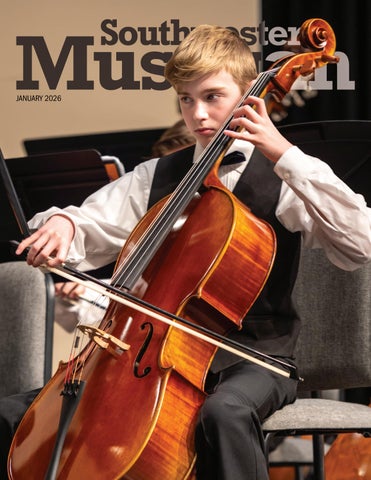
JANUARY 2026
Where music takes shape. Behind every thriving music program is a system that works. Bandstor by Marco blends durability with thoughtful design—protecting instruments and powering programs with strength and style. That’s music, shaped right.
CONTENTS VOLUME 94 • ISSUE 5 • JANUARy 2026
Features Sound Ideas 10
Band . . . . . . . . . . . by.aaron.snipes,.iii
22
Orchestra. . . . . . by.grace.lewis.and.carlos.quiroz
34
Vocal. . . . . . . . . . . by.nicholas.likos
48
Elementary. . . . by.elaine.waier
54
College. . . . . . . . . by.philip.flynn
18
Building Independent Musicianship Through Formative Assessment by.jennifer.haden
Enhance student engagement, independence, and overall ensemble performance by integrating technology that supports valuable formative assessment.
30
Beyond the Bow: Cultivating Good Tone in Middle School Orchestras
45
by.karly.stern.and.sofia.velázquez
Achieving good tone in middle school orchestras requires a balance of aural skills, positive classroom climate, and relationship-building through storytelling and team collaboration.
45
Improving Choral Tuning Through Ear Training by.dr ..anthony.trecek-king
Teaching students to hear music clearly in their minds before singing will improve their intonation, confidence, and overall musicianship, allowing them to connect more deeply with the music.
COLUMNS 2
From the Editor
24
Orchestra
4
TMEA News
36
Vocal
6
President
50
Elementary
12
Band
56
College
UPDATES ON THE COVER: Matthew Long, now a freshman at Richardson High School, performs with the Richardson West Junior High Orchestra during the 2025 TMEA Clinic/Convention. Photo by Joe Aigner-Varoz/AV Photography.
5
Clinic/Convention Dates and Details
15
President’s Concert: U.S. Army Band
23
Explore the Exhibits
28
HS String Honor Orchestra Results
SOUTHWESTERN MUSICIAN | JANUARy 2026
1
From the Editor Around the world, different cultures celebrate the New Year in a variety ways, celebrating the idea of potential and opportunity. As we enter the second half of the school year, this theme can inspire us to transform our approach to the increasing list of tasks and challenges we face in teaching. Students may not fully understand the pressures you face as a professional music educator; however, they can appreciate the experiences a high-quality music education provides. Let’s lean into our efforts to create a positive, inclusive environment where every student feels a sense of belonging and support. This issue of Southwestern Musician is packed with pedagogical insights from all divisions, including strategies for student assessment, professional perspectives, and ways to engage students. This month’s feature articles focus on leveraging technologybased student assessment, creating a classroom environment that fosters excellence, and supporting students’ musical independence through the power of audiation. Our Sound Ideas short features also give you division-specific concepts that can promote positive outcomes with your students. Our Vice-Presidents are music educators first, and their columns provide ideas and perspectives that can help you and your students. You will find several ideas to implement in your classrooms this semester. Their columns also have division-specific information and introduce the incredible programs that will present concerts at the convention in February.
OFFICIAL PUBLICATION OF TEXAS MUSIC EDUCATORS ASSOCIATION
Editor-in-Chief: Joe Muñoz Managing Editor: Karen Cross Advertising Manager: Zachary Gersch
TMEA Executive Board President: Shane Goforth, North Shore Senior HS president@tmea.org / 713-516-7158
President-Elect: Jennifer Martin, Fort Worth ISD presidentelect@tmea.org / 817-814-2640
Immediate Past-President: Jesse Cannon II, Fort Worth ISD pastpresident@tmea.org / 817-814-2635
Band Vice-President: Andy Sealy, Hebron HS bandvp@tmea.org / 469-948-3011
Orchestra Vice-President: Sabrina Behrens, Travis HS orchestravp@tmea.org / 281-633-6300
Vocal Vice-President: Jennifer Gallagher, Shadow Creek HS vocalvp@tmea.org / 281-245-3865
Elementary Vice-President: Lauren Summa, Passmore ES elementaryvp@tmea.org / 281-585-6696 x3126
College Vice-President: Carter Biggers, Texas Woman’s University collegevp@tmea.org / 940-898-2689
TMEA Staff Executive Director: Joe Muñoz, jmunoz@tmea.org Deputy Director: Mike Howard, mhoward@tmea.org
The TMEA News keeps you informed about the work underway to plan for TMEA’s future and about projects that seek to amplify the value and benefits of music education. It also has final reminders to prepare for the convention.
Administrative Director: Kay Vanlandingham, kvanlandingham@tmea.org
I hope you can draw inspiration for the New Year from the words of Dmitri Shostakovich, “A creative artist works on his next composition because he was not satisfied with his previous one.” Reflecting on this can help educators feel motivated and resilient, understanding that growth often comes from striving for better. Enjoy the safe place of belonging that your classrooms and rehearsal halls provide you and your students.
Digital Communications Specialist: Amanda Pierce, apierce@tmea.org
All the best for a musical second verse to the school year!
Joe Muñoz Executive Director jmunoz@tmea.org
2
SOUTHWESTERN MUSICIAN | January 2026
Advertising/Exhibits Manager: Zachary Gersch, zgersch@tmea.org Membership Manager: Susan Daugherty, susand@tmea.org Communications Manager: Karen Cross, kcross@tmea.org Financial Manager: Cristin Gaffney, cgaffney@tmea.org Information Technologist: Andrew Denman-Tidline, adenman@tmea.org Software Developer: Daniel Reinhuber, dreinhuber@tmea.org Administrative Assistant: Darielle Cyphers, dcyphers@tmea.org
TMEA Office 7900 Centre Park Drive, Austin, TX, 78754 P.O. Box 140465, Austin, TX, 78714-0465 www.tmea.org / 512-452-0710 Southwestern Musician (ISSN 0162-380X) (USPS 508-340) is published eight times annually (September–May, excluding March) by Texas Music Educators Association, 7900 Centre Park Drive, Austin, TX 78754. Subscription rates: One Year – $30; Single copies – $5.00. Periodical postage paid at Austin, TX, and additional mailing offices. © Texas Music Educators Association.
EXPRESS YOURSELF.
2026 Audition Dates: Wind, Brass, Percussion, Strings, Voice Jan. 24, Feb. 16, Feb. 28, March 21
INSPIRE OTHERS.
Sound Recording Technology Feb. 28, March 21 Piano Feb. 16, Feb. 28, March 21
Scan the code to register for an audition now.
Composition by appointment
sfasu.edu/music
TMEA News By Joe Muñoz
T
he New Year invites reflection, introspection, and visionary dreaming. As TMEA continues to adapt to rapidly changing factors that impact high-quality music education in Texas, how we plan, strategize, and implement new ideas can have long-term impacts on students, educators, and stakeholders. This year will be marked by dedicated planning and actions to set the course for TMEA’s future.
PLANNING Strategic Plan: As I shared in the November issue, TMEA will begin a strategic planning process to identify and articulate our goals for the next five years. Like the work local education agencies do to formulate system, district, or campus strategic plans, TMEA will engage stakeholders to provide vital information on the challenges and opportunities facing TMEA and music education. Your input is essential to help us understand what we do well and where we can improve, making you a key part of shaping our future. Strategic Association Management will facilitate the strategic planning process. We will utilize a Strategic Planning Task Force led by the Executive Board and will engage individuals for interviews and focus groups who represent a cross-section of stakeholders, including educators, administrators, exhibitors, TMEA leaders, and community members. Additional participants will be asked to complete surveys, the findings of which will be an essential component in helping us calibrate our focus areas for setting our goals. We anticipate having our Strategic Plan in place starting in 2027. This plan will guide our work and ensure alignment with TMEA’s mission. Alignment: As part of the biennial alignment process, the Executive Board will begin their review of the 2024–2025 audition entry data at their January meeting. The planned Region–Area alignment will be shared, and member feedback will be accepted until the Executive Board meeting in March, when the 2026–2028 Region–Area alignment will be finalized. Legislative Update: TMEA and the Texas Arts Education Campaign (TAEC) are actively planning for the 2026 primary and general elections. TAEC is working to engage candidates in discussions about the value of arts education and the critical benefits that arts programs provide, equipping students with the essential skills needed to support the Texas workforce. We will continue to survey general election candidates on their perspective on fine arts education and will provide those results to educators and local communities. Now is the time to get to know the candidates who seek to represent you at the capitol. It is also a great time to invite them to a performance or to your classroom to share with them the essential skills that a high-quality music education can provide. You can 4
SOUTHWESTERN MUSICIAN | January 2026
help them understand that studying music helps develop the whole child and that the skills learned by studying music transition to all areas of the workforce. If you are not a TAEC member, please visit www.txartsed.org to sign up today! ACTION Advocacy: Growing music programs requires us to consistently evaluate how we can get our message to parents and decision makers. In our recent market research, parents of elementary-level students said elementary music teachers are the most influential people who can promote continued study in secondary music programs. The market research also informed us that students are the main decision makers about what programs to enroll in as they enter secondary school. To support students’ interest in continuing their education in music, TMEA worked with Lopez Negrete Communications to create marketing materials to inform elementary students and parents about the value and benefits of music education. To support secondary school music enrollment, print-ready advocacy posters and flyers for elementary teachers are available on the TMEA website. In the future, TMEA will conduct a social media ad campaign to educate communities and promote enrollment in secondary music classes and programs. Go to www.tmea.org/ advocacymaterials to download and print these materials. CHECK YOUR HOUSING RESERVATION January 14 is the deadline to cancel reservations made through TMEA’s official housing system. In early January, reservation holders will receive an email from Orchid Events (info@cvent. com) for each reservation. If you made a reservation you don’t need, cancel it by January 14, so others can reserve those rooms before our system closes. Additionally, please be vigilant of hotel scammers and poachers. TMEA does not authorize any third party to contact you regarding hotel reservations. Our only official housing partner is Orchid Events. If someone other than Orchid Events contacts you, please notify us immediately. If you book through an unofficial source, TMEA cannot assist with lost deposits or fraudulent reservations. NEED A CONVENTION HOTEL RESERVATION? Through January 20, you can continue to check our reservation system for any rooms that become available via cancellation (www.tmea.org/housing). Otherwise, we advise you to book directly with other hotels or short-term rentals. Consider avoiding properties that are part of our reservation system, as any rooms they wouldn’t offer to TMEA at our rates will be sold at a premium 0 (view the initial property list at www.tmea.org/hotelrates).
Join Thousands of Music Educators at the 2026 TMEA Clinic/Convention FEBRUARY 11–14 • SAN ANTONIO • HENRY B. GONZÁLEZ CONVENTION CENTER
EARLY REGISTRATION
IMPORTANT DATES
•
Active TMEA members*: $70
• January 14: Hotel cancellation deadline (no penalty).
•
Retired TMEA members*: $20
•
College Student members*: $0 (must register)
• January 20: Last day to utilize the TMEA housing reservation system to book a hotel.
•
Out-of-state attendees: $145
•
Upper-level school administrators: $0
•
Non-music educator family badges: $15
•
Wednesday Technology Preconference: $50 *Membership must be current.
Learn more: www.tmea.org/register
• January 22: Last day for early registration (details below on paying by check/PO). • January 23–February 14: Registration fees increase (online or onsite payment): • Active members: $95 • Out-of-state attendee: $170
Must Pay by Check or Purchase Order? Don’t Wait! Mail can take multiple weeks to arrive at the TMEA office. If paying by check or purchase order, please wait no longer! Download the form: www.tmea.org/registrationform.
• If your check is not postmarked by January 22, you must pay the higher fee shown above to register and receive a badge—either online by credit card or at the convention with another check. • All purchase orders must be received via email (to susand@tmea.org) by January 22 to be honored for convention registration.
WWW.TMEA.ORG/CONVENTION SOUTHWESTERN MUSICIAN | JANUARy 2026
5
TMEA PRESIDENT SHANE GOFORTH
Growth is a primary focus in the fields of education and music, so New Year’s resolutions and goal-setting for the second semester are a natural fit for music educators.
MARK YOUR CALENDAR check www.tmea .org for updates
Resolving to Set Better Goals
H
appy New Year! I hope the holiday season brought you time to rest and rejuvenate, opportunities to celebrate, and reasons to look forward to the possibilities that a new year brings. Even though the calendar year splits our school year in half, I always look forward to the fresh start that the second semester provides. In our band hall this month, we focus on chamber music and concert literature. There is a heightened sense of musicianship and ensemble communication that I try to capitalize on as I compose goals for the new semester. I imagine your classrooms are much the same and that, like mine, your resolution list also includes some professional or teaching goals. Humanity seems to have always been fascinated by new beginnings and second chances. We start our year in January because many ancient Romans worshiped the god Janus and would make promises to him about the things they would do better in the year to come. From this ancient tradition we derive the name of the month January—the start of our calendar year and the basis for our practice of making New Year’s resolutions. Most cultures around the world have some practice of setting New Year’s plans, wishes, goals, or resolutions to improve themselves, their families, and communities. Knowing that
6
SOUTHWESTERN MUSICIAN | JANUARy 2026
January—Renew membership, purchase liability insurance, register for the convention. January 14—Last day to cancel a TMEA hotel reservation without a fee. January 20—Last day to utilize the TMEA housing reservation system to book a hotel. January 22—TMEA convention early registration deadline. February 11–14—TMEA Clinic/Convention. February 11, 8 p.m.—President’s Concert featuring the U.S. Army Band. February 12, 8:00 a.m.—TMEA General Session at the convention. February 12—TMEA Division business meetings at the convention (times vary). February 12—TMEA emails eligible members their ballot for the Executive Board election. February 13, 8:15 a.m.—TMEA Region meetings at the convention. February 13, 6:00 p.m.—Executive Board election voting closes.
we can do better and striving to make that knowledge a reality ties us together across time and geography.
with this step gives you detailed focus, and it sometimes leads you to abandon the original idea in pursuit of a higher priority.
Growth is a primary focus in the fields of education and music, so New Year’s resolutions and goal-setting for the second semester are a natural fit for music educators. As I set goals for myself and my programs, I often refer to a popular concept formally introduced by George T. Doran in the November 1981 issue of Management Review commonly known as the SMART criteria. In Doran’s framework, SMART is an acronym that serves as a mnemonic device to remind the user of key goal-setting concepts:
MEASURABLE Beyond the obvious need to know if you have accomplished anything, how you measure the amount of growth and improvement you achieve is of paramount importance in formulating quality goals. Ambiguity in this area often leads to a lack of motivation and sustained effort. When you are unable to clearly see and track the progress of your work, you will often find the priority of the task reduced precipitously until there is little to no effort applied to it. Conversely, well-structured and periodically updated progress can provide the incentive and energy needed to accomplish goals you might have previously considered unattainable.
• Specific • Measurable • Achievable • Relevant • Time-bound While not completely comprehensive in its scope, the SMART framework certainly gives our goals structure and has proven over time to increase users’ success in accomplishing their goals. SPECIFIC While it is a crucial element in constructing productive goals, specificity is sometimes overlooked. On the surface, a well-defined goal is obviously more achievable than an ambiguous one. In addition, I find that when I begin to consider the specificity of a goal idea, it also motivates an evaluation of the goal’s priority. When you begin to articulate the details of the goal it is natural to reconsider if the goal is truly an area of primary importance. Starting
ACHIEVABLE Considering the achievability of a goal is a tenuous process. We all have probably been guilty of biting off more than we can chew at some point, but we also know the stories of people (not so different from us) who have accomplished incredible things in their lives. How then are we supposed to dream big but not be completely unrealistic? When confronted with this conundrum we might consider thinking about a macro goal with micro benchmarks. Operating in this framework often allows you to write rock star goals while maintaining motivation by achieving smaller navigational points along your pathway to success. RELEVANT The relevance of your resolution is listed fourth in the SMART acronym, but may well be the most important concept in this
SOUTHWESTERN MUSICIAN | JANUARy 2026
7
goal-setting method. The reality is that we have a finite amount of time and limited mental, physical, and emotional energy in which to pursue our desired objectives. Given those confines, the relevance and priority of where we direct our time and energy must be a primary consideration when developing a goal. There are countless aspects to debate here, and many change with each individual, but the real power of relevance lies in keeping the why at the forefront of your decision-making process.
TIME-BOUND I am a firm believer that humans can do anything. Consider that it was just 67 years after the Wright brothers managed 12 seconds of sustained flight when Alan Sheppard hit golf balls on the surface of the Moon with a smuggled six iron head attached to a rock-collecting tool. So, if you stipulate with me that humans (including you) can accomplish any goal they set, then why do we seem to find such frustration doing just that? The answer lies in what I call the four-part achievement paradigm: can – will – do – did.
Clark W Fobes Clarinet and Saxophone mouthpieces Responsive, Reed friendly, Reasonably priced!
FORGET THE REST AND BUY THE BEST! Fobes Debut and NOVA mouthpieces have been the choice of TMEA educators for over 30 years for affordability and consistent quality.
Can: To achieve it, you must believe that you can accomplish the goal. Sometimes in the beginning, others can believe for you, but you have to start believing in yourself to find true achievement. Will: If you can do anything, then you must decide what you will do. When you write that down it becomes a goal. Do: What you can do and what you will do mean nothing without the actual doing. The regular application of your time, energy, intelligence, and talent toward the achievement of the goal is the only thing that really matters at the end of the day, and this is where the time-bound factor comes into play. Having a firm and trackable schedule and a deadline attached to your goal is essential to avoid procrastination, which has proven to be the death of countless resolutions and goals throughout history. Did: When you accomplish your goal, make sure to look back and evaluate your journey, the relationships you made along the way, and the unexpected lessons learned and skills gained. As we start this new semester filled with potential, I hope you’ll join me in setting thoughtful, structured goals that not only enhance our teaching practice but also inspire our students to strive for their own growth and achievements. CLINIC/CONVENTION UPDATE I hope you are able to attend our annual convention next month! If you haven’t yet, be sure to register by January 22 to pay the lowest fee. Go to www.tmea.org/register. Read on for a few important updates:
Available at local dealers all over the great state of Texas!
www.clarkwfobes.com Debut NOVA San Francisco 10K LEUTHNER ISHIMORI PILGERSTORFER 8
SOUTHWESTERN MUSICIAN | January 2026
Prepare to Vote! By January 21, Executive Board candidate details will be online. Learn more and prepare to vote:
www.tmea.org/election
VOTING FOR EXECUTIVE BOARD Those nominated by four or more Regions at their fall Region meeting are official candidates. Additional President-Elect candidates can be nominated in writing, with a second, to the President and the TMEA Office. Additional Vice-President candidates can be nominated in writing, with a second, to the division VicePresident and the TMEA Office. Additional nominations and seconds must be received by January 14 and be accepted by the nominee to be included on the ballot. By January 21, TMEA will notify members of all candidates for President-Elect and Band and College Vice-Presidents. Learn more about who can vote and how to ensure you receive your ballot at www.tmea.org/election. PRESIDENT’S CONCERT I am thrilled to announce that this year’s President’s Concert will feature the U.S. Army Band “Pershing’s Own.” The free concert is on Wednesday at 8:00 p.m. in Lila Cockrell Theatre. Kick off your convention attendance in the perfect way by attending an inspiring musical performance by this premier military band.
For more details about attending, go to www.tmea.org/presidentsconcert. Following this concert, the convention will feature over 300 professional development clinics covering an amazing array of topics, led by master educators from across the state and nation and 100 performances by elementary through university musicians. In our massive exhibit hall, more than 600 exhibitors from all aspects of the music industry and beyond, as well as from higher education institutions, will be ready to share the latest news on their products, services, and programs. KEY MEETINGS AT THE CONVENTION Make note of the following organizational meetings held during the convention. I hope you will plan to attend them as each offers you the opportunity to participate more fully in your association’s future: • Thursday, 8:00 a.m.: TMEA General Session in Lila Cockrell Theatre. • Thursday (times vary): TMEA division business meetings (check the convention program and the app for your division’s meeting schedule).
Music Department
• Friday, 8:15 a.m.: TMEA Region meetings. If you don’t know your Region, go to www.tmea.org/regionlookup. ACCESSING THE 2026 CONVENTION APP This month, TMEA will email all members (from convention@tmea.org), inviting you to download the 2026 TMEA convention app. Using the link from that email will give you the smoothest experience in downloading the app, updating your profile, and accessing the app’s full features. This includes building your schedule (which you can export to your calendar), bookmarking exhibitors to visit, and connecting with other attendees. Be sure to take time to explore the app and set your schedule. Watch for more emails about utilizing the app and go to www.tmea.org/2026app for more details, including instructional videos guiding your usage. 0 Shane Goforth is Director of Bands at North Shore Senior HS in Galena Park ISD. president@tmea.org
Band • Pep Band Drum and Bugle Corps Choir • Orchestra Song Keepers Private Lessons
SCHREINER.EDU/MUSIC Located in the beautiful Texas Hill Country of Kerrville, Texas, Schreiner University helps students of all majors achieve more, including the Bachelor
of Arts in Music degree (with an optional Minor in Teacher Certification). Students of all majors are eligible for competitive financial aid.
SOUTHWESTERN MUSICIAN | JANUARy 2026
9
SOUND IDEAS BAND: STUDENT LEADERSHIP IN EVERY SEASON
By Aaron Snipes, III
T
he structure and visibility of the fall semester provide natural opportunities for students to lead. Students are entrusted with the responsibility to motivate peers, foster unity, and influence the broader culture of the ensemble. Some go further by attending leadership camps or workshops. But what becomes of student leadership once the marching season ends? When the last performance concludes and the daily structure shifts, does leadership go dormant? It shouldn’t. In fact, the spring semester can offer an even more valuable opportunity for leadership development. Yet in many programs, spring presents a different kind of challenge. We are often pulled in multiple directions—managing concert bands, chamber groups, percussion ensembles, winter guard, and solo and ensemble events. With such demands, intentional leadership development is often neglected. But if fall is when leaders perform, spring is when they transform. Early in my career, I moved away from traditional leadership meetings and began implementing regular leadership trainings. This shift has deeply shaped our program’s culture. The difference is simple yet significant: meetings often become outlets for complaints, while trainings focus on solutions, reflection, collaboration, and communication. Initially, I relied on Dr. Tim Lautzenheiser’s Classic Leadership materials, and then I gradually built a curriculum tailored to the evolving needs of our students. In the fall, we hold weekly leadership trainings. In the spring, we reduce to biweekly sessions while maintaining our intentionality and focus. This seasonal shift also informs the focus of our leadership training. In the fall, student leaders concentrate on how to lead others—building relationships, communicating effectively, and motivating their peers. They learn to read the room, manage relational dynamics, and build community. In the spring, however, we turn inward. The emphasis becomes self-leadership: developing emotional resilience, self-discipline, and personal integrity. After all, students can’t lead others well if they aren’t first leading themselves. And they can’t lead themselves without the tools to manage their physical, emotional, and mental well-being. Rather than viewing spring as a leadership break, we view it as a leadership lab—a chance for students to apply what they’ve learned in real and meaningful ways. Here’s how we do it: 1. Teaching Responsibilities: When directors are away for events like the TMEA convention, student leaders conduct rehearsals. These opportunities are not spontaneous; throughout the year,
10 SOUTHWESTERN MUSICIAN | JANUARy 2026
students practice teaching segments of class with director oversight and receive feedback on their instructional and interpersonal skills. 2. Media and Communication: Our student media team documents events, manages social media, and highlights program achievements. This empowers them to become ambassadors for the program and cultivates 21st-century leadership skills like storytelling and digital communication. 3. Planning and Logistics: Spring socials, section events, and middle school outreach are all student-led. Leaders manage logistics, delegate responsibilities, and coordinate with staff—developing essential project management experience and strengthening their collaboration skills. 4. Classroom Operations: Students begin each class with pencil checks, stretches, and announcements. They also prepare the space—setting up equipment and ensuring readiness for rehearsal. These tasks instill ownership and accountability. At this point, you might wonder why this matters. It matters because leadership is not about a title—it’s about ownership. When students are trusted with meaningful responsibilities and receive consistent guidance, they begin to view themselves not just as helpers, but as culture carriers. My goal is for students to take ownership of the program in a way that allows directors to lead more and manage less. And when leadership is prioritized year-round, we see students who take initiative without prompting. Their influence is earned through high character, not position, and a culture where leadership becomes a lifestyle, not a seasonal assignment. Music educators are uniquely positioned to nurture both musical excellence and personal growth. Our work with student leaders prepares them not just for ensemble success—but for life. With intentionality, the spring semester can become a powerful season of growth where self-leadership is nurtured, confidence is built, and future leaders begin to emerge. After all, true leaders don’t just lead others, they empower others to lead. And that is our calling, all year long. 0 Aaron Snipes, III, is the Braswell HS Band Director (Denton ISD).
C I S U S R M O T A C U D
E
PS M A C FAITH, C I S ! IN MU
R S GROW L QUICKL E M FIL LIST SUM IAN Y
IC . SPOTS CESS RTS. R S U O L M E BAY LY AC ON ALE UNG LENC YO EXCEL OR EAR GISTRATI P L E H IC, AND UCAT AND RE MUS OUR ED P DATES JOINECEIVE CAM RS ONL O T
Y→
EDUCA
TO R
INTRODUCE YOUR STUDENTS
TO A BAYLOR SUMMER EXPERIENCE
BAND DIVISION
ANDY SEALY, STATE VICE-PRESIDENT
Great teaching often comes from curiosity and the exchange of ideas.
Cross-Training for Band Directors
L
ast month I had the distinct pleasure of watching our school orchestra and vocal colleagues rehearsing for a joint holiday performance. As I stood in the doorway watching and listening, I was reminded of how many pedagogical concepts we share as performers and of the many valuable rehearsal tools we can glean from one another. We spend much of our professional careers refining the craft of teaching wind instruments. We study scores, attend clinics, and work to perfect rehearsal techniques—all within the well-worn lanes of accepted band pedagogy. While this expertise is invaluable, there is a risk in only looking inward. We can miss fresh perspectives that spark rehearsal creativity and inspire artistic growth in ourselves and our students. Some of the most effective strategies for building strong ensembles can come from outside the band room. For example, coaches, theater teachers, and choir directors face challenges remarkably similar to ours: motivating young people, shaping group dynamics, and preparing for high-stakes performances. By borrowing ideas from these disciplines, band directors can enrich our own teaching, strengthen our ensembles, and broaden our strategies.
12 SOUTHWESTERN MUSICIAN | JANUARy 2026
MARK YOUR CALENDAR check www.tmea .org for updates
January—Renew membership, purchase liability insurance, register for the convention. January 10—Area Band auditions. January 14—Last day to cancel a TMEA hotel reservation without a fee. January 20—Last day to utilize the TMEA housing reservation system to book a hotel. January 22—TMEA convention early registration deadline. February 1—Honor Band entry opens online. February 11–14—TMEA Clinic/Convention. February 11, 8:00 p.m.—President’s Concert featuring the U.S. Army Band. February 12, 8:00 a.m.—TMEA General Session at the convention. February 12, 2:30 p.m.—Band Division business meeting at the convention. February 12—Ballots for the Executive Board election are emailed to eligible members. February 13, 8:15 a.m.—TMEA Region meetings at the convention. February 13, 6:00 p.m.—Executive Board election voting closes.
DEGREES OFFERED
SCHOOL OF MUSIC AUDITIONS SCHEDULE AN AUDITION AT HSU:
Feb. 20 and March 27, 2026
VIDEO AUDITIONS:
Submit online
COMPOSITION MUSIC BUSINESS MUSIC EDUCATION MUSIC PERFORMANCE MUSICAL THEATRE WORSHIP LEADERSHIP
ENSEMBLES CONCERT BAND CONCERT CHOIR CHORALE COWBOY BAND JAZZ BAND ORCHESTRA WORSHIP BAND
www.hsutx.edu/music-admissions-auditions-scholarships
hsutx.edu An accredited Institutional Member of the National Association of Schools of Music. (325) 670-1426 | music@hsutx.edu Hardin-Simmons University | School of Music Box 16230 | 2200 Hickory St. | Abilene, TX 79698
Learn more at hsutx.edu/music Follow us:
COACHING STRATEGIES Step into a team sport workout and you will quickly notice an intensity and structure that we band folk can appreciate. Keeping it simple, our athletic counterparts know that fundamentals build champions. Athletes begin with stretching, conditioning, and agility drills; band students begin with daily exercises in tone, articulation, and scales. When framed this way, students better understand the importance of fundamentals as the foundation of “gameday” readiness. Coaches prepare athletes to manage nerves, focus under pressure, and perform at their peak when it matters most. Teaching band students to enter a performance with resilience and composure mirrors this athletic mindset and builds confidence for concerts and contests. Coaches constantly reinforce unity, accountability, and the idea that every member contributes to the team’s success. Applying this to band means teaching students that tuning a chord or maintaining balance is not about personal attention, it’s about understanding and fulfilling your role in the ensemble sound. Coaches celebrate both effort and results. There are high-fives, back slaps, and fist bumps all around. Band directors can adopt this by recognizing daily improvements instead of only emphasizing final outcomes. And just imagine the shock of that flying midair chest bump by your trombones! THEATRE DIRECTOR STRATEGIES Theater directors face the challenge of transforming a script into a living, breathing performance—much like we must transform sound and silence into expressive music. Theater directors encourage students to inhabit roles. Band directors can use similar language: “What is the mood of this piece? Who are you as a performer in this moment?” Encouraging musicians to play a role by becoming a
character or adding a simple storyline helps them connect to the music emotionally. Theatrical productions emphasize presence, blocking, entrances, and exits. The parallels for marching band are obvious and deep. For concert performances, teaching students how to walk on stage confidently, set up efficiently, and acknowledge applause with professionalism adds polish that audiences appreciate. Theater directors rehearse scenes in chunks and then run through the whole act. Band directors often do the same but can adopt the theater practice of “character notes” to focus on expressive choices after a run. Finally, theater students must listen and respond to one another on stage. Band students can practice the same skill by “passing the line” between sections or treating musical phrases like the meter and cadence of natural dialogue. This musical communication between performers is really the bedrock for all chamber playing. CHOIR DIRECTOR STRATEGIES From our vocal colleagues we can learn about the beauty and purity of the human voice. My students sing in rehearsal daily in some capacity. For many, this is out of their comfort zone early on, but consistently employing basic vocal techniques can transform us as instrumentalists. Breathing and air flow exercises are obvious overlaps. Ear-training concepts of matching melodic (horizontal) tuning or harmonic/ chordal (vertical) tuning can be effectively approached through singing in the band rehearsal. This elevates student awareness of ensemble intonation and balance. Additionally, choir directors teach singers to shape phrases naturally with the breath. Wind players can benefit from this approach, learning to phrase as if they are singing and clearly delineating the natural shape and cadence of musical lines.
VIZI-AIR Making air visible! Airflow Training Device for ALL brass instruments. 14 SOUTHWESTERN MUSICIAN | January 2026
Even percussionists gain from considering where the breath, or natural punctuation of a phrase, occurs. Choirs emphasize resonance, unification of tone, and the priority of musical lines. Bands apply the same principles, too, just under the umbrella of blend and balance. Singers must clearly communicate text through diction. Band students can think about this clarity of diction as shaping attacks, releases, and articulations as though speaking through their instruments. Great teaching often comes from curiosity and the exchange of ideas. By observing how coaches motivate athletes, how theater teachers shape expression, and how choir directors train and focus listening, band directors can expand their teaching toolbox. More importantly, we model for students the value of lifelong learning and the interconnectedness of the arts. CLINIC/CONVENTION UPDATES I hope you will consider this concept of cross-training and the benefits of curiosity as you make your plans to attend our annual convention. In these four days of clinics, open All-State rehearsals, and performances, there are so many opportunities to learn from colleagues in other performing disciplines. There are only a few days left to take advantage of the lower prices in early registration, so please register soon. Our thanks go to many in our division who are preparing to present clinics and lead their ensembles in performance! In addition to the wonderful lineup of our division’s honor and invited performances, I’m thrilled that we can start our convention on Wednesday night at 8:00 p.m. with the President’s Concert featuring the U.S. Army Band “Pershing’s Own.” Be sure to put this free concert on your schedule! Also, be sure to put the Band Division business meeting on your convention calendar (Thursday at 2:30–3:30 p.m.). This month, I am excited to highlight some of our amazing Invited Ensembles (our Honor Bands were featured in our November issue and our university ensembles will be in next month’s issue). I hope you will make time in your convention schedule to attend these inspiring performances. For a complete
2026 TMEA President’s Concert
Featuring the U.S. Army Band “Pershing’s Own” Wednesday, February 11, 8:00 PM Lila Cockrell Theatre Doors open at 7:00 PM • General Admission • No Tickets Get inspired by this amazing performance offered at no cost. It’s the best way to kick off your convention experience!
Providing the soundtrack to history in Washington DC for over 100 years, the U.S. Army Band “Pershing’s Own” is the premier musical organization of the nation’s senior service. Headquartered in Washington DC, the U.S. Army Concert Band has performed in venues such as Lincoln Center’s Avery Fisher Hall, Carnegie Hall, the Kennedy Center, and the Hollywood Bowl—connecting the Army with the American people. The soldiers in this ensemble have been trained at some of the most prestigious music conservatories and universities in the country. Displaying their versatility, the Concert Band members perform a variety of styles, ranging from classical to popular. The communicative power of the U.S. Army Concert Band is greatly enhanced when combined with other musical elements of “Pershing’s Own.” SOUTHWESTERN MUSICIAN | January 2026 15
listing of all concert ensembles, go to www.tmea.org/2026concerts. This month, you’ll receive an email with access to the convention app. When you download it, you’ll find access from the homepage to a prefiltered schedule of performances where you can add these concerts to your personal schedule. ALEDO HS PERCUSSION ENSEMBLE (ALEDO ISD) The Aledo HS Percussion Ensemble, directed by Scott Stephens and Kayla Liptak, is part of the award-winning Aledo HS Band. In 2024, the ensemble earned first place in percussion at the UIL 5A State Marching Band Contest and won the Percussive Arts Society International Percussion Ensemble Competition. Recent honors include top placements at the TCU Percussion Festival, HEB Drumline Contest, and Lonestar Classic. Aledo has upheld a strong tradition of excellence since 2014, when it won both the PAS IPEC and Black Swamp Percussion Ensemble Showcase. The Aledo Band, led by Joey Paul and assisted by Jake Albin and Dexx
Moore, earned distinction as the 2016 TMEA 5A Honor Band and performed as an invited ensemble at the 2022 TMEA Clinic/Convention. HARLINGEN HS HONORS JAZZ ENSEMBLE (HARLINGEN CISD) Harlingen HS is home to one of the finest high school jazz programs in the country. The Harlingen HS Jazz performing groups consist of the Honors Jazz Ensemble, Jazz Band II, Jazz Band III, Jazz Combo, Jazz Trumpet Ensemble, and several studentled combos. Harlingen jazz ensemble students perform in a wide variety of competitive jazz festivals and numerous community appearances. In 1998, the Harlingen HS Honors Jazz Ensemble performed at the International Association for Jazz Education (IAJE) Convention in New York, with John Fedchock as guest artist. They have performed at the Midwest Clinic (2003, 2015, and 2021), were named the TMEA Invited HS Jazz Ensemble in 2017 and 2022, and most recently, were named a National Winner for the Mark of Excellence/
National Jazz Honors Project. The Honors Jazz Ensemble is under the direction of Maria Coronado. STILLMAN JAZZ (STILLMAN MS, BROWNSVILLE ISD) Founded in 2019, Stillman Jazz is a standout ensemble of seventh and eighth graders who excel on primary and secondary instruments. All members also perform in band and dedicate extra time to jazz rehearsals each week after school. The group has earned consistent superior ratings, soloist and section awards, and numerous Region 28 Jazz Band placements. Outside jazz, these students are active in choir, chess club, Destination Imagination, National Junior Honor Society, athletics, and more. Being named the 2026 TMEA Invited Middle School Jazz Ensemble marks a historic first for any middle school jazz program in Brownsville, bringing the city’s jazz legacy full circle. The ensemble is under the direction of David Ramirez. 0 Andy Sealy is the Director of Bands at Hebron HS (Lewisville ISD). bandvp@tmea.org
BAND 𝄞𝄞𝄞𝄞 ORCHESTRA CONCERT FESTIVAL Presented by Note-Able Travel Experiences
LEARN MORE
RED ROCK SOUNDSCAPE
CLICK OR SCAN
DEBUTING SPRING 2027
Nestled in the heart of Utah’s Greater Zion Region, the Red Rock Soundscape Band 𝄞𝄞𝄞𝄞 Orchestra Concert Festival offers students & their educators a transformative journey — where performance meets place, and artistry meets adventure. Due to the program’s distinctive structure, we welcome four ensembles per festival date. Adventure Beyond the Stage 2027 Festival Dates Feb 27 - Mar 2 Feb 28 - Mar 3 March 5-9 March 6-10 March 12-16 March 13-17
Guided Visit to Zion National Park Guided E-Biking Experience Guided Dark Sky Astronomy
A Setting Like No Other: Far beyond the confines of conventional festival, immerse your ensemble in a concert performance program that fuses music education with the breathtaking beauty of nature and the great outdoors. Renowned Educational Consultants: Learn from some of the most respected music educators and conductors, each dedicated to inspiring the next generation of talented musicians. Seamless Support: We manage every logistical detail so you can focus on what matters most: the musical excellence, lasting memories, and transformative moments for your students. Immersive Adventures in Sound & Spirit: Deepen ensemble bonds and spark new passions through an unforgettable regional educational experience designed to inspire, uplift, and motivate. VISIT US IN THE TMEA LOBBY & BOOTH #1770 16 SOUTHWESTERN MUSICIAN | JANUARy 2026
Aledo HS Percussion Ensemble
Harlingen HS Honors Jazz Ensemble
Stillman Jazz
SOUTHWESTERN MUSICIAN | JANUARy 2026 17
Building Independent Musicianship Through Formative Assessment
By Jennifer Haden
E
very band director knows the struggle of trying to listen to fifteen trumpets and ten flutes play a concert D while also attempting to fix intonation across the entire ensemble. Working through those challenges, we have wondered what our rehearsals would be like if students could assess their own pitch accuracy and adjust in real time.
One of the most challenging skills to help young musicians develop, especially in a non-varsity setting, is consistent, independent intonation. Embedding formative assessment into daily routines has been one of the most effective ways I’ve found to bridge the gap between performance evaluation and real-time learning, which helps our students develop the independence they need. My teaching partner and I have explored these approaches together, and they’ve become an important part of our program’s identity. Assessment is an inherent aspect of our rehearsals, but the way we present it can dramatically impact student engagement and the quality of the feedback they receive. Too often in instrumental music, assessments happen only at the end of a rehearsal cycle— through chair tests, concerts, or contests—rather than during the learning process itself. By integrating tech-supported formative assessments into daily rehearsal habits, students receive immediate, meaningful feedback. This improves buy-in, streamlines rehearsals, and leads to more authentic evaluations of musical skills. Tools like Chromebooks, iPads, Edpuzzle, Blooket, Kahoot, MakeMusic, and the TonalEnergy app allow us to combine traditional rehearsal methods with technology that empowers students to take ownership of their learning, build confidence, and contribute to stronger ensemble performances. And while these are the tools I have used, be sure to explore all available solutions to find what best fits your needs and budget, as education tech offerings are constantly evolving.
18 SOUTHWESTERN MUSICIAN | JANUARy 2026
FORMATIVE ASSESSMENT FOR MUSIC LITERACY In 2020, we were unexpectedly thrown into the world of digital learning and had to translate our instruction into formats students could access at home. Without being physically present, teaching beginners how to assemble their instruments and develop a characteristic tone required a completely different approach. That’s when I discovered Edpuzzle, which quickly became my favorite formative assessment tool. You can upload videos and embed multiple-choice questions that are auto graded. Once students complete an assignment, the GradeTransferer extension makes it easy to move scores into an LMS. Once I learned how to use the platform, I started creating a wide range of videos. I began with music theory, quickly realizing I couldn’t teach rhythm without teaching foot tap. I didn’t love any of the videos I found online, so I made my own instead. I built presentations using Google Slides, recorded them with Screencastify, uploaded the videos to Edpuzzle, and added embedded questions for students to answer. At the time, all of this ran through Google Classroom; by the start of the 2020–2021 school year I was managing 27 different Classrooms! While it was a major challenge, it completely reshaped how I understood the possibilities of digital formative assessment. For theory review, I found it powerful to use a platform like Blooket or Kahoot. While trading instruments for Chromebooks can be strange, I found it beneficial. The teacher creates the questions and answers, so I designed sets that included rhythms, vocabulary, and musical symbols for our final exam review. Once the game starts, the platform runs while students play (each tool allows teachers to restrict nicknames to keep things appropriate). At the end of each session, teachers receive a report highlighting frequently missed questions and the answers students chose. My students love Robot Run on Kahoot, and Blooket’s Cryptohack is also a crowd favorite. These game-based assessments are perfect for half days, testing
Manhattan School of Music
BE A PART OF IT IN THE HEART OF IT. MSMNYC.EDU NEW YORK, NY admission@msmnyc.edu
days, or times playing instruments isn’t possible. One of the biggest advantages of these digital assessments is the access to clear, real-time data. I can immediately see whether students understand how many beats a whole note receives or whether they’re mixing up musical symbols. This concrete data has been incredibly helpful when communicating with parents and when creating and tracking my SLO goals each year. These tools also provide ongoing, tech-supported feedback for students and can serve as study resources long after class is over. Edpuzzle also supports individualized learning—students can complete different videos or work at different levels of difficulty. These assignments can double as excellent, structured plans for substitute days. INSTRUMENTAL FORMATIVE ASSESSMENT After realizing the impact of my music theory videos, I began creating instrumental videos as well. I started with basic assembly guides and then moved on to clarinet fingerings for the third octave of the All-Region scales. Eventually, I created full practice tracks that included rhythmic explanations, fingering reminders, and recordings of me playing the student part so they could practice along. These tools were incredibly helpful during remote learning, but they also reminded me how valuable in-person instruction is for quickly diagnosing and correcting errors.
MakeMusic is another formative assessment tool that has improved how my students practice. Its catalog includes many PML pieces and instrumental solos, and it allows teachers to create custom practice tracks. I assign recordings, the program auto-grades them, and then I can listen to offer more detailed feedback. MakeMusic logs practice time (when students use it correctly) and it includes a built-in tuner. This kind of individual data saves rehearsal time, informs lesson planning, and provides clear evidence of progress for parents and administrators. I also regularly use Canvas video submissions for playing assessments. Students submit recordings through Canvas, I utilize the SpeedGrader tool, and I leave feedback using my saved comment library. This system allows me to respond quickly while still giving students meaningful, specific feedback. Once everything is graded, I use the GradeTransferer extension to move the scores to my LMS in seconds. IMPACT OF FORMATIVE ASSESSMENT In a time when instrumental music programs seem to be inching closer to the
chopping block, the ability to assess students in a way that parents and administrators can easily understand is invaluable. While it might feel strange to dedicate a class period to activities that don’t involve playing instruments, these brief moments of assessment add up. Over time, they strengthen musical literacy, reinforce technique, and build the individual skills that ultimately lead to stronger ensemble performances. Formative assessments create opportunities previous generations of directors simply didn’t have. They allow us to hear every student—even the quiet ones. They help us gather meaningful data that supports our instruction. And they give students the confidence to track their own progress and take ownership of their musicianship. Ultimately, if these tools can help us reach even one more student, build one more skill, or possibly save one more program, then the effort is absolutely worth it. 0 Jennifer Haden is an Assistant Band Director at Pike MS in Northwest ISD.
As I looked for ways to support students beyond these videos, I explored tools that could improve their tuning and overall ensemble skills. Tuning, within sections and across the ensemble, is something my students consistently struggle with, so I turned to digital options. While our district uses 1:1 Chromebooks, I’ve always loved the TonalEnergy app on iPads. I use it myself as a professional musician, and it gives students an impressive amount of real-time feedback: pitch accuracy, tone quality, and clarity of attacks and releases. When students can see and hear this information as they play, they learn how their adjustments affect the ensemble and start developing critical listening skills. Helping them understand what in tune looks, feels, and sounds like has made a noticeable difference in their confidence and performance. SOUTHWESTERN MUSICIAN | January 2026 21
SOUND IDEAS ORCHESTRA: MUSICALLY UNDERSERVED ENVIRONMENTS
By Grace Lewis and Carlos Quiroz
E
very student deserves access to an excellent music education. Yet, in musically underserved environments, systemic barriers like lack of funding, limited transportation resources, and inconsistent administrative support prevent some students from reaching their full musical potential. Fortunately, there are ways to mitigate these issues. By leveraging community partnerships, maximizing access to live music experiences, and adopting the mindset that every student has potential, all educators can develop thriving music programs. LEVERAGING COMMUNITY PARTNERSHIPS A growing program should aim to strengthen partnerships within the community. The G.W. Carver Magnet HS orchestra program enjoys rich collaborative relationships with several performing arts organizations and universities. We hope these examples will inspire your own community connections: College Campus Visits: A favorite annual trip is to Sam Houston State University for their “Music Major for a Day” event. Students can tour the campus, attend theory and studio classes, observe rehearsals, and even play side by side with the SHSU orchestra. This event offers students a peek into a post-graduation future in music and brings the dream of attending college closer to reality. Recruitment Clinics: Consider inviting a college professor to visit your classroom, speak about their program, and work with your orchestra. This clinic–promotion synthesis is mutually beneficial. Students gain insight from a variety of collegiate music educators, and colleges make valuable connections with prospective students. Community Performances: Last December, the Carver Orchestra presented its second annual concert hosted by POST Houston and the Houston Professional Musicians’ Association, with funding in part by the Music Performance Trust Fund. These organizations have collaborated to provide Carver with a performance space while its campus is being rebuilt. Performing in community spaces brings visibility to a program and enriches the venue’s offerings. Local Symphony Partnerships: One of Carver Orchestra’s most impactful partnerships is with the Houston Symphony Orchestra through its Community Embedded Musician program. Musicians from the HSO regularly provide large ensemble clinics, chamber coaching, and solo masterclasses at Carver. The partnership also includes in-school chamber music performances by HSO members. MAXIMIZING ACCESS TO LIVE MUSIC Ensuring students experience live music is a must, as students need outstanding musical role models both in and out of the classroom.
22 SOUTHWESTERN MUSICIAN | JANUARy 2026
Observing live performances inspires students, allowing them to visualize the best practices we emphasize in rehearsal as they are applied on the stage. Accompanying its student concert series, the Houston Symphony hosts open rehearsals. Students receive a listening guide with reflection questions, encouraging them to draw parallels between rehearsal procedures and concert outcomes. ADOPTING A MINDSET OF EMPOWERMENT Even more than community building and concert attendance, equitable access to music education depends on how we organize opportunities. Working with school staff to establish clear procedures for scheduling, recruitment, and resource distribution is essential, and collaboration across feeder patterns helps align expectations. Together, we can empower students and families to see music as a core part of the school culture, not an “extra.” In an under-resourced classroom, the root of success is fundamentals: proper setup, bow control, tone production, posture, and physical understanding of the instrument. Rather than chasing difficult literature too soon, confidence is built through attainable repertoire. When students feel successful, their motivation soars and so does their playing. From Carlos: When I began teaching at Carver, I struggled to connect with my students. I had to learn to love them actively by showing up, listening, and understanding their lived experience. When my heart opened to my students, my teaching transformed. I stopped just teaching notes and rhythms; I began teaching life skills, perseverance, and self-worth. I reminded them: “You can do this. You are powerful. You can redefine what others think of you.” Once they believed that, the music came alive and their sound blossomed! When students feel valued, they rise to the occasion. As educators, our job is not only to teach music, but also to cultivate human beings. While program development in an underserved environment means advocacy at the community level, our most significant investment is in building relationships with students. By adopting a mindset that recognizes every musician’s value, directors can vitalize their programs while ensuring that no student is overlooked. The potential is there, and it’s up to us to unlock it. 0 Grace Lewis is Director of Orchestras at G.W. Carver Magnet HS (Aldine ISD). Carlos Quiroz is the Orchestra Director at Alamo Heights HS (Alamo Heights ISD).
Explore the Exhibits Thursday: 9 a.m.–5 p.m. | Friday: 9 a.m.–6 p.m. | Saturday: 9 a.m.–1 p.m.
Over 600 exhibitors from music instrument manufacturers, retailers, fundraising, travel companies, and higher education institutions will exhibit. Explore their booths to learn more about the latest products and services and to get the best deals.
www.tmea.org/2026exhibits WHERE MUSIC AND SCIENCE COME TOGETHER TO TRANSFORM LIVES
MUSIC THERAPY
AT THE UNIVERSITY OF HOUSTON Empathic. Transformative. Evidence-based. Empowering future music therapists to integrate human connection and neuroscience-informed care through the art and science of music. Do you love music? Want to use it to help people? At the University of Houston, our Music Therapy program blends creativity, compassion, and cutting-edge science.
LEARN MORE
Collaborate with the Tilman J. Fertitta Family College of Medicine Participate in impactful research and neuroscience projects Gain real-world experience through extensive clinical training Join a community of artist–scholar–clinicians dedicated to improving lives www.uh.edu/kgmca
SOUTHWESTERN MUSICIAN | JANUARy 2026 23
ORCHESTRA DIVISION SABRINA BEHRENS, STATE VICE-PRESIDENT
In Memoriam
By cultivating a space where truth is spoken kindly and individuality is celebrated, we empower our students not only to become better musicians, but also to become more confident, authentic human beings.
Ann Roberts 1934–2025 David Hinds 1949–2025
MARK YOUR CALENDAR
Just Be Yourself
I
’m a lover of all kinds of music, and I frequently find myself circling back to the music of my past. My guilty pleasure is a night out for karaoke with my husband and our friends. In full disclosure, I’m not a great singer, but I have lots of fun and that’s what really matters! I was recently listening to “The Middle” from 2001 by Jimmy Eat World as it would make a fun karaoke anthem. When I saw the lyrics on the screen, I began considering their depth. The first two verses of this upbeat rock anthem have really hit home for me in this stage of my life and career: Hey, don’t write yourself off yet It’s only in your head, you feel left out Or looked down on Just try your best Try everything you can And don’t you worry what they tell themselves When you’re away It just takes some time Little girl, you’re in the middle of the ride Everything, everything’ll be just fine Everything, everything’ll be alright, alright
24 SOUTHWESTERN MUSICIAN | JANUARy 2026
check www.tmea .org for updates
January—Renew membership, purchase liability insurance, register for the convention. January 14—Last day to cancel a TMEA hotel reservation without a fee. January 20—Last day to utilize the TMEA housing reservation system to book a hotel. January 22—TMEA convention early registration deadline. February 11–14—TMEA Clinic/Convention. February 12, 8:00 a.m.—TMEA General Session at the convention. February 12, 1:00 p.m.—Orchestra Division business meeting at the convention. February 12—TMEA emails eligible members their ballot for the Executive Board election. February 13, 8:15 a.m.—TMEA Region meetings at the convention. February 13, 6:00 p.m.—Executive Board election voting closes.
Hey, you know they’re all the same You know you’re doing better on your own (on your own) So don’t buy in Live right now Yeah, just be yourself It doesn’t matter if it’s good enough (good enough) For someone else The great thing about song lyrics is that they can mean profoundly different things to different people and their meaning to an individual can change at various stages of their life. The lyrics from this song that really struck a chord with me are, “Yeah, just be yourself. It doesn’t matter if it’s good
enough, for someone else.” As an educator, I try to live my most authentic life in front of my students. Being authentic helps us build trust-based relationships with our students. I also want my students to be authentic with me and with each other. What does authenticity look like in the rehearsal hall? It could be an in-depth conversation about the meaning of a piece of music and how it made the students feel when they heard or played it. It could also look like an honest conversation with your students from the podium. When I have tough feedback to deliver to my students, I often start with the question, “Do you want me to be nice or to be kind? Because if I’m nice, I won’t tell the
Built to adjust. Designed to Embrace. Adjustable. Quick. Simple.
Full range of height and tilt for players of any size. All without a tool. embracestrings.com
Harp Sales and Rentals Lever and Pedal Harps Mariachi Harps Harp Instruction Strings Accessories Printed Music We are the only new pedal harp store in the state of Texas
www.MindaMusic.com 469-661-8116 AUTHORIZED DEALER
26 SOUTHWESTERN MUSICIAN | JANUARy 2026
whole truth. But if I’m being kind, I will tell you the whole truth because I want you to get better.” And in the scenario, a nice feedback statement would be, “That sounded good.” However, a kind statement would sound more like, “We’ve got a good start on this, but the intonation at measures 45–50 is really struggling.” No one ever likes to hear what they didn’t do well, but it is necessary to grow and improve. The more we can encourage our students to embrace kind feedback focused on growth, the more progress we can see in our students and ensembles. In the end, authenticity in the rehearsal hall is less about perfection and more about presence—showing up fully as ourselves and inviting our students to do the same. Whether through the vulnerable honesty of a rehearsal conversation or the unexpected wisdom found in a karaoke anthem from two decades ago, we model what it means to embrace growth with courage and humility. When students see that we are willing to be genuine, to admit when something isn’t good enough, and to keep striving through it all, they learn to do the same. By cultivating a space where truth is spoken kindly and individuality
MARIACHI at TEXAS WOMAN’S UNIVERSITY EARN YOUR DEGREE WITH A MARIACHI FOCUS Pursue a Bachelor of Music in Music Education – Mariachi track, preparing you for a career in teaching and performance.
JOIN ONE OF OUR MARIACHI ENSEMBLES The Mariachi Alas and Mariachi Itzá are open to all students, regardless of major. Experience the rich traditions of mariachi while honing your musical skills.
MARIACHI SCHOLARSHIPS ARE AVAILABLE We’re investing in the future of mariachi music! Scholarships are available for student performers.
twu.edu/music music@twu.edu 940-898-2500
is celebrated, we empower our students not only to become better musicians but also to become more confident, authentic human beings. And remember—everything will be alright! CLINIC/CONVENTION UPDATE I hope you are making plans to attend our annual convention, which is just one month away! This year’s convention has so much to offer all attendees as every time block is filled with great clinic and performance choices! If you haven’t registered yet, go to www.tmea.org/register to learn more and complete this important step by the January 22 early registration deadline. This month, I’m pleased to offer details about our HS String Honor Orchestra and our Invited HS Mariachi Ensemble and University Orchestra. You can learn about our other Honor Orchestras in the November issue, available online at www.tmea.org/november2025. The performances by our division’s ensembles are a must for your convention calendar! HIGH SCHOOL STRING HONOR ORCHESTRA We had many entries to our HS String Honor Orchestra contest, and I am thrilled to announce that Klein Cain High School Chamber Orchestra is our 2026 TMEA HS String Honor Orchestra. Congratulations go to all who entered and a special kudos to all finalists (see below).
KLEIN CAIN HS CHAMBER ORCHESTRA (KLEIN ISD) The Klein Cain HS Orchestra program features six string ensembles serving students from beginning through All-State levels. The Chamber Orchestra has risen to statewide and national acclaim, receiving the Mark of Excellence National Winner distinction, consistent finals placement in the TMEA String Honor Orchestra competition since first entering in 2023, and invitations to perform at the Midwest Clinic and the National Orchestra Festival.
MARIACHI GRULLA DE PLATA (GRULLA HS, RIO GRANDE CITY CISD) Mariachi Grulla De Plata was founded in the fall of 2010 and has since established itself as one of the premier high school mariachi programs in the nation. The ensemble has earned the distinction of being 13-time State Champions and 2-time National Champions, while also receiving numerous accolades at local, state, and national mariachi festivals and competitions.
Chamber Orchestra musicians are among the most accomplished and diverse on campus. Collectively, they speak 11 languages and have completed 214 AP courses, and 83% serve as school organization leaders. Additionally, they are athletes, scholars, and creators, representing varsity swim, cross country, track and field, wrestling, taekwondo, FFA, robotics, and UIL academics, among many other interests. The Klein Cain HS Chamber Orchestra is led by directors Sundas Mohi Truong and Hanson Yong and is honored to perform on the TMEA stage!
The group proudly represented Grulla HS on multiple occasions and was most recently invited to perform at the worldrenowned Carnegie Hall in June 2026. With a legacy of excellence and a commitment to preserving and advancing mariachi tradition, Mariachi Grulla De Plata continues to inspire audiences and uphold a standard of musical success.
INVITED HS MARIACHI ENSEMBLE We had a larger number of applications for the High School Invited Mariachi program this year, and I am pleased to share that our Invited Mariachi Ensemble is Mariachi Grulla De Plata from Grulla HS, led by Alfonso Rodriguez.
HS String Honor Orchestra Results Congratulations to the following orchestras and their directors for this outstanding accomplishment: Rank School/ISD........................................................................................Directors 1
Klein Cain HS./Klein ISD............................... Sundas Mohi-Truong, Hanson Yong
2
Jordan HS./Katy ISD..................................................................................... Kyle Davis
3
Flower Mound HS/.Lewisville ISD.......................................................Stephen Clink
4
Jasper HS/.Plano ISD........................................................................ Matthew Moreno
5
Tompkins HS./Katy ISD...................................................................... Matthew Porter
6
Clements HS/.Fort Bend ISD..................................................................Neal Springer
7
Allen HS/.A llen ISD................................................................................ David DeVoto
8
Seven Lakes HS./Katy ISD..................................................................Desiree Overree
9
McNeil HS./Round Rock ISD............................................................ Justin Anderson
10
Martin HS/.Arlington ISD...................................................................... Jamie Ovalle
11
Reedy HS./Frisco ISD....................................................................................Aryc Lane
28 SOUTHWESTERN MUSICIAN | January 2026
INVITED UNIVERSITY ORCHESTRA UNIVERSITY OF TEXAS RIO GRANDE VALLEY SYMPHONY ORCHESTRA The 2026 Invited College Orchestra is the University of Texas Rio Grande Valley (UTRGV) Symphony Orchestra, conducted by Norman Gamboa. The orchestra is a dynamic ensemble that presents an average of six concert programs annually. Its repertoire spans classical to contemporary works, offering a rich tapestry of musical expression. Collaboration is central to the orchestra’s mission, featuring partnerships with distinguished music faculty, guest artists, dance and ballet companies, choral and operatic performances, and mariachi shows. Additionally, the orchestra engages with local school district music programs, fostering musical endeavors from an early age. The UTRGV Symphony Orchestra was invited to perform at the Palm Beach Atlantic Hispanic Heritage Festival in Florida, and it recently traveled to Guatemala to perform at the National Festival of Arts, highlighting the university’s commitment to cultural exchange and community involvement. 0 Sabrina Behrens is the Director of Orchestras at Travis HS in Fort Bend ISD. orchestravp@tmea.org
Klein Cain HS Chamber Orchestra
Mariachi Grulla De Plata
University of Texas Rio Grande Valley Symphony Orchestra
SOUTHWESTERN MUSICIAN | JANUARy 2026 29
Beyond the Bow: Cultivating Good Tone in Middle School Orchestras By Karly Stern and Sofia Velázquez
A
chieving good tone is an important yet often elusive building block in a middle school orchestra program. While posture and positioning tend to take center stage, aural skills and classroom climate are equally fundamental in developing a characteristic orchestral sound. In the following narrative, we offer examples of how middle school students can accomplish this through modeling, listening, and storytelling. [Karly] As a new teacher, 13 years ago, I firmly believed a great bow hold was the key to great tone. I sought out clinics, attended summer institutes, and interviewed colleagues and professors to perfect my bow-hold teaching sequence. In my orchestra classes, we reviewed the anatomy of the bow hold with scrupulous attention to detail and engaged in daily warmups that applied this learning. I spent four years convinced the perfect bow hold was the secret to a rich, beautiful, effortless tone. It took just one day to unravel that belief. Sofi and I cotaught at a 6th–8th-grade campus for two years. Our first day working together was the start of my fifth year teaching; I was finally beginning to feel comfortable with my pedagogy and procedures. As Sofi led that first class, I sat watching from the violin section, completely bemused. In contrast to my brisk pace and 30 SOUTHWESTERN MUSICIAN | January 2026
loud voice, she spoke in an unhurried, soft tone, interrupting the lesson with seemingly random stories about dogs, chocolate, or the desert. Where was she going with these tangents? I glanced around the room, expecting to see blank stares or heads nodding off, but it was the opposite. Students leaned in; they listened more closely. They giggled at her dry humor, and when she returned to the music, they were fully engaged. I soon learned these interruptions were intentional brain breaks and relationship builders. That was my light-bulb moment. Great tone needs so much more than a perfect bow hold. And because of that, the ensemble’s tone becomes a barometer of classroom climate. [Sofia] Throughout my career, I have observed a variety of models on developing and maintaining a healthy classroom environment. As music educators, we use our experiences in both teaching and performing to help our students. Imagine if we were paid extra for every chord played in tune? Yet, monetary compensation is not what drives the sound from the students who sit in our orchestra room. Students are good listeners and want to experience being a part of a group. They absorb and reflect the energy of the room. Working alongside Karly, it was easy to model a positive and safe working environment. Students learn how to work together with their peers and teachers when what they observe is a healthy community.
FEELING SAFE AND WELCOMED [Sofia] Establishing good tone starts at the door. I enjoy greeting students as they enter. A friendly greeting and question about their day or weekend is the first touchpoint of setting the tone. It is important to interact with each student prior, during, or after a rehearsal to allow a natural bond to develop. If students innately understand they are heard and feel safe, then they are willing to put in the work during rehearsal. My hope is our interactions create a fun experience and make it easier for them to contribute to the group.
Their tone is influenced before they open a case or take an instrument off the rack to play. I strive to create an organized environment in which we can work effectively. Chairs and stands are in place, a large screen displays the day’s agenda, and a diffuser emits a subtle aroma of rosemary mint. This creates a calming atmosphere that minimizes distraction so we can focus on our craft. STORYTELLING [Sofia] We all have life experiences to share, and telling stories is a wonderful
SAM HOUSTON STATE UNIVERSITY
MUSIC
At SHSU’s School of Music, you’ll join a supportive community where creativity and collaboration thrive. Our faculty provide expert instruction, mentorship, and performance opportunities to help you turn your passion into a purposeful career in music.
FALL 2025–SPRING 2026
November 15 Excluding Guitar
January 24
Excluding Piano, Percussion, & Guitar
February 7
Excluding Percussion, & Guitar
February 21 Excluding Piano & Guitar
February 28 April 25 Voice and Percussion Only
School of Music 1751 Avenue I, Suite 225 Huntsville, TX 77340 Phone: 936.294.1360 shsu.edu/music
32 SOUTHWESTERN MUSICIAN | JANUARy 2026
way for students to get to know our human side. Timing is crucial to this. In rehearsals, I am constantly reading the room and assessing when students need a brain break. While I try my best to relate the story to what is happening in the music, sometimes it’s unrelated and that’s fine! Sharing and building relationships is never wasted time. My stories often involve food, nature, or hobbies such as hiking and camping. The human connection established through storytelling facilitates an open line of communication while simultaneously relieving tension. The process of learning, especially if it’s challenging, can create stress in the body. Students listen to my relaxed tone as I recount a funny or enjoyable experience, and they pick up on my energy. This provides a safe environment that supports creating a smooth tone. Storytelling also mitigates discipline issues. We’ve all participated in intense rehearsals for an upcoming contest. We drill passages and repeat just a few notes sometimes for several minutes at a time. Students’ minds are hyper-focused as they work toward improvement. Like the necessary breaks taken during an effective highintensity workout, a brain break offers a vital opportunity for a brief recovery. TEACHING INSIDE THE ORCHESTRA [Karly] Teaching from within the ensemble setup is one of the most valuable pedagogical methods I learned while teaching with Sofi. My college classes consistently emphasized the importance of proximity and modeling, but physically participating in the sections and playing different instruments was a transformative experience for me. It’s amazing what we gain by playing next to our students—what we hear, or don’t hear, within and between sections. For instance, maybe the violins are out of tune because they can’t hear the basses, or the violas aren’t together because they aren’t locked in with the cellos. The quicker we identify the source of a problem, the more efficiently we can fix it. Experiencing the music side by side is also an essential relationship-building tool. Students become so excited when the teacher plays their instrument. To confidently play alongside our students, we must step out of our comfort zone and practice modeling on all instruments,
not just our primary. I am a violinist and, admittedly, I avoided playing the bass the entire first year I taught. After realizing how detrimental this was, I did everything I could to improve my bass chops. I took lessons, attended workshops, interviewed professionals, and made sure I was set up well to demonstrate and play next to my students. Now, it’s my favorite instrument! Some may question how teaching from within the orchestra helps students learn to follow a baton. Our method is to train students to conduct from their seats. In beginner orchestra, students learn to count together, cue with their instrument, and breathe together. This is both productive and meaningful as it seamlessly imbues leadership and teamwork. Then, when we transition to conducting on the podium, students are prepared to conduct with us and not just stare at a beat pattern. TEAM BUILDING = TONE BUILDING [Karly] In my first years of teaching, I believed the most effective way to build technique was through competition. Who can play this book line best? Who can clap this rhythm perfectly? Who can win first chair? I eventually discovered this method catered to the top players of the group, leaving the rest uninspired and insecure. Students didn’t work to help each other because there was no benefit to doing so. The lack of teamwork resulted in an unblended sound and thin tone. This is not to say that I don’t use competition at all, but I focus more on building leadership through warmups and daily activities. For example, in the first few weeks of beginner class, I introduce a series of simple posture and finger pattern warmups that are completely student-led after only a few days. Then, when we begin the bow hold, students eagerly volunteer to lead various bow chants (e.g., the Suzuki rocket song). These noncompetitive leadership opportunities encourage students to take risks without fearing failure or embarrassment. While I demonstrate concepts, students lead in reinforcing and practicing them, fostering a more active and engaging learning environment. When students share in the work, it enhances their buyin, pride, and confidence. This directly impacts their bow arm, allowing them to play with greater assurance and produce a bigger sound.
It takes lots of confidence to make a full tone on the instrument. Our bow is like our voice. If we don’t feel supported or safe enough to take risks, we don’t speak up. Another way to foster team and tone building is with small ensemble playing. Not only do small groups allow everyone to be actively involved, but they also sharpen the students’ sense of pulse, intonation, and blending. Students form groups from two to six players and prepare mini performances. They might be eight measures of a piece they are working on or a method book line. Students help each other learn the notes and rhythms systematically, using practice techniques taught in class.
this and a pinch of that. Just the thought of measuring it out would make her cringe. It takes away the joy and creativity of it all. In teaching tone, there is no secret recipe. So, while the bow hold matters, without the core ingredients of balance, blend, and most importantly, a joy for playing, even a perfect bow hold won’t result in great tone. Every teacher has their unique style. Using that to build on these fundamental ingredients and experiment with your ensemble is a worthwhile adventure that will yield tremendous benefit for your program. 0 Karly Stern is an Assistant Orchestra Director at Jones MS (Prosper ISD).
For two small-group practice techniques that promote healthy practice habits and team building, go to www.tmea.org/ stern-velazquez2026. WHAT ABOUT BOW TECHNIQUE? [Karly] I learned from Sofi that teaching tone is like making great salsa. Sofi’s “salsa” is outstanding, and so many people ask her for the recipe. To their dismay, she’s unable to offer one, not because it’s a secret, but because she’s never used one. It’s a dash of
Sofia Velázquez is Associate Orchestra Director at McKinney Boyd HS (McKinney ISD). SUGGESTED READING The Joy of Inspired Teaching by Dr. Tim Lautzenheiser
TEXAS MUSIC EDUCATORS THROUGH APRIL 30 2026 Terms Apply
ENJOY FREE SHIPPING
& OUR 10% 10% OFF OFF CONFERENCE CONFERENCE PROMO
SHOP WITH CODE: TMEA26THX
RECORDERS | RHYTHM | MOVEMENT | BOOKS | ORFF MusicIsElementary.com
SOUTHWESTERN MUSICIAN | JANUARy 2026 33
SOUND IDEAS VOCAL: MAKING THE MOST OF EVERY MINUTE IN REHEARSAL
By Nicholas Likos
I
n today’s fast-paced educational environment, every rehearsal minute matters. Like many music educators, I often feel the pressure of preparing students for concerts, contests, and performances with limited class time. Over the years, I have refined a rehearsal workflow that helps me maximize every moment with my singers. To streamline my preparation and keep rehearsals focused, flexible, and productive, I incorporate technology tools. What I share here is based on my use of Apple Notes, forScore, and Beam Music. After reading about how we use these tools, I encourage you to explore what’s available and find the right solutions that best support you and your choir. STRATEGY: PATTERN RECOGNITION & SEQUENCING Before we sing a note, I spend time getting to know the music myself—specifically looking for patterns. I treat each piece like a puzzle, asking myself how I can teach it most efficiently. Using Apple Notes, I create a dedicated note for each song. This becomes my master plan. In that note, I identify similar sections and mark where patterns repeat or vary slightly. For instance, if the A section returns with a minor change in rhythm or text, I write out those differences in the note. This allows me to sequence the music in a way that builds on prior learning, helping students recognize what they have already mastered and apply it to new material. Working smarter means training my students to do the same—to recognize connections in the music rather than just memorizing each page. Listening to recordings is part of my preparation. Recordings help me hear where phrases begin and end, which aids in understanding the musical form and flow. I mark these phrase points in my notes to determine logical stopping places in rehearsal and to create natural checkpoints for progress. SCORE PREPARATION: CLARITY FROM THE START The other major part of my pre-rehearsal workflow is preparing the score. Using forScore, I digitally annotate the conductor’s score, marking information I want students to have in their copies, including numbered measures, starting solfège syllables for each measure, and solfège for any accidentals. After I mark my score, I generate a PDF and load the digital copy into Beam Music for the singers. I transitioned to Beam Music so students can automatically see any additional markings (breath marks, carryovers, peak musical points of phrases, etc.). Students access Beam Music on Chromebooks or tablets (iOS or Android), making our class workflow more efficient and our practices more eco-friendly.
34 SOUTHWESTERN MUSICIAN | JANUARy 2026
RUNNING REHEARSAL: EFFICIENT, NOT RUSHED When rehearsal begins, I rely on my Apple Notes and digital scores to guide the flow. One of the most useful features in Apple Notes is the ability to link notes together. I embed links to each song’s sequencing directly into my lesson plans. This small step saves me time and mental energy, especially when planning future rehearsals or making real-time adjustments during class. Sometimes, despite the best preparation, a class takes an unexpected turn. Perhaps a section I thought would be easy needs more attention, or students breeze through material I thought would be a challenge. Because I have already sequenced the piece and outlined multiple teaching paths, I can pivot quickly. I know what comes next, what can be skipped or reordered, and how to stay on track without compromising the learning. This approach has changed the way I think about rehearsal. Instead of reacting in the moment, I am equipped to respond strategically. I am not just managing time—I am leveraging it. HELPING STUDENTS WORK SMARTER Everything I do in my preparation is in service of one goal: helping my students work smarter. When students see measure numbers, solfège, and patterns already marked in their music, it reduces their cognitive load. They can focus on making music rather than constantly decoding it. More importantly, they start to see how music is constructed. They begin to recognize the compositional devices composers use—sequences, repetitions, variations—and they become more independent musicians. My long-term goal is to build independent thinkers, not robotic singers. Maximizing rehearsal time does not mean rushing through music. It means preparing deeply and with purpose. With the right tools and a thoughtful strategy, we can transform how our ensembles learn and how we teach. Whether you are working with a beginning choir or a varsity ensemble, efficient rehearsal planning makes a difference. The more intentional your prep, the more musical your rehearsals become. By using the latest technology tools to support your planning and teaching, you will find yourself with more time to do what really matters—making music. 0 Nicholas Likos is the Head Choir Director at Katy HS.
MUSIC SCHOLARSHIPS TO NON-MUSIC MAJORS! FEBRUARY 20, 2026 DEADLINE BM
MUSIC EDUCATION PERFORMANCE COMPOSITION
BA
MUSIC
MUSIC MINOR MAT
• Faculty who focus on UNDERGRADUATES • Frequent national and international ENSEMBLE TOURING • 100% JOB PLACEMENT for music education majors (35+ consecutive years)
• 16 ensembles, private lessons, and chamber music available to ALL STUDENTS, regardless of major
• 11 FULL-TIME music faculty + 22 applied artist-teachers
(MASTER OF ARTS IN TEACHING) • Located in CULTURALLY VIBRANT San Antonio 5TH YEAR PROFRAM FOLLOWING THE BM • Study at one of the nation’s top liberal arts institutions
www.trinity.edu/music
VOCAL DIVISION
JENNIFER GALLAGHER, STATE VICE-PRESIDENT
In Memoriam
We give students responsibility to teach responsibility. Do they always succeed? No, but that is part of learning.
It’s National Figure It Out Day
W
hether you are in your first year as a choir director or a seasoned veteran, I’m sure you’ve experienced some last-minute questions like these: “The concert is today?!” “What time do we have to be there?” “Can I wear purple shoes with my tuxedo?” “Where are we supposed to go?” In our program, we declare each concert day as “National Figure It Out Day.” Essentially, this means that on a concert day, we do not take questions from students. To be clear, I do generally agree with the idea that there is no such thing as a stupid question; however, I draw the line at concert day. To support this practice, about two weeks before the concert, I remind students I will not take questions on the day of the concert. I explain that while they are responsible only for themselves, I am responsible for many things on a performance day—stage setup, programs, tickets, lights, sound, custodial support, coordinating adult volunteers, guest instrumentalists, and more. Therefore, if one of them comes to me and asks a question I have likely already answered multiple times, I cannot abide! As we get closer to the event, I remind them daily: “I will continue to take questions until Thursday. Then, you need to figure it out! Once the concert is over, you can ask all the questions again!”
36 SOUTHWESTERN MUSICIAN | JANUARy 2026
Cheryl Lee Marshall 1951–2025 Allan Andrews 1954–2025
MARK YOUR CALENDAR check www.tmea .org for updates
January—Renew membership, purchase liability insurance, register for the convention. January 10—Area Vocal auditions. January 14—Last day to cancel a TMEA hotel reservation without a fee. January 20—Last day to utilize the TMEA housing reservation system to book a hotel. January 22—TMEA convention early registration deadline. February 11–14—TMEA Clinic/Convention. February 12, 8:00 a.m.—TMEA General Session at the convention. February 12, 1:00 p.m.—Vocal Division business meeting at the convention. February 12—Ballots for the Executive Board election are emailed to eligible members. February 13, 8:15 a.m.—TMEA Region meetings at the convention. February 13, 6:00 p.m.—Executive Board election voting closes.
TEXAS LUTHERAN UNIVERSITY SCHOOL OF MUSIC
S C H O L A RS H I P A U D I T I O N S TLU SCHOOL OF MUSIC
Scholarships are available for both music and non-music majors. These awards are intended to provide recognition for scholarship and talent in the study of music.
SCHOLARSHIP AUDITION DATES: Monday, February 16, 2026 • 1 - 3pm Saturday, March 28, 2026 • 1 - 3pm Saturday, April 11, 2026 • 1 - 3pm Individual audition dates may be requested if necessary.
For specific qualifications for each award, visit
www.tlu.edu/music-scholarships.
DEPARTMENT HEADS Douglas R. Boyer Director, School of Music and Director of Choral Activities dboyer@tlu.edu 830-372-6869 or 800-771-8521 Heather Couture Musicology Studies hcouture@tlu.edu Eliza Jeffords Director of Strings ejeffords@tlu.edu Melissa Lubecke Sarabia Director of Vocal Studies mlubecke@tlu.edu SungEun Park Director of Piano Studies supark@tlu.edu Brett A. Richardson Director of Bands brichardson@tlu.edu FACULTY Carol Brittin Chambers Composer in Residence & Composition Lauren Casey-Clyde Asst. Professor, Trombone & Euphonium Jimmy Cheung Asst. Professor, Piano & Collaborative Pianist Sean Holmes Asst. Professor, Horn & General Music Stephanie Hulsey Instructor, Flute Michael Keplinger Instructor, Guitar
Martin Kesuma Asst. Professor, Piano & Music Theory Elizabeth Lee Asst. Professor, Cello Katherine Martz Instructor, Bassoon Scott McDonald Instructor, Saxophone, Jazz Band & Music Education Carla McElhaney Asst. Professor, General Music David Milburn Instructor, Double Bass Daniel Orban Instructor, Trumpet Keith Robinson Instructor, Tuba & Music Education Jill Rodriguez Instructor, General Music Eric Siu Asst. Professor, Violin Yu-Hsin Teng Asst. Professor, Collaborative Pianist Bryce Turner Instructor, Percussion Shareen Vader Instructor, Piano & Music Education Mika Allison Valenzuela Instructor, Oboe Yvonne Vasquez Instructor, Mariachi Tyler Webster Asst. Professor, Clarinet & General Music
www.tlu.edu/music
If this policy seems harsh, consider the following: we would never expect a child to learn how to walk if we never let them, and we wouldn’t expect a teenager to learn how to drive if we never gave them the car keys. We give students responsibility to teach responsibility. Do they always succeed? No, but that is part of learning. Just because something is uncomfortable doesn’t mean it is bad, it just means it is new. When I remind students about this practice, I also ensure they know where they can find the answers. Information has been
emailed, posted to Google Classroom, sent via Remind and GroupMe, and is displayed on our announcement boards throughout our classroom. They can ask a section leader, a choir officer, or an upperclassman, all of whom understand how we like things done. This empowers our student leadership team to be proactive about reminders in their GroupMe chats and in their conversations leading to the event. Additionally, our most senior leaders are wise enough to discern what is a true emergency (and they will tell a director) versus what is simply a question or
ECHELON MUSIC PRESS 350+ Original Works for Band, Orchestra, Jazz, and Medium/Small Instr. Ensembles Echelon Music is a publishing house dedicated to original works for all instrumental groups and levels. We aim to produce music that is well written, playable and enjoyable for those who perform and hear it.
New Releases for 2026 Brass Festung – brass choir gr. 3 Autobahn – horn quartet gr. 3 Symphony #21 mvt 1 quintet gr. 4 And Thy Camel Doth Runneth – brass choir gr. 2
Concert band March of the Beaver Moon gr 1 Iron Horizon (march) gr 2 Desert Winds (march) gr 2 Orchestra Suite Yer Bouti gr.4 Symphony # 24 gr. 4 Symphony #25 gr. 5 Divertimento #4 gr. 3 (strings) Jazz Ensemble
comment we have already addressed. Our student leaders are strong, capable, and continue to raise the bar every year! Concert days are stressful by nature, but as the captain of your ship, you deserve to enjoy them too! In our program, we strive to model healthy boundaries so we can be at our optimum energy level and at our maximum capacity for all students. Protect your peace! As we tell our students, “Help a friend. Save a life.” I hope that for your next concert, you employ some version of National Figure It Out Day, giving yourself the gift of more boundaries and less stress! CLINIC/CONVENTION UPDATE With our annual event just one month away, I hope you have registered to attend and secured a hotel reservation. If not, now is the time! With our hotel reservation cancellation deadline of January 14, you might find some rooms become available. You can continue to check our housing system at www.tmea.org/housing until January 20. Also, go to www.tmea.org/ register to learn more and register by the January 22 early registration deadline. The Vocal Division features more invited ensemble concerts than any other TMEA division. These amazing performances are inspirational and pedagogical anchors of our convention experience, and I expect you are looking forward to them as much as I am. This month, I am pleased to share details about our work to improve our concertgoing experience as well as information about some of our Invited Choirs.
All titles are available from JW Pepper. Just search “Echelon Music Press” or use any of our writers. [Leon Steward, Kelly Bennette, Scott Johnson, Mary Ellen Burns, Neil Quinn, Keith Terrett, Kenneth Booker, Justin Writer].
CONCERT ENTRY AND EXIT UPDATE As we near the convention, we are looking forward to welcoming 14 Invited Choirs. Our Stars at Night Ballroom team consists of several amazing leaders who I’m pleased to introduce: Charnele PendarvisRomero (Ballroom Manager), Eunice Marrero (Assistant Ballroom ManagerFront of House), Jennifer Agbu (Stage Manager), and Vicky Suarez (Assistant Stage Manager). In addition to many more volunteers, you will witness these leaders in action throughout the convention. Please offer them your thanks when you have the opportunity!
Echelon Music Press / 365 County Road 4642 / Hondo, Texas 78861 lsteward3@yahoo.com / 830-931-1819
Know that we have been working to further improve the efficiency of entering and
Woodwind Choir Woppy Jawed Square Dance – gr. 4 Two Georgia Peaches and a Tennessee Squat Melon – gr. 2.5
Laguna Verde gr. 2 The Shaky Ed Shuffle gr.3 Toad Rage gr.3 A Disrespectful Level of Krank Lacking Basic Hygiene gr. 4
The Kangaroo Court of Antioch – gr. 2
Fat Jack Took Issue with the Bouncer gr.4
Of the First Water – gr. 2
Biscuits & Gravy gr. 4
38 SOUTHWESTERN MUSICIAN | January 2026
exiting concerts, with a goal of helping all Invited Choir concerts begin on time. When you attend a concert, please look for directional signs as well as volunteers in bright vests who will help guide your entry and exit. We appreciate your cooperation as our team works hard to keep our concert series on track to benefit everyone involved. INVITED CHOIRS This month, I’m pleased to continue to introduce our division’s Invited Choirs, whose concerts we can look forward to attending next month. Please enjoy reading about these amazing ensembles! For information about our other amazing choirs, go to the November issue, which you can access online at www.tmea.org/ november2025. CHAPARRAL HS VARSITY TENORBASS CHOIR (KILLEEN ISD) The Chaparral HS Choir program, founded in the fall of 2022, and under the direction of Gerald Nicholas and Eric Bourg, quickly established a tradition of excellence. Chaparral ensembles have earned consistent sweepstakes ratings at UIL, been recognized as Commended Winners in the FME Mark of Excellence Competition, and been named finalists in Perform America’s Next Level Performances Competition and the Capital City Clash. The Varsity TenorBass Choir, made up of members from the Chaparral HS Varsity Chorale, rehearses weekly after school to prepare their repertoire. Students balance athletics, work, and academics while maintaining the highest performance standards through studentled accountability and camaraderie. We are proud to share our passion for music, dedication to excellence, and love for our community at the TMEA convention. DR. JULIET V. GARCIA MS ADVANCED TREBLE CHOIR (BROWNSVILLE ISD) The Advanced Treble Choir at Dr. Juliet V. Garcia MS is a distinguished varsity ensemble of dedicated 7th–8th-grade students selected for their leadership, academic excellence, and musicianship. Its members describe the group as more than just a class; it’s a second family and a space where students grow emotionally and musically. Members bond over their love of singing, supporting each other through challenging repertoire, and shared goals. They strive to make their community
proud and uplift audiences through powerful performances. Representing the highest level of choral achievement at Garcia, the ensemble embodies commitment, community, and character. JORDAN HS WARRIOR TREBLE CHOIR (KATY ISD) The Warrior Treble Choir of Jordan HS is a community of passionate treble voices, bringing together singers in grades 10–12 from the Warrior Chorale and Treble Select Choirs. Now in its fifth year, the ensemble carries the uplifting spirit of Jordan’s first musicians, who gave the program its voice in 2020. Known for expressive singing and a diverse repertoire, Warrior Treble Choir reflects the cultures and families of the Jordan community. Inspiring and welcoming, the choir is more than an ensemble—it is a home and a safe space filled with determined singers. Together, they bring resilience, artistry, and joy to every stage. Under the direction of Raegan Grantham and Audrey De La Cruz, they are honored to share their performance at the TMEA convention. LEO ADAMS MS CHORALE TREBLE (NORTHWEST ISD) The Leo Adams MS Singing Lions are located in North Fort Worth and are directed by Ashley Grant and Emily Cowan. The Leo Adams choir program has made great strides since the school opened in 2018. Leo Adams MS is proud to have a family of 330 students and retains 85% of their 6th, 7th, and 8th graders year to year. Chorale Treble is an auditioned choir of 60 incredible young singers in the 7th
and 8th grades. They are active Leo Adams students who strive for excellence in their clubs, in their classrooms, on the stage, and on the sports field. Chorale Treble has consistently earned superior UIL ratings and been awarded Best in Class at festivals. In 2024, they earned the Mark of Excellence Choral Honor. LIBERTY-EYLAU HS VARSITY CHOIR (LIBERTY-EYLAU ISD) Liberty-Eylau HS is in Texarkana, and the Varsity Choir is an auditioned choir of 9th–12th-grade students. The choir competes at various UIL and state contests. They consistently place students in the Region IV Choir and advance students to the area level. Liberty-Eylau choir students annually represent their choir in the TMEA SSC All-State choir. The choir also participates in UIL Solo and Ensemble, where they receive superior ratings and advance to the state level. The LEHS Varsity Choir also participates in UIL Concert and Sightreading annually where they consistently receive superior ratings. The choir has been privileged to perform in Carnegie Hall twice under the direction of Marc Bougie. The choir is under the direction of Sherri Pickering, who is in her 27th year of teaching. TEXAS TECH UNIVERSITY CHOIR For more than 50 years, the Texas Tech University Choir has created a legacy of outstanding choral music. The choir has established a standard of excellence recognized through national and international venues with performances at conventions of the American Choral Directors
Chaparral HS Varsity Tenor-Bass
SOUTHWESTERN MUSICIAN | JANUARy 2026 39
Association, the Southwest Division of the American Choral Directors Association, the Texas Music Educators Association, and the Association of British Choral Directors. In addition to touring in various locations throughout the world, the choir has served as the featured ensemble in many of the finest performance halls in the United States. Conductors of the University Choir have included Professors Ken Davis, John Dickson, and Rick Bjella. The Choir is currently conducted by Texas Tech University Director of Choral Studies Alan Zabriskie.
UNIVERSITY OF TEXAS AT SAN ANTONIO CHAMBER SINGERS The University of Texas at San Antonio Chamber Singers is the university’s premier choral ensemble, composed of approximately 50 members. Under the direction of Dr. Yoojin Muhn, the ensemble performs repertoire of the highest artistic standard, spanning music from all eras. Recent highlights include performances in the Caritas Concert Series at the Chapel of the Incarnate Word, Beethoven’s Symphony No. 9 with the Symphony of the Hills, and regular appearances in the School of Music’s Winterlude and New
Music Festival. The Chamber Singers also had the honor of performing at the 2025 National ACDA Conference in Dallas as one of the featured choirs for the final concert. The ensemble maintains a vibrant presence throughout San Antonio and represents UT San Antonio with distinction. 0 Jennifer Gallagher is the Choir Director at Shadow Creek HS in Alvin ISD. vocalvp@tmea.org
Dr. Juliet V. Garcia MS Advanced Treble Choir
Jordan HS Warrior Treble Choir
Leo Adams MS Chorale Treble
40 SOUTHWESTERN MUSICIAN | JANUARy 2026
Liberty-Eylau HS Varsity Choir
Texas Tech University Choir
University of Texas at San Antonio Chamber Singers
SOUTHWESTERN MUSICIAN | JANUARy 2026 41
You could pay more, but why? Unify and simplify for less
Performance Ensemble Solution Sight Reading
Performance Assessment
Embedded Audio Recorder
“We partner with MusicFirst as it gives us more tools than other platforms and gives us the most flexibility in purchasing the tools we need.” Aaron Michaelson, Orchestra Director & Department Chair, The Woodlands High School, Conroe ISD
Ear Training
Theory
“We partner with MusicFirst because their comprehensive suite of tools supports every aspect of music education.” Matt Wood, Director of Bands Ridgeview Middle School, Round Rock ISD
Composition & Worksheets
“We love using PracticeFirst. It is easy to track students’ progress and provide feedback. We prefer MusicFirst because it is easier to understand and provides many software options and allows us to assess student learning.” Ramón Niño III, Director of Mariachi North Side High School, Fort Worth ISD
FREE 30-day trial at musicfirst.com
TIA Fine Arts Assessments by
Learn more & view samples
All Music… All Visual Art… All Theatre… All Dance… Any Grade Level TEKS-Based, Customized Assessments to be Authentic to YOUR District’s Curriculum and Instructional Priorities • Knowledge Assessments • Performance Assessments • Sight Reading Assessments • Portfolios Find out why MusicFirst is the only third-party resource for Fine Arts Assessment listed by TEA.
“This data-driven approach not only supports instructional improvement but also plays a vital role in our district’s efforts to meet the requirements of TIA.” Dana Grubb, Director of Curriculum & Professional Learning, La Vernia ISD
“MusicFirst has provided all fine arts areas with access to the TIA Incentive process through easy, effective, and approved pre- and post-test assessments tailored to our curriculum and specific needs. Our teachers are experiencing great success with this tool!” Eric Eakes, Director of Fine Arts, College Station ISD
“We are so fortunate to have MusicFirst as a partner in our TIA process! I can’t imagine having to do everything that MusicFirst does for us on our own.” Mark Rohwer, Director of Fine Arts, Carrollton-Farmers Branch ISD
Keith Dye, Ed.D. Former Associate Academic Dean, Texas Tech University College of Visual Arts & Performing Arts and Past-TMEA President, personally works with every partner to develop, customize, and refine all aspects of your Fine Arts TIA journey.
“I highly recommend MusicFirst. It makes the Teacher Incentive Allotment testing procedures smooth and stress free.” Oscar Gonzales, Supervisor of Bands, Rio Grande City CISD
“MusicFirst has made the creation and implementation of our pre-test/post-test assessment simple!” Jenni Olges, Director of Fine Arts, Humble ISD
“The work they do allows easy integration in every classroom and they take care of the details, allowing us to focus on our programs and our students.” Jacob Justice, Director of Fine Arts, Bryan ISD
musicfirst.com
Study with Dallas Symphony Orchestra Faculty at SMU
SMU Auditions 2025-26: December 6, January 31, February 21 and 28
U N D E R G R A D U AT E M U S I C D E G R E E S
B.A. in Music B.M. in Music Composition Classical and Film & Game Scoring B.M. in Music Education
Our SMU Meadows Division of Music students do it all— start their own ensembles and companies, perform on and off campus, win commissions for new works, and more, all under
B.M. in Music Therapy
the guidance of faculty members who are symphony principals,
B.M. in Performance
international concert artists, composers, recording artists,
G R A D U AT E M U S I C D E G R E E S
M.M. in Conducting M.M. in Music Education M.M. in Music Composition
authors and researchers. At SMU Meadows many students double major, study abroad and make a difference in the world.
Learn more at smu.edu/music.
M.M. in Musicology M.M. in Performance M.M. in Theory Pedagogy Artist Diploma Performer’s Diploma
Southern Methodist University (SMU) will not discriminate in any employment practice, education program, education activity, or admissions on the basis of race, color, religion, national origin, sex, age, disability, genetic information, or veteran status. SMU’s commitment to equal opportunity includes nondiscrimination on the basis of sexual orientation and gender identity and expression. The Executive Director for Access and Equity/Title IX1 Coordinator is designated to handle inquiries regarding the nondiscrimination policies, including the prohibition of sex discrimination under Title IX. The Executive Director/Title IX Coordinator may be reached at the Perkins Administration Building, Room 204, 6425 Boaz Lane, Dallas, TX 75205, 214-768-3601, accessequity@smu.edu. Inquiries regarding the application of Title IX may also be directed to the Assistant Secretary for Civil Rights of the U.S. Department of Education. 1 Title IX of the Education Amendments of 1972, 20 U.S.C. §§ 1681-1688.
Improving Choral Tuning Through Ear Training
W
By Anthony Trecek-King e’ve all been there, in rehearsal, mid-phrase, and it just isn’t working. The intonation is off, or they’re not singing the correct notes. You roll up your sleeves, reach for your tool bag, and get to work.
While poor intonation is frustrating, what bothers me more is when singers are constantly second-guessing every pitch, or even worse, when we are second-guessing them before they have even tried—we are all stuck in survival mode. We can’t connect to the text, shape a phrase, or make music because all their mental energy (and ours) is dedicated just trying to find the right notes. But what if your singers could hear the music clearly in their heads before they sang it? What if they were so confident that intonation problems largely disappeared, and they had the mental freedom to focus on what the composer is trying to say? It’s possible. And it starts with something you might not think to teach: the inner ear.
My approach to music education is simple: teach skills, not songs. I believe every singer can become an independent, thinking musician who does more, so we can do less. The exercises I’ll share below will help your singers’ brains become more sensitive to pitch, and when the brain leads, the voice follows. The real benefit is that once singers master this skill, they stop being just notereaders and become true musicians. They are finally free to create the music. Try these exercises with your choir and see how their tuning and musicianship improve. AUDIATION: HEARING WITH THE MIND’S EAR Picture your music classroom in your mind. You might see risers,
the piano up front, maybe a pile (or two) of music. This is mental imagery, a skill we possess and can strengthen with practice. Now apply that same concept to sound. Just as you can see something in your mind’s eye, you can hear something in your mind’s ear. Audiation, coined by music educator Edwin Gordon, is defined by him as when one “hears and comprehends music for which the sound is no longer or may never have been physically present.” Can you sing “Happy Birthday” in your head right now? You are audiating. The difference is that most of us do this passively, without control or intention. Imagine if your singers could audiate their music with clarity and precision. When a singer clearly hears what they want to sing before they engage their voice, everything changes. Intonation improves, sightreading becomes faster, and entrances are confident instead of tentative. Singers start trusting themselves. WHY THIS MATTERS FOR YOUR CHOIR When we constantly play the parts, we rob our singers of the mental workout they need to grow stronger. They learn to depend on an external source instead of developing their internal one. Instead, have your singers hear the note in their mind’s ear first, and then confirm it with the piano if needed. Play only the piano part during rehearsal and let them figure out their notes using the tools they’ve been building. Yes, it’s harder at first. But if it’s easy, we’re not growing. Studies show that mental practice activates the same regions of the brain as physical practice. When your singers audiate a phrase, their brains are rehearsing just as meaningfully as when they sing SOUTHWESTERN MUSICIAN | JANUARy 2026 45
it aloud. Therefore, singing in your head is a great way to practice. GETTING STARTED The good news? You can start building audiation skills today! Step 1: Choose Your System First, you’ll need a sightreading framework to give your singers a shared musical language. At the Boston Children’s Chorus, we were based in Kodály, using Curwen hand signs and movable do. But the specific system matters less than consistency; use whatever you’re comfortable with, whether that’s solfège, numbers, or another approach. Step 2: Create the Sensation Now, make your students aware of their ability to hear in their minds. Try this simple exercise: 1. Have everyone sing a familiar song out loud, for example: “Twinkle, Twinkle, Little Star.” 2. Sing the first phrase together, then stop. 3. Go back to the beginning, but this time have them sing it only in their heads.
4. As you conduct through the silent singing, randomly stop and ask them to sing the next note out loud. If they land on the right pitch, they are audiating. The beauty of this exercise is you can use it throughout rehearsal, not just in warmups. More on that later. WARMUPS: BUILDING THE SKILL Warmups are the perfect time to develop audiation because the stakes are low, and singers can focus entirely on the mental process. Here are four exercises I use regularly to train the ear and brain. Start simply and build complexity as your choir gets comfortable. Silent Solfège: Using hand signs (we use Curwen), have singers alternate between singing out loud and audiating using solfège. Example: Tackling a tricky interval like a tritone or minor sixth becomes easier when singers can audiate the intermediate steps. Sing the first note out loud, audiate the notes in between (showing
We do
OWNING THE SPOTLIGHT Commercial Music degree with specialization in songwriting and composition 100% job placement for B.M.E degree graduates
In-state tuition for all!
CONTACT US TODAY! musicadmit@cmich.edu 989-774-3281 music.cmich.edu
46 SOUTHWESTERN MUSICIAN | JANUARy 2026
hand signs), and then sing the target note out loud. As singers advance, see how many silent notes they can audiate in a row while still landing correctly at the end. Finding Keys: Take silent solfège a step further by giving singers a reference pitch (from piano or tuning fork) and having them find another note, chord, or key. Example: Give your choir an A and ask them to find their starting notes for a song in C major. This requires working knowledge of intervals, theory, and the staff, but it’s worth the investment. Once your singers master this skill, you can do something magical: perform multiple a cappella pieces in different keys without ever touching the piano between songs. If one song ends on an A minor chord and the next starts in D major, simply sign do (A) to fa (D), then indicate with your other hand that fa is now the new do. The choir modulates in complete silence. It looks like magic! Scales and Rounds: Once singers are comfortable with the basics, scales offer
see with their ears (visualize notation when hearing pitches).
sound, helping students understand what audiation feels like.
• Sing a scale ascending and descending.
Pitch Visualization:
• Repeat the scale, leaving out one note (for example, fa). Singers must audiate the missing note—not just skip it.
2. Ask singers to visualize that note on the staff.
I also use tuning forks to help singers memorize a reference pitch, typically A440. If a singer can reliably recall a single pitch, they can find any other note using it as a reference. With practice and repeated use of tuning forks, they will no longer require a piano to practice.
wonderful opportunities to work multiple skills simultaneously.
• Sing the scale in canon by section, starting a third apart. • Finally, sing the scale in canon silently in their heads. Stop at any moment and have singers sing out loud. This ensures everyone is engaged in mental practice. Sight-Singing: Apply the same silent singing technique to any sightreading exercise or piece your choir is learning. Conduct a phrase silently and stop on any note to check that everyone is on pitch. This transforms sightreading from a note-finding exercise into an audiation workout. IN REHEARSAL: APPLYING THE SKILLS Once your singers have built audiation skills in warmups, it’s time to use them in rehearsal. Active Listening: When a section isn’t actively rehearsing, have them practice their part silently in their heads. This keeps everyone engaged and mentally rehearsing, even when they’re not singing out loud. You can also challenge singers to audiate other parts while singing their own, which develops harmonic awareness and improves blend and intonation.
1. Play or sing a pitch (for example, C).
3. Ask them to imagine a note a whole step higher (D), see it on the staff, hear it in their heads, then sing it. 4. Gradually expand to larger intervals. Deconstructing Chords: Play chords or tone clusters and have singers mentally pull apart the individual pitches. Can they identify the root? The third? Any dissonances? This develops harmonic hearing and helps singers understand their role within the ensemble texture. Dictation: Melodic and harmonic dictation is the ultimate test of audiation skills. If you’ve practiced all the exercises above, dictation becomes a natural extension of what your singers already do. Start simply (short melodic fragments) and build to full phrases and harmonic progressions. A TOOL TO SHARPEN THE SENSATION: TUNING FORKS Tuning forks offer a unique way to experience audiation, especially for beginning singers. When you strike a tuning fork and hold it to your ear (or place it on your skull behind your ear), you hear the pitch inside your head without using your voice. This creates a physical sensation of internal
IT’S A TEACHABLE SKILL One of the most valuable assets any musician can have is a good ear. But we often assume it develops on its own. Audiation is a skill, and like any skill, can be taught. By using focused, systematic exercises to develop each singer’s mind’s ear and mind’s voice, you’ll see tangible results: better intonation, more fluent sightreading, faster music learning, and stronger retention. Doing this work will help your students gain mental freedom to move beyond the notes. They can finally connect to the text, shape phrases, and bring the music to life. 0 Dr. Anthony Trecek-King is a Resident Conductor with the Handel and Haydn Society and Artistic Director of Berkshire Choral International. Dr. Trecek-King is also the 2026 TMEA Vocal Division Featured Clinician.
The Silent Rehearsal: Here’s an exercise that I love, especially with honor choirs: conduct an entire piece with the choir singing only in their heads. No singing, just perhaps the piano accompanying the silence.
1849 University Ave. Berkeley, Ca 94703 800-322-6263 510-845-7178 www.forrestsmusic.com
When you finish, ask your singers what they heard. You’ll be amazed at how much more they notice when they aren’t producing sound—balance issues, tuning problems, phrasing opportunities. It’s like watching film footage of a game: suddenly, they can see (or hear) what they couldn’t perceive in the moment.
Your one stop shop for all things double reed since 1944
Advanced Exercises: Once your choir has a solid foundation, these advanced exercises will further sharpen their skills. The goal is to help singers hear with their eyes (hear music when reading notation) and
Instruments Accessories Rental Repair
SOUTHWESTERN MUSICIAN | January 2026 47
SOUND IDEAS ELEMENTARY: PLANNING WITH PURPOSE By Elaine Waier
A
s a curriculum coordinator and former elementary music teacher, I often feel overwhelmed by curriculum planning, and it’s my job! Teaching general music can often seem like trying to squeeze a full survey of music history, theory, and performance into just 36 class periods a year. So, when teachers anxiously ask how to even begin, I completely understand the panic. One thing that helps is having a sense of the big picture. Whether you’ve mapped out a formal scope and sequence or are just starting to think through the key concepts you want your students to walk away with, long-range planning gives you a clearer sense of direction. It doesn’t have to be perfect to be useful. With that foundation, whether fully built or still under construction, the following are three simple, flexible strategies that can bring clarity to your day-to-day planning. These ideas don’t depend on a particular methodology (Orff, Kodály, MLT, etc.), and they don’t require a full overhaul. They’re just tools to reach for when things feel overwhelming or when you need a fresh approach. CHUNK IT. LEVEL IT. FLIP IT. Chunk it organizes your lesson into manageable, age-appropriate pieces. Think of your class as a menu or template made of predictable segments. For example, you might plan: • Warmup • Review of a known song • Melodic focus activity • Rhythmic focus activity • Singing game • Closing song/routine This structure gives you something to plug into without reinventing the wheel each day. The key is variety. Rotate not only the type of activity (singing, moving, instruments, listening, etc.) but also the level of concentration. A good rhythm is to balance low-, medium-, and highconcentration activities across the lesson so students are never in one gear too long. One way to think about pacing is to use a loose reference of about 1–2 minutes per year of age. Using this idea, a six-year-old might be ready for a shift after about 6–12 minutes. Pause & Ponder: If you simplified just one part of your lesson structure, which part would make the biggest difference in your day-to-day teaching? What part of your lesson could you plan once and reuse all semester with different content? Level it extends and enriches your activities without requiring you 48 SOUTHWESTERN MUSICIAN | JANUARy 2026
to start from scratch. “Leveling up” is a way to scaffold an activity across multiple lessons. For example, begin with teaching a song in lesson one. In lesson two, you could add the game that accompanies it. Lesson three might focus on reading the notation, and lesson four could highlight a rhythmic or melodic concept drawn from the song. Each level builds on the last, adding novelty and challenge while reinforcing what students already know. Another example could start with teaching a song in lesson one and adding accompaniment on body percussion or instruments in lesson two. In lesson three, students might break into groups to create their own rhythmic ostinatos. Lesson four could invite each group to add a movement component to their pattern. Finally, lesson five could bring all the elements together in an extended rondo form for a culminating performance. On paper, this kind of progression might seem obvious, but in the day-to-day rush of planning it’s easy to miss. Framing each stage as a challenge keeps students motivated and creates natural opportunities to adjust and differentiate. Pause & Ponder: How might you turn a favorite game or song into a multi-day challenge? How could you invite students to “level up” their own ideas? Flip it is your permission to pivot. If the class energy is off, your explanation isn’t clicking, or the activity feels too easy or too hard, try shifting to something else. Have a pivot in your pocket. That could mean teaching the same concept in a different way, inserting a quick brain break, or pulling out a favorite game to reset. Flexibility is part of good planning, too. Flipping it isn’t abandoning your plan. It’s adapting in the moment to keep learning joyful and productive. Pause & Ponder: What’s your go-to pivot when things go sideways? How could flipping an activity create a new learning opportunity instead of a detour? Curriculum planning doesn’t have to be perfect to be powerful. No matter where you are in your planning journey, you’re not behind; you’re building. Chunk it, Level it, Flip it isn’t about doing more; it’s about bringing structure, flexibility, and challenge together in a way that supports both you and your students. Start small (one song, one lesson, one shift) and know that progress builds over time. 0 Elaine Waier is a district curriculum coordinator for Cypress-Fairbanks ISD.
Calling all change-makers. Bring your talent to the premier progressive hub for the performing arts at the Ithaca College School of Music, Theatre, and Dance.
UNDERGRADUATE 2025–26 MUSIC AUDITIONS
UNDERGRADUATE APPLICATION DEADLINE
Saturday, January 24, 2026 Saturday, February 7, 2026 Saturday, February 21, 2026
February 1
GRADUATE PROGRAMS We’re thrilled to announce the return of our master’s degree programs: Composition (M.M.) Conducting (M.M.) Performance (M.M.)
ithaca.edu/mtd/apply mtd@ithaca.edu
ELEMENTARY DIVISION LAUREN SUMMA, STATE VICE-PRESIDENT
Students can perceive making music as a high-stakes engagement activity. Building opportunities for lower-risk engagement allows students to overcome their fears of judgment and rejection while still connecting with peers.
Music, Connection, and Compromise
I
love writing simple songs with my students. Classes connect to pieces they create, whether they’re working individually or as a group. We usually kick things off by using a picture book as a springboard for creativity.
Right now, my second graders are getting ready to create a program inspired by Suzy Levinson’s book Animals in Pants. The title really says it all—it’s full of silly poems about animals wearing all types of pants. My students naturally gravitate toward animals when writing lyrics. They also understand the benefits and challenges of wearing pants, so I know this book perfectly fits its purpose. The act of creating a song together builds instant community touchpoints. These common experiences bond the students to the lyrics and, more importantly, to each other. Several years ago, I witnessed this bond developing among the fifth graders who were creating a program based on the book Hello, Hello by Brendan Wenzel. At the beginning of the project, one of my classes was extremely detached. They were not interested in the book, the program, or performing on stage.
50 SOUTHWESTERN MUSICIAN | JANUARy 2026
MARK YOUR CALENDAR check www.tmea .org for updates
January—Renew membership, purchase liability insurance, register for the convention. January 14—Last day to cancel a TMEA hotel reservation without a fee. January 20—Last day to utilize the TMEA housing reservation system to book a hotel. January 22—TMEA convention early registration deadline. February 11–14—TMEA Clinic/Convention. February 12, 8:00 a.m.—TMEA General Session at the convention. February 12, 5:15 p.m.—Elementary Division business meeting at the convention. February 12—TMEA emails eligible members their ballot for the Executive Board election. February 13, 8:15 a.m.—TMEA Region meetings at the convention. February 13, 6:00 p.m.—Executive Board election voting closes.
800-443-3592 WWW.PERIPOLE.COM EXCLUSIVE DIRECT DISTRIBUTORS OF:
PERIPOLE MUSIC IS PROUD TO SPONSOR AT TMEA 2026: Sessions by Rodolfo Gonzalez, Ed.D. and Provide Instruments for All Sessions in
GRAND HYATT LONE STAR BALLROOM ABC
That all changed when they selected their class animal, a snake. Snakes are scary, have fangs, and eat other animals alive. This project was getting cooler in their eyes. But it really came to life when we started brainstorming ideas for lyrics. Instead of asking for scientific facts about snakes, I asked about the snake’s personality. The students were confused at first, but they got on board once they realized I would let them include slang and pop culture references. “Emo Snake” was born. Emo Snake – Shee! Emo Snake – Shee! He’s sneaky, low key, And he gives you all the tea. He’s the Emo Snake. Imagine my surprise when that homeroom had more students than any other on stage for our performance. And they weren’t just there taking up space. My students were engaged, encouraging, and proud of their composition. Why embrace student interests and current conversational trends? Sharing ideas carries risk. I can think of six or seven trends in the past that made me polish up my retirement plans. That said, starting from a common point of humor or social currency will get all your students on the same page from the beginning. There are different levels of risk associated with different types of group engagement. Sharing our artistic visions can be awkward, especially if the topic you’re dealing with is emotionally meaningful. “Bored Tiger” made his program debut the same year as “Emo Snake.” The class
Elementary Events at the Convention Most clinics hosted by the Elementary Division are in the adjacent Grand Hyatt hotel on the 2nd and 4th floors. Invited Ensemble concerts are in the convention center 3rd floor Stars at Night Ballroom.
52 SOUTHWESTERN MUSICIAN | JANUARy 2026
started out with regular fifth-grade silliness. The tiger drove a Bugatti, was ultrarich, and had a private jet. But as we continued, the students began to transition to some shared community values: He’s a Bored Tiger, sad and lonely. Just can’t sleep ’cause he’ll lose his money. Flies around the world in his private jet, But he just hasn’t found true happiness yet. Students can perceive making music as a high-stakes engagement activity. Building opportunities for lower-risk engagement allows students to overcome their fears of judgment and rejection while still connecting with peers. Take some time this month to explore students’ humor. You might just slay. CLINIC/CONVENTION UPDATE I hope to see you in San Antonio next month for our annual convention where over 2,000 elementary music educators will gather to learn and be inspired! Even if you can’t attend the entire convention, each day features sessions for elementary music teachers and the opportunity to collaborate with colleagues from across the state and beyond. So, if you haven’t yet registered to attend, do so by January 22 to pay the lowest fee. If you need administrator support, be sure to share the convention preview issue with them so they can see how beneficial your attendance will be. The December convention preview issue was mailed to members and is online at www.tmea.org/december2025. INVITED ELEMENTARY ENSEMBLES Six amazing elementary school ensembles will travel to our convention to perform. You met three of the groups in November’s issue of Southwestern Musician. Read on to learn about the final three Invited Elementary Ensembles. When you make your convention schedule, be sure to include the performances of our amazing Invited Ensembles! CRESTVIEW EAGLE-AIRES (CANYON ISD) The Crestview Eagle-aires were formed in 2016 under the direction of Amanda Pullen. The Eagle-aires are an auditioned group of 48 fourth-grade students. Throughout the year the Crestview
Eagle-aires perform concerts on campus and within the Canyon and Amarillo communities. The Crestview Eagle-aires performed for the 2020 TMEA Clinic/ Convention and are honored to represent Canyon ISD again this year. DURHAM ELEMENTARY SPOTLIGHT CHOIR (HOUSTON ISD) Founded in 2021, Durham Choir is built on a program of three ensembles: Kinder Pawprints, 1st and 2nd Grade Pup Choir, and the Durham Spotlight 3rd–5th Grade Choir. Durham Elementary is in Houston and is a dual-language and IB magnet school. All students in choir enjoy a fun and challenging afterschool program that includes not only choral studies but also opportunities for solo singing and class piano instruction. In addition to performing in choral festivals and national anthem performances, Durham choirs regularly tour local nursing homes and businesses and perform in schoolwide celebrations. This will be Durham Elementary’s first time performing at a TMEA convention. Their director Michelle Womack is excited to bring this event to her students, community, and school. TOMBALL ISD HONOR CHOIR Founded in 2002, the Tomball ISD Honor Choir showcases exceptional fourth and fifth graders from all 16 TISD elementary and intermediate schools. Selected through a rigorous audition process, these students reflect the district’s strong commitment to fine arts and the outstanding talent it cultivates. Honor Choir members demonstrate remarkable discipline by learning their music independently, supported by bimonthly afterschool rehearsals held across the district. The choir’s success is made possible by the dedication of our 27 elementary and intermediate music teachers. Under the direction of Rachel Hamann, the choir is accompanied by retired TISD music teacher Thomas Bainbridge. This year, the TISD Honor Choir proudly makes history as the first elementary ensemble in the district to be invited to perform at a TMEA convention. 0 Lauren Summa is an Elementary Music Teacher at Melba Passmore Elementary in Alvin ISD. elementaryvp@tmea.org
Crestview Eagle-Aires
Durham Elementary Spotlight Choir
Tomball ISD Honor Choir
SOUTHWESTERN MUSICIAN | JANUARy 2026 53
SOUND IDEAS COLLEGE: MAXIMIZING YOUR STUDENT TEACHING EXPERIENCE
By Philip Flynn
A
s you begin to plan for your student-teaching placement, it is important to find the right campus and a mentor who is a good fit for you. Start by familiarizing yourself with your university’s process for assigning student teachers. Do you get to offer input on your placement? Are you able to leave the town where your college is located? Does your school have a relationship with strong teachers in the area? You should also ask yourself what type of program (and mentor) would best fit your personality. Establishing professional communication is incredibly important for anyone preparing to enter the workforce. Now would be a great time to transition away from your high school or college email address, to evaluate your social media profile photos, and to update your voicemail greeting. Reach out to your cooperating teacher to introduce yourself. Request a school calendar for the year to ensure you’re available for any extra events. Remember, the expectation is that you shadow your cooperating teacher in all aspects of their job. DURING STUDENT TEACHING The way you approach your first days on campus will be critical to your success. Observe the culture, learn the names of colleagues and students, and make it a point to meet other staff and administrators at the school. Don’t be afraid to ask for help, you are not a burden! Be an active observer in your first few days and carefully study the teacher’s systems and procedures. Why do they do things that way? What do they do when their first plan doesn’t work? During student teaching, there are no stupid questions; you are there to ask all those questions. While you should prepare to be spontaneously asked to teach, it is important that you make a timeline with your cooperating teacher to help you get ready for your first lesson. It is also helpful to familiarize yourself with the administrative duties of the job. From answering emails to collecting permission slips, you will quickly learn how many tasks pull educators away from their time in front of students. Remember that no teacher walked in as an expert, and organization is a skill that requires thoughtful practice, just like lesson planning. It is important to be humble and to assimilate into the campus and classroom culture. Your cooperating teacher has offered to share their knowledge and open their classroom to you, and they have met a set of criteria to be chosen by their administration to host a student teacher. Ask to attend districtwide music meetings, 54 SOUTHWESTERN MUSICIAN | JANUARy 2026
TMEA/UIL Region meetings, Region auditions, professional development sessions, and everything in between. Even when your cooperating teacher is not actively giving you feedback, you can find ways to grow in your teaching. Record yourself early and often, and self-assess as much as possible. You could record 15 minutes of a lesson as a voice memo and listen to it on your drive home. Does the pacing and tone feel the same as it did from the podium? Would your school-age self be engaged with that lesson? AFTER STUDENT TEACHING—NOW WHAT? Ideally, throughout your student-teaching placement, you were networking and taking every opportunity to volunteer and serve within the area. As your placement comes to an end, the hope is that teachers across many campuses and districts will be able to vouch for your ability and work ethic. You would have spent time at the feeder campuses within your district and made connections with administrators, teachers, and private instructors. Your cooperating teacher should be one of your best references for potential employers. No one will have seen you in action in front of students more than they have, and no one will be able to speak to your abilities as a professional better than your cooperating teacher. Be sure to have a conversation with them before listing them as a reference. Ask them if they are comfortable serving as a reference, and reach out to them as a resource if you have questions about job prospects in the area. Lean on them for advice about potential openings. A lot of work goes into job searches, applications, and interviews. Don’t take a passive approach to these crucial steps in the process. Research job vacancies and practice your responses to standard interview questions in the same way that you would prepare for any major test or project in school. If you haven’t learned it yet, the world of music education is relatively small, and there are often only a few degrees of separation between veteran teachers, head directors, and administrators across our field. If you approach your student-teaching placement with responsibility and professionalism, word will spread quickly that you would be a great candidate for an opening in the area! 0 Philip Flynn is the Fine Arts Director of Music Programs for North East ISD in San Antonio.
COLLEGE DIVISION
CARTER BIGGERS, STATE VICE-PRESIDENT
With deep listening to music, to students, and to ourselves, we can develop skills that last long after specific repertoire is forgotten.
MARK YOUR CALENDAR check www.tmea .org for updates
Won’t You Be My Neighbor? Part 4
I
n his 1997 Emmy Lifetime Achievement acceptance speech, Fred Rogers sat in front of a television camera and did something extraordinary: nothing. For 10 seconds, while silence aired on national television, he asked viewers to think about the people who had helped them become who they are. In our noisy world, that kind of patience feels almost radical. For music educators, how Mr. Rogers embraced silence, patience, and process offers a powerful counter-narrative to the rush-to-perfection culture that often dominates our field. THE SPACE BETWEEN NOTES: TEACHING PATIENCE, PROCESS, AND DEEP LISTENING I am sure you have heard (and perhaps taught) that music exists not only in the notes we play and sing but also in the spaces between them. The rests, the breaths, and the moments of preparation before the sound starts are as essential to music as the pitches that follow. However, in our rehearsal rooms, we often focus on notes while ignoring the space. We want faster tempos, swift progress, and better performances. We rush through fundamentals to get to the repertoire. We schedule a performance before students are ready simply because it’s on the calendar. In doing so, we often miss the profound lessons that patience, process, and deep listening can teach us.
56 SOUTHWESTERN MUSICIAN | JANUARy 2026
January—Renew membership, purchase liability insurance, register for the convention. January 14—Last day to cancel a TMEA hotel reservation without a fee. January 20—Last day to utilize the TMEA housing reservation system to book a hotel. January 22—TMEA convention early registration deadline. February 11–14—TMEA Clinic/Convention. February 11, 8:00 p.m.—President’s Concert featuring the U.S. Army Band. February 12, 8:00 a.m.—TMEA General Session at the convention. February 12, 1:00 p.m.—College Division business meeting at the convention. February 12, 3:30–5:00 p.m.—College Division Research Poster Session. February 12—TMEA emails eligible members their ballot for the Executive Board election. February 13, 8:15 a.m.—TMEA Region meetings at the convention. February 13, 6:00 p.m.—Executive Board election voting closes.
SUMMER AT
MOORES COLLEGE
Texas Music Festival Orchestral Institute Texas Music Festival College Piano Institute Chamber Music Institute
HIGH SCHOOL
Chamber Music Institute Cougar Choir Camp *NEW* MEXICA Mariachi Institute Pre-College Piano Institute Wind Ensemble Institute Texas Music Festival Jazz Institute
MIDDLE SCHOOL
Pre-College Piano Institute Texas Music Festival Jazz Institute MEXICA Mariachi Institute Cougar Band Camp
excited to offer a robust lineup of professional development opportunities throughout the summer—take a look! EDUCATORS We’re
Learn More
www.uh.edu/kgmca
As we begin this new year, as we face pressure to do more with less, to produce results faster, to prove our worth through measurable outcomes, I want to challenge each of you to use the patient approach Mr. Rogers modeled as an alternative path. Growth takes time. The process matters. Mr. Rogers understood that growth takes time. He spoke slowly, moved deliberately, and never rushed his viewers. He trusted that children could handle silence, could sit with their thoughts, and could learn at a pace that was developmentally appropriate rather than by an arbitrary schedule. This philosophy translates directly into music education through what we might call slow practice. PATIENCE IN SLOW PRACTICE Slow practice isn’t simply playing something at half tempo. It’s a mindset that values attention to detail over rushing toward results. When we teach students to practice slowly, we’re teaching them to notice what they’re actually doing—the quality of their tone, the precision of their articulation, the shape of their phrases. We’re teaching them that mastery requires patience and the journey toward proficiency matters just as much as the arrival. This might mean spending an entire class period exploring a single phrase of a song, discovering different ways it can be sung or played. You might encourage students to experiment with dynamics, articulation, tempo, and mood. The goal isn’t covering material; it’s developing musical curiosity and attention. You could consider implementing deepdive rehearsals where you spend 20 minutes on just four measures of music. Use a metronome to practice passages at 60% tempo, gradually increasing only when every detail is secure. Teach students to record themselves and listen back critically, developing the self-awareness that comes from patient observation. Require practice journals that document not just what students practiced but also 58 SOUTHWESTERN MUSICIAN | January 2026
how they practiced. Ask them to identify specific problems and describe their problem-solving process. Grade them based on thoughtful engagement with the material rather than just results. This helps create a culture where saying “I’m not ready yet” is acceptable and respected. DEVELOPING DEEP LISTENING Deep listening forms the other half of this equation. Mr. Rogers was a masterful listener—not just of words, but of what people meant, of what they needed, and of the silence beneath the conversation. Music education should develop this same capacity for deep listening, both musical and interpersonal. Musical deep listening means moving beyond simply hearing whether notes are right or wrong. It means teaching students to listen for tone quality, balance, blend, intonation, phrasing, and emotional content. It means training them to hear not just their own part but also how it fits into the ensemble texture. It means developing the ability to imagine sound before producing it (for more on this idea, read Anthony Trecek-King’s article on page 45). Start every rehearsal with a listening exercise. Play a recording and ask students to focus on one specific element, perhaps the bass line, the percussion color, the phrase shape, or the dynamic contrast. Keep a listening journal where students regularly write about music they’ve heard, describing not just what they liked but what they noticed and why. Practice ensemble listening by having students play their parts while focusing attention on a different section. Can the trumpets describe what the clarinets just played? Can the sopranos explain what choice the
altos made on that phrase? This develops the ensemble awareness that separates good groups from great ones. PRODUCT VS. PROCESS Perhaps the most countercultural aspect of Mr. Rogers’s approach is how he valued process over product. He cared more about how children felt about themselves than about producing polished television. He understood that the journey of becoming matters more than any single achievement. This directly challenges the performance-focused culture in much of music education. We schedule concerts before students are truly ready because administrators expect them. We choose repertoire based on how impressive it will sound rather than what students need developmentally. We stress about ratings and rankings. Meanwhile, we risk our students learning that only the performance matters, that rehearsal is just preparation for the real thing, and that mistakes in public are failures. What if we flipped this? What if we treated rehearsal as the heart of music education and performance as simply one way we share what we’ve learned? What if we graded students primarily on their engagement with the learning process rather than on performance outcomes? What if we programmed more informal workin-progress shows and fewer high-stakes concerts? Replace traditional concert assessments with portfolio reviews where students present evidence of their learning journey like practice videos, written reflections, recordings showing improvement over time, or compositions or arrangements they’ve created. The final performance becomes one piece of evidence among many rather than the sole measure of success. Build reflection time into every rehearsal. Take five minutes at the end for students to write about what they learned, what challenged them, or what they want to work on. This reinforces that today’s rehearsal had inherent value not just as preparation for some future event. THE SOUND OF SILENCE And then there’s silence itself, which is perhaps the most difficult thing to incorporate in our overscheduled, noise-filled
W E C A N ’ T WA I T TO S E E YO U AT T M E A Check out the sessions & events featuring the Butler School at music.utexas.edu/tmea-2026
educational environments. Mr. Rogers understood that pauses, breath, and reflection are essential. Music educators know that rests are as important as notes, that breath support underlies all wind playing and singing, and that the moment before sound begins shapes everything that follows. Yet we often treat silence as empty time to be filled. We talk through rests in rehearsals. We rush students from one activity to the next. We’re uncomfortable with quiet. What if we embraced it instead? What if we began rehearsals with a minute of silence, teaching students to center themselves before making music? What if we took meditation breaks during long rehearsals, helping students reset their focus? What if we treated the silence after a piece ends as part of the musical experience, letting sound resonate in memory before we move on? As we begin this new year, as we face pressure to do more with less, to produce results faster, to prove our worth through measurable outcomes, I want to challenge each of you to use the patient approach Mr. Rogers modeled as an alternative path. Growth takes time. The process matters.
With deep listening to music, to students, and to ourselves, we can develop skills that last long after specific repertoire is forgotten. The spaces between the notes teach us as much as the notes themselves.
practice in my classroom. I hope you do as well. Whether you are a seasoned veteran or first-time attendee, there will be something new for you to learn over the four days of the convention.
We cannot rush growth, and we shouldn’t try. Our job isn’t to produce polished performances on demand. It’s to develop thoughtful, patient, musically aware human beings who understand that anything worth doing requires attention, time, and care. That’s a lesson Fred Rogers taught every day, and it’s one our students desperately need to learn.
If your schedule is tight and you can make it only for one day, Saturday is a great option! Not only will you get to experience some amazing All-State performances, but you will also have time to visit our exhibit hall from 9 a.m. to 1 p.m. Saturday also includes a wonderful slate of 59 educational clinics from which you can choose to attend.
TAKE A BREAK AND CONNECT WITH COLLEAGUES Next month offers a wonderful opportunity to rest from your work as an educator or college student and surround yourself with the positive energy and connections that are a hallmark of our annual convention.
Check your December issue of the magazine for the full schedule preview, available online at www.tmea.org/december2025.
We are so fortunate to have the finest and largest music educators convention in the world in our home state every February. Each year I attend, I am filled with a sense of renewal and fervor to take what I learned at the convention and put it into
Carter Biggers, DMA, is Director of Bands and Associate Professor of Music at Texas Woman’s University. collegevp@tmea.org
The registration cost is well worth it! Learn more and register by the January 22 deadline at www.tmea.org/register. I hope to see you there next month.
ADVERTISER INDEX Austin College . . . . . . . . . . . . . . . . . . . . . . . . . . . . . . . . . . . . . . . 7
Note-Able Travel Experiences. . . . . . . . . . . . . . . . . . . . . . . . 16
Baylor Univ . . . . . . . . . . . . . . . . . . . . . . . . . . . . . . . . . . . . . . . . . 11
Peripole Music. . . . . . . . . . . . . . . . . . . . . . . . . . . . . . . . . . . . . . 51
Central Michigan Univ. . . . . . . . . . . . . . . . . . . . . . . . . . . . . . 46
Sam Houston State Univ. . . . . . . . . . . . . . . . . . . . . . . . . . . . . 32
Clark W. Fobes. . . . . . . . . . . . . . . . . . . . . . . . . . . . . . . . . . . . . . . 8
Schreiner Univ. . . . . . . . . . . . . . . . . . . . . . . . . . . . . . . . . . . . . . . 9
Echelon Music Press . . . . . . . . . . . . . . . . . . . . . . . . . . . . . . . 38
Southern Methodist Univ . . . . . . . . . . . . . . . . . . . . . . . . . . . 44
Embrace Strings . . . . . . . . . . . . . . . . . . . . . . . . . . . . . . . . . . . . 26
Stephen F. Austin State Univ. . . . . . . . . . . . . . . . . . . . . . . . . . 3
Forrests Music, Inc.. . . . . . . . . . . . . . . . . . . . . . . . . . . . . . . . . . 47
Texas A&M Univ. . . . . . . . . . . . . . . . . . . . . . . . . . . . . . . . . . . . . 19
Hardin-Simmons Univ. . . . . . . . . . . . . . . . . . . . . . . . . . . . . . . 13
Texas Lutheran Univ. . . . . . . . . . . . . . . . . . . . . . . . . . . . . . . . . 37
Ithaca College. . . . . . . . . . . . . . . . . . . . . . . . . . . . . . . . . . . . . . . 49
Texas Tech Univ. . . . . . . . . . . . . . . . . . . . . . . . . . . . . . . . . . . . . 31
Loyola Univ New Orleans. . . . . . . . . . . . . . . . . . . . . . . . . . . . 21
Texas Woman’s Univ. . . . . . . . . . . . . . . . . . . . . . . . . . . . . . . . . 27
Manhattan School of Music. . . . . . . . . . . . . . . . . . . . . . . . . . 20
Trinity Univ. . . . . . . . . . . . . . . . . . . . . . . . . . . . . . . . . . . . . . . . . 35
Marco Group, Inc.. . . . . . . . . . . . . . . . . . . Inside Front Cover
Univ of Houston. . . . . . . . . . . . . . . . . . . . . . . . . . . . . . . . . 23, 57
MindaMusic School & Store . . . . . . . . . . . . . . . . . . . . . . . . . 26
UT/Austin. . . . . . . . . . . . . . . . . . . . . . . . . . . . . . . . . . . . . . . . . . 59
Music Is Elementary. . . . . . . . . . . . . . . . . . . . . . . . . . . . . . . . 33
UT/El Paso. . . . . . . . . . . . . . . . . . . . . . . . . . . . . . . . . . . . . . . . . . 25
Musical Bridges Around the World . . . . . . . . . . Back Cover
Vizi-Air LLC. . . . . . . . . . . . . . . . . . . . . . . . . . . . . . . . . . . . . . . . . 14
MusicFirst . . . . . . . . . . . . . . . . . . . . . . . . . . . . . . . . . . . . . . 42–43
West Texas A&M Univ. . . . . . . . . . . . . . . . . . . . . . . . . . . . . . 55
60 SOUTHWESTERN MUSICIAN | January 2026
0
2026 TMEA Clinic/Convention
FEBRUARY 11–14 • SAN ANTONIO • TMEA.ORG/CONVENTION
300 Clinics 100 Performances 600 Exhibitors 11,000 Music Educators “It was incredible to be surrounded by so many dedicated professionals, all eager to learn, collaborate, and support each other.” —2025 convention survey comment
Register Today!
www.tmea.org/ /register SOUTHWESTERN MUSICIAN | DECEMbER 2025 III
Presented by
Many Cultures, One Sound
Extend your TMEA Convention with unforgettable concerts across the city!
7 FREE CONCERTS • 12-15 FEBRUARY 2026 REGISTER AT: CROSS-CULTURAL MUSIC FESTIVAL IN SAN ANTONIO, TX
EST. 1957
mbaw.org/unityfest
William & Salome Scanlan Foundation Drs. Bradley Kayser & Gemma Kennedy, Chuck & Anne Parrish, and James E. Sanders