
Sample Read
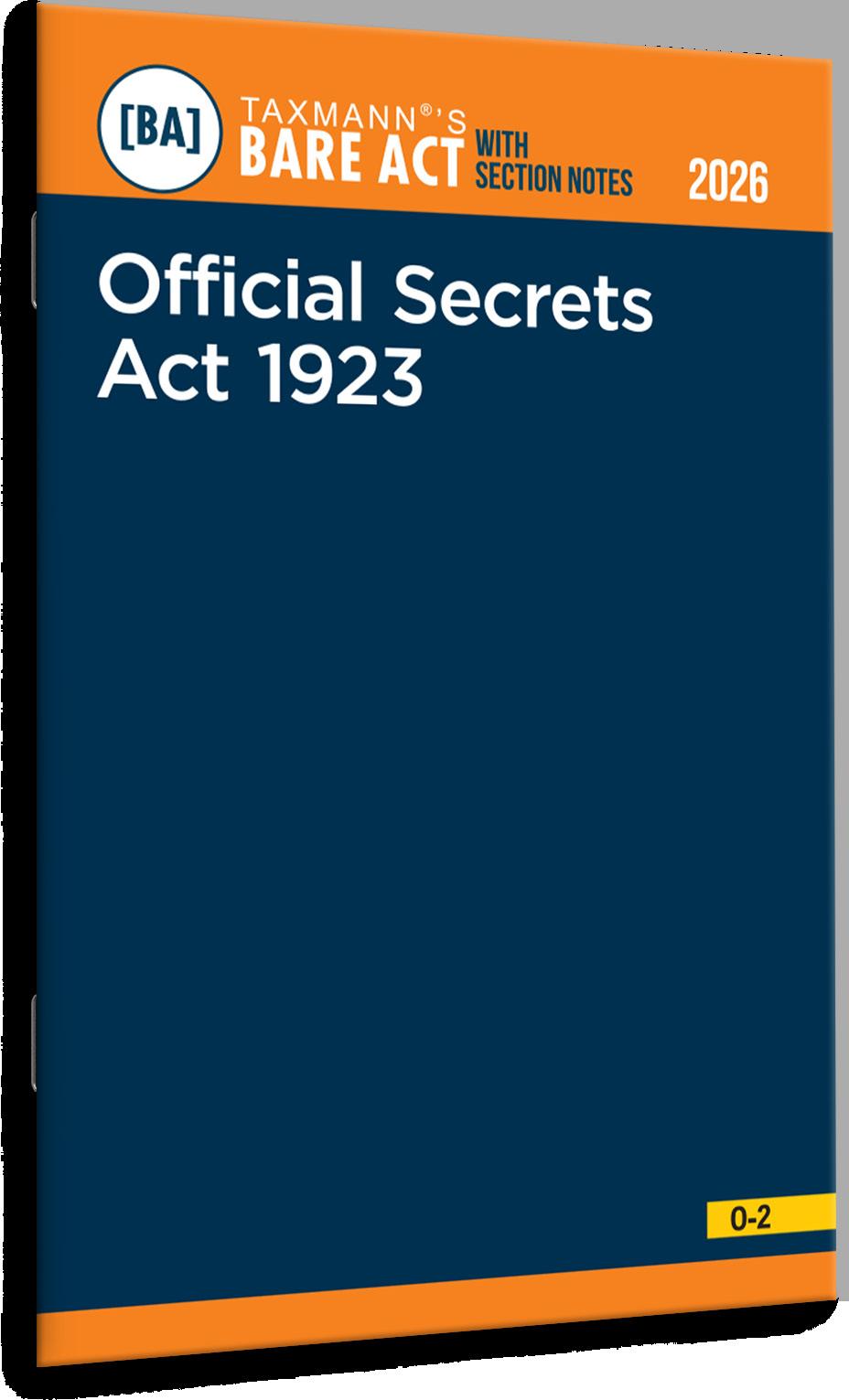



OFFICIAL SECRETS ACT, 1923
1.
4. Communications with foreign agents to be evidence of commission of certain offences
5. Wrongful communication, etc., of information
6. Unauthorised use of uniforms, falsification of reports, forgery, personation, and false documents
7. Interfering with officers of the police or members of the Armed Forces of the Union
8. Duty of giving information as to commission of offences
9. Attempts, incitements, etc.
10. Penalty for harbouring spies
11. Search-warrants
12. Provisions of section 337 of Act 5 of 1898 to apply to offences under sections 3, 5 and 7
13. Restriction on trial of offences
14. Exclusion of public from proceedings
15. Offences by companies
16. [Omitted by the Repealing Act, 1927, w.e.f. 8-9-1927]
Official Secrets Act, 1923
[19 OF 1923]
An Act to consolidate and amend the law 1[***] relating to official secrets.
2[***]
WHEREAS it is expedient that the law relating to official secrets 1[***] should be consolidated and amended;
It is hereby enacted as follows:—
3[Short title, extent and application.
1. (1) This Act may be called the Official Secrets Act, 1923.
(2) It extends to the whole of India and applies also to servants of the Government and to citizens of India outside India.]
Definitions.
2. In this Act, unless there is anything repugnant in the subject or context,—
(1) any reference to a place belonging to Government includes a place occupied by any department of the Government, whether the place is or is not actually vested in Government;
(2) expressions referring to communicating or receiving include any communicating or receiving, whether in whole or in part, and whether the sketch, plan, model, article, note, document, or information itself, or the substance, effect or description thereof only be communicated or received; expressions referring to obtaining or retaining any sketch, plan, model, article, note or document, include the copying or causing to be copied of the whole or any part of any sketch, plan, model, article, note, or document; and expressions referring to the communication of
1. Words “in the Provinces” omitted by the Adaptation of Laws Order, 1950, w.e.f. 26-1-1950.
2. Paragraphs 1 and 2 omitted by the Adaptation of Laws Order, 1950, w.e.f. 26-1-1950. Prior to their omission, paragraphs 1 and 2 read as under:
“Whereas the law in British India relating to official secrets is at present contained in two Acts of the Governor General in Council, namely, the Indian Official Secrets Act, 1889, and the Indian Official Secrets (Amendment) Act, 1904, and one Statute of Parliament, namely, the Official Secrets Act, 1911; and
Whereas the Official Secrets Act, 1911, has been amended by the Official Secrets Act, 1920, which Statute applies to the United Kingdom and to certain British possessions, but not to British India; and”
3. Substituted by the Indian Official Secrets (Amendment) Act, 1967, w.e.f. 15-8-1967.
any sketch, plan, model, article, note or document include the transfer or transmission of the sketch, plan, model article, note or document;
(3) “document” includes part of a document;
(4) “model” includes design, pattern and specimen;
(5) “munitions of war” includes the whole or any part of any ship, submarine, aircraft, tank or similar engine, arms and ammunition, torpedo, or mine intended or adopted for use in war, and any other article, material or device, whether actual or proposed, intended for such use;
(6) “office under Government” includes any office or employment in or under any department of the Government 4[***];
(7) “photograph” includes an undeveloped film or plate;
(8) “prohibited place” means—
(
a) any work of defence, arsenal, naval, military or air force establishment or station, mine, minefield, camp, ship or aircraft belonging to, or occupied by or on behalf of Government, any military telegraph or telephone so belonging or occupied, any wireless or signal station or office so belonging or occupied and any factory, dockyard or other place so belonging or occupied and used for the purpose of building, repairing, making or storing any munitions of war, or any sketches, plans, models or documents relating thereto, or for the purpose of getting any metals, oil or minerals of use in time of war;
(
b) any place not belonging to Government where any munitions of war or any sketches, models, plans or documents relating thereto, are being made, repaired, gotten or stored under contract with, or with any person on behalf of, Government, or otherwise on behalf of Government;
(
c) any place belonging to or used for the purpose of Government which is for the time being declared by the Central Government, by notification in the Official Gazette, to be a prohibited place for the purposes of this Act on the ground that information with respect thereto, or damage thereto, would be useful to an enemy, and to which a copy of the notification in respect thereof has been affixed in English and in the vernacular of the locality;
(
d) any railway, road, way or channel, or other means of communication by land or water (including any works or structures being part thereof or connected therewith) or any place used for gas, water or electricity works or other works for purposes of a public character, or any place where any munitions of war or any sketches, models, plans or documents relating thereto, are being made, repaired, or stored otherwise than on behalf of Government, which is for the
4. Words “or of the Government of the United Kingdom or of any British possession” omitted by the Indian Official Secrets (Amendment) Act, 1967, w.e.f. 15-8-1967.
OFFICIAL SECRETS ACT, 1923 S. 2
time being declared by the Central Government, by notification in the Official Gazette, to be a prohibited place for the purposes of this Act on the ground that information with respect thereto, or the destruction of obstruction thereof, or interference therewith, would be useful to an enemy, and to which a copy of the notification in respect thereof has been affixed in English and in the vernacular of the locality;
(9) “sketch” includes any photograph or other mode of representing any place or thing; and
(9A) 5[***]
(10) “Superintendent of Police” includes any police officer of a like or superior rank, and any person upon whom the powers of a Superintendent of Police are for the purposes of this Act conferred by the Central Government.
COMMENTS
SECTION NOTES
2.1 Interpretation of specific expressions [Section 2(2)]
Meaning of “Communicating or Receiving”
Expressions referring to “communicating or receiving” include any act of communicating or receiving.
Such communicating or receiving is included: Whether it is performed in whole or in part, or Whether the item communicated or received is the sketch, plan, model, article, note, document, or information itself.
The act is also covered if only the substance, effect, or description of the sketch, plan, model, article, note, document, or information is communicated or received.
Meaning of “Obtaining or Retaining” specific items
Expressions referring to “obtaining or retaining” a sketch, plan, model, article, note, or document include the act of copying the whole or any part of that item.
These expressions also include the act of causing the whole or any part of a sketch, plan, model, article, note, or document to be copied.
Meaning of “Communication” of specific items
Expressions referring to the “communication” of any sketch, plan, model, article, note, or document include:
The transfer of that item, and
The transmission of the sketch, plan, model, article, note, or document.
5. Omitted by the Part B States (Laws) Act, 1951, w.e.f. 1-4-1951. Prior to omission, clause (9A) as inserted by the Adaptation of Laws Order, 1950, w.e.f. 26-1-1950, read as under: “(9A) ‘States’ means all the territorial for the time being comprised within Part A States and Part C States.”
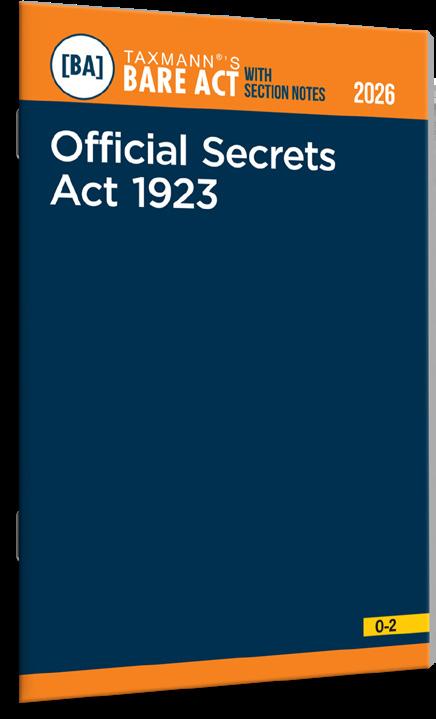
Official Secrets Act 1923 –Bare Act with Section Notes
AUTHOR : Taxmann’s Editorial Board
PUBLISHER : Taxmann
DATE OF PUBLICATION : December 2025
EDITION : 2026 Edition
ISBN NO : 9789371269698
No. of Pages : 40
BINDING TYPE : Paperback
Rs. 95
DESCRIPTION
Official Secrets Act 1923 [ Bare Act with Section Notes ] by Taxmann is an authoritative statutory publication on India’s law governing official secrets, classified information, espionage, and related national security offences. The book presents the complete and updated text of the Act, supplemented with clear section-wise notes, practical commentary, and relevant judicial interpretation, enabling readers to understand both the letter and application of the law. This 2026 Edition is curated for accuracy, clarity, and practical utility, making it a dependable reference for matters concerning State secrecy and national security.
This book is intended for the following audience:
• Legal Practitioners & Judges
• Government Officials & Law Enforcement Authorities
• Investigative and Intelligence Agencies
• Corporate Legal Departments & Companies
• Academics, Researchers & Law Students
The Present Publication is the 2026 Edition, covering the amended and updated text of the Official Secrets Act [ Act No. 19 of 1923 ], with the following noteworthy features:
• [Authentic & Updated Statutory Text] Complete and amended text of the Official Secrets Act 1923, incorporating all legislative changes
• [Pre-amendment Provisions in Footnotes] Earlier versions of amended provisions included in footnotes for historical and transitional reference
• [Concise Section Notes] Section-wise notes explaining legislative intent, scope, key expressions, and practical implications
• [Judicial Commentary & Case Law] Important judicial decisions integrated to clarify application, safeguards, and constitutional interface
• [Procedural & Compliance Guidance] Clear guidance on investigation, prosecution, search, seizure, and trial-related provisions
• [Subject Index & Easy Navigation] Detailed subject index and user-friendly layout for quick reference
• [Editorial Reliability] Prepared in line with Taxmann’s rigorous editorial standards, ensuring accuracy and authority
• [Contemporary Relevance] Reflects current judicial trends, including the interface between RTI, public interest disclosures, and State secrecy
• [Safeguards against Misuse] Case law highlights judicial checks against overreach, reinforcing procedural fairness