Juvenile Justice (Care and Protection of Children) Act, 2015
[NO. 2 OF 2016]1
An Act to consolidate and amend the law relating to children alleged and found to be in conflict with law and children in need of care and protection by catering to their basic needs through proper care, protection, development, treatment, social re-integration, by adopting a child-friendly approach in the adjudication and disposal of matters in the best interest of children and for their rehabilitation through processes provided, and institutions and bodies established, hereinunder and for matters connected therewith or incidental thereto.
Whereas, the provisions of the Constitution confer powers and impose duties, under clause (3) of article 15, clauses (e) and (f) of article 39, article 45 and article 47, on the State to ensure that all the needs of children are met and that their basic human rights are fully protected;
And whereas, the Government of India has acceded on the 11th December, 1992 to the Convention on the Rights of the Child, adopted by the General Assembly of United Nations, which has prescribed a set of standards to be adhered to by all State parties in securing the best interest of the child;
And whereas, it is expedient to re-enact the Juvenile Justice (Care and Protection of Children) Act, 2000 (56 of 2000) to make comprehensive provisions for children alleged and found to be in conflict with law and children in need of care and protection, taking into consideration the standards prescribed in the Convention on the Rights of the Child, the United Nations Standard Minimum Rules for the Administration of Juvenile Justice, 1985 (the Beijing Rules), the United Nations Rules for the Protection of Juveniles Deprived of their Liberty (1990), the Hague Convention on Protection of Children and Co-operation in Respect of Inter-country Adoption (1993), and other related international instruments.
Be it enacted by Parliament in the Sixty-sixth Year of the Republic of India as follows:—
1. Dated 31-12-2015
CHAPTER I
PRELIMINARY
Short title, extent, commencement and application.
1. (1) This Act may be called the Juvenile Justice (Care and Protection of Children) Act, 2015.
(2) It extends to the whole of India 2[***].
(3) It shall come into force on such date3 as the Central Government may, by notification in the Official Gazette, appoint.
(4) Notwithstanding anything contained in any other law for the time being in force, the provisions of this Act shall apply to all matters concerning children in need of care and protection and children in conflict with law, including —
(i) apprehension, detention, prosecution, penalty or imprisonment, rehabilitation and social re-integration of children in conflict with law;
(ii) procedures and decisions or orders relating to rehabilitation, adoption, re-integration, and restoration of children in need of care and protection.
COMMENTS
SECTION NOTES
1.1 Territorial Extent of this Act [Sub-section (2)]
u This Act extends to the whole of India.
1.2 Application of this Act [Sub-section (4)]
u The provisions of this Act shall apply to all matters concerning children in need of care and protection and children in conflict with law, including —
(i) apprehension, detention, prosecution, penalty or imprisonment, rehabilitation and social re-integration of children in conflict with law;
(ii) procedures and decisions or orders relating to rehabilitation, adoption, re-integration, and restoration of children in need of care and protection.
u The provisions of this Act apply as above notwithstanding anything contained in any other law for the time being in force.
Definitions.
2. In this Act, unless the context otherwise requires,—
(1) “abandoned child” means a child deserted by his biological or adoptive parents or guardians, who has been declared as abandoned by the Committee after due inquiry;
(2) “adoption” means the process through which the adopted child is permanently separated from his biological parents and becomes the lawful child of his adoptive parents with all the rights, privileges and responsibilities that are attached to biological child;
2. Words “except the State of Jammu and Kashmir” omitted by the Jammu and Kashmir Reorganisation Act, 2019, w.e.f. 31-10-2019.
3. With effect from 15-1-2016.
(3) “adoption regulations” means the regulations framed by the Authority and notified by the Central Government in respect of adoption;
(4) 4[***]
(5) “aftercare” means making provision of support, financial or otherwise, to persons, who have completed the age of eighteen years but have not completed the age of twenty-one years, and have left any institutional care to join the mainstream of the society;
(6) “authorised foreign adoption agency” means a foreign social or child welfare agency that is authorised by the Central Adoption Resource Authority on the recommendation of their Central Authority or Government department of that country for sponsoring the application of non-resident Indian or overseas citizen of India or persons of Indian origin or foreign prospective adoptive parents for adoption of a child from India;
(7) “Authority” means the Central Adoption Resource Authority constituted under section 68;
(8) “begging” means—
(i) soliciting or receiving alms in a public place or entering into any private premises for the purpose of soliciting or receiving alms, under any pretence;
(ii) exposing or exhibiting with the object of obtaining or extorting alms, any sore, wound, injury, deformity or disease, whether of himself or of any other person or of an animal;
(9) “best interest of child” means the basis for any decision taken regarding the child, to ensure fulfilment of his basic rights and needs, identity, social well-being and physical, emotional and intellectual development;
(10) “Board” means a Juvenile Justice Board constituted under section 4;
(11) “Central Authority” means the Government department recognised as such under the Hague Convention on Protection of Children and Cooperation in Inter-country Adoption (1993);
(12) “child” means a person who has not completed eighteen years of age;
(13) “child in conflict with law” means a child who is alleged or found to have committed an offence and who has not completed eighteen years of age on the date of commission of such offence;
(14) “child in need of care and protection” means a child—
(i) who is found without any home or settled place of abode and without any ostensible means of subsistence; or
4. Omitted by the Juvenile Justice (Care and Protection of Children) Amendment Act, 2021, w.e.f. 1-9-2022. Prior to its omission, clause (4) read as under:
‘(4) “administrator” means any district official not below the rank of Deputy Secretary to the State, on whom magisterial powers have been conferred;’
(ii) who is found working in contravention of 5[the provisions of this Act or] labour laws for the time being in force or is found begging, or living on the street; or
(iii) who resides with a person (whether a guardian of the child or not) and such person—
(a) has injured, exploited, abused or neglected the child or has violated any other law for the time being in force meant for the protection of child; or
(b) has threatened to kill, injure, exploit or abuse the child and there is a reasonable likelihood of the threat being carried out; or
(c) has killed, abused, neglected or exploited some other child or children and there is a reasonable likelihood of the child in question being killed, abused, exploited or neglected by that person; or
(iv) who is mentally ill or mentally or physically challenged or suffering from terminal or incurable disease, having no one to support or look after or having parents or guardians unfit to take care, if found so by the Board or the Committee; or
(v) who has a parent or guardian and such parent or guardian is found to be unfit or incapacitated, by the Committee or the Board, to care for and protect the safety and well-being of the child; or
6[(vi) who does not have parents and no one is willing to take care of, and protect or who is abandoned or surrendered;]
(vii) who is missing or run away child, or whose parents cannot be found after making reasonable inquiry in such manner as may be prescribed; or
(viii) who has been or is being or is likely to be abused, tortured or exploited for the purpose of sexual abuse or illegal acts; or
(ix) who is found vulnerable and 7[has been or is being or is likely to be] inducted into drug abuse or trafficking; or
(x) who is being or is likely to be abused for unconscionable gains ; or
(xi) who is victim of or affected by any armed conflict, civil unrest or natural calamity; or
(xii) who is at imminent risk of marriage before attaining the age of marriage and whose parents, family members, guardian and any
5. Inserted by the Juvenile Justice (Care and Protection of Children) Amendment Act, 2021 w.e.f. 1-9-2022.
6. Substituted by the Juvenile Justice (Care and Protection of Children) Amendment Act, 2021, w.e.f. 1-9-2022. Prior to its substitution, sub-clause (vi) read as under : “(vi) who does not have parents and no one is willing to take care of, or whose parents have abandoned or surrendered him; or”
7. Substituted for “is likely to be”, ibid
other persons are likely to be responsible for solemnisation of such marriage;
(15) “child friendly” means any behaviour, conduct, practice, process, attitude, environment or treatment that is humane, considerate and in the best interest of the child;
(16) “child legally free for adoption” means a child declared as such by the Committee after making due inquiry under section 38;
(17) “Child Welfare Officer” means an officer attached to a 8[child care institution], for carrying out the directions given by the Committee or, as the case may be, the Board with such responsibility as may be prescribed;
(18) “Child Welfare Police Officer” means an officer designated as such under sub-section (1) of section 107;
(19) “Children’s Home” means a Children’s Home, established or maintained, in every district or group of districts, by the State Government, either by itself, or through a voluntary or non-governmental organisation, and is registered as such for the purposes specified in section 50;
(20) “Children’s Court’’ means a court established under the Commissions for Protection of Child Rights Act, 2005 (4 of 2006) or a Special Court under the Protection of Children from Sexual Offences Act, 2012 (32 of 2012), wherever existing and where such courts have not been designated, the Court of Sessions having jurisdiction to try offences under the Act;
(21) “child care institution” means Children Home, open shelter, observation home, special home, place of safety, specialised Adoption Agency and a fit facility recognised under this Act for providing care and protection to children, who are in need of such services;
(22) “Committee” means Child Welfare Committee constituted under section 27;
(23) “court” means a civil court, which has jurisdiction in matters of adoption and guardianship and may include the District Court, Family Court and City Civil Courts;
(24) “corporal punishment” means the subjecting of a child by any person to physical punishment that involves the deliberate infliction of pain as retribution for an offence, or for the purpose of disciplining or reforming the child;
(25) “childline services” means a twenty-four hours emergency outreach service for children in crisis which links them to emergency or long-term care and rehabilitation service;
(26) “District Child Protection Unit” means a Child Protection Unit for a District, established by the State Government under section 106, 9[which shall function under the supervision of the District Magistrate] to ensure
8. Substituted for “Children’s Home” by the Juvenile Justice (Care and Protection of Children) Amendment Act, 2021, w.e.f. 1-9-2022.
9. Substituted for “which is the focal point”, ibid
the implementation of this Act and other child protection measures in the district;
10[(26A) “District Magistrate” includes Additional District Magistrate of the District;]
(27) “fit facility” means a facility being run by a governmental organisation or a registered voluntary or non-governmental organisation, prepared to temporarily own the responsibility of a particular child for a specific purpose, and such facility is recognised as fit for the said purpose, by the Committee, as the case may be, or the Board, under sub-section (1) of section 51;
(28) “fit person” means any person, prepared to own the responsibility of a child, for a specific purpose, and such person is identified after inquiry made in this behalf and recognised as fit for the said purpose, by the Committee or, as the case may be, the Board, to receive and take care of the child;
(29) “foster care” means placement of a child, by the Committee for the purpose of alternate care in the domestic environment of a family, other than the child’s biological family, that has been selected, qualified, approved and supervised for providing such care;
(30) “foster family” means a family found suitable by the District Child Protection Unit to keep children in foster care under section 44;
(31) “guardian” in relation to a child, means his natural guardian or any other person having, in the opinion of the Committee or, as the case may be, the Board, the actual charge of the child, and recognised by the Committee or, as the case may be, the Board as a guardian in the course of proceedings;
(32) “group foster care” means a family like care facility for children in need of care and protection who are without parental care, aiming on providing personalised care and fostering a sense of belonging and identity, through family like and community based solutions;
(33) “heinous offences” includes the offences for which the minimum punishment under the Indian Penal Code (45 of 1860) or any other law for the time being in force is imprisonment for seven years or more;
(34) “inter-country adoption” means adoption of a child from India by nonresident Indian or by a person of Indian origin or by a foreigner;
(35) “juvenile” means a child below the age of eighteen years;
(36) “narcotic drug” and “psychotropic substance” shall have the meanings, respectively, assigned to them in the Narcotic Drugs and Psychotropic Substances Act, 1985 (61 of 1985);
(37) “no objection certificate” for inter-country adoption means a certificate issued by the Central Adoption Resource Authority for the said purpose;
10. Inserted by the Juvenile Justice (Care and Protection of Children) Amendment Act, 2021, w.e.f. 1-9-2022.
(38) “non-resident Indian” means a person who holds an Indian passport and is presently residing abroad for more than one year;
(39) “notification” means the notification published in the Official Gazette of India, or as the case may be, in the Gazette of a State, and the expression “notify” shall be construed accordingly;
(40) “observation home” means an observation home established and maintained in every district or group of districts by a State Government, either by itself, or through a voluntary or non-governmental organisation, and is registered as such, for the purposes specified in sub-section (1) of section 47;
(41) “open shelter” means a facility for children, established and maintained by the State Government, either by itself, or through a voluntary or non-governmental organisation under sub-section (1) of section 43, and registered as such, for the purposes specified in that section;
(42) “orphan” means a child—
(i) who is without biological or adoptive parents or legal guardian; or (ii) whose legal guardian is not willing to take, or capable of taking care of the child;
(43) “overseas citizen of India” means a person registered as such under the Citizenship Act, 1955 (57 of 1955);
(44) “person of Indian origin” means a person, any of whose lineal ancestors is or was an Indian national, and who is presently holding a Person of Indian Origin Card issued by the Central Government;
(45) “petty offences” includes the offences for which the maximum punishment under the Indian Penal Code (45 of 1860)* or any other law for the time being in force is imprisonment up to three years;
(46) “place of safety” means any place or institution, not being a police lockup or jail, established separately or attached to an observation home or a special home, as the case may be, 11[***] to receive and take care of the children alleged or found to be in conflict with law, by an order of the Board or the Children’s Court, both during inquiry and ongoing rehabilitation after having been found guilty for a period and purpose as specified in the order;
(47) “prescribed” means prescribed by rules made under this Act;
(48) “probation officer” means an officer appointed by the State Government as a probation officer under the Probation of Offenders Act, 1958 (20 of 1958) or the Legal-cum-Probation Officer appointed by the State Government under District Child Protection Unit;
(49) “prospective adoptive parents” means a person or persons eligible to adopt a child as per the provisions of section 57;
11. Words “the person-in-charge of which is willing” omitted by the Juvenile Justice (Care and Protection of Children) Amendment Act, 2021, w.e.f. 1-9-2022.
* Now see the Bharatiya Nyaya Sanhita, 2023 (45 of 2023) [Vide Notification No. S.O. 2790(E), dated 16-7-2024].
(50) “public place” shall have the same meaning assigned to it in the Immoral Traffic (Prevention) Act, 1956 (104 of 1956);
(51) “registered”, with reference to child care institutions or agencies or facilities managed by the State Government, or a voluntary or non-governmental organisation, means observation homes, special homes, place of safety, children’s homes, open shelters or Specialised Adoption Agency or fit facility or any other institution that may come up in response to a particular need or agencies or facilities authorised and registered under section 41, for providing residential care to children, on a short-term or long-term basis;
(52) “relative”, in relation to a child for the purpose of adoption under this Act, means a paternal uncle or aunt, or a maternal uncle or aunt, or paternal grandparent or maternal grandparent;
(53) “State Agency” means the State Adoption Resource Agency set up by the State Government for dealing with adoption and related matters under section 67;
12[(54) “serious offences” includes the offences for which the punishment under the Indian Penal Code (45 of 1860) or any other law for the time being in force, is,—
(a) minimum imprisonment for a term more than three years and not exceeding seven years; or
(
b) maximum imprisonment for a term more than seven years but no minimum imprisonment or minimum imprisonment of less than seven years is provided.]
(55) “special juvenile police unit” means a unit of the police force of a district or city or, as the case may be, any other police unit like railway police, dealing with children and designated as such for handling children under section 107;
(56) “special home” means an institution established by a State Government or by a voluntary or non-governmental organisation, registered under section 48, for housing and providing rehabilitative services to children in conflict with law, who are found, through inquiry, to have committed an offence and are sent to such institution by an order of the Board;
(57) “Specialised Adoption Agency” means an institution established by the State Government or by a voluntary or non-governmental organisation and recognized under section 65, for housing orphans, abandoned and surrendered children, placed there by order of the Committee, for the purpose of adoption;
12. Substituted by the Juvenile Justice (Care and Protection of Children) Amendment Act, 2021, w.e.f. 1-9-2022. Prior to its substitution, clause (54) read as under :
‘(54) “serious offences” includes the offences for which the punishment under the Indian Penal Code (45 of 1860) or any other law for the time being in force, is imprisonment between three to seven years;’
(58) “sponsorship” means provision of supplementary support, financial or otherwise, to the families to meet the medical, educational and developmental needs of the child;
(59) “State Government”, in relation to a Union territory, means the Administrator of that Union territory appointed by the President under article 239 of the Constitution;
(60) “surrendered child” means a child, who is relinquished by the parent or guardian to the Committee, on account of physical, emotional and social factors beyond their control, and declared as such by the Committee;
(61) all words and expressions used but not defined in this Act and defined in other Acts shall have the meanings respectively assigned to them in those Acts.
COMMENTS
SECTION NOTES
2.1 Child [Section 2(12)]
u “Child” means a person who has not completed eighteen years of age.
u See Section 94 which provides for Presumption and determination of age.
u See also Sections 5 and 6.
2.2 Juvenile [Section 2(35)]
u “Juvenile” means a child below the age of eighteen years.
u See Section 94 which provides for Presumption and determination of age.
u See also Sections 5 and 6.
2.3 Child in conflict with offence [Section 2(13)]
u “Child in conflict with law” means a person who is a child as on the date of commission of an offence which he is alleged or found to have committed.
u Age as on date of commission of offence is relevant, not age on the date when offence is found to have been committed or on the date on which allegations are first made.
u Section 89 provides that any child who commits any offence under Chapter IX of this Act shall be considered as a child in conflict with law under this Act.
2.4 Child in need of care and protection [Section 2(14)]
“Child in need of care and protection” means a child—
Homeless and sans ostensible means of subsistence (i) who is:
u without any home or settled place of abode, and u without any ostensible means of subsistence; or
Found working in contravention of labour laws or begging or living on street (ii) who is found:
u working in contravention of the provisions of this Act or labour laws for the time being in force, or
u begging, or
u living on the street; or
Injured, exploited, abused or neglected by the person with whom the child resides
(iii) who resides with a person (whether a guardian of the child or not) and such person—
(a) has injured, exploited, abused or neglected the child or has violated any other law for the time being in force meant for the protection of child; or
(b) has threatened to kill, injure, exploit or abuse the child and there is a reasonable likelihood of the threat being carried out; or
(
c) has killed, abused, neglected or exploited some other child or children and there is a reasonable likelihood of the child in question being killed, abused, exploited or neglected by that person; or
Mentally ill or mentally or physically challenged or suffering from terminal or incurable disease with none to care for
(iv) who is mentally ill or mentally or physically challenged or suffering from terminal or incurable disease, having no one to support or look after or having parents or guardians unfit to take care, if found so by the Board or the Committee; or
Parent or guardian of child is unfit or incapacitated to care and protect the child
(v) who has a parent or guardian and such parent or guardian is found to be unfit or incapacitated, by the Committee or the Board, to care for and protect the safety and well-being of the child; or
Orphaned or abandoned or surrendered
(vi) who does not have parents and no one is willing to take care of and protect or who is abandoned or surrendered;
Missing or run away child
(vii) who is missing or run away child, or whose parents cannot be found after making reasonable inquiry in such manner as may be prescribed; or
(viii) who has been or is being or is likely to be abused, tortured or exploited for the purpose of sexual abuse or illegal acts; or
Vulnerable to drug abuse or trafficking
(ix) who is found vulnerable and has been or is being or is likely to be inducted into drug abuse or trafficking; or
Child Abused for unconscionable gains
(x) who is being or is likely to be abused for unconscionable gains; or
Victim
(xi) who is victim of or affected by any armed conflict, civil unrest or natural calamity; or
Child at imminent risk of marriage
(xii) who is at imminent risk of marriage before attaining the age of marriage and whose parents, family members, guardian and any other persons are likely to be responsible for solemnisation of such marriage;
2.5 Abandoned child [Section 2(1)]
“Abandoned child” means a child who has been:
u deserted by his biological or adoptive parents or guardians, and
u declared as abandoned by the Child Welfare Committee [See Section 27] after due inquiry;
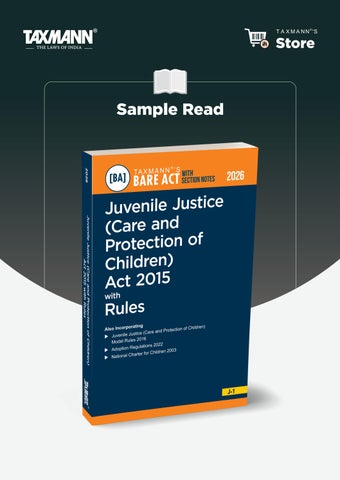
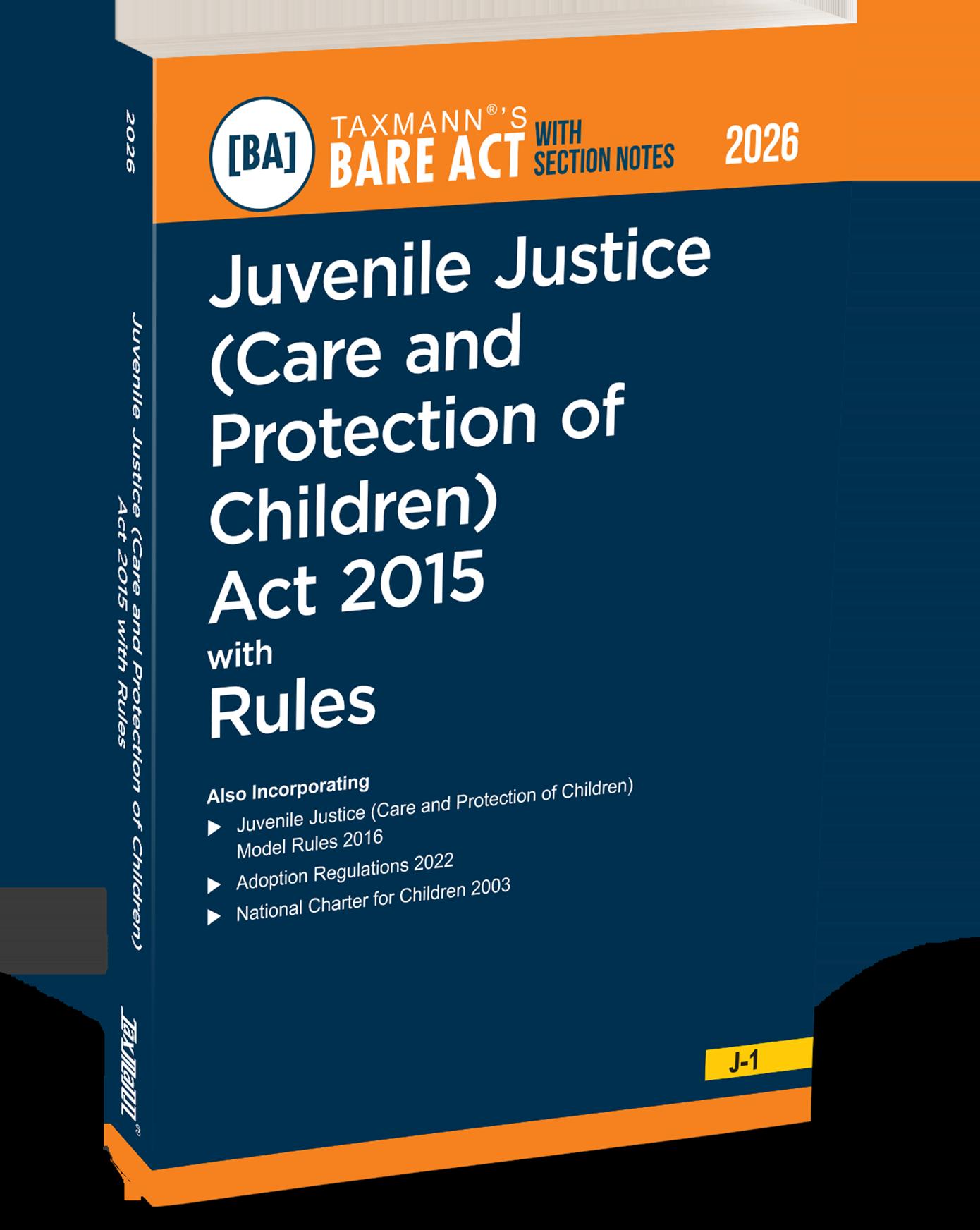
JUVENILE JUSTICE (CARE AND PROTECTION OF CHILDREN) ACT 2015 WITH RULES – BARE ACT WITH SECTION NOTES
AUTHOR : Taxmann's Editorial Board
PUBLISHER : Taxmann
DATE OF PUBLICATION : December 2025
EDITION : 2026 Edition
ISBN NO : 9789371267021
NO. OF PAGES : 488
BINDING TYPE : Paperback
Rs. 345
DESCRIPTION
Juvenile Justice (Care and Protection of Children) Act 2015 with Rules [Bare Act with Section Notes] by Taxmann is a concise and authoritative statutory reference on India's juvenile justice and child protection framework. The 2026 Edition presents the amended and updated text of the Act together with the relevant Rules, Regulations, and allied instruments in force. Supplemented with clear section-wise notes, the publication facilitates a precise understanding of the statutory, procedural, and institutional mechanisms governing the care, protection, rehabilitation, social reintegration, and adoption of children, while preserving the integrity of a Bare Act. This book is intended for the following audience:
• Legal Practitioners, Judges & Law Firms
• Child Rights Activists, NGOs & Social Workers
• Police, Juvenile Justice Boards & Child Welfare Committees
• Government Officials, Policy Makers & Administrators
• Academicians & Students
The Present Publication is the 2026 Edition, covering the amended and updated text of the Juvenile Justice (Care and Protection of Children) Act [Act No. 2 of 2016] and Rules, with the following noteworthy features:
• [Authentic and Updated Bare Act] Verbatim and amended text of the Act as in force
• [Pre-amendment Provisions] Prior versions of amended provisions included through amendment footnotes
• [Section-wise Notes] Concise explanatory notes clarifying scope, intent, and procedural application
• [Rules and Allied Legislation] Applicable Rules, Adoption Regulations, and allied statutory instruments
• [User-friendly Structure] Clear chapterisation and statutory sequencing for quick reference
• [Forms, Schedules & Appendices] Prescribed forms, schedules, and procedural formats
• [Value for Multiple Stakeholders] Useful for legal, enforcement, social sector, and academic users
• [Suitable for Training & Examinations] Recommended reference for training and academic courses