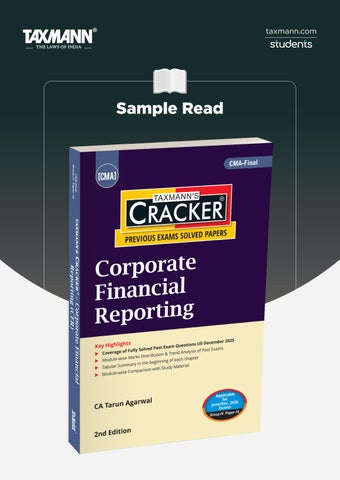

Sample Read




A QUICK REVIEW
Purpose of Share Valuation:
The shares of a company are required to be valued for various purposes. Some of the most important purposes include the following:
1. For selling shares of a shareholder to a purchaser (which are not quoted in the stock exchange).
2. For acquiring a block of shares which may or may not give the holder thereof a controlling interest in the company.
3. To shares by employees of the company where the retention of such shares is limited to the period of their employment.
4.To formulate schemes of merger and acquisition.
5.To acquire interest of dissenting shareholders under a scheme of reconstruction.
6.For granting loans on the basis of security of shares.
7.To compensate shareholders on the acquisition of their shares by the government under a scheme of nationalization.
8.For conversion of securities, say preference shares into equity shares.
9.To resolve a deadlock in the management of a company on the basis of the controlling block of shares given to either of the parties.
Factors Affecting Valuation of Shares:
The different factors that affect the valuation of shares are:
1. Nature of the industry to which the company belongs
2.The companies past performance
3. Economic conditions of the country
4.Other political and economic factors (e.g., possibility of nationalization, excise duty on goods produced, etc.)
5.Demand and supply of shares
6.Income yielding capacity of the company
7.The availability of sufficient assets over liabilities
8.Proportion of liabilities and capital
9. Rate of proposed dividend and past profit of the company.
10. Yield of other related shares of the Stock Exchange.
There are different approaches to valuation and with clear understanding of the purpose of valuation an accountant has to use judgement, experience and knowledge to find the relevant value of a share. The true value remains always unknown and all valuation techniques are applied to find the value nearest to its true value.
The major three approaches to valuation of shares are:
A. Income Approach
B. Net Assets Approach
C. Market Approach
A. Income Approach (Under this approach different alternative terms are used: DCF method, Intrinsic Valuation, Yield value etc.):
The Income Approach indicates the value of a business or equity based on the value of the future income (represented by cash flows, operating profits, net profits or dividends as the case may be) that a business is expected to generate in future. This approach is appropriate in most going concern situations as the worth of a business or equity is generally a function of its ability to earn income/cash flow in future. The Income approach includes a number of models/Techniques:
(1) Discounted Cash Flow
(2) Dividend Discount Model
(3) Maintainable Profits Basis and
(4) Other bases.
1. Discounted Cash Flow (DCF) model:
It indicates the fair market value of a business (or Equity) based on the value of cash flows that the business (or Equity) is expected to earn in future. This method involves the estimation of Net Operating Profits Adjusted Tax (NOPAT) for the projected period, the business’s requirement of reinvestment in terms of capital expenditure and incremental working capital and appropriate cost of capital that reflects the risks of the corresponding return.
(a) Merits of DCF model:
(i) Cash flows are unaffected by any differences of accounting policies, principles, conventions and methods.
(ii) It provides the intrinsic or economic value unaffected by market forces.
(b) De-merits of DCF model:
It is hard
(i) To estimate future cash flows, and
(ii) To apply appropriate rate of discounting
(c) Computation of value per share = Value of Equity/No. of equity shares
Value of Equity = Value of the business less value of Debt Capital
Value of business = Aggregate of future cash flows (or Free Cash flows) discounted at its present worth
(d) Let us see how cash flows are computed so that future cash flows can be projected.
(a) Cash Flows (CF) = NOPAT + Depreciation, amortisation, impairment etc. (noncash expenses charged against profits) + (–) Decrease (Increase) in non-cash working capital
Net Operating Profits Adjusted Tax (NOPAT) = EBIT × (1 – t)
EBIT (Earnings Before Interest and Tax) is Net Operating Profits.
t = Tax Rate = Tax expenses/Earning Before Tax (EBT)
(b) Free Cash Flows are of two types:
(a) Free Cash Flows to the Firm (FCFF) and (b) Free Cash Flows to the Equity (FCFE)
(b1) FCFF = CF – Capex (Capex means capital expenditures made within the business for expansion, replacement etc.)
(
b2) FCFE {Free Cash Flow to the Equity} = FCFE = Net Income – Increase in non-cash WC – Net Capex + Net Debt Issue
Or, FCFE = FCFF – Interest net of tax + Net Debt Issued
Interest net of tax = Interest × (1 – t)
(e) Terminal Value or continuing value:
As business is a going concern, at the end of the limited period for which future cash flows (CF, FCFF or FCFE) are projected, the terminal value has to be computed by aggregating the discounted cash flows from that moment till infinity. Thus, Terminal Value = DCF commencing from the end of projection period continued up to infinity.
(i) Two assumptions are made for finding terminal value for business valuation:
(a) There is an infinite series of cash flows (CF, FCFF or FCFE)
(b) Cash flows are either (a) constant or (b) growing at a constant rate
(ii) Growth rate (g) in cash flows is determined by multiplying Re-investment rate (RR) with Return on invested capital (ROIC) or return on capital employed (ROCE in absence of ROIC).
g = RR× ROIC (or, ROCE)
(iii) Re-investment rate = Re-investment/NOPAT, where Re-investment = Net change in non-cash working capital + Net Capex (where, Net Capex = Capex less Depreciation etc.)
(f) Value of business = Aggregate of future cash flows (or Free Cash flows) discounted at its present worth = DCF (for the period future cash flows are projected) + Terminal Value (Continuing Value) discounted at its present worth
Terminal Value (Continuing Value) at constant cash flows assumption = TVn = CF(n + 1)/k, where, k is the discounting rate
Terminal Value (Continuing Value) at constant growth rate of cash flows assumption = TVn = CF(n+1)/(k – g), where, k = WACC is the discounting rate
(i) If there is no period of projected cash flows, continuing value is measured at period 0. In that case
Value of business = V0 = Continuing Value = CF1/k (at constant cash flows assumption)
And V0 = CF1/(k – g) [at constant growth rate of cash flows assumption)
(ii) When there is ‘n’ period of projected cash flows, continuing value is measured at period ‘n’. In that case
Value of business = V0 = DCF (for the years 1 to n) + TVn discounted for ‘n’ years (for the cash flows from n + 1 year to infinity)
2. Dividend Discount Model:
Here, Value per share = Dividend per Share/Ke [when constant dividend is assumed for infinity]
Value per share = Dividend per Share/(Ke – g) [when constant growth of dividend is assumed for infinity]
Ke is the cost of equity and g is the growth rate of dividend. This model is based on Gordon’s model of share pricing.
3. Maintainable Profits Basis:
Value of equity under Maintainable Profits Basis = Maintainable Profits available to equity/Equity capitalisation rate (Ke)
Value per share = Value of Equity/no. of equity shares
Average Maintainable Profits are computed to find out expected future earnings of the Equity. Hence all non-recurring or abnormal items of income and expenses are eliminated. Simple or weighted average of past years (excluding any abnormal year) adjusted earnings are computed.
4 Other bases:
(i) Yield-Basis Method:
Yield is the effective rate of return on investments which is invested by the investors. It is always expressed in terms of percentage. Since the valuation of shares is made on the basis of Yield, it is called Yield-Basis Method.
Under Yield-Basis method, valuation of shares is made on either of the following basis:
(a) Profit Basis; or (b) Dividend Basis.
(a) Under Profit Basis: Under this method, at first, profit should be ascertained on the basis of past average profit; thereafter, capitalized value of profit is to be determined on the basis of normal rate of return, and, the same (capitalized value of profit) is divided by the number of shares in order to find out the value of each share.
(b) Under Dividend Basis: Valuation of shares may be made either (I) on the basis of total amount of dividend, or (II) on the basis of percentage or rate of dividend.
Whether Profit Basis or Dividend Basis method is to be followed for ascertaining the value of shares depends on the shares that are held by the respective shareholders. In other words, the shareholders holding minimum number of shares (i.e., minority holding) may determine the value of shares on dividend basis in order satisfy the rate of dividend which is recommended by the Board of Directors, i.e. such shareholders have no such power to control the affairs of the company.
On the contrary, the shareholders holding maximum number of shares (i.e., majority holding) have got more controlling rights over the affairs of the company including the recommendation for the rate of dividend among others. Under the circumstances, valuation of shares should be made on profit basis. In short, Profit Basis should be followed in the case of Majority Holding, and Dividend Basis should be followed in the case of Non-controlling Holding.
(
ii) Fair Value Method:
There are some valuers who do not accept either the Intrinsic Value or the Yield Value for ascertaining the value of shares. They prescribe the Fair Value Method which happens to be the arithmetic mean of Intrinsic Value Method (net asset method) and Yield Value Method.
B. Net Assets Approach or Asset-Backing Method:
Since the valuation is made on the basis of the assets of the company, it is known as Asset-Basis or Asset-Backing Method. At the same time, the shares are valued on the basis of real internal value of the assets of the company and that is why the method is also termed Intrinsic Value Method or Real Value Basis Method. Under net assets basis value of equity is determined by subtracting ascertained value of liabilities from the value of assets.
This method may be made either:
(a) On a going concern basis; or
(b) On Break-up value basis.
In case of the former, the utility of the assets is to be considered for the purpose of arriving at the value of the assets, but, in the case of the latter, the realizable value of the assets is to be taken.
(1) Valuation of assets and liabilities:
(a) There are three major bases of asset valuation for a going concern:
(I) Book Value;
(II) Net Replacement Value;
(III) Net Realisable Value
Assets include all tangible assets including contingent assets and intangible assets including goodwill.
Liabilities include contingent liabilities also. For valuing equity shares dues of preference shareholders are also considered as liabilities.
(b) In case of liquidation, however, break-up value is computed based on sale value of individual assets and remission value of individual liabilities.
Thus, under net assets approach
Value per share = Net Assets/no. of equity shares
Net Assets = Value of all tangible assets including contingent assets (using an appropriate basis of valuation) + Value of Goodwill and other Intangible assets –Ascertained value of liabilities including Contingent liabilities and dues of preference shareholders, if any.
(2) Valuation of Goodwill:
Goodwill represents the capacity of the business to earn excess profit for a period of time over normal profit. The value of goodwill is the aggregate of such excess profit for the period of consideration duly discounted to their present worth (or without adjusting for time value of money). The popular measure of determining excess profit or super profit is the average maintainable profits less normal profits. The period for which such excess profit is computed may be assumed to be infinite time or it may be assumed to be limited to certain years (3 to 5 years, for instance). Accordingly, different methods of valuation of goodwill are broadly classified as follows:
(a) Capitalisation method: It assumes constant super profit for infinite years.
(b) Number of years’ purchase method: It assumes constant super profit for limited number of years (usually 3 to 5 years).
(a) Under capitalisation method:
(i) Aggregate of constant super profits discounted at normal rate of return (= WACC) for infinite number of years is computed.
Goodwill (capitalisation of super profits) = Discounted Super Profits (for infinite years) = Super Profits/Normal rate of return
Super Profits = Average (Simple or Weighted) Maintainable Profits – Normal Profits
Normal Profits = Average Capital Employed × Normal rate of return [hence, Average Capital Employed = Normal Profits/Normal rate of return]
Thus, Goodwill = {Average (Simple or Weighted) Maintainable Profits – Normal Profits}/Normal rate of return
= Average (Simple or Weighted) Maintainable Profits/Normal rate of returnNormal Profits/Normal rate of return
Thus, we find:
(ii) Goodwill = Capitalised value of Average Maintainable Profits – Average Capital Employed
[When goodwill is valued in this manner it is not at all different from the capitalisation of super profit method, but it is popularly named as capitalisation of Average Maintainable Profits method]
(b) Number of years’ purchase method:
(i) Super profits method:
(I) Goodwill = Super profits × number of years’ purchase (without adjusting for time value of money). It is assumed that the business will earn constant super profits for a fixed number of years. Value of goodwill is the aggregate of such super profits.
(II) Goodwill = Super Profits × Present Value of Annuity (It computes the present value worth, and is called Annuity method)
(ii) Average Maintainable Profits method:
Instead of super profits, Average Maintainable Profits are used to find value of goodwill.
(I) Goodwill = Average Maintainable Profits × number of years’ purchase (without adjusting for time value of money). It is assumed that the business will earn constant Average Maintainable Profits for a fixed number of years. Value of goodwill is the aggregate of such Average Maintainable Profits.
(II) Goodwill = Average Maintainable Profits × Present Value of Annuity (It computes the present value worth, and is called Annuity method)
[Thus, under Annuity method both super profit and average maintainable profits are used]
Now, we shall see how the values for the following variables are determined for valuation of goodwill:
(i) Average (Simple or Weighted) Maintainable Profits
(ii) Average Capital Employed
(iii) Normal rate of return
Average Maintainable Profits are computed to find out expected future operating income of the business. Hence all non-operating and non-recurring or abnormal items of income and expenses are eliminated.
In the same way corresponding assets (investments etc.) and liabilities are also excluded from Average Capital Employed.
Normal Rate Of Return: Weighted Average Cost of Capital (WACC) represents normal rate of return.
WACC = Weight of Equity × Cost of Equity + Weight of Debt Capital × Cost of Debt Capital
(3) Valuation of other intangible assets:
Other intangible assets are identifiable and they can be valued on (i) cost basis, (ii) market basis and (iii) income basis.
(i) Value of intangible asset under cost basis is the current replacement cost of the identified intangible asset
(ii) Value of intangible asset under market basis is similar to the market approach for business valuation. Market value of equivalent asset in peer group is related to its base value (such as historical cost, replacement cost or book value or ascertainable income from such asset) and the average of the relatives or multiples is applied on the base value of the required intangible asset.
Thus, Value of intangible asset = Base value × Market value relative or multiple.
(iii) Value of intangible asset under income basis is similar to the income approach for business valuation. As life of other intangible asset is finite capitalisation method is not applicable.
Value of intangible asset = DCF (for the years 1 to ‘n’, where estimated life is n years)
C. Market Approach:
Under market approach, value of equity is determined by applying relative or multiple to the base value of the company. Relative or multiple is the ratio of market price to some accounting variable of the company taken as the base value.
Most common multiples are price-earnings (P/E) ratio, price-sales (P/S) ratio, price-cash flow from operations (P/CFO) ratio etc. Important point is that the
relatives have to be computed for the peer group of companies to find the average relationship between the base value and market price. After obtaining the average relationship through relative or multiple, the company finds its calculated market price by applying the average relative to its base value.
The steps involved to find value per share based on market approach:
1. Market capitalisation of each of the peer group of companies is related to any fundamental element of that company (called base value such as Profits, Cash Flows, Net assets, Sales). The ratio obtained is called relative or multiple.
2. To decide what will be the base value on which multiple will be applied. More than one multiple is usually considered in practice.
3. To compute the average of the multiples of the peer group of companies (we call it as Comparator) for each base value.
4. To apply the average multiple (Comparator to a particular base value of the required company for valuation of its equity for that base. Then to find average of the different equity values based on different base values.
5. To divide average value of equity by the no. of shares in order to find value per share.
Market capitalisation is the product of market price of shares and the no. of shares outstanding. Thus, it represents market value of equity. In computation of relative we may find some popular ratios also such as Price Earnings ratio where base value is Earnings and Market to Book Value ratio where base value is Net Assets. But in all circumstances the base values are related to market value of equity.
Relative or multiple = Market Capitalisation/Base value. [where, alternative base values are EAT, EBIT, NOPAT, CF, FCFF, FCFE, Net Assets, Enterprise Value, Sales, or any other fundamental variable]
PAST EXAMINATION QUESTIONS
OBJECTIVE QUESTIONS
Q. 1 In a company net assets available for share holders is ` 1,450 Lakhs; Equity share capital 60 Lakhs shares of ` 10 each; An average dividend is ` 3.20 per equity share and normal rate of dividend for the company is 10%. The fair value of each share will be:
(a) ` 32 (b) ` 24.17 (c) ` 27.81 (d) ` 28.09 [June 2017, 2 Marks]
Ans. (d) ` 28.09
Working Note:
Net Asset Value per share = 1,450/60 = ` 24.17
Price as per dividend yield method = 3.20/10% = ` 32
Fair Value per share = (24.17 + 32)/2 = ` 28.09
Q. 2 Capital Employed is ` 255 Lakhs; Annual average profits are ` 57 Lakhs; Normal rate of return is 12%. The value of goodwill on the basis of Capitalization of super profits will be:
(a) ` 220 Lakhs (b) ` 475 Lakhs (c) ` 6.84 Lakhs (d) ` 26.40 Lakhs [Dec. 2017, 2 Marks]
Ans. (a) ` 220 Lakhs
Working Note:
Super profit = Average profit – (Capital Employed × Normal Rate of Return)
= ` 57 Lakhs – (` 255 Lakhs × 12%)
= ` 57 Lakhs – ` 30.60 Lakhs
= ` 26.40 Lakhs
Goodwill = 26.40/12% = ` 220 Lakhs
Q. 3 A firm values goodwill under ‘Capitalisation of Profits’ method. Average profit of the firm for past 4 years has been determined at ` 1,00,000 (before tax). Capital employed in the business is ` 4,80,000 and its normal rate of return is 12%. Tax rate is 28% on average. Value of Goodwill based on capitalisation of average profit will be:
(a) ` 1,20,000
(b) ` 6,00,000
(c) ` 5,00,000
(d) ` 4,80,000
[June 2018, 2 Marks; Similar Question in Dec. 2018, 2 Marks]
Ans. (a) ` 1,20,000
Working Note:
Profits after Taxes = (` 1,00,000 – 28% of ` 1,00,000) = ` 72,000
Capitalisation of Profits = ` 72,000/0.12 = ` 6,00,000
Therefore, Goodwill = ` 6,00,000 –` 4,80,000 = ` 1,20,000.
Q. 4
4,00,000 Equity Shares of ` 10 each, ` 8 paid up. 7,00,000 Equity Shares of ` 5 each fully called up (Callsin-arrears @ ` 2 on 2,00,000 shares). 10,000 9% Preference Shares of ` 100 each fully paid up. Normal Rate of Earnings-9%. Fair Value of an Equity Share (` 3 paid up) ` 8.50. Difference between Yield Based Value and Net Assets Value is ` 1. Calculate Net Assets for Equity Shareholders and Expected FMP for Equity Shareholders.
[Dec. 2021, 1 Mark; June 2023, 2 Marks]
Ans.
Fair Value = [Net Asset value + Yield Value]/2
8.50 = [Net Asset value + Yield Value]/2
Net Asset Value + Yield Value = 17
Yield Value – Net Asset Value = 1
Solving by Elimination we get: Yield Value = ` 9
Net Asset Value = ` 8 (` 3 paid up)
Therefore, Net Asset Value of Share ` 5 paid up = 8 + 2 = ` 10
Net Asset Value of Share ` 10 paid up = 10 × 2 = ` 20
Net Assets for Equity Share Holders = (4,00,000 × 20) + (7,00,000 × 10) = ` 150 lakhs including uncalled amount and call-in-arrears or Net Assets for Equity Share Holders = ` 138 lakhs excluding uncalled amount and call-in-arrears.
Yield % = Yield Value × Normal Return/ Paid-up Value = 9 × 9/3 = 27%
Expected Future Maintainable Profit for Equity Shareholders = Total Paid up Value × 27%
= {[4,00,000 × 8] + [7,00,000 × 5] –[2,00,000 × 2]} × 27% = ` 17.01 lakhs
Q. 5 Normal dividend expected on equity shares of A Ltd. is 8% while fair return is 10%. The profit available to equity shareholders is ` 3,83,125 and value of net assets for equity shareholders is ` 40,82,000. Calculate value of each equity share under fair value method if number of outstanding equity share is ` 1,00,000 and face value is 10.
(a) ` 38.41 (b) ` 44.36 (c) ` 47.89 (d) ` 40.82 [Dec. 2023, 2 Marks]
Ans. (b) ` 44.36
Working Note: Value per share based in Net Assets = 40,82,000/1,00,000 = ` 40.82 = Yield on
Equity Share = (Profit for Equity Shareholders/Equity Share Capital) × 100 = (` 3,83,125/` 10,00,000) × 100 = 38.3125%
Value per share = (38.3125/8) × `10 = ` 47.89
Fair Value = (40.82 + 47.89)/2 = ` 44.36
Q. 6 Given by the Poova Mart:
Average trading profit of last four years: ` 7,00,000
Average capital employed by the firm: ` 45,00,000
Normal rate of return: 10%
Present value of annuity oft 1 for 4 years @ 10%: 3.1699
The value of goodwill on the basis of annuity of super profit will be ______.
(a) ` 22,18,930
(b) ` 7,92,475
(c) ` 2,20,827
(d) ` 6,21,575 [Dec. 2024, 2 Marks]
Ans. (b) ` 7,92,475
Working Note: Super Profit = 7,00,000 – [45,00,000 × 10%] = ` 2,50,000
Goodwill = 2,50,000 × 3.1699 = ` 7,92,475
NUMERICAL PROBLEMS
Q. 1 Following are the information of two companies for the year ended 31st March, 2017:
Assume that in both the cases, the Market expectation is 18% and 80% of the Profits are distributed.
(i) What is the rate you would pay for the Equity Shares of each Company (a) If you are buying a small lot, and (b) If you are buying controlling interest shares?
(ii) If you plan to invest only in preference shares which company’s preference shares would you prefer? [June 2017, 8 Marks]
Ans.
ParticularsCompany XCompany Y
after tax3,00,0002,60,000 Less: Preference Dividend (60,000)(40,000) Earnings available to Equity Shareholders2,40,0002,20,000 No: of Shares80,0001,00,000 Earnings per
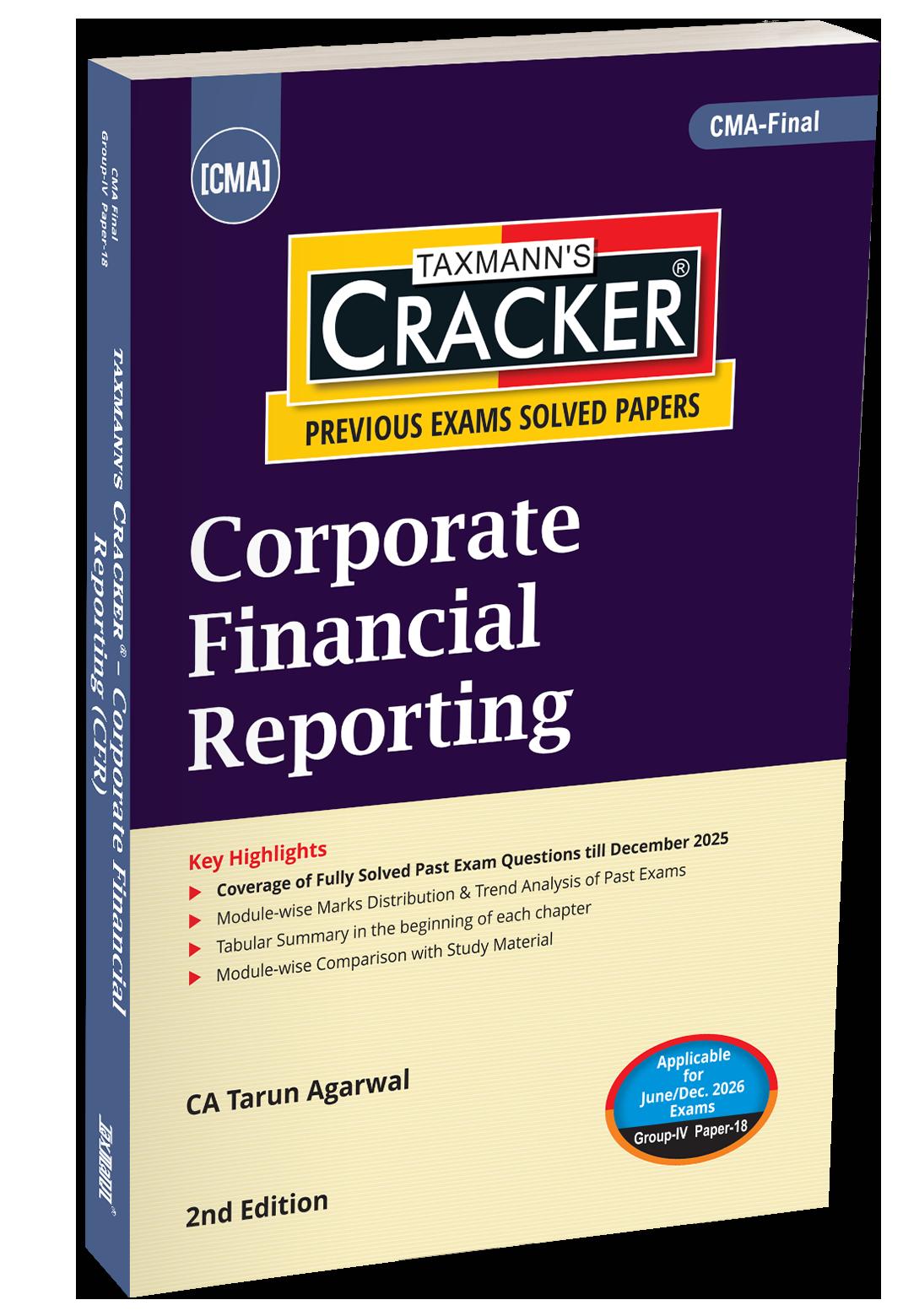
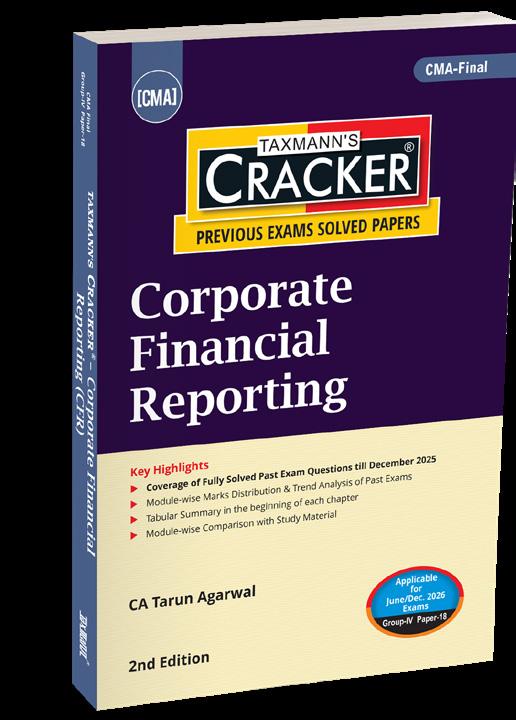
Corporate Financial Reporting (CFR) | CRACKER
AUTHOR : Tarun Agarwal
PUBLISHER : Taxmann
DATE OF PUBLICATION : December 2025
EDITION : 2nd Edition
ISBN NO : 9789375614364
No. of Pages : 428
BINDING TYPE : Paperback
Rs. 525
DESCRIPTION
Corporate Financial Reporting | CRACKER is an exam-focused resource for CMA Final students. It presents fully solved past exam questions up to Dec. 2025, along with marks distribution, trend analysis, and CMA study material cross-references. Designed with a structured approach, it helps aspirants prepare effectively for Group IV | Paper 18.
The Present Publication is the 2nd Edition for the June/Dec. 2026 Exams. This book is authored by CA. Tarun Agarwal, with the following noteworthy features:
• [Complete Coverage of Past Papers] Solved questions up to Dec. 2025 with examiner-style solutions
• [Marks Distribution & Trend Analysis] Year-wise (2023–2025) insights on weightage & recurring topics
• [Tabular Summaries] Concise overviews at the start of each chapter for quick revision
• [CMA Study Material Mapping] Direct alignment with the Institute’s Study Material
• [Marks-driven Approach] Balanced theory & practical questions reflecting exam patterns
• [Updated Syllabus] Covers all Ind AS, recent reporting changes & exam trends
• [Time-efficient Format] Systematic, student-friendly layout ideal for guided or self-study