
Sample Read

CONTENTS
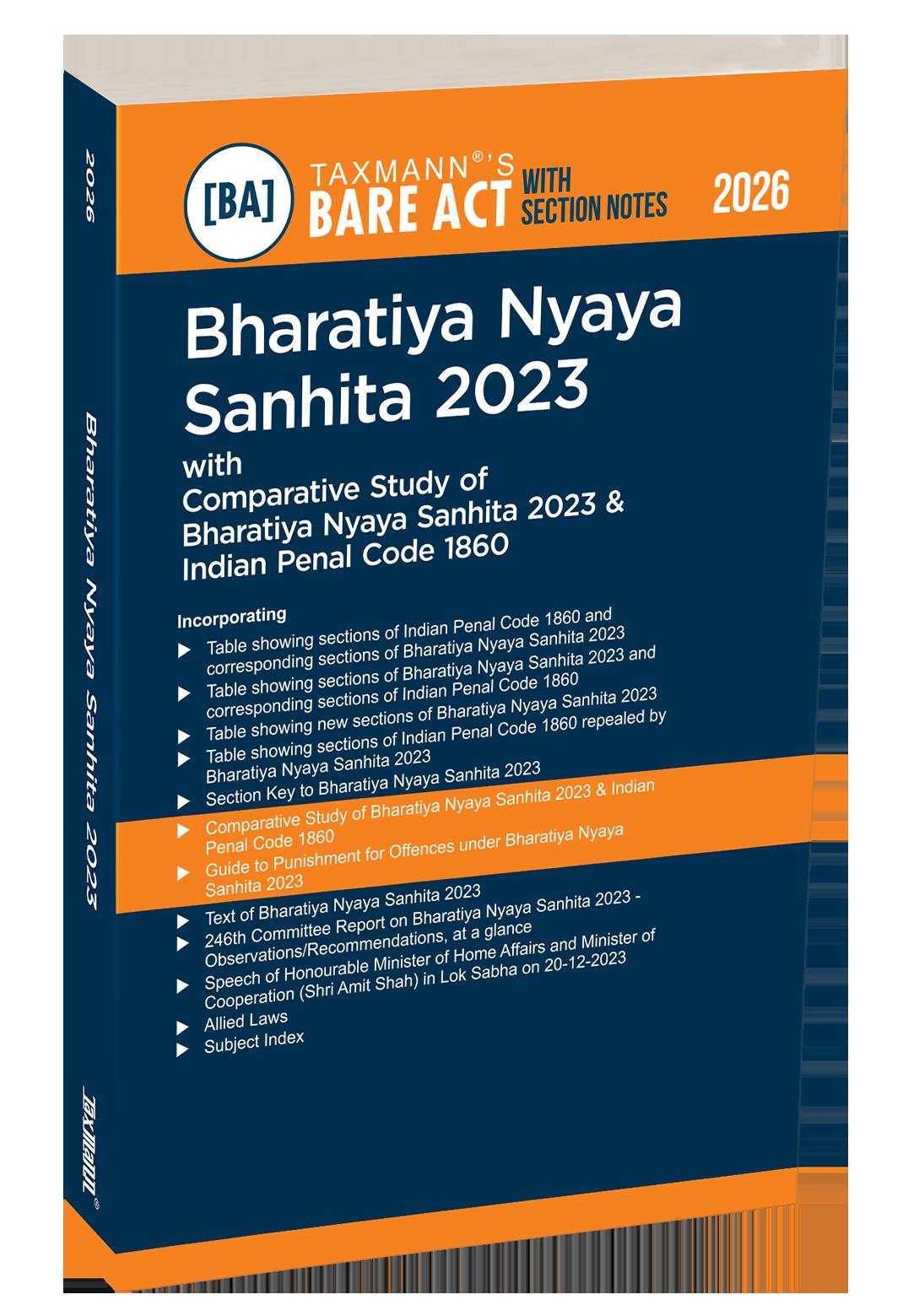
Table showing sections of Indian Penal Code, 1860 and corresponding sections of Bharatiya Nyaya Sanhita, 2023 I-7
Table showing sections of Bharatiya Nyaya Sanhita, 2023 and corresponding sections of Indian Penal Code, 1860 I-45
Table showing new sections of Bharatiya Nyaya Sanhita, 2023 I-81
Table showing sections of Indian Penal Code, 1860 repealed by Bharatiya Nyaya Sanhita, 2023 I-83
Section Key to Bharatiya Nyaya Sanhita, 2023 I-85
Alphabetical Key to Comparative Study of Bharatiya Nyaya Sanhita, 2023 (BNS) & Indian Penal Code, 1860 (IPC) I-107
Comparative Study of Bharatiya Nyaya Sanhita, 2023 (BNS) & Indian Penal Code, 1860 (IPC) I-121
Guide to Punishment for Offences under Bharatiya Nyaya Sanhita, 2023 I-157

BHARATIYA NYAYA SANHITA, 2023
[45 OF 2023]
An Act to consolidate and amend the provisions relating to offences and for matters connected therewith or incidental thereto.
BE it enacted by Parliament in the Seventy-fourth Year of the Republic of India as follows:––
CHAPTER I
PRELIMINARY
Short title, commencement and application.
1. (1) This Act may be called the Bharatiya Nyaya Sanhita, 2023.
Corresponding Provision : Section 1 of IPC, 1860
(2)It shall come into force on such date as the Central Government may, by notification in the Official Gazette†, appoint, and different dates may be appointed for different provisions of this Sanhita.
Corresponding Provision : Section 1 of IPC, 1860
(3)Every person shall be liable to punishment under this Sanhita and not otherwise for every act or omission contrary to the provisions thereof, of which he shall be guilty within India.
Corresponding Provision : Section 2 of IPC, 1860
(4)Any person liable, by any law for the time being in force in India, to be tried for an offence committed beyond India shall be dealt with according to the provisions of this Sanhita for any act committed beyond India in the same manner as if such act had been committed within India.
Corresponding Provision : Section 3 of IPC, 1860
(5)The provisions of this Sanhita shall also apply to any offence committed by—
(a)any citizen of India in any place without and beyond India;
(b)any person on any ship or aircraft registered in India wherever it may be;
(
c)any person in any place without and beyond India committing offence targeting a computer resource located in India.
† Notification No. S.O. 850(E), dated 23-2-2024 - In exercise of the powers conferred by sub-section (2) of section 1 of the Bharatiya Nyaya Sanhita, 2023 (45 of 2023), the Central Government hereby appoints the 1st day of July, 2024 as the date on which the provisions of the said Sanhita, except the provision of sub-section (2) of section 106, shall come into force.
Explanation.—In this section, the word “offence” includes every act committed outside India which, if committed in India, would be punishable under this Sanhita.
Illustration
A, who is a citizen of India, commits a murder in any place without and beyond India. He can be tried and convicted of murder in any place in India in which he may be found.
Corresponding Provision : Section 4 of IPC, 1860
(6) Nothing in this Sanhita shall affect the provisions of any Act for punishing mutiny and desertion of officers, soldiers, sailors or airmen in the service of the Government of India or the provisions of any special or local law.
Corresponding Provision : Section 5 of IPC, 1860
COMMENTS
SECTION NOTES
1.1 Commencement of the provisions of Bharatiya Nyaya Sanhita, 2023 (hereinafter referred to as ‘BNS 2023’)
Except section 106(2), provisions of this Sanhita (BNS) shall come into force on 1-7-2024 vide Notification No. SO 850(E), dated 23-2-2024.
Notification No. SO 850(E), dated 23-2-2024 reads as under:—
In exercise of the powers conferred by sub-section (2) of section 1 of the Bharatiya Nyaya Sanhita, 2023 (45 of 2023), the Central Government hereby appoints the 1st day of July, 2024 as the date on which the provisions of the said Sanhita, except the provision of sub-section (2) of section 106, shall come into force.
1.2 Application - Territorial Jurisdiction
1.2-1 Punishment of offences committed within India
Every person shall be liable for punishment under this Sanhita only if he commits any act or omission contrary to the provisions of this Sanhita for which he shall be guilty within India.
The person shall not be liable for any punishment under BNS unless he does any act or omission contrary to the provisions of BNS.
1.3
Extra-Territorial Jurisdiction
1.3-1 Punishment of offences committed beyond, but which by law may be tried within, India
Sub-section (4) of section 1applies to any person liable, by any law for the time being in force in India, to be tried for an offence committed beyond India. Such person shall be dealt with according to the provisions of BNS for any act committed beyond India in the same manner as if such act had been committed within India.
1.3-2 Extension of BNS to extra-territorial offences
The provisions of BNS apply also to any offence committed by—
(
a) any citizen of India in any place without and beyond India;
(b) any person on any ship or aircraft registered in India wherever it may be;
(c) any person in any place without and beyond India committing offence targeting a computer resource located in India.
The word “offence” includes every act committed outside India which, if committed in India, would be punishable under this Sanhita.
Illustration : A, who is a citizen of India, commits a murder in any place without and beyond India. He can be tried and convicted of murder in any place in India in which he may be found.
1.4 Exclusion : Certain laws not to be affected by BNS
1.4-1 Certain laws not to be affected by BNS
Nothing in BNS shall affect — the provisions of any Act for punishing mutiny and desertion of officers, soldiers, sailors or airmen in the service of the Government of India or the provisions of any special or local law.
Definitions.
2. In this Sanhita, unless the context otherwise requires,––(1) “act” denotes as well a series of acts as a single act;
Corresponding Provision : Sections 32 and 33 of IPC, 1860
(2) “animal” means any living creature, other than a human being;
Corresponding Provision : Section 47 of IPC, 1860
(3) “child” means any person below the age of eighteen years;
(4) “counterfeit”.––A person is said to “counterfeit” who causes one thing to resemble another thing, intending by means of that resemblance to practise deception, or knowing it to be likely that deception will thereby be practised.
Explanation 1.—It is not essential to counterfeiting that the imitation should be exact.
Explanation 2.—When a person causes one thing to resemble another thing, and the resemblance is such that a person might be deceived thereby, it shall be presumed, until the contrary is proved, that the person so causing the one thing to resemble the other thing intended by means of that resemblance to practise deception or knew it to be likely that deception would thereby be practised;
Corresponding Provision : Section 28 of IPC, 1860
(5) “Court” means a Judge who is empowered by law to act judicially alone, or a body of Judges which is empowered by law to act judicially as a body, when such Judge or body of Judges is acting judicially;
Corresponding Provision : Section 20 of IPC, 1860
(6) “death” means the death of a human being unless the contrary appears from the context;
Corresponding Provision : Section 46 of IPC, 1860
(7) “dishonestly” means doing anything with the intention of causing wrongful gain to one person or wrongful loss to another person;
Corresponding Provision : Section 24 of IPC, 1860
(8) “document” means any matter expressed or described upon any substance by means of letters, figures or marks, or by more than one of those means, and includes electronic and digital record, intended to be used, or which may be used, as evidence of that matter.
Explanation 1.—It is immaterial by what means or upon what substance the letters, figures or marks are formed, or whether the evidence is intended for, or may be used in a Court or not.
Illustrations
(a) A writing expressing the terms of a contract, which may be used as evidence of the contract, is a document.
(b) A cheque upon a banker is a document.
(
(
c) A power-of-attorney is a document.
d) A map or plan which is intended to be used or which may be used as evidence, is a document.
(
e) A writing containing directions or instructions is a document.
Explanation 2. Whatever is expressed by means of letters, figures or marks as explained by mercantile or other usage, shall be deemed to be expressed by such letters, figures or marks within the meaning of this section, although the same may not be actually expressed.
Illustration
A writes his name on the back of a bill of exchange payable to his order. The meaning of the endorsement, as explained by mercantile usage, is that the bill is to be paid to the holder. The endorsement is a document, and shall be construed in the same manner as if the words “pay to the holder” or words to that effect had been written over the signature;
Corresponding Provision : Section 29 of IPC, 1860 (9) “fraudulently” means doing anything with the intention to defraud but not otherwise;
Corresponding Provision : Section 25 of IPC, 1860 (10) “gender”.—The pronoun “he” and its derivatives are used of any person, whether male, female or transgender.
Explanation.–– “transgender” shall have the meaning assigned to it in clause (k) of section 2* of the Transgender Persons (Protection of Rights) Act, 2019 (40 of 2019);
Corresponding Provision : Section 8 of IPC, 1860
* For text of section 2(k) of the Transgender Persons (Protection of Rights) Act, 2019, see Appendix.
(11) “good faith”.—Nothing is said to be done or believed in “good faith” which is done or believed without due care and attention;
Corresponding Provision : Section 52 of IPC, 1860
(12) “Government” means the Central Government or a State Government;
Corresponding Provision : Section 17 of IPC, 1860
(13) “harbour” includes supplying a person with shelter, food, drink, money, clothes, arms, ammunition or means of conveyance, or the assisting a person by any means, whether of the same kind as those enumerated in this clause or not, to evade apprehension;
Corresponding Provision : Section 52A of IPC, 1860
(14) “injury” means any harm whatever illegally caused to any person, in body, mind, reputation or property;
Corresponding Provision : Section 44 of IPC, 1860
(15) “illegal” and “legally bound to do”.—The word “illegal” is applicable to everything which is an offence or which is prohibited by law, or which furnishes ground for a civil action; and a person is said to be “legally bound to do” whatever it is illegal in him to omit;
Corresponding Provision : Section 43 of IPC, 1860
(16) “Judge” means a person who is officially designated as a Judge and includes a person,––
(i) who is empowered by law to give, in any legal proceeding, civil or criminal, a definitive judgment, or a judgment which, if not appealed against, would be definitive, or a judgment which, if confirmed by some other authority, would be definitive; or
(ii) who is one of a body or persons, which body of persons is empowered by law to give such a judgment.
Illustration
A Magistrate exercising jurisdiction in respect of a charge on which he has power to sentence to fine or imprisonment, with or without appeal, is a Judge;
Corresponding Provision : Section 19 of IPC, 1860
(17) “life” means the life of a human being, unless the contrary appears from the context;
Corresponding Provision : Section 45 of IPC, 1860
(18) “local law” means a law applicable only to a particular part of India;
Corresponding Provision : Section 42 of IPC, 1860
(19) “man” means male human being of any age;
Corresponding Provision : Section 10 of IPC, 1860
(20) “month” and “year”.––Wherever the word “month” or the word “year” is used, it is to be understood that the month or the year is to be reckoned according to the Gregorian calendar;
Corresponding Provision : Section 49 of IPC, 1860
(21) “movable property” includes property of every description, except land and things attached to the earth or permanently fastened to anything which is attached to the earth;
Corresponding Provision : Section 22 of IPC, 1860
(22) “number”.—Unless the contrary appears from the context, words importing the singular number include the plural number, and words importing the plural number include the singular number;
Corresponding Provision : Section 9 of IPC, 1860
(23) “oath” includes a solemn affirmation substituted by law for an oath, and any declaration required or authorised by law to be made before a public servant or to be used for the purpose of proof, whether in a Court or not;
Corresponding Provision : Section 51 of IPC, 1860
(24) “offence”.—Except in the Chapters and sections mentioned in subclauses (a) and (b), the word “offence” means a thing made punishable by this Sanhita, but––
(a) in Chapter III and in the following sections, namely, sub-sections (2), (3), (4) and (5) of section 8, sections 9, 49, 50, 52, 54, 55, 56, 57, 58, 59, 60, 61, 119, 120, 123, sub-sections (7) and (8) of sections 127, 222, 230, 231, 240, 248, 250, 251, 259, 260, 261, 262, 263, sub-sections (6) and (7) of section 308 and sub-section (2) of section 330, the word “offence” means a thing punishable under this Sanhita, or under any special law or local law; and
(b) in sub-section (1) of section 189, sections 211, 212, 238, 239, 249, 253 and sub-section (1) of section 329, the word “offence” shall have the same meaning when the act punishable under the special law or local law is punishable under such law with imprisonment for a term of six months or more, whether with or without fine;
Corresponding Provision : Section 40 of IPC, 1860
(25) “omission” denotes as well as a series of omissions as a single omission;
Corresponding Provision : Section 33 of IPC, 1860
(26) “person” includes any company or association or body of persons, whether incorporated or not;
Corresponding Provision : Section 11 of IPC, 1860
(27) “public” includes any class of the public or any community;
Corresponding Provision : Section 12 of IPC, 1860
(28) “public servant” means a person falling under any of the descriptions, namely:—
(
(
a) every commissioned officer in the Army, Navy or Air Force;
b) every Judge including any person empowered by law to discharge, whether by himself or as a member of any body of persons, any adjudicatory functions;
(
c) every officer of a Court including a liquidator, receiver or commissioner whose duty it is, as such officer, to investigate or report on any matter of law or fact, or to make, authenticate, or keep any document, or to take charge or dispose of any property, or to execute any judicial process, or to administer any oath, or to interpret, or to preserve order in the Court, and every person specially authorised by a Court to perform any of such duties;
(
d) every assessor or member of a panchayat assisting a Court or public servant;
(
e) every arbitrator or other person to whom any cause or matter has been referred for decision or report by any Court, or by any other competent public authority;
(
f) every person who holds any office by virtue of which he is empowered to place or keep any person in confinement;
(
g) every officer of the Government whose duty it is, as such officer, to prevent offences, to give information of offences, to bring offenders to justice, or to protect the public health, safety or convenience;
(
h) every officer whose duty it is, as such officer, to take, receive, keep or expend any property on behalf of the Government, or to make any survey, assessment or contract on behalf of the Government, or to execute any revenue-process, or to investigate, or to report, on any matter affecting the pecuniary interests of the Government, or to make, authenticate or keep any document relating to the pecuniary interests of the Government, or to prevent the infraction of any law for the protection of the pecuniary interests of the Government;
(
i) every officer whose duty it is, as such officer, to take, receive, keep or expend any property, to make any survey or assessment or to levy any rate or tax for any secular common purpose of any village, town or district, or to make, authenticate or keep any document for the ascertaining of the rights of the people of any village, town or district;
(
j) every person who holds any office by virtue of which he is empowered to prepare, publish, maintain or revise an electoral roll or to conduct an election or part of an election;
(k) every person—
(i) in the service or pay of the Government or remunerated by fees or commission for the performance of any public duty by the Government;
(ii) in the service or pay of a local authority as defined in clause (31) of section 3* of the General Clauses Act, 1897 (10 of 1897), a corporation established by or under a Central or State Act or a Government company as defined in clause (45) of section 2** of the Companies Act, 2013 (18 of 2013).
Explanation.—
(
a) persons falling under any of the descriptions made in this clause are public servants, whether appointed by the Government or not;
(
b) every person who is in actual possession of the situation of a public servant, whatever legal defect there may be in his right to hold that situation is a public servant;
(
c) “election” means an election for the purpose of selecting members of any legislative, municipal or other public authority, of whatever character, the method of selection to which is by, or under any law for the time being in force.
Illustration
A Municipal Commissioner is a public servant;
Corresponding Provision : Section 21 of IPC, 1860
(29) “reason to believe”.—A person is said to have “reason to believe” a thing, if he has sufficient cause to believe that thing but not otherwise;
Corresponding Provision : Section 26 of IPC, 1860
(30) “special law” means a law applicable to a particular subject;
Corresponding Provision : Section 41 of IPC, 1860
(31) “valuable security” means a document which is, or purports to be, a document whereby any legal right is created, extended, transferred, restricted, extinguished or released, or whereby any person acknowledges that he lies under legal liability, or has not a certain legal right.
Illustration
A writes his name on the back of a bill of exchange. As the effect of this endorsement is to transfer the right to the bill to any person who may become the lawful holder of it, the endorsement is a “valuable security”;
Corresponding Provision : Section 30 of IPC, 1860
* For text of section 3(31) of the General Clauses Act, 1897, see Appendix
** For text of section 2(45) of the Companies Act, 2013, see Appendix.
(32) “vessel” means anything made for the conveyance by water of human beings or of property;
Corresponding Provision : Section 48 of IPC, 1860
(33) “voluntarily”.—A person is said to cause an effect “voluntarily” when he causes it by means whereby he intended to cause it, or by means which, at the time of employing those means, he knew or had reason to believe to be likely to cause it.
Illustration
A sets fire, by night, to an inhabited house in a large town, for the purpose of facilitating a robbery and thus causes the death of a person. Here, A may not have intended to cause death; and may even be sorry that death has been caused by his act; yet, if he knew that he was likely to cause death, he has caused death voluntarily;
Corresponding Provision : Section 39 of IPC, 1860
(34) “will” means any testamentary document;
Corresponding Provision : Section 31 of IPC, 1860
(35) “woman” means a female human being of any age;
Corresponding Provision : Section 10 of IPC, 1860
(36) “wrongful gain” means gain by unlawful means of property to which the person gaining is not legally entitled;
Corresponding Provision : Section 23, para 1 of IPC, 1860
(37) “wrongful loss” means the loss by unlawful means of property to which the person losing it is legally entitled;
Corresponding Provision : Section 23, para 2 of IPC, 1860
(38) “gaining wrongfully” and “losing wrongfully”.—A person is said to gain wrongfully when such person retains wrongfully, as well as when such person acquires wrongfully. A person is said to lose wrongfully when such person is wrongfully kept out of any property, as well as when such person is wrongfully deprived of property; and
Corresponding Provision : Section 23, para 3 of IPC, 1860
(39) words and expressions used but not defined in this Sanhita but defined in the Information Technology Act, 2000 (21 of 2000) and the Bharatiya Nagarik Suraksha Sanhita, 2023 shall have the meanings respectively assigned to them in that Act and Sanhita.
Corresponding Provision : Section 29A of IPC, 1860
COMMENTS GENERAL
SECTION NOTES
2.0-1 General
Section 2 of BNS gives 39 definitions in clauses (1) to (39), arranged in dictionary sequence for ease of reading and reference.
2.0-2 Unless context otherwise requires
All these definitions in the 39 clauses of section 2 are qualified by the opening sentence in section 2 which states “In this Sanhita unless the context otherwise requires”.
The first limb of the opening sentence “In this Sanhita” suggests that a word occurring in any provision of BNS will have the meaning given to it in the definition of that word in section 2.
The second limb of the opening sentence limits the scope of first limb by using the phrase “unless the context otherwise requires”. If context of a provision requires a different meaning to be given to a word than that given to it in section 2, such different meaning required by the context will be given to that word.
The meaning given to a word in definition given in section 2 will apply whenever that word is used in any provision in BNS unless the context of that provision requires the word to be given a different meaning.
For example, section 2(21) defines movable property so as to cover intangible assets as well. However, in the context of the definition of offence of “snatching” in section 304(1), movable property will not cover intangible. The words used in section 304(1) are “ suddenly or quickly or forcibly seizes or secures or grabs or takes away from any person or from his position any movable property”. The context clearly implies that “movable property” for section 304 purposes will cover only tangible movable property and not intangible assets/property.
ACT [SEC. 2(1)]
SECTION NOTES
2.1-1 Definition of ‘Act’
Section 2(1) defines the term “act” to denote as well a series of acts as a single act.
The word “act” will not only denote a single act but will also denote a series of acts as a single act.
The definition of “act” in section 2(1) should be read in the light of section 3(4) of BNS Section 3(4) provides that in every Part of BNS, except where a contrary intention appears from the context, words which refer to acts done extend also to illegal omissions.
Under section 2(25), “omission” means single omission as well as a series of omissions.
ANIMAL [SEC. 2(2)]
SECTION NOTES
2.2-1 Definition of ‘animal’
The definition of “animal” in section 2(2) is the same as given in section 47 of IPC except that definition in section 47 was not qualified by the phrase “unless the context otherwise requires”.
Section 2(2) defines the term “animal” to mean any living creature, other than a human being.
Human being will be out of the purview of the term “animal”.
CHILD [SEC. 2(3)]
SECTION NOTES
2.3-1 Definition of ‘child’
Section 2(3) of BNS defines ‘child’ to means any person below the age of 18 years.
COUNTERFEIT [SEC. 2(4)]
SECTION NOTES
2.4-1 Definition of ‘Counterfeit’
The definition of “counterfeit” in section 2(4) has the following ingredients:—
1. A person causes one thing to resemble another; 2. He does so intentionally or knowingly to practice deception; and 3. Resemblance/imitation need not be exact. It is sufficient if the resemblance is such that any person might be deceived; If ingredients (1) and (3) are present, intention or knowledge in (2) above will be presumed unless the contrary is proved.
Burden to prove otherwise (lack of intent or knowledge) shall be on the accused.
Section 2(4) defines the term “counterfeit” so as to provide that a person is said to “counterfeit” who—
causes one thing to resemble another thing, intending by means of that resemblance to practice deception, or knowing it to be likely that deception will thereby be practised.
There are two Explanations below the definition in section 2(4) which further clarify the definition as under:
Explanation 1 clarifies that it is not essential to counterfeiting that the imitation should be exact.
Explanation 2 clarifies that when a person causes one thing to resemble another thing, and the resemblance is such that a person might be deceived thereby, it shall be presumed, until the contrary is proved, that the person so causing the one thing to resemble the other thing intended by means of that resemblance to practise deception or knew it to be likely that deception would thereby be practised.
Bharatiya Nyaya Sanhita 2023 – Bare Act with Section Notes
AUTHOR : Taxmann’s Editorial Board
PUBLISHER : Taxmann
DATE OF PUBLICATION : December 2025
EDITION : 2026 Edition
ISBN NO : 9789371261975
No. of Pages : 736
BINDING TYPE : Paperback
Rs. 495
DESCRIPTION
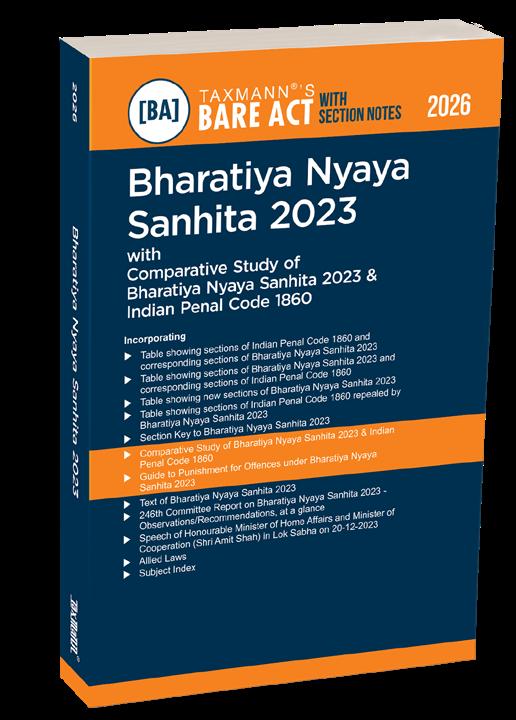
Bharatiya Nyaya Sanhita (BNS) 2023 [Bare Act with Section Notes] by Taxmann is a feature-rich statutory publication presenting the complete and authoritative text of India’s new substantive criminal law. This 2026 Edition goes substantially beyond a conventional Bare Act by integrating structured section notes, comprehensive comparative tools, transition tables, and editorial aids, thereby serving as a practical statutory reference and transition manual for the post-IPC criminal law regime. Alongside the verbatim statutory text of the Bharatiya Nyaya Sanhita 2023, the publication includes expertly drafted Section Notes that explain the intent, scope, interpretation, and practical application of each provision. Its multi-layered comparative framework enables readers to clearly trace continuity, modification, repeal, and innovation between the BNS and the IPC through correspondence tables, comparative studies, and transition aids. Designed as a professional-grade working reference, this Edition equips readers with a clear, navigable, and reliable understanding of India’s re-codified criminal law.
This Edition is designed for a wide spectrum of stakeholders across the criminal justice ecosystem, including:
• Judges, Judicial Officers & Trial Courts
• Advocates, Litigators & Law Firms
• Police, Prosecutors & Investigative Agencies
• Law Students, Academicians & Researchers
• Government Officials & Policy Professionals
• Training Institutes & Examination Aspirants
The Present Publication is the 2026 Edition, covering the amended and updated text of the Bharatiya Nyaya Sanhita [Act No. 45 of 2023], with the following noteworthy features:
• [Complete Text of the Bharatiya Nyaya Sanhita 2023] Accurate and updated statutory text with clean formatting and editorial integrity
• [Detailed Section Notes] Section-wise explanations covering legislative intent, scope, principles of criminal liability, and practical implications
• [Comprehensive Comparative Tables with the Indian Penal Code 1860] Including:
o IPC sections mapped to corresponding BNS sections
o BNS sections mapped to corresponding IPC sections
o Identification of new sections under the BNS
o Identification of IPC provisions repealed by the BNS
• [Comparative Study of BNS & IPC] Highlighting continuity, restructuring of offences, and policy-driven modernisation
• [Section Key to the BNS] Facilitating quick subject-based identification and cross-referencing
• [Guide to Punishment under the BNS] A consolidated, punishment-ready reckoner for quick sentencing reference
• [246th Committee Report on the BNS – At a Glance] Summarised legislative background, reform objectives, and policy rationale
• [Speech of the Hon’ble Minister of Home Affairs & Minister of Cooperation (Shri Amit Shah)] Reflecting the legislative vision behind the enactment
• [Allied Laws] Relevant connected legislations for contextual completeness
• [Detailed Subject Index] Ensuring fast and efficient navigation across provisions and concepts