“It (Mexico) has failed to establish any public system of education … unless a people are educated and enlightened, it is idle to expect the continuance of civil liberty, or the capacity for self-government.”
Texas Declaration of Independence against Mexico, March 2, 1836
“A general diffusion of knowledge being essential to the preservation of the liberties and rights of the people, it shall be the duty of the Legislature of the State to establish and make suitable provision for the support and maintenance of an efficient system of public free schools.”
Texas Constitution, Article 7, Sec1, 1876
Public education is in the DNA of Texas today and has been throughout its history.
Our Founding Fathers understood the importance of public education as the cornerstone of our democracy. Two centuries of investments in public education for every child has made our exceptional state and nation the envy of the world and has ensured a robust economy with engaged citizens in a free society.
This is an important time to remember our history as a state and nation, to remember what got us here, and to continue to support our public schools to ensure a bright future. The American dream today continues to depend on well-resourced, innovative public schools that give all children an opportunity to fulfill their potential in the 21st century.
Miracles happen in public schools every day because of teachers, principals, superintendents, trustees, and support staff who do the hard work. We know there are many critics, but to paraphrase President Teddy Roosevelt, it is not the critics who count but rather the “doer of deeds.” Public school educators are “in the arena.” They are the experts in working with children, improving systems, and creating positive outcomes, and their voices must be heard if we, as a society, want to continue to thrive.
This document reflects the collective voices of leaders representing approximately 2,500 years of service in public schools. Their voices, spoken with humility and care, are not definitive, but rather they continue a conversation in our society and within our profession about how we can best serve our children and prepare them for their future.
We humbly and courageously submit our collective wisdom for consideration. Our hope is that the ideas embedded in this document inspire all of us to “dare greatly.”
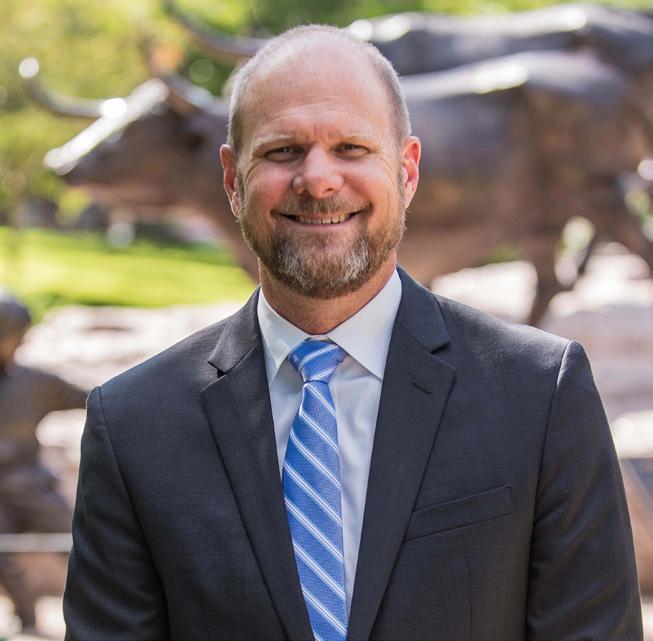
Kevin Brown, Ed.D. Executive Director
Texas
Association of School Administrators
Photo credit: Carl Hyndman
History of the “Visioning Document”
In 2006, 35 public school superintendents, frustrated with the state accountability system’s over-reliance on standardized testing and the general over-regulation of schools by the state and federal government, gathered to imagine a better future for public education in Texas. Meeting as the Public Education Visioning Institute for two years, they crafted Creating a New Vision for Public Education in Texas, a landmark document that articulated a bold, locally driven vision for 21st-century learning.
The effort began when retired Northwest ISD superintendent Keith Sockwell, hearing widespread frustration across the state, asked a simple but powerful question: What are we for?
With support from SHW Group LLP (now Stantec) and in partnership with then-TASA Executive Director Johnny Veselka and TASA Past President John Horn, the Institute assembled superintendents from diverse districts representing more than a million students. Their work, modeled after the Declaration of
Independence, called for innovation, creativity, meaningful assessment, accountability focused on learning, and a more balanced state-local relationship. The resulting document was organized into six articles that later shaped transformation efforts statewide. (Read more about the writers, history, and the original visioning document, Creating a New Vision for Public Education in Texas, at www.bit.ly/ visioning-institute )
Two Decades of Impact
Since its publication in 2008, the visioning document has influenced legislation, district innovation, and TASA’s evolution as an organization. It informed the creation of the Texas High Performance Schools Consortium and sparked new learning networks — including the School Transformation Network, the Future-Ready Superintendents Leadership Institute and Network (FRSLI/FRSLN), and later the Texas Performance Accountability Consortium (TPAC) and the Small Schools Network — all designed to advance the principles originally set forth in the visioning document. For nearly 20 years, this seminal work has helped TASA and school leaders reimagine systems, assessment, learning, and leadership across Texas.
Photo credit: Decatur ISD
The Texas Promise: A Vision for the Future
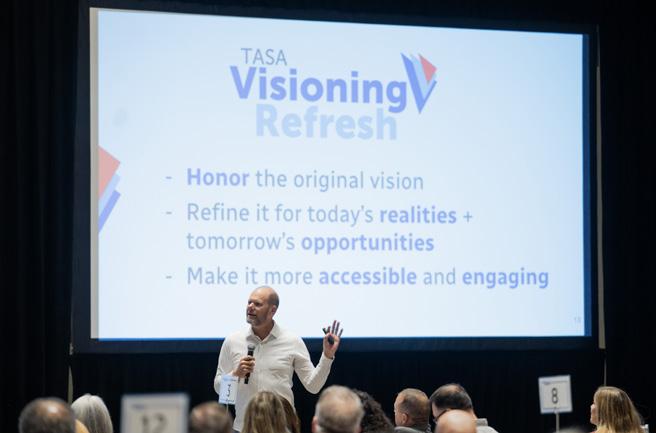
In 2025, acknowledging both the lasting influence of the original work and the significant changes facing schools today, TASA, under the direction of Executive Director Kevin Brown and TASA President Chris Moran, launched a statewide effort to refresh the visioning document.
Nearly 100 leaders contributed to updating and expanding the ideas for a new era. The result — The Texas Promise: A Vision for Public Education — honors the groundbreaking work of the Public Education Visioning Institute while offering a renewed, forward-looking vision that reflects the needs, challenges, and aspirations of Texas public schools today.
Context for this Vision
The Texas Promise is organized in a sequence that mirrors how strong systems bring a vision to life. It opens with the culture and leadership of organizations that cultivate excellence — the foundation on which all other work depends. From there, the framework moves through the core instructional cycle: establishing aligned and impactful standards, designing profound learning experiences, using assessment to guide growth, and ensuring accountability that promotes learning.
Once this instructional pathway is established, the framework addresses the essential conditions that support it, including safety, wellness, and belonging. The sequence concludes with partnering for the future of Texas students, emphasizing that families, communities, and industry play a vital role in sustaining student success. Although presented linearly, these articles function as an interconnected system, each strengthening the whole.
Statements within this document use present-tense language to express a bold vision for what Texas public education strives to make true for every student. These descriptions are
aspirational and serve as a guide for ongoing growth and improvement across our school systems.
The ideas and commitments articulated in The Texas Promise: A Vision for Public Education are grounded in the foundational work of the original writers of the 2008 visioning document, Creating a New Vision for Public Education in Texas. This refreshed version was developed by the 2025 Visioning Refresh Team and subsequently refined through a series of rewrites with a smaller Design Team and Work Group.
Throughout the process, artificial intelligence tools were used to support alignment of content, identify gaps, and offer suggestions, while the vision itself remained rooted in the collective expertise, values, and judgment of Texas educators and leaders.
Photo credit: Lubbock-Cooper ISD
Preamble
Public education is the cornerstone of our democracy and the key to a bright future in Texas. It is both a promise and a responsibility: to nurture the potential of every child, to strengthen every community, and to ensure that our state thrives for generations to come. The Texas Promise: A Vision for Public Education affirms that schools are not merely institutions of learning, but the heart of civic life — where knowledge, character, creativity, and belonging are cultivated.
This vision is rooted in the conviction that all students, regardless of background or circumstance, deserve access to learning that is rigorous, meaningful, and transformative. It reflects the collective wisdom of educators, leaders, families, and communities across Texas who believe that public education must inspire learning and curiosity, equip students with essential skills, and prepare them to contribute boldly in a rapidly changing world.
The Texas Promise calls for leadership grounded in integrity, systems built on trust, and classrooms alive with learning, innovation, and human connection. It is a vision that honors our history, responds to the challenges of today, and looks ahead with hope and clarity.
Together, we commit to ensuring that every Texas student is known, valued, and prepared to thrive — not just in school, but in life.
Photo credit: Prosper ISD
Article 1: Organizations that Cultivate Excellence
• Empowered People: Students and staff are valued within a culture of growth and belonging.
• Purposeful Innovation: Creativity and deeper learning are prioritized over compliance.
• Shared Values & Leadership: Ethical collaboration aligns people and systems for students.
We believe school systems are dynamic learning organizations — systems that empower students as creators of their own futures, honor and elevate the teaching profession and call for bold leadership. Such organizations are adaptive, collaborative, and ethical; they build capacity across all roles and foster cultures of care, engagement, and excellence that extend beyond the classroom into the community.
Supporting Premises
1.1 Systems of Excellence and Innovation
School systems are built on clear, high standards that ensure excellence while allowing the local flexibility to adapt, innovate, and meet the unique needs of students. Strong systems honor consistency without stifling creativity, empowering educators and learners to prosper.
1.2 Interconnected Systems and Collaboration
Learning organizations function as connected systems, not isolated silos. When departments such as curriculum, instruction, technology, student services, and operations work in alignment, they foster collaboration, coherence, and innovation — creating shared ownership of learning across the organization.
1.3 Excellence through Shared Values
A learning organization succeeds when all members — students, educators, leaders, families, and communities — are committed to shared values, continuous growth, and excellence through engagement and collaboration.
Photo credit: Prosper ISD
Photo credit: Grandview ISD
1.4 Elevating and Sustaining the Profession
Teachers are central to transformation and are valued as designers, facilitators, and curators of powerful, authentic learning. Public education must attract, support, and retain exceptional educators by nurturing their innovation, honoring their moral purpose, and cultivating cultures of respect, trust, and professional growth.
1.5 Redefining Teacher Excellence
Elevating the teaching profession requires more than rewards tied to test scores. Teacher excellence is defined in broader terms, valuing impact and growth, so that our systems recognize and support what truly matters in student learning and professional practice.
1.6 Innovation that Redefines Learning
Innovation in learning organizations is about reimagining how we teach, learn, and define success. It requires moving beyond compliance-driven systems to empower teachers as trusted designers of powerful learning and students as creators, not just consumers. Innovation must lead to deeper learning, where students demonstrate critical thinking, problem solving, and meaningful contribution to their communities.
1.7 Students as Owners of Learning
Profound learning comes through curiosity and engagement — not through compliance or narrow measures of success. Students are empowered with voice and agency, engaging in personalized pathways that prepare them with both academic knowledge and soft skills to succeed.
1.8 Balanced and Inspiring Accountability
Accountability systems inspire and elevate practice. They are locally informed and focused on continuous improvement, emphasizing multiple measures of student and school success.
1.9 Learning Spaces that Inspire
The design of physical and digital learning environments reflects a student-centered approach, offering flexibility, ownership, and opportunities for connection and collaboration that deepen engagement and creativity.
1.10 Culture of Care and Belonging
Schools are places that support students emotionally, socially, intellectually, and ethically, cultivating school cultures that reflect respect, inclusion, and hope.
1.11 Life-Ready Graduates
Schools ensure that every learner develops the knowledge, skills, and character needed to succeed in college, career, and life — and to contribute meaningfully to their community and society.
1.12 Ethical and Courageous Leadership
Leadership grounded in integrity, humility, courage, and service is essential at every level. Leaders consistently weigh choices through a student-focused lens, ensuring that policies, budgets, and actions align with the long-term well-being of children. Leaders model transparency, responsibility, and compassion while acting with urgency and skill to improve student outcomes and unite communities around a bold, shared vision for success.
Photo credit: Terrell ISD
Statement of Principle
Every child deserves learning that is deep, relevant, and transformative. Rigorous and aligned standards serve as pathways that challenge students with high expectations and engage them in authentic learning experiences, not as compliance checklists. Grounded in the state standards, curriculum must be coherent, connected, and thoughtfully vetted, while also honoring community and individual strengths, and personalizing learning.
Supporting Premises
2.1 High Expectations and Purposeful Alignment
Standards set rigorous expectations that guide the design of inspiring and impactful learning experiences. Teaching and learning are firmly grounded in the state standards.
2.2 Internalizing Standards
Professional development supports educators to internalize the state standards and understand the depth, complexity, and intent behind each standard. When teachers grasp not only what students should learn but how that learning progresses over time, they can craft instruction that moves to application and mastery.
2.3 Fewer, Deeper Standards
Students engage in learning that goes beyond surface knowledge; they apply understanding in new contexts, synthesize ideas, solve problems and cultivate their full range of capabilities. While teachers teach all the standards, they pre-assess and compact them to provide essential time to focus on high-priority standards.
Photo credit: New Braunfels ISD
Photo credit: Elgin ISD
2.4 Coherent and Connected Curriculum
Curriculum is intentionally designed to provide vertical alignment across grade levels, ensuring that learning builds logically and progressively over time. At the same time, educators identify and cultivate points of connection across disciplines so that students experience learning as integrated, relevant, and connected to the real world.
2.5 Thoughtful Curation of Resources
Educators carefully vet instructional resources to ensure alignment with the state curriculum standards and to confirm that materials are accurate, rigorous, and supportive of meaningful learning. By selecting resources with discernment, teachers create conditions where standards come alive in ways that are both aligned to expectations and engaging for students.
2.6 Digital Resources with Purpose
Curriculum incorporates digital and adaptive resources that are aligned to the state standards and enrich, rather than replace, powerful teacher-led learning. Emerging tools are purposefully selected, ensuring they foster deeper understanding and expand student opportunities.
2.7 Competency-Based Pathways
Students progress based on demonstrated mastery of standards, allowing flexible, personalized learning journeys in accordance with district scope and sequence. This approach ensures that learners advance at a pace that reflects their readiness, honors their strengths, and supports deeper engagement.
2.8 Learning for Life
Schools develop not only academic skills but also character, creativity, resilience, respectful citizenship, well-being, the arts, and career readiness. Schools prepare students to lead purposeful lives, contribute to their communities, and adapt with confidence to an ever-changing world.
2.9 Community & Connection
State standards are meant to have equitable expectations, experiences and outcomes for all Texas students in all settings, yet schools weave community priorities — such as character development, local history, culture, and service — into the curriculum alongside state standards. By reflecting local values, schools strengthen relationships, belonging, and pride of place.
Photo credit: Frenship ISD
Photo credit: Eagle Mountain-Saginaw ISD
Designing Profound Learning Experiences
Statement of Principle
Profound learning occurs when teachers design experiences that spark curiosity, challenge thinking, and connect to students’ lives and futures. In these environments, students are creators with voice and ownership, supported by authentic relationships with teachers who guide and inspire. Schools empower educators to leverage resources, integrate disciplines, and use technology thoughtfully so that students build strong foundations in literacy and numeracy while developing the creativity, collaboration, and problem-solving skills needed to thrive.
Supporting Premises
3.1 Teachers as Experience Designers, Students as Creators
Teachers bring standards to life through the art and science of learning design, sparking curiosity, imagination, and productive struggle. In these rich experiences, students are not merely consumers of knowledge but active creators — designing, applying, and generating new ideas that extend their learning.
3.2 The Role and Empowerment of Teachers
Teachers are the heart of profound learning. Their relationships with students create the trust and connection that make deep engagement and risk-taking possible. To fulfill this vital role, teachers are supported and trusted as innovators — equipped with meaningful professional learning, adequate resources, and competitive compensation that reflect their expertise and elevate both teaching and support roles as essential to every learner’s success.
3.3 Student Agency & Voice
Students are empowered to co-design learning, exercise voice and choice, and pursue their unique strengths and passions. When students are trusted as partners in their education, they develop ownership of their learning and the confidence to shape their own futures.
Photo credit: Gainesville ISD
Photo credit: San Angelo ISD
3.4 Depth & Interconnectedness of Learning
Rich learning experiences move beyond surface-level knowledge to help students acquire essential understandings, make meaning from new ideas, and grapple with increasing levels of complexity that lead to deeper mastery. Learning breaks down traditional silos, connecting subjects and ideas in ways that mirror how knowledge and skills are applied in the real world.
3.5 Foundations of Literacy and Numeracy
Schools have a vital responsibility to ensure that every student develops strong literacy and numeracy skills. These foundational competencies are essential for success in higher education, the workforce, and civic life. K–12 learning experiences should intentionally build these abilities through engaging, relevant, and scaffolded instruction that connects academic content to real-world applications, ensuring all students are prepared to think critically, solve problems, and contribute meaningfully beyond school.
3.6 Future Readiness
Learning experiences connect to authentic problems, community contexts, and students’ lived realities so students see purpose and meaning in what they learn. These experiences include mentorships, internships, industry-based certifications, and college coursework, giving students opportunities to apply their learning and prepare for success in college, the workforce, or the military.
3.7 Building Resilience
Teachers design complex learning tasks so that students can use and apply their learning in novel ways using collaboration, communication, problem solving, adaptability, and teamwork. Through reflection and perseverance after failure, students gain resilience and confidence that prepare them for future challenges in learning and in life.
3.8 Technology as a Tool
Emerging technologies carry both benefits and challenges, but when used thoughtfully they can enhance teaching, learning, and student engagement. Students should have equitable access and be taught how to navigate information overload, evaluate sources, and engage responsibly as digital citizens with an understanding of privacy, bias, and misinformation.
3.9 Human Connection
In a world shaped by technology, relationships remain the foundation of learning. Educators use digital tools to extend connection and dialogue, guiding and questioning in ways that keep learning personal, authentic, and human.
Photo credit: La Porte ISD
Assessment for Learning
Statement of Principle
Assessment is not just a measure of what has been learned; it is a driver of future learning. When designed with purpose, assessment fuels growth, affirms progress, and guides next steps for students, teachers, and schools. Effective assessment is timely, authentic, and varied, giving students ownership of their learning while informing educators and families. When thoughtfully used, assessment strengthens instruction and informs program design that motivates growth and excellence for every learner.
Supporting Premises
4.1 Assessment for Learning
The goal of assessment is to evaluate depth of learning, inform instructional decisions, and ultimately promote student growth. When teachers use formative feedback to guide instruction, they transform assessment into a continuous cycle of learning and improvement.
4.2 Balanced, Multi-Level Systems
High-quality assessment operates at three interconnected levels: the classroom, where feedback drives learning; the program, where evidence informs improvement; and the system, where results guide accountability. Standardized assessments have a role, but they must never overshadow the more timely classroom-based assessments that directly shape teaching and learning.
4.3 Authentic and Comprehensive Assessments
A robust assessment system uses multiple measures — performance tasks, projects, portfolios, demonstrations, and traditional tests — to capture a full picture of student learning. Assessments reflect real-world applications, engaging students in problem solving, collaboration, and communication that demonstrate both mastery and individual growth through authentic tasks such as exhibitions and capstone projects that honor the diverse ways students learn and excel.
4.4 Teachers as Designers and Interpreters
Teachers play a critical role in designing meaningful assessments, interpreting evidence of learning, and communicating results that inform instruction and support student growth.
Photo credit: Arlington ISD
They must be equipped with time, resources, and ongoing professional learning to analyze data thoughtfully, collaborate with peers, and use assessment insights to design next steps in learning.
4.5 Grading, Local Control, and Professional Judgment
The purpose of grading is to communicate the mastery of content standards to students and their parents or guardians. Grading policies should be determined locally to ensure fairness and consistency, while allowing teachers the professional autonomy to apply those policies in ways that reflect the needs and growth of their students.
4.6 Student Agency and Feedback
Students are active partners in the assessment process, setting goals, interpreting results, and reflecting on progress. Timely, student-centered feedback empowers learners to take ownership while guiding teachers to design more personalized learning experiences.
Photo credit: Channelview ISD
Photo credit: Runge ISD
Accountability for Learning
Statement of Principle
Accountability for learning is grounded in shared leadership, community trust, and a commitment to continuous growth and evidence-based outcomes for every student. Designing schools that achieve the highest aspirations for each student requires an accountability system that is valid, transparent, and addresses all the ways schools serve the unique needs of their students and community. True accountability extends beyond compliance to reflect the values and aspirations of local communities. This collective commitment to student outcomes is a catalyst for improvement, empowering schools to prepare every learner for success in college, career, and life.
Supporting Premises
5.1 Leadership and Shared Design
Accountability thrives when guided by strong leadership and shared ownership. School leaders, educators, families, and communities co-design systems that define expectations, select balanced measures, and build trust through fairness, transparency, and collaboration.
5.2 Community-Based Accountability
Accountability systems go beyond state minimum standards to reflect the hopes, dreams, and highest aspirations communities have for their students and emphasize both achievement and growth. Community members need a full picture of their school system with a comprehensive view of student outcomes and growth, future readiness, engagement, community partnerships, staff quality, fiscal responsibility, and the safety and well-being of students and staff.
Photo credit: Royse City ISD
Photo credit: New Braunfels ISD
5.3 A Balanced Approach
Accountability should be a holistic view of a school or district and reflect what local communities value most. Systems should include multiple measures of student growth and academic outcomes — student work and authentic demonstrations — while empowering students to set goals, reflect on progress, and take ownership of their learning.
5.4 Educator Growth
Accountability informs professional learning and connects evidence of student learning to opportunities for educator development, ensuring that accountability fosters growth, collaboration, and continuous improvement across the profession.
5.5 Growth and Future Readiness
Accountability emphasizes student growth and preparation for life beyond graduation. Systems prioritize college and career readiness, real-world learning, and the development of essential skills that equip students to thrive in further education, the workforce, and their communities.
State Responsibility & Support in Accountability
Accountability for All
Any school system receiving public funds, whether district, charter, or private, should be held to the same standards of state accountability. A uniform system ensures fairness and transparency for all students and taxpayers, while reinforcing trust that every publicly funded school is responsible for student growth and outcomes.
Transparency and Stability
Accountability requires transparency in how data is collected, analyzed, and reported, including the way proficiency standards are set. Accountability criteria must be clearly defined, valid, and reliable so they can be measured and improved over time.
Identify Gaps, Not Labels
Accountability should focus on identifying performance gaps rather than assigning punitive labels to schools. School accountability data and ratings should reflect the full range of student learning, not hinge on a single area of underperformance that overshadows broader strengths.
State Sanctions
State interventions should be considered only when multiple measures confirm that student learning falls significantly outside the expected range. When needed, state accountability interventions must be precise, addressing the specific area of need without disrupting other aspects of a district’s governance or overall effectiveness.
Photo credit: San Elizario ISD
Safety, Wellness & Belonging
Statement of Principle
Each student and educator deserves an environment where they feel safe, supported, and valued. Schools work in partnership with families to prioritize wellness in all its dimensions — physical, mental, and emotional — while cultivating a culture of belonging and engagement. When schools cultivate safety, wellness, and belonging, students and staff are provided the foundation to grow both personally and together as a caring community.
Supporting Premises
6.1 Physical Safety
Safety is essential to student learning. Schools go beyond compliance to create environments where every person feels physically secure and emotionally protected. This includes investments in infrastructure, effective emergency preparedness, strong partnerships with local safety officials, and a culture of trust in which students and staff know their well-being is prioritized.
6.2 Digital Security and Data Protection
Schools implement secure digital environments that protect student and staff information while promoting responsible technology use. Districts adopt strong cybersecurity practices, safeguard data privacy, and provide training for educators and students.
6.3 A Culture of Wellness and Respect
Schools intentionally cultivate cultures where every student feels seen, valued, and supported. Wellness is strengthened through strong partnerships with families, as educators and caregivers work together to reinforce healthy habits and create the consistency students need to thrive. Promoting balance, including helping students manage stress, screen time, and competing demands, is essential to sustaining wellness. When dignity and worth are protected, students are empowered to engage fully and grow with confidence.
Photo credit: Aldine ISD
Photo credit: Bowie ISD
6.4 Staff Wellness and Sustainability
Educator well-being is essential to student success. Schools recognize the demands of the profession and support staff through manageable workloads, opportunities for growth, and systems of appreciation. When educators are healthy, valued, and supported, they are better able to create positive environments and more likely to stay in the profession.
6.5 Resilience Through Struggle
Growth comes from overcoming difficulty. Schools provide safe spaces for productive struggle where students are encouraged to take risks, learn from setbacks, and reflect on their progress. These experiences build the resilience and adaptability students need to succeed in school and beyond.
6.6 Supporting Strong Mental Health
Schools ensure timely access to mental health resources, reduce stigma through open conversations, and provide proactive supports for both prevention and intervention. Families are essential partners in supporting student well-being, and schools should engage parents and caregivers with timely communication and collaboration when mental health concerns arise. By equipping students, staff, and families with effective strategies and access to caring professionals, schools help their communities navigate challenges with confidence, care, and resilience.
6.7 Belonging and Engagement
Belonging is not accidental; it is cultivated through intentional relationships, meaningful engagement, and a culture that celebrates every student’s contributions. Schools create inclusive environments where every student has a place to connect, participate, and lead. Belonging is both a personal anchor and a collective responsibility — fueling motivation, empathy, and engagement that extend far beyond the classroom.
6.8 Modeling Civility
Leaders and educators show what it means to navigate conflict with grace, turning disagreements into opportunities for dialogue and growth. Modeling civility teaches students that it is possible to disagree without division, building cultures where understanding and common ground are prioritized.
Photo credit: Bland ISD
Photo credit: Decatur ISD
Partnering for the Future of Texas Students
Statement of Principle
A balanced, trust-based relationship between the state and local communities creates the conditions for innovative, responsive schools that meet the diverse needs of every student. The state must provide clear vision, equitable funding, and broad expectations for learning, while empowering local boards, educators, and families to determine how best to achieve them. When the state, local communities, higher education, industry, professional associations, and schools work in true partnership, they build trust and ensure that every decision advances what is best for students.
Supporting Premises
7.1 Clear Roles and Shared Responsibility
The state sets vision, learning standards, and broad accountability expectations, while local boards, educators, and families determine how to achieve them in ways that reflect their communities’ unique needs and in the best interests of their students.
7.2 Empowering Local Governance
Local school boards and educators should have the authority to shape the direction of their schools. Reducing excessive regulatory burden and ensuring oversight without overreach will strengthen local ownership, build trust, and allow districts to create learning experiences that prepare students for the future.
7.3 Families as Essential Partners
Families are a child’s first and most influential teachers. Schools and communities intentionally
engage parents as partners in decision-making, communication, and support, ensuring that every family feels valued and equipped to help their child succeed.
Photo credit: Arlington ISD
Photo credit: Frenship ISD
7.4 Higher Education and Workforce Partnerships
Strong collaboration among K–12 schools, higher education institutions, and workforce partners ensures that learning is aligned with future opportunities. Dual credit programs, career pathways, and shared initiatives with business and industry help students connect their learning to purpose, preparing them for success.
7.5 Responsiveness to Local Needs
Texas communities face distinct economic and social realities that impact students. Schools cannot meet these needs alone; strong partnerships with families, businesses, higher education, social services, and community organizations are essential. With appropriate state support and local flexibility, these collaborations can create innovative, community-driven solutions.
7.6 Civic Responsibility
Preparing students for meaningful participation in civic life requires strong partnerships among schools, families, community organizations, and local leaders. Together, they can create opportunities for students to lead and serve, helping them develop the confidence, voice, and responsibility to be active, engaged citizens.
7.7 Professional Partnerships
Strong partnerships with professional associations, regional education service centers and other organizations provide critical capacity and support for districts and schools. By collaborating across these networks, educators gain access to expertise, technical assistance, and professional learning that accelerate innovation and transformation.
7.8
Partnership
through Advocacy
Strengthening the state–local partnership requires intentional collaboration with local legislators who represent and understand their communities. By equipping educators, families, and community leaders to engage in meaningful dialogue and shared advocacy with policymakers, we can build trust, shape responsive policies, and ensure public education reflects the values and priorities of every community.
State Responsibility & Support
Adequate, Equitable, and Flexible Funding
Public education finance mechanisms must be adequate and equitable, while allowing for local discretion and flexibility in the allocation of resources to support district goals and community priorities. Funding should provide stability and support local priorities, not add unfunded mandates or unnecessary restrictions.
Charles Dupre — Deputy Executive Director, Member Engagement & Support*
Jill Siler — Deputy Executive Director, Professional Learning* (TASA Lead for The Texas Promise work)
Brian Woods — Deputy Executive Director, Advocacy*
We are thankful for the collective support of the full TASA staff and offer special recognition to the following leaders for their significant contributions:
Brandon Core — Associate Executive Director, Professional Learning & Member Engagement*
Amy Francisco — Director, Communications & Marketing*
Jennifer Garrido — Director, Corporate Partner Services
Eric Simpson — Chief Learning Officer*
TASA Officers (2025-26)
Christopher Moran — TASA President; Superintendent, San Angelo ISD (12,734 students) ESC 15*
A special thanks to these N2 Learning Partners who contributed to the facilitation of this work: Susan Borg, Julie Diaz, Stephanie Edgar and Roy Garcia.
Jeremy Williams — Superintendent, Eastland ISD (1,003 students) ESC 14
Taylor Williams — Superintendent, Decatur ISD (3,401 students) ESC 11
Lisa Wilson — Deputy Superintendent, Plano ISD (46,148 students) ESC 10
*Denotes participation in the Visioning Refresh Design Team and/or September Work Group
Visioning Refresh Sponsors
Visioning Refresh Video Sponsor
DLR Group
A special thanks to Marilyn Denison and Brooks Powell (DLR Group) for their generous support and coordination of this video with the Key Ideas video production company and to Marco De La Cueva (TASA) for contributing photographs and video clips.