
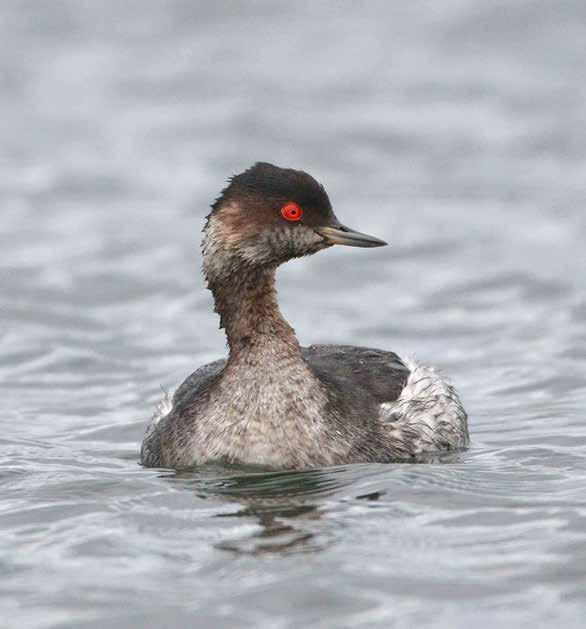

Gi Grieco
Gi Grieco
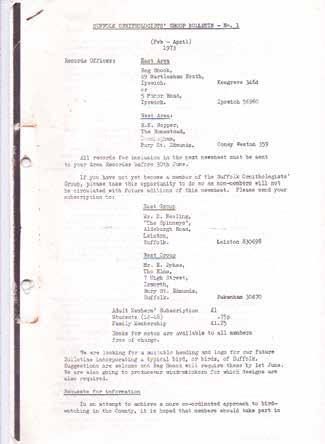
Welcome to this edition of The Harrier. This being the 200th edition we’ve decided to make it a bumper one! A copy of SBG’s first ever publication, Bulletin #1, was sourced with a scanned image included. Times have changed in its production, from those early days of when Reg Snook produced it on a Gestener on his dining table to currently being generated on laptops and PCs, getting it digitally printed, courtesy of the excellent production of Lester from Pleasure For Printing, which allows us to have full colour images throughout.
Thanks to all those who have sent in articles for publication and there is a bit of a theme of the past, present and future. There’s a look back at a time when sewage works were famed birding hot spots (I recall reading about them in my youth). The present is covered by the work of Justin, with Ellie and Dan, in the ringing study at Trimley, the various ongoing projects and surveys to gauge the
current status of some of our birds species while the Corncrake reintroduction takes a species from our recent past and see if it can make a comeback in the years to come. An interesting observation of birds from our past that are now making a comeback is detailed in another article and which must have been quite a spectacle.
We have a comprehensive update on bird sightings of the winter, again a mild one weather wise and we wonder what impact the weather patterns will have on our bird populations. We have another great selection of some of the groups’ field trips including a stay on Orfordness and thanks to Adam for writing his first trip report. We’re glad that merchandise is now available with our new logo – the new fleece was worn by the trip leader on the recent Brecks trip as well as in the Pyrenees earlier in the month and is very warm and comfortable!
Following the latest UK Government advice we have regretfully decided to SUSPEND all SBG INDOOR and OUTDOOR ACTIVITIES until FURTHER NOTICE. We will of course keep the situation under review. Please check the website for further details and any updates -http://www.suffolkbirdgroup.org We will endeavour, if possible, to re-schedule the March and April talks for later in the year or in 2021. For those involved in surveys, we’d like to draw your attention to the BTO’s advice here: https://www.bto.org/community/news/202003-bto-and-covid-19
We would like to wish all our members all the best during this difficult time and we hope you will all take every action possible to ensure that you and everyone else remains safe.
As this is the 200th edition of the magazine it was good to look back at the very first issue, back from when the group was formed in 1973. The publication was Suffolk Ornithologists’ Group Bulletin No.1 and covered the period from February to April that year. The group had two regional groups, West and East. The bulletin had 10 pages and included contacts from the group with details of membership subscription – an adult membership was £1. There was a request to design a heading and logo for the new group. Still an important aspect of the group today, projects featured with requests for participation in surveys on Kestrel, Nightjar and Cuckoo. Additionally there was a Local Study request, what today we’d call patch birding, with emphasis on breeding species and habitat. Breeding records of a certain few species were requested including a species that unfortunately has long ceased to breed in the county, Red-backed Shrike. Two forthcoming field meetings were listed, a walk in King’s Forest and at Redgrave; again something that is still an important part of the group in 2020. The remainder of the bulletin covered bird sightings in the county between February and April. Some interesting records were a male Marsh Harrier seen by 11 SOG members near Bury St. Edmunds on April 29th – back when it was a very rare breeding bird. A note that Barn Owl still appears to be declining and records were needed urgently and Black
Redstart recorded from four areas including ‘interesting report from Sizewell Nuclear Power Station of a female bird on March 23rd (AC), then on 25th April 2 female and one male seen on same site. On 26th April a very dark male appeared’; this species still favours the site.
The Harrier is still an integral part of Suffolk Bird Group and thanks must go to all who have contributed, whether in print or images, to both the Bulletin and The Harrier over the 200 issues.
Just a reminder that there is an easy way to raise money for Suffolk Bird Group. SBG has been signed up to Everyclick for a few years and almost £275 has been raised for the group so far. SBG Everyclick web page – https://www.everyclick.com/charity/suffolkbirdgroup.
Everyclick was launched in 2005 to provide an easy way to raise free funds for charities just by searching the web or shopping online.
• Search - Use Everyclick to find what you need. It’s powered by Bing so you can trust our results.
• Shop - Use the Give as you Live shopping links to raise free funds at 4,400 online stores
• Raise - We make a donation to the charity of your choice - at no cost to you.
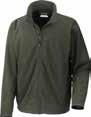
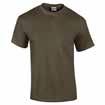
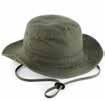
Suffolk Bird Group now has a selection of clothing bearing the new logo of the group. Items come in a variety of colours and SBG prices are:


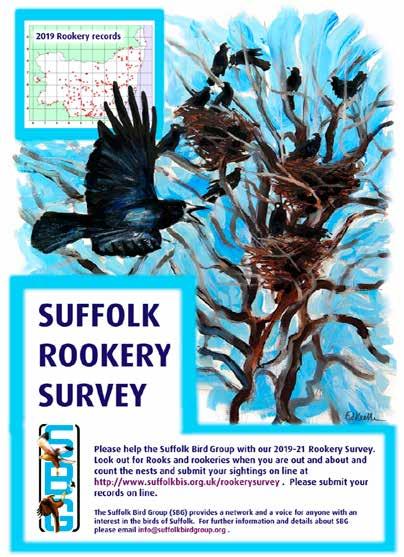
Thanks to everyone who submitted records for the rookery survey last year. There are still parts of Suffolk with gaps, as can be seen on the map on the poster below, and we’d especially appreciate coverage of these areas.
The survey page to enter details can be found herehttp://www.suffolkbis.org.uk/rookerysurvey
Information on how to fill in the information on the survey page can be found in Harrier #196.
Mick Wright
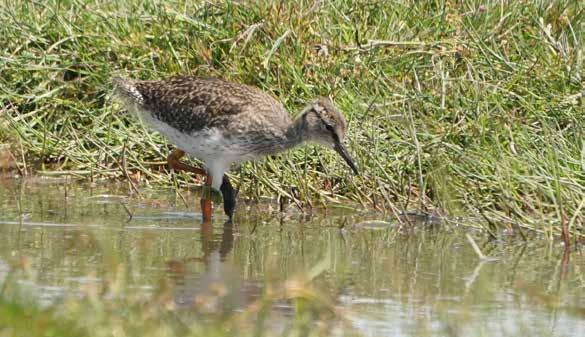
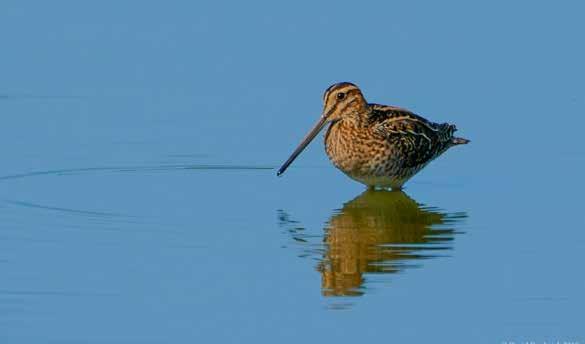
The purpose of this survey is to assess the importance of both existing and new wet grassland and also other breeding wader habitats in England (as provided by agrienvironment schemes) for declining breeding birds such as Curlew, Lapwing, Redshank and Snipe. The survey will re-visit sites from the 1982 and 2002 surveys, including sites from the 2009-10 RSPB targeted areas, as well as other new sites since 2002.
The survey will involve up to four visits between mid-April and the end of June to count and map all waders within allocated sites featuring wet grassland and/or farmland sites containing specific agrienvironment scheme (AES) options. Simple habitat and land management measures will also be recorded during the field work. All regions of lowland England will be covered. Surveyors will need to be able to identify
several common wader species by sight and sound, and also to be familiar with display and territorial behaviour.
The survey will require three daytime visits, with at least one week separating each, and a single dusk visit for Snipe during May - only if present at the site. It is important to make the first visit in April if possible, as this is an optimal time to survey Lapwing. Daytime visits should be carried out preferably between dawn and midday – avoiding cold, wet or windy weather.
A map will be provided showing you the boundary of your site. Cover all of the area indicated to ensure results are comparable to the 2002 surveys. Sites will need to be surveyed systematically, field by field, walking 100m of each part of the site. Record all waders on maps provided using standard BTO species codes.
Ducks should also be recorded and we are also keen to use the opportunity to record Yellow Wagtail and Meadow Pipit. Only wader species need to be mapped.
The BWWM webpage is now live: (https:// www.bto.org/our-science/projects/ breeding-waders-wet-meadows), and all survey documentation and recording forms will be available to access and download after 26th February, from the Resources page. This survey is entirely online and surveyors are expected to download their own survey documents and recording forms, with data also being entered online. However, paper forms can be provided to non-online surveyors.
Key survey points
• Surveyors must seek permission entering private land before survey work commences – we can help with identifying landowners and may be able to provide contact details, if available.
• All Waders (and other birds) need to be recorded at the field level.
• Habitat details need to be recorded for every field within the site on the first visit, and any changes to habitat or ground conditions need to be recorded on all subsequent visits.
• It is important that survey timings are adhered to and evening Snipe visits are carried out within the specified time of day.
RSPB sites - As mentioned, the survey has been jointly organised with RSPB who will be coordinating staff/volunteers on all RSPB managed sites/reserves or other sites where they are overseeing wader survey work. So, as a consequence, the list of sites that I am coordinating for the BTO does not include the RSPB sites. This list can be found on the SBG website.
Thank you and I look forward to hearing from you.
If you have any questions or need further information about the survey please contact me; Mick Wright BTO RR Suffolk Email: kupe1515@sky.com
Dave Pearsons
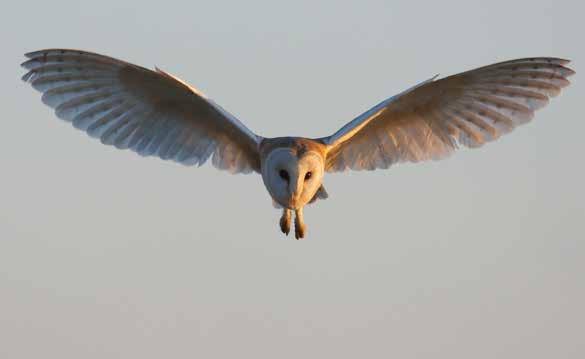
I am responsible for organising the monitoring, ringing and record keeping of around 300 boxes in the south-east part of Suffolk. The area covers the Shotley peninsula north of Ipswich to Helmingham, across to Framlingham, across to Westleton then south to Felixstowe.
My impression is that the project overall has had a better year for breeding Barn Owls - certainly in the south-east area, results have been better than in 2018. It seems as though the vole population was very good. There are around 300 boxes in the area, of which 55 showed signs of Barn Owl activity; this is down on last year when 64 had activity in 2018. However those 55 contained more pulli. Many of the females in 2018 were not in breeding condition; the “Beast from the East” didn’t help that. The
boxes were therefore often being used only by roosting birds. Of the 55 boxes showing Barn Owl activity 39 (34 in 2018) boxes contained 109 (70 in 2018) pulli, with just 3 perishing in the box. Brood sizes were higher this year with 6 boxes containing 4 pulli and one with 5. Of the 110 pulli 77 were ringed with 3 adult birds ringed. There were 18 failed eggs, of the failed eggs 5 came from a box where eggs were present in early September, if they had succeeded then the pulli would have fledged sometime in November.
Tawny Owls were reported in 1 box, Little Owls in 4 boxes, Kestrel 9, Stock Dove 41, Jackdaw 26 and Grey Squirrel 1. One surprise addition to the south-east list was the presence of Mandarin Duck in one box. Empty boxes numbered 64, with a further
56 not checked and a further 12 being either damaged beyond repair, in unsuitable sites or too high to be checked safely. While the unchecked number is disappointing there is only so much that can done. They represent, in general, boxes that I inherited from an area that had been subject to some neglect in the past. I am hoping to re-establish some contact with the box owners in 2020 to continue what has been done with others this year.
One interesting event concerned a box on Snape Marshes which fell from the tree that it was secured to. The monitors, Derek and Lesley Walduck together with Mick Wright
found 3 underweight pulli in the box. Mick took the pulli to our local rehabilitation expert, Peter Merchant, who fattened the pulli up over 7 days, force feeding for 2 days. Derek and Lesley arranged for the box to be repaired by Suffolk Wildlife Trust and it was then placed back in the same tree. The pulli were returned to the box and were hand fed for two days. The adults then returned to feed them and I understand the young where seen to fledge. Amazing!
In conclusion, I thank all the monitors for their continued support and hope those heart-shaped faces will look back at us from their boxes in good numbers in 2020.
Footnote: A fundamental part in the original setup of the Suffolk Community Barn Owl Project was to involve the community in increasing the number of Barn Owls in Suffolk. In the south-east I tried to involve as many people as I can in the project. Currently there are about 24 volunteers carrying out monitoring and ringing activities in the south east.
Emily Jordan
Pensthorpe Conservation Trust’s Corncrake
Reintroduction Project is now in its sixth year of implementation, with the first birds released into Norfolk in 2015. The overarching aim of the project is to establish a sustainable population in the Wensum Valley to support the return of the Corncrake to East Anglia, following a similar project lead by the RSPB in Cambridgeshire.
Why reintroduce the Corncrake?
The Corncrake is on the RSPB’s red list for urgent conservation action in the UK. Once widespread across England and the wider UK, populations are now largely restricted to the Scottish islands. Dramatic declines in the 20th century have been attributed to habitat loss and changes in agricultural practices, such as early mowing, which can directly result in the death of chicks as Corncrakes are ground-
nesting. Intensive farming methods can additionally impact the abundance of insects, the Corncrake’s prime food resource, and they are particularly sensitive to disturbance by livestock and machinery.
Reintroductions are a useful conservation tool in cases where a species has undergone severe declines or been lost from an area. If no range expansion is likely to occur naturally, translocating wild or captive-bred birds has the potential to greatly improve chances of species recovery.
Corncrakes are a flagship species for farmland conservation, encouraging habitat management beneficial for wildlife, and their reintroduction provides a valuable platform for partnerships with landowners and public engagement.
A key part of the project is liaising with landowners and encouraging corncrakefriendly habitat management practices. As ground-nesting birds, corncrakes seek habitat with long vegetation which provides cover enabling them to remain hidden from predators. Local farmers have engaged with advisory sessions on farmland conservation and play a key role in maintaining suitable habitat; some of their achievements were even presented on BBC Countryfile in August 2019.
Corncrake chicks are bred in captivity at Pensthorpe Natural Park. Upon hatching the young birds are cared for in brooders, requiring hourly feeding from 6am-10pm. By 14 days of age they are moved to prerelease pens situated within the release area, which are maintained to provide a seminatural environment. Chicks are released into suitable habitat once they are around 35 days old following a veterinary health check. >100 healthy young corncrakes have been released into the Wensum Valley over the past 5 years.
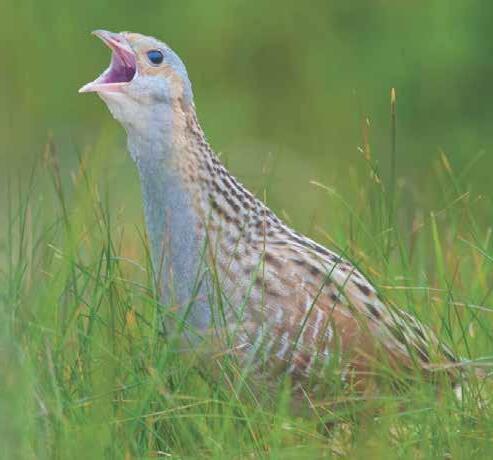
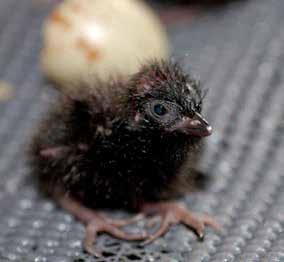
In 2019 a new approach was taken and the team successfully raised healthy chicks for release using parent-rearing husbandry. Not only is this method less labour intensive, but it may help to promote natural development processes and produce young which are better adapted to the wild environment, and will likely form the basis of ongoing breeding efforts.
Monitoring
Staff and volunteers survey the area around release sites every breeding season. Corncrakes are migrants, and start returning to the UK from their overwintering grounds in sub-Saharan Africa from April. Once they have found a suitable territory males begin calling to attract a female, and after mating will move on to settle in a new area. As the species is otherwise very secretive and seldom seen out of cover, this distinctive, rasping ‘crex crex’ call is the focal indicator of Corncrake presence. Surveys are conducted between 22:00-03:00 at night when males are most likely to be heard calling due to increased activity and reduced noise pollution, however corncrakes may be heard at any time and a large proportion of birds detected are reported by members of the public. The monitoring season ends in August when birds begin to moult in preparation for autumn migration.
So far we have confirmed >20 Corncrakes from the programme returning to East Anglia and settling across Norfolk and North Suffolk. Whilst some of these males were found within the Wensum Valley, it is apparent that returning birds are settling across a wider area than originally expected, which presents a challenge for monitoring as it is very difficult to survey such a wide area at all thoroughly, especially with such a small team. It is probable that many of the birds go unheard, unrecognised or unreported.
In the future the project hopes to improve the scope of monitoring efforts in order to gain an improved perspective of the abundance and distribution of corncrakes in East Anglia. Citizen science and support from the local community continues to be invaluable in our efforts to return this iconic farmland species to its former range.
If you are lucky enough to hear a Corncrake in East Anglia, please let us know by email at crex@pensthorpe.com, via twitter @ WensumMonitors or by calling 01328 851465 with a message for the Pensthorpe Conservation Trust.
We would be very grateful if you are able to provide your contact details, the date and time you heard the Corncrake, and its location as precisely as possible.
If you are unsure what a Corncrake sounds like or would like to learn more about our work, please visit the ‘Our Projects’ section of the Pensthorpe website at www.pensthorpe. com for further details and to view a video of a male ‘crexing’.
Chris Gregory
Those of us slightly longer in the tooth will probably remember what fantastic places the late Victorian sewage farms were for birds. I remember as a young boy cycling miles to Cambridge Sewage Farm, my local site, where on arrival there’d be a mad rush to grab the notebook which had all the recent sightings scribbled down inside! From the late 1920s, sewage farms became recognised as one of the most important inland habitats for birds in the UK. The open settling beds supported huge numbers of invertebrates and in spring and summer myriads of insects hatched from the drying pools drawing in large numbers of migrants. Waders, terns, hirundines and wagtails all gorged on the clouds of tiny black sewage flies. Sewage farms across the country were hotspots for rarities and megas, playing host to Sharp-tailed Sandpiper,
Killdeer, Black-winged Pratincole and Aquatic Warbler to name just a few. They didn’t just attract passage birds, in 1945 two pairs of Black-winged Stilts successfully bred at Nottingham S.F. which constituted the first breeding record of this species in the UK. The putative record from the following year of a breeding pair of Moustached Warblers at Cambridge Sewage Farm was unfortunately thrown out recently following further scrutiny of the field notes!
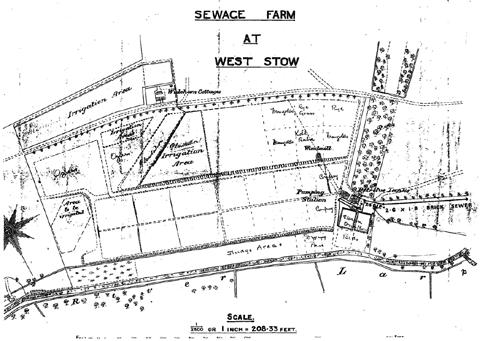
Soon after moving to Suffolk in 1986 I discovered that a smaller sewage works once existed at West Stow. A 112 acre site along the Lark valley was purchased by the Borough Council exactly one hundred years earlier in 1886 so that a new sewage farm could be built to serve Bury St. Edmunds. The new farm at West Stow was built on the flat
floodplain to the north of the River Lark and like most sewage schemes at that time it relied on gravity in order to move the waste. Several miles of underground pipes were subsequently laid between the town and the farm and at its peak the farm dealt with 300,000 gallons of sewage a day. However it very quickly began to struggle with the increasing amount of waste produced by the rapidly growing population of the town. Despite various efforts to improve performance the site closed in 1953 and was decommissioned in 1962 when a new site at Fornham St. Martin came online. Today only the Victorian pumping station remains as testimony to that brief industrial period.
In his book ‘The Birds Of Suffolk’, Bill Payn describes West Stow as the best known sewage farm in the county. But it was not just on the radar of local birders as the Cambridge Bird Club, which included records from the Brecks at that time, published many observations from the site in its reports during the 1950s and 1960s. A few years ago I was given a logbook which contains entries of wildlife sightings from members of the Bury St. Edmunds Naturalists’ Society. It also provided a fascinating glimpse into the birdlife at the site in the early 1950s. I have listed some of the more notable records from this and the Cambridge Bird Club Reports at the end of this article.
About 40 acres of the farm at West Stow was laid out to receive sewage; 20 of these were for low-level gravitational lagoons and about 13 were for high-level lagoons which had to be filled by pumping. The remaining land was irrigated and planted with crops, hence the name ‘sewage farm’. Annotations on the plan of the sewage farm show that the disused beds were planted with various vegetable crops including mangolds (beets) and kohlrabi. Other areas were set aside to grow Comfrey and Rye, with Osiers also being planted. Clumps of cultivated plants,
including Tomatoes, occurred naturally from seed imported in the sewage and these would have provided food for finches and sparrows.
Records show that a wide variety of passage wader species visited the sewage farm. These included Green Sandpipers which often occurred in relatively large numbers in autumn. Other regular species included Ruff, Dunlin, Common Sandpiper and Spotted Redshank while Wood Sandpiper, Curlew Sandpiper and Greenshank were less frequent. In winter the site would have held numerous Snipe and there is an uncorroborated record of two Great Snipe feeding on the settling beds in August 1951. Large flocks of Greenfinches, Siskins and Linnets would have feasted on the Polygonum persicaria seeds and varying numbers of Hooded Crows featured regularly and varying numbers over-wintered during the 1950s and early 1960s. Large numbers of wagtails, Meadow Pipits and winter thrushes would have visited the farm during the winter months, especially at times when the beds were being ploughed. There were relatively few reports of breeding species but the rank bankside vegetation would have probably held a few pairs of Yellow Wagtails, Sedge Warblers and possibly Grasshopper Warblers. Elsewhere, Shelduck and Redshank appear to have nested intermittently and Blackheaded Gulls bred in small numbers. Another interesting observation was that Stock Doves often nested in the disused irrigation pipes.
Its value to birds gradually diminished when the sewage farm was decommissioned and reports from the site had completely dried up by the late 1960s. Following small-scale mineral extraction in the 1960s the resulting quarry was used as a municipal rubbish tip then covered over using soil from another mineral excavation at the western end of the site. The site now forms part of West Stow Country Park, which was officially opened to the public in 1979. The area was put into the
Breckland ESA scheme for several years during the 1990s during which time it was grazed by sheep. During this period the short grass often attracted geese from the neighbouring Lackford Lakes, SWT reserve as well as winter flocks of Meadow Pipits and Linnets. In recent years it has been left largely unmanaged and
as a result has become an important foraging area for Barn Owls and Kestrels which feed on the numerous small mammals. In summer Nightjars occasionally fly over from Kings Forest to feed over the grasslands and in autumn flocks of Goldfinches feed on the thistles.
Here are a few of the more interesting records from the 1950s and 1960s:
1949/1950 about 12 Hooded Crows present during the winter period
1950 up to a dozen Green Sandpipers at a time during August and September
1951 three Wood Sandpiper on settling beds on July 28th
Unconfirmed report of two Great Snipe feeding on settling beds on August 18th
Six Redshank on July 7th
Black Tern May 2nd
Pair of Yellow Wagtail with five fledged young, July 7th
Seven Hooded Crows foraging in settling beds
60-70 Siskins feeding on Polygonum persicaria seeds on settling beds February 15th
1952 peak count of 30 Green Sandpipers on August 9th
Black Tern, August 26th
1953 peak count of 40 Green Sandpipers on July 30th
1954 a good variety of waders seen this year including Black-tailed Godwit, Greenshank, Curlew Sandpiper, Sanderling and Ruff
10 Hooded Crows on settling beds
1955 up to 45 Green Sandpipers present in August
1956 20 Hooded Crows on March 18th
1957 38 Black-headed Gulls, including 11 juveniles were seen in July
Two Black Terns seen May 2nd and 3rd
Up to 25 Green Sandpiper present in August
1959 Shelduck probably bred on the site
Three Wood Sandpipers, August 3rd
Three Hooded Crows in November
1960 22 Green Sandpiper in autumn, also 2 Ruff, Greenshank and Dunlin
1966 up to six Hooded Crows on March 12th
40 Great-black Backed Gulls on December 11th
References:
The Birds Of Suffolk, WH Payn. (Ancient House Publishing, 1962)
“Sewage-farms as Bird Habitats”, AW Boyd. (British Birds, 1957)
Cambridge Bird Club reports 1951 to 1968 – various editors
In 2014 I was invited to write an article for the winter edition of the Harrier which I was more than happy to do as the Wallasea project was then, as it is now, very close to my heart because of my personal involvement with the project as Natural England’s area team lead for protected species. It also provided the opportunity to work with dedicated RSPB staff, in particular Chris Tyas who has led on the project for the RSPB and Charlie Dwight, a consultant ecologist whom I am pleased to say, I have had opportunity to continue to work with in developing mitigation and habitat creation for Water Voles.
The dry grassland on the sea walls surrounding Wallasea provided a habitat corridor for Adders and Common Lizard as they do throughout Essex, while Water Voles occupied the borrow dyke and the ditches crossing the island. Many of the ditches were
dry for all or part of their length and offering sub-optimal habitat for Water Voles but still supported viable populations. The presence of species afforded protection under the Wildlife and Countryside Act was an additional complication but also an opportunity. Natural England, RSPB and consultant ecologists worked together to create new habitat for reptiles and Water Voles as part of the largest coastal habitat restoration ever undertaken in the UK.
An area twice the size of the City of London transformed into a nature reserve for rare and threatened wildlife. The new network of interconnecting ditches was designed to increase opportunity for Water Voles to withstand predation and quickly re-colonise from cut offs and side channels. It is also our intention that the ‘cryptic’ landscape will make it harder for terrestrial predators such
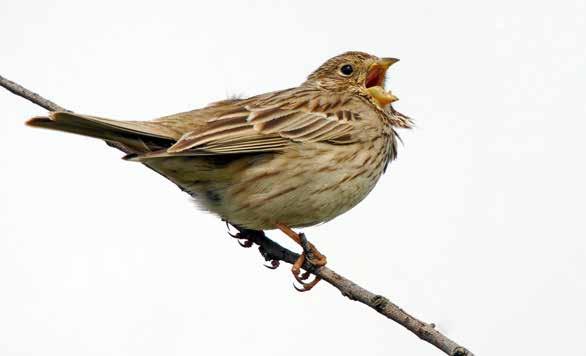
as Foxes to easily locate nests and eggs as opposed to linear open habitats where nests can be stumbled upon with minimal effort. Additional habitats created at Wallasea are areas of wild bird cover to provide seed for farmland birds, particularly Corn Buntings; and rough grassland for Adders and Common Lizards that were translocated from areas of the island before they were converted to wetland. This rough grassland also provides excellent hunting areas for raptors.
Another innovative feature is the predatorexclusion fence based on fences used to protect nesting terns and gulls on islands that have been pioneered by Sussex Wildlife Trust at their Rye Harbour Nature Reserve. This Wallasea predator fence encloses a 75-ha area containing coastal grazing marsh, Grass Farm Lagoon and its associated salt pan. The fence is located within a water-filled ditch. It is designed to protect wader, gull and tern nests from both Fox and Badger that are unable to jump, or climb over a fence from a swimming position. The top of the fence is at, or slightly below, ground level, and so does not interrupt the view across the landscape.
I have previously described the historical background to the project, in the 2014 winter edition of the Harrier, how saltmarsh between the rivers Crouch and Roach was enclosed by sea walls, drained, and grazed by sheep and cattle until the post war years when arable farming replaced livestock on the majority of farms. Protected from storms and surge tides by the same sea walls for 400 years, every gap and tumble of clay rebuilt, plugged and tamped down before the next storm, the walls held firm, until the salt marsh that had for so long cushioned the walls against storms and high springs crumbled and fell away into the rising sea levels of the 21st Century.
It is often the way that the consequences of our actions are only fully understood as we stand at the edge and watch our footprints slipping away with the rising tide. In the 21st
Century, climate change and rising sea levels demonstrated the importance of dynamic natural systems and our dependence upon allowing them to function unhindered as we take a step back. To use yet another marine metaphor it takes a sea change in how we view the natural world and our place within it before we can begin to change and make space for nature and ensure our own wellbeing. Without sea walls, saltmarsh will move inland even as its seaward edge erodes into rising tides, continuing to absorb wave energy and reducing the impact of storms and the likelihood of flooding further inland. With the erosion of salt marsh, and as the sea walls encircling Wallasea Island became ever more vulnerable, the costs of maintaining them in combination with the economics of farming encouraged the owners of Wallasea to offer the land for sale.
The serendipity of the timing of the offer of sale to the RSPB in 2009 and the Crossrail Project looking for somewhere to dispose of 3 million tonnes of soil and clay dug out from the new tunnels beneath London was a rare opportunity for a major transport development project to create new wildlife habitat on a landscape scale. The excavated material has been used to re-profile what had been an arable plain to create new islands, tidal lagoons and saltmarsh. In May last year work began on the final phase of the Wallasea Island Wild Coast Project.
The contractors BAM Nuttall broke ground on earthworks that saw the creation of three new areas of coastal wetland habitat – 55 hectares of brackish marsh, 82 hectares of freshwater marsh, and 132 hectares of tidal saline lagoon. Since 2009, when the RSPB purchased 670 hectares of arable farmland in the CrouchRoach Estuary with the aim of restoring it to coastal wetland, nearly two thirds of that area has now been turned into bird and other wildlife-rich habitats. The project is a model for coastal habitat creation and natural
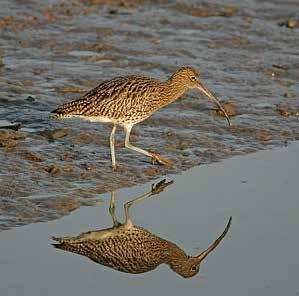
flood risk management, demonstrating how coastal areas can be future-proofed against sea-level rise at the same time as delivering benefits for wildlife. The new nature reserve has also been designed with the future in mind. As the widespread impacts of climate change on nature make themselves felt, the Island’s new habitats are already providing habitat for a wealth of birds and other wildlife. Curlew, Lapwing, Brown Hare, Shrill Carder Bee and Skylark have already begun to benefit.
It is hoped the reserve will also provide suitable habitat and opportunity for Spoonbill and Black-winged Stilt to colonise and breed. Spoonbills have been recorded in late spring/ early summer in each of 2016, 2017 and 2018, but most have been immature birds. A Black-winged Stilt was also present for a single day in June 2017. Other wetland birds of interest recorded at Wallasea in winter or on passage during the last ten years include Cattle Egret, Great White Egret, Temminck’s Stint and Blue-headed Wagtail. Wallasea Island Wild Coast project manager Chris Tyas, said: “After nearly ten years since the RSPB first purchased the land at Wallasea Island with the aim of restoring the coastal wetland that once existed here, it’s fantastic to finally be embarking on the final phase of habitat
creation – the last piece of the puzzle that will complete the picture of Wallasea Island as a coastal wetland for the future, for wildlife and people”
The reserve which now covers more than 740ha is open at all times between 8am and 8pm or dusk, whichever is earlier. There are three walking trails – Jubilee Marsh, Allfleets Marsh and Marsh Flat. The trail is complemented by hides and shelters designed by Biotope, a Norwegian architectural practice based in the Arctic town of Varanger, which provide a comfortable place to sit overlooking the river. There are no facilities on site at the moment but the RSPB hope that in time a reception hide will welcome visitors. The sea wall footpath which runs along the northern side of the reserve along the River Crouch, provides uninterrupted views to the north of the river and is open at all times.
In February 2016 the SBG, or SOG as we were then, visited Wallasea where we were met by Chris Tyas who had arranged permission for our group to visit parts of the island that were not yet open to the public. We were escorted along rough tracks that had until recently been used by excavators and heavy trucks. On the day of our visit gales and strong winds made it all but impossible to hold a scope steady and not surprisingly few birds were seen although we were fortunate to see two Peregrines, two Merlins and a Short-eared Owl.

Jeremy Mynott
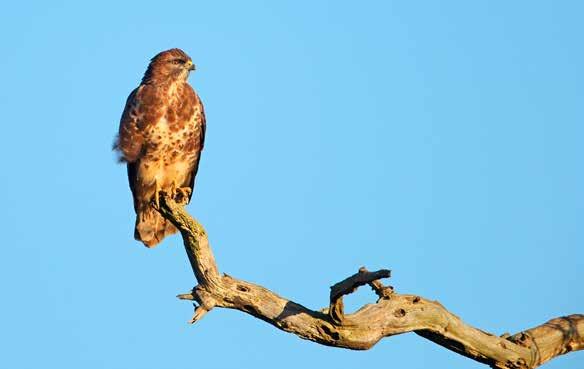
I saw something by a Suffolk road in the west of the county the other day that would have been inconceivable only 20 years ago. There were three scavengers contesting a roadkill. The first was a Buzzard Buteo buteo, once common throughout Britain, but after relentless persecution by gamekeepers in the nineteenth and early twentieth centuries its range had become restricted to Wales and the West of England; later attempts to recolonise were further restricted by the deadly effects of myxomatosis in the 1950s (so decimating its staple prey of Rabbits) and by the impacts of organochlorine pesticides in the 1950s and 1960s (from which all raptors suffered by being at the end of the poisoned food-chain, as exposed in Rachel Carson’s Silent Spring of 1962). It wasn’t until 1999 that the Buzzard was finally re-instated as a Suffolk breeding bird and now they are a familiar sight again.
Indeed, they have now overtaken Kestrels as Britain’s commonest raptor.
The second scavenger was a Red Kite Milvus milvus, a similar story, though a more extreme one. In the Middle Ages they were protected by Royal Decree as they kept the city streets free of carrion and rotting food. But from about 1600 they were persecuted as inimical to game interests, and by the mid-twentieth century the remnant Welsh population had been reduced to just a handful of pairs. These magnificent birds were finally rescued by a large-scale re-introduction programme in the 1990s that has seen them spread back to many of their old haunts, with the difference that they haven’t (yet) become city scavengers again, thanks no doubt to our improved public sanitation services. Red Kites are still an exciting sight in our county but no longer a great rarity.
The third bird in my little tableau was a Raven Corvus corax. This charismatic corvid, the much larger relation of the carrion crow Corvus corone, has been slower to spread back, after an even longer period of absence. The last breeding record in Suffolk until 2018 was in 1869 and it was virtually unseen in the county throughout the twentieth century. Now at last they are moving back eastwards across England; occasional sightings are being reported here and there and one or two pairs are breeding again in both the east and west of the county. Ravens of course are birds of myth and legend, the first bird to be sent out by Noah from his Ark and the traditional guardians of the Tower of London, whose departure it was believed would presage the fall of England.
Justin Zantboer
All these three species are now protected by law and it was wonderful to see them together in one spot. But I now need to identify the road-kill they were feeding on to complete this story. It was a Pheasant Phasianus colchicus, one of the many we see killed by cars at our road-sides every day. Some 60 million (yes, 60,000,000) of these non-native birds (the scientific name is the clue to their origins near the Black Sea) are released annually into the British countryside so that they can be shot, and it was mainly for the protection of this (scarcely wild) human quarry that the three native species above were systematically slaughtered for so long. Perhaps what I witnessed, therefore, was an ironic historical revenge of a kind?
Introduction
As during 2018, along with my two children Ellie and Dan, we were able to operate from the end of March through to November although ringing in Spring was cut short from April 20th through to May 6th as I was incapacitated with broken ribs. Operations also stopped from 10-20th August and 20-27th October for family holidays. Otherwise, coverage was fairly constant although poor weather during early September certainly impeded us, with the monthly ringing total reflecting this. As per previous years, netting was restricted to the scrub area between the river wall and the Reserve perimeter so disturbance to both the lagoons and the mudflats was virtually non-existent. We continued to operate the same seven nets although more often than not, we only used one or two.
Ringing details - Spring:
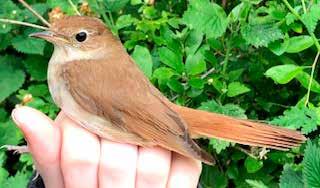
March to May saw the ringing of just 91 birds of 16 species. A female Cetti’s Warbler and a female Common Nightingale, both with good brood patches, were caught on May 19th and May 27th respectively giving a strong indication that breeding on the Reserve was taking place and with male birds of both species singing close by, the signs were good. Interestingly, especially considering the limited coverage, warbler numbers were up on Spring 2018, as shown in the following table:
heading inland between 0800-1000hrs. Eleven of these were ringed by us that morning.
Ringing details – June:
Reasons for this can only be guessed at but it seems most likely that the weather conditions were more suitable for dropping migrating birds onto the Reserve. Certainly, this was the case on April 20th when it was estimated that 80 Blackcaps passed through in small flocks, all
Netting was reduced to avoid disturbance to nesting birds. When we did ring, we only used a maximum of four nets and for the most part, just the one so our total of 71 birds of 15 species was very pleasing. The male Common Nightingale was caught on 9th and like the female caught in May, showed signs of breeding with a very good ‘cloacal protuberance’ (the male appendage being very prominent). The first juvenile Cetti’s Warbler of the season was ringed on 22nd with other juvenile birds ringed being Reed Bunting on 9th, European Robin on 10th, Eurasian Reed and Sedge Warblers on 22nd and Lesser Whitethroat and Common Chiffchaff on 29th. Lots of juvenile tits were on site with a flock consisting of at least 100 Blue Tits, 50 Great Tits and 30 Long-tailed Tits being present on 22nd, indicating that, locally at least, they’d had a good breeding season. Two more unusual dispersing juvenile birds were ringed, these being a Eurasian Treecreeper on 15th and a Marsh Tit on 22nd; the latter being a real rarity for the Reserve and indeed the local area. It was also only the second ringed on the Reserve, with the first being a juvenile ringed on 20th June 2015. This bird was also caught on a day when large numbers of tits were moving through the Reserve.
Ringing details – July:
July saw a sharp rise in the numbers with 173 birds of 16 species ringed compared with just 41 birds ringed during July 2018. Most of the birds we caught were juvenile Eurasian Reed and Sedge Warblers with 48 and 85 respectively ringed. We can only speculate as to whether these were locally bred birds. Of the seven Reed and 15 Sedge Warblers ringed up to 10th, none had any fat content, suggesting they hadn’t travelled far so these would’ve most likely have fledged locally and possibly from the Reserve. From 14th onwards, we started to catch a few birds with some fat content so it’s difficult to know for sure whether these were birds fledged on the Reserve, building up fat reserves in preparation to migrate, or birds from elsewhere fuelling up on the Reserve. Other recently fledged juvenile birds ringed included one Cetti’s Warbler, six Blackcaps, seven Common Whitethroats, one Lesser Whitethroat, two Common Chiffchaffs, three Dunnocks, two Common Linnets and five Reed Buntings. It was felt that all of these birds probably fledged on the Reserve and with adults of each species seen and heard frequently, this would come as no surprise.
Three unusual juvenile birds were ringed, these being a Yellow Wagtail on 14th, an Eurasian Bullfinch on 25th and a Great Spotted Woodpecker on 31st. The Bullfinch and Great Spotted Woodpecker were presumed to have fledged on the Reserve, but the Yellow Wagtail was more intriguing as no adults had been seen since the Spring, but the plumage of the youngster suggested that it hadn’t come very far at all. Both the Great Spotted Woodpecker and Yellow Wagtail were also the first we’d ringed on site.
Ringing details – August: It’s fair to say that we certainly didn’t expect to ring 601 birds of 26 species, given that we thought that the 265 birds ringed in 2018 was good. The numbers were swelled with an impressive 278 Sedge Warblers, 90 Eurasian Reed Warblers, 35 Common Whitethroats and 20 Willow Warblers, nearly all of which were juvenile birds with the two latter species’
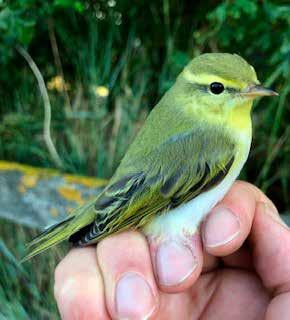
numbers exceeding the total number that we’ve ringed here. With the month being dominated by juvenile birds, it was nice to catch two freshly fledged Common Nightingales on 4th, confirming successful breeding. Of interest, one of these birds was far less developed than the other so we were happy that it was re-trapped on 24th in a much more advanced state. Nine juvenile Cetti’s Warblers seemed exceptional considering we ringed none during August 2018. It’s difficult to say if these were locally fledged birds but with at least two males on territory, we’d like to think that some were. With their numbers rapidly declining nationally, ringing nine Yellow Wagtails during the month was remarkable, especially as eight were juveniles and that these were all caught during the day, and not coming to roost. Two first year male Common Redstarts ringed on 4th and 28th were the first ringed on site with other unusual species ringed being two Common Grasshopper Warbler on 21st and 22nd and a Kingfisher on 24th but the star bird of the month was a stunning Wood Warbler ringed on 4th which again, was the first ringed on site.
Ringing details – September:
258 birds of 22 species ringed which given the declining daylight and poor weather during the month, was better than we’d hoped for. Warbler numbers, as would be expected, dropped off with 48 Sedge Warblers, 39 Eurasian Reed Warblers and 27 Common Chiffchaffs leading the way although another 14 Cetti’s Warblers was encouraging after this species took a hit during the ‘Beast from the East’ of 2018. Common Reed Bunting passage started midmonth with 43 ringed. Surprisingly not a great month for oddities which again, was most likely a reflection of the westerly biased winds. We did however ring four Common Kingfishers throughout the month with each bird being caught in the same net in almost exactly the same position, so we’ve obviously got their flightpath well covered.
Ringing details – October:
205 birds of 21 species ringed wasn’t a bad return as visits were limited to weekends only. As with 2018, Common Reed Bunting numbers
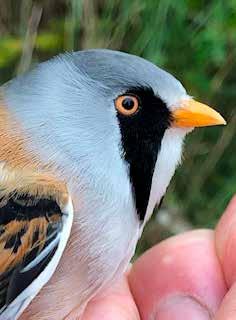
were good again with 90 ringed with Longtailed Tits being the next highest species with 25 ringed. Other local coastal sites recorded big numbers of Long-tailed Tits moving through so although our captures were reasonable, we could’ve expected a few more. Warbler numbers were higher than last year with 15 Blackcaps and 12 Common Chiffchaffs ringed but with other local sites reporting much higher numbers of Blackcaps, the belief that we lack their (and lots of other species) preferred food plants, such as Elderflower and Bramble, probably accounts for our lower numbers. Of particular interest were very late records of both Sedge Warbler and Common Whitethroat. Four Sedge Warblers were ringed during the month which is unusual but the last on 19th is particularly late. A Common Whitethroat ringed on 30th was exceptional and was considered highly unlikely to be of UK origin. A Yellow-browed Warbler ringed on 7th was a long overdue first site record and certainly a welcome addition to the site’s Ringing list, this being the only bird caught that day! Single Bearded Tits ringed on 12th and 20th were the only other unusual species ringed.
Ringing details – November: 79 birds of 16 species ringed with the undoubted highlight of our year being our first ever Water Pipit ringed on 17th. Only just over 200 of these have ever been ringed in the UK and a lot of these would’ve been targeted at specialist sites so for one to turn up unexpectedly in our net, at a site that only rarely records them, is extraordinary. Rather bizarrely, it was also the 1500th bird to be ringed in 2019. With 20 Common Reed Buntings and 15 Goldcrests being the only significant totals, it was more about quality rather than quantity this month with a Common Stonechat ringed on 9th being our first ringed at the site, our third Bearded Tit of the year also ringed on 9th and an incredibly late Willow Warbler ringed on 3rd; this bird was almost certainly of the northern race acredula
STOP PRESS –
News of our first foreign control!
A Sedge Warbler that we ringed on 2nd September was re-trapped seven days later 757kms away near Braud-et-Saint-Louis, France! The speed with which this bird has covered this distance shows that once birds get the urge, they can migrate very quickly. With Braud-et-Saint-Louis (north of Bordeaux) being located SSW from Trimley, it’s also a useful indication of the route this and other Sedge Warblers take when heading south to their wintering grounds in sub-Saharan Africa.
Summary
A total of 1502 birds ringed of 40 species with our top three species being 431 Sedge Warblers, 208 Eurasian Reed Warblers and 177 Common Reed Buntings. Species added to the Ringing List were: Great Spotted Woodpecker, Water Pipit, Yellow Wagtail, Common Redstart, Common Stonechat, Wood Warbler and Yellow-browed Warbler. We’re still awaiting details on two birds caught at Trimley bearing foreign rings during 2018 and 2019.
The full report can be found on the SBG web site.
The quarterly records section gives a snapshot of birds seen within the county during the period and is compiled by Tony Gdula, predominately from data received by Suffolk BINS. All scarce and rare birds are subject to submission and acceptance by either SORC or BBRC. Updated lists on Accepted and Outstanding Records for previous years can be found on the SBG websitehttp://www.suffolkbirdgroup.org/bird-recording.
November was generally a fairly wet month with only six days when no rain occurred. There were two days with high amounts of rain; 27mm on the 14th and 20mm on the 27th. Day time temperatures ranged from 6C to 14C, the highest occurring on the first two days of the month. There were two nights when the temperature reached doublefigures of 10C, on the 2nd and 26th and two nights below zero, -3C on the 19th and -1C on the 30th.
On the 25th a single Pale-bellied Brent Goose on the Deben Estuary. Two Tundra Bean Geese north off Landguard Bird Observatory on the 21st, 10 at North Warren on the 23rd with four there the following day. Within 52 Pink-footed Geese at Micklemere on the 20th there was one white neck-collared bird. There were also 25 at Southwold on the 23rd and one at Boyton Marshes on the 27th. There were numerous sightings of Greater Whitefronted Geese from the 15th onwards on
the Alde Estuary, Minsmere, North Warren, Ixworth, Snape, Southwold and Boyton. There were groups of four to eight Bewick’s Swans at Minsmere throughout the month. On the first day of the month five Whooper Swans flew in off at Covehithe. Up to four birds were present at Dunwich and Minsmere while at Carlton Marshes there were seven on 22nd, 23rd and 25th. A Greater Scaup seen at Bawdsey on the 4th and 27th. Longtailed Duck offshore at Slaughden on the 6th and 15th and one off Minsmere on the 18th.
Two Velvet Scoter south of Felixstowe Ferry on the 23rd and one off LBO on the 27th. Goosanders were regular at both Minsmere and Thorpeness Meare through the month with two off Stonner Point, River Deben on the 17th and birds offshore at LBO on the 20th and 28th. A Slavonian Grebe was spotted on the Stour Estuary on the 2nd. A number of Purple Sandpipers along the coast at East Lane, Landguard Point and Southwold and the highest count was at Ness Point with nine on the 9th. A Grey Phalarope was seen flying north off Minsmere and later at Dunwich on the 15th with a bird also offshore at Minsmere the next day.
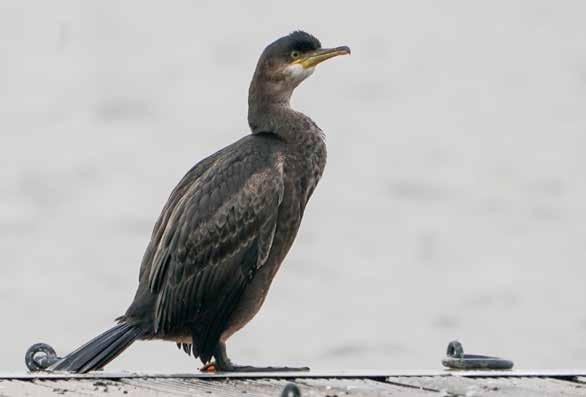
An Iceland Gull noted at Minsmere on the 15th. Caspian Gulls were recorded at Hollesley, Southwold, Havergate Island, Blythburgh, Minsmere and Ipswich. Three Great Skuas at both Slaughden and Dunwich on the 15th. Pomarine Skuas were noted at Bawdsey, Minsmere, Thorpeness, Sizewell and Dunwich. Two Little Auks were seen at Felixstowe on the 6th, although one was subsequently taken by a Peregrine. Other sightings offshore were at Slaughden, Lowestoft, Felixstowe, Minsmere and Walberswick. Great Northern Divers were seen throughout the month along the coast at Minsmere, the Alde and Deben estuaries and off Felixstowe. A Shag seen at Southwold 15th was ringed. A juvenile was on the Alde Estuary between the 22nd and 25th with another in the Lowestoft area on the 28th.
A Cattle Egret was recorded at Minsmere on the 20th and lots of Great Egrets present; sites include Trimley, Southwold, Carlton Marshes Lakenheath, Minsmere, Hollesley, Dunwich and Walberswick, the latter two had up to three birds present.
A Hen Harrier seen on the Orwell Estuary (3rd), Minsmere (5th), Micklemere (9th), Deben Estuary (19th) and Hollesley (18th).
A Merlin at Slaughden on the 15th. There were four Ring-necked Parakeets in the Old Cemetery, Ipswich on the 26th. Raven sightings came from Elveden, Bucklesham and Ixworth. There were numerous and frequent Waxwing sightings from the 14th onwards around Lowestoft/Beccles area. A Long-eared Owl was seen at Hollesley on the 13th. Several Short-eared Owls seen throughout the month at Shingle Street (up to three per sighting), Benacre, Minsmere, Walberswick, Gedgrave and Methersgate Quay. A Shorelark noted at Easton Broad on the 19th, 20th and 24th. Yellowbrowed Warblers at Kessingland sewage works on the 24th (ringed) and 26th and at Minsmere on the 25th. Firecrests seen in small numbers but frequently over the month at coastal locations. A Ring Ouzel at Orford on the 10th and one ringed at LBO on the 15th. Black Redstart noted at several locations including at Sudbury on the 3rd. Late Whinchat at Hollesley and Wheatear at Dunwich, both on the 19th. Water Pipits at Lakenheath, Southwold, Trimley, Covehithe and five at Herringfleet Marshes. Twite were noted regularly at Walberswick and Dunwich, reaching six on the 3rd. Twite were also present at Sizewell with three on the 6th and three near Easton Broad on the 24th. There were high numbers of Snow Buntings throughout the month along the coast at Kessingland, Benacre, Minsmere, Slaughden, Landguard and at Walberswick. The latter site reached 29 birds on the 19th. Singles of Lapland Bunting at Trimley on 2nd and at Covehithe on the 22nd.
A Black Brant was on the Deben Estuary on Falkenham Marshes on the 23rd and 24th. A Puffin was seen offshore at LBO on both the 9th and 15th. A Black-throated Diver offshore at LBO on the 7th.
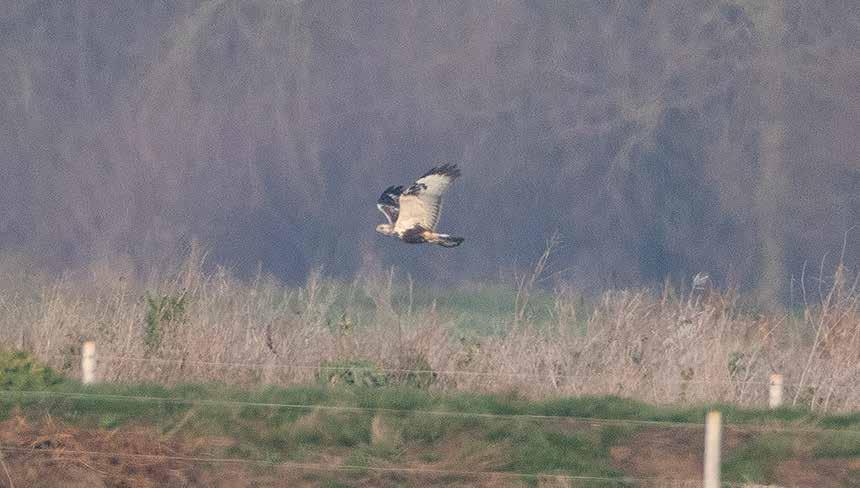
A Purple Heron was reported from the Maltings, Snape on the 4th. Rough-legged Buzzard sightings were at Walberswick (10th), Lakenheath (12th), Ipswich (13th) and the Alde Estuary (15th) and at Bawdsey, in fields near the quay, from the 29th. A Hoopoe near Burgh Castle on the 3rd and another in a horse paddock at Bradwell on the 5th. A Penduline Tit at Minsmere on the 7th and one was ringed on Orfordness on the 13th. A Siberian Chiffchaff at Eastbridge on the 5th. A Dusky Warbler was trapped and ringed on the 10th at Hollesley and then re-
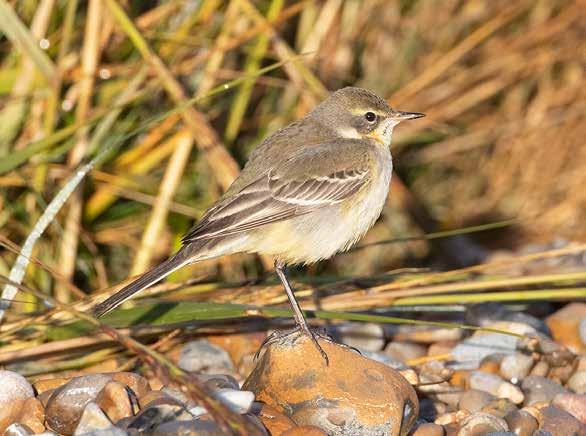
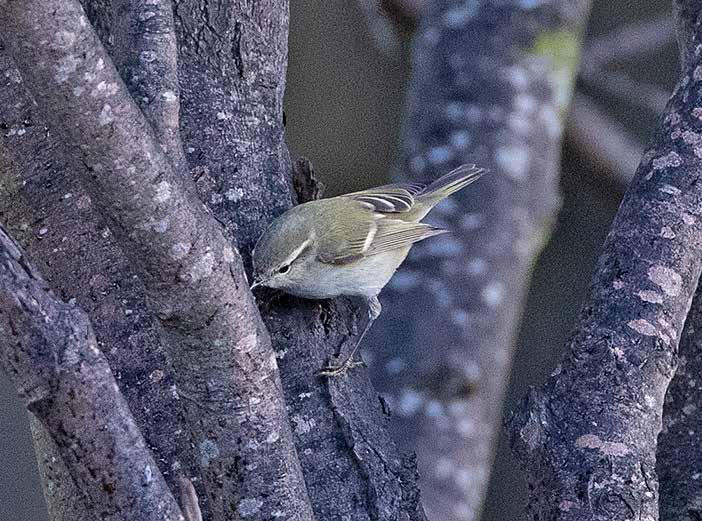
trapped on the 13th. A few records of Pallas’s Warbler; one at Belle Vue Park, Lowestoft on the 1st, one ringed at Kessingland on the 9th and seen again on the 10th. A second bird present at the site on the 25th. One at Boyton on the 26th and one the following day at Minsmere. Good numbers of Hume’s Warblers occurred on the 9th; one at Scott’s Hall, Dunwich, one by the golf clubhouse at Felixstowe Ferry and one along Flycatcher Alley, Lowestoft with two at the latter site the following day. An Eastern Yellow Wagtail was found at Corporation Marsh, Walberswick on the 7th and was seen daily up to and including the 19th. A second bird was found on Havergate Island on the 12th and was there the following two days. These represent the first and second records for Suffolk and there has only been five accepted UK records.
December, like November, was another wet month. What stood out was the mild day time temperatures for a winter month, with 10 days reaching double-figures, the highest being 12C on both the 6th and 19th. The average day time temperature for the month was 8.5C. Even night time temperatures were relatively mild; at the start of the month the first few days were either -1C or -2C but was 7C on the 6th, as was the 19th. Rain occurred on all but 10 days of the month with the wettest period during the middle of the month. There was 12mm of rain on the 13th, 15mm on the 17th and a high of 28mm on the 20th.
A Pale-bellied Brent Goose was on the marshes near Felixstowe Ferry on the 3rd, 11th and 14th and there were five at Aldeburgh Marshes on the 23rd, 28th and 31st. There were three Tundra Bean Geese at Minsmere on the 20th, three south over Aldringham Walks on the 26th, two at Trimley on the 30th and 31st and two at Hollesley on the last day of the year. Four Pink-footed Geese at the Alde Estuary on the 2nd, one at Boyton Marshes on the 3rd with two there on the 11th and 13th and one at Hollesley on the 24th. Eurasian White-fronted Geese seen at Boyton Marshes in the first two weeks of the month and at Hollesley Marshes on the 21st, 28th and 31st with larger numbers at North Warren towards the end of the month.
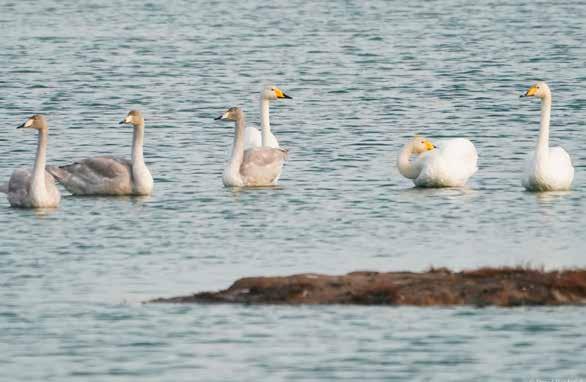
Whooper Swan
Bewick’s Swans were seen regularly in December at Minsmere with up to 11 present and at Leiston there were 11 daily from the 21st to 31st. Whooper Swans were also recorded regularly throughout the month at Minsmere with a maximum of seven, and three birds moved between Boyton, Shingle Street and Hollesley. A Greater Scaup was on the Stour Estuary from the 10th to the 13th. A Long-tailed Duck was present regularly throughout the month on the Orwell Estuary with sightings also offshore at Sizewell, Minsmere and Dunwich. A Velvet Scoter offshore at Sizewell on the 1st and two south off Hollesley on the 28th. Goosanders regularly seen at Thorpeness Meare with a maximum of 12 on the 21st plus three on the Orwell Estuary on the 15th and up to three at Flatford Mill on the 18th and 24th.
Up to five Slavonian Grebes on the Stour Estuary. A Black-necked Grebe showed really well at Felixstowe Ferry from the 8th to 18th and the same bird present off Freston on
the River Orwell on the 20th and 21st. Purple Sandpipers were seen regularly throughout the month up the coast from Felixstowe to Lowestoft, where nine were seen on two dates. On the 2nd, a Jack Snipe at Dunwich and the Orwell Estuary on the 15th. A Little Gull seen at Minsmere on the 28th. Caspian Gulls recorded at Minsmere and Hollesley Marshes and a Glaucous Gull at Needham Market on the 31st.
A Pomarine Skua offshore at Felixstowe on the 9th and 12th, at Minsmere on four occasions and off Southwold on the 26th and 27th. There were five Great Skuas off Southwold on the 1st. This was a good month for Divers, with a substantial gathering of 4157 Red-throated Divers off Thorpeness on the 16th. Two Black-throated Divers off Minsmere on the 7th, one off Felixstowe on the 9th and one on the Orwell Estuary on the 16th and 17th. A good scattering of Great Northern Diver records throughout the month from Felixstowe up to Benacre,
Southwold with juvenile birds regularly on the Alde Estuary and on Benacre Broad. A Shag at Felixstowe on the 28th. A spread of Great Egret records around the county with the highest counts being five at Dunwich Marshes on the 14th and three at Lakenheath on the 15th.
A thin month for birds of prey; a Red Kite was seen at Bawdsey on the 2nd, a Hen Harrier at Lakenheath on the 4th and on Orfordness on the 5th with a male at Levington Creek on the 28th. Short-eared Owls were seen regularly
around Shingle Street with up to three present with birds also seen at Havergate, Hollesley, Walberswick, Aldeburgh, Bawdsey and the Deben Estuary. A Merlin recorded at Hollesley on the 30th. The Ring-necked Parakeets were still present in Ipswich Cemetery with up to four seen on a number of dates. Waxwings were around Lowestoft throughout the month with 30+ on the 21st plus a single at Covehithe on the 22nd. A very late Swallow was noted at the Orwell Estuary on the 16th and 28th. A Firecrest at Bawdsey on the 1st.
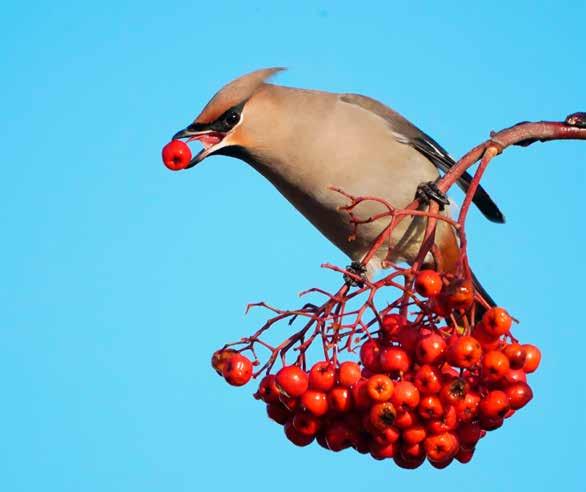
Water Pipits seen at a number of locations including Covehithe, Southwold, North Warren, Hollesley, Trimley Marshes, Levington Creek and Lakenheath Fen. The only Twite record for the month was one at Dunwich on the 2nd. Snow Buntings were around in good numbers through the month; chiefly along the beach at Dunwich and Walberswick with a maximum count of 25 and also present on the edge of Aldeburgh Town Marshes, Kessingland, Bawdsey and Landguard.
A Black Brant was on the Deben estuary in the month; on Falkenham Marshes on the 3rd and opposite Woodbridge on the 16th and 22nd. A putative juvenile Pacific Golden Plover was seen on the River Deben opposite Woodbridge on the 11th. The juvenile Roughlegged Buzzard was still present near Bawdsey Quay throughout December. Sightings also came from Lakenheath on the 4th, 14th and 15th and at Snape on the 23rd.
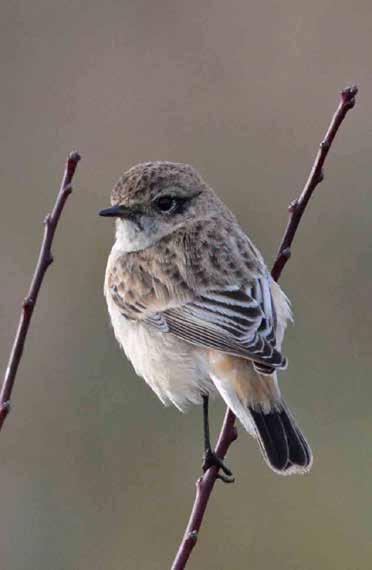
A Siberian Chiffchaff was found at the sewage works at Southwold on the 1st. On the first day of the month a Siberian Stonechat was found at Hollesley Marshes which continued to be present right through the month. A Little Bunting was trapped, ringed and released at a private ringing site at Wrentham on the 31st.
A continuation of the mild winter with no daytime temperatures below zero and 13 days of 10C and above. The highest was 13C on the 14th. Similarly, night temperatures were higher than typical with just three days below zero and a high of 8C on the 8th. Rainfall occurred on just over half of the days within the month with 13mm on the 3rd and 14mm on the 15th.
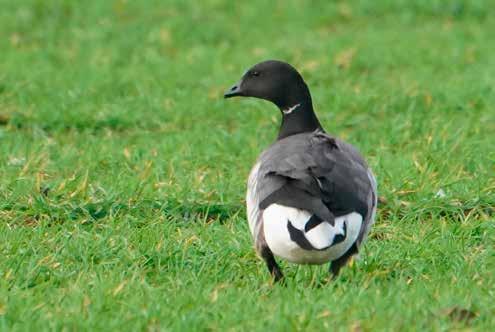
Geese featured prominently: Five Palebellied Brent Geese at Aldeburgh from the 2nd to 4th and again on the 8th with a single bird seen occasionally along the Deben Estuary and a bird at Benacre on the 13th. Two Tundra Bean Geese were present daily at Trimley with further records at Boyton (9), Blythburgh (up to 4), Hollesley (up to 18), 31 south off LBO, a single bird daily at Covehithe, Westleton (up to 5), Havergate (up to 19), Minsmere and Gedgrave (both 16). 10 Pinkfooted Geese were seen at Shingle Street on the 1st, around 450 at Oulton Marshes on the
2nd and around 600 there on the 4th and the 19th. Plentiful Eurasian White-fronted Geese through January at various sites with the highest counts of nearly 300 at North Warren and Aldeburgh and 100 at Hollesley. As you might expect January was a good month for swans: up to 11 Bewick’s Swans were present on the coast, mostly at Leiston but also at sites up to Blythburgh plus inland there were 20 at Lakenheath. There were three Whooper Swans regularly at Shingle Street and Hollesley and seven at Minsmere with seven briefly at Micklemere on the 7th. Greater Scaup showed well at East Lane on the 3rd, another at Trimley on the 12th, up to five on the Stour Estuary in the second half of the month and up to two along the Orwell Estuary. A Long-tailed Duck was recorded on the Orwell Estuary throughout the month with two off Dunwich on the 29th. A redhead Smew appeared at Minsmere on the 21st and was seen there for the rest of January. The main sightings of Goosander were two at Barham on the 1st, throughout the month at Thorpeness with a maximum of six, 20 went to roost at Minsmere on the 1st with further sightings during the month.
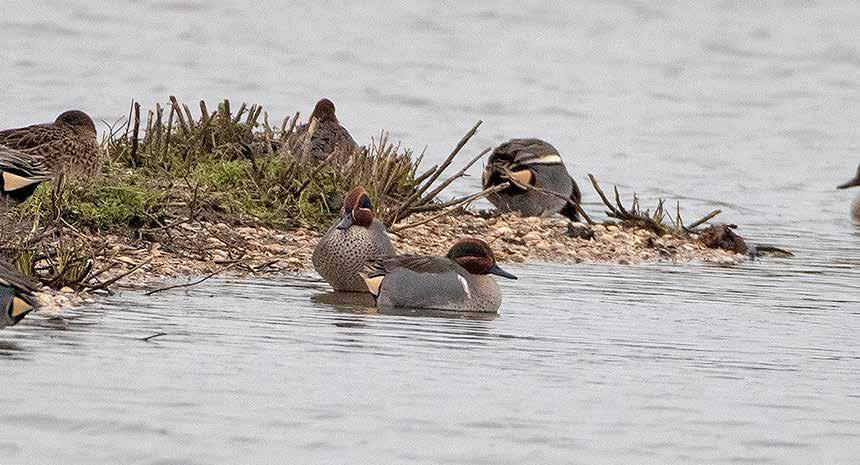
Green-winged Teal
Common Cranes were seen at Lakenheath with four on the 18th and five on the 30th. A Red-necked Grebe seen on the Stour on the 5th and Orwell on the 9th. Up to six Slavonian Grebes seen on the Stour during the month. On the 23rd there was also a Black-necked Grebe also on the Stour. Purple Sandpipers seen throughout the month with two at Landguard and 10 at Ness Point plus a couple at East Lane. Jack Snipe on the Orwell Estuary on the 4th and at Dunwich on both the 6th and 22nd. An early Whimbrel was seen near Waldringfield on the 18th. An Iceland Gull was seen off Aldeburgh on the 14th. Caspian Gulls were seen regularly on the Blyth Estuary plus also at Covehithe, Trimley and Hollesley Marshes. A Pomarine Skua was seen off both Aldeburgh and Minsmere on the 14th. Another good month for the Great Northern Diver; the long-staying bird remained on Benacre Broad, up to three seen regularly and frequently on the Orwell Estuary, two for a few days on Weybread Gravel Pits and one occasionally on the Stour Estuary. Shag present on the Orwell Estuary in the first three weeks of the month, one further up river on the Gipping in Ipswich on the 21st, at Slaughden on the 4th and along the
Stour Estuary on the 10th. Multiple sightings of Great Egret were seen throughout the month with a maximum of three at Carlton Marshes and four on the marshes between Walberswick and Dunwich. Two Spoonbills were noted on Havergate on a few dates and singly at Hollesley and Boyton.
Several sightings of Red Kites including three at Lackford on the 7th. Hen Harrier sightings came from Shingle Street (1st), Stour Estuary (4th), Benacre (5th), Tattingstone (16th), Orfordness (18th), Aldeburgh (19th), Westleton (22nd) and Lakenheath (30th). Short-eared Owls were seen regularly at Shingle Street (usually two) and also at the Alde Estuary on the 7th and 8th, from Waveney Mound (five on 8th and two on 31st), Orwell Estuary (9th), Hollesley (18th) and Boyton (21st). Lesser-spotted Woodpeckers were seen on a few dates at Santon Downham through the month. Merlin sightings came from Lackford, Cavenham, Minsmere (on three dates), Hollesley, Blythburgh, Leiston and Gedgrave. Up to four Ring-necked Parakeets were still seen in the old cemetery, Ipswich in the month. Raven noted at Lackford on the 1st, two at Gifford’s
Flash along the Brett Valley on the 10th, Sudbourne on the 16th and Flatford on the 30th. A Waxwing seen in Lowestoft on the 9th and another at Sizewell on the 11th. A Shorelark was present throughout the month at Kessingland although it could be elusive. Black Redstarts at Sizewell on the 8th and 10th. Firecrest seen in Lowestoft on the 1st, Minsmere on the 4th, Hollesley on the 18th and at Woodbridge on the 26th. Up to seven Tree Sparrows were at Covehithe on the 6th and 17th and nearby four at Easton Bavents on the 7th, two on the 12th and six on the 19th. Water Pipits in good numbers; up to 16 at Herringfleet Marshes with sightings also at Covehithe, Easton Bavents, Hollesley, Trimley Marshes, Benacre, Lakenheath, Walberswick, Deben Estuary and Dunwich. Twite were seen regularly along the beach between Dunwich and Walberswick with the highest count of 17 on the 24th plus two at Easton Bavents on the 31st. A Hawfinch was recorded at Wenhaston on the 14th. Snow Buntings were seen in good numbers throughout the
month, especially between Dunwich and Walberswick with up to 26 present and at Covehithe (up to 15). Snow Buntings also seen occasionally at Landguard, Kessingland, Bawdsey, Benacre and Shingle Street. Up to seven Corn Buntings seen at Chelmondiston through the month.
A Green-winged Teal was present at Minsmere throughout the month. A winterplumaged Black Guillemot was found on the Stour Estuary off Mistley on the 15th. A probable Little Bittern was seen in flight at Minsmere on the 13th. The over-wintering Rough-legged Buzzard continued to be on view through the month near Bawdsey Quay. A probable Rough-legged Buzzard was seen at Covehithe on the 4th. The Siberian Stonechat remained at Hollesley Marsh and was last seen on the 5th. Although always thought to be Siberian Stonechat the identity was confirmed by DNA analysis on the 22nd.
Saturday 19th and Sunday 20th September 2019
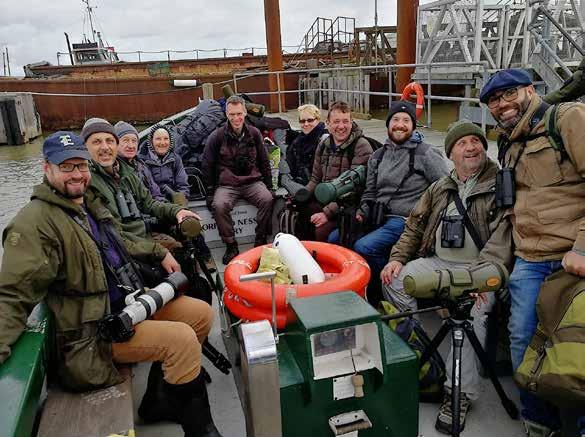
On the Saturday six of us met at Orford Quay on a sunny but slightly windy afternoon; ready to catch the National Trust boat over to Orfordness for an evening walk to the accommodation, an overnight stay and then a full day in the field on Sunday before getting the boat back across.
On arriving on Orfordness, following our health and safety meeting and loading our bags on to the Ranger’s vehicle to kindly be taken to our accommodation for us, as we were all wearing our wellies, we decided to
take the flooded path across air field marsh.
As we carefully made our way along the path, in places wading through water that almost came over the tops of our wellies, we flushed up 13 Snipe. While scanning through the wildfowl, Kestrel, Buzzard and Sparrowhawk were seen and then we noticed a small falcon flying low over the marsh in hot pursuit of a Meadow Pipit. We watched for a couple of minutes in awe as a female Merlin determinedly chased the Meadow Pipit - the Pipit flew for its life dodging and
diving. The two birds twisted, turned, dived and swerved until the Merlin decided not to exert any more energy and the Pipit flew to safety.
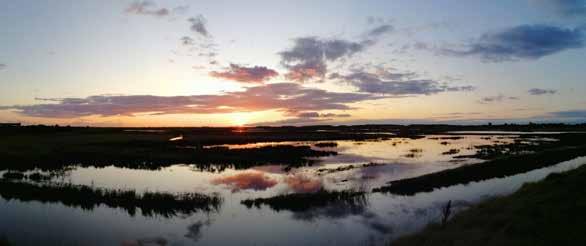
After viewing a stunning sunset, we just had time to check some of the bushes on our way to the lodgings for the night. These were fairly quiet with just Linnets and Robins noted. As darkness arrived so did we to the accommodation, which was a very pleasant surprise to me, with a full kitchen for cooking tea, a good-sized communal room and goodsized bunk bed rooms. After cooking some food, having a few drinks and plenty of good chat we headed out for a walk in the dark and although the experience was dampened slightly by the music drifting across from the
pub on the quay, it was great to listen to the Wigeon and other wildfowl calling in the darkness and to have a good look at the night sky with little impact from light pollution. The next morning after a good night’s sleep (for me at least – although I don’t think that was shared by everyone else) an early and cold start rewarded us with good views of a Barn Owl hunting right outside a building alongside a Kestrel and a Chinese Water Deer making its way through the marsh. We then made our way back via a drier route than the previous evening to the jetty ready to meet some more group members who would be joining us for the day. As we neared the jetty another Barn Owl briefly flew out of one of the livestock buildings before disappearing
back inside, not to be seen again.
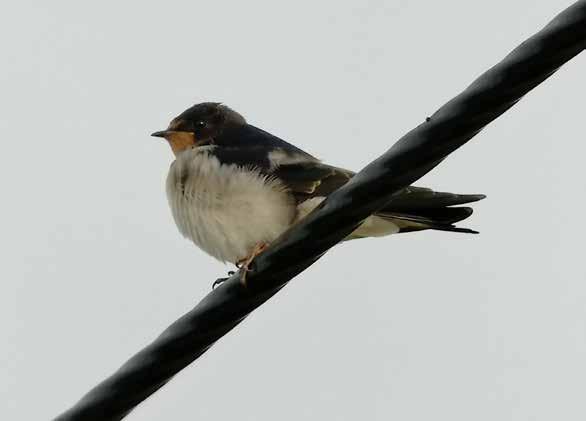
After meeting the others, a skulking bird in a bush kept us guessing for a bit before eventually showing itself to be a female Blackcap. We then walked up to view one of the creeks where the pick of the waders was a Greenshank – which was seen and heard in flight. Our walk then took us to the area that is used by volunteers for bird ringing. Here we spotted a Goldcrest, heard and a very lucky few briefly saw Firecrest, a Brambling flew over calling, a Redwing perched in one of the trees for a while and a late Swallow was flying around and resting on wires. A chat with the ringers was informative as they had told us what had been seen and caught over the last few days. While we were there, they showed us in the hand a few of the birds they had caught including three Bearded Reedlings, two female and a male. Interestingly and something I did not know, the male and one of the females had black eyes instead of the usual orange, a characteristic shown by a small percentage of the population.
We then headed off across the shingle towards the lighthouse where the warden was dropping off our lunches, on the way a couple of Hares showed very close to our
path. While we sat by the lighthouse looking at the recent storm damage and the sea, although quiet, we did add Razorbill and Gannet to people’s trip lists. Once lunch was finished, we headed to the Bomb Ballistics building where we could climb the stairs up to the roof which gives brilliant views over a lot of the landscape. From here we could see Spoonbill, and our sixth bird of prey on the trip – a distant Peregrine. There was also a small amount of visible migration as a group of Siskin flew over us heading inland. It was then time to head back to the accommodation to get our things together and then walk back towards the jetty ready for the boat back across.
On the way back the Firecrest was heard again, although it was not seen despite lots of effort looking. A Fieldfare was seen by a couple of the group having a last quick check of the bushes. Overall, it was a brilliant trip with a bit of escapism in a wonderful habitat, with very interesting history to take in also. With much better equipped and comfier accommodation than I had imagined, and as I stepped back off the boat back on to the Orford Quay, I was already looking forward to hopefully being able to enjoy the trip again next year.
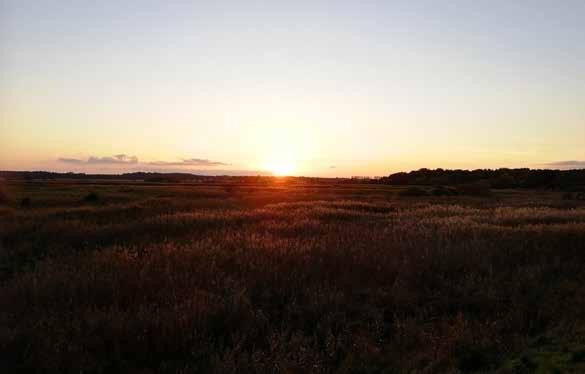
Sunday, November 10th
Leader: Gi Grieco
A lovely, bright but fresh morning greeted an excellent turn out of members for this trip. It consisted of a walk along the shingle ridge by Dingle Marshes before cutting inland, around both Little and Great Dingle Hills, and then back along the track between the marsh and the bottom edge of Dunwich Forest.
The high turnout could have been due to the nice weather, the beautiful walk or the lure of a mega – an Eastern Yellow Wagtail; a first for the county. Maybe it was a combination of all three! Some members who were on a tight schedule pressed on ahead to see the rarity – you know who you are! The remainder of us took a more casual approach, birding as
we went along and we were rewarded with some excellent birds. This included a Dartford Warbler in the sparse Gorse bushes along the beach track followed by a confiding Bittern that was on the edge of one of the pools nearby. In addition to these we saw many Skylarks, Reed Buntings and, for some of the group, a small party of Bearded Tits ‘pinging’ along a reedy ditch. Attention turned towards the sea and with a scan some Common Scoters were seen close in while further out there was the odd Gannet or two. Back on the beach a Rock Pipit was on the shingle while within the reedbed we saw a Great Egret, amazingly before we’d seen our first Little Egret of the day. A number of finches
caught our attention in the vegetation and we saw a lovely flock of 15 Greenfinches and a similar number of Linnets. Whilst scanning the latter, two Twites were seen briefly and only when we moved along a bit further did the group all manage to seem them well. Over the reedbeds a Marsh Harrier quartered and a second Great Egret was seen.
By now we’d reached Corporation Marsh where a number of birders were assembled looking for the Eastern Yellow Wagtail. With a bit of patience it eventually came into view, as did a Western Yellow Wagtail and it was good to hear the former call; quite distinctive. With reports of Snow Buntings further up the beach we went in search for them and had fantastic close views of half a dozen birds. With a last scan of the sea and brief second views of the rare wagtail, we cut inland. Not far in we heard a number of Bearded Tits within the reedbed although those lucky enough, or in some cases tall enough, were able to see them as they flitted across a ditch. Our walk through the woodland, by contrast to the first part, was much quieter. In fact, on discussion, reckoned to be the quietest birdwise we’d encountered on doing this walk over the years. We managed Treecreeper, a few Goldcrests and a mixed tit flock but not
a single Bullfinch which was always a bird previously seen on this section.
Back at the car park we said goodbye to some members and the rest of us took our lunches on to the beach for a seawatch. A couple of flocks of Common Scoters, including one of around 30 birds, Gannets seen diving again plus two Goosander flying south were the highlights. With not many hours left in the day we decided to move to another site nearby to carry on birding, aiming for a Hume’s Warbler that had been present the previous day at Scott’s Hall, Minsmere. We had a pleasant walk through the woods, noting the odd Coal Tit, Goldcrest and Long-tailed Tit. We did find one warbler, a Chiffchaff, but no sign of the Hume’s. We walked along Docwra Ditch coming out to the sea and the scene was beautiful with the sun going down behind the reedbeds of Minsmere.
Heading back to the cars we made a stop at Whin Hill, hoping with the last light of the day for a Hen Harrier to come in to roost. Unfortunately no luck but we did have another Great Egret behind Island Mere, a Barn Owl hunting over the fields at the back, two Tawny Owls calling and finally two Woodcocks flew over making a wonderful end to a fantastic day’s birding.
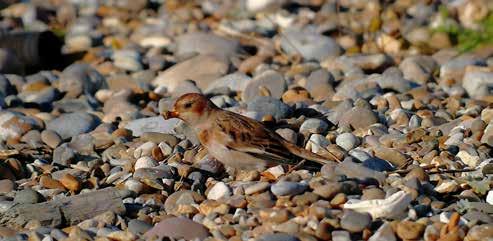
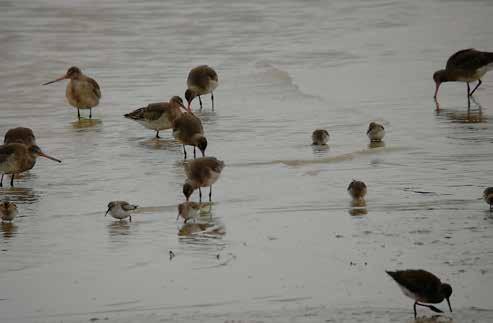
As is often the case with the final outdoor meeting in the calendar the weather may not always be at its best - having said that twelve members assembled in the car park of Martlesham Church. A cold brisk wind cutting across the fields left members thinking it might have been better to have gone Christmas shopping. We headed into the woods leading down to the head of the creek noting a small flock of Long-tailed and Blue Tits with two Redwings. At the creek, Great Spotted Woodpecker and Reed Bunting were seen with a good selection of waders on the mud facing a rising tideLapwings, Grey Plovers, Redshanks and a good number of Black-tailed Godwits. Ducks were represented by Teal and Wigeon with a couple of Little Grebes. Further downstream we located a small flock of Dunlins with more Black-tailed Godwits; total for the Creek
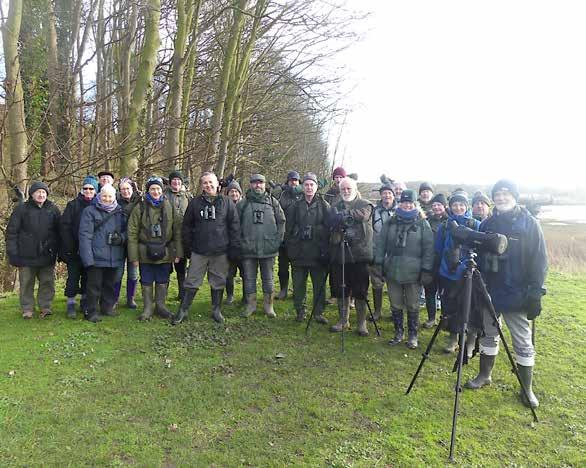
probably exceeded 150, with a single Avocet. Above Kyson Point was a circling Common Buzzard, the only raptor of the day, with a flock of Brent Geese directly opposite on the Sutton side totalling an impressive c.450. It was fast approaching high tide and sightings dwindled as we reached the furthest point of the river path. It started to rain as we turning back to cut across the water meadows, having noted a brief glimpse of a Rock Pipit. We observed a few Curlew flying in to feed on the fields as the weather conditions began to worsen with wind and driving rain. Swiftly, we arrived at the Churchyard with the chances of finding “Thrush or Crest” clearly remote. Taking shelter under some trees for a moment we agreed to abandon the meeting, give seasonal greetings, shook hands and beat a hasty retreat.
Justin Zantboer
Saturday, January 4th
Leader: Justin Zantboer
Another amazing turnout for this trip, with twenty-two hardy souls joining me, under the unusually clear skies, at Levington Marina for the first SBG trip of the new decade. I’d already decided to play it a little different this year due to various body parts feeling like they’d have been better off being left at home, so with such a gathering too, I was feeling the pressure to offer a good trip.
We set off on our usual route, heading towards Trimley Managed Retreat via Loompit Lake and Thorpe Bay. The woods were quiet, offering just a few Long-tailed Tits. Loompit was better though, with decent numbers of Gadwall, Pochard and Tufted Duck along with two female Goldeneyes. After a good grilling of the lake, we switched our attentions to the mudflats of Thorpe Bay where we noted lots of Wigeon, a few Avocet and a couple of Grey
Plovers amongst the Redshanks. Strangely, there were no Black-tailed Godwits or Rock Pipits though, both of which are species regularly encountered here.
Scanning across the river produced large numbers of Dark-bellied Brent Geese and eight Red-breasted Mergansers. Whilst watching these, I noticed a smaller, paler duck surface and was surprised to find that it was the drake Long-tailed Duck which had chosen to winter on the River, normally frequenting the Wherstead Strand area. Most of the group got onto it quite quickly which was lucky as it then decided that it preferred the looks of the water � a mile upriver, so then only offering distant views.
We continued the walk, heading up Thorpe Cliff and finding a female Bullfinch whilst balancing precariously in the mud. Thankfully (he says with tongue in cheek!), everyone stayed on their feet, arriving safely at The Retreat. The Jack Snipe which habitually winter here didn’t disappoint, with two birds seen, along with two Common Snipe, several Skylarks and two Reed Buntings.
I’d already decided not to continue the walk on to Trimley Marshes. The walk back to the cars was uneventful other than picking up a late arriving straggler who’d come down from Bungay. Again, the walk to Levington Creek for the Water Pipit was deemed to be a bad idea so rather than risk a muddy end, we opted instead to drive to Nacton Shores.
Thankfully upon arrival, the carpark was devoid of any characters of ill repute although one lady did comment on our impressive looking equipment! Looking over mudflats, we were treated to large numbers of Knot and Dunlin and smaller but still sizeable counts of Avocet and Grey Plover along with the odd Turnstone and Black-tailed Godwit. Although views of the river were distant, we were able to pick out a few Great Crested Grebe, Goldeneye and Red-breasted Merganser but the bird of the moment was a female Common Scoter – not a common sight on the River Orwell.
As folks started to say their farewells at Nacton, the remainder of the group elected to finish off the trip at Freston Shores. Two Redwings were noted overhead, with one pausing briefly in a tree-top, whilst we walked down the track to the Stoke Sailing Club before viewing the river commenced. Here we were treated to two Great Northern Divers, two Shags, at least 16 Red-breasted Mergansers, a few Goldeneye and a Peregrine on its favoured perch on the Orwell Bridge. To end the trip, the drake Long-tailed Duck then flew in and with the turning tide, ending up drifting towards us, giving us some superb views.
A fitting end to a very enjoyable day on the River. Thanks to everyone for attending and being so understanding of my poor health on the day. SBG folks really do rock.
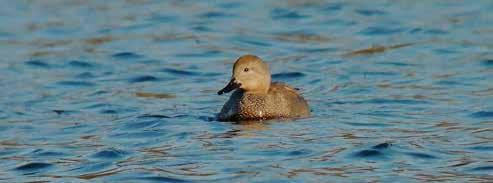
All the places in the wordsearch are birding sites around the county. The remaining letters reveal two bird species, very relevant to SOG/SBG. Please email in the answers to harrier@suffolkbirdgroup.org or call/text to 07951 482547. The first name ‘out of the hat’ will win a £25 book token.
Benacre Broad
Blyth Estuary
Carlton Marsh
Cattawade Marsh
Cavenham Heath
Christchurch Park
Corton Old Sewage Works
East Lane
Ellough
Elveden
Giffords Flash
Groton
Havergate Island
Hazlewood Marsh
Holbrook Bay
Hollesley Marsh
Knettishall Heath
Kyson Point
Lackford Lakes Ness Point
Lakenheath Fen North Warren
Landguard
Orfordness
Livermere Lake Pipps Ford
Lowestoft Denes Santon Downham
Mayday Farm
Micklemere
Minsmere
Sutton Common
Trimley Marsh
Westleton Heath
Council for 2020 Officers
President: John Grant
Chair: Chris Courtney
Vice Chair: Justin Zantboer
Secretary: Chris Keeling
Treasurer: Anne Wright
Communications Officer: Alex Rafinski
Projects Officer: Chris Keeling
Suffolk Bird Report Editor and SORC Link: Nick Mason
Harrier Editor and Outdoor Events Coordinator: Gi Grieco
Indoor Events Coordinator: Adam Gretton
Members
Eddie Bathgate
Peter Merchant
Jamie Everett
Roy Marsh
Matthew Deans
Edward Jackson
Adam Faiers
Honorary Vice-Presidents
Jean Garrod
Robin Hopper
Mike Jeanes
Mike Marsh
Philip Murphy
Reg Snook
Steve Piotrowski
Bird Recorders
North-east Area Recorder: Andrew Green, 17 Cherrywood, HARLESTON, Norfolk IP20 9LP Tel: 07766 900063 Email: bird-ne@sns.org.uk
South-east Area Recorders: Gi Grieco Tel: 07951 482547 and Steve Fryett Tel: 07593 382082 4, The Street, Melton, Woodbridge, IP12 1PW. Email: bird-se@sns.org.uk
West Area Recorder: Colin Jakes, 7 Maltwood Avenue, BURY ST EDMUNDS IP33 3XN Tel: 01284 702215 Email: bird-w@sns.org.uk
Memberships
c/o SNS, The Museum, High Street, Ipswich, Suffolk IP1 3QH
Founded in 1973 by a group of Suffolk birdwatchers
Associated with the Suffolk Naturalists’ Society
SBG remains an independent birding group and is a registered charity
A voice for Suffolk birdwatchers
With established links to many naturalist and conservation organisations
Media
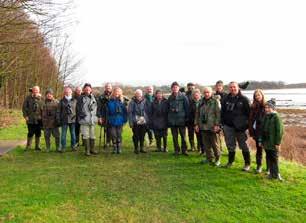
Actively lobbies to protect key Suffolk habitats
Provides a county-wide field force of bird surveyors
Promotes BTO bird surveys and organises special SBG surveys

Strong web presence - www.suffolkbirdgroup.org
Active Twitter feed - @suffolkbirds1
Quarterly magazine - The Harrier
Annual review - Suffolk Birds report
Annually (20+) field trips - ideal for novices or experts and young or old alike
Opportunities to visit hot spots and receive practical ID tips in the field
Programme of talks and presentations - variety of topics (county, national, or international) with quality speakers
Assists with conservation projects to improve breeding success
- Swifts
- Barn Owls
- Peregrines
- Waders
Partners with Suffolk Wildlife Trust and other bird groups
Assists with funding for bird hides and other birding amenities
Contributes to community events, including dawn chorus walks
Provides bursaries for special projects