





Farr
By Ashley Winters St. Louis American
When Akberet Boykin Farr walks into work on a hard day, she doesn’t reach first for a spreadsheet or a strategic plan. She thinks about children — students she has met in St. Louis classrooms, about literacy programs and after-school spaces that can change the arc of a young person’s life. She asks herself the same question again and again: What gives them the opportunity to live up to their


For Boykin Farr, that question guides her work as vice president of diversity and social responsibility at Emerson, where she oversees corporate responsibility efforts focused largely on education and community investment across the St. Louis region.
“A lot of what Emerson does surrounds literacy programs, math programs and after-school activities,” she said. “Those are at the top of what reminds me why this work is important.”
See BOYKIN FARR, A12
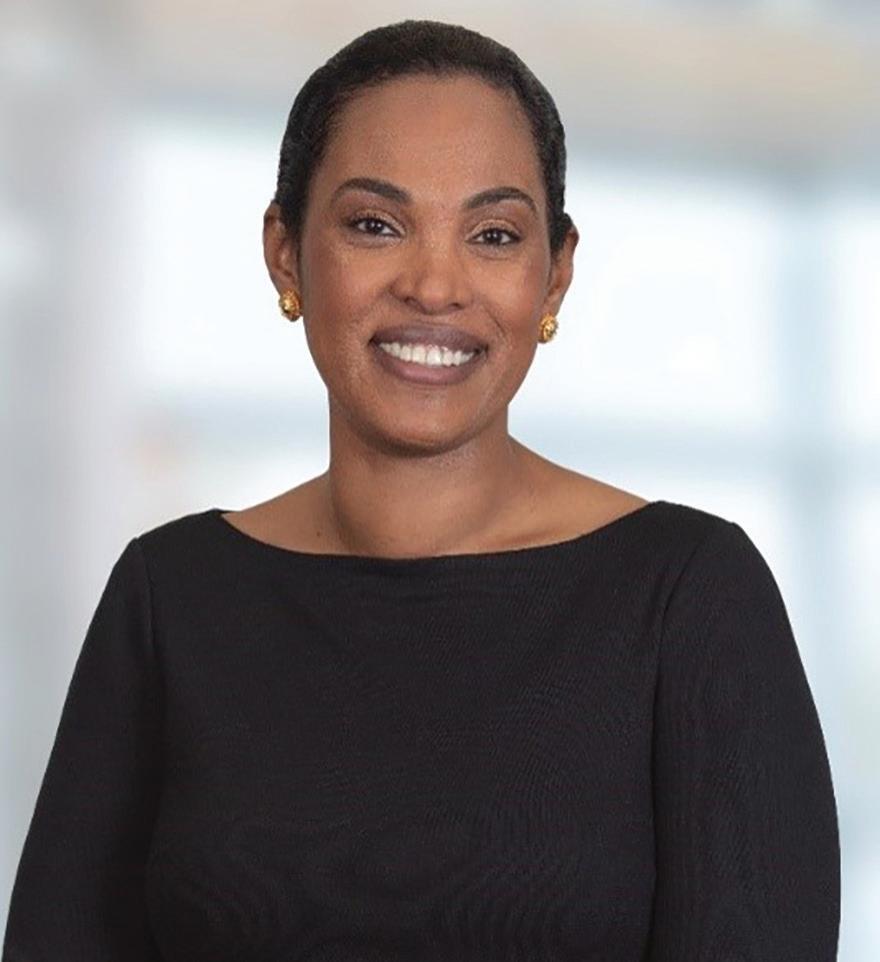

Akberet Boykin Farr is being recognized for her outstanding leadership and professional success and her dedication to student literacy, math, and afterschool programs in the St. Louis region.
Little explanation offered for abrupt suspension of popular initiative
By Sylvester Brown Jr. St. Louis American

Most St. Louis city and county schools closed Monday and Tuesday, along with major attractions including Gateway Arch National Park, the Missouri Botanical Garden, the St. Louis Zoo and all St. Louis City and County public libraries.
With several days of heavy snow and bitter cold behind the St. Louis region, a stretch of milder temperatures is finally in sight — offering relief after one of the coldest periods of the winter.
Looking ahead, the region is expected to see a steady warmup over the next week.
High temperatures are forecast to reach the mid-teens to upper 20s Friday through Sunday, with a chance of light snow Sunday. Early next week, highs are expected to climb into the low to upper 30s Monday through Thursday, with no major snow or ice storms currently in the forecast.
The storm that started Saturday dumped between 8 and 12 inches of snow across the area as extreme cold settled in, bringing temperatures well below zero. Early Monday morning lows fell between 5 and 10 degrees below zero, according to AccuWeather St. Louis. That followed a frigid weekend, with temperatures ranging from a low of 2 degrees to a high of 10 degrees Saturday and a low of 6 degrees to a high of 14 degrees Sunday.
The conditions forced widespread closures across the region. Most St. Louis City and County schools closed Monday and Tuesday, along with major attractions including Gateway Arch National Park, the Missouri Botanical Garden, the St. Louis Zoo and all St. Louis City and County public libraries.
The weekend storm was messy and inconvenient but far less

A little over a month after one of St. Louis’ most beloved and established youth programs was abruptly suspended, those who helped run it and the families involved still don’t know exactly why. By most accounts, the decades-old Youth Exploring Science (YES) program at the St. Louis Science Center successfully guided young people from underserved communities into college and careers in science, technology, engineering and math — or STEM. The affiliated annual Martin Luther King Jr. Day Community
By Ashley Winters St. Louis American
As Missouri education leaders reviewed the state’s latest student test scores Wednesday, a troubling disconnect framed the conversation: While state officials report that more than 91% of schools “meet expectations,” fewer than half of Missouri students are proficient in core subjects, and overall achievement remains below pre-pandemic levels. That gap was at the center of The Opportunity Trust’s fourth annual Education Town Hall, where education policy experts, civic leaders and school

TOWN HALL, A10
By Marc Morial
“Loose and easy language about equality, resonant resolutions about brotherhood fall pleasantly on the ear, but for the Negro there is a credibility gap he cannot overlook. He remembers that with each modest advance the white population promptly raises the argument that the Negro has come far enough. Each step forward accents an ever-present tendency to backlash.”
— Martin Luther King Jr.
When he signed the legislation that made the birthday of Dr. Martin Luther King Jr. a legal public holiday in 1983, President Ronald Reagan called the Civil Rights Movement a “just cause” and said “as a democratic people, we can take pride in the knowledge that we Americans recognized a grave injustice and took action to correct it.”
When he signed the legislation linking the holiday to national community service in 1994, President Bill Clinton said King’s vision “was so great, his moral purpose was so strong that he made us believe that we could be better than we are and that someday we would be able to walk hand in hand together into a brighter tomorrow.”
Last week, President Donald Trump complained that the movement to create equal opportunity for Americans of color had made life harder for white people.
ernment, the workforce and public life.
One year later, these attacks have intensified, but so has the response, with an expanded group of civil and human rights organizations, civic engagement leaders, faith voices, business and economic institutions, media and academic leaders, and democracy partners joining the table.
Far from seeking to eliminate what Reagan called “traces of bigotry” that “still mar America,” from day one the Trump administration has sought to dismantle 60 years of progress, subverting civil rights laws to entrench and reinforce historical inequities.
The administration has eliminated diversity, equity and inclusion offices and policies across the federal government, strong-armed universities and corporations to dismantle their own equity programs, encouraged “reverse discrimination” complaints and altered EEOC enforcement to prioritize claims by majority-group individuals.
The truth is that white males are admitted to colleges at higher rates than every other group. White job applicants are more likely to be granted interviews. White people have an employment advantage at every level of educational attainment. White men are paid more. They are overrepresented in executive and management positions. According to one study, it will take 22 years for white women and 48 years for women of color to achieve parity in corporate senior leadership roles.
By Eric Morrissette
Recently, the Supreme Court heard arguments that could reshape the global financial system. The case before the justices asks a deceptively simple question: Can the president of the United States fire Dr. Lisa Cook, a member of the Federal Reserve Board of Governors, before the end of her statutory term?
But everyone watching — from Wall Street traders to central bankers in Europe and Asia — knows the real question: Can President Trump fire Federal Reserve Chairman Jerome Powell and, by doing so, end the Fed’s independence?
Dr. Cook, the first Black woman ever to serve on the Fed’s Board of Governors, faced pressure to resign last year after President Trump seized on an allegation of mortgage fraud made by a member of his administration to justify her removal. No criminal charges were filed against her. No wrongdoing was proven. Dr. Cook refused to step down.
That refusal — and the lawsuit she filed to defend her position — now stands as the last legal barrier between the Trump administration and its stated goal of bending America’s central bank to presidential will.
Federal Reserve independence was front and center. Justice Sonia Sotomayor noted that in the Federal Reserve’s 112year history, a Federal Reserve officer has never been removed and that “the unprecedented nature of this case is a part of what the president did, not what Ms. Cook did.”
Justice Brett Kavanaugh explored the slippery slope: If this precedent stands, what prevents the next president from removing all Fed officials appointed by predecessors, effectively turning Fed governors into at-will employees by 2033? He warned, “What goes around comes around.”
The line of questioning that followed left the impression of a justice unsatisfied with the administration’s arguments and suggested a likely favorable ruling for Dr. Cook.
However, something glaringly absent in the courtroom but ever present in the real world was the economic impact of the court’s decision. That concern surfaced in a different hearing just a week earlier.
For more than four decades, MLK Day has been an occasion of national pride — an opportunity to celebrate the progress the nation has made in overcoming racial prejudice and discrimination and expanding opportunity. This year, it feels more like a dire warning and an urgent call to action against the radical rollback of racial justice and equal opportunity under the Trump administration.
On Thursday, Jan. 22, the National Urban League reconvened the Demand Diversity Roundtable, bringing together a broad, cross-sector group of national leaders to assess the moment and chart a path forward.
We launched the Roundtable in January 2025 in response to an unprecedented wave of federal actions targeting diversity, equity and inclusion across gov-
There simply is no evidence of “reverse discrimination” against white men. Perhaps for some, a level playing field feels like an uphill climb.
On MLK Day, politicians who support anti-equity policies and oppose racial justice often twist Dr. King’s words to justify their actions, as though judging people “by the content of their character” instead of “the color of their skin” means ignoring inequality.
Dr. King didn’t advocate for a “color-blind” society, but one where diversity is cherished and embraced. The National Urban League and our partners in the Demand Diversity Roundtable remain committed to his vision.
Marc Morial is National Urban League president and CEO.
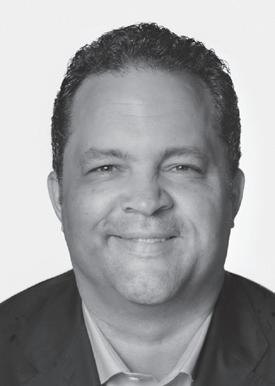
By Ben Jealous
In Minnesota this winter, amid the steady stream of grim headlines out of Minneapolis, one story barely made it beyond Duluth’s city limits. The Duluth News Tribune and other regional outlets are inviting residents to dig into the city’s archives, retell old stories and share plans for America’s upcoming 250th anniversary. Town halls are discussing parades. Local museums are planning exhibits. Families are marking the milestone in small, thoughtful ways. Amid the snow and long nights, there is a quiet insistence on remembering, on telling the stories that matter. And yet, not far away, the news tells of lives ended, of authority deployed without accountability, of neighbors afraid to act. The contrast is sharp. It is both a blessing and a wound.
I am also the child of parents who were active in the civil rights movement — a multiracial family that taught me early: freedom is never given. It must be defended.
This year, as America approaches its 250th anniversary, the circumstances that led our ancestors to rebel feel more familiar than they should: standing armies enforcing laws without consent, violence meted out without accountability, ordinary people afraid to act. And yet, like the colonists in Boston, we are reminded that liberty is not inherited; it is earned, defended and demanded. In Minneapolis, the killings of Renée Nicole Good and Alex Jeffrey Pretti by federal immigration agents have underscored that lesson in the harshest terms. Their deaths remind us that no one is immune to injustice when authority acts without accountability. I watch my children, and the people I love, grow more fearful with each news cycle. I watch neighbors endure quietly, afraid to speak out. Their courage is tested not in the abstract, but in daily life — just as it was for my ancestors under British rule.
As we did 50 years ago, we will honor this 250th anniversary by telling stories to our children, much like communities in Duluth are doing now. That year, 1976, marked the bicentennial of the Revolution and the centennial of the end of Reconstruction. It was my grandmothers who told most of the stories — one White, one Black — each with her own focus. My White grandmother kept the Revolution close to her heart. My Black grandmother told stories of the Civil War and the era of Reconstruction. Our nation’s story is one of struggle and perseverance. The ideals of the Revolution were aspirational from the start, limited by the exclusions of the time and extended only through centuries of struggle: abolition, civil rights, voting rights, labor rights and the ongoing fight for accountability and justice for all.
The deaths in Minnesota are not merely local tragedies; they are a call to the conscience of every American. They remind us that the revolution — the effort to define freedom as something real and universal — is not over. It didn’t end on a battlefield, and it doesn’t stop with another fireworks display.
So when we tell the stories this year, let’s do it as my grandmothers did. Let us tell history to the children as instruction for the America we must all build together again.
Ben Jealous is a professor of practice at the University of Pennsylvania and former national president and CEO of the NAACP.
I spent a little over three years working at the Federal Reserve’s Office of Board Members. I later managed a congressional subcommittee overseeing the Fed. I learned how the institution works, how it moves, how carefully it guards its independence and, perhaps most importantly, its profound focus on advancing the public good.
I vividly remember the agony that staff and Fed governors endured over single words in speeches or congressional testimony, fearing how they could send bond markets into a frenzy. These experiences are why I believe what is unfolding now is unprecedented, dangerous and likely to turn on whether one woman holds her ground — and whether the Supreme Court is willing to stand with her in defense of an independent monetary system.
The weight of the moment, and what it could mean for the global economy, was clear from who sat in the room. Among those attending the hearing were former Federal Reserve Chairman Ben Bernanke and current Federal Reserve Chairman Jerome Powell — both appointed by Republican presidents, both responsible for navigating economic crises, both aware of what this decision could mean for the future of U.S. monetary policy.
While the legal arguments in the court turned in several directions, the issue of
A previously scheduled Congressional Task Force on Monetary Policy hearing revealed how far this issue transcends normal politics and policy. Following the announcement of the criminal probe into Chairman Powell and before the hearing, House Financial Services Committee Chairman French Hill, a Republican, publicly rebuked the Trump administration’s Department of Justice. Remarkably, during the hearing there was neither unanimity in condemning the administration nor a full-throated defense of the Justice Department’s actions.
What the justices must decide is whether one woman’s courage to defend an institution matters more than a president’s power. It is fitting that the Supreme Court heard arguments in this case during the week the nation honored Dr. Martin Luther King Jr.’s birthday. Like Rosa Parks, who understood that her refusal to give up her seat on a Montgomery bus was about far more than one woman’s comfort, Dr. Cook’s refusal to resign is about far more than one woman’s career. Parks challenged a system that relied on compliance to survive. Cook is defending an entire system of economic governance. Both understood that sometimes the most radical act is simply to stay put. Eric Morrissette served as deputy undersecretary of commerce for minority business development in the Biden administration.

The largest weekly newspaper in Missouri •
100% Independently owned, operated and continuously published without interruption since 1928



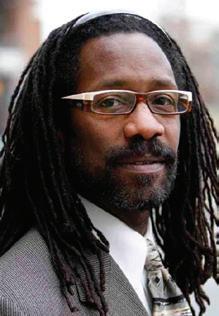
By Ashley Winters
St. Louis American
Harris-Stowe State University has broken ground on a $62.3 million science and technology building, a project university and civic leaders say signals a turning point for the historically Black institution and its role in St. Louis’ economic future.
The four-story, 82,443-squarefoot STEM center will rise on the university’s Laclede Avenue campus and is among the largest capital investments in HarrisStowe’s history. University officials said the facility is designed to expand academic offerings, research capacity and workforce training in fields that are among the region’s fastest-growing.
The project reflects HarrisStowe’s broader effort to strengthen pathways into high-demand STEM careers while positioning the university as a driver of opportunity and innovation in the St. Louis region. Elected officials and university leaders said the building builds on decades of partnerships across the city and state.
State Sens. Brian Williams and Steven Roberts pointed to the university’s long-standing collaborations with public and private partners. They said the
new facility will help prepare students for careers that support regional growth. Speakers at the Friday event described the project as an investment not only in campus infrastructure, but in talent development and shared learning environments meant to benefit future generations of students.
“We are not simply breaking ground on a building — we are ushering in a bold new era for Harris-Stowe State University,” one speaker said during the ceremony.
Valerie Patton, chair of the Harris-Stowe Board of Regents and honorary chair of the university’s capital campaign, called the groundbreaking a monumental moment for the institution, crediting years of planning, leadership and support for bringing the project to this stage.
Dr. Freddie E. Wills, vice president for STEM initiatives and research partnerships, said the building is expected to play a key role in strengthening the region’s STEM workforce. He said the facility will help prepare students to step into some of the area’s most critical jobs while contributing to economic growth in the city.
“The STEM building will contribute to upward mobility

and economic growth for St. Louis citizens,” Wills said.
Harris-Stowe President LaTonia Collins Smith said the new facility represents opportunity, innovation and a long-term commitment to student success at the university. She said the building will feature advanced laboratories, makerspaces and flexible classrooms designed to mirror real-world work environments.
“This new STEM building will transform how our students learn,” Collins Smith said. “They will continue to graduate career-ready for high-demand


industries.”
Collins Smith also emphasized the importance of expanding diversity in STEM fields, noting that science and technology careers are among the fastest-growing and highest-paying in the nation. According to the federal Bureau of Labor Statistics, STEM occupations are expected to grow at roughly twice the rate of non-STEM jobs over the next decade, even as students from underserved communities remain underrepresented.
“Harris-Stowe is changing that reality,” she said, noting that
81% of the university’s STEM graduates are women.
St. Louis Mayor Cara Spencer said Harris-Stowe has long served as an anchor institution in the community and described the STEM center as an investment in the city’s future.
“STEM is our future,” Spencer said, adding that careers in science and technology can open doors for students while strengthening the local economy.
Following the outdoor ceremony, attendees viewed architectural renderings of the planned building. A construction timeline has not yet been set.


Photo by Brian Munoz / St. Louis Public Radio
St. Louis American staff
Clearer sunlight is greeting parishioners and visitors at St. Alphonsus Rock Church as restoration continues on 28 of the historic church’s 120-year-old German-designed stained-glass windows.
Last February, the church received a $500,000 grant from the National Trust for Historic Preservation’s African American Cultural Heritage Action Fund to support the restoration work.
The project is about 60% complete and is expected to be finished in March, said Monica Huddleston, grant compliance administrator — ahead of Easter on April 5. Restoration work is continuing through Willett Stained Glass Studios of
Winona, Minnesota, with some windows removed and shipped to the company’s facility for more detailed repairs.
Once restored, the windows are fitted with protective acrylic coverings. Peeling paint on the ornate wood frames has been removed, and the surfaces repainted.
Olivier Fournier of Paris, France, and his assistant, Mark Hice, are conducting much of the on-site restoration using scaffolding, boom equipment and specialized tools.
The grant covers only part of the overall stained-glass restoration. The project is part of the church’s capital campaign to raise $1.5 million for major infrastructure repairs and replacements, including tuckpointing, roofing and other improvements.
By Margot Brown
More than 60 years ago, Dr. Martin Luther King Jr. delivered his powerful speech “How Long, Not Long.” In it, he reminded us that “we shall overcome because the moral arc of the universe is long, but it bends toward justice.” While his words offer comfort, King’s speech also issued a challenge: “We are not about to turn around. We are on the move now.”
Over the past year, the Trump administration has dismantled dozens of critical environmental protections. One of its earliest actions was revoking Executive Order 12898 — Federal Actions to Address Environmental Justice in Minority Populations and Low-Income Populations — along with all related directives. As a result, federal agencies are no longer required to consider how their policies affect minority and low-income communities. Billions of congressionally approved grants meant to improve environmental conditions in these communities were rescinded.
pollution in disadvantaged communities. Minnesota and Washington state have revised their climate action plans to explicitly address environmental justice, ensuring that marginalized communities are central to climate policy.
In New York City, the new administration has launched the EJNYC Initiative, which includes a comprehensive environmental justice report, interactive mapping tools, community engagement programs and the city’s first Environmental Justice Plan. Meanwhile, the city of Imperial, California, is adding an Environmental Justice Element to its General Plan, mapping disadvantaged neighborhoods and setting goals to reduce hazardous pollutants and expand green space. These actions prove that progress is possible, even in the most challenging of times.
These rollbacks were compounded by sweeping reversals of clean air and water protections, the removal of federal employees sworn to safeguard public health and the U.S. withdrawal from the Paris Climate Agreement. Under such coordinated assaults, it is hard to see a path forward. But we can and must move forward. How? Through faith and action.
If you believe that the moral arc of the universe bends toward justice, we must act to make it so. Across the country, governors and mayors are stepping up where federal leadership has failed. From coast to coast, action is bending the arc.
In California, the state has established a Bureau of Environmental Justice within its Department of Justice and is mandating long-term community air monitoring in priority areas — strengthening enforcement and increasing transparency around
The moral arc does not bend on its own; it bends because people of faith and conviction push it forward.
We can control our civic engagement and how we advocate for the issues that matter to us and our communities. We can control how we use our time and resources to support leaders and organizations working tirelessly to protect the environment and create a healthier, more just world for all.
We know the stakes are high. Studies show that Black and Latino communities are exposed to nearly 60% more air pollution than they produce. These findings serve as a stark reminder of why environmental justice matters. And it does not just matter to minority and low-income communities; it matters to all of us. Because if we protect the environment for those who are most exposed, we protect the environment for everyone. With the federal government stepping away from its duty to protect people over industry, the burden falls to us. Our choices today will shape the world our children inherit tomorrow.
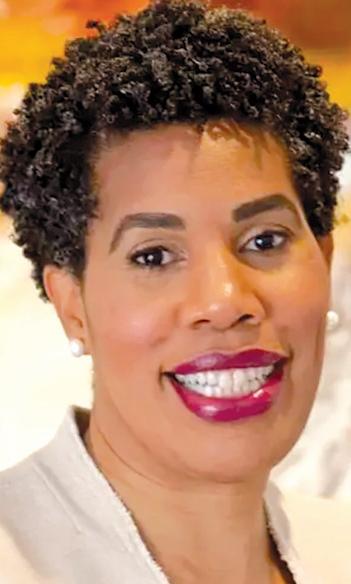
Margot Brown is senior vice president of justice and equity at the Environmental Defense Fund. She previously worked at the U.S. Environmental Protection Agency.


This time of year, dedicating
By Laura Onyeneho Houston Defender
The start of a new year brings fresh opportunities to transform your financial life.
While resolutions often fade by February, building genuine wealth requires more than good intentions; it demands strategic action grounded in the latest financial tools and knowledge. This year, the landscape has shifted with new contribution limits, evolving savings rates and critical tax changes that could significantly impact your bottom line. The question isn’t
If you’re 50 or older, the catch-up contribution for 401(k) plans has increased to $8,000, allowing you to contribute up to $32,500 total.
whether you should take control of your finances in 2026; it’s which moves will deliver the most powerful results. Here are five essential money moves that can set you up for lasting financial success.
Maximize retirement contributions
The IRS has increased the 401(k) contribution limit to $24,500 for 2026, up from $23,500 in 2025, and the IRA limit has risen to $7,500 from $7,000. This isn’t just a slight adjust-
sponsored By JPMorganChase & Co.
ment — it’s an invitation to supercharge your retirement savings.
If you’re 50 or older, the catch-up contribution for 401(k) plans has increased to $8,000, allowing you to contribute up to $32,500 total. And if you’re between 60 and 63, you can take advantage of a “super catch-up” contribution of $11,250 instead of the standard $8,000. If your Social Security wages from a single employer exceeded $150,000 in the previous year, all your catch-up contributions must be made
By Blake Emerson, Missouri Head
of Investments and Advice at J.P. Morgan Private Bank
AI is not just a buzzword. It is a force already reshaping the city’s economic landscape. Much of the national conversation has centered on job disruption, and it is a valid concern. Earlier this year, several leading technology companies announced significant job cuts as they increased investment in AI capabilities.
These dynamics raise the question: If AI can perform more tasks at lower cost, what does that mean for employment, consumer demand and the broader
economy?
In my piece “Jobs in the AI Revolution: Disruption Today, Growth Tomorrow,” I argue that while AI will displace certain tasks, the broader pattern will likely mirror past technological shifts. Throughout history, from the steam engine to electricity to the mainframe computer, innovation has initially displaced workers, but ultimately expanded industries, created new roles and delivered powerful waves of productivity growth. This piece highlights that early adoption tends to create the impression of destruction,

Blake Emerson
while the full economic cycle typically produces reinvention, new demand and broader opportunity. Our 2026 Global Investment Outlook echoes this theme. The AI investment boom already accounts for roughly 1% of U.S. GDP, and historical comparisons suggest that could double. AI is driving down the marginal cost of cognition, much as past technologies lowered the costs of transportation, power and information processing. When those costs fell, demand surged, new industries emerged and productivity growth accelerated.
Fathers & Families, HSSU get Justice Awards
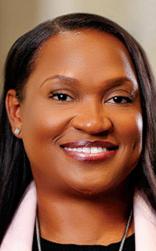
The Fathers & Families Support Center and Harris-Stowe State University will be honored during the Saint Louis Bar Foundation’s 2026 Spirit of Justice Awards celebration on Saturday, Feb. 21, 2026, at the Royal Sonesta Chase Park Plaza in St. Louis. Under the leadership of CEO Cheri Tillis, the Fathers & Families Support Center “demonstrates integrity and tangible impact in strengthening families and improving the administration of justice,” according to the Bar Foundation, the charitable arm of the Bar Association of Metropolitan St. Louis. Since 2022, Harris-Stowe has assisted the Bar Association of Metropolitan St. Louis and the foundation in hosting the annual Motion for Kids holiday party, serving about 2,000 children in foster care or impacted by the criminal justice system. President Latonia Collins Smith and the university donate use of the Emerson Performance Center, event security, parking and student volunteers. Also receiving Spirit of Justice Awards are the Migrant and Immigrant Community Action Project and Bill Bay, president of the Bar Association of Metropolitan St. Louis.
Webster grad on Forbes ‘30 Under 30’ list

Stephen Works
Stephen Works, a 2020 graduate of Webster University’s School of Communications Interactive Digital Media program, has been named to Forbes magazine’s 2026 “30 Under 30” list, which recognizes up-and-coming leaders shaping their industries. Works, 29, founded the online company SpringSims and uses its platform to promote charities to nearly 2 million viewers and 140,000 followers. He hosts fundraisers and awareness events for Hope for Haiti, St. Jude Children’s Research Hospital and the Trevor Project. Last year, he raised more than $246,000 and also hosts podcasts in which content creators from diverse backgrounds discuss the challenges they face.
Okutho named credit union branch manager
What St. Louis can expect
In cities across the U.S., the impact of AI is already visible across key sectors such as healthcare, pharmaceuticals, financial services, energy and education. Hospitals and research centers are pioneering new diagnostic tools and supporting better clinical decisions. On the factory floor, smart automation is being adopted to improve efficiency, enhance precision and streamline production processes in industries like pharmaceuticals, chemicals and food manufacturing. Financial institutions across the country are also exploring AI-driven ways to simplify operations and man-

West Community Credit Union has named Milly Okutho manager of its Brentwood branch, where she will oversee daily operations, guide staff development and ensure members receive personalized financial solutions and service. A former U.S. Bank client relationship consultant, Okutho brings 18 years of experience in banking and finance to the Brentwood branch, which is celebrating its 90th year.
“I’m excited to immerse myself in the credit union culture and help our members achieve their financial goals,” Okutho said. “I look forward to being a trusted resource for the Brentwood community.”
Promotion, board appointment, new hire, award... please submit your People on the Move item (including photo) to areid@stlamerican.com
Continued from A5
as Roth contributions. This means higher earners will pay taxes on those contributions now rather than later, but they’ll build taxfree income for retirement.
Review your contribution strategy early in the year and adjust your withholding if necessary. Even a 1% increase in your savings rate can translate into tens of thousands of dollars over time through the power of compound growth.
Increase your earning power
Your human capital is your most valuable asset, and improving your skills, expanding your scope, or stepping into higher-impact roles can significantly boost your earning power.
Continued from A5
age risk more effectively, while energy companies are leveraging data and machine-learning models to help optimize output and improve reliability. At the same time, leading universities are driving much of this innovation, helping to connect research, industry and talent.
Early research suggests that many of these AI applications focus on augmentation rather than full automation, supporting workers in their roles instead of replacing them entirely. Humans still retain an advantage in
This year, commit to one of these high-leverage career moves: Acquire a certification or skill that commands premium pay in your industry; negotiate your current compensation (most people never ask and leave 10% to 30% on the table); build a strategic side-income stream that could scale to replace your job; or position yourself for a promotion by taking on high-visibility projects that showcase your impact. Document your wins quarterly with specific metrics and dollar amounts. These concrete achievements become your ammunition for compensation conversations. You’re not being greedy or difficult by advocating for higher pay. You’re being strategic about the single biggest wealth-building asset you have.
areas such as common sense, emotional intelligence, dexterity and adaptive learning, which remain difficult for AI to replicate.
The road ahead Historically, technological breakthroughs have reduced costs, expanded demand and driven long periods of productivity growth. AI is beginning to replicate this pattern by lowering the cost of expertise and enabling companies to accomplish more with fewer resources. As organizations reinvest AI-driven efficiencies into new capabilities, St. Louis could see growth in new types of roles,
The foundation of financial success is knowing exactly where every dollar goes before you spend it. A zero-based budget means assigning every dollar a specific purpose — whether that’s paying bills, building savings, investing, or enjoying life — until your income minus your expenses equals zero. Before building your 2026 budget, analyze your 2025 spending patterns, identify your biggest spending categories and reflect on what worked well versus areas where you overspent. Then categorize your spending into essentials (housing, utilities, food and transportation), financial goals (emergency fund, debt payoff and retirement), and discretionary spending (entertainment, dining out
businesses and services that do not yet exist today.
For informational/ educational purposes only: Views and strategies described on this article or provided via links may not be appropriate for everyone and are not intended as specific advice/recommendation for any business. Information has been obtained from sources believed to be reliable, but JPMorgan Chase & Co. or its affiliates and/ or subsidiaries do not warrant its completeness or accuracy. The material is not intended to provide legal, tax, or financial advice or to indicate the availability or suit-

and hobbies).
Set aside a contingency fund for unexpected expenses and review your budget monthly to make adjustments as needed.
If the COVID-19 pandemic taught us anything, it’s that financial shocks can arrive without warning. Yet many Americans continue to live paycheck to paycheck without a safety net. An emergency fund is your financial insurance policy against job loss, medical emergencies, car repairs and unexpected home expenses. Without one, you’re forced to rely on credit cards or loans when a crisis strikes, creating a debt spiral that can be difficult to escape.
Start with a shortterm goal of $1,000 to $2,000, then build toward 3 to 6 months of essential
ability of any JPMorgan Chase Bank, N.A. product or service. You should carefully consider your needs and objectives before making any decisions and consult the appropriate professional(s). Outlooks and past performance are not guarantees of future results. JPMorgan Chase & Co. and its affiliates are not responsible for, and do not provide or endorse third party products, services, or other content.
Deposit products provided JPMorgan Chase Bank, N.A. Member FDIC. Equal Opportunity Lender. © 2025 JPMorgan Chase & Co.
expenses. Automate weekly or biweekly transfers to a separate high-yield savings account so you never see the money in your checking account. Treat your emergency fund contribution like a non-negotiable bill. If you receive a tax refund, bonus, or unexpected windfall this year, resist the temptation to splurge. Direct a significant portion straight to your emergency fund. The peace of mind that comes from knowing you can weather financial storms is priceless, and it frees you to take smart risks with other financial opportunities.
Tackle high-interest debt aggressively
High-interest credit card debt is a wealth killer. With average credit card interest rates still hovering in the high teens to low 20s, every month you carry
a balance, you’re essentially working for your credit card company instead of building your own wealth. Make debt elimination a non-negotiable priority, especially for balances with interest rates above 15%.
Consider the avalanche method (targeting the highest-interest debts first to minimize total interest paid) or the snowball method (paying off the smallest balances first for psychological momentum). If you’re currently making minimum payments, consider adding even an extra $50 monthly to significantly reduce your balance faster and lower your total interest costs.
Every dollar you send toward high-interest debt today is a dollar that stops working against you and can start working for you in investments and savings tomorrow.
$700,000 donation boosts hunger relief efforts in region
St. Louis American staff
The Home of Love Foundation has donated $700,000 to Operation Food Search as part of a larger $1 million campaign to expand food access and support households experiencing food insecurity.
“When people are fed, they have the opportunity to actually follow their dreams, take care of their kids, be productive at work and live their best lives,” said Jared Boyd, a spokesperson for the foundation.
Operation Food Search will use the funding to increase distribution capacity, expand outreach programs and strengthen wraparound services for individuals and families facing hunger. The investment will also support nutrition initiatives aimed at stabilizing households and improving long-term health outcomes.
“This is the second largest donation we’ve received from an individual in the history of our 44 years,” said Kristen Wild, president and CEO of Operation Food Search. “This funding will go far.”


Serenity Cole was one of the first patients to undergo gene therapy for sickle cell disease under a new Medicaid program in which the federal government negotiates the therapies’ cost on behalf of states — with payment depending on the treatment’s success. She says the treatment has alleviated her pain and kept her out of the hospital.
Pharmaceutical companies will get paid only if costly gene therapies work.
By Phil Galewitz KFF Health News
erenity Cole enjoyed Christmas last month, relaxing with her family near her St. Louis home, making crafts, and visiting friends.
It was a contrast to how Cole, 18, spent part of the 2024 holiday season. She was in the hospital — a frequent occurrence with sickle cell disease, a genetic condition that damages oxygen-carrying red blood cells and, for years, caused debilitating pain in her arms and legs. Flare-ups often would force her to cancel plans or miss school.
“With sickle cell, it hurts every day,” she said. “It might be more tolerable some days,
Under the agreement, participating states will receive “discounts and rebates” from the drugmakers if the treatments don’t work as promised.
but it’s a constant thing.”
In May, Cole completed a several-months-long gene therapy treatment that helps reprogram the body’s stem cells to produce healthy red blood cells. She was one of the first Medicaid enroll-
See SICKLE CELL, page A8
Out-of-pocket costs are jumping to record levels and Black Americans are usually hit hardest by medical debt. But patients who know their rights can fight billing errors and avoid getting the beatdown from the bills.
By Jennifer Porter Gore Word In Black
It’s a fact: in both employer-provided healthcare coverage as well as in the Affordable Care Act marketplace, premiums are skyrocketing, insurance coverage is shrinking, and most healthcare consumers are facing growing outof-pocket expenses.
At the same time, Black Americans are twice as likely to struggle with medical debt, and are disproportionately more likely to face collection action for that debt, than whites.
As a result, experts say, medical debt is going to get worse — and the Black community will likely get hit hard by a financial crisis.
Consumers, however, can arm themselves with tools that can help keep medical debt from ruining their household budgets, courtesy of two nonprofits focused on the issue.
The side effects of medical debt
Last week, the organizations Community Catalyst and the U.S. PIRG Education Fund unveiled a new consumer tool, Medical Bills: Everything you need to know about your rights.
“Medical debt can lead to home foreclosures, personal bankruptcies, and reduced credit scores,” according to the guide’s introduction. “It also has health-related consequences like delaying a medically necessary treatment due to the cost.”
As a result, “it’s important to learn how to handle your medical bills and avoid unnecessary billing charges. In some cases, you may even need to fight
See MEDICAL DEBT, A8
A new American Heart Association report shows 60% of Black adults live with cardiovascular disease and the rate of stroke deaths has overtaken COVID.
By Jennifer Porter Gore Word In Black
First, the good news: new data shows medical advances are helping people with cardiovacomes on the planet, due in part to a rise in the number of people grappling with underlying health risks, like high blood pressure, and obesity.

The numbers are included in the latest issue of Circulation, the online journal of the American Heart Association. The publication also notes that roughly 60% of Black adults have some type of cardiovascular disease, compared with 49% of all U.S. adults. Cardiovascular disease includes coronary heart disease, heart failure, hypertension, and stroke.
“It’s ‘encouraging’ that fatalities due to heart disease and stroke are trending downward.”
– Dr. Stacey E. Rosen
“The fact remains that heart disease and stroke continue to take the lives of
See HEART, A8
Dr. Stacey E. Rosen, volunteer president of the American Heart Association, said it’s “encouraging” that fatalities due to heart disease and stroke are trending downward, “given the huge impact the [COVID-19] pandemic had on all health during that time.” But heart disease and stroke, she said, are still leading causes of death in the U.S.

Continued from A7
an illegal or incorrect medical bill.”
Experts had already predicted that nearly six in ten ACA Marketplace enrollees would not be able to afford the projected premium increases.
That’s how many enrollees had said an annual increase of $300 in health care expenses would significantly upend their household finances. So, managing the estimated average premium increase of 114%–much more than double–would definitely be out of the question.
Even many Americans who get health insurance through their employers have seen their benefits change if their employers made changes to manage company costs. This usually means the employees will face higher out-ofpocket expenses and decreased coverage.
Abrupt increases like these worsen the crippling affordability crisis. Although the healthcare landscape has several pitfalls, consumers can arm themselves with tools that can help keep medical debt from ruining their household budgets.
One of those tools is an updated guide that this week millions of Americans have medical debt and face stringent
Continued from A7
ees nationally to benefit from a new payment model in which the federal government negotiates the cost of a cell or gene therapy with pharmaceutical companies on behalf of state Medicaid programs — and then holds them accountable for the treatment’s success. Under the agreement, participating states will receive “discounts and rebates” from the drugmakers if the treatments don’t work as promised, according to the Centers for Medicare & Medicaid Services.
That’s a stark difference from how Medicaid and other health plans typically pay for drugs and therapies — the bill usually gets paid regardless of the treatments’ benefits for patients. But CMS has not disclosed the full terms of the contract, including how much the drug companies will repay if the therapy doesn’t work.
The treatment Cole received offers a potential cure for many of the 100,000 primarily Black Americans with sickle cell disease, which is estimated to shorten lifespans by more than two decades. But the treatment’s cost

debt collectors because of it. Recent data show nearly four in 10 people in the U.S. have medical debt.
Creditors are becoming more assertive
Roughly 1% of U.S. workers were having their wages garnished by creditors in 2019 and the number of people being sued to collect medical debts has increased steadily since the end of the COVID pandemic.
Black adults are getting hit pretty hard and they carry a disproportionate amount of medical debt compared to whites. Research published last year found Black and Hispanic individuals were
presents a steep financial challenge for Medicaid, the joint state-federal government insurer for people with low incomes or disabilities. Medicaid covers roughly half of Americans with the condition.
Serenity Cole takes several medications after undergoing gene therapy for sickle cell disease. The therapy was covered under a new Medicaid program that allows the government to hold pharmaceutical companies accountable for the treatment’s success.
“This model is a game changer,” says Mehmet Oz, administrator of the Centers for Medicare & Medicaid Services
There are two gene therapies approved by the Food and Drug Administration on the market, one costing $2.2 million per patient and the other $3.1 million, with neither cost including the expense of the long hospital stay.
Oz said in a July statement announcing that 33 states, Washington, D.C., and Puerto Rico had signed onto the initiative.
Asked for further details on the contracts, Catherine Howden, a CMS spokesperson, said in a statement that the terms of the agreements are “confidential and have only been disclosed to state Medicaid agencies.”
52% more likely to have a debt collection judgment compared to white Americans. This was true despite the fact that Blacks and Hispanics typically had lower 90-day past due debt balances than “non-minority borrowers.”
Medical debt is also more common for women, particularly if they’ve recently had a child, and for people with disabilities.“[We] hear every day from people struggling with confusing, inaccurate and unaffordable medical bills,” Michelle Sternthal, interim senior director of policy and strategy for Community Catalyst, said in a statement. Soaring medical costs “often means weighing
“Tackling the high cost of drugs in the United States is a priority of the current administration,” the statement said.
The gene therapies, approved in December 2023 for people 12 or older with sickle cell disease, offer a chance to live without pain and complications, which can include strokes and organ damage, and avoid hospitalizations, emergency room visits, and other costly care. The Biden administration estimated that sickle cell care already costs the health system almost $3 billion a year. With many more expensive gene therapies on the horizon, the cost of the sickle cell therapies presages financial challenges for Medicaid. Hundreds of cell and gene therapies are in clinical trials, and dozens could get federal approval in the next few years.
If the sickle cell payment model works, it will probably lead to similar arrangements for other pricey therapies, particularly for those that treat rare diseases, said Sarah Emond, president and CEO of the Institute for Clinical and Economic Review, an independent
food on the table against the care they need to live healthy, productive lives,” she said. The U.S. PIRG tool, she says, “gives people the knowledge to fight back as our organizations work to fix the systems that drive high costs and build the power of people and communities to protect themselves from unnecessary financial harm.”
The guide offers several ways consumers can protect their families, and their wallets, from burdensome medical debt. Here are some crucial points.
Understand your network. Even if you have the same health plan, you’ll want to make sure
research institute that evaluates new medical treatments. “This is a worthy experiment,” she said.
Clinical trials for the gene therapies included fewer than 100 patients and followed them for only two years, leaving some state Medicaid officials eager for reassurance they were getting a good deal.
“What we care about is whether services actually improve health,” said Djinge Lindsay, chief medical officer for the Maryland Department of Health, which runs the state’s Medicaid program. Maryland is expected to begin accepting patients for the new sickle cell program this month.
Medicaid is already required to cover almost all FDA-approved drugs and therapies, but states have leeway to limit access by restricting which patients are eligible, setting up a lengthy prior authorization process, or requiring enrollees to first undergo other treatments.
While the gene therapy treatments are limited to certain hospitals around the country, state Medicaid officials say the federal model means more enrollees will have access to the therapies without other restrictions.
Emond said pharmaceutical companies were
your favorite providers are in-network in 2026. If you have a new plan, you might need to spend some time finding new doctors that will let you take advantage of lower costs of in-network plans. For any appointments you’ve already scheduled for 2026, call those offices to check that they are in-network for your plan.
Check your medical transportation benefits. Be clear on what your co-pay and co-insurance are for ambulance rides. In addition, see if you have coverage for non-emergency transportation. With more hospitals closing their specialty units, more patients need transpor-
interested in the federal deal because it could lead to quicker acceptance of the therapy by Medicaid, compared with signing individual contracts with each state.
This therapy can benefit many sickle cell patients. States are attracted to the federal program because it offers help monitoring patients in addition to negotiating the cost, she said. Despite some secrecy around the new model, Emond said she expects a federally funded evaluation will track the number of patients in the program and their results, allowing states to seek rebates if the treatment is not working.
Before gene therapy, the only potential cure for sickle cell patients was a bone marrow transplant — an option available only to those who could find a suitable donor, about 25% of patients, Ivy said. For others, lifelong management includes medications to reduce the disease’s effects and manage pain, as well as blood transfusions.
About 30 of Missouri’s 1,000 Medicaid enrollees with sickle cell disease will get the therapy in the first three years, said Josh
tation to get to a second hospital that offers cardiac, stroke or other specialty treatment. If it’s not urgent that you get to the second hospital, it’s considered “non-emergency.” Many people don’t realize their health insurance policy doesn’t cover those rides.
Request copies of your free credit report to fix any mistakes. The three major credit bureaus promised they won’t include several types of medical bills on Americans’ credit reports, including any new medical bills (less than a year old), any medical bills under $500, or any medical bills you’ve fully paid. In addition, several states have enacted prohibitions on credit reporting of medical debt. Report any errors if you see them. The guide gives you stepby-step instructions about how to check your credit report and dispute these mistakes or other inaccurate items.
If you have any scheduled hospital care for 2026, check for your hospital’s financial assistance policy. With prices rising, many people will need help paying their medical bills. Take a moment to look up the application for your hospital’s financial assistance policy and gather the documents you need. Apply early.
Moore, director of the state’s Medicaid program. So far, fewer than 10 enrollees have received it since the state began offering it in 2025, he said. Moore said the federal program based on how well the treatment works was preferred over cutting fees for a new and promising therapy, which would put the manufacturers’ ability to develop new drugs at risk. “We want to be good stewards of taxpayer dollars,” he said. Lately, Cole, who underwent gene therapy at St. Louis Children’s Hospital, has been able to focus on her hobbies — playing video games, drawing, and painting – and earning her high school diploma. She said that her condition is “way better” and that she has had no pain episodes leading to a hospital stay since completing the therapy last spring. “I’m just grateful I was able to get it.”
KFF Health News is a national newsroom that produces in-depth journalism about health issues and is one of the core operating programs at KFF — an independent source of health policy research, polling, and journalism. Learn more about KFF.
Continued from A7
too many of our loved ones each and every day,” she said. “Together, they still kill more people than the [second and third leading] causes of death, which include all types of cancer and accidents, combined.”
“The good news is that, overall, fewer people are dying from any cause, and death rates are improving as life expectancy continues to rebound after the COVID-19 pandemic,” said AHA’s Dr. Latha P. Palaniappan. “However, about half of all U.S. adults continue to have some form of cardiovascular disease. Those rates
are still higher than they were before the pandemic and persistent increases in common conditions like high blood pressure, diabetes and obesity continue to drive the risk.”
According to Circulation, in 2023, the most recent year for which data is available, someone died from heart disease or stroke every 34 seconds. At the same time, the data shows, Black Americans have the worst overall cardiovascular disease health outcomes in the country.
While the overall numbers are positive, the picture isn’t quite as good for Black Americans. The data showed roughly 60% of Black adults have some type of cardiovascular disease as
opposed to 49% of all U.S. adults.
More than half of U.S. adults under age 50 who were hospitalized for heart failure were Black. Heart failure means a person’s heart cannot pump enough blood to meet the body’s needs or cannot fill properly with blood. This condition leads to symptoms such as shortness of breath, tiredness, swelling in the legs or feet, and trouble with physical activity.
This differs from coronary heart disease, which is the most common form of cardiovascular disease that often leads to heart attacks.
When it comes to underlying health conditions that increase the risk
of coronary disease, things aren’t much better. Nearly 6 in 10 Black women and men Black men have been diagnosed with high blood pressure, compared with 43% of all U.S. women and around half of all U.S. men.
Stroke overtakes COVID Stroke and stroke-related complications have surpassed COVID as the nation’s fourth leading cause of death. More than 5% of U.S. deaths are now from strokes.
The AHA finds the prevalence of stroke is highest among Black women closely followed by Black men. Slightly more than 5% of Black women and almost the
same percentage of Black men suffered from stroke, compared to just 2.9% of all U.S. women and 3.6% of all men. Particularly troubling is the trend showing an increase in stroke deaths among both the youngest and the oldest populations. Between 2013 and 2023, there was an 8% increase in the stroke death rate among people ages 25 to 34 and an 18% increase in the rate among people over age 85. Unfortunately, experts say, not enough Americans are doing what prevents cardiovascular diseases. Only around a quarter of U.S. adults meet national physical activity guidelines. While smoking rates
have been declining for decades, e-cigarettes have become so popular that almost 3 million students report using them. Roughly 26% of middle and high school students use e-cigarettes every day. Meanwhile, diabetes rates are still quite high: just half of U.S. adults diagnosed with Type 2 diabetes actually have their condition under control.
“We know that as much as 80% of heart disease and stroke is preventable with lifestyle changes and many chronic health conditions that contribute to poor cardiovascular health are manageable,” Rosen said. “Improving your cardiovascular health is possible. However, it will take a concerted effort.”

Reality TV contestant and St. Louis native Jardyn Walker found fatally shot
Jardyn “Pee Wee” Walker, 23, a Ferguson native who appeared on Erica Mena’s Zeus Network dating show “Two Ways With Erica Mena,” was found fatally shot on Jan. 21. Walker was reported missing the previous day after failing to meet his sister for a ride home. The University City Police Department told KSDK.com that the sister called them to report him missing, because that’s where he was last seen.
According to a statement by St. Louis Metropolitan Police Department provided to PEOPLE.com, Police traced his phone to an alley near Olive and Whittier. Officers sub sequently found him with a gunshot wound. Walker died at the scene. A 27‑year‑old man was found nearby with a weapon and was taken into custody. He has been charged with first‑degree murder, armed criminal action and tampering with evidence.
Ye issues apology in ‘Wall Street Journal’
Ye — formerly known as Kanye West — published a full‑page apology in the Wall Street Journal on Monday, addressing the behavior he says stemmed from a four‑month manic episode. Excerpts from the apology reads as follows:
I’m not asking for sympathy, or a free pass, though I aspire to earn your forgiveness. I write today simply to ask for your patience and understanding as I find my way home.”
Karamo posts cryptic notes following feud with ‘Queer Eye’ castmates
“The Queer Eye” cast drama escalated last week after Karamo Brown skipped the final‑season press junket, claiming he’d been bullied by his co‑stars. TMZ reports the tension stems from a hot‑mic moment last summer in Washington, D.C., when Brown’s mother visited the set and listened in through production headphones. While Brown stepped away, Antoni Porowski, Tan France and Jonathan Van Ness were allegedly overheard crit icizing Brown and his lifestyle choices. His mother later told him what she heard, creating an immediate rift. TMZ.com claims that Brown remains on the outs with the trio. Brown has since posted cryptic messag es online, hinting at betrayal and personal

“In that fractured state, I gravitated toward the most destructive symbol I could find, the swastika, and even sold T-shirts bearing it. One of the difficult aspects of having bipolar type-1 are the disconnected moments – many of which I still cannot recall – that led to poor judgment and reckless behavior that oftentimes feels like an out-of-body-experience. I regret and am deeply mortified by my actions in that state, and am committed to accountability, treatment, and meaningful change. It does not excuse what I did though. I am not a Nazi or an antisemite. I love Jewish people.
To the black community – which held me down through all of the highs and lows and the darkest of times. The black community is, unquestionably, the foundation of who I am. I am so sorry to have let you down. I love us.
Sources:



“What was your storm that actu ally ended up clearing your path?” Brown posted on his social media platforms.
Footage shows Corey Holcomb punching female comic in the face
Surveillance footage leaked last week showing comedian Corey Holcomb striking fellow comic Cristina Payne outside a com edy club in December of 2024 outside the Hollywood Improv in California. In a clip obtained by The Bizi Room, the two comedians appear to be engaged in a confrontation outside of the venue. Payne told TMZ she and Holcomb had been roasting each other when he suddenly became angry and hit her. She also claims Holcomb had a firearm and had been threatening to assault her for months.
“I feel like Cory’s like threatened or tried to silence me or like where it’s like I’ve been in fear for my life, literally. I’m not able to leave the house sometimes.” Payne said in a tear filled eight minute interview with the celebrity news and gossip outlet.
“It’s horrible the way he treats women, the way he talks about us, and then to the point where it’s like, really, you’re going to hit me because I’m telling you about God, and you need to change your ways. It’s just horrible, and I’m just disappointed in how noth ing was done.”
Payne also says she’s now afraid to leave her home as the investigation continues.












Nearly 300 guests filled the Paul F. Detrick Atrium at Christian Hospital on Friday for the Christian Hospital Foundation’s 9th Annual Rev. Dr. Martin Luther King Jr. Embracing the Dream Celebration Luncheon — a gathering that blended leadership, service and the promise of the next generation.
The event was pre sented by the Christian Hospital medical staff and hosted by media per sonality Jade Harrell. Her warmth and cadence set the tone for an afternoon focused on purpose and impact.
A highlight of the program was a conver sation between Christian Hospital President Rick Stevens, FACHE, and Brig. Gen. (Ret.) C. David Turner — a St. Louis native whose jour ney from the city’s North side to the Pentagon shaped a leadership phi losophy rooted in humili ty and service.
Turner reflected on his childhood in St. Louis, crediting the discipline he learned at home and the encouragement of teach ers who “saw something in me long before I saw it in myself.” “Growing up here taught me that lead ership isn’t about rank. It’s about responsibility,” Turner told the audience. “Responsibility to your family, your community and the people who trust you.”
He also shared a
Continued from A1
damaging than last year’s Jan. 4 6 system, which brought prolonged snow, sleet and freezing rain that created days of hazardous travel conditions.
City and county crews worked through the week end to clear streets and keep major routes passable during the recent snow storm.
St. Louis Mayor Cara Spencer and Chief Operating Officer Colonel Ben Jonsson said the city used Real Time Crime Center cameras to monitor road conditions and direct plowing efforts where they were most needed. The city also deployed
Continued from A1
officials examined the newly released 2025 Missouri Assessment Program results and what they reveal about student performance statewide. Speakers repeatedly pointed to accountability, transparency and long term structural reform as essential to closing achievement gaps, draw ing lessons from fast im proving states and local districts while urging Missouri leaders to align school performance ratings more closely with student outcomes.
Kira Orange Jones, CEO of Teach Plus and a former two term member of Louisiana’s Board of Elementary and Secondary Education, cautioned against quick fixes and emphasized sustained commitment to systemic change.
“This is generation al work,” Jones said. “There’s no silver bullet. It took decades for educa tional inequities to impact generations of students,
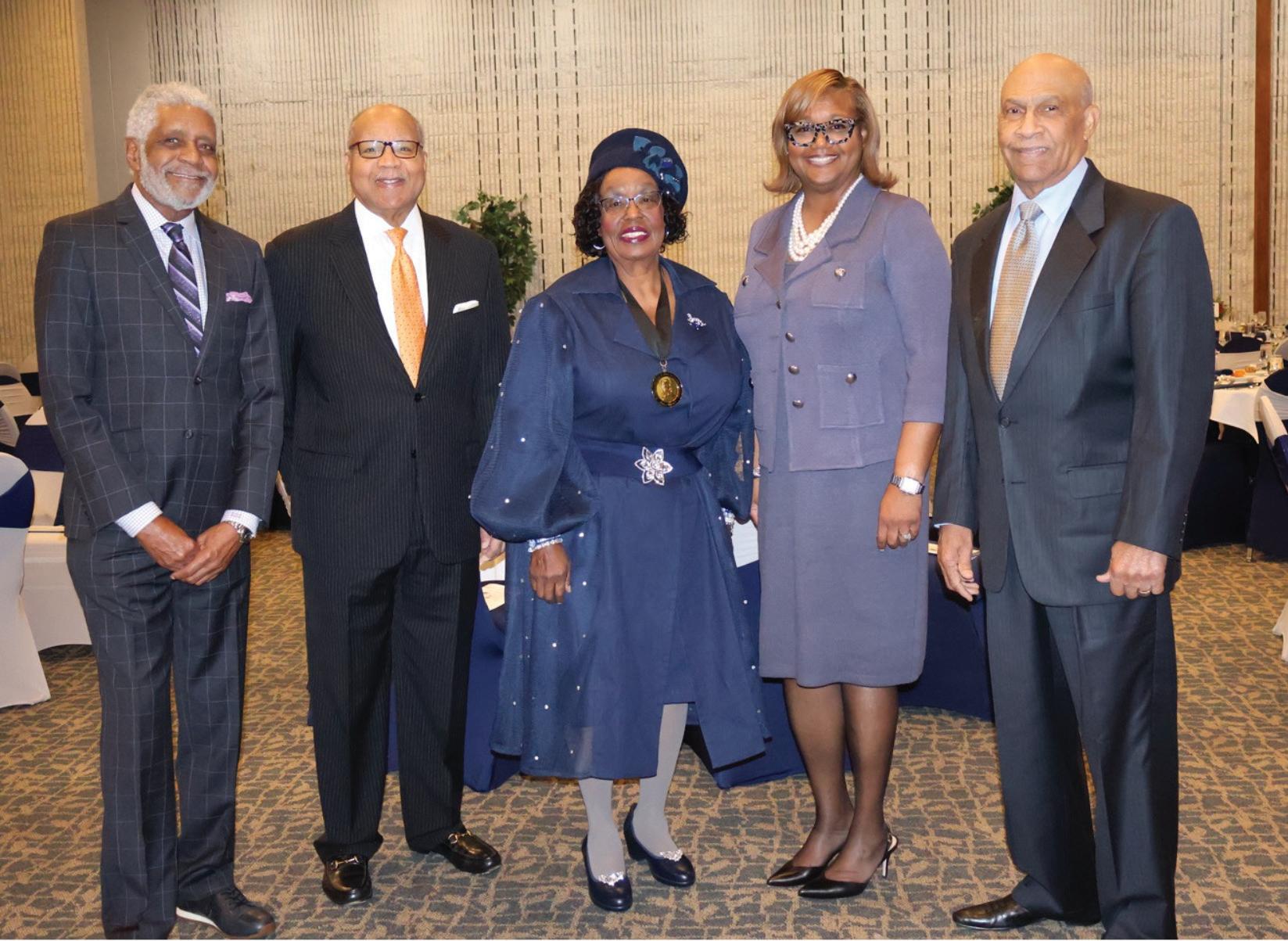
gripping account of the Sept. 11, 2001, attacks, describing how he helped save the life of his commanding officer at the Pentagon. “In that moment, instinct took over,” Turner said. “You don’t think about danger. You think about the per son beside you. That’s what service looks like.”
Throughout the con versation, Turner empha sized the principles of servant leadership. “If the work is only about you, it’s not leadership,” he said. “It’s the people you lift up that define your legacy.”
The luncheon also
warming buses for people without homes, GPS equipped snowplows and roughly 50 private con tractor plows. Jonsson said those additional resources helped crews clear about 450 miles of snow routes, including primary and sec ondary streets.
Some contractors also worked on residential streets — a shift from how the city has handled previ ous storms, Jonsson said.
In St. Louis County, more than 100 trucks worked through the week end clearing roads, accord ing to county transporta tion officials.
“County streets aren’t ‘treacherous,’” said Dave Wrone, a spokes man for the St. Louis County Department of Transportation, told St.
and it’s going to take sus tained effort to undo those results.”
Jones said Louisiana’s overhaul of its account ability system demonstrat ed how consistent data use and transparency can drive improvement across schools.
“Tracking proof points allows you to learn from what’s working,” she said. “The data shows this kind of work can make it pos sible to address inequities that have held students back.”
She also stressed the political resolve required to confront underperform ing systems.
“The real structur al change required to redesign systems takes courage,” Jones said. “It requires us to do coura geous things.”
Rachel Canter, found er and former longtime executive director of Mississippi First, said states must be honest about the depth of learning loss and declining achieve ment — trends she noted predated the COVID 19 pandemic.
“It’s been six years since the pandemic, and student outcomes are still
honored the 2026 Drum Major Award recipients — individuals whose ser vice reflects Dr. King’s call to be “a drum major for justice.” This year’s honorees included retired entrepreneur and com munity leader George Gipson III; Andrea Jackson‑Jennings, Ed.D., managing director of the Regional Response Team at the St. Louis Community Foundation; Michael E. Kennedy, RA, chairman of KAI Design and Build Enterprises; Sheryl “Ms. Sherry” Maxwell of Lincoln University Cooperative Extension; and retired
executive and community leader David Price. Education remained a central theme as ten high school students received $2,000 scholarships to support their academ ic goals. The Ronald McMullen Nursing Scholarship was also awarded to a Goldfarb School of Nursing grad uate, underscoring the hospital’s commitment to strengthening the future of health care.
The afternoon served as a reminder of how leadership, service and education strengthen a community — and how deeply those values align


with King’s life and leg acy. “Dr. King taught us that greatness comes

Louis Public Radio for a story Monday. “You’re most likely going to encounter snow in some
areas. But in terms of driv ability the system overall is in fair to good shape.”
Both Jonsson and

not where they should be,” Canter said. “And to be honest, we were already on the decline before COVID.”
Canter argued that meaningful improvement depends on revisiting foundational education policies.
“What is the standard of expectation?” she said. “Is the bar high enough? Are we being transparent with the data, and are we truly using accountability to improve student learning?”
Local leaders discussed how those principles play out in school systems showing progress.
Dr. Bonita Jamison,
superintendent of the Maplewood Richmond Heights School District, said improvement starts with staffing, focus and consistent expectations.
“We hire well and we coach,” Jamison said.
“Having the right people in the right seats, setting high expectations, focusing on literacy and intellectual preparation, and holding ourselves accountable — that’s the work.”
Jamison said the district closely tracks data, invests in professional devel opment and maintains a narrow focus on strategies that drive student success. She also emphasized
Wrone said the closure of schools and government buildings helped reduce traffic, giving plow crews
Brandi Chin, of The Opportunity Trust, Dr. Bonita Jamison, Maplewood Richmond Heights superintendent and state Board of Education member Kerry Casey chat at The Opportunity Trust’s Fourth Annual Education Town Hall.
intentional community engagement, particularly in districts serving diverse racial, ethnic and socio economic populations.
“Some families need a little extra push,” she said. “That means showing up — at school plays, bas ketball games, community events — and creating spaces where parents feel comfortable asking ques tions.”
Jamison said sharing data in accessible ways is critical, noting that some parents, particularly par ents of color, may feel disconnected from tradi tional school engagement because of past experi ences.
“They didn’t always feel welcomed or know what questions to ask,” she said. “So we think dif
from serving,” Turner said. “If we keep that at the center, there’s nothing this community can’t do.”
Evan Washington spreads salt across the sidewalks in front of government buildings downtown as winter weather moved through the St. Louis region on Saturday.
more room to work and speed up clearing efforts. The warmer stretch should allow continued snowmelt and improved road conditions, though officials cautioned drivers to remain alert for lin gering slick spots during overnight refreezing.
Sylvester Brown Jr. is the Deaconess Foundation Community Advocacy Fellow.
ferently about how we get information out and invite families into the room.” Missouri currently ranks 33rd nationally in educa tion, with chronic absen teeism, literacy challenges and lingering pandemic impacts contributing to the state’s struggles.
Jamison said improving that standing will require examining proficiency standards, strengthening accountability for district leadership and ensuring state systems provide sup port tailored to local needs. She also identified funding as a key factor for districts serving high poverty com munities.
“If we’re serious about equity — no matter a student’s ZIP code — we need funding mechanisms that allow us to pay teach ers more in high need areas, attract strong educa tors, and put the right sup ports in place,” Jamison said.
Across the panel, speak ers agreed that sustained commitment, honest assessment and action based on data will be nec essary if Missouri hopes to close achievement gaps and improve outcomes statewide.

STEM Showcase was also a success, drawing high numbers of visitors from across the metro area.
Most of the 90 young participants earned roughly $40 to $60 weekly in stipends, which helped them pay for school needs or cover urgent household expenses. The program was doing so well that in June, the Burns & McDonnell engineering and architectural firm awarded the Science Center $250,000 to expand YES.
“This donation will allow us to deepen the impact of our YES initiative,” Dr. Ray Vandiver, SLSC CEO, said in a statement at the time.
But just a few months later, leaders at the Science Center abruptly announced suspension of the program. It happened Dec. 16, nine days before Christmas and about a month before the King Day showcase. The six YES employees arrived for what they thought was a routine weekly staff meeting. Instead, Science Center leadership and human resources representatives told them the program was being suspended.
Staff escorted out
It was difficult to hear, Lauren Patrick, program manager and the longest-tenured YES edu-
That focus — along with a career spanning more than two decades in human resources and organizational leadership — has earned Boykin Farr recognition as the St. Louis Foundation’s 2026 Salute to Excellence in Business Corporate Executive of the Year.
She and other honorees, will be recognized during the 24th annual Salute to Excellence in Business Awards and Networking Luncheon on Thursday, Feb. 19, at The RitzCarlton, St. Louis.
In her current role, she said one of her most meaningful accomplishments has been strengthening Emerson’s community partnerships and deepening its impact on education. Along the way, she has learned that creating lasting change requires balancing community needs with available resources,
cator, told the St. Louis American. Staff were told to collect their belongings immediately and were escorted off the premises. Patrick received her final paycheck that day, with unused vacation pay mailed later, and learned there would be no severance. She had worked with YES for 14 years, starting as an intern.
“I have felt disheartened,” Patrick said.
“Working with the YES teams was always such a pleasure. I looked forward to going to work. It has been disheartening, destabilizing.”
No one involved in the program has been told exactly why it was suspended or how long it will be gone.
Patrick said her separation paperwork described the suspension as indefinite, citing “organizational changes.” Letters sent to parents said YES would come to a “full stop” for a “strategic reset designed to build something stronger for the future.”
The letter came from Vandiver, who did not respond to a message sent through LinkedIn. The Science Center’s communications office also did not respond to requests to speak with leadership.
Parents were told the decision followed a review by the center’s Diversity, Equity and Inclusion committee — a panel Patrick said neither she nor other educators knew existed.
Dr. Lamara Warren, the Science Center’s DEAI strategist, did not respond
careful prioritization and collaboration.
Earlier in her career at Emerson, Boykin Farr played a key role in advancing the company’s diversity, equity and inclusion efforts, work she said helped shape a more inclusive culture while teaching her the importance of listening to and elevating diverse voices across an organization.
Before moving into corporate responsibility, she served as Emerson’s director of human resources, building expertise in organizational development, recruitment and retention, benefits administration and compliance.
In St. Louis, where corporate, nonprofit and education sectors often overlap, Boykin Farr has become known for pairing strategy with presence.
That presence stands out to those who serve alongside her.
Michael P. McMillan, president and CEO of the Urban League of Metropolitan St. Louis, said Boykin Farr was a

to a message left through LinkedIn.
Questions about money
Organizational changes are often tied to budget concerns, though it is unclear whether finances played a role in the YES suspension.
The Science Center’s 2025 expenditures have not yet been made public.
While 2024 records show an $18 million shortfall, the largest increase in spending that year appeared to be pension costs, which people close to the center said may be linked to high leadership turnover. By comparison, the YES program cost about $1 million annually, according to those familiar with its operations.
Neither Science Center leadership nor the Zoo
Museum District — which distributes tax revenue to the institution — responded to requests for comment. State and local elected officials also did not respond, though a spokesperson for Mayor Cara Spencer said the mayor’s office was aware of the suspension but did not know the reason behind it.
As far as participants knew, the program was thriving. Students had recently been interviewed by a private consultant and were told the feedback would help shape the future of YES. There were no classroom visits or signs the program was under review, Patrick said.
“It was absolutely a surprise,” she said. “We had already been told by the executive team to prep for the (King Day) showcase and had been working all
semester with multiple partners to prepare.”
She added, “As an educator, my expectation was to finish the school year.”
For the 90 students involved, YES served as a pipeline to opportunities — helping with resumes, cover letters, college recommendations and providing stability beyond academics. Students entered the program in eighth grade and became eligible to earn stipends at 14. Many families came to rely on that income, Patrick said.
A consultant’s report recommended that if changes were made, there should be a transition plan to avoid harming students.
Community concern
“My concern is for the students,” said Nicole
natural choice to lead the organization’s board, citing her preparation and thoughtful leadership.
“Her commitment to excellence is widely known,” McMillan said. “She spends a considerable amount of time research-

ing each and every subject that comes before the board.”
At City Academy, a St. Louis charter school where she also serves on the board, founder Don Danforth said her leadership extends beyond meetings and into daily engagement with students and families.
Shortly after joining the board, Boykin Farr began opening meetings with quotes from books students were reading — a practice Danforth said helped connect governance decisions to the children they serve.
Her approach to leadership was tested after the May 16 tornado devastated parts of St. Louis.
Unsure what the right response should be, Boykin Farr drove through the hardest-hit neighborhoods, grappling with how best to help.
“What can I do?” she kept asking herself. “How am I going to show up?”
As a private-sector leader, she said she felt the weight of responsibility without the comfort of precedent.
At the Urban League, that uncertainty quickly
Dec. 16, nine days before Christmas and about a month before the King Day showcase, the six YES employees were told that the program was being suspended.
Adewale, a longtime YES community partner and co-owner of an engineering company with her husband, Abe, a member of the Science Center’s Board of Trustees. Their daughters also went through the program. “Those students had resumes, transcripts and records from the high school readiness program in their computer accounts,” Adewale said. “I’m concerned that these children, especially those counting on the income, were just dropped with no level of consideration, and that’s just not fair.”
Students were suddenly unable to access their online accounts, Patrick said, and the disruption came too late in the academic year to find comparable college-prep support elsewhere.
Families flooded Patrick with calls and messages after news of the suspension spread.
“I had to explain to families, ‘I want to help you but I no longer work at the Science Center,’” she said. “It is devastating because this was the outreach branch of the Science Center.”
turned into action, where she attended every major community distribution for 15 consecutive weekends.
“She showed up when people needed it the most,” McMillan said.
He described her as a vital bridge between business, philanthropy and community institutions — a role that strengthens long-standing missions rooted in equity and opportunity.
“That kind of voice is critical,” McMillan said, “because it reflects the very principles the Urban League was founded on 108 years ago.”
Those values were shaped long before boardrooms and executive titles.
Boykin Farr was adopted and raised by a woman in St. Louis, along with her adopted mother’s sister, who together created a close-knit household. Her mother taught for the U.S. Air Force, and her aunt worked as a nurse — professional paths that were far from guaranteed for women at that time.
“They were the best parts of both worlds,” Boykin Farr said. Her mother was soft-spoken and visionary.
Her aunt was practical and resourceful. Together, they modeled resilience and integrity. Being adopted, she said, gave her an early sense that opportunity carried responsibility.
In the final decade of her mother’s life, Boykin Farr became her caretaker. Her mother died in 2018.
“In a sense, it was a blessing — my mother would say I was her blessing,” she said. “I really hope I lived up to that.”
Education further expanded her sense of possibility. Boykin Farr earned her undergraduate, master’s and doctoral degrees from Saint Louis University while working on campus, gradually growing into leadership roles rather than pursuing them outright.
Because her mother taught education for the U.S. military, she spent much of her childhood living abroad — visiting the pyramids at age 10 and living in Taiwan at 8 — experiences that helped her grow comfortable navigating difference and complexity.
Even now, confidence is something she practices daily.
“Every day,” she said, when asked whether she ever questions if she belongs in the room.
She tends to listen before speaking, weighing perspectives carefully before offering her own. When asked about legacy, Boykin Farr returns to the children who have shaped her work.
“If the kids my work impacts are on a better path,” she said, “I don’t even have to know who they are or what happens. That’s enough.”



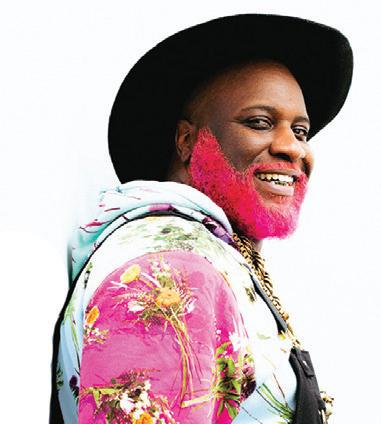
“Country music is four chords and the truth. You don’t have to play the good guy or the bad guy. You can just be.””
- Singer/songwriter Sebastian “Pynk Beard” Kole’s advice to up and coming country singers
By Zaria Mac The St. Louis American
When Black Violin made their St. Louis debut nearly ten years ago, they left a lasting impression on the sold-out audience at the Sheldon Concert Hall. The duo—Wil Baptiste and Kev Marcus—is bringing their show-stopping hip hop symphony back to the region next Saturday (Feb. 7). Drummer Nat Stokes, keyboardist Liston Gregory and DJ SPS will join them at The Factory.
“Our approach is to always mess with your head,” Baptiste said. “To give you something you’ve never heard, never thought of—and the violin and the viola are the glue that pieces it together.”
The duo describes their sound as “classical boom.”

“You don’t think of classical music as hard-hitting, so we like to think of ourselves as disruptors,” Baptiste said. “As artists, and as men, we have grown—and that definitely comes across in the new album Full Circle.” Baptiste plays the viola alongside Marcus on violin. His path to the instrument was accidental. He originally planned to play the saxophone when he signed up for a summer program at Sunrise Middle School in South Florida.
“When I went into class there were no saxophones— just string instruments,” Baptiste said. “I was stuck with the class for two weeks, but I kinda liked it, and 28 years later I’m still playing.”
For more than 20 of those years, he has played with Marcus. The pair met at Dillard High School of Performing Arts, where they shared the same music teacher. They caught the entertainment industry’s attention with repeated wins on “Showtime at the Apollo” in the early 2000s.
With careers that began in the classroom, Black Violin understands the power of youth arts education. In 2019, Baptiste and Marcus launched the Black Violin

With careers that began in the
Foundation, which awards grants and instrument donations to support the next generation of artists.
“The goal of our foundation is really to fill the gaps,” Baptiste said. “We had a lot of individuals who were pivotal in our careers, and that is what we want to do for
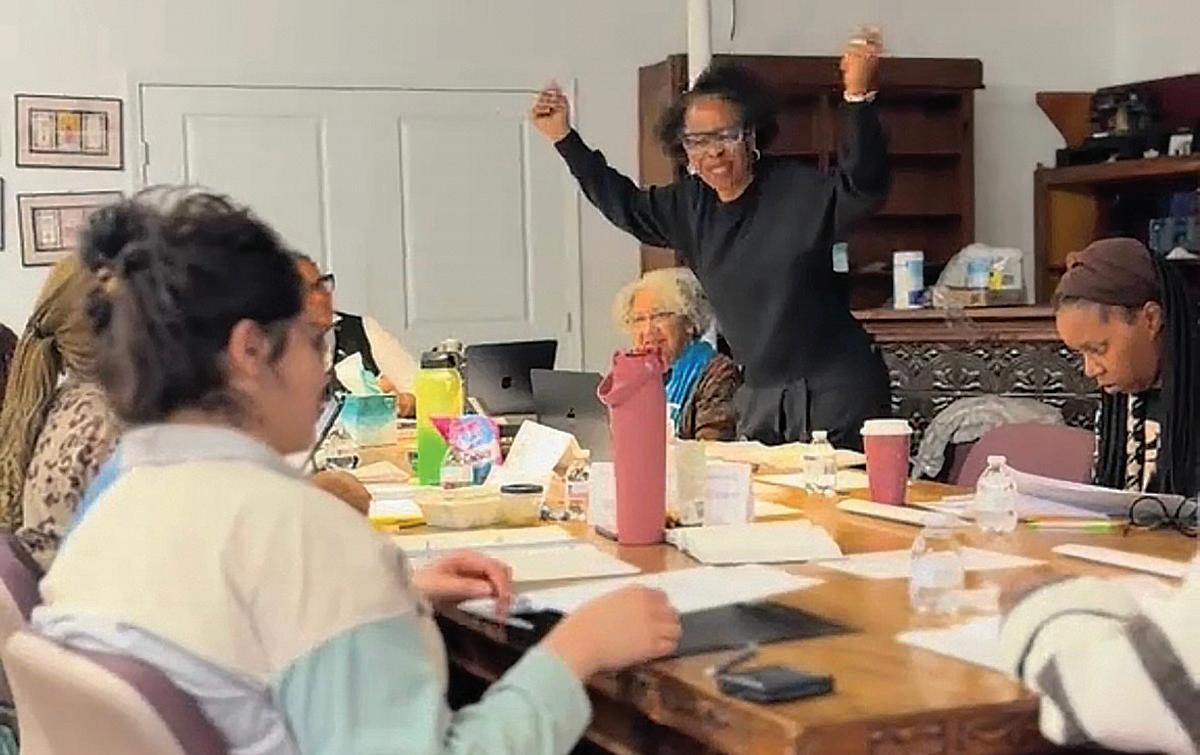
By Kenya Vaughn The St. Louis American
Acclaimed classical saxophonist
Steven Banks has a wish that drives him: he wants Black people to feel welcome in the concert hall. He will embody that mission as the featured soloist for “Diaspora,” performed by the St. Louis Symphony Orchestra on February 6–7 as part of “Prokofiev and Childs: Anthems of Resilience.”
The concerto, written by Grammy Award–winning composer Billy Childs and commissioned in 2023, traces the Black American experience through sound.

‘The Black Feminist Guide to the Human Body’ makes its STL premiere
By Kenya Vaughn
The St. Louis American
“The Black Feminist Guide to the Human Body” is a mouthful to say. Playwright Lisa B. Thompson makes no apologies about that. In fact, she feels that the title deserves to be spoken slowly – with intention and reverence. The same way that Black women deserve to have agency in this world. The same way her deeply personal, genre-defying theatrical work – which features music and movement – should be received when it
makes its St. Louis premiere next week. The production will be presented by The Black Rep at Washington University’s Hotchner Studio Theatre. Presenting the play in St. Louis for the first time is an extra special moment for Thompson. She will also have her work presented in the place where famed Playwright Ntozake Shange spent her formative years. Thompson was inspired to write poetry as a young girl after reading a piece from Shange’s “For Colored
“For me, the purpose of this piece was to connect with the Black community — not just to perform for them, but to make sure they know this music is for them,” Banks said. “Classical music has always had the capacity to tell our stories, even if those stories haven’t always been programmed or uplifted.”
To help fulfill that vision, Banks founded the Come As You Are (CAYA) Initiative, a program designed to expand access to and interest in classical music among historically underrepresented communities. He is bringing both CAYA and performances of “Diaspora” to orchestras across the country this season.
He describes CAYA as a campaign — one that begins with meeting people
where they are. In each city, he goes into the community to “remove as many barriers as possible,” starting with simply making sure people know the performance is happening.
“Whether it’s free tickets, helping with transportation, or just telling them the story of the music,” Banks said. “I love to go out and give people a heads up about what to expect.”
Fri., Feb. 6 – Sat., Feb. 7, St. Louis Symphony Orchestra presents Prokofiev and Childs: Anthems of Resilience, Powell Hall 718 N Grand Blvd, St. Louis, MO 63103. For more information, www.slso.org.
Sat., Feb. 7, doors 7 p.m. Black Violin, The Factory, 17105 N Outer 40 Rd. Chesterfield, MO 63005. For more information, visit www.thefactorystl.com.
Sun., Feb, 15, 7 p.m. The Queens! 4 Legends 1 Stage featuring Chaka Khan, Patti LaBelle, Gladys Knight & Stephanie Mills, Enterprise Center, 1401 Clark Ave, St Louis, Missouri 63103. For more information, visit www.enterprisecenter.com.
Sat., Feb. 21, 7:30 p.m.
Playadors: An Evening of Jazz & Soul, Kirkwood Performing Arts Center, 210 E Monroe Ave, Kirkwood, MO 63122. For more information, visit www.thekpac. org.
Sun., Feb. 22, doors 6 p.m.
Boys 4 Life Tour featuring B2K & Bow Wow, 1 S Compton Ave, St. Louis, MO 63103. For more information, visit www.chaifetzarena.com.
Thurs., Jan. 29, 7:30 p.m.
Maddie in the Morning Live with TS Madison, City Winery St. Louis, 3730 Foundry Way, St. Louis, MO 63110. For more information, visit https://citywinery.com.
Fri., Feb. 6, 7 p.m. 4th Annual
Bob Marley’s Birthday Bash, Atomic Garage, 4140
Manchester Ave, St. Louis, MO 63110. Purchase tickets at www. ticketweb.com.
Thurs. Feb. 5 6 p.m. Orchid Nights, Missouri Botanical Garden, 4344 Shaw Blvd, St. Louis, MO 63110. For more information www.missouribotanicalgarden.org.
Fri., Jan. 30 - 31, 7 p.m.
Special Event Donnell Rawlings, Helium Comedy Club, 1151 St. Louis Galleria St. St. Louis, MO 63117. For more information visit https://st-louis. heliumcomedy.com.
Fri., Feb. 13, 6 p.m. Leslie Jones: Live!, City Winery St. Louis, 3730 Foundry Way, St. Louis, MO 63110. Purchase ticket at https://tickets.citywinery. com.
Fri., Feb. 20, 8 p.m. Legends of Laughter featuring Sommore, Earthquake, Lavell Crawford, and Arnez J, Stifel Theatre, 1400 Market St. St. Louis, MO 63103. For more information visit www.stifeltheatre.com.
ST. LOUIS MUSIC SPOTLIGHT
Sat., Jan 31, 9 p.m. DJ Mursa & DaSkwaad: A Tribute to New Jack Swing, The Dark Room, 3610 Grandel Sq. St. Louis, MO 63103. For more information visit https://kranzbergartsfoundation.org.
Sun., Feb. 1, 7 p.m., Denise Thimes: The Nina Simone & Billie Holliday Experience, City Winery St. Louis, 3730 Foundry Way, St. Louis, MO 63110. For

more information, visit https:// tickets.citywinery.com.
Mon., Feb. 2, 7:30 p.m., “Take 2” with Chuck Flowers and Roz White, Power Creative, 3221 Oak Hill. For more information, email chuckluvmusic@ gmail.com.
THEATRE
Through Feb. 1, 7:30 p.m. Alice By Heart, Looking Glass Playhouse, 301 West St. Louis St., Lebanon, IL 62254. For more information, visit www. lookingglassplayhouse.com.
Feb. 4 – March 1, The

Black Rep presents The Black Feminist Guide to the Human Body, Hotchner Studio Theatre, Washington University. For more information, visit www.theblackrep.org.
Wed., Feb. 4 – March 1, The Repertory Theatre of St. Louis presents Primary Trust, Loretto-Hilton Center, 130 Edgar Rd, Webster Groves, MO 63119. For more information, visit www.repstl.org.
Through Feb. 8, 7:30 p.m. Myth of the Ostrich, The Marcelle, 3310 Samuel Shepard Dr, St. Louis, MO 63103. For more information, visit https:// kranzbergartsfoundation.org/.
Through Feb. 8, The Fabulous Fox presents Hell’s Kitchen, The Fabulous Fox. For more information, visit www.thefabulousfox.com.
ART
Fri., Jan. 30, 5 p.m. Closing Reception for Current Exhibitions, Pulitzer Arts Foundation, 3716 Washington Blvd, St. Louis, MO 63108. For more information, visit https:// pulitzerarts.org/campus/.
Through February 1, 2026, Jennie C. Jones: A Line When Broken Begins Again, Pulitzer Arts Foundation and Museum, 3716 Washington Blvd, St. Louis, MO 63108. For more information, visit https://pulitzerarts.org.
Through February 8, 2026, Teresa Baker: Somewhere Between Earth and Sky, Contemporary Art Museum, 3750 Washington Blvd, St. Louis, MO 63108. For more information visit, https://camstl. org.
Through February 14, Portfolio Inc. presents the All Colors Arts Invitation and Juried Exhibition The St. Louis Artists Guild, 12 North Jackson Ave, Clayton, MO 63105. For more information, visit www.portfoliogallerystl. org.
Through June 2026, The Future Is Female, 21c Hotel and Museum Hotel St. Louis, 1528 Locust St, St. Louis, MO 63103. For more information, visit https://21cmuseumhotels. com.






Girls…” As fate would have it, Thompson ended up being taught by Shange when she was a grad student at UCLA. “It’s pretty amazing that I wrote my first monologue in her class,” Thompson said. “Isn’t that crazy.”
“The Black Feminist Guide to the Human Body” is about embodiment — about inhabiting a Black woman’s body across time, history and experience. Thompson traces a wide and powerful arc, from Sally Hemings, a child enslaved and exploited in Thomas Jefferson’s household, to Michelle Obama, a First Lady whose body, brilliance and humanity have been relentlessly scrutinized. The juxtaposition is striking, but intentional. “From being in the White House as property to being in the White House as First Lady,” Thompson said. “And still seeing the through line.”
That through line — the vulnerability and policing of Black women’s bodies — is not presented as spectacle in her play. Instead, Thompson insists on centering the gift of Black womanhood alongside its burdens. “It’s an extraordinary gift,” she said, “and sometimes a horrific burden. But I want us to sit in the space of the gift.”
This is not a “cheesy” celebration, as Thompson is careful to note. It is textured and honest — one that also makes room for Black women to be regular.
“We don’t have to be spectacular to be honorable,” Thompson said. “I want the theater to be a place of radical permission,” Thompson said. Permission to love ourselves assiduously — a phrase she borrowed from “For Colored Girls…”
“Not after the weight loss, not after the glowup, not after perfection, but exactly as we are,” Thompson added. “Even at 3 a.m., half-asleep, hair
Continued from B1
The concerto unfolds in three movements, each inspired by Black literary voices and historical realities. The opening movement, “Motherland,” draws from a poem by Nayyirah Waheed, personifying Africa as a grieving mother whose children have been taken. Musically, it begins with rhythmic, dance-like textures that evoke joy and innocence before gradually unraveling.
“It’s meant to sound almost childlike at first,” Banks explained, “before that world starts to fracture.”
The second movement, “If We Must Die,” takes its title from Claude McKay’s defiant poem of resistance. Here, the music becomes confrontational and angular, filled with complex rhythms and tension between soloist and orchestra.
“It feels like a battle,” Banks said. “There’s anger there — righteous anger — and the piece gives space to express it.” The final movement, “And Still Our Eyes in Wonder,” gestures toward reflection and possibility. Inspired by St. Louis’ own Maya Angelou’s poem “And Still I Rise,” it includes a moment where Banks performs in duet with the piano — an intentional echo of Black church traditions, where hymns are shared intimately between soloist and accompanist.
What makes “Diaspora” particularly powerful, Banks notes, is its refusal to present the Black expe-
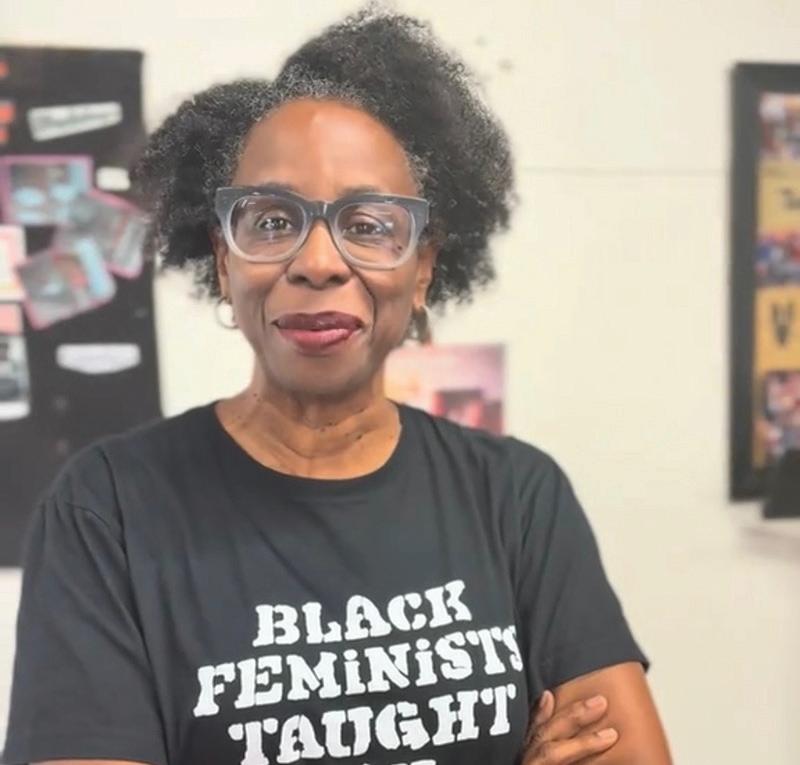
going every which way.”
The piece is also deeply ancestral. Thompson speaks with reverence about the women in her family — grandmothers, aunts, mothers — whose brilliance and dreams were constrained by time, access and circumstance.
“I ran with everything,” she said. “Because they didn’t get to.” Writing this piece became a way of reaching back, gathering up the permissions denied to those women, and living them fully — even as, she notes, the world continues to try to snatch those permissions away.
While the piece centers Black women, Thompson is adamant that it is not exclusionary. “This is for anybody who has ever loved, been loved by, or been birthed by a Black woman,” she said. Men are not bashed here; many, she notes, return to see the show with their mothers, sisters and partners in tow.
Bringing the production to The Black Rep also holds special meaning. Thompson, a scholar, playwright and associate dean, spoke with awe about the institution’s 49-year legacy and its founder Ron Himes, whom she calls both legendary and audacious. Thompson said presenting her first production at The Black Rep, feels like alignment.
rience as singular or static.
“If you listened to the beginning of the piece and then jumped 15 minutes ahead, you might not even realize it’s the same work,” he said. “That’s intentional. Our story has many sounds.”
That breadth mirrors Banks’ own experience performing the piece nationwide. Each performance, he says, is emotionally demanding — physically exhausting and spiritually charged. At times, he has dedicated performances to victims of police brutality or to communities grappling with collective trauma.
“There are moments
What makes “Diaspora” particularly powerful, Banks notes, is its refusal to present the Black experience as singular or static.
where you can release things — anger, grief — in a constructive way,” Banks said. “When a thousand people are experiencing that together, it opens the door to healing.”
Banks’ career reflects the diversity of Black musical expression. Though many still associate the saxophone primarily with jazz, he has built his artistic home firmly within classical music.
That path felt natural as soon as the WinstonSalem, North Carolina native discovered it. After growing up immersed in church music and school band programs, he encountered classical saxophone in a transfor-
The work is part of what she refers to as “the Black feminist trilogy,” which also includes “Single Black Female” and the “The Mamalogues.”
“I’m just thrilled to have been able to craft this trilogy about what it means to be a black woman,” Thompson said.
She wrote “The Feminist Guide to the Human Body” while in her 50s, a season she calls “the sweetest decade.” She was writing during a time when she was losing friends and mentors too soon. Researching the ages at which iconic Black women passed away forced a reckoning with time, care and how often Black women are denied rest.
The result is a work she calls her “own medicine.”
“This piece is a love letter to Black women and girls,” Thompson said. “And the joy, and blessing and the honor it has been to be one – and to grow older.”
The Black Feminist Guide to the Human Body” will run February 4-March 1 at Washington University’s Hotchner Studio Theatre, inside Edison Theatre, 6445 Forsyth Blvd, 63130. For more information, visit www.theblackrep.org.
mative way during high school. Hearing his teacher perform the instrument in a classical context was a revelation.
“From the very first note, my ears perked up,” Banks recalled. “I had never heard anything like it. I just knew this was what I wanted to do.”
Another formative influence came from witnessing Black excellence in classical music firsthand — particularly through recordings of pianist André Watts, one of the first internationally celebrated Black classical soloists.
Listening to Watts perform Franz Liszt’s “Sonata in B minor” became a daily ritual for Banks during his student years. It was a source of validation and resolve in a space where representation was sparse.
Banks knows that many Black audiences have been conditioned to feel that classical spaces are not meant for them. CAYA is his way of dismantling that myth.
“I just want to tell the story of the music ahead of time, so people feel welcomed instead of intimidated.”
He hopes “Diaspora” lands as both affirmation and possibility for St. Louis audiences.
“I want Black people to feel a sense of ownership over this music,” he said. “To come into the hall and feel like this belongs to them — because it does.”
The St. Louis Symphony Orchestra will present Prokofiev and Childs: Anthems of Resilience featuring Steven Banks on February 6–7 at Powell Symphony Hall inside the Jack C. Taylor Music Center. For more information, visit www.slso.org.

By Maria Russell Missouri Historical Society
Annie Malone’s story is a classic pullyourself-up-by-your-bootstraps narrative, the kind Americans love to tell. But the heart of her story reveals something more: a woman’s commitment to her community and her efforts to pull others up with her.
Annie Turnbo Malone was born on August 9, 1869, the second-youngest child in a large family. Her parents, who had previously been enslaved, died when she was still very young, so she was raised by an older sister in Peoria, Illinois.
As Malone was growing up, many Black women and girls were dealing with hair loss, hair brittleness, scalp disease, and hair damage from stress, illness, and the harsh chemicals and techniques marketed to straighten textured hair. Wanting to remedy this, the young entrepreneur experimented on her sisters and their friends, developing mixtures to not only encourage hair growth and health but also heal chemical burns and scalp disease.
With a burgeoning reputation for good results and a perfected recipe for her “Wonderful Hair Grower,” Malone moved to Brooklyn, Illinois, an African American town popularly known as Lovejoy after the abolitionist Elijah Lovejoy. She launched her Poro business by marketing her product door to door and recruiting locals to advertise its success.
As news spread about the upcoming 1904 World’s Fair, Malone saw a tremendous opportunity. She moved to St. Louis’s Mill Creek neighborhood in 1902, living and working at 2223 Market Street. From 1911 to 1918, she operated her business at another Mill Creek address, 3100 Pine.
With their emphasis on African hairstyles and Black beauty, rather than straightening hair and lightening skin to adhere to white beauty ideals, Poro haircare and skincare products became even more popular. Poro ads also emphasized opportunities for Black women to earn income, gain independence, and build self-esteem as Poro agents. In 1913, in what was probably the first convention of professional Black women in the country, Malone gathered her agents together in Mill Creek.
In 1918, Malone built Poro College in the Ville neighborhood. In addition to serving as Poro’s manufacturing and shipping headquarters, the college was a training center for sales agents. The campus included dormitories and a student cafeteria. A 500-seat auditorium, committee rooms, and rooftop garden were open for public use.
As one of America’s first Black female millionaires, Malone was well known for her generosity. She helped her employees with mortgages and rewarded workers who bought homes for their parents and siblings. Black institutions, including the Pine Street YMCA, received large donations from Malone. At one point the St. Louis Argus reported that she had financially supported at least two students at every African American land-grant col-
Continued from B1
tours, Grammy nominations and a career of enthralling audiences with singing, strings and bouncing 808s—now including seven new songs from the Full Circle album.
Songs like “Drama” are gritty yet classical—sharp and hard-hitting—while tracks like “Smoke” resemble a soulful lullaby that invites listeners to sing along. At the upcoming show, audiences can also expect to hear Baptiste’s vocal stylings.
“I didn’t really consider myself a singer until eight years ago,” he said. “It’s

lege in the nation.
Malone also donated land and money to the St. Louis Colored Orphan’s Home and assisted the institution in moving to its permanent location on Goode Avenue (later renamed Annie Malone Drive). She served as board president from 1919 to 1943.
Financial difficulties eventually led Malone to move her Poro headquarters to Chicago, but she returned to St. Louis every year for the annual May Day parade, a fundraiser for the Orphan’s Home. In 1946 the institution was officially renamed the Annie Malone Children’s Home. Malone passed away in 1957, and the site of her business venture was eventually replaced with residences. Although the Poro empire itself didn’t survive, Malone’s legacy of philanthropy and community building lives on here in St. Louis.
On Thursday, February 5, the Missouri History Museum and Frizzy by Nature will kick off Black History Month with a celebration of Black hair and the heritage of natural hair in St. Louis, centered on Annie Malone. The evening will begin with a happy hour and Blooming Business Market at 5pm. Pop-up tours of Mill Creek: Black Metropolis will be available at 5:30pm and 5:55pm. At 6:30pm, head to the Lee Auditorium to hear from public historian Cicely Hunter, Linda Nance of the Annie Malone Historical Society, and Valerie and Leslie Hughes of Frizzy by Nature, plus a recorded message from Annie Malone’s descendant James Agbara Bryson.
Be sure to return the following Thursday, February 12, for exciting Mill Creek–inspired performances by HEAL Center for the Arts and Carrie Collins. From 5pm to 6:30pm, enjoy live music with local DJ Lamar Harris. Pop-up exhibit tours will be available at 5:30pm and 5:55pm. At 6:30pm, curator Gwen Moore and Carol Daniel will discuss how Mill Creek and Black culture intersect as a major influence on pop culture today.
one of those things that grew and developed over time.”
Baptiste said audiences often feel free enough to dance and move in the aisles, “with their eyes closed—lost in the music.”
“The vibe of our shows is energetic and inclusive,” he added. “We encourage people to get up and dance and move—however you feel, feel free to express that.”
He’s excited to bring their sound back to St. Louis.
“I think there will be people who have seen it before and will be hype and excited,” Baptiste said. “And there will be people who have no idea and just saw a violin and
two Black dudes. They’re gonna be fresh and brand new and get hit in the chest—in a good way.” He describes the show as a full-circle emotional journey, with “peaks and valleys of how we started off and where we are now.”
“At the end of the show I’m gonna get everybody to stand up and put their hands in the air,” Baptiste said. “That’s just how it is.”
Black Violin will play The Factory at The District at 7 p.m. on Saturday, February 7. For more information, visit www.thefactorystl.com.


The storm is over now. Welp, we lived through it. The weather apps and reports had folks on edge about this snowstorm that everybody was scared to death would be the blizzard of ’82 2.0. St. Louis weather is already about as predictable as a scammer psychic trying to give a tarot reading with Uno cards. But when you add inclement freezing weather to the mix, we will either get a light dust or an avalanche – regardless of what the forecast says is for certain. This weekend’s storm was somewhere in the middle. Actually it wasn’t that bad. The streets… well…that’s a different story. I’m not pointing fingers, just stating facts. I will say that I’m so glad that I got some practice keeping my balance on ice at Morgan Casey’s set, because I was hitting triple axels all up and through the North and West Side. I’m sure somebody trying to dig themselves out saw me gliding by and said, “When did Tai Babilonia move here?” But seriously, based on my experience out here, I advise y’all to stay off the side streets as much as possible. And keep main road travel to a minimum if you can – yes, all these days later.
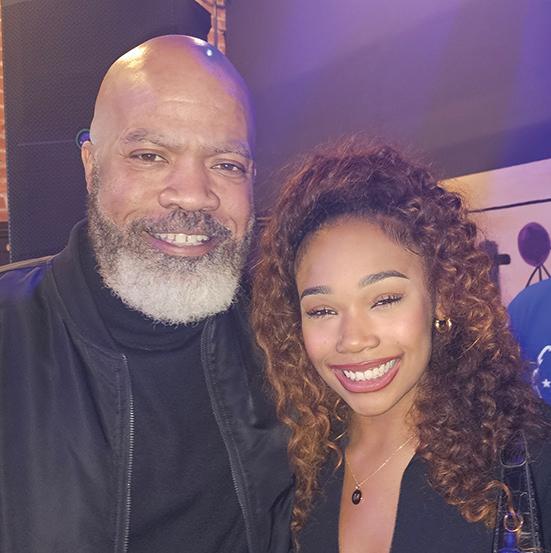
The weather whisperers. Since we are talking about the snowstorm, I have a full-proof predictor of inclement weather severity – I’m talking with 98 percent accuracy. I’m not trying to put any of our beloved media personalities out of work, and my method will be met with
some judgement, but hear me out. Follow the meteorologists and the Farmer’s Almanac if you must, but also pay close attention to the moves that “hobosexuals” are making within 48 hours of a severe winter weather alert. If you have one in the hall of shame, unblock him for 24 hours before the snow is supposed to hit. If he hits you with a late night “wyd” or “hey big head” message, know that the storm is on the way and he’s lining up his living situation options. I didn’t get any traction on Friday night, so I thought the storm was gonna pass us over. Then on Saturday I received an Instagram follow accompanied with a “Hey beautiful” message. I couldn’t get to the grocery store fast enough to stock up. Too bad by the time I got there all I had to choose from in the meat aisle was tripe and chicken feet. Fellas, y’all know y’all have that one friend you’ve been loyal to since middle school despite his life being an absolute mess. If you say to yourself, “Where’s Twan,” “Anybody seen Rico?” or “Man-Man done went MIA on a brother”– and said friend doesn’t owe you $50 at the moment – he is out seeking inclement weather intimacy. The storm is on its way. I will put hobosexuals against any worldclass meteorologist when they are scheming to get a woman to allow them to use her house as their short-term warming shelter.
Giggling with Guy. Because I didn’t believe the snow was coming, I made my way to The Funny Bone to catch Guy
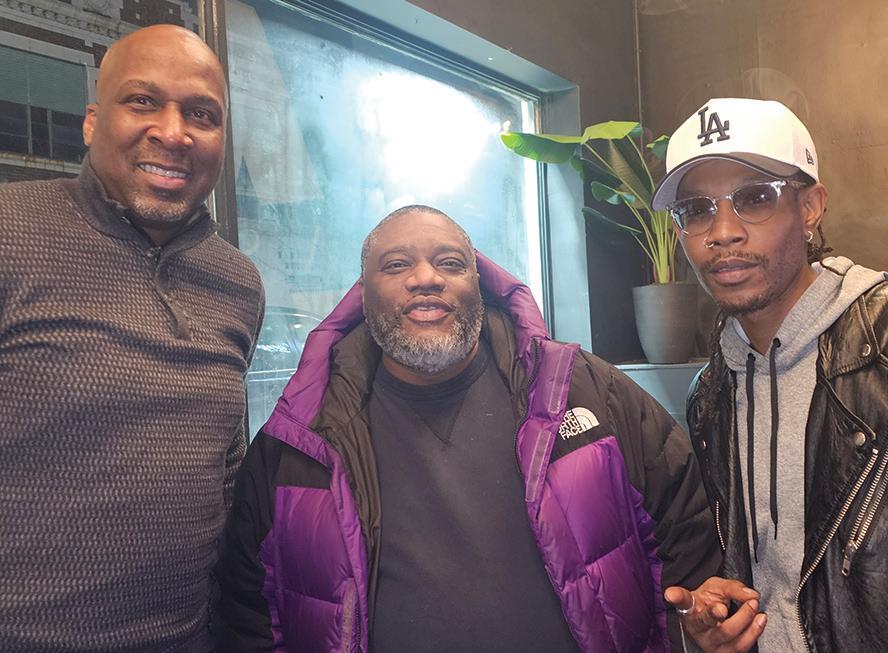
and NBA Champion Earl Barron were just a couple of the power players at Jami Ballentine’s birthday celebration Tuesday night at Ash
Torry Friday night. The wintry mix hadn’t dropped, but those temperatures shole had (yes, I said shole)! By the time I made it from the parking lot to the building, I was almost frozen solid…as I watched the frat boys make their way to Trainwreck (I think) in shorts and slide ins. But I’m sure y’all want to hear about the show. I cackled, just like I thought I would. My ki-kis actually kicked off before Guy hit the stage thanks to opener Tony Tone. The way he roasted the woman with the Weezy Jefferson voice over an open fire – but in a friendly way – had me hollering. When Guy hit the stage in an Adidas jumpsuit and not a wrinkle in sight, I was like, “How Sway? I know he pushin’ 60!” I was right. He said he was 57, and the crowd gasped. He said that he looks so good because Black people age like “McDonalds cheeseburgers.” Am I the only news nerd

who remembers that story about the Iceland hotel that had one on display for ten years and it looked like it was just grabbed out the bin? But back to Guy. I cackled, even as some aged out frat boys audibly grumbled anytime Guy said something positive about Black people. Help. You went to see a Black comic, what did you expect? I didn’t stay for the whole show, because I wanted to get home before the snow started. But I was glad to see while I was there that Guy gave them the attention they deserved – none.
Not a party? I couldn’t tell! Since I’m already talking about my folks aging like fine wine –or processed food loaded with chemicals – I might as well tell y’all I kicked it with my girl Jami Ballentine for her b-day at Ash. She kept saying it was not a party as she told folks to stop through on a Tuesday.
She bamboozled us, y’all. Or was it a Jedi mind trick? Either way, she had us going up on a Tuesday. It was in a cigar bar, so I’m currently on my third hit of my albuterol inhaler, and I sound like Weezy Jefferson Jr. I’m gonna go ahead and say it was worth it! She had the STL heavy hitters in the house. I got a chance to see my beloved little brother from another mother (and father) Laurence Maroney as well as NBA champion Earl Barron, Mark Harris II, Tony “T-Luv” Davis to name a few. I would need this whole Partyline to name all the folks (and I’d still probably still accidently leave some folks out), just know that the power players were in the place as the connection broker herself cut a rug with a masterfully beaten mug. I have to admit that Jami was doing the Tameka slide while everyone else was hitting the Tamia. But hey, it was her party. She could miss a step – or three – if she wanted to.


A decade before NFL Films proclaimed the Dallas Cowboys “America’s Team,” Black America had its own team.
It was and forever will be the 1969 Kansas City Chiefs.
Led by maverick owner and American Football League founder Lamar Hunt, Kansas City had more African American players than any franchise in the AFL or NFL.
Behind the innovative mind of head coach Hank Stram, who saw talent and not skin color, the Chiefs dominated the Minnesota Vikings 23-7 in Super Bowl IV in New Orleans.
“They were calling me washed, saying I didn’t have it anymore. I just wanted to prove to myself I am who I say I am.”
— New England Patriots wide receiver Stefon Diggs, who is headed to the Super Bowl after coming off an ACL injury
With Alvin A. Reid
(Minnesota); Junious “Buck” Buchanan (Grambling); Curley Culp (Arizona State).
Linebackers: Bobby Bell (Minnesota); Willie Lanier (Morgan State).
Safeties: Caesar Belser (Arkansas AM&N — now the University of Arkansas at Pine Bluff); Jim Kearney (Prairie View).
The 40-man roster that won the Super Bowl included 19 Black players — nearly 50%. At the time, that was virtually unheard of in the NFL and rare even in the AFL.
Here are the 19, along with the colleges they starred at before playing professional football:
Running backs: Mike Garrett (USC); Wendell Hayes (Humboldt State — now Cal Poly Humboldt); Robert Holmes (Southern University); Warren McVea (Houston).
Wide receivers: Frank Pitts (Southern University); Gloster Richardson (Jackson State University); Otis Taylor (Prairie View A&M).
Tight end: Curtis McClinton (Kansas).
Defensive linemen: Aaron Brown
Cornerbacks: Jim Marsalis (Tennessee A&I — now Tennessee State); Willie Mitchell (Tennessee A&I); Goldie Sellers (Grambling); Emmitt Thomas (Bishop College). Of the 19 African American players, 12 attended historically Black colleges and universities — another staggering statistic.
Lanier and fellow linebacker Jim Lynch, drafted in 1967, became roommates and close friends during their time with the Chiefs.
Lanier recalled in “America’s Game: The Story of the 1969 Kansas City Chiefs” how the team bonded regardless of race.
“The lack of bias… was extremely impressive. Because the relationships were pure. It wasn’t something that was pushed,” Lanier said.
“The individuals understood that if there was going to be accomplishment at the highest level everyone had to understand that even though there were differences, there were similarities.

That was how it happened to come together.”
Lynch explained in “America’s Game” that he was one of three white starters on defense in 1969.
“You have to remember the times. This was not the norm,” he said.
During a 1969 interview, Lynch said, “The Black-white relationships
that we have are not parallel on any team and I am elated with it. These kinds of things build champions and keep you champions.”
Lanier and Lynch credited Stram with refusing to yield to racism that existed throughout NFL locker rooms in building a championship-caliber team.
“We don’t care what color [a player] is, what
With Earl Austin Jr.
Willie Lanier (63) was one of 19 Black players on the 1969 Kansas City Chiefs’ 40-man roster.
the 1969 Chiefs and the Jan. 11, 1970, Super Bowl remain my favorites.
The Reid Roundup
nationality he is, the only concern we have is bringing him in with the idea of competing. And if they earn a right to be a member of our 40-man squad they are going to be here,” Stram said in a 1969 interview aired on “America’s Game.”
With all the exploits of Patrick Mahomes and the modern-day Chiefs,
Kansas City Chiefs greats Bobby Bell Willie Lanier, “Buck” Buchanan, Emmitt Thomas and Curly Culp are members of the Pro Football Hall of Fame in Canton, Ohio...In an alarming omission, the late Otis Taylor has not been inducted. Taylor snagged six passes from Hall of Fame quarterback Len Dawson for 81 yards in Super Bowl IV, and his 46-yard touchdown reception in the fourth quarter sealed the Chiefs’ victory. Taylor is a finalist in this year’s voting, which will be announced Feb. 7…Chiefs wide receiver Frank Pitts ran three reverse plays against Minnesota for 37 yards in Super Bowl IV and had three receptions for 33 yards. Pitts, who died last week at 82, could have easily been the game’s MVP…Pitts wore No. 25, and 10-year-old Alvin A. Reid chose his number for his first Kirkwood Junior Football League jersey… Lloyd Wells, a photographer turned Chiefs scout, traveled back roads during the 1960s to help the team sign many outstanding HBCU players…In 1965, Chiefs running back Mike Garrett of USC became just the second Black player to win the Heisman Trophy. Ernie Davis of Syracuse won in 1961.
The Principia Panthers have become a high school girls basketball powerhouse over the past three years under head coach Josh Spuhl. In the past two seasons, the Panthers have advanced to the state championship game, finishing second in Class 2 in 2024 and second in Class 3 in 2025.
Principia is enjoying its best season yet in 2026, currently 18-2 against a challenging schedule. The Panthers’ only losses have come against national power Incarnate Word Academy in the championship game of the Visitation Christmas Tournament and Lee’s Summit West, one of the top teams in Kansas.
Principia has defeated several quality opponents, including Belleville East, Marshfield, LoganRogersville, Tipton, Olathe South, Nashville, Illinois, North Little Rock, MICDS, West Plains and Ursuline.
The Panthers have a deep and talented roster and play at a fast pace, using full-court pressure defense. Their top player is 6-foot-2 junior forward
Dasia Scott, a two-time all-state selection. Scott is averaging 21.1 points, 8.4 rebounds, 2.3 steals and 1.5 blocks while shooting 53% from the field and 39% from 3-point range. She has received multiple scholarship offers from major Division I programs. Providing support in the backcourt is 5-foot-5 sophomore point guard Loganne Love, who is averaging 14.1 points, 5.7 rebounds, 4.5 assists and 3.5 steals in her second season as a varsity starter. The rest of the supporting cast is young but talented. Freshman guard Aniyah Poniewaz is third on the team in scoring at 9.5 points per game. Sophomore guard Nadia Bateman averages 6.3 points and nearly two steals per game while providing strong defense. Sophomore forward Paige Ivy averages seven points and five rebounds per game. Junior guard Nya Walker averages 4.5 points, senior guard Nyja Williams averages four rebounds, and sophomore forward Jayme Brown averages 3.2 points.
Principia is ranked No.

1 in the latest Missouri Basketball Coaches Association Class 3 state poll.
Jamiah Herring-Green reaches 1,000 points
Hazelwood West girls basketball standout Jamiah Herring-Green scored her 1,000th career point last week.
The 5-foot-10 sophomore shooting guard is one of the state’s top young
prospects and is averaging 29 points per game, leading scorers in the St. Louis metropolitan area.
Herring-Green also averages 9.5 rebounds, four assists and three steals per game. She has scored at least 25 points in 12 games and topped 30 points seven times this season. She delivered a career-high 49 points in a victory over St. Pius X last week, adding 12
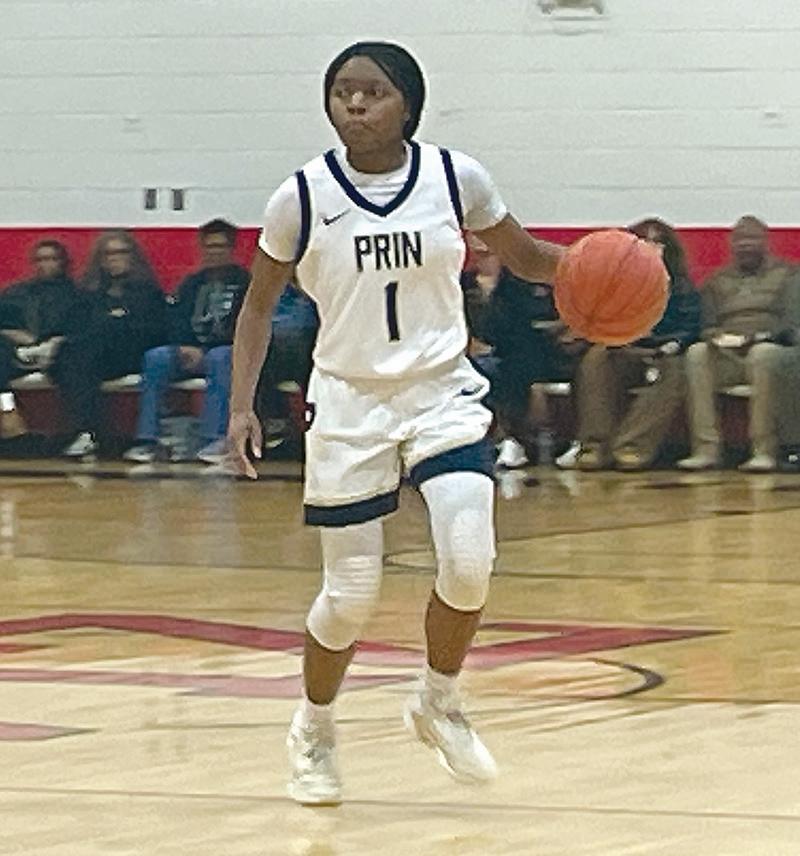
rebounds, three assists and five steals.
Herring-Green is the daughter of former Hancock High standout Sonya Daugherty-Green, who scored 3,000 points during her prep career. She led Hancock to a third-place finish in the Class 3 state tournament in 2005 and later scored 1,170 points at Southeast Missouri State.
Top games this week
Boys Vashon at De Smet, Thursday, 6:30 p.m. CBC at Chaminade, Friday, 6:30 p.m.
Girls Principia at Lift for Life, Thursday, 6:30 p.m. Cardinal Ritter at University City, Saturday, 12:30 p.m.
The St. Louis American’s award winning NIE program provides newspapers and resources to more than 8,000 teachers and students each week throughout the school year, at no charge.
The St. Louis American’s award winning NIE program offers newspapers and resources to St. Louis area teachers and students each week throughout the school year, at no charge.
Questions or comments? Contact Cathy Sewell csewell@stlamerican.com or 618-910-9551



Students at The American’s Summer Science Academy work in teams to discover the many different computer prog ramming languages.
construct a series circuit.
Students at The American’s Summer Science Academy work in teams to discover the many different computer programming languages.
Teachers,


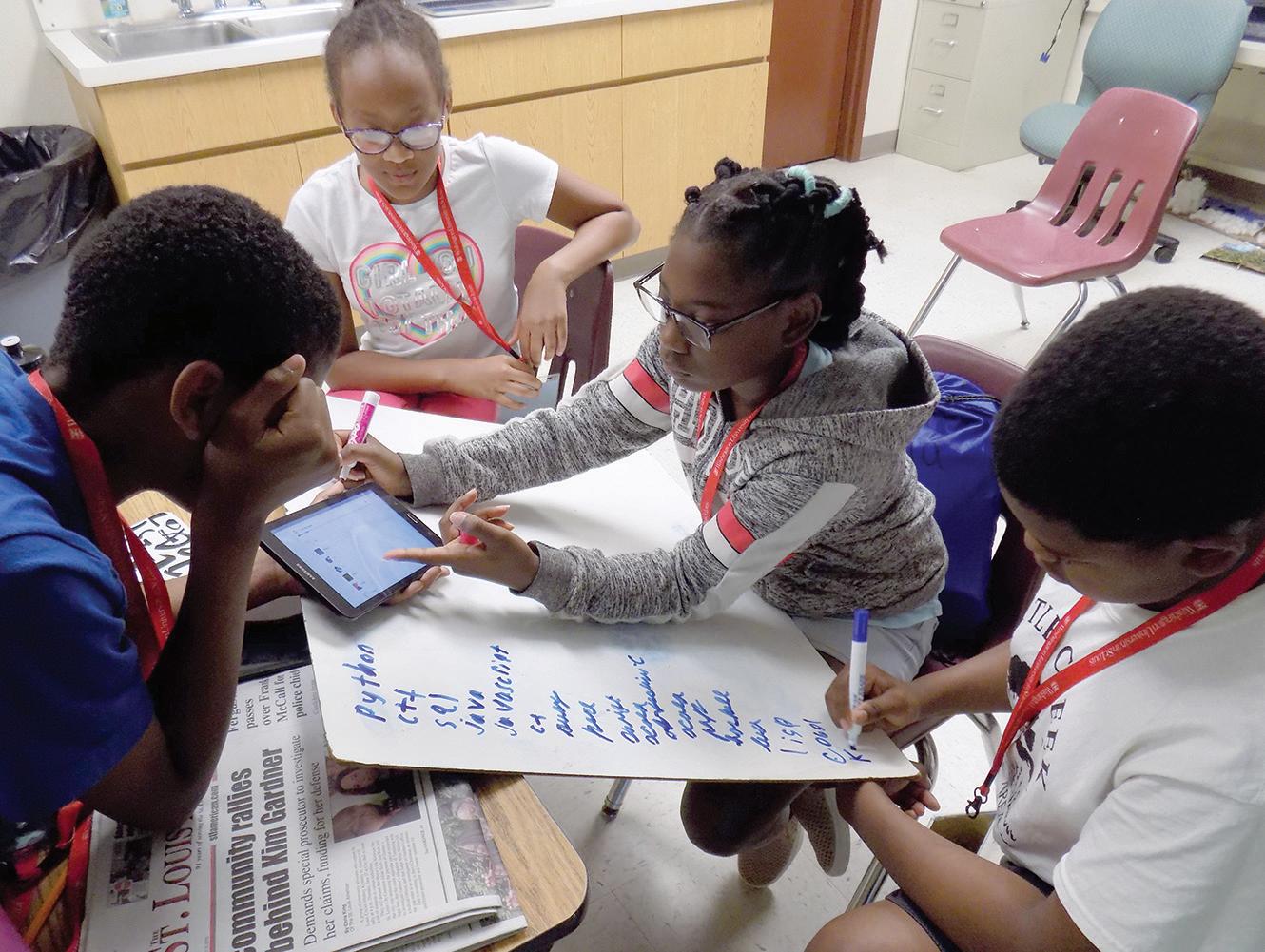


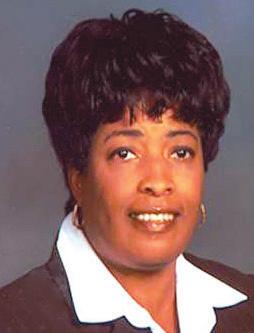
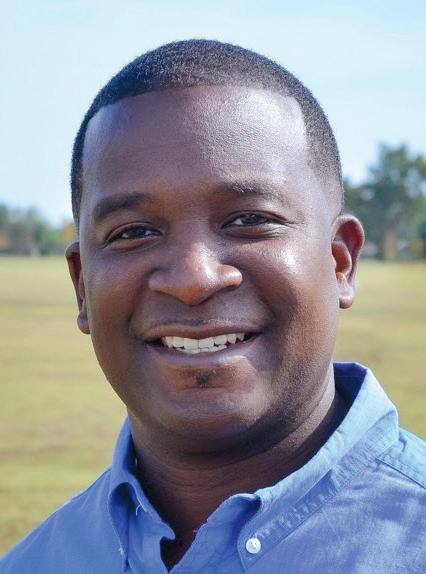
William (Bill) Parker grew up in New Orleans. He graduated from JFK High School, which focused on math, science, and engineering. Parker was interested in hurricanes at a young age, but he became interested in the weather after a high school statistics class. In this class, he learned how to predict the chance of rain. Parker wanted to attend a historically black college/ university (HBCU), so he chose Jackson State University to study meteorology. He graduated with his bachelor’s degree,
A hurricane forms over tropical and subtropical ocean water. Warm water and cool, moist air combine to create strong winds that can gust up to 200 miles per hour! These winds create waves that bring the storm on shore. Hurricanes are very destructive. They can flip cars, sink boats, uproot trees, and demolish houses.

Fungi are organisms made of filaments (called hyphe) that are stacked together. Unlike plants, fungi do not have chlorophyll, so they cannot make their own food. Some fungi are parasites, which mean they live off of other organisms. Some fungi feed off of dead and decaying matter. Fungi are everywhere in the environment, including the soil, lakes, river and seas, air, and on plants and animals. Fungi (plural of fungus) help organic matter to decay and release carbon and oxygen into the environment. Unlike plants, fungi do not have
In addition to powerful winds, hurricanes bring a lot of rain. (Taiwan received 114 inches of rain in three days during a hurricane.) These rains can cause landslides and flash floods.

Fungi are organisms made of filaments (called hyphe) that are stacked together. Unlike plants, fungi do not have chlorophyll, so they cannot make their own food. Some fungi are parasites, which mean they live off of other organisms. Some fungi feed off of dead and decaying matter. Fungi are everywhere in the environment, including the soil, lakes, river and seas, air, and on plants and animals. Fungi (plural of fungus) help organic matter to decay and release carbon and oxygen into the environment. Unlike plants, fungi do not have
In this experiment, you’ll create a replica of a hurricane and identify how the forces work together to create a hurricane.
Materials Needed:
• 2 Soda Bottles • 3 Paper Clips
In this experiment, you will learn how mold grows best. Mold is an important fungus that has several uses, including breaking down dead organic material. Some purified molds are actually used as an antibiotic to treat illnesses.
• 3 Peanuts • ¼ C. Sand • Funnel
Materials Needed:
• Water • Duct Tape
leaves, stems, or roots. Fungi use spores to reproduce. One common type of fungus is the mushrooms you find on your pizza. Mold, yeasts, and mildew are also types of fungus.
leaves, stems, or roots. Fungi use spores to reproduce. One common type of fungus is the mushrooms you find on your pizza. Mold, yeasts, and mildew are also types of fungus.
For More Information, Go to: https://kids.kiddle.co/Fungus
For More Information, Go to: https://kids.kiddle.co/Fungus
Learning Standards: I can read nonfiction text to gain background information about fungi.
Hurricanes can last a few hours or several days. Most hurricanes occur during the fall months. How can you stay safe? Have an evacuation plan and an emergency kit prepared. Meteorologists can track these storms and keep you informed. For more hurricane facts, visit: http://www.sciencekids.co.nz/ sciencefacts/weather/hurricane.html. Learning Standards: I can read nonfiction text for main idea and supporting details.
Learning Standards: I can read nonfiction text to gain background information about fungi.
create a watertight seal. Continue taping 1 to 2 inches above and below the seam.
t Hold the bottles by the middle and lift the jugs.
In this experiment, you will learn how mold grows best. Mold is an important fungus that has several uses, including breaking down dead organic material. Some purified molds are actually used as an antibiotic to treat illnesses.
• 3 slices of bread • Water • 3 Ziploc bags
Procedure:
Materials Needed:
• 10x10 square centimeter grid • Ruler
• 3 slices of bread • Water • 3 Ziploc bags
Process:
q Fill one bottle with the paperclips, peanuts and sand. These represent the debris and help make the movement of water easier to see.
• 10x10 square centimeter grid • Ruler Process:
q Wet one slice of bread enough to make it moist and place it in a bag. Seal the bag very tightly.
w Place the funnel in the mouth of the bottle and pour water into the bottle until it is 3/4 full, then remove the funnel.
w Place the two other slices of dry bread in two separate bags and seal them, as well.
q Wet one slice of bread enough to make it moist and place it in a bag. Seal the bag very tightly.
e Turn the second empty bottle upside down and hold it over the first bottle so that the mouths of the bottle are aligned. The bottles will look like an hourglass.
w Place the two other slices of dry bread in two separate bags and seal them, as well.
e Place the bag with the wet slice of bread and one of the bags with a dry slice of bread in a dark place, such as a closed cabinet or closet.
r Tape the seam, pressing the duct tape firmly to
r Place the third bag with a dry slice of bread in the refrigerator.
e Place the bag with the wet slice of bread and one of the bags with a dry slice of bread in a dark place, such as a closed cabinet or closet.

r Place the third bag with a dry slice
z A hurricane has moved 456 miles in 6 hours. How many miles per hour is the hurricane traveling? ______ If it continues to travel at that speed, how far will it travel in 10 hours? ______
t For five days, measure the square centimeters of mold on each piece of bread through the bag. Use a grid, if possible, or a ruler. If mold covers more than half a square centimeter, it is counted as one full centimeter. If it is less, it is counted as 0 centimeters. This will give you the area of mold on each slice of bread

Dr. LaNell Williams is a scientist who studies how very small things in our world, like viruses, come together and work. She grew up in Memphis, Tennessee, and was always curious about how the world worked. When she was young, she loved asking questions and solving puzzles. That curiosity led her to study physics, which is the science of matter, energy, and how things move.
Jeanette Jones was born on September 19, 1950, in Fort Valley, Georgia. Jones graduated from Fort Valley State University in 1972 with a bachelor’s degree in biology education. In 1973, Jones received her master’s degree in botany and mycology (a branch of biology that studies fungi) from The Ohio State University. In 1976, she received her doctorate (Ph.D.) degree. She also studied at the University of Nevada, the University of California Medical School, the National Center for Disease Control-Atlanta, and the Massachusetts Institute of Technology. After graduation, Alabama A&M University hired Jones as an assistant biology professor. In 1986, she served as an adjunct professor in the College of Pharmacy and Pharmaceutical Services at Florida Agricultural and Mechanical University and worked on a project with NASA. In 1991, Jones served as the first female vice president of research and development at Alabama A&M University. She also served as President of Alabama A&M University’s Faculty Senate from 2001 to 2006. In 1992, she was appointed to the U.S. Army Science Board by the U.S. Secretary of the Army, Togo West. Since 2004 Jones has been the director of the Center for Biomedical, Behavioral, and Environment Research at Alabama A&M University. She also worked as a consultant with federal agencies to help them develop training programs to attract women and minorities to STEM education and careers.
LaNell went to Wesleyan University, where she earned her college degree in physics. After that, she went to Fisk University, a historically Black university, where she earned her master’s degree. At Fisk, she studied how different materials behave and how cells move together. Later, she went to Harvard University to earn her Ph.D. in physics. At Harvard, she focused on studying how viruses build themselves a process called self-assembly. She wanted to understand how viruses form and what happens when something goes wrong. Her research helps other scientists learn more about how viruses behave, which could one day help people create better treatments for diseases. Today, Dr. Williams works at Princeton University as a biophysicist, which means she uses physics to study living things. She continues to explore how tiny pieces of matter can organize and move in amazing ways.
y Quickly, turn the bottles over so that the water-filled bottle is on top. Set the bottles on the table again.
u Observe the water as it drains into the bottle below. The water competes with the air from the empty bottle. Both substances push to pass through the neck.
y At the end of a week (5 days of measuring) or longer, use your final results to say what percentage of the bread was covered in mold. Make a table or graph to display the information.
i Turn the bottles over again. This time, shake the bottles in a circular motion. Be sure to keep the bottles vertical.
t For five days, measure the square centimeters of mold on each piece of bread through the bag. Use a grid, if possible, or a ruler. If mold covers more than half a square centimeter, it is counted as one full centimeter. If it is less, it is counted as 0 centimeters. This will give you the area of mold on each slice of bread y At the end of a week (5 days of measuring) or longer, use your final results to say what percentage of the bread was covered in mold. Make a table or graph to display the information.
o The water will form a vortex as it drains into the next bottle. The water will flow along the outside of the neck, while air moves quickly up through the center of the vortex. The water will drain much faster.
Analyze: How did water and air create a hurricane?
Discussion Questions: How much mold was on the bread? Which location had the most mold? Which had the least? What conclusions can you draw about the conditions in which mold grows? How can food manufacturers and restaurant owners use this information to help them?
Discussion Questions: How much mold was on the bread? Which location had the most mold? Which had the least? What conclusions can you draw about the conditions in which mold grows? How can food manufacturers and restaurant owners use this information to help them?
Learning Standards: I can follow sequential directions to complete an experiment. I can make observations and draw conclusions.
Learning Standards: I can follow sequential directions to complete an experiment. I can display my results, make observations, and draw conclusions.
Learning Standards: I can follow sequential directions to complete an experiment.
I can display my results, make observations, and draw conclusions.
Scientists often use tables and graphs to display the results of their research. Looking at these displays, you can draw conclusions.
X has grown to have wind speeds of 48 miles per hour. How much faster will the winds have to become for Tropical Storm X to become Hurricane X? ______
Analyzing a Bar Graph
Scientists often use tables and graphs to display the results of their research. Looking at these displays, you can draw conclusions.
x Hurricane Frederick is traveling at 86 miles per hour. If the hurricane is 129 miles from the coast, how many hours will it take until the hurricane reaches the coast? ______
As we approach spring weather (and increased rain), create a bar graph that displays the amount of rain that falls for several consecutive days or weeks. (Day 1: 1.5 inches, Day 2: 0 inches, Day 3: 1.5 inches, etc.)
Discussion Questions: Which day had the most measured rainfall? Which day(s) had the least? Looking at the bar graph, what might you conclude about rain patterns in March/April? What other observations can you make?
As we approach spring weather (and increased rain), create a bar graph that displays the amount of rain that falls for several consecutive days or weeks. (Day 1: 1.5 inches, Day 2: 0 inches, Day 3: 1.5 inches, etc.)
v Upon landfall of a Category 4 hurricane, local officials ordered an evacuation. City A has a population of 9,613, City B has a population of 5,013 and City C has a population of 3,972. How many people were evacuated in all?
Learning Standards: I can use a bar graph to display information. I can use the information to make deductions and inferences.
c A tropical storm takes on a hurricane status when the winds reach 74 miles per hour. After three days, Tropical Storm


This special Newspaper In Education initiative is made possible, and delivered to classrooms through the St. Louis American Foundation and its NIE Corporate Partners:
Discussion Questions: Which day had the most measured rainfall? Which day(s) had the least? Looking at the bar graph, what might you conclude about rain patterns in March/April? What other observations can you make?
$115,264 in damage, City B reported $236,096 and City C reported $436,869 in damages. What was the total cost of damages rounded to the nearest thousand? ______ If the state and federal government promised $500,000 in aid, how much would the local people have to raise by themselves? ______
Learning Standards: I can use a bar graph to display information. I can use the information to make deductions and inferences.
b After citizens returned to their houses after the evacuation, reports of damage were totaled. City A reported
are over 10,000
There are over 10,000 species of mold, with 1,000 of those species found in the United States.


subtract, multiply, and divide to solve a



In 1993, he began to gain experience in the field when he worked as a student meteorologist. One year later, he was a meteorologist intern at Shreveport. In 1998, Parker became a general forecaster, and ten years later, a lead forecaster. In 2012, he became a warning coordination meteorologist (WCM). There are only 122 people with this title in the United States, and Parker was the only African American. Parker is currently the meteorologist-in-charge (MIC) at the National Weather Service, leading a team of 26 weather professionals. Parker is also very active as a volunteer in his community. He is a member of the Shreveport-Bossier Mayors’ Prayer Breakfast Executive Committee, La Cima Bilingual Leadership Academy, Bossier Chamber of Commerce Education Committee, Volunteers for Youth Justice, and a coach for Bossier Parks and Recreation. Parker is also an associate minister at Elizabeth Baptist Church in Benton, where he has been serving the congregation since 1997.

Dr. Williams is also a leader and a helper. She started a program called the Women+ of Color Project, which supports women and other underrepresented students who want to study physics and astronomy. She works hard to make sure everyone feels welcome in science, no matter where they come from.
In 1975, Jones was listed in the World’s Women’s Who’s Who and she was named an Outstanding Young Woman of America in 1978. Beta Beta Beta National Biological Honor Society awarded her the distinguished service award. Jones also received the Significant Service Award from the NASA Space Life Sciences Training Program and the Extramural Associate Research Development Award from the National Institute of Health. In 1990 and 2006, she was named Woman of the Year at Alabama A&M University and was given the Outstanding Leadership Award by the Faculty Senate. The U.S. Army presented Jones the Commander’s Award for Outstanding Civilian Service as a member of the Army Science Board.
Dr. LaNell Williams shows that curiosity, hard work, and kindness can help you reach your dreams. She inspires young students to ask questions, learn new things, and believe that they belong in science too.
ELA Questions:
Discussion Questions: Dr. Jones received many awards and honors. How would you describe her achievements and her contributions to science? Dr. Jones is studying how fungi might be used as agents of war. What purpose do you think fungi serve in modern warfare? Are fungi beneficial or harmful?
What inspired Dr. LaNell Williams to become a scientist, and how did her curiosity shape her career?
How does Dr. Williams help other students through the Women+ of Color Project?
Learning Standards: I can read a biography to learn about an African American who has made contributions in science, math, technology, or engineering.
Parker believes in serving as a role model to the youth and to recruiting African Americans in the STEM field. Personally, he has hired three African-American meteorologists. In addition, he has recruited minorities for summer intern positions. Parker has also mentored an Airline High School student for his senior project. Parker’s advice to students interested in meteorology is to take as many math and science classes as possible. Learn about summer opportunities in your community. If you are interested in meteorology, visit National Weather Service offices and serve as a volunteer or intern, and find leaders in your community to serve as your personal role

a person who has made contributions to the fields of science, technology,
Use the newspaper to complete the following activities:
Use the newspaper to complete the following activities: Types of News: Use the front section of the newspaper to evaluate the types of news stories presented: local, national, and international. Sort the articles into the three categories and create a bar graph that displays the amount of coverage each type of news story received.

Types of News:
Enjoy these activities that help you get to know your St. Louis American newspaper.
Use the front section of the newspaper to evaluate the types of news stories presented: local, national, and international. Sort the articles into the three categories and create a bar graph that displays the amount of coverage each type of news story received.


Activities — Who works where? a picture of a building in the newspaper and tell what kind of jobs people who work in that building could have.



Mystery Story: Cut out several pictures from the newspaper without reading the caption. Place the pictures in a bag, and without looking, pick your mystery picture from the bag. That’s your stimulus for writing. Construct a graphic organizer to identify the 5Ws (who, what, when, where, and why) of your story by looking at your picture. Then, continue the writing process.

Mystery Story: Cut out several pictures from the newspaper without reading the caption. Place the pictures in a bag, and without looking, pick your mystery picture from the bag. That’s your stimulus for writing. Construct a graphic organizer to identify the 5Ws (who, what, when, where, and why) of your story by looking at your picture. Then, continue the writing process.
Problem and Solution: Over a period of weeks, clip articles from newspapers that deal with problems and issues facing your local or county government. Discuss the reasons for these problems and how the government hopes to solve them.
Learning Standards: I can use the newspaper to locate information. I can categorize and summarize that information.
Learning Standards: I can use the newspaper to locate information. I can categorize and summarize that information.
Learning Standards: I can use the newspaper to locate information. I can discuss problems and solutions. I can identify types of jobs. I can make text-to-world connections.







River City Construction, LLC is the Construction Manager at Risk for the Missouri S&T Bioplex project. This project consists of approximately 105,000 sf of new building, site work and landscaping, and will be connected to the existing Bertelsmeyer Hall via a connector bridge. The building will consist of a vivarium, laboratory space, offices, and classrooms. The Bioplex will be the final piece to complete Missouri S&T’s master planned arrival court.
Missouri S&T / River City Construction, LLC as the Construction Manager, is accepting bids for the Work Categories noted below on February 10th, 2026 at 1:30PM in person to Missouri University of Science and Technology, Design and Construction Management, General Services Building, 1701 Spruce Dr., Rolla, MO 65409.
• 03.5 – Structural Concrete
• 05.5 – Structural Steel
• 07.5 – Vertical Foundation Waterproofing
Bid documents can be obtained by visiting our website at: https://www.rccllc.com/ smart-bid/. The link to the project will be located under the link: River City – Ashland River City Construction, LLC is an Equal Opportunity Employer.
Aging Ahead invites proposals for transportation, in-home personal care, homemaker, visiting, and adult day services within the counties of St. Louis, St. Charles, Jefferson, and Franklin.
Awards to be made are governed by Titles III of OAA regulations and specifications of U.S. Dept. of HHS, MO Div. of Senior and Disability Services and Aging Ahead. Agency reserves the right to award multiple contracts within each program.
The total cost for all IIIB programs mentioned above is $1,650,888. Of this, 85% ($1,403,255) is funded through Contract # ERS10527008 from MO Dept. of Health & Senior Services and U.S. Dept. of Health & Human Services, Administration for Community Living. The remaining 15% ($247,633) of IIIB is funded through non-Federal resources as a match requirement for the contractor. The total cost for IIIB noted above includes all services; not all funds will be awarded.
Initial contract period is July 1, 2026 to June 30, 2027. Contracts may be extended for two additional fiscal years. Specifications and proposal packets may be obtained from Aging Ahead’s website at https://www.agingahead.org/who-we-are/financials/ at noon on February 16, 2026. A public hearing is scheduled for February 23, 2026 at 2:00pm via Zoom. Agency reserves right to accept or reject any or all proposals. Closing date for receipt of electronic proposals is March 20, 2026 at 4:00pm.
The Criminal Justice Ministry (CJM), is looking to fill an opening for a full-time First Services Program Coordinator.
See position details on Indeed, listed under “FIRST Services Program Coordinator” at Criminal Justice Ministry.
Please send resumes, and any inquiries, to: Apply@cjmstlouis.org
Sealed bids for the Spirit Airport Pavement Resurfacing project, St. Louis County Project No. CR-1929, will be received electronically thru the County’s Vendor Self Service portal at https:// stlouiscountymovendors. munisselfservice.com/ Vendors/default.aspx, until 2:00 PM on February 25, 2026.
Plans and specifications will be available on January 26, 2026 from the St. Louis County Web Site (www.stlouiscounty mo.gov) or by contacting Cross Rhodes Print & Technologies, 2731 South Jefferson Avenue, St. Louis, MO 63118 (314) 678-0087.
DIRECTOR OF PROCUREMENT
ST. LOUIS COUNTY
CITY OF ST. LOUIS ST. LOUIS LAMBERT INTERNATIONAL AIRPORT REQUEST FOR PROPOSALS (RFP)
Service: Terminal Cleaning Services
Pre-Proposal Meeting Date: February 2, 2026, 1:00 p.m. local time (via Zoom)
Question Due Date: February 4, 2026
Proposal Due Date: February 23, 2026, 2:00 p.m., local time
Point of Contact: Delia Cummings –dfcummings@flystl.com
Proposal documents may be obtained at St. Louis Lambert International Airport, Airport Properties Division, Monday through Friday between 8:00 a.m. and 4:30 p.m., or by calling (314) 426-8174. This RFP may also be obtained by visiting our website at https://www.flystl.com/business/ contract-opportunities/
Robert Salarano Airport Properties Division Manager
Triple H Real Estate, PO Box 519, Wentzville, MO 63385 is seeking subcontractor bids for three (3) new construction homes at 2129 and 2227 Chippewa, St. Louis, MO 63118 and 7226 Michigan St. Louis, MO 63111 and one substantial renovation at 6109 Michigan, St. Louis, MO 63111.
Scopes of work include, but are not limited to: New Construction of three (3) single family homes and a complete gut renovation of one (1) single family home. Section 3, Minority, Women and Disadvantaged Business Enterprises are encouraged to bid.
Project plans and specifications are available by request. Please contact Triple H Real Estate at (314)339-7618, AdamRoberts709@gmail.com
All bids are due to Triple H Real Estate by 2/13/26, 12 p.m.
Triple H Real Estate is an Equal Opportunity Employer.
LETTING NO. 8793 SOUTH BROADWAY MULTIMODAL IMPROVEMENTS
FEDERAL PROJECT NO. CMAQ-9901(669)
Electronic bids submitted through the Bid Express Online Portal will be received by the Board of Public Service until 1:45 PM, CT, on FEBRUARY 24, 2026, then publicly opened and read. Proposals must be submitted electronically using “Bid Express Online Portal” at https://www.bidexpress.com/businesses/20618/home
Plans and Specifications may be examined online through Bid Express at https://www.bidexpress.com/businesses/20618/home and may be downloaded for free.
A pre-bid conference for all contractors bidding on this project will be held February 3, 2026 at 10:00 a.m. The pre-bid conference will be held in City Hall, 1200 Market Street, Room #301, St. Louis, Missouri 63103.
Bidders shall comply with all applicable City, State and Federal laws (including MBE/WBE policies).
All bidders must regard Federal Executive Order 11246, “Notice of Requirement for Affirmative Action to Ensure Equal Employment Opportunity”, the “Equal Opportunity Clause” and the “Standard Federal Equal Employment Specifications” set forth within and referenced at www.stl-bps.org (Announcements).
CITY OF ST. LOUIS
LOUIS
Service: Emergency Generator Uninterrupted Power Supply UPS and Associated Battery System Maintenance Services
Pre-Bid Meeting: February 3, 2026 12:00 P.M. Meeting will be held via Zoom. See SFB for details.
Question Due Date: February 6, 2026, close of business.
Bid Due Date: March 3, 2026 at 2:00 P.M., local time.
Point of Contact: Gin Nelson –gmnelson@flystl.com
Bid documents may be obtained at St. Louis Lambert International Airport, Airport Properties Division, Monday through Friday between 8:00 a.m. and 4:00 p.m., or by calling (314) 426-8033. This SFB may also be obtained by visiting our website at www. flystl.com/civil-rights/business/contractopportunities.
Robert Salarano Airport Properties Division Manager
Keeley Construction Group, Inc. located at 500 S Ewing Avenue, Suite G, St. Louis, MO 63103-2944, is seeking disadvantaged businesses for the Village of Glen Carbon, IL Water Treatment Plant Project for subcontracting opportunities in the following areas: Glen Carbon and Surrounding Areas within Madison County, Illinois. All disadvantaged businesses should contact in writing by email Alex Ball at aball@keeleyconstruction.com to discuss subcontracting opportunities. All negotiations must be completed prior to bid opening Friday, February 20, 2026. Keeley Construction Group hereby notifies all bidders that it will affirmatively ensure that in any contract entered into pursuant to this advertisement, businesses owned and controlled by socially and economically disadvantaged individuals will be afforded full opportunity to submit bids in response to this invitation and will not be discriminated against on the grounds of race, color, religion, creed, sex, age, ancestry or national origin in consideration for an award. The work involves Construction of three potable water supply wells; a new 3.0 MGD water treatment plant with a 3-acre solar array and watermain and forcemain piping.
Bids for Replace Auxvasse Creek Bridge, Hwy 94 and Auxvasse Creek intersection, Callaway County, MO. Project No. X2408-02 will be received by FMDC, State of MO, UNTIL 1:30 PM, 2/26/2026. Project information available at: http:// oa.mo.gov/ facilities
Notice is hereby given that the Metropolitan St. Louis Sewer District Requests for Quotes, Bids and Proposals are posted online for public download. Please navigate to www.msdprojectclear.org > Doing Business With Us > View Bid Opportunities Metropolitan St. Louis Sewer District is an Equal Opportunity Employer.
Great Rivers Greenway request for qualifications to complete a salary survey and provide analysis. Go to www. greatriversgreenway. org/careers/ for details and submit by March 03, 2026.
Confluence Academies will be seeking bids for the removal and replacement of a roof at our Old North Campus. Information and specs regarding this project as well as the info for a MANDATORY pre-bid meeting can be found by visiting www.con fluenceacademy.org
East-West Gateway Council of Governments (EWG) is seeking public comment on its proposed 2026 update to its Public Involvement Plan. The document will be posted online at www.ewgateway.org/PIP2026 and also available for viewing in person at 1 S. Memorial Dr., Suite 1600, St. Louis, MO 63102 from January 28 through March 16, 2026.
The public is also invited to view and comment on this document directly with EWG staff through an in-person or virtual appointment by emailing communityengagement@ewgateway.org or calling (314) 421-4220 or (618)274-2750. Requests for a language translation of the draft or for accommodations should be submitted to EWG at titlevi@ewgateway.org or by calling the (314) 421-4220.
All comments must be received or post-marked by midnight, March 16, 2026. Comments may be submitted by emailing communityengagement@ewgateway.org or by mailing to PIP Comments, East-West Gateway Council of Governments, 1 S. Memorial Dr., St. Louis, MO, Suite 1600, St. Louis, MO 63102.
Alberici Constructors, Kwame Building Group and the Saint Louis Zoo seek bids from qualified firms to submit proposals for a project at the Saint Louis Zoo WildCare Park. The project consists of constructing 10 Glamping cabins. To request bid documents, please send an E-mail to stlzoobids@alberici.com
Reinhardt Construction LLC is Soliciting Bids from MBE/WBE/DBE/ Veteran/SDVE for the following:
Renovate Interior and Exterior George Washington Carver State Office Building Contact: Mike Murray; mikem@reinhardtcon structionllc.com Phone: 573-682-5505
Great Rivers Greenway is soliciting sealed bids for Deer Creek Greenway: Big Bend Blvd to River Des Peres Greenway in Maplewood and the City of St. Louis, Missouri. Go to www.greatriversgre enway.org/bids/ for details and submit by February 25, 2026.
The PIP and related meetings and comment period fulfill the requirements from the Federal Highway Administration (FHWA) under 23 CFR 450.316. EWG also fully complies with Title VI of the Civil Rights Act of 1964 and related statutes and regulations in all programs & activities. For more information, or to obtain a Title VI nondiscrimination complaint form, call (314) 421-4220 or (616) 274-2750 or see www.ewgateway.org/titlevi.
Sealed proposals for Food Service Management will be received at Epworth Children & Family Services, Inc., 110 N. Elm Ave. St. Louis, Mo. 63119 until 9:00 am on Saturday, March 1st, 2026 and then publicly opened.
To receive copies of January 22, 2026, RFP or for more information contact Kimberly Mims at (314) 324-5966.
Bids for Paved Trail Repair Phase 2, Project No. X2117-02 will be received by FMDC, State of MO, UNTIL 1:30 PM, 2/26/26. Project information available at: http://oa.mo.gov/ facilities. This is an equal opportunity bidding event and MBE/WBE firms are encouraged to respond. Federal funds are being used in the project, and all relevant federal, state and local requirements apply.
The School District of University City is seeking bids for Roofing Replacement. There will be 3 bid packages that include: Brittany Woods Middle School, Julia Goldstein Early Childhood, and McNair Administration. The deadline for bids is 1:00 p.m. on February 24th. The mandatory pre-bid walkthrough is scheduled for 10:00 a.m. on February 9th at Brittany Woods Middle School. This will be a prevailing wage project. For more information and to request bid documents, please email Drew Bade at drew@ graycoconsulting.com
Sealed bids for the Canton Ave Improvement Project - Phase 2, STP-5402(619) will be received at the Administrative Services Department, 1st Floor, 6801 Delmar Boulevard, University City, Missouri, until 2:00 p.m. local time, on Friday, February 20, 2026, at which time the bids will be publicly opened and read aloud. The project will be awarded to the lowest, responsive, responsible bidder. The bid proposal shall be made on a form of proposal, provided in the specifications and delivered in a sealed envelope clearly marked on the outside Bid Canton Ave Improvement Project - Phase 2, STP5402(619) to the Finance Department office on or before the time specified above. No facsimiles will be accepted. The proposal shall be accompanied by a bid bond, certified check or cashier’s check of a bank or trust company in City of University City, St. Louis County, or in the City of St. Louis for an amount not less than five (5%) percent of the bid amount. The amount of the check shall be forfeited to the City if the bidder neglects or refuses to enter into a contract or to furnish bond after their proposal has been accepted. The proposed work includes full depth reclamation of the existing pavement on Canton Avenue from Midland Boulevard to Pennsylvania Avenue, providing ADA upgrades to existing sidewalks and curb ramps, curb and gutter, signing, pavement marking, and lighting. Bid packages are available through Drexel Technologies Plan Room website (http://projectbids.drexeltech.com). Log on using your email address as your Username, and first initial followed by last name as your password. If you do not already have an account, setting one up is easy and free. All labor used in the construction of this public improvement shall be paid a wage no less than the prevailing hourly rate of wages of work of a similar character in this locality as established by the Department of Labor and Industrial Relations (Federal Wage Rate), or state wage rate, whichever is higher. The City of University City hereby notifies all bidders that it will affirmatively ensure that in any contract entered into pursuant to this advertisement, businesses owned and controlled by socially and economically disadvantaged individuals will be afforded full opportunity to submit bids in response to this invitation and will not be discriminated against on the grounds of race, color, religion, creed, sex, age, ancestry, or national origin in consideration for an award.” All bidders must be on MoDOT’s Qualified Contractor List per Section 102.2 from the current version of the Missouri Standard Specifications for Highway Construction, including all revisions. The contractor questionnaire must be on file 7 days prior to bid opening. Contractors and sub-contractors who sign a contract to work on public works project provide a 10-Hour OSHA construction safety program, or similar program approved by the Department of Labor and Industrial Relations, to be completed by their on-site employees within sixty (60) days of beginning work on the construction project. The proposal shall be accompanied by a bid bond, certified check or cashier’s check of a bank or trust company in City of University City, St. Louis County, or in the City of St. Louis for an amount not less than five (5%) percent of the bid amount. The amount of the check shall be forfeited to the City if the bidder neglects or refuses to enter into a contract or to furnish bond after their proposal has been accepted. The City of University City reserves the right to reject any or all bids. The DBE Goal for this project is 0%.



By: Daulton Hilleman, Mortgage Banker, Stifel Bank & Trust
Is one of your goals for 2026 to purchase a home? Start preparing early, so you can make knowledgeable financial decisions in meeting your goals. At Stifel Bank & Trust, we want to equip you with tips to cross homeownership off your resolution list.
Review your credit report
One of the first steps in preparing to buy a home is making sure your credit report is accurate.
One of the first steps in preparing to buy a home is making sure your credit report is accurate. You can easily review this by ordering a free copy of your credit report at www.annualcreditreport.com. Then verify your information is correct and up to date. If there are any errors on your credit report, you may dispute them with your creditors. Regularly reviewing your
report helps ensure accuracy and catch mistakes before they affect your credit score.
Understand your monthly cash flow
Before making a significant purchase, such as a home, look through your monthly expenses to better understand what you can afford. Bills to evaluate in your expenses include student loan payments, monthly credit card payments, utilities, car payments, and more. Make a goal of putting away a certain amount of your earnings into savings every month to save for your down payment.
Budget for homeownership
To build your budget, you need to understand your mortgage payments. Mortgage payments


By StatePoint
Looking to stretch your dollar further in 2026?
Here’s how your family can get more bang for your buck on the items and services you use most:
Find a value-packed phone plan
If it’s been awhile since you’ve looked at phone plan options, you may not realize that upgrading your plan doesn’t have to be complicated or mean spending more. Check out enhanced plans like T-Mobile’s newly unveiled Better Value, a family plan that gives new and long-term customers, including small businesses, such benefits as the largest, fastest, most advanced 5G network, unlimited data abroad, satellite connectivity and built-in extras like streaming services, without the premium price tag. Designed to deliver real savings families can feel right away, the plan starts
at $140 a month for three lines with AutoPay, and can amount to savings of over $1,000 compared to similar plans.
Plus, it’s a good choice if you’re looking to map out your long-term budget. The plan comes with a fiveyear price guarantee on talk, text and data, so your family can count on the price you sign up for in the months and years ahead.
Additional benefits include exclusive hotel and rental car perks, exclusive ticket access and premium experiences at thousands of concerts and festivals nationwide, free DashPass by DoorDash, weekly perks through T-Mobile Tuesdays and more.
This limited-time plan is available to new customers with three or more phone lines who are switching at least two of those lines to T-Mobile, as well as existing customers of five or more years who have three phone lines. For more information, visit www.t-mobile.com.

Bundle and save
If you’re working with more than one insurance provider, you may be over-paying – and wasting time. Not only does streamlining coverage
Using a rewards credit card at the supermarket will give you cash back overy purchase.
can be broken down into principal, interest, taxes, and insurance. Additionally, your home may be subject to Homeowners Association (HOA) fees, depending on the neighborhood’s bylaws. You will also need to factor in utility costs for water, electricity, internet, etc.
Research prospective homes
Having a clear idea of what you want in your future home can help you narrow your search when it’s time to buy. Plan ahead and have a general idea of how much living space your family needs and your ideal location. Maybe living in a specific school district or close to family is important to you. Perhaps you would prefer to be close to your work or to have an open yard. Keep a list of your ideal home qualities so you may prioritize wants and needs when you begin your homebuying journey.
Work with wxperts
It’s essential to work with real estate agents who understand the market in the area where you want to live. A buyer’s agent is responsible for assist-
ing you in negotiations and providing market insights, so the more knowledgeable they are in that area, the better they can work for you. Working with an experienced mortgage lender is also vital to making your homebuying process as smooth as possible. Stifel Bank & Trust’s lenders have built lasting relationships in the St. Louis area and have an average of 20 years of experience. Visit www. stifelmortgage.com to meet our team of dedicated lenders and learn more about our offerings.
Additional resources
Stifel Bank & Trust offers mortgage calculators to help you assess affordability and expected payments. Visit https://stifelmortgagecalculators.mymortgage-online.com/ for our free online calculators. If you want to know more about financial topics, such as budgeting, buying a home, and building credit, visit https://stifelbank. banzai.org/wellness for free online workshops.
Ready to take the next step?
To learn more about the homebuying process, contact Daulton Hillemann at hillemannd@ stifelbank.com or (314) 317-6926.
Get started here: www.StifelMortgage.
com or call (314) 3176900 for additional information.
Stifel Bank & Trust, NLMS #375103
Please contact your
under one carrier provide clerical convenience, an analysis by NerdWallet finds that bundling your auto and home insurance can offer savings of up to 40%. Additional discounts are available for all kinds
Stifel Bank & Trust Lender for loan program details. This information is provided for informational purposes only and is not intended to extend consumer credit as de-
of reasons – from having a good driving record to making specific home updates, so ask your agent what’s available to you. The best part is that you can use the savings on other household neces-
fined by section 1026.2 of Regulation “Z.” Interest rate, program terms, and conditions are subject to change without notice. Stifel Bank & Trust
sities, or to expand your coverage and gain additional peace of mind.
Shop smart
With the cost of two basic essentials – groceries and gas – on the rise, you may be looking for ways to stretch your dollar on the items you can’t live without. One way to do that is by always using a rewards credit card at the supermarket and at the pump for cash back on every purchase. Additionally, apps like GasBuddy can help you locate the lowest gas prices near you, and apps like Ibotta let you submit receipts of your grocery purchases in order to earn cash back.
When it comes to monthly bills, a few smart strategies and tweaks to your routine means that your family can live large without your wallet taking a hit.
offers mortgage services to clients of Stifel and current and prospective homeowners in the St. Louis Metro Area of Missouri and Illinois.


By Jeannine Murphy
A home is much more than just a building. It’s where families come together, celebrate milestones, and create lasting memories from everyday moments for years to come. As a Community Development loan officer, I often stress the importance of home repairs and maintenance, and the continuing effects these have on families and their surrounding communities. Whether you are a first-time homeowner or a longtime resident, maintaining and improving your home can help ensure safety and comfort, and can create lasting benefits for generations to come.
Why home repair and improvement matters
Routine maintenance and timely repairs, such as addressing roofing, electrical, plumbing, and structural concerns may prevent more costly problems down the road. Keeping up with maintenance and making important upgrades can help keep homes in good shape, support neighborhood stability, and protect property values over time.
Improvements that make a difference
When you plan home repairs or upgrades, try to prioritize projects that are both useful now and add value in the long run. Here
are some improvements that can make a big difference:
• Safety upgrades: Address electrical, plumbing, and structural concerns first.
• Energy efficiency: Improve insulation, replace outdated windows, or install energyefficient heating and cooling systems to reduce utility costs.
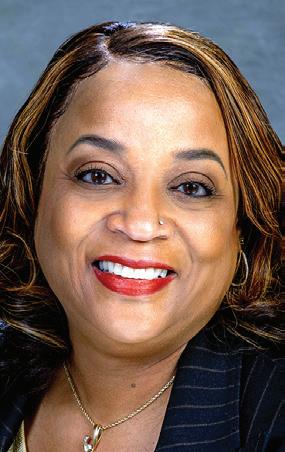
• Curb appeal: Exterior improvements such as painting, landscaping, and updating doors can enhance both pride of ownership and neighborhood appearance.
• Durability: Choosing longlasting materials can help reduce future maintenance costs.
Financing options to support home repair and improvements
• Functionality: Kitchen and bathroom renovations can improve daily living, while also increasing resale value.
At FCB Banks, we offer a variety of financing options designed to help qualified homeowners plan and manage home repair
and improvement projects. These include Home Repair and Improvement Loans, Home Equity Loans, and Home Equity Lines of Credit (HELOCs).
Taking care of your home means investing in the place where you make memories and strengthen your community. As a Community Development loan officer, I am dedicated to helping homeowners understand their options and access resources that support safe, stable, and lasting housing. If you would like to learn more about our various loan options or schedule an appointment, please call us at 314-7339096, visit our website at fcbbanks.com, or stop by our FCB Banks Florissant location. We’re here to



By StatePoint
Smart money decisions can give you a head start on the future you want!
Whether you’re newly graduated or well into your career, certified financial planner professionals say you should make these five financial moves right now:
Create a budget.
Research finds that 83% of
Gen Z-ers and millennials have experienced regret
about their spending decisions. Crafting a budget means making mindful choices about how you spend your money, which can eliminate financial stress. However, if the term “budget” fills you with dread, try calling it a “spending plan” instead. The important thing is to get started and find a process that works for you.
Build an emergency fund. According to the
Federal Reserve Board, only 55% of Americans had three months’ worth of expenses in emergency savings in 2024. In the event of an unexpected expense, such as hospitalization or home repairs, a rainy-day fund can save you from accumulating debt or dipping into retirement savings. A CFP professional can help you adjust your budget to divert savings into an emergency fund to cover at

least three to six months’ worth of fixed expenses.
Start saving for retirement now. It’s never too early to begin saving for a comfortable retirement. If your employer offers a retirement savings plan, sign up for it now and put as much in as you can, especially if your company offers matching contributions. You don’t need an employer-sponsored plan to save for your golden
years, though. Traditional IRAs and Roth IRAs are also good vehicles for retirement savings.
Take a big-picture approach. From paying down debt and growing your investments to managing taxes and insurance, reviewing your overall financial picture can help you reach your personal goals. That’s where the help of a financial advisor who has your best interests
in mind comes into
A CFP professional can serve as a financial
integrating the many components of your financial plan and providing valuable advice at any stage of your life. These four financial moves will create the foundation for a strong financial future. A
and


By Rev. Dorothy S. Boulware Word In Black
Pastors, bishops, rabbis and imams from more than a dozen states have responded to a call issued by local faith and justice organizers in Minneapolis following a series of Immigration and Customs Enforcement operations that have left residents fearful and grieving.
The mobilization intensified after the January 7 fatal shooting of Renée Nicole Good by a federal agent, an incident that galvanized national attention and faith-based response. And even more so, after the January 24 killing of Alex Jeffrey Pretti, a 37-year old Intensive care unit nurse at the Minneapolis Veterans Affairs Health Care System.
a digital call to action issued by Minnesota MARCH (Multifaith Antiracism, Change & Healing) and rooted in the practice of faithful witness. Eyes Not Lies encourages people to believe what they see.
Rev. Regina Lowe, associate minister at St. Paul AME Church in St. Louis, recorded herself narrating what she saw in the video of Pretti’s killing.
“I am sharing this because truth matters,” Lowe said.
“What we are seeing must not be denied. Please join me. Watch the video and tell the world what you have seen with your own eyes to combat these lies.”

Officials said they believed Pretti meant to kill them. They said he attacked first, even as video evidence later contradicted that account. They questioned whether he was legally entitled to carry a concealed weapon. And they insisted he received immediate medical care, a claim a witness directly challenged.
In response to these assertions, various clergy have made videos as part of Eyes Not Lies,
Dr. Otis Moss III, senior pastor of Trinity United Church of Christ in Chicago, was equally direct.
“It is very obvious that the federal officers were not trained appropriately. As any officer who understands how to subdue a subject, you should not pull and fire a gun right next to another officer. He was shot in the back. All he had was a cell phone and was trying to protect another protester. He had a conceal and carry permit and the officers had subdued him. And yet an officer pulled his gun and shot Alex Pretti. An ICU nurse is now dead,” Moss said.
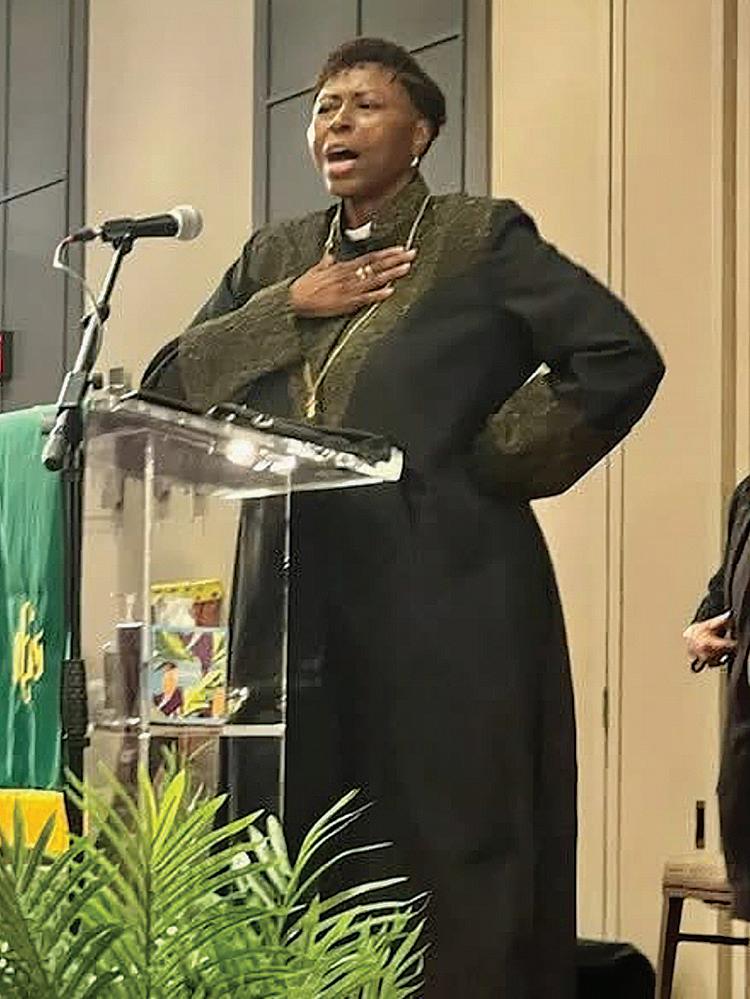
“We must organize if we are to stop this kind of immoral unethical operation that is happening across this nation. Look at the video and you will see the pain of this moment and where our nation is. Your eyes do not lie.”
The “Lynching” of Alex Pretti
“The vast majority of Americans who have seen what is being done by masked-men in their name know that it is wrong,” said Bishop William Barber II

referring to what he called the “lynching” of Alex Pretti. “We cannot sit back and curse the darkness from the comfort of our normal lives. Instead, we must recognize what is stirring within us as righteous anger to fuel a moral struggle. At the root of all anger is grief. We must let the blood of Alex Pretti and Renee Good and the more than 30 people who have died in ICE custody over the past year cry out from the ground.” Family members and col-
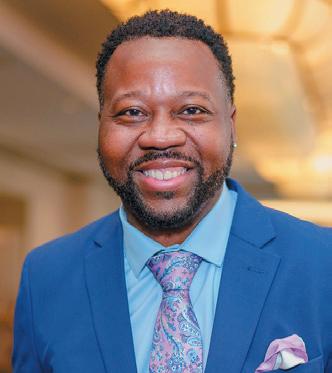
ORVIN T. KIMBROUGH
Chairman and CEO, Midwest BankCentre
Author, Twice Over a Man, More Than a Conqueror, and Ward and the State
Every leader has an emotional operating system — a hidden internal framework of thoughts, beliefs, and habits that quietly sits beneath the surface of your leadership. You don’t see it. But you feel it. And everyone around you feels it too.
Your emotional OS is the unseen code running your leadership life. It shapes how you make decisions, respond to conflict, interpret pressure, handle disappointment, and show up when the stakes are high.
Before a word leaves your mouth, your OS has already interpreted the moment. Before an action is taken, your OS has already assigned meaning. Before you choose your next move, your OS has already framed the story.
Your emotional operating system is shaped by layers of your life:
• your childhood conditioning your earliest experiences of safety or danger your core beliefs about worth, belonging, and identity your relational history and leadership experiences
• your faith formation and spiritual worldview
You may not be conscious of every influence, but your OS remembers. And unless it is updated, it will keep trying to protect you even in seasons where you no longer need protection.
This OS determines how you interpret everyday leadership moments:
Do you hear feedback as opportunity… or as an attack?
• Do you read silence as disrespect… or as reflection?
Do you see conflict as danger… or as discovery?
• Do you treat challenge as a threat… or as an invitation to grow?
• Do you step toward tension… or away from it?
leagues described Pretti as a devoted caregiver, especially to veterans. He had become deeply troubled by federal immigration policies and was engaged in peaceful protest at the time of his death. A U.S. citizen with no serious criminal history, he was remembered by supervisors and coworkers at the Minneapolis VA as calm, intelligent, and unwaveringly committed to patient care.
Shine a Light
On January 23, the faith coalition ISAIAH invited residents across Minnesota to “Shine a Light” — “Step outside and light a candle on our street corners with out neighbors. For our communities and Alex. ICE Out Now.”
“These leaders are not flying in for a photo op,” said Minister JaNaé Bates Imari, co-executive director of ISAIAH, a progressive, multi-faith non-profit.
“They are walking with families, showing up in the cold, sitting with grief and helping people feel less alone.”
On Jan. 23, roughly 100 clergy members were arrested during a peaceful sit-in at Minneapolis-Saint Paul International Airport, protesting deportation flights and urging airlines to sever ties with ICE transport operations. The demonstration was one of the largest faith-led acts of civil disobedience in the city in years.
“Jesus is pretty clear about what our job is if we choose to follow him,” Dave Comstock, a volunteer connected to Our Saviour’s Lutheran Church which has been tracking enforcement actions told NPR after the killing of Renee Good. “We choose to take risks. We choose to stand against the Empire. And we choose to stand on the side of the people who are oppressed, the people who are forgotten.”
Most leaders try to change behavior without changing the underlying operating system.
But behavior follows belief. Reactions follow wiring. Patterns follow interpretation.
Thrivers understand this. They don’t just work on habits — they work on the lens that produces the habits. They update the OS. And this is where The Triple R Method™ becomes transformational:
1. Reframe the Story. Why does this moment feel like danger? What old narrative is being activated? What’s the truth beneath the trigger? Reframing loosens the grip of old meaning so new meaning can emerge.
2. Reclaim Agency. What do I control right now? What response reflects who I’m becoming, not who I used to be? Agency breaks the cycle of emotional reactivity and invites intentional leadership.
3. Rename Possibilities. What new identity becomes available when I shift the lens? What new behavior becomes possible? Renaming redefines the moment and redefines you in the moment.
When your emotional operating system evolves, your leadership evolves. You stop reacting from the old version of yourself — the version shaped by fear, survival, scarcity, or shame. You stop replaying scripts written by someone else’s expectations or your own unhealed story. You stop repeating patterns that keep you small, silent, or stuck.
You begin leading from a different place: From clarity instead of confusion. From calm instead of reactivity. From wisdom instead of insecurity. From healing instead of hurt. From purpose instead of pressure.
And when your OS shifts, everything shifts: your communication, your confidence, your presence, your relationships, your influence, your leadership trajectory.
Your emotional OS is running your leadership life, unless you choose to run it. And the leaders who rise are the ones who stop letting the old OS lead the present moment and start updating it to match who they are becoming. For more, visit OrvinKimbrough.com or MidwestBankCentre.com.