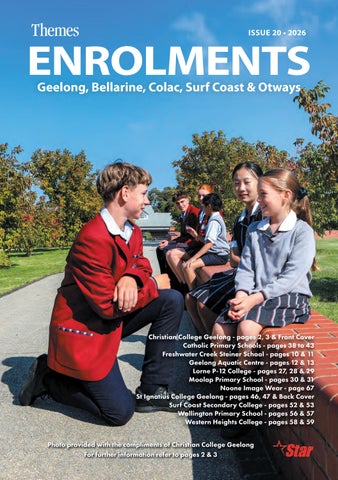
2026 Enrolments Guide (GBCSO)

Page 1


ENROLMENTS

Geelong, Bellarine, Colac, Surf Coast & Otways

Christian College Geelong - pages 2, 3 & Front Cover Catholic Primary Schools - pages 38 to 43

Freshwater Creek Steiner School - pages 10 & 11

Geelong Aquatic Centre - pages 12 & 13

Lorne P-12 College - pages 27, 28 & 29

Moolap Primary School - pages 30 & 31 Noone Image Wear - page 67

St Ignatius College Geelong - pages 46, 47 & Back Cover

Surf Coast Secondary College - pages 52 & 53 Wallington Primary School - pages 56 & 57 Western Heights College - pages 58 & 59

Photo provided with the compliments of Christian College Geelong For further information refer to pages 2 & 3

COME AND SEE US!

www.christiancollege.vic.edu.au or call us 5241 1899 Book your place on a tour today

Big Sc h oo l , Sma ll Sc h oo l –th e B es t o f B o th Wo rl ds

A sense of community and connection to a school where you are known and cared for has always been part of Christian College Geelong’s DNA across its 45-year history. Even today with 2000 students across two kindergartens and five campuses.

That DNA developed from Day 1 when a few dozen students from P-10 occupied two rented classrooms. As numbers rose over a decade, three additional campuses evolved. Then came a fifth campus and second kindergarten in Torquay in 2018.

Developing multiple campuses has meant that traditional DNA remains – at every Christian College site there is community and there is connection. Research shows that once a school reaches a population of more than around 600, students can lose that sense of community and connection. Christian College campuses are small enough to be ‘small schools’ within a ‘big school’.

Executive Principal, Dr Mathilda Joubert, said across all learning sites consistency is the key, but not uniformity.

“I love the idea that each of our campuses are different. I love that they’ve each got a different feel. The parent and student communities, the demographics are different,” she said.

“We are careful about achieving consistency. If we aspire to uniformity, people lose their sense of agency, and we don’t want that.”

That sense of agency includes students having a voice and being able to impact and influence life at their school.

“I want our young people to feel that they can contribute and come up with ideas for their campus. I don’t want to say no to things because other campuses are not doing them. I want the students to be able to shape things.

“Yet we do want that core DNA to stay the same – that sense of community and that sense of connection.”

Equally, the collective size of the Christian College Geelong student population has real advantages.

“It gives us tremendous benefits, like economies of scale. We can offer so many rich opportunities, which a small school can’t do.

“A small school can’t have a Music Program like ours – it can’t offer opportunities for students to go on so many trips, camps and excursions. It can’t have as many sporting facilities or sporting opportunities. We’ve got one of the largest senior secondary subject offerings of any school in Victoria, because we’re a large school,” Dr Joubert said.

Bellarine Secondary College

BELLARINE Secondary College provides students with a high quality education within a safe and supportive environment where all students are nurtured as valued members of the community.

Students are encouraged to strive for excellence in a learning environment that promotes the core values of Respect, Resilience and Responsibility and the belief that we are all lifelong learners.

The College is committed to restorative practices and believes that positive empathetic relationships are fundamental to a vibrant trusting learning environment where students are confident to take risks and achieve their full potential.

The College provides students with the opportunity, encouragement and the support to realize their potential in diverse pathways.

The College’s diverse program is evidenced by the classroom and extra-curricular programs such as Farm My School, Agriculture and Horticulture Studies, Equine Students, Performing Arts, Outdoor Education and partnerships with Farm My School, The Potato Shed (CoGG), Bellarine Landcare and access to wonderful facilities such as the Bellarine Sports and Aquatic Centre and the newly opened North Bellarine Aquatic Centre.

Academic studies are embedded in a curriculum rich in the Victorian Curriculum with the Select Entry Accelerated Learning Program providing a curated learning in an environment to ensure that all students are fully challenged.

While students continue to achieve outstanding results in the VCE and from 2023 will be able to access the VCE Vocational. Major Certificate which is a 2-year vocational and applied learning program within the VCE that aims to equip students with the skills, knowledge, confidence and agency needed to prepare for the world of work and further education and training.

Vocational Education and Training (VET) and workplace learning through innovative programs such as Head Start or a School Based Apprenticeship actively support students seeking to transition into the workplace.

Students are encouraged to strive for excellence in a learning environment that promotes the core values of Respect, Resilience and Responsibility and the belief that we are all lifelong learners.

The College is inclusive and centrally located on the Bellarine Peninsula with campuses in Ocean Grove (years 7-8) and Drysdale (years 9-12). Bellarine Secondary College offers a scholarship to a Grade 6 student from each Partnership Primary School. These scholarships are awarded to the student who has most consistency displayed the following qualities:

■ Academic effort

■ Participation in school activities

■ Respect for others

Parents and carers seeking to enroll at the College should complete the Enrolment Enquiry at www.bellarinesc.vic.edu.au/ enrolment/ and/or contact the College on 52519000.

OCEAN GROVE CAMPUS

Tuesday 24th of February 2026

Self Guided Tours from 4:25 pm to 7:00 pm

Ocean Grove - Free BBQ with fresh salads courtesy of the school’s partnership with Farm My School

Ocean Grove Campus Years 7 & 8 70 Shell Road, Ocean Grove

DRYSDALE CAMPUS

Wednesday 4th of March 2026 Tours from 5:30 pm

Information Sessions 6 pm & 7 pm Bookings are required to attend via Try Booking

Bellarine.sc@education.vic.gov.au Telephone 5251 9000 Drysdale Campus Years 9 – 12 Peninsula Drive, Drysdale

Belmont High School

Strive for the Highest AT Belmont High School, we empower young people to achieve academic excellence in a supportive and inclusive environment. Guided by our motto, “Strive for the Highest,” and our core values of Respect, Resilience, and Opportunity, we nurture confident, capable, and compassionate learners who are ready to succeed in a changing world.

Our House System lies at the heart of our school community, fostering a deep sense of belonging and connection. Every student is known, supported, and valued. Senior students mentor younger peers, building positive relationships that promote wellbeing, participation, and leadership. We believe that these relationships are the cornerstone of success—both academically and personally.

Belmont High School offers a diverse range of high-quality academic programs that challenge, extend, and inspire. From our Select Entry Accelerated Learning Program (SEALP) to enrichment opportunities across all learning areas, students are encouraged to “strive for the highest” and reach their full potential. Our strong Arts and Technology programs provide further avenues for creativity and innovation, enabling students to discover and develop their passions.

We are proud to offer a broad co-curricular program that caters to a wide range of interests and talents. Students can participate in academic competitions, music, sport, drama, outdoor education, and overseas travel. Our renowned music program offers exceptional opportunities for connection, expression, and excellence. The school’s camp in the beautiful Otway Ranges further strengthens teamwork, independence, and an appreciation for the natural environment.

Leadership and service are integral to life at Belmont High School. Students are encouraged to take on meaningful roles through whole-school and House leadership, as well as community initiatives—building confidence, responsibility, and a strong sense of purpose.

Our Middle Years program ensures a smooth and supported transition into secondary school. Dedicated teachers work

Strive for the Highest,” and our core values of Respect, Resilience, and Opportunity, we nurture confident, capable, and compassionate learners who are ready to succeed in a changing world.

closely with Year 7 and 8 students to develop strong learning habits, positive relationships, and a lasting love of learning.

With opportunities for international study tours, cultural exchanges, and community partnerships, Belmont High School inspires every student to see themselves as a global citizen—curious, compassionate, and ready to make a difference.

At Belmont High School, every student is supported to discover their strengths, pursue their passions, and truly Strive for the Highest.

Integrating arts into the curriculum

IN the quest to provide a holistic education that prepares students for the challenges of the future, there is a growing recognition of the importance of integrating arts into the academic curriculum. While traditional academic subjects are undoubtedly crucial, fostering creativity and artistic expression is equally essential. Here we explore the benefits of developing an arts curriculum alongside academic studies, the impact on students’ cognitive and emotional development, and the potential for cultivating wellrounded individuals equipped for the complexities of the modern world.

Cognitive Benefits of Arts Education:

Arts education encourages students to think critically and analyse situations from multiple perspectives. Through activities like visual arts, music, and drama, students develop the ability to interpret and evaluate information, fostering a more nuanced approach to problem-solving.

Numerous studies have shown a positive correlation between arts education and improved academic performance. Engaging in creative activities stimulates brain function, enhancing memory, attention, and overall cognitive abilities. Students involved in the arts often demonstrate higher scores in standardised tests and exhibit increased proficiency in other academic subjects.

Emotional and Social Development:

The arts provide a platform for self-expression, allowing students to convey their thoughts, emotions, and experiences in a non-verbal manner. This creative outlet can be particularly valuable for students who may struggle with verbal communication, providing them with alternative means of expressing themselves.

Participation in the arts exposes students to diverse perspectives, cultures, and experiences. This exposure fosters empathy, helping students develop a deeper understanding of others and promoting a sense of interconnectedness that extends beyond cultural and social boundaries.

Creating Well-Rounded Individuals:

By integrating arts into the academic curriculum, schools instill a lifelong appreciation for various forms of artistic expression. This appreciation goes beyond the classroom and extends into students’ personal lives, enriching their cultural experiences and contributing to a more vibrant and engaged society.

Arts education encourages interdisciplinary

connections, demonstrating the interconnected nature of knowledge. Students can explore the intersections between art, science, history, and literature, fostering a more comprehensive understanding of the world and breaking down traditional academic silos.

Practical Implementation:

Collaborative efforts between arts and academic teachers can result in innovative, crossdisciplinary projects. For example, a history lesson could be enhanced through a theatrical performance or a science class enriched by incorporating visual arts to illustrate concepts.

Schools can incorporate dedicated arts courses into the curriculum, ensuring that students receive comprehensive exposure to various artistic disciplines. This may include visual arts, music, drama, dance, and creative writing, allowing students to discover and nurture their individual artistic strengths.

Addressing Challenges:

One of the challenges in developing an arts curriculum alongside academic studies is resource allocation. Schools may need to invest in art supplies, musical instruments, and qualified arts educators. However, the long-term benefits in terms of student development and academic success make this investment worthwhile.

Cultivating a culture that recognises and values the importance of arts education is crucial. This involves fostering support among educators, parents, and policymakers to ensure that the arts are not sidelined but integrated as an essential component of the overall educational experience.

By providing students with opportunities to engage in creative expression, schools contribute to the development of critical thinking skills, emotional intelligence, and a lifelong appreciation for the arts. The synergy between academic and artistic pursuits creates a more enriching educational experience, preparing students not only for academic success but also for the complexities and challenges of a rapidly evolving world. As we continue to redefine the goals of education, an integrated curriculum that values both the academic and the artistic is a powerful step towards fostering the diverse talents and capabilities of each student.

Come and See

Friday 13 March

Wednesday 18 March

Friday 20 March

Freshwater Creek Steiner School

STEINER Education is the world’s largest independent education movement, and it continues to grow.

Steiner education fosters personal and academic growth in students. Through a balanced integration of arts, music, practical crafts, outdoor and environmental education and a strong focus on wellbeing, personal values, and kindness, students learn about themselves and others, and how we can all live together. The Steiner curriculum fosters a love of learning, offering a holistic approach. In an age of digital distractions, Steiner education provides a warm, balanced learning environment where children are nurtured academically, socially, and emotionally.

Freshwater Creek Steiner School thrives in a beautiful natural setting. Situated on 24 acres of regenerated farmland on Wadawurrung country, near the Victorian Surfcoast, students benefit with nature play, biodynamic gardening and working on the farm next door all part of their learning program. Community involvement, such as local environmental projects, is also a key part of the student experience.

The Australian Steiner Curriculum Framework (ASCF) is followed in the Primary School.

The ASCF is one of the few alternative curriculums accredited for use in Australian schools. The ASCF aligns the integrated Steiner approach with the Australian Curriculum’s eight key learning areas. When our students graduate in Class 6, they easily adapt to the mainstream secondary curriculum that is available in the region.

The integration of arts and experiential learning is central to the curriculum. Primary School classes engage the students’ interests by integrating the arts and experiential learning, with academic skills development. Painting, music, drama, hands on experiments and research are woven through the learning units. The outcome is student work that exhibits skills and knowledge and is also artistically presented. Our students take pride in their work.

Specialist subjects enhance the Steiner education experience from Prep to Class 6. Students participate in subjects such as library, handcraft, Japanese, choir and a Strings program from Class 3 (violin, viola and cello). Their connection to nature is deepened through outdoor excursions and activities, including school camps that begin with a sleepover in Class 2 and ramp up to a high-country hike and camp in Class 6.

Seasonal festivals and a strong school community further enrich the students’ learning experiences.

These celebrations of nature’s rhythms strengthen connections between students, families, and teachers, creating a supportive and vibrant environment for learning.

Student wellbeing is a core focus at Freshwater Creek Steiner School. The school ensures students feel safe and supported in their learning journey through differentiated programs. The Student Support team works closely with teachers to ensure that every child’s unique needs are met.

In Steiner Education humanity is paramount. The school’s values of warmth, balance, inclusivity, integrity and vitality are the foundation for how we work with the children.

WHAT WE OFFER

• Baby and Me water awareness classes 4 months - 3 years providing valuable one on one and bonding time

• Pre-school classes 3 years - 5 years making a curious pre schooler water safe while learning valuable skills

• After school learn to swim learning all the skills needed to be safe and confident around the water, building on endurance and technique

• Adults learn to swim it’s never too late to learn or refine your stroke

• Swordfish Program consisting of specialized aqua supports for students with developmental delays , disability, and medical conditions to help access swimming lessons

• Junior, Intermediate, Senior and Masters Squads for the advanced or fitness conscious

Benefits of extracurricular activities

EXTRACURRICULAR activities play a crucial role in the holistic development of school students. These activities, which encompass a wide range of interests and passions beyond the traditional academic curriculum, offer students numerous benefits that extend far beyond the classroom walls.

From boosting academic performance and fostering social skills to nurturing personal growth and building character, participation in extracurricular activities equips students with essential life skills and helps shape them into well-rounded individuals.

This article explores the transformative power of extracurricular activities and highlights the manifold advantages they provide to school students.

Contrary to popular belief, engaging in extracurricular activities can have a positive impact on academic performance.

Research indicates that students involved in extracurriculars often exhibit higher levels of motivation, better time management skills, and improved organisational abilities.

Participation in activities such as debate clubs, science fairs, or mathematic competitions stimulates intellectual curiosity and enhances critical thinking and problemsolving skills. Students who engage in extracurriculars are more likely to develop discipline and perseverance, attributes that contribute to academic success.

These activities provide a practical application of concepts learned in the classroom, reinforcing academic knowledge and deepening understanding.

Extracurricular activities can also offer opportunities for mentorship and access to resources that extend beyond the school environment, further enriching the learning experience.

Extracurricular activities provide an ideal platform for students to develop crucial social skills that are essential for their personal and professional lives.

Through teamwork, collaboration, and interaction with peers who share similar interests, students learn to communicate

From boosting academic performance and fostering social skills to nurturing personal growth and building character, participation in extracurricular activities equips students with essential life skills and helps shape them into wellrounded individuals.

effectively, resolve conflicts, and build relationships. Whether it’s participating in team sports, joining a music ensemble, or working on a community service project, students gain exposure to diverse perspectives, fostering empathy and cultural sensitivity.

These activities also promote leadership skills, as students often assume roles of responsibility, such as team captains, club presidents, or project coordinators. By engaging in extracurricular activities, students develop self-confidence, assertiveness, and the ability to adapt to different social contexts, qualities that are vital for success in the future.

Extracurricular activities serve as fertile ground for personal growth and character building. These activities encourage students to explore their interests, discover their passions, and develop a sense of identity. Whether it’s pursuing a hobby like painting or learning a musical instrument, extracurriculars provide a creative outlet for self-expression, fostering a sense of fulfillment and purpose. Furthermore, these activities teach students resilience and perseverance, as they often face challenges and setbacks along the way.

Through practice, dedication, and the pursuit of excellence, students develop a growth mindset, embracing failure as an opportunity to learn and grow. Extracurricular activities also instil important values and virtues such as discipline, integrity, and teamwork. In sports, for example, students learn the value of fair play, respect for opponents, and the importance of teamwork to achieve common goals. In clubs and organisations, they learn to navigate responsibilities, manage time effectively, and develop organisational skills. These activities provide a platform for students to learn from mentors and role models, who impart valuable life lessons and guide them towards ethical decision-making.

Beyond the school years, the skills and values gained through extracurricular activities contribute to college admissions and career success. Participation in these activities demonstrates a commitment to personal growth, a willingness to step outside one’s comfort zone, and the ability to manage multiple responsibilities simultaneously.

Extracurricular activities offer students a myriad of benefits that extend far beyond the academic realm. From enhancing academic performance to fostering social skills and nurturing personal growth, these activities

Participation in these activities demonstrates a commitment to personal growth, a willingness to step outside one’s comfort zone, and the ability to manage multiple responsibilities simultaneously.

play a pivotal role in shaping well-rounded individuals. By participating in extracurriculars, students develop skills and qualities that prepare them for the challenges of the future, both academically and personally. It is imperative for educational institutions and parents alike to recognise and encourage the power of extracurricular activities, ensuring that students have ample opportunities to explore their interests, pursue their passions, and grow into confident and capable individuals.

Seamless

Nurturing

Strong

10km

Affordable,

Extensive

WhenyouenrolatGeelongHighSchool,youarejoininglearningcommunitythatisbothpositiveand creative,withalonghistoryofexcellenceandinnovation.Ourteachingfocussupportsstudentstostrivefor theirbestinnovativeandengagingteachingprogramsthatencourageitsstudentstodeveloprespectful relationshipsandstrivetoachievetheirfullacademicandpersonalpotential.

Foundedin1910,GeelongHighSchoolwasthefirstnon-privatesecondaryschoolintheregionandwas fought forbythepeopleofGeelongwhofeltthatahigh-qualityeducationisarightthatallyoungpeople shouldhave.

Sincethen,asaschoolcommunitywehavehelpedcountlessstudentsfindtheirpathwayintotopclass universitiesandcareerslocally,acrossAustraliaandinternationally.Manyofourfamilieshavealonghistory withtheschoolandaswemoveintothenextphaseofourdevelopmentwith newbuildings,arenewedfocus onhighqualityteachingandlearning,andanevenstrongercultureofimprovementandchallenge,weinvite newfamiliestojoinourlongtraditionofexcellenceandachievement. Throughouttheschool’sesteemedhistory,oneconstanthasalwaysremainedstrongandisat theforefrontof theschool’sethos.Theschool’smotto“VitaeNosParat” means‘Prepareusforlife’andcapturesthespiritand ethosoftheschoolcommunity.Itsfocusisnotonlysharedacrossacademic,sportingandpathwayaspiration, butequallyuponbuildingthecharacterstrengthandlearningcapabilitiestobecomerespectful,lifelong learnersabletosucceedinanincreasinglycompetitiveandchangingworld.

ThekeystrengthofthecurriculumdeliveredatGeelongHighSchoolisthewider rangeofsubjectsofferedat VCE,andthesubjectpathwaysthatleadtoVCE.Forstudentslookingforachallengeandextension, opportunitiestoaccelerateexistthroughYears9and10incoresubjectsofSciences,Mathematics, Humanities,andviaelectivesinPEandSport,plusouroutstandingOutdoor Educationprogramme.

WealsoofferelectivessuchasAdvancedEnglishinYear10,andtheGeelongPositiveEducationProgram whichisacommunityserviceoutreachsubjectinYear9thathelpsstudentsdeveloptheskillstogivebackto ourcommunityandconcludeseachyearwithatriptotheNorthernTerritorytosupportsomeofourremote Indigenouscommunities.

AtVCE,ourVETDanceprogramisreputablyoneoftheleadingdanceprogramsintheState,which culminateseachyearinaperformancecelebratedacrossGeelong.OurTheatreStudiesVCEcourseisoneof theleadingcoursesintheregion,withexceptionalproductionsandarangeofperformanceacrosstheyear takingplaceintheschool’smajesticShentonTheatre.OurArtsprogramisalsoakeystrengthwithVETMusic Productionandarangeoffineartsonoffer.

Since2024,GeelongHighhasfurtherextendedopportunitiesforstudentsthroughourAcceleratedLearning Program.IntroducedasadedicatedclassforYear7students,itwasexpandedin2025toincludeYear8 students,andin2026wewillcontinuethisexpansionintoYear9.Theprogramisalreadyprovingtobehighly successfulbyprovidingstudentswithadedicatedclass thatprovidesanextrachallengeandextensioninall coresubjects,whilststillenjoyingthefull breadthofourrichcurriculum.

ComeandseewhatGeelongHighSchoolcanoffer,andseehowyourchildcanfindtheirpassionandfind theirpathway.

2023 OPEN DAY & INFORMATION

Lara Secondary College

SESSIONS

Lara Secondary College is a school where all students are known and valued, and where genuine partnerships are formed between the school, families and young people to ensure every student has the opportunity to ‘realise their potential’.

Wednesday 1st March 2023 & Wednesday 3rd May 2023 www.larasc.edu.vic.au

Tours: 9.30am & 6.30pm with Information Briefing at 7.00pm A great opportunity to view our learning environment and meet both staff and students of our College.

Our college utilises contemporary teaching practices, to challenge students, while fostering their confidence and identity. All students are supported to be successful within the school context and within the broader community, making meaningful contributions to each, while living our college values of Respect, Teamwork, Commitment and Excellence.

• We value the performing arts at Lara Secondary College, our school production is a continual success and our music program sees budding musicians begin learning to play an instrument in private lessons and results in student bands performing all across Lara and the Geelong region.

2024 YEAR 7 & 10 ACADEMIC SCHOLARSHIPS

• Our Rugby and Cricket Academy’s compliment the other individual and team sporting opportunities that the college provides. The academies provide elite level coaching within the school day, while ensuring that students are set up for success post secondary schooling, regardless of their athletic performance.

Lara Secondary College in partnership with the Lara District Community Bank (Bendigo Bank), is pleased to continue to offer highly academic students in Year 7 & Year 10 in 2024, the opportunity to gain an academic scholarship to the value of $1500 over 3 years.

We are committed to our core business of teaching and learning but also understand that for all students to ‘realise their potential’ and succeed in the modern world, learning needs to take place beyond the four walls of the classroom. This is why we have developed an extensive co-curricular program, where all students can experience success. These programs include:

• Student leaders, across every year level, do an incredible job of representing their peers, making meaningful change to our school, while developing their personal leadership skills.

• Enrichment program, where the most academically capable students are not only accelerated through the curriculum but are pushed and challenged as they delve further into the learning, promoting higher order thinking.

The $1500 scholarship amount may contribute to the annual Essential Education Items cost required at each year level, any school camps, excursions or Textbook requirements.

• Our comprehensive camps program, ensures students are exposed to unique experiences at every year level, whether that be international study tours, snow camps, chasing waterfalls in the Great Otway National Park, summiting mountains, team building activities, urban experiences in Melbourne or staying on residence at university.

• An array of excursions, incursions, academic extension groups, debating and public speaking events, lunchtime and afterschool clubs all compliment our learning program, that sees students having choices in their pathway as they conclude their secondary schooling. At Lara Secondary College we understand and explicitly teach the knowledge, skills and dispositions required to be successful in an ever changing world. This is why our students continually succeed, long after they finish their secondary schooling. Whether it be pursuing further study at university or securing a vocational pathway, such as an apprenticeship, all students at our school are set up for a lifetime of success, regardless of their goals and ambitions.

In order to receive a $1500 Academic Scholarship, students will need to register for the Scholarship Exam (Higher Ability Selection Test - written by the Australian Council of Educational Research) to be held at the following times at the College.

2024 Year 7: Monday 15th May 2023 (9.15am – 12.00pm) in College Auditorium (Registrations se 3.00pm Friday 5th May) Successful students will be admitted to the 2024 with the opportunity to receive a $1,500

Thursday 25th May 2023 (9.15am – 12.00pm) in College Auditorium (Registrations se 10.00am Friday 12th May 2023) Successful students will be admitted to our with the opportunity to receive a $1,500 scholarship

REALISE YOUR POTENTIAL

REALISE YOUR POTENTIAL

The teaching staff at Lara Secondary College will do everything they possibly can to enable your child to reach their full potential. Our school is a great school for many reasons as we have been able to develop a strong, guaranteed and engaging curriculum that enables students to experience a breadth of subjects in preparation for a wide range of career pathways and interests.

The teaching staff at Lara Secondary College will do everything they possibly can to enable your child to reach their full academic potential. Our school is a great school for many reasons as we have been able to develop a strong reputation over the past few years for providing a ‘re-energised’ and vibrant curriculum that enables students to select semester subjects in preparation for a wide range of career pathways and interests.

Our teaching practice is focussed on an evidence/research based Common Instructional Model delivered by every teacher in every classroom. Such high quality teaching practices enable every student to become fully engaged in their classroom activities in order to develop a much deeper understanding of the curriculum material being taught. All students are therefore expected to be actively engaged in their learning.Furthermore, College feedback from staff, parents and teachers clearly identifies: High Expectations, Effective Teaching, Classroom Behaviour and Stimulating Learning, as

Our teaching practice is focussed on an evidence/research based Common Instructional Model delivered by every teacher in every classroom. Such high quality teaching practices enable every student to become fully engaged in their classroom activities in order to develop a much deeper understanding of the curriculum material being taught. All students are therefore expected to be actively engaged in their learning.

www.larasc.edu.vic.au

Furthermore, College feedback from staff, parents and teachers clearly identifies: High Expectations, Effective Teaching, Classroom Behaviour and Stimulating Learning, as areas that have experienced significant positive change and are either ‘at’ or ‘above’ state benchmarks.

Open Evening

Tuesday February 24 at 5.30pm

Many of our senior students from previous years have graduated from Lara Secondary College with definitive career pathway

Presentation at 5.30pm with school tours to follow

areas that have experienced significant positive change and are state benchmarks.

Senior students graduate from Lara Secondary College with definitive career pathway opportunities that see them go onto further study, apprenticeships or fulltime employment.

Students and teachers constantly refer to the words of: Excellence, Teamwork, Respect & Commitment as these words reflect the values of the College Council, Student Leaders, Staff and Students, in order to demonstrate to the rest of the local community, our collective belief in the education of young people today.

opportunities that have enabled them to be worthy community citizens. Students and teachers constantly refer to the words of: Excellence, Teamwork, Respect & Commitment as these words reflect the values of the College Council, Student Leaders, Staff and Students, in order to demonstrate to the rest of the local community, our collective belief in the education of young people today.

In addition to the above, your child will be encouraged to realise their potential in everything they do within the College. We, as a school community, are very proud of our efforts so far and we encourage the involvement of all parents in the development of our student focused, academic culture over the coming years.

www.larasc.edu.vic.au

In addition to the above, your child will be encouraged to realise their potential in everything they do within the College. We, as a school community, are very proud of our efforts so far and we encourage the involvement of all parents in the development of our student focused culture over the coming years.

2023 Open Days & Information Evening Wednesday 1st March 2023 & Wednesday 3rd May 2023

Tours: 9.30am & 6.30pm

Information Evening Presentation: 7.00pm

$500 Academic Scholarships also available at Year 7 & 10 each year for 3 years

$500 Academic Scholarships available at Year 7 & 10 each year for 3 years

Contact our Principal team for an Enrolment Interview & discussion on 5282 8988

School tours occur every Wednesday morning with our Principal Team. Book through the College Website

Leading with Heart and Purpose: Principal Carly Stafford, Lorne P–12 College

For Carly Stafford, Principal of Lorne P–12 College, leading the school she once attended is both a privilege and a personal calling. Growing up in Lorne and completing her own schooling at the College, Carly has a deep understanding of the community, its unique coastal environment, and the special sense of belonging that comes from being part of a small, connected school.

Carly has taught and held leadership roles in diverse international settings, gaining invaluable insights into global education practices and student development. These experiences have shaped her belief that the best schools are those that combine academic excellence with a strong focus on wellbeing and personal growth.

Carly’s educational philosophy is grounded in the idea that every student should feel known, valued, and supported to reach their full potential. She is passionate about nurturing young people who are confident, compassionate, and ready to make a positive impact in their world. Her vision for Lorne P–12 College is clear: that every student is empowered to experience a high level of success and enjoyment, both personally and academically.

Under her leadership, Lorne P–12 College has continued to build on its proud tradition of excellence across both academic and vocational pathways. The school’s outstanding achievements in VCE and the Vocational Major programs reflect Carly’s commitment to providing diverse opportunities for every learner. She is deeply invested in ensuring that students can pursue their individual interests — whether that’s gaining a university place, starting an apprenticeship, or developing their creative and artistic talents.

Equally, Carly is an advocate for student wellbeing as the foundation of success. She has championed programs that promote resilience, inclusion, and connection across the College, recognising that happy and supported students are the most engaged and successful learners. Her approachable leadership style and genuine care for students, families, and staff have helped strengthen the College’s warm, community-focused culture.

Carly’s deep local roots continue to influence her leadership. She is proud to see today’s students enjoying the same coastal environment that inspired her as a child — from learning on the Lorne foreshore to participating in outdoor education and sustainability initiatives unique to the area.

For Carly Stafford, leading Lorne P–12 College is more than a professional role — it’s a chance to give back to her community, helping to shape a generation of great humans, enabling young people to discover their strengths, pursue their passions, and find joy in learning every day.

r p s i

Discover Lorne P–12 College: A Place Where Every Student Thrives

Nestled in one of Victoria’s most breathtaking coastal settings, Lorne P–12 College offers an exceptional educational experience from Prep through to Year 12 — where every student is known, supported, and inspired to achieve their best. With its combination of academic excellence, vocational innovation, and wellbeing-focused education, Lorne P–12 College offers something truly special. Our students benefit from strong community connections, supportive relationships with staff, and learning experiences that reflect the beauty and diversity of our coastal environment.

Whether your child is starting their very first day of school or preparing for their final exams, they’ll find a place to belong — and a pathway to success — at Lorne P–12 College. Tours of the school are always welcome. Come and discover how your child can thrive at Lorne P–12 College.

Lorne P-12 College

North Geelong Secondary College

EVERY school is different and offers different learning opportunities for students. As parents and guardians, it is essential to ask the following five questions when finding the right school for your children:

1.What are the College’s values?

At North Geelong Secondary College (NGSC), our values are Respect, Excellence, Achievement and Diversity. These values are upheld through our culture of high expectations and embedded in our teaching and learning programs, which promote every student’s right to learn.

2. What will my child be learning?

At NGSC, we have a fully-documented curriculum which means that teaching and learning is carefully planned and mapped, taking into account students’ individual needs and progress. Student learning is also supported by:

■ Chromebooks and access to internet speeds up to 10Gbps

■ Select Entry Accelerated Learning (SEAL) Program

■ STEM Program

■ Excellence in Sport Program (Soccer, AFL & Volleyball)

Beyond the traditional classroom, students also have the opportunity to be involved in:

■ Debating

■ Human Powered Vehicle

■ Annual College Production

■ International exchange programs.

3.What support is there for my child?

At NGSC, we provide the following academic and wellbeing support:

■ The STRIVE program that fosters research skills and academic writing

■ ACE and STAR Literacy and Numeracy support programs

■ Wellbeing hub with allied health professionals, plus Doctors in Schools Service program

■ CONNECT wellbeing program to help build students resilience and capacity for learning

■ Lunchtime clubs including Jewellery

Making, Anime, Chess, Coding, Karaoke, Yoga, Boxing, Esports and more.

4. What are the facilities like?

At NGSC, we are proud to offer state-of-theart facilities for our students, including:

■ Traditional enclosed classrooms fitted with interactive touch screen TVs.

■ Food Technology wing and Science laboratories

■ Specialised Visual and Performing Arts spaces

■ Expansive library

■ Outstanding sporting facilities, including synthetic turf surfaces

■ 100% air-conditioned teaching spaces.

■ Dedicated STEM resources including cutting-edge robots, drones and 3D printers

The Sanctuary is an area designed to assist new Year 7 students in their transition to secondary school. It is exclusive to Junior School students and provides easy access to their lockers, Year Level Coordinators and Student Wellbeing.

5. How will my child be prepared for work and tertiary studies?

At NGSC, our experienced Pathways Team ensures students have the opportunity to select courses that best suit their strengths and interests, whether it be VCE, VCE Vocational Major, VET subjects and/or SBATs. We ensure all students have a viable postsecondary pathway, whether it be further study or full-time employment.

For more information on what NGSC has to offer your child, we invite you to attend our Open Night on Thursday 12th March or contact us to organise a personalised college tour.

Mr Paul Dawson, Principal

Thursday 12th March 2026

Commencing 6pm

Find out more about our Specialist Programs.

• Select Entry Accelerated Learning (SEAL)

• Scholarships

• Excellence in Sport

Followed by self-guided interactive tours facilitated by our students and staff.

If you wish to organise a personalised college tour, to see us in operation, please contact

Physical education & student wellbeing

PHYSICAL education (PE) is often considered an integral component of a well-rounded education, contributing significantly to the overall well-being of students. Beyond its role in promoting physical fitness, PE encompasses a broad spectrum of benefits that extend to mental, social, and emotional dimensions. This piece explores the multifaceted ways in which physical education contributes to student wellbeing, emphasising the importance of a holistic approach to education that prioritises the health and happiness of individuals.

Physical Fitness and Health: The most apparent and direct impact of physical education on student well-being is the promotion of physical fitness and overall health. Engaging in regular physical activity during PE classes helps students develop cardiovascular endurance, muscular strength, flexibility, and coordination. These physical benefits contribute to the prevention of chronic health conditions, such as obesity and cardiovascular diseases, laying the foundation for a healthy lifestyle throughout their lives.

Stress Reduction and Mental Health:

Physical activity has a profound impact on mental health by acting as a natural stress reliever. PE classes provide students with an opportunity to release built-up tension, reduce stress levels, and improve mood through the release of endorphins—hormones associated with positive feelings. The mental health benefits of PE extend beyond the classroom, positively influencing students’ overall wellbeing and resilience in the face of life’s challenges.

Development of Motor Skills:

Physical education plays a crucial role in the development of fundamental motor skills in students. From basic movements like running and jumping to more complex skills such as throwing and catching, PE classes contribute to the refinement of motor skills essential for daily activities and sports participation. The mastery of these skills enhances students’ confidence in their physical abilities, fostering a positive selfimage and a sense of accomplishment.

Social Interaction and Team Building: PE provides a unique setting for social interaction and team building. Participating in

The positive habits, skills, and attitudes cultivated through physical education extend far beyond the school years, shaping individuals who are not only physically fit but also resilient, socially adept, and equipped for a lifetime of well-being and success.

group activities and team sports promotes cooperation, communication, and the development of interpersonal skills. Students learn to work collaboratively, appreciate diversity, and cultivate a sense of camaraderie. These social interactions contribute to the creation of a positive and supportive school community, fostering a sense of belonging and enhancing overall well-being.

Lifelong Physical Activity Habits:

Physical education lays the foundation for the development of lifelong physical activity habits. By exposing students to a variety of activities and sports, PE classes help them discover enjoyable ways to stay active beyond their school years. The cultivation of a positive attitude towards physical activity during childhood is instrumental in creating habits that contribute to a healthier and more active lifestyle throughout adulthood.

Improved Concentration and Academic Performance:

There is a strong correlation between physical activity and cognitive function. Engaging in regular physical exercise has been shown to enhance concentration, memory, and academic performance. PE classes provide a structured outlet for energy release, allowing students to return to academic tasks with increased focus.

and readiness to learn. This connection underscores the importance of physical education as a complementary component of a comprehensive educational experience.

Healthy Body Image and Self-Esteem:

Participation in physical education activities promotes a positive body image and selfesteem. PE classes emphasize the importance of effort, improvement, and individual progress rather than focusing solely on competition or external standards. This approach helps students develop a healthy relationship with their bodies, fostering a sense of self-worth and confidence irrespective of their athletic abilities.

Exposure to a Variety of Physical Activities:

Physical education exposes students to a diverse range of physical activities, allowing them to discover their interests and talents. Whether its team sports, individual activities, or alternative forms of exercise like yoga or dance, PE classes provide a platform for students to explore different avenues of physical expression. This exposure contributes to a holistic understanding of health and fitness, catering to the diverse preferences and needs of individual students.

Time Management and Discipline:

Regular participation in physical education requires students to manage their time effectively. PE classes teach students to prioritise physical activity within their schedules, fostering

habits of discipline and time management. These organisational skills contribute not only to their physical well-being but also to the development of essential life skills that extend beyond the realm of physical education.

Promotion of Lifelong Well-Being:

The holistic benefits of physical education extend beyond the school years, contributing to lifelong well-being. By instilling a foundation of physical fitness, promoting mental health, and fostering positive attitudes toward physical activity, PE sets the stage for individuals to lead healthier, more active, and fulfilling lives well into adulthood.

The importance of physical education in contributing to student well-being is evident in its multifaceted impact on physical, mental, social, and emotional dimensions. By prioritising physical education within the educational framework, schools not only promote healthier lifestyles but also contribute to the holistic development of students. The positive habits, skills, and attitudes cultivated through physical education extend far beyond the school years, shaping individuals who are not only physically fit but also resilient, socially adept, and equipped for a lifetime of well-being and success.

Join us at St Francis Xavier Primary School

Along with the curriculum, a variety of additional programs are offered: Digital Technologies, Physical Education, Art, LOTE and STEM to enhance the learning and development of all students. At St Francis Xavier Primany School we pride ourselves on being a highly motivated team of staff who are committed to ongoing professional teaching and learning and providing a faith-field environment where all children can flourish and learn.

Our belief is that student’s social and emotional wellbeing is essential for them to engage in rich, and personalised learning.

“Together We Grow”

Francis

Your child’s transition to school

STARTING school is a big step for you and your child. It can be both challenging and exciting. As families, the support you give your child is important because you are your child’s first and most important teacher.

Tips for transition

Below are some tips on how you can help your child have a positive start to school.

The year before school

■ Ask your child what they think about starting school.

■ Encourage your child to ask questions about going to school.

■ Help your child stay healthy. Make sure they have regular health and dental checks and keep immunisations up to date.

■ Encourage your child to try to do things on their own such as dressing, going to the toilet, washing their hands, unwrapping their food and opening and closing their drink bottle.

■ Talk to friends and other families about what school is like.

■ Attend transition-to-school programs and activities at your child’s early years service and school.

■ Talk to your child’s early childhood educator about things you can do at home to help your child’s learning and development.

■ Talk to the school about how you can engage in your child’s learning and development at school.

■ Ask the school what time your child starts on the first day and where to take them.

During the summer holidays

■ Show your child where the school is and talk about how you will get there.

■ Arrange play-times with other families whose children will be going to the same school as your child. It helps if your child knows another child at their school at the start of prep.

■ Practise the things your child will need to do to get ready for school (e.g. putting things in their bag, remembering to take a hat).

■ Confirm your before or after school care arrangements. Show your child where the outside school hours care facilities are and talk about how they will get there.

■ Be positive about starting school and enjoy your child’s excitement.

■ Visit your local library and read books with your child about starting school.

The first day of school

■ Make sure your child knows who will take them to school and pick them up on the first day.

■ Help your child to organise their clothes, hat, shoes and socks the night before.

■ Help your child to pack their school bag with a snack, drink, lunch and a hat.

■ Place a spare pair of underpants and a change of clothes in a plastic bag. Let your child know these clothes are in their bag in case of any accidents at school.

■ Put sunscreen on your child in the morning if it is needed.

■ Show your child where you will meet them at the end of the school day.

■ At the end of the day talk to your child about what happened at school.

The first year of school

■ Find out about what your child is learning at school. By doing this, you can support your child’s learning and find out how your child is adjusting to school.

■ If your child is having difficulty at school, talk to their teacher. Your child can also say what they think might help them.

■ Keep talking to your child about school. Ask them about their new experiences, what they like and what they find hard.

■ If your child attends an outside school hours care service, find a way of sharing your child’s school progress with the staff.

■ Share feedback about your child’s experience of starting school with the school and early childhood service.

■ Organise time for your child and their new friends to play together outside of school.

Local early childhood services and schools will organise their own transition-to-school programs and activities each year. To find out more, talk to your child’s early childhood educator or contact the school where your child is enrolled.

Ref: http://www.education.vic.gov.au/ childhood/parents/transition/pages/ supporttransition.aspx

ST THERESE

CATHOLIC PRIMARY SCHOOL TORQUAY

St Therese in the Nazareth Parish, is set in a semi-rural area on the Surf Coast. The majority of families at St Therese live in the immediate Torquay, Jan Juc and Anglesea areas.

We are a Catholic Parish Primary School, priding itself on a friendly and supportive environment with a unique sense of community where parents, staff and students value and respect each other.

At St Therese, all learners have the opportunity to inquire, discover, grow and be Christ - centred.

We learn:

• To be resilient, mindful/calm and self-responsible.

• To do by building positive relationships, problem solving, taking responsible risks, making decisions and communicating effectively.

• To learn with curiosity, purpose, critical thinking and reflection.

• To enquire, develop, grow and discover.

We encourage you to explore our website and contact the school if you have any further queries.

Students & the educational revolution

THE integration of artificial intelligence (AI) into various facets of our lives has been nothing short of transformative, and the realm of education is no exception. From K-12 schools to higher education institutions, students are increasingly exposed to AI-powered tools and technologies that are reshaping the way they learn, engage with content, and interact with their educational environments. This article delves into the multifaceted use of AI by students at school, exploring its benefits, challenges, and the potential it holds for shaping the future of education.

Enhanced Personalised Learning

One of the key advantages of incorporating AI into education is its ability to facilitate personalised learning experiences. Traditional classrooms often struggle to cater to the diverse needs and learning paces of individual students. AI, however, can analyse each student’s learning patterns, strengths, and areas for improvement to tailor educational content accordingly. Adaptive learning platforms use data-driven insights to present students with appropriate challenges and resources, helping them progress at their own pace while ensuring a deeper understanding of the material.

Efficient Content Delivery

AI-driven platforms offer students access to a wealth of educational resources, making the learning process more efficient and engaging. Virtual tutors and intelligent chatbots are on the rise, providing instant help and explanations for complex concepts. These AI-driven tools enable students to seek clarification and assistance at any time, eliminating the need to wait for teachers or peer support. Consequently, students become more independent learners, honing their problem-solving skills and fostering a sense of empowerment in their academic journeys.

Automated Grading and Assessment

The time-consuming task of grading assignments and assessments has long been a challenge for educators. AI-powered grading systems, equipped with natural language processing capabilities, can provide automated and consistent evaluation of essays, quizzes, and assignments. This not only saves teachers time

These AI-driven tools enable students to seek clarification and assistance at any time, eliminating the need to wait for teachers or peer support.

but also ensures objective and unbiased grading, allowing educators to focus on providing meaningful feedback and support to students. Furthermore, AI can analyse assessment data to identify learning trends, helping educators refine their teaching strategies for better outcomes.

Data-Driven Insights

AI’s ability to analyse large volumes of data has led to a revolution in educational analytics. Schools can now gather and analyse data related to students’ performance, attendance, engagement, and more. These insights provide educators with a deeper understanding of individual and collective learning patterns, enabling timely interventions for struggling students and the identification of effective teaching methods. Additionally, these datadriven insights can help schools make informed decisions about curriculum development, resource allocation, and overall educational strategies.

Virtual Reality and Immersive Learning

AI’s integration with virtual reality (VR) and augmented reality (AR) has opened up new avenues for immersive learning experiences. Students can step into historically significant events, explore complex scientific concepts, or travel through the human body-all through interactive virtual environments. AI algorithms enhance these experiences by adjusting the level of difficulty, guiding students through challenges, and providing real-time feedback. Immersive learning not only makes education more engaging but also deepens understanding by offering experiential learning opportunities.

Ethical and Social Considerations

While the benefits of AI in education are undeniable, there are ethical and social considerations that must be addressed. The collection and analysis of student data raise concerns about privacy and data security. Schools must ensure that data is handled responsibly and transparently, with clear policies in place to protect student information. Moreover, the potential for AI to perpetuate biases present in training data raises questions about fairness and equity in education. Vigilance is required to prevent AI from inadvertently reinforcing existing educational inequalities.

Teacher-Student Dynamic

The introduction of AI in education does not diminish the role of teachers; rather, it redefines it. Teachers become facilitators of learning, guiding students in navigating the AI-enhanced educational landscape. With administrative tasks like grading automated, teachers can allocate more time to one-onone interactions, mentorship, and addressing students’ individual needs. This reimagined teacher-student dynamic fosters a more collaborative and personalised educational experience.

Preparation for the Future

In an era characterised by rapid technological advancements, students need skills that will prepare them for an evolving job market. The use of AI in education equips students with digital literacy, critical thinking, and problem-solving skillsqualities essential for success in the 21st century. By engaging with AI-powered tools and technologies, students not only learn subject-specific content but also develop the ability to adapt to new technologies and innovate in diverse fields.

The use of AI by students at school marks a pivotal moment in the evolution of education. From personalised learning experiences to efficient content delivery, AI is revolutionising the way students engage with educational content and their learning environments. However, the responsiblve integration of AI requires a balance between technological advancement and ethical considerations. By embracing AI’s potential while addressing its challenges, educators can empower students to thrive in a rapidly changing world, fostering a generation of lifelong learners equipped with the skills needed to shape the future.

FAQs

Can we look around?

Yes! We welcome families to join us on a College Tour in 2026. You can take our Virtual 360 degree tour online anytime.

COLLEGE TOURS

9.15am tours

Tuesday 17 March

Friday 20 March

Tuesday 24 March

Wednesday 25 March

1.45pm tours

Wednesday 18 March

Wednesday 25 March

Does my son have to be Catholic?

No. St Joseph’s is a school based on Catholic values where every family is welcome, rather than a school for Catholic families only.

What are your fees?

In 2026, our annual tuition fee is $8100 for all year levels.

What Pathways Options are available for my son?

We have a proud tradition of students achieving excellent VCE Results, however, we are equally as proud of our students who complete the VCE Vocational Major, Foundation Pathway, VET in Schools Certificate or an Australian School Based Apprenticeship. The College has outstanding outcomes for preparing students for the workforce or further education and we provide over 600 alternate learning combinations through our school timetable in order to support our students successfully transitioning from the College.

Unraveling the gender disparity

IN recent decades, a noticeable trend has emerged within the education system: girls consistently outperform boys in numerous academic subjects. This phenomenon has raised questions about the underlying factors contributing to this gender disparity and their implications for the educational landscape. While it’s important to note that generalisations do not apply to every individual, various factors shed light on why girls are frequently achieving higher academic success than boys.

Learning Styles and Study Habits

One potential explanation for the gender gap in academic performance is related to differences in learning styles and study habits. Studies suggest that girls often excel in skills that are enhanced by meticulous planning, organisation, and attention to detail. They tend to be more disciplined in their study routines, diligently completing assignments and reviewing material in a systematic manner. On the other hand, boys may be more inclined towards active, handson learning and may struggle with tasks that require extended periods of focused reading or writing.

Classroom Behavior and Participation

Classroom behavior and participation patterns can significantly influence academic outcomes. Girls are often characterised by their attentiveness, willingness to ask questions, and participation in classroom discussions. These behaviors contribute to a positive learning environment and facilitate deeper understanding of subjects. Conversely, boys may sometimes exhibit more disruptive behaviors, which can hinder their ability to absorb information effectively. This divergence in classroom behavior can lead to divergent academic outcomes.

Social and Cultural Norms

Societal and cultural norms can also play a role in shaping academic performance. Traditional gender roles and expectations might discourage boys from engaging in activities that are perceived as “feminine,” including excelling in certain academic subjects. Similarly, girls may receive more encouragement and support for academic achievement, leading them to invest more

With computers and calculators readily available to perform complex calculations, some argue that traditional math skills are becoming obsolete.

time and effort into their studies. These societal pressures and expectations can impact students’ self-perception and motivation to excel in school.

Emotional Intelligence and Communication Skills

Emotional intelligence and communication skills are crucial for success in many academic disciplines. Girls often exhibit greater emotional intelligence, empathy, and interpersonal skills, which can enhance their ability to collaborate, communicate, and excel in subjects that emphasise teamwork and effective communication. These skills are increasingly valued in various fields, contributing to girls’ academic achievements and their ability to adapt to evolving workplace demands.

Focus on Soft Skills

The modern education system increasingly values a range of skills beyond academic prowess, often referred to as “soft skills.” Girls are more likely to excel in areas such as empathy, teamwork, and adaptability. These skills are nurtured through activities that encourage cooperative learning and emotional engagement, which are prevalent in many subjects. As the job market evolves, the prominence of these skills gives girls an advantage in their future careers.

Teacher Bias and Classroom Environment

Teacher bias and classroom environment can inadvertently influence academic outcomes. Research suggests that teachers might unknowingly hold different expectations for boys and girls, affecting their assessments

and interactions with students. Girls may receive more constructive feedback and encouragement, while boys’ potential might be underestimated. Additionally, classroom environments that cater to specific learning styles might favour girls’ approaches to learning, inadvertently disadvantaging boys.

The phenomenon of girls consistently outperforming boys in many academic subjects is a complex issue influenced by a multitude of factors. These factors encompass learning styles, study habits, classroom behavior, societal norms, emotional intelligence, and the evolving demands of the job market. It is crucial to recognize that gender disparities do not indicate an innate superiority of one gender over the other but rather highlight the diverse ways in which individuals approach learning and succeed in different contexts.

Addressing this gender disparity requires a multifaceted approach that considers both the needs of boys and girls. Educators should focus on promoting diverse learning styles and creating inclusive classroom environments that encourage active participation from all students.

It is crucial to recognize that gender disparities do not indicate an innate superiority of one gender over the other but rather highlight the diverse ways in which individuals approach learning and succeed in different contexts.

Ultimately, recognising and celebrating the strengths and abilities of all students, regardless of gender, is paramount. By fostering an educational environment that values diverse learning styles, skills, and perspectives, schools can help bridge the gender gap and provide every student with the opportunity to reach their full potential.

From the moment you step onto our campus at Surf Coast Secondary College, you can feel the difference.

Visitors frequently comment on the welcoming and vibrant atmosphere that fills every learning space. This positive energy is no coincidence, it’s the result of our passionate and dedicated staff, who work tirelessly to create an environment where every student feels valued, supported, and inspired to reach their full potential.

Our College is committed to providing a world-class education that equips students with the skills, confidence, and curiosity to thrive in the 21st century. Through best practice teaching, based on explicit instruction, a diverse and engaging curriculum, and a strong focus on individual growth, we ensure every learner is challenged, motivated, and empowered to achieve their best, academically, socially, and emotionally.

For students who are ready to extend themselves further, our Select Entry Extension Learning Program offers a stimulating and rigorous academic pathway. Designed for high-achieving learners, this program provides advanced learning opportunities and the chance to explore areas of interest in greater depth, fostering both excellence and a lifelong love of learning.

tudents

Our transition program sets students up for success in year 7, and according to the State-wide Attitude to Schools Survey our year 7 students positively endorse the management of bullying 15% above state, positive transition to secondary school being 5% above state and stimulating learning 9% above state.

Attitude tudents above condary and e state.

Looking to the future

Importance of effective primary learning

CHILDREN learn an amazing amount as their learning journey continues through primary school.

Primary school education continues in Years 1 to 6 where children receive a strong foundation in eight core subject areas:

■ English

■ Mathematics

■ Science

■ Society and Environment

■ Technology and Enterprise

■ Languages

■ The Arts

■ Health and Physical Education

Literacy and numeracy are important learning areas. Learning focuses on ensuring your children understand mathematics, and learn to read and write competently. Many schools have specialist literacy and numeracy teachers to help your children develop these important skills.

Programs are designed to build natural curiosity and foster inquiring minds in the area of science and technology. In society and environment, they learn about the history and traditions at the heart of Australia’s democratic society.

Teachers plan for a balance of activities based on the learning needs of your children and other children in their class. In some instances specialist teachers teach the class, for example in art, music and physical education.

The classroom layout is more formal than Preprimary with students sitting together in groups or rows. Your children spend more time working at their desk and in small groups. Set days and times are allocated to each subject area.

If your children are having difficulty with any of the learning, speak with their teacher. Homework and study

Homework reinforces and supports the things your children learn at school. It is designed to get your children thinking and applying what they learn in different ways and encourages them to become independent learners.

During the first years of primary school homework involves fun activities such as:

■ reading with your children every day

■ encouraging your children to draw, write and tell stories

■ practising using numbers

■ encouraging your children to observe things in nature and to ask questions.

As your children progress through school, they receive specific tasks and projects designed to apply their knowledge in different ways - for example creative writing, oral presentations and assignments. You can help your children by:

■ setting aside a set time each day for homework (also allow time for play and relaxation)

■ setting up a ‘homework space’ where your children can do their homework

■ setting up a schedule for big projects that take longer to complete so they are not left with one day to finish it

■ letting your children have a go at their homework first before helping them

■ asking your children to explain what they have done - explaining things in their own words is a great way to learn

■ checking your children’s homework when they are done for the day and working through any errors together

■ knowing where your children are up to with their homework so they do not fall behind.

If your children are having problems with their homework or with a specific subject or project, ask their teacher to spend some extra time helping them through the task.

Talk with your children’s teacher about the school’s homework policy for more details.

Ref: http://www.education.vic.gov.au

DisCover WalLinGton Primary ScHoOl

Nestled in our stunning rural setting on the Bellarine Peninsula, Wallington Primary School grow, inspire, and empower

Western Heights College

WESTERN Heights College is a learning community where students are guided to discover their talents, enjoy their educational journey and develop goals for the future. We believe all students can succeed with effort, persistence and the right support in place. We are a welcoming school, progressive, honest, resilient and adventurous.

Our core values, courage, responsible and inclusion compel us, but our actions define us. The values are lived by our people, through our programs and in our interactions with our community. These values are the essence of our school’s identity. They guide our actions, helping us, and helping others to do and be their best.

Western Heights College is a government coeducational single campus secondary college located in the heart of the Hamlyn Heights, Herne Hill and the Geelong West region just a short drive from the Geelong city centre, the Geelong Ring Road and nearby rural towns. In 2015, the stage 2 school total rebuild was complete enabling the school to realise its vision of state-of-the-art modern buildings which connect learning, to our community.

The college’s purpose is to empower students to strive for success and excellence in their educational journey with a focus on learning growth, high expectations, holistic well-being, creativity and innovation. Construction will commence in April 2025 for a state of art gymnasium constructed on-site to enable the highly successful specialist sports program and physical activity program to grow. The college offers flexible indoor and outdoor learning spaces as well as an array of educational opportunities to empower students to strive for success and excellence in them educational learning journey.

The college has a strong focus on literacy and numeracy across the college. Global learning and thinking is a priority for the College with the school inclusive of cultural diversity, offering EAL and Chinese mandarin as it’s language. The college has sister schools

in China and tours biannually to China, The USA for a Basketball Tour, Europe for a Soccer Tour, New Zealand for a Netball Tour and in 2026 it is planning an Ireland AFL/ International Rules Tour.

The school now offers an elite specialist sports program in basketball, AFL and netball and soccer program. This elite program offers students an opportunity to explore their sporting potential with elite coaches whilst combining this with individualised learning programs.

Western Heights College offers an “Accelerate”program at year 7/8/9. This program is a a select entry academic program for high ability and achieving learners.

Leadership, interpersonal development and student voice and agency with their learning are a focus for the school with its offerings of exceptional dance, music, performing arts and the state school spectacular, technology, STEM and art extension programs on offer. The college has All students belong to learning communities with developmental personal learning goals and pathways plan, supported by a mentoring program.Years 7 and 8 students are supported in their learning communities by a teacher team focused on building key skills, knowledge and understanding. An innovative personalised program for Year 9 and 10 students includes access to VCE, School Based Apprenticeships (SBA’s) and Vocational Education Training (VET)studies in the supported DET Head Start Program. Years 11 and 12 students choose from a wide range of studies, combining academic, vocational and applied learning programs and certificates.

Western Heights College has an active and fully engaged College Council, establishing strong links with the local community, including partnerships with the City of Greater Geelong, Vines Road Community Hub, the Geelong Regional Library, Vines Road Senior Citizens and the many sporting groups co-located on the site. It an exciting time to be a student learning at Western Heights College.

Navigating exam stress

EXAMS are a common feature of the educational journey, assessing students’ understanding and mastery of course material. However, the pressure and stress associated with exams can take a toll on students’ wellbeing and academic performance. It is essential for educators, parents, and students themselves to employ effective strategies to help students deal with exams. The following piece explores various approaches to support students in managing exam stress, fostering a positive mindset, and enhancing their overall exam experience.

Establishing a Positive Learning

Environment:

Creating a positive and supportive learning environment throughout the academic year is foundational to helping students cope with exams. A classroom atmosphere that encourages open communication, collaboration, and a growth mindset fosters resilience and a sense of community. When students feel supported in their day-to-day learning, the transition to exam periods becomes less daunting.

Teaching Stress Management Techniques:

Incorporating stress management techniques into the curriculum can equip students with valuable tools for dealing with exam-related stress. Techniques such as deep breathing exercises, mindfulness, and meditation can help students regulate their stress levels, promote relaxation, and improve focus during both study sessions and exams.

Providing Clear Expectations and Guidance:

Clearly outlining expectations for exams and providing guidance on study strategies can alleviate uncertainty and anxiety. Educators should offer insights into the exam format, highlight key topics, and provide study resources. Knowing what to expect and how to prepare gives students a sense of control, reducing anxiety associated with the unknown.

Encouraging Effective Study Habits:

Helping students develop effective study habits is crucial in preparing them for exams. Educators can teach time management skills, encourage regular breaks during study sessions, and emphasize the importance of a well-balanced study routine. Promoting active learning, such as summarising information in their own words or teaching concepts to peers, enhances retention and understanding.

Helping students deal with exams goes beyond academic preparation; it involves addressing their holistic well-being and mindset.

Fostering a Growth Mindset:

Encouraging a growth mindset— the belief that intelligence and abilities can be developed through dedication and hard work— is essential for building resilience in the face of academic challenges. Emphasising that exams are opportunities for learning and growth, rather than just assessments, helps students approach exams with a positive and adaptive mindset.

Providing Academic Support:

Offering additional academic support, such as review sessions, study groups, or one-onone tutoring, can address specific challenges students may face in understanding course material. Identifying and addressing gaps in knowledge well in advance of exams contributes to students’ confidence in their ability to perform well.

Promoting Healthy Lifestyle Choices:

Emphasising the importance of a healthy lifestyle during exam periods is crucial. Encouraging students to prioritise sufficient sleep, maintain a balanced diet, and engage in regular physical activity supports both their physical and mental well-being. These lifestyle choices contribute to enhanced cognitive function and stress resilience.

Normalising Exam Stress Discussions:

Creating an environment where students feel comfortable discussing their stress and anxieties surrounding exams is essential. Normalising conversations about stress reduces the stigma associated with seeking support. Providing opportunities for students to share their concerns, ask questions, and express their feelings can foster a sense of community and mutual support.

Teaching Test-Taking Strategies:

Exam-specific strategies, such as effective time management, reading questions carefully, and tackling easier questions first, can significantly improve students’ test-taking experiences. Educators can integrate these strategies into their teaching approach and provide practice opportunities for students to familiarise themselves with exam formats.

Celebrating Effort and Progress:

Recognising and celebrating students’ efforts and progress, regardless of the exam outcome, helps build resilience and motivation.

Emphasising the importance of a healthy lifestyle during exam periods is crucial.

Emphasising that exams are part of a broader learning journey and that mistakes are opportunities for growth reinforces a positive attitude toward exams and promotes a sense of accomplishment.

Helping students deal with exams goes beyond academic preparation; it involves addressing their holistic well-being and mindset. By creating a positive learning environment, teaching stress management techniques, providing guidance and support, and fostering healthy lifestyle choices, educators and parents play a crucial role in supporting students during exam periods. Moreover, instilling a growth mindset, encouraging effective study habits, and normalising discussions about exam stress contribute to the development of resilient and confident learners. Ultimately, the goal is not just to help students cope with exams but to empower them with the skills and mindset needed for a lifetime of successful learning and personal growth.

Sustaining physical education

PHYSICAL education is often considered a fundamental aspect of early education, focusing on fostering physical fitness, motor skills, and healthy lifestyle habits in young learners. However, the benefits of maintaining physical education extend well beyond the initial years of schooling. As students’ progress to the upper years of education, it becomes even more crucial to sustain physical education programs. In this article, we delve into the myriad advantages of continuing physical education during the upper years of school, emphasising its role in promoting physical, mental, social, and academic well-being.

■ Physical Health and Fitness: Physical activity remains essential for overall health, regardless of age. Engaging in regular physical education during the upper years of school helps students maintain or enhance their physical fitness levels. Adolescence is a critical time for growth and development, and physical education programs provide opportunities for cardiovascular fitness, muscular strength, and flexibility improvement. By continuing to prioritise physical activity, students can mitigate the risk of obesity, cardiovascular diseases, and other health issues later in life.

■ Lifelong Habits: Fostering healthy habits at a young age paves the way for lifelong well-being. By maintaining physical education in upper years, students develop a strong foundation for a physically active lifestyle. They are more likely to carry forward these habits into adulthood, reducing the likelihood of sedentary behaviors that contribute to health complications. Furthermore, the inclusion of physical education encourages students to find enjoyment in various forms of exercise, making fitness a part of their daily routines.

■ Mental Health and Stress Management: Physical activity has a profound impact on mental health. Engaging in regular exercise during the upper years of school can help reduce stress, anxiety, and depression. Adolescents often face academic pressures, social challenges, and hormonal changes, making physical education a crucial outlet for stress relief. Exercise stimulates the

Physical education programs that emphasize positive body image and selfacceptance contribute to a healthier selfconcept.

release of endorphins, promoting a positive mood and enhancing cognitive function, which can ultimately improve academic performance.

■ Improved Academic Performance: Contrary to the misconception that physical education detracts from academic pursuits, research suggests a positive correlation between physical activity and academic performance. Regular exercise enhances cognitive functions such as memory, attention, and problem-solving skills. By participating in physical education, students can experience improved focus and concentration, leading to more effective learning in other subjects.

■ Social Interaction and Teamwork: Physical education provides a unique environment for social interaction and teamwork. In upper years, students have the opportunity to refine their interpersonal skills, develop leadership qualities, and learn to work collaboratively with their peers. Team sports and group activities foster a sense of camaraderie and mutual support, enhancing students’ ability to communicate effectively and resolve conflicts in various contexts.

■ Body Image and Self-Esteem: Adolescence is a time when body image and self-esteem can be particularly vulnerable. Physical education programs that emphasize positive body image and self-acceptance contribute to a healthier self-concept. Engaging in physical activities that challenge and nurture their bodies can boost students’ self-confidence and help them develop a realistic view of their physical capabilities.

■ Motor Skills and Coordination: Upper years of schooling provide opportunities for students to further refine their motor skills and coordination through various physical activities. These skills not only contribute to overall physical fitness but also impact daily tasks and recreational activities outside of school. Developing strong motor skills and coordination enhances students’ ability to engage in a range of physical activities with confidence.

■ Long-Term Benefits for Preventive Health: Engaging in physical education during the upper years of school can have a significant impact on preventive health measures later in life. Adolescents who cultivate healthy habits are more likely to continue engaging in regular exercise as adults. This, in turn, reduces the risk of chronic diseases such as diabetes, hypertension, and osteoporosis in the long run.

■ Time Management and Balance: Sustaining physical education programs in upper years teaches students valuable time management skills. Balancing academics, extracurricular activities, and physical exercise fosters a sense of discipline and organisation. These skills

are transferable to the demands of adulthood, where juggling various responsibilities is a constant challenge.

■ Setting a Positive Example: Educational institutions play a pivotal role in shaping students’ attitudes and behaviors. By continuing to prioritise physical education in upper years, schools set a positive example for students. They send a message that physical well-being is integral to a holistic education, encouraging students to value their health and make informed choices about their lifestyles.

■ Sustaining physical education in the upper years of school is a multifaceted investment that yields lifelong benefits. Beyond the immediate advantages of physical fitness and motor skill development, the continuation of physical education promotes mental health, stress management, academic performance, and social skills. The habits formed during these crucial years lay the foundation for a healthier, more active and fulfilling adulthood. By recognising the far-reaching impacts of physical education, educational institutions can empower students to lead balanced, active lives that contribute positively to their overall well-being.

School Listings

SECONDARY SCHOOLS

Bellarine Secondary College......................4 & 5

Belmont High School .................................6 & 7

Christian College Geelong ....2, 3 & Front Cover

Clonard College .................................................9

Geelong Baptist College ........................16 & 17

Geelong High School .............................18 & 19

Grovedale College ..................................20 & 21

Lara Secondary College .........................22 & 23

Lavers Hill College .................................24 & 25

Lorne P-12 College ...........................27, 28 & 29

Newcomb Secondary College ...............32 & 33

North Geelong Secondary College ........34 & 35

St Ignatius College

Geelong...........................46 & 47 & Back Cover

St Joseph’s College Geelong .................48 & 49

Surf Coast Secondary College ..............52 & 53

Western Heights College .......................58 & 59

PRIMARY SCHOOLS

Christian College Geelong ...2, 3 & Front Cover

Freshwater Creek Steiner School .........10 & 11

Geelong Baptist College .......................16 & 17

Lavers Hill College ................................24 & 25

Lorne P-12 College ..........................27, 28 & 29

Moolap Primary School ........................30 & 31

School ....................................38 & 39 St Francis Xavier Primary School .........40 & 41

St Therese Catholic Primary School .............43 Wallington Primary School ...................56 & 57

Victoria School Guides

Whether you are seeking information about a particular school in your area or are looking for a school for your child, then this site is for you.

Several frequently asked questions have been answered and if you have a question that hasn’t been addressed then send it to our team for their input.

Check out the many interesting stories on students and their achievements, while many other educational issues have also been featured.

Bellarine Secondary College .........................4 & 5

Belmont High School ....................................6 & 7

Benefits of Extracurricular Activities .......14 & 15

Christian College Geelong .........2, 3 & Front Cover

Clonard College ....................................................9

Freshwater Creek Steiner School .............10 & 11

Geelong Aquatic Centre ............................12 & 13

Geelong Baptist College ...........................16 & 17

Geelong High School ................................18 & 19

Grovedale College .....................................20 & 21

Importance of Effective Primary Learning .......55

Integrating Arts into the Curriculum ...................8

Lara Secondary College ............................22 & 23

Lavers Hill College ....................................24 & 25

Lorne P-12 College ..............................27, 28 & 29

Moolap Primary School ............................30 & 31

Navigating Exam Stress ...........................60 & 61

Nazareth School ........................................38 & 39

Newcomb Secondary College ..................32 & 33

Noone Image Wear ............................................67

North Geelong Secondary College ...........34 & 35

Physical Education & Student Wellbeing .36 & 37

St Francis Xavier Primary School .............40 & 41

St Ignatius College Geelong......46, 47 & Back Cover

St Joseph’s College Geelong ....................48 & 49

St Therese Catholic Primary School .................43

Students & the Educational Revolution ...44 & 45

Surf Coast Secondary College ..................52 & 53

Sustaining Physical Education .................62 & 63

Unravelling the Gender Disparity ..............50 & 51

Victorian School Guides Website ......................65

Wallington Primary School .......................56 & 57 Western Heights College ..........................58 & 59

Your Child’s Transition to School .......................42

Turn static files into dynamic content formats.

Create a flipbook
Issuu converts static files into: digital portfolios, online yearbooks, online catalogs, digital photo albums and more. Sign up and create your flipbook.