tDIS Toolkit

Page 1


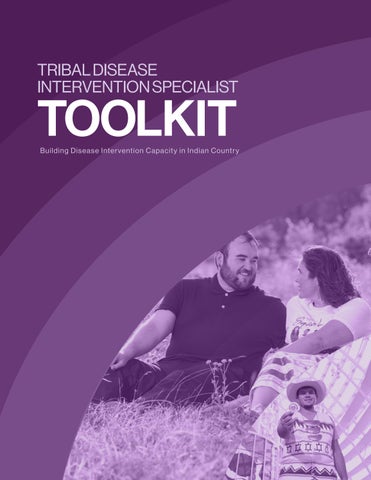
TRIBAL DISEASE INTERVENTION SPECIALIST

Building Disease Intervention Capacity in Indian Country

AUTHOR’S NOTE

This publication was made possible through funding support from the United States Centers for Disease Control and Prevention (CDC) to the Southern Plains Tribal Health Board and the Oklahoma Tribal Epidemiology Center. The contents of this document are solely the responsibility of the author and do not necessarily represent the official views or positions of the CDC.

This toolkit is designed to provide valuable information for individuals interested in becoming a Tribal Disease Intervention Specialist and strengthen the capacity of tribal communities in addressing public health challenges.

ENHANCED DISEASE INTERVENTION CAPACITY (EDIC) TEAM (Top from left to right)

AMBER MARTINEZ

CSTLTS Program Manager

ARIELLE BUSH

Disease Intervention Program Coordinator

TESHA HAMILTON

Disease Intervention Specialist

CODY KNIGHT Tribal Epidemiology Center Core Program Manager

ROBBIE BRIGHT Native Test Program Coordinator

KORI VALENTINE Disease Intervention Specialist

TERRANCE TODOME Program Coordinator

ISABEL RENDON Public Health Specialist

TEC CORE STAFF TEAM (From left to right)

INTRODUCTION TO THE

TRIBAL DISEASE

INTERVENTION SPECIALIST (tDIS)

WHAT IS A t DIS?

The work of disease intervention specialists (DIS) originated in the 1930s when syphilis was endemic in the United States. At the time, health departments used staff members (who would eventually become known as disease intervention specialists (DIS) to ensure that all persons with a diagnosis of syphilis were treated and that their contacts and suspected sources of infection were investigated. This service was considered beneficial because it verified treatment for patients with a new diagnosis of syphilis and established partnerships with key community stakeholders. In the 1940s, the Centers for Disease Control and Prevention (CDC) established a federally funded workforce to increase local capacity to control syphilis and work side-by-side with state and local DIS. Collectively, these DIS were also enlisted to help control gonorrhea in the 1970s and HIV starting in the late 1990s. Because DIS skills are valuable for various types of public health efforts, they contribute to outbreak investigations for other infectious diseases and to public health preparedness responses.

ORIGINS AND EVOLUTION

The work of disease intervention specialists originated in the 1930s when syphilis was endemic in the United States. 1930s

In the 1940s, the Centers for Disease Control and Prevention (CDC) established a federally funded workforce to increase local capacity to control syphilis and work sideby-side with state and local disease intervention specialists. 1940s

Collectively, these disease intervention specialists were enlisted to help control gonorrhea in the 1970s. 1970s

Disease intervention specialists were also enlisted to help control HIV starting in the late 1990s. 1990s

WHAT IS A t DIS? (CONT’D)

While Disease Intervention Specialist (DIS) programs have been historically housed within state and local health departments, there has been a growing effort to integrate these roles into Tribal communities. Many Tribal nations have historically relied on state and federal public health resources for disease surveillance and intervention, but this has often resulted in challenges related to jurisdictional barriers, cultural differences, and gaps in care. In response, Tribal health organizations and public health authorities have recognized the importance of having trained DIS professionals who are embedded within their communities. A Tribal Disease Intervention Specialist (tDIS) plays a crucial role in protecting the health and well-being of tribal communities by preventing and controlling the spread of infectious diseases. tDIS professionals collaborate closely with tribal healthcare providers, state and federal entities, community leaders, and community members to implement effective intervention strategies and promote health education. Their work includes disease surveillance, outbreak investigation, and culturally sensitive interventions tailored to the specific needs of the tribal population. Through collaborating with tribal leadership, community education, evaluation support, and linkage to care tDIS can assist with building capacity for field testing and raising awareness in tribal communities.

WHY ARE THEY IMPORTANT?

tDIS professionals are essential to enhancing the effectiveness of public health efforts, reducing health disparities, and improving health outcomes in Tribal communities. Health disparities could include higher prevalence of certain diseases such as STIs, HIV, or HCV; access barriers such as lack of transportation or culturally insensitive providers.

According to the Centers for Disease Control and Prevention (CDC), HIV, STIs, viral hepatitis, and tuberculosis takes a greater toll on American Indian and Alaska Native (AI/AN) populations due to health disparities. Through tDIS intervention and building partnerships, it could help mitigate those disparities, improve health outcomes, and help build tribal capacity. tDIS use contact tracing and case investigation to prevent and control infectious diseases.

DIS also uses partner services which includes case investigation, contact tracing, and referral to other relevant services the client may need to assist in identifying individuals at risk for STIs, increasing STI awareness, and providing timely treatment. Tribal disease intervention is key to sexually transmitted infection prevention and control.

A Tribal Disease Intervention Specialist (tDIS) plays a crucial role in protecting the health and well-being of tribal communities by preventing and controlling the spread of infectious diseases.
tDIS professionals are essential to enhancing the effectiveness of public health efforts, reducing health disparities, and improving health outcomes in Tribal communities.

ROLES AND RESPONSIBILITIES

A GLIMPSE INTO THE LIFE OF A t DIS

tDIS specialists are involved in managing and preventing the spread of infectious diseases. Their responsibilities include conducting case investigations to understand symptoms, the timing of infection, and potential sources. They also engage in contact tracing to identify individuals who may have been exposed and notify those at risk. Additionally, tDIS professionals collect and analyze data to track disease patterns, which informs effective prevention strategies. They provide education and support to patients and their contacts on disease transmission and prevention measures. Collaboration with healthcare providers, public health teams, and community organizations is crucial to ensuring a coordinated response to outbreaks.

Beyond direct patient interaction, tDIS specialists also focus on community outreach, raising awareness, sharing vital public health information, and conducting field testing. In some cases, they help ensure compliance with public health regulations to control the spread of disease.

tDIS roles are crucial in ensuring culturally appropriate disease intervention efforts that respect Tribal sovereignty and traditions. Cultural considerations are crucial because they foster respect, trust, and effective communication. In Tribal communities, taking time to build relationships before diving into formal work shows respect and aligns with cultural values of relationality and patience. Providing appropriate services like health education materials that reflect the community’s traditions, beliefs, and preferred language are more likely to be understood and acted upon. Hosting a community health event that incorporates cultural practices like a blessing ceremony, or traditional songs can increase turnout and community buy-in.

Tribal communities often experience higher rates of STIs, HIV, and other infectious diseases due to disparities in healthcare access, historical trauma, and systemic barriers. tDIS ensures that individuals receive the appropriate medical care and support services needed and plays a vital role in building trust between public health agencies and Tribal nations.

WHO CAN BECOME A t DIS?

Anyone with a passion for public health and disease prevention can become a tDIS. Training programs provide the necessary knowledge and skills to perform the role effectively. Disease intervention work has multiple levels, offering opportunities for individuals to contribute based on their expertise and experience.

Upon completing the training, tDIS professionals gain expertise in cultural competence, disease surveillance, outbreak investigation, and a foundational understanding of sexually transmitted infections (STIs), prevention methods, and more. Community Health Representatives (CHR), Community Health Workers (CHW), Public Health Nurses (PHN), and other public health professionals can incorporate disease intervention into their work through the tDIS framework.

Anyone with a passion for public health and disease prevention can become a tDIS. Training programs provide the necessary knowledge and skills to perform the role effectively.

RECOMMENDED TRAININGS

AND TRAINING PLATFORMS

CARDEA TRAINING CENTER

Cardea Training Center has many trainings geared towards STI information.

Cardea Training Center - This link takes takes you to the catalog. You must create a log in if you have not done so. Click on courses.

The following trainings are great for diving into your DIS role.

STI 101: Basics of Sexually Transmitted Infections

HIV Care and Sexual Health Assessment for American Indian and Alaska Native Patients

HIV Care and Sexual Health Assessment for American Indian and Alaska Native Patients: Part 2

Advancing the Uptake and Use of PrEP in Indian Country

Developing a Social Media Strategy to Combat the HIV Epidemic in Indian Country

An Introduction to Motivational Interviewing

PrEP Navigator Training for Community and Public Health Staff

CDC TRAIN

CDC TRAIN is a gateway into the TRAIN Learning Network, the most comprehensive catalog of public health trainings shared by public health organizations across the United States. You can become a learner in this system through the national gateway, your state’s gateway, or CDC’s gateway.

DIS Fundamentals Training Plan - CDC TRAIN - an affiliate of the TRAIN Learning Network powered by the Public Health Foundation

This training plan focuses on fundamental disease intervention (DI) skills for new Disease Intervention Specialists (DIS) and/or those conducting partner services (PS) activities. These online DIS training modules are for providers who conduct all aspects of STD/HIV Disease Intervention Services, and they are designed for PS professionals of all experience levels.

There are 29 online modules in this training plan. Eight of these modules focus on key disease concepts: Infectious Disease and Human Anatomy, Syphilis, Chlamydia, Gonorrhea, Pelvic Inflammatory Disease (PID), HIV Infection and AIDS, Tuberculosis, and Hepatitis. The other six modules focus on core Partner Services skills: Introduction to Partner Services for PS Providers, Communication Skills, Interviewing (5 sub-units), Field Investigation and Notification, Referrals and Linkages to Care, and Syphilis Case Management and VCA. There are also 15 additional modules that address General Public Health (3), Gender Diversity and Cultural Competency (7) and Disease Investigation (5)

CULTURAL COMPETENCY TRAININGS

The Southern Plains Tribal Health Board provides two cultural competency training programs specifically designed for working with the Tribal communities..

Trainings – SPTHB

Data Into Action for Tribes for Tribes: Introduction to Epidemiology

Weaving the Threads of Culture: Working Effectively with American Indians and Alaska Natives

HealthHIV HIV PrEP Navigation Certification (HIVPNC) Program

The HealthHIV HIV PrEP Navigation Certification (HIVPNC) Program is the only certification program offered to providers and allied health professionals to prepare them to guide community members in their use of PrEP over time. HIVPNC promotes interprofessional collaboration and teamwork by engaging clinical and non-clinical providers to share their experiences in PrEP navigation services.

HealthHIV HIV PrEP Navigation Certification (HIVPNC) Program

THE RAVEN COLLECTIVE

The Raven Collective operates on the past, present, and future homelands of many Tribal Nations, including the Bodéwadmi, Myaamia, Oceti Ŝakowiŋ, Hoocak and Kiikapoi Tribes. TRC is committed to honoring all Indigenous communities’ many connections to the land across Indian Country.

Strengthening Indigenous Public Health: The Tribal Disease Investigation

Specialist Learning Pathway

Indigenous Syndemic Pathway

RECOMMENDED TRAININGS

AND TRAINING PLATFORMS ( Cont’d )

TRAININGS PROVIDED UPON REQUEST IN OKLAHOMA

HIV Counseling, Testing, & Referral and Linkage to Care Training

HIV CTR/LCT aims to equipe tDIS and other healthcare providers with the knowledge and skills required to deliver comprehensive HIV services, including counseling, testing, and referral/linkage to care. Participants will learn the importance of creating a supportive, non-judgmental environment for individuals at risk of or living with HIV, ensuring that they receive accurate information and emotional support thru the process.

Contact Maria Mancebo at maria.mancebo@health.ok.gov to request information on the next training available.

OSDH Disease Intervention Specialist and PHIDDO Training

PHIDDO

The preferred method of disease reporting in Oklahoma is through the Public Health Investigation and Disease Detection of Oklahoma (PHIDDO) system. PHIDDO is a real-time, secure, internet-based application that provides a centralized place for reporting diseases and conditions in Oklahoma. All data is secure and accessible only to registered users. Once a user submits a report through PHIDDO, the disease report is reviewed and assigned for investigation and follow up.

OSDH DIS shadowing opportunities

Contact Erinn Williams at Erinnw@health.ok.gov to request information on other available trainings.

Syphilis Educational Training

Contact Terrance Todome at ttodome@spthb.org to request information on trainings available.

OTHER TRAININGS AVAILABLE UPON REQUEST

Motivational Interviewing: Breathing Life into Helping Relationships

This training is intended to focus on those who serve local Tribal Communities for children and their families. Related health concerns such as ongoing COVID issues parenting younger age children with special needs, healthy childhood developmental issues and other concerns raised by participants in the audience will be addressed within the curriculum. Discussion will include what role MI interventions and approaches will support tribal health and well-being holistically as it applies to specific tribal needs and concerns.

Contact Dr. Kathyleen Tomlin at Kathyleen-tomlin@uiowa.edu to request information on this training.

RESOURCES

HARM REDUCTION SERVICES IN KANSAS

Confluence HRKC is a texting service available in the Kansas City area where you can order safe drug use kits, Naloxone, condom kits, wound care supplies, Plan B, and basic hygiene kits.

https://www.confluencehrkc.org/

HARM REDUCTION SERVICES IN OKLAHOMA

SovereignMe

SovereignMe is a harm reduction texting service that provides Health and Safety kits, Safer Use kits, Safer Sex kits and HIV test kits. Participants text “Safer” to 55251.

Healthcare partners can request bulk kits by emailing safer@spthb.org

SovereignME Harm Reduction

Oklahoma HIV & Hepatitis Planning Council

Offers free condoms to businesses and individuals by filling out form.

Ending HIV Oklahoma & Hepatitis Planning Council (OHHPC)

Cheyenne and Arapaho Tribes Tribal Office of Recovery

Offers harm reduction services that provides Narcan, Fentanyl and Xylazine test strips, Plan B, condoms, safer injection kits, wound care kits, and hygiene kits, and more recovery resources. You can find information at the website below.

https://www.cheyenneandarapaho-nsn.gov/health/tribal-office-of-recovery-tor

https://form.jotform.com/233483491288062 (order form)

HARM REDUCTION SERVICES IN TEXAS

Texas does not have any laws to protect the distribution of Harm Reduction supplies and there is no mail out service. There are places within the state that you can find supplies. Use the following link to find assistance.

NASEN | North America Syringe Exchange Network: NASEN Directory

Stop Overdose where individuals who live in Texas can order Naloxone by filling out the order form below.

STOP Order Form

Texas Wears Condoms

Mail order condom service and free At Home Testing

Texas Wears Condoms

HARM REDUCTION SERVICES NATION WIDE

National Harm Reduction Coalition

Provides harm reduction resources including finding naloxone and syringe programs within the United States.

https://harmreduction.org/

National Condom Distribution Service

The National Condom Distribution Service (NCDS) distributes free condoms and lubricant sachets to services working directly with population groups who may be at increased risk of unplanned pregnancy, HIV or STIs.

Howard Brown Health Prevention Supply

Provides sexual health and STI-prevention supplies such as condoms, lube, and dental dams completely for free with delivery across the United States.

https://howardbrown.org/prevention-supply/ Prevention Supplies Order Form

CDC Condom Finder Widget

https://npin.cdc.gov/web-tools/condom-finder-widget

RESOURCES

PARTNER SERVICES

TellYourPartner

TellYourPartner is a platform that fosters responsible and transparent communication for a healthier community. It provides a discreet way for individuals to inform their recent sexual partners about potential STI exposure, giving everyone the crucial information needed to manage their sexual health responsibly. TellYourPartner is a unique service that lets you anonymously notify your previous partners about potential STI exposure via text message. It’s a quick, private, and responsible way to share crucial health information.

TellYourPartner.org

SELF-TESTING SERVICES

Native Test

Native Test is a nationwide service that provides individuals with free human immunodeficiency virus (HIV) self-test kits, syphilis self-test kits, prevention information with pre-exposure prophylaxis (PrEP) and post exposure prophylaxis (PEP), and sexual health care navigation all without internet access. Native Test is for anyone nationwide 13 years or older including both American Indians/Alaska Natives and non-Native individuals.

This program is coordinated by the Oklahoma Area Tribal Epidemiology Center (OKTEC) and has 90 partner organizations across Indian Country. To get started today or for more information, text “Native Test” to 55251 or visit online at nativetest.org. For more information about Native Test email nativetest@spthb.org

REFERENCES

CENTER FOR DISEASE CONTROL AND PREVENTION STI INFORMATION

https://www.cdc.gov/sti/index.html

INDIAN HEALTH SERVICES STI INITIATIVE

https://www.ihs.gov/sti/

KANSAS DEPARTMENT OF HEALTH AND ENVIRONMENT DIVISION OF PUBLIC HEALTH STI/HIV/HEP C PROGRAM

https://www.kdhe.ks.gov/352/STI-HIV-Hep-C-Program

OKLAHOMA STATE DEPARTMENT OF HEALTH SEXUAL HEALTH AND HARM REDUCTION SERVICE

https://oklahoma.gov/health/services/personal-health/sexual-health-and-harm-reduction-service.html

PMC PUBMED CENTRAL

The Changing Role of Disease Intervention Specialists in Modern Public Health Programs - PMC

SOUTHERN PLAINS TRIBAL HEALTH BOARD www.spthb.org

TEXAS DEPARTMENT OF STATE HEALTH SERVICES HIV/STD PROGRAM

https://www.dshs.texas.gov/hivstd

Turn static files into dynamic content formats.
Create a flipbook
Issuu converts static files into: digital portfolios, online yearbooks, online catalogs, digital photo albums and more. Sign up and create your flipbook.
tDIS Toolkit by Southern Plains Tribal Health Board - Issuu