Southeast Ohio Magazine Winter | Spring 2026

Page 1


OHIO Southeast

OHIO Southeast

Editor-in-Chief

Maggie Allwein

Managing Editor

Haylee Leasure

Department Editors

Isabella Pedrera

Jack Solon

Maggie Valentine

Rachel Yount

Writer

Brandt James

Digital Editor-in-Chief

Anna Hanes

Web Editor

Anna Hanes

Multimedia Editor

Grace Miller

Social Media Editor

Tyson Bernath

Design Directors

Nicole Bell

Ally Parker

Photo Editor

Grace Miller

Faculty Adviser

Kelly K. Ferguson

Letter from the Editor

The past few years have again proven the perseverance of the Southeast Ohio region. This is a fact that the writers, photographers and designers have had the opportunity of seeing during the last four months, and the last three years as Ohio University students.

As the nation adjusts to life five years after COVID-19 and traverses ongoing government changes, our staffers strived to reflect both the daily challenges and the widespread initiatives which serve the 21 counties this publication covers.

What I’ve seen in this short time is quite simple, but hard to come by: neighbors helping neighbors. In this issue, we aimed to represent the impact Southeast Ohioans create with their ongoing determination.

Behind the Bite Editor Maggie Valentine showcases Hocking Athens Perry Community Action, a nonprofit agency dedicated to alleviating the food needs of the region. Founder, president and CEO of FosterHub Michelle Mays sits down with In Your Neighborhood Editor Rachel Yount to discuss the fulfillment of her dream to provide a physical safe space for youth aging out of the foster care system. Design Director Nicole Bell amplifies the story of Macedonia Missionary Baptist Church’s rehabilitation after almost 30 years of closure.

Features Editor Isabella Pedrera writes about the Lewis family, owners of Libby’s Pumpkin Patch which was forced to close its doors after a drought last fall, but came back this season with gusto. David and Tina Slack discuss their over 60,000 book collection for sale at Slack’s Book Barn, with Social Media Editor Tyson Bernath.

We hope to have illustrated Southeast Ohio the way we have come to see it—perserverent, determined and above all, supportive.

Happy reading, Maggie Allwein

Southeast Ohio strives to spotlight the culture and community within our 21-county region. The student-run magazine aims to inform, entertain and inspire readers with stories that hit close to home.

On the Cover

Contact Us

Southeast Ohio magazine

E.W. Scripps School of Journalism 1 Ohio University Athens, Ohio 45701

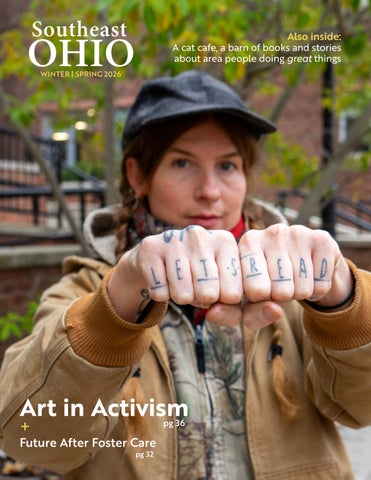
Author Madeline ffitch spells out her passion for activism. Read about her on page 32. Photo by Nicole Bell.

Table of Contents

THE SCENE

4 | Ride the Nine

Ohio’s Windy 9 brings motorcyclists together from all over the state and beyond

BEHIND THE BITE

6 | Meows and Macchiatos

The Chatty Cat Cafe of Zanesville offers coffee and some claw-some company

8 | A Tale of Two Rooms

Black Diamond Steakhouse adds to the Circleville dining scene

10 | World of Pure Imagination

The Fat Apple Bakery in Belmont serves sweet treats and charming nostalgia

IN YOUR NEIGHBORHOOD

12 | Handcrafted Heritage

In the heart of Logan, the Columbus Washboard Company keeps American craftsmanship alive

14 | Libby’s Pumpkin Patch Digs In

After the 2024 drought forced closure, Libby’s Pumpkin Patch regains its groove

16 | One Last Spell

Ironton turns the page after its seven years of hosting Wizardfest

18 | Escape Cyberspace

With over 60,000 books for sale, Slack’s Book Barn is the place to go analog

20 | Strong Foundations

Macedonia Baptist Church, founded by 37 formerly enslaved people nearly two centuries ago, reopens doors as a cultural center

22 | Framing Fairfield

Lancaster couple Web and Diane Rice showcase student work and quilting history

24 | HAPCAP Fights Against Hunger

Despite recent changes in national public policy, Southeast Ohio Foodbank remains steadfast

WHAT’S YOUR STORY?

46 | Sweet, Sweet Success

Tom Warne of Donald’s Donuts shares his secrets for being number one

TALKING POINTS

26 | Smashing Stress

WINTER | SPRING 2026

New Breakerspace gives Athens residents a new way to let loose

28 | Explosive Consequences

Orphan wells of oil and natural gas are volatile sites that threaten citizen safety

FEATURE WELL

32 | Future After Foster Care

Local nonprofit FosterHub begins construction of a new resource center for young adults

36 | Art in Activism

Local author Madeline ffitch discusses Appalachian art and activism

40 | Mobile Impact

Inventive initiatives drive resources to the hills and dales of Southeast Ohio

ABOVE: A tabby cat perches at Chatty Cat Cafe, pg. 6..
Motorcyclist Kane Wagner rides Ohio’s Windy 9 at Wailin Wayne Weekend.
Photo provided by Joel Prince.

Ride the Nine

Ohio’s Windy 9 brings motorcyclists together from all over state

Southeast Ohio residents are no strangers to winding roads. These twists and turns are the reason why the Athens County Convention and Visitors Bureau created Ohio’s Windy 9 (OW9). This motorcycling destination has nine routes that extend all over the region, beginning and ending in Athens County.

OW9 attracts bikers from all over the region. Kane Wagner, a biker from Youngstown, Ohio, is a frequent participant.

“When I first started going down here, it was kind of like the hidden gem of the East Coast,” Wagner says.

Wagner compares OW9 to other famous riding destinations, such as Tail of the

Dragon in North Carolina and Back of the Dragon in Virginia.

“Most people think of [Ohio as] super flat cornfields, and that is definitely not what it’s like where the Windy 9 is at,” Wagner says. “It’s very hilly, it’s very twisty roads and it’s beautiful terrain.”

Wagner loves the town of Athens and exploring the small communities these routes run through. Since 2018, he has attended Wailin Wayne Weekend, an adventure motorcycle rally in Nelsonville every September.

“It’s like a family reunion every time you go to any of these events like that,” Wagner says. “You see the same faces and get a chance to ride together.”

ABOVE: Joshua Leasure rides the Hocking Hills Nipper route.

Display wall features pictures of successful adoptions.

Meows and Macchiatos

The Chatty Cat Cafe offers coffee and claw-some company

Mornings begin with the soft rustle of paws making biscuits and whiskers twitching to the scent of espresso. The gentle swirl of steam rises from fresh lattes. Around the room, cats stretch lazily on plush pillows. Their purrs blend with the quiet hum of conversations. Each cat lounging on the windowsill has its own story, from rescue to recovery to hopefully, finding its forever home.

Half-cat rescue, half-cafe, The Chatty Cat Cafe of Zanesville offers a mix of cozy treats and compassionate

care. Guests can stop in for coffee or pastries, which are available for pick up, walk-in or delivery, while watching the cats through a large viewing window.

Those looking for more can schedule a 15-minute or 30-minute session in the cat lounge to spend time with adoptable residents. The cafe also hosts special events and offers opportunities for visitors to support their rescue mission through volunteering and donations.

The Chatty Cat Cafe’s goal is to “chang[e] lives, one heart,

one paw, one forever home at a time,” according to their Facebook profile. The café has over 8,500 Facebook followers who track daily updates on cat placements, events and limited-time menu options.

Founder Erica Roberts opened The Chatty Cat Cafe in 2019. She states on her website that it has always been her dream to work with animals.

Carmie Shook, now the cafe’s manager, first got involved to help a friend.

“I have known Erica for probably about 10 to 15 years,

but I first heard about it [her business] on Facebook,” Shook says. “I started coming a year and a half ago, and I just didn’t stop."

Shook’s day-to-day responsibilities now include working with volunteers, vets and even baristas. “I help clean litter boxes, feed, give water, provide medicine and watch for the general wellbeing of all cats,” Shook says. “I also transport cats to and from the vet to the cafe.”

Shook also helps socialize the cats. She spends time with them, making sure the cats feel “nothing but love for the rest of their life.”

Shortly after coming to the cafe in 2024, Shook adopted her first rescue. “I started coming probably in May, and then I became a volunteer here around June, and then by September, I adopted a cat [named Cheddar],” Shook says. “That cat brought me so

much happiness in my life, and he was my soul cat.”

Shook then adopted Smokey, a gray cat, who at the time was just five weeks old. The pair will be getting two more siblings joining their family in September of 2025: Honey, an orange cat, and a tabby named Pumpkin.

The cats at The Chatty Cat Cafe are up to date on their vaccines, spayed, neutered and dewormed, which helps streamline the adoption process. Once interested adoptees have cleared their background check, vet and other necessary information, they are free to take their new furry friend home.

According to the café, over 350 cats have been successfully adopted so far.

“It's usually within 24 to 48 hours and it's super easy; they just set up a time, and you

come in here and get your baby,” Shook says.

As the day winds down, a few cats stretch lazily, their paws kneading on blankets where customers once sat sipping lattes. Behind the counter, Shook picks up cat toys and pauses to give a small calico kitten a scratch under its chin. Its purr rumbles softly, a small sound that carries through the quiet space.

“If you’re looking for a cat, come here because they are socialized and they are some of the sweetest cats you will ever meet,” Shook says.

Information: www.thechattycatcafe.com

LEFT: Adoptable cat waits for a forever home. MIDDLE: Carmie Shook poses with her newly adopted cats, Pumpkin and Honey. (Photo provided by Carmie Shook) RIGHT: Cafe offers specialty drinks.

A Tale of Two Rooms

Black Diamond Steakhouse brings contemporary casual

Circleville diners enter under the black awning marked with a “B.” Patrons sit in candlelit booths, enjoying filet mignon and bourbon. In the back, guests gather in a casual taproom, while a chef puts a tray of sliders on the windowsill under the scarlet light.

General Manager Nicole Pesa pours beer into a glass from the tap beside the kitchen.

Black Diamond Steakhouse, located at 126 West Main Street in Circleville, is the newest location in the Black Diamond franchise. Headquartered at Black Diamond Brewery & Distillery in Nelsonville, the business has other satellite taprooms which operate in Marietta, Shawnee and Greenfield.

Spirits and bourbon are their flagship products, but the taproom locations also offer bar food menus. The Circleville steakhouse is the company’s first location to venture into formal dining.

The West Main Street space was previously occupied by a family-owned restaurant called Gibby’s. The Gibson family retired last year, leaving managerial control vacant until Black Diamond hired Pesa.

“You have fast food, a few mom-and-pop shops, but no steakhouse, so everybody had to drive to Columbus or Chillicothe,” Pesa says.

The Black Diamond Steakhouse mission is to welcome upscale steakhouse customers and casual bar foodies alike.

The dual menus were created by Head Chef Alfonso Contrisciani, owner of Alfonso’s Italian Kitchen & Bakery in Nelsonville and Alfonso’s Italian Grille in Lancaster.

Two menus, one place

The steakhouse side offers shrimp cocktail, chicken cutlets, bourbon-glazed salmon, pastas and, as its name suggests, various cuts of steak.

Meanwhile, the taproom offers lighter bar food options. Customers have a choice among entrees including various salads, flatbread pizzas and slider burgers served in trios. Black Diamond’s signature IPA, as well as an expansive selection of craft brews, are available.

Guests can choose either menu, regardless of which half of the establishment they sit. The dessert menus are the same on both sides and include a chocolate pretzel brownie,

to Circleville

“You have fast food, a few mom-andpop shops, but no steakhouse, so everybody had to drive to Columbus or Chillicothe.”
- Nicole Pesa, general manager

bourbon molasses pecan pie, classic cheesecake and “Alfonso’s Cannoli,” all sourced from Alfonso’s Bakery.

“If three out of the four people in your party want the steakhouse, then eat in the steakhouse to get that full experience,” Pesa says. “But if the majority of your party wants burgers and sliders and flatbreads, eat in the taproom. We’re still more than happy to serve them a steak.”

Black Diamond Steakhouse - Circleville 126 W. Main Street Circleville, 43113 614-315-4916

Black Diamond Steakhouse customers enjoy food and drink in the casual taproom.

ABOVE: An order of wings next to sliders with a side of fries.

ABOVE:
ABOVE: Black Diamond Steakhouse Head Chef Alfonso Contrisciani leans against the kitchen counter in the taproom.
ABOVE: Black Diamond General Manager Nicole Pesa pouring a beer.

The bright entrance of The Fat Apple Bakery, decorated with an old truck turned flower pot.

World of Pure Imagination

The Fat Apple Bakery of Belmont serves sweet nostalgia Story & Photos by Tyson Bernath

At the entrance of the Fat Apple Bakery, a life-size statue of actor Humphrey Bogart stands beside a statue of a giant cow with lipstick. Inside features include Elvis records, posters of a young Michael Jackson, and retro Coca-Cola signage. Faint lullabies from the carousel rides on the second floor drift downstairs.

The Fat Apple Bakery, owned and operated by couple Don and Robyn Rhodes and their family, has been a part

of the Bridgeport community since 2019. During the day, Robyn can be found running the register and serving customer at the bakery counter. Daughter Whitney Stemkowski is the main baker who creates and decorates the sought-after sweet treats. She combines creativity with ambition in cakes such as her Barbie Dress Cake and plays on food trends such as the Dubai chocolate brownie.

Before opening the bakery, Don worked as a florist that

serviced weddings and found himself offering to bake cakes for some extra cash. That lead to the Rhodes family’s wedding catering company where they created more than just cakes and treats, offering a full menu.

When the coronavirus pandemic hit and public gatherings like weddings declined, the couple began selling their extravagant sugarshocked apples at school fundraisers.

“We'd have groups that

would order 1,000 or 1,200 apples, and it was impossible,” Don says. “So, we cut the fundraisers out.”

The Fat Apple Bakery’s name comes from its signature, coveted dessert-covered apples. These oversized apples are smothered in chocolates, candies and more.

But the shop is more than the bakery, it’s a curated space of unique sweets, toys and displays. Don is always on the look for decoration. He shops estate sales, checks inventories of closing businesses, and accepts donations of nostalgic or wacky pieces to add to the ever-growing display.

“It's things that hopefully will trigger something in a person's

mind to make them feel good,” Don says. “There’s no theme to anything except happiness. I could decorate this place two or three times over with the stuff I have, so we can take stuff down and put stuff up, but mostly it stays up once it gets up.”

Candies and goodies are likewise selected for their nostalgia factor. Shelves are stocked with vintage candies such as Razzles, Charleston Chews and NECCO wafers.

As a grandfather, Rhodes prioritized opening a business that would appeal to all ages.

“We wanted to make it a place where people could come and enjoy themselves and look around,” Don says.

“The grandparents could bring the grandkids, and the grandparents could tell them about ‘this is what I used to have when I was a kid.’”

The toy store upstairs features old school coinoperated rides, costumes and toys, along with displays of LEGOs, K’NEX and even a Build-A-Bear machine. Don hopes to continuously improve his place to make it an immersive escape for all ages.

“When you come here, we want you to feel a lot happier, a lot better, and just put the cares of the world aside for a day,” Don says.

The Fat Apple Bakery 225 Main St, Bridgeport,43912 (740) 298-6770

ABOVE: Whitney Stemkowski and two employees show off some of their recently baked goods including: A pie, fall-themed donuts, and a fall-themed cake.

Handcrafted He ritage

Logan’s Columbus Washboard Company keeps American craftsmanship alive

The clang of metal striking metal echoes through the air, sharp and rhythmic. Inside the Columbus Washboard Company of Logan, that sound isn’t just noise. It’s a legacy.

In a century-old brick building, workers still cut, press and assemble each washboard by hand. Sheets of tin catch the light as wood frames are sanded smooth, fitted and fastened—all parts of a process that hasn’t changed much since 1895. While washboards began as a household necessity, they have since become a collector’s item, a musical instrument and a living reminder of smalltown craftsmanship.

The Columbus Washboard Company began in Columbus when Frederic Martin Sr. and

his family started producing washboards in their backyard.

“Solid wooden washboards date back to the 1700s, but the Martin family, the owners of the company, started making them in his backyard before he actually opened the company in 1895,” says Diane Hopkins, the company’s manager.

More than a century later, the company remains American made, a point of pride that Hopkins believes has helped it endure. In 1999, the business was sold and relocated to Logan, bringing its handcrafted heritage to the Hocking Hills region.

A visit inside feels like stepping back in time. Handmade goods by local artists fill the shelves. An oldfashioned ice cream parlor sits just inside the door, serving

flavors such as coconut, Biscoff, pumpkin and Cookie Monster.

Downstairs, visitors can tour the factory to watch the washboards being made. Machines press metal ridges while stacks of Ohio-sourced wood wait to be shaped into frames. The logo, developed in 1907, still adorns each board, though customers can now choose from a range of screen prints and styles.

Four employees keep the tradition going today. Hopkins is one of the few who can work in every department, and she’s currently training a new hire to handle materials in the basement. Hopkins has worked at the company for more than 15 years, handling everything from Amazon orders to hands-on production in the shop.

“We are finding that more and more [people] are going back to the old traditional ways,” Hopkins says, noting that washboards have found a new life as both laundry tools and instruments.

History has repeatedly reminded the company of its lasting utility. During World War II, Hopkins says, “over 1.2 million washboards were sold.”

Decades later, the coronavirus pandemic brought another unexpected surge. “We come in on a Monday morning to 500 orders that morning alone,” Hopkins says. “When everything shut down, mostly people that lived in apartment complexes weren’t able to get out. Everything was closed. Laundromats were closed, so they had to do laundry in their homes. Most of them didn’t have washers and dryers, so they used washboards.”

Over the years, the company's history has reached beyond Ohio. “The Color Purple, the musical, placed an order to use [washboards] as a prop in their musical. They wanted the

original, authentic washboard, so we sent them some of those,” Hopkins says.

Tourism also plays a major role in the company’s business. From May through October, the shop buzzes with visitors who come for the nostalgia, the craftsmanship and a scoop or two of real ice cream. Hopkins says she’s noticed a renewed appreciation among the older generation, though she hopes younger people will develop the same curiosity.

“A great way to get involved

would be to put our name out there so people can come and support us,” Hopkins says.

Authentic craftsmanship epitomizes the Columbus Washboard Company legacy, and that quality cannot be replicated by mass production or machine.

“Everything is American made here; we've always kept that authentic and we do good work,” Hopkins says.

Columbus Washboard Co. www.columbuswashboard.com

ABOVE: Diane Hopkins, Store Manager pointing to the Washboard Assembly room.
Washboards decorate the store walls.

Libby’s Pumpkin Patch Digs In

After the 2024 drought left its fields barren, Libby’s Pumpkin Patch prevailed

ABOVE: From left to right: Lucy Dye, Rachel Lewis, Kevin Lewis, Libby Lewis, and Zack Dye in front of the Libby’s Pumpkin Patch sign.

Abead of sweat rolls down the temple of Rachel Lewis, one of Libby’s Pumpkin Patch co-owners, before dropping to the floor. It’s an unusually humid evening for late September in Albany, but Lewis welcomes the muchneeded rain absent this time last year.

In the distance, Rachel’s husband, Kevin Lewis, and

daughter, namesake Libby Lewis, uproot pumpkins from the dense, wet dirt and transfer them into large bins. The pumpkins are plump, plentiful, and glow bright orange.

The Lewis family is hard at work bringing their business back to life after its 2024 closure.

“Last year we had nothing to sell,” Kevin says. “All this land

looked like the surface of the moon. You see all this green grass? Last year, it was brown, crusty and a fire hazard. One stray cigarette would’ve sent us up in flames.”

Fall 2024 marked a D4 or “exceptional” drought in Athens County, which left Libby’s Pumpkin Patch scrubby and its crops unharvested. Last fall was the first year since opening in 2011 that Libby’s was forced to close its doors to the public.

Thankfully, this year’s more normal rainfall has rebooted the family business.

Humble Beginnings

The Lewis family started by just selling pumpkins off their porch and never expected their small business to take off so rapidly.

“We went into everything sideways, not having a clue what we were doing,” Rachel says. “Then, people would start driving in and asking, ‘Hey, can we go get the pumpkins right off the patch?’ Since then, year to year, it’s just been growing.”

Libby’s Pumpkin Patch has expanded to include pumpkin picking, a flower field, a corn maze, tractor hayrides, giant slides, and hay bale creations of various animals and children’s characters. The family also built a venue space used to host weddings, parties and other events.

Also featured on the patch, the Lewis family’s signature

homemade pumpkin ice cream, which they claim relies more on a feeling than a recipe.

“That’s a funny one; there is no recipe,” Kevin says. “It changes every week! Rachel won’t write it down.”

In addition to the ice cream, the patch features local vendors selling a variety of meats, baked goods and fall beverages and also food trucks on select weekends, plus outdoor seating to enjoy meals.

The patch operates on Saturdays and Sundays from noon to 5 p.m. during October.

A typical visit to Libby’s includes a long tractor hayride through the fields, children running around the patch, and families gathering by various attractions to take pictures.

“It was nice to see smiling faces and the kids that we’ve seen since they were very young. We definitely missed that,” Rachel says. “It was nice to hear that people missed us, too, and are glad we are back.”

A popular attraction with the

kids is the backwoods hiking trail, a half-mile trek adorned with spooky sights like Bigfoot silhouettes, a crashed UFO, and witches on brooms flying around the trees. Another favorite part of the patch is the challenging, yet manageable, corn maze made from crops that the Lewis family harvests themselves.

For those who are fans of the Flower Cart that operates on West Union Street, adjacent to Ohio University’s College Green, the Lewis family transports the cart to the patch for all to enjoy during the pumpkin season.

The Flower Cart is a personal project of Libby’s, which has an assortment of single-stemmed plants that customers can arrange into a custom bouquet for $1 a stem.

“When we couldn’t open last year, the only thing that grew was the flowers she had in the high tunnel,” Rachel says. “So, we had flowers and we took them uptown to sell them, that’s how the Flower Cart came about, because everything else was sort of failing.”

Libby’s Pumpkin Patch & Venue www.libbyspumpkinpatch.com

Such entrepreneurship is part of the Lewis family’s resilience, one that has helped six generations cultivate the land on which the patch rests, with Libby marking the seventh. ABOVE: A tractor and people gathering at Libby’s Pumpkin Patch.

ABOVE: Fans Dressed as Professor Minerva McGonagall and Professor Albus Dumbledore.

Wizards in Ironton

Magical enthusiasts in Southeast Ohio gather for Wizardfest’s final festival

Reporting by Brandt James & Grace Miller

Photos by Grace Miller

During the weekend of Nov. 11, 2025, kids in robes hurried down 3rd street in Ironton, and a Dumbledore or two wandered past a broomstick stall.

Wizardfest has been a staple here since 2018, with a festival every year except 2020. This year, though, marks Wizardfest’s final festival, as the Harry Potter books series, which has sold over 600 million copies globally, stops at seven.

But during it’s Ironton run, Wizardfest has transformed the town into an annual gathering spot for Harry Potter fans and magic enthusiasts across Southeast Ohio. Head organizer Bradley Bear described the festival as made “by fans for fans.”

“It’s kind of a great place where people gather from around the county,” Bear says.

“It’s turned into a fandom super meet.”

Bear described Wizardfest as a mix of a pop-culture festival and a classic fall Appalachian festival.

Instead of an indoor setting or the usual outdoor festival, Wizardfest takes over downtown Ironton, occupying the streets and multiple buildings. The Iron Diner is renamed Dobby’s Diner for the festival, and the Two Beaters Wizards Pub adds to the Harry-Potter-like atmosphere.

“We had planned on seven festivals to align with the seven Harry Potter books,” Bear says. “It’s a lot of fun to put on and we’re really glad we were able to build the playground where so many people could come and play.”

At this year's festival, there were a variety of activities, from a cosplay contest to numerous meet-and-greets. Harry Potter actors Jim Tavaré, who played Tom the Innkeeper in Harry Potter and the Prisoner of Azkaban, and Nick Moran, who played Scabior in Harry Potter and the Deathly Hallows.

Although 2025 marks the last Wizardfest, Bear plans to take a year off and then keep his options open to “figure out what the next adventure will be.”

“We’re definitely all Potter fans, so whatever we cook up next, we’re hoping that some of the elements can be worked in and those folks who have spent the last seven years with us, they still have a place to come back and connect with one another again,” Bear says. “We want to certainly give it a fair shot; anything’s possible at this point.”

ABOVE: Patrick Johnson makes homemade walking sticks and broomsticks
ABOVE: Fan dressed as Deatheater stares down camera.
ABOVE: Alyssa Musser from Jackson makes homemade crochet plushies.

Escape Cyberspace

With over 60,000 books for sale, Slack’s Book Barn is the place to go analog

Trying to unplug? Slack’s Book Barn in Zanesville is the place to do it.

The former barn-turnedbookstore is a two-level building filled top to bottom with bookshelves and with lingering smells of old paper and rustic wood. Bins of books sit on the floor, waiting to be moved to the shelves.

Home to over 60,000 books, the Book Barn, owned by David and Tina Slacks, is the perfect antidote to the hyperspeed pace of social media.

The Slacks, married later in life, now live and work together in the barn, which was previously used to build and sell furniture.

David owned multiple businesses prior to the Book Barn, including another

bookstore, but none of them stuck quite like this current venture, which opened in 2020 after a real estate search.

“Every place we saw wasn’t worth the money,” David says. “We got lucky and happened across this one.”

David, the owner, claims that many of his customers are not who you'd expect. While middle-aged collectors or older generations might come looking for a book from their past, the younger generation also comes searching for physical media in a digital world.

“There’s something about putting a vinyl [record] on,” David says. “There’s something perfect about the imperfections. Books are that way too.”

Search engines rely on predictive algorithms and user history, while at Book Barn, the only algorithm is chance. No pop-up ads distract customers as they run their hands along book spines, searching for the right novel.

Sorted simply by genres and authors, the selection of books constantly changes. With a selection that dates back to the Industrial Revolution, there is a book for anyone and everyone.

The Slacks credit much of their sales to the Amish and Mennonite communities. The two groups have a strong population scattered throughout southern Ohio. Both cultures limit technology use, so they often turn to the classic pastime of reading.

ABOVE: The signage at the end of the drive to the entrance.

“Maybe a truck will come up and it’ll have an Amish family in it,” David says. "Somebody's driving them and they like to stop. They really, really enjoy the books.”

Whether returning to Ohio to visit family or for vacation, Slack’s Book Barn has become a ‘must stop’ location for returning customers.

“I have a guy who lives in California, and he comes here once a year,” Tina says. “We have people that come from Cleveland, Toledo, Canton … People who know they’re going to Old Man’s Cave or Hocking Hills look us up coming off of I-70. We’re the only bookstore between here and there, pretty much.”

Seventy percent of people who come through the door end up with some kind of purchase, often leaving with a stack.

“When you’re selling them for $5, and a hardback costs $25 if you buy it brand new, they’re coming out pretty good,” David says.

David and Tina can be found working at the store six days a week, making the barn a second home. Their reliable presence and quiet nature of the store give the space a cozy feel.

The Book Barn takes donations and buys used books of all kinds. But a warning to those looking to offload books: you may leave the business with just as many as you brought.

Slack’s Book Barn

1124 Wayne Ave, Zanesville (740) 297-7133

Shelf on the first floor of the Book Barn.

Strong Foundations

Founded by 37 formerly enslaved people in 1849, Macedonia Missionary Baptist Church reopens doors as a community center

Anew steel strap hugs an old wooden beam, holding the church’s frame steady. It’s a symbol of strength that mirrors the story of Macedonia Missionary Baptist Church. After years of deterioration, through a massive rehabilitation effort, the historic church in Burlington is reclaiming its role as a cultural center.

Built in the late 1840s by 37 formerly enslaved individuals known as the Burlington 37, the church served as a place of congregation and worship for Burlington’s Baptist population. Until the 1970s, the building represented a significant cultural and historical landmark for the

African American community. Calvin Benson, who attended the Macedonia church when it was part of the public school system before desegregation, is the church’s last living member. In 2019, Benson initiated efforts to preserve the church by approaching Lacy Ward Jr., the volunteer project manager of the Foundation for Appalachia Ohio (FAO), to coordinate a rehabilitation effort together.

Drawing on friends, former colleagues and national organizations, their vision for the center was about maintaining the integrity of the building while giving it a purpose that serves the community today.

In 2020, the two traveled to Washington, D.C., where they met with representatives from the National Park Service to explore the possibility of public funds. In 2021, Ward formed a partnership with the FAO, making it possible to apply for large grants.

With the help of the FAO, the Macedonia Missionary Baptist Church secured a $12,000 grant from the Jeffris Heartland Fund, matched by the Jeffris family foundation. Then, in 2023, the church received a $100,000 grant through the Action Fund’s Preserving Black Churches program.

With funding now in place, they needed expertise for

Macedonia Missionary Baptist Church Historical Marker.

turning an abandoned building into a functioning space.

Ward and Benson searched for a construction and design team with the right expertise. They wanted professionals who could protect the character and history of the original building while updating it to be accessible, comfortable and up to code.

“This is a rehabilitation, not a restoration,” Ward says, emphasizing that the project focuses on adaptive reuse.

The work included practical construction, such as updating the electrical systems and the heating and cooling systems, as well as improving overall accessibility through features such as a ramp and a second entrance.

Preserving the delicate building posed a challenge. The rehabilitation demanded precision, patience, and the respect and understanding of craftsmanship.

Ward and Benson asked Mullins Construction in Wheelersburg and Charissa Durst, founder of Hardlines Design Company, to lead the design and renovation.

First, they took on the difficult task of stabilizing the frame, relying on their experience with historic wood buildings. Just like the literal tension and triumph that existed throughout this project, heavy steel straps held the beams in place for months. Every repair required care and intention to balance preservation with practicality, history with accessibility.

Even before the doors fully reopened, Macedonia Missionary was creating community connections.

Students from Burlington Elementary School planned and led their own Burlington Black History Bus Tour, featuring a stop at the church during its renovations. In this case, educators placed history above photo-ready.

“When our children learn about our community's history, they walk away with not just a better understanding of the events, but a better understanding of who they are. They listen and learn the stories of the Macedonia Church and beam with pride knowing they come from a long line of freedom fighters,” Burlington Elementary School Principal David Ashworth says. “In Ohio, we have to keep the fight to continue to preserve our heritage. When our history is blurred, it in turn distorts our vision of the future,”

Beyond its role as a local historic landmark, the church now serves as a stop on the Appalachian Freedom Trail, linking Underground Railroad sites across Lawrence County.

After years of careful planning, construction and rehabilitation, Macedonia Missionary’s Church doors are ready to reopen. Its long-term cultural impact will depend on how the community, educators and historians use the space to tell stories of resilience and heritage.

“It’s about preserving the past while inspiring the present,” Ward says, noting how the church’s story contributes to a national story of freedom and resilience.

For now, the church stands as proof that history cannot only be remembered but made new again. As each layer of paint is brushed on and each beam rebuilt, the church carries on the legacy of the 37 who built it.

“I believe in freedom and if we don’t have stories to tell us how hard it was to win freedom, we’ll too easily give it up,” Ward says.

Macedonia Missionary Baptist Church

2237 Co Rd 120 South Point, 45680

ABOVE: Lacy Ward Jr. speaking at the opening ceremony.

Framing Fairfield

Lancaster couple Web and Diane Rice showcase student work and quilting history

Three red and white barns on the Fairfield County Fairgrounds stand against the mountainous Appalachian landscape of Mount Pleasant. Ninety-four wooden quilt squares hang neatly around the barns’ perimeters, each one colorfully and stylistically different from the next, and just about every single one is crafted by a Fairfield area student.

Three years ago, Web and Diane Rice, the organizers behind this artistic display, saw a void in the coverage of young peoples’ achievements.

“It seems like kids in sports, every week there’s something

ABOVE: Web and Diane Rice, originators of the fairgrounds public art display.

in the paper about them,” Web says. “And somebody that’s got an artistic talent, you don’t really hear a whole lot about it, and we thought this could be a way to at least showcase what they can do.”

The wife and husband, both born and raised in Lancaster, started the public art collaboration between the fairground and Fairfield County art students, and the first quilt blocks were displayed in 2023.

Barn quilts play a special role in Ohio’s rural scenery, as the state is widely regarded as home to the country’s first barn quilt trail.

The creator of the movement, Donna Sue Groves, started the Adams County trail in 2001 as a way to “promote regional tourism, support artisans and preserve old barns,” according to the Foundation for Appalachian Ohio. Since then, multiple trails have been added in Ohio, including one in Vinton County, which totals over 25 quilt stops.

After learning about the quilt trails, the couple imagined what they could do with a similar idea. As an inclusive, neighborly act, Web, a former fairgrounds superintendent, decided to reach out to local schools to see if were

interested in participating.

So far, the couple has recruited high school art teachers Shannon Fish from Lancaster City Schools and Kim DeKay from Bloom Carroll School District, and they hope to add the list. The project’s goal is to have every school, in every district in the entirety of Fairfield County, contribute to the display.

The first year proved a slow start, with four-by-four-foot painted quilt squares located solely around the side of the art hall situated in the corner of the property, but as Web and Diane received more student contributions, two more buildings were added.

Lancaster City Schools, one of the first participants of the display and led by Fish, consists of nine schools.

“Every single one of the school buildings in the district is represented with at least one quilt square on the fairgrounds,” Fish says.

Fish recalls how student artists return, excited to tell her they drove past the fairgrounds and could show their friends and families, pointing out specifically which one they created.

“Just being able to have that public space for the students is really special for the kids

to be validated in their work, but then also the literal visual enrichment for the whole community to see,” Fish says.

Though dating back centuries, quilt creations can also include contemporary, modern works holding symbolic meanings, such as cultural representations.

“Quilting has a history probably as long as humankind,” Fish says. She teaches her students about artists like Faith Ringgold, known for her painted story quilts. Her work, according to The Metropolitan Museum of Art, focused on “stories about African American life, history, and identity, especially in her resident community of Harlem.”

Fish also discusses the AIDS Memorial Quilt, which was first displayed at the National Mall in

Washington, D.C., in 1987. The quilt commemorates the lives lost to HIV/AIDS and is considered the largest community arts project in history, with 50,000 panels representing over 110,000 individuals.

She hopes such stories will encourage students to cultivate creations that are personal and special to them, whether it's memories of the fair, about their families, or the way they connect to their neighborhood and area.

“While they’re working on these quilt squares, there’s a little bit of themselves in the story behind the quilt that they are making,” Fish says.

Some squares follow the traditional, symmetrical pattern, while others add their own creative flair.

“Quilting has a history probably as long as humankind”
- Shannon Fish, Lancaster art teacher

“The funkiness makes me like it,” Diane says, specifically mentioning a square with a painted deer face in the center.

Web and Diane can still describe the young artists behind the quilts, from kids whose relatives have served in the military, to foreign-exchange students, to Taylor Swift fans, even as the number of quilt squares continues to grow.

“It’s something for the kids who are artistic,” Diane says. “Gives them something to feel good about.”

The Art Hall’s perimeter is lined with the four-by-four foot vibrant wooden panels.

HAPCAP Provides Vital Connections

Despite recent cutbacks in national support, community action program remains steadfast in its goal to improve lives

Hocking Athens Perry Community Action (HAPCAP) provides an abundance of resources to support the Southeast Ohio community, prioritizing their food needs andways to achieve social stability. Across its many food pantries and centers, HAPCAP provides abundant information about career, utilities, housing and transportation services. The varied resources all aim to benefit the health of Southeast Ohio residents. HAPCAP’s program, the Southeast Ohio Foodbank, is in Hocking County, where the food insecurity rate was 17% in 2023, according to Feeding America. The SE Ohio Foodbank acts as is a relief hub for those in the 10-county

region it serves.

The foodbank has worked consistently to reduce food insecurity and advocate for policies to end hunger.

“Sometimes hunger is not just about food. It's also about dignity and stability and having the ability to thrive,” HAPCAP Public Relations Coordinator Valerie Addis says. “It can be hard to store meat if you don't have electricity or a refrigerator. A lot of our other [HAPCAP] programs really do help fighting against hunger, even if they don't look like food relief.

The Southeast Ohio Foodbank assists over 60,000 individuals, meeting their needs across 70 participating food pantries and meal providers. Since its opening

ABOVE: Outside of the Logan HAPCAP Health Market Pantry.

in November 2024, the HAPCAP Health Market Pantry in Logan has received 9,394 visits.

Two months ago, the SE Ohio Coalition of Community Health Workers began a partnership with the Health Market Pantry and became a sit-in resource for individuals to connect and educate them on services such as SNAP, childcare or GED programs.

HAPCAP is home to many services that benefit the quality of life for Southeast Ohioans, with more than 30 programs that advocate, empower and promote self-sufficient lifestyles. From assistance with utility payments to repairing the foundation of houses, HAPCAP puts the health and safety of individuals’ needs first.

“I'll talk to the people that come here to shop and see if I can find out what their needs are and help them connect to the different things at HAPCAP,” Community Health Worker Ronda Clark says. “We're just trying to be that connection so that these people who come in here can also tap into these other resources besides the food.”

Clark also helps direct people to the Supplemental Nutrition Assistance Program (SNAP) and determines whether individuals qualify for SNAP or financial aid. SNAP is a temporary aid for individuals to find their way back on their feet and provides basic needs while stabilizing a household.

On July 4, 2025, President Donald Trump signed the One Big Beautiful Bill Act into law, which cuts funding to the SNAP program.

“As changes are made, [they] affect folks in our area, and they have less access to purchase food from the grocery store on their own,” Addis says. “We know that this will, in turn, impact the food bank directly, as a lot of the time the next place that folks can turn to is the food pantry network.”

This new law also changes eligibility standards and work requirements, making the job of community health workers even more important. Since the partnership with the Coalition, the Logan Health Market has become a training site for community health workers, Ohio University Rural Experience in Appalachian Community Health students and social work interns.

“We help these people get what they need ... health insurance, SNAP, how to cook, how to deal with childcare,” Clark says. “Things like that pull people back from being successful.”

Beyond the 50 years of HAPCAP services, Community Action has always been at the forefront of nonprofit organizations. Volunteers are vital to the SE Ohio Foodbank. Many returning volunteer groups help pack food boxes and make a whole day of it.

The nonprofit women’s group, Athens Friends and Newcomers, has created an interest group called the Helpful Packers, which volunteers with the foodbank every six weeks. What started as a topic for their newsletter became an activity that gave them purpose.

“And [we] just got to talking and what the ladies like to do,” Helpful Packers Group Leader Jane Newton says. “We're only a social club; we aren't a profit club. So, they wanted to do something that they are able to do.”

Despite the challenges that have come this year, the HAPCAP team and volunteers have committed themselves to continue their work.

“Our mission has always been the same, and it's to fight hunger and improve nutrition and strengthen community health in our area across Southeast Ohio,” Addis says.

Right: Some of the Helpful Packers, who volunteer with the foodbank every six weeks.

A bin full of smashed items from the Breakerspace.

Smashing Stress

New Breakerspace gives Athens residents a new way to let loose

ABOVE: Editor-In-Chief Maggie Allwein swings a bat in the Breakerspace Rage Room.

The Breakerspace, run by UpCycle Ohio, gives people in Athens a new way to reuse, repurpose and release emotions. Inside a small storage unit lay items ranging from antique mugs to inoperative televisions, all ready for the wreckage. Don proper safety attire, read the rules and pull back the curtain to separate the rage room from the stressors of everyday life.

UpCycle General Manager Tony Hammons says a rage room is “exactly what it sounds like.”

“You go smash things,” Hammons says. “It's a place to come have fun, it’s a place to come smash things, it’s a place to come get a little bit of therapeutic catharsis if you just need something out of your system.”

The idea came from what Hammons calls “a perfect dovetailing of meeting several needs with one thing.” Not only does The Breakerspace

provide residents with an emotional outlet as the first rage room in Athens, but it also supports UpCycle’s zero waste initiative.

The rage room uses donations that might otherwise end up in a landfill. In doing so, this reduces waste and lessens their environmental impact.

UpCycle Ohio is part of Rural Action, a nonprofit based in Appalachian Ohio focused on “locally based, sustainable and inclusive development.”

AmeriCorps comes in regularly and tracks the total weight of Breakerspace recyclables kept out of local landfills with each visit. What can’t be recycled is donated to the UpCycle Ohio Community Makerspace, a "gym for your brain” where members can access materials and tools for crafts, sewing, woodworking and even metalworking.

Abiding by Upcycle’s mission to repurpose, the materials

used to build the room consist of nearly all recycled materials, while plywood, screws and nails were the only items purchased for construction. Everything else was upcycled and recycled in some way, including the padded walls formed by carpets, rugs and lids from rubber tubs.

“One of our goals is to find the highest and best use for the things that are donated,” Hammons says.

Monique Singleterry, a project manager and graduate of The Ohio State University, booked a joint session with a friend.

“This is a unique experience; this is the first time we've ever done anything like this,” Singleterry says. “If you want more time, they have more items you can buy. If you get in there and you find out that you had a little bit too much rage, you still have time to get some of it out.”

“It was amazing, we had so much fun,” Tori Swarm, who went into the rage room with Laura Costa dos Santos, says. The two work as success advisors at Ohio University.

Costa dos Santos says her favorite parts were the baseball bats, while Swarm enjoyed the variety of smashable objects.

“It was really fun actually. I had a good time,” Costa dos Santos says. “It was fun to get to break stuff, to get to do something different, to be able to let loose and throw things around.”

Explosive Consequences

The volatile reality of unreported oil and natural gas orphan wells

BELOW: First responders review site of an orphan well explosion in Independence Township within Wayne National Forest.

Photos Provided

It was the call no firefighter ever wanted to receive: a mass-casualty incident.

On August 25, 2025, an explosion occurred two miles deep into the hilly terrain of Wayne National Forest. A team of workers with Monroe Drilling Operations LLC and a mineral resources inspector joining them from the Ohio Department of Natural Resources (ONDR) found themselves engulfed by the ignition of their equipment while trying to plug an oil and natural gas well on forest grounds.

First responders arrived at the forest’s jurisdiction and braved the fire as flames surrounded them, two miles from the nearest fire hydrant. Of the six injured, five were airlifted in critical condition to Marietta Memorial Hospital.

Orphan wells are oil and natural gas wells that have been abandoned, with no known owner who can take responsibility. This well is one of over 20,000 in the state as tracked by ODNR, as part of an initiative to plug as many of the wells as they can and encourage locals to report any they come across through a form on their website.

Orphan wells can be identified by old, rusted or abandoned equipment including pumpjacks as well as leaks or sinkholes in the surrounding area.

According to the U.S. Department of Agriculture’s Forest Service, old and faulty equipment on-site can leak harmful gases such as methane and benzene, which impact the environment. Furthermore, oil, brine and gas pollutants can contaminate local drinking water, and in the case of locations such as the Wayne National Forest, harm natural ecosystems.

During their early 20th century heyday, the wells were drilled and operated before implementation

“But it’s just not something you think about on a Monday morning.”
- Chief Jon Bradford

of environmental regulations. Plugging the wells can mitigate these problems by sealing away pollutants and preventing future leakage. But these defunct, improperly sealed wells are volatile, and on August 25, the filling equipment sparked and triggered an explosion, severely burning the workers.

As acting chief of the Reno Volunteer Fire Department, Jon Bradford was one of the firefighters on the scene. He said the distance from the nearest fire hydrant to the site of the explosion forced the team to hook up the larger side-toside truck to the hydrant. They had to navigate four-wheeler brush trucks through the forest terrain in order to deliver the water.

“You always think about these mass casualty things in the back of your head; I run these scenarios in my head all the

time,” Bradford says. “But it’s just not something you think about on a Monday morning.”

Bradford says the jurisdiction of the forest was ambiguous.

“I assumed it was Newport Township because I could almost throw a rock to their high school … then a day later we find out it was Independence Township and that’s Little Muskingum Fire Department,” Bradford says. “We ended up doing what needed to be done … somebody had to do it.”

The Reno Volunteer Fire Department received a grant at the beginning of last year that Bradford says his crew was lucky to receive. It gave them funds for the side-by-side Bradford equipped with a pump and a rescue kit, as well as funds for the off-road, four-wheeler brush trucks that carried Bradford and his team onto the explosion site.

ABOVE: Fallen trees and branches overlay the defunct equipment of an orphan well in Wayne National Forest. (Photo provided by the Ohio Department of Natural Resources)
“This is one of the first accidents we’ve had to respond to with them plugging an orphan well..”
- Chief Jon Bradford

“Thank goodness we were able to acquire something like that in a time of need, the availability of the right equipment,” Bradford says. “We didn’t know how far back in the woods it was, so we just brought everything.”

Due to the remote site of the orphan well, Bradford noted medical personnel were unable to be dispatched to the location. The injured workers had to be brought to the foot of the hill and out of the forest in brush trucks one by one before they were airlifted to receive care.

ODNR Press Secretary Karina Cheung states that the ODNR’s orphan well division worked with local disaster response to ease the situation and keep the rest of Wayne National Forest safe. Early investigations have found that crude oil and natural gas had traveled from the work site and ignited the equipment, causing the explosion.

A vast majority of Ohio’s orphan wells are located in the eastern half of the state. Southeast Ohio has a dense cluster of orphan wells as well, more tightly packed than those in Northeast Ohio.

Cheung says 3,400 of the wells have been successfully plugged, 2,000 more are ready to be contracted for plugging, and another 5,000 are undergoing the final stages of inspection before contracting a fill

job. The ODNR’s orphan well program was founded in 1977.

While the negative effects of orphan wells are well documented, explosions are practically unheard of. ODNR is investigating the incident to ensure that all staff have proper safety training and equipment credentials.

“In this part of the state, I know there are several orphan wells that are in the process of being plugged and getting things tidied up,” Bradford says. “But this is one of the first accidents we’ve had to respond to with them plugging an orphan well.”

ODNR’s website states they are expecting up to $326 million in federal funding for the orphan well program by 2030 from the Bipartisan Infrastructure Law (BIL) passed in November 2021 by the Biden administration. The BIL’s Section 40601 dispenses funding for “orphan well site plugging, remediation and restoration.”

ODNR received an initial grant of $25 million in October 2022 and a formula grant for its next phase amounting to $57.7 million in July of the following year.

According to the Orphan Well Quarterly Report, 133 orphan wells were plugged with the initial grant alone. Every one of those also lists that the surface operations were conducted by

privately contracted workers, and that the plugging of each site was witnessed and authorized by an ODNR inspector.

Whether the incident at Wayne National Forest will jeopardize future federal funding remains uncertain.

INFO.

Follow the orphan well plugging project by visiting the ODNR’s Oil and Gas Well Viewer, then filtering by “Orphan Status.”

Use caution when approaching suspected orphan wells and do not interfere with equipment beyond reporting its location and apparent condition.

To report orphan wells and/or request an inspection from the ODNR, scan the QR code below.

Future After Foster Care

Nonprofit FosterHub begins construction of new resource center for young adults

How many people in here have kids?” Michelle Mays asks when she addresses crowds as a guest speaker. “How many have 18-year-olds and up? When they turned 18, did you kick them out and tell them to ‘figure it out’?”

“Foster kids aren’t in foster care because they want to be.”
- Michelle Mays, president and CEO of FosterHub

That final question describes the lived experience of around 20,000 foster youth in the U.S. every year who age out of the foster care system.

Mays is the founder, president and CEO of FosterHub, a nonprofit organization that provides

resources, transitional housing and support for foster youth who lose their support systems at 18.

“Foster kids aren’t in foster care because they want to be,” Mays says. “They’re in foster care because, for some reason, the parents that they were given have not been able to take care of them, and it’s not their fault.”

About 20% of foster youth become homeless upon aging-out, and only 50% will have a form of gainful employment by age 24, according to the National Foster Youth Institute. Mays’ mission is to improve these numbers.

FosterHub helps provide guidance through processes such as opening a bank account, securing health insurance, acquiring a driver’s license, and obtaining youths’ necessary legal documents, such as birth certificates.

Through FosterHub, youth

have access to budgeting and financial literacy training, they receive help with resumes and job interviews, and they can connect with wellness and mental health resources. FosterHub also partners with other local organizations and community members to help young people materially, financially and emotionally as they build a stable adult life.

The stakes are high. The National Foster Youth Institute estimates that of youth who age out of foster care, approximately 70% of women will be pregnant before they turn 21. About 80% of men will be arrested within six years of aging out, and about 60% will be convicted of at least one crime, according to the National Council for Adoption. Approximately 25% will experience Post-Traumatic Stress Disorder, according to the

Mays explaining plans for apartments in the center.

University of Pittsburgh Medical Center and the National Institute of Health.

As she walks through the construction zone, Mays greets those at work with friendly conversations and a self-assured smile. She shares the story of how a new FosterHub center came to be.

Drawing from a Dream

Mays’ vision began with storytelling. She and board member Michelle Moons collaborated on publishing the Dumpster Doll book series, which chronicles Mays’ personal journey through tragedy, trauma and her own experience aging out. But Mays wanted to do more.

One night, Mays had a dream of a safe home and community center.

“It was so realistic that I got up and drew it,” May says. “And I am not an artist at all. I didn’t know why, I was just doing what I thought I was supposed to do.”

After drawing the envisioned building by hand, Mays made a 3D walk-through computer

model. Later that day, she went to a cookout, where she was approached by a neighbor she hadn’t met before. He worked for a construction company that occasionally took on charitable cases, and he asked if she might need help with something.

“I had not told anyone about this drawing or this dream yet,” Mays says. “No one.”

She showed him her drawing, and he thought it was a great idea. However, he advised her that she needed a building before any company would be able to get involved. With the help of her son, a real estate agent, Mays began the search for the right location.

That quest brought her to downtown Logan, where a 20,000-square-foot building built in 1914 had been almost entirely vacant for about 23 years. It was the perfect space for the new center, but it was listed at $640,000, and Mays needed money for a down payment. The Logan Moose, where Mays would DJ karaoke, threw a fundraiser and raised around $48,000 for the project.

“I was like, ‘All right. Now I need to find the rest of the money. How am I going to do that?’ And I

pray to God,” Mays says. “Then I get a text from Tina Husted.”

Tina Husted is married to Jon Husted, a U.S. senator and the lieutenant governor of Ohio at the time. The text read, “I just read your first book, and I’m halfway through your second. I absolutely have to meet you. Would you please come to my house for breakfast?”

When they met, Mays showed Tina the walk-through model and explained her mission to do more for her kids.

“She said, ‘Who’s helping you with this?’ And I said, ‘Nobody yet! I don’t know the first thing to do!’ And she starts texting people,” Mays says.

Suddenly, Mays was in meetings with the Appalachian Children Coalition, Sunday Creek Horizons: Consulting, and Buckeye Hills Regional Council. Then, Nationwide Children’s Hospital informed Mays of a grant with the potential to fund the renovation of a historic downtown building. Before long, Mays had her building.

Zoning Controversy

Mays' building is located in a B-1 business zone, and she needed

ABOVE: The original drawing Mays made following her dream.
ABOVE: Mays holding two Dumpster Doll books. Photo provided by Michelle Mays.
“When I aged out of foster care, I didn’t have all of this, so pretty much everything we’re doing here is everything I wish I had.”
- Michelle Mays, President and CEO of FosterHub

a conditional use permit to allow residents to stay overnight. During an August meeting of the Logan Zoning Board of Appeals, over 20 members of the community showed up to voice support for, or opposition to, FosterHub’s goal of moving downtown.

Some local business owners supported the idea of the FosterHub center but disagreed with the location. Attendees debated the legality of the zoning permit and expressed concerns that FosterHub’s presence would harm local businesses. Others passionately voiced support for the project, and the zoning permit was eventually granted.

“We want the kids to see the community around here,” Mays says. “And so far, this community has really stepped up. They hire our kids; they mentor our kids.”

Logan Mayor Greg Fraunfelter is a proponent of the project who

emphasizes the importance of having FosterHub’s resources available to local foster youth, and he takes no issue with the downtown location.

“I love it. It’s something that we really need,” Fraunfelter says, recalling his 40-year career as a teacher. Over the years, he says, “there were so many young people that were sleeping in cars and having to go into the school to take showers ... They were kind of stuck out there on their own ... I believe FosterHub is the way to help them.”

A Center for Hope

The basement of FosterHub will house training rooms, a laundry facility and a “shopping area” where youth can pick out donated necessities such as clothing, hygiene products, cleaning supplies, furniture and more. Mays plans to build for classrooms, offices and three

ADA-compliant apartments on the first level and seven more apartments upstairs.

While FosterHub focuses on the transitional period, the organization wants to form ties that last. Like Mays, some youth who have been helped by FosterHub are paying it forward by mentoring newcomers.

Community partnerships have also been integral. Ohio University Associate Professor Thomas Stevenson is mentoring youth in cooking and hospitality, Culinary Arts Instructor at Tri-County Career Center’s Katie Mosher is assisting in the kitchen, and local hospital staff will provide nutrition education. A rooftop garden with a greenhouse will provide fruits and vegetables for a cafe downstairs. The central location will help area businesses get involved when the center opens in May of 2026.

Senator Husted also provided a statement on the project: “I spent the first two months of my life in foster care before being adopted

ABOVE: Mays stands in front of the FosterHub entrance
BELOW: The storefront of the new FosterHub Center building.

RIGHT, TOP: Mays walks up the stairs in the FosterHub building.

RIGHT, MIDDLE: A view of the center from across West Main Street, Logan. .

by my loving parents, and that experience shaped my belief that every child deserves a secure and loving home. Unfortunately, many young people never receive or lose that support when they turn 18. That’s why I’m truly excited about FosterHub’s new youth center in Logan—it will give these young people the support, skills, and encouragement they need to find their path to a more hopeful future.”

Mays’s dream is becoming reality. “When I aged out of foster care, I didn’t have all of this, so pretty much everything we’re doing here is everything I wish I had,” Mays says. “It’s going to take a village and a community to show these kids that there are good people out there, and that they’re not less than.”

BELOW: The homepage of FosterHub’s website: fosterhub.com.

Library

Madeline ffitch outside of Alden

Art in Activism

Local author Madeline ffitch embodies Appalachian art and activism

When author, artist and activist Madeline ffitch moved to Athens County 16 years ago, her first winter was one of the harshest Southeast Ohio had seen in years. While she attempted to homestead a section of land, ffitch wondered if she’d made a mistake. She was accustomed to the gray, yet generally mild winters of the Pacific Northwest where she was raised.

But one winter day, ffitch went hiking in Hocking Hills and was transfixed by its ice formations. “I just thought, I’m going to stick it out and stay here,” ffitch says. From that moment on, Ohio became home.

On this warm morning years later, ffitch sits at a small table next to a window at the Village Bakery in Athens, hands wrapped around a large mug of hot coffee.

“I’ve always been a writer, since I was a little kid,” she says. “The best way to learn how to write is by reading as many books as you can,” she adds, holding up her hands to show that the letters tattooed across them spell out “Let’s Read.”

ffitch, whose name is customarily spelled with two lowercase F’s, is the author of several short stories, as well as the novel Stay and Fight published in 2019, which explores themes of family, community and activism in Appalachian Ohio.

Stay and Fight tells the story of Helen, a Seattleborn-activist, who homesteads the land. She meets a lesbian couple with a baby boy on the way, forming a mini-matriarchal commune in the words.

The novel was reviewed by prestigious national publications such as O: The Oprah Magazine, The Wall Street Journal and Vanity Fair. It was a finalist for the PEN/Hemingway Award for Debut Novel, a Vulture Best Book of 2019, and a Publisher’s Weekly Book of the Week, among other awards and honors. The novel received praise for its prose, wit, and nuanced portrayals of Appalachian characters. Ohio University Fiction Professor Patrick O’Keefe taught and worked alongside ffitch as she completed her doctorate in English. He has also invited her to speak to his undergraduate classes about her writing process and how that intersects with her other love, activism.

“Madeline is always deeply engaged, in whatever she’s doing. In reading, in writing, in her activism, it’s always done at a level of real intensity and generosity, and intelligence ... she’s kind of remarkable,” O’Keefe says. “Her work ethic is intense, and I think it takes that type of work ethic to write a novel like that, and to write the way she does, and do all this other important work to her.”

Reading countless novels as a child helped ffitch develop her writing style and unique voice. She revisits many of the same books she read growing up as she reads them again to her own children— books like The Hobbit and Roll of Thunder, Hear My Cry.

“I love that propulsive storytelling,” ffitch says. “But then, when I started to develop more as a writer, when I grew up a little bit, I started noticing … writers who made me realize that you could do things with style that were completely magnetic and convincing to me, like I could not put that kind of work down.”

Initially, her property had no buildings, electricity or running water. There, ffitch and a few friends built a home from the ground up, where she is currently raising her two children.

“You know, people might say they want to move out to the woods and just get away from it all. But you get out to the woods, and you realize: you drink from the spring, you drink from a well, you're reliant, really reliant on the land,” ffitch says. “Everybody's reliant on the land, but rural people know that firsthand.”

ABOVE: Madeline ffitch’s knuckle tattoo.
“To me, civic participation and movement participation is something I grew up with as something you just do. Nobody can do everything, but everybody does what they can.”
-Madeline ffitch

“Once I got here, it’s hard to leave. It’s a really beautiful, powerful place with really interesting history and really good neighbors,” ffitch says. “I feel like neighbors really look out for each other.”

For much of her life, ffitch has been influenced by and participated in experimental arts scenes, creating alongside musicians and performance artists. The notion of pushing the boundaries of narrative appealed to her. Her early literary influences, mixed with a resistance to convention, and a willingness to experiment, helped ffitch develop her authorial voice.

“My aunt is a professional storyteller, and my family is very steeped in folk tradition, so I love a good story … but I also love this kind of asymmetry and weirdness, wildness, kind of untamed quality, and mystery,” ffitch says. “I like mystery, like the pieces that don’t quite fit.”

ffitch’s family history, as well as her upbringing, influenced many of the themes explored in her writing and her activism. She comes from a family wherein her parents opposed the Vietnam War while her grandparents were coal mining union organizers in the north of England.

“To me, civic participation and movement participation is something I grew up with as something you just do,” ffitch says. “Nobody can do everything, but everybody does what they can.”

ffitch does what she can. She has worked alongside friends with a history of organizing against the oil and gas industry. Some of her earliest forays into activism in Athens County focused on environmental justice and the economic concerns that accompanied unfair treatment by larger corporations. ffitch says her justice-oriented work is a matter of necessity.

In 2012, ffitch proved this point when she was arrested as part of a local anti-fracking group, Appalachia Resist. Her arms were locked into cement-filled drums to block the entrance.

“I don't actually consider myself very political …

I'm an artist and I'm a writer, and I consider my poetic and my political imperative to be the same,” ffitch says. “Any writer who is worth their salt is considering deeply human questions about power and community and conflict that's central to our craft.”

Growing up in the Pacific Northwest in the 90s, ffitch recalls neo-Nazi organizing as a scary part of her adolescent years. She was always grateful for those who vocally opposed the fascist movements because of the way they stood up to the bullies, and she attributes her current convictions to those same values.

“You can call it whatever you want, but when people see their neighbors getting kidnapped and seeing families being torn apart, people know that that's wrong. And people will stand up, and people will get in the way. And that's very fundamental,” ffitch says. “Even if they don't succeed, the fact that they took their chance and that they tried to do something is pretty fundamental to people's sense of humanity. And authoritarianism tries to crush that fundamental sense of humanity.”

Her next book will be more overtly political, ffitch explains. The novel will be set in 2017 during a surge in white supremacist ideology, about people who consider themselves activists.

“It's very unusual for me in my fiction writing, but I think the sort of unlikely affinities of characters, the sort of open, big imagination, the kind of ‘writing against the status quo,’ writing against the expected or conventional narrative, that is, at its core, anti-authoritarian … so those things go together,” ffitch says. “Any art that's worthwhile will always find itself at odds with an authoritarian sensibility.”

As for her future work, ffitch’s next novel will be published in October 2026. A collection of short stories will follow in 2027.

For more information, visit: www.madelineffitch.com.

Madeline ffitch at Alden Library.

Mobile Impact

Inventive initiatives drive resources to Southeast Ohio

by
& Maggie Valentine | Photos by Nicole Bell

Agrowing number of mobile initiatives are closing the societal gaps in Southeast Ohio. A colorful art bus, a veggie-filled van and a collegerun rescue kitchen are helping others to find a way forward. These on-the-go projects share a common goal: to meet people where they are.

Crafty Art Bus brings creativity to Appalachian kids

Wheels meet gravel with a satisfying, crisp crunch. A onceyellow school bus painted electric blue comes to a stop. On its side, three rabbits dance in a row, one is painting, one is strumming a guitar, and a third has its nose in a book. The Crafty Art Bus reflects founder Daisy Carlson’s love for creative expression.

“I manifested this dream for so long,” Carlson says. “I hit 33 and I went through a midlife crisis and I was like, ‘I’ve got to figure out what my imprint is on the world.’ I started thinking about it and [realized] I should really make my bus dream come alive.”

The Crafty Art Bus brings art, music and literature to children who otherwise wouldn’t have much access. The mobile art

and music studio, located inside a renovated school bus, stops at various parks, libraries and public venues across the region.

The first half of the bus is an art studio equipped with various crafting materials according to the project of the day, from paints and markers to beads and glitter. The back half features a library of donated books and instruments. The slide that swoops out the back door is certainly a plus, too.

All levels of artistry are welcome in the Crafty Art Bus. Carlson believes there is no right or wrong way to express oneself creatively.

“In my bus, I never say no,” Carlson says. “It’s all beautiful. I love watching them [the kids] create, I love watching them design things and just feeling so proud of it.”

Carlson created the idea for the bus after she saw a need for an organization that prioritized children’s developmental needs in

a positive, engaging way. Originally from Cincinnati, Ohio, Carlson moved to Athens to attend Ohio University, where she graduated with a degree in family studies.

Now 35, she has dedicated her life to enriching the lives of children in Appalachia.

“Transportation is our hardest problem,” Carlson says. “In Appalachia, we have these rural pockets of people who are stuck, and we need to figure out how to get the resources to them.”

The Crafty Art Bus brings an enriching environment for children to build self-esteem and emotional wellness through art exploration. Instilled in its mission statement, Crafty is curating a space for healthy self-expression.

“I want kids to start using music and art as therapy,” Carlson says. “Realizing that they have a cool, safe spot to just be yourself.” www.craftyartbus.com

LEFT: A crafty chandelier hangs from the ceiling of the bus. MIDDLE: Daisy Carlson outside of the Crafty Art Bus. RIGHT: Vivid paint scatters the table tops inside the bus.

ABOVE: Ivan Orquera selling fresh produce out of the Veggie Van in Glouster.

Veggie Van brings affordable local produce to the people

When Ivan Orquera moved from Anaheim, California, to Athens, he noticed the immense amount of greenery. Soon after, he met local farmers and discovered his interest in local food.

“I’m on East State Street, and I see a bunch of vendors outside with their canopies,” Orquera says. “I had heard about the farmers market, so I go and check it out. That was really the start of my interest in local food.”

Orquera became the food coordinator for the Veggie Van, a mobile farm market stand that carries locally produced

resources to rural communities in Southeast Ohio throughout each growing season. The van makes stops in Nelsonville, Coolville and Glouster to bring resources into communities with limited access to fresh produce.

Affordability, sustainability and accessibility are at the heart of the Veggie Van, with an emphasis on keeping it local. As a nonprofit organization, the van is sponsored by Community Food Initiatives (CFI), a membership-based social benefit group. CFI combats food insecurity and health disparities and works to improve overall health in the region.

“We’re not for-profit,” Orquera says. “So, we’re not thinking about profit; we’re thinking about

what people are used to paying at the grocery stores. We try to be affordable. So, when I’m bidding on produce at the auction, I try to make sure that I can price it at an affordable cost.”

The Veggie Van works to connect families and individuals with the farmers and producers who grow the food they consume. Food education is important to the van’s mission.

“My favorite thing to do is engage with people in those communities,” Orquera says. “We try to instill the value of local produce, and then it’s not just about the produce. It's about talking to people, asking them questions and getting to know them.” communityfoodinitiatives.org/ programs/veggie-van.html

740 Rescue Kitchen Serves Sustainability

Two years ago, Hocking College Executive Vice President Jarrod Tudor received a phone call that would set a new idea in motion. On the line was Kara Brooke, executive director of the Foundation for Appalachian Ohio, sitting with Robin Burrow,

the mother of hometown hero Athens High School alumnus and Cincinnati Bengals quarterback Joe Burrow.

Together with the Joe Burrow Foundation, Brooke asked Tudor to start a rescue kitchen in Southeast Ohio. From that conversation, the 740 Rescue Kitchen was born, an initiative to fight hunger and reduce waste.

With support from Hocking College’s culinary program and funding from the Joe Burrow Foundation, the 740 Rescue Kitchen has since grown into a network that provides nutritious meals and resources to 10 counties with 14+ distribution sites such as schools, churches, community centers and food pantries.

Volunteers or partners collect or

ABOVE: Ripe peppers fill up containers in the Veggie Van.

ABOVE: Half pecks of apples are ready to go.

Ivan Orquera chooses a fresh tomato from the bin.

ABOVE:
“With some of the funding challenges that have come into existence for some of these programs over the past year, this is meeting even a bigger need than we would have had even a couple of years ago.”

ABOVE: The 740 Van parked at Hocking College.

donate surplus food from grocery stores, restaurants and farms. Then, volunteers and chefs prepare the ingredients into healthy, cooked meals. Once prepared and packaged, the distribution process begins, delivering meals directly to individuals, families and shelters.

“We're really solving two problems,” Tudor says. “The biggest problem, by far, is taking care of families in need and who are hungry. But also, reducing the amount of food waste. You think about a lot of food that would otherwise go into a landfill; we're taking that food, repurposing it,

reworking it, cooking it, putting it into individual meals.”

When Tudor approached Hocking College President Betty Young with the idea, she welcomed the collaboration.

“Being able to be a part of this is a great extension of what we do with our academic program,” Young says. “With some of the funding challenges that have come into existence for some of these programs over the past year, this is meeting even a bigger need than we would have had even a couple of years ago.”

By rescuing food that would

otherwise be discarded, the program keeps landfills lower and stomachs fuller, while helping children and families thrive.

“If you're hungry, you're not going to learn,” Tudor says. “In terms of getting these kids into a situation where they can learn, finish high school successfully, go on to college, complete a degree or technical program or certificate, that's social mobility in practice. But if you don’t have the absolute basics, you’re not going to be able to do stuff on the high end.”

https://www.hocking.edu/ rescuekitchen

The bright green roof of Donald’s Donuts in Muskingum County is a beacon to travelers in search of a sugar fix. Inside, large red cursive letters introduce customers to its decades-long legacy of producing more than 40 varieties of homemade donuts.

Founded in 1960 by Donald Warne, his son, Tom Warne, now runs the business with Tom’s daughter, Frances Warne, who is poised to inherit the business.

In June 2025, a USA Today poll ranked Donald’s Donuts number one in the country. Tom Warne explains what makes his donuts the most popular.

First, tell us what goes into making a donut?

We have two different types. There’s cake doughnuts and yeast doughnuts. The cake donuts are going to be like a cake batter you crank out in a compositor. So those you just crack them out into the fryer, cook them all inside, flip them, cook the other side and then once you pull them out, then you do all the different finishings, whether it’s icing or pop sugar.

Sweet, Sweet Success

Tom Warne of Donald’s Donuts shares the secrets to being number one

Story & Photos by Grace Miller

Yeast doughnuts, which are more like bread dough, are a totally different process. It’s got yeast; it’s got to sit and rise. It’s a much longer process, but it’s just a different style.

What’s the most popular donut and which one is your personal favorite?

I’ve had a lot of time to think about this. The most popular goes back and forth between chocolate iced cream-filled, maple iced cream-filled and glazed. For me, if I could only eat one for the rest of my life, I think it’d be a maple iced cream-filled doughnut with peanuts on top.

Did USA Today reach out, or did they have a reporter come here and visit you guys?

USA Today has contributors all over the country. There was one contributor from Columbus. He had come to the shop and enjoyed it. The website lists a bunch of people that submitted doughnut shops to be in the poll, and he submitted us.

The poll was up for 30 or 45 days. In the last two weeks, you weren’t allowed to see how you were doing. It’s not something

we were seeking out. It was like if this works out, it’ll be great.

Afterwards, we have had so many people reaching out. Radio interviews from radio stations across the country, television and newspaper interviews. One of the things that has been fascinating is just seeing how many people are willing to travel for donuts.

What makes your donuts the fan favorite?

What makes us number one in the U.S. is the dedication that our family puts into it. My dad was Donald. He started this company in 1960, and I grew up doing this.

We are very good at paying attention to every single step, all the little details that put the doughnut together. I think that’s what separates our doughnuts from all other doughnut shops out there and chains, where they just crank them out without giving any thought to it. We just pay attention.

Donald’s Donuts

2622 Maple Ave, Zanesville 740) 453-4749

donaldsdeliciousdonuts.com

BELOW: Craft supplies inside the Crafty Art Bus.

Turn static files into dynamic content formats.

Create a flipbook
Issuu converts static files into: digital portfolios, online yearbooks, online catalogs, digital photo albums and more. Sign up and create your flipbook.